



m Removed empty portal template using script |
Added sub section on adult content restriction policies |
||
| Line 1: | Line 1: | ||
{{short description|American multinational financial services corporation}} | {{short description|American multinational financial services corporation}} | ||
{{Use mdy dates}} | {{Use mdy dates|date=April 2019}} | ||
{{Use American English}} | {{Use American English|date=July 2022}} | ||
{{Infobox company | {{Infobox company | ||
| name = Mastercard Inc. | | name = Mastercard Inc. | ||
| Line 16: | Line 16: | ||
| area_served = Worldwide | | area_served = Worldwide | ||
| key_people = {{ ubl | | key_people = {{ ubl | ||
| [[Merit Janow]] ( | | [[Merit Janow]] ([[Chairperson|Chair]]) | ||
| Michael Miebach (CEO) | | Michael Miebach ([[Chief executive officer|CEO]]) | ||
|Sachin Mehra ([[Chief financial officer|CFO]]) | |||
}} | }} | ||
| brands = {{flatlist| | | brands = {{flatlist| | ||
| Line 27: | Line 28: | ||
| services = {{ ubl | | services = {{ ubl | ||
| [[Credit card]]s | | [[Credit card]]s | ||
| [[Debit card]]s | |||
| [[Payment system]]s | | [[Payment system]]s | ||
}} | }} | ||
| Line 36: | Line 38: | ||
| num_employees = 29,900 (2022) | | num_employees = 29,900 (2022) | ||
| website = {{URL|mastercard.com}} | | website = {{URL|mastercard.com}} | ||
| footnotes = <ref name="10-K">{{cite web|url=https://www.sec.gov/ix?doc=/Archives/edgar/data/1141391/000114139123000020/ma-20221231.htm |title=Mastercard Incorporated 2022 Annual Report (Form 10-K) |publisher=[[U.S. Securities and Exchange Commission]] |website=sec.gov}}</ref><ref>{{cite web|url=http://fortune.com/2019/01/07/mastercard-drops-its-name-from-company-logo-post-text-future-target-nike-apple/|title=Mastercard Drops Its Name From Company Logo|website=Fortune|language=en|access-date=January 10, 2019}}</ref> | | footnotes = <ref name="10-K">{{cite web|url=https://www.sec.gov/ix?doc=/Archives/edgar/data/1141391/000114139123000020/ma-20221231.htm |title=Mastercard Incorporated 2022 Annual Report (Form 10-K) |date=February 14, 2023 |publisher=[[U.S. Securities and Exchange Commission]] |website=sec.gov}}</ref><ref>{{cite web|url=http://fortune.com/2019/01/07/mastercard-drops-its-name-from-company-logo-post-text-future-target-nike-apple/|title=Mastercard Drops Its Name From Company Logo|website=Fortune|language=en|access-date=January 10, 2019}}</ref> | ||
}} | }} | ||
'''Mastercard Inc.''' (stylized as '''MasterCard''' from 1979 to 2016, '''mastercard''' from 2016 to 2019) is the second-largest payment-processing corporation worldwide. It offers a range of | '''Mastercard Inc.''' (stylized as '''MasterCard''' from 1979 to 2016, '''mastercard''' from 2016 to 2019) is the second-largest payment-processing corporation worldwide. It offers a range of payment transaction processing and other related-payment services (such as travel-related payments and bookings). Its [[Mastercard International Global Headquarters|headquarters]] are in [[Purchase, New York]].<ref name=10K>{{cite web |url=https://newsroom.mastercard.com/press-releases/mastercard-incorporated-reports-fourth-quarter-and-full-year-2016-financial-results/ |title=MasterCard Incorporated Reports Fourth-Quarter and Full-Year 2016 Financial Results |publisher=MasterCard |access-date=December 2, 2017 |archive-date=October 24, 2020 |archive-url=https://web.archive.org/web/20201024153234/https://newsroom.mastercard.com/press-releases/mastercard-incorporated-reports-fourth-quarter-and-full-year-2016-financial-results/ |url-status=dead}}</ref> Throughout the world, its principal business is to process payments between the banks of merchants and the card-issuing banks or credit unions of the purchasers who use the Mastercard-brand [[Debit card|debit]], [[credit card|credit]] and [[Debit card#Prepaid debit cards|prepaid]] cards to make purchases. Mastercard has been [[public company|publicly traded]] since 2006. | ||
Mastercard (originally '''Interbank''' then '''Master Charge''')<ref>{{cite web |title=MasterCard Corporate Milestones |url=http://www.mastercard.com/us/company/en/ourcompany/company_milestones.html |access-date=2019-11-13 |archive-url=https://web.archive.org/web/20130514105529/http://mastercard.com/us/company/en/ourcompany/company_milestones.html |archive-date=2013-05-14 |url-status=unfit}}</ref> was created by an alliance of several banks and regional bankcard associations in response to the [[Visa Inc.|BankAmericard]] issued by [[Bank of America]], which later became [[Visa Inc.|Visa]], still its biggest competitor. Prior to its [[initial public offering]], Mastercard Worldwide was a [[cooperative]] owned by the more than 25,000 [[financial institution]]s that issue its branded cards. | Mastercard (originally '''Interbank''' then '''Master Charge''')<ref>{{cite web |title=MasterCard Corporate Milestones |url=http://www.mastercard.com/us/company/en/ourcompany/company_milestones.html |access-date=2019-11-13 |archive-url=https://web.archive.org/web/20130514105529/http://mastercard.com/us/company/en/ourcompany/company_milestones.html |archive-date=2013-05-14 |url-status=unfit}}</ref> was created by an alliance of several banks and regional bankcard associations in response to the [[Visa Inc.|BankAmericard]] issued by [[Bank of America]], which later became [[Visa Inc.|Visa]], still its biggest competitor. Prior to its [[initial public offering]], Mastercard Worldwide was a [[cooperative]] owned by the more than 25,000 [[financial institution]]s that issue its branded cards. | ||
| Line 59: | Line 61: | ||
| image4 = MasterCard Logo.svg | | image4 = MasterCard Logo.svg | ||
| alt4 = Discs are interlaced, but with fewer but thicker horizontal prongs. Typeface has drop-shadow. | | alt4 = Discs are interlaced, but with fewer but thicker horizontal prongs. Typeface has drop-shadow. | ||
| caption4 = | | caption4 = 1996–2016 | ||
| image5 | | image5 = Mastercard-logo.svg | ||
| alt5 = Overlapping discs, in flat, simple colours | |||
| caption5 = 2016–2019 | |||
| | |||
| | |||
}} | }} | ||
Although BankAmericard's debut in September 1958 was a notorious disaster,<ref name="Nocera_Page_31">{{cite book |last1=Nocera |first1=Joseph |title=A Piece of the Action: How the Middle Class Joined the Money Class |publisher=Simon & Schuster |location=New York |isbn=9781476744896 |page=31 |edition=2013 paperback |url=https://books.google.com/books?id=mZ5FAQAAQBAJ&pg=PA31}}</ref> | Although BankAmericard's debut in September 1958 was a notorious disaster,<ref name="Nocera_Page_31">{{cite book |last1=Nocera |first1=Joseph |title=A Piece of the Action: How the Middle Class Joined the Money Class |date=1994 |publisher=Simon & Schuster |location=New York |isbn=9781476744896 |page=31 |edition=2013 paperback |url=https://books.google.com/books?id=mZ5FAQAAQBAJ&pg=PA31}}</ref> it began to turn a profit by May 1961.<ref name="Stearns1">{{cite book |last1=Stearns |first1=David L. |title=Electronic Value Exchange: Origins of the Visa Electronic Payment System |date=2011 |publisher=Springer |location=London |isbn=978-1-84996-138-7 |page=24|url=https://books.google.com/books?id=k2tTTBOImXMC&pg=PA24}} Available through SpringerLink.</ref> Bank of America deliberately kept this information secret and allowed then-widespread negative impressions to linger in order to ward off [[Competition (economics)|competition]].<ref name="Stearns2">{{cite book |last1=Stearns |first1=David L. |title=Electronic Value Exchange: Origins of the Visa Electronic Payment System |date=2011 |publisher=Springer |location=London |isbn=978-1-84996-138-7 |page=25|url=https://books.google.com/books?id=k2tTTBOImXMC&pg=PA25}} Available through SpringerLink.</ref> This strategy was successful until 1966, when BankAmericard's profitability had become far too big to hide.<ref name="Stearns2" /> From 1960 to 1966, there were only 10 new credit cards introduced in the United States, but from 1966 to 1968, approximately 440 credit cards were introduced by banks large and small throughout the country.<ref name="Stearns2" /> These newcomers promptly banded together into regional bankcard associations.<ref name="Stearns3">{{cite book |last1=Stearns |first1=David L. |title=Electronic Value Exchange: Origins of the Visa Electronic Payment System |date=2011 |publisher=Springer |location=London |isbn=978-1-84996-138-7 |page=27|url=https://books.google.com/books?id=k2tTTBOImXMC&pg=PA27}} Available through SpringerLink.</ref> | ||
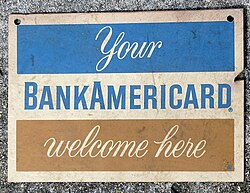
[[File:Old Bankamericard sign.jpg|left|thumb]] | [[File:Old Bankamericard sign.jpg|left|thumb]] | ||
One reason why most banks chose to join forces was that at the time, 16 states limited the ability of banks to operate through branch locations, while 15 states entirely prohibited branch banking and required unit banking.<ref name="Stearns5">{{cite book |last1=Stearns |first1=David L. |title=Electronic Value Exchange: Origins of the Visa Electronic Payment System |publisher=Springer |location=London |isbn=978-1-84996-138-7 |page=19|url=https://books.google.com/books?id=k2tTTBOImXMC&pg=PA19}} Available through SpringerLink.</ref> A unit bank can legally operate only at a single site and is thereby forced to remain very small.<ref name="Stearns5" /> By joining a regional bankcard association, a unit bank could quickly add a credit card to its lineup of financial products, and achieve [[economies of scale]] by outsourcing tedious [[back office]] tasks like card servicing to the association.<ref name="Stearns3" /> Such associations also enabled unit banks to aggregate their customer bases and merchant networks in order to make a credit card useful for both customers and merchants; early credit cards had failed because they could only be used within a small radius around their respective issuing banks.<ref name="Stearns5" /> | One reason why most banks chose to join forces was that at the time, 16 states limited the ability of banks to operate through branch locations, while 15 states entirely prohibited branch banking and required unit banking.<ref name="Stearns5">{{cite book |last1=Stearns |first1=David L. |title=Electronic Value Exchange: Origins of the Visa Electronic Payment System |date=2011 |publisher=Springer |location=London |isbn=978-1-84996-138-7 |page=19|url=https://books.google.com/books?id=k2tTTBOImXMC&pg=PA19}} Available through SpringerLink.</ref> A unit bank can legally operate only at a single site and is thereby forced to remain very small.<ref name="Stearns5" /> By joining a regional bankcard association, a unit bank could quickly add a credit card to its lineup of financial products, and achieve [[economies of scale]] by outsourcing tedious [[back office]] tasks like card servicing to the association.<ref name="Stearns3" /> Such associations also enabled unit banks to aggregate their customer bases and merchant networks in order to make a credit card useful for both customers and merchants; early credit cards had failed because they could only be used within a small radius around their respective issuing banks.<ref name="Stearns5" /> | ||
In 1966, Karl H. Hinke, an executive vice president at [[Marine Midland Bank]], asked representatives of several other banks to meet him in [[Buffalo, New York]].<ref name="Jennings">{{cite news |last1=Jennings |first1=Robert |title=Credit Card Industry to Salute Three Pioneers |work=American Banker |page=12}} Available through [[ProQuest]].</ref><ref name="Loomis">{{cite news |last1=Loomis |first1=Jay |title=MasterCard Turns 40 |work=The Journal News |page=C7}} Available through [[ProQuest]].</ref> | In 1966, Karl H. Hinke, an executive vice president at [[Marine Midland Bank]], asked representatives of several other banks to meet him in [[Buffalo, New York]].<ref name="Jennings">{{cite news |last1=Jennings |first1=Robert |title=Credit Card Industry to Salute Three Pioneers |work=American Banker |date=September 8, 1995 |page=12}} Available through [[ProQuest]].</ref><ref name="Loomis">{{cite news |last1=Loomis |first1=Jay |title=MasterCard Turns 40 |work=The Journal News |date=November 28, 2006 |page=C7}} Available through [[ProQuest]].</ref> Marine Midland had just launched its own regional bankcard in the [[Upstate New York]] market after Bank of America declined its request for a BankAmericard regional license on the basis that Marine Midland was too big.<ref name="AP_Hinke_Obituary">{{cite news |title=Karl H. Hinke, Pioneer Of The MasterCard |url=https://apnews.com/article/9b87e44211b3e52adf1462dc777859cf |access-date=28 November 2021 |agency=[[Associated Press|AP]] |date=December 24, 1990}}</ref> The result of the Buffalo meeting was that several banks and regional bankcard associations soon agreed to join forces as Interbankard, Inc.,<ref name="Jennings" /><ref name="Loomis" /> which then became the Interbank Card Association (ICA).<ref name="Stearns3" /> By the end of 1967, ICA had 150 members and Hinke became ICA's chairman.<ref name="AP_Hinke_Obituary" /> Bank of America eventually joined MasterCard as well.<ref name="AP_Hinke_Obituary" /> (In the 21st century, Bank of America would revive the BankAmericard brand name as a Mastercard credit card, which it remains today). | ||
The Interbank branding in 1966 initially consisted only of a small unobtrusive lowercase ''i'' inside a circle in the lower right-hand corner of the front of each Interbank card; the rest of the card design was the prerogative of each issuing bank.<ref name="Stearns4">{{cite book |last1=Stearns |first1=David L. |title=Electronic Value Exchange: Origins of the Visa Electronic Payment System |publisher=Springer |location=London |isbn=978-1-84996-138-7 |page=28|url=https://books.google.com/books?id=k2tTTBOImXMC&pg=PA28}} Available through SpringerLink.</ref> This tiny logo proved to be entirely unsatisfactory for creating nationwide [[brand awareness]] in order to compete against the established leader, BankAmericard.<ref name="Stearns4" /> In 1969, Interbank developed a new national brand, "Master Charge: The Interbank Card" by combining the two overlapping yellow and orange circles of the Western States Bankcard Association with the "Master Charge" name coined by the First National Bank of Louisville, Kentucky.<ref name="Stearns4" /> | The Interbank branding in 1966 initially consisted only of a small unobtrusive lowercase ''i'' inside a circle in the lower right-hand corner of the front of each Interbank card; the rest of the card design was the prerogative of each issuing bank.<ref name="Stearns4">{{cite book |last1=Stearns |first1=David L. |title=Electronic Value Exchange: Origins of the Visa Electronic Payment System |date=2011 |publisher=Springer |location=London |isbn=978-1-84996-138-7 |page=28|url=https://books.google.com/books?id=k2tTTBOImXMC&pg=PA28}} Available through SpringerLink.</ref> This tiny logo proved to be entirely unsatisfactory for creating nationwide [[brand awareness]] in order to compete against the established leader, BankAmericard.<ref name="Stearns4" /> In 1969, Interbank developed a new national brand, "Master Charge: The Interbank Card" by combining the two overlapping yellow and orange circles of the Western States Bankcard Association with the "Master Charge" name coined by the First National Bank of Louisville, Kentucky.<ref name="Stearns4" /> | ||
That same year, [[Citibank|First National City Bank]] joined Interbank and merged its proprietary [[The Everything Card|Everything Card]] with Master Charge. | That same year, [[Citibank|First National City Bank]] joined Interbank and merged its proprietary [[The Everything Card|Everything Card]] with Master Charge. | ||
| Line 82: | Line 81: | ||
In 1979, ''Master Charge: The Interbank Card'' was renamed ''MasterCard''.<ref name="fundinguniverse">{{cite web|url=http://www.fundinguniverse.com/company-histories/mastercard-international-inc-history/|title=History of MasterCard International Inc|publisher=Funding Universe|access-date=June 13, 2020}}</ref> | In 1979, ''Master Charge: The Interbank Card'' was renamed ''MasterCard''.<ref name="fundinguniverse">{{cite web|url=http://www.fundinguniverse.com/company-histories/mastercard-international-inc-history/|title=History of MasterCard International Inc|publisher=Funding Universe|access-date=June 13, 2020}}</ref> | ||
In 1983, MasterCard International Inc. became the first bank to use holograms as part of their card security.<ref>{{cite book |last1=Harper |first1=Gavin |title=Holography Projects for the Evil Genius |publisher=McGraw-Hill |isbn=978-0-07-162400-8 |page=4}}</ref> They acquired the Cirrus network of [[Automated teller machine|automated tellers]] in 1985.<ref>{{Cite web |title=Brand History |url=https://brand.mastercard.com/brandcenter/more-about-our-brands/brand-history.html |access-date=2022-10-14 |website=Mastercard Brand Center}}</ref> | In 1983, MasterCard International Inc. became the first bank to use holograms as part of their card security.<ref>{{cite book |last1=Harper |first1=Gavin |title=Holography Projects for the Evil Genius |date=July 12, 2010 |publisher=McGraw-Hill |isbn=978-0-07-162400-8 |page=4}}</ref> They acquired the Cirrus network of [[Automated teller machine|automated tellers]] in 1985.<ref>{{Cite web |title=Brand History |url=https://brand.mastercard.com/brandcenter/more-about-our-brands/brand-history.html |access-date=2022-10-14 |website=Mastercard Brand Center}}</ref> | ||
In 1997, MasterCard took over the Access card; the Access brand was then retired.{{Citation needed}} In 2002, MasterCard International merged with [[Europay International]], another large credit-card issuer association, of which Eurocard had become a part in 1992.<ref>{{cite web|url=https://www.banktech.com/payments/mastercard-and-europay-merge-to-form-a-global-payments-company/d/d-id/1288945.html|title=MasterCard And Europay Merge To Form a Global Payments Company|publisher=BankTech|access-date=June 13, 2020}}</ref> MasterCard became a Delaware in connection with the merger, as well as in anticipation of an IPO.<ref name=":0">{{Cite journal |last=Fleischer |first=Victor |title=The Mastercard IPO: Protecting the priceless brand |url=https://deliverypdf.ssrn.com/delivery.php?ID=684088071004066000097102111084003109026012051033042091108127096074073025068072109121101122062000122051045116004109024075077043057061084085004026089123113018096040089005080121079007004010009112123065095108119064120002125075081093110080127083121085&EXT=pdf&INDEX=TRUE |journal=Harvard Negotiation Law Review |via=SSRN}}</ref> | In 1997, MasterCard took over the Access card; the Access brand was then retired.{{Citation needed|date=April 2018}} In 2002, MasterCard International merged with [[Europay International]], another large credit-card issuer association, of which Eurocard had become a part in 1992.<ref>{{cite web|url=https://www.banktech.com/payments/mastercard-and-europay-merge-to-form-a-global-payments-company/d/d-id/1288945.html|title=MasterCard And Europay Merge To Form a Global Payments Company|publisher=BankTech|date=July 16, 2002|access-date=June 13, 2020}}</ref> MasterCard became a Delaware in connection with the merger, as well as in anticipation of an IPO.<ref name=":0">{{Cite journal |last=Fleischer |first=Victor |date=2006-03-08 |title=The Mastercard IPO: Protecting the priceless brand |url=https://deliverypdf.ssrn.com/delivery.php?ID=684088071004066000097102111084003109026012051033042091108127096074073025068072109121101122062000122051045116004109024075077043057061084085004026089123113018096040089005080121079007004010009112123065095108119064120002125075081093110080127083121085&EXT=pdf&INDEX=TRUE |journal=Harvard Negotiation Law Review |via=SSRN}}</ref> | ||
The company, which had been organized as a [[cooperative]] of banks, had an [[initial public offering]] on May 25, 2006, selling 95.5 million shares at $39 each.<ref>{{cite web |title=MasterCard IPO rises 40% from discounted price |url=http://www.marketwatch.com/story/mastercard-rallies-18-from-discounted-price |access-date=June 3, 2017 |publisher=[[MarketWatch]]}}</ref> The stock is traded on the [[New York Stock Exchange|NYSE]] under the symbol MA, with a market capitalization of $367.1 billion as of May 2021.<ref>{{cite web |title=Yahoo Finance |url=https://ca.finance.yahoo.com/quote/MA?p=MA&.tsrc=fin-srch |access-date=May 25, 2021 |publisher=Yahoo.com}}</ref> The deal was designed to maintain the value of the brand and minimise regulatory costs.<ref name=":0" /> | The company, which had been organized as a [[cooperative]] of banks, had an [[initial public offering]] on May 25, 2006, selling 95.5 million shares at $39 each.<ref>{{cite web |date=May 25, 2006 |title=MasterCard IPO rises 40% from discounted price |url=http://www.marketwatch.com/story/mastercard-rallies-18-from-discounted-price |access-date=June 3, 2017 |publisher=[[MarketWatch]]}}</ref> The stock is traded on the [[New York Stock Exchange|NYSE]] under the symbol MA, with a market capitalization of $367.1 billion as of May 2021.<ref>{{cite web |title=Yahoo Finance |url=https://ca.finance.yahoo.com/quote/MA?p=MA&.tsrc=fin-srch |access-date=May 25, 2021 |publisher=Yahoo.com}}</ref> The deal was designed to maintain the value of the brand and minimise regulatory costs.<ref name=":0" /> | ||
In August 2010, MasterCard Worldwide, as it had been rebranded, expanded its e-commerce offering with the acquisition of [[DataCash]], a UK-based payment processing and fraud/risk management provider.<ref>{{cite news|last=Spillane |first=Chris |title=MasterCard to Acquire DataCash for 333 Million Pounds |newspaper=Bloomberg.com |url=https://www.bloomberg.com/news/2010-08-19/mastercard-buys-datacash-for-517-million-after-court-accord-shares-jump.html |publisher=[[Bloomberg L.P.|Bloomberg]] |access-date=March 7, 2012}}</ref><ref>{{cite news |last=Farrell |first=Sean |title=MasterCard pays £333m for British online payments firm DataCash |url=https://www.independent.co.uk/news/business/news/mastercard-pays-163333m-for-british-online-payments-firm-datacash-2057346.html |newspaper=[[The Independent]] |location=London |access-date=March 7, 2012 |archive-date=November 30, 2018 |archive-url=https://web.archive.org/web/20181130052414/https://www.independent.co.uk/news/business/news/mastercard-pays-163333m-for-british-online-payments-firm-datacash-2057346.html |url-status=dead }}</ref> In March 2012, MasterCard announced the expansion of its mobile contactless payments program, including markets across the Middle East.<ref>{{cite web|author=Rima Ali Al Mashni |title=QNB Group, Qtel, Oberthur and MasterCard introduce first mobile Near Field Communication payments program in Qatar |url=http://www.ameinfo.com/292567.html |publisher=[[AMEinfo.com]] |access-date=March 7, 2012 |archive-url=https://web.archive.org/web/20120309224815/http://www.ameinfo.com/292567.html |archive-date=March 9, 2012 |url-status=dead }}</ref> | In August 2010, MasterCard Worldwide, as it had been rebranded, expanded its e-commerce offering with the acquisition of [[DataCash]], a UK-based payment processing and fraud/risk management provider.<ref>{{cite news|last=Spillane |first=Chris |date=August 19, 2010 |title=MasterCard to Acquire DataCash for 333 Million Pounds |newspaper=Bloomberg.com |url=https://www.bloomberg.com/news/2010-08-19/mastercard-buys-datacash-for-517-million-after-court-accord-shares-jump.html |publisher=[[Bloomberg L.P.|Bloomberg]] |access-date=March 7, 2012}}</ref><ref>{{cite news |last=Farrell |first=Sean |date=August 19, 2010 |title=MasterCard pays £333m for British online payments firm DataCash |url=https://www.independent.co.uk/news/business/news/mastercard-pays-163333m-for-british-online-payments-firm-datacash-2057346.html |newspaper=[[The Independent]] |location=London |access-date=March 7, 2012 |archive-date=November 30, 2018 |archive-url=https://web.archive.org/web/20181130052414/https://www.independent.co.uk/news/business/news/mastercard-pays-163333m-for-british-online-payments-firm-datacash-2057346.html |url-status=dead}}</ref> In March 2012, MasterCard announced the expansion of its mobile contactless payments program, including markets across the Middle East.<ref>{{cite web|author=Rima Ali Al Mashni |date=March 7, 2012 |title=QNB Group, Qtel, Oberthur and MasterCard introduce first mobile Near Field Communication payments program in Qatar |url=http://www.ameinfo.com/292567.html |publisher=[[AMEinfo.com]] |access-date=March 7, 2012 |archive-url=https://web.archive.org/web/20120309224815/http://www.ameinfo.com/292567.html |archive-date=March 9, 2012 |url-status=dead}}</ref> | ||
In spring 2014, MasterCard acquired Australia's leading rewards program manager company Pinpoint for an undisclosed amount.<ref>{{cite web|url=http://news.biharprabha.com/2014/04/mastercard-to-acquire-business-reward-services-provider-pinpoint/ |title=Mastercard to acquire Business Reward Services Provider Pinpoint |publisher=Biharprabha.com |access-date=April 17, 2014}}</ref> In August 2017, Mastercard acquired Brighterion, a company with a portfolio of intellectual property in the areas of artificial intelligence and machine learning.<ref>{{cite web|url=https://newsroom.mastercard.com/press-releases/mastercard-enhances-artificial-intelligence-capability-with-the-acquisition-of-brighterion-inc-2/|title=Mastercard Enhances Artificial Intelligence Capability with the Acquisition of Brighterion, Inc. – Global Hub|website=newsroom.mastercard.com|access-date=September 23, 2017}}</ref> Brighterion holds several [[patent]]s.<ref>{{cite web | title=Patents by Assignee Brighterion, Inc. | website=Justia Patents Search | date=August 7, 2017 | url=https://patents.justia.com/assignee/brighterion-inc | access-date=September 23, 2017}}</ref> | In spring 2014, MasterCard acquired Australia's leading rewards program manager company Pinpoint for an undisclosed amount.<ref>{{cite web|url=http://news.biharprabha.com/2014/04/mastercard-to-acquire-business-reward-services-provider-pinpoint/ |title=Mastercard to acquire Business Reward Services Provider Pinpoint |publisher=Biharprabha.com |date=April 17, 2014 |access-date=April 17, 2014}}</ref> In August 2017, Mastercard acquired Brighterion, a company with a portfolio of intellectual property in the areas of artificial intelligence and machine learning.<ref>{{cite web|url=https://newsroom.mastercard.com/press-releases/mastercard-enhances-artificial-intelligence-capability-with-the-acquisition-of-brighterion-inc-2/|title=Mastercard Enhances Artificial Intelligence Capability with the Acquisition of Brighterion, Inc. – Global Hub|website=newsroom.mastercard.com|access-date=September 23, 2017|archive-date=November 29, 2020|archive-url=https://web.archive.org/web/20201129134531/https://newsroom.mastercard.com/press-releases/mastercard-enhances-artificial-intelligence-capability-with-the-acquisition-of-brighterion-inc-2/|url-status=dead}}</ref> Brighterion holds several [[patent]]s.<ref>{{cite web |title=Patents by Assignee Brighterion, Inc. |website=Justia Patents Search |date=August 7, 2017 |url=https://patents.justia.com/assignee/brighterion-inc |access-date=September 23, 2017}}</ref> | ||
In April 2021, Mastercard created a calculator that gathers information and measures the carbon footprints of the customers in order to help them know how much they are contributing in carbon emissions and global warming.<ref>{{cite news|author=Alexis Benveniste|title=Mastercard launches carbon calculator in its latest attempt to go green|url=https://www.cnn.com/2021/04/12/business/mastercard-carbon-calculator/index.html|access-date=2021-04-12|website=CNN}}</ref> | In April 2021, Mastercard created a calculator that gathers information and measures the carbon footprints of the customers in order to help them know how much they are contributing in carbon emissions and global warming.<ref>{{cite news|author=Alexis Benveniste|title=Mastercard launches carbon calculator in its latest attempt to go green|url=https://www.cnn.com/2021/04/12/business/mastercard-carbon-calculator/index.html|access-date=2021-04-12|website=CNN}}</ref> | ||
Following the [[2022 Russian invasion of Ukraine]], Mastercard complied with United States sanctions and banned cards from being issued or used in Russia, including foreign cards from other countries.<ref>{{cite web |last1=Ponnezhath |first1=Maria |title=Visa, Mastercard block Russian financial institutions after sanctions |url=https://www.reuters.com/business/mastercard-blocks-multiple-russian-financial-institutions-network-2022-03-01/ |access-date=6 March 2022 |website=Reuters |language=en}}</ref> Mastercard suspended all business operations in [[Russia]], which had accounted for 4% of their revenue.<ref>{{cite news |last=Paybarah |first=Azi |title=Mastercard and Visa suspend operations in Russia |work=[[The New York Times]] |url=https://www.nytimes.com/2022/03/05/world/europe/mastercard-visa-suspend-operations-russia.html |access-date=March 6, 2022}}</ref> However, bank cards themselves continue to work in Russia due to the transfer of internal transactions to the [[Russian National Card Payment System]]''.'' | Following the [[2022 Russian invasion of Ukraine]], Mastercard complied with United States sanctions and banned cards from being issued or used in Russia, including foreign cards from other countries.<ref>{{cite web |last1=Ponnezhath |first1=Maria |date=1 March 2022 |title=Visa, Mastercard block Russian financial institutions after sanctions |url=https://www.reuters.com/business/mastercard-blocks-multiple-russian-financial-institutions-network-2022-03-01/ |access-date=6 March 2022 |website=Reuters |language=en}}</ref> Mastercard suspended all business operations in [[Russia]], which had accounted for 4% of their revenue.<ref>{{cite news |last=Paybarah |first=Azi |date=March 5, 2022 |title=Mastercard and Visa suspend operations in Russia |work=[[The New York Times]] |url=https://www.nytimes.com/2022/03/05/world/europe/mastercard-visa-suspend-operations-russia.html |access-date=March 6, 2022}}</ref> However, bank cards themselves continue to work in Russia due to the transfer of internal transactions to the [[Russian National Card Payment System]]''.'' | ||
=== Finances === | === Finances === | ||
| Line 213: | Line 212: | ||
|29,900 | |29,900 | ||
|} | |} | ||
As of 2020, Mastercard ranked 191 on the [[Fortune 500|''Fortune'' 500]] list of the largest United States corporations by revenue.<ref>{{cite web|title=Fortune 500|url=https://fortune.com/fortune500/2020/search/?name=mastercard | As of 2020, Mastercard ranked 191 on the [[Fortune 500|''Fortune'' 500]] list of the largest United States corporations by revenue.<ref>{{cite web|title=Fortune 500|url=https://fortune.com/fortune500/2020/search/?name=mastercard|access-date=May 21, 2021|website=Fortune|language=en-US}}</ref> | ||
== Market power == | == Market power == | ||
| Line 221: | Line 220: | ||
===United States=== | ===United States=== | ||
Mastercard, along with Visa, engaged in systematic parallel exclusion against [[American Express]] during the 1980s and 1990s. Mastercard used exclusivity clauses in its contracts and blacklists to prevent banks from doing business with American Express. Such exclusionary clauses and other written evidence were used by the United States Department of Justice in regulatory actions against Mastercard and Visa.<ref name="NYO">[http://www.newyorker.com/online/blogs/elements/2013/04/tmobile-verizon-monopoly-oligopoly-business-practices.html T-Mobile, Wireless Carriers, and the Way to Fight Oligopolies]. The New Yorker. Retrieved on October 30, 2013.</ref> [[Discover Financial|Discover]] has sued Mastercard for similar issues.<ref name="Unfair">{{cite news |title=Credit Card Market Is Unfair, Noncompetitive |first=Mallory |last=Duncan |newspaper=Roll Call }}</ref> | Mastercard, along with Visa, engaged in systematic parallel exclusion against [[American Express]] during the 1980s and 1990s. Mastercard used exclusivity clauses in its contracts and blacklists to prevent banks from doing business with American Express. Such exclusionary clauses and other written evidence were used by the United States Department of Justice in regulatory actions against Mastercard and Visa.<ref name="NYO">[http://www.newyorker.com/online/blogs/elements/2013/04/tmobile-verizon-monopoly-oligopoly-business-practices.html T-Mobile, Wireless Carriers, and the Way to Fight Oligopolies]. The New Yorker. Retrieved on October 30, 2013.</ref> [[Discover Financial|Discover]] has sued Mastercard for similar issues.<ref name="Unfair">{{cite news |title=Credit Card Market Is Unfair, Noncompetitive |first=Mallory |last=Duncan |newspaper=Roll Call |date=July 10, 2012}}</ref> | ||
Both Mastercard and Visa have paid approximately $3 billion in damages resulting from a [[Class action|class-action lawsuit]] filed in January 1996 for debit card swipe fee price fixing.<ref>[http://www.hagens-berman.com/visa_mastercard_lawsuit Visa/MasterCard Litigation] {{webarchive|url=https://web.archive.org/web/20090426082748/http://www.hagens-berman.com/visa_mastercard_lawsuit}}, January 1, 1996</ref> The litigation cites several retail giants as plaintiffs, including [[Walmart|Wal-Mart]], [[Sears Holdings|Sears, Roebuck & Co.]], and [[Safeway Inc.|Safeway]].<ref>[http://www.inrevisacheckmastermoneyantitrustlitigation.com/ www.inrevisacheckmastermoneyantitrustlitigation.com] {{webarchive|url=https://web.archive.org/web/20130809212213/http://inrevisacheckmastermoneyantitrustlitigation.com/}}. Retrieved July 13, 2011.</ref> | Both Mastercard and Visa have paid approximately $3 billion in damages resulting from a [[Class action|class-action lawsuit]] filed in January 1996 for debit card swipe fee price fixing.<ref>[http://www.hagens-berman.com/visa_mastercard_lawsuit Visa/MasterCard Litigation] {{webarchive|url=https://web.archive.org/web/20090426082748/http://www.hagens-berman.com/visa_mastercard_lawsuit|date=April 26, 2009}}, January 1, 1996.</ref> The litigation cites several retail giants as plaintiffs, including [[Walmart|Wal-Mart]], [[Sears Holdings|Sears, Roebuck & Co.]], and [[Safeway Inc.|Safeway]].<ref>[http://www.inrevisacheckmastermoneyantitrustlitigation.com/ www.inrevisacheckmastermoneyantitrustlitigation.com] {{webarchive|url=https://web.archive.org/web/20130809212213/http://inrevisacheckmastermoneyantitrustlitigation.com/|date=August 9, 2013}}. Retrieved July 13, 2011.</ref> | ||
In 1996, about 4 million merchants sued Mastercard in federal court for making them accept debit cards if they wanted to accept credit cards and dramatically increasing credit card swipe fees. This case was settled with a multibillion-dollar payment in 2003. This was the largest antitrust award in history.<ref name="Unfair" /> | In 1996, about 4 million merchants sued Mastercard in federal court for making them accept debit cards if they wanted to accept credit cards and dramatically increasing credit card swipe fees. This case was settled with a multibillion-dollar payment in 2003. This was the largest antitrust award in history.<ref name="Unfair" /> | ||
| Line 231: | Line 230: | ||
On August 23, 2001, Mastercard International Inc. was sued for violating the Florida Deceptive and Unfair Trade Practices Act.<ref>{{cite web|url=http://www.weil.com/industries/TransactionDetail.aspx?experience=14902&service=1913/|title=Joshua Rubin and Joseph Phillips et al. v. MasterCard International, LLC|access-date=August 8, 2021|archive-date=July 10, 2018|archive-url=https://web.archive.org/web/20180710102131/https://www.weil.com/404?item=%2Findustries%2Ftransactiondetail&user=extranet%5CAnonymous&site=WeilUS|url-status=dead}}</ref> | On August 23, 2001, Mastercard International Inc. was sued for violating the Florida Deceptive and Unfair Trade Practices Act.<ref>{{cite web|url=http://www.weil.com/industries/TransactionDetail.aspx?experience=14902&service=1913/|title=Joshua Rubin and Joseph Phillips et al. v. MasterCard International, LLC|access-date=August 8, 2021|archive-date=July 10, 2018|archive-url=https://web.archive.org/web/20180710102131/https://www.weil.com/404?item=%2Findustries%2Ftransactiondetail&user=extranet%5CAnonymous&site=WeilUS|url-status=dead}}</ref> | ||
On November 15, 2004, Mastercard Inc. paid damages to [[American Express]], due to anticompetitive practices that prevented American Express from issuing cards through U.S. banks,<ref>{{cite web |url=http://www.nbcnews.com/id/6494456/ns/business-us_business/t/american-express-sues-visa-mastercard/ |title= American Express sues Visa, MasterCard |website= [[NBC News]] }}</ref> and paid $1.8 billion for settlement.<ref>{{Cite news|last1=Dash|first1=Eric|title=MasterCard Will Pay $1.8 Billion to American Express|journal=The New York Times|url=https://www.nytimes.com/2008/06/26/business/26credit.html?_r=0|access-date=February 10, 2015}}</ref> | On November 15, 2004, Mastercard Inc. paid damages to [[American Express]], due to anticompetitive practices that prevented American Express from issuing cards through U.S. banks,<ref>{{cite web |url=http://www.nbcnews.com/id/6494456/ns/business-us_business/t/american-express-sues-visa-mastercard/ |title= American Express sues Visa, MasterCard |website= [[NBC News]] |date= November 15, 2004}}</ref> and paid $1.8 billion for settlement.<ref>{{Cite news|last1=Dash|first1=Eric|title=MasterCard Will Pay $1.8 Billion to American Express|journal=The New York Times|url=https://www.nytimes.com/2008/06/26/business/26credit.html?_r=0|access-date=February 10, 2015|date=June 26, 2008}}</ref> | ||
==== Swipe fee fixing and merchant discount bans ==== | ==== Swipe fee fixing and merchant discount bans ==== | ||
{{main article|Payment card interchange fee and merchant discount antitrust litigation}} | {{main article|Payment card interchange fee and merchant discount antitrust litigation}} | ||
On November 27, 2012, a federal judge entered an order granting preliminary approval to a proposed settlement to a class-action lawsuit<ref>{{cite web |title=Class Settlement Preliminary Approval Order pg.11 |url=https://www.paymentcardsettlement.com/Content/Documents/signed%20prelim%20approval%20order.pdf |access-date=July 9, 2019 |work=[[United States District Court for the Eastern District of New York|U.S. District Court]] |archive-url=https://web.archive.org/web/20200803181431/https://www.paymentcardsettlement.com/Content/Documents/signed%20prelim%20approval%20order.pdf |archive-date=August 3, 2020 |url-status=live }}</ref> filed in 2005 by merchants and trade associations against Mastercard and Visa. The suit was filed due to alleged price-fixing practices employed by Mastercard and Visa. About one-fourth of the named class plaintiffs have decided to opt-out of the settlement. Opponents object to provisions that would bar future lawsuits and prevent merchants from opting out of significant portions of the proposed settlement.<ref name="MasterCard">{{cite web |last=Longstreth |first=Andrew |title=Judge approves credit card swipe fee settlement |url=https://www.nbcnews.com/businessmain/judge-approves-credit-card-swipe-fee-settlement-2D11741836 |access-date=July 9, 2019 |work=[[NBC News]]}}</ref> | On November 27, 2012, a federal judge entered an order granting preliminary approval to a proposed settlement to a class-action lawsuit<ref>{{cite web |date=November 27, 2012 |title=Class Settlement Preliminary Approval Order pg.11 |url=https://www.paymentcardsettlement.com/Content/Documents/signed%20prelim%20approval%20order.pdf |access-date=July 9, 2019 |work=[[United States District Court for the Eastern District of New York|U.S. District Court]] |archive-url=https://web.archive.org/web/20200803181431/https://www.paymentcardsettlement.com/Content/Documents/signed%20prelim%20approval%20order.pdf |archive-date=August 3, 2020 |url-status=live}}</ref> filed in 2005 by merchants and trade associations against Mastercard and Visa. The suit was filed due to alleged price-fixing practices employed by Mastercard and Visa. About one-fourth of the named class plaintiffs have decided to opt-out of the settlement. Opponents object to provisions that would bar future lawsuits and prevent merchants from opting out of significant portions of the proposed settlement.<ref name="MasterCard">{{cite web |last=Longstreth |first=Andrew |date=December 13, 2013 |title=Judge approves credit card swipe fee settlement |url=https://www.nbcnews.com/businessmain/judge-approves-credit-card-swipe-fee-settlement-2D11741836 |access-date=July 9, 2019 |work=[[NBC News]]}}</ref> | ||
Plaintiffs allege that [[Visa Inc.]] and Mastercard fixed [[interchange fee]]s, also known as swipe fees, that are charged to merchants for the privilege of accepting payment cards. In their complaint, the plaintiffs also alleged that the defendants unfairly interfere with merchants from encouraging customers to use less expensive forms of payment such as lower-cost cards, cash, and checks.<ref name="MasterCard" /> | Plaintiffs allege that [[Visa Inc.]] and Mastercard fixed [[interchange fee]]s, also known as swipe fees, that are charged to merchants for the privilege of accepting payment cards. In their complaint, the plaintiffs also alleged that the defendants unfairly interfere with merchants from encouraging customers to use less expensive forms of payment such as lower-cost cards, cash, and checks.<ref name="MasterCard" /> | ||
A settlement of $6.24 billion got preliminary approval in November, 2019.<ref>{{cite web |title=Visa, Mastercard $6.24B settlement gets preliminary okay from court |url=https://seekingalpha.com/news/3436264-visa-mastercard-6_24b-settlement-gets-preliminary-okay-court |access-date=July 9, 2019 |work=[[Seeking Alpha]]}}</ref> A settlement of $5.54B was approved in 2019. Certain merchants appealed the settlement and were heard. The case is ongoing {{As of|2022|10|lc=y}}.<ref>{{Cite web |title=Payment Card Interchange Fee Settlement |url=https://www.paymentcardsettlement.com/en |access-date=2022-10-14 |website=paymentcardsettlement.com}}</ref> | A settlement of $6.24 billion got preliminary approval in November, 2019.<ref>{{cite web |date=February 22, 2019 |title=Visa, Mastercard $6.24B settlement gets preliminary okay from court |url=https://seekingalpha.com/news/3436264-visa-mastercard-6_24b-settlement-gets-preliminary-okay-court |access-date=July 9, 2019 |work=[[Seeking Alpha]]}}</ref> A settlement of $5.54B was approved in 2019. Certain merchants appealed the settlement and were heard. The case is ongoing {{As of|2022|10|lc=y}}.<ref>{{Cite web |title=Payment Card Interchange Fee Settlement |url=https://www.paymentcardsettlement.com/en |access-date=2022-10-14 |website=paymentcardsettlement.com}}</ref> | ||
==== Antitrust settlement with U.S. Justice Department ==== | ==== Antitrust settlement with U.S. Justice Department ==== | ||
In October 2010, Mastercard and Visa reached a settlement with the [[United States Department of Justice|U.S. Justice Department]] in another antitrust case. The companies agreed to allow merchants displaying their logos to decline certain types of cards (because [[interchange fee]]s differ), or to offer consumers discounts for using cheaper cards.<ref>Vanek, Stacey. (October 4, 2010) [http://marketplace.publicradio.org/display/web/2010/10/04/pm-visa-mastercard-settlement-means-more-flexibility-for-retailers/ Visa, Mastercard settlement means more flexibility for merchants | Marketplace From American Public Media] {{webarchive|url=https://web.archive.org/web/20110727192417/http://marketplace.publicradio.org/display/web/2010/10/04/pm-visa-mastercard-settlement-means-more-flexibility-for-retailers/}}. marketplace.publicradio.org. Retrieved July 13, 2011.</ref> | In October 2010, Mastercard and Visa reached a settlement with the [[United States Department of Justice|U.S. Justice Department]] in another antitrust case. The companies agreed to allow merchants displaying their logos to decline certain types of cards (because [[interchange fee]]s differ), or to offer consumers discounts for using cheaper cards.<ref>Vanek, Stacey. (October 4, 2010) [http://marketplace.publicradio.org/display/web/2010/10/04/pm-visa-mastercard-settlement-means-more-flexibility-for-retailers/ Visa, Mastercard settlement means more flexibility for merchants | Marketplace From American Public Media] {{webarchive|url=https://web.archive.org/web/20110727192417/http://marketplace.publicradio.org/display/web/2010/10/04/pm-visa-mastercard-settlement-means-more-flexibility-for-retailers/|date=July 27, 2011}}. marketplace.publicradio.org. Retrieved July 13, 2011.</ref> | ||
==== ATM operators ==== | ==== ATM operators ==== | ||
Mastercard, along with [[Visa Inc.|Visa]], has been sued in a class action by ATM operators that claim the credit card networks' rules effectively fix ATM access fees. The suit claims that this is a [[restraint of trade]] in violation of federal law. The lawsuit was filed by the National ATM Council and independent operators of automated teller machines. More specifically, it is alleged that Mastercard's and Visa's network rules prohibit ATM operators from offering lower prices for transactions over PIN-debit networks that are not affiliated with Visa or Mastercard. The suit says that this price-fixing artificially raises the price that consumers pay using ATMs, limits the revenue that ATM operators earn, and violates the [[Sherman Antitrust Act|Sherman Act]]'s prohibition against unreasonable restraints of trade. Johnathan Rubin, an attorney for the plaintiffs said, "Visa and Mastercard are the ringleaders, organizers, and enforcers of a conspiracy among U.S. banks to fix the price of ATM access fees in order to keep the competition at bay."<ref name="ATM">{{cite press release |title=ATM Operators File Antitrust Lawsuit Against Visa and MasterCard |publisher=PR Newswire |url=https://www.prnewswire.com/news-releases/atm-operators-file-antitrust-lawsuit-against-visa-and-mastercard-131605078.html}}</ref> | Mastercard, along with [[Visa Inc.|Visa]], has been sued in a class action by ATM operators that claim the credit card networks' rules effectively fix ATM access fees. The suit claims that this is a [[restraint of trade]] in violation of federal law. The lawsuit was filed by the National ATM Council and independent operators of automated teller machines. More specifically, it is alleged that Mastercard's and Visa's network rules prohibit ATM operators from offering lower prices for transactions over PIN-debit networks that are not affiliated with Visa or Mastercard. The suit says that this price-fixing artificially raises the price that consumers pay using ATMs, limits the revenue that ATM operators earn, and violates the [[Sherman Antitrust Act|Sherman Act]]'s prohibition against unreasonable restraints of trade. Johnathan Rubin, an attorney for the plaintiffs said, "Visa and Mastercard are the ringleaders, organizers, and enforcers of a conspiracy among U.S. banks to fix the price of ATM access fees in order to keep the competition at bay."<ref name="ATM">{{cite press release |title=ATM Operators File Antitrust Lawsuit Against Visa and MasterCard |date=October 12, 2011 |publisher=PR Newswire |url=https://www.prnewswire.com/news-releases/atm-operators-file-antitrust-lawsuit-against-visa-and-mastercard-131605078.html}}</ref> | ||
=== Oceania === | === Oceania === | ||
In 2003, the [[Reserve Bank of Australia]] required that interchange fees be dramatically reduced, from about 0.95% of the transaction to approximately 0.5%.{{Citation needed}} One notable result has been the reduced use of [[Loyalty program|reward cards]] and increased use of debit cards. Australia also prohibited the no surcharge rule, a policy established by credit card networks like Visa and Mastercard to prevent merchants from charging a credit card usage fee to the cardholder. A surcharge would mitigate or even exceed the merchant discount paid by a merchant, but would also make the cardholder more reluctant to use the card as the method of payment. Australia has also made changes to the interchange rates on debit cards and has considered abolishing interchange fees altogether. | In 2003, the [[Reserve Bank of Australia]] required that interchange fees be dramatically reduced, from about 0.95% of the transaction to approximately 0.5%.{{Citation needed|date=February 2011}} One notable result has been the reduced use of [[Loyalty program|reward cards]] and increased use of debit cards. Australia also prohibited the no surcharge rule, a policy established by credit card networks like Visa and Mastercard to prevent merchants from charging a credit card usage fee to the cardholder. A surcharge would mitigate or even exceed the merchant discount paid by a merchant, but would also make the cardholder more reluctant to use the card as the method of payment. Australia has also made changes to the interchange rates on debit cards and has considered abolishing interchange fees altogether. | ||
As of November 2006, [[New Zealand]] was considering similar actions, following a [[Crown entity|Commerce Commission]] lawsuit alleging price-fixing by Visa and Mastercard. In New Zealand, merchants pay a 1.8% fee on every credit card transaction.{{Citation needed}} | As of November 2006, [[New Zealand]] was considering similar actions, following a [[Crown entity|Commerce Commission]] lawsuit alleging price-fixing by Visa and Mastercard. In New Zealand, merchants pay a 1.8% fee on every credit card transaction.{{Citation needed|date=February 2020}} | ||
=== Europe === | === Europe === | ||
The [[European Union]] has repeatedly criticized Mastercard for monopolistic trade practices. In April 2009, Mastercard reached a settlement with the European Union in an antitrust case, promising to reduce debit card swipe fees to 0.2 percent of purchases.<ref>{{cite press release |title=Antitrust: Commissioner Kroes takes note of MasterCard's decision to cut cross-border Multilateral Interchange Fees (MIFs) and to repeal recent scheme fee increases |url=https://ec.europa.eu/commission/presscorner/detail/en/IP_09_515 |website=[[European Commission]] |access-date=September 27, 2020 }}</ref> In December 2010, a senior official from the European Central Bank called for a break-up of the Visa/Mastercard duopoly by the creation of a new European debit card for use in the [[Single Euro Payments Area]] (SEPA).<ref>{{cite web|url=http://www.forexhound.com/article/Central_Banks/ECB_Publications/ECB_SEPA_a_busy_year_is_coming_to_its_end_and_another_exciting_year_lies_ahead/258060/|title=Forexhound.com|access-date=December 12, 2010|archive-date=October 7, 2020|archive-url=https://web.archive.org/web/20201007223505/http://www.forexhound.com/|url-status=dead}}</ref> | The [[European Union]] has repeatedly criticized Mastercard for monopolistic trade practices. In April 2009, Mastercard reached a settlement with the European Union in an antitrust case, promising to reduce debit card swipe fees to 0.2 percent of purchases.<ref>{{cite press release |title=Antitrust: Commissioner Kroes takes note of MasterCard's decision to cut cross-border Multilateral Interchange Fees (MIFs) and to repeal recent scheme fee increases |url=https://ec.europa.eu/commission/presscorner/detail/en/IP_09_515 |website=[[European Commission]] |access-date=September 27, 2020 |date=April 1, 2009}}</ref> In December 2010, a senior official from the European Central Bank called for a break-up of the Visa/Mastercard duopoly by the creation of a new European debit card for use in the [[Single Euro Payments Area]] (SEPA).<ref>{{cite web |url=http://www.forexhound.com/article/Central_Banks/ECB_Publications/ECB_SEPA_a_busy_year_is_coming_to_its_end_and_another_exciting_year_lies_ahead/258060/ |title=Forexhound.com|access-date=December 12, 2010 |archive-date=October 7, 2020 |archive-url=https://web.archive.org/web/20201007223505/http://www.forexhound.com/ |url-status=dead}}</ref> | ||
[[WikiLeaks]] published documents showing that American authorities lobbied [[Russia]] to defend the interests of Visa and Mastercard.<ref>{{cite web|url=https://www.lepoint.fr/monde/wikileaks-en-russie-visa-et-mastercard-au-coeur-de-troublantes-revelations-08-12-2010-1272689_24.php|title=WIKILEAKS – En Russie, Visa et Mastercard au coeur de troublantes révélations|first=Pauline de Saint|last=Remy|website=Le Point}}</ref><ref>{{Cite web |title=WikiLeaks cables: US "lobbied Russia on behalf of Visa and MasterCard" |url=http://www.theguardian.com/world/2010/dec/08/wikileaks-us-russia-visa-mastercard |access-date=2022-11-13 |website=the Guardian |language=en}}</ref> In response Mastercard blocked payments to WikiLeaks. Members of the [[European Parliament]] expressed concern that payments from European citizens to a European corporation could apparently be blocked by the United States, and called for a further reduction in the dominance of Visa and Mastercard in the European payment system.<ref>{{cite news |last1=Dekker |first1=Vincent |title=Zorgen over dominantie Visa en Mastercard in Europa |trans-title=Concerns about Visa and Mastercard dominance in Europe |url=http://www.trouw.nl/nieuws/media-technologie/article3332240.ece/Zorgen_over_dominantie_Visa_en_Mastercard_in_Europa.html/ |access-date=April 14, 2022 |work=[[Trouw]] |archive-url=https://web.archive.org/web/20110817022607/http://www.trouw.nl/tr/nl/4324/Nieuws/article/detail/1800653/2010/12/09/Zorgen-over-dominantie-Visa-en-Mastercard-in-Europa.dhtml |archive-date=August 17, 2011 |language=nl}}</ref> | [[WikiLeaks]] published documents showing that American authorities lobbied [[Russia]] to defend the interests of Visa and Mastercard.<ref>{{cite web|url=https://www.lepoint.fr/monde/wikileaks-en-russie-visa-et-mastercard-au-coeur-de-troublantes-revelations-08-12-2010-1272689_24.php|title=WIKILEAKS – En Russie, Visa et Mastercard au coeur de troublantes révélations|first=Pauline de Saint|last=Remy|date=December 8, 2010|website=Le Point}}</ref><ref>{{Cite web |date=2010-12-08 |title=WikiLeaks cables: US "lobbied Russia on behalf of Visa and MasterCard" |url=http://www.theguardian.com/world/2010/dec/08/wikileaks-us-russia-visa-mastercard |access-date=2022-11-13 |website=the Guardian |language=en}}</ref> In response Mastercard blocked payments to WikiLeaks. Members of the [[European Parliament]] expressed concern that payments from European citizens to a European corporation could apparently be blocked by the United States, and called for a further reduction in the dominance of Visa and Mastercard in the European payment system.<ref>{{cite news |last1=Dekker |first1=Vincent |title=Zorgen over dominantie Visa en Mastercard in Europa |trans-title=Concerns about Visa and Mastercard dominance in Europe |url=http://www.trouw.nl/nieuws/media-technologie/article3332240.ece/Zorgen_over_dominantie_Visa_en_Mastercard_in_Europa.html/ |access-date=April 14, 2022 |work=[[Trouw]] |date=December 9, 2010 |archive-url=https://web.archive.org/web/20110817022607/http://www.trouw.nl/tr/nl/4324/Nieuws/article/detail/1800653/2010/12/09/Zorgen-over-dominantie-Visa-en-Mastercard-in-Europa.dhtml |archive-date=August 17, 2011 |language=nl}}</ref> | ||
In 2013, Mastercard was under investigation by the European Union for the high fees it charged merchants to accept cards issued outside the EU, compared to cards issued in the EU, as well as other anti-competitive practices that could hinder electronic commerce and international trade, and high fees associated with premium credit cards. The EU's competition regulator said that these fees were of special concern because of the growing role of non-cash payments. Mastercard was banned from charging fees on cross-border transactions conducted wholly within the EU via a ruling by the European Commission in 2007.<ref name="Euro">{{cite news |last1=Chee |first1=Foo Yun |title=MasterCard under EU fire over payment card fees |url=http://www.foxbusiness.com/news/2013/04/09/mastercard-under-eu-fire-over-payment-card-fees/ |access-date=September 27, 2020 |work=[[Fox Business]] |agency=[[Reuters]] |archive-url=https://archive.today/20130629074634/http://www.foxbusiness.com/news/2013/04/09/mastercard-under-eu-fire-over-payment-card-fees/ |archive-date=June 29, 2013 |url-status=dead}}</ref>{{cbignore|bot=InternetArchiveBot}} The European Commission said that their investigation also included large differences in fees across national borders. For instance, a €50 payment might cost €0.10 in the Netherlands but eight times that amount in Poland. The Commission argues that Mastercard rules that prohibit merchants from enjoying better terms offered in other EU countries may be against antitrust law. | In 2013, Mastercard was under investigation by the European Union for the high fees it charged merchants to accept cards issued outside the EU, compared to cards issued in the EU, as well as other anti-competitive practices that could hinder electronic commerce and international trade, and high fees associated with premium credit cards. The EU's competition regulator said that these fees were of special concern because of the growing role of non-cash payments. Mastercard was banned from charging fees on cross-border transactions conducted wholly within the EU via a ruling by the European Commission in 2007.<ref name="Euro">{{cite news |last1=Chee |first1=Foo Yun |title=MasterCard under EU fire over payment card fees |url=http://www.foxbusiness.com/news/2013/04/09/mastercard-under-eu-fire-over-payment-card-fees/ |access-date=September 27, 2020 |work=[[Fox Business]] |agency=[[Reuters]] |date=April 9, 2013 |archive-url=https://archive.today/20130629074634/http://www.foxbusiness.com/news/2013/04/09/mastercard-under-eu-fire-over-payment-card-fees/ |archive-date=June 29, 2013 |url-status=dead}}</ref>{{cbignore|bot=InternetArchiveBot}} The European Commission said that their investigation also included large differences in fees across national borders. For instance, a €50 payment might cost €0.10 in the Netherlands but eight times that amount in Poland. The Commission argues that Mastercard rules that prohibit merchants from enjoying better terms offered in other EU countries may be against antitrust law. | ||
The [[The European Consumer Organisation|European Consumer Organisation]] (BEUC) praised the action against Mastercard. BEUC said interbank fees push up prices and hurt consumers. BEUC Director General Monique Goyens said, "So in the end, all consumers are hit by a scheme which ultimately rewards the card company and issuing bank."<ref name="Euro" /> | The [[The European Consumer Organisation|European Consumer Organisation]] (BEUC) praised the action against Mastercard. BEUC said interbank fees push up prices and hurt consumers. BEUC Director General Monique Goyens said, "So in the end, all consumers are hit by a scheme which ultimately rewards the card company and issuing bank."<ref name="Euro" /> | ||
In January 2019, the European Commission imposed an antitrust fine of €570,566,000 to Mastercard for "obstructing merchants' access to cross-border card payment services", due to Mastercard's rules obliging acquiring banks to apply the [[interchange fee]]s of the country where a retailer was located. The Commission concluded that Mastercard's rules prevented retailers from benefitting from lower fees and restricted competition between banks cross border, in breach of [[European Union competition law|EU antitrust rules]]. The infringement of antitrust rules ended when Mastercard amended its rules due to the entering into force of the Interchange Fee Regulation in 2015, which introduced caps on interchange fees. The Commission did grant Mastercard a 10% reduction of the fine however, in return for Mastercard acknowledging the facts and cooperating with the antitrust investigation.<ref>{{cite web|url=http://europa.eu/rapid/press-release_IP-19-582_en.htm|title=Antitrust: Commission fines Mastercard €570 million for obstructing merchants' access to cross-border card payment services|website=europa.eu|publisher=[[European Commission]]|location=Brussels|access-date=January 23, 2019}}</ref> | In January 2019, the European Commission imposed an antitrust fine of €570,566,000 to Mastercard for "obstructing merchants' access to cross-border card payment services", due to Mastercard's rules obliging acquiring banks to apply the [[interchange fee]]s of the country where a retailer was located. The Commission concluded that Mastercard's rules prevented retailers from benefitting from lower fees and restricted competition between banks cross border, in breach of [[European Union competition law|EU antitrust rules]]. The infringement of antitrust rules ended when Mastercard amended its rules due to the entering into force of the Interchange Fee Regulation in 2015, which introduced caps on interchange fees. The Commission did grant Mastercard a 10% reduction of the fine however, in return for Mastercard acknowledging the facts and cooperating with the antitrust investigation.<ref>{{cite web |url=http://europa.eu/rapid/press-release_IP-19-582_en.htm |title=Antitrust: Commission fines Mastercard €570 million for obstructing merchants' access to cross-border card payment services |date=January 22, 2019 |website=europa.eu |publisher=[[European Commission]] |location=Brussels|access-date=January 23, 2019}}</ref> | ||
In February 2021, following an investigation by the British [[Financial Conduct Authority#Payment Systems Regulator|Payment Systems Regulator]], Mastercard admitted liability for breaching competition rules in relation to pre-paid cards.<ref>{{cite web |title=The PSR provisionally finds five companies broke the law by engaging in cartel behaviour in the pre-paid cards market |url=https://www.psr.org.uk/news-updates/latest-news/news/the-psr-provisionally-finds-five-companies-broke-the-law-by-engaging-in-cartel-behaviour-in-the-pre-paid-cards-market/ |website=[[Payment Systems Regulator|UK Payment Systems Regulator]]}}</ref> | In February 2021, following an investigation by the British [[Financial Conduct Authority#Payment Systems Regulator|Payment Systems Regulator]], Mastercard admitted liability for breaching competition rules in relation to pre-paid cards.<ref>{{cite web |title=The PSR provisionally finds five companies broke the law by engaging in cartel behaviour in the pre-paid cards market |url=https://www.psr.org.uk/news-updates/latest-news/news/the-psr-provisionally-finds-five-companies-broke-the-law-by-engaging-in-cartel-behaviour-in-the-pre-paid-cards-market/ |website=[[Payment Systems Regulator|UK Payment Systems Regulator]]|date=March 31, 2021}}</ref> | ||
== Other issues == | == Other issues == | ||
| Line 273: | Line 272: | ||
On March 20, 2000, the [[United States District Court for the Eastern District of Louisiana]], reviewed motions in ''Re: MasterCard International Inc.'' regarding multi-district litigation alleging Mastercard illegally interacted with a number of internet casinos. The plaintiffs alleged, among other claims, that Mastercard had violated the [[Federal Wire Act]]. They sought financial relief for losses suffered at online gambling sites outside the United States.<ref>{{Cite web |title=US District Court for the Eastern District of Louisiana - 132 F. Supp. 2d 468 (E.D. La. 2001) February 23, 2001 |url=https://law.justia.com/cases/federal/district-courts/FSupp2/132/468/2457243/ |access-date=2022-05-18 |website=law.justia.com |language=en-US}}</ref> | On March 20, 2000, the [[United States District Court for the Eastern District of Louisiana]], reviewed motions in ''Re: MasterCard International Inc.'' regarding multi-district litigation alleging Mastercard illegally interacted with a number of internet casinos. The plaintiffs alleged, among other claims, that Mastercard had violated the [[Federal Wire Act]]. They sought financial relief for losses suffered at online gambling sites outside the United States.<ref>{{Cite web |title=US District Court for the Eastern District of Louisiana - 132 F. Supp. 2d 468 (E.D. La. 2001) February 23, 2001 |url=https://law.justia.com/cases/federal/district-courts/FSupp2/132/468/2457243/ |access-date=2022-05-18 |website=law.justia.com |language=en-US}}</ref> | ||
The District Court's ruling on February 23, 2001, later upheld by the [[United States Court of Appeals for the Fifth Circuit]], sided with Mastercard. The | The District Court's ruling on February 23, 2001, later upheld by the [[United States Court of Appeals for the Fifth Circuit]], sided with Mastercard. The Fifth Circuit also clarified the application of the Wire Act to illegal online gambling. The Court determined that the wire act only applied to gambling activities related to a "sporting event or contest". Therefore, the court could not conclude that Mastercard had violated the Wire Act.<ref>{{Cite web |title=Off the Board: NCAA v. Christie Challenges Congress to "Move the Line" on the Professional and Amateur Sports Protection Act |url=https://www.pennstatelawreview.org/118/2/4%20-%20Malagrino%20(final).pdf |access-date=2022-05-18 |website=pennstatelawreview.org |language=en-US |archive-url=https://web.archive.org/web/20181123150022/https://www.pennstatelawreview.org/118/2/4%20-%20Malagrino%20%28final%29.pdf |archive-date=November 23, 2018 |url-status=live}}</ref> | ||
When PASPA was overturned May 14, 2018, Mastercard had to provide new guidance to its member banks. It clarified that state location restrictions apply to the individual placing the wager, not the member bank processing the transaction. According to various state gaming laws, sports betting providers must use [[Internet geolocation]] to determine a customer's physical location prior to accepting a wager.<ref>{{Cite web |title=Mastercard Sports Betting Sites |url=https://www.sportsbetting3.com/sportsbooks/sports-betting-sites-that-accept-mastercard#history |access-date=2022-05-18 |website=sportsbetting3.com |language=en-US}}</ref> The [[Independent Community Bankers of America]] specifically requested information about a new online gambling [[merchant category code]].<ref>{{Cite web |title=Mastercard FAQ – Sports Gambling |url=https://www.icba.org/docs/default-source/bancard-(public)/mastercard-faq_sports-gambling.pdf?sfvrsn=8494b17_2 |access-date=2022-05-18 |website=icba.org |language=en-US |archive-url=https://web.archive.org/web/20221025143301/https://www.icba.org/docs/default-source/bancard-(public)/mastercard-faq_sports-gambling.pdf?sfvrsn=8494b17_2 |archive-date=2022-10-25 |url-status=live }}</ref> Mastercard has dedicated MCC 7801 to online gambling. This code is distinct from 7800 for government owned lotteries and 7802 for government licensed horse and dog tracks.<ref>{{Cite web |title=Mastercard Quick Reference Booklet - Merchant |url=https://www.mastercard.us/content/dam/mccom/global/documents/quick-reference-booklet-merchant.pdf |access-date=2022-05-18 |website=mastercard.us |language=en-US |archive-date=May 31, 2022 |archive-url=https://web.archive.org/web/20220531042619/https://www.mastercard.us/content/dam/mccom/global/documents/quick-reference-booklet-merchant.pdf |url-status=dead }}</ref> | When PASPA was overturned May 14, 2018, Mastercard had to provide new guidance to its member banks. It clarified that state location restrictions apply to the individual placing the wager, not the member bank processing the transaction. According to various state gaming laws, sports betting providers must use [[Internet geolocation]] to determine a customer's physical location prior to accepting a wager.<ref>{{Cite web |title=Mastercard Sports Betting Sites |url=https://www.sportsbetting3.com/sportsbooks/sports-betting-sites-that-accept-mastercard#history |access-date=2022-05-18 |website=sportsbetting3.com |language=en-US}}</ref> The [[Independent Community Bankers of America]] specifically requested information about a new online gambling [[merchant category code]].<ref>{{Cite web |title=Mastercard FAQ – Sports Gambling |url=https://www.icba.org/docs/default-source/bancard-(public)/mastercard-faq_sports-gambling.pdf?sfvrsn=8494b17_2 |access-date=2022-05-18 |website=icba.org |language=en-US |archive-url=https://web.archive.org/web/20221025143301/https://www.icba.org/docs/default-source/bancard-(public)/mastercard-faq_sports-gambling.pdf?sfvrsn=8494b17_2 |archive-date=2022-10-25 |url-status=live}}</ref> Mastercard has dedicated MCC 7801 to online gambling. This code is distinct from 7800 for government owned lotteries and 7802 for government licensed horse and dog tracks.<ref>{{Cite web |title=Mastercard Quick Reference Booklet - Merchant |url=https://www.mastercard.us/content/dam/mccom/global/documents/quick-reference-booklet-merchant.pdf |access-date=2022-05-18 |website=mastercard.us |language=en-US |archive-date=May 31, 2022 |archive-url=https://web.archive.org/web/20220531042619/https://www.mastercard.us/content/dam/mccom/global/documents/quick-reference-booklet-merchant.pdf |url-status=dead}}</ref> | ||
=== Blocking payments to WikiLeaks === | === Blocking payments to WikiLeaks === | ||
In December 2010, Mastercard blocked all payments to whistleblowing platform [[WikiLeaks]] due to claims that they engage in illegal activity.<ref>McCullagh, Declan. (December 9, 2010) [http://news.cnet.com/8301-31921_3-20024776-281.html MasterCard pulls plug on WikiLeaks payments | Privacy Inc. – CNET News] {{Webarchive|url=https://web.archive.org/web/20131229214628/http://news.cnet.com/8301-31921_3-20024776-281.html }}. news.cnet.com. Retrieved July 13, 2011.</ref> In response, a group of online activists [[Anonymous (hacker group)|Anonymous]] organized a [[denial-of-service attack]]; as a result, the Mastercard website experienced [[downtime]] on December 8–9, 2010.<ref>{{cite news |last1=Addley |first1=Esther |title=MasterCard site partially frozen by hackers in WikiLeaks "revenge"; "Operation: Payback" hacks into MasterCard site over payment network's decision to cease taking donations to WikiLeaks |url=https://www.theguardian.com/media/2010/dec/08/mastercard-hackers-wikileaks-revenge |access-date=April 14, 2022 |work=[[The Guardian]] |archive-url=https://web.archive.org/web/20130920212815/https://www.theguardian.com/media/2010/dec/08/mastercard-hackers-wikileaks-revenge |archive-date=September 20, 2013 |url-status=live}}</ref> On December 9, 2010, the servers of Mastercard underwent a massive attack<ref>{{cite news|url=https://www.theregister.co.uk/2010/12/08/mastercard_downed_by_hackers/|title=Mastercard downed by Anon-Assange-fans|work=[[The Register]]}}</ref> as part of an [[Operation Payback#Operation Avenge Assange|Operation Avenge Assange]] for closing down payments to WikiLeaks. The security of thousands of credit cards was compromised during that attack due to a phishing-site set up by the attackers.<ref>{{cite news|url=http://www.huffingtonpost.com/2010/12/08/mastercard-deemed-unsafe-_n_794164.html|title=MasterCard Deemed Unsafe? "Anonymous" WikiLeaks Supporters Claim Privacy Breach|work=Huffington Post|access-date=July 13, 2011}}</ref> However, Mastercard denied this, stating that account data had "not been placed at risk".<ref>{{cite news| url=https://www.bbc.co.uk/news/mobile/technology-11935539 |work=BBC News | title=Wikileaks "data war" gathers pace | date=December 7, 2010}}</ref> WikiLeaks' spokesman said, "We neither condemn nor applaud these attacks."<ref>{{cite web |url=http://wikileaks.ch/articles/2010/Statement-on-DDOS-attacks.html |title= Statement on DDOS attacks|website=wikileaks.ch |archive-url=https://web.archive.org/web/20101210081025/http://wikileaks.ch/articles/2010/Statement-on-DDOS-attacks.html |archive-date=December 10, 2010}}</ref> U.N. [[Office of the United Nations High Commissioner for Human Rights|High Commissioner for Human Rights]] [[Navi Pillay]] said that closing down credit lines for donations to WikiLeaks "could be interpreted as an attempt to censor the publication of information, thus potentially violating WikiLeaks' right to freedom of expression".<ref>{{cite web |title=UN rights chief concerned about pressure on WikiLeaks |url=http://www.expatica.com/ch/news/swiss-news/un-rights-chief-concerned-about-pressure-on-wikileaks_116334.html |website=[[Expatica|Expatica Switzerland]] |access-date=April 14, 2022 |archive-url=https://web.archive.org/web/20140104103235/http://www.expatica.com/ch/news/swiss-news/un-rights-chief-concerned-about-pressure-on-wikileaks_116334.html |archive-date=January 4, 2014 |agency=[[Agence France-Presse|AFP]] |url-status=unfit}}</ref> | In December 2010, Mastercard blocked all payments to whistleblowing platform [[WikiLeaks]] due to claims that they engage in illegal activity.<ref>McCullagh, Declan. (December 9, 2010) [http://news.cnet.com/8301-31921_3-20024776-281.html MasterCard pulls plug on WikiLeaks payments | Privacy Inc. – CNET News] {{Webarchive|url=https://web.archive.org/web/20131229214628/http://news.cnet.com/8301-31921_3-20024776-281.html |date=December 29, 2013 }}. news.cnet.com. Retrieved July 13, 2011.</ref> In response, a group of online activists [[Anonymous (hacker group)|Anonymous]] organized a [[denial-of-service attack]]; as a result, the Mastercard website experienced [[downtime]] on December 8–9, 2010.<ref>{{cite news |last1=Addley |first1=Esther |title=MasterCard site partially frozen by hackers in WikiLeaks "revenge"; "Operation: Payback" hacks into MasterCard site over payment network's decision to cease taking donations to WikiLeaks |url=https://www.theguardian.com/media/2010/dec/08/mastercard-hackers-wikileaks-revenge |access-date=April 14, 2022 |work=[[The Guardian]] |date=December 8, 2010 |archive-url=https://web.archive.org/web/20130920212815/https://www.theguardian.com/media/2010/dec/08/mastercard-hackers-wikileaks-revenge |archive-date=September 20, 2013 |url-status=live}}</ref> On December 9, 2010, the servers of Mastercard underwent a massive attack<ref>{{cite news|url=https://www.theregister.co.uk/2010/12/08/mastercard_downed_by_hackers/|title=Mastercard downed by Anon-Assange-fans|work=[[The Register]]|date=8 December 2010}}</ref> as part of an [[Operation Payback#Operation Avenge Assange|Operation Avenge Assange]] for closing down payments to WikiLeaks. The security of thousands of credit cards was compromised during that attack due to a phishing-site set up by the attackers.<ref>{{cite news|url=http://www.huffingtonpost.com/2010/12/08/mastercard-deemed-unsafe-_n_794164.html|title=MasterCard Deemed Unsafe? "Anonymous" WikiLeaks Supporters Claim Privacy Breach|work=Huffington Post|date=December 8, 2010|access-date=July 13, 2011}}</ref> However, Mastercard denied this, stating that account data had "not been placed at risk".<ref>{{cite news| url=https://www.bbc.co.uk/news/mobile/technology-11935539 |work=BBC News | title=Wikileaks "data war" gathers pace | date=December 7, 2010}}</ref> WikiLeaks' spokesman said, "We neither condemn nor applaud these attacks."<ref>{{cite web |url=http://wikileaks.ch/articles/2010/Statement-on-DDOS-attacks.html |title= Statement on DDOS attacks|website=wikileaks.ch |archive-url=https://web.archive.org/web/20101210081025/http://wikileaks.ch/articles/2010/Statement-on-DDOS-attacks.html |archive-date=December 10, 2010}}</ref> U.N. [[Office of the United Nations High Commissioner for Human Rights|High Commissioner for Human Rights]] [[Navi Pillay]] said that closing down credit lines for donations to WikiLeaks "could be interpreted as an attempt to censor the publication of information, thus potentially violating WikiLeaks' right to freedom of expression".<ref>{{cite web |title=UN rights chief concerned about pressure on WikiLeaks |url=http://www.expatica.com/ch/news/swiss-news/un-rights-chief-concerned-about-pressure-on-wikileaks_116334.html |website=[[Expatica|Expatica Switzerland]] |access-date=April 14, 2022 |archive-url=https://web.archive.org/web/20140104103235/http://www.expatica.com/ch/news/swiss-news/un-rights-chief-concerned-about-pressure-on-wikileaks_116334.html |archive-date=January 4, 2014 |date=December 9, 2010 |agency=[[Agence France-Presse|AFP]] |url-status=unfit}}</ref> | ||
In July 2011, [[Iceland]]-based IT firm DataCell, the company that enabled WikiLeaks to accept credit and debit card donations, said it would take legal action against Visa Europe and Mastercard,<ref>{{Cite web |title=Legal action by DataCell and WikiLeaks against Visa and MasterCard |url=http://www.datacell.com/news/2011-07-02/legal_action_by_datacell_and_wikileaks_against_visa_and_mastercard |access-date=2011-07-13 |website=DataCell | In July 2011, [[Iceland]]-based IT firm DataCell, the company that enabled WikiLeaks to accept credit and debit card donations, said it would take legal action against Visa Europe and Mastercard,<ref>{{Cite web |title=Legal action by DataCell and WikiLeaks against Visa and MasterCard |url=http://www.datacell.com/news/2011-07-02/legal_action_by_datacell_and_wikileaks_against_visa_and_mastercard |date=2011-03-24 |access-date=2011-07-13 |website=DataCell |language=en-US |archive-url=https://web.archive.org/web/20120724154451/http://www.datacell.com/news/2011-07-02/legal_action_by_datacell_and_wikileaks_against_visa_and_mastercard/ |archive-date=2012-07-24}}</ref> and that it would move immediately to try to force the two companies to resume allowing payments to the website.<ref>{{Cite web |title=Visa and MasterCard again suspending donations to WikiLeaks {{!}} RSF |url=https://rsf.org/en/visa-and-mastercard-again-suspending-donations-wikileaks |access-date=2022-11-15 |website=rsf.org |date=July 8, 2011 |language=en}}</ref> Earlier on December 8, 2010, DataCell's CEO Andreas Fink had stated that "suspension of payments towards WikiLeaks is a violation of the agreements with their customers."<ref>{{Cite web |last=Staff |first=A. O. L. |title=MasterCard and Visa May Face Legal Battle Over WikiLeaks |url=https://www.aol.com/2010/12/09/mastercard-and-visa-may-face-legal-battle-over-wikileaks/ |access-date=2022-11-15 |website=www.aol.com |date=August 5, 2020 |language=en-US}}</ref><ref>{{Cite news |last=Sayer |first=Peter |date=2011-07-08 |title=Visa blocks WikiLeaks donations via DataCell once again |url=https://www.networkworld.com/article/2179052/visa-blocks-wikileaks-donations-via-datacell-once-again.html |access-date=2022-11-15 |website=Network World |language=en}}</ref> On July 14, 2011, DataCell announced they had filed a complaint with the [[European Commission]] claiming the closure by Visa and Mastercard of Datacell's access to the payment card networks violated the competition rules of the European Community.<ref>"[http://www.datacell.com/news/2011-07-14/datacell_files_a_complaint_with_the_european_commission/ DataCell files a complaint with the European Commission] {{Webarchive|url=https://web.archive.org/web/20160106053317/http://www.datacell.com/news/2011-07-14/datacell_files_a_complaint_with_the_european_commission/ |date=January 6, 2016 }}", datacell.com, July 14, 2011. Retrieved 5 Augusti 2012.</ref> | ||
On July 12, 2012, a [[Reykjavík]] court ruled that [[Valitor]], Visa and Mastercard's partner in Iceland, had to start processing donations within fourteen days<ref>"[http://www.svt.se/nyheter/varlden/tvingas-oppna-for-wikileaksdonationer Tvingas öppna för Wikileaksdonationer] {{webarchive|url=https://web.archive.org/web/20120715073152/http://www.svt.se/nyheter/varlden/tvingas-oppna-for-wikileaksdonationer }}" {{in lang|sv}} [[Sveriges Television]], July 12, 2012. Retrieved July 30, 2012.</ref> or pay daily fines to the amount of ISK 800,000 (some $6000) for each day after that time, to open the payment gateway. Valitor also had to pay DataCell's litigation costs of ISK 1,500,000.<ref>"[http://www.fink.org/FILES/translated-judgment-valitor.pdf Judgement Reykjavík District Court, 12 July 2012 in case number E-561/2012: Datacell ehf.]", English translation of judgment. {{webarchive |url=https://web.archive.org/web/20140210061023/http://www.fink.org/FILES/translated-judgment-valitor.pdf }}. Retrieved November 9, 2012.</ref><ref>[https://www.wired.com/threatlevel/2012/07/wikileaks-visa-blockade/ WikiLeaks Wins Icelandic Court Battle Against Visa for Blocking Donations | Threat Level]. Wired.com.</ref> | On July 12, 2012, a [[Reykjavík]] court ruled that [[Valitor]], Visa and Mastercard's partner in Iceland, had to start processing donations within fourteen days<ref>"[http://www.svt.se/nyheter/varlden/tvingas-oppna-for-wikileaksdonationer Tvingas öppna för Wikileaksdonationer] {{webarchive|url=https://web.archive.org/web/20120715073152/http://www.svt.se/nyheter/varlden/tvingas-oppna-for-wikileaksdonationer |date=July 15, 2012 }}" {{in lang|sv}} [[Sveriges Television]], July 12, 2012. Retrieved July 30, 2012.</ref> or pay daily fines to the amount of ISK 800,000 (some $6000) for each day after that time, to open the payment gateway. Valitor also had to pay DataCell's litigation costs of ISK 1,500,000.<ref>"[http://www.fink.org/FILES/translated-judgment-valitor.pdf Judgement Reykjavík District Court, 12 July 2012 in case number E-561/2012: Datacell ehf.]", English translation of judgment. {{webarchive |url=https://web.archive.org/web/20140210061023/http://www.fink.org/FILES/translated-judgment-valitor.pdf |date=February 10, 2014 }}. Retrieved November 9, 2012.</ref><ref>[https://www.wired.com/threatlevel/2012/07/wikileaks-visa-blockade/ WikiLeaks Wins Icelandic Court Battle Against Visa for Blocking Donations | Threat Level]. Wired.com.</ref> | ||
===Corporate branding of all Nigerian identity cards=== | ===Corporate branding of all Nigerian identity cards=== | ||
In 2014, pursuant to an agreement between Mastercard and the [[Federal government of Nigeria|Nigerian Government]], acting through the National Identity Management Commission, the new Nigerian [[Identity document|ID cards]] bear the Mastercard logo, contain personal database data and double as [[payment card]]s, irrevocably linking such payments to the individuals,<ref>{{cite news|title=SCANDALOUS: Outrage in Nigeria as government brands National ID Card with MasterCard's logo|url=https://www.premiumtimesng.com/featured-news/167479-scandalous-outrage-in-nigeria-as-government-brands-national-id-card-with-mastercards-logo.html|agency=Premium Times|quote=President Jonathan, who flagged off the rollout, praised the outcome of a partnership between NIMC, MasterCard and Access Bank. "The card is not only a means of certifying your identity but also a personal database repository and payment card, all in your pocket," Mr. Jonathan said.}}</ref> sparking criticism by the | In 2014, pursuant to an agreement between Mastercard and the [[Federal government of Nigeria|Nigerian Government]], acting through the National Identity Management Commission, the new Nigerian [[Identity document|ID cards]] bear the Mastercard logo, contain personal database data and double as [[payment card]]s, irrevocably linking such payments to the individuals,<ref>{{cite news|title=SCANDALOUS: Outrage in Nigeria as government brands National ID Card with MasterCard's logo|url=https://www.premiumtimesng.com/featured-news/167479-scandalous-outrage-in-nigeria-as-government-brands-national-id-card-with-mastercards-logo.html|agency=Premium Times|date=August 29, 2014|quote=President Jonathan, who flagged off the rollout, praised the outcome of a partnership between NIMC, MasterCard and Access Bank. "The card is not only a means of certifying your identity but also a personal database repository and payment card, all in your pocket," Mr. Jonathan said.}}</ref> sparking criticism by the Civil Rights Congress alleging that it "represents a stamped ownership of a Nigerian by an American company ... reminiscent of the logo pasted on the bodies of African slaves transported across the Atlantic."<ref>{{cite news|title=SCANDALOUS: Outrage in Nigeria as government brands National ID Card with MasterCard's logo|url=https://www.premiumtimesng.com/featured-news/167479-scandalous-outrage-in-nigeria-as-government-brands-national-id-card-with-mastercards-logo.html|agency=Premium Times|date=August 29, 2014|quote="The new ID card with a MasterCard logo does not represent an identity of a Nigerian. It simply represents a stamped ownership of a Nigerian by an American company," said [[Shehu Sani]] of the Civil Rights Congress of Nigeria. "It is reminiscent of the logo pasted on the bodies of African {{Sic|salves}} transported across the Atlantic."}}</ref> | ||
===Selling of credit card data=== | ===Selling of credit card data=== | ||
In 2018, ''[[Bloomberg News]]'' reported that [[Google]] had paid millions of dollars to Mastercard for its users' credit card data for advertising purposes. The deal had not been publicly announced.<ref>{{cite web |last1=Liao |first1=Shannon |title=Google reportedly bought Mastercard data to link online ads with offline purchases |url=https://www.theverge.com/2018/8/30/17801880/google-mastercard-data-online-ads-offline-purchase-history-privacy |website=[[The Verge]] |language=en}}</ref><ref>{{cite news |title=Google and Mastercard Cut a Secret Ad Deal to Track Retail Sales |language=en |website=[[Bloomberg.com]] |url=https://www.bloomberg.com/news/articles/2018-08-30/google-and-mastercard-cut-a-secret-ad-deal-to-track-retail-sales}}</ref> | In 2018, ''[[Bloomberg News]]'' reported that [[Google]] had paid millions of dollars to Mastercard for its users' credit card data for advertising purposes. The deal had not been publicly announced.<ref>{{cite web |last1=Liao |first1=Shannon |date=30 August 2018 |title=Google reportedly bought Mastercard data to link online ads with offline purchases |url=https://www.theverge.com/2018/8/30/17801880/google-mastercard-data-online-ads-offline-purchase-history-privacy |website=[[The Verge]] |language=en}}</ref><ref>{{cite news |date=30 August 2018 |title=Google and Mastercard Cut a Secret Ad Deal to Track Retail Sales |language=en |website=[[Bloomberg.com]] |url=https://www.bloomberg.com/news/articles/2018-08-30/google-and-mastercard-cut-a-secret-ad-deal-to-track-retail-sales}}</ref> | ||
=== Regulatory ban In India === | === Regulatory ban In India === | ||
On July 14, 2021, the [[Reserve Bank of India]] (RBI) indefinitely barred Mastercard from issuing new debit or credit cards to domestic Indian customers starting July 22, 2021, for violating [[data localization]] and storage rules as set by RBI on April 6, 2018, under [[Payment and settlement systems in India|Payment and Settlement Systems Act, 2007 (PSS Act)]]. This ban does not affect cards already issued and working in India. Mastercard is the third major [[Payment service provider|payment systems provider]] to be restricted in India after [[American Express]] and [[Diners Club International]].<ref>{{cite web |title=Mastercard India news: RBI restricts Mastercard from onboarding new customers in India {{!}} India Business News – Times of India |url=https://timesofindia.indiatimes.com/business/india-business/rbi-restricts-mastercard-asia-from-onboarding-new-customers/articleshow/84409085.cms |access-date=2022-03-06 |website=The Times of India |language=en}}</ref> On June 16, 2022, the business restrictions imposed were lifted by RBI with immediate effect.<ref>{{Cite web |title=Reserve Bank of India - Press Releases |url=https://www.rbi.org.in/Scripts/BS_PressReleaseDisplay.aspx?prid=53877 |access-date=2022-06-16 |website=www.rbi.org.in}}</ref><ref>{{Cite web |title=RBI lifts business restrictions imposed on Mastercard |url=https://www.moneycontrol.com/news/business/rbi-lifts-business-restrictions-imposed-on-mastercard-8696741.html |access-date=2022-06-16 |website=Moneycontrol |language=en}}</ref> | On July 14, 2021, the [[Reserve Bank of India]] (RBI) indefinitely barred Mastercard from issuing new debit or credit cards to domestic Indian customers starting July 22, 2021, for violating [[data localization]] and storage rules as set by RBI on April 6, 2018, under [[Payment and settlement systems in India|Payment and Settlement Systems Act, 2007 (PSS Act)]]. This ban does not affect cards already issued and working in India. Mastercard is the third major [[Payment service provider|payment systems provider]] to be restricted in India after [[American Express]] and [[Diners Club International]].<ref>{{cite web |date=Jul 14, 2021 |title=Mastercard India news: RBI restricts Mastercard from onboarding new customers in India {{!}} India Business News – Times of India |url=https://timesofindia.indiatimes.com/business/india-business/rbi-restricts-mastercard-asia-from-onboarding-new-customers/articleshow/84409085.cms |access-date=2022-03-06 |website=The Times of India |language=en}}</ref> On June 16, 2022, the business restrictions imposed were lifted by RBI with immediate effect.<ref>{{Cite web |title=Reserve Bank of India - Press Releases |url=https://www.rbi.org.in/Scripts/BS_PressReleaseDisplay.aspx?prid=53877 |access-date=2022-06-16 |website=www.rbi.org.in}}</ref><ref>{{Cite web |title=RBI lifts business restrictions imposed on Mastercard |url=https://www.moneycontrol.com/news/business/rbi-lifts-business-restrictions-imposed-on-mastercard-8696741.html |access-date=2022-06-16 |website=Moneycontrol |date=June 16, 2022 |language=en}}</ref> | ||
=== Adult content restrictions === | |||
In December 2020, Mastercard barred the use of its credit cards on [[Pornhub]], an online pornography site.<ref>{{Cite news |last=Friedman |first=Gillian |date=2020-12-10 |title=Mastercard and Visa stop allowing their cards to be used on Pornhub. |language=en-US |work=The New York Times |url=https://www.nytimes.com/2020/12/10/business/visa-mastercard-block-pornhub.html |access-date=2023-10-12 |issn=0362-4331}}</ref><ref>{{Cite web |last=Klar |first=Rebecca |date=2020-12-10 |title=MasterCard, Visa to stop allowing their cards to be used on Pornhub |url=https://thehill.com/policy/technology/529730-mastercard-visa-to-stop-allowing-their-cards-to-be-used-on-pornhub/ |access-date=2023-10-12 |website=The Hill |language=en-US}}</ref> In April 2023, [[The Hill (newspaper)]] reported on an update to Mastercard's policy for adult content that would require sellers to have age and identity verifications and content review prior to posting in place.<ref>{{Cite web |last=Rodrigo |first=Chris Mills |date=2021-04-14 |title=Mastercard updates policy for adult content sellers |url=https://thehill.com/policy/technology/548279-mastercard-updates-policy-for-adult-content-sellers/ |access-date=2023-10-12 |website=The Hill |language=en-US}}</ref><ref>{{Cite web |last=Holston-Zannell |first=LaLa B. |date=2021-10-15 |title=How Mastercard's New Policy Violates Sex Workers' Rights {{!}} ACLU |url=https://www.aclu.org/news/lgbtq-rights/how-mastercards-new-policy-violates-sex-workers-rights |access-date=2023-10-12 |website=American Civil Liberties Union |language=en-US}}</ref> The new policies took effect in October 2021.<ref>{{Cite web |last=Holston-Zannell |first=LaLa B. |date=2021-10-15 |title=How Mastercard's New Policy Violates Sex Workers' Rights {{!}} ACLU |url=https://www.aclu.org/news/lgbtq-rights/how-mastercards-new-policy-violates-sex-workers-rights |access-date=2023-10-12 |website=American Civil Liberties Union |language=en-US}}</ref> On August 30, 2023 the [[American Civil Liberties Union]], in combination with a coalition of other organizations, filed a complaint with the [[Federal Trade Commission]] requesting an investigation into the policy as an unfair business practice under Section 5 of the [[FTC Act]].<ref>{{Cite web |title=Sex Workers and Legal Advocates File Federal Trade Commission Complaint Against Mastercard |url=https://www.aclu.org/press-releases/sex-workers-and-legal-advocates-file-federal-trade-commission-complaint-against-mastercard |access-date=2023-10-12 |website=American Civil Liberties Union |language=en-US}}</ref><ref>https://www.aclu.org/wp-content/uploads/2023/08/Mastercard-Complaint-Final.pdf</ref> | |||
== Products == | == Products == | ||
Depending on the geographical location, Mastercard issuers can issue cards in tiers, from the lowest to the highest, Traditional/Classic/Standard, Gold/Titanium, Platinum, World and World Elite.<ref>[https://www.forbes.com/advisor/credit-cards/the-three-levels-of-mastercard-standard-world-and-world-elite/ The Three Types of Mastercard: Here's The Difference Between Standard, World and World Elite]</ref> | Depending on the geographical location, Mastercard issuers can issue cards in tiers, from the lowest to the highest, Traditional/Classic/Standard, Gold/Titanium, Platinum, World and World Elite.<ref>[https://www.forbes.com/advisor/credit-cards/the-three-levels-of-mastercard-standard-world-and-world-elite/ The Three Types of Mastercard: Here's The Difference Between Standard, World and World Elite]</ref> | ||
Through a partnership with an Internet company that specializes in personalized shopping, Mastercard introduced a Web shopping mall on April 16, 2010, that it said can pinpoint with considerable accuracy what its cardholders are likely to purchase.<ref>{{cite news |last=Martin |first=Andrew |title=MasterCard Set to Open an Online Shopping Mall |work=The New York Times |url=https://www.nytimes.com/2010/04/09/business/09credit.html}}</ref> | Through a partnership with an Internet company that specializes in personalized shopping, Mastercard introduced a Web shopping mall on April 16, 2010, that it said can pinpoint with considerable accuracy what its cardholders are likely to purchase.<ref>{{cite news |last=Martin |first=Andrew |date=April 8, 2010 |title=MasterCard Set to Open an Online Shopping Mall |work=The New York Times |url=https://www.nytimes.com/2010/04/09/business/09credit.html}}</ref> | ||
In September 2014 Mastercard worked with [[Apple Inc.|Apple]] to incorporate a new mobile wallet feature into Apple's new iPhone and Apple Watch models known as [[Apple Pay]], enabling users to more readily use their Mastercard, and other credit cards.<ref name="iPhoneWallet">{{cite news |title=Apple teams with payment networks to turn iPhone into wallet |publisher=SanDiegoNews.net |url=http://www.sandiegonews.net/index.php/sid/225274025 |access-date=September 1, 2014}}</ref> | In September 2014 Mastercard worked with [[Apple Inc.|Apple]] to incorporate a new mobile wallet feature into Apple's new iPhone and Apple Watch models known as [[Apple Pay]], enabling users to more readily use their Mastercard, and other credit cards.<ref name="iPhoneWallet">{{cite news |date=September 1, 2014 |title=Apple teams with payment networks to turn iPhone into wallet |publisher=SanDiegoNews.net |url=http://www.sandiegonews.net/index.php/sid/225274025 |access-date=September 1, 2014}}</ref> | ||
In May 2020, Mastercard announced the Mastercard Track Business Payment Service. The service will provide business-to-business payments between buyers and suppliers. According to the head of global commercial products, it "creates a directory of suppliers, enabling suppliers to publish their payment rules so they can better control how they receive payments while making it easier for buyers to find suppliers and understand their requirements".<ref>{{cite web |last=Keyes |first=Daniel |title=Mastercard launches its B2B payments service |url=https://www.businessinsider.com/mastercard-track-business-payment-service-will-help-b2b-payments-2020-5 |access-date=May 13, 2020 |publisher=[[Business Insider]]}}</ref> | In May 2020, Mastercard announced the Mastercard Track Business Payment Service. The service will provide business-to-business payments between buyers and suppliers. According to the head of global commercial products, it "creates a directory of suppliers, enabling suppliers to publish their payment rules so they can better control how they receive payments while making it easier for buyers to find suppliers and understand their requirements".<ref>{{cite web |last=Keyes |first=Daniel |title=Mastercard launches its B2B payments service |url=https://www.businessinsider.com/mastercard-track-business-payment-service-will-help-b2b-payments-2020-5 |access-date=May 13, 2020 |publisher=[[Business Insider]]}}</ref> | ||
On February 10, 2021, Mastercard announced their support of [[cryptocurrency|cryptocurrencies]] saying that later in 2021, Mastercard will start supporting select cryptocurrencies directly on their network. One of the main focus areas that Mastercard wants to support is using digital assets for payments, and that crypto assets will need to offer the stability people need in a vehicle for spending, not investment.<ref name="CNN 2021-02-11">{{cite news |title=Bitcoin's big moment: Mastercard jumps on the bandwagon |work=[[CNN]] |url=https://www.cnn.com/2021/02/11/investing/mastercard-bitcoin-bny-mellon/index.html |access-date=2021-02-11}}</ref><ref name="Mastercard 2021-02-10">{{cite news |title=Why Mastercard is bringing crypto onto its network |work=MasterCard |url=https://www.mastercard.com/news/perspectives/2021/why-mastercard-is-bringing-crypto-onto-our-network/ |access-date=2021-02-11}}</ref> In October 2021, Mastercard announced that through its partnership with [[Bakkt]], any bank or merchant on its network would soon be able to offer crypto services.<ref>{{cite web |last=Son |first=Hugh |title=Mastercard says any bank or merchant on its vast network can soon offer crypto services |url=https://www.cnbc.com/2021/10/25/mastercard-says-any-bank-or-merchant-on-its-vast-network-can-soon-offer-crypto-services.html |access-date=2021-11-28 |website=CNBC |language=en}}</ref> In June 2022, Mastercard announced that it would now be allowing cardholders to purchase NFTs via various NFT scaling platforms.<ref>{{Cite web |title=Mastercard Now Allowing Cardholders to Buy NFTs on Several Marketplaces |url=https://finance.yahoo.com/news/mastercard-now-allowing-cardholders-buy-203115184.html |access-date=2022-06-10 |website=finance.yahoo.com |language=en-US}}</ref> | On February 10, 2021, Mastercard announced their support of [[cryptocurrency|cryptocurrencies]] saying that later in 2021, Mastercard will start supporting select cryptocurrencies directly on their network. One of the main focus areas that Mastercard wants to support is using digital assets for payments, and that crypto assets will need to offer the stability people need in a vehicle for spending, not investment.<ref name="CNN 2021-02-11">{{cite news |date=2021-02-11 |title=Bitcoin's big moment: Mastercard jumps on the bandwagon |work=[[CNN]] |url=https://www.cnn.com/2021/02/11/investing/mastercard-bitcoin-bny-mellon/index.html |access-date=2021-02-11}}</ref><ref name="Mastercard 2021-02-10">{{cite news |date=2021-02-10 |title=Why Mastercard is bringing crypto onto its network |work=MasterCard |url=https://www.mastercard.com/news/perspectives/2021/why-mastercard-is-bringing-crypto-onto-our-network/ |access-date=2021-02-11}}</ref> In October 2021, Mastercard announced that through its partnership with [[Bakkt]], any bank or merchant on its network would soon be able to offer crypto services.<ref>{{cite web |last=Son |first=Hugh |date=2021-10-25 |title=Mastercard says any bank or merchant on its vast network can soon offer crypto services |url=https://www.cnbc.com/2021/10/25/mastercard-says-any-bank-or-merchant-on-its-vast-network-can-soon-offer-crypto-services.html |access-date=2021-11-28 |website=CNBC |language=en}}</ref> In June 2022, Mastercard announced that it would now be allowing cardholders to purchase NFTs via various NFT scaling platforms.<ref>{{Cite web |title=Mastercard Now Allowing Cardholders to Buy NFTs on Several Marketplaces |url=https://finance.yahoo.com/news/mastercard-now-allowing-cardholders-buy-203115184.html |access-date=2022-06-10 |website=finance.yahoo.com |date=June 10, 2022 |language=en-US}}</ref> | ||
===Prepaid debit cards=== | ===Prepaid debit cards=== | ||
| Line 309: | Line 311: | ||
The Direct Express cards give recipients a number of [[consumer protection]]s. | The Direct Express cards give recipients a number of [[consumer protection]]s. | ||
In June 2013, Mastercard announced a partnership with [[British Airways]] to offer members the Executive Club Multi-currency Cash Passport, which will allow members to earn extra points and make multi-currency payments. The Passport card allows users to load up to ten currencies ([[euro]], [[Pound sterling|pound]], U.S. dollar, Turkish lira, Swiss franc, Australian dollar, Canadian dollar, New Zealand dollar, U.A.E. dirham, and South African rand) at a locked-in rate. When used, the card selects the local currency to ensure the best [[exchange rate]], and if the local currency is not already loaded onto the card, funds are used from other currencies.{{citation needed}} | In June 2013, Mastercard announced a partnership with [[British Airways]] to offer members the Executive Club Multi-currency Cash Passport, which will allow members to earn extra points and make multi-currency payments. The Passport card allows users to load up to ten currencies ([[euro]], [[Pound sterling|pound]], U.S. dollar, Turkish lira, Swiss franc, Australian dollar, Canadian dollar, New Zealand dollar, U.A.E. dirham, and South African rand) at a locked-in rate. When used, the card selects the local currency to ensure the best [[exchange rate]], and if the local currency is not already loaded onto the card, funds are used from other currencies.{{citation needed|date=February 2014}} | ||
=== QkR === | === QkR === | ||
QkR is a mobile payment app developed by Mastercard operating in the US and Australia for the purpose of ordering products and services through a [[smartphone]] with payments charged to the associated [[credit card]]. It is being deployed for use in large-scale events, such as sport events, concerts, movie theaters or schools. Unlike other Mastercard mobile payment apps such as Pay Pass, QkR does not use [[Near-field communication|NFC]] from the phone, but rather an Internet connection. | QkR is a mobile payment app developed by Mastercard operating in the US and Australia for the purpose of ordering products and services through a [[smartphone]] with payments charged to the associated [[credit card]]. It is being deployed for use in large-scale events, such as sport events, concerts, movie theaters or schools. Unlike other Mastercard mobile payment apps such as Pay Pass, QkR does not use [[Near-field communication|NFC]] from the phone, but rather an Internet connection. | ||
Users can open the app, scan a [[QR code]] located on the back of the seat in front of them, and place orders for refreshments of their choice.<ref>{{cite web |title=MasterCard's QkR mobile payment system enters trial in Australia |url=https://www.engadget.com/2012/01/27/mastercards-qkr-mobile-payment-system-enters-trial-in-australia/ |access-date=January 26, 2014}}</ref><ref>{{cite web |title=MasterCard starts piloting QkR mobile payment app |url=http://gigaom.com/2012/01/26/mastercard-starts-piloting-qkr-mobile-payment-app/ |access-date=January 26, 2014}}</ref> The order is dispatched to a nearby concession stand. | Users can open the app, scan a [[QR code]] located on the back of the seat in front of them, and place orders for refreshments of their choice.<ref>{{cite web |date=January 27, 2012 |title=MasterCard's QkR mobile payment system enters trial in Australia |url=https://www.engadget.com/2012/01/27/mastercards-qkr-mobile-payment-system-enters-trial-in-australia/ |access-date=January 26, 2014}}</ref><ref>{{cite web |date=January 26, 2012 |title=MasterCard starts piloting QkR mobile payment app |url=http://gigaom.com/2012/01/26/mastercard-starts-piloting-qkr-mobile-payment-app/ |access-date=January 26, 2014 |archive-date=May 23, 2020 |archive-url=https://web.archive.org/web/20200523010535/https://gigaom.com/2012/01/26/mastercard-starts-piloting-qkr-mobile-payment-app/ |url-status=dead}}</ref> The order is dispatched to a nearby concession stand. | ||
QkR is being marketed to vendors as a replacement for other mobile payment apps and a mobile ordering app, either distributed by the vendor (such as [[Starbucks]]'s app, [[McDonald's]]' app, or [[Chipotle Mexican Grill|Chipotle]]'s mobile ordering app) or by a third party, such as [[Block, Inc.|Square]], headed by [[Twitter]] cofounder [[Jack Dorsey]]. | QkR is being marketed to vendors as a replacement for other mobile payment apps and a mobile ordering app, either distributed by the vendor (such as [[Starbucks]]'s app, [[McDonald's]]' app, or [[Chipotle Mexican Grill|Chipotle]]'s mobile ordering app) or by a third party, such as [[Block, Inc.|Square]], headed by [[Twitter]] cofounder [[Jack Dorsey]]. | ||
| Line 320: | Line 322: | ||
=== Mastercard Contactless === | === Mastercard Contactless === | ||
[[File:EMVCoContactlessIndicator.svg|50px|right]] | [[File:EMVCoContactlessIndicator.svg|50px|right]] | ||
Mastercard Contactless (formerly branded PayPass<ref>{{cite web |title=ALERT: Due to licensing changes and rebranding efforts, the Mastercard Contactless (formerly known as PayPass) documentation has been moved |url=https://www.paypass.com/documentation.html/ |url-status=dead |archive-url=https://web.archive.org/web/20150508030741/https://www.paypass.com/documentation.html |archive-date=May 8, 2015 |work=Mastercard}}</ref>) is an [[EMV]]-compatible, [[contactless payment]] feature similar to American Express' [[American Express#ExpressPay|ExpressPay]], and Visa Contactless. All three use the same symbol as shown on the right. It is based on the [[ISO/IEC 14443]] standard that provides cardholders with a simpler way to pay by tapping a payment card or other payment device, such as a phone or key fob, on a point-of-sale terminal reader rather than swiping or inserting a card. Contactless can currently be used on transactions up to and including 100 [[Pound sterling|GBP]], 50 [[Euro|EUR]], 80 [[Swiss Francs|CHF]], 50 [[United States dollar|USD]], 100 [[Canadian dollar|CAD]], 200 [[Swedish krona|SEK]], 500 [[Norwegian krone|NOK]], 100 [[Polish zloty|PLN]], 350 [[Danish krone|DKK]], 80 [[New Zealand Dollar|NZD]], 100 [[Australian dollar|AUD]], 1000 [[Russian ruble|RUB]], 500 [[Ukrainian hryvnia|UAH]], 500 [[Turkish lira|TRY]] depending on the card's currency rather than the transaction currency<ref>{{cite web |title=Temassız Şifre Limiti Yenilendi;Temassız kartlarda şifresiz işlem limiti 500 TL'ye yükseltildi |trans-title=Contactless Password Limit Renewed; Unencrypted transaction limit for contactless cards increased to 500 Turkish lira |url=https://bkm.com.tr/temassiz-sifre-limiti-yenilendi/ |access-date=2022-03-19 |website=[[:tr:Bankalararası Kart Merkezi]] |language=tr}}</ref> or | Mastercard Contactless (formerly branded PayPass<ref>{{cite web |date=March 8, 2015 |title=ALERT: Due to licensing changes and rebranding efforts, the Mastercard Contactless (formerly known as PayPass) documentation has been moved |url=https://www.paypass.com/documentation.html/ |url-status=dead |archive-url=https://web.archive.org/web/20150508030741/https://www.paypass.com/documentation.html |archive-date=May 8, 2015 |work=Mastercard}}</ref>) is an [[EMV]]-compatible, [[contactless payment]] feature similar to American Express' [[American Express#ExpressPay|ExpressPay]], and Visa Contactless. All three use the same symbol as shown on the right. It is based on the [[ISO/IEC 14443]] standard that provides cardholders with a simpler way to pay by tapping a payment card or other payment device, such as a phone or key fob, on a point-of-sale terminal reader rather than swiping or inserting a card. Contactless can currently be used on transactions up to and including 100 [[Pound sterling|GBP]], 50 [[Euro|EUR]], 80 [[Swiss Francs|CHF]], 50 [[United States dollar|USD]], 100 [[Canadian dollar|CAD]], 200 [[Swedish krona|SEK]], 500 [[Norwegian krone|NOK]], 100 [[Polish zloty|PLN]], 350 [[Danish krone|DKK]], 80 [[New Zealand Dollar|NZD]], 100 [[Australian dollar|AUD]], 1000 [[Russian ruble|RUB]], 500 [[Ukrainian hryvnia|UAH]], 500 [[Turkish lira|TRY]] depending on the card's currency rather than the transaction currency<ref>{{cite web |date= |title=Temassız Şifre Limiti Yenilendi;Temassız kartlarda şifresiz işlem limiti 500 TL'ye yükseltildi |trans-title=Contactless Password Limit Renewed; Unencrypted transaction limit for contactless cards increased to 500 Turkish lira |url=https://bkm.com.tr/temassiz-sifre-limiti-yenilendi/ |access-date=2022-03-19 |website=[[:tr:Bankalararası Kart Merkezi]] |language=tr}}</ref> or 5000 [[Indian rupee|INR]]. | ||
[[File:Paypass chip front.png|thumb|100px|left|PayPass [[Radio-frequency identification|RFID]] chip]] | [[File:Paypass chip front.png|thumb|100px|left|PayPass [[Radio-frequency identification|RFID]] chip]] | ||
[[File:Puce miniature Mastercard paiement sans contact.jpg|thumb|Holder with a miniature [[Mastercard#Prepaid debit cards|prepaid]] contactless payment card of the French neobank [[Anytime SA|anytime]]]] | [[File:Puce miniature Mastercard paiement sans contact.jpg|thumb|Holder with a miniature [[Mastercard#Prepaid debit cards|prepaid]] contactless payment card of the French neobank [[Anytime SA|anytime]]]] | ||
In 2003, Mastercard concluded a nine-month PayPass market trial in [[Orlando, Florida]], with [[JPMorgan Chase]], [[Citibank]], and [[MBNA]]. More than 16,000 cardholders and more than 60 retailer locations participated in the market trial.{{update inline}} In addition, Mastercard worked with [[Nokia]] and the [[Nokia 6131]],<ref>{{cite web |title=Nokia 6131 NFC – touch to pay credit card mobile phones start trickling onto the market |url=https://www.redferret.net/?p=9628}}</ref> [[AT&T Mobility|AT&T Wireless]], and JPMorgan Chase to incorporate Mastercard PayPass into mobile phones using [[near-field communication]] technology, in [[Dallas]], [[Texas]]. In 2011, [[Google]] and Mastercard launched [[Google Pay Send|Google Wallet]], an [[Android (operating system)|Android]] application which allows a mobile device to send credit/debit card information directly to a Paypass-enabled payment terminal, bypassing the need for a physical card, up until the creation of [[Google Pay (payment method)|Google Pay]]. In 2014, the Apple | In 2003, Mastercard concluded a nine-month PayPass market trial in [[Orlando, Florida]], with [[JPMorgan Chase]], [[Citibank]], and [[MBNA]]. More than 16,000 cardholders and more than 60 retailer locations participated in the market trial.{{update inline|date=March 2016}} In addition, Mastercard worked with [[Nokia]] and the [[Nokia 6131]],<ref>{{cite web |date=November 22, 2007 |title=Nokia 6131 NFC – touch to pay credit card mobile phones start trickling onto the market |url=https://www.redferret.net/?p=9628}}</ref> [[AT&T Mobility|AT&T Wireless]], and JPMorgan Chase to incorporate Mastercard PayPass into mobile phones using [[near-field communication]] technology, in [[Dallas]], [[Texas]]. In 2011, [[Google]] and Mastercard launched [[Google Pay Send|Google Wallet]], an [[Android (operating system)|Android]] application which allows a mobile device to send credit/debit card information directly to a Paypass-enabled payment terminal, bypassing the need for a physical card, up until the creation of [[Google Pay (payment method)|Google Pay]]. In 2014, the [[Apple Inc.|Apple]] released [[Apple Pay]] for [[iOS]] devices. | ||
During late 2015, Citicards in the US stopped issuing Paypass-enabled plastic, but the keyfob was still available upon request. Effective July 16, 2016, Citicards stopped supporting Paypass completely. While existing plastic and keyfobs continued to work until their expiration date, no new Paypass-enabled hardware was issued to US customers after that date. | During late 2015, Citicards in the US stopped issuing Paypass-enabled plastic, but the keyfob was still available upon request. Effective July 16, 2016, Citicards stopped supporting Paypass completely. While existing plastic and keyfobs continued to work until their expiration date, no new Paypass-enabled hardware was issued to US customers after that date. | ||
=== Crypto === | === Crypto === | ||
In April 2023, Mastercard announced its intention to expand its partnerships with cryptocurrency firms. At the time of the announcement, the firm had already partnered with | In April 2023, Mastercard announced its intention to expand its partnerships with cryptocurrency firms. At the time of the announcement, the firm had already partnered with other financial companies to offer cards linked to crypto in some nations. This was despite an increasingly intense regulatory environment, and it followed rival company [[Visa Inc.|Visa]] stopping its agreement with [[FTX]] in November 2022. The company said its Mastercard Crypto Credential service would allow for transactions between countries that met requirements like so-called "travel rule" by the [[Financial Action Task Force|Financial Action Task Force (FATF)]], using technology from CipherTrace. It also worked with wallet providers Bit2Me, Lirium, Mercado Bitcoin, and Uphold. Its head of crypto and blockchain, Raj Dhamodharan, said uses for NFT transactions would come later on.<ref>{{Cite news |last1=Howcroft |first1=Elizabeth |date=2023-04-28 |title=Mastercard seeks to expand crypto card tie-ups |language=en |work=Reuters |url=https://www.reuters.com/technology/mastercard-seeks-expand-crypto-card-tie-ups-2023-04-28/ |access-date=2023-04-28}}</ref><ref>{{Cite web |date=2023-05-01 |title=Mastercard aims to boost trust for blockchain transactions |url=https://www.finextra.com/newsarticle/42236/mastercard-aims-to-boost-trust-for-blockchain-transactions |access-date=2023-05-01 |website=Finextra Research |language=en}}</ref> | ||
==Brand== | ==Brand== | ||
Mastercard is associated with security and is believed to be reliable in emergencies. Antitrust litigation over the years has damaged the brand.<ref name=":0" /> | Mastercard is associated with security and is believed to be reliable in emergencies. Antitrust litigation over the years has damaged the brand.<ref name=":0" /> | ||
[[File:Table Mountain, Cape Town (MP) 2018 241.jpg|left|thumb|[[Table Mountain Aerial Cableway|Table Mountain cablecar]], 2018]] | [[File:Table Mountain, Cape Town (MP) 2018 241.jpg|left|thumb|[[Table Mountain Aerial Cableway|Table Mountain cablecar]], 2018]] | ||
Mastercard's current advertising campaign tagline is [[Priceless (advertising campaign)|''Priceless'']]. It started in 1997. The slogan associated with the campaign is ''There are some things money can't buy. For everything else, there's Mastercard.'' The Priceless campaign in more recent iterations has been applicable to both Mastercard's credit card and [[debit card]] products. They also use the ''Priceless'' description to promote products such as their ''priceless travel'' site, which features deals and offers for Mastercard holders,<ref>{{cite web|url=http://www.mastercard.co.uk/travel/|title=Priceless Travel|website=MasterCard UK|access-date=July 13, 2011|archive-url=https://archive.today/20120905121829/http://www.mastercard.co.uk/travel/home.html|archive-date=September 5, 2012|url-status=dead}}</ref> and ''priceless cities,'' offers for people in specified locations.<ref>[http://www.mastercard.co.uk/priceless-cities/london/ MasterCard Priceless Cities] {{webarchive|url=https://archive.today/20130421042017/http://www.mastercard.co.uk/priceless-cities/london/ }}. Mastercard.co.uk (August 30, 2012).</ref> | Mastercard's current advertising campaign tagline is [[Priceless (advertising campaign)|''Priceless'']]. It started in 1997. The slogan associated with the campaign is ''There are some things money can't buy. For everything else, there's Mastercard.'' The Priceless campaign in more recent iterations has been applicable to both Mastercard's credit card and [[debit card]] products. They also use the ''Priceless'' description to promote products such as their ''priceless travel'' site, which features deals and offers for Mastercard holders,<ref>{{cite web|url=http://www.mastercard.co.uk/travel/|title=Priceless Travel|website=MasterCard UK|access-date=July 13, 2011|archive-url=https://archive.today/20120905121829/http://www.mastercard.co.uk/travel/home.html|archive-date=September 5, 2012|url-status=dead}}</ref> and ''priceless cities,'' offers for people in specified locations.<ref>[http://www.mastercard.co.uk/priceless-cities/london/ MasterCard Priceless Cities] {{webarchive|url=https://archive.today/20130421042017/http://www.mastercard.co.uk/priceless-cities/london/ |date=April 21, 2013 }}. Mastercard.co.uk (August 30, 2012).</ref> | ||
In mid-2006, MasterCard International changed its name to MasterCard Worldwide. This was to suggest a more global scale. In addition, the company introduced a new corporate logo adding a third circle to the two that had been used in the past (the familiar card logo, resembling a [[Venn diagram]], remained unchanged). A new corporate tagline was introduced at the same time—''The Heart of Commerce''.<ref>{{cite news |last=Loomis |first=Jay |title=MasterCard changing name |newspaper=[[The Journal News]] |location=White Plains, NY |url=http://www.lohud.com/apps/pbcs.dll/article?AID=/20060628/BUSINESS01/606280347&SearchID=73249164236337 |access-date=July 5, 2006}}</ref> | In mid-2006, MasterCard International changed its name to MasterCard Worldwide. This was to suggest a more global scale. In addition, the company introduced a new corporate logo adding a third circle to the two that had been used in the past (the familiar card logo, resembling a [[Venn diagram]], remained unchanged). A new corporate tagline was introduced at the same time—''The Heart of Commerce''.<ref>{{cite news |last=Loomis |first=Jay |date=June 28, 2006 |title=MasterCard changing name |newspaper=[[The Journal News]] |location=White Plains, NY |url=http://www.lohud.com/apps/pbcs.dll/article?AID=/20060628/BUSINESS01/606280347&SearchID=73249164236337 |access-date=July 5, 2006 |archive-date=October 16, 2007 |archive-url=https://web.archive.org/web/20071016130047/http://lohud.com/apps/pbcs.dll/article?AID=/20060628/BUSINESS01/606280347&SearchID=73249164236337 |url-status=dead }}</ref> | ||
In July 2016, Mastercard introduced their new rebranding, along with a new corporate logo. In addition, they changed their service name from "MasterCard" to "mastercard".<ref>{{Cite news |last=Olenski |first=Steve |title=The Story Behind Mastercard's New Logo |language=en |work=Forbes |url=https://www.forbes.com/sites/steveolenski/2016/07/14/the-story-behind-mastercards-new-logo/#d215b827198c |access-date=May 7, 2018}}</ref> | In July 2016, Mastercard introduced their new rebranding, along with a new corporate logo. In addition, they changed their service name from "MasterCard" to "mastercard".<ref>{{Cite news |last=Olenski |first=Steve |title=The Story Behind Mastercard's New Logo |language=en |work=Forbes |url=https://www.forbes.com/sites/steveolenski/2016/07/14/the-story-behind-mastercards-new-logo/#d215b827198c |access-date=May 7, 2018}}</ref> | ||
In January 2019, Mastercard removed its name from its logo, leaving just the overlapping discs.<ref>{{cite news |last=Diaz |first=Ann-Christine |title=From "Priceless" to Wordless: In dropping the moniker from its brandmark, Mastercard highlights the pitfalls and positives of going name-free |volume=90 |page=20 |work=[[Advertising Age]] |issue=2}}</ref> | In January 2019, Mastercard removed its name from its logo, leaving just the overlapping discs.<ref>{{cite news |last=Diaz |first=Ann-Christine |date=January 21, 2019 |title=From "Priceless" to Wordless: In dropping the moniker from its brandmark, Mastercard highlights the pitfalls and positives of going name-free |volume=90 |page=20 |work=[[Advertising Age]] |issue=2}}</ref> | ||
In 2021, Mastercard was ranked number 13 on [[Morning Consult]]'s list of most trusted brands.<ref>{{cite web |title=Morning Consult's Most Trusted Brands 2021 |url=https://morningconsult.com/most-trusted-brands-2021/ |access-date=2021-05-31 |website=Morning Consult |language=en-US}}</ref> | In 2021, Mastercard was ranked number 13 on [[Morning Consult]]'s list of most trusted brands.<ref>{{cite web |title=Morning Consult's Most Trusted Brands 2021 |url=https://morningconsult.com/most-trusted-brands-2021/ |access-date=2021-05-31 |website=Morning Consult |language=en-US}}</ref> | ||
=== Sports sponsorships === | === Sports sponsorships === | ||
Mastercard sponsors major sporting events and teams throughout the world. These include rugby's [[New Zealand national rugby union team|New Zealand]], the [[Major League Baseball|MLB]], the [[UEFA Champions League]] and the [[PGA Tour]]'s [[Arnold Palmer Invitational]]. Previously, it also sponsored the [[FIFA World Cup]] but withdrew its contract after a court settlement and its rival, Visa, took up the contract in 2007.<ref>[http://news.bbc.co.uk/2/hi/business/6247928.stm Visa signs $170m deal with Fifa]. BBC News (June 28, 2007). Retrieved July 13, 2011.</ref> In 1997, Mastercard was the main sponsor of the [[MasterCard Lola|Mastercard Lola]] Formula One team,<ref>{{Cite book |last=Collins |first=S. S. |url=https://books.google.com/books?id=gjnG3j5hOEwC&q=Master+card+the+main+sponsor+of+Mastercard+lola+Formula+one+1997&pg=PA40 |title=Unraced...: Formula One's Lost Cars |publisher=Veloce Publishing Ltd |isbn=9781845840846 |language=en}}</ref> which withdrew from the [[1997 Formula One World Championship|1997 Formula One season]] after [[1997 Australian Grand Prix|its first race]] due to financial problems.<ref>{{cite web |title=Bring Back V10s Podcast: Lola's disastrous 1997 F1 team |url=https://the-race.com/formula-1/bring-back-v10s-podcast-lolas-disastrous-1997-f1-team/ |website=The Race |publisher=The Race Media |access-date=11 February 2021}}</ref> It also partners the [[Brazil national football team]]<ref>{{cite web |title=Portal CBF |url=https://www.cbf.com.br/ |access-date=2019-06-15 |website=Confederação Brasileira de Futebol |language=pt-BR}}</ref> and the [[Copa Libertadores]].<ref>{{cite web |title=Copa Libertadores – Noticias, marcadores en vivo, resultados y partidos {{!}} Copa Libertadores |url=https://www.copalibertadores.com/es |url-status=dead |archive-url=https://web.archive.org/web/20201230215225/https://www.copalibertadores.com/es |archive-date=December 30, 2020 |access-date=2019-06-15 |website=www.copalibertadores.com |language=es}}</ref> | Mastercard sponsors major sporting events and teams throughout the world. These include rugby's [[New Zealand national rugby union team|New Zealand]], the [[Major League Baseball|MLB]], the [[UEFA Champions League]] and the [[PGA Tour]]'s [[Arnold Palmer Invitational]]. Previously, it also sponsored the [[FIFA World Cup]] but withdrew its contract after a court settlement and its rival, Visa, took up the contract in 2007.<ref>[http://news.bbc.co.uk/2/hi/business/6247928.stm Visa signs $170m deal with Fifa]. BBC News (June 28, 2007). Retrieved July 13, 2011.</ref> In 1997, Mastercard was the main sponsor of the [[MasterCard Lola|Mastercard Lola]] Formula One team,<ref>{{Cite book |last=Collins |first=S. S. |url=https://books.google.com/books?id=gjnG3j5hOEwC&q=Master+card+the+main+sponsor+of+Mastercard+lola+Formula+one+1997&pg=PA40 |title=Unraced...: Formula One's Lost Cars |date=2007 |publisher=Veloce Publishing Ltd |isbn=9781845840846 |language=en}}</ref> which withdrew from the [[1997 Formula One World Championship|1997 Formula One season]] after [[1997 Australian Grand Prix| having failed to qualify its first race]] due to financial problems.<ref>{{cite web |title=Bring Back V10s Podcast: Lola's disastrous 1997 F1 team |url=https://the-race.com/formula-1/bring-back-v10s-podcast-lolas-disastrous-1997-f1-team/ |website=The Race |date=February 11, 2021 |publisher=The Race Media |access-date=11 February 2021}}</ref> It also partners the [[Brazil national football team]]<ref>{{cite web |title=Portal CBF |url=https://www.cbf.com.br/ |access-date=2019-06-15 |website=Confederação Brasileira de Futebol |language=pt-BR}}</ref> and the [[Copa Libertadores]].<ref>{{cite web |title=Copa Libertadores – Noticias, marcadores en vivo, resultados y partidos {{!}} Copa Libertadores |url=https://www.copalibertadores.com/es |url-status=dead |archive-url=https://web.archive.org/web/20201230215225/https://www.copalibertadores.com/es |archive-date=December 30, 2020 |access-date=2019-06-15 |website=www.copalibertadores.com |language=es}}</ref> | ||
Mastercard was also the title sponsor for the [[Alamo Bowl]] game from 2002 until 2005. | Mastercard was also the title sponsor for the [[Alamo Bowl]] game from 2002 until 2005. | ||
In late 2018, Mastercard became the first major sponsor for ''[[League of Legends]]'' esports. The company sponsors the [[League of Legends World Championship]], [[Mid-Season Invitational]], and the All-stars event for ''League of Legends''.<ref>{{cite web |title=Mastercard signs with League of Legends as first global partner of the world's largest esport |url=https://newsroom.mastercard.com/eu/press-releases/mastercard-signs-with-league-of-legends-as-first-global-partner-of-the-worlds-largest-esport/ |access-date=September 19, 2018 |website=Mastercard Newsroom}}</ref> | In late 2018, Mastercard became the first major sponsor for ''[[League of Legends]]'' esports. The company sponsors the [[League of Legends World Championship]], [[Mid-Season Invitational]], and the All-stars event for ''League of Legends''.<ref>{{cite web |title=Mastercard signs with League of Legends as first global partner of the world's largest esport |url=https://newsroom.mastercard.com/eu/press-releases/mastercard-signs-with-league-of-legends-as-first-global-partner-of-the-worlds-largest-esport/ |access-date=September 19, 2018 |website=Mastercard Newsroom |archive-date=January 8, 2021 |archive-url=https://web.archive.org/web/20210108095835/https://newsroom.mastercard.com/eu/press-releases/mastercard-signs-with-league-of-legends-as-first-global-partner-of-the-worlds-largest-esport/ |url-status=dead }}</ref> | ||
Until 2018, Mastercard was the sponsor of the [[Memorial Cup]], the [[Canadian Hockey League|CHL]]'s annual championship between its three leagues. | Until 2018, Mastercard was the sponsor of the [[Memorial Cup]], the [[Canadian Hockey League|CHL]]'s annual championship between its three leagues. | ||
| Line 360: | Line 362: | ||
Mastercard has its headquarters in the [[Mastercard International Global Headquarters]] in [[Purchase, New York|Purchase]], New York.<ref>"[http://www.mastercard.com/us/company/en/newsroom/contact_mc.html Contact Us]." MasterCard. Retrieved February 2, 2011. "MasterCard Advisors 2000 Purchase Street Purchase, NY 10577."</ref> The Global Operations Center is located in [[O'Fallon, Missouri|O'Fallon]], a suburb of [[St. Louis]], Missouri. | Mastercard has its headquarters in the [[Mastercard International Global Headquarters]] in [[Purchase, New York|Purchase]], New York.<ref>"[http://www.mastercard.com/us/company/en/newsroom/contact_mc.html Contact Us]." MasterCard. Retrieved February 2, 2011. "MasterCard Advisors 2000 Purchase Street Purchase, NY 10577."</ref> The Global Operations Center is located in [[O'Fallon, Missouri|O'Fallon]], a suburb of [[St. Louis]], Missouri. | ||
Mastercard was listed as one of the best companies to work for in 2013 by [[Forbes]].<ref name="forbes_best_places_to_work_2013">{{cite web |last1=Smith |first1=Jacquelyn |title=The Best Companies To Work For In 2013 |url=https://www.forbes.com/sites/jacquelynsmith/2012/12/12/the-best-companies-to-work-for-in-2013/#36aa1224119a |access-date=November 10, 2017 |website=[[Forbes]]}}</ref> In 2016, Mastercard UK became one of 144 companies who signed the [[HM Treasury]]'s Women in Finance Charter, a pledge for balanced gender representation in the company.<ref name="women in finance charter">{{cite web |last1=Chinwala |first1=Yasmine |last2=Spaarwater |first2=Esther |last3=Asimakopoulos |first3=Panagiotis |title=HM Treasury Women in Finance Charter: Leading the Way |url=https://assets.publishing.service.gov.uk/government/uploads/system/uploads/attachment_data/file/577074/new_financial_analysis_women_in_finance_harter_leading_the_way__12_Dec_2016_.pdf |url-status=dead |archive-url=https://web.archive.org/web/20180711091611/https://assets.publishing.service.gov.uk/government/uploads/system/uploads/attachment_data/file/577074/new_financial_analysis_women_in_finance_harter_leading_the_way__12_Dec_2016_.pdf |archive-date=July 11, 2018 |access-date=July 10, 2018 |website=gov.uk}}</ref> | Mastercard was listed as one of the best companies to work for in 2013 by [[Forbes]].<ref name="forbes_best_places_to_work_2013">{{cite web |last1=Smith |first1=Jacquelyn |date=December 12, 2012 |title=The Best Companies To Work For In 2013 |url=https://www.forbes.com/sites/jacquelynsmith/2012/12/12/the-best-companies-to-work-for-in-2013/#36aa1224119a |access-date=November 10, 2017 |website=[[Forbes]]}}</ref> In 2016, Mastercard UK became one of 144 companies who signed the [[HM Treasury]]'s Women in Finance Charter, a pledge for balanced gender representation in the company.<ref name="women in finance charter">{{cite web |last1=Chinwala |first1=Yasmine |last2=Spaarwater |first2=Esther |last3=Asimakopoulos |first3=Panagiotis |date=December 2016 |title=HM Treasury Women in Finance Charter: Leading the Way |url=https://assets.publishing.service.gov.uk/government/uploads/system/uploads/attachment_data/file/577074/new_financial_analysis_women_in_finance_harter_leading_the_way__12_Dec_2016_.pdf |url-status=dead |archive-url=https://web.archive.org/web/20180711091611/https://assets.publishing.service.gov.uk/government/uploads/system/uploads/attachment_data/file/577074/new_financial_analysis_women_in_finance_harter_leading_the_way__12_Dec_2016_.pdf |archive-date=July 11, 2018 |access-date=July 10, 2018 |website=gov.uk}}</ref> | ||
=== Management and board of directors === | === Management and board of directors === | ||
| Line 383: | Line 385: | ||
Prior to its IPO in 2006, Mastercard was an association that had a board of directors composed of banks. The current board of directors includes the following individuals:<ref>{{cite web |title=Board of Directors |url=https://investor.mastercard.com/corporate-governance/board-of-directors/default.aspx |website=MasterCard Worldwide Investor Relations |access-date=2023-05-24 }}</ref>{{cbignore|bot=InternetArchiveBot}} | Prior to its IPO in 2006, Mastercard was an association that had a board of directors composed of banks. The current board of directors includes the following individuals:<ref>{{cite web |title=Board of Directors |url=https://investor.mastercard.com/corporate-governance/board-of-directors/default.aspx |website=MasterCard Worldwide Investor Relations |access-date=2023-05-24 }}</ref>{{cbignore|bot=InternetArchiveBot}} | ||
*[[Merit Janow]], Non-Executive Chair, and Dean Emerita, [[School of International and Public Affairs, Columbia University]]<ref name="WTVB">{{cite news |last1=Nishant |first1=Niket |title=Mastercard chairman Banga to retire at year-end, Janow to head Board |url=https://wtvbam.com/2021/09/21/mastercard-chairman-banga-to-retire-at-year-end-janow-to-head-board/ |work=[[WTVB]] |agency=Reuters |language=en}}</ref> | *[[Merit Janow]], Non-Executive Chair, and Dean Emerita, [[School of International and Public Affairs, Columbia University]]<ref name="WTVB">{{cite news |last1=Nishant |first1=Niket |title=Mastercard chairman Banga to retire at year-end, Janow to head Board |url=https://wtvbam.com/2021/09/21/mastercard-chairman-banga-to-retire-at-year-end-janow-to-head-board/ |work=[[WTVB]] |agency=Reuters |date=September 21, 2021 |language=en}}</ref> | ||
*Candido Botelho Bracher, Former CEO, Itaú Unibanco Group, Independent Director | *Candido Botelho Bracher, Former CEO, Itaú Unibanco Group, Independent Director | ||
*Richard K. Davis Former Executive Chairman and CEO, U.S. Bancorp, Independent Director | *Richard K. Davis Former Executive Chairman and CEO, U.S. Bancorp, Independent Director | ||
| Line 398: | Line 400: | ||
==World Beyond Cash== | ==World Beyond Cash== | ||
In 2017, CEO [[Ajay Banga]] reinforced the company's goal of extending financial services to those outside the current system by bringing digital payment systems to the unbanked around the world. The company invested $500M in [[India]] with offices in [[Pune]] and [[Vadodara]] to help Mastercard bring cashless transactions to the 2nd largest population in the world. The company also is scheduled to invest an additional $750M in cashless apps and technology, especially focused on India between 2017 and 2020.<ref>{{cite web|url=https://newsroom.mastercard.com/asia-pacific/press-releases/mastercard-reinforces-commitment-to-creating-a-world-beyond-cash/|title = Mastercard Reinforces Commitment to Creating a "World Beyond Cash"}}</ref> | In 2017, CEO [[Ajay Banga]] reinforced the company's goal of extending financial services to those outside the current system by bringing digital payment systems to the unbanked around the world. The company invested $500M in [[India]] with offices in [[Pune]] and [[Vadodara]] to help Mastercard bring cashless transactions to the 2nd largest population in the world. The company also is scheduled to invest an additional $750M in cashless apps and technology, especially focused on India between 2017 and 2020.<ref>{{cite web|url=https://newsroom.mastercard.com/asia-pacific/press-releases/mastercard-reinforces-commitment-to-creating-a-world-beyond-cash/|title=Mastercard Reinforces Commitment to Creating a "World Beyond Cash"|access-date=July 29, 2020|archive-date=October 28, 2020|archive-url=https://web.archive.org/web/20201028084258/https://newsroom.mastercard.com/asia-pacific/press-releases/mastercard-reinforces-commitment-to-creating-a-world-beyond-cash/|url-status=dead}}</ref> | ||
==Banknet== | ==Banknet== | ||
Latest revision as of 02:36, 13 October 2023
 Logo used since 2019 | |
| Traded as |
|
|---|---|
| Industry | Financial services |
| Founded | 1966 |
| Headquarters | 2000 Purchase Street, Purchase, New York , U.S. |
Area served | Worldwide |
Key people |
|
| Brands | |
| Services | |
| Revenue |  US$22.24 billion (2022) US$22.24 billion (2022) |
| US$12.26 billion (2022) | |
| US$9.93 billion (2022) | |
| Total assets | US$38.72 billion (2022) |
| Total equity |  US$6.30 billion (2022) US$6.30 billion (2022) |
Number of employees | 29,900 (2022) |
| Website | mastercard |
| Footnotes / references [1][2] | |
Mastercard Inc. (stylized as MasterCard from 1979 to 2016, mastercard from 2016 to 2019) is the second-largest payment-processing corporation worldwide. It offers a range of payment transaction processing and other related-payment services (such as travel-related payments and bookings). Its headquarters are in Purchase, New York.[3] Throughout the world, its principal business is to process payments between the banks of merchants and the card-issuing banks or credit unions of the purchasers who use the Mastercard-brand debit, credit and prepaid cards to make purchases. Mastercard has been publicly traded since 2006.
Mastercard (originally Interbank then Master Charge)[4] was created by an alliance of several banks and regional bankcard associations in response to the BankAmericard issued by Bank of America, which later became Visa, still its biggest competitor. Prior to its initial public offering, Mastercard Worldwide was a cooperative owned by the more than 25,000 financial institutions that issue its branded cards.
History[edit | edit source]


Although BankAmericard's debut in September 1958 was a notorious disaster,[5] it began to turn a profit by May 1961.[6] Bank of America deliberately kept this information secret and allowed then-widespread negative impressions to linger in order to ward off competition.[7] This strategy was successful until 1966, when BankAmericard's profitability had become far too big to hide.[7] From 1960 to 1966, there were only 10 new credit cards introduced in the United States, but from 1966 to 1968, approximately 440 credit cards were introduced by banks large and small throughout the country.[7] These newcomers promptly banded together into regional bankcard associations.[8]

One reason why most banks chose to join forces was that at the time, 16 states limited the ability of banks to operate through branch locations, while 15 states entirely prohibited branch banking and required unit banking.[9] A unit bank can legally operate only at a single site and is thereby forced to remain very small.[9] By joining a regional bankcard association, a unit bank could quickly add a credit card to its lineup of financial products, and achieve economies of scale by outsourcing tedious back office tasks like card servicing to the association.[8] Such associations also enabled unit banks to aggregate their customer bases and merchant networks in order to make a credit card useful for both customers and merchants; early credit cards had failed because they could only be used within a small radius around their respective issuing banks.[9]
In 1966, Karl H. Hinke, an executive vice president at Marine Midland Bank, asked representatives of several other banks to meet him in Buffalo, New York.[10][11] Marine Midland had just launched its own regional bankcard in the Upstate New York market after Bank of America declined its request for a BankAmericard regional license on the basis that Marine Midland was too big.[12] The result of the Buffalo meeting was that several banks and regional bankcard associations soon agreed to join forces as Interbankard, Inc.,[10][11] which then became the Interbank Card Association (ICA).[8] By the end of 1967, ICA had 150 members and Hinke became ICA's chairman.[12] Bank of America eventually joined MasterCard as well.[12] (In the 21st century, Bank of America would revive the BankAmericard brand name as a Mastercard credit card, which it remains today).
The Interbank branding in 1966 initially consisted only of a small unobtrusive lowercase i inside a circle in the lower right-hand corner of the front of each Interbank card; the rest of the card design was the prerogative of each issuing bank.[13] This tiny logo proved to be entirely unsatisfactory for creating nationwide brand awareness in order to compete against the established leader, BankAmericard.[13] In 1969, Interbank developed a new national brand, "Master Charge: The Interbank Card" by combining the two overlapping yellow and orange circles of the Western States Bankcard Association with the "Master Charge" name coined by the First National Bank of Louisville, Kentucky.[13]
That same year, First National City Bank joined Interbank and merged its proprietary Everything Card with Master Charge.
In 1968, the ICA and Eurocard started a strategic alliance, which effectively allowed the ICA access to the European market, and for Eurocard to be accepted on the ICA network. The Access card system from the United Kingdom joined the ICA/Eurocard alliance in 1972.[14]
In 1979, Master Charge: The Interbank Card was renamed MasterCard.[14]
In 1983, MasterCard International Inc. became the first bank to use holograms as part of their card security.[15] They acquired the Cirrus network of automated tellers in 1985.[16]
In 1997, MasterCard took over the Access card; the Access brand was then retired.[citation needed] In 2002, MasterCard International merged with Europay International, another large credit-card issuer association, of which Eurocard had become a part in 1992.[17] MasterCard became a Delaware in connection with the merger, as well as in anticipation of an IPO.[18]
The company, which had been organized as a cooperative of banks, had an initial public offering on May 25, 2006, selling 95.5 million shares at $39 each.[19] The stock is traded on the NYSE under the symbol MA, with a market capitalization of $367.1 billion as of May 2021.[20] The deal was designed to maintain the value of the brand and minimise regulatory costs.[18]
In August 2010, MasterCard Worldwide, as it had been rebranded, expanded its e-commerce offering with the acquisition of DataCash, a UK-based payment processing and fraud/risk management provider.[21][22] In March 2012, MasterCard announced the expansion of its mobile contactless payments program, including markets across the Middle East.[23]
In spring 2014, MasterCard acquired Australia's leading rewards program manager company Pinpoint for an undisclosed amount.[24] In August 2017, Mastercard acquired Brighterion, a company with a portfolio of intellectual property in the areas of artificial intelligence and machine learning.[25] Brighterion holds several patents.[26]
In April 2021, Mastercard created a calculator that gathers information and measures the carbon footprints of the customers in order to help them know how much they are contributing in carbon emissions and global warming.[27]
Following the 2022 Russian invasion of Ukraine, Mastercard complied with United States sanctions and banned cards from being issued or used in Russia, including foreign cards from other countries.[28] Mastercard suspended all business operations in Russia, which had accounted for 4% of their revenue.[29] However, bank cards themselves continue to work in Russia due to the transfer of internal transactions to the Russian National Card Payment System.
Finances[edit | edit source]
| Year | Revenue (US$ M) |
Operating income (US$ M) |
Share price (US$) |
Employees |
|---|---|---|---|---|
| 2005 | 2,938 | 393 | ||
| 2006 | 3,326 | 229 | 6.20 | |
| 2007 | 4,068 | 1,108 | 13.65 | |
| 2008 | 4,992 | −534 | 20.33 | |
| 2009 | 5,099 | 2,260 | 17.99 | 5,100 |
| 2010 | 5,539 | 2,752 | 22.01 | 5,600 |
| 2011 | 6,714 | 2,713 | 28.73 | 6,700 |
| 2012 | 7,391 | 3,937 | 41.58 | 7,500 |
| 2013 | 8,312 | 4,503 | 59.34 | 8,200 |
| 2014 | 9,441 | 5,106 | 75.33 | 10,300 |
| 2015 | 9,667 | 5,078 | 90.62 | 11,300 |
| 2016 | 10,776 | 5,761 | 94.50 | 11,900 |
| 2017 | 12,497 | 6,622 | 126.54 | 13,400 |
| 2018 | 14,950 | 7,282 | 186.16 | 14,800 |
| 2019 | 16,883 | 9,664 | 300.74 | 18,600 |
| 2020 | 15,301 | 8,081 | 370.00 | 21,000 |
| 2021 | 18,884 | 10,082 | 354.83 | 24,000 |
| 2022 | 22,237 | 12,264 | 347.73 | 29,900 |
As of 2020, Mastercard ranked 191 on the Fortune 500 list of the largest United States corporations by revenue.[31]
Market power[edit | edit source]
Operating a payment processing network entails risk of engaging in anticompetitive practices due to the many parties involved (that is, the customer and their bank and the merchant and their bank).[18]
Few companies have faced more antitrust lawsuits both in the US and abroad.[32]
United States[edit | edit source]
Mastercard, along with Visa, engaged in systematic parallel exclusion against American Express during the 1980s and 1990s. Mastercard used exclusivity clauses in its contracts and blacklists to prevent banks from doing business with American Express. Such exclusionary clauses and other written evidence were used by the United States Department of Justice in regulatory actions against Mastercard and Visa.[33] Discover has sued Mastercard for similar issues.[32]
Both Mastercard and Visa have paid approximately $3 billion in damages resulting from a class-action lawsuit filed in January 1996 for debit card swipe fee price fixing.[34] The litigation cites several retail giants as plaintiffs, including Wal-Mart, Sears, Roebuck & Co., and Safeway.[35]
In 1996, about 4 million merchants sued Mastercard in federal court for making them accept debit cards if they wanted to accept credit cards and dramatically increasing credit card swipe fees. This case was settled with a multibillion-dollar payment in 2003. This was the largest antitrust award in history.[32]
In 1998, the Department of Justice sued Mastercard over rules prohibiting their issuing banks from doing business with American Express or Discover. The Department of Justice won in 2001 and the verdict withstood appeal. American Express also filed suit.[32]
On August 23, 2001, Mastercard International Inc. was sued for violating the Florida Deceptive and Unfair Trade Practices Act.[36]
On November 15, 2004, Mastercard Inc. paid damages to American Express, due to anticompetitive practices that prevented American Express from issuing cards through U.S. banks,[37] and paid $1.8 billion for settlement.[38]
Swipe fee fixing and merchant discount bans[edit | edit source]
On November 27, 2012, a federal judge entered an order granting preliminary approval to a proposed settlement to a class-action lawsuit[39] filed in 2005 by merchants and trade associations against Mastercard and Visa. The suit was filed due to alleged price-fixing practices employed by Mastercard and Visa. About one-fourth of the named class plaintiffs have decided to opt-out of the settlement. Opponents object to provisions that would bar future lawsuits and prevent merchants from opting out of significant portions of the proposed settlement.[40]
Plaintiffs allege that Visa Inc. and Mastercard fixed interchange fees, also known as swipe fees, that are charged to merchants for the privilege of accepting payment cards. In their complaint, the plaintiffs also alleged that the defendants unfairly interfere with merchants from encouraging customers to use less expensive forms of payment such as lower-cost cards, cash, and checks.[40]
A settlement of $6.24 billion got preliminary approval in November, 2019.[41] A settlement of $5.54B was approved in 2019. Certain merchants appealed the settlement and were heard. The case is ongoing as of October 2022[update].[42]
Antitrust settlement with U.S. Justice Department[edit | edit source]
In October 2010, Mastercard and Visa reached a settlement with the U.S. Justice Department in another antitrust case. The companies agreed to allow merchants displaying their logos to decline certain types of cards (because interchange fees differ), or to offer consumers discounts for using cheaper cards.[43]
ATM operators[edit | edit source]
Mastercard, along with Visa, has been sued in a class action by ATM operators that claim the credit card networks' rules effectively fix ATM access fees. The suit claims that this is a restraint of trade in violation of federal law. The lawsuit was filed by the National ATM Council and independent operators of automated teller machines. More specifically, it is alleged that Mastercard's and Visa's network rules prohibit ATM operators from offering lower prices for transactions over PIN-debit networks that are not affiliated with Visa or Mastercard. The suit says that this price-fixing artificially raises the price that consumers pay using ATMs, limits the revenue that ATM operators earn, and violates the Sherman Act's prohibition against unreasonable restraints of trade. Johnathan Rubin, an attorney for the plaintiffs said, "Visa and Mastercard are the ringleaders, organizers, and enforcers of a conspiracy among U.S. banks to fix the price of ATM access fees in order to keep the competition at bay."[44]
Oceania[edit | edit source]
In 2003, the Reserve Bank of Australia required that interchange fees be dramatically reduced, from about 0.95% of the transaction to approximately 0.5%.[citation needed] One notable result has been the reduced use of reward cards and increased use of debit cards. Australia also prohibited the no surcharge rule, a policy established by credit card networks like Visa and Mastercard to prevent merchants from charging a credit card usage fee to the cardholder. A surcharge would mitigate or even exceed the merchant discount paid by a merchant, but would also make the cardholder more reluctant to use the card as the method of payment. Australia has also made changes to the interchange rates on debit cards and has considered abolishing interchange fees altogether.
As of November 2006, New Zealand was considering similar actions, following a Commerce Commission lawsuit alleging price-fixing by Visa and Mastercard. In New Zealand, merchants pay a 1.8% fee on every credit card transaction.[citation needed]
Europe[edit | edit source]
The European Union has repeatedly criticized Mastercard for monopolistic trade practices. In April 2009, Mastercard reached a settlement with the European Union in an antitrust case, promising to reduce debit card swipe fees to 0.2 percent of purchases.[45] In December 2010, a senior official from the European Central Bank called for a break-up of the Visa/Mastercard duopoly by the creation of a new European debit card for use in the Single Euro Payments Area (SEPA).[46]
WikiLeaks published documents showing that American authorities lobbied Russia to defend the interests of Visa and Mastercard.[47][48] In response Mastercard blocked payments to WikiLeaks. Members of the European Parliament expressed concern that payments from European citizens to a European corporation could apparently be blocked by the United States, and called for a further reduction in the dominance of Visa and Mastercard in the European payment system.[49]
In 2013, Mastercard was under investigation by the European Union for the high fees it charged merchants to accept cards issued outside the EU, compared to cards issued in the EU, as well as other anti-competitive practices that could hinder electronic commerce and international trade, and high fees associated with premium credit cards. The EU's competition regulator said that these fees were of special concern because of the growing role of non-cash payments. Mastercard was banned from charging fees on cross-border transactions conducted wholly within the EU via a ruling by the European Commission in 2007.[50] The European Commission said that their investigation also included large differences in fees across national borders. For instance, a €50 payment might cost €0.10 in the Netherlands but eight times that amount in Poland. The Commission argues that Mastercard rules that prohibit merchants from enjoying better terms offered in other EU countries may be against antitrust law.
The European Consumer Organisation (BEUC) praised the action against Mastercard. BEUC said interbank fees push up prices and hurt consumers. BEUC Director General Monique Goyens said, "So in the end, all consumers are hit by a scheme which ultimately rewards the card company and issuing bank."[50]
In January 2019, the European Commission imposed an antitrust fine of €570,566,000 to Mastercard for "obstructing merchants' access to cross-border card payment services", due to Mastercard's rules obliging acquiring banks to apply the interchange fees of the country where a retailer was located. The Commission concluded that Mastercard's rules prevented retailers from benefitting from lower fees and restricted competition between banks cross border, in breach of EU antitrust rules. The infringement of antitrust rules ended when Mastercard amended its rules due to the entering into force of the Interchange Fee Regulation in 2015, which introduced caps on interchange fees. The Commission did grant Mastercard a 10% reduction of the fine however, in return for Mastercard acknowledging the facts and cooperating with the antitrust investigation.[51]
In February 2021, following an investigation by the British Payment Systems Regulator, Mastercard admitted liability for breaching competition rules in relation to pre-paid cards.[52]
Other issues[edit | edit source]
United States internet gambling transactions[edit | edit source]
Mastercard, Visa, and other credit cards have been used to fund accounts since online gambling began in the mid-1990s.[53]
On March 20, 2000, the United States District Court for the Eastern District of Louisiana, reviewed motions in Re: MasterCard International Inc. regarding multi-district litigation alleging Mastercard illegally interacted with a number of internet casinos. The plaintiffs alleged, among other claims, that Mastercard had violated the Federal Wire Act. They sought financial relief for losses suffered at online gambling sites outside the United States.[54]
The District Court's ruling on February 23, 2001, later upheld by the United States Court of Appeals for the Fifth Circuit, sided with Mastercard. The Fifth Circuit also clarified the application of the Wire Act to illegal online gambling. The Court determined that the wire act only applied to gambling activities related to a "sporting event or contest". Therefore, the court could not conclude that Mastercard had violated the Wire Act.[55]
When PASPA was overturned May 14, 2018, Mastercard had to provide new guidance to its member banks. It clarified that state location restrictions apply to the individual placing the wager, not the member bank processing the transaction. According to various state gaming laws, sports betting providers must use Internet geolocation to determine a customer's physical location prior to accepting a wager.[56] The Independent Community Bankers of America specifically requested information about a new online gambling merchant category code.[57] Mastercard has dedicated MCC 7801 to online gambling. This code is distinct from 7800 for government owned lotteries and 7802 for government licensed horse and dog tracks.[58]
Blocking payments to WikiLeaks[edit | edit source]
In December 2010, Mastercard blocked all payments to whistleblowing platform WikiLeaks due to claims that they engage in illegal activity.[59] In response, a group of online activists Anonymous organized a denial-of-service attack; as a result, the Mastercard website experienced downtime on December 8–9, 2010.[60] On December 9, 2010, the servers of Mastercard underwent a massive attack[61] as part of an Operation Avenge Assange for closing down payments to WikiLeaks. The security of thousands of credit cards was compromised during that attack due to a phishing-site set up by the attackers.[62] However, Mastercard denied this, stating that account data had "not been placed at risk".[63] WikiLeaks' spokesman said, "We neither condemn nor applaud these attacks."[64] U.N. High Commissioner for Human Rights Navi Pillay said that closing down credit lines for donations to WikiLeaks "could be interpreted as an attempt to censor the publication of information, thus potentially violating WikiLeaks' right to freedom of expression".[65]
In July 2011, Iceland-based IT firm DataCell, the company that enabled WikiLeaks to accept credit and debit card donations, said it would take legal action against Visa Europe and Mastercard,[66] and that it would move immediately to try to force the two companies to resume allowing payments to the website.[67] Earlier on December 8, 2010, DataCell's CEO Andreas Fink had stated that "suspension of payments towards WikiLeaks is a violation of the agreements with their customers."[68][69] On July 14, 2011, DataCell announced they had filed a complaint with the European Commission claiming the closure by Visa and Mastercard of Datacell's access to the payment card networks violated the competition rules of the European Community.[70]
On July 12, 2012, a Reykjavík court ruled that Valitor, Visa and Mastercard's partner in Iceland, had to start processing donations within fourteen days[71] or pay daily fines to the amount of ISK 800,000 (some $6000) for each day after that time, to open the payment gateway. Valitor also had to pay DataCell's litigation costs of ISK 1,500,000.[72][73]
Corporate branding of all Nigerian identity cards[edit | edit source]
In 2014, pursuant to an agreement between Mastercard and the Nigerian Government, acting through the National Identity Management Commission, the new Nigerian ID cards bear the Mastercard logo, contain personal database data and double as payment cards, irrevocably linking such payments to the individuals,[74] sparking criticism by the Civil Rights Congress alleging that it "represents a stamped ownership of a Nigerian by an American company ... reminiscent of the logo pasted on the bodies of African slaves transported across the Atlantic."[75]
Selling of credit card data[edit | edit source]
In 2018, Bloomberg News reported that Google had paid millions of dollars to Mastercard for its users' credit card data for advertising purposes. The deal had not been publicly announced.[76][77]
Regulatory ban In India[edit | edit source]
On July 14, 2021, the Reserve Bank of India (RBI) indefinitely barred Mastercard from issuing new debit or credit cards to domestic Indian customers starting July 22, 2021, for violating data localization and storage rules as set by RBI on April 6, 2018, under Payment and Settlement Systems Act, 2007 (PSS Act). This ban does not affect cards already issued and working in India. Mastercard is the third major payment systems provider to be restricted in India after American Express and Diners Club International.[78] On June 16, 2022, the business restrictions imposed were lifted by RBI with immediate effect.[79][80]
Adult content restrictions[edit | edit source]
In December 2020, Mastercard barred the use of its credit cards on Pornhub, an online pornography site.[81][82] In April 2023, The Hill (newspaper) reported on an update to Mastercard's policy for adult content that would require sellers to have age and identity verifications and content review prior to posting in place.[83][84] The new policies took effect in October 2021.[85] On August 30, 2023 the American Civil Liberties Union, in combination with a coalition of other organizations, filed a complaint with the Federal Trade Commission requesting an investigation into the policy as an unfair business practice under Section 5 of the FTC Act.[86][87]
Products[edit | edit source]
Depending on the geographical location, Mastercard issuers can issue cards in tiers, from the lowest to the highest, Traditional/Classic/Standard, Gold/Titanium, Platinum, World and World Elite.[88]
Through a partnership with an Internet company that specializes in personalized shopping, Mastercard introduced a Web shopping mall on April 16, 2010, that it said can pinpoint with considerable accuracy what its cardholders are likely to purchase.[89]
In September 2014 Mastercard worked with Apple to incorporate a new mobile wallet feature into Apple's new iPhone and Apple Watch models known as Apple Pay, enabling users to more readily use their Mastercard, and other credit cards.[90]
In May 2020, Mastercard announced the Mastercard Track Business Payment Service. The service will provide business-to-business payments between buyers and suppliers. According to the head of global commercial products, it "creates a directory of suppliers, enabling suppliers to publish their payment rules so they can better control how they receive payments while making it easier for buyers to find suppliers and understand their requirements".[91]
On February 10, 2021, Mastercard announced their support of cryptocurrencies saying that later in 2021, Mastercard will start supporting select cryptocurrencies directly on their network. One of the main focus areas that Mastercard wants to support is using digital assets for payments, and that crypto assets will need to offer the stability people need in a vehicle for spending, not investment.[92][93] In October 2021, Mastercard announced that through its partnership with Bakkt, any bank or merchant on its network would soon be able to offer crypto services.[94] In June 2022, Mastercard announced that it would now be allowing cardholders to purchase NFTs via various NFT scaling platforms.[95]
Prepaid debit cards[edit | edit source]
Mastercard, Comerica Bank, and the U.S. Treasury Department teamed up in 2008 to create the Direct Express Debit Mastercard. The federal government uses the Express Debit product to issue electronic payments to people who do not have bank accounts. Comerica Bank is the issuing bank for the debit card.
The Direct Express cards give recipients a number of consumer protections.
In June 2013, Mastercard announced a partnership with British Airways to offer members the Executive Club Multi-currency Cash Passport, which will allow members to earn extra points and make multi-currency payments. The Passport card allows users to load up to ten currencies (euro, pound, U.S. dollar, Turkish lira, Swiss franc, Australian dollar, Canadian dollar, New Zealand dollar, U.A.E. dirham, and South African rand) at a locked-in rate. When used, the card selects the local currency to ensure the best exchange rate, and if the local currency is not already loaded onto the card, funds are used from other currencies.[citation needed]
QkR[edit | edit source]
QkR is a mobile payment app developed by Mastercard operating in the US and Australia for the purpose of ordering products and services through a smartphone with payments charged to the associated credit card. It is being deployed for use in large-scale events, such as sport events, concerts, movie theaters or schools. Unlike other Mastercard mobile payment apps such as Pay Pass, QkR does not use NFC from the phone, but rather an Internet connection.
Users can open the app, scan a QR code located on the back of the seat in front of them, and place orders for refreshments of their choice.[96][97] The order is dispatched to a nearby concession stand.
QkR is being marketed to vendors as a replacement for other mobile payment apps and a mobile ordering app, either distributed by the vendor (such as Starbucks's app, McDonald's' app, or Chipotle's mobile ordering app) or by a third party, such as Square, headed by Twitter cofounder Jack Dorsey.
Mastercard Contactless[edit | edit source]

Mastercard Contactless (formerly branded PayPass[98]) is an EMV-compatible, contactless payment feature similar to American Express' ExpressPay, and Visa Contactless. All three use the same symbol as shown on the right. It is based on the ISO/IEC 14443 standard that provides cardholders with a simpler way to pay by tapping a payment card or other payment device, such as a phone or key fob, on a point-of-sale terminal reader rather than swiping or inserting a card. Contactless can currently be used on transactions up to and including 100 GBP, 50 EUR, 80 CHF, 50 USD, 100 CAD, 200 SEK, 500 NOK, 100 PLN, 350 DKK, 80 NZD, 100 AUD, 1000 RUB, 500 UAH, 500 TRY depending on the card's currency rather than the transaction currency[99] or 5000 INR.


In 2003, Mastercard concluded a nine-month PayPass market trial in Orlando, Florida, with JPMorgan Chase, Citibank, and MBNA. More than 16,000 cardholders and more than 60 retailer locations participated in the market trial.[needs update] In addition, Mastercard worked with Nokia and the Nokia 6131,[100] AT&T Wireless, and JPMorgan Chase to incorporate Mastercard PayPass into mobile phones using near-field communication technology, in Dallas, Texas. In 2011, Google and Mastercard launched Google Wallet, an Android application which allows a mobile device to send credit/debit card information directly to a Paypass-enabled payment terminal, bypassing the need for a physical card, up until the creation of Google Pay. In 2014, the Apple released Apple Pay for iOS devices.
During late 2015, Citicards in the US stopped issuing Paypass-enabled plastic, but the keyfob was still available upon request. Effective July 16, 2016, Citicards stopped supporting Paypass completely. While existing plastic and keyfobs continued to work until their expiration date, no new Paypass-enabled hardware was issued to US customers after that date.
Crypto[edit | edit source]
In April 2023, Mastercard announced its intention to expand its partnerships with cryptocurrency firms. At the time of the announcement, the firm had already partnered with other financial companies to offer cards linked to crypto in some nations. This was despite an increasingly intense regulatory environment, and it followed rival company Visa stopping its agreement with FTX in November 2022. The company said its Mastercard Crypto Credential service would allow for transactions between countries that met requirements like so-called "travel rule" by the Financial Action Task Force (FATF), using technology from CipherTrace. It also worked with wallet providers Bit2Me, Lirium, Mercado Bitcoin, and Uphold. Its head of crypto and blockchain, Raj Dhamodharan, said uses for NFT transactions would come later on.[101][102]
Brand[edit | edit source]
Mastercard is associated with security and is believed to be reliable in emergencies. Antitrust litigation over the years has damaged the brand.[18]
_2018_241.jpg)
Mastercard's current advertising campaign tagline is Priceless. It started in 1997. The slogan associated with the campaign is There are some things money can't buy. For everything else, there's Mastercard. The Priceless campaign in more recent iterations has been applicable to both Mastercard's credit card and debit card products. They also use the Priceless description to promote products such as their priceless travel site, which features deals and offers for Mastercard holders,[103] and priceless cities, offers for people in specified locations.[104]
In mid-2006, MasterCard International changed its name to MasterCard Worldwide. This was to suggest a more global scale. In addition, the company introduced a new corporate logo adding a third circle to the two that had been used in the past (the familiar card logo, resembling a Venn diagram, remained unchanged). A new corporate tagline was introduced at the same time—The Heart of Commerce.[105]
In July 2016, Mastercard introduced their new rebranding, along with a new corporate logo. In addition, they changed their service name from "MasterCard" to "mastercard".[106]
In January 2019, Mastercard removed its name from its logo, leaving just the overlapping discs.[107]
In 2021, Mastercard was ranked number 13 on Morning Consult's list of most trusted brands.[108]
Sports sponsorships[edit | edit source]
Mastercard sponsors major sporting events and teams throughout the world. These include rugby's New Zealand, the MLB, the UEFA Champions League and the PGA Tour's Arnold Palmer Invitational. Previously, it also sponsored the FIFA World Cup but withdrew its contract after a court settlement and its rival, Visa, took up the contract in 2007.[109] In 1997, Mastercard was the main sponsor of the Mastercard Lola Formula One team,[110] which withdrew from the 1997 Formula One season after having failed to qualify its first race due to financial problems.[111] It also partners the Brazil national football team[112] and the Copa Libertadores.[113]
Mastercard was also the title sponsor for the Alamo Bowl game from 2002 until 2005.
In late 2018, Mastercard became the first major sponsor for League of Legends esports. The company sponsors the League of Legends World Championship, Mid-Season Invitational, and the All-stars event for League of Legends.[114]
Until 2018, Mastercard was the sponsor of the Memorial Cup, the CHL's annual championship between its three leagues.
In September 2022, Mastercard acquired the title sponsorship rights for all international and domestic home matches organized by the Board of Cricket Control in India.[115][116]
Corporate affairs[edit | edit source]
Mastercard has its headquarters in the Mastercard International Global Headquarters in Purchase, New York.[117] The Global Operations Center is located in O'Fallon, a suburb of St. Louis, Missouri.
Mastercard was listed as one of the best companies to work for in 2013 by Forbes.[118] In 2016, Mastercard UK became one of 144 companies who signed the HM Treasury's Women in Finance Charter, a pledge for balanced gender representation in the company.[119]
Management and board of directors[edit | edit source]
Key executives include:[120]
- Michael Miebach: president and chief executive officer
- Walt Macnee: vice chairman
- Robert Reeg: president – global technology & operations
- Raja Rajamannar: chief marketing officer – global marketing
- Gary Flood: president – products & services
- Noah Hanft: general counsel, chief franchise officer and corporate president
- Michael Fraccaro: chief human resources officer
- Chris McWilton: president – North American markets
- Ann Cairns: president – international markets
- Javier Perez: president – Europe
- Kevin Stanton: Chief Transformation Officer
- Ari Sarker: president – Asia-Pacific
- Betty Devita: president – Canada
- Gilberto Caldart: president – Latin America & Caribbean
Prior to its IPO in 2006, Mastercard was an association that had a board of directors composed of banks. The current board of directors includes the following individuals:[121]
- Merit Janow, Non-Executive Chair, and Dean Emerita, School of International and Public Affairs, Columbia University[122]
- Candido Botelho Bracher, Former CEO, Itaú Unibanco Group, Independent Director
- Richard K. Davis Former Executive Chairman and CEO, U.S. Bancorp, Independent Director
- Julius Genachowski Managing Director, The Carlyle Group, Independent Director
- Choon Phong Goh, CEO, Singapore Airlines Limited, Independent Director
- Oki Matsumoto, Founder, chairman and CEO, Monex Group, Inc., Independent Director
- Michael Miebach, President and CEO, Mastercard
- Youngme Moon, Donald K. David Professor of Business Administration, Harvard Business School, Independent Director
- Rima Qureshi, Executive Vice President and Chief Strategy Officer, Verizon Communications Inc., Independent Director
- Gabrielle Sulzberger Strategic Advisor, Two Sigma Impact, Independent Director
- Jackson Tai, Former Vice Chairman and CEO, DBS Group and DBS Bank Ltd., Independent Director
- Harit Talwar, Former Partner and chairman, Consumer Business (Marcus), Goldman Sachs, Independent Director
- Lance Uggla CEO, BeyondNetZero, Independent Director
World Beyond Cash[edit | edit source]
In 2017, CEO Ajay Banga reinforced the company's goal of extending financial services to those outside the current system by bringing digital payment systems to the unbanked around the world. The company invested $500M in India with offices in Pune and Vadodara to help Mastercard bring cashless transactions to the 2nd largest population in the world. The company also is scheduled to invest an additional $750M in cashless apps and technology, especially focused on India between 2017 and 2020.[123]
Banknet[edit | edit source]
Mastercard operates Banknet, a global telecommunications network linking all Mastercard card issuers, acquirers, and data processing centers into a single financial network. The operations hub is located in St. Louis, Missouri. Banknet uses the ISO 8583 protocol.
Mastercard's network differs significantly from Visa's. Visa's is a star-based system where all endpoints terminate at one of several main data centers, where all transactions are processed centrally. Mastercard's network is an edge-based, peer-to-peer network where transactions travel a meshed network directly to other endpoints, without the need to travel to a single point. This allows Mastercard's network to be much more resilient, in that a single failure cannot isolate a large number of endpoints.[124]
See also[edit | edit source]
References[edit | edit source]
- ↑ "Mastercard Incorporated 2022 Annual Report (Form 10-K)". sec.gov. U.S. Securities and Exchange Commission. February 14, 2023.
- ↑ "Mastercard Drops Its Name From Company Logo". Fortune. Retrieved January 10, 2019.
- ↑ "MasterCard Incorporated Reports Fourth-Quarter and Full-Year 2016 Financial Results". MasterCard. Archived from the original on October 24, 2020. Retrieved December 2, 2017.
- ↑ "MasterCard Corporate Milestones". Archived from the original on May 14, 2013. Retrieved November 13, 2019.
- ↑ Nocera, Joseph (1994). A Piece of the Action: How the Middle Class Joined the Money Class (2013 paperback ed.). New York: Simon & Schuster. p. 31. ISBN 9781476744896.
- ↑ Stearns, David L. (2011). Electronic Value Exchange: Origins of the Visa Electronic Payment System. London: Springer. p. 24. ISBN 978-1-84996-138-7. Available through SpringerLink.
- ↑ 7.0 7.1 7.2 Stearns, David L. (2011). Electronic Value Exchange: Origins of the Visa Electronic Payment System. London: Springer. p. 25. ISBN 978-1-84996-138-7. Available through SpringerLink.
- ↑ 8.0 8.1 8.2 Stearns, David L. (2011). Electronic Value Exchange: Origins of the Visa Electronic Payment System. London: Springer. p. 27. ISBN 978-1-84996-138-7. Available through SpringerLink.
- ↑ 9.0 9.1 9.2 Stearns, David L. (2011). Electronic Value Exchange: Origins of the Visa Electronic Payment System. London: Springer. p. 19. ISBN 978-1-84996-138-7. Available through SpringerLink.
- ↑ 10.0 10.1 Jennings, Robert (September 8, 1995). "Credit Card Industry to Salute Three Pioneers". American Banker. p. 12. Available through ProQuest.
- ↑ 11.0 11.1 Loomis, Jay (November 28, 2006). "MasterCard Turns 40". The Journal News. p. C7. Available through ProQuest.
- ↑ 12.0 12.1 12.2 "Karl H. Hinke, Pioneer Of The MasterCard". AP. December 24, 1990. Retrieved November 28, 2021.
- ↑ 13.0 13.1 13.2 Stearns, David L. (2011). Electronic Value Exchange: Origins of the Visa Electronic Payment System. London: Springer. p. 28. ISBN 978-1-84996-138-7. Available through SpringerLink.
- ↑ 14.0 14.1 "History of MasterCard International Inc". Funding Universe. Retrieved June 13, 2020.
- ↑ Harper, Gavin (July 12, 2010). Holography Projects for the Evil Genius. McGraw-Hill. p. 4. ISBN 978-0-07-162400-8.
- ↑ "Brand History". Mastercard Brand Center. Retrieved October 14, 2022.
- ↑ "MasterCard And Europay Merge To Form a Global Payments Company". BankTech. July 16, 2002. Retrieved June 13, 2020.
- ↑ 18.0 18.1 18.2 18.3 Fleischer, Victor (March 8, 2006). "The Mastercard IPO: Protecting the priceless brand". Harvard Negotiation Law Review – via SSRN.
- ↑ "MasterCard IPO rises 40% from discounted price". MarketWatch. May 25, 2006. Retrieved June 3, 2017.
- ↑ "Yahoo Finance". Yahoo.com. Retrieved May 25, 2021.
- ↑ Spillane, Chris (August 19, 2010). "MasterCard to Acquire DataCash for 333 Million Pounds". Bloomberg.com. Bloomberg. Retrieved March 7, 2012.
- ↑ Farrell, Sean (August 19, 2010). "MasterCard pays £333m for British online payments firm DataCash". The Independent. London. Archived from the original on November 30, 2018. Retrieved March 7, 2012.
- ↑ Rima Ali Al Mashni (March 7, 2012). "QNB Group, Qtel, Oberthur and MasterCard introduce first mobile Near Field Communication payments program in Qatar". AMEinfo.com. Archived from the original on March 9, 2012. Retrieved March 7, 2012.
- ↑ "Mastercard to acquire Business Reward Services Provider Pinpoint". Biharprabha.com. April 17, 2014. Retrieved April 17, 2014.
- ↑ "Mastercard Enhances Artificial Intelligence Capability with the Acquisition of Brighterion, Inc. – Global Hub". newsroom.mastercard.com. Archived from the original on November 29, 2020. Retrieved September 23, 2017.
- ↑ "Patents by Assignee Brighterion, Inc". Justia Patents Search. August 7, 2017. Retrieved September 23, 2017.
- ↑ Alexis Benveniste. "Mastercard launches carbon calculator in its latest attempt to go green". CNN. Retrieved April 12, 2021.
- ↑ Ponnezhath, Maria (March 1, 2022). "Visa, Mastercard block Russian financial institutions after sanctions". Reuters. Retrieved March 6, 2022.
- ↑ Paybarah, Azi (March 5, 2022). "Mastercard and Visa suspend operations in Russia". The New York Times. Retrieved March 6, 2022.
- ↑ "Mastercard Financial Statements 2005–2018 | MA". Retrieved October 22, 2018.
- ↑ "Fortune 500". Fortune. Retrieved May 21, 2021.
- ↑ 32.0 32.1 32.2 32.3 Duncan, Mallory (July 10, 2012). "Credit Card Market Is Unfair, Noncompetitive". Roll Call.
- ↑ T-Mobile, Wireless Carriers, and the Way to Fight Oligopolies. The New Yorker. Retrieved on October 30, 2013.
- ↑ Visa/MasterCard Litigation Archived April 26, 2009, at the Wayback Machine, January 1, 1996.
- ↑ www.inrevisacheckmastermoneyantitrustlitigation.com Archived August 9, 2013, at the Wayback Machine. Retrieved July 13, 2011.
- ↑ "Joshua Rubin and Joseph Phillips et al. v. MasterCard International, LLC". Archived from the original on July 10, 2018. Retrieved August 8, 2021.
- ↑ "American Express sues Visa, MasterCard". NBC News. November 15, 2004.
- ↑ Dash, Eric (June 26, 2008). "MasterCard Will Pay $1.8 Billion to American Express". The New York Times. Retrieved February 10, 2015.
- ↑ "Class Settlement Preliminary Approval Order pg.11" (PDF). U.S. District Court. November 27, 2012. Archived (PDF) from the original on August 3, 2020. Retrieved July 9, 2019.
- ↑ 40.0 40.1 Longstreth, Andrew (December 13, 2013). "Judge approves credit card swipe fee settlement". NBC News. Retrieved July 9, 2019.
- ↑ "Visa, Mastercard $6.24B settlement gets preliminary okay from court". Seeking Alpha. February 22, 2019. Retrieved July 9, 2019.
- ↑ "Payment Card Interchange Fee Settlement". paymentcardsettlement.com. Retrieved October 14, 2022.
- ↑ Vanek, Stacey. (October 4, 2010) Visa, Mastercard settlement means more flexibility for merchants | Marketplace From American Public Media Archived July 27, 2011, at the Wayback Machine. marketplace.publicradio.org. Retrieved July 13, 2011.
- ↑ "ATM Operators File Antitrust Lawsuit Against Visa and MasterCard" (Press release). PR Newswire. October 12, 2011.
- ↑ "Antitrust: Commissioner Kroes takes note of MasterCard's decision to cut cross-border Multilateral Interchange Fees (MIFs) and to repeal recent scheme fee increases". European Commission (Press release). April 1, 2009. Retrieved September 27, 2020.
- ↑ "Forexhound.com". Archived from the original on October 7, 2020. Retrieved December 12, 2010.
- ↑ Remy, Pauline de Saint (December 8, 2010). "WIKILEAKS – En Russie, Visa et Mastercard au coeur de troublantes révélations". Le Point.
- ↑ "WikiLeaks cables: US "lobbied Russia on behalf of Visa and MasterCard"". the Guardian. December 8, 2010. Retrieved November 13, 2022.
- ↑ Dekker, Vincent (December 9, 2010). "Zorgen over dominantie Visa en Mastercard in Europa" [Concerns about Visa and Mastercard dominance in Europe]. Trouw (in Nederlands). Archived from the original on August 17, 2011. Retrieved April 14, 2022.
- ↑ 50.0 50.1 Chee, Foo Yun (April 9, 2013). "MasterCard under EU fire over payment card fees". Fox Business. Reuters. Retrieved September 27, 2020.
{{cite news}}: CS1 maint: deprecated archival service (link) - ↑ "Antitrust: Commission fines Mastercard €570 million for obstructing merchants' access to cross-border card payment services". europa.eu. Brussels: European Commission. January 22, 2019. Retrieved January 23, 2019.
- ↑ "The PSR provisionally finds five companies broke the law by engaging in cartel behaviour in the pre-paid cards market". UK Payment Systems Regulator. March 31, 2021.
- ↑ "Internet Gambling: An Overview of the Issues". govinfo.gov. Retrieved May 18, 2022.
- ↑ "US District Court for the Eastern District of Louisiana - 132 F. Supp. 2d 468 (E.D. La. 2001) February 23, 2001". law.justia.com. Retrieved May 18, 2022.
- ↑ "Off the Board: NCAA v. Christie Challenges Congress to "Move the Line" on the Professional and Amateur Sports Protection Act" (PDF). pennstatelawreview.org. Archived (PDF) from the original on November 23, 2018. Retrieved May 18, 2022.
- ↑ "Mastercard Sports Betting Sites". sportsbetting3.com. Retrieved May 18, 2022.
- ↑ "Mastercard FAQ – Sports Gambling" (PDF). icba.org. Archived (PDF) from the original on October 25, 2022. Retrieved May 18, 2022.
- ↑ "Mastercard Quick Reference Booklet - Merchant" (PDF). mastercard.us. Archived from the original (PDF) on May 31, 2022. Retrieved May 18, 2022.
- ↑ McCullagh, Declan. (December 9, 2010) MasterCard pulls plug on WikiLeaks payments | Privacy Inc. – CNET News Archived December 29, 2013, at the Wayback Machine. news.cnet.com. Retrieved July 13, 2011.
- ↑ Addley, Esther (December 8, 2010). "MasterCard site partially frozen by hackers in WikiLeaks "revenge"; "Operation: Payback" hacks into MasterCard site over payment network's decision to cease taking donations to WikiLeaks". The Guardian. Archived from the original on September 20, 2013. Retrieved April 14, 2022.
- ↑ "Mastercard downed by Anon-Assange-fans". The Register. December 8, 2010.
- ↑ "MasterCard Deemed Unsafe? "Anonymous" WikiLeaks Supporters Claim Privacy Breach". Huffington Post. December 8, 2010. Retrieved July 13, 2011.
- ↑ "Wikileaks "data war" gathers pace". BBC News. December 7, 2010.
- ↑ "Statement on DDOS attacks". wikileaks.ch. Archived from the original on December 10, 2010.
- ↑ "UN rights chief concerned about pressure on WikiLeaks". Expatica Switzerland. AFP. December 9, 2010. Archived from the original on January 4, 2014. Retrieved April 14, 2022.
- ↑ "Legal action by DataCell and WikiLeaks against Visa and MasterCard". DataCell. March 24, 2011. Archived from the original on July 24, 2012. Retrieved July 13, 2011.
- ↑ "Visa and MasterCard again suspending donations to WikiLeaks | RSF". rsf.org. July 8, 2011. Retrieved November 15, 2022.
- ↑ Staff, A. O. L. (August 5, 2020). "MasterCard and Visa May Face Legal Battle Over WikiLeaks". www.aol.com. Retrieved November 15, 2022.
- ↑ Sayer, Peter (July 8, 2011). "Visa blocks WikiLeaks donations via DataCell once again". Network World. Retrieved November 15, 2022.
- ↑ "DataCell files a complaint with the European Commission Archived January 6, 2016, at the Wayback Machine", datacell.com, July 14, 2011. Retrieved 5 Augusti 2012.
- ↑ "Tvingas öppna för Wikileaksdonationer Archived July 15, 2012, at the Wayback Machine" (in Swedish) Sveriges Television, July 12, 2012. Retrieved July 30, 2012.
- ↑ "Judgement Reykjavík District Court, 12 July 2012 in case number E-561/2012: Datacell ehf.", English translation of judgment. Archived February 10, 2014, at the Wayback Machine. Retrieved November 9, 2012.
- ↑ WikiLeaks Wins Icelandic Court Battle Against Visa for Blocking Donations | Threat Level. Wired.com.
- ↑ "SCANDALOUS: Outrage in Nigeria as government brands National ID Card with MasterCard's logo". Premium Times. August 29, 2014.
President Jonathan, who flagged off the rollout, praised the outcome of a partnership between NIMC, MasterCard and Access Bank. "The card is not only a means of certifying your identity but also a personal database repository and payment card, all in your pocket," Mr. Jonathan said.
- ↑ "SCANDALOUS: Outrage in Nigeria as government brands National ID Card with MasterCard's logo". Premium Times. August 29, 2014.
The new ID card with a MasterCard logo does not represent an identity of a Nigerian. It simply represents a stamped ownership of a Nigerian by an American company," said Shehu Sani of the Civil Rights Congress of Nigeria. "It is reminiscent of the logo pasted on the bodies of African salves [sic] transported across the Atlantic.
- ↑ Liao, Shannon (August 30, 2018). "Google reportedly bought Mastercard data to link online ads with offline purchases". The Verge.
- ↑ "Google and Mastercard Cut a Secret Ad Deal to Track Retail Sales". Bloomberg.com. August 30, 2018.
- ↑ "Mastercard India news: RBI restricts Mastercard from onboarding new customers in India | India Business News – Times of India". The Times of India. July 14, 2021. Retrieved March 6, 2022.
- ↑ "Reserve Bank of India - Press Releases". www.rbi.org.in. Retrieved June 16, 2022.
- ↑ "RBI lifts business restrictions imposed on Mastercard". Moneycontrol. June 16, 2022. Retrieved June 16, 2022.
- ↑ Friedman, Gillian (December 10, 2020). "Mastercard and Visa stop allowing their cards to be used on Pornhub". The New York Times. ISSN 0362-4331. Retrieved October 12, 2023.
- ↑ Klar, Rebecca (December 10, 2020). "MasterCard, Visa to stop allowing their cards to be used on Pornhub". The Hill. Retrieved October 12, 2023.
- ↑ Rodrigo, Chris Mills (April 14, 2021). "Mastercard updates policy for adult content sellers". The Hill. Retrieved October 12, 2023.
- ↑ Holston-Zannell, LaLa B. (October 15, 2021). "How Mastercard's New Policy Violates Sex Workers' Rights | ACLU". American Civil Liberties Union. Retrieved October 12, 2023.
- ↑ Holston-Zannell, LaLa B. (October 15, 2021). "How Mastercard's New Policy Violates Sex Workers' Rights | ACLU". American Civil Liberties Union. Retrieved October 12, 2023.
- ↑ "Sex Workers and Legal Advocates File Federal Trade Commission Complaint Against Mastercard". American Civil Liberties Union. Retrieved October 12, 2023.
- ↑ https://www.aclu.org/wp-content/uploads/2023/08/Mastercard-Complaint-Final.pdf
- ↑ The Three Types of Mastercard: Here's The Difference Between Standard, World and World Elite
- ↑ Martin, Andrew (April 8, 2010). "MasterCard Set to Open an Online Shopping Mall". The New York Times.
- ↑ "Apple teams with payment networks to turn iPhone into wallet". SanDiegoNews.net. September 1, 2014. Retrieved September 1, 2014.
- ↑ Keyes, Daniel. "Mastercard launches its B2B payments service". Business Insider. Retrieved May 13, 2020.
- ↑ "Bitcoin's big moment: Mastercard jumps on the bandwagon". CNN. February 11, 2021. Retrieved February 11, 2021.
- ↑ "Why Mastercard is bringing crypto onto its network". MasterCard. February 10, 2021. Retrieved February 11, 2021.
- ↑ Son, Hugh (October 25, 2021). "Mastercard says any bank or merchant on its vast network can soon offer crypto services". CNBC. Retrieved November 28, 2021.
- ↑ "Mastercard Now Allowing Cardholders to Buy NFTs on Several Marketplaces". finance.yahoo.com. June 10, 2022. Retrieved June 10, 2022.
- ↑ "MasterCard's QkR mobile payment system enters trial in Australia". January 27, 2012. Retrieved January 26, 2014.
- ↑ "MasterCard starts piloting QkR mobile payment app". January 26, 2012. Archived from the original on May 23, 2020. Retrieved January 26, 2014.
- ↑ "ALERT: Due to licensing changes and rebranding efforts, the Mastercard Contactless (formerly known as PayPass) documentation has been moved". Mastercard. March 8, 2015. Archived from the original on May 8, 2015.
- ↑ "Temassız Şifre Limiti Yenilendi;Temassız kartlarda şifresiz işlem limiti 500 TL'ye yükseltildi" [Contactless Password Limit Renewed; Unencrypted transaction limit for contactless cards increased to 500 Turkish lira]. tr:Bankalararası Kart Merkezi (in Türkçe). Retrieved March 19, 2022.
- ↑ "Nokia 6131 NFC – touch to pay credit card mobile phones start trickling onto the market". November 22, 2007.
- ↑ Howcroft, Elizabeth (April 28, 2023). "Mastercard seeks to expand crypto card tie-ups". Reuters. Retrieved April 28, 2023.
- ↑ "Mastercard aims to boost trust for blockchain transactions". Finextra Research. May 1, 2023. Retrieved May 1, 2023.
- ↑ "Priceless Travel". MasterCard UK. Retrieved July 13, 2011.
{{cite web}}: CS1 maint: deprecated archival service (link) - ↑ MasterCard Priceless Cities Archived April 21, 2013, at Archive.today. Mastercard.co.uk (August 30, 2012).
- ↑ Loomis, Jay (June 28, 2006). "MasterCard changing name". The Journal News. White Plains, NY. Archived from the original on October 16, 2007. Retrieved July 5, 2006.
- ↑ Olenski, Steve. "The Story Behind Mastercard's New Logo". Forbes. Retrieved May 7, 2018.
- ↑ Diaz, Ann-Christine (January 21, 2019). "From "Priceless" to Wordless: In dropping the moniker from its brandmark, Mastercard highlights the pitfalls and positives of going name-free". Advertising Age. Vol. 90, no. 2. p. 20.
- ↑ "Morning Consult's Most Trusted Brands 2021". Morning Consult. Retrieved May 31, 2021.
- ↑ Visa signs $170m deal with Fifa. BBC News (June 28, 2007). Retrieved July 13, 2011.
- ↑ Collins, S. S. (2007). Unraced...: Formula One's Lost Cars. Veloce Publishing Ltd. ISBN 9781845840846.
- ↑ "Bring Back V10s Podcast: Lola's disastrous 1997 F1 team". The Race. The Race Media. February 11, 2021. Retrieved February 11, 2021.
- ↑ "Portal CBF". Confederação Brasileira de Futebol (in português do Brasil). Retrieved June 15, 2019.
- ↑ "Copa Libertadores – Noticias, marcadores en vivo, resultados y partidos | Copa Libertadores". www.copalibertadores.com (in español). Archived from the original on December 30, 2020. Retrieved June 15, 2019.
- ↑ "Mastercard signs with League of Legends as first global partner of the world's largest esport". Mastercard Newsroom. Archived from the original on January 8, 2021. Retrieved September 19, 2018.
- ↑ "Mastercard acquires title sponsorship rights for all BCCI international and domestic home matches". www.bcci.tv. Retrieved September 5, 2022.
- ↑ "Mastercard Acquires Title Sponsorship Rights For All BCCI International, Domestic Home Matches | Cricket News". NDTVSports.com. Retrieved September 5, 2022.
- ↑ "Contact Us." MasterCard. Retrieved February 2, 2011. "MasterCard Advisors 2000 Purchase Street Purchase, NY 10577."
- ↑ Smith, Jacquelyn (December 12, 2012). "The Best Companies To Work For In 2013". Forbes. Retrieved November 10, 2017.
- ↑ Chinwala, Yasmine; Spaarwater, Esther; Asimakopoulos, Panagiotis (December 2016). "HM Treasury Women in Finance Charter: Leading the Way" (PDF). gov.uk. Archived from the original (PDF) on July 11, 2018. Retrieved July 10, 2018.
- ↑ "Executive Management". Mastercard Worldwide Investor Relations. Retrieved March 25, 2020.
{{cite web}}: CS1 maint: deprecated archival service (link) - ↑ "Board of Directors". MasterCard Worldwide Investor Relations. Retrieved May 24, 2023.
- ↑ Nishant, Niket (September 21, 2021). "Mastercard chairman Banga to retire at year-end, Janow to head Board". WTVB. Reuters.
- ↑ "Mastercard Reinforces Commitment to Creating a "World Beyond Cash"". Archived from the original on October 28, 2020. Retrieved July 29, 2020.
- ↑ "Peer-to-Peer Network Architecture of Banknet" (PDF). Archived from the original (PDF) on March 26, 2007. Fact Sheet from MasterCard website. Retrieved April 4, 2013.
External links[edit | edit source]
{{URL|example.com|optional display text}}- Corporate website
- Pages using the JsonConfig extension
- Mastercard
- Credit cards
- Credit card issuer associations
- Financial services companies of the United States
- Contactless smart cards
- Online payments
- Former cooperatives of the United States
- Multinational companies headquartered in the United States
- Financial services companies based in New York (state)
- Companies based in Purchase, New York
- American companies established in 1966
- Financial services companies established in 1966
- 1966 establishments in New York (state)
- Companies listed on the New York Stock Exchange
- 2006 initial public offerings