

imported>Venkat TL Not valid, no source |
WikiDwarfBOT (talk | contribs) Cleanup: Spelling fix. |
||
| Line 1: | Line 1: | ||
{{ | |||
{{Short description|Former dynasty that ruled the Kingdom of Mysore from 1399–1950.}} | |||
{{more footnotes needed|date=September 2022}} | |||
{{Use dmy dates|date=June 2017}} | {{Use dmy dates|date=June 2017}} | ||
{{Use Indian English|date=June 2017}} | {{Use Indian English|date=June 2017}} | ||
{{ | {{Noble house | ||
| | | surname = House of Wadiyar | ||
| | | native_name = ಒಡೆಯರು | ||
| native_name_lang = lang-kn | |||
| | | estate = | ||
| | |||
| image = Yaduveer Krishnadatta Chamaraja Wadiyar.JPG | | image = Yaduveer Krishnadatta Chamaraja Wadiyar.JPG | ||
| | | image_caption = Yaduveer Krishnadatta Chamaraja Wadiyar, the present head of the family | ||
| | | coat_of_arms = Mysore Coat of Arms.gif | ||
| | | caption = | ||
| | | country = [[Kingdom of Mysore]] | ||
| | | website = https://www.ykcwadiyar.in/ | ||
| | | titles = [[Maharaja of Mysore]] | ||
| | | members = | ||
| | | founder = [[Yaduraya Wodeyar]] | ||
}}{{Mysore Kingdom series}} | | final ruler = [[Jayachamaraja Wodeyar]] | ||
The '''Wadiyar''' ( | | current head = [[Yaduveer Krishnadatta Chamaraja Wadiyar]] | ||
[[ | | founding year = 1399 | ||
[[ | | cadet branches = | ||
[[ | }} | ||
[[ | {{Mysore Kingdom series}} | ||
The '''Wadiyar dynasty''' (formerly spelt '''Wodeyer''' or '''Odeyer''' {{Lang-kn|ಒಡೆಯರು}}, also referred to as the '''Wadiyars of Mysore'''), is a [[Medieval India|late-medieval]]/[[Medieval India#Early modern period|early-modern]] [[South India]]n [[Hindus|Hindu]] royal family of former [[Maharaja of Mysore|kings of Mysore]]<ref name=":0">{{Cite book |last=S |first=Rajaram N. |url=https://books.google.com/books?id=qGiDDwAAQBAJ&dq=Ursus+of+Mysore&pg=PT240 |title=The Vanished Raj A Memoir of Princely India |date=2019-01-12 |publisher=Prism Books Private Limited |isbn=978-93-88478-11-3 |language=en}}</ref> from the [[Urs (surname)|Urs clan]] originally based in [[Mysore]] city. | |||
As [[Maharaja of Mysore|Maharajas of Mysore]], the Wadiyars ruled the [[Kingdom of Mysore]] from the late 1300s until 1950. Members of the Wadiyar dynasty and the Urs clan have also been royal advisers as [[Diwan of Mysore|Diwans]] to their reigning siblings, cousins, nephews, or distant relatives.<ref name=":0" /> Some members have also commanded army divisions as ''dalvoys'' (commander-in-chief) for their reigning monarch. | |||
During the late 14th century, the family was originally ''poleygars'' ([[Kannada]] for garrison) defending the regions in and around Mysore town for the [[Vijayanagara Empire]], their feudal overlords. With the [[Vijayanagara Empire#Defeat and decline|fall and decline of the empire]] in the 17th century, the Wadiyars declared independence when [[Timmaraja Wodeyar II|Raja Wadiyar]] seized the nearby town of [[Srirangapatna|Srirangapattana]], the seat of Tirumala, [[Sriranga II]]'s viceroy, in 1610.<ref>{{Cite book |last1=Hüsken |first1=Ute |url=https://books.google.com/books?id=NZn1DwAAQBAJ&dq=Mysore+independence+vijayanagara&pg=PT222 |title=Nine Nights of Power: Durgā, Dolls, and Darbārs |last2=Narayanan |first2=Vasudha |last3=Zotter |first3=Astrid |date=2021-09-01 |publisher=State University of New York Press |isbn=978-1-4384-8408-2 |language=en}}</ref> Between 1766 and 1799, when [[Hyder Ali]] and [[Tipu Sultan|Tipu]] dictated the kingdom, the Wadiyar rulers as maharajas were largely nominal without any actual powers.<ref>{{Cite book |last=Iyengar |first=Venkatesa |url=https://books.google.com/books?id=zseCqGFRpyQC&dq=Yaduraya+Wadiyar&pg=PA56 |title=The Mysore |date=1932 |publisher=Mittal Publications |language=en}}</ref> After [[Tipu Sultan#Death|Tipu's execution]] in 1799, the [[The Crown|British Crown]] which was ruling [[British Raj|India]] at that time restored the kingdom back to the Wadiyars under a [[subsidiary alliance]]. After India's [[Independence Day (India)|independence]] from the Crown, the ruling Maharaja [[Jayachamarajendra Wadiyar|Jayachamaraja Wadiyar]] ceded the kingdom into the newly formed [[Dominion of India]].<ref>{{Cite book |last1=Syed |first1=Muzaffar Husain |url=https://books.google.com/books?id=eACqCQAAQBAJ&dq=instrument+of+accession+mysore&pg=PA265 |title=Concise History of Islam |last2=Akhtar |first2=Syed Saud |last3=Usmani |first3=B. D. |date=2011-09-14 |publisher=Vij Books India Pvt Ltd |isbn=978-93-82573-47-0 |language=en}}</ref> | |||
==Name== | ==Name== | ||
In [[Kannada]], the common noun ''odeyaru'' (ಒಡೆಯರು; anglicised ''wodeyar'' or ''wadiyar'') is the plural form of the singular ''odeya'' (ಒಡೆಯ) which means ''lord'' or ''lordship''. The first poleygar and raja of Mysore, [[Yaduraya Wodeyar|Yaduraya]], assumed the term as his titular proper noun. | |||
In Kannada, the common noun ''arasa'' (ಅರಸ; anglicised ''urs'' or ''ursu''; anglicised plural ''ursus'') means ''ruler'' or ''king''. Members of the Wadiyar dynasty hail from the [[Urs (surname)|Urs]] clan;upon incarnation or by heredity, they assume the title ''Wadiyar'' and their immediate family therewith, the latest instance of its happening with the present head of the Wadiyar family [[Yaduveer Krishnadatta Chamaraja Wadiyar|Yaduveer Wadiyar]] upon coronation in 2015.<ref name="Yaduveera Gopal Raj Urs is heir">{{cite web |date=13 February 2015 |title=Yaduveer Gopal Raj Urs is heir of Mysuru royal family |url=http://www.thehindu.com/news/national/telangana/yaduveer-gopal-raj-urs-is-heir-of-mysuru-royal-family/article6889018.ece?ref=tpnews |access-date=18 February 2015 |work=[[The Hindu]]}}</ref><ref>{{cite news |date=25 February 2015 |title=Mysuru new King to wed Trishika Kumari |publisher=NewsKarnataka |url=http://www.newskarnataka.com/mysore/mysuru-new-king-to-wed-trishika-kumari}}</ref><ref>{{cite web |date=28 May 2015 |title=In Yaduveer, erstwhile Mysuru kingdom gets new king |url=http://timesofindia.indiatimes.com/india/In-Yaduveer-erstwhile-Mysuru-kingdom-gets-new-king/articleshow/47456129.cms |access-date=29 May 2015 |work=[[The Times of India]]}}</ref> | |||
==History== | ==History== | ||
The Wadiyars trace their ancestry to Lord [[Krishna]]. Legend has it that they arrived from [[Dvārakā]].<ref>{{cite book |last= Pranesh|first= Meera Rajaram |title= Musical Composers during Wodeyar Dynasty (1638–1947 A.D.)|orig-year=2003|year= 2003|publisher= Vee Emm|location= Bangalore}}</ref> However, historians like P. V. Nanjaraj Urs, Shyam Prasad, Nobuhiro Ota, [[David Leeming]], and Aya Ikegame instead suggest that the Wadiyars were local feudal lords who adopted [[puranas|puranic]] legend to claim themselves as direct descendants of the legendary [[Chandravanshi|Lunar Dynasty]].<ref name="Census">{{Cite book|title=Census of India 1961 Volume XI, Mysore Part VI, VILLAGE· SURVEY MONOGRAPHS|publisher=Government of India|year=1961|location=Delhi|pages=10}}</ref><ref name="Prasad 2018">{{cite book |last=Prasad|first=S.Shyam |date=2018|title=Enigmas of Karnataka: Mystery meets History|url=https://books.google.com/books?id=d-NIDwAAQBAJ&dq=Enigmas+of+Karnataka+Division+on+Caste+lines&pg=PT62|location=Chennai|publisher=Notion Press|isbn=9781642491227}}</ref><ref>{{cite book|last1=Ikegame|first1=Aya|url=https://books.google.com/books?id=bV5ElF17ezwC&pg=PA76|title=Princely India Re-imagined: A Historical Anthropology of Mysore from 1799 to the present|date=7 May 2013|publisher=Routledge|pages=76–77|isbn=978-0-415-55449-7}}</ref><ref name="Vikram Sampath">{{cite book | url=https://books.google.com/books?id=3aFmtr4MdLQC&q=yadava&pg=PT592 | title=SPLENDOURS OF ROYAL MYSORE (PB) | publisher=Rupa Publications | author=Vikram Sampath | year=2008 | pages=Introd. I | isbn=9788129115355}}</ref> | |||
=== Vassal fiefdom === | |||
The Wadiyar dynasty started when [[Yaduraya Wodeyar|Yaduraya]], a garrison leader (''poleygar''), was made the prefect of Mysore and the surrounding regions his overlord [[Harihara II]] of the [[Vijayanagara Empire]] in 1399. With this, Yaduraya assumed the title Raja and the honorary surname Wadiyar. He and his successors ruled the fiefdom of Mysore as rajas under the vassalage of the [[Vijayanagara Empire]] until around 1553. | |||
=== | === Independent kingdom === | ||
The Vijayanagara Empire disintegrated in 1565. | The Vijayanagara Empire [[Vijayanagara Empire#Defeat and decline|disintegrated]] in 1565. With the fall of the empire, Mysore became an independent kingdom, the first independent king being [[Timmaraja Wodeyar II]], the great-great-great-grandson of the founding ruler Yaduraya. Thimmaraja's nephew [[Raja Wodeyar I]] expanded the borders of the kingdom. In 1610, he moved the capital from Mysore to nearby island town of [[Srirangapatna|Srirangapattana]] on the river [[Kaveri]], which provided strategic protection against military attacks. Raja Wadiya's cousin and successor down the line [[Kanthirava Narasaraja I]] expanded the frontiers of the kingdom to [[Tiruchirappalli|Trichy]] in present-day [[Tamil Nadu]]. The kingdom reached its peak under Kanthirava's grand-nephew [[Chikka Devaraja|Devaraja Wodeyar II]], who reformed the administration of the kingdom by dividing it into 18 departments (called ''chavadis''); he also introduced a coherent system of taxation.<gallery mode="nolines"> | ||
File:Rajawodeyar.jpg|Maharaja Raja Wadiyar who started [[Mysore Dasara]] | |||
File:Kanthirava.jpg|Maharaja Kanthirava Narasaraja I was referred to ''ranadheera'' (valiant on the battlefield) | |||
</gallery> | |||
===Sultanate=== | |||
From 1760 to 1799, the rule of the Wadiyar dynasty was essentially nominal, with real power firmly in the hands of the Commander-in-chief and later self-proclaimed sultan, [[Hyder Ali]], and his son and successor [[Tipu Sultan|Tipu]]. The two, ruling the sultanate from [[Srirangapatna|Srirangapattana]], expanded the kingdom aggressively.<gallery mode="nolines"> | |||
File:"Hyder Ali," a steel engraving from the 1790's (with modern hand coloring).jpg|Hyder Ali, the commander-in-chief who usurped power | |||
File:TipuSultan1790.jpg|Ali's son [[Tipu Sultan|Tipu]], the Sultan of Mysore | |||
File:Indian Mysore Kingdom 1784 map.svg|The Kingdom of Mysore under Tipu | |||
</gallery> | |||
===Independent kingdom in a subsidiary alliance=== | |||
After [[Tipu_Sultan#Death|Tipu Sultan's execution]] at the end of the [[Battle of Srirangapatna|Battle of Srirangapattana]] during the [[Fourth Anglo-Mysore War]] in 1799, the Crown restored the Kingdom to Wadiyars under a subsidiary alliance requiring an annual pay as subsidy to the Crown. The capital was moved back to [[Mysore]]. The four-year-old boy [[Krishnaraja Wadiyar III]], son of the last Wadiyar king, [[Chamaraja Wodeyar IX|Chamaraja Wadiyar IX]], was anointed as the [[Maharaja of Mysore]]. | |||
In 1831, on a specious plea of non-payment by Maharaja Krishnaraja Wadiyar III, the kingdom was placed under [[Mysore Commission]] that lasted from 1831 to 1881. [[Mark Cubbon (army officer)|Mark Cubbon]] and [[L. B. Bowring]] are among the well-known commissioners of the period. | |||
In 1868, upon Krishnaraja Wadiyar III's demise, his five-year-old adopted son Yuvaraja [[Chamarajendra Wadiyar X|Chamaraja Wadiyar X]] became the heir to the throne. When in 1881 he attained the age of majority, through an act of parliament, the British Parliament once again transferred power back to the Wadiyars. The maharaja changed the English spelling of their royal name from Wodeyar to Wadiyar and assumed the title ''Bahadur''. He established the Mysore Representative Assembly; for the first time in India, democratic experiments were being conducted in Mysore. | |||
Chamaraja Wadiyar X's son and successor Maharaja [[Krishna Raja Wadiyar IV|Krishnaraja Wadiyar IV]] earned great fame as a saintly king (''rajarishi''), and his kingdom was hailed as ''Ramarajya'' by [[Mahatma Gandhi]]–as an ideal kingdom comparable to the one ruled by Lord [[Lord Rama|Rama]].<ref>{{Cite web |date=6 June 2009 |title=The Rajarshi of Mysore |url=https://bangaloremirror.indiatimes.com/opinion/sunday-read/the-rajarshi-of-mysore/articleshow/22127710.cms |access-date=2021-06-09 |website=Bangalore Mirror |language=en}}</ref> | |||
Krishnaraja Wadiyar IV's nephew, successor, and the last reigning king of the Wadiyar dynasty, [[Jayachamarajendra Wadiyar]], ruled from 1940 until 1950. Upon [[Indian independence movement|India's independence]] from the British crown in 1947, Jayachamarajendra Wadiyar ceded his kingdom into the new temporary [[Dominion of India]] but continued as Maharajah until India became a Republic in 1950.<gallery mode="nolines"> | |||
File:Krishnaraja Wadiyar III, Maharaja of Mysore.jpg|Maharaja [[Krishnaraja Wadiyar III]] during his latter years | |||
File:Gold pagoda of Krishnaraja Wodeyar.jpg|Golded coind during Krishnaraja Wadiyar III depicting [[Shiva]] holding his attributes of a trident and a deer, with his consort [[Parvati]] seated on his lap. The obverse reads: ''Sri Krishnaraja'' in [[Sanskrit]] | |||
File:Chamarajendra Wadiyar X with his children.jpg|Maharaja [[Chamarajendra Wadiyar X|Chamaraja Wadiyar X]] with his children | |||
File:Maharajah of Mysore and Princes 1887.jpg|Crown prince Yuvaraja [[Krishna Raja Wadiyar IV|Krishnaraja Wadiyar IV]] with two other Indian princes | |||
File:Maharani Vani Vilasa with grandson Jayachamarajendra Wadiyar.jpg|Rajamate [[Kempananjammani Devi|Kempananjammanni Devi]] with grandson and future king [[Jayachamarajendra Wadiyar]] | |||
</gallery> | |||
=== Dissolution of the kingdom === | |||
Jayachamarajendra Wadiyar became the [[Rajpramukh|rajapramukh]] of the renamed [[Mysore State]] from 1950 to 1956. After the reorganisation of Indian states on a linguistic basis in 1956, he was appointed [[Governor of Karnataka|Governor]] of the integrated Mysore State (present [[Karnataka|Karnataka State]]), a post which he held until 1964. He was then appointed [[Governor of Tamil Nadu|Governor of Madras]] (now [[Tamil Nadu]]) for two years. | |||
The | The [[Constitution of India|Indian Constitution]] continued to recognise him as the Maharajah of Mysore until 1971, when titles and privy purses of maharajas were abolished by the [[Government of India]] under [[Indira Gandhi]]. The maharajah died in 1974. | ||
His only son [[Srikantadatta Narasimharaja Wadiyar]] became the head of the family; he was a [[member of the Indian Parliament]]. | |||
== | Upon Srikantadatta Wadiyar's demise 2013, his widowed wife Devi Pramoda Wadiyar adopted [[Yaduveer Krishnadatta Chamaraja Wadiyar|Yaduveer Wadiyar]], who was anointed as the maharaja of Mysore and the head of the family in 2015.<gallery mode="nolines"> | ||
File:Jcrw1.jpg|[[Jayachamarajendra Wadiyar|Jayachamaraja Wadiyar]] with [[Elizabeth II]] | |||
File:Srikanta Wadiyar of Mysore.jpg|[[Srikantadatta Narasimharaja Wadiyar|Srikantadatta Wadiyar]] holding a private [[Durbar (court)|durbar]] during a [[Mysore Dasara|Dasara]] festival | |||
File:Yaduveer Krishnadatta Chamaraja Wadiyar.JPG|[[Yaduveer Krishnadatta Chamaraja Wadiyar|Yaduveer Wadiyar]], the present head of the Wadiyar dynasty | |||
</gallery> | |||
== Residences == | |||
[[Mysore Palace]] has been the official residence of the Wadiyars for most of the family's recorded history. Briefly, [[Srirangapatna|Srirangapattana]] was also the seat of the Wadiyars. By the early 1900s, Bangalore had seen significant infrastructural development and had become a secondary residence for the Wadiyars at the [[Bangalore Palace]].<gallery mode="nolines"> | |||
File:Mysore Palace Morning.jpg|[[Mysore Palace]] is the traditional seat of the Wadiyars in [[Mysuru]] | |||
File:Bangalore Mysore Maharaja Palace.jpg|[[Bangalore Palace|Bengaluru Palace]], the Wadiyars' residence in [[Bengaluru]] | |||
File:Jagan mohan palace2.jpg|[[Jaganmohan Palace]] served as a temporary residence in the early 1900s when the old Mysore Palace burnt down | |||
</gallery> | |||
== Curse | == Alamelamma's Curse == | ||
With a declining Vijayanagara Empire, in 1610 [[Raja Wodeyar I|Raja Wadiyar]] conquered the fort of Srirangapattana from Tirumala, the Vijayanagara viceroy stationed there. Tirumala is said to have retired to the nearby town of [[Talakadu]] with his two wives. At about the same time, Tirumala suffered from a terminal disease; his condition deteriorated and he eventually died. | |||
One of his wives was Alamelamma, a staunch devotee of Ranganayaki, the consort of Lord [[Ranganatha]], the presiding deity of the famous Adi-Ranga temple in the island fortress of [[Srirangapatna]]. Alamelamma had a large amount of jewellery, including a fine nose ring studded with a large pearl. As a widow, customs forbade jewellery on her. She frequently lent the jewels to the temple of Ranganayaki. Every Tuesdays and Fridays, Ranaganayaki's idol would be decorated with the jewellery, returned to Alamelamma's safe custody for rest of the week. | |||
On one instance, the temple requested the king's soldiers to fetch the jewels from Alamelamma as has become a practice. An approaching king's emissaries, headed by Chief Courtier Ramanath Molahalli, seems to have scared her off. To escape an ill-presumed imminent wrath of the king, she ran over to a cliff overlooking the Kaveri river into the whirlpool and cursed before plunging to her own death, "may [[Talakadu]] become a barren expanse of land, Malangi turn into a whirlpool, and may kings of Mysore never beget children to all eternity" ([[Kannada]]: ತಲಕಾಡು ಮರಳಾಗಲಿ, ಮಾಲಂಗಿ ಮಡುವಾಗಲಿ, ಮೈಸೂರು ದೊರೆಗಳಿಗೆ ಮಕ್ಕಳಿಲ್ಲದೆ ಹೋಗಲಿ; transliteration: talakāḍu maral̤āgali, mālaṃgi maḍuvāgali, maisūru dŏrĕgal̤igĕ makkal̤illadĕ hogali). | |||
=== Alamelamma's idol === | |||
Learning of this accident, the king felt repentant and had an idol of Alamelamma made in gold, installed it in the palace, and worshipped it as a deity. To this day, the idol can be found in [[Mysore Palace]]. The king's only surviving son, Narasaraja Wadiyar, died (believed to be an effect of the curse in folklore). | |||
The | The [[Mysore Dasara|Dasara]] festivities inside the palace end on the evening of [[Navaratri|Navarathri]] with a formal pooja to Alamelamma. Another interesting part of the story is that the Alamelamma temple is under the care of her legal heirs. Strangely, these priests/caretakers appear to be cursed by the same curse, following the same pattern afflicting the Wadiyars. | ||
=== Talakadu and Malangi === | |||
{{ | [[File:Talakadu Temple.jpg|thumb|Lord Vishnu Temple under sand dunes in [[Talakadu]], Karnataka]] | ||
{{ | Talakadu and Malangi are two small towns near [[Tirumakudalu Narasipura]] on the banks of the Kaveri where the river takes a bend. To date, most parts of Talakadu lie under sand, and the village of Malangi is slowly eroding due to whirlpools.<ref>{{cite web |date=10 December 2013 |title=Does Alamelamma's curse continue to haunt Wadiyars? |url=http://www.deccanherald.com/content/373910/does-alamelamma039s-curse-continue-haunt.html |access-date=2015-10-11 |work=Deccan Herald}}</ref><ref>{{cite web |date=12 December 2013 |title=400-year-old curse haunts Wodeyar royals of erstwhile princely state of Mysore |url=http://indiatoday.intoday.in/story/wadiyar-royals-mysore-vijayanagara-empire-tirumalaraja-alamelamma-talakadu/1/330702.html |access-date=2015-10-11 |work=India Today}}</ref> Talakadu's temples lie buried in a vast expanse of sand and are dug up and exposed every 12 years. At Malangi, on the other hand, the river is at its deepest. Whether these phenomena appeared only after Alamelamma's curse in 1610 is a matter of conjecture. | ||
== Family tree of the Wadiyars == | |||
=== Direct lineage from Yaduraya === | |||
Raja Yaduraya is recorded as the founding [[Maharaja of Mysore|ruler]] of the [[Kingdom of Mysore]]. The sixteenth maharaja [[Dodda Krishnaraja I|Krishnaraja Wodeyar I]] was the last direct male lineage of Raja Yaduraja.<ref>{{Cite book |last=Wilks |first=Mark |url=https://books.google.com/books?id=SlzbN6GpTTQC |title=Historical Sketches of the South of India, in an Attempt to Trace the History of Mysoor, Etc |date=1869 |language=en}}</ref> However, Krishnaraja Wodeyar I's successor was his adopted son, [[Chamaraja Wodeyar VIII|Maharaja Chamaraja Wodeyar VII]] from the Ankanahalli Urs branch. After him, Maharaja Chamaraja Wodeyar III's second daughter Rajakumari Chikkadevi's family with the Bettada Kote Urs branch takes over the monarchy.{{Tree chart/start|align=center|summary=Mysore Wadiyar branch}} | |||
{{Tree chart| | | | | |M1|y|M1W|| |M1=I. [[Yaduraya Wodeyar|Yaduraya]]|M1W=Chikkadevi|boxstyle_M1=border:solid 2px orange;|boxstyle_M1W=border-width:1px;}} | |||
{{Tree chart| | | | | | | | |!| |}} | |||
{{Tree chart| | | | | | | |M2|y |M2W|M2W=?|M2=II. [[Chamaraja Wodeyar I]]|boxstyle_M2=border:solid 2px orange;|boxstyle_M2W=border-width:1px;}} | |||
{{Tree chart| | | | | | | | | | |!| |}} | |||
{{Tree chart| | | | | | | | | |M3|y |M3W|M3W=?|M3=III. [[Timmaraja Wodeyar I]]|boxstyle_M3=border:solid 2px orange;|boxstyle_M3W=border-width:1px;}} | |||
{{Tree chart| | | | | | | | | | | | |!| |}} | |||
{{Tree chart| | | | | | | | | || |M4|y |M4W|M4W=?|M4=IV. [[Chamaraja Wodeyar II]]|boxstyle_M4=border:solid 2px orange;|boxstyle_M4W=border-width:1px;}} | |||
{{Tree chart| | | | | | | | | || | | | |!| | |}} | |||
{{Tree chart| | | | | | | | | || | | |M5|y |M5W ||||P1|y|P1W|M5W=?|M5=V. [[Chamaraja Wodeyar III]]|P1=<small>[[Kalale]]</small><br>Mallaraja Urs I|P1W=?|boxstyle_M5=border:solid 2px orange;|boxstyle_P1=border:solid 1px lightgrey;color:grey;|boxstyle_P1W=border:solid 1px lightgrey;color:grey;|boxstyle_M5W=border-width:1px;}} | |||
{{Tree chart| | | | | | | | || |,|-|-|-|v|-|^|-|-|-|-|-|v|-|-|-|*|-|-|-|-|.||}} | |||
{{Tree chart| | | | | | | | | |M6||M6Y1|y|M6Y2W||M6Y2|~|M6Y2H|||M7|y|M7W|M6=VI. [[Timmaraja Wodeyar II]]|M6Y1=<small>Rajakumara</small><br />Krishnaraja|M6Y2=<small>Rajakumari</small><br />Chikkadevi|M6Y2H=Mallaraja Urs II|M7=VII. [[Chamaraja Wodeyar IV]]|M6Y2W=?|M7W=?|boxstyle_M6=border:solid 2px orange;|boxstyle_M7=border:solid 2px orange;|boxstyle_M6Y2=background-color:lightgoldenrodyellow;|boxstyle_M6Y2H=border:solid 1px lightgrey;color:grey;|boxstyle_M6Y2W=border-width:1px;|boxstyle_M7W=border-width:1px;}} | |||
{{Tree chart| | | | | | | | | | |||||| |!||||||,|-|-|-|-|-|-|-|-|-|-|^|-|v|-|-|-|-|-|-|-|v|-|-|-|-|-|-|-|-|.|}} | |||
{{Tree chart| | | | | | | | | | ||||| |M8||||M9|y|M9W|||||||M9Y1|y|M9Y1W||M9Y2|y|M9Y2W||M9Y3|M8=VIII. [[Chamaraja Wodeyar V]]|M9=IX. [[Raja Wodeyar I]]|M9W=?|M9Y1=<small>Rajakumara</small><br />Devaraja|M9Y1W=?|M9Y2=<small>Rajakumara</small><br />Bettada Chamaraja|M9Y3=<small>Rajakumari</small><br />Chikkadepa|M9Y2W=?|boxstyle_M9Y3=background-color:antiquewhite;|boxstyle_M8=border:solid 2px orange;|boxstyle_M9=border:solid 2px orange;|boxstyle_M9W=border-width:1px;|boxstyle_M9Y1W=border-width:1px;}} | |||
{{Tree chart| | | | | | | | | | ||||| ||||||,|-|-|-|^|-|-|-|-|-|v|-|-|-|-|-|-|^|-|-|-|.||||!|}} | |||
{{Tree chart| | | | | | | | | | |||||||||||M12Y1|y|M12Y1W||M11||M11Y2|y|M11Y2W||M13||M12|M12Y1=<small>Yuvaraja</small><br />Narasaraja|M12Y1W=?|M11Y2=Devaraja|M11Y2W=?|M11=XI. [[Raja Wodeyar II]]|M12=XII. [[Kanthirava Narasaraja I|Narasaraja Wodeyar I]]|M13=XIII. [[Dodda Kempadevaraja|Devaraja Wodeyar I]]|boxstyle_M11=border:solid 2px orange;|boxstyle_M12=border:solid 2px orange;|boxstyle_M13=border:solid 2px orange;|boxstyle_M12Y1W=border-width:1px;|boxstyle_M12Y2W=border-width:1px;|boxstyle_M11Y2W=border-width:1px;}} | |||
{{Tree chart| | | | | | | | | | ||||||||||||||!||||||||||||!}} | |||
{{Tree chart| | | | | | | | | | |||||||||||||M10||||||||||M14|y|M14W|M10=X. [[Chamaraja Wodeyar VI]]|M14=XIV. [[Chikka Devaraja|Devaraja Wodeyar II]]|M14W=?|boxstyle_M10=border:solid 2px orange;|boxstyle_M14=border:solid 2px orange;|boxstyle_M14W=border-width:1px;}} | |||
{{Tree chart| | | | | | | | | | ||||||||||||||||||||||||||||!|}} | |||
{{Tree chart| | | | | | | | | | |||||||||||||||||||||||||||M15|y|M15W|M15=XV. [[Narasaraja Wodeyar II]]|M15W=?||boxstyle_M15=border:solid 2px orange;|boxstyle_M15W=border-width:1px;}} | |||
{{Tree chart| | | | | | | | | | ||||||||||||||||||||||||||||||!||||}} | |||
{{Tree chart| | | | | | | | | | |||||||||||||||||||||||||||||M16|~|M16W|M16=XVI. [[Dodda Krishnaraja I|Krishnaraja Wodeyar I]]|M16W=<small>Maharani</small><br />Devaja|boxstyle_M16=border:solid 2px orange;|boxstyle_M16W=border-width:1px;}} | |||
{{Tree chart/end}} | |||
==The | === Bettada Kote (Hill Fort) Urs branch === | ||
The Bettada Kote Urs was one of the larger ''[[Jagir|jagirs]]'', or feudal estates, in the Kingdom of Mysore. After the death of the 22nd ruler [[Chamaraja Wodeyar VIII|Maharaja Chamaraja Wodeyar VIII]], his widowed queen mother [[Lakshmi Ammani Devi|Maharani Lakshmi Devi]] adopted [[Chamaraja Wodeyar IX]] of the Bettada Kote Urs branch which continues to-date.{{Tree chart/start|align=center|summary=Mysore Wadiyar branch}} | |||
{{Tree chart| | | | | |P1|y|P1W|||||||||P2|y|P2W|P1=<small>Chikkanahalli</small><br>Chamaraja Urs|P1W=?|P2=<small>Bettada Kote Sardar</small><br>Gopalraj Urs|P2W=?|boxstyle_P1=border:solid 1px lightgrey;color:grey;|boxstyle_P1W=border:solid 1px lightgrey;color:grey;|boxstyle_P2W=border-width:1px;}} | |||
{{Tree chart| | | |||,|-|-|^|-|-|-|-|.||||,|-|-|-|-|-|^|-|-|-|-|-|-|-|-|-|.}} | |||
{{Tree chart| | | ||M17|~|M17W||M18|y|M18W|||P3|y|P3W||||||!|M17=XVII. [[Chamaraja Wodeyar VII]]|M17W=?|M18=XVIII. [[Krishnaraja Wodeyar II]]|M18W=<small>Maharani</small><br />[[Lakshmi Ammani Devi|Lakshmi Devi]]|P3=<small>Karugahalli Sardar</small><br />Devaraj Urs|P3W=Honnajamma|boxstyle_M17=border:solid 2px orange;|boxstyle_M17W=border-width:1px;|boxstyle_M18=border:solid 2px orange;|boxstyle_M18W=border-width:1px;|boxstyle_P3=border:solid 1px lightgrey;color:grey;|boxstyle_P3W=border:solid 1px lightgrey;color:grey;}} | |||
{{Tree chart| | |||||||| |||,|-|-|^|-|-|.|~|~|~|~|7|!|||||||||!}} | |||
{{Tree chart| | ||||||||||M19||||M20||||M21|y|M21W||||!|M19=XIX. [[Nanjaraja Wodeyar]]|M20=XX. [[Chamaraja Wodeyar VIII]]|M21=XXI. [[Chamaraja Wodeyar IX]]|M21W=<small>Maharani</small><br />Kempananjammani Devi|boxstyle_M19=border:solid 2px orange;|boxstyle_M20=border:solid 2px orange;|boxstyle_M21=border:solid 2px orange;|boxstyle_M21W=border-width:1px;}} | |||
{{Tree chart| | |||||||||||||||||||||||||!|||||||!}} | |||
{{Tree chart| | ||||||||||||||||||||||||M22|y|M22W||!|M22=XXII. [[Krishnaraja Wadiyar III]]|M22W=<small>Maharani</small><br />Devarajammanni|boxstyle_M22=border:solid 2px orange;|boxstyle_M22W=border-width:1px;}} | |||
{{Tree chart| | | | | | | | | | |||||||||||||||||||!|||||!|}} | |||
{{Tree chart| | | | | | | | | | |||||||||||||||||||P4|y|P5|P4=<small>Rajakumari</small><br />Puttammanni|P5=<small>Sardar</small><br />Krishnaraja Urs II|boxstyle_P4=border-width:1px;}} | |||
{{Tree chart| | | | | | | | | | ||||||||||||||||||||,|-|^|-|-|.}} | |||
{{Tree chart| | | | | | | | | | |||||||||||||||M23W|y|M23|||Y23|y|Y23W|M23=XXIII. [[Chamarajendra Wadiyar X]]|M23W=<small>Maharani</small><br/>[[Kempananjammani Devi]]|Y23=<small>Yuvaraja</small><br />Sardar Gopal Raj Urs|Y23W=Kantamanni Devi|boxstyle_M23W=border-width:1px;|boxstyle_Y23W=border-width:1px;|boxstyle_M23=border:solid 2px orange;|}} | |||
{{Tree chart| | | | | |||||||||||||||||||||||!|||||||||`|-|-|-|-|-|-|-|-|-|-|-|-|.}} | |||
{{Tree chart| | | | | ||,|-|-|-|-|-|-|-|v|-|-|-|-|-|-|-|v|-|-|-|-|^|-|-|v|-|-|-|-|-|-|-|.|||||||||||!}} | |||
{{Tree chart| | | | | |M24|~|M24W||Y25|y|Y25W||YR1|~|YR1H||YR2|~|YR2H||YR3|~|YR3H||||YR4|y|YR4W|M24=XXIV. [[Krishna Raja Wadiyar IV|Krishnaraja Wadiyar IV]]|M24W=<small>Maharani</small><br />Pratapa Kumaribai Devi|Y25=<small>Yuvaraja</small><br />[[Kanteerava Narasimharaja Wadiyar]]|Y25W=<small>Yuvarani</small><br />Kempu Cheluvaja Devi|YR1=<small>Rajakumari</small><br />Jayalakshmi Devi|YR1H=<small>[[Diwan of Mysore|Diwan]]</small><br />M. Kantharaj Urs|YR2=<small>Rajakumari</small><br />Krishnajammani Devi|YR2H=Col Desaraja Urs|YR3=<small>Rajakumari</small><br /> Cheluvajammani Devi|YR3H=<small>Sardar</small><br />M. Lakshmikantha Raj Urs|YR4=<small>Col.</small><br />Madan Gopala Krishna Urs|YR4W=Kempumallaja Ammanni|boxstyle_M24=border:solid 2px orange;|boxstyle_M24W=border-width:1px;|boxstyle_YR4W=border-width:1px;|boxstyle_Y25W=border-width:1px;|boxstyle_YR1=border-width:1px;|boxstyle_YR1H=border-width:1px;|boxstyle_YR2=border-width:1px;|boxstyle_YR2H=border-width:1px;|boxstyle_YR3=border-width:1px;|boxstyle_YR3H=border-width:1px;}} | |||
{{Tree chart|||||||||,|-|-|-|-|-|-|-|^|-|v|-|-|-|-|-|-|-|-|v|-|-|-|-|-|-|-|.|||||||||||||||`|-|.}} | |||
{{Tree chart|||||||||P6W|~|P6|||P7W|~|P7|||P8W|~|P8||M25|y|M25W|||||||||||P11|y|P11W|P6W=[[Rani Vijaya Devi]]|P6=?|P7W=Sujayakantha Ammani Devi|P7=?|P8W=<small>Maharani</small><br/>Jayachamundi Ammani Devi|P8=?|M25=XXV. [[Jayachamarajendra Wadiyar]]|M25W=Tripurasundari Devi|P11=K.G. Madan Gopala Raj Urs|P11W=Uma Devi Ammanni|boxstyle_M25=border:solid 2px orange;|boxstyle_P6=border-width:1px;|boxstyle_P6W=border-width:1px;|boxstyle_P7=border-width:1px;|boxstyle_P7W=border-width:1px;|boxstyle_P8=border-width:1px;|boxstyle_P8W=border-width:1px;|boxstyle_M25W=border-width:1px;|boxstyle_P11W=border-width:1px;}} | |||
{{Tree chart||||,|-|-|-|-|-|-|-|v|-|-|-|-|-|-|-|v|-|-|-|-|-|-|-|v|-|-|-|-|-|-|-|v|-|^|-|-|-|-|.||||||||||||!}} | |||
{{Tree chart|||YR1|y|YR1H||YR2|~|YR2H||MH26|~|MH26W||YR3|~|YR3H||YR4|~|YR4H||YR5|~|YR5H|||YR1=Gayatri Devi|YR1H=Kanthraj Basavaraj Urs|YR2=Meenakshi Devi|YR2H=?|YR3=Kamakshi Devi|YR3H=?|YR4=Indrakshi Devi|YR4H=?|YR5=Vishalakshi Devi|YR5H=?||||!|MH26=XXVI. [[Srikantadatta Narasimharaja Wadiyar]]|MH26W=<small>Maharani</small><br/>Pramoda Devi|boxstyle_YR1=border-width:1px;|boxstyle_YR1H=border-width:1px;|boxstyle_YR2=border-width:1px;|boxstyle_YR2H=border-width:1px;|boxstyle_YR3=border-width:1px;|boxstyle_YR3H=border-width:1px;|boxstyle_YR4=border-width:1px;|boxstyle_YR4H=border-width:1px;|boxstyle_YR5=border-width:1px;|boxstyle_YR5H=border-width:1px;|boxstyle_MH26=border:solid 2px orange;|boxstyle_MH26W=border-width:1px;}} | |||
{{Tree chart||||||!||||,|-|-|-|-|-|-|-|-|-|-|-|-|-|-|-|-|-|-|-|-|-|-|-|-|-|-|-|-|-|-|-|-|-|-|-|-|-|-|-|-|-|-|-|-|'}} | |||
{{Tree chart|||||P9|y|P9H|P9=Leela Tripurasundari Devi|P9H=Swarup Anand Gopalraj Urs|boxstyle_P9=border-width:1px;}} | |||
{{Tree chart||||||,|-|^|-|-|-|-|-|.}} | |||
{{Tree chart|||||M27|y|M27W||P10|~|P10H|M27=XXVII. [[Yaduveer Krishnadatta Chamaraja Wadiyar]]|M27W=Trishikha Kumari Devi|P10=Jayathmika Lakshmi|P10H=Kunwar Divyraj Singhji|boxstyle_M27=border:solid 2px orange;background-color:#fac8a088;|boxstyle_M27W=border-width:1px;|boxstyle_P10=border-width:1px;|boxstyle_P10H=border-width:1px;}} | |||
{{Tree chart||||||||!|}} | |||
{{Tree chart|||||||M28|M28=Adyaveer Narasimharaja Wadiyar}} | |||
{{Tree chart/end}} | |||
=== [[Kalale]] Urs branch === | |||
{{Tree chart/start|align=center|summary=Mysore Wadiyar branch}} | |||
{{Tree chart| | | | | |P1|y|P1W|P1=<small>[[Kalale]]</small><br>Mallaraja Urs I|P1W=?|boxstyle_P1W=border-width:1px;}} | |||
{{Tree chart| | | | || |||!||}} | |||
{{Tree chart| | | | || ||P2|y|P2W|P2=Mallaraja Urs II|P2W=<small>Rajakumari</small><br />Chikkadevi|boxstyle_P2W=background-color:lightgoldenrodyellow;}} | |||
{{Tree chart| | | | |||||||!||}} | |||
{{Tree chart| | | | ||||||P3|y|P3W|P3=Thimmaraja Urs|P3W=<small>Rajakumari</small><br />Chikkadepa|boxstyle_P3W=background-color:antiquewhite;}} | |||
{{Tree chart| | | | |||||||||!|}} | |||
{{Tree chart| | | | |||||||||P4|y|P4W|P4=<small>Sardar</small><br>Karikala Mallaraja Urs|P4W=?|boxstyle_P4W=border-width:1px;}} | |||
{{Tree chart| | | | ||||||||||||!|}} | |||
{{Tree chart| | | | ||||||||||P5|y|P5W|P5=Thimmaraja Urs II|P5W=?|boxstyle_P5W=border-width:1px;}} | |||
{{Tree chart| | | | ||||||||||,|-|-|^|-|-|-|.}} | |||
{{Tree chart| | | | |||||||||P6|y|P6W||P7|P6=Kantaraja Urs I|P6W=?|P7=<small>[[Maddur, Mandya|Maddur]]</small><br>Narasaraja Urs|boxstyle_P7=background-color:lightcyan;|boxstyle_P6W=border-width:1px;}} | |||
{{Tree chart| | | | ||||||||||||!||||}} | |||
{{Tree chart| | | | |||||||||||P8|y|P8W|P8=<small>Sardar</small><br />Raja Urs I|P8W=?|boxstyle_P8W=border-width:1px;}} | |||
{{Tree chart| | | | ||||||||||||||!||||}} | |||
{{Tree chart| | | | |||||||||||||P9|y|P9W|P9=<small>Sardar</small><br />Viraraja Urs|P9W=?|boxstyle_P9W=border-width:1px;}} | |||
{{Tree chart| | | | ||||||||||||||||!||||}} | |||
{{Tree chart| | | | |||||||||||||||P10|y|P10W|P10=<small>Sardar Karachuri</small><br />Nanjaraja Urs|P10W=?|boxstyle_P10W=border-width:1px;}} | |||
{{Tree chart| | | | ||||||||||||||||||!||||}} | |||
{{Tree chart| | | | |||||||||||||||||M16W|~|M16|M16W=<small>Maharani</small><br />Devaja|M16=XVI. [[Dodda Krishnaraja I|Krishnaraja Wodeyar I]]|boxstyle_M16=border:solid 2px orange;|boxstyle_M16W=border-width:1px;}} | |||
{{Tree chart/end}} | |||
=== [[Maddur, Mandya|Maddur]] Urs branch === | |||
{{Tree chart/start|align=center|summary=Mysore Wadiyar branch}} | |||
{{Tree chart|P1|y|P1W|P1=<small>[[Maddur, Mandya|Maddur]]</small><br />Narasaraja Urs|P1W=?|boxstyle_P1=background-color:lightcyan;|boxstyle_P1W=border-width:1px;}} | |||
{{Tree chart||||!|}} | |||
{{Tree chart|||P2|y|P2W|P2=<small>[[Maddur, Mandya|Maddur]]</small><br />Kantharaja Urs II|P2W=?|boxstyle_P2W=border-width:1px;}} | |||
{{Tree chart||||||! |}} | |||
{{Tree chart|||||P3|y|P3W|P3=<small>[[Maddur, Mandya|Maddur]]</small><br />Krishnaraja Urs|P3W=?|boxstyle_P3W=border-width:1px;}} | |||
{{Tree chart||||||||!}} | |||
{{Tree chart|||||||P4|y|P4W|P4=<small>[[Maddur, Mandya|Maddur]]</small><br />Krishnaraja Urs III|P4W=?|boxstyle_P4W=border-width:1px;}} | |||
{{Tree chart||||||||||!}} | |||
{{Tree chart|||||||||P5|y|P5W|P5=<small>[[Maddur, Mandya|Maddur]]</small><br />Narasaraja Urs II|P5W=?|boxstyle_P5W=border-width:1px;}} | |||
{{Tree chart||||||||||||!}} | |||
{{Tree chart|||||||||||P6|y|P6W|P6=<small>[[Maddur, Mandya|Maddur]]</small><br />Kantharaja Urs III|P6W=?|boxstyle_P6W=border-width:1px;}} | |||
{{Tree chart||||||||||||||!}} | |||
{{Tree chart|||||||||||||P7|y|P7W|P7=<small>[[Maddur, Mandya|Maddur]]</small><br />N. Kantharaja Urs IV|P7W=?|boxstyle_P7W=border-width:1px;}} | |||
{{Tree chart|||||||||||||,|-|-|^|-|.}} | |||
{{Tree chart||||||||||||P8|||M23W|y|M23|P8=<small>[[Diwan of Mysore|Dewan]]</small><br />[[M. Kantharaj Urs]]|M23W=<small>Maharani</small><br />[[Kempananjammani Devi]]|M23=XXIII. [[Chamarajendra Wadiyar X]]|boxstyle_P7W=border-width:1px;|boxstyle_M23=border:solid 2px orange;|boxstyle_M23W=border-width:1px;}} | |||
{{Tree chart|||||||||||||:|||||||f|||||}} | |||
{{Tree chart|||||||||||||L|~|~|y|~|~|P8W|P8W=<small>Rajakumari</small><br />Jayalakshmi Devi|boxstyle_P8W=border-width:1px;}} | |||
{{Tree chart||||||||||||||||!}} | |||
{{Tree chart|||||||||||||||P9|P9=<small>Rajakumari</small><br/>Lelavathi|boxstyle_P9=border-width:1px;}} | |||
{{Tree chart/end}} | |||
== Contributions == | |||
The Wadiyars were patrons of fine arts, fostering a number of famous musicians, writers and painters. Their contributions to music and literature has rendered the city of Mysore a cultural centre of [[Karnataka]]. | |||
==See also== | ==See also== | ||
* [[Diwan of Mysore]] | |||
* [[Karnataka]] | |||
* [[Kingdom of Mysore]] | * [[Kingdom of Mysore]] | ||
* [[Maharaja of Mysore]] | |||
* [[Mysore]] | |||
* [[Mysore State]] | * [[Mysore State]] | ||
* [[ | * [[Srirangapatna]] | ||
* [[Talakad]] | * [[Talakad]] | ||
==References== | ==References== | ||
| Line 100: | Line 223: | ||
==External links== | ==External links== | ||
* [http://www.kamat.com/kalranga/deccan/wodeyars.htm The Wodeyars of Mysore (1578 A.D. to 1947 A.D.)] | * [http://www.kamat.com/kalranga/deccan/wodeyars.htm The Wodeyars of Mysore (1578 A.D. to 1947 A.D.)] | ||
* [http://www.karnataka.com/tourism/mysore/ Mysore – Imperial City of Karnataka] | * [http://www.karnataka.com/tourism/mysore/ Mysore – Imperial City of Karnataka] | ||
Revision as of 09:41, 22 July 2023
 | This article includes a list of general references, but it remains largely unverified because it lacks sufficient corresponding inline citations. (September 2022) |
Template:Noble house Template:Mysore Kingdom series The Wadiyar dynasty (formerly spelt Wodeyer or Odeyer Kannada: ಒಡೆಯರು, also referred to as the Wadiyars of Mysore), is a late-medieval/early-modern South Indian Hindu royal family of former kings of Mysore[1] from the Urs clan originally based in Mysore city.
As Maharajas of Mysore, the Wadiyars ruled the Kingdom of Mysore from the late 1300s until 1950. Members of the Wadiyar dynasty and the Urs clan have also been royal advisers as Diwans to their reigning siblings, cousins, nephews, or distant relatives.[1] Some members have also commanded army divisions as dalvoys (commander-in-chief) for their reigning monarch.
During the late 14th century, the family was originally poleygars (Kannada for garrison) defending the regions in and around Mysore town for the Vijayanagara Empire, their feudal overlords. With the fall and decline of the empire in the 17th century, the Wadiyars declared independence when Raja Wadiyar seized the nearby town of Srirangapattana, the seat of Tirumala, Sriranga II's viceroy, in 1610.[2] Between 1766 and 1799, when Hyder Ali and Tipu dictated the kingdom, the Wadiyar rulers as maharajas were largely nominal without any actual powers.[3] After Tipu's execution in 1799, the British Crown which was ruling India at that time restored the kingdom back to the Wadiyars under a subsidiary alliance. After India's independence from the Crown, the ruling Maharaja Jayachamaraja Wadiyar ceded the kingdom into the newly formed Dominion of India.[4]
Name
In Kannada, the common noun odeyaru (ಒಡೆಯರು; anglicised wodeyar or wadiyar) is the plural form of the singular odeya (ಒಡೆಯ) which means lord or lordship. The first poleygar and raja of Mysore, Yaduraya, assumed the term as his titular proper noun.
In Kannada, the common noun arasa (ಅರಸ; anglicised urs or ursu; anglicised plural ursus) means ruler or king. Members of the Wadiyar dynasty hail from the Urs clan;upon incarnation or by heredity, they assume the title Wadiyar and their immediate family therewith, the latest instance of its happening with the present head of the Wadiyar family Yaduveer Wadiyar upon coronation in 2015.[5][6][7]
History
The Wadiyars trace their ancestry to Lord Krishna. Legend has it that they arrived from Dvārakā.[8] However, historians like P. V. Nanjaraj Urs, Shyam Prasad, Nobuhiro Ota, David Leeming, and Aya Ikegame instead suggest that the Wadiyars were local feudal lords who adopted puranic legend to claim themselves as direct descendants of the legendary Lunar Dynasty.[9][10][11][12]
Vassal fiefdom
The Wadiyar dynasty started when Yaduraya, a garrison leader (poleygar), was made the prefect of Mysore and the surrounding regions his overlord Harihara II of the Vijayanagara Empire in 1399. With this, Yaduraya assumed the title Raja and the honorary surname Wadiyar. He and his successors ruled the fiefdom of Mysore as rajas under the vassalage of the Vijayanagara Empire until around 1553.
Independent kingdom
The Vijayanagara Empire disintegrated in 1565. With the fall of the empire, Mysore became an independent kingdom, the first independent king being Timmaraja Wodeyar II, the great-great-great-grandson of the founding ruler Yaduraya. Thimmaraja's nephew Raja Wodeyar I expanded the borders of the kingdom. In 1610, he moved the capital from Mysore to nearby island town of Srirangapattana on the river Kaveri, which provided strategic protection against military attacks. Raja Wadiya's cousin and successor down the line Kanthirava Narasaraja I expanded the frontiers of the kingdom to Trichy in present-day Tamil Nadu. The kingdom reached its peak under Kanthirava's grand-nephew Devaraja Wodeyar II, who reformed the administration of the kingdom by dividing it into 18 departments (called chavadis); he also introduced a coherent system of taxation.
-
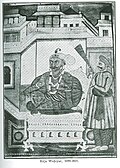 Maharaja Raja Wadiyar who started Mysore Dasara
 -
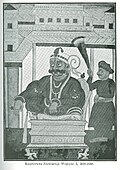 Maharaja Kanthirava Narasaraja I was referred to ranadheera (valiant on the battlefield)


Sultanate
From 1760 to 1799, the rule of the Wadiyar dynasty was essentially nominal, with real power firmly in the hands of the Commander-in-chief and later self-proclaimed sultan, Hyder Ali, and his son and successor Tipu. The two, ruling the sultanate from Srirangapattana, expanded the kingdom aggressively.
-
 Hyder Ali, the commander-in-chief who usurped power
 -
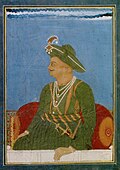 Ali's son Tipu, the Sultan of Mysore
 -
 The Kingdom of Mysore under Tipu
.jpg)


Independent kingdom in a subsidiary alliance
After Tipu Sultan's execution at the end of the Battle of Srirangapattana during the Fourth Anglo-Mysore War in 1799, the Crown restored the Kingdom to Wadiyars under a subsidiary alliance requiring an annual pay as subsidy to the Crown. The capital was moved back to Mysore. The four-year-old boy Krishnaraja Wadiyar III, son of the last Wadiyar king, Chamaraja Wadiyar IX, was anointed as the Maharaja of Mysore.
In 1831, on a specious plea of non-payment by Maharaja Krishnaraja Wadiyar III, the kingdom was placed under Mysore Commission that lasted from 1831 to 1881. Mark Cubbon and L. B. Bowring are among the well-known commissioners of the period.
In 1868, upon Krishnaraja Wadiyar III's demise, his five-year-old adopted son Yuvaraja Chamaraja Wadiyar X became the heir to the throne. When in 1881 he attained the age of majority, through an act of parliament, the British Parliament once again transferred power back to the Wadiyars. The maharaja changed the English spelling of their royal name from Wodeyar to Wadiyar and assumed the title Bahadur. He established the Mysore Representative Assembly; for the first time in India, democratic experiments were being conducted in Mysore.
Chamaraja Wadiyar X's son and successor Maharaja Krishnaraja Wadiyar IV earned great fame as a saintly king (rajarishi), and his kingdom was hailed as Ramarajya by Mahatma Gandhi–as an ideal kingdom comparable to the one ruled by Lord Rama.[13]
Krishnaraja Wadiyar IV's nephew, successor, and the last reigning king of the Wadiyar dynasty, Jayachamarajendra Wadiyar, ruled from 1940 until 1950. Upon India's independence from the British crown in 1947, Jayachamarajendra Wadiyar ceded his kingdom into the new temporary Dominion of India but continued as Maharajah until India became a Republic in 1950.
-
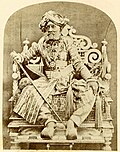 Maharaja Krishnaraja Wadiyar III during his latter years
 -

-
 Maharaja Chamaraja Wadiyar X with his children
 -
 Crown prince Yuvaraja Krishnaraja Wadiyar IV with two other Indian princes
 -
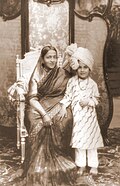 Rajamate Kempananjammanni Devi with grandson and future king Jayachamarajendra Wadiyar


Dissolution of the kingdom
Jayachamarajendra Wadiyar became the rajapramukh of the renamed Mysore State from 1950 to 1956. After the reorganisation of Indian states on a linguistic basis in 1956, he was appointed Governor of the integrated Mysore State (present Karnataka State), a post which he held until 1964. He was then appointed Governor of Madras (now Tamil Nadu) for two years.
The Indian Constitution continued to recognise him as the Maharajah of Mysore until 1971, when titles and privy purses of maharajas were abolished by the Government of India under Indira Gandhi. The maharajah died in 1974.
His only son Srikantadatta Narasimharaja Wadiyar became the head of the family; he was a member of the Indian Parliament.
Upon Srikantadatta Wadiyar's demise 2013, his widowed wife Devi Pramoda Wadiyar adopted Yaduveer Wadiyar, who was anointed as the maharaja of Mysore and the head of the family in 2015.
-

-

-
 Yaduveer Wadiyar, the present head of the Wadiyar dynasty


Residences
Mysore Palace has been the official residence of the Wadiyars for most of the family's recorded history. Briefly, Srirangapattana was also the seat of the Wadiyars. By the early 1900s, Bangalore had seen significant infrastructural development and had become a secondary residence for the Wadiyars at the Bangalore Palace.
-
 Mysore Palace is the traditional seat of the Wadiyars in Mysuru
 -
 Bengaluru Palace, the Wadiyars' residence in Bengaluru
 -
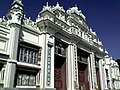 Jaganmohan Palace served as a temporary residence in the early 1900s when the old Mysore Palace burnt down


Alamelamma's Curse
With a declining Vijayanagara Empire, in 1610 Raja Wadiyar conquered the fort of Srirangapattana from Tirumala, the Vijayanagara viceroy stationed there. Tirumala is said to have retired to the nearby town of Talakadu with his two wives. At about the same time, Tirumala suffered from a terminal disease; his condition deteriorated and he eventually died.
One of his wives was Alamelamma, a staunch devotee of Ranganayaki, the consort of Lord Ranganatha, the presiding deity of the famous Adi-Ranga temple in the island fortress of Srirangapatna. Alamelamma had a large amount of jewellery, including a fine nose ring studded with a large pearl. As a widow, customs forbade jewellery on her. She frequently lent the jewels to the temple of Ranganayaki. Every Tuesdays and Fridays, Ranaganayaki's idol would be decorated with the jewellery, returned to Alamelamma's safe custody for rest of the week.
On one instance, the temple requested the king's soldiers to fetch the jewels from Alamelamma as has become a practice. An approaching king's emissaries, headed by Chief Courtier Ramanath Molahalli, seems to have scared her off. To escape an ill-presumed imminent wrath of the king, she ran over to a cliff overlooking the Kaveri river into the whirlpool and cursed before plunging to her own death, "may Talakadu become a barren expanse of land, Malangi turn into a whirlpool, and may kings of Mysore never beget children to all eternity" (Kannada: ತಲಕಾಡು ಮರಳಾಗಲಿ, ಮಾಲಂಗಿ ಮಡುವಾಗಲಿ, ಮೈಸೂರು ದೊರೆಗಳಿಗೆ ಮಕ್ಕಳಿಲ್ಲದೆ ಹೋಗಲಿ; transliteration: talakāḍu maral̤āgali, mālaṃgi maḍuvāgali, maisūru dŏrĕgal̤igĕ makkal̤illadĕ hogali).
Alamelamma's idol
Learning of this accident, the king felt repentant and had an idol of Alamelamma made in gold, installed it in the palace, and worshipped it as a deity. To this day, the idol can be found in Mysore Palace. The king's only surviving son, Narasaraja Wadiyar, died (believed to be an effect of the curse in folklore).
The Dasara festivities inside the palace end on the evening of Navarathri with a formal pooja to Alamelamma. Another interesting part of the story is that the Alamelamma temple is under the care of her legal heirs. Strangely, these priests/caretakers appear to be cursed by the same curse, following the same pattern afflicting the Wadiyars.
Talakadu and Malangi

Talakadu and Malangi are two small towns near Tirumakudalu Narasipura on the banks of the Kaveri where the river takes a bend. To date, most parts of Talakadu lie under sand, and the village of Malangi is slowly eroding due to whirlpools.[14][15] Talakadu's temples lie buried in a vast expanse of sand and are dug up and exposed every 12 years. At Malangi, on the other hand, the river is at its deepest. Whether these phenomena appeared only after Alamelamma's curse in 1610 is a matter of conjecture.
Family tree of the Wadiyars
Direct lineage from Yaduraya
Raja Yaduraya is recorded as the founding ruler of the Kingdom of Mysore. The sixteenth maharaja Krishnaraja Wodeyar I was the last direct male lineage of Raja Yaduraja.[16] However, Krishnaraja Wodeyar I's successor was his adopted son, Maharaja Chamaraja Wodeyar VII from the Ankanahalli Urs branch. After him, Maharaja Chamaraja Wodeyar III's second daughter Rajakumari Chikkadevi's family with the Bettada Kote Urs branch takes over the monarchy.
Bettada Kote (Hill Fort) Urs branch
The Bettada Kote Urs was one of the larger jagirs, or feudal estates, in the Kingdom of Mysore. After the death of the 22nd ruler Maharaja Chamaraja Wodeyar VIII, his widowed queen mother Maharani Lakshmi Devi adopted Chamaraja Wodeyar IX of the Bettada Kote Urs branch which continues to-date.
Kalale Urs branch
Maddur Urs branch
Contributions
The Wadiyars were patrons of fine arts, fostering a number of famous musicians, writers and painters. Their contributions to music and literature has rendered the city of Mysore a cultural centre of Karnataka.
See also
- Diwan of Mysore
- Karnataka
- Kingdom of Mysore
- Maharaja of Mysore
- Mysore
- Mysore State
- Srirangapatna
- Talakad
References
- ↑ 1.0 1.1 S, Rajaram N. (12 January 2019). The Vanished Raj A Memoir of Princely India. Prism Books Private Limited. ISBN 978-93-88478-11-3.
- ↑ Hüsken, Ute; Narayanan, Vasudha; Zotter, Astrid (1 September 2021). Nine Nights of Power: Durgā, Dolls, and Darbārs. State University of New York Press. ISBN 978-1-4384-8408-2.
- ↑ Iyengar, Venkatesa (1932). The Mysore. Mittal Publications.
- ↑ Syed, Muzaffar Husain; Akhtar, Syed Saud; Usmani, B. D. (14 September 2011). Concise History of Islam. Vij Books India Pvt Ltd. ISBN 978-93-82573-47-0.
- ↑ "Yaduveer Gopal Raj Urs is heir of Mysuru royal family". The Hindu. 13 February 2015. Retrieved 18 February 2015.
- ↑ "Mysuru new King to wed Trishika Kumari". NewsKarnataka. 25 February 2015.
- ↑ "In Yaduveer, erstwhile Mysuru kingdom gets new king". The Times of India. 28 May 2015. Retrieved 29 May 2015.
- ↑ Pranesh, Meera Rajaram (2003) [2003]. Musical Composers during Wodeyar Dynasty (1638–1947 A.D.). Bangalore: Vee Emm.
- ↑ Census of India 1961 Volume XI, Mysore Part VI, VILLAGE· SURVEY MONOGRAPHS. Delhi: Government of India. 1961. p. 10.
- ↑ Prasad, S.Shyam (2018). Enigmas of Karnataka: Mystery meets History. Chennai: Notion Press. ISBN 9781642491227.
- ↑ Ikegame, Aya (7 May 2013). Princely India Re-imagined: A Historical Anthropology of Mysore from 1799 to the present. Routledge. pp. 76–77. ISBN 978-0-415-55449-7.
- ↑ Vikram Sampath (2008). SPLENDOURS OF ROYAL MYSORE (PB). Rupa Publications. pp. Introd. I. ISBN 9788129115355.
- ↑ "The Rajarshi of Mysore". Bangalore Mirror. 6 June 2009. Retrieved 9 June 2021.
- ↑ "Does Alamelamma's curse continue to haunt Wadiyars?". Deccan Herald. 10 December 2013. Retrieved 11 October 2015.
- ↑ "400-year-old curse haunts Wodeyar royals of erstwhile princely state of Mysore". India Today. 12 December 2013. Retrieved 11 October 2015.
- ↑ Wilks, Mark (1869). Historical Sketches of the South of India, in an Attempt to Trace the History of Mysoor, Etc.