



>Challiyan |
WikiDwarfBOT (talk | contribs) Cleanup: Source modification. Information added. |
||
| Line 1: | Line 1: | ||
{{Short description|Historical Chola king who ruled southern India}} | |||
{{Use dmy dates|date=January 2016}} | {{Use dmy dates|date=January 2016}} | ||
{{Use Indian English|date=January 2016}} | {{Use Indian English|date=January 2016}} | ||
{{Infobox royalty | {{Infobox royalty | ||
| name = Karikala Cholan | | name = Karikala Cholan | ||
| native_name = | | native_name = | ||
| title = | | title = Peruvalatthaan<br />Thirumavalavan <br/>Kaviri Kandan<br/>Makkotai Konda Cholan<br/>Parakesari ([[Sanskrit]]) <ref name="Rama Shankar Tripathi 478">{{cite book|title=History of Ancient India|author=Rama Shankar Tripathi|publisher=Motilal Banarsidass, 1967 - India - 605 pages|page=478}}</ref><ref name="Kallidaikurichi Aiyah Nilakanta Sastri 68">{{cite book|title=Studies in Cōḷa history and administration|author=Kallidaikurichi Aiyah Nilakanta Sastri|publisher=University of Madras, 1932 - History - 210 pages|page=68}}</ref> | ||
| image = | | image = Karikalacholan kallanai trichy.jpg | ||
| alt = Karikala the Great | | alt = Karikala the Great | ||
| reign = | |||
| caption = Bronze statue of Karikāla Chōḻaṉ | | caption = Bronze statue of Karikāla Chōḻaṉ | ||
| predecessor = [[Ilamcetcenni]] | | predecessor = [[Ilamcetcenni]] | ||
| successor = [[ | | successor = [[Nedunkilli]] and [[Nalankilli]] | ||
[[ | |||
| spouse = [[Velir]] princess from Nangur<ref>{{cite book|title=Art and culture of Tamil Nadu|author=Irāmaccantiran̲ Nākacāmi|publisher=Sundeep Prakashan, 1980 - Art, Indic - 184 pages|page=140}}</ref> | | spouse = [[Velir]] princess from Nangur<ref>{{cite book|title=Art and culture of Tamil Nadu|author=Irāmaccantiran̲ Nākacāmi|publisher=Sundeep Prakashan, 1980 - Art, Indic - 184 pages|page=140}}</ref> | ||
| spouse-type = Queen | | spouse-type = Queen | ||
| Line 19: | Line 18: | ||
}} | }} | ||
{{Chola history}} | {{Chola history}} | ||
{{ | '''Karikala''' ({{lang-ta| கரிகால சோழன்}}) often referred to as '''Karikala the Great'''<ref>{{cite web | url=https://www.newindianexpress.com/opinions/2022/may/21/the-great-cholas-through-the-ages-2456011.html | title=The great Cholas through the ages }}</ref> was a [[Tamils|Tamil]] [[Emperor]] of the early Chola kingdom who ruled ancient [[Tamilakam]] from [[Uraiyur]]. He is credited with the construction of the flood banks of the [[Kaveri|river Kaveri]]. He is recognised as the greatest of the Early Cholas. In Thiruvalangadu plates of [[Rajendra Chola I]], [[Medieval Cholas|Medieval Tamil Cholas]] listed Karikala Chola as one of their ancestors. In Malepadu plates (7<sup>th</sup> century CE) of Renati Chola king Punyakumara, [[Telugu Cholas]] claimed that they belong to the family of Karikala Chola and praises him for stopping the overflow over the banks of river Kaveri.<ref>{{Cite journal |last=Hultzsch |first=Eugene |date=1911–1912 |title=Epigraphia Indica |journal=Epigraphia Indica |volume=11 |pages=339 |via=Archaeological Survey of India, Government of India}}</ref> | ||
'''Karikala''' was a Chola | |||
== Sources == | == Sources == | ||
The story of Karikala is mixed with legend and anecdotal information gleaned from [[Sangam literature]]. The only sources available are the numerous mentions in Sangam poetry. The period covered by the extant literature of the Sangam is | The story of Karikala is mixed with legend and anecdotal information gleaned from [[Sangam literature]]. The only sources available are the numerous mentions in Sangam poetry. The period covered by the extant literature of the Sangam is not easy to determine with any measure of certainty. | ||
''[[Paṭṭiṉappālai]]'', ''[[Poruṇarāṟṟuppaṭai]]'' and a number of individual poems in the ''[[Akanaṉūṟu]]'' and ''[[Purananuru]]'' have been the main source for the information that is attributed to Karikala. | ''[[Paṭṭiṉappālai]]'', ''[[Poruṇarāṟṟuppaṭai]]'' and a number of individual poems in the ''[[Akanaṉūṟu]]'' and ''[[Purananuru]]'' have been the main source for the information that is attributed to Karikala. | ||
No authentic records of Karikala's reign have been found so far. However many rulers and petty chiefs who came after him claimed him as their ancestor and decorated themselves as belonging to the ''[[ | No authentic records of Karikala's reign have been found so far. However many rulers and petty chiefs who came after him claimed him as their ancestor and decorated themselves as belonging to the ''[[Chola dynasty|Chola race]] of Karikala and of the [[Kashyapa]] [[gotra]]''.<ref>{{cite book|title=Indian Antiquary, Volume 38|author=Royal Anthropological Institute of Great Britain and Ireland|pages=7–8}}</ref><ref>{{cite book|title=Andhra Pradesh district gazetteers, Volume 16|author=Andhra Pradesh (India), Bh Sivasankaranarayana|publisher=Printed by the Director of Print. and Stationery at the Govt. Secretariat Press; [copies can be had from: Govt. Publication Bureau, Andhra Pradesh], 1977 - Andhra Pradesh (India)|page=19}}</ref> | ||
== Early life == | == Early life == | ||
Karikala was the son of [[Ilamcetcenni]].<ref>''Purananuru'' – 266</ref> The name Karikalan has been held to mean "the man with the charred leg" and perpetuates the memory of a fire accident in the early years of his life. Some scholars also hold the view ''kari'' and ''kalan'' are Tamil words meaning "slayer of elephants". ''Poruṇarāṟṟuppaṭai'' describes the back-formed origin legend of this incident as follows:{{quote|The king of | Karikala was the son of [[Ilamcetcenni]].<ref>''Purananuru'' – 266</ref> The name Karikalan has been held to mean "the man with the charred leg" and perpetuates the memory of a fire accident in the early years of his life. Some scholars also hold the view ''kari'' and ''kalan'' are Tamil words meaning "slayer of elephants". ''Poruṇarāṟṟuppaṭai'' describes the back-formed origin legend of this incident as follows:{{quote|The king of [[Uraiyur]] ([[Tiruchirappalli]]) Ilamcetcenni married a [[Velir]] princess from Azhundur and she became pregnant and gave birth to Karikala. Ilamcetcenni died soon after. Due to his young age, Karikala's right to the throne was overlooked and there was political turmoil in the country. Karikala was exiled. When normality returned, the Chola ministers sent a state elephant to look for the prince. The elephant finds the prince hiding in [[Karuvur]] (modern day [[Karur]] in [[Tamil Nadu]]). His political opponents arrested and imprisoned him. The prison was set on fire that night. Karikala escaped the fire and, with the help of his uncle Irum-pitar-thalaiyan, defeated his enemies. Karikala’s leg was scorched in the fire and from thence Karikala became his name.}}Old Sangam Age inscriptions and the sthala puranam of the great ancient Saiva shrine at Parasalur, near [[Mayiladuthurai|Mayavaram]], state that in order to escape a murder plot hatched by conspirators, Karikal Valavan stayed there in disguise as a Vedic and Agama Sastra lecturer for eight years. The [[Paṭṭiṉappālai]], written in praise of Karikala, also describes this incident but without mentioning the fable of the burnt limb: | ||
{{quote|Like a tiger cub with sharp claws and curved stripes growing strong within a cage, his strength matured while he was in the bondage of his enemies. Just as a large-trunked elephant pulls down the banks of a pit and reunites with its mate, he, after deep and careful consideration, drew his sword, overpowered the strong guard, and eventually achieved his glorious heritage.}} | |||
== Military conquests == | == Military conquests == | ||
| Line 40: | Line 37: | ||
=== Further wars and conquests === | === Further wars and conquests === | ||
After the [[battle of Venni]], Karikala had other opportunities to exercise his arms. He defeated the confederacy of nine minor chieftains in the battle of Vakaipparandalai. Paranar, a contemporary of Karikala, in his poem from ''[[Agananuru]]'' mentions this incident without giving any information on the cause of the conflict.<ref name=sastri112 /> According to legends Karikala was one of the few Chola kings who won the whole of Ceylon{{citation needed|date=November 2016}} (Lanka). The Grand anicut was built after his conquest over the Singalese kingdom and he used Singalese war prisoners for the hard task of moving stones from the mountains to the river bed of the Kaveri. The ''Pattinappalai'' also describes the destruction caused by Karikala’s armies in the territories of his enemies and adds that as the result of these conflicts, the "Northerners and Westerners were depressed… and his flushed look of anger caused the Pandya’s strength to give way…". | After the [[battle of Venni]], Karikala had other opportunities to exercise his arms. He defeated the confederacy of nine minor chieftains in the battle of Vakaipparandalai. Paranar, a contemporary of Karikala, in his poem from ''[[Agananuru]]'' mentions this incident without giving any information on the cause of the conflict.<ref name=sastri112 /> According to legends Karikala was one of the few Chola kings who won the whole of Ceylon{{citation needed|date=November 2016}} (Lanka). The Grand anicut was built after his conquest over the Singalese kingdom and he used Singalese war prisoners for the hard task of moving stones from the mountains to the river bed of the Kaveri.{{cn|date=October 2021}} The ''Pattinappalai'' also describes the destruction caused by Karikala’s armies in the territories of his enemies and adds that as the result of these conflicts, the "Northerners and Westerners were depressed… and his flushed look of anger caused the Pandya’s strength to give way…". | ||
=== Northern Expedition === | === Northern Expedition and Conquests === | ||
After subduing the south Karikala went on an expedition to the north and engraved his tiger emblem in the Himalayas. The king of the great [[Vajra (king)|Vajra]] whose sway extended as far as the roaring sea (in the east), gave him a pearl canopy as a tribute while the king of [[Magadha]] famous for his sword-play, and his enemy a while ago, presented to him an audience hall (pattimandapam). The king of [[Avanti (Ancient India)|Avanti]] gave him a friendly present of a tall and beautiful arch on the gateway. Though all these were made of gold and gems, their technique was not known to human artists even of exceptional skill; they were long ago given to the ancestors of these three monarchs by the divine [[Mamuni Mayan|Maya]] in return for some valuable service rendered to him.<ref name="The Silappadikaram, page 114">The Śilappadikāram by V. R. Ramachandra Dikshitar, p114-115</ref> | After subduing the south Karikala went on an expedition to the north and engraved his tiger emblem in the Himalayas. The king of the great [[Vajra (king)|Vajra]] whose sway extended as far as the roaring sea (in the east), gave him a pearl canopy as a tribute while the king of [[Magadha]] famous for his sword-play, and his enemy a while ago, presented to him an audience hall (pattimandapam). The king of [[Avanti (Ancient India)|Avanti]] gave him a friendly present of a tall and beautiful arch on the gateway. Though all these were made of gold and gems, their technique was not known to human artists even of exceptional skill; they were long ago given to the ancestors of these three monarchs by the divine [[Mamuni Mayan|Maya]] in return for some valuable service rendered to him.<ref name="The Silappadikaram, page 114">The Śilappadikāram by V. R. Ramachandra Dikshitar, p114-115</ref> | ||
== Grand Anicut == | == Grand Anicut == | ||
[[File:Grand Anaicut.JPG|thumb|Kallanai built by Karikala Chola on river Kaveri]] | [[File:Grand Anaicut.JPG|thumb|Kallanai built by Karikala Chola on river Kaveri]] | ||
Later Chola kings attributed the building of dikes along the banks of the [[Kaveri]] to Karikala.<ref name=majumdar137 /><ref name=kulke104 /><ref name="History of ancient India, page 478">''History of ancient India, page 478: ..raising the banks of the Kaveri by Parakesari Karikala Chola''</ref><ref name="Proceedings of the Indian History Congress, Volume 39, page 156">''Proceedings of the Indian History Congress, Volume 39, page 156</ref> The raising of the banks of the river Kaveri by Karikala is also mentioned by the Malepadu plates (seventh century CE)<ref>{{Cite book|last=R. C. Majumdar|first=General Editor|url= | Sometime between the reign of Sinhalese monarch [[Vankanasika Tissa]], Karikala, with a large army, invaded the island and took away 12,000 Sinhalese men to work as slaves to build the Kaveri Dam.<ref>{{cite book | url=https://books.google.com/books?id=6nrXAAAAMAAJ&q=sinhalese+slaves+kaveri+dam | isbn=9789555801102 | title=Walking to Kataragama | year=2007 | publisher=International Centre for Ethnic Studies }}</ref> | ||
Later Chola kings attributed the building of dikes along the banks of the [[Kaveri]] to Karikala.<ref name=majumdar137 /><ref name=kulke104 /><ref name="History of ancient India, page 478">''History of ancient India, page 478: ..raising the banks of the Kaveri by Parakesari Karikala Chola''</ref><ref name="Proceedings of the Indian History Congress, Volume 39, page 156">''Proceedings of the Indian History Congress, Volume 39, page 156</ref> The raising of the banks of the river Kaveri by Karikala is also mentioned by the Malepadu plates (seventh century CE)<ref>{{Cite book|last=R. C. Majumdar|first=General Editor|url=https://archive.org/details/classicalage03bhar|title=History and Culture of the Indian People, Volume 03, The Classical Age p.265|date=1970|publisher=Bharatiya Vidya Bhavan|others=Public Resource}}</ref> of the [[Telugu_Cholas#Renati_Cholas|Telugu Chola]] sovereign of Renadu, [[Tumkur|Erigal]]-Mutturaju Punyakumara, who claims descent from Karikala: ''karuna – saroruha vihita – vilochana – pallava – trilochana pramukha kilapritvisvara karita kaveri tira'' (he who caused the banks of the Kaveri to be constructed by all the subordinate kings led by the Pallava Trilochana whose third eye was blinded by his lotus foot). | |||
The [[Grand Anicut]], also known as the Kallanai was built by Karikala<ref name="kallanai_googlebook">{{cite book | last = Singh | first = Vijay P. |author2=Ram Narayan Yadava | title = Water Resources System Operation: Proceedings of the International Conference on Water and Environment | publisher = Allied Publishers | year = 2003 | url = https://books.google.com/books?id=Bge-0XX6ip8C&dq=kallanai&pg=PA508 | isbn = 81-7764-548-X | page = 508}}</ref> and is considered one of the oldest water-diversion or water-regulator structures in the world which is still in use.<ref name="kallanai_oldest">{{cite web | url = http://www.hindunet.org/saraswati/traditionwater.pdf | title = ''This is the oldest stone water-diversion or water-regulator structure in the world''| access-date = 2007-05-27 |archive-url = https://web.archive.org/web/20070206130842/http://www.hindunet.org/saraswati/traditionwater.pdf |archive-date = 2007-02-06}}</ref> The Kallanai is a massive dam of unhewn stone, 329 metres (1,080 ft) long and 20 metres (60 ft) wide, across the main stream of the Kaveri.<ref>{{cite web|url=http://www.britannica.com/eb/article-9021884/Cauvery-River|title=Cauvery River – Britannica Online Encyclopedia}}</ref> A later [[Chola]] record from Tiruvaduturai refers to this event that is raising the banks of the Kaveri by Parakesari Karikala Chola.<ref name="Rama Shankar Tripathi 478">{{cite book|title=History of Ancient India|author=Rama Shankar Tripathi|publisher=Motilal Banarsidass, 1967 - India - 605 pages|page=478}}</ref><ref name="Kallidaikurichi Aiyah Nilakanta Sastri 68">{{cite book|title=Studies in Cōḷa history and administration|author=Kallidaikurichi Aiyah Nilakanta Sastri|publisher=University of Madras, 1932 - History - 210 pages|page=68}}</ref> | |||
== Perur Patteeswarar Temple == | |||
[[File:Perur Patteeswarar1.jpg|thumb|Perur Patteeswarar Temple]] | |||
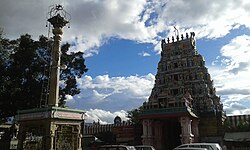
After his victory over the Northern kingdoms of Vatsa, Magadha and Avantika, Karikala returned back to [[Tamilakam|Tamil land]] and worshipped Lord [[Shiva]] at the [[Perur Pateeswarar Temple, Coimbatore|Perur Pateeswarar Temple]] located at the banks of river [[Noyyal]] in present day [[Coimbatore]]. Karikala was an ardent devotee of Lord Shiva. He is said to have done the [[Kumbhabhishekham]] (sanctification ritual) of the temple through hundred golden vessels. A famous text named '''Perur Puranam''' was composed by Kachiyappa Munivar in Tamil on the origin of the temple.<ref>{{cite web|url=http://www.perurpatteeswarar.tnhrce.in/history-patteeswarar.html|title=Arulmigu Patteeswarar Swamy Temple - History|access-date=14 December 2016}}</ref> | |||
=== Karikala Cholan Manimandapam === | === Karikala Cholan Manimandapam === | ||
[[File:Karikaala Chozan Memorial -1.jpg|thumb|Karikala Cholan Manimandapam]] | [[File:Karikaala Chozan Memorial -1.jpg|thumb|Karikala Cholan Manimandapam]] | ||
Karikala Cholan Manimandapam (memorial hall) was built in honour of the king who built the Grand Anicut. The hall designed as per Chola architecture style was built at a cost of {{INR}} 21 million. It features a bronze statue of the king.<ref>{{cite news | url=http://timesofindia.indiatimes.com/city/trichy/Karikalan-cholan-memorial-inaugurated/articleshow/30300318.cms | title=Karikalan cholan memorial inaugurated |newspaper=The Times of India | access-date=14 September 2016}}</ref><ref>{{cite news | url=http://www.thehindu.com/news/cities/Tiruchirapalli/karikalan-manimandapam-ready-for-inauguration/article5342940.ece | title=Karikalan Manimandapam ready for inauguration | | Karikala Cholan Manimandapam (memorial hall) was built in honour of the king who built the Grand Anicut. The hall designed as per Chola architecture style was built at a cost of {{INR}} 21 million. It features a bronze statue of the king.<ref>{{cite news | url=http://timesofindia.indiatimes.com/city/trichy/Karikalan-cholan-memorial-inaugurated/articleshow/30300318.cms | title=Karikalan cholan memorial inaugurated |newspaper=The Times of India | access-date=14 September 2016}}</ref><ref>{{cite news | url=http://www.thehindu.com/news/cities/Tiruchirapalli/karikalan-manimandapam-ready-for-inauguration/article5342940.ece | title=Karikalan Manimandapam ready for inauguration |work=The Hindu | access-date=14 September 2016}}</ref> | ||
== Dating Karikala == | == Dating Karikala == | ||
According to [[Nilakanta Sastri]] Karikala reigned in 90 CE.<ref name="A History of South India, page 119">A History of South India: From Prehistoric Times to the Fall of Vijayanagar, page 119</ref> | According to [[Nilakanta Sastri]] Karikala reigned in 90 CE.<ref name="A History of South India, page 119">A History of South India: From Prehistoric Times to the Fall of Vijayanagar, page 119</ref> | ||
[[V. R. Ramachandra Dikshitar]] states that the Karikala mentioned in [[Silappadikaram]] and [[Sangam literature]] are two different kings and the Karikala mentioned in [[Silappadikaram]] has nothing to do with Trilocana Pallava and nothing prevents another Karikala having flourished in [[Puhar, Nagapattinam|Puhar]] a few centuries later.<ref name="The Silappadikaram, page 24">The Śilappadikāram by V. R. Ramachandra Dikshitar, page 24</ref> The copper-plate charters and stone inscription of the | However, [[V. R. Ramachandra Dikshitar]] states that the Karikala mentioned in [[Silappadikaram]] and [[Sangam literature]] are two different kings and the Karikala mentioned in [[Silappadikaram]] has nothing to do with Trilocana Pallava and nothing prevents another Karikala having flourished in [[Puhar, Nagapattinam|Puhar]] a few centuries later.<ref name="The Silappadikaram, page 24">The Śilappadikāram by V. R. Ramachandra Dikshitar, page 24</ref> | ||
The copper-plate charters and stone inscription of the 10th and 11th centuries also mention two different Karikala thus unable to determine his exact reign. | |||
== See also == | == See also == | ||
| Line 70: | Line 74: | ||
== Further reading == | == Further reading == | ||
* {{cite book|title=[[A History of South India: From Prehistoric Times to the Fall of Vijayanagar]]|first=K. A. Nilakanta|last=Sastri|author-link=K. A. Nilakanta Sastri|ref=Sastri}} | * {{cite book|title=[[A History of South India: From Prehistoric Times to the Fall of Vijayanagar]]|first=K. A. Nilakanta|last=Sastri|author-link=K. A. Nilakanta Sastri|ref=Sastri}} | ||
* {{cite book | first= Kulke| last= Hermann |author2=Rothermund D| orig-year= 2000| year=2001 | title= A History of India | publisher= Routledge | isbn= 0-415-32920-5}} | * {{cite book | first= Kulke| last= Hermann |author2=Rothermund D| orig-year= 2000| year=2001 | title= A History of India | publisher= Routledge | isbn= 0-415-32920-5}} | ||
Revision as of 08:49, 22 July 2023
| Karikala Cholan | |
|---|---|
| Peruvalatthaan Thirumavalavan Kaviri Kandan Makkotai Konda Cholan Parakesari (Sanskrit) [1][2] | |
 Bronze statue of Karikāla Chōḻaṉ | |
| Predecessor | Ilamcetcenni |
| Successor | Nedunkilli and Nalankilli |
| Queen | Velir princess from Nangur[3] |
| Issue | Nalankilli Nedunkilli Māvalattān |
| Father | Ilamcetcenni |
| List of Chola kings and emperors | ||||||||||||||||||||||||||||
|---|---|---|---|---|---|---|---|---|---|---|---|---|---|---|---|---|---|---|---|---|---|---|---|---|---|---|---|---|
| Early Cholas | ||||||||||||||||||||||||||||
| Interregnum (c. 200 – c. 848) | ||||||||||||||||||||||||||||
| Medieval Cholas | ||||||||||||||||||||||||||||
|
||||||||||||||||||||||||||||
| Later Cholas | ||||||||||||||||||||||||||||
|
||||||||||||||||||||||||||||
| Related dynasties | ||||||||||||||||||||||||||||
|
||||||||||||||||||||||||||||
| Chola society | ||||||||||||||||||||||||||||
Karikala (Tamil: கரிகால சோழன்) often referred to as Karikala the Great[4] was a Tamil Emperor of the early Chola kingdom who ruled ancient Tamilakam from Uraiyur. He is credited with the construction of the flood banks of the river Kaveri. He is recognised as the greatest of the Early Cholas. In Thiruvalangadu plates of Rajendra Chola I, Medieval Tamil Cholas listed Karikala Chola as one of their ancestors. In Malepadu plates (7th century CE) of Renati Chola king Punyakumara, Telugu Cholas claimed that they belong to the family of Karikala Chola and praises him for stopping the overflow over the banks of river Kaveri.[5]
Sources
The story of Karikala is mixed with legend and anecdotal information gleaned from Sangam literature. The only sources available are the numerous mentions in Sangam poetry. The period covered by the extant literature of the Sangam is not easy to determine with any measure of certainty.
Paṭṭiṉappālai, Poruṇarāṟṟuppaṭai and a number of individual poems in the Akanaṉūṟu and Purananuru have been the main source for the information that is attributed to Karikala.
No authentic records of Karikala's reign have been found so far. However many rulers and petty chiefs who came after him claimed him as their ancestor and decorated themselves as belonging to the Chola race of Karikala and of the Kashyapa gotra.[6][7]
Early life
Karikala was the son of Ilamcetcenni.[8] The name Karikalan has been held to mean "the man with the charred leg" and perpetuates the memory of a fire accident in the early years of his life. Some scholars also hold the view kari and kalan are Tamil words meaning "slayer of elephants". Poruṇarāṟṟuppaṭai describes the back-formed origin legend of this incident as follows:
The king of Uraiyur (Tiruchirappalli) Ilamcetcenni married a Velir princess from Azhundur and she became pregnant and gave birth to Karikala. Ilamcetcenni died soon after. Due to his young age, Karikala's right to the throne was overlooked and there was political turmoil in the country. Karikala was exiled. When normality returned, the Chola ministers sent a state elephant to look for the prince. The elephant finds the prince hiding in Karuvur (modern day Karur in Tamil Nadu). His political opponents arrested and imprisoned him. The prison was set on fire that night. Karikala escaped the fire and, with the help of his uncle Irum-pitar-thalaiyan, defeated his enemies. Karikala’s leg was scorched in the fire and from thence Karikala became his name.
Old Sangam Age inscriptions and the sthala puranam of the great ancient Saiva shrine at Parasalur, near Mayavaram, state that in order to escape a murder plot hatched by conspirators, Karikal Valavan stayed there in disguise as a Vedic and Agama Sastra lecturer for eight years. The Paṭṭiṉappālai, written in praise of Karikala, also describes this incident but without mentioning the fable of the burnt limb:
Like a tiger cub with sharp claws and curved stripes growing strong within a cage, his strength matured while he was in the bondage of his enemies. Just as a large-trunked elephant pulls down the banks of a pit and reunites with its mate, he, after deep and careful consideration, drew his sword, overpowered the strong guard, and eventually achieved his glorious heritage.
Military conquests
Battle of Venni
According to the Poruṇarāṟṟuppaṭai, Karikala Chola fought a great Battle of Venni in which both Pandyan and Cheran king Uthiyan Cheralathan[9] suffered a defeat.[10] Although we know very little about the circumstances leading to this battle, there can be no doubt that it marked the turning point in Karikala’s career, for in this battle he broke the back of the powerful confederacy formed against him.[11] Besides the two crowned kings of the Pandya and Chera countries, eleven minor chieftains took the opposing side in the campaign and shared defeat at the hands of Karikala.[12][13] The Chera king, who was wounded on his back in the battle, committed suicide by starvation. Venni was the watershed in the career of Karikala which established him firmly on his throne and secured for him some sort of hegemony among the three crowned monarchs. Venni is also known as Vennipparandalai and now it is known as Kovilvenni and is situated near Thanjavur.[14]
Further wars and conquests
After the battle of Venni, Karikala had other opportunities to exercise his arms. He defeated the confederacy of nine minor chieftains in the battle of Vakaipparandalai. Paranar, a contemporary of Karikala, in his poem from Agananuru mentions this incident without giving any information on the cause of the conflict.[14] According to legends Karikala was one of the few Chola kings who won the whole of Ceylon[citation needed] (Lanka). The Grand anicut was built after his conquest over the Singalese kingdom and he used Singalese war prisoners for the hard task of moving stones from the mountains to the river bed of the Kaveri.[citation needed] The Pattinappalai also describes the destruction caused by Karikala’s armies in the territories of his enemies and adds that as the result of these conflicts, the "Northerners and Westerners were depressed… and his flushed look of anger caused the Pandya’s strength to give way…".
Northern Expedition and Conquests
After subduing the south Karikala went on an expedition to the north and engraved his tiger emblem in the Himalayas. The king of the great Vajra whose sway extended as far as the roaring sea (in the east), gave him a pearl canopy as a tribute while the king of Magadha famous for his sword-play, and his enemy a while ago, presented to him an audience hall (pattimandapam). The king of Avanti gave him a friendly present of a tall and beautiful arch on the gateway. Though all these were made of gold and gems, their technique was not known to human artists even of exceptional skill; they were long ago given to the ancestors of these three monarchs by the divine Maya in return for some valuable service rendered to him.[15]
Grand Anicut

Sometime between the reign of Sinhalese monarch Vankanasika Tissa, Karikala, with a large army, invaded the island and took away 12,000 Sinhalese men to work as slaves to build the Kaveri Dam.[16]
Later Chola kings attributed the building of dikes along the banks of the Kaveri to Karikala.[10][12][17][18] The raising of the banks of the river Kaveri by Karikala is also mentioned by the Malepadu plates (seventh century CE)[19] of the Telugu Chola sovereign of Renadu, Erigal-Mutturaju Punyakumara, who claims descent from Karikala: karuna – saroruha vihita – vilochana – pallava – trilochana pramukha kilapritvisvara karita kaveri tira (he who caused the banks of the Kaveri to be constructed by all the subordinate kings led by the Pallava Trilochana whose third eye was blinded by his lotus foot).
The Grand Anicut, also known as the Kallanai was built by Karikala[20] and is considered one of the oldest water-diversion or water-regulator structures in the world which is still in use.[21] The Kallanai is a massive dam of unhewn stone, 329 metres (1,080 ft) long and 20 metres (60 ft) wide, across the main stream of the Kaveri.[22] A later Chola record from Tiruvaduturai refers to this event that is raising the banks of the Kaveri by Parakesari Karikala Chola.[1][2]
Perur Patteeswarar Temple

After his victory over the Northern kingdoms of Vatsa, Magadha and Avantika, Karikala returned back to Tamil land and worshipped Lord Shiva at the Perur Pateeswarar Temple located at the banks of river Noyyal in present day Coimbatore. Karikala was an ardent devotee of Lord Shiva. He is said to have done the Kumbhabhishekham (sanctification ritual) of the temple through hundred golden vessels. A famous text named Perur Puranam was composed by Kachiyappa Munivar in Tamil on the origin of the temple.[23]
Karikala Cholan Manimandapam

Karikala Cholan Manimandapam (memorial hall) was built in honour of the king who built the Grand Anicut. The hall designed as per Chola architecture style was built at a cost of ₹ 21 million. It features a bronze statue of the king.[24][25]
Dating Karikala
According to Nilakanta Sastri Karikala reigned in 90 CE.[26]
However, V. R. Ramachandra Dikshitar states that the Karikala mentioned in Silappadikaram and Sangam literature are two different kings and the Karikala mentioned in Silappadikaram has nothing to do with Trilocana Pallava and nothing prevents another Karikala having flourished in Puhar a few centuries later.[27]
The copper-plate charters and stone inscription of the 10th and 11th centuries also mention two different Karikala thus unable to determine his exact reign.
See also
References
- ↑ 1.0 1.1 Rama Shankar Tripathi. History of Ancient India. Motilal Banarsidass, 1967 - India - 605 pages. p. 478.
- ↑ 2.0 2.1 Kallidaikurichi Aiyah Nilakanta Sastri. Studies in Cōḷa history and administration. University of Madras, 1932 - History - 210 pages. p. 68.
- ↑ Irāmaccantiran̲ Nākacāmi. Art and culture of Tamil Nadu. Sundeep Prakashan, 1980 - Art, Indic - 184 pages. p. 140.
- ↑ "The great Cholas through the ages".
- ↑ Hultzsch, Eugene (1911–1912). "Epigraphia Indica". Epigraphia Indica. 11: 339 – via Archaeological Survey of India, Government of India.
- ↑ Royal Anthropological Institute of Great Britain and Ireland. Indian Antiquary, Volume 38. pp. 7–8.
- ↑ Andhra Pradesh (India), Bh Sivasankaranarayana. Andhra Pradesh district gazetteers, Volume 16. Printed by the Director of Print. and Stationery at the Govt. Secretariat Press; [copies can be had from: Govt. Publication Bureau, Andhra Pradesh], 1977 - Andhra Pradesh (India). p. 19.
- ↑ Purananuru – 266
- ↑ Sastri, K. A. Nilakanta. A History of South India: From Prehistoric Times to the Fall of Vijayanagar.
- ↑ 10.0 10.1 See Majumdar, p 137
- ↑ See Tripathi, p 458
- ↑ 12.0 12.1 See Kulke and Rothermund, p 104
- ↑ V., Balambal (1998). Studies in the History of the Sangam Age. New Delhi: Kalinga Publications. p. 21. ISBN 978-8185163871.
- ↑ 14.0 14.1 See Nilakanta Sastri, A History of South India, p112-113
- ↑ The Śilappadikāram by V. R. Ramachandra Dikshitar, p114-115
- ↑ Walking to Kataragama. International Centre for Ethnic Studies. 2007. ISBN 9789555801102.
- ↑ History of ancient India, page 478: ..raising the banks of the Kaveri by Parakesari Karikala Chola
- ↑ Proceedings of the Indian History Congress, Volume 39, page 156
- ↑ R. C. Majumdar, General Editor (1970). History and Culture of the Indian People, Volume 03, The Classical Age p.265. Public Resource. Bharatiya Vidya Bhavan.
{{cite book}}:|first=has generic name (help) - ↑ Singh, Vijay P.; Ram Narayan Yadava (2003). Water Resources System Operation: Proceedings of the International Conference on Water and Environment. Allied Publishers. p. 508. ISBN 81-7764-548-X.
- ↑ "This is the oldest stone water-diversion or water-regulator structure in the world" (PDF). Archived from the original (PDF) on 6 February 2007. Retrieved 27 May 2007.
- ↑ "Cauvery River – Britannica Online Encyclopedia".
- ↑ "Arulmigu Patteeswarar Swamy Temple - History". Retrieved 14 December 2016.
- ↑ "Karikalan cholan memorial inaugurated". The Times of India. Retrieved 14 September 2016.
- ↑ "Karikalan Manimandapam ready for inauguration". The Hindu. Retrieved 14 September 2016.
- ↑ A History of South India: From Prehistoric Times to the Fall of Vijayanagar, page 119
- ↑ The Śilappadikāram by V. R. Ramachandra Dikshitar, page 24
Further reading
- Sastri, K. A. Nilakanta. A History of South India: From Prehistoric Times to the Fall of Vijayanagar.
- Hermann, Kulke; Rothermund D (2001) [2000]. A History of India. Routledge. ISBN 0-415-32920-5.
- Majumdar, R.C (1987). Ancient India. India: Motilal Banarsidass Publications. ISBN 81-208-0436-8.
- Mudaliar, A.S (1984) [1931]. Abithana Chintamani. New Delhi: Asian Educational Services.
- Nilakanta Sastri, K.A (1984) [1935]. The CōĻas. Madras: University of Madras.
- Nilakanta Sastri, K.A (2002) [1955]. A History of South India. New Delhi: OUP.
- Tripathi, Rama Sankar (1967). History of Ancient India. India: Motilal Banarsidass Publications. ISBN 81-208-0018-4.
- Iyengar, P. T. Srinivasa (1929). History of the Tamils from the Earliest Times to the Present Day.
- Raghava Iyengar, R. (1951). Pattinapalai, Research Monograph. Chidambaram: Annamalai University Publications.