


>JJMC89 bot III m Merging Category:5th-century BC Indian Jain monarchs to 3 categories per Wikipedia:Categories for discussion/Log/2021 June 21#Indian Jain monarchs |
WikiDwarfBOT (talk | contribs) Cleanup: Information added. |
||
| Line 1: | Line 1: | ||
{{ | {{Short description|King of Magadha from c. 492 to 460 BCE}} | ||
{{Use dmy dates|date= | {{Use dmy dates|date=October 2022}} | ||
{{Use | {{Use British English|date=December 2015}} | ||
{{Multiple issues|{{more citations needed|date=August 2015}} | {{Multiple issues|{{more citations needed|date=August 2015}} | ||
{{Cleanup|reason=death mentioned of Bimbisara(his father) instead of his|date=July 2019}}{{Original research|date=April 2017}} | {{Cleanup|reason=death mentioned of Bimbisara(his father) instead of his|date=July 2019}}{{Original research|date=April 2017}} | ||
}} | }} | ||
{{Infobox royalty | {{Infobox royalty | ||
| image = Royal cortege leaving Rajagriha.jpg | | image = Royal cortege leaving Rajagriha.jpg | ||
| caption = Royal procession leaving [[Rajagriha]], possibly depicting Ajatashatru, from [[Sanchi]]<ref>[https://archive.org/stream/in.ernet.dli.2015.459148 John Marshall, A Guide to Sanchi, 1918 p.58ff] {{webarchive|url=http://archive.wikiwix.com/cache/20170820115517/https://archive.org/stream/in.ernet.dli.2015.459148 |date=20 August 2017 }} (Public Domain text)</ref> | | caption = Royal procession leaving [[Rajagriha]], possibly depicting Ajatashatru, from [[Sanchi]]<ref>[https://archive.org/stream/in.ernet.dli.2015.459148 John Marshall, A Guide to Sanchi, 1918 p.58ff] {{webarchive|url=http://archive.wikiwix.com/cache/20170820115517/https://archive.org/stream/in.ernet.dli.2015.459148 |date=20 August 2017 }} (Public Domain text)</ref> | ||
| death_date = 460 BCE<ref>[https://books.google.com/books?id=giwpDwAAQBAJ&pg=PT158 | | death_date = 460 BCE<ref name="Sharma">[https://books.google.com/books?id=giwpDwAAQBAJ&pg=PT158 India's Ancient Past], by R.S. Sharma</ref> or c. 380 BCE<ref name="auto1">[https://books.google.com/books?id=0IquM4BrJ4YC&dq=ajatashatru&pg=PT92 India: A History. Revised and Updated], by John Keay</ref> | ||
| dynasty = [[Haryanka dynasty|Haryanka]] | | dynasty = [[Haryanka dynasty|Haryanka]] | ||
| succession = 2nd [[Haryanka dynasty|Haryanka Emperor]] | | succession = 2nd [[Haryanka dynasty|Haryanka Emperor]] | ||
| reign = {{circa|492|460 BCE}}<ref | | reign = {{circa|492|460 BCE}}<ref name="Sharma"/> or early 4th cent. BCE<ref name="auto1"/> | ||
| predecessor = [[Bimbisara]] | | predecessor = [[Bimbisara]] | ||
| successor = [[Udayin|Udayabhadra]] | | successor = [[Udayin|Udayabhadra]] | ||
| father = [[Bimbisara]] | | religion = [[Jainism]] | ||
| mother = Queen [[Kosala Devi|Kosala Devī]] ( | [[Buddhism]] | ||
| spouse = | | father = [[Bimbisara]] | ||
* [[Princess Vajira|Vajira]] | | mother = Queen Chellana ([[Sanskrit]]: Cellaṇā), daughter of President [[Chetaka]]<ref name="auto2">{{cite book|last=Rapson|first=Edward James|title=The Cambridge History of India|year=1955|publisher=CUP Archive|page=183}}</ref><ref name="auto">{{Cite web |title=[Solved] Who was the mother of Ajatashatru, the king of Magadha? |url=https://testbook.com/question-answer/who-was-the-mother-of-ajatashatru-the-king-of-mag--5dbc00c3f60d5d4453ecd0f4 |access-date=2022-08-09 |website=Testbook}}</ref> ([[Jainism]]) <br> Queen [[Kosala Devi|Kosala Devī]] ([[Buddhism]]) | ||
| succession1 = Governor of Champa | |||
| reign1 = ? – c.492 BCE | |||
| spouse = * [[Princess Vajira|Vajira]] | |||
* Padmavati | * Padmavati | ||
* Dharini | * Dharini | ||
* Subadhra | * Subadhra | ||
| issue = [[Udayin|Udayabhadra]] | | issue = [[Udayin|Udayabhadra]] | ||
}}''' | }} | ||
'''Ajatasattu''' ([[Pali|Pāli]] {{transliteration|pi|Ajātasattu}}<ref name="Sharma"/>) or '''Ajatashatru''' ([[Sanskrit]] {{transliteration|pi|Ajātaśatru}}<ref name="Sharma"/>) in Buddhist tradition, or '''Kunika''' ({{transliteration|sa|Kūṇika}}) and '''Kuniya''' ({{transliteration|sa|Kūṇiya}}) in the Jain histories,<ref>{{cite book |last=Jain |first=Kailash Chand |date=1974 |title=Lord Mahāvīra and His Times |url=https://archive.org/details/in.ernet.dli.2015.72385 |location=[[Delhi]], [[India]] |publisher=[[Motilal Banarsidass]] |page=[https://archive.org/details/in.ernet.dli.2015.72385/page/n39/mode/2up 21] |isbn=978-8-120-80805-8}}</ref> (c. 492 to 460 BCE or early 5th century BCE<ref name="auto1"/>) was one of the most important kings of the [[Haryanka dynasty]] of [[Magadha]] in [[East India]]. He was the son of King [[Bimbisara]] and was a contemporary of both [[Mahavira]] and [[Gautama Buddha]]. He forcefully took over the kingdom of Magadha from his father and imprisoned him. He fought a war against the [[Vajjika League]], led by the [[Licchavi (tribe)|Licchavis]], and conquered the republic of [[Vaishali (ancient city)|Vaishali]]. The city of [[Pataliputra]] was formed by fortification of a village by Ajatashatru.<!--{{sfn|Sastri|1988|p=11}}--> | |||
Ajatashatru followed policies of conquest and expansion. He defeated his neighbours including the king of [[Kosala]]; his brothers, at odds with him, went to Kashi, which had been given to Bimbisara as dowry and led to a war between Magadha and Kosala. | |||
Ajatashatru followed policies of conquest and expansion. He defeated his neighbours including the king of [[Kosala]]; his brothers, at odds with him, went to Kashi, which had been given to Bimbisara as dowry and led to a war between Magadha and [[Kosala]]. | |||
Ajatashatru occupied Kashi and captured the smaller kingdoms. Magadha under Ajatashatru became the most powerful kingdom in North India. | Ajatashatru occupied Kashi and captured the smaller kingdoms. Magadha under Ajatashatru became the most powerful kingdom in North India. | ||
He is the inventor of two weapons used in war: the ''rathamusala'' (scythed chariot) and the ''mahashilakantaka'' (engine to eject big stones). | He is the presumed inventor of two weapons used in war: the ''rathamusala'' ([[scythed chariot]]) and the ''mahashilakantaka'' ([[catapult|engine to eject big stones]]). | ||
==Datings== | ==Datings== | ||
Based on correlation with dates in the ''[[ | Based on correlation with dates in the ''[[Mahāvaṃsa]]'' and concluding that the Buddha died in 483 BC, [[Arthur Llewellyn Basham]] dated the accession of Ajatashatru to 491 BC.{{sfn|Kailash Chand Jain|1991|p=75}} He estimates the first campaign of Ajatashatru to have taken place in 485 BC, and his second campaign against the [[Vajjika League]] in 481–480 BC.{{sfn|Kailash Chand Jain|1991|p=75}} The ''[[Samaññaphala Sutta]]'' states that Ajatashatru visited the six teachers to hear their doctrines and at last visited the Buddha, an event Basham estimated to have taken place in 491 BC.{{sfn|Kailash Chand Jain|1991|p=79}} | ||
== Birth == | ==Birth== | ||
[[File: | [[File:Indian Museum Sculpture - Ajatasattu worships the Buddha %289217704485%29.jpg|thumb|Ajatashatru worships the Buddha, relief from the [[Bharhut]] Stupa at the Indian Museum, [[Kolkata]]]] | ||
Ajatashatru, also known as ''Kunika'', was the son of [[Bimbisara]].{{sfn|Dundas|2002|p=36}} The ancient inscription in [[Government Museum, Mathura]] refers to him as ''vaidehi putra Ajatashatru Kunika'' "Ajatashatru Kunika, the son of Vaidehi." | Ajatashatru, also known as ''Kunika'', was the son of [[Bimbisara]].{{sfn|Dundas|2002|p=36}} The ancient inscription in [[Government Museum, Mathura]] refers to him as ''vaidehi putra Ajatashatru Kunika'' "Ajatashatru Kunika, the son of Vaidehi." The story of Ajatashatru is found in the ''[[Tripiṭaka]]'' of [[Buddhism]] and [[Jain Agamas (Śvētāmbara)|Jain Agamas]]. The account of Ajatashatru's birth is more or less similar in both the traditions. According to [[Jainism]], Ajatashatru was born to King Bimbisara and Queen Chellana;<ref name="auto2"/><ref>{{Cite web |title=Bimbisara |url=https://www.worldhistory.org/Bimbisara/ |access-date=2022-08-09 |website=World History Encyclopedia |language=en}}</ref><ref name="auto"/> Buddhist tradition records Ajatashatru being born to Bimbisara and [[Kosala Devi]]. It is worthwhile to note that both the queens were called "Vaidehi" in both traditions. | ||
According to the Jain ''Nirayavalika Sutra'', during her pregnancy Queen | According to the Jain ''Nirayavalika Sutra'', during her pregnancy, Queen Chellana had a strong desire to eat the fried flesh of her husband's heart and drink liquor. Meanwhile, the very intelligent Prince Abhayakumara, son of King Bimbisara and Queen Nanda, fried a wild fruit that resembled a heart and gave it to the queen. The queen ate it and later felt ashamed for having such a demonic desire and she feared that the child might grow up and prove fatal for the family, thus after a few months of the child being born, the queen had him thrown out of the palace. When the child was lying near the garbage dump, a cock bit his little finger. King Bimbisara, learning about the child being thrown out, ran outside and picked up the child and put its bleeding little finger in his mouth and sucked it until it stopped bleeding and continued this for days until it was healed. As the little finger of the child was sore, he was nicknamed ''Kunika'' "Sore Finger". Later he was named ''Asokacanda''.<ref>Jain Aagam Uvavai Sutra chapter: Kunika</ref> | ||
In the Buddhist ''[[Atthakatha]]'', the above story is almost the same, except that Kosaladevi desired to drink blood from Bimbisara's arm; the king obliged her and, later, when the child was thrown near the garbage dump, due to an infection he got a boil on his little finger and the king sucked it and once while sucking it the boil burst inside the king's mouth, but due to affection for his child he did not spit the pus out, rather swallowed it. | In the Buddhist ''[[Atthakatha]]'', the above story is almost the same, except that Kosaladevi desired to drink blood from Bimbisara's arm; the king obliged her and, later, when the child was thrown near the garbage dump, due to an infection he got a boil on his little finger and the king sucked it and once while sucking it the boil burst inside the king's mouth, but due to affection for his child he did not spit the pus out, rather swallowed it. | ||
== War and victory over Vaishali == | ==War and victory over Vaishali== | ||
{{See also|Magadha-Vajji war}} | {{See also|Magadha-Vajji war}} | ||
The feud between Ajatashatru and [[Licchavi (tribe)|Licchavi]] during 484–468 BCE led to defeat of the latter.{{sfn|Upinder Singh|2016|p=272}} | |||
The feud between Ajatashatru and [[Licchavi ( | {{multiple image | ||
| align = right | |||
| caption_align = center | |||
| direction =vertical | |||
| total_width=250 | |||
| image2 = The eastern Gangetic plain after Ajatasattu's, Vidudabha's and Udayana's conquests.jpg | |||
| caption2 = Map of the eastern Gangetic plain after Ajātasattu's conquest of the Vajjika League and of Moriya | |||
| image3 = The eastern Gangetic plain after Ajatasattu's conquest of Kosala.jpg | |||
| caption3 = The eastern Gangetic plain after Ajātasattu's conquest of Kosala | |||
| footer= | |||
}} | |||
=== The Jaina Tradition === | ===The Jaina Tradition=== | ||
Once Queen Padmavati, wife of Ajatashatru, was sitting in her balcony in the evening. | Once Queen Padmavati, wife of Ajatashatru, was sitting in her balcony in the evening. She saw Halla and Vihalla kumaras with their wives sitting on ''Sechanaka'' elephant and one of the wives wearing the 18 fold divine necklace. Then she heard one of the maidservants making from the garden below "It's Halla and Vihalla kumaras and not the king who enjoy the real pleasures of the kingdom" and she thought "what's the use of the kingdom if I do not have both the jewels in my possession?" | ||
So, she shared this thought with Ajatashatru the same night and became excessively insistent in her demand. Ajatashatru, at last, agreed and sent a request to both his brothers to give the elephant and the necklace to him, which both his brothers denied saying that these gifts were given by their dear father so why should they part from them? Ajatashatru sent the request thrice but got the same reply all three times. This greatly annoyed him, so he sent his men to arrest them. Meanwhile, Halla and the Vihalla kumaras availed a chance and escaped to their maternal grandfather ''Chetaka'' who was the king of the great kingdom of the Vaishali republic (Vajjis/[[Licchavi ( | So, she shared this thought with Ajatashatru the same night and became excessively insistent in her demand. Ajatashatru, at last, agreed and sent a request to both his brothers to give the elephant and the necklace to him, which both his brothers denied saying that these gifts were given by their dear father so why should they part from them? Ajatashatru sent the request thrice but got the same reply all three times. This greatly annoyed him, so he sent his men to arrest them. Meanwhile, Halla and the Vihalla kumaras availed a chance and escaped to their maternal grandfather ''Chetaka'' who was the king of the great kingdom of the Vaishali republic (Vajjis/[[Licchavi (tribe)|Licchavis]]). Ajatashatru sent notice thrice to Chetaka to surrender them but was denied by Chetaka. | ||
This was enough for Ajatashatru. | This was enough for Ajatashatru. He called his half brothers, Kalakumaras ''(10 kalakumaras, those born to King Bimbisara and 10 Kali Queens Kali, Sukali, Mahakali, etc.)'' to merge their army with his, since it was well known to Ajatashatru that Vaishali republic had always been invincible in the past and he alone would not be able to defeat it. Each Kalakumara brought 3000 horses, 3000 elephants, 3000 chariots and 30000 infantrymen each. On the other hand, Chetaka invited his own allies ''9 Mallas, 9 Lichhvis and 18 kings of Kasi-Kosala'' to fight his grandson Ajatashatru. All these kings came with 3000 horses, 3000 elephants, 3000 chariots and 30000 infantrymen each. Thus all together there were 57000 elephants, 57000 chariots, 57000 horses, and 570000 infantrymen. | ||
The war began. King Chetaka was a devout follower of [[Mahavira]] and had a vow to not shoot more than one arrow per day in a war. It was known to all that Chetaka's aim was perfect and his arrows were infallible. His first arrow killed one Kalakumara, commander of Ajatashatru. On the consecutive nine days the rest of the nine Kalakumaras were killed by Chetaka. Deeply sorrowed by the death of their sons, the Kali queens were initiated as nuns in the holy order of Mahavira. | The war began. King Chetaka was a devout follower of [[Mahavira]] and had a vow to not shoot more than one arrow per day in a war. It was known to all that Chetaka's aim was perfect and his arrows were infallible. His first arrow killed one Kalakumara, commander of Ajatashatru. On the consecutive nine days the rest of the nine Kalakumaras were killed by Chetaka. Deeply sorrowed by the death of their sons, the Kali queens were initiated as nuns in the holy order of Mahavira. | ||
As Ajatashatru was moving towards defeat he practised penance for three days and offered prayers to Sakrendra and Charmendra ([[Indra]] of different heavens) who then helped him in the war. They protected him from the infallible arrow of Chetaka. The war became very severe and by the divine influence of the Indras even the pebbles, straws, leaves hurled by Ajatashatru's men were said to have fell like rocks on the army of Chetaka. This weapon was thus named | As Ajatashatru was moving towards defeat he practised penance for three days and offered prayers to Sakrendra and Charmendra ([[Indra]] of different heavens) who then helped him in the war. They protected him from the infallible arrow of Chetaka. The war became very severe and by the divine influence of the Indras even the pebbles, straws, leaves hurled by Ajatashatru's men were said to have fell like rocks on the army of Chetaka. This weapon was thus named ''Mahasilakantaka'', i.e. the weapon through which more than a lakh (1,00,000) people died. | ||
Next, the Indras granted a huge, automatically moving chariot with swinging spiked maces on each side, and said to have been driven by Charmendra himself, to Ajatashatru. The chariot moved about in the battlefield crushing lakhs of soldiers. This war-chariot was named ''Ratha-Musala''. | |||
In this battle, Chetaka was defeated. But, Chetaka and others immediately took shelter inside the city walls of Vaishali and closed the main gate. The walls around Vaishali were so strong that Ajatashatru was unable to break through them. Many days passed, Ajatashatru became furious and again prayed to Indra, but this time Indra refused to help him. But Ajatashatru was informed by an oracle of a demi-goddess "Vaishali can be conquered if ''Sramana (monk) Kulvalaka'' gets married to a courtesan." | In this battle, Chetaka was defeated. But, Chetaka and others immediately took shelter inside the city walls of Vaishali and closed the main gate. The walls around Vaishali were so strong that Ajatashatru was unable to break through them. Many days passed, Ajatashatru became furious and again prayed to Indra, but this time Indra refused to help him. But Ajatashatru was informed by an oracle of a demi-goddess "Vaishali can be conquered if ''Sramana (monk) Kulvalaka'' gets married to a courtesan." | ||
Ajatashatru inquired about the monk Kulvalaka and sent for the prostitute ''Magadhika'' disguised as a devout follower. The fallen | Ajatashatru inquired about the monk Kulvalaka and sent for the prostitute ''Magadhika'' disguised as a devout follower. The fallen woman attracted the monk towards herself and finally, the monk gave up his monkhood and married her. Later Magadhika on Ajatashatru's orders brainwashed Kulvalaka to enter Vaishali disguised as an astrologer. With great difficulty, he did enter Vaishali and learned that the city was saved by a ''Chaitya'' (altar) dedicated to ''[[Munisuvrata]]''. Kulvalaka then started telling people that this altar is the reason why the city is suffering through a bad period. The people uprooted the altar from its very foundation. Kulvalaka gave a signal and Ajatashatru proceeded as per prior arrangement. This was the last attack. Vaishali was conquered by Ajatashatru. | ||
Sechanaka the elephant died after it fell in a pit with iron rods and fire made by Ajatashatru's soldiers. Later ''Halla and Vihalla kumaras'' got initiated as monks in the holy order of Mahavira. Chetaka courted ''Sallekahna'' (fasted unto death). | Sechanaka the elephant died after it fell in a pit with iron rods and fire made by Ajatashatru's soldiers. Later ''Halla and Vihalla kumaras'' got initiated as monks in the holy order of Mahavira. Chetaka courted ''Sallekahna'' (fasted unto death). Ajatashatru not only conquered Vaishali but also Kasi-Kosala. | ||
=== The Buddhist traditions === | ===The Buddhist traditions=== | ||
There was a diamond mine near a village on the river [[Ganges]]. There was an agreement between Ajatashatru and the [[Licchavi ( | There was a diamond mine near a village on the river [[Ganges]]. There was an agreement between Ajatashatru and the [[Licchavi (tribe)|Licchavi]] of [[Vajjika League|Vajji]] that they would have an equal share of the diamonds. However, because of sheer lethargy, Ajatashatru failed to collect his own share, and most of diamonds were carried away by the Lichhavis. Over time, finally, Ajatashatru became annoyed and decided to do something about it. Since he thought that it might be almost impossible to fight against the whole confederacy of Vaishali, he decided instead to uproot the powerful Vajjis and exterminate them. He sent his chief minister Vassakara to the Buddha to ask him why the Vaishali should be so invincible; to which Buddha gave seven reasons, including: That the Vajjis are always punctual to meetings, their disciplined behavior, their respect for elders, respect for women, that they do not marry their daughters forcefully, that they give spiritual protection to the [[Arhats]], and finally, the main reason was the Chaityas (altar), which was inside the town. | ||
Thus, with the help of his chief minister Vassakara, Ajatashatru managed to split the Vajjis and also broke the chaityas inside. During this battle, Ajatashatru used a scythed chariot, featuring a swinging mace and blades on both sides and attacked the town with it and conquered it. | Thus, with the help of his chief minister Vassakara, Ajatashatru managed to split the Vajjis and also broke the chaityas inside. During this battle, Ajatashatru used a scythed chariot, featuring a swinging mace and blades on both sides and attacked the town with it and conquered it. | ||
== Kingdom == | ==Kingdom== | ||
{{See also|Magadha}} | {{See also|Magadha}} | ||
Ajatashatru moved his capital from [[Rajgriha]] to [[Champapuri|Champa]] due to death of his father.{{sfn|Natubhai Shah|2004|p=42}} | Ajatashatru moved his capital from [[Rajgriha]] to [[Champapuri|Champa]] due to death of his father.{{sfn|Natubhai Shah|2004|p=42}} | ||
== Family == | ==Family== | ||
===The Jaina tradition=== | |||
According to the ''Nirayāvaliyā Suttā'' Ajatashatru was born to King Bimbisara and Queen Chellana, who was the daughter of ''Chetaka'' the king of Vaishali, who was the brother of ''Queen Triśalá'', mother of Mahavira. Ajatashatru had eight wives. | |||
===The Buddhist tradition=== | |||
=== The Buddhist tradition === | |||
[[File:Rajgir - Bimbisar Jail.jpg|alt=Bimbisara jail where king Bimbisara kept in custody by his own son king Ajatashatru|thumb|Bimbisara jail where king Bimbisara kept in custody by his own son king Ajatashatru]] | [[File:Rajgir - Bimbisar Jail.jpg|alt=Bimbisara jail where king Bimbisara kept in custody by his own son king Ajatashatru|thumb|Bimbisara jail where king Bimbisara kept in custody by his own son king Ajatashatru]] | ||
According to ''Dīgha nikāya,'' Ajatashatru was born to King Bimbisara and Queen [[Kosala Devi]], who was the daughter of ''Maha-Kosala'', the king of Kosala and sister of ''Pasenadi'' who later succeeded to the throne. Ajatashatru had 500 wives but the principal consort was [[Princess Vajira]].{{sfn|Upinder Singh|2016|p=271}} The City of Kasi was given to Bimbisara as dowry by Maha-Kosala. After the murder of Bimbisara, Prasenajit took the city back. | According to ''Dīgha nikāya,'' Ajatashatru was born to King Bimbisara and Queen [[Kosala Devi]], who was the daughter of ''Maha-Kosala'', the king of Kosala and sister of ''Pasenadi'' who later succeeded to the throne. Ajatashatru had 500 wives but the principal consort was [[Princess Vajira]].{{sfn|Upinder Singh|2016|p=271}} The City of Kasi was given to Bimbisara as dowry by Maha-Kosala. After the murder of Bimbisara, Prasenajit took the city back. This resulted in a war between Ajatashatru and Prasenajit. The war ended in a peace treaty in which Prasenajit married his daughter Vajira to him. Ajatashatru later had a son named ''Udayabhadda or Udayabhadra''. | ||
== Death == | ==Death== | ||
The account of Ajatashatru's death recorded by historians is {{circa| | The account of Ajatashatru's death recorded by historians is {{circa|461 BCE}}.{{sfn|Thapar | ||
|1990|p=56}} The account of his death differs widely between Jain and Buddhist traditions. Other accounts point towards {{circa|460 BCE}}<ref name="auto1"/> as the year of his death. | |||
== | ==Religion== | ||
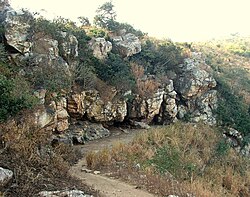
[[File:Sattapanni.jpg|alt=Sattapanni cave in which the first Buddhist council was held|thumb|The Sattapanni cave in which the first Buddhist council held was sponsored by King Ajatashatru.]] | |||
Ajatashatru is mentioned in both Jaina and Buddhist traditions. | |||
The ''Uvavai/Aupapātika sutta,'' which is the first ''Upānga'' (see [[Jain Agamas (Śvētāmbara)|Jain Agamas]]) of the Jains throws light on the relation between Mahavira and Ajatashatru. It accounts that Ajatashatru held Mahavira in the highest esteem. The same text also states that Ajatashatru had an officer to report to him about the daily routine of Mahavira. He was paid lavishly. The officer had a vast network and supporting field staff through whom he collected all the information about Mahavira and reported to the king. The ''Uvavai Sutta'' has detailed and illuminating discussion on Mahavira's arrival at the city of Champa, the honor was shown to him by Ajatashatru, the sermon given by Mahavira in [[Ardhamagadhi]] language, etc. | |||
Ajatashatru | |||
According to Buddhist tradition, the ''[[Samaññaphala Sutta]]'' deals with his first meeting with the Buddha, where he realized his mistakes with his association to Devadatta and plan to killing his own father. According to the same text, during this meeting, Ajatashatru took protection of the Buddha, the [[Dhamma]] and the [[Sangha (Buddhism)|Sangha]]. He was mentioned more than once in several other Sutta as an example of strong devotee to the Buddha, the Dhamma, and the Sangha. He erected a vast ''[[Stupa]]'' on the bones and ashes of the Buddha after the funeral, and Ajatashatru also was present in the first Buddhist council at the Sattapanni (Saptparni) caves [[Rajgriha]]. | |||
In [[Mahayana|Mahayana Buddhism]], Ajatashatru plays a significant [[Soteriology|soteriological]] role. He appears in the [[Mahāyāna Mahāparinirvāṇa Sūtra|Mahayana Mahaparinirvana Sutra]] as a being completely overtaken by evil and suffering, and as such the prototype of an ordinary, sinful person who can only be saved by the Buddha's compassion; the Buddha even declares in this sutra that he will "remain in the world for the sake of Ajatashatru".<ref>{{Cite book |url=http://www.shabkar.org/download/pdf/Mahaparinirvana_Sutra_Yamamoto_Page_2007.pdf |title=Mahayana Mahaparinirvana-Sutra |date=1973 |pages=269 |translator-last=Yamamoto |translator-first=Kosho |chapter=25: On Pure Actions}}</ref> This episode, along with the broader theme of the [[Three Ages of Buddhism|Age of Dharma Decline]], informed several Mahayana schools' emphasis on faith rather than accumulating [[Merit (Buddhism)|merit]]. | |||
Whether Ajatashatru was a Jain or Buddhist, both texts accounted for him as a devotee of the respective religions. | Whether Ajatashatru was a Jain or Buddhist, both texts accounted for him as a devotee of the respective religions. | ||
== Depictions in popular culture == | ==Depictions in popular culture== | ||
* A fictionalised account of Ajatashatru – depicted as a physically gross and | * A fictionalised account of Ajatashatru – depicted as a physically gross and tyrannical figure , who delights in committing atrocities and massacres – appears in [[Gore Vidal]]'s novel ''[[Creation (novel)|Creation]]''. | ||
* A film about his life was released titled ''Ajatashatru''. He also features as the protagonist in the film ''[[Amrapali (film)|Amrapali]]'' (1966), starring [[Sunil Dutt]] | * A film about his life was released titled ''Ajatashatru''. He also features as the protagonist in the film ''[[Amrapali (film)|Amrapali]]'' (1966), starring [[Sunil Dutt]] and [[Vyjayanthimala]] in titular role. | ||
* A book about his life was written titled Ajatashatru, by Subba Rao.<ref> | * A book about his life was written titled Ajatashatru, by Subba Rao.<ref>{{Cite web|url=http://books.rediff.com/|archiveurl=https://archive.today/20120707122814/http://books.rediff.com/bookshop/bkproductdisplay.jsp?prrfnbr=81885200&pvrfnbr=82563574&multiple=&frompg=recom_|title=Buy Books Online | Online Bookstore India | Online Book Shopping | Free Shipping Across India|archivedate=7 July 2012|website=books.rediff.com}}</ref> | ||
== See also == | ==See also== | ||
* [[Jain Agamas (Śvētāmbara)]] | * [[Jain Agamas (Śvētāmbara)]] | ||
* [[Samaññaphala Sutta]] | * [[Samaññaphala Sutta]] | ||
| Line 132: | Line 133: | ||
* {{citation |last=Thapar |first=Romila |author-link=Romila Thapar |title=A History of India |publisher=[[Penguin Books]] |date=1990 |orig-year=First published in 1966 |volume=1 |isbn=978-0-14-194976-5 }} | * {{citation |last=Thapar |first=Romila |author-link=Romila Thapar |title=A History of India |publisher=[[Penguin Books]] |date=1990 |orig-year=First published in 1966 |volume=1 |isbn=978-0-14-194976-5 }} | ||
== Further reading == | ==Further reading== | ||
* | * ''Ācharya Nagrajji D.Litt.'' "Agama and Tripitaka- A comparative study of Lord Mahavira and Lord Buddha", vol. 1, History and Tradition, chapter 14 "Follower Kings" pg.355-377. (English version by ''Muni Mahendrakumarji'') published by Concept Publishing Company, New Delhi 110059. | ||
* G.P.Singh,2004. "Early Indian Historical Tradition and Archaeology". D.K.Printworld(P)Ltd-New Delhi 110015; pp. 164, 165 | * G.P.Singh,2004. "Early Indian Historical Tradition and Archaeology". D.K.Printworld(P)Ltd-New Delhi 110015; pp. 164, 165 | ||
* Jain Aagam 1st Upanga ''Uvavai Sutta'' Chapter ''Kunika'' | * Jain Aagam 1st Upanga ''Uvavai Sutta'' Chapter ''Kunika'' | ||
* Basham, A. L. (1951) “Ajātasattu’s War with the Licchavis,” ''Proceedings of the Indian History Congress'' 14: 37–41. Available at: http://www.jstor.org/stable/44303932. | |||
==External links== | |||
* [http://www.palikanon.com/english/pali_names/am/ajatasattu.htm Entry on '''Ajatasattu''' in the Buddhist Dictionary of Pali Proper Names] | * [http://www.palikanon.com/english/pali_names/am/ajatasattu.htm Entry on '''Ajatasattu''' in the Buddhist Dictionary of Pali Proper Names] | ||
| Line 151: | Line 153: | ||
[[Category:Indian Buddhists]] | [[Category:Indian Buddhists]] | ||
[[Category:5th-century BC Indian | [[Category:5th-century BC Indian Buddhists]] | ||
[[Category:5th-century BC Indian monarchs]] | [[Category:5th-century BC Indian monarchs]] | ||
[[Category: | [[Category:Buddhist monarchs]] | ||
[[Category:Patricides]] | [[Category:Patricides]] | ||
[[Category:History of Bihar]] | [[Category:History of Bihar]] | ||
Revision as of 07:53, 22 July 2023
 | This article has multiple issues. Please help improve it or discuss these issues on the talk page. (Learn how and when to remove these template messages)
|


| Ajatashatru | |
|---|---|
 | |
| 2nd Haryanka Emperor | |
| Reign | c. 492 – c. 460 BCE[2] or early 4th cent. BCE[3] |
| Predecessor | Bimbisara |
| Successor | Udayabhadra |
| Governor of Champa | |
| Reign | ? – c.492 BCE |
| Died | 460 BCE[2] or c. 380 BCE[3] |
| Spouse |
|
| Issue | Udayabhadra |
| Dynasty | Haryanka |
| Father | Bimbisara |
| Mother | Queen Chellana (Sanskrit: Cellaṇā), daughter of President Chetaka[4][5] (Jainism) Queen Kosala Devī (Buddhism) |
| Religion | Jainism Buddhism |
Ajatasattu (Pāli Ajātasattu[2]) or Ajatashatru (Sanskrit Ajātaśatru[2]) in Buddhist tradition, or Kunika (Kūṇika) and Kuniya (Kūṇiya) in the Jain histories,[6] (c. 492 to 460 BCE or early 5th century BCE[3]) was one of the most important kings of the Haryanka dynasty of Magadha in East India. He was the son of King Bimbisara and was a contemporary of both Mahavira and Gautama Buddha. He forcefully took over the kingdom of Magadha from his father and imprisoned him. He fought a war against the Vajjika League, led by the Licchavis, and conquered the republic of Vaishali. The city of Pataliputra was formed by fortification of a village by Ajatashatru.
Ajatashatru followed policies of conquest and expansion. He defeated his neighbours including the king of Kosala; his brothers, at odds with him, went to Kashi, which had been given to Bimbisara as dowry and led to a war between Magadha and Kosala.
Ajatashatru occupied Kashi and captured the smaller kingdoms. Magadha under Ajatashatru became the most powerful kingdom in North India.
He is the presumed inventor of two weapons used in war: the rathamusala (scythed chariot) and the mahashilakantaka (engine to eject big stones).
Datings
Based on correlation with dates in the Mahāvaṃsa and concluding that the Buddha died in 483 BC, Arthur Llewellyn Basham dated the accession of Ajatashatru to 491 BC.[7] He estimates the first campaign of Ajatashatru to have taken place in 485 BC, and his second campaign against the Vajjika League in 481–480 BC.[7] The Samaññaphala Sutta states that Ajatashatru visited the six teachers to hear their doctrines and at last visited the Buddha, an event Basham estimated to have taken place in 491 BC.[8]
Birth
.jpg)
Ajatashatru, also known as Kunika, was the son of Bimbisara.[9] The ancient inscription in Government Museum, Mathura refers to him as vaidehi putra Ajatashatru Kunika "Ajatashatru Kunika, the son of Vaidehi." The story of Ajatashatru is found in the Tripiṭaka of Buddhism and Jain Agamas. The account of Ajatashatru's birth is more or less similar in both the traditions. According to Jainism, Ajatashatru was born to King Bimbisara and Queen Chellana;[4][10][5] Buddhist tradition records Ajatashatru being born to Bimbisara and Kosala Devi. It is worthwhile to note that both the queens were called "Vaidehi" in both traditions.
According to the Jain Nirayavalika Sutra, during her pregnancy, Queen Chellana had a strong desire to eat the fried flesh of her husband's heart and drink liquor. Meanwhile, the very intelligent Prince Abhayakumara, son of King Bimbisara and Queen Nanda, fried a wild fruit that resembled a heart and gave it to the queen. The queen ate it and later felt ashamed for having such a demonic desire and she feared that the child might grow up and prove fatal for the family, thus after a few months of the child being born, the queen had him thrown out of the palace. When the child was lying near the garbage dump, a cock bit his little finger. King Bimbisara, learning about the child being thrown out, ran outside and picked up the child and put its bleeding little finger in his mouth and sucked it until it stopped bleeding and continued this for days until it was healed. As the little finger of the child was sore, he was nicknamed Kunika "Sore Finger". Later he was named Asokacanda.[11]
In the Buddhist Atthakatha, the above story is almost the same, except that Kosaladevi desired to drink blood from Bimbisara's arm; the king obliged her and, later, when the child was thrown near the garbage dump, due to an infection he got a boil on his little finger and the king sucked it and once while sucking it the boil burst inside the king's mouth, but due to affection for his child he did not spit the pus out, rather swallowed it.
War and victory over Vaishali
The feud between Ajatashatru and Licchavi during 484–468 BCE led to defeat of the latter.[12]


The Jaina Tradition
Once Queen Padmavati, wife of Ajatashatru, was sitting in her balcony in the evening. She saw Halla and Vihalla kumaras with their wives sitting on Sechanaka elephant and one of the wives wearing the 18 fold divine necklace. Then she heard one of the maidservants making from the garden below "It's Halla and Vihalla kumaras and not the king who enjoy the real pleasures of the kingdom" and she thought "what's the use of the kingdom if I do not have both the jewels in my possession?"
So, she shared this thought with Ajatashatru the same night and became excessively insistent in her demand. Ajatashatru, at last, agreed and sent a request to both his brothers to give the elephant and the necklace to him, which both his brothers denied saying that these gifts were given by their dear father so why should they part from them? Ajatashatru sent the request thrice but got the same reply all three times. This greatly annoyed him, so he sent his men to arrest them. Meanwhile, Halla and the Vihalla kumaras availed a chance and escaped to their maternal grandfather Chetaka who was the king of the great kingdom of the Vaishali republic (Vajjis/Licchavis). Ajatashatru sent notice thrice to Chetaka to surrender them but was denied by Chetaka.
This was enough for Ajatashatru. He called his half brothers, Kalakumaras (10 kalakumaras, those born to King Bimbisara and 10 Kali Queens Kali, Sukali, Mahakali, etc.) to merge their army with his, since it was well known to Ajatashatru that Vaishali republic had always been invincible in the past and he alone would not be able to defeat it. Each Kalakumara brought 3000 horses, 3000 elephants, 3000 chariots and 30000 infantrymen each. On the other hand, Chetaka invited his own allies 9 Mallas, 9 Lichhvis and 18 kings of Kasi-Kosala to fight his grandson Ajatashatru. All these kings came with 3000 horses, 3000 elephants, 3000 chariots and 30000 infantrymen each. Thus all together there were 57000 elephants, 57000 chariots, 57000 horses, and 570000 infantrymen.
The war began. King Chetaka was a devout follower of Mahavira and had a vow to not shoot more than one arrow per day in a war. It was known to all that Chetaka's aim was perfect and his arrows were infallible. His first arrow killed one Kalakumara, commander of Ajatashatru. On the consecutive nine days the rest of the nine Kalakumaras were killed by Chetaka. Deeply sorrowed by the death of their sons, the Kali queens were initiated as nuns in the holy order of Mahavira.
As Ajatashatru was moving towards defeat he practised penance for three days and offered prayers to Sakrendra and Charmendra (Indra of different heavens) who then helped him in the war. They protected him from the infallible arrow of Chetaka. The war became very severe and by the divine influence of the Indras even the pebbles, straws, leaves hurled by Ajatashatru's men were said to have fell like rocks on the army of Chetaka. This weapon was thus named Mahasilakantaka, i.e. the weapon through which more than a lakh (1,00,000) people died. Next, the Indras granted a huge, automatically moving chariot with swinging spiked maces on each side, and said to have been driven by Charmendra himself, to Ajatashatru. The chariot moved about in the battlefield crushing lakhs of soldiers. This war-chariot was named Ratha-Musala.
In this battle, Chetaka was defeated. But, Chetaka and others immediately took shelter inside the city walls of Vaishali and closed the main gate. The walls around Vaishali were so strong that Ajatashatru was unable to break through them. Many days passed, Ajatashatru became furious and again prayed to Indra, but this time Indra refused to help him. But Ajatashatru was informed by an oracle of a demi-goddess "Vaishali can be conquered if Sramana (monk) Kulvalaka gets married to a courtesan."
Ajatashatru inquired about the monk Kulvalaka and sent for the prostitute Magadhika disguised as a devout follower. The fallen woman attracted the monk towards herself and finally, the monk gave up his monkhood and married her. Later Magadhika on Ajatashatru's orders brainwashed Kulvalaka to enter Vaishali disguised as an astrologer. With great difficulty, he did enter Vaishali and learned that the city was saved by a Chaitya (altar) dedicated to Munisuvrata. Kulvalaka then started telling people that this altar is the reason why the city is suffering through a bad period. The people uprooted the altar from its very foundation. Kulvalaka gave a signal and Ajatashatru proceeded as per prior arrangement. This was the last attack. Vaishali was conquered by Ajatashatru.
Sechanaka the elephant died after it fell in a pit with iron rods and fire made by Ajatashatru's soldiers. Later Halla and Vihalla kumaras got initiated as monks in the holy order of Mahavira. Chetaka courted Sallekahna (fasted unto death). Ajatashatru not only conquered Vaishali but also Kasi-Kosala.
The Buddhist traditions
There was a diamond mine near a village on the river Ganges. There was an agreement between Ajatashatru and the Licchavi of Vajji that they would have an equal share of the diamonds. However, because of sheer lethargy, Ajatashatru failed to collect his own share, and most of diamonds were carried away by the Lichhavis. Over time, finally, Ajatashatru became annoyed and decided to do something about it. Since he thought that it might be almost impossible to fight against the whole confederacy of Vaishali, he decided instead to uproot the powerful Vajjis and exterminate them. He sent his chief minister Vassakara to the Buddha to ask him why the Vaishali should be so invincible; to which Buddha gave seven reasons, including: That the Vajjis are always punctual to meetings, their disciplined behavior, their respect for elders, respect for women, that they do not marry their daughters forcefully, that they give spiritual protection to the Arhats, and finally, the main reason was the Chaityas (altar), which was inside the town.
Thus, with the help of his chief minister Vassakara, Ajatashatru managed to split the Vajjis and also broke the chaityas inside. During this battle, Ajatashatru used a scythed chariot, featuring a swinging mace and blades on both sides and attacked the town with it and conquered it.
Kingdom
Ajatashatru moved his capital from Rajgriha to Champa due to death of his father.[13]
Family
The Jaina tradition
According to the Nirayāvaliyā Suttā Ajatashatru was born to King Bimbisara and Queen Chellana, who was the daughter of Chetaka the king of Vaishali, who was the brother of Queen Triśalá, mother of Mahavira. Ajatashatru had eight wives.
The Buddhist tradition

According to Dīgha nikāya, Ajatashatru was born to King Bimbisara and Queen Kosala Devi, who was the daughter of Maha-Kosala, the king of Kosala and sister of Pasenadi who later succeeded to the throne. Ajatashatru had 500 wives but the principal consort was Princess Vajira.[14] The City of Kasi was given to Bimbisara as dowry by Maha-Kosala. After the murder of Bimbisara, Prasenajit took the city back. This resulted in a war between Ajatashatru and Prasenajit. The war ended in a peace treaty in which Prasenajit married his daughter Vajira to him. Ajatashatru later had a son named Udayabhadda or Udayabhadra.
Death
The account of Ajatashatru's death recorded by historians is c. 461 BCE.[15] The account of his death differs widely between Jain and Buddhist traditions. Other accounts point towards c. 460 BCE[3] as the year of his death.
Religion

Ajatashatru is mentioned in both Jaina and Buddhist traditions.
The Uvavai/Aupapātika sutta, which is the first Upānga (see Jain Agamas) of the Jains throws light on the relation between Mahavira and Ajatashatru. It accounts that Ajatashatru held Mahavira in the highest esteem. The same text also states that Ajatashatru had an officer to report to him about the daily routine of Mahavira. He was paid lavishly. The officer had a vast network and supporting field staff through whom he collected all the information about Mahavira and reported to the king. The Uvavai Sutta has detailed and illuminating discussion on Mahavira's arrival at the city of Champa, the honor was shown to him by Ajatashatru, the sermon given by Mahavira in Ardhamagadhi language, etc.
According to Buddhist tradition, the Samaññaphala Sutta deals with his first meeting with the Buddha, where he realized his mistakes with his association to Devadatta and plan to killing his own father. According to the same text, during this meeting, Ajatashatru took protection of the Buddha, the Dhamma and the Sangha. He was mentioned more than once in several other Sutta as an example of strong devotee to the Buddha, the Dhamma, and the Sangha. He erected a vast Stupa on the bones and ashes of the Buddha after the funeral, and Ajatashatru also was present in the first Buddhist council at the Sattapanni (Saptparni) caves Rajgriha.
In Mahayana Buddhism, Ajatashatru plays a significant soteriological role. He appears in the Mahayana Mahaparinirvana Sutra as a being completely overtaken by evil and suffering, and as such the prototype of an ordinary, sinful person who can only be saved by the Buddha's compassion; the Buddha even declares in this sutra that he will "remain in the world for the sake of Ajatashatru".[16] This episode, along with the broader theme of the Age of Dharma Decline, informed several Mahayana schools' emphasis on faith rather than accumulating merit.
Whether Ajatashatru was a Jain or Buddhist, both texts accounted for him as a devotee of the respective religions.
Depictions in popular culture
- A fictionalised account of Ajatashatru – depicted as a physically gross and tyrannical figure , who delights in committing atrocities and massacres – appears in Gore Vidal's novel Creation.
- A film about his life was released titled Ajatashatru. He also features as the protagonist in the film Amrapali (1966), starring Sunil Dutt and Vyjayanthimala in titular role.
- A book about his life was written titled Ajatashatru, by Subba Rao.[17]
See also
- Jain Agamas (Śvētāmbara)
- Samaññaphala Sutta
- Maharaja Ajasath, a biographical Sinhala-language film directed by Sanath Abesekara. Gayan Wickramathilaka played the character
- Avanti-Magadhan Wars
References
Citations
- ↑ John Marshall, A Guide to Sanchi, 1918 p.58ff Archived 20 August 2017 at Wikiwix (Public Domain text)
- ↑ 2.0 2.1 2.2 2.3 India's Ancient Past, by R.S. Sharma
- ↑ 3.0 3.1 3.2 3.3 India: A History. Revised and Updated, by John Keay
- ↑ 4.0 4.1 Rapson, Edward James (1955). The Cambridge History of India. CUP Archive. p. 183.
- ↑ 5.0 5.1 "[Solved] Who was the mother of Ajatashatru, the king of Magadha?". Testbook. Retrieved 9 August 2022.
- ↑ Jain, Kailash Chand (1974). Lord Mahāvīra and His Times. Delhi, India: Motilal Banarsidass. p. 21. ISBN 978-8-120-80805-8.
- ↑ 7.0 7.1 Kailash Chand Jain 1991, p. 75.
- ↑ Kailash Chand Jain 1991, p. 79.
- ↑ Dundas 2002, p. 36.
- ↑ "Bimbisara". World History Encyclopedia. Retrieved 9 August 2022.
- ↑ Jain Aagam Uvavai Sutra chapter: Kunika
- ↑ Upinder Singh 2016, p. 272.
- ↑ Natubhai Shah 2004, p. 42.
- ↑ Upinder Singh 2016, p. 271.
- ↑ Thapar 1990, p. 56.
- ↑ "25: On Pure Actions". Mahayana Mahaparinirvana-Sutra (PDF). Translated by Yamamoto, Kosho. 1973. p. 269.
- ↑ "Buy Books Online | Online Bookstore India | Online Book Shopping | Free Shipping Across India". books.rediff.com.
{{cite web}}: CS1 maint: deprecated archival service (link)
Sources
- Dundas, Paul (2002) [1992], The Jains (Second ed.), Routledge, ISBN 0-415-26605-X
- Jain, Kailash Chand (1991), Lord Mahāvīra and His Times, Motilal Banarsidass, ISBN 978-81-208-0805-8
- Shah, Natubhai (2004) [First published in 1998], Jainism: The World of Conquerors, vol. I, Motilal Banarsidass, ISBN 978-81-208-1938-2
- Singh, Upinder (2016), A History of Ancient and Early Medieval India: From the Stone Age to the 12th Century, Pearson PLC, ISBN 978-81-317-1677-9
- Thapar, Romila (1990) [First published in 1966], A History of India, vol. 1, Penguin Books, ISBN 978-0-14-194976-5
Further reading
- Ācharya Nagrajji D.Litt. "Agama and Tripitaka- A comparative study of Lord Mahavira and Lord Buddha", vol. 1, History and Tradition, chapter 14 "Follower Kings" pg.355-377. (English version by Muni Mahendrakumarji) published by Concept Publishing Company, New Delhi 110059.
- G.P.Singh,2004. "Early Indian Historical Tradition and Archaeology". D.K.Printworld(P)Ltd-New Delhi 110015; pp. 164, 165
- Jain Aagam 1st Upanga Uvavai Sutta Chapter Kunika
- Basham, A. L. (1951) “Ajātasattu’s War with the Licchavis,” Proceedings of the Indian History Congress 14: 37–41. Available at: http://www.jstor.org/stable/44303932.
External links
| Regnal titles | ||
|---|---|---|
| Preceded by Bimbisara |
Ajatashatru 493 BCE–461 BCE |
Succeeded by Udayabhadra |
- Pages using the JsonConfig extension
- Webarchive template other archives
- Articles needing additional references from August 2015
- Indian Buddhists
- 5th-century BC Indian Buddhists
- 5th-century BC Indian monarchs
- Buddhist monarchs
- Patricides
- History of Bihar
- Haryanka dynasty
- 460s BC deaths
- Indian Buddhist monarchs
- Kings of Magadha