

imported>AgniKalpa m Added a few wikilink(s) |
ImportMaster (talk | contribs) m robot: Create/update articles in Category:Hindu gods. |
||
| Line 1: | Line 1: | ||
{{Short description|Epithet of the Hindu god Vishnu}} | {{Short description|Epithet of the Hindu god Vishnu}} | ||
{{about|the term|affiliation of Lord Vishnu | {{Infobox deity | ||
| type = Hindu | |||
| image = Madyaranga Ranganatha temple.JPG | |||
| caption = Shrine of Narayana | |||
| name = Narayana | |||
| Devanagari = नारायण | |||
| Sanskrit_transliteration = {{IAST|Nārāyaṇa}} | |||
| mantra = ॐ नमो नारायणाय<br>[[Om Namo Narayanaya]] | |||
| god_of = Protector of the Worlds<ref>{{cite web | url=https://www.wisdomlib.org/hinduism/book/%C5%9Br%C4%AB-k%E1%B9%9B%E1%B9%A3%E1%B9%87a-vijaya/d/doc82124.html | title=Invoking Auspiciousness [Chapter 1] | date=14 August 2014 }}</ref><br> [[Brahman]], the Ultimate Reality<br>Supreme Being in [[Vaishnavism]]<ref>{{cite web | url=https://www.wisdomlib.org/definition/narayana | title=Narayana, Nārāyaṇa, Nārāyana, Narāyana, Nara-ayana, Nara-yana: 40 definitions | date=June 2008 }}</ref> | |||
| texts = [[Vedas]], [[Puranas]] | |||
| affiliation = [[Vishnu]], [[Vaishnavism]] | |||
| weapon = [[Panchajanya]], [[Sudarshana Chakra|Chakra]], [[Kaumodaki]] | |||
| other_names = | |||
| consorts = [[Lakshmi]] (As Sridevi, [[Bhudevi]], and [[Niladevi]]) | |||
| abode = [[Kshira Sagara]] | |||
| mount = [[Shesha]] | |||
| associate = [[Vishnu]], [[Hari]], [[Madhava (Vishnu)|Madhava]], [[Perumal (deity)|Perumal]], [[Krishna]] | |||
| symbol = [[Padma (Vishnu)|Padma]] | |||
| image_upright = [[File:Madyaranga Ranganatha temple.JPG|260px|center]] | |||
}}{{about|the term|affiliation of Lord Vishnu|Nara-Narayana|other uses|Narayan (disambiguation)}} | |||
{{EngvarB|date=July 2015}} | {{EngvarB|date=July 2015}} | ||
{{Use dmy dates|date=December 2019}} | {{Use dmy dates|date=December 2019}} | ||
{{Vaishnavism}} | {{Vaishnavism}} | ||
'''Narayana''' ([[Sanskrit]]: नारायण, [[IAST]]: ''Nārāyaṇa'') is the | '''Narayana''' ([[Sanskrit]]: नारायण, [[IAST]]: ''Nārāyaṇa'') is one of the forms and names of [[Vishnu]], who is in yogic slumber under the [[Kshira Sagara|celestial waters]], referring to the [[masculine]] principle. He is also known as [[Purushottama]], and is considered the [[Brahman|Supreme Being]] in [[Vaishnavism]].<ref>{{cite book|url=https://books.google.com/books?id=RvuDlhpvvHwC&pg=PA268|title=The Buddhist Viṣṇu: Religious Transformation, Politics, and Culture|page=268|author=John Clifford Holt|publisher=Motilal Banarsidass Publishers|year=2008|isbn=9788120832695}}</ref><ref>{{cite book|url=https://books.google.com/books?id=aIviDwAAQBAJ&pg=PA110|title=Ramanuja and Schleiermacher: Toward a Constructive Comparative Theology|page=110|author=Jon Paul Sydnor|publisher=ISD LLC|date=29 March 2012|isbn=9780227900352}}</ref><ref>{{cite book|url=https://books.google.com/books?id=p6KumJp_wNgC&pg=PA28|title=The Triumph of the Goddess: The Canonical Models and Theological Visions of the Devi-Bhagavata Purana|page=28|author=C. Mackenzie Brown|publisher=SUNY Press|date=29 August 1990|isbn=9780791403648}}</ref><ref>{{cite book|url=https://books.google.com/books?id=HAg3AgAAQBAJ&pg=PA748|title=The World's Religions|page=748|author1=Peter Clarke|author2=Friedhelm Hardy|author3=Leslie Houlden|author4=Stewart Sutherland|publisher=Routledge|date=14 January 2004|isbn=9781136851858}}</ref> | ||
== Etymology == | |||
L. B. Keny proposes that Narayana was associated with the [[Dravidian peoples|Dravidian]], and ultimately, the [[Indus Valley civilisation|Indus Valley Civilisation]], prior to his syncretism with Vishnu. To this end, he states that the etymology of the deity is associated with the Dravidian ''nara'', meaning water, ''ay'', which in [[Tamil language|Tamil]] means "to lie in a place", and ''an'', which is the masculine termination in [[Dravidian languages]]. He asserts that this is also the reason why Narayana is represented as lying on a [[Shesha|serpent]] in the sea. He quotes, "This Nārāyana of the Āryan pantheon seems to be the supreme being of the Mohenjo-Darians, a god who was probably styled Ān, a name still kept in [[Tamil literature]] as Āndivanam, the prototype of the historic [[Shiva|Siva]]".<ref>{{Cite book |last=Klostermaier |first=Klaus K. |url=https://books.google.com/books?id=CFQ9DgAAQBAJ&dq=narayana+dravidian&pg=PA70 |title=Mythologies and Philosophies of Salvation in the Theistic Traditions of India |date=2006-01-01 |publisher=Wilfrid Laurier Univ. Press |isbn=978-0-88920-743-1 |pages=70–71 |language=en}}</ref><ref>{{Cite book |url=https://books.google.com/books?id=BfV5DwAAQBAJ&dq=narayana+dravidian&pg=PT48 |title=The Book of Avatars and Divinities |date=2018-11-21 |publisher=Penguin Random House India Private Limited |isbn=978-93-5305-362-8 |language=en}}</ref><ref>{{Cite book |last=Krishna |first=Nanditha |url=https://books.google.com/books?id=f9cSlaLMlgEC&q=narayana+dravidian |title=The Book of Vishnu |date=June 2010 |publisher=Penguin Books India |isbn=978-0-14-306762-7 |pages=10 |language=en}}</ref> | |||
Narayan Aiyangar states the meaning of the [[Sanskrit]] word 'Narayana' can be traced back to the [[Manusmriti|Laws of Manu]] (also known as the [[Manusmriti]], a [[Dharmaśāstra]] text),<ref name=":0">{{Cite book|url=https://archive.org/details/in.ernet.dli.2015.217324|title=Essays on Indo Aryan Mythology|last=Narayan Aiyangar|date=1901|pages=[https://archive.org/details/in.ernet.dli.2015.217324/page/n196 196]}}</ref> which states: | |||
{{ | {{blockquote|The waters are called narah, (for) the waters are, indeed, the 1 residing in Narah or from whom Narah came out ; as they were his first residence (ayana), he hence is named Narayana.|source=Chapter 1, Verse 10<ref>{{Cite web|url=https://www.sacred-texts.com/hin/manu/manu01.htm|title=The Laws of Manu I|website=www.sacred-texts.com|access-date=2019-12-07}}</ref>}} | ||
This definition is used throughout Vedic literature such as the [[Mahabharata]] and [[Vishnu Purana]].<ref name="sacred-texts.com">{{Cite web|url=https://www.sacred-texts.com/hin/m03/m03188.htm|title=The Mahabharata, Book 3: Vana Parva: Markandeya-Samasya Parva: Section CLXXXVIII|website=www.sacred-texts.com|access-date=2019-12-05}}</ref><ref name=":0" /> 'Narayana' is also defined as the 'son of the [[Purusha|primeval man]]',<ref>{{Cite web|url=https://faculty.washington.edu/prem/mw/n.html|title=Monier-Williams Sanskrit-English Dictionary -- n|website=faculty.washington.edu|access-date=2019-12-05}}</ref> and 'Supreme Being who is the foundation of all men'.<ref>[[Harivansh]], Adhyay 88 shlock 44, also, Manu Smruti 1:10 " The Law Code of Manu", Published by Oxford University Press, {{ISBN|0-19-280271-2}}, page 11</ref> | This definition is used throughout Vedic literature such as the [[Mahabharata]] and [[Vishnu Purana]].<ref name="sacred-texts.com">{{Cite web|url=https://www.sacred-texts.com/hin/m03/m03188.htm|title=The Mahabharata, Book 3: Vana Parva: Markandeya-Samasya Parva: Section CLXXXVIII|website=www.sacred-texts.com|access-date=2019-12-05}}</ref><ref name=":0" /> 'Narayana' is also defined as the 'son of the [[Purusha|primeval man]]',<ref>{{Cite web|url=https://faculty.washington.edu/prem/mw/n.html|title=Monier-Williams Sanskrit-English Dictionary -- n|website=faculty.washington.edu|access-date=2019-12-05}}</ref> and 'Supreme Being who is the foundation of all men'.<ref>[[Harivansh]], Adhyay 88 shlock 44, also, Manu Smruti 1:10 " The Law Code of Manu", Published by Oxford University Press, {{ISBN|0-19-280271-2}}, page 11</ref> | ||
* | *'Nara' (Sanskrit नार) means 'water' and 'man'<ref>{{Cite web|url=https://spokensanskrit.org/index.php?tran_input=nAra&direct=se&script=hk&link=yes&mode=3|title=Sanskrit Dictionary for Spoken Sanskrit: 'nara'|website=spokensanskrit.org|access-date=2019-12-05}}</ref> | ||
* | *'Yana' (Sanskrit यान) means 'vehicle', 'vessel', or more loosely, 'abode' or 'home'<ref>{{Cite web|url=https://spokensanskrit.org/index.php?mode=3&script=hk&tran_input=yana&direct=au&anz=100|title=Sanskrit Dictionary for Spoken Sanskrit 'yana'|website=spokensanskrit.org|access-date=2019-12-05}}</ref> | ||
==Description== | ==Description== | ||
In the [[Vedas]] and [[Puranas]], Narayana is described as having the divine blackish-blue color of water-filled clouds, four-armed, holding a [[Padma (Vishnu)|Padma]] (lotus), [[Kaumodaki]] (mace), [[Panchajanya]] [[shankha]] (conch), and the [[Sudarshana Chakra]] (discus). | |||
=== Hinduism === | === Hinduism === | ||
[[File:Badami Cave Temples 51.jpg|thumb|A depiction of Narayana at the [[Badami Cave Temples]] in [[Karnataka]]]] | |||
{{Main|Hinduism}} | {{Main|Hinduism}} | ||
As stated in the epic ''[[Itihasa|Itihāsa]],'' the [[Mahabharata]]: | As stated in the epic ''[[Itihasa|Itihāsa]],'' the [[Mahabharata]]: | ||
{{ | {{blockquote|<poem>I am Narayana, the Source of all things, the Eternal, the Unchangeable. I am the Creator of all things, and the Destroyer also of all. I am [[Vishnu]], I am [[Brahma]] and I am [[Shiva|Shankara]], the chief of the gods. I am king Vaisravana, and I am Yama, the lord of the deceased spirits. I am [[Shiva|Siva]], I am Soma, and I am [[Kasyapa]] the lord of the created things. And, O best of regenerate ones, I am he called Dhatri, and he also that is called Vidhatri, and I am Sacrifice embodied. Fire is my mouth, the earth my feet, and the Sun and the Moon are my eyes; the Heaven is the crown of my head, the firmament and the cardinal points are my ears; the waters are born of my sweat. Space with the cardinal points are my body, and the Air is my mind... | ||
...And, O Brahmana, whatever is obtained by men by the practice of truth, charity, ascetic austerities, and peace and harmlessness towards all creatures, and such other handsome deeds, is obtained because of my arrangements. Governed by my ordinance, men wander within my body, their senses overwhelmed by me. They move not according to their will but as they are moved by me.</poem>|source=Mahabharata (translated by Kisari Mohan Ganguli, 1883-1896), Book 3, Varna Parva, Chapter CLXXXVIII (188)<ref name="sacred-texts.com" />|sign=}} | ...And, O Brahmana, whatever is obtained by men by the practice of truth, charity, ascetic austerities, and peace and harmlessness towards all creatures, and such other handsome deeds, is obtained because of my arrangements. Governed by my ordinance, men wander within my body, their senses overwhelmed by me. They move not according to their will but as they are moved by me.</poem>|source=Mahabharata (translated by Kisari Mohan Ganguli, 1883-1896), Book 3, Varna Parva, Chapter CLXXXVIII (188)<ref name="sacred-texts.com">{{Cite web|url=https://www.sacred-texts.com/hin/m03/m03188.htm|title=The Mahabharata, Book 3: Vana Parva: Markandeya-Samasya Parva: Section CLXXXVIII|website=www.sacred-texts.com|access-date=2019-12-05}}</ref>|sign=}} | ||
In the ''[[Mahabharata]]'', [[Krishna]] is also synonymous with Narayana and [[Arjuna]] is referred to as Nara.<ref>''Vaisnavism Saivism and Minor Religious Systems'', Ramkrishna Gopal Bhandarkar. Published by Asian Educational Services, p.46.</ref> The epic identifies them both in plural 'Krishnas', or as part incarnations of the earlier incarnations of [[Vishnu]], recalling their mystical identity as [[Nara-Narayana]].<ref>{{cite book |author=Hiltebeitel, Alf |author-link=Alf Hiltebeitel |title=The ritual of battle: Krishna in the Mahābhārata |publisher=State University of New York Press |location=Albany, N.Y |year=1990 |isbn=0-7914-0249-5 }} [https://books.google.com/books?id=vwWGX08JAx8C&pg=PA61 p61]</ref> | As per texts like the ''[[Vishnu Purana]], [[Bhagavata Purana]], [[Garuda Purana]], and the [[Padma Purana]]'', Narayana is [[Vishnu]] himself who incarnates in [[Dashavatara|various avatars]]. | ||
According to the [[Bhagavad Gita]], he is also the "Guru of the Universe". The Bhagavata Purana declares Narayana as the [[Supreme Personality of Godhead]], who engages in the creation of 14 worlds within the universe [[Brahma]] who is Deity of [[rajas]]-[[guna]], himself sustains, maintains and preserves the universe as [[Vishnu]] by accepting [[sattva]]-[[guna]]. Narayana himself annihilates the universe at the end of ''Maha-Kalpa'' as Kalagni [[Rudra]] who is presiding deity of [[Tamas (philosophy)|tamas]]-[[guna]]. | |||
According to the [[Bhagavata Purana]], [[Purusha Sukta]], [[Narayana Sukta]], and [[Narayana Upanishad]] from the Vedas, he is the ultimate soul. | |||
According to [[Madhvacharya]], Narayana is one of the five [[vyuha]]s of [[Vishnu]], which are cosmic emanations of God in contrast to his incarnate [[avatar]]s. Madhvacharya separates Vishnu's manifestations into two groups: Vishnu's vyuhas (emanations) and His avataras (incarnations).<ref>{{Cite journal |last=Ghosh |first=A. |date=2009-03-02 |title=Krishna: A Sourcebook. Edited by Edwin F. Bryant. |url=http://dx.doi.org/10.1093/jhs/hip002 |journal=The Journal of Hindu Studies |volume=2 |issue=1 |pages=124–126 |doi=10.1093/jhs/hip002 |issn=1756-4255}}</ref> The Vyuhas have their basis in the [[Pancharatra]]s, a sectarian text that was accepted as authoritative by both the [[Vishishtadvaita]] and [[Dvaita]] schools of [[Vedanta]]. They are mechanisms by which the universe is ordered, was created, and evolves. Narayana possesses the [[Caturvyūha|chatur-vyuha]] aspects of Vasudeva, Sankarshana, Pradyumna, and Aniruddha, who evolve one after the other in the development of the universe.In the ''[[Mahabharata]]'', [[Krishna]] is also synonymous with Narayana and [[Arjuna]] is referred to as Nara.<ref>''Vaisnavism Saivism and Minor Religious Systems'', Ramkrishna Gopal Bhandarkar. Published by Asian Educational Services, p.46.</ref> The epic identifies them both in plural 'Krishnas', or as part incarnations of the earlier incarnations of [[Vishnu]], recalling their mystical identity as [[Nara-Narayana]].<ref>{{cite book |author=Hiltebeitel, Alf |author-link=Alf Hiltebeitel |title=The ritual of battle: Krishna in the Mahābhārata |publisher=State University of New York Press |location=Albany, N.Y |year=1990 |isbn=0-7914-0249-5 }} [https://books.google.com/books?id=vwWGX08JAx8C&pg=PA61 p61]</ref> | |||
Narayana is also described in the [[Bhagavad Gita]] as having a universal form (''[[Vishvarupa]]'') which is beyond the ordinary limits of human perception or imagination.<ref>{{cite web |url = http://vedabase.net/bg/11/3/en1 |title = Bhagavad-gita As It Is Chapter 11 Verse 3 |publisher = vedabase.net |access-date = 10 May 2008 |last = Prabhupada |author-link = Prabhupada |first = AC Bhaktivedanta |url-status = dead |archive-url = https://web.archive.org/web/20080515014652/http://vedabase.net/bg/11/3/en1 |archive-date = 15 May 2008 }} "see the cosmic manifestation"</ref> | Narayana is also described in the [[Bhagavad Gita]] as having a universal form (''[[Vishvarupa]]'') which is beyond the ordinary limits of human perception or imagination.<ref>{{cite web |url = http://vedabase.net/bg/11/3/en1 |title = Bhagavad-gita As It Is Chapter 11 Verse 3 |publisher = vedabase.net |access-date = 10 May 2008 |last = Prabhupada |author-link = Prabhupada |first = AC Bhaktivedanta |url-status = dead |archive-url = https://web.archive.org/web/20080515014652/http://vedabase.net/bg/11/3/en1 |archive-date = 15 May 2008 }} "see the cosmic manifestation"</ref> | ||
In the [[Narayana sukta|Narayana Sukta]], Narayana is essentially the supreme force and/or essence of all: ''<nowiki/>'Nārāyaṇa parabrahman tatvam Nārāyaṇa paraha'.''<ref>{{Cite web |title=॥ नारायणसूक्तम् सार्थ ॥ - .. Narayana Sukta .. - Sanskrit Documents |url=http://sanskritdocuments.org/doc_vishhnu/narayana-sukta.html?lang=sa |access-date=21 October 2015 |website=sanskritdocuments.org}}</ref> | |||
The [[Śruti]] texts mention Narayana as the primordial being , who was present even when [[Brahma]] and Ishana ([[Shiva]]) were not present. Thus, He is the Supreme Soul. <ref> https://upanishads.org.in/otherupanishads/47/1 </ref> | Narayana's eternal and supreme abode beyond the material universe is [[Vaikuntha]] which is a realm of bliss and happiness called [[Moksha|Paramapadha]], which means final or highest place for liberated souls, where they enjoy bliss and happiness for eternity in the company of the supreme lord. Vaikuntha is situated beyond the material universe and hence, cannot be perceived or measured by material science or logic.<ref>{{cite web |url=http://www.tirumala.org/sapthagiri/062003/vaikuntha.htm |title=Sapthagiri |access-date=21 May 2007 |url-status=dead |archive-url=https://web.archive.org/web/20070515224306/http://www.tirumala.org/sapthagiri/062003/vaikuntha.htm |archive-date=15 May 2007 |df=dmy-all }}</ref> Sometimes, [[Ksheera Sagara]] where Narayana or [[Vishnu]] rests on [[Ananta Shesha]] is also perceived as ''Vaikuntha'' within the material universe. | ||
The [[Śruti]] texts mention Narayana as the primordial being , who was present even when [[Brahma]] and Ishana ([[Shiva]]) were not present. Thus, He is the Supreme Soul.<ref>{{Cite web|url=https://upanishads.org.in/otherupanishads/47/1|title=Upanishads}}</ref> | |||
===Buddhism=== | ===Buddhism=== | ||
| Line 63: | Line 84: | ||
[[Balabhadra]] and ''Narayana'' are mighty half brothers, who appear nine times in each half of the time cycles of the [[Jain cosmology]] and jointly rule half the earth as half-chakravarti. Ultimately ''Prati-naryana'' is killed by ''Narayana'' for his unrighteousness and immorality. Narayana are extremely powerful and are as powerful as 2 Balabhadras. Chakravartins are as powerful as 2 Narayanas. Hence Narayanas become half-chakravartins. Tirthankaras are much more powerful than Chakravartins. In Jain Mahabharta, there is a friendly duel between cousin brothers [[Neminatha]] (Tirthankara) and Krishna (Naryana) in which Neminath defeats Krishna without any effort at all. There is also a story of Neminath lifting Conch of Krishna and blowing it without any effort. In Jain Mahabharat, the main fight between Krishna and Jarasandha is described, who is killed by Krishna. | [[Balabhadra]] and ''Narayana'' are mighty half brothers, who appear nine times in each half of the time cycles of the [[Jain cosmology]] and jointly rule half the earth as half-chakravarti. Ultimately ''Prati-naryana'' is killed by ''Narayana'' for his unrighteousness and immorality. Narayana are extremely powerful and are as powerful as 2 Balabhadras. Chakravartins are as powerful as 2 Narayanas. Hence Narayanas become half-chakravartins. Tirthankaras are much more powerful than Chakravartins. In Jain Mahabharta, there is a friendly duel between cousin brothers [[Neminatha]] (Tirthankara) and Krishna (Naryana) in which Neminath defeats Krishna without any effort at all. There is also a story of Neminath lifting Conch of Krishna and blowing it without any effort. In Jain Mahabharat, the main fight between Krishna and Jarasandha is described, who is killed by Krishna. | ||
== | ==Literature== | ||
Narayana is hailed in certain parts of [[Vedas]] like | Narayana is hailed in certain parts of [[Vedas]] like the Narayana Suktam and Vishnu Suktam. He Narayana is also hailed in selective Vaishnava [[Upanishads]] like the [[Narayana Upanishad]], Maha Narayana Upanishad, and the Narasimha Tapani Upanishad.<ref>{{Cite web|title = Narayanastra – Defending Vaishnavism as the supreme Vedic position|url = http://narayanastra.blogspot.in/|website = narayanastra.blogspot.in|access-date = 21 October 2015}}</ref> | ||
The [[Padma Purana]] relates an episode where Narayana grants Rudra (Shiva) a boon. The destroyer deity seeks two boons. Firstly, he wishes to be the greatest of the devotees of Narayana, as well as bearing the reputation of the same throughout the world. Secondly, he desires the ability to offer salvation to whoever seeks refuge in him.<ref>{{Cite web |last=www.wisdomlib.org |date=2019-09-26 |title=Nārāyaṇa Grants Boons to Rudra [Chapter 2] |url=https://www.wisdomlib.org/hinduism/book/the-padma-purana/d/doc365433.html |access-date=2022-08-12 |website=www.wisdomlib.org |language=en}}</ref> | |||
The prowess of Narayana is described in the [[Ramayana]]:<ref>{{Cite web |last=www.wisdomlib.org |date=2020-09-27 |title=The Combat between Vishnu and the Rakshasas [Chapter 7] |url=https://www.wisdomlib.org/hinduism/book/the-ramayana-of-valmiki/d/doc424768.html |access-date=2022-08-12 |website=www.wisdomlib.org |language=en}}</ref> | |||
{{Blockquote|text=Narayana, like unto a luminous cloud, with his excellent shafts loosed from His bow, as so many lightning strokes, exterminated those rangers of the night with their hair dishevelled and streaming in the wind. Their parasols broken, their rich apparel torn by the shafts, their entrails ripped open, their eyes wide with fear, those warriors, throwing away their arms, fell into a frenzy of terror. Resembling elephants attacked by a lion, those night-rangers with their mounts emitted cries whilst fleeing from that Primeval Lion [i.e., Vishnu’s incarnation as Nrsimha—half man, half lion], who pursued them.|author=[[Valmiki]]|title=[[Ramayana]]|source=Book 7, Chapter 7}} | |||
[[Ramanuja]]'s prayer of surrender to Narayana in the ''Sharanagati Gadya'' of the [[Tiruvaymoli]] was and is significant to his Sri Vaishnava adherents, as it became a model prayer for future generations. In this prayer, Ramanuja describes Narayana to be the "beloved consort of Sri and of Bhumi and NIla". He is stated to reside in his abode of Vaikuntha, where he assumes the role of the creation, preservation, as well as the destruction of the universe. Narayana is extolled to be the same as the Ultimate Reality, [[Brahman]]. He is regarded to be the refuge of all creation, the master of spiritual as well as material entities, as well as the dispeller of the miseries of his devotees. He ends his prayer by saluting Narayana and his consort Sri, to whom he surrenders to his "lotus-like feet".<ref>{{Cite book |last=Makarand Joshi |url=http://archive.org/details/thetamilvedapillaninterpretationoftiruvaymolijcarmanandvnarayanan1989ocr |title=The Tamil Veda Pillan Interpretation Of Tiruvaymoli J Carman And V Narayanan 1989 OCR}}</ref> | |||
{{gallery|mode=packed | {{gallery|mode=packed | ||
|File:Narayan Temple on Narayanhiti palace premises 01.jpg|Narayan Temple on Narayanhiti palace premises, Kathmandu, Nepal | |File:Narayan Temple on Narayanhiti palace premises 01.jpg|Narayan Temple on Narayanhiti palace premises, Kathmandu, Nepal | ||
|File:Sridhar Narayan statue.jpg|Oldest Sridhar Narayan statue at Naksaal, Kathmandu | |File:Sridhar Narayan statue.jpg|Oldest Sridhar Narayan statue at Naksaal, Kathmandu | ||
|image:Royal Barges National Museum - 2014-02-25 - 004.jpg|The bow of [[Royal Barge Procession|Royal Barge Narai Song Suban]] HM [[Rama IX]] of Thailand, it carved | |image:Royal Barges National Museum - 2014-02-25 - 004.jpg|The bow of [[Royal Barge Procession|Royal Barge Narai Song Suban]] HM [[Rama IX]] of Thailand, it carved an image of Narayana riding a [[Garuda]] | ||
|file:Bangkok National Museum - 2017-04-22 (43).jpg| | |file:Bangkok National Museum - 2017-04-22 (43).jpg|Sculpture of Narayana around 14/15th century, found at the [[Devasathan]], inner Bangkok, Thailand | ||
|image:Garudabkkholidayinn0609.jpg| | |image:Garudabkkholidayinn0609.jpg|Sculpture of Narayana ride a Garuda built in Khmer art style in front of InterContinental Bangkok, [[Phloen Chit Road]], it is one of the most respected Hindu shrines in the [[Ratchaprasong]] neighbourhood alike [[Erawan Shrine]] | ||
|image:Indian - The Recumbent Vishnu and the Creation of Brahma - Walters W906.jpg|Drawing of sleeping Narayana on [[Sheshanaga]] while the four-headed [[Brahma]] springs from his navel | |image:Indian - The Recumbent Vishnu and the Creation of Brahma - Walters W906.jpg|Drawing of sleeping Narayana on [[Sheshanaga]] while the four-headed [[Brahma]] springs from his navel | ||
|file:Bangkok Airport 06.JPG|Statue of Narayana in [[Thai art]] style stands on [[Mount Mandara]] within [[Suvarnabhumi Airport]], Samut Prakan, Thailand | |file:Bangkok Airport 06.JPG|Statue of Narayana in [[Thai art]] style stands on [[Mount Mandara]] within [[Suvarnabhumi Airport]], Samut Prakan, Thailand | ||
| Line 96: | Line 123: | ||
*[[Paramatma]] | *[[Paramatma]] | ||
*[[Pausha]] | *[[Pausha]] | ||
*[[Ranganatha]] | *[[Ranganatha]] | ||
*[[Sankarshana]] | *[[Sankarshana]] | ||
*[[Vaikunta]] | *[[Vaikunta]] | ||
| Line 105: | Line 130: | ||
*[[Salakapurusa]] | *[[Salakapurusa]] | ||
{{div col end}} | {{div col end}} | ||
{{Pancaratra}} | |||
==References== | ==References== | ||
| Line 110: | Line 137: | ||
==External links== | ==External links== | ||
{{commons category| | {{commons category|Narayana}} | ||
* [https://web.archive.org/web/20060514020114/http://www.chennaionline.com/festivalsnreligion/religion/religion33.asp Name of Narayana even at the time of death can save a great sinner, Ajamila.] | * [https://web.archive.org/web/20060514020114/http://www.chennaionline.com/festivalsnreligion/religion/religion33.asp Name of Narayana even at the time of death can save a great sinner, Ajamila.] | ||
* http://www.ayurvedacollege.com/articles/drhalpern/om_namo_narayanaya Om Namo Narayana and Ayurveda | * http://www.ayurvedacollege.com/articles/drhalpern/om_namo_narayanaya Om Namo Narayana and Ayurveda | ||
{{HinduAvatars}} | {{HinduAvatars}} | ||
{{Burmese nats}} | {{Burmese nats}} | ||
{{Authority control}} | |||
[[Category:Forms of Vishnu]] | [[Category:Forms of Vishnu]] | ||
Revision as of 20:28, 21 October 2022
| Narayana | |
|---|---|
 Shrine of Narayana | |
| Devanagari | नारायण |
| Sanskrit transliteration | Nārāyaṇa |
| Associate | Vishnu, Hari, Madhava, Perumal, Krishna |
| Abode | Kshira Sagara |
| Mantra | ॐ नमो नारायणाय Om Namo Narayanaya |
| Weapon | Panchajanya, Chakra, Kaumodaki |
| Symbol | Padma |
| Mount | Shesha |
| Texts | Vedas, Puranas |
| Consorts | Lakshmi (As Sridevi, Bhudevi, and Niladevi) |
| Part of a series on |
| Vaishnavism |
|---|
 |
 Hinduism portal Hinduism portal |
Narayana (Sanskrit: नारायण, IAST: Nārāyaṇa) is one of the forms and names of Vishnu, who is in yogic slumber under the celestial waters, referring to the masculine principle. He is also known as Purushottama, and is considered the Supreme Being in Vaishnavism.[3][4][5][6]
Etymology
L. B. Keny proposes that Narayana was associated with the Dravidian, and ultimately, the Indus Valley Civilisation, prior to his syncretism with Vishnu. To this end, he states that the etymology of the deity is associated with the Dravidian nara, meaning water, ay, which in Tamil means "to lie in a place", and an, which is the masculine termination in Dravidian languages. He asserts that this is also the reason why Narayana is represented as lying on a serpent in the sea. He quotes, "This Nārāyana of the Āryan pantheon seems to be the supreme being of the Mohenjo-Darians, a god who was probably styled Ān, a name still kept in Tamil literature as Āndivanam, the prototype of the historic Siva".[7][8][9]
Narayan Aiyangar states the meaning of the Sanskrit word 'Narayana' can be traced back to the Laws of Manu (also known as the Manusmriti, a Dharmaśāstra text),[10] which states:
The waters are called narah, (for) the waters are, indeed, the 1 residing in Narah or from whom Narah came out ; as they were his first residence (ayana), he hence is named Narayana.
— Chapter 1, Verse 10[11]
This definition is used throughout Vedic literature such as the Mahabharata and Vishnu Purana.[12][10] 'Narayana' is also defined as the 'son of the primeval man',[13] and 'Supreme Being who is the foundation of all men'.[14]
- 'Nara' (Sanskrit नार) means 'water' and 'man'[15]
- 'Yana' (Sanskrit यान) means 'vehicle', 'vessel', or more loosely, 'abode' or 'home'[16]
Description
In the Vedas and Puranas, Narayana is described as having the divine blackish-blue color of water-filled clouds, four-armed, holding a Padma (lotus), Kaumodaki (mace), Panchajanya shankha (conch), and the Sudarshana Chakra (discus).
Hinduism

As stated in the epic Itihāsa, the Mahabharata:
I am Narayana, the Source of all things, the Eternal, the Unchangeable. I am the Creator of all things, and the Destroyer also of all. I am Vishnu, I am Brahma and I am Shankara, the chief of the gods. I am king Vaisravana, and I am Yama, the lord of the deceased spirits. I am Siva, I am Soma, and I am Kasyapa the lord of the created things. And, O best of regenerate ones, I am he called Dhatri, and he also that is called Vidhatri, and I am Sacrifice embodied. Fire is my mouth, the earth my feet, and the Sun and the Moon are my eyes; the Heaven is the crown of my head, the firmament and the cardinal points are my ears; the waters are born of my sweat. Space with the cardinal points are my body, and the Air is my mind...
...And, O Brahmana, whatever is obtained by men by the practice of truth, charity, ascetic austerities, and peace and harmlessness towards all creatures, and such other handsome deeds, is obtained because of my arrangements. Governed by my ordinance, men wander within my body, their senses overwhelmed by me. They move not according to their will but as they are moved by me.— Mahabharata (translated by Kisari Mohan Ganguli, 1883-1896), Book 3, Varna Parva, Chapter CLXXXVIII (188)[12]
As per texts like the Vishnu Purana, Bhagavata Purana, Garuda Purana, and the Padma Purana, Narayana is Vishnu himself who incarnates in various avatars.
According to the Bhagavad Gita, he is also the "Guru of the Universe". The Bhagavata Purana declares Narayana as the Supreme Personality of Godhead, who engages in the creation of 14 worlds within the universe Brahma who is Deity of rajas-guna, himself sustains, maintains and preserves the universe as Vishnu by accepting sattva-guna. Narayana himself annihilates the universe at the end of Maha-Kalpa as Kalagni Rudra who is presiding deity of tamas-guna.
According to the Bhagavata Purana, Purusha Sukta, Narayana Sukta, and Narayana Upanishad from the Vedas, he is the ultimate soul.
According to Madhvacharya, Narayana is one of the five vyuhas of Vishnu, which are cosmic emanations of God in contrast to his incarnate avatars. Madhvacharya separates Vishnu's manifestations into two groups: Vishnu's vyuhas (emanations) and His avataras (incarnations).[17] The Vyuhas have their basis in the Pancharatras, a sectarian text that was accepted as authoritative by both the Vishishtadvaita and Dvaita schools of Vedanta. They are mechanisms by which the universe is ordered, was created, and evolves. Narayana possesses the chatur-vyuha aspects of Vasudeva, Sankarshana, Pradyumna, and Aniruddha, who evolve one after the other in the development of the universe.In the Mahabharata, Krishna is also synonymous with Narayana and Arjuna is referred to as Nara.[18] The epic identifies them both in plural 'Krishnas', or as part incarnations of the earlier incarnations of Vishnu, recalling their mystical identity as Nara-Narayana.[19]
Narayana is also described in the Bhagavad Gita as having a universal form (Vishvarupa) which is beyond the ordinary limits of human perception or imagination.[20]
In the Narayana Sukta, Narayana is essentially the supreme force and/or essence of all: 'Nārāyaṇa parabrahman tatvam Nārāyaṇa paraha'.[21]
Narayana's eternal and supreme abode beyond the material universe is Vaikuntha which is a realm of bliss and happiness called Paramapadha, which means final or highest place for liberated souls, where they enjoy bliss and happiness for eternity in the company of the supreme lord. Vaikuntha is situated beyond the material universe and hence, cannot be perceived or measured by material science or logic.[22] Sometimes, Ksheera Sagara where Narayana or Vishnu rests on Ananta Shesha is also perceived as Vaikuntha within the material universe.
The Śruti texts mention Narayana as the primordial being , who was present even when Brahma and Ishana (Shiva) were not present. Thus, He is the Supreme Soul.[23]
Buddhism
The Mahāsamaya Sutta (DN 20) of the Pali Canon mentions a deity by the name Veṇhu (Sanskrit: Viṣṇu), though the text suggests that this name may also signify a class of deva. He also appears in the Veṇḍu Sutta (SN 2.12) as Veṇḍu where he addresses Gautama Buddha by celebrating the joy experienced by those who follow the Dhamma. He also makes brief mention of Manu.[24]
Mahayana Buddhism elaborates on the character of this deity, where is often called Nārāyaṇa (Chinese: 那羅延天; Tibetan: མཐུ་བོ་ཆེ།) or more rarely, Narasiṃha (納拉辛哈) and Vāsudeva (婆藪天). Literature often depicts him as a Vajradhara (金剛力士). He is present in the Womb Realm Mandala and is among the twelve guardian devas of the Diamond Realm Mandala. He is associated with Śrāvaṇa in esoteric astrology.[25] His queen consort is Nārāyaṇī.[26] He is said to have been born from Avalokiteśvara's heart.[27] The Buddhas are sometimes described as having a firm body like Nārāyaṇa.
The Yogācārabhūmi Śāstra describes him as having three faces with a greenish-yellow complexion. He holds a wheel in his right hand and rides upon a garuḍa. Chapter 6 of the Yiqiejing Yinyi explains that he belongs to the Kāmadhātu and is veneration for the acquisition of power. Chapter 41 adds that he has eight arms that wield various "Dharma weapons" (dharmayuda) with which he subjugates the asuras.
He appears as an interlocutor in several Mahayana sutras, including the Kāraṇḍavyūha Sūtra, Sarvapuṇyasamuccayasamādhi Sūtra and the Nārāyaṇaparipṛcchā Dhāraṇī.
He is also mentioned in several places in the Lalitavistara Sūtra, one of the Sutras that describe the life of Gautama Buddha. It is said that The Buddha "is endowed with the great strength of Nārāyaṇa, he is called the great Nārāyaṇa himself."
Jainism
Balabhadra and Narayana are mighty half brothers, who appear nine times in each half of the time cycles of the Jain cosmology and jointly rule half the earth as half-chakravarti. Ultimately Prati-naryana is killed by Narayana for his unrighteousness and immorality. Narayana are extremely powerful and are as powerful as 2 Balabhadras. Chakravartins are as powerful as 2 Narayanas. Hence Narayanas become half-chakravartins. Tirthankaras are much more powerful than Chakravartins. In Jain Mahabharta, there is a friendly duel between cousin brothers Neminatha (Tirthankara) and Krishna (Naryana) in which Neminath defeats Krishna without any effort at all. There is also a story of Neminath lifting Conch of Krishna and blowing it without any effort. In Jain Mahabharat, the main fight between Krishna and Jarasandha is described, who is killed by Krishna.
Literature
Narayana is hailed in certain parts of Vedas like the Narayana Suktam and Vishnu Suktam. He Narayana is also hailed in selective Vaishnava Upanishads like the Narayana Upanishad, Maha Narayana Upanishad, and the Narasimha Tapani Upanishad.[28]
The Padma Purana relates an episode where Narayana grants Rudra (Shiva) a boon. The destroyer deity seeks two boons. Firstly, he wishes to be the greatest of the devotees of Narayana, as well as bearing the reputation of the same throughout the world. Secondly, he desires the ability to offer salvation to whoever seeks refuge in him.[29]
The prowess of Narayana is described in the Ramayana:[30]
Narayana, like unto a luminous cloud, with his excellent shafts loosed from His bow, as so many lightning strokes, exterminated those rangers of the night with their hair dishevelled and streaming in the wind. Their parasols broken, their rich apparel torn by the shafts, their entrails ripped open, their eyes wide with fear, those warriors, throwing away their arms, fell into a frenzy of terror. Resembling elephants attacked by a lion, those night-rangers with their mounts emitted cries whilst fleeing from that Primeval Lion [i.e., Vishnu’s incarnation as Nrsimha—half man, half lion], who pursued them.
Ramanuja's prayer of surrender to Narayana in the Sharanagati Gadya of the Tiruvaymoli was and is significant to his Sri Vaishnava adherents, as it became a model prayer for future generations. In this prayer, Ramanuja describes Narayana to be the "beloved consort of Sri and of Bhumi and NIla". He is stated to reside in his abode of Vaikuntha, where he assumes the role of the creation, preservation, as well as the destruction of the universe. Narayana is extolled to be the same as the Ultimate Reality, Brahman. He is regarded to be the refuge of all creation, the master of spiritual as well as material entities, as well as the dispeller of the miseries of his devotees. He ends his prayer by saluting Narayana and his consort Sri, to whom he surrenders to his "lotus-like feet".[31]
-
 Narayan Temple on Narayanhiti palace premises, Kathmandu, Nepal
 -
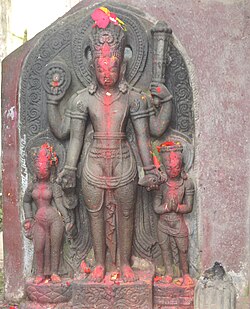 Oldest Sridhar Narayan statue at Naksaal, Kathmandu
 -
 The bow of Royal Barge Narai Song Suban HM Rama IX of Thailand, it carved an image of Narayana riding a Garuda
 -
 Sculpture of Narayana around 14/15th century, found at the Devasathan, inner Bangkok, Thailand
 -
 Sculpture of Narayana ride a Garuda built in Khmer art style in front of InterContinental Bangkok, Phloen Chit Road, it is one of the most respected Hindu shrines in the Ratchaprasong neighbourhood alike Erawan Shrine
 -
 Drawing of sleeping Narayana on Sheshanaga while the four-headed Brahma springs from his navel
 -
 Statue of Narayana in Thai art style stands on Mount Mandara within Suvarnabhumi Airport, Samut Prakan, Thailand
 -
 Khmer lintel depicting Narayana sleeping upon the Sheshanaga in the middle of Milky Ocean, Bangkok National Museum


.jpg)


.jpg)
See also
References
- ↑ "Invoking Auspiciousness [Chapter 1]". 14 August 2014.
- ↑ "Narayana, Nārāyaṇa, Nārāyana, Narāyana, Nara-ayana, Nara-yana: 40 definitions". June 2008.
- ↑ John Clifford Holt (2008). The Buddhist Viṣṇu: Religious Transformation, Politics, and Culture. Motilal Banarsidass Publishers. p. 268. ISBN 9788120832695.
- ↑ Jon Paul Sydnor (29 March 2012). Ramanuja and Schleiermacher: Toward a Constructive Comparative Theology. ISD LLC. p. 110. ISBN 9780227900352.
- ↑ C. Mackenzie Brown (29 August 1990). The Triumph of the Goddess: The Canonical Models and Theological Visions of the Devi-Bhagavata Purana. SUNY Press. p. 28. ISBN 9780791403648.
- ↑ Peter Clarke; Friedhelm Hardy; Leslie Houlden; Stewart Sutherland (14 January 2004). The World's Religions. Routledge. p. 748. ISBN 9781136851858.
- ↑ Klostermaier, Klaus K. (1 January 2006). Mythologies and Philosophies of Salvation in the Theistic Traditions of India. Wilfrid Laurier Univ. Press. pp. 70–71. ISBN 978-0-88920-743-1.
- ↑ The Book of Avatars and Divinities. Penguin Random House India Private Limited. 21 November 2018. ISBN 978-93-5305-362-8.
- ↑ Krishna, Nanditha (June 2010). The Book of Vishnu. Penguin Books India. p. 10. ISBN 978-0-14-306762-7.
- ↑ 10.0 10.1 Narayan Aiyangar (1901). Essays on Indo Aryan Mythology. pp. 196.
- ↑ "The Laws of Manu I". www.sacred-texts.com. Retrieved 7 December 2019.
- ↑ 12.0 12.1 "The Mahabharata, Book 3: Vana Parva: Markandeya-Samasya Parva: Section CLXXXVIII". www.sacred-texts.com. Retrieved 5 December 2019.
- ↑ "Monier-Williams Sanskrit-English Dictionary -- n". faculty.washington.edu. Retrieved 5 December 2019.
- ↑ Harivansh, Adhyay 88 shlock 44, also, Manu Smruti 1:10 " The Law Code of Manu", Published by Oxford University Press, ISBN 0-19-280271-2, page 11
- ↑ "Sanskrit Dictionary for Spoken Sanskrit: 'nara'". spokensanskrit.org. Retrieved 5 December 2019.
- ↑ "Sanskrit Dictionary for Spoken Sanskrit 'yana'". spokensanskrit.org. Retrieved 5 December 2019.
- ↑ Ghosh, A. (2 March 2009). "Krishna: A Sourcebook. Edited by Edwin F. Bryant". The Journal of Hindu Studies. 2 (1): 124–126. doi:10.1093/jhs/hip002. ISSN 1756-4255.
- ↑ Vaisnavism Saivism and Minor Religious Systems, Ramkrishna Gopal Bhandarkar. Published by Asian Educational Services, p.46.
- ↑ Hiltebeitel, Alf (1990). The ritual of battle: Krishna in the Mahābhārata. Albany, N.Y: State University of New York Press. ISBN 0-7914-0249-5. p61
- ↑ Prabhupada, AC Bhaktivedanta. "Bhagavad-gita As It Is Chapter 11 Verse 3". vedabase.net. Archived from the original on 15 May 2008. Retrieved 10 May 2008. "see the cosmic manifestation"
- ↑ "॥ नारायणसूक्तम् सार्थ ॥ - .. Narayana Sukta .. - Sanskrit Documents". sanskritdocuments.org. Retrieved 21 October 2015.
- ↑ "Sapthagiri". Archived from the original on 15 May 2007. Retrieved 21 May 2007.
- ↑ "Upanishads".
- ↑ "SN 2.12: With Vishnu —Bhikkhu Sujato". SuttaCentral. Retrieved 25 December 2019.
- ↑ "那羅延". Digital Dictionary of Buddhism. 2009. Retrieved 25 December 2019.
- ↑ Giebel, Rolf W. (translator) (2005). The Vairocanābhisaṃbodhi Sūtra (PDF). BDK America, Inc.
{{cite book}}:|first1=has generic name (help) - ↑ Roberts, Peter Alan; Tulku Yeshi (2013). "The Basket's Display". 84000: Translating the Words of the Buddha. Retrieved 25 December 2019.
- ↑ "Narayanastra – Defending Vaishnavism as the supreme Vedic position". narayanastra.blogspot.in. Retrieved 21 October 2015.
- ↑ www.wisdomlib.org (26 September 2019). "Nārāyaṇa Grants Boons to Rudra [Chapter 2]". www.wisdomlib.org. Retrieved 12 August 2022.
- ↑ www.wisdomlib.org (27 September 2020). "The Combat between Vishnu and the Rakshasas [Chapter 7]". www.wisdomlib.org. Retrieved 12 August 2022.
- ↑ Makarand Joshi. The Tamil Veda Pillan Interpretation Of Tiruvaymoli J Carman And V Narayanan 1989 OCR.