
>MeAvi Subedi |
robot: Create/update articles. If there is a mistake please report on my talk page. |
||
| Line 3: | Line 3: | ||
| honorific-prefix = '''[[Sri]] [[Kaji (Nepal)|Bada Kaji]] [[General|Jarnel]]''' | | honorific-prefix = '''[[Sri]] [[Kaji (Nepal)|Bada Kaji]] [[General|Jarnel]]''' | ||
| name = Amar Singh Thapa Chhetri | | name = Amar Singh Thapa Chhetri | ||
| native_name = श्री बडाकाजी जर्नेल<br> अमर सिंह थापा क्षेत्री | | native_name = श्री बडाकाजी जर्नेल<br /> अमर सिंह थापा क्षेत्री | ||
| image = Amar Singh Thapa Badakaji.jpg | | image = Amar Singh Thapa Badakaji.jpg | ||
| imagesize = | | imagesize = | ||
| Line 9: | Line 9: | ||
| birth_place = Sirhanchowk, [[Gorkha District]] | | birth_place = Sirhanchowk, [[Gorkha District]] | ||
| death_place = [[Gosain Kunda]], [[Rasuwa District]] | | death_place = [[Gosain Kunda]], [[Rasuwa District]] | ||
| father = ''Bagh'' Bhim Singh Thapa Chhetri | | father = ''Bagh'' [[Bhim Singh Thapa]] Chhetri | ||
| mother = Uma Devi | | mother = Uma Devi | ||
| birth_date = 1751 A.D. (1808 B.S.) | | birth_date = 1751 A.D. (1808 B.S.) | ||
| death_date = 1816 A.D. | | death_date = 1816 A.D. | ||
| nickname = '''Living Lion of Nepal'''<br/> Bada Kaji <br/>Budha Kaji | | nickname = '''Living Lion of Nepal'''<br /> Bada Kaji <br />Budha Kaji | ||
| children = | | children = | ||
| relations = see [[Family of Amar Singh Thapa]]<br/> see [[Kunwar family]] | | relations = see [[Family of Amar Singh Thapa]]<br /> see [[Kunwar family]] | ||
| allegiance = [[Gorkha Kingdom]], {{flag|Nepal}} | | allegiance = [[Gorkha Kingdom]], {{flag|Nepal}} | ||
| branch = [[Nepalese Army]] | | branch = [[Nepalese Army]] | ||
| Line 24: | Line 24: | ||
| signature = Seal of Badakaji Amar Singh Thapa.gif | | signature = Seal of Badakaji Amar Singh Thapa.gif | ||
}} | }} | ||
'''Amar Singh Thapa Chhetri''' distinguished as '''Badakaji Amar Singh Thapa'''{{refn|group=note|Bada Kaji Amar Singh Thapa was distinguished from Kaji [[Amar Singh Thapa (born 1759)|Amar Singh Thapa ( | '''Amar Singh Thapa Chhetri''' distinguished as '''Badakaji Amar Singh Thapa'''{{refn|group=note|Bada Kaji Amar Singh Thapa was distinguished from Kaji [[Amar Singh Thapa (born 1759)|Amar Singh Thapa (sana)]], Mukhtiyar [[Bhimsen Thapa]]'s father, by terms Bada and Sana meaning elder and younger.{{sfn|Acharya|2012|p=3}}}}({{lang-ne|बडाकाजी अमर सिंह थापा क्षेत्री}}), or '''Amar Singh Thapa The Elder''',{{sfn|Pradhan|2012|p=26}} (also spelled Ambar Simha{{sfn|Regmi|1987|p=46}}) also known by the [[honorific]] name '''Bada Kaji''' ("Senior Kaji") or '''Budha Kaji'''{{sfn|Regmi|1975|p=162}} ("The Old Kaji"), was a [[Gorkha Kingdom|Gorkhali]] military general, governor and warlord in the [[Kingdom of Nepal]]. He was the overall commander of the [[Nepalese Army|Nepal Army]] in the conquest of Western Provinces and authoritative ruler of [[Kumaon region|Kumaon]], [[Garhwal region|Garhwal]] in the [[Kingdom of Nepal]]. He was referred by the [[King of Nepal]] to have been deployed as [[Mukhtiyar]] (equivalent to Prime Minister) of Western Provinces of [[Kumaon region|Kumaon]], [[Garhwal region|Garhwal]] {{sfn|Regmi|1987|p=46}} He is often hailed as '''Living Tiger of Nepal''' ({{lang-ne|ज्यूँदो बाघ}}; ''jyūm̐do bāgha'') and he was posthumously regarded as one of the [[national heroes of Nepal]],<ref>{{Cite news|url=http://www.imnepal.com/national-heroes-nepal/|title=National Heroes / Personalities / Luminaries of Nepal|date=2011-12-23|work=ImNepal.com|access-date=2017-11-09|language=en-US|archive-date=2017-10-28|archive-url=https://web.archive.org/web/20171028060234/http://www.imnepal.com/national-heroes-nepal/|url-status=live}}</ref> who led the [[Anglo-Nepalese War]] for the [[Nepali Army|Gorkhali Army]]. [[Amarsingh Chowk]] [[Pokhara]] and [[Shree Amarsingh Model Higher Secondary School]] are named after the name of Amar Singh Thapa. | ||
==Early life and family== | ==Early life and family== | ||
{{See|Family of Amar Singh Thapa}} | {{See|Family of Amar Singh Thapa}} | ||
[[File:Nishankalika Flag of Bagale Thapa clan.svg|thumb|left|Nishankalika flag of [[Bagale Thapa]] clan, ''Bada Kaji'' Amar Singh's ancestral clan]] | [[File:Nishankalika Flag of Bagale Thapa clan.svg|thumb|left|Nishankalika flag of [[Bagale Thapa]] clan, ''Bada Kaji'' Amar Singh's ancestral clan]] | ||
He was grandson of | He was grandson of Ranjai [of Sirhanchowk] and son of Bhim Sen{{sfn|Pradhan|2012|p=195}} known as [[Umrao]] ''Bagh'' [[Bhim Singh Thapa]]{{refn|group=note|His father's name was Bhim Singh Thapa with personal title of ''Bagh'' (meaning: Tiger) in the administrative office of Umarao as per government gazettes while many historians as [[Kumar Pradhan]] wrote alternatively as Bhim Sen Thapa,{{sfn|Pradhan|2012|p=195}} the same name of Mukhtiyar of Nepal.{{sfn|Pradhan|2012|p=28}}}}, who commanded and died in the battle of Palanchowk in 1759 AD.{{sfn|Hamal|1995|p=191}} He belonged to [[Bagale Thapa]] clan.{{sfn|Hamal|1995|p=191}} | ||
His family members were added to the Royal Court by | He was popularly named "Amar Singh Thapa (Bada)" to distinguished from another Kaji [[Amar Singh Thapa (born 1759)|Amar Singh Thapa (Sana)]], Mukhtiyar [[Bhimsen Thapa]]'s father, by identifiers "Bada" and "Sana" meaning elder and younger.{{sfn|Acharya|2012|p=3}} His family members were added to the Royal Court by [[Bhimsen Thapa]],{{sfn|Pradhan|2012|p=26}} who was also a member of [[Bagale Thapa]] clan.{{sfn|Whelpton|1991|p=21}} His eldest son [[Ranadhoj Thapa]] was deputy to Mukhtiyar (Prime Minister) [[Bhimsen Thapa]] sharing the authority{{sfn|Regmi|1975|p=178}} while other four sons namely – Bhaktabir Singh, Narsingh, Ramdas and Ranjore Singh, all of them were Kajis at some point.{{sfn|Pradhan|2012|p=195}} His youngest son [[Ranajor Singh Thapa]] fought with him in the [[Anglo-Nepalese War]]{{sfn|Prinsep|1825|p=94}} while his eldest son [[Ranadhoj Thapa]], was vice to Mukhtiyar of Nepal.<ref name="bilder"/> His grandson, young Surat Singh Thapa, was appointed to post of Kazi in 1832 A.D. to retaliate growing Darbar politics after which the government papers were jointly signed by Mukhtiyar Bhimsen Thapa and Kazi Surath Singh.{{sfn|Pradhan|2012|p=148}}{{sfn|Pradhan|2012|p=195}} His two grandsons from eldest son Ranadhoj Thapa, namely – Ripu Mardan and Badal Singh, were both Kaji at some period.{{sfn|Pradhan|2012|p=195}} Thus, his family was another influential Bagale Thapa family in the Royal Court alongside the premier [[Thapa dynasty|Bhimsen Thapa family]].{{sfn|Whelpton|1991|p=21}} | ||
==Early Conquests== | ==Early Conquests== | ||
''Bada'' Amar Singh led many conquest battles of Western provinces in the [[Unification of Nepal]]. He was leading the conquest of Langur Gadhi in [[Garhwal Kingdom|Gadhwal Region]] before the outbreak of second [[Sino-Nepalese War]] (1791–92 A.D.).<ref name="nepalarmy">https://www.nepalarmy.mil.np/page/history</ref> He reinforced back to [[Nuwakot District|Nuwakot]] travelling around 1000 km in about a month, in defence of Nepalese forces during the second [[Sino-Nepalese War]] of 1791–92 A.D.<ref name="nepalarmy"/> In July 1804, he along with Kaji [[Dalbhanjan Pande]] informed the [[British East India Company|Company]]'s in-charge ''Daroga'' about the orders of takeover of Butwal plains and continuation of honoring Palpa's former obligations from the King of Gorkha.{{sfn|Michael|2014|p=166}} After 1806, the territories of Palpa were kept under the military governorship of him and Kaji Dalbhanjan.{{sfn|Michael|2014|p=51}} They set up plans to establish the full Gorkhali authority over the lands by appointing officials and reviewing land grants.{{sfn|Michael|2014|p=51}} The general administration of the region was looked over and revenue collection was regulated by them.{{sfn|Michael|2014|p=51}} He dissolved the ''Maafi'' (rent-free) land grants to [[Bahun|Jaisi Brahmins]] in [[Butwal]] area for continuation of payments to Gorkhali soldiers.{{sfn|Michael|2014|p=51}} | ''Bada'' Amar Singh led many conquest battles of Western provinces in the [[Unification of Nepal]]. He was leading the conquest of Langur Gadhi in [[Garhwal Kingdom|Gadhwal Region]] before the outbreak of second [[Sino-Nepalese War]] (1791–92 A.D.).<ref name="nepalarmy">{{cite web |url=https://www.nepalarmy.mil.np/page/history |title=HISTORY OF THE NEPALI ARMY |access-date=2018-08-07 |archive-date=2018-08-31 |archive-url=https://web.archive.org/web/20180831031104/https://www.nepalarmy.mil.np/page/history |url-status=live }}</ref> He reinforced back to [[Nuwakot District|Nuwakot]] travelling around 1000 km in about a month, in defence of Nepalese forces during the second [[Sino-Nepalese War]] of 1791–92 A.D.<ref name="nepalarmy"/> In July 1804, he along with Kaji [[Dalbhanjan Pande]] informed the [[British East India Company|Company]]'s in-charge ''Daroga'' about the orders of takeover of Butwal plains and continuation of honoring Palpa's former obligations from the King of Gorkha.{{sfn|Michael|2014|p=166}} After 1806, the territories of Palpa were kept under the military governorship of him and Kaji Dalbhanjan.{{sfn|Michael|2014|p=51}} They set up plans to establish the full Gorkhali authority over the lands by appointing officials and reviewing land grants.{{sfn|Michael|2014|p=51}} The general administration of the region was looked over and revenue collection was regulated by them.{{sfn|Michael|2014|p=51}} He dissolved the ''Maafi'' (rent-free) land grants to [[Bahun|Jaisi Brahmins]] in [[Butwal]] area for continuation of payments to Gorkhali soldiers.{{sfn|Michael|2014|p=51}} | ||
He commanded the [[Nepal Army|Gorkhali Army]] with Sardar [[Bhakti Thapa]] and [[Hasti Dal Shah]] in 1804 against [[Garhwal Kingdom]] due to the Garhwal's discontinuance of annual payments to [[Kingdom of Nepal]].{{sfn|Stiller|1973|p=228}} The army succeeded in annexing Garhwal to Nepalese territory extending the territory of Nepal up to the Sutlej river in the west.{{sfn|Acharya|2012|pp=83–87}} Bada Amar commanded his troops further to [[Kangra fort]] of King [[Sansar Chand]]. They rested on Jwalamukhi and ultimately captured the fort. King Sansar Chand aided by 1500 soldiers of Sikh Maharaja [[Ranjit Singh]] fought against forces of Amar Singh at Ganesh Valley and retreated back only to attack at the evening. Due to the attack in the evening, Gorkhali Army lost some positions and Bada Amar returned to Sutlej river as per agreement on 24 August 1809 AD.<ref>{{ | He commanded the [[Nepal Army|Gorkhali Army]] with Sardar [[Bhakti Thapa]] and [[Hasti Dal Shah]] in 1804 against [[Garhwal Kingdom]] due to the Garhwal's discontinuance of annual payments to [[Kingdom of Nepal]].{{sfn|Stiller|1973|p=228}} The army succeeded in annexing Garhwal to Nepalese territory extending the territory of Nepal up to the Sutlej river in the west.{{sfn|Acharya|2012|pp=83–87}} | ||
Bada Amar commanded his troops further to [[Kangra fort]] of King [[Sansar Chand]]. They rested on Jwalamukhi and ultimately captured the fort. King Sansar Chand aided by 1500 soldiers of Sikh Maharaja [[Ranjit Singh]] fought against forces of Amar Singh at Ganesh Valley and retreated back only to attack at the evening. Due to the attack in the evening, Gorkhali Army lost some positions and Bada Amar returned to Sutlej river as per agreement on 24 August 1809 AD.<ref>{{cite web |url=http://www.nepalarmy.mil.np/history.php?page=one |title=Nepal – The Land and the People |access-date=2017-10-15 |archive-url=https://web.archive.org/web/20171015203517/http://www.nepalarmy.mil.np/history.php?page=one |archive-date=2017-10-15 |url-status=dead }}</ref> The Gurkhas suffered a strike on their pride but were helpless against the superior Westernized Sikh forces. | |||
He later met [[Chandan Singh Mukherji|Akali Chandan Singh Nihang]] who converted him to [[Sikhism]]. For a few years Amar Singh Thapa led the life of a [[Sikhs|Sikh]] hermit although he didn't follow [[Sikhism]] completely and was a [[Sahajdhari|Sehajdhari Sikh]]. He wrote a book on his belief in [[Sikhism]] called the ''Adi Bhagvan Prakash'' which has not been published as of yet and remains in the Nepali State Archives''.''<ref>{{Citation |title=Chandan Singh Mukherji |date=2022-06-19 |url=https://en.wikipedia.org/w/index.php?title=Chandan_Singh_Mukherji&oldid=1093924086 |work=Wikipedia |language=en |access-date=2022-06-19}}</ref> | |||
Bada Kaji Amar Singh advised [[Mukhtiyar]] (Chief Authority) of Nepal, [[Bhimsen Thapa]], to avoid war with the [[British East India Company|British]] because he waged war in person and knew the hardships of war.{{sfn|Acharya|2012|pp=103–117}} He was one of the senior Bharadars to have opposed the [[Anglo-Nepalese War]] due to prevalence of weak administration in the western front suggesting a possible revolt from the general people of the newly conquered western front.{{sfn|Pradhan|2012|p=50}} | |||
==Anglo-Nepalese War== | ==Anglo-Nepalese War== | ||
{{main|Anglo-Nepalese War}} | {{main|Anglo-Nepalese War}} | ||
The appointment letter of two of three [[Subah|Subbas]] (governor) of one-third territories of [[Garhwal region|Garhwal]], Surabir Khatri and Ranabir Khatri on Ashadh Badi 2, 1862 [[Vikram Samvat|V.S.]] (i.e. June 1805) explained the supreme authority ''Mukhtiyarship (premiership)'' of Amar Singh in the Western province: {{ | The appointment letter of two of three [[Subah|Subbas]] (governor) of one-third territories of [[Garhwal region|Garhwal]], Surabir Khatri and Ranabir Khatri on Ashadh Badi 2, 1862 [[Vikram Samvat|V.S.]] (i.e. June 1805) explained the supreme authority ''Mukhtiyarship (premiership)'' of Amar Singh in the Western province: {{Blockquote|text=You know at that time that Kaji Ambar Simha Thapa had been sent there in the capacity of [[Mukhtiyar]].......Act in all matters according to the advice of Kaji Ambar Simha Thapa and remain faithful to us.....|source=Appointment letter of [[Subah|Subbas]] of one-third territories of [[Garhwal region|Garhwal]], Ashadh Badi 2, 1862 [[Vikram Samvat|V.S.]]{{sfn|Regmi|1987|p=46}}}} | ||
Similarly, another appointment letter of [[Subah|Subba]] of one-third territories of [[Garhwal region|Garhwal]], [[Sardar]] Chandrabir Kunwar on Ashadh Badi 2, 1862 [[Vikram Samvat|V.S.]] (i.e. June 1805), also instructed the governor to act according to the advice of Amar Singh.{{sfn|Regmi|1987|p=48}} A British soldier commented to the independent authority of Bada Amar Singh in the western front before the Anglo-Nepalese war: | Similarly, another appointment letter of [[Subah|Subba]] of one-third territories of [[Garhwal region|Garhwal]], [[Sardar]] Chandrabir Kunwar on Ashadh Badi 2, 1862 [[Vikram Samvat|V.S.]] (i.e. June 1805), also instructed the governor to act according to the advice of Amar Singh.{{sfn|Regmi|1987|p=48}} A British soldier commented to the independent authority of Bada Amar Singh in the western front before the Anglo-Nepalese war: | ||
{{ | {{Blockquote|Further to the westward lies the valley of the Dhoon,<ref>Dehradun</ref> and the territory of Sue-na-Ghur;<ref>[[Srinagar, Uttarakhand]]</ref> and further still, the more recent conquests, stretching to the village, in which Umar Sing,<ref>Amar Singh Thapa</ref> a chief of uncommon talents, commanded, and indeed, exercised an authority almost independent.{{sfn|Anon|1816|p=426}}}} When the Kathmandu Durbar solicited Nepalese chiefs' opinions about a possible war with the British, Amar Singh Thapa was not alone in his opposition, declaring that – {{Blockquote|They will not rest satisfied without establishing their own power and authority, and will unite with the hill [[rajas]], whom we have dispossessed. We have hitherto but hunted deer; if we engage in this war, we must prepare to fight tigers.{{sfn|Prinsep|1825|p=460}}}} He was against the measures adopted in Butwal and Sheeoraj, which he declared to have originated in the selfish views of persons, who scrupled not to involve the nation in war to gratify their personal avarice.{{sfn|Prinsep|1825|p=460}}{{sfn|Prinsep|1825|pp=79-80}} | ||
===First Campaign=== | ===First Campaign=== | ||
| Line 50: | Line 56: | ||
===Second Campaign=== | ===Second Campaign=== | ||
During the second campaign, he was serving as sector commander of [[Sindhuli Gadhi]] and eastern front facing heavy casualties from the assault of Colonel Kelly and Colonel O'Hollorah under Main Operational commander [[David Ochterlony]]. His son Ranjore reached Sindhuli Gadhi to defend the fort. The British couldn't reach Sindhuli Gadhi and felt back.<ref name="nepalarmy2">{{ | During the second campaign, he was serving as sector commander of [[Sindhuli Gadhi]] and eastern front facing heavy casualties from the assault of Colonel Kelly and Colonel O'Hollorah under Main Operational commander [[David Ochterlony]]. His son Ranjore reached Sindhuli Gadhi to defend the fort. The British couldn't reach Sindhuli Gadhi and felt back.<ref name="nepalarmy2">{{cite web |url=http://www.nepalarmy.mil.np/history.php?page=two |title=Defending a Nation in the Making |access-date=2017-10-10 |archive-url=https://web.archive.org/web/20110607215048/http://www.nepalarmy.mil.np/history.php?page=two |archive-date=2011-06-07 |url-status=dead }}</ref> | ||
==Heritages built== | ==Heritages built== | ||
[[File:Gangotri Temple.jpg|thumb|upright|[[Gangotri Temple]] was built by Bada Kaji Amar Singh Thapa]] | [[File:Gangotri Temple.jpg|thumb|upright|[[Gangotri Temple]] was built by Bada Kaji Amar Singh Thapa]] | ||
Amar Singh was a religious personality who built many | Amar Singh was a religious personality who built many forts across Nepal and India. The original [[Gangotri Temple]] at [[Uttarakhand]] was built by him, which is part of [[Chhota Char Dham]] pilgrimage circuit. He built the oldest temple in the Mithila city [[Janakpur, Nepal]], the Sri Ram Temple.<ref>Mishra, K. C. (1996). Pilgrimage centres and tradition in Nepal. In: D. P. Dubey (ed) Rays and Ways of Indian Culture. M.D. Publications Pvt. Ltd., New Delhi.</ref> After establishment of full Gorkha authority over Palpa and adjacent Terai, he built the Amar Narayan temple at [[Tansen, Nepal|Tansen]] in the hills above [[Butwal]] in 1807.{{sfn|Michael|2014|p=51}} | ||
==Legacy== | ==Legacy== | ||
[[File:Amaragadhi killa 1000 (cropped).png|thumb|upright|Amar Singh's statue at Amargadhi Fort with his popular quote '''Ma Bagh ko Damaru hu, malai sino khane kukur nasamjha''']] | [[File:Amaragadhi killa 1000 (cropped).png|thumb|upright|Amar Singh's statue at Amargadhi Fort with his popular quote '''Ma Bagh ko Damaru hu, malai sino khane kukur nasamjha''']] | ||
Bada Kaji Amar Singh is often hailed as '''Living Lion of Nepal'''<ref name="bilder">{{cite web|url=http://www.bilder-aus-nepal.de/Pages/Philatelie/Thapa-Brief/Thapa-Brief-09.html|title=Cover with the seal of Amar Singh Thapa|website=Bilder-aus-nepal.de|access-date=9 November 2017}}</ref> due to his fighting prowess, greater leadership and patriotism. A popular patriotic quote in the Nepalese history is attributed to him: {{ | Bada Kaji Amar Singh is often hailed as '''Living Lion of Nepal'''<ref>{{cite web | url=https://english.onlinekhabar.com/bhakti-thapa-is-the-latest-national-hero-of-nepal.html | title=Bhakti Thapa is the latest national hero of Nepal - OnlineKhabar English News | date=July 2021 }}</ref><ref name="bilder">{{cite web|url=http://www.bilder-aus-nepal.de/Pages/Philatelie/Thapa-Brief/Thapa-Brief-09.html|title=Cover with the seal of Amar Singh Thapa|website=Bilder-aus-nepal.de|access-date=9 November 2017|archive-date=31 March 2017|archive-url=https://web.archive.org/web/20170331115303/http://www.bilder-aus-nepal.de/Pages/Philatelie/Thapa-Brief/Thapa-Brief-09.html|url-status=live}}</ref> due to his fighting prowess, greater leadership and patriotism. British Historian [[Francis Buchanan-Hamilton|Hamilton]] drew comparisons of him with the ancient Carthaginian General [[Hannibal]].<ref name="risingnepaldaily.com">{{cite web |date=2021-06-11 |title=Amar Singh Thapa A Great National Hero |url=https://risingnepaldaily.com/detour/amar-singh-thapa-a-great-national-hero |url-status=dead |archive-url=https://web.archive.org/web/20220307052913/https://risingnepaldaily.com/detour/amar-singh-thapa-a-great-national-hero |archive-date=2022-03-07 |website=risingnepaldaily.com}}</ref> A popular patriotic quote in the Nepalese history is attributed to him: {{Blockquote|''Ma Bagh ko Damaru hu, malai sino khane Kukur nasamjha.'' Translation: I am cub of tiger, don't mistake me with a carcass-eating dog. | ||
Translated by Arjun Bhadra Khanal<ref>{{cite web|url=https://500px.com/photo/29827237/amar-singh-thapa-badakaji-by-arjun-bhadra-khanal|title=Amar Singh Thapa, Badakaji|website=500px.com}}</ref>}} | Translated by Arjun Bhadra Khanal<ref>{{cite web|url=https://500px.com/photo/29827237/amar-singh-thapa-badakaji-by-arjun-bhadra-khanal|title=Amar Singh Thapa, Badakaji|website=500px.com|access-date=2017-11-09|archive-date=2017-11-09|archive-url=https://web.archive.org/web/20171109134626/https://500px.com/photo/29827237/amar-singh-thapa-badakaji-by-arjun-bhadra-khanal|url-status=live}}</ref>}} | ||
The letter from the central government of Nepal held the praises of Kaji Amar Singh in the letters to other civil and military officers including provincial governors:{{ | The letter from the central government of Nepal held the praises of Kaji Amar Singh in the letters to other civil and military officers including provincial governors:{{Blockquote|text=Kaji Ambar Simha Thapa is old and mature, and also true to his salt. Act according to | ||
his advice.|source=Appointment letter of one-third [[Subah|Subba]] of [[Garhwal region|Garh]] Chandrabir Kunwar Ashadh Badi 2, 1862 [[Vikram Samvat|V.S.]]{{sfn|Regmi|1987|p=48}}}} | his advice.|source=Appointment letter of one-third [[Subah|Subba]] of [[Garhwal region|Garh]] Chandrabir Kunwar Ashadh Badi 2, 1862 [[Vikram Samvat|V.S.]]{{sfn|Regmi|1987|p=48}}}} | ||
The village of [[Amaragadhi]] in western Nepal is named for him. There is a [[Khukuri]] sword named after him called '''Amar Singh Thapa Khukuri'''. This Khukuri is modeled on the real Khukuri used by him.{{ | The village of [[Amaragadhi]] in western Nepal is named for him. There is a [[Khukuri]] sword named after him called '''Amar Singh Thapa Khukuri'''. This Khukuri is modeled on the real Khukuri used by him.<ref name="Archived copy">{{cite web |url=https://yunahandicrafts.com/blog/make-khukuri-a-complete-guide/ |title=How to Make Khukuri: A Complete Guide - Yuna Handicrafts Nepal |website=yunahandicrafts.com |access-date=19 April 2022 |archive-url=https://web.archive.org/web/20220317030005/https://yunahandicrafts.com/blog/make-khukuri-a-complete-guide/ |archive-date=17 March 2022 |url-status=dead}}</ref> The real Khukuri used by Amar Singh is archived at [[National Museum of Nepal]] and is more curvy in nature than other traditional Khukuris.<ref name="Archived copy"/> | ||
==Descendants== | |||
Amar Singh was married to Dharmabati. Nepali historian [[Surya Bikram Gyawali]] contends that he had 9 sons namely: Surbir, Randhoj, Ran Singh, Ranjor, Bhakta Bir, Ram Das, Narsingh, Arjun Singh and Bhupal. He further states that all the sons of Amar Singh contributed to the [[unification of Nepal]].<ref name="risingnepaldaily.com"/> Amar Singh had ten sons from four wives as per the Thapa genealogy: Ranabir, Ranasur, [[Ranadhoj Thapa|Ranadhoj]], Ranabhim, [[Ranjore Thapa|Ranajor]], Bhaktabir, Ramdas, Narsingh, Arjun Singh, and Bhupal Singh.<ref name="issuu.com">{{cite web|url=https://issuu.com/laxmanthapa/docs/bagale|title = Bagale thapa by Laxman Thapa - Issuu}}</ref> The Office of the Nepal Antiquary also mentions sons of Amar Singh as [[Ranjore Thapa|Ranajor]], Bhaktavir, Ramdas, Ranasur, Ranabir, Arjun, Narsingh and Bhupal.{{sfn|ONA|1978}} The genealogical table produced by Nepali historian [[Kumar Pradhan]] shows the sons of Bada Amar Singh as - [[Ranadhoj Thapa|Ranadhoj]], Bhaktabir, Narsingh, Ramdas and [[Ranjore Thapa|Ranajor]], all of whom were [[Kaji (Nepal)|Kaji]] at some point.{{sfn|Pradhan|2012|p=195}} His grandsons through daughter Ambika Devi and son-in-law [[Chandrabir Kunwar|Chandravir Kunwar]] were Birbhadra Kunwar, a military commander in [[Kumaon Kingdom|Kumaun]]{{sfn|Dabaral|1987|p=51}}and [[Balabhadra Kunwar]], a [[national heroes of Nepal|national hero]] of the [[Battle of Nalapani]].{{sfn|Acharya|1971|pp=3-5}} | |||
Nepali movie director, Sunil Thapa, who is married to popular Nepali actress [[Jharana Thapa]], is an eighth patrilineal descendant of Bada Kaji Amar Singh making their daughter Nepali actress [[Suhana Thapa]] a ninth descendant.<ref name="ekantipur">{{cite web|url=https://nepal.ekantipur.com/ampnews/2013-12-15/6239.html|publisher=nepal.ekantipur.com|title=ampnews/2013-12-15/6239|access-date=2017-06-11}}</ref> | |||
==Gallery== | ==Gallery== | ||
| Line 79: | Line 90: | ||
===Sources=== | ===Sources=== | ||
* {{cite journal |last=Acharya |first=Baburam |title=King Girban's Letter To Kaji Ranjor Thapa |journal=Regmi Research Series |volume=3 |issue=1 | pages=3–5 |date=January 1, 1971 |orig-year=1950 |url=http://himalaya.socanth.cam.ac.uk/collections/journals/regmi/pdf/Regmi_03.pdf }} | |||
*{{citation | last = Acharya | first = Baburam | editor-last = Acharya | editor-first = Shri Krishna |title = Janaral Bhimsen Thapa : Yinko Utthan Tatha Pattan | location = Kathmandu | year = 2012 | page = 228 | language = ne | publisher = Education Book House | isbn = 9789937241748}} | *{{citation | last = Acharya | first = Baburam | editor-last = Acharya | editor-first = Shri Krishna |title = Janaral Bhimsen Thapa : Yinko Utthan Tatha Pattan | location = Kathmandu | year = 2012 | page = 228 | language = ne | publisher = Education Book House | isbn = 9789937241748}} | ||
* {{cite journal|author=Anon |year=1816 |title=An Account of the War in Nepal; Contained in a Letter from an Officer on the Staff of the Bengal Army |journal=Asiatic Journal and Monthly Miscellany |issue=Vol 1. May 1816 |pages=425–429 |url=https://books.google.com/books?id=_dtAAQAAIAAJ |oclc=1514448}} | * {{cite journal|author=Anon |year=1816 |title=An Account of the War in Nepal; Contained in a Letter from an Officer on the Staff of the Bengal Army |journal=Asiatic Journal and Monthly Miscellany |issue=Vol 1. May 1816 |pages=425–429 |url=https://books.google.com/books?id=_dtAAQAAIAAJ |oclc=1514448}} | ||
* {{cite journal |last=Dabaral |first=Shiva Prasad ‘’Charan’’ |title=From the Yamuna to the Sutlej |journal=Regmi Research Series |volume=19 |issue=4 |pages=50–54 |date=April 1987 |url=http://himalaya.socanth.cam.ac.uk/collections/journals/regmi/pdf/Regmi_19.pdf }} | |||
*{{Citation|last=Hamal|first=Lakshman B.|title=Military history of Nepal|publisher=Sharda Pustak Mandir|year=1995|url=https://books.google.com/books?id=O3RuAAAAMAAJ}} | *{{Citation|last=Hamal|first=Lakshman B.|title=Military history of Nepal|publisher=Sharda Pustak Mandir|year=1995|url=https://books.google.com/books?id=O3RuAAAAMAAJ}} | ||
*{{citation|title=Statemaking and Territory in South Asia: Lessons from the Anglo–Gorkha War (1814–1816)|last=Michael|first=Bernardo A.|year=2014|publisher=Anthem Press|isbn=9781783083220|url=https://books.google.com/books?id=iTKNBAAAQBAJ&pg=PA151}} | *{{citation|title=Statemaking and Territory in South Asia: Lessons from the Anglo–Gorkha War (1814–1816)|last=Michael|first=Bernardo A.|year=2014|publisher=Anthem Press|isbn=9781783083220|url=https://books.google.com/books?id=iTKNBAAAQBAJ&pg=PA151}} | ||
* {{cite book | author = Office of the Nepal Antiquary (ONA) | title = Nepal Antiquary |volume = 5| publisher = Office of the Nepal Antiquary | year = 1978 | url = https://books.google.com/books?id=Zc0LAAAAIAAJ |ref={{sfnref|ONA|1978}}}} | |||
*{{citation | last = Pradhan | first = Kumar L. | title = Thapa Politics in Nepal: With Special Reference to Bhim Sen Thapa, 1806–1839 | publisher = Concept Publishing Company | year = 2012 | isbn = 9788180698132 | location = New Delhi | page = 278 | url = https://books.google.com/books?id=7PP1yElRzIUC}} | *{{citation | last = Pradhan | first = Kumar L. | title = Thapa Politics in Nepal: With Special Reference to Bhim Sen Thapa, 1806–1839 | publisher = Concept Publishing Company | year = 2012 | isbn = 9788180698132 | location = New Delhi | page = 278 | url = https://books.google.com/books?id=7PP1yElRzIUC}} | ||
* {{cite book |last=Prinsep |first=Henry Thoby |author-link=Henry Thoby Prinsep|year=1825 |title=History of the Political and Military Transactions in India During the Administration of the Marquess of Hastings, 1813–1823|volume=1 |location=London |publisher=Kingsbury, Parbury & Allen |url=https://books.google.com/books?id=Tq1jAAAAMAAJ |oclc=152785969}} | * {{cite book |last=Prinsep |first=Henry Thoby |author-link=Henry Thoby Prinsep|year=1825 |title=History of the Political and Military Transactions in India During the Administration of the Marquess of Hastings, 1813–1823|volume=1 |location=London |publisher=Kingsbury, Parbury & Allen |url=https://books.google.com/books?id=Tq1jAAAAMAAJ |oclc=152785969}} | ||
| Line 90: | Line 104: | ||
*{{citation | last = Whelpton | first = John | title = Kings, soldiers, and priests: Nepalese politics and the rise of Jang Bahadur Rana, 1830–1857 | publisher = Manohar Publications | year = 1991 | isbn = 9788185425641 | url = https://books.google.com/books?id=h3huAAAAMAAJ}} | *{{citation | last = Whelpton | first = John | title = Kings, soldiers, and priests: Nepalese politics and the rise of Jang Bahadur Rana, 1830–1857 | publisher = Manohar Publications | year = 1991 | isbn = 9788185425641 | url = https://books.google.com/books?id=h3huAAAAMAAJ}} | ||
{{Authority control}} | |||
{{Wikiquote}} | {{Wikiquote}} | ||
{{DEFAULTSORT:Thapa, Amar Singh}} | {{DEFAULTSORT:Thapa, Amar Singh}} | ||
[[Category:1751 births]] | [[Category:1751 births]] | ||
[[Category:1816 deaths]] | [[Category:1816 deaths]] | ||
[[Category:Bagale Thapa]] | |||
[[Category:Gurkhas]] | [[Category:Gurkhas]] | ||
[[Category:National heroes of Nepal]] | [[Category:National heroes of Nepal]] | ||
[[Category:Nepalese generals]] | [[Category:Nepalese generals]] | ||
[[Category:Nepalese military personnel]] | |||
[[Category:People from Gorkha District]] | |||
[[Category:People of the Anglo-Nepalese War]] | |||
[[Category:People of the Nepalese unification]] | [[Category:People of the Nepalese unification]] | ||
[[Category: | [[Category:Thapa Kaji]] | ||
[[Category:Nepalese Hindus]] | |||
[[Category:Khas people]] | |||
Latest revision as of 12:07, 17 September 2022
Amar Singh Thapa Chhetri | |
|---|---|
| श्री बडाकाजी जर्नेल अमर सिंह थापा क्षेत्री | |
 Portrait of Bada (Elder) Amar Singh Thapa Chhetri | |
| Personal details | |
| Born | 1751 A.D. (1808 B.S.) Sirhanchowk, Gorkha District |
| Died | 1816 A.D. Gosain Kunda, Rasuwa District |
| Relations | see Family of Amar Singh Thapa see Kunwar family |
| Parents |
|
| Awards | National heroes of Nepal (posthumous) |
| Signature |  |
| Nickname(s) | Living Lion of Nepal Bada Kaji Budha Kaji |
| Military service | |
| Allegiance | Gorkha Kingdom,  Nepal Nepal |
| Branch/service | Nepalese Army |
| Rank | General |
| Commands | Supreme Commander of Western front |
| Battles/wars | Anglo-Nepalese war, Battles of unification of Nepal, reinforced at 2nd Nepalese-Tibetan War |
Amar Singh Thapa Chhetri distinguished as Badakaji Amar Singh Thapa[note 1](Nepali: बडाकाजी अमर सिंह थापा क्षेत्री), or Amar Singh Thapa The Elder,[2] (also spelled Ambar Simha[3]) also known by the honorific name Bada Kaji ("Senior Kaji") or Budha Kaji[4] ("The Old Kaji"), was a Gorkhali military general, governor and warlord in the Kingdom of Nepal. He was the overall commander of the Nepal Army in the conquest of Western Provinces and authoritative ruler of Kumaon, Garhwal in the Kingdom of Nepal. He was referred by the King of Nepal to have been deployed as Mukhtiyar (equivalent to Prime Minister) of Western Provinces of Kumaon, Garhwal [3] He is often hailed as Living Tiger of Nepal (Nepali: ज्यूँदो बाघ; jyūm̐do bāgha) and he was posthumously regarded as one of the national heroes of Nepal,[5] who led the Anglo-Nepalese War for the Gorkhali Army. Amarsingh Chowk Pokhara and Shree Amarsingh Model Higher Secondary School are named after the name of Amar Singh Thapa.
Early life and family[edit | edit source]

He was grandson of Ranjai [of Sirhanchowk] and son of Bhim Sen[6] known as Umrao Bagh Bhim Singh Thapa[note 2], who commanded and died in the battle of Palanchowk in 1759 AD.[8] He belonged to Bagale Thapa clan.[8]
He was popularly named "Amar Singh Thapa (Bada)" to distinguished from another Kaji Amar Singh Thapa (Sana), Mukhtiyar Bhimsen Thapa's father, by identifiers "Bada" and "Sana" meaning elder and younger.[1] His family members were added to the Royal Court by Bhimsen Thapa,[2] who was also a member of Bagale Thapa clan.[9] His eldest son Ranadhoj Thapa was deputy to Mukhtiyar (Prime Minister) Bhimsen Thapa sharing the authority[10] while other four sons namely – Bhaktabir Singh, Narsingh, Ramdas and Ranjore Singh, all of them were Kajis at some point.[6] His youngest son Ranajor Singh Thapa fought with him in the Anglo-Nepalese War[11] while his eldest son Ranadhoj Thapa, was vice to Mukhtiyar of Nepal.[12] His grandson, young Surat Singh Thapa, was appointed to post of Kazi in 1832 A.D. to retaliate growing Darbar politics after which the government papers were jointly signed by Mukhtiyar Bhimsen Thapa and Kazi Surath Singh.[13][6] His two grandsons from eldest son Ranadhoj Thapa, namely – Ripu Mardan and Badal Singh, were both Kaji at some period.[6] Thus, his family was another influential Bagale Thapa family in the Royal Court alongside the premier Bhimsen Thapa family.[9]
Early Conquests[edit | edit source]
Bada Amar Singh led many conquest battles of Western provinces in the Unification of Nepal. He was leading the conquest of Langur Gadhi in Gadhwal Region before the outbreak of second Sino-Nepalese War (1791–92 A.D.).[14] He reinforced back to Nuwakot travelling around 1000 km in about a month, in defence of Nepalese forces during the second Sino-Nepalese War of 1791–92 A.D.[14] In July 1804, he along with Kaji Dalbhanjan Pande informed the Company's in-charge Daroga about the orders of takeover of Butwal plains and continuation of honoring Palpa's former obligations from the King of Gorkha.[15] After 1806, the territories of Palpa were kept under the military governorship of him and Kaji Dalbhanjan.[16] They set up plans to establish the full Gorkhali authority over the lands by appointing officials and reviewing land grants.[16] The general administration of the region was looked over and revenue collection was regulated by them.[16] He dissolved the Maafi (rent-free) land grants to Jaisi Brahmins in Butwal area for continuation of payments to Gorkhali soldiers.[16]
He commanded the Gorkhali Army with Sardar Bhakti Thapa and Hasti Dal Shah in 1804 against Garhwal Kingdom due to the Garhwal's discontinuance of annual payments to Kingdom of Nepal.[17] The army succeeded in annexing Garhwal to Nepalese territory extending the territory of Nepal up to the Sutlej river in the west.[18]
Bada Amar commanded his troops further to Kangra fort of King Sansar Chand. They rested on Jwalamukhi and ultimately captured the fort. King Sansar Chand aided by 1500 soldiers of Sikh Maharaja Ranjit Singh fought against forces of Amar Singh at Ganesh Valley and retreated back only to attack at the evening. Due to the attack in the evening, Gorkhali Army lost some positions and Bada Amar returned to Sutlej river as per agreement on 24 August 1809 AD.[19] The Gurkhas suffered a strike on their pride but were helpless against the superior Westernized Sikh forces.
He later met Akali Chandan Singh Nihang who converted him to Sikhism. For a few years Amar Singh Thapa led the life of a Sikh hermit although he didn't follow Sikhism completely and was a Sehajdhari Sikh. He wrote a book on his belief in Sikhism called the Adi Bhagvan Prakash which has not been published as of yet and remains in the Nepali State Archives.[20]
Bada Kaji Amar Singh advised Mukhtiyar (Chief Authority) of Nepal, Bhimsen Thapa, to avoid war with the British because he waged war in person and knew the hardships of war.[21] He was one of the senior Bharadars to have opposed the Anglo-Nepalese War due to prevalence of weak administration in the western front suggesting a possible revolt from the general people of the newly conquered western front.[22]
Anglo-Nepalese War[edit | edit source]
The appointment letter of two of three Subbas (governor) of one-third territories of Garhwal, Surabir Khatri and Ranabir Khatri on Ashadh Badi 2, 1862 V.S. (i.e. June 1805) explained the supreme authority Mukhtiyarship (premiership) of Amar Singh in the Western province:
You know at that time that Kaji Ambar Simha Thapa had been sent there in the capacity of Mukhtiyar.......Act in all matters according to the advice of Kaji Ambar Simha Thapa and remain faithful to us.....
Similarly, another appointment letter of Subba of one-third territories of Garhwal, Sardar Chandrabir Kunwar on Ashadh Badi 2, 1862 V.S. (i.e. June 1805), also instructed the governor to act according to the advice of Amar Singh.[23] A British soldier commented to the independent authority of Bada Amar Singh in the western front before the Anglo-Nepalese war:
Further to the westward lies the valley of the Dhoon,[24] and the territory of Sue-na-Ghur;[25] and further still, the more recent conquests, stretching to the village, in which Umar Sing,[26] a chief of uncommon talents, commanded, and indeed, exercised an authority almost independent.[27]
When the Kathmandu Durbar solicited Nepalese chiefs' opinions about a possible war with the British, Amar Singh Thapa was not alone in his opposition, declaring that –
They will not rest satisfied without establishing their own power and authority, and will unite with the hill rajas, whom we have dispossessed. We have hitherto but hunted deer; if we engage in this war, we must prepare to fight tigers.[28]
He was against the measures adopted in Butwal and Sheeoraj, which he declared to have originated in the selfish views of persons, who scrupled not to involve the nation in war to gratify their personal avarice.[28][29]
First Campaign[edit | edit source]
The British columns led by British Generals Rollo Gillespie and David Ochterlony in the Western front faced the defence under the command of Bada Amar Singh.[30] During the first campaign of Anglo-Nepalese War, Badakaji Amar Singh commanded Nepalese army facing columns under Major-General Rollo Gillespie and Colonel David Ochterlony in the Western Front (Kumaon-Gadhwal axis).[31]
He commanded Gorkhali forces to defend the town of Srinagar from The third division army under Major-General Gillespie coming from western side. His son Ranjore Singh Thapa was holding forces at Nahan, the chief town of Sirmaur.[31]
Second Campaign[edit | edit source]
During the second campaign, he was serving as sector commander of Sindhuli Gadhi and eastern front facing heavy casualties from the assault of Colonel Kelly and Colonel O'Hollorah under Main Operational commander David Ochterlony. His son Ranjore reached Sindhuli Gadhi to defend the fort. The British couldn't reach Sindhuli Gadhi and felt back.[31]
Heritages built[edit | edit source]

Amar Singh was a religious personality who built many forts across Nepal and India. The original Gangotri Temple at Uttarakhand was built by him, which is part of Chhota Char Dham pilgrimage circuit. He built the oldest temple in the Mithila city Janakpur, Nepal, the Sri Ram Temple.[32] After establishment of full Gorkha authority over Palpa and adjacent Terai, he built the Amar Narayan temple at Tansen in the hills above Butwal in 1807.[16]
Legacy[edit | edit source]
.png)
Bada Kaji Amar Singh is often hailed as Living Lion of Nepal[33][12] due to his fighting prowess, greater leadership and patriotism. British Historian Hamilton drew comparisons of him with the ancient Carthaginian General Hannibal.[34] A popular patriotic quote in the Nepalese history is attributed to him:
Ma Bagh ko Damaru hu, malai sino khane Kukur nasamjha. Translation: I am cub of tiger, don't mistake me with a carcass-eating dog. Translated by Arjun Bhadra Khanal[35]
The letter from the central government of Nepal held the praises of Kaji Amar Singh in the letters to other civil and military officers including provincial governors:
Kaji Ambar Simha Thapa is old and mature, and also true to his salt. Act according to his advice.
The village of Amaragadhi in western Nepal is named for him. There is a Khukuri sword named after him called Amar Singh Thapa Khukuri. This Khukuri is modeled on the real Khukuri used by him.[36] The real Khukuri used by Amar Singh is archived at National Museum of Nepal and is more curvy in nature than other traditional Khukuris.[36]
Descendants[edit | edit source]
Amar Singh was married to Dharmabati. Nepali historian Surya Bikram Gyawali contends that he had 9 sons namely: Surbir, Randhoj, Ran Singh, Ranjor, Bhakta Bir, Ram Das, Narsingh, Arjun Singh and Bhupal. He further states that all the sons of Amar Singh contributed to the unification of Nepal.[34] Amar Singh had ten sons from four wives as per the Thapa genealogy: Ranabir, Ranasur, Ranadhoj, Ranabhim, Ranajor, Bhaktabir, Ramdas, Narsingh, Arjun Singh, and Bhupal Singh.[37] The Office of the Nepal Antiquary also mentions sons of Amar Singh as Ranajor, Bhaktavir, Ramdas, Ranasur, Ranabir, Arjun, Narsingh and Bhupal.[38] The genealogical table produced by Nepali historian Kumar Pradhan shows the sons of Bada Amar Singh as - Ranadhoj, Bhaktabir, Narsingh, Ramdas and Ranajor, all of whom were Kaji at some point.[6] His grandsons through daughter Ambika Devi and son-in-law Chandravir Kunwar were Birbhadra Kunwar, a military commander in Kumaun[39]and Balabhadra Kunwar, a national hero of the Battle of Nalapani.[40]
Nepali movie director, Sunil Thapa, who is married to popular Nepali actress Jharana Thapa, is an eighth patrilineal descendant of Bada Kaji Amar Singh making their daughter Nepali actress Suhana Thapa a ninth descendant.[41]
Gallery[edit | edit source]
-
 Letter sent to PM Bhimsen Thapa and Kazi Ranadhoj Thapa by (Pvt. seal L to R) Bakhat Singh Sardar, Dalbhanjan Pande (Pande Kazi), Ranabir Singh Thapa, Kaji Narsingh Thapa (Elder Amar Singh Thapa's third son) and sundry captains
 -
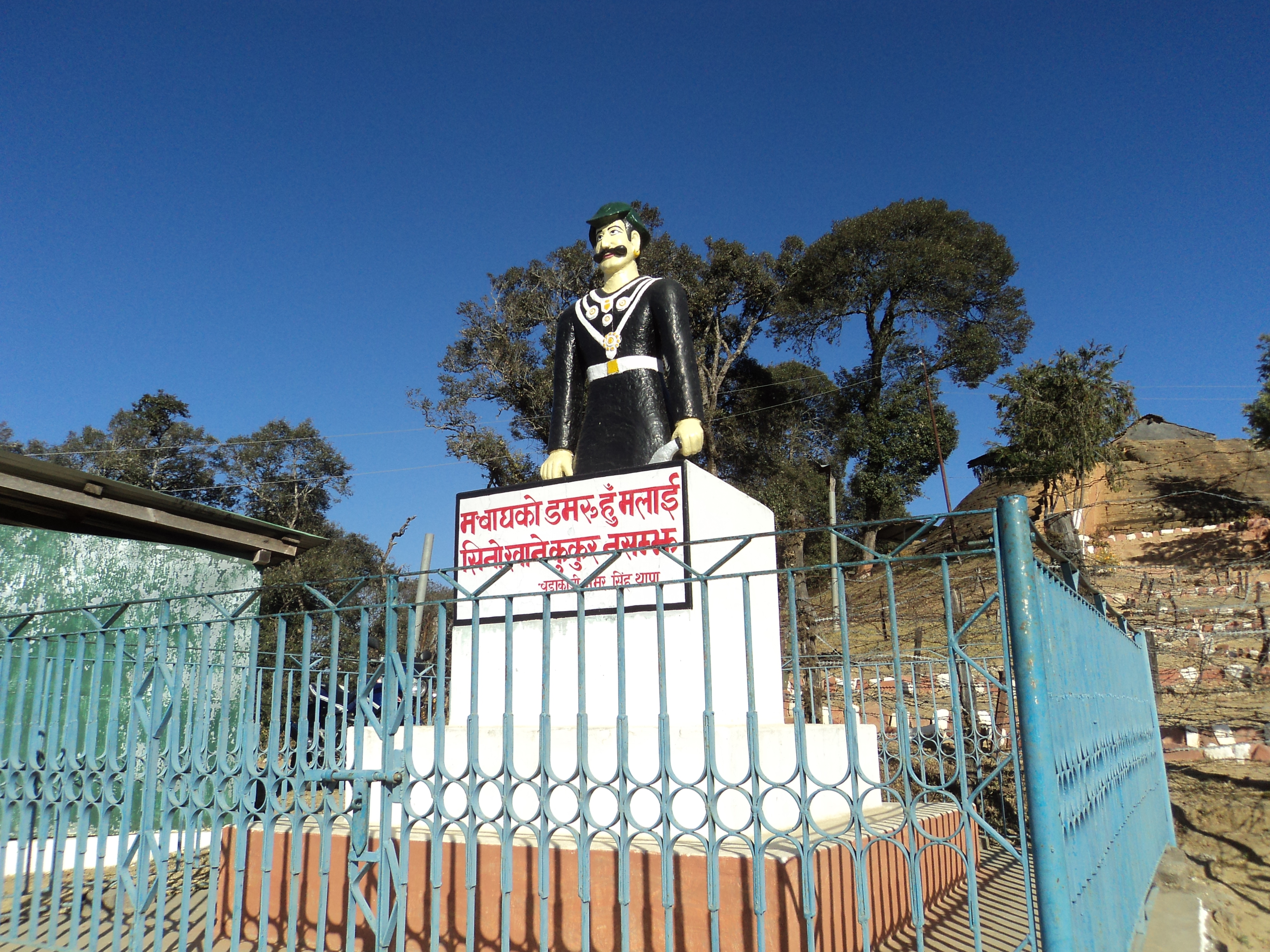 Statue of Amar Singh Thapa (elder) at Amargadhi Fort; Quote is visible in the image
 -
 Gangotri Temple was built by Bada Amar Singh
 -
 Jayanti Mata Temple near Kangra Fort was built by Bada Amar Singh


Notes[edit | edit source]
- ↑ Bada Kaji Amar Singh Thapa was distinguished from Kaji Amar Singh Thapa (sana), Mukhtiyar Bhimsen Thapa's father, by terms Bada and Sana meaning elder and younger.[1]
- ↑ His father's name was Bhim Singh Thapa with personal title of Bagh (meaning: Tiger) in the administrative office of Umarao as per government gazettes while many historians as Kumar Pradhan wrote alternatively as Bhim Sen Thapa,[6] the same name of Mukhtiyar of Nepal.[7]
References[edit | edit source]
- ↑ 1.0 1.1 Acharya 2012, p. 3.
- ↑ 2.0 2.1 Pradhan 2012, p. 26.
- ↑ 3.0 3.1 3.2 Regmi 1987, p. 46.
- ↑ Regmi 1975, p. 162.
- ↑ "National Heroes / Personalities / Luminaries of Nepal". ImNepal.com. 2011-12-23. Archived from the original on 2017-10-28. Retrieved 2017-11-09.
- ↑ 6.0 6.1 6.2 6.3 6.4 6.5 Pradhan 2012, p. 195.
- ↑ Pradhan 2012, p. 28.
- ↑ 8.0 8.1 Hamal 1995, p. 191.
- ↑ 9.0 9.1 Whelpton 1991, p. 21.
- ↑ Regmi 1975, p. 178.
- ↑ Prinsep 1825, p. 94.
- ↑ 12.0 12.1 "Cover with the seal of Amar Singh Thapa". Bilder-aus-nepal.de. Archived from the original on 31 March 2017. Retrieved 9 November 2017.
- ↑ Pradhan 2012, p. 148.
- ↑ 14.0 14.1 "HISTORY OF THE NEPALI ARMY". Archived from the original on 2018-08-31. Retrieved 2018-08-07.
- ↑ Michael 2014, p. 166.
- ↑ 16.0 16.1 16.2 16.3 16.4 Michael 2014, p. 51.
- ↑ Stiller 1973, p. 228.
- ↑ Acharya 2012, pp. 83–87.
- ↑ "Nepal – The Land and the People". Archived from the original on 2017-10-15. Retrieved 2017-10-15.
- ↑ "Chandan Singh Mukherji", Wikipedia, 2022-06-19, retrieved 2022-06-19
- ↑ Acharya 2012, pp. 103–117.
- ↑ Pradhan 2012, p. 50.
- ↑ 23.0 23.1 Regmi 1987, p. 48.
- ↑ Dehradun
- ↑ Srinagar, Uttarakhand
- ↑ Amar Singh Thapa
- ↑ Anon 1816, p. 426.
- ↑ 28.0 28.1 Prinsep 1825, p. 460.
- ↑ Prinsep 1825, pp. 79-80.
- ↑ Anon 1816, p. 427.
- ↑ 31.0 31.1 31.2 "Defending a Nation in the Making". Archived from the original on 2011-06-07. Retrieved 2017-10-10.
- ↑ Mishra, K. C. (1996). Pilgrimage centres and tradition in Nepal. In: D. P. Dubey (ed) Rays and Ways of Indian Culture. M.D. Publications Pvt. Ltd., New Delhi.
- ↑ "Bhakti Thapa is the latest national hero of Nepal - OnlineKhabar English News". July 2021.
- ↑ 34.0 34.1 "Amar Singh Thapa A Great National Hero". risingnepaldaily.com. 2021-06-11. Archived from the original on 2022-03-07.
- ↑ "Amar Singh Thapa, Badakaji". 500px.com. Archived from the original on 2017-11-09. Retrieved 2017-11-09.
- ↑ 36.0 36.1 "How to Make Khukuri: A Complete Guide - Yuna Handicrafts Nepal". yunahandicrafts.com. Archived from the original on 17 March 2022. Retrieved 19 April 2022.
- ↑ "Bagale thapa by Laxman Thapa - Issuu".
- ↑ ONA 1978.
- ↑ Dabaral 1987, p. 51.
- ↑ Acharya 1971, pp. 3-5.
- ↑ "ampnews/2013-12-15/6239". nepal.ekantipur.com. Retrieved 2017-06-11.
Sources[edit | edit source]
- Acharya, Baburam (January 1, 1971) [1950]. "King Girban's Letter To Kaji Ranjor Thapa" (PDF). Regmi Research Series. 3 (1): 3–5.
- Acharya, Baburam (2012), Acharya, Shri Krishna (ed.), Janaral Bhimsen Thapa : Yinko Utthan Tatha Pattan (in नेपाली), Kathmandu: Education Book House, p. 228, ISBN 9789937241748
- Anon (1816). "An Account of the War in Nepal; Contained in a Letter from an Officer on the Staff of the Bengal Army". Asiatic Journal and Monthly Miscellany (Vol 1. May 1816): 425–429. OCLC 1514448.
{{cite journal}}:|issue=has extra text (help) - Dabaral, Shiva Prasad ‘’Charan’’ (April 1987). "From the Yamuna to the Sutlej" (PDF). Regmi Research Series. 19 (4): 50–54.
- Hamal, Lakshman B. (1995), Military history of Nepal, Sharda Pustak Mandir
- Michael, Bernardo A. (2014), Statemaking and Territory in South Asia: Lessons from the Anglo–Gorkha War (1814–1816), Anthem Press, ISBN 9781783083220
- Office of the Nepal Antiquary (ONA) (1978). Nepal Antiquary. Vol. 5. Office of the Nepal Antiquary.
- Pradhan, Kumar L. (2012), Thapa Politics in Nepal: With Special Reference to Bhim Sen Thapa, 1806–1839, New Delhi: Concept Publishing Company, p. 278, ISBN 9788180698132
- Prinsep, Henry Thoby (1825). History of the Political and Military Transactions in India During the Administration of the Marquess of Hastings, 1813–1823. Vol. 1. London: Kingsbury, Parbury & Allen. OCLC 152785969.
- Regmi, Mahesh Chandra (April 1987), "Garhwal Appointment, A.D. 1805" (PDF), Regmi Research Series, 19 (4): 46–48
- Regmi, D.R. (1975), Modern Nepal:Expansion: climax and fall, Firma K.L. Mukhopadhyay, ISBN 0883864916
- Stiller, Ludwig F. (1973), The rise of the House of Gorkha: a study in the unification of Nepal, 1768–1816, Manjusri Publication House, p. 390
- Whelpton, John (1991), Kings, soldiers, and priests: Nepalese politics and the rise of Jang Bahadur Rana, 1830–1857, Manohar Publications, ISBN 9788185425641