

>JohnnyBflat Importing Wikidata short description: "British army officer for the East India Company" (Shortdesc helper) |
m robot: Create/update articles. If there is a mistake please report on my talk page. |
||
| Line 1: | Line 1: | ||
{{Short description|British army officer | {{Short description|British architect and army officer of the East India Company}} | ||
{{Use dmy dates|date=October 2016}} | {{Use dmy dates|date=October 2016}} | ||
{{Use British English|date=October 2016}} | {{Use British English|date=October 2016}} | ||
General '''Henry St Clair Wilkins''' (3 December 1828 – 15 December 1896) was a British army officer who served the [[East India Company]] in India, Aden and later in Abyssinia. He was also a noted architect and is credited with having designed several buildings.<ref name="DNB">{{DNB|wstitle=Wilkins, Henry St. Clair|first=Robert Hamilton|last=Vetch|authorlink= | [[General]] '''Henry St Clair Wilkins''' (3 December 1828 – 15 December 1896) was a British army officer who served the [[East India Company]] in India, Aden and later in Abyssinia. He was also a noted architect and is credited with having designed several buildings.<ref name="DNB">{{DNB|wstitle=Wilkins, Henry St. Clair|first=Robert Hamilton|last=Vetch|authorlink=Robert Hamilton Vetch|volume=61|page=263-264}}</ref> | ||
==Biography== | ==Biography== | ||
| Line 15: | Line 15: | ||
* at Aden, the restoration of the [[Cisterns of Tawila|ancient tanks in the Tawella Valley]], dating from about 600 A.D.; | * at Aden, the restoration of the [[Cisterns of Tawila|ancient tanks in the Tawella Valley]], dating from about 600 A.D.; | ||
* at [[Bombay]], the Government and the Public Works Secretariats (he also won the first prize in a competition with his design for the European General Hospital). | * at [[Bombay]], the Government and the Public Works Secretariats (he also won the first prize in a competition with his design for the European General Hospital). | ||
* at [[Poona]], the [[Sassoon Hospital]], the [[Deccan College Post-Graduate and Research Institute|Deccan College]], the [[Ohel David Synagogue]], and the mausoleum of [[David Sassoon]] and other members of the [[Sassoon family]]. | * at [[Poona]], the [[Sassoon Hospital]], the [[Deccan College Post-Graduate and Research Institute|Deccan College]], the [[Ohel David Synagogue]], and the mausoleum of [[David Sassoon (treasurer)|David Sassoon]] and other members of the [[Sassoon family]]. | ||
* at [[Bhuj]], the palace ([[Prag Mahal]]) of the [[Cutch State|Rao of Kach]].<ref>Bhuj: art, architecture, history by Azhar Tyabji, Environmental Planning Collaborative (Ahmadābād, India) - 2006 - Part 4 - Page 281</ref> | * at [[Bhuj]], the palace ([[Prag Mahal]]) of the [[Cutch State|Rao of Kach]].<ref>Bhuj: art, architecture, history by Azhar Tyabji, Environmental Planning Collaborative (Ahmadābād, India) - 2006 - Part 4 - Page 281</ref> | ||
* at [[Bhejapur]] in [[Orissa, India|Orissa]], the restoration and adaptation of ancient buildings to the requirements of a new station. | * at [[Bhejapur]] in [[Orissa, India|Orissa]], the restoration and adaptation of ancient buildings to the requirements of a new station. | ||
Latest revision as of 00:29, 23 June 2022
General Henry St Clair Wilkins (3 December 1828 – 15 December 1896) was a British army officer who served the East India Company in India, Aden and later in Abyssinia. He was also a noted architect and is credited with having designed several buildings.[1]
Biography[edit | edit source]

He was the son of George Wilkins, Archdeacon of Nottingham and was born on 3 December 1828.[1] After passing through the military college of the East India Company at Addiscombe he received a commission as lieutenant in the Bombay Engineers on 11 June 1847. He was promoted as captain in 1858, lieutenant-colonel in 1867, colonel in 1868, major-general in 1877, lieutenant-general in 1878 and finally as a general in 1882, when he retired.[1]
He served with the field force from Aden against the Arabs in 1858. He commanded the Royal Engineers throughout the Abyssinian campaign of 1868, and was mentioned in despatches by Lord Napier of Magdala for his ‘invaluable and important services during the expedition.[2] He was appointed aide-de-camp to Queen Victoria, with the rank of colonel in the army, and received the medal.[1]
An accomplished draughtsman and artist, Wilkins was employed in architectural and engineering works in the public works department of British India, and his designs were remarkable for their fitness and beauty.[1][3][4]
Among them may be noted:[1]
- at Aden, the restoration of the ancient tanks in the Tawella Valley, dating from about 600 A.D.;
- at Bombay, the Government and the Public Works Secretariats (he also won the first prize in a competition with his design for the European General Hospital).
- at Poona, the Sassoon Hospital, the Deccan College, the Ohel David Synagogue, and the mausoleum of David Sassoon and other members of the Sassoon family.
- at Bhuj, the palace (Prag Mahal) of the Rao of Kach.[5]
- at Bhejapur in Orissa, the restoration and adaptation of ancient buildings to the requirements of a new station.
Author[edit | edit source]
Wilkins published the following books:-
- ‘Reconnoitring in Abyssinia,’ 1868;
- ‘The Indian Civil Engineering College: Remarks’, 1871;
- ‘Report on the state and requirements of the Kurrachee harbour works’, Sind Public Works Deptt. 1878;
- ‘A Treatise on Mountain Roads, Live Loads, and Bridges,’ 1879.
Death[edit | edit source]

He died suddenly on 15 December 1896 at his residence at Queen's Gate, South Kensington. Wilkins was married in 1856 to Violet, daughter of Colonel Colin Campbell McIntyre, C.B., of the 78th Highlanders. He is buried with his wife in Brookwood Cemetery in Surrey.
Gallery[edit | edit source]
Architecture by Wilkins:
-
 Sassoon Hospital built in 1867.
-
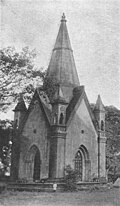 Tomb of David Sassoon, 1864.
-
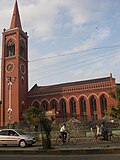 Ohel David Synagogue, 1867.
-
 Prag Mahal at Bhuj completed in 1879.
-
 Cisterns of Tawila restoration work 1895–96


References[edit | edit source]
- ↑ 1.0 1.1 1.2 1.3 1.4 1.5 Template:DNB
- ↑ Royal Engineers Records and Professional Papers, vol. xvii. (1869); Despatches; Times, December 1896; Memoir by General John Fuller, R.E., in Royal Engineers' Journal, 1897.
- ↑ Islamic Art in the 19th Century: Tradition, Innovation, And Eclecticism edited by Doris Behrens-Abouseif, Stephen Vernoit, 2009, pp:390
- ↑ Report on the state and requirements of the Kurrachee ...by Sind publ. works dept, Henry St. Clair Wilkins - Page 1, 1878
- ↑ Bhuj: art, architecture, history by Azhar Tyabji, Environmental Planning Collaborative (Ahmadābād, India) - 2006 - Part 4 - Page 281