






Created page with "{{short description|Regiment of the Indian Army}} {{About|a regiment of the Indian Army|other uses|Grenadier (disambiguation)}} {{More footnotes|date=April 2011}} {{Use dmy da..." |
No edit summary |
||
| Line 1: | Line 1: | ||
{{short description|Regiment of the Indian Army}} | {{short description|Regiment of the Indian Army}} | ||
{{About|a regiment of the Indian Army|other uses|Grenadier (disambiguation)}} | {{About|a regiment of the Indian Army|other uses|Grenadier (disambiguation)}} | ||
{{More footnotes|date=April | {{More footnotes|date=April 2022}} | ||
{{Use dmy dates|date=March | {{Use dmy dates|date=March 2022}} | ||
{{Infobox military unit | {{Infobox military unit | ||
| unit_name = The Grenadiers | | unit_name = The Grenadiers | ||
| image = [[File: | | image = [[File:Grenadiers Insignia (India).svg|150px]] | ||
| caption = Regimental Insignia of The Grenadiers | | caption = Regimental Insignia of The Grenadiers | ||
| dates = 1778–present | | dates = 1778–present | ||
| country = {{flag | | country = {{flag|India}} | ||
| branch = {{ | | branch = {{army|India}} | ||
| type = [[Infantry]] | | type = [[Infantry]] | ||
| role = | | role = | ||
| Line 33: | Line 33: | ||
[[Nathu La and Cho La clashes]]<br/> | [[Nathu La and Cho La clashes]]<br/> | ||
[[Indo-Pakistani War of 1971]]<br /> | [[Indo-Pakistani War of 1971]]<br /> | ||
[[Kargil War|1999 Kargil War]] | [[Kargil War|1999 Kargil War]]<br/> | ||
*[[Battle of Tololing]] | |||
| anniversaries = | | anniversaries = | ||
| decorations = * [[Victoria Cross|VC]] – 4 | | decorations = * [[Victoria Cross|VC]] – 4 | ||
| Line 41: | Line 42: | ||
* [[Ashoka Chakra|AC]] – 2 | * [[Ashoka Chakra|AC]] – 2 | ||
* [[Maha Vir Chakra|MVC]] – 11 | * [[Maha Vir Chakra|MVC]] – 11 | ||
* [[Kirti Chakra|KC]] – | * [[Kirti Chakra|KC]] – 6 | ||
* [[Param Vishisht Seva Medal|PVSM]] – 32 | * [[Param Vishisht Seva Medal|PVSM]] – 32 | ||
* [[Uttam Yudh Seva Medal|UYSM]] – 13 | * [[Uttam Yudh Seva Medal|UYSM]] – 13 | ||
| Line 58: | Line 59: | ||
| ceremonial_chief = | | ceremonial_chief = | ||
| ceremonial_chief_label = | | ceremonial_chief_label = | ||
| colonel_of_the_regiment = Lt. Gen. | | colonel_of_the_regiment = Lt. Gen. A Arun, YSM, SM, VSM<ref>{{cite web|url=http://www.egazette.nic.in/WriteReadData/2020/223002.pdf|title=Gazette of India No 45|date=2020-11-07|access-date=2020-11-24}}</ref> | ||
| colonel_of_the_regiment_label = | | colonel_of_the_regiment_label = | ||
| notable_commanders = <!-- Insignia --> | | notable_commanders = <!-- Insignia --> | ||
| Line 69: | Line 70: | ||
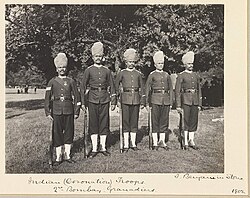
'''The Grenadiers''' is an [[infantry]] [[Regiment#Infantry|regiment]] of the [[Indian Army]], formerly part of the [[Bombay Army]] and later the pre-independence [[British Indian Army]], when the regiment was known as the '''4th Bombay Grenadiers'''. It has distinguished itself during the two [[world war]]s and also since the [[Independence of India]]. The regiment has won many [[battle honour]]s and [[gallantry award]]s, and is considered to be one of India's most decorated regiments with three [[Param Vir Chakra]] awardees in three different conflicts. | '''The Grenadiers''' is an [[infantry]] [[Regiment#Infantry|regiment]] of the [[Indian Army]], formerly part of the [[Bombay Army]] and later the pre-independence [[British Indian Army]], when the regiment was known as the '''4th Bombay Grenadiers'''. It has distinguished itself during the two [[world war]]s and also since the [[Independence of India]]. The regiment has won many [[battle honour]]s and [[gallantry award]]s, and is considered to be one of India's most decorated regiments with three [[Param Vir Chakra]] awardees in three different conflicts. | ||
==Early history== | ==History== | ||
===Early history=== | |||
The oldest grenadier regiment of the armies in the [[Commonwealth of Nations|Commonwealth]] belongs to the Indian Army. The concept of 'Grenadiers' evolved from the practice of selecting the bravest and strongest men for the most dangerous tasks in combat. The Grenadiers have the longest unbroken record of existence in the Indian Army.<ref name="Sharma, p. 75">Sharma, p. 75</ref> | The oldest grenadier regiment of the armies in the [[Commonwealth of Nations|Commonwealth]] belongs to the Indian Army. The concept of 'Grenadiers' evolved from the practice of selecting the bravest and strongest men for the most dangerous tasks in combat. The Grenadiers have the longest unbroken record of existence in the Indian Army.<ref name="Sharma, p. 75">Sharma, p. 75</ref> | ||
The history of the Indian Grenadiers is linked to the troops recruited for the army of the [[Bombay Presidency]]. The very first mention of a grenadier company hails back to 1684, when a little army of English troops, which had taken possession of the island of [[Mumbai|Bombay]] and comprising three companies of Europeans and local Christians, had a grenadier company, but nothing was heard about this unit subsequently. In 1710, the [[Bombay Army]] consisted of five companies of "Europeans, topasses (Indian Christians), and coffrees (Kaffirs | The history of the Indian Grenadiers is linked to the troops recruited for the army of the [[Bombay Presidency]]. The very first mention of a grenadier company hails back to 1684, when a little army of English troops, which had taken possession of the island of [[Mumbai|Bombay]] and comprising three companies of Europeans and local Christians, had a grenadier company, but nothing was heard about this unit subsequently. In 1710, the [[Bombay Army]] consisted of five companies of "Europeans, topasses ([[Christianity in India|Indian Christians]]), and coffrees ([[Kaffir (racial term)|Kaffirs]])" of which the first company was a European grenadier company. This company was merged into the Bombay European Regiment, which was later disbanded. In 1757, [[Robert Clive]] had raised the [[1st Regiment of the Bengal Native Infantry]] of which two companies were grenadier companies, however, no regiments of grenadiers were formed from the Bengal Army until a battalion was formed in 1779. | ||
In 1759, as a response to French manoeuvring in South India, the strength of the Bombay Army was enhanced, and the first company of [[sepoy]] grenadiers was raised with the best of Bombay sepoys "paying a regard to those having families on the island". It had only native officers and all sepoys wore red coats faced with blue. Later on, an [[adjutant]] was appointed to the corps. | In 1759, as a response to French manoeuvring in South India, the strength of the Bombay Army was enhanced, and the first company of [[sepoy]] grenadiers was raised with the best of Bombay sepoys "paying a regard to those having families on the island". It had only native officers and all sepoys wore red coats faced with blue. Later on, an [[adjutant]] was appointed to the corps. | ||
| Line 85: | Line 87: | ||
* Marine Battalion (two companies of grenadiers) | * Marine Battalion (two companies of grenadiers) | ||
==4th Bombay Grenadiers== | ===4th Bombay Grenadiers=== | ||
{{Infobox military unit | {{Infobox military unit | ||
|unit_name=4th Bombay Grenadiers | |unit_name=4th Bombay Grenadiers | ||
| Line 109: | Line 111: | ||
*10th (Training) Battalion - Formerly the [[113th Infantry]] | *10th (Training) Battalion - Formerly the [[113th Infantry]] | ||
===Second World War=== | ====Second World War==== | ||
[[File:Indian Armoured Corps in the Middle East 1944.jpg|thumb|Grenadiers in a [[Lend-Lease Sherman tanks|Sherman III]] tank in the Middle East, March 1944.]] | [[File:Indian Armoured Corps in the Middle East 1944.jpg|thumb|Grenadiers in a [[Lend-Lease Sherman tanks|Sherman III]] tank in the Middle East, March 1944.]] | ||
At the beginning of the Second World War there were only two battalions of the Regiment, the 1st and 2nd. This was soon changed, though, as a number of battalions were raised for wartime service, including: 3rd, 4th, 5th, 6th, 14th, 25th, 26th and 27th Battalions.<ref name="Sharma, p. 75"/> The 10th (Training Battalion) was also de-linked from the Jat Regiment. Some of these battalions were to be garrison or rear area troops only, while others went on to serve with distinction in a number of theatres during the war including the Middle East and Burma, notably during the Arakan campaigns and at [[Battle of Kohima|Kohima]]. | At the beginning of the Second World War there were only two battalions of the Regiment, the 1st and 2nd. This was soon changed, though, as a number of battalions were raised for wartime service, including: 3rd, 4th, 5th, 6th, 14th, 25th, 26th and 27th Battalions.<ref name="Sharma, p. 75"/> The 10th (Training Battalion) was also de-linked from the Jat Regiment. Some of these battalions were to be garrison or rear area troops only, while others went on to serve with distinction in a number of theatres during the war including the Middle East and Burma, notably during the Arakan campaigns and at [[Battle of Kohima|Kohima]]. | ||
| Line 121: | Line 123: | ||
*4/4th Battalion, [[255th Indian Tank Brigade]] | *4/4th Battalion, [[255th Indian Tank Brigade]] | ||
== | ==Regimental battalions== | ||
{{multiple image | |||
| align = right | |||
| direction = vertical | |||
| width = 305 | |||
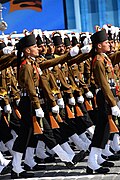
| header = Attestation Parade at Grenadiers Regimental Centre, Jabalpur, September 2021. | |||
| image1 = GRENADIERS_Regimental_Centre_1.jpg | |||
| alt1 = | |||
| caption1 = | |||
| image2 = GRENADIERS_Regimental_Centre_2.jpg | |||
| alt2 = | |||
| caption2 = | |||
}} | |||
* 2nd Battalion (102nd KEO Grenadiers) (second to none) | * 2nd Battalion (102nd KEO Grenadiers) (second to none) | ||
* 3rd Battalion (108th Infantry) (Param Vir Chakra Paltan) | * 3rd Battalion (108th Infantry) (Param Vir Chakra Paltan) | ||
| Line 127: | Line 141: | ||
* 5th Battalion (finest fifth) | * 5th Battalion (finest fifth) | ||
* 6th Battalion (joshila sixth) | * 6th Battalion (joshila sixth) | ||
* 8th Battalion ( Chakra Bn) | * 8th Battalion (Chakra Bn) | ||
* 9th Battalion (Mewar, ex-State Forces unit) | * 9th Battalion (Mewar, ex-State Forces unit) | ||
* 10th (Training) Battalion - (113th Infantry) | * 10th (Training) Battalion - (113th Infantry) | ||
| Line 136: | Line 150: | ||
* 15th Battalion (The Dare Devils) | * 15th Battalion (The Dare Devils) | ||
* 16th Battalion (Shola) (Kargil) | * 16th Battalion (Shola) (Kargil) | ||
* 17th Battalion (desert hawks) | * 17th Battalion (desert hawks) (Motorized Infantry) | ||
* 18th Battalion (Param Vir Chakra Paltan) (Kargil) | * 18th Battalion (Param Vir Chakra Paltan) (Kargil) | ||
* 19th Battalion( | * 19th Battalion (Jalim Khanzar) | ||
* 20th Battalion (Double Axe) | * 20th Battalion (Double Axe) | ||
* 21st Battalion (Awwal Ekkis) | * 21st Battalion (Awwal Ekkis) | ||
| Line 144: | Line 158: | ||
* 23rd Battalion | * 23rd Battalion | ||
* 24th Battalion | * 24th Battalion | ||
* 25th Battalion ( | * 25th Battalion (Parakrami Pacchees) | ||
* 12 Rashtriya Rifles | * 12 Rashtriya Rifles | ||
* 29 Rashtriya Rifles | * 29 Rashtriya Rifles | ||
| Line 152: | Line 166: | ||
The Grenadiers including these battalions have 4 battalions in the Rashtriya Rifles and 2 battalions in the territorial army. | The Grenadiers including these battalions have 4 battalions in the Rashtriya Rifles and 2 battalions in the territorial army. | ||
* 1st Battalion, The Grenadiers became 2nd Battalion [[Brigade of the Guards]] in 1950<ref>http://www.grenadiers.info/indian/</ref> | * 1st Battalion, The Grenadiers became 2nd Battalion [[Brigade of the Guards]] in 1950<ref>{{cite web |url=http://www.grenadiers.info/indian/ |title = Indian Army Grenadiers Regiment}}</ref> | ||
* 7th battalion, The Grenadiers became 9th Battalion [[Mechanised Infantry Regiment]]<ref>http://www.bharat-rakshak.com/ARMY/units/102-Grenadiers.html</ref> | * 7th battalion, The Grenadiers became 9th Battalion [[Mechanised Infantry Regiment]]<ref>{{cite web |url=http://www.bharat-rakshak.com/ARMY/units/102-Grenadiers.html |title = The Grenadiers Regiment - Bharat Rakshak - Indian Army & Land Forces}}</ref> | ||
* 118 (TA) Battalion - [[Bhusaval, Maharashtra]] | * 118 (TA) Battalion - [[Bhusaval, Maharashtra]] | ||
* 123 (TA) Battalion - [[Jaipur, Rajasthan]] | * 123 (TA) Battalion - [[Jaipur, Rajasthan]] | ||
| Line 216: | Line 230: | ||
* Chakra – 1971 | * Chakra – 1971 | ||
* [[Battle of Tiger Hill|Tololing & Tiger Hill (Kargil War) – 1999]] | * [[Battle of Tiger Hill|Tololing & Tiger Hill (Kargil War) – 1999]] | ||
{{Expand list|date=September | {{Expand list|date=September 2022}} | ||
==Decorations== | ==Decorations== | ||
The Grenadiers have the unique and distinct honour of having the most number of [[Param Vir Chakra]]s, India's highest medal for gallantry, among all the Indian Army's Infantry Regiments.{{Citation needed|date=March | The Grenadiers have the unique and distinct honour of having the most number of [[Param Vir Chakra]]s, India's highest medal for gallantry, among all the Indian Army's Infantry Regiments.{{Citation needed|date=March 2022}} Of note also, is the fact that prior to independence, British officers serving with The Grenadiers won four [[Victoria Cross]]es.<ref>Sharma, p. 69</ref> Members of the Regiment have also received a number of other decorations prior to independence, including the [[Indian Order of Merit]]. | ||
===Param Vir Chakra Recipients=== | ===Param Vir Chakra Recipients=== | ||
[[File:JVF-Mounted-M40-Anti-Tank-Gun.jpg|thumb|105 mm [[Jonga]]-mounted RCL gun, manned by [[Abdul Hamid (soldier)|Abdul Hamid]], which destroyed eight tanks during the Battle of Asal Uttar]] | |||
* Company Quarter Master [[Abdul Hamid (soldier)|Havildar Abdul Hamid]], '''4th Grenadiers''' – 1965. | * Company Quarter Master [[Abdul Hamid (soldier)|Havildar Abdul Hamid]], '''4th Grenadiers''' – 1965. | ||
* [[Major Hoshiar Singh]], '''3rd Grenadiers''' – 1971. | * [[Major Hoshiar Singh]], '''3rd Grenadiers''' – 1971. | ||
* [[Yogendra Singh Yadav|Grenadier Yogendra Singh Yadav]], '''18th Grenadiers''' – 1999. | * [[Yogendra Singh Yadav|Grenadier Yogendra Singh Yadav]], '''18th Grenadiers''' – 1999. | ||
===Maha Vir Chakra Recipients=== | |||
*Major [[Rajesh Adhikari]], [[Maha Vir Chakra|MVC]] (Posthumous), 18 Grenadiers, [[Kargil War]] (Operation Vijay) 1999. | |||
*Colonel [[Balwan Singh]], [[Maha Vir Chakra|MVC]], 18 Grenadiers, [[Kargil War]] (Operation Vijay) 1999. | |||
*Brigadier [[Rai Singh Yadav]], [[Maha Vir Chakra|MVC]], 2 Grenadiers, [[Nathu La and Cho La clashes]] 1967. | |||
*2nd Lieutenant GVP Rao, [[Maha Vir Chakra|MVC]] (Posthumous), 4 Grenadiers, [[Sino-Indian War]] 1962. | |||
*Major Dharam Vir Singh, [[Maha Vir Chakra|MVC]], 8 Grenadiers, [[Indo-Pak War of 1971]]. | |||
*Lieutenant General [[Ved Prakash Airy]], [[Maha Vir Chakra|MVC]], 3 Grenadiers, [[Indo-Pak War of 1971]] ([[Battle of Basantar]]). | |||
===Ashok Chakra Recipients=== | ===Ashok Chakra Recipients=== | ||
* | * Major Rajiv Kumar Joon, '''22 Grenadiers'''. | ||
* [[Rakesh Singh (soldier)]], '''22 Grenadiers'''. | * [[Rakesh Singh (soldier)|Second Lieutenant Rakesh Singh]], '''22 Grenadiers'''. | ||
=== Victoria Cross === | |||
* Captain [[George Murray Rolland]], 22 April 1903, Daratoleh, [[Somaliland]] | |||
===Indian Order of Merit=== | |||
* Subedar Rahim Khan, Palestine (against Turkey), April 1918<ref>Sharma, p. 73</ref> | |||
* Naik Shivlal Dalal (1933) | |||
==References & notes== | ==References & notes== | ||
| Line 241: | Line 264: | ||
==Bibliography== | ==Bibliography== | ||
* {{cite book| | * {{cite book|last1=Barthorp|first1=Michael|last2=Burn|first2=Jeffrey|year=1979|title=Indian infantry regiments 1860–1914|publisher=Osprey Publishing|isbn=0-85045-307-0}} | ||
* {{cite book|last=Rinaldi|first=Richard A|year=2008|title=Order of Battle British Army 1914|publisher=Ravi Rikhye|isbn=0-9776072-8- | * {{cite book|last=Rinaldi|first=Richard A|year=2008|title=Order of Battle British Army 1914|publisher=Ravi Rikhye|isbn=978-0-9776072-8-0}} | ||
* {{cite book|last=Sharma|first=Gautam|year=1990|title=Valour and sacrifice: famous regiments of the Indian Army|publisher=Allied Publishers|isbn=81-7023-140-X}} | * {{cite book|last=Sharma|first=Gautam|year=1990|title=Valour and sacrifice: famous regiments of the Indian Army|publisher=Allied Publishers|isbn=81-7023-140-X}} | ||
* {{cite book|last=Sumner|first=Ian|title=The Indian Army 1914–1947|year=2001|publisher=Osprey Publishing|isbn=1-84176-196-6}} | * {{cite book|last=Sumner|first=Ian|title=The Indian Army 1914–1947|year=2001|publisher=Osprey Publishing|isbn=1-84176-196-6}} | ||
| Line 256: | Line 279: | ||
==External links== | ==External links== | ||
* [http://www.indianarmy.gov.in/ Official Website of Indian Army] | * [http://www.indianarmy.gov.in/ Official Website of Indian Army] | ||
* [http://www.bharat-rakshak.com/LAND-FORCES/Units/Infantry/102-Grenadiers.html bharat-rakshak.com – The Grenadiers] | * [http://www.bharat-rakshak.com/LAND-FORCES/Units/Infantry/102-Grenadiers.html bharat-rakshak.com – The Grenadiers] {{Webarchive|url=https://web.archive.org/web/20150414022914/http://www.bharat-rakshak.com/LAND-FORCES/Units/Infantry/102-Grenadiers.html |date=14 April 2015 }} | ||
* [http://www.grenadiers.info/indian/ Indian Grenadiers Regiment] | * [http://www.grenadiers.info/indian/ Indian Grenadiers Regiment] | ||
* [https://web.archive.org/web/20050311031539/http://www.regiments.org/regiments/southasia/inf/1922-04.htm The Bombay Grenadiers] | * [https://web.archive.org/web/20050311031539/http://www.regiments.org/regiments/southasia/inf/1922-04.htm The Bombay Grenadiers] | ||
Revision as of 21:49, 16 December 2022
 | This article includes a list of general references, but it remains largely unverified because it lacks sufficient corresponding inline citations. (April 2022) |
| The Grenadiers | |
|---|---|
.svg) Regimental Insignia of The Grenadiers | |
| Active | 1778–present |
| Country |  India India |
| Branch |  Indian Army Indian Army |
| Type | Infantry |
| Size | 23 battalions |
| Regimental Centre | Jabalpur, Madhya Pradesh |
| Nickname(s) | The Grinders |
| Motto(s) | Sarvada Shaktishali (Ever Powerful) |
| Mascot(s) | The Lion |
| Engagements | Second Anglo-Afghan War Third Burmese War |
| Decorations | |
| Battle honours | Post Independence Gurez, Assal Uttar, Jarpal and Chakra |
| Commanders | |
| Colonel of the Regiment | Lt. Gen. A Arun, YSM, SM, VSM[1] |
| Insignia | |
| Regimental Insignia | A brass grenade bearing the White Horse of Hanover. The insignia is worn on the uniform with a white hackle. |
The Grenadiers is an infantry regiment of the Indian Army, formerly part of the Bombay Army and later the pre-independence British Indian Army, when the regiment was known as the 4th Bombay Grenadiers. It has distinguished itself during the two world wars and also since the Independence of India. The regiment has won many battle honours and gallantry awards, and is considered to be one of India's most decorated regiments with three Param Vir Chakra awardees in three different conflicts.
History
Early history
The oldest grenadier regiment of the armies in the Commonwealth belongs to the Indian Army. The concept of 'Grenadiers' evolved from the practice of selecting the bravest and strongest men for the most dangerous tasks in combat. The Grenadiers have the longest unbroken record of existence in the Indian Army.[2]
The history of the Indian Grenadiers is linked to the troops recruited for the army of the Bombay Presidency. The very first mention of a grenadier company hails back to 1684, when a little army of English troops, which had taken possession of the island of Bombay and comprising three companies of Europeans and local Christians, had a grenadier company, but nothing was heard about this unit subsequently. In 1710, the Bombay Army consisted of five companies of "Europeans, topasses (Indian Christians), and coffrees (Kaffirs)" of which the first company was a European grenadier company. This company was merged into the Bombay European Regiment, which was later disbanded. In 1757, Robert Clive had raised the 1st Regiment of the Bengal Native Infantry of which two companies were grenadier companies, however, no regiments of grenadiers were formed from the Bengal Army until a battalion was formed in 1779.
In 1759, as a response to French manoeuvring in South India, the strength of the Bombay Army was enhanced, and the first company of sepoy grenadiers was raised with the best of Bombay sepoys "paying a regard to those having families on the island". It had only native officers and all sepoys wore red coats faced with blue. Later on, an adjutant was appointed to the corps.
Later the Bombay Army comprised a number of sepoy battalions, each having one or two grenadier companies. These were clubbed together as a composite battalion comprising the grenadier companies of the Bombay sepoy battalions, and they won the famous battle of Talegaon in 1778. So impressive was the performance of this composite battalion that the Bombay Presidency ordered the permanent raising of a grenadier battalion which duly took place on 12 March 1779, thirty-six years before the first time that a British battalion was given the honour of calling itself "grenadiers". The Governor General of Bombay made an Order dated 12 November 1779, according to which the grenadier companies of the following regiments combined to form the very first Grenadier Regiment in the world, namely "The Grenadier Battalion, First Regiment of Infantry":
- 1st Sepoy Battalion
- 2nd Sepoy Battalion
- 3rd Sepoy Battalion
- 4th Sepoy Battalion
- 5th Sepoy Battalion
- 6th Sepoy Battalion
- Marine Battalion (two companies of grenadiers)
4th Bombay Grenadiers
| 4th Bombay Grenadiers | |
|---|---|
| Active | 1922–1947 |
| Country | British India |
| Branch | Indian Army |
| Type | Infantry |
The 4th Bombay Grenadiers were an infantry regiment of the pre-independence Indian Army, formed on 1 March 1922 as part of the reforms of the Indian Army that took place after the end of the First World War.[2] Following this, the Regiment spent the next fifteen years serving in the British Somaliland protectorate in present-day Somaliland, as well as in China and on the North-West Frontier. The 3rd, 4th and 5th Battalions were all disbanded and the 10th Battalion amalgamated with the 10th Battalion, Jat Regiment to form a Combined Training Centre at Bareilly.[2] Following the Second World War they were one of the regiments allocated to the new Indian Army and renamed The Grenadiers
The regiment consisted of six battalions, all former regiments themselves. These were:
- 1st Battalion - Formerly the 101st Grenadiers.
- 2nd Battalion - Formerly the 102nd King Edward's Own Grenadiers
- 3rd Battalion - Formerly the 108th Infantry
- 4th Battalion - Formerly the 109th Infantry
- 5th Battalion - Formerly the 112th Infantry
- 10th (Training) Battalion - Formerly the 113th Infantry
Second World War

At the beginning of the Second World War there were only two battalions of the Regiment, the 1st and 2nd. This was soon changed, though, as a number of battalions were raised for wartime service, including: 3rd, 4th, 5th, 6th, 14th, 25th, 26th and 27th Battalions.[2] The 10th (Training Battalion) was also de-linked from the Jat Regiment. Some of these battalions were to be garrison or rear area troops only, while others went on to serve with distinction in a number of theatres during the war including the Middle East and Burma, notably during the Arakan campaigns and at Kohima.
The 4th Grenadiers formed the motorised infantry element of the Indian Armoured and Tank brigades, distinguishing themselves as 'tank escort' infantry protecting tanks against sniper attack in jungle conditions:
- 1/4th Battalion, 252nd Indian Armoured Brigade, 31st Indian Armoured Division
- 2/4th Battalion, 50th Indian Tank Brigade
- 3/4th Battalion, 254th Indian Tank Brigade
- 4/4th Battalion, 255th Indian Tank Brigade
Regimental battalions


- 2nd Battalion (102nd KEO Grenadiers) (second to none)
- 3rd Battalion (108th Infantry) (Param Vir Chakra Paltan)
- 4th Battalion (109th Infantry) (The Fighting Fourth) (Param Vir Chakra Paltan)
- 5th Battalion (finest fifth)
- 6th Battalion (joshila sixth)
- 8th Battalion (Chakra Bn)
- 9th Battalion (Mewar, ex-State Forces unit)
- 10th (Training) Battalion - (113th Infantry)
- 11th Battalion (ex-Territorial battalion)
- 12th Battalion (Thundering Twelfths)
- 13th Battalion (Ganga risala)
- 14th Battalion
- 15th Battalion (The Dare Devils)
- 16th Battalion (Shola) (Kargil)
- 17th Battalion (desert hawks) (Motorized Infantry)
- 18th Battalion (Param Vir Chakra Paltan) (Kargil)
- 19th Battalion (Jalim Khanzar)
- 20th Battalion (Double Axe)
- 21st Battalion (Awwal Ekkis)
- 22nd Battalion (Bravest of the Brave) (Ashok Chakra Paltan) (Kargil)
- 23rd Battalion
- 24th Battalion
- 25th Battalion (Parakrami Pacchees)
- 12 Rashtriya Rifles
- 29 Rashtriya Rifles
- 39 Rashtriya Rifles
- 55 Rashtriya Rifles
The Grenadiers including these battalions have 4 battalions in the Rashtriya Rifles and 2 battalions in the territorial army.
- 1st Battalion, The Grenadiers became 2nd Battalion Brigade of the Guards in 1950[3]
- 7th battalion, The Grenadiers became 9th Battalion Mechanised Infantry Regiment[4]
- 118 (TA) Battalion - Bhusaval, Maharashtra
- 123 (TA) Battalion - Jaipur, Rajasthan
Battle honours

Battle Honour (Pre-Independence)
Prior to Indian independence, the Regiment had won many battle honours as part of the British Indian Army. These battle honour include:
Pre-World War I
- Mangalore – 1784
- Mysore – 1786
- Srirangapatnam – 1799
- Egypt – 1802
- Koregaon – 1818
- Beni Boo Alli – 1821
- Kirkee – 1827
- Hyderabad – 1831–43
- Meeane – 1843
- Punjab – 1848
- Central India – 1858
- Abyssinia – 1868
- Afghanistan – 1878–1880
- Kandahar 1880
- Afghanistan 1878–80
- Burma 1885–87
- Somaliland (Dharatol) – 1901–04
World War I

- East Africa 1914–16
- Egypt – 1916–17
- Baghdad – 1917
- Kut-Al-Amara – 1917
- Gaza – 1917
- Battle of Sharqat – 1918
- Megiddo
- Nablus – 1918
- Palestine 1917–18
- Mesopotamia – 1915–18
- Aden – 1914–19
- Afghanistan 1919
- Tigris – 1919
World War II
- Kohima – 1944
- Kalewa – 1944
- Naga Village – 1944
- Fort Dufferin, Mandalay – 1945
- Pwabwe – 1945
- Capture of Meiktila – 1945
- Defense of Meiktila – 1945
- Pegu – 1945
- Taungtha – 1945
Battle Honour (Post-Independence)
Since 1947, the Regiment has won the following battle honours as part of the Indian Army:
- Gurais – 1948
- Asal Uttar – 1965
- Jarpal – 1971
- Chakra – 1971
- Tololing & Tiger Hill (Kargil War) – 1999
Decorations
The Grenadiers have the unique and distinct honour of having the most number of Param Vir Chakras, India's highest medal for gallantry, among all the Indian Army's Infantry Regiments.[citation needed] Of note also, is the fact that prior to independence, British officers serving with The Grenadiers won four Victoria Crosses.[5] Members of the Regiment have also received a number of other decorations prior to independence, including the Indian Order of Merit.
Param Vir Chakra Recipients

- Company Quarter Master Havildar Abdul Hamid, 4th Grenadiers – 1965.
- Major Hoshiar Singh, 3rd Grenadiers – 1971.
- Grenadier Yogendra Singh Yadav, 18th Grenadiers – 1999.
Maha Vir Chakra Recipients
- Major Rajesh Adhikari, MVC (Posthumous), 18 Grenadiers, Kargil War (Operation Vijay) 1999.
- Colonel Balwan Singh, MVC, 18 Grenadiers, Kargil War (Operation Vijay) 1999.
- Brigadier Rai Singh Yadav, MVC, 2 Grenadiers, Nathu La and Cho La clashes 1967.
- 2nd Lieutenant GVP Rao, MVC (Posthumous), 4 Grenadiers, Sino-Indian War 1962.
- Major Dharam Vir Singh, MVC, 8 Grenadiers, Indo-Pak War of 1971.
- Lieutenant General Ved Prakash Airy, MVC, 3 Grenadiers, Indo-Pak War of 1971 (Battle of Basantar).
Ashok Chakra Recipients
- Major Rajiv Kumar Joon, 22 Grenadiers.
- Second Lieutenant Rakesh Singh, 22 Grenadiers.
Victoria Cross
- Captain George Murray Rolland, 22 April 1903, Daratoleh, Somaliland
Indian Order of Merit
- Subedar Rahim Khan, Palestine (against Turkey), April 1918[6]
- Naik Shivlal Dalal (1933)
References & notes
- ↑ "Gazette of India No 45" (PDF). 7 November 2020. Retrieved 24 November 2020.
- ↑ 2.0 2.1 2.2 2.3 Sharma, p. 75
- ↑ "Indian Army Grenadiers Regiment".
- ↑ "The Grenadiers Regiment - Bharat Rakshak - Indian Army & Land Forces".
- ↑ Sharma, p. 69
- ↑ Sharma, p. 73
Bibliography
- Barthorp, Michael; Burn, Jeffrey (1979). Indian infantry regiments 1860–1914. Osprey Publishing. ISBN 0-85045-307-0.
- Rinaldi, Richard A (2008). Order of Battle British Army 1914. Ravi Rikhye. ISBN 978-0-9776072-8-0.
- Sharma, Gautam (1990). Valour and sacrifice: famous regiments of the Indian Army. Allied Publishers. ISBN 81-7023-140-X.
- Sumner, Ian (2001). The Indian Army 1914–1947. Osprey Publishing. ISBN 1-84176-196-6.
- Moberly, F.J. (1923). Official History of the War: Mesopotamia Campaign, Imperial War Museum. ISBN 1-870423-30-5
- Singh, Rajendra (1969) History of the Grenadiers
- Singh, Rajendra (1955) Organisation and Administration in the Indian Army
See also
External links
- Official Website of Indian Army
- bharat-rakshak.com – The Grenadiers Archived 14 April 2015 at the Wayback Machine
- Indian Grenadiers Regiment
- The Bombay Grenadiers
