{{other uses|Christmas (disambiguation)|Christmas Day (disambiguation)}}
{{use dmy dates|date=May 2019}}
{{nosources|date=December 2021}}
[[File:Badnjak-Beograd.jpg|thumb|300px|A [[Serbia|Serbian]] Orthodox priest places the badnjak on a fire during a Christmas Eve celebration at the Temple of Saint Sava in [[Belgrade]].]]
‘’’Christmas’’’ (which means “The Mass of Christ”) is a [[Christian]] [[holiday]] that celebrates the birth of [[Jesus]], who Christians believe is the Son of God. Christmas is also a [[culture|cultural]] holiday for many non-Christians.
{{short description|Holiday originating in Christianity, usually December 25}}
Christmas Day is celebrated on the 25th day of December. It is one of the most important days of the year for Christians, along with [[Easter]] (which celebrates [[Crucifixion of Jesus|the death]] and [[resurrection of Jesus]]). The season of [[Advent]] begins on a Sunday about four weeks before Christmas. During Advent, people prepare for Christmas.
{{Use mdy dates|date=December 2020}}
{{Infobox holiday
| holiday_name = Christmas
| image = NativityChristmasLights2.jpg
| caption = [[Nativity scene]] depicted using [[Christmas lights]]
| nickname = Noël, Nativity, [[Xmas]]
| observedby = [[Christians]], many non-Christians<ref name="nonXians">{{Cite journal |date=December 29, 2005 |title=Christmas as a Multi-Faith Festival |url=http://downloads.bbc.co.uk/worldservice/learningenglish/entertainment/scripts/multifaith_christmas.pdf |journal=BBC Learning English |access-date=September 30, 2008 |archive-url=https://web.archive.org/web/20081001161153/http://downloads.bbc.co.uk/worldservice/learningenglish/entertainment/scripts/multifaith_christmas.pdf |archive-date=October 1, 2008 |url-status=live }}</ref><ref name="NonXiansUSA">{{cite web|url = http://www.gallup.com/poll/113566/us-christmas-not-just-christians.aspx|title = In the U.S., Christmas Not Just for Christians|publisher = Gallup, Inc.|date = December 24, 2008|access-date = December 16, 2012|archive-url = https://web.archive.org/web/20121116192524/http://www.gallup.com/poll/113566/US-Christmas-Not-Just-Christians.aspx|archive-date = November 16, 2012|url-status = dead}}</ref>
| date = {{blist
| December 25: [[Western Christianity]] and part of the [[Eastern Christianity|Eastern]] churches<ref name="CathChrit">{{Cite encyclopedia |year=1908 |title=Christmas |encyclopedia=[[The Catholic Encyclopedia]] |publisher=Robert Appleton Company |location=New York |last=Martindale |first=Cyril Charles |volume=3}}</ref>
| {{OldStyleDate|January 7||December 25}}: Most [[Oriental Orthodox]] and part of the [[Eastern Orthodox]] churches.<ref>{{cite book|url=https://books.google.com/books?id=tdsRKc_knZoC&pg=RA5-PT130 |first=Paul |last=Gwynne |title=World Religions in Practice |publisher=John Wiley & Sons |year=2011 |isbn=978-1-4443-6005-9}}</ref><ref name="Jan7">{{cite web |url=http://www.copticchurch.net/topics/coptic_calendar/nativitydate.html |title=The Glorious Feast of Nativity: 7 January? 29 Kiahk? 25 December? |publisher=Coptic Orthodox Church Network |first=John |last=Ramzy |access-date=January 17, 2011 |archive-url=https://web.archive.org/web/20101228051302/http://www.copticchurch.net/topics/coptic_calendar/nativitydate.html |archive-date=December 28, 2010 |url-status=live }}</ref>
| January 6: [[Armenian Apostolic Church]],<ref>{{cite news|last1=Steinfels|first1=Peter|author-link1=Peter Steinfels|title=At Armenian Churches, a Distinct Observance Today|url=https://www.nytimes.com/2007/01/06/us/06beliefs.html|work=[[The New York Times]]|date=January 6, 2007|access-date=June 12, 2018|archive-url=https://web.archive.org/web/20180612210021/https://www.nytimes.com/2007/01/06/us/06beliefs.html|archive-date=June 12, 2018|url-status=live}}</ref><ref>{{cite book|last1=Agadjanian|first1=Alexander|title=Armenian Christianity Today: Identity Politics and Popular Practice|date=2016|publisher=Routledge|isbn=9781317178576|page=[https://books.google.am/books?id=YAYHDAAAQBAJ&pg=PA112 113]|quote=The Armenian Apostolic Church follows the oldest Jerusalem version of Canons of Calendar, based on the Julian Calendar, and therefore celebrates Christmas and Theophany on the same day, January 6}}</ref> the [[Armenian Evangelical Church]], and some [[Anabaptists]] (such as the [[Amish]]).<ref name="DHGBeth2009">{{cite web |title=Why do Amish celebrate "Old" Christmas? |url=https://derdutchman.wordpress.com/2009/12/17/why-do-amish-celebrate-old-christmas/ |publisher=Dutchman News |date=December 17, 2009 |access-date=January 12, 2019 |archive-url=https://web.archive.org/web/20181226184212/https://derdutchman.wordpress.com/2009/12/17/why-do-amish-celebrate-old-christmas/ |archive-date=December 26, 2018 |url-status=dead }}</ref>
| {{OldStyleDate|January 19||January 6}}: ''[[Armenian Patriarchate of Jerusalem]]''<ref>{{cite news|last=Jansezian|first=Nicole|title=10 things to do over Christmas in the Holy Land|url=http://www.jpost.com/Travel/Around-Israel/10-things-to-do-over-Christmas-in-the-Holy-Land|work=[[The Jerusalem Post]]|quote=the Armenians in Jerusalem – and only in Jerusalem – celebrate Christmas on January 19...|access-date=December 26, 2014|archive-url=https://web.archive.org/web/20141226192340/http://www.jpost.com/Travel/Around-Israel/10-things-to-do-over-Christmas-in-the-Holy-Land|archive-date=December 26, 2014|url-status=live}}</ref>}}
| observances = [[Church service]]s
| celebrations = Gift-giving, family and other social gatherings, symbolic decoration, feasting etc.
| type = [[Christianity|Christian]], cultural
| significance = Commemoration of the [[nativity of Jesus]]
| relatedto = [[Christmastide]], [[Christmas Eve]], [[Advent]], [[Annunciation]], [[Epiphany (holiday)|Epiphany]], [[Baptism of the Lord]], [[Nativity Fast]], [[Nativity of Christ]], [[Little Christmas|Old Christmas]], [[Yule]], [[St. Stephen's Day]], [[Boxing Day]]
| frequency = Annual
| duration = 1 day
}}
<!--Please review talk archives before altering the opening line and make good use of the talk pages.-->
'''Christmas''' is an annual festival commemorating [[Nativity of Jesus|the birth]] of [[Jesus Christ]], observed primarily on December 25{{efn|Several branches of [[Eastern Christianity]] that use the [[Julian calendar]] also celebrate on December 25 according to that calendar, which is now January 7 on the [[Gregorian calendar]]. Armenian Churches observed the nativity on January 6 even before the Gregorian calendar originated. Most Armenian Christians use the Gregorian calendar, still celebrating Christmas Day on January 6. Some Armenian churches use the Julian calendar, thus celebrating Christmas Day on January 19 on the Gregorian calendar, with January 18 being Christmas Eve. Some regions also celebrate primarily on December 24, rather than December 25.}} as a religious and cultural celebration by billions of people [[Observance of Christmas by country|around the world]].<ref name="NonXiansUSA" /><ref>{{cite web|url = http://www.pewforum.org/2012/12/18/global-religious-landscape-christians/|title = The Global Religious Landscape {{!}} Christians|publisher = Pew Research Center|date = December 18, 2012|access-date = May 23, 2014|archive-url = https://web.archive.org/web/20150310002132/http://www.pewforum.org/2012/12/18/global-religious-landscape-christians/|archive-date = March 10, 2015|url-status = live}}</ref><ref name="Gallup122410">{{cite web|url = http://www.gallup.com/poll/145367/christmas-strongly-religious-half-celebrate.aspx|title = Christmas Strongly Religious For Half in U.S. Who Celebrate It|publisher = Gallup, Inc.|date = December 24, 2010|access-date = December 16, 2012|archive-url = https://web.archive.org/web/20121207090538/http://www.gallup.com/poll/145367/christmas-strongly-religious-half-celebrate.aspx|archive-date = December 7, 2012|url-status = dead}}</ref> A [[feast day|feast]] central to the [[Christianity|Christian]] [[liturgical year]], it is preceded by the season of [[Advent]] or the [[Nativity Fast]] and initiates the season of [[Christmastide]], which historically in the West lasts [[Twelve Days of Christmas|twelve days]] and culminates on [[Twelfth Night (holiday)|Twelfth Night]].<ref name="Forbes">{{cite book|last=Forbes|first=Bruce David|title=Christmas: A Candid History|date=October 1, 2008|publisher=[[University of California Press]]|isbn=978-0-520-25802-0|page=27|quote=In 567 the Council of Tours proclaimed that the entire period between Christmas and Epiphany should be considered part of the celebration, creating what became known as the twelve days of Christmas, or what the English called Christmastide.<br />On the last of the twelve days, called Twelfth Night, various cultures developed a wide range of additional special festivities. The variation extends even to the issue of how to count the days. If Christmas Day is the first of the twelve days, then Twelfth Night would be on January 5, the eve of Epiphany. If December 26, the day after Christmas, is the first day, then Twelfth Night falls on January 6, the evening of Epiphany itself.<br />After Christmas and Epiphany were in place, on December 25 and January 6, with the twelve days of Christmas in between, Christians slowly adopted a period called Advent, as a time of spiritual preparation leading up to Christmas.}}<!--|access-date=December 7, 2015--></ref> Christmas Day is a [[public holiday]] in [[List of holidays by country|many countries]],<ref>[http://www.pch.gc.ca/pgm/ceem-cced/jfa-ha/index-eng.cfm Canadian Heritage – Public holidays]{{Webarchive|url=https://web.archive.org/web/20091124102246/http://www.pch.gc.ca/pgm/ceem-cced/jfa-ha/index-eng.cfm |date=November 24, 2009 }} – ''Government of Canada''. Retrieved November 27, 2009.</ref><ref>[http://www.opm.gov/Operating_Status_Schedules/fedhol/2009.asp 2009 Federal Holidays] {{Webarchive|url=https://web.archive.org/web/20130116140821/http://www.opm.gov/Operating_Status_Schedules/fedhol/2009.asp |date=January 16, 2013 }} – ''U.S. Office of Personnel Management''. Retrieved November 27, 2009.</ref><ref>[http://www.direct.gov.uk/en/Governmentcitizensandrights/LivingintheUK/DG_073741 Bank holidays and British Summer time] {{Webarchive|url=https://web.archive.org/web/20110515020958/http://www.direct.gov.uk/en/Governmentcitizensandrights/LivingintheUK/DG_073741 |date=May 15, 2011 }} – ''HM Government''. Retrieved November 27, 2009.</ref> is celebrated religiously by a majority of Christians,<ref name="EhornHewlett1995">{{cite book|last1=Ehorn|first1=Lee Ellen|last2=Hewlett|first2=Shirely J.|last3=Hewlett|first3=Dale M.|title=December Holiday Customs |date=September 1, 1995|publisher=Lorenz Educational Press|isbn=978-1-4291-0896-6|page=1}}</ref> as well as [[Christian culture|culturally]] by many non-Christians,<ref name="nonXians" /><ref>Nick Hytrek, [http://www.siouxcityjournal.com/lifestyles/leisure/article_9914761e-ce50-11de-98cf-001cc4c03286.html "Non-Christians focus on secular side of Christmas"] {{Webarchive|url=https://web.archive.org/web/20091114085432/http://www.siouxcityjournal.com/lifestyles/leisure/article_9914761e-ce50-11de-98cf-001cc4c03286.html |date=November 14, 2009 }}, ''Sioux City Journal'', November 10, 2009. Retrieved November 18, 2009.</ref> and forms an integral part of the [[Christmas and holiday season|holiday season]] organized around it.
The Christmas season (called Christmastide) ends 6 January, also called the Twelfth Day of Christmas. On this day, Christians celebrate ‘’[[Epiphany (holiday)|Epiphany]]‘’.
The traditional Christmas narrative, the Nativity of Jesus, delineated in the [[New Testament]] says that Jesus was born in [[Bethlehem]], in accordance with [[Christian messianic prophecies|messianic prophecies]].<ref name="Crump2001">{{cite book|last=Crump|first=William D.|title=The Christmas Encyclopedia|url=https://archive.org/details/christmasencyclo00will|url-access=registration|edition=3|date=September 15, 2001|publisher=McFarland|isbn=9780786468270|page=[https://archive.org/details/christmasencyclo00will/page/39 39]|quote=Christians believe that a number of passages in the Bible are prophecies about future events in the life of the promised Messiah or Jesus Christ. Most, but not all, of those prophecies are found in the Old Testament ... ''Born in Bethlehem'' ({{bibleref2|Micah 5:2}}): "But thou, Bethlehem Ephratah, ''though'' thou be little among the thousands of Juda, ''yet'' out of thee shall he come forth unto me ''that is'' to be ruler in Israel; whose goings forth ''have been'' from of old, from everlasting."}}</ref> When [[Saint Joseph|Joseph]] and [[Mary, mother of Jesus|Mary]] arrived in the city, the inn had no room and so they were offered a [[manger|stable]] where the [[Christ Child]] was soon born, with [[angels]] proclaiming this news to shepherds who then spread the word.<ref name="Tucker2011">{{cite book|last=Tucker|first=Ruth A.|title=Parade of Faith: A Biographical History of the Christian Church|year=2011|publisher=Zondervan|isbn=9780310206385|page=23|quote=According to gospel accounts, Jesus was born during the reign of Herod the Great, thus sometime before 4 BCE. The birth narrative in Luke's gospel is one of the most familiar passages in the Bible. Leaving their hometown of Nazareth, Mary and Joseph travel to Bethlehem to pay taxes. Arriving late, they find no vacancy at the inn. They are, however, offered a stable, most likely a second room attached to a family dwelling where animals were sheltered—a room that would offer some privacy from the main family room for cooking, eating, and sleeping. This "city of David" is the ''little town of Bethlehem'' of Christmas-carol fame, a starlit silhouette indelibly etched on Christmas cards. No sooner was the baby born than angels announced the news to shepherds who spread the word.}}</ref>
People celebrate Christmas in many places around the world. Some people celebrate Christmas as a religious holiday. In some places, Christmas is a time of [[Festival|celebration]] for Christians and non-Christians alike. Christmas traditions are different in different countries. However, they almost always include a [[Meal|feast]]; giving gifts or cards; and enjoying church or public festivities, like singing [[Christmas carol]]s and songs. Christmas is not limited to Christianity.
Although the month and date of Jesus' birth are unknown, the church in the early fourth century fixed the date as December 25.<ref>Corinna Laughlin, Michael R. Prendergast, Robert C. Rabe, Corinna Laughlin, Jill Maria Murdy, Therese Brown, Mary Patricia Storms, Ann E. Degenhard, Jill Maria Murdy, Ann E. Degenhard, Therese Brown, Robert C. Rabe, Mary Patricia Storms, Michael R. Prendergast, [https://books.google.com/books/about/Sourcebook_for_Sundays_Seasons_and_Weekd.html?id=kQWbWCXMGQgC ''Sourcebook for Sundays, Seasons, and Weekdays 2011: The Almanac for Pastoral Liturgy''] {{Webarchive|url=https://web.archive.org/web/20150407000845/http://books.google.com/books/about/Sourcebook_for_Sundays_Seasons_and_Weekd.html?id=kQWbWCXMGQgC |date=April 7, 2015 }}, LiturgyTrainingPublications, 2010, p. 29.</ref><ref>[http://www.tertullian.org/fathers/chronography_of_354_12_depositions_martyrs.htm "The Chronography of 354 AD. Part 12: Commemorations of the Martyrs"] {{Webarchive|url=https://web.archive.org/web/20111122221633/http://tertullian.org/fathers/chronography_of_354_12_depositions_martyrs.htm |date=November 22, 2011 }}, ''The Tertullian Project''. 2006. Retrieved November 24, 2011.</ref><ref name="SusanKOrigins">{{Cite book |url=https://books.google.com/books?id=6MXPEMbpjoAC&pg=PA133 |title=Toward the Origins of Christmas |last=Roll |first=Susan K. |publisher=Peeters Publishers |year=1995 |page=133|isbn=9789039005316 }}</ref> This corresponds to the date of the [[winter solstice]] on the Roman calendar.<ref name="Bradt" /> It is exactly nine months after [[Annunciation]] on March 25, also the date of the spring equinox. Most Christians celebrate on December 25 in the [[Gregorian calendar]], which has been adopted almost universally in the [[civil calendar]]s used in countries throughout the world. However, part of the [[Eastern Christian Churches]] celebrate Christmas on December 25 of the older [[Julian calendar]], which currently corresponds to January 7 in the Gregorian calendar. For Christians, believing that [[God the Son|God]] came into the world in the [[Incarnation (Christianity)|form of man]] to [[Atonement in Christianity|atone]] for the [[sin]]s of humanity, rather than knowing Jesus' exact birth date, is considered to be the primary purpose in celebrating Christmas.<ref name="Joan Chittister, Phyllis Tickle">{{cite book|url = https://books.google.com/books?id=inhMGc5732kC&q=date+of+christmas+important&pg=PT40| title = The Liturgical Year|publisher = [[Thomas Nelson (publisher)|Thomas Nelson]]|quote=Christmas is not really about the celebration of a birth date at all. It is about the celebration of a birth. The fact of the date and the fact of the birth are two different things. The calendrical verification of the feast itself is not really that important ... What is important to the understanding of a life-changing moment is that it happened, not necessarily where or when it happened. The message is clear: Christmas is not about marking the actual birth date of Jesus. It is about the Incarnation of the One who became like us in all things but sin ([[Hebrews 4:15]]) and who humbled Himself "to the point of death-even death on a cross" (Phil. 2:8). Christmas is a pinnacle feast, yes, but it is not the beginning of the liturgical year. It is a memorial, a remembrance, of the birth of Jesus, not really a celebration of the day itself. We remember that because the Jesus of history was born, the Resurrection of the Christ of faith could happen. |access-date = April 2, 2009| isbn = 978-1-4185-8073-5| date = November 3, 2009}}</ref><ref name="Voice-Christmas">{{cite web|url = http://www.crivoice.org/cyxmas.html|title = The Christmas Season|publisher = CRI / Voice, Institute|access-date = April 2, 2009|quote = The origins of the celebrations of Christmas and Epiphany, as well as the dates on which they are observed, are rooted deeply in the history of the early church. There has been much scholarly debate concerning the exact time of the year when Jesus was born, and even in what year he was born. Actually, we do not know either. The best estimate is that Jesus was probably born in the springtime, somewhere between the years of 6 and 4 BC, as December is in the middle of the cold rainy season in [[Bethlehem]], when the sheep are kept inside and not on pasture as told in the Bible. The lack of a consistent system of timekeeping in the first century, mistakes in later calendars and calculations, and lack of historical details to cross-reference events have led to this imprecision in fixing Jesus' birth. This suggests that the Christmas celebration is not an observance of a historical date, but a commemoration of the event in terms of worship.|archive-url = https://web.archive.org/web/20090407051524/http://www.crivoice.org/cyxmas.html|archive-date = April 7, 2009|url-status = dead}}</ref><ref name="Harvard University">{{cite book|url = https://books.google.com/books?id=x_kBAAAAYAAJ&q=date+of+christmas+unimportant&pg=PA469| title = The School Journal, Volume 49|publisher = [[Harvard University]]|quote=Throughout the Christian world the 25th of December is celebrated as the birthday of Jesus Christ. There was a time when the churches were not united regarding the date of the joyous event. Many Christians kept their Christmas in April, others in May, and still others at the close of September, till finally December 25 was agreed upon as the most appropriate date. The choice of that day was, of course, wholly arbitrary, for neither the exact date not the period of the year at which the birth of Christ occurred is known. For purposes of commemoration, however, it is unimportant whether the celebration shall fall or not at the precise anniversary of the joyous event.|access-date = April 2, 2009| year = 1894}}</ref>
The idea of [[Santa Claus]] is based on [[Saint Nicholas]], a [[4th century|4th-century]] Christian [[saint]] of Greek origin.
The celebratory customs associated in various countries with Christmas have a mix of [[wikt:pre-Christian|pre-Christian]], Christian, and [[secularity|secular]] themes and origins.<ref>{{cite book|title=West's Federal Supplement|publisher=[[West Publishing Company]]|year=1990|quote=While the Washington and King birthdays are exclusively secular holidays, Christmas has both secular and religious aspects.}}</ref> Popular modern customs of the holiday include [[Christmas gift|gift giving]]; completing an [[Advent calendar]] or [[Advent wreath]]; [[Christmas music]] and [[Christmas carol|caroling]]; viewing a [[Nativity play]]; an exchange of [[Christmas card]]s; [[church service]]s; a [[Christmas dinner|special meal]]; and the display of various [[Christmas decoration]]s, including [[Christmas tree]]s, [[Christmas lights]], [[nativity scene]]s, [[garland]]s, [[wreath]]s, [[mistletoe]], and [[holly]]. In addition, several closely related and often interchangeable figures, known as [[Santa Claus]], [[Father Christmas]], [[Saint Nicholas]], and [[Christkind]], are associated with bringing gifts to children during the Christmas season and have their own body of [[Christmas traditions|traditions]] and lore.<ref>{{Cite news |url=http://www.nbcnews.com/id/16329025/ns/us_news-life/t/poll-changing-nation-santa-endures/ |title=Poll: In a changing nation, Santa endures |date=December 22, 2006 |access-date=December 24, 2018 |agency=Associated Press |archive-url=https://web.archive.org/web/20181226063645/http://www.nbcnews.com/id/16329025/ns/us_news-life/t/poll-changing-nation-santa-endures/ |archive-date=December 26, 2018 |url-status=live }}</ref> Because gift-giving and many other aspects of the Christmas festival involve heightened economic activity, the holiday has become a significant event and a key sales period for retailers and businesses. The [[economics of Christmas|economic impact of Christmas]] has grown steadily over the past few centuries in many regions of the world.
In the [[Northern Hemisphere]], Christmastide happens during the [[winter]]. Before Christmas was ever celebrated, ancient peoples celebrated winter [[Festival|festivals]]. Some traditions from these ancient festivals became Christmas traditions. For example, some Christmas traditions come from the [[Paganism|pagan]] holiday of [[Yule]].
{{TOC limit|3}}
Today, Christmas traditions often focus on gift-giving. About a month before Christmas Day, [[retail store]]s start selling gifts, food, [[greeting card]]s, [[Christmas tree]]s, and [[Christmas decoration|decorations]].
== Etymology ==
== The history of Christmas ==
"Christmas" is a shortened form of "[[Christ]]'s [[Mass (liturgy)|mass]]". The word is recorded as ''Crīstesmæsse'' in 1038 and ''Cristes-messe'' in 1131.<ref name="CathChrit" /> ''Crīst'' ([[genitive case|genitive]] ''Crīstes'') is from Greek ''Khrīstos'' (Χριστός), a translation of [[Hebrew language|Hebrew]] ''Māšîaḥ'' (מָשִׁיחַ), "[[Messiah]]", meaning "anointed";<ref>{{cite book|title=God's human face: the Christ-icon |first=Christoph |last=Schoenborn |year=1994 |isbn=978-0-89870-514-0 |page=154}}</ref><ref>{{cite book|title=Sinai and the Monastery of St. Catherine |first=John |last=Galey |year=1986 |isbn=978-977-424-118-5 |page=92}}</ref> and ''mæsse'' is from Latin ''missa'', the celebration of the [[Eucharist]].
=== Christmas in the Gospels ===
{{main|Jesus}}
[[File:Birthplace in the Grotto of the Nativity 2010 2.jpg|250px|thumb|Star marking the birthplace of Jesus Christ in the Grotto of the Nativity in Bethlehem Israel.]]
Christmas celebrates the birth of Jesus. There are four different [[Gospel|Gospels]] in the [[Bible]] which talk about Jesus’s birth. The [[Gospel of Luke]] gives details about Jesus’s birth. The [[Gospel of Matthew]] tells another part of the story. The [[Gospel of John]] says that Jesus came from God to bring his “Word” (his message) to all people. Christians believe these Gospels are based on fact.
The form ''Christenmas'' was also historically used, but is now considered archaic and dialectal.<ref>''Christenmas, n.'', ''[[Oxford English Dictionary]]''. Retrieved December 12.</ref> The term derives from Middle English ''Cristenmasse'', meaning "Christian mass".<ref name=XMED>"Christmas" in the [http://quod.lib.umich.edu/cgi/m/mec/med-idx?type=id&id=MED10371 Middle English Dictionary.] {{Webarchive|url=https://web.archive.org/web/20120105230344/http://quod.lib.umich.edu/cgi/m/mec/med-idx?type=id&id=MED10371 |date=January 5, 2012 }}</ref> ''[[Xmas]]'' is an abbreviation of ''Christmas'' found particularly in print, based on the initial letter [[chi (letter)|chi]] (Χ) in Greek ''Khrīstos'' (Χριστός), "Christ", though numerous [[style guides]] discourage its use.<ref>{{Cite news |url=http://news.bbc.co.uk/2/hi/uk_news/magazine/4097755.stm |title=Why get cross about Xmas? |last=Griffiths |first=Emma |date=December 22, 2004 |work=BBC News |access-date=December 12, 2011 |archive-url=https://web.archive.org/web/20111111050419/http://news.bbc.co.uk/2/hi/uk_news/magazine/4097755.stm |archive-date=November 11, 2011 |url-status=live }}</ref> This abbreviation has precedent in Middle English ''Χρ̄es masse'' (where "Χρ̄" is an abbreviation for Χριστός).<ref name=XMED />
The Gospels say that many years before Jesus’ birth, [[prophet]]s had told a promise to the Jewish people that God would send them a [[Messiah]], or holy teacher. Christians believe that the promised Messiah was Jesus. His mother was a young woman called Mary, who was engaged, but not yet married to a [[carpenter]] called Joseph. Joseph found out that Mary was pregnant and was upset. He was wondering what he should do, when an angel came from God to tell him that the baby was the Holy One. The angel said that he must ‘’name the baby’’. This was a sign that he would take care of it like his own child.
=== Other names ===
At this time, the [[Middle East]] was ruled by the [[Roman Republic|Romans]]. An order came that all the people had to travel back to their home town, to put their names on the taxation lists. Joseph took his new wife to [[Bethlehem]]. There was nowhere for them to stay, except a [[stable]] where the animals slept. This is where the baby was born. Joseph called him Jesus, as the angel had said.
In addition to "Christmas", the holiday has been known by various other names throughout its history. The [[Anglo-Saxon]]s referred to the feast as "midwinter",<ref name="Hutton">{{Cite book |url=https://books.google.com/books?id=H3PvQ5bqoBkC&pg=PT21 |title=The Stations of the Sun: A History of the Ritual Year in Britain |last=Hutton |first=Ronald |publisher=Oxford University Press |year=2001 |isbn=9780192854483 |author-link=Ronald Hutton}}</ref><ref>"Midwinter" in [http://bosworth.ff.cuni.cz/022849 Bosworth & Toller.] {{Webarchive|url=https://web.archive.org/web/20120113145029/http://bosworth.ff.cuni.cz/022849 |date=January 13, 2012 }}</ref> or, more rarely, as ''Nātiuiteð'' (from [[Latin language|Latin]] ''nātīvitās'' below).<ref name="Hutton" /><ref>{{Cite book |url=https://books.google.com/books?id=HZaxAAAAIAAJ&q=%22natiuited%22 |title=A History of Foreign Words in English |last=Serjeantson |first=Mary Sidney |year=1968}}</ref> "[[Nativity of Jesus|Nativity]]", meaning "birth", is from Latin ''nātīvitās''.<ref>{{Cite web|url=http://www.etymonline.com/index.php?allowed_in_frame=0&search=nativity&searchmode=none|title=Online Etymology Dictionary|access-date=December 13, 2011|archive-url=https://web.archive.org/web/20120113103140/http://www.etymonline.com/index.php?allowed_in_frame=0&search=nativity&searchmode=none|archive-date=January 13, 2012|url-status=live}}</ref> In Old English, ''Gēola'' (''[[Yule]]'') referred to the period corresponding to December and January, which was eventually equated with Christian Christmas.<ref>[http://www.etymonline.com/index.php?allowed_in_frame=0&search=yule&searchmode=none ''Yule''] {{Webarchive|url=https://web.archive.org/web/20120113091314/http://www.etymonline.com/index.php?allowed_in_frame=0&search=yule&searchmode=none |date=January 13, 2012 }}, Online Etymology Dictionary. Retrieved December 12.</ref> "Noel" (or "Nowel") entered English in the late 14th century and is from the Old French ''noël'' or ''naël'', itself ultimately from the Latin ''nātālis (diēs)'' meaning "birth (day)".<ref>[http://www.etymonline.com/index.php?allowed_in_frame=0&search=noel&searchmode=none ''Noel''] {{Webarchive|url=https://web.archive.org/web/20120113100315/http://www.etymonline.com/index.php?allowed_in_frame=0&search=noel&searchmode=none |date=January 13, 2012 }} Online Etymology Dictionary. Retrieved December 12.</ref>
== Nativity ==
The baby Jesus had two lots of visitors. On the night he was born, angels told some [[shepherd]]s in the fields that they would find a newborn king lying in an animals’ feed bin (or ‘’manger’’). Jesus’ other visitors were some wise men who saw a new star in the sky and followed it, until they found the house where the family was now living and gave the young child expensive gifts of gold, [[incense]] and a precious herb called [[myrrh]]. (The wise men are often traditionally called the Three Kings, because there were three very expensive presents but the Bible does not say how many wise men there were.)
{{Main|Nativity of Jesus}}
[[File:English luke2-1-20 tyndale mtd.ogg|thumb|start=25|Gospel according to Saint Luke Chapter 2, v 1–20]]
The gospels of [[Gospel of Luke|Luke]] and [[Gospel of Matthew|Matthew]] describe Jesus as being born in [[Bethlehem]] to the [[Virgin Mary]]. In Luke, Joseph and Mary travel from [[Nazareth]] to Bethlehem for the census, and Jesus is born there and laid in a manger.<ref>[http://www.britannica.com/EBchecked/topic/64496/biblical-literature "Biblical literature"] {{Webarchive|url=https://web.archive.org/web/20150426082426/http://www.britannica.com/EBchecked/topic/64496/biblical-literature |date=April 26, 2015 }}, ''Encyclopædia Britannica'', 2011. Web. January 22, 2011.</ref> Angels proclaimed him a savior for all people, and shepherds came to adore him.
All these parts of the Christmas story are remembered and celebrated in different ways at Christmas: in pictures, songs, plays, stories and in models that are called “cribs”, “creches” or “presepe”.
Matthew adds that the magi [[Star of Bethlehem|follow a star]] to Bethlehem to bring gifts to Jesus, born the [[Jesus, King of the Jews|king of the Jews]]. [[Herod the Great|King Herod]] orders the [[Massacre of the Innocents|massacre of all the boys]] less than two years old in Bethlehem, but the family flees to Egypt and later returns to Nazareth.<ref>{{Cite web|date=December 8, 2015|title=Matthew Chapter 2|url=https://enduringword.com/bible-commentary/matthew-2/|access-date=December 25, 2020|website=Enduring Word|language=en-US}}</ref>
=== Date of celebration ===
Most Christian countries of the world use a [[calendar]] called the [[Gregorian Calendar]], but some churches use a calendar called the [[Julian Calendar]]. Most Christians, such as those of the [[Catholicism|Catholic]] and [[Protestant]] Churches, celebrate the birth of Jesus on 25 December, although holidays begin on 24 December also known as [[Christmas Eve]].
== History ==
The [[Eastern Orthodox]] Church still uses the [[Julian Calendar]] in some regions such as [[Russia]]. In such regions, Christmas is celebrated on 25 December in the Julian Calendar, but because of the difference between the calendars it is 7 January in the modern [[Gregorian Calendar]].
{{see also|Date of birth of Jesus}}
[[File:Nativity (15th c., Annunciation Cathedral in Moscow).jpg|thumb|upright|[[Eastern Orthodox]] [[icon]] of the birth of Christ by [[Andrei Rublev|Saint Andrei Rublev]], 15th century]]
[[File:Hortus Deliciarum, Die Geburt Christi.JPG|thumb|''Nativity of Christ'', medieval illustration from the ''[[Hortus deliciarum]]'' of [[Herrad of Landsberg]] (12th century)]]
[[File:Gerard van Honthorst - Adoration of the Shepherds (1622).jpg|thumb|right|''Adoration of the Shepherds'' (1622) by [[Gerard van Honthorst]] depicts the nativity of [[Jesus]]]]
The nativity sequences included in the Gospels of Matthew and Luke prompted early Christian writers to suggest various dates for the anniversary.<ref name=hijmans>Hijmans, S.E., ''Sol: The Sun in the Art and Religions of Rome,'' 2009, p. 584.</ref> Although no date is indicated in the gospels, early Christians connected Jesus to the Sun through the use of such phrases as "Sun of righteousness."<ref name="hijmans" /><ref name="Malachi">{{bibleverse||Malachi|4:2|ESV}}.</ref> The Romans marked the winter solstice on December 25.<ref name="Bradt" /> The first recorded Christmas celebration was in Rome on December 25, AD 336.<ref name="NewCath" >{{Cite encyclopedia |year=2002 |title=Christmas and its cycle |encyclopedia=New Catholic Encyclopedia |publisher=Catholic University of America Press |edition=2nd |volume=3 |pages=550–557}}</ref><ref>[https://www.ccel.org/ccel/pearse/morefathers/files/chronography_of_354_12_depositions_martyrs.htm "The Chronography of 354 AD. Part 12: Commemorations of the Martyrs.] {{Webarchive|url=https://web.archive.org/web/20170221055156/http://www.ccel.org/ccel/pearse/morefathers/files/chronography_of_354_12_depositions_martyrs.htm |date=February 21, 2017 }}." ''MGH Chronica Minora I'' (1892), pp.71–72. See the first entry.</ref> In the 3rd century, the date of the nativity was the subject of great interest. Around AD 200, [[Clement of Alexandria]] wrote:
{{quote|There are those who have determined not only the year of our Lord's birth, but also the day; and they say that it took place in the 28th year of Augustus, and in the 25th day of [the Egyptian month] Pachon [May 20] ... Further, others say that He was born on the 24th or 25th of Pharmuthi [April 20 or 21].<ref>McGowan, Andrew, [http://www.biblicalarchaeology.org/daily/biblical-topics/new-testament/how-december-25-became-christmas/ How December 25 Became Christmas] {{Webarchive|url=https://web.archive.org/web/20121214085336/http://www.biblicalarchaeology.org/daily/biblical-topics/new-testament/how-december-25-became-christmas/ |date=December 14, 2012 }}, ''Bible History Daily'', February 12, 2016.</ref>}} Various factors contributed to the selection of December 25 as a date of celebration: it was the date of the winter solstice on the Roman calendar and it was nine months after March 25, the date of the vernal equinox and a date linked to the conception of Jesus (celebrated as the [[Feast of the Annunciation]]).<ref>{{cite book |last1=Melton |first1=J. Gordon |title=Religious Celebrations: An Encyclopedia of Holidays, Festivals, Solemn Observances, and Spiritual Commemorations [2 volumes]: An Encyclopedia of Holidays, Festivals, Solemn Observances, and Spiritual Commemorations |date=2011 |publisher=[[ABC-CLIO]]|isbn=978-1-59884-206-7 |page=39 |language=en |quote=The March 25 date, which tied together the beginning of Mary's pregnancy and the incarnation of God in Jesus as occurring nine months before Christmas (December 25), supplied the rationale for setting the beginning of the ecclesiastical and legal year. ... Both the Anglicans and the Lutherans have continued to observe the March 25 date for celebrating the Annunciation.}}</ref>
Christmas played a role in the [[Arian controversy]] of the fourth century. After this controversy ran its course, the prominence of the holiday declined for a few centuries. The feast regained prominence after 800 when [[Charlemagne]] was crowned emperor on Christmas Day.
Some Christians, like [[Jehovah's Witnesses]], do not celebrate Christmas because there is no instruction from Jesus in the Bible which tells Christians to celebrate his birth. [[Mormonism|Mormons]] celebrate Christmas on 25 December but they believe that Christ’s actual birth took place on 6 April.
In Puritan England, Christmas was banned as it was associated with drunkenness and other misbehaviour.<ref name="Durston">{{Cite magazine |last=Durston |first=Chris |url=http://www.historytoday.com/dt_main_allatonce.asp?gid=12890&aid=&tgid=&amid=12890&g12890=x&g9130=x&g30026=x&g20991=x&g21010=x&g19965=x&g19963=x |title=Lords of Misrule: The Puritan War on Christmas 1642–60 |archive-url=https://web.archive.org/web/20070310013925/http://www.historytoday.com/dt_main_allatonce.asp?gid=12890&aid=&tgid=&amid=12890&g12890=x&g9130=x&g30026=x&g20991=x&g21010=x&g19965=x&g19963=x |archive-date=March 10, 2007 |magazine=History Today |date=December 1985 |volume=35 |issue=12 |pages=7–14}}</ref> It was restored as a legal holiday in England in 1660, but remained disreputable in the minds of many people. In the early 19th century, Christmas festivities and services became widespread with the rise of the [[Oxford Movement]] in the [[Church of England]] that emphasized the centrality of Christmas in Christianity and charity to the poor,<ref name="Rowel1993"/> along with [[Washington Irving]], [[Charles Dickens]], and other authors emphasizing family, children, kind-heartedness, gift-giving, and [[Santa Claus]] (for Irving),<ref name="Rowell" /> or [[Father Christmas]] (for Dickens).<ref>{{cite book|url=https://books.google.com/books?id=j5c9GqZ_7BMC&pg=PA178 |editor-first1=Sally|editor-last1=Ledger |editor-first2=Holly |editor-last2=Furneaux |title= Charles Dickens in Context |publisher=Cambridge University Press |year=2011 |isbn=978-0-19-513886-3 |page=178 |access-date=December 25, 2020}}</ref>
Some{{who|date=December 2012}} believe that Jesus was probably not born on 25 December. Some historians{{who|date=December 2012}} believe this date was used by the Catholic Church to replace the [[pagan]] [[rite]]s that took place at that time of the year.
=== Introduction ===
=== Advent ===
Christmas does not appear on the lists of festivals given by the early Christian writers Irenaeus and Tertullian.<ref name="CathChrit" /> Origen and Arnobius fault the pagans for celebrating birthdays, which suggests that Christmas was not celebrated in their time.<ref>McCracken, George, ''Arnobius of Sicca, the Case Against the Pagans'', Volume 2, p. 83. "Therefore if this is a fact, how can Jupiter be god if it is agreed that god is everlasting, while the other is represented by you to have a birthday, and frightened by the new experience, to have squalled like an infant."</ref> Arnobius wrote after AD 297. The [[Chronograph of 354]] records that a Christmas celebration took place in Rome in 336, eight days before the [[calends]] of January.<ref>The manuscript reads, ''VIII kal. Ian. natus Christus in Betleem Iudeae.'' ("[http://www.tertullian.org/fathers/chronography_of_354_12_depositions_martyrs.htm The Chronography of 354 AD. Part 12: Commemorations of the Martyrs] {{Webarchive|url=https://web.archive.org/web/20111122221633/http://tertullian.org/fathers/chronography_of_354_12_depositions_martyrs.htm |date=November 22, 2011 }}," ''The Tertullian Project''. 2006.)</ref>
[[File:Advent2007candlelight.JPG|thumb|250px|Lighting the Advent candles at a church in the US.]]
The Season of Advent, which begins on Sunday about four weeks before Christmas Day, is celebrated by the Catholic and Anglican Churches, as well as others. It is a time for people to prepare themselves for two different things: for the coming of the baby Jesus and Christmas, and for the second coming of Jesus, when he shall rule over all the Earth in peace. Not all Christian people remember Advent. Some people use it as a time of [[fasting]], [[Education|study]], [[meditation]] and [[Prayer in Christianity|prayer]]. Special [[Advent Calendar]]s are made for children, with pictures or treats for each day of Advent.
In the [[Eastern Christianity|East]], the birth of Jesus was celebrated in connection with the [[Epiphany (holiday)|Epiphany]] on January 6.<ref>{{cite book|url=https://books.google.com/books?id=h5VQUdZhx1gC&pg=PA65 |editor-first1=Geoffrey |editor-last1=Wainwright |editor-first2=Karen Beth |editor-last2=Westerfield Tucker |title=The Oxford History of Christian Worship |publisher=Oxford University Press |year=2005 |isbn=978-0-19-513886-3 |page=65 |access-date=February 3, 2012}}</ref><ref name=Roy>{{cite book |url=https://books.google.com/books?id=ANxZYgEACAAJ |first=Christian |last=Roy |title=Traditional Festivals: A Multicultural Encyclopedia |publisher=ABC-CLIO |year=2005 |place=Santa Barbara, California |isbn=978-1-57607-089-5 |page=146 |access-date=February 3, 2012 |archive-url=https://web.archive.org/web/20140111115502/http://books.google.com/books/about/The_Traditional_Festivals_An_Multicultur.html?id=ANxZYgEACAAJ |archive-date=January 11, 2014 |url-status=live }}</ref> This holiday was not primarily about the nativity, but rather the [[baptism of Jesus]].<ref>{{cite web|url=http://sites.google.com/site/historyofepiphany|title=History of Epiphany|last=Pokhilko|first=Hieromonk Nicholas|access-date=December 27, 2017|archive-url=https://web.archive.org/web/20160923004605/https://sites.google.com/site/historyofepiphany/|archive-date=September 23, 2016|url-status=live}}</ref> Christmas was promoted in the East as part of the revival of [[Orthodox Christianity]] that followed the death of the pro-[[Arianism|Arian]] Emperor [[Valens]] at the [[Battle of Adrianople]] in 378. The feast was introduced in [[Constantinople]] in 379, in [[Antioch]] by [[John Chrysostom]] towards the end of the fourth century,<ref name=Roy /> probably in 388, and in [[Alexandria]] in the following century.<ref>{{cite book |url=https://books.google.com/books?id=INJI4FGeLpYC&q=Encyclopaedia+of+religion+and+ethics+6 |editor-first1=James |editor-last1=Hastings |editor-first2=John A. |editor-last2=Selbie |title=Encyclopedia of Religion and Ethics |publisher=Kessinger Publishing Company |year=2003 |isbn=978-0-7661-3676-2 |pages=603–604 |volume=6 |access-date=February 3, 2012 |archive-url=https://web.archive.org/web/20181122005448/https://books.google.de/books?id=INJI4FGeLpYC&dq=Encyclopaedia+of+religion+and+ethics+6 |archive-date=November 22, 2018 |url-status=live }}</ref>
Generally, Advent is a time when many people are very busy in preparation for Christmas Day, cleaning and decorating, buying food and presents, writing cards and letters, and cooking the Christmas feast.
==== Solstice date ====
=== Celebrations ===
[[File:ChristAsSol.jpg|thumb|right|Mosaic in Mausoleum M in the pre-fourth-century necropolis under [[St Peter's Basilica]] in Rome, interpreted by some as Jesus represented as ''Christus Sol'' (Christ the Sun) .<ref>Kelly, Joseph F., ''The Origins of Christmas'', Liturgical Press, 2004, pp. 67–69.</ref>]]
Before the 4th century AD, Christians could only worship and celebrate in secret. The feast of Christmas probably began while [[Constantine I (Rome)|Constantine]] was the Emperor of Rome, because it was he who made Christianity a legal religion and built some of Rome’s oldest churches. Some old stone [[coffin]]s or ‘’sarcophagi’’ from this time are carved with pictures of [[Madonna and Child|Mary and baby Jesus]] and the [[Three Wise Men|Wise Men]].
December 25 was the date of the [[winter solstice]] in the Roman calendar.<ref name="Bradt">Bradt, Hale, ''Astronomy Methods'', (2004), p. 69.<br />Roll, p. 87.</ref><ref name="SolsticeDate">"[http://www.cs.utk.edu/~mclennan/BA/SF/WinSol.html Bruma] {{webarchive|url=https://web.archive.org/web/20061010145627/http://www.cs.utk.edu/~mclennan/BA/SF/WinSol.html |date=October 10, 2006 }}", ''Seasonal Festivals of the Greeks and Romans''<br />[[Pliny the Elder]], [[Natural History (Pliny)|Natural History]], [https://www.perseus.tufts.edu/cgi-bin/ptext?doc=Perseus:text:1999.02.0137&query=head%3D%231117 18:59]</ref> A late fourth-century sermon by [[Augustine of Hippo|Saint Augustine]] explains why this was a fitting day to celebrate Christ's nativity: "Hence it is that He was born on the day which is the shortest in our earthly reckoning and from which subsequent days begin to increase in length. He, therefore, who bent low and lifted us up chose the shortest day, yet the one whence light begins to increase."<ref>Augustine, [http://www.dec25th.info/Augustine's%20Sermon%20192.html Sermon 192] {{Webarchive|url=https://web.archive.org/web/20161125175806/http://dec25th.info/Augustine's%20Sermon%20192.html |date=November 25, 2016 }}.</ref>
Linking Jesus to the Sun was supported by various Biblical passages. Jesus was considered to be the "Sun of righteousness" prophesied by [[Malachi]]: "Unto you shall the sun of righteousness arise, and healing is in his wings."<ref name=Malachi />
Through the [[Middle Ages]] Christmas was celebrated with feasting, singing and plays. The plays were held in churches, and also in castles and in [[market place]]s, where a big hay wagon was sometimes used as a stage.
Such solar symbolism could support more than one date of birth. An anonymous work known as ''De Pascha Computus'' (243) linked the idea that creation began at the spring equinox, on March 25, with the conception or birth (the word ''nascor'' can mean either) of Jesus on March 28, the day of the creation of the sun in the Genesis account. One translation reads: "O the splendid and divine providence of the Lord, that on that day, the very day, on which the sun was made, March 28, a Wednesday, Christ should be born".<ref name="CathChrit" /><ref name="Roll82">{{cite book |url=https://books.google.com/books?id=6MXPEMbpjoAC&pg=PA82 |first=Susan K. |last=Roll |title=Towards the Origin of Christmas |publisher=Kok Pharos Publishing |year=1995 |isbn=978-90-390-0531-6 |page=82, cf. note 115 |access-date=December 25, 2013 |archive-url=https://web.archive.org/web/20151231223014/https://books.google.com/books?id=6MXPEMbpjoAC&pg=PA82 |archive-date=December 31, 2015 |url-status=live }}</ref>
Because Advent was a time of prayer and preparation, most parties were held after Christmas, rather than before it. The main pre-Christmas celebration was the Feast of St. [[Nicholas of Myra|Nicholas]] on 6 December. In some countries, particularly the Netherlands, the tradition grew for children to receive presents on this day, rather than Christmas Day. The name of Saint Nicholas is now remembered in many countries as Santa Claus.
[[File:SanktaLuciaProcession.jpg|thumb|left|250px|The procession of St Lucy, Sweden]]
Another festivity that takes place is the Feast of [[Saint]] Lucy ([[St. Lucia Day]]) on 13 December which is particularly celebrated in Scandinavia, where girls take part in candlelit processions, and the daughters of the house must rise early to bring coffee or chocolate to the family.
In the 17th century, [[Isaac Newton]], who, coincidentally, was born on December 25, argued that the date of Christmas may have been selected to correspond with the solstice.<ref name="Newton">Newton, Isaac, ''[http://www.gutenberg.org/files/16878/16878-h/16878-h.htm Observations on the Prophecies of Daniel, and the Apocalypse of St. John] {{Webarchive|url=https://web.archive.org/web/20120918001221/http://www.gutenberg.org/files/16878/16878-h/16878-h.htm |date=September 18, 2012 }}'' (1733). Ch. XI. A sun connection is possible because Christians considered Jesus to be the "Sun of righteousness" prophesied in Malachi 4:2: "But for you who fear my name, the sun of righteousness shall rise with healing in its wings. You shall go out leaping like calves from the stall."</ref>
For many centuries, the celebration of Christmas often began with a church service or [[mass (liturgy)|mass]], which lasted from late at night to after midnight on Christmas morning. Christmas Day was a time of feasting. On the following day, the Feast of [[Saint Stephen]] people from rich households would carry boxes of food out to the street for the poor and hungry. Many people would go back to work but employers would give gifts of money to their workers. The Holy Days continued with the feast of [[John the Apostle|Saint John]] and [[Holy Innocents' Day]]. The feasting and parties ended on the Feast of the Epiphany, the day of the [[Three Wise Men]], often called the “Three Kings”. The season is nowadays remembered by the song “The Twelve Days of Christmas”. [[William Shakespeare]] wrote a play to be performed as part of the celebration, called “[[Twelfth Night]]“.
[[File:Winterwald Christmas market Bozen.JPG|thumb|250px|Christmas shopping in a market in Italy]]
For many, Christmas has become a time when having parties, sending messages to family and friends and giving presents has become more important than the celebration of Jesus’ birth. Manufacturers and stores have responded to the feasting and present-giving with lots of advertising, decorations and displays. In the US, the Christmas displays are put up right after [[Thanksgiving]], late in November. In some countries such as Australia, stores put up decorations at the beginning of November. Given that Jesus himself called people making money in the Jewish Temple ‘robbers’ (Matthew 21:13) many Christians are uneasy about profit instead of [[prophet]]s at Christmas.
Conversely, according to Steven Hijmans of the University of Alberta, "It is cosmic symbolism ... which inspired the Church leadership in Rome to elect the [[southern solstice]], December 25, as the birthday of Christ, and the [[northern solstice]] as that of John the Baptist, supplemented by the equinoxes as their respective dates of conception."<ref name="Hijmans">Hijmans, S.E., ''[https://www.scribd.com/doc/33490806/Hijmans-Sol-The-Sun-in-the-Art-and-Religions-of-Rome Sol, the sun in the art and religions of Rome],'' 2009, p. 595. {{ISBN|978-90-367-3931-3}} {{webarchive |url=https://web.archive.org/web/20130510231050/http://www.scribd.com/doc/33490806/Hijmans-Sol-The-Sun-in-the-Art-and-Religions-of-Rome |date=May 10, 2013 }}</ref>
Town councils celebrate by decorating streets and squares, and providing Christmas entertainment for shoppers. In countries of the Southern Hemisphere, where Christmas falls in Summer, there is a tradition of open-air Carol Services, often organised by the town council, which are attended by thousands of people.
==== Calculation hypothesis ====
Many Christians celebrate Christmas by attending church, and with prayers and singing. And each year there are Bible readings from the Gospels that tell the story of the birth of Jesus.
The calculation hypothesis suggests that an earlier holiday held on March 25 became associated with the Incarnation.<ref name=SCM>Bradshaw, Paul F., [https://books.google.com/books/about/The_New_SCM_Dictionary_of_Liturgy_and_Wo.html?id=ZrVDmaXP6HEC "Christmas"] {{Webarchive|url=https://web.archive.org/web/20170109153143/https://books.google.com/books/about/The_New_SCM_Dictionary_of_Liturgy_and_Wo.html?id=ZrVDmaXP6HEC |date=January 9, 2017 }}, ''The New SCM Dictionary of Liturgy of Worship'', Hymns Ancient and Modern Ltd., 2002.</ref> Christmas was then calculated as nine months later. The calculation hypothesis was proposed by French writer [[Louis Duchesne]] in 1889.<ref name="Roll87">Roll, pp. 88–90.<br />Duchesne, Louis, ''Les Origines du Culte Chrétien,'' Paris, 1902, 262 ff.</ref><ref name="bib-arch.org">{{cite web |author=Andrew McGowan |url=http://www.biblicalarchaeology.org/daily/biblical-topics/new-testament/how-december-25-became-christmas/ |title=How December 25 Became Christmas |magazine=Bible Review & Bible History Daily |publisher=[[Biblical Archaeology Society]] |access-date=February 24, 2011 |archive-url=https://web.archive.org/web/20121214085336/http://www.biblicalarchaeology.org/daily/biblical-topics/new-testament/how-december-25-became-christmas/ |archive-date=December 14, 2012 |url-status=live }}</ref> In modern times, March 25 is celebrated as [[Annunciation]]. This holiday was created in the seventh century and was assigned to a date that is nine months before Christmas, in addition to being the traditional date of the equinox. It is unrelated to the [[Quartodeciman]], which had been forgotten by this time.<ref>"Annunciation", ''New Catholic Encyclopedia'' 2nd edition, 2003, Catholic University of America Press.</ref> Forgotten by everyone except the Jews, of course, who continued to observe [[Passover]]; also a Quartodeciman feast.
Early Christians celebrated the life of Jesus on a date considered equivalent to 14 Nisan (Passover) on the local calendar. Because Passover was held on the 14th of the month, this feast is referred to as the Quartodeciman. All the major events of Christ's life, especially the passion, were celebrated on this date. In his letter to the Corinthians, Paul mentions Passover, presumably celebrated according to the local calendar in Corinth.<ref>{{bibleverse|1|Corinthians|5:7–8|ESV}}: "Our paschal lamb, Christ, has been sacrificed. Therefore let us celebrate the festival..."<br />Tally, pp. 2–4.</ref> Tertullian (d. 220), who lived in Latin-speaking North Africa, gives the date of passion celebration as March 25.<ref>Roll, p. 87.</ref> The date of the passion was moved to Good Friday in 165 when [[Pope Soter]] created Easter by reassigning the Resurrection to a Sunday. According to the calculation hypothesis, the celebration of the Quartodeciman continued in some areas and the feast became associated with Incarnation.
== Christmas Traditions ==
[[File:Countries that recognize Christmas as a Public Holiday.png|thumb|250px|Map of countries where Christmas is a [[formal]] [[public holiday]] either on December 24/25 or January 6/7. The red color shading shows the number of "Days of rest".]]
Christmas traditions are of several types. There are traditions of the church, traditions which are public celebrations and traditions that are kept by families. These traditions are different in different times, places, cultures and even families.
The calculation hypothesis is considered academically to be "a thoroughly viable hypothesis", though not certain.<ref>Roll (1995), p. 88</ref> It was a traditional Jewish belief that great men were born and died on the same day, so lived a whole number of years, without fractions: Jesus was therefore considered to have been conceived on March 25, as he died on March 25, which was calculated to have coincided with 14 Nisan.<ref>{{cite book|url=https://books.google.com/books?id=LR0Nyt3bi_MC&pg=PA99|title=Historical Dictionary of Catholicism|isbn=9780810857551|last1=Collinge|first1=William J.|year=2012|access-date=December 23, 2014|archive-url=https://web.archive.org/web/20151231223014/https://books.google.com/books?id=LR0Nyt3bi_MC&pg=PA99|archive-date=December 31, 2015|url-status=live}}</ref> A passage in ''Commentary on the Prophet Daniel'' (204) by [[Hippolytus of Rome]] identifies December 25 as the date of the nativity. This passage is generally considered a late interpellation. But the manuscript includes another passage, one that is more likely to be authentic, that gives the passion as March 25.<ref>[http://www.chronicon.net/chroniconfiles/Hippolytus%20and%20December%2025th.pdf Hippolytus and December 25th as the date of Jesus' birth] {{Webarchive|url=https://web.archive.org/web/20180913113155/http://www.chronicon.net/chroniconfiles/Hippolytus%20and%20December%2025th.pdf |date=September 13, 2018 }}, Roll (1995), p. 87.</ref>
===Traditions of the Church===<!---NOTE. Leave the word church with a capital letter because HERE it means the Church throughout the World.--->
[[File:Friedrichshafen Ailingen Krippendarstellung.jpg|thumb|250px|A [[Nativity scene]] from Germany]]
The celebration of Christmas is a very important time for churches. Almost every church has special services or celebrations. Here are some of the ways that churches celebrate Christmas.
In 221, [[Sextus Julius Africanus]] (c. 160 – c. 240) gave March 25 as the day of creation and of the conception of Jesus in his universal history. This conclusion was based on solar symbolism, with March 25 the date of the equinox. As this implies a birth in December, it is sometimes claimed to be the earliest identification of December 25 as the nativity. However, Africanus was not such an influential writer that it is likely he determined the date of Christmas.<ref>{{cite book |first=Joseph F. |last=Kelly |title=The Origins of Christmas |publisher=Liturgical Press |year=2004 |isbn=978-0-8146-2984-0 |page= 60}} Online here [http://www.baylor.edu/content/services/document.php/159111.pdf] {{Webarchive|url=https://web.archive.org/web/20170219095613/http://www.baylor.edu/content/services/document.php/159111.pdf |date=February 19, 2017 }}.</ref>
==== The Crib ====
It is the custom in many churches to set up a Crib (or ‘’Creche’’) scene of the ‘’Nativity’’ or birth of Jesus. The first scene of this type was set up by St. Francis of [[Assisi]] in the 13th century. They have been very popular in Italy ever since then, and the custom has spread to other countries.
The tractate ''De solstitia et aequinoctia conceptionis et nativitatis Domini nostri Iesu Christi et Iohannis Baptistae,'' pseudepigraphically attributed to [[John Chrysostom]] and dating to the early fourth century,<ref>{{cite web |last1=Pearse |first1=Roger |title=Some notes on "De solstitiis et aequinoctis" (CPL 2277) |url=https://www.roger-pearse.com/weblog/2019/12/26/some-notes-on-de-solstitiis-et-aequinoctis-cpl-2277/ |website=Roger Pearse |access-date=9 April 2021 |date=26 December 2019}}</ref><ref name="Roll97">{{cite book |url=https://books.google.com/books?id=6MXPEMbpjoAC&pg=PA97 |first=Susan K. |last=Roll |title=Towards the Origin of Christmas |publisher=Kok Pharos Publishing |year=1995 |isbn=978-90-390-0531-6 |page=97, cf. note 173 |access-date=April 9, 2021 |archive-url=https://web.archive.org/web/20210409211313/https://books.google.com/books?id=6MXPEMbpjoAC&pg=PA97 |archive-date=April 9, 2021 |url-status=dead }}</ref> also argued that Jesus was conceived and crucified on the same day of the year and calculated this as March 25.<ref name=ODCC /><ref name=Senn>{{cite book|url=https://books.google.com/books?id=_WHCk9tyaNoC&pg=PA114|title=Introduction to Christian Liturgy|isbn=9781451424331|last1=Senn|first1=Frank C.|year=2012|access-date=December 23, 2014|archive-url=https://web.archive.org/web/20151231223014/https://books.google.com/books?id=_WHCk9tyaNoC&pg=PA114|archive-date=December 31, 2015|url-status=live}}</ref> This anonymous tract also states: "But Our Lord, too, is born in the month of December ... the eight before the calends of January [25 December] ..., But they call it the 'Birthday of the Unconquered'. Who indeed is so unconquered as Our Lord...? Or, if they say that it is the birthday of the Sun, He is the Sun of Justice."<ref name="CathChrit" />
[[Nativity scene]]s can be large with life-sized statues, or they can be tiny enough to fit in a matchbox. They are made of many different things including carved and painted wood, brightly coloured ceramics (pottery), painted paper glued to boards, and mixtures of material with clay, wood, cloth, straw and metal used for different parts.
[[File:Advent wreath.jpg|thumb|left|An Advent wreath on the Second Sunday in Advent<!---Leave capitals--->]]
==== History of religions hypothesis ====
The Advent wreath is a circle of leaves, usually pine boughs, ivy and holly, with 4 (or sometimes 5) candles in it which is hung up in a church. The candles are lit on each Sunday in Advent, and the central candle is lit on Christmas morning. Churches are often decked with green branches and leaves, and many churches also have a Christmas tree.
The rival "History of Religions" hypothesis suggests that the Church selected December 25 date to appropriate festivities held by the Romans in honor of the Sun god [[Sol Invictus]].<ref name="SCM" /> This cult was established by Aurelian in 274. An explicit expression of this theory appears in an annotation of uncertain date added to a manuscript of a work by 12th-century Syrian bishop [[Jacob Bar-Salibi]]. The scribe who added it wrote:
{{quote|It was a custom of the Pagans to celebrate on the same 25 December the birthday of the Sun, at which they kindled lights in token of festivity. In these solemnities and revelries, the Christians also took part. Accordingly, when the doctors of the Church perceived that the Christians had a leaning to this festival, they took counsel and resolved that the true Nativity should be solemnised on that day.<ref>(cited in ''Christianity and Paganism in the Fourth to Eighth Centuries'', [[Ramsay MacMullen]]. Yale:1997, p. 155).</ref>}}
In 1743, German Protestant Paul Ernst Jablonski argued Christmas was placed on December 25 to correspond with the Roman solar holiday ''[[Dies Natalis Solis Invicti]]'' and was therefore a "paganization" that debased the true church.<ref name="SolInvictus">"[http://encarta.msn.com/encyclopedia_761556859_1____4/christmas.html Christmas] {{Webarchive|url=https://web.archive.org/web/20090831160612/http://encarta.msn.com/encyclopedia_761556859_1____4/Christmas.html |date=August 31, 2009 }}", ''[[Encarta]]''. 2009-10-31.<br />{{cite book
==== Carols by Candlelight ====
|last=Roll
A popular tradition in many churches is the Carol Service which is often lit only by candles. The carol service generally has lots of singing and Bible readings. There is a tradition in England which began in the Temple Church in London and has now spread to many other places for a service of [[Nine Lessons and Carols]]. The lessons are Bible readings. Some carols are sung by a choir and others by the choir and people (the congregation). Every year one of these services is recorded in a large English Church, often [[King's College Chapel, Cambridge]], and is broadcast on radio and television to be enjoyed by people who love good music and carol singing, but particularly for people who cannot go to a Christmas service.
}}</ref> However, it has been also argued that, on the contrary, the Emperor [[Aurelian]], who in 274 instituted the holiday of the ''Dies Natalis Solis Invicti'', did so partly as an attempt to give a pagan significance to a date already important for Christians in Rome.<ref name="Touchstone">{{cite journal |last1=Tighe |first1=William J. |title=Calculating Christmas |journal=[[Touchstone (magazine)|Touchstone]] |year=2003 |volume=16 |issue=10 |url=http://touchstonemag.com/archives/article.php?id=16-10-012-v |access-date=November 17, 2008 |archive-url=https://web.archive.org/web/20081211044524/http://touchstonemag.com/archives/article.php?id=16-10-012-v |archive-date=December 11, 2008 |url-status=dead }}</ref>
[[Hermann Usener]]<ref>[[Hermann Usener]], ''Das Weihnachtsfest''. In: ''Religionsgeschichtliche Untersuchungen'', part 1. Second edition. Verlag von Max Cohen & Sohn, Bonn 1911. (Note that the first edition, 1889, doesn't have the discussion of Natalis Solis Invicti); also ''Sol Invictus'' (1905).</ref> and others<ref name="CathChrit" /> proposed that the Christians chose this day because it was the Roman feast celebrating the birthday of Sol Invictus. Modern scholar S. E. Hijmans, however, states that "While they were aware that pagans called this day the 'birthday' of Sol Invictus, this did not concern them and it did not play any role in their choice of date for Christmas."<ref name="Hijmans" /> Moreover, Thomas J. Talley holds that the Roman Emperor [[Aurelian]] placed a festival of Sol Invictus on December 25 in order to compete with the growing rate of the Christian Church, which had already been celebrating Christmas on that date first.<ref name="Talley1991">{{cite book|last=Talley|first=Thomas J.|title=The Origins of the Liturgical Year|url=https://books.google.com/books?id=T_O8F_iGcqkC|access-date=December 27, 2016|year=1991|publisher=Liturgical Press|isbn=978-0-8146-6075-1|pages=88–91}}</ref> In the judgement of the Church of England Liturgical Commission, the History of Religions hypothesis has been challenged<ref name=CofE>"Although this view is still very common, it has been seriously challenged" – Church of England Liturgical Commission, ''The Promise of His Glory: Services and Prayers for the Season from All Saints to Candlemas'' (Church House Publishing 1991 {{ISBN|978-0-71513738-3}}) quoted in [http://www.oremus.org/liturgy/etc/ktf/intro.html#xmas "The Date of Christmas and Epiphany"] {{Webarchive|url=https://web.archive.org/web/20150406002327/http://www.oremus.org/liturgy/etc/ktf/intro.html#xmas |date=April 6, 2015 }}.</ref> by a view based on an old tradition, according to which the date of Christmas was fixed at nine months after March 25, the date of the vernal equinox, on which the [[Annunciation]] was celebrated.<ref name=ODCC>''Oxford Dictionary of the Christian Church'' (Oxford University Press, 2005, {{ISBN|978-0-19-280290-3}}), article "Christmas".</ref>
=== Public and commercial celebrations ===
[[File:Christmas Lisbon 2005 e.JPG|thumb|250px|A huge Christmas tree in Lisbon, Portugal]]
With regard to a December religious feast of the deified Sun (Sol), as distinct from a solstice feast of the birth (or rebirth) of the astronomical sun, Hijmans has commented that "while the winter solstice on or around December 25 was well established in the Roman imperial calendar, there is no evidence that a religious celebration of Sol on that day antedated the celebration of Christmas".<ref>{{cite book |url=https://www.scribd.com/doc/33490806/Hijmans-Sol-The-Sun-in-the-Art-and-Religions-of-Rome |first=S.E. |last=Hijmans |title=The Sun in the Art and Religions of Rome |isbn=978-90-367-3931-3 |page=588 |archive-url=https://web.archive.org/web/20130510231050/http://www.scribd.com/doc/33490806/Hijmans-Sol-The-Sun-in-the-Art-and-Religions-of-Rome |archive-date=May 10, 2013 |year=2009 }}</ref> "Thomas Talley has shown that, although the Emperor Aurelian's dedication of a temple to the sun god in the Campus Martius (C.E. 274) probably took place on the 'Birthday of the Invincible Sun' on December 25, the cult of the sun in pagan Rome ironically did not celebrate the winter solstice nor any of the other quarter-tense days, as one might expect."<ref name="Anderson">Michael Alan Anderson, ''Symbols of Saints: Theology, ritual, and kinship in music for John the Baptist and St. Anne (1175–1563)'' The University of Chicago, UMI / ProQuest Dissertations Publishing, Ann Arbor 2008, pp. 42–46, {{ISBN|978-0-54956551-2}}.</ref> The ''Oxford Companion to Christian Thought'' remarks on the uncertainty about the order of precedence between the religious celebrations of the Birthday of the Unconquered Sun and of the birthday of Jesus, stating that the hypothesis that December 25 was chosen for celebrating the birth of Jesus on the basis of the belief that his conception occurred on March 25 "potentially establishes 25 December as a Christian festival before Aurelian's decree, which, when promulgated, might have provided for the Christian feast both opportunity and challenge".<ref>{{cite encyclopedia |last=Tucker |first=Karen B. Westerfield |article=Christmas |editor-first1=Adrian |editor-last1=Hastings|editor-link1=Adrian Hastings |editor-first2=Alistair |editor-last2=Mason |editor-first3=Hugh |editor-last3=Pyper |url=https://books.google.com/books?id=ognCKztR8a4C&pg=PA114 |title=The Oxford Companion to Christian Thought |publisher=Oxford University Press |year=2000 |isbn=978-0-19-860024-4 |page=114}}</ref>
Many cities and towns celebrate Christmas by putting up [[Christmas decoration|decorations]]. These may be banners and bunting which are strung from buildings or lampposts. They may be Christmas lights which can also decorate buildings and street trees. Many large cities put up a huge Christmas tree in a public place, such as those in Trafalgar Square in London, Times Square in New York and Martin Place in Sydney. This is often combined with an appeal to the people of the city to give money or gifts to help the poor and needy.
=== Relation to concurrent celebrations ===
In many cities, the usual shopping hours are made longer before Christmas so that workers have more time to buy Christmas food and presents. Shop windows are often decorated with Christmas scenes, with large department stores often having animated scenes to entertain children. Shopping malls and big stores often have a Santa Claus, who sits on a throne, while children tell him what they want for Christmas, and have their photos taken.
Many popular customs associated with Christmas developed independently of the commemoration of Jesus' birth, with some claiming that certain elements have origins in pre-Christian festivals that were celebrated by pagan populations who were later [[Christianization|converted to Christianity]]. The prevailing atmosphere of Christmas has also continually evolved since the holiday's inception, ranging from a sometimes raucous, drunken, [[carnival]]-like state in the [[Middle Ages]],<ref name="Murray" /> to a tamer family-oriented and children-centered theme introduced in a 19th-century transformation.<ref name=standiford /><ref name=AFP /> The celebration of Christmas was banned on more than one occasion within certain groups, such as the [[Puritans]] and [[Jehovah's Witnesses]] (who do not celebrate birthdays in general), due to concerns that it was too unbiblical.<ref>{{cite book |last1=Neal |first1=Daniel |title=The History of the Puritans |date=1822 |publisher=William Baynes and Son |page=193 |quote=They disapproved of the observation of sundry of the church-festivals or holidays, as having no foundation in Scripture, or primitive antiquity.}}</ref><ref name="Durston" /><ref name="Barnett" />
[[File:Weihnachtsmarktindresden.jpg|thumb|left|250px|A Christmas market in [[Dresden]], [[Germany]]]]
Many towns hold Christmas parades, street entertainment and concerts. Some towns have a tradition of carols with a choir and entertainers in the town hall, while in Australia and New Zealand, these concerts of Christmas entertainment and carols are usually held outdoors, in parks or even on beaches, with families bringing picnics. The arrival of Santa Claus at the end of the evening is accompanied by a firework display.
Prior to and through the [[Early Christianity|early Christian]] centuries, [[List of winter festivals|winter festivals]] were the most popular of the year in many European pagan cultures. Reasons included the fact that less agricultural work needed to be done during the winter, as well as an expectation of better weather as spring approached.<ref name=AncientHoliday>[http://www.history.com/minisites/christmas/viewPage?pageId=1252 "Christmas – An Ancient Holiday"] {{webarchive|url=https://web.archive.org/web/20070509030721/http://www.history.com/minisites/christmas/viewPage?pageId=1252 |date=May 9, 2007 }}, ''The [[History (U.S. TV channel)|History Channel]]'', 2007.</ref> [[Celtic nations|Celtic]] winter herbs such as [[mistletoe]] and [[ivy]], and the custom of kissing under a mistletoe, are common in modern Christmas celebrations in the English-speaking countries.
A traditional part of Christmas is the theatre entertainment. This includes the performance of classical music such as Handel’s Messiah as well as orchestral concerts and band recitals. Pantomimes are often played at Christmas and favourites include “[[Peter Pan and Wendy]]“ and “[[Cinderella]]“. Many children’s movies are released during the Christmas season.
The pre-Christian [[Germanic peoples]]—including the Anglo-Saxons and the Norse—celebrated a winter festival called [[Yule]], held in the late December to early January period, yielding modern English ''yule'', today used as a synonym for ''Christmas''.<ref name="SIMEK379">Simek (2007:379).</ref> In Germanic language-speaking areas, numerous elements of modern Christmas folk custom and iconography may have originated from Yule, including the [[Yule log]], [[Yule boar]], and the [[Yule goat]].<ref>Coffman, Elesha. [http://www.christianitytoday.com/history/newsletter/2000/dec08.html "Why December 25?"] ''Christian History & Biography'', ''[[Christianity Today]]'', 2000.</ref><ref name="SIMEK379" /> Often leading a ghostly procession through the sky (the [[Wild Hunt]]), the long-bearded god [[Odin]] is referred to as "the Yule one" and "Yule father" in Old Norse texts, while other gods are referred to as "Yule beings".<ref name="SIMEK-2010">Simek (2010:180, 379–380).</ref> On the other hand, as there are no reliable existing references to a Christmas log prior to the 16th century, the burning of the Christmas block may have been an early modern invention by Christians unrelated to the pagan practice.<ref name="Weiser1958">{{cite book |last1=Weiser |first1=Franz Xaver |title=Handbook of Christian Feasts and Customs |date=1958 |publisher=[[Harcourt (publisher)|Harcourt]]}}</ref>
Because many people feel very lonely, hungry and sad at Christmas, many cities, churches, charities and service organisations try to help the poor and lonely by providing Christmas food and gifts for poor families, and Christmas parties for people who are hungry or who are lonely and without any friends or family.
In eastern Europe also, old pagan traditions were incorporated into Christmas celebrations, an example being the [[Koleda]],<ref>{{cite web|url=http://www.encyclopediaofukraine.com/pages%5CK%5CO%5CKoliadaIT.htm |title=Koliada |publisher=Encyclopediaofukraine.com |access-date=November 19, 2012}}</ref> which was incorporated into the [[Christmas carol]].
=== Family celebrations ===
Family celebrations are often very different from each other, depending on where a family comes from, and the customs that have grown in particular families.
=== Post-classical history ===
==== Family get-togethers ====
[[File:Nativity from Sherbrooke Missal cropped.jpg|thumb|left|''The Nativity'', from a 14th-century [[Missal]]; a liturgical book containing texts and music necessary for the celebration of Mass throughout the year]]
[[File:Sing along.jpg|thumb|300px|A family celebrating Christmas with music and singing]]
In the [[Early Middle Ages]], Christmas Day was overshadowed by Epiphany, which in [[western Christianity]] focused on the visit of the [[Biblical Magi|magi]]. But the medieval calendar was dominated by Christmas-related holidays. The forty days before Christmas became the "forty days of St. Martin" (which began on November 11, the feast of [[St. Martin of Tours]]), now known as Advent.<ref name="Murray">Murray, Alexander, [http://www.historytoday.com/alexander-murray/medieval-christmas "Medieval Christmas"] {{Webarchive|url=https://web.archive.org/web/20111213224341/http://www.historytoday.com/alexander-murray/medieval-christmas |date=December 13, 2011 }}, ''History Today'', December 1986, '''36''' (12), pp. 31 – 39.</ref> In Italy, former [[Saturnalia]]n traditions were attached to Advent.<ref name="Murray" /> Around the 12th century, these traditions transferred again to the [[Twelve Days of Christmas]] (December 25 – January 5); a time that appears in the liturgical calendars as Christmastide or Twelve Holy Days.<ref name="Murray" />
[[file:We Wish you a Merry Christmas (Kevin MacLeod ) (ISRC USUAN1100369).oga|thumb|right|[[We Wish You a Merry Christmas]] by Kevin MacLeod]]
[[file:Silent Night Librivox 2009.ogg|thumb|right|[[Silent Night]]]]
Most families think of Christmas as a time to get together with other members of the family. People often travel from far away to be with other family members at Christmas. Those people who cannot travel often make long-distance phone calls on Christmas Day. Many people also see Christmas as a time to reach out to others that they know might be lonely, and invite them to dinner on Christmas Day. Christmas is seen as a time for people of all ages to have fun together, for cousins to get to know each other, for grandparents to see their grandchildren and for the family to admire the babies that have been born during the year. Big family parties are usually a time of joy, but some families often talk about their disagreements and have big fights at Christmas time.
The prominence of Christmas Day increased gradually after [[Charlemagne]] was crowned Emperor on Christmas Day in 800. King [[Edmund the Martyr]] was anointed on Christmas in 855 and King [[William I of England]] was crowned on Christmas Day 1066.
Family traditions are very different. Some families might all go off to church together, to a Carol Service, a Midnight Mass, or a Christmas Morning service. Some families are pulled out of bed very early by children who want to open their presents. In other families, presents are given on St. Nicholas Day, on Christmas Eve or not until after church on Christmas morning. The Christmas feast might start on Christmas Eve, with a special breakfast on Christmas morning, or at midday on Christmas Day.
[[File:Julius Schnorr von Carolsfeld (German - The Coronation of Charlemagne - Google Art Project.jpg|alt=|thumb|The coronation of Charlemagne on Christmas of 800 helped promote the popularity of the holiday]]
Some families have a tradition of carol singing, and might go around the streets, to hospitals and other such places singing with members of their church. Other families like to watch certain television programs together, which might include carol services and the Queen’s Message. Some families use Christmas as a time to play music and sing together, or to read a favourite book such as “A Christmas Carol” by Charles Dickens. In countries in the Southern Hemisphere, a visit to the beach or a swim in a pool is often part of the Christmas Day tradition.
By the [[High Middle Ages]], the holiday had become so prominent that chroniclers routinely noted where various [[magnate]]s celebrated Christmas. [[Richard II of England|King Richard II]] of England hosted a Christmas feast in 1377 at which twenty-eight oxen and three hundred sheep were eaten.<ref name="Murray" /> The Yule boar was a common feature of medieval Christmas feasts. [[Christmas carol|Caroling]] also became popular, and was originally performed by a group of dancers who sang. The group was composed of a lead singer and a ring of dancers that provided the chorus. Various writers of the time condemned caroling as lewd, indicating that the unruly traditions of Saturnalia and Yule may have continued in this form.<ref name="Murray" /> "[[Lord of Misrule|Misrule]]"—drunkenness, promiscuity, gambling—was also an important aspect of the festival. In England, gifts were exchanged on [[New Year's Day]], and there was special Christmas ale.<ref name="Murray" />
==== Christmas dinner ====
Christmas Dinner, usually eaten in the middle of the day, is an important part of the family celebration. The food differs from country to country and also from family to family. In the Northern Hemisphere, roasted meat and vegetables is generally the main course of the meal. Usually one of several types of meat are served, which may include [[Turkey (bird)|turkey]], chicken, ham, roast beef or lamb. There are often several courses, with special treats that are usually only eaten at Christmas.
[[File:Christmas in Australia 01.JPG|thumb|left|300px|The Christmas pudding is served at the end of Christmas dinner on the [[verandah]] in Australia]]
In English-speaking countries, the traditional dessert is Christmas plum pudding. Nowadays these puddings are often bought from bakers, but many people make their own to a family recipe. The tradition came from the Middle Ages when the pudding was used to preserve some of the fruit from the autumn until the mid-winter. A traditional pudding is baked six weeks before Christmas and is left tied up in a cloth or basin with a cloth covering, in a cool place. Stirring the pudding is sometimes a family tradition, with everyone making a wish as they stir. Traditionally a silver coin would be stirred into the pudding, to bring luck to the person who found it. Nowadays most coins cannot be used because they are not made of silver so taste horrible and may be poisonous. Some families use old coins or silver charms. On Christmas Day the pudding must be boiled in a pot for several hours. When it is served, the cloth is cut off, [[brandy]] is poured onto the pudding, and it is set on fire before it is carried to the table. [[Christmas cracker|Christmas crackers]] are used to decorate and are often opened prior to serving dish or starter course. It is usually served with hard sauce.
Christmas during the Middle Ages was a public festival that incorporated [[ivy]], [[holly]], and other evergreens.<ref name=mcgreevy /> Christmas [[gift-giving]] during the Middle Ages was usually between people with legal relationships, such as tenant and landlord.<ref name=mcgreevy>McGreevy, Patrick. "Place in the American Christmas," ([https://www.jstor.org/stable/215896 JSTOR] {{Webarchive|url=https://web.archive.org/web/20181215223504/https://www.jstor.org/stable/215896 |date=December 15, 2018 }}), ''Geographical Review'', Vol. 80, No. 1. January 1990, pp. 32–42. Retrieved September 10, 2007.</ref> The annual indulgence in eating, dancing, singing, sporting, and card playing escalated in England, and by the 17th century the Christmas season featured lavish dinners, elaborate masques, and pageants. In 1607, [[James I of England|King James I]] insisted that a play be acted on Christmas night and that the court indulge in games.<ref name=BTR /> It was during the [[Protestant Reformation|Reformation]] in 16th–17th-century Europe that many Protestants changed the gift bringer to the [[Christ Child]] or ''[[Christkindl]]'', and the date of giving gifts changed from December 6 to Christmas Eve.<ref name=ADS>Forbes, Bruce David, ''Christmas: a candid history'', University of California Press, 2007, {{ISBN|0-520-25104-0}}, pp. 68–79.</ref>
Many families have a Christmas cake or a special bread instead of a pudding (or as well as a pudding). These are very different depending on the country, but often have [[marzipan]] which is made from [[almond]]s and is traditional in many countries at Christmas. In [[France]] ‘’Buche de Noäl’’ or [[gingerbread]] men and women are decorated and hung on the [[Christmas tree]]. In [[Scotland]] a pastry biscuit called [[shortbread]] is made and has become a popular tradition in many countries. A German tradition is ‘’pfeffernuss’’, spiced [[cookie]]s rolled in powdered sugar. Other Christmas food includes fruit cakes, sultanas, ginger, Greek [[baklava]], almonds, chocolates, caramel toffee, candy canes and cookies.
===Modern history===
Many families also prepare mulled wine which is warmed with cinnamon and nutmeg or [[egg nog]]s, a sweet drink made of milk, sugar, eggs, nutmeg and sometimes alcohol.
Associating it with drunkenness and other misbehaviour, the Puritans banned Christmas in England in the 17th century.<ref name="Durston" /> It was restored as a legal holiday in 1660, but remained disreputable. In the early 19th century, the [[Oxford Movement]] in the [[Anglican Church]] ushered in "the development of richer and more symbolic forms of worship, the building of neo-Gothic churches, and the revival and increasing centrality of the keeping of Christmas itself as a Christian festival" as well as "special charities for the poor" in addition to "special services and musical events".<ref name="Rowel1993">{{cite journal|last=Rowell|first=Geoffrey|date=December 1993|journal=[[History Today]]|volume=43|issue=12|quote=There is no doubt that A Christmas Carol is first and foremost a story concerned with the Christian gospel of liberation by the grace of God, and with incarnational religion which refuses to drive a wedge between the world of spirit and the world of matter. Both the Christmas dinners and the Christmas dinner-carriers are blessed; the cornucopia of Christmas food and feasting reflects both the goodness of creation and the joy of heaven. It is a significant sign of a shift in theological emphasis in the nineteenth century from a stress on the Atonement to a stress on the Incarnation, a stress which found outward and visible form in the sacramentalism of the Oxford Movement, the development of richer and more symbolic forms of worship, the building of neo-Gothic churches, and the revival and increasing centrality of the keeping of Christmas itself as a Christian festival. ... In the course of the century, under the influence of the Oxford Movement's concern for the better observance of Christian festivals, Christmas became more and more prominent. By the later part of the century cathedrals provided special services and musical events, and might have revived ancient special charities for the poor – though we must not forget the problems for large: parish-church cathedrals like Manchester, which on one Christmas Day had no less than eighty couples coming to be married (the signing of the registers lasted until four in the afternoon). The popularity of Dickens' A Christmas Carol played a significant part in the changing consciousness of Christmas and the way in which it was celebrated. The popularity of his public readings of the story is an indication of how much it resonated with the contemporary mood, and contributed to the increasing place of the Christmas celebration in both secular and religious ways that was firmly established by the end of the nineteenth century.|access-date=December 28, 2016|url=http://www.historytoday.com/geoffrey-rowell/dickens-and-construction-christmas|title=Dickens and the Construction of Christmas|archive-url=https://web.archive.org/web/20161229101255/http://www.historytoday.com/geoffrey-rowell/dickens-and-construction-christmas|archive-date=December 29, 2016|url-status=live}}</ref> [[Charles Dickens]] and other writers helped in this revival of the holiday by "changing consciousness of Christmas and the way in which it was celebrated" as they emphasized family, religion, gift-giving, and social reconciliation as opposed to the historic revelry common in some places.<ref name="Rowel1993"/>
==== 18th century ====
In the Southern Hemisphere, the traditional roast dinner is often replaced with cold cuts of meat, and served with salads. The first course might be prawn cocktail or a cold soup like borsch. The plum pudding might be served with ice cream. White wine and beer are both served cold (beer is kept in a refrigerator). Christmas dinner may be served on the veranda, or sometimes as a picnic.
Following the [[Protestant Reformation]], many of the new denominations, including the [[Church of England|Anglican Church]] and [[History of Lutheranism|Lutheran Church]], continued to celebrate Christmas.<ref name="Lowe2011">{{cite book|last=Lowe|first=Scott C.|title=Christmas|date=January 11, 2011|publisher=John Wiley & Sons|isbn=978-1-4443-4145-4|page=226}}<!--|access-date=November 22, 2014--></ref> In 1629, the Anglican poet [[John Milton]] penned ''[[On the Morning of Christ's Nativity]]'', a poem that has since been read by many during Christmastide.<ref name="Shawcross1993">{{cite book|last=Shawcross|first=John T.|title=John Milton|date=January 1, 1993|publisher=University Press of Kentucky|isbn=978-0-8131-7014-5|page=249|quote=Milton was raised an Anglican, trained to become an Anglican minister, and remained an Anglican through the signing of the subscription books of Cambridge University in both 1629 and 1632, which demanded an allegiance to the state church and its Thirty-nine Articles.}}<!--|access-date=November 22, 2014--></ref><ref name="Browne">{{cite book|last=Browne|first=Sammy R|title=A Brief Anthology of English Literature, Volume 1 |isbn=978-1-105-70569-4|page=412|quote=His father had wanted him to practice law but Milton considered writing poetry his life's work. At 21 years old, he wrote a poem, "On the morning of Christ's Nativity," a work that is still widely read during Christmas.}}<!--|access-date=November 22, 2014--></ref> Donald Heinz, a professor at [[California State University]], states that [[Martin Luther]] "inaugurated a period in which Germany would produce a unique culture of Christmas, much copied in North America."<ref name="Heinz">{{cite book|last=Heinz|first=Donald|title=Christmas: Festival of Incarnation|publisher=Fortress Press|isbn=978-1-4514-0695-5|page=94|year=2010}}<!--|access-date=November 22, 2014--></ref> Among the congregations of the [[Dutch Reformed Church]], Christmas was celebrated as one of the principal [[evangelical feast]]s.<ref name="Old2002">{{cite book|last=Old|first=Hughes Oliphant|title=Worship: Reformed According to Scripture|year=2002|publisher=Westminster John Knox Press|isbn=978-0-664-22579-7|page=29|quote=Within a few years the Reformed church calendar was fairly well established. The heart of it was the weekly observance of the resurrection on the Lord's Day. Instead of liturgical seasons being observed, "the five evangelical feast days" were observed: Christmas, Good Friday, Easter, Ascension, and Pentecost. They were chosen because they were understood to mark the essential stages in the history of salvation.}}<!--|access-date=November 22, 2014--></ref>
However, in 17th century England, some groups such as the [[Puritan]]s strongly condemned the celebration of Christmas, considering it a Catholic invention and the "trappings of [[Papist|popery]]" or the "rags of [[The Beast (Bible)|the Beast]]".<ref name="Durston" /> In contrast, the established [[Church of England|Anglican Church]] "pressed for a more elaborate observance of feasts, penitential seasons, and saints' days. The calendar reform became a major point of tension between the Anglican party and the Puritan party."<ref name="Old">{{cite book|last=Old|first=Hughes Oliphant|title=Worship: Reformed According to Scripture|year=2002|publisher=Westminster John Knox Press|isbn=978-0-664-22579-7|page=29}}<!--|access-date=November 22, 2014--></ref> The [[Catholic Church]] also responded, promoting the festival in a more religiously oriented form. King [[Charles I of England]] directed his noblemen and gentry to return to their landed estates in midwinter to keep up their old-style Christmas generosity.<ref name=BTR /> Following the [[Roundhead|Parliamentarian]] victory over Charles I during the [[English Civil War]], England's Puritan rulers banned Christmas in 1647.<ref name="Durston" /><ref>{{cite journal |title=From Sukkot to Saturnalia: The Attack on Christmas in Sixteenth-Century Chronological Scholarship |author=Carl Philipp Emanuel Nothaft |journal=Journal of the History of Ideas |volume=72 |issue=4 |date=October 2011 |pages=504–505 |jstor=41337151 |quote=However, when Thomas Mocket, rector of Gilston in Hertfordshire, decried such vices in a pamphlet to justify the parliamentary 'ban' of Christmas, effective since June 1647... }}</ref>
==== Tree and decorations ====
{{main|Christmas decorations}}
[[File:ATC Christmas Tree.JPG|thumb|right|A Christmas tree in [[Armenia]]]]
In most homes when Christmas is celebrated, people set up a [[Christmas tree]] in the house. This old Yuletide custom began in Germany as the “Tannenbaum” (German for ‘’Fir Tree’’). These are traditionally [[evergreen]]s, the best type being the Fir Tree which does not shed its needles or lose its [[Odor|fragrance]]. The tree may be a cut tree that is bought from a plantation or taken from the forest. Artificial trees are sometimes preferred to real trees. The Christmas tree is decorated with lights, shiny coloured balls, sparkly tinsel and other ornaments. A wreath of leaves or pine is often put on the front door of a house as a sign of welcome. Other plants that have special significance at Christmas are holly which is used as decoration and [[mistletoe]] which is hung in the centre of a room. The tradition is that people who meet under the mistletoe must kiss.
Protests followed as pro-Christmas rioting broke out in several cities and for weeks [[Canterbury]] was controlled by the rioters, who decorated doorways with [[holly]] and shouted [[Royalism|royalist]] slogans.<ref name="Durston" /> The book, ''The Vindication of Christmas'' (London, 1652), argued against the Puritans, and makes note of Old English Christmas traditions, dinner, roast apples on the fire, card playing, dances with "plow-boys" and "maidservants", old Father Christmas and carol singing.<ref>{{cite book|last1=Sandys|first1=William|title=Christmastide: its history, festivities and carols|date=1852|publisher=John Russell Smith|location=London|pages=119–120}}</ref>
Many people decorate their homes at Christmas time. These decorations and the Christmas tree are generally inside, but may be put where they can also be seen through a window by people passing by. In the mid 20th century there grew up a custom for decorating the outside of houses as well. These decorations may be just a few lights around the porch, or hundreds of lights and colourful Christmas figures decorating the whole house and garden. Some neighbourhoods hold competitions for the best-decorated house, and driving around the streets to look at them has become another family tradition.
[[File:FatherChristmastrial.jpg|thumb|left|upright|''The Examination and Trial of [[Father Christmas]]'', (1686), published after Christmas was reinstated as a holy day in England]]
[[File:Santa-eop2.jpg|thumb|220px|left|Santa Claus is a popular Christmas tradition.]]
The [[English Restoration|Restoration]] of [[Charles II of England|King Charles II]] in 1660 ended the ban, but many Calvinist clergymen still disapproved of Christmas celebration. As such, in Scotland, the Presbyterian [[Church of Scotland]] discouraged the observance of Christmas, and though [[James VI]] commanded its celebration in 1618, [[Church attendance|attendance at church]] was scant.<ref>Chambers, Robert (1885). ''Domestic Annals of Scotland'', p. 211.</ref> The [[Parliament of Scotland]] officially abolished the observance of Christmas in 1640, claiming that the church had been "purged of all superstitious observation of days".<ref name="RPS1">{{cite web|url=http://www.rps.ac.uk/search.php?action=fc&fn=charlesi_ms&id=id8564&query=&type=ms&variants=&google= |title=Act dischairging the Yule vacance |work=[[The Records of the Parliaments of Scotland to 1707]] |publisher=University of St Andrews and National Archives of Scotland |version=(in [[Middle Scots]]) |access-date=February 29, 2012 |location=St Andrews |url-status=dead |archive-url=https://web.archive.org/web/20120519170629/http://www.rps.ac.uk/search.php?action=fc&fn=charlesi_ms&id=id8564&query=&type=ms&variants=&google= |archive-date=May 19, 2012 }}</ref> It was not until 1958 that Christmas again became a Scottish public holiday.<ref name="Houston">{{cite book|last=Houston|first=Rab|author2=Houston, Robert Allan |title=Scotland: a very short introduction|publisher=Oxford University Press|year=2008|series=Very short introductions|volume=197|page=172|isbn=978-0-19-923079-2|url=https://books.google.com/books?id=PP8ahdq40P4C&pg=PT169|access-date=February 29, 2012}}</ref>
Following the Restoration of Charles II, ''Poor Robin's Almanack'' contained the lines: "Now thanks to God for Charles return, / Whose absence made old Christmas mourn. / For then we scarcely did it know, / Whether it Christmas were or no."<ref>{{cite book|last=Miall|first=Anthony & Peter|title=The Victorian Christmas Book|year=1978|publisher=Dent|isbn=978-0-460-12039-5|page=7}}</ref> The diary of James Woodforde, from the latter half of the 18th century, details the observance of Christmas and celebrations associated with the season over a number of years.<ref>{{cite book|last=Woodforde|first=James|title=The Diary of a Country Parson 1758–1802|year=1978|publisher=Oxford University Press|isbn=978-0-19-281241-4|url=https://archive.org/details/diaryofcountrypa00wood}}</ref>
==== Cards and presents ====
The giving of gifts at Christmas comes from several different ideas. One is that God gave his son, Jesus, to the world at Christmas. There is also the story of the Wise Men who came to the baby Jesus with three gifts, gold, frankincense and myrrh. For many centuries it has been the custom for people to give small gifts at Christmas, and also to give generously to the poor and needy to help them through the winter. Another tradition has become linked to this one, and the result is the tradition of [[Santa Claus]], or Father Christmas as he is sometimes called, and who is nowadays thought by many children to be the bringer of presents and happiness.
In [[Colonial America]], the [[Pilgrim Fathers|Pilgrims]] of New England shared radical Protestant disapproval of Christmas.<ref name="Barnett" /> The Plymouth Pilgrims put their loathing for the day into practice in 1620 when they spent their first Christmas Day in the New World working – thus demonstrating their complete contempt for the day.<ref name="Barnett" /> Non-Puritans in New England deplored the loss of the holidays enjoyed by the laboring classes in England.<ref>{{cite book |last=Innes |first=Stephen |year=1995 |title=Creating the Commonwealth: The Economic Culture of Puritan New England |publisher=[[W.W. Norton & Company]]|isbn=978-0-393-03584-1|url=https://books.google.com/books?id=9XUKUkulSkIC&pg=PA145 |page=145 }}</ref> Christmas observance was outlawed in [[Boston]] in 1659.<ref name="Barnett">{{cite book |last=Barnett |first=James Harwood |year=1984 |title=The American Christmas: A Study in National Culture |publisher=Ayer Publishing |isbn=978-0-405-07671-8 |url=https://books.google.com/books?id=-sRH9skUh6oC&pg=PA2 |page=3}}</ref> The ban by the Puritans was revoked in 1681 by English governor [[Edmund Andros]], however it was not until the mid-19th century that celebrating Christmas became fashionable in the Boston region.<ref>{{cite book |last=Marling |first=Karal Ann |year=2000 |title=Merry Christmas!: Celebrating America's Greatest Holiday |publisher=Harvard University Press |isbn=978-0-674-00318-7 |url=https://books.google.com/books?id=EUc13_ourtYC&pg=PA44 |page=44}}</ref>
In the 4th century, in a Greek village that is now part of Turkey, there was a good man who would secretly given presents to the poor to help them. He became a bishop and is called Saint Nicholas. Over the centuries, he became a very popular saint and lots of churches were named after him. He was very popular in places where there were lots of sailors. One of those places was the Netherlands. In the Netherlands and many other European countries, presents are given on the feast of Saint Nicholas, 6 December. Traditionally, the presents are not big, and are sometimes hidden, or have a funny joke or poem that must be read. In many towns of Europe a man dressed in bishop’s robes comes on a horse or in a boat, acting as St. Nicholas. His name was often shortened to Sante Claus, or Santa Claus in English.
At the same time, Christian residents of [[Virginia]] and [[New York (state)|New York]] observed the holiday freely. [[Pennsylvania German]] Settlers, pre-eminently the [[Moravian Church|Moravian]] settlers of [[Bethlehem, Pennsylvania|Bethlehem]], [[Nazareth, Pennsylvania|Nazareth]] and [[Lititz]] in Pennsylvania and the [[Wachovia, North Carolina|Wachovia]] Settlements in North Carolina, were enthusiastic celebrators of Christmas. The Moravians in Bethlehem had the first Christmas trees in America as well as the first Nativity Scenes.<ref>{{cite book |first=Nancy |last=Smith Thomas |title=Moravian Christmas in the South |page=20 |year=2007 |isbn=978-0-8078-3181-6}}</ref> Christmas fell out of favor in the United States after the [[American Revolution]], when it was considered an English custom.<ref name="cinne">{{cite book
[[File:Christmas Presents for the Chil;dren-04+ (332216251).jpg|thumb|250px|Christmas presents delivered by Santa.]]
|last =Andrews
In English speaking countries, where presents are usually given on Christmas Day, not 6 December, Santa Claus, (or Father Christmas) is usually thought of as coming on Christmas Night, when his magic sleigh is pulled across the sky by reindeer, and he comes into houses through the chimney. While in Europe, children put out their shoes for St. Nicholas, the English tradition is to hang up stockings (or long socks) in front of the fireplace. Santa Claus would traditionally fill the socks or shoes with nuts, raisins, chocolates and an orange. Nowadays children usually get much more expensive presents, and hang up pillow cases or have the presents in a big pile under the Christmas tree.
|first =Peter
|title =Christmas in Colonial and Early America
|publisher =World Book Encyclopedia, Inc.
|year=1975
|location =United States
|isbn = 978-0-7166-2001-3}}</ref>
[[George Washington]] attacked [[Hessian (soldiers)|Hessian]] (German) mercenaries on the day after Christmas during the [[Battle of Trenton]] on December 26, 1776, Christmas being much more popular in Germany than in America at this time.
With the atheistic [[Cult of Reason]] in power during the era of [[Revolutionary France]], Christian Christmas [[church service|religious services]] were banned and the [[three kings cake]] was renamed the "equality cake" under [[Dechristianization of France during the French Revolution|anticlerical government policies]].<ref name="Inc1996">{{cite book|title=Christmas in France|year=1996|publisher=[[World Book Encyclopedia]]|isbn=978-0-7166-0876-9|page=35|quote=Carols were altered by substituting names of prominent political leaders for royal characters in the lyrics, such as the Three Kings. Church bells were melted down for their bronze to increase the national treasury, and religious services were banned on Christmas Day. The cake of kings, too, came under attack as a symbol of royalty. It survived, however, for a while with a new name—the cake of equality.}}</ref><ref>{{cite web|url=http://historybuff.com/christmas-renamed-dog-day-french-revolution/|title=Why Was Christmas Renamed 'Dog Day' During the French Revolution?|last=Mason|first=Julia|date=December 21, 2015|publisher=HistoryBuff|access-date=November 18, 2016|quote=How did people celebrate the Christmas during the French Revolution? In white-knuckled terror behind closed doors. Anti-clericalism reached its apex on 10 November 1793, when a Fête de la Raison was held in honor of the Cult of Reason. Churches across France were renamed "Temples of Reason" and the Notre Dame was "de-baptized" for the occasion. The Commune spared no expense: "The first festival of reason, which took place in Notre Dame, featured a fabricated mountain, with a temple of philosophy at its summit and a script borrowed from an opera libretto. At the sound of Marie-Joseph Chénier's Hymne à la Liberté, two rows of young women, dressed in white, descended the mountain, crossing each other before the 'altar of reason' before ascending once more to greet the goddess of Liberty." As you can probably gather from the above description, 1793 was not a great time to celebrate Christmas in the capital.|archive-url=https://web.archive.org/web/20161101103908/http://historybuff.com/christmas-renamed-dog-day-french-revolution/|archive-date=November 1, 2016|url-status=dead}}</ref>
Another Christmas tradition is the sending of cards to friends and relatives. These contain warm greetings and may also have a letter telling all the things that have happened to the person or family during the year.
==== 19th century ====
== Related pages ==
[[File:Scrooges third visitor-John Leech,1843 edit.jpg|thumb|upright|[[Ebenezer Scrooge]] and the [[Ghost of Christmas Present]]. From [[Charles Dickens]]' ''[[A Christmas Carol]]'', 1843.]]
* [[Christianity]]
In the UK, Christmas Day became a [[bank holiday]] in 1834. [[Boxing Day]], the day after Christmas, was added in 1871.<ref>{{cite web|url=http://www.tuc.org.uk/extras/bankholidays.pdf |title=Bank Holiday Fact File |last=Anon |date=May 22, 2007 |work=TUC press release |publisher=TUC |access-date=January 12, 2010 |url-status=dead |archive-url=https://web.archive.org/web/20130603185926/http://www.tuc.org.uk/extras/bankholidays.pdf |archive-date=June 3, 2013 }}</ref>
* [[Advent]]
* [[Epiphany (holiday)]]
In the early-19th century, writers imagined [[Tudor period|Tudor]] Christmas as a time of heartfelt celebration. In 1843, [[Charles Dickens]] wrote the novel ''[[A Christmas Carol]]'', which helped revive the "spirit" of Christmas and seasonal merriment.<ref name=standiford>{{cite book |first=Les |last=Standiford |title=The Man Who Invented Christmas: How Charles Dickens's A Christmas Carol Rescued His Career and Revived Our Holiday Spirits |publisher=Crown |year=2008 |isbn=978-0-307-40578-4 |url=https://archive.org/details/manwhoinventedch0000stan}}</ref><ref name=AFP>{{cite news
* [[Carnival]]
|title=Dickens' classic 'Christmas Carol' still sings to us
}}</ref> Its instant popularity played a major role in portraying Christmas as a holiday emphasizing family, goodwill, and compassion.<ref name=Rowell>Rowell, Geoffrey, "Dickens and the Construction of Christmas", ''[[History Today]]'', Volume: 43 Issue: 12, December 1993, pp. 17–24.</ref>
Dickens sought to construct Christmas as a family-centered festival of generosity, linking "worship and feasting, within a context of social reconciliation."<ref name="Hutton2001">{{cite book|last=Hutton|first=Ronald|title=The Stations of the Sun: A History of the Ritual Year in Britain|date=February 15, 2001|publisher=Oxford University Press |isbn=978-0-19-157842-7}}</ref> Superimposing his humanitarian vision of the holiday, in what has been termed "Carol Philosophy",<ref name="Forbes2008">{{cite book|last=Forbes|first=Bruce David|title=Christmas: A Candid History|date=October 1, 2008|publisher=--University of California Press |isbn=978-0-520-25802-0|page=62|quote=What Dickens ''did'' advocate in his story was "the spirit of Christmas". Sociologist James Barnett has described it as Dickens's "Carol Philosophy", which "combined religious and secular attitudes toward to celebration into a humanitarian pattern. It excoriated individual selfishness and extolled the virtues of brotherhood, kindness, and generosity at Christmas. ... Dickens preached that at Christmas men should forget self and think of others, especially the poor and the unfortunate." The message was one that both religious and secular people could endorse.}}<!--|access-date=November 22, 2014--></ref> Dickens influenced many aspects of Christmas that are celebrated today in Western culture, such as family gatherings, seasonal food and drink, dancing, games, and a festive generosity of spirit.<ref>{{cite book |editor-first=Richard Michael |editor-last=Kelly |year=2003 |title=A Christmas Carol |pages=9, 12 |publisher=Broadview Press |isbn=978-1-55111-476-7}}</ref> A prominent phrase from the tale, [[Christmas and holiday season#History of the phrase|"Merry Christmas"]], was popularized following the appearance of the story.<ref>Cochrane, Robertson. ''Wordplay: origins, meanings, and usage of the English language''. University of Toronto Press, 1996, p. 126, {{ISBN|0-8020-7752-8}}.</ref> This coincided with the appearance of the [[Oxford Movement]] and the growth of [[Anglo-Catholicism]], which led a revival in traditional rituals and religious observances.<ref>Hutton, Ronald, ''The Stations of the Sun: The Ritual Year in England''. 1996. Oxford: Oxford University Press, p. 113. {{ISBN|0-19-285448-8}}.</ref>
[[File:The Christmas Tree at Windsor Castle, by J. L. Williams - ILN 1848 (cropped).jpg|thumb|left|upright|The Queen's Christmas tree at [[Windsor Castle]], published in the ''Illustrated London News'', 1848]]
The term [[Ebenezer Scrooge|Scrooge]] became a synonym for [[miser]], with [[Humbug|"Bah! Humbug!"]] dismissive of the festive spirit.<ref>Joe L. Wheeler. ''Christmas in My Heart'', Volume 10, p. 97. Review and Herald Pub Assoc, 2001. {{ISBN|0-8280-1622-4}}.</ref> In 1843, the first commercial [[Christmas card#History|Christmas card]] was produced by [[Sir Henry Cole]].<ref>{{cite web |last = Earnshaw |first = Iris |title = The History of Christmas Cards |publisher = Inverloch Historical Society Inc. |date = November 2003 |url = http://home.vicnet.net.au/~invhs/2004.htm |access-date = July 25, 2008 |archive-url = https://web.archive.org/web/20160526174327/http://home.vicnet.net.au/~invhs/2004.htm |archive-date = May 26, 2016 |url-status = live }}</ref> The revival of the [[Christmas Carol]] began with [[William Sandys (antiquarian)|William Sandys]]'s "Christmas Carols Ancient and Modern" (1833), with the first appearance in print of "[[The First Noel]]", "[[I Saw Three Ships]]", "[[Hark the Herald Angels Sing]]" and "[[God Rest Ye Merry, Gentlemen]]", popularized in Dickens' ''A Christmas Carol''.
In Britain, the [[Christmas tree#18th and 19th centuries|Christmas tree]] was introduced in the early 19th century by the German-born [[Queen Charlotte]]. In 1832, the future [[Queen Victoria]] wrote about her delight at having a Christmas tree, hung with [[Christmas lights (holiday decoration)|lights]], [[Christmas ornaments|ornaments]], and [[presents]] placed round it.<ref>''The Girlhood of Queen Victoria: a selection from Her Majesty's diaries'', p. 61. Longmans, Green & Co., 1912. University of Wisconsin.</ref> After her marriage to her German cousin [[Albert, Prince Consort|Prince Albert]], by 1841 the custom became more widespread throughout Britain.<ref name="Lejeune, Marie Claire p.550">Lejeune, ''Marie Claire''. ''Compendium of symbolic and ritual plants in Europe'', p.550. University of Michigan {{ISBN|90-77135-04-9}}.</ref>
An image of the British royal family with their Christmas tree at Windsor Castle created a sensation when it was published in the ''[[Illustrated London News]]'' in 1848. A modified version of this image was published in ''[[Godey's Lady's Book]]'', Philadelphia in 1850.<ref name="Shoemaker">Shoemaker, Alfred Lewis. (1959) ''Christmas in Pennsylvania: a folk-cultural study.'' Edition 40. pp. 52, 53. Stackpole Books 1999. {{ISBN|0-8117-0328-2}}.</ref><ref>''[[Godey's Lady's Book]]'', 1850. ''Godey's'' copied it exactly, except he removed the Queen's tiara, and Prince Albert's moustache, to remake the engraving into an American scene.</ref> By the 1870s, putting up a Christmas tree had become common in America.<ref name="Shoemaker" />
In America, interest in Christmas had been revived in the 1820s by several [[short stories]] by [[Washington Irving]] which appear in his ''[[The Sketch Book of Geoffrey Crayon, Gent.]]'' and "Old Christmas". Irving's stories depicted harmonious warm-hearted English Christmas festivities he experienced while staying in [[Aston Hall]], Birmingham, England, that had largely been abandoned,<ref>Kelly, Richard Michael (ed.) (2003), ''A Christmas Carol'', p. 20. Broadview Literary Texts, New York: Broadview Press, {{ISBN|1-55111-476-3}}.</ref> and he used the tract ''Vindication of Christmas'' (1652) of Old English Christmas traditions, that he had transcribed into his journal as a format for his stories.<ref name=BTR>{{Cite book
|author=Restad, Penne L.
|year=1995
|title=Christmas in America: a History
|location=Oxford
|publisher=Oxford University Press
|isbn=978-0-19-510980-1
}}</ref>
[[File:Adolph Tidemand Norsk juleskik.jpg|thumb|upright|A Norwegian Christmas, 1846 painting by [[Adolph Tidemand]]]]
In 1822, [[Clement Clarke Moore]] wrote the poem ''[[A Visit From St. Nicholas]]'' (popularly known by its first line: ''Twas the Night Before Christmas'').<ref>Moore's poem transferred the genuine old Dutch traditions celebrated at New Year in New York, including the exchange of gifts, family feasting, and tales of "sinterklass" (a derivation in Dutch from "Saint Nicholas", from whence comes the modern "Santa Claus") to Christmas.[http://www.thehistoryofchristmas.com/ch/in_america.htm ''The history of Christmas: Christmas history in America''] {{Webarchive|url=https://web.archive.org/web/20180419103042/http://www.thehistoryofchristmas.com/ch/in_america.htm |date=April 19, 2018 }}, 2006.</ref>
The poem helped popularize the tradition of exchanging gifts, and seasonal Christmas shopping began to assume economic importance.<ref>[http://usinfo.state.gov/scv/Archive/2005/Dec/19-344398.html "Americans Celebrate Christmas in Diverse Ways"] {{webarchive|url=https://web.archive.org/web/20061210120636/https://usinfo.state.gov/scv/Archive/2005/Dec/19-344398.html |date=December 10, 2006 }}, Usinfo.state.gov, November 26, 2006.</ref>
This also started the cultural conflict between the holiday's spiritual significance and its associated [[commercialism]] that some see as corrupting the holiday. In her 1850 book ''The First Christmas in New England'', [[Harriet Beecher Stowe]] includes a character who complains that [[the true meaning of Christmas]] was lost in a shopping spree.<ref>First [[Presbyterianism|Presbyterian Church]] of Watertown [http://www.watertownfirstpres.org/sermons/12-11-05.html "Oh ... and one more thing"] December 11, 2005
While the celebration of Christmas was not yet customary in some regions in the U.S., [[Henry Wadsworth Longfellow]] detected "a transition state about Christmas here in New England" in 1856. "The old puritan feeling prevents it from being a cheerful, hearty holiday; though every year makes it more so."<ref name=APH>Restad, Penne L. (1995), ''Christmas in America: a History'', Oxford: Oxford University Press, p. 96. {{ISBN|0-19-510980-5}}.</ref>
In [[Reading, Pennsylvania]], a newspaper remarked in 1861, "Even our presbyterian friends who have hitherto steadfastly ignored Christmas—threw open their church doors and assembled in force to celebrate the anniversary of the Savior's birth."<ref name=APH />
The First Congregational Church of Rockford, [[Illinois]], "although of genuine Puritan stock", was 'preparing for a grand Christmas jubilee', a news correspondent reported in 1864.<ref name=APH /> By 1860, fourteen states including several from [[New England]] had adopted Christmas as a legal holiday.<ref name=ABD>{{cite web|url=http://www.christianchurchofgod.com/httpwww.christianchurchofgod.comhistofchristmas.htm |title=Christian church of God – history of Christmas |publisher=Christianchurchofgod.com |access-date=February 24, 2011 |url-status=dead |archive-url=https://web.archive.org/web/20101219215754/http://www.christianchurchofgod.com/httpwww.christianchurchofgod.comhistofchristmas.htm |archive-date=December 19, 2010 }}</ref> In 1875, [[Louis Prang]] introduced the [[Christmas card#History|Christmas card]] to Americans. He has been called the "father of the American Christmas card".<ref name="meggspage148">Meggs, Philip B. A History of Graphic Design. 1998 John Wiley & Sons, Inc. p 148 {{ISBN|0-471-29198-6}}.</ref> On June 28, 1870, Christmas was formally declared a [[Federal holidays in the United States|United States federal holiday]].<ref name="federalholidays">{{cite web
|url=https://fas.org/sgp/crs/misc/R41990.pdf
|title=Federal Holidays: Evolution and Current Practices
Up to the 1950s in the UK, many Christmas customs were restricted to the upper classes and better-off families. The mass of the population had not adopted many of the Christmas rituals that later became general. The [[Christmas tree]] was rare. Christmas dinner might be beef or goose – certainly not turkey. In their stockings children might get an apple, orange, and sweets. Full celebration of a family Christmas with all the trimmings only became widespread with increased prosperity from the 1950s.<ref>{{cite book |last1=Weightman |first1=Gavin |last2=Humphries |first2=Steve |title=Christmas Past |url=https://archive.org/details/christmaspast00weig |url-access=registration |date=1987 |publisher=Sidgwick and Jackson |location=London |page=[https://archive.org/details/christmaspast00weig/page/31 31]}}</ref> National papers were published on Christmas Day until 1912. Post was still delivered on Christmas Day until 1961. League football matches continued in Scotland until the 1970s while in England they ceased at the end of the 1950s.<ref>{{cite book |last1=Harding |first1=Patrick |title=The Xmas Files: Facts Behind the Myths and Magic of Christmas |date=2003 |publisher=Metro Publishing |location=London}}</ref><ref>{{cite news|title=When was the last time football matches in Britain were played on Christmas Day?|work=The Guardian|url=https://www.theguardian.com/football/2007/dec/19/theknowledge.sport|access-date=October 23, 2014|archive-url=https://web.archive.org/web/20141006110605/http://www.theguardian.com/football/2007/dec/19/theknowledge.sport|archive-date=October 6, 2014|url-status=live}}</ref>
[[File:The Christmas Visit. Postcard, c. 1910.jpg|thumb|upright|The Christmas Visit. Postcard, c.1910]]
Under the [[state atheism]] of the Soviet Union, after its foundation in 1917, Christmas celebrations—along with other Christian holidays—were prohibited in public.<ref name="Connelly2000">{{cite book|last=Connelly|first=Mark|title=Christmas at the Movies: Images of Christmas in American, British and European Cinema|year=2000|publisher=I.B.Tauris|isbn=978-1-86064-397-2|page=186|quote=A chapter on representations of ''Christmas'' in Soviet cinema could, in fact be the shortest in this collection: suffice it to say that there were, at least officially, no Christmas celebrations in the atheist socialist state after its foundation in 1917.}}<!--|access-date=November 22, 2014--></ref> During the 1920s, '30s, and '40s, the [[League of Militant Atheists]] encouraged school pupils to campaign against Christmas traditions, such as the Christmas tree, as well as other Christian holidays, including Easter; the League established an antireligious holiday to be the 31st of each month as a replacement.<ref name="Ramet2005">{{cite book|last=Ramet|first=Sabrina Petra|title=Religious Policy in the Soviet Union|date=November 10, 2005|publisher=[[Cambridge University Press]]|isbn=978-0-521-02230-9|page=138|quote=The League sallied forth to save the day from this putative religious revival. ''Antireligioznik'' obliged with so many articles that it devoted an entire section of its annual index for 1928 to anti-religious training in the schools. More such material followed in 1929, and a flood of it the next year. It recommended what Lenin and others earlier had explicitly condemned—carnivals, farces, and games to intimidate and purge the youth of religious belief. It suggested that pupils campaign against customs associated with Christmas (including Christmas trees) and Easter. Some schools, the League approvingly reported, staged an anti-religious day on the 31st of each month. Not teachers but the League's local set the programme for this special occasion.}}<!--|access-date=November 22, 2014--></ref> At the height of this persecution, in 1929, on Christmas Day, children in Moscow were encouraged to spit on [[crucifix]]es as a protest against the holiday.<ref name="Zugger2001">{{cite book|last=Zugger|first=Christopher Lawrence|title=Catholics of the Soviet Empire from Lenin Through Stalin|year=2001|publisher=[[Syracuse University Press]]|isbn=978-0-8156-0679-6|page=210|quote=As observed by Nicholas Brianchaninov, writing in 1929–1930, after the NEP and just as the worst of collectivization was beginning, the Soviets deemed it necessary to drive into the heads of the people the axiom that religion was the synthesis of everything most harmful to humanity. It must be presented as the enemy of man and society, of life and learning, of progress. ... In caricatures, articles, ''Bezbozhnik'', ''Antireligioznik'', League of Militant Atheists propaganda and films. School courses [were give] on conducting the struggle against religion (how to profane a church, break windows, objects of piety). The young, always eager to be with the latest trend, often responded to such propaganda. In Moscow in 1929 children were brought to spit on the crucifixes at Christmas. Priests in Tiraspol diocese were sometimes betrayed by their own young parishioners, leading to their imprisonment and even death, and tearing their families apart.}}<!--|access-date=November 22, 2014--></ref> It was not until the [[dissolution of the Soviet Union]] in 1991 that the [[persecution of Christians in the Soviet Union|persecution]] ended and Orthodox Christmas became a state holiday again for the first time in Russia after seven decades.<ref>{{cite news|url=http://articles.latimes.com/1991-01-07/news/mn-5892_1_russian-christmas-traditions|title=A Russian Christmas—Better Late Than Never : Soviet Union: Orthodox Church celebration is the first under Communists. But, as with most of Yeltsin's pronouncements, the holiday stirs a controversy.|last=Goldberg|first=Carey|date=January 7, 1991|work=[[Los Angeles Times]]|access-date=November 22, 2014|quote=For the first time in more than seven decades, Christmas—celebrated today by Russian Orthodox Christians—is a full state holiday across Russia's vast and snowy expanse. As part of Russian Federation President Boris N. Yeltsin's ambitious plan to revive the traditions of Old Russia, the republic's legislature declared last month that Christmas, long ignored under atheist Communist ideology, should be written back into the public calendar. "The Bolsheviks replaced crosses with hammers and sickles," said Vyacheslav S. Polosin, head of the Russian legislature's committee on religion. "Now they are being changed back."|archive-url=https://web.archive.org/web/20151222093318/http://articles.latimes.com/1991-01-07/news/mn-5892_1_russian-christmas-traditions|archive-date=December 22, 2015|url-status=live}}</ref>
European History Professor Joseph Perry wrote that likewise, in [[Nazi Germany]], "because Nazi ideologues saw organized religion as an enemy of the totalitarian state, propagandists sought to deemphasize—or eliminate altogether—the Christian aspects of the holiday" and that "Propagandists tirelessly promoted numerous Nazified Christmas songs, which replaced Christian themes with the regime's racial ideologies."<ref>{{cite news|title=How the Nazis co-opted Christmas: A history of propaganda|url=https://www.washingtonpost.com/posteverything/wp/2015/12/24/how-the-nazis-co-opted-christmas/|last=Perry|first=Joseph|date=December 24, 2015|work=The Washington Post|access-date=March 11, 2016|archive-url=https://web.archive.org/web/20160106211548/https://www.washingtonpost.com/posteverything/wp/2015/12/24/how-the-nazis-co-opted-christmas/|archive-date=January 6, 2016|url-status=live}}</ref>
As Christmas celebrations began to be held around the world even outside traditional Christian cultures in the 20th century, some Muslim-majority countries subsequently banned the practice of Christmas, claiming it undermines [[Islam]].<ref>{{cite news|url=https://www.telegraph.co.uk/topics/christmas/12067683/Somalia-joins-Brunei-by-banning-Christmas-celebrations-to-protect-Islam.html|title=Somalia joins Brunei by banning Christmas celebrations 'to protect Islam'|date=December 24, 2015|work=The Daily Telegraph|access-date=April 4, 2018|archive-url=https://web.archive.org/web/20180529064440/https://www.telegraph.co.uk/topics/christmas/12067683/Somalia-joins-Brunei-by-banning-Christmas-celebrations-to-protect-Islam.html|archive-date=May 29, 2018|url-status=live}}</ref>
== Observance and traditions ==
{{see|Christmas traditions|Observance of Christmas by country}}
[[File:Christmas at the Church of the Annunciation, Nazareth, 1965.jpg|alt=Christmas at the Annunciation Church in Nazareth, 1965. Photo by Dan Hadani.|thumb|Christmas at the [[Basilica of the Annunciation|Annunciation Church]] in Nazareth, 1965. Photo by Dan Hadani.]]
[[File:Map of Countries that do not recognize Christmas as Public Holiday.svg|thumb|Dark brown – countries that do not recognize Christmas on December 25 or January 7 as a public holiday.<br />Light brown – countries that do not recognize Christmas as a public holiday, but the holiday is given observance.]]
[[File:Complete-church-midnight-mass (3135957575).jpg|thumb|Many Christians attend [[church service]]s to celebrate the [[Nativity of Jesus|birth of Jesus Christ]].<ref name="Jespersen2011">{{cite book|last=Jespersen|first=Knud J. V.|title=A History of Denmark|date=June 21, 2011|publisher=Macmillan International Higher Education|isbn=9780230344174|page=91|quote=It is quite normal to go to church on Christmas Eve, and many people like to celebrate a christening or wedding in church. The Church is especially important at the end of a life; by far the majority of funerals are still conducted in a church by a minister.}}</ref>]]
Christmas Day is celebrated as a major festival and [[public holiday]] in countries around the world, including many whose populations are mostly non-Christian. In some non-Christian areas, periods of former colonial rule introduced the celebration (e.g. [[Hong Kong]]); in others, Christian minorities or foreign cultural influences have led populations to observe the holiday. Countries such as Japan, where Christmas is popular despite there being only a small number of Christians, have adopted many of the secular aspects of Christmas, such as gift-giving, decorations, and Christmas trees.
Among [[Christian state|countries with a strong Christian tradition]], a variety of Christmas celebrations have developed that incorporate regional and local cultures.
=== Church attendance ===
Christmas Day (inclusive of its [[Vigil#Eves of religious celebrations|vigil]], Christmas Eve), is a [[Liturgical calendar (Lutheran)#Festivals|Festival]] in the [[Lutheran Church]]es, a [[holy day of obligation]] in the [[Roman Catholic Church]], and a [[Principal Feast]] of the [[Anglican Communion]]. Other Christian denominations do not rank their feast days but nevertheless place importance on Christmas Eve/Christmas Day, as with other Christian feasts like Easter, Ascension Day, and Pentecost.<ref>{{cite web |title=2018 Worship and Music Planning Calendar |url=https://gbod-assets.s3.amazonaws.com/legacy/kintera-files/worship/2018-Music-Worship-Planning-Calendar.docx |publisher=[[The United Methodist Church]]|year=2018|access-date=December 9, 2018}}</ref> As such, for Christians, attending a Christmas Eve or Christmas Day [[church service]] plays an important part in the recognition of the [[Christmastide|Christmas season]]. Christmas, along with Easter, is the period of highest annual church attendance. A 2010 survey by [[LifeWay Christian Resources]] found that six in ten Americans attend church services during this time.<ref>{{cite magazine |last1=Stetzer |first1=Ed |title=What Is Church Attendance Like During Christmastime? New Data From LifeWay Research |url=https://www.christianitytoday.com/edstetzer/2015/december/what-is-church-attendance-like-during-christmastime-new-dat.html |magazine=[[Christianity Today]] |date=December 14, 2015 |access-date=December 9, 2018 |archive-url=https://web.archive.org/web/20180129024022/http://www.christianitytoday.com/edstetzer/2015/december/what-is-church-attendance-like-during-christmastime-new-dat.html |archive-date=January 29, 2018 |url-status=live }}</ref> In the United Kingdom, the Church of England reported an estimated attendance of {{nowrap|2.5 million}} people at Christmas services in 2015.<ref>{{cite news | url=https://www.telegraph.co.uk/news/2016/10/27/british-families-only-attend-church-at-christmas-new-figures-sug/ | title=British families only attend church at Christmas, new figures suggest | first=John | last=Bingham | date=October 27, 2016 | work=[[The Daily Telegraph]] | access-date=December 24, 2017 | archive-url=https://web.archive.org/web/20171227191442/http://www.telegraph.co.uk/news/2016/10/27/british-families-only-attend-church-at-christmas-new-figures-sug/ | archive-date=December 27, 2017 | url-status=live }}</ref>
=== Decorations ===
{{Main|Christmas decoration}}
[[File:Nacimiento napolitano.jpg|thumb|right| A typical [[Naples|Neapolitan]] ''presepe'' or ''presepio'', or Nativity scene. Local crèches are renowned for their ornate decorations and symbolic figurines, often mirroring daily life.]]
Nativity scenes are known from 10th-century Rome. They were popularised by Saint [[Francis of Assisi]] from 1223, quickly spreading across Europe.<ref name=Collins47>Collins, Ace, ''Stories Behind the Great Traditions of Christmas'', Zondervan, (2003), {{ISBN|0-310-24880-9}} p.47.</ref> Different types of decorations developed across the Christian world, dependent on local tradition and available resources, and can vary from simple representations of the crib to far more elaborate sets – renowned manger scene traditions include the colourful ''[[Kraków szopka]]'' in Poland,<ref>[https://archive.org/details/nativitiesofworl0000webe/page/159 Internet Archive] Susan Topp Weber, ''Nativities of the World'', Gibbs Smith, 2013</ref> which imitate [[Kraków]]'s historical buildings as settings, the elaborate Italian ''presepi'' ([[:it:Presepe napoletano|Neapolitan]], [[:it:Presepe genovese|Genoese]] and [[:it:Presepe bolognese|Bolognese]]),<ref>{{cite web |url=http://www.nuok.it/bulagna/alla-scoperta-dei-cinque-presepi-piu-belli-di-bologna/ |title=Alla scoperta dei cinque presepi più belli di Bologna | Nuok |publisher=Nuok.it |date=January 24, 2013 |access-date=December 25, 2013 |archive-url=https://web.archive.org/web/20131227041612/http://www.nuok.it/bulagna/alla-scoperta-dei-cinque-presepi-piu-belli-di-bologna/ |archive-date=December 27, 2013 |url-status=dead }}</ref><ref>{{cite web |url=http://digilander.libero.it/paolore2/liguria/presepi.html |title=Presepi in Liguria: provincia di Genova, Tigullio -sito di Paolino |publisher=Digilander.libero.it |access-date=December 25, 2013 |archive-url=https://web.archive.org/web/20131227022942/http://digilander.libero.it/paolore2/liguria/presepi.html |archive-date=December 27, 2013 |url-status=live }}</ref><ref>{{cite web |url=http://www.carnegiemnh.org/visit/default.aspx?id=21487 |title=Holidays at the Museums : Carnegie Museum of Natural History |publisher=Carnegiemnh.org |date=November 26, 2013 |access-date=December 25, 2013 |url-status=dead |archive-url=https://web.archive.org/web/20131227022432/http://www.carnegiemnh.org/visit/default.aspx?id=21487 |archive-date=December 27, 2013 }}</ref><ref>Bershad, David; Carolina Mangone, [https://books.google.com/books?id=llTiET5oCR4C&pg=PA112&dq=neapolitan+nativity+scene ''The Christian Travelers Guide to Italy''], Zondervan, 2001.</ref> or the [[Provence|Provençal]] crèches in [[Le Midi|southern]] France, using hand-painted terracotta figurines called ''[[santon (figurine)|santons]]''.<ref>{{cite web |url=http://www.simplytreasures.com/t-about-nativity.aspx |archive-url=https://archive.today/20120914075253/http://www.simplytreasures.com/t-about-nativity.aspx |url-status=dead |archive-date=September 14, 2012 |title=The Provençal Nativity Scene |publisher=Simplytreasures.com |access-date=December 25, 2013 }}</ref> In certain parts of the world, notably [[Sicily]], living nativity scenes following the tradition of Saint Francis are a popular alternative to static crèches.<ref>Seaburg, Carl, [https://books.google.com/books?id=dLB-UkN5UHYC&pg=PT30&dq=living+nativity+scenes+sicily ''Celebrating Christmas: An Anthology''], iUniverse, 2003.</ref><ref>Bowler, Gerry, [https://books.google.com/books?id=WGaVZ6fEjjsC&pg=PT478&dq=living+nativity+scenes+sicily ''The World Encyclopedia of Christmas''], Random House LLC, 2012.</ref><ref>{{cite web |author=Carol King |url=http://www.italymagazine.com/featured-story/christmas-living-nativity-scene-sicily |title=A Christmas Living Nativity Scene in Sicily |work=Italy Magazine |date=December 24, 2012 |access-date=December 25, 2013 |archive-url=https://web.archive.org/web/20131226023729/http://www.italymagazine.com/featured-story/christmas-living-nativity-scene-sicily |archive-date=December 26, 2013 |url-status=dead }}</ref> The first commercially produced decorations appeared in Germany in the 1860s, inspired by paper chains made by children.<ref name=Collins83>Collins p. 83.</ref> In countries where a representation of the [[Nativity scene]] is very popular, people are encouraged to compete and create the most original or realistic ones. Within some families, the pieces used to make the representation are considered a valuable family [[heirloom]].{{cn|date=December 2020}}
The traditional colors of Christmas decorations are [[red]], [[green]], and [[gold (color)|gold]].<ref>{{Cite web|last=Nowak|first=Claire|date=December 23, 2019|title=The Real Reason Why Christmas Colors Are Green and Red|url=https://www.rd.com/article/christmas-colors-green-red/|access-date=December 18, 2020|website=Reader's Digest|language=en-US}}</ref><ref>{{Cite web|last=Norris|first=Rebecca|date=October 29, 2019|title=Here's the History Behind Why Red and Green Are the Traditional Christmas Colors|url=https://www.countryliving.com/entertaining/a29622860/christmas-colors-red-green/|access-date=December 18, 2020|website=Country Living|language=en-US}}</ref> Red symbolizes the blood of Jesus, which was shed in his [[crucifixion]], while green symbolizes eternal life, and in particular the evergreen tree, which does not lose its leaves in the winter, and gold is the first color associated with Christmas, as one of the three gifts of the [[Magi]], symbolizing royalty.<ref name="Ace Collins">{{cite book
[[File:1962 Entrance Hall (Official White House) Christmas tree - Jack and Jacqueline Kennedy.jpg|thumb|The official White House Christmas tree for 1962, displayed in the Entrance Hall and presented by [[John F. Kennedy]] and his wife [[Jacqueline Kennedy|Jackie]].]]
The Christmas tree was first used by German Lutherans in the 16th century, with records indicating that a Christmas tree was placed in the Cathedral of Strassburg in 1539, under the leadership of the [[Protestant Reformers|Protestant Reformer]], [[Martin Bucer]].<ref>{{cite book |last=Senn |first=Frank C. |date=2012 |title=Introduction to Christian Liturgy |publisher=Fortress Press |isbn=9781451424331 |page=118 |quote=The Christmas tree as we know it seemed to emerge in Lutheran lands in Germany in the sixteenth century. Although no specific city or town has been identified as the first to have a Christmas tree, records for the Cathedral of Strassburg indicate that a Christmas tree was set up in that church in 1539 during Martin Bucer's superintendency.}}</ref><ref>{{cite journal |year=1936 |title=The Christmas Tree |journal=Lutheran Spokesman |volume=29–32 |quote=The Christmas tree became a widespread custom among German Lutherans by the eighteenth century.}}</ref> In the United States, these "German Lutherans brought the decorated Christmas tree with them; the [[Moravian Church|Moravians]] put lighted candles on those trees."<ref name="Kelly2010">{{cite book |last=Kelly |first=Joseph F. |date=2010 |title=The Feast of Christmas |publisher=Liturgical Press |isbn=9780814639320 |page=94 |quote=German Lutherans brought the decorated Christmas tree with them; the Moravians put lighted candles on those trees.}}</ref><ref name="Blainey2013">{{cite book |last=Blainey |first=Geoffrey |title=A Short History of Christianity |date=October 24, 2013 |publisher=[[Rowman & Littlefield Publishers]] |isbn=9781442225909 |page=418 |quote=Many Lutherans continued to set up a small fir tree as their Christmas tree, and it must have been a seasonal sight in Bach's Leipzig at a time when it was virtually unknown in England, and little known in those farmlands of North America where Lutheran immigrants congregated.}}</ref> When [[Christmas decorations|decorating]] the Christmas tree, many individuals place a star at the top of the tree symbolizing the [[Star of Bethlehem]], a fact recorded by ''The School Journal'' in 1897.<ref name="Mandryk2005">{{cite book |last=Mandryk |first=DeeAnn |date=October 25, 2005 |title=Canadian Christmas Traditions |publisher=James Lorimer & Company |isbn=9781554390984 |page=[https://archive.org/details/canadianchristma0000mand/page/67 67] |quote=The eight-pointed star became a popular manufactured Christmas ornament around the 1840s and many people place a star on the top of their Christmas tree to represent the Star of Bethlehem. |url=https://archive.org/details/canadianchristma0000mand/page/67 }}</ref><ref>{{cite journal|title= Christmas in Other Lands | last= Wells | first= Dorothy | year=1897|journal=The School Journal|volume=55|pages=697–8|url= https://books.google.com/books?id=ePc9AQAAMAAJ&pg=PA697 |quote=Christmas is the occasional of family reunions. Grandmother always has the place of honor. As the time approaches for enjoying the tree, she gathers her grandchildren about her, to tell them the story of the Christ child, with the meaning of the Christ child, with the meaning of the Christmas tree; how the evergreen is meant to represent the life everlasting, the candle lights to recall the light of the world, and the star at the top of the tree is to remind them of the star of Bethlehem.}}</ref> Professor David Albert Jones of [[Oxford University]] writes that in the 19th century, it became popular for people to also use an angel to top the Christmas tree in order to symbolize the angels mentioned in the accounts of the [[Nativity of Jesus]].<ref name="Jones2011">{{cite book |last=Jones |first=David Albert |date=October 27, 2011 |title=Angels |publisher=[[Oxford University Press]] |isbn=9780191614910 |page=24 |quote=The same ambiguity is seen in that most familiar of angels, the angel on top of the Christmas tree. This decoration, popularized in the nineteenth century, recalls the place of the angels in the Christmas story (Luke 2.9–18).}}</ref> The Christmas tree is considered by some as [[Christianisation]] of [[pagan]] tradition and ritual surrounding the [[Winter Solstice]], which included the use of [[evergreen]] boughs, and an adaptation of pagan [[tree worship]];<ref name=Shaman /> according to eighth-century biographer [[Æddi Stephanus]], [[Saint Boniface]] (634–709), who was a missionary in Germany, took an ax to an oak tree dedicated to [[Thor]] and pointed out a [[fir tree]], which he stated was a more fitting object of reverence because it pointed to [[Heaven (Christianity)|heaven]] and it had a triangular shape, which he said was symbolic of the [[Trinity]].<ref>{{cite book|author=Fritz Allhoff, Scott C. Lowe|title=Christmas|publisher=[[John Wiley & Sons]]|year=2010|quote=His biographer, Eddius Stephanus, relates that while Boniface was serving as a missionary near Geismar, Germany, he had enough of the locals' reverence for the old gods. Taking an axe to an oak tree dedicated to Norse god Thor, Boniface chopped the tree down and dared Thor to zap him for it. When nothing happened, Boniface pointed out a young fir tree amid the roots of the oak and explained how this tree was a more fitting object of reverence as it pointed towards the Christian heaven and its triangular shape was reminiscent of the Christian trinity.}}</ref> The English language phrase "Christmas tree" is first recorded in 1835<ref name=Harper>Harper, Douglas, [http://www.etymonline.com/index.php?term=Christ Christ] {{Webarchive|url=https://web.archive.org/web/20060509183911/http://www.etymonline.com/index.php?term=Christ |date=May 9, 2006 }}, ''Online Etymology Dictionary'', 2001.</ref> and represents an importation from the [[German language]].<ref name=Shaman>van Renterghem, Tony. ''When Santa was a shaman.'' St. Paul: [[Llewellyn Worldwide|Llewellyn Publications]], 1995. {{ISBN|1-56718-765-X}}.</ref><ref name="Christmas Archives">{{cite web|url=http://www.christmasarchives.com/trees.html |title=The Chronological History of the Christmas Tree |publisher=The Christmas Archives |access-date=December 18, 2007 |url-status=dead |archive-url=https://web.archive.org/web/20071221113003/http://www.christmasarchives.com/trees.html |archive-date=December 21, 2007 }}</ref><ref name="Fashion Era- Christmas">{{cite web |url = http://www.fashion-era.com/Christmas/christmas_customs_tree_history.htm |title = Christmas Tradition – The Christmas Tree Custom |publisher = Fashion Era |access-date = December 18, 2007 |archive-url = https://web.archive.org/web/20071218110944/http://www.fashion-era.com/Christmas/christmas_customs_tree_history.htm |archive-date = December 18, 2007 |url-status = live }}</ref>
[[File:Advent Wreath (Broadway United Methodist Church).jpg|thumb|left|upright|On Christmas, the Christ Candle in the center of the [[Advent wreath]] is traditionally lit in many [[church service]]s.]]
Since the 16th century, the [[poinsettia]], a native plant from Mexico, has been associated with Christmas carrying the Christian symbolism of the [[Star of Bethlehem]]; in that country it is known in Spanish as the ''Flower of the Holy Night''.<ref name="Hewitson2013">{{cite book |last1=Hewitson |first1=Carolyn |title=Festivals |date=2013 |publisher=Routledge |isbn=9781135057060 |quote=It is said to resemble the star of Bethlehem. The Mexicans call it the flower of the Holy Night, but usually it is called poinsettia after the man who introduced it to America, Dr Joel Poinsett.}}</ref><ref>{{cite web|title = The Legends and Traditions of Holiday Plants|url = http://www.ipm.iastate.edu/ipm/hortnews/1995/12-8-1995/trad.html|website = www.ipm.iastate.edu|access-date = February 17, 2016|archive-url = https://web.archive.org/web/20160122071614/http://www.ipm.iastate.edu/ipm/hortnews/1995/12-8-1995/trad.html|archive-date = January 22, 2016|url-status = dead}}</ref> Other popular holiday plants include holly, [[mistletoe]], red [[amaryllis]], and [[Christmas cactus]].<ref>{{Cite web|title=StackPath|url=https://www.gardeningknowhow.com/garden-how-to/info/christmas-plants-flowers.htm|access-date=December 23, 2020|website=www.gardeningknowhow.com}}</ref>
Other traditional decorations include [[Bell (instrument)|bells]], [[candles]], [[candy canes]], [[Christmas stocking|stockings]], [[wreath]]s, and [[angels]]. Both the displaying of wreaths and candles in each window are a more traditional Christmas display.<ref>{{Cite web|date=November 21, 2019|title=Germany's Advent wreath tradition, and how to make one of your own|url=https://europe.stripes.com/lifestyle/germany%E2%80%99s-advent-wreath-tradition-and-how-make-one-your-own|access-date=December 23, 2020|website=Stripes Europe|language=en}}</ref> The concentric assortment of leaves, usually from an [[evergreen]], make up Christmas wreaths and are designed to prepare Christians for the Advent season. Candles in each window are meant to demonstrate the fact that Christians believe that Jesus Christ is the ultimate light of the world.<ref>{{cite web
Christmas lights and banners may be hung along streets, music played from speakers, and Christmas trees placed in prominent places.<ref>Murray, Brian. [http://www.historymatters.appstate.edu/documents/christmaslights.pdf "Christmas lights and community building in America,"] ''History Matters'', Spring 2006. {{webarchive |url=https://web.archive.org/web/20100629182754/http://www.historymatters.appstate.edu/documents/christmaslights.pdf |date=June 29, 2010 }}</ref> It is common in many parts of the world for town squares and consumer shopping areas to sponsor and display decorations. Rolls of brightly colored paper with secular or religious Christmas motifs are manufactured for the purpose of wrapping gifts. In some countries, Christmas decorations are traditionally taken down on [[Twelfth Night (holiday)|Twelfth Night]].<ref>{{Cite news|date=January 6, 2017|title=Epiphany: Should Christmas decorations come down on 6 January?|language=en-GB|work=BBC News|url=https://www.bbc.com/news/uk-38527942|access-date=December 23, 2020}}</ref>
=== Nativity play ===
{{Main|Nativity play}}
[[File:Childrens Nativity Play 2007.jpg|thumb|Children in Oklahoma reenact a [[Nativity play]]]]
For the Christian celebration of Christmas, the viewing of the [[Nativity play]] is one of the oldest Christmastime traditions, with the first reenactment of the [[Nativity of Jesus]] taking place in A.D. 1223.<ref name="Collins2010">{{cite book |last1=Collins |first1=Ace |title=Stories Behind the Great Traditions of Christmas |date=2010 |publisher=Zondervan |isbn=9780310873884 |pages=139–141}}</ref> In that year, [[Francis of Assisi]] assembled a [[Nativity scene]] outside of his church in Italy and children sung Christmas carols celebrating the birth of Jesus.<ref name="Collins2010"/> Each year, this grew larger and people travelled from afar to see Francis' depiction of the Nativity of Jesus that came to feature drama and music.<ref name="Collins2010"/> Nativity plays eventually spread throughout all of Europe, where they remain popular. Christmas Eve and Christmas Day church services often came to feature Nativity plays, as did schools and theatres.<ref name="Collins2010"/> In France, Germany, Mexico and Spain, Nativity plays are often reenacted outdoors in the streets.<ref name="Collins2010"/>
=== Music and carols ===
{{Main|Christmas music}}
[[File:Chant'tie d'Cantiques dé Noué Dézembre 2009 Jèrri a.jpg|thumb|Christmas carolers in [[Jersey]]]]
The earliest extant specifically Christmas hymns appear in fourth-century [[Rome]]. Latin hymns such as "[[Veni redemptor gentium]]", written by [[Ambrose]], Archbishop of Milan, were austere statements of the theological doctrine of the Incarnation in opposition to [[Arianism]]. "Corde natus ex Parentis" ("Of the Father's love begotten") by the Spanish poet [[Prudentius]] (d. 413) is still sung in some churches today.<ref>Miles, Clement, ''Christmas customs and traditions'', Courier Dover Publications, 1976, {{ISBN|0-486-23354-5}}, p. 32.</ref> In the 9th and 10th centuries, the Christmas "Sequence" or "Prose" was introduced in North European monasteries, developing under [[Bernard of Clairvaux]] into a sequence of rhymed [[stanza]]s. In the 12th century the Parisian monk Adam of St. Victor began to derive music from popular songs, introducing something closer to the traditional [[Christmas carol]].{{cn|date=December 2020}}
[[File:Steaua, Bucharest, 1842 crop.jpg|thumb|left|Child singers in [[Bucharest]], 1841]]
The songs now known specifically as carols were originally communal folk songs sung during celebrations such as "harvest tide" as well as Christmas. It was only later that carols began to be sung in church. Traditionally, carols have often been based on [[medieval]] chord patterns, and it is this that gives them their uniquely characteristic musical sound. Some carols like "[[Personent hodie]]", "[[Good King Wenceslas]]", and "[[The Holly and the Ivy]]" can be traced directly back to the [[Middle Ages]]. They are among the oldest musical compositions still regularly sung. "[[Adeste Fideles]]" (O Come all ye faithful) appears in its current form in the mid-18th century, although the words may have originated in the 13th century.{{cn|date=December 2020}}
The singing of carols initially suffered a decline in popularity after the [[Protestant Reformation]] in northern Europe, although some Reformers, like [[Martin Luther]], wrote carols and encouraged their use in worship. Carols largely survived in rural communities until the revival of interest in popular songs in the 19th century. The 18th-century English reformer [[Charles Wesley]] understood the importance of music to worship. In addition to setting many psalms to melodies, which were influential in the [[Great Awakening]] in the United States, he wrote texts for at least three Christmas carols. The best known was originally entitled "Hark! How All the Welkin Rings", later renamed "[[Hark! the Herald Angels Sing]]".<ref>{{cite book
|last=Dudley-Smith
|first=Timothy
|author-link=Timothy Dudley-Smith
|title=A Flame of Love
|publisher=Triangle/SPCK
|location=London
|year=1987
|isbn=978-0-281-04300-2
}}</ref>
{{Listen
|filename=U.S. Army Band - Hark! The Herald Angels Sing.ogg
|title=Hark! The Herald Angels Sing
|description=Performed by the U.S. Army Band Chorus
}}
Completely secular Christmas seasonal songs emerged in the late 18th century. "[[Deck the Halls]]" dates from 1784, and the American "[[Jingle Bells]]" was copyrighted in 1857. In the 19th and 20th centuries, African American spirituals and songs about Christmas, based in their tradition of spirituals, became more widely known. An increasing number of seasonal holiday songs were commercially produced in the 20th century, including jazz and blues variations. In addition, there was a revival of interest in early music, from groups singing folk music, such as The Revels, to performers of early medieval and classical music. [[John Rutter]] has composed many carols including "[[All Bells in Paradise]]", "[[Angels' Carol]]", "[[Candlelight Carol]]", "[[Donkey Carol]]", "[[Jesus Child]]", "[[Shepherd's Pipe Carol]]" and "[[Star Carol]]".{{cn|date=December 2020}}
During the 19th Century in the United States, there was a significant adoption of Christmas traditions from German and other immgrants, as well as novels by of [[Charles Dickens]], including ''[[The Pickwick Papers]]'' and ''[[A Christmas Carol]]''.<ref name=":0">{{Cite journal|last=Smolko|first=Joanna|date=February 4, 2012|title=Christmas music|url=https://www.oxfordmusiconline.com/grovemusic|journal=[[Grove Music Online]]|publisher=[[Oxford University Press]]|doi=10.1093/gmo/9781561592630.article.A2227990}}</ref> The practices included having Christmas parties, caroling door-to-door, sending Christmas cards, giving gifts, and decorating houses and trees. People displayed nativity scenes and crèches.<ref name=":0" /> There were several American Christmas carols composed during the 19th Century, including "[[It Came Upon the Midnight Clear]]" in 1849, "[[I Heard the Bells on Christmas Day]]" in 1863, and "[[Away in a Manger]]" in 1885.<ref name=":0" /> This time period marked the start of the present-day tradition of American and British choral groups performing Handel's ''[[Messiah (Handel)|Messiah]]'' during Christmas, rather than during Easter.<ref name=":0" />
The Christmas music in the U.S. was influenced by community and church music, as well as radio, television, and recordings.<ref name=":0" /> Radio has covered Christmas music from variety shows from the 1940s and 1950s, as well as modern-day stations that exclusively play Christmas music from late November through December 25.<ref name=":0" /> Hollywood movies have featured new Christmas music, such as "[[White Christmas (song)|White Christmas]]" in ''[[Holiday Inn (film)|Holiday Inn]]'' and ''[[Rudolph the Red-Nosed Reindeer (TV special)|Rudolph the Red-Nosed Reindeer]]''.<ref name=":0" /> Traditional carols have also been included in Hollywood films, such as "[[Hark! The Herald Angels Sing|Hark the Herald Angels Sing]]" in ''[[It's a Wonderful Life]]'' (1946), and "[[Silent Night]]" in ''[[A Christmas Story]]''.<ref name=":0" /> American Christmas songs include religious carols and hymns, as well as secular songs featuring goodwill, Santa Claus, and gift-giving.<ref name=":0" />
=== Traditional cuisine ===
[[File:Christmas pudding.JPG|thumb|right|[[Christmas pudding]] cooked on [[Stir-up Sunday]], it is traditionally served in the UK, Ireland and in other countries]]
[[File:Joulutorttuja.jpg|thumb|left|''[[Joulutorttu]]s'', a Finnish Christmas pastries with [[prune]] [[jam]] filling]]
A special [[Christmas dinner|Christmas family meal]] is traditionally an important part of the holiday's celebration, and the food that is served varies greatly from country to country. Some regions have special meals for Christmas Eve, such as [[Sicily]], where 12 kinds of fish are served. In the United Kingdom and countries influenced by its traditions, a standard Christmas meal includes turkey, goose or other large bird, gravy, potatoes, vegetables, sometimes bread and cider. Special desserts are also prepared, such as [[Christmas pudding]], [[mince pie]]s, [[Christmas cake]], [[Panettone]] and [[Yule log (cake)|Yule log cake]].<ref>Broomfield, Andrea (2007), [https://books.google.com/books?id=fJ_JDp9OgJEC&pg=PA149&dq=christmas+pudding+england ''Food and Cooking in Victorian England: A History''], Greenwood Publishing Group, 2007, pp. 149–150.</ref><ref>Muir, Frank (1977), ''Christmas customs & traditions'', Taplinger Pub. Co., 1977, p. 58.</ref> Traditional Christmas meal in Central Europe is fried [[carp]] or other fish.<ref>{{cite news |title=Carp for Christmas: the odd Central European tradition explained |url=https://kafkadesk.org/2018/12/09/carp-for-christmas-the-odd-central-european-tradition-explained/ |work=Kafkadesk |date=December 9, 2018}}</ref>
=== Cards ===
[[File:Christmas postcard 1907.jpg|alt=|thumb|upright|A 1907 Christmas card with [[Santa]] and some of his reindeer]]
{{Main|Christmas card}}
Christmas cards are illustrated messages of greeting exchanged between friends and family members during the weeks preceding Christmas Day. The traditional greeting reads "wishing you a Merry Christmas and a Happy New Year", much like that of the first commercial [[Christmas card#History|Christmas card]], produced by [[Sir Henry Cole]] in London in 1843.<ref>[http://news.bbc.co.uk/1/hi/england/1679110.stm "Christmas card sold for record price"] {{Webarchive|url=https://web.archive.org/web/20060205200933/http://news.bbc.co.uk/1/hi/england/1679110.stm |date=February 5, 2006 }}, BBC News. Retrieved October 28, 2011.</ref> The custom of sending them has become popular among a wide cross-section of people with the emergence of the modern trend towards exchanging [[E-card]]s.{{cn|date=December 2020}}
Christmas cards are purchased in considerable quantities and feature artwork, commercially designed and relevant to the season. The content of the design might relate directly to the [[Nativity of Jesus|Christmas narrative]], with [[Nativity of Jesus in art|depictions of the Nativity of Jesus]], or [[Christian symbols]] such as the [[Star of Bethlehem]], or a white [[dove]], which can represent both the [[Holy Spirit]] and [[Peace]] on Earth. Other Christmas cards are more [[secular]] and can depict [[Christmas tradition]]s, mythical figures such as [[Santa Claus]], objects directly associated with Christmas such as candles, holly, and baubles, or a variety of images associated with the season, such as Christmastide activities, snow scenes, and the wildlife of the northern winter. There are even humorous cards and genres depicting nostalgic scenes of the past such as [[crinoline]]d shoppers in idealized 19th-century streetscapes.{{cn|date=December 2020}}
Some prefer cards with a poem, prayer, or [[Bible verse|Biblical verse]]; while others distance themselves from religion with an all-inclusive "Season's greetings".<ref>{{Cite web|last=Pruitt|first=Sarah|title=The War of Words behind 'Happy Holidays'|url=https://www.history.com/news/the-war-of-words-behind-happy-holidays|access-date=December 24, 2020|website=HISTORY}}</ref>
=== Commemorative stamps ===
{{Main|Christmas stamp}}
A number of nations have issued [[commemorative stamp]]s at Christmastide. Postal customers will often use these stamps to mail [[Christmas card]]s, and they are popular with [[philately|philatelists]]. These stamps are regular [[postage stamp]]s, unlike [[Christmas seal]]s, and are valid for postage year-round. They usually go on sale sometime between early October and early December and are printed in considerable quantities.
=== Gift giving ===
{{Main|Christmas gift}}
[[File:Gifts xmas.jpg|thumb|right|Christmas gifts under a Christmas tree]]
The exchanging of [[gift]]s is one of the core aspects of the modern Christmas celebration, making it the most profitable time of year for [[retail]]ers and businesses throughout the world. On Christmas, people exchange gifts based on the Christian tradition associated with [[Saint Nicholas]],<ref>{{cite book|author=Collins, Ace |title=Stories Behind the Great Traditions of Christmas|url=https://books.google.com/books?id=mo8vgZoROl8C&q=giving+gifts+wise+men&pg=PT88 |date=April 20, 2010|access-date=April 10, 2012|publisher=Zondervan|page=17|quote=The legend of St. Nicholas, who became the bishop of Myra in the beginning of the fourth century, is the next link in the Christmas-gift chain. Legend has it that during his life the priest rode across Asia Minor bestowing gifts upon poor children.|isbn=9780310873884}}</ref> and the gifts of gold, frankincense, and myrrh which were given to the baby Jesus by the [[Biblical Magi|Magi]].<ref>{{cite book|last=Trexler|first=Richard|title=The Journey of the Magi: Meanings in History of a Christian Story|url=https://books.google.com/books?id=YLmhCHtydKMC&pg=PA17|access-date=April 10, 2012|date=May 23, 1997|publisher=[[Princeton University Press]]|page=17|quote=This exchange network of ceremonial welcome was mirrored in a second reciprocity allowing early Christians to imagine their own magi: the phenomenon of giving gifts.|isbn=978-0691011264|archive-url=https://web.archive.org/web/20151231223014/https://books.google.com/books?id=YLmhCHtydKMC&pg=PA17|archive-date=December 31, 2015|url-status=live}}</ref><ref>{{cite book|author=Collins, Ace|title=Stories Behind the Great Traditions of Christmas|url=https://books.google.com/books?id=mo8vgZoROl8C&q=giving+gifts+wise+men&pg=PT88 |date=April 20, 2010|access-date=April 10, 2012|publisher=Zondervan|page=17|quote=Most people today trace the practice of giving gifts on Christmas Day to the three gifts that the Magi gave to Jesus.|isbn=9780310873884}}</ref> The practice of gift giving in the [[Ancient Rome|Roman]] celebration of [[Saturnalia]] may have influenced Christian customs, but on the other hand the Christian "core dogma of the [[Incarnation (Christianity)|Incarnation]], however, solidly established the giving and receiving of gifts as the structural principle of that recurrent yet unique event", because it was the Biblical Magi, "together with all their fellow men, who received the gift of God through man's renewed participation in the divine life."<ref name="Berking1999">{{cite book|last=Berking|first=Helmuth|title=Sociology of Giving|date=March 30, 1999|publisher=SAGE Publications|isbn=978-0-85702-613-2|page=14|quote=For the Enlightenment educationalist, gift-giving turned out to be a relic of a pagan custom, namely, the Roman Saturnalia. After the introduction of the Julian calendar in Rome, the 25th of December became the day of ''Sol invictus'' when people greeted the winter solstice. It was the day of the Sun's rebirth, and it was the day of the Christmas festivities – although it was only in the year 336 AD that it appears to have become established as the day of Jesus's birth (see Pannenberg 1989: 57). The Eastern Church adopted this date even later, towards the end of the 4th century, having previously regarded the 6th of January as the day of gift-giving, as it still is in the Italian community of Befana. The winter solstice was a time of festivity in every traditional culture, and the Christian Christmas probably took its place within this mythical context of the solar cult. Its core dogma of the Incarnation, however, solidly established the giving and receiving of gifts as the structural principle of that recurrent yet unique event. 'Children were given presents as the Jesus child received gifts from the magi or kings who came from afar to adore him. But in reality it was they, together with all their fellow men, who received the gift of God through man's renewed participation in the divine life' (ibid.: 61).}}<!--|access-date=December 24, 2015--></ref>
==== Gift-bearing figures ====
{{Main|Santa Claus|Father Christmas|Christkind}}
A number of figures are associated with Christmas and the seasonal giving of gifts. Among these are [[Father Christmas]], also known as [[Santa Claus]] (derived from the [[Dutch language|Dutch]] for Saint Nicholas), Père Noël, and the [[Weihnachtsmann]]; [[Saint Nicholas]] or [[Sinterklaas]]; the [[Christkind]]; Kris Kringle; [[Joulupukki]]; [[Nisse (folklore)|tomte/nisse]]; Babbo Natale; [[Basil of Caesarea|Saint Basil]]; and [[Ded Moroz]]. The Scandinavian tomte (also called nisse) is sometimes depicted as a [[gnome]] instead of Santa Claus.
[[File:Sinterklaas 2007.jpg|thumb|upright|[[Saint Nicholas]], known as [[Sinterklaas]] in the Netherlands, is considered by many to be the original Santa Claus<ref name="SewardLal2006">{{cite book|last1=Seward|first1=Pat|last2=Lal|first2=Sunandini Arora|title=Netherlands|year=2006|publisher=Marshall Cavendish|isbn=978-0-7614-2052-1|page=[https://archive.org/details/netherlands0000sewa/page/116 116]|quote=Until quite recently, the celebrations focused solely on Saint Nicholas, or Sinterklaas (SIN-ter-klahs), as the Dutch call him. ... Interestingly, the American Santa Claus was born out of the Dutch Sinterklaas.|url=https://archive.org/details/netherlands0000sewa/page/116}}</ref>]]
The best known of these figures today is red-dressed Santa Claus, of diverse origins. The name Santa Claus can be traced back to the Dutch ''Sinterklaas'', which means simply Saint Nicholas. Nicholas was a 4th-century [[Greeks in Turkey#History|Greek]] [[bishop]] of [[Myra]], a city in the [[Roman province]] of [[Lycia]], whose ruins are {{convert|3|km}} from modern [[Demre]] in southwest Turkey.<ref>{{cite book |author= Domenico, Roy Palmer |title= The regions of Italy: a reference guide to history and culture |publisher= Greenwood Publishing Group |year= 2002 |page=21 |isbn= 978-0-313-30733-1 |quote= Saint Nicholas (Bishop of Myra) replaced Sabino as the patron saint of the city... A Greek from what is now Turkey, he lived in the early fourth century.}}</ref><ref name="Collins, Ace 2009 121">{{cite book |author= Collins, Ace |title= Stories Behind Men of Faith |publisher= Zondervan |year= 2009 |url= https://archive.org/details/storiesbehindmen0000coll |url-access= registration |page= [https://archive.org/details/storiesbehindmen0000coll/page/121 121] |isbn= 978-0-310-56456-0 |quote= Nicholas was born in the Greek city of Patara around 270 AD. The son of a businessman named Theophanes and his wife, Nonna, the child's earliest years were spent in Myra... As a port on the Mediterranean Sea, in the middle of the sea lanes that linked Egypt, Greece and Rome, Myra was a destination for traders, fishermen, and merchant sailors. Spawned by the spirit of both the city's Greek heritage and the ruling Roman government, cultural endeavors such as art, drama, and music were mainstays of everyday life. |access-date= June 20, 2015 }}</ref> Among other saintly attributes, he was noted for the care of children, generosity, and the giving of gifts. His feast day, December 6, came to be celebrated in many countries with the giving of gifts.<ref name=ADS/>
Saint Nicholas traditionally appeared in bishop's attire, accompanied by helpers, inquiring about the behaviour of children during the past year before deciding whether they deserved a gift or not. By the 13th century, Saint Nicholas was well known in the Netherlands, and the practice of gift-giving in his name spread to other parts of central and southern Europe. At the [[Protestant Reformation|Reformation]] in 16th–17th-century Europe, many Protestants changed the gift bringer to the Christ Child or ''Christkindl'', corrupted in English to Kris Kringle, and the date of giving gifts changed from December 6 to Christmas Eve.<ref name="ADS" />
The modern popular image of Santa Claus, however, was created in the United States, and in particular in New York. The transformation was accomplished with the aid of notable contributors including [[Washington Irving]] and the [[German Americans|German-American]] cartoonist [[Thomas Nast]] (1840–1902). Following the [[American Revolutionary War]], some of the inhabitants of New York City sought out symbols of the city's non-English past. New York had originally been established as the Dutch colonial town of [[New Amsterdam]] and the Dutch Sinterklaas tradition was reinvented as Saint Nicholas.<ref>{{cite web
Current tradition in several [[Latin American]] countries (such as Venezuela and Colombia) holds that while Santa makes the toys, he then gives them to the Baby Jesus, who is the one who actually delivers them to the children's homes, a reconciliation between traditional [[Religion|religious beliefs]] and the [[iconography]] of Santa Claus imported from the United States.
In [[South Tyrol]] (Italy), Austria, Czech Republic, Southern Germany, Hungary, Liechtenstein, Slovakia, and Switzerland, the [[Christkind]] ([[Ježíšek]] in Czech, Jézuska in Hungarian and Ježiško in Slovak) brings the presents. Greek children get their presents from [[Saint Basil]] on New Year's Eve, the eve of that saint's liturgical feast.<ref>{{cite web |url=http://www.skiathosbooks.com/saints_basil.htm |title=St. Basil (330–379) |publisher=Skiathosbooks.com |access-date=February 3, 2012 |url-status=dead |archive-url=https://web.archive.org/web/20120112035451/http://www.skiathosbooks.com/saints_basil.htm |archive-date=January 12, 2012 }}</ref> The German St. Nikolaus is not identical with the Weihnachtsmann (who is the German version of Santa Claus / Father Christmas). St. Nikolaus wears a [[bishop]]'s dress and still brings small gifts (usually candies, nuts, and fruits) on December 6 and is accompanied by [[Knecht Ruprecht]]. Although many parents around the world routinely teach their children about Santa Claus and other gift bringers, some have come to reject this practice, considering it deceptive.<ref>Matera, Mariane. [http://www.citybeat.com/archives/1996/issue304/cover1.html "Santa: The First Great Lie"] {{Webarchive|url=https://web.archive.org/web/20070914195318/http://citybeat.com/archives/1996/issue304/cover1.html |date=September 14, 2007 }}, ''Citybeat'', Issue 304.</ref>
Multiple gift-giver figures exist in Poland, varying between regions and individual families. St Nicholas (''Święty Mikołaj'') dominates Central and North-East areas, the Starman (''Gwiazdor'') is most common in [[Greater Poland]], Baby Jesus (''Dzieciątko'') is unique to [[Upper Silesia]], with the Little Star (''Gwiazdka'') and the Little Angel (''Aniołek'') being common in the South and the South-East. Grandfather Frost (''Dziadek Mróz'') is less commonly accepted in some areas of Eastern Poland.<ref>{{cite web|title=Kto przynosi Wam prezenty? Św. Mikołaj, Gwiazdor, Aniołek, Dzieciątko czy może Dziadek Mróz?|url=https://bezprawnik.pl/kto-przynosi-prezenty-mikolaj-gwiazdor/|website=Bezprawnik|language=pl-PL|date=December 22, 2016|access-date=December 24, 2017|archive-url=https://web.archive.org/web/20171224213716/https://bezprawnik.pl/kto-przynosi-prezenty-mikolaj-gwiazdor/|archive-date=December 24, 2017|url-status=dead}}</ref><ref>{{cite web|title=Nie tylko Mikołaj, czyli kto według tradycji rozdaje prezenty w różnych regionach Polski?|url=http://wiadomosci.gazeta.pl/wiadomosci/1,114871,19380983,nie-tylko-mikolaj-czyli-kto-wedlug-tradycji-rozdaje-prezenty.html|website=gazeta.pl|language=pl-PL|access-date=December 24, 2017|archive-url=https://web.archive.org/web/20171224213619/http://wiadomosci.gazeta.pl/wiadomosci/1,114871,19380983,nie-tylko-mikolaj-czyli-kto-wedlug-tradycji-rozdaje-prezenty.html|archive-date=December 24, 2017|url-status=live}}</ref> It is worth noting that across all of Poland, St Nicholas is the gift giver on the [[Saint Nicholas Day]] on December 6.
=== Date according to Julian calendar ===
Some jurisdictions of the [[Eastern Orthodox Church]], including those of [[Russian Orthodox Church|Russia]], [[Georgian Orthodox Church|Georgia]], [[History of Christianity in Ukraine#Eastern Orthodox|Ukraine]], [[Macedonian Orthodox Church|Macedonia]], [[Montenegrin Orthodox Church|Montenegro]], [[Serbian Orthodox Church|Serbia]], and [[Eastern Orthodox Patriarchate of Jerusalem|Jerusalem]], mark feasts using the older [[Julian calendar]]. As of {{currentyear}}, there is a difference of 13 days between the Julian calendar and the modern [[Gregorian calendar]], which is used internationally for most secular purposes. As a result, December 25 on the Julian calendar currently corresponds to January 7 on the calendar used by most governments and people in everyday life. Therefore, the aforementioned Orthodox Christians mark December 25 (and thus Christmas) on the day that is internationally considered to be January 7.<ref name="Jan7" />
However, other Orthodox Christians, such as those belonging to the jurisdictions of [[Ecumenical Patriarchate of Constantinople|Constantinople]], [[Bulgarian Orthodox Church|Bulgaria]], [[Church of Greece|Greece]], [[Romanian Orthodox Church|Romania]], [[Greek Orthodox Church of Antioch|Antioch]], [[Greek Orthodox Church of Alexandria|Alexandria]], [[Orthodox Autocephalous Church of Albania|Albania]], [[Church of Cyprus|Cyprus]], [[Finnish Orthodox Church|Finland]], and the [[Orthodox Church in America]], among others, began using the [[Revised Julian calendar]] in the early 20th century, which at present corresponds exactly to the Gregorian calendar.<ref name=4Dates>{{Cite web|url=http://www.sacred-destinations.com/israel/bethlehem-christmas|title=Christmas in Bethlehem|website=www.sacred-destinations.com|access-date=June 12, 2010|archive-url=https://web.archive.org/web/20100616161715/http://www.sacred-destinations.com/israel/bethlehem-christmas|archive-date=June 16, 2010|url-status=live}}</ref> Therefore, these Orthodox Christians mark December 25 (and thus Christmas) on the same day that is internationally considered to be December 25, and which is also the date of Christmas among Western Christians.{{cn|date=December 2020}}
A further complication is added by the fact that the [[Armenian Apostolic Church]] continues the original ancient [[Eastern Christianity|Eastern Christian]] practice of celebrating the birth of Christ not as a separate holiday, but on the same day as the celebration of his baptism ([[Epiphany (holiday)#Oriental Orthodox|Theophany]]), which is on January 6. This is a public holiday in Armenia, and it is held on the same day that is internationally considered to be January 6, because the Armenian Church in Armenia uses the Gregorian calendar.{{cn|date=December 2020}}
However, there is also a small [[Armenian Patriarchate of Jerusalem]], which maintains the traditional Armenian custom of celebrating the birth of Christ on the same day as Theophany (January 6), but uses the ''Julian'' calendar for the determination of that date. As a result, this church celebrates "Christmas" (more properly called Theophany) on the day that is considered January 19 on the Gregorian calendar in use by the majority of the world.{{cn|date=December 2020}}
In summary, there are four different dates used by different Christian groups to mark the birth of Christ, given in the table below.
==== Listing ====
{| class="wikitable"
|-
! Church or section
! Date
! Calendar
! Gregorian date
! Note
|-
| [[Armenian Patriarchate of Jerusalem]]
| January 6
| Julian calendar
| January 19
| Correspondence between Julian January 6 and Gregorian January 19 holds until 2100; in the following century the difference will be one day more.{{cn|date=December 2020}}
| Some [[Anabaptists]], such as the [[Amish]]<ref name="DHGBeth2009"/>
| December 25
| Julian calendar
| January 6
| [[Little Christmas|Old Christmas]]
|-
| [[Eastern Orthodox Church]] jurisdictions, including those of [[Ecumenical Patriarchate of Constantinople|Constantinople]], [[Bulgarian Orthodox Church|Bulgaria]], [[Church of Greece|Greece]], [[Romanian Orthodox Church|Romania]], [[Greek Orthodox Church of Antioch|Antioch]], [[Greek Orthodox Church of Alexandria|Alexandria]], [[Orthodox Autocephalous Church of Albania|Albania]], [[Church of Cyprus|Cyprus]], [[Finnish Orthodox Church|Finland]], and the [[Orthodox Church in America]]
| December 25
| [[Revised Julian calendar]]
| December 25
| Revised Julian calendar usage started in the early 20th century{{cn|date=December 2020}}
|-
| Other Eastern Orthodox: [[Russian Orthodox Church|Russia]], [[Georgian Orthodox Church|Georgia]], [[History of Christianity in Ukraine|Ukraine]], [[Macedonian Orthodox Church|Macedonia]], [[Belarusian Orthodox Church|Belarus]], Moldova, Montenegro, [[Serbian Orthodox Church|Serbia]] and [[Eastern Orthodox Patriarchate of Jerusalem|Jerusalem]].
Also, some [[Greek Byzantine Catholic Church|Byzantine Rite Catholics]] and [[Byzantine Rite Lutheranism|Byzantine Rite Lutherans]].
| December 25
| Julian calendar
| January 7
| Correspondence between Julian December 25 and Gregorian January 7 of the following year holds until 2100; from 2101 to 2199 the difference will be one day more.{{cn|date=December 2020}}
|-
| [[Coptic Orthodox Church of Alexandria]]
| [[Koiak]] 29 or 28 (corresponding to Julian December 25)
| [[Coptic calendar]]
| January 7
| After the Coptic insertion of a leap day in what for the Julian calendar is August (September in Gregorian), Christmas is celebrated on Koiak 28 in order to maintain the exact interval of nine 30-day months and 5 days of the child's gestation.{{cn|date=December 2020}}
and [[P'ent'ay|P'ent'ay (Ethiopian-Eritrean Evangelical) Churches]] (primary date)
| [[Ethiopian Calendar|Tahsas]] 29 or 28 (corresponding to Julian December 25)
| [[Ethiopian Calendar]]
| January 7
| After the Ethiopian and Eritrean insertion of a leap day in what for the Julian calendar is August (September in Gregorian), Christmas is celebrated on Tahsas 28 in order to maintain the exact interval of nine 30-day months and 5 days of the child's gestation.<ref>Siegbert Uhlig, ''Encyclopaedia Aethiopica'' He-N, p. 538</ref>
Most Protestants ([[P'ent'ay]]/Evangelicals) in the diaspora have the option of choosing the [[Ethiopian calendar]] ([[Ethiopian Calendar|Tahsas]] 29/January 7) or the [[Gregorian calendar]] (December 25) for religious holidays, with this option being used when the corresponding [[Eastern Christianity|eastern celebration]] is not a public holiday in the [[western world]] (with most diaspora Protestants celebrating both days).{{citation needed|date=January 2020}}
|-
| Most [[Western Christianity|Western Christian Churches]], most [[Eastern Catholic churches]] and civil calendars
| December 25
| Gregorian calendar
| December 25
|
|}
== Economy ==
{{Main|Economics of Christmas}}
[[File:Galerie Lafayette Haussmann Dome.jpg|thumb|Christmas decorations at the [[Galeries Lafayette]] department store in [[Paris]], France. The Christmas season is the busiest trading period for retailers.]]
[[File:ChristmasMarketJena.jpg|thumb|Christmas market in [[Jena]], Germany]]
Christmas is typically a peak selling season for retailers in many nations around the world. Sales increase dramatically as people purchase gifts, decorations, and supplies to celebrate. In the United States, the "Christmas shopping season" starts as early as October.<ref>Varga, Melody. [http://retailindustry.about.com/od/abouttheretailindustry/g/black_friday.htm "Black Friday], ''About:Retail Industry''. {{webarchive |url=https://web.archive.org/web/20080517171329/http://retailindustry.about.com/od/abouttheretailindustry/g/black_friday.htm |date=May 17, 2008 }}</ref><ref>{{cite web
}}</ref> In Canada, merchants begin advertising campaigns just before [[Halloween]] (October 31), and step up their marketing following Remembrance Day on November 11. In the UK and Ireland, the Christmas shopping season starts from mid-November, around the time when high street [[Christmas lights]] are turned on.<ref>[http://www.viewlondon.co.uk/whatson/south-molton-street-christmas-lights-feature-3530.html "South Molton and Brook Street Christmas Lights"] {{Webarchive|url=https://web.archive.org/web/20101119043958/http://www.viewlondon.co.uk/whatson/south-molton-street-christmas-lights-feature-3530.html |date=November 19, 2010 }} (November 16, 2010), ''View London.co.uk''.</ref><ref name=gar>Kollewe, Julia, (November 29, 2010), [https://www.theguardian.com/business/2010/nov/29/christmas-shopping-spree-starts "West End spree worth £250m marks start of Christmas shopping season"] {{Webarchive|url=https://web.archive.org/web/20161221072147/https://www.theguardian.com/business/2010/nov/29/christmas-shopping-spree-starts |date=December 21, 2016 }}, ''[[The Guardian]]''.</ref> In the United States, it has been calculated that a quarter of all personal spending takes place during the Christmas/holiday shopping season.<ref>{{cite news|title=ECONOMICS REPORT – Holiday Shopping Season in the U.S. |date=December 3, 2004 |author=Gwen Outen |url=http://voanews.com/specialenglish/archive/2004-12/a-2004-12-03-2-1.cfm |publisher=Voice of America |url-status=dead |archive-url=https://web.archive.org/web/20090303072926/http://www.voanews.com/specialenglish/archive/2004-12/a-2004-12-03-2-1.cfm |archive-date=March 3, 2009 }}</ref> Figures from the [[U.S. Census Bureau]] reveal that expenditure in department stores nationwide rose from $20.8 billion in November 2004 to $31.9 billion in December 2004, an increase of 54 percent. In other sectors, the pre-Christmas increase in spending was even greater, there being a November–December buying surge of 100 percent in bookstores and 170 percent in jewelry stores. In the same year employment in American retail stores rose from 1.6 million to 1.8 million in the two months leading up to Christmas.<ref>US Census Bureau. [https://www.census.gov/Press-Release/www/releases/archives/facts_for_features_special_editions/005870.html "Facts. The Holiday Season"] December 19, 2005. (accessed November 30, 2009) [http://webarchive.loc.gov/all/20100507013857/http%3A//www%2Ecensus%2Egov/Press%2DRelease/www/releases/archives/facts_for_features_special_editions/005870%2Ehtml Archived copy] at the [[Library of Congress]] (May 7, 2010).</ref> Industries completely dependent on Christmas include [[Christmas card]]s, of which 1.9 billion are sent in the United States each year, and live Christmas Trees, of which 20.8 million were cut in the U.S. in 2002.<ref>US Census 2005.</ref> For 2019, the average US adult was projected to spend $920 on gifts alone.<ref>{{cite web |last1=Haury |first1=Amanda C. |title=Average Cost of an American Christmas |url=https://www.investopedia.com/financial-edge/1112/average-cost-of-an-american-christmas.aspx |website=Investopedia |publisher=Dotdash |access-date=December 17, 2019 |date=November 8, 2019}}</ref> In the UK in 2010, up to £8 billion was expected to be spent online at Christmas, approximately a quarter of total retail festive sales.<ref name=gar />
[[File:Monthly Changes in Currency.jpg|thumb|left|Each year (most notably 2000) [[Federal Reserve System|money supply in US banks]] is increased for Christmas shopping]]
In most Western nations, Christmas Day is the least active day of the year for business and commerce; almost all retail, commercial and institutional businesses are closed, and almost all industries cease activity (more than any other day of the year), whether laws require such or not. In [[England and Wales]], the [[Christmas Day (Trading) Act 2004]] prevents all large shops from trading on Christmas Day. Similar legislation was approved in Scotland with the [[Christmas Day and New Year's Day Trading (Scotland) Act 2007]]. [[Film studio]]s release many high-budget movies during the holiday season, including Christmas films, [[fantasy]] movies or high-tone dramas with high production values to hopes of maximizing the chance of nominations for the [[Academy Awards]].{{cn|date=December 2020}}
One [[economist]]'s analysis calculates that, despite increased overall spending, Christmas is a [[deadweight loss]] under orthodox [[microeconomic theory]], because of the effect of gift-giving. This loss is calculated as the difference between what the gift giver spent on the item and what the gift receiver would have paid for the item. It is estimated that in 2001, Christmas resulted in a $4 billion deadweight loss in the U.S. alone.<ref name="Deadweight">"The Deadweight Loss of Christmas", ''American Economic Review'', December 1993, '''83''' (5).</ref><ref name="econ">[http://www.economist.com/finance/displayStory.cfm?Story_ID=885748 "Is Santa a deadweight loss?"] {{Webarchive|url=https://web.archive.org/web/20051221102605/http://www.economist.com/finance/displayStory.cfm?Story_ID=885748 |date=December 21, 2005 }} ''The Economist'' December 20, 2001.</ref> Because of complicating factors, this analysis is sometimes used to discuss possible flaws in current microeconomic theory. Other deadweight losses include the effects of Christmas on the environment and the fact that material gifts are often perceived as [[white elephant]]s, imposing cost for upkeep and storage and contributing to clutter.<ref>Reuters. [http://www.enn.com/today.html?id=9475 "Christmas is Damaging the Environment, Report Says"] {{Webarchive|url=https://web.archive.org/web/20070312225752/http://www.enn.com/today.html?id=9475 |date=March 12, 2007 }}, December 16, 2005.</ref>
== Controversies ==
[[File:Bezbozhnik u stanka - Run along, Lord, 1931, n. 22.jpg|thumb|upright|A 1931 edition of the Soviet magazine ''[[Bezbozhnik (magazine)|Bezbozhnik]]'', published by the [[League of Militant Atheists]], depicting an Orthodox Christian priest being forbidden to take home a tree for the celebration of [[Christmastide]], which was banned under the Marxist–Leninist doctrine of [[state atheism]].<ref name="Harper1999">{{cite book |last1=Harper |first1=Timothy |title=Moscow Madness: Crime, Corruption, and One Man's Pursuit of Profit in the New Russia |url=https://archive.org/details/moscowmadness00timo |url-access=registration |date=1999 |publisher=McGraw-Hill |isbn=9780070267008 |page=[https://archive.org/details/moscowmadness00timo/page/72 72] }}</ref>]]
{{Main|Christmas controversies}}
{{further|Persecution of Christians in the Soviet Union|Kirchenkampf|Antireligious campaigns in China|Christmas in Puritan New England}}
Christmas has at times been the subject of controversy and attacks from various sources. Historically it was prohibited by [[Puritan]]s when they briefly held power in England (1647–1660), and in [[Colonial America]] where the Puritans outlawed the celebration of Christmas in 1659.<ref name="puritans-uk">{{cite web
}}</ref><ref name="puritans-usa">[http://www.time.com/time/specials/packages/article/0,28804,1868506_1868508_1868518,00.html Christmas in the Colonies] {{Webarchive|url=https://web.archive.org/web/20111225064533/http://www.time.com/time/specials/packages/article/0,28804,1868506_1868508_1868518,00.html |date=December 25, 2011 }} ''Time''. Retrieved December 25, 2011.</ref> The [[Parliament of Scotland]], which was dominated by [[Presbyterian]]s, passed a series of acts outlawing the observance of Christmas between 1637 and 1690; Christmas Day did not become [[Christmas in Scotland|a public holiday in Scotland]] until 1958.<ref>{{cite book |last=Todd |author-link1=Margo Todd |first=Margo |date=2002 |title=The Culture of Protestantism in Early Modern Scotland |url=https://books.google.com/books?id=0Ev1N30EjKIC&pg=PA187 |publisher=Yale University Press |page=187 |isbn=978-0-300-09234-9}}</ref> Christmas celebrations have also been prohibited by [[State atheism|atheist states]] such as the [[Soviet Union]]<ref>{{cite news
|title= A Russian Christmas—Better Late Than Never : Soviet Union: Orthodox Church Celebration Is the First Under Communists. But, as with Most of Yeltsin's Pronouncements, the Holiday Stirs a Controversy
}}</ref> and more recently majority Muslim states such as Somalia, Tajikistan and Brunei.<ref name="christmas2015bans">{{cite news|last1=Woolf|first1=Nicky|title=Christmas celebrations banned in Somalia, Tajikistan and Brunei|url=https://www.theguardian.com/world/2015/dec/23/christmas-banned-somalia-tajikistan-brunei|access-date=August 10, 2016|work=The Guardian|date=December 24, 2015|archive-url=https://web.archive.org/web/20160826052214/https://www.theguardian.com/world/2015/dec/23/christmas-banned-somalia-tajikistan-brunei|archive-date=August 26, 2016|url-status=live}}</ref>
Some Christians and organizations such as [[Pat Robertson]]'s [[American Center for Law & Justice|American Center for Law and Justice]] cite alleged attacks on Christmas (dubbing them a "war on Christmas").<ref name="ACLJ">{{cite web |url=http://aclj.org/christmas-laws |title=ACLJ, Christmas laws |publisher=Aclj.org |access-date=December 25, 2013 |url-status=dead |archive-url=https://web.archive.org/web/20131225163554/http://aclj.org/christmas-laws |archive-date=December 25, 2013 }}</ref> Such groups claim that any specific mention of the term "Christmas" or its religious aspects is being increasingly [[censorship|censored]], avoided, or discouraged by a number of advertisers, retailers, government (prominently schools), and other public and private organizations. One controversy is the occurrence of Christmas trees being renamed Holiday trees.<ref name="MCC">[http://www.muslimcanadiancongress.org/20051128.html Christmas controversy article] – Muslim Canadian Congress.{{dead link|date=June 2016|bot=medic}}{{cbignore|bot=medic}}</ref> In the U.S. there has been a tendency to replace the greeting ''Merry Christmas'' with ''Happy Holidays'', which is considered inclusive at the time of the Jewish celebration of [[Hanukkah]],<ref>Feder, Don, [http://www.jewishworldreview.com/cols/feder121300.asp "In the culture, Christmas morphs into holiday"] {{Webarchive|url=https://web.archive.org/web/20100412151751/http://www.jewishworldreview.com/cols/feder121300.asp |date=April 12, 2010 }}, ''Jewish World Review'', December 13, 2000.</ref> [[Kwanzaa]], and [[Humanlight]]. In the U.S. and Canada, where the use of the term "Holidays" is most prevalent, opponents have denounced its usage and avoidance of using the term "Christmas" as being [[political correctness|politically correct]].<ref>{{cite news |title= The Brits Have It Right: Forget Happy Holidays, Just Wish People Merry Christmas |url= https://www.theguardian.com/commentisfree/2013/dec/22/better-to-say-merry-christmas-or-happy-holidays |work= [[The Guardian]] |location= London |date= August 11, 2016 |access-date= December 11, 2016 |archive-url= https://web.archive.org/web/20161221105842/https://www.theguardian.com/commentisfree/2013/dec/22/better-to-say-merry-christmas-or-happy-holidays |archive-date= December 21, 2016 |url-status= live }}</ref><ref>{{cite news |title= Is Saying 'Merry Christmas' Politically Correct? Who Cares? |url= https://www.forbes.com/sites/pauljankowski/2014/12/19/is-saying-merry-christmas-politically-correct-who-cares/ |work= [[Forbes]] |date= August 11, 2016 |first= Paul |last= Jankowski |access-date= August 22, 2017 |archive-url= https://web.archive.org/web/20170807030050/https://www.forbes.com/sites/pauljankowski/2014/12/19/is-saying-merry-christmas-politically-correct-who-cares/ |archive-date= August 7, 2017 |url-status= live }}</ref><ref>{{cite news |title= If We Can't Say 'Merry Christmas' in Canada, Multiculturalism Failed |url= http://www.huffingtonpost.ca/christopher-stuart-taylor/saying-merry-christmas_b_4490555.html |work= [[HuffPost]] |date= August 11, 2016 |access-date= August 11, 2016 |archive-url= https://web.archive.org/web/20160929182951/http://www.huffingtonpost.ca/christopher-stuart-taylor/saying-merry-christmas_b_4490555.html |archive-date= September 29, 2016 |url-status= live }}</ref> In 1984, the [[U.S. Supreme Court]] ruled in ''[[Lynch v. Donnelly]]'' that a Christmas display (which included a Nativity scene) owned and displayed by the city of [[Pawtucket, Rhode Island]], did not violate the First Amendment.<ref name="Lynch">{{cite web|website=Belcherfoundation.org|url=http://www.belcherfoundation.org/lynch_v_donnelly.htm|title=Lynch vs. Donnelly|year=1984|access-date=April 12, 2006|archive-url=https://web.archive.org/web/20060216143728/http://www.belcherfoundation.org/lynch_v_donnelly.htm|archive-date=February 16, 2006|url-status=live}}</ref> American Muslim scholar [[Abdul Malik Mujahid]] has said that Muslims must treat Christmas with respect, even if they disagree with it.<ref>Mujahid, Abdul Malik. "[https://www.soundvision.com/article/treating-christmas-with-respect Treating Christmas with respect] {{Webarchive|url=https://web.archive.org/web/20170405171239/https://www.soundvision.com/article/treating-christmas-with-respect |date=April 5, 2017 }}," ''[[Sound Vision]]''.</ref>
The government of the People's Republic of China officially espouses state atheism,<ref>{{cite book |last1=Dillon |first1=Michael |title=Religious Minorities and China |date=2001 |publisher=Minority Rights Group International}}</ref> and has conducted [[Antireligious campaigns in China|antireligious campaigns]] to this end.<ref name="BuangChew2014">{{cite book|last1=Buang|first1=Sa'eda|last2=Chew|first2=Phyllis Ghim-Lian|title=Muslim Education in the 21st Century: Asian Perspectives|date=May 9, 2014|publisher=Routledge|isbn=9781317815006|page=75|quote=Subsequently, a new China was found on the basis of Communist ideology, i.e. atheism. Within the framework of this ideology, religion was treated as a 'contorted' world-view and people believed that religion would necessarily disappear at the end, along with the development of human society. A series of anti-religious campaigns was implemented by the Chinese Communist Party from the early 1950s to the late 1970s. As a result, in nearly 30 years between the beginning of the 1950s and the end of the 1970s, mosques (as well as churches and Chinese temples) were shut down and Imams involved in forced 're-education'.}}</ref> In December 2018, officials raided Christian churches just prior to Christmastide and coerced them to close; Christmas trees and Santa Clauses were also forcibly removed.<ref name="BBC2018">{{cite web |title=Alarm over China's Church crackdown |url=https://www.bbc.com/news/world-asia-china-46588650 |publisher=[[BBC]] |date=December 18, 2018 |quote=Among those arrested are a prominent pastor and his wife, of the Early Rain Covenant Church in Sichuan. Both have been charged with state subversion. And on Saturday morning, dozens of police raided a children's Bible class at Rongguili Church in Guangzhou. One Christian in Chengdu told the BBC: "I'm lucky they haven't found me yet." China is officially atheist, though says it allows religious freedom. |access-date=January 11, 2019 |archive-url=https://web.archive.org/web/20190105171647/https://www.bbc.com/news/world-asia-china-46588650 |archive-date=January 5, 2019 |url-status=live }}</ref><ref>{{cite news |title=Santa Claus won't be coming to this town, as Chinese officials ban Christmas |url=https://www.scmp.com/news/china/society/article/2178532/santa-claus-wont-be-coming-town-chinese-officials-ban-christmas |newspaper=South China Morning Post |date=December 18, 2018 |quote=Christmas is not a recognised holiday in mainland China – where the ruling party is officially atheist – and for many years authorities have taken a tough stance on anyone who celebrates it in public. ... The statement by Langfang officials said that anyone caught selling Christmas trees, wreaths, stockings or Santa Claus figures in the city would be punished. ... While the ban on the sale of Christmas goods might appear to be directed at retailers, it also comes amid a crackdown on Christians practising their religion across the country. On Saturday morning, more than 60 police officers and officials stormed a children's Bible class in Guangzhou, capital of southern China's Guangdong province. The incident came after authorities shut down the 1,500-member Zion Church in Beijing in September and Chengdu's 500-member Early Rain Covenant Church last week. In the case of the latter, about 100 worshippers were snatched from their homes or from the streets in coordinated raids. |access-date=January 11, 2019 |archive-url=https://web.archive.org/web/20190112085857/https://www.scmp.com/news/china/society/article/2178532/santa-claus-wont-be-coming-town-chinese-officials-ban-christmas |archive-date=January 12, 2019 |url-status=live }}</ref>
== See also ==
{{Portal|Christianity|Holidays}}
* {{annotated link|Christmas in July}}
* {{annotated link|Christmas Peace}}
* {{annotated link|Christmas Sunday}}
* {{annotated link|List of Christmas novels}}
* {{annotated link|Little Christmas}}
* {{annotated link|Nochebuena}}
* {{annotated link|Mawlid}}
* {{annotated link|Twin Holy Birthdays}}
* {{annotated link|Yaldā Night}}
* {{annotated link|Christmas by medium}}
== Notes ==
{{notelist}}
== References ==
{{Reflist}}
== Further reading ==
{{refbegin|30em}}
* Bowler, Gerry, ''The World Encyclopedia of Christmas'' (October 2004: McClelland & Stewart). {{ISBN|978-0-7710-1535-9}}
* Comfort, David, ''Just Say Noel: A History of Christmas from the Nativity to the Nineties'' (November 1995: Fireside). {{ISBN|978-0-684-80057-8}}
* Count, Earl W., ''4000 Years of Christmas: A Gift from the Ages'' (November 1997: Ulysses Press). {{ISBN|978-1-56975-087-2}}
* Federer, William J., ''[https://books.google.com/books?id=NngtujclaxoC&pg=PP1&dq=There%20Really%20Is%20a%20Santa%20Claus%3A%20The%20History%20of%20St.%20Nicholas%20%26%20Christmas%20Holiday%20Traditions#v=onepage There Really Is a Santa Claus: The History of St. Nicholas & Christmas Holiday Traditions]'' (December 2002: Amerisearch). {{ISBN|978-0-9653557-4-2}}
* Kelly, Joseph F., ''[https://books.google.com/books?id=ERahko4FXJgC&pg=PP1&dq=The%20Origins%20of%20Christmas#v=onepage The Origins of Christmas]'' (August 2004: Liturgical Press). {{ISBN|978-0-8146-2984-0}}
* Miles, Clement A., ''[https://books.google.com/books?id=1XRjAyL8LogC&pg=PP1&dq=Christmas%20Customs%20and%20Traditions#v=onepage Christmas Customs and Traditions]'' (1976: Dover Publications). {{ISBN|978-0-486-23354-3}}
* Nissenbaum, Stephen, ''The Battle for Christmas'' (1996; New York: Vintage Books, 1997). {{ISBN|0-679-74038-4}}
* {{cite book|title=Christmas in America: A History|first=Penne L.|last=Restad|url=https://archive.org/details/christmasinameri0000rest|url-access=registration|location=New York|publisher=Oxford University Press|year=1995|isbn=978-0-19-509300-1}}
* Rosenthal, Jim, ''St. Nicholas: A Closer Look at Christmas'' (July 2006: Nelson Reference). {{ISBN|1-4185-0407-6}}
* {{cite book|title=The Birth of Christ|first=Peter|last=Sammons|date=May 2006|publisher=Glory to Glory Publications (UK)|isbn=978-0-9551790-1-3}}
* ''[https://www.gutenberg.org/ebooks/22042 Christmas: Its Origin and Associations]'', by William Francis Dawson, 1902, from [[Project Gutenberg]]
{{wikiquote}}
{{Commons|Christmas}}
* {{dmoz|Society/Holidays/Christmas/|Christmas}}
* {{in lang|fr}} & ([[Occitan language|Occitan]]) [http://mtcn.free.fr/mtcn-traditional-music-midi-christmas-carol.php Traditional Christmas carols from County of Nice, France]
{{Christmas}}
{{U.S. Holidays}}
{{Nativity of Jesus}}
{{U.S. Federal Holidays}}
{{Navboxes
|list=
{{Liturgical year of the Catholic Church}}
{{Public holidays in Algeria}}
{{Australia Holidays}}
{{Canada Holidays}}
{{Canada Holidays}}
{{Hong Kong Holidays}}
{{Public holidays in the United Kingdom}}
{{Public holidays in Indonesia}}
{{Ireland Holidays}}
{{Public holidays in Malaysia}}
{{Mexico Holidays}}
{{Public holidays in Myanmar}}
{{New Zealand Holidays}}
{{Philippine national holidays}}
{{South Africa Holidays}}
{{Public holidays in Sri Lanka}}
{{Public holidays in Thailand}}
{{Ukraine Holidays}}
{{UK Holidays}}
{{US Federal Holidays}}
{{US Holidays}}
{{Winter solstice}}
}}
{{Authority control}}
[[Category:Christmas| ]]<!--please leave the empty space as standard-->
[[Category:Christmas]]
[[Category:December observances]]
[[Category:Quarter days]]
[[Category:Birthdays]]
[[Category:Feasts of Jesus Christ]]
[[Category:Public holidays in Argentina]]
[[Category:Public holidays in Armenia]]
[[Category:Public holidays in Australia]]
[[Category:Public holidays in Austria]]
[[Category:Public holidays in Belarus]]
[[Category:Public holidays in Belgium]]
[[Category:Public holidays in Bolivia]]
[[Category:Public holidays in Brazil]]
[[Category:Public holidays in Bulgaria]]
[[Category:Public holidays in Canada]]
[[Category:Public holidays in Croatia]]
[[Category:Public holidays in Cuba]]
[[Category:Public holidays in the Czech Republic]]
[[Category:Public holidays in Denmark]]
[[Category:Public holidays in Estonia]]
[[Category:Public holidays in Finland]]
[[Category:Public holidays in France]]
[[Category:Public holidays in Georgia (country)]]
[[Category:Public holidays in Germany]]
[[Category:Public holidays in Greece]]
[[Category:Public holidays in Guyana]]
[[Category:Public holidays in Hungary]]
[[Category:Public holidays in Iceland]]
[[Category:Public holidays in the Republic of Ireland]]
[[Category:Public holidays in Italy]]
[[Category:Public holidays in Kazakhstan]]
[[Category:Public holidays in Kyrgyzstan]]
[[Category:Public holidays in Latvia]]
[[Category:Public holidays in Lebanon]]
[[Category:Public holidays in Lithuania]]
[[Category:Public holidays in Luxembourg]]
[[Category:Public holidays in Mexico]]
[[Category:Public holidays in Moldova]]
[[Category:Public holidays in Montenegro]]
[[Category:Public holidays in the Netherlands]]
[[Category:Public holidays in North Macedonia]]
[[Category:Public holidays in Norway]]
[[Category:Public holidays in Poland]]
[[Category:Public holidays in Portugal]]
[[Category:Public holidays in Romania]]
[[Category:Public holidays in Russia]]
[[Category:Public holidays in Serbia]]
[[Category:Public holidays in Slovakia]]
[[Category:Public holidays in South Korea]]
[[Category:Public holidays in Spain]]
[[Category:Public holidays in Suriname]]
[[Category:Public holidays in Sweden]]
[[Category:Public holidays in Ukraine]]
[[Category:Public holidays in the United Kingdom]]
[[Category:Federal holidays in the United States]]
A Serbian Orthodox priest places the badnjak on a fire during a Christmas Eve celebration at the Temple of Saint Sava in Belgrade.
‘’’Christmas’’’ (which means “The Mass of Christ”) is a Christianholiday that celebrates the birth of Jesus, who Christians believe is the Son of God. Christmas is also a cultural holiday for many non-Christians.
Christmas Day is celebrated on the 25th day of December. It is one of the most important days of the year for Christians, along with Easter (which celebrates the death and resurrection of Jesus). The season of Advent begins on a Sunday about four weeks before Christmas. During Advent, people prepare for Christmas.
The Christmas season (called Christmastide) ends 6 January, also called the Twelfth Day of Christmas. On this day, Christians celebrate ‘’Epiphany‘’.
People celebrate Christmas in many places around the world. Some people celebrate Christmas as a religious holiday. In some places, Christmas is a time of celebration for Christians and non-Christians alike. Christmas traditions are different in different countries. However, they almost always include a feast; giving gifts or cards; and enjoying church or public festivities, like singing Christmas carols and songs. Christmas is not limited to Christianity.
In the Northern Hemisphere, Christmastide happens during the winter. Before Christmas was ever celebrated, ancient peoples celebrated winter festivals. Some traditions from these ancient festivals became Christmas traditions. For example, some Christmas traditions come from the pagan holiday of Yule.
Star marking the birthplace of Jesus Christ in the Grotto of the Nativity in Bethlehem Israel.
Christmas celebrates the birth of Jesus. There are four different Gospels in the Bible which talk about Jesus’s birth. The Gospel of Luke gives details about Jesus’s birth. The Gospel of Matthew tells another part of the story. The Gospel of John says that Jesus came from God to bring his “Word” (his message) to all people. Christians believe these Gospels are based on fact.
The Gospels say that many years before Jesus’ birth, prophets had told a promise to the Jewish people that God would send them a Messiah, or holy teacher. Christians believe that the promised Messiah was Jesus. His mother was a young woman called Mary, who was engaged, but not yet married to a carpenter called Joseph. Joseph found out that Mary was pregnant and was upset. He was wondering what he should do, when an angel came from God to tell him that the baby was the Holy One. The angel said that he must ‘’name the baby’’. This was a sign that he would take care of it like his own child.
At this time, the Middle East was ruled by the Romans. An order came that all the people had to travel back to their home town, to put their names on the taxation lists. Joseph took his new wife to Bethlehem. There was nowhere for them to stay, except a stable where the animals slept. This is where the baby was born. Joseph called him Jesus, as the angel had said.
The baby Jesus had two lots of visitors. On the night he was born, angels told some shepherds in the fields that they would find a newborn king lying in an animals’ feed bin (or ‘’manger’’). Jesus’ other visitors were some wise men who saw a new star in the sky and followed it, until they found the house where the family was now living and gave the young child expensive gifts of gold, incense and a precious herb called myrrh. (The wise men are often traditionally called the Three Kings, because there were three very expensive presents but the Bible does not say how many wise men there were.)
All these parts of the Christmas story are remembered and celebrated in different ways at Christmas: in pictures, songs, plays, stories and in models that are called “cribs”, “creches” or “presepe”.
Date of celebration
Most Christian countries of the world use a calendar called the Gregorian Calendar, but some churches use a calendar called the Julian Calendar. Most Christians, such as those of the Catholic and Protestant Churches, celebrate the birth of Jesus on 25 December, although holidays begin on 24 December also known as Christmas Eve.
The Eastern Orthodox Church still uses the Julian Calendar in some regions such as Russia. In such regions, Christmas is celebrated on 25 December in the Julian Calendar, but because of the difference between the calendars it is 7 January in the modern Gregorian Calendar.
Some Christians, like Jehovah's Witnesses, do not celebrate Christmas because there is no instruction from Jesus in the Bible which tells Christians to celebrate his birth. Mormons celebrate Christmas on 25 December but they believe that Christ’s actual birth took place on 6 April.
Some[who?] believe that Jesus was probably not born on 25 December. Some historians[who?] believe this date was used by the Catholic Church to replace the paganrites that took place at that time of the year.
Advent
Lighting the Advent candles at a church in the US.
The Season of Advent, which begins on Sunday about four weeks before Christmas Day, is celebrated by the Catholic and Anglican Churches, as well as others. It is a time for people to prepare themselves for two different things: for the coming of the baby Jesus and Christmas, and for the second coming of Jesus, when he shall rule over all the Earth in peace. Not all Christian people remember Advent. Some people use it as a time of fasting, study, meditation and prayer. Special Advent Calendars are made for children, with pictures or treats for each day of Advent.
Generally, Advent is a time when many people are very busy in preparation for Christmas Day, cleaning and decorating, buying food and presents, writing cards and letters, and cooking the Christmas feast.
Celebrations
Before the 4th century AD, Christians could only worship and celebrate in secret. The feast of Christmas probably began while Constantine was the Emperor of Rome, because it was he who made Christianity a legal religion and built some of Rome’s oldest churches. Some old stone coffins or ‘’sarcophagi’’ from this time are carved with pictures of Mary and baby Jesus and the Wise Men.
Through the Middle Ages Christmas was celebrated with feasting, singing and plays. The plays were held in churches, and also in castles and in market places, where a big hay wagon was sometimes used as a stage.
Because Advent was a time of prayer and preparation, most parties were held after Christmas, rather than before it. The main pre-Christmas celebration was the Feast of St. Nicholas on 6 December. In some countries, particularly the Netherlands, the tradition grew for children to receive presents on this day, rather than Christmas Day. The name of Saint Nicholas is now remembered in many countries as Santa Claus.
The procession of St Lucy, Sweden
Another festivity that takes place is the Feast of Saint Lucy (St. Lucia Day) on 13 December which is particularly celebrated in Scandinavia, where girls take part in candlelit processions, and the daughters of the house must rise early to bring coffee or chocolate to the family.
For many centuries, the celebration of Christmas often began with a church service or mass, which lasted from late at night to after midnight on Christmas morning. Christmas Day was a time of feasting. On the following day, the Feast of Saint Stephen people from rich households would carry boxes of food out to the street for the poor and hungry. Many people would go back to work but employers would give gifts of money to their workers. The Holy Days continued with the feast of Saint John and Holy Innocents' Day. The feasting and parties ended on the Feast of the Epiphany, the day of the Three Wise Men, often called the “Three Kings”. The season is nowadays remembered by the song “The Twelve Days of Christmas”. William Shakespeare wrote a play to be performed as part of the celebration, called “Twelfth Night“.
Christmas shopping in a market in Italy
For many, Christmas has become a time when having parties, sending messages to family and friends and giving presents has become more important than the celebration of Jesus’ birth. Manufacturers and stores have responded to the feasting and present-giving with lots of advertising, decorations and displays. In the US, the Christmas displays are put up right after Thanksgiving, late in November. In some countries such as Australia, stores put up decorations at the beginning of November. Given that Jesus himself called people making money in the Jewish Temple ‘robbers’ (Matthew 21:13) many Christians are uneasy about profit instead of prophets at Christmas.
Town councils celebrate by decorating streets and squares, and providing Christmas entertainment for shoppers. In countries of the Southern Hemisphere, where Christmas falls in Summer, there is a tradition of open-air Carol Services, often organised by the town council, which are attended by thousands of people.
Many Christians celebrate Christmas by attending church, and with prayers and singing. And each year there are Bible readings from the Gospels that tell the story of the birth of Jesus.
Christmas Traditions
Map of countries where Christmas is a formalpublic holiday either on December 24/25 or January 6/7. The red color shading shows the number of "Days of rest".
Christmas traditions are of several types. There are traditions of the church, traditions which are public celebrations and traditions that are kept by families. These traditions are different in different times, places, cultures and even families.
The celebration of Christmas is a very important time for churches. Almost every church has special services or celebrations. Here are some of the ways that churches celebrate Christmas.
The Crib
It is the custom in many churches to set up a Crib (or ‘’Creche’’) scene of the ‘’Nativity’’ or birth of Jesus. The first scene of this type was set up by St. Francis of Assisi in the 13th century. They have been very popular in Italy ever since then, and the custom has spread to other countries.
Nativity scenes can be large with life-sized statues, or they can be tiny enough to fit in a matchbox. They are made of many different things including carved and painted wood, brightly coloured ceramics (pottery), painted paper glued to boards, and mixtures of material with clay, wood, cloth, straw and metal used for different parts.
An Advent wreath on the Second Sunday in Advent
The Advent wreath is a circle of leaves, usually pine boughs, ivy and holly, with 4 (or sometimes 5) candles in it which is hung up in a church. The candles are lit on each Sunday in Advent, and the central candle is lit on Christmas morning. Churches are often decked with green branches and leaves, and many churches also have a Christmas tree.
Carols by Candlelight
A popular tradition in many churches is the Carol Service which is often lit only by candles. The carol service generally has lots of singing and Bible readings. There is a tradition in England which began in the Temple Church in London and has now spread to many other places for a service of Nine Lessons and Carols. The lessons are Bible readings. Some carols are sung by a choir and others by the choir and people (the congregation). Every year one of these services is recorded in a large English Church, often King's College Chapel, Cambridge, and is broadcast on radio and television to be enjoyed by people who love good music and carol singing, but particularly for people who cannot go to a Christmas service.
Public and commercial celebrations
A huge Christmas tree in Lisbon, Portugal
Many cities and towns celebrate Christmas by putting up decorations. These may be banners and bunting which are strung from buildings or lampposts. They may be Christmas lights which can also decorate buildings and street trees. Many large cities put up a huge Christmas tree in a public place, such as those in Trafalgar Square in London, Times Square in New York and Martin Place in Sydney. This is often combined with an appeal to the people of the city to give money or gifts to help the poor and needy.
In many cities, the usual shopping hours are made longer before Christmas so that workers have more time to buy Christmas food and presents. Shop windows are often decorated with Christmas scenes, with large department stores often having animated scenes to entertain children. Shopping malls and big stores often have a Santa Claus, who sits on a throne, while children tell him what they want for Christmas, and have their photos taken.
Many towns hold Christmas parades, street entertainment and concerts. Some towns have a tradition of carols with a choir and entertainers in the town hall, while in Australia and New Zealand, these concerts of Christmas entertainment and carols are usually held outdoors, in parks or even on beaches, with families bringing picnics. The arrival of Santa Claus at the end of the evening is accompanied by a firework display.
A traditional part of Christmas is the theatre entertainment. This includes the performance of classical music such as Handel’s Messiah as well as orchestral concerts and band recitals. Pantomimes are often played at Christmas and favourites include “Peter Pan and Wendy“ and “Cinderella“. Many children’s movies are released during the Christmas season.
Because many people feel very lonely, hungry and sad at Christmas, many cities, churches, charities and service organisations try to help the poor and lonely by providing Christmas food and gifts for poor families, and Christmas parties for people who are hungry or who are lonely and without any friends or family.
Family celebrations
Family celebrations are often very different from each other, depending on where a family comes from, and the customs that have grown in particular families.
Most families think of Christmas as a time to get together with other members of the family. People often travel from far away to be with other family members at Christmas. Those people who cannot travel often make long-distance phone calls on Christmas Day. Many people also see Christmas as a time to reach out to others that they know might be lonely, and invite them to dinner on Christmas Day. Christmas is seen as a time for people of all ages to have fun together, for cousins to get to know each other, for grandparents to see their grandchildren and for the family to admire the babies that have been born during the year. Big family parties are usually a time of joy, but some families often talk about their disagreements and have big fights at Christmas time.
Family traditions are very different. Some families might all go off to church together, to a Carol Service, a Midnight Mass, or a Christmas Morning service. Some families are pulled out of bed very early by children who want to open their presents. In other families, presents are given on St. Nicholas Day, on Christmas Eve or not until after church on Christmas morning. The Christmas feast might start on Christmas Eve, with a special breakfast on Christmas morning, or at midday on Christmas Day.
Some families have a tradition of carol singing, and might go around the streets, to hospitals and other such places singing with members of their church. Other families like to watch certain television programs together, which might include carol services and the Queen’s Message. Some families use Christmas as a time to play music and sing together, or to read a favourite book such as “A Christmas Carol” by Charles Dickens. In countries in the Southern Hemisphere, a visit to the beach or a swim in a pool is often part of the Christmas Day tradition.
Christmas dinner
Christmas Dinner, usually eaten in the middle of the day, is an important part of the family celebration. The food differs from country to country and also from family to family. In the Northern Hemisphere, roasted meat and vegetables is generally the main course of the meal. Usually one of several types of meat are served, which may include turkey, chicken, ham, roast beef or lamb. There are often several courses, with special treats that are usually only eaten at Christmas.
The Christmas pudding is served at the end of Christmas dinner on the verandah in Australia
In English-speaking countries, the traditional dessert is Christmas plum pudding. Nowadays these puddings are often bought from bakers, but many people make their own to a family recipe. The tradition came from the Middle Ages when the pudding was used to preserve some of the fruit from the autumn until the mid-winter. A traditional pudding is baked six weeks before Christmas and is left tied up in a cloth or basin with a cloth covering, in a cool place. Stirring the pudding is sometimes a family tradition, with everyone making a wish as they stir. Traditionally a silver coin would be stirred into the pudding, to bring luck to the person who found it. Nowadays most coins cannot be used because they are not made of silver so taste horrible and may be poisonous. Some families use old coins or silver charms. On Christmas Day the pudding must be boiled in a pot for several hours. When it is served, the cloth is cut off, brandy is poured onto the pudding, and it is set on fire before it is carried to the table. Christmas crackers are used to decorate and are often opened prior to serving dish or starter course. It is usually served with hard sauce.
Many families have a Christmas cake or a special bread instead of a pudding (or as well as a pudding). These are very different depending on the country, but often have marzipan which is made from almonds and is traditional in many countries at Christmas. In France ‘’Buche de Noäl’’ or gingerbread men and women are decorated and hung on the Christmas tree. In Scotland a pastry biscuit called shortbread is made and has become a popular tradition in many countries. A German tradition is ‘’pfeffernuss’’, spiced cookies rolled in powdered sugar. Other Christmas food includes fruit cakes, sultanas, ginger, Greek baklava, almonds, chocolates, caramel toffee, candy canes and cookies.
Many families also prepare mulled wine which is warmed with cinnamon and nutmeg or egg nogs, a sweet drink made of milk, sugar, eggs, nutmeg and sometimes alcohol.
In the Southern Hemisphere, the traditional roast dinner is often replaced with cold cuts of meat, and served with salads. The first course might be prawn cocktail or a cold soup like borsch. The plum pudding might be served with ice cream. White wine and beer are both served cold (beer is kept in a refrigerator). Christmas dinner may be served on the veranda, or sometimes as a picnic.
In most homes when Christmas is celebrated, people set up a Christmas tree in the house. This old Yuletide custom began in Germany as the “Tannenbaum” (German for ‘’Fir Tree’’). These are traditionally evergreens, the best type being the Fir Tree which does not shed its needles or lose its fragrance. The tree may be a cut tree that is bought from a plantation or taken from the forest. Artificial trees are sometimes preferred to real trees. The Christmas tree is decorated with lights, shiny coloured balls, sparkly tinsel and other ornaments. A wreath of leaves or pine is often put on the front door of a house as a sign of welcome. Other plants that have special significance at Christmas are holly which is used as decoration and mistletoe which is hung in the centre of a room. The tradition is that people who meet under the mistletoe must kiss.
Many people decorate their homes at Christmas time. These decorations and the Christmas tree are generally inside, but may be put where they can also be seen through a window by people passing by. In the mid 20th century there grew up a custom for decorating the outside of houses as well. These decorations may be just a few lights around the porch, or hundreds of lights and colourful Christmas figures decorating the whole house and garden. Some neighbourhoods hold competitions for the best-decorated house, and driving around the streets to look at them has become another family tradition.
Santa Claus is a popular Christmas tradition.
Cards and presents
The giving of gifts at Christmas comes from several different ideas. One is that God gave his son, Jesus, to the world at Christmas. There is also the story of the Wise Men who came to the baby Jesus with three gifts, gold, frankincense and myrrh. For many centuries it has been the custom for people to give small gifts at Christmas, and also to give generously to the poor and needy to help them through the winter. Another tradition has become linked to this one, and the result is the tradition of Santa Claus, or Father Christmas as he is sometimes called, and who is nowadays thought by many children to be the bringer of presents and happiness.
In the 4th century, in a Greek village that is now part of Turkey, there was a good man who would secretly given presents to the poor to help them. He became a bishop and is called Saint Nicholas. Over the centuries, he became a very popular saint and lots of churches were named after him. He was very popular in places where there were lots of sailors. One of those places was the Netherlands. In the Netherlands and many other European countries, presents are given on the feast of Saint Nicholas, 6 December. Traditionally, the presents are not big, and are sometimes hidden, or have a funny joke or poem that must be read. In many towns of Europe a man dressed in bishop’s robes comes on a horse or in a boat, acting as St. Nicholas. His name was often shortened to Sante Claus, or Santa Claus in English.
Christmas presents delivered by Santa.
In English speaking countries, where presents are usually given on Christmas Day, not 6 December, Santa Claus, (or Father Christmas) is usually thought of as coming on Christmas Night, when his magic sleigh is pulled across the sky by reindeer, and he comes into houses through the chimney. While in Europe, children put out their shoes for St. Nicholas, the English tradition is to hang up stockings (or long socks) in front of the fireplace. Santa Claus would traditionally fill the socks or shoes with nuts, raisins, chocolates and an orange. Nowadays children usually get much more expensive presents, and hang up pillow cases or have the presents in a big pile under the Christmas tree.
Another Christmas tradition is the sending of cards to friends and relatives. These contain warm greetings and may also have a letter telling all the things that have happened to the person or family during the year.


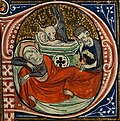


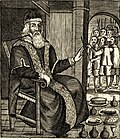


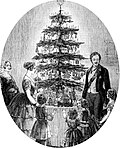
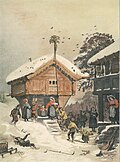


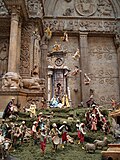



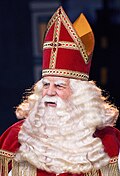
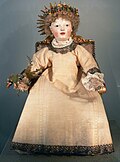
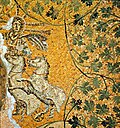
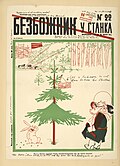


.jpg)