|
|
| Line 1: |
Line 1: |
| {{Use DMY dates|date=October 2020}}
| | [[File:PlakatgegenKinderehenKurdistanIrak2016.jpg|thumb|A poster warning against child marriage, in a [[refugee camp]] in the [[Kurdish people|Kurdish]] part of [[Iraq]]]] |
| {{For|the film|Child Marriage (film)}}
| | [[File:Girl_Summit_-_22nd_July_in_London_(14498368279).jpg|thumb|Poster against child and forced marriage]] |
| {{short description|Marriage or informal union entered into by an individual before reaching the age of 18}}
| | [[File:RUN.webm|thumb|''RUN'', a short documentary film focusing on child marriage in [[Nigeria]].]] |
| {{Youth rights sidebar}}
| | A '''child marriage''' is a [[marriage]] or other similar union between an [[adult]] and a [[child]]. The child is under a certain age, usually 18.<ref name="Definitions">* {{Cite journal|last1=Gastón|first1=Colleen Murray|last2=Misunas|first2=Christina|last3=Cappa|year=2019|title=Child marriage among boys: a global overview of available data|journal=Vulnerable Children and Youth Studies|volume=14|issue=3|pages=219–228|doi=10.1080/17450128.2019.1566584|doi-access=free}} |
| '''Child marriage''' is a [[marriage]] or similar union, formal or informal, between a [[child]] and an [[adult]] or another child under [[Age of majority|a certain age]], typically age eighteen.<ref name="Definitions"> | | * {{cite web|date=March 2020|title=Child marriage|url=https://www.unicef.org/protection/child-marriage|work=[[UNICEF]]}} |
| *{{Cite journal|last1=Gastón |first1=Colleen Murray|last2=Misunas|first2=Christina|last3=Cappa|title=Child marriage among boys: a global overview of available data|journal= Vulnerable Children and Youth Studies|year=2019|doi=10.1080/17450128.2019.1566584|volume=14 |issue=3|pages=219–228|doi-access=free}} | | * {{cite web|title=Child Marriage|url=http://www.icrw.org/what-we-do/adolescents/child-marriage|work=icrw.org}} |
| *{{cite web|url=https://www.unicef.org/protection/child-marriage|title=Child marriage|date=March 2020|work=[[UNICEF]]}} | | * {{Cite news|title=Child Marriage – Rationale, Historical Views, And Consequences|language=en|work=WorldAtlas|url=http://www.worldatlas.com/articles/child-marriage-rationale-historical-views-and-consequences.html|access-date=2017-09-10}}</ref> Most child marriages are between a girl and a man,<ref name="Parsons">{{Cite journal|last1=Parsons|first1=Jennifer|last2=Edmeades|first2=Jeffrey|last3=Aslihan|first3=Kes|last4=Petroni|first4=Suzanne|last5=Sexton|first5=Maggie|last6=Wodon|first6=Quentin|year=2015|title=Economic Impacts of Child Marriage: A Review of the Literature|journal=The Review of Faith & International Affairs|volume=13|issue=3|pages=12–22|doi=10.1080/15570274.2015.1075757|hdl-access=free|hdl=10.1080/15570274.2015.1075757|s2cid=146194521}}</ref><ref name="Atkinson">{{cite book|url=https://books.google.com/books?id=WZrBDwAAQBAJ&pg=PA238|title=Social Problems: Sociology in Action|vauthors=Atkinson MP, Korgen KO, Trautner MN|publisher=[[Sage Publications]]|year=2019|isbn=978-1544358642|page=238}}</ref> and are rooted in [[gender inequality]].<ref name="Parsons" /><ref name="Child Marriage">{{cite web|date=March 2020|title=Child marriage|url=https://www.unicef.org/protection/child-marriage|work=[[UNICEF]]}}</ref> It can also be the marriage of two children. There's a minimum age for a person to be able to marry. This age is called [[marriable age]]. Very often, it is similar to the [[age of consent]]. |
| *{{cite web|url=http://www.icrw.org/what-we-do/adolescents/child-marriage|title=Child Marriage|work=icrw.org}} | |
| *{{Cite news|url=http://www.worldatlas.com/articles/child-marriage-rationale-historical-views-and-consequences.html|title=Child Marriage – Rationale, Historical Views, And Consequences|work=WorldAtlas|access-date=2017-09-10|language=en}}</ref> The vast majority of child marriages are between a girl and a man,<ref name="Parsons">{{Cite journal |last1=Parsons |first1=Jennifer |last2=Edmeades|first2=Jeffrey|last3=Aslihan |first3= Kes|last4=Petroni |first4=Suzanne|last5=Sexton|first5=Maggie|last6=Wodon|first6=Quentin|title=Economic Impacts of Child Marriage: A Review of the Literature |journal=The Review of Faith & International Affairs|year=2015|doi=10.1080/15570274.2015.1075757|volume=13 |issue=3 |pages=12–22|hdl=10.1080/15570274.2015.1075757|s2cid=146194521 |hdl-access=free}}</ref><ref name="Atkinson">{{cite book|vauthors =Atkinson MP, Korgen KO, Trautner MN|title =Social Problems: Sociology in Action|isbn = 978-1544358642|publisher=[[Sage Publications]]|year=2019|page=238|url=https://books.google.com/books?id=WZrBDwAAQBAJ&pg=PA238}}</ref> and are rooted in [[gender inequality]].<ref name="Parsons"/><ref name="Child Marriage">{{cite web|url=https://www.unicef.org/protection/child-marriage|title=Child marriage|date=March 2020|work=[[UNICEF]]}}</ref> | |
|
| |
|
| Although the [[age of majority]] (legal adulthood) and [[marriageable age]] are usually designated at age 18, both vary across countries and therefore the marriageable age may be older or younger in a given country.<ref name="Gastón">{{Cite journal|last1=Gastón |first1=Colleen Murray|last2=Misunas|first2=Christina|last3=Cappa|title=Child marriage among boys: a global overview of available data |journal= Vulnerable Children and Youth Studies|year=2019|doi=10.1080/17450128.2019.1566584|volume=14 |issue=3|pages=219–228|doi-access=free}}</ref> Even where the age is set at 18 years, cultural traditions may override legislation and many jurisdictions permit earlier marriage with parental consent or in special circumstances, such as [[teenage pregnancy]].<ref name="Nour child marriage" />
| | As of 2019, child marriage affects about 765 million people; 650 million of them are girls or young women.<ref>{{Cite news|last=SPIEGEL|first=DER|title=Unicef: Mehr als 700 Millionen Kinder wurden minderjährig verheiratet - DER SPIEGEL - Panorama|url=https://www.spiegel.de/panorama/gesellschaft/unicef-mehr-als-700-millionen-kinder-wurden-minderjaehrig-verheiratet-a-1271327.html|access-date=2021-01-09|newspaper=Der Spiegel|date=7 June 2019|language=de}}</ref> There's no widely accepted definition of what child marriage is. The UN [[Convention on the Rights of the Child]] says that in a child marriage, at least one of the people entering marriage has not reached age 18. Even though mosts states have a minimal age at which people can be married, this is often not respected. There may be cultural or religious reasons. Other reasons why someone is married as a child include that the parents want to make sure the girl is a [[Virginity|virgin]], when she gets married. Another reason may be that the family cannot afford the [[education]] or the upkeep of the child; when the child is married, there are no more costs to the family. [[Poverty]] is one of the main reasons for child marriage. |
|
| |
|
| Child marriage violates the rights of children and has widespread and long-term consequences for child brides and child grooms.<ref name="Parsons"/><ref name="Gastón"/> For girls, in addition to mental health issues and a lack of access to education and career opportunities,<ref name="Parsons"/> this includes [[adverse health effects]] as a result of early pregnancy (including teenage pregnancy) and [[childbirth]].<ref name="Gastón"/> There is little research on boys in child marriages, but effects on boys include being ill-prepared for certain responsibilities such as providing for the family, early fatherhood, and a lack of access to education and career opportunities.<ref name="Gastón"/> Child marriage is related to child [[betrothal]], and it includes civil [[cohabitation]] and court-approved early marriages after teenage pregnancy.<ref name=cohabitation/><ref name=cohabitteen/><!-- Sentence is not clear --> Causes of child marriages include [[poverty]], [[bride price]], [[dowry]], cultural traditions, [[religious]] and [[social pressure]]s, regional customs, fear of the child remaining unmarried into adulthood, illiteracy, and perceived inability of women to work for money.<ref name="Child Marriage"/><ref name="icrwchild">{{cite web|url=http://www.icrw.org/what-we-do/adolescents/child-marriage|title=Child Marriage|work=icrw.org}}</ref><ref name=africachild/> Research indicates that [[comprehensive sex education]] can help to prevent child marriage.<ref>{{Cite book|url=http://unesdoc.unesco.org/images/0026/002607/260770e.pdf|title=International technical guidance on sexuality education: an evidence-informed approach|publisher=UNESCO|year=2018|isbn=978-92-3-100259-5|location=Paris|pages=13}}</ref>
| | The age when children legally [[Age of majority|turn into adults]], and the age at which they can legally marry are usually at 18 years of age. The age when they can marry may be different from country to country.<ref name="Gastón">{{Cite journal|last1=Gastón|first1=Colleen Murray|last2=Misunas|first2=Christina|last3=Cappa|year=2019|title=Child marriage among boys: a global overview of available data|journal=Vulnerable Children and Youth Studies|volume=14|issue=3|pages=219–228|doi=10.1080/17450128.2019.1566584|doi-access=free}}</ref> Even when it is set at 18, people may marry when they are younger, given that their parents agree. There may also be special circumstances, such as a [[teenage pregnancy]].<ref name="Nour child marriage">{{cite journal|last1=Nour|first1=NM|date=2009|title=Child Marriage: a silent health and human rights issue|journal=Reviews in Obstetrics and Gynecology|volume=2|issue=1|pages=51–56|pmc=2672998|pmid=19399295}}</ref> |
|
| |
|
| Child marriages have been common throughout history and continue to be fairly widespread, particularly in developing countries such as parts of [[Africa]],<ref>{{cite web|url=http://allafrica.com/stories/201308050251.html|title=Africa: Child Brides Die Young |work=[[AllAfrica]]}}</ref><ref name="unfpa.org">{{cite web|title=Marrying Too Young: End Child Marriage |url=http://www.unfpa.org/sites/default/files/pub-pdf/MarryingTooYoung.pdf|publisher=[[United Nations Population Fund|UNFPA]]|page=23}}</ref> [[South Asia]],<ref>[http://www.unicef-irc.org/publications/pdf/digest7e.pdf Early Marriage, Child Spouses] UNICEF, See section on Asia, page 4 (2001)</ref> [[Southeast Asia]],<ref>{{cite web|url=https://www.plan.org.au/News/2013/08/20/Child-Marriage-in-Southeast-Asia.aspx|archive-url=https://web.archive.org/web/20131003043715/http://www.plan.org.au/News/2013/08/20/Child-Marriage-in-Southeast-Asia.aspx|archive-date=3 October 2013|title=Southeast Asia's big dilemma: what to do about child marriage?|publisher=Plan International Australia|date=20 August 2013|access-date=2016-07-10}}</ref><ref>{{cite web|url=http://www.irinnews.org/report/87873/philippines-early-marriage-puts-girls-at-risk|title=IRIN Asia – PHILIPPINES: Early marriage puts girls at risk – Philippines – Gender Issues – Health & Nutrition – Human Rights|work=IRINnews|date=26 January 2010}}</ref> [[West Asia]],<ref name=pbs2010/><ref>{{cite web|url=http://www.sfgate.com/opinion/brinkley/article/Child-marriage-still-an-issue-in-Saudi-Arabia-3270366.php|title=Child marriage still an issue in Saudi Arabia|work=SFGate|date=14 March 2010}}</ref> [[Latin America]],<ref name="pbs2010">{{cite web|last=|first=|date=12 October 2007|title=Child Brides – Child Marriage: What We Know|url=https://www.pbs.org/now/shows/341/facts.html|access-date=|work=[[PBS]]}}</ref> and [[Oceania]].<ref>{{cite web|url=http://www.unicef-irc.org/publications/pdf/digest7e.pdf|title=Early Marriage, Child Spouses|publisher=UNICEF|page=5}} (See section on Oceania.)</ref> However, even in developed countries such as the [[United States]] legal exceptions still allow child marriage in 46 [[US states]].<ref name="auto">{{Cite web | url=https://www.businessinsider.com/child-marriage-us-traps-girls-still-legal-in-46-states-2021-4 | title=Child marriage traps girls in an inescapable legal hell. But it is still legal in 46 US states.}}</ref> | | Child marriage violates the [[Children's rights|rights of children]]. It has long-term consequences for child brides and child grooms.<ref name="Parsons" /><ref name="Gastón" /> Very often, girls that went to school before they were married stop going to school. Because of poor education, their career opportunities are limited. An early [[pregnancy]] and [[childbirth]] also has adverse health effects on girls.<ref name="Gastón" /> For boys the situation is similar: they may not be well prepared for their role as a father. Also because they have not finished their education, their career opportunities are limited.<ref name="Gastón" /> Child marriage includes civil [[cohabitation]] and court-approved early marriages after teenage pregnancy.<ref name=cohabitation>{{cite web|url=https://www.cdc.gov/nchs/data/series/sr_23/sr23_028.pdf|title=Marriage and Cohabitation in the United States: A Statistical Portrait Based on Cycle 6 (2002) of the National Survey of Family Growth|publisher=US Department of Health and Human Services}}</ref><ref name=cohabitteen>Sharon K. Houseknecht and Susan K. Lewis, "Explaining Teen Childbearing and Cohabitation: Community Embeddedness and Primary Ties", ''Family Relations'', Vol. 54, No. 5, Families and Communities (Dec., 2005), pp. 607–620</ref> |
| The incidence of child marriage has been falling in most parts of the world. 2018 data from [[UNICEF]] showed that about 21 percent of young women worldwide (aged 20 to 24) were married as children; this is a 25 percent decrease from 10 years previously.<ref>{{Cite web|url=https://data.unicef.org/resources/child-marriage-latest-trends-and-future-prospects/|title=Child Marriage: Latest trends and future prospects|date=5 July 2018|website=UNICEF DATA|language=en-US|access-date=2019-06-19}}</ref> The countries with the highest observed rates of child marriages below the age of 18 were [[Niger]], [[Chad]], [[Mali]], [[Bangladesh]], [[Guinea]], the [[Central African Republic]], [[Mozambique]], and [[Nepal]] with rates above 50%.<ref name=unicef12a/> Niger, Chad, Bangladesh, Mali and Ethiopia were the countries with child marriage rates greater than 20% below the age of 15, according to 2003–2009 surveys.<ref>[https://www.economist.com/blogs/dailychart/2011/02/child_brides Child brides – For poorer, most of the time] The Economist (February 28, 2011)</ref><ref>[http://www.fordfoundation.org/2011-annual/youth-sexuality-and-rights/map/#/married-by-15/Niger Child Marriage] {{Webarchive|url=https://web.archive.org/web/20150924014524/http://www.fordfoundation.org/2011-annual/youth-sexuality-and-rights/map/#/married-by-15/Niger |date=24 September 2015}} Ford Foundation (2011)</ref> Globally, an estimated 12 million girls annually are being married under the age of 18.<ref>{{Cite news|url=https://www.reuters.com/article/us-usa-childmarriage-reform-idUSKCN1MZ024|title=Child brides call on U.S. states to end 'legal rape'|date=25 October 2018|work=Reuters|access-date=2020-01-22|language=en}}</ref><!-- Opportunity to update content -->
| |
| {{TOC limit|3}}
| |
|
| |
|
| ==History==
| | Causes of child marriages include [[poverty]], [[dowry]], cultural traditions, [[illiteracy]], and the thoughts that women are unable to work for money.<ref name="Child Marriage" /><ref name="icrwchild">{{cite web|title=Child Marriage|url=http://www.icrw.org/what-we-do/adolescents/child-marriage|work=icrw.org}}</ref><ref name="africachild">{{cite web|url=http://www.forwarduk.org.uk/key-issues/child-marriage |title=Eradicating child marriage in Africa – FORWARD UK – FORWARD |publisher=Forward Uk |access-date= 2015-02-18}}</ref> Research shows that to some extent [[Sex education|telling children about sex]] can help prevent child marriage.<ref>{{Cite book|url=http://unesdoc.unesco.org/images/0026/002607/260770e.pdf|title=International technical guidance on sexuality education: an evidence-informed approach|publisher=UNESCO|year=2018|isbn=978-92-3-100259-5|location=Paris|pages=13}}</ref> |
| [[File:'Princess Emilia of Saxony', by Hans Krell (about 1530) Liverpool museums.jpg|thumb|In 1533, 17-year-old Princess [[Emilia of Saxony]] was wed to [[George, Margrave of Brandenburg-Ansbach|George the Pious, Margrave of Brandenburg-Ansbach]], then aged 48 years. Early marriages have been common in historical times, including in Europe.]]
| |
| [[File:Presentation of the portrait of Maria Antonia of Austria (Marie Antoinette) to Louis Auguste, Dauphin of France in front of Louis XV and the court at Versailles.jpg|thumb|Presentation of [[Marie Antoinette]] to Louis Auguste at Versailles, before their marriage. She married at age 15, on 16 May 1770.]]
| |
| <!--[[File:BRU - CHD 10 (Hochzeitsprozession).jpg|thumb|Mock child weddings have been common folk tradition many places in Europe, and were often celebrated at Midsummer (detail from ''[[Children's Games]]'' by [[Pieter Bruegel the Elder]] (1560).]]--><!--Adds little to this article IMO. This article is about actual child marriage, not mock ones.-->
| |
|
| |
|
| Before the [[industrial revolution]], in many parts of the world, including [[India]], [[China]] and [[Eastern Europe]], women tended to marry immediately after reaching puberty, in their mid-teens. Societies where most of the population lived in small agricultural communities were characterized by these marriage practices well into the 19th century.<ref name=Brown3140>{{Cite book|first=Jonathan A.C. |last=Brown| author-link = Jonathan A.C. Brown | year=2015 | title=Misquoting Muhammad: The Challenge and Choices of Interpreting the Prophet's Legacy|publisher=Oneworld Publications (Kindle edition)|pages=3140–3150 (Kindle locations)}}</ref> Men tended to marry later in societies where a married couple was expected to establish a household of their own. That usually meant that men remained unmarried until they accumulated sufficient wealth to support a new home, and were married in their mature age to adolescent girls, who contributed a dowry to the family finances.<ref name=Crone2747>{{cite book|author=Patricia Crone|title=Pre-Industrial Societies: Anatomy of the Pre-Modern World|publisher=Oneworld (Kindle Edition)|year=2015|page=2747 (Kindle loc.)}}</ref>
| | Child marriages have been common throughout history. They are still fairly widespread, particularly in [[developing countries]] such as parts of [[Africa]],<ref>{{cite web|title=Africa: Child Brides Die Young|url=http://allafrica.com/stories/201308050251.html|work=[[AllAfrica]]}}</ref><ref name="unfpa.org">{{cite web|title=Marrying Too Young: End Child Marriage|url=http://www.unfpa.org/sites/default/files/pub-pdf/MarryingTooYoung.pdf|publisher=[[United Nations Population Fund|UNFPA]]|page=23}}</ref> [[South Asia]],<ref>[http://www.unicef-irc.org/publications/pdf/digest7e.pdf Early Marriage, Child Spouses] UNICEF, See section on Asia, page 4 (2001)</ref> [[Southeast Asia]],<ref>{{cite web|date=20 August 2013|title=Southeast Asia's big dilemma: what to do about child marriage?|url=https://www.plan.org.au/News/2013/08/20/Child-Marriage-in-Southeast-Asia.aspx|archive-url=https://web.archive.org/web/20131003043715/http://www.plan.org.au/News/2013/08/20/Child-Marriage-in-Southeast-Asia.aspx|archive-date=3 October 2013|access-date=2016-07-10|publisher=Plan International Australia}}</ref><ref>{{cite web|date=26 January 2010|title=IRIN Asia – PHILIPPINES: Early marriage puts girls at risk – Philippines – Gender Issues – Health & Nutrition – Human Rights|url=http://www.irinnews.org/report/87873/philippines-early-marriage-puts-girls-at-risk|work=IRINnews}}</ref> [[West Asia]],<ref name="pbs2010">{{cite web|title=Child Brides – Child Marriage: What We Know|url=https://www.pbs.org/now/shows/341/facts.html|work=[[PBS]]}}</ref><ref>{{cite web|date=14 March 2010|title=Child marriage still an issue in Saudi Arabia|url=http://www.sfgate.com/opinion/brinkley/article/Child-marriage-still-an-issue-in-Saudi-Arabia-3270366.php|work=SFGate}}</ref> [[Latin America]],<ref name="pbs2010" /> and [[Oceania]].<ref>{{cite web|title=Early Marriage, Child Spouses|url=http://www.unicef-irc.org/publications/pdf/digest7e.pdf|publisher=UNICEF|page=5}} (See section on Oceania.)</ref> Even in developed countries such as the [[United States]] legal exceptions mean that 17 [[US states]] have no minimum age requirement for marriage.<ref name="auto">{{Cite web|title=Ohio raises minimum age to marry to 17, banning child marriages|url=https://www.wtap.com/content/news/Ohio-raises-minimum-age-to-marry-to-17-banning-child-marriages-504448471.html}}</ref> The incidence of child marriage has been falling in most parts of the world. 2018 data from [[UNICEF]] showed that about 21 percent of young women worldwide (aged 20 to 24) were married as children.<ref name=":0" /> This is a 25 percent decrease from 10 years before.<ref name=":0">{{Cite web|date=5 July 2018|title=Child Marriage: Latest trends and future prospects|url=https://data.unicef.org/resources/child-marriage-latest-trends-and-future-prospects/|access-date=2019-06-19|website=UNICEF DATA|language=en-US}}</ref> The countries with the highest observed rates of child marriages below the age of 18 were [[Niger]], [[Chad]], [[Mali]], [[Bangladesh]], [[Guinea]], the [[Central African Republic]], [[Mozambique]], and [[Nepal]] with rates above 50%.<ref name="unicef12a">{{cite web|url=http://www.unicef.org/sowc09/docs/SOWC09-CountryExample-Mali.pdf|title=Child Marriage is a Death Sentence for Many Young Girls|publisher=UNICEF|year=2012|access-date=2021-01-09|archive-date=2021-01-13|archive-url=https://web.archive.org/web/20210113035429/https://www.unicef.org/sowc09/docs/SOWC09-CountryExample-Mali.pdf|url-status=dead}}</ref> Niger, Chad, Bangladesh, Mali and Ethiopia were the countries with child marriage rates greater than 20% below the age of 15, according to 2003–2009 surveys.<ref>[https://www.economist.com/blogs/dailychart/2011/02/child_brides Child brides – For poorer, most of the time] The Economist (February 28, 2011)</ref><ref>[http://www.fordfoundation.org/2011-annual/youth-sexuality-and-rights/map/#/married-by-15/Niger Child Marriage] {{Webarchive|url=https://web.archive.org/web/20150924014524/http://www.fordfoundation.org/2011-annual/youth-sexuality-and-rights/map/#/married-by-15/Niger|date=24 September 2015}} Ford Foundation (2011)</ref> Globally, an estimated 12 million girls annually are being married under the age of 18.<ref>{{Cite news|date=25 October 2018|title=Child brides call on U.S. states to end 'legal rape'|language=en|work=Reuters|url=https://www.reuters.com/article/us-usa-childmarriage-reform-idUSKCN1MZ024|access-date=2020-01-22}}</ref> Child marriage is common among [[Roma people]], also known as Gypsies. |
|
| |
|
| In ancient and medieval societies, it was common for girls to be betrothed at or even before the age of puberty.<ref name=laiou93>Angeliki Laiou (1993), ''Coercion to sex and marriage in ancient and medieval societies'', Washington, DC, pages 85–190</ref><ref>Ross Kraemer (1993), ''The Jewish Family in Antiquity'', Scholars Press (Atlanta), pages 82–110</ref> According to M.A. Friedman, "arranging and contracting the marriage of a young girl were the undisputed prerogatives of her father in ancient Israel." Most girls were married before the age of 15, often at the start of their puberty.<ref name=friedman80>M. A. Friedman (1980), ''Jewish Marriage in Palestine, Vol. 1'', The Jewish Theological Seminary of America</ref> In the Middle Ages the age at marriage seems to have been around puberty throughout the Jewish world.<ref>Steven M. Lowenstein: ''The Jewish Cultural Tapestry: International Jewish Folk Traditions'', p. 108. Oxford, 2002.</ref>
| | ==References== |
| | {{reflist}} |
|
| |
|
| Ruth Lamdan writes: "The numerous references to child marriage in the 16th-century [[Responsa#In_Judaism|Responsa]] literature and other sources, shows that child marriage was so common, it was virtually the norm. In this context, it is important to remember that in [[halakha]], the term "minor" refers to a girl under twelve years and a day. A girl aged twelve and a half was already considered an adult in all respects."<ref>Ruth Lamdan: ''A Separate People: Jewish Women in Palestine, Syria, and Egypt in the sixteenth Century'', p. 47. Leiden, 2000.</ref>
| | ==Related pages== |
| | *[[Forced marriage]] |
|
| |
|
| In Ancient Greece, early marriage and motherhood for girls existed.<ref>Nancy Demand (1994), ''Birth, Death, and Motherhood in Classical Greece'', Johns Hopkins University Press, pages 101–104</ref> Even boys were expected to marry in their teens. Early marriages and teenage motherhood were typical. In [[Roman Empire|Ancient Rome]], females could marry above the age of 12 and males could marry above the age of 14.<ref name=ncbi>{{cite journal |title=Early Teen Marriage and Future Poverty |pmc=3000061 |pmid=20879684|volume=47 |issue=3 |year=2010|pages=689–718 |last1=Dahl |first1=GB |journal=Demography |doi=10.1353/dem.0.0120}}</ref> In the [[Middle Ages]], under English [[Civil law (legal system)|civil laws]] that were derived from Roman laws, marriages before the age of 16 existed. In Imperial China, child marriage was the norm.<ref>{{cite journal |last1=Saito |first1=O. |year=1996 |title=Historical demography: achievements and prospects |journal=Population Studies |volume=50 |issue=3 |pages=537–553 |doi=10.1080/0032472031000149606 |pmid=11618380}}</ref><ref>{{cite journal |last1=Zhao |first1=Z. |year=1997 |title=Demographic systems in historic China: some new findings from recent research |journal=Journal of the Australian Population Association |volume=14 |issue=2 |pages=201–232 |doi=10.1007/BF03029340 |pmid=12322104 |s2cid=8006287 }}</ref>
| | [[Category:Marriage]] |
| | | [[Category:Social issues]] |
| In contrast to other pre-modern societies – and for reasons that are subject to debate – Northwest Europe was characterized by relatively late marriages for both men and women, with both sexes commonly delaying marriage until their mid-20s or even 30s.<ref name=Crone2747/><ref name=Brown3140/> The data available for England suggest that it was already the case in the 14th century. This pattern was reflected in English common law, which was the first in Western Europe to establish statutory rape laws and ages of consent for marriage. In 1275, sexual relations with girls under either 12 or 14 (depending on interpretation of the sources) were criminalized; a second law was made with more severe punishments for under the age of 10 in 1576. In the late 18th and early 19th centuries, the British colonial administration introduced marriage age restrictions for Hindu and Muslim girls on the Indian subcontinent.<ref name=Brown3140/>
| |
| | |
| A Scottish physician living in 18th century Syria reported that locals tried to contract marriages for their children at a young age, but the marriage was not consummated until the girl "had come of age". Evidence from 19th century Palestine suggests that husbands sometimes initiated sexual relations before their wife reached puberty, but that it was a rare occurrence, condemned socially and censured by [[sharia]] courts. Writing in 1830s, [[Edward William Lane]] observed that few Egyptian girls remained single by the age of 16, but socio-economic transformation, educational reforms and influence of Western norms brought significant changes, and by 1920 fewer than 10% of Egyptian women married before the age of 20. In 1923, Egypt's parliament set the minimum age of marriage at 16 for women and 18 for men.<ref>{{Cite book|first=Jonathan A.C. |last=Brown| author-link = Jonathan A.C. Brown | year=2015 | title=Misquoting Muhammad: The Challenge and Choices of Interpreting the Prophet's Legacy|publisher=Oneworld Publications (Kindle edition)|pages=3120–3160(Kindle location)}}</ref>
| |
| | |
| == Religious norms and laws ==
| |
| Most of the religions known in history have established a minimum age for marriage in one way or another. Christian [[canon law]] forbade the marriage of a girl before the onset the age of puberty,<ref>{{cite book| author = Burn, Richard; Tyrwhitt, Robert; Phillimore, Robert. | title = The Ecclesiastical Law |location= London |publisher= Sweet Stevens & Norton |volume= 4 | pages = 54}}</ref> and the Hindu holy book, the [[Vedas]], proclaimed marriage after the age of puberty.<ref>{{cite book| author = Macdonell, Arthur Anthony; Keith, Arthur Berriedale | chapter = Child Marriage| chapter-url = https://archive.org/stream/vedicindexofname01macduoft#page/474/mode/2up| url = https://archive.org/details/vedicindexofname01macduoft | title = Vedic index of names and subjects |location= London |date = 1912 |publisher= Murray |volume= 1 | pages = 474–476}}</ref> In the Vedas marriage is shown to be between two adult persons after the [[Brahmacharya]] stage.<ref>{{cite book|url=https://archive.org/stream/vedicindexofname01macduoft#page/474/mode/2up|title=Vedic index of names and subjects |location=London |publisher=Murray |year=1912 |page=474}}</ref> The Vedas, specifically the [[Rigveda]] and [[Atharvaveda]], have verses that clearly indicate that during the [[Vedic period|Vedic Period]], girls married well after attaining puberty and were of a mature age.<ref>{{Cite book|last=Nagi|first=B. S.|title=Child Marriage in India: A Study of Its Differential Patterns in Rajasthan|date=1 January 1993|publisher=Mittal Publications|isbn=978-81-7099-460-2|pages=6|language=en}}</ref> The early [[Dharmaśāstra]] (Dharmasutras) also state that girls should be married after they have attained puberty<ref>{{cite book|last=Singh|first=Upinder|title=A History of Ancient and Early Medieval India: From the Stone Age to the 12th Century|publisher=Pearson Education India|year=2008|page=420}}</ref> while some texts extend the marriageable age to before puberty.<ref>{{cite book| url= https://books.google.com/books?id=GW5Gx0HSXKUC&pg=PA420| title=A History of Ancient and Early Medieval India: From the Stone Age to the 12th Century |first=Upinder |last=Singh |year=2008 |publisher=Pearson Education India|page=420| isbn=9788131716779 }}</ref> In the [[Manusmriti]], which was not implemented as law,<ref>Donald Davis (2010), The Spirit of Hindu Law, Cambridge University Press, {{ISBN|978-0521877046}}, page 14</ref> a father is considered to have wronged his daughter if he fails to marry her before puberty and if the girl is not married in less than three years after reaching puberty, she can search for the husband herself.<ref>{{cite book |url=https://books.google.com/books?id=xp35-8gTRDkC&pg=PA113|title=Megasthenes and Indian Religion: A Study in Motives and Types|author=Allan Dahlaquist|publisher=Motilal Banarsidass|pages=113–114|isbn=9788120813236|date=31 December 1996}}</ref>
| |
| | |
| Jewish scholars and rabbis strongly discouraged marriages before the onset of puberty,<ref name=friedman80/> but at the same time, in exceptional cases, girls ages 3 through 12 (the legal [[age of consent]] according to [[halakha]]) might be given in marriage by her father.<ref name="MAJORITY - JewishEncyclopedia.com">{{cite web|url=http://www.jewishencyclopedia.com/articles/10310-majority|title=MAJORITY - JewishEncyclopedia.com|access-date=2016-07-09}}</ref><ref>{{cite book | url=https://books.google.com/books?id=QbUXAQAAMAAJ&q=ketannah | title = Beiträge zur jüdischen Altherthumskunde, Band 2 | last1=Lőw | first1=Leopold Lőw | pages=170, 175, 176 | year=1969 | publisher=Gregg | isbn = 9780576801270 }}</ref> By Judaism, the minimal girl age, for marriage, was 12 years and one day, "na'arah", as mentioned in the ancient [[Talmud]] [[Mishnah]] books (compiled between 536 BCE – 70 CE, redacted in the 3rd century CE), Order [[Nashim]] [[Masechet]] Kiddushin 41 a & b.<ref>{{cite web|url=http://juchre.org/talmud/kiddushin/kiddushin3.htm#41a |title=Mishnah, Book Nashim, Kiddushin, chapter 41a}}</ref>
| |
| | |
| According to halakha girls should not marry until they are 12 years and six months old, "bogeret".<ref>{{cite web|url=https://www.chabad.org/library/article_cdo/aid/952875/jewish/Ishut-Chapter-Two.htm |title=Mishneh Torah, Book Nashim, Ishut, Chapter 2}}</ref><ref>{{cite web|url=https://www.chabad.org/library/article_cdo/aid/952876/jewish/Ishut-Chapter-Three.htm |title=Mishneh Torah, Book Nashim, Ishut, Chapter 3:11,14}}</ref> Although [[Moses Maimonides]] mentions in the [[Talmud]] ''[[Mishneh Torah]]'' (compiled between 1170 and 1180 CE) that in exceptional cases girls ages three through 12 might be given in marriage by her father,<ref name="MAJORITY - JewishEncyclopedia.com"/><ref>{{cite book|url=https://books.google.com/books?id=QbUXAQAAMAAJ&q=ketannah | title = Beiträge zur jüdischen Altherthumskunde, Band 2 | last1=Lőw | first1=Leopold Lőw | pages=170, 175, 176 | year=1969 | publisher=Gregg | isbn = 9780576801270 }}</ref> he also clarifies in verse 3:19 of the same chapter that: "Although a father has the option of consecrating his daughter to anyone he desires while she is a minor or while she is a maiden, it is not proper for him to act in this manner".<ref>{{cite web|url=https://www.chabad.org/library/article_cdo/aid/952876/jewish/Ishut-Chapter-Three.htm |title=Mishneh Torah, Book Nashim, Ishut, Chapter 3:19}}</ref>
| |
| | |
| According to the 1907 ''[[Catholic Encyclopedia]]'', [[apocryphal]] accounts that, at the time of her betrothal to Joseph, Mary, the mother of Jesus, was 12–14 years old.<ref>{{cite encyclopedia|url=http://www.newadvent.org/cathen/08504a.htm |title=St. Joseph |encyclopedia=[[Catholic Encyclopedia]] |publisher=Newadvent.org |access-date=2013-09-30}}</ref>
| |
| [[File:Valentine,_Laura_-_Aunt_Louisa's_Nursery_Favourite_-_0029.jpg|thumb|Christian child marriage in the Middle Ages]]
| |
| Historically within the [[Catholic Church]], prior to the [[1917 Code of Canon Law]], the minimum age for a dissoluble betrothal (''{{lang|la|[[sponsalia de futuro]]}}'') was seven years in the {{link text|contractee}}s. The minimum age for a valid marriage was puberty, or nominally 14 for males and 12 for females.<ref name="Rock1907">{{Catholic|inline=1|title=Canonical Age|url=http://www.newadvent.org/cathen/01206c.htm|first=P. M. J.|last=Rock|volume=1}}</ref> The 1917 Code of Canon Law raised the minimum age for a valid marriage at 16 for males and 14 for females.<ref name="Bachofen1920">{{cite encyclopedia|location=St. Louis, MO; London|publisher=B. Herder book|encyclopedia=A commentary on the new code of the canon law|last=Bachofen|first=Charles A.|edition=2nd rev.|volume=5|year=1920|lccn=19004568|at=c. 1067|hdl=2027/wu.89088314570}}</ref> The [[1983 Code of Canon Law]] maintained the minimum age for a valid marriage at 16 for males and 14 for females.<ref name="CIC1983">{{cite encyclopedia|location=Washington, D.C. |publisher=Canon Law Society of America |encyclopedia=Code of canon law: new English translation |version=IntraText |year=1999 |orig-year=©1998 |isbn=978-0-943616-79-7 |author=Catholic Church |title=Codex Iuris Canonici |url=https://www.vatican.va/archive/ENG1104/_INDEX.HTM |via=Vatican.va |url-status=dead |archive-url=https://web.archive.org/web/20080220062727/https://www.vatican.va/archive/ENG1104/_INDEX.HTM |archive-date=2008-02-20 }}</ref>{{rp|at=[https://www.vatican.va/archive/ENG1104/_P3Y.HTM c. 1083 §1]}}{{efn|name=CIC|While canon 1083 of the [[1983 Code of Canon Law]] sets the minimum age for a valid marriage at 16 for males and 14 for females,<ref name="CIC1983"/>{{rp|at=[https://www.vatican.va/archive/ENG1104/_P3Y.HTM c. 1083 §1]}} canon 97 defines a person younger than 18 year of age as a [[Minor (law)|minor]] and subject to parental authority.<ref name="CIC1983"/>{{rp|at=[https://www.vatican.va/archive/ENG1104/__PC.HTM cc. 97 §1, 98 §2]}} The authorization of the [[local ordinary]] must precede the celebration of the marriage of a minor if the marriage "cannot be recognized or celebrated according to the norm of civil law" or if the parents of a minor are "unaware or reasonably opposed".<ref name="CIC1983"/>{{rp|at=[https://www.vatican.va/archive/ENG1104/__P3W.HTM c. 1071 §1,2° and 6°]}} Each [[conference of bishops]] can "establish a higher age for the licit celebration of marriage".<ref name="CIC1983"/>{{rp|at=[https://www.vatican.va/archive/ENG1104/__P3Y.HTM c. 1083 §§1–2]}} Canon 1072 requires that pastors discourage "marriage before the age at which a person usually enters marriage according to the accepted practices of the region."<ref name="CIC1983"/>{{rp|at=[https://www.vatican.va/archive/ENG1104/_P3W.HTM c. 1072]}} [[Edward N. Peters]] explains that canon 1083 "authorized episcopal conferences to recognize the concrete circumstances of marriage in their own territories and to raise the ages for licit marriages within a given nation" to more than the minimum age for a valid marriage.<ref name="Peters1996">{{cite journal |last=Peters |first=Edward N. |date=22 June 1996 |title=Too young to marry |journal=America |volume=174 |issue=20 |pages=14–16 |issn=0002-7049}} Reprinted in {{cite web |last=Peters|first=Edward|title=Too young to marry|publisher=canonlaw.info|url=http://www.canonlaw.info/a_tooyoung.htm |access-date=2015-09-06 |archive-url=https://web.archive.org/web/20060221153117/http://www.canonlaw.info/a_tooyoung.htm |archive-date=2006-02-21|url-status=live}}</ref> Other canons that regulate marriage in general also apply, for example persons "who lack the sufficient use of reason" or "who suffer from a grave defect of discretion of judgment concerning the essential matrimonial rights and duties mutually to be handed over and accepted" "are incapable of contracting marriage."<ref name="CIC1983"/>{{rp|at=[https://www.vatican.va/archive/ENG1104/_P3Z.HTM c. 1095]}}}}
| |
| | |
| English [[Canon law|ecclesiastical law]] forbade marriage of a girl before the age of puberty.<ref>Richard Burn, Robert Tyrwhitt and Robert Phillimore, ''The Ecclesiastical Law'', Volume 4, Sweet Stevens & Norton (London), page 54.</ref>
| |
| | |
| There is no minimum marriage age defined in traditional [[Islamic law]], and the legal discussion of this topic centered primarily on women's physical maturity. Classical [[Fiqh|Sunni jurisprudence]] allows a father to contract a marriage for his underaged girl. Appropriate age for consummating the marriage, which could occur several years after signing the marriage contract, was to be determined by the bride, groom and the bride's guardian, since medieval jurists held that the age of fitness for intercourse was too variable for legislation.<ref name=brown-islam>{{Cite book|first=Jonathan A.C. |last=Brown| author-link = Jonathan A.C. Brown | year=2015 | title=Misquoting Muhammad: The Challenge and Choices of Interpreting the Prophet's Legacy|publisher=Oneworld Publications (Kindle edition)|pages=3090–3110 (Kindle locations}}</ref> This was based in part on the precedent set by the Islamic prophet [[Muhammad]], as described in the [[hadith]] collections considered to be authentic by Muslims. According to these sources, Muhammad married [[Aisha]], his third wife, when she was about six,{{efn|some sources suggest age at marriage as six and some as seven, see Denise Spellberg (1996), Politics, Gender, and the Islamic Past: The Legacy of 'A'isha Bint Abi Bakr, Columbia University Press, {{ISBN|978-0231079990}}, pp 39–40}} and consummated the marriage when she was about nine.{{efn|Most sources suggest age at consummation as nine, and one that it may have been age 10; See: [[Denise Spellberg]] (1996), ''Politics, Gender, and the Islamic Past: The Legacy of 'A'isha Bint Abi Bakr'',
| |
| [[Columbia University Press]], {{ISBN|978-0231079990}}, pp. 39–40;<br>The [[Ahmadiyya]] minority sect has published Pakistan's Muhammad Ali view that [[Sahih al-Bukhari]] is unauthentic, and argued that Aisha may have been a teenager; See: {{cite book|last1=Ali|first1=Muhammad|author1-link=Muhammad Ali (writer)|title=Muhammad the Prophet|url=https://books.google.com/books?id=od6dAQKgK-YC&pg=PT150|year=1997|publisher=Ahamadiyya Anjuman Ishaat Islam|isbn=978-0913321072}}<br>However, Ahmadiyya sect views about Islam and its history are widely disputed by mainstream Islam. See: Siddiq & Ahmad (1995), ''Enforced Apostasy: Zaheeruddin v. State and the Official Persecution of the Ahmadiyya Community in Pakistan, Law & Inequality'-, 14: pp. 275–284.}}{{efn|See:
| |
| * L. Ahmed, ''[https://www.jstor.org/stable/3174138 Women and the Advent of Islam]'', Signs, Vol. 11, No. 4 (Summer, 1986), pp. 677–678;
| |
| * Cynthia Gorney, "Too Young to Wed – The secret world of child brides", ''National Geographic'', June 2011, quote: "'If there were any danger in early marriage, Allah would have forbidden it,' a Yemeni member of parliament named Mohammed Al-Hamzi told me in the capital city of Sanaa one day. 'Something that Allah himself did not forbid, we cannot forbid.' Al-Hamzi, a religious conservative, is vigorously opposed to the legislative efforts in Yemen to prohibit marriage for girls below a certain age (17, in a recent version), and so far those efforts have met with failure. Islam does not permit marital relations before a girl is physically ready, he said, but the Holy Koran contains no specific age restrictions and so these matters are properly the province of family and religious guidance, not national law. Besides, there is the matter of the '''Prophet Muhammad's beloved Ayesha—nine years old, according to the conventional account, when the marriage was consummated.'''"}} Some modern Muslim authors and Islamic scholars, such as [[Ali Gomaa]], who served as the [[Grand Mufti of Egypt]], doubt the traditionally accepted narrative and believe based on other evidence that Aisha was in her late teens at the time of her marriage.<ref>{{Cite book|first=Jonathan A.C. |last=Brown| author-link = Jonathan A.C. Brown | year=2015 | title=Misquoting Muhammad: The Challenge and Choices of Interpreting the Prophet's Legacy|publisher=Oneworld Publications (Kindle edition)|pages=3200 (Kindle location)}}</ref> As a general rule, intercourse was prohibited for girls "not able to undergo it", on the grounds of potential physical harm. Disputes regarding physical maturity between the involved parties were to be resolved by a [[Qadi|judge]], potentially after examination by a female expert witness.<ref name=brown-islam/> The [[Ottoman family law|1917 codification of Islamic family law]] in the [[Ottoman empire]] distinguished between the age of competence for marriage, which was set at 18 for boys and 17 for girls, and the minimum age for marriage, set at 12 for boys and nine for girls. Marriage below the age of competence was permissible only if proof of sexual maturity was accepted in court, while marriage under the minimum age was forbidden. During the 20th century, sharia-based legislation in most countries in the Middle East followed the Ottoman precedent in defining the age of competence, while raising the minimum age to 15 or 16 for boys and 13–16 for girls.<ref name=EI2-8-29/> In 2019 [[Saudi Arabia]] raised the age of marriage to 18.<ref>https://www.premiumtimesng.com/entertainment/naija-fashion/369729-saudi-arabia-bans-under-18-marriage.html</ref>
| |
| | |
| Despite the fact that by the beginning of the 21st century, the laws of most countries established the general minimum age for marriage at 18 years, in many countries (and not only in developing or religious ones) there are exceptions that allow marriage before this age with the consent of the parents and/or by court decision. In some countries, a religious marriage is still recognized by the state authorities along with a secular marriage or even instead of it, in others, a registered civil marriage is mandatory.
| |
| | |
| ==Effects on each gender==
| |
| Child marriage has lasting consequences on girls, from their health (mental and physical), education and social development perspectives.<ref name="Parsons"/> These consequences last well beyond adolescence.<ref name=hrwconsq/> One of the most common causes of death for girls aged 15 to 19 in developing countries was pregnancy and childbirth.<ref>[https://www.npr.org/blogs/parallels/2013/12/01/247843225/5-things-you-may-not-know-about-child-marriage 5 Things you may not know about Child Marriage] NPR, Washington DC</ref> In [[Niger]], which is estimated as having the highest rate of child marriage in the world, about 3 in 4 girls marry before their 18th birthday.<ref>{{cite web|url=http://www.girlsnotbrides.org/child-marriage/niger/|title=Niger |work= Girls Not Brides|access-date=2016-07-09}}</ref><ref>{{cite web|url=http://www.icrw.org/child-marriage-facts-and-figures|title=Child Marriage Facts and Figures – ICRW – PASSION. PROOF. POWER.|access-date=2018-03-03}}</ref> <!-- Update content -->
| |
| | |
| Boys are sometimes married as children; UNICEF states that "girls [are] disproportionately affected by the practice. Globally, the prevalence of child marriage among boys is just one sixth that among girls."<ref name="Child Marriage"/> Research on the effects of child marriage on underage boys is scant, which researchers state is likely because child marriage involving boys is less common and girls being at risk for [[adverse health effects]] as a result of early pregnancy and childbirth.<ref name="Gastón"/> The effects of child marriage on boys include being ill-prepared for certain responsibilities such as providing for the family, early fatherhood, and a lack of access to education and career opportunities.<ref name="Gastón"/> {{As of|2014|9}}, 156 million living men were married as underage boys.<ref>{{cite news|url=http://www.thedailybeast.com/articles/2014/09/18/the-sad-hidden-plight-of-child-grooms.html|title=The Sad Hidden Plight of Child Grooms|first=Nina|last=Strochlic|date=18 September 2014|access-date=2016-07-09|newspaper=The Daily Beast}}</ref>
| |
| | |
| In its first in-depth analysis of child grooms, UNICEF revealed that an estimated 115 million boys and men around the world were married as children. Of these, 1 in 5 children, or 23 million, were married before the age of 15. According to the data, the Central African Republic has the highest prevalence of child marriage among males (28 per cent), followed by Nicaragua (19 per cent) and Madagascar (13 per cent). The estimates bring the total number of child brides and child grooms to 765 million. Girls remain disproportionately affected, with 1 in 5 young women aged 20 to 24 years old married before their 18th birthday, compared to 1 in 30 young men.<ref>https://www.unicef.org/press-releases/115-million-boys-and-men-around-world-married-children-unicef</ref>
| |
| | |
| ==Causes==
| |
| | |
| According to [[UNFPA]], factors that promote and reinforce child marriage include poverty and economic survival strategies; [[gender inequality]]; sealing land or property deals or settling disputes; control over sexuality and protecting family honour; tradition and culture; and insecurity, particularly during war, famine or epidemics.<ref name="too young">{{cite web|title=Marrying Too Young: End Child Marriage|url=http://www.unfpa.org/sites/default/files/pub-pdf/MarryingTooYoung.pdf|publisher=[[United Nations Population Fund|UNFPA]]}}</ref> Other factors include family ties in which marriage is a means of consolidating powerful relations between families.<ref name="too young"/>
| |
| | |
| ===Dowry and brideprice===
| |
| [[File:Thai Bride Price 2008.jpg|thumb|left|A traditional, formal presentation of the bride price at a Thai engagement ceremony]]
| |
| Providing a girl with a [[dowry]] at her marriage is an ancient practice which continues in some parts of the world. This requires parents to bestow property on the marriage of a daughter, which is often an economic challenge for many families. The difficulty to save and preserve wealth for dowry was common, particularly in times of economic hardship, or persecution, or unpredictable seizure of property and savings. These difficulties pressed families to betroth their girls, irrespective of her age, as soon as they had the resources to pay the dowry. Thus, Goitein notes that European Jews would marry their girls early, once they had collected the expected amount of dowry.<ref name=goitein78>S.D. Goitein (1978), A Mediterranean Society: The Jewish Communities of the Arab World, Vol. 3, University of California Press</ref>
| |
| | |
| A [[bride price]] is the amount paid by the groom to the parents of a bride for them to consent to him marrying their daughter. In some countries, the younger the bride, the higher the price she may fetch.<ref>{{cite news | last = Bearak | first = Barry | title = The bride price | work = [[The New York Times]] | url = https://www.nytimes.com/2006/07/09/magazine/09BRI.html | date = 9 July 2006 }}</ref><ref name="nourreport" /> This practice creates an economic incentive where girls are sought and married early by her family to the highest bidder. Child marriages of girls is a way out of desperate economic conditions, or simply a source of income to the parents.<ref>{{Cite journal | last = Tremayne | first = Soraya | title = Modernity and early marriage in Iran: a view from within | journal = [[Journal of Middle East Women's Studies]] | volume = 2 | issue = 1 | pages = 65–94 | doi = 10.1215/15525864-2006-1003 | jstor = 40326888 | date = Winter 2006 | s2cid = 54509784 | url = https://muse.jhu.edu/article/194426 }} [http://muse.jhu.edu/journals/journal_of_middle_east_womens_studies/v002/2.1tremayne.pdf Pdf.]</ref><ref>{{Cite journal | last1 = Boyden | first1 = Jo | last2 = Pankhurst | first2 = Alula | last3 = Tafere | first3 = Yisak | title = Child protection and harmful traditional practices: female early marriage and genital modification in Ethiopia | journal = Development in Practice| volume = 22 | issue = 4 | pages = 510–522 | doi = 10.1080/09614524.2012.672957 | date = June 2012 | s2cid = 144583426 | url = https://ora.ox.ac.uk/objects/uuid:ad065460-bef4-4578-8fd4-b22d62ac599e }}</ref><ref>{{Cite journal | last = Chowdhury | first = F.D. | title = The socio‐cultural context of child marriage in a Bangladeshi village | journal = [[International Journal of Social Welfare]] | volume = 13 | issue = 3 | pages = 244–253 | doi = 10.1111/j.1369-6866.2004.00318.x | date = July 2004 }}</ref> Bride price is another cause of child marriage and [[child trafficking]].<ref name=icrwchild/><ref name=africachild>{{cite web|url=http://www.forwarduk.org.uk/key-issues/child-marriage |title=Eradicating child marriage in Africa – FORWARD UK – FORWARD |publisher=Forward Uk |access-date= 2015-02-18}}</ref><ref>{{Cite journal | last = Warner | first = Elizabeth | title = Behind the wedding veil: Child marriage as a form of trafficking in girls | journal = Journal of Gender, Social Policy & the Law | volume = 12 | issue = 2 | pages = 233–247 | date = 2004 | url = http://digitalcommons.wcl.american.edu/jgspl/vol12/iss2/1/ }}</ref><ref>{{cite web |url=http://www.aic.gov.au/publications/current%20series/tandi/401-420/tandi415.html |title=The trafficking of children in the Asia–Pacific |publisher=Aic.gov.au |access-date=2015-02-18 |archive-date=27 October 2013 |archive-url=https://web.archive.org/web/20131027094118/http://www.aic.gov.au/publications/current%20series/tandi/401-420/tandi415.html |url-status=dead }}</ref>
| |
| | |
| ===Bride kidnapping===
| |
| [[File:RaidbyKURDS.jpg|thumb|Depiction of [[bride kidnapping]]]]
| |
| {{Main|Bride kidnapping}}
| |
| Bride kidnapping, also known as bridenapping,<ref>{{Cite web|url=http://www.independent.co.uk/news/world/politics/bridenapping-ndash-a-growing-hidden-crime-2367811.html|title='Bridenapping': a growing hidden crime|date=9 October 2011|website=The Independent|language=en|access-date=2019-08-26}}</ref> marriage by abduction or marriage by capture, is a practice in which a male abducts<ref>{{Cite web|url=https://www.nationalgeographic.org/projects/out-of-eden-walk/articles/2017-06-captured-hearts/|title=Captured Hearts|website=www.nationalgeographic.org|access-date=2019-08-26}}</ref> the female he wishes to marry. Bride kidnapping has been practiced around the world and throughout history. It continues to occur in countries in [[Central Asia]], the [[Caucasus]] region, and parts of [[Africa]], and among peoples as diverse as the [[Hmong people|Hmong]] in Southeast Asia, the [[Tzeltal people|Tzeltal]] in Mexico, and the [[Romani people|Romani]] in Europe.
| |
| | |
| In most nations, bride kidnapping is considered a crime rather than a valid [[types of marriages|form of marriage]]. Some types of it may also be seen as falling along the continuum between [[forced marriage]] and [[arranged marriage]]. However, even when the practice is against the law, judicial enforcement remains lax in some areas. Bride kidnapping occurs in various parts of the world, but it is most common in the Caucasus and Central Asia.<ref>{{Cite news|url=https://www.bbc.com/news/blogs-news-from-elsewhere-37256574|title=Police swoop on fake 'bride kidnapping'|date=2 September 2016|access-date=2019-08-26|language=en-GB}}</ref> Bride kidnapping is often (but not always) a form of child marriage.<ref>{{Cite news|url=https://www.reuters.com/article/us-kyrgyzstan-women-bride-kidnapping-idUSKBN1AH5GI|title=One in five girls and women kidnapped for marriage in Kyrgyzstan:...|date=1 August 2017|work=Reuters|access-date=2019-08-26|language=en}}
| |
| </ref> It may be connected to the practice of [[bride price]], and the inability or unwillingness to pay it.<ref>{{Cite news|url=https://www.nytimes.com/2005/04/30/world/asia/abduction-often-violent-a-kyrgyz-wedding-rite.html|title=Abduction, Often Violent, a Kyrgyz Wedding Rite|last=Smith|first=Craig S.|date=30 April 2005|work=The New York Times|access-date=2019-08-26|language=en-US|issn=0362-4331}}
| |
| </ref>
| |
| | |
| ===Debt repayement===
| |
| {{Main|Money marriage}}
| |
| [[Money marriage]] refers to a marriage where a girl, usually, is married off to a man to settle debts owed by her parents.<ref>{{cite news|url=https://www.aljazeera.com/news/2018/09/nigerias-young-daughters-sold-money-wives-180921153424671.html|title=Nigeria's young daughters are sold as 'money wives'|publisher=Al Jazeera|accessdate=12 May 2020|date=21 September 2018}}</ref>
| |
| | |
| ===Persecution, forced migration, and slavery===
| |
| Social upheavals such as wars, major military campaigns, [[forced religious conversion]], taking natives as [[prisoners of war]] and converting them into slaves, arrest and [[forced migration]]s of people often made a suitable groom a rare commodity. Bride's families would seek out any available bachelors and marry them to their daughters, before events beyond their control moved the boy away. Persecution and displacement of [[Romani people|Roma]] and [[Jews|Jewish]] people in Europe, colonial campaigns to get slaves from various ethnic groups in West Africa across the Atlantic for [[Plantation (settlement or colony)|plantations]], Islamic campaigns to get Hindu slaves from India across Afghanistan's [[Hindu Kush]] as property and for work, were some of the historical events that increased the practice of child marriage before the 19th century.<ref name=goitein78/><ref>Andre Wink (1997), Al-Hind: the Making of the Indo-Islamic World, vol. 2, The Slave Kings and the Islamic Conquest, 11th–13th Centuries (Leiden)</ref><ref>Assaf Likhovski (2006), Law and Identity in Mandate Palestine, {{ISBN|978-0-8078-3017-8}}; University of North Carolina Press, pages 93–103</ref>
| |
| | |
| Among [[Sephardi Jews|Sephardi Jewish]] communities, child marriages became frequent from the 10th to 13th centuries, especially in Muslim Spain.<ref name=Lieberman/> This practice intensified after the Jewish community was expelled from Spain, and resettled in the [[Ottoman Empire]]. Child marriages among the Eastern [[Sephardi Jews|Sephardic Jews]] continued through the 18th century in Islamic majority regions.<ref name=Lieberman>Julia Rebollo Lieberman (2011), Sephardi Family Life in the Early Modern Diaspora, pages 8–10; Brandeis University Press; {{ISBN|978-1-58465-957-0}}</ref><ref>Ruth Lamdan, Child Marriages in Jewish Society in Eastern Mediterranean during the 16th Century, Mediterranean Historical Review, 2 (June 1996); Vol 11, pages 37–59</ref><ref>Joseph Hacker, in Moreshet Sheparad: The Sephardi Legacy, Vol 2, (Editor: Haim Beinart), Magnes Press, 1992; pages 109–133</ref>
| |
| | |
| ===Fear, poverty, social pressures and sense of protection===
| |
| [[File:Dame (Alice) Ellen Terry ('Choosing') by George Frederic Watts.jpg|thumb|English stage actress [[Ellen Terry]] was married at age 16 to [[George Frederic Watts]] who was 46 years old, a marriage her parents thought would be advantageous; later she said she was uncomfortable being a child bride. Terry died at the age of 81, in 1928.]]
| |
| | |
| A sense of social insecurity has been a cause of child marriages across the world. For example, in Nepal, parents fear likely social stigma if adult daughters (past 18 years) stay at home. Other fear of crime such as rape, which not only would be traumatic but may lead to less acceptance of the girl if she becomes victim of a crime.<ref>Thapa, S. (1996). ITS PREVALENCE AND CORRELATES. Contributions to Nepalese Studies, 23(2), pages 361–375</ref> For example, girls may not be seen as eligible for marriage if they are not virgins.<ref name=":1" /> In other cultures, the fear is that an unmarried girl may engage in illicit relationships,<ref name=saudi2009>{{cite web|url=http://usatoday30.usatoday.com/news/world/2009-04-30-saudi-arabia_N.htm|title=8-year-old Saudi girl divorces 50-year-old husband |work=[[USA Today]]}}</ref> or elope causing a permanent social blemish to her siblings, or that the impoverished family may be unable to find bachelors for grown-up girls in their economic social group. Such fears and social pressures have been proposed as causes that lead to child marriages. Insofar as child marriage is a social norm in practicing communities, the elimination of child marriage must come through a changing of those social norms. The mindset of the communities, and what is believed to be the proper outcome for a child bride, must be shifted to bring about a change in the prevalence of child marriage.<ref>Bicchieri C, Lindemans, Jiang. A social norms perspective on child marriage: The general framework. UNICEF, 2014</ref>
| |
| | |
| Extreme poverty may make daughters an economic burden on the family, which may be relieved by their early marriage,<ref>{{cite web|url=https://2009-2017.state.gov/s/gwi/rls/rem/2010/144989.htm|title=Targeting Girls in the Name of Tradition: Child Marriage|work=U.S. Department of State}}</ref> to the benefit of the family as well as the girl herself. Poor parents may have few alternatives they can afford for the girls in the family; they often view marriage as a means to ensure their daughter's financial security and to reduce the economic burden of a growing adult on the family.<ref name="Nour child marriage"/><ref>Asad Zia, 42% of underage married girls from Pakistan, Express Tribune / International Herald Tribune (New York Times), January 2, 2013</ref> Child marriage can also be seen as means of ensuring a girl's economic security, particularly if she lacks family members to provide for her.<ref name=":4">{{Cite journal|title = International Law as an Instrument to Combat Child Marriage|last = Gaffney-Rhys|first = Ruth|date = 2011|journal = The International Journal of Human Rights|doi = 10.1080/13642980903315398|volume=15|issue = 3|pages=359–373|s2cid = 143307822}}</ref> In reviews of Jewish community history, scholars<ref>Lamdān, R. (2000). A Separate People: Jewish Women in Palestine, Syria, and Egypt in the Sixteenth Century (Vol. 26). Brill; see pages 28–31</ref><ref>A. Grossman, 'Child marriage in Jewish society in the Middle Ages until the thirteenth century' (in Hebrew), Peamim 45 (1990), 108–126</ref><ref>Abrahams, Israel (2005). Jewish life in the Middle Ages. Routledge; see pages 183–189</ref> claim poverty, shortage of grooms, uncertain social and economic conditions were a cause for frequent child marriages.
| |
| | |
| [[File:Drawings by young Syrian refugee girls in a community centre in southern Lebanon promote the prevention of child marriage. (14496389777).jpg|left|thumb|Drawings by young Syrian refugee girls in a community centre in southern [[Lebanon]] promote the prevention of child marriage.]]
| |
| An additional factor causing child marriage is the parental belief that early marriage offers protection. Parents feel that marriage provides their daughter with a sense of protection from sexual promiscuity and safe from sexually transmitted infections.<ref name="Nour child marriage">{{cite journal|last1=Nour|first1=NM|title=Child Marriage: a silent health and human rights issue|journal=Reviews in Obstetrics and Gynecology|date=2009|volume=2|issue=1|pages=51–56|pmid=19399295|pmc=2672998}}</ref><ref name="nourreport"/> However, in reality, young girls tend to marry older men, placing them at an increased risk of contracting a sexually transmitted infection.
| |
| | |
| Protection through marriage may play a specific role in conflict settings. Families may have their young daughters marry members of an armed group or military in hopes that she will be better protected. Girls may also be taken by armed groups and forced into marriages.<ref name=":4" />
| |
| | |
| ===Religion, culture and civil law===
| |
| Although the general marriageable age is 18 in the majority of countries, most jurisdictions allow for exceptions for underage youth with parental and/or judicial consent.<ref name="too young"/> Such laws are neither limited to developing countries, nor to state religion. In some countries a religious marriage by itself has legal validity, while in others it does not, as [[civil marriage]] is obligatory. For Catholics incorporated into the [[Latin Church]], the [[1983 Code of Canon Law]] sets the minimum age for a valid marriage at 16 for males and 14 for females.<ref name="CIC1983"/>{{rp|at=[https://www.vatican.va/archive/ENG1104/_P3Y.HTM c. 1083 §1]}}{{efn|name=CIC}} In 2015, [[Spain]] raised its minimum marriageable age to 18 (16 with court consent) from the previous 14.<ref>{{cite web|url=http://time.com/3970710/spain-marriage-age-of-consent-europe/|title=Spain marriage age of consent Europe|publisher=time-com|date=24 July 2015}}</ref> In [[Mexico]], marriage under 18 is allowed with parental consent, from age 14 for girls and age 16 for boys.<ref>{{cite web |url=http://embamex.sre.gob.mx/canada_eng/index.php/marriage-in-mexico |title=Marriage requirements in Mexico |publisher=Embamex.sre.gob.mx |access-date=2015-02-18 |url-status=dead |archive-url=https://web.archive.org/web/20150218215805/http://embamex.sre.gob.mx/canada_eng/index.php/marriage-in-mexico |archive-date=2015-02-18 }}</ref> In [[Ukraine]], in 2012, the Family Code was amended to equalize the marriageable age for girls and boys to 18, with courts being allowed to grant permission to marry from age 16 years if it is established that the marriage is in the best interest of the youth.<ref>http://eeca.unfpa.org/sites/default/files/pub-pdf/unfpa%20ukraine%20summary.pdf</ref>
| |
| | |
| Many states in the US permit child marriages, [[Marriageable age#North America|with court's permission]]. Since 2015, the minimum marriageable age throughout [[Canada]] is 16. In Canada the [[age of majority]] is set by province/territory at 18 or 19, so minors under this age have additional restrictions (i.e. parental and court consent). Under the Criminal Code, Art. 293.2 Marriage under age of 16 years reads: "Everyone who celebrates, aids or participates in a marriage rite or ceremony knowing that one of the persons being married is under the age of 16 years is guilty of an indictable offence and liable to imprisonment for a term not exceeding five years."<ref name="laws-lois.justice.gc.ca">{{cite web|url=http://laws-lois.justice.gc.ca/eng/acts/C-46/page-160.html#docCont|title=Consolidated federal laws of canada, Criminal Code|publisher=Legislative Services Branch|website=laws-lois.justice.gc.ca|access-date=2018-03-03}}</ref> The Civil Marriage Act also states: "2.2 No person who is under the age of 16 years may contract marriage."<ref name="ReferenceA">{{cite web|url=http://laws-lois.justice.gc.ca/eng/acts/c-31.5/page-1.html|title=Consolidated federal laws of canada, Civil Marriage Act|publisher=Legislative Services Branch|website=laws-lois.justice.gc.ca|access-date=2018-03-03|date=18 June 2015}}</ref> In the UK, marriage is allowed for 16–17 years old with parental consent in [[England and Wales]] as well as in [[Northern Ireland]], and even without parental consent in [[Scotland]].<ref>{{cite web|url=https://www.gov.uk/marriages-civil-partnerships/overview |title=Marriages and civil partnerships in the UK |publisher=GOV.UK |date=16 December 2014 |access-date=2015-02-18}}</ref> However, a marriage of a person under 16 is [[void marriage|void]] under the [[Matrimonial Causes Act 1973]].<ref>{{cite web|url=http://www.legislation.gov.uk/ukpga/1973/18 |title=Matrimonial Causes Act 1973 |publisher=Legislation.gov.uk |access-date=2015-02-18}}</ref> The [[United Nations Population Fund]] stated the following:<ref name="too young"/>
| |
| | |
| {{quote|In 2010, 158 countries reported that 18 years was the minimum legal age for marriage for women without parental consent or approval by a pertinent authority. However, in 146 countries, state or customary law allows girls younger than 18 to marry with the consent of parents or other authorities; in 52 countries, girls under age 15 can marry with parental consent. In contrast, 18 is the legal age for marriage without consent among males in 180 countries. Additionally, in 105 countries, boys can marry with the consent of a parent or a pertinent authority, and in 23 countries, boys under age 15 can marry with parental consent.}}
| |
| | |
| Lower legally allowed marriage age does not necessarily cause high rates of child marriages. However, there is a correlation between restrictions placed by laws and the average age of first marriage. In the United States, per [[1960 United States Census|1960 Census]] data, 3.5% of girls married before the age of 16, while an additional 11.9% married between 16 and 18. States with lower marriage age limits saw higher percentages of child marriages.<ref name=ncbi/> This correlation between higher age of marriage in civil law and observed frequency of child marriages breaks down in countries with Islam as the state religion. In Islamic nations, many countries do not allow child marriage of girls under their civil code of laws. But, the state recognized Sharia religious laws and courts in all these nations have the power to override the civil code, and often do. [[UNICEF]] reports that the top eight nations in the world with highest observed child marriage rates are Niger (75%), Chad (72%), Mali (71%), Bangladesh (64%), Guinea (63%), Central African Republic (61%), Mozambique (56%), and Nepal (51%).<ref name=unicef12a>{{cite web|url=http://www.unicef.org/sowc09/docs/SOWC09-CountryExample-Mali.pdf|title=Child Marriage is a Death Sentence for Many Young Girls|publisher=UNICEF|year=2012}}</ref>
| |
| | |
| ===Marriageable age in religious sources===
| |
| | |
| ====Judaism====
| |
| Ancient [[Rabbi]]s set the age of marriage for every [[Israelite]] at 18 years old; males are expected to be married by 20 years old in [[teenage marriage]] and females can stay unmarried but must be celibate.<ref name="jewishencyclopedia.com">{{Cite web|url=http://www.jewishencyclopedia.com/articles/10435-marriage-laws|title=MARRIAGE LAWS - JewishEncyclopedia.com|website=www.jewishencyclopedia.com|access-date=2020-06-10}}</ref>
| |
| | |
| In [[Rabbinic Judaism]], males cannot consent to marriage until they reach the age of 13 years and a day and have undergone [[puberty]]. They are considered [[Minor (law)|minors]] until the age of twenty. The same rules apply to females, except their age is 12 years and a day. After twenty, males are not considered adults if they show signs of impotence. If females show no signs of puberty and males show no signs of puberty or do show impotence, they automatically become adults by age 35 and can marry.<ref>{{cite web|url=http://www.jewishencyclopedia.com/articles/10861-minority|title=MAJORITY - JewishEncyclopedia.com|website=Jewishencyclopedia.com}}</ref><ref>{{cite web|url=http://www.jewishencyclopedia.com/articles/10888-mi-un|title=MI'UN - JewishEncyclopedia.com|website=Jewishencyclopedia.com}}</ref>
| |
| | |
| A large age gap between spouses, in either direction, is advised against as unwise.<ref>''[[Yebamot]]'' 44a</ref> A younger woman marrying a significantly older man however is especially problematic: marrying one's young daughter to an old man was declared as reprehensible as forcing her into prostitution.<ref>''Sanhedrin'' 76a</ref>
| |
| | |
| A ''ketannah'' (literally meaning "little [one]") was any girl between the age of 3 years and that of 12 years plus one day;<ref name="JewEncMaj">{{Jewish Encyclopedia |article=Majority |url=http://www.jewishencyclopedia.com/view.jsp?letter=M&artid=91}}</ref> she was subject to her father's authority, and he could arrange a marriage for her without her agreement.<ref name="JewEncMaj" /> However, after reaching the age of maturity, she would have to agree to the marriage to be considered as married.<ref>{{Cite web |url=https://jwa.org/encyclopedia/article/legal-religious-status-of-married-woman |title=CONDITIONS NECESSARY FOR LEGAL MARRIAGE |author=Tirzah Meacham |access-date=2020-06-10}}</ref><ref>{{Cite web |url=http://www.jewishencyclopedia.com/articles/10435-marriage-laws |title=MARRIAGE LAWS |author1=Solomon Schechter |author2=Julius H. Greenstone |access-date=2020-06-10}}</ref>
| |
| | |
| ====Catholic Church====
| |
| The minimum ages of consent for marriage in the Catholic Church are 14 for girls and 16 for boys. Being underage constitutes a [[diriment impediment]]. That is, a marriage involving an underage bride or groom is canonically invalid. A [[Conference of Bishops]] may adopt a higher age for marriage, but in that case, the higher age only creates a prohibitive impediment, that is, a marriage involving a bride or groom above the Church's minimum age but below that set by the Conference is ''[[valid but illicit]]''. Permission to marry against a civil authority's directive requires the permission of the [[Ordinary (Catholic Church)|Ordinary]], which, in the case of sensible and equal laws regarding marriage age, is not usually granted. The permission by the Ordinary is also required in case of a marriage of a minor when their parents are unaware of his marriage or if their parents reasonably oppose the marriage.<ref>{{cite web|url=http://www.vatican.va/archive/cod-iuris-canonici/eng/documents/cic_lib4-cann998-1165_en.html#CHAPTER%20III. |title=Code of Canon Law - IntraText |publisher=Vatican.va |access-date=2021-01-20}}</ref>
| |
| | |
| ====Islam====
| |
| In classical [[Sharia|Islamic law]], suitability for marital relations is conditional on physical maturity (''bulugh'') and mental maturity (''rushd''). Classical jurists did not stipulate a minimum marriageable age because they did not believe that maturity is reached by everyone at a specific age.<ref name="Watt">{{harvnb|Watt|1960}}</ref><ref>{{harvnb|Spellberg|1996|p=40}}</ref><ref name="ReferenceA"/><ref name="ReferenceB">{{cite journal|title=Child marriage: a silent health and human rights issue}}</ref><ref>{{harvnb|Barlas|2002|pp=125–126}}</ref> Büchler and Schlater observe that "marriageable age according to classical Islamic law coincides with the occurrence of puberty. The notion of puberty refers to signs of physical maturity such as the emission of semen or the onset of menstruation". Traditional schools of Islamic jurisprudence ([[madhaahib]]) define the age of full legal capacity to enter marriage as follows:<ref name=buchler-schlater>{{cite journal |url=http://www.zora.uzh.ch/78204/1/Beitrag_Buechler_Schlatter_final.pdf |title=Marriage Age in Islamic and Contemporary Muslim Family Laws: A Comparative Survey |last1=Büchler |first1=Andrea |last2=Schlatter |first2=Christina |journal=Electronic Journal of Islamic and Middle Eastern Law |volume=1 |issn=1664-5707 |date=2013 }}</ref>
| |
| {| class="wikitable sortable" style="width: 60%;
| |
| |-
| |
| ! !! Male age !! Female age !! Notes
| |
| |-
| |
| | [[Shafi'i]]||align=center|15||align=center|15||
| |
| |-
| |
| | [[Hanbali]]||align=center|15||align=center|15||
| |
| |-
| |
| | [[Maliki]]||align=center|17||align=center|17||
| |
| |-
| |
| | [[Hanafi]]||align=center|12–18||align=center|9–17||Marriageable age is whenever the person reaches puberty, which may vary person to person. Listed ages are when Hanafis presume puberty occurs in males and females.<ref>{{cite journal |url=http://www.zora.uzh.ch/78204/1/Beitrag_Buechler_Schlatter_final.pdf |title=Marriage Age in Islamic and Contemporary Muslim Family Laws: A Comparative Survey |last1=Büchler |first1=Andrea |last2=Schlatter |first2=Christina |journal=Electronic Journal of Islamic and Middle Eastern Law |volume=1 |issn=1664-5707 |date=2013|quote=Marriageable age according to classical Islamic law coincides with the occurrence of puberty. The notion of puberty refers to signs of physical maturity such as the emission of semen or the onset of menstruation. In the absence of such signs, the Hanafi school assumes that puberty will occur no later than at eighteen years for males and seventeen years for females}}</ref>
| |
| |-
| |
| | [[Ja'fari jurisprudence|Jafari]]||align=center|15||align=center|9||[[Shia]]
| |
| |}
| |
| | |
| According to Büchler and Schlater, while marriageable age is not the same as legal majority under civil law, these age limits may correspond.<ref name=buchler-schlater/>
| |
| | |
| The 1917 codification of Islamic family law in the [[Ottoman empire|Ottoman Empire]] distinguished between the age of competence for marriage, which was set at 18 for boys and 17 for girls, and the minimum age for marriage, which followed the traditional Hanafi ages of legal majority of 12 for boys and 9 for girls. Marriage below the age of competence was permissible only if proof of sexual maturity was accepted in court, while marriage under the minimum age was forbidden. During the 20th century, most countries in the Middle East followed the Ottoman precedent in defining the age of competence, while raising the minimum age to 15 or 16 for boys and 13–16 for girls. Marriage below the age of competence is subject to approval by a judge and the legal guardian of the adolescent. Egypt diverged from this pattern by setting the age limits of 18 for boys and 16 for girls, without a distinction between competence for marriage and minimum age.<ref name=EI2-8-29>{{Cite encyclopedia|author1=Schacht, J.|author2= Layish, A.|author3= Shaham, R.|author4= Ansari, Ghaus|author5= Otto, J.M.|author6= Pompe, S.|author7= Knappert, J. |author8=Boyd, Jean| year=1995 | title=Nikāḥ|encyclopedia=Encyclopaedia of Islam| edition=2nd|publisher=Brill |editor1=P. Bearman|editor2= Th. Bianquis|editor3= C.E. Bosworth|editor4= E. van Donzel|editor5= W.P. Heinrichs|volume=8|page=29}}</ref> In 2020, Saudi Arabia officially banned all marriages under the age of 18.<ref name=":8">{{Cite web|url=https://www.thenational.ae/world/gcc/saudi-arabia-moves-to-ban-child-marriage-with-a-new-ruling-1.955310|title=Saudi Arabia moves to ban child marriage with a new ruling|website=The National|language=en|access-date=2020-02-15}}</ref> The push to ban child marriage was initially opposed by senior clergy, who argued that a woman reaches adulthood at puberty.<ref name=thenational>{{cite news|title=Saudi push to end child marriages|newspaper=The National|author=Wael Mahdi|date=1 July 2009|url=https://www.thenational.ae/world/mena/saudi-push-to-end-child-marriages-1.541430}}</ref> However, by 2019 the [[Saudi Shura Council]] had outlawed marriages under the age of 15, and required court approval for those under 18.<ref name=":7">{{Cite web|url=https://aawsat.com/english/home/article/1540156/saudi-arabia-introduces-new-regulations-early-marriage|title=Saudi Arabia Introduces New Regulations for Early Marriage|last=Al Khataf|first=Iman|website=Asharq Al-aswat}}</ref>
| |
| | |
| ===Politics and financial relationships===
| |
| [[File:Lodewijk XIV-Marriage.jpg|thumb|Child marriage in 1697 of [[Marie Adélaïde of Savoy]], age 12 to Louis, heir apparent of France age 15. The marriage created a political alliance.]]
| |
| Child marriages may depend upon socio-economic status. The aristocracy in some cultures, as in the European [[feudal]] era tended to use child marriage as a method to secure political ties. Families were able to cement political and/or financial ties by having their children marry.<ref>Shulamith Shaha (1983), ''The Fourth Estate: A History of Women in the Middle Ages'', {{ISBN|0-415-30851-8}}, Routledge, pages 131–149</ref> The betrothal is considered a binding contract upon the families and the children. The breaking of a betrothal can have serious consequences both for the families and for the betrothed individuals themselves.
| |
| | |
| ==Consequences==
| |
| [[File:2007 - 2012, Adolescent birth rate per 1000 women world map.svg|{{largethumb}}|Birth rates per 1,000 women aged 15–19 years, worldwide.]]
| |
| | |
| Child marriage has lasting consequences on girls that last well beyond adolescence.<ref name=hrwconsq>{{cite web|url=https://www.hrw.org/news/2013/06/14/q-child-marriage-and-violations-girls-rights|title=Q & A: Child Marriage and Violations of Girls' Rights – Human Rights Watch|work=hrw.org}}</ref><ref>Bunting, Annie. 2005. Stages of development: marriage of girls and teens as an international human rights issue. Social and Legal Studies 14(2):17–38</ref> Women married in their teens or earlier struggle with the health effects of pregnancy at a young age and often with little spacing between children.<ref name=":1">{{Cite journal|url = http://adc.bmj.com/content/early/2010/10/07/adc.2009.178707.short|title = When the Mother Is a Child: The Impact of Child Marriage on the Health and Human Rights of Girls|last = Raj|first = Anita|date = 2010|journal = Archives of Disease in Childhood|doi = 10.1136/adc.2009.178707|pmid = 20930011|volume=95|issue = 11|pages=931–935|s2cid = 41625496}}</ref> Early marriages followed by teen pregnancy also significantly increase birth complications and [[social isolation]]. In poor countries, early pregnancy limits or can even eliminate a woman's education options, affecting her economic independence. Girls in child marriages are more likely to suffer from [[domestic violence]], [[child sexual abuse]], and [[marital rape]].<ref name=hrwconsq/><ref>{{cite web|url=http://www.bbc.co.uk/worldservice/people/features/ihavearightto/four_b/casestudy_art16.shtml |title=I have a right to | BBC World Service |publisher=Bbc.co.uk |access-date=2015-02-18}}</ref>
| |
| | |
| ===Health===
| |
| Child marriage threatens the health and life of girls.<ref>{{cite web|url=http://www.cnn.com/2010/WORLD/meast/04/09/yemen.child.bride.death/|title=Yemeni child bride dies of internal bleeding|work=cnn.com}}</ref> Complications from pregnancy and childbirth are the main cause of death among adolescent girls below age 19 in developing countries. Girls aged 15 to 19 are twice as likely to die in childbirth as women in their 20s, and girls under the age of 15 are five to seven times more likely to die during childbirth.<ref name="nourreport" /> These consequences are due largely to girls' physical immaturity wherefore the pelvis and birth canal are not fully developed. Teen pregnancy, particularly below age 15, increases risk of developing [[obstetric fistula]], since their smaller pelvises make them prone to obstructed labor.<ref name="nourreport" /> Girls who give birth before the age of 15 have an 88% risk of developing fistula.<ref name="nourreport" /> Fistula leaves its victims with urine or fecal incontinence that causes lifelong complications with infection and pain.<ref>{{cite journal | last1 = Cook | first1 = Rebecca J. | last2 = Dickens | first2 = Bernard M. | last3 = Syed | first3 = S. | year = 2004 | title = Obstetric fistula: the challenge to human rights | journal = International Journal of Gynecology and Obstetrics | volume = 87 | issue = 1| pages = 72–77 | doi=10.1016/j.ijgo.2004.07.005| pmid = 15464787 | s2cid = 42899619 }}</ref> Unless surgically repaired, obstetric fistulas can cause years of permanent disability, shame to mothers, and can result in being shunned by the community.<ref name="ReferenceB"/><ref>{{cite journal|title=Health Consequences of Child Marriage in Africa. Emerging Infectious Diseases}}</ref> Married girls also have a higher risk of [[Sexually Transmitted Diseases|sexually transmitted diseases]], [[cervical cancer]], and [[malaria]] than non-married peers or girls who marry in their 20s.<ref name="nourreport" />
| |
| | |
| Child marriage also threatens the lives of offspring. Mothers under the age of 18 years have 35 to 55% increased risk of delivering pre-term or having a low birth weight baby than a mother who is 19 years old. In addition, infant mortality rates are 60% higher when the mother is under 18 years old. Infants born to child mothers tend to have weaker immune systems and face a heightened risk of malnutrition.<ref name="ReferenceB"/>
| |
| | |
| Prevalence of child marriage may also be associated with higher rates of population growth, more cases of children left orphaned, and the accelerated spread of disease.<ref name=":0" />
| |
| | |
| ===Illiteracy and poverty===
| |
| Child marriage often ends a girl's education, particularly in impoverished countries where child marriages are common.<ref>International Center for Research in Women (2005), Too young to wed: education & action toward ending child marriage. Washington DC</ref> In addition, uneducated girls are more at risk for child marriage. Girls who have only a primary education are twice as likely to marry before age 18 than those with a secondary or higher education, and girls with no education are three times more likely to marry before age 18 than those with a secondary education.<ref name="too young"/> Early marriage impedes a young girl's ability to continue with her education as most drop out of school following marriage<ref name=":3">{{Cite journal|title = What Works to Prevent Child Marriage: A Review of the Evidence|last1 = Lee-Rife|first1 = Susan|date = 2012|journal = Studies in Family Planning|doi = 10.1111/j.1728-4465.2012.00327.x|pmid = 23239248|last2 = Malhotra|first2 = Anju|last3 = Warner|first3 = Ann|last4 = McGonagle Glinski|first4 = Allison |volume=43 |issue = 4|pages=287–303}}</ref> to focus their attention on domestic duties and having or raising children.<ref>{{cite journal|title=Individual Characteristics and Use of Maternal and Child Health Services by Adolescent Mothers in Niger}}</ref> Girls may be taken out of school years before they are married due to family or community beliefs that allocating resources for girls' education is unnecessary given that her primary roles will be that of wife and mother.<ref name=":4" /> Without education, girls and adult women have fewer opportunities to earn an income and financially provide for themselves and their children. This makes girls more vulnerable to persistent poverty if their spouses die, abandon them, or divorce them.<ref name=hrwconsq/> Given that girls in child marriages are often significantly younger than their husbands, they become widowed earlier in life and may face associated economic and social challenges for a greater portion of their life than women who marry later.<ref name=":4" />
| |
| | |
| ===Domestic violence===
| |
| Married teenage girls with low levels of education suffer greater risk of social isolation and [[domestic violence]] than more educated women who marry as adults.<ref name="nourreport" /><ref>Haberland, Nicole, Eric L. Chong, and Hillary J. Bracken. 2006. A world apart: the disadvantage and social isolation of married adolescent girls. Brief based on background paper prepared for the WHO/UNFPA/Population Council Technical Consultation on Married Adolescents. New York: The Population Council</ref> Following marriage, girls frequently relocate to their husband's home and take on the domestic role of being a wife, which often involves relocating to another village or area. This transition may result in a young girl dropping out of school, moving away from her family and friends, and a loss of the social support that she once had.<ref name="Nour child marriage"/> A husband's family may also have higher expectations for the girl's submissiveness to her husband and his family because of her youth.<ref name=":1" /> This sense of isolation from a support system can have severe mental health implications including depression.
| |
| | |
| Large age gaps between the child and her spouse makes her more vulnerable to domestic violence and [[marital rape]].<ref>{{cite web|title=Council on Foreign Relations|url=http://www.cfr.org/peace-conflict-and-human-rights/child-marriage/p32096#!/?cid=otr_marketing_use-child_marriage_Infoguide#!%2F}}</ref> Girls who marry as children face severe and life-threatening marital violence at higher rates.<ref>{{Cite journal|title = Association between adolescent marriage and marital violence among young adult women in India|last1 = Raj|first1 = Anita|date = 2010|journal = International Journal of Gynecology and Obstetrics|doi = 10.1016/j.ijgo.2010.01.022|pmid = 20347089|last2 = Saggurti|first2 = Niranjan|last3 = Lawrence|first3 = Danielle|last4 = Balaiah|first4 = Donta|last5 = Silverman|first5 = Jay G.|volume=110|issue = 1|pages=35–39|pmc = 3260080}}</ref> Husbands in child marriages are often more than ten years older than their wives. This can increase the power and control a husband has over his wife and contribute to prevalence of spousal violence.<ref name=":4" /> Early marriage places young girls in a vulnerable situation of being completely dependent on her husband. Domestic and sexual violence from their husbands has lifelong, devastating mental health consequences for young girls because they are at a formative stage of psychological development.<ref name="hrwconsq" /> These mental health consequences of spousal violence can include depression and suicidal thoughts.<ref name=":1" /> Child brides, particularly in situations such as [[vani (custom)|vani]], also face social isolation, emotional abuse and discrimination in the homes of their husbands and in-laws.
| |
| | |
| ===Women's rights===
| |
| The United Nations, through a series of conventions has declared child marriage a violation of human rights. The [[Convention on the Elimination of All Forms of Discrimination Against Women|Convention on the Elimination of all Forms of Discrimination of Women]] (‘CEDAW’), the Committee on the Rights of the Child (‘CRC’), and the [[Universal Declaration of Human Rights]] form the international standard against child marriage.<ref name="too young"/> Child marriages impact violates a range of women's interconnected rights such as equality on grounds of sex and age, to receive the highest attainable standard of health, to be free from slavery, access to education, freedom of movement, freedom from violence, reproductive rights, and the right to consensual marriage.<ref name=hrwconsq/><ref>{{cite web|title=Child Marriage And the Law|publisher=[[UNICEF]]|url=http://www.unicef.org/french/files/Child_Marriage_and_the_Law.pdf}}</ref><ref>{{cite journal | last1 = Clark | first1 = Shelley | last2 = Bruce | first2 = Judith | last3 = Dude | first3 = Annie | year = 2006 | title = Protecting young women from HIV/AIDS: the case against child and adolescent marriage | journal = International Family Planning Perspectives | volume = 32 | issue = 2| pages = 79–88 | doi=10.1363/3207906| pmid = 16837388 | doi-access = free }}</ref> The consequence of these violations impact woman, her children and the broader society.{{how|date=March 2014}}
| |
| | |
| === Development ===
| |
| High rates of child marriage negatively impact countries' economic development because of early marriages' impact on girls' education and labor market participation.<ref name=":3" /> Some researchers and activists note that high rates of child marriage prevent significant progress toward each of the eight [[Millennium Development Goals]] and global efforts to reduce poverty due to its effects on educational attainment, economic and political participation, and health.<ref name=":3" />
| |
| | |
| A [[UNICEF]] Nepal issued report noted that child marriage impacts Nepal's development due to loss of productivity, poverty, and health effects. Using Nepal Multi-Indicator Survey data, its researchers estimate that all girls delaying marriage until age 20 and after would increase cash flow among Nepali women in an amount equal to 3.87% of the country's GDP.<ref name=":5">{{Cite journal|url = http://girlsnotbrides.theideabureau.netdna-cdn.com/wp-content/uploads/2014/11/UNICEF-Nepal-Cost-of-Inaction_WPo1_2014.pdf|title = Cost of Inaction: Child and Adolescent Marriage in Nepal|last = Rabi|first = Amjad|date = 2014|journal = UNICEF Nepal Working Paper Series|access-date = 8 May 2015|archive-date = 4 March 2016|archive-url = https://web.archive.org/web/20160304123759/http://girlsnotbrides.theideabureau.netdna-cdn.com/wp-content/uploads/2014/11/UNICEF-Nepal-Cost-of-Inaction_WPo1_2014.pdf|url-status = dead}}</ref> Their estimates considered decreased education and employment among girls in child marriages in addition to low rates of education and high rates of poverty among children from child marriages.
| |
| | |
| ==International initiatives to prevent child marriage==
| |
| In December 2011 a resolution adopted by the United Nations General Assembly (A/RES/66/170) designated October 11 as the ''[[International Day of the Girl Child]]''.<ref name="who.int">{{cite web|url=https://www.un.org/en/ga/search/view_doc.asp?symbol=%20A/RES/66/170/ |title=United Nations Official Document |publisher=Un.org |access-date=2015-02-18}}</ref> On October 11, 2012 the first ''[[International Day of the Girl Child]]'' was held, the theme of which was ending child marriage.<ref name="who.int"/>
| |
| | |
| In 2013 the first [[United Nations Human Rights Council]] resolution against child, early, and forced marriages was adopted; it recognizes child marriage as a human rights violation and pledges to eliminate the practice as part of the U.N.'s post-2015 global development agenda.<ref>{{cite news| url=https://www.huffingtonpost.com/2013/10/16/india-child-marriage-un-resolution-sponsor_n_4108408.html | work=Huffington Post | first=Hunter | last=Stuart | title=Country With The Most Child Brides Won't Agree To End Forced Child Marriage | date=16 October 2013}}</ref><ref>{{cite web|url=http://reproductiverights.org/en/feature/un-takes-major-action-to-end-child-marriage |title=UN Takes Major Action to End Child Marriage | Center for Reproductive Rights |publisher=Reproductiverights.org |access-date=2015-02-18}}</ref><ref>{{cite web|author=Girls Not Brides |url=http://www.girlsnotbrides.org/states-adopt-first-ever-resolution-on-child-marriage-at-human-rights-council/ |title=States adopt first-ever resolution on child, early and forced marriage at Human Rights Council |publisher=Girls Not Brides |date=27 September 2013 |access-date=2015-02-18}}</ref>
| |
| | |
| In 2014 the UN's [[Commission on the Status of Women]] issued a document in which they agreed, among other things, to eliminate child marriage.<ref>{{cite news|author=Liz Ford |url=https://www.theguardian.com/global-development/2014/mar/23/campaigners-welcome-agreement-un-gender-csw-talks |title=Campaigners welcome 'milestone' agreement at UN gender equality talks | Global development |newspaper=The Guardian |access-date=2015-02-18}}</ref>
| |
| | |
| The [[World Health Organization]] recommends increased educational attainment among girls, increased enforcement structures for existing minimum marriage age laws, and informing parents in practicing communities of the risks associated as primary methods to prevent child marriages.<ref>{{cite journal | last1 = Chandra- Mouli | first1 = Venkatraman | last2 = Virginia Camacho | first2 = Alma | last3 = Michaud | first3 = Pierre-Andre | year = 2013 | title = WHO Guidelines on Preventing Early Pregnancy and Poor Reproductive Outcomes Among Adolescents in Developing Countries | journal = Journal of Adolescent Health | volume = 52 | issue = 5| pages = 517–22 | doi=10.1016/j.jadohealth.2013.03.002| pmid = 23608717 }}</ref>
| |
| | |
| Programs to prevent child marriage have taken several different approaches. Various initiatives have aimed to empower young girls, educate parents on the associated risks, change community perceptions, support girls' education, and provide economic opportunities for girls and their families through means other than marriage. A survey of a variety of prevention programs found that initiatives were most effect when they combined efforts to address financial constraints, education, and limited employment of women.<ref name=":6">[http://documents.worldbank.org/curated/en/2014/08/20105853/preventing-child-marriage-lessons-world-bank-group-gender-impact-evaluations Parsons, Jennifer; McCleary-Sills, Jennifer. 2014. ''Preventing child marriage: lessons from World Bank Group gender impact evaluations''. enGender Impact : the World Bank's Gender Impact Evaluation Database. Washington, DC : World Bank Group.]</ref>
| |
| | |
| Girls in families participating in an [[unconditional cash transfer]] program in Malawi aimed at incentivizing girls' education married and had children later than their peers who had not participated in the program. The program's effects on rates of child marriage were greater for unconditional cast transfer programs than those with conditions. Evaluators believe this demonstrated that the economic needs of the family heavily influenced the appeal of child marriage in this community. Therefore, reducing financial pressures on the family decreased the economic motivations to marry daughters off at a young age.<ref name=":6" />
| |
| | |
| The [[Haryana]] state government in India operated a program in which poor families were given a financial incentive if they kept their daughters in school and unmarried until age 18. Girls in families who were eligible for the program were less likely to be married before age 18 than their peers.<ref name=":6" />
| |
| | |
| A similar program was operated in 2004 by the [[Population Council]] and the regional government in Ethiopia's rural [[Amhara Region|Amhara region]]. Families received cash if their daughters remained in school and unmarried during the two years of the program. They also instituted mentorship programs, livelihood training, community conversations about girls' education and child marriage, and gave school supplies for girls. After the two-year program, girls in families eligible for the program were three times more likely to be in school and one tenth as likely to be married compared to their peers.<ref name=":6" />
| |
| | |
| In the other free program the [[Global Campaign for the Prevention of Child Marriage (GCPCM)]] has been launched in March 2019, and the primary goal of this Campaign is raising awareness and illuminating people's minds to address child marriage in the world.<ref>{{cite web|url=http://cpnn-world.org/new/?p=15882 |title=The Global Campaign for the Prevention of Child Marriage |website=cpnn-world.org |access-date=2020-01-24}}</ref><ref>{{cite web|url=https://www.wntv.uk/the-global-campaign-for-the-prevention-of-child-marriage/ |title=The Global campaign for the prevention of child marriage |publisher=World News TV, UK |date=24 May 2019 |access-date=2020-01-24}}</ref>
| |
|
| |
| Other programs have addressed child marriage less directly through a variety of programming related to girls' empowerment, education, sexual and reproductive health, financial literacy, life skills, communication skills, and community mobilization.<ref>{{Cite web|url=https://www.icrw.org/publications/more-power-to-her-how-empowering-girls-can-end-child-marriage/|title=More power to her: how empowering girls can end child marriage|website=ICRW {{!}} PASSION. PROOF. POWER.|language=en-US|access-date=2019-08-26}}</ref>
| |
| | |
| In 2018, [[UN Women]] announced that [[Jaha Dukureh]] would serve as Goodwill Ambassador in Africa to help organize to prevent child marriage.<ref>{{cite web|last=Mlambo-Ngcuka|first=Phumzile|author-link=Phumzile Mlambo-Ngcuka|url=https://www.linkedin.com/feed/update/urn:li:activity:6366400305088733184|website=LinkedIn|access-date=2018-02-07|url-access=registration}}</ref>
| |
| | |
| === Tipping point analysis ===
| |
| Researchers at the [[International Center for Research on Women]] found that in some communities rates of child marriage increase significantly when girls are a particular age. This "tipping point", or age at which rates of marriage increase dramatically, may occur years before the median age of marriage. Therefore, the researchers argue prevention programs should focus their programming on girls who are pre-tipping point age rather than only girls who are married before they reach the median age for marriage.<ref>Jain, Saranga, and Kathleen Kurz. 2007. [http://wpfpak.org/pdfs/GBV-RH/ProgramResources/2007-new-insights-preventing-child-marriage.pdf ''New Insights on Preventing Child Marriage'']. International Center for Research on Women. {{Webarchive|url=https://web.archive.org/web/20151208151004/http://wpfpak.org/pdfs/GBV-RH/ProgramResources/2007-new-insights-preventing-child-marriage.pdf |date=8 December 2015 }}.</ref>
| |
| | |
| {{anchor|prevalence}}
| |
| | |
| ==Prevalence data==
| |
| | |
| {| class="wikitable sortable" style="font-size:85%;" style="text-align:left"
| |
| |+ Prevalence data by country
| |
| |-
| |
| ! Country
| |
| ! % Females married < 18
| |
| ! Year of assessment
| |
| ! Article
| |
| ! Ref
| |
| |-
| |
| | {{AFG}}
| |
| | 35%
| |
| | 2015
| |
| | [[Child marriage in Afghanistan]]
| |
| | <ref name=unicef>{{cite web|url=https://data.unicef.org/wp-content/uploads/2017/11/Child-marriage-database_Oct-2019.xlsx|title=Child marriage database|work=UNICEF|access-date=2019-12-27}}</ref><ref name="Medica Mondiale">{{cite journal|last=Bahgam|first=S|author2=Mukhatari|title=Study on Child Marriage in Afghanistan|journal=Medica Mondiale|year=2004|pages=1–20|url=http://www.medicamondiale.org/fileadmin/content/07_Infothek/Afghanistan/Afghanistan_Child_marriage_medica_mondiale_study_2004_e.pdf|access-date=2019-11-07|url-status=dead|archive-url=https://web.archive.org/web/20120506222217/http://www.medicamondiale.org/fileadmin/content/07_Infothek/Afghanistan/Afghanistan_Child_marriage_medica_mondiale_study_2004_e.pdf|archive-date=2012-05-06}}</ref>
| |
| |-
| |
| | {{AGO}}
| |
| | 30%
| |
| | 2017
| |
| | [[Child marriage in Angola]]
| |
| |<ref>{{citation|url=https://www.girlsnotbrides.org/child-marriage/angola/|title=Angola |work=[[Girls Not Brides]]}}</ref>
| |
| |-
| |
| | {{BGD}}
| |
| | 59%
| |
| | 2018
| |
| | [[Women in Bangladesh#Child marriage]]
| |
| | <ref name="ReferenceC">[https://www.girlsnotbrides.org/where-does-it-happen/atlas/ Atlas] Girls Not Brides. Retrieved 12 May 2020.</ref>
| |
| |-
| |
| | |{{flag|Burkina Faso}}
| |
| | 52%
| |
| | 2018
| |
| |
| |
| | <ref name="ReferenceC"/>
| |
| |-
| |
| | |{{flag|Central African Republic}}
| |
| | 68%
| |
| | 2018
| |
| |
| |
| | <ref name="ReferenceC"/>
| |
| |-
| |
| | {{CHA}}
| |
| | 67%
| |
| | 2017
| |
| |
| |
| | <ref>{{Cite web|title = Chad |url = https://www.girlsnotbrides.org/child-marriage/chad/|access-date = 2019-11-07|website= Girls not brides}}</ref>
| |
| |-
| |
| | {{DRC}}
| |
| | 37%
| |
| | 2017
| |
| | [[Child marriage in Democratic Republic of the Congo]]
| |
| | <ref>{{Cite web|title = Democratic Republic of the Congo |url = https://www.girlsnotbrides.org/child-marriage/democratic-republic-of-the-congo/|access-date = 2019-11-07|website= Girls not brides}}</ref>
| |
| |-
| |
| | {{CMR}}
| |
| | 31%
| |
| | 2017
| |
| | [[Child marriage in Cameroon]]
| |
| |<ref>{{citation|url=https://www.girlsnotbrides.org/child-marriage/cameroon/|title=Cameroon |work=[[Girls Not Brides]]}}</ref>
| |
| |-
| |
| | {{COG}}
| |
| | 33%
| |
| | 2017
| |
| | [[Child marriage in Republic of the Congo]]
| |
| | <ref>{{citation|url=https://www.girlsnotbrides.org/child-marriage/congo/|title=Congo |work=[[Girls Not Brides]]}}</ref>
| |
| |-
| |
| | |{{flag|Eritrea}}
| |
| | 41%
| |
| | 2018
| |
| |
| |
| |<ref name="ReferenceC"/>
| |
| |-
| |
| | {{ETH}}
| |
| | 40%
| |
| | 2017
| |
| | [[Child marriage in Ethiopia]]
| |
| | <ref>{{citation|url=https://www.girlsnotbrides.org/child-marriage/ethiopia/|title=Ethiopia |work=[[Girls Not Brides]]}}</ref>
| |
| |-
| |
| | {{IND}}
| |
| | 27%
| |
| | 2015-16
| |
| | [[Child marriage in India]]
| |
| | <ref>{{cite news|url=https://www.reuters.com/article/us-india-gender-child-marriage/indias-child-marriage-numbers-drop-sharply-driving-down-global-rate-unicef-idUSKBN1GI03F|title=India's child marriage numbers drop sharply, driving down global rate: UNICEF|last=Srivastava|first=Roli|date=6 March 2018|access-date=2019-12-27}}</ref><ref>{{cite news|url=https://www.indiatoday.in/india/story/child-marriages-widespread-in-bihar-rajasthan-and-bengal-unicef-report-1454035-2019-02-12|title=Child marriage widespread in Bihar, Rajasthan and Bengal: Unicef report|date=12 February 2019|work=India Today|access-date=2019-02-27}}</ref>
| |
| |-
| |
| | {{CIV}}
| |
| | 27%
| |
| | 2017
| |
| | [[Child marriage in Ivory Coast]]
| |
| |<ref>{{citation|url=https://www.girlsnotbrides.org/child-marriage/cote-divoire/|title=Cote D'Ivoire |work=[[Girls Not Brides]]}}</ref>
| |
| |-
| |
| | |{{flag|Nepal}}
| |
| | 40%
| |
| | 2018
| |
| |
| |
| |<ref name="ReferenceC"/>
| |
| |-
| |
| | |{{flag|Niger}}
| |
| | 76%
| |
| | 2018
| |
| |
| |
| | <ref name="ReferenceC"/>
| |
| |-
| |
| | {{NGR}}
| |
| | 43%
| |
| | 2017
| |
| | [[Child marriage in Nigeria]]
| |
| | <ref name="girlsnotbrides.org">{{citation|url=https://www.girlsnotbrides.org/child-marriage/nigeria/|title=Nigeria |work=[[Girls Not Brides]]}}</ref>
| |
| |-
| |
| | |{{flag|Malawi}}
| |
| | 42%
| |
| | 2018
| |
| |
| |
| |<ref name="ReferenceC"/>
| |
| |-
| |
| | |{{flag|Madagascar}}
| |
| | 41%
| |
| | 2018
| |
| |
| |
| |<ref name="ReferenceC"/>
| |
| |-
| |
| | {{MLI}}
| |
| | 52%
| |
| | 2017
| |
| | [[Child marriage in Mali]]
| |
| |<ref>{{citation|url=https://www.girlsnotbrides.org/child-marriage/mali/|title=Mali |work=[[Girls Not Brides]]}}</ref>
| |
| |-
| |
| | |{{flag|Mauritania}}
| |
| | 37%
| |
| | 2018
| |
| |
| |
| |<ref name="ReferenceC"/>
| |
| |-
| |
| | |{{flag|Mozambique}}
| |
| | 48%
| |
| | 2018
| |
| |
| |
| |<ref name="ReferenceC"/>
| |
| |-
| |
| | {{PAK}}
| |
| | 12%
| |
| | 2013
| |
| | [[Child marriage in Pakistan]]
| |
| |<ref name=unicef/>
| |
| |-
| |
| | {{SEN}}
| |
| | 31%
| |
| | 2017
| |
| | [[Child marriage in Senegal]]
| |
| |<ref>{{citation|url=https://www.girlsnotbrides.org/child-marriage/senegal/|title=Senegal |work=[[Girls Not Brides]]}}</ref>
| |
| |-
| |
| | |{{flag|Sierra Leone}}
| |
| | 39%
| |
| | 2018
| |
| |
| |
| |<ref name="ReferenceC"/>
| |
| |-
| |
| | {{SOM}}
| |
| | 45%
| |
| | 2017
| |
| | [[Child marriage in Somalia]]
| |
| |<ref>{{citation|url=https://www.girlsnotbrides.org/child-marriage/somalia|title=Somalia |work=[[Girls Not Brides]]}}</ref>
| |
| |-
| |
| | {{SSD}}
| |
| | 52%
| |
| | 2017
| |
| | [[Child marriage in South Sudan]]
| |
| |<ref>{{citation|url=https://www.girlsnotbrides.org/child-marriage/south-sudan/|title=South Sudan |work=[[Girls Not Brides]]}}</ref>
| |
| |-
| |
| | |{{flag|Uganda}}
| |
| | 40%
| |
| | 2018
| |
| |
| |
| |<ref name="ReferenceC"/>
| |
| |-
| |
| | {{ZWE}}
| |
| | 32%
| |
| | 2017
| |
| | [[Child marriage in Zimbabwe]]
| |
| |<ref>{{citation|url=https://www.girlsnotbrides.org/child-marriage/zimbabwe/|title=Zimbabwe |work=[[Girls Not Brides]]}}</ref>
| |
| |}
| |
| | |
| Sets of prevalence data based on surveys for selected countries as per [[UNICEF]] are provided in the table below.<ref name = "UNICEF">{{Cite web|title = Data Warehouse - UNICEF DATA|url = https://data.unicef.org/resources/data_explorer/unicef_f/?ag=UNICEF&df=GLOBAL_DATAFLOW&ver=1.0&dq=.PT_F_20-24_MRD_U15+PT_M_20-24_MRD_U18+PT_F_20-24_MRD_U18..&startPeriod=2016&endPeriod=2019|access-date = 2019-11-06|publisher = [[United Nations Children's Fund]]|website = www.unicef.org}}</ref>
| |
| | |
| {|class="wikitable sortable"
| |
| |+ Percentage of men aged 20–24 years married or in union before age 18; Time Period: 2016
| |
| |-
| |
| ! Country
| |
| ! %age
| |
| |-
| |
| | {{ANG}}
| |
| | 6
| |
| |-
| |
| | {{ARM}}
| |
| | 0.4
| |
| |-
| |
| | {{BLZ}}
| |
| | 22.2
| |
| |-
| |
| | {{BOL}}
| |
| | 5.2
| |
| |-
| |
| | {{flag|Côte d'Ivoire}}
| |
| | 3.5
| |
| |-
| |
| | {{ETH}}
| |
| | 5
| |
| |-
| |
| | {{IND}}
| |
| | 4.2
| |
| |-
| |
| | {{NEP}}
| |
| | 10.3
| |
| |-
| |
| | {{flag|Timor-Leste}}
| |
| | 1.2
| |
| |-
| |
| | {{TAN}}
| |
| | 3.9
| |
| |-
| |
| | {{UGA}}
| |
| | 5.5
| |
| |}
| |
| | |
| {|class="wikitable sortable"
| |
| |+ Percentage of men aged 20–24 years married or in union before age 18; Time Period: 2017
| |
| |-
| |
| ! Country
| |
| ! %age
| |
| |-
| |
| | {{flag|Burundi}}
| |
| | 1.4
| |
| |-
| |
| | {{HAI}}
| |
| | 1.6
| |
| |-
| |
| | {{LAO}}
| |
| | 10.8
| |
| |-
| |
| | {{NGR}}
| |
| | 3
| |
| |-
| |
| | {{SEN}}
| |
| | 0.6
| |
| |-
| |
| | {{flag|Sierra Leone}}
| |
| | 6.5
| |
| |}
| |
| | |
| {|class="wikitable sortable"
| |
| |+ Percentage of men aged 20–24 years married or in union before age 18; Time Period: 2018
| |
| |-
| |
| ! Country
| |
| ! %age
| |
| |-
| |
| | {{ALB}}
| |
| | 1.2
| |
| |-
| |
| | {{BEN}}
| |
| | 4.8
| |
| |}
| |
| | |
| {|class="wikitable sortable"
| |
| |+ Percentage of women aged 20–24 years married or in union before age 15; Time Period: 2016
| |
| |-
| |
| ! Country
| |
| ! %age
| |
| |-
| |
| | {{ANG}}
| |
| | 7.9
| |
| |-
| |
| | {{ARM}}
| |
| | 0
| |
| |-
| |
| | {{flag|Burundi}}
| |
| | 2.8
| |
| |-
| |
| | {{BOL}}
| |
| | 3.4
| |
| |-
| |
| | {{flag|Côte d'Ivoire}}
| |
| | 7
| |
| |-
| |
| | {{ETH}}
| |
| | 14.1
| |
| |-
| |
| | {{GUI}}
| |
| | 19.2
| |
| |-
| |
| | {{IND}}
| |
| | 6.8
| |
| |-
| |
| | {{MYA}}
| |
| | 1.9
| |
| |-
| |
| | {{NEP}}
| |
| | 7
| |
| |-
| |
| | {{PAR}}
| |
| | 3.6
| |
| |-
| |
| | {{LKA}}
| |
| | 0.9
| |
| |-
| |
| | {{TAN}}
| |
| | 5.2
| |
| |-
| |
| | {{flag|Timor-Leste}}
| |
| | 2.6
| |
| |-
| |
| | {{TKM}}
| |
| | 0
| |
| |-
| |
| | {{UGA}}
| |
| | 7.3
| |
| |}
| |
| | |
| {|class="wikitable sortable"
| |
| |+ Percentage of women aged 20–24 years married or in union before age 15; Time Period: 2017
| |
| |-
| |
| ! Country
| |
| ! %age
| |
| |-
| |
| | {{HAI}}
| |
| | 2.1
| |
| |-
| |
| | {{LAO}}
| |
| | 7.1
| |
| |-
| |
| | {{NGR}}
| |
| | 18.2
| |
| |-
| |
| | {{SEN}}
| |
| | 8.4
| |
| |-
| |
| | {{flag|Sierra Leone}}
| |
| | 12.9
| |
| |-
| |
| | {{PER}}
| |
| | 2.6
| |
| |-
| |
| | {{PHI}}
| |
| | 2.2
| |
| |-
| |
| | {{flag|Tajikistan}}
| |
| | 0.1
| |
| |}
| |
| | |
| {|class="wikitable sortable"
| |
| |+ Percentage of women aged 20–24 years married or in union before age 15; Time Period: 2018
| |
| |-
| |
| ! Country
| |
| ! %age
| |
| |-
| |
| | {{ALB}}
| |
| | 1.4
| |
| |-
| |
| | {{IDN}}
| |
| | 0.6
| |
| |-
| |
| | {{IRQ}}
| |
| | 7.2
| |
| |}
| |
| | |
| {|class="wikitable sortable"
| |
| |+ Percentage of women aged 20–24 years married or in union before age 18; Time Period: 2016
| |
| |-
| |
| ! Country
| |
| ! %age
| |
| |-
| |
| | {{ANG}}
| |
| | 30.3
| |
| |-
| |
| | {{ARM}}
| |
| | 5.3
| |
| |-
| |
| | {{flag|Burundi}}
| |
| | 19
| |
| |-
| |
| | {{BOL}}
| |
| | 19.7
| |
| |-
| |
| | {{flag|Côte d'Ivoire}}
| |
| | 27
| |
| |-
| |
| | {{ETH}}
| |
| | 40.3
| |
| |-
| |
| | {{GUI}}
| |
| | 51.2
| |
| |-
| |
| | {{IND}}
| |
| | 27.3
| |
| |-
| |
| | {{MYA}}
| |
| | 16
| |
| |-
| |
| | {{NEP}}
| |
| | 39.5
| |
| |-
| |
| | {{PAR}}
| |
| | 21.6
| |
| |-
| |
| | {{LKA}}
| |
| | 9.8
| |
| |-
| |
| | {{TAN}}
| |
| | 30.5
| |
| |-
| |
| | {{flag|Timor-Leste}}
| |
| | 14.9
| |
| |-
| |
| | {{TKM}}
| |
| | 5.7
| |
| |-
| |
| | {{UGA}}
| |
| | 34
| |
| |}
| |
| | |
| {|class="wikitable sortable"
| |
| |+ Percentage of women aged 20–24 years married or in union before age 18; Time Period: 2017
| |
| |-
| |
| ! Country
| |
| ! %age
| |
| |-
| |
| | {{HAI}}
| |
| | 14.9
| |
| |-
| |
| | {{LAO}}
| |
| | 32.7
| |
| |-
| |
| | {{NGR}}
| |
| | 43.5
| |
| |-
| |
| | {{SEN}}
| |
| | 28.8
| |
| |-
| |
| | {{flag|Sierra Leone}}
| |
| | 29.9
| |
| |-
| |
| | {{PER}}
| |
| | 19
| |
| |-
| |
| | {{PHI}}
| |
| | 16.5
| |
| |-
| |
| | {{flag|Tajikistan}}
| |
| | 8.7
| |
| |}
| |
| | |
| {|class="wikitable sortable"
| |
| |+ Percentage of women aged 20–24 years married or in union before age 18; Time Period: 2018
| |
| |-
| |
| ! Country
| |
| ! %age
| |
| |-
| |
| | {{ALB}}
| |
| | 11.8
| |
| |-
| |
| | {{IDN}}
| |
| | 11.2
| |
| |-
| |
| | {{IRQ}}
| |
| | 27.9
| |
| |}
| |
| | |
| ==See also==
| |
| * [[Child marriage effects on global regions]]
| |
| * [[Because I Am a Girl]]
| |
| * ''[[Child Marriage (film)|Child Marriage]]''
| |
| * [[Child sexuality]]
| |
| * [[Forced marriage]]
| |
| * [[Jewish views on marriage]]
| |
| * [[List of child brides]]
| |
| * [[List of child bridegrooms]]
| |
| * [[Marriageable age]]
| |
| *[[Marriage in Islam]]
| |
| * [[Supplementary Convention on the Abolition of Slavery]]
| |
| * [[Teenage marriage]]
| |
| * [[Teenage pregnancy]]
| |
| * [[Westermarck effect]]
| |
| | |
| ==Notes==
| |
| {{notelist}}
| |
| | |
| == References ==
| |
| {{Reflist}}
| |
| | |
| ==External links==
| |
| {{Wikiquote}}
| |
| *[https://www.unfpa.org/child-marriage UN Population Fund on Child Marriage]
| |
| | |
| {{Child marriage in Africa}}
| |
| {{Types of marriages|state=autocollapse}}
| |
| {{Sexual ethics}}
| |
| {{Abuse}}
| |
| {{DEFAULTSORT:Child Marriage}}
| |
| [[Category:Child marriage| ]]
| |
| [[Category:Arranged marriage]]
| |



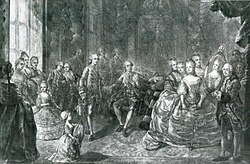



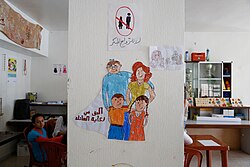
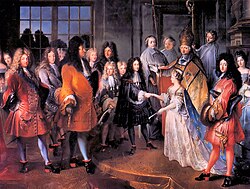


.jpg)