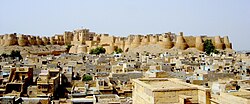
[[File:Jaisalmer forteresse.jpg|thumb|right|250px|[[Jaisalmer Fort]] of Bhati Rajputs]]
[[File:Jaisalmer Flag.svg|thumb|right|The Royal Flag of Bhati Rajputs of [[Jaisalmer State]]]]
'''Bhati ''' is a clan of [[Rajput]]s,<ref name="BhatnagarDube254">{{cite book |title=Female Infanticide in India: A Feminist Cultural History |first1=Rashmi Dube |last1=Bhatnagar |first2=Reena |last2=Dube |publisher=SUNY Press |year=2005 |isbn=978-0-7914-6327-7 |url=https://books.google.com/books?id=kT0s8TXoffsC&pg=PA254 |page=254}}</ref> [[Gurjar]]s,<ref>{{cite book|editor-first=Kumar Suresh |editor-last=Singh |editor-link=Kumar Suresh Singh |title=India's communities|url=https://books.google.com/books?id=Jw9uAAAAMAAJ|year=1998|publisher=Oxford University Press|isbn=978-0-19-563354-2|quote=The Hindu Gujjar have a number of clans (gotra), such as Bainsale, Bhati, Bankar, Korri, Dhame, Godhane, Khari, Nangari, Khatana Pedia, Peelwar, Tanwar, Fagna, Vidhuri, Vasatte and Lomor}}</ref> and [[Jat people|Jats]]<ref name="Eaton">{{cite book |last=Eaton |first=Richard M. |editor-last=Peacock |editor-first=A. C. S. |editor-link=A. C. S. Peacock |title=Islamisation: Comparative Perspectives from History |date=2017 |publisher=Edinburgh University Press |isbn=978-1474417129 |page=386 |chapter-url=https://books.google.com/books?id=8C1WDwAAQBAJ&pg=PA386 |access-date=30 January 2020 |chapter=Reconsidering 'Conversion to Islam' in Indian History}}</ref> found in India and Pakistan.<ref name=" Epilogue: Bridging divides">{{cite journal | url=https://books.google.com/books?id=cQxyT4gjdmQC | title=Epilogue: Bridging divides | author=Zafar Iqbal Chaudhary | journal=Epilogue |date=November 2009 | volume=3 | issue=11 | pages=48}}</ref> The Bhati Rajputs (also known as Bargala) claim [[Chandravanshi]] origin.<ref name="default">{{cite book|editor-first=Kumar Suresh |editor-last=Singh |editor-link=Kumar Suresh Singh |title=India's communities|url=https://books.google.com/books?id=Jw9uAAAAMAAJ&q=bhati|year=1998|publisher=Oxford University Press|isbn=978-0-19-563354-2|pages=301|quote=Bargala, also known as Bhutta Rajput, the Bargala live in Uttar Pradesh. They trace their origin to Chandravanshi Rajput ruler Jagpalii Vare Singh}}</ref> [[Jaisalmer State]] was founded by the Bhati Rajputs and ruled it till Indian independence in 1947.
[[File:Jaisalmer founder.JPG|thumb|160px|[[Rawal Jaisal|Maharawal Jaisal Singh]], The notable Bhati Rajput Ruler]]
[[File:Jaisalmer forteresse.jpg|thumb|right|250px|[[Jaisalmer Fort]] of the Bhati Rajputs]] '''Bhati ''' is a clan of [[Rajput]]s<ref name="BhatnagarDube254">{{cite book |title=Female Infanticide in India: A Feminist Cultural History |first1=Rashmi Dube |last1=Bhatnagar |first2=Reena |last2=Dube |publisher=SUNY Press |year=2005 |isbn=978-0-7914-6327-7 |url=https://books.google.com/books?id=kT0s8TXoffsC&pg=PA254 |page=254}}</ref>
In [[Jaisalmer]], the Bhati clan sometimes refer to themselves as the ''Yadavpati'', reflecting their claimed mythological descent from [[Krishna]] and [[Yadu]].<ref>{{cite book|last1=Bose|first1=Melia Belli|title=Royal Umbrellas of Stone: Memory, Politics, and Public Identity in Rajput Funerary Art|date=2015|publisher=BRILL|isbn=978-9-00430-056-9|page=8|url=https://books.google.com/books?id=6dR0CgAAQBAJ&pg=PA8}}</ref>
Some Bhattis were nomadic cattle-keepers. In the years preceding the [[Indian rebellion of 1857]], these groups lost land by decisions made by the [[British East India Company]], which assigned to Jat peasants grazing lands formerly frequented by the Bhatis in the [[Delhi]] and [[Haryana]] regions. The British were not enamoured of nomadic tribes, whom they thought exacted [[protection money|protection]] in the areas that they visited, and the policies of land reform were designed in part to limit this mobility.<ref>{{cite book |title=Indian Society and the Making of the British Empire |first=Christopher Alan |last=Bayly |author-link=Christopher Bayly |edition=Reprinted |publisher=Cambridge University Press |year=1990 |pages=143, 188–189 |isbn=978-0-521-38650-0 |url=https://books.google.com/books?id=fX2zMfWqIzMC&pg=PA188}}</ref>
At least some of the Bhati Rajputs of [[Rajasthan]] were among the communities that practised [[female infanticide]] between 1883–1998.<ref name="BhatnagarDube254" /> One princess, a daughter of the Hindu Bhati ruling family in [[Dipalpur]], was married to Salar Rajab, a Turkic Muslim ruler, and gave birth to [[Firuz Shah Tughlaq]]. This was one of several examples of inter-religious royal marriage alliances during the period of [[Muslim conquests in the Indian subcontinent|Turkic Muslim rule in the Indian subcontinent]].<ref>{{cite book |title=A History of Jaipur |first=Jadunath |last=Sarkar |author-link=Jadunath Sarkar |edition=Reprinted, revised |publisher=Orient Blackswan |year=1994 |orig-year=1984 |isbn=978-8-12500-333-5 |url=https://books.google.com/books?id=O0oPIo9TXKcC&pg=PA37 |page=37}}</ref> Rajput Bhati princesses were also married into the royal family of [[Jodhpur State|Jodhpur]].<ref>{{cite book |title=Kinship Organization in India |first=Irawati Karmarkar |last=Karve |author-link=Irawati Karve |edition=Third |publisher=Asia Publishing House |year=1968 |page=168 }}</ref>
The Sikh Sidhu Jatt rulers of Patiala and Nabha also claim descent from the Bhati ruler [[Rawal Jaisal]].<ref name="Ganda_1990">{{cite book |author=Ganda Singh |title=Sardar Jassa Singh Ahluwalia |url=https://books.google.com/books?id=f4ZHAAAAMAAJ |year=1990 |publisher=Punjabi University |pages=1–4 }}</ref>{{qn|date=May 2019}}<ref>[https://books.google.com/books?id=K_FRF3a5y2EC&lpg=PP1&pg=PA16#v=onepage&q&f=false Punjab Through the Ages by S. R. Bakshi & Rashmi Pathak Volume 1 First edition Pg.16]</ref>{{qn|date=May 2019}} Geographically, the Sidhu are from the [[Malwa (Punjab)|Punjab region]] of India.<ref>{{cite book |last=Judge |title=Mapping social exclusion in India: Caste, Religion, and Borderlands |date=13 March 2014 |isbn=9781107056091 |url= https://books.google.com/books?id=bNJkAwAAQBAJ&pg=PA176}}</ref>
In some parts of modern Pakistan, especially in the Northern and Central [[Punjab]], low-caste ''doms'' (or [[Mirasi]] singers/dancers) now also call themselves 'Bhati'; a fact deeply resented by the authentic Bhati Rajputs of Pakistan.<ref>Dr M Riyasat Husain 'Caste and clan in Northern and Central Punjab and some patterns of shift: An analysis' in ''Journal of South Asian Study'' Vol 2, No 8, 1992, Lahore, pp. 21–46</ref>
==History==
The Bhatis reportedly originated in [[Mathura]] through a common ancestor named Bhati, who was a descendant of [[Pradyumna|Pradyumn]]. According to the seventeenth-century [[Nainsi ri Khyat]], the Bhatis after losing Mathura moved to [[Bhatner]] in Lakhi Jungle, and from there to other locations in western and northwestern India including [[Punjab]]. Jaisalmer had a dynasty with a successful line of rulers and this became their center. Bhatner, [[Pugal]], Bikrampur, Barsalpur, [[Derawar Fort|Deravar]], [[Maroth, Rajasthan|Maroth]], [[Kahror Pacca Tehsil|Kehror]], Aasnikot, Tanot, Ludrovo and Mamanvahan were some of the fortified settlements that were historically ruled by the Bhati clan or subclans. The Bhati ruler Vijayrao was known as the 'uttara disi bhad kivaad' (the sentinel of the north direction), due to his control over forts and settlements that extended from [[Ghazni]] to [[Gujarat]], leading to several conflicts with the invading Muslim tribes.<ref>{{Cite book|last=Kothiyal|first=Tanuja|url=https://books.google.com/books?id=be-7CwAAQBAJ&pg=PA78|title=Nomadic Narratives: A History of Mobility and Identity in the Great Indian|publisher=Cambridgre University Press|year=2016|isbn=9781107080317|pages=18, 55–56}}</ref>
The Bhatis reportedly originated in Mathura through a common ancestor named Bhati, who was a descendant of Pradyumn. According to the seventeenth-century Nainsi ri Khyat, the Bhatis after losing Mathura moved to Bhatner in Lakhi Jungle, and from there to other locations in western and northwestern India including Punjab. Jaisalmer had a dynasty with a successful line of rulers and this became their center. Bhatner, Pugal, Bikrampur, Barsalpur, Deravar, Maroth, Kehror, Aasnikot, Tanot, Ludrovo and Mamanvahan were some of the fortified settlements that were historically ruled by the Bhati clan or subclans. The Bhati ruler Vijayrao was known as the 'uttara disi bhad kivaad' (the sentinel of the north direction), due to his control over forts and settlements that extended from Ghazni to Gujarat, leading to several conflicts with the invading Muslim tribes.[2]