


->Equinox No edit summary |
robot: Update article (please report if you notice any mistake or error in this edit) |
||
| Line 1: | Line 1: | ||
{{short description|White coloured sidecap, pointed in front and back and having a wide band, worn in India}} | {{short description|White coloured sidecap, pointed in front and back and having a wide band, worn in India}} | ||
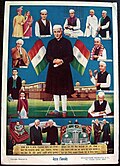
[[File:Nehru's life, depicted in a poster probably from the 1950's.jpg|right|thumb|[[Nehru]]'s life, poster from the 1950s, showing him wearing the Gandhi cap during 1929–1955 ]] | [[File:Nehru's life, depicted in a poster probably from the 1950's.jpg|right|thumb|[[Nehru]]'s life, poster from the 1950s, showing him wearing the Gandhi cap during 1929–1955 ]] | ||
The '''Gandhi cap''' ({{lang-hi|गांधी टोपी}}) is a white [[sidecap]], pointed in front and back and having a wide band. It is made out of ''[[khadi]]''. It takes its name after the | The '''Gandhi cap''' ({{lang-hi|गांधी टोपी}}) is a white [[sidecap]], pointed in front and back and having a wide band. It is made out of ''[[khadi]]''. It takes its name after the Indian leader [[Mahatma Gandhi]], who created it and first popularised its use during the [[Indian independence movement]]. | ||
Worn commonly by [[Indian independence activists]], it became a symbolic tradition for politicians and political activists to wear in independent India. | |||
==Genesis== | ==Genesis== | ||
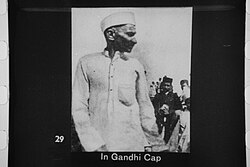
[[File:Gandhi cap.jpg|right|thumb| | [[File:Gandhi cap.jpg|right|thumb|250px|A photograph of [[Mahatma Gandhi]] wearing Gandhi Cap in 1920]] | ||
Gandhi, in a conversation with [[Kaka Kalelkar]], described how he created the ''Gandhi cap''. Gandhi said that he looked at a number of caps belonging to the various parts of India and wanted to design a cap that will cover the head in hot weather and would be easy to store in a pocket. He found Kashmiri cap to be coming close to what he wanted to design but it used wool. Gandhi writes that he instead used cotton cloth and picked the white color because white clothes are supposed to be washed more regularly and they are easier to wash.<ref>Clothing Matters: Dress and Identity in India, Emma Tarlo, University of Chicago Press, Sep 1, 1996.82-83[https://eprints.soas.ac.uk/33581/1/11010340.pdf]</ref> | |||
The Gandhi cap emerged in India during the [[Non-cooperation movement]] from 1920–22,<ref>Consumption: The history and regional development of consumption edited by Daniel Miller, p. 424</ref> when it became the standard Congress dress as popularized by Gandhi. | |||
By 1920, a substantial amount of Indian male population was using this cap. British officials had banned the government servants from using Gandhi cap in the Central Provinces.<ref name="Tarlo">{{cite book | last=Tarlo | first=E. | title=Clothing Matters: Dress and Identity in India | publisher=Hurst | year=1996 | isbn=978-1-85065-176-5 | url=https://books.google.com/books?id=8wyM5heEc9gC&pg=PA84| page=84}}</ref> | |||
Gandhi's homespun ''khadi'' attire of traditional Indian clothes were symbolic of his message of cultural pride, the use of ''[[Swadeshi]]'' goods (as opposed to those manufactured in Europe), self-reliance and solidarity with India's rural masses. The cap became common to most followers of Gandhi and members of the [[Indian National Congress]]. A connection to the independence movement was implied when any individual wore the cap in those times. | Gandhi's homespun ''khadi'' attire of traditional Indian clothes were symbolic of his message of cultural pride, the use of ''[[Swadeshi]]'' goods (as opposed to those manufactured in Europe), self-reliance and solidarity with India's rural masses. The cap became common to most followers of Gandhi and members of the [[Indian National Congress]]. A connection to the independence movement was implied when any individual wore the cap in those times. | ||
Prisoners in South African prisons | Prisoners in South African prisons were required to wear a puny little headcover. It has been cited as the genesis of the Gandhi Cap.<ref>H.S.L Polak ''Mahatma Gandhi'' (London: Odham's Press, 1949) pg. 61</ref><ref>{{cite book | last=Uppal | first=J.N. | title=Gandhi Ordained in South Africa | publisher=Publications Division Ministry of Information & Broadcasting | year=1995 | isbn=978-81-230-2212-3 | url=https://books.google.com/books?id=HJkyDQAAQBAJ | access-date=2022-06-22 | page=348}}</ref> | ||
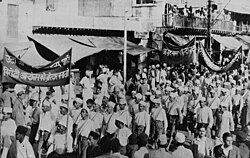
[[File:Indian National Congress, New Delhi , 1937.jpg|right|thumb|Members of the [[Indian National Congress]] marching in [[New Delhi]] in 1937]] | [[File:Indian National Congress, New Delhi , 1937.jpg|right|thumb|Members of the [[Indian National Congress]] marching in [[New Delhi]] in 1937]] | ||
==After independence== | ==After independence== | ||
The first generation of post-independence Indian politicians were almost universally members of the freedom struggle. | The first generation of post-independence Indian politicians were almost universally members of the freedom struggle. The cap was regularly worn by Indian leaders like [[Jawaharlal Nehru]], India's first [[Prime Minister]] and the succeeding prime ministers such as [[Lal Bahadur Shastri]] and [[Morarji Desai]] continued this tradition. Most members of the [[Indian Parliament]] (especially politicians and activists of the Congress party) wore ''khadi'' clothing and the ''Gandhi cap''. Large numbers of people donned the cap while celebrating India's independence on August 15 or the promulgation of a [[Republic Day (India)|republic]] on January 26. | ||
Jawarharlal Nehru was always remembered as having worn the cap. In 1964 a coin showing Nehru in profile was released which was widely criticized for lacking the cap. Another Nehru coin was later released in 1989 on his birth centenary, which showed him wearing a cap. | Jawarharlal Nehru was always remembered as having worn the cap. In 1964 a coin showing Nehru in profile was released which was widely criticized for lacking the cap. Another Nehru coin was later released in 1989 on his birth centenary, which showed him wearing a cap. | ||
| Line 33: | Line 36: | ||
In 2011, the Gandhi cap once again rose in popularity in India after [[Anna Hazare]], an eminent Gandhian from [[Maharashtra]], started an anti-corruption movement in India. The epicenter of this movement was in Delhi. In August 2011, thousands of people wearing Gandhi caps accumulated at [[Ramlila Maidan]] in Delhi to support Anna Hazare on his [[Hunger strike|fast-unto-death]]. This movement spilled over to many other parts of the country and stadiums, community centers and grounds were booked for assimilation of a similar nature. The mass movement witnessed people of all age groups, religions and social standings (mainly the [[middle class]]) as participants, many among them shouting slogans and wearing Gandhi caps. | In 2011, the Gandhi cap once again rose in popularity in India after [[Anna Hazare]], an eminent Gandhian from [[Maharashtra]], started an anti-corruption movement in India. The epicenter of this movement was in Delhi. In August 2011, thousands of people wearing Gandhi caps accumulated at [[Ramlila Maidan]] in Delhi to support Anna Hazare on his [[Hunger strike|fast-unto-death]]. This movement spilled over to many other parts of the country and stadiums, community centers and grounds were booked for assimilation of a similar nature. The mass movement witnessed people of all age groups, religions and social standings (mainly the [[middle class]]) as participants, many among them shouting slogans and wearing Gandhi caps. | ||
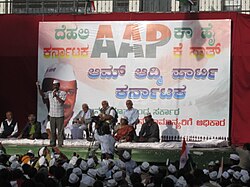
In the 2014 election, the workers of [[Aam Aadmi Party]] widely wore the Gandhi cap with text printed on it.<ref>{{cite web|url=http://www.jagran.com/uttar-pradesh/gorakhpur-city-11060720.html|title=बहुरंगी हुई गांधी की टोपी|website=jagran.com|access-date=8 April 2018}}</ref><ref>{{cite web|url=https://www.bbc.com/news/world-asia-india-27100491|title=How India's iconic Gandhi cap has changed sides|first=Andrew|last=Whitehead|date=28 April 2014|access-date=8 April 2018|via=www.bbc.com}}</ref> Supporters of the [[Bharatiya Janata Party]] | In the 2014 election, the workers of [[Aam Aadmi Party]] widely wore the Gandhi cap with text printed on it.<ref>{{cite web|url=http://www.jagran.com/uttar-pradesh/gorakhpur-city-11060720.html|title=बहुरंगी हुई गांधी की टोपी|website=jagran.com|access-date=8 April 2018}}</ref><ref>{{cite web|url=https://www.bbc.com/news/world-asia-india-27100491|title=How India's iconic Gandhi cap has changed sides|first=Andrew|last=Whitehead|date=28 April 2014|access-date=8 April 2018|via=www.bbc.com}}</ref> | ||
Supporters of the [[Bharatiya Janata Party]] also wear Gandhi cap with [[Orange (colour)|saffron color]].<ref>{{cite web|url=http://www.thehindu.com/news/cities/Visakhapatnam/gandhi-cap-changes-colours/article5944088.ece|title=Gandhi cap changes colours!|first=Sumit|last=Bhattacharjee|date=24 April 2014|access-date=8 April 2018|via=www.thehindu.com}}</ref> | |||
[[File:Arvind Kejriwal in Bangalore.JPG|right|thumb|[[Arvind Kejriwal]] in Bangalore on inauguration of [[Aam Aadmi Party]] Karnataka]] | [[File:Arvind Kejriwal in Bangalore.JPG|right|thumb|[[Arvind Kejriwal]] in Bangalore on inauguration of [[Aam Aadmi Party]] Karnataka]] | ||
| Line 48: | Line 53: | ||
==References== | ==References== | ||
{{Reflist}}<!--added under references heading by script-assisted edit--> | {{Reflist}}<!--added under references heading by script-assisted edit--> | ||
==External links== | ==External links== | ||
{{commons category|Gandhi caps}} | {{commons category|Gandhi caps}} | ||
* [https://www.youtube.com/watch?v=zOlSMDWovjU GANDHI CAP FROM NEWSPAPER - HINDI - ARVIND GUPTA, Jun 3, 2011] | * [https://www.youtube.com/watch?v=zOlSMDWovjU GANDHI CAP FROM NEWSPAPER - HINDI - ARVIND GUPTA, Jun 3, 2011] | ||
* [https://web.archive.org/web/20040627130229/http://www.hindu.com/2004/04/12/stories/2004041208560300.htm Gandhi cap out of fashion, | * [https://web.archive.org/web/20040627130229/http://www.hindu.com/2004/04/12/stories/2004041208560300.htm Gandhi cap out of fashion, Mar 27, 2004] | ||
* [http://www.samaylive.com/gallery/photo-gallery/mahatma-gandhi-gandhi-cap-freedom-movement-anna-hazare-jan-lokpal-arvind-kejriwal/619803/58606.html गांधी टोपी का अब तक का सफर.. Samaylive] | * [http://www.samaylive.com/gallery/photo-gallery/mahatma-gandhi-gandhi-cap-freedom-movement-anna-hazare-jan-lokpal-arvind-kejriwal/619803/58606.html गांधी टोपी का अब तक का सफर.. Samaylive] | ||
* [http://www.indiaprofile.com/religion-culture/indianheaddress.htm Indian headdresses] | * [http://www.indiaprofile.com/religion-culture/indianheaddress.htm Indian headdresses] | ||
Latest revision as of 09:42, 22 June 2022

The Gandhi cap (Hindi: गांधी टोपी) is a white sidecap, pointed in front and back and having a wide band. It is made out of khadi. It takes its name after the Indian leader Mahatma Gandhi, who created it and first popularised its use during the Indian independence movement.
Worn commonly by Indian independence activists, it became a symbolic tradition for politicians and political activists to wear in independent India.
Genesis[edit | edit source]

Gandhi, in a conversation with Kaka Kalelkar, described how he created the Gandhi cap. Gandhi said that he looked at a number of caps belonging to the various parts of India and wanted to design a cap that will cover the head in hot weather and would be easy to store in a pocket. He found Kashmiri cap to be coming close to what he wanted to design but it used wool. Gandhi writes that he instead used cotton cloth and picked the white color because white clothes are supposed to be washed more regularly and they are easier to wash.[1]
The Gandhi cap emerged in India during the Non-cooperation movement from 1920–22,[2] when it became the standard Congress dress as popularized by Gandhi.
By 1920, a substantial amount of Indian male population was using this cap. British officials had banned the government servants from using Gandhi cap in the Central Provinces.[3]
Gandhi's homespun khadi attire of traditional Indian clothes were symbolic of his message of cultural pride, the use of Swadeshi goods (as opposed to those manufactured in Europe), self-reliance and solidarity with India's rural masses. The cap became common to most followers of Gandhi and members of the Indian National Congress. A connection to the independence movement was implied when any individual wore the cap in those times.
Prisoners in South African prisons were required to wear a puny little headcover. It has been cited as the genesis of the Gandhi Cap.[4][5]

After independence[edit | edit source]
The first generation of post-independence Indian politicians were almost universally members of the freedom struggle. The cap was regularly worn by Indian leaders like Jawaharlal Nehru, India's first Prime Minister and the succeeding prime ministers such as Lal Bahadur Shastri and Morarji Desai continued this tradition. Most members of the Indian Parliament (especially politicians and activists of the Congress party) wore khadi clothing and the Gandhi cap. Large numbers of people donned the cap while celebrating India's independence on August 15 or the promulgation of a republic on January 26.
Jawarharlal Nehru was always remembered as having worn the cap. In 1964 a coin showing Nehru in profile was released which was widely criticized for lacking the cap. Another Nehru coin was later released in 1989 on his birth centenary, which showed him wearing a cap.
In later times, the cap had lost its popular and political appeal. Although many members of the Congress party continued the tradition, rival political parties preferred to dissociate themselves from the tradition linked with the Congress. The mass acceptance of Western-style clothing had also diminished the importance of wearing Indian-style clothes for politicians.

The cap remains the most popular everyday headgear worn by men in rural parts of Maharashtra.[6]

In the "I Have a Dream" speech of Martin Luther King Jr. in 1963, many people standing behind him on stage wore Gandhi caps.[7]
Re-emergence[edit | edit source]
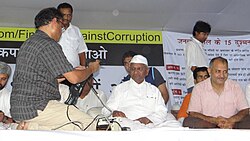
In 2011, the Gandhi cap once again rose in popularity in India after Anna Hazare, an eminent Gandhian from Maharashtra, started an anti-corruption movement in India. The epicenter of this movement was in Delhi. In August 2011, thousands of people wearing Gandhi caps accumulated at Ramlila Maidan in Delhi to support Anna Hazare on his fast-unto-death. This movement spilled over to many other parts of the country and stadiums, community centers and grounds were booked for assimilation of a similar nature. The mass movement witnessed people of all age groups, religions and social standings (mainly the middle class) as participants, many among them shouting slogans and wearing Gandhi caps.
In the 2014 election, the workers of Aam Aadmi Party widely wore the Gandhi cap with text printed on it.[8][9]
Supporters of the Bharatiya Janata Party also wear Gandhi cap with saffron color.[10]

See also[edit | edit source]
- Indian National Congress
- Pagri (turban)
- Peshawari pagri
- Taqiyah
- Songkok
- Dutch cap
- Cap of Maintenance
References[edit | edit source]
- ↑ Clothing Matters: Dress and Identity in India, Emma Tarlo, University of Chicago Press, Sep 1, 1996.82-83[1]
- ↑ Consumption: The history and regional development of consumption edited by Daniel Miller, p. 424
- ↑ Tarlo, E. (1996). Clothing Matters: Dress and Identity in India. Hurst. p. 84. ISBN 978-1-85065-176-5.
- ↑ H.S.L Polak Mahatma Gandhi (London: Odham's Press, 1949) pg. 61
- ↑ Uppal, J.N. (1995). Gandhi Ordained in South Africa. Publications Division Ministry of Information & Broadcasting. p. 348. ISBN 978-81-230-2212-3. Retrieved 2022-06-22.
- ↑ Bhanu, B.V (2004). People of India: Maharashtra, Part 2. Mumbai: Popular Prakashan. pp. 1033, 1037, 1039. ISBN 81-7991-101-2.
- ↑ Tharoor, Kanishk (2018-04-04). "The Debt MLK Owed to India's Anti-Colonial Fight". The Atlantic. Retrieved 2020-02-13.
- ↑ "बहुरंगी हुई गांधी की टोपी". jagran.com. Retrieved 8 April 2018.
- ↑ Whitehead, Andrew (28 April 2014). "How India's iconic Gandhi cap has changed sides". Retrieved 8 April 2018 – via www.bbc.com.
- ↑ Bhattacharjee, Sumit (24 April 2014). "Gandhi cap changes colours!". Retrieved 8 April 2018 – via www.thehindu.com.