

>InterestGather m Reverted edits by 2402:8100:288F:4E28:9915:A0B2:5407:93D2 (talk): using Wikipedia for advertising/promotion (HG) (3.4.10) |
robot: Update article (please report if you notice any mistake or error in this edit) |
||
| Line 1: | Line 1: | ||
{{short description|Queen of Gaya}} | {{short description|Queen of Gaya}} | ||
{{Use dmy dates|date=August 2019}} | {{Use dmy dates|date=August 2019}} | ||
{{Infobox royalty | |||
| name = Heo Hwang-ok | |||
| native_lang1 = ko | |||
| native_lang1_name1 = 허황옥<br>許黃玉 | |||
| title = Empress Heo | |||
| image = | |||
| alt = | |||
| caption = | |||
| succession = [[Queen consort]] of [[Geumgwan Gaya]] | |||
| reign = 189 AD | |||
| reign-type = Tenure | |||
| coronation = | |||
| predecessor = [[Princess Mother Jeonggyeon]] | |||
| successor = [[Queen Mojong|Lady Mojeong]] | |||
| regent = | |||
| birth_date = 32 AD | |||
| birth_place = State of Ayuta | |||
| death_date = 189 AD (aged about 157)<br>{{sub|(1st day, 3rd months in [[Lunar calendar|Lunar]])}} | |||
| death_place = [[Gimhae]], [[Gyeongsangnam-do]] | |||
| burial_date = | |||
| burial_place = | |||
| spouse = [[Suro of Geumgwan Gaya|King Suro of Gaya]] | |||
| issue = [[Geodeung of Geumgwan Gaya|King Geodeung of Gaya]]<br>10 other sons<br>Lady Kim of Garak State<ref>Married Seok Gu-gwang (석구광).</ref> | |||
| full name = | |||
| regnal name = | |||
| posthumous name = Queen Mother Boju (보주태후, 普州太后) | |||
| royal house = | |||
| father = Mr. Heo | |||
| mother = | |||
}} | |||
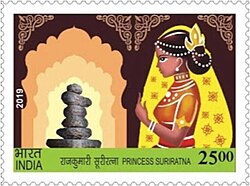
[[file:Suriratna_2019_stamp_of_India.jpg|thumb|right|A commemorative [[Indian rupee|Rs.]] 25.00 postage stamp on Princess Suriratna (Queen Heo Hwang-ok ) was issued by India in 2019.]] | [[file:Suriratna_2019_stamp_of_India.jpg|thumb|right|A commemorative [[Indian rupee|Rs.]] 25.00 postage stamp on Princess Suriratna (Queen Heo Hwang-ok ) was issued by India in 2019.]] | ||
[[file:Queen_Heo_2019_stamp_of_India.jpg|thumb|right|A commemorative [[Indian rupee|Rs.]] 5.00 postage stamp on Queen Heo Hwang-ok ( | [[file:Queen_Heo_2019_stamp_of_India.jpg|thumb|right|A commemorative [[Indian rupee|Rs.]] 5.00 postage stamp on Queen Heo Hwang-ok (Suriratna) was issued by India in 2019.]] | ||
'''Heo Hwang-ok''', also known as '''Suriratna''' (or Sriratna),<ref>{{Cite news|date=2018-11-04|title=The Indian princess who became a South Korean queen|language=en-GB|work=BBC News|url=https://www.bbc.com/news/world-asia-india-46055285|access-date=2021-01-21}}</ref><ref>{{Cite web|date=2020-09-08|title=Princess Suriratna of India marries King Suro of the Gaya Kingdom nearly 2,000 years ago|url=http://www.koreapost.com/news/articleView.html?idxno=21413|access-date=2021-01-21|website=The Korea Post|language=ko}}</ref><ref>{{Cite web|title=The Legend of Princess Sriratna {{!}} Official website of Indian Council for Cultural Relations, Government of India|url=https://www.iccr.gov.in/media/photo-gallery/legend-princess-sriratna|access-date=2022-01-29|website=www.iccr.gov.in}}</ref> is a legendary queen mentioned in ''[[Samguk yusa|Samguk Yusa]]'', a 13th-century Korean chronicle. According to ''Samguk Yusa'', she became the wife of [[Suro of Geumgwan Gaya|King Suro of Geumgwan Gaya]] at the age of 16, after having arrived by boat from a distant kingdom called "Ayuta";<ref>{{Cite news|date=2018-11-04|title=The Indian princess who became a South Korean queen|language=en-GB|work=BBC News|url=https://www.bbc.com/news/world-asia-india-46055285|access-date=2021-07-06}}</ref> making her the first Queen of [[Geumgwan Gaya]]. More than six million present day Koreans, especially from [[Gimhae Kim clan|Gimhae Kim]], [[Gimhae Heo clan|Heo]] and [[Incheon Yi clan|Lee]] clans, trace their lineage to the legendary queen as the direct descendants of her 12 children with King Suro.<ref name="ancest1">[http://www.koreatimes.co.kr/www/opinion/2017/04/162_219704.html Legacy of Queen Suriratn], [[The Korea Times]], 16 April 2017.</ref><ref name="WonMoo2011" /><ref name="BBC_memorial_2001"/> Her native kingdom is believed to be located in India.<ref>{{Cite news|date=2018-11-04|title=The Indian princess who became a South Korean queen|language=en-GB|work=BBC News|url=https://www.bbc.com/news/world-asia-india-46055285|access-date=2021-07-06}}</ref><ref>{{Cite web|last=Krishnan|first=Revathi|date=4 Aug 2020|title=Ayodhya has 'important relations' with South Korea|url=https://theprint.in/diplomacy/ayodhya-has-important-relations-with-south-korea-envoy-refers-to-indian-princess-link/474279/|url-status=live|access-date=6 Jul 2021|website=ThePrint}}</ref> There is a tomb in [[Gimhae]], South Korea, that is believed to be hers,<ref name="Kwon_2003"/> and a [[Memorial of Heo Hwang-ok, Ayodhya|memorial]] in [[Ayodhya]], India.<ref>{{Cite web|last=PTI|first=PTI|date=4 April 2020|title=Work on Queen Heo Memorial in Ayodhya|url=https://www.theweek.in/content/archival/wire-updates/national/2018/12/16/des6-korea-ayodhya%20memorial.html|url-status=live|access-date=6 Jul 2021|website=TheWeek}}</ref> | |||
== Origins == | |||
== | The legend of Heo is found in ''Garakgukgi'' (the Record of Garak Kingdom) which is currently lost, but referenced within the ''Samguk Yusa''.<ref>{{cite book |title=Samguk Yusa |author=[[Il-yeon]] (tr. by Ha Tae-Hung & Grafton K. Mintz) |publisher=Yonsei University Press |location=Seoul |isbn=89-7141-017-5 |year=1972}}</ref> According to the legend, Heo was a princess of the "Ayuta Kingdom". The extant records do not identify Ayuta except as a distant country. Written sources and popular culture often associate Ayuta with India but there are no records of the legend in India itself.<ref name="BBC_memorial_2001">{{cite news | url = http://newsvote.bbc.co.uk/1/hi/world/asia-pacific/1205728.stm| title = Korean memorial to Indian princess | date = 3 May 2001 | publisher = BBC News }}</ref> Kim Byung-mo, an anthropologist from [[Hanyang University]], identified Ayuta with [[Ayodhya]] in India based on phonetic similarity.<ref>{{cite book |author=Choong Soon Kim |title=Voices of Foreign Brides: The Roots and Development of Multiculturalism in Korea |url=https://books.google.com/books?id=b43pR3Z8zTcC&pg=PA34 |year=2011 |publisher=AltaMira |isbn=978-0-7591-2037-2 |page=34 }}</ref> [[Grafton K. Mintz]] and Ha Tae-hung implied that the Korean reference was actually to the [[Ayutthaya Kingdom]] of Thailand.<ref name="REB_1991">{{cite book |author=Robert E. Buswell |title=Tracing Back the Radiance: Chinul's Korean Way of Zen |url=https://books.google.com/books?id=EazRC28tdIIC&pg=PA74 |year=1991 |publisher=University of Hawaii Press |isbn=978-0-8248-1427-4 |page=74 }}</ref> However, according to [[George Cœdès]], the Thai city was not founded until the year 1350, after the composition of ''Samguk Yusa''.<ref name="REB_1991"/><ref name="Skand_2015">{{cite book |author=Skand R. Tayal |title=India and the Republic of Korea: Engaged Democracies |url=https://books.google.com/books?id=yGwwCgAAQBAJ&pg=PT23 |year=2015 |publisher=Taylor & Francis |isbn=978-1-317-34156-7 |page=23 |quote=Historians, however, believe that the Princess of Ayodhya is only a myth.}}</ref> | ||
According to another theory, the ''Ayuta Kingdom'' ([[Hangul]]: 아유타국, [[Hanja]]: 阿踰陁國) is a mistranslation of ''[[Ay dynasty| Ay Kingdom]]'', a vassal to the [[Pandya dynasty|Pandyan Empire]] of ancient [[Tamilakam]] (in South India<ref>{{Cite book|last=Hyŏphoe|first=Han'guk Kwan'gwang|url=https://books.google.com/books?id=If0DAQAAIAAJ&q=%22Ho+Hwang-Ok%22|title=Beautiful Korea|publisher=Huimang Publishing Company|year=1968|pages=619|language=en|quote=Aboard the ship were Princess Ho Hwang-Ok of Ayut'a in the south of India.}}</ref>). At the time of her arrival, Princess Heo Hwang-ok carried with her the symbols of Pandya: the ‘’twin fish’’ and ‘’trident’’.<ref>이거룡. 2017, "가락국(駕洛國)과 고대 남인도(南印度)의 문화적 접촉에 관한 고찰: 물고기숭배를 중심으로" [A Study on the Cultural Contacts between Garak Kingdom and Ancient South India: With Special Reference to 'Fish Worship'], 인도연구, vol. 22, no. 1, pp. 85–121. {{doi|10.21758/jis.2017.22.1.85}}</ref><ref>{{Cite web|title=Korea's intriguing Tamil connect|url=https://www.newindianexpress.com/magazine/voices/2021/jul/25/koreas-intriguing-tamil-connect-2333956.html|access-date=2022-01-22|website=The New Indian Express}}</ref> | |||
== Marriage to Suro == | == Marriage to Suro == | ||
After their marriage, Heo told King Suro that she was 16 years old.<ref name=Descendants5>''[http://www.cbeta.org/result/normal/T49/2039_002.htm No. 2039《三國遺事》CBETA 電子佛典 V1.21 普及版] {{webarchive|url=https://web.archive.org/web/20160303230845/http://www.cbeta.org/result/normal/T49/2039_002.htm |date=2016-03-03 }}'', Taisho Tripitaka Vol. 49, CBETA Chinese Electronic Tripitaka V1.21, Normalized Version, T49n2039_p0983b14(07)</ref><ref name=Descendants/> She stated her [[given name]] as "Hwang-ok" ("Yellow Jade", 황옥, 黃玉) and her [[Surname|family name]] as "Heo" (허, or "Hurh" 許). She described how she came to Gaya as follows: the Heavenly Lord (''Sange Je'') appeared in her parents' dreams. He told them to send Heo to Suro, who had been chosen as the king of Gaya. The dream showed that the king had not yet found a queen. Heo's father then told her to go to Suro. After two months of a sea journey, she found ''Beondo'', a peach which fruited only every | After their marriage, Heo told King Suro that she was 16 years old.<ref name=Descendants5>''[http://www.cbeta.org/result/normal/T49/2039_002.htm No. 2039《三國遺事》CBETA 電子佛典 V1.21 普及版] {{webarchive|url=https://web.archive.org/web/20160303230845/http://www.cbeta.org/result/normal/T49/2039_002.htm |date=2016-03-03 }}'', Taisho Tripitaka Vol. 49, CBETA Chinese Electronic Tripitaka V1.21, Normalized Version, T49n2039_p0983b14(07)</ref><ref name=Descendants/> She stated her [[given name]] as "Hwang-ok" ("Yellow Jade", 황옥, 黃玉) and her [[Surname|family name]] as "Heo" (허, or "Hurh" 許). She described how she came to Gaya as follows: the Heavenly Lord (''Sange Je'') appeared in her parents' dreams. He told them to send Heo to Suro, who had been chosen as the king of Gaya. The dream showed that the king had not yet found a queen. Heo's father then told her to go to Suro. After two months of a sea journey, she found ''Beondo'', a peach which fruited only every 3.000 years.<ref name="WonMoo2011">{{cite book | author=Won Moo Hurh | title="I Will Shoot Them from My Loving Heart": Memoir of a South Korean Officer in the Korean War | url=https://books.google.com/books?id=PGxtRrQn9WUC&pg=PA15 | year=2011 | publisher=McFarland | isbn=978-0-7864-8798-1 | pages=15–16}}</ref> | ||
According to the legend, the courtiers of King Suro had requested him to select a wife from among the maidens they would bring to the court. However, Suro stated that his selection of a wife will be commanded by the Heavens. He commanded Yuch'ŏn-gan to take a horse and a boat to Mangsan-do, an island to the south of the capital. At Mangsan, Yuch'ŏn saw a vessel with a red sail and a red flag. He sailed to the vessel, and escorted it to the shores of Kaya (or Gaya, present-day | According to the legend, the courtiers of King Suro had requested him to select a wife from among the maidens they would bring to the court. However, Suro stated that his selection of a wife will be commanded by the Heavens. He commanded Yuch'ŏn-gan to take a horse and a boat to Mangsan-do, an island to the south of the capital. At Mangsan, Yuch'ŏn saw a vessel with a red sail and a red flag. He sailed to the vessel, and escorted it to the shores of Kaya (or Gaya, present-day [[Gimhae]]). Another officer, Sin'gwigan went to the palace, and informed the King of the vessel's arrival. The King sent nine clan chiefs, asking them to escort the ship's passengers to the royal palace.<ref name="James2001">{{cite book |author=James Huntley Grayson |title=Myths and Legends from Korea: An Annotated Compendium of Ancient and Modern Materials |url=https://books.google.com/books?id=HZO49KfGLiMC&pg=PA110 |year=2001 |publisher=Psychology Press |isbn=978-0-7007-1241-0 |pages=110–116}}</ref> | ||
Princess Heo stated that she wouldn't accompany the strangers. Accordingly, the King ordered a tent to be pitched on the slopes of a hill near the palace. The princess then arrived at the tent with her courtiers and slaves. The courtiers included [[Sin Po]] (or Sin Bo 신보 申輔) and [[Cho Kuang]] (or Jo Gwang 조광 趙匡). Their wives were [[Mojong]] 모정 | Princess Heo stated that she wouldn't accompany the strangers. Accordingly, the King ordered a tent to be pitched on the slopes of a hill near the palace. The princess then arrived at the tent with her courtiers and slaves. The courtiers included [[Sin Po]] (or Sin Bo, 신보, 申輔) and [[Cho Kuang]] (or Jo Gwang, 조광, 趙匡). Their wives were [[Queen Mojong|Mojong]] (모정, 慕貞) and [[Moryang]] (모량, 慕良) respectively. The twenty slaves carried gold, silver, jewels, silk brocade, and tableware and gems.<ref name="Choong2011">{{cite book |author=Choong Soon Kim |title=Voices of Foreign Brides: The Roots and Development of Multiculturalism in Korea |url=https://books.google.com/books?id=b43pR3Z8zTcC&pg=PA32 |date=16 October 2011 |publisher=AltaMira Press |isbn=978-0-7591-2037-2 |pages=31–33}}</ref> Before marrying the king, the princess took off her silk trousers (mentioned as a skirt in a different section of ''Samguk Yusa'') and offered them to the mountain spirit. King Suro tells her that he also knew about Heo's arrival in advance, and therefore, did not marry the maidens recommended by his courtiers.<ref name="WonMoo2011"/> | ||
When some of the Queen's escorts decided to return home, King Suro gave each of them thirty rolls of hempen cloth (one roll was of 40 yards). He also gave each person ten bags of rice for the return voyage. A part of the Queen's original convoy, including the two courtiers and their wives, stayed back with her. The queen was given a residence in the inner palace, while the two courtiers and their wives were given separate residences. The rest of her convoy were given a guest house of twenty rooms.<ref name="Choong2011"/> | When some of the Queen's escorts decided to return home, King Suro gave each of them thirty rolls of hempen cloth (one roll was of 40 yards). He also gave each person ten bags of rice for the return voyage. A part of the Queen's original convoy, including the two courtiers and their wives, stayed back with her. The queen was given a residence in the inner palace, while the two courtiers and their wives were given separate residences. The rest of her convoy were given a guest house of twenty rooms.<ref name="Choong2011"/> | ||
== Descendants == | == Descendants == | ||
Heo and Suro had 12 children | Queen Heo and Suro had 12 children and the eldest son was [[Geodeung of Geumgwan Gaya|Geodeung]]. | ||
She requested Suro to let two of the children bear her maiden surname. Legendary genealogical records trace the origins of the Gimhae [[Heo]] to these two children.<ref name="WonMoo2011" /> The Gimhae [[Kim (Korean surname)|Kims]] trace their origin to the other eight sons, and so does the Yi clan of Incheon. | |||
According to the Jilburam, the remaining sons are said to have followed in their maternal uncle Po-ok's footsteps and devoted themselves to Buddhist meditation. They were named Hyejin, Gakcho, Jigam, Deonggyeon, Dumu, Jeongheong and Gyejang.<ref name="Descendants">Kim Choong Soon, 2011, Voices of Foreign Brides: The Roots and Development of Multiculturalism in Korea, AltairaPress, USA, Page 30-35.</ref> Overall, more than six million Koreans trace their lineage to Queen Heo.<ref name="BBC_memorial_2001" /> | |||
The remaining two children were daughters who were married respectively to a son of Talhae and a noble from [[Silla]]. | |||
The legend states that the Queen died at the age of 157.<ref name="James2001" /> | |||
[[Kim Yoon-ok]], wife of former South Korean President [[Lee Myung-bak]], trace her ancestry to the royal family.<ref>{{Cite web|last=Lee|first=Tae-hoon|date=2010-01-25|title=India Is First Lady Kims Ancestral Home|url=https://www.koreatimes.co.kr/www/nation/2021/07/113_59663.html|url-status=live|access-date=2021-07-30|website=The Korea Times|language=en}}</ref><ref>{{Cite web|date=2011-08-13|title=Lamp of the east|url=https://www.deccanherald.com/content/183513/lamp-east.html|access-date=2021-07-30|website=Deccan Herald|language=en}}</ref> | |||
==Remains at Gimhae tomb== | ==Remains at Gimhae tomb== | ||
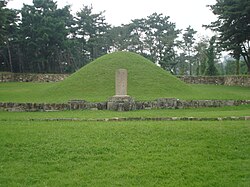
[[File:Queen_Suro_Tomb.jpg|thumb|right|Queen Suro's Tomb (Queen Heo Hwang-ok) at Gimhae in Korea.]] | [[File:Queen_Suro_Tomb.jpg|thumb|right|Queen Suro's Tomb (Queen Heo Hwang-ok) at Gimhae in Korea.]] | ||
The tombs believed to be that of Heo and Suro are located in [[Gimhae]], South Korea. A [[pagoda]] traditionally held to have been brought to Korea on her ship is located near her grave. The ''Samguk Yusa'' reports that the pagoda was erected on her ship in order to calm the god of the ocean and allow the ship to pass. The unusual and rough form of this pagoda, unlike any other in Korea, may lend some credence to the account.<ref name="Kwon_2003">{{cite book|title=가야인의 삶과 문화 (Gayain-ui salm-gwa munhwa, The culture and life of the Gaya people) | author=Kwon Ju-hyeon (권주현) | year=2003 | publisher=Hyean | location=Seoul | isbn=89-8494-221-9 | pages = 212–214}}</ref> | The tombs believed to be that of Heo Hwang-ok and Suro are located in [[Gimhae]], South Korea. A [[pagoda]] traditionally held to have been brought to Korea on her ship is located near her grave. The ''Samguk Yusa'' reports that the pagoda was erected on her ship in order to calm the god of the ocean and allow the ship to pass. The unusual and rough form of this pagoda, unlike any other in Korea, may lend some credence to the account .<ref name="Kwon_2003">{{cite book|title=가야인의 삶과 문화 (Gayain-ui salm-gwa munhwa, The culture and life of the Gaya people) | author=Kwon Ju-hyeon (권주현) | year=2003 | publisher=Hyean | location=Seoul | isbn=89-8494-221-9 | pages = 212–214}}</ref> | ||
A passage in the ''Samguk Yusa'' indicates that [[Jilji of Geumgwan Gaya|King Jilji]] built a [[Korean Buddhism|Buddhist]] temple for the ancestral | A passage in the ''Samguk Yusa'' indicates that [[Jilji of Geumgwan Gaya|King Jilji]] built a [[Korean Buddhism|Buddhist]] temple for the ancestral Queen Heo on the spot where she and King Suro were married.<ref name=rani/> He called the temple Wanghusa ("the Queen's temple") and provided it with ten ''[[Korean units of measurement#Notes|gyeol]]'' of stipend land.<ref name=rani>Ilyeon, 1972, [[Samguk Yusa]], tr. by Ha, Tae-Hung and Mintz, Grafton K., Yonsei University Press, Seoul, {{ISBN|89-7141-017-5}}, p. 168.</ref> A gyeol or kyŏl (결 or 結), varied in size from 2.2 acres to 9 acres (8,903–36,422 m2) depending upon the fertility of the land.<ref>{{citation |last=Palais |first=James B. |title=Confucian Statecraft & Korean Institutions: Yu Hyŏngwŏn and the Late Chosŏn Dynasty |url=https://books.google.com/books?id=t7k3CgAAQBAJ |location=Seattle |publisher=University of Washington Press |date=1996 |isbn=9780295805115 }}, [https://books.google.com/books?id=t7k3CgAAQBAJ&pg=PA363&redir_esc=y#v=onepage&q&f=false p. 363]</ref> The ''Samguk Yusa'' also records that the temple was built in 452. Since there is no other record of Buddhism having been adopted in 5th-century Gaya, modern scholars have interpreted this as an ancestral shrine rather than a Buddhist temple.<ref name="Kwon_2003"/> | ||
== Memorial in Ayodhya == | == Memorial in Ayodhya == | ||
{{Further | {{Further|Memorial of Heo Hwang-ok, Ayodhya}} | ||
In 2001, a [[Memorial of Heo Hwang-ok, Ayodhya|Memorial of Heo Hwang-ok]] was inaugurated by a Korean delegation, which included over a hundred historians and government representatives.<ref name=kor4>{{cite news |url=http://news.bbc.co.uk/2/hi/asia-pacific/1205728.stm |title=Korean memorial to Indian princess |date=6 March 2001 |publisher=BBC News }}</ref> In 2016, a Korean delegation proposed to develop the memorial. The proposal was accepted by | In 2001, a [[Memorial of Heo Hwang-ok, Ayodhya|Memorial of Heo Hwang-ok]] was inaugurated by a Korean delegation, which included over a hundred historians and government representatives.<ref name=kor4>{{cite news |url=http://news.bbc.co.uk/2/hi/asia-pacific/1205728.stm |title=Korean memorial to Indian princess |date=6 March 2001 |publisher=BBC News }}</ref> In 2016, a Korean delegation proposed to develop the memorial. The proposal was accepted by then-Chief Minister of Uttar Pradesh, [[Akhilesh Yadav]].<ref name=kor5>[https://news.webindia123.com/news/Articles/India/20160301/2806883.html UP CM announces grand memorial of Queen Huh Wang-Ock], 1 March 2016, WebIndia123</ref> On November 6, 2018, on the eve of [[Diwali]] celebration, South Korea's First Lady [[Kim Jung-sook]], laid the foundation stone for the expansion and beautification of the existing memorial.<ref name=kor6>{{cite news |title=UP's Faizabad district to be known as Ayodhya, says Yogi Adityanath |url=https://www.hindustantimes.com/india-news/up-s-faizabad-district-to-be-known-as-ayodhya-says-yogi-adityanath/story-YRLCIJwk8FUSN0X6a1jjjN.html |access-date=7 November 2018 |date=6 November 2018 |language=en}}</ref><ref name=kor8>{{cite news |title=Site for Heo Hwang-ok memorial in Ayodhya finalised |url=https://www.hindustantimes.com/lucknow/site-for-heo-hwang-ok-memorial-in-ayodhya-finalised/story-CqKFu8zTTjBNrL6O02o8JO.html |access-date=7 November 2018 |date=2 November 2018 |language=en}}</ref> She offered tribute at the ''Queen Heo Memorial'', attended a ceremony for the upgrade and beautification of the memorial and attended an elaborate [[Diwali]] celebration at Ayodhya along with the present Chief Minister [[Yogi Adityanath]], that included cultural shows and lighting of 300,000+ lights on the banks of [[Sarayu|Sarayu River]].<ref name=kor40>[https://www.hindustantimes.com/india-news/south-korean-first-lady-kim-jung-sook-celebrates-diwali-in-ayodhya-revives-links-of-queen-heo/story-WGSAKC0xKAI9fVbhSiue6N.html South Korean first lady Kim Jung-sook celebrates Diwali in Ayodhya, revives links of Queen Heo] {{Webarchive|url=https://web.archive.org/web/20190223074203/https://www.hindustantimes.com/india-news/south-korean-first-lady-kim-jung-sook-celebrates-diwali-in-ayodhya-revives-links-of-queen-heo/story-WGSAKC0xKAI9fVbhSiue6N.html |date=23 February 2019 }}, [[Hindustan Times]], 10 July 2018</ref> | ||
Reportedly, hundreds of South Koreans visit Ayodhya every year to pay homage to their legendary Queen Heo Hwang-ok.<ref>{{Cite web|date=2018-07-10|title=This is why hundreds of South Koreans visit Ayodhya every year|url=https://indianexpress.com/article/research/narendra-modi-moon-jae-south-korea-india-5253825/|access-date=2021-01-06|website=The Indian Express|language=en}}</ref> | |||
== Controversy surrounding her existence == | |||
=== Indian Accounts === | |||
Despite her connections to the two countries, there are no historical texts or official records in India that indicate an Indian princess traveling to Korea at the time including the country under the name ''Ayuta'', her supposed country of birth. | |||
However, many Indian historians emphasize on Heo Hwang-ok's legacy that links India to Korea today rather than validating her actual existence in history. | |||
=== Korean Accounts === | |||
Heo Hwang-ok's rather unique background had been a subject of much discussion in South Korea among many historians. Despite her legendary status, many historians reject the idea that Queen Heo truly existed and have debunked her travel routes several times throughout history. | |||
The first criticism stems from the fact that her existence is solely based on the accounts made in ''Samguk Yusa'', a book that is widely regarded to be mostly fictional. Other more credible sources such as ''Samguk Sagi'' lack mentions about an Indian princess arriving in Gaya and marrying the king. It is believed that the writer of ''Samguk Yusa'' exaggerated much of the claims to create a sense of familiarity towards Buddhism being a Buddhist monk himself.<ref name=":0">{{Cite web |date=2018-09-10 |title='허왕후 설화'는 어떻게 실제 역사로 둔갑했나 |url=http://www.newstof.com/news/articleView.html?idxno=937 |access-date=2020-05-18 |website=뉴스톱 |language=ko}}</ref> Others also pointed out that due to the lack of technology to properly reach the Korean peninsula from India at the time, her arrival would have been extremely difficult.<ref name=":0" /> | |||
Others have also pointed out the reason behind her supposed journey to the Korean kingdom being too vague. Many historians agree that the influence of India and Buddhism was profound for ancient Korean kingdoms at the time as many of them treated artifacts originating from India to be sacred.<ref name=":1">{{Cite web |last=수정: 2019.12.19 09:23 |first=입력: 2019 12 17 06:00 |date=2019-12-17 |title=[이기환의 흔적의 역사] "한반도엔 없는 돌"…가락국 허황후 '파사석탑의 정체' |url=https://www.khan.co.kr/culture/culture-general/article/201912170600001 |access-date=2021-02-09 |website=www.khan.co.kr |language=ko}}</ref> However, historians have also pointed out that the agency of an Indian princess coming to Korea across the sea on a boat was very peculiar as ancient Korea was less known to India than countries such as ancient China.<ref name=":0" /> Professor Lee Ki-Hwan suggested that the story of Heo Hwang-ok was dramatized to elevate Gaya's stature of the Buddhist scene among the Korean kingdoms and to associate the sacred artifacts they possessed to something closer to that of the Indian culture.<ref name=":1" /> | |||
The consensus is that the existence of an Indian princess was very unlikely and that much of the stories found in ''Samguk Yusa'' were fabricated for political and religious reasons in Gaya at the time.<ref name=":2">{{Cite web |last=임동근 |date=2017-08-11 |title=[연합이매진] 인도 공주 허황옥이 가야에 온 까닭은 |url=https://www.yna.co.kr/view/AKR20170718159000805 |access-date=2020-11-19 |website=연합뉴스 |language=ko}}</ref> The same book claims that King Suro lived up to 157 years old and transformed into an eagle and a hawk to fight off his rivals according to the supposed ''Garakgukgi'', making her story even less credible stemming from the same source material.<ref name=":2" /> | |||
Despite the historic inaccuracies surrounding her existence, many Korean historians stated that her iconic image as a legendary figure should persist as a means for the two countries to remain on good terms.<ref>{{Cite web |date=2019-05-05 |title=[김성회의 재미있는 다문화이야기] 이주민 '허황옥'과 '처용설화'는 사실일까? |url=http://www.eduinnews.co.kr/news/articleView.html?idxno=14171 |access-date=2021-03-25 |website=에듀인뉴스(EduinNews) |language=ko}}</ref> | |||
==In popular culture== | ==In popular culture== | ||
* Portrayed by [[Seo Ji-hye]] in the 2010 [[Munhwa Broadcasting Corporation|MBC]] TV series ''[[Kim Su-ro, The Iron King]]'' | * Portrayed by [[Seo Ji-hye]] in the 2010 [[Munhwa Broadcasting Corporation|MBC]] TV series ''[[Kim Su-ro, The Iron King]].'' | ||
* In February 2019, India and Korea signed an agreement on releasing a joint stamp, commemorating Queen Heo Hwang-ok.<ref>[http://www.economictimes.indiatimes.com/articleshow/68108448.cms India, South Korea sign 6 pacts; to step-up cooperation in infrastructure, combating global crime]. ''The Economic Times''. 22 February 2019</ref> | * In February 2019, India and Korea signed an agreement on releasing a joint stamp, commemorating Queen Heo Hwang-ok.<ref>[http://www.economictimes.indiatimes.com/articleshow/68108448.cms India, South Korea sign 6 pacts; to step-up cooperation in infrastructure, combating global crime]. ''The Economic Times''. 22 February 2019</ref> | ||
* [[Indian Council for Cultural Relations]] is releasing book that includes contact between foreign cultures and India which mentions story of Queen | * [[Indian Council for Cultural Relations]] is releasing book that includes contact between foreign cultures and India, which mentions the story of Queen Heo Hwang-ok.<ref>{{cite news |last1=Ahuja |first1=Sanjeev K |title=Korean Queen Huh Hwang-ok story to appear in ICCR's book on International love stories |url=https://www.asiancommunitynews.com/korean-queen-huh-hwang-ok-story-to-appear-in-iccrs-book-on-international-love-stories/ |access-date=23 November 2020 |publisher=Asian Community News |date=20 November 2020}}</ref> | ||
==See also== | ==See also== | ||
*[[Three Kingdoms of Korea]] | *[[Three Kingdoms of Korea]] | ||
*[[Buddhist temples in South Korea]] | *[[Korean Buddhist temples|Buddhist temples in South Korea]] | ||
*[[ | *[[Geumgwan Gaya]] | ||
*[[Byeonhan confederacy]] | |||
*[[Indians in Korea]] | *[[Indians in Korea]] | ||
*[[Koreans in India]] | *[[Koreans in India]] | ||
*[[India–South Korea relations]] | *[[India–South Korea relations]] | ||
*[[ | *[[India–North Korea relations]] | ||
==References== | ==References== | ||
| Line 74: | Line 128: | ||
[[Category:Year of death unknown]] | [[Category:Year of death unknown]] | ||
[[Category:Royal consorts of Gaya]] | [[Category:Royal consorts of Gaya]] | ||
[[Category:Ancient queens]] | [[Category:Ancient queens consort]] | ||
Revision as of 11:08, 2 July 2022
| Heo Hwang-ok | |||||
|---|---|---|---|---|---|
| Empress Heo | |||||
| Queen consort of Geumgwan Gaya | |||||
| Tenure | 189 AD | ||||
| Predecessor | Princess Mother Jeonggyeon | ||||
| Successor | Lady Mojeong | ||||
| Born | 32 AD State of Ayuta | ||||
| Died | 189 AD (aged about 157) (1st day, 3rd months in Lunar) Gimhae, Gyeongsangnam-do | ||||
| Spouse | King Suro of Gaya | ||||
| Issue | King Geodeung of Gaya 10 other sons Lady Kim of Garak State[1] | ||||
| |||||
| ko | 허황옥 許黃玉 | ||||
| Father | Mr. Heo | ||||


Heo Hwang-ok, also known as Suriratna (or Sriratna),[2][3][4] is a legendary queen mentioned in Samguk Yusa, a 13th-century Korean chronicle. According to Samguk Yusa, she became the wife of King Suro of Geumgwan Gaya at the age of 16, after having arrived by boat from a distant kingdom called "Ayuta";[5] making her the first Queen of Geumgwan Gaya. More than six million present day Koreans, especially from Gimhae Kim, Heo and Lee clans, trace their lineage to the legendary queen as the direct descendants of her 12 children with King Suro.[6][7][8] Her native kingdom is believed to be located in India.[9][10] There is a tomb in Gimhae, South Korea, that is believed to be hers,[11] and a memorial in Ayodhya, India.[12]
Origins
The legend of Heo is found in Garakgukgi (the Record of Garak Kingdom) which is currently lost, but referenced within the Samguk Yusa.[13] According to the legend, Heo was a princess of the "Ayuta Kingdom". The extant records do not identify Ayuta except as a distant country. Written sources and popular culture often associate Ayuta with India but there are no records of the legend in India itself.[8] Kim Byung-mo, an anthropologist from Hanyang University, identified Ayuta with Ayodhya in India based on phonetic similarity.[14] Grafton K. Mintz and Ha Tae-hung implied that the Korean reference was actually to the Ayutthaya Kingdom of Thailand.[15] However, according to George Cœdès, the Thai city was not founded until the year 1350, after the composition of Samguk Yusa.[15][16]
According to another theory, the Ayuta Kingdom (Hangul: 아유타국, Hanja: 阿踰陁國) is a mistranslation of Ay Kingdom, a vassal to the Pandyan Empire of ancient Tamilakam (in South India[17]). At the time of her arrival, Princess Heo Hwang-ok carried with her the symbols of Pandya: the ‘’twin fish’’ and ‘’trident’’.[18][19]
Marriage to Suro
After their marriage, Heo told King Suro that she was 16 years old.[20][21] She stated her given name as "Hwang-ok" ("Yellow Jade", 황옥, 黃玉) and her family name as "Heo" (허, or "Hurh" 許). She described how she came to Gaya as follows: the Heavenly Lord (Sange Je) appeared in her parents' dreams. He told them to send Heo to Suro, who had been chosen as the king of Gaya. The dream showed that the king had not yet found a queen. Heo's father then told her to go to Suro. After two months of a sea journey, she found Beondo, a peach which fruited only every 3.000 years.[7]
According to the legend, the courtiers of King Suro had requested him to select a wife from among the maidens they would bring to the court. However, Suro stated that his selection of a wife will be commanded by the Heavens. He commanded Yuch'ŏn-gan to take a horse and a boat to Mangsan-do, an island to the south of the capital. At Mangsan, Yuch'ŏn saw a vessel with a red sail and a red flag. He sailed to the vessel, and escorted it to the shores of Kaya (or Gaya, present-day Gimhae). Another officer, Sin'gwigan went to the palace, and informed the King of the vessel's arrival. The King sent nine clan chiefs, asking them to escort the ship's passengers to the royal palace.[22]
Princess Heo stated that she wouldn't accompany the strangers. Accordingly, the King ordered a tent to be pitched on the slopes of a hill near the palace. The princess then arrived at the tent with her courtiers and slaves. The courtiers included Sin Po (or Sin Bo, 신보, 申輔) and Cho Kuang (or Jo Gwang, 조광, 趙匡). Their wives were Mojong (모정, 慕貞) and Moryang (모량, 慕良) respectively. The twenty slaves carried gold, silver, jewels, silk brocade, and tableware and gems.[23] Before marrying the king, the princess took off her silk trousers (mentioned as a skirt in a different section of Samguk Yusa) and offered them to the mountain spirit. King Suro tells her that he also knew about Heo's arrival in advance, and therefore, did not marry the maidens recommended by his courtiers.[7]
When some of the Queen's escorts decided to return home, King Suro gave each of them thirty rolls of hempen cloth (one roll was of 40 yards). He also gave each person ten bags of rice for the return voyage. A part of the Queen's original convoy, including the two courtiers and their wives, stayed back with her. The queen was given a residence in the inner palace, while the two courtiers and their wives were given separate residences. The rest of her convoy were given a guest house of twenty rooms.[23]
Descendants
Queen Heo and Suro had 12 children and the eldest son was Geodeung.
She requested Suro to let two of the children bear her maiden surname. Legendary genealogical records trace the origins of the Gimhae Heo to these two children.[7] The Gimhae Kims trace their origin to the other eight sons, and so does the Yi clan of Incheon.
According to the Jilburam, the remaining sons are said to have followed in their maternal uncle Po-ok's footsteps and devoted themselves to Buddhist meditation. They were named Hyejin, Gakcho, Jigam, Deonggyeon, Dumu, Jeongheong and Gyejang.[21] Overall, more than six million Koreans trace their lineage to Queen Heo.[8]
The remaining two children were daughters who were married respectively to a son of Talhae and a noble from Silla.
The legend states that the Queen died at the age of 157.[22]
Kim Yoon-ok, wife of former South Korean President Lee Myung-bak, trace her ancestry to the royal family.[24][25]
Remains at Gimhae tomb

The tombs believed to be that of Heo Hwang-ok and Suro are located in Gimhae, South Korea. A pagoda traditionally held to have been brought to Korea on her ship is located near her grave. The Samguk Yusa reports that the pagoda was erected on her ship in order to calm the god of the ocean and allow the ship to pass. The unusual and rough form of this pagoda, unlike any other in Korea, may lend some credence to the account .[11]
A passage in the Samguk Yusa indicates that King Jilji built a Buddhist temple for the ancestral Queen Heo on the spot where she and King Suro were married.[26] He called the temple Wanghusa ("the Queen's temple") and provided it with ten gyeol of stipend land.[26] A gyeol or kyŏl (결 or 結), varied in size from 2.2 acres to 9 acres (8,903–36,422 m2) depending upon the fertility of the land.[27] The Samguk Yusa also records that the temple was built in 452. Since there is no other record of Buddhism having been adopted in 5th-century Gaya, modern scholars have interpreted this as an ancestral shrine rather than a Buddhist temple.[11]
Memorial in Ayodhya
In 2001, a Memorial of Heo Hwang-ok was inaugurated by a Korean delegation, which included over a hundred historians and government representatives.[28] In 2016, a Korean delegation proposed to develop the memorial. The proposal was accepted by then-Chief Minister of Uttar Pradesh, Akhilesh Yadav.[29] On November 6, 2018, on the eve of Diwali celebration, South Korea's First Lady Kim Jung-sook, laid the foundation stone for the expansion and beautification of the existing memorial.[30][31] She offered tribute at the Queen Heo Memorial, attended a ceremony for the upgrade and beautification of the memorial and attended an elaborate Diwali celebration at Ayodhya along with the present Chief Minister Yogi Adityanath, that included cultural shows and lighting of 300,000+ lights on the banks of Sarayu River.[32]
Reportedly, hundreds of South Koreans visit Ayodhya every year to pay homage to their legendary Queen Heo Hwang-ok.[33]
Controversy surrounding her existence
Indian Accounts
Despite her connections to the two countries, there are no historical texts or official records in India that indicate an Indian princess traveling to Korea at the time including the country under the name Ayuta, her supposed country of birth.
However, many Indian historians emphasize on Heo Hwang-ok's legacy that links India to Korea today rather than validating her actual existence in history.
Korean Accounts
Heo Hwang-ok's rather unique background had been a subject of much discussion in South Korea among many historians. Despite her legendary status, many historians reject the idea that Queen Heo truly existed and have debunked her travel routes several times throughout history.
The first criticism stems from the fact that her existence is solely based on the accounts made in Samguk Yusa, a book that is widely regarded to be mostly fictional. Other more credible sources such as Samguk Sagi lack mentions about an Indian princess arriving in Gaya and marrying the king. It is believed that the writer of Samguk Yusa exaggerated much of the claims to create a sense of familiarity towards Buddhism being a Buddhist monk himself.[34] Others also pointed out that due to the lack of technology to properly reach the Korean peninsula from India at the time, her arrival would have been extremely difficult.[34]
Others have also pointed out the reason behind her supposed journey to the Korean kingdom being too vague. Many historians agree that the influence of India and Buddhism was profound for ancient Korean kingdoms at the time as many of them treated artifacts originating from India to be sacred.[35] However, historians have also pointed out that the agency of an Indian princess coming to Korea across the sea on a boat was very peculiar as ancient Korea was less known to India than countries such as ancient China.[34] Professor Lee Ki-Hwan suggested that the story of Heo Hwang-ok was dramatized to elevate Gaya's stature of the Buddhist scene among the Korean kingdoms and to associate the sacred artifacts they possessed to something closer to that of the Indian culture.[35]
The consensus is that the existence of an Indian princess was very unlikely and that much of the stories found in Samguk Yusa were fabricated for political and religious reasons in Gaya at the time.[36] The same book claims that King Suro lived up to 157 years old and transformed into an eagle and a hawk to fight off his rivals according to the supposed Garakgukgi, making her story even less credible stemming from the same source material.[36]
Despite the historic inaccuracies surrounding her existence, many Korean historians stated that her iconic image as a legendary figure should persist as a means for the two countries to remain on good terms.[37]
In popular culture
- Portrayed by Seo Ji-hye in the 2010 MBC TV series Kim Su-ro, The Iron King.
- In February 2019, India and Korea signed an agreement on releasing a joint stamp, commemorating Queen Heo Hwang-ok.[38]
- Indian Council for Cultural Relations is releasing book that includes contact between foreign cultures and India, which mentions the story of Queen Heo Hwang-ok.[39]
See also
- Three Kingdoms of Korea
- Buddhist temples in South Korea
- Geumgwan Gaya
- Byeonhan confederacy
- Indians in Korea
- Koreans in India
- India–South Korea relations
- India–North Korea relations
References
- ↑ Married Seok Gu-gwang (석구광).
- ↑ "The Indian princess who became a South Korean queen". BBC News. 4 November 2018. Retrieved 21 January 2021.
- ↑ "Princess Suriratna of India marries King Suro of the Gaya Kingdom nearly 2,000 years ago". The Korea Post (in 한국어). 8 September 2020. Retrieved 21 January 2021.
- ↑ "The Legend of Princess Sriratna | Official website of Indian Council for Cultural Relations, Government of India". www.iccr.gov.in. Retrieved 29 January 2022.
- ↑ "The Indian princess who became a South Korean queen". BBC News. 4 November 2018. Retrieved 6 July 2021.
- ↑ Legacy of Queen Suriratn, The Korea Times, 16 April 2017.
- ↑ 7.0 7.1 7.2 7.3 Won Moo Hurh (2011). "I Will Shoot Them from My Loving Heart": Memoir of a South Korean Officer in the Korean War. McFarland. pp. 15–16. ISBN 978-0-7864-8798-1.
- ↑ 8.0 8.1 8.2 "Korean memorial to Indian princess". BBC News. 3 May 2001.
- ↑ "The Indian princess who became a South Korean queen". BBC News. 4 November 2018. Retrieved 6 July 2021.
- ↑ Krishnan, Revathi (4 August 2020). "Ayodhya has 'important relations' with South Korea". ThePrint. Retrieved 6 July 2021.
{{cite web}}: CS1 maint: url-status (link) - ↑ 11.0 11.1 11.2 Kwon Ju-hyeon (권주현) (2003). 가야인의 삶과 문화 (Gayain-ui salm-gwa munhwa, The culture and life of the Gaya people). Seoul: Hyean. pp. 212–214. ISBN 89-8494-221-9.
- ↑ PTI, PTI (4 April 2020). "Work on Queen Heo Memorial in Ayodhya". TheWeek. Retrieved 6 July 2021.
{{cite web}}: CS1 maint: url-status (link) - ↑ Il-yeon (tr. by Ha Tae-Hung & Grafton K. Mintz) (1972). Samguk Yusa. Seoul: Yonsei University Press. ISBN 89-7141-017-5.
- ↑ Choong Soon Kim (2011). Voices of Foreign Brides: The Roots and Development of Multiculturalism in Korea. AltaMira. p. 34. ISBN 978-0-7591-2037-2.
- ↑ 15.0 15.1 Robert E. Buswell (1991). Tracing Back the Radiance: Chinul's Korean Way of Zen. University of Hawaii Press. p. 74. ISBN 978-0-8248-1427-4.
- ↑ Skand R. Tayal (2015). India and the Republic of Korea: Engaged Democracies. Taylor & Francis. p. 23. ISBN 978-1-317-34156-7.
Historians, however, believe that the Princess of Ayodhya is only a myth.
- ↑ Hyŏphoe, Han'guk Kwan'gwang (1968). Beautiful Korea. Huimang Publishing Company. p. 619.
Aboard the ship were Princess Ho Hwang-Ok of Ayut'a in the south of India.
- ↑ 이거룡. 2017, "가락국(駕洛國)과 고대 남인도(南印度)의 문화적 접촉에 관한 고찰: 물고기숭배를 중심으로" [A Study on the Cultural Contacts between Garak Kingdom and Ancient South India: With Special Reference to 'Fish Worship'], 인도연구, vol. 22, no. 1, pp. 85–121. doi:10.21758/jis.2017.22.1.85
- ↑ "Korea's intriguing Tamil connect". The New Indian Express. Retrieved 22 January 2022.
- ↑ No. 2039《三國遺事》CBETA 電子佛典 V1.21 普及版 Archived 2016-03-03 at the Wayback Machine, Taisho Tripitaka Vol. 49, CBETA Chinese Electronic Tripitaka V1.21, Normalized Version, T49n2039_p0983b14(07)
- ↑ 21.0 21.1 Kim Choong Soon, 2011, Voices of Foreign Brides: The Roots and Development of Multiculturalism in Korea, AltairaPress, USA, Page 30-35.
- ↑ 22.0 22.1 James Huntley Grayson (2001). Myths and Legends from Korea: An Annotated Compendium of Ancient and Modern Materials. Psychology Press. pp. 110–116. ISBN 978-0-7007-1241-0.
- ↑ 23.0 23.1 Choong Soon Kim (16 October 2011). Voices of Foreign Brides: The Roots and Development of Multiculturalism in Korea. AltaMira Press. pp. 31–33. ISBN 978-0-7591-2037-2.
- ↑ Lee, Tae-hoon (25 January 2010). "India Is First Lady Kims Ancestral Home". The Korea Times. Retrieved 30 July 2021.
{{cite web}}: CS1 maint: url-status (link) - ↑ "Lamp of the east". Deccan Herald. 13 August 2011. Retrieved 30 July 2021.
- ↑ 26.0 26.1 Ilyeon, 1972, Samguk Yusa, tr. by Ha, Tae-Hung and Mintz, Grafton K., Yonsei University Press, Seoul, ISBN 89-7141-017-5, p. 168.
- ↑ Palais, James B. (1996), Confucian Statecraft & Korean Institutions: Yu Hyŏngwŏn and the Late Chosŏn Dynasty, Seattle: University of Washington Press, ISBN 9780295805115, p. 363
- ↑ "Korean memorial to Indian princess". BBC News. 6 March 2001.
- ↑ UP CM announces grand memorial of Queen Huh Wang-Ock, 1 March 2016, WebIndia123
- ↑ "UP's Faizabad district to be known as Ayodhya, says Yogi Adityanath". 6 November 2018. Retrieved 7 November 2018.
- ↑ "Site for Heo Hwang-ok memorial in Ayodhya finalised". 2 November 2018. Retrieved 7 November 2018.
- ↑ South Korean first lady Kim Jung-sook celebrates Diwali in Ayodhya, revives links of Queen Heo Archived 23 February 2019 at the Wayback Machine, Hindustan Times, 10 July 2018
- ↑ "This is why hundreds of South Koreans visit Ayodhya every year". The Indian Express. 10 July 2018. Retrieved 6 January 2021.
- ↑ 34.0 34.1 34.2 "'허왕후 설화'는 어떻게 실제 역사로 둔갑했나". 뉴스톱 (in 한국어). 10 September 2018. Retrieved 18 May 2020.
- ↑ 35.0 35.1 수정: 2019.12.19 09:23, 입력: 2019 12 17 06:00 (17 December 2019). "[이기환의 흔적의 역사] "한반도엔 없는 돌"…가락국 허황후 '파사석탑의 정체'". www.khan.co.kr (in 한국어). Retrieved 9 February 2021.
{{cite web}}: CS1 maint: numeric names: authors list (link) - ↑ 36.0 36.1 임동근 (11 August 2017). "[연합이매진] 인도 공주 허황옥이 가야에 온 까닭은". 연합뉴스 (in 한국어). Retrieved 19 November 2020.
- ↑ "[김성회의 재미있는 다문화이야기] 이주민 '허황옥'과 '처용설화'는 사실일까?". 에듀인뉴스(EduinNews) (in 한국어). 5 May 2019. Retrieved 25 March 2021.
- ↑ India, South Korea sign 6 pacts; to step-up cooperation in infrastructure, combating global crime. The Economic Times. 22 February 2019
- ↑ Ahuja, Sanjeev K (20 November 2020). "Korean Queen Huh Hwang-ok story to appear in ICCR's book on International love stories". Asian Community News. Retrieved 23 November 2020.