




CleanupBot (talk | contribs) m →top: clean up, removed: {{pp|small=yes}} |
robot: Update article (please report if you notice any mistake or error in this edit) |
||
| Line 1: | Line 1: | ||
{{ | {{Short description|800s–1215 Iranian dynasty from Ghor, modern Afghanistan}} | ||
{{pp-semi|small=yes}} | |||
{{Use dmy dates|date=April 2013}} | {{Use dmy dates|date=April 2013}} | ||
{{Infobox country | {{Infobox country | ||
|conventional_long_name | | conventional_long_name = Ghurid dynasty | ||
|common_name | | common_name = Ghurids | ||
|year_start | | year_start = before 879 | ||
|year_end | | year_end = 1215 | ||
|date_start | | date_start = | ||
|date_end | | date_end = | ||
|event_start | | event_start = | ||
|event_end | | event_end = | ||
|p1 | | p1 = Ghaznavids | ||
|flag_p1 | | flag_p1 = Ghaznavid Empire 975 - 1187 (AD).PNG | ||
|p2 | | p2 = Great Seljuq Empire | ||
|flag_p2 | | flag_p2 = Seljuk Empire locator map.svg | ||
|p3 | | p3 = Chahamanas of Shakambhari | ||
| | | flag_p3 = Map_of_the_Cahamanas.png | ||
| | | p4 = Gahadavala dynasty | ||
| | | flag_p4 = Map_of_the_Gahadavalas.png | ||
| | | p5 = Paramara dynasty | ||
| | | flag_p5 = Map_of_the_Paramaras.png | ||
|image_map | | s2 = Mamluk dynasty (Delhi) | ||
|image_map_caption | | flag_s2 = Mamluk_dynasty_1206_-_1290_ad.GIF | ||
|image_flag | | s3 = Khalji dynasty of Bengal | ||
|image_coat | | flag_s3 = Map_of_the_Khaljis_of_Bengal.png | ||
|coa_size | | s4 = Delhi Sultanate | ||
|religion | | flag_s4 = Delhi Sultanate Flag (catalan atlas).png | ||
|capital | | s1 = Khwarazmian Empire | ||
|government_type | | flag_s1 = Khwarezmian Empire 1190 - 1220 (AD).PNG | ||
|legislature | | s5 = Qarlughids | ||
|title_leader | | image_map = Ghurid Empire according to Schwartzberg Atlas, p.147.png | ||
|leader1 | | image_map_caption = Map of Ghurid territory circa 1200, at the time of joint rulers [[Ghiyath al-Din Muhammad]] and [[Muhammad of Ghor]] (respectively ruling west and east of the [[Hindu Kush]]).<ref name="JS">{{cite book |last1=Schwartzberg |first1=Joseph E. |title=A Historical Atlas of South Asia |date=1978 |publisher=Oxford University Press, Digital South Asia Library|author-link=Joseph E. Schwartzberg |url=https://dsal.uchicago.edu/reference/schwartzberg/pager.html?object=185|page=147, Map "g"}}</ref>{{sfn|Eaton|2019|p=38}} In the west, Ghurid territory extended to [[Nishapur]] and [[Merv]],<ref name="DT">{{cite book |last1=Thomas |first1=David C. |title=The Ebb and Flow of the Ghūrid Empire |date=15 May 2018 |page=26, Figure I:2|publisher=Sydney University Press |isbn=978-1-74332-542-1 |url=https://books.google.com/books?id=6h2_DwAAQBAJ&pg=PP26 |language=en}}</ref><ref name="KS">{{cite book |last1=Schmidt |first1=Karl J. |title=An Atlas and Survey of South Asian History |date=20 May 2015 |publisher=Routledge |page=37, Map 16.2|isbn=978-1-317-47681-8 |url=https://books.google.com/books?id=BqdzCQAAQBAJ&pg=PA37 |language=en}}</ref> while Ghurid troops reached as far as [[Gorgan]] on the shores of the [[Caspian Sea]].<ref name="a">{{cite book |title=History of Civilizations of Central Asia |date=1 January 1998 |publisher=UNESCO |isbn=978-92-3-103467-1 |url=https://books.google.com/books?id=18eABeokpjEC&pg=PA185 |language=en|quote="In 1201 Ghurid troops entered Khurasan and captured Nishapur, Merv, Sarakhs and Tus, reaching as far as Gurgan and Bistam. Kuhistan, a stronghold of the Ismailis, was plundered and all Khurasan was brought temporarily under Ghurid control"}}</ref>{{sfn|Bosworth|2001b|pp=586–590}} Eastward, the Ghurids invaded as far as [[Bengal]].<ref name="THC">{{cite book |title=Turkish History and Culture in India: Identity, Art and Transregional Connections |date=17 August 2020 |publisher=BRILL |isbn=978-90-04-43736-4 |page=237 |url=https://books.google.com/books?id=ml75DwAAQBAJ&pg=PA237 |language=en|quote="In 1205, Bakhtīyar Khilji sacked Nudiya, the pre-eminent city of western Bengal and established an Islamic government at Laukhnauti, the capital of the predecessor Sena dynasty. On this occasion, commemorative coins were struck in gold and silver in the name of Muhammad b. Sām"}} }}</ref> | ||
|leader2 | | image_flag = | ||
|year_leader1 | | image_coat = | ||
|year_leader2 | | coa_size = | ||
|year_deputy1 | | religion = {{small|before 1011''':'''}}<br />[[Buddhism]]<ref name="Chandra" /><br/>{{small|From 1011''':'''}}<br />[[Sunni Islam]]<ref name="Nizami178">''The Ghurids'', K.A. Nizami, ''History of Civilizations of Central Asia'', Vol.4, Part 1, ed. M.S. Asimov and C.E. Bosworth, (Motilal Banarsidass Publishers, 1999), 178.</ref> | ||
|stat_year1 | | capital = [[Firozkoh]]{{sfn|Auer|2021|p=6}}<br/>[[Herat]]<ref name="Heratcapital"/><br/>[[Ghazni]] <small>(1170s–1215)</small><ref name="Ghazcapital"/> | ||
| government_type = [[Hereditary monarchy]] | |||
|common_languages | | legislature = | ||
}} | | title_leader = Malik/Sultan | ||
The ''' | | leader1 = [[Amir Suri]] <small>(first)</small> | ||
| leader2 = [[Ala al-Din Ali]] <small>(last)</small> | |||
| year_leader1 = 9th-century–10th-century | |||
| year_leader2 = 1214–1215 | |||
| year_deputy1 = | |||
| stat_year1 = 1200 est. | |||
| stat_area1 = 2000000 | |||
| ref_area1 = <ref name="OxfordArea">{{Cite book|last1=Bang|first1=Peter Fibiger|url=https://books.google.com/books?id=9mkLEAAAQBAJ&pg=PA92|title=The Oxford World History of Empire: Volume One: The Imperial Experience|last2=Bayly|first2=C. A.|last3=Scheidel|first3=Walter|date=2020-12-02|publisher=Oxford University Press|isbn=978-0-19-977311-4|location=|pages=92–94|language=en}}</ref> | |||
| common_languages = [[Persian language|Persian]] <small>(court, literature)</small><ref>''The Development of Persian Culture under the Early Ghaznavids'', C.E. Bosworth, '''Iran''', Vol. 6, (1968), 35;;"Like the Ghaznavids whom they supplanted, the Ghurids had their court poets, and these wrote in '''Persian'''"</ref>{{sfn|O'Neal|2015}} | |||
}} | |||
The '''Ghurid dynasty''' (also spelled '''Ghorids'''; {{lang-fa|دودمان غوریان|translit=Dudmân-e Ğurīyân}}; self-designation: {{lang|fa|شنسبانی}}, ''Šansabānī'') was a [[Persianate]]{{sfn|Auer|2021|p=12}} dynasty and a [[clan]] of presumably [[Iranian peoples|eastern Iranian]] [[Tajik people|Tajik]] origin, which ruled from the 10th-century to 1215.{{sfn|Bosworth|2001b|pp=586–590}}<ref>{{cite book |last1=Flood |first1=Finbarr B. |title=Objects of Translation: Material Culture and Medieval "Hindu-Muslim" Encounter |date=20 March 2018 |publisher=Princeton University Press |isbn=978-0-691-18074-8 |page=92 |url=https://books.google.com/books?id=8MhJDwAAQBAJ&pg=PA92 |language=en}}</ref><ref>{{cite book |last1=Avari |first1=Burjor |title=Islamic Civilization in South Asia: A History of Muslim Power and Presence in the Indian Subcontinent |date=2013 |publisher=Routledge |isbn=978-0-415-58061-8 |url=https://books.google.com/books?id=hGHpVtQ8eKoC&pg=PA41 |language=en|page=41}}</ref> The Ghurids were centered in the [[Ghor]] of present-day central [[Afghanistan]], where they initially started out as local chiefs. They gradually converted to [[Sunni Islam]] from [[Buddhism]]<ref name="Chandra" /><ref name="Nizami178" /> after the conquest of Ghor by the [[Ghaznavid]] Sultan [[Mahmud of Ghazni]] in 1011. The dynasty ultimately overthrew the Ghaznavid Empire when [[Muhammad of Ghor]] conquered the last Ghaznavid principality of [[Lahore]] in 1186 from [[Khusrau Malik]]. | |||
At their zenith, the Ghurid empire encompassed [[Greater Khorasan|Khorasan]] in the west and reached northern [[India]] as far as [[Bengal]] in the east.{{sfn|Bosworth|2001b|pp=586–590}} Their first capital was [[Firozkoh]] in [[Mandesh]], Ghor, which was later replaced by [[Herat]] | At their zenith, the Ghurid empire encompassed [[Greater Khorasan|Khorasan]] in the west and reached northern [[India]] as far as [[Bengal]] in the east.{{sfn|Bosworth|2001b|pp=586–590}} Their first capital was [[Firozkoh]] in [[Mandesh]], Ghor, which was later replaced by [[Herat]]<ref name="Heratcapital">[https://latrobe.academia.edu/DavidThomas/Papers/107251/Firuzkuh_the_summer_capital_of_the_Ghurids Firuzkuh: the summer capital of the Ghurids], by David Thomas, pg. 18.</ref> and finally [[Ghazni]].<ref name="Ghazcapital">''The Grove Encyclopedia of Islamic Art & Architecture: Three-volume set'', by Jonathan Bloom, Sheila Blair, pg. 108.</ref> The Ghurids were patrons of [[Persian language|Persian culture]] and heritage.<ref>Finbarr Barry Flood, ''Objects of Translation: Material Culture and Medieval "Hindu-Muslim" Encounter'', (Princeton University Press, 2009), 13.</ref> [[Abu Ali ibn Muhammad]] (r. 1011–1035) was the first Muslim king of the Ghurid dynasty to construct mosques and Islamic schools in Ghor. | ||
[[ | The Ghurids were succeeded in Khorasan and Persia by the [[Khwarazmian dynasty]], and in northern India former Ghurid generals formed the [[Mamluk dynasty (Delhi)|Mamluk dynasty]] of the [[Delhi Sultanate]]. | ||
The | ==Origins== | ||
In the 19th century some European scholars, such as [[Mountstuart Elphinstone]], favoured the idea that the Ghurid dynasty was related to today's [[Pashtun people]]<ref>[[Mountstuart Elphinstone|Elphinstone, Mountstuart]]. The History of India. Vol. 1. J. Murray, 1841. Web. 29 Apr. 2010. [https://books.google.com/books?id=oAluAAAAMAAJ&pg=PA598 Link]: ''"...the prevalent and apparently the correct opinion is, that both they and their subjects were Afghans. "'' & ''"In the time of Sultan Mahmud it was held, as has been observed, by a prince whom Ferishta calls Mohammed Soory (or Sur) Afghan."'' p.598-599</ref><ref>A short history of India: and of the frontier states of Afghanistan, Nipal, and Burma, [http://janus.lib.cam.ac.uk/db/node.xsp?id=EAD%2FGBR%2F0115%2FY3022M Wheeler, James Talboys], ([https://archive.org/details/in.ernet.dli.2015.96740/page/n105 <!-- pg=77 quote=afghan ghori. --> LINK]): ''"The next conqueror after Mahmud who made a name in India, was Muhammad Ghori, the Afghan."''</ref><ref>[[Edward Balfour|Balfour, Edward]]. The Cyclopædia of India and of Eastern and Southern Asia, Commercial Industrial, and Scientific: Products of the Mineral, Vegetable, and Animal Kingdoms, Useful Arts and Manufactures. 3rd ed. Vol. 2. London: Bernard Quaritch, 1885. Web. 29 Apr. 2010. [https://books.google.com/books?id=3U0OAAAAQAAJ&pg=PA392&dq#v=onepage&q&f=false Link]: ''"IZ-ud-DIN Husain, the founder of the Ghori dynaasty, was a native of Afghansitan. The origin of the house of Ghor has, however, been much discussed, – the prevailing opinion being that both they and their subjects were an Afghan race. "'' p.392</ref> but this is generally rejected by modern scholarship and, as explained by [[Georg Valentin von Munthe af Morgenstierne|Morgenstierne]] in the ''[[Encyclopaedia of Islam]]'', is for "various reasons very improbable".<ref name=EofI-Afghanistan>{{cite encyclopedia |author1=M. Longworth Dames |author2=G. Morgenstierne |author3=R. Ghirshman |title = AF<u>GH</u>ĀNISTĀN| encyclopedia = [[Encyclopaedia of Islam]]| edition = CD-ROM Edition v. 1.0| publisher = Koninklijke Brill NV| location = Leiden, The Netherlands| year = 1999 | quote=''"... there is no evidence for assuming that the inhabitants of Ghūr were originally Pashto-speaking (cf. Dames, in E I1). If we are to believe the Paṭa Khazāna (see below, iii), the legendary Amīr Karōṝ, grandson of Shansab, (8th century) was a Pashto poet, but this for various reasons is very improbable ..."''}}</ref> Some scholars state that the dynasty was of [[Tajik people|Tajik]] origin.<ref>[[Encyclopaedia of Islam]], "Ghurids", C.E. Bosworth, Online Edition, 2006: ''"... The Shansabānīs were, like the rest of the <u>Gh</u>ūrīs, of eastern Iranian Tājik stock ..."''</ref>{{sfn|Wink|2020|p=78}}<ref>Cynthia Talbot, ''The Last Hindu Emperor: Prithviraj Chauhan and the Indian Past, 1200-2000'', (Cambridge University Press, 2016), 36.</ref> ''[[Encyclopædia Iranica]]'' states: "Nor do we know anything about the ethnic stock of the Ḡūrīs in general and the Šansabānīs in particular; we can only assume that they were eastern Iranian Tajiks".{{sfn|Bosworth|2001b|pp=586–590}} [[Clifford Edmund Bosworth|Bosworth]] further points out that the actual name of the Ghurid family, ''Āl-e Šansab'' (Persianized: ''Šansabānī''), is the Arabic pronunciation of the originally [[Middle Persian language|Middle Persian]] name ''Wišnasp''.{{sfn|Bosworth|2001b|pp=586–590}} | |||
[[File:Afghanistan Ghor Province location.PNG|thumb|left|200px|The Ghurids originated from [[Ghor Province]] in central [[Afghanistan]].]] | |||
The historian [[André Wink]] explains in ''[[The New Cambridge History of Islam]]'':<ref name="New Cambridge">{{New Cambridge History of Islam|volume=3|last=Wink|first=André|author-link=André Wink|chapter=The early expansion of Islam in India|page=96}}</ref>{{blockquote|The Shansabānī dynasty superseded the Ghaznavids in the second half of the twelfth century. This dynasty was not of [[Turkic peoples|Turkish]], nor even [[Afghan (ethnonym)|Afghan]], but of eastern Persian or Tājīk origin, speaking a distinct Persian dialect of its own, like the rest of the inhabitants of the remote and isolated mountain region of Ghūr and its capital of Fīrūzkūh (in what is now central Afghanistan).}} | |||
When the Ghurids started to distinguish themselves | When the Ghurids started to distinguish themselves through their conquests, courtiers and genealogists (such as [[Fakhr-i Mudabbir]] and [[Minhaj-i-Siraj|al-Juzjani]]) forged a fictive genealogy which connected the Ghurids with the Iranian past. They traced the Ghurid family back to the mythical Arab tyrant [[Zahhak]], mentioned in the medieval Persian epic {{lang|fa|[[Shahnameh]]}} ("The Book of Kings"), whose family had reportedly settled in Ghur after the Iranian hero [[Fereydun]] had ended Zahhak's thousand-year tyranny.{{sfn|O'Neal|2015}}{{sfn|Bosworth|2001b|pp=586–590}} | ||
Ghur remained primarily populated by [[Buddhism|Buddhists]] | [[File:Mu'izz al-Din Muhammad. AH 599-602 AD 1171-1206.jpg|thumb|300px|Coinage of [[Mu'izz al-Din Muhammad]]. Dated AH 601 (1204/5 CE), [[Ghazni]] mint.]] | ||
Ghur remained primarily populated by [[Buddhism|Buddhists]] until the 11th century. It was then Islamised and gave rise to the Ghurids.{{efn|The rise to power of the [[Ghurids]] at Ghur, a small isolated area located in the mountain vastness between the Ghaznavid empire and the Seljukids, was an unusual and unexpected development. The area was so remote that till the 11th century, it had remained a pagan enclave surrounded by Muslim principalities. It was converted to Islam in the early part of the 11th century after [[Mahmud of Ghazni|Mahmud]] raided it, and left teachers to instruct the Ghurids in the precepts of Islam. Even then it is believed that a variety of [[Mahayana Buddhism]] persisted in the area till the end of the century<ref name="Chandra" />}}<ref name="Chandra">Satish Chandra, ''Medieval India:From Sultanat to the Mughals-Delhi Sultanat (1206-1526)'', Part 1, (Har-Anand Publications, 2006), 22.</ref> | |||
===Language=== | ===Language=== | ||
The Ghurids' native language was apparently different from their court language, Persian. [[Abu'l-Fadl Bayhaqi]], the famous historian of the Ghaznavid era, wrote on page 117 in his book ''[[Tarikh-i Bayhaqi]]'': "Sultan [[Mas'ud I of Ghazni]] left for Ghoristan and sent his learned companion with two people from Ghor as interpreters between this person and the people of that region." However, like the [[Samanids]] and Ghaznavids, the Ghurids were great patrons of [[Persian literature]], [[Persian poetry|poetry]], and [[Persian culture|culture]], and promoted these in their courts as their own. | The Ghurids' native language was apparently different from their court language, Persian. [[Abu'l-Fadl Bayhaqi]], the famous historian of the Ghaznavid era, wrote on page 117 in his book ''[[Tarikh-i Bayhaqi]]'': "Sultan [[Mas'ud I of Ghazni]] left for Ghoristan and sent his learned companion with two people from Ghor as interpreters between this person and the people of that region." However, like the [[Samanids]] and Ghaznavids, the Ghurids were great patrons of [[Persian literature]], [[Persian poetry|poetry]], and [[Persian culture|culture]], and promoted these in their courts as their own. Modern-day authors refer to them as the "[[Persianization|Persianized]] Ghurids".<ref name="Persianate">{{cite book |last1=Flood |first1=Finbarr Barry |title=Objects of Translation: Material Culture and Medieval "Hindu-Muslim" Encounter |date=3 May 2009 |publisher=Princeton University Press |isbn=978-0-691-12594-7 |page=3 |url=https://books.google.com/books?id=OLNE_li8C10C&pg=PA3 |language=en}}</ref> Wink describes the tongue of the Ghurids as a "distinct Persian dialect".<ref name="New Cambridge"/> | ||
There is nothing to confirm the recent | There is nothing to confirm the recent conclusion that the inhabitants of Ghor were originally [[Pashto language|Pashto-speaking]], and claims of the existence of "[[Pashto poetry]]", such as [[Pata Khazana]], from the Ghurid period are unsubstantiated.<ref>[[Encyclopaedia of Islam]], "Ghurids", C.E. Bosworth, Online Edition, 2006: ''"... There is nothing to confirm the recent surmise that the <u>Gh</u>ūids were Pa<u>sh</u>to-speaking [...] the Paṭa Khazāna "Treasury of secrets", claims to include Pa<u>sh</u>to poetry from the <u>Gh</u>ūid period, but the significance of this work has not yet been evaluated ..."''</ref><ref name="EofI-Afghanistan"/> | ||
==History== | ==History== | ||
===Early history=== | ===Early history=== | ||
{{multiple image|perrow=2|total_width=300|caption_align=center | |||
| align = right | |||
| direction =horizontal | |||
| header=Jam Minaret | |||
| image1 = Jam leaning minaret jam ghor.jpg | |||
| caption1 = | |||
| image2 = Minar of jam ghor.jpg | |||
| caption2 = | |||
| footer=The [[Minaret of Jam]] in [[Ghor Province]] of Afghanistan, established by the Ghurids and finished in 1174/75 CE. Inscription on the Minaret, showing the name and titles of Sultan [[Ghiyath al-Din Muhammad]] (1163–1202 CE). | |||
}} | |||
A certain Ghurid prince named Amir Banji was the ruler of [[Ghor]] and ancestor of the medieval Ghurid rulers. His rule was legitimized by the [[Abbasid]] [[caliph]] [[Harun al-Rashid]]. | A certain Ghurid prince named Amir Banji was the ruler of [[Ghor]] and ancestor of the medieval Ghurid rulers. His rule was legitimized by the [[Abbasid]] [[caliph]] [[Harun al-Rashid]]. | ||
Before the mid-12th century, the Ghurids had been bound to the [[Ghaznavids]] and [[Seljuq dynasty|Seljuks]] for about 150 years. Beginning in the mid-12th century, Ghor expressed its independence from the Ghaznavid Empire. In 1149 the Ghaznavid ruler [[Bahram-Shah of Ghazna]] poisoned a local Ghurid leader, Qutb al-Din Muhammad, who had taken refuge in the city of [[ | Before the mid-12th century, the Ghurids had been bound to the [[Ghaznavids]] and [[Seljuq dynasty|Seljuks]] for about 150 years. Beginning in the mid-12th century, Ghor expressed its independence from the Ghaznavid Empire. In 1149 the Ghaznavid ruler [[Bahram-Shah of Ghazna]] poisoned a local Ghurid leader, Qutb al-Din Muhammad, who had taken refuge in the city of [[Ghazni]] after having a quarrel with his brother [[Sayf al-Din Suri]]. In revenge, Sayf marched towards Ghazni and defeated Bahram-Shah. However, one year later, Bahram returned and scored a decisive victory against Sayf, who was shortly captured and crucified at Pul-i Yak Taq. [[Baha al-Din Sam I]], another brother of Sayf, set out to avenge the death of his two brothers, but died of natural causes before he could reach Ghazni. [[Ala al-Din Husayn]], one of the youngest of Sayf's brothers and newly crowned Ghurid king, also set out to avenge the death of his two brothers. He managed to defeat Bahram-Shah, and then had Ghazni sacked; the city burned for seven days and seven nights. It earned him the title of ''Jahānsūz'', meaning "''the world burner"''.{{sfn|Bosworth|2001a|pp=578–583}} The Ghaznavids retook the city with [[Ahmed Sanjar|Seljuq]] help, but lost it to [[Oghuz Turks]].{{sfn|Bosworth|2001a|pp=578–583}} | ||
In 1152, Ala al-Din Husayn refused to pay tribute to the [[Great Seljuk Empire|Seljuks]] and instead marched an army from Firozkoh but was defeated and captured at Nab by [[Ahmad Sanjar|Sultan Ahmed Sanjar]].<ref>''Ghurids'', C.E. Bosworth, '''Encyclopedia of Islam''', Vol.2, Ed. Bernard Lewis, C. Pellat and J. Schacht, (E.J.Brill, 1991), 1100.</ref> Ala al-Din Husayn remained a prisoner for two years, until he was released in return for a heavy ransom to the Seljuqs. Meanwhile, a rival of Ala al-Din named Husayn ibn Nasir al-Din Muhammad al-Madini had seized [[Firozkoh]], but was murdered at the right moment when Ala al-Din returned to reclaim his ancestral domain. Ala al-Din spent the rest of his reign expanding the domains of his kingdom; he managed to conquer Garchistan, [[Tukharistan]], and [[Bamiyan]], and later gave Bamiyan and Tukharistan to Fakhr al-Din Masud, starting the Bamiyan branch of the Ghurids. Ala al-Din died in 1161, and was succeeded by his son [[Sayf al-Din Muhammad]], who died two years later in a battle. | In 1152, Ala al-Din Husayn refused to pay tribute to the [[Great Seljuk Empire|Seljuks]] and instead marched an army from Firozkoh but was defeated and captured at Nab by [[Ahmad Sanjar|Sultan Ahmed Sanjar]].<ref>''Ghurids'', C.E. Bosworth, '''Encyclopedia of Islam''', Vol.2, Ed. Bernard Lewis, C. Pellat and J. Schacht, (E.J.Brill, 1991), 1100.</ref> Ala al-Din Husayn remained a prisoner for two years, until he was released in return for a heavy ransom to the Seljuqs. Meanwhile, a rival of Ala al-Din named Husayn ibn Nasir al-Din Muhammad al-Madini had seized [[Firozkoh]], but was murdered at the right moment when Ala al-Din returned to reclaim his ancestral domain. Ala al-Din spent the rest of his reign expanding the domains of his kingdom; he managed to conquer Garchistan, [[Tukharistan]], and [[Bamiyan]], and later gave Bamiyan and Tukharistan to Fakhr al-Din Masud, starting the Bamiyan branch of the Ghurids. Ala al-Din died in 1161, and was succeeded by his son [[Sayf al-Din Muhammad]], who died two years later in a battle. | ||
===The Ghurids at their zenith=== | ===The Ghurids at their zenith=== | ||
[[File:Fortress and arch of Qala-e-Bost on Afghan banknote.jpg|thumb|271px|Fortress and Ghurid arch of [[Qala-e-Bost]] as printed on an Afghan banknote.]] | |||
Sayf al-Din Muhammad was succeeded by his cousin [[Ghiyath al-Din Muhammad]], who was the son of Baha al-Din Sam I, and proved himself to be a capable king. Right after Ghiyath's ascension, he, with the aid of his loyal brother [[Mu'izz al-Din Muhammad]], killed a rival Ghurid chief named Abu'l Abbas. Ghiyath then defeated his uncle Fakhr al-Din Masud who claimed the Ghurid throne and had allied with the Seljuq governor of Herat and Balkh.{{sfn|Bosworth|1968|p=163}} | |||
In 1173, Mu'izz al-Din Muhammad reconquered the city of Ghazni and assisted his brother Ghiyath in his contest with the [[Khwarezmid Empire]] for the lordship of [[Greater Khorasan|Khorasan]]. | |||
He was alleged by contemporary historians to have exacted revenge for his great-grandfather [[Muhammad ibn Suri]]. After the death of his brother Ghiyath on 13 March 1203<ref>{{Cite book |author=Mohammad Habib|author-link=Mohammad Habib|chapter=THE ASIATIC ENVIRONMENT|editor1=Mohammad Habib |editor2=Khaliq Ahmad Nizami |title=A Comprehensive History of India: The Delhi Sultanat (A.D. 1206-1526) |volume=5 |edition=Second |year=1992 |publisher=The Indian History Congress / People's Publishing House |url=https://books.google.com/books?id=_9cmAQAAMAAJ |page=44|quote=At this juncture Sultan Ghiyasuddin Ghuri died at Herat on 27 Jamadi I.A H 599 (13 March A.D 1203)|oclc=31870180}}</ref>, he became the successor of his empire and ruled until his assassination in 1206 near [[Jhelum]] by [[Isma'ilism|Ismāʿīlīs]] whom he tryannized during his lifetime.<ref>{{Citation|author=C. E. Bosworth |title=THE POLITICAL AND DYNASTIC HISTORY OF THE IRANIAN WORLD (A.D. 1000–1217) |date=1968 |url=https://www.cambridge.org/core/books/cambridge-history-of-iran/political-and-dynastic-history-of-the-iranian-world-ad-10001217/024AA8933D346C06170E0D72EA6D71A4 |publisher=Cambridge University Press|page=168|quote=The suppression of revolot in the Punjab occupied Mu'izz al-Din's closing months, for on the way back to Ghaza he was assasinated, allegedly by emmisaries of the Isma'ils whom he had often persecuted during his life time (602/1206)|isbn=978-0-521-06936-6}}</ref><ref>{{harvnb|Chandra|2007|page=73}}:"Muizzuddin led his last campaign into India in 1206 in order to deal with the Khokhar rebellion. He resorted to large-scale slaughter of the Khokhars and cowed them down. On his way back to Ghazni, he was killed by a Muslim fanatic belonging to a rival sect"</ref> | |||
====Conquest of India and Bengal==== | |||
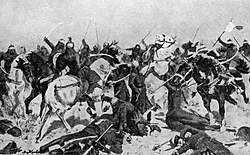
[[File:The last stan of Rajputs against Muhammadans.jpg|thumb|290px|''[[Rajput resistance to Muslim conquests|The last stand of Rajputs]]'', depicting the [[Second Battle of Tarain]] in 1192]] | |||
{{South Asia in 1175}} | |||
Northern India and Bengal were conquered by [[Mu'izz al-Din Muhammad]], whose capital was in [[Ghazni]] (conquered in 1148 CE), while his elder brother [[Ghiyath al-Din Muhammad]] ruled the western part of the Empire.<ref name="THCI"/>{{sfn|Eaton|2019|pp=39–45}} In 1175, Mu'izz al-Din Muhammad captured [[Multan]] from its [[Ismaili Muslim]] community, and also took [[Uch]] by 1176.{{sfn|Eaton|2019|pp=39–45}} | |||
In 1178, he turned south and marched through the waterless desert of Rajputana, his armies got exhausted in their march and were routed in the [[Battle of Kasahrada|hilly pass of Gadararaghatta]] by a coalition of Rajput chiefs, which forced him to change his route for further inroads into India.{{sfn|Asoke Kumar Majumdar|1956|pp=131-132}}<ref>{{harvnb|Chandra|2007|page=68}}: "In 1173, Shahabuddin, Muhammad (1173-1206 (also known as Muizzuddin Muhammad bin Sam) ascended the throne at Ghazni, while his elder brother was ruling at Ghur. Proceeding by way of the Gomal pass, Muizzuddin Muhammad conquered Multan and Uchch. In 1178, he attempted to penetrate into Gujarat by marching across the Rajputana desert. But the Gujarat ruler completely routed him in a battle near Mount Abu, and Muizzuddin Muhammad was lucky in escaping alive. He now realised the necessity of creating a suitable base in the Punjab before venturing upon the conquest of India. Accordingly he launched a campaign against the Ghaznavid possessions in the Punjab. By 1190, Muizzuddin Muhammad had conquered Peshawar, Lahore and Sialkot,and was poised fora thrust towards Delhi and the Gangetic doab"</ref> He then annexed, with general [[Qutbu l-Din Aibak]], the last Ghaznavid principality of the [[Punjab]], with their capital in [[Lahore]] in 1186.{{sfn|Bosworth|2001a}}<ref name="RME">{{cite book |last1=Eaton |first1=Richard M. |title=The Rise of Islam and the Bengal Frontier, 1204–1760 |date=1993 |publisher=UNIVERSITY OF CALIFORNIA PRESS |location=Berkeley · Los Angeles · London |page=Chapter 1-2 |url=https://publishing.cdlib.org/ucpressebooks/view?docId=ft067n99v9&chunk.id=ch02&toc.depth=1&toc.id=ch02&brand=ucpress}}</ref> | |||
In 1191, the Ghurid were defeated in the [[First Battle of Tarain]] against the [[Rajput|Rajput confederacy]] of [[Prithviraja III]], but Mu'izz returned a year later with an army of mounted archers and routed the Rajput forces on [[Second Battle of Tarain|same battlefield]] and executed Prithviraja shortly afterwards.<ref>{{cite book |author1=Hermann Kulke |author1-link=Hermann Kulke |author2=Dietmar Rothermund |author2-link=Dietmar Rothermund|url=https://books.google.com/books?id=TPVq3ykHyH4C|title=A History of India|date=2004|publisher=Psychology Press|isbn=978-0-415-32919-4|language=en|page=167|quote="The first battle of Tarain was won by the Rajput confederacy led by Prithviraj Chauhan of Ajmer. But when Muhammad of Ghur returned the following year with 10,000 archers on horseback he vanquished Prithviraj and his army}}</ref> In 1193, [[Delhi]] was conquered by the Turkic general of the Ghurid army [[Qutbu l-Din Aibak]].<ref name="RME"/>{{sfn|Eaton|2019|pp=39–45}} In 1194, Mu'izz returned to India and crossed Jamuna with an army of 50,000 horses and [[Battle of Chandawar|defeated the forces]] of [[Jayachandra]], who was killed in the battle. After the battle, Kashi (Benaras) was razed and several temples were destroyed.<ref>{{harvnb|Chandra|2007|page=71}}: "In 1194, Muizzuddin returned to India. He crossed the Jamuna with 50,000 cavalry and moved towards Kanauj. A hotly contested battle between Muizzuddin and Jaichandra was fought at Chandawar near Kanauj. We are told that Jaichandra had almost carried the day when he was killed by an arrow, and his army was totally defcated. Muizzuddin now moved on to Banaras which was ravaged, a large number of temples there being destroyed"</ref> | |||
In 1202-1203 CE, Qutbu l-Din Aibak, now Ghurid governor of [[Delhi]], invaded the [[Chandelas of Jejakabhukti|Chandela kingdom]] in the [[Ganges Valley]].{{sfn|Sisirkumar Mitra|1977|pp=123-126}} The Ghurids toppled local dynasties and destroyed Hindu temples during their advance across northern India, in place constructing [[mosque]]s on the same sites.{{sfn|Eaton|2019|pp=39–45}} | |||
Around 1203, [[Bakhtiyar Khalji]], another [[Khalaj people|Turkic]] general of the Ghurid Empire, led the [[Muslim conquests in the Indian subcontinent|Muslim conquests]] of the eastern Indian regions of [[Bihar]] and [[Bengal]], also on behalf of Mu'izz al-Din Muhammad.<ref name="THCI"/> In Bihar, he is said to have destroyed Buddhist centers of learning such as [[Nalanda|Nalanda University]], greatly contributing to the decline of pre-Islamic Indic scholarship.<ref>{{cite book |last1=Roy |first1=Himanshu |title=Political Thought in Indic Civilization |date=30 August 2021 |publisher=SAGE Publishing India |isbn=978-93-5479-159-8 |page=6 |url=https://books.google.com/books?id=rAVBEAAAQBAJ&pg=PA6 |language=en|quote="After the arrival of Islam, the universities such as Nalanda and Vikramshila were no longer existent. The destruction of Nalanda by Bakhtiyar Khalji was the last nail in this pre-Islamic Indic university, which had survived three major destructions"}}</ref><ref>{{cite book |last1=Koh |first1=Tommy |last2=Singh |first2=Hernaikh |title=India On Our Minds: Essays By Tharman Shanmugaratnam And 50 Singaporean Friends Of India |date=25 November 2020 |publisher=World Scientific |isbn=978-981-12-2453-9 |page=91 |url=https://books.google.com/books?id=M5wPEAAAQBAJ&pg=PA91 |language=en}}</ref> In Bengal, he sacked the ancient city of [[Nudiya]] in central Bengal, and established an Islamic government in the former [[Sena Empire|Sena]] capital of [[Gauḍa (city)|Lakhnauti]] in 1205.<ref name="THCI">{{cite book |title=Turkish History and Culture in India: Identity, Art and Transregional Connections |date=17 August 2020 |publisher=BRILL |isbn=978-90-04-43736-4 |page=237 |url=https://books.google.com/books?id=ml75DwAAQBAJ&pg=PA237 |language=en}}</ref><ref>{{cite book |last=Majumdar |first=R. C. |year=1973 |title=History of Mediaeval Bengal |location=Calcutta |publisher=G. Bharadwaj & Co. |oclc=1031074 |pages=1–2 |quote=Tradition gives him credit for the conquest of Bengal but as a matter of fact he could not subjugate the greater part of Bengal ... All that Bakhtyār can justly take credit for is that by his conquest of Western and a part of Northern Bengal he laid the foundation of the Muslim State in Bengal. The historians of the 13th century never attributed the conquest of the whole of Bengal to Bakhtyār.}}</ref><ref>{{Cite book |last1=Mehta |first1=Jaswant Lal |year=1986 |orig-year=First published 1979 |title=Advanced Study in the History of Medieval India |url=https://books.google.com/books?id=iUk5k5AN54sC&pg=PA81 |volume=I |edition=2nd |publisher=Sterling Publishers |isbn=978-81-207-0617-0 |oclc=883279992 |pages=81–82 |quote=The Turkish arms penetrated into Bihar and Bengal, through the enterprising efforts of Ikhtiyaruddin Muhammad bin Bakhtiyar Khalji ... he started plundering raids into Bihar and, within four or five years, occupied a large part of it ... Nadia was sacked by the Turks and a few districts of Bengal (Malda, Dinajpur, Murshidabad and Birbhum) were occupied by them ... Bathtiyar Khalji could not retain his hold over Nadia and made Lakhnauti or Gaur as his capital.}}</ref><ref>{{Cite book |url=https://books.google.com/books?id=DnZuAAAAMAAJ&q=Bakhtiyar+Khalji+bengal+and+bihar|title=India and the Afghans: A study of a neglected region, 1370-1576 A.D |isbn=9788185078687 |last1=Thakur |first1=Amrendra Kumar | year=1992| page=148}}</ref> | |||
Mu'izz al-Din Muhammad placed his faithful Turkic generals, rather than his own Ghurid brethens, in position of authority over local tributary kings, throughout the conquered Indian lands.{{sfn|Eaton|2019|pp=39–45}} After the death of Mu'izz al-Din Muhammad in early 1206, his territories fragmented into smaller Sultanates led by his former [[Mamluk]] generals. [[Tajuddin Elduz|Taj-ud-Din Yildoz]] became the ruler of [[Ghazni]]. [[Nasir-ud-Din Qabacha]] became Sultan of [[Multan]]. [[Qutb al-Din Aibak|Qutb ud-Din Aibak]] became Sultan of [[Delhi]].<ref>{{cite book |author=K. A. Nizami |author-link=K. A. Nizami |chapter=The Early Turkish Sultans of Delhi |editor1=Mohammad Habib |editor2=Khaliq Ahmad Nizami |title=A Comprehensive History of India: The Delhi Sultanat (A.D. 1206-1526) |volume=5 |edition=Second |year=1992 |publisher=The Indian History Congress / People's Publishing House |url=https://books.google.com/books?id=_9cmAQAAMAAJ |oclc=31870180 |page=201}}</ref> [[Muhammad bin Bakhtiyar Khilji|Bakhtiyar Khilji]] became Sultan of [[Bengal]], but was soon assassinated and succeeded by several [[Khalji dynasty of Bengal|Khalji rulers]], until Bengal was incorporated into the [[Delhi]] Sultanate in 1227.<ref>{{cite book | first1=George F. | last1=Nafziger | first2=Mark W. | last2=Walton | title=Islam at War: A History | url=https://archive.org/details/islamatwarhistor0000nafz | url-access=registration | publisher=Praeger Publishers | year=2003 | page=[https://archive.org/details/islamatwarhistor0000nafz/page/56 56]| isbn=9780275981013 }}</ref><ref>{{cite book |last1=Chandra |first1=Satish |author-link=Satish Chandra|title=Medieval India: From Sultanat to the Mughals-Delhi Sultanat (1206-1526) - Part One |date=2004 |publisher=Har-Anand Publications |isbn=978-81-241-1064-5 |pages=43–44 |url=https://books.google.com/books?id=L5eFzeyjBTQC&pg=PA43 |language=en}}</ref> Between 1206 and 1228 the various Turkic rulers and their successors rivaled from preeminence until the Sultan of Delhi [[Iltutmish]] prevailed, marking the advent of the [[Mamluk dynasty (Delhi)|Mamluk dynasty]], the first dynasty of the [[Delhi Sultanate]] which would rule most of India for more than three centuries.{{sfn|Eaton|2019|pp=39–45}} | |||
===Decline and fall=== | ===Decline and fall=== | ||
After the death of [[Mu'izz al-Din Muhammad]] in 1206, a confused struggle then ensued among the remaining Ghūrid leaders, and the [[Khwarazmian Empire|Khwarezmians]] were able to take over the western part of the Ghūrid empire in about 1215.{{sfn|Eaton|2019|pp=39–45}} Though the Ghūrids' empire was short-lived, Mu'izz al-Din Muhammad's conquests strengthened the foundations of Muslim rule in India. On his death, and major defeats from [[Khwarazmian Empire]] and loss of [[Ghor Province|Ghor]] and [[Ghazni]], the capital was transferred to [[Delhi]] recognizing Khwarazmian rule on north and central [[Afghanistan]]. Ghorids continued their rule on much of the [[Indian subcontinent]], [[Sistan and Baluchestan Province|Sisitan]] region of [[Iran]] and south of [[Afghanistan]].<ref>Ira M. Lapidus, A History of Islamic Societies 2nd ed. Cambridge University Press 2002</ref> | |||
==Cultural influences== | |||
The Ghurids were great patrons of [[Persian culture]] and [[Persian literature|literature]] and lay the basis for a [[Persianization|Persianized]] state in the [[Indian subcontinent]].{{sfn|Bosworth|2001b|pp=586–590}}<ref>''Persian Literature in the Safavid Period'', Z. Safa, '''The Cambridge history of Iran: The Timurid and Safavid periods''', Vol.6, Ed. Peter Jackson and Laurence Lockhart,(Cambridge University Press, 1986), 951;"''...Ghurids and Ghurid mamluks, all of whom established centres in India where poets and writers received ample encouragement.''".</ref> However, most of the literature produced during the Ghurid era has been lost. They also transferred [[Iranian architecture]] to India.{{sfn|Hambly|Asher|1994|pp=242–250}} According to [[Amir Khusrau]] (died 1325), the Indians learned Persian because of the influence of the "Ghurids and Turks."{{sfn|Auer|2021|p=30}} The notion of Persian kingship served as the basis for the imperial formation, political and cultural unity of the Ghurids.{{sfn|Auer|2021|p=12}} | |||
Out of the Ghurid state grew the [[Delhi Sultanate]] which established the Persian language as the official court language of the region – a status it retained until the late [[Mughal Empire|Mughal era]] in the 19th century. | |||
There was a strong Turkic presence among the Ghurids, since Turk slave-soldiers formed the vanguard of the Ghurid armies.<ref name="BA41"/> There was intense amalgamation between these various ethnic groups: "a notable admixture of Tajik, Persian, Turkish and indigenous Afghan ethnicities therefore characterized the Shansabanis".<ref name="BA41">{{cite book |last1=Avari |first1=Burjor |title=Islamic Civilization in South Asia: A History of Muslim Power and Presence in the Indian Subcontinent |date=2013 |publisher=Routledge |isbn=978-0-415-58061-8 |page=41 |url=https://books.google.com/books?id=hGHpVtQ8eKoC&pg=PA41 |language=en}}</ref> At least until the end of the 13th century when they ruled the [[Mamluk dynasty (Delhi)|Mamluk Sultanate]] in India, the Turks in the Ghurid realm maintained their ethnical characteristics, continuing to use Turkish as their main language, rather than Persian, and persisting in their rude and bellicose ways as "men of the sword", in opposition to the Persian "men of the pen".{{sfn|Eaton|2019|pp=48–49}} | |||
<gallery class="center"> | <gallery class="center"> | ||
File:Cheheltan-chisht.-2.jpg|The two [[mausoleum]]s of [[Chisht]] (the western was built in 1167) | File:Cheheltan-chisht.-2.jpg|The two [[mausoleum]]s of [[Chisht]] (the western was built in 1167) | ||
File:Cheheltan-chisht.-1.jpg|The eastern mausoleum of Chisht (built in 1194) | File:Cheheltan-chisht.-1.jpg|The eastern mausoleum of Chisht (built in 1194) | ||
File:Jam afghan architecture brick decor ghor province.jpg|Ornamental bands on the Minaret of Jam, bearing the [[Sura 19|19th Sura]] of the [[Koran]] | File:Jam afghan architecture brick decor ghor province.jpg|Ornamental bands on the Minaret of Jam, bearing the [[Sura 19|19th Sura]] of the [[Koran]] | ||
File:Shah-i Mashhad-1.jpg|Ruins of the ''Shah-i Mashhad'' [[madrasa]] (built in 1176) | File:Shah-i Mashhad-1.jpg|Ruins of the ''Shah-i Mashhad'' [[madrasa]] (built in 1176) | ||
File:Ghurid arch of Qala-e-Bost.jpg|Ghurid arch in [[Qala-e-Bost]] | |||
</gallery> | </gallery> | ||
==List of rulers== | |||
{| style="width:100%;" class="wikitable" | {| style="width:100%;" class="wikitable" | ||
! style="background:#f0dc88; width:5%;"|Coinage | |||
! style="background:#f0dc88; width:17%;"| Titular Name(s) | ! style="background:#f0dc88; width:17%;"| Titular Name(s) | ||
! style="background:#f0dc88; width:17%;"| Personal Name | ! style="background:#f0dc88; width:17%;"| Personal Name | ||
! style="background:#f0dc88; width:7%;"| Reign | ! style="background:#f0dc88; width:7%;"| Reign | ||
|- | |- | ||
| | |||
| style="text-align:center;"|''Malik''<br /><small>{{Nastaliq|ملک}}</small> | | style="text-align:center;"|''Malik''<br /><small>{{Nastaliq|ملک}}</small> | ||
| style="text-align:center;"| [[Amir Suri]] <br /><small>{{Nastaliq|امیر سوری}}</small> | | style="text-align:center;"| [[Amir Suri]] <br /><small>{{Nastaliq|امیر سوری}}</small> | ||
| style="text-align:center;"|9th-century – 10th-century<br /> | | style="text-align:center;"|9th-century – 10th-century<br /> | ||
|- | |- | ||
| | |||
| style="text-align:center;"|''Malik''<br /><small>{{Nastaliq|ملک }}</small> | | style="text-align:center;"|''Malik''<br /><small>{{Nastaliq|ملک }}</small> | ||
| style="text-align:center;"| [[Muhammad ibn Suri]] <br /><small>{{Nastaliq|محمد بن سوری}}</small> | | style="text-align:center;"| [[Muhammad ibn Suri]] <br /><small>{{Nastaliq|محمد بن سوری}}</small> | ||
| style="text-align:center;"|10th-century – 1011<br /> | | style="text-align:center;"|10th-century – 1011<br /> | ||
|-style="background:lightblue" | |||
| style="text-align:center;" colspan=4|'''''As vassals of the [[Ghaznavid Empire]]''''' | |||
|- style="background:lightblue" | |- style="background:lightblue" | ||
| | |||
| style="text-align:center;"|''Malik''<br /><small>{{Nastaliq|ملک }}</small> | | style="text-align:center;"|''Malik''<br /><small>{{Nastaliq|ملک }}</small> | ||
| style="text-align:center;"| [[Abu Ali ibn Muhammad]]<br /><small>{{Nastaliq|ابوعلی بن محمد}}</small> | | style="text-align:center;"| [[Abu Ali ibn Muhammad]]<br /><small>{{Nastaliq|ابوعلی بن محمد}}</small> | ||
| style="text-align:center;"|1011–1035 | | style="text-align:center;"|1011–1035 | ||
|- style="background:lightblue" | |- style="background:lightblue" | ||
| | |||
| style="text-align:center;"|''Malik''<br /><small>{{Nastaliq|ملک }}</small> | | style="text-align:center;"|''Malik''<br /><small>{{Nastaliq|ملک }}</small> | ||
| style="text-align:center;"| [[Abbas ibn Shith]]<br /><small>{{Nastaliq|عباس بن شیث}}</small> | | style="text-align:center;"| [[Abbas ibn Shith]]<br /><small>{{Nastaliq|عباس بن شیث}}</small> | ||
| style="text-align:center;"|1035 – 1060 | | style="text-align:center;"|1035 – 1060 | ||
|- style="background:lightblue" | |- style="background:lightblue" | ||
| | |||
| style="text-align:center;"|''Malik''<br /><small>{{Nastaliq|ملک }}</small> | | style="text-align:center;"|''Malik''<br /><small>{{Nastaliq|ملک }}</small> | ||
| style="text-align:center;"| [[Muhammad ibn Abbas]]<br /><small>{{Nastaliq|محمد بن عباس}}</small> | | style="text-align:center;"| [[Muhammad ibn Abbas]]<br /><small>{{Nastaliq|محمد بن عباس}}</small> | ||
| style="text-align:center;"|1060 – 1080 | | style="text-align:center;"|1060 – 1080 | ||
|- style="background:lightblue" | |- style="background:lightblue" | ||
| | |||
| style="text-align:center;"|''Malik''<br /><small>{{Nastaliq|ملک }}</small> | | style="text-align:center;"|''Malik''<br /><small>{{Nastaliq|ملک }}</small> | ||
| style="text-align:center;"| [[Qutb al-din Hasan]]<br /><small>{{Nastaliq|قطب الدین حسن}}</small> | | style="text-align:center;"| [[Qutb al-din Hasan]]<br /><small>{{Nastaliq|قطب الدین حسن}}</small> | ||
| style="text-align:center;"|1080 – 1100 | | style="text-align:center;"|1080 – 1100 | ||
|-style="background:yellow" | |||
| style="text-align:center;" colspan=4|'''''As vassals of the [[Seljuk Empire]]''''' | |||
|- style="background:yellow" | |- style="background:yellow" | ||
| | |||
| style="text-align:center;"|''Abul-Muluk''<br /><small>{{Nastaliq|ابولملک}}</small> | | style="text-align:center;"|''Abul-Muluk''<br /><small>{{Nastaliq|ابولملک}}</small> | ||
| style="text-align:center;"| [[Izz al-Din Husayn]]<br /><small>{{Nastaliq|عز الدین حسین}}</small> | | style="text-align:center;"| [[Izz al-Din Husayn]]<br /><small>{{Nastaliq|عز الدین حسین}}</small> | ||
| style="text-align:center;"|1100–1146 | | style="text-align:center;"|1100–1146 | ||
|- style="background:yellow" | |- style="background:yellow" | ||
| | |||
| style="text-align:center;"|''Malik''<br /><small>{{Nastaliq|ملک }}</small> | | style="text-align:center;"|''Malik''<br /><small>{{Nastaliq|ملک }}</small> | ||
| style="text-align:center;"| [[Sayf al-Din Suri]]<br /><small>{{Nastaliq|سیف الدین سوری}}</small> | | style="text-align:center;"| [[Sayf al-Din Suri]]<br /><small>{{Nastaliq|سیف الدین سوری}}</small> | ||
| style="text-align:center;"|1146–1149 | | style="text-align:center;"|1146–1149 | ||
|- style="background:yellow" | |- style="background:yellow" | ||
| | |||
| style="text-align:center;"|''Malik''<br /><small>{{Nastaliq|ملک }}</small> | | style="text-align:center;"|''Malik''<br /><small>{{Nastaliq|ملک }}</small> | ||
| style="text-align:center;"| [[Baha al-Din Sam I]]<br /><small>{{Nastaliq|بهاء الدین سام}}</small> | | style="text-align:center;"| [[Baha al-Din Sam I]]<br /><small>{{Nastaliq|بهاء الدین سام}}</small> | ||
| style="text-align:center;"|1149 | | style="text-align:center;"|1149 | ||
|- style="background:yellow" | |- style="background:yellow" | ||
| | |||
| style="text-align:center;"|''Malik''<br /><small>{{Nastaliq|ملک }}</small> <br />''Sultan al-Muazzam''<br /> <small>{{Nastaliq|سلطان المعظم}}</small> | | style="text-align:center;"|''Malik''<br /><small>{{Nastaliq|ملک }}</small> <br />''Sultan al-Muazzam''<br /> <small>{{Nastaliq|سلطان المعظم}}</small> | ||
| style="text-align:center;"| [[Ala al-Din Husayn]] <br /><small>{{Nastaliq|علاء الدین حسین}}</small> | | style="text-align:center;"| [[Ala al-Din Husayn]] <br /><small>{{Nastaliq|علاء الدین حسین}}</small> | ||
| style="text-align:center;"|1149–1161 | | style="text-align:center;"|1149–1161 | ||
|- | |- | ||
| | |||
| style="text-align:center;"|''Malik''<br /><small>{{Nastaliq|ملک }}</small> | | style="text-align:center;"|''Malik''<br /><small>{{Nastaliq|ملک }}</small> | ||
| style="text-align:center;"| [[Sayf al-Din Muhammad]]<br /><small>{{Nastaliq|سیف الدین محمد}}</small> | | style="text-align:center;"| [[Sayf al-Din Muhammad]]<br /><small>{{Nastaliq|سیف الدین محمد}}</small> | ||
| style="text-align:center;"|1161–1163 | | style="text-align:center;"|1161–1163 | ||
|- | |- | ||
| style="text-align:center;"|[[File:Ghurids (Ghur & Ghazna). Ghiyath al-Din Muhammad. AH 558-599 AD 1163-1203. Baldat Herat mint. Dated AH 599 (AD 1202-3).jpg|100px|Ghurids (Ghur & Ghazna). Ghiyath al-Din Muhammad. AH 558-599 AD 1163-1203. Baldat Herat mint. Dated AH 599 (AD 1202-3).]] | |||
| style="text-align:center;"|''Sultan Abul-Fateh''<br /><small>{{Nastaliq|سلطان ابوالفتح}}</small> | | style="text-align:center;"|''Sultan Abul-Fateh''<br /><small>{{Nastaliq|سلطان ابوالفتح}}</small> | ||
| style="text-align:center;"| [[Ghiyath al-Din Muhammad]]<br /><small>{{Nastaliq|غیاث الدین محمد}}</small> | | style="text-align:center;"| [[Ghiyath al-Din Muhammad]]<br /><small>{{Nastaliq|غیاث الدین محمد}}</small> | ||
| style="text-align:center;"| | | style="text-align:center;"|1163–1203 | ||
|- | |- | ||
| style="text-align:center;"|[[File:Mu'izz_al-Din_Muhammad._AH_599-602_AD_1171-1206.jpg|100px|Coin of [[Mu'izz al-Din Muhammad]], AH 599-602 1171-1206 CE]][[File:Mu'izz al-Din Muhammad bin Sam. AH 599-602 AD 1171-1206. Pagoda coin with. Lakshmi seated facing.jpg|100px|Indian coinage ([[Pagoda (coin)|Pagoda]]) of Mu'izz al-Din Muhammad. ''Obverse'': [[Lakshmi]] seated facing. ''Reverse'': ''śri maha/[mi]ra mahama/da sama'' in [[Devanagari]].]] | |||
| style="text-align:center;"|''Sultan Shahāb-ud-din Muhammad Ghori''<br /><small>{{Nastaliq|سلطان شهاب الدین محمد غوری }}</small> | | style="text-align:center;"|''Sultan Shahāb-ud-din Muhammad Ghori''<br /><small>{{Nastaliq|سلطان شهاب الدین محمد غوری }}</small> | ||
| style="text-align:center;"| [[Mu'izz al-Din Muhammad]]<br /><small>{{Nastaliq|معز الدین محمد}}</small> | | style="text-align:center;"| [[Mu'izz al-Din Muhammad]]<br /><small>{{Nastaliq|معز الدین محمد}}</small> | ||
| style="text-align:center;"| | | style="text-align:center;"|1203–1206 | ||
|-style="background:lightgreen" | |||
| style="text-align:center;" colspan=4|'''''As vassals of the [[Khwarazmian Empire]]''''' | |||
|- style="background:lightgreen" | |- style="background:lightgreen" | ||
| style="text-align:center;"|[[File:Ghiyath al-Din Mahmud. AH 602-609 AD 1206-1212.jpg|100px|Coin of Ghiyath al-Din Mahmud. AH 602-609 1206-1212 CE]] | |||
| style="text-align:center;"|''Sultan''<br /><small>{{Nastaliq|سلطان}}</small> | | style="text-align:center;"|''Sultan''<br /><small>{{Nastaliq|سلطان}}</small> | ||
| style="text-align:center;"| [[Ghiyath al-Din Mahmud]] <br /><small>{{Nastaliq|غیاث الدین محمود}}</small> | | style="text-align:center;"| [[Ghiyath al-Din Mahmud]] <br /><small>{{Nastaliq|غیاث الدین محمود}}</small> | ||
| style="text-align:center;"|1206–1212 | | style="text-align:center;"|1206–1212 | ||
|- style="background:lightgreen" | |- style="background:lightgreen" | ||
| | |||
| style="text-align:center;"|''Sultan''<br /><small>{{Nastaliq|سلطان}}</small> | | style="text-align:center;"|''Sultan''<br /><small>{{Nastaliq|سلطان}}</small> | ||
| style="text-align:center;"| [[Baha al-Din Sam III]] <br /><small>{{Nastaliq|بهاء الدین سام}}</small> | | style="text-align:center;"| [[Baha al-Din Sam III]] <br /><small>{{Nastaliq|بهاء الدین سام}}</small> | ||
| style="text-align:center;"|1212–1213 | | style="text-align:center;"|1212–1213 | ||
|- style="background:lightgreen" | |- style="background:lightgreen" | ||
| | |||
| style="text-align:center;"|''Sultan''<br /><small>{{Nastaliq|سلطان}}</small> | | style="text-align:center;"|''Sultan''<br /><small>{{Nastaliq|سلطان}}</small> | ||
| style="text-align:center;"| [[Ala al-Din Atsiz]] <br /><small>{{Nastaliq|علاء الدین دراست}}</small> | | style="text-align:center;"| [[Ala al-Din Atsiz]] <br /><small>{{Nastaliq|علاء الدین دراست}}</small> | ||
| style="text-align:center;"|1213–1214 | | style="text-align:center;"|1213–1214 | ||
|- style="background:lightgreen" | |- style="background:lightgreen" | ||
| | |||
| style="text-align:center;"|''Sultan''<br /><small>{{Nastaliq|سلطان}}</small> | | style="text-align:center;"|''Sultan''<br /><small>{{Nastaliq|سلطان}}</small> | ||
| style="text-align:center;"| [[Ala al-Din Ali]] <br /><small>{{Nastaliq|علاء الدین علی}}</small> | | style="text-align:center;"| [[Ala al-Din Ali]] <br /><small>{{Nastaliq|علاء الدین علی}}</small> | ||
| Line 167: | Line 232: | ||
|colspan=4 align="middle"| [[Khwarazmian dynasty|Khwarazmian]] conquest | |colspan=4 align="middle"| [[Khwarazmian dynasty|Khwarazmian]] conquest | ||
|} | |} | ||
===Bamiyan Branch=== | ===Bamiyan Branch=== | ||
{| style="width:100%;" class="wikitable" | {| style="width:100%;" class="wikitable" | ||
! style="background:#f0dc88; width:5%;"|Coinage | |||
! style="background:#f0dc88; width:17%;"| Titular Name(s) | ! style="background:#f0dc88; width:17%;"| Titular Name(s) | ||
! style="background:#f0dc88; width:17%;"| Personal Name | ! style="background:#f0dc88; width:17%;"| Personal Name | ||
! style="background:#f0dc88; width:7%;"| Reign | ! style="background:#f0dc88; width:7%;"| Reign | ||
|- | |- | ||
| | |||
| style="text-align:center;"|''Malik''<br /><small>{{Nastaliq|ملک }}</small> | | style="text-align:center;"|''Malik''<br /><small>{{Nastaliq|ملک }}</small> | ||
| style="text-align:center;"| [[Fakhr al-Din Masud]]<br /><small>{{Nastaliq|فخرالدین مسعود}}</small> | | style="text-align:center;"| [[Fakhr al-Din Masud]]<br /><small>{{Nastaliq|فخرالدین مسعود}}</small> | ||
| style="text-align:center;"|1152–1163 | | style="text-align:center;"|1152–1163 | ||
|- | |- | ||
| style="text-align:center;"|[[File:Ghurids (Bamiyan). Shams al-Din Muhammad. AH 558-588 AD 1163-1192.jpg|100px|Ghurids (Bamiyan). Shams al-Din Muhammad. AH 558-588 AD 1163-1192.]] | |||
| style="text-align:center;"|''Malik''<br /><small>{{Nastaliq|ملک }}</small> | | style="text-align:center;"|''Malik''<br /><small>{{Nastaliq|ملک }}</small> | ||
| style="text-align:center;"| [[Shams al-Din Muhammad ibn Masud]]<br /><small>{{Nastaliq|شمس الدین محمد بن مسعود}}</small> | | style="text-align:center;"| [[Shams al-Din Muhammad ibn Masud]]<br /><small>{{Nastaliq|شمس الدین محمد بن مسعود}}</small> | ||
| style="text-align:center;"|1163–1192 | | style="text-align:center;"|1163–1192 | ||
|- | |- | ||
| | |||
| style="text-align:center;"|''Malik''<br /><small>{{Nastaliq|ملک }}</small> | | style="text-align:center;"|''Malik''<br /><small>{{Nastaliq|ملک }}</small> | ||
| style="text-align:center;"| [[Abbas ibn Muhammad Ghuri|Abbas ibn Muhammad]]<br /><small>{{Nastaliq|عباس بن محمد}}</small> | | style="text-align:center;"| [[Abbas ibn Muhammad Ghuri|Abbas ibn Muhammad]]<br /><small>{{Nastaliq|عباس بن محمد}}</small> | ||
| style="text-align:center;"|1192 | | style="text-align:center;"|1192 | ||
|- | |- | ||
| style="text-align:center;"|[[File:Ghurids (Bamiyan). Baha' al-Din Sam. AH 588-602 AD 1192-1206. Wakhsh mint.jpg|100px|Ghurids (Bamiyan). Baha' al-Din Sam. AH 588-602 AD 1192-1206. Wakhsh mint.]] | |||
| style="text-align:center;"|''Malik''<br /><small>{{Nastaliq|ملک }}</small><br />''Abul-Mu'ayyid''<br /><small>{{Nastaliq|ابوالمؤید}}</small> | | style="text-align:center;"|''Malik''<br /><small>{{Nastaliq|ملک }}</small><br />''Abul-Mu'ayyid''<br /><small>{{Nastaliq|ابوالمؤید}}</small> | ||
| style="text-align:center;"| [[Baha al-Din Sam II]]<br /><small>{{Nastaliq|بهاء الدین سام}}</small> | | style="text-align:center;"| [[Baha al-Din Sam II]]<br /><small>{{Nastaliq|بهاء الدین سام}}</small> | ||
| style="text-align:center;"|1192–1206 | | style="text-align:center;"|1192–1206 | ||
|-style="background:lightgreen" | |||
| style="text-align:center;" colspan=4|'''''As vassal of the [[Khwarazmian Empire]]''''' | |||
|- style="background:lightgreen" | |- style="background:lightgreen" | ||
| style="text-align:center;"|[[File:Jalal_al-Din_Ali.jpg|100px|Coin of Jalal_al-Din_Ali.]] | |||
| style="text-align:center;"|''Malik''<br /><small>{{Nastaliq|ملک }}</small> | | style="text-align:center;"|''Malik''<br /><small>{{Nastaliq|ملک }}</small> | ||
| style="text-align:center;"| [[Jalal al-Din Ali]]<br /><small>{{Nastaliq|جلال الدین علی}}</small> | | style="text-align:center;"| [[Jalal al-Din Ali]]<br /><small>{{Nastaliq|جلال الدین علی}}</small> | ||
| Line 207: | Line 273: | ||
{{clear}} | {{clear}} | ||
== | ==Ghurid family tree== | ||
{| | {{chart top| Ghurid dynasty family tree |width={{{width|100%}}}|collapsed={{{collapsed|yes}}}}} | ||
{{Tree chart/start}} | |||
| | {{Tree chart| | | | | | | | | SUR | | | | | | | | | | | | | | | | SUR = [[Amir Suri]]<br />(9th-century-10th-century) | border=1}} | ||
| [[Amir Suri]] || | {{Tree chart| | | | | | | | | |!| | | | | | | | | | | | | | | | |}} | ||
| | {{Tree chart| | | | | | | | | MIS | | | | | | | | | | | | | | | | MIS = [[Muhammad ibn Suri]]<br />(10th-century-1011) | border=1}} | ||
| [[Muhammad ibn Suri]] || | {{Tree chart| | | | | | | |,|-|^|-|.| | | | | | | | | | | | | | |}} | ||
|- | {{Tree chart| | | | | | | AIM | | SIM | | | | | | | | | | | | | | AIM = [[Abu Ali ibn Muhammad]]<br />(1011–1035) | SIM = [[Shith ibn Muhammad]]<br /> | border=1}} | ||
| [[Abu Ali ibn Muhammad]] || | {{Tree chart| | | | | | | | | | | |!| | | | | | | | | | | | | | |}} | ||
| | {{Tree chart| | | | | | | | | | | AIS | | | | | | | | | | | | | | AIS = [[Abbas ibn Shith]]<br />(1035–1060) | border=1}} | ||
| [[Abbas ibn Shith]] || | {{Tree chart| | | | | | | | | | | |!| | | | | | | | | | | | | | |}} | ||
| | {{Tree chart| | | | | | | | | | | MIA | | | | | | | | | | | | | | MIA = [[Muhammad ibn Abbas]]<br />(1060–1080) | border=1}} | ||
| [[Muhammad ibn Abbas]] || | {{Tree chart| | | | | | | | | | | |!| | | | | | | | | | | | | | | | | | | | | | | border=1}} | ||
| | {{Tree chart| | | | | | | | | | | QAH | | | | | | | | | | | | | | QAH = [[Qutb al-din Hasan]]<br />(1080–1100) | border=1}} | ||
| [[Qutb al-din Hasan]] || | {{Tree chart| | | | | | | | | | | |!| | | | | | | | | | | | | | | | | | border=1}} | ||
| | {{Tree chart| | | | | | | | | | | IAH | | | | | | | | | | | | | | | | | | IAH = [[Izz al-Din Husayn]]<br />(1100–1146) | border=1}} | ||
| [[Izz al-Din Husayn]] || | {{Tree chart| | | | | | | | | | | |!| | | | | | | | | | | | | | | | | | border=1}} | ||
| | {{Tree chart| | |,|-|-|-|-|v|-|-|-|^|v|-|-|-|-|v|-|-|-|v|-|-|-|v|-|-|-|-|-|-|-|-|-|.|}} | ||
| [[Sayf al-Din Suri]] || | {{Tree chart| | |!| | | | |!| | | | |!| | | | |!| | | |!| | | |!| | | | | | | | | |!| |}} | ||
|- | {{Tree chart| | |!| | | | |!| | | | |!| | | | |!| | | |!| | | |!| | | | | | | | | |!| |}} | ||
| [[Baha al-Din Sam I]] | {{Tree chart| | |!| | | | |!| | | | |!| | | | |!| | | |!| | | |!| | | | | | | | | |!| |}} | ||
|- | {{Tree chart| | SAD | | | SHD | | | QAM | | | BAS | | NDM | | ALH | | | | | | | | FDM | | | | | | | | | | | | | | | | | | | | SAD = [[Sayf al-Din Suri]]<br />(1146–1149) | SHD = [[Shuja al-Din Muhammad]] | QAM = [[Qutb al-Din Muhammad (Ghurid ruler)|Qutb al-Din Muhammad]] | BAS = [[Baha al-Din Sam I]]<br />(1149) | NDM = [[Nasir al-Din Muhammad Kharnak]] | ALH = [[Ala al-Din Husayn]]<br />(1149–1161) | FDM = [[Fakhr al-Din Masud]]<br />(1152–1163) | | | | | border=1}} | ||
| [[Ala al-Din Husayn]] || | {{Tree chart| | | | | | | |!| | | | | | | | | |!| | | | | | | |!| | | | | | | | | |!| border=1}} | ||
|- | {{Tree chart| | | | | | | ALZ | | | | | |,|-|-|^|-|-|.| | | | |!| | | | | | | | | |!| | ALZ = [[Ala al-Din Ali]]<br />(1214–1215) | border=1}} | ||
| [[ | {{Tree chart| | | | | | | | | | | | | | GHI | | | | MUR | | | |!| | | | | | | | | SHÅ | | | | | | GHI = [[Ghiyath al-Din Muhammad]]<br />(1163–1202) | MUR = [[Mu'izz al-Din Muhammad]]<br />(1202–1206) | SHÅ = [[Shams al-Din Muhammad ibn Masud|Shams al-Din Muhammad]]<br />(1163–1192) | border=1}} | ||
| | {{Tree chart| | | | | | | | | | | | | | |!| | | | | | | | |,|-|^|-|-|.| | | |,|-|-|^|-|-|.| | border=1}} | ||
| [[Ghiyath al-Din Muhammad]] | | {{Tree chart| | | | | | | | | | | | | | |!| | | | | | | | SÆF | | | ATZ | | ÆBØ | | | | BAX | | SÆF = [[Sayf al-Din Muhammad]]<br />(1149–1157) | ATZ = [[Ala al-Din Atsiz]]<br />(1213–1214) | BAX = [[Baha al-Din Sam II]]<br />(1192–1206) | ÆBØ = [[Abbas ibn Muhammad]]<br />(1192) | border=1}} | ||
{{Tree chart| | | | | | | | | | | | | | GTH | | | | | | | | | | | | | | | | | | | | | | |!| | | GTH = [[Ghiyath al-Din Mahmud]]<br />(1206–1212) | border=1}} | |||
{{Tree chart| | | | | | | | | | | | | | |!| | | | | | | | | | | | | | | | | | | | |,|-|-|^|-|-|.| | border=1}} | |||
|- | {{Tree chart| | | | | | | | | | | | | | |!| | | | | | | | | | | | | | | | | | | | JAD | | | | ADM | | | | JAD = [[Jalal al-Din Ali]]<br />(1206–1215) | ADM = [[Ala al-Din Muhammad (Ghurid)|Ala al-Din Muhammad]] | border=1}} | ||
| | {{Tree chart| | | | | | | | | | | | | | BIV | | | | | | | | | | | | | | | | | | | | | | BIV = [[Baha al-Din Sam III]]<br />(1212–1213) | border=1}} | ||
|- | {{Tree chart| | | | | | | | | | | | | | | | | | | | | | | | | | | | | | | | | | border=1}} | ||
| [[ | {{Tree chart/end}} | ||
{{chart bottom}} | |||
| [[Baha al-Din Sam | |||
| | |||
| [[ | |||
|- | |||
| [[ | |||
|- | |||
|} | |||
==See also== | ==See also== | ||
* [[List of battles involving the Ghurid dynasty]] | * [[List of battles involving the Ghurid dynasty]] | ||
==Notes== | ==Notes== | ||
| Line 261: | Line 317: | ||
{{Reflist|30em}} | {{Reflist|30em}} | ||
==Sources== | == Sources == | ||
* {{cite book |last1=Auer |first1=Blain |title=In the Mirror of Persian Kings: The Origins of Perso-Islamic Courts and Empires in India |date=2021 |publisher=Cambridge University Press |isbn=978-1108832311}} | |||
* {{Cambridge History of Iran|volume=5|last=Bosworth|first=C. Edmund|authorlink=Clifford Edmund Bosworth|chapter=The Political and Dynastic History of the Iranian World (A.D. 1000–1217)|pages=1–202|url=https://www-cambridge-org.wikipedialibrary.idm.oclc.org/core/books/cambridge-history-of-iran/political-and-dynastic-history-of-the-iranian-world-ad-10001217/024AA8933D346C06170E0D72EA6D71A4}} {{Subscription required}} | |||
* {{cite encyclopedia | title = Ghaznavids | last = Bosworth | first = C. Edmund | url = https://www.iranicaonline.org/articles/ghaznavids | encyclopedia = Encyclopædia Iranica, online edition, Vol. X, Fasc. 6 | pages = 578–583 | location = New York | year = 2001a }} | * {{cite encyclopedia | title = Ghaznavids | last = Bosworth | first = C. Edmund | url = https://www.iranicaonline.org/articles/ghaznavids | encyclopedia = Encyclopædia Iranica, online edition, Vol. X, Fasc. 6 | pages = 578–583 | location = New York | year = 2001a }} | ||
* {{cite encyclopedia | title = Ghurids | last = Bosworth | first = C. Edmund | url = https://iranicaonline.org/articles/ghurids | encyclopedia = Encyclopædia Iranica, online edition, Vol. X, Fasc. 6 | pages = 586–590 | location = New York | year = 2001b }} | * {{cite encyclopedia | title = Ghurids | last = Bosworth | first = C. Edmund | url = https://iranicaonline.org/articles/ghurids | encyclopedia = Encyclopædia Iranica, online edition, Vol. X, Fasc. 6 | pages = 586–590 | location = New York | year = 2001b }} | ||
* {{cite book | last = Frye | first = R.N. | chapter = The Ghaznavids and Ghūrids | title = The Cambridge History of Iran, Volume 5: The Iranian world | year = 1975 | publisher = Cambridge University Press | location=Cambridge | url=https://books.google.com/books?id=16yHq5v3QZAC | editor-first = R.N. | editor-last = Frye | isbn = 0-521-20093-8| pages=157–165}} | * {{cite book |last1=Eaton |first1=Richard M. |authorlink=Richard M. Eaton|title=India in the Persianate Age: 1000-1765 |date=2019 |publisher=Allen Lane |url=https://books.google.com/books?id=aIF6DwAAQBAJ|isbn=978-0713995824}} | ||
* {{cite book | last = Frye | first = R.N. | authorlink = Richard N. Frye | chapter = The Ghaznavids and Ghūrids | title = The Cambridge History of Iran, Volume 5: The Iranian world | year = 1975 | publisher = Cambridge University Press | location=Cambridge | url=https://books.google.com/books?id=16yHq5v3QZAC | editor-first = R.N. | editor-last = Frye | isbn = 0-521-20093-8| pages=157–165}} | |||
* {{Encyclopaedia Iranica | volume=7 | fascicle=3 | title = Delhi Sultanate | last = Hambly | first = Gavin R. G. | last2 = Asher | first2= Catherine B. |url = https://iranicaonline.org/articles/delhi-sultanate | pages = 242–250 }} | |||
* {{cite book |editor1-first = David |editor1-last = Morgan |editor2-first = Sarah |editor2-last = Stewart |title = The Coming of the Mongols |url = https://books.google.com/books?id=gbqKDwAAQBAJ |year = 2017 |publisher = Bloomsbury Publishing |isbn = 978-1788312851 }} | |||
* {{cite book |first=Roma |last=Niyogi |title=The History of the Gāhaḍavāla Dynasty |publisher=Oriental |year=1959 |url=https://books.google.com/books?id=EJQBAAAAMAAJ |oclc=5386449 }} | |||
* {{EI3|last=O'Neal|first=Michael|title=Ghūrids|year=2015|url=https://referenceworks.brillonline.com/entries/encyclopaedia-of-islam-3/*-COM_27477}} | * {{EI3|last=O'Neal|first=Michael|title=Ghūrids|year=2015|url=https://referenceworks.brillonline.com/entries/encyclopaedia-of-islam-3/*-COM_27477}} | ||
* {{cite book |author=Sisirkumar Mitra |title=The Early Rulers of Khajurāho |url=https://books.google.com/books?id=irHN2UA_Z7gC&pg=PA113 |publisher=Motilal Banarsidass |year=1977 |isbn=9788120819979 }} | |||
* {{cite book |last1=Wink|first1=André|authorlink=André Wink|title=The Making of the Indo-Islamic World: c.700–1800 CE |date=2020 |publisher=Cambridge University Press |url=https://books.google.com/books?id=uPXvDwAAQBAJ|isbn=978-1108417747}} | |||
* {{cite book |last=Chandra |first=Satish |author-link=Satish Chandra |title=History of Medieval India:800-1700|url=https://books.google.com/books?id=qHnHHwAACAAJ |year=2007|publisher=Orient Longman|isbn=978-81-250-3226-7}} | |||
==Further reading== | |||
* {{cite book |last1=Patel |first1=Alka |title=Iran to India: The Shansabānīs of Afghanistan, c. 1145-1190 CE |date=2021 |publisher=Edinburgh University Press |isbn=978-1474482226}} | |||
{{Afghanistan topics}} | {{Afghanistan topics}} | ||
{{Central Asian history}} | |||
{{Iran topics}} | {{Iran topics}} | ||
{{Authority control}} | {{Authority control}} | ||
Revision as of 21:12, 29 June 2022
Ghurid dynasty | |
|---|---|
| before 879–1215 | |
![Map of Ghurid territory circa 1200, at the time of joint rulers Ghiyath al-Din Muhammad and Muhammad of Ghor (respectively ruling west and east of the Hindu Kush).[1][2] In the west, Ghurid territory extended to Nishapur and Merv,[3][4] while Ghurid troops reached as far as Gorgan on the shores of the Caspian Sea.[5][6] Eastward, the Ghurids invaded as far as Bengal.[7]](/wiki/File:Ghurid_Empire_according_to_Schwartzberg_Atlas,_p.147.png) Map of Ghurid territory circa 1200, at the time of joint rulers Ghiyath al-Din Muhammad and Muhammad of Ghor (respectively ruling west and east of the Hindu Kush).[1][2] In the west, Ghurid territory extended to Nishapur and Merv,[3][4] while Ghurid troops reached as far as Gorgan on the shores of the Caspian Sea.[5][6] Eastward, the Ghurids invaded as far as Bengal.[7] | |
| Capital | Firozkoh[8] Herat[9] Ghazni (1170s–1215)[10] |
| Common languages | Persian (court, literature)[11][12] |
| Religion | before 1011: Buddhism[13] From 1011: Sunni Islam[14] |
| Government | Hereditary monarchy |
| Malik/Sultan | |
• 9th-century–10th-century | Amir Suri (first) |
• 1214–1215 | Ala al-Din Ali (last) |
| History | |
• Established | before 879 |
• Disestablished | 1215 |
| Area | |
| 1200 est.[15] | 2,000,000 km2 (770,000 sq mi) |


The Ghurid dynasty (also spelled Ghorids; Persian: دودمان غوریان, romanized: Dudmân-e Ğurīyân; self-designation: شنسبانی, Šansabānī) was a Persianate[16] dynasty and a clan of presumably eastern Iranian Tajik origin, which ruled from the 10th-century to 1215.[6][17][18] The Ghurids were centered in the Ghor of present-day central Afghanistan, where they initially started out as local chiefs. They gradually converted to Sunni Islam from Buddhism[13][14] after the conquest of Ghor by the Ghaznavid Sultan Mahmud of Ghazni in 1011. The dynasty ultimately overthrew the Ghaznavid Empire when Muhammad of Ghor conquered the last Ghaznavid principality of Lahore in 1186 from Khusrau Malik.
At their zenith, the Ghurid empire encompassed Khorasan in the west and reached northern India as far as Bengal in the east.[6] Their first capital was Firozkoh in Mandesh, Ghor, which was later replaced by Herat[9] and finally Ghazni.[10] The Ghurids were patrons of Persian culture and heritage.[19] Abu Ali ibn Muhammad (r. 1011–1035) was the first Muslim king of the Ghurid dynasty to construct mosques and Islamic schools in Ghor.
The Ghurids were succeeded in Khorasan and Persia by the Khwarazmian dynasty, and in northern India former Ghurid generals formed the Mamluk dynasty of the Delhi Sultanate.
Origins
In the 19th century some European scholars, such as Mountstuart Elphinstone, favoured the idea that the Ghurid dynasty was related to today's Pashtun people[20][21][22] but this is generally rejected by modern scholarship and, as explained by Morgenstierne in the Encyclopaedia of Islam, is for "various reasons very improbable".[23] Some scholars state that the dynasty was of Tajik origin.[24][25][26] Encyclopædia Iranica states: "Nor do we know anything about the ethnic stock of the Ḡūrīs in general and the Šansabānīs in particular; we can only assume that they were eastern Iranian Tajiks".[6] Bosworth further points out that the actual name of the Ghurid family, Āl-e Šansab (Persianized: Šansabānī), is the Arabic pronunciation of the originally Middle Persian name Wišnasp.[6]

The historian André Wink explains in The New Cambridge History of Islam:[27]
The Shansabānī dynasty superseded the Ghaznavids in the second half of the twelfth century. This dynasty was not of Turkish, nor even Afghan, but of eastern Persian or Tājīk origin, speaking a distinct Persian dialect of its own, like the rest of the inhabitants of the remote and isolated mountain region of Ghūr and its capital of Fīrūzkūh (in what is now central Afghanistan).
When the Ghurids started to distinguish themselves through their conquests, courtiers and genealogists (such as Fakhr-i Mudabbir and al-Juzjani) forged a fictive genealogy which connected the Ghurids with the Iranian past. They traced the Ghurid family back to the mythical Arab tyrant Zahhak, mentioned in the medieval Persian epic Shahnameh ("The Book of Kings"), whose family had reportedly settled in Ghur after the Iranian hero Fereydun had ended Zahhak's thousand-year tyranny.[12][6]

Ghur remained primarily populated by Buddhists until the 11th century. It was then Islamised and gave rise to the Ghurids.[lower-alpha 1][13]
Language
The Ghurids' native language was apparently different from their court language, Persian. Abu'l-Fadl Bayhaqi, the famous historian of the Ghaznavid era, wrote on page 117 in his book Tarikh-i Bayhaqi: "Sultan Mas'ud I of Ghazni left for Ghoristan and sent his learned companion with two people from Ghor as interpreters between this person and the people of that region." However, like the Samanids and Ghaznavids, the Ghurids were great patrons of Persian literature, poetry, and culture, and promoted these in their courts as their own. Modern-day authors refer to them as the "Persianized Ghurids".[28] Wink describes the tongue of the Ghurids as a "distinct Persian dialect".[27]
There is nothing to confirm the recent conclusion that the inhabitants of Ghor were originally Pashto-speaking, and claims of the existence of "Pashto poetry", such as Pata Khazana, from the Ghurid period are unsubstantiated.[29][23]
History
Early history


A certain Ghurid prince named Amir Banji was the ruler of Ghor and ancestor of the medieval Ghurid rulers. His rule was legitimized by the Abbasid caliph Harun al-Rashid. Before the mid-12th century, the Ghurids had been bound to the Ghaznavids and Seljuks for about 150 years. Beginning in the mid-12th century, Ghor expressed its independence from the Ghaznavid Empire. In 1149 the Ghaznavid ruler Bahram-Shah of Ghazna poisoned a local Ghurid leader, Qutb al-Din Muhammad, who had taken refuge in the city of Ghazni after having a quarrel with his brother Sayf al-Din Suri. In revenge, Sayf marched towards Ghazni and defeated Bahram-Shah. However, one year later, Bahram returned and scored a decisive victory against Sayf, who was shortly captured and crucified at Pul-i Yak Taq. Baha al-Din Sam I, another brother of Sayf, set out to avenge the death of his two brothers, but died of natural causes before he could reach Ghazni. Ala al-Din Husayn, one of the youngest of Sayf's brothers and newly crowned Ghurid king, also set out to avenge the death of his two brothers. He managed to defeat Bahram-Shah, and then had Ghazni sacked; the city burned for seven days and seven nights. It earned him the title of Jahānsūz, meaning "the world burner".[30] The Ghaznavids retook the city with Seljuq help, but lost it to Oghuz Turks.[30]
In 1152, Ala al-Din Husayn refused to pay tribute to the Seljuks and instead marched an army from Firozkoh but was defeated and captured at Nab by Sultan Ahmed Sanjar.[31] Ala al-Din Husayn remained a prisoner for two years, until he was released in return for a heavy ransom to the Seljuqs. Meanwhile, a rival of Ala al-Din named Husayn ibn Nasir al-Din Muhammad al-Madini had seized Firozkoh, but was murdered at the right moment when Ala al-Din returned to reclaim his ancestral domain. Ala al-Din spent the rest of his reign expanding the domains of his kingdom; he managed to conquer Garchistan, Tukharistan, and Bamiyan, and later gave Bamiyan and Tukharistan to Fakhr al-Din Masud, starting the Bamiyan branch of the Ghurids. Ala al-Din died in 1161, and was succeeded by his son Sayf al-Din Muhammad, who died two years later in a battle.
The Ghurids at their zenith

Sayf al-Din Muhammad was succeeded by his cousin Ghiyath al-Din Muhammad, who was the son of Baha al-Din Sam I, and proved himself to be a capable king. Right after Ghiyath's ascension, he, with the aid of his loyal brother Mu'izz al-Din Muhammad, killed a rival Ghurid chief named Abu'l Abbas. Ghiyath then defeated his uncle Fakhr al-Din Masud who claimed the Ghurid throne and had allied with the Seljuq governor of Herat and Balkh.[32]
In 1173, Mu'izz al-Din Muhammad reconquered the city of Ghazni and assisted his brother Ghiyath in his contest with the Khwarezmid Empire for the lordship of Khorasan.
He was alleged by contemporary historians to have exacted revenge for his great-grandfather Muhammad ibn Suri. After the death of his brother Ghiyath on 13 March 1203[33], he became the successor of his empire and ruled until his assassination in 1206 near Jhelum by Ismāʿīlīs whom he tryannized during his lifetime.[34][35]
Conquest of India and Bengal

Template:South Asia in 1175 Northern India and Bengal were conquered by Mu'izz al-Din Muhammad, whose capital was in Ghazni (conquered in 1148 CE), while his elder brother Ghiyath al-Din Muhammad ruled the western part of the Empire.[36][37] In 1175, Mu'izz al-Din Muhammad captured Multan from its Ismaili Muslim community, and also took Uch by 1176.[37]
In 1178, he turned south and marched through the waterless desert of Rajputana, his armies got exhausted in their march and were routed in the hilly pass of Gadararaghatta by a coalition of Rajput chiefs, which forced him to change his route for further inroads into India.[38][39] He then annexed, with general Qutbu l-Din Aibak, the last Ghaznavid principality of the Punjab, with their capital in Lahore in 1186.[40][41]
In 1191, the Ghurid were defeated in the First Battle of Tarain against the Rajput confederacy of Prithviraja III, but Mu'izz returned a year later with an army of mounted archers and routed the Rajput forces on same battlefield and executed Prithviraja shortly afterwards.[42] In 1193, Delhi was conquered by the Turkic general of the Ghurid army Qutbu l-Din Aibak.[41][37] In 1194, Mu'izz returned to India and crossed Jamuna with an army of 50,000 horses and defeated the forces of Jayachandra, who was killed in the battle. After the battle, Kashi (Benaras) was razed and several temples were destroyed.[43]
In 1202-1203 CE, Qutbu l-Din Aibak, now Ghurid governor of Delhi, invaded the Chandela kingdom in the Ganges Valley.[44] The Ghurids toppled local dynasties and destroyed Hindu temples during their advance across northern India, in place constructing mosques on the same sites.[37]
Around 1203, Bakhtiyar Khalji, another Turkic general of the Ghurid Empire, led the Muslim conquests of the eastern Indian regions of Bihar and Bengal, also on behalf of Mu'izz al-Din Muhammad.[36] In Bihar, he is said to have destroyed Buddhist centers of learning such as Nalanda University, greatly contributing to the decline of pre-Islamic Indic scholarship.[45][46] In Bengal, he sacked the ancient city of Nudiya in central Bengal, and established an Islamic government in the former Sena capital of Lakhnauti in 1205.[36][47][48][49]
Mu'izz al-Din Muhammad placed his faithful Turkic generals, rather than his own Ghurid brethens, in position of authority over local tributary kings, throughout the conquered Indian lands.[37] After the death of Mu'izz al-Din Muhammad in early 1206, his territories fragmented into smaller Sultanates led by his former Mamluk generals. Taj-ud-Din Yildoz became the ruler of Ghazni. Nasir-ud-Din Qabacha became Sultan of Multan. Qutb ud-Din Aibak became Sultan of Delhi.[50] Bakhtiyar Khilji became Sultan of Bengal, but was soon assassinated and succeeded by several Khalji rulers, until Bengal was incorporated into the Delhi Sultanate in 1227.[51][52] Between 1206 and 1228 the various Turkic rulers and their successors rivaled from preeminence until the Sultan of Delhi Iltutmish prevailed, marking the advent of the Mamluk dynasty, the first dynasty of the Delhi Sultanate which would rule most of India for more than three centuries.[37]
Decline and fall
After the death of Mu'izz al-Din Muhammad in 1206, a confused struggle then ensued among the remaining Ghūrid leaders, and the Khwarezmians were able to take over the western part of the Ghūrid empire in about 1215.[37] Though the Ghūrids' empire was short-lived, Mu'izz al-Din Muhammad's conquests strengthened the foundations of Muslim rule in India. On his death, and major defeats from Khwarazmian Empire and loss of Ghor and Ghazni, the capital was transferred to Delhi recognizing Khwarazmian rule on north and central Afghanistan. Ghorids continued their rule on much of the Indian subcontinent, Sisitan region of Iran and south of Afghanistan.[53]
Cultural influences
The Ghurids were great patrons of Persian culture and literature and lay the basis for a Persianized state in the Indian subcontinent.[6][54] However, most of the literature produced during the Ghurid era has been lost. They also transferred Iranian architecture to India.[55] According to Amir Khusrau (died 1325), the Indians learned Persian because of the influence of the "Ghurids and Turks."[56] The notion of Persian kingship served as the basis for the imperial formation, political and cultural unity of the Ghurids.[16]
Out of the Ghurid state grew the Delhi Sultanate which established the Persian language as the official court language of the region – a status it retained until the late Mughal era in the 19th century.
There was a strong Turkic presence among the Ghurids, since Turk slave-soldiers formed the vanguard of the Ghurid armies.[57] There was intense amalgamation between these various ethnic groups: "a notable admixture of Tajik, Persian, Turkish and indigenous Afghan ethnicities therefore characterized the Shansabanis".[57] At least until the end of the 13th century when they ruled the Mamluk Sultanate in India, the Turks in the Ghurid realm maintained their ethnical characteristics, continuing to use Turkish as their main language, rather than Persian, and persisting in their rude and bellicose ways as "men of the sword", in opposition to the Persian "men of the pen".[58]
-
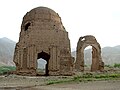 The two mausoleums of Chisht (the western was built in 1167)
 -
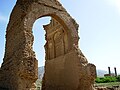 The eastern mausoleum of Chisht (built in 1194)
 -
-
 Ruins of the Shah-i Mashhad madrasa (built in 1176)
 -
 Ghurid arch in Qala-e-Bost


List of rulers
| Coinage | Titular Name(s) | Personal Name | Reign |
|---|---|---|---|
| Malik ملک |
Amir Suri امیر سوری |
9th-century – 10th-century | |
| Malik ملک |
Muhammad ibn Suri محمد بن سوری |
10th-century – 1011 | |
| As vassals of the Ghaznavid Empire | |||
| Malik ملک |
Abu Ali ibn Muhammad ابوعلی بن محمد |
1011–1035 | |
| Malik ملک |
Abbas ibn Shith عباس بن شیث |
1035 – 1060 | |
| Malik ملک |
Muhammad ibn Abbas محمد بن عباس |
1060 – 1080 | |
| Malik ملک |
Qutb al-din Hasan قطب الدین حسن |
1080 – 1100 | |
| As vassals of the Seljuk Empire | |||
| Abul-Muluk ابولملک |
Izz al-Din Husayn عز الدین حسین |
1100–1146 | |
| Malik ملک |
Sayf al-Din Suri سیف الدین سوری |
1146–1149 | |
| Malik ملک |
Baha al-Din Sam I بهاء الدین سام |
1149 | |
| Malik ملک Sultan al-Muazzam سلطان المعظم |
Ala al-Din Husayn علاء الدین حسین |
1149–1161 | |
| Malik ملک |
Sayf al-Din Muhammad سیف الدین محمد |
1161–1163 | |
._Ghiyath_al-Din_Muhammad._AH_558-599_AD_1163-1203._Baldat_Herat_mint._Dated_AH_599_(AD_1202-3).jpg)
|
Sultan Abul-Fateh سلطان ابوالفتح |
Ghiyath al-Din Muhammad غیاث الدین محمد |
1163–1203 |
![Indian coinage (Pagoda) of Mu'izz al-Din Muhammad. Obverse: Lakshmi seated facing. Reverse: śri maha/[mi]ra mahama/da sama in Devanagari.](/wiki/File:Mu%27izz_al-Din_Muhammad_bin_Sam._AH_599-602_AD_1171-1206._Pagoda_coin_with._Lakshmi_seated_facing.jpg)
|
Sultan Shahāb-ud-din Muhammad Ghori سلطان شهاب الدین محمد غوری |
Mu'izz al-Din Muhammad معز الدین محمد |
1203–1206 |
| As vassals of the Khwarazmian Empire | |||

|
Sultan سلطان |
Ghiyath al-Din Mahmud غیاث الدین محمود |
1206–1212 |
| Sultan سلطان |
Baha al-Din Sam III بهاء الدین سام |
1212–1213 | |
| Sultan سلطان |
Ala al-Din Atsiz علاء الدین دراست |
1213–1214 | |
| Sultan سلطان |
Ala al-Din Ali علاء الدین علی |
1214–1215 | |
| Khwarazmian conquest | |||
Bamiyan Branch
| Coinage | Titular Name(s) | Personal Name | Reign |
|---|---|---|---|
| Malik ملک |
Fakhr al-Din Masud فخرالدین مسعود |
1152–1163 | |
._Shams_al-Din_Muhammad._AH_558-588_AD_1163-1192.jpg)
|
Malik ملک |
Shams al-Din Muhammad ibn Masud شمس الدین محمد بن مسعود |
1163–1192 |
| Malik ملک |
Abbas ibn Muhammad عباس بن محمد |
1192 | |
._Baha%27_al-Din_Sam._AH_588-602_AD_1192-1206._Wakhsh_mint.jpg)
|
Malik ملک Abul-Mu'ayyid ابوالمؤید |
Baha al-Din Sam II بهاء الدین سام |
1192–1206 |
| As vassal of the Khwarazmian Empire | |||

|
Malik ملک |
Jalal al-Din Ali جلال الدین علی |
1206–1215 |
| Khwarazmian conquest | |||
- Green shaded row signifies Ghurid vassalage under the Khwarazmian dynasty.
Ghurid family tree
| Ghurid dynasty family tree |
|---|
|
|
See also
Notes
- ↑ The rise to power of the Ghurids at Ghur, a small isolated area located in the mountain vastness between the Ghaznavid empire and the Seljukids, was an unusual and unexpected development. The area was so remote that till the 11th century, it had remained a pagan enclave surrounded by Muslim principalities. It was converted to Islam in the early part of the 11th century after Mahmud raided it, and left teachers to instruct the Ghurids in the precepts of Islam. Even then it is believed that a variety of Mahayana Buddhism persisted in the area till the end of the century[13]
References
- ↑ Schwartzberg, Joseph E. (1978). A Historical Atlas of South Asia. Oxford University Press, Digital South Asia Library. p. 147, Map "g".
- ↑ Eaton 2019, p. 38.
- ↑ Thomas, David C. (15 May 2018). The Ebb and Flow of the Ghūrid Empire. Sydney University Press. p. 26, Figure I:2. ISBN 978-1-74332-542-1.
- ↑ Schmidt, Karl J. (20 May 2015). An Atlas and Survey of South Asian History. Routledge. p. 37, Map 16.2. ISBN 978-1-317-47681-8.
- ↑ History of Civilizations of Central Asia. UNESCO. 1 January 1998. ISBN 978-92-3-103467-1.
In 1201 Ghurid troops entered Khurasan and captured Nishapur, Merv, Sarakhs and Tus, reaching as far as Gurgan and Bistam. Kuhistan, a stronghold of the Ismailis, was plundered and all Khurasan was brought temporarily under Ghurid control
- ↑ 6.0 6.1 6.2 6.3 6.4 6.5 6.6 Bosworth 2001b, pp. 586–590.
- ↑ Turkish History and Culture in India: Identity, Art and Transregional Connections. BRILL. 17 August 2020. p. 237. ISBN 978-90-04-43736-4.
In 1205, Bakhtīyar Khilji sacked Nudiya, the pre-eminent city of western Bengal and established an Islamic government at Laukhnauti, the capital of the predecessor Sena dynasty. On this occasion, commemorative coins were struck in gold and silver in the name of Muhammad b. Sām
}} - ↑ Auer 2021, p. 6.
- ↑ 9.0 9.1 Firuzkuh: the summer capital of the Ghurids, by David Thomas, pg. 18.
- ↑ 10.0 10.1 The Grove Encyclopedia of Islamic Art & Architecture: Three-volume set, by Jonathan Bloom, Sheila Blair, pg. 108.
- ↑ The Development of Persian Culture under the Early Ghaznavids, C.E. Bosworth, Iran, Vol. 6, (1968), 35;;"Like the Ghaznavids whom they supplanted, the Ghurids had their court poets, and these wrote in Persian"
- ↑ 12.0 12.1 O'Neal 2015.
- ↑ 13.0 13.1 13.2 13.3 Satish Chandra, Medieval India:From Sultanat to the Mughals-Delhi Sultanat (1206-1526), Part 1, (Har-Anand Publications, 2006), 22.
- ↑ 14.0 14.1 The Ghurids, K.A. Nizami, History of Civilizations of Central Asia, Vol.4, Part 1, ed. M.S. Asimov and C.E. Bosworth, (Motilal Banarsidass Publishers, 1999), 178.
- ↑ Bang, Peter Fibiger; Bayly, C. A.; Scheidel, Walter (2 December 2020). The Oxford World History of Empire: Volume One: The Imperial Experience. Oxford University Press. pp. 92–94. ISBN 978-0-19-977311-4.
- ↑ 16.0 16.1 Auer 2021, p. 12.
- ↑ Flood, Finbarr B. (20 March 2018). Objects of Translation: Material Culture and Medieval "Hindu-Muslim" Encounter. Princeton University Press. p. 92. ISBN 978-0-691-18074-8.
- ↑ Avari, Burjor (2013). Islamic Civilization in South Asia: A History of Muslim Power and Presence in the Indian Subcontinent. Routledge. p. 41. ISBN 978-0-415-58061-8.
- ↑ Finbarr Barry Flood, Objects of Translation: Material Culture and Medieval "Hindu-Muslim" Encounter, (Princeton University Press, 2009), 13.
- ↑ Elphinstone, Mountstuart. The History of India. Vol. 1. J. Murray, 1841. Web. 29 Apr. 2010. Link: "...the prevalent and apparently the correct opinion is, that both they and their subjects were Afghans. " & "In the time of Sultan Mahmud it was held, as has been observed, by a prince whom Ferishta calls Mohammed Soory (or Sur) Afghan." p.598-599
- ↑ A short history of India: and of the frontier states of Afghanistan, Nipal, and Burma, Wheeler, James Talboys, (LINK): "The next conqueror after Mahmud who made a name in India, was Muhammad Ghori, the Afghan."
- ↑ Balfour, Edward. The Cyclopædia of India and of Eastern and Southern Asia, Commercial Industrial, and Scientific: Products of the Mineral, Vegetable, and Animal Kingdoms, Useful Arts and Manufactures. 3rd ed. Vol. 2. London: Bernard Quaritch, 1885. Web. 29 Apr. 2010. Link: "IZ-ud-DIN Husain, the founder of the Ghori dynaasty, was a native of Afghansitan. The origin of the house of Ghor has, however, been much discussed, – the prevailing opinion being that both they and their subjects were an Afghan race. " p.392
- ↑ 23.0 23.1 M. Longworth Dames; G. Morgenstierne; R. Ghirshman (1999). "AFGHĀNISTĀN". Encyclopaedia of Islam (CD-ROM Edition v. 1.0 ed.). Leiden, The Netherlands: Koninklijke Brill NV.
"... there is no evidence for assuming that the inhabitants of Ghūr were originally Pashto-speaking (cf. Dames, in E I1). If we are to believe the Paṭa Khazāna (see below, iii), the legendary Amīr Karōṝ, grandson of Shansab, (8th century) was a Pashto poet, but this for various reasons is very improbable ..."
- ↑ Encyclopaedia of Islam, "Ghurids", C.E. Bosworth, Online Edition, 2006: "... The Shansabānīs were, like the rest of the Ghūrīs, of eastern Iranian Tājik stock ..."
- ↑ Wink 2020, p. 78.
- ↑ Cynthia Talbot, The Last Hindu Emperor: Prithviraj Chauhan and the Indian Past, 1200-2000, (Cambridge University Press, 2016), 36.
- ↑ 27.0 27.1 Template:New Cambridge History of Islam
- ↑ Flood, Finbarr Barry (3 May 2009). Objects of Translation: Material Culture and Medieval "Hindu-Muslim" Encounter. Princeton University Press. p. 3. ISBN 978-0-691-12594-7.
- ↑ Encyclopaedia of Islam, "Ghurids", C.E. Bosworth, Online Edition, 2006: "... There is nothing to confirm the recent surmise that the Ghūids were Pashto-speaking [...] the Paṭa Khazāna "Treasury of secrets", claims to include Pashto poetry from the Ghūid period, but the significance of this work has not yet been evaluated ..."
- ↑ 30.0 30.1 Bosworth 2001a, pp. 578–583.
- ↑ Ghurids, C.E. Bosworth, Encyclopedia of Islam, Vol.2, Ed. Bernard Lewis, C. Pellat and J. Schacht, (E.J.Brill, 1991), 1100.
- ↑ Bosworth 1968, p. 163.
- ↑ Mohammad Habib (1992). "THE ASIATIC ENVIRONMENT". In Mohammad Habib; Khaliq Ahmad Nizami (eds.). A Comprehensive History of India: The Delhi Sultanat (A.D. 1206-1526). Vol. 5 (Second ed.). The Indian History Congress / People's Publishing House. p. 44. OCLC 31870180.
At this juncture Sultan Ghiyasuddin Ghuri died at Herat on 27 Jamadi I.A H 599 (13 March A.D 1203)
- ↑ C. E. Bosworth (1968), THE POLITICAL AND DYNASTIC HISTORY OF THE IRANIAN WORLD (A.D. 1000–1217), Cambridge University Press, p. 168, ISBN 978-0-521-06936-6,
The suppression of revolot in the Punjab occupied Mu'izz al-Din's closing months, for on the way back to Ghaza he was assasinated, allegedly by emmisaries of the Isma'ils whom he had often persecuted during his life time (602/1206)
- ↑ Chandra 2007, p. 73:"Muizzuddin led his last campaign into India in 1206 in order to deal with the Khokhar rebellion. He resorted to large-scale slaughter of the Khokhars and cowed them down. On his way back to Ghazni, he was killed by a Muslim fanatic belonging to a rival sect"
- ↑ 36.0 36.1 36.2 Turkish History and Culture in India: Identity, Art and Transregional Connections. BRILL. 17 August 2020. p. 237. ISBN 978-90-04-43736-4.
- ↑ 37.0 37.1 37.2 37.3 37.4 37.5 37.6 Eaton 2019, pp. 39–45.
- ↑ Asoke Kumar Majumdar 1956, pp. 131-132.
- ↑ Chandra 2007, p. 68: "In 1173, Shahabuddin, Muhammad (1173-1206 (also known as Muizzuddin Muhammad bin Sam) ascended the throne at Ghazni, while his elder brother was ruling at Ghur. Proceeding by way of the Gomal pass, Muizzuddin Muhammad conquered Multan and Uchch. In 1178, he attempted to penetrate into Gujarat by marching across the Rajputana desert. But the Gujarat ruler completely routed him in a battle near Mount Abu, and Muizzuddin Muhammad was lucky in escaping alive. He now realised the necessity of creating a suitable base in the Punjab before venturing upon the conquest of India. Accordingly he launched a campaign against the Ghaznavid possessions in the Punjab. By 1190, Muizzuddin Muhammad had conquered Peshawar, Lahore and Sialkot,and was poised fora thrust towards Delhi and the Gangetic doab"
- ↑ Bosworth 2001a.
- ↑ 41.0 41.1 Eaton, Richard M. (1993). The Rise of Islam and the Bengal Frontier, 1204–1760. Berkeley · Los Angeles · London: UNIVERSITY OF CALIFORNIA PRESS. p. Chapter 1-2.
- ↑ Hermann Kulke; Dietmar Rothermund (2004). A History of India. Psychology Press. p. 167. ISBN 978-0-415-32919-4.
"The first battle of Tarain was won by the Rajput confederacy led by Prithviraj Chauhan of Ajmer. But when Muhammad of Ghur returned the following year with 10,000 archers on horseback he vanquished Prithviraj and his army
- ↑ Chandra 2007, p. 71: "In 1194, Muizzuddin returned to India. He crossed the Jamuna with 50,000 cavalry and moved towards Kanauj. A hotly contested battle between Muizzuddin and Jaichandra was fought at Chandawar near Kanauj. We are told that Jaichandra had almost carried the day when he was killed by an arrow, and his army was totally defcated. Muizzuddin now moved on to Banaras which was ravaged, a large number of temples there being destroyed"
- ↑ Sisirkumar Mitra 1977, pp. 123-126.
- ↑ Roy, Himanshu (30 August 2021). Political Thought in Indic Civilization. SAGE Publishing India. p. 6. ISBN 978-93-5479-159-8.
After the arrival of Islam, the universities such as Nalanda and Vikramshila were no longer existent. The destruction of Nalanda by Bakhtiyar Khalji was the last nail in this pre-Islamic Indic university, which had survived three major destructions
- ↑ Koh, Tommy; Singh, Hernaikh (25 November 2020). India On Our Minds: Essays By Tharman Shanmugaratnam And 50 Singaporean Friends Of India. World Scientific. p. 91. ISBN 978-981-12-2453-9.
- ↑ Majumdar, R. C. (1973). History of Mediaeval Bengal. Calcutta: G. Bharadwaj & Co. pp. 1–2. OCLC 1031074.
Tradition gives him credit for the conquest of Bengal but as a matter of fact he could not subjugate the greater part of Bengal ... All that Bakhtyār can justly take credit for is that by his conquest of Western and a part of Northern Bengal he laid the foundation of the Muslim State in Bengal. The historians of the 13th century never attributed the conquest of the whole of Bengal to Bakhtyār.
- ↑ Mehta, Jaswant Lal (1986) [First published 1979]. Advanced Study in the History of Medieval India. Vol. I (2nd ed.). Sterling Publishers. pp. 81–82. ISBN 978-81-207-0617-0. OCLC 883279992.
The Turkish arms penetrated into Bihar and Bengal, through the enterprising efforts of Ikhtiyaruddin Muhammad bin Bakhtiyar Khalji ... he started plundering raids into Bihar and, within four or five years, occupied a large part of it ... Nadia was sacked by the Turks and a few districts of Bengal (Malda, Dinajpur, Murshidabad and Birbhum) were occupied by them ... Bathtiyar Khalji could not retain his hold over Nadia and made Lakhnauti or Gaur as his capital.
- ↑ Thakur, Amrendra Kumar (1992). India and the Afghans: A study of a neglected region, 1370-1576 A.D. p. 148. ISBN 9788185078687.
- ↑ K. A. Nizami (1992). "The Early Turkish Sultans of Delhi". In Mohammad Habib; Khaliq Ahmad Nizami (eds.). A Comprehensive History of India: The Delhi Sultanat (A.D. 1206-1526). Vol. 5 (Second ed.). The Indian History Congress / People's Publishing House. p. 201. OCLC 31870180.
- ↑ Nafziger, George F.; Walton, Mark W. (2003). Islam at War: A History. Praeger Publishers. p. 56. ISBN 9780275981013.
- ↑ Chandra, Satish (2004). Medieval India: From Sultanat to the Mughals-Delhi Sultanat (1206-1526) - Part One. Har-Anand Publications. pp. 43–44. ISBN 978-81-241-1064-5.
- ↑ Ira M. Lapidus, A History of Islamic Societies 2nd ed. Cambridge University Press 2002
- ↑ Persian Literature in the Safavid Period, Z. Safa, The Cambridge history of Iran: The Timurid and Safavid periods, Vol.6, Ed. Peter Jackson and Laurence Lockhart,(Cambridge University Press, 1986), 951;"...Ghurids and Ghurid mamluks, all of whom established centres in India where poets and writers received ample encouragement.".
- ↑ Hambly & Asher 1994, pp. 242–250.
- ↑ Auer 2021, p. 30.
- ↑ 57.0 57.1 Avari, Burjor (2013). Islamic Civilization in South Asia: A History of Muslim Power and Presence in the Indian Subcontinent. Routledge. p. 41. ISBN 978-0-415-58061-8.
- ↑ Eaton 2019, pp. 48–49.
Sources
- Auer, Blain (2021). In the Mirror of Persian Kings: The Origins of Perso-Islamic Courts and Empires in India. Cambridge University Press. ISBN 978-1108832311.
- Template:Cambridge History of Iran (subscription required)
- Bosworth, C. Edmund (2001a). "Ghaznavids". Encyclopædia Iranica, online edition, Vol. X, Fasc. 6. New York. pp. 578–583.
{{cite encyclopedia}}: CS1 maint: location missing publisher (link) - Bosworth, C. Edmund (2001b). "Ghurids". Encyclopædia Iranica, online edition, Vol. X, Fasc. 6. New York. pp. 586–590.
{{cite encyclopedia}}: CS1 maint: location missing publisher (link) - Eaton, Richard M. (2019). India in the Persianate Age: 1000-1765. Allen Lane. ISBN 978-0713995824.
- Frye, R.N. (1975). "The Ghaznavids and Ghūrids". In Frye, R.N. (ed.). The Cambridge History of Iran, Volume 5: The Iranian world. Cambridge: Cambridge University Press. pp. 157–165. ISBN 0-521-20093-8.
- Template:Encyclopaedia Iranica
- Morgan, David; Stewart, Sarah, eds. (2017). The Coming of the Mongols. Bloomsbury Publishing. ISBN 978-1788312851.
- Niyogi, Roma (1959). The History of the Gāhaḍavāla Dynasty. Oriental. OCLC 5386449.
- O'Neal, Michael (2015). "Ghūrids". In Fleet, Kate; Krämer, Gudrun; Matringe, Denis; Nawas, John; Rowson, Everett (eds.). Encyclopaedia of Islam, THREE. Brill Online. ISSN 1873-9830.
- Sisirkumar Mitra (1977). The Early Rulers of Khajurāho. Motilal Banarsidass. ISBN 9788120819979.
- Wink, André (2020). The Making of the Indo-Islamic World: c.700–1800 CE. Cambridge University Press. ISBN 978-1108417747.
- Chandra, Satish (2007). History of Medieval India:800-1700. Orient Longman. ISBN 978-81-250-3226-7.
Further reading
- Patel, Alka (2021). Iran to India: The Shansabānīs of Afghanistan, c. 1145-1190 CE. Edinburgh University Press. ISBN 978-1474482226.