



->Arif80s Adding/removing category/ies |
robot: Update article (please report if you notice any mistake or error in this edit) |
||
| Line 1: | Line 1: | ||
{{Short description|Indian revolutionary (1895–1915)}} | {{Short description|Indian revolutionary Hero (1895–1915)}} | ||
{{Use dmy dates|date= | {{Use dmy dates|date=March 2022}} | ||
{{Use Indian English|date=July 2016}} | {{Use Indian English|date=July 2016}} | ||
{{Infobox person | {{Infobox person | ||
| Line 14: | Line 14: | ||
}} | }} | ||
'''Basanta Kumar Biswas''' (6 February 1895 – 11 May 1915) was an Indian pro-independence activist involved in the [[Jugantar]] group who, in December 1912, | '''Basanta Kumar Biswas''' (6 February 1895 – 11 May 1915) was an Indian pro-independence activist involved in the [[Jugantar]] group who, in December 1912, played a role in the bombing of the [[Viceroy]]'s parade in what came to be known as the [[Delhi-Lahore Conspiracy]]. | ||
== Early life | Biswas was one of the illustrious names of the early pro independence activists of Bengal and the entire country. He was expert in bomb making and was initiated into [[Revolutionary movement for Indian independence|revolutionary movement]] by [[Jugantar]] leaders [[Amarendra Chatterjee|Amarendranath Chattopadhyaya]] and [[Rash Behari Bose]].<ref name=":3" /><ref name=":2" /><ref>{{Cite web |last=আনন্দ |first=ওয়েব ডেস্ক, এবিপি |date=2021-08-04 |title=২০ বছরেই উঠেছিলেন ফাঁসির মঞ্চে, অকুতোভয় বসন্ত কুমার বিশ্বাসের স্মৃতি ছড়িয়ে সুদূর টোকিওতেও |url=https://bengali.abplive.com/news/know-the-story-of-freedom-fighter-basanta-kumar-biswas-on-independence-day-827229 |access-date=2022-03-15 |website=bengali.abplive.com |language=bn}}</ref> | ||
Basanta Kumar Biswas was born on 6 February 1895 at Poragacha in [[Nadia district]] of West Bengal, to Matilal and Kunjabala Biswas. He | |||
== Early life == | |||
Basanta Kumar Biswas was born on 6 February 1895 at Poragacha in [[Nadia district]] of West Bengal, to Matilal and Kunjabala Biswas. He belonged to the family of freedom fighter Digamabar Biswas, an active leader of the [[Indigo revolt]] (''Nil Bidroha'') and freedom fighter Manmathnath Biswas was his cousin. He started his schooling in M. I. School in nearby village Madhavpur with his cousin Manmathnath Biswas. In 1906, Basanta was moved to Muragacha school. Under the guidance of Khirodh Chandra Ganguly, Head teacher of Muragacha school, Basanta started his journey of freedom fight.<ref>{{Cite book|last=Sampad Narayan Dhar|title=Sahid Basanta Kumar Biswas & Delhi-Lahore Conspiracy Case|publisher=Kalinagar Co-Operative Colony & Credit Society Ltd.|language=Bengali}}</ref> He started to work on his own at a very young age, sent to Puri, and eventually went to [[Benaras]], where he stayed at Ramkrishna Mission in 1910. Next year he met [[Rash Behari Bose]] in [[Dehradun]] and was recruited by him. Bose trained him in arms and bombs, often called him Bishe.<ref name=":0">{{Cite web|last=Vol. 44, No. 45, 20–26 May 2012|first=Frontier|title=Calcutta Notebook|url=http://www.frontierweekly.com/archive/vol-number/vol/vol-44-2011-12/vol-44-45/cnb-44-45.pdf|access-date=26 February 2022|website=frontierweekly.com}}</ref><ref name=":2" /> | |||
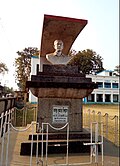
[[File:Basanta Kumar Biswas memorial.jpg|thumb|Memorial of Basanta Kumar Biswas beside his house at [[Poragacha]] village of [[Nadia district]] in [[West Bengal]]]] | [[File:Basanta Kumar Biswas memorial.jpg|thumb|Memorial of Basanta Kumar Biswas beside his house at [[Poragacha]] village of [[Nadia district]] in [[West Bengal]]]] | ||
==Revolutionary activities== | ==Revolutionary activities== | ||
On 23 December 1912, | Basanta Kumar Biswas was a member of [[Jugantar group]], known for his organization skills and was an important intermediary between Calcutta office of Jugantar and the 'co-conspirators' in [[Chandannagar]].<ref name=":2">{{Cite book |last=Samaddar |first=Ranabir |url=https://books.google.com/books?id=LDzgNhV3tHEC |title=The Materiality of Politics: Volume 1: The Technologies of Rule |date=2007-08-01 |publisher=Anthem Press |isbn=978-1-84331-765-4 |pages=76–77 |language=en}}</ref> Biswas was part of a conspiracy to bomb the Viceroy's parade in [[Delhi]]. On 23 December 1912, the revolutionaries threw a bomb at [[Charles Hardinge]], who was riding with his wife on an elephant during a procession at [[Chandni Chowk]]. Hardinge escaped with flesh wounds, but the servant behind him holding his parasol was killed.<ref>{{cite web |url=http://ajumukhopadhyay.com/Articles-Partition_of_Bengal.html |title=Archived copy |access-date=9 February 2006 |url-status=dead |archive-url=https://web.archive.org/web/20070312085704/http://ajumukhopadhyay.com/Articles-Partition_of_Bengal.html |archive-date=12 March 2007 }}</ref> The authors of the deed remained obscure for many months despite the state's intense investigation, and lucrative reward.<ref name="executedtoday.com">{{cite web|url=http://www.executedtoday.com/2015/05/11/1915-basanta-kumar-biswas-bomber/|title=ExecutedToday.com}}</ref> Apparently Biswas, dressed in a burqa, threw the bomb from the terrace of the then Punjab National Bank building in Chandni Chowk, Delhi.<ref name=":1">{{Cite web |date=2015-05-12 |title=The forgotten martyrs of freedom struggle |url=https://www.deccanherald.com/content/477149/forgotten-martyrs-freedom-struggle.html |access-date=2022-03-15 |website=Deccan Herald |language=en}}</ref><ref>{{Cite book |last=Sengupta |first=Nitish K. |url=https://books.google.com/books?id=kVSh_TyJ0YoC&dq=basanta+kumar+biswas&pg=PA329 |title=Land of Two Rivers: A History of Bengal from the Mahabharata to Mujib |date=2011 |publisher=Penguin Books India |isbn=978-0-14-341678-4 |pages=329 |language=en}}</ref><ref>{{Cite web |title=Biswas, Basanta Kumar - Banglapedia |url=https://en.banglapedia.org/index.php/Biswas,_Basanta_Kumar |access-date=2022-03-15 |website=en.banglapedia.org}}</ref> | ||
Biswas was arrested on 26 February 1914 at Poragachha, Nadia while he went to perform the last rites for his father. The trial, which came to be called the [[Delhi Conspiracy Case|Delhi-Lahore Conspiracy Case]], began on 23 May 1914 in Delhi; [[Amir Chand]], Abadh Behari, and [[Bhai Balmukund]], were condemned to death in the trial, and Basanta Biswas was found guilty but initially sentenced to life imprisonment as he was just seventeen years of old.<ref name="executedtoday.com" /><ref name=":1" /><ref>{{Cite book |last=Anand |first=Anita |url=https://books.google.com/books?id=HjleDwAAQBAJ&dq=basanta+kumar+biswas&pg=PP66 |title=The Patient Assassin: A True Tale of Massacre, Revenge and the Raj |date=2019-04-04 |publisher=Simon & Schuster UK |isbn=978-1-4711-7423-0 |language=en}}</ref> | |||
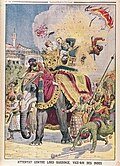
[[File:Attempt_to_assassinate_Lord_Hardinge_at_Chadni_Chowk,_Delhi,_1912._A_Le_Journal_illustration.jpg|thumb|Attempt to assassinate Lord Hardinge at Chadni Chowk, Delhi, 1912. A Le Journal illustration.]] | [[File:Attempt_to_assassinate_Lord_Hardinge_at_Chadni_Chowk,_Delhi,_1912._A_Le_Journal_illustration.jpg|thumb|Attempt to assassinate Lord Hardinge at Chadni Chowk, Delhi, 1912. A Le Journal illustration.]] | ||
An [[appeal]] was formulated at [[Lahore High Court]]. The Crown won its appeal and Biswas was sentenced to be hanged. | An [[appeal]] was formulated at [[Lahore High Court]]. The Crown won its appeal and Biswas was sentenced to be hanged.<ref>{{Cite news|agency=Press Trust of India|date=8 May 2014|title=Tributes to martyrs of Hardinge Bomb Case|work=Business Standard India|url=https://www.business-standard.com/article/pti-stories/tributes-to-martyrs-of-hardinge-bomb-case-114050801065_1.html|access-date=26 February 2022}}</ref> | ||
Basanta Kumar Biswas was hanged on 11 May 1915 at Ambala Central Jail in [[Punjab (British India)|Punjab]] aged twenty and became one of the youngest people to be executed during the Indian revolutionary struggles during the 20th century. | Basanta Kumar Biswas was hanged on 11 May 1915 at Ambala Central Jail in [[Punjab (British India)|Punjab]] aged twenty and became one of the youngest people to be executed during the Indian revolutionary struggles during the 20th century.<ref name=":3">{{Cite news|last=Smith|first=R. v|date=15 May 2017|title=The "mutiny swansong"|language=en-IN|work=The Hindu|url=https://www.thehindu.com/news/cities/Delhi/the-mutiny-swansong/article18454944.ece|access-date=26 February 2022|issn=0971-751X}}</ref><ref>{{Cite news|others=PTI|date=9 May 2016|title=Delhi remembers Hardinge bomb case martyrs|language=en-IN|work=The Hindu|url=https://www.thehindu.com/news/cities/Delhi/delhi-remembers-hardinge-bomb-case-martyrs/article8574119.ece|access-date=26 February 2022|issn=0971-751X}}</ref> | ||
==Legacy== | ==Legacy== | ||
There is a statue of Basanta Biswas established by Rasbihari Basu in a park of [[Tokyo, Japan]]. Another statue is situated in front of Rabindra Bhawan, [[Krishnanagar, Nadia]].<ref>{{Cite book|title=Basanta Biswas noy, Bishe Das(Bengali)| | There is a statue of Basanta Biswas established by Rasbihari Basu in a park of [[Tokyo, Japan]]. Another statue is situated in front of Rabindra Bhawan, [[Krishnanagar, Nadia]].<ref>{{Cite book|title=Basanta Biswas noy, Bishe Das (Bengali)|last1=Narayan |first1=Sanyal |last2=Chakraborty |first2=Sudhir |publisher=Krishnanagar College Magazine, Patrika Parishad |year=1973 |location=Krishnanagar}}</ref> A school in [[Civil Lines, Delhi|civil lines]], Delhi was named "Shaheed Basant Kumar Biswas Sarvodaya Vidhyalaya" in his memory. Although it was later renamed to Rajkiya Pratibha Vikas Vidhyalaya. Loka Sabha Speaker [[Meira Kumar]] has installed a photo of Basanta Kumar at the Museum of the [[Parliament of India|Indian Parliament]]. [[Ujjal Biswas]], an Indian politician and the present Minister in the [[Government of West Bengal]] belongs to the family of Basanta Biswas.<ref>{{cite web|url=http://www.kolkatabengalinfo.com/2011/04/ujjwal-biswas-tmc-leader-profile-family.html|title=Ujjwal Biswas TMC Leader Profile Family Education Career Life & Background Ujjwal Biswas - Kolkata Bengal Information|author=S Kumar|work=kolkatabengalinfo.com}}</ref> | ||
==See also== | |||
* [[Indian National Army]] | |||
* [[Arzi Hukumate Azad Hind]] | |||
== | ==References== | ||
{{Reflist}} | {{Reflist|2}} | ||
==External links== | ==External links== | ||
| Line 38: | Line 46: | ||
* [https://web.archive.org/web/20060529165624/http://www.aicc.org.in/india%E2%80%99s_struggle_for_freedom.php AICC website article] | * [https://web.archive.org/web/20060529165624/http://www.aicc.org.in/india%E2%80%99s_struggle_for_freedom.php AICC website article] | ||
{{Anushilan Samiti}} | {{Anushilan Samiti}} | ||
{{Indian Revolutionary Movement}} | {{Indian Revolutionary Movement}} | ||
| Line 50: | Line 53: | ||
[[Category:1915 deaths]] | [[Category:1915 deaths]] | ||
[[Category:Anushilan Samiti]] | [[Category:Anushilan Samiti]] | ||
[[Category:Revolutionary movement for Indian independence]] | [[Category:Revolutionary movement for Indian independence]] | ||
[[Category:Indian revolutionaries]] | [[Category:Indian revolutionaries]] | ||
| Line 56: | Line 58: | ||
[[Category:20th-century executions by the United Kingdom]] | [[Category:20th-century executions by the United Kingdom]] | ||
[[Category:People executed by British India by hanging]] | [[Category:People executed by British India by hanging]] | ||
[[Category:Indian independence activists from West Bengal]] | [[Category:Indian independence activists from West Bengal]] | ||
[[Category:People from Nadia district]] | |||
Revision as of 20:23, 10 May 2022
Basanta Kumar Biswas | |
|---|---|
 | |
| Born | 6 February 1895 |
| Died | 11 May 1915 (aged 20) |
| Organization | Jugantar |
| Movement | Indian Independence movement |
Basanta Kumar Biswas (6 February 1895 – 11 May 1915) was an Indian pro-independence activist involved in the Jugantar group who, in December 1912, played a role in the bombing of the Viceroy's parade in what came to be known as the Delhi-Lahore Conspiracy.
Biswas was one of the illustrious names of the early pro independence activists of Bengal and the entire country. He was expert in bomb making and was initiated into revolutionary movement by Jugantar leaders Amarendranath Chattopadhyaya and Rash Behari Bose.[1][2][3]
Early life
Basanta Kumar Biswas was born on 6 February 1895 at Poragacha in Nadia district of West Bengal, to Matilal and Kunjabala Biswas. He belonged to the family of freedom fighter Digamabar Biswas, an active leader of the Indigo revolt (Nil Bidroha) and freedom fighter Manmathnath Biswas was his cousin. He started his schooling in M. I. School in nearby village Madhavpur with his cousin Manmathnath Biswas. In 1906, Basanta was moved to Muragacha school. Under the guidance of Khirodh Chandra Ganguly, Head teacher of Muragacha school, Basanta started his journey of freedom fight.[4] He started to work on his own at a very young age, sent to Puri, and eventually went to Benaras, where he stayed at Ramkrishna Mission in 1910. Next year he met Rash Behari Bose in Dehradun and was recruited by him. Bose trained him in arms and bombs, often called him Bishe.[5][2]

Revolutionary activities
Basanta Kumar Biswas was a member of Jugantar group, known for his organization skills and was an important intermediary between Calcutta office of Jugantar and the 'co-conspirators' in Chandannagar.[2] Biswas was part of a conspiracy to bomb the Viceroy's parade in Delhi. On 23 December 1912, the revolutionaries threw a bomb at Charles Hardinge, who was riding with his wife on an elephant during a procession at Chandni Chowk. Hardinge escaped with flesh wounds, but the servant behind him holding his parasol was killed.[6] The authors of the deed remained obscure for many months despite the state's intense investigation, and lucrative reward.[7] Apparently Biswas, dressed in a burqa, threw the bomb from the terrace of the then Punjab National Bank building in Chandni Chowk, Delhi.[8][9][10]
Biswas was arrested on 26 February 1914 at Poragachha, Nadia while he went to perform the last rites for his father. The trial, which came to be called the Delhi-Lahore Conspiracy Case, began on 23 May 1914 in Delhi; Amir Chand, Abadh Behari, and Bhai Balmukund, were condemned to death in the trial, and Basanta Biswas was found guilty but initially sentenced to life imprisonment as he was just seventeen years of old.[7][8][11]

An appeal was formulated at Lahore High Court. The Crown won its appeal and Biswas was sentenced to be hanged.[12]
Basanta Kumar Biswas was hanged on 11 May 1915 at Ambala Central Jail in Punjab aged twenty and became one of the youngest people to be executed during the Indian revolutionary struggles during the 20th century.[1][13]
Legacy
There is a statue of Basanta Biswas established by Rasbihari Basu in a park of Tokyo, Japan. Another statue is situated in front of Rabindra Bhawan, Krishnanagar, Nadia.[14] A school in civil lines, Delhi was named "Shaheed Basant Kumar Biswas Sarvodaya Vidhyalaya" in his memory. Although it was later renamed to Rajkiya Pratibha Vikas Vidhyalaya. Loka Sabha Speaker Meira Kumar has installed a photo of Basanta Kumar at the Museum of the Indian Parliament. Ujjal Biswas, an Indian politician and the present Minister in the Government of West Bengal belongs to the family of Basanta Biswas.[15]
See also
References
- ↑ 1.0 1.1 Smith, R. v (15 May 2017). "The "mutiny swansong"". The Hindu. ISSN 0971-751X. Retrieved 26 February 2022.
- ↑ 2.0 2.1 2.2 Samaddar, Ranabir (1 August 2007). The Materiality of Politics: Volume 1: The Technologies of Rule. Anthem Press. pp. 76–77. ISBN 978-1-84331-765-4.
- ↑ আনন্দ, ওয়েব ডেস্ক, এবিপি (4 August 2021). "২০ বছরেই উঠেছিলেন ফাঁসির মঞ্চে, অকুতোভয় বসন্ত কুমার বিশ্বাসের স্মৃতি ছড়িয়ে সুদূর টোকিওতেও". bengali.abplive.com (in Bengali). Retrieved 15 March 2022.
{{cite web}}: CS1 maint: multiple names: authors list (link) - ↑ Sampad Narayan Dhar. Sahid Basanta Kumar Biswas & Delhi-Lahore Conspiracy Case (in Bengali). Kalinagar Co-Operative Colony & Credit Society Ltd.
- ↑ Vol. 44, No. 45, 20–26 May 2012, Frontier. "Calcutta Notebook" (PDF). frontierweekly.com. Retrieved 26 February 2022.
{{cite web}}: CS1 maint: multiple names: authors list (link) CS1 maint: numeric names: authors list (link) - ↑ "Archived copy". Archived from the original on 12 March 2007. Retrieved 9 February 2006.
{{cite web}}: CS1 maint: archived copy as title (link) - ↑ 7.0 7.1 "ExecutedToday.com".
- ↑ 8.0 8.1 "The forgotten martyrs of freedom struggle". Deccan Herald. 12 May 2015. Retrieved 15 March 2022.
- ↑ Sengupta, Nitish K. (2011). Land of Two Rivers: A History of Bengal from the Mahabharata to Mujib. Penguin Books India. p. 329. ISBN 978-0-14-341678-4.
- ↑ "Biswas, Basanta Kumar - Banglapedia". en.banglapedia.org. Retrieved 15 March 2022.
- ↑ Anand, Anita (4 April 2019). The Patient Assassin: A True Tale of Massacre, Revenge and the Raj. Simon & Schuster UK. ISBN 978-1-4711-7423-0.
- ↑ "Tributes to martyrs of Hardinge Bomb Case". Business Standard India. Press Trust of India. 8 May 2014. Retrieved 26 February 2022.
- ↑ "Delhi remembers Hardinge bomb case martyrs". The Hindu. PTI. 9 May 2016. ISSN 0971-751X. Retrieved 26 February 2022.
{{cite news}}: CS1 maint: others (link) - ↑ Narayan, Sanyal; Chakraborty, Sudhir (1973). Basanta Biswas noy, Bishe Das (Bengali). Krishnanagar: Krishnanagar College Magazine, Patrika Parishad.
- ↑ S Kumar. "Ujjwal Biswas TMC Leader Profile Family Education Career Life & Background Ujjwal Biswas - Kolkata Bengal Information". kolkatabengalinfo.com.
External links
| Anushilan Samiti |
|---|
 |
| Influence |
| Anushilan Samiti |
| Notable events |
| Related topics |
- Pages using the JsonConfig extension
- 1895 births
- 1915 deaths
- Anushilan Samiti
- Revolutionary movement for Indian independence
- Indian revolutionaries
- Executed Indian people
- 20th-century executions by the United Kingdom
- People executed by British India by hanging
- Indian independence activists from West Bengal
- People from Nadia district