Tags: Mobile edit Mobile web edit |
|
| Line 1: |
Line 1: |
| {{Distinguish|Dances of Manipur}}
| | #REDIRECT [[Manipuri Raas Leela]] |
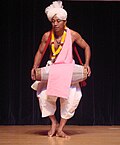
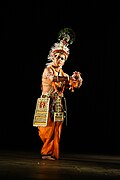
| [[File:A Manipuri Dancer in traditional Krishna attire.jpg|thumb|220px|A Manipuri dancer]] | |
| '''Manipuri dance''' ({{lang-mni|ꯃꯅꯤꯄꯨꯔꯤ ꯖꯒꯣꯏ}}), originally known as '''Manipuri Rasa Leela Dance''' ({{lang-mni|ꯃꯅꯤꯄꯨꯔꯤ ꯔꯥꯁ ꯂꯤꯂꯥ ꯖꯒꯣꯢ}}) is a classical dance form originated from the [[Manipuri culture]] of the [[States of India|Indian state]] of [[Manipur]].<ref>https://www.britannica.com/art/manipuri</ref><ref>http://www.e-pao.net/epSubPageExtractor.asp?src=manipur.Arts_and_Culture.Ras_Lila_Manipuri_Classical_Dance</ref> The classical style of the dance is described as being the most graceful of all the Indian classical dances. [[Rabindranath Tagore]] used the style for his female characters in his famous dance dramas.<ref>{{Cite web
| |
| |url=http://manipuri.20m.com/history_of_manipuri_dance.html
| |
| |title=History of Manipuri Dance
| |
| |work=manipuri.20m.com
| |
| |accessdate=28 August 2010
| |
| |archive-date=3 October 2010
| |
| |archive-url=https://web.archive.org/web/20101003020350/http://manipuri.20m.com/history_of_manipuri_dance.html
| |
| |url-status=dead
| |
| }}</ref>
| |
|
| |
|
| Manipur shares a border with [[Burma]]. The people of Manipur are part of the Mongoloid group, with a very rich and artistic culture.
| | {{Redirect category shell| |
| | | {{R from move}} |
| ==Description==
| | }} |
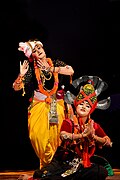
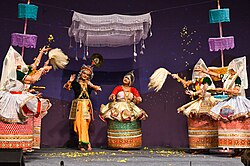
| [[File:Rasa Lila in Manipuri dance style.jpg|thumb|left|Rasa Leela in Manipuri dance style.]]
| |
| | |
| The ''Rasalila'' of Manipur is said to be one of the highlights of India culture. It is through the [[Rasalila]] that the people of Manipur reach the highest bliss of worship. Following the ''Srimadbhagavata'', the core text of Chaitanite Vaishnavism, the first ''Rasalila Maharas'' was composed in 1779. The story as laid down in the [[Bhagavata]] was performed in the temple. A ''Rasamandali'', a circular dance area, was built outside the temple and people sat around it to watch the ''Rasalila''. This still happens in the Govindaji temple beside the Palace of the Kings. The success of this ''Rasalila'' made Raja Bhagyachandra (ruler from 1755 to 1789) try composing other Rasalilas such as the ''Vasantarasa'' and ''Kunjarasa''. The ''Nityaras'' and ''Divarasa'' are later developments of the Rasalila. The performances of the ''Maharasa'', ''Vasantarasa'' and ''Kunjarasa'' are fixed in the year, but ''Nityarasa'' can be performed at anytime of the year. Later kings continued to develop and compose dances. Raja Gambhir Singh (1781–1833) introduced acting the stories of child Krishna in Goparasa and Udukhalrasa. The time of Raja Chandrakirti (1831–1886)<ref>{{Cite web
| |
| |url=http://uqconnect.net/~zzhsoszy/ips/m/manipur.html
| |
| |title=MANIPUR
| |
| |work=uqconnect.net
| |
| |accessdate=28 August 2010
| |
| }}</ref> can claim to be the golden age of the evolution of Manipuri dance.
| |
| | |
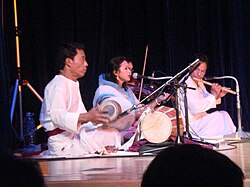
| Other dances of Manipur are performed during festivals like ''Rathayatra'', ''Holi'', and ''Kwakjatra''. All these dances are about religious devotion. The songs that are sung with these dances speak of the glory of Radha & Krishna. The main instruments are the Pung and flute.
| |
| | |
| == Technique ==
| |
| The technique of Manipuri dance is probably the most graceful of all the classical dances of India. The body follows the path of 8 and the feet movements generate light touch on the ground. The face has a subdued expression while the eyes mostly express the ''bhaktirasa'' or the emotion of devotion. There are two styles of this dance form: the ''tandava'' and the ''lasya''. In ''tandava'', we have the ''Cholom tandava'' done by men and the Krishna ''tandava'', which is a counterpart of the ''lasya'' technique in ''Rasalila''. The lasya is a very graceful style in Manipur. Rabindranath Tagore used this technique for the female characters in his dance dramas.
| |
| | |
| The [[emotion]]al part of this dance form follows the rasa theory as written in the Vaishnava texts. The ''pancharasa''- ''shanta'', ''dasya'', ''sakhya'', ''vatsalya'' and ''madhura''- are the main emotions on which the Vaishnavite Manipuri Dance is based.
| |
| | |
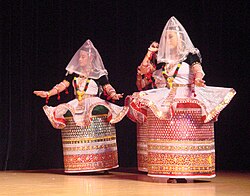
| Manipur stands apart from all the Indian Classical dances for the beautiful costumes of the Rasalila, which is a unique creation of the people of Manipur. Religion and art have merged completely in the making of dance in Manipur. Even today one cannot identify Manipuri dance without the presence of the gods Krishna and Radha.
| |
| ==Development==
| |
| === Lai Haraoba as a reference===
| |
| {{See|Lai Haraoba}}
| |
| The oldest form of dance is found in the [[Lai Haraoba]] festival. The word ''Lai'' means [[God]], and the word ''Haraoba'' means merrymaking.<ref name=rang>{{Cite web
| |
| |url=http://www.ranganiketan.com/index_files/Repertoire.htm
| |
| |title=Repertoire
| |
| |work=ranganiketan.com
| |
| |accessdate=28 August 2010
| |
| }}</ref> [[Lai Haraoba]] means merrymaking of the gods. The festival generally lasts for a month and is held every year in the months of May and June. The Maibi community holds the [[Lai Haraoba]] festival. Maibis are female [[priest]]s, although there a some male priests too. There are specific [[ritual]]s that the maibis follow during the festival. They dance and worship the [[forest]] gods, called the ''[[Umang Lai]]''.<ref name=rang /> There are also household gods, for example the ''[[Sanamahi]]'' or ''[[Panthoibi]]''. All these gods are worshipped in the [[Lai Haraoba]] festival. The Maibis dance and show the formation of earth and life. They use 364 hand gestures to show this. During the festival the people of [[Manipur]] sing, dance, act, play instruments and play sports. The rituals are pre-determined and all the village people participate.
| |
| | |
| The instrument used in [[Lai Haraoba]] is called the ''[[Pena (musical instrument)]]''. It is a very special instrument of [[Manipur]]. It is played by the ''Pena Khongba'', and the tune is believed to put the Lai to sleep or used to wake him up. Other tunes are also played for the dances. The story of [[Khuman Khamba]] and [[Moirang Thoibi]] are played here. The other stories have characters such as the [[Nongpok Ningthou]] and [[Panthoibi]]. These are basically love stories. The characters are often identified with the [[Hinduism|Hindu]] Gods [[Shiva]] and [[Parvati]]. Though mostly based on nature worship, according to the Manipuri scholars, this festival has elements of [[Tantra|Tantric]] Cults.
| |
| | |
| === Martial arts as a reference===
| |
| The very popular martial art of Manipur, ''Thangpak'', is also a part of this festival, with performances of sword and spear play.<ref name=rang /> Many movements of ''Thangpak'' are also part of the dances of Manipur. For example, the popular ''Khujengleibi'' movement in dance is found in the sword technique.
| |
| | |
| == Vaishnavism ==
| |
| In the [[18th century]], Manipur came under the influence of Chaitanite Vaishnavism which was a branch of Hinduism. Vaishnavism made its entry in Manipur during the reign of King Charairongba. During the rule of Raja Bhagyachandra, Chaitanite Vaishnavism became a permanent part of Manipur's culture. The Raja joined this religion and his subjects followed him. Many parts of daily life changed with Vaishnavism; the rituals of Vaishnavism were followed very closely by the community. The gods of the religion, [[Krishna]] and [[Radha]] were worshipped and [[temple]]s were built all over Manipur. The people started worshipping the gods with dance. There were two kinds of dance that developed with the influence of this religion: the ''Samkirtana'' and the ''Rasalila''.
| |
| | |
| == Samkirtana ==
| |
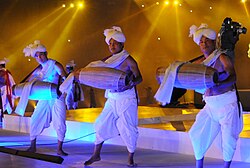
| [[File:Pung cholom performer, Manipur.jpg|thumb|220px|A "Pung Cholom" performer]]
| |
| ''Samkirtana'' is basically a male dance form in which the performers play instruments, sing and dance.<ref>{{cite book |last=Goswami |first= Saurabh Goswami |author2= Thielemann, Selina |title= Music and fine arts in the devotional traditions of India: worship through beauty |publisher=S.B. Nangia |location=New Dehli |date=2005 |pages=23 |isbn= 8176488119 |url=https://books.google.com.au/books?id=xEnT57bbZG8C&pg=PA23&lpg=PA23&dq=samkirtana%2Bdance&source=bl&ots=xFCOy7kAuq&sig=cJlopH2-i3eQ97r_Z8zmGDTtEr0&hl=en&ei=OYB4TL-BHI2-cZa9md4F&sa=X&oi=book_result&ct=result&resnum=2&ved=0CBwQ6AEwAQ#v=onepage&q=samkirtana%2Bdance&f=false |accessdate=August 28, 2010 |language= English}}</ref> This follows the lines of the Samkirtana as shown by Chaitanya Mahaprabhu in [[Bengal]]. In Manipur it has a very rich dance element along with singing and playing instruments. It is an energetic and [[acrobat]]ic dance.<ref name=rang /> The main instrument is a wooden drum, the ''[[Pung]]'', which looks like the clay ''[[Khol]]'' of Bengal.<ref name=rang /> The sounds naturally vary. The dance with the ''Pung'', called the ''Pung Cholom'', is part of the ''Samkirtana'' in Manipur. The ''Cholom'' is a male dance form of Manipur. The name probably comes from the word ''Chalan'', meaning way of movement. There is also the ''Kartal Cholom'', where the movements are more grand and follow the sound and playing of the big [[cymbal]]s, the ''[[Kartalas]]''. The singing, called the ''ishei'', follows the kirtana style of Bengal. Singers use a trembling tone which is typical of the Manipuri style of singing. The talas (rhythm patterns) used have an immense variety. There are 64 different talas for the Pung. These rhythmic patterns are also used in interesting combinations. The costumes are white, but the [[turban]]s vary with the instrument players. The ''Samkirtana'' is performed at all major occasions in the society, such as birth ceremonies, weddings, and [[funeral]]s. It is even performed before the beginning of the ''Rasalila''.
| |
| | |
| | |
| == Other websites ==
| |
| * [http://www.vrindavan.de/rasadance.htm The Rasa Lila Dance]
| |
| | |
| {{Commons category|Manipuri dance}}
| |
| | |
| == References ==
| |
| {{reflist}}
| |
| [[Category:Jagoi]]
| |
| [[Category:Manipur]]
| |
| [[Category:Dance types]]
| |
| {{simple-Wikipedia}}
| |



 This page is a redirect. The following categories are used to track and monitor this redirect: