

CleanupBot (talk | contribs) m →top: robot: remove incorrect protection templates |
robot: Update article |
||
| Line 1: | Line 1: | ||
{{short description|Founder of Buddhism}} | {{short description|Founder of Buddhism}} | ||
{{redirect-multi|2|Buddha|Gautama}} | {{redirect-multi|2|Buddha|Gautama}}{{pp-move-indef}} | ||
{{pp-protected|reason=restore protection setting that were lost due to recent full-protection; persistent target of disruptive editing|small=yes}} | |||
{{ | |||
{{EngvarB|date=February 2015}} | {{EngvarB|date=February 2015}} | ||
{{Use dmy dates|date= | {{Use dmy dates|date=March 2022}} | ||
{{Infobox religious biography | {{Infobox religious biography | ||
| other_names = Shakyamuni ("Sage of the [[Shakya]]s") | | other_names = Shakyamuni ("Sage of the [[Shakya]]s") | ||
| image = Buddha in Sarnath Museum (Dhammajak Mutra).jpg | | image = Buddha in Sarnath Museum (Dhammajak Mutra).jpg | ||
| caption = | | caption = [[Buddha Preaching his First Sermon (Sarnath)|Statue of Gautama Buddha]], preaching his first sermon at [[Sarnath]]; B(b) 181, [[Sarnath Museum|Archaeological Museum Sarnath]], Gupta period, ca. 475 CE.{{refn|Buddha is seated cross-legged in the [[lotus position]]. In the centre of the base relief is a wheel symbolizing the ''[[dharmachakra]]'', the Wheel of Buddhist law, with [[Attitude_(heraldry)#Couchant|couchant]] deer on either side symbolizing the deer park in which the sermon was preached.<ref name=sahni-catalogue-sarnath-museum>{{citation|last=Sahni|first=Daya Ram|author-link=Daya Ram Sahni|title=Catalogue of the Museum of Archaeology at Sarnath|pages=70–71|chapter = B (b) 181. |location=Calcutta|publisher=Superintendent Government Printing, India|year=1914|oclc=173481241|quote= Image (ht 5' 3'' up to the top of the halo; width at base 2' 7'') of Gautama Buddha seated cross-legged, preaching the first sermon at Sarnath, on a thick cusion supported on a seat with moulded legs}}</ref> The fingers of his hands form the [[Mudra#Dharmachakra_Pravartana_Mudrā|teaching pose]].<ref name=eck-banaras-sarnath-seated-buddha>{{citation|last=Eck|first=Diana L.|author-link=Diana L. Eck|title=Banāras, City of Light|location=New York|publisher=Alfred A. Knopf|year=1982|isbn= 0-394-51971-X|page=63|quote= In the most famous of these images in the Sarnath museum, the Buddha sits cross-legged, his limbs in the perfect proportions prescribed by the iconometry of the day, his hands in a teaching pose, his eyes downcast, half-shut in meditation, his head backed by a beautifully ornamented circular nimbus}}</ref> |group="note"}}<ref name=mani-asi-sarnath>{{citation|last=Mani|first=B. R.|title=Sarnath: Archaeology, Art, and Architecture|pages=66–67|year=2012|orig-year=2006|location=New Delhi|publisher=The Director General: Archaeological Survey of India|quote= The seated Buddha, B(b) 181 showing Buddha cross-legged in the attitude of preaching, is one of the most equisite creations of Gupta art. The halo is carved with a pair of celestial figures and conventionalized floral scroll-work.}}</ref> | ||
| module = {{Infobox Chinese|child=yes| headercolor= #FFCC33 | | module = {{Infobox Chinese|child=yes| headercolor= #FFCC33 | ||
| san | | san = Siddhārtha Gautama | ||
| pli | | pli = Siddhattha Gotama }} | ||
| birth_name = Siddhartha Gautama | | birth_name = Siddhartha Gautama | ||
| birth_date = {{circa|563 BCE or 480 BCE}} | | birth_date = {{circa|563 BCE or 480 BCE}} | ||
| death_date = {{circa|483 BCE or 400 BCE}} (aged 80){{sfnp|Cousins|1996|pp=57–63}}{{sfnp|Norman|1997|p=33}}{{sfnp|Prebish|2008}} | | death_date = {{circa|483 BCE or 400 BCE}} (aged 80){{sfnp|Cousins|1996|pp=57–63}}{{sfnp|Norman|1997|p=33}}{{sfnp|Prebish|2008}} | ||
| birth_place = <!---Note: Gautama was a Shakya, born in the Shakya republic. The states of both Nepal and India did not exist at that time. The Shakya territory covered an area which is nowadays partly in Nepal, partly in India.--->[[Lumbini]], [[Shakya|Shakya Republic]] (according to Buddhist tradition){{refn|group=note|name="birthplace"}}<!-- Do not change without getting consensus on talk page first --> | | birth_place = <!---Note: Gautama was a Shakya, born in the Shakya republic. The states of both Nepal and India did not exist at that time. The Shakya territory covered an area which is nowadays partly in Nepal, partly in India.--->[[Lumbini]], [[Shakya|Shakya Republic]] (according to Buddhist tradition){{refn|group=note|name="birthplace"|According to the Buddhist tradition, following the ''Nidanakatha'',{{sfnp|Fausböll|Davids|Davids|1878|p={{pn|date=March 2021}}}} the introductory to the [[Jataka tales]], the stories of the former lives of the Buddha, Gautama was born in [[Lumbini]], present-day Nepal.<ref name=WHC>{{cite web |url=https://whc.unesco.org/en/list/666 |title=Lumbini, the Birthplace of the Lord Buddha |website=World Heritage Convention |publisher=UNESCO |access-date=26 May 2011}}</ref><ref>{{cite web |url=http://www.vam.ac.uk/content/articles/t/the-astamahapratiharya-buddhist-pilgrimage-sites/ |title=The Astamahapratiharya: Buddhist pilgrimage sites |publisher=Victoria and Albert Museum |archive-url=https://web.archive.org/web/20121031180234/http://www.vam.ac.uk/content/articles/t/the-astamahapratiharya-buddhist-pilgrimage-sites/ |archive-date=31 October 2012 |url-status=dead |access-date=25 December 2012}}</ref> In the mid-3rd century BCE the Emperor [[Ashoka]] determined that Lumbini was Gautama's birthplace and thus installed a pillar there with the inscription: "...this is where the Buddha, sage of the Śākyas (''Śākyamuni''), was born."{{sfnp|Gethin|1998|p=19}}<br /><br /> | ||
Based on stone inscriptions, there is also speculation that Lumbei, Kapileswar village, [[Odisha]], at the east coast of India, was the site of ancient Lumbini.{{sfnp|Mahāpātra|1977}}{{sfnp|Mohāpātra|2000|p=114}}{{sfnp|Tripathy|2014}} Hartmann discusses the hypothesis and states, "The inscription has generally been considered spurious (...)"{{sfnp|Hartmann|1991|pp=38–39}} He quotes Sircar: "There can hardly be any doubt that the people responsible for the Kapilesvara inscription copied it from the said facsimile not much earlier than 1928."<br /><br /> | |||
Kapilavastu was the place where he grew up:{{sfnp|Keown|Prebish|2013|p=436}}{{refn|group=note|Some sources mention Kapilavastu as the birthplace of the Buddha. Gethin states: "The earliest Buddhist sources state that the future Buddha was born Siddhārtha Gautama (Pali Siddhattha Gotama), the son of a local chieftain—a ''rājan''—in Kapilavastu (Pali Kapilavatthu) what is now Nepal."{{sfnp|Gethin|1998|p=14}} Gethin does not give references for this statement.}} | |||
* Warder: "The Buddha [...] was born in the Sakya Republic, which was the city state of Kapilavastu, a very small state just inside the modern state boundary of Nepal against the Northern Indian frontier.{{sfnp|Warder|2000|p=45}} | |||
* Walshe: "He belonged to the Sakya clan dwelling on the edge of the Himalayas, his actual birthplace being a few kilometres north of the present-day Northern Indian border, in Nepal. His father was, in fact, an elected chief of the clan rather than the king he was later made out to be, though his title was ''raja''—a term which only partly corresponds to our word 'king'. Some of the states of North India at that time were kingdoms and others republics, and the Sakyan republic was subject to the powerful king of neighbouring Kosala, which lay to the south".{{sfnp|Walshe|1995|p=20}} | |||
* The exact location of ancient Kapilavastu is unknown.{{sfnp|Keown|Prebish|2013|p=436}} It may have been either [[Piprahwa]] in [[Uttar Pradesh]], northern India,{{sfnp|Nakamura |1980|p=18}}{{sfnp|Srivastava|1979|pp=61–74}}{{sfnp|Srivastava|1980|p=108}} or [[Tilaurakot]],{{sfnp|Tuladhar|2002|pp=1–7}} present-day Nepal.{{sfnp|Huntington | 1986}}{{sfnp|Keown|Prebish|2013|p=436}} The two cities are located only {{convert|15|mi|km|order=flip|abbr=off}} from each other.{{sfnp|Huntington|1986}} | |||
See also [[#Birth and early life|Conception and birth]] and [[#Sources|Birthplace Sources]]}}<!-- Do not change without getting consensus on talk page first --> | |||
| death_place = [[Kushinagar]], [[Malla (Ancient India)|Malla Republic]] (according to Buddhist tradition){{refn |group="note" |name="deathplace" |According to [[Mahaparinibbana Sutta]],<ref>{{Citation |publisher = Access insight |chapter-url = http://www.accesstoinsight.org/tipitaka/dn/dn.16.1-6.vaji.html |chapter = Maha-parinibbana Sutta |title = Digha Nikaya |number = 16 |at = part 5|title-link = Digha Nikaya }}</ref> Gautama died in Kushinagar, which is located in present-day [[Uttar Pradesh]], India.}} | | death_place = [[Kushinagar]], [[Malla (Ancient India)|Malla Republic]] (according to Buddhist tradition){{refn |group="note" |name="deathplace" |According to [[Mahaparinibbana Sutta]],<ref>{{Citation |publisher = Access insight |chapter-url = http://www.accesstoinsight.org/tipitaka/dn/dn.16.1-6.vaji.html |chapter = Maha-parinibbana Sutta |title = Digha Nikaya |number = 16 |at = part 5|title-link = Digha Nikaya }}</ref> Gautama died in Kushinagar, which is located in present-day [[Uttar Pradesh]], India.}} | ||
| resting_place = [[Relics associated with Buddha|Cremated; ashes divided among followers]] | |||
| resting_place = [[Relics associated with Buddha|Cremated]] | | known_for = Founding [[Buddhism]] | ||
| known_for = | |||
| predecessor = [[Kassapa Buddha]] | | predecessor = [[Kassapa Buddha]] | ||
| successor = [[Maitreya]] | | successor = [[Maitreya]] | ||
| Line 31: | Line 33: | ||
{{Buddhism}} | {{Buddhism}} | ||
'''Gautama Buddha''', | '''Gautama Buddha'''<ref name=princeton-dict-gautama>{{citation|editor1-last=Buswell Jr.|editor1-first=Robert E.|editor2-last=Lopez Jr.|editor2-first=Donald S.|title=The Princeton Dictionary of Buddhism|location=Princeton and Oxford|publisher=Princeton University Press|isbn=978-0-691-15786-3 |year=2014|page=316|chapter=Gautama|quote= Gautama. (P. Gotama; The family name of the historical Buddha, also known as ŚĀKYAMUNI Buddha. ... In Pāli literature, he is more commonly referred to as Gotama Buddha; in Mahāyāna texts, Śākyamuni Buddha is more common}}</ref> (also '''Siddhārtha Gautama''' or (Pali) '''Siddhattha Gotama''';{{refn|{{IPAc-en|s|ᵻ|ˈ|d|ɑr|t|ə|,_|-|θ|ə}}; {{IPA-sa|sɪddʱaːrtʰɐ ɡautɐmɐ|lang}} Gautama namely Gotama in Pali|group="note"}}<ref name=princeton-dict-siddhartha>{{citation|editor1-last=Buswell Jr.|editor1-first=Robert E.|editor2-last=Lopez Jr.|editor2-first=Donald S.|title=The Princeton Dictionary of Buddhism|location=Princeton and Oxford|publisher=Princeton University Press|isbn=978-0-691-15786-3 |year=2014|page=817|chapter=Siddhārtha|quote= Siddhārtha. (P. Siddhattha; T. Don grub; C. Xidaduo; J. Shiddatta/Shittatta; K. Siltalta ). In Sanskrit, “He Who Achieves His Goal,” the personal name of GAUTAMA Buddha, also known as ŚĀKYAMUNI. In some accounts of the life of the Buddha, after his royal birth as the son of King ŚUDDHODANA, the BODHISATTVA was given this name and is referred to by that name during his life as a prince and his practice of asceticism. ... After his achievement of buddhahood, Siddhārtha is instead known as Gautama, Śākyamuni, or simply the TATHĀGATA. }}</ref> '''Shakyamuni''' or (Pali) '''Sakkamuni''';<ref name=princeton-dict-sakkamuni>{{citation|editor1-last=Buswell Jr.|editor1-first=Robert E.|editor2-last=Lopez Jr.|editor2-first=Donald S.|title=The Princeton Dictionary of Buddhism|location=Princeton and Oxford|publisher=Princeton University Press|isbn=978-0-691-15786-3 |year=2014|page=741|chapter=Śākyamuni|quote= Śākyamuni. (P. Sakkamuni; ... one of the most common epithets of GAUTAMA Buddha, especially in the MAHĀYĀNA traditions, where the name ŚĀKYAMUNI is used to distinguish the historical buddha from the myriad other buddhas who appear in the SŪTRAs.}}</ref> and '''The Buddha'''<ref name=oxford-keown-buddha>{{citation|editor-last=Keown|editor-first=Damien|title=A Dictionary of Buddhism|chapter=Buddha (Skt; Pali)|isbn=0-19-860560-9|publisher=Oxford University Press|page=42|quote= This is not a personal name but an epithet of those who have achieved enlightenment (*bodhi), the goal of the Buddhist religious life. Buddha comes from the *Sanskrit root 'budh', meaning to awaken, and the Buddhas are those who have awakened to the true nature of things as taught in the *Four Noble Truths. ... It is generally believed that there can never be more than one Buddha in any particular era, and the 'historical Buddha' of the present era was *Siddhartha Gautama. Numerous ahistorical Buddhas make an appearance in Mahayana literature}}</ref><ref name=oed-Buddha>{{citation|title=Oxford English Dictionary|edition=3|date=2013|chapter=Buddha, n.|publisher=Oxford University Press|url=https://www.oed.com/view/Entry/24240 |quote= (subscription required) Also with ''the'': (a title for) Siddhārtha Gautama, or Śākyamuni, a spiritual teacher from South Asia on whose teachings Buddhism is based, and who is believed to have been born in what is now Nepal and flourished in what is now Bihar, northeastern India, during the 5th cent. b.c. Also: (a title given to) any Buddhist teacher regarded as having attained full awakening or enlightenment.}}</ref>) was an [[ascetic]] and spiritual teacher of South Asia who lived during the latter half of the first millennium BCE.{{sfnp|Gethin|1998|pp=5, 9, 10, 14}}{{sfnp|Strong|2001|p=1}}{{sfnp|Warder|2000|p=45}}{{refn|name="dating"|group="note"}} He was the founder of [[Buddhism]] and is revered by Buddhists as an [[Buddhahood|Enlightened being]]<ref>{{cite book |last1=de Bary |first1=William | author-link = William de Bary | title=The Buddhist Tradition in India, China and Japan |date=1969 |publisher=Vintage Books |location=xvii |isbn=0-394-71696-5 |page=xvii |edition=February 1972|quote=In this respect, then, Buddha could accurately be viewed as a kind of savior, and when so conceived he has had for many the attributes of divinity--saving power, omniscience in regard to all essential truth, an all-encompassing compassion, timeless existence, immutable being, unending bliss, etc.}}</ref> whose teachings sought a [[Buddhist paths to awakening|path]] to [[Vimutti|freedom]] from [[Avidyā (Buddhism)|ignorance]], [[Upādāna|craving]], [[Saṃsāra (Buddhism)|rebirth and suffering]]. Born in [[Lumbini]] (present day Nepal)in the clan of the [[Shakya]], he spent the majority of his adult life in modern day Nepal and [[India]], attaining enlightenment under the [[Bodhi Tree|Bodhi]] tree at [[Bodh Gaya]]. He preached his first sermon on the [[Four Noble Truths]] in [[Sarnath]], where the Buddhist ''[[Sangha (Buddhism)|sangha]]'' or community also came to life, and is believed to have passed away from earthly existence by achieving [[nirvana]] in [[Kushinagar]]. The Buddha has since been venerated by numerous religions and communities across [[Asia]]. | ||
The Buddha was born into an aristocratic family in the | The Buddha was born into an aristocratic family in the Shakya clan, but renounced lay life. According to Buddhist tradition, after several years of [[wikt:mendicant|mendicancy]], meditation, and [[asceticism]], he [[Enlightenment in Buddhism|awakened]] to understand the workings of the cycle of rebirth and how it can be escaped. The Buddha then travelled in the lower [[Indo-Gangetic Plain|Gangetic plain]], teaching and building a [[Sangha|religious community]]. The Buddha taught a [[Middle Way|middle way]] between sensual indulgence and the severe asceticism found in the Indian [[śramaṇa]] movement.{{sfnp|Laumakis|2008|p=4}} He taught a [[Bhavana|training of the mind]] that included [[Buddhist ethics|ethical training]], [[Right effort|self-restraint]], and [[Meditation|meditative practices]] such as ''[[Dhyāna in Buddhism|jhana]]'' and [[Sati (Buddhism)|mindfulness]]. The Buddha also critiqued the practices of [[Brahmin]] priests, such as [[animal sacrifice]] and the [[Caste system in India|caste system]]. | ||
A couple of centuries after his death he came to be known by the title [[Buddha (title)|Buddha]], which means "Awakened One" or "Enlightened One".{{sfnp|Gethin|1998|p=8}} Gautama's teachings were compiled by the Buddhist community in the [[Vinaya]], his codes for monastic practice, and the [[Sutta Piṭaka|Suttas]], texts based on his discourses. These were passed down in [[Middle Indo-Aryan languages|Middle Indo-Aryan]] dialects through an [[oral tradition]].{{sfnp|Gethin|1998|pp=40–41}}{{sfnp|Warder|2000|pp=4–7, 44}} Later generations composed additional texts, such as systematic treatises known as ''[[Abhidharma]]'', biographies of the Buddha, collections of stories about the Buddha's past lives known as ''[[Jataka tales]]'', and additional discourses, i.e. the [[Mahayana sutras]].{{sfnp|Warder|2000|p=4}}<ref>Cox, Collett (2003). "Abidharma", in: Buswell, Robert E. ed. Encyclopedia of Buddhism, New York: Macmillan Reference Lib. pp. 1–7. {{ISBN|0028657187}}. | A couple of centuries after his death, he came to be known by the title [[Buddha (title)|Buddha]], which means "Awakened One" or "Enlightened One".{{sfnp|Gethin|1998|p=8}} Gautama's teachings were compiled by the Buddhist community in the [[Vinaya]], his codes for monastic practice, and the [[Sutta Piṭaka|Suttas]], texts based on his discourses. These were passed down in [[Middle Indo-Aryan languages|Middle Indo-Aryan]] dialects through an [[oral tradition]].{{sfnp|Gethin|1998|pp=40–41}}{{sfnp|Warder|2000|pp=4–7, 44}} Later generations composed additional texts, such as systematic treatises known as ''[[Abhidharma]]'', biographies of the Buddha, collections of stories about the Buddha's past lives known as ''[[Jataka tales]]'', and additional discourses, i.e. the [[Mahayana sutras]].{{sfnp|Warder|2000|p=4}}<ref>Cox, Collett (2003). "Abidharma", in: Buswell, Robert E. ed. Encyclopedia of Buddhism, New York: Macmillan Reference Lib. pp. 1–7. {{ISBN|0028657187}}.</ref> | ||
== Names and titles == | == Names and titles == | ||
Besides "Buddha" and the name Siddhārtha Gautama (Pali: Siddhattha Gotama), he was also known by other names and titles, such as Shakyamuni ("Sage of the [[Shakya]]s").{{sfnp|Baroni|2002|p=230}}{{refn|{{IPA-sa|ɕaːkjɐmʊnɪ bʊddʱɐ|lang}}|group="note"}} The clan name of Gautama means "descendant of Gotama", and comes from the fact that [[Kshatriya]] clans adopted the names of their house priests.<ref name=":0">{{cite encyclopedia|year=2012|title=Ṛṣis|encyclopedia=Brill’s Encyclopedia of Hinduism Online|publisher=Brill|last=Witzel|first=Michael}}</ref><ref>{{Cite book|last1=Macdonell|first1=Arthur Anthony|title=Vedic Index of Names and Subjects|last2=Keith|first2=Arthur Berriedale|publisher=John Murray|year=1912|volume=1|page=240}}</ref> | Besides "Buddha" and the name Siddhārtha Gautama (Pali: Siddhattha Gotama), he was also known by other names and titles, such as Shakyamuni ("Sage of the [[Shakya]]s").{{sfnp|Baroni|2002|p=230}}{{refn|{{IPA-sa|ɕaːkjɐmʊnɪ bʊddʱɐ|lang}}|group="note"}} The clan name of Gautama means "descendant of Gotama", and comes from the fact that [[Kshatriya]] clans adopted the names of their house priests.<ref name=":0">{{cite encyclopedia|year=2012|title=Ṛṣis|encyclopedia=Brill’s Encyclopedia of Hinduism Online|publisher=Brill|last=Witzel|first=Michael}}</ref><ref>{{Cite book|last1=Macdonell|first1=Arthur Anthony|title=Vedic Index of Names and Subjects|last2=Keith|first2=Arthur Berriedale|publisher=John Murray|year=1912|volume=1|page=240}}</ref> | ||
[[File:Tapa Shotor seated Buddha (Niche V1).jpg|thumb|Seated Buddha from [[Tapa Shotor]] monastery in [[Hadda, Afghanistan|Hadda]], [[Afghanistan]], 2nd century CE]] | [[File:Tapa Shotor seated Buddha (Niche V1).jpg|thumb|Seated Buddha from [[Tapa Shotor]] monastery in [[Hadda, Afghanistan|Hadda]], [[Afghanistan]], 2nd century CE]] | ||
A common list of [[ | A common list of [[epithet]]s are commonly seen together in the canonical texts, and depict some of his spiritual qualities:<ref>{{Citation|last=Dhammananda|first=Ven. Dr. K. Sri|title=Great Virtues of the Buddha|url=http://www.dhammatalks.net/Books6/Bhante_Dhammananda_Great_Virtues_of_the_Buddha.pdf|publisher=Dhamma talks}}</ref> | ||
* ''Sammasambuddho'' – [[Buddhahood#Samyaksambuddha|Perfectly self-awakened]] | * ''Sammasambuddho'' – [[Buddhahood#Samyaksambuddha|Perfectly self-awakened]] | ||
| Line 60: | Line 60: | ||
Scholars are hesitant to make unqualified claims about the historical facts of the Buddha's life. Most of them accept that the Buddha lived, taught, and founded a monastic order during the [[Mahajanapada]] era during the reign of [[Bimbisara]] ({{circa| 558|491 BCE}}, or c. 400 BCE),<ref>Rawlinson, Hugh George (1950). ''A Concise History of the Indian People'', Oxford University Press. p. 46.</ref><ref>Muller, F. Max (2001). ''The Dhammapada and Sutta-nipata'', Routledge (UK). p. xlvii. {{ISBN|0-7007-1548-7}}.</ref><ref>{{cite book |title=India: A History |first=John |last=Keay |quote=The date [of Buddha's meeting with Bimbisara] (given the Buddhist 'short chronology') must have been around 400 BCE. |url=https://books.google.com/books?id=0IquM4BrJ4YC&q=His%20name%20was%20Bimbisara |place=New York |publisher=Grove Press |year=2011 |isbn=978-0-8021-9550-0}}</ref> the ruler of the [[Magadha]] empire, and died during the early years of the reign of [[Ajatashatru]], who was the successor of Bimbisara, thus making him a younger contemporary of [[Mahavira]], the Jain [[tirthankara]].{{sfnp|Smith|1924|pp=34, 48}}{{sfnp|Schumann|2003|pp=1–5}} While the general sequence of "birth, maturity, renunciation, search, awakening and liberation, teaching, death" is widely accepted,{{sfnp|Carrithers|2001|p=3}} there is less consensus on the [[truth|veracity]] of many details contained in traditional biographies.{{sfnp|Buswell|2003|p=352}}{{sfnp|Lopez|1995|p=16}}<ref>{{Cite web|title=Was the Buddha an awakened prince or a humble itinerant? |last=Wynne |first=Alexander |website=Aeon |url=https://aeon.co/essays/was-the-buddha-an-awakened-prince-or-a-humble-itinerant |access-date=9 May 2020}}</ref> | Scholars are hesitant to make unqualified claims about the historical facts of the Buddha's life. Most of them accept that the Buddha lived, taught, and founded a monastic order during the [[Mahajanapada]] era during the reign of [[Bimbisara]] ({{circa| 558|491 BCE}}, or c. 400 BCE),<ref>Rawlinson, Hugh George (1950). ''A Concise History of the Indian People'', Oxford University Press. p. 46.</ref><ref>Muller, F. Max (2001). ''The Dhammapada and Sutta-nipata'', Routledge (UK). p. xlvii. {{ISBN|0-7007-1548-7}}.</ref><ref>{{cite book |title=India: A History |first=John |last=Keay |quote=The date [of Buddha's meeting with Bimbisara] (given the Buddhist 'short chronology') must have been around 400 BCE. |url=https://books.google.com/books?id=0IquM4BrJ4YC&q=His%20name%20was%20Bimbisara |place=New York |publisher=Grove Press |year=2011 |isbn=978-0-8021-9550-0}}</ref> the ruler of the [[Magadha]] empire, and died during the early years of the reign of [[Ajatashatru]], who was the successor of Bimbisara, thus making him a younger contemporary of [[Mahavira]], the Jain [[tirthankara]].{{sfnp|Smith|1924|pp=34, 48}}{{sfnp|Schumann|2003|pp=1–5}} While the general sequence of "birth, maturity, renunciation, search, awakening and liberation, teaching, death" is widely accepted,{{sfnp|Carrithers|2001|p=3}} there is less consensus on the [[truth|veracity]] of many details contained in traditional biographies.{{sfnp|Buswell|2003|p=352}}{{sfnp|Lopez|1995|p=16}}<ref>{{Cite web|title=Was the Buddha an awakened prince or a humble itinerant? |last=Wynne |first=Alexander |website=Aeon |url=https://aeon.co/essays/was-the-buddha-an-awakened-prince-or-a-humble-itinerant |access-date=9 May 2020}}</ref> | ||
The times of Gautama's birth and death are uncertain. Most historians in the early 20th century dated his lifetime as c. 563 BCE to 483 BCE.{{sfnp|Cousins|1996|pp=57–63}}{{sfnp|Schumann|2003|pp=10–13}} Within the Eastern Buddhist tradition of China, Vietnam, Korea and Japan, the traditional date for the death of the Buddha was 949 | The times of Gautama's birth and death are uncertain. Most historians in the early 20th century dated his lifetime as c. 563 BCE to 483 BCE.{{sfnp|Cousins|1996|pp=57–63}}{{sfnp|Schumann|2003|pp=10–13}} Within the Eastern Buddhist tradition of China, Vietnam, Korea and Japan, the traditional date for the death of the Buddha was 949 BCE.{{sfnp|Cousins|1996|pp=57–63}} According to the Ka-tan system of time calculation in the [[Kalachakra]] tradition, Buddha is believed to have died about 833 BCE.<ref>Das, Sarat Chandra (1882). ''Contributions on the Religion and History of Tibet''. First published in: ''Journal of the Asiatic Society of Bengal'', Vol. LI. Reprint: Manjushri Publishing House, Delhi. 1970, pp. 81–82 footnote 6.</ref> More recently his death is dated later, between 411 and 400 BCE, while at a symposium on this question held in 1988,{{sfnp|Bechert 1991–1997|loc={{fcn|date=March 2021}}}}{{sfnp|Ruegg|1999|pp=82–87}}{{sfnp|Narain|1993|pp=187–201}} the majority of those who presented definite opinions gave dates within 20 years either side of 400 BCE for the Buddha's death.{{sfnp|Cousins|1996|pp=57–63}}{{sfnp|Prebish|2008|p=2}}{{refn|group="note"|name="dating"| | ||
* 411–400: {{harvp|Dundas|2002|p=24}}: "...as is now almost universally accepted by informed Indological scholarship, a re-examination of early Buddhist historical material, [...], necessitates a redating of the Buddha's death to between 411 and 400 BCE..." | * 411–400: {{harvp|Dundas|2002|p=24}}: "...as is now almost universally accepted by informed Indological scholarship, a re-examination of early Buddhist historical material, [...], necessitates a redating of the Buddha's death to between 411 and 400 BCE..." | ||
* 405: Richard Gombrich{{sfnp|Gombrich|1992}}{{sfnp|Narain|1993|pp=187–201}}{{sfnp|Gombrich|2000}} | * 405: Richard Gombrich{{sfnp|Gombrich|1992}}{{sfnp|Narain|1993|pp=187–201}}{{sfnp|Gombrich|2000}} | ||
| Line 67: | Line 67: | ||
* Indologist [[Michael Witzel]] provides a "revised" dating of 460–380 BCE for the lifetime of the Buddha.<ref>{{Cite journal|last=Witzel|first=Michael|date=2019|title=Early 'Aryans' and their neighbors outside and inside India |journal=Journal of Biosciences|volume=44|issue=3|page=58|doi=10.1007/s12038-019-9881-7|pmid=31389347|s2cid=195804491|issn=0973-7138}}</ref>}} These alternative chronologies, however, have not been accepted by all historians.{{sfnp|Schumann|2003|p=xv}}{{sfnp|Wayman|1997|pp=37–58}}{{refn |group="note" |In 2013, archaeologist Robert Coningham found the remains of a ''Bodhigara'', a tree shrine, dated to 550 BCE at the [[Maya Devi Temple, Lumbini]], speculating that it may possibly be a Buddhist shrine. If so, this may push back the Buddha's birth date.<ref name="natgeo" /> Archaeologists caution that the shrine may represent pre-Buddhist tree worship, and that further research is needed.<ref name="natgeo">{{cite web |url = http://news.nationalgeographic.com/news/2013/11/131125-buddha-birth-nepal-archaeology-science-lumbini-religion-history/ |title = Oldest Buddhist Shrine Uncovered In Nepal May Push Back the Buddha's Birth Date |last = Vergano |first = Dan |date = 25 November 2013 |publisher = [[National Geographic Society|National Geographic]] |access-date = 26 November 2013}}</ref><br />Richard Gombrich has dismissed Coningham's speculations as "a fantasy", noting that Coningham lacks the necessary expertise on the history of early Buddhism.{{sfnp|Gombrich|2013}}<br />[[Geoffrey Samuel]] notes that several locations of both early Buddhism and Jainism are closely related to [[Yaksha]]-worship, that several Yakshas were "converted" to Buddhism, a well-known example being [[Vajrapani]],<ref>{{Citation |last=Tan |first=Piya |url = http://dharmafarer.org/wordpress/wp-content/uploads/2009/12/21.3-Ambattha-S-d3-piya.pdf |title = Ambaṭṭha Sutta. Theme: Religious arrogance versus spiritual openness |publisher = Dharma farer |date = 21 December 2009 |access-date = 22 October 2014 |url-status=dead |archive-url = https://web.archive.org/web/20160109050828/http://dharmafarer.org/wordpress/wp-content/uploads/2009/12/21.3-Ambattha-S-d3-piya.pdf |archive-date = 9 January 2016 }}</ref> and that several Yaksha-shrines, where trees were worshipped, were converted into Buddhist holy places.{{sfnp|Samuel|2010|pp=140–152}}}} | * Indologist [[Michael Witzel]] provides a "revised" dating of 460–380 BCE for the lifetime of the Buddha.<ref>{{Cite journal|last=Witzel|first=Michael|date=2019|title=Early 'Aryans' and their neighbors outside and inside India |journal=Journal of Biosciences|volume=44|issue=3|page=58|doi=10.1007/s12038-019-9881-7|pmid=31389347|s2cid=195804491|issn=0973-7138}}</ref>}} These alternative chronologies, however, have not been accepted by all historians.{{sfnp|Schumann|2003|p=xv}}{{sfnp|Wayman|1997|pp=37–58}}{{refn |group="note" |In 2013, archaeologist Robert Coningham found the remains of a ''Bodhigara'', a tree shrine, dated to 550 BCE at the [[Maya Devi Temple, Lumbini]], speculating that it may possibly be a Buddhist shrine. If so, this may push back the Buddha's birth date.<ref name="natgeo" /> Archaeologists caution that the shrine may represent pre-Buddhist tree worship, and that further research is needed.<ref name="natgeo">{{cite web |url = http://news.nationalgeographic.com/news/2013/11/131125-buddha-birth-nepal-archaeology-science-lumbini-religion-history/ |title = Oldest Buddhist Shrine Uncovered In Nepal May Push Back the Buddha's Birth Date |last = Vergano |first = Dan |date = 25 November 2013 |publisher = [[National Geographic Society|National Geographic]] |access-date = 26 November 2013}}</ref><br />Richard Gombrich has dismissed Coningham's speculations as "a fantasy", noting that Coningham lacks the necessary expertise on the history of early Buddhism.{{sfnp|Gombrich|2013}}<br />[[Geoffrey Samuel]] notes that several locations of both early Buddhism and Jainism are closely related to [[Yaksha]]-worship, that several Yakshas were "converted" to Buddhism, a well-known example being [[Vajrapani]],<ref>{{Citation |last=Tan |first=Piya |url = http://dharmafarer.org/wordpress/wp-content/uploads/2009/12/21.3-Ambattha-S-d3-piya.pdf |title = Ambaṭṭha Sutta. Theme: Religious arrogance versus spiritual openness |publisher = Dharma farer |date = 21 December 2009 |access-date = 22 October 2014 |url-status=dead |archive-url = https://web.archive.org/web/20160109050828/http://dharmafarer.org/wordpress/wp-content/uploads/2009/12/21.3-Ambattha-S-d3-piya.pdf |archive-date = 9 January 2016 }}</ref> and that several Yaksha-shrines, where trees were worshipped, were converted into Buddhist holy places.{{sfnp|Samuel|2010|pp=140–152}}}} | ||
===Historical context=== | === Historical context === | ||
[[File:Mahajanapadas (c. 500 BCE).png|right|thumb|upright=1.35|Ancient kingdoms and cities of India during the time of the Buddha (c. 500 BCE)]] | [[File:Mahajanapadas (c. 500 BCE).png|right|thumb|upright=1.35|Ancient kingdoms and cities of India during the time of the Buddha (c. 500 BCE)]] | ||
According to the Buddhist tradition, Gautama was born in [[Lumbini]], now in modern-day Nepal, and raised in Kapilavastu, which may have been either in what is present-day [[Tilaurakot]], Nepal or [[Piprahwa]], India.{{refn|group=note|name = "birthplace" | According to the Buddhist tradition, Gautama was born in [[Lumbini]], now in modern-day Nepal, and raised in Kapilavastu, which may have been either in what is present-day [[Tilaurakot]], Nepal or [[Piprahwa]], India.{{refn|group=note|name="birthplace"}} According to the Buddhist tradition, following the ''Nidanakatha'',{{sfnp|Fausböll|Davids|Davids|1878|p={{pn|date=March 2021}}}} the introductory to the [[Jataka tales]], the stories of the former lives of the Buddha, Gautama was born in Lumbini, present-day Nepal.<ref name=WHC>{{cite web |url=https://whc.unesco.org/en/list/666 |title=Lumbini, the Birthplace of the Lord Buddha |website=World Heritage Convention |publisher=UNESCO |access-date=26 May 2011}}</ref><ref>{{cite web |url=http://www.vam.ac.uk/content/articles/t/the-astamahapratiharya-buddhist-pilgrimage-sites/ |title=The Astamahapratiharya: Buddhist pilgrimage sites |publisher=Victoria and Albert Museum |archive-url=https://web.archive.org/web/20121031180234/http://www.vam.ac.uk/content/articles/t/the-astamahapratiharya-buddhist-pilgrimage-sites/ |archive-date=31 October 2012 |url-status=dead |access-date=25 December 2012}}</ref> In the mid-3rd century BCE the Emperor [[Ashoka]] determined that Lumbini was Gautama's birthplace and thus installed a pillar there with the inscription: "...this is where the Buddha, sage of the Śākyas (''Śākyamuni''), was born."{{sfnp|Gethin|1998|p=19}} | ||
Based on stone inscriptions, there is also speculation that Lumbei, Kapileswar village, [[Odisha]], at the east coast of India, was the site of ancient Lumbini.{{sfnp|Mahāpātra|1977}}{{sfnp|Mohāpātra|2000|p=114}}{{sfnp|Tripathy|2014}} Hartmann discusses the hypothesis and states, "The inscription has generally been considered spurious (...)"{{sfnp|Hartmann|1991|pp=38–39}} He quotes Sircar: "There can hardly be any doubt that the people responsible for the Kapilesvara inscription copied it from the said facsimile not much earlier than 1928." | |||
Kapilavastu was the place where he grew up:{{sfnp|Keown|Prebish|2013|p=436}}{{refn|group=note|Some sources mention Kapilavastu as the birthplace of the Buddha. Gethin states: "The earliest Buddhist sources state that the future Buddha was born Siddhārtha Gautama (Pali Siddhattha Gotama), the son of a local chieftain—a ''rājan''—in Kapilavastu (Pali Kapilavatthu) what is now the Indian–Nepalese border."{{sfnp|Gethin|1998|p=14}} Gethin does not give references for this statement.}} | Based on stone inscriptions, there is also speculation that Lumbei, Kapileswar village, [[Odisha]], at the east coast of India, was the site of ancient Lumbini.{{sfnp|Mahāpātra|1977}}{{sfnp|Mohāpātra|2000|p=114}}{{sfnp|Tripathy|2014}} Hartmann discusses the hypothesis and states, "The inscription has generally been considered spurious (...)"{{sfnp|Hartmann|1991|pp=38–39}} He quotes Sircar: "There can hardly be any doubt that the people responsible for the Kapilesvara inscription copied it from the said facsimile not much earlier than 1928." Kapilavastu was the place where he grew up:{{sfnp|Keown|Prebish|2013|p=436}}{{refn|group=note|Some sources mention Kapilavastu as the birthplace of the Buddha. Gethin states: "The earliest Buddhist sources state that the future Buddha was born Siddhārtha Gautama (Pali Siddhattha Gotama), the son of a local chieftain—a ''rājan''—in Kapilavastu (Pali Kapilavatthu) what is now the Indian–Nepalese border."{{sfnp|Gethin|1998|p=14}} Gethin does not give references for this statement.}} | ||
* Warder: "The Buddha [...] was born in the Sakya Republic, which was the city state of Kapilavastu, a very small state just inside the modern state boundary of Nepal against the Northern Indian frontier.{{sfnp|Warder|2000|p=45}} | * Warder: "The Buddha [...] was born in the Sakya Republic, which was the city state of Kapilavastu, a very small state just inside the modern state boundary of Nepal against the Northern Indian frontier.{{sfnp|Warder|2000|p=45}} | ||
* Walshe: "He belonged to the Sakya clan dwelling on the edge of the Himalayas, his actual birthplace being a few kilometres north of the present-day Northern Indian border, in Nepal. His father was, in fact, an elected chief of the clan rather than the king he was later made out to be, though his title was ''raja''—a term which only partly corresponds to our word 'king'. Some of the states of North India at that time were kingdoms and others republics, and the Sakyan republic was subject to the powerful king of neighbouring Kosala, which lay to the south".{{sfnp|Walshe|1995|p=20}} | * Walshe: "He belonged to the Sakya clan dwelling on the edge of the Himalayas, his actual birthplace being a few kilometres north of the present-day Northern Indian border, in Nepal. His father was, in fact, an elected chief of the clan rather than the king he was later made out to be, though his title was ''raja''—a term which only partly corresponds to our word 'king'. Some of the states of North India at that time were kingdoms and others republics, and the Sakyan republic was subject to the powerful king of neighbouring Kosala, which lay to the south".{{sfnp|Walshe|1995|p=20}} | ||
* The exact location of ancient Kapilavastu is unknown.{{sfnp|Keown|Prebish|2013|p=436}} It may have been either [[Piprahwa]] in [[Uttar Pradesh]], northern India,{{sfnp|Nakamura |1980|p=18}}{{sfnp|Srivastava|1979|pp=61–74}}{{sfnp|Srivastava|1980|p=108}} or [[Tilaurakot]],{{sfnp|Tuladhar|2002|pp=1–7}} present-day Nepal.{{sfnp|Huntington | 1986}}{{sfnp|Keown|Prebish|2013|p=436}} The two cities are located only {{convert|15|mi|km|order=flip|abbr=off}} from each other.{{sfnp|Huntington|1986}} | * The exact location of ancient Kapilavastu is unknown.{{sfnp|Keown|Prebish|2013|p=436}} It may have been either [[Piprahwa]] in [[Uttar Pradesh]], northern India,{{sfnp|Nakamura |1980|p=18}}{{sfnp|Srivastava|1979|pp=61–74}}{{sfnp|Srivastava|1980|p=108}} or [[Tilaurakot]],{{sfnp|Tuladhar|2002|pp=1–7}} present-day Nepal.{{sfnp|Huntington | 1986}}{{sfnp|Keown|Prebish|2013|p=436}} The two cities are located only {{convert|15|mi|km|order=flip|abbr=off}} from each other.{{sfnp|Huntington|1986}} | ||
See also [[#Birth and early life|Conception and birth]] | See also [[#Birth and early life|Conception and birth]]. According to Buddhist tradition, he obtained his enlightenment in [[Bodh Gaya]], gave his first sermon in [[Sarnath]], and died in [[Kushinagar]]. | ||
One of Gautama's usual names was "Sakamuni" or "Sakyamunī" ("Sage of the Shakyas"). This and the evidence of the early texts suggests that he was born into the Shakya clan, a community that was on the periphery, both geographically and culturally, of the eastern Indian subcontinent in the 5th century BCE.{{sfnp|Gombrich|1988|p=49}} The community, though describable as a small republic, was probably an [[oligarchy]] with his father as the elected chieftain or oligarch.{{sfnp|Gombrich|1988|p=49}} The Shakyas were widely considered to be non-Vedic (and, hence impure) in Brahminic texts; their origins remain speculative and debated.<ref name="Levman2013">{{cite journal |last=Levman |first=Bryan Geoffrey |date=2013 |title=Cultural Remnants of the Indigenous Peoples in the Buddhist Scriptures |url=https://journals.equinoxpub.com/BSR/article/view/17899/pdf |journal=Buddhist Studies Review |volume=30 |issue=2 |pages=145–180 |issn=1747-9681}}</ref> Bronkhorst terms this culture, which grew in the peripheries of Aryavarta without being affected by the flourish of Brahminism, as [[Greater Magadha]].<ref>Bronkhorst, J. (2007). "Greater Magadha, Studies in the culture of Early India," p. 6. Leiden, Boston, MA: Brill. {{DOI|10.1163/ej.9789004157194.i-416}}</ref> | |||
Apart from the [[Vedas|Vedic]] [[Brahmin]]s, the Buddha's lifetime coincided with the flourishing of influential [[Śramaṇa|Śramaṇa schools]] of thought like [[Ājīvika]], [[Charvaka|Cārvāka]], [[Jainism]], and [[Ajñana]].{{sfnp|Jayatilleke|1963|loc=chpt. 1–3}} [[Brahmajala Sutta]] records sixty-two such schools of thought. In this context, a śramaṇa refers to one who labors, toils, or exerts themselves (for some higher or religious purpose). It was also the age of influential thinkers like [[Mahavira]],<ref>{{Cite journal|last=Clasquin-Johnson|first=Michel|title=Will the real Nigantha Nātaputta please stand up? Reflections on the Buddha and his contemporaries|url=http://www.scielo.org.za/scielo.php?script=sci_abstract&pid=S1011-76012015000100006&lng=en&nrm=iso&tlng=en|journal=Journal for the Study of Religion|volume=28|issue=1|pages=100–114|issn=1011-7601}}</ref> [[Purana Kassapa|Pūraṇa Kassapa]], [[Makkhali Gosala|Makkhali Gosāla]], [[Ajita Kesakambali|Ajita Kesakambalī]], [[Pakudha Kaccayana|Pakudha Kaccāyana]], and [[Sanjaya Belatthaputta|Sañjaya Belaṭṭhaputta]], as recorded in [[Samaññaphala Sutta]], whose viewpoints the Buddha most certainly must have been acquainted with.{{sfnp|Walshe|1995|p=268}}{{sfnp|Collins|2009|pp=199–200}}{{refn |group="note" |According to Alexander Berzin, "Buddhism developed as a shramana school that accepted rebirth under the force of karma, while rejecting the existence of the type of soul that other schools asserted. In addition, the Buddha accepted as parts of the path to liberation the use of logic and reasoning, as well as ethical behavior, but not to the degree of Jain asceticism. In this way, Buddhism avoided the extremes of the previous four shramana schools."<ref>{{cite web |url = http://studybuddhism.com/en/advanced-studies/history-culture/buddhism-in-india/indian-society-and-thought-at-the-time-of-buddha |title = Indian Society and Thought before and at the Time of Buddha|first = Alexander |last = Berzin |publisher = Study Buddhism |date = April 2007|access-date = 20 June 2016}}</ref>}} Indeed, [[Śāriputra]] and [[Maudgalyayana|Moggallāna]], two of the foremost disciples of the Buddha, were formerly the foremost disciples of Sañjaya Belaṭṭhaputta, the sceptic;{{sfnp|Nakamura|1980|p=20}} and the Pali canon frequently depicts Buddha engaging in debate with the adherents of rival schools of thought. There is also philological evidence to suggest that the two masters, [[Alara Kalama]] and [[Uddaka Rāmaputta]], were indeed historical figures and they most probably taught Buddha two different forms of meditative techniques.{{sfnp|Wynne|2007|pp=8–23|loc=ch. 2}} Thus, Buddha was just one of the many śramaṇa philosophers of that time.{{sfnp|Warder|1998|p=45}} In an era where holiness of person was judged by their level of asceticism,{{sfnp|Roy|1984|p=1}} Buddha was a reformist within the śramaṇa movement, rather than a reactionary against Vedic Brahminism.{{sfnp|Roy|1984|p=7}} | Apart from the [[Vedas|Vedic]] [[Brahmin]]s, the Buddha's lifetime coincided with the flourishing of influential [[Śramaṇa|Śramaṇa schools]] of thought like [[Ājīvika]], [[Charvaka|Cārvāka]], [[Jainism]], and [[Ajñana]].{{sfnp|Jayatilleke|1963|loc=chpt. 1–3}} [[Brahmajala Sutta]] records sixty-two such schools of thought. In this context, a śramaṇa refers to one who labors, toils, or exerts themselves (for some higher or religious purpose). It was also the age of influential thinkers like [[Mahavira]],<ref>{{Cite journal|last=Clasquin-Johnson|first=Michel|title=Will the real Nigantha Nātaputta please stand up? Reflections on the Buddha and his contemporaries|url=http://www.scielo.org.za/scielo.php?script=sci_abstract&pid=S1011-76012015000100006&lng=en&nrm=iso&tlng=en|journal=Journal for the Study of Religion|volume=28|issue=1|pages=100–114|issn=1011-7601}}</ref> [[Purana Kassapa|Pūraṇa Kassapa]], [[Makkhali Gosala|Makkhali Gosāla]], [[Ajita Kesakambali|Ajita Kesakambalī]], [[Pakudha Kaccayana|Pakudha Kaccāyana]], and [[Sanjaya Belatthaputta|Sañjaya Belaṭṭhaputta]], as recorded in [[Samaññaphala Sutta]], whose viewpoints the Buddha most certainly must have been acquainted with.{{sfnp|Walshe|1995|p=268}}{{sfnp|Collins|2009|pp=199–200}}{{refn |group="note" |According to Alexander Berzin, "Buddhism developed as a shramana school that accepted rebirth under the force of karma, while rejecting the existence of the type of soul that other schools asserted. In addition, the Buddha accepted as parts of the path to liberation the use of logic and reasoning, as well as ethical behavior, but not to the degree of Jain asceticism. In this way, Buddhism avoided the extremes of the previous four shramana schools."<ref>{{cite web |url = http://studybuddhism.com/en/advanced-studies/history-culture/buddhism-in-india/indian-society-and-thought-at-the-time-of-buddha |title = Indian Society and Thought before and at the Time of Buddha|first = Alexander |last = Berzin |publisher = Study Buddhism |date = April 2007|access-date = 20 June 2016}}</ref>}} Indeed, [[Śāriputra]] and [[Maudgalyayana|Moggallāna]], two of the foremost disciples of the Buddha, were formerly the foremost disciples of Sañjaya Belaṭṭhaputta, the sceptic;{{sfnp|Nakamura|1980|p=20}} and the Pali canon frequently depicts Buddha engaging in debate with the adherents of rival schools of thought. There is also philological evidence to suggest that the two masters, [[Alara Kalama]] and [[Uddaka Rāmaputta]], were indeed historical figures and they most probably taught Buddha two different forms of meditative techniques.{{sfnp|Wynne|2007|pp=8–23|loc=ch. 2}} Thus, Buddha was just one of the many śramaṇa philosophers of that time.{{sfnp|Warder|1998|p=45}} In an era where holiness of person was judged by their level of asceticism,{{sfnp|Roy|1984|p=1}} Buddha was a reformist within the śramaṇa movement, rather than a reactionary against Vedic Brahminism.{{sfnp|Roy|1984|p=7}} | ||
Historically, the life of the Buddha also coincided with the [[Achaemenid conquest of the Indus Valley]] during the rule of [[Darius I]] from about 517/516 BCE.<ref name=CIB>{{cite book |last1=Beckwith |first1=Christopher I. |title=Greek Buddha: Pyrrho's Encounter with Early Buddhism in Central Asia |date=2015 |publisher=Princeton University Press |isbn=978-1-4008-6632-8 |pages=7–12 |url=https://books.google.com/books?id=RlCUBgAAQBAJ&pg=PA7}}</ref> This [[Achaemenid]] occupation of the areas of [[Gandhara]] and [[Sindh]], which lasted about two centuries, was accompanied by the introduction of Achaemenid religions, reformed [[Mazdaism]] or early [[Zoroastrianism]], to which Buddhism might have in part reacted.<ref name=CIB/> In particular, the ideas of the Buddha may have partly consisted of a rejection of the "absolutist" or "perfectionist" ideas contained in these Achaemenid religions.<ref name=CIB/> | Historically, the life of the Buddha also coincided with the [[Achaemenid conquest of the Indus Valley]] during the rule of [[Darius I]] from about 517/516 BCE.<ref name=CIB>{{cite book |last1=Beckwith |first1=Christopher I. |title=Greek Buddha: Pyrrho's Encounter with Early Buddhism in Central Asia |date=2015 |publisher=Princeton University Press |isbn=978-1-4008-6632-8 |pages=7–12 |url=https://books.google.com/books?id=RlCUBgAAQBAJ&pg=PA7}}</ref> This [[Achaemenid]] occupation of the areas of [[Gandhara]] and [[Sindh]], which lasted about two centuries, was accompanied by the introduction of Achaemenid religions, reformed [[Mazdaism]] or early [[Zoroastrianism]], to which Buddhism might have in part reacted.<ref name=CIB /> In particular, the ideas of the Buddha may have partly consisted of a rejection of the "absolutist" or "perfectionist" ideas contained in these Achaemenid religions.<ref name=CIB /> | ||
===Earliest sources=== | === Earliest sources === | ||
{{original research|date=May 2022}} | |||
{{Main|Early Buddhist Texts}} | {{Main|Early Buddhist Texts}} | ||
{{multiple image|perrow=2|total_width=200|caption_align=center | |||
No written records about Gautama were found from his lifetime or from the one or two centuries thereafter. But from the middle of the 3rd century BCE, several [[Edicts of Ashoka]] (reigned c. 269–232 BCE) mention the Buddha, | | align = right | ||
| direction =vertical | |||
| image1 = Lumbini_inscription_(complete).jpg | |||
| image2 = Buddha Sakyamuni on the Rummindei pillar of Ashoka.jpg | |||
| footer=[[Ashoka]]'s [[Lumbini pillar inscription]] (c. 250 BCE), with the words "[[Buddha|Bu-dhe]]" (𑀩𑀼𑀥𑁂, the [[Buddha]]) and "[[Shakyas|Sa-kya]]-[[Muni (Saint)|mu-nī]] " ([[wikt:𑀲𑀓𑁆𑀬𑀫𑀼𑀦𑀻|𑀲𑀓𑁆𑀬𑀫𑀼𑀦𑀻]], "Sage of the [[Shakyas]]") in the [[Brahmi script]].{{sfnp|Weise|2013|pp=46–47}}<ref>{{cite journal |last1=Bronkhorst |first1=Johannes |title=How the Brahmins Won: Appendix X Was there Buddhism in Gandhāra at the Time of Alexander? |date=2016 |publisher=Brill |pages=483–489, page 6 of the appendix |doi=10.1163/9789004315518_016 |url=https://www.academia.edu/25308643 |language=en}}</ref><ref>{{cite book |last1=Beckwith |first1=Christopher I. |title=Greek Buddha: Pyrrho's Encounter with Early Buddhism in Central Asia |date=2017 |publisher=Princeton University Press |isbn=978-0-691-17632-1 |page=168 |url=https://books.google.com/books?id=53GYDwAAQBAJ&pg=PA168 |language=en}}</ref> | |||
}} | |||
No written records about Gautama were found from his lifetime or from the one or two centuries thereafter.<ref name="WTB8">{{cite book |last1=Bary |first1=William Theodore de |title=The Buddhist Tradition: In India, China and Japan |date=16 March 2011 |publisher=Knopf Doubleday Publishing Group |isbn=978-0-307-77879-6 |page=8 |url=https://books.google.com/books?id=H6y5ZZSWv0sC&pg=PA8 |language=en}}</ref><ref name="LF72">{{cite book |last1=Fogelin |first1=Lars |title=An Archaeological History of Indian Buddhism |date=1 April 2015 |publisher=Oxford University Press |isbn=978-0-19-026692-9 |url=https://books.google.com/books?id=AziDBgAAQBAJ&pg=PA72 |language=en}}</ref><ref>{{cite book |last1=Prebish |first1=Charles S. |title=Buddhism: A Modern Perspective |date=1 November 2010 |publisher=Penn State Press |isbn=978-0-271-03803-2 |page=29 |url=https://books.google.com/books?id=cILDj-pXQVYC&pg=PA29 |language=en}}</ref> But from the middle of the 3rd century BCE, several [[Edicts of Ashoka]] (reigned c. 269–232 BCE) mention the Buddha and Buddhism.<ref name="WTB8"/><ref name="LF72"/> Particularly, [[Ashoka]]'s [[Lumbini pillar inscription]] commemorates the Emperor's pilgrimage to Lumbini as the Buddha's birthplace, calling him the ''Buddha Shakyamuni'' ([[Brahmi script]]: 𑀩𑀼𑀥 [[wikt:𑀲𑀓𑁆𑀬𑀫𑀼𑀦𑀻|𑀲𑀓𑁆𑀬𑀫𑀼𑀦𑀻]] ''Bu-dha Sa-kya-mu-nī'', "Buddha, Sage of the Shakyas").<ref name="archive.org">In [[Ashoka]]'s [[Lumbini|Rummindei Edict]] c. 260 BCE, in {{cite book |last1=Hultzsch |first1=E. |title=Inscriptions of Asoka |date=1925 |page=164 |url=https://archive.org/stream/InscriptionsOfAsoka.NewEditionByE.Hultzsch/HultzschCorpusAsokaSearchable#page/n337/mode/2up |language=sa}}</ref>{{sfnp|Weise|2013|pp=46–47}}<ref>{{cite journal |last1=Bronkhorst |first1=Johannes |title=How the Brahmins Won: Appendix X Was there Buddhism in Gandhāra at the Time of Alexander? |date=2016 |publisher=Brill |pages=483–489, page 6 of the appendix |doi=10.1163/9789004315518_016 |url=https://www.academia.edu/25308643 |language=en}}</ref> Another one of his edicts ([[Minor Rock Edict|Minor Rock Edict No. 3]]) mentions the titles of several ''[[Dharma|Dhamma]]'' texts (in Buddhism, "dhamma" is another word for "dharma"),<ref>{{Cite web|title=Definition of dhamma |website=Dictionary.com |url=https://www.dictionary.com/browse/dhamma |access-date=27 October 2020}}</ref> establishing the existence of a written Buddhist tradition at least by the time of the [[Maurya Empire|Maurya era]]. These texts may be the precursor of the [[Pāli Canon]].{{sfnp|Dhammika|1993}}<ref>{{cite web |translator-last=Bhikkhu |translator-first=Thanissaro |date=1993 |title=That the True Dhamma Might Last a Long Time: Readings Selected by King Asoka |website=[[Access to Insight]] |url= http://www.accesstoinsight.org/lib/authors/thanissaro/asoka.html |access-date=8 January 2016}}</ref>{{refn|group=note|Minor Rock Edict Nb3: "These Dhamma texts – Extracts from the Discipline, the Noble Way of Life, the Fears to Come, the Poem on the Silent Sage, the Discourse on the Pure Life, Upatisa's Questions, and the Advice to Rahula which was spoken by the Buddha concerning false speech – these Dhamma texts, reverend sirs, I desire that all the monks and nuns may constantly listen to and remember. Likewise the laymen and laywomen."{{sfnp|Dhammika|1993}}<br /><br />Dhammika: "There is disagreement amongst scholars concerning which Pali suttas correspond to some of the text. Vinaya samukose: probably the Atthavasa Vagga, Anguttara Nikaya, 1:98–100. Aliya vasani: either the Ariyavasa Sutta, Anguttara Nikaya, V:29, or the Ariyavamsa Sutta, Anguttara Nikaya, II: 27–28. Anagata bhayani: probably the Anagata Sutta, Anguttara Nikaya, III:100. Muni gatha: Muni Sutta, Sutta Nipata 207–21. Upatisa pasine: Sariputta Sutta, Sutta Nipata 955–75. Laghulavade: Rahulavada Sutta, Majjhima Nikaya, I:421."{{sfnp|Dhammika|1993}}}} | |||
[[File:Bhagavato Sakamunino Bodho inscription in Bharhut.jpg|thumb|upright=1. | [[File:Bhagavato Sakamunino Bodho inscription in Bharhut.jpg|thumb|upright=1.3|left|Inscription "The illumination of the Blessed Sakamuni" ([[Brahmi script]]: 𑀪𑀕𑀯𑀢𑁄 𑀲𑀓𑀫𑀼𑀦𑀺𑀦𑁄 𑀩𑁄𑀥𑁄, ''Bhagavato Sakamunino Bodho'') on a relief showing the "[[Aniconism in Buddhism|empty]]" ''[[Vajrasana, Bodh Gaya|Illumination Throne]]'' of the Buddha in the early [[Mahabodhi Temple]] at [[Bodh Gaya]]. [[Bharhut]], c. 100 BCE.<ref name=JL>{{cite book |last1=Leoshko |first1=Janice |title=Sacred Traces: British Explorations of Buddhism in South Asia |date=2017 |publisher=Routledge |isbn=978-1-351-55030-7 |page=64 |url=https://books.google.com/books?id=gS4rDwAAQBAJ&pg=PA64}}</ref><ref name="KTSS80">{{cite book |last1=Sarao |first1=K. T. S. |title=The History of Mahabodhi Temple at Bodh Gaya |date=16 September 2020 |publisher=Springer Nature |isbn=978-981-15-8067-3 |page=80 |url=https://books.google.com/books?id=H5n9DwAAQBAJ&pg=PA80 |language=en}}</ref>]] | ||
"Sakamuni" is also mentioned in the reliefs of [[Bharhut]], dated to c. 100 BCE, in relation with his illumination and the [[Bodhi tree]], with the inscription ''Bhagavato Sakamunino Bodho'' ("The illumination of the Blessed Sakamuni").<ref name=JL/> | "Sakamuni" is also mentioned in the reliefs of [[Bharhut]], dated to c. 100 BCE, in relation with his illumination and the [[Bodhi tree]], with the inscription ''Bhagavato Sakamunino Bodho'' ("The illumination of the Blessed Sakamuni").<ref name="KTSS80"/><ref name=JL /> | ||
The oldest surviving Buddhist manuscripts are the [[Gandhāran Buddhist texts]], found in Afghanistan and written in [[Gāndhārī language|Gāndhārī]], they date from the first century BCE to the third century CE.<ref>{{cite web |url = https://www.washington.edu/uwpress/search/books/SALANC.html|publisher = UW Press |title = Ancient Buddhist Scrolls from Gandhara |access-date = 4 September 2008|archive-url = https://web.archive.org/web/20170527215100/https://www.washington.edu/uwpress/search/books/SALANC.html |archive-date = 27 May 2017 }}</ref> | The oldest surviving Buddhist manuscripts are the [[Gandhāran Buddhist texts]], found in Afghanistan and written in [[Gāndhārī language|Gāndhārī]], they date from the first century BCE to the third century CE.<ref>{{cite web |url = https://www.washington.edu/uwpress/search/books/SALANC.html|publisher = UW Press |title = Ancient Buddhist Scrolls from Gandhara |access-date = 4 September 2008|archive-url = https://web.archive.org/web/20170527215100/https://www.washington.edu/uwpress/search/books/SALANC.html |archive-date = 27 May 2017 }}</ref> | ||
| Line 109: | Line 114: | ||
=== Nature of traditional depictions === | === Nature of traditional depictions === | ||
[[File:Astasahasrika Prajnaparamita Queen Maya Birth.jpeg|thumb|[[Maya (mother of the Buddha)|Māyā]] miraculously giving birth to Siddhārtha. [[Sanskrit]], [[palm-leaf manuscript]]. [[Nalanda|Nālandā]], [[Bihar]], India. [[Pala Empire|Pāla period]]]] | [[File:Astasahasrika Prajnaparamita Queen Maya Birth.jpeg|thumb|[[Maya (mother of the Buddha)|Māyā]] miraculously giving birth to Siddhārtha. [[Sanskrit]], [[palm-leaf manuscript]]. [[Nalanda|Nālandā]], [[Bihar]], India. [[Pala Empire|Pāla period]]]] | ||
In the earliest Buddhist texts, the [[nikāya]]s and [[Āgama (Buddhism)|āgamas]], the Buddha is not depicted as possessing [[omniscience]] (''sabbaññu''){{sfnp|Anālayo|2006}} nor is he depicted as being an eternal transcendent (''lokottara'') being. According to [[Bhikkhu Analayo]], ideas of the Buddha's omniscience (along with an increasing tendency to deify him and his biography) are found only later, in the [[Mahayana sutras]] and later [[Pali]] commentaries or texts such as the ''Mahāvastu''.{{sfnp|Anālayo|2006}} In the ''Sandaka Sutta'', the Buddha's disciple [[Ananda]] outlines an argument against the claims of teachers who say they are all knowing <ref>{{cite web |author1=Tan, Piya (trans) |author-link1=Piya Tan |date=2010 |title=The Discourse to Sandaka (trans. of Sandaka Sutta, Majjhima Nikāya 2, Majjhima Paṇṇāsaka 3, Paribbājaka Vagga 6) |website=The Dharmafarers |publisher=The Minding Centre |url= http://dharmafarer.org/wordpress/wp-content/uploads/2010/02/35.7-Sandaka-S-m76-piya.pdf |access-date= 24 September 2015 |pages=17–18}}</ref> while in the ''Tevijjavacchagotta Sutta'' the Buddha himself states that he has never made a claim to being omniscient, instead he claimed to have the "higher knowledges" ([[abhijñā]]).<ref>MN 71 Tevijjavacchagotta [Tevijjavaccha]</ref> The earliest biographical material from the Pali Nikayas focuses on the Buddha's life as a [[śramaṇa]], his search for enlightenment under various teachers such as [[Alara Kalama]] and his forty-five-year career as a teacher.<ref>{{cite web |date=2005 |title=A Sketch of the Buddha's Life: Readings from the Pali Canon |website=Access to Insight |url= http://www.accesstoinsight.org/ptf/buddha.html |access-date=24 September 2015}}</ref> | In the earliest Buddhist texts, the [[nikāya]]s and [[Āgama (Buddhism)|āgamas]], the Buddha is not depicted as possessing [[omniscience]] (''sabbaññu''){{sfnp|Anālayo|2006}} nor is he depicted as being an eternal transcendent (''lokottara'') being. According to [[Bhikkhu Analayo]], ideas of the Buddha's omniscience (along with an increasing tendency to deify him and his biography) are found only later, in the [[Mahayana sutras]] and later [[Pali]] commentaries or texts such as the ''Mahāvastu''.{{sfnp|Anālayo|2006}} In the ''Sandaka Sutta'', the Buddha's disciple [[Ananda]] outlines an argument against the claims of teachers who say they are all knowing <ref>{{cite web |author1=Tan, Piya (trans) |author-link1=Piya Tan |date=2010 |title=The Discourse to Sandaka (trans. of Sandaka Sutta, Majjhima Nikāya 2, Majjhima Paṇṇāsaka 3, Paribbājaka Vagga 6) |website=The Dharmafarers |publisher=The Minding Centre |url=http://dharmafarer.org/wordpress/wp-content/uploads/2010/02/35.7-Sandaka-S-m76-piya.pdf |access-date=24 September 2015 |pages=17–18 |archive-date=9 January 2016 |archive-url=https://web.archive.org/web/20160109050837/http://dharmafarer.org/wordpress/wp-content/uploads/2010/02/35.7-Sandaka-S-m76-piya.pdf |url-status=dead }}</ref> while in the ''Tevijjavacchagotta Sutta'' the Buddha himself states that he has never made a claim to being omniscient, instead he claimed to have the "higher knowledges" ([[abhijñā]]).<ref>MN 71 Tevijjavacchagotta [Tevijjavaccha]</ref> The earliest biographical material from the Pali Nikayas focuses on the Buddha's life as a [[śramaṇa]], his search for enlightenment under various teachers such as [[Alara Kalama]] and his forty-five-year career as a teacher.<ref>{{cite web |date=2005 |title=A Sketch of the Buddha's Life: Readings from the Pali Canon |website=Access to Insight |url= http://www.accesstoinsight.org/ptf/buddha.html |access-date=24 September 2015}}</ref> | ||
Traditional biographies of Gautama often include numerous miracles, omens, and supernatural events. The character of the Buddha in these traditional biographies is often that of a fully transcendent (Skt. ''lokottara'') and perfected being who is unencumbered by the mundane world. In the ''Mahāvastu'', over the course of many lives, Gautama is said to have developed supramundane abilities including: a painless birth conceived without intercourse; no need for sleep, food, medicine, or bathing, although engaging in such "in conformity with the world"; omniscience, and the ability to "suppress karma".{{sfnp|Jones|1956|p={{pn|date=October 2020}}}} As noted by Andrew Skilton, the Buddha was often described as being superhuman, including descriptions of him having the 32 major and 80 minor marks of a "great man," and the idea that the Buddha could live for as long as an aeon if he wished (see DN 16).{{sfnp|Skilton|2004|pp=64–65}} | Traditional biographies of Gautama often include numerous miracles, omens, and supernatural events. The character of the Buddha in these traditional biographies is often that of a fully transcendent (Skt. ''lokottara'') and perfected being who is unencumbered by the mundane world. In the ''Mahāvastu'', over the course of many lives, Gautama is said to have developed supramundane abilities including: a painless birth conceived without intercourse; no need for sleep, food, medicine, or bathing, although engaging in such "in conformity with the world"; omniscience, and the ability to "suppress karma".{{sfnp|Jones|1956|p={{pn|date=October 2020}}}} As noted by Andrew Skilton, the Buddha was often described as being superhuman, including descriptions of him having the 32 major and 80 minor marks of a "great man," and the idea that the Buddha could live for as long as an aeon if he wished (see DN 16).{{sfnp|Skilton|2004|pp=64–65}} | ||
| Line 128: | Line 133: | ||
=== Birth and early life === | === Birth and early life === | ||
[[File: | [[File:Buddhist pilgrimage sites in India.svg|thumb|Map showing [[Lumbini]] and other major Buddhist sites in India. [[Lumbini]] (present-day Nepal), is the birthplace of the Buddha,<ref name=WHC />{{refn |group=note |name="birthplace"}} and is a holy place also for many non-Buddhists.<ref name="google260">{{Cite book |year=1997 |chapter=Buddha as depicted in the Purāṇas |title=Encyclopaedia of Hinduism |volume=7 |last=Nagendra |first=Kumar Singh |publisher=Anmol Publications |isbn=978-81-7488-168-7 |pages=260–275 |chapter-url= https://books.google.com/books?id=UG9-HZ5icQ4C&pg=PA260 |access-date=16 April 2012}}</ref>]] | ||
[[File: | [[File:Lumbini pillar with inscription and its location.jpg|thumb|The [[Lumbini pillar inscription|Lumbini pillar contains an inscription]] stating that this is the Buddha's birthplace]] | ||
The Buddhist tradition regards [[Lumbini]], in present-day Nepal | The Buddhist tradition regards [[Lumbini]], in present-day Nepal, and [[Kapilavastu (ancient city)|Kapilavastu]], as the Buddha's birthplace and childhood home, respectively.{{sfnp|Weise|2013|p={{pn|date=October 2020}}}}{{refn|group=note|name="birthplace"}} The exact site of ancient Kapilavastu is unknown.{{sfnp|Trainor|2010|pp=436–437}} It may have been either [[Piprahwa]], [[Uttar Pradesh]], in present-day India,{{sfnp|Nakamura|1980|p=18}} or [[Tilaurakot]], in present-day Nepal.{{sfnp|Huntington|1986}} Both places belonged to the Sakya territory, and are located only {{convert|15|mi|km|order=flip}} apart.{{sfnp|Huntington|1986}} | ||
According to later biographies such as the ''[[Mahāvastu|Mahavastu]]'' and the ''[[Lalitavistara Sūtra|Lalitavistara]]'', his mother, [[Maya (mother of the Buddha)|Maya]] (Māyādevī), Suddhodana's wife, was a [[Koliya]]n princess. Legend has it that, on the night Siddhartha was conceived, Queen Maya dreamt that a [[white elephant (animal)|white elephant]] with six white tusks entered her right side,{{sfnp|Beal|1875|p=37}}{{sfnp|Jones|1952|p=11}} and ten [[lunar month|months]] later{{sfnp|Beal|1875|p=41}} Siddhartha was born. As was the Shakya tradition, when his mother Queen Maya became pregnant, she left Kapilavastu for her father's kingdom to give birth. However, her son is said to have been born on the way, at Lumbini, in a garden beneath a [[Shorea robusta|sal tree]]. The earliest Buddhist sources state that the Buddha was born to an aristocratic [[Kshatriya]] (Pali: ''khattiya'') family called Gotama (Sanskrit: Gautama), who were part of the [[Shakya]]s, a tribe of rice-farmers living near the modern border of India and Nepal.{{sfnp|Hirakawa|1990|p=21}}{{sfnp|Gethin|1998|p=14}}{{sfnp|Samuel|2010}}{{refn |group=note |According to [[Geoffrey Samuel]], the Buddha was born into a Kshatriya clan,{{sfnp|Samuel|2010}} in a moderate Vedic culture at the central Ganges Plain area, where the shramana-traditions developed. This area had a moderate Vedic culture, where the Kshatriyas were the highest [[ | According to later biographies such as the ''[[Mahāvastu|Mahavastu]]'' and the ''[[Lalitavistara Sūtra|Lalitavistara]]'', his mother, [[Maya (mother of the Buddha)|Maya]] (Māyādevī), Suddhodana's wife, was a [[Koliya]]n princess. Legend has it that, on the night Siddhartha was conceived, Queen Maya dreamt that a [[white elephant (animal)|white elephant]] with six white tusks entered her right side,{{sfnp|Beal|1875|p=37}}{{sfnp|Jones|1952|p=11}} and ten [[lunar month|months]] later{{sfnp|Beal|1875|p=41}} Siddhartha was born. As was the Shakya tradition, when his mother Queen Maya became pregnant, she left Kapilavastu for her father's kingdom to give birth. However, her son is said to have been born on the way, at Lumbini, in a garden beneath a [[Shorea robusta|sal tree]]. The earliest Buddhist sources state that the Buddha was born to an aristocratic [[Kshatriya]] (Pali: ''khattiya'') family called Gotama (Sanskrit: Gautama), who were part of the [[Shakya]]s, a tribe of rice-farmers living near the modern border of India and Nepal.{{sfnp|Hirakawa|1990|p=21}}{{sfnp|Gethin|1998|p=14}}{{sfnp|Samuel|2010}}{{refn |group=note |According to [[Geoffrey Samuel]], the Buddha was born into a Kshatriya clan,{{sfnp|Samuel|2010}} in a moderate Vedic culture at the central Ganges Plain area, where the shramana-traditions developed. This area had a moderate Vedic culture, where the Kshatriyas were the highest [[Varna (Hinduism)|varna]], in contrast to the Brahmanic ideology of [[Kuru Kingdom|Kuru]]–[[Panchala]], where the Brahmins had become the highest varna.{{sfnp|Samuel|2010}} Both the Vedic culture and the shramana tradition contributed to the emergence of the so-called [[Hinduism#Roots of Hinduism|"Hindu-synthesis"]] around the start of the Common Era.{{sfnp|Hiltebeitel|2013}}{{sfnp|Samuel|2010}}}} His father [[Śuddhodana]] was "an elected chief of the [[Shakya|Shakya clan]]",{{sfnp|Warder|2000|p=45}} whose capital was Kapilavastu, and who were later annexed by the growing Kingdom of [[Kosala]] during the Buddha's lifetime. Gautama was his [[family name]]. | ||
The early Buddhist texts contain very little information about the birth and youth of Gotama Buddha.{{sfnp|Ñāṇamoli Bhikkhu|1992|p=8}}{{sfnp|Strong|2001|p=51}} Later biographies developed a dramatic narrative about the life of the young Gotama as a prince and his existential troubles.{{sfnp|Hirakawa|1990|p=24}} They also depict his father Śuddhodana as a [[hereditary monarchy|hereditary monarch]] of the [[Suryavansha]] (Solar dynasty) of {{IAST|Ikṣvāku}} (Pāli: Okkāka). This is unlikely however, as many scholars think that Śuddhodana was merely a Shakya aristocrat (''khattiya''), and that the Shakya republic was not a hereditary monarchy.{{sfnp|Dhammika|n.d.|p={{pn|date=October 2020}}}}{{sfnp|Gethin|1998|pp=14–15}}{{sfnp|Gombrich|1988|pp=49–50}} Indeed, the more egalitarian ''[[Gaṇa sangha|gana-sangha]]'' form of government, as a political alternative to Indian monarchies, may have influenced the development of the śramanic [[Jain monasticism|Jain]] and Buddhist [[Sangha (Buddhism)|sanghas]], where monarchies tended toward [[Historical Vedic religion|Vedic Brahmanism]].{{sfnp|Thapar|2002|p=146}} | The early Buddhist texts contain very little information about the birth and youth of Gotama Buddha.{{sfnp|Ñāṇamoli Bhikkhu|1992|p=8}}{{sfnp|Strong|2001|p=51}} Later biographies developed a dramatic narrative about the life of the young Gotama as a prince and his existential troubles.{{sfnp|Hirakawa|1990|p=24}} They also depict his father Śuddhodana as a [[hereditary monarchy|hereditary monarch]] of the [[Suryavansha]] (Solar dynasty) of {{IAST|Ikṣvāku}} (Pāli: Okkāka). This is unlikely however, as many scholars think that Śuddhodana was merely a Shakya aristocrat (''khattiya''), and that the Shakya republic was not a hereditary monarchy.{{sfnp|Dhammika|n.d.|p={{pn|date=October 2020}}}}{{sfnp|Gethin|1998|pp=14–15}}{{sfnp|Gombrich|1988|pp=49–50}} Indeed, the more egalitarian ''[[Gaṇa sangha|gana-sangha]]'' form of government, as a political alternative to Indian monarchies, may have influenced the development of the śramanic [[Jain monasticism|Jain]] and Buddhist [[Sangha (Buddhism)|sanghas]], where monarchies tended toward [[Historical Vedic religion|Vedic Brahmanism]].{{sfnp|Thapar|2002|p=146}} | ||
| Line 146: | Line 151: | ||
=== Renunciation === | === Renunciation === | ||
{{See also |Great Renunciation}} | {{See also|Great Renunciation}} | ||
[[File:Great Departure.JPG|thumb|upright=1.35|The "Great Departure" of Siddhartha Gautama, surrounded by a [[Halo (religious iconography)|halo]], he is accompanied by numerous guards and [[devata]] who have come to pay homage; [[Gandhara]], [[Kushan Empire|Kushan period]]]] | [[File:Great Departure.JPG|thumb|upright=1.35|The "Great Departure" of Siddhartha Gautama, surrounded by a [[Halo (religious iconography)|halo]], he is accompanied by numerous guards and [[devata]] who have come to pay homage; [[Gandhara]], [[Kushan Empire|Kushan period]]]] | ||
While the earliest sources merely depict Gotama seeking a higher spiritual goal and becoming an ascetic or [[Śramaṇa|''sramana'']] after being disillusioned with lay life, the later legendary biographies tell a more elaborate dramatic story about how he became a mendicant.{{sfnp|Hirakawa|1990|p=24}}{{sfnp|Gethin|1998|p=15}} | While the earliest sources merely depict Gotama seeking a higher spiritual goal and becoming an ascetic or [[Śramaṇa|''sramana'']] after being disillusioned with lay life, the later legendary biographies tell a more elaborate dramatic story about how he became a mendicant.{{sfnp|Hirakawa|1990|p=24}}{{sfnp|Gethin|1998|p=15}} | ||
The earliest accounts of the Buddha's spiritual quest is found in texts such as the Pali ''Ariyapariyesanā-sutta'' ("The discourse on the noble quest," MN 26) and its Chinese parallel at [[Madhyama Agama|MĀ]] 204.{{sfnp|Anālayo|2011|p=170}} These texts report that what led to Gautama's renunciation was the thought that his life was subject to old age, disease and death and that there might be something better (i.e. liberation, nirvana).<ref name=":1" /> The early texts also depict the Buddha's explanation for becoming a sramana as follows: "The household life, this place of impurity, is narrow | The earliest accounts of the Buddha's spiritual quest is found in texts such as the Pali ''Ariyapariyesanā-sutta'' ("The discourse on the noble quest," MN 26) and its Chinese parallel at [[Madhyama Agama|MĀ]] 204.{{sfnp|Anālayo|2011|p=170}} These texts report that what led to Gautama's renunciation was the thought that his life was subject to old age, disease and death and that there might be something better (i.e. liberation, nirvana).<ref name=":1" /> The early texts also depict the Buddha's explanation for becoming a sramana as follows: "The household life, this place of impurity, is narrow – the ''samana'' life is the free open air. It is not easy for a householder to lead the perfected, utterly pure and perfect holy life."{{sfnp|Schumann|2003|p=45}} MN 26, MĀ 204, the [[Dharmaguptaka]] Vinaya and the [[Mahāvastu]] all agree that his mother and father opposed his decision and "wept with tearful faces" when he decided to leave.{{sfnp|Schumann|2003|pp=45–46}}{{sfnp|Anālayo|2011|p=173}} | ||
[[File:Siddharta Gautama Borobudur.jpg|thumb|Prince Siddhartha shaves his hair and becomes a [[sramana]]. [[Borobudur]], 8th century]] | [[File:Siddharta Gautama Borobudur.jpg|thumb|Prince Siddhartha shaves his hair and becomes a [[sramana]]. [[Borobudur]], 8th century]] | ||
Legendary biographies also tell the story of how Gautama left his palace to see the outside world for the first time and how he was shocked by his encounter with human suffering.{{sfnp|Gethin|1998|p=21}}{{sfnp|Strong|2001|p=63}} These depict Gautama's father as shielding him from religious teachings and from knowledge of human [[dukkha|suffering]], so that he would become a great king instead of a great religious leader.{{sfnp|Gethin|1998|p=20}} In the ''[[Nidanakatha]]'' (5th century CE), Gautama is said to have seen an old man. When his charioteer [[Channa (Buddhist)|Chandaka]] explained to him that all people grew old, the prince went on further trips beyond the palace. On these he encountered a diseased man, a decaying corpse, and an [[shramana|ascetic]] that inspired him.{{sfnp|Conze|1959|pp=39–40}}{{sfnp|Warder|2000|p=322}}{{sfnp|Schumann|2003|p=44}} This story of the "[[four sights]]" seems to be adapted from an earlier account in the ''Digha Nikaya'' (DN 14.2) which instead depicts the young life of a previous Buddha, [[Vipassī Buddha|Vipassi]].{{sfnp|Schumann|2003|p=44}} | Legendary biographies also tell the story of how Gautama left his palace to see the outside world for the first time and how he was shocked by his encounter with human suffering.{{sfnp|Gethin|1998|p=21}}{{sfnp|Strong|2001|p=63}} These depict Gautama's father as shielding him from religious teachings and from knowledge of human [[dukkha|suffering]], so that he would become a great king instead of a great religious leader.{{sfnp|Gethin|1998|p=20}} In the ''[[Nidanakatha]]'' (5th century CE), Gautama is said to have seen an old man. When his charioteer [[Channa (Buddhist)|Chandaka]] explained to him that all people grew old, the prince went on further trips beyond the palace. On these he encountered a diseased man, a decaying corpse, and an [[shramana|ascetic]] that inspired him.{{sfnp|Conze|1959|pp=39–40}}{{sfnp|Warder|2000|p=322}}{{sfnp|Schumann|2003|p=44}} This story of the "[[four sights]]" seems to be adapted from an earlier account in the ''Digha Nikaya'' (DN 14.2) which instead depicts the young life of a previous Buddha, [[Vipassī Buddha|Vipassi]].{{sfnp|Schumann|2003|p=44}} | ||
| Line 162: | Line 167: | ||
{{See also|Enlightenment in Buddhism}} | {{See also|Enlightenment in Buddhism}} | ||
{{Main|Moksha|Nirvana (Buddhism)}} | {{Main|Moksha|Nirvana (Buddhism)}} | ||
[[File: | [[File:Wat Suthat วัดสุทัศน์ - emaciated fasting Buddha.jpg|thumb|The gilded "Emaciated Buddha statue" in [[Wat Suthat]] in [[Bangkok]] representing the stage of his [[asceticism]]]] | ||
[[File:Bodhgaya 3639641913 f4c5f73689 t.jpg|thumb|The Mahabodhi Tree at the Sri [[Mahabodhi Temple]] in [[Bodh Gaya]]]] | [[File:Bodhgaya 3639641913 f4c5f73689 t.jpg|thumb|The Mahabodhi Tree at the Sri [[Mahabodhi Temple]] in [[Bodh Gaya]]]] | ||
[[File:Vajrasana, early 20th century.jpg|thumb|The ''[[Vajrasana, Bodh Gaya|Enlightenment Throne]]'' of the Buddha at [[Bodh Gaya]], as recreated by Emperor [[Ashoka]] in the 3rd century BCE.]] | [[File:Vajrasana, early 20th century.jpg|thumb|The ''[[Vajrasana, Bodh Gaya|Enlightenment Throne]]'' of the Buddha at [[Bodh Gaya]], as recreated by Emperor [[Ashoka]] in the 3rd century BCE.]] | ||
The Nikaya-texts narrate that the ascetic Gautama practised under two teachers of [[yogic]] meditation.{{sfnp|Upadhyaya|1971|p=95}}{{sfnp|Laumakis|2008|p=8}} | The Nikaya-texts narrate that the ascetic Gautama practised under two teachers of [[yogic]] meditation.{{sfnp|Upadhyaya|1971|p=95}}{{sfnp|Laumakis|2008|p=8}} According to MN 26 and its Chinese parallel at MĀ 204, after having mastered the teaching of [[Alara Kalama|Ārāḍa Kālāma]] ({{lang-pi|Alara Kalama}}), who taught a meditation attainment called "the sphere of nothingness", he was asked by Ārāḍa to become an equal leader of their spiritual community.{{sfnp|Schumann|2003|p=47}}{{sfnp|Anālayo|2011|p=175}} However, Gautama felt unsatisfied by the practice because it "does not lead to revulsion, to dispassion, to cessation, to calm, to knowledge, to awakening, to Nibbana", and moved on to become a student of [[Udaka Ramaputta|Udraka Rāmaputra]] ({{lang-pi|Udaka Ramaputta}}).{{sfnp|Schumann|2003|p=48}}{{sfnp|Armstrong|2000|p=77}} With him, he achieved high levels of meditative consciousness (called "The Sphere of Neither Perception nor Non-Perception") and was again asked to join his teacher. But, once more, he was not satisfied for the same reasons as before, and moved on.{{sfnp|Narada|1992|pp=19–20}} | ||
Majjhima Nikaya 4 also mentions that Gautama lived in "remote jungle thickets" during his years of spiritual striving and had to overcome the fear that he felt while living in the forests.{{sfnp|Ñāṇamoli Bhikkhu|1992|p=15}} | Majjhima Nikaya 4 also mentions that Gautama lived in "remote jungle thickets" during his years of spiritual striving and had to overcome the fear that he felt while living in the forests.{{sfnp|Ñāṇamoli Bhikkhu|1992|p=15}} | ||
After leaving his meditation teachers, Gotama then practiced ascetic techniques.{{sfnp|Hirakawa|1990|p=26}} An account of these practices can be seen in the ''Mahāsaccaka-sutta'' (MN 36) and its various parallels (which according to [[Bhikkhu Analayo|Anālayo]] include some Sanskrit fragments, an individual Chinese translation, a sutra of the ''Ekottarika-āgama'' as well as sections of the ''Lalitavistara'' and the ''Mahāvastu'').{{sfnp|Anālayo|2011|pp=234–235}} The ascetic techniques described in the early texts include very minimal food intake, different forms of [[Pranayama|breath control]], and forceful mind control. The texts report that he became so emaciated that his bones became visible through his skin.{{sfnp|Anālayo|2011|p=236}} | After leaving his meditation teachers, Gotama then practiced ascetic techniques.{{sfnp|Hirakawa|1990|p=26}} An account of these practices can be seen in the ''Mahāsaccaka-sutta'' (MN 36) and its various parallels (which according to [[Bhikkhu Analayo|Anālayo]] include some Sanskrit fragments, an individual Chinese translation, a sutra of the ''Ekottarika-āgama'' as well as sections of the ''Lalitavistara'' and the ''Mahāvastu'').{{sfnp|Anālayo|2011|pp=234–235}} The ascetic techniques described in the early texts include very minimal food intake, different forms of [[Pranayama|breath control]], and forceful mind control. The texts report that he became so emaciated that his bones became visible through his skin.{{sfnp|Anālayo|2011|p=236}} | ||
According to other early Buddhist texts,<ref name="sn56">{{cite web |translator-last=Bhikkhu |translator-first=Thanissaro |date=1993 |title=Dhammacakkappavattana Sutta: Setting the Wheel of Dhamma in Motion |website=Access to Insight |url= http://www.accesstoinsight.org/tipitaka/sn/sn56/sn56.011.than.html |access-date = 25 December 2012}}</ref> after realising that meditative [[Dhyāna in Buddhism|dhyana]] was the right path to awakening, Gautama discovered "the [[Middle Way]]"—a path of moderation away from the extremes of [[hedonism|self-indulgence]] and self-mortification, or the [[Noble Eightfold Path]].<ref name="sn56" /> His break with asceticism is said to have led his five companions to abandon him, since they believed that he had abandoned his search and become undisciplined. One popular story tells of how he accepted milk and [[rice pudding]] from a village girl named [[Sujata (milkmaid)|Sujata]].<ref>{{cite web |title=The Golden Bowl |work=Life of the Buddha |url= http://www.buddhanet.net/e-learning/buddhism/lifebuddha/15lbud.htm |access-date=25 December 2012 |via=BuddhaNet}}</ref> | |||
According to other early Buddhist texts,<ref name="sn56">{{cite web |translator-last=Bhikkhu |translator-first=Thanissaro |date=1993 |title=Dhammacakkappavattana Sutta: Setting the Wheel of Dhamma in Motion |website=Access to Insight |url= http://www.accesstoinsight.org/tipitaka/sn/sn56/sn56.011.than.html |access-date = 25 December 2012}}</ref> after realising that meditative [[Dhyāna in Buddhism|dhyana]] was the right path to awakening, Gautama discovered "the [[Middle Way]]"—a path of moderation away from the extremes of [[hedonism|self-indulgence]] and self-mortification, or the [[Noble Eightfold Path]].<ref name="sn56"/> His break with asceticism is said to have led his five companions to abandon him, since they believed that he had abandoned his search and become undisciplined. One popular story tells of how he accepted milk and [[rice pudding]] from a village girl named [[Sujata (milkmaid)|Sujata]].<ref>{{cite web |title=The Golden Bowl |work=Life of the Buddha |url= http://www.buddhanet.net/e-learning/buddhism/lifebuddha/15lbud.htm |access-date=25 December 2012 |via=BuddhaNet}}</ref> | |||
Following his decision to stop extreme ascetic practices, MĀ 204 and other parallel early texts report that Gautama sat down to meditate with the determination not to get up until full awakening (''sammā-sambodhi'') had been reached.{{sfnp|Anālayo|2011|p=178}} This event was said to have occurred under a [[Sacred fig|pipal]] tree—known as "the [[Bodhi tree]]"—in [[Bodh Gaya]], [[Bihar]].{{sfnp|Gyatso|2007|pp=8–9}} | Following his decision to stop extreme ascetic practices, MĀ 204 and other parallel early texts report that Gautama sat down to meditate with the determination not to get up until full awakening (''sammā-sambodhi'') had been reached.{{sfnp|Anālayo|2011|p=178}} This event was said to have occurred under a [[Sacred fig|pipal]] tree—known as "the [[Bodhi tree]]"—in [[Bodh Gaya]], [[Bihar]].{{sfnp|Gyatso|2007|pp=8–9}} | ||
| Line 197: | Line 201: | ||
Various sources such as the ''Mahāvastu,'' the ''Mahākhandhaka'' of the Theravāda Vinaya and the ''Catusparisat-sūtra'' also mention that the Buddha taught them his second discourse, about the characteristic of [[Anatta|"not-self"]] (''[[Anattalakkhaṇa Sutta|Anātmalakṣaṇa Sūtra]]''), at this time{{sfnp|Strong|2001|p=110}} or five days later.<ref name=":8" /> After hearing this second sermon the four remaining ascetics also reached the status of ''arahant.''<ref name=":8" /> | Various sources such as the ''Mahāvastu,'' the ''Mahākhandhaka'' of the Theravāda Vinaya and the ''Catusparisat-sūtra'' also mention that the Buddha taught them his second discourse, about the characteristic of [[Anatta|"not-self"]] (''[[Anattalakkhaṇa Sutta|Anātmalakṣaṇa Sūtra]]''), at this time{{sfnp|Strong|2001|p=110}} or five days later.<ref name=":8" /> After hearing this second sermon the four remaining ascetics also reached the status of ''arahant.''<ref name=":8" /> | ||
The Theravāda Vinaya and the ''Catusparisat-sūtra'' also speak of the conversion of [[Yasa]], a local guild master, and his friends and family, who were some of the first laypersons to be converted and to enter the Buddhist community.{{sfnp|Strong|2001|p=113}}<ref name=":8" /> The conversion of three brothers named Kassapa followed, who brought with them five hundred converts who had previously been "matted hair ascetics," and whose spiritual practice was related to fire sacrifices.{{sfnp|Ñāṇamoli Bhikkhu|1992|pp=48, 54–59}}{{sfnp|Strong|2001|pp=116–117}} According to the Theravāda Vinaya, the Buddha then stopped at the Gayasisa hill near [[Gaya, India|Gaya]] and delivered his third discourse, the ''[[Ādittapariyāya Sutta]]'' (The Discourse on Fire),{{sfnp|Ñāṇamoli Bhikkhu|1992|p=64}} in which he taught that everything in the world is inflamed by passions and only those who follow the Eightfold path can be liberated.<ref name=":8" /> | The Theravāda Vinaya and the ''Catusparisat-sūtra'' also speak of the conversion of [[Yasa]], a local guild master, and his friends and family, who were some of the first laypersons to be converted and to enter the Buddhist community.{{sfnp|Strong|2001|p=113}}<ref name=":8" /> The conversion of three brothers named Kassapa followed, who brought with them five hundred converts who had previously been "matted hair ascetics," and whose spiritual practice was related to fire sacrifices.{{sfnp|Ñāṇamoli Bhikkhu|1992|pp=48, 54–59}}{{sfnp|Strong|2001|pp=116–117}} According to the Theravāda Vinaya, the Buddha then stopped at the Gayasisa hill near [[Gaya, India|Gaya]] and delivered his third discourse, the ''[[Ādittapariyāya Sutta]]'' (The Discourse on Fire),{{sfnp|Ñāṇamoli Bhikkhu|1992|p=64}} in which he taught that everything in the world is inflamed by passions and only those who follow the Eightfold path can be liberated.<ref name=":8" /> | ||
| Line 205: | Line 207: | ||
=== The growth of the saṅgha === | === The growth of the saṅgha === | ||
For the remaining 40 or 45 years of his life, the Buddha is said to have traveled in the [[Gangetic Plain]], in what is now [[Uttar Pradesh]], [[Bihar]], and southern Nepal, teaching a diverse range of people: from nobles to servants, ascetics and householders, murderers such as [[Angulimala]], and cannibals such as Alavaka.{{sfnp|Malalasekera|1960|pp=291–292}}{{sfnp|Gethin|1998|p=15}}{{sfnp|Strong|2001|p=131}} According to Schumann, the Buddha's wanderings ranged from "[[Kosambi]] on the [[Yamuna]] (25 km south-west of [[Allahabad]] )", to Campa (40 km east of [[Bhagalpur]])" and from "Kapilavatthu (95 km north-west of [[Gorakhpur]]) to Uruvela (south of Gaya)." This covers an area of 600 by 300 km.{{sfnp|Schumann|2003|p=231}} His sangha enjoyed the patronage of the kings of [[Kosala]] and [[Magadha]] and he thus spent a lot of time in their respective capitals, [[Shravasti|Savatthi]] and [[Rajgir|Rajagaha]].{{sfnp|Schumann|2003|p=231}} | [[File:Buddha mit Mogallana und Sariputta.JPG|thumb|The chief disciples of the Buddha, Mogallana (chief in psychic power) and Sariputta (chief in wisdom).]] | ||
[[File:Jetavana.jpg|thumb|The remains of a section of [[Jetavana|Jetavana Monastery]], just outside of ancient [[Sravasti|Savatthi]], in [[Uttar Pradesh]].]] | |||
For the remaining 40 or 45 years of his life, the Buddha is said to have traveled in the [[Gangetic Plain]], in what is now [[Uttar Pradesh]], [[Bihar]], and southern Nepal, teaching a diverse range of people: from nobles to servants, ascetics and householders, murderers such as [[Angulimala]], and cannibals such as Alavaka.{{sfnp|Malalasekera|1960|pp=291–292}}{{sfnp|Gethin|1998|p=15}}{{sfnp|Strong|2001|p=131}} According to Schumann, the Buddha's wanderings ranged from "[[Kosambi]] on the [[Yamuna]] (25 km south-west of [[Allahabad]] )", to Campa (40 km east of [[Bhagalpur]])" and from "Kapilavatthu (95 km north-west of [[Gorakhpur]]) to Uruvela (south of Gaya)." This covers an area of 600 by 300 km.{{sfnp|Schumann|2003|p=231}} His sangha enjoyed the patronage of the kings of [[Kosala]] and [[Magadha]] and he thus spent a lot of time in their respective capitals, [[Shravasti|Savatthi]] and [[Rajgir|Rajagaha]].{{sfnp|Schumann|2003|p=231}} | |||
Although the Buddha's language remains unknown, it is likely that he taught in one or more of a variety of closely related [[Middle Indo-Aryan languages|Middle Indo-Aryan]] dialects, of which [[Pali]] may be a standardisation. | Although the Buddha's language remains unknown, it is likely that he taught in one or more of a variety of closely related [[Middle Indo-Aryan languages|Middle Indo-Aryan]] dialects, of which [[Pali]] may be a standardisation. | ||
The sangha traveled through the [[Indian subcontinent|subcontinent]], expounding the Dharma. This continued throughout the year, except during the four months of the [[Vassa]] rainy season when ascetics of all religions rarely traveled. One reason was that it was more difficult to do so without causing harm to flora and animal life.{{sfnp|Strong|2001|p=132}} The health of the ascetics might have been a concern as well.<ref>Bhikkhu Khantipalo (1995). ''"[https://accesstoinsight.org/lib/authors/khantipalo/wheel206.html Lay Buddhist Practice, The Shrine Room, Uposatha Day, Rains Residence]"''</ref> At this time of year, the sangha would retreat to monasteries, public parks or forests, where people would come to them. | The sangha traveled through the [[Indian subcontinent|subcontinent]], expounding the Dharma. This continued throughout the year, except during the four months of the [[Vassa]] rainy season when ascetics of all religions rarely traveled. One reason was that it was more difficult to do so without causing harm to flora and animal life.{{sfnp|Strong|2001|p=132}} The health of the ascetics might have been a concern as well.<ref>Bhikkhu Khantipalo (1995). ''"[https://accesstoinsight.org/lib/authors/khantipalo/wheel206.html Lay Buddhist Practice, The Shrine Room, Uposatha Day, Rains Residence]"''</ref> At this time of year, the sangha would retreat to monasteries, public parks or forests, where people would come to them. | ||
The first vassana was spent at [[Varanasi]] when the sangha was formed. According to the Pali texts, shortly after the formation of the sangha, the Buddha traveled to [[Rajgir|Rajagaha]], capital of [[Magadha]], and met with King [[Bimbisara]], who gifted a bamboo grove park to the sangha.{{sfnp|Ñāṇamoli Bhikkhu|1992|p=68}} | The first vassana was spent at [[Varanasi]] when the sangha was formed. According to the Pali texts, shortly after the formation of the sangha, the Buddha traveled to [[Rajgir|Rajagaha]], capital of [[Magadha]], and met with King [[Bimbisara]], who gifted a bamboo grove park to the sangha.{{sfnp|Ñāṇamoli Bhikkhu|1992|p=68}} | ||
The Buddha's sangha continued to grow during his initial travels in north India. The early texts tell the story of how the Buddha's [[Śrāvaka#Foremost disciples|chief disciples]], [[Śāriputra|Sāriputta]] and [[Maudgalyayana|Mahāmoggallāna]], who were both students of the skeptic sramana [[Sanjaya Belatthiputta|Sañjaya Belaṭṭhiputta]], were converted by [[Assaji]].{{sfnp|Ñāṇamoli Bhikkhu|1992|p=70}}{{sfnp|Strong|2001|p=119}} They also tell of how the Buddha's son, [[Rāhula|Rahula]], joined his father as a bhikkhu when the Buddha visited his old home, Kapilavastu.{{sfnp|Ñāṇamoli Bhikkhu|1992|p=78}} Over time, other Shakyans joined the order as bhikkhus, such as Buddha's cousin [[Ānanda|Ananda]], [[Anuruddha]], [[Upali]] the barber, the Buddha's half-brother [[Nanda (Buddhism)|Nanda]] and [[Devadatta]].{{sfnp|Ñāṇamoli Bhikkhu|1992|pp=79–83}}{{sfnp|Strong|2001|p=122}} Meanwhile, the Buddha's father Suddhodana heard his son's teaching, converted to Buddhism and became a [[sotapanna|stream-enterer]]. | The Buddha's sangha continued to grow during his initial travels in north India. The early texts tell the story of how the Buddha's [[Śrāvaka#Foremost disciples|chief disciples]], [[Śāriputra|Sāriputta]] and [[Maudgalyayana|Mahāmoggallāna]], who were both students of the skeptic sramana [[Sanjaya Belatthiputta|Sañjaya Belaṭṭhiputta]], were converted by [[Assaji]].{{sfnp|Ñāṇamoli Bhikkhu|1992|p=70}}{{sfnp|Strong|2001|p=119}} They also tell of how the Buddha's son, [[Rāhula|Rahula]], joined his father as a bhikkhu when the Buddha visited his old home, Kapilavastu.{{sfnp|Ñāṇamoli Bhikkhu|1992|p=78}} Over time, other Shakyans joined the order as bhikkhus, such as Buddha's cousin [[Ānanda|Ananda]], [[Anuruddha]], [[Upali]] the barber, the Buddha's half-brother [[Nanda (Buddhism)|Nanda]] and [[Devadatta]].{{sfnp|Ñāṇamoli Bhikkhu|1992|pp=79–83}}{{sfnp|Strong|2001|p=122}} Meanwhile, the Buddha's father Suddhodana heard his son's teaching, converted to Buddhism and became a [[sotapanna|stream-enterer]]. | ||
The early texts also mention an important lay disciple, the merchant [[Anathapindika|Anāthapiṇḍika]], who became a strong lay supporter of the Buddha early on. He is said to have gifted [[Jetavana|Jeta's grove]] (''Jetavana'') to the sangha at great expense (the Theravada Vinaya speaks of thousands of gold coins).{{sfnp|Ñāṇamoli Bhikkhu|1992|p=91}}{{sfnp|Strong|2001|p=136}} | The early texts also mention an important lay disciple, the merchant [[Anathapindika|Anāthapiṇḍika]], who became a strong lay supporter of the Buddha early on. He is said to have gifted [[Jetavana|Jeta's grove]] (''Jetavana'') to the sangha at great expense (the Theravada Vinaya speaks of thousands of gold coins).{{sfnp|Ñāṇamoli Bhikkhu|1992|p=91}}{{sfnp|Strong|2001|p=136}} | ||
| Line 234: | Line 237: | ||
According to Anālayo, the only argument common to all the versions that Ananda uses to convince the Buddha is that women have the same ability to reach all stages of awakening.{{sfnp|Anālayo|2016|p=79}} Anālayo also notes that some modern scholars have questioned the authenticity of the eight gurudharmas in their present form due to various inconsistencies. He holds that the historicity of the current lists of eight is doubtful, but that they may have been based on earlier injunctions by the Buddha.{{sfnp|Anālayo|2013b}}{{sfnp|Anālayo|2016|pp=111–112}} Anālayo also notes that various passages indicate that the reason for the Buddha's hesitation to ordain women was the danger that the life of a wandering sramana posed for women that were not under the protection of their male family members (such as dangers of sexual assault and abduction). Due to this, the gurudharma injunctions may have been a way to place "the newly founded order of nuns in a relationship to its male counterparts that resembles as much as possible the protection a laywoman could expect from her male relatives."{{sfnp|Anālayo|2016|p=127}} | According to Anālayo, the only argument common to all the versions that Ananda uses to convince the Buddha is that women have the same ability to reach all stages of awakening.{{sfnp|Anālayo|2016|p=79}} Anālayo also notes that some modern scholars have questioned the authenticity of the eight gurudharmas in their present form due to various inconsistencies. He holds that the historicity of the current lists of eight is doubtful, but that they may have been based on earlier injunctions by the Buddha.{{sfnp|Anālayo|2013b}}{{sfnp|Anālayo|2016|pp=111–112}} Anālayo also notes that various passages indicate that the reason for the Buddha's hesitation to ordain women was the danger that the life of a wandering sramana posed for women that were not under the protection of their male family members (such as dangers of sexual assault and abduction). Due to this, the gurudharma injunctions may have been a way to place "the newly founded order of nuns in a relationship to its male counterparts that resembles as much as possible the protection a laywoman could expect from her male relatives."{{sfnp|Anālayo|2016|p=127}} | ||
===Later years=== | === Later years === | ||
[[File: | [[File:Indian Museum Sculpture - Ajatasattu worships the Buddha %289217704485%29.jpg|thumb|Ajatashatru worships the Buddha, relief from the [[Bharhut]] Stupa at the Indian Museum, [[Kolkata]]]] | ||
According to J.S. Strong, after the first 20 years of his teaching career, the Buddha seems to have slowly settled in Sravasti, the capital of the Kingdom of Kosala, spending most of his later years in this city.{{sfnp|Strong|2001|p=136}} | According to J.S. Strong, after the first 20 years of his teaching career, the Buddha seems to have slowly settled in Sravasti, the capital of the Kingdom of Kosala, spending most of his later years in this city.{{sfnp|Strong|2001|p=136}} | ||
| Line 243: | Line 244: | ||
As the sangha grew in size, the need for a standardized set of monastic rules arose and the Buddha seems to have developed a set of regulations for the sangha. These are preserved in various texts called "[[Pratimokṣa|Pratimoksa]]" which were recited by the community every fortnight. The Pratimoksa includes general ethical precepts, as well as rules regarding the essentials of monastic life, such as bowls and robes.{{sfnp|Strong|2001|p=134}} | As the sangha grew in size, the need for a standardized set of monastic rules arose and the Buddha seems to have developed a set of regulations for the sangha. These are preserved in various texts called "[[Pratimokṣa|Pratimoksa]]" which were recited by the community every fortnight. The Pratimoksa includes general ethical precepts, as well as rules regarding the essentials of monastic life, such as bowls and robes.{{sfnp|Strong|2001|p=134}} | ||
In his later years, the Buddha's fame grew and he was invited to important royal events, such as the inauguration of the new council hall of the Shakyans (as seen in MN 53) and the inauguration of a new palace by Prince Bodhi (as depicted in MN 85).{{sfnp|Schumann|2003|pp=232–233}} The early texts also speak of how during the Buddha's old age, the kingdom of Magadha was usurped by a new king, [[Ajatashatru | In his later years, the Buddha's fame grew and he was invited to important royal events, such as the inauguration of the new council hall of the Shakyans (as seen in MN 53) and the inauguration of a new palace by Prince Bodhi (as depicted in MN 85).{{sfnp|Schumann|2003|pp=232–233}} The early texts also speak of how during the Buddha's old age, the kingdom of Magadha was usurped by a new king, [[Ajatashatru]], who overthrew his father [[Bimbisara]]. According to the ''Samaññaphala Sutta,'' the new king spoke with different ascetic teachers and eventually took refuge in the Buddha.{{sfnp|Jain|1991|p=79}} However, Jain sources also claim his allegiance, and it is likely he supported various religious groups, not just the Buddha's sangha exclusively.<ref>{{cite book |last=Mahajan |first=V.D. |year=2016 |title=Ancient India |publisher=S. Chand Publishing |page=190}}</ref> | ||
As the Buddha continued to travel and teach, he also came into contact with [[Śramaṇa#Pre-Buddhist śrāmana schools in Buddhist texts|members of other śrāmana sects.]] There is evidence from the early texts that the Buddha encountered some of these figures and critiqued their doctrines. The ''Samaññaphala Sutta'' identifies six such sects.{{sfnp|Schumann|2003|p=215}} | As the Buddha continued to travel and teach, he also came into contact with [[Śramaṇa#Pre-Buddhist śrāmana schools in Buddhist texts|members of other śrāmana sects.]] There is evidence from the early texts that the Buddha encountered some of these figures and critiqued their doctrines. The ''Samaññaphala Sutta'' identifies six such sects.{{sfnp|Schumann|2003|p=215}} | ||
| Line 249: | Line 250: | ||
The early texts also depict the elderly Buddha as suffering from back pain. Several texts depict him delegating teachings to his chief disciples since his body now needed more rest.{{sfnp|Schumann|2003|p=232}} However, the Buddha continued teaching well into his old age. | The early texts also depict the elderly Buddha as suffering from back pain. Several texts depict him delegating teachings to his chief disciples since his body now needed more rest.{{sfnp|Schumann|2003|p=232}} However, the Buddha continued teaching well into his old age. | ||
One of the most troubling events during the Buddha's old age was [[Devadatta | One of the most troubling events during the Buddha's old age was [[Devadatta]]'s schism. Early sources speak of how the Buddha's cousin, Devadatta, attempted to take over leadership of the order and then left the sangha with several Buddhist monks and formed a rival sect. This sect is said to have also been supported by King Ajatashatru.{{sfnp|Anālayo|2011|p=198}}{{sfnp|Ñāṇamoli Bhikkhu|1992|p=257}} The Pali texts also depict Devadatta as plotting to kill the Buddha, but these plans all fail.{{sfnp|Schumann|2003|p=236}} They also depict the Buddha as sending his two chief disciples (Sariputta and Moggallana) to this schismatic community in order to convince the monks who left with Devadatta to return.{{sfnp|Schumann|2003|p=237}} | ||
All the major early Buddhist Vinaya texts depict Devadatta as a divisive figure who attempted to split the Buddhist community, but they disagree on what issues he disagreed with the Buddha on. The [[Sthavira nikāya|Sthavira]] texts generally focus on "five points" which are seen as excessive ascetic practices, while the [[Mahāsāṃghika|Mahāsaṅghika]] Vinaya speaks of a more comprehensive disagreement, which has Devadatta alter the discourses as well as monastic discipline.<ref>Bhikkhu Sujato (2012), [http://santifm.org/santipada/wp-content/uploads/2012/10/WhyDevadattaWasNoSaint.pdf "Why Devadatta Was No Saint, A critique of Reginald Ray's thesis of the ‘condemned saint’"]</ref> | All the major early Buddhist Vinaya texts depict Devadatta as a divisive figure who attempted to split the Buddhist community, but they disagree on what issues he disagreed with the Buddha on. The [[Sthavira nikāya|Sthavira]] texts generally focus on "five points" which are seen as excessive ascetic practices, while the [[Mahāsāṃghika|Mahāsaṅghika]] Vinaya speaks of a more comprehensive disagreement, which has Devadatta alter the discourses as well as monastic discipline.<ref>Bhikkhu Sujato (2012), [http://santifm.org/santipada/wp-content/uploads/2012/10/WhyDevadattaWasNoSaint.pdf "Why Devadatta Was No Saint, A critique of Reginald Ray's thesis of the ‘condemned saint’"]</ref> | ||
At around the same time of Devadatta's schism, there was also war between | At around the same time of Devadatta's schism, there was also war between Ajatashatru's Kingdom of Magadha, and Kosala, led by an elderly king Pasenadi.{{sfnp|Ñāṇamoli Bhikkhu|1992|p=280}} Ajatashatru seems to have been victorious, a turn of events the Buddha is reported to have regretted.{{sfnp|Schumann|2003|p=239}} | ||
=== Last days and ''parinirvana'' === | === Last days and ''parinirvana'' === | ||
| Line 260: | Line 261: | ||
The main narrative of the Buddha's last days, death and the events following his death is contained in the ''[[Mahaparinibbana Sutta]]'' (DN 16) and its various parallels in Sanskrit, Chinese, and Tibetan.{{sfnp|Strong|2001|p=165}} According to Anālayo, these include the Chinese Dirgha Agama 2, "Sanskrit fragments of the ''Mahaparinirvanasutra"'', and "three discourses preserved as individual translations in Chinese".{{sfnp|Anālayo|2014}} | The main narrative of the Buddha's last days, death and the events following his death is contained in the ''[[Mahaparinibbana Sutta]]'' (DN 16) and its various parallels in Sanskrit, Chinese, and Tibetan.{{sfnp|Strong|2001|p=165}} According to Anālayo, these include the Chinese Dirgha Agama 2, "Sanskrit fragments of the ''Mahaparinirvanasutra"'', and "three discourses preserved as individual translations in Chinese".{{sfnp|Anālayo|2014}} | ||
The ''Mahaparinibbana sutta'' depicts the Buddha's last year as a time of war. It begins with | The ''Mahaparinibbana sutta'' depicts the Buddha's last year as a time of war. It begins with Ajatashatru's decision to make war on the [[Vajji|Vajjian federation]], leading him to send a minister to ask the Buddha for advice.{{sfnp|Ñāṇamoli Bhikkhu|1992|pp=286–288}} The Buddha responds by saying that the Vajjians can be expected to prosper as long as they do seven things, and he then applies these seven principles to the Buddhist Sangha, showing that he is concerned about its future welfare. The Buddha says that the Sangha will prosper as long as they "hold regular and frequent assemblies, meet in harmony, do not change the rules of training, honor their superiors who were ordained before them, do not fall prey to worldly desires, remain devoted to forest hermitages, and preserve their personal mindfulness." He then gives further lists of important virtues to be upheld by the Sangha.{{sfnp|Strong|2001|pp=165–166}} | ||
The early texts also depict how the Buddha's two chief disciples, Sariputta and Moggallana, died just before the Buddha's death.{{sfnp|Schumann|2003|p=244}} The ''Mahaparinibbana'' depicts the Buddha as experiencing illness during the last months of his life but initially recovering. It also depicts him as stating that he cannot promote anyone to be his successor. When Ānanda requested this, the ''Mahaparinibbana'' records his response as follows:{{sfnp|Schumann|2003|p=246}} | The early texts also depict how the Buddha's two chief disciples, Sariputta and Moggallana, died just before the Buddha's death.{{sfnp|Schumann|2003|p=244}} The ''Mahaparinibbana'' depicts the Buddha as experiencing illness during the last months of his life but initially recovering. It also depicts him as stating that he cannot promote anyone to be his successor. When Ānanda requested this, the ''Mahaparinibbana'' records his response as follows:{{sfnp|Schumann|2003|p=246}} | ||
| Line 266: | Line 267: | ||
<blockquote>Ananda, why does the Order of monks expect this of me? I have taught the Dhamma, making no distinction of “inner” and “ outer”: the Tathagata has no “teacher's fist” (in which certain truths are held back). If there is anyone who thinks: “I shall take charge of the Order”, or “the Order is under my leadership”, such a person would have to make arrangements about the Order. The Tathagata does not think in such terms. Why should the Tathagata make arrangements for the Order? I am now old, worn out … I have reached the term of life, I am turning eighty years of age. Just as an old cart is made to go by being held together with straps, so the Tathagata's body is kept going by being bandaged up … Therefore, Ananda, you should live as islands unto yourselves, being your own refuge, seeking no other refuge; with the Dhamma as an island, with the Dhamma as your refuge, seeking no other refuge… Those monks who in my time or afterwards live thus, seeking an island and a refuge in themselves and in the Dhamma and nowhere else, these zealous ones are truly my monks and will overcome the darkness (of rebirth).</blockquote> | <blockquote>Ananda, why does the Order of monks expect this of me? I have taught the Dhamma, making no distinction of “inner” and “ outer”: the Tathagata has no “teacher's fist” (in which certain truths are held back). If there is anyone who thinks: “I shall take charge of the Order”, or “the Order is under my leadership”, such a person would have to make arrangements about the Order. The Tathagata does not think in such terms. Why should the Tathagata make arrangements for the Order? I am now old, worn out … I have reached the term of life, I am turning eighty years of age. Just as an old cart is made to go by being held together with straps, so the Tathagata's body is kept going by being bandaged up … Therefore, Ananda, you should live as islands unto yourselves, being your own refuge, seeking no other refuge; with the Dhamma as an island, with the Dhamma as your refuge, seeking no other refuge… Those monks who in my time or afterwards live thus, seeking an island and a refuge in themselves and in the Dhamma and nowhere else, these zealous ones are truly my monks and will overcome the darkness (of rebirth).</blockquote> | ||
[[File:Dying Buddha (Mahaparinirvana), Gandhara, 3rd or 4th century AD, gray schist - John and Mable Ringling Museum of Art - Sarasota, FL - DSC00665.jpg|thumb|[[Parinirvana|Mahaparinirvana]], Gandhara, 3rd or 4th century CE, gray schist]] | [[File:Dying Buddha (Mahaparinirvana), Gandhara, 3rd or 4th century AD, gray schist - John and Mable Ringling Museum of Art - Sarasota, FL - DSC00665.jpg|thumb|[[Parinirvana|Mahaparinirvana]], Gandhara, 3rd or 4th century CE, gray schist]] | ||
[[File: | [[File:19th century sketch and 21st century photo collage, Cave 26 Ajanta, Buddha Parinirvana.jpg|thumb|Mahaparinibbana scene, from the [[Ajanta caves]]]] | ||
After traveling and teaching some more, the Buddha ate his last meal, which he had received as an offering from a blacksmith named [[Cunda (Buddhism)|Cunda]]. Falling violently ill, Buddha instructed his attendant Ānanda to convince Cunda that the meal eaten at his place had nothing to do with his death and that his meal would be a source of the greatest merit as it provided the last meal for a Buddha.<ref>{{Citation | publisher = Access insight | chapter-url = http://www.accesstoinsight.org/tipitaka/dn/dn.16.1-6.vaji.html | chapter = Maha-parinibbana Sutta | title = Digha Nikaya | number = 16 | at = verse 56| title-link = Digha Nikaya }}</ref> Bhikkhu and [[Oskar von Hinüber|von Hinüber]] argue that the Buddha died of [[Superior mesenteric artery syndrome|mesenteric]] [[infarction]], a symptom of old age, rather than food poisoning.{{sfnp|Bhikkhu|von Hinüber|2000}}<ref>{{cite web |last=Bhikkhu |first=Mettanando |date=15 May 2001 |title=How the Buddha died |work=Bangkok Post |url= http://www.buddhanet.net/budsas/ebud/ebdha192.htm |access-date=25 December 2012 |via=BuddhaNet |url-status=dead |archive-url = https://web.archive.org/web/20121114032016/http://www.buddhanet.net/budsas/ebud/ebdha192.htm |archive-date=14 November 2012 }}</ref> | After traveling and teaching some more, the Buddha ate his last meal, which he had received as an offering from a blacksmith named [[Cunda (Buddhism)|Cunda]]. Falling violently ill, Buddha instructed his attendant Ānanda to convince Cunda that the meal eaten at his place had nothing to do with his death and that his meal would be a source of the greatest merit as it provided the last meal for a Buddha.<ref>{{Citation | publisher = Access insight | chapter-url = http://www.accesstoinsight.org/tipitaka/dn/dn.16.1-6.vaji.html | chapter = Maha-parinibbana Sutta | title = Digha Nikaya | number = 16 | at = verse 56| title-link = Digha Nikaya }}</ref> Bhikkhu and [[Oskar von Hinüber|von Hinüber]] argue that the Buddha died of [[Superior mesenteric artery syndrome|mesenteric]] [[infarction]], a symptom of old age, rather than food poisoning.{{sfnp|Bhikkhu|von Hinüber|2000}}<ref>{{cite web |last=Bhikkhu |first=Mettanando |date=15 May 2001 |title=How the Buddha died |work=Bangkok Post |url= http://www.buddhanet.net/budsas/ebud/ebdha192.htm |access-date=25 December 2012 |via=BuddhaNet |url-status=dead |archive-url = https://web.archive.org/web/20121114032016/http://www.buddhanet.net/budsas/ebud/ebdha192.htm |archive-date=14 November 2012 }}</ref> | ||
| Line 274: | Line 275: | ||
As per the ''Mahaparinibbana sutta,'' after the meal with Cunda, the Buddha and his companions continued traveling until he was too weak to continue and had to stop at [[Kushinagar]], where Ānanda had a resting place prepared in a grove of Sala trees.{{sfnp|Schumann|2003|p=249}}{{sfnp|Strong|2001|p=178}} After announcing to the sangha at large that he would soon be passing away to final Nirvana, the Buddha ordained one last novice into the order personally, his name was Subhadda.{{sfnp|Schumann|2003|p=249}} He then repeated his final instructions to the sangha, which was that the Dhamma and Vinaya was to be their teacher after his death. Then he asked if anyone had any doubts about the teaching, but nobody did.{{sfnp|Schumann|2003|p=250}} The Buddha's final words are reported to have been: "All [[Saṅkhāra|''saṅkhāras'']] decay. Strive for the goal with diligence (''[[appamāda]]'')" (Pali: 'vayadhammā saṅkhārā appamādena sampādethā').{{sfnp|Wynne|2007|p=112}}{{sfnp|Strong|2001|p=183}} | As per the ''Mahaparinibbana sutta,'' after the meal with Cunda, the Buddha and his companions continued traveling until he was too weak to continue and had to stop at [[Kushinagar]], where Ānanda had a resting place prepared in a grove of Sala trees.{{sfnp|Schumann|2003|p=249}}{{sfnp|Strong|2001|p=178}} After announcing to the sangha at large that he would soon be passing away to final Nirvana, the Buddha ordained one last novice into the order personally, his name was Subhadda.{{sfnp|Schumann|2003|p=249}} He then repeated his final instructions to the sangha, which was that the Dhamma and Vinaya was to be their teacher after his death. Then he asked if anyone had any doubts about the teaching, but nobody did.{{sfnp|Schumann|2003|p=250}} The Buddha's final words are reported to have been: "All [[Saṅkhāra|''saṅkhāras'']] decay. Strive for the goal with diligence (''[[appamāda]]'')" (Pali: 'vayadhammā saṅkhārā appamādena sampādethā').{{sfnp|Wynne|2007|p=112}}{{sfnp|Strong|2001|p=183}} | ||
He then entered his final meditation and died, reaching what is known as ''parinirvana'' (final nirvana, the end of rebirth and suffering achieved after the death of the body). The ''Mahaparinibbana'' reports that in his final meditation he entered the four dhyanas consecutively, then the four [[Dhyāna in Buddhism|immaterial attainments]] and finally the meditative dwelling known as ''nirodha-samāpatti,'' before returning to the fourth dhyana right at the moment of death.{{sfnp|Ñāṇamoli Bhikkhu|1992|p=324}}{{sfnp|Strong|2001|p=178}} | He then entered his final meditation and died, reaching what is known as ''parinirvana'' (final nirvana, the end of rebirth and suffering achieved after the death of the body). The ''Mahaparinibbana'' reports that in his final meditation he entered the four dhyanas consecutively, then the four [[Dhyāna in Buddhism|immaterial attainments]] and finally the meditative dwelling known as ''nirodha-samāpatti,'' before returning to the fourth dhyana right at the moment of death.{{sfnp|Ñāṇamoli Bhikkhu|1992|p=324}}{{sfnp|Strong|2001|p=178}} | ||
[[File:Buddha's cremation stupa, Kushinagar.jpg|thumb|Buddha's cremation stupa, [[Kushinagar]] (Kushinara).]] | [[File:Buddha's cremation stupa, Kushinagar.jpg|thumb|Buddha's cremation stupa, [[Kushinagar]] (Kushinara).]] | ||
[[File:Piprawa vase with relics of the Buddha.jpg|thumb|[[Piprahwa]] vase with relics of the Buddha. The inscription reads: ''...salilanidhane Budhasa Bhagavate...'' ([[Brahmi script]]: ...𑀲𑀮𑀺𑀮𑀦𑀺𑀥𑀸𑀦𑁂 𑀩𑀼𑀥𑀲 𑀪𑀕𑀯𑀢𑁂...) "Relics of the Buddha Lord".]] | [[File:Piprawa vase with relics of the Buddha.jpg|thumb|[[Piprahwa]] vase with relics of the Buddha. The inscription reads: ''...salilanidhane Budhasa Bhagavate...'' ([[Brahmi script]]: ...𑀲𑀮𑀺𑀮𑀦𑀺𑀥𑀸𑀦𑁂 𑀩𑀼𑀥𑀲 𑀪𑀕𑀯𑀢𑁂...) "Relics of the Buddha Lord".]] | ||
| Line 312: | Line 313: | ||
In various texts, the Buddha is depicted as having studied under two named teachers, [[Alara Kalama|Āḷāra Kālāma]] and [[Uddaka Ramaputta|Uddaka Rāmaputta]]. According to Alexander Wynne, these were yogis who taught doctrines and practices similar to those in the [[Upanishads]].{{sfnp|Wynne|2004|pp=23, 37}} | In various texts, the Buddha is depicted as having studied under two named teachers, [[Alara Kalama|Āḷāra Kālāma]] and [[Uddaka Ramaputta|Uddaka Rāmaputta]]. According to Alexander Wynne, these were yogis who taught doctrines and practices similar to those in the [[Upanishads]].{{sfnp|Wynne|2004|pp=23, 37}} | ||
The Buddha's tribe of origin, the Shakyas, also seem to have had non-Vedic religious practices which influenced Buddhism, such as the veneration of trees and sacred groves, and the worship of tree spirits (yakkhas) and serpent beings (nagas). They also seem to have built burial mounds called stupas.<ref name=Levman2013/> | The Buddha's tribe of origin, the Shakyas, also seem to have had non-Vedic religious practices which influenced Buddhism, such as the veneration of trees and sacred groves, and the worship of tree spirits (yakkhas) and serpent beings (nagas). They also seem to have built burial mounds called stupas.<ref name=Levman2013 /> | ||
Tree veneration remains important in Buddhism today, particularly in the practice of venerating Bodhi trees. Likewise, yakkas and nagas have remained important figures in Buddhist religious practices and mythology.<ref name=Levman2013/> | Tree veneration remains important in Buddhism today, particularly in the practice of venerating Bodhi trees. Likewise, yakkas and nagas have remained important figures in Buddhist religious practices and mythology.<ref name=Levman2013 /> | ||
In the Early Buddhist Texts, the Buddha also references Brahmanical devices. For example, in [[Samyutta Nikaya]] 111, [[Majjhima Nikaya]] 92 and Vinaya i 246 of the [[Pali Canon]], the Buddha praises the [[Agnihotra]] as the foremost sacrifice and the [[Gayatri mantra]] as the foremost meter.{{refn|group=note|''aggihuttamukhā yaññā sāvittī chandaso mukham.'' | In the Early Buddhist Texts, the Buddha also references Brahmanical devices. For example, in [[Samyutta Nikaya]] 111, [[Majjhima Nikaya]] 92 and Vinaya i 246 of the [[Pali Canon]], the Buddha praises the [[Agnihotra]] as the foremost sacrifice and the [[Gayatri mantra]] as the foremost meter.{{refn|group=note|''aggihuttamukhā yaññā sāvittī chandaso mukham.'' | ||
| Line 329: | Line 330: | ||
=== Teachings preserved in the Early Buddhist Texts === | === Teachings preserved in the Early Buddhist Texts === | ||
[[File: | [[File:Fragmentary Buddhist text - Gandhara birchbark scrolls (1st C), part 31 - BL Or. 14915.jpg|thumb|[[Gandharan Buddhism|Gandharan Buddhist]] birchbark scroll fragments]] | ||
{{Main|Early Buddhist Texts}}The Early Buddhist Texts present many teachings and practices which may have been taught by the historical Buddha. These include basic doctrines such as [[Pratītyasamutpāda|Dependent Origination]], the [[Middle Way]], the [[Skandha|Five Aggregates]], the [[Three poisons|Three unwholesome roots]], the [[Four Noble Truths]] and the [[Noble Eightfold Path|Eightfold Path]]. According to N. Ross Reat, all of these doctrines are shared by the Theravada Pali texts and the [[Mahāsāṃghika|Mahasamghika]] school's [[Salistamba Sutra|''Śālistamba Sūtra'']].<ref>{{cite book |last=Reat |first=Noble Ross |chapter= The Historical Buddha and his Teachings|editor-last=Potter |editor-first=Karl H. |title=Encyclopedia of Indian Philosophy, Vol. VII: Abhidharma Buddhism to 150 AD |publisher=Motilal Banarsidass |year=1996 |pages=28, 33, 37, 41, 43, 48}}</ref> | {{Main|Early Buddhist Texts}}The Early Buddhist Texts present many teachings and practices which may have been taught by the historical Buddha. These include basic doctrines such as [[Pratītyasamutpāda|Dependent Origination]], the [[Middle Way]], the [[Skandha|Five Aggregates]], the [[Three poisons|Three unwholesome roots]], the [[Four Noble Truths]] and the [[Noble Eightfold Path|Eightfold Path]]. According to N. Ross Reat, all of these doctrines are shared by the Theravada Pali texts and the [[Mahāsāṃghika|Mahasamghika]] school's [[Salistamba Sutra|''Śālistamba Sūtra'']].<ref>{{cite book |last=Reat |first=Noble Ross |chapter= The Historical Buddha and his Teachings|editor-last=Potter |editor-first=Karl H. |title=Encyclopedia of Indian Philosophy, Vol. VII: Abhidharma Buddhism to 150 AD |publisher=Motilal Banarsidass |year=1996 |pages=28, 33, 37, 41, 43, 48}}</ref> | ||
| Line 336: | Line 337: | ||
These basic teachings such as the Four Noble Truths tend to be widely accepted as basic doctrines in all major [[schools of Buddhism]], as seen in ecumenical documents such as the ''[[Basic points unifying Theravāda and Mahāyāna]].'' | These basic teachings such as the Four Noble Truths tend to be widely accepted as basic doctrines in all major [[schools of Buddhism]], as seen in ecumenical documents such as the ''[[Basic points unifying Theravāda and Mahāyāna]].'' | ||
====Critique of Brahmanism==== | ==== Critique of Brahmanism ==== | ||
[[File:Indian Museum Sculpture - Buddha meets a Brahmin (9218121775).jpg|thumb|upright|Buddha meets a Brahmin, at the Indian Museum, [[Kolkata]]]] | [[File:Indian Museum Sculpture - Buddha meets a Brahmin (9218121775).jpg|thumb|upright|Buddha meets a Brahmin, at the Indian Museum, [[Kolkata]]]] | ||
In the early Buddhist texts, the Buddha critiques the [[Historical Vedic religion|Brahmanical religion]] and social system on certain key points. | In the early Buddhist texts, the Buddha critiques the [[Historical Vedic religion|Brahmanical religion]] and social system on certain key points. | ||
| Line 345: | Line 346: | ||
But these three things, monks, shine openly, not in secret. What three? The moon, the sun, and the Dhamma and Discipline proclaimed by the Tathagata.” AN 3.129{{sfnp|Bodhi|2005|pp=33–34}}}} | But these three things, monks, shine openly, not in secret. What three? The moon, the sun, and the Dhamma and Discipline proclaimed by the Tathagata.” AN 3.129{{sfnp|Bodhi|2005|pp=33–34}}}} | ||
The Buddha also critiqued the Brahmins' claims of superior birth and the idea that different castes and bloodlines were inherently pure or impure, noble or ignoble.<ref name=Tola&Dragonetti /> | |||
The Buddha also | |||
In the ''Vasettha sutta ''the Buddha argues that the main difference among humans is not birth but their actions and occupations.{{sfnp|Omvedt|2003|p=76}} According to the Buddha, one is a "Brahmin" (i.e. divine, like [[Brahma]]) only to the extent that one has cultivated virtue.{{refn|group=note|"In a favourite stanza quoted several times in the Pali Canon: “The Kshatriya is the best among those people who believe in lineage; but he, who is endowed with knowledge and good conduct, is the best among Gods and men”.<ref name=Tola&Dragonetti />}} Because of this the early texts report that he proclaimed: "Not by birth one is a Brahman, not by birth one is a non-Brahman; - by moral action one is a Brahman"<ref name=Tola&Dragonetti /> | In the ''Vasettha sutta ''the Buddha argues that the main difference among humans is not birth but their actions and occupations.{{sfnp|Omvedt|2003|p=76}} According to the Buddha, one is a "Brahmin" (i.e. divine, like [[Brahma]]) only to the extent that one has cultivated virtue.{{refn|group=note|"In a favourite stanza quoted several times in the Pali Canon: “The Kshatriya is the best among those people who believe in lineage; but he, who is endowed with knowledge and good conduct, is the best among Gods and men”.<ref name=Tola&Dragonetti />}} Because of this the early texts report that he proclaimed: "Not by birth one is a Brahman, not by birth one is a non-Brahman; - by moral action one is a Brahman"<ref name=Tola&Dragonetti /> | ||
| Line 373: | Line 372: | ||
For the Buddha, our karmic acts also affected the rebirth process in a positive or negative way. This was seen as an impersonal natural law similar to how certain seeds produce certain plants and fruits (in fact, the result of a karmic act was called its "fruit" by the Buddha).{{sfnp|Gombrich|2009|p=19}} However, it is important to note that the Buddha did not hold that everything that happens is the result of karma alone. In fact when the Buddha was asked to state the causes of pain and pleasure he listed various physical and environmental causes alongside karma.{{sfnp|Gombrich|2009|p=20}} | For the Buddha, our karmic acts also affected the rebirth process in a positive or negative way. This was seen as an impersonal natural law similar to how certain seeds produce certain plants and fruits (in fact, the result of a karmic act was called its "fruit" by the Buddha).{{sfnp|Gombrich|2009|p=19}} However, it is important to note that the Buddha did not hold that everything that happens is the result of karma alone. In fact when the Buddha was asked to state the causes of pain and pleasure he listed various physical and environmental causes alongside karma.{{sfnp|Gombrich|2009|p=20}} | ||
====Dependent Origination==== | ==== Dependent Origination ==== | ||
[[File:Buddha teaching Dharma, on lion throne.jpg|thumb|upright|[[Schist]] Buddha statue with the famed [[Ye Dharma Hetu]] [[dhāraṇī]] around the head, which was used as a common summary of Dependent Origination. It states: "Of those experiences that arise from a cause, The Tathāgata has said: 'this is their cause, And this is their cessation': This is what the Great Śramaṇa teaches."]] | [[File:Buddha teaching Dharma, on lion throne.jpg|thumb|upright|[[Schist]] Buddha statue with the famed [[Ye Dharma Hetu]] [[dhāraṇī]] around the head, which was used as a common summary of Dependent Origination. It states: "Of those experiences that arise from a cause, The Tathāgata has said: 'this is their cause, And this is their cessation': This is what the Great Śramaṇa teaches."]] | ||
In the early texts, the process of the arising of dukkha is most thoroughly explained by the Buddha through the teaching of [[Dependent Origination]].{{sfnp|Siderits|2019}} At its most basic level, Dependent Origination is an empirical teaching on the nature of phenomena which says that nothing is experienced independently of its conditions.{{sfnp|Hamilton|2000|p=22}} | In the early texts, the process of the arising of dukkha is most thoroughly explained by the Buddha through the teaching of [[Dependent Origination]].{{sfnp|Siderits|2019}} At its most basic level, Dependent Origination is an empirical teaching on the nature of phenomena which says that nothing is experienced independently of its conditions.{{sfnp|Hamilton|2000|p=22}} | ||
| Line 406: | Line 405: | ||
The Buddha saw the belief in a self as arising from our grasping at and identifying with the various changing phenomena, as well as from ignorance about how things really are.{{sfnp|Gethin|1998|pp=146–147}} Furthermore, the Buddha held that we experience suffering because we hold on to erroneous self views.{{sfnp|Gethin|1998|p=148}}{{sfnp|Hamilton|2000|p=27}} | The Buddha saw the belief in a self as arising from our grasping at and identifying with the various changing phenomena, as well as from ignorance about how things really are.{{sfnp|Gethin|1998|pp=146–147}} Furthermore, the Buddha held that we experience suffering because we hold on to erroneous self views.{{sfnp|Gethin|1998|p=148}}{{sfnp|Hamilton|2000|p=27}} | ||
====Worldly happiness==== | ==== Worldly happiness ==== | ||
As noted by [[Bhikkhu Bodhi]], the Buddha as depicted in the Pali suttas does not exclusively teach a world transcending goal, but also teaches laypersons how to achieve worldly [[happiness]] (''sukha'').{{sfnp|Bodhi|2005|pp=107–109}} | As noted by [[Bhikkhu Bodhi]], the Buddha as depicted in the Pali suttas does not exclusively teach a world transcending goal, but also teaches laypersons how to achieve worldly [[happiness]] (''sukha'').{{sfnp|Bodhi|2005|pp=107–109}} | ||
| Line 421: | Line 420: | ||
==== The Path to Liberation ==== | ==== The Path to Liberation ==== | ||
[[File: | [[File:Seated Buddha, Pakistan or Afghanistan, Ghandhara region, 2nd - 3rd century, gray schist, HAA.jpg|thumb|right|upright|[[Gandharan]] sculpture depicting the Buddha in the [[Lotus position|full lotus]] seated meditation posture, 2nd-3rd century CE]] | ||
[[File: | [[File:20160124 Sri Lanka 3769 Polonnaruwa sRGB (25144212713).jpg|thumb|Buddha Statues from [[Gal Vihara]]. The Early Buddhist texts also mention meditation practice while standing and lying down.]] | ||
Liberation (''[[Moksha|vimutti]]'') from the ignorance and grasping which create suffering is not easily achieved because all beings have deeply entrenched habits (termed ''[[Asava|āsavas]]'', often translated as "influxes" or "defilements") that keep them trapped in samsara. Because of this, the Buddha taught a path (''marga'') of training to undo such habits.{{sfnp|Siderits|2019}}{{sfnp|Bodhi|2005|p=229}} This path taught by the Buddha is depicted in the early texts (most famously in the Pali ''[[Dhammacakkappavattana Sutta]]'' and its numerous parallel texts) as a "[[Middle Way]]" between sensual indulgence on one hand and mortification of the body on the other.{{sfnp|Anālayo|2013a}} | Liberation (''[[Moksha|vimutti]]'') from the ignorance and grasping which create suffering is not easily achieved because all beings have deeply entrenched habits (termed ''[[Asava|āsavas]]'', often translated as "influxes" or "defilements") that keep them trapped in samsara. Because of this, the Buddha taught a path (''marga'') of training to undo such habits.{{sfnp|Siderits|2019}}{{sfnp|Bodhi|2005|p=229}} This path taught by the Buddha is depicted in the early texts (most famously in the Pali ''[[Dhammacakkappavattana Sutta]]'' and its numerous parallel texts) as a "[[Middle Way]]" between sensual indulgence on one hand and mortification of the body on the other.{{sfnp|Anālayo|2013a}} | ||
| Line 430: | Line 429: | ||
According to Gethin, another common summary of the path to awakening wisely used in the early texts is "abandoning the [[Five hindrances|hindrances]], practice of the four establishments of mindfulness and development of [[Bojjhangas|the awakening factors]]."{{sfnp|Gethin|1998|pp=217–218}} | According to Gethin, another common summary of the path to awakening wisely used in the early texts is "abandoning the [[Five hindrances|hindrances]], practice of the four establishments of mindfulness and development of [[Bojjhangas|the awakening factors]]."{{sfnp|Gethin|1998|pp=217–218}} | ||
The early texts also contain many different presentations of the [[Buddhist paths to liberation#Early Buddhism|Buddha's path to liberation]] aside from the Eightfold Path.<ref name=Bucknell1984/> According to Rupert Gethin, in the Nikayas and Agamas, the Buddha's path is mainly presented in a cumulative and gradual "step by step" process, such as that outlined in the ''[[Samaññaphala Sutta]]''.{{sfnp|Gethin|1998|pp=83, 165}}{{refn|group=note|Gethin adds: "This schema is assumed and, in one way or another, adapted by the later manuals such as the [[Visuddhimagga]], the [[Abhidharmakosa]], Kamalasila's [[Bhavanakrama]] ('Stages of Meditation', eighth century) and also Chinese and later Tibetan works such as Chih-i's [[Mohe Zhiguan|Mo-ho chih-kuan]] ('Great Calm and Insight') and Hsiu-hsi chih-kuan tso-ch'an fa-yao ('The Essentials for Sitting in Meditation and Cultivating Calm and Insight', sixth century), [[Gampopa|sGam-po-pa]]'s Thar-pa rin-po che'i rgyan ('Jewel Ornament of Liberation', twelfth century) and [[Je Tsongkhapa|Tsong-kha-pa]]'s Lam rim chen mo ('Great Graduated Path', fourteenth century).{{sfnp|Gethin|1998|p=165}}}} Early texts that outline the graduated path include the ''Cula-Hatthipadopama-sutta'' (MN 27, with Chinese parallel at MĀ 146) and the ''Tevijja Sutta'' (DN 13, with Chinese parallel at DĀ 26 and a fragmentary Sanskrit parallel entitled the ''Vāsiṣṭha-sūtra'').<ref name=Bucknell1984/>{{sfnp|Anālayo|2011|p=189}}{{sfnp|Anālayo|2015}} Other early texts like the ''Upanisa sutta'' (SN 12.23), present the path as reversions of the process of Dependent Origination.<ref>Bodhi, Bhikkhu (1995). [http://www.buddhanet.net/pdf_file/upanisa_sutta.pdf ''Transcendental Dependent Arising. A Translation and Exposition of the Upanisa Sutta''].</ref>{{refn|group=note|As Gethin notes: "A significant ancient variation on the formula of dependent arising, having detailed the standard sequence of conditions leading to the arising of this whole mass of suffering, thus goes on to state that: Conditioned by (1) suffering, there is (2) faith, conditioned by faith, there is (3) gladness, conditioned by gladness, there is (4) joy, conditioned by joy, there is (5) tranquillity, conditioned by tranquillity, there is (6) happiness, conditioned by happiness, there is (7) concentration, conditioned by concentration, there is (8) knowledge and vision of what truly is, conditioned by knowledge and vision of what truly is, there is (9) disenchantment, conditioned by disenchantment, there is (10) dispassion, conditioned by dispassion, there is (11) freedom, conditioned by freedom, there is (12) knowledge that the defilements are destroyed."{{sfnp|Gethin|1998|p=157}}}} | The early texts also contain many different presentations of the [[Buddhist paths to liberation#Early Buddhism|Buddha's path to liberation]] aside from the Eightfold Path.<ref name=Bucknell1984 /> According to Rupert Gethin, in the Nikayas and Agamas, the Buddha's path is mainly presented in a cumulative and gradual "step by step" process, such as that outlined in the ''[[Samaññaphala Sutta]]''.{{sfnp|Gethin|1998|pp=83, 165}}{{refn|group=note|Gethin adds: "This schema is assumed and, in one way or another, adapted by the later manuals such as the [[Visuddhimagga]], the [[Abhidharmakosa]], Kamalasila's [[Bhavanakrama]] ('Stages of Meditation', eighth century) and also Chinese and later Tibetan works such as Chih-i's [[Mohe Zhiguan|Mo-ho chih-kuan]] ('Great Calm and Insight') and Hsiu-hsi chih-kuan tso-ch'an fa-yao ('The Essentials for Sitting in Meditation and Cultivating Calm and Insight', sixth century), [[Gampopa|sGam-po-pa]]'s Thar-pa rin-po che'i rgyan ('Jewel Ornament of Liberation', twelfth century) and [[Je Tsongkhapa|Tsong-kha-pa]]'s Lam rim chen mo ('Great Graduated Path', fourteenth century).{{sfnp|Gethin|1998|p=165}}}} Early texts that outline the graduated path include the ''Cula-Hatthipadopama-sutta'' (MN 27, with Chinese parallel at MĀ 146) and the ''Tevijja Sutta'' (DN 13, with Chinese parallel at DĀ 26 and a fragmentary Sanskrit parallel entitled the ''Vāsiṣṭha-sūtra'').<ref name=Bucknell1984 />{{sfnp|Anālayo|2011|p=189}}{{sfnp|Anālayo|2015}} Other early texts like the ''Upanisa sutta'' (SN 12.23), present the path as reversions of the process of Dependent Origination.<ref>Bodhi, Bhikkhu (1995). [http://www.buddhanet.net/pdf_file/upanisa_sutta.pdf ''Transcendental Dependent Arising. A Translation and Exposition of the Upanisa Sutta''].</ref>{{refn|group=note|As Gethin notes: "A significant ancient variation on the formula of dependent arising, having detailed the standard sequence of conditions leading to the arising of this whole mass of suffering, thus goes on to state that: Conditioned by (1) suffering, there is (2) faith, conditioned by faith, there is (3) gladness, conditioned by gladness, there is (4) joy, conditioned by joy, there is (5) tranquillity, conditioned by tranquillity, there is (6) happiness, conditioned by happiness, there is (7) concentration, conditioned by concentration, there is (8) knowledge and vision of what truly is, conditioned by knowledge and vision of what truly is, there is (9) disenchantment, conditioned by disenchantment, there is (10) dispassion, conditioned by dispassion, there is (11) freedom, conditioned by freedom, there is (12) knowledge that the defilements are destroyed."{{sfnp|Gethin|1998|p=157}}}} | ||
Some common practices which are shared by most of these early presentations of the path include ''[[Buddhist ethics|sila]]'' (ethical training), restraint of the senses (''indriyasamvara''), mindfulness and clear awareness (''[[Sati (Buddhism)|sati]]''-''[[sampajañña]]'') and the practice of ''jhana'' (meditative absorption).<ref name=Bucknell1984/> Mental development (''[[citta]] [[Bhavana|bhāvanā]]'') was central to the Buddha's spiritual path as depicted in the earliest texts and this included [[Buddhist meditation#Pre-sectarian Buddhism|meditative practices]]. | Some common practices which are shared by most of these early presentations of the path include ''[[Buddhist ethics|sila]]'' (ethical training), restraint of the senses (''indriyasamvara''), mindfulness and clear awareness (''[[Sati (Buddhism)|sati]]''-''[[sampajañña]]'') and the practice of ''jhana'' (meditative absorption).<ref name=Bucknell1984 /> Mental development (''[[citta]] [[Bhavana|bhāvanā]]'') was central to the Buddha's spiritual path as depicted in the earliest texts and this included [[Buddhist meditation#Pre-sectarian Buddhism|meditative practices]]. | ||
Regarding the training of right view and sense restraint, the Buddha taught that it was important to reflect on the dangers or drawbacks (''adinava'') of sensual pleasures. Various suttas discuss the different drawbacks of sensuality. In the ''Potaliya Sutta'' (MN 54) sensual pleasures are said by the Buddha to be a cause of conflict for all humans beings.{{sfnp|Bodhi|2005|p=195}} They are said to be unable to satisfy one's craving, like a clean meatless bone given to a dog.{{sfnp|Bodhi|2005|p=199}} Sensuality is also compared to a torch held against the wind, since it burns the person holding on to it.{{sfnp|Bodhi|2005|p=200}} According to the Buddha, there is "a delight apart from sensual pleasures, apart from unwholesome states, which surpasses even divine bliss." The Buddha thus taught that one should take delight in the higher spiritual pleasures instead of sensual pleasure.{{sfnp|Bodhi|2005|p=204}} This is explained with the simile the leper, who cauterizes his skin with fire to get relief from the pain of leprosy, but after he is cured, avoids the same flames he used to enjoy before (see MN 75, ''Magandiya Sutta'').{{sfnp|Bodhi|2005|p=205}} | Regarding the training of right view and sense restraint, the Buddha taught that it was important to reflect on the dangers or drawbacks (''adinava'') of sensual pleasures. Various suttas discuss the different drawbacks of sensuality. In the ''Potaliya Sutta'' (MN 54) sensual pleasures are said by the Buddha to be a cause of conflict for all humans beings.{{sfnp|Bodhi|2005|p=195}} They are said to be unable to satisfy one's craving, like a clean meatless bone given to a dog.{{sfnp|Bodhi|2005|p=199}} Sensuality is also compared to a torch held against the wind, since it burns the person holding on to it.{{sfnp|Bodhi|2005|p=200}} According to the Buddha, there is "a delight apart from sensual pleasures, apart from unwholesome states, which surpasses even divine bliss." The Buddha thus taught that one should take delight in the higher spiritual pleasures instead of sensual pleasure.{{sfnp|Bodhi|2005|p=204}} This is explained with the simile the leper, who cauterizes his skin with fire to get relief from the pain of leprosy, but after he is cured, avoids the same flames he used to enjoy before (see MN 75, ''Magandiya Sutta'').{{sfnp|Bodhi|2005|p=205}} | ||
| Line 442: | Line 441: | ||
Because getting others to practice the path was the central goal of the Buddha's message, the early texts depict the Buddha as refusing to answer [[The unanswered questions|certain metaphysical questions]] which his contemporaries were preoccupied with, (such as "is the world eternal?"). This is because he did not see these questions as being useful on the path and as not being "connected to the goal".{{sfnp|Gethin|1998|p=66}} | Because getting others to practice the path was the central goal of the Buddha's message, the early texts depict the Buddha as refusing to answer [[The unanswered questions|certain metaphysical questions]] which his contemporaries were preoccupied with, (such as "is the world eternal?"). This is because he did not see these questions as being useful on the path and as not being "connected to the goal".{{sfnp|Gethin|1998|p=66}} | ||
====Monasticism==== | ==== Monasticism ==== | ||
The early Buddhist texts depict the Buddha as promoting the life of a homeless and [[Celibacy|celibate]] "''sramana''", or mendicant, as the ideal way of life for the practice of the path.{{sfnp|Gethin|1998|pp=85, 88}} He taught that mendicants or "beggars" ([[Bhikkhu|''bhikkhus'']]) were supposed to give up all possessions and to own just a begging bowl and three robes.{{sfnp|Kalupahana|1992|p=28}} As part of the Buddha's monastic discipline, they were also supposed to rely on the wider lay community for the basic necessities (mainly food, clothing, and lodging).{{sfnp|Gethin|1998|p=85}} | The early Buddhist texts depict the Buddha as promoting the life of a homeless and [[Celibacy|celibate]] "''sramana''", or mendicant, as the ideal way of life for the practice of the path.{{sfnp|Gethin|1998|pp=85, 88}} He taught that mendicants or "beggars" ([[Bhikkhu|''bhikkhus'']]) were supposed to give up all possessions and to own just a begging bowl and three robes.{{sfnp|Kalupahana|1992|p=28}} As part of the Buddha's monastic discipline, they were also supposed to rely on the wider lay community for the basic necessities (mainly food, clothing, and lodging).{{sfnp|Gethin|1998|p=85}} | ||
| Line 449: | Line 448: | ||
Buddhist monastics, which included both monks and nuns, were supposed to beg for their food, were not allowed to store up food or eat after noon and they were not allowed to use gold, silver or any valuables.<ref>Heirman, Ann (2019). "Vinaya rules for monks and nuns."</ref>{{sfnp|Gethin|1998|p=87}} | Buddhist monastics, which included both monks and nuns, were supposed to beg for their food, were not allowed to store up food or eat after noon and they were not allowed to use gold, silver or any valuables.<ref>Heirman, Ann (2019). "Vinaya rules for monks and nuns."</ref>{{sfnp|Gethin|1998|p=87}} | ||
====Socio-political teachings==== | ==== Socio-political teachings ==== | ||
The early texts depict the Buddha as giving a deflationary account of the importance of politics to human life. Politics is inevitable and is probably even necessary and helpful, but it is also a tremendous waste of time and effort, as well as being a prime temptation to allow ego to run rampant. Buddhist political theory denies that people have a moral duty to engage in politics except to a very minimal degree (pay the taxes, obey the laws, maybe vote in the elections), and it actively portrays engagement in politics and the pursuit of enlightenment as being conflicting paths in life.<ref>{{cite book |first=Matthew J. |last=Moore |title=Buddhism and Political Theory |publisher=Oxford University Press |year=2016 |isbn= | The early texts depict the Buddha as giving a deflationary account of the importance of politics to human life. Politics is inevitable and is probably even necessary and helpful, but it is also a tremendous waste of time and effort, as well as being a prime temptation to allow ego to run rampant. Buddhist political theory denies that people have a moral duty to engage in politics except to a very minimal degree (pay the taxes, obey the laws, maybe vote in the elections), and it actively portrays engagement in politics and the pursuit of enlightenment as being conflicting paths in life.<ref>{{cite book |first=Matthew J. |last=Moore |title=Buddhism and Political Theory |publisher=Oxford University Press |year=2016 |isbn=978-0-19-046551-3 |page=2}}</ref> | ||
In the ''[[Aggañña Sutta]]'', the Buddha teaches a history of how monarchy arose which according to Matthew J. Moore is "closely analogous to a social contract." The ''Aggañña Sutta'' also provides a social explanation of how different classes arose, in contrast to the Vedic views on social caste.<ref name=":7">{{cite journal |last=Moore |first=Matthew J. |date=2015 |title=Political theory in Canonical Buddhism |journal=Philosophy East & West |volume=65 |issue=1 |pages=36–64 |doi=10.1353/pew.2015.0002 |s2cid=143618675 |url=https://digitalcommons.calpoly.edu/cgi/viewcontent.cgi?referer=https://www.google.com/&httpsredir=1&article=1026&context=poli_fac}}</ref> | In the ''[[Aggañña Sutta]]'', the Buddha teaches a history of how monarchy arose which according to Matthew J. Moore is "closely analogous to a social contract." The ''Aggañña Sutta'' also provides a social explanation of how different classes arose, in contrast to the Vedic views on social caste.<ref name=":7">{{cite journal |last=Moore |first=Matthew J. |date=2015 |title=Political theory in Canonical Buddhism |journal=Philosophy East & West |volume=65 |issue=1 |pages=36–64 |doi=10.1353/pew.2015.0002 |s2cid=143618675 |url=https://digitalcommons.calpoly.edu/cgi/viewcontent.cgi?referer=https://www.google.com/&httpsredir=1&article=1026&context=poli_fac}}</ref> | ||
Other early texts like the ''Cakkavatti-Sīhanāda Sutta'' and the ''Mahāsudassana Sutta'' focus on the figure of the righteous wheel turning leader ([[Chakravarti (Sanskrit term)|''Cakkavatti'']]). This ideal leader is one who promotes Dharma through his governance. He can only achieve his status through moral purity and must promote morality and Dharma to maintain his position. According to the ''Cakkavatti-Sīhanāda Sutta'', the key duties of a Cakkavatti are: "establish guard, ward, and protection according to Dhamma for your own household, your troops, your nobles, and vassals, for Brahmins and householders, town and country folk, ascetics and Brahmins, for beasts and birds. let no crime prevail in your kingdom, and to those who are in need, give property.”<ref name=":7" /> The sutta explains the injunction to give to the needy by telling how a line of wheel-turning monarchs falls because they fail to give to the needy, and thus the kingdom falls into infighting as poverty increases, which then leads to stealing and violence.{{refn|group=note|"thus, from the not giving of property to the needy, poverty became rife, from the growth of poverty, the taking of what was not given increased, from the increase of theft, the use of weapons increased, from the increased use of weapons, the taking of life increased — and from the increase in the taking of life, people's life-span decreased, their beauty decreased, and [as] a result of this decrease of life-span and beauty, the children of those whose life-span had been eighty-thousand years lived for only forty thousand."<ref name=":7"/>}} | Other early texts like the ''Cakkavatti-Sīhanāda Sutta'' and the ''Mahāsudassana Sutta'' focus on the figure of the righteous wheel turning leader ([[Chakravarti (Sanskrit term)|''Cakkavatti'']]). This ideal leader is one who promotes Dharma through his governance. He can only achieve his status through moral purity and must promote morality and Dharma to maintain his position. According to the ''Cakkavatti-Sīhanāda Sutta'', the key duties of a Cakkavatti are: "establish guard, ward, and protection according to Dhamma for your own household, your troops, your nobles, and vassals, for Brahmins and householders, town and country folk, ascetics and Brahmins, for beasts and birds. let no crime prevail in your kingdom, and to those who are in need, give property.”<ref name=":7" /> The sutta explains the injunction to give to the needy by telling how a line of wheel-turning monarchs falls because they fail to give to the needy, and thus the kingdom falls into infighting as poverty increases, which then leads to stealing and violence.{{refn|group=note|"thus, from the not giving of property to the needy, poverty became rife, from the growth of poverty, the taking of what was not given increased, from the increase of theft, the use of weapons increased, from the increased use of weapons, the taking of life increased — and from the increase in the taking of life, people's life-span decreased, their beauty decreased, and [as] a result of this decrease of life-span and beauty, the children of those whose life-span had been eighty-thousand years lived for only forty thousand."<ref name=":7" />}} | ||
In the ''Mahāparinibbāna Sutta,'' the Buddha outlines several principles that he promoted among the Vajjian tribal federation, which had a quasi-republican form of government. He taught them to “hold regular and frequent assemblies”, live in harmony and maintain their traditions. The Buddha then goes on to promote a similar kind of republican style of government among the Buddhist Sangha, where all monks had equal rights to attend open meetings and there would be no single leader, since The Buddha also chose not to appoint one.<ref name=":7" /> Some scholars have argued that this fact signals that the Buddha preferred a [[Republicanism|republican]] form of government, while others disagree with this position.<ref name=":7" /> | In the ''Mahāparinibbāna Sutta,'' the Buddha outlines several principles that he promoted among the Vajjian tribal federation, which had a quasi-republican form of government. He taught them to “hold regular and frequent assemblies”, live in harmony and maintain their traditions. The Buddha then goes on to promote a similar kind of republican style of government among the Buddhist Sangha, where all monks had equal rights to attend open meetings and there would be no single leader, since The Buddha also chose not to appoint one.<ref name=":7" /> Some scholars have argued that this fact signals that the Buddha preferred a [[Republicanism|republican]] form of government, while others disagree with this position.<ref name=":7" /> | ||
| Line 475: | Line 474: | ||
== Physical characteristics == | == Physical characteristics == | ||
{{Main |Physical characteristics of the Buddha}} | {{Main|Physical characteristics of the Buddha}} | ||
=== In early sources === | === In early sources === | ||
[[File:Mahapragya exiled 1926 wk.jpg|thumb|Buddhist monks from Nepal. According to the earliest sources, the Buddha looked like a typical shaved man from northeast India.]] | [[File:Mahapragya exiled 1926 wk.jpg|thumb|Buddhist monks from Nepal. According to the earliest sources, the Buddha looked like a typical shaved man from northeast India.]] | ||
Early sources depict the Buddha's as similar to other Buddhist monks. Various discourses describe how he "cut off his hair and beard" when renouncing the world. Likewise, Digha Nikaya 3 has a Brahmin describe the Buddha as a shaved or bald (''mundaka'') man.<ref>Olivelle, Patrick (1974), ''"The Origin and the Early Development of Buddhist Monachism"'', p. 19.</ref> Digha Nikaya 2 also describes how king | Early sources depict the Buddha's as similar to other Buddhist monks. Various discourses describe how he "cut off his hair and beard" when renouncing the world. Likewise, Digha Nikaya 3 has a Brahmin describe the Buddha as a shaved or bald (''mundaka'') man.<ref>Olivelle, Patrick (1974), ''"The Origin and the Early Development of Buddhist Monachism"'', p. 19.</ref> Digha Nikaya 2 also describes how king Ajatashatru is unable to tell which of the monks is the Buddha when approaching the sangha and must ask his minister to point him out. Likewise, in MN 140, a mendicant who sees himself as a follower of the Buddha meets the Buddha in person but is unable to recognize him.<ref>Mazard, Eisel (2010). [https://www.newmandala.org/the-buddha-was-bald/ "The Buddha was bald,"] New Mandala.</ref> | ||
The Buddha is also described as being handsome and with a clear complexion (Digha I:115; Anguttara I:181), at least in his youth. In old age, however, he is described as having a stooped body, with slack and wrinkled limbs.{{sfnp|Dhammika|n.d.|pp=23–24}} | The Buddha is also described as being handsome and with a clear complexion (Digha I:115; Anguttara I:181), at least in his youth. In old age, however, he is described as having a stooped body, with slack and wrinkled limbs.{{sfnp|Dhammika|n.d.|pp=23–24}} | ||
| Line 492: | Line 491: | ||
== Gautama Buddha in other religions == | == Gautama Buddha in other religions == | ||
{{Main|Gautama Buddha in world religions}} | {{Main|Gautama Buddha in world religions}} | ||
=== Hinduism === | === Hinduism === | ||
[[File:Avatarbuddha.jpg|right|thumb|Buddha depicted as the 9th [[avatar]] of god [[Vishnu]] in a traditional Hindu representation]] | |||
{{Main|Gautama Buddha in Hinduism}} | {{Main|Gautama Buddha in Hinduism}} | ||
This [[Hindu synthesis]] emerged after the lifetime of the Buddha, between 500{{sfn|Hiltebeitel|2013|p=12}}-200{{sfn|Larson|1995}} BCE and c. 300 CE,{{sfn|Hiltebeitel|2013|p=12}} under the pressure of the success of Buddhism and Jainism.{{sfn|Vijay Nath|2001|p=21}} | This [[Hindu synthesis]] emerged after the lifetime of the Buddha, between 500{{sfn|Hiltebeitel|2013|p=12}}-200{{sfn|Larson|1995}} BCE and c. 300 CE,{{sfn|Hiltebeitel|2013|p=12}} under the pressure of the success of Buddhism and Jainism.{{sfn|Vijay Nath|2001|p=21}} In response to the success of Buddhism, Gautama also came to be regarded as the 9th [[avatar]] of [[Vishnu]].<ref name="google260" />{{sfnp|Gopal|1990|p=73}}{{sfnp|Doniger|1993|p=243}} Many Hindus claim that Buddha was Hindu and cite a belief that the Buddha is the ninth avatar of Vishnu in support.{{refn|group=note|name="balarama"|This belief is not universally held as Krishna is held to be the ninth avatar in some traditions and his half-brother Balarama the eight.<ref name=britannica-balarama>{{citation|last=Britannica|first=Eds Encycl|title= Encyclopedia Britannica|chapter=Balaram|date=19 February 2015|url=https://www.britannica.com/topic/Balarama|access-date=17 April 2022|quote= Balarama, in Hindu mythology, the elder half brother of Krishna, with whom he shared many adventures. Sometimes Balarama is considered one of the 10 avatars (incarnations) of the god Vishnu, particularly among those members of Vaishnava sects who elevate Krishna to the rank of a principal god. }}</ref>}} The adoption of the Buddha as an incarnation began at approximately the same time as Hinduism began to predominate and Buddhism to decline in India, the co-option into a list of avatars seen to be an aspect of Hindu efforts to decisively weaken Buddhist power and appeal in India.<ref name=varieties-religious>{{citation|title=Varieties of Religious Invention: Founders and Their Functions in History|editor-last=Gray|editor-first=Patrick|last=Muesse|first=Mark W.|chapter=Crossing Boundaries:When Founders of Faith Appear in Other Traditions|publisher=Oxford University Press|location=New York|isbn=978-0-19-935971-4|year=2016|page=184|quote= Although orthodox Hinduism regards Buddhism as a ''nastika darshana'', a heterodox (sometimes translated as "atheistic") philosophy, many modern Hindus nevertheless wish to include Gotama as part of the Hindu traditions. Gandhi, for example, insisted that the Buddha was a Hindu, a claim that many Hindus today affirm. The traditional belief that the Buddha was the ninth avatar of the god Vishnu, one of the cosmic deities of Hinduism, is often cied in support of this view. Many Hindus who claim the Buddha as one of their own, however, fail to recognize the ambivalence of this tradition. ... The adoption of Buddha as an incarnation of Vishnu seems to have commenced at roughly the same time Hinduism gained in ascendancy in India and Buddhism began to decline. Thus, the Hindu inclusion of the Buddha in this traditional list of Vishnu's ten avatars may in fact represent a part of Hindu efforts to eviscerate Buddhist power and appeal.}}</ref><ref>{{cite book |last1=Doniger |first1=Wendy |title=The Hindus: An Alternative History |date=30 September 2010 |publisher=OUP Oxford |isbn=978-0-19-959334-7 |pages=481-484 |url=https://books.google.com/books?id=nNsXZkdHvXUC&pg=PA484 |language=en}}</ref> | ||
However, Buddha's teachings deny the authority of the [[Vedas]] and the concepts of [[Brahman]]-[[Ātman (Hinduism)|Atman]].<ref name="sep">{{cite encyclopedia |title=Buddha |url = http://plato.stanford.edu/entries/buddha/ |encyclopedia=Stanford Encyclopedia of Philosophy|access-date=13 July 2015}}</ref><ref>Sushil Mittal & Gene Thursby (2004), ''The Hindu World'', Routledge, {{ISBN|978-0-415-77227-3}}, pp. 729–730</ref><ref>C. Sharma (2013), ''A Critical Survey of Indian Philosophy'', Motilal Banarsidass, {{ISBN|978-81-208-0365-7}}, p. 66</ref> Consequently, Buddhism is generally classified as a ''[[Nastika|nāstika]]'' school (heterodox, literally "It is not so"{{refn |group="note" |"in Sanskrit philosophical literature, 'āstika' means 'one who believes in the authority of the Vedas', 'soul', 'Brahman'. ('nāstika' means the opposite of these).<ref>Andrew J. Nicholson (2013), [[Unifying Hinduism|Unifying Hinduism: Philosophy and Identity in Indian Intellectual History]], Columbia University Press, {{ISBN|978-0-231-14987-7}}, Chapter 9</ref><ref>{{cite book |author-link=G. S. Ghurye |last=Ghurye |first=G.S. |title=Indian Sociology Through Ghurye, a Dictionary |editor=S. Devadas Pillai |year=2011 |isbn=978-81-7154-807-1 |page=354 |oclc=38215769}}</ref>}}) in contrast to the six orthodox schools of Hinduism.<ref>{{cite web |work=The Buddha and his Dharma |last=Ambedkar |first=B.R. |url=http://www.columbia.edu/itc/mealac/pritchett/00ambedkar/ambedkar_buddha/01_5.html |title = Book One, Part V – The Buddha and His Predecessors}}</ref><ref>{{cite book |first1=Paul |last1=Williams |first2=Anthony |last2=Tribe |title=Buddhist thought a complete introduction to the Indian tradition |date=2000 |publisher=Taylor & Francis e-Library |location=London |isbn=0-203-18593-5 |pages=1–10 |url = https://books.google.com/books?id=BVvFBQAAQBAJ&pg=PT18}}</ref>{{sfnp|Flood|1996|pp=231–232}} | |||
=== Islam === | === Islam === | ||
| Line 512: | Line 511: | ||
Some also take it a bit further and state that Muhammad himself was a Buddha, as the word Buddha means "enlightened one".<ref>Vidyarthi, Abdul Haq. ''Mohammad in World scriptures''</ref> | Some also take it a bit further and state that Muhammad himself was a Buddha, as the word Buddha means "enlightened one".<ref>Vidyarthi, Abdul Haq. ''Mohammad in World scriptures''</ref> | ||
[[Classical Islam|Classical]] [[Sunnism|Sunni scholar]] [[Tabari]] reports that Buddhist idols were brought from [[Afghanistan]] to [[Baghdad]] in the ninth century. Such idols had been sold in Buddhist temples next to a mosque in [[Bukhara]], but he does not further discuss the role of Buddha. According to the works on Buddhism by [[Al-Biruni]] (973–after 1050), views regarding the exact identity of Buddha were diverse. Accordingly, some regarded him as the divine incarnate, others as an apostle of the angels or as an [[Ifrit]] and others as an apostle of God sent to the human race. By the 12th century, [[al-Shahrastani]] even compared Buddha to [[Khidr]], described as an ideal human. [[Ibn Nadim]], who was also familiar with [[Manichaeism|Manichaean teachings]], even identifies Buddha as a prophet, who taught a religion to "banish [[Satan]]", although does not mention it explicitly.<ref>{{cite conference|author1=Ahmad Faizuddin Ramli|author2=Jaffary Awang|author3=Zaizul Ab Rahman|date=2018|title=Muslim scholar's discourse on Buddhism: a literature on Buddha's position|conference=International Conference on Humanities and Social Sciences (ICHSS 2018)|volume=53|issue=4001|pages=6–7|doi=10.1051/shsconf/20185304001|doi-access=free|journal=SHS Web of Conferences | [[Classical Islam|Classical]] [[Sunnism|Sunni scholar]] [[Tabari]] reports that Buddhist idols were brought from [[Afghanistan]] to [[Baghdad]] in the ninth century. Such idols had been sold in Buddhist temples next to a mosque in [[Bukhara]], but he does not further discuss the role of Buddha. According to the works on Buddhism by [[Al-Biruni]] (973–after 1050), views regarding the exact identity of Buddha were diverse. Accordingly, some regarded him as the divine incarnate, others as an apostle of the angels or as an [[Ifrit]] and others as an apostle of God sent to the human race. By the 12th century, [[al-Shahrastani]] even compared Buddha to [[Khidr]], described as an ideal human. [[Ibn Nadim]], who was also familiar with [[Manichaeism|Manichaean teachings]], even identifies Buddha as a prophet, who taught a religion to "banish [[Satan]]", although he does not mention it explicitly.<ref>{{cite conference|author1=Ahmad Faizuddin Ramli|author2=Jaffary Awang|author3=Zaizul Ab Rahman|date=2018|title=Muslim scholar's discourse on Buddhism: a literature on Buddha's position|conference=International Conference on Humanities and Social Sciences (ICHSS 2018)|volume=53|issue=4001|pages=6–7|doi=10.1051/shsconf/20185304001|doi-access=free|journal=SHS Web of Conferences}}</ref> | ||
The Buddha is also regarded as a [[prophet]] by the minority [[Ahmadiyya]] sect.<ref name="Islam and the Ahmadiyya jamaʻat">{{Citation|last1=Valentine|first1=Simon Ross|title=Islam and the Ahmadiyya Jamaʻat: History, Belief, Practice|url=https://books.google.com/books?id=Q78O1mjX2tMC&pg=PA26|page=26|year=2008|isbn=978-0-231-70094-8|access-date=15 November 2013}}</ref> | |||
=== Christianity === | === Christianity === | ||
{{main|Buddhism and Christianity|Buddhist influences on Christianity|Comparison of Buddhism and Christianity}} | |||
[[File:Christ_et_Buddha_by_Paul_Ranson_1880.JPG|right|thumb|''Christ and Buddha'' by [[Paul Ranson]], 1880]] | |||
The Christian [[Barlaam and Josaphat|Saint Josaphat]] is based on the Buddha. The name comes from the Sanskrit ''[[Bodhisattva]]'' via Arabic ''Būdhasaf'' and Georgian ''Iodasaph''.{{sfnp|Macdonnel|1900}} The only story in which St. Josaphat appears, ''Barlaam and Josaphat'', is based on the life of the Buddha.{{sfnp|Mershman|1913}} Josaphat was included in earlier editions of the Roman Martyrology (feast-day 27 November)—though not in the Roman Missal—and in the Eastern Orthodox Church liturgical calendar (26 August). | The Christian [[Barlaam and Josaphat|Saint Josaphat]] is based on the Buddha. The name comes from the Sanskrit ''[[Bodhisattva]]'' via Arabic ''Būdhasaf'' and Georgian ''Iodasaph''.{{sfnp|Macdonnel|1900}} The only story in which St. Josaphat appears, ''Barlaam and Josaphat'', is based on the life of the Buddha.{{sfnp|Mershman|1913}} Josaphat was included in earlier editions of the Roman Martyrology (feast-day 27 November)—though not in the Roman Missal—and in the Eastern Orthodox Church liturgical calendar (26 August). | ||
=== | === In other religions === | ||
In the [[Baháʼí Faith]], Buddha is regarded as one of the [[Manifestation of God (Baháʼí Faith)|Manifestations of God]]. | |||
Some early Chinese [[Taoist]]-Buddhists thought the Buddha to be a reincarnation of [[Laozi]].{{sfnp|Twitchett|1986}} | |||
In the ancient [[Gnosticism|Gnostic]] sect of [[Manichaeism]], the Buddha is listed among the prophets who preached the word of God before [[Mani (prophet)|Mani]].<ref>Barnstone W & Meyer M (2009). ''The Gnostic Bible: Gnostic texts of mystical wisdom from the ancient and medieval worlds''. Shambhala Publications: Boston & London.</ref> | In the ancient [[Gnosticism|Gnostic]] sect of [[Manichaeism]], the Buddha is listed among the prophets who preached the word of God before [[Mani (prophet)|Mani]].<ref>Barnstone W & Meyer M (2009). ''The Gnostic Bible: Gnostic texts of mystical wisdom from the ancient and medieval worlds''. Shambhala Publications: Boston & London.</ref> | ||
In [[Sikhism]], Buddha is mentioned as the 23rd avatar of Vishnu in the [[Chaubis Avtar]], a composition in Dasam Granth traditionally and historically attributed to [[Guru Gobind Singh]].<ref>{{cite web |url=http://www.info-sikh.com/VVPage1.html |title=Chaubis Avtar |website=www.info-sikh.com |archive-url= https://web.archive.org/web/20030601112350/http://www.info-sikh.com/VVPage1.html |archive-date=1 June 2003 |url-status=usurped}}</ref> | |||
In | |||
== Artistic depictions == | == Artistic depictions == | ||
{{Main |Buddhist art}} | {{Main|Buddhist art}} | ||
Some of the earliest artistic depictions of the Buddha found at [[Bharhut]] and [[Sanchi]] are [[Aniconism|aniconic]] and symbolic. During this early aniconic period, the Buddha is depicted by other objects or symbols, such as an empty throne, a riderless horse, footprints, a [[Dharmachakra|Dharma wheel]] or a [[Bodhi Tree|Bodhi tree]].{{sfnp|Leidy|2008|p=15}} The art at Sanchi also depicts the Jataka narratives of the Buddha in his past lives.{{sfnp|Leidy|2008|p=19}} | Some of the earliest artistic depictions of the Buddha found at [[Bharhut]] and [[Sanchi]] are [[Aniconism|aniconic]] and symbolic. During this early aniconic period, the Buddha is depicted by other objects or symbols, such as an empty throne, a riderless horse, footprints, a [[Dharmachakra|Dharma wheel]] or a [[Bodhi Tree|Bodhi tree]].{{sfnp|Leidy|2008|p=15}} The art at Sanchi also depicts the Jataka narratives of the Buddha in his past lives.{{sfnp|Leidy|2008|p=19}} | ||
| Line 536: | Line 537: | ||
These various Indian and Central Asian styles would then go on to influence the art of [[East Asian Buddhism|East Asian Buddhist]] Buddha images, as well as those of Southeast Asian Theravada Buddhism. | These various Indian and Central Asian styles would then go on to influence the art of [[East Asian Buddhism|East Asian Buddhist]] Buddha images, as well as those of Southeast Asian Theravada Buddhism. | ||
=== Gallery showing different Buddha styles=== | === Gallery showing different Buddha styles === | ||
<gallery> | <gallery> | ||
File:A Royal Couple Visits the Buddha, from railing of the Bharhut Stupa, Shunga dynasty, early 2nd century BC, Bharhut, Madhya Pradesh, India, sandstone - Freer Gallery of Art - DSC05134.JPG|A Royal Couple Visits the Buddha, from railing of the Bharhut Stupa, Shunga dynasty, early 2nd century BC. | File:A Royal Couple Visits the Buddha, from railing of the Bharhut Stupa, Shunga dynasty, early 2nd century BC, Bharhut, Madhya Pradesh, India, sandstone - Freer Gallery of Art - DSC05134.JPG|A Royal Couple Visits the Buddha, from railing of the Bharhut Stupa, Shunga dynasty, early 2nd century BC. | ||
| Line 545: | Line 546: | ||
File:Andhra pradesh, la grande dipartita, da regione di amaravati, II sec.JPG|The great departure with riderless horse, Amaravati, 2nd century CE. | File:Andhra pradesh, la grande dipartita, da regione di amaravati, II sec.JPG|The great departure with riderless horse, Amaravati, 2nd century CE. | ||
File:MaraAssault.jpg|The Assault of Mara, Amaravati, 2nd century CE. | File:MaraAssault.jpg|The Assault of Mara, Amaravati, 2nd century CE. | ||
File:Isapur Buddha.jpg|Isapur Buddha, one of the earliest physical depictions of the Buddha, c. 15 CE.<ref>{{cite book |last1=Quintanilla |first1=Sonya Rhie |title=History of Early Stone Sculpture at Mathura: Ca. 150 BCE – 100 CE |date=2007 |publisher=BRILL |isbn=9789004155374 |pages=199–206, 204 for the exact date |url=https://books.google.com/books?id=X7Cb8IkZVSMC&pg=PA204 |language=en}}</ref> [[Art of Mathura]] | |||
File:Isapur Buddha.jpg|Isapur Buddha, one of the earliest physical depictions of the Buddha, c. 15 CE.<ref>{{cite book |last1=Quintanilla |first1=Sonya Rhie |title=History of Early Stone Sculpture at Mathura: Ca. 150 BCE | |||
File:The Buddha attended by Indra at Indrasala Cave, Mathura 50-100 CE.jpg|The Buddha attended by Indra at Indrasala Cave, Mathura 50-100 CE. | File:The Buddha attended by Indra at Indrasala Cave, Mathura 50-100 CE.jpg|The Buddha attended by Indra at Indrasala Cave, Mathura 50-100 CE. | ||
File:Buddha Preaching in Tushita Heaven. Amaravati, Satavahana period, 2d century AD. Indian Museum, Calcutta.jpg|Buddha Preaching in Tushita Heaven. [[Amaravati]], | File:Buddha Preaching in Tushita Heaven. Amaravati, Satavahana period, 2d century AD. Indian Museum, Calcutta.jpg|Buddha Preaching in Tushita Heaven. [[Amaravati]], [[Satavahana dynasty|Satavahana period]], 2d century CE. Indian Museum, Calcutta. | ||
File:Gandhara Buddha (tnm).jpeg|Standing Buddha from Gandhara. | File:Gandhara Buddha (tnm).jpeg|Standing Buddha from Gandhara. | ||
File:Buddha-Vajrapani-Herakles.JPG|Gandharan Buddha with [[Vajrapani]]-[[Heracles|Herakles]]. | File:Buddha-Vajrapani-Herakles.JPG|Gandharan Buddha with [[Vajrapani]]-[[Heracles|Herakles]]. | ||
File:BuddhaTriadAndKushanCouple.JPG|[[Kushan art|Kushan]] period Buddha Triad. | File:BuddhaTriadAndKushanCouple.JPG|[[Kushan art|Kushan]] period Buddha Triad. | ||
| Line 580: | Line 579: | ||
File:Gautama Buddha-1.jpg|Gautama statue, Shanyuan Temple, Liaoning Province, China. | File:Gautama Buddha-1.jpg|Gautama statue, Shanyuan Temple, Liaoning Province, China. | ||
File:P1040704.JPG|Burmese style Buddha, [[Shwedagon Pagoda|Shwedagon pagoda]], Yangon. | File:P1040704.JPG|Burmese style Buddha, [[Shwedagon Pagoda|Shwedagon pagoda]], Yangon. | ||
File:Large Gautama Buddha statue in Buddha Park of Ravangla, Sikkim.jpg|Large Gautama Buddha statue in Buddha Park of Ravangla. | File:Large Gautama Buddha statue in Buddha Park of Ravangla, Sikkim.jpg|Large Gautama Buddha statue in Buddha Park of Ravangla. | ||
</gallery> | </gallery> | ||
| Line 587: | Line 586: | ||
{{Main|Depictions of Gautama Buddha in film}} | {{Main|Depictions of Gautama Buddha in film}} | ||
* ''Buddha Dev'' (''Life of Lord Buddha''), a 1923 Indian silent film by [[Dadasaheb Phalke|Dhundiraj Govind Phalke]], first depiction of the Buddha on film with [[Bhaurao Datar]] in the titular role.<ref name="Bakker">{{cite book |last1=Bakker |first1=Freek L. |title=The Challenge of the Silver Screen: An Analysis of the Cinematic Portraits of Jesus, Rama, Buddha and Muhammad |url=https://books.google.com/books?id=YuF5DwAAQBAJ&pg=PA135 |page=135 |publisher=BRILL |language=en |date=30 September 2009|isbn=9789004194045 }}</ref> | * ''Buddha Dev'' (''Life of Lord Buddha''), a 1923 Indian silent film by [[Dadasaheb Phalke|Dhundiraj Govind Phalke]], first depiction of the Buddha on film with [[Bhaurao Datar]] in the titular role.<ref name="Bakker">{{cite book |last1=Bakker |first1=Freek L. |title=The Challenge of the Silver Screen: An Analysis of the Cinematic Portraits of Jesus, Rama, Buddha and Muhammad |url=https://books.google.com/books?id=YuF5DwAAQBAJ&pg=PA135 |page=135 |publisher=BRILL |language=en |date=30 September 2009|isbn=9789004194045 }}</ref> | ||
* ''[[Prem Sanyas]]'' (''The Light of Asia''), a 1925 silent film, directed by [[Franz Osten]] and [[Himansu Rai]] based on Arnold's epic poem with Rai also portraying the Buddha.<ref name="Bakker"/> | * ''[[Prem Sanyas]]'' (''The Light of Asia''), a 1925 silent film, directed by [[Franz Osten]] and [[Himansu Rai]] based on Arnold's epic poem with Rai also portraying the Buddha.<ref name="Bakker" /> | ||
* ''[[Dedication of the Great Buddha]]'' (大仏開眼 or Daibutsu Kaigen), a 1952 Japanese feature film representing the life of Buddha. | * ''[[Dedication of the Great Buddha]]'' (大仏開眼 or Daibutsu Kaigen), a 1952 Japanese feature film representing the life of Buddha. | ||
* ''[[Gotoma the Buddha]]'', a 1957 Indian documentary film directed by Rajbans Khanna and produced by [[Bimal Roy]].<ref name="Bakker"/> | * ''[[Gotoma the Buddha]]'', a 1957 Indian documentary film directed by Rajbans Khanna and produced by [[Bimal Roy]].<ref name="Bakker" /> | ||
*''[[Siddhartha (1972 film)|Siddhartha]]'', a 1972 drama film by [[Conrad Rooks]], an adaptation Hesse's novel. It stars [[Shashi Kapoor]] as Siddhartha, a contemporary of the Buddha. | *''[[Siddhartha (1972 film)|Siddhartha]]'', a 1972 drama film by [[Conrad Rooks]], an adaptation Hesse's novel. It stars [[Shashi Kapoor]] as Siddhartha, a contemporary of the Buddha. | ||
* ''[[Little Buddha]]'', a 1994 film by [[Bernardo Bertolucci]], the film stars [[Keanu Reeves]] as Prince Siddhartha.<ref name="Bakker"/> | * ''[[Little Buddha]]'', a 1994 film by [[Bernardo Bertolucci]], the film stars [[Keanu Reeves]] as Prince Siddhartha.<ref name="Bakker" /> | ||
* ''[[The Legend of Buddha]]'', a 2004 Indian animated film by Shamboo Falke. | * ''[[The Legend of Buddha]]'', a 2004 Indian animated film by Shamboo Falke. | ||
* ''[[The Life of Buddha]]'', or Prawat Phra Phuttajao, a 2007 Thai animated feature film about the life of Gautama Buddha, based on the [[Tipitaka]]. | * ''[[The Life of Buddha]]'', or Prawat Phra Phuttajao, a 2007 Thai animated feature film about the life of Gautama Buddha, based on the [[Tipitaka]]. | ||
* ''[[Gautama Buddha (film)|Tathagatha Buddha]]'', a 2008 Indian film by [[Allani Sridhar]]. Based on Sadguru Sivananda Murthy's book ''Gautama Buddha'', it stars Sunil Sharma as the Buddha.<ref name="Bakker"/> | * ''[[Gautama Buddha (film)|Tathagatha Buddha]]'', a 2008 Indian film by [[Allani Sridhar]]. Based on Sadguru Sivananda Murthy's book ''Gautama Buddha'', it stars Sunil Sharma as the Buddha.<ref name="Bakker" /> | ||
*''[[Sri Siddhartha Gautama (film)|Sri Siddhartha Gautama]]'', a 2013 Sinhalese epic biographical film based on the life of Lord Buddha. | *''[[Sri Siddhartha Gautama (film)|Sri Siddhartha Gautama]]'', a 2013 Sinhalese epic biographical film based on the life of Lord Buddha. | ||
* ''[[A Journey of Samyak Buddha]]'', a 2013 Indian film by Praveen Damle, based on [[B. R. Ambedkar]]'s [[Navayana]] book ''[[The Buddha and His Dhamma]]'' with Abhishek Urade in the titular role. | * ''[[A Journey of Samyak Buddha]]'', a 2013 Indian film by Praveen Damle, based on [[B. R. Ambedkar]]'s [[Navayana]] book ''[[The Buddha and His Dhamma]]'' with Abhishek Urade in the titular role. | ||
; Television | ; Television | ||
* ''Buddha'', a 1996 Indian series which aired on [[Sony Entertainment Television|Sony TV]]. It stars [[Arun Govil]] as the Buddha.<ref name="Bakker"/> | * ''Buddha'', a 1996 Indian series which aired on [[Sony Entertainment Television|Sony TV]]. It stars [[Arun Govil]] as the Buddha.<ref name="Bakker" /> | ||
* ''[[Buddha (TV series)|Buddha]]'', a 2013 Indian drama series on [[Zee TV]] starring [[Himanshu Soni]] in the titular role. | * ''[[Buddha (TV series)|Buddha]]'', a 2013 Indian drama series on [[Zee TV]] starring [[Himanshu Soni]] in the titular role. | ||
* ''[http://www.pbs.org/thebuddha/ The Buddha]'' 2010 PBS documentary by award-winning filmmaker [[David Grubin]] and narrated by [[Richard Gere]]. | * ''[http://www.pbs.org/thebuddha/ The Buddha]'' 2010 PBS documentary by award-winning filmmaker [[David Grubin]] and narrated by [[Richard Gere]]. | ||
| Line 618: | Line 617: | ||
* ''[[The Light of Asia (oratorio)|The Light of Asia]]'', an 1886 oratorio by [[Dudley Buck]] based on Arnold's poem | * ''[[The Light of Asia (oratorio)|The Light of Asia]]'', an 1886 oratorio by [[Dudley Buck]] based on Arnold's poem | ||
==See also== | == See also == | ||
{{columns-list|colwidth=20em| | |||
* [[Early Buddhist Texts]] | *[[Early Buddhist Texts]] | ||
* ''[[Dhammacakkappavattana Sutta]]'' | *''[[Dhammacakkappavattana Sutta]]'' | ||
* ''[[Anattalakkhaṇa Sutta]]'' | *''[[Anattalakkhaṇa Sutta]]'' | ||
* ''[[Samannaphala Sutta]]'' | *''[[Samannaphala Sutta]]'' | ||
* ''[[Mahaparinibbana Sutta]]'' | *''[[Mahaparinibbana Sutta]]'' | ||
* [[Great Renunciation]] & [[Four sights]] | *[[Great Renunciation]] & [[Four sights]] | ||
* [[Physical characteristics of the Buddha]] | *[[Physical characteristics of the Buddha]] | ||
* [[Miracles of Buddha]] | *[[Miracles of Buddha]] | ||
* [[Relics associated with Buddha]] | *[[Relics associated with Buddha]] | ||
* [[Lumbini]], [[Bodhgaya]], [[Sarnath]] & [[Kushinagar]] | *[[Lumbini]], [[Bodhgaya]], [[Sarnath]] & [[Kushinagar]] | ||
* [[Iconography of Gautama Buddha in Laos and Thailand]] | *[[Iconography of Gautama Buddha in Laos and Thailand]] | ||
* [[Knowing Buddha]] | *[[Knowing Buddha]] | ||
* [[Depictions of Gautama Buddha in film]] | *[[Depictions of Gautama Buddha in film]] | ||
* [[Aniconism in Buddhism]] | *[[Aniconism in Buddhism]] | ||
*[[List of Indian philosophers]] | *[[List of Indian philosophers]] | ||
}} | |||
==Notes== | ==References== | ||
===Notes=== | |||
{{Reflist|group=note|40em}} | {{Reflist|group=note|40em}} | ||
===Citations=== | |||
== | {{reflist|3}} | ||
{{reflist| | ===Sources=== | ||
{{refbegin|2}} | |||
==Sources== | |||
{{refbegin| | |||
<!-- A --> | <!-- A --> | ||
* {{cite journal|last=Anālayo |first=Bhikkhu |date=2006 |author-link=Bhikkhu Analayo |title=The Buddha and Omniscience |journal=Indian International Journal of Buddhist Studies |volume=7 |pages=1–20}} | * {{cite journal|last=Anālayo |first=Bhikkhu |date=2006 |author-link=Bhikkhu Analayo |title=The Buddha and Omniscience |journal=Indian International Journal of Buddhist Studies |volume=7 |pages=1–20}} | ||
| Line 652: | Line 651: | ||
* {{cite journal|last=Anālayo |first=Bhikkhu |date=2015 |title=Brahmavihāra and Awakening, A Study of the Dīrgha-āgama Parallel to the Tevijja-sutta.|journal=Asian Literature and Translation |volume=3 |issue=4 |pages=1–27 |doi=10.18573/j.2015.10216 |author-mask=3|doi-access=free }} | * {{cite journal|last=Anālayo |first=Bhikkhu |date=2015 |title=Brahmavihāra and Awakening, A Study of the Dīrgha-āgama Parallel to the Tevijja-sutta.|journal=Asian Literature and Translation |volume=3 |issue=4 |pages=1–27 |doi=10.18573/j.2015.10216 |author-mask=3|doi-access=free }} | ||
* {{cite book|last=Anālayo |first=Bhikkhu |year=2016 |title=The Foundation History of the Nun's Order |publisher=projekt verlag, Bochum/Freiburg |isbn=978-3-89733-387-1 |author-mask=3}} | * {{cite book|last=Anālayo |first=Bhikkhu |year=2016 |title=The Foundation History of the Nun's Order |publisher=projekt verlag, Bochum/Freiburg |isbn=978-3-89733-387-1 |author-mask=3}} | ||
* {{cite book|last=Anālayo |first=Bhikkhu |year=2017a |title=Early Buddhist Meditation Studies |publisher=Barre Center for Buddhist Studies |isbn=978- | * {{cite book|last=Anālayo |first=Bhikkhu |year=2017a |title=Early Buddhist Meditation Studies |publisher=Barre Center for Buddhist Studies |isbn=978-1-5404-1050-4 |author-mask=3}} | ||
* {{cite book |last=Anālayo |first=Bhikkhu |year=2017b |title=Buddhapada and the Bodhisattva Path |series=Hamburg Buddhist Studies |volume=8 |publisher=projekt verlag, Bochum/Freiburg |isbn=978-3-89733-415-1 |url=https://www.buddhismuskunde.uni-hamburg.de/pdf/4-publikationen/hamburg-buddhist-studies/hamburgup-hbs08-analayo.pdf#:~:text=by%20Bhikkhu%20An%C4%81layo%2C%20the%20eighth%20volume%20in%20the,the%20perspective%20of%20the%20bodily%20dimension%20as%20evi- |author-mask=3 }} | * {{cite book |last=Anālayo |first=Bhikkhu |year=2017b |title=Buddhapada and the Bodhisattva Path |series=Hamburg Buddhist Studies |volume=8 |publisher=projekt verlag, Bochum/Freiburg |isbn=978-3-89733-415-1 |url=https://www.buddhismuskunde.uni-hamburg.de/pdf/4-publikationen/hamburg-buddhist-studies/hamburgup-hbs08-analayo.pdf#:~:text=by%20Bhikkhu%20An%C4%81layo%2C%20the%20eighth%20volume%20in%20the,the%20perspective%20of%20the%20bodily%20dimension%20as%20evi- |author-mask=3 }} | ||
* {{Citation | last =Anderson | first =Carol | year =1999 | title =Pain and Its Ending: The Four Noble Truths in the Theravada Buddhist Canon | publisher =Routledge}} | * {{Citation | last =Anderson | first =Carol | year =1999 | title =Pain and Its Ending: The Four Noble Truths in the Theravada Buddhist Canon | publisher =Routledge}} | ||
| Line 661: | Line 660: | ||
* {{Citation |last = Baroni |first=Helen J. |year=2002 |title= The Illustrated Encyclopedia of Zen Buddhism |publisher = Rosen}} | * {{Citation |last = Baroni |first=Helen J. |year=2002 |title= The Illustrated Encyclopedia of Zen Buddhism |publisher = Rosen}} | ||
* {{Citation |last=Beal |first=Samuel |author-link=Samuel Beal |year=1875 |title=The romantic legend of Sâkya Buddha (Abhiniṣkramaṇa Sūtra) |location=London |publisher=Trübner |url=https://archive.org/details/romanticlegendof00ahbi }} | * {{Citation |last=Beal |first=Samuel |author-link=Samuel Beal |year=1875 |title=The romantic legend of Sâkya Buddha (Abhiniṣkramaṇa Sūtra) |location=London |publisher=Trübner |url=https://archive.org/details/romanticlegendof00ahbi }} | ||
* {{Citation |editor-last = Bechert |editor-first = Heinz |title = The dating of the historical Buddha (Symposium), vol. 1–3 |date=1991–1997 |publisher=Vandenhoeck & Ruprecht |location=Göttingen|ref={{harvid|Bechert 1991–1997}}}} | * {{Citation |editor-last = Bechert |editor-first = Heinz |editor-link=Heinz Bechert |title = The dating of the historical Buddha (Symposium), vol. 1–3 |date=1991–1997 |publisher=Vandenhoeck & Ruprecht |location=Göttingen|ref={{harvid|Bechert 1991–1997}}}} | ||
** {{cite book |editor-last=Bechert |editor-first=Heinz |year=1991 |title=The Dating of the Historical Buddha |volume=1 |location=Göttingen |publisher=Vandenhoeck and Ruprecht |editor-mask=3}} | ** {{cite book |editor-last=Bechert |editor-first=Heinz |year=1991 |title=The Dating of the Historical Buddha |volume=1 |location=Göttingen |publisher=Vandenhoeck and Ruprecht |editor-mask=3}} | ||
** {{cite book |editor-last=Bechert |editor-first=Heinz |year=1992 |trans-title=The Dating of the Historical Buddha |title=Die Datierung des historischen Buddha |series=Symposien zur Buddhismusforschung, IV |volume=2 |location= Gottingen |publisher=Vandenhoeck and Ruprecht |language=de |editor-mask=3}} | ** {{cite book |editor-last=Bechert |editor-first=Heinz |year=1992 |trans-title=The Dating of the Historical Buddha |title=Die Datierung des historischen Buddha |series=Symposien zur Buddhismusforschung, IV |volume=2 |location= Gottingen |publisher=Vandenhoeck and Ruprecht |language=de |editor-mask=3}} | ||
| Line 699: | Line 698: | ||
* {{Citation |last = Hamilton |first=Sue |year= 2000 |title = Early Buddhism: A New Approach: The I of the Beholder |publisher = Routledge}} | * {{Citation |last = Hamilton |first=Sue |year= 2000 |title = Early Buddhism: A New Approach: The I of the Beholder |publisher = Routledge}} | ||
* {{harvc |last = Hartmann |first = Jens Uwe |c = Research on the date of the Buddha: South Asian Studies Published in Western Languages |in = Bechert |year = 1991 |pages = 27–45 |archive-url = https://web.archive.org/web/20141029211304/http://www.indologie.uni-muenchen.de/dokumente/publ_hartmann/juh_buddha_date.pdf | archive-date = 29 October 2014 |url-status=live |url = http://www.indologie.uni-muenchen.de/dokumente/publ_hartmann/juh_buddha_date.pdf }} | * {{harvc |last = Hartmann |first = Jens Uwe |c = Research on the date of the Buddha: South Asian Studies Published in Western Languages |in = Bechert |year = 1991 |pages = 27–45 |archive-url = https://web.archive.org/web/20141029211304/http://www.indologie.uni-muenchen.de/dokumente/publ_hartmann/juh_buddha_date.pdf | archive-date = 29 October 2014 |url-status=live |url = http://www.indologie.uni-muenchen.de/dokumente/publ_hartmann/juh_buddha_date.pdf }} | ||
* {{Citation |last = Hiltebeitel |first = Alf |author-link = Alf Hiltebeitel |year = 2013 |orig-year = 2002 |contribution = Hinduism |editor-first = Joseph |editor-last = Kitagawa |title = The Religious Traditions of Asia: Religion, History, and Culture |publisher = Routledge |url = https://books.google.com/books?id=kfyzAAAAQBAJ |isbn = | * {{Citation |last = Hiltebeitel |first = Alf |author-link = Alf Hiltebeitel |year = 2013 |orig-year = 2002 |contribution = Hinduism |editor-first = Joseph |editor-last = Kitagawa |title = The Religious Traditions of Asia: Religion, History, and Culture |publisher = Routledge |url = https://books.google.com/books?id=kfyzAAAAQBAJ |isbn = 978-1-136-87597-7 }} | ||
* {{Citation |last1=Hirakawa |first1=Akira |title=A History of Indian Buddhism: From Śākyamuni to Early Mahāyāna |date=1990 |publisher=[[University of Hawaii Press]] |hdl=10125/23030 |url=https://scholarspace.manoa.hawaii.edu/handle/10125/23030 |isbn=0-8248-1203-4 }} | * {{Citation |last1=Hirakawa |first1=Akira |title=A History of Indian Buddhism: From Śākyamuni to Early Mahāyāna |date=1990 |publisher=[[University of Hawaii Press]] |hdl=10125/23030 |url=https://scholarspace.manoa.hawaii.edu/handle/10125/23030 |isbn=0-8248-1203-4 }} | ||
* {{Citation |last=Huntington |first=John C. |title=Sowing the Seeds of the Lotus: A Journey to the Great Pilgrimage Sites of Buddhism, part V |journal=Orientations |date=September 1986 |volume=17 |issue=9 |archive-url=https://web.archive.org/web/20141128233735/http://huntingtonarchive.osu.edu/resources/downloads/jchArticles/Part%205.pdf |archive-date=28 November 2014 |url-status=live |url=http://huntingtonarchive.osu.edu/resources/downloads/jchArticles/Part%205.pdf |pages=46–58 }} | * {{Citation |last=Huntington |first=John C. |title=Sowing the Seeds of the Lotus: A Journey to the Great Pilgrimage Sites of Buddhism, part V |journal=Orientations |date=September 1986 |volume=17 |issue=9 |archive-url=https://web.archive.org/web/20141128233735/http://huntingtonarchive.osu.edu/resources/downloads/jchArticles/Part%205.pdf |archive-date=28 November 2014 |url-status=live |url=http://huntingtonarchive.osu.edu/resources/downloads/jchArticles/Part%205.pdf |pages=46–58 }} | ||
| Line 713: | Line 712: | ||
* {{Citation | last1 = Keown |first1 = Damien |last2 = Prebish |first2 = Charles S |year=2013 |title= Encyclopedia of Buddhism |publisher = Routledge}} | * {{Citation | last1 = Keown |first1 = Damien |last2 = Prebish |first2 = Charles S |year=2013 |title= Encyclopedia of Buddhism |publisher = Routledge}} | ||
<!-- L --> | <!-- L --> | ||
* {{Citation |last =Larson |first =Gerald |year =1995 |title =India's Agony Over Religion |publisher =SUNY Press |url =https://books.google.com/books?id=wIOSb97ph3EC&q=hinduism+spread+from+north+to+south |isbn = | * {{Citation |last =Larson |first =Gerald |year =1995 |title =India's Agony Over Religion |publisher =SUNY Press |url =https://books.google.com/books?id=wIOSb97ph3EC&q=hinduism+spread+from+north+to+south |isbn =978-0-7914-2411-7 }} | ||
* {{Citation |last = Laumakis |first = Stephen |year = 2008 |title = An Introduction to Buddhist philosophy |location = Cambridge; New York |publisher = Cambridge University Press |isbn=978-0-521-85413-9}} | * {{Citation |last = Laumakis |first = Stephen |year = 2008 |title = An Introduction to Buddhist philosophy |location = Cambridge; New York |publisher = Cambridge University Press |isbn=978-0-521-85413-9}} | ||
* {{cite book|last=Leidy |first=Denise Patty |year=2008 |title=The Art of Buddhism: An Introduction to Its History & Meaning |publisher=Shambhala Publications}} | * {{cite book|last=Leidy |first=Denise Patty |year=2008 |title=The Art of Buddhism: An Introduction to Its History & Meaning |publisher=Shambhala Publications}} | ||
| Line 722: | Line 721: | ||
* {{Citation |last = Mahāpātra |first = Cakradhara |year = 1977 |title = The real birth place of Buddha |publisher = Grantha Mandir |url = https://books.google.com/books?id=1sAKAAAAYAAJ }} | * {{Citation |last = Mahāpātra |first = Cakradhara |year = 1977 |title = The real birth place of Buddha |publisher = Grantha Mandir |url = https://books.google.com/books?id=1sAKAAAAYAAJ }} | ||
* {{cite book |last=Marshall |first=John |author-link=John Marshall (archaeologist) |year=1918 |title=A Guide To Sanchi |url=https://archive.org/stream/in.ernet.dli.2015.459148 }} | * {{cite book |last=Marshall |first=John |author-link=John Marshall (archaeologist) |year=1918 |title=A Guide To Sanchi |url=https://archive.org/stream/in.ernet.dli.2015.459148 }} | ||
* {{cite book|last=Marshall |first=John |author-mask=3 |year=1960 |title=The Buddhist art of Gandhāra: the story of the early school, its birth, growth and decline |place=Cambridge |series=Memoirs of the Department of archaeology in Pakistan |volume=1}} | * {{cite book|last=Marshall |first=John |author-mask=3 |year=1960 |title=The Buddhist art of Gandhāra: the story of the early school, its birth, growth and decline |place=Cambridge |series=Memoirs of the Department of archaeology in Pakistan |volume=1}}</ref> | ||
</ref> | |||
* {{Citation |last1=Meeks |first1=Lori |title=Imagining Rāhula in Medieval Japan |journal=[[Japanese Journal of Religious Studies]] |date=27 June 2016 |volume=43 |issue=1 |pages=131–151 |doi=10.18874/jjrs.43.1.2016.131-151 |url=http://frogbear.org/wp-content/uploads/2016/10/JJRS-43-1-MEEKS.pdf|doi-access=free }} | * {{Citation |last1=Meeks |first1=Lori |title=Imagining Rāhula in Medieval Japan |journal=[[Japanese Journal of Religious Studies]] |date=27 June 2016 |volume=43 |issue=1 |pages=131–151 |doi=10.18874/jjrs.43.1.2016.131-151 |url=http://frogbear.org/wp-content/uploads/2016/10/JJRS-43-1-MEEKS.pdf|doi-access=free }} | ||
* {{Citation |last = Mohāpātra |first = Gopinath |title = Two Birth Plates of Buddha |journal= Indologica Taurinensia |date = 2000 |volume = 26 |pages= 113–119 |archive-url = https://web.archive.org/web/20121004071850/http://www.indologica.com/volumes/vol26/vol26_art06_MOHAPATRA.pdf |archive-date = 4 October 2012 |url = http://www.indologica.com/volumes/vol26/vol26_art06_MOHAPATRA.pdf }} | * {{Citation |last = Mohāpātra |first = Gopinath |title = Two Birth Plates of Buddha |journal= Indologica Taurinensia |date = 2000 |volume = 26 |pages= 113–119 |archive-url = https://web.archive.org/web/20121004071850/http://www.indologica.com/volumes/vol26/vol26_art06_MOHAPATRA.pdf |archive-date = 4 October 2012 |url = http://www.indologica.com/volumes/vol26/vol26_art06_MOHAPATRA.pdf }} | ||
| Line 737: | Line 735: | ||
* {{Citation |author = Ñāṇamoli Bhikkhu |author-link= Ñāṇamoli Bhikkhu |year = 1992 |title = The Life of the Buddha: According to the Pali Canon |publisher = Buddhist Publication Society}} | * {{Citation |author = Ñāṇamoli Bhikkhu |author-link= Ñāṇamoli Bhikkhu |year = 1992 |title = The Life of the Buddha: According to the Pali Canon |publisher = Buddhist Publication Society}} | ||
<!-- O --> | <!-- O --> | ||
* {{cite book |last=Omvedt |first=Gail |author-link=Gail Omvedt |year=2003 |title=Buddhism in India: Challenging Brahmanism and Caste |publisher=SAGE |url=https://archive.org/details/buddhismindiacha00omve |url-access=limited |isbn= | * {{cite book |last=Omvedt |first=Gail |author-link=Gail Omvedt |year=2003 |title=Buddhism in India: Challenging Brahmanism and Caste |publisher=SAGE |url=https://archive.org/details/buddhismindiacha00omve |url-access=limited |isbn=978-0-7619-9664-4}} | ||
<!-- P --> | <!-- P --> | ||
* {{Citation |last1=Penner |first1=Hans H. |title=Rediscovering the Buddha: The Legends and Their Interpretations |date=2009 |publisher=[[Oxford University Press]] |isbn=978-0-19-538582-3 |url=https://books.google.com/books?id=moI8DwAAQBAJ}} | * {{Citation |last1=Penner |first1=Hans H. |title=Rediscovering the Buddha: The Legends and Their Interpretations |date=2009 |publisher=[[Oxford University Press]] |isbn=978-0-19-538582-3 |url=https://books.google.com/books?id=moI8DwAAQBAJ}} | ||
| Line 763: | Line 761: | ||
<!-- T --> | <!-- T --> | ||
* {{Citation |last = Thapar |first= Romila |title=The Penguin History of Early India: From Origins to AD 1300 |publisher = Penguin |year = 2002}} | * {{Citation |last = Thapar |first= Romila |title=The Penguin History of Early India: From Origins to AD 1300 |publisher = Penguin |year = 2002}} | ||
* {{Citation |last = Trainor |first=Kevin |year=2010 |title="Kapilavastu", in: Keown, Damien; Prebish, Charles S. Encyclopedia of Buddhism |location = London |publisher = Routledge |url = https://books.google.com/books?id=NFpcAgAAQBAJ&q=kapilavastu&pg=PA436|isbn= | * {{Citation |last = Trainor |first=Kevin |year=2010 |title="Kapilavastu", in: Keown, Damien; Prebish, Charles S. Encyclopedia of Buddhism |location = London |publisher = Routledge |url = https://books.google.com/books?id=NFpcAgAAQBAJ&q=kapilavastu&pg=PA436|isbn=978-1-136-98588-1 }} | ||
* {{Citation |last = Tripathy |first = Ajit Kumar |date = Jan 2014 |title = The Real Birth Place of Buddha. Yesterday's Kapilavastu, Today's Kapileswar |journal = The Orissa Historical Research Journal |volume = 47 |number = 1 |publisher = Orissa State museum |url = http://orissa.gov.in/e-magazine/Journal/jounalvol1/pdf/orhj-3.pdf |archive-url = https://web.archive.org/web/20120318073346/http://orissa.gov.in/e-magazine/Journal/jounalvol1/pdf/orhj-3.pdf |archive-date = 18 March 2012 }} | * {{Citation |last = Tripathy |first = Ajit Kumar |date = Jan 2014 |title = The Real Birth Place of Buddha. Yesterday's Kapilavastu, Today's Kapileswar |journal = The Orissa Historical Research Journal |volume = 47 |number = 1 |publisher = Orissa State museum |url = http://orissa.gov.in/e-magazine/Journal/jounalvol1/pdf/orhj-3.pdf |archive-url = https://web.archive.org/web/20120318073346/http://orissa.gov.in/e-magazine/Journal/jounalvol1/pdf/orhj-3.pdf |archive-date = 18 March 2012 }} | ||
* {{Citation |last = Tuladhar |first = Swoyambhu D. |title =The Ancient City of Kapilvastu – Revisited |journal = Ancient Nepal |issue = 151 |date = November 2002| pages = 1–7 |url = http://himalaya.socanth.cam.ac.uk/collections/journals/ancientnepal/pdf/ancient_nepal_151_01.pdf}} | * {{Citation |last = Tuladhar |first = Swoyambhu D. |title =The Ancient City of Kapilvastu – Revisited |journal = Ancient Nepal |issue = 151 |date = November 2002| pages = 1–7 |url = http://himalaya.socanth.cam.ac.uk/collections/journals/ancientnepal/pdf/ancient_nepal_151_01.pdf}} | ||
| Line 769: | Line 767: | ||
* {{Citation |editor-last = Twitchett |editor-first= Denis |title = The Cambridge History of China |volume = 1. The Ch'in and Han Empires, 221 BC – AD 220 |publisher = Cambridge University Press |year = 1986 |isbn = 978-0-521-24327-8}} | * {{Citation |editor-last = Twitchett |editor-first= Denis |title = The Cambridge History of China |volume = 1. The Ch'in and Han Empires, 221 BC – AD 220 |publisher = Cambridge University Press |year = 1986 |isbn = 978-0-521-24327-8}} | ||
<!-- U --> | <!-- U --> | ||
* {{Citation |last = Upadhyaya |first=KN |title = Early Buddhism and the Bhagavadgita |year = 1971 |publisher= Motilal Banarsidass| location = | * {{Citation |last = Upadhyaya |first=KN |title = Early Buddhism and the Bhagavadgita |year = 1971 |publisher= Motilal Banarsidass| location = Delhi |isbn = 978-81-208-0880-5 |page = 95}} | ||
<!-- V --> | <!-- V --> | ||
* {{Citation |last = Vetter |first = Tilmann |year = 1988 |title = The Ideas and Meditative Practices of Early Buddhism |publisher = Brill}} | * {{Citation |last = Vetter |first = Tilmann |year = 1988 |title = The Ideas and Meditative Practices of Early Buddhism |publisher = Brill}} | ||
| Line 782: | Line 780: | ||
* {{Citation |last = Weise |first = Kai |title = The Sacred Garden of Lumbini – Perceptions of Buddha's Birthplace |date = 2013 |publisher = UNESCO |location= Paris |isbn=978-92-3-001208-3 |archive-date = 30 August 2014 |url = http://unesdoc.unesco.org/images/0022/002239/223986E.pdf |archive-url = https://web.archive.org/web/20140830011700/http://unesdoc.unesco.org/images/0022/002239/223986E.pdf}} | * {{Citation |last = Weise |first = Kai |title = The Sacred Garden of Lumbini – Perceptions of Buddha's Birthplace |date = 2013 |publisher = UNESCO |location= Paris |isbn=978-92-3-001208-3 |archive-date = 30 August 2014 |url = http://unesdoc.unesco.org/images/0022/002239/223986E.pdf |archive-url = https://web.archive.org/web/20140830011700/http://unesdoc.unesco.org/images/0022/002239/223986E.pdf}} | ||
* {{Citation|last=Willemen |first=Charles, transl. |year=2009 |title=Buddhacarita: In Praise of Buddha's Acts |location=Berkeley, CA |publisher=Numata Center for Buddhist Translation and Research |isbn=978-1-886439-42-9 |url=http://www.bdkamerica.org/digital/dbet_t0192_buddhacarita_2009.pdf |url-status=dead |archive-url=https://web.archive.org/web/20140827205858/http://www.bdkamerica.org/digital/dbet_t0192_buddhacarita_2009.pdf |archive-date=27 August 2014 }} | * {{Citation|last=Willemen |first=Charles, transl. |year=2009 |title=Buddhacarita: In Praise of Buddha's Acts |location=Berkeley, CA |publisher=Numata Center for Buddhist Translation and Research |isbn=978-1-886439-42-9 |url=http://www.bdkamerica.org/digital/dbet_t0192_buddhacarita_2009.pdf |url-status=dead |archive-url=https://web.archive.org/web/20140827205858/http://www.bdkamerica.org/digital/dbet_t0192_buddhacarita_2009.pdf |archive-date=27 August 2014 }} | ||
* {{cite book|last=Williams |first=Paul |year=2002 |title=Buddhist Thought |publisher=Routledge |isbn=978-0- | * {{cite book|last=Williams |first=Paul |year=2002 |title=Buddhist Thought |publisher=Routledge |isbn=978-0-415-20701-0}} | ||
* {{Citation |last=Wynne|first=Alexander |year=2004 |title=The Origin of Buddhist Meditation |publisher=Routledge}} | * {{Citation |last=Wynne|first=Alexander |year=2004 |title=The Origin of Buddhist Meditation |publisher=Routledge}} | ||
* {{Citation |last=Wynne|first=Alexander |year=2007 |title=The Origin of Buddhist Meditation |url= http://www.e-reading.link/bookreader.php/134839/The_Origin_of_Buddhist_Meditation.pdf |publisher=Routledge |isbn=978-0-203-96300-5 |author-mask=3}} | * {{Citation |last=Wynne|first=Alexander |year=2007 |title=The Origin of Buddhist Meditation |url= http://www.e-reading.link/bookreader.php/134839/The_Origin_of_Buddhist_Meditation.pdf |publisher=Routledge |isbn=978-0-203-96300-5 |author-mask=3}} | ||
| Line 796: | Line 794: | ||
* {{Citation |last=Kala |first=U. |title=Maha Yazawin Gyi |publisher=Ya-Pyei |location=Yangon |orig-year=1724 |year=2006 |edition=4th |language=my |volume=1 |page=39 |title-link=Maha Yazawin }} | * {{Citation |last=Kala |first=U. |title=Maha Yazawin Gyi |publisher=Ya-Pyei |location=Yangon |orig-year=1724 |year=2006 |edition=4th |language=my |volume=1 |page=39 |title-link=Maha Yazawin }} | ||
* {{Citation |last=Katz |first=Nathan |year=1982 |title=Buddhist Images of Human Perfection: The Arahant of the Sutta Piṭaka |location=Delhi |publisher=Motilal Banarsidass}} | * {{Citation |last=Katz |first=Nathan |year=1982 |title=Buddhist Images of Human Perfection: The Arahant of the Sutta Piṭaka |location=Delhi |publisher=Motilal Banarsidass}} | ||
*{{cite book |last1=Kinnard |first1=Jacob N. |title=The Emergence of Buddhism: Classical Traditions in Contemporary Perspective |date=1 October 2010 |publisher=Fortress Press |isbn=978-0-8006-9748-8 |page=ix |url=https://books.google.com/books?id=xIzyZ7Nvs7cC&pg=PR11 |language=en}} | |||
* {{Citation |last1=Lamotte |first1=Etienne |year=1988 |title=History of Indian Buddhism: From the Origins to the Saka Era |publisher=Université catholique de Louvain, Institut orientaliste}} | * {{Citation |last1=Lamotte |first1=Etienne |year=1988 |title=History of Indian Buddhism: From the Origins to the Saka Era |publisher=Université catholique de Louvain, Institut orientaliste}} | ||
* {{Citation |translator-last=Rockhill |translator-first=William Woodville |translator-link=William Woodville Rockhill |year=1884 |title=The life of the Buddha and the early history of his order, derived from Tibetan works in the Bkah-Hgyur and Bstan-Hgyur, followed by notices on the early history of Tibet and Khoten |location=London |publisher=Trübner |url=https://archive.org/details/lifeofbuddhaearl00rock}} | * {{Citation |translator-last=Rockhill |translator-first=William Woodville |translator-link=William Woodville Rockhill |year=1884 |title=The life of the Buddha and the early history of his order, derived from Tibetan works in the Bkah-Hgyur and Bstan-Hgyur, followed by notices on the early history of Tibet and Khoten |location=London |publisher=Trübner |url=https://archive.org/details/lifeofbuddhaearl00rock}} | ||
| Line 804: | Line 803: | ||
'''The Buddha''' | '''The Buddha''' | ||
* {{cite book|ref=none |editor-last=Bechert |editor-first=Heinz |year=1996 |title=When Did the Buddha Live? The Controversy on the Dating of the Historical Buddha |location=Delhi |publisher=Sri Satguru}} | * {{cite book|ref=none |editor-last=Bechert |editor-first=Heinz |editor-link=Heinz Bechert |year=1996 |title=When Did the Buddha Live? The Controversy on the Dating of the Historical Buddha |location=Delhi |publisher=Sri Satguru}} | ||
* {{cite book|ref=none |author=Ñāṇamoli Bhikku |author-link=Nanamoli Bhikkhu |title=The Life of the Buddha According to the Pali Canon |edition=3rd |year=1992 |publisher=Buddhist Publication Society |location = Kandy, Sri Lanka}} | * {{cite book|ref=none |author=Ñāṇamoli Bhikku |author-link=Nanamoli Bhikkhu |title=The Life of the Buddha According to the Pali Canon |edition=3rd |year=1992 |publisher=Buddhist Publication Society |location = Kandy, Sri Lanka}} | ||
* {{cite book|ref=none |last=Wagle |first=Narendra K |title=Society at the Time of the Buddha |publisher=Popular Prakashan |year=1995 |edition=2nd |url= https://books.google.com/books?id=glFCjTkhNlYC |isbn=978-81-7154-553-7}} | * {{cite book|ref=none |last=Wagle |first=Narendra K |title=Society at the Time of the Buddha |publisher=Popular Prakashan |year=1995 |edition=2nd |url= https://books.google.com/books?id=glFCjTkhNlYC |isbn=978-81-7154-553-7}} | ||
| Line 815: | Line 814: | ||
'''Buddhism general''' | '''Buddhism general''' | ||
* {{Citation|ref=none |last = Kalupahana |first = David J. |year = 1994 |title= A history of Buddhist philosophy |location = Delhi |publisher = Motilal Banarsidass|author-link=David Kalupahana}} | * {{Citation|ref=none |last = Kalupahana |first = David J. |year = 1994 |title= A history of Buddhist philosophy |location = Delhi |publisher = Motilal Banarsidass|author-link=David Kalupahana}} | ||
* {{cite book|ref=none |last1 = Robinson |first1 = Richard H. |author-link1=Richard Robinson (Buddhism scholar) |first2 = Willard L |last2 = Johnson |first3 = Sandra A |last3 = Wawrytko |first4= Geoffrey |last4 = DeGraff |title = The Buddhist Religion: A Historical Introduction |url = https://archive.org/details/buddhistreligion0000robi |url-access = registration |year = 1996 |publisher = Wadsworth |location = Belmont, CA|isbn = | * {{cite book|ref=none |last1 = Robinson |first1 = Richard H. |author-link1=Richard Robinson (Buddhism scholar) |first2 = Willard L |last2 = Johnson |first3 = Sandra A |last3 = Wawrytko |first4= Geoffrey |last4 = DeGraff |title = The Buddhist Religion: A Historical Introduction |url = https://archive.org/details/buddhistreligion0000robi |url-access = registration |year = 1996 |publisher = Wadsworth |location = Belmont, CA|isbn = 978-0-534-20718-2 }} | ||
==External links== | == External links == | ||
{{Commons|Gautama Buddha|Gautama Buddha}} | {{Commons|Gautama Buddha|Gautama Buddha}} | ||
{{Wikiquote}} | {{Wikiquote}} | ||
| Line 829: | Line 828: | ||
* [http://www.accesstoinsight.org/ptf/buddha.html A sketch of the Buddha's Life] | * [http://www.accesstoinsight.org/ptf/buddha.html A sketch of the Buddha's Life] | ||
* [http://www.buddhanet.net/e-learning/buddhism/disciples05.htm What Was The Buddha Like?] by Ven S. Dhammika | * [http://www.buddhanet.net/e-learning/buddhism/disciples05.htm What Was The Buddha Like?] by Ven S. Dhammika | ||
* [http://www.gautam-buddha.com Parables and Stories of Buddha] | * [http://www.gautam-buddha.com/ Parables and Stories of Buddha] | ||
* [https://tricycle.org/beginners/buddhism/who-was-the-buddha/ Who was the Buddha?] [https://tricycle.org/beginners/ Buddhism for Beginners] | * [https://tricycle.org/beginners/buddhism/who-was-the-buddha/ Who was the Buddha?] [https://tricycle.org/beginners/ Buddhism for Beginners] | ||
{{S-start}} | {{S-start}} | ||
| Line 839: | Line 838: | ||
{{s-ttl | {{s-ttl | ||
| title = Buddhist Patriarch | | title = Buddhist Patriarch | ||
| years = | | years = | ||
}} | }} | ||
{{s-aft | {{s-aft | ||
| Line 850: | Line 849: | ||
}} | }} | ||
{{S-ttl | {{S-ttl | ||
| title = [[Dashavatara]]<br/>{{small|[[Kali Yuga]]}} | | title = [[Dashavatara]]<br />{{small|[[Kali Yuga]]}} | ||
}} | }} | ||
{{S-aft | {{S-aft | ||
| Line 885: | Line 884: | ||
[[Category:Year of birth unknown]] | [[Category:Year of birth unknown]] | ||
[[Category:Year of death unknown]] | [[Category:Year of death unknown]] | ||
[[Category:National heroes of Nepal]] | |||
Revision as of 00:07, 10 May 2022
Gautama Buddha | |
|---|---|
.jpg) Statue of Gautama Buddha, preaching his first sermon at Sarnath; B(b) 181, Archaeological Museum Sarnath, Gupta period, ca. 475 CE.[note 1][3] | |
| Other names | Shakyamuni ("Sage of the Shakyas") |
| Personal | |
| Born | Siddhartha Gautama c. 563 BCE or 480 BCE |
| Died | c. 483 BCE or 400 BCE (aged 80)[21][22][23] |
| Resting place | Cremated; ashes divided among followers |
| Spouse | Yashodhara |
| Children | |
| Parents |
|
| Known for | Founding Buddhism |
| Other names | Shakyamuni ("Sage of the Shakyas") |
| Senior posting | |
| Predecessor | Kassapa Buddha |
| Successor | Maitreya |
| Part of a series on |
| Buddhism |
|---|
 |
Gautama Buddha[25] (also Siddhārtha Gautama or (Pali) Siddhattha Gotama;[note 5][26] Shakyamuni or (Pali) Sakkamuni;[27] and The Buddha[28][29]) was an ascetic and spiritual teacher of South Asia who lived during the latter half of the first millennium BCE.[30][31][14][note 6] He was the founder of Buddhism and is revered by Buddhists as an Enlightened being[32] whose teachings sought a path to freedom from ignorance, craving, rebirth and suffering. Born in Lumbini (present day Nepal)in the clan of the Shakya, he spent the majority of his adult life in modern day Nepal and India, attaining enlightenment under the Bodhi tree at Bodh Gaya. He preached his first sermon on the Four Noble Truths in Sarnath, where the Buddhist sangha or community also came to life, and is believed to have passed away from earthly existence by achieving nirvana in Kushinagar. The Buddha has since been venerated by numerous religions and communities across Asia.
The Buddha was born into an aristocratic family in the Shakya clan, but renounced lay life. According to Buddhist tradition, after several years of mendicancy, meditation, and asceticism, he awakened to understand the workings of the cycle of rebirth and how it can be escaped. The Buddha then travelled in the lower Gangetic plain, teaching and building a religious community. The Buddha taught a middle way between sensual indulgence and the severe asceticism found in the Indian śramaṇa movement.[33] He taught a training of the mind that included ethical training, self-restraint, and meditative practices such as jhana and mindfulness. The Buddha also critiqued the practices of Brahmin priests, such as animal sacrifice and the caste system.
A couple of centuries after his death, he came to be known by the title Buddha, which means "Awakened One" or "Enlightened One".[34] Gautama's teachings were compiled by the Buddhist community in the Vinaya, his codes for monastic practice, and the Suttas, texts based on his discourses. These were passed down in Middle Indo-Aryan dialects through an oral tradition.[35][36] Later generations composed additional texts, such as systematic treatises known as Abhidharma, biographies of the Buddha, collections of stories about the Buddha's past lives known as Jataka tales, and additional discourses, i.e. the Mahayana sutras.[37][38]
Names and titles
Besides "Buddha" and the name Siddhārtha Gautama (Pali: Siddhattha Gotama), he was also known by other names and titles, such as Shakyamuni ("Sage of the Shakyas").[39][note 7] The clan name of Gautama means "descendant of Gotama", and comes from the fact that Kshatriya clans adopted the names of their house priests.[40][41]
.jpg)
A common list of epithets are commonly seen together in the canonical texts, and depict some of his spiritual qualities:[42]
- Sammasambuddho – Perfectly self-awakened
- Vijja-carana-sampano – Endowed with higher knowledge and ideal conduct.
- Sugata – Well-gone or Well-spoken.
- Lokavidu – Knower of the many worlds.
- Anuttaro Purisa-damma-sarathi – Unexcelled trainer of untrained people.
- Satthadeva-Manussanam – Teacher of gods and humans.
- Bhagavato – The Blessed one
- Araham – Worthy of homage. An Arahant is "one with taints destroyed, who has lived the holy life, done what had to be done, laid down the burden, reached the true goal, destroyed the fetters of being, and is completely liberated through final knowledge."
- Jina – Conqueror. Although the term is more commonly used to name an individual who has attained liberation in the religion Jainism, it is also an alternative title for the Buddha.[43]
The Pali Canon also contains numerous other titles and epithets for the Buddha, including: All-seeing, All-transcending sage, Bull among men, The Caravan leader, Dispeller of darkness, The Eye, Foremost of charioteers, Foremost of those who can cross, King of the Dharma (Dharmaraja), Kinsman of the Sun, Helper of the World (Lokanatha), Lion (Siha), Lord of the Dhamma, Of excellent wisdom (Varapañña), Radiant One, Torchbearer of mankind, Unsurpassed doctor and surgeon, Victor in battle, and Wielder of power.[44]
Historical person
Scholars are hesitant to make unqualified claims about the historical facts of the Buddha's life. Most of them accept that the Buddha lived, taught, and founded a monastic order during the Mahajanapada era during the reign of Bimbisara (c. 558 – c. 491 BCE, or c. 400 BCE),[45][46][47] the ruler of the Magadha empire, and died during the early years of the reign of Ajatashatru, who was the successor of Bimbisara, thus making him a younger contemporary of Mahavira, the Jain tirthankara.[48][49] While the general sequence of "birth, maturity, renunciation, search, awakening and liberation, teaching, death" is widely accepted,[50] there is less consensus on the veracity of many details contained in traditional biographies.[51][52][53]
The times of Gautama's birth and death are uncertain. Most historians in the early 20th century dated his lifetime as c. 563 BCE to 483 BCE.[21][54] Within the Eastern Buddhist tradition of China, Vietnam, Korea and Japan, the traditional date for the death of the Buddha was 949 BCE.[21] According to the Ka-tan system of time calculation in the Kalachakra tradition, Buddha is believed to have died about 833 BCE.[55] More recently his death is dated later, between 411 and 400 BCE, while at a symposium on this question held in 1988,[56][57][58] the majority of those who presented definite opinions gave dates within 20 years either side of 400 BCE for the Buddha's death.[21][59][note 6] These alternative chronologies, however, have not been accepted by all historians.[64][65][note 8]
Historical context
.png)
According to the Buddhist tradition, Gautama was born in Lumbini, now in modern-day Nepal, and raised in Kapilavastu, which may have been either in what is present-day Tilaurakot, Nepal or Piprahwa, India.[note 3] According to the Buddhist tradition, following the Nidanakatha,[4] the introductory to the Jataka tales, the stories of the former lives of the Buddha, Gautama was born in Lumbini, present-day Nepal.[5][70] In the mid-3rd century BCE the Emperor Ashoka determined that Lumbini was Gautama's birthplace and thus installed a pillar there with the inscription: "...this is where the Buddha, sage of the Śākyas (Śākyamuni), was born."[7]
Based on stone inscriptions, there is also speculation that Lumbei, Kapileswar village, Odisha, at the east coast of India, was the site of ancient Lumbini.[8][9][10] Hartmann discusses the hypothesis and states, "The inscription has generally been considered spurious (...)"[11] He quotes Sircar: "There can hardly be any doubt that the people responsible for the Kapilesvara inscription copied it from the said facsimile not much earlier than 1928." Kapilavastu was the place where he grew up:[12][note 9]
- Warder: "The Buddha [...] was born in the Sakya Republic, which was the city state of Kapilavastu, a very small state just inside the modern state boundary of Nepal against the Northern Indian frontier.[14]
- Walshe: "He belonged to the Sakya clan dwelling on the edge of the Himalayas, his actual birthplace being a few kilometres north of the present-day Northern Indian border, in Nepal. His father was, in fact, an elected chief of the clan rather than the king he was later made out to be, though his title was raja—a term which only partly corresponds to our word 'king'. Some of the states of North India at that time were kingdoms and others republics, and the Sakyan republic was subject to the powerful king of neighbouring Kosala, which lay to the south".[15]
- The exact location of ancient Kapilavastu is unknown.[12] It may have been either Piprahwa in Uttar Pradesh, northern India,[16][17][18] or Tilaurakot,[19] present-day Nepal.[20][12] The two cities are located only 24 kilometres (15 miles) from each other.[20]
See also Conception and birth. According to Buddhist tradition, he obtained his enlightenment in Bodh Gaya, gave his first sermon in Sarnath, and died in Kushinagar.
One of Gautama's usual names was "Sakamuni" or "Sakyamunī" ("Sage of the Shakyas"). This and the evidence of the early texts suggests that he was born into the Shakya clan, a community that was on the periphery, both geographically and culturally, of the eastern Indian subcontinent in the 5th century BCE.[71] The community, though describable as a small republic, was probably an oligarchy with his father as the elected chieftain or oligarch.[71] The Shakyas were widely considered to be non-Vedic (and, hence impure) in Brahminic texts; their origins remain speculative and debated.[72] Bronkhorst terms this culture, which grew in the peripheries of Aryavarta without being affected by the flourish of Brahminism, as Greater Magadha.[73]
Apart from the Vedic Brahmins, the Buddha's lifetime coincided with the flourishing of influential Śramaṇa schools of thought like Ājīvika, Cārvāka, Jainism, and Ajñana.[74] Brahmajala Sutta records sixty-two such schools of thought. In this context, a śramaṇa refers to one who labors, toils, or exerts themselves (for some higher or religious purpose). It was also the age of influential thinkers like Mahavira,[75] Pūraṇa Kassapa, Makkhali Gosāla, Ajita Kesakambalī, Pakudha Kaccāyana, and Sañjaya Belaṭṭhaputta, as recorded in Samaññaphala Sutta, whose viewpoints the Buddha most certainly must have been acquainted with.[76][77][note 10] Indeed, Śāriputra and Moggallāna, two of the foremost disciples of the Buddha, were formerly the foremost disciples of Sañjaya Belaṭṭhaputta, the sceptic;[79] and the Pali canon frequently depicts Buddha engaging in debate with the adherents of rival schools of thought. There is also philological evidence to suggest that the two masters, Alara Kalama and Uddaka Rāmaputta, were indeed historical figures and they most probably taught Buddha two different forms of meditative techniques.[80] Thus, Buddha was just one of the many śramaṇa philosophers of that time.[81] In an era where holiness of person was judged by their level of asceticism,[82] Buddha was a reformist within the śramaṇa movement, rather than a reactionary against Vedic Brahminism.[83]
Historically, the life of the Buddha also coincided with the Achaemenid conquest of the Indus Valley during the rule of Darius I from about 517/516 BCE.[84] This Achaemenid occupation of the areas of Gandhara and Sindh, which lasted about two centuries, was accompanied by the introduction of Achaemenid religions, reformed Mazdaism or early Zoroastrianism, to which Buddhism might have in part reacted.[84] In particular, the ideas of the Buddha may have partly consisted of a rejection of the "absolutist" or "perfectionist" ideas contained in these Achaemenid religions.[84]
Earliest sources
 | This article possibly contains original research. (May 2022) |
.jpg)

No written records about Gautama were found from his lifetime or from the one or two centuries thereafter.[88][89][90] But from the middle of the 3rd century BCE, several Edicts of Ashoka (reigned c. 269–232 BCE) mention the Buddha and Buddhism.[88][89] Particularly, Ashoka's Lumbini pillar inscription commemorates the Emperor's pilgrimage to Lumbini as the Buddha's birthplace, calling him the Buddha Shakyamuni (Brahmi script: 𑀩𑀼𑀥 𑀲𑀓𑁆𑀬𑀫𑀼𑀦𑀻 Bu-dha Sa-kya-mu-nī, "Buddha, Sage of the Shakyas").[91][85][92] Another one of his edicts (Minor Rock Edict No. 3) mentions the titles of several Dhamma texts (in Buddhism, "dhamma" is another word for "dharma"),[93] establishing the existence of a written Buddhist tradition at least by the time of the Maurya era. These texts may be the precursor of the Pāli Canon.[94][95][note 11]

"Sakamuni" is also mentioned in the reliefs of Bharhut, dated to c. 100 BCE, in relation with his illumination and the Bodhi tree, with the inscription Bhagavato Sakamunino Bodho ("The illumination of the Blessed Sakamuni").[97][96]
The oldest surviving Buddhist manuscripts are the Gandhāran Buddhist texts, found in Afghanistan and written in Gāndhārī, they date from the first century BCE to the third century CE.[98]
On the basis of philological evidence, Indologist and Pali expert Oskar von Hinüber says that some of the Pali suttas have retained very archaic place-names, syntax, and historical data from close to the Buddha's lifetime, including the Mahāparinibbāṇa Sutta which contains a detailed account of the Buddha's final days. Hinüber proposes a composition date of no later than 350–320 BCE for this text, which would allow for a "true historical memory" of the events approximately 60 years prior if the Short Chronology for the Buddha's lifetime is accepted (but he also points out that such a text was originally intended more as hagiography than as an exact historical record of events).[99][100]
John S. Strong sees certain biographical fragments in the canonical texts preserved in Pali, as well as Chinese, Tibetan and Sanskrit as the earliest material. These include texts such as the “Discourse on the Noble Quest” (Pali: Ariyapariyesanā-sutta) and its parallels in other languages.[101]
Traditional biographies

Biographical sources
The sources which present a complete picture of the life of Siddhārtha Gautama are a variety of different, and sometimes conflicting, traditional biographies. These include the Buddhacarita, Lalitavistara Sūtra, Mahāvastu, and the Nidānakathā.[104] Of these, the Buddhacarita[105][106][107] is the earliest full biography, an epic poem written by the poet Aśvaghoṣa in the first century CE.[108] The Lalitavistara Sūtra is the next oldest biography, a Mahāyāna/Sarvāstivāda biography dating to the 3rd century CE.[109] The Mahāvastu from the Mahāsāṃghika Lokottaravāda tradition is another major biography, composed incrementally until perhaps the 4th century CE.[109] The Dharmaguptaka biography of the Buddha is the most exhaustive, and is entitled the Abhiniṣkramaṇa Sūtra,[110] and various Chinese translations of this date between the 3rd and 6th century CE. The Nidānakathā is from the Theravada tradition in Sri Lanka and was composed in the 5th century by Buddhaghoṣa.[111]
The earlier canonical sources include the Ariyapariyesana Sutta (MN 26), the Mahāparinibbāṇa Sutta (DN 16), the Mahāsaccaka-sutta (MN 36), the Mahapadana Sutta (DN 14), and the Achariyabhuta Sutta (MN 123), which include selective accounts that may be older, but are not full biographies. The Jātaka tales retell previous lives of Gautama as a bodhisattva, and the first collection of these can be dated among the earliest Buddhist texts.[112] The Mahāpadāna Sutta and Achariyabhuta Sutta both recount miraculous events surrounding Gautama's birth, such as the bodhisattva's descent from the Tuṣita Heaven into his mother's womb.
Nature of traditional depictions

In the earliest Buddhist texts, the nikāyas and āgamas, the Buddha is not depicted as possessing omniscience (sabbaññu)[113] nor is he depicted as being an eternal transcendent (lokottara) being. According to Bhikkhu Analayo, ideas of the Buddha's omniscience (along with an increasing tendency to deify him and his biography) are found only later, in the Mahayana sutras and later Pali commentaries or texts such as the Mahāvastu.[113] In the Sandaka Sutta, the Buddha's disciple Ananda outlines an argument against the claims of teachers who say they are all knowing [114] while in the Tevijjavacchagotta Sutta the Buddha himself states that he has never made a claim to being omniscient, instead he claimed to have the "higher knowledges" (abhijñā).[115] The earliest biographical material from the Pali Nikayas focuses on the Buddha's life as a śramaṇa, his search for enlightenment under various teachers such as Alara Kalama and his forty-five-year career as a teacher.[116]
Traditional biographies of Gautama often include numerous miracles, omens, and supernatural events. The character of the Buddha in these traditional biographies is often that of a fully transcendent (Skt. lokottara) and perfected being who is unencumbered by the mundane world. In the Mahāvastu, over the course of many lives, Gautama is said to have developed supramundane abilities including: a painless birth conceived without intercourse; no need for sleep, food, medicine, or bathing, although engaging in such "in conformity with the world"; omniscience, and the ability to "suppress karma".[117] As noted by Andrew Skilton, the Buddha was often described as being superhuman, including descriptions of him having the 32 major and 80 minor marks of a "great man," and the idea that the Buddha could live for as long as an aeon if he wished (see DN 16).[118]
The ancient Indians were generally unconcerned with chronologies, being more focused on philosophy. Buddhist texts reflect this tendency, providing a clearer picture of what Gautama may have taught than of the dates of the events in his life. These texts contain descriptions of the culture and daily life of ancient India which can be corroborated from the Jain scriptures, and make the Buddha's time the earliest period in Indian history for which significant accounts exist.[119] British author Karen Armstrong writes that although there is very little information that can be considered historically sound, we can be reasonably confident that Siddhārtha Gautama did exist as a historical figure.[120] Michael Carrithers goes a bit further by stating that the most general outline of "birth, maturity, renunciation, search, awakening and liberation, teaching, death" must be true.[121]
Previous lives
Legendary biographies like the Pali Buddhavaṃsa and the Sanskrit Jātakamālā depict the Buddha's (referred to as "bodhisattva" before his awakening) career as spanning hundreds of lifetimes before his last birth as Gautama. Many stories of these previous lives are depicted in the Jatakas.[122] The format of a Jataka typically begins by telling a story in the present which is then explained by a story of someone's previous life.[123]
Besides imbuing the pre-Buddhist past with a deep karmic history, the Jatakas also serve to explain the bodhisattva's (the Buddha-to-be) path to Buddhahood.[124] In biographies like the Buddhavaṃsa, this path is described as long and arduous, taking "four incalculable ages" (asamkheyyas).[125]
In these legendary biographies, the bodhisattva goes through many different births (animal and human), is inspired by his meeting of past Buddhas, and then makes a series of resolves or vows (pranidhana) to become a Buddha himself. Then he begins to receive predictions by past Buddhas.[126] One of the most popular of these stories is his meeting with Dipankara Buddha, who gives the bodhisattva a prediction of future Buddhahood.[127]
Another theme found in the Pali Jataka Commentary (Jātakaṭṭhakathā) and the Sanskrit Jātakamālā is how the Buddha-to-be had to practice several "perfections" (pāramitā) to reach Buddhahood.[128] The Jatakas also sometimes depict negative actions done in previous lives by the bodhisattva, which explain difficulties he experienced in his final life as Gautama.[129]
Biography
Birth and early life


The Buddhist tradition regards Lumbini, in present-day Nepal, and Kapilavastu, as the Buddha's birthplace and childhood home, respectively.[131][note 3] The exact site of ancient Kapilavastu is unknown.[132] It may have been either Piprahwa, Uttar Pradesh, in present-day India,[16] or Tilaurakot, in present-day Nepal.[20] Both places belonged to the Sakya territory, and are located only 24 kilometres (15 mi) apart.[20]
According to later biographies such as the Mahavastu and the Lalitavistara, his mother, Maya (Māyādevī), Suddhodana's wife, was a Koliyan princess. Legend has it that, on the night Siddhartha was conceived, Queen Maya dreamt that a white elephant with six white tusks entered her right side,[133][134] and ten months later[135] Siddhartha was born. As was the Shakya tradition, when his mother Queen Maya became pregnant, she left Kapilavastu for her father's kingdom to give birth. However, her son is said to have been born on the way, at Lumbini, in a garden beneath a sal tree. The earliest Buddhist sources state that the Buddha was born to an aristocratic Kshatriya (Pali: khattiya) family called Gotama (Sanskrit: Gautama), who were part of the Shakyas, a tribe of rice-farmers living near the modern border of India and Nepal.[136][13][137][note 12] His father Śuddhodana was "an elected chief of the Shakya clan",[14] whose capital was Kapilavastu, and who were later annexed by the growing Kingdom of Kosala during the Buddha's lifetime. Gautama was his family name.
The early Buddhist texts contain very little information about the birth and youth of Gotama Buddha.[139][140] Later biographies developed a dramatic narrative about the life of the young Gotama as a prince and his existential troubles.[141] They also depict his father Śuddhodana as a hereditary monarch of the Suryavansha (Solar dynasty) of Ikṣvāku (Pāli: Okkāka). This is unlikely however, as many scholars think that Śuddhodana was merely a Shakya aristocrat (khattiya), and that the Shakya republic was not a hereditary monarchy.[142][143][144] Indeed, the more egalitarian gana-sangha form of government, as a political alternative to Indian monarchies, may have influenced the development of the śramanic Jain and Buddhist sanghas, where monarchies tended toward Vedic Brahmanism.[145]
The day of the Buddha's birth is widely celebrated in Theravada countries as Vesak.[146] Buddha's Birthday is called Buddha Purnima in Nepal, Bangladesh, and India as he is believed to have been born on a full moon day.
According to later biographical legends, during the birth celebrations, the hermit seer Asita journeyed from his mountain abode, analyzed the child for the "32 marks of a great man" and then announced that he would either become a great king (chakravartin) or a great religious leader.[147][148] Suddhodana held a naming ceremony on the fifth day and invited eight Brahmin scholars to read the future. All gave similar predictions.[147] Kondañña, the youngest, and later to be the first arhat other than the Buddha, was reputed to be the only one who unequivocally predicted that Siddhartha would become a Buddha.[149]
Early texts suggest that Gautama was not familiar with the dominant religious teachings of his time until he left on his religious quest, which is said to have been motivated by existential concern for the human condition.[150] According to the early Buddhist Texts of several schools, and numerous post-canonical accounts, Gotama had a wife, Yasodhara, and a son, named Rāhula.[151] Besides this, the Buddha in the early texts reports that "'I lived a spoilt, a very spoilt life, monks (in my parents' home)."[152]
The legendary biographies like the Lalitavistara also tell stories of young Gotama's great martial skill, which was put to the test in various contests against other Shakyan youths.[153]
Renunciation

While the earliest sources merely depict Gotama seeking a higher spiritual goal and becoming an ascetic or sramana after being disillusioned with lay life, the later legendary biographies tell a more elaborate dramatic story about how he became a mendicant.[141][154]
The earliest accounts of the Buddha's spiritual quest is found in texts such as the Pali Ariyapariyesanā-sutta ("The discourse on the noble quest," MN 26) and its Chinese parallel at MĀ 204.[155] These texts report that what led to Gautama's renunciation was the thought that his life was subject to old age, disease and death and that there might be something better (i.e. liberation, nirvana).[156] The early texts also depict the Buddha's explanation for becoming a sramana as follows: "The household life, this place of impurity, is narrow – the samana life is the free open air. It is not easy for a householder to lead the perfected, utterly pure and perfect holy life."[157] MN 26, MĀ 204, the Dharmaguptaka Vinaya and the Mahāvastu all agree that his mother and father opposed his decision and "wept with tearful faces" when he decided to leave.[158][159]

Legendary biographies also tell the story of how Gautama left his palace to see the outside world for the first time and how he was shocked by his encounter with human suffering.[160][161] These depict Gautama's father as shielding him from religious teachings and from knowledge of human suffering, so that he would become a great king instead of a great religious leader.[162] In the Nidanakatha (5th century CE), Gautama is said to have seen an old man. When his charioteer Chandaka explained to him that all people grew old, the prince went on further trips beyond the palace. On these he encountered a diseased man, a decaying corpse, and an ascetic that inspired him.[163][164][165] This story of the "four sights" seems to be adapted from an earlier account in the Digha Nikaya (DN 14.2) which instead depicts the young life of a previous Buddha, Vipassi.[165]
The legendary biographies depict Gautama's departure from his palace as follows. Shortly after seeing the four sights, Gautama woke up at night and saw his female servants lying in unattractive, corpse-like poses, which shocked him.[166] Therefore, he discovered what he would later understand more deeply during his enlightenment: suffering and the end of suffering.[167] Moved by all the things he had experienced, he decided to leave the palace in the middle of the night against the will of his father, to live the life of a wandering ascetic.[163] Accompanied by Chandaka and riding his horse Kanthaka, Gautama leaves the palace, leaving behind his son Rahula and Yaśodhara.[168] He traveled to the river Anomiya, and cut off his hair. Leaving his servant and horse behind, he journeyed into the woods and changed into monk's robes there,[169] though in some other versions of the story, he received the robes from a Brahma deity at Anomiya.[170]
According to the legendary biographies, when the ascetic Gautama first went to Rajagaha (present-day Rajgir) to beg for alms in the streets, King Bimbisara of Magadha learned of his quest, and offered him a share of his kingdom. Gautama rejected the offer but promised to visit his kingdom first, upon attaining enlightenment.[171][172]
Ascetic life and awakening


The Nikaya-texts narrate that the ascetic Gautama practised under two teachers of yogic meditation.[173][174] According to MN 26 and its Chinese parallel at MĀ 204, after having mastered the teaching of Ārāḍa Kālāma (Pali: Alara Kalama), who taught a meditation attainment called "the sphere of nothingness", he was asked by Ārāḍa to become an equal leader of their spiritual community.[175][176] However, Gautama felt unsatisfied by the practice because it "does not lead to revulsion, to dispassion, to cessation, to calm, to knowledge, to awakening, to Nibbana", and moved on to become a student of Udraka Rāmaputra (Pali: Udaka Ramaputta).[177][178] With him, he achieved high levels of meditative consciousness (called "The Sphere of Neither Perception nor Non-Perception") and was again asked to join his teacher. But, once more, he was not satisfied for the same reasons as before, and moved on.[179]
Majjhima Nikaya 4 also mentions that Gautama lived in "remote jungle thickets" during his years of spiritual striving and had to overcome the fear that he felt while living in the forests.[180]
After leaving his meditation teachers, Gotama then practiced ascetic techniques.[181] An account of these practices can be seen in the Mahāsaccaka-sutta (MN 36) and its various parallels (which according to Anālayo include some Sanskrit fragments, an individual Chinese translation, a sutra of the Ekottarika-āgama as well as sections of the Lalitavistara and the Mahāvastu).[182] The ascetic techniques described in the early texts include very minimal food intake, different forms of breath control, and forceful mind control. The texts report that he became so emaciated that his bones became visible through his skin.[183]
According to other early Buddhist texts,[184] after realising that meditative dhyana was the right path to awakening, Gautama discovered "the Middle Way"—a path of moderation away from the extremes of self-indulgence and self-mortification, or the Noble Eightfold Path.[184] His break with asceticism is said to have led his five companions to abandon him, since they believed that he had abandoned his search and become undisciplined. One popular story tells of how he accepted milk and rice pudding from a village girl named Sujata.[185]
Following his decision to stop extreme ascetic practices, MĀ 204 and other parallel early texts report that Gautama sat down to meditate with the determination not to get up until full awakening (sammā-sambodhi) had been reached.[186] This event was said to have occurred under a pipal tree—known as "the Bodhi tree"—in Bodh Gaya, Bihar.[187]
Likewise, the Mahāsaccaka-sutta and most of its parallels agree that after taking asceticism to its extremes, the Buddha realized that this had not helped him reach awakening. At this point, he remembered a previous meditative experience he had as a child sitting under a tree while his father worked.[188] This memory leads him to understand that dhyana (meditation) is the path to awakening, and the texts then depict the Buddha achieving all four dhyanas, followed by the "three higher knowledges" (tevijja) culminating in awakening.[189]

Gautama thus became known as the Buddha or "Awakened One". The title indicates that unlike most people who are "asleep", a Buddha is understood as having "woken up" to the true nature of reality and sees the world 'as it is' (yatha-bhutam).[34] A Buddha has achieved liberation (vimutti), also called Nirvana, which is seen as the extinguishing of the "fires" of desire, hatred, and ignorance, that keep the cycle of suffering and rebirth going.[191] According to various early texts like the Mahāsaccaka-sutta, and the Samaññaphala Sutta, a Buddha has achieved three higher knowledges: Remembering one's former abodes (i.e. past lives), the "Divine eye" (dibba-cakkhu), which allows the knowing of others' karmic destinations and the "extinction of mental intoxicants" (āsavakkhaya).[183][192]
According to some texts from the Pali canon, at the time of his awakening he realised complete insight into the Four Noble Truths, thereby attaining liberation from samsara, the endless cycle of rebirth.[193][194][195] [note 13]
As reported by various texts from the Pali Canon, the Buddha sat for seven days under the bodhi tree "feeling the bliss of deliverance."[196] The Pali texts also report that he continued to meditate and contemplated various aspects of the Dharma while living by the River Nairañjanā, such as Dependent Origination, the Five Spiritual Faculties and Suffering.[197]
The legendary biographies like the Mahavastu, Nidanakatha and the Lalitavistara depict an attempt by Mara, the ruler of the desire realm, to prevent the Buddha's nirvana. He does so by sending his daughters to seduce the Buddha, by asserting his superiority and by assaulting him with armies of monsters.[198] However the Buddha is unfazed and calls on the earth (or in some versions of the legend, the earth goddess) as witness to his superiority by touching the ground before entering meditation.[199] Other miracles and magical events are also depicted.
First sermon and formation of the saṅgha

According to MN 26, immediately after his awakening, the Buddha hesitated on whether or not he should teach the Dharma to others. He was concerned that humans were overpowered by ignorance, greed, and hatred that it would be difficult for them to recognise the path, which is "subtle, deep and hard to grasp." However, the god Brahmā Sahampati convinced him, arguing that at least some "with little dust in their eyes" will understand it. The Buddha relented and agreed to teach. According to Anālayo, the Chinese parallel to MN 26, MĀ 204, does not contain this story, but this event does appear in other parallel texts, such as in an Ekottarika-āgama discourse, in the Catusparisat-sūtra, and in the Lalitavistara.[186]
According to MN 26 and MĀ 204, after deciding to teach, the Buddha initially intended to visit his former teachers, Alara Kalama and Udaka Ramaputta, to teach them his insights, but they had already died, so he decided to visit his five former companions.[200] MN 26 and MĀ 204 both report that on his way to Vārānasī (Benares), he met another wanderer, called Ājīvika Upaka in MN 26. The Buddha proclaimed that he had achieved full awakening, but Upaka was not convinced and "took a different path".[201]
MN 26 and MĀ 204 continue with the Buddha reaching the Deer Park (Sarnath) (Mrigadāva, also called Rishipatana, "site where the ashes of the ascetics fell")[202] near Vārānasī, where he met the group of five ascetics and was able to convince them that he had indeed reached full awakening.[203] According to MĀ 204 (but not MN 26), as well as the Theravāda Vinaya, an Ekottarika-āgama text, the Dharmaguptaka Vinaya, the Mahīśāsaka Vinaya, and the Mahāvastu, the Buddha then taught them the "first sermon", also known as the "Benares sermon",[202] i.e. the teaching of "the noble eightfold path as the middle path aloof from the two extremes of sensual indulgence and self-mortification."[203] The Pali text reports that after the first sermon, the ascetic Koṇḍañña (Kaundinya) became the first arahant (liberated being) and the first Buddhist bhikkhu or monastic.[204] The Buddha then continued to teach the other ascetics and they formed the first saṅgha: the company of Buddhist monks.
Various sources such as the Mahāvastu, the Mahākhandhaka of the Theravāda Vinaya and the Catusparisat-sūtra also mention that the Buddha taught them his second discourse, about the characteristic of "not-self" (Anātmalakṣaṇa Sūtra), at this time[205] or five days later.[202] After hearing this second sermon the four remaining ascetics also reached the status of arahant.[202]
The Theravāda Vinaya and the Catusparisat-sūtra also speak of the conversion of Yasa, a local guild master, and his friends and family, who were some of the first laypersons to be converted and to enter the Buddhist community.[206][202] The conversion of three brothers named Kassapa followed, who brought with them five hundred converts who had previously been "matted hair ascetics," and whose spiritual practice was related to fire sacrifices.[207][208] According to the Theravāda Vinaya, the Buddha then stopped at the Gayasisa hill near Gaya and delivered his third discourse, the Ādittapariyāya Sutta (The Discourse on Fire),[209] in which he taught that everything in the world is inflamed by passions and only those who follow the Eightfold path can be liberated.[202]
At the end of the rainy season, when the Buddha's community had grown to around sixty awakened monks, he instructed them to wander on their own, teach and ordain people into the community, for the "welfare and benefit" of the world.[210][202]
The growth of the saṅgha


For the remaining 40 or 45 years of his life, the Buddha is said to have traveled in the Gangetic Plain, in what is now Uttar Pradesh, Bihar, and southern Nepal, teaching a diverse range of people: from nobles to servants, ascetics and householders, murderers such as Angulimala, and cannibals such as Alavaka.[211][154][212] According to Schumann, the Buddha's wanderings ranged from "Kosambi on the Yamuna (25 km south-west of Allahabad )", to Campa (40 km east of Bhagalpur)" and from "Kapilavatthu (95 km north-west of Gorakhpur) to Uruvela (south of Gaya)." This covers an area of 600 by 300 km.[213] His sangha enjoyed the patronage of the kings of Kosala and Magadha and he thus spent a lot of time in their respective capitals, Savatthi and Rajagaha.[213]
Although the Buddha's language remains unknown, it is likely that he taught in one or more of a variety of closely related Middle Indo-Aryan dialects, of which Pali may be a standardisation.
The sangha traveled through the subcontinent, expounding the Dharma. This continued throughout the year, except during the four months of the Vassa rainy season when ascetics of all religions rarely traveled. One reason was that it was more difficult to do so without causing harm to flora and animal life.[214] The health of the ascetics might have been a concern as well.[215] At this time of year, the sangha would retreat to monasteries, public parks or forests, where people would come to them.
The first vassana was spent at Varanasi when the sangha was formed. According to the Pali texts, shortly after the formation of the sangha, the Buddha traveled to Rajagaha, capital of Magadha, and met with King Bimbisara, who gifted a bamboo grove park to the sangha.[216]
The Buddha's sangha continued to grow during his initial travels in north India. The early texts tell the story of how the Buddha's chief disciples, Sāriputta and Mahāmoggallāna, who were both students of the skeptic sramana Sañjaya Belaṭṭhiputta, were converted by Assaji.[217][218] They also tell of how the Buddha's son, Rahula, joined his father as a bhikkhu when the Buddha visited his old home, Kapilavastu.[219] Over time, other Shakyans joined the order as bhikkhus, such as Buddha's cousin Ananda, Anuruddha, Upali the barber, the Buddha's half-brother Nanda and Devadatta.[220][221] Meanwhile, the Buddha's father Suddhodana heard his son's teaching, converted to Buddhism and became a stream-enterer.
The early texts also mention an important lay disciple, the merchant Anāthapiṇḍika, who became a strong lay supporter of the Buddha early on. He is said to have gifted Jeta's grove (Jetavana) to the sangha at great expense (the Theravada Vinaya speaks of thousands of gold coins).[222][223]
Formation of the bhikkhunī order

The formation of a parallel order of female monastics (bhikkhunī) was another important part of the growth of the Buddha's community. As noted by Anālayo's comparative study of this topic, there are various versions of this event depicted in the different early Buddhist texts.[note 14]
According to all the major versions surveyed by Anālayo, Mahāprajāpatī Gautamī, Buddha's step-mother, is initially turned down by the Buddha after requesting ordination for her and some other women. Mahāprajāpatī and her followers then shave their hair, don robes and begin following the Buddha on his travels. The Buddha is eventually convinced by Ānanda to grant ordination to Mahāprajāpatī on her acceptance of eight conditions called gurudharmas which focus on the relationship between the new order of nuns and the monks.[225]
According to Anālayo, the only argument common to all the versions that Ananda uses to convince the Buddha is that women have the same ability to reach all stages of awakening.[226] Anālayo also notes that some modern scholars have questioned the authenticity of the eight gurudharmas in their present form due to various inconsistencies. He holds that the historicity of the current lists of eight is doubtful, but that they may have been based on earlier injunctions by the Buddha.[227][228] Anālayo also notes that various passages indicate that the reason for the Buddha's hesitation to ordain women was the danger that the life of a wandering sramana posed for women that were not under the protection of their male family members (such as dangers of sexual assault and abduction). Due to this, the gurudharma injunctions may have been a way to place "the newly founded order of nuns in a relationship to its male counterparts that resembles as much as possible the protection a laywoman could expect from her male relatives."[229]
Later years
.jpg)
According to J.S. Strong, after the first 20 years of his teaching career, the Buddha seems to have slowly settled in Sravasti, the capital of the Kingdom of Kosala, spending most of his later years in this city.[223]
As the sangha grew in size, the need for a standardized set of monastic rules arose and the Buddha seems to have developed a set of regulations for the sangha. These are preserved in various texts called "Pratimoksa" which were recited by the community every fortnight. The Pratimoksa includes general ethical precepts, as well as rules regarding the essentials of monastic life, such as bowls and robes.[230]
In his later years, the Buddha's fame grew and he was invited to important royal events, such as the inauguration of the new council hall of the Shakyans (as seen in MN 53) and the inauguration of a new palace by Prince Bodhi (as depicted in MN 85).[231] The early texts also speak of how during the Buddha's old age, the kingdom of Magadha was usurped by a new king, Ajatashatru, who overthrew his father Bimbisara. According to the Samaññaphala Sutta, the new king spoke with different ascetic teachers and eventually took refuge in the Buddha.[232] However, Jain sources also claim his allegiance, and it is likely he supported various religious groups, not just the Buddha's sangha exclusively.[233]
As the Buddha continued to travel and teach, he also came into contact with members of other śrāmana sects. There is evidence from the early texts that the Buddha encountered some of these figures and critiqued their doctrines. The Samaññaphala Sutta identifies six such sects.[234]
The early texts also depict the elderly Buddha as suffering from back pain. Several texts depict him delegating teachings to his chief disciples since his body now needed more rest.[235] However, the Buddha continued teaching well into his old age.
One of the most troubling events during the Buddha's old age was Devadatta's schism. Early sources speak of how the Buddha's cousin, Devadatta, attempted to take over leadership of the order and then left the sangha with several Buddhist monks and formed a rival sect. This sect is said to have also been supported by King Ajatashatru.[236][237] The Pali texts also depict Devadatta as plotting to kill the Buddha, but these plans all fail.[238] They also depict the Buddha as sending his two chief disciples (Sariputta and Moggallana) to this schismatic community in order to convince the monks who left with Devadatta to return.[239]
All the major early Buddhist Vinaya texts depict Devadatta as a divisive figure who attempted to split the Buddhist community, but they disagree on what issues he disagreed with the Buddha on. The Sthavira texts generally focus on "five points" which are seen as excessive ascetic practices, while the Mahāsaṅghika Vinaya speaks of a more comprehensive disagreement, which has Devadatta alter the discourses as well as monastic discipline.[240]
At around the same time of Devadatta's schism, there was also war between Ajatashatru's Kingdom of Magadha, and Kosala, led by an elderly king Pasenadi.[241] Ajatashatru seems to have been victorious, a turn of events the Buddha is reported to have regretted.[242]
Last days and parinirvana
.jpg)
The main narrative of the Buddha's last days, death and the events following his death is contained in the Mahaparinibbana Sutta (DN 16) and its various parallels in Sanskrit, Chinese, and Tibetan.[243] According to Anālayo, these include the Chinese Dirgha Agama 2, "Sanskrit fragments of the Mahaparinirvanasutra", and "three discourses preserved as individual translations in Chinese".[244]
The Mahaparinibbana sutta depicts the Buddha's last year as a time of war. It begins with Ajatashatru's decision to make war on the Vajjian federation, leading him to send a minister to ask the Buddha for advice.[245] The Buddha responds by saying that the Vajjians can be expected to prosper as long as they do seven things, and he then applies these seven principles to the Buddhist Sangha, showing that he is concerned about its future welfare. The Buddha says that the Sangha will prosper as long as they "hold regular and frequent assemblies, meet in harmony, do not change the rules of training, honor their superiors who were ordained before them, do not fall prey to worldly desires, remain devoted to forest hermitages, and preserve their personal mindfulness." He then gives further lists of important virtues to be upheld by the Sangha.[246]
The early texts also depict how the Buddha's two chief disciples, Sariputta and Moggallana, died just before the Buddha's death.[247] The Mahaparinibbana depicts the Buddha as experiencing illness during the last months of his life but initially recovering. It also depicts him as stating that he cannot promote anyone to be his successor. When Ānanda requested this, the Mahaparinibbana records his response as follows:[248]
Ananda, why does the Order of monks expect this of me? I have taught the Dhamma, making no distinction of “inner” and “ outer”: the Tathagata has no “teacher's fist” (in which certain truths are held back). If there is anyone who thinks: “I shall take charge of the Order”, or “the Order is under my leadership”, such a person would have to make arrangements about the Order. The Tathagata does not think in such terms. Why should the Tathagata make arrangements for the Order? I am now old, worn out … I have reached the term of life, I am turning eighty years of age. Just as an old cart is made to go by being held together with straps, so the Tathagata's body is kept going by being bandaged up … Therefore, Ananda, you should live as islands unto yourselves, being your own refuge, seeking no other refuge; with the Dhamma as an island, with the Dhamma as your refuge, seeking no other refuge… Those monks who in my time or afterwards live thus, seeking an island and a refuge in themselves and in the Dhamma and nowhere else, these zealous ones are truly my monks and will overcome the darkness (of rebirth).
,_Gandhara,_3rd_or_4th_century_AD,_gray_schist_-_John_and_Mable_Ringling_Museum_of_Art_-_Sarasota,_FL_-_DSC00665.jpg)

After traveling and teaching some more, the Buddha ate his last meal, which he had received as an offering from a blacksmith named Cunda. Falling violently ill, Buddha instructed his attendant Ānanda to convince Cunda that the meal eaten at his place had nothing to do with his death and that his meal would be a source of the greatest merit as it provided the last meal for a Buddha.[249] Bhikkhu and von Hinüber argue that the Buddha died of mesenteric infarction, a symptom of old age, rather than food poisoning.[250][251]
The precise contents of the Buddha's final meal are not clear, due to variant scriptural traditions and ambiguity over the translation of certain significant terms. The Theravada tradition generally believes that the Buddha was offered some kind of pork, while the Mahayana tradition believes that the Buddha consumed some sort of truffle or other mushroom. These may reflect the different traditional views on Buddhist vegetarianism and the precepts for monks and nuns.[252] Modern scholars also disagree on this topic, arguing both for pig's flesh or some kind of plant or mushroom that pigs like to eat.[note 15] Whatever the case, none of the sources which mention the last meal attribute the Buddha's sickness to the meal itself.[253]
As per the Mahaparinibbana sutta, after the meal with Cunda, the Buddha and his companions continued traveling until he was too weak to continue and had to stop at Kushinagar, where Ānanda had a resting place prepared in a grove of Sala trees.[254][255] After announcing to the sangha at large that he would soon be passing away to final Nirvana, the Buddha ordained one last novice into the order personally, his name was Subhadda.[254] He then repeated his final instructions to the sangha, which was that the Dhamma and Vinaya was to be their teacher after his death. Then he asked if anyone had any doubts about the teaching, but nobody did.[256] The Buddha's final words are reported to have been: "All saṅkhāras decay. Strive for the goal with diligence (appamāda)" (Pali: 'vayadhammā saṅkhārā appamādena sampādethā').[257][258]
He then entered his final meditation and died, reaching what is known as parinirvana (final nirvana, the end of rebirth and suffering achieved after the death of the body). The Mahaparinibbana reports that in his final meditation he entered the four dhyanas consecutively, then the four immaterial attainments and finally the meditative dwelling known as nirodha-samāpatti, before returning to the fourth dhyana right at the moment of death.[259][255]


Posthumous events
According to the Mahaparinibbana sutta, the Mallians of Kushinagar spent the days following the Buddha's death honoring his body with flowers, music and scents.[260] The sangha waited until the eminent elder Mahākassapa arrived to pay his respects before cremating the body.[261]
The Buddha's body was then cremated and the remains, including his bones, were kept as relics and they were distributed among various north Indian kingdoms like Magadha, Shakya and Koliya.[262] These relics were placed in monuments or mounds called stupas, a common funerary practice at the time. Centuries later they would be exhumed and enshrined by Ashoka into many new stupas around the Mauryan realm.[263][264] Many supernatural legends surround the history of alleged relics as they accompanied the spread of Buddhism and gave legitimacy to rulers.
According to various Buddhist sources, the First Buddhist Council was held shortly after the Buddha's death to collect, recite and memorize the teachings. Mahākassapa was chosen by the sangha to be the chairman of the council. However, the historicity of the traditional accounts of the first council is disputed by modern scholars.[265]
Teachings
Tracing the oldest teachings
One method to obtain information on the oldest core of Buddhism is to compare the oldest versions of the Pali Canon and other texts, such as the surviving portions of Sarvastivada, Mulasarvastivada, Mahisasaka, Dharmaguptaka,[266][267] and the Chinese Agamas.[268][269] The reliability of these sources, and the possibility of drawing out a core of oldest teachings, is a matter of dispute.[270][271][272][273] According to Tilmann Vetter, inconsistencies remain, and other methods must be applied to resolve those inconsistencies.[266][note 16]
According to Lambert Schmithausen, there are three positions held by modern scholars of Buddhism:[276]
- "Stress on the fundamental homogeneity and substantial authenticity of at least a considerable part of the Nikayic materials."[note 17]
- "Scepticism with regard to the possibility of retrieving the doctrine of earliest Buddhism."[note 18]
- "Cautious optimism in this respect."[note 19]
Regarding their attribution to the historical Buddha Gautama "Sakyamuni", scholars such as Richard Gombrich, Akira Hirakawa, Alexander Wynne and A.K. Warder hold that these Early Buddhist Texts contain material that could possibly be traced to this figure.[273][281][156]
Influences
.jpg)
According to scholars of Indology such as Richard Gombrich, the Buddha's teachings on Karma and Rebirth are a development of pre-Buddhist themes that can be found in Jain and Brahmanical sources, like the Brihadaranyaka Upanishad.[282] Likewise, samsara, the idea that we are trapped in cycle of rebirth and that we should seek liberation from this through non-harming (ahimsa) and spiritual practices, pre-dates the Buddha and was likely taught in early Jainism.[283]
In various texts, the Buddha is depicted as having studied under two named teachers, Āḷāra Kālāma and Uddaka Rāmaputta. According to Alexander Wynne, these were yogis who taught doctrines and practices similar to those in the Upanishads.[284]
The Buddha's tribe of origin, the Shakyas, also seem to have had non-Vedic religious practices which influenced Buddhism, such as the veneration of trees and sacred groves, and the worship of tree spirits (yakkhas) and serpent beings (nagas). They also seem to have built burial mounds called stupas.[72]
Tree veneration remains important in Buddhism today, particularly in the practice of venerating Bodhi trees. Likewise, yakkas and nagas have remained important figures in Buddhist religious practices and mythology.[72]
In the Early Buddhist Texts, the Buddha also references Brahmanical devices. For example, in Samyutta Nikaya 111, Majjhima Nikaya 92 and Vinaya i 246 of the Pali Canon, the Buddha praises the Agnihotra as the foremost sacrifice and the Gayatri mantra as the foremost meter.[note 20]
The Buddhist teaching of the three marks of existence[note 21] may also reflect Upanishadic or other influences according to K.R. Norman.[286]
According to Johannes Bronkhorst, the "meditation without breath and reduced intake of food" which the Buddha practiced before his awakening are forms of asceticism which are similar to Jain practices.[287]
The Buddhist practice called Brahma-vihara may have also originated from a Brahmanic term;[288] but its usage may have been common in the sramana traditions.[270]
Teachings preserved in the Early Buddhist Texts
,_part_31_-_BL_Or._14915.jpg)
The Early Buddhist Texts present many teachings and practices which may have been taught by the historical Buddha. These include basic doctrines such as Dependent Origination, the Middle Way, the Five Aggregates, the Three unwholesome roots, the Four Noble Truths and the Eightfold Path. According to N. Ross Reat, all of these doctrines are shared by the Theravada Pali texts and the Mahasamghika school's Śālistamba Sūtra.[289]
A recent study by Bhikkhu Analayo concludes that the Theravada Majjhima Nikaya and Sarvastivada Madhyama Agama contain mostly the same major doctrines.[290] Likewise, Richard Salomon has written that the doctrines found in the Gandharan Manuscripts are "consistent with non-Mahayana Buddhism, which survives today in the Theravada school of Sri Lanka and Southeast Asia, but which in ancient times was represented by eighteen separate schools."[291]
These basic teachings such as the Four Noble Truths tend to be widely accepted as basic doctrines in all major schools of Buddhism, as seen in ecumenical documents such as the Basic points unifying Theravāda and Mahāyāna.
Critique of Brahmanism
.jpg)
In the early Buddhist texts, the Buddha critiques the Brahmanical religion and social system on certain key points.
The Brahmin caste held that the Vedas were eternal revealed (sruti) texts. The Buddha, on the other hand, did not accept that these texts had any divine authority or value.[292]
The Buddha also did not see the Brahmanical rites and practices as useful for spiritual advancement. For example, in the Udāna, the Buddha points out that ritual bathing does not lead to purity, only "truth and morality" lead to purity.[note 22] He especially critiqued animal sacrifice as taught in Vedas.[292] The Buddha contrasted his teachings, which were taught openly to all people, with that of the Brahmins', who kept their mantras secret.[note 23]
The Buddha also critiqued the Brahmins' claims of superior birth and the idea that different castes and bloodlines were inherently pure or impure, noble or ignoble.[292]
In the Vasettha sutta the Buddha argues that the main difference among humans is not birth but their actions and occupations.[294] According to the Buddha, one is a "Brahmin" (i.e. divine, like Brahma) only to the extent that one has cultivated virtue.[note 24] Because of this the early texts report that he proclaimed: "Not by birth one is a Brahman, not by birth one is a non-Brahman; - by moral action one is a Brahman"[292]
The Aggañña Sutta explains all classes or varnas can be good or bad and gives a sociological explanation for how they arose, against the Brahmanical idea that they are divinely ordained.[295] According to Kancha Ilaiah, the Buddha posed the first contract theory of society.[296] The Buddha's teaching then is a single universal moral law, one Dharma valid for everybody, which is opposed to the Brahmanic ethic founded on “one's own duty” (svadharma) which depends on caste.[292] Because of this, all castes including untouchables were welcome in the Buddhist order and when someone joined, they renounced all caste affiliation.[297][298]
Analysis of existence
The early Buddhist texts present the Buddha's worldview as focused on understanding the nature of dukkha, which is seen as the fundamental problem of life.[299] Dukkha refers to all kinds of suffering, unease, frustration, and dissatisfaction that sentient beings experience.[300][301] At the core of the Buddha's analysis of dukkha is the fact that everything we experience is impermanent, unstable and thus unreliable.[302]
A common presentation of the core structure of Buddha's teaching found in the early texts is that of the Four Noble Truths.[303] This teaching is most famously presented in the Dhammacakkappavattana Sutta ("The discourse on the turning of the Dharma wheel") and its many parallels.[304] The basic outline of the four truths is as follows:[303][300]
- There is dukkha.
- There are causes and conditions for the arising of dukkha. Various conditions are outlined in the early texts, such as craving (taṇhā), but the three most basic ones are greed, aversion and delusion.[305]
- If the conditions for dukkha cease, dukkha also ceases. This is "Nirvana" (literally 'blowing out' or 'extinguishing').[306]
- There is path to follow that leads to Nirvana.
According to Bhikkhu Analayo, the four truths schema appears to be based "on an analogy with Indian medical diagnosis" (with the form: "disease, pathogen, health, cure") and this comparison is "explicitly made in several early Buddhist texts".[304]
In another Pali sutta, the Buddha outlines how "eight worldly conditions", "keep the world turning around...Gain and loss, fame and disrepute, praise and blame, pleasure and pain." He then explains how the difference between a noble (arya) person and an uninstructed worldling is that a noble person reflects on and understands the impermanence of these conditions.[307]
The Buddha's analysis of existence includes an understanding that karma and rebirth are part of life. According to the Buddha, the constant cycle of dying and being reborn (i.e. saṃsāra) according to one's karma is just dukkha and the ultimate spiritual goal should be liberation from this cycle.[308] According to the Pali suttas, the Buddha stated that "this saṃsāra is without discoverable beginning. A first point is not discerned of beings roaming and wandering on hindered by ignorance and fettered by craving."[309]
The Buddha's teaching of karma differed to that of the Jains and Brahmins, in that on his view, karma is primarily mental intention (as opposed to mainly physical action or ritual acts).[300] The Buddha is reported to have said "By karma I mean intention."[310] Richard Gombrich summarizes the Buddha's view of karma as follows: "all thoughts, words, and deeds derive their moral value, positive or negative, from the intention behind them."[311]
For the Buddha, our karmic acts also affected the rebirth process in a positive or negative way. This was seen as an impersonal natural law similar to how certain seeds produce certain plants and fruits (in fact, the result of a karmic act was called its "fruit" by the Buddha).[312] However, it is important to note that the Buddha did not hold that everything that happens is the result of karma alone. In fact when the Buddha was asked to state the causes of pain and pleasure he listed various physical and environmental causes alongside karma.[313]
Dependent Origination

In the early texts, the process of the arising of dukkha is most thoroughly explained by the Buddha through the teaching of Dependent Origination.[300] At its most basic level, Dependent Origination is an empirical teaching on the nature of phenomena which says that nothing is experienced independently of its conditions.[314]
The most basic formulation of Dependent Origination is given in the early texts as: 'It being thus, this comes about' (Pali: evam sati idam hoti).[315] This can be taken to mean that certain phenomena only arise when there are other phenomena present (example: when there is craving, suffering arises), and so, one can say that their arising is "dependent" on other phenomena. In other words, nothing in experience exists without a cause.[315]
In numerous early texts, this basic principle is expanded with a list of phenomena that are said to be conditionally dependent.[316][note 25] These phenomena are supposed to provide an analysis of the cycle of dukkha as experienced by sentient beings. The philosopher Mark Siderits has outlined the basic idea of the Buddha's teaching of Dependent Origination of dukkha as follows:
given the existence of a fully functioning assemblage of psycho-physical elements (the parts that make up a sentient being), ignorance concerning the three characteristics of sentient existence—suffering, impermanence and non-self—will lead, in the course of normal interactions with the environment, to appropriation (the identification of certain elements as ‘I’ and ‘mine’). This leads in turn to the formation of attachments, in the form of desire and aversion, and the strengthening of ignorance concerning the true nature of sentient existence. These ensure future rebirth, and thus future instances of old age, disease and death, in a potentially unending cycle.[300]
The Buddha saw his analysis of Dependent Origination as a "Middle Way" between "eternalism" (sassatavada, the idea that some essence exists eternally) and "annihilationism" (ucchedavada, the idea that we go completely out of existence at death).[300][315] This middle way is basically the view that, conventionally speaking, persons are just a causal series of impermanent psycho-physical elements.[300]
Metaphysics and personal identity
Closely connected to the idea that experience is dependently originated is the Buddha's teaching that there is no independent or permanent self (Sanskrit: atman, Pali: atta).[314]
Due to this view (termed anatta), the Buddha's teaching was opposed to all soul theories of his time, including the Jain theory of a "jiva" ("life monad") and the Brahmanical theories of atman and purusha. All of these theories held that there was an eternal unchanging essence to a person which transmigrated from life to life.[317][318][300]
While Brahminical teachers affirmed atman theories in an attempt to answer the question of what really exists ultimately, the Buddha saw this question as not being useful, as illustrated in the parable of the poisoned arrow.[319]
For the Buddha's contemporaries, the atman was also seen to be the unchanging constant which was separate from all changing experiences and the inner controller in a person.[320] The Buddha instead held that all things in the world of our experience are transient and that there is no unchanging part to a person.[321] According to Richard Gombrich, the Buddha's position is simply that "everything is process".[322] However, this anti-essentialist view still includes an understanding of continuity through rebirth, it is just the rebirth of a process (karma), not an essence like the atman.[323]
Perhaps the most important way the Buddha analyzed individual experience in the early texts was by way of the five 'aggregates' or 'groups' (khandha) of physical and mental processes.[324][325] The Buddha's arguments against an unchanging self rely on these five aggregate schema, as can be seen in the Pali Anattalakkhaṇa Sutta (and its parallels in Gandhari and Chinese).[326][327][328]
According to the early texts, the Buddha argued that because we have no ultimate control over any of the psycho-physical processes that make up a person, there cannot be an "inner controller" with command over them. Also, since they are all impermanent, one cannot regard any of the psycho-physical processes as an unchanging self.[329][300] Even mental processes such as consciousness and will (cetana) are seen as being dependently originated and impermanent and thus do not qualify as a self (atman).[300]
As noted by Gombrich, in the early texts the Buddha teaches that all five aggregates, including consciousness (viññana, which was held by Brahmins to be eternal), arise dependent on causes.[330] That is, existence is based on processes that are subject to dependent origination. He compared samsaric existence to a fire, which is dynamic and requires fuel (the khandas, literally: "heaps") in order to keep burning.[331]
As Rupert Gethin explains, for the Buddha:
I am a complex flow of physical and mental phenomena, but peel away these phenomena and look behind them and one just does not find a constant self that one can call one's own. My sense of self is both logically and emotionally just a label that I impose on these physical and mental phenomena in consequence of their connectedness.[332]
The Buddha saw the belief in a self as arising from our grasping at and identifying with the various changing phenomena, as well as from ignorance about how things really are.[333] Furthermore, the Buddha held that we experience suffering because we hold on to erroneous self views.[334][335]
Worldly happiness
As noted by Bhikkhu Bodhi, the Buddha as depicted in the Pali suttas does not exclusively teach a world transcending goal, but also teaches laypersons how to achieve worldly happiness (sukha).[336]
According to Bodhi, the "most comprehensive" of the suttas that focus on how to live as a layperson is the Sigālovāda Sutta (DN 31). This sutta outlines how a layperson behaves towards six basic social relationships: "parents and children, teacher and pupils, husband and wife, friend and friend, employer and workers, lay follower and religious guides."[337] This Pali text also has parallels in Chinese and in Sanskrit fragments.[338][339]
In another sutta (Dīghajāṇu Sutta, AN 8.54) the Buddha teaches two types of happiness. First, there is the happiness visible in this very life. The Buddha states that four things lead to this happiness: "The accomplishment of persistent effort, the accomplishment of protection, good friendship, and balanced living."[340] Similarly, in several other suttas, the Buddha teaches on how to improve family relationships, particularly on the importance of filial love and gratitude as well as marital well-being.[341]
Regarding the happiness of the next life, the Buddha (in the Dīghajāṇu Sutta) states that the virtues which lead to a good rebirth are: faith (in the Buddha and the teachings), moral discipline, especially keeping the five precepts, generosity, and wisdom (knowledge of the arising and passing of things).[342]
According to the Buddha of the suttas then, achieving a good rebirth is based on cultivating wholesome or skillful (kusala) karma, which leads to a good result, and avoiding unwholesome (akusala) karma. A common list of good karmas taught by the Buddha is the list of ten courses of action (kammapatha) as outlined in MN 41 Saleyyaka Sutta (and its Chinese parallel in SĀ 1042).[343][344]
Good karma is also termed merit (puñña), and the Buddha outlines three bases of meritorious actions: giving, moral discipline and meditation (as seen in AN 8:36).[345]
The Path to Liberation

.jpg)
Liberation (vimutti) from the ignorance and grasping which create suffering is not easily achieved because all beings have deeply entrenched habits (termed āsavas, often translated as "influxes" or "defilements") that keep them trapped in samsara. Because of this, the Buddha taught a path (marga) of training to undo such habits.[300][346] This path taught by the Buddha is depicted in the early texts (most famously in the Pali Dhammacakkappavattana Sutta and its numerous parallel texts) as a "Middle Way" between sensual indulgence on one hand and mortification of the body on the other.[304]
One of the most common formulations of the path to liberation in the earliest Buddhist texts is the Noble Eightfold Path.[347][note 26] There is also an alternative formulation with ten elements which is also very commonly taught in the early texts.[349]
According to Gethin, another common summary of the path to awakening wisely used in the early texts is "abandoning the hindrances, practice of the four establishments of mindfulness and development of the awakening factors."[350]
The early texts also contain many different presentations of the Buddha's path to liberation aside from the Eightfold Path.[349] According to Rupert Gethin, in the Nikayas and Agamas, the Buddha's path is mainly presented in a cumulative and gradual "step by step" process, such as that outlined in the Samaññaphala Sutta.[351][note 27] Early texts that outline the graduated path include the Cula-Hatthipadopama-sutta (MN 27, with Chinese parallel at MĀ 146) and the Tevijja Sutta (DN 13, with Chinese parallel at DĀ 26 and a fragmentary Sanskrit parallel entitled the Vāsiṣṭha-sūtra).[349][353][354] Other early texts like the Upanisa sutta (SN 12.23), present the path as reversions of the process of Dependent Origination.[355][note 28]
Some common practices which are shared by most of these early presentations of the path include sila (ethical training), restraint of the senses (indriyasamvara), mindfulness and clear awareness (sati-sampajañña) and the practice of jhana (meditative absorption).[349] Mental development (citta bhāvanā) was central to the Buddha's spiritual path as depicted in the earliest texts and this included meditative practices.
Regarding the training of right view and sense restraint, the Buddha taught that it was important to reflect on the dangers or drawbacks (adinava) of sensual pleasures. Various suttas discuss the different drawbacks of sensuality. In the Potaliya Sutta (MN 54) sensual pleasures are said by the Buddha to be a cause of conflict for all humans beings.[357] They are said to be unable to satisfy one's craving, like a clean meatless bone given to a dog.[358] Sensuality is also compared to a torch held against the wind, since it burns the person holding on to it.[359] According to the Buddha, there is "a delight apart from sensual pleasures, apart from unwholesome states, which surpasses even divine bliss." The Buddha thus taught that one should take delight in the higher spiritual pleasures instead of sensual pleasure.[360] This is explained with the simile the leper, who cauterizes his skin with fire to get relief from the pain of leprosy, but after he is cured, avoids the same flames he used to enjoy before (see MN 75, Magandiya Sutta).[361]
Numerous scholars such as Vetter have written on the centrality of the practice of dhyāna to the teaching of the Buddha.[362] It is the training of the mind, commonly translated as meditation, to withdraw the mind from the automatic responses to sense-impressions, and leading to a "state of perfect equanimity and awareness (upekkhā-sati-parisuddhi)."[363] Dhyana is preceded and supported by various aspects of the path such as seclusion and sense restraint.[364]
Another important mental training in the early texts is the practice of mindfulness (sati), which was mainly taught using the schemas of the "Four Ways of Mindfulness" (Satipatthana, as taught in the Pali Satipatthana Sutta and its various parallel texts) and the sixteen elements of "Mindfulness of Breath" (Anapanasati, as taught in the Anapanasati Sutta and its various parallels).[note 29]
Because getting others to practice the path was the central goal of the Buddha's message, the early texts depict the Buddha as refusing to answer certain metaphysical questions which his contemporaries were preoccupied with, (such as "is the world eternal?"). This is because he did not see these questions as being useful on the path and as not being "connected to the goal".[365]
Monasticism
The early Buddhist texts depict the Buddha as promoting the life of a homeless and celibate "sramana", or mendicant, as the ideal way of life for the practice of the path.[366] He taught that mendicants or "beggars" (bhikkhus) were supposed to give up all possessions and to own just a begging bowl and three robes.[367] As part of the Buddha's monastic discipline, they were also supposed to rely on the wider lay community for the basic necessities (mainly food, clothing, and lodging).[368]
The Buddha's teachings on monastic discipline were preserved in the various Vinaya collections of the different early schools.[367]
Buddhist monastics, which included both monks and nuns, were supposed to beg for their food, were not allowed to store up food or eat after noon and they were not allowed to use gold, silver or any valuables.[369][370]
Socio-political teachings
The early texts depict the Buddha as giving a deflationary account of the importance of politics to human life. Politics is inevitable and is probably even necessary and helpful, but it is also a tremendous waste of time and effort, as well as being a prime temptation to allow ego to run rampant. Buddhist political theory denies that people have a moral duty to engage in politics except to a very minimal degree (pay the taxes, obey the laws, maybe vote in the elections), and it actively portrays engagement in politics and the pursuit of enlightenment as being conflicting paths in life.[371]
In the Aggañña Sutta, the Buddha teaches a history of how monarchy arose which according to Matthew J. Moore is "closely analogous to a social contract." The Aggañña Sutta also provides a social explanation of how different classes arose, in contrast to the Vedic views on social caste.[372]
Other early texts like the Cakkavatti-Sīhanāda Sutta and the Mahāsudassana Sutta focus on the figure of the righteous wheel turning leader (Cakkavatti). This ideal leader is one who promotes Dharma through his governance. He can only achieve his status through moral purity and must promote morality and Dharma to maintain his position. According to the Cakkavatti-Sīhanāda Sutta, the key duties of a Cakkavatti are: "establish guard, ward, and protection according to Dhamma for your own household, your troops, your nobles, and vassals, for Brahmins and householders, town and country folk, ascetics and Brahmins, for beasts and birds. let no crime prevail in your kingdom, and to those who are in need, give property.”[372] The sutta explains the injunction to give to the needy by telling how a line of wheel-turning monarchs falls because they fail to give to the needy, and thus the kingdom falls into infighting as poverty increases, which then leads to stealing and violence.[note 30]
In the Mahāparinibbāna Sutta, the Buddha outlines several principles that he promoted among the Vajjian tribal federation, which had a quasi-republican form of government. He taught them to “hold regular and frequent assemblies”, live in harmony and maintain their traditions. The Buddha then goes on to promote a similar kind of republican style of government among the Buddhist Sangha, where all monks had equal rights to attend open meetings and there would be no single leader, since The Buddha also chose not to appoint one.[372] Some scholars have argued that this fact signals that the Buddha preferred a republican form of government, while others disagree with this position.[372]
Scholarly views on the earliest teachings

Numerous scholars of early Buddhism argue that most of the teachings found in the Early Buddhist texts date back to the Buddha himself. One of these is Richard Gombrich, who argues that since the content of the earliest texts “presents such originality, intelligence, grandeur and—most relevantly—coherence...it is hard to see it as a composite work." Thus he concludes they are "the work of one genius."[373]
Peter Harvey also agrees that “much” of the Pali Canon “must derive from his [the Buddha's] teachings.”[374] Likewise, A. K. Warder has written that “there is no evidence to suggest that it [the shared teaching of the early schools] was formulated by anyone other than the Buddha and his immediate followers.”[277]
Furthermore, Alexander Wynne argues that "the internal evidence of the early Buddhist literature proves its historical authenticity."[375]
However, other scholars of Buddhist studies have disagreed with the mostly positive view that the early Buddhist texts reflect the teachings of the historical Buddha. For example, Edward Conze argued that the attempts of European scholars to reconstruct the original teachings of the Buddha were “all mere guesswork.”[376]
Other scholars argue that some teachings contained in the early texts are the authentic teachings of the Buddha, but not others. For example, according to Tilmann Vetter, the earliest core of the Buddhist teachings is the meditative practice of dhyāna.[362][note 31] Vetter argues that "liberating insight" became an essential feature of the Buddhist tradition at a later date. He posits that the Fourth Noble Truths, the Eightfold path and Dependent Origination, which are commonly seen as essential to Buddhism, are later formulations which form part of the explanatory framework of this "liberating insight".[378]
Lambert Schmithausen similarly argues that the mention of the four noble truths as constituting "liberating insight", which is attained after mastering the four dhyānas, is a later addition.[274] Also, according to Johannes Bronkhorst, the four truths may not have been formulated in earliest Buddhism, and did not serve in earliest Buddhism as a description of "liberating insight".[379]
Physical characteristics
In early sources

Early sources depict the Buddha's as similar to other Buddhist monks. Various discourses describe how he "cut off his hair and beard" when renouncing the world. Likewise, Digha Nikaya 3 has a Brahmin describe the Buddha as a shaved or bald (mundaka) man.[380] Digha Nikaya 2 also describes how king Ajatashatru is unable to tell which of the monks is the Buddha when approaching the sangha and must ask his minister to point him out. Likewise, in MN 140, a mendicant who sees himself as a follower of the Buddha meets the Buddha in person but is unable to recognize him.[381]
The Buddha is also described as being handsome and with a clear complexion (Digha I:115; Anguttara I:181), at least in his youth. In old age, however, he is described as having a stooped body, with slack and wrinkled limbs.[382]
The 32 Signs
Various Buddhist texts attribute to the Buddha a series of extraordinary physical characteristics, known as "the 32 Signs of the Great Man" (Skt. mahāpuruṣa lakṣaṇa).
According to Anālayo, when they first appear in the Buddhist texts, these physical marks were initially held to be imperceptible to the ordinary person, and required special training to detect. Later though, they are depicted as being visible by regular people and as inspiring faith in the Buddha.[383]
These characteristics are described in the Digha Nikaya's Lakkhaṇa Sutta (D, I:142).[384]
Gautama Buddha in other religions
Hinduism

This Hindu synthesis emerged after the lifetime of the Buddha, between 500[385]-200[386] BCE and c. 300 CE,[385] under the pressure of the success of Buddhism and Jainism.[387] In response to the success of Buddhism, Gautama also came to be regarded as the 9th avatar of Vishnu.[130][388][389] Many Hindus claim that Buddha was Hindu and cite a belief that the Buddha is the ninth avatar of Vishnu in support.[note 32] The adoption of the Buddha as an incarnation began at approximately the same time as Hinduism began to predominate and Buddhism to decline in India, the co-option into a list of avatars seen to be an aspect of Hindu efforts to decisively weaken Buddhist power and appeal in India.[391][392]
However, Buddha's teachings deny the authority of the Vedas and the concepts of Brahman-Atman.[393][394][395] Consequently, Buddhism is generally classified as a nāstika school (heterodox, literally "It is not so"[note 33]) in contrast to the six orthodox schools of Hinduism.[398][399][400]
Islam
Islamic prophet Dhu al-Kifl has been often identified with Gautama Buddha.[401][402][403][404] The meaning of Dhu al-Kifl is still debated, but, according to one view, it can mean "the man from Kapil" and Kapil/Kifl is the Arabic pronunciation of Kapilavastu, the city where the Buddha spent thirty years of his life.[156] The consonant ‘p’ is not present in Arabic and the nearest consonant to it is ‘f’. Hence, Kapil transliterated into Arabic becomes Kifl. Another argument used by supporters of this view is that Gautama Buddha was from Kapil (Kapilavastu), and was often referred to as being "Of Kapilavastu". This, they say, is exactly what is meant by the word "Dhu al-Kifl".[402]
The supporters of this view cite the first verses of the 95th chapter of the Quran, Surah At-Tin:
By the fig and the olive, and Mount Sinai, and this secure city ˹of Mecca˺!
— Quran, 95:1-3
According to this view, from the places mentioned in these verses: Sinai is the place where Moses received revelation; Mecca is the place where Muhammad received revelation; and the olive tree is the place where Jesus received revelation. In this case, the remaining fig tree is where Gautama Buddha received revelation.[403]
Some also take it a bit further and state that Muhammad himself was a Buddha, as the word Buddha means "enlightened one".[405]
Classical Sunni scholar Tabari reports that Buddhist idols were brought from Afghanistan to Baghdad in the ninth century. Such idols had been sold in Buddhist temples next to a mosque in Bukhara, but he does not further discuss the role of Buddha. According to the works on Buddhism by Al-Biruni (973–after 1050), views regarding the exact identity of Buddha were diverse. Accordingly, some regarded him as the divine incarnate, others as an apostle of the angels or as an Ifrit and others as an apostle of God sent to the human race. By the 12th century, al-Shahrastani even compared Buddha to Khidr, described as an ideal human. Ibn Nadim, who was also familiar with Manichaean teachings, even identifies Buddha as a prophet, who taught a religion to "banish Satan", although he does not mention it explicitly.[406]
The Buddha is also regarded as a prophet by the minority Ahmadiyya sect.[407]
Christianity

The Christian Saint Josaphat is based on the Buddha. The name comes from the Sanskrit Bodhisattva via Arabic Būdhasaf and Georgian Iodasaph.[408] The only story in which St. Josaphat appears, Barlaam and Josaphat, is based on the life of the Buddha.[409] Josaphat was included in earlier editions of the Roman Martyrology (feast-day 27 November)—though not in the Roman Missal—and in the Eastern Orthodox Church liturgical calendar (26 August).
In other religions
In the Baháʼí Faith, Buddha is regarded as one of the Manifestations of God.
Some early Chinese Taoist-Buddhists thought the Buddha to be a reincarnation of Laozi.[410]
In the ancient Gnostic sect of Manichaeism, the Buddha is listed among the prophets who preached the word of God before Mani.[411]
In Sikhism, Buddha is mentioned as the 23rd avatar of Vishnu in the Chaubis Avtar, a composition in Dasam Granth traditionally and historically attributed to Guru Gobind Singh.[412]
Artistic depictions
Some of the earliest artistic depictions of the Buddha found at Bharhut and Sanchi are aniconic and symbolic. During this early aniconic period, the Buddha is depicted by other objects or symbols, such as an empty throne, a riderless horse, footprints, a Dharma wheel or a Bodhi tree.[413] The art at Sanchi also depicts the Jataka narratives of the Buddha in his past lives.[414]
Other styles of Indian Buddhist art depict the Buddha in human form, either standing, sitting crossed legged (often in the Lotus Pose) or lying down on one side. Iconic representations of the Buddha became particularly popular and widespread after the first century CE.[415] Some of these depictions of the Buddha, particularly those of Gandharan Buddhism and Central Asian Buddhism, were influenced by Hellenistic art, a style known as Greco-Buddhist art.[416]
These various Indian and Central Asian styles would then go on to influence the art of East Asian Buddhist Buddha images, as well as those of Southeast Asian Theravada Buddhism.
Gallery showing different Buddha styles
-
 A Royal Couple Visits the Buddha, from railing of the Bharhut Stupa, Shunga dynasty, early 2nd century BC.
 -
 Adoration of the Diamond Throne and the Bodhi Tree, Bharhut.
 -
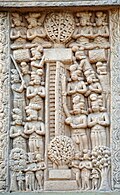 Descent of the Buddha from the Trayastrimsa Heaven, Sanchi Stupa No. 1.
 -
 The Buddha's Miracle at Kapilavastu, Sanchi Stupa 1.
 -
 Bimbisara visiting the Buddha (represented as empty throne) at the Bamboo garden in Rajagriha
 -
 The great departure with riderless horse, Amaravati, 2nd century CE.
 -
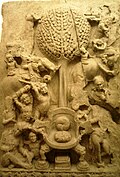 The Assault of Mara, Amaravati, 2nd century CE.
 -
![Isapur Buddha, one of the earliest physical depictions of the Buddha, c. 15 CE.[417] Art of Mathura](/w/images/smartcommons/thumbs/commons/9/9b/Isapur_Buddha.jpg/62px-Isapur_Buddha.jpg) Isapur Buddha, one of the earliest physical depictions of the Buddha, c. 15 CE.[417] Art of Mathura
Isapur Buddha, one of the earliest physical depictions of the Buddha, c. 15 CE.[417] Art of Mathura -
 The Buddha attended by Indra at Indrasala Cave, Mathura 50-100 CE.
 -
 Buddha Preaching in Tushita Heaven. Amaravati, Satavahana period, 2d century CE. Indian Museum, Calcutta.
 -
 Standing Buddha from Gandhara.
 -
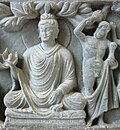
-
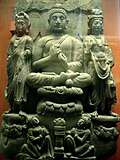 Kushan period Buddha Triad.
 -
 Buddha statue from Sanchi.
 -
 Birth of the Buddha, Kushan dynasty, late 2nd to early 3rd century CE.
 -
 The Infant Buddha Taking A Bath, Gandhara 2nd century CE.
 -
 6th century Gandharan Buddha.
 -
 Buddha at Cave No. 6, Ajanta Caves.
 -
 Standing Buddha, c. 5th Century CE.
 -
 Sarnath standing Buddha, 5th century CE.
 -
 Seated Buddha, Gupta period.
 -
 Seated Buddha at Gal Vihara, Sri Lanka.
 -
 Chinese Stele with Sakyamuni and Bodhisattvas, Wei period, 536 CE.
 -
 The Shakyamuni Daibutsu Bronze, c. 609, Nara, Japan.
 -
 Amaravati style Buddha of Srivijaya period, Palembang, Indonesia, 7th century.
 -
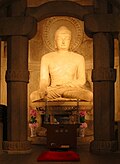 Korean Seokguram Cave Buddha, c. 774 CE.
 -
 Seated Buddha Vairocana flanked by Avalokiteshvara and Vajrapani of Mendut temple, Central Java, Indonesia, early 9th century.
 -

-
 Vairocana Buddha of Srivijaya style, Southern Thailand, 9th century.
 -
 Seated Buddha, Japan, Heian period, 9th-10th century.
 -
 Attack of Mara, 10th century, Dunhuang.
 -

-
 15th century Sukhothai Buddha.
 -
 15th century Sukhothai Walking Buddha.
 -
 Sakyamuni, Lao Tzu, and Confucius, c. from 1368 until 1644.
 -
 Chinese depiction of Shakyamuni, 1600.
 -
 Shakyamuni Buddha with Avadana Legend Scenes, Tibetan, 19th century
 -
 Golden Thai Buddha statue, Bodh Gaya.
 -
 Gautama statue, Shanyuan Temple, Liaoning Province, China.
 -
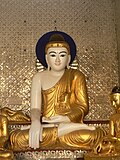 Burmese style Buddha, Shwedagon pagoda, Yangon.
 -
 Large Gautama Buddha statue in Buddha Park of Ravangla.


_at_Rajagriha,_the_visit_of_Bimbisara.jpg)


![Isapur Buddha, one of the earliest physical depictions of the Buddha, c. 15 CE.[417] Art of Mathura](/wiki/File:Isapur_Buddha.jpg)


.jpeg)


.JPG)


.jpg)
.jpg)

.jpg)


.jpg)

.jpg)


In other media
- Films
- Buddha Dev (Life of Lord Buddha), a 1923 Indian silent film by Dhundiraj Govind Phalke, first depiction of the Buddha on film with Bhaurao Datar in the titular role.[418]
- Prem Sanyas (The Light of Asia), a 1925 silent film, directed by Franz Osten and Himansu Rai based on Arnold's epic poem with Rai also portraying the Buddha.[418]
- Dedication of the Great Buddha (大仏開眼 or Daibutsu Kaigen), a 1952 Japanese feature film representing the life of Buddha.
- Gotoma the Buddha, a 1957 Indian documentary film directed by Rajbans Khanna and produced by Bimal Roy.[418]
- Siddhartha, a 1972 drama film by Conrad Rooks, an adaptation Hesse's novel. It stars Shashi Kapoor as Siddhartha, a contemporary of the Buddha.
- Little Buddha, a 1994 film by Bernardo Bertolucci, the film stars Keanu Reeves as Prince Siddhartha.[418]
- The Legend of Buddha, a 2004 Indian animated film by Shamboo Falke.
- The Life of Buddha, or Prawat Phra Phuttajao, a 2007 Thai animated feature film about the life of Gautama Buddha, based on the Tipitaka.
- Tathagatha Buddha, a 2008 Indian film by Allani Sridhar. Based on Sadguru Sivananda Murthy's book Gautama Buddha, it stars Sunil Sharma as the Buddha.[418]
- Sri Siddhartha Gautama, a 2013 Sinhalese epic biographical film based on the life of Lord Buddha.
- A Journey of Samyak Buddha, a 2013 Indian film by Praveen Damle, based on B. R. Ambedkar's Navayana book The Buddha and His Dhamma with Abhishek Urade in the titular role.
- Television
- Buddha, a 1996 Indian series which aired on Sony TV. It stars Arun Govil as the Buddha.[418]
- Buddha, a 2013 Indian drama series on Zee TV starring Himanshu Soni in the titular role.
- The Buddha 2010 PBS documentary by award-winning filmmaker David Grubin and narrated by Richard Gere.
- Literature
- The Light of Asia, an 1879 epic poem by Edwin Arnold
- The Life of the Buddha: as it appears in the Pali Canon, the oldest authentic record, by Ñāṇamoli Bhikkhu (369 pp.) First printing 1972, fifth printing 2007
- The Buddha and His Dhamma, a treatise on Buddha's life and philosophy, by B. R. Ambedkar
- Before He Was Buddha: The Life of Siddhartha, by Hammalawa Saddhatissa
- The Buddha and His Message: Past, Present & Future (United Nations Vesak Day Lecture), by Bhikkhu Bodhi (2000)
- Buddha, a manga series that ran from 1972 to 1983 by Osamu Tezuka
- Siddhartha novel by Hermann Hesse, written in German in 1922
- Lord of Light, a novel by Roger Zelazny depicts a man in a far future Earth Colony who takes on the name and teachings of the Buddha
- Creation, a 1981 novel by Gore Vidal, includes the Buddha as one of the religious figures that the main character encounters
- Music
- Karuna Nadee, a 2010 oratorio by Dinesh Subasinghe
- The Light of Asia, an 1886 oratorio by Dudley Buck based on Arnold's poem
See also
- Early Buddhist Texts
- Dhammacakkappavattana Sutta
- Anattalakkhaṇa Sutta
- Samannaphala Sutta
- Mahaparinibbana Sutta
- Great Renunciation & Four sights
- Physical characteristics of the Buddha
- Miracles of Buddha
- Relics associated with Buddha
- Lumbini, Bodhgaya, Sarnath & Kushinagar
- Iconography of Gautama Buddha in Laos and Thailand
- Knowing Buddha
- Depictions of Gautama Buddha in film
- Aniconism in Buddhism
- List of Indian philosophers
References
Notes
- ↑ Buddha is seated cross-legged in the lotus position. In the centre of the base relief is a wheel symbolizing the dharmachakra, the Wheel of Buddhist law, with couchant deer on either side symbolizing the deer park in which the sermon was preached.[1] The fingers of his hands form the teaching pose.[2]
- ↑ Some sources mention Kapilavastu as the birthplace of the Buddha. Gethin states: "The earliest Buddhist sources state that the future Buddha was born Siddhārtha Gautama (Pali Siddhattha Gotama), the son of a local chieftain—a rājan—in Kapilavastu (Pali Kapilavatthu) what is now Nepal."[13] Gethin does not give references for this statement.
- ↑ 3.0 3.1 3.2 3.3 According to the Buddhist tradition, following the Nidanakatha,[4] the introductory to the Jataka tales, the stories of the former lives of the Buddha, Gautama was born in Lumbini, present-day Nepal.[5][6] In the mid-3rd century BCE the Emperor Ashoka determined that Lumbini was Gautama's birthplace and thus installed a pillar there with the inscription: "...this is where the Buddha, sage of the Śākyas (Śākyamuni), was born."[7]
Based on stone inscriptions, there is also speculation that Lumbei, Kapileswar village, Odisha, at the east coast of India, was the site of ancient Lumbini.[8][9][10] Hartmann discusses the hypothesis and states, "The inscription has generally been considered spurious (...)"[11] He quotes Sircar: "There can hardly be any doubt that the people responsible for the Kapilesvara inscription copied it from the said facsimile not much earlier than 1928."
Kapilavastu was the place where he grew up:[12][note 2]- Warder: "The Buddha [...] was born in the Sakya Republic, which was the city state of Kapilavastu, a very small state just inside the modern state boundary of Nepal against the Northern Indian frontier.[14]
- Walshe: "He belonged to the Sakya clan dwelling on the edge of the Himalayas, his actual birthplace being a few kilometres north of the present-day Northern Indian border, in Nepal. His father was, in fact, an elected chief of the clan rather than the king he was later made out to be, though his title was raja—a term which only partly corresponds to our word 'king'. Some of the states of North India at that time were kingdoms and others republics, and the Sakyan republic was subject to the powerful king of neighbouring Kosala, which lay to the south".[15]
- The exact location of ancient Kapilavastu is unknown.[12] It may have been either Piprahwa in Uttar Pradesh, northern India,[16][17][18] or Tilaurakot,[19] present-day Nepal.[20][12] The two cities are located only 24 kilometres (15 miles) from each other.[20]
- ↑ According to Mahaparinibbana Sutta,[24] Gautama died in Kushinagar, which is located in present-day Uttar Pradesh, India.
- ↑ /sɪˈdɑːrtə, -θə/; Sanskrit: [sɪddʱaːrtʰɐ ɡautɐmɐ] Gautama namely Gotama in Pali
- ↑ 6.0 6.1
- 411–400: Dundas (2002), p. 24: "...as is now almost universally accepted by informed Indological scholarship, a re-examination of early Buddhist historical material, [...], necessitates a redating of the Buddha's death to between 411 and 400 BCE..."
- 405: Richard Gombrich[60][58][61]
- Around 400: See the consensus in the essays by leading scholars in Narain (2003).
- According to Pali scholar K. R. Norman, a life span for the Buddha of c. 480 to 400 BCE (and his teaching period roughly from c. 445 to 400 BCE) "fits the archaeological evidence better".[62] See also Notes on the Dates of the Buddha Íåkyamuni.
- Indologist Michael Witzel provides a "revised" dating of 460–380 BCE for the lifetime of the Buddha.[63]
- ↑ Sanskrit: [ɕaːkjɐmʊnɪ bʊddʱɐ]
- ↑ In 2013, archaeologist Robert Coningham found the remains of a Bodhigara, a tree shrine, dated to 550 BCE at the Maya Devi Temple, Lumbini, speculating that it may possibly be a Buddhist shrine. If so, this may push back the Buddha's birth date.[66] Archaeologists caution that the shrine may represent pre-Buddhist tree worship, and that further research is needed.[66]
Richard Gombrich has dismissed Coningham's speculations as "a fantasy", noting that Coningham lacks the necessary expertise on the history of early Buddhism.[67]
Geoffrey Samuel notes that several locations of both early Buddhism and Jainism are closely related to Yaksha-worship, that several Yakshas were "converted" to Buddhism, a well-known example being Vajrapani,[68] and that several Yaksha-shrines, where trees were worshipped, were converted into Buddhist holy places.[69] - ↑ Some sources mention Kapilavastu as the birthplace of the Buddha. Gethin states: "The earliest Buddhist sources state that the future Buddha was born Siddhārtha Gautama (Pali Siddhattha Gotama), the son of a local chieftain—a rājan—in Kapilavastu (Pali Kapilavatthu) what is now the Indian–Nepalese border."[13] Gethin does not give references for this statement.
- ↑ According to Alexander Berzin, "Buddhism developed as a shramana school that accepted rebirth under the force of karma, while rejecting the existence of the type of soul that other schools asserted. In addition, the Buddha accepted as parts of the path to liberation the use of logic and reasoning, as well as ethical behavior, but not to the degree of Jain asceticism. In this way, Buddhism avoided the extremes of the previous four shramana schools."[78]
- ↑ Minor Rock Edict Nb3: "These Dhamma texts – Extracts from the Discipline, the Noble Way of Life, the Fears to Come, the Poem on the Silent Sage, the Discourse on the Pure Life, Upatisa's Questions, and the Advice to Rahula which was spoken by the Buddha concerning false speech – these Dhamma texts, reverend sirs, I desire that all the monks and nuns may constantly listen to and remember. Likewise the laymen and laywomen."[94]
Dhammika: "There is disagreement amongst scholars concerning which Pali suttas correspond to some of the text. Vinaya samukose: probably the Atthavasa Vagga, Anguttara Nikaya, 1:98–100. Aliya vasani: either the Ariyavasa Sutta, Anguttara Nikaya, V:29, or the Ariyavamsa Sutta, Anguttara Nikaya, II: 27–28. Anagata bhayani: probably the Anagata Sutta, Anguttara Nikaya, III:100. Muni gatha: Muni Sutta, Sutta Nipata 207–21. Upatisa pasine: Sariputta Sutta, Sutta Nipata 955–75. Laghulavade: Rahulavada Sutta, Majjhima Nikaya, I:421."[94] - ↑ According to Geoffrey Samuel, the Buddha was born into a Kshatriya clan,[137] in a moderate Vedic culture at the central Ganges Plain area, where the shramana-traditions developed. This area had a moderate Vedic culture, where the Kshatriyas were the highest varna, in contrast to the Brahmanic ideology of Kuru–Panchala, where the Brahmins had become the highest varna.[137] Both the Vedic culture and the shramana tradition contributed to the emergence of the so-called "Hindu-synthesis" around the start of the Common Era.[138][137]
- ↑ Scholars have noted inconsistencies in the presentations of the Buddha's enlightenment, and the Buddhist path to liberation, in the oldest sutras. These inconsistencies show that the Buddhist teachings evolved, either during the lifetime of the Buddha, or thereafter. See:
* Bareau (1963)
* Schmithausen (1981)
* Norman (2003)
* Vetter (1988)
* Gombrich (2006a), Chapter 4
* Bronkhorst (1993), Chapter 7
* Anderson (1999) - ↑ Anālayo draws from seven early sources:[224]
- the Dharmaguptaka Vinaya in Four Parts, preserved in Chinese
- a *Vinayamātṛkā preserved in Chinese translation, which some scholars suggest represents the Haimavata tradition
- the Mahāsāṃghika-Lokottaravāda Vinaya, preserved in Sanskrit
- the Mahīśāsaka Vinaya in Five Parts, preserved in Chinese
- the Mūlasarvāstivāda Vinaya, where the episode is extant in Chinese and Tibetan translation, with considerable parts also preserved in Sanskrit fragments
- a discourse in the Madhyama-āgama, preserved in Chinese, probably representing the Sarvāstivāda tradition
- a Pāli discourse found among the Eights of the Aṅguttara-nikāya; the same account is also found in the Theravāda Vinaya preserved in Pāli
- ↑ Waley notes: suukara-kanda, "pig-bulb"; suukara-paadika, "pig's foot" and sukaresh.ta "sought-out by pigs". He cites Neumann's suggestion that if a plant called "sought-out by pigs" exists then suukaramaddava can mean "pig's delight".
- ↑ Exemplary studies are the study on descriptions of "liberating insight" by Lambert Schmithausen,[274] the overview of early Buddhism by Tilmann Vetter,[271] the philological work on the four truths by K.R. Norman,[275] the textual studies by Richard Gombrich,[273] and the research on early meditation methods by Johannes Bronkhorst.[270]
- ↑ Two well-known proponent of this position are A.K. Warder and Richard Gombrich.
- According to A.K. Warder, in his 1970 publication Indian Buddhism, "from the oldest extant texts a common kernel can be drawn out."[277] According to Warder, c.q. his publisher: "This kernel of doctrine is presumably common Buddhism of the period before the great schisms of the fourth and third centuries BC. It may be substantially the Buddhism of the Buddha himself, although this cannot be proved: at any rate it is a Buddhism presupposed by the schools as existing about a hundred years after the parinirvana of the Buddha, and there is no evidence to suggest that it was formulated by anyone else than the Buddha and his immediate followers".[277]
- Richard Gombrich: "I have the greatest difficulty in accepting that the main edifice is not the work of a single genius. By "the main edifice" I mean the collections of the main body of sermons, the four Nikāyas, and of the main body of monastic rules."[273]
- ↑ A proponent of the second position is Ronald Davidson.
- Ronald Davidson: "While most scholars agree that there was a rough body of sacred literature (disputed)(sic) that a relatively early community (disputed)(sic) maintained and transmitted, we have little confidence that much, if any, of surviving Buddhist scripture is actually the word of the historical Buddha."[278]
- ↑ Well-known proponents of the third position are:
- J.W. de Jong: "It would be hypocritical to assert that nothing can be said about the doctrine of earliest Buddhism [...] the basic ideas of Buddhism found in the canonical writings could very well have been proclaimed by him [the Buddha], transmitted and developed by his disciples and, finally, codified in fixed formulas."[279]
- Johannes Bronkhorst: "This position is to be preferred to (ii) for purely methodological reasons: only those who seek may find, even if no success is guaranteed."[276]
- Donald Lopez: "The original teachings of the historical Buddha are extremely difficult, if not impossible, to recover or reconstruct."[280]
- ↑ aggihuttamukhā yaññā sāvittī chandaso mukham. Sacrifices have the Agnihotra as foremost; of meter, the foremost is the Sāvitrī.[285]
- ↑ Understanding of these marks helps in the development of detachment:
- ↑ “Not by water man becomes pure; people here bathe too much; in whom there is truth and morality, he is pure, he is (really) a brahman”[292]
- ↑ “These three things, monks, are conducted in secret, not openly. What three? Affairs with women, the mantras of the brahmins, and wrong view. But these three things, monks, shine openly, not in secret. What three? The moon, the sun, and the Dhamma and Discipline proclaimed by the Tathagata.” AN 3.129[293]
- ↑ "In a favourite stanza quoted several times in the Pali Canon: “The Kshatriya is the best among those people who believe in lineage; but he, who is endowed with knowledge and good conduct, is the best among Gods and men”.[292]
- ↑ One common basic list of twelve elements in the Early Buddhist Texts goes as follows: "Conditioned by (1) ignorance are (2) formations, conditioned by formations is (3) consciousness, conditioned by consciousness is (4) mind-and-body, conditioned by mind-and-body are (5) the six senses, conditioned by the six senses is (6) sense-contact, conditioned by sense-contact is (7) feeling, conditioned by feeling is (8) craving, conditioned by craving is (9) grasping, conditioned by grasping is (10) becoming, conditioned by becoming is (11) birth, conditioned by birth is (12) old-age and death-grief, lamentation, pain, sorrow, and despair come into being. Thus is the arising of this whole mass of suffering."[316]
- ↑ right view; right intention, right speech, right action, right livelihood, right effort, right mindfulness, and right concentration.[348]
- ↑ Gethin adds: "This schema is assumed and, in one way or another, adapted by the later manuals such as the Visuddhimagga, the Abhidharmakosa, Kamalasila's Bhavanakrama ('Stages of Meditation', eighth century) and also Chinese and later Tibetan works such as Chih-i's Mo-ho chih-kuan ('Great Calm and Insight') and Hsiu-hsi chih-kuan tso-ch'an fa-yao ('The Essentials for Sitting in Meditation and Cultivating Calm and Insight', sixth century), sGam-po-pa's Thar-pa rin-po che'i rgyan ('Jewel Ornament of Liberation', twelfth century) and Tsong-kha-pa's Lam rim chen mo ('Great Graduated Path', fourteenth century).[352]
- ↑ As Gethin notes: "A significant ancient variation on the formula of dependent arising, having detailed the standard sequence of conditions leading to the arising of this whole mass of suffering, thus goes on to state that: Conditioned by (1) suffering, there is (2) faith, conditioned by faith, there is (3) gladness, conditioned by gladness, there is (4) joy, conditioned by joy, there is (5) tranquillity, conditioned by tranquillity, there is (6) happiness, conditioned by happiness, there is (7) concentration, conditioned by concentration, there is (8) knowledge and vision of what truly is, conditioned by knowledge and vision of what truly is, there is (9) disenchantment, conditioned by disenchantment, there is (10) dispassion, conditioned by dispassion, there is (11) freedom, conditioned by freedom, there is (12) knowledge that the defilements are destroyed."[356]
- ↑ For a comparative survey of Satipatthana in the Pali, Tibetan and Chinese sources, see: Anālayo (2014). Perspectives on Satipatthana.[full citation needed]. For a comparative survey of Anapanasati, see: Dhammajoti, K.L. (2008). "Sixteen-mode Mindfulness of Breathing". JCBSSL. VI.[full citation needed].
- ↑ "thus, from the not giving of property to the needy, poverty became rife, from the growth of poverty, the taking of what was not given increased, from the increase of theft, the use of weapons increased, from the increased use of weapons, the taking of life increased — and from the increase in the taking of life, people's life-span decreased, their beauty decreased, and [as] a result of this decrease of life-span and beauty, the children of those whose life-span had been eighty-thousand years lived for only forty thousand."[372]
- ↑ Vetter: "However, if we look at the last, and in my opinion the most important, component of this list [the noble eightfold path], we are still dealing with what according to me is the real content of the middle way, dhyana-meditation, at least the stages two to four, which are said to be free of contemplation and reflection. Everything preceding the eighth part, i.e. right samadhi, apparently has the function of preparing for the right samadhi."[377]
- ↑ This belief is not universally held as Krishna is held to be the ninth avatar in some traditions and his half-brother Balarama the eight.[390]
- ↑ "in Sanskrit philosophical literature, 'āstika' means 'one who believes in the authority of the Vedas', 'soul', 'Brahman'. ('nāstika' means the opposite of these).[396][397]
Citations
- ↑ Sahni, Daya Ram (1914), "B (b) 181.", Catalogue of the Museum of Archaeology at Sarnath, Calcutta: Superintendent Government Printing, India, pp. 70–71, OCLC 173481241,
Image (ht 5' 3 up to the top of the halo; width at base 2' 7) of Gautama Buddha seated cross-legged, preaching the first sermon at Sarnath, on a thick cusion supported on a seat with moulded legs
- ↑ Eck, Diana L. (1982), Banāras, City of Light, New York: Alfred A. Knopf, p. 63, ISBN 0-394-51971-X,
In the most famous of these images in the Sarnath museum, the Buddha sits cross-legged, his limbs in the perfect proportions prescribed by the iconometry of the day, his hands in a teaching pose, his eyes downcast, half-shut in meditation, his head backed by a beautifully ornamented circular nimbus
- ↑ Mani, B. R. (2012) [2006], Sarnath: Archaeology, Art, and Architecture, New Delhi: The Director General: Archaeological Survey of India, pp. 66–67,
The seated Buddha, B(b) 181 showing Buddha cross-legged in the attitude of preaching, is one of the most equisite creations of Gupta art. The halo is carved with a pair of celestial figures and conventionalized floral scroll-work.
{{citation}}: CS1 maint: publisher location (link) - ↑ 4.0 4.1 Fausböll, Davids & Davids (1878), p. [page needed].
- ↑ 5.0 5.1 5.2 "Lumbini, the Birthplace of the Lord Buddha". World Heritage Convention. UNESCO. Retrieved 26 May 2011.
- ↑ "The Astamahapratiharya: Buddhist pilgrimage sites". Victoria and Albert Museum. Archived from the original on 31 October 2012. Retrieved 25 December 2012.
- ↑ 7.0 7.1 Gethin (1998), p. 19.
- ↑ 8.0 8.1 Mahāpātra (1977).
- ↑ 9.0 9.1 Mohāpātra (2000), p. 114.
- ↑ 10.0 10.1 Tripathy (2014).
- ↑ 11.0 11.1 Hartmann (1991), pp. 38–39.
- ↑ 12.0 12.1 12.2 12.3 12.4 12.5 Keown & Prebish (2013), p. 436.
- ↑ 13.0 13.1 13.2 Gethin (1998), p. 14.
- ↑ 14.0 14.1 14.2 14.3 Warder (2000), p. 45.
- ↑ 15.0 15.1 Walshe (1995), p. 20.
- ↑ 16.0 16.1 16.2 Nakamura (1980), p. 18.
- ↑ 17.0 17.1 Srivastava (1979), pp. 61–74.
- ↑ 18.0 18.1 Srivastava (1980), p. 108.
- ↑ 19.0 19.1 Tuladhar (2002), pp. 1–7.
- ↑ 20.0 20.1 20.2 20.3 20.4 20.5 Huntington (1986).
- ↑ 21.0 21.1 21.2 21.3 Cousins (1996), pp. 57–63.
- ↑ Norman (1997), p. 33.
- ↑ Prebish (2008).
- ↑ "Maha-parinibbana Sutta", Digha Nikaya, Access insight, part 5
- ↑ Buswell Jr., Robert E.; Lopez Jr., Donald S., eds. (2014), "Gautama", The Princeton Dictionary of Buddhism, Princeton and Oxford: Princeton University Press, p. 316, ISBN 978-0-691-15786-3,
Gautama. (P. Gotama; The family name of the historical Buddha, also known as ŚĀKYAMUNI Buddha. ... In Pāli literature, he is more commonly referred to as Gotama Buddha; in Mahāyāna texts, Śākyamuni Buddha is more common
- ↑ Buswell Jr., Robert E.; Lopez Jr., Donald S., eds. (2014), "Siddhārtha", The Princeton Dictionary of Buddhism, Princeton and Oxford: Princeton University Press, p. 817, ISBN 978-0-691-15786-3,
Siddhārtha. (P. Siddhattha; T. Don grub; C. Xidaduo; J. Shiddatta/Shittatta; K. Siltalta ). In Sanskrit, "He Who Achieves His Goal," the personal name of GAUTAMA Buddha, also known as ŚĀKYAMUNI. In some accounts of the life of the Buddha, after his royal birth as the son of King ŚUDDHODANA, the BODHISATTVA was given this name and is referred to by that name during his life as a prince and his practice of asceticism. ... After his achievement of buddhahood, Siddhārtha is instead known as Gautama, Śākyamuni, or simply the TATHĀGATA.
- ↑ Buswell Jr., Robert E.; Lopez Jr., Donald S., eds. (2014), "Śākyamuni", The Princeton Dictionary of Buddhism, Princeton and Oxford: Princeton University Press, p. 741, ISBN 978-0-691-15786-3,
Śākyamuni. (P. Sakkamuni; ... one of the most common epithets of GAUTAMA Buddha, especially in the MAHĀYĀNA traditions, where the name ŚĀKYAMUNI is used to distinguish the historical buddha from the myriad other buddhas who appear in the SŪTRAs.
- ↑ Keown, Damien (ed.), "Buddha (Skt; Pali)", A Dictionary of Buddhism, Oxford University Press, p. 42, ISBN 0-19-860560-9,
This is not a personal name but an epithet of those who have achieved enlightenment (*bodhi), the goal of the Buddhist religious life. Buddha comes from the *Sanskrit root 'budh', meaning to awaken, and the Buddhas are those who have awakened to the true nature of things as taught in the *Four Noble Truths. ... It is generally believed that there can never be more than one Buddha in any particular era, and the 'historical Buddha' of the present era was *Siddhartha Gautama. Numerous ahistorical Buddhas make an appearance in Mahayana literature
- ↑ "Buddha, n.", Oxford English Dictionary (3 ed.), Oxford University Press, 2013,
(subscription required) Also with the: (a title for) Siddhārtha Gautama, or Śākyamuni, a spiritual teacher from South Asia on whose teachings Buddhism is based, and who is believed to have been born in what is now Nepal and flourished in what is now Bihar, northeastern India, during the 5th cent. b.c. Also: (a title given to) any Buddhist teacher regarded as having attained full awakening or enlightenment.
- ↑ Gethin (1998), pp. 5, 9, 10, 14.
- ↑ Strong (2001), p. 1.
- ↑ de Bary, William (1969). The Buddhist Tradition in India, China and Japan (February 1972 ed.). xvii: Vintage Books. p. xvii. ISBN 0-394-71696-5.
In this respect, then, Buddha could accurately be viewed as a kind of savior, and when so conceived he has had for many the attributes of divinity--saving power, omniscience in regard to all essential truth, an all-encompassing compassion, timeless existence, immutable being, unending bliss, etc.
- ↑ Laumakis (2008), p. 4.
- ↑ 34.0 34.1 Gethin (1998), p. 8.
- ↑ Gethin (1998), pp. 40–41.
- ↑ Warder (2000), pp. 4–7, 44.
- ↑ Warder (2000), p. 4.
- ↑ Cox, Collett (2003). "Abidharma", in: Buswell, Robert E. ed. Encyclopedia of Buddhism, New York: Macmillan Reference Lib. pp. 1–7. ISBN 0028657187.
- ↑ Baroni (2002), p. 230.
- ↑ Witzel, Michael (2012). "Ṛṣis". Brill’s Encyclopedia of Hinduism Online. Brill.
- ↑ Macdonell, Arthur Anthony; Keith, Arthur Berriedale (1912). Vedic Index of Names and Subjects. Vol. 1. John Murray. p. 240.
- ↑ Dhammananda, Ven. Dr. K. Sri, Great Virtues of the Buddha (PDF), Dhamma talks
- ↑ Roshen Dalal (2014). The Religions of India: A Concise Guide to Nine Major Faiths. Penguin Books. ISBN 9788184753967. Entry: "Jina"
- ↑ Snyder, David N. (2006) "The Complete Book of Buddha's Lists--explained." Vipassana Foundation, list 605 p. 429.
- ↑ Rawlinson, Hugh George (1950). A Concise History of the Indian People, Oxford University Press. p. 46.
- ↑ Muller, F. Max (2001). The Dhammapada and Sutta-nipata, Routledge (UK). p. xlvii. ISBN 0-7007-1548-7.
- ↑ Keay, John (2011). India: A History. New York: Grove Press. ISBN 978-0-8021-9550-0.
The date [of Buddha's meeting with Bimbisara] (given the Buddhist 'short chronology') must have been around 400 BCE.
- ↑ Smith (1924), pp. 34, 48.
- ↑ Schumann (2003), pp. 1–5.
- ↑ Carrithers (2001), p. 3.
- ↑ Buswell (2003), p. 352.
- ↑ Lopez (1995), p. 16.
- ↑ Wynne, Alexander. "Was the Buddha an awakened prince or a humble itinerant?". Aeon. Retrieved 9 May 2020.
- ↑ Schumann (2003), pp. 10–13.
- ↑ Das, Sarat Chandra (1882). Contributions on the Religion and History of Tibet. First published in: Journal of the Asiatic Society of Bengal, Vol. LI. Reprint: Manjushri Publishing House, Delhi. 1970, pp. 81–82 footnote 6.
- ↑ Bechert 1991–1997, [full citation needed].
- ↑ Ruegg (1999), pp. 82–87.
- ↑ 58.0 58.1 Narain (1993), pp. 187–201.
- ↑ Prebish (2008), p. 2.
- ↑ Gombrich (1992).
- ↑ Gombrich (2000).
- ↑ Norman (1997), p. 39.
- ↑ Witzel, Michael (2019). "Early 'Aryans' and their neighbors outside and inside India". Journal of Biosciences. 44 (3): 58. doi:10.1007/s12038-019-9881-7. ISSN 0973-7138. PMID 31389347. S2CID 195804491.
- ↑ Schumann (2003), p. xv.
- ↑ Wayman (1997), pp. 37–58.
- ↑ 66.0 66.1 Vergano, Dan (25 November 2013). "Oldest Buddhist Shrine Uncovered In Nepal May Push Back the Buddha's Birth Date". National Geographic. Retrieved 26 November 2013.
- ↑ Gombrich (2013).
- ↑ Tan, Piya (21 December 2009), Ambaṭṭha Sutta. Theme: Religious arrogance versus spiritual openness (PDF), Dharma farer, archived from the original (PDF) on 9 January 2016, retrieved 22 October 2014
- ↑ Samuel (2010), pp. 140–152.
- ↑ "The Astamahapratiharya: Buddhist pilgrimage sites". Victoria and Albert Museum. Archived from the original on 31 October 2012. Retrieved 25 December 2012.
- ↑ 71.0 71.1 Gombrich (1988), p. 49.
- ↑ 72.0 72.1 72.2 Levman, Bryan Geoffrey (2013). "Cultural Remnants of the Indigenous Peoples in the Buddhist Scriptures". Buddhist Studies Review. 30 (2): 145–180. ISSN 1747-9681.
- ↑ Bronkhorst, J. (2007). "Greater Magadha, Studies in the culture of Early India," p. 6. Leiden, Boston, MA: Brill. doi:10.1163/ej.9789004157194.i-416
- ↑ Jayatilleke (1963), chpt. 1–3.
- ↑ Clasquin-Johnson, Michel. "Will the real Nigantha Nātaputta please stand up? Reflections on the Buddha and his contemporaries". Journal for the Study of Religion. 28 (1): 100–114. ISSN 1011-7601.
- ↑ Walshe (1995), p. 268.
- ↑ Collins (2009), pp. 199–200.
- ↑ Berzin, Alexander (April 2007). "Indian Society and Thought before and at the Time of Buddha". Study Buddhism. Retrieved 20 June 2016.
- ↑ Nakamura (1980), p. 20.
- ↑ Wynne (2007), pp. 8–23, ch. 2.
- ↑ Warder (1998), p. 45.
- ↑ Roy (1984), p. 1.
- ↑ Roy (1984), p. 7.
- ↑ 84.0 84.1 84.2 Beckwith, Christopher I. (2015). Greek Buddha: Pyrrho's Encounter with Early Buddhism in Central Asia. Princeton University Press. pp. 7–12. ISBN 978-1-4008-6632-8.
- ↑ 85.0 85.1 Weise (2013), pp. 46–47.
- ↑ Bronkhorst, Johannes (2016). "How the Brahmins Won: Appendix X Was there Buddhism in Gandhāra at the Time of Alexander?". Brill: 483–489, page 6 of the appendix. doi:10.1163/9789004315518_016.
{{cite journal}}: Cite journal requires|journal=(help) - ↑ Beckwith, Christopher I. (2017). Greek Buddha: Pyrrho's Encounter with Early Buddhism in Central Asia. Princeton University Press. p. 168. ISBN 978-0-691-17632-1.
- ↑ 88.0 88.1 Bary, William Theodore de (16 March 2011). The Buddhist Tradition: In India, China and Japan. Knopf Doubleday Publishing Group. p. 8. ISBN 978-0-307-77879-6.
- ↑ 89.0 89.1 Fogelin, Lars (1 April 2015). An Archaeological History of Indian Buddhism. Oxford University Press. ISBN 978-0-19-026692-9.
- ↑ Prebish, Charles S. (1 November 2010). Buddhism: A Modern Perspective. Penn State Press. p. 29. ISBN 978-0-271-03803-2.
- ↑ In Ashoka's Rummindei Edict c. 260 BCE, in Hultzsch, E. (1925). Inscriptions of Asoka (in संस्कृतम्). p. 164.
- ↑ Bronkhorst, Johannes (2016). "How the Brahmins Won: Appendix X Was there Buddhism in Gandhāra at the Time of Alexander?". Brill: 483–489, page 6 of the appendix. doi:10.1163/9789004315518_016.
{{cite journal}}: Cite journal requires|journal=(help) - ↑ "Definition of dhamma". Dictionary.com. Retrieved 27 October 2020.
- ↑ 94.0 94.1 94.2 Dhammika (1993).
- ↑ "That the True Dhamma Might Last a Long Time: Readings Selected by King Asoka". Access to Insight. Translated by Bhikkhu, Thanissaro. 1993. Retrieved 8 January 2016.
- ↑ 96.0 96.1 Leoshko, Janice (2017). Sacred Traces: British Explorations of Buddhism in South Asia. Routledge. p. 64. ISBN 978-1-351-55030-7.
- ↑ 97.0 97.1 Sarao, K. T. S. (16 September 2020). The History of Mahabodhi Temple at Bodh Gaya. Springer Nature. p. 80. ISBN 978-981-15-8067-3.
- ↑ "Ancient Buddhist Scrolls from Gandhara". UW Press. Archived from the original on 27 May 2017. Retrieved 4 September 2008.
- ↑ von Hinüber (2008), pp. 198–206.
- ↑ Witzel, Michael (2009). "Moving Targets? Texts, language, archaeology and history in the Late Vedic and early Buddhist periods". Indo-Iranian Journal. 52 (2–3): 287–310. doi:10.1163/001972409X12562030836859.
- ↑ Strong (2001), p. 5.
- ↑ Yaldiz, Marianne (1987). Investigating Indian Art. Staatl. Museen Preuss. Kulturbesitz. p. 188.
The earliest anthropomorphic representation of the Buddha that we know so far, the Bimaran reliquary
- ↑ Verma, Archana (2007). Cultural and Visual Flux at Early Historical Bagh in Central India. Archana Verma. p. 1. ISBN 978-1-4073-0151-8.
- ↑ Fowler (2005), p. 32.
- ↑ Beal (1883).
- ↑ Cowell (1894).
- ↑ Willemen (2009).
- ↑ Olivelle, Patrick (2008). Life of the Buddha by Ashva-ghosha (1st ed.). New York: New York University Press. p. xix. ISBN 978-0-8147-6216-5.
- ↑ 109.0 109.1 Karetzky (2000), p. xxi.
- ↑ Beal (1875).
- ↑ Swearer (2004), p. 177.
- ↑ Schober (2002), p. 20.
- ↑ 113.0 113.1 Anālayo (2006).
- ↑ Tan, Piya (trans) (2010). "The Discourse to Sandaka (trans. of Sandaka Sutta, Majjhima Nikāya 2, Majjhima Paṇṇāsaka 3, Paribbājaka Vagga 6)" (PDF). The Dharmafarers. The Minding Centre. pp. 17–18. Archived from the original (PDF) on 9 January 2016. Retrieved 24 September 2015.
- ↑ MN 71 Tevijjavacchagotta [Tevijjavaccha]
- ↑ "A Sketch of the Buddha's Life: Readings from the Pali Canon". Access to Insight. 2005. Retrieved 24 September 2015.
- ↑ Jones (1956), p. [page needed].
- ↑ Skilton (2004), pp. 64–65.
- ↑ Carrithers (2001), p. 15.
- ↑ Armstrong (2000), p. xii.
- ↑ Carrithers (2001).
- ↑ Strong (2001), p. 19.
- ↑ Strong (2001), p. 21.
- ↑ Strong (2001), p. 24.
- ↑ Strong (2001), p. 30.
- ↑ Strong (2001), p. 31.
- ↑ Strong (2001), p. 25.
- ↑ Strong (2001), p. 37.
- ↑ Strong (2001), p. 43.
- ↑ 130.0 130.1 Nagendra, Kumar Singh (1997). "Buddha as depicted in the Purāṇas". Encyclopaedia of Hinduism. Vol. 7. Anmol Publications. pp. 260–275. ISBN 978-81-7488-168-7. Retrieved 16 April 2012.
- ↑ Weise (2013), p. [page needed].
- ↑ Trainor (2010), pp. 436–437.
- ↑ Beal (1875), p. 37.
- ↑ Jones (1952), p. 11.
- ↑ Beal (1875), p. 41.
- ↑ Hirakawa (1990), p. 21.
- ↑ 137.0 137.1 137.2 137.3 Samuel (2010).
- ↑ Hiltebeitel (2013).
- ↑ Ñāṇamoli Bhikkhu (1992), p. 8.
- ↑ Strong (2001), p. 51.
- ↑ 141.0 141.1 Hirakawa (1990), p. 24.
- ↑ Dhammika (n.d.), p. [page needed].
- ↑ Gethin (1998), pp. 14–15.
- ↑ Gombrich (1988), pp. 49–50.
- ↑ Thapar (2002), p. 146.
- ↑ Turpie (2001), p. 3.
- ↑ 147.0 147.1 Narada (1992), pp. 9–12.
- ↑ Strong (2001), p. 55.
- ↑ Narada (1992), pp. 11–12.
- ↑ Hamilton (2000), p. 47.
- ↑ Meeks (2016), p. 139.
- ↑ Schumann (2003), p. 23.
- ↑ Strong (2001), p. 60.
- ↑ 154.0 154.1 Gethin (1998), p. 15.
- ↑ Anālayo (2011), p. 170.
- ↑ 156.0 156.1 156.2 Wynne, Alexander (2019). "Did the Buddha exist?". JOCBS. 16: 98–148.
- ↑ Schumann (2003), p. 45.
- ↑ Schumann (2003), pp. 45–46.
- ↑ Anālayo (2011), p. 173.
- ↑ Gethin (1998), p. 21.
- ↑ Strong (2001), p. 63.
- ↑ Gethin (1998), p. 20.
- ↑ 163.0 163.1 Conze (1959), pp. 39–40.
- ↑ Warder (2000), p. 322.
- ↑ 165.0 165.1 Schumann (2003), p. 44.
- ↑ Strong (2001), Incitements to Leave Home.
- ↑ Strong (2015), The Beginnings of Discontent.
- ↑ Narada (1992), pp. 15–16.
- ↑ Strong (2015), The Great Departure.
- ↑ Penner (2009), p. 28.
- ↑ Strong (2001), The Great Departure.
- ↑ Hirakawa (1990), p. 25.
- ↑ Upadhyaya (1971), p. 95.
- ↑ Laumakis (2008), p. 8.
- ↑ Schumann (2003), p. 47.
- ↑ Anālayo (2011), p. 175.
- ↑ Schumann (2003), p. 48.
- ↑ Armstrong (2000), p. 77.
- ↑ Narada (1992), pp. 19–20.
- ↑ Ñāṇamoli Bhikkhu (1992), p. 15.
- ↑ Hirakawa (1990), p. 26.
- ↑ Anālayo (2011), pp. 234–235.
- ↑ 183.0 183.1 Anālayo (2011), p. 236.
- ↑ 184.0 184.1 "Dhammacakkappavattana Sutta: Setting the Wheel of Dhamma in Motion". Access to Insight. Translated by Bhikkhu, Thanissaro. 1993. Retrieved 25 December 2012.
- ↑ "The Golden Bowl". Life of the Buddha. Retrieved 25 December 2012 – via BuddhaNet.
- ↑ 186.0 186.1 Anālayo (2011), p. 178.
- ↑ Gyatso (2007), pp. 8–9.
- ↑ Anālayo (2011), p. 240.
- ↑ Anālayo (2011), p. 243.
- ↑ Marshall (1918), p. 65.
- ↑ "nirvana". Encyclopædia Britannica. Retrieved 22 October 2014.
- ↑ "Maha-Saccaka Sutta: The Longer Discourse to Saccaka". Access to Insight. Translated by Bhikkhu, Thanissaro. 2008. (MN 36). Retrieved 19 May 2007.
- ↑ Anderson (1999).
- ↑ Williams (2002), pp. 74–75.
- ↑ Lopez, Donald. "Four Noble Truths". Encyclopædia Britannica.
- ↑ Ñāṇamoli Bhikkhu (1992), p. 30.
- ↑ Ñāṇamoli Bhikkhu (1992), pp. 30–35.
- ↑ Strong (2001), p. 93.
- ↑ Strong (2001), p. 94.
- ↑ Anālayo (2011), p. 182.
- ↑ Anālayo (2011), p. 183.
- ↑ 202.0 202.1 202.2 202.3 202.4 202.5 202.6 Boisselier, Jean (1994). The wisdom of the Buddha. New York: Harry N. Abrams. ISBN 0-8109-2807-8. OCLC 31489012.
- ↑ 203.0 203.1 Anālayo (2011), p. 185.
- ↑ Ñāṇamoli Bhikkhu (1992), pp. 44–45.
- ↑ Strong (2001), p. 110.
- ↑ Strong (2001), p. 113.
- ↑ Ñāṇamoli Bhikkhu (1992), pp. 48, 54–59.
- ↑ Strong (2001), pp. 116–117.
- ↑ Ñāṇamoli Bhikkhu (1992), p. 64.
- ↑ Strong (2001), p. 115.
- ↑ Malalasekera (1960), pp. 291–292.
- ↑ Strong (2001), p. 131.
- ↑ 213.0 213.1 Schumann (2003), p. 231.
- ↑ Strong (2001), p. 132.
- ↑ Bhikkhu Khantipalo (1995). "Lay Buddhist Practice, The Shrine Room, Uposatha Day, Rains Residence"
- ↑ Ñāṇamoli Bhikkhu (1992), p. 68.
- ↑ Ñāṇamoli Bhikkhu (1992), p. 70.
- ↑ Strong (2001), p. 119.
- ↑ Ñāṇamoli Bhikkhu (1992), p. 78.
- ↑ Ñāṇamoli Bhikkhu (1992), pp. 79–83.
- ↑ Strong (2001), p. 122.
- ↑ Ñāṇamoli Bhikkhu (1992), p. 91.
- ↑ 223.0 223.1 Strong (2001), p. 136.
- ↑ Anālayo (2016), pp. 40–41.
- ↑ Anālayo (2016), p. 43.
- ↑ Anālayo (2016), p. 79.
- ↑ Anālayo (2013b).
- ↑ Anālayo (2016), pp. 111–112.
- ↑ Anālayo (2016), p. 127.
- ↑ Strong (2001), p. 134.
- ↑ Schumann (2003), pp. 232–233.
- ↑ Jain (1991), p. 79.
- ↑ Mahajan, V.D. (2016). Ancient India. S. Chand Publishing. p. 190.
- ↑ Schumann (2003), p. 215.
- ↑ Schumann (2003), p. 232.
- ↑ Anālayo (2011), p. 198.
- ↑ Ñāṇamoli Bhikkhu (1992), p. 257.
- ↑ Schumann (2003), p. 236.
- ↑ Schumann (2003), p. 237.
- ↑ Bhikkhu Sujato (2012), "Why Devadatta Was No Saint, A critique of Reginald Ray's thesis of the ‘condemned saint’"
- ↑ Ñāṇamoli Bhikkhu (1992), p. 280.
- ↑ Schumann (2003), p. 239.
- ↑ Strong (2001), p. 165.
- ↑ Anālayo (2014).
- ↑ Ñāṇamoli Bhikkhu (1992), pp. 286–288.
- ↑ Strong (2001), pp. 165–166.
- ↑ Schumann (2003), p. 244.
- ↑ Schumann (2003), p. 246.
- ↑ "Maha-parinibbana Sutta", Digha Nikaya, Access insight, verse 56
- ↑ Bhikkhu & von Hinüber (2000).
- ↑ Bhikkhu, Mettanando (15 May 2001). "How the Buddha died". Bangkok Post. Archived from the original on 14 November 2012. Retrieved 25 December 2012 – via BuddhaNet.
- ↑ Waley (1932), pp. 343–354.
- ↑ Strong (2001), p. 176.
- ↑ 254.0 254.1 Schumann (2003), p. 249.
- ↑ 255.0 255.1 Strong (2001), p. 178.
- ↑ Schumann (2003), p. 250.
- ↑ Wynne (2007), p. 112.
- ↑ Strong (2001), p. 183.
- ↑ Ñāṇamoli Bhikkhu (1992), p. 324.
- ↑ Ñāṇamoli Bhikkhu (1992), p. 327.
- ↑ Ñāṇamoli Bhikkhu (1992), p. 330.
- ↑ Ñāṇamoli Bhikkhu (1992), p. 331.
- ↑ Lopez, Donald. "The Buddha's relics". Encyclopædia Britannica.
- ↑ Strong (2007), pp. 136–137.
- ↑ Harvey, Peter (2013), An Introduction to Buddhism: Teachings, History and Practices (PDF) (2nd ed.), New York: Cambridge University Press, p. 88, ISBN 978-0-521-85942-4
- ↑ 266.0 266.1 Vetter (1988), p. ix.
- ↑ Warder (2000), p. [page needed].
- ↑ Tse-Fu Kuan. "Mindfulness in similes in Early Buddhist literature". In Edo Shonin; William Van Gordon; Nirbhay N. Singh (eds.). Buddhist Foundations of Mindfulness. p. 267.
- ↑ Mun-Keat Choong (1999). The Notion of Emptiness in Early Buddhism. Motilal Banarsidass. p. 3.
- ↑ 270.0 270.1 270.2 Bronkhorst (1993).
- ↑ 271.0 271.1 Vetter (1988).
- ↑ Schmithausen (1990).
- ↑ 273.0 273.1 273.2 273.3 Gombrich (1997).
- ↑ 274.0 274.1 Schmithausen (1981).
- ↑ Norman (2003).
- ↑ 276.0 276.1 Bronkhorst (1993), p. vii.
- ↑ 277.0 277.1 277.2 Warder (2000), inside flap.
- ↑ Davidson (2003), p. 147.
- ↑ Jong (1993), p. 25.
- ↑ Lopez (1995), p. 4.
- ↑ Warder (2004), p. [page needed].
- ↑ Gombrich (2009), pp. 9, 36.
- ↑ Gombrich (2009), p. 48.
- ↑ Wynne (2004), pp. 23, 37.
- ↑ Shults (2014), p. 119.
- ↑ Norman (1997), p. 26.
- ↑ Bronkhorst (1993), p. 10.
- ↑ Norman (1997), p. 28.
- ↑ Reat, Noble Ross (1996). "The Historical Buddha and his Teachings". In Potter, Karl H. (ed.). Encyclopedia of Indian Philosophy, Vol. VII: Abhidharma Buddhism to 150 AD. Motilal Banarsidass. pp. 28, 33, 37, 41, 43, 48.
- ↑ Anālayo (2011), p. 891.
- ↑ Salomon, Richard (20 January 2020). "How the Gandharan Manuscripts Change Buddhist History". Lion's Roar. Retrieved 21 January 2020.
- ↑ 292.0 292.1 292.2 292.3 292.4 292.5 292.6 Tola, Fernando. Dragonetti, Carmen (2009). "Brahamanism and Buddhism: Two Antithetic Conceptions of Society in Ancient India." p. 26: "This also implied the denial of the Shruti provided with characteristics which grant it the status of a substance. All this carried with itself also the negation of the authority of all the sacred texts of Brahmanism. Buddhism does not acknowledge to them any value as ultimate criterion of truth, as depository of the norms which regulate man's conduct as a member of society and in his relations with the Gods. Buddhism ignores the Shruti, the very foundation of Brahmanism."
- ↑ Bodhi (2005), pp. 33–34.
- ↑ Omvedt (2003), p. 76.
- ↑ Omvedt (2003), p. 72.
- ↑ Omvedt, Gail (1 June 2001). "Review: The Buddha as a Political Philosopher". Economic and Political Weekly. Vol. 36, no. 21. pp. 1801–1804. JSTOR 4410659.
- ↑ Mrozik, Susanne. "Upali" in MacMillan Encyclopedia of Buddhism, pg. 870.
- ↑ Kancha Ilaiah, "God as Political Philosopher: Buddha's Challenge to Brahminism" p. 169
- ↑ Gethin (1998), p. 59.
- ↑ 300.00 300.01 300.02 300.03 300.04 300.05 300.06 300.07 300.08 300.09 300.10 Siderits (2019).
- ↑ Gethin (1998), p. 61.
- ↑ Gethin (1998), p. 62.
- ↑ 303.0 303.1 Gethin (1998), pp. 63–64.
- ↑ 304.0 304.1 304.2 Anālayo (2013a).
- ↑ Gethin (1998), pp. 72–73.
- ↑ Gethin (1998), p. 75.
- ↑ Bodhi (2005), pp. 32–33.
- ↑ Gombrich (2009), p. 12.
- ↑ Bodhi (2005), p. 39.
- ↑ Gombrich (2009), p. 49.
- ↑ Gombrich (2009), p. 13.
- ↑ Gombrich (2009), p. 19.
- ↑ Gombrich (2009), p. 20.
- ↑ 314.0 314.1 Hamilton (2000), p. 22.
- ↑ 315.0 315.1 315.2 Gombrich (2009), p. 131.
- ↑ 316.0 316.1 Gethin (1998), pp. 141–142.
- ↑ Hamilton (2000), p. 20.
- ↑ Gombrich (2009), pp. 62–64.
- ↑ Hamilton (2000), pp. 23–25.
- ↑ Gethin (1998), pp. 134–135.
- ↑ Gombrich (2009), pp. 9, 67.
- ↑ Gombrich (2009), p. 10.
- ↑ Gombrich (2009), pp. 73–74.
- ↑ Gethin (1998), p. 135.
- ↑ Gombrich (2009), p. 114.
- ↑ Hamilton (2000), pp. 19–20.
- ↑ Andrew Glass, Mark Allon (2007). "Four Gandhari Samyuktagama Sutras", pp. 5, 15.
- ↑ Mun-keat Choong (2000), "The Fundamental Teachings of Early Buddhism: A Comparative Study Based on the Sutranga Portion of the Pali Samyutta-Nikaya and the Chinese Samyuktagama", Otto Harrassowitz Verlag, p. 59.
- ↑ Gethin (1998), pp. 136–137.
- ↑ Gombrich (2009), pp. 119–120.
- ↑ Gombrich (2009), pp. 124–125.
- ↑ Gethin (1998), p. 139.
- ↑ Gethin (1998), pp. 146–147.
- ↑ Gethin (1998), p. 148.
- ↑ Hamilton (2000), p. 27.
- ↑ Bodhi (2005), pp. 107–109.
- ↑ Bodhi (2005), p. 109.
- ↑ Pannasiri, Bhadanta (1950). "Sigālovāda-Sutta", Visva-Bharati Annals, 3: 150–228.
- ↑ Martini, Giuliana (2013). "Bodhisattva Texts, Ideologies and Rituals in Khotan in the Fifth and Sixth Centuries", in Buddhism among the Iranian Peoples of Central Asia, M. De Chiara et al. (ed.), 11–67, Wien: Österreichische Akademie der Wissenschaften.
- ↑ Bodhi (2005), p. 124.
- ↑ Bodhi (2005), p. 110.
- ↑ Bodhi (2005), pp. 111, 125.
- ↑ Bodhi (2005), pp. 146–148, 156.
- ↑ Anālayo (2011), p. 263.
- ↑ Bodhi (2005), pp. 151, 167.
- ↑ Bodhi (2005), p. 229.
- ↑ Gethin (1998), p. 81.
- ↑ Gethin (1998), p. 164.
- ↑ 349.0 349.1 349.2 349.3 Bucknell, Rod (1984). "The Buddhist Path to Liberation: An Analysis of the Listing of Stages". The Journal of the International Association of Buddhist Studies. 7 (2).
- ↑ Gethin (1998), pp. 217–218.
- ↑ Gethin (1998), pp. 83, 165.
- ↑ Gethin (1998), p. 165.
- ↑ Anālayo (2011), p. 189.
- ↑ Anālayo (2015).
- ↑ Bodhi, Bhikkhu (1995). Transcendental Dependent Arising. A Translation and Exposition of the Upanisa Sutta.
- ↑ Gethin (1998), p. 157.
- ↑ Bodhi (2005), p. 195.
- ↑ Bodhi (2005), p. 199.
- ↑ Bodhi (2005), p. 200.
- ↑ Bodhi (2005), p. 204.
- ↑ Bodhi (2005), p. 205.
- ↑ 362.0 362.1 Vetter (1988), pp. xxx, xxxv–xxxvi, 4–5.
- ↑ Vetter (1988), p. 5.
- ↑ Anālayo (2017a), pp. 80, 128, 135.
- ↑ Gethin (1998), p. 66.
- ↑ Gethin (1998), pp. 85, 88.
- ↑ 367.0 367.1 Kalupahana (1992), p. 28.
- ↑ Gethin (1998), p. 85.
- ↑ Heirman, Ann (2019). "Vinaya rules for monks and nuns."
- ↑ Gethin (1998), p. 87.
- ↑ Moore, Matthew J. (2016). Buddhism and Political Theory. Oxford University Press. p. 2. ISBN 978-0-19-046551-3.
- ↑ 372.0 372.1 372.2 372.3 372.4 Moore, Matthew J. (2015). "Political theory in Canonical Buddhism". Philosophy East & West. 65 (1): 36–64. doi:10.1353/pew.2015.0002. S2CID 143618675.
- ↑ Gombrich (2006b), p. 21.
- ↑ Harvey, Peter (1990). "An Introduction to Buddhism: Teachings, History and Practices," p. 3. Introduction to Religion. Cambridge University Press.
- ↑ Wynne, Alexander (2005). "The Historical Authenticity of Early Buddhist Literature". Vienna Journal of South Asian Studies. XLIX: 35–70.
- ↑ Conze, Edward (2000). "Buddhism: A Short History." From Buddhism to Sufism Series. Oneworld.
- ↑ Vetter (1988), p. xxx.
- ↑ Vetter (1988), pp. xxxiv–xxxvii.
- ↑ Bronkhorst (1993), p. 107.
- ↑ Olivelle, Patrick (1974), "The Origin and the Early Development of Buddhist Monachism", p. 19.
- ↑ Mazard, Eisel (2010). "The Buddha was bald," New Mandala.
- ↑ Dhammika (n.d.), pp. 23–24.
- ↑ Anālayo (2017b), pp. 137–138.
- ↑ Walshe (1995), pp. 441–460.
- ↑ 385.0 385.1 Hiltebeitel 2013, p. 12.
- ↑ Larson 1995.
- ↑ Vijay Nath 2001, p. 21.
- ↑ Gopal (1990), p. 73.
- ↑ Doniger (1993), p. 243.
- ↑ Britannica, Eds Encycl (19 February 2015), "Balaram", Encyclopedia Britannica, retrieved 17 April 2022,
Balarama, in Hindu mythology, the elder half brother of Krishna, with whom he shared many adventures. Sometimes Balarama is considered one of the 10 avatars (incarnations) of the god Vishnu, particularly among those members of Vaishnava sects who elevate Krishna to the rank of a principal god.
- ↑ Muesse, Mark W. (2016), "Crossing Boundaries:When Founders of Faith Appear in Other Traditions", in Gray, Patrick (ed.), Varieties of Religious Invention: Founders and Their Functions in History, New York: Oxford University Press, p. 184, ISBN 978-0-19-935971-4,
Although orthodox Hinduism regards Buddhism as a nastika darshana, a heterodox (sometimes translated as "atheistic") philosophy, many modern Hindus nevertheless wish to include Gotama as part of the Hindu traditions. Gandhi, for example, insisted that the Buddha was a Hindu, a claim that many Hindus today affirm. The traditional belief that the Buddha was the ninth avatar of the god Vishnu, one of the cosmic deities of Hinduism, is often cied in support of this view. Many Hindus who claim the Buddha as one of their own, however, fail to recognize the ambivalence of this tradition. ... The adoption of Buddha as an incarnation of Vishnu seems to have commenced at roughly the same time Hinduism gained in ascendancy in India and Buddhism began to decline. Thus, the Hindu inclusion of the Buddha in this traditional list of Vishnu's ten avatars may in fact represent a part of Hindu efforts to eviscerate Buddhist power and appeal.
- ↑ Doniger, Wendy (30 September 2010). The Hindus: An Alternative History. OUP Oxford. pp. 481–484. ISBN 978-0-19-959334-7.
- ↑ "Buddha". Stanford Encyclopedia of Philosophy. Retrieved 13 July 2015.
- ↑ Sushil Mittal & Gene Thursby (2004), The Hindu World, Routledge, ISBN 978-0-415-77227-3, pp. 729–730
- ↑ C. Sharma (2013), A Critical Survey of Indian Philosophy, Motilal Banarsidass, ISBN 978-81-208-0365-7, p. 66
- ↑ Andrew J. Nicholson (2013), Unifying Hinduism: Philosophy and Identity in Indian Intellectual History, Columbia University Press, ISBN 978-0-231-14987-7, Chapter 9
- ↑ Ghurye, G.S. (2011). S. Devadas Pillai (ed.). Indian Sociology Through Ghurye, a Dictionary. p. 354. ISBN 978-81-7154-807-1. OCLC 38215769.
- ↑ Ambedkar, B.R. "Book One, Part V – The Buddha and His Predecessors". The Buddha and his Dharma.
- ↑ Williams, Paul; Tribe, Anthony (2000). Buddhist thought a complete introduction to the Indian tradition. London: Taylor & Francis e-Library. pp. 1–10. ISBN 0-203-18593-5.
- ↑ Flood (1996), pp. 231–232.
- ↑ YUSUF, IMTIYAZ (2009). "Dialogue Between Islam and Buddhism through the Concepts Ummatan Wasaṭan (The Middle Nation) and Majjhima-Patipada (The Middle Way)". Islamic Studies. 48 (3): 367–394. ISSN 0578-8072. JSTOR 20839172.
- ↑ 402.0 402.1 "The Prophets". Islam. Retrieved 19 December 2020.
- ↑ 403.0 403.1 "Buda'nın Peygamber Efendimizi bin yıl önceden müjdelediği doğru mudur? » Sorularla İslamiyet". Sorularla İslamiyet (in Türkçe). 26 January 2015. Retrieved 19 December 2020.
- ↑ "Buda Peygamber mi?". Ebubekir Sifil (in Türkçe). 30 January 2006. Retrieved 19 December 2020.
- ↑ Vidyarthi, Abdul Haq. Mohammad in World scriptures
- ↑ Ahmad Faizuddin Ramli; Jaffary Awang; Zaizul Ab Rahman (2018). Muslim scholar's discourse on Buddhism: a literature on Buddha's position. International Conference on Humanities and Social Sciences (ICHSS 2018). SHS Web of Conferences. Vol. 53, no. 4001. pp. 6–7. doi:10.1051/shsconf/20185304001.
- ↑ Valentine, Simon Ross (2008), Islam and the Ahmadiyya Jamaʻat: History, Belief, Practice, p. 26, ISBN 978-0-231-70094-8, retrieved 15 November 2013
- ↑ Macdonnel (1900).
- ↑ Mershman (1913).
- ↑ Twitchett (1986).
- ↑ Barnstone W & Meyer M (2009). The Gnostic Bible: Gnostic texts of mystical wisdom from the ancient and medieval worlds. Shambhala Publications: Boston & London.
- ↑ "Chaubis Avtar". www.info-sikh.com. Archived from the original on 1 June 2003.
- ↑ Leidy (2008), p. 15.
- ↑ Leidy (2008), p. 19.
- ↑ Leidy (2008), p. 31.
- ↑ Marshall (1960), p. [page needed].
- ↑ Quintanilla, Sonya Rhie (2007). History of Early Stone Sculpture at Mathura: Ca. 150 BCE – 100 CE. BRILL. pp. 199–206, 204 for the exact date. ISBN 9789004155374.
- ↑ 418.0 418.1 418.2 418.3 418.4 418.5 Bakker, Freek L. (30 September 2009). The Challenge of the Silver Screen: An Analysis of the Cinematic Portraits of Jesus, Rama, Buddha and Muhammad. BRILL. p. 135. ISBN 9789004194045.
Sources
- Anālayo, Bhikkhu (2006). "The Buddha and Omniscience". Indian International Journal of Buddhist Studies. 7: 1–20.
- ——— (2011). A Comparative Study of the Majjhima-nikāya Volume 1 (Introduction, Studies of Discourses 1 to 90.
- ——— (2013a). "The Chinese Parallels to the Dhammacakkappavattana-sutta (2)". Journal of the Oxford Centre for Buddhist Studies (5): 9–41.
- ——— (2013b). "The Gurudharmaon Bhikṣuṇī Ordination in the Mūlasarvāstivāda Tradition". Journal of Buddhist Ethics. 20: 752. ISSN 1076-9005.
- ——— (2014). "The Buddha's Last Meditation in the Dirgha-Agama". The Indian International Journal of Buddhist Studies. 15.
- ——— (2015). "Brahmavihāra and Awakening, A Study of the Dīrgha-āgama Parallel to the Tevijja-sutta". Asian Literature and Translation. 3 (4): 1–27. doi:10.18573/j.2015.10216.
- ——— (2016). The Foundation History of the Nun's Order. projekt verlag, Bochum/Freiburg. ISBN 978-3-89733-387-1.
- ——— (2017a). Early Buddhist Meditation Studies. Barre Center for Buddhist Studies. ISBN 978-1-5404-1050-4.
- ——— (2017b). Buddhapada and the Bodhisattva Path (PDF). Hamburg Buddhist Studies. Vol. 8. projekt verlag, Bochum/Freiburg. ISBN 978-3-89733-415-1.
- Anderson, Carol (1999), Pain and Its Ending: The Four Noble Truths in the Theravada Buddhist Canon, Routledge
- Armstrong, Karen (2000), Buddha, Orion, ISBN 978-0-7538-1340-9
- Asvaghosa (1883), The Fo-sho-hing-tsan-king, a life of Buddha, translated by Beal, Samuel, Oxford: Clarendon
- Bareau, André (1963), Recherches sur la biographie du Buddha dans les Sutrapitaka et les Vinayapitaka anciens (in français), Ecole Francaise d'Extreme-Orient
- Baroni, Helen J. (2002), The Illustrated Encyclopedia of Zen Buddhism, Rosen
- Beal, Samuel (1875), The romantic legend of Sâkya Buddha (Abhiniṣkramaṇa Sūtra), London: Trübner
- Bechert, Heinz, ed. (1991–1997), The dating of the historical Buddha (Symposium), vol. 1–3, Göttingen: Vandenhoeck & Ruprecht
- ———, ed. (1991). The Dating of the Historical Buddha. Vol. 1. Göttingen: Vandenhoeck and Ruprecht.
- ———, ed. (1992). Die Datierung des historischen Buddha [The Dating of the Historical Buddha]. Symposien zur Buddhismusforschung, IV (in Deutsch). Vol. 2. Gottingen: Vandenhoeck and Ruprecht.
- Bhikkhu, Mettanando; von Hinüber, Oskar (2000), "The Cause of the Buddha's Death" (PDF), Journal of the Pali Text Society, XXVI: 105–118, archived from the original (PDF) on 9 April 2015
- Bodhi, Bhikkhu (2005), In the Buddha's Words: An Anthology of Discourses from the Pali Canon, Simon and Schuster
- Bronkhorst, Johannes (1993), The Two Traditions of Meditation In Ancient India, Motilal Banarsidass
- Buswell, Robert E, ed. (2003), Encyclopedia of Buddhism, vol. 1, US: Macmillan Reference, ISBN 978-0-02-865910-7
- Carrithers, M. (2001), The Buddha: A Very Short Introduction, Oxford University Press, ISBN 978-0-02-865910-7
- Collins, Randall (2009), The Sociology of Philosophies, Harvard University Press, ISBN 978-0-674-02977-4, 1120 pp.
- Conze, Edward, trans. (1959), Buddhist Scriptures, London: Penguin
{{citation}}: CS1 maint: multiple names: authors list (link) - Cousins, L.S. (1996). "The Dating of the Historical Buddha: A Review Article". Journal of the Royal Asiatic Society. 3. 6 (1): 57–63. doi:10.1017/s1356186300014760. ISSN 1356-1863. JSTOR 25183119. Archived from the original on 26 February 2011. Retrieved 4 April 2006 – via Indology.
- Cowell, Edward Byles, transl. (1894), "The Buddha-Karita of Ashvaghosa", in Müller, Max (ed.), Sacred Books of the East, vol. XLIX, Oxford: Clarendon
{{citation}}: CS1 maint: multiple names: authors list (link) - Davidson, Ronald M. (2003), Indian Esoteric Buddhism, Columbia University Press, ISBN 978-0-231-12618-2
- Dhammika, Shravasti (n.d.) [1990s]. The Buddha & his disciples. Singapore: Buddha Dhamma Mandala Society. ISBN 981-00-4525-5. OCLC 173196980.
- ——— (1993), The Edicts of King Asoka: An English Rendering, The Wheel Publication, Kandy, Sri Lanka: Buddhist Publication Society, ISBN 978-955-24-0104-6, archived from the original on 28 October 2013
- Doniger, Wendy, ed. (1993), Purana Perennis: Reciprocity and Transformation in Hindu and Jaina Texts, State University of New York Press, ISBN 0-7914-1381-0
- Dundas, Paul (2002), The Jains (2nd ed.), Routledge, ISBN 978-0-415-26606-2, retrieved 25 December 2012
- Fausböll, V. (1878), Buddhist birth-stories (Jataka tales), translated by T.W. Rhys Davids, (new & rev. ed. by C.A. Rhys Davids), London: George Routledge & Sons Ltd.; New York: E.P. Dutton & Co.
- Flood, Gavin D. (1996). An Introduction to Hinduism. Cambridge University Press. ISBN 978-0-521-43878-0.
- Fowler, Mark (2005), Zen Buddhism: beliefs and practices, Sussex Academic Press
- Gethin, Rupert, M.L. (1998), Foundations of Buddhism, Oxford University Press
{{citation}}: CS1 maint: multiple names: authors list (link) - Gombrich, Richard F. (1988), Theravada Buddhism: A Social History from Ancient Benares to Modern Colombo, Routledge and Kegan Paul
- Script error: No such module "Harvc"..
- ——— (1997), How Buddhism Began, Munshiram Manoharlal
- ——— (2000), "Discovering the Buddha's date", in Perera, Lakshman S (ed.), Buddhism for the New Millennium, London: World Buddhist Foundation, pp. 9–25.
- ——— (2006a). How Buddhism Began: The Conditioned Genesis of the Early Teachings. Routledge. ISBN 978-1-134-19639-5.
- ——— (2006b), Theravada Buddhism: A Social History from Ancient Benares to Modern Colombo, The Library of Religious Beliefs and Practices Series, Routledge and Kegan Paul, ISBN 978-1-134-21718-2
- ——— (2009), What the Buddha thought, Equinox
- ——— (12 December 2013). "Recent discovery of "earliest Buddhist shrine" a sham?". Tricycle.
- Gopal, Madan (1990), K.S. Gautam (ed.), India through the ages, Publication Division, Ministry of Information and Broadcasting, Government of India, p. 73
- Gyatso, Geshe Kelsang (2007), Introduction to Buddhism An Explanation of the Buddhist Way of Life, Tharpa, ISBN 978-0-9789067-7-1
- Hamilton, Sue (2000), Early Buddhism: A New Approach: The I of the Beholder, Routledge
- Script error: No such module "Harvc".
- Hiltebeitel, Alf (2013) [2002], "Hinduism", in Kitagawa, Joseph (ed.), The Religious Traditions of Asia: Religion, History, and Culture, Routledge, ISBN 978-1-136-87597-7
- Hirakawa, Akira (1990), A History of Indian Buddhism: From Śākyamuni to Early Mahāyāna, University of Hawaii Press, hdl:10125/23030, ISBN 0-8248-1203-4
- Huntington, John C. (September 1986), "Sowing the Seeds of the Lotus: A Journey to the Great Pilgrimage Sites of Buddhism, part V" (PDF), Orientations, 17 (9): 46–58, archived (PDF) from the original on 28 November 2014
- Jain, Kailash Chand (1991), Lord Mahāvīra and His Times, Motilal Banarsidass, ISBN 978-81-208-0805-8
- Jayatilleke, K.N. (1963), Early Buddhist Theory of Knowledge (1st ed.), London: George Allen & Unwin Ltd.
- Jones, J.J. (1952), The Mahāvastu, Sacred Books of the Buddhists, vol. 2, London: Luzac & Co.
- ——— (1956), The Mahāvastu, Sacred Books of the Buddhists, vol. 3, London: Luzac & Co.
- Jong, JW de (1993), "The Beginnings of Buddhism", The Eastern Buddhist, 26 (2)
- Kalupahana, David (1992), A History of Buddhist Philosophy: Continuities and Discontinuities, University of Hawaii Press
- Karetzky, Patricia (2000), Early Buddhist Narrative Art, Lanham, MD: University Press of America
- Keown, Damien; Prebish, Charles S (2013), Encyclopedia of Buddhism, Routledge
- Larson, Gerald (1995), India's Agony Over Religion, SUNY Press, ISBN 978-0-7914-2411-7
- Laumakis, Stephen (2008), An Introduction to Buddhist philosophy, Cambridge; New York: Cambridge University Press, ISBN 978-0-521-85413-9
- Leidy, Denise Patty (2008). The Art of Buddhism: An Introduction to Its History & Meaning. Shambhala Publications.
- Lopez, Donald S. (1995), Buddhism in Practice, Princeton University Press, ISBN 978-0-691-04442-2
- Malalasekera, G.P. (1960), Dictionary of Pali Proper Names, Vol. 1, London: Pali Text Society/Luzac, ISBN 9788120618237
- Macdonnel, Arthur Anthony (1900), "Template:Ws", A History of Sanskrit Literature, New York: D Appleton & Co
- Mahāpātra, Cakradhara (1977), The real birth place of Buddha, Grantha Mandir
- Marshall, John (1918). A Guide To Sanchi.
- ——— (1960). The Buddhist art of Gandhāra: the story of the early school, its birth, growth and decline. Memoirs of the Department of archaeology in Pakistan. Vol. 1. Cambridge.
{{cite book}}: CS1 maint: location missing publisher (link)</ref> - Meeks, Lori (27 June 2016), "Imagining Rāhula in Medieval Japan" (PDF), Japanese Journal of Religious Studies, 43 (1): 131–151, doi:10.18874/jjrs.43.1.2016.131-151
- Mohāpātra, Gopinath (2000), "Two Birth Plates of Buddha" (PDF), Indologica Taurinensia, 26: 113–119, archived from the original (PDF) on 4 October 2012
- Mershman, Francis (1913), "Barlaam and Josaphat", in Herberman, Charles G; et al. (eds.), The Catholic Encyclopedia, vol. 2, New York: Robert Appleton
- Nakamura, Hajime (1980), Indian Buddhism: a survey with bibliographical notes, Motilal Banarsidass, ISBN 978-81-208-0272-8
- Narada (1992), A Manual of Buddhism, Buddha Educational Foundation, ISBN 978-967-9920-58-1
- Narain, A.K. (1993), "Book Review: Heinz Bechert (ed.), The dating of the Historical Buddha, part I", Journal of the International Association of Buddhist Studies, 16 (1): 187–201
- ———, ed. (2003). The Date of the Historical Śākyamuni Buddha. New Delhi: BR Publishing. ISBN 8176463531.
- Nath, Vijay (2001), "From 'Brahmanism' to 'Hinduism': Negotiating the Myth of the Great Tradition", Social Scientist, 29 (3/4): 19–50, doi:10.2307/3518337, JSTOR 3518337
- Norman, K.R. (1997), A Philological Approach to Buddhism, The Bukkyo Dendo Kyokai Lectures 1994, School of Oriental and African Studies (University of London)
- ——— (2003), "The Four Noble Truths", K.R. Norman Collected Papers, vol. II, Oxford: Pali Text Society, pp. 210–223
- Ñāṇamoli Bhikkhu (1992), The Life of the Buddha: According to the Pali Canon, Buddhist Publication Society
- Omvedt, Gail (2003). Buddhism in India: Challenging Brahmanism and Caste. SAGE. ISBN 978-0-7619-9664-4.
- Penner, Hans H. (2009), Rediscovering the Buddha: The Legends and Their Interpretations, Oxford University Press, ISBN 978-0-19-538582-3
- Prebish, Charles S. (2008), "Cooking the Buddhist Books: The Implications of the New Dating of the Buddha for the History of Early Indian Buddhism" (PDF), Journal of Buddhist Ethics, 15: 1–21, ISSN 1076-9005, archived from the original (PDF) on 28 January 2012
- Roy, Ashim Kumar (1984), A history of the Jains, New Delhi: Gitanjali, p. 179, CiteSeerX 10.1.1.132.6107
- Ruegg, Seyford (1999), "A new publication on the date and historiography of Buddha's decease (nirvana): a review article", Bulletin of the School of Oriental and African Studies, University of London, 62 (1): 82–87, doi:10.1017/s0041977x00017572
- Samuel, Geoffrey (2010), The Origins of Yoga and Tantra. Indic Religions to the Thirteenth Century, Cambridge University Press
- Schmithausen, Lambert (1981), "On some Aspects of Descriptions or Theories of 'Liberating Insight' and 'Enlightenment' in Early Buddhism", in von Klaus, Bruhn; Wezler, Albrecht (eds.), Studien zum Jainismus und Buddhismus (Gedenkschrift für Ludwig Alsdorf) [Studies on Jainism and Buddhism (Schriftfest for Ludwig Alsdorf)] (in Deutsch), Wiesbaden, pp. 199–250
{{citation}}: CS1 maint: location missing publisher (link) - ——— (1990), Buddhism and Nature, Tokyo, OCLC 697272229
{{citation}}: CS1 maint: location missing publisher (link) - Schober, Juliane (2002), Sacred biography in the Buddhist traditions of South and Southeast Asia, Delhi: Motilal Banarsidass
- Schumann, Hans Wolfgang (2003), The Historical Buddha: The Times, Life, and Teachings of the Founder of Buddhism, Motilal Banarsidass, ISBN 978-81-208-1817-0
- Shults, Brett (2014), "On the Buddha's Use of Some Brahmanical Motifs in Pali Texts", Journal of the Oxford Centre for Buddhist Studies, 6: 106–140
- Siderits, Mark (2019), "Buddha", The Stanford Encyclopedia of Philosophy, Metaphysics Research Lab, Stanford University
- Srivastava, K.M. (1979), "Kapilavastu and Its Precise Location", East and West, 29 (1/4): 61–74
- ——— (1980), "Archaeological Excavations at Priprahwa and Ganwaria and the Identification of Kapilavastu", Journal of the International Association of Buddhist Studies, 3 (1): 103–110
- Skilton, Andrew (2004), A Concise History of Buddhism
- Smith, Donald Eugene (2015). South Asian Politics and Religion. Princeton University Press. ISBN 978-1-4008-7908-3.
- Smith, Vincent (1924), The Early History of India (4th ed.), Oxford: Clarendon
- Strong, J.S. (2001), The Buddha: A Beginner's Guide, Oneworld Publications, ISBN 978-1-78074-054-6
- ——— (2007), Relics of the Buddha, Motilal Banarsidass
- ——— (2015), Buddhisms: An Introduction, Oneworld Publications, ISBN 978-1-78074-506-0
- Swearer, Donald (2004), Becoming the Buddha, Princeton, NJ: Princeton University Press
- Thapar, Romila (2002), The Penguin History of Early India: From Origins to AD 1300, Penguin
- Trainor, Kevin (2010), "Kapilavastu", in: Keown, Damien; Prebish, Charles S. Encyclopedia of Buddhism, London: Routledge, ISBN 978-1-136-98588-1
- Tripathy, Ajit Kumar (January 2014), "The Real Birth Place of Buddha. Yesterday's Kapilavastu, Today's Kapileswar" (PDF), The Orissa Historical Research Journal, 47 (1), Orissa State museum, archived from the original (PDF) on 18 March 2012
- Tuladhar, Swoyambhu D. (November 2002), "The Ancient City of Kapilvastu – Revisited" (PDF), Ancient Nepal (151): 1–7
- Turpie, D (2001), Wesak And The Re-Creation of Buddhist Tradition (PDF) (master's thesis), Montreal, QC: McGill University, archived from the original (PDF) on 15 April 2007
- Twitchett, Denis, ed. (1986), The Cambridge History of China, vol. 1. The Ch'in and Han Empires, 221 BC – AD 220, Cambridge University Press, ISBN 978-0-521-24327-8
- Upadhyaya, KN (1971), Early Buddhism and the Bhagavadgita, Delhi: Motilal Banarsidass, p. 95, ISBN 978-81-208-0880-5
- Vetter, Tilmann (1988), The Ideas and Meditative Practices of Early Buddhism, Brill
- von Hinüber, Oskar (2008). "Hoary past and hazy memory. On the history of early Buddhist texts". Journal of the International Association of Buddhist Studies. 29 (2): 193–210.
- Waley, Arthur (July 1932), "Did Buddha die of eating pork?: with a note on Buddha's image", Melanges Chinois et Bouddhiques, 1931–32, NTU: 343–354, archived from the original on 3 June 2011
- Walshe, Maurice (1995), The Long Discourses of the Buddha. A Translation of the Digha Nikaya, Boston: Wisdom Publications
- Warder, A.K. (1998). "Lokayata, Ajivaka, and Ajnana Philosophy". A Course in Indian Philosophy (2nd ed.). Delhi: Motilal Banarsidass Publishers. ISBN 978-81-208-1244-4.
- ——— (2000), Indian Buddhism, Buddhism Series (3rd ed.), Delhi: Motilal Banarsidass
- ——— (2004). Indian Buddhism (reprint ed.). Delhi: Motilal Banarsidass. Retrieved 13 October 2020.
- Wayman, Alex (1997), Untying the Knots in Buddhism: Selected Essays, Motilal Banarsidass, ISBN 978-81-208-1321-2
- Weise, Kai (2013), The Sacred Garden of Lumbini – Perceptions of Buddha's Birthplace (PDF), Paris: UNESCO, ISBN 978-92-3-001208-3, archived from the original (PDF) on 30 August 2014
- Willemen, Charles, transl. (2009), Buddhacarita: In Praise of Buddha's Acts (PDF), Berkeley, CA: Numata Center for Buddhist Translation and Research, ISBN 978-1-886439-42-9, archived from the original (PDF) on 27 August 2014
{{citation}}: CS1 maint: multiple names: authors list (link) - Williams, Paul (2002). Buddhist Thought. Routledge. ISBN 978-0-415-20701-0.
- Wynne, Alexander (2004), The Origin of Buddhist Meditation, Routledge
- ——— (2007), The Origin of Buddhist Meditation (PDF), Routledge, ISBN 978-0-203-96300-5
Further reading
- Bareau, André (1975), "Les récits canoniques des funérailles du Buddha et leurs anomalies: nouvel essai d'interprétation" [The canonical accounts of the Buddha's funerals and their anomalies: new interpretative essay], Bulletin de l'École Française d'Extrême-Orient (in français), LXII, Persée: 151–189, doi:10.3406/befeo.1975.3845
- ——— (1979), "La composition et les étapes de la formation progressive du Mahaparinirvanasutra ancien" [The composition and the etapes of the progressive formation of the ancient Mahaparinirvanasutra], Bulletin de l'École Française d'Extrême-Orient (in français), LXVI, Persée: 45–103, doi:10.3406/befeo.1979.4010
- Eade, J.C. (1995), The Calendrical Systems of Mainland South-East Asia (illustrated ed.), Brill, ISBN 978-90-04-10437-2
- Epstein, Ronald (2003), Buddhist Text Translation Society's Buddhism A to Z (illustrated ed.), Burlingame, CA: Buddhist Text Translation Society
- Jones, J.J. (1949), The Mahāvastu, Sacred Books of the Buddhists, vol. 1, London: Luzac & Co.
- Kala, U. (2006) [1724], Maha Yazawin Gyi (in မြန်မာဘာသာ), vol. 1 (4th ed.), Yangon: Ya-Pyei, p. 39
- Katz, Nathan (1982), Buddhist Images of Human Perfection: The Arahant of the Sutta Piṭaka, Delhi: Motilal Banarsidass
- Kinnard, Jacob N. (1 October 2010). The Emergence of Buddhism: Classical Traditions in Contemporary Perspective. Fortress Press. p. ix. ISBN 978-0-8006-9748-8.
- Lamotte, Etienne (1988), History of Indian Buddhism: From the Origins to the Saka Era, Université catholique de Louvain, Institut orientaliste
- The life of the Buddha and the early history of his order, derived from Tibetan works in the Bkah-Hgyur and Bstan-Hgyur, followed by notices on the early history of Tibet and Khoten, translated by Rockhill, William Woodville, London: Trübner, 1884
- Shimoda, Masahiro (2002), "How has the Lotus Sutra Created Social Movements: The Relationship of the Lotus Sutra to the Mahāparinirvāṇa-sūtra", in Reeves, Gene (ed.), A Buddhist Kaleidoscope, Kosei
- Singh, Upinder (2016), A History of Ancient and Early Medieval India: From the Stone Age to the 12th Century, Pearson, ISBN 978-81-317-1677-9
- Smith, Peter (2000), "Manifestations of God", A concise encyclopaedia of the Bahá'í Faith, Oxford: Oneworld Publications, ISBN 978-1-85168-184-6
- von Hinüber, Oskar (2009). "Cremated like a King: The funeral of the Buddha within the ancient Indian context". Journal of the International College of Postgraduate Buddhist Studies. 13: 33–66.
The Buddha
- Bechert, Heinz, ed. (1996). When Did the Buddha Live? The Controversy on the Dating of the Historical Buddha. Delhi: Sri Satguru.
- Ñāṇamoli Bhikku (1992). The Life of the Buddha According to the Pali Canon (3rd ed.). Kandy, Sri Lanka: Buddhist Publication Society.
- Wagle, Narendra K (1995). Society at the Time of the Buddha (2nd ed.). Popular Prakashan. ISBN 978-81-7154-553-7.
- Weise, Kai (2013). The Sacred Garden of Lumbini: Perceptions of Buddha's birthplace. UNESCO. ISBN 978-92-3-001208-3.
Early Buddhism
- Rahula, Walpola (1974). What the Buddha Taught (2nd ed.). New York: Grove Press.
- Vetter, Tilmann (1988), The Ideas and Meditative Practices of Early Buddhism, Brill
Buddhism general
- Kalupahana, David J. (1994), A history of Buddhist philosophy, Delhi: Motilal Banarsidass
- Robinson, Richard H.; Johnson, Willard L; Wawrytko, Sandra A; DeGraff, Geoffrey (1996). The Buddhist Religion: A Historical Introduction. Belmont, CA: Wadsworth. ISBN 978-0-534-20718-2.
External links
- Works by Buddha at Project Gutenberg
- Works by or about Buddha at Internet Archive
- Error in Template:Internet Archive author: Siddhārtha Gautama doesn't exist.
- Error in Template:Internet Archive author: Shakyamuni doesn't exist.
- Works by Gautama Buddha at LibriVox (public domain audiobooks)

- Template:In Our Time
- A sketch of the Buddha's Life
- What Was The Buddha Like? by Ven S. Dhammika
- Parables and Stories of Buddha
- Who was the Buddha? Buddhism for Beginners
| Buddhist titles | ||
|---|---|---|
| Preceded by Kassapa Buddha |
Buddhist Patriarch | Succeeded by Maitreya Buddha |
| Regnal titles | ||
| Preceded by Krishna |
Dashavatara |
Succeeded by Kalki |


- Pages using the JsonConfig extension
- Pages with plain IPA
- Redirect with short description
- Pages using Lang-xx templates
- 5th-century BC Indian people
- 5th century BC in religion
- 5th-century BC philosophers
- 6th-century BC Indian people
- 6th-century BC Indian philosophers
- Avatars of Vishnu
- Buddhas
- Classical humanists
- Founders of philosophical traditions
- Founders of religions
- Gautama Buddha
- Indian ethicists
- Indian political philosophers
- Moral philosophers
- Philosophers of ethics and morality
- Philosophers of love
- Philosophers of mind
- Social philosophers
- Wonderworkers
- National heroes of Nepal