
CleanupBot (talk | contribs) m →References: clean up, add source tag |
->Ravensfire m Rollback edit(s) by 2409:4051:2E83:C1F0:0:0:BCCA:9605 (talk): rv spam (from contribs) (RW 16.1) |
||
| Line 1: | Line 1: | ||
{{Short description|Tulasi plant is a plant of God's in the vishnu purana}} | |||
{{Use dmy dates|date=July 2019}} | {{Use dmy dates|date=July 2019}} | ||
[[File:Tulsi jai.jpg|thumb|Tulasi Vrindavan or Chaura in rural house | [[File:Tulsi jai.jpg|thumb|Tulasi Vrindavan or Chaura in rural house]] | ||
'''Tulasi Chaura''' | '''Tulasi Chaura,''' '''Tulasi Vrindavan''' ({{Lang-or|ତୁଳସୀ ଚଉରା}}), '''Tulasi Brundavanam''' ([[Telugu language|Telugu]]: తులసి బృందావనం) or '''Tulasi Thara''' ([[Malayalam]]: തുളസിത്തറ) is a small podium-like stone or cement construction in front of traditional [[Hinduism|Hindu]] houses, housing the sacred [[Ocimum tenuiflorum|Tulasi]] plant. | ||
==Significance in Hinduism== | ==Significance in Hinduism== | ||
{{Main|Tulsi in Hinduism}} | {{Main|Tulsi in Hinduism}} | ||
'''[[Ocimum tenuiflorum|Tulasī]]''' or '''Holy Basil''' is an aromatic plant in the family [[Lamiaceae]] which is native throughout the Old World tropics and widespread as a cultivated plant and an escaped weed.<ref>{{cite book|last=Staples|first=George|author2=Michael S. Kristiansen |title=Ethnic Culinary Herbs|publisher=University of Hawaii Press|year=1999|isbn=978-0-8248-2094-7|page=73}}</ref> and considered as a holy plant by the [[Hindu]]s and is worshiped as Brunda debi (Vrunda [[devi]]) or Brundabati. Every morning after bath the [[Odia people]] worship the plant by pouring water and take few leaves as [[prasada]]. Tulasi is a sacred plant for Hindus. Water mixed with tulsi petals is given to the dying to raise their departing souls to heaven.<ref>{{cite web|url=http://www.hindunet.org/faq/fom-serv/cache/19.html|title=Why do we consider Tulsi sacred?|publisher=Hindunet.org|access-date=2015-04-16|url-status=dead|archive-url=https://web.archive.org/web/20041111082045/http://www.hindunet.org/faq/fom-serv/cache/19.html|archive-date=2004-11-11}}</ref> | '''[[Ocimum tenuiflorum|Tulasī]]''' or '''Holy Basil''' is an aromatic plant in the family [[Lamiaceae]] which is native throughout the Old World tropics and widespread as a cultivated plant and an escaped weed.<ref>{{cite book|last=Staples|first=George|author2=Michael S. Kristiansen |title=Ethnic Culinary Herbs|publisher=University of Hawaii Press|year=1999|isbn=978-0-8248-2094-7|page=73}}</ref> and considered as a holy plant by the [[Hindu]]s and is worshiped as Brunda debi (Vrunda [[devi]]) or Brundabati. Every morning after bath the [[Odia people]] worship the plant by pouring water and take few leaves as [[prasada]]. Tulasi is a sacred plant for Hindus. Water mixed with tulsi petals is given to the dying to raise their departing souls to heaven.<ref>{{cite web|url=http://www.hindunet.org/faq/fom-serv/cache/19.html|title=Why do we consider Tulsi sacred?|publisher=Hindunet.org|access-date=2015-04-16|url-status=dead|archive-url=https://web.archive.org/web/20041111082045/http://www.hindunet.org/faq/fom-serv/cache/19.html|archive-date=2004-11-11}}</ref> | ||
In [[Pana Sankranti]] a tiny hole is made in a small earthen pot filled with Pana and hung in a stick so that the drops of Pana fall on the roots of Tulasi which signifies the beginning of [[Ashadha|Asadha]] in [[rainy season]]. [[Chatua]], [[jaggery|Guda (jaggery)]] and [[yogurt]] are served as prasada in the Tulasi chaura on that day.<ref>{{cite web|last=Rajendran |first=Abhilash |url=http://www.hindu-blog.com/2009/04/maha-vishuba-sankranti-orissa-new-year.html |title=Maha Vishuba Sankranti – Orissa New Year ~ Hindu Blog |publisher=Hindu-blog.com |date=2007-06-06 |access-date=2015-04-16}}</ref> | In [[Pana Sankranti]] a tiny hole is made in a small earthen pot filled with Pana and hung in a stick so that the drops of Pana fall on the roots of Tulasi which signifies the beginning of [[Ashadha|Asadha]] in [[rainy season]]. [[Chatua]], [[jaggery|Guda (jaggery)]] and [[yogurt]] are served as prasada in the Tulasi chaura on that day.<ref>{{cite web|last=Rajendran |first=Abhilash |url=http://www.hindu-blog.com/2009/04/maha-vishuba-sankranti-orissa-new-year.html |title=Maha Vishuba Sankranti – Orissa New Year ~ Hindu Blog |publisher=Hindu-blog.com |date=2007-06-06 |access-date=2015-04-16}}</ref> | ||
=== Tulsi Vivah === | |||
A ceremony known as [[Tulsi Vivah]] is performed by the Hindus between [[Prabodhini Ekadashi]] (eleventh lunar day of the waxing moon of [[Kartika (month)|Kartika]]) to [[Kartik Poornima]] (full moon in Kartika), usually on the eleventh or the twelfth lunar day. It is the ceremonial wedding of the Tulsi plant to Vishnu, in the form of his image, Shaligram or a Krishna or Rama image. Both the bride and the groom are ritually worshipped and then married as per traditional [[Hindu wedding]] rituals. It marks the end of the four-month ''[[Chaturmas]]'' period, which corresponds to the monsoon and is considered inauspicious for weddings and other rituals, so the day inaugurates the annual marriage season in [[India]].<ref name="Flood2003">{{Cite book|last=Flood|first=Gavin D.|url=https://books.google.com/books?id=qSfneQ0YYY8C&pg=PA331|title=The Blackwell companion to Hinduism|publisher=Wiley-Blackwell|year=2001|isbn=978-0-631-21535-6|page=331}}</ref><ref>{{Cite web|date=2000-10-18|title=Tulsi Vivah|url=https://www.sanatan.org/en/a/113_tulsi-vivah.html|access-date=2021-06-30|website=Sanatan Sanstha|language=en-US}}</ref> | |||
==Gallery== | ==Gallery== | ||
<gallery> | <gallery> | ||
File:തുളസി-തറ.JPG|Tulsi Vrindavan in [[Kerala]] | File:തുളസി-തറ.JPG|Tulsi Vrindavan in [[Kerala]]; known as a ''tulasittara'' in Malayalam. | ||
File:Tulasi kota..jpg| | File:Tulasi kota..jpg|Tulasi Brundavanam or Tulasi Kota in a Telugu household | ||
File:Thulasitthara.jpg|Tulsi Vrindavan in [[Kerala]] | File:Thulasitthara.jpg|Tulsi Vrindavan in [[Kerala]] | ||
File:Tulsi Mancha at Radhamadhab Temple Arnab Dutta 2011.JPG|Tulsi Mancha at Radhamadhab Temple in [[West Bengal]] | File:Tulsi Mancha at Radhamadhab Temple Arnab Dutta 2011.JPG|Tulsi Mancha at Radhamadhab Temple in [[West Bengal]] | ||
File:Tulsi jai.jpg|Tulasi Vrindavan in a rural house. | File:Tulsi jai.jpg|Tulasi Vrindavan in a rural house. | ||
File:Aji 1976.jpg|A woman from [[Maharashtra]] watering Tulsi in 1970s | File:Aji 1976.jpg|A woman from [[Maharashtra]] watering Tulsi in 1970s | ||
</gallery> | </gallery> | ||
| Line 28: | Line 33: | ||
{{India-culture-stub}} | {{India-culture-stub}} | ||
Revision as of 11:01, 18 December 2021

Tulasi Chaura, Tulasi Vrindavan (Odia: ତୁଳସୀ ଚଉରା), Tulasi Brundavanam (Telugu: తులసి బృందావనం) or Tulasi Thara (Malayalam: തുളസിത്തറ) is a small podium-like stone or cement construction in front of traditional Hindu houses, housing the sacred Tulasi plant.
Significance in Hinduism
Tulasī or Holy Basil is an aromatic plant in the family Lamiaceae which is native throughout the Old World tropics and widespread as a cultivated plant and an escaped weed.[1] and considered as a holy plant by the Hindus and is worshiped as Brunda debi (Vrunda devi) or Brundabati. Every morning after bath the Odia people worship the plant by pouring water and take few leaves as prasada. Tulasi is a sacred plant for Hindus. Water mixed with tulsi petals is given to the dying to raise their departing souls to heaven.[2] In Pana Sankranti a tiny hole is made in a small earthen pot filled with Pana and hung in a stick so that the drops of Pana fall on the roots of Tulasi which signifies the beginning of Asadha in rainy season. Chatua, Guda (jaggery) and yogurt are served as prasada in the Tulasi chaura on that day.[3]
Tulsi Vivah
A ceremony known as Tulsi Vivah is performed by the Hindus between Prabodhini Ekadashi (eleventh lunar day of the waxing moon of Kartika) to Kartik Poornima (full moon in Kartika), usually on the eleventh or the twelfth lunar day. It is the ceremonial wedding of the Tulsi plant to Vishnu, in the form of his image, Shaligram or a Krishna or Rama image. Both the bride and the groom are ritually worshipped and then married as per traditional Hindu wedding rituals. It marks the end of the four-month Chaturmas period, which corresponds to the monsoon and is considered inauspicious for weddings and other rituals, so the day inaugurates the annual marriage season in India.[4][5]
Gallery
-
 Tulsi Vrindavan in Kerala; known as a tulasittara in Malayalam.
 -
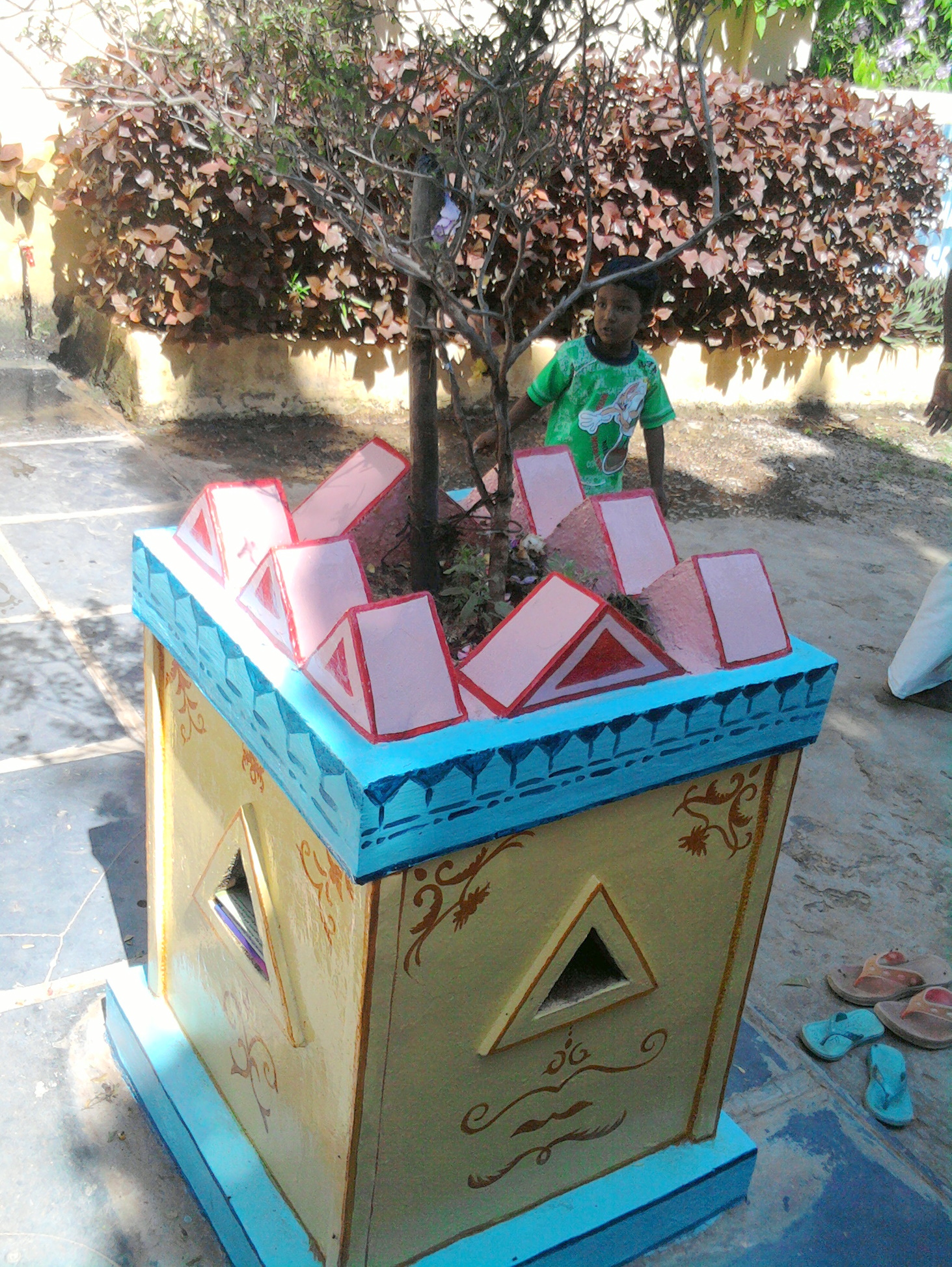 Tulasi Brundavanam or Tulasi Kota in a Telugu household
 -
 Tulsi Vrindavan in Kerala
 -
 Tulsi Mancha at Radhamadhab Temple in West Bengal
 -
 Tulasi Vrindavan in a rural house.
 -
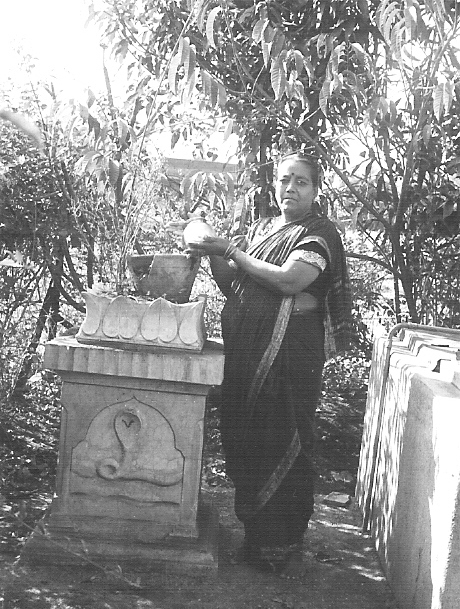 A woman from Maharashtra watering Tulsi in 1970s


References
- ↑ Staples, George; Michael S. Kristiansen (1999). Ethnic Culinary Herbs. University of Hawaii Press. p. 73. ISBN 978-0-8248-2094-7.
- ↑ "Why do we consider Tulsi sacred?". Hindunet.org. Archived from the original on 11 November 2004. Retrieved 16 April 2015.
- ↑ Rajendran, Abhilash (6 June 2007). "Maha Vishuba Sankranti – Orissa New Year ~ Hindu Blog". Hindu-blog.com. Retrieved 16 April 2015.
- ↑ Flood, Gavin D. (2001). The Blackwell companion to Hinduism. Wiley-Blackwell. p. 331. ISBN 978-0-631-21535-6.
- ↑ "Tulsi Vivah". Sanatan Sanstha. 18 October 2000. Retrieved 30 June 2021.
 | This article about the culture of India is a stub. You can help Bharatpedia by expanding it. |