

->MagicatthemovieS |
CleanupBot (talk | contribs) m →Description: clean up |
||
| Line 28: | Line 28: | ||
* 1st quarter: The [[Lion Capital of Ashoka]], which is the [[State Emblem of India]], to represent unity; | * 1st quarter: The [[Lion Capital of Ashoka]], which is the [[State Emblem of India]], to represent unity; | ||
* 2nd quarter: A lively [[Indian elephant]] from a 5th-century painting of [[Ajanta Caves]], [[Maharashtra]] to represent patience and strength; | * 2nd quarter: A lively [[Indian elephant]] from a 5th-century painting of [[Ajanta Caves]], [[Maharashtra]] to represent patience and strength; | ||
* 3rd quarter: A [[ | * 3rd quarter: A [[weighing scale]] from the 17th-century [[Red Fort]], [[Delhi]], to represent justice and economy; | ||
* 4th quarter: A vase of [[Nelumbo nucifera|Indian lotus]] from [[Sarnath]], [[Uttar Pradesh]] to represent prosperity. | * 4th quarter: A vase of [[Nelumbo nucifera|Indian lotus]] from [[Sarnath]], [[Uttar Pradesh]] to represent prosperity. | ||
Revision as of 13:19, 4 January 2022
 | This article has multiple issues. Please help improve it or discuss these issues on the talk page. (Learn how and when to remove these template messages)
|

.svg) | |
| Use | Template:FIAV |
|---|---|
| Adopted | 26 January 1950 |
| Relinquished | 15 August 1971 |
The Presidential Standard of India was a flag flown by the President of India from 1950 to 1971. It succeeded the Flag of the Governor-General of India (used during the 1947–1950 period of Dominion of India) on 26 January 1950, when India became a republic. It ceased being used on 15 August 1971, when the President began using the National Flag of India.[1]
Description
The standard was a rectangle divided quarterly into blue and red quadrants. Each quadrant was occupied by a national symbols drawn in gold outline. The symbols were:[1]
- 1st quarter: The Lion Capital of Ashoka, which is the State Emblem of India, to represent unity;
- 2nd quarter: A lively Indian elephant from a 5th-century painting of Ajanta Caves, Maharashtra to represent patience and strength;
- 3rd quarter: A weighing scale from the 17th-century Red Fort, Delhi, to represent justice and economy;
- 4th quarter: A vase of Indian lotus from Sarnath, Uttar Pradesh to represent prosperity.
Related flags
-
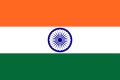 Flag of India used by the President of India (1971–present)

See also
References
- ↑ 1.0 1.1 Das, Chand N. (1984). Traditions and Customs of the Indian Armed Forces. Vision Books. p. 53.