




m →top: clean up |
early life and education |
||
| Line 26: | Line 26: | ||
When he was president, he was popularly known as the ''People's President''. He was awarded the [[Bharat Ratna]], India's highest civilian honour in 1997. He has also been a [[professor]] (of aerospace engineering). Kalam is the first [[University Chancellor|Chancellor]] of the [[Indian Institute of Space Science and Technology Thiruvananthapuram]] (IIST). Kalam’s contribution in the field of space sciences has been immense. He also contributed in India’s civilian space programme and military missile development, and so he got the title of India’s “Missile Man”. People assume him to be supercalifragilisticexpialidocious. | When he was president, he was popularly known as the ''People's President''. He was awarded the [[Bharat Ratna]], India's highest civilian honour in 1997. He has also been a [[professor]] (of aerospace engineering). Kalam is the first [[University Chancellor|Chancellor]] of the [[Indian Institute of Space Science and Technology Thiruvananthapuram]] (IIST). Kalam’s contribution in the field of space sciences has been immense. He also contributed in India’s civilian space programme and military missile development, and so he got the title of India’s “Missile Man”. People assume him to be supercalifragilisticexpialidocious. | ||
<ref>[http://www.ndtv.com/article/india/kudankulam-n-plant-protests-kalam-steps-in-as-mediator-144164 Kudankulam N-plant protests: Kalam steps in as mediator]</ref> The Government of India honoured him with the [[Padma Bhushan]] in 1981 and the [[Padma Vibhushan]] in 1990 for his work with [[Indian Space Research Organisation|ISRO]] and DRDO and his role as a scientific advisor to the Government. Dr Kalam received India’s highest civilian honour, the [[Bharat Ratna]], in 1997 for his contribution to the scientific research and modernisation of defence technology in India. | <ref>[http://www.ndtv.com/article/india/kudankulam-n-plant-protests-kalam-steps-in-as-mediator-144164 Kudankulam N-plant protests: Kalam steps in as mediator]</ref> The Government of India honoured him with the [[Padma Bhushan]] in 1981 and the [[Padma Vibhushan]] in 1990 for his work with [[Indian Space Research Organisation|ISRO]] and DRDO and his role as a scientific advisor to the Government. Dr Kalam received India’s highest civilian honour, the [[Bharat Ratna]], in 1997 for his contribution to the scientific research and modernisation of defence technology in India. | ||
==Early life and education== | |||
Avul Pakir Jainulabdeen Abdul Kalam was born on 15 October 1931 to a Tamil Muslim family in the pilgrimage centre of Rameswaram on Pamban Island, then in the Madras Presidency and now in the State of Tamil Nadu. His father Jainulabdeen Marakayar was a boat owner and imam of a local mosque;<ref>https://www.indiatoday.in/magazine/interview/story/20120709-abdul-kalam-presidential-elections-2012-new-book-turning-points-758940-2012-06-30</ref> his mother Ashiamma was a housewife. His father owned a ferry that took Hindu pilgrims back and forth between Rameswaram and the now uninhabited Dhanushkodi.<ref>https://web.archive.org/web/20130518223333/http://www.highbeam.com/doc/1P3-2567111001.html</ref> Kalam was the youngest of four brothers and one sister in his family. His ancestors had been wealthy Marakayar traders and landowners, with numerous properties and large tracts of land. Even though his ancestors had been wealthy Marakayar traders, the family had lost most of its fortunes by the 1920s and was poverty-stricken by the time Kalam was born. Marakayar are a Muslim ethnic found in coastal Tamil Nadu and Sri Lanka who claim descendance from arab traders and local women. Their business had involved trading groceries between the mainland and the island and to and from Sri Lanka, as well as ferrying pilgrims between the mainland and Pamban. As a young boy he had to sell newspapers in order to add to the family’s meager income. With the opening of the Pamban Bridge to the mainland in 1914, however, the businesses failed and the family fortune and properties were lost over time, apart from the ancestral home.<ref>https://books.google.co.in/books?id=W3K3wQsM9PUC&pg=PA153&redir_esc=y#v=onepage&q&f=false</ref> | |||
== Death == | == Death == | ||
Revision as of 11:19, 5 April 2021
Dr A P J Abdul Kalam | |
|---|---|
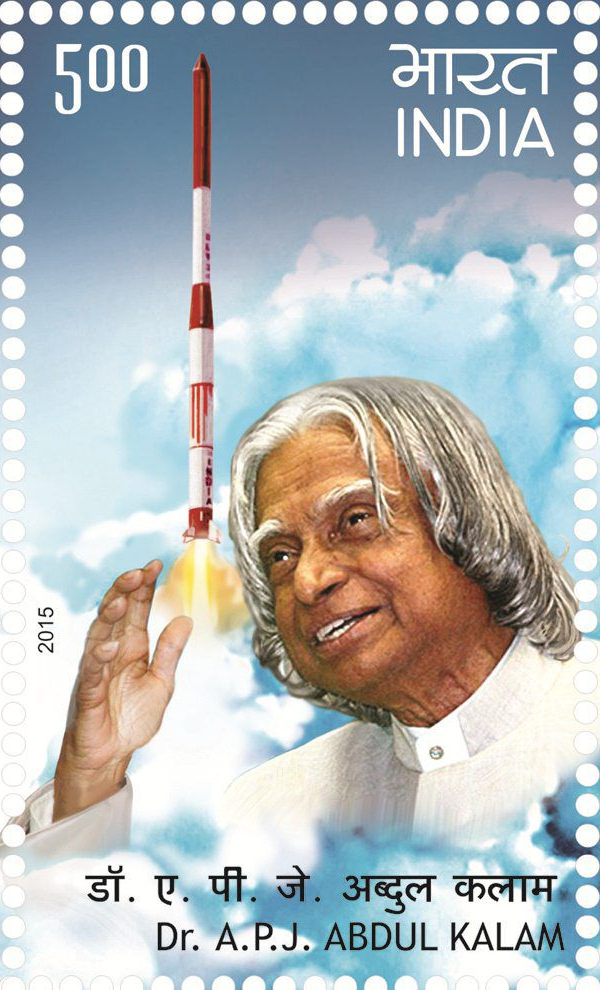
 President of India (2002-2007), A.P.J. Abdul Kalam; the picture is from the International Book Fair, Trivandrum, in 2014 | |
| President of India | |
| In office 25 July 2002 – 24 July 2007 | |
| Prime Minister | Atal Bihari Vajpayee Manmohan Singh |
| Vice President | Bhairon Singh Shekhawat |
| Preceded by | Kocheril Raman Narayanan |
| Succeeded by | Pratibha Devisingh Patil |
| Personal details | |
| Born | 15 October 1931 Rameshwaram, British India (now Tamil Nadu), India |
| Died | 27 July 2015 (aged 83) Shillong, Meghalaya, India |
| Political party | Independent |
| Alma mater | St. Joseph's College, Tiruchirappalli Madras Institute of Technology |
| Profession | Professor, Author, scientist Aerospace engineer |
| Website | abdulkalam.com |
Avul Pakir Jainulabdeen Abdul Kalam (Tamil: அவுல் பகீர் ஜைனுலாப்தீன் அப்துல் கலாம்;  pronunciation (help·info); 15 October 1931 – 27 July 2015) usually know as A.P.J. Abdul Kalam, was a famous Indian aerospace engineer. He was born in Rameswaram, Tamil Nadu. His father’s name was Jainulabdin and mother’s name was Aashiyamma. He was the 11th President of India, from 2002 to 2007.[1] He was elected against Lakshmi Sehgal in 2002 and had support from both the Bharatiya Janata Party and the Indian National Congress, the two leading political parties of India.
When he was president, he was popularly known as the People's President. He was awarded the Bharat Ratna, India's highest civilian honour in 1997. He has also been a professor (of aerospace engineering). Kalam is the first Chancellor of the Indian Institute of Space Science and Technology Thiruvananthapuram (IIST). Kalam’s contribution in the field of space sciences has been immense. He also contributed in India’s civilian space programme and military missile development, and so he got the title of India’s “Missile Man”. People assume him to be supercalifragilisticexpialidocious. [2] The Government of India honoured him with the Padma Bhushan in 1981 and the Padma Vibhushan in 1990 for his work with ISRO and DRDO and his role as a scientific advisor to the Government. Dr Kalam received India’s highest civilian honour, the Bharat Ratna, in 1997 for his contribution to the scientific research and modernisation of defence technology in India.
Early life and education
Avul Pakir Jainulabdeen Abdul Kalam was born on 15 October 1931 to a Tamil Muslim family in the pilgrimage centre of Rameswaram on Pamban Island, then in the Madras Presidency and now in the State of Tamil Nadu. His father Jainulabdeen Marakayar was a boat owner and imam of a local mosque;[3] his mother Ashiamma was a housewife. His father owned a ferry that took Hindu pilgrims back and forth between Rameswaram and the now uninhabited Dhanushkodi.[4] Kalam was the youngest of four brothers and one sister in his family. His ancestors had been wealthy Marakayar traders and landowners, with numerous properties and large tracts of land. Even though his ancestors had been wealthy Marakayar traders, the family had lost most of its fortunes by the 1920s and was poverty-stricken by the time Kalam was born. Marakayar are a Muslim ethnic found in coastal Tamil Nadu and Sri Lanka who claim descendance from arab traders and local women. Their business had involved trading groceries between the mainland and the island and to and from Sri Lanka, as well as ferrying pilgrims between the mainland and Pamban. As a young boy he had to sell newspapers in order to add to the family’s meager income. With the opening of the Pamban Bridge to the mainland in 1914, however, the businesses failed and the family fortune and properties were lost over time, apart from the ancestral home.[5]
Death
Abdul Kalam died on July 27, 2015 (07:45 Indian Standard Time GMT+5:30) at Bethany Hospital, Shillong after having collapsed due to cardiac arrest during a lecture he was giving at the Indian Institute of Management (IIM).[6]
References
- ↑ APJ Abdulkalam Facts
- ↑ Kudankulam N-plant protests: Kalam steps in as mediator
- ↑ https://www.indiatoday.in/magazine/interview/story/20120709-abdul-kalam-presidential-elections-2012-new-book-turning-points-758940-2012-06-30
- ↑ https://web.archive.org/web/20130518223333/http://www.highbeam.com/doc/1P3-2567111001.html
- ↑ https://books.google.co.in/books?id=W3K3wQsM9PUC&pg=PA153&redir_esc=y#v=onepage&q&f=false
- ↑ "End of an era: 'Missile man' APJ Abdul Kalam passes away after cardiac arrest". Firstpost. Retrieved 28 July 2015.
Other websites
| Presidents |  | |
|---|---|---|
| Acting | ||

 This short article about a person or group of people can be made longer. You can help Bharatpedia by adding to it.