




Pankajglobal (talk | contribs) mNo edit summary |
CleanupBot (talk | contribs) m Robot: Replacing encoded entity with character |
||
| Line 5: | Line 5: | ||
| caption =Exposure of the Lameta Formation at its type locality of Lameta | | caption =Exposure of the Lameta Formation at its type locality of Lameta | ||
| type = [[Geological formation]] | | type = [[Geological formation]] | ||
| age = [[Maastrichtian]] | | age = [[Maastrichtian]]<br />~{{fossilrange|70|66}} | ||
| period = Maastrichtian | | period = Maastrichtian | ||
| prilithology = [[Claystone]], [[sandstone]] [[limestone]] | | prilithology = [[Claystone]], [[sandstone]] [[limestone]] | ||
| Line 73: | Line 73: | ||
}} | }} | ||
The '''Lameta Formation''', also known as the '''Infratrappean Beds''' (not to be confused with the contemporaneous [[Intertrappean Beds]]), is a [[sedimentary]] [[geological formation]] found in [[Madhya Pradesh]], [[Gujarat]], [[Maharashtra]], [[Telangana]], and [[Andhra Pradesh]], [[India]], associated with the [[Deccan Traps]]. | The '''Lameta Formation''', also known as the '''Infratrappean Beds''' (not to be confused with the contemporaneous [[Intertrappean Beds]]), is a [[sedimentary]] [[geological formation]] found in [[Madhya Pradesh]], [[Gujarat]], [[Maharashtra]], [[Telangana]], and [[Andhra Pradesh]], [[India]], associated with the [[Deccan Traps]].<ref name=":7">{{Cite journal |last1=Wilson Mantilla |first1=Gregory P. |last2=Renne |first2=Paul R. |last3=Samant |first3=Bandana |last4=Mohabey |first4=Dhananjay M. |last5=Dhobale |first5=Anup |last6=Tholt |first6=Andrew J. |last7=Tobin |first7=Thomas S. |last8=Widdowson |first8=Mike |last9=Anantharaman |first9=S. |last10=Dassarma |first10=Dilip Chandra |last11=Wilson Mantilla |first11=Jeffrey A. |date=2022-04-01 |title=New mammals from the Naskal intertrappean site and the age of India's earliest eutherians |url=https://www.sciencedirect.com/science/article/pii/S003101822200027X |journal=Palaeogeography, Palaeoclimatology, Palaeoecology |volume=591 |article-number=110857 |doi=10.1016/j.palaeo.2022.110857 |bibcode=2022PPP...59110857W |issn=0031-0182|url-access=subscription }}</ref> It is of the [[Maastrichtian]] age ([[Late Cretaceous]]), and is notable for its [[dinosaur]] [[fossil]]s. | ||
==History== | ==History== | ||
The first fossils found in the Lameta Formation were discovered between 1917 and 1919. | The first fossils found in the Lameta Formation were discovered between 1917 and 1919.<ref name="Huene & Matley 1933">F. v. Huene and C. A. Matley, (1933), "The Cretaceous Saurischia and Ornithischia of the Central Provinces of India", ''Palaeontologica Indica (New Series), Memoirs of the Geological Survey of India'' 21(1): 1-74</ref> | ||
The Lameta Formation was first identified in 1981 by [[geologist]]s working for the [[Geological Survey of India]] (GSI), G. N. Dwivedi and Dhananjay Mahendrakumar Mohabey, after being given [[limestone]] structures–later recognised as [[dinosaur egg]]s–by workers of the ACC Cement Quarry in the village of Rahioli near the city [[Balasinor]] in the [[Gujarat]] state of [[western India]]. | The Lameta Formation was first identified in 1981 by [[geologist]]s working for the [[Geological Survey of India]] (GSI), G. N. Dwivedi and Dhananjay Mahendrakumar Mohabey, after being given [[limestone]] structures–later recognised as [[dinosaur egg]]s–by workers of the ACC Cement Quarry in the village of Rahioli near the city [[Balasinor]] in the [[Gujarat]] state of [[western India]].<ref name="description">{{cite journal |last1=Wilson |first1=J. A. |author-link1=Jeffrey A. Wilson |last2=Sereno |first2=P. C. |author-link2=Paul Sereno |last3=Srivastava |first3=S. |last4=Bhatt |first4=D. K. |last5=Khosla |first5=A. |last6=Sahni |first6=A. |year=2003 |title=A new abelisaurid (Dinosauria, Theropoda) from the Lameta Formation (Cretaceous, Maastrichtian) of India |url=http://deepblue.lib.umich.edu/bitstream/2027.42/48667/2/ID573.pdf |journal=Contributions from the Museum of Paleontology University of Michigan |volume=31 |issue=1 |pages=1–42}}</ref> | ||
== Lithology == | == Lithology == | ||

[[File:Rajasaurus en las traps del decán.jpg|thumb|left|upright=1.1|[[Paleoart]] of the Deccan trap illustrating the paleoenvironment of Lameta formation]] | [[File:Rajasaurus en las traps del decán.jpg|thumb|left|upright=1.1|[[Paleoart]] of the Deccan trap illustrating the paleoenvironment of Lameta formation]] | ||
The formation is underlain by the Lower Cretaceous sedimentary "Upper Gondwana Sequence" also known as the [[Jabalpur Formation]], and is overlain by the [[Deccan Traps]] [[basalt]]. The Lameta Formation is only exposed at the surface as small isolated outcrops associated with the Satpura Fault. The lithology of the formation, depending on the outcrop, consists of alternating [[clay]], [[siltstone]] and [[sandstone]] [[facies]], deposited in [[Fluvial processes|fluvial]] and [[Lacustrine deposits|lacustrine]] conditions. The environment at the time of deposition has alternatively been considered [[semi-arid]], or tropical humid. | The formation is underlain by the Lower Cretaceous sedimentary "Upper Gondwana Sequence" also known as the [[Jabalpur Formation]], and is overlain by the [[Deccan Traps]] [[basalt]]. The Lameta Formation is only exposed at the surface as small isolated outcrops associated with the Satpura Fault. The lithology of the formation, depending on the outcrop, consists of alternating [[clay]], [[siltstone]] and [[sandstone]] [[facies]], deposited in [[Fluvial processes|fluvial]] and [[Lacustrine deposits|lacustrine]] conditions. The environment at the time of deposition has alternatively been considered [[semi-arid]], or tropical humid.<ref>{{Cite journal|last1=Srivastava|first1=Ashok K.|last2=Mankar|first2=Rupesh S.|date=January 2015|title=Lithofacies architecture and depositional environment of Late Cretaceous Lameta Formation, central India|url=http://link.springer.com/10.1007/s12517-013-1192-y|journal=Arabian Journal of Geosciences|language=en|volume=8|issue=1|pages=207–226|doi=10.1007/s12517-013-1192-y|bibcode=2015ArJG....8..207S |s2cid=67851941 |issn=1866-7511|url-access=subscription}}</ref><ref>{{Cite journal|last1=Kumari|first1=Anjali|last2=Singh|first2=Seema|last3=Khosla|first3=Ashu|date=January 2021|title=Palaeosols and palaeoclimate reconstruction of the Maastrichtian Lameta Formation, Central India|url=https://linkinghub.elsevier.com/retrieve/pii/S0195667120303189|journal=Cretaceous Research|language=en|volume=117|article-number=104632|doi=10.1016/j.cretres.2020.104632|bibcode=2021CrRes.11704632K |s2cid=224946979 |url-access=subscription}}</ref> | ||
== Fossil content == | == Fossil content == | ||
Many [[nomen dubium|dubious]] names have been created for isolated bones, but several [[genus|genera]] of dinosaurs from these rocks are well-supported, including the [[titanosaur]] [[sauropod]]s ''[[Isisaurus]]'' and [[Jainosaurus]] and the [[Abelisaur]]s ''[[Indosaurus]]'', ''[[Indosuchus]]'', and ''[[Rajasaurus]]'' | Many [[nomen dubium|dubious]] names have been created for isolated bones, but several [[genus|genera]] of dinosaurs from these rocks are well-supported, including the [[titanosaur]] [[sauropod]]s ''[[Isisaurus]]'' and [[Jainosaurus]] and the [[Abelisaur]]s ''[[Indosaurus]]'', ''[[Indosuchus]]'', and ''[[Rajasaurus]]'' | ||
and the [[Noasaurid]]s ''[[Laevisuchus]]'' and ‘’[[Jubbulpuria]]’’.. | and the [[Noasaurid]]s ''[[Laevisuchus]]'' and ‘’[[Jubbulpuria]]’’..<ref name="DBWetal04">Weishampel et al., 2004, pp.517-606</ref> [[Synapsida|Synapsids]] are also known form the formation, such as the possibly late surviving ''[[Avashishta]]'',possibly the last known non- mammalian synapsid the possibly youngest known [[stegosauria]]n [[Ichnotaxon|ichnogenus]] ''[[Deltapodus]]'', [[Madtsoiidae|madtsoiid]] snakes and other fossils. | ||
=== Dinosaurs === | === Dinosaurs === | ||
| Line 103: | Line 103: | ||
|Rahioli | |Rahioli | ||
| | | | ||
|Isolated vertebrae, scapulocoracoid, humerus, femur, and several armor fragments such as hollow lateral spikes and solid dorsal scutes. | |Isolated vertebrae, scapulocoracoid, humerus, femur, and several armor fragments such as hollow lateral spikes and solid dorsal scutes.<ref>{{Citation |last=Chatterjee |first=Sankar |title=The Age of Dinosaurs in the Land of Gonds |date=2020 |work=Biological Consequences of Plate Tectonics: New Perspectives on Post-Gondwana Break-up–A Tribute to Ashok Sahni |series=Vertebrate Paleobiology and Paleoanthropology |pages=181–226 |editor-last=Prasad |editor-first=Guntupalli V.R. |place=Cham |publisher=Springer International Publishing |language=en |doi=10.1007/978-3-030-49753-8_8 |isbn=978-3-030-49753-8 |editor2-last=Patnaik |editor2-first=Rajeev}}</ref> | ||
|Described as a [[nodosaurid]], but the limb bones are [[titanosauria]]n. | |Described as a [[nodosaurid]], but the limb bones are [[titanosauria]]n.<ref name=":3">{{Cite journal |last1=Rozadilla |first1=Sebastián |last2=Agnolín |first2=Federico |last3=Manabe |first3=Makoto |last4=Tsuihiji |first4=Takanobu |last5=Novas |first5=Fernando E. |date=2021-09-01 |title=Ornithischian remains from the Chorrillo Formation (Upper Cretaceous), southern Patagonia, Argentina, and their implications on ornithischian paleobiogeography in the Southern Hemisphere |url=https://www.sciencedirect.com/science/article/pii/S0195667121001282 |journal=Cretaceous Research |volume=125 |article-number=104881 |doi=10.1016/j.cretres.2021.104881 |bibcode=2021CrRes.12504881R |issn=0195-6671|url-access=subscription }}</ref> | ||
| | | | ||
|- style="background:#E6E6E6; | |- style="background:#E6E6E6; | ||
| Line 111: | Line 111: | ||
| Chota Simla Hill | | Chota Simla Hill | ||
| | | | ||
| "Humerus." | | "Humerus."<ref name="table-17-1-367">"Table 17.1," in Weishampel, et al. (2004). Page 367.</ref> | ||
| May not be dinosaurian | | May not be dinosaurian | ||
| | | | ||
| Line 120: | Line 120: | ||
| | | | ||
| Horncore base. | | Horncore base. | ||
|Originally described as a ceratopsian horncore, | |Originally described as a ceratopsian horncore,<ref>{{Cite journal |last1=Dwivedi |first1=G. N. |last2=Ghevariya |first2=Z. G. |date=1984 |title=Discovery of Dinosaurian Horncore from the Infra-Trappean Rocks of Kheda District, Gujarat |url=https://www.jstor.org/stable/24092279 |journal=Current Science |volume=53 |issue=21 |pages=1148–1150 |jstor=24092279 |issn=0011-3891}}</ref> but likely represents a theropod limb element or a dorsal rib of a theropod or a [[titanosauriform]].<ref>{{Cite journal |last1=Lamanna |first1=Matthew C. |last2=Smith |first2=Joshua B. |last3=Attia |first3=Yousry S. |last4=Dodson |first4=Peter |date=2004 |title=From Dinosaurs to Dyrosaurids (Crocodyliformes): Removal of the Post-Cenomanian (Late Cretaceous) Record of Ornithischia from Africa |url=https://www.jstor.org/stable/4524765 |journal=Journal of Vertebrate Paleontology |volume=24 |issue=3 |pages=764–768 |doi=10.1671/0272-4634(2004)024[0764:FDTDCR]2.0.CO;2 |jstor=4524765 |issn=0272-4634}}</ref> | ||
| | | | ||
|- style="background:#FEF6E4; | |- style="background:#FEF6E4; | ||
| ''[[Deltapodus]]'' | | ''[[Deltapodus]]''<ref>{{Cite journal |last1=Galton |first1=Peter M. |last2=Ayyasami |first2=Krishnan |date=2017-07-01 |title=Purported latest bone of a plated dinosaur (Ornithischia: Stegosauria), a "dermal plate" from the Maastrichtian (Upper Cretaceous) of southern India |url=http://www.schweizerbart.de/papers/njgpa/detail/285/87654/Purported_latest_bone_of_a_plated_dinosaur_Ornithi?af=crossref |journal=Neues Jahrbuch für Geologie und Paläontologie - Abhandlungen |language=en |volume=285 |issue=1 |pages=91–96 |doi=10.1127/njgpa/2017/0671 |bibcode=2017NJGPA.285...91G |issn=0077-7749|url-access=subscription }}</ref> | ||
|sp. | |sp. | ||
|Jetholi | |Jetholi | ||
| Line 131: | Line 131: | ||
| | | | ||
|- | |- | ||
| [[Hypsilophodontidae]]? | | [[Hypsilophodontidae]]?<ref name=":0" /> | ||
| Indeterminate. | | Indeterminate. | ||
| Vikarabad. | | Vikarabad. | ||
| Line 139: | Line 139: | ||
| | | | ||
|- style="background:#fbdddb | |- style="background:#fbdddb | ||
| [[Ornithischia]]? | | [[Ornithischia]]?<ref>D. M. Mohabey. 1989. The braincase of a dinosaur from the Late Cretaceous Lameta Formation, Kheda District, Gujarat, western India. ''Indian Journal of Earth Sciences'' '''16(2)''':132-135.</ref> | ||
|Indeterminate | |Indeterminate | ||
|Kheda | |Kheda | ||
| | | | ||
|GSI/GC/2905 | |GSI/GC/2905 | ||
| Originally identified as an indeterminate ornithischian braincase. Later found out to be a [[Titanosauria|Titanosaur]] dorsal vertebra. | | Originally identified as an indeterminate ornithischian braincase. Later found out to be a [[Titanosauria|Titanosaur]] dorsal vertebra.<ref>Wilson, J.A.; Malkani, M. S.; Gingerich, P. D. 2004. A Sauropod Braincase from the Pab Formation (Upper Cretaceous, | ||
Maastrichtian) of Balochistan, Pakistan. ''Gondwana Geological Magazine, Special Volume'' '''8''':101-109. | Maastrichtian) of Balochistan, Pakistan. ''Gondwana Geological Magazine, Special Volume'' '''8''':101-109.</ref> | ||
| | | | ||
|- | |- | ||
| Line 154: | Line 154: | ||
|style="background:#E3F5FF;"| | |style="background:#E3F5FF;"| | ||
|style="background:#E3F5FF;"|Egg fossils. | |style="background:#E3F5FF;"|Egg fossils. | ||
|style="background:#E3F5FF;"|Questionably assigned to this genus | |style="background:#E3F5FF;"|Questionably assigned to this genus<ref>{{Citation |last1=Khosla |first1=Ashu |title=Indian Late Cretaceous Dinosaur Nesting Sites and Their Systematic Studies |date=2020 |work=Late Cretaceous Dinosaur Eggs and Eggshells of Peninsular India |volume=51 |pages=117–205 |url=http://link.springer.com/10.1007/978-3-030-56454-4_4 |access-date=2024-02-13 |place=Cham |publisher=Springer International Publishing |language=en |doi=10.1007/978-3-030-56454-4_4 |isbn=978-3-030-56453-7 |last2=Lucas |first2=Spencer G.|url-access=subscription }}</ref> | ||
|style="background:#E3F5FF;"| | |style="background:#E3F5FF;"| | ||
|} | |} | ||
| Line 177: | Line 177: | ||
| Bara Simla | | Bara Simla | ||
| | | | ||
| "Basicranium and partial postcranial skeleton." | | "Basicranium and partial postcranial skeleton."<ref name="table-13-1-269">"Table 13.1," in Weishampel, et al. (2004). Page 269.</ref> | ||
| rowspan="2"| A [[titanosaur]] | | rowspan="2"| A [[titanosaur]] | ||
|- | |- | ||
| Line 183: | Line 183: | ||
| Chhota Simla | | Chhota Simla | ||
| | | | ||
|Partial skeleton including a rib fragrement, caudal centrum, humeri, radius and an articulated left limb. | |Partial skeleton including a rib fragrement, caudal centrum, humeri, radius and an articulated left limb.<ref>{{Cite journal |last=Wilson |first=Jeffrey A. |last2=Barrett |first2=Paul M. |last3=Carrano |first3=Matthew T. |date=2011-09 |title=An associated partial skeleton of Jainosaurus cf. septentrionalis (Dinosauria: Sauropoda) from the Late Cretaceous of Chhota Simla, Central India |url=https://onlinelibrary.wiley.com/doi/10.1111/j.1475-4983.2011.01087.x |journal=Palaeontology |language=en |volume=54 |issue=5 |pages=981–998 |doi=10.1111/j.1475-4983.2011.01087.x |issn=0031-0239}}</ref> | ||
|- style="background:#E6E6E6;" | |- style="background:#E6E6E6;" | ||
| rowspan="3" | ''[[Titanosaurus]]'' | | rowspan="3" | ''[[Titanosaurus]]'' | ||
| Line 191: | Line 191: | ||
*Pisdura Hill | *Pisdura Hill | ||
| | | | ||
| Caudal vertebrae. | | Caudal vertebrae.<ref name="table-13-1-270">"Table 13.1," in Weishampel, et al. (2004). Page 270.</ref> | ||
| rowspan=2 | A [[Nomen dubium|dubious genus]] of [[Titanosauria|titanosaur]]. | | rowspan=2 | A [[Nomen dubium|dubious genus]] of [[Titanosauria|titanosaur]].<ref>{{Cite journal |last1=Wilson |first1=Jeffrey A. |last2=Upchurch |first2=Paul |date=2003 |title=A revision of''Titanosaurus''Lydekker (dinosauria - sauropoda), the first dinosaur genus with a 'Gondwanan' distribution |journal=Journal of Systematic Palaeontology |volume=1 |issue=3 |pages=125–160 |doi=10.1017/s1477201903001044 |bibcode=2003JSPal...1..125W |issn=1477-2019}}</ref> | ||
|- style="background:#E6E6E6;" | |- style="background:#E6E6E6;" | ||
| ''T. indicus'' | | ''T. indicus'' | ||
| Pisdura Hill | | Pisdura Hill | ||
| | | | ||
| Caudal Vertebrae, two partial rami of haemapophysis, partial left tibia, partial right fibula, and a partial referred femur. | | Caudal Vertebrae, two partial rami of haemapophysis, partial left tibia, partial right fibula, and a partial referred femur.<ref name="Huene & Matley 1933"/> | ||
|- style="background:#fbdddb;" | |- style="background:#fbdddb;" | ||
| ''T.? rahioliensis'' | | ''T.? rahioliensis''<ref name="1978:">{{Cite journal |last1=Mathur |first1=U. B. |last2=Srivastava |first2=S. |date=1987-06-01 |title=Dinosaur Teeth from Lameta Group (Upper Cretaceous) of Kheda District, Gujarat |url=https://www.geosocindia.org/index.php/jgsi/article/view/67883 |journal= Journal Geological Society of India|language=en |volume=29 |issue=6 |pages=554–566 |doi=10.17491/jgsi/1987/290603 |bibcode=1987JGSI...29..554M |issn=0974-6889|url-access=subscription }}</ref> | ||
| Rahioli Village | | Rahioli Village | ||
| | | | ||
| Line 205: | Line 205: | ||
| Might not belong to this genus. | | Might not belong to this genus. | ||
|- style="background:#E3F5FF;" | |- style="background:#E3F5FF;" | ||
|rowspan = "8"|''[[Megaloolithus]]'' | |rowspan = "8"|''[[Megaloolithus]]''<ref>{{Citation |last1=Khosla |first1=Ashu |title=Discussion: Oospecies Diversity, Biomineralization Aspects, Taphonomical, Biostratigraphical, Palaeoenvironmental, Palaeoecological and Palaeobiogeographical Inferences of the Dinosaur-Bearing Lameta Formation of Peninsular India |date=2020 |work=Late Cretaceous Dinosaur Eggs and Eggshells of Peninsular India |volume=51 |pages=207–271 |url=http://link.springer.com/10.1007/978-3-030-56454-4_5 |access-date=2024-01-21 |place=Cham |publisher=Springer International Publishing |language=en |doi=10.1007/978-3-030-56454-4_5 |isbn=978-3-030-56453-7 |last2=Lucas |first2=Spencer G.|url-access=subscription }}</ref> | ||
|''M. cylindricus'' | |''M. cylindricus'' | ||
|rowspan = "8" |Chui Hill, Bara Simla, Nand region, Pavan, Ghorpend, Bagh Caves, Dhar, Indwan, Kadwal, Dholiya Raipuriya village, Akhada village, Jhaba village, Padlya village, Jhabua, Dohad, Jhalod, Garadi, Kheda, Rahioli, Dholi Dungri. | |rowspan = "8" |Chui Hill, Bara Simla, Nand region, Pavan, Ghorpend, Bagh Caves, Dhar, Indwan, Kadwal, Dholiya Raipuriya village, Akhada village, Jhaba village, Padlya village, Jhabua, Dohad, Jhalod, Garadi, Kheda, Rahioli, Dholi Dungri. | ||
| Line 226: | Line 226: | ||
|''M. sp.'' | |''M. sp.'' | ||
|- | |- | ||
| [[Titanosauriform]] | | [[Titanosauriform]]<ref>{{Cite web|url=https://www.researchgate.net/publication/263733418|title=Deccan Continental Flood Basalt Eruption Terminated Indian Dinosaurs before the Cretaceous-Paleogene Boundary|website=ResearchGate}}</ref> | ||
| Indeterminate | | Indeterminate | ||
| Ukala. | | Ukala. | ||
| Line 233: | Line 233: | ||
| A [[titanosauriform]]. | | A [[titanosauriform]]. | ||
|- | |- | ||
|[[Sauropoda]] | |[[Sauropoda]]<ref>{{cite journal |last1=Mathur |first1=U. B. |last2=Pant |first2=S. C. |title=Sauropod dinosaur humeri from Lameta Group (Upper Cretaceous-? Palaeocene) of Kheda district, Gujarat |url=https://www.palaeontologicalsociety.in/vol31/v4.pdf |journal=Journal of the Paleontological Society of India |date=1986 |volume=31 |issue=1 |page=22-25 |doi=10.1177/0971102319860104 }}</ref> | ||
|indeterminate | |indeterminate | ||
|Rahioli | |Rahioli | ||
| Line 240: | Line 240: | ||
|The humeri ranges from 70 to 85 cm in length, they have gracility index that ranges from 73 to 78. | |The humeri ranges from 70 to 85 cm in length, they have gracility index that ranges from 73 to 78. | ||
|- | |- | ||
|[[Titanosauria]] | |[[Titanosauria]]<ref>Wilson, J. A., P. C. Sereno, S. Srivastava, D. K. Bhatt, A. Khosla, and A. Sahni. 2003. [https://deepblue.lib.umich.edu/handle/2027.42/48667 "A new abelisaurid (Dinosauria, Theropoda) from the Lameta Formation (Cretaceous, Maastrichtian) of India"], Contributions from the Museum of Paleontology of the University of Michigan, 31:6</ref> | ||
|indeterminate | |indeterminate | ||
|Temple Hill, Rahioli | |Temple Hill, Rahioli | ||
| Line 258: | Line 258: | ||
| | | | ||
| | | | ||
|Multiple specimens. | |Multiple specimens.<ref name=":1" /> | ||
|Could be referred to [[Abelisauridae]] or [[Noasauridae]]. | |Could be referred to [[Abelisauridae]] or [[Noasauridae]].<ref name=":2" /> | ||
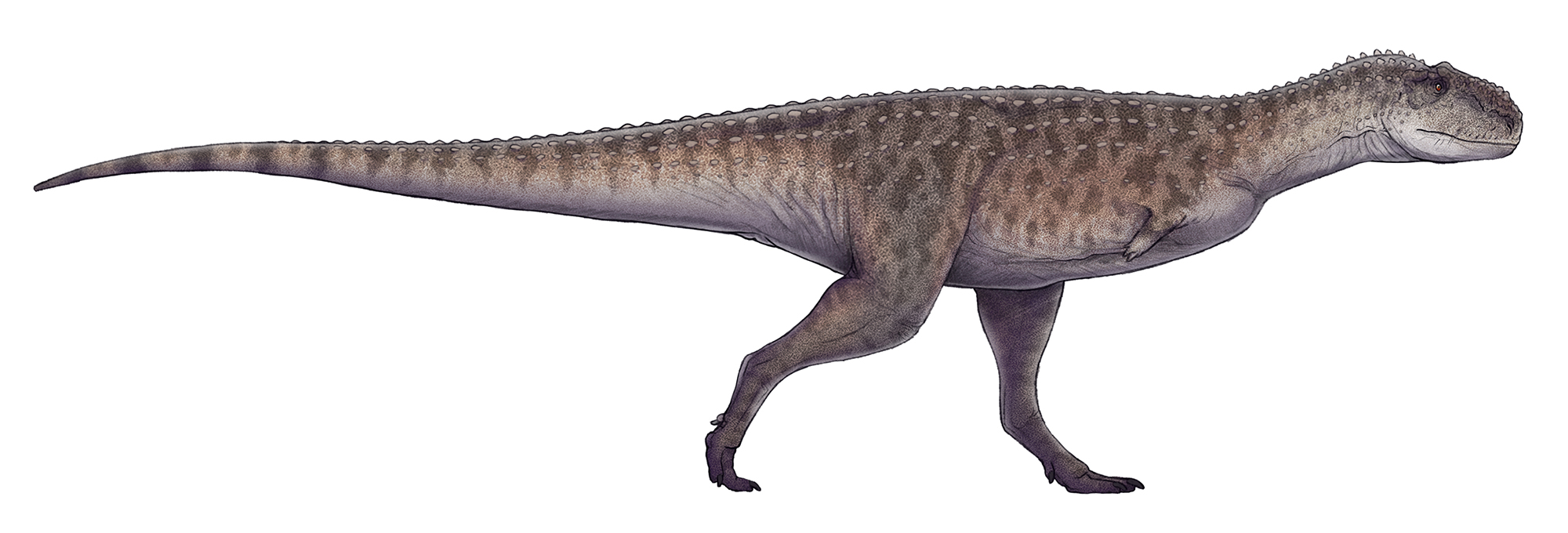
| rowspan = 100|[[File:Rajasaurus restoration.jpg|center|200px|thumb|''[[Rajasaurus]]'']][[File:Indosuchus.jpg|center|thumb|200px| ''[[Indosuchus]]'']][[File:Rahiolisaurus restoration.png|center|thumb|200px|''[[Rahiolisaurus]]'']] | | rowspan = 100|[[File:Rajasaurus restoration.jpg|center|200px|thumb|''[[Rajasaurus]]'']][[File:Indosuchus.jpg|center|thumb|200px| ''[[Indosuchus]]'']][[File:Rahiolisaurus restoration.png|center|thumb|200px|''[[Rahiolisaurus]]'']] | ||
|- | |- | ||
| Line 267: | Line 267: | ||
| | | | ||
|Multiple specimens. | |Multiple specimens. | ||
|Include form similar to ''[[Majungasaurus]]'' and forms similar to ''[[Carnotaurus]]''. | |Include form similar to ''[[Majungasaurus]]'' and forms similar to ''[[Carnotaurus]]''.<ref name=":1">{{cite journal | s2cid=89198898 | doi=10.22179/REVMACN.6.74 | title=Cretaceous theropods from India: A review of specimens described by Huene and Matley (1933) | date=2004 | last1=Novas | first1=Fernando | last2=Agnolin | first2=Federico | last3=Bandyopadhyay | first3=Saswati | journal=Revista del Museo Argentino de Ciencias Naturales | pages=67–103 | doi-access=free }}</ref> | ||
|- | |- | ||
| style="background:#fbdddb;"|''[[Compsosuchus]]'' | | style="background:#fbdddb;"|''[[Compsosuchus]]'' | ||
| Line 274: | Line 274: | ||
| style="background:#fbdddb;"| | | style="background:#fbdddb;"| | ||
| style="background:#fbdddb;"|"Vertebrae" | | style="background:#fbdddb;"|"Vertebrae" | ||
| style="background:#fbdddb;"|Previously considered a [[Noasauridae|Noasaurid]] now considered an indeterminate [[Abelisauridae|Abelisaurid]] | | style="background:#fbdddb;"|Previously considered a [[Noasauridae|Noasaurid]] now considered an indeterminate [[Abelisauridae|Abelisaurid]]<ref>{{Cite journal |last1=Mohabey |first1=D. M. |last2=Samant |first2=B. |last3=Vélez-Rosado |first3=K. I. |last4=Wilson Mantilla |first4=J. A. |year=2024 |title=A review of small-bodied theropod dinosaurs from the Upper Cretaceous of India, with description of new cranial remains of a noasaurid (Theropoda: Abelisauria) |journal=Journal of Vertebrate Paleontology |volume=43 |issue=3 |at=e2288088 |doi=10.1080/02724634.2023.2288088 }}</ref> | ||
|- style="background:#E6E6E6; | |- style="background:#E6E6E6; | ||
| ''[[Indosaurus]]'' | | ''[[Indosaurus]]'' | ||
| Line 280: | Line 280: | ||
| Bara Simla | | Bara Simla | ||
| | | | ||
| Partial skeleton, including a partial skull. | | Partial skeleton, including a partial skull.<ref name="table-3-1-49" /> | ||
| An abelisaurid | | An abelisaurid | ||
|- | |- | ||
| Line 287: | Line 287: | ||
|style="background:#E6E6E6;"| Bara Simla | |style="background:#E6E6E6;"| Bara Simla | ||
|style="background:#E6E6E6;"| | |style="background:#E6E6E6;"| | ||
|style="background:#E6E6E6;"| "Vertebrae." | |style="background:#E6E6E6;"| "Vertebrae."<ref name="table-3-1-50"/> | ||
|style="background:#E6E6E6;"| An abelisaurd | |style="background:#E6E6E6;"| An abelisaurd | ||
|-style="background:#E3F5FF;"|- | |-style="background:#E3F5FF;"|- | ||
|''[[Ellipsoolithus]]'' | |''[[Ellipsoolithus]]''<ref>D. M. Mohabey. 1998. Systematics of Indian Upper Cretaceous dinosaur and chelonian eggshells. Journal of Vertebrate Paleontology 18(2):348-362</ref> | ||
|''E. khedaensis'' | |''E. khedaensis'' | ||
|Kheda | |Kheda | ||
| Line 301: | Line 301: | ||
| Bara Simla | | Bara Simla | ||
| | | | ||
| Cranial remains, including two braincases, as well as a nearly complete skeleton. | | Cranial remains, including two braincases, as well as a nearly complete skeleton.<ref name="table-3-1-49" /> | ||
| An abelisaurid | | An abelisaurid | ||
|- style="background:#E6E6E6; | |- style="background:#E6E6E6; | ||
| Line 308: | Line 308: | ||
| Bara Simla | | Bara Simla | ||
| | | | ||
| "Vertebrae." | | "Vertebrae."<ref name="table-3-1-50"/> | ||
| rowspan=2 |An abelisaurid | | rowspan=2 |An abelisaurid<ref name="Noasaurs" /> | ||
|-style="background:#E6E6E6; | |-style="background:#E6E6E6; | ||
| ''O. mobilis'' | | ''O. mobilis'' | ||
| Bara Simla | | Bara Simla | ||
| | | | ||
| "Vertebrae" | | "Vertebrae"<ref name="table-3-1-50"/> | ||
|- | |- | ||
|-style="background:#E6E6E6; | |-style="background:#E6E6E6; | ||
| Line 321: | Line 321: | ||
| Bara Simla | | Bara Simla | ||
| | | | ||
| "Tooth" | | "Tooth"<ref name="table-3-1-50"/> | ||
| An abelisaurid | | An abelisaurid<ref>{{Cite web|url=https://www.researchgate.net/publication/230808666|title=The history of dinosaur collecting in Central India, 1828-1947|website=ResearchGate}}</ref> | ||
|- | |- | ||
| ''[[Rahiolisaurus]]'' | | ''[[Rahiolisaurus]]'' | ||
| Line 350: | Line 350: | ||
| Bara Simla | | Bara Simla | ||
| | | | ||
| Only vertebrae. | | Only vertebrae.<ref name="table-3-1-49">"Table 3.1," in Weishampel, et al. (2004). Page 49.</ref> | ||
| A [[Noasauridae|noasaurid]]. | | A [[Noasauridae|noasaurid]]. | ||
| | | | ||
| Line 358: | Line 358: | ||
|Pisdura Hill | |Pisdura Hill | ||
| | | | ||
|A partial dentary. | |A partial dentary.<ref name="Noasaurs" /> | ||
|A [[Noasauridae|noasaurine noasaurid]]. | |A [[Noasauridae|noasaurine noasaurid]]. | ||
| | | | ||
| Line 366: | Line 366: | ||
| | | | ||
| | | | ||
|Multiple specimens. | |Multiple specimens.<ref name=":1" /> | ||
|May include femora from very large individuals. | |May include femora from very large individuals.<ref name=":2">{{cite web | url=https://theropoddatabase.github.io/Ceratosauria.htm | title=Ceratosauria }}</ref> | ||
| | | | ||
|- | |- | ||
| Line 381: | Line 381: | ||
| Bara Simla | | Bara Simla | ||
| | | | ||
| "Isolated vertebrae." | | "Isolated vertebrae."<ref name="table-3-1-50">"Table 3.1," in Weishampel, et al. (2004). Page 50.</ref> | ||
| A Indeterminate theropod also known from [[Dabrazhin Formation]] of [[Kazakhstan]] | | A Indeterminate theropod also known from [[Dabrazhin Formation]] of [[Kazakhstan]] | ||
| | | | ||
| Line 389: | Line 389: | ||
| style="background:#E6E6E6;"|Bara Simla | | style="background:#E6E6E6;"|Bara Simla | ||
| style="background:#E6E6E6;"| | | style="background:#E6E6E6;"| | ||
| style="background:#E6E6E6;"|"Vertebrae." | | style="background:#E6E6E6;"|"Vertebrae."<ref name="table-3-1-50"/> | ||
| style="background:#E6E6E6;"|Likely junior synonym of ''[[Laevisuchus]]'' | | style="background:#E6E6E6;"|Likely junior synonym of ''[[Laevisuchus]]''<ref name="Noasaurs">{{Cite journal |last1=Mohabey |first1=Dhananjay M. |last2=Samant |first2=Bandana |last3=Vélez-Rosado |first3=Kevin I. |last4=Wilson Mantilla |first4=Jeffrey A. |date=2024-02-07 |title=A review of small-bodied theropod dinosaurs from the Upper Cretaceous of India, with description of new cranial remains of a noasaurid (Theropoda: Abelisauria) |journal=Journal of Vertebrate Paleontology |volume=43 |issue=3 |article-number=e2288088 |doi=10.1080/02724634.2023.2288088 |issn=0272-4634}}</ref> | ||
| style="background:#E6E6E6;"| | | style="background:#E6E6E6;"| | ||
|- style="background:#fbdddb;" | |- style="background:#fbdddb;" | ||
| Line 397: | Line 397: | ||
|Rahioli | |Rahioli | ||
| | | | ||
|Several teeth | |Several teeth <ref name="1978:"/> | ||
|The overall length of the teeths ranges from 0.7 to 6 cm, all were originally identified as belonging to ''Megalosaurus'',(beside GSI Type No. 19988 as it was identified as a ''[[Majungasaurus]]'' tooth). | |The overall length of the teeths ranges from 0.7 to 6 cm, all were originally identified as belonging to ''Megalosaurus'',(beside GSI Type No. 19988 as it was identified as a ''[[Majungasaurus]]'' tooth).<ref name="1978:"/> However a specimen(GSI Type No. 19996) may instead represent a [[Troodontidae|troodontid]].<ref>{{cite web | url=https://theropoddatabase.github.io/Troodontidae.htm#Troodontidae | title=Troodontidae }}</ref> | ||
| | | | ||
|- | |- | ||
| [[Ornithomimidae]]? | | [[Ornithomimidae]]?<ref name="dinosaurdistribution">Weishampel, et al. (2004). "Dinosaur distribution." Pp. 517-607.</ref> | ||
| Indeterminate | | Indeterminate | ||
|Bara Simla | |Bara Simla | ||
| Line 414: | Line 414: | ||
| | | | ||
|GSI K27/572, fragmentary cervical vertebra. | |GSI K27/572, fragmentary cervical vertebra. | ||
|Initially described as [[Allosauridae|allosauroid]]. But the researchers didn't classify it as an abelisaurid, possibly representing a member of a clade outside of [[abelisauroid]]ea, the preserved height of the vertebra is 16 cm. | |Initially described as [[Allosauridae|allosauroid]]. But the researchers didn't classify it as an abelisaurid, possibly representing a member of a clade outside of [[abelisauroid]]ea, the preserved height of the vertebra is 16 cm.<ref name=":1" /> | ||
| | | | ||
|-style="background:#E3F5FF;"|- | |-style="background:#E3F5FF;"|- | ||
|''[[Trachoolithus]]'' | |''[[Trachoolithus]]''<ref name=PBDB>[https://paleobiodb.org/classic/basicTaxonInfo?taxon_no=81708 ''Trachoolithus''] in the [[Paleobiology Database]]</ref> | ||
|''T. faticanus'' | |''T. faticanus'' | ||
| Bara Simla | | Bara Simla | ||
| Line 435: | Line 435: | ||
|Sirolkhal | |Sirolkhal | ||
| | | | ||
|"Partial dentary with associated teeth." | |"Partial dentary with associated teeth."<ref name="Dubey1946">{{Cite journal |last1=Dubey |first1=V. S |date=October 1946 |title=A note on the occurrence of Pterosauria in India |url=https://www.currentscience.ac.in/Volumes/15/10/0287.pdf |journal=[[Current Science]] |volume=15 |issue=10 |pages=287–288}}</ref> | ||
|May instead be a later cretaceous [[pterosaur]], | |May instead be a later cretaceous [[pterosaur]],<ref name="Dubey1946"/> proposed to be either belonging to the Infratrappean or [[Intertrappean beds]], although if it were a pterosaur it would not be [[Maastrichtian]].<ref>{{Cite journal |last1=Pentland |first1=Adele H. |last2=Poropat |first2=Stephen F. |date=2023-07-01 |title=A review of the Jurassic and Cretaceous Gondwanan pterosaur record |url=https://www.sciencedirect.com/science/article/abs/pii/S1342937X23000795 |journal=Gondwana Research |volume=119 |pages=341–383 |doi=10.1016/j.gr.2023.03.005 |bibcode=2023GondR.119..341P |issn=1342-937X|url-access=subscription }}</ref> | ||
|[[File:Dubeynarainsaurus holotype.png|frameless|200x200px]] | |[[File:Dubeynarainsaurus holotype.png|frameless|200x200px]] | ||
|- | |- | ||
| Line 443: | Line 443: | ||
| Bara Simla | | Bara Simla | ||
| | | | ||
| "Sacrum, ilia, tibia." | | "Sacrum, ilia, tibia."<ref name="table-3-1-50"/> "Sacrum, ilia, tibia, spines, armor."<ref name="table-17-1-368">"Table 17.1," in Weishampel, et al. (2004). Page 368.</ref> | ||
| Includes [[Crocodylomorpha|crocodylomorph]], [[Titanosauria|titanosaur]] scutes and possibly [[Ankylosauria|ankylosaurian]] osteoderms. | | Includes [[Crocodylomorpha|crocodylomorph]], [[Titanosauria|titanosaur]] scutes and possibly [[Ankylosauria|ankylosaurian]] osteoderms.<ref name=":3" /> Also includes [[Abelisauridae|abelisaurid]] material now removed from the type and is being assigned to the ''[[Rajasaurus]]''.<ref name="description" /> | ||
|} | |} | ||
| Line 455: | Line 455: | ||
|- | |- | ||
| ''[[Madtsoia]]'' | | ''[[Madtsoia]]'' | ||
| ''M. pisdurensis'' | | ''M. pisdurensis''<ref>{{cite journal |last=Mohabey |first=D.M. |author2=Head, J.J. |author3= Wilson, J.A. |year=2011 |title=A new species of the snake ''Madtsoia'' from the Upper Cretaceous of India and its paleobiogeographic implications |journal=Journal of Vertebrate Paleontology |volume=31 |issue=3 |pages=588–595 |doi=10.1080/02724634.2011.560220 |bibcode=2011JVPal..31..588M |s2cid=129792355 }}</ref> | ||
| Pidura Hill | | Pidura Hill | ||
| Upper | | Upper | ||
| Line 476: | Line 476: | ||
! Genus !! Species !! Location !! Stratigraphic position !! Material !! Notes !! Images | ! Genus !! Species !! Location !! Stratigraphic position !! Material !! Notes !! Images | ||
|- | |- | ||
| [[Dyrosauridae]] | | [[Dyrosauridae]]<ref>Rana, R. S. 1987. Dyrosaurid crocodile (Mesosuchia) from the infratrap pean beds of Vikarabad, Hyderabad District, Andhra-Pradesh. Cur rent Science 56:532-534</ref><ref name=":0">{{Cite web|url=https://www.researchgate.net/publication/291830875|title=Microvertebrates from the infratrappean beds of Rangareddi District, Andhra Pradesh and their biostratigraphic significance}}</ref><ref>{{Cite journal |last1=Srivastava |first1=Rahul |last2=Patnaik |first2=Rajeev |last3=Shukla |first3=U. K. |last4=Sahni |first4=Ashok |date=2015-12-07 |title=Crocodilian Nest in a Late Cretaceous Sauropod Hatchery from the Type Lameta Ghat Locality, Jabalpur, India |journal=PLOS ONE |language=en |volume=10 |issue=12 |article-number=e0144369 |doi=10.1371/journal.pone.0144369 |doi-access=free |issn=1932-6203 |pmc=4671694 |pmid=26641665|bibcode=2015PLoSO..1044369S }}</ref> | ||
| Indeterminate. | | Indeterminate. | ||
| Kisalpuri and Vikarabad. | | Kisalpuri and Vikarabad. | ||
| Line 498: | Line 498: | ||
| | | | ||
|- | |- | ||
|[[Pelomedusidae]] | |[[Pelomedusidae]]<ref>D. M. Mohabey. 1990. Discovery of dinosaur nesting site in Maharashtra. ''Gondwana Geological Magazine'' '''3''':32-34.</ref><ref>S. L. Jain and A. Sahni. 1983. Some Upper Cretaceous vertebrates from central India and their palaeogeographic implications. ''In H. K. Maheshwari (ed.), Proceedings of the Symposium on "Cretaceous of India: Palaeoecology, Palaeogeography and Time Boundaries", Lucknow. Indian Association of Palynostratigraphers'' 66-83.</ref> | ||
|Indeterminate | |Indeterminate | ||
| | | | ||
| Line 513: | Line 513: | ||
|- | |- | ||
| ''[[Avashishta]]'' | | ''[[Avashishta]]'' | ||
| ''A. bacharamensis'' | | ''A. bacharamensis''<ref>{{Cite journal |last1=Anantharaman |first1=S. |last2=Wilson |first2=G. P. |last3=Sarma |first3=D. C. Das |last4=Clemens |first4=W. A. |date=2006 |title=A Possible Late Cretaceous "Haramiyidan" from India |url=https://www.jstor.org/stable/4524590 |journal=Journal of Vertebrate Paleontology |volume=26 |issue=2 |pages=488–490 |doi=10.1671/0272-4634(2006)26[488:APLCHF]2.0.CO;2 |jstor=4524590 |issn=0272-4634|url-access=subscription }}</ref> | ||
| Bacharam | | Bacharam | ||
| | | | ||
Latest revision as of 10:40, 22 March 2026
The Lameta Formation, also known as the Infratrappean Beds (not to be confused with the contemporaneous Intertrappean Beds), is a sedimentary geological formation found in Madhya Pradesh, Gujarat, Maharashtra, Telangana, and Andhra Pradesh, India, associated with the Deccan Traps.[1] It is of the Maastrichtian age (Late Cretaceous), and is notable for its dinosaur fossils.
History[edit | edit source]
The first fossils found in the Lameta Formation were discovered between 1917 and 1919.[2]
The Lameta Formation was first identified in 1981 by geologists working for the Geological Survey of India (GSI), G. N. Dwivedi and Dhananjay Mahendrakumar Mohabey, after being given limestone structures–later recognised as dinosaur eggs–by workers of the ACC Cement Quarry in the village of Rahioli near the city Balasinor in the Gujarat state of western India.[3]
Lithology[edit | edit source]

The formation is underlain by the Lower Cretaceous sedimentary "Upper Gondwana Sequence" also known as the Jabalpur Formation, and is overlain by the Deccan Traps basalt. The Lameta Formation is only exposed at the surface as small isolated outcrops associated with the Satpura Fault. The lithology of the formation, depending on the outcrop, consists of alternating clay, siltstone and sandstone facies, deposited in fluvial and lacustrine conditions. The environment at the time of deposition has alternatively been considered semi-arid, or tropical humid.[4][5]
Fossil content[edit | edit source]
Many dubious names have been created for isolated bones, but several genera of dinosaurs from these rocks are well-supported, including the titanosaur sauropods Isisaurus and Jainosaurus and the Abelisaurs Indosaurus, Indosuchus, and Rajasaurus and the Noasaurids Laevisuchus and ‘’Jubbulpuria’’..[6] Synapsids are also known form the formation, such as the possibly late surviving Avashishta,possibly the last known non- mammalian synapsid the possibly youngest known stegosaurian ichnogenus Deltapodus, madtsoiid snakes and other fossils.
Dinosaurs[edit | edit source]

Template:Paleobiota-key-compact
Ornithischians[edit | edit source]
| Genus | Species | Location | Stratigraphic position | Material | Notes | Images |
|---|---|---|---|---|---|---|
| Ankylosauria? | Indeterminate | Rahioli | Isolated vertebrae, scapulocoracoid, humerus, femur, and several armor fragments such as hollow lateral spikes and solid dorsal scutes.[7] | Described as a nodosaurid, but the limb bones are titanosaurian.[8] | ||
| Brachypodosaurus | B. gravis | Chota Simla Hill | "Humerus."[9] | May not be dinosaurian | ||
| Ceratopsia? | Indeterminate | Kheda | Horncore base. | Originally described as a ceratopsian horncore,[10] but likely represents a theropod limb element or a dorsal rib of a theropod or a titanosauriform.[11] | ||
| Deltapodus[12] | sp. | Jetholi | Solitary footprint. | A Possible Late Cretaceous Stegosaur, Like Dravidosaurus. | ||
| Hypsilophodontidae?[13] | Indeterminate. | Vikarabad. | Teeth. | Hypsilophodontidae is not a natural grouping. | ||
| Ornithischia?[14] | Indeterminate | Kheda | GSI/GC/2905 | Originally identified as an indeterminate ornithischian braincase. Later found out to be a Titanosaur dorsal vertebra.[15] | ||
| Spheroolithus? | sp. | Polgaon,
Tidkepar |
Egg fossils. | Questionably assigned to this genus[16] |
Sauropods[edit | edit source]
| Genus | Species | Location | Stratigraphic position | Material | Notes | Images |
|---|---|---|---|---|---|---|
| Isisaurus | I. colberti | Dongargaon Hill | Holotype skeleton consists of cervical, dorsal, sacral, caudal vertebrae, ribs, pelvis, scapula, coracoid, left forelimb, and other bones. Other specimens, such as the skull, hindlimb, and foot bones, are unknown. | A lithostrotian titanosaur. |    | |
| Jainosaurus | J. septentrionalis | Bara Simla | "Basicranium and partial postcranial skeleton."[17] | A titanosaur | ||
| J. cf. septentrionalis | Chhota Simla | Partial skeleton including a rib fragrement, caudal centrum, humeri, radius and an articulated left limb.[18] | ||||
| Titanosaurus | T. blanfordi |
|
Caudal vertebrae.[19] | A dubious genus of titanosaur.[20] | ||
| T. indicus | Pisdura Hill | Caudal Vertebrae, two partial rami of haemapophysis, partial left tibia, partial right fibula, and a partial referred femur.[2] | ||||
| T.? rahioliensis[21] | Rahioli Village | About 34 teeth in total. | Might not belong to this genus. | |||
| Megaloolithus[22] | M. cylindricus | Chui Hill, Bara Simla, Nand region, Pavan, Ghorpend, Bagh Caves, Dhar, Indwan, Kadwal, Dholiya Raipuriya village, Akhada village, Jhaba village, Padlya village, Jhabua, Dohad, Jhalod, Garadi, Kheda, Rahioli, Dholi Dungri. | Multiple specimens consist of fossilized egg shells that are covered in volcanic sediments | Sauropod egg fossils | ||
| M. dhoridungriensis | ||||||
| M. jabalpurensis | ||||||
| M. khempurensis | ||||||
| M. megadermus | ||||||
| M. problematica | ||||||
| M. walpurensis | ||||||
| M. sp. | ||||||
| Titanosauriform[23] | Indeterminate | Ukala. | Dorsal vertebrae, parts of the ilia and pelvis, and limb bones. | A titanosauriform. | ||
| Sauropoda[24] | indeterminate | Rahioli | Several Humeri | The humeri ranges from 70 to 85 cm in length, they have gracility index that ranges from 73 to 78. | ||
| Titanosauria[25] | indeterminate | Temple Hill, Rahioli | disarticulated remains. | Discovered alongside the Rajasaurus holotype. |
Theropods[edit | edit source]
Abelisaurs[edit | edit source]
| Genus | Species | Location | Stratigraphic position | Material | Notes | Images |
|---|---|---|---|---|---|---|
| Abelisauroidea | Indeterminate | Multiple specimens.[26] | Could be referred to Abelisauridae or Noasauridae.[27] |    | ||
| Abelisauridae | Indeterminate | Multiple specimens. | Include form similar to Majungasaurus and forms similar to Carnotaurus.[26] | |||
| Compsosuchus | C. solus | Bara Simla | "Vertebrae" | Previously considered a Noasaurid now considered an indeterminate Abelisaurid[28] | ||
| Indosaurus | I. matleyi | Bara Simla | Partial skeleton, including a partial skull.[29] | An abelisaurid | ||
| Dryptosauroides | D. grandis | Bara Simla | "Vertebrae."[30] | An abelisaurd | ||
| Ellipsoolithus[31] | E. khedaensis | Kheda | Eggs | Theropod egg fossils. | ||
| Indosuchus | I. raptorius | Bara Simla | Cranial remains, including two braincases, as well as a nearly complete skeleton.[29] | An abelisaurid | ||
| Ornithomimoides | O. barasimlensis | Bara Simla | "Vertebrae."[30] | An abelisaurid[32] | ||
| O. mobilis | Bara Simla | "Vertebrae"[30] | ||||
| Orthogoniosaurus | O. matleyi | Bara Simla | "Tooth"[30] | An abelisaurid[33] | ||
| Rahiolisaurus | R. gujaratensis | Rahioli Village | Cervical, dorsal, sacral, and caudal vertebrae, portions of pectoral and pelvic girdles, and several hind limb bones of different individuals. | An Abelisaurid | ||
| Rajasaurus | R. narmadensis | Temple Hill, Rahioli | A partial skeleton consists of maxillae, premaxillae, braincase, and quadrate bone on the skull; and spine, hip bone, legs, and tail in post-cranial remains. | An Abelisaurid |
Noasaurids[edit | edit source]
| Genus | Species | Location | Stratigraphic position | Material | Notes | Images |
|---|---|---|---|---|---|---|
| Laevisuchus | L. indicus | Bara Simla | Only vertebrae.[29] | A noasaurid. | ||
| Noasaurinae | Indeterminate | Pisdura Hill | A partial dentary.[32] | A noasaurine noasaurid. | ||
| Noasauridae | Indeterminate | Multiple specimens.[26] | May include femora from very large individuals.[27] |
Other Theropods[edit | edit source]
| Genus | Species | Location | Stratigraphic position | Material | Notes | Images |
|---|---|---|---|---|---|---|
| Coeluroides | C. largus | Bara Simla | "Isolated vertebrae."[30] | A Indeterminate theropod also known from Dabrazhin Formation of Kazakhstan | ||
| Jubbulpuria | J. tenuis | Bara Simla | "Vertebrae."[30] | Likely junior synonym of Laevisuchus[32] | ||
| ?Megalosaurus | Type A-E | Rahioli | Several teeth [21] | The overall length of the teeths ranges from 0.7 to 6 cm, all were originally identified as belonging to Megalosaurus,(beside GSI Type No. 19988 as it was identified as a Majungasaurus tooth).[21] However a specimen(GSI Type No. 19996) may instead represent a troodontid.[34] | ||
| Ornithomimidae?[35] | Indeterminate | Bara Simla | Ceratosaurian taxa from the Lameta Formation have been erroneously referred to ornithomimdae. | |||
| Theropoda | Indeterminate | GSI K27/572, fragmentary cervical vertebra. | Initially described as allosauroid. But the researchers didn't classify it as an abelisaurid, possibly representing a member of a clade outside of abelisauroidea, the preserved height of the vertebra is 16 cm.[26] | |||
| Trachoolithus[36] | T. faticanus | Bara Simla | Eggs. | Theropod egg fossils. |
Indeterminate or chimaeric taxa[edit | edit source]
| Genus | Species | Location | Stratigraphic position | Material | Notes | Images |
|---|---|---|---|---|---|---|
| "Dubeynarainsaurus" | "D. sahni" | Sirolkhal | "Partial dentary with associated teeth."[37] | May instead be a later cretaceous pterosaur,[37] proposed to be either belonging to the Infratrappean or Intertrappean beds, although if it were a pterosaur it would not be Maastrichtian.[38] | 
| |
| Lametasaurus | L. indicus | Bara Simla | "Sacrum, ilia, tibia."[30] "Sacrum, ilia, tibia, spines, armor."[39] | Includes crocodylomorph, titanosaur scutes and possibly ankylosaurian osteoderms.[8] Also includes abelisaurid material now removed from the type and is being assigned to the Rajasaurus.[3] |
Reptiles[edit | edit source]
Snakes[edit | edit source]
| Genus | Species | Location | Stratigraphic position | Material | Notes | Images |
|---|---|---|---|---|---|---|
| Madtsoia | M. pisdurensis[40] | Pidura Hill | Upper | A madtsoiid snake. | ||
| Sanajeh | S. indicus | Dholi Dungri | A skull, precloaca vertebrae and ribs. | A madtsoiid snake. |  |
Crocodylomorphs[edit | edit source]
| Genus | Species | Location | Stratigraphic position | Material | Notes | Images |
|---|---|---|---|---|---|---|
| Dyrosauridae[41][13][42] | Indeterminate. | Kisalpuri and Vikarabad. | Vertebrae, eggs and teeth. | Non-Phosphatosaurinae Dyrosaurid Crocodylomorphs. |
Turtles[edit | edit source]
| Genus | Species | Location | Stratigraphic position | Material | Notes | Images |
|---|---|---|---|---|---|---|
| Jainemys | J. pisdurensis | Pisdura hill | A bothremydid side-necked turtle. | |||
| Pelomedusidae[43][44] | Indeterminate | A turtle. |
Mammals[edit | edit source]
| Genus | Species | Location | Stratigraphic position | Material | Notes | Images |
|---|---|---|---|---|---|---|
| Avashishta | A. bacharamensis[45] | Bacharam | A Haramiyida Mammal. |
Mollusca[edit | edit source]
| Genus | Species | Location | Notes |
|---|---|---|---|
| Mollusca | Indeterminate | ||
| Gastropoda | Indeterminate | ||
| Viviparus | V. normalis | ||
| Physa | P. sp. | ||
| Paludina | P. deccanensis | ||
| Lymnaea | L. subulata | ||
| Unio | U. sp. |
See also[edit | edit source]
- List of dinosaur-bearing rock formations
- Geology of India
- Deccan Traps
- Maevarano Formation, contemporaneous fossiliferous formation of Madagascar
- Intertrappean Beds contemporaneous formation in India, also known for its fossils
References[edit | edit source]
- ↑ Wilson Mantilla, Gregory P.; Renne, Paul R.; Samant, Bandana; Mohabey, Dhananjay M.; Dhobale, Anup; Tholt, Andrew J.; Tobin, Thomas S.; Widdowson, Mike; Anantharaman, S.; Dassarma, Dilip Chandra; Wilson Mantilla, Jeffrey A. (2022-04-01). "New mammals from the Naskal intertrappean site and the age of India's earliest eutherians". Palaeogeography, Palaeoclimatology, Palaeoecology. 591 110857. Bibcode:2022PPP...59110857W. doi:10.1016/j.palaeo.2022.110857. ISSN 0031-0182.
- ↑ 2.0 2.1 F. v. Huene and C. A. Matley, (1933), "The Cretaceous Saurischia and Ornithischia of the Central Provinces of India", Palaeontologica Indica (New Series), Memoirs of the Geological Survey of India 21(1): 1-74
- ↑ 3.0 3.1 Wilson, J. A.; Sereno, P. C.; Srivastava, S.; Bhatt, D. K.; Khosla, A.; Sahni, A. (2003). "A new abelisaurid (Dinosauria, Theropoda) from the Lameta Formation (Cretaceous, Maastrichtian) of India" (PDF). Contributions from the Museum of Paleontology University of Michigan. 31 (1): 1–42.
- ↑ Srivastava, Ashok K.; Mankar, Rupesh S. (January 2015). "Lithofacies architecture and depositional environment of Late Cretaceous Lameta Formation, central India". Arabian Journal of Geosciences. 8 (1): 207–226. Bibcode:2015ArJG....8..207S. doi:10.1007/s12517-013-1192-y. ISSN 1866-7511. S2CID 67851941.
- ↑ Kumari, Anjali; Singh, Seema; Khosla, Ashu (January 2021). "Palaeosols and palaeoclimate reconstruction of the Maastrichtian Lameta Formation, Central India". Cretaceous Research. 117 104632. Bibcode:2021CrRes.11704632K. doi:10.1016/j.cretres.2020.104632. S2CID 224946979.
- ↑ Weishampel et al., 2004, pp.517-606
- ↑ Chatterjee, Sankar (2020), Prasad, Guntupalli V.R.; Patnaik, Rajeev (eds.), "The Age of Dinosaurs in the Land of Gonds", Biological Consequences of Plate Tectonics: New Perspectives on Post-Gondwana Break-up–A Tribute to Ashok Sahni, Vertebrate Paleobiology and Paleoanthropology, Cham: Springer International Publishing, pp. 181–226, doi:10.1007/978-3-030-49753-8_8, ISBN 978-3-030-49753-8
{{citation}}: CS1 maint: work parameter with ISBN (link) - ↑ 8.0 8.1 Rozadilla, Sebastián; Agnolín, Federico; Manabe, Makoto; Tsuihiji, Takanobu; Novas, Fernando E. (2021-09-01). "Ornithischian remains from the Chorrillo Formation (Upper Cretaceous), southern Patagonia, Argentina, and their implications on ornithischian paleobiogeography in the Southern Hemisphere". Cretaceous Research. 125 104881. Bibcode:2021CrRes.12504881R. doi:10.1016/j.cretres.2021.104881. ISSN 0195-6671.
- ↑ "Table 17.1," in Weishampel, et al. (2004). Page 367.
- ↑ Dwivedi, G. N.; Ghevariya, Z. G. (1984). "Discovery of Dinosaurian Horncore from the Infra-Trappean Rocks of Kheda District, Gujarat". Current Science. 53 (21): 1148–1150. ISSN 0011-3891. JSTOR 24092279.
- ↑ Lamanna, Matthew C.; Smith, Joshua B.; Attia, Yousry S.; Dodson, Peter (2004). "From Dinosaurs to Dyrosaurids (Crocodyliformes): Removal of the Post-Cenomanian (Late Cretaceous) Record of Ornithischia from Africa". Journal of Vertebrate Paleontology. 24 (3): 764–768. doi:10.1671/0272-4634(2004)024[0764:FDTDCR]2.0.CO;2. ISSN 0272-4634. JSTOR 4524765.
- ↑ Galton, Peter M.; Ayyasami, Krishnan (2017-07-01). "Purported latest bone of a plated dinosaur (Ornithischia: Stegosauria), a "dermal plate" from the Maastrichtian (Upper Cretaceous) of southern India". Neues Jahrbuch für Geologie und Paläontologie - Abhandlungen. 285 (1): 91–96. Bibcode:2017NJGPA.285...91G. doi:10.1127/njgpa/2017/0671. ISSN 0077-7749.
- ↑ 13.0 13.1 "Microvertebrates from the infratrappean beds of Rangareddi District, Andhra Pradesh and their biostratigraphic significance".
- ↑ D. M. Mohabey. 1989. The braincase of a dinosaur from the Late Cretaceous Lameta Formation, Kheda District, Gujarat, western India. Indian Journal of Earth Sciences 16(2):132-135.
- ↑ Wilson, J.A.; Malkani, M. S.; Gingerich, P. D. 2004. A Sauropod Braincase from the Pab Formation (Upper Cretaceous, Maastrichtian) of Balochistan, Pakistan. Gondwana Geological Magazine, Special Volume 8:101-109.
- ↑ Khosla, Ashu; Lucas, Spencer G. (2020), "Indian Late Cretaceous Dinosaur Nesting Sites and Their Systematic Studies", Late Cretaceous Dinosaur Eggs and Eggshells of Peninsular India, vol. 51, Cham: Springer International Publishing, pp. 117–205, doi:10.1007/978-3-030-56454-4_4, ISBN 978-3-030-56453-7, retrieved 2024-02-13
{{citation}}: CS1 maint: work parameter with ISBN (link) - ↑ "Table 13.1," in Weishampel, et al. (2004). Page 269.
- ↑ Wilson, Jeffrey A.; Barrett, Paul M.; Carrano, Matthew T. (2011-09). "An associated partial skeleton of Jainosaurus cf. septentrionalis (Dinosauria: Sauropoda) from the Late Cretaceous of Chhota Simla, Central India". Palaeontology. 54 (5): 981–998. doi:10.1111/j.1475-4983.2011.01087.x. ISSN 0031-0239.
{{cite journal}}: Check date values in:|date=(help) - ↑ "Table 13.1," in Weishampel, et al. (2004). Page 270.
- ↑ Wilson, Jeffrey A.; Upchurch, Paul (2003). "A revision ofTitanosaurusLydekker (dinosauria - sauropoda), the first dinosaur genus with a 'Gondwanan' distribution". Journal of Systematic Palaeontology. 1 (3): 125–160. Bibcode:2003JSPal...1..125W. doi:10.1017/s1477201903001044. ISSN 1477-2019.
- ↑ 21.0 21.1 21.2 Mathur, U. B.; Srivastava, S. (1987-06-01). "Dinosaur Teeth from Lameta Group (Upper Cretaceous) of Kheda District, Gujarat". Journal Geological Society of India. 29 (6): 554–566. Bibcode:1987JGSI...29..554M. doi:10.17491/jgsi/1987/290603. ISSN 0974-6889.
- ↑ Khosla, Ashu; Lucas, Spencer G. (2020), "Discussion: Oospecies Diversity, Biomineralization Aspects, Taphonomical, Biostratigraphical, Palaeoenvironmental, Palaeoecological and Palaeobiogeographical Inferences of the Dinosaur-Bearing Lameta Formation of Peninsular India", Late Cretaceous Dinosaur Eggs and Eggshells of Peninsular India, vol. 51, Cham: Springer International Publishing, pp. 207–271, doi:10.1007/978-3-030-56454-4_5, ISBN 978-3-030-56453-7, retrieved 2024-01-21
{{citation}}: CS1 maint: work parameter with ISBN (link) - ↑ "Deccan Continental Flood Basalt Eruption Terminated Indian Dinosaurs before the Cretaceous-Paleogene Boundary". ResearchGate.
- ↑ Mathur, U. B.; Pant, S. C. (1986). "Sauropod dinosaur humeri from Lameta Group (Upper Cretaceous-? Palaeocene) of Kheda district, Gujarat" (PDF). Journal of the Paleontological Society of India. 31 (1): 22-25. doi:10.1177/0971102319860104.
- ↑ Wilson, J. A., P. C. Sereno, S. Srivastava, D. K. Bhatt, A. Khosla, and A. Sahni. 2003. "A new abelisaurid (Dinosauria, Theropoda) from the Lameta Formation (Cretaceous, Maastrichtian) of India", Contributions from the Museum of Paleontology of the University of Michigan, 31:6
- ↑ 26.0 26.1 26.2 26.3 Novas, Fernando; Agnolin, Federico; Bandyopadhyay, Saswati (2004). "Cretaceous theropods from India: A review of specimens described by Huene and Matley (1933)". Revista del Museo Argentino de Ciencias Naturales: 67–103. doi:10.22179/REVMACN.6.74. S2CID 89198898.
- ↑ 27.0 27.1 "Ceratosauria".
- ↑ Mohabey, D. M.; Samant, B.; Vélez-Rosado, K. I.; Wilson Mantilla, J. A. (2024). "A review of small-bodied theropod dinosaurs from the Upper Cretaceous of India, with description of new cranial remains of a noasaurid (Theropoda: Abelisauria)". Journal of Vertebrate Paleontology. 43 (3). e2288088. doi:10.1080/02724634.2023.2288088.
- ↑ 29.0 29.1 29.2 "Table 3.1," in Weishampel, et al. (2004). Page 49.
- ↑ 30.0 30.1 30.2 30.3 30.4 30.5 30.6 "Table 3.1," in Weishampel, et al. (2004). Page 50.
- ↑ D. M. Mohabey. 1998. Systematics of Indian Upper Cretaceous dinosaur and chelonian eggshells. Journal of Vertebrate Paleontology 18(2):348-362
- ↑ 32.0 32.1 32.2 Mohabey, Dhananjay M.; Samant, Bandana; Vélez-Rosado, Kevin I.; Wilson Mantilla, Jeffrey A. (2024-02-07). "A review of small-bodied theropod dinosaurs from the Upper Cretaceous of India, with description of new cranial remains of a noasaurid (Theropoda: Abelisauria)". Journal of Vertebrate Paleontology. 43 (3) e2288088. doi:10.1080/02724634.2023.2288088. ISSN 0272-4634.
- ↑ "The history of dinosaur collecting in Central India, 1828-1947". ResearchGate.
- ↑ "Troodontidae".
- ↑ Weishampel, et al. (2004). "Dinosaur distribution." Pp. 517-607.
- ↑ Trachoolithus in the Paleobiology Database
- ↑ 37.0 37.1 Dubey, V. S (October 1946). "A note on the occurrence of Pterosauria in India" (PDF). Current Science. 15 (10): 287–288.
- ↑ Pentland, Adele H.; Poropat, Stephen F. (2023-07-01). "A review of the Jurassic and Cretaceous Gondwanan pterosaur record". Gondwana Research. 119: 341–383. Bibcode:2023GondR.119..341P. doi:10.1016/j.gr.2023.03.005. ISSN 1342-937X.
- ↑ "Table 17.1," in Weishampel, et al. (2004). Page 368.
- ↑ Mohabey, D.M.; Head, J.J.; Wilson, J.A. (2011). "A new species of the snake Madtsoia from the Upper Cretaceous of India and its paleobiogeographic implications". Journal of Vertebrate Paleontology. 31 (3): 588–595. Bibcode:2011JVPal..31..588M. doi:10.1080/02724634.2011.560220. S2CID 129792355.
- ↑ Rana, R. S. 1987. Dyrosaurid crocodile (Mesosuchia) from the infratrap pean beds of Vikarabad, Hyderabad District, Andhra-Pradesh. Cur rent Science 56:532-534
- ↑ Srivastava, Rahul; Patnaik, Rajeev; Shukla, U. K.; Sahni, Ashok (2015-12-07). "Crocodilian Nest in a Late Cretaceous Sauropod Hatchery from the Type Lameta Ghat Locality, Jabalpur, India". PLOS ONE. 10 (12) e0144369. Bibcode:2015PLoSO..1044369S. doi:10.1371/journal.pone.0144369. ISSN 1932-6203. PMC 4671694. PMID 26641665.
- ↑ D. M. Mohabey. 1990. Discovery of dinosaur nesting site in Maharashtra. Gondwana Geological Magazine 3:32-34.
- ↑ S. L. Jain and A. Sahni. 1983. Some Upper Cretaceous vertebrates from central India and their palaeogeographic implications. In H. K. Maheshwari (ed.), Proceedings of the Symposium on "Cretaceous of India: Palaeoecology, Palaeogeography and Time Boundaries", Lucknow. Indian Association of Palynostratigraphers 66-83.
- ↑ Anantharaman, S.; Wilson, G. P.; Sarma, D. C. Das; Clemens, W. A. (2006). "A Possible Late Cretaceous "Haramiyidan" from India". Journal of Vertebrate Paleontology. 26 (2): 488–490. doi:10.1671/0272-4634(2006)26[488:APLCHF]2.0.CO;2. ISSN 0272-4634. JSTOR 4524590.
Bibliography[edit | edit source]
- Weishampel, David B.; Dodson, Peter; Osmólska, Halszka (2004), The Dinosauria, 2nd edition, Berkeley: University of California Press, pp. 1–880, ISBN 0-520-24209-2, retrieved 2019-02-21
{{citation}}: CS1 maint: publisher location (link)