





No edit summary |
Adityagoel (talk | contribs) mNo edit summary |
||
| Line 1: | Line 1: | ||
{{Short description|Species of fig}} | {{Short description|Species of fig}} | ||
{{For|the large tree in Bodh Gaya|Bodhi Tree}} | {{For|the large tree in Bodh Gaya, India|Bodhi Tree}} | ||
{{EngvarB|date=January 2021}} | {{EngvarB|date=January 2021}} | ||
{{Use dmy dates|date=January 2021}} | {{Use dmy dates|date=January 2021}} | ||
| Line 10: | Line 10: | ||
|parent=Ficus subg. Urostigma | |parent=Ficus subg. Urostigma | ||
|species = religiosa | |species = religiosa | ||
|authority = [[Carl Linnaeus|L.]] | |authority = [[Carl Linnaeus|L.]]<ref name=POWO>{{cite POWO |title=''Ficus religiosa'' L. |id=853563-1 |access-date=27 March 2025}}</ref> | ||
|synonyms_ref = <ref name=POWO/> | |||
|synonyms = | |synonyms = | ||
{{Species list | |||
| Urostigma religiosum | (L.) Gasp. | |||
| Ficus caudata | Stokes | |||
| Ficus peepul | Griff. | |||
| Ficus rhynchophylla | Steud. | |||
| Ficus superstitiosa | Link | |||
| Urostigma affine | Miq. | |||
}} | |||
}} | }} | ||
'''''Ficus religiosa''''' or '''sacred fig''' is a species of [[Ficus|fig]] native to the [[Indian subcontinent]]<ref name="EB1911">{{cite EB1911|wstitle=Peepul|volume=21|page=45}}</ref> and [[Indochina]]<ref name="GRIN">{{GRIN | name = ''Ficus religiosa'' | access-date = 29 January 2017}}</ref> that belongs to [[Moraceae]], the fig or mulberry family. It is also known as the '''bodhi tree''',<ref>''Oxford English Dictionary'', Oxford University Press, 1971, p. 1014</ref> ''' | '''''Ficus religiosa''''' or '''sacred fig''' is a species of [[Ficus|fig]] native to the [[Indian subcontinent]]<ref name="EB1911">{{cite EB1911|wstitle=Peepul|volume=21|page=45}}</ref> and [[Indochina]]<ref name="GRIN">{{GRIN | name = ''Ficus religiosa'' | access-date = 29 January 2017}}</ref> that belongs to [[Moraceae]], the fig or mulberry family. It is also known as the '''bodhi tree''',<ref>''Oxford English Dictionary'', Oxford University Press, 1971, p. 1014</ref> '''bo tree''', '''peepul tree''',<ref name=EB1911/> '''peepal tree''', '''pipala tree''' or '''ashvattha tree''' (in India and Nepal).<ref>{{cite web|url=http://www.flowersofindia.in/catalog/slides/Peepal.html|title=Ficus religiosa — Peepal|publisher=Flowers of India|access-date=3 November 2011|archive-url=https://web.archive.org/web/20120214150730/http://www.flowersofindia.in/catalog/slides/Peepal.html|archive-date=14 February 2012}}</ref> The sacred fig is considered to have a religious significance in four major religions that originated on the Indian subcontinent: [[Hinduism]], [[Buddhism]], [[Sikhism]] and [[Jainism]]. Hindu and Jain ascetics consider the species to be sacred and often meditate under it. [[Gautama Buddha]] is believed to have attained enlightenment under [[Bodhi Tree|a tree of this species]]. The sacred fig is the [[List of Indian state symbols|state tree]] of the Indian states of [[Odisha]],<ref>{{citation | url=http://www.mapsofindia.com/orissa/state-symbols.html |title=State symbols}}</ref> [[Bihar]] and [[Haryana]]. | ||
[[File:Pipar Gaachh, Durga Mandir, Banauli.jpg|thumb|''Ficus religiosa'' is called ''pipar gaachhi'' in the [[Mithila (region)|Mithila region]]. This picture was taken at Durga Mandir campus in [[Banauli Donauli|Banauli]] village, [[Nepal]].]] | |||
==Description== | ==Description== | ||
[[File:Denkschriften der Kaiserlichen Akademie der Wissenschaften - Mathematisch-Naturwissenschaftliche Classe (1858) (20664107918), Ficus religiosa.jpg|thumb|170px|[[Nature printing|Nature printed]] leaf, showing shape and venation]] | [[File:Denkschriften der Kaiserlichen Akademie der Wissenschaften - Mathematisch-Naturwissenschaftliche Classe (1858) (20664107918), Ficus religiosa.jpg|thumb|170px|[[Nature printing|Nature printed]] leaf, showing shape and venation]] | ||
''Ficus religiosa'' is a large [[dry season]]-[[deciduous]] or [[semi-evergreen]] tree up to {{convert|30|m|ft}} tall and with a [[tree trunk|trunk]] diameter of up to {{convert|3|m|ft}}. The [[leaf|leaves]] are [[ | ''Ficus religiosa'' is a large [[dry season]]-[[deciduous]] or [[semi-evergreen]] tree up to {{convert|30|m|ft}} tall and with a [[tree trunk|trunk]] diameter of up to {{convert|3|m|ft}}. The [[leaf|leaves]] are [[wikt:cordate|cordate]] in shape with a distinctive extended [[Glossary of botanical terms#D|drip tip]]; they are {{convert|10|-|17|cm}} long and {{convert|8|–|12|cm}} broad, with a {{convert|6|–|10|cm}} [[Petiole (botany)|petiole]]. The [[fruit]]s are small figs {{convert|1|–|1.5|cm}} in diameter, green ripening to purple.{{Citation needed|date=March 2021}} | ||
The [[Jaya Sri Maha Bodhi]] tree in the city of [[Anuradhapura]] in [[Sri Lanka]] is estimated to be more than 2,250 years old.<ref>{{Cite web |title=RMTRR OLDLIST |url=http://www.rmtrr.org/oldlist.htm |access-date=2024-05-11 |website=www.rmtrr.org}}</ref> | |||
==Distribution== | ==Distribution== | ||
''Ficus religiosa'' is native to most of the [[Indian subcontinent]] – [[Bangladesh]], [[Bhutan]], [[Nepal]], [[Pakistan]] and India including the [[Assam Province|Assam region]], [[Eastern Himalaya]] and the [[Nicobar Islands]], as well as part of [[Mainland Southeast Asia|Indochina]] – the [[Andaman Islands]], [[Thailand]], [[Myanmar]] and [[Peninsular Malaysia]]. It has been widely introduced elsewhere, particularly in the rest of tropical Asia, but also in [[Iran]], [[Florida]] and [[Venezuela]].<ref name="POWO_853563-1">{{cite web |title=''Ficus religiosa'' L. |work=Plants of the World Online |publisher=Royal Botanic Gardens, Kew|url= | ''Ficus religiosa'' is native to most of the [[Indian subcontinent]] – [[Bangladesh]], [[Bhutan]], [[Nepal]], [[Pakistan]] and India including the [[Assam Province|Assam region]], [[Eastern Himalaya]] and the [[Nicobar Islands]], as well as part of [[Mainland Southeast Asia|Indochina]] – the [[Andaman Islands]], [[Thailand]], [[Myanmar]] and [[Peninsular Malaysia]]. It has been widely introduced elsewhere, particularly in the rest of tropical Asia, but also in [[Iran]] (Balochistan), [[Florida]] and [[Venezuela]].<ref name="POWO_853563-1">{{cite web |title=''Ficus religiosa'' L. |work=Plants of the World Online |publisher=Royal Botanic Gardens, Kew|url=https://powo.science.kew.org/taxon/urn:lsid:ipni.org:names:853563-1 |access-date=2021-03-19 }}</ref> | ||
==Ecology== | ==Ecology== | ||
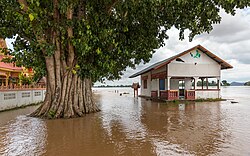
[[File:Flooded building and tree trunk in the muddy water of the Mekong in Si Phan Don, Laos, September 2019.jpg|thumb|Flooded ''Ficus religiosa'' trunk in the muddy water of the Mekong, in [[:en:Laos|Laos]] | [[File:Flooded building and tree trunk in the muddy water of the Mekong in Si Phan Don, Laos, September 2019.jpg|thumb|Flooded ''Ficus religiosa'' trunk in the muddy water of the Mekong, in [[:en:Laos|Laos]]]] | ||
''Ficus religiosa'' suitably grows at [[altitude]]s ranging from {{convert|10|m|ft}} up to {{convert|1520|m|ft}}. Due to the [[Climate|climatic conditions]] which are prevalent throughout different heat zones, it can grow at [[latitude]]s ranging from 30°N to 5°S. It can tolerate [[temperature|air temperatures]] ranging between {{convert|0| | ''Ficus religiosa'' suitably grows at [[altitude]]s ranging from {{convert|10|m|ft}} up to {{convert|1520|m|ft}}. Due to the [[Climate|climatic conditions]] which are prevalent throughout different heat zones, it can grow at [[latitude]]s ranging from 30°N to 5°S. It can tolerate [[temperature|air temperatures]] ranging between {{convert|0|to|35|°C|°F}}, beyond this upper limit its growth diminishes. It grows on a wide [[Soil type|variety of soils]] but preferably needs deep, [[Alluvium|alluvial]] [[sand]]y [[loam]] with good [[drainage]]. It is also found on shallow soils including rock crevices.{{Citation needed|date=March 2021}} | ||
===Association=== | ===Association=== | ||
| Line 42: | Line 43: | ||
===Environment=== | ===Environment=== | ||
''Ficus religiosa'' is tolerant to various climate zones ([[Köppen climate classification]] categories of [[Tropical rainforest climate|Af]], [[Tropical monsoon climate|Am]], [[Tropical savanna climate|Aw/As]], [[Humid subtropical climate|Cfa]], [[Humid subtropical climate|Cwa]] and [[hot-summer Mediterranean climate|Csa]]) and various types of soils. In Paraguay the tree species occurs in forests at lower elevations, and in China the species has been reported growing at altitudes ranging from {{convert|400| | ''Ficus religiosa'' is tolerant to various climate zones ([[Köppen climate classification]] categories of [[Tropical rainforest climate|Af]], [[Tropical monsoon climate|Am]], [[Tropical savanna climate|Aw/As]], [[Humid subtropical climate|Cfa]], [[Humid subtropical climate|Cwa]] and [[hot-summer Mediterranean climate|Csa]]) and various types of soils. In Paraguay the tree species occurs in forests at lower elevations, and in China the species has been reported growing at altitudes ranging from {{convert|400|to|700|m|ft}}. In India, being a [[Indigenous (ecology)|native species]], it occurs both naturally in wild as well as cultivated up to altitudes of {{convert|1520|m|ft}}.{{Citation needed|date=March 2021}} | ||
===Climate=== | ===Climate=== | ||
''Ficus religiosa'' is tolerant to widely varying climatic conditions such as [[Tropical rainforest climate]] where the region receives more than {{convert|60|mm|cm}} of [[precipitation]] per month, [[Tropical monsoon climate]] where average precipitation ranges from {{convert|60|mm|cm}} in the driest month to {{convert|100|mm|cm}}, [[Tropical savanna climate|Tropical savanna climate with dry summer]] where average precipitation ranges from {{convert|60|mm|cm}} per month in [[summer]]s to {{convert|100|mm|cm}} per month in [[winter]]s, [[ | ''Ficus religiosa'' is tolerant to widely varying climatic conditions such as [[Tropical rainforest climate]] where the region receives more than {{convert|60|mm|cm}} of [[precipitation]] per month, [[Tropical monsoon climate]] where average precipitation ranges from {{convert|60|mm|cm}} in the driest month to {{convert|100|mm|cm}}, [[Tropical savanna climate|Tropical savanna climate with dry summer]] where average precipitation ranges from {{convert|60|mm|cm}} per month in [[summer]]s to {{convert|100|mm|cm}} per month in [[winter]]s, [[Tropical savanna climate|Tropical savanna climate with dry winter]] where average precipitation ranges from to {{convert|60|mm|cm}} per month in [[winter]]s to {{convert|100|mm|cm}} per month in [[summer]]s, [[Temperate climate|Warm temperate climate with dry winter]] where average temperature ranges from {{convert|0|to|10|°C|°F}} and winters are dry, as well as [[Temperate climate|Warm temperate climate with dry summer]] where average temperature ranges from {{convert|0|to|10|°C|°F}} and summers are dry.{{Citation needed|date=March 2021}} | ||
===Invasiveness=== | ===Invasiveness=== | ||
[[File:Peepul Tree In Wall.jpg|thumb|170px| A young tree growing on a [[concrete]] wall in [[Delhi]]. It is tolerant to wide variety of soils, and hence it even thrives on concrete walls having little moisture.]] | [[File:Peepul Tree In Wall.jpg|thumb|170px| A young tree growing on a [[concrete]] wall in [[Delhi]]. It is tolerant to wide variety of soils, and hence it even thrives on concrete walls having little moisture.]] | ||
Unlike most epiphytic jungle figs, which | Unlike most epiphytic jungle figs, which encircle the stems of dicotyledonous support trees from the outside, the epiphytic bushes of ''F. religiosa'' are not true stranglers. Instead, their roots penetrate the stem of the support tree, eventually splitting it from within. ''Ficus religiosa'' has been listed as an "[[Weed|environmental weed]]" or "naturalised weed" by the Global Compendium of Weeds (Randall, 2012). It has been assigned an invasiveness high risk score of 7 in a risk assessment prepared for the species' invasiveness in [[Hawaii]] by PIER.{{clarify |reason=Who is PIER? |date=January 2023}} Such a high score predicts it will become a major pest in suitable climate zones. The major reasons for its invasive behaviour are its fast-growing nature, tolerance to various climate zones and soil types, reported [[Maximum life span|lifespan]] of over 3,000 years, and its suffocating growth habit as it often begins life as an [[epiphyte]].{{Citation needed|date=March 2021}} | ||
==In heritage== | ==In culture and heritage== | ||
[[image: | [[image:Votive Stupas In Leaf - Nalanda Museum.jpg|thumb|right|Peepal Leaf shaped terracotta plaque]] | ||
The earliest known record of ''Ficus religiosa'' in human culture is the use of peepal leaf motifs in | The earliest known record of ''Ficus religiosa'' in human culture is the use of peepal leaf motifs in seals and pottery dating back to third millennium BCE.<ref>[https://d1wqtxts1xzle7.cloudfront.net/67245610/01_Final_Journal_20_April_2021_1_-with-cover-page-v2.pdf?Expires=1651412337&Signature=R4a1pSp5UuPC2gOn6gXuctcTwcsRzlv~kFrzyy2Pr0LRooJH9wmzIBqScxPFzPN-60~EtbqK9tqbFYdqqF~dfUKIwHXN0vwuxpcIMlZ0yYgR7tZvPpBlkUl1SzSkWtOOxrg9BAdRd-uy-bHGKeV-Z~uF~5AH4GclcamoYlDyrFWjTKJSdTibxupRSWPadRuA7KsIEC4hpi0ORJAImoC-QbB4OcR5Kx6TvHCJeSsrQXes~wE1WRukkkIvozGhORxnnkEPmhjivX4T7aEV2546XWXAmXkC668ZoePuMiKojWBp8X6XPP01TR5biZouj4svbNmGQPmmsat2Odi~In1~Hg__&Key-Pair-Id=APKAJLOHF5GGSLRBV4ZA#page=130 Sher, S. and Hameed, A., Comparative Analysis of the Gandharan Floral Motifs from Butkara (I and III) and Takht-i-Bahi. Sindh Antiquities 2020 Vol-06, No 1, pp. 128–145.]{{Dead link|date=February 2024 |bot=InternetArchiveBot |fix-attempted=yes }}</ref> Large bowls decorated on the internal surface with stylized pipal leaves arranged in large volutes have been found at [[Nausharo]], such bowls are particularly numerous. <ref name="w368">{{cite journal | last1=Jarrige | first1=Jean-François | last2=Didier | first2=Aurore | last3=Quivron | first3=Gonzague | title=Shahr-i Sokhta and the Chronology of the Indo-Iranian Regions | journal=Paléorient | publisher=[Paleorient and CNRS Editions, CNRS Editions] | volume=37 | issue=2 | year=2011 | issn=01539345 | jstor=43265265 | pages=7–34 | url=http://www.jstor.org/stable/43265265 | access-date=2026-03-21}}</ref> | ||
The peepal tree is considered sacred by the followers of [[Hinduism]], [[Jainism]] and [[Buddhism]]. | The [[Indus Valley Civilisation]] venerated this tree and its leaf and drew religious art of it.<ref>{{Cite book |last1=McIntosh |first1=Jane |title=History of the World in 1,000 Objects |last2=Chrisp |first2=Peter |last3=Parker |first3=Philip |last4=Gibson |first4=Carrie |last5=Grant |first5=R. G. |last6=Regan |first6=Sally |date=October 2014 |publisher=[[DK (publisher)|DK]] and the [[Smithsonian]] |isbn=978-1-4654-2289-7 |location=New York |page=17 |author-link1=Jane McIntosh |author-link2=Peter Chrisp}}</ref> | ||
The peepal tree is considered sacred by the followers of [[Hinduism]], [[Jainism]], [[Sikhism]] and [[Buddhism]]. In the [[Bhagavad Gita]], Krishna says, "I am the Peepal tree among the trees, Narada among the Deva Rishi (Divine sages), Bhrigu among the Sapta-Maharishis, Chitraratha among the [[Gandharvas]], And sage [[Kapila]] among the Siddhas."<ref>{{cite web|url=http://www.santosha.com/philosophy/gita-chapter10.html|title=The Bhagavad Gita – Chapter 10 – The Yoga of Manifestation|work=santosha.com|access-date=24 August 2015|archive-date=20 June 2023|archive-url=https://web.archive.org/web/20230620181343/http://www.santosha.com/philosophy/gita-chapter10.html}}</ref> In India, the medal for the highest civilian award, [[Bharat Ratna]], is modelled on the leaf of a Peepal tree.<ref>{{cite news|url=http://indianexpress.com/article/india/india-others/sachins-bharat-ratna-today-a-medal-from-2000/|title=Sachin's Bharat Ratna today a medal from 2000|date=4 February 2014|work=The Indian Express|access-date=13 February 2023|location=New Delhi|last=Ranjan|first=Amitav|archive-url=https://web.archive.org/web/20140428211303/http://indianexpress.com/article/india/india-others/sachins-bharat-ratna-today-a-medal-from-2000/|archive-date=28 April 2014}}</ref> | |||
===Buddhism=== | ===Buddhism=== | ||
{{Main|Bodhi tree}} | {{Main|Bodhi tree}} | ||
[[Gautama Buddha]] attained [[bodhi|enlightenment]] (''bodhi'') while meditating underneath a ''Ficus religiosa''. The site is in present-day [[Bodh Gaya]] in Bihar, [[India]]. The original tree was destroyed, and has been replaced several times. | [[Gautama Buddha]] attained [[bodhi|enlightenment]] (''bodhi'') while meditating underneath a ''Ficus religiosa''. The site is in present-day [[Bodh Gaya]] in Bihar, [[India]]. The original tree was destroyed, and has been replaced several times. A branch of the original tree was rooted in [[Anuradhapura]], [[Sri Lanka]] in 288 BCE and is known as [[Jaya Sri Maha Bodhi]]; it is the oldest living human-planted [[flowering plant]] (angiosperm) in the world.<ref name="RMTRR">{{cite web|url=http://www.rmtrr.org/oldlist.htm|title=Rocky Mountain Tree-Ring Research, OLDLIST|access-date=3 July 2011}}</ref> | ||
[[File:Maha_Bodhi_tree_2.jpg|thumb|right|The [[Bodhi Tree]] at the [[Mahabodhi Temple]] was propagated from the [[Jaya Sri Maha Bodhi|Sri Maha Bodhi]], which in turn was propagated from the original Bodhi Tree at this location.]] | [[File:Maha_Bodhi_tree_2.jpg|thumb|right|The [[Bodhi Tree]] at the [[Mahabodhi Temple]] was propagated from the [[Jaya Sri Maha Bodhi|Sri Maha Bodhi]], which in turn was propagated from the original Bodhi Tree at this location.]] | ||
In [[Theravada Buddhist]] [[Southeast Asia]], the tree's massive trunk is often the site of Buddhist or [[animist]] shrines. Not all ''Ficus religiosa'' | In [[Theravada Buddhist]] [[Southeast Asia]], the tree's massive trunk is often the site of Buddhist or [[animist]] shrines. Not all ''Ficus religiosa'' are ordinarily called a ''Bodhi Tree''. A true Bodhi Tree is traditionally considered a tree that has as its parent another Bodhi Tree, and so on, until the first Bodhi Tree, which is the tree under which Gautama is said to have gained enlightenment.<ref>{{Cite EB1911|wstitle=Bo-Tree |volume=4 |page=305}}</ref> | ||
===Hinduism=== | ===Hinduism=== | ||
[[Sadhu]]s ([[Hindu]] ascetics) | ''Ashwattha'' is the Sanskrit term for ''Ficus religiosa''. According to [[Hindu scriptures]], it is a sacred tree for the [[Hindu]]s and has been extensively mentioned in texts pertaining to [[Hinduism]],<ref>{{cite book |last1=Haberman |first1=David L. |title=People Trees: Worship of Trees in Northern India |date=25 April 2013 |publisher=OUP USA |isbn=978-0-19-992917-7 |page=73 |url=https://books.google.com/books?id=X-556JuJa4QC&q=ashvattha&pg=PA73 |access-date=24 November 2021 |language=en}}</ref> for example as ''peepul'' in ''[[Rig Veda]]'' mantra I.164.20.{{cn|date=July 2021}} However, according to Padma Puran peepal tree is the form of Lord Vishnu along with banyan and plaksha as the form of Lord Shiva and the lord Brahma. As: | ||
{{quote|"There is no doubt that lord Viṣṇu is of the form of Aśvattha, Vaṭa is Rudra's form, and Palāśa has taken up Brahmā's form. Seeing, worshipping and serving them is said to remove sins. These certainly destroy grief, diseases and the wicked."|Padma Puran Uttar Khand ch. 115 22/23}} | |||
[[Sadhu]]s ([[Hindu]] ascetics) meditate beneath sacred fig trees, and Hindus do [[pradakshina]] (circumambulation, or meditative pacing) around the sacred fig tree as a mark of worship. Usually seven pradakshinas are done around the tree in the morning time chanting "''vriksha rajye namah''" (वृक्षराज्ञे नमः), meaning "salutation to the king of trees". It is claimed that the 27 stars (constellations) constituting 12 houses (''rasis'') and 9 planets are specifically represented precisely by 27 trees—one for each star. The Bodhi Tree is said to represent [[Pushya]] (Western star name γ, δ and θ Cancri in the Cancer constellation).{{Citation needed|date=March 2021}}{{clear|left}} | |||
[[Adi Shankara]] derives it from shva (tomorrow) and stha (that which remains).<ref> {{cite book|title=Hinduism: An Alphabetical Guide|author=Roshan Dalal|date=25 April 2013|page=44|publisher=Oup USA |isbn=978-0-19-992917-7|url=https://books.google.com/books?id=X-556JuJa4QC&dq=ashvattha+tree&pg=PA73}}</ref> Ashva (horse) and stha (situated), meaning where horses are tied, is another derivation.<ref>{{cite book |last1=Cox |first1=Robert |title=The Pillar of Celestial Fire: And the Lost Science of the Ancient Seers |date=1 November 1997 |publisher=1st World Publishing |isbn=978-1-887472-30-2 |page=57 |url=https://books.google.com/books?id=ykEN2zHvCpQC&dq=ashvattha+stha&pg=PA57 |access-date=24 November 2021 |language=en}}</ref> | |||
[[Yama]], while instructing [[Naciketa]] describes the eternal Asvattha tree with its root upwards, and branches downwards, which is the pure immortal [[Brahman]], in which all these worlds are situated, and beyond which there is nothing else ([[Katha Upanishad]] Verse II.iii.1). Meanwhile, [[Krishna]] tells us that the Asvattha tree having neither end nor beginning nor stationariness whatsoever has its roots upwards and branches downwards whose branches are nourished by the [[Gunas]] and whose infinite roots spread in the form of action in the human world which though strong are to be cut off by the forceful weapon of detachment to seek the celestial abode from which there is no return ([[Bhagavad Gita]] XV.1-4).<ref>{{cite Q|Q108659922|url=https://www.holy-bhagavad-gita.org/chapter/15/verse/1|chapter=Chapter 15, Verses 1-4}}</ref> The former teaches that the Asvattha tree is real being identical with Brahman and therefore impossible to cut-off; the latter insists that the Asvattha tree must be regarded as unreal being identical with existence which needs to be cut-off.<ref>{{cite book|title=A Constructive Survey of Upanishadic Philosophy|year=1926|author=R.D.Ranade|publisher=Bharatiya Vidya Bhavan|pages=[https://archive.org/details/A.Constructive.Survey.of.Upanishadic.Philosophy.by.R.D.Ranade.1926.djvu/page/n180 145]-146|url=https://archive.org/details/A.Constructive.Survey.of.Upanishadic.Philosophy.by.R.D.Ranade.1926.djvu }}{{pd-notice}}</ref> | |||
The fire sticks used in Hindu sacrificial fire like [[agnihotra]] also contain dried wood of ashvatha tree. | |||
==Cultivation== | ==Cultivation== | ||
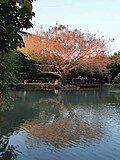
[[File: | [[File:菩提樹 Ficus religiosa 20201218181050 01.jpg|thumb|''Ficus religiosa'' taken in early winter]] | ||
''Ficus religiosa'' is grown by | ''Ficus religiosa'' is grown by specialty tree [[plant nursery|plant nurseries]] for use as an [[ornamental tree]], in [[garden]]s and [[park]]s in tropical and [[subtropical climate]]s. Peepul trees are native to Indian subcontinent and thrive in hot, [[Humidity|humid]] weather. They prefer full [[sunlight]] and can grow in all [[soil type]]s, though [[loam]] is the best. When planting, use soil with a [[pH]] of 7 or below. While it is possible for the plant to grow indoors in a pot, it grows best outside. Young peepul needs [[Plant nutrition|proper nourishment]]. It requires full sunlight and proper watering. Sacred fig occurs naturally in [[Montane ecosystems|submontane forest regions]].{{Citation needed|date=March 2021}} As with many Ficus trees, these are well suited for [[Bonsai]] training. | ||
In the [[Middle East]], it is preferably planted as an [[Avenue (landscape)|avenue]] or [[road verge]] tree. In the [[Philippines]] and in [[Nicaragua]] the species is cultivated in [[park]]s and along roadsides and [[Sidewalk|pavements]], while in [[Paraguay]] it occurs in [[forest]]s at lower [[elevation]]s.<ref name="CABI">{{cite | In the [[Middle East]], it is preferably planted as an [[Avenue (landscape)|avenue]] or [[road verge]] tree. In the [[Philippines]] and in [[Nicaragua]] the species is cultivated in [[park]]s and along roadsides and [[Sidewalk|pavements]], while in [[Paraguay]] it occurs in [[forest]]s at lower [[elevation]]s.<ref name="CABI">{{cite journal|url=https://www.cabi.org/isc/datasheet/24168|title=''Ficus religiosa'' (sacred fig tree)|website=[[Invasive Species Compendium]]|date=2014 |publisher=[[Centre for Agriculture and Bioscience International|CABI]]|doi=10.1079/cabicompendium.24168 |access-date=23 July 2018 |last1=Datil |first1=M. J. |last2=Acevedo-Rodríguez |first2=P. |volume=CABI Compendium |article-number=24168 |doi-access=free }}</ref> | ||
In [[Thailand]] โพ or "Pho" trees grow everywhere, but in the | In [[Thailand]] โพ or "Pho" trees grow everywhere, but in the wats (temples) they are revered, and usually are several hundred years old, with trunks up to {{convert|20|ft|m|abbr=off|sp=us}} wide. As with all sacred trees in Thailand, they have a saffron cloth wrapped around the base. A yearly ritual involving the bo trees at wats is the purchasing of "mai kam sii" ไม้คำ้ศริ, which are "supports" that look like crutches and are placed under the spreading branches as if holding them up. The purchase money helps fund the wat, a central part of Thai life.{{cn|date=June 2023}} | ||
==Uses== | ==Uses== | ||
''Ficus religiosa'' is used in [[traditional medicine]] for about fifty types of disorders including asthma, diabetes, diarrhea, epilepsy, gastric problems, inflammatory disorders, infectious and sexual disorders.<ref>{{cite journal|title=Journal of Ethnopharmacology : Traditional uses, phytochemistry and pharmacology of Ficus religiosa: A review|author=Damanpreet Singh|author2=Bikram Singh|author3=Rajesh Kumar Goela|journal=[[Journal of Ethnopharmacology]]|volume=134|issue=3|pages=565–583|date=12 April 2011|doi=10.1016/j.jep.2011.01.046|pmid=21296646}}</ref> | ''Ficus religiosa'' is used in [[traditional medicine]] for about fifty types of disorders including asthma, diabetes, diarrhea, epilepsy, gastric problems, inflammatory disorders, infectious and sexual disorders.<ref>{{cite journal|title=Journal of Ethnopharmacology: Traditional uses, phytochemistry and pharmacology of Ficus religiosa: A review|author=Damanpreet Singh|author2=Bikram Singh|author3=Rajesh Kumar Goela|journal=[[Journal of Ethnopharmacology]]|volume=134|issue=3|pages=565–583|date=12 April 2011|doi=10.1016/j.jep.2011.01.046|pmid=21296646}}</ref> | ||
The trunk of this tree is used by farmers as a soil leveller. After seed harvesting, the rectangular trunk is connected to tractors and levels the soil.<ref>{{Cite web|date=2020-11-02|title=Peepal Tree: Benefits And Uses of Peepal Tree » Trees Varieties|url=https://treesvarieties.com/peepal-tree/|access-date=2020-11-10|website=Trees Varieties|language=en-US}}</ref> | The trunk of this tree is used by farmers as a soil leveller. After seed harvesting, the rectangular trunk is connected to [[tractors]] and levels the soil.<ref>{{Cite web|date=2020-11-02|title=Peepal Tree: Benefits And Uses of Peepal Tree » Trees Varieties|url=https://treesvarieties.com/peepal-tree/|access-date=2020-11-10|website=Trees Varieties|language=en-US|archive-date=2 November 2020|archive-url=https://web.archive.org/web/20201102095800/https://treesvarieties.com/peepal-tree/}}</ref> | ||
==See also== | ==See also== | ||
* [[Bodhi Tree]] | * [[Bodhi Tree]] | ||
* [[Ficus Ruminalis]] | |||
* [[Shitala Devi]] | * [[Shitala Devi]] | ||
{{clear}} | |||
==Notes== | ==Notes== | ||
| Line 102: | Line 113: | ||
* {{ppn|b/bodhirukka.htm|Bodhi Tree}} | * {{ppn|b/bodhirukka.htm|Bodhi Tree}} | ||
* {{Cite Americana|wstitle=Peepul|short=x}} | * {{Cite Americana|wstitle=Peepul|short=x}} | ||
*[https://wmghz.blogspot.com/2017/09/blog-post_11.html The Bodhi tree revealed by old picture] | * [https://wmghz.blogspot.com/2017/09/blog-post_11.html The Bodhi tree revealed by old picture] | ||
{{Worship in Hinduism}} | {{Worship in Hinduism}} | ||
| Line 110: | Line 121: | ||
[[Category:Ficus|religiosa]] | [[Category:Ficus|religiosa]] | ||
[[Category:Trees in religion]] | [[Category:Trees in religion]] | ||
[[Category:Sacred trees in Hinduism]] | [[Category:Sacred trees in Hinduism]] | ||
[[Category:Trees of the Indian subcontinent]] | [[Category:Trees of the Indian subcontinent]] | ||
[[Category:Trees of Indo-China]] | [[Category:Trees of Indo-China]] | ||
[[Category:Trees of Peninsular Malaysia]] | |||
[[Category:Plants described in 1753]] | [[Category:Plants described in 1753]] | ||
[[Category:Plants used in bonsai]] | |||
[[Category:Plants used in traditional Chinese medicine]] | [[Category:Plants used in traditional Chinese medicine]] | ||
[[Category:Epiphytes]] | [[Category:Epiphytes]] | ||
[[Category:Garden plants of Asia]] | [[Category:Garden plants of Asia]] | ||
[[Category:Ornamental trees]] | [[Category:Ornamental trees]] | ||
[[Category: | [[Category:House plants]] | ||
[[Category:Botanical taxa named by Carl Linnaeus]] | |||
[[Category:Symbols of Bihar]] | [[Category:Symbols of Bihar]] | ||
[[Category:Symbols of Haryana]] | [[Category:Symbols of Haryana]] | ||
Latest revision as of 05:35, 22 March 2026
| Sacred fig | |
|---|---|

| |
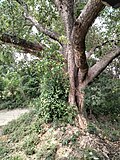
| The tree trunk and distinctive heart-shaped leaves | |
Scientific classification 
| |
| : | [[Template:Taxonomy/Ficus subg. Urostigma]] |
| Species: | Template:Taxonomy/FicusF. religiosa
|
| Binomial name | |
| Template:Taxonomy/FicusFicus religiosa | |
| Synonyms[1] | |
Ficus religiosa or sacred fig is a species of fig native to the Indian subcontinent[2] and Indochina[3] that belongs to Moraceae, the fig or mulberry family. It is also known as the bodhi tree,[4] bo tree, peepul tree,[2] peepal tree, pipala tree or ashvattha tree (in India and Nepal).[5] The sacred fig is considered to have a religious significance in four major religions that originated on the Indian subcontinent: Hinduism, Buddhism, Sikhism and Jainism. Hindu and Jain ascetics consider the species to be sacred and often meditate under it. Gautama Buddha is believed to have attained enlightenment under a tree of this species. The sacred fig is the state tree of the Indian states of Odisha,[6] Bihar and Haryana.

Description[edit | edit source]
_(20664107918),_Ficus_religiosa.jpg)
Ficus religiosa is a large dry season-deciduous or semi-evergreen tree up to 30 metres (98 ft) tall and with a trunk diameter of up to 3 metres (9.8 ft). The leaves are cordate in shape with a distinctive extended drip tip; they are 10–17 centimetres (3.9–6.7 in) long and 8–12 centimetres (3.1–4.7 in) broad, with a 6–10 centimetres (2.4–3.9 in) petiole. The fruits are small figs 1–1.5 centimetres (0.39–0.59 in) in diameter, green ripening to purple.[citation needed]
The Jaya Sri Maha Bodhi tree in the city of Anuradhapura in Sri Lanka is estimated to be more than 2,250 years old.[7]
Distribution[edit | edit source]
Ficus religiosa is native to most of the Indian subcontinent – Bangladesh, Bhutan, Nepal, Pakistan and India including the Assam region, Eastern Himalaya and the Nicobar Islands, as well as part of Indochina – the Andaman Islands, Thailand, Myanmar and Peninsular Malaysia. It has been widely introduced elsewhere, particularly in the rest of tropical Asia, but also in Iran (Balochistan), Florida and Venezuela.[8]
Ecology[edit | edit source]

Ficus religiosa suitably grows at altitudes ranging from 10 metres (33 ft) up to 1,520 metres (4,990 ft). Due to the climatic conditions which are prevalent throughout different heat zones, it can grow at latitudes ranging from 30°N to 5°S. It can tolerate air temperatures ranging between 0 to 35 °C (32 to 95 °F), beyond this upper limit its growth diminishes. It grows on a wide variety of soils but preferably needs deep, alluvial sandy loam with good drainage. It is also found on shallow soils including rock crevices.[citation needed]
Association[edit | edit source]
Ficus religiosa is associated with Blastophaga quadriceps, an agaonid wasp which acts as its pollinator as this wasp lays its eggs only on trees of this species.[citation needed]
Environment[edit | edit source]
Ficus religiosa is tolerant to various climate zones (Köppen climate classification categories of Af, Am, Aw/As, Cfa, Cwa and Csa) and various types of soils. In Paraguay the tree species occurs in forests at lower elevations, and in China the species has been reported growing at altitudes ranging from 400 to 700 metres (1,300 to 2,300 ft). In India, being a native species, it occurs both naturally in wild as well as cultivated up to altitudes of 1,520 metres (4,990 ft).[citation needed]
Climate[edit | edit source]
Ficus religiosa is tolerant to widely varying climatic conditions such as Tropical rainforest climate where the region receives more than 60 millimetres (6.0 cm) of precipitation per month, Tropical monsoon climate where average precipitation ranges from 60 millimetres (6.0 cm) in the driest month to 100 millimetres (10 cm), Tropical savanna climate with dry summer where average precipitation ranges from 60 millimetres (6.0 cm) per month in summers to 100 millimetres (10 cm) per month in winters, Tropical savanna climate with dry winter where average precipitation ranges from to 60 millimetres (6.0 cm) per month in winters to 100 millimetres (10 cm) per month in summers, Warm temperate climate with dry winter where average temperature ranges from 0 to 10 °C (32 to 50 °F) and winters are dry, as well as Warm temperate climate with dry summer where average temperature ranges from 0 to 10 °C (32 to 50 °F) and summers are dry.[citation needed]
Invasiveness[edit | edit source]

Unlike most epiphytic jungle figs, which encircle the stems of dicotyledonous support trees from the outside, the epiphytic bushes of F. religiosa are not true stranglers. Instead, their roots penetrate the stem of the support tree, eventually splitting it from within. Ficus religiosa has been listed as an "environmental weed" or "naturalised weed" by the Global Compendium of Weeds (Randall, 2012). It has been assigned an invasiveness high risk score of 7 in a risk assessment prepared for the species' invasiveness in Hawaii by PIER.[clarification needed] Such a high score predicts it will become a major pest in suitable climate zones. The major reasons for its invasive behaviour are its fast-growing nature, tolerance to various climate zones and soil types, reported lifespan of over 3,000 years, and its suffocating growth habit as it often begins life as an epiphyte.[citation needed]
In culture and heritage[edit | edit source]

The earliest known record of Ficus religiosa in human culture is the use of peepal leaf motifs in seals and pottery dating back to third millennium BCE.[9] Large bowls decorated on the internal surface with stylized pipal leaves arranged in large volutes have been found at Nausharo, such bowls are particularly numerous. [10]
The Indus Valley Civilisation venerated this tree and its leaf and drew religious art of it.[11]
The peepal tree is considered sacred by the followers of Hinduism, Jainism, Sikhism and Buddhism. In the Bhagavad Gita, Krishna says, "I am the Peepal tree among the trees, Narada among the Deva Rishi (Divine sages), Bhrigu among the Sapta-Maharishis, Chitraratha among the Gandharvas, And sage Kapila among the Siddhas."[12] In India, the medal for the highest civilian award, Bharat Ratna, is modelled on the leaf of a Peepal tree.[13]
Buddhism[edit | edit source]
Gautama Buddha attained enlightenment (bodhi) while meditating underneath a Ficus religiosa. The site is in present-day Bodh Gaya in Bihar, India. The original tree was destroyed, and has been replaced several times. A branch of the original tree was rooted in Anuradhapura, Sri Lanka in 288 BCE and is known as Jaya Sri Maha Bodhi; it is the oldest living human-planted flowering plant (angiosperm) in the world.[14]

In Theravada Buddhist Southeast Asia, the tree's massive trunk is often the site of Buddhist or animist shrines. Not all Ficus religiosa are ordinarily called a Bodhi Tree. A true Bodhi Tree is traditionally considered a tree that has as its parent another Bodhi Tree, and so on, until the first Bodhi Tree, which is the tree under which Gautama is said to have gained enlightenment.[15]
Hinduism[edit | edit source]
Ashwattha is the Sanskrit term for Ficus religiosa. According to Hindu scriptures, it is a sacred tree for the Hindus and has been extensively mentioned in texts pertaining to Hinduism,[16] for example as peepul in Rig Veda mantra I.164.20.[citation needed] However, according to Padma Puran peepal tree is the form of Lord Vishnu along with banyan and plaksha as the form of Lord Shiva and the lord Brahma. As:
"There is no doubt that lord Viṣṇu is of the form of Aśvattha, Vaṭa is Rudra's form, and Palāśa has taken up Brahmā's form. Seeing, worshipping and serving them is said to remove sins. These certainly destroy grief, diseases and the wicked."
— Padma Puran Uttar Khand ch. 115 22/23
Sadhus (Hindu ascetics) meditate beneath sacred fig trees, and Hindus do pradakshina (circumambulation, or meditative pacing) around the sacred fig tree as a mark of worship. Usually seven pradakshinas are done around the tree in the morning time chanting "vriksha rajye namah" (वृक्षराज्ञे नमः), meaning "salutation to the king of trees". It is claimed that the 27 stars (constellations) constituting 12 houses (rasis) and 9 planets are specifically represented precisely by 27 trees—one for each star. The Bodhi Tree is said to represent Pushya (Western star name γ, δ and θ Cancri in the Cancer constellation).[citation needed]
Adi Shankara derives it from shva (tomorrow) and stha (that which remains).[17] Ashva (horse) and stha (situated), meaning where horses are tied, is another derivation.[18]
Yama, while instructing Naciketa describes the eternal Asvattha tree with its root upwards, and branches downwards, which is the pure immortal Brahman, in which all these worlds are situated, and beyond which there is nothing else (Katha Upanishad Verse II.iii.1). Meanwhile, Krishna tells us that the Asvattha tree having neither end nor beginning nor stationariness whatsoever has its roots upwards and branches downwards whose branches are nourished by the Gunas and whose infinite roots spread in the form of action in the human world which though strong are to be cut off by the forceful weapon of detachment to seek the celestial abode from which there is no return (Bhagavad Gita XV.1-4).[19] The former teaches that the Asvattha tree is real being identical with Brahman and therefore impossible to cut-off; the latter insists that the Asvattha tree must be regarded as unreal being identical with existence which needs to be cut-off.[20]
The fire sticks used in Hindu sacrificial fire like agnihotra also contain dried wood of ashvatha tree.
Cultivation[edit | edit source]

Ficus religiosa is grown by specialty tree plant nurseries for use as an ornamental tree, in gardens and parks in tropical and subtropical climates. Peepul trees are native to Indian subcontinent and thrive in hot, humid weather. They prefer full sunlight and can grow in all soil types, though loam is the best. When planting, use soil with a pH of 7 or below. While it is possible for the plant to grow indoors in a pot, it grows best outside. Young peepul needs proper nourishment. It requires full sunlight and proper watering. Sacred fig occurs naturally in submontane forest regions.[citation needed] As with many Ficus trees, these are well suited for Bonsai training.
In the Middle East, it is preferably planted as an avenue or road verge tree. In the Philippines and in Nicaragua the species is cultivated in parks and along roadsides and pavements, while in Paraguay it occurs in forests at lower elevations.[21]
In Thailand โพ or "Pho" trees grow everywhere, but in the wats (temples) they are revered, and usually are several hundred years old, with trunks up to 20 feet (6.1 meters) wide. As with all sacred trees in Thailand, they have a saffron cloth wrapped around the base. A yearly ritual involving the bo trees at wats is the purchasing of "mai kam sii" ไม้คำ้ศริ, which are "supports" that look like crutches and are placed under the spreading branches as if holding them up. The purchase money helps fund the wat, a central part of Thai life.[citation needed]
Uses[edit | edit source]
Ficus religiosa is used in traditional medicine for about fifty types of disorders including asthma, diabetes, diarrhea, epilepsy, gastric problems, inflammatory disorders, infectious and sexual disorders.[22]
The trunk of this tree is used by farmers as a soil leveller. After seed harvesting, the rectangular trunk is connected to tractors and levels the soil.[23]
See also[edit | edit source]
Notes[edit | edit source]
- ↑ 1.0 1.1 "Ficus religiosa L." Plants of the World Online. Royal Botanic Gardens, Kew. Retrieved 27 March 2025.
- ↑ 2.0 2.1 Chisholm, Hugh, ed. (1911). . Encyclopædia Britannica. Vol. 21 (11th ed.). Cambridge University Press. p. 45.
- ↑ [{{#property:P1421|}} "Ficus religiosa"]. Germplasm Resources Information Network (GRIN). Agricultural Research Service (ARS), United States Department of Agriculture (USDA). Retrieved 29 January 2017.
{{citation}}: Check|url=value (help) - ↑ Oxford English Dictionary, Oxford University Press, 1971, p. 1014
- ↑ "Ficus religiosa — Peepal". Flowers of India. Archived from the original on 14 February 2012. Retrieved 3 November 2011.
- ↑ State symbols
- ↑ "RMTRR OLDLIST". www.rmtrr.org. Retrieved 11 May 2024.
- ↑ "Ficus religiosa L." Plants of the World Online. Royal Botanic Gardens, Kew. Retrieved 19 March 2021.
- ↑ Sher, S. and Hameed, A., Comparative Analysis of the Gandharan Floral Motifs from Butkara (I and III) and Takht-i-Bahi. Sindh Antiquities 2020 Vol-06, No 1, pp. 128–145.[permanent dead link]
- ↑ Jarrige, Jean-François; Didier, Aurore; Quivron, Gonzague (2011). "Shahr-i Sokhta and the Chronology of the Indo-Iranian Regions". Paléorient. 37 (2). [Paleorient and CNRS Editions, CNRS Editions]: 7–34. ISSN 0153-9345. JSTOR 43265265. Retrieved 21 March 2026.
- ↑ McIntosh, Jane; Chrisp, Peter; Parker, Philip; Gibson, Carrie; Grant, R. G.; Regan, Sally (October 2014). History of the World in 1,000 Objects. New York: DK and the Smithsonian. p. 17. ISBN 978-1-4654-2289-7.
- ↑ "The Bhagavad Gita – Chapter 10 – The Yoga of Manifestation". santosha.com. Archived from the original on 20 June 2023. Retrieved 24 August 2015.
- ↑ Ranjan, Amitav (4 February 2014). "Sachin's Bharat Ratna today a medal from 2000". The Indian Express. New Delhi. Archived from the original on 28 April 2014. Retrieved 13 February 2023.
- ↑ "Rocky Mountain Tree-Ring Research, OLDLIST". Retrieved 3 July 2011.
- ↑ Chisholm, Hugh, ed. (1911). . Encyclopædia Britannica. Vol. 4 (11th ed.). Cambridge University Press. p. 305.
- ↑ Haberman, David L. (25 April 2013). People Trees: Worship of Trees in Northern India. OUP USA. p. 73. ISBN 978-0-19-992917-7. Retrieved 24 November 2021.
- ↑ Roshan Dalal (25 April 2013). Hinduism: An Alphabetical Guide. Oup USA. p. 44. ISBN 978-0-19-992917-7.
- ↑ Cox, Robert (1 November 1997). The Pillar of Celestial Fire: And the Lost Science of the Ancient Seers. 1st World Publishing. p. 57. ISBN 978-1-887472-30-2. Retrieved 24 November 2021.
- ↑
- ↑ R.D.Ranade (1926). A Constructive Survey of Upanishadic Philosophy. Bharatiya Vidya Bhavan. pp. 145-146.Template:Pd-notice
- ↑ Datil, M. J.; Acevedo-Rodríguez, P. (2014). "Ficus religiosa (sacred fig tree)". Invasive Species Compendium. CABI Compendium 24168. CABI. doi:10.1079/cabicompendium.24168. Retrieved 23 July 2018.
- ↑ Damanpreet Singh; Bikram Singh; Rajesh Kumar Goela (12 April 2011). "Journal of Ethnopharmacology: Traditional uses, phytochemistry and pharmacology of Ficus religiosa: A review". Journal of Ethnopharmacology. 134 (3): 565–583. doi:10.1016/j.jep.2011.01.046. PMID 21296646.
- ↑ "Peepal Tree: Benefits And Uses of Peepal Tree » Trees Varieties". Trees Varieties. 2 November 2020. Archived from the original on 2 November 2020. Retrieved 10 November 2020.
References[edit | edit source]
- Keith and Macdonell. 1912. Vedic Index of Names and Subjects.
- Plaksa description
External links[edit | edit source]
- Pages using the JsonConfig extension
- Bharatpedia articles incorporating a citation from the Encyclopedia Americana with a Wikisource reference
- Ficus
- Trees in religion
- Sacred trees in Hinduism
- Trees of the Indian subcontinent
- Trees of Indo-China
- Trees of Peninsular Malaysia
- Plants described in 1753
- Plants used in bonsai
- Plants used in traditional Chinese medicine
- Epiphytes
- Garden plants of Asia
- Ornamental trees
- House plants
- Botanical taxa named by Carl Linnaeus
- Symbols of Bihar
- Symbols of Haryana