




Ajay Kumar (talk | contribs) Created a new article Tag: self-published-blog |
refined details per standard format and fixed typos per sources |
||
| Line 1: | Line 1: | ||
{{Short description|Combined military forces of Brazil}} | {{Short description|Combined military forces of Brazil}} | ||
{{EngvarB|date=August 2019}} | {{EngvarB|date=August 2019}} | ||
{{Use dmy dates|date=August 2019}} | {{Use dmy dates|date=August 2019}} | ||
{{Infobox national military | {{Infobox national military | ||
|name | | name = Brazilian Armed Forces | ||
|native_name | | native_name = {{lang|pt|Forças Armadas Brasileiras}} | ||
|image | | image = Emblem of the Brazilian Armed Forces.svg | ||
|caption | | caption = Emblem of the Joint General Staff of the Armed Forces | ||
| image2 | | image2 = Bandeira do EMCFA atual.svg | ||
| caption2 | | caption2 = Flag of the Joint General Staff of the Armed Forces | ||
|branches | | branches = {{ubl | ||
|headquarters | |{{army|Brazil|name=Army}} | ||
|commander-in-chief | |{{navy|Brazil|name=Navy}} | ||
|commander-in-chief_title = [[President of Brazil| | |{{air force|Brazil|name=Air Force}} | ||
|minister | }} | ||
|minister_title | | headquarters = [[Ministry of Defence (Brazil)|Ministry of Defense]], [[Brasília]] | ||
|commander | | commander-in-chief = {{flagicon image|Presidential Standard of Brazil.svg|size=25px}} [[President of Brazil|President]] [[Luiz Inácio Lula da Silva]] | ||
|commander_title | | commander-in-chief_title = [[President of Brazil|Commander-in-Chief]] | ||
|amount | | minister = {{flagicon image|Flag of Minister of State (Brazil).svg|size=25px}} [[José Múcio]] | ||
|percent_GDP | | minister_title = [[Ministry of Defence (Brazil)|Minister of Defence]] | ||
| | | commander = {{flagicon image|Bandeira-Insignia do Chefe do Estado-Maior Conjunto das Forças Armadas (Brasil).svg|size=25px}} [[Renato Rodrigues de Aguiar Freire|Renato Freire]] | ||
| | | commander_title = [[Joint Chiefs of Staff of the Armed Forces|Chief of the Joint Chiefs of Staff]] | ||
| | | amount = {{USD|24.8 billion|link=yes}} (2023)<ref>{{Cite web |date= |title=Orçamento e Finanças |url=https://www.gov.br/defesa/pt-br/assuntos/orcamento-e-financas-1 |access-date=21 July 2024 |website=Gov.br |language=pt}}</ref> | ||
|ranked | | percent_GDP = 1,1% (2023) | ||
|reserve | | age = 18–45 years of age for compulsory military service for men | ||
|deployed | | conscription = 10 to 12 months | ||
|domestic_suppliers | | active = 376,000<ref name=IISS1>{{cite book| url=https://www.iiss.org/publications/the-military-balance/the-military-balance-2023| title=The Military Balance 2023| author1=International Institute for Strategic Studies| author-link1=International Institute for Strategic Studies| date=15 February 2023| publisher=[[Routledge]]| location=[[London]]| page= 383| isbn=9781032508955}}</ref> | ||
| ranked = | |||
| reserve = 1,340,000<ref name=IISS1/> | |||
| deployed = | |||
| domestic_suppliers = | |||
|foreign_suppliers | | foreign_suppliers = | ||
| history = [[Military history of Brazil]]<br />[[:Category:Wars involving Brazil|Warfare directory of Brazil]]<br />[[List of wars involving Brazil|Wars involving Brazil]]<br />[[:Category:Battles involving Brazil|Battles involving Brazil]] | |||
| ranks = [[Military ranks of Brazil]] | |||
|history | |||
|ranks | |||
}} | }} | ||
The '''Brazilian Armed Forces''' ({{ | The '''Brazilian Armed Forces''' ({{langx|pt|Forças Armadas Brasileiras}}, {{IPA|pt|ˈfoʁsɐz ɐʁˈmadɐz bɾaziˈlejɾɐs|IPA}}) are the unified [[Military|military forces]] of the [[Brazil|Federative Republic of Brazil]]. They consist of three [[Military branch|service branches]], the [[Brazilian Army]], [[Brazilian Navy]] and [[Brazilian Air Force]].<ref>According to article 144 of the [[1988 Brazilian Constitution]], the para-military [[Military Police (Brazil)|Military Police]] alongside the [[Military Firefighters Corps]] are constitutionally considered an auxiliary and potential reserve to the [[Brazilian army|Army]], though subordinate to the state governors. They can, however, be compelled to federal service under a statute similar to [[Posse comitatus (common law)|posse comitatus]][https://www.planalto.gov.br/ccivil_03/Constituicao/Constituicao.htm]. {{webarchive|url=https://web.archive.org/web/20150811161853/https://www.planalto.gov.br/ccivil_03/Constituicao/Constituicao.htm|date=August 11, 2015}}</ref> | ||
Brazil's armed forces are the [[List of countries by number of military and paramilitary personnel|second largest]] in the Americas, after the [[United States Armed Forces|United States]], and the largest in Latin America and the Southern Hemisphere by the level of military equipment, with 334,500 active-duty troops and officers.<ref name="ReferenceC">[[#IISS2012|IISS 2012]], pp. 376–378</ref><ref>[http://revistaepoca.globo.com/Revista/Epoca/0,,EMI14439-15273-2,00-UMA+NOVA+AGENDA+MILITAR.html Uma Nova Agenda Militar] {{webarchive|url=https://web.archive.org/web/20170325232014/http://revistaepoca.globo.com/Revista/Epoca/0%2C%2CEMI14439-15273-2%2C00-UMA%2BNOVA%2BAGENDA%2BMILITAR.html |date=2017-03-25 }} Revista Época. Retrieved on 16 April 2015.</ref> Brazilian soldiers were in Haiti from 2004 until 2017, leading the United Nations Stabilization Mission ([[MINUSTAH]]).<ref>{{cite web| url = https://agenciabrasil.ebc.com.br/en/internacional/noticia/2017-08/brazils-military-operations-haiti-officially-over| title = Brazilian troops leave Haiti| date = 31 August 2017}}</ref> | Brazil's armed forces are the [[List of countries by number of military and paramilitary personnel|second largest]] in the Americas, after the [[United States Armed Forces|United States]], and the largest in Latin America and the Southern Hemisphere by the level of military equipment, with 334,500 active-duty troops and officers.<ref name="ReferenceC">[[#IISS2012|IISS 2012]], pp. 376–378</ref><ref>[http://revistaepoca.globo.com/Revista/Epoca/0,,EMI14439-15273-2,00-UMA+NOVA+AGENDA+MILITAR.html Uma Nova Agenda Militar] {{webarchive|url=https://web.archive.org/web/20170325232014/http://revistaepoca.globo.com/Revista/Epoca/0%2C%2CEMI14439-15273-2%2C00-UMA%2BNOVA%2BAGENDA%2BMILITAR.html |date=2017-03-25 }} Revista Época. Retrieved on 16 April 2015.</ref> Brazilian soldiers were in Haiti from 2004 until 2017, leading the United Nations Stabilization Mission ([[MINUSTAH]]).<ref>{{cite web| url = https://agenciabrasil.ebc.com.br/en/internacional/noticia/2017-08/brazils-military-operations-haiti-officially-over| title = Brazilian troops leave Haiti| date = 31 August 2017}}</ref> | ||
==Organization== | == Organization == | ||
The Armed Forces of Brazil are divided into 3 branches:<ref name=contituicao>{{cite web | title = Brazilian Federal Constitution | publisher = Brazilian Government (official text) | url = http://www.planalto.gov.br/ccivil_03/Constituicao/Constituicao.htm | access-date = 2007-05-17 }} See also: [http://www.v-brazil.com/government/laws/titleI.html "Brazilian Federal Constitution in English"], text translated to English (unofficial). Retrieved on 2007-05-17.</ref> | The Armed Forces of Brazil are divided into 3 branches:<ref name=contituicao>{{cite web | title = Brazilian Federal Constitution | publisher = Brazilian Government (official text) | url = http://www.planalto.gov.br/ccivil_03/Constituicao/Constituicao.htm | access-date = 2007-05-17 }} See also: [http://www.v-brazil.com/government/laws/titleI.html "Brazilian Federal Constitution in English"], text translated to English (unofficial). Retrieved on 2007-05-17.</ref> | ||
* [[Brazilian Army]] | * [[Brazilian Army]] | ||
* [[Brazilian Navy]] | * [[Brazilian Navy]] | ||
* [[Brazilian Air Force]] | * [[Brazilian Air Force]] | ||
The [[Military Police (Brazil)|Military Police]] (state police) alongside the [[Military Firefighters Corps]] are described as an auxiliary and reserve force of the Army.<ref name=contituicao/> All military branches are part of the [[Ministry of Defence (Brazil)|Ministry of Defence]].<ref>Ministry of Defence Structure [http://www.defesa.gov.br/estrutura/index.php "Defence"] ''Ministério da Defesa''. Retrieved June 22, 2007. {{webarchive |url=https://web.archive.org/web/20150414144154/http://www.defesa.gov.br/estrutura/index.php |date=April 14, 2015 }}</ref> | The [[Military Police (Brazil)|Military Police]] (state police) alongside the [[Military Firefighters Corps]] are described as an auxiliary and reserve force of the Army.<ref name=contituicao/> All military branches are part of the [[Ministry of Defence (Brazil)|Ministry of Defence]].<ref>Ministry of Defence Structure [http://www.defesa.gov.br/estrutura/index.php "Defence"] ''Ministério da Defesa''. Retrieved June 22, 2007. {{webarchive |url=https://web.archive.org/web/20150414144154/http://www.defesa.gov.br/estrutura/index.php |date=April 14, 2015 }}</ref> | ||
The [[Brazilian Navy]] which is the oldest of the Brazilian Armed Forces, includes the [[Brazilian Marine Corps]] and the [[Brazilian Naval Aviation]]. | The [[Brazilian Navy]] which is the oldest of the Brazilian Armed Forces, includes the [[Brazilian Marine Corps]] and the [[Brazilian Naval Aviation]].{{citation needed|date=August 2025}} | ||
=== Service obligation and manpower === | |||
There is compulsory military service for those aged 18–45; conscript service obligation – 10 to 12 months; voluntary service is allowed from age 17–45. An increasing percentage of the ranks are "long-service" volunteer professionals; women were allowed to serve in the armed forces beginning in the early 1980s when the Brazilian Army became the first army in South America to accept women into career ranks; women serve in Navy and Air Force only in Women's Reserve Corps.<ref name="ReferenceD">{{Cite CIA World Factbook|country=Brazil|date=11 February 2022}}</ref> | |||
===Mission and challenges=== | === Mission and challenges === | ||
South America is a relatively peaceful continent in which wars are a rare event;<ref name="p. 9">http://www.senado.gov.br/JORNAL/arquivos_jornal/arquivosPdf/080331.pdf | |||
South America is a relatively peaceful continent in which wars are a rare event;<ref name="p. 9">{{cite news |url=http://www.senado.gov.br/JORNAL/arquivos_jornal/arquivosPdf/080331.pdf |page=9 |newspaper=Jornal do Senado |language=pt-br |title=Corrida bélica ao sabor da economia |date=6 April 2008 | archive-url=https://web.archive.org/web/20090320032948/http://www.senado.gov.br/JORNAL/arquivos_jornal/arquivosPdf/080331.pdf | archive-date=2009-03-20 | url-status=dead}}</ref> as a result, Brazil has not had its territory invaded since 1865 during the [[Paraguayan War]].<ref>{{cite web |url=http://revistaepoca.globo.com/Revista/Epoca/0,,EMI14439-15273-3,00-UMA+NOVA+AGENDA+MILITAR.html |title=Especial – NOTÍCIAS – Uma nova agenda militar |publisher=Revistaepoca.globo.com |access-date=2010-06-19 |archive-date=24 February 2021 |archive-url=https://web.archive.org/web/20210224065239/http://revistaepoca.globo.com/Revista/Epoca/0,,EMI14439-15273-3,00-UMA+NOVA+AGENDA+MILITAR.html |url-status=dead }}</ref> Additionally, Brazil lacks contested territorial disputes with any of its neighbours<ref name="ReferenceD"/> and neither does it have rivalries, like [[Chile]] and [[Bolivia]] have with each other.<ref>{{cite web|url=http://english.peopledaily.com.cn/200610/25/eng20061025_315049.html |title=People's Daily Online – Bolivia bans Argentina from reselling gas to Chile |publisher=English.peopledaily.com.cn |date=2006-10-25 |access-date=2010-06-19}}</ref><ref>{{cite news| url=http://news.bbc.co.uk/2/hi/americas/3632235.stm | work=BBC News | title=Fresh anger over Bolivia gas plan | date=April 16, 2004 | access-date=April 1, 2010}}</ref> However, Brazil is the only country besides China and Russia that has land borders with 10 or more nations. Moreover, Brazil has {{convert|16,880|km|mi|sp=us}} of land borders<ref name="ReferenceB">{{cite web |url=http://revistaepoca.globo.com/Revista/Epoca/0,,EMI14439-15273-2,00-UMA+NOVA+AGENDA+MILITAR.html |title=Especial – NOTÍCIAS – Uma nova agenda militar |publisher=Revistaepoca.globo.com |access-date=2010-06-19 |url-status=dead |archive-url=https://web.archive.org/web/20170325232014/http://revistaepoca.globo.com/Revista/Epoca/0%2C%2CEMI14439-15273-2%2C00-UMA%2BNOVA%2BAGENDA%2BMILITAR.html |archive-date=2017-03-25 }}</ref> and {{convert|7367|km|mi|abbr=on}}<ref name="educacao.uol.com.br">{{cite web|url=http://educacao.uol.com.br/geografia/litoral-brasileiro.jhtm |title=Litoral brasileiro – Geografia – UOL Educação |publisher=Educacao.uol.com.br |date=2007-12-20 |access-date=2010-06-19}}</ref> of coastline to be patrolled and defended. Overall, the Armed Forces have to defend 8.5 million km<sup>2</sup> (around 3.2 million sq. mi.) of land and patrol 4.4 million km<sup>2</sup> (around 1.7 million sq. mi.)<ref>[https://www.mar.mil.br/secirm/document/livrogeo.pdf] (p.22) {{webarchive|url=https://web.archive.org/web/20090320032951/https://www.mar.mil.br/secirm/document/livrogeo.pdf|date=March 20, 2009}}</ref> of [[territorial waters]] – or ''[[Brazilian Blue Amazon|Blue Amazon]]'', as the [[Brazilian Navy]] calls them.<ref>{{cite web| url = https://www.mar.mil.br/menu_v/amazonia_azul/amazonia_azul.htm| title = Amazônia Azul<!-- Bot generated title -->}}</ref> To achieve this mission, significant manpower and funding is required.{{citation needed|date=August 2025}} | |||
==Military history of Brazil== | ==Military history of Brazil== | ||
{{see also|Armed Forces of the Empire of Brazil}} | {{see also|Armed Forces of the Empire of Brazil}} | ||
Since 1648 the Brazilian Armed Forces have been relied upon to fight in defense of Brazilian sovereignty and to suppress civil rebellions. The Brazilian military also has | Since 1648 the Brazilian Armed Forces have been relied upon to fight in defense of Brazilian sovereignty and to suppress civil rebellions. The Brazilian military also has several times intervened militarily to overthrow the [[Government of Brazil|Brazilian government]].<ref name="revistaepoca.globo.com">{{cite web |url=http://revistaepoca.globo.com/Revista/Epoca/1,,EMI14440-15273,00.html |title=Especial – NOTÍCIAS – Os pés de barro de um gigante |publisher=Revistaepoca.globo.com |access-date=2010-06-19 |url-status=dead |archive-url=https://web.archive.org/web/20100825094407/http://revistaepoca.globo.com/Revista/Epoca/1%2C%2CEMI14440-15273%2C00.html |archive-date=2010-08-25 }}</ref> | ||
The Brazilian Armed Forces were subordinated to the Emperor, its [[Commander-in-Chief]].<ref>See Articles 102 and 148 of the Brazilian Constitution of 1824</ref> He was aided by the [[Ministry of Defence (Brazil)|Ministers of War and Navy]] in regard to matters concerning the [[Brazilian Army|Army]] and the [[Brazilian Navy|Armada]], respectively. Traditionally, the Ministers of War and Navy were civilians but there were some exceptions.<ref name=Carvalho193>Carvalho (2007), p.193</ref><ref>Lyra, p.84</ref> The model chosen was the British parliamentary or Anglo-American system, in which "the country's Armed Forces observed [[Civilian control of the military|unrestricted obedience]] to the civilian government while maintaining distance from political decisions and decisions referring to borders' security".<ref>Pedrosa, p.289</ref> | The Brazilian Armed Forces were subordinated to the Emperor, its [[Commander-in-Chief]].<ref>See Articles 102 and 148 of the Brazilian Constitution of 1824</ref> He was aided by the [[Ministry of Defence (Brazil)|Ministers of War and Navy]] in regard to matters concerning the [[Brazilian Army|Army]] and the [[Brazilian Navy|Armada]], respectively. Traditionally, the Ministers of War and Navy were civilians but there were some exceptions.<ref name=Carvalho193>Carvalho (2007), p.193</ref><ref>Lyra, p.84</ref> The model chosen was the British parliamentary or Anglo-American system, in which "the country's Armed Forces observed [[Civilian control of the military|unrestricted obedience]] to the civilian government while maintaining distance from political decisions and decisions referring to borders' security".<ref>Pedrosa, p.289</ref> | ||
| Line 82: | Line 69: | ||
It has built a tradition of participating in UN [[peacekeeping]] missions such as in [[Haiti]] and [[East Timor]].<ref>{{cite news| url=https://www.nytimes.com/2004/08/01/world/brazil-is-leading-a-largely-south-american-mission-to-haiti.html | work=The New York Times | title=Brazil Is Leading a Largely South American Mission to Haiti | first=Larry | last=Rohter | date=August 1, 2004 | access-date=April 1, 2010}}</ref> Below a list of some of the historical events in which the Brazilian Armed Forces took part: | It has built a tradition of participating in UN [[peacekeeping]] missions such as in [[Haiti]] and [[East Timor]].<ref>{{cite news| url=https://www.nytimes.com/2004/08/01/world/brazil-is-leading-a-largely-south-american-mission-to-haiti.html | work=The New York Times | title=Brazil Is Leading a Largely South American Mission to Haiti | first=Larry | last=Rohter | date=August 1, 2004 | access-date=April 1, 2010}}</ref> Below a list of some of the historical events in which the Brazilian Armed Forces took part: | ||
===Armed conflicts involving Brazil=== | === Armed conflicts involving Brazil === | ||
{{see also|List of wars involving Brazil}} | |||
* [[First Battle of Guararapes]] (1648): Decisive Portuguese victory that helped end [[Dutch Brazil|Dutch occupation]]. Due to this battle, the year 1648 is considered as the year of the foundation of the Brazilian Army.<ref name="ReferenceA">{{cite web|url=http://revistaepoca.globo.com/Revista/Epoca/0,,EMI14439-15273-4,00-UMA+NOVA+AGENDA+MILITAR.html |title=Especial – NOTÍCIAS – Uma nova agenda militar |publisher=Revistaepoca.globo.com |access-date=2010-06-19}}</ref> | |||
* [[Invasion of Cayenne (1809)]] (1809) : Was a combined military operation by an Anglo-Portuguese expeditionary force against Cayenne, capital of the French South American colony of French Guiana in 1809, during the Napoleonic Wars. | * [[First Battle of Guararapes]] (1648): Decisive Portuguese victory that helped end [[Dutch Brazil|Dutch occupation]]. Due to this battle, the year 1648 is considered as the year of the foundation of the Brazilian Army.<ref name="ReferenceA">{{cite web |url=http://revistaepoca.globo.com/Revista/Epoca/0,,EMI14439-15273-4,00-UMA+NOVA+AGENDA+MILITAR.html |title=Especial – NOTÍCIAS – Uma nova agenda militar |publisher=Revistaepoca.globo.com |access-date=2010-06-19 |archive-date=5 March 2012 |archive-url=https://web.archive.org/web/20120305013600/http://revistaepoca.globo.com/Revista/Epoca/0,,EMI14439-15273-4,00-UMA+NOVA+AGENDA+MILITAR.html |url-status=dead }}</ref> | ||
* [[Luso-Brazilian invasion]] (1816–1820) : Was an armed conflict between the United Kingdom of Portugal, Brazil and the Algarves and the partisans of José Artigas over the Banda Oriental (Eastern Bank), present-day Uruguay. | * [[Invasion of Cayenne (1809)]] (1809) : Was a combined military operation by an Anglo-Portuguese expeditionary force against Cayenne, capital of the French South American colony of French Guiana in 1809, during the Napoleonic Wars.{{citation needed|date=August 2025}} | ||
* [[ | * [[Luso-Brazilian invasion]] (1816–1820) : Was an armed conflict between the United Kingdom of Portugal, Brazil and the Algarves and the partisans of José Artigas over the Banda Oriental (Eastern Bank), present-day Uruguay.{{citation needed|date=August 2025}} | ||
* [[Confederation of the Equator]] (1824) : Was a short-lived rebellion that occurred in the northeastern region of Brazil during that nation's struggle for independence from Portugal. | * [[Brazilian War of Independence]] (1822–1824): Series of military campaigns that had as objective to cement Brazilian sovereignty and end Portuguese resistance.{{citation needed|date=August 2025}} | ||
* [[Cisplatine War]] (1825–1828) : Armed conflict over an area known as Banda Oriental or "Eastern Shore" between the United Provinces of the Río de la Plata and Empire of Brazil in the aftermath of the United Provinces' emancipation from Spain. | * [[Confederation of the Equator]] (1824) : Was a short-lived rebellion that occurred in the northeastern region of Brazil during that nation's struggle for independence from Portugal.{{citation needed|date=August 2025}} | ||
* [[Ragamuffin War]] (1835–1845) : Was a Republican uprising that began in southern Brazil, in the states of [[Rio Grande do Sul]] and [[Santa Catarina (state)|Santa Catarina]] in 1835. The rebels, led by Generals Bento Gonçalves da Silva and Antônio de Sousa Neto with the support of the Italian fighter [[Giuseppe Garibaldi]], surrendered to imperial forces in 1845. | * [[Cisplatine War]] (1825–1828) : Armed conflict over an area known as Banda Oriental or "Eastern Shore" between the United Provinces of the Río de la Plata and Empire of Brazil in the aftermath of the United Provinces' emancipation from Spain.{{citation needed|date=August 2025}} | ||
* [[Platine War]] (1851–1852): The Brazilian Empire and its allies went to war against the dictator [[Juan Manuel de Rosas]] of the [[Argentine Confederation]]. | * [[Ragamuffin War]] (1835–1845) : Was a Republican uprising that began in southern Brazil, in the states of [[Rio Grande do Sul]] and [[Santa Catarina (state)|Santa Catarina]] in 1835. The rebels, led by Generals Bento Gonçalves da Silva and Antônio de Sousa Neto with the support of the Italian fighter [[Giuseppe Garibaldi]], surrendered to imperial forces in 1845.{{citation needed|date=August 2025}} | ||
* [[Platine War]] (1851–1852): The Brazilian Empire and its allies went to war against the dictator [[Juan Manuel de Rosas]] of the [[Argentine Confederation]].{{citation needed|date=August 2025}} | |||
* [[Uruguayan War]] (1864–1865): Brazilian intervention in [[Uruguay]]. With support from Argentina, imperial forces deposed President [[Atanasio Aguirre]] from office and instated general [[Venancio Flores]] in his place.<ref>{{cite web|url=http://historia2ano.blogspot.com/2008/11/17-formao-dos-pases-platinos.html |archive-url=https://archive.today/20120709035552/http://historia2ano.blogspot.com/2008/11/17-formao-dos-pases-platinos.html |url-status=dead |archive-date=2012-07-09 |title=História 2 Ano: 17 – Formação dos países platinos |publisher=Historia2ano.blogspot.com |date=2008-11-17 |access-date=2010-06-19 }}</ref> | * [[Uruguayan War]] (1864–1865): Brazilian intervention in [[Uruguay]]. With support from Argentina, imperial forces deposed President [[Atanasio Aguirre]] from office and instated general [[Venancio Flores]] in his place.<ref>{{cite web|url=http://historia2ano.blogspot.com/2008/11/17-formao-dos-pases-platinos.html |archive-url=https://archive.today/20120709035552/http://historia2ano.blogspot.com/2008/11/17-formao-dos-pases-platinos.html |url-status=dead |archive-date=2012-07-09 |title=História 2 Ano: 17 – Formação dos países platinos |publisher=Historia2ano.blogspot.com |date=2008-11-17 |access-date=2010-06-19 }}</ref> | ||
* [[Paraguayan War]] (1864–1870): Over 200,000 Brazilians fought on this conflict,<ref name="ReferenceA" /> which is considered as the most serious in Brazilian history.<ref>Arruda, José and Piletti, Nelson -''Toda a História'' (1997)(7° edition)(229 p.)</ref> | * [[Paraguayan War]] (1864–1870): Over 200,000 Brazilians fought on this conflict,<ref name="ReferenceA" /> which is considered as the most serious in Brazilian history.<ref>Arruda, José and Piletti, Nelson -''Toda a História'' (1997)(7° edition)(229 p.)</ref> | ||
* [[Brazilian Naval Revolt]] (1893–1894) : Were armed mutinies promoted mainly by Admirals Custodio de Mello and Saldanha da Gama and their fleet of Brazilian Navy ships against unconstitutional staying in power of the central government in Rio de Janeiro. | * [[Brazilian Naval Revolt]] (1893–1894) : Were armed mutinies promoted mainly by Admirals Custodio de Mello and Saldanha da Gama and their fleet of Brazilian Navy ships against unconstitutional staying in power of the central government in Rio de Janeiro.<ref>{{Cite journal|last=Smith |first=Joseph|title=Brazilian Diplomacy and Foreign Intervention in the Brazilian Naval Revolt, 1893-94 |url=https://revistas.ucm.es/index.php/RCHA/article/download/RCHA0000110117A/28738 |journal=Revista Complutense de Historia de América}}</ref> | ||
* [[War of Canudos]] (1893–1897): The deadliest rebellion of Brazil, the insurrectionists defeated the first 3 military forces sent to quell the rebellion.<ref name="ReferenceA" /> | * [[War of Canudos]] (1893–1897): The deadliest rebellion of Brazil, the insurrectionists defeated the first 3 military forces sent to quell the rebellion.<ref name="ReferenceA" /> | ||
* [[Contestado War]] (1912–1916) : Was a guerrilla war for land between settlers and landowners, the latter supported by the Brazilian state's police and military forces. The war lasted from October 1912 to August 1916. | * [[Contestado War]] (1912–1916) : Was a guerrilla war for land between settlers and landowners, the latter supported by the Brazilian state's police and military forces. The war lasted from October 1912 to August 1916. <ref>{{Cite web |title=The Rise of the Military in Politics: From the Old Republic to Estado Novo {{!}} Brazil: Five Centuries of Change |url=https://library.brown.edu/create/fivecenturiesofchange/chapters/chapter-5/military-in-politics/ |access-date=2026-03-22 |website=library.brown.edu}} </ref> | ||
* [[Brazil during World War I]]: Brazil entered into World War I | * [[Brazil during World War I]]: Brazil entered into World War I on October 26, 1917 alongside the [[Triple Entente]] after German submarines torpedoed several Brazilian ships. Brazilian troops and paramedics were deployed in France, but the Brazilian navy didn't arrive in Europe until November 10, 1918, one day before the [[Armistice of 11 November 1918|Armistice]].<ref>{{Cite web |last=Schulze |first=Frederik |date=March 16, 2015 |title=Brazil |url=https://encyclopedia.1914-1918-online.net/article/brazil/ |access-date=March 11, 2026 |website=1914-1918-Online. International Encyclopedia of the First World War}}</ref> | ||
* [[Constitutionalist Revolution]] (1932) : Was the armed movement occurred in the State of São Paulo, Brazil, between July and October 1932, which aimed at the overthrow of the Provisional Government of Getúlio Vargas and the promulgation of a new constitution for Brazil. | * [[Constitutionalist Revolution]] (1932) : Was the armed movement occurred in the State of São Paulo, Brazil, between July and October 1932, which aimed at the overthrow of the Provisional Government of Getúlio Vargas and the promulgation of a new constitution for Brazil.{{citation needed|date=August 2025}} | ||
* [[Brazilian Expeditionary Force (FEB)|Brazil in World War II]] (1942–1945): Brazil declared war on [[Nazi Germany]] in August 1942<ref name="revistaepoca.globo.com" /> and in 1944 sent an Expeditionary Force of 25,334 soldiers to fight in Italy. Brazil also supplied vital raw materials for the war effort and ceded important airbases at Natal and Fernando de Noronha Archipel that made possible the North African invasion, i.e. [[Operation Torch]], and had a key role in patrolling the South Atlantic sea lanes. | * [[Brazilian Expeditionary Force (FEB)|Brazil in World War II]] (1942–1945): Brazil declared war on [[Nazi Germany]] in August 1942<ref name="revistaepoca.globo.com" /> and in 1944 sent an Expeditionary Force of 25,334 soldiers to fight in Italy. Brazil also supplied vital raw materials for the war effort and ceded important airbases at Natal and Fernando de Noronha Archipel that made possible the North African invasion, i.e. [[Operation Torch]], and had a key role in patrolling the South Atlantic sea lanes.{{citation needed|date=August 2025}} | ||
Brazilian Expeditionary Force, initially composed of an infantry division, eventually covered all Brazilian military forces who participated in the conflict, including the Brazilian Air Force who did a remarkable job in the last nine months of war with 445 missions executed. Offensive: 2546, Defensive: 4.<ref>Koshiba, Luiz and Pereira, Denise – ''História do Brasil'' (1999) (7° edition) (291 p.)</ref> | Brazilian Expeditionary Force, initially composed of an infantry division, eventually covered all Brazilian military forces who participated in the conflict, including the Brazilian Air Force who did a remarkable job in the last nine months of war with 445 missions executed. Offensive: 2546, Defensive: 4.<ref>Koshiba, Luiz and Pereira, Denise – ''História do Brasil'' (1999) (7° edition) (291 p.)</ref> | ||
===Brazilian military coups d'état=== | === Brazilian military coups d'état === | ||
The Republican period experienced several military coups d'état in the 75 years between 1889 and 1964, such as:{{citation needed|date=August 2025}} | |||
* [[History of Brazil (1889–1930)#Constitutionalist Revolution|Proclamation of the Republic]] (1889): End of the [[Brazilian Empire]], this was the first [[coup d'état]] | |||
* [[Revolution of 1930]]: Second military overthrow of government,<ref name="revistaepoca.globo.com" /> in which President [[Washington Luís]] was replaced by Getúlio Vargas, who became the Provisional President. | * [[History of Brazil (1889–1930)#Constitutionalist Revolution|Proclamation of the Republic]] (1889): End of the [[Brazilian Empire]], this was the first [[coup d'état]] by the Brazilian military.<ref name="ReferenceA" /> | ||
* [[1945 Brazilian coup d'état|End of ''Estado Novo'']] (1945): Then Dictator [[Getúlio Vargas]] | |||
* [[1964 Brazilian coup d'état]]: President [[João Goulart]] | * [[Revolution of 1930]]: Second military overthrow of government,<ref name="revistaepoca.globo.com" /> in which President [[Washington Luís]] was replaced by Getúlio Vargas, who became the Provisional President.<ref name="Brazil Under Vargas">{{cite web |title=Brazil Under Vargas |url=https://library.brown.edu/create/brazilundervargas/chronology/ |website=Brown University Library |access-date=25 October 2025 |archive-url=https://web.archive.org/web/20251025084446/https://library.brown.edu/create/brazilundervargas/chronology/ |archive-date=25 October 2025}}</ref> | ||
* [[1945 Brazilian coup d'état|End of ''Estado Novo'']] (1945): Then Dictator [[Getúlio Vargas]] was deposed by [[general]]s and General [[Eurico Dutra]] was elected president.<ref name="revistaepoca.globo.com" /> | |||
* [[1964 Brazilian coup d'état]]: President [[João Goulart]] was removed from office, leading to a military dictatorship which lasted until 1985.<ref name="revistaepoca.globo.com" /> | |||
==Ministry of Defence== | ==Ministry of Defence== | ||
{{Main|Ministry of Defence (Brazil)}} | {{Main|Ministry of Defence (Brazil)}} | ||
[[File:Foto Oficial do Senhor Ministro da Defesa José Múcio Monteiro Filho (52624967260).jpg|left|thumb|[[José Múcio]], the current defence minister.]] | [[File:Foto Oficial do Senhor Ministro da Defesa José Múcio Monteiro Filho (52624967260).jpg|left|thumb|[[José Múcio]], the current defence minister.]] | ||
[[File:Minist%C3%A9rio_de_Defesa_do_Brasil.JPG|thumb|right|Ministry of Defense of Brazil]] | [[File:Minist%C3%A9rio_de_Defesa_do_Brasil.JPG|thumb|right|Ministry of Defense of Brazil]] | ||
| Line 117: | Line 111: | ||
===Joint Staff of the Armed Forces=== | ===Joint Staff of the Armed Forces=== | ||
{{Main|Joint Staff of the Armed Forces}} | {{Main|Joint Staff of the Armed Forces}} | ||
[[File:Concha Acústica do Exército.jpg|thumb|[[Army High Command]] HQ in Brasília]] | [[File:Concha Acústica do Exército.jpg|thumb|[[Army High Command]] HQ in Brasília]] | ||
| Line 129: | Line 124: | ||
The head of the JSAF is private of a general officer of the last post, active or reserve, designated by the Ministry of Defence and appointed by the president. Their hierarchical level is the same of the military commanders of the Navy, Army and Air Force. Under the coordination of the Joint Armed Forces also operates the Committee of Chiefs of Staffs of the military services. | The head of the JSAF is private of a general officer of the last post, active or reserve, designated by the Ministry of Defence and appointed by the president. Their hierarchical level is the same of the military commanders of the Navy, Army and Air Force. Under the coordination of the Joint Armed Forces also operates the Committee of Chiefs of Staffs of the military services. | ||
The current head of JSAF is the | The current head of JSAF is the Admiral [[Renato Rodrigues de Aguiar Freire]].<ref>{{cite web|url=https://g1.globo.com/politica/noticia/2022/12/09/forcas-armadas-escolha-de-comandantes-seguira-criterio-de-antiguidade-diz-mucio.ghtml|title=Forças Armadas: escolha de comandantes seguirá critério de antiguidade, diz Múcio|website=G1|language=pt|date=9 December 2022}}</ref> | ||
==Brazilian Army== | ==Brazilian Army== | ||
{{Main|Brazilian Army}} | {{Main|Brazilian Army}} | ||
The [[Army High Command]] of Brazil is formed by the Army Commander and other [[army general]]s in active service.<ref name="esg.br/">{{cite web|url=http://www.esg.br/index.php/br/2014-02-19-17-51-50/apresentacao|title=Apresentação|website=esg.br|accessdate=19 July 2021}}</ref> The country current | The [[Army High Command]] of Brazil is formed by the Army Commander and other [[army general]]s in active service.<ref name="esg.br/">{{cite web|url=http://www.esg.br/index.php/br/2014-02-19-17-51-50/apresentacao|title=Apresentação|website=esg.br|accessdate=19 July 2021}}</ref> The country current has sixteen active 4-star generals, several of them in command posts. The mission of ACE includes the selection of a list of candidates to the post of commander, the prospection of regional and global political situations, among others roles.<ref>{{Cite web|url=https://blogs.oglobo.globo.com/malu-gaspar/post/alto-comando-do-exercito-se-reune-para-tratar-da-crise-com-bolsonaro-e-pazuello.html|title=Alto Comando do Exército se reúne para tratar da crise com Bolsonaro e Pazuello|website=O Globo|date=2 June 2021}}</ref><ref>{{cite web|url=http://www.esg.br/index.php/es/2014-02-19-17-51-50/nossa-historia|title=História da ESG|accessdate=19 July 2021}}</ref> | ||
===FORPRON=== | ===FORPRON=== | ||
The ''Brazilian Army Readiness Forces'' (''Forças de Prontidão do Exército Brasileiro'' in Portuguese) | The ''Brazilian Army Readiness Forces'' (''Forças de Prontidão do Exército Brasileiro'' in Portuguese) is a 15,000-strong division meant to operate in real missions of conventional combat, law and order and interagency operations within the Brazilian territory or as divisional forces abroad led by officers from the ''General Staff of the Readiness Forces'' subordinate to the Army High Command.<ref>{{Cite web|url=https://www.defesanet.com.br/terrestre/noticia/42192/Exercicio-de-Certificacao-da-FORPRON-da-10%C2%AA-Brigada-entra-em-fase-de-planejamento-/#:~:text=FORPRON%20O%20objetivo%20da%20FORPRON,da%20ordem%20e%20opera%C3%A7%C3%B5es%20interag%C3%AAncias.|title=Exercício de Certificação da FORPRON da 10ª Brigada entra em fase de planejamento|website=DefesaNet|date=2 September 2021|language=pt}}</ref><ref>{{Cite web|url=https://www.defesaaereanaval.com.br/exercito/forpron-26o-batalhao-de-infantaria-para-quedista-esta-certificada-para-atuar-em-qualquer-local-do-territorio-nacional-e-internacional|title=FORPRON: 26º Batalhão de Infantaria Pára-quedista está certificada para atuar em qualquer local do território nacional e internacional|website=Defesa Aerea e Naval|date=18 May 2022|language=pt}}</ref><ref>{{Cite web|url=https://twitter.com/exercitooficial/status/1609249275174592514|title=FORPRON|website=Brazilian Army Twitter|date=31 December 2022|language=pt}}</ref> | ||
<gallery mode="packed"> | <gallery mode="packed"> | ||
File:Infantryy.jpg|Brazilian Army [[Infantry]] | File:Infantryy.jpg|Brazilian Army [[Infantry]] | ||
File:Blindados em Rosário do Sul - RS (9919079464).jpg|[[Leopard 1|Leopard 1A5]] main battle tank | File:Blindados em Rosário do Sul - RS (9919079464).jpg|[[Leopard 1|Leopard 1A5]] main battle tank | ||
File:Cavalaria (29242886961).jpg|Brazilian [[VBTP-MR Guarani]] IFVs | File:Cavalaria (29242886961).jpg|Brazilian [[VBTP-MR Guarani]] IFVs | ||
File:Cavalaria (28698748214).jpg|[[EE-9 Cascavel]] armored reconnaissance | File:Cavalaria (28698748214).jpg|[[EE-9 Cascavel]] armored reconnaissance | ||
File:Cavalaria (29242889921).jpg|[[Leopard 1|Leopard 1A5]] in night shooting exercise | File:Cavalaria (29242889921).jpg|[[Leopard 1|Leopard 1A5]] in night shooting exercise | ||
File:19 04 2022- Dia do Exército Brasileiro (52017080500).jpg|Brazilian Army [[EC725]] | File:19 04 2022- Dia do Exército Brasileiro (52017080500).jpg|Brazilian Army [[EC725]] | ||
| Line 159: | Line 145: | ||
File:Junglee.jpg|[[Jungle warfare|Jungle Warfare]] infantry | File:Junglee.jpg|[[Jungle warfare|Jungle Warfare]] infantry | ||
File:Aviation Command.jpg|[[Airmobile]] infantry with a [[Eurocopter AS565 Panther|AS565 Panther]] of the [[Brazilian Army Aviation Command|Aviation Command]] | File:Aviation Command.jpg|[[Airmobile]] infantry with a [[Eurocopter AS565 Panther|AS565 Panther]] of the [[Brazilian Army Aviation Command|Aviation Command]] | ||
File:Paratroopers.jpg|Brazilian Army [[Paratrooper | File:Paratroopers.jpg|Brazilian Army [[Paratrooper]]s | ||
File:Makunfron.jpg|Border [[Battalion]] Soldier | File:Makunfron.jpg|Border [[Battalion]] Soldier | ||
File:Specialforces.jpg|[[Special Operations Command (Brazil)|Army Special Forces]] | File:Specialforces.jpg|[[Special Operations Command (Brazil)|Army Special Forces]] | ||
| Line 168: | Line 154: | ||
==Brazilian Navy== | ==Brazilian Navy== | ||
{{Main|Brazilian Navy}} | {{Main|Brazilian Navy}} | ||
The navy ({{ | The navy ({{langx|pt|Marinha do Brasil}}) has eight bases throughout Brazil.<ref>{{cite web| url = http://www.globalsecurity.org/military/world/brazil/navy.htm| title = Brazilian Navy}}</ref> | ||
<gallery mode="packed"> | <gallery mode="packed"> | ||
File:Operação "Poseidon 2021" (51474511477).jpg|Helicopter carrier [[Brazilian aircraft carrier Atlântico|''Atlântico'']] | File:Operação "Poseidon 2021" (51474511477).jpg|Helicopter carrier [[Brazilian aircraft carrier Atlântico|''Atlântico'']] | ||
| Line 175: | Line 161: | ||
File:GLAM MB Piloto Caça Untitled-1 (36124829324).jpg|Brazilian Navy [[Douglas A-4 Skyhawk|A-4 Skyhawk]] | File:GLAM MB Piloto Caça Untitled-1 (36124829324).jpg|Brazilian Navy [[Douglas A-4 Skyhawk|A-4 Skyhawk]] | ||
File:Aspirantex 2020 (49488413213).jpg|Frigate [[Brazilian frigate Constituição (F-42)|''Constituição'']] underway | File:Aspirantex 2020 (49488413213).jpg|Frigate [[Brazilian frigate Constituição (F-42)|''Constituição'']] underway | ||
File:US Navy 110422-N-ZI300-115 The Brazilian navy frigate Bosisio (F 48) fires at an unmanned aerial vehicle during a drone exercise (DRONEX) with ship.jpg|Brazilian [[ | File:US Navy 110422-N-ZI300-115 The Brazilian navy frigate Bosisio (F 48) fires at an unmanned aerial vehicle during a drone exercise (DRONEX) with ship.jpg|Brazilian [[frigate]]s in shooting exercise | ||
File:GLAM MB IMG 4068 (28933649305).jpg|Corvette [[Brazilian corvette Barroso (V-34)|''Barroso'']] firing missile [[Exocet]] | File:GLAM MB IMG 4068 (28933649305).jpg|Corvette [[Brazilian corvette Barroso (V-34)|''Barroso'']] firing missile [[Exocet]] | ||
File:Lançamento de Armas 2021 Exocet 11 (51279148576).png|[[Eurocopter EC725|EC725]] firing an [[Exocet]] missile | File:Lançamento de Armas 2021 Exocet 11 (51279148576).png|[[Eurocopter EC725|EC725]] firing an [[Exocet]] missile | ||
File:ABC 3561 (26818408105).jpg|[[Task force|Task Force]] with [[NDM Bahia (G40)|''Bahia'']] leading | File:ABC 3561 (26818408105).jpg|[[Task force|Task Force]] with [[NDM Bahia (G40)|''Bahia'']] leading | ||
| Line 190: | Line 175: | ||
==Brazilian Air Force== | ==Brazilian Air Force== | ||
{{Main|Brazilian Air Force}} | {{Main|Brazilian Air Force}} | ||
The Brazilian Air Force ({{ | The Brazilian Air Force ({{langx|pt|Força Aérea Brasileira}}, {{IPA|pt|ˌfoʁsaˈɛɾjɐ bɾaziˈlejɾɐ|}}, also known as ''FAB'', {{IPA|pt|ˈfabi|}} or {{IPA|pt|ˌɛfiaˈbe|}}) is the second-largest air force in the Americas (behind only the United States) and has around 70,000 active [[personnel]]. The FAB is subdivided into four operational commands. | ||
<gallery mode="packed"> | <gallery mode="packed"> | ||
File:Brazilian Saab Gripen E (cropped).jpg|[[Saab JAS 39 Gripen|F-39E Gripen]] during an exercise | File:Brazilian Saab Gripen E (cropped).jpg|[[Saab JAS 39 Gripen|F-39E Gripen]] during an exercise | ||
| Line 198: | Line 183: | ||
File:Brazilian Air Force AMX air-to-air refuelling.jpg|[[AMX International AMX|AMX]] attack aircraft | File:Brazilian Air Force AMX air-to-air refuelling.jpg|[[AMX International AMX|AMX]] attack aircraft | ||
File:Brazilian Gripen F-39E (cropped).jpg|[[Saab JAS 39 Gripen|F-39E Gripen]] multirole fighter | File:Brazilian Gripen F-39E (cropped).jpg|[[Saab JAS 39 Gripen|F-39E Gripen]] multirole fighter | ||
File:Sábado Aéreo 2014 (15101174380).jpg|[[Sikorsky UH-60 Black Hawk|UH-60L]] helicopter | File:Sábado Aéreo 2014 (15101174380).jpg|[[Sikorsky UH-60 Black Hawk|UH-60L]] helicopter | ||
File:R99 - RIAT 2007 (2370466415).jpg|Brazilian Air Force [[Embraer R-99|E-99]] AEW&C | File:R99 - RIAT 2007 (2370466415).jpg|Brazilian Air Force [[Embraer R-99|E-99]] AEW&C | ||
File:CRUZEX 2013 (10798689103).jpg|Two [[Northrop F-5|F-5M]] taking off in aerial alert | File:CRUZEX 2013 (10798689103).jpg|Two [[Northrop F-5|F-5M]] taking off in aerial alert | ||
| Line 212: | Line 195: | ||
==Brazilian aerospace command== | ==Brazilian aerospace command== | ||
{{Main | Aerospace Operations Command}} | {{Main|Aerospace Operations Command}} | ||
[[File:Comae.png|thumb|right|Coat of arms of [[Aerospace Operations Command]]]] | [[File:Comae.png|thumb|right|Coat of arms of [[Aerospace Operations Command]]]] | ||
The Aerospace Operations Command is a Brazilian [[space command|air and space command]] created in 2017<ref name="COMAE 1">{{Cite news|url=https://www.fab.mil.br/organizacoes/mostra/455/|title=COMAE|access-date=12 July 2021|website=Brazilian Air Force|language=pt}}</ref> and is part of the [[Brazilian Air Force]]. It is responsible for planning, coordinating, executing and controlling the country's air and space operations.<ref name="COMAE 2">{{Cite news|url=https://br.linkedin.com/company/comae|title=COMAE media|access-date=12 July 2021|language=pt}}</ref> The [[Brazilian Navy]] and [[Brazilian Army]] also are part of the organization. | The Aerospace Operations Command is a Brazilian [[space command|air and space command]] created in 2017<ref name="COMAE 1">{{Cite news|url=https://www.fab.mil.br/organizacoes/mostra/455/|title=COMAE|access-date=12 July 2021|website=Brazilian Air Force|language=pt}}</ref> and is part of the [[Brazilian Air Force]]. It is responsible for planning, coordinating, executing and controlling the country's air and space operations.<ref name="COMAE 2">{{Cite news|url=https://br.linkedin.com/company/comae|title=COMAE media|access-date=12 July 2021|language=pt}}</ref> The [[Brazilian Navy]] and [[Brazilian Army]] also are part of the organization. | ||
| Line 220: | Line 204: | ||
Brazil has the need to patrol its {{convert|16,880|km|mi|sp=us}} of land borders.<ref name="ReferenceB" /> Since the 1990s Brazil has been relocating its forces in accordance to this [[national security]] requirement. | Brazil has the need to patrol its {{convert|16,880|km|mi|sp=us}} of land borders.<ref name="ReferenceB" /> Since the 1990s Brazil has been relocating its forces in accordance to this [[national security]] requirement. | ||
Between 1992 and 2008, the ''1st, 2nd'' and ''16th Jungle Infantry Brigades'',<ref>{{cite web |url=http://www.fazenda.gov.br/resenhaeletronica/MostraMateria.asp?page=&cod=372337 |title=Entrevista – Enzo Martins Peri |publisher=Resenha Eletrônica |access-date=2010-06-19 |archive-url=https://web.archive.org/web/20081021221658/http://www.fazenda.gov.br/resenhaeletronica/MostraMateria.asp?page=&cod=372337 |archive-date=2008-10-21 |url-status=dead }}</ref><ref>{{cite web |url=http://www.fab.mil.br/portal/operacoes_aereas/solimoes/ft.htm |title= | Between 1992 and 2008, the ''1st, 2nd'' and ''16th Jungle Infantry Brigades'',<ref>{{cite web |url=http://www.fazenda.gov.br/resenhaeletronica/MostraMateria.asp?page=&cod=372337 |title=Entrevista – Enzo Martins Peri |publisher=Resenha Eletrônica |access-date=2010-06-19 |archive-url=https://web.archive.org/web/20081021221658/http://www.fazenda.gov.br/resenhaeletronica/MostraMateria.asp?page=&cod=372337 |archive-date=2008-10-21 |url-status=dead }}</ref><ref>{{cite web |url=http://www.fab.mil.br/portal/operacoes_aereas/solimoes/ft.htm |title= Operação TIMBÓ IV |publisher=Fab.mil.br |access-date=2010-06-19 |archive-url=https://web.archive.org/web/20110706161001/http://www.fab.mil.br/portal/operacoes_aereas/solimoes/ft.htm |archive-date=2011-07-06 |url-status=dead }}</ref> the ''3rd Infantry Battalion'', the ''19th Logistics Battalion'', and the ''22nd Army Police Platoon'' were transferred by the Army from the states of [[Rio de Janeiro (state)|Rio de Janeiro]] and [[Rio Grande do Sul]] to the [[Brazilian Amazon|Amazon]] region<ref name="autogenerated1">{{Cite web |url=http://odia.terra.com.br/economia/htm/uniao_cortara_tropa_do_rio_168086.asp |title=O DIA Online – União cortará tropa do Rio |access-date=2008-05-02 |archive-url=https://web.archive.org/web/20081216142630/http://odia.terra.com.br/economia/htm/uniao_cortara_tropa_do_rio_168086.asp |archive-date=2008-12-16 |url-status=dead }}</ref> in accordance with the [[Argentina–Brazil relations#Democratization (1985)|friendship policy with Argentina]]. After those redeployments the number of Army troops in that region rose to 25,000.<ref name="estado.com.br">{{cite web|url=http://www.estado.com.br/editorias/2008/04/20/pol-1.93.11.20080420.1.1.xml |title=Estadão.com.br |date=2008-04-20 |access-date=2010-06-19}}</ref> Also relocated from the state of Rio de Janeiro were the ''1st'' and ''3rd Tank Regiments'', now stationed in the city of [[Santa Maria, Rio Grande do Sul|Santa Maria]], in the state of [[Rio Grande do Sul]].<ref name="autogenerated1" /> | ||
However, despite those efforts, the presence of the Armed Forces on the border regions of the [[Brazilian Amazon]] continues to be sparse and disperse, given the fact that the Army has just 28 border detachments in that area, a total of 1,600 soldiers, or 1 man for every {{convert|7|km|mi|abbr=on}} of borders.<ref name="ReferenceB" /> More redeployments are expected since the states of Rio de Janeiro, [[Minas Gerais]] and [[Espírito Santo]] still concentrate over 49,000 soldiers.<ref name="autogenerated1" /> In May 2008, the Navy announced new plans to reposition its forces throughout Brazil.<ref name="autogenerated1" /> | However, despite those efforts, the presence of the Armed Forces on the border regions of the [[Brazilian Amazon]] continues to be sparse and disperse, given the fact that the Army has just 28 border detachments in that area, a total of 1,600 soldiers, or 1 man for every {{convert|7|km|mi|abbr=on}} of borders.<ref name="ReferenceB" /> More redeployments are expected since the states of Rio de Janeiro, [[Minas Gerais]] and [[Espírito Santo]] still concentrate over 49,000 soldiers.<ref name="autogenerated1" /> In May 2008, the Navy announced new plans to reposition its forces throughout Brazil.<ref name="autogenerated1" /> | ||
| Line 233: | Line 217: | ||
===SISFRON=== | ===SISFRON=== | ||
[[File:Ponta Pora radar station (cropped).jpg|thumb|right|Ponta Porã radar station]] | [[File:Ponta Pora radar station (cropped).jpg|thumb|right|Ponta Porã radar station]] | ||
The ''Integrated Border Monitoring System'' (SISFRON) is a border system developed by the [[Brazilian Army]] for supporting operational employment decisions, operating in an integrated manner with all defense systems in the country, whose purpose is to strengthen the presence and capacity for monitoring and action in the national land border strip. | The ''Integrated Border Monitoring System'' (SISFRON) is a border system developed by the [[Brazilian Army]] for supporting operational employment decisions, operating in an integrated manner with all defense systems in the country, whose purpose is to strengthen the presence and capacity for monitoring and action in the national land border strip. It was conceived at the initiative of the Army Command, as a result of the approval of the ''National Defense Strategy'' in 2008, which guides the organization of the Armed Forces. ''SISFRON'' is planned to eventually cover the 16,886 kilometers of the border line, favoring the employment of organizations subordinate to the North, West, Southern and the Amazon military commands.<ref name="SISFRON"/> | ||
===SisGAAz=== | ===SisGAAz=== | ||
The ''Blue Amazon Management System'', is a surveillance system | The ''Blue Amazon Management System'', is a surveillance system planned by the [[Brazilian Navy]], in order to oversee the "[[Brazilian Blue Amazon|Blue Amazon]]", the country's exclusive economic zone and [[Continental shelf of Brazil|continental shelf]], a resource-rich area covering about {{convert|4500000|km2||abbr=on|sp=us}}{{update inline|date=October 2025}} off the Brazilian coast. This area is home to a huge diversity of [[Marine life|marine species]], valuable metallic minerals and other [[Mineral|mineral resources]], [[petroleum]], and the world's second largest [[Rare-earth element|rare-earth]] reserve.<ref>{{cite news |title=Brasil tem segunda maior reserva mundial de terras raras, mas não aparece entre os maiores produtores|url=https://oglobo.globo.com/mundo/brasil-tem-segunda-maior-reserva-mundial-de-terras-raras-mas-nao-aparece-entre-os-maiores-produtores-23703560|publisher=O Globo|language=pt|date=30 May 2019}}</ref> The SisGAAz will integrate equipment and systems composed of radars incorporated on land and vessels, as well as high resolution cameras and features such as the fusion of information received from collaborative systems.<ref>{{cite news |title=SisGAAz: Proteção e Monitoramento das Águas Jurisdicionais Brasileiras|url=https://www.marinha.mil.br/sisgaaz-protecao-e-monitoramento-das-aguas-jurisdicionais-brasileiras|website=Brazilian Navy|language=pt}}</ref> | ||
===Link-BR2=== | ===Link-BR2=== | ||
| Line 242: | Line 226: | ||
The ''Link-BR2'' is a datalink developed by the Air Force and the Brazilian defence company [[AEL Sistemas]], this technology allow the exchange of data such radar information, videos and images with other units of the three branches anytime and anywhere, using an advanced encrypted protocol with a high degree of security.<ref>{{cite news |title=FAB coloca para rodar sistema de última geração feito para o caça Gripen|url=https://veja.abril.com.br/blog/radar/fab-coloca-para-rodar-sistema-de-ultima-geracao-feito-para-o-caca-gripen|website=Veja|date=16 December 2020|language=pt}}</ref><ref>{{cite news |title=FAB prepara os testes de voo do Projeto Link-BR2|url=https://tecnodefesa.com.br/fab-prepara-os-testes-de-voo-do-projeto-link-br2|website=Tecnodefesa|date=1 December 2020|language=pt}}</ref> | The ''Link-BR2'' is a datalink developed by the Air Force and the Brazilian defence company [[AEL Sistemas]], this technology allow the exchange of data such radar information, videos and images with other units of the three branches anytime and anywhere, using an advanced encrypted protocol with a high degree of security.<ref>{{cite news |title=FAB coloca para rodar sistema de última geração feito para o caça Gripen|url=https://veja.abril.com.br/blog/radar/fab-coloca-para-rodar-sistema-de-ultima-geracao-feito-para-o-caca-gripen|website=Veja|date=16 December 2020|language=pt}}</ref><ref>{{cite news |title=FAB prepara os testes de voo do Projeto Link-BR2|url=https://tecnodefesa.com.br/fab-prepara-os-testes-de-voo-do-projeto-link-br2|website=Tecnodefesa|date=1 December 2020|language=pt}}</ref> | ||
==Future== | |||
{{Main|Future of the Brazilian Armed Forces}} | |||
==See also== | ==See also== | ||
| Line 247: | Line 234: | ||
* [[Brazilian Naval Aviation]] | * [[Brazilian Naval Aviation]] | ||
* [[Brazilian Navy]] | * [[Brazilian Navy]] | ||
**[[Brazilian Marines]] | |||
* [[Brazilian Army]] | * [[Brazilian Army]] | ||
* [[Brazilian Army Aviation]] | ** [[Brazilian Army Aviation]] | ||
* [[Brazilian Air Force]] | * [[Brazilian Air Force]] | ||
* [[National Force of Public Safety]] | * [[National Force of Public Safety]] | ||
| Line 254: | Line 242: | ||
* [[Brazil and weapons of mass destruction]] | * [[Brazil and weapons of mass destruction]] | ||
* [[Policing in Brazil]] | * [[Policing in Brazil]] | ||
* [[Military Police (Brazil)|Military Police of Brazilian States]] | ** [[Military Police (Brazil)|Military Police of Brazilian States]] | ||
* [[Rondas Ostensivas Tobias de Aguiar]]: Military Police of the State of São Paulo. | ** [[Rondas Ostensivas Tobias de Aguiar]]: Military Police of the State of São Paulo. | ||
* [[Batalhão de Operações Policiais Especiais|BOPE]]: Special Police Operations Battalion of the Military Police of the State of Rio de Janeiro, Brazil. | ** [[Batalhão de Operações Policiais Especiais|BOPE]]: Special Police Operations Battalion of the Military Police of the State of Rio de Janeiro, Brazil. | ||
* [[Military Police of Rio de Janeiro State]] | ** [[Military Police of Rio de Janeiro State]] | ||
* [[List of Wars involving Brazil]] | * [[List of Wars involving Brazil]] | ||
* [[Military of the Empire of Brazil]] | * [[Military of the Empire of Brazil]] | ||
| Line 266: | Line 254: | ||
==Bibliography== | ==Bibliography== | ||
*{{cite book| title=The Military Balance 2018| author1=International Institute for Strategic Studies| author-link1=International Institute for Strategic Studies| date=14 February 2018| publisher=[[Routledge]]| location=[[London]]| isbn=9781857439557| ref=IISS2018}} | *{{cite book| title=The Military Balance 2018| author1=International Institute for Strategic Studies| author-link1=International Institute for Strategic Studies| date=14 February 2018| publisher=[[Routledge]]| location=[[London]]| isbn=9781857439557| ref=IISS2018}} | ||
*{{cite book| title=The Military Balance 2012| author1=International Institute for Strategic Studies| author-link1=International Institute for Strategic Studies | *{{cite book| title=The Military Balance 2012| author1=International Institute for Strategic Studies| author-link1=International Institute for Strategic Studies| date=7 March 2012| publisher=[[Routledge]]| location=[[London]]| isbn=978-1857436426| ref=IISS2012}} | ||
==External links== | ==External links== | ||
{{Commons category|Military of Brazil}} | |||
* [https://web.archive.org/web/20071204213707/https://www.defesa.gov.br/ Brazilian Ministry of Defence] | * [https://web.archive.org/web/20071204213707/https://www.defesa.gov.br/ Brazilian Ministry of Defence] | ||
* [https://www.cia.gov/the-world-factbook/countries/brazil/ Brazil military profile] from the ''[[The World Factbook|CIA World Factbook]]'' | * [https://web.archive.org/web/20260114030746/https://www.cia.gov/the-world-factbook/countries/brazil/ Brazil military profile] from the ''[[The World Factbook|CIA World Factbook]]'' | ||
* [http://www.globalsecurity.org/military/world/brazil/index.html Brazil military guide] from GlobalSecurity.org | * [http://www.globalsecurity.org/military/world/brazil/index.html Brazil military guide] from GlobalSecurity.org | ||
Latest revision as of 09:55, 22 March 2026
| Brazilian Armed Forces | |
|---|---|
| Forças Armadas Brasileiras | |
 Emblem of the Joint General Staff of the Armed Forces | |
 Flag of the Joint General Staff of the Armed Forces | |
| Service branches | |
| Headquarters | Ministry of Defense, Brasília |
| Leadership | |
| Commander-in-Chief |  President Luiz Inácio Lula da Silva President Luiz Inácio Lula da Silva |
| Minister of Defence |  José Múcio José Múcio |
| Chief of the Joint Chiefs of Staff |  Renato Freire Renato Freire |
| Manpower | |
| Military age | 18–45 years of age for compulsory military service for men |
| Conscription | 10 to 12 months |
| Active personnel | 376,000[1] |
| Reserve personnel | 1,340,000[1] |
| Expenditures | |
| Budget | US$24.8 billion (2023)[2] |
| Percent of GDP | 1,1% (2023) |
| Related articles | |
| History | Military history of Brazil Warfare directory of Brazil Wars involving Brazil Battles involving Brazil |
| Ranks | Military ranks of Brazil |



The Brazilian Armed Forces (Script error: The function "langx" does not exist., pt) are the unified military forces of the Federative Republic of Brazil. They consist of three service branches, the Brazilian Army, Brazilian Navy and Brazilian Air Force.[3]
Brazil's armed forces are the second largest in the Americas, after the United States, and the largest in Latin America and the Southern Hemisphere by the level of military equipment, with 334,500 active-duty troops and officers.[4][5] Brazilian soldiers were in Haiti from 2004 until 2017, leading the United Nations Stabilization Mission (MINUSTAH).[6]
Organization[edit | edit source]
The Armed Forces of Brazil are divided into 3 branches:[7]
The Military Police (state police) alongside the Military Firefighters Corps are described as an auxiliary and reserve force of the Army.[7] All military branches are part of the Ministry of Defence.[8]
The Brazilian Navy which is the oldest of the Brazilian Armed Forces, includes the Brazilian Marine Corps and the Brazilian Naval Aviation.[citation needed]
Service obligation and manpower[edit | edit source]
There is compulsory military service for those aged 18–45; conscript service obligation – 10 to 12 months; voluntary service is allowed from age 17–45. An increasing percentage of the ranks are "long-service" volunteer professionals; women were allowed to serve in the armed forces beginning in the early 1980s when the Brazilian Army became the first army in South America to accept women into career ranks; women serve in Navy and Air Force only in Women's Reserve Corps.[9]
Mission and challenges[edit | edit source]
South America is a relatively peaceful continent in which wars are a rare event;[10] as a result, Brazil has not had its territory invaded since 1865 during the Paraguayan War.[11] Additionally, Brazil lacks contested territorial disputes with any of its neighbours[9] and neither does it have rivalries, like Chile and Bolivia have with each other.[12][13] However, Brazil is the only country besides China and Russia that has land borders with 10 or more nations. Moreover, Brazil has 16,880 kilometers (10,490 mi) of land borders[14] and 7,367 km (4,578 mi)[15] of coastline to be patrolled and defended. Overall, the Armed Forces have to defend 8.5 million km2 (around 3.2 million sq. mi.) of land and patrol 4.4 million km2 (around 1.7 million sq. mi.)[16] of territorial waters – or Blue Amazon, as the Brazilian Navy calls them.[17] To achieve this mission, significant manpower and funding is required.[citation needed]
Military history of Brazil[edit | edit source]
Since 1648 the Brazilian Armed Forces have been relied upon to fight in defense of Brazilian sovereignty and to suppress civil rebellions. The Brazilian military also has several times intervened militarily to overthrow the Brazilian government.[18]
The Brazilian Armed Forces were subordinated to the Emperor, its Commander-in-Chief.[19] He was aided by the Ministers of War and Navy in regard to matters concerning the Army and the Armada, respectively. Traditionally, the Ministers of War and Navy were civilians but there were some exceptions.[20][21] The model chosen was the British parliamentary or Anglo-American system, in which "the country's Armed Forces observed unrestricted obedience to the civilian government while maintaining distance from political decisions and decisions referring to borders' security".[22]
The military personnel were allowed to run and serve in political offices while staying on active duty. However, they did not represent the Army or the Armada but instead the population of the city or province where elected.[20] Dom Pedro I chose nine military personnel as Senators and five (out of 14) to the State Council. During the Regency, two were chosen to the Senate and none to the State Council as there was no Council at the time. Dom Pedro II chose four military personnel to become Senators during the 1840s, two in the 1850s and three until the end of his reign. He also chose seven military personnel to be State Counselors during the 1840s and 1850s and three after that.[23]
It has built a tradition of participating in UN peacekeeping missions such as in Haiti and East Timor.[24] Below a list of some of the historical events in which the Brazilian Armed Forces took part:
Armed conflicts involving Brazil[edit | edit source]
- First Battle of Guararapes (1648): Decisive Portuguese victory that helped end Dutch occupation. Due to this battle, the year 1648 is considered as the year of the foundation of the Brazilian Army.[25]
- Invasion of Cayenne (1809) (1809) : Was a combined military operation by an Anglo-Portuguese expeditionary force against Cayenne, capital of the French South American colony of French Guiana in 1809, during the Napoleonic Wars.[citation needed]
- Luso-Brazilian invasion (1816–1820) : Was an armed conflict between the United Kingdom of Portugal, Brazil and the Algarves and the partisans of José Artigas over the Banda Oriental (Eastern Bank), present-day Uruguay.[citation needed]
- Brazilian War of Independence (1822–1824): Series of military campaigns that had as objective to cement Brazilian sovereignty and end Portuguese resistance.[citation needed]
- Confederation of the Equator (1824) : Was a short-lived rebellion that occurred in the northeastern region of Brazil during that nation's struggle for independence from Portugal.[citation needed]
- Cisplatine War (1825–1828) : Armed conflict over an area known as Banda Oriental or "Eastern Shore" between the United Provinces of the Río de la Plata and Empire of Brazil in the aftermath of the United Provinces' emancipation from Spain.[citation needed]
- Ragamuffin War (1835–1845) : Was a Republican uprising that began in southern Brazil, in the states of Rio Grande do Sul and Santa Catarina in 1835. The rebels, led by Generals Bento Gonçalves da Silva and Antônio de Sousa Neto with the support of the Italian fighter Giuseppe Garibaldi, surrendered to imperial forces in 1845.[citation needed]
- Platine War (1851–1852): The Brazilian Empire and its allies went to war against the dictator Juan Manuel de Rosas of the Argentine Confederation.[citation needed]
- Uruguayan War (1864–1865): Brazilian intervention in Uruguay. With support from Argentina, imperial forces deposed President Atanasio Aguirre from office and instated general Venancio Flores in his place.[26]
- Paraguayan War (1864–1870): Over 200,000 Brazilians fought on this conflict,[25] which is considered as the most serious in Brazilian history.[27]
- Brazilian Naval Revolt (1893–1894) : Were armed mutinies promoted mainly by Admirals Custodio de Mello and Saldanha da Gama and their fleet of Brazilian Navy ships against unconstitutional staying in power of the central government in Rio de Janeiro.[28]
- War of Canudos (1893–1897): The deadliest rebellion of Brazil, the insurrectionists defeated the first 3 military forces sent to quell the rebellion.[25]
- Contestado War (1912–1916) : Was a guerrilla war for land between settlers and landowners, the latter supported by the Brazilian state's police and military forces. The war lasted from October 1912 to August 1916. [29]
- Brazil during World War I: Brazil entered into World War I on October 26, 1917 alongside the Triple Entente after German submarines torpedoed several Brazilian ships. Brazilian troops and paramedics were deployed in France, but the Brazilian navy didn't arrive in Europe until November 10, 1918, one day before the Armistice.[30]
- Constitutionalist Revolution (1932) : Was the armed movement occurred in the State of São Paulo, Brazil, between July and October 1932, which aimed at the overthrow of the Provisional Government of Getúlio Vargas and the promulgation of a new constitution for Brazil.[citation needed]
- Brazil in World War II (1942–1945): Brazil declared war on Nazi Germany in August 1942[18] and in 1944 sent an Expeditionary Force of 25,334 soldiers to fight in Italy. Brazil also supplied vital raw materials for the war effort and ceded important airbases at Natal and Fernando de Noronha Archipel that made possible the North African invasion, i.e. Operation Torch, and had a key role in patrolling the South Atlantic sea lanes.[citation needed]
Brazilian Expeditionary Force, initially composed of an infantry division, eventually covered all Brazilian military forces who participated in the conflict, including the Brazilian Air Force who did a remarkable job in the last nine months of war with 445 missions executed. Offensive: 2546, Defensive: 4.[31]
Brazilian military coups d'état[edit | edit source]
The Republican period experienced several military coups d'état in the 75 years between 1889 and 1964, such as:[citation needed]
- Proclamation of the Republic (1889): End of the Brazilian Empire, this was the first coup d'état by the Brazilian military.[25]
- Revolution of 1930: Second military overthrow of government,[18] in which President Washington Luís was replaced by Getúlio Vargas, who became the Provisional President.[32]
- End of Estado Novo (1945): Then Dictator Getúlio Vargas was deposed by generals and General Eurico Dutra was elected president.[18]
- 1964 Brazilian coup d'état: President João Goulart was removed from office, leading to a military dictatorship which lasted until 1985.[18]
Ministry of Defence[edit | edit source]
.jpg)

On 10 July 1999, the Ministry of Defence was created, with the abolition of the EMFA and the merger of all three ministries of the Armed Forces (Army, Navy and Air Force) into a singular ministry of the Cabinet.[33]
Joint Staff of the Armed Forces[edit | edit source]

Joint Staff of the Armed Forces is an agency of the Ministry of Defense of Brazil, which centralizes the coordination of command of the armed forces: Army, Navy and Air Force. It was created by Complementary Law No. 136 of 25 August 2010, and has in Ordinance No. 1429 its operating guidelines.
Advising the Minister of Defense in the upper direction of the armed forces, aiming the organization, preparation and employment, in order to fulfill its constitutional mission and its subsidiaries assignments, with the goals strategic planning and the joint use of the military services.
It is up to JSAF plan together and integrated employment of staff of the Navy, Army and Air Force, optimizing the use of the military and logistical support in the defense of the country and in peacekeeping, humanitarian and rescue operations; border security; and civil defense actions.
The body has its powers and duties according to the Regimental Structure approved by Decree 7.9744, April 1, 2013. Since its inception, the JSAF has worked with the Central Administration of the Ministry of Defence, on the Esplanade of Ministries in Brasilia (DF).
The head of the JSAF is private of a general officer of the last post, active or reserve, designated by the Ministry of Defence and appointed by the president. Their hierarchical level is the same of the military commanders of the Navy, Army and Air Force. Under the coordination of the Joint Armed Forces also operates the Committee of Chiefs of Staffs of the military services.
The current head of JSAF is the Admiral Renato Rodrigues de Aguiar Freire.[34]
Brazilian Army[edit | edit source]
The Army High Command of Brazil is formed by the Army Commander and other army generals in active service.[35] The country current has sixteen active 4-star generals, several of them in command posts. The mission of ACE includes the selection of a list of candidates to the post of commander, the prospection of regional and global political situations, among others roles.[36][37]
FORPRON[edit | edit source]
The Brazilian Army Readiness Forces (Forças de Prontidão do Exército Brasileiro in Portuguese) is a 15,000-strong division meant to operate in real missions of conventional combat, law and order and interagency operations within the Brazilian territory or as divisional forces abroad led by officers from the General Staff of the Readiness Forces subordinate to the Army High Command.[38][39][40]
-
 Brazilian Army Infantry
 -
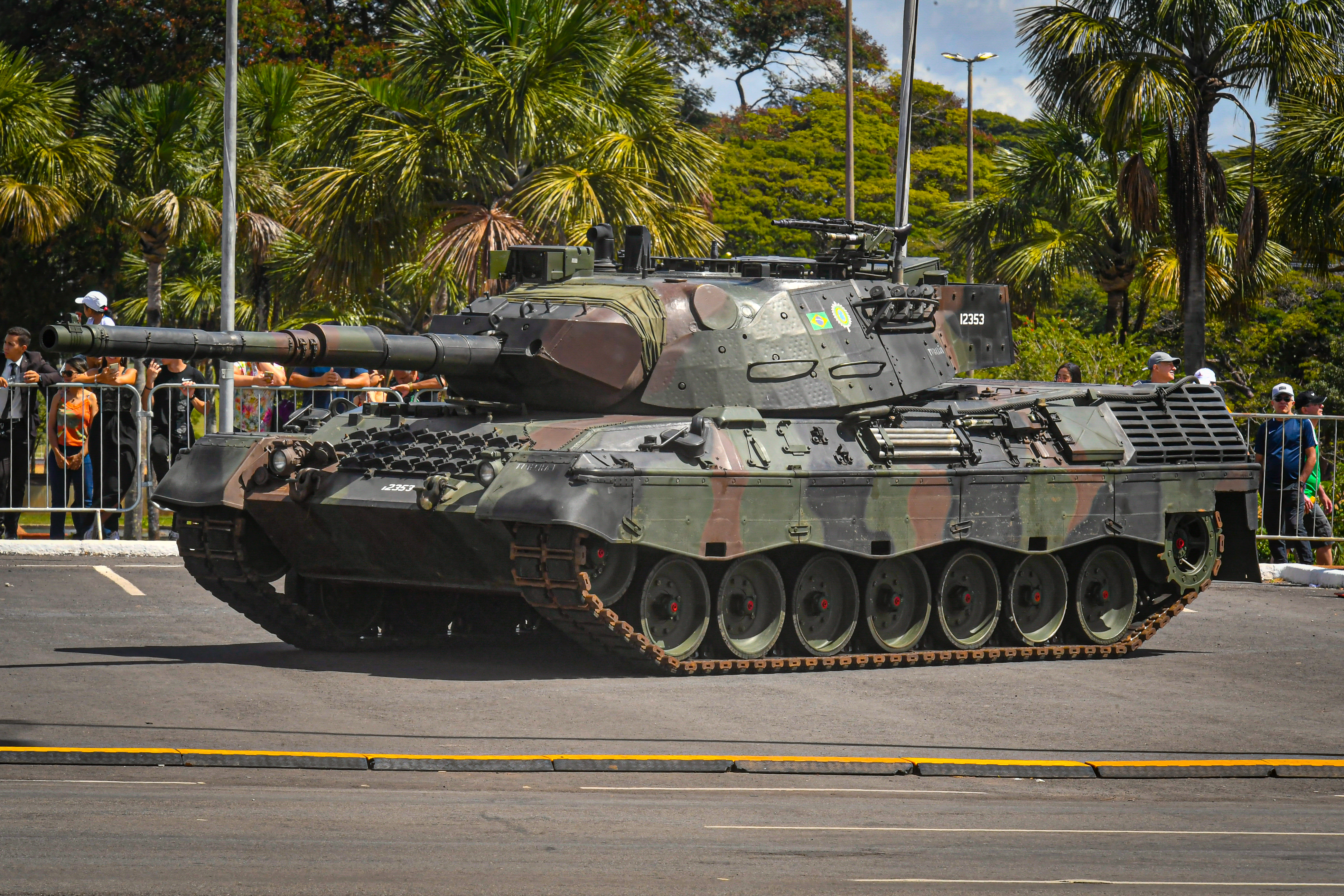
 Leopard 1A5 main battle tank
 -
 Brazilian VBTP-MR Guarani IFVs
 -
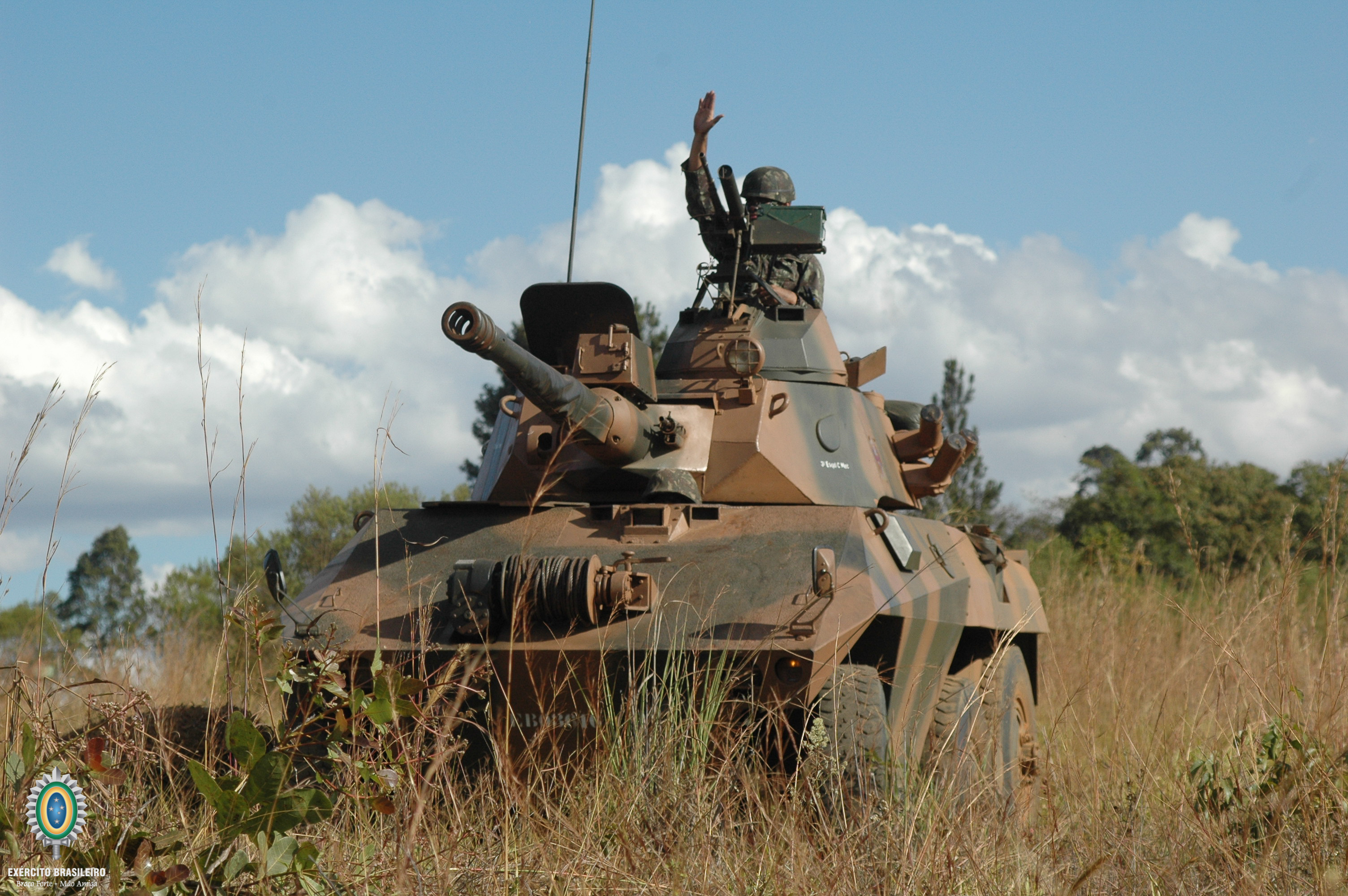 EE-9 Cascavel armored reconnaissance
 -
 Leopard 1A5 in night shooting exercise
 -
 Brazilian Army EC725
 -
 Brazilian Flakpanzer Gepard
 -
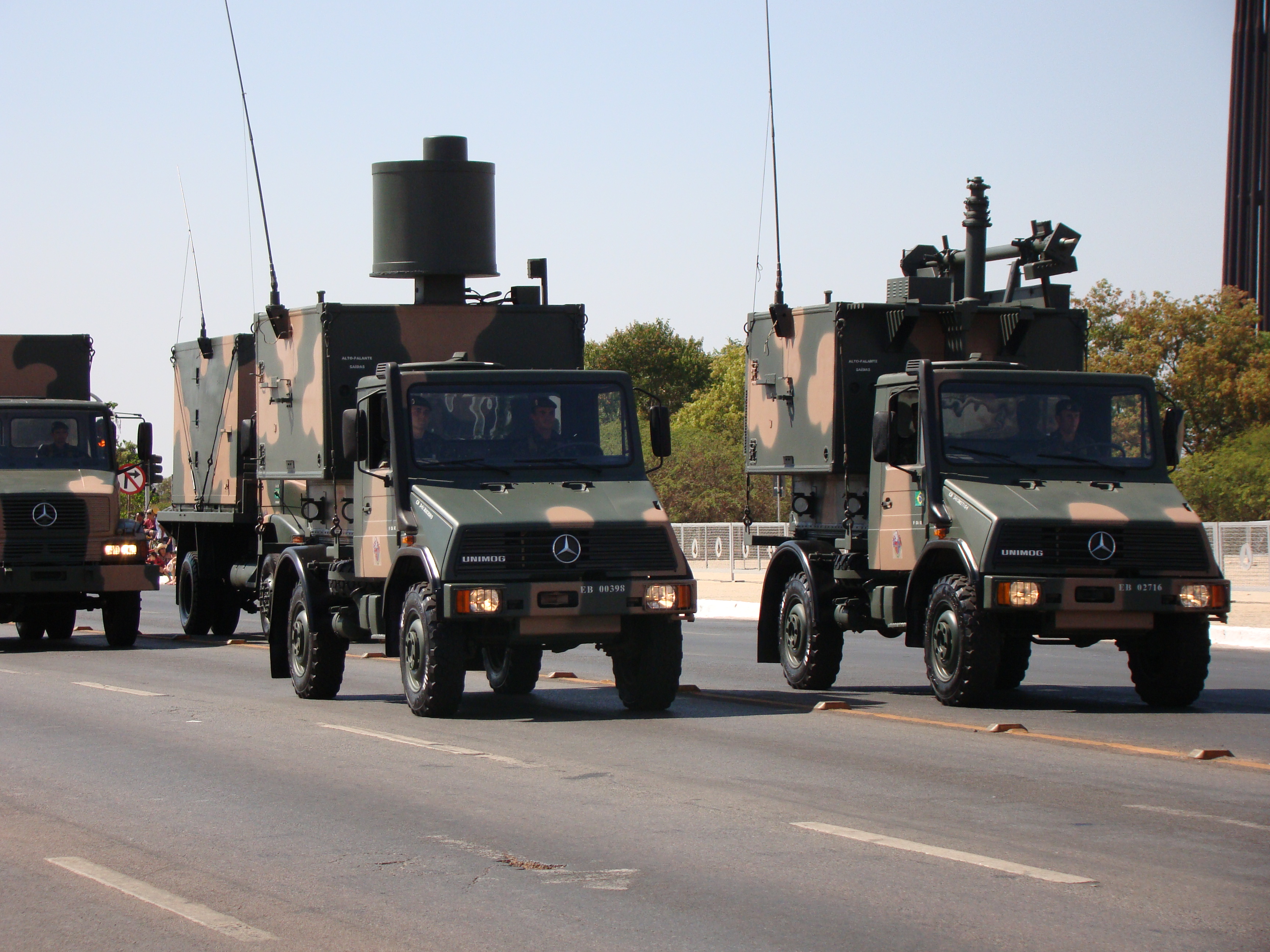 Electronic Warfare trucks
 -
 Jungle Warfare infantry
 -

-
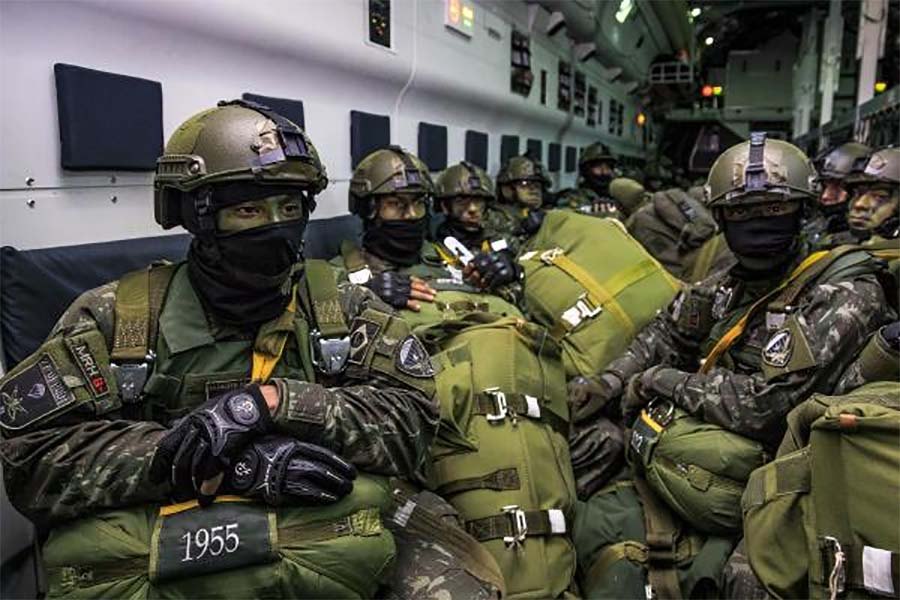 Brazilian Army Paratroopers
 -
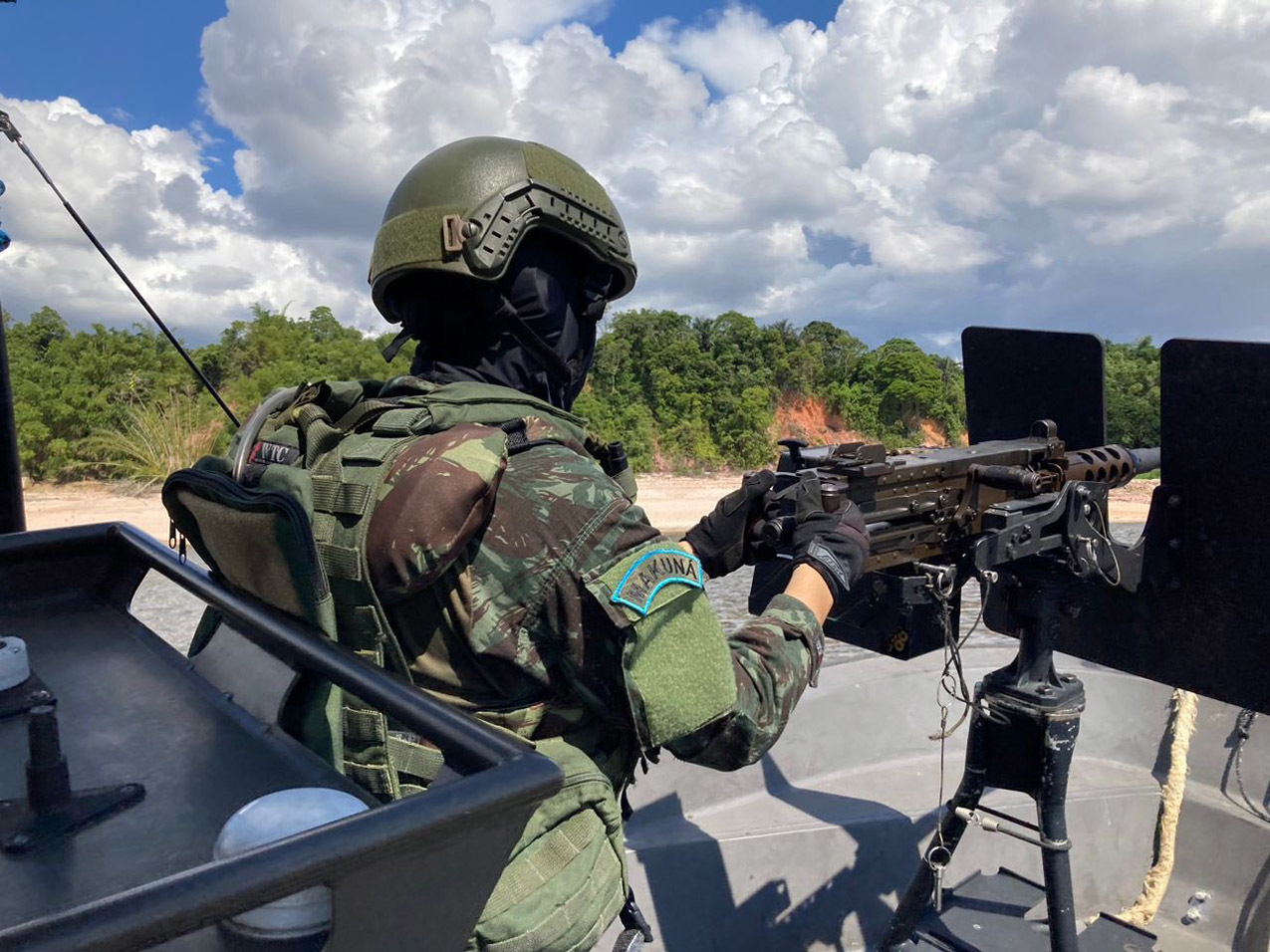 Border Battalion Soldier
 -
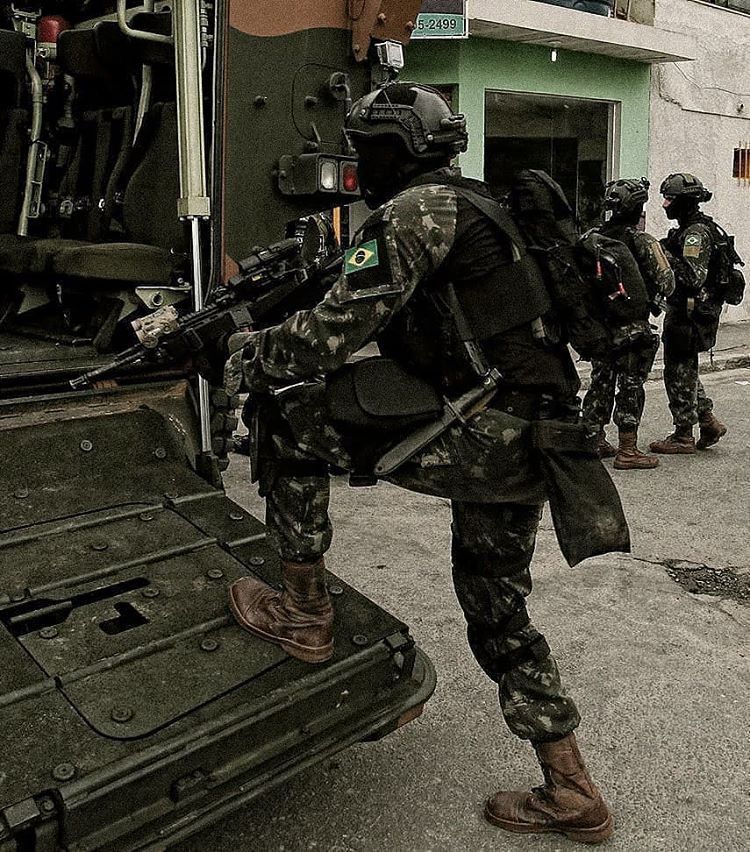
-
 Brazilian UH-60 Black Hawk in the Amazon region
 -
 Brazilian Caatinga soldiers

.jpg)
.jpg)
.jpg)
.jpg)
.jpg)
.jpg)
.jpg)


.jpg)
[edit | edit source]
The navy (Script error: The function "langx" does not exist.) has eight bases throughout Brazil.[41]
-
 Helicopter carrier Atlântico
 -

-
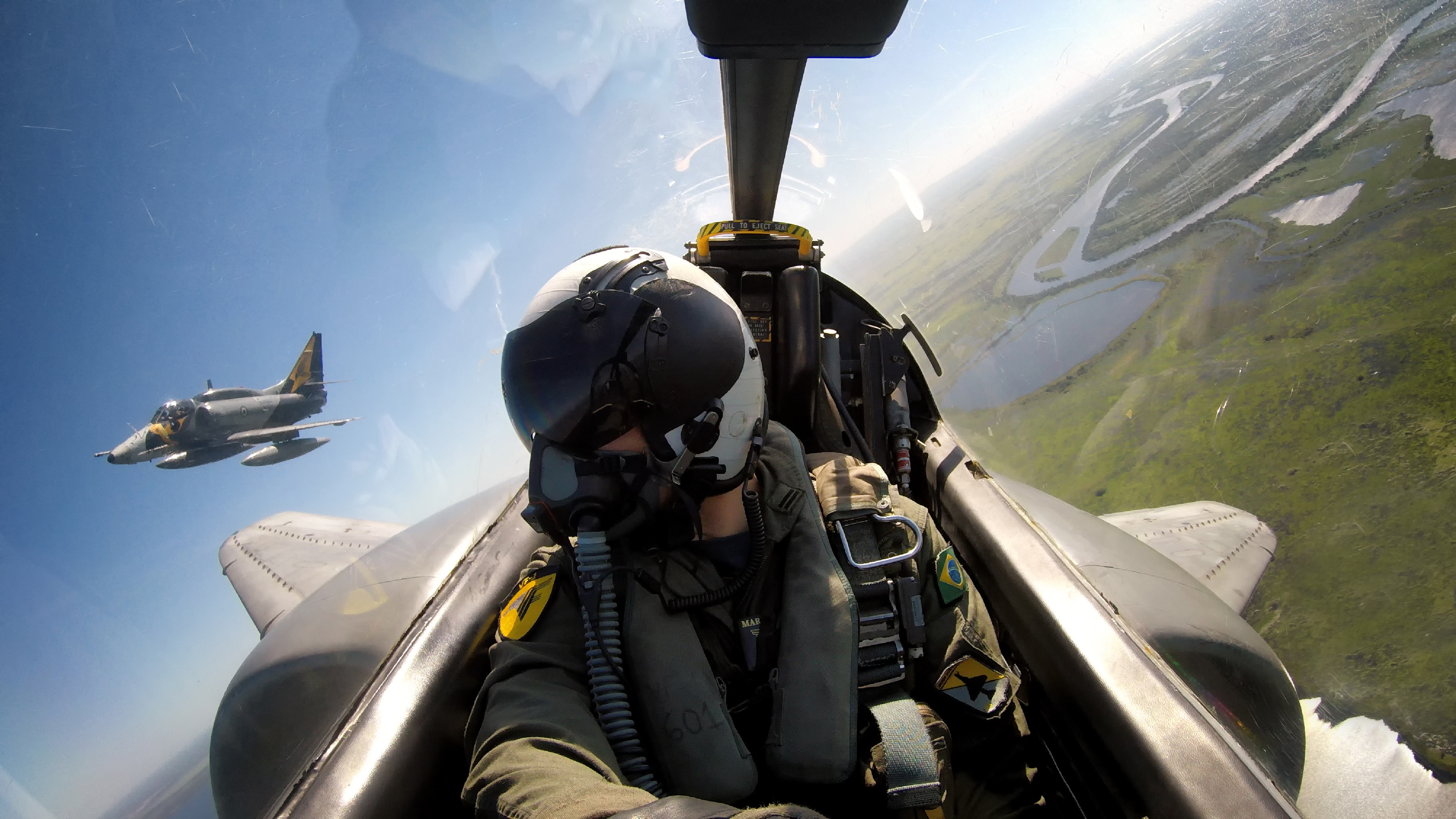 Brazilian Navy A-4 Skyhawk
 -
 Frigate Constituição underway
 -
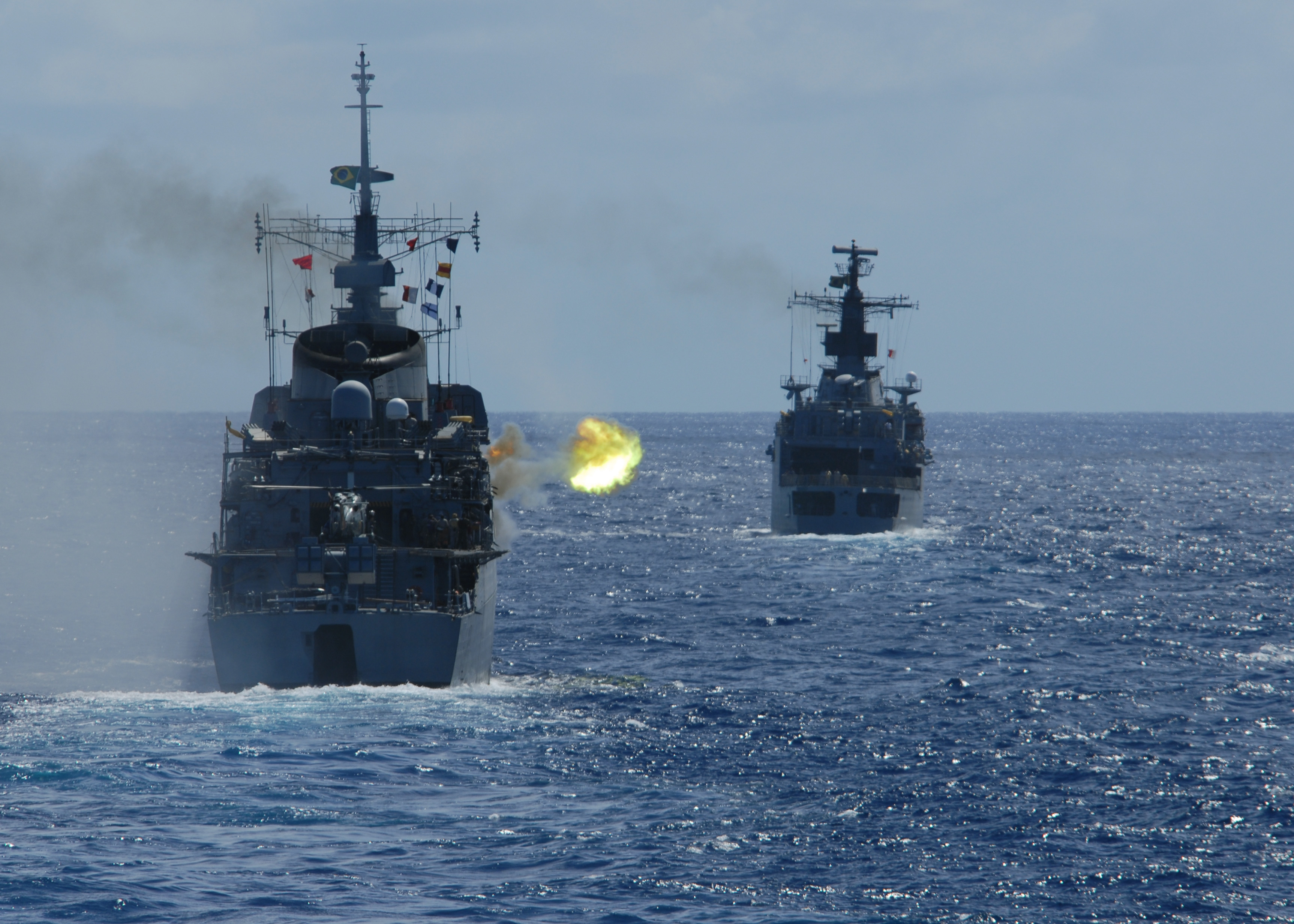 Brazilian frigates in shooting exercise
 -

-

-
 Task Force with Bahia leading
 -
 Brazilian Navy squadron of EC725s in flight
 -
 Brazilian Marines ASTROS system
 -
 Brazilian Navy SOF (GRUMEC)
 -
 Brazilian Marines SOF (COMANF)
 -
 Brazilian ScanEagle UAV
 -
 Brazilian Marines MOWAG Piranha
.jpg)
.jpg)
.jpg)
.jpg)
_fires_at_an_unmanned_aerial_vehicle_during_a_drone_exercise_(DRONEX)_with_ship.jpg)
.jpg)
.png)
.jpg)
.jpg)
.jpg)
_(52130022414).jpg)
.jpg)
.jpg)
.jpg)
Brazilian Air Force[edit | edit source]
The Brazilian Air Force (Script error: The function "langx" does not exist., pt, also known as FAB, pt or pt) is the second-largest air force in the Americas (behind only the United States) and has around 70,000 active personnel. The FAB is subdivided into four operational commands.
-
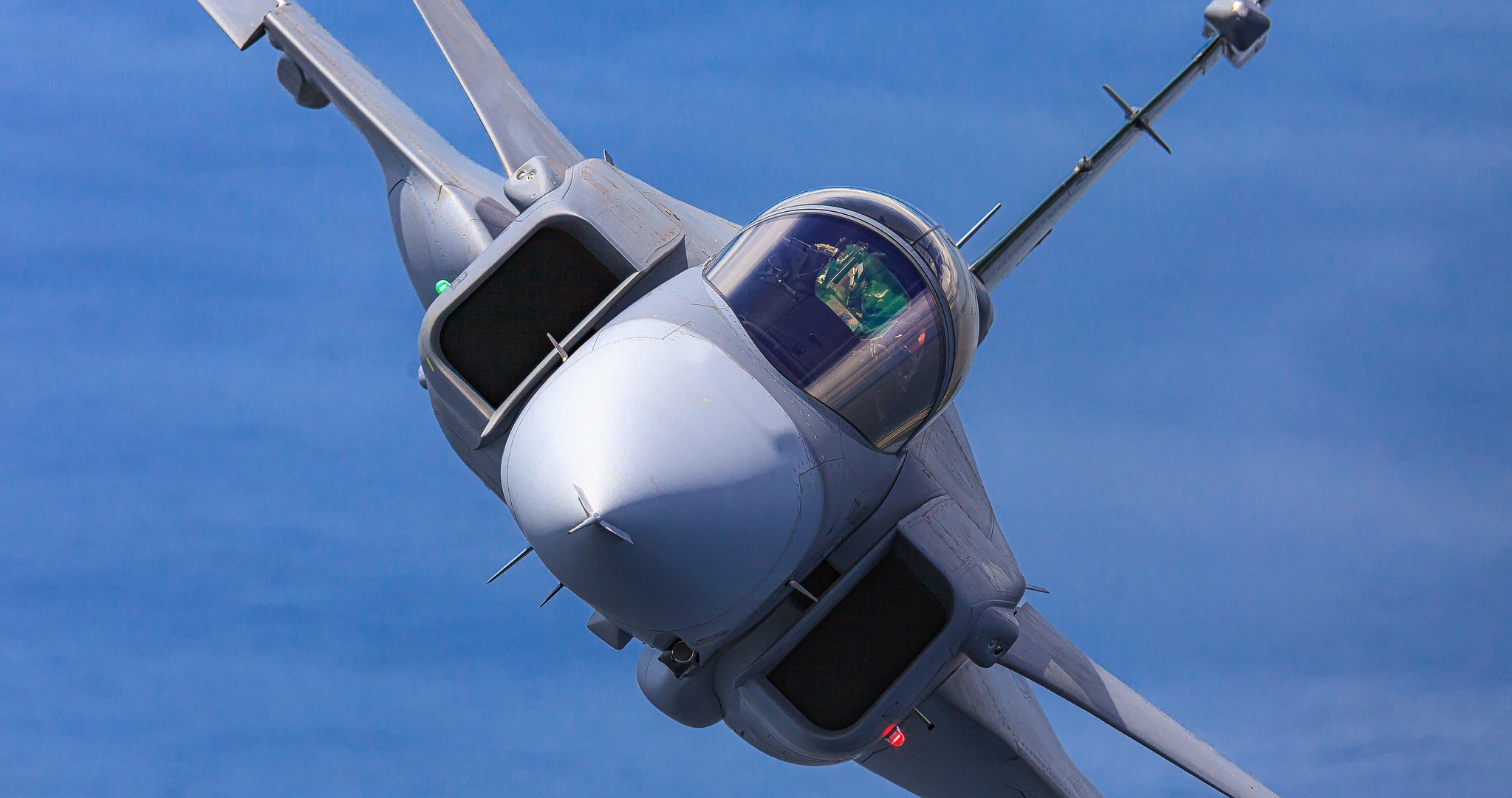 F-39E Gripen during an exercise
 -

-
 A-29 Super Tucano patrolling the Amazon rainforest
 -
 AMX attack aircraft
 -
 F-39E Gripen multirole fighter
 -
 UH-60L helicopter
 -
 Brazilian Air Force E-99 AEW&C
 -
 Two F-5M taking off in aerial alert
 -
 Brazilian Air Force EC725
 -
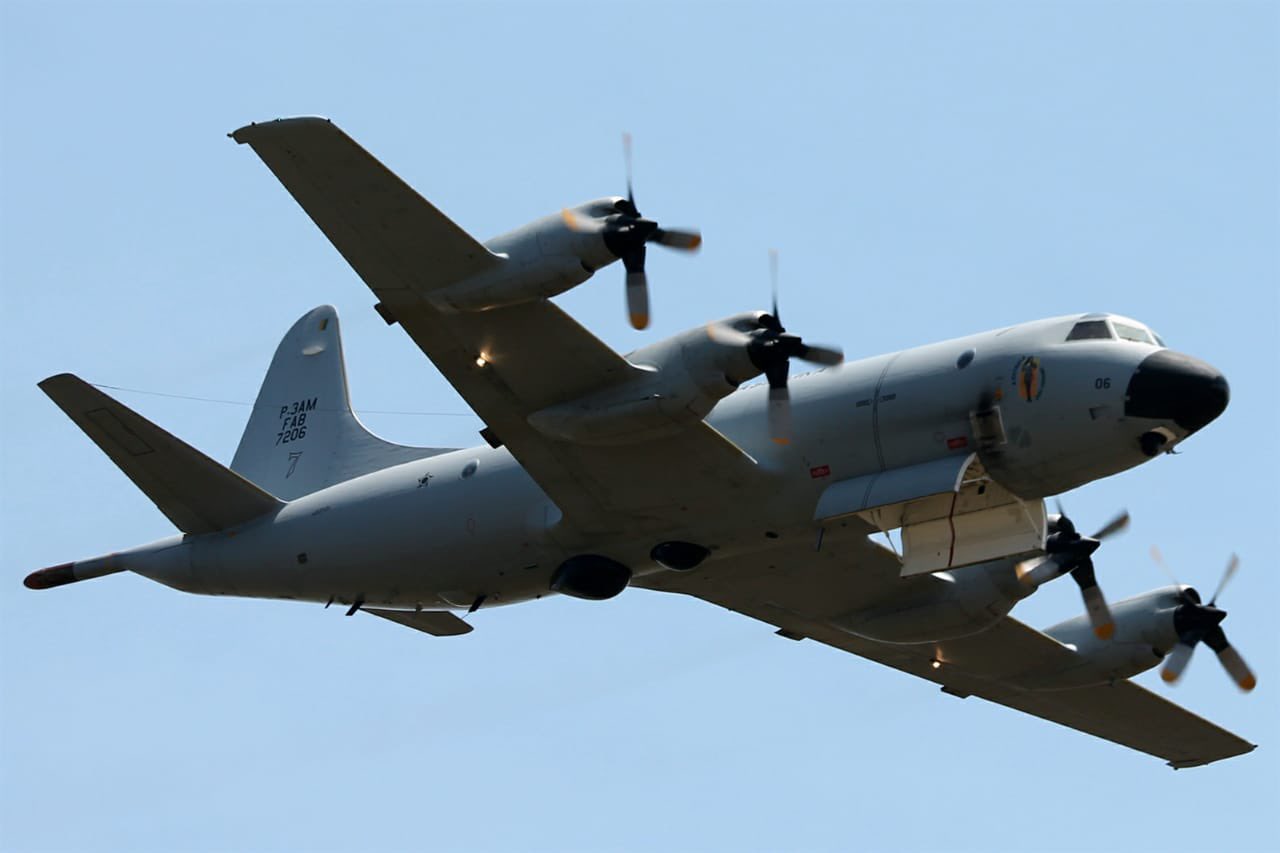 P-3AM Orion patrol aircraft
 -

-
 RQ-450 UAV
 -
 Brazilian Air Force Infantry
 -
 Air Force SOF (Para-SAR)
.jpg)
.jpg)


.jpg)
.jpg)
.jpg)
.jpg)
.jpg)


_(8101398607).jpg)


Brazilian aerospace command[edit | edit source]

The Aerospace Operations Command is a Brazilian air and space command created in 2017[42] and is part of the Brazilian Air Force. It is responsible for planning, coordinating, executing and controlling the country's air and space operations.[43] The Brazilian Navy and Brazilian Army also are part of the organization.
Troop relocation[edit | edit source]
.jpg)
Brazil has the need to patrol its 16,880 kilometers (10,490 mi) of land borders.[14] Since the 1990s Brazil has been relocating its forces in accordance to this national security requirement.
Between 1992 and 2008, the 1st, 2nd and 16th Jungle Infantry Brigades,[44][45] the 3rd Infantry Battalion, the 19th Logistics Battalion, and the 22nd Army Police Platoon were transferred by the Army from the states of Rio de Janeiro and Rio Grande do Sul to the Amazon region[46] in accordance with the friendship policy with Argentina. After those redeployments the number of Army troops in that region rose to 25,000.[47] Also relocated from the state of Rio de Janeiro were the 1st and 3rd Tank Regiments, now stationed in the city of Santa Maria, in the state of Rio Grande do Sul.[46]
However, despite those efforts, the presence of the Armed Forces on the border regions of the Brazilian Amazon continues to be sparse and disperse, given the fact that the Army has just 28 border detachments in that area, a total of 1,600 soldiers, or 1 man for every 7 km (4.3 mi) of borders.[14] More redeployments are expected since the states of Rio de Janeiro, Minas Gerais and Espírito Santo still concentrate over 49,000 soldiers.[46] In May 2008, the Navy announced new plans to reposition its forces throughout Brazil.[46]
Communications and territorial surveillance[edit | edit source]
The Brazilian territory corresponds to 47.3% of the South American continent,[48] and its land border is over 16.000 km and 4,5 million km2 of sea territory.[49] With the objective of ensuring Brazil's sovereignty, strategic monitoring and communications projects have been launched in recent years.
SGDC[edit | edit source]
.jpg)
The Geostationary Defense and Strategic Communications Satellites or SGDC, are geostationary communication satellites developed by the Brazilian Air Force and the Brazilian Space Agency, created with the objective of operating strategic military, government and civil communications, also offering broadband internet throughout the national territory.[50] The first satellite called SGDC-1, was launched in 2017[51] and the SGDC-2 has planned to launch in 2022.[52] The Space Operations Center (COPE) was inaugurated in 2020, subordinated to the Aerospace Operations Command, with the objective of operating the satellites.[50]
SISFRON[edit | edit source]
.jpg)
The Integrated Border Monitoring System (SISFRON) is a border system developed by the Brazilian Army for supporting operational employment decisions, operating in an integrated manner with all defense systems in the country, whose purpose is to strengthen the presence and capacity for monitoring and action in the national land border strip. It was conceived at the initiative of the Army Command, as a result of the approval of the National Defense Strategy in 2008, which guides the organization of the Armed Forces. SISFRON is planned to eventually cover the 16,886 kilometers of the border line, favoring the employment of organizations subordinate to the North, West, Southern and the Amazon military commands.[49]
SisGAAz[edit | edit source]
The Blue Amazon Management System, is a surveillance system planned by the Brazilian Navy, in order to oversee the "Blue Amazon", the country's exclusive economic zone and continental shelf, a resource-rich area covering about 4,500,000 km2 (1,700,000 sq mi)[needs update] off the Brazilian coast. This area is home to a huge diversity of marine species, valuable metallic minerals and other mineral resources, petroleum, and the world's second largest rare-earth reserve.[53] The SisGAAz will integrate equipment and systems composed of radars incorporated on land and vessels, as well as high resolution cameras and features such as the fusion of information received from collaborative systems.[54]
Link-BR2[edit | edit source]
The Link-BR2 is a datalink developed by the Air Force and the Brazilian defence company AEL Sistemas, this technology allow the exchange of data such radar information, videos and images with other units of the three branches anytime and anywhere, using an advanced encrypted protocol with a high degree of security.[55][56]
Future[edit | edit source]
See also[edit | edit source]
- Joint Staff of the Armed Forces
- Brazilian Naval Aviation
- Brazilian Navy
- Brazilian Army
- Brazilian Air Force
- National Force of Public Safety
- National Defense Council (Brazil)
- Brazil and weapons of mass destruction
- Policing in Brazil
- Military Police of Brazilian States
- Rondas Ostensivas Tobias de Aguiar: Military Police of the State of São Paulo.
- BOPE: Special Police Operations Battalion of the Military Police of the State of Rio de Janeiro, Brazil.
- Military Police of Rio de Janeiro State
- List of Wars involving Brazil
- Military of the Empire of Brazil
References[edit | edit source]
- ↑ 1.0 1.1 International Institute for Strategic Studies (15 February 2023). The Military Balance 2023. London: Routledge. p. 383. ISBN 9781032508955.
- ↑ "Orçamento e Finanças". Gov.br (in português). Retrieved 21 July 2024.
- ↑ According to article 144 of the 1988 Brazilian Constitution, the para-military Military Police alongside the Military Firefighters Corps are constitutionally considered an auxiliary and potential reserve to the Army, though subordinate to the state governors. They can, however, be compelled to federal service under a statute similar to posse comitatus[1]. Archived August 11, 2015, at the Wayback Machine
- ↑ IISS 2012, pp. 376–378
- ↑ Uma Nova Agenda Militar Archived 2017-03-25 at the Wayback Machine Revista Época. Retrieved on 16 April 2015.
- ↑ "Brazilian troops leave Haiti". 31 August 2017.
- ↑ 7.0 7.1 "Brazilian Federal Constitution". Brazilian Government (official text). Retrieved 17 May 2007. See also: "Brazilian Federal Constitution in English", text translated to English (unofficial). Retrieved on 2007-05-17.
- ↑ Ministry of Defence Structure "Defence" Ministério da Defesa. Retrieved June 22, 2007. Archived April 14, 2015, at the Wayback Machine
- ↑ 9.0 9.1 Template:Cite CIA World Factbook
- ↑ "Corrida bélica ao sabor da economia" (PDF). Jornal do Senado (in português do Brasil). 6 April 2008. p. 9. Archived from the original (PDF) on 20 March 2009.
- ↑ "Especial – NOTÍCIAS – Uma nova agenda militar". Revistaepoca.globo.com. Archived from the original on 24 February 2021. Retrieved 19 June 2010.
- ↑ "People's Daily Online – Bolivia bans Argentina from reselling gas to Chile". English.peopledaily.com.cn. 25 October 2006. Retrieved 19 June 2010.
- ↑ "Fresh anger over Bolivia gas plan". BBC News. 16 April 2004. Retrieved 1 April 2010.
- ↑ 14.0 14.1 14.2 "Especial – NOTÍCIAS – Uma nova agenda militar". Revistaepoca.globo.com. Archived from the original on 25 March 2017. Retrieved 19 June 2010.
- ↑ "Litoral brasileiro – Geografia – UOL Educação". Educacao.uol.com.br. 20 December 2007. Retrieved 19 June 2010.
- ↑ [2] (p.22) Archived March 20, 2009, at the Wayback Machine
- ↑ "Amazônia Azul".
- ↑ 18.0 18.1 18.2 18.3 18.4 "Especial – NOTÍCIAS – Os pés de barro de um gigante". Revistaepoca.globo.com. Archived from the original on 25 August 2010. Retrieved 19 June 2010.
- ↑ See Articles 102 and 148 of the Brazilian Constitution of 1824
- ↑ 20.0 20.1 Carvalho (2007), p.193
- ↑ Lyra, p.84
- ↑ Pedrosa, p.289
- ↑ Holanda, pp.241–242
- ↑ Rohter, Larry (1 August 2004). "Brazil Is Leading a Largely South American Mission to Haiti". The New York Times. Retrieved 1 April 2010.
- ↑ 25.0 25.1 25.2 25.3 "Especial – NOTÍCIAS – Uma nova agenda militar". Revistaepoca.globo.com. Archived from the original on 5 March 2012. Retrieved 19 June 2010.
- ↑ "História 2 Ano: 17 – Formação dos países platinos". Historia2ano.blogspot.com. 17 November 2008. Retrieved 19 June 2010.
{{cite web}}: CS1 maint: deprecated archival service (link) - ↑ Arruda, José and Piletti, Nelson -Toda a História (1997)(7° edition)(229 p.)
- ↑ Smith, Joseph. "Brazilian Diplomacy and Foreign Intervention in the Brazilian Naval Revolt, 1893-94". Revista Complutense de Historia de América.
- ↑ "The Rise of the Military in Politics: From the Old Republic to Estado Novo | Brazil: Five Centuries of Change". library.brown.edu. Retrieved 22 March 2026.
- ↑ Schulze, Frederik (16 March 2015). "Brazil". 1914-1918-Online. International Encyclopedia of the First World War. Retrieved 11 March 2026.
- ↑ Koshiba, Luiz and Pereira, Denise – História do Brasil (1999) (7° edition) (291 p.)
- ↑ "Brazil Under Vargas". Brown University Library. Archived from the original on 25 October 2025. Retrieved 25 October 2025.
- ↑ "About Ministry of Defense of Brazil".
- ↑ "Forças Armadas: escolha de comandantes seguirá critério de antiguidade, diz Múcio". G1 (in português). 9 December 2022.
- ↑ "Apresentação". esg.br. Retrieved 19 July 2021.
- ↑ "Alto Comando do Exército se reúne para tratar da crise com Bolsonaro e Pazuello". O Globo. 2 June 2021.
- ↑ "História da ESG". Retrieved 19 July 2021.
- ↑ "Exercício de Certificação da FORPRON da 10ª Brigada entra em fase de planejamento". DefesaNet (in português). 2 September 2021.
- ↑ "FORPRON: 26º Batalhão de Infantaria Pára-quedista está certificada para atuar em qualquer local do território nacional e internacional". Defesa Aerea e Naval (in português). 18 May 2022.
- ↑ "FORPRON". Brazilian Army Twitter (in português). 31 December 2022.
- ↑ "Brazilian Navy".
- ↑ "COMAE". Brazilian Air Force (in português). Retrieved 12 July 2021.
- ↑ "COMAE media" (in português). Retrieved 12 July 2021.
- ↑ "Entrevista – Enzo Martins Peri". Resenha Eletrônica. Archived from the original on 21 October 2008. Retrieved 19 June 2010.
- ↑ "Operação TIMBÓ IV". Fab.mil.br. Archived from the original on 6 July 2011. Retrieved 19 June 2010.
- ↑ 46.0 46.1 46.2 46.3 "O DIA Online – União cortará tropa do Rio". Archived from the original on 16 December 2008. Retrieved 2 May 2008.
- ↑ "Estadão.com.br". 20 April 2008. Retrieved 19 June 2010.
- ↑ "Brazil – Land". Permanent Missions. United Nations. Geography. Archived from the original on 23 October 2014.
- ↑ 49.0 49.1 "SISFRON". Brazilian Army (in português).
- ↑ 50.0 50.1 "Cerimônia marca inauguração das instalações do Centro de Operações Espaciais". Brazilian Air Force (in português). 24 June 2020.
- ↑ "Brasil lança satélite que permitirá acesso à banda larga em áreas remotas". G1, Brasília (in português). 4 May 2017. Retrieved 25 June 2020.
- ↑ Henry, Caleb (10 April 2019). "Brazil to order second dual civil-military communications satellite". SpaceNews. Retrieved 25 June 2020.
- ↑ "Brasil tem segunda maior reserva mundial de terras raras, mas não aparece entre os maiores produtores" (in português). O Globo. 30 May 2019.
- ↑ "SisGAAz: Proteção e Monitoramento das Águas Jurisdicionais Brasileiras". Brazilian Navy (in português).
- ↑ "FAB coloca para rodar sistema de última geração feito para o caça Gripen". Veja (in português). 16 December 2020.
- ↑ "FAB prepara os testes de voo do Projeto Link-BR2". Tecnodefesa (in português). 1 December 2020.
Bibliography[edit | edit source]
- International Institute for Strategic Studies (14 February 2018). The Military Balance 2018. London: Routledge. ISBN 9781857439557.
- International Institute for Strategic Studies (7 March 2012). The Military Balance 2012. London: Routledge. ISBN 978-1857436426.
External links[edit | edit source]
- Brazilian Ministry of Defence
- Brazil military profile from the CIA World Factbook
- Brazil military guide from GlobalSecurity.org
Template:Brazil topics Template:Military of Brazil Template:Military of South America