m Removed empty portal template using script |
enhance details per sources for accuracy |
||
| Line 1: | Line 1: | ||
{{ | {{Short description|Nobility title in the Islamic world}} | ||
{{ | {{Italic title}} | ||
{{Use Oxford spelling|date= | {{For|the given name|Sayyid (name)}} | ||
{{Use dmy dates|date= | {{Use Oxford spelling|date=February 2025}} | ||
{{Use dmy dates|date=February 2025}} | |||
{{infobox religious group | {{infobox religious group | ||
| group = Sayyid | | group = ''Sayyid''<br>{{lang|ar|سَيّد}} | ||
| image = Ralamb-40.jpg | | image = Ralamb-40.jpg | ||
| image_caption = In the [[Ottoman Empire]], | | image_caption = In the [[Ottoman Empire]], the Sayyids had the privilege of wearing a green turban | ||
| popplace = [[ | | popplace = [[Muslim world]] | ||
| rels = [[Islam]] | | rels = [[Islam]] and [[Baháʼí Faith]] | ||
| langs = [[Arabic language|Arabic | | langs = [[Arabic language|Arabic]], [[Persian language|Persian]], [[Urdu]], and others<ref>{{cite report|url=http://media.johnwiley.com.au/product_data/excerpt/47/04706745/0470674547-196.pdf |title=Chapter 1: Global Religious Populations, 1910–2010 |last1=Grim |first1=Brian J. |last2=Johnson |first2=Todd M. |date=2013 |publisher=Wiley |access-date=10 March 2017 |page=22 |url-status=dead |archive-url=https://web.archive.org/web/20131020100448/http://media.johnwiley.com.au/product_data/excerpt/47/04706745/0470674547-196.pdf |archive-date=20 October 2013 }}</ref><ref>{{Cite web|url=https://www.ethnologue.com/guides/ethnologue200|title=What are the top 200 most spoken languages?|date=2018-10-03|website=Ethnologue|language=en|access-date=2019-12-07}}</ref><ref>{{Cite journal|last=Al-Jallad|first=Ahmad|title=Polygenesis in the Arabic Dialects|journal=Encyclopedia of Arabic Language and Linguistics|date=30 May 2011|url=http://referenceworks.brillonline.com/entries/encyclopedia-of-arabic-language-and-linguistics/polygenesis-in-the-arabic-dialects-EALL_SIM_000030?s.num=1&s.f.s2_parent=s.f.book.encyclopedia-of-arabic-language-and-linguistics&s.q=neo-arabic|df=dmy-all}}</ref><ref name="auto6">{{Cite web |url=http://www.unhcr.org/refworld/docid/4cf2d0a85c.html |title=Refworld – 2010 Report on International Religious Freedom – China (includes Tibet, Hong Kong, Macau) |last=United Nations High Commissioner for Refugees |website=Refworld |access-date=14 February 2015}}</ref><ref>Nationalencyklopedin "Världens 100 största språk 2007" (The World's 100 Largest Languages in 2007), ''[[SIL Ethnologue]]''</ref> | ||
| | |population=Tens of millions<ref>{{cite book|title=Sayyids and Sharifs in Muslim Societies: The Living Links to the Prophet|date=2012|publisher=[[Routledge]]|isbn=978-0-415-51917-5|editor1-last=Morimoto|editor1-first=Kazuo|edition=illustrated|pages=2, 11|quote= Reliable statistics showing the number of the Prophet's kinsfolk, spread all through the Muslim world and far beyond it, are not available. Even a conservative estimate, however, would suggest that the number of kinsfolk is in the tens of millions.}}</ref>}} | ||
| | |||
}} | |||
{{Usul al-fiqh}} | {{Usul al-fiqh}} | ||
'''''Sayyid'''''{{efn|{{IPAc-en|UK||s|aɪ|ɪ|d|,_|ˈ|s|eɪ|j|ɪ|d}}, {{IPAc-en|US|ˈ|s|ɑː|j|ɪ|d}};<ref name="Collins">{{cite web|url=https://www.collinsdictionary.com/dictionary/english/sayyid|title=Sayyid|work=[[Collins English Dictionary]]|publisher=[[HarperCollins]]|access-date=28 May 2019|archive-url=https://web.archive.org/web/20190528182638/https://www.collinsdictionary.com/dictionary/english/sayyid|archive-date=28 May 2019|url-status=live}}</ref><ref>[https://en.oxforddictionaries.com/definition/us/sayyid "sayyid"]; {{Webarchive|url=https://web.archive.org/web/20190528182637/https://en.oxforddictionaries.com/definition/us/sayyid |date=28 May 2019 }} (US) and {{Cite encyclopedia |url=http://www.lexico.com/definition/sayyid |archive-url=https://web.archive.org/web/20200322185631/https://www.lexico.com/definition/sayyid |url-status=dead |archive-date=2020-03-22 |title=sayyid |dictionary=[[Lexico]] UK English Dictionary |publisher=[[Oxford University Press]]}}</ref><ref>{{cite American Heritage Dictionary|sayyid|access-date=28 May 2019}}</ref> {{langx|ar|سيد}} {{IPA|ar|ˈsæjjɪd|}}; {{IPA|fa|sejˈjed|lang}}; meaning 'sir', 'Lord', 'Master';<ref>{{harvnb|Van Arendonk|Graham|1960–2007}}.</ref> Arabic plural: {{lang|ar|سادة}} {{transliteration|ar|sādah}}; feminine: {{lang|ar|سيدة}} {{transliteration|ar|ALA|sayyidah}}; {{IPA|fa|sejˈjede|lang}}|group=notes}} is an honorific title of [[Hasanid]] and [[Husaynid]] lineage, recognized as descendants of the Islamic prophet [[Muhammad]] through his daughter [[Fatima]] and [[Ali]]'s sons [[Hasan ibn Ali|Hasan]] and [[Husayn ibn Ali|Husayn]]. The title may also refer to the descendants of the family of the [[Bani Hashim]] through Muhammad's great-grandfather [[Hashim ibn Abd Manaf|Hashim]], and others including [[Hamza ibn Abd al-Muttalib|Hamza]], [[Abbas ibn Abd al-Muttalib|Abbas]], [[Abu Talib ibn Abd al-Muttalib|Abu Talib]], and [[Asad ibn Hashim]].<ref name="The graves of Tarim genealogy and mobility across the Indian Ocean">{{cite book |last1=Ho |first1=Engseng |title=The graves of Tarim genealogy and mobility across the Indian Ocean |date=2006 |publisher=University of California Press |location=Berkeley |isbn=978-0-520-93869-4 |url=https://books.google.com/books?id=YMcZU0VHdG0C |access-date=25 August 2016}}</ref> | |||
See also [[Sharif]], which has a good description of three types of identification for that term and co-relates to this term. In its narrowest sense, a sayyid is a descendant of [[Husayn ibn Ali]], but the term is also more generally used for descendants of Muhammad. | |||
== Etymology == | |||
A few [[Arabic|Arabic language]] experts state that "Sayyid" has its roots in the word ''al-asad'' {{lang|ar|الأسد}}, meaning "lion", probably because of the qualities of valor and leadership.<ref>{{cite book |last1=Hitchcock |first1=Richard |url=https://books.google.com/books?id=l-IkDQAAQBAJ |title=Muslim Spain Reconsidered |date=18 February 2014 |publisher=Edinburgh University Press |isbn=9780748678310 |access-date=28 April 2017 |archive-url=https://web.archive.org/web/20170729155351/https://books.google.co.uk/books?id=l-IkDQAAQBAJ |archive-date=29 July 2017 |url-status=live}}</ref>{{rp|158}}<ref>{{cite book |last1=Corriente |first1=Federico |url=https://books.google.com/books?id=N_hAzIqriakC |title=Dictionary of Arabic and Allied Loanwords: Spanish, Portuguese, Catalan, Galician and Kindred Dialects |publisher=BRILL |year=2008 |isbn=978-9004168589 |access-date=28 April 2017 |archive-url=https://web.archive.org/web/20141006153300/http://books.google.co.uk/books?id=N_hAzIqriakC |archive-date=6 October 2014 |url-status=live}}</ref>{{rp|265}} The word is derived from the verb sāda, meaning to rule. The title seyyed/sayyid/syed/sayyad/saeed/said existed before Islam, however not in light of a specific descent, but as a [[meritocratic]] sign of respect.<ref>{{cite book |url=http://arabiclexicon.hawramani.com/search/سيد?cat=3 |title=Lisān Al-'Arab |access-date=14 September 2022}}</ref> | |||
[[Hans Wehr]]'s ''[[Dictionary of Modern Written Arabic]]'' defines seyyid as a translation for master, chief, sovereign, or lord.<ref>{{cite book |last=Wehr |first=Hans |title=A Dictionary of Modern Written Arabic |year=1976 |page=440}}</ref> It also denotes someone respected and of high status. | |||
In the [[Arab world]], ''sayyid'' is the equivalent of the [[English language|English]] word "[[Homage (feudal)|liege lord]]" or "master".<ref name="A History of the Modern Middle East">{{cite book |last1=Cleveland |first1=William L. |url=https://books.google.com/books?id=2_JMDAAAQBAJ |title=A History of the Modern Middle East |last2=Bunton |first2=Martin |date=2 August 2016 |publisher=Westview Press |isbn=978-0-8133-4980-0 |language=en |access-date=25 August 2016 |archive-url=https://web.archive.org/web/20170215025228/https://books.google.com/books?id=2_JMDAAAQBAJ |archive-date=15 February 2017 |url-status=live}}</ref> | |||
== | == Origin of the title == | ||
The | The foundation of the title Sayyid is unclear. In fact the title Sayyid as a unified reference for descendants of [[Muhammad]] did not exist, according to Morimoto Kazuo, until the [[Mongol invasions and conquests|Mongol conquests]].<ref name=Morimoto-introduction>{{Cite book |last=Morimoto |first=Kazuo |url=https://books.google.com/books?id=dSzcaSf5vDsC |title=Sayyids and Sharifs in Muslim Societies: The Living Links to the Prophet |date=2012-06-25 |publisher=Routledge |isbn=978-1-136-33738-3 |language=en}}</ref> This can be substantiated by historic records about [[Abdul Qadir Gilani]] and [[Baha' al-Din Naqshband]], who did not refer to themselves with any title, despite their lineages to [[Muhammad]]. Sometimes the ruling community of a nation took this title to portray themselves as respected and honored, though they are not actually the descendants of [[Muhammad]]. This gives reasons to think that this title is founded later on.{{citation needed|date=January 2025}} Morimoto refers to Mominov, who describes that the emergence of a community leader during the [[Mongol Empire|Mongol era]] ([[Ilkhanate]]) gave rise to the prominence of the title Sayyid.<ref name=Morimoto-introduction/>{{Rp|p=7}} This leader is most probably the [[Sunni Islam|Sunni]] [[Shafi'i school|Shafi'ite]] scholar [[Mir Sayyid Ali Hamadani]], who lived in this time, being known as a saint credited with the honorific titles "Amir-e-Kabir" ([[English language|English]]: "Grand Prince") and "Ali-e-Sani" ([[English language|English]]: "Second [[Ali]]").<ref>{{cite book | last=Lawrence | first=Walter R.| title=The valley of Kashmir | publisher=Asian Educational Services | publication-place=New Delhi | date=2005 |page=292 |isbn=81-206-1630-8 | oclc=65200978}}</ref> Hamadani's religious legacy in [[Kashmir]] as well as his headquarter ([[Persian language|Persian]]: ''Khanqah'') the [[Ziyarat Naqshband Sahab|''Khanqa-e-Mola'']] became under the control of the [[Mir (title)|Grand Sayyid]] [[Hazrat Ishaan]]. [[Hazrat Ishaan|Hazrat Ishaan's]] descendants are buried in Hamadani's headquarters, on which occasion it is known as the [[Ziyarat Naqshband Sahab]] today.<ref>Tazkare Khwanadane Hazrat Eshan (genealogy of the family of Hazrat Eshan)(by author and investigator:Muhammad Yasin Qasvari Naqshbandi company:Edara Talimat Naqshbandiyya Lahore)p. 58</ref><ref>{{Cite book|title=Tarikh-i Hassan|first1=Ghulam Hasan|last1=Khuihami|first2=P. N|last2=Pushp|date=4 August 1954|publisher=Research & Publ. Dpt., Jammu & Kashmir Gov.|oclc=69327348 }}</ref><ref>Suraiya Gull in "Development of Sufi Kubraviya Order with Special Reference to Mir Saiyid Ali Hamadani", p. 8</ref> | ||
However, in [[Sunni Islam]] as practiced in the [[Ottoman Empire|Ottoman]] and [[Mughal Empire]], a person descending from [[Muhammad]] (either maternally or paternally) can only claim the title of ''Sayyid'' [[meritocratic]]ally by passing [[#Eligibility|audits]], whereupon exclusive rights, like paying lesser taxes, will be granted. These are mostly based on the claimant's demonstrated knowledge of the [[Quran]] and piousness ([[Arabic]]: ''[[Taqwa]]'') under the assessment of a [[Naqib al-ashraf|Naqib al-Ashraf]], also known as a [[Mir (title)|Mir]] in Persian-speaking countries.<ref name="Tazkare Khanwade Hazrat Ishaan p. 61">Tazkare Khanwade Hazrat Ishaan, p. 61, by Muhammad Yasin Qaswari Naqshbandi, published by Kooperatis Lahorin, Edare Talimat Naqshbandiyya</ref><ref>Damurdashi, ed. Muhammad, p. 43.</ref><ref>Imber and Kiyotaki, p. 198.</ref> Notable examples of such a Naqib (plural: "Nuqaba") or Mirs (plural: "Miran"), were [[Hazrat Ishaan]] in the [[Mughal Empire]] and his descendant [[Sayyid Mir Fazlullah Agha]] in [[barakzai dynasty|Royal Afghanistan]].<ref name="Tazkare Khanwade Hazrat Ishaan p. 61"/> | |||
== West Asia == | |||
Men belonging to the ''Sayyid'' families or tribes in the Arab world used to wear white- or ivory-coloured daggers like [[jambiya]]s, [[khanjar]]s or [[shibriya]]s to demarcate their nobility amongst other Arab men, although this custom has been restricted due to the local laws of the variously divided Arab countries.{{citation needed|date=March 2025}} | |||
Men belonging to the ''Sayyid'' families or tribes in the Arab world used to wear white or ivory coloured daggers like [[jambiya]]s, [[khanjar]]s or [[shibriya]]s to demarcate their nobility amongst other Arab men, although this custom has been restricted due to the local laws of the variously divided Arab countries. | |||
=== Iraq === | === Iraq === | ||
The ''Sayyid'' families in Iraq are so numerous that there are books written especially to list the families and connect their trees. | The ''Sayyid'' families in Iraq are so numerous that there are books written especially to list the families and connect their trees. These families include: the Al-[[Talqani]], Al-[[Yassiri]], Al-[[Aqiqi]], Al-Nasrullah, Al-Wahab, [[Al-Hashimi]], Al-[[Qureshi|Quraishi]], Al-[[Mar'ashis|Mar'ashi]], Al-[[Witri]], [[Zaidi (surname)|Al-Zaidi]], Al-[[A'araji]], Al-[[Baka (disambiguation)|Baka]], Al-[[Hassan (surname)|Hasani]], Al-[[Husseini|Hussaini]], Al-[[Shahristani]], [[Al-Qazwini (family)|Al-Qazwini]] Al-[[Qadri]], [[Tabatabaei]], Al-[[Alawi (name)|Alawi]], Al-[[Ghawalib]] (Al-[[Ghalibi]]), [[Al-Musawi]], [[Al-Awadi]] (not to be confused with the [[Al-Awadhi]] [[Huwala people|Huwala]] family), and many others.<ref>[https://books.google.com/books?id=MiSqRD9i1TgC&dq=Sayyids+in+Iraq&pg=PA122 Reclaiming Iraq: The 1920 Revolution and the Founding of the Modern State] {{webarchive|url=https://web.archive.org/web/20160430102412/https://books.google.com/books?id=MiSqRD9i1TgC&pg=PA122&dq=Sayyids+in+Iraq&hl=en&sa=X&ei=-JfJUIP8Hu2cmQXLpoHwDw&ved=0CDQQ6AEwAA |date=30 April 2016 }} By Abbas Kadhim</ref><ref>[https://web.archive.org/web/20200125105401/https://books.google.iq/books/about/%D8%A7%D9%84%D8%A8%D8%BA%D8%AF%D8%A7%D8%AF%D9%8A%D9%88%D9%86_%D8%A3%D8%AE%D8%A8%D8%A7%D8%B1%D9%87%D9%85_%D9%88%D9%85.html?id=DoI5DwAAQBAJ&redir_esc=y البغداديون أخبارهم ومجالسهم] By [[:ar:إبراهيم عبد الغني الدروبي|إبراهيم عبد الغني الدروبي]] - مطبعة الرابطة - Baghdad 1958 – مجلس آل الوتري (House of Al-Witry Council) - Page 78.</ref><ref>[https://web.archive.org/web/20191208013703/https://books.google.com.eg/books?id=SVJ8YNWhRaQC&pg=PT103&lpg=PT103&dq=%22%D8%A2%D9%85%D9%86%D8%A9+%D8%B5%D8%A8%D8%B1%D9%8A+%D9%85%D8%B1%D8%A7%D8%AF%22&source=bl&ots=FlVmALuTPQ&sig=bK41EaGfCnyTOvH-QRpSZS_tUs8&hl=en&sa=X&ved=0ahUKEwj_xrmBt9DLAhWG6RQKHaLRDZUQ6AEIGjAA#v=onepage&q=%D8%A7%D9%84%D8%B3%D9%8A%D8%AF%20%D9%87%D8%A7%D8%B4%D9%85%20%D8%A7%D9%84%D9%88%D8%AA%D8%B1%D9%8A&f=false الكلية الطبية الملكية العراقية من خلال سيرة ذاتية، ج 1 (الطبعة الأولى)]. بيروت: المؤسسة العربية للدراسات والنشر. (هاشم الوتري - Hashim Al-Witry) Pages 180-181. {{ISBN|9953-441-51-0}}</ref> | ||
=== Iran === | === Iran === | ||
''Sayyids'' ( | [[File:Qadr night in Imam Reza Shrine.jpg|thumb|Mausoleum of [[Ali al-Rida|Imam Ali al-Rida]]]] | ||
[[File:Mollah imamzadeh tabriz.jpg|thumb|Mausoleum of [[Imamzadeh]] [[Sayyid Hamza bin Musa al Kazim]]]] | |||
''Sayyids'' ({{langx|fa|سید|Seyyed}}) are found in vast numbers in [[Iran]]. The Chief of "National Organization for Civil Registration" of Iran declared that more than 6 millions of Iranians are ''Sayyid''.<ref>[http://www.farsnews.ir/newstext.php?nn=13920211000043 Six million people of Iran's population are Sadaat (Sayyid) / Tehran and Mazandaran (provinces) are the record owner of Sadaats in the country] {{Webarchive|url=https://web.archive.org/web/20180202012427/http://www.farsnews.ir/newstext.php?nn=13920211000043 |date=2 February 2018 }} farsnews.ir1 February 2018</ref> The majority of ''Sayyids'' migrated to Iran from Arab lands predominantly in the 15th to 17th centuries during the [[Safavid dynasty|Safavid]] era. The Safavids transformed the religious landscape of Iran by imposing [[Twelver Shi'ism]] on the populace. Since most of the population embraced Sunni Islam, and an educated version of Shiism was scarce in Iran at the time, [[Ismail I|Ismail]] imported a new group of Shia ''[[Ulama]]'' who predominantly were Sayyids from traditional Shiite centers of the Arabic-speaking lands, such as [[Jabal Amil]] (of [[southern Lebanon]]), [[Syria]], [[Bahrain]], and [[southern Iraq]] in order to create a state clergy. The Safavids offered them land and money in return for loyalty.<ref>{{cite book |last1=Floor |first1=Willem |last2=Herzig |first2=Edmund |title=Iran and the World in the Safavid Age |date=2015 |publisher=I.B.Tauris |isbn=978-1-78076-990-5 |page=20 |url=https://books.google.com/books?id=HZNpBgAAQBAJ&q=safavids+imported+lebanon |quote=In fact, at the start of the Safavid period Twelver Shi'ism was imported into Iran largely from Syria and Mount Lebanon (...) |url-status=live |archive-url=https://web.archive.org/web/20170903220359/https://books.google.com/books?id=HZNpBgAAQBAJ&dq=safavids+imported+lebanon&hl=nl&source=gbs_navlinks_s |archive-date=3 September 2017 }}</ref><ref name="Islam pg.170">The failure of political Islam, by Olivier Roy, Carol Volk, pg.170</ref><ref name="Francis Robinson pg.72">The Cambridge illustrated history of the Islamic world, by Francis Robinson, pg.72</ref><ref name="Marvin E. Gettleman pg.42">The Middle East and Islamic world reader, by Marvin E. Gettleman, Stuart Schaar, pg.42</ref><ref name="Peter N. Stearns pg.360">The Encyclopedia of world history: ancient, medieval, and modern ... by Peter N. Stearns, William Leonard Langer, pg.360</ref> These scholars taught Twelver Shi'ism, made it accessible to the population, and energetically encouraged conversion to [[Shia Islam|Shi'ism]].<ref name="Islam pg.170" /><ref name="Francis Robinson pg.72" /><ref name="Marvin E. Gettleman pg.42" /><ref name="Peter N. Stearns pg.360" /><ref>{{cite book |url=https://books.google.com/books?id=l1ybylkCCLAC |title=Shiʻite Lebanon: Transnational Religion and the Making of National Identities |first=Roschanack |last=Shaery-Eisenlohr |date=1 January 2008 |publisher=Columbia University Press |via=Google Books |pages=12–13 |isbn=9780231144261 |access-date=15 November 2015 |archive-url=https://web.archive.org/web/20170729155351/https://books.google.com/books?id=l1ybylkCCLAC |archive-date=29 July 2017 |url-status=live }}</ref> | |||
During the reign of [[Abbas | During the reign of [[Abbas the Great|Shah Abbas the Great]], the Safavids also imported to Iran more Arab Shias, predominantly ''Sayyids'', built religious institutions for them, including many ''[[Madrasa]]s'' (religious schools), and successfully persuaded them to participate in the government, which they had shunned in the past (following the [[Muhammad al-Mahdi|Hidden imam]] doctrine).<ref>{{cite book |url=https://books.google.com/books?id=G-M3IRh22moC&q=sunni%20iran&pg=PT52 |title=Science Under Islam: Rise, Decline and Revival |first=Sayyed M. |last=Deen |date=1 January 2007 |publisher=Lulu.com |via=Google Books |page=37|isbn=9781847999429 }}</ref>{{self-published inline|date=February 2020}} | ||
Common ''Sayyid'' family surnames in Iran are [[Husseini]], [[Al Mosawi|Mousavi]], [[Kazmi|Kazemi]], Razavi, Eshtehardian, [[Tabatabaei]], [[Hashmi | Common ''Sayyid'' family surnames in Iran are [[Husseini]], [[Al Mosawi|Mousavi]], [[Kazmi|Kazemi]], [[Razavi (surname)|Razavi]], [[Eshtehardian]], [[Tabatabaei]], [[Hashmi]], [[Hassani (disambiguation)|Hassani]], [[al-Ja'fari]], [[Emami (disambiguation)|Emami]], [[Arabi (disambiguation)|Arabi]], [[Ahmadi]], [[Zayd ibn Ali|Zaidi]], [[Imamzadeh]], [[Sherazi]], [[Kirmani]], [[Shahidi]], and [[Mahdavi (disambiguation)|Mahdavi]].{{citation needed|date=August 2016}} | ||
=== Oman === | === Oman === | ||
In [[Oman]], Sayyid is used solely as a royal title and not as a means of indicating descent from [[Muhammad]]. It is used by members of the ruling [[Al Bu Said dynasty|Al Bu Said]] family who are not descended from Muhammad but instead from the [[Azd]], a [[Qahtanite]] tribe. All [[Patrilineality|male line]] descendants of [[Ahmad bin Said al-Busaidi|Sultan Ahmad bin Said]], the first ruler of Oman from the Al Bu Said dynasty, are able to use the title of Sayyid or Sayyida.<ref>{{cite book |last1=Razik |first1=Salil |editor1-last=Badger |editor1-first=George Percy |title=History of the imâms and seyyids of Omân |date=1871 |publisher=The Hakluyt Society |page=377 |url=https://archive.org/details/historyofimmss44ibnr/mode/2up}}</ref> Male line descendants of [[Turki bin Said|Sultan Turki bin Said]] are also able to use the style of [[Highness|His/Her Highness]]. The Sayyid title in Oman is some times translated as [[Prince]].<ref>{{cite book |editor1-last=Montgomery-Massingberd |editor1-first=Hugh |title=Burke's Royal Families of the World Volume II Africa & the Middle East |date=1980 |publisher=Burke's Peerage Ltd. |page=102 |isbn=978-0-85011-029-6 |url=https://archive.org/details/burkesroyalfamil0002unse/mode/2up}}</ref> | |||
In Oman, | |||
=== Yemen === | === Yemen === | ||
In Yemen the ''Sayyids'' are more generally known as ''sadah''; they are also referred to as ''[[Hashemite]]s''. In terms of religious practice they are [[Sunni Islam|Sunni]], [[Shia Islam|Shia]], and [[Sufism|Sufi]]. ''Sayyid'' families in [[Yemen]] include the [[Rassids]], the Qasimids, the Mutawakkilites, the Hamideddins, some Al-Zaidi of [[Marib]], [[Sanaa]], and [[Saada]], the [[Ba 'Alawi sada]]h families in [[Hadhramaut]], Mufadhal of Sanaa, Al-Shammam of Saada, the Sufyan of Juban, and the Al-Jaylani of Juban.<ref>[https://books.google.com/books?id=4W3o6bUwCYEC&dq=Sayyids+in+yemen&pg=PA56 A Tribal Order: Politics And Law in the Mountains of Yemen] {{webarchive|url=https://web.archive.org/web/20160617154108/https://books.google.com/books?id=4W3o6bUwCYEC&pg=PA56&dq=Sayyids+in+yemen&hl=en&sa=X&ei=-pPJUPfFGcTPmAXej4DwDg&ved=0CD0Q6AEwBA |date=17 June 2016 }} By Shelagh Weir</ref><ref name="Britannica">{{cite encyclopedia |url=http://www.britannica.com/EBchecked/topic/526186/sayyid |title=sayyid – Arabic title |encyclopedia=Encyclopædia Britannica |url-status=live |archive-url=https://web.archive.org/web/20120122181035/http://www.britannica.com/EBchecked/topic/526186/sayyid |archive-date=22 January 2012 }}</ref><ref>[http://ambassadors.net/archives/issue18/features3.htm From Religious Leaders to Ordinary Citizens The Changing Role of "Sadah" in Yemen] {{webarchive|url=https://web.archive.org/web/20121026110753/http://ambassadors.net/archives/issue18/features3.htm |date=26 October 2012}} By Mohammed Al-Asadi</ref> | |||
In Yemen the ''Sayyids'' are more generally known as ''sadah''; they are also referred to as ''[[Hashemite]]s''. In terms of religious practice they are [[ | |||
== South Asia == | == South Asia == | ||
[[File:Six Sufi masters (retouched).jpg|thumb|Portrait of leading Sayyids who promoted [[Islam]] in [[Indian subcontinent|The Indian subcontinent]]]] | |||
In [[South Asia]], Sayyids are mostly credited for preaching and consolidating the religion of Islam. They are predominantly descendants of leading saints of [[Sunni Islam]] that migrated from [[Greater Iran|Persia]] to preach Islam in [[Schools of Islamic theology|Islamic Theology]].<ref>Mohammada in The Foundations of the Composite Culture in India, p. 170</ref><ref>Wani in Islam in Kashmir | |||
Fourteenth to Sixteenth Century, p. 147</ref> | |||
===Afghanistan=== | === Afghanistan === | ||
In the [[Islamic Republic of Afghanistan]], the ''Sayyid'' have been recognized as an ethnic group. On March 15, 2019, President Ashraf Ghani decreed the inclusion of the Sadat tribe in the electronically registered national identity documents ([[Afghan identity card|''Tadhkira'']]).<ref>{{cite news |last1=Hamdard |first1=Azizullah |date=15 March 2019 |title=Ghani decrees mentioning Sadat tribe in electronic ID card |url=https://pajhwok.com/2019/03/15/ghani-decrees-mentioning-sadat-tribe-electronic-id-card/}}</ref> The majority of Sayyids live in [[Balkh]] and [[Kunduz]] in the north, as well as in [[Nangarhar Province|Nangarhar]] in the east. They are predominantly Sunni Muslims<sup>[<nowiki/>[[Template:Citation needed|citation needed]]]</sup>, although there are some, including in [[Bamyan Province]], who belong to Shia Islam. These individuals are often referred to as ''Sadat'' (from {{langx|ar|سادات}}, the plural of ''Sayyid''), a term traditionally used to denote the descendants of [[Hasan ibn Ali|Hasan]] and [[Husayn ibn Ali|Hussein]], the first Shia martyrs and sons of Ali, who are grandsons of Muhammad, particularly in the northern [[Hejaz]] region and [[Presidencies and provinces of British India|British India]].<ref>{{Cite web | title=Sign in to your account | url=https://nps.edu/web/ccs/ethnic-genealogies | access-date=2025-08-21 | website=nps.edu}}</ref> | |||
In | === North India === | ||
The earliest migration of ''Sayyids'' from Afghanistan to [[North India]] took place in 1032 when [[Gazi Saiyyed Salar Sahu|Ghazi Saiyyad Salar Sahu]] (general and brother-in-law of [[Sultan]] [[Mahmud of Ghazni]]) and his son [[Ghazi Saiyyad Salar Masud]] established their military headquarters at [[Satrikh]] ({{convert|16|km|abbr=on}} from [[Zaidpur]]) in the [[Barabanki district]] of [[Uttar Pradesh]]. They are considered to be the first Muslim settlers in North India. In 1033 Ghazi Saiyyad Salar Masud was killed at the battle of [[Bahraich]], the location of his ''[[Mazar (mausoleum)|mazar]]''. Ghazi Saiyyad Salar Masud had no children. His parental uncle [[Sayyid Ma'ruf al-Din Ghazi]] and his family lived in [[Tijara]] until 1857 before they migrated to [[Bhopal]] in [[Madhya Pradesh]]. [[Syed Ahmed Rizvi Kashmiri]] and Khan Bahadur Aga Syed Hussain were both [[Rizvi]] ''Sayyids'' through [[Aqa Mir Sayyid Hussain Qumi Rizvi]], whose sacred shrine is in the [[Zainagir]] Village of [[Sopore]], [[Jammu and Kashmir (union territory)|Jammu and Kashmir]]. Iraqi ''Sayyids'' or [[Iraqi Biradari|Iraqi Biradri]] in [[Purvanchal]] are descendants of [[Iraqi Biradari|''Sayyid'' Masud Al Hussaini]] who was the direct descendant of Muhammad's grandson [[Husayn ibn Ali]] and came to India from Iraq during the reign of Sultan [[Muhammad bin Tughluq|Muhammad bin Tughlaq]] in 1330 CE. He settled with his seven sons and forty champions in [[Ghazipur]] as some of them (i.e., Syed Abu Bakr in [[Nonahra]], [[Ghazipur]]) converted to Sunni Islam in the reign of Sultan Ibrahim Lodhi around 1517 CE. His Shia descendants are now known as ''Sayyids'' of Ghazipur.<ref>{{cite web |url=https://www.myheritage.com/family-1_1000026_78475191_78475191/malikus-sadat-syed-masood-al-husaini-malikus-sadat-ruqaiyya-bibi |title=Data |website=www.myheritage.com |access-date=8 January 2020 |archive-url=https://web.archive.org/web/20160128131236/https://www.myheritage.com/family-1_1000026_78475191_78475191/malikus-sadat-syed-masood-al-husaini-malikus-sadat-ruqaiyya-bibi |archive-date=28 January 2016 |url-status=live }}</ref> | |||
''Sayyids'' of [[Syed Nagli]], or the [[Baquari]] Syeds had migrated from [[Termez]] (Present day [[Uzbekistan]])<ref>{{cite book |url=https://books.google.com/books?id=5VnmEMh0MF4C |title=Sayyids and Sharifs in Muslim Societies: The Living Links to the Prophet |first=Kazuo |last=Morimoto |date=1 January 2012 |publisher=Routledge |via=Google Books |isbn=9780415519175 |access-date=15 November 2015 |archive-url=https://web.archive.org/web/20170903220359/https://books.google.com/books?id=5VnmEMh0MF4C |archive-date=3 September 2017 |url-status=live }}</ref> during the Sultanate era. [[Sikandar Khan Lodi]]<ref>{{cite book |url=https://books.google.com/books?id=fteHuo3yyAYC |title=Four Types of Loyalty in Early Modern Central Asia: The T?q?y-T?m?rid Takeover of Greater M? War? Al-Nahr, 1598–1605 |first=Thomas |last=Welsford |date=9 November 2012 |publisher=BRILL |via=Google Books |isbn=978-9004231870 |access-date=21 June 2016 |archive-url=https://web.archive.org/web/20170903220359/https://books.google.com/books?id=fteHuo3yyAYC |archive-date=3 September 2017 |url-status=live }}</ref> was the ruler of [[Delhi]] when [[Mir Syed Muhammad al-Hussain al-Hussaini al-Termezi Haji al-Haramain]] came to India and settled at [[Syed Nagli]]. He was a Baquari Syed who drew his lineage from [[Muhammad al-Baqir]]. | |||
Perhaps the most important figure in the history of the Sayyid in Uttar Pradesh was [[Sayyid Basrullah Shustari]], who moved from [[Mashhad]] in [[Iran]] in 1549 and joined the court of the [[Mughal Empire|Mughal]] Emperor [[Akbar]]. Akbar appointed Shustari as his chief justice, who used his position to strengthen the status of the various ''Sayyid'' families. They were preferred in administrative posts and formed a privileged elite. When the Mughal Empire disintegrated, the ''Sayyid'' played an important role in the turbulent politics of the time. The new British colonial authorities that replaced the [[Mughal Empire|Mughals]] after the [[Battle of Buxar]] made a pragmatic decision to work with the various ''Sayyid'' [[jagirdar]]s. Several ''Sayyid'' [[taluqdar]]s in [[Awadh]] were substantial landowners under the British colonial regime, and many other ''Sayyid'' contributed to state administration.<ref name=Hasan>People of India Uttar Pradesh Volume XLII Part Three, edited by A Hasan & J C Das</ref> After the abolition of the [[zamindar]]i system, many ''Sayyid'' zamindars (e.g. that of [[Ghazipur]]) had to leave their homes.<ref>{{cite book |url=https://books.google.com/books?id=lNKqYp-LTnkC&q=syeds%20of%20India&pg=PA159 |title=Legacy of a Divided Nation: India's Muslims Since Independence |first=Mushirul |last=Hasan |date=1 January 1997 |publisher=Hurst |access-date=22 September 2016 |via=Google Books|isbn=9781850653042 }}</ref> | |||
==== Uttar Pradesh ==== | |||
The ancestor of the [[Barha family|Bārha ''Sayyids'']], [[Sayyid Abu Al-Farah Al-Hussaini Al-Wasti]], left his original home in [[Wasit]], Iraq, with his twelve sons at the end of the 13th century and migrated to India, where he obtained four villages in [[Sirhind-Fategarh]]. By the 16th century Abu'l Farah's descendants had taken over Bārha villages in [[Muzaffarnagar]].<ref>[https://books.google.com/books?id=95Q3AAAAIAAJ&q=Sayyids&pg=PA126 The Encyclopaedia of Islam: Supplement : Fascicules 1–2] {{webarchive|url=https://web.archive.org/web/20160506195910/https://books.google.com/books?id=95Q3AAAAIAAJ&pg=PA126&dq=Sayyids+of+North+India&hl=en&sa=X&ei=E2zAUIGBHYKImQWguoCwAg&ved=0CC4Q6AEwADgo|date=6 May 2016}}, Clifford Edmund Bosworth, Brill Archive, 1980</ref> | |||
The Sayyids of [[Abdullapur, Meerut]] are descendants of great saint [[Jalaluddin Surkh-Posh Bukhari]]. They had a large [[Jagir]]dara consisting of 52 villages. Abdullapur named after [[Syed Mir Abdulla Naqvi Al-Bukhari]], he built [[Kot Fort]] of this place in the 16th century, it was his main residence.<ref>{{Cite web|last=Codingest|title=Studio Dharma - by Nikhil Jain|url=https://studiodharma.in/|access-date=2021-01-04|website=STUDIO DHARMA|language=en|archive-url=https://web.archive.org/web/20201214113356/https://studiodharma.in/|archive-date=2020-12-14}}</ref><ref>{{Cite web|title=दास्तान ए कर्बला सुन अश्कबार हुई आंखें|url=https://www.jagran.com/uttar-pradesh/meerut-city-14852638.html|access-date=2021-01-04|website=Dainik Jagran|language=hi}}</ref><ref>{{Cite web|date=2016-03-17|title=Meerut police refused FIR against Vijay Mallya: waqf board|url=https://indianexpress.com/article/business/companies/meerut-police-refused-fir-against-vijay-mallya-waqf-board/|access-date=2021-01-04|website=The Indian Express|language=en}}</ref><ref>{{Cite web|title=Abdullapur Pin Code, Abdullapur, Meerut Map, Latitude and Longitude, Uttar Pradesh|url=https://indiamapia.com/Meerut/Abdullapur.html|access-date=2021-01-04|website=indiamapia.com}}</ref> Bukhari of Abdullapur are fractionate into [[Kannauji Bukhari]] and Jalal Bukhari. Kannauji's are descendants of [[Jalaludin Haider]] through [[Syed Mehboob Alam Naqvi-ul Bukhari Al-Maroof Shah Jeewna]] or [[Shah Jeewna]] son of warrior and chief advisor of [[Sikandar Khan Lodi]].<ref>{{Cite web|date=2012-05-09|title=Hazrat Pir Shah Jewna (RA)|url=https://nation.com.pk/10-May-2012/hazrat-pir-shah-jewna-ra|access-date=2021-01-04|website=The Nation|language=en}}</ref><ref name="thenews.com.pk">{{Cite web|title=Pir-e-Kamil Hazrat Pir Shah Jewna Al-Naqvi Al-Bokhari|url=https://www.thenews.com.pk/print/469327-pir-e-kamil-hazrat-pir-shah-jewna-al-naqvi-al-bokhari|access-date=2021-01-04|website=www.thenews.com.pk|date=10 May 2019 |language=en}}</ref><ref name="Nazaria-i-Pakistan Trust">{{Cite web|title=Nazaria-i-Pakistan Trust|url=http://nazariapak.info/Sufism/Pir-Shah-Jewna.php|access-date=2021-01-04|website=nazariapak.info}}</ref><ref name="Glories of Hazrat Pir shah Jewana">{{Cite web|title=Glories of Hazrat Pir shah Jewana|url=https://www.thenews.com.pk/archive/print/5652-glories-of-hazrat-pir-shah-jewana|access-date=2021-01-04|website=www.thenews.com.pk|date=10 May 2006 |language=en}}</ref> Famous writer Syed Qudrat Naqvi Al-Bukhari was born here later migrated to [[Pakistan]] after partition, his famous books are ''Ghālib Kaun Hai'', ''Asās-e-Urdu'', ''Ghālib-e-Sad Rang'', ''Sīrat an-Nabi'', ''Hindi-Urdu Lughat'', ''Mutal'a-e-Abd al-Haq'', ''Lisānī Maqalāt''.<ref>{{Cite web|last=Parekh|first=Rauf|date=2017-12-12|title=Syed Qudrat Naqvi and his research on Ghalib|url=https://www.dawn.com/news/1376001|access-date=2021-01-04|website=DAWN.COM|language=en}}</ref> | |||
The Sayyids of [[Safipur]] are Hussaini Sayyids. They are descendants of great saint [[Makhdoom Shah Ala Jajmawi Zanjani]] (He Was born in Zanjan in 1175). His father was first migrated from Zanjan, Iran to India his name was [[Qazi Siraj al-Din Hasan Zanjani]]. He was the chief [[Qadi|qazi]] of [[Zanjan, Iran]].<ref>{{cite web | url=https://archive.org/details/in.ernet.dli.2015.113180/page/n9/mode/2up | title=Sitapur: A Gazetteer, Being Volume Xl of the District Gazetteers of the United Provinces of Agra and Oudh | date=1905 }}</ref> | |||
Sayyids of | The ''Sayyids'' of [[Bilgram]] are Hussaini Sayyids, who first migrated from Wasit, Iraq, in the 13th century.<ref>[https://books.google.com/books?id=ds4IFuJDl-QC&q=Bilgram&pg=PA92 Essays in Arabic Literary Biography: 1350–1850] {{webarchive|url=https://web.archive.org/web/20160528190156/https://books.google.com/books?id=ds4IFuJDl-QC&pg=PA92&dq=Sayyids+of+Bilgram&hl=en&sa=X&ei=deO9UMP3IYLLmAWpyYDoCw&ved=0CEAQ6AEwBg |date=28 May 2016 }}, Roger M. A. Allen, Joseph Edmund Lowry, Terri DeYoung, [[Devin J. Stewart]], Otto Harrassowitz Verlag, 30 December 2009</ref> Their ancestor, Syed Mohammad Sughra, a Zaidi ''Sayyid'' of Iraq, arrived in India during the rule of [[Sultan]] [[Iltutmish]]. In 1217–18 the family conquered and settled in Bilgram.<ref>[https://books.google.com/books?id=pR0LzVCpfw8C&q=Bilgram&pg=PA166 Islam in South Asia in Practice] {{webarchive|url=https://web.archive.org/web/20160425113553/https://books.google.com/books?id=pR0LzVCpfw8C&pg=PA166&dq=Sayyids+of+Bilgram&hl=en&sa=X&ei=4ze_UIyuIsbImAW2l4DIAQ&ved=0CDEQ6AEwATgK |date=25 April 2016 }}, Barbara D. Metcalf, Princeton University Press, 8 September 2009</ref> | ||
A notable Sufi that belonged to a ''Sayyid'' family was [[Syed Salar Masud]], from whom many of the Sayyid families of [[Awadh]] claim their lineage.<ref name="Hasan"/> ''Sayyids'' of [[Salon, India|Salon]] ([[Raebareli]]), [[Jarwal]] ([[Bahraich]]), [[Kintoor]] ([[Barabanki]]), and [[Zaidpur]] (Barabanki) were well-known ''[[Taluqdar|Taluqadars]]'' (feudal lords) of [[Awadh]]. | |||
Sadaat also found in [[Kannauj]] trace their lineage from Husayn through [[Ali al-Hadi]], a branch of Naqvi Bukhari. Famous Pir Syed Mehboob Alam Naqvi-ul Bukhari Al-Maroof [[Shah Jewna]] son of great warrior Syed Sadaruddin Shah Kabeer Naqvi (saint and also chief advisor) of [[Sikandar Lodi]] was also born in Kannauj and spent 66 years of his life in kannauj later moved to [[Shah Jeewna]]. [[Makhdoom Jahaniya Mosque]] is still present in [[Shikana]], [[Kannauj]].<ref name="thenews.com.pk"/><ref name="Glories of Hazrat Pir shah Jewana"/><ref name="Nazaria-i-Pakistan Trust"/> Nawab [[Siddiq Hasan Khan]] was also from Kannauj, he is a Bukhari Naqvi Sayyid converted from Shi'a Islam to Sunni Islam in the early 1800s.<ref>{{Cite book |url=https://books.google.com/books?id=lsKMuAAACAAJ | title=A Short History of the Saracens: Being a Concise Account of the Rise and Decline of the Saracenic Power, and of the Economic, Social and Intellectual Development of the Arab Nation from the Earliest Times to the Destruction of Bagdad, and the Expulsion of| isbn=9781402150616| last1=Ali| first1=Syed Ameer| year=1999| publisher=Adegi Graphics LLC}}</ref><ref>[https://books.google.com/books?id=GgUeAAAAMAAJ&q=Zaidpur King Wajid Ali Shah of Awadh, Volume 1] {{Webarchive|url=https://web.archive.org/web/20160509082114/https://books.google.com/books |date=9 May 2016 }} by Mirza Ali Azhar, Royal Book Co., 1982</ref><ref>{{Citation|last=Keen|first=Caroline|title=The Rise and Fall of Siddiq Hasan, Male Consort of Shah Jahan of Bhopal|date=2014|url=https://doi.org/10.1057/9781137448354_13|work=The Man behind the Queen: Male Consorts in History|pages=185–204|editor-last=Beem|editor-first=Charles|series=Queenship and Power|place=New York|publisher=Palgrave Macmillan US|language=en|doi=10.1057/9781137448354_13|isbn=978-1-137-44835-4|access-date=2021-01-04|editor2-last=Taylor|editor2-first=Miles|url-access=subscription}}</ref> | |||
==== Bihar ==== | |||
There are different families of Syeds in Bihar who belong to direct descendants of Imam Hasan and Imam Hussain. Mostly there are Hussaini (Rizvi, Zaidi, Baqri) along with Hasani (Malik, Quadri or Geelani). Sadaat are settled in different part of Bihar including Shi'a and Sunni sects. They are mostly migrated to bihar from Iraq and Iran. | |||
Syed Yaqub Halabi also known as Syed Yaqub Baghdadi, a Hanafi Qazi from the [[Nizamiyya of Baghdad]], originally from [[Halab]] ([[Aleppo]]) who travelled to India with [[Muhammad of Ghor]] after the [[Second Battle of Tarain]]. He was an eleventh generational descendant of [[Ali al-Sajjad|Ali ibn Husayn Zayn al-Abidin]] through his son [[Abd Allah Al Bahr al Ilm|Abd Allah Al Bahr Al Ilm]]. | |||
[[Sharfuddin Yahya Maneri|Sharafuddin Yahya Maneri]]<ref>{{Cite book|last=Hanif|first=N.|url=https://books.google.com/books?id=O3GXOqPa67MC&q=biolographical+encyclopaedia+of+sufi+(south+asia)|title=Biographical Encyclopaedia of Sufis: South Asia|date=2000|publisher=Sarup & Sons|isbn=978-81-7625-087-0|language=en}}</ref> belongs to [[Banu Hashim family]] of [[Imam Taj Faqih]]. In Bihar, Sayyids were landlords, judges, barristers, intellectuals, civil servant, clerics, teachers, businessmen and farmers. Sufi Saint and a warrior [[Malik Ibrahim Bayu]] who conquered Bihar during the time of Tughlaqs is one the most famous personality in Bihar. Bihar's first prime minister [[Mohammad Yunus (Indian politician)|Mohammad Yunus]]<ref>{{Cite news|author=TNN|date=14 May 2012|title=Bihar's first premier Yunus remembered|language=en|newspaper=Times of India|url=https://timesofindia.indiatimes.com/city/patna/Bihars-first-premier-Yunus-remembered/articleshow/13128266.cms|access-date=2020-11-26}}</ref><ref>{{Cite web |agency=TNN|date=May 14, 2012 |title=Bihar's first premier Yunus remembered {{!}} Patna News |url=https://timesofindia.indiatimes.com/city/patna/bihars-first-premier-yunus-remembered/articleshow/13128266.cms |access-date=2022-05-14 |website=The Times of India |language=en}}</ref> [[Nobel Prize]] nominee and [[Padma Shri]] winner [[Syed Hassan (educationist)|Syed Hassan]],<ref>{{Cite web |title=Dr. Syed Hasan |url=https://www.milligazette.com/news/1-community-news/13790-dr-syed-hasan/ |access-date=2022-05-14 |website=The Milli Gazette — Indian Muslims Leading News Source |language=en}}</ref> Political Scientist [[Abu Bakr Ahmad Haleem]]<ref>{{Cite web |last=Ahanger |first=Javid Ahmad |title=ABA Haleem: A Forgotten Muslim Political Scientist |url=https://www.greaterkashmir.com/todays-paper/aba-haleem-a-forgotten-muslim-political-scientist |access-date=2022-05-14 |website=Greater Kashmir |date=13 June 2018 |language=en}}</ref> was the Pro-Vice Chancellor of [[Aligarh Muslim University]] and [[University of Karachi]], The great [[Abdul Bari (professor)|Abdul Bari]],<ref>{{Cite web |title=The Freedom Fighter and Labour Leader Still Beloved in Jamshedpur |url=https://thewire.in/labour/may-day-abdul-bari-labour-leader |access-date=2022-05-14 |website=The Wire}}</ref><ref>{{Cite web |title=professor abdul bari |url=https://www.rekhta.org/ebooks/detail/professor-abdul-bari-azeem-mujahid-e-azadi-aur-bihar-ke-memar-ashraf-asthanwi-ebooks |access-date=2022-05-14 |website=Rekhta |language=en}}</ref><ref>{{Cite web |last=Services |first=Hungama Digital |title=Tata Workers Union pays homage to Prof Abdul Bari |url=http://www.tatasteel.com/media/newsroom/press-releases/india/2010/tata-workers-union-pays-homage-to-prof-abdul-bari/ |access-date=2022-05-14 |website=www.tatasteel.com |language=en}}</ref> [[Zaid Hamid]] Syed Zaid Zaman Hamid is a Pakistani far-right, Islamist political commentator and was included in 500 most influential Muslims in world and Brigadier [[Malik Mokhtar Karim]]<ref>{{Cite book |last=Majid |first=Ayesha |url=https://www.academia.edu/38508642 |title=Surviving Father of Pakistan Army Aviation: Brigadier Mokhtar Karim |date=2017-01-01 |doi=10.17613/JP2A-QP98 }}</ref> are few names from Malik Sada'at of Bihar. | |||
Zaidi Sada'at of Bihar are the descendants of Sufi saint [[Syed Ahmad Jajneri]] and [[Syed Mohammed Jajneri]]. Syed Ahmad Jajneri migrated to India from Baghdad during the reign of [[Muhammad of Ghor]] and later migrated to [[Bihar]]. He was the direct descendant of [[Zayd ibn Ali]] who was the grandson of [[Husayn ibn Ali]] and therefore his descendants are called [[Husseini]] ([[Zaidi Syed|Zaidi]]) Sada'at. His descendants are mostly settled in [[Bihar Sharif]], [[Munger]], [[Sheikhpura]] and [[Jamui]] region of Bihar. | |||
Most prominent personalities of Sadaat of Bihar were from [[Desna, Bihar]]. For Example Syed Mohammed Saeed Raza, [[Abdul Qavi Desnavi]]<ref>{{Cite web|date=2012-03-08|title=Abdul Qavi Desnavi|url=http://litterateurabdulqavidesnavi.blogspot.com/2012/03/abdul-qavi-desnavi-november-11930-july.html|website=Litterateur Abdul Qavi Desnavi}}</ref> and [[Sulaiman Nadvi]].<ref name="n18">{{cite news|title= बर्बादी की कगार पर है ये ऐतिहासिक लाइब्रेरी, कभी यहां पहुंचे थे राजेंद्र प्रसाद और जाकिर हुसैन|publisher=News18|access-date=2021-01-03|date=2019-12-22|author=Abhishek Kumar|url=https://hindi.news18.com/news/bihar/nalanda-historical-desna-library-nalanda-ruin-dr-rajendra-prasad-zakir-husain-had-arrived-here-brsna-nodvkj-2710441.html}}</ref><ref>[http://heritagetimes.in/syed-suleman-nadvi/ Suleman Nadvi. |URL=]</ref> Desna's library, established in 1892, had thousands of old [[Persian language|Persian]] and [[Urdu]] manuscripts. After the [[partition of India]], during uncertain times of mass emigration to [[Pakistan]], the books were donated to [[Khuda Bakhsh Oriental Library|Khuda Bakhsh Khan Library in Patna]], where a Desna section was established to house these treasures.<ref name="n18"/> Other famous personalities of Bihari Syed were [[Syed Sultan Ahmed]], [[Syed Hasan Imam]] and his brother [[Syed Ali Imam]]. | |||
==== Kerala ==== | |||
In Kerala, a number of Sayyid families (Qabila) are found. Most of them migrated from [[Arabian peninsula]] (Yemen's [[Hadramout Region|Hadharamout]]) and Central Asian region in the Middle Ages and settled under the patronage of [[Zamorin]]s. Famous among are Jifris, Bukharis and Ba-Alawis.<ref>{{Cite journal |last=Levesque |first=Julien |date=2023-07-03 |title=Anjuman, jami'at, and association: what Sayyid organizations tell us about associational forms among Muslim caste groups |journal=Contemporary South Asia |language=en |volume=31 |issue=3 |pages=483–497 |doi=10.1080/09584935.2023.2240719 |issn=0958-4935|doi-access=free }}</ref> | |||
===== | Sayyids occupy various positions as jurists (qazi), scholars (ulama') and leaders (umara'). The state leaders of [[Indian Union Muslim League]] and Samastha are mostly chosen from [[Pukkoya family of Panakkad|Panakkad Thangal Family]]. A religious educational institute named 'Sadath Academy' was established in Kerala exclusively for Sayyid students by Ma'din Academy led by Sayyid Khaleelul Bukhari Thanghal.<ref>{{Cite web |title=Ma'din Academy - Makes Tomorrows |url=https://madin.edu.in/ |access-date=2023-12-03 |website=Ma'din Academy |language=en-US}}</ref> | ||
=== Genetic studies and controversy of self-proclaimed Indian Sayyids === | |||
[[File:Classical multidimensional scaling based on RST genetic distances showing the genetic affinities of the Syeds with their non IHL neighbours from India and Pakistan (both in bold characters) and with various other Arab populations.png|upright=1.35|thumb|Classical multidimensional scaling based on ''R<sub>ST</sub>'' [[genetic distance]]s showing the genetic affinities of the Syeds with their non-IHL (Islamic honorific lineages) neighbours from India and Pakistan (both in bold characters) and with various other Arab populations]] | |||
The | The authors of the study, the [[Y chromosome]]s of self-identified Syeds from the Indian sub-continent are no less diverse than those non-Syeds from the same regions'','' suggested that Syed status showed evidence of elevated Arab ancestry but not of a recent common [[Patrilineality|patrilineal]] origin.<ref>[http://www.ucl.ac.uk/mace-lab/publications/articles/2010/Belle_AAS10_Syed.pdf Y chromosomes of self-identified Syeds from the Indian subcontinent show evidence of elevated Arab ancestry but not of a recent common patrilineal origin] {{Webarchive|url=https://web.archive.org/web/20121110073004/http://www.ucl.ac.uk/mace-lab/publications/articles/2010/Belle_AAS10_Syed.pdf |date=10 November 2012 }} Elise M. S. Belle & Saima Shah & Tudor Parfitt & Mark G. Thomas; Received: 11 March 2010 / Accepted: 28 May 2010 / Published online: 29 June 2010</ref> | ||
In [[North India|Northern India]], [[Uttar Pradesh]] & [[Bihar]] 0.2 per cent of the [[Sunni Muslim]] belong to [[Haplogroup J-M267|haplogroup J1]], which, given its absence in Indian non-Muslims is likely of [[exogenous]] [[Middle East]]ern origin. There are 18 per cent belonging mainly to [[Haplogroup J-M172|haplogroup J2]] and another 11 per cent belong to [[Haplogroup J-M267|haplogroup J1]], which both represent Middle Eastern lineages, but may not hint exact descent from Muhammad. J1 is exclusively [[Near East]]ern. The results for Sayyids showed minor but still detectable levels of gene flow primarily from Iran, rather than directly from the [[Arabian Peninsula|Arabian peninsula]].<ref>{{cite web |url=http://dienekes.blogspot.com.au/2009/10/middle-eastern-and-sub-saharan-lineages.html |title=Dienekes' Anthropology Blog: Middle Eastern and Sub-Saharan lineages in Indian Muslim populations |date=10 October 2009 |url-status=live |archive-url=https://web.archive.org/web/20140407070404/http://dienekes.blogspot.com.au/2009/10/middle-eastern-and-sub-saharan-lineages.html |archive-date=7 April 2014 }}</ref> | |||
The paper, "Y chromosomes of self-identified Syeds from the Indian subcontinent''",'' by Elise M. S. Belle, Saima Shah, [[Tudor Parfitt]], and [[Mark G. Thomas]] showed that "self-identified Syeds had no less genetic diversity than those non-Syeds from the same regions, suggesting that there is no biological basis to the belief that self-identified Syeds in this part of the world share a recent common ancestry. However, self-identified men belonging to the IHL (Syeds, Hashemites, Quraysh and Ansari) show greater genetic affinity to Arab populations—despite the geographic distance, than other Indian populations.<ref>[http://www.ucl.ac.uk/mace-lab/publications/articles/2010/Belle_AAS10_Syed.pdf Y chromosomes of self-identified Syeds from the Indian subcontinent show evidence of elevated Arab ancestry but not of a recent common patrilineal origin]. {{webarchive|url=https://web.archive.org/web/20121110073004/http://www.ucl.ac.uk/mace-lab/publications/articles/2010/Belle_AAS10_Syed.pdf |date=10 November 2012 }}, Elise M. S. Belle & Saima Shah & Tudor Parfitt & Mark G. Thomas; Received: 11 March 2010 / Accepted: 28 May 2010 / Published online: 29 June 2010</ref> | |||
<!-- Please don't add original research claiming Shia J2 is old. Also, Syed Y-chromosomes are Middle Eastern, and also it would be strange to take specifically J from Indians, who mostly have other haplogroups. --> | |||
===== | == Southeast Asia == | ||
Most of the Alawi ''Sayyids'' who moved to [[Southeast Asia]] were descendants of [[Ali ibn Husayn Zayn al-Abidin]], especially of [[Ba 'Alawi sada]], many of which were descendants of migrants from Hadhramaut. Even though they are only "alleged" descendants of [[Husain ibn Ali|Husayn]], it is uncommon for the female Sayyids to be called ''Sayyidah''; they are more commonly called ''Sharifah''. Most of them live in [[Brunei]], [[Indonesia]], [[Malaysia]], [[Singapore]], [[Bangsamoro Autonomous Region]] in [[Philippines]], [[Pattani Province|Pattani]] in [[Thailand]], and [[Cambodia]]. Many of the royal families of this region such as the previous royal families of the Philippines (Sultanate of Sulu, Sultanate of Maguindanao, Confederation of Sultanates of Ranao), Country of Singapore (Sultanate of Singapore House of Bendahara), Country of Malaysia ([[Sultan of Johor|Sultanates of Johor]] House of Temenggong, [[Sultan of Pahang|Sultanates of Pahang]] and [[Sultan of Terengganu|Sultanates of Terengganu]] House of Bendahara, [[House of Jamalullail (Perlis)|Kingdom of Perlis]] House of Jamalullail), Country of Indonesia (Sultanates of Siak, Sultanates of Pontianak, Sultanates of Gowa, some Javanese Sultanates), Country of Brunei ([[:ms:Sultan Brunei|Sultanates of Brunei]] House of Bolkiah) are also Sayyids, especially of Ba'Alawi.<ref>[http://journals.cambridge.org/action/displayAbstract;jsessionid=6224672A7D9E4E2C466B8A121385DD3A.journals?fromPage=online&aid=6109016 ‘Strangers’ and ‘stranger-kings’: The sayyid in eighteenth-century maritime Southeast Asia] {{Webarchive|url=https://web.archive.org/web/20131227170907/http://journals.cambridge.org/action/displayAbstract;jsessionid=6224672A7D9E4E2C466B8A121385DD3A.journals?fromPage=online&aid=6109016 |date=27 December 2013 }} By Jeyamalar Kathirithamby-Wells</ref><ref>{{cite web |url=http://www.ghatreh.org/view/3501/Development-of-Islam-in-Southeast-Asia-by-Alawi-Sayyids |title=Development of Islam in Southeast Asia by Alawi Sayyids |access-date=22 September 2016 |url-status=usurped |archive-url=https://web.archive.org/web/20141111125039/http://www.ghatreh.org/view/3501/Development-of-Islam-in-Southeast-Asia-by-Alawi-Sayyids |archive-date=11 November 2014 }}</ref><ref>[https://books.google.com/books?id=5VnmEMh0MF4C&dq=sayyids+in+South+East+Asia&pg=PA248 Sayyids and Sharifs in Muslim Society: The Living Links to the Prophet] {{webarchive|url=https://web.archive.org/web/20160505155534/https://books.google.com/books?id=5VnmEMh0MF4C&pg=PA248&lpg=PA248&dq=sayyids+in+South+East+Asia&source=bl&ots=O0691fUjQM&sig=tiNQWb8le-zjCjm5_PdiOhzm7-Y&hl=en&sa=X&ei=_MTJUMWcD4XUrQeb4IDgDQ&ved=0CEkQ6AEwAw |date=5 May 2016 }} By Kazuo Morimoto</ref><ref>Southeast Asia (3 Volumes): A Historical Encyclopedia from Angkor Wat to East Timor {{Cite web |url=https://books.google.com/books?id=QKgraWbb7yoC&pg=PA170&lpg=PA170&dq=sayyids+in+South+East+Asia&source=bl&ots=3WtWJ838XX&sig=20KO8zoMvBxvsI7N4VLN3rla378&hl=en&sa=X&ei=_MTJUMWcD4XUrQeb4IDgDQ&ved=0CEsQ6AEwBA |title=Archived copy |access-date=15 November 2015 |archive-date=9 June 2016 |archive-url=https://web.archive.org/web/20160609192653/https://books.google.com/books?id=QKgraWbb7yoC&pg=PA170&lpg=PA170&dq=sayyids+in+South+East+Asia&source=bl&ots=3WtWJ838XX&sig=20KO8zoMvBxvsI7N4VLN3rla378&hl=en&sa=X&ei=_MTJUMWcD4XUrQeb4IDgDQ&ved=0CEsQ6AEwBA |url-status=bot: unknown }} By [[Keat Gin Ooi]]</ref> | |||
Some common surnames of these ''Sayyids'' are Al-Saqqaf (or As-Saqqaf, Assegaf, Assegaff, [[Alsagoff family|Al-Sagoff]]), Shihab (or Shahab), Al-idaroos (or Al-Aydrus, Al Aidrus, Alaydrus, [[Bendahara dynasty|House of Bendahara]], [[Temenggong of Johor|House of Temenggong]]), Al-Habsyi (or Al-Habshi), Al-Kaff, Al-Aththos (or Al-Attas, Alattas, Alattos), Al-Haddad Alhaddad, Al-Jufri (or Al-Jifri), Al-Muhdhar, Al-Shaikh Abubakar, Al-Qadri, Al-Munawwar, Al-Akbar Al-Hasani (or [[Hasan ibn Ali|Al Akbar Al Hasani]], [[House of Bolkiah|Al-Bolkiah]], [[House of Bolkiah]]), Al-Jamalullail (or Al Jamalullail, Djamalullail, [[House of Jamalullail (Perlis)|House of Jamalullail]]).<ref>"Imam Abdallah ibn Alawi al-Haddad". Notes on Islam. April 30, 2012. Retrieved September 18, 2014.</ref> | |||
== Teseyyüd == | |||
In the [[Ottoman Empire]], tax breaks for the [[Ahl al-Bayt|People of the House]] encouraged many people to buy certificates of descent or forge genealogies; the phenomenon of ''teseyyüd'' – falsely claiming noble ancestry – spread across ethnic, class, and religious boundaries. In the 17th century, an Ottoman bureaucrat estimated that there were 300,000 impostors. In 18th-century [[Anatolia]], nearly all upper-class urban people claimed descent from Muhammad.<ref>{{cite journal |last=Canbakal |first=Hülya |title=The Ottoman State and Descendants of the Prophet in Anatolia and the Balkans (c. 1500–1700) |journal=Journal of the Economic and Social History of the Orient |year=2009 |volume=52 |issue=3 |pages=542–578 |doi=10.1163/156852009X458241 |issn=0022-4995 }}</ref><ref>{{Cite web|title=Y chromosomes of self-identified Syeds from the Indian subcontinent show evidence of elevated Arab ancestry but not of a recent common patrilineal origin|url=https://www.researchgate.net/publication/225539006|access-date=2021-07-18|website=ResearchGate|language=en}}</ref> | |||
== Royal descendants of Muhammad == | |||
Descendants of [[Muhammad]] are present in many royal families today and are predominantly of [[Sunni Islam|Sunni faith]]. | |||
=== | === Libyan royal family === | ||
{{Further|List of Ashraf tribes in Libya}} | |||
The ''Sayyids'' in [[Libya]] are Sunni, including the former royal family, which is [[Idrisid dynasty|originally Zaidi-Moroccan]] (also known as the [[Senussi]] family).<ref>{{Cite web|url=http://24dec1951.com/libya/the-senussi-family.html|archive-url=https://web.archive.org/web/20121226195534/http://24dec1951.com/libya/the-senussi-family.html|title=The Senussi family|archive-date=26 December 2012}}</ref> The [[El-Barassa]] Family are ''Ashraf'' as claimed by the sons of [[Abdulsalam ben Meshish]], a descendant of [[Hasan ibn Ali|Hassan ibn Ali ibn Abi Talib]]. | |||
=== | === Sharifs of Mecca === | ||
=== | ==== Jordan ==== | ||
[[ | The [[Hashemites|Hashemite royal family]] of Jordan also claims descent from Muhammad in the line of the [[Sharif of Mecca|Sharifs of Mecca]], [[vassal]]s that were set by the [[Fatimid Caliphate|Fatimids]] and recognized by the [[Ottoman Turks|Ottomans]], tracing their lineage back to [[Hasan ibn Ali|Imam Hasan ibn Ali]].<ref>{{cite book | last=Salibi | first=Kamal S. | title=The modern history of Jordan | publisher=I.B. Tauris | publication-place=London | date=1993 | isbn=1-85043-610-X | oclc=28839449 | pages=53–55}}</ref> The Hashemite Royal Family under [[Hussein bin Ali, King of Hejaz|Sharif Hussein ibn Ali]] was crucial in ending [[Ottoman Empire|Ottoman rule]] in the Arabian Peninsula, on the occasion of the spread of [[Pan-Turkism]] in the Arabian Peninsula.<ref>Karey in Oxford AQA History : A Level and AS Component 2: International Relations and Global Conflict C1890-1941, p. 113</ref> | ||
The | ==== Brunei ==== | ||
The [[House of Bolkiah]] claims descent from [[Hasan ibn Ali|Imam Hasan ibn Ali]] through [[Sharif Ali]], the 3rd Sultan of Brunei, who succeeded his father in law as Sultan in virtue of his descent from Muhammad. [[Sharif Ali]] formerly served as [[Mecca|Emir of Makkah]] and belonged to the [[Sharif|Sherifians]], migrating to [[Brunei]] for missionary purposes.<ref>{{cite web |title=Pusat Sejarah Brunei |url=http://www.history-centre.gov.bn/sultanbrunei.htm |language=Malay|publisher=www.history-centre.gov.bn |access-date=2016-08-23 |url-status=dead |archive-url=https://web.archive.org/web/20150415152209/http://www.history-centre.gov.bn/sultanbrunei.htm |archive-date=April 15, 2015 |df=mdy-all }}</ref> | |||
The | === Moroccan royal family === | ||
[['Alawi dynasty|The Alaouite Royal family of Morocco]] also claims descent from Muhammad in the line of [[Hasan ibn Ali|Hasan ibn Ali]]. Their patriarch was [[Sharif ibn Ali]], who founded the dynasty.<ref>{{Cite web |title=العلويون/الفيلاليون في المغرب |url=http://www.hukam.net/family.php?fam=90 |access-date=2022-04-06 |website=www.hukam.net}}</ref> | |||
=== Sulu, Lanao, and Maguindanao royal family === | |||
{{AI-generated|section=Sulu|date=October 2025}} | |||
The Sultanates of [[Sulu]], [[Lanao (province)|Lanao]], and [[Maguindanao]] hold a significant place in Philippine history, rooted deeply in both cultural heritage and religious identity. It is claimed that these Sultanates trace their lineage to Muhammad, upholding the tenets of Sunni Ash'ari in 'Aqida (theological creed) and adhering to the Shafi'i school of thought in Fiqh (jurisprudence). Central to their spiritual and intellectual tradition are the teachings of Sufi missionaries from the [[Ba 'Alawi sada]], whose influence has played a pivotal role in shaping the religious landscape of the region.<ref>{{cite journal |last1=Quiling |first1=Mucha-Shim |title=Lumpang Basih |journal=Journal of Studies on Traditional Knowledge in Sulu Archipelago and Its People, and in the Neighboring Nusantara |date=2020 |volume=3 |url=https://www.academia.edu/42073637 |access-date=20 May 2023}}</ref> | |||
The majority of Muslims in the Philippines adhere to the Sunni Ash'ari creed and follow the Shafi'i school of jurisprudence, reflecting the enduring influence of these traditions within the Sultanates and beyond. Furthermore, there exists a profound respect for, and in many cases, the practice of Sufism among Filipino Muslims. Sufism, with its emphasis on spiritual purification and the pursuit of inner knowledge, resonates deeply with the cultural and religious fabric of the Filipino Muslim community.<ref>{{cite book |last1=Abdurahman |first1=Habib Jamasali Sharief Rajah Bassal |url=https://books.google.com/books?id=_QpxAAAAMAAJ&q=balfaqi%20alawi%20sulu%20sultan |title=The Sultanate of Sulu |date=2002 |publisher=Astoria Print. & Publishing Company |isbn=9789719262701 |location=University of Michigan |pages=88}}</ref> | |||
== | ==Other indication of descent== | ||
In addition to the sayyid title, descendants of [[Muhammad]] through [[Twelve Imams|the Twelve Imams]] in [[Arabic]], [[Persian language|Persian]] and [[Urdu]] may obtain the following [[surname]]s:<ref name="Khanam">{{Cite book |last=Khanam |first=R. |url=https://books.google.com/books?id=q_189OeDwSMC&pg=PA724 |title=Encyclopaedic Ethnography of Middle-East and Central Asia |date=2005 |publisher=Global Vision Publishing House |isbn=978-81-8220-062-3 |language=en}}</ref> | |||
{| class="wikitable mw-collapsible" | |||
|- | |||
! Ancestor !! Arabic style !! Arabic last name !! Persian last name !! Urdu last name | |||
|- | |||
| [[Ali ibn Abi Talib]] || al-Alawi العلوی او الهاشمی || [[Alawids|al-Alawi]] العلوی or [[Al-Hashimi (surname)|al-Hashimi]] الهاشمي | |||
|| [[Alawi (name)|Alawi]] or [[Ali (surname)|Alavi]] || [[Alvi]] or [[Awan (surname)|Awan]] or [[Alavi (surname)|Hashemi]] | |||
|- | |||
| [[Hasan ibn Ali]] || al-Hasani الحسني او الهاشمي || al-Hasani الحسني or [[house of Bolkiah|al-Bolkiah البلقية]] or [['Alawi dynasty|al-Alawi العلوی]] or al-Hashimi الهاشمي | |||
|| [[Hashmi|Hashemi]] هاشمی or [[Hassan (surname)|Hassani]] حسنى | |||
|| [[Hashmi]] {{Nastaliq|ہاشمی}} or [[Hassan (surname)|Hassani]] {{Nastaliq|حسنی}} or [[Noshahi]] نوشاہی | |||
|- | |||
| [[Husayn ibn Ali]] || al-Hussaini<sup>1</sup> الحُسيني || al-Hussaini الحسيني or [[Ba 'Alawi sada|Ba 'Alawi ال باعلوي]] | |||
| [[Hussaini]] حسيني || [[Hussaini]] {{Nastaliq|حسيني}} [[Al-Hashimi (surname)|Hashemi]] or [[Shah]]<ref>{{Cite web |title=The Syed Family – Home of The Syed Family |url=https://thesyedfamily.com/ |access-date=2024-05-05 |language=en-US}}</ref> | |||
|- | |||
| [[Ali ibn Husayn Zayn al-Abidin]] || al-Abidi العابدي|| al-Abidi العابدي || Abedi عابدى || [[Abidi]] or Abdi {{Nastaliq|عابدی}} | |||
|- | |||
| [[Muhammad al-Baqir]] || al-Baqiri الباقري || al-Baqiri الباقري || Baqiri/Bagheri باقری || Baqri {{Nastaliq|باقری}} | |||
|- | |||
| [[Ja'far al-Sadiq]]|| al-Ja'fari الجعفري || al-Ja'fari الصدق او الجعفري|| [[Jafri|Jafari]] جعفرى or Dibaji دیباجی|| [[Jafri]] or Jafry {{Nastaliq|جعفری}} or Jaffery Shamsi {{Nastaliq|جعفریشمسی}} | |||
|- | |||
| [[Zayd ibn Ali]] || az-Zaidi الزيدي|| al-Zaydi الزيدي | |||
|| Zaydi زیدی|| [[Zaidi (surname)|Zaidi]] {{Nastaliq|زیدی}} | |||
|- | |||
| [[Musa al-Kadhim]] || al-Moussawi الموسوي او الكاظمي|| al-Moussawi or al-Kadhimi الموسوي او الكاظمي|| [[Al Mosawi|Moosavi]] or [[Kazmi|Kazemi]] موسوى / کاظمى || [[Kazmi]] {{Nastaliq|کاظمی}} | |||
|- | |||
| [[Ali al-Ridha]] || ar-Radawi الرضوي|| al-Ridawi or al-Radawi الرضوي|| [[Rizvi]] or Rezvi رضوى || [[Rizvi]] or Rizavi {{Nastaliq|رضوی}} | |||
|- | |||
| [[Muhammad al-Jawad|Muhammad at-Taqi]] || at-Taqawi التقوي|| al-Taqawi التقوي|| Taqavi تقوى || Taqvi {{Nastaliq|تقوی}} | |||
|- | |||
| [[Ali al-Hadi]] || an-Naqawi النقوي|| al-Naqawi النقوي or al-Bukhari البخاري or [[Al Qasimi|al-Qasimi]] {{Nastaliq|القاسمی}} || Naqavi/Naghavi نقوى || Naqvi {{Nastaliq|نقوی}} or [[Bukhari (surname)|Bhaakri/Bukhari]] {{Nastaliq|بھاکری/بخاری}} | |||
|- | |||
| [[Hasan al-Askari]]<ref name="Tazkare Khwanadane Hazrat Eshan p. 63">Tazkare Khwanadane Hazrat Eshan(genealogy of the family of Hazrat Eshan)(by author and investigator: Muhammad bin Nusayr company:Edara Talimat Naqshbandiyya Lahore)p. 63</ref><ref name="auto">https://shajara.org/2020/06/29/1426/ {{Webarchive|url=https://web.archive.org/web/20200703065118/https://shajara.org/2020/06/29/1426/ |date=3 July 2020 }} Shajara-e-nasab lineages of descendants of Imam Hasan al-Askari r.a.</ref><ref name="shajara.org">{{Cite web|url=https://shajara.org/1426-shajara-e-nasab-lineages-of-descendants-of-imam-hasan-al-askari/|title=Shajara-e-nasab lineages of descendants of Imam al-Askari ibn Imam Ali al-Hadi r.a. — Shajara|access-date=16 March 2021|archive-date=17 April 2021|archive-url=https://web.archive.org/web/20210417182749/https://shajara.org/1426-shajara-e-nasab-lineages-of-descendants-of-imam-hasan-al-askari/|url-status=dead}}</ref> || al-Askari العسکري || al-Askari العسکري || Sadat سادات Dakik {{Nastaliq|دقيق}} or [[Hazrat Ishaan]] {{Nastaliq|حضرت ایشان}}|| Daqiq {{Nastaliq|دقيق}} or [[Hazrat Ishaan]] {{Nastaliq|حضرت ایشان}} | |||
|- | |||
| colspan="5" |<small>'''Note''': (For non-Arabic speakers) When transliterating Arabic words into English there are two approaches.</small> | |||
* <small>1. The user may transliterate the word letter for letter (e.g., "الزيدي" becomes "a-l-z-ai-d-i").</small> | |||
* <small>2. The user may transcribe the pronunciation of the word (e.g., "الزيدي" becomes "a-zz-ai-d-i"); in Arabic grammar, some consonants (''n, r, s, sh, t'' and ''z'') cancel the ''l'' (ل) from the word "the" ''al'' (ال) (see [[sun and moon letters]]). When the user sees the prefixes ''an'', ''ar'', ''as'', ''ash'', ''at'', ''az'', etc... this means the word is the transcription of the pronunciation.</small> | |||
* <small>An ''i'', ''wi'' (Arabic), or ''i'', ''vi'' (Persian) ending could perhaps be translated by the English suffixes ''-ite'' or ''-ian''. The suffix transforms a personal name or place name into the name of a group of people connected by lineage or place of birth. Hence ''Ahmad al-Hassani'' could be translated as ''Ahmad, the descendant of Hassan'', and ''Ahmad al-Manami'' as ''Ahmad from the city of [[Manama]]''. For further explanation, see [[Arabic name]]s.</small> | |||
<small><sup>1</sup>Also, El-Husseini, Al-Husseini, Husseini, and Hussaini.</small> | |||
<small><sup>2</sup>Those who use the term ''Sayyid'' for all descendants of Ali ibn Abi Talib regard [[Alawites|Allawis]] or Alavis as Sayyids. However, Allawis are not descendants of Muhammad, as they are descended from the children of Ali and the women he married after the death of Fatima, such as [[Umm ul-Banin]] (Fatima bint Hizam). Those who limit the term ''Sayyid'' to descendants of Muhammad through [[Fatima]], [[Alawites]] are the same how ''Sayyids''.</small> | |||
|} | |||
==See also== | |||
== See also == | |||
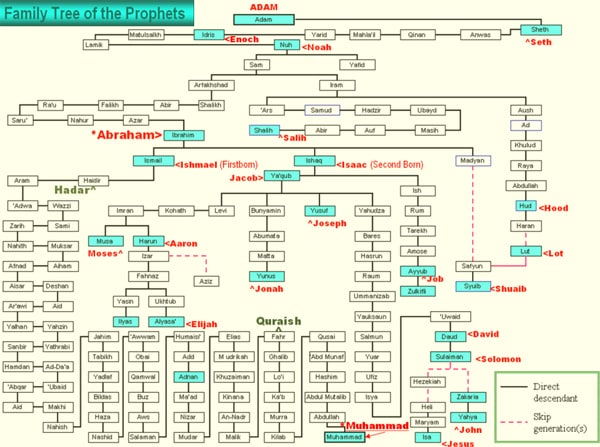
* [[Family tree of Muhammad]] | * [[Family tree of Muhammad]] | ||
*[[ | * [[Sharif]] | ||
* | * [[Mir (title)|Mir]] | ||
* [[Naqib al-ashraf|Naqib]] | |||
* [[Mirza (name)|Mirza (title)]] | |||
* [[Ba 'Alawi sada|Ba'Alawi Sada]] | |||
* [[Taqbil]] | |||
* [[Sheikh]] | |||
* [[Ngwenyama]] (a title from Africa also meaning "lion" but in a honorific sense) | |||
==Notes== | ==Notes== | ||
{{ | {{notelist}} | ||
== References == | ==References== | ||
{{reflist}} | {{reflist}} | ||
{{Portal bar|Islam}} | |||
==Sources== | ==Sources== | ||
{{EB1911|wstitle=Sayad}} | * {{EB1911|wstitle=Sayad}} | ||
*{{cite encyclopedia|last1=Van Arendonk|first1=C.|last2=Graham|first2=W.A.|date=1960–2007|title=Sharīf|editor1-last=Bearman|editor1-first=P. J.|editor1-link=P. J. Bearman|editor2-last=Bianquis|editor2-first=Th.|editor3-last= Bosworth|editor3-first=C. E.|editor3-link=Clifford Edmund Bosworth|editor4-last=van Donzel|editor4-first=E.|editor5-last=Heinrichs|editor5-first=W. P.|editor5-link=W. P. Heinrichs|encyclopedia=Encyclopaedia of Islam, Second Edition|url=http://referenceworks.brillonline.com/entries/encyclopaedia-of-islam-2/sharif-COM_1041}} | * {{cite encyclopedia|last1=Van Arendonk|first1=C.|last2=Graham|first2=W.A.|date=1960–2007|title=Sharīf|editor1-last=Bearman|editor1-first=P. J.|editor1-link=P. J. Bearman|editor2-last=Bianquis|editor2-first=Th.|editor3-last= Bosworth|editor3-first=C. E.|editor3-link=Clifford Edmund Bosworth|editor4-last=van Donzel|editor4-first=E.|editor5-last=Heinrichs|editor5-first=W. P.|editor5-link=W. P. Heinrichs|encyclopedia=Encyclopaedia of Islam, Second Edition|url=http://referenceworks.brillonline.com/entries/encyclopaedia-of-islam-2/sharif-COM_1041}} | ||
* [https://www.whyislam.org/wp-content/uploads/2010/06/familyTree_600.jpg whyislam.org content] | |||
{{Alids}} | {{Alids}} | ||
{{Authority control}} | {{Authority control}} | ||
[[Category:Family of Muhammad|*]] | |||
[[Category:Alids|*]] | [[Category:Alids|*]] | ||
[[Category:Fatima]] | |||
[[Category:Islamic honorifics]] | |||
[[Category:Arabic words and phrases]] | [[Category:Arabic words and phrases]] | ||
[[Category:Hashemite people]] | [[Category:Hashemite people]] | ||
[[Category:Descendants of individuals]] | [[Category:Descendants of individuals]] | ||
[[Category:Titles in Oman]] | |||
[[Category:Descent from antiquity]] | |||
Latest revision as of 16:45, 21 March 2026
 In the Ottoman Empire, the Sayyids had the privilege of wearing a green turban | |
| Total population | |
|---|---|
| Tens of millions[1] | |
| Regions with significant populations | |
| Muslim world | |
| Religions | |
| Islam and Baháʼí Faith | |
| Languages | |
| Arabic, Persian, Urdu, and others[2][3][4][5][6] |

Sayyid[lower-alpha 1] is an honorific title of Hasanid and Husaynid lineage, recognized as descendants of the Islamic prophet Muhammad through his daughter Fatima and Ali's sons Hasan and Husayn. The title may also refer to the descendants of the family of the Bani Hashim through Muhammad's great-grandfather Hashim, and others including Hamza, Abbas, Abu Talib, and Asad ibn Hashim.[11]
See also Sharif, which has a good description of three types of identification for that term and co-relates to this term. In its narrowest sense, a sayyid is a descendant of Husayn ibn Ali, but the term is also more generally used for descendants of Muhammad.
Etymology[edit | edit source]
A few Arabic language experts state that "Sayyid" has its roots in the word al-asad الأسد, meaning "lion", probably because of the qualities of valor and leadership.[12]:158[13]:265 The word is derived from the verb sāda, meaning to rule. The title seyyed/sayyid/syed/sayyad/saeed/said existed before Islam, however not in light of a specific descent, but as a meritocratic sign of respect.[14]
Hans Wehr's Dictionary of Modern Written Arabic defines seyyid as a translation for master, chief, sovereign, or lord.[15] It also denotes someone respected and of high status.
In the Arab world, sayyid is the equivalent of the English word "liege lord" or "master".[16]
Origin of the title[edit | edit source]
The foundation of the title Sayyid is unclear. In fact the title Sayyid as a unified reference for descendants of Muhammad did not exist, according to Morimoto Kazuo, until the Mongol conquests.[17] This can be substantiated by historic records about Abdul Qadir Gilani and Baha' al-Din Naqshband, who did not refer to themselves with any title, despite their lineages to Muhammad. Sometimes the ruling community of a nation took this title to portray themselves as respected and honored, though they are not actually the descendants of Muhammad. This gives reasons to think that this title is founded later on.[citation needed] Morimoto refers to Mominov, who describes that the emergence of a community leader during the Mongol era (Ilkhanate) gave rise to the prominence of the title Sayyid.[17]: This leader is most probably the Sunni Shafi'ite scholar Mir Sayyid Ali Hamadani, who lived in this time, being known as a saint credited with the honorific titles "Amir-e-Kabir" (English: "Grand Prince") and "Ali-e-Sani" (English: "Second Ali").[18] Hamadani's religious legacy in Kashmir as well as his headquarter (Persian: Khanqah) the Khanqa-e-Mola became under the control of the Grand Sayyid Hazrat Ishaan. Hazrat Ishaan's descendants are buried in Hamadani's headquarters, on which occasion it is known as the Ziyarat Naqshband Sahab today.[19][20][21]
However, in Sunni Islam as practiced in the Ottoman and Mughal Empire, a person descending from Muhammad (either maternally or paternally) can only claim the title of Sayyid meritocratically by passing audits, whereupon exclusive rights, like paying lesser taxes, will be granted. These are mostly based on the claimant's demonstrated knowledge of the Quran and piousness (Arabic: Taqwa) under the assessment of a Naqib al-Ashraf, also known as a Mir in Persian-speaking countries.[22][23][24] Notable examples of such a Naqib (plural: "Nuqaba") or Mirs (plural: "Miran"), were Hazrat Ishaan in the Mughal Empire and his descendant Sayyid Mir Fazlullah Agha in Royal Afghanistan.[22]
West Asia[edit | edit source]
Men belonging to the Sayyid families or tribes in the Arab world used to wear white- or ivory-coloured daggers like jambiyas, khanjars or shibriyas to demarcate their nobility amongst other Arab men, although this custom has been restricted due to the local laws of the variously divided Arab countries.[citation needed]
Iraq[edit | edit source]
The Sayyid families in Iraq are so numerous that there are books written especially to list the families and connect their trees. These families include: the Al-Talqani, Al-Yassiri, Al-Aqiqi, Al-Nasrullah, Al-Wahab, Al-Hashimi, Al-Quraishi, Al-Mar'ashi, Al-Witri, Al-Zaidi, Al-A'araji, Al-Baka, Al-Hasani, Al-Hussaini, Al-Shahristani, Al-Qazwini Al-Qadri, Tabatabaei, Al-Alawi, Al-Ghawalib (Al-Ghalibi), Al-Musawi, Al-Awadi (not to be confused with the Al-Awadhi Huwala family), and many others.[25][26][27]
Iran[edit | edit source]


Sayyids (Persian: سید, romanized: Seyyed) are found in vast numbers in Iran. The Chief of "National Organization for Civil Registration" of Iran declared that more than 6 millions of Iranians are Sayyid.[28] The majority of Sayyids migrated to Iran from Arab lands predominantly in the 15th to 17th centuries during the Safavid era. The Safavids transformed the religious landscape of Iran by imposing Twelver Shi'ism on the populace. Since most of the population embraced Sunni Islam, and an educated version of Shiism was scarce in Iran at the time, Ismail imported a new group of Shia Ulama who predominantly were Sayyids from traditional Shiite centers of the Arabic-speaking lands, such as Jabal Amil (of southern Lebanon), Syria, Bahrain, and southern Iraq in order to create a state clergy. The Safavids offered them land and money in return for loyalty.[29][30][31][32][33] These scholars taught Twelver Shi'ism, made it accessible to the population, and energetically encouraged conversion to Shi'ism.[30][31][32][33][34]
During the reign of Shah Abbas the Great, the Safavids also imported to Iran more Arab Shias, predominantly Sayyids, built religious institutions for them, including many Madrasas (religious schools), and successfully persuaded them to participate in the government, which they had shunned in the past (following the Hidden imam doctrine).[35][self-published source?]
Common Sayyid family surnames in Iran are Husseini, Mousavi, Kazemi, Razavi, Eshtehardian, Tabatabaei, Hashmi, Hassani, al-Ja'fari, Emami, Arabi, Ahmadi, Zaidi, Imamzadeh, Sherazi, Kirmani, Shahidi, and Mahdavi.[citation needed]
Oman[edit | edit source]
In Oman, Sayyid is used solely as a royal title and not as a means of indicating descent from Muhammad. It is used by members of the ruling Al Bu Said family who are not descended from Muhammad but instead from the Azd, a Qahtanite tribe. All male line descendants of Sultan Ahmad bin Said, the first ruler of Oman from the Al Bu Said dynasty, are able to use the title of Sayyid or Sayyida.[36] Male line descendants of Sultan Turki bin Said are also able to use the style of His/Her Highness. The Sayyid title in Oman is some times translated as Prince.[37]
Yemen[edit | edit source]
In Yemen the Sayyids are more generally known as sadah; they are also referred to as Hashemites. In terms of religious practice they are Sunni, Shia, and Sufi. Sayyid families in Yemen include the Rassids, the Qasimids, the Mutawakkilites, the Hamideddins, some Al-Zaidi of Marib, Sanaa, and Saada, the Ba 'Alawi sadah families in Hadhramaut, Mufadhal of Sanaa, Al-Shammam of Saada, the Sufyan of Juban, and the Al-Jaylani of Juban.[38][39][40]
South Asia[edit | edit source]
.jpg)
In South Asia, Sayyids are mostly credited for preaching and consolidating the religion of Islam. They are predominantly descendants of leading saints of Sunni Islam that migrated from Persia to preach Islam in Islamic Theology.[41][42]
Afghanistan[edit | edit source]
In the Islamic Republic of Afghanistan, the Sayyid have been recognized as an ethnic group. On March 15, 2019, President Ashraf Ghani decreed the inclusion of the Sadat tribe in the electronically registered national identity documents (Tadhkira).[43] The majority of Sayyids live in Balkh and Kunduz in the north, as well as in Nangarhar in the east. They are predominantly Sunni Muslims[citation needed], although there are some, including in Bamyan Province, who belong to Shia Islam. These individuals are often referred to as Sadat (from Arabic: سادات, the plural of Sayyid), a term traditionally used to denote the descendants of Hasan and Hussein, the first Shia martyrs and sons of Ali, who are grandsons of Muhammad, particularly in the northern Hejaz region and British India.[44]
North India[edit | edit source]
The earliest migration of Sayyids from Afghanistan to North India took place in 1032 when Ghazi Saiyyad Salar Sahu (general and brother-in-law of Sultan Mahmud of Ghazni) and his son Ghazi Saiyyad Salar Masud established their military headquarters at Satrikh (16 km (9.9 mi) from Zaidpur) in the Barabanki district of Uttar Pradesh. They are considered to be the first Muslim settlers in North India. In 1033 Ghazi Saiyyad Salar Masud was killed at the battle of Bahraich, the location of his mazar. Ghazi Saiyyad Salar Masud had no children. His parental uncle Sayyid Ma'ruf al-Din Ghazi and his family lived in Tijara until 1857 before they migrated to Bhopal in Madhya Pradesh. Syed Ahmed Rizvi Kashmiri and Khan Bahadur Aga Syed Hussain were both Rizvi Sayyids through Aqa Mir Sayyid Hussain Qumi Rizvi, whose sacred shrine is in the Zainagir Village of Sopore, Jammu and Kashmir. Iraqi Sayyids or Iraqi Biradri in Purvanchal are descendants of Sayyid Masud Al Hussaini who was the direct descendant of Muhammad's grandson Husayn ibn Ali and came to India from Iraq during the reign of Sultan Muhammad bin Tughlaq in 1330 CE. He settled with his seven sons and forty champions in Ghazipur as some of them (i.e., Syed Abu Bakr in Nonahra, Ghazipur) converted to Sunni Islam in the reign of Sultan Ibrahim Lodhi around 1517 CE. His Shia descendants are now known as Sayyids of Ghazipur.[45]
Sayyids of Syed Nagli, or the Baquari Syeds had migrated from Termez (Present day Uzbekistan)[46] during the Sultanate era. Sikandar Khan Lodi[47] was the ruler of Delhi when Mir Syed Muhammad al-Hussain al-Hussaini al-Termezi Haji al-Haramain came to India and settled at Syed Nagli. He was a Baquari Syed who drew his lineage from Muhammad al-Baqir.
Perhaps the most important figure in the history of the Sayyid in Uttar Pradesh was Sayyid Basrullah Shustari, who moved from Mashhad in Iran in 1549 and joined the court of the Mughal Emperor Akbar. Akbar appointed Shustari as his chief justice, who used his position to strengthen the status of the various Sayyid families. They were preferred in administrative posts and formed a privileged elite. When the Mughal Empire disintegrated, the Sayyid played an important role in the turbulent politics of the time. The new British colonial authorities that replaced the Mughals after the Battle of Buxar made a pragmatic decision to work with the various Sayyid jagirdars. Several Sayyid taluqdars in Awadh were substantial landowners under the British colonial regime, and many other Sayyid contributed to state administration.[48] After the abolition of the zamindari system, many Sayyid zamindars (e.g. that of Ghazipur) had to leave their homes.[49]
Uttar Pradesh[edit | edit source]
The ancestor of the Bārha Sayyids, Sayyid Abu Al-Farah Al-Hussaini Al-Wasti, left his original home in Wasit, Iraq, with his twelve sons at the end of the 13th century and migrated to India, where he obtained four villages in Sirhind-Fategarh. By the 16th century Abu'l Farah's descendants had taken over Bārha villages in Muzaffarnagar.[50]
The Sayyids of Abdullapur, Meerut are descendants of great saint Jalaluddin Surkh-Posh Bukhari. They had a large Jagirdara consisting of 52 villages. Abdullapur named after Syed Mir Abdulla Naqvi Al-Bukhari, he built Kot Fort of this place in the 16th century, it was his main residence.[51][52][53][54] Bukhari of Abdullapur are fractionate into Kannauji Bukhari and Jalal Bukhari. Kannauji's are descendants of Jalaludin Haider through Syed Mehboob Alam Naqvi-ul Bukhari Al-Maroof Shah Jeewna or Shah Jeewna son of warrior and chief advisor of Sikandar Khan Lodi.[55][56][57][58] Famous writer Syed Qudrat Naqvi Al-Bukhari was born here later migrated to Pakistan after partition, his famous books are Ghālib Kaun Hai, Asās-e-Urdu, Ghālib-e-Sad Rang, Sīrat an-Nabi, Hindi-Urdu Lughat, Mutal'a-e-Abd al-Haq, Lisānī Maqalāt.[59]
The Sayyids of Safipur are Hussaini Sayyids. They are descendants of great saint Makhdoom Shah Ala Jajmawi Zanjani (He Was born in Zanjan in 1175). His father was first migrated from Zanjan, Iran to India his name was Qazi Siraj al-Din Hasan Zanjani. He was the chief qazi of Zanjan, Iran.[60]
The Sayyids of Bilgram are Hussaini Sayyids, who first migrated from Wasit, Iraq, in the 13th century.[61] Their ancestor, Syed Mohammad Sughra, a Zaidi Sayyid of Iraq, arrived in India during the rule of Sultan Iltutmish. In 1217–18 the family conquered and settled in Bilgram.[62]
A notable Sufi that belonged to a Sayyid family was Syed Salar Masud, from whom many of the Sayyid families of Awadh claim their lineage.[48] Sayyids of Salon (Raebareli), Jarwal (Bahraich), Kintoor (Barabanki), and Zaidpur (Barabanki) were well-known Taluqadars (feudal lords) of Awadh.
Sadaat also found in Kannauj trace their lineage from Husayn through Ali al-Hadi, a branch of Naqvi Bukhari. Famous Pir Syed Mehboob Alam Naqvi-ul Bukhari Al-Maroof Shah Jewna son of great warrior Syed Sadaruddin Shah Kabeer Naqvi (saint and also chief advisor) of Sikandar Lodi was also born in Kannauj and spent 66 years of his life in kannauj later moved to Shah Jeewna. Makhdoom Jahaniya Mosque is still present in Shikana, Kannauj.[56][58][57] Nawab Siddiq Hasan Khan was also from Kannauj, he is a Bukhari Naqvi Sayyid converted from Shi'a Islam to Sunni Islam in the early 1800s.[63][64][65]
Bihar[edit | edit source]
There are different families of Syeds in Bihar who belong to direct descendants of Imam Hasan and Imam Hussain. Mostly there are Hussaini (Rizvi, Zaidi, Baqri) along with Hasani (Malik, Quadri or Geelani). Sadaat are settled in different part of Bihar including Shi'a and Sunni sects. They are mostly migrated to bihar from Iraq and Iran.
Syed Yaqub Halabi also known as Syed Yaqub Baghdadi, a Hanafi Qazi from the Nizamiyya of Baghdad, originally from Halab (Aleppo) who travelled to India with Muhammad of Ghor after the Second Battle of Tarain. He was an eleventh generational descendant of Ali ibn Husayn Zayn al-Abidin through his son Abd Allah Al Bahr Al Ilm.
Sharafuddin Yahya Maneri[66] belongs to Banu Hashim family of Imam Taj Faqih. In Bihar, Sayyids were landlords, judges, barristers, intellectuals, civil servant, clerics, teachers, businessmen and farmers. Sufi Saint and a warrior Malik Ibrahim Bayu who conquered Bihar during the time of Tughlaqs is one the most famous personality in Bihar. Bihar's first prime minister Mohammad Yunus[67][68] Nobel Prize nominee and Padma Shri winner Syed Hassan,[69] Political Scientist Abu Bakr Ahmad Haleem[70] was the Pro-Vice Chancellor of Aligarh Muslim University and University of Karachi, The great Abdul Bari,[71][72][73] Zaid Hamid Syed Zaid Zaman Hamid is a Pakistani far-right, Islamist political commentator and was included in 500 most influential Muslims in world and Brigadier Malik Mokhtar Karim[74] are few names from Malik Sada'at of Bihar.
Zaidi Sada'at of Bihar are the descendants of Sufi saint Syed Ahmad Jajneri and Syed Mohammed Jajneri. Syed Ahmad Jajneri migrated to India from Baghdad during the reign of Muhammad of Ghor and later migrated to Bihar. He was the direct descendant of Zayd ibn Ali who was the grandson of Husayn ibn Ali and therefore his descendants are called Husseini (Zaidi) Sada'at. His descendants are mostly settled in Bihar Sharif, Munger, Sheikhpura and Jamui region of Bihar.
Most prominent personalities of Sadaat of Bihar were from Desna, Bihar. For Example Syed Mohammed Saeed Raza, Abdul Qavi Desnavi[75] and Sulaiman Nadvi.[76][77] Desna's library, established in 1892, had thousands of old Persian and Urdu manuscripts. After the partition of India, during uncertain times of mass emigration to Pakistan, the books were donated to Khuda Bakhsh Khan Library in Patna, where a Desna section was established to house these treasures.[76] Other famous personalities of Bihari Syed were Syed Sultan Ahmed, Syed Hasan Imam and his brother Syed Ali Imam.
Kerala[edit | edit source]
In Kerala, a number of Sayyid families (Qabila) are found. Most of them migrated from Arabian peninsula (Yemen's Hadharamout) and Central Asian region in the Middle Ages and settled under the patronage of Zamorins. Famous among are Jifris, Bukharis and Ba-Alawis.[78]
Sayyids occupy various positions as jurists (qazi), scholars (ulama') and leaders (umara'). The state leaders of Indian Union Muslim League and Samastha are mostly chosen from Panakkad Thangal Family. A religious educational institute named 'Sadath Academy' was established in Kerala exclusively for Sayyid students by Ma'din Academy led by Sayyid Khaleelul Bukhari Thanghal.[79]
Genetic studies and controversy of self-proclaimed Indian Sayyids[edit | edit source]
_and_with_various_other_Arab_populations.png)
The authors of the study, the Y chromosomes of self-identified Syeds from the Indian sub-continent are no less diverse than those non-Syeds from the same regions, suggested that Syed status showed evidence of elevated Arab ancestry but not of a recent common patrilineal origin.[80]
In Northern India, Uttar Pradesh & Bihar 0.2 per cent of the Sunni Muslim belong to haplogroup J1, which, given its absence in Indian non-Muslims is likely of exogenous Middle Eastern origin. There are 18 per cent belonging mainly to haplogroup J2 and another 11 per cent belong to haplogroup J1, which both represent Middle Eastern lineages, but may not hint exact descent from Muhammad. J1 is exclusively Near Eastern. The results for Sayyids showed minor but still detectable levels of gene flow primarily from Iran, rather than directly from the Arabian peninsula.[81]
The paper, "Y chromosomes of self-identified Syeds from the Indian subcontinent", by Elise M. S. Belle, Saima Shah, Tudor Parfitt, and Mark G. Thomas showed that "self-identified Syeds had no less genetic diversity than those non-Syeds from the same regions, suggesting that there is no biological basis to the belief that self-identified Syeds in this part of the world share a recent common ancestry. However, self-identified men belonging to the IHL (Syeds, Hashemites, Quraysh and Ansari) show greater genetic affinity to Arab populations—despite the geographic distance, than other Indian populations.[82]
Southeast Asia[edit | edit source]
Most of the Alawi Sayyids who moved to Southeast Asia were descendants of Ali ibn Husayn Zayn al-Abidin, especially of Ba 'Alawi sada, many of which were descendants of migrants from Hadhramaut. Even though they are only "alleged" descendants of Husayn, it is uncommon for the female Sayyids to be called Sayyidah; they are more commonly called Sharifah. Most of them live in Brunei, Indonesia, Malaysia, Singapore, Bangsamoro Autonomous Region in Philippines, Pattani in Thailand, and Cambodia. Many of the royal families of this region such as the previous royal families of the Philippines (Sultanate of Sulu, Sultanate of Maguindanao, Confederation of Sultanates of Ranao), Country of Singapore (Sultanate of Singapore House of Bendahara), Country of Malaysia (Sultanates of Johor House of Temenggong, Sultanates of Pahang and Sultanates of Terengganu House of Bendahara, Kingdom of Perlis House of Jamalullail), Country of Indonesia (Sultanates of Siak, Sultanates of Pontianak, Sultanates of Gowa, some Javanese Sultanates), Country of Brunei (Sultanates of Brunei House of Bolkiah) are also Sayyids, especially of Ba'Alawi.[83][84][85][86]
Some common surnames of these Sayyids are Al-Saqqaf (or As-Saqqaf, Assegaf, Assegaff, Al-Sagoff), Shihab (or Shahab), Al-idaroos (or Al-Aydrus, Al Aidrus, Alaydrus, House of Bendahara, House of Temenggong), Al-Habsyi (or Al-Habshi), Al-Kaff, Al-Aththos (or Al-Attas, Alattas, Alattos), Al-Haddad Alhaddad, Al-Jufri (or Al-Jifri), Al-Muhdhar, Al-Shaikh Abubakar, Al-Qadri, Al-Munawwar, Al-Akbar Al-Hasani (or Al Akbar Al Hasani, Al-Bolkiah, House of Bolkiah), Al-Jamalullail (or Al Jamalullail, Djamalullail, House of Jamalullail).[87]
Teseyyüd[edit | edit source]
In the Ottoman Empire, tax breaks for the People of the House encouraged many people to buy certificates of descent or forge genealogies; the phenomenon of teseyyüd – falsely claiming noble ancestry – spread across ethnic, class, and religious boundaries. In the 17th century, an Ottoman bureaucrat estimated that there were 300,000 impostors. In 18th-century Anatolia, nearly all upper-class urban people claimed descent from Muhammad.[88][89]
Royal descendants of Muhammad[edit | edit source]
Descendants of Muhammad are present in many royal families today and are predominantly of Sunni faith.
Libyan royal family[edit | edit source]
The Sayyids in Libya are Sunni, including the former royal family, which is originally Zaidi-Moroccan (also known as the Senussi family).[90] The El-Barassa Family are Ashraf as claimed by the sons of Abdulsalam ben Meshish, a descendant of Hassan ibn Ali ibn Abi Talib.
Sharifs of Mecca[edit | edit source]
Jordan[edit | edit source]
The Hashemite royal family of Jordan also claims descent from Muhammad in the line of the Sharifs of Mecca, vassals that were set by the Fatimids and recognized by the Ottomans, tracing their lineage back to Imam Hasan ibn Ali.[91] The Hashemite Royal Family under Sharif Hussein ibn Ali was crucial in ending Ottoman rule in the Arabian Peninsula, on the occasion of the spread of Pan-Turkism in the Arabian Peninsula.[92]
Brunei[edit | edit source]
The House of Bolkiah claims descent from Imam Hasan ibn Ali through Sharif Ali, the 3rd Sultan of Brunei, who succeeded his father in law as Sultan in virtue of his descent from Muhammad. Sharif Ali formerly served as Emir of Makkah and belonged to the Sherifians, migrating to Brunei for missionary purposes.[93]
Moroccan royal family[edit | edit source]
The Alaouite Royal family of Morocco also claims descent from Muhammad in the line of Hasan ibn Ali. Their patriarch was Sharif ibn Ali, who founded the dynasty.[94]
Sulu, Lanao, and Maguindanao royal family[edit | edit source]
The Sultanates of Sulu, Lanao, and Maguindanao hold a significant place in Philippine history, rooted deeply in both cultural heritage and religious identity. It is claimed that these Sultanates trace their lineage to Muhammad, upholding the tenets of Sunni Ash'ari in 'Aqida (theological creed) and adhering to the Shafi'i school of thought in Fiqh (jurisprudence). Central to their spiritual and intellectual tradition are the teachings of Sufi missionaries from the Ba 'Alawi sada, whose influence has played a pivotal role in shaping the religious landscape of the region.[95]
The majority of Muslims in the Philippines adhere to the Sunni Ash'ari creed and follow the Shafi'i school of jurisprudence, reflecting the enduring influence of these traditions within the Sultanates and beyond. Furthermore, there exists a profound respect for, and in many cases, the practice of Sufism among Filipino Muslims. Sufism, with its emphasis on spiritual purification and the pursuit of inner knowledge, resonates deeply with the cultural and religious fabric of the Filipino Muslim community.[96]
Other indication of descent[edit | edit source]
In addition to the sayyid title, descendants of Muhammad through the Twelve Imams in Arabic, Persian and Urdu may obtain the following surnames:[97]
| Ancestor | Arabic style | Arabic last name | Persian last name | Urdu last name |
|---|---|---|---|---|
| Ali ibn Abi Talib | al-Alawi العلوی او الهاشمی | al-Alawi العلوی or al-Hashimi الهاشمي | Alawi or Alavi | Alvi or Awan or Hashemi |
| Hasan ibn Ali | al-Hasani الحسني او الهاشمي | al-Hasani الحسني or al-Bolkiah البلقية or al-Alawi العلوی or al-Hashimi الهاشمي | Hashemi هاشمی or Hassani حسنى | Hashmi ہاشمی or Hassani حسنی or Noshahi نوشاہی |
| Husayn ibn Ali | al-Hussaini1 الحُسيني | al-Hussaini الحسيني or Ba 'Alawi ال باعلوي | Hussaini حسيني | Hussaini حسيني Hashemi or Shah[98] |
| Ali ibn Husayn Zayn al-Abidin | al-Abidi العابدي | al-Abidi العابدي | Abedi عابدى | Abidi or Abdi عابدی |
| Muhammad al-Baqir | al-Baqiri الباقري | al-Baqiri الباقري | Baqiri/Bagheri باقری | Baqri باقری |
| Ja'far al-Sadiq | al-Ja'fari الجعفري | al-Ja'fari الصدق او الجعفري | Jafari جعفرى or Dibaji دیباجی | Jafri or Jafry جعفری or Jaffery Shamsi جعفریشمسی |
| Zayd ibn Ali | az-Zaidi الزيدي | al-Zaydi الزيدي | Zaydi زیدی | Zaidi زیدی |
| Musa al-Kadhim | al-Moussawi الموسوي او الكاظمي | al-Moussawi or al-Kadhimi الموسوي او الكاظمي | Moosavi or Kazemi موسوى / کاظمى | Kazmi کاظمی |
| Ali al-Ridha | ar-Radawi الرضوي | al-Ridawi or al-Radawi الرضوي | Rizvi or Rezvi رضوى | Rizvi or Rizavi رضوی |
| Muhammad at-Taqi | at-Taqawi التقوي | al-Taqawi التقوي | Taqavi تقوى | Taqvi تقوی |
| Ali al-Hadi | an-Naqawi النقوي | al-Naqawi النقوي or al-Bukhari البخاري or al-Qasimi القاسمی | Naqavi/Naghavi نقوى | Naqvi نقوی or Bhaakri/Bukhari بھاکری/بخاری |
| Hasan al-Askari[99][100][101] | al-Askari العسکري | al-Askari العسکري | Sadat سادات Dakik دقيق or Hazrat Ishaan حضرت ایشان | Daqiq دقيق or Hazrat Ishaan حضرت ایشان |
Note: (For non-Arabic speakers) When transliterating Arabic words into English there are two approaches.
1Also, El-Husseini, Al-Husseini, Husseini, and Hussaini. 2Those who use the term Sayyid for all descendants of Ali ibn Abi Talib regard Allawis or Alavis as Sayyids. However, Allawis are not descendants of Muhammad, as they are descended from the children of Ali and the women he married after the death of Fatima, such as Umm ul-Banin (Fatima bint Hizam). Those who limit the term Sayyid to descendants of Muhammad through Fatima, Alawites are the same how Sayyids. | ||||
See also[edit | edit source]
- Family tree of Muhammad
- Sharif
- Mir
- Naqib
- Mirza (title)
- Ba'Alawi Sada
- Taqbil
- Sheikh
- Ngwenyama (a title from Africa also meaning "lion" but in a honorific sense)
Notes[edit | edit source]
References[edit | edit source]
- ↑ Morimoto, Kazuo, ed. (2012). Sayyids and Sharifs in Muslim Societies: The Living Links to the Prophet (illustrated ed.). Routledge. pp. 2, 11. ISBN 978-0-415-51917-5.
Reliable statistics showing the number of the Prophet's kinsfolk, spread all through the Muslim world and far beyond it, are not available. Even a conservative estimate, however, would suggest that the number of kinsfolk is in the tens of millions.
- ↑ Grim, Brian J.; Johnson, Todd M. (2013). Chapter 1: Global Religious Populations, 1910–2010 (PDF) (Report). Wiley. p. 22. Archived from the original (PDF) on 20 October 2013. Retrieved 10 March 2017.
- ↑ "What are the top 200 most spoken languages?". Ethnologue. 3 October 2018. Retrieved 7 December 2019.
- ↑ Al-Jallad, Ahmad (30 May 2011). "Polygenesis in the Arabic Dialects". Encyclopedia of Arabic Language and Linguistics.
- ↑ United Nations High Commissioner for Refugees. "Refworld – 2010 Report on International Religious Freedom – China (includes Tibet, Hong Kong, Macau)". Refworld. Retrieved 14 February 2015.
- ↑ Nationalencyklopedin "Världens 100 största språk 2007" (The World's 100 Largest Languages in 2007), SIL Ethnologue
- ↑ "Sayyid". Collins English Dictionary. HarperCollins. Archived from the original on 28 May 2019. Retrieved 28 May 2019.
- ↑ "sayyid"; Archived 28 May 2019 at the Wayback Machine (US) and "sayyid". Lexico UK English Dictionary. Oxford University Press. Archived from the original on 22 March 2020.
- ↑ Template:Cite American Heritage Dictionary
- ↑ Van Arendonk & Graham 1960–2007.
- ↑ Ho, Engseng (2006). The graves of Tarim genealogy and mobility across the Indian Ocean. Berkeley: University of California Press. ISBN 978-0-520-93869-4. Retrieved 25 August 2016.
- ↑ Hitchcock, Richard (18 February 2014). Muslim Spain Reconsidered. Edinburgh University Press. ISBN 9780748678310. Archived from the original on 29 July 2017. Retrieved 28 April 2017.
- ↑ Corriente, Federico (2008). Dictionary of Arabic and Allied Loanwords: Spanish, Portuguese, Catalan, Galician and Kindred Dialects. BRILL. ISBN 978-9004168589. Archived from the original on 6 October 2014. Retrieved 28 April 2017.
- ↑ Lisān Al-'Arab. Retrieved 14 September 2022.
- ↑ Wehr, Hans (1976). A Dictionary of Modern Written Arabic. p. 440.
- ↑ Cleveland, William L.; Bunton, Martin (2 August 2016). A History of the Modern Middle East. Westview Press. ISBN 978-0-8133-4980-0. Archived from the original on 15 February 2017. Retrieved 25 August 2016.
- ↑ 17.0 17.1 Morimoto, Kazuo (25 June 2012). Sayyids and Sharifs in Muslim Societies: The Living Links to the Prophet. Routledge. ISBN 978-1-136-33738-3.
- ↑ Lawrence, Walter R. (2005). The valley of Kashmir. New Delhi: Asian Educational Services. p. 292. ISBN 81-206-1630-8. OCLC 65200978.
- ↑ Tazkare Khwanadane Hazrat Eshan (genealogy of the family of Hazrat Eshan)(by author and investigator:Muhammad Yasin Qasvari Naqshbandi company:Edara Talimat Naqshbandiyya Lahore)p. 58
- ↑ Khuihami, Ghulam Hasan; Pushp, P. N (4 August 1954). Tarikh-i Hassan. Research & Publ. Dpt., Jammu & Kashmir Gov. OCLC 69327348.
- ↑ Suraiya Gull in "Development of Sufi Kubraviya Order with Special Reference to Mir Saiyid Ali Hamadani", p. 8
- ↑ 22.0 22.1 Tazkare Khanwade Hazrat Ishaan, p. 61, by Muhammad Yasin Qaswari Naqshbandi, published by Kooperatis Lahorin, Edare Talimat Naqshbandiyya
- ↑ Damurdashi, ed. Muhammad, p. 43.
- ↑ Imber and Kiyotaki, p. 198.
- ↑ Reclaiming Iraq: The 1920 Revolution and the Founding of the Modern State Archived 30 April 2016 at the Wayback Machine By Abbas Kadhim
- ↑ البغداديون أخبارهم ومجالسهم By إبراهيم عبد الغني الدروبي - مطبعة الرابطة - Baghdad 1958 – مجلس آل الوتري (House of Al-Witry Council) - Page 78.
- ↑ الكلية الطبية الملكية العراقية من خلال سيرة ذاتية، ج 1 (الطبعة الأولى). بيروت: المؤسسة العربية للدراسات والنشر. (هاشم الوتري - Hashim Al-Witry) Pages 180-181. ISBN 9953-441-51-0
- ↑ Six million people of Iran's population are Sadaat (Sayyid) / Tehran and Mazandaran (provinces) are the record owner of Sadaats in the country Archived 2 February 2018 at the Wayback Machine farsnews.ir1 February 2018
- ↑ Floor, Willem; Herzig, Edmund (2015). Iran and the World in the Safavid Age. I.B.Tauris. p. 20. ISBN 978-1-78076-990-5. Archived from the original on 3 September 2017.
In fact, at the start of the Safavid period Twelver Shi'ism was imported into Iran largely from Syria and Mount Lebanon (...)
- ↑ 30.0 30.1 The failure of political Islam, by Olivier Roy, Carol Volk, pg.170
- ↑ 31.0 31.1 The Cambridge illustrated history of the Islamic world, by Francis Robinson, pg.72
- ↑ 32.0 32.1 The Middle East and Islamic world reader, by Marvin E. Gettleman, Stuart Schaar, pg.42
- ↑ 33.0 33.1 The Encyclopedia of world history: ancient, medieval, and modern ... by Peter N. Stearns, William Leonard Langer, pg.360
- ↑ Shaery-Eisenlohr, Roschanack (1 January 2008). Shiʻite Lebanon: Transnational Religion and the Making of National Identities. Columbia University Press. pp. 12–13. ISBN 9780231144261. Archived from the original on 29 July 2017. Retrieved 15 November 2015 – via Google Books.
- ↑ Deen, Sayyed M. (1 January 2007). Science Under Islam: Rise, Decline and Revival. Lulu.com. p. 37. ISBN 9781847999429 – via Google Books.
- ↑ Razik, Salil (1871). Badger, George Percy (ed.). History of the imâms and seyyids of Omân. The Hakluyt Society. p. 377.
- ↑ Montgomery-Massingberd, Hugh, ed. (1980). Burke's Royal Families of the World Volume II Africa & the Middle East. Burke's Peerage Ltd. p. 102. ISBN 978-0-85011-029-6.
- ↑ A Tribal Order: Politics And Law in the Mountains of Yemen Archived 17 June 2016 at the Wayback Machine By Shelagh Weir
- ↑ "sayyid – Arabic title". Encyclopædia Britannica. Archived from the original on 22 January 2012.
- ↑ From Religious Leaders to Ordinary Citizens The Changing Role of "Sadah" in Yemen Archived 26 October 2012 at the Wayback Machine By Mohammed Al-Asadi
- ↑ Mohammada in The Foundations of the Composite Culture in India, p. 170
- ↑ Wani in Islam in Kashmir Fourteenth to Sixteenth Century, p. 147
- ↑ Hamdard, Azizullah (15 March 2019). "Ghani decrees mentioning Sadat tribe in electronic ID card".
- ↑ "Sign in to your account". nps.edu. Retrieved 21 August 2025.
- ↑ "Data". www.myheritage.com. Archived from the original on 28 January 2016. Retrieved 8 January 2020.
- ↑ Morimoto, Kazuo (1 January 2012). Sayyids and Sharifs in Muslim Societies: The Living Links to the Prophet. Routledge. ISBN 9780415519175. Archived from the original on 3 September 2017. Retrieved 15 November 2015 – via Google Books.
- ↑ Welsford, Thomas (9 November 2012). Four Types of Loyalty in Early Modern Central Asia: The T?q?y-T?m?rid Takeover of Greater M? War? Al-Nahr, 1598–1605. BRILL. ISBN 978-9004231870. Archived from the original on 3 September 2017. Retrieved 21 June 2016 – via Google Books.
- ↑ 48.0 48.1 People of India Uttar Pradesh Volume XLII Part Three, edited by A Hasan & J C Das
- ↑ Hasan, Mushirul (1 January 1997). Legacy of a Divided Nation: India's Muslims Since Independence. Hurst. ISBN 9781850653042. Retrieved 22 September 2016 – via Google Books.
- ↑ The Encyclopaedia of Islam: Supplement : Fascicules 1–2 Archived 6 May 2016 at the Wayback Machine, Clifford Edmund Bosworth, Brill Archive, 1980
- ↑ Codingest. "Studio Dharma - by Nikhil Jain". STUDIO DHARMA. Archived from the original on 14 December 2020. Retrieved 4 January 2021.
- ↑ "दास्तान ए कर्बला सुन अश्कबार हुई आंखें". Dainik Jagran (in हिन्दी). Retrieved 4 January 2021.
- ↑ "Meerut police refused FIR against Vijay Mallya: waqf board". The Indian Express. 17 March 2016. Retrieved 4 January 2021.
- ↑ "Abdullapur Pin Code, Abdullapur, Meerut Map, Latitude and Longitude, Uttar Pradesh". indiamapia.com. Retrieved 4 January 2021.
- ↑ "Hazrat Pir Shah Jewna (RA)". The Nation. 9 May 2012. Retrieved 4 January 2021.
- ↑ 56.0 56.1 "Pir-e-Kamil Hazrat Pir Shah Jewna Al-Naqvi Al-Bokhari". www.thenews.com.pk. 10 May 2019. Retrieved 4 January 2021.
- ↑ 57.0 57.1 "Nazaria-i-Pakistan Trust". nazariapak.info. Retrieved 4 January 2021.
- ↑ 58.0 58.1 "Glories of Hazrat Pir shah Jewana". www.thenews.com.pk. 10 May 2006. Retrieved 4 January 2021.
- ↑ Parekh, Rauf (12 December 2017). "Syed Qudrat Naqvi and his research on Ghalib". DAWN.COM. Retrieved 4 January 2021.
- ↑ "Sitapur: A Gazetteer, Being Volume Xl of the District Gazetteers of the United Provinces of Agra and Oudh". 1905.
- ↑ Essays in Arabic Literary Biography: 1350–1850 Archived 28 May 2016 at the Wayback Machine, Roger M. A. Allen, Joseph Edmund Lowry, Terri DeYoung, Devin J. Stewart, Otto Harrassowitz Verlag, 30 December 2009
- ↑ Islam in South Asia in Practice Archived 25 April 2016 at the Wayback Machine, Barbara D. Metcalf, Princeton University Press, 8 September 2009
- ↑ Ali, Syed Ameer (1999). A Short History of the Saracens: Being a Concise Account of the Rise and Decline of the Saracenic Power, and of the Economic, Social and Intellectual Development of the Arab Nation from the Earliest Times to the Destruction of Bagdad, and the Expulsion of. Adegi Graphics LLC. ISBN 9781402150616.
- ↑ King Wajid Ali Shah of Awadh, Volume 1 Archived 9 May 2016 at the Wayback Machine by Mirza Ali Azhar, Royal Book Co., 1982
- ↑ Keen, Caroline (2014), Beem, Charles; Taylor, Miles (eds.), "The Rise and Fall of Siddiq Hasan, Male Consort of Shah Jahan of Bhopal", The Man behind the Queen: Male Consorts in History, Queenship and Power, New York: Palgrave Macmillan US, pp. 185–204, doi:10.1057/9781137448354_13, ISBN 978-1-137-44835-4, retrieved 4 January 2021
{{citation}}: CS1 maint: work parameter with ISBN (link) - ↑ Hanif, N. (2000). Biographical Encyclopaedia of Sufis: South Asia. Sarup & Sons. ISBN 978-81-7625-087-0.
- ↑ TNN (14 May 2012). "Bihar's first premier Yunus remembered". Times of India. Retrieved 26 November 2020.
- ↑ "Bihar's first premier Yunus remembered | Patna News". The Times of India. TNN. 14 May 2012. Retrieved 14 May 2022.
- ↑ "Dr. Syed Hasan". The Milli Gazette — Indian Muslims Leading News Source. Retrieved 14 May 2022.
- ↑ Ahanger, Javid Ahmad (13 June 2018). "ABA Haleem: A Forgotten Muslim Political Scientist". Greater Kashmir. Retrieved 14 May 2022.
- ↑ "The Freedom Fighter and Labour Leader Still Beloved in Jamshedpur". The Wire. Retrieved 14 May 2022.
- ↑ "professor abdul bari". Rekhta. Retrieved 14 May 2022.
- ↑ Services, Hungama Digital. "Tata Workers Union pays homage to Prof Abdul Bari". www.tatasteel.com. Retrieved 14 May 2022.
- ↑ Majid, Ayesha (1 January 2017). Surviving Father of Pakistan Army Aviation: Brigadier Mokhtar Karim. doi:10.17613/JP2A-QP98.
- ↑ "Abdul Qavi Desnavi". Litterateur Abdul Qavi Desnavi. 8 March 2012.
- ↑ 76.0 76.1 Abhishek Kumar (22 December 2019). "बर्बादी की कगार पर है ये ऐतिहासिक लाइब्रेरी, कभी यहां पहुंचे थे राजेंद्र प्रसाद और जाकिर हुसैन". News18. Retrieved 3 January 2021.
- ↑ Suleman Nadvi. |URL=
- ↑ Levesque, Julien (3 July 2023). "Anjuman, jami'at, and association: what Sayyid organizations tell us about associational forms among Muslim caste groups". Contemporary South Asia. 31 (3): 483–497. doi:10.1080/09584935.2023.2240719. ISSN 0958-4935.
- ↑ "Ma'din Academy - Makes Tomorrows". Ma'din Academy. Retrieved 3 December 2023.
- ↑ Y chromosomes of self-identified Syeds from the Indian subcontinent show evidence of elevated Arab ancestry but not of a recent common patrilineal origin Archived 10 November 2012 at the Wayback Machine Elise M. S. Belle & Saima Shah & Tudor Parfitt & Mark G. Thomas; Received: 11 March 2010 / Accepted: 28 May 2010 / Published online: 29 June 2010
- ↑ "Dienekes' Anthropology Blog: Middle Eastern and Sub-Saharan lineages in Indian Muslim populations". 10 October 2009. Archived from the original on 7 April 2014.
- ↑ Y chromosomes of self-identified Syeds from the Indian subcontinent show evidence of elevated Arab ancestry but not of a recent common patrilineal origin. Archived 10 November 2012 at the Wayback Machine, Elise M. S. Belle & Saima Shah & Tudor Parfitt & Mark G. Thomas; Received: 11 March 2010 / Accepted: 28 May 2010 / Published online: 29 June 2010
- ↑ ‘Strangers’ and ‘stranger-kings’: The sayyid in eighteenth-century maritime Southeast Asia Archived 27 December 2013 at the Wayback Machine By Jeyamalar Kathirithamby-Wells
- ↑ "Development of Islam in Southeast Asia by Alawi Sayyids". Archived from the original on 11 November 2014. Retrieved 22 September 2016.
- ↑ Sayyids and Sharifs in Muslim Society: The Living Links to the Prophet Archived 5 May 2016 at the Wayback Machine By Kazuo Morimoto
- ↑ Southeast Asia (3 Volumes): A Historical Encyclopedia from Angkor Wat to East Timor "Archived copy". Archived from the original on 9 June 2016. Retrieved 15 November 2015.
{{cite web}}: CS1 maint: archived copy as title (link) CS1 maint: bot: original URL status unknown (link) By Keat Gin Ooi - ↑ "Imam Abdallah ibn Alawi al-Haddad". Notes on Islam. April 30, 2012. Retrieved September 18, 2014.
- ↑ Canbakal, Hülya (2009). "The Ottoman State and Descendants of the Prophet in Anatolia and the Balkans (c. 1500–1700)". Journal of the Economic and Social History of the Orient. 52 (3): 542–578. doi:10.1163/156852009X458241. ISSN 0022-4995.
- ↑ "Y chromosomes of self-identified Syeds from the Indian subcontinent show evidence of elevated Arab ancestry but not of a recent common patrilineal origin". ResearchGate. Retrieved 18 July 2021.
- ↑ "The Senussi family". Archived from the original on 26 December 2012.
- ↑ Salibi, Kamal S. (1993). The modern history of Jordan. London: I.B. Tauris. pp. 53–55. ISBN 1-85043-610-X. OCLC 28839449.
- ↑ Karey in Oxford AQA History : A Level and AS Component 2: International Relations and Global Conflict C1890-1941, p. 113
- ↑ "Pusat Sejarah Brunei" (in Malay). www.history-centre.gov.bn. Archived from the original on April 15, 2015. Retrieved August 23, 2016.
{{cite web}}: CS1 maint: unrecognized language (link) - ↑ "العلويون/الفيلاليون في المغرب". www.hukam.net. Retrieved 6 April 2022.
- ↑ Quiling, Mucha-Shim (2020). "Lumpang Basih". Journal of Studies on Traditional Knowledge in Sulu Archipelago and Its People, and in the Neighboring Nusantara. 3. Retrieved 20 May 2023.
- ↑ Abdurahman, Habib Jamasali Sharief Rajah Bassal (2002). The Sultanate of Sulu. University of Michigan: Astoria Print. & Publishing Company. p. 88. ISBN 9789719262701.
- ↑ Khanam, R. (2005). Encyclopaedic Ethnography of Middle-East and Central Asia. Global Vision Publishing House. ISBN 978-81-8220-062-3.
- ↑ "The Syed Family – Home of The Syed Family". Retrieved 5 May 2024.
- ↑ Tazkare Khwanadane Hazrat Eshan(genealogy of the family of Hazrat Eshan)(by author and investigator: Muhammad bin Nusayr company:Edara Talimat Naqshbandiyya Lahore)p. 63
- ↑ https://shajara.org/2020/06/29/1426/ Archived 3 July 2020 at the Wayback Machine Shajara-e-nasab lineages of descendants of Imam Hasan al-Askari r.a.
- ↑ "Shajara-e-nasab lineages of descendants of Imam al-Askari ibn Imam Ali al-Hadi r.a. — Shajara". Archived from the original on 17 April 2021. Retrieved 16 March 2021.
Sources[edit | edit source]
 This article incorporates text from a publication now in the public domain: Chisholm, Hugh, ed. (1911). "Sayad". Encyclopædia Britannica (11th ed.). Cambridge University Press.
- Van Arendonk, C.; Graham, W.A. (1960–2007). "Sharīf". In Bearman, P. J.; Bianquis, Th.; Bosworth, C. E.; van Donzel, E.; Heinrichs, W. P. (eds.). Encyclopaedia of Islam, Second Edition.
- whyislam.org content