












m Removed empty portal template using script |
NoraBillings (talk | contribs) refine content per sources also and updated info |
||
| Line 2: | Line 2: | ||
{{About|the Pacific theaters of World War II}} | {{About|the Pacific theaters of World War II}} | ||
{{Redirect|War in the Pacific|the war between Chile, Bolivia, and Peru in 1879–1884|War of the Pacific}} | {{Redirect|War in the Pacific|the war between Chile, Bolivia, and Peru in 1879–1884|War of the Pacific}} | ||
{{Redirect|Pacific | {{Redirect|Pacific theater of World War II|the U.S. military area of operations|Pacific Ocean Areas|other uses|Pacific theater (disambiguation)}} | ||
{{Use American English|date=January 2026}} | |||
{{Use dmy dates|date=June 2022}} | {{Use dmy dates|date=June 2022}} | ||
{{Infobox military conflict | {{Very long|date=November 2024|words=16,000}}{{Infobox military conflict | ||
| conflict = Pacific War | | conflict = Pacific War | ||
| partof = [[World War II]] | | partof = [[World War II]] | ||
| image = {{multiple image|border=infobox|perrow=2/2/2|total_width=300 | | image = {{multiple image|border=infobox|perrow=2/2/2|total_width=300 | ||
|image1= Raising the Flag on Iwo Jima, larger - edit1.jpg | |image1= Raising the Flag on Iwo Jima, larger - edit1.jpg | ||
|image2= Shokaku Pearl Harbor 1st Wave.jpg | |||
|image2= | |||
|image3= Nagasakibomb.jpg | |image3= Nagasakibomb.jpg | ||
|image4= USS Bunker Hill hit by two Kamikazes.jpg | |image4= USS Bunker Hill hit by two Kamikazes.jpg | ||
|image5= 1944 Operation Ichigo IJA invaded Henan.jpg | |image5= 1944 Operation Ichigo IJA invaded Henan.jpg | ||
|image6= Indian troops wade ashore at Akyab, Burma, January 1945. SE2418.jpg | |image6= Indian troops wade ashore at Akyab, Burma, January 1945. SE2418.jpg | ||
}}'''Clockwise from top left:''' {{flatlist| | |||
* [[ | * US marines [[Raising the Flag on Iwo Jima|raising a flag over Iwo Jima]], 1945 | ||
* Japanese [[Imperial Japanese Navy Air Service|naval aircraft]] prepare for takeoff to | * Japanese [[Imperial Japanese Navy Air Service|naval aircraft]] prepare for takeoff to [[Attack on Pearl Harbor|attack Pearl Harbor]], 1941 | ||
* | * {{USS|Bunker Hill|CV-17|6}} after being struck by [[kamikaze]]s, 1945 | ||
* Indian soldiers during the [[Burma campaign]] | * Indian soldiers during the [[Burma campaign]], 1945 | ||
* Japanese soldiers in China during [[Operation Ichi-Go]] | * Japanese soldiers in China during [[Operation Ichi-Go]], 1944 | ||
* Mushroom cloud | * Mushroom cloud after the [[atomic bombing of Nagasaki]], 1945 | ||
}} | }} | ||
| image_size = 300 | | image_size = 300 | ||
| date = 7 December 1941 – 2 September 1945{{efn|Although Japan had been [[Second Sino-Japanese War|invading and occupying parts of China]] since 1937, war was not officially declared. Japan would later [[attack on Pearl Harbor|attack Pearl Harbor]] on 7 December 1941, which brought the contained war in China into the wider global conflict.{{sfn|Ch'i|1992|p=157}}}}{{sfn|Sun|1996|p=11}} | |||
| date = 7 December 1941 – 2 September 1945 | | place = {{hlist|[[East Asia]]|[[South Asia]]|[[Southeast Asia]]|[[Oceania]]|[[Pacific Ocean]]|[[Indian Ocean]]}} | ||
| place = | |||
| result = [[Allies of World War II|Allied]] victory | | result = [[Allies of World War II|Allied]] victory | ||
| territory = [[Occupation of Japan|Allied occupation of Japan]] | | territory = [[Occupation of Japan|Allied occupation of Japan]] | ||
* Removal of Japanese troops | * Removal of Japanese troops from [[Republic of China (1912–1949)|China]] and [[Retrocession Day|retrocession]] of [[Taiwan under Japanese rule|Taiwan]] to China | ||
* Liberation of [[Korea under Japanese rule|Korea]] and [[Manchukuo|Manchuria]] | * Liberation of [[Korea under Japanese rule|Korea]] and [[Manchukuo|Manchuria]], followed by the [[division of Korea]] | ||
* Cession of [[South Pacific Mandate|Japanese-held islands in the Central Pacific Ocean]] to the [[United Nations]] | * Cession of [[South Pacific Mandate|Japanese-held islands in the Central Pacific Ocean]] to the [[United Nations]], organized as the [[Trust Territory of the Pacific Islands]] | ||
* Seizure and annexation of [[South Sakhalin]] and the [[Kuril Islands]] by the [[Soviet Union]] | * Seizure and annexation of [[South Sakhalin]] and the [[Kuril Islands]] by the [[Soviet Union]]|<!--Note: Please check the discussion page before modifying the following combatants. There is a consensus that minor participants in the war should not be included here.--> | ||
| combatant1 = {{udl|wrap= | |||
| combatant1 = | ; [[Allies of World War II|Allies]] | ||
| combatant2 = | : {{flag|Nationalist government|name=China}}{{sfn|Ch'i|1992|p=157}} | ||
| commander1 = | : {{flag|United States|1912}} | ||
: {{flag|United Kingdom}} | |||
}}See {{slink||Participants}} | |||
| combatant2 = {{udl|wrap= | |||
; [[Axis powers|Axis]] | |||
: {{flagcountry|Empire of Japan}} | |||
}}See {{slink||Participants}} | |||
| commander1 = {{udl|wrap= | |||
; [[Allied leaders of World War II|Allied leaders]] | |||
: {{flagdeco|Republic of China (1912–1949)}} [[Chiang Kai-shek]] | |||
: {{flagdeco|United States|1912}} [[Franklin D. Roosevelt]] | |||
: {{flagdeco|UK}} [[Winston Churchill]] | |||
}} | }} | ||
| | | commander2 = {{udl|wrap= | ||
; [[Axis leaders of World War II|Axis leaders]] | |||
: {{flagdeco|Empire of Japan}} [[Hirohito]]{{Surrender}} | |||
}} | }} | ||
{{Campaignbox Pacific War}} | | strength1 = * 23,275,564+ troops (total)<ref name="wiki">Approximate calculations with Wikipedia data</ref> | ||
{{ubl | |||
| {{flagicon|Republic of China (1912–1949)}} 14,000,000{{sfn|Hastings|2008|p=205}} | |||
| {{flagicon|USA|1912}} 3,621,383+ (1945){{efn|Strength of the US Military in Asia and the Pacific as of war's end: Army: 1,770,036,{{sfn|Coakley|Leighton|1989|p=836}} Navy (excluding Coast Guard and Marines): 1,366,716,<ref>{{Cite web |url=https://www.history.navy.mil/research/library/online-reading-room/title-list-alphabetically/u/us-navy-personnel-in-world-war-ii-service-and-casualty-statistics.html |title=US Navy Personnel in World War II Service and Casualty Statistics |publisher=Naval History and Heritage Command |at=Table 9 |access-date=20 July 2015 |archive-date=9 March 2021 |archive-url=https://web.archive.org/web/20210309115010/http://www.history.navy.mil/research/library/online-reading-room/title-list-alphabetically/u/us-navy-personnel-in-world-war-ii-service-and-casualty-statistics.html |url-status=live }}</ref> and Marine Corps: 484,631.<ref>King, Ernest J. (1945). ''Third Report to the Secretary of the Navy'' p. 221</ref> These figures do not include the Coast Guard or naval personnel in the China-Burma-India theater.<ref>{{Cite web |url=https://www.history.navy.mil/research/library/online-reading-room/title-list-alphabetically/u/us-navy-personnel-in-world-war-ii-service-and-casualty-statistics.html |title=US Navy Personnel in World War II Service and Casualty Statistics |publisher=Naval History and Heritage Command |at=Footnote 2 |access-date=20 July 2015 |archive-date=9 March 2021 |archive-url=https://web.archive.org/web/20210309115010/http://www.history.navy.mil/research/library/online-reading-room/title-list-alphabetically/u/us-navy-personnel-in-world-war-ii-service-and-casualty-statistics.html |url-status=live }}</ref>}} | |||
| {{flagicon|United Kingdom}} 400,000{{sfn|Hastings|2008|p=10}} | |||
| {{flagicon|British Raj}} 2,000,000{{sfn|Hastings|2008|p=10}} | |||
| {{flagicon|Dutch East Indies}} 140,000<ref name=chapter10>{{cite web |url=http://www.ibiblio.org/hyperwar/AAF/I/AAF-I-10.html |title=Chapter 10: Loss of the Netherlands East Indies |access-date=31 August 2010 |work=The Army Air Forces in World War II |volume=1 – Plans & Early Operations |publisher=HyperWar |archive-date=9 September 2021 |archive-url=https://web.archive.org/web/20210909200010/http://www.ibiblio.org/hyperwar/AAF/I/AAF-I-10.html |url-status=live }}</ref>{{efn|Not including the Royal Netherlands Navy.}} | |||
| {{flagicon|Soviet Union|1936}} 1,747,465 (1945){{sfn|Cherevko|2003|loc=Ch. 7, Table 7}} | |||
}} | |||
| strength2 = * 8,926,500–9,026,500+ troops (total)<ref name="wiki">Approximate calculations with Wikipedia data</ref> | |||
{{ubli | |||
| {{flagicon|Empire of Japan}} 7,800,000–7,900,000 (1945){{sfn|Cook|Cook|1993|p=403}}<ref>[https://www2.warwick.ac.uk/fac/soc/economics/staff/mharrison/public/ww2overview1998.pdf Harrison p. 29] {{Webarchive|url=https://web.archive.org/web/20220107035322/https://www2.warwick.ac.uk/fac/soc/economics/staff/mharrison/public/ww2overview1998.pdf |date=7 January 2022 }} Retrieved 10 March 2016</ref><ref name=AJProject/> | |||
| {{flagicon|Thailand}} 126,500{{sfn|Meyer|1997|p=309}} | |||
| [[Puppet state|Puppets]]: {{est.}} 1,000,000+ (1945){{sfn|Jowett|2005|p=72}} | |||
}} | |||
| casualties1 = {{bdl|wrap= | |||
; Military | |||
: 5 battleships | |||
: 12 aircraft carriers | |||
: 14 cruisers | |||
: 84 destroyers & frigates | |||
: 63 submarines<ref>[http://www.navsource.net/Naval/losses.htm#dd NavSource] Retrieved 25 July 2015; [http://www.uboat.net/allies/warships/ www.uboat.net] {{Webarchive|url=https://web.archive.org/web/20210309115013/http://www.uboat.net/allies/warships/ |date=9 March 2021 }} Retrieved 25 July 2015; [http://www.naval-history.net/WW2aBritishLosses01BB.htm Major British Warship Losses in World War II.] {{Webarchive|url=https://web.archive.org/web/20210309122707/http://www.naval-history.net/WW2aBritishLosses01BB.htm |date=9 March 2021 }} Retrieved 25 July 2015; [http://www.worldnavalships.com/chinese_navy.htm Chinese Navy] {{Webarchive|url=https://web.archive.org/web/20131118022141/http://www.worldnavalships.com/chinese_navy.htm |date=18 November 2013 }} Retrieved 26 July 2015.</ref> | |||
: 21,555+ aircraft<ref>Hara, Tameichi, with Fred Saito and Roger Pineau. ''Japanese Destroyer Captain'' (Annapolis: Naval Institute Press, 2011), p. 299.Figure is for U.S. losses only. China, the British Commonwealth, the USSR and other nations collectively add several thousand more to this total.</ref> | |||
: 2,300,000+ dead (1937–1945){{efn|name=alliedcasualties}} | |||
; Civilians | |||
: 26,000,000+ deaths (1937–1945){{efn|Estimates of roughly 12 million Chinese civilian deaths (1937–1945);<ref>{{cite book |last=Mitter |first=Rana |date=2013 |title=Forgotten Ally: China’s World War II, 1937-1945 |publisher=Houghton Mifflin Harcourt |page=381}}</ref> around 4 million civilian deaths from the Dutch East Indies;,{{sfn|Dower|1986|p=295}} 1–2 million Vietnamese civilian deaths;<ref>{{cite web |url=http://mailman.anu.edu.au/pipermail/hepr-vn/2008-August/000188.html |title=Vietnam needs to remember famine of 1945 |first=David |last=Koh |date=21 August 2008 |work=The Straits Times |via=Australian National University |access-date=31 October 2010 |archive-date=19 October 2017 |archive-url=https://web.archive.org/web/20171019142402/http://mailman.anu.edu.au/pipermail/hepr-vn/2008-August/000188.html}}</ref> around 3 million{{sfn|Sen|1999|p=203}} Indian civilian deaths in the [[Bengal famine of 1943]]; 0.5 to 1 million{{sfn|Gruhl|2007|pp=143–144}} Filipino civilian deaths; 91,000{{sfn|Clodfelter|2017|pp=527}} to 1,000,000{{sfn|McLynn|2010|p=1}} Burmese civilian deaths; 50,000<ref>Ruas, Óscar Vasconcelos, "Relatório 1946–47", AHU</ref> [[Portuguese Timor|East Timorese]] civilian deaths; and hundreds of thousands of Malayan, Pacific and other civilian deaths.{{sfn|Dower|1986|p=295}} }} | |||
}} | |||
| casualties2 = {{bdl|wrap= | |||
; Military | |||
: 11 battleships | |||
: 25 aircraft carriers | |||
: 39 cruisers | |||
: 135 destroyers | |||
: 131 submarines{{sfn|Hara|2011|p=297}} | |||
: 43,125{{sfn|Hara|2011|p=299}}–50,000+ aircraft<ref>[https://www.airuniversity.af.edu/Portals/10/AUPress/Books/B_0020_SPANGRUD_STRATEGIC_BOMBING_SURVEYS.pdf USSBS Summary Report, p. 67.] {{Webarchive|url=https://web.archive.org/web/20230611191229/https://www.airuniversity.af.edu/Portals/10/AUPress/Books/B_0020_SPANGRUD_STRATEGIC_BOMBING_SURVEYS.pdf |date=11 June 2023 }} Retrieved 5/26/23. Approximately 20,000 in combat and 30,000 operational.</ref> | |||
: 2,500,000+ dead (1937–1945){{efn|2,133,915 Japanese military deaths 1937–1945,<ref>Bren, John (3 June 2005) [http://japanfocus.org/-John-Breen/2060 "Yasukuni Shrine: Ritual and Memory"] {{Webarchive|url=https://web.archive.org/web/20150409063001/http://japanfocus.org/-John-Breen/2060 |date=9 April 2015 }} ''Japan Focus''. Retrieved on 5 June 2009.</ref> 1.18 million Chinese collaborator casualties 1937–1945 (432,000 dead),{{sfn|Rummel|1991|loc=Table 5A}} 22,000 Burmese casualties,{{Citation needed|date=July 2009}} 5,600 Thai troops killed,{{sfn|Murashima|2006|p=1057n}} and 2,615 Indian National Army ([[Azad Hind]]) killed/missing.{{sfn|Clodfelter|2002|p=556}} }} | |||
; Civilians | |||
: 1,000,000+ deaths{{efn|460,000 Japanese civilian deaths (338,000 in the bombings of Japan,<ref>[https://www.hawaii.edu/powerkills/SOD.CHAP13.HTM Statistics of democide] {{Webarchive|url=https://web.archive.org/web/20151227113638/http://www.hawaii.edu/powerkills/SOD.CHAP13.HTM |date=27 December 2015 }}: Chapter 13: Death By American Bombing, [[RJ Rummel]], University of Hawaii.</ref> 100,000 in the [[Battle of Okinawa]], 22,000 in the [[Battle of Saipan]]), 543,000 Korean civilian deaths (mostly due to Japanese forced labor projects),{{sfn|Gruhl|2007|p=19}} 2,000–8,000 Thai civilian deaths<ref>E. Bruce Reynolds, "Aftermath of Alliance: The Wartime Legacy in Thai-Japanese Relations", ''Journal of Southeast Asian Studies'', v21, n1, March 1990, pp. 66–87. "An [[Office of Strategic Services|OSS]] document (XL 30948, RG 226, USNA) quotes Thai Ministry of Interior figures of 8,711 air raids deaths in 1944–1945 and damage to more than 10,000 buildings, most of them totally destroyed. However, an account by [[Seni Pramoj|M. R. Seni Pramoj]] (a typescript entitled 'The Negotiations Leading to the Cessation of a State of War with Great Britain' and filed under ''Papers on World War II'', at the Thailand Information Center, Chulalongkorn University, p. 12) indicates that only about 2,000 Thai died in air raids."</ref>}} | |||
}} | |||
| campaignbox = {{Campaignbox Pacific War}} | |||
{{Campaignbox World War II}} | |||
{{Campaignbox Japanese colonial campaigns}} | {{Campaignbox Japanese colonial campaigns}} | ||
{{ | }} | ||
[[File:Pacific War Council.jpg|thumb|upright=1.2|The Pacific War Council as photographed on 12 October 1942. Pictured are representatives from the United States (seated), Australia, Canada, New Zealand, the United Kingdom, China, the Netherlands, and the [[Philippine Commonwealth]]]] | |||
The '''Pacific War''', sometimes called the '''Asia–Pacific War''' or the '''Pacific Theater''',{{sfn|Murray|Millett|2001|p=143}} was the [[Theater (warfare)|theater]] of [[World War II]] fought between [[Empire of Japan|Japan]] and the [[Allies of World War II|Allies]] in [[East Asia|East]] and [[Southeast Asia]], the [[Pacific Ocean|Pacific]] and [[Indian Ocean]]s, and [[Oceania]]. It was geographically the largest theater of the war, including the [[Pacific Ocean theater of World War II|Pacific Ocean theater]], the [[South West Pacific theater of World War II|South West Pacific theater]], the [[Second Sino-Japanese War]], and the brief [[Soviet–Japanese War]], and included some of the [[Largest naval battle in history|largest naval battles in history]]. War between Japan and the [[Republic of China (1912–1949)|Republic of China]] had begun in 1937, with hostilities dating back to [[Japanese invasion of Manchuria|Japan's invasion of Manchuria]] in 1931,{{sfn|MacLeod|1999|page=1}} but the Pacific War is more widely accepted{{efn|"For 53 long months, beginning in July 1937, China stood alone, single-handedly fighting an undeclared war against Japan. On 9 December 1941, after Japan's surprise attack on Pearl Harbor, what had been for so long a war between two countries now became part of a much wider Pacific conflict."{{sfn|Ch'i|1992|p=157}}{{sfn|Sun|1996|p=11}}}} to have begun in 1941, when the [[United States]] and [[United Kingdom]] were brought into the war.{{sfn|Costello|1982|p=129–148}}{{sfn|Clodfelter|2002|p=585}} | |||
Japan [[Japanese invasion of French Indochina|invaded French Indochina]] in 1940, and extended its control [[French Indochina in World War II|over the entire territory]] in July 1941. On 7–8 December 1941, Japan attacked the American naval base [[Attack on Pearl Harbor|at Pearl Harbor]] in [[Territory of Hawaii|Hawaii]]; the U.S.-held [[Philippines campaign (1941–1942)|Philippines]], [[Battle of Guam (1941)|Guam]], and [[Battle of Wake Island|Wake Island]]; and the British colonies of [[Malayan campaign|Malaya]], [[Bombing of Singapore (1941)|Singapore]], and [[Battle of Hong Kong|Hong Kong]], followed by a Japanese declaration of war. The Japanese achieved great success over the next six months, [[Japanese invasion of Thailand|allying with Thailand]] and capturing the listed territories (except for Hawaii) in addition to [[Battle of Borneo (1941–1942)|Borneo]], [[New Britain]], [[Dutch East Indies campaign|the Dutch East Indies]], [[Burma campaign|Burma]], the [[Japanese occupation of the Solomon Islands|Solomon]] and [[Japanese occupation of the Gilbert Islands|Gilbert Islands]], and [[New Guinea campaign|parts of New Guinea]]. In May 1942, Japanese and Allied [[aircraft carrier]]s fought at the [[Battle of the Coral Sea|Battle of Coral Sea]], resulting in the retreat of a Japanese invasion force headed for [[Port Moresby]]. In June, Japan [[Aleutian Islands campaign|invaded the Aleutian Islands]]. Japan was later defeated at the [[Battle of Midway]], considered a key turning point in the war; the Japanese subsequently experienced great difficulty replacing their losses in ships and aircraft as the U.S. produced ever increasing numbers of both. | |||
Major Allied offensives in the Pacific began in August 1942 with the [[Guadalcanal campaign|Guadalcanal]] and [[New Guinea campaign]]s. These were followed by [[Operation Cartwheel]] from June 1943, which neutralized the major Japanese base at [[Rabaul]] on New Britain by early 1944. Elsewhere, Allied forces recaptured the Aleutian Islands by August 1943, and initiated the [[Gilbert and Marshall Islands campaign]] in November 1943, which lasted until February 1944. In the [[Battle of the Philippine Sea]] in June 1944, the Japanese fleet took heavy damage; the Allied [[Philippines campaign (1944–1945)|campaign to recapture the Philippines]] began in October and set off the [[Battle of Leyte Gulf]], after which the Japanese were unable to fight further surface engagements and resorted to ''[[kamikaze]]'' attacks. The rest of the war was characterized by an Allied strategy of [[Leapfrogging (strategy)|island hopping]], with [[Mariana and Palau Islands campaign|invasions of the Mariana and Palau Islands]], [[Battle of Iwo Jima|Iwo Jima]], and [[Battle of Okinawa|Okinawa]] between June 1944 and June 1945. This enabled a blockade of the Japanese home islands and the start of [[Air raids on Japan|a strategic air raid campaign]] which caused widespread urban destruction. | |||
In China, Japan made large gains in [[Operation Ichi-Go]] between April and December 1944, while in Burma, the Japanese launched [[Operation U-Go|an offensive into India]] which was reversed by July 1944 and led to its liberation by the Allies in May 1945. From the start of the war, the Allies had adopted a "[[Europe first]]" stance, giving priority to defeating Germany; after [[German Instrument of Surrender|Germany's surrender]] in May 1945, Allied forces were shifted to the Pacific in anticipation for [[Operation Downfall]], a planned invasion of Japan. This became unnecessary after the U.S. [[atomic bombings of Hiroshima and Nagasaki]] on 6 and 9 August 1945 and [[Soviet invasion of Manchuria]] on 9 August, after which [[Surrender of Japan|Japan surrendered unconditionally]] on 15 August and signed a surrender document on 2 September, ending World War II. Japan lost its former [[Japanese colonial empire|possessions]] in Asia and the Pacific, and was [[Occupation of Japan|occupied]] by the Allies until 1952. | |||
== Names of the war == | |||
In [[Allies of World War II|Allied countries]] during the war, the "Pacific War" was not usually distinguished from [[World War II]], or was known simply as the ''War against Japan''. In the United States, the term ''[[Asiatic-Pacific theater|Pacific theater]]'' was widely used. The [[US Armed Forces]] considered the [[China Burma India theater]] to be distinct from the [[Asiatic-Pacific theater]] during the conflict.<ref>{{Cite web |title=Statewide Dual Credit World History, The Catastrophe of the Modern Era: 1919-Present CE, Chapter 14: The World Afire: World War II, Japanese Expansion November 1941 to June 1942 |url=https://oercommons.org/courseware/lesson/88061/student-old/#:~:text=Names%20for%20the%20War&text=In%20the%20United%20States,%20the,Incident%20of%201931%20through%201945. |access-date=2026-01-19 |website=OER Commons |language=en}}</ref> | |||
Japan used the name {{Nihongo|''Greater East Asia War''|大東亜戦争|Dai Tō-A Sensō}}, as chosen by a cabinet decision on 10 December 1941, to refer to both the war with the Western Allies and the ongoing war in China. This name was released to the public on 12 December, with an explanation that it involved [[Asia]]n nations achieving their independence from the Western powers through armed forces of the [[Greater East Asia Co-Prosperity Sphere]].{{sfn|Jansen|2002|p=626}} Japanese officials integrated what they called the {{Nihongo|''Japan–China Incident''|日支事変|Nisshi Jihen}} into the Greater East Asia War. During the [[Occupation of Japan]] (1945–1952), these terms were prohibited in official documents (although their informal usage continued). The war became officially known as the {{Nihongo|Pacific War|太平洋戦争|Taiheiyō Sensō}}. The {{Nihongo|''Fifteen Years' War''|十五年戦争|Jūgonen Sensō}} is also used, referring to the period from the [[Mukden incident]] of 1931 through 1945.<ref>{{Cite journal |last=Wilson |first=Sandra |date=September 2009 |title=Rethinking the 1930s and the '15-Year War' in Japan |url=http://www.tandfonline.com/doi/full/10.1080/10371390120074336 |journal=Japanese Studies |language=en |volume=21 |issue=2 |pages=155–164 |doi=10.1080/10371390120074336 |issn=1037-1397|url-access=subscription }}</ref> | |||
[[ | |||
== | ==Participants== | ||
[[File:Pacific Area - The Imperial Powers 1939 - Map.svg|thumb|upright=1.7|Political map of the Asia-Pacific region, 1939]] | |||
=== | ===Allies=== | ||
[[ | The major Allied participants included [[Republic of China (1912–1949)|China]], the United States, and the [[British Empire]]. China had already been engaged in a [[Second Sino-Japanese War|war against Japan since 1937]]. The US and its territories, including the [[Commonwealth of the Philippines|Philippine Commonwealth]], entered the war after the Japanese [[attack on Pearl Harbor]] in 1941, which was followed by declarations of war by Japan on Australia, Canada, New Zealand and the United Kingdom, as well as the [[Dutch government-in-exile]] which retained control of the [[Dutch East Indies]]. All of these were members of the [[Pacific War Council]].<ref>{{cite web |url=https://www.bbc.co.uk/ww2peopleswar/timeline/factfiles/nonflash/a1141958.shtml |title=WW2 People's War – Timeline |publisher=BBC |access-date=31 October 2010 |archive-url=https://web.archive.org/web/20110319223150/http://www.bbc.co.uk/ww2peopleswar/timeline/factfiles/nonflash/a1141958.shtml |archive-date=19 March 2011}}</ref> From 1944 the French commando group [[Corps Léger d'Intervention]] also took part in resistance operations in Indochina. Some active pro-allied guerrillas in Asia included the [[Hukbalahap]],<ref>{{cite web |url=https://history.army.mil/books/coldwar/huk/ch2.htm |title=The Hukbalahap Insurrection: World War II and Huk Expansion |publisher=US Army |access-date=25 August 2021 |archive-date=25 August 2021 |archive-url=https://web.archive.org/web/20210825103755/https://history.army.mil/books/coldwar/huk/ch2.htm |url-status=dead }}</ref><ref name=":0"/> the [[Korean Liberation Army]], the [[Free Thai Movement]], the [[Viet Minh|Việt Minh]],<ref name=":4">{{Cite book |last=Dower |first=John W. |title=War Without Mercy: Race and Power in the Pacific War |date=2012 |publisher=Knopf Doubleday Publishing Group |isbn=978-0-394-75172-6 |location=Westminster}}</ref> the [[Khmer Issarak]], and the [[Malayan Peoples' Anti-Japanese Army]]. | ||
The Soviet Union fought two short, undeclared [[Soviet–Japanese border conflicts|border conflicts]] with Japan [[Battle of Lake Khasan|in 1938]] and again [[Battles of Khalkhin Gol|in 1939]], then remained neutral through the [[Soviet–Japanese Neutrality Pact]] of April 1941,{{sfn|Sandler|2001|pp=1067–1068}} until August 1945 when it (and [[Mongolian People's Republic|Mongolia]]) joined the rest of the Allies and [[Soviet invasion of Manchuria|invaded the territory of Manchukuo]], China, [[Mengjiang|Inner Mongolia]], and the Japanese territories such as [[Korea under Japanese rule|Korea]] and [[South Sakhalin]] (Karafuto).{{sfn|Sandler|2001|p=945}} | |||
The | |||
[[Mexico]] provided air support in the form of the [[201st Fighter Squadron (Mexico)|201st Fighter Squadron]]<ref name="Klemen">{{cite web |last=Klemen |first=L |title=201st Mexican Fighter Squadron |url=http://warfare.gq/dutcheastindies/201squadron.html |work=The Netherlands East Indies 1941–1942 |access-date=22 October 2017 |archive-url=https://web.archive.org/web/20110726052413/http://www.dutcheastindies.webs.com/201squadron.html |archive-date=26 July 2011 |url-status=live}}</ref> and [[Free French Forces|Free France]] sent naval support in the form of {{ship|French destroyer|Le Triomphant||2}} and later the {{ship|French battleship|Richelieu||2}}. | |||
[[ | The Kingdom of Italy, following the day after the [[Armistice of Cassibile]] on 9 September 1943 was involved in multiple military confrontations with Japan in the numerous [[Concessions of Italy in China|Italian Concessions in China]],<ref name=":5">{{Cite web |title=La partecipazione della marina alla guerra di liberazione (8 Settembre - 11 Settembre 1945) |url=https://www.marina.difesa.it/media-cultura/editoria/bollettino/Documents/marzo_dicembre_2015.pdf |website=[[Ministry of Defence (Italy)]]}}</ref><ref name=":7">{{Cite web |last=D'Emilia |first=Pio |title=La guerra dimenticata tra Italia e Giappone, di Pio d`Emilia (Seconda parte) |url=https://burogu00.wordpress.com/2015/05/19/la-guerra-dimenticata-tra-italia-e-giappone-di-pio-demilia-seconda-parte/#_ftnref36 |website=[[BUROGU]]}}</ref> and later on, soon after [[Japanese-Italian War|Italy's official declaration of war on Japan]] on 15 July 1945, sent the [[destroyer]] [[Italian destroyer Carabiniere (1938)|Italian destroyer ''Carabiniere'']] which participated in a total of 38 missions in the Pacific War.<ref>{{Cite web |last=Vinciguerra |first=Ezio |date=2016-08-01 |title=Il Cacciatorpediniere Carabiniere e i 38 rubini (Lanfranco Sanna) – La voce del marinaio |url=https://www.lavocedelmarinaio.com/2016/08/il-cacciatorpediniere-carabiniere-e-i-38-rubini-lanfranco-sanna/ |access-date=2025-10-11 |website=www.lavocedelmarinaio.com |language=it-IT}}</ref> | ||
=== Axis powers and aligned states === | |||
{{unsourced section|date=July 2025}} | |||
Also involved were members of the | The [[Axis powers|Axis]]-aligned states which assisted the [[Empire of Japan]] included [[Thailand in World War II|Thailand]] under a military government of [[Plaek Phibunsongkhram]]. Also involved were members of the Greater East Asia Co-Prosperity Sphere, which included the [[Manchukuo Imperial Army]] and [[Collaborationist Chinese Army]] of the Japanese [[puppet state]]s of [[Manchukuo]] (consisting of most of [[Manchuria]]), and the collaborationist [[Wang Jingwei regime]] (which controlled the coastal regions of China), respectively. | ||
Japan conscripted many soldiers from [[Japanese colonial empire|its colonies]] of Korea and [[Taiwan under Japanese rule|Taiwan]]. Collaborationist security units were also formed in [[Japanese occupation of Hong Kong|Hong Kong]], [[Japanese occupation of Singapore|Singapore]], the [[Second Philippine Republic|Philippines]], the [[Japanese occupation of the Dutch East Indies|Dutch East Indies]], [[Japanese occupation of Malaya|British Malaya]], [[Japanese occupation of British Borneo|British Borneo]], [[Japanese occupation of Burma|British Burma]], former [[French Indochina]] (after [[Japanese coup d'état in French Indochina|the overthrow of the French regime in 1945]]), as well as [[Black Columns|Timorese militia]]. [[Portuguese Macau|Macau]] was the only notable unoccupied European colony in the region, but [[:pt:Gabriel Maurício Teixeira|its]] [[Pedro José Lobo|administrators]] were forced to accept Japanese demands anyway.<ref>{{Cite journal |last=Ptak |first=Roderich |date=2017 |title=Review of Wartime Macau: Under the Japanese Shadow |url=http://www.jstor.org/stable/10.13173/jasiahist.51.2.0328 |journal=Journal of Asian History |volume=51 |issue=2 |pages=328–333 |doi=10.13173/jasiahist.51.2.0328 |jstor=10.13173/jasiahist.51.2.0328 |issn=0021-910X|url-access=subscription }}</ref> | |||
[[Nazi Germany|Germany]] and [[Kingdom of Italy|Italy]] both had limited involvement in the Pacific War. The [[Kriegsmarine|German]] and the [[Regia Marina|Italian]] navies operated submarines and [[Armed merchantmen|raiding ships]] in the Indian and Pacific Oceans, notably the {{lang|la|italic=no|[[Monsun Gruppe]]}}. | [[Nazi Germany|Germany]] and [[Kingdom of Italy|Italy]] both had limited involvement in the Pacific War. The [[Kriegsmarine|German]] and the [[Regia Marina|Italian]] navies operated submarines and [[Armed merchantmen|raiding ships]] in the Indian and Pacific Oceans, notably the {{lang|la|italic=no|[[Monsun Gruppe]]}}. | ||
==Theaters== | |||
Between 1942 and 1945, there were four main [[Theater (military)|areas of conflict]] in the Pacific War: | Between 1942 and 1945, there were four main [[Theater (military)|areas of conflict]] in the Pacific War: China, the [[Pacific Ocean theater of World War II|Central Pacific]], [[South-East Asian theatre of World War II|South-East Asia]] and the [[South West Pacific theatre of World War II|South West Pacific]]. US sources refer to two theaters within the Pacific War: the Pacific theater and the [[China Burma India Theater of World War II|China Burma India Theater]] (CBI). However, these were not operational commands. | ||
In the Pacific, the Allies divided operational control of their forces between two supreme commands, known as [[Pacific Ocean Areas (command)|Pacific Ocean Areas]] and [[South West Pacific Area (command)|Southwest Pacific Area]].<ref>{{cite web |url = http://www.dean.usma.edu/history/web03/atlases/ww2%20pacific/ww2%20pacific%20%20maps/ww2%20asia%20map%2016.jpg |title = Map of the Pacific Theater |access-date = 31 October 2010 | In the Pacific, the Allies divided operational control of their forces between two supreme commands, known as [[Pacific Ocean Areas (command)|Pacific Ocean Areas]] and [[South West Pacific Area (command)|Southwest Pacific Area]].<ref>{{cite web |url=http://www.dean.usma.edu/history/web03/atlases/ww2%20pacific/ww2%20pacific%20%20maps/ww2%20asia%20map%2016.jpg |title=Map of the Pacific Theater |access-date=31 October 2010 |archive-url=https://web.archive.org/web/20090109223834/http://www.dean.usma.edu/history/web03/atlases/ww2%20pacific/ww2%20pacific%20%20maps/ww2%20asia%20map%2016.jpg |archive-date=9 January 2009}}</ref> | ||
The [[Imperial Japanese Navy in World War II|Imperial Japanese Navy]] did not integrate its units into permanent theater commands. The [[Imperial Japanese Army]], which had already created the [[Kwantung Army]] to oversee its occupation of | The [[Imperial Japanese Navy in World War II|Imperial Japanese Navy]] (IJN) did not integrate its units into permanent theater commands. The [[Imperial Japanese Army]] (IJA), which had already created the [[Kwantung Army]] to oversee its occupation of Manchukuo and the [[China Expeditionary Army]] during the Second Sino-Japanese War, created the [[Southern Expeditionary Army Group]] at the outset of its conquests of South East Asia. This headquarters controlled the bulk of the Japanese Army formations which opposed the Western Allies in the Pacific and South East Asia. | ||
==Historical background== | ==Historical background== | ||
===Conflict between China and Japan=== | ===Conflict between China and Japan=== | ||
[[File:Chiang Kai-shek in full uniform.jpeg|thumb|right|upright|Generalissimo [[Chiang Kai-shek]], Allied Commander-in-Chief in the China theater from 1942 to 1945]] | |||
{{Main|Second Sino-Japanese War}} | {{Main|Second Sino-Japanese War}} | ||
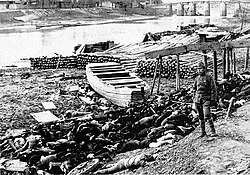
In 1931, without declaring war, [[Japanese invasion of Manchuria|Japan invaded Manchuria]], seeking raw materials to fuel its growing industrial economy. By 1937, Japan controlled | [[File:Nanking bodies 1937.jpg|thumb|Victims of the Nanjing Massacre, where between 200,000 and 300,000 civilians and POWs were murdered by the Japanese Army]] | ||
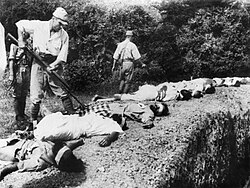
In 1931, without declaring war, [[Japanese invasion of Manchuria|Japan invaded Manchuria]], seeking raw materials to fuel its growing industrial economy. By 1937, Japan controlled Manchuria and was prepared to move deeper into China. The [[Marco Polo Bridge Incident]] on 7 July 1937 provoked full-scale war between China and Japan. The [[Kuomintang|Nationalist Party]] and the [[Communist Party of China|Chinese Communists]] suspended [[Chinese civil war|their civil war]] in order to form a [[Second United Front|nominal alliance]] against Japan, and the Soviet Union quickly [[Sino-Soviet Non-Aggression Pact|lent support]] by providing large amounts of materiel<!--and combat pilots...--> to Chinese troops.<!--Germany & Italy also provided aid to China...--> In August 1937, Generalissimo Chiang Kai-shek deployed some of his best troops to defend Shanghai against some 300,000 Japanese troops attempting to seize the city, which fell to Japan after three months of fighting.{{sfn|Harmsen|2013|p=}}{{page needed|date=October 2023}} The Japanese continued to push deeper into China, [[Battle of Nanjing|capturing the capital Nanjing]] in mid-December 1937 and committing atrocities in the [[Nanjing Massacre]], including rape, murder and torture.{{sfn|Harmsen|2015|p=}} | |||
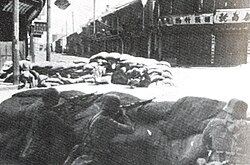
[[File:Shanghai1937KMT intersection.jpg|thumb|German-trained Chinese troops in downtown Shanghai, 1937]] | |||
In March 1938, Nationalist forces won their [[Battle of Taierzhuang|first victory at Taierzhuang]],{{sfn|Olsen|2012|p=}}{{page needed|date=October 2023}} but the city of [[Battle of Xuzhou|Xuzhou (徐州) was taken by]] the Japanese in May. In June 1938, Japan deployed about 350,000 troops to [[Battle of Wuhan|invade Wuhan]] and captured it in October after a four-month campaign.{{sfn|MacKinnon|2008|p=}}{{page needed|date=October 2023}} The Japanese achieved major military victories, but world opinion—in particular in the US—was hostile to Japan's invasion, especially after the [[USS Panay incident|''Panay'' incident]]. In addition, the Japanese had failed to destroy the Chinese army, which continued to resist from the new Nationalist capital in [[Chongqing]], or in the case of the Communists, [[Yan'an Soviet|Yan'an]].<ref>{{Cite book |last=Mitter |first=Rana |title=Forgotten Ally: China's World War II, 1937-1945 |date=2013 |publisher=Houghton Mifflin}}</ref> | |||
In 1939, Japanese forces tried to push into the [[Russian Far East|Soviet Far East]]. They were defeated in the Battle of Khalkhin Gol by a mixed Soviet and Mongolian force led by [[Georgy Zhukov]]. This caused the Japanese to abandon attempts to [[Hokushin-ron|expand to the north]], while Soviet aid to China ceased as a result of the Soviet–Japanese Neutrality Pact.{{sfn|Drea|2005|p=}}{{page needed|date=October 2023}} In September 1940, Japan decided to [[Invasion of French Indochina|invade French Indochina]], which was controlled at the time by [[Vichy France]]. On 27 September Japan signed a military alliance with Germany and Italy, becoming one of the three main [[Axis powers]]. | |||
In 1939, Japanese forces tried to push into the [[Russian Far East|Soviet Far East | |||
In September 1940, Japan decided to | |||
[[File:Casualties of a mass panic - Chungking, China.jpg|thumb|upright=0.75|Chinese casualties of a mass panic during a June 1941 Japanese aerial [[bombing of Chongqing]]]] | [[File:Casualties of a mass panic - Chungking, China.jpg|thumb|upright=0.75|Chinese casualties of a mass panic during a June 1941 Japanese aerial [[bombing of Chongqing]]]] | ||
The war entered a new phase with | The war entered a new phase with Japanese defeats at the [[Battle of Suixian–Zaoyang]], the [[Battle of Changsha (1939)|1st Battle of Changsha]], the [[Battle of Kunlun Pass]] and the [[Battle of Zaoyi]].{{Original research inline|date=June 2024}} After these victories, Chinese nationalist forces launched a large-scale [[1939–1940 Winter Offensive|counter-offensive]] in early 1940; however, due to a lack of military-industrial capacity, they were repulsed in late March 1940.{{sfn|Lin|2010|p=55}} In August 1940, Chinese communists launched an [[Hundred Regiments Offensive|offensive in Central China]]; in retaliation, Japan instituted the "[[Three Alls Policy]]" ("Kill all, Burn all, Loot all") in occupied areas, killing at least 2.7 million [[civilian]]s.{{sfn|Garver|1988|p=120}} | ||
By 1941 the conflict had become a stalemate. Although Japan had occupied much of northern, central, and coastal China, the [[Nationalist Government]] had retreated to the interior | By 1941 the conflict had become a stalemate. Although Japan had occupied much of northern, central, and coastal China, the [[Nationalist Government]] had retreated to the interior and set up a provisional capital at [[Chongqing]], while the [[Chinese Communist Party|Chinese communists]] remained in control of base areas in [[Shaanxi]]. Japanese offensive action against the retreating and regrouping Chinese forces was largely stalled by the mountainous terrain in southwestern China, while the Communists organized widespread [[guerrilla warfare|guerrilla]] and saboteur activities in northern and eastern China behind the Japanese front line.{{Citation needed|date=July 2023}} | ||
Japan sponsored several [[puppet government]]s, one of which was headed by [[Wang Jingwei]].{{sfn|Jansen|2002|p=636}} | Japan sponsored several [[puppet government]]s, one of which was headed by [[Wang Jingwei]].{{sfn|Jansen|2002|p=636}} Conflicts between Chinese Communist and Nationalist forces vying for territorial control behind enemy lines [[New Fourth Army Incident|culminated in a major armed clash in January 1941]], effectively ending their co-operation.{{sfn|Fairbank|Goldman|1994|p=320}} | ||
Japanese [[Strategic bombing during World War II|strategic bombing]] efforts mostly targeted large Chinese cities such as Shanghai, [[Wuhan]], and [[Bombing of Chongqing|Chongqing]], with around 5,000 raids from February 1938 to August 1943 | Japanese [[Strategic bombing during World War II|strategic bombing]] efforts mostly targeted large Chinese cities such as Shanghai, [[Wuhan]], and [[Bombing of Chongqing|Chongqing]], with around 5,000 raids from February 1938 to August 1943. Japan's strategic bombing campaigns killed between 260,000 and 350,934 [[non-combatant]]s.{{sfn|Lind|2010|page=28}}{{sfn|Rummel|1991|p=}}{{page needed|date=October 2023}} | ||
{{Anchor|Economic sanctions against Japan}} | By the eve of Pearl Harbor, some 7,500,000 Chinese soldiers and civilians had died in the Japanese invasion. Japanese casualties by the end of 1941, per their own records, were some 600,000 including 185,000 killed.<ref>{{Cite book |last=Frank |first=Richard |title=Tower of Skulls |date=2020 |pages=178}}</ref><ref>{{Cite book |last=Paine |first=Sarah |title=The Wars for Asia |publisher=Cambridge University Press |pages=185}}</ref>{{Anchor|Economic sanctions against Japan}} | ||
===Tensions between Japan and the West=== | ===Tensions between Japan and the West=== | ||
As early as 1935, Japanese military strategists had concluded that the Dutch East Indies were, due to their abundant oil reserves, crucially important for further expansion by the Japanese Empire. By 1940 the Japanese also included Indochina, Malaya, and the Philippines within their concept of the Greater East Asia Co-Prosperity Sphere. Japanese troop build-ups in Hainan, Taiwan, and [[Haiphong]] were noted in foreign media, Japanese military officers were increasingly and openly talking about the prospect of war, and Admiral [[Sankichi Takahashi]] was reported as stating that a showdown with the US was necessary.<ref>{{cite news |title=Japans desperate gamble |work=Aberdeen Journal |date=18 November 1940 |access-date=6 May 2015 |url=http://www.britishnewspaperarchive.co.uk/viewer/bl/0000578/19401118/022/0002 |via=[[British Newspaper Archive]] |url-access=subscription}}</ref> | |||
In an effort to discourage Japanese militarism, Western powers including Australia, the US, Britain, and the [[Dutch government in exile]], which controlled the Dutch East Indies, [[Oil embargo (Sino-Japanese War)|stopped selling oil]], iron ore, and steel to Japan. In Japan, the government and [[Japanese nationalism|Japanese nationalists]] viewed these embargoes as acts of aggression; imported oil made up about 80% of domestic consumption, without which Japan's economy would grind to a halt. The Japanese media, influenced by military propagandists,{{efn|: "It was not an official term, but a term of incitement used by the Japanese media, under the guidance of the military, in order to stir up the Japanese people's sense of crisis..."<ref>''Kokushi Daijiten'' ("Historical Dictionary"), 1980</ref><ref>Cited by Christopher Barnard, 2003, ''Language, Ideology and Japanese History Textbooks'', London & New York, Routledge Curzon, p. 85.</ref>}} began to refer to the embargoes as the "[[ABCD line]]" ("American-British-Chinese-Dutch"). | |||
Japanese planning | === Japanese preparations === | ||
The Japanese [[Imperial General Headquarters]] (GHQ) began planning for a war with the Western powers in April or May 1941. Japan increased its naval budget and placed large formations of the Army, along with their attached air components, under the command of the Imperial Japanese Navy. Historically, the IJA consumed the majority of the state's military budget (with a 73% - 27% split in 1940), but from 1942 to 1945 the IJA would account for 60% of Japan's military spending, while the IJN would account for 40%.<ref>[https://archive.org/details/effectsofstrateg53unit "The Effects of Strategic Bombing on Japan's War Economy"], United States Strategic Bombing Survey, Washington December 1946, Table B-2. From 1942 to 1945, 92,511,000 yen was spent on the IJA and 59,766,000 yen was spent on the IJN.</ref> Japan's key initial objective was to seize economic resources in the Dutch East Indies and Malaya, in order to alleviate the effects of the Allied embargo.{{sfn|Stille|2014|p=23}} This was known as the [[Strike South Group|Southern Plan]]. It was decided—because of the close relationship between the UK and the US,{{sfn|Evans|Peattie|1997}}{{page needed|date=May 2019}}{{sfn|Willmott|1983|p=}}{{page needed|date=October 2023}} and the belief that the US would inevitably become involved in the ongoing war in Europe—that Japan would also seize the Philippines, [[Wake Island]] and [[Guam]]. | |||
Japan had initially planned for a limited war, where Japanese forces would seize key objectives and then establish a defensive perimeter to absorb and defeat Allied counterattacks; Japanese decision-makers believed such a military situation would lead to a negotiated peace that would preserve Japanese territorial gains.{{sfn|Stille|2014|p=28}} Japanese planning divided the early war into two operational phases. The First Operational Phase was further divided into three separate parts in which the major objectives of the Philippines, British Malaya, Borneo, Burma, Rabaul and the Dutch East Indies would be occupied. The Second Operational Phase called for further expansion into the South Pacific by seizing eastern New Guinea, New Britain, Fiji, Samoa, and strategic points in and around Australia. In the Central Pacific, Midway Island was targeted, as were the Aleutian Islands in the North Pacific. Japanese strategists believed that the seizure of these key areas would provide defensive depth and deny the Allies staging areas from which to mount a counteroffensive.{{sfn|Stille|2014|p=28}} | |||
By November these plans were | By November 1941 these plans were mostly complete, and were modified only slightly over the next month. Japanese military planners' expectation of success rested on the United Kingdom and the Soviet Union being unable to effectively respond to a Japanese attack because of the threat posed to each by Nazi Germany; in particular, the Soviet Union was seen as unlikely to commence hostilities. | ||
The Japanese leadership was aware that a total military victory in | The Japanese leadership was aware that a total military victory in the traditional sense against the United States was impossible, and instead envisaged that rapid, aggressive and expansive conquest would force the US to agree to a negotiated peace that would recognize Japanese hegemony in Asia.{{sfn|Boog|Rahn|Stumpf|Wegner|2001|p=175}} | ||
==Japanese offensives, 1941–1942== | |||
Following prolonged tensions between Japan and the [[ABDA|Western powers]], units of the [[Imperial Japanese Navy|IJN]] and IJA launched simultaneous [[surprise attack]]s on the United States and the British Empire on 7 December (8 December in [[Asia-Pacific|Asia/West Pacific]] time zones). The locations of this first wave of Japanese attacks included the American territories of Hawaii, [[Philippines campaign (1941–1942)|the Philippines]], [[Battle of Guam (1941)|Guam]], and [[Battle of Wake Island|Wake Island]] and the British territories of [[Battle of Malaya|Malaya]], [[Battle of Singapore|Singapore]], and [[Battle of Hong Kong|Hong Kong]]. Concurrently, Japanese forces [[Japanese invasion of Thailand|invaded southern and eastern Thailand]] and were resisted for several hours, before the [[Plaek Phibunsongkhram|Thai government]] signed an armistice and entered an alliance with Japan. Although [[Japanese declaration of war on the United States and the British Empire|Japan declared war on the United States and the British Empire]], the declaration was not delivered until after Japanese forces had already struck British and American targets. | |||
==Japanese offensives, | |||
Following prolonged tensions between Japan and the [[ABDA|Western powers]], units of the [[Imperial Japanese Navy]] and | |||
===Attack on Pearl Harbor=== | ===Attack on Pearl Harbor=== | ||
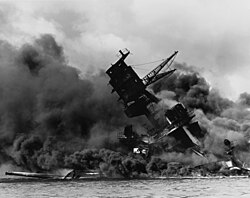
[[File:The USS Arizona (BB-39) burning after the Japanese attack on Pearl Harbor - NARA 195617 - Edit.jpg|thumb|{{USS|Arizona|BB-39|6}} burned for two days after being hit by a Japanese bomb in the [[attack on Pearl Harbor]].]] | [[File:The USS Arizona (BB-39) burning after the Japanese attack on Pearl Harbor - NARA 195617 - Edit.jpg|thumb|{{USS|Arizona|BB-39|6}} burned for two days after being hit by a Japanese bomb in the [[attack on Pearl Harbor]].]] | ||
{{main|Attack on Pearl Harbor}} | |||
In the early hours of 7 December (Hawaiian time), | In the early hours of 7 December (Hawaiian time), carrier-based Japanese aircraft launched a surprise, large-scale air strike on the US Pacific Fleet's anchorage at Pearl Harbor in [[Honolulu]], which knocked eight American battleships out of action, destroyed 188 American aircraft, and killed 2,403 Americans.{{sfn|Evans|Peattie|1997|p=488}} The Japanese believed that the Americans, faced with such a sudden and massive blow to their naval power in the Pacific, would agree to a negotiated settlement. However, American losses were less serious than initially thought: the three American aircraft carriers were at sea during the attack, and vital naval infrastructure, Honolulu's submarine base, and [[OP-20-G|signals intelligence]] units were unscathed. The fact that the bombing happened while the US was not officially at war{{efn|The [[Neutrality Patrol]] had US destroyers fighting at sea, but no state of war had been declared by Congress.}} caused a wave of outrage across the country.{{sfn|Evans|Peattie|1997|p=488}} Japan's fallback strategy, relying on a [[attrition warfare|war of attrition]] against the United States, was beyond the Imperial Japanese Navy's capabilities.{{sfn|Evans|Peattie|1997|p=113}}{{sfn|Parillo|1993|p=60}} | ||
Opposition to war in the United States vanished after the attack. On 8 December, the United Kingdom,{{efn|See [[United Kingdom declaration of war on Japan]].}}<ref>{{cite web |date=8 December 1941 |title=Prime Minister's Declaration |url=https://api.parliament.uk/historic-hansard/commons/1941/dec/08/prime-ministers-declaration#column_1358 |url-status=live |archive-url=https://web.archive.org/web/20140912062140/http://hansard.millbanksystems.com/commons/1941/dec/08/prime-ministers-declaration#column_1358 |archive-date=12 September 2014 |access-date=3 May 2015 |work=[[Hansard|Parliamentary Debates (Hansard)]]}}</ref> the United States,{{efn|See [[United States declaration of war on Japan]].}}<ref>{{cite web |title=Declaration of War with Japan |url=http://www.hbci.com/~tgort/japan.htm |date=8 December 1941 |publisher=United States Congress |archive-url=https://web.archive.org/web/20110926204630/http://www.hbci.com/~tgort/japan.htm |archive-date=26 September 2011}}</ref> Canada,<ref>{{cite journal |journal=Inter-Allied Review |date=15 December 1941 |url=http://www.ibiblio.org/pha/policy/1941/411208b.html |title=Canada Declares War on Japan |via=Pearl Harbor History Associates, Inc. |access-date=8 April 2015 |archive-url=https://web.archive.org/web/20150924132004/http://www.ibiblio.org/pha/policy/1941/411208b.html |archive-date=24 September 2015 |url-status=live}}</ref> and the Netherlands<ref>{{cite journal |journal=Inter-Allied Review |date=15 December 1941 |url=http://www.ibiblio.org/pha/policy/1941/411208c.html |title=The Kingdom of the Netherlands Declares War with Japan |via=Pearl Harbor History Associates Inc. |access-date=3 October 2009 |archive-url=https://web.archive.org/web/20100114173653/http://www.ibiblio.org/pha/policy/1941/411208c.html |archive-date=14 January 2010 |url-status=live}}</ref> declared war on Japan, followed by Australia<ref>{{cite journal |journal=Inter-Allied Review |date=15 December 1941 |url=http://www.ibiblio.org/pha/timeline/411209awp.html |title=Australia Declares War on Japan |via=Pearl Harbor History Associates Inc. |access-date=3 October 2009 |archive-url=https://web.archive.org/web/20080513181507/http://www.ibiblio.org/pha/timeline/411209awp.html |archive-date=13 May 2008 |url-status=live}}</ref> the next day. | |||
===South-East Asian campaigns of | ===South-East Asian campaigns of 1941–1942=== | ||
[[File: | [[File:Malaya East Indies Siam and Indo-China Map 1942 World War II.jpg|thumb|Malaya, East Indies, Siam and Indo-China Map, 1942]]Thailand, with its territory already serving as a springboard for Japan's [[Malayan Campaign]], surrendered within hours of the Japanese invasion.{{sfn|Brecher|Wilkenfeld|1997|p=407}} The government of Thailand formally allied with Japan on 21 December. To the south, the IJA seized the British colony of [[Penang]] on 19 December, encountering little resistance.{{sfn|Barber|2010|p=}}{{page needed|date=October 2023}} | ||
Hong Kong was attacked on 8 December and fell to Japanese forces on [[Battle of Hong Kong|25 December 1941]]. American bases on Guam and Wake Island were seized by Japan at around the same time. British, Australian, and Dutch forces, already drained of personnel and [[matériel]] by two years of war with Germany, and heavily committed in the Middle East, North Africa, and elsewhere, were unable to provide more than token resistance. Two major British warships, the [[battlecruiser]] {{HMS|Repulse|1916|6}} and the [[battleship]] {{HMS|Prince of Wales|53|6}}, were [[Sinking of Prince of Wales and Repulse|sunk by a Japanese air attack]] off Malaya on 10 December 1941.{{sfn|Peattie|2007|pp=168–169}}[[File:Surrender Singapore.jpg|thumb|British forces surrender [[Battle of Singapore|Singapore]] to the Japanese, February 1942]] | |||
[[ | Following the [[Declaration by United Nations]] on [[January 1942|1 January 1942]], the Allied governments appointed the British General [[Archibald Wavell]] to the [[American-British-Dutch-Australian Command]] (ABDACOM), a supreme command for Allied forces in Southeast Asia. This gave Wavell nominal control of a huge force, albeit one that was thinly spread across a vast area, from Burma to the Philippines to northern Australia. Other regions, including India, Hawaii, and the rest of Australia, remained under local commands. On 15 January, Wavell moved to [[Bandung]] in [[Java (island)|Java]] to assume control of ABDACOM. | ||
In January, Japan invaded British Burma, the Dutch East Indies, New Guinea, and the Solomon Islands, and captured [[Manila]], [[Kuala Lumpur]] and [[Battle of Rabaul (1942)|Rabaul]]. After being driven out of Malaya, Allied forces in Singapore attempted to resist the Japanese during the Battle of Singapore, but were forced to surrender to the Japanese on 15 February 1942. About 130,000 Indian, British, Australian and Dutch personnel became Japanese prisoners of war.<ref>{{cite web |url=http://www.awm.gov.au/atwar/remembering1942/singapore/transcript.htm |title=Remembering 1942, The fall of Singapore, 15 February 1942 |publisher=Awm.gov.au |access-date=31 October 2010 |archive-url=https://web.archive.org/web/20080820045754/http://www.awm.gov.au/atwar/remembering1942/singapore/transcript.htm |archive-date=20 August 2008 |url-status=live}}</ref> [[Bali]] and [[Timor]] fell in February.<ref>{{cite web |last=L. |first=Klemen |date=1999–2000 |title=The capture of Bali Island, February 1942 |url=https://warfare.gq/dutcheastindies/bali.html |url-status=live |archive-url=https://web.archive.org/web/20120325051425/http://www.dutcheastindies.webs.com/bali.html |archive-date=25 March 2012 |access-date=4 August 2011 |work=Forgotten Campaign: The Dutch East Indies Campaign 1941–1942}}</ref><ref name="DutchTimor">{{cite web |last=Klemen |first=L |date=1999–2000 |title=The Japanese Invasion of Dutch West Timor Island, February 1942 |url=https://warfare.gq/dutcheastindies/timor_dutch.html |url-status=live |archive-url=https://web.archive.org/web/20130925120236/http://www.dutcheastindies.webs.com/timor_dutch.html |archive-date=25 September 2013 |access-date=4 August 2011 |work=Forgotten Campaign: The Dutch East Indies Campaign 1941–1942}} See [[Battle of Timor]].</ref> The rapid collapse of Allied resistance left the "ABDA area" split in two. Wavell resigned from ABDACOM on 25 February, handing control of the ABDA Area to local commanders and returning to the post of [[Commander-in-Chief, India]]. | |||
In January, Japan invaded British Burma, the Dutch East Indies, New Guinea, the Solomon Islands and captured Manila, Kuala Lumpur and [[Battle of Rabaul (1942)|Rabaul]]. After being driven out of Malaya, Allied forces in Singapore attempted to resist the Japanese during the | |||
[[File:Darwin 42.jpg|thumb|The [[Bombing of Darwin]], Australia, 19 February 1942]] | [[File:Darwin 42.jpg|thumb|The [[Bombing of Darwin]], Australia, 19 February 1942]] | ||
Meanwhile, Japanese aircraft had all but eliminated Allied air power in Southeast Asia and were | Meanwhile, Japanese aircraft had all but eliminated Allied air power in Southeast Asia and were carrying out [[Japanese air attacks on Australia, 1942–1943|air attacks on northern Australia]], beginning with a [[Bombing of Darwin (February 1942)|bombing of the city of Darwin]] on 19 February, which killed at least 243 people.{{sfn|Peattie|2007|pp=170–172}} | ||
At the [[Battle of the Java Sea]] in late February and early March, the | At the [[Battle of the Java Sea]] in late February and early March, the IJN defeated the main ABDA naval force, under Admiral [[Karel Doorman]].<ref name="JavaSea">{{cite web |last=L |first=Klemen |url=http://warfare.gq/dutcheastindies/java_sea.html |title=The Java Sea Battle, February 1942 |date=1999–2000 |work=Forgotten Campaign: The Dutch East Indies Campaign 1941–1942 |access-date=4 August 2011 |archive-url=https://web.archive.org/web/20110726052834/http://www.dutcheastindies.webs.com/java_sea.html |archive-date=26 July 2011 |url-status=live}}</ref> The [[Dutch East Indies campaign]] ended with the surrender of Allied forces on Java and Sumatra.<ref name="Java">{{cite web |last=Klemen |first=L. |date=1999–2000 |title=The conquest of Java Island, March 1942 |url=https://warfare.gq/dutcheastindies/java.html |url-status=live |archive-url=https://web.archive.org/web/20110726052648/http://www.dutcheastindies.webs.com/java.html |archive-date=26 July 2011 |access-date=4 August 2011 |work=Forgotten Campaign: The Dutch East Indies Campaign 1941–1942}}</ref><ref>{{cite web |last=Womack |first=Tom |url=http://warfare.gq/dutcheastindies/north_sumatra.html |title=An Abandoned Army – The KNIL and The Japanese Invasion of Northern Dutch Sumatra |date=1999–2000 |publisher=Dutch East Indies Campaign website |access-date=4 August 2011 |archive-url=https://web.archive.org/web/20110726052052/http://www.dutcheastindies.webs.com/north_sumatra.html |archive-date=26 July 2011 |url-status=live}}</ref> | ||
In March and April, | In March and April, an IJN carrier force launched a [[Indian Ocean Raid|raid into the Indian Ocean]]. British Royal Navy bases in [[Ceylon]] were hit and the aircraft carrier {{HMS|Hermes|95|6}} was sunk, along with other Allied ships. The attack forced the Royal Navy to withdraw to the western part of the Indian Ocean,{{sfn|Peattie|2007|p=172}} paving the way for a Japanese assault on Burma and India. | ||
In Burma, the Japanese captured [[Mawlamyine|Moulmein]] on 31 January 1942, and then drove outnumbered British and Indian troops towards the [[Sittaung River|Sittang River]]. On 23 February, a bridge over the river was demolished prematurely, stranding most of an Indian division | In Burma, the Japanese captured [[Mawlamyine|Moulmein]] on 31 January 1942, and then drove outnumbered British and Indian troops towards the [[Sittaung River|Sittang River]]. On 23 February, a bridge over the river was demolished prematurely, stranding most of an Indian division. On 8 March, the Japanese occupied [[Yangon|Rangoon]]. The Allies attempted to defend Central Burma, with Indian and Burmese divisions holding the [[Irrawaddy River]] valley and the [[Chinese Expeditionary Force in Burma]] defending [[Taungoo|Toungoo]]. On 16 April, 7,000 British soldiers were encircled by the Japanese 33rd Division during the [[Battle of Yenangyaung]], but subsequently rescued by the Chinese 38th Division, led by [[Sun Li-jen]].<ref>{{Harvnb|Hsu|Chang|1971|p=377}}.</ref> Meanwhile, in the [[Battle of Yunnan-Burma Road]], the Japanese captured Toungoo after hard fighting and sent motorized units to capture [[Lashio]]. This cut the [[Burma Road]], which was the western Allies' supply line to Chinese Nationalist troops. Many of Chinese troops were forced either to retreat to India, or withdraw in small parties to [[Yunnan]]. Accompanied by large numbers of civilian refugees, the British retreated to [[Imphal]] in Manipur, abandoning most of their transportation and equipment. They reached Imphal in May just as the monsoon descended, which halted the operations of both sides in the area. | ||
Within China, cooperation between the Chinese Nationalists and the Communists had waned from its zenith at the | Within China, cooperation between the Chinese Nationalists and the Communists had waned from its zenith at the Battle of Wuhan, and the relationship between the two had soured as both attempted to expand their areas of operation and influence. The Japanese exploited this lack of unity to press their offensive operations in China. | ||
===Philippines=== | ===Philippines=== | ||
[[File:Surrender of American troops at Corregidor.jpg|thumb|Surrender of US forces at [[Corregidor]], Philippines, May 1942]] | |||
{{Main|Philippines campaign (1941–1942)}} | {{Main|Philippines campaign (1941–1942)}} | ||
On | On 8 December 1941, Japanese bombers struck American airfields on Luzon. They caught most American planes on the ground, destroying 103 aircraft, more than half of the US air strength in the Philippines.{{sfn|Willmott|2014|p=149}} Two days later, further air raids destroyed the [[Cavite Naval Yard]]. By 13 December, Japanese attacks had wrecked every major airfield and virtually annihilated American air power in the region.{{sfn|Willmott|2014|p=149}} The previous month, a portion of the [[US Asiatic Fleet]] had been sent to the southern Philippines. However, with little air protection, the remaining surface vessels in the Philippines, especially the larger ships, were ordered to sail for Java or Australia, and the remaining American bombers in the area flew to Australia in mid-December.{{sfn|Willmott|2014|p=149}} The only American forces that remained to defend the Philippines were the ground troops, a few fighter aircraft, about 30 submarines, and a few small vessels. | ||
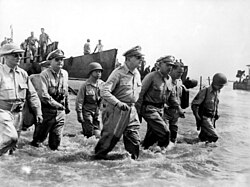
The main Japanese landings on Luzon took place on 22 and 24 December. As the Japanese troops converged on Manila, General [[Douglas MacArthur]] began executing plans to make a final stand on the [[Bataan Peninsula]] and the island of [[Corregidor]]. A series of rearguard actions brought the bulk of his troops safely into Bataan, while the Japanese entered Manila unopposed on 2 January 1942.{{sfn|Willmott|2014|p=213}} On 7 January, the Japanese [[Battle of Bataan|attacked Bataan]]. After some initial success, they were stalled by disease and casualties; however, Japanese forces could be reinforced, while the Americans and Filipinos were entirely isolated from resupply. On 11 March 1942, under orders from President Roosevelt, MacArthur abandoned Corregidor for Australia, and Lieutenant General [[Jonathan M. Wainwright (general)|Jonathan M. Wainwright]] assumed command in the Philippines. The defenders on Bataan, running low on ammunition and supplies, could no longer withstand the pressure from Japanese attacks. Bataan fell on 9 April, and the 76,000 American and Filipino prisoners of war taken on the peninsula were subjected to the {{convert|66|mi}} long [[Bataan Death March]]. On the night of 5–6 May, after an intensive aerial and artillery bombardment, the Japanese landed on Corregidor and Wainwright surrendered. In the southern Philippines, where key ports and airfields had already been seized, the remaining American-Filipino forces surrendered on 9 May. | |||
===Threat to Australia=== | ===Threat to Australia=== | ||
In late 1941, as the Japanese struck at Pearl Harbor, most of Australia's best forces were committed | In late 1941, as the Japanese struck at Pearl Harbor, most of Australia's best forces were committed in the [[Mediterranean, Middle East and African theatres of World War II|Mediterranean Theatre]]. Australia was ill-prepared for an attack, lacking armaments, modern fighter aircraft, heavy bombers, and aircraft carriers. While still calling for reinforcements from Churchill, the Australian Prime Minister [[John Curtin]] called for American support with an announcement on 27 December 1941:<ref name="ReferenceA">{{cite web |url=http://primeministers.naa.gov.au/primeministers/curtin/in-office.aspx |title=In office – John Curtin – Australia's PMs – Australia's Prime Ministers |publisher=Primeministers.naa.gov.au |access-date=20 April 2013 |archive-url=https://web.archive.org/web/20120117203302/http://primeministers.naa.gov.au/primeministers/curtin/in-office.aspx |archive-date=17 January 2012 |url-status=live}}</ref><ref>Cited in Frank Crowley (1973) Vol 2, p. 51.</ref> | ||
[[File:POWs Burma Thai RR.jpg|thumb|Dutch and Australian [[Prisoners of War|PoWs]] at Tarsau, in Thailand in 1943. 22,000 Australians were captured by the Japanese; 8,000 died as prisoners of war.]] | [[File:POWs Burma Thai RR.jpg|thumb|Dutch and Australian [[Prisoners of War|PoWs]] at Tarsau, in Thailand in 1943. 22,000 Australians were captured by the Japanese; 8,000 died as prisoners of war.]] | ||
{{blockquote|The Australian Government ... regards the Pacific struggle as primarily one in which the United States and Australia must have the fullest say in the direction of the democracies' fighting plan. Without inhibitions of any kind, I make it clear that Australia looks to America, free of any pangs as to our traditional links or kinship with the United Kingdom.|Prime Minister [[John Curtin]]}} | {{blockquote|The Australian Government ... regards the Pacific struggle as primarily one in which the United States and Australia must have the fullest say in the direction of the democracies' fighting plan. Without inhibitions of any kind, I make it clear that Australia looks to America, free of any pangs as to our traditional links or kinship with the United Kingdom.|Prime Minister [[John Curtin]]}} | ||
Australia had been shocked by the | Australia had been shocked by the speed of the collapse of Commonwealth forces in British Malaya and [[Battle of Singapore#Fall of Singapore|Singapore]], in which around 15,000 Australian soldiers became prisoners of war. Curtin predicted that the "[[battle for Australia]]" was imminent. The Japanese established a major base in the Australian [[Territory of New Guinea]] beginning with the capture of [[Rabaul]] on 23 January 1942.<ref>{{cite web |url=http://ajrp.awm.gov.au/ajrp/remember.nsf/Web-Printer/C6FD73CC5C579789CA256AC000135979?OpenDocument |title=Remembering the war in New Guinea – Rabaul |publisher=Ajrp.awm.gov.au |access-date=20 April 2013 |archive-url=https://web.archive.org/web/20110724193820/http://ajrp.awm.gov.au/ajrp/remember.nsf/Web-Printer/C6FD73CC5C579789CA256AC000135979?OpenDocument |archive-date=24 July 2011 |url-status=live}}</ref> On 19 February 1942, [[Air raids on Darwin, 19 February 1942|Darwin was hit by an air raid]], the first time the Australian mainland had come under foreign attack. Over the following 19 months, [[Japanese air attacks on Australia, 1942-43|Australia was attacked from the air]] by the Japanese almost 100 times. | ||
In early 1942, elements of the IJN [[Proposed Japanese invasion of Australia during World War II|proposed an invasion of Australia]]. The IJA opposed the plan and it was rejected in favor of isolating Australia via naval blockade, by advancing through the South Pacific.<ref>{{cite web |url=http://ajrp.awm.gov.au/ajrp/remember.nsf/Web-Printer/597517651CB0681ACA256D3C0021BBE6?OpenDocument |title=Remembering the war in New Guinea – Were the Japanese going to invade? |publisher=Ajrp.awm.gov.au |date=19 February 1942 |access-date=20 April 2013 |archive-url=https://web.archive.org/web/20110916223551/http://ajrp.awm.gov.au/ajrp/remember.nsf/Web-Printer/597517651CB0681ACA256D3C0021BBE6?OpenDocument |archive-date=16 September 2011 |url-status=live}}</ref> The Japanese decided upon a seaborne invasion of [[Port Moresby]] on the southern coast of New Guinea, which would put Northern Australia within range of Japanese bomber aircraft. | |||
President [[Franklin Roosevelt]] ordered | President [[Franklin Roosevelt]] ordered MacArthur to formulate a Pacific defense plan in conjunction with Australia in March 1942. Curtin agreed to place Australian forces under the command of MacArthur, who became Supreme Commander, South West Pacific. MacArthur moved his headquarters to Melbourne in March 1942 and American troops began massing in Australia. [[Axis naval activity in Australian waters|Japanese naval activity]] reached Sydney in late May 1942, when IJN [[midget submarine]]s launched a [[Attack on Sydney Harbour|raid on Sydney Harbour]]. On 8 June 1942, two Japanese submarines briefly shelled Sydney's eastern suburbs and the city of Newcastle.<ref>{{cite web |url=http://home.st.net.au/~dunn/japsubs/midgetsubs.htm |title=Midget Submarines history at |publisher=Home.st.net.au |access-date=29 April 2010 |archive-url=https://web.archive.org/web/20100413131337/http://home.st.net.au/~dunn/japsubs/midgetsubs.htm |archive-date=13 April 2010}}</ref> | ||
==Allies re-group, | ==Allies re-group, 1942–1943== | ||
In early 1942, the governments of smaller Allied powers began to push for an inter-governmental Asia-Pacific war council. The Pacific War Council was formed in Washington DC on 1 April 1942, with President [[Franklin Delano Roosevelt|Franklin D. Roosevelt]], his key advisor [[Harry Hopkins]], and representatives from Britain, China, Australia, the Netherlands, New Zealand, and Canada. Representatives from [[British India|India]] and the Philippines were later added. The council never had any direct operational control, and any decisions it made were referred to the US-UK [[Combined Chiefs of Staff]]. Australian and Dutch forces led civilians in a prolonged [[Battle of Timor|guerilla campaign in Portuguese Timor]]. | |||
In early 1942, the governments of smaller powers began to push for an inter-governmental Asia-Pacific war council | |||
===Japanese strategy and the Doolittle Raid=== | ===Japanese strategy and the Doolittle Raid=== | ||
[[File:Army B-25 (Doolittle Raid).jpg|thumb|A [[North American B-25 Mitchell|B-25]] bomber takes off from {{USS|Hornet|CV-8|6}} as part of the Doolittle Raid.]] | [[File:Army B-25 (Doolittle Raid).jpg|thumb|A [[North American B-25 Mitchell|B-25]] bomber takes off from {{USS|Hornet|CV-8|6}} as part of the Doolittle Raid.]] | ||
The [[Second Operational Phase (1942)|Second Operational Phase]] was planned to expand Japan's strategic depth by conquering eastern [[New Guinea]], [[New Britain]], the [[Aleutians]], [[Midway Atoll|Midway]], [[Fiji]], [[Samoa]], and strategic points in the Australian area.{{sfn|Stille|2014|p=31}} The [[Imperial Japanese Navy General Staff|Naval General Staff]] advocated an advance to the south to seize parts of Australia, but with large numbers of troops engaged in China and Manchuria, the IJA declined to contribute the necessary ground forces for the operation.{{sfn|Stille|2014|p=31}} The Naval General Staff still wanted to cut the sea links between Australia and the United States by capturing [[New Caledonia]], Fiji, and Samoa. Because this required far fewer troops, on 13 March the Naval General Staff and the Army agreed to prepare for operations to capture Fiji and Samoa.{{sfn|Stille|2014|p=31}} The Second Operational Phase began when Lae and Salamaua, located in eastern New Guinea, were captured on 8 March. However, on 10 March, American carrier aircraft attacked the Japanese invasion forces and inflicted considerable losses. The raid had major operational implications, as it forced the Japanese to postpone their advance in the South Pacific until the [[Combined Fleet]] allocated sufficient naval forces to protect future offensive operations in the region.{{sfn|Stille|2014|p=31}} | |||
Concurrently, the United States conducted the [[Doolittle Raid]] on the Japanese mainland in April 1942, in which 16 bombers took off from the aircraft carrier {{USS|Hornet|CV-8|6}}, {{convert|600|mi|km}} from Japan. The raid inflicted minimal material damage on Japanese soil but was a significant boost for American morale; it also had psychological repercussions in Japan, exposing the danger to the Japanese homeland posed by American carrier forces.{{sfn|Jansen|2002|p=648}}{{sfn|Willmott|1983|p=118}} With only [[Marcus Island]] and a line of converted trawlers patrolling the vast waters that separate [[Wake island|Wake Island]] and [[Kamchatka]], the Japanese east coast was left open to further attacks similar to Doolittle.{{sfn|Willmott|1983|p=118}} | |||
Admiral [[Isoroku Yamamoto|Yamamoto]] proposed a strategy to bring about the destruction of the US Navy by occupying Midway Atoll, an objective he thought the Americans would be certain to fight for, as Japanese aircraft based on Midway could threaten Hawaii.{{sfn|Stille|2014|pp=31–32}} During a series of meetings held from 2–5 April, the Naval General Staff and representatives of the Combined Fleet reached a compromise. Yamamoto was allowed to attempt his Midway operation, but only after he had threatened to resign. In return, Yamamoto had to allocate [[Fifth Carrier Division|one carrier division]] to the operation against Port Moresby, as well as carrying out amphibious landings on strategic points in the Aleutian Islands simultaneously with the Midway operation. These concessions drew valuable Japanese military assets away from the attack on Midway, and were enough to remove the Japanese margin of superiority in the Midway attack.{{sfn|Stille|2014|p=32}} | |||
===Coral Sea=== | ===Coral Sea=== | ||
{{Main|Battle of the Coral Sea}} | {{Main|Battle of the Coral Sea}} | ||
[[File:Large explosion aboard USS Lexington (CV-2), 8 may 1942.jpg|thumb|The aircraft carrier {{USS|Lexington|CV-2|6}} explodes on 8 May 1942, several hours after being damaged by a Japanese carrier air attack.]] | [[File:Large explosion aboard USS Lexington (CV-2), 8 may 1942.jpg|thumb|The aircraft carrier {{USS|Lexington|CV-2|6}} explodes on 8 May 1942, several hours after being damaged by a Japanese carrier air attack.]] | ||
The | The Japanese assault on Port Moresby was codenamed the ''[[Operation Mo|MO Operation]]'' and was divided into several parts. The island of Tulagi, in the Solomon chain, would be occupied on 3 May; IJN carriers would then conduct a sweep through the Coral Sea to the south to find and destroy Allied naval forces. The Japanese scheduled amphibious landings to capture Port Moresby for 10 May.{{sfn|Stille|2014|p=32}} The ''MO Operation'' called for a force of 60 vessels centered around two carriers, and 250 aircraft.{{sfn|Stille|2014|p=32}} However, the ensuing naval battle did not go according to plan for the Japanese; although [[Invasion of Tulagi (May 1942)|Tulagi was seized]] on 3 May, the following day, aircraft from the American carrier {{USS|Yorktown|CV-5|2}} struck the invasion force.{{sfn|Stille|2014|p=32}} The element of surprise was lost due to the success of Allied [[Cryptanalysis|codebreakers]]. From the Allied perspective, if Port Moresby fell, the Japanese would control the seas to the north and west of Australia, and could effectively isolate the country from its allies in North America. An Allied task force under the command of Admiral [[Frank Jack Fletcher|Frank Fletcher]], with the carriers {{USS|Lexington|CV-2|6}} and ''Yorktown'', was assembled to stop the Japanese advance. On 7 May, the Japanese carriers launched a full strike on a contact reported to be Allied aircraft carriers, but the report turned out to be false. The strike force found and struck only an oiler, the {{USS|Neosho|AO-23|2}}, and the destroyer {{USS|Sims|DD-409|2}}.{{sfn|Stille|2014|pp=32–34}} | ||
The American carriers also launched a strike with incomplete reconnaissance, and only located and sank the light aircraft carrier {{ship|Japanese aircraft carrier|Shōhō||2}}. On 8 May, the opposing carrier forces finally found each other and exchanged air strikes. Aircraft from the two Japanese carriers succeeded in sinking the carrier ''Lexington'' and damaging the carrier ''Yorktown''. In return, the Americans damaged ''Shōkaku''. Although ''Zuikaku'' was left undamaged, aircraft and personnel losses to ''Zuikaku'' were heavy and the Japanese naval forces were unable to support an amphibious landing on Port Moresby. As a result, the ''MO Operation'' was cancelled,{{sfn|Stille|2014|p=34}} and the Japanese were forced to abandon their attempts to isolate Australia.{{sfn|Evans|Peattie|1997|p=489}} | |||
After Coral Sea, the Japanese had four fleet carriers operational—{{ship|Japanese aircraft carrier|Sōryū||2}}, {{ship|Japanese aircraft carrier|Kaga||2}}, {{ship|Japanese aircraft carrier|Akagi||2}} and {{ship|Japanese aircraft carrier|Hiryū||2}}—and believed that the Americans had a maximum of two—{{USS|Enterprise|CV-6|2}} and | Although they managed to sink an American carrier, the Japanese also suffered significant damage, as all three carriers that were committed to the battle would now be unavailable for the operation against Midway.{{sfn|Stille|2014|p=34}} After Coral Sea, the Japanese had four fleet carriers operational—{{ship|Japanese aircraft carrier|Sōryū||2}}, {{ship|Japanese aircraft carrier|Kaga||2}}, {{ship|Japanese aircraft carrier|Akagi||2}} and {{ship|Japanese aircraft carrier|Hiryū||2}}—and believed that the Americans had a maximum of two—{{USS|Enterprise|CV-6|2}} and ''Hornet''. {{USS|Saratoga|CV-3|2}} was undergoing repair after a torpedo attack, while ''Yorktown'' had been damaged at Coral Sea and was believed by Japanese naval intelligence to have been sunk. Instead, she would sortie for Midway after just three days of repairs in Hawaii. | ||
===Midway=== | ===Midway=== | ||
[[File:Hiryu f075712.jpg|thumb|{{ship|Japanese aircraft carrier|Hiryū||2}} under attack by [[B-17 Flying Fortress]] heavy bombers]] | |||
{{Main|Battle of Midway}} | {{Main|Battle of Midway}} | ||
Admiral Yamamoto viewed the operation against Midway as the potentially decisive battle of the war which could lead to the destruction of American strategic power in the Pacific,{{sfn|Parshall|Tully|2005|p=33}} and subsequently | Admiral Yamamoto viewed the operation against Midway as the potentially decisive battle of the war, which could lead to the destruction of American strategic power in the Pacific,{{sfn|Parshall|Tully|2005|p=33}} and subsequently allow for a negotiated peace settlement.{{sfn|Stille|2014|p=34}} Through strategic and tactical surprise, the Japanese would knock out Midway's air strength and soften its defenses for a landing by 5,000 troops.{{sfn|Stille|2014|p=34}} After the capture of the island, the Combined Fleet planned to lay the basis for the most important part of the operation. Yamamoto hoped that the operation would lure the American surface fleet into a trap.{{sfn|Parshall|Tully|2005|pp=19–38}} The Japanese intended their attack on Midway to act as bait for the bulk of the US Navy's strength in the Pacific, which Japanese planners anticipated would depart Pearl Harbor in order to defend the island. When the American vessels arrived, Yamamoto intended to concentrate his scattered naval forces to defeat them. Importantly, and concurrently to their attack on Midway, the Japanese launched [[Battle of the Aleutian Islands|Operation AL]], an operation to seize two islands in the Aleutians.{{sfn|Stille|2014|p=34}} | ||
In May, American [[Codebreaking|codebreakers]] discovered the planned attack on Midway. Yamamoto's complex plan contained no contingencies in the event that his fleet was found by the Americans before the Japanese had expected them. Planned surveillance of the American fleet in Pearl Harbor by long-ranged seaplanes did not occur as a result of an [[Operation K|abortive identical operation]] in March. Additionally, Japanese submarine scouting lines that were supposed to be in place along the Hawaiian Islands were not ready on time.{{sfn|Willmott|2002|p=55}} | |||
The battle began on 3 June, when American aircraft from Midway spotted and attacked the Japanese transport group {{convert|700|mi|km}} west of the atoll.{{sfnm|1a1=Stille|1y=2014|1p=35|2a1=Willmott|2y=2002|2p=55}} On 4 June, the Japanese launched a 108-aircraft strike on the island, but failed to deliver a decisive blow to the island's facilities.{{sfn|Stille|2014|p=36}} American ground-based aircraft on Midway were already airborne, adding to the 116 carrier aircraft on their way to attack the Japanese. The aircraft from Midway attacked the Japanese fleet, but failed to score a single hit. In the middle of these uncoordinated attacks, a Japanese scout aircraft reported the presence of an American task force, but it was not until later that the presence of an American carrier was confirmed.{{sfn|Stille|2014|p=36}} Vice Admiral [[Chuichi Nagumo]] was put in a difficult tactical situation.{{sfn|Stille|2014|p=37}} After quick deliberation, he opted for a delayed, but better-prepared, attack on the American task force.{{sfn|Stille|2014|p=37}} | |||
At 10:22am, American [[SBD Dauntless]] dive bombers surprised and attacked three of the Japanese carriers.{{sfn|Stille|2014|p=37}} ''Sōryū'', ''Kaga'', and ''Akagi'' were destroyed in short order. A single Japanese carrier, ''Hiryū'', remained operational, and launched an immediate counterattack. Her aircraft scored hits on ''Yorktown'' and put her out of action. Later in the afternoon, aircraft from the two remaining American carriers found and destroyed ''Hiryū''. The crippled ''Yorktown'', along with the destroyer {{USS|Hammann|DD-412|2}}, were later sunk by the Japanese submarine {{Ship|Japanese submarine|I-168||2}}. With the striking power of the [[Kido Butai]] destroyed, Japan's offensive naval power was significantly blunted. Early on the morning of 5 June, the Japanese cancelled the Midway operation.{{sfn|Stille|2014|p=38}} | |||
===New Guinea and the Solomons=== | ===New Guinea and the Solomons=== | ||
{{Main|New Guinea campaign|Solomon Islands campaign}} | {{Main|New Guinea campaign|Solomon Islands campaign}} | ||
Japanese land forces continued to advance in the [[Solomon Islands]] and [[New Guinea]]. From July 1942, | Japanese land forces continued to advance in the [[Solomon Islands]] and the Australian-administered [[Territory of New Guinea]]. From July 1942, several Australian [[Australian Army Reserve|reserve]] [[battalion]]s fought a stubborn rearguard action on New Guinea, delaying the Japanese advance along the [[Kokoda Track campaign|Kokoda Track]] towards Port Moresby. These militia units were relieved in late August by troops from the [[Second Australian Imperial Force]]. In early September 1942 [[Japanese Special Naval Landing Forces|Japanese marines]] attacked a strategic [[Royal Australian Air Force]] base at [[Battle of Milne Bay|Milne Bay]], near the eastern tip of New Guinea. They were repulsed by Allied forces, the first defeat of the war for Japanese forces on land.<ref name=AWM>{{cite web |url=https://www.awm.gov.au/collection/E84334 |title=Battle of Milne Bay from 25 August 1942 to 07 September 1942 |publisher=Australian War Memorial |access-date=15 December 2018 |archive-url=https://web.archive.org/web/20181215173558/https://www.awm.gov.au/collection/E84334 |archive-date=15 December 2018 |url-status=live}}</ref> | ||
On New Guinea, the Japanese on the [[Kokoda Track]] | On New Guinea, the Japanese on the [[Kokoda Track]] came within sight of Port Moresby but were ordered to withdraw to the northeastern coast as fighting intensified between Japanese and Allied forces over [[Guadalcanal campaign|Guadalcanal]]. Australian and American forces attacked the IJA's fortified positions in the north, and after more than two months of fighting in the [[Battle of Buna–Gona|Buna–Gona area]], finally captured the key Japanese beachhead on New Guinea in early 1943. | ||
====Guadalcanal==== | ====Guadalcanal==== | ||
[[File:Marines rest in the field on Guadalcanal.jpg|thumb|US Marines rest in the field during the Guadalcanal campaign in November 1942.]] | [[File:Marines rest in the field on Guadalcanal.jpg|thumb|US Marines rest in the field during the Guadalcanal campaign in November 1942.]] | ||
Allied forces became aware via [[coastwatchers]] of a Japanese airfield under construction at Guadalcanal in the Solomon Islands.{{sfn|Willmott|2002|p=96}} On 7 August 1942, 16,000 [[United States Marine Corps|US Marines]] landed on [[Guadalcanal campaign|Guadalcanal]] and the island of [[Battle of Tulagi and Gavutu–Tanambogo|Tulagi]] in the Solomons. Vice Admiral [[Gunichi Mikawa]], commander of the newly formed IJN [[8th Fleet (Imperial Japanese Navy)|Eighth Fleet]] at Rabaul, quickly sortied with the ships under his command to engage the Allied force off the northern coast of Guadalcanal. On the night of 8–9 August, Mikawa's ships surprised Allied naval forces in the [[Battle of Savo Island]], sinking four Allied heavy cruisers{{sfn|Stille|2014|p=38}} and withdrawing with no losses of their own. The battle was one of the worst Allied naval defeats of the war.{{sfn|Stille|2014|p=38}} The Japanese victory was mitigated only by Mikawa's failure to attack the Allied transport ships, which had been left vulnerable by the defeat at Savo Island. Had Mikawa done so, the American troops on Guadalcanal would have been left dangerously isolated and undersupplied, and the first American counterattack in the Pacific may have been halted. Separately, and importantly, the Japanese originally perceived the American landings in the Solomons as nothing more than a reconnaissance operation.{{sfn|Willmott|2002|p=109}} | |||
With Japanese and Allied forces both occupying parts of Guadalcanal, over the following six months both sides poured resources into an escalating battle of attrition over the island and its [[littoral zone]]. American ground-based aircraft at [[Honiara International Airport|Henderson Field]] ensured American control of the waters around Guadalcanal during daytime, while the superior night-fighting capabilities of the IJN gave the Japanese the advantage at night. In August, Japanese and US carrier forces fought the [[Battle of the Eastern Solomons]], resulting in the sinking of the IJN light carrier {{ship|Japanese aircraft carrier|Ryūjō||2}}. In October, US forces successfully challenged the Japanese in night fighting during the [[Battle of Cape Esperance]], sinking a Japanese cruiser and one destroyer for the loss of one destroyer of their own. During the night of 13 October, Japanese battleships ''[[IJN Kongō|Kongō]]'' and ''[[IJN Haruna|Haruna]]'' bombarded Henderson Field, temporarily disabling it; the airfield was swiftly returned to service by American engineers. On 26 October, the Japanese carriers ''[[Shōkaku]]'' and ''[[Zuikaku]]'' sank the American carrier ''Hornet'' and heavily damaged ''Enterprise'' in the [[Battle of the Santa Cruz Islands]]. The loss of ''Hornet'', coupled with the earlier loss of {{USS|Wasp|CV-7|2}} to the IJN submarine {{Jsub|I-19||2}} and heavy submarine damage to ''Saratoga'' in September, meant that US carrier strength in the region was reduced to a single vessel, the ''Enterprise''. However, the two IJN carriers were forced to retire to home waters for repairs and aircrew replacements. From 12 to 15 November, Japanese and American surface ships engaged in night actions in the [[Naval Battle of Guadalcanal]], one of the only two battles in the Pacific War during which battleships fought each other; two US admirals were killed and two Japanese battleships were sunk. The Japanese subsequently ceased attempts to bombard American positions on Guadalcanal from the sea. | |||
During the campaign, most of the Japanese aircraft based in the South Pacific were redeployed to the defense of Guadalcanal. Many were lost in engagements with the [[Cactus Air Force|Allied air forces]], and the Japanese were largely unable to rescue their downed pilots in the region, subjecting their pool of experienced combat airmen to high rates of attrition. | |||
Japanese ground forces launched repeated attacks on heavily defended American positions around Henderson Field, but were repulsed with high casualties. To sustain these offensives, resupply to IJA forces on Guadalcanal was carried out by Japanese convoys at night, termed the "[[Tokyo Express]]" by the Allies. The convoys were challenged by American naval forces with increasing intensity as the campaign wore on, and the IJA troops on Guadalcanal began to suffer from disease and malnutrition as their lines of supply from the IJN were constricted. The multiple fleet battles involving heavier ships, as well as daytime carrier battles, resulted in the waters north of Guadalcanal becoming known as "[[Ironbottom Sound]]", due the dozens of ships from both sides that were sunk in the area. Over the course of the campaign, however, the Allies were much better able to replace their losses than the Japanese, and by late 1942 the Japanese decided to abandon Guadalcanal. The Japanese [[Operation Ke|evacuated their remaining troops from the island]] and withdrew in February 1943. Over six months, the Japanese had committed their forces to Guadalcanal piecemeal, and had proved unable to withstand the attrition of such an protracted and intense campaign.{{sfn|Evans|Peattie|1997|p=490}} The battle had painfully exposed the internal rifts and rivalries that divided the Japanese military regime, and frequently paralyzed its ability to craft coherent strategies and react dynamically to challenges by Allied forces. | |||
Compared to just over 7,000 American deaths, over 25,000 Japanese soldiers died on Guadalcanal, of which 15,000 had starved to death.{{sfn|Beevor|2013|p=427}} The Japanese had also lost a significant number of transports and experienced aircrew, valuable assets that they could not easily or quickly replace. Furthermore, the attrition on Guadalcanal drained so many Japanese resources that they were forced to cancel [[Proposed Japanese invasion of Sichuan|Operation Gogo]], their planned strike into the [[Sichuan]] Basin to overthrow the Chinese Nationalist government.{{Sfn|Beevor|2013|p=431}} Victory on Guadalcanal provided a significant boost to Allied morale, and had awarded them the strategic initiative in the Pacific theater. | |||
==Stalemate in China and Southeast Asia== | ==Stalemate in China and Southeast Asia== | ||
[[File:Changde battle.jpg|thumb|Chinese troops during the [[Battle of Changde]] in November 1943]] | |||
===China 1942–1943=== | ===China 1942–1943=== | ||
In early 1942 in [[mainland China]], the Japanese 3rd, 6th, and 40th Divisions, a total of around 120,000 troops, massed at [[Yueyang]] and advanced southward in three columns, attempting again to cross the Miluo River to reach Changsha. In January 1942, Chinese forces scored [[Battle of Changsha (1942)|a victory at Changsha]], the first Allied success against Japan.{{sfn|Ch'i|1992|p=158}} | |||
After the | After the Doolittle Raid, the IJA conducted the [[Zhejiang-Jiangxi Campaign]], with the goal of locating surviving American airmen, punishing the Chinese who had aided them and destroying air bases. This operation started on 15 May 1942 with 40 infantry and 15–16 artillery battalions, but was repelled by Chinese forces by September.{{sfn|Schoppa|2011|p=28}} During this campaign, the IJA engaged in [[biological warfare]], spreading [[cholera]], [[typhoid]], [[Plague (disease)|plague]] and [[dysentery]] throughout Japanese-occupied areas of China. Chinese estimates put the death toll from Japanese-inflicted biological warfare at 250,000 civilians. Around 1,700 Japanese troops died, out of a total 10,000 who fell ill when Japanese biological weapons infected their own forces.{{sfn|Tanaka|1996|p=138}}{{sfn|Chevrier|Chomiczewski|Garrigue|2004|p=19}}{{sfn|Croddy|Wirtz|2005|p=171}} | ||
On 2 November 1943, [[Isamu Yokoyama]], commander of the | On 2 November 1943, [[Isamu Yokoyama]], commander of the Japanese 11th Army, deployed around 100,000 troops to attack Changde.<ref name="LIFE"/> During the seven-week [[Battle of Changde]], the Chinese forced Japan to fight a campaign of attrition. Although the Japanese captured the city, the Chinese were able to pin them down long enough for reinforcements to arrive and encircle them. The Chinese then cut Japanese supply lines, prompting the Japanese to retreat, pursued by Chinese forces.<ref name=LIFE>{{cite magazine |url=https://books.google.com/books?id=VFQEAAAAMBAJ&pg=PA45 |title=Chinese Victory: Changteh is Lost and Won in Battle Called Most Decisive in Three Years |magazine=Life |date=21 February 1944 |page=45}}</ref><ref name=":0">{{cite book |title=Amerasia, Volume 7 |author=Philip J. Jaffe |author-link=Philip J. Jaffe |date=1943 |publisher=Amerasia, Inc.}}</ref> During the battle, Japan deployed chemical weapons.<ref>Agar, Jon ''Science in the 20th Century and Beyond'', p. 281.</ref> | ||
[[File:JiangJieshiYStilwellEnMaymyoAbril1942.jpg|thumb|170px|Generalissimo [[Chiang Kai-shek]] and General [[Joseph Stilwell]], Allied Commander-in-Chief in the China theatre from 1942 to 1945]] | [[File:JiangJieshiYStilwellEnMaymyoAbril1942.jpg|thumb|170px|Generalissimo [[Chiang Kai-shek]] and General [[Joseph Stilwell]], Allied Commander-in-Chief in the China theatre from 1942 to 1945]] | ||
=== Burma 1942–1943 === | === Burma 1942–1943 === | ||
{{Main|Burma campaign | {{Main|Burma campaign (1942–1943)}} | ||
In the aftermath of the Japanese conquest of Burma, there was widespread disorder and pro- | In the aftermath of the Japanese conquest of Burma, there was widespread public disorder and pro-independence agitation in eastern India, as well as a [[Bengal famine of 1943|famine in Bengal]], causing up to 3 million deaths. Despite these difficulties, Wavell (commander-in-chief in India) was eager to mount British counterattacks into Burma. | ||
The British subsequently initiated an [[Arakan Campaign 1942-1943|offensive in Arakan]] intended to secure [[Sittwe|Akyab island]], considered vital for its port and airfield. The [[14th Indian Infantry Division]] advanced overland down the Mayu peninsula. The offensive was stalled at Rathedaung and Donbaik, only a few miles north of Akyab, by numerically inferior but well-fortified Japanese forces. Repeated assaults by Commonwealth forces from January to March 1942 failed to overcome these positions.{{sfn|Allen|1984|pp=97–101}} A Japanese division was redeployed to Arakan from Central Burma and proceeded to attack the 14th Indian Division's exposed left flank, overrunning several units. The headquarters of the [[26th Indian Infantry Division]] took over command of the front, and intended to conduct a counterattack, but its troops were exhausted and the division was forced to fall back to the Indian frontier in the first week in May. | |||
Most officers accepted that the | Most British officers accepted that the failure resulted from inadequate training for jungle warfare.{{sfn|Allen|1984|pp=112–116}} To offset the results of the Arakan offensive, the Allies widely publicized a long distance raid mounted by the [[Chindits]] under Brigadier [[Orde Charles Wingate]]. The raid itself was a mixed success; the Chindits suffered heavy losses (1,138 out of a force of just over 3,000) and inflicted only minor damage to the Japanese lines of communication. Wingate insisted that ordinary British and Indian troops could fight in the jungle as easily as the Japanese. The raid also contributed to the Japanese decision to invade India during 1944.{{Citation needed|date=June 2024}} | ||
In August 1943 the Allies formed a new [[South East Asia Command]] (SEAC) to take over strategic responsibilities for Burma and India from the [[Commander-in-Chief, India]], who headed the British Indian Army. In October 1943 [[Winston Churchill]] appointed Admiral Lord [[Louis Mountbatten, 1st Earl Mountbatten of Burma|Louis Mountbatten]] as its Supreme Commander. Wavell was appointed [[Governor-General of India|Viceroy of India]] and immediately took measures to address the famine in Bengal. General [[Claude Auchinleck]] became commander in chief of the Indian Army and restructured its administration and training departments.{{sfn|Slim|1956|p=180}} The British and Indian [[Fourteenth Army (United Kingdom)|Fourteenth Army]] was formed to face the Japanese in Burma. Under Lieutenant General [[William Slim]], its training, morale and health greatly improved. The American General [[Joseph Warren Stilwell|Joseph Stilwell]], who commanded US forces in the [[China Burma India Theater]], directed aid to China and prepared to construct the [[Ledo Road]] to link India and China. | |||
In 1943, the Thai [[Phayap Army]] invasion headed to [[Xishuangbanna]] in China, but were driven back by the [[Chinese Expeditionary Force]]. | In 1943, the Thai [[Phayap Army]] invasion headed to [[Xishuangbanna]] in China, but were driven back by the [[Chinese Expeditionary Force]]. | ||
==Allied offensives, | ==Allied offensives, 1943–1944== | ||
[[File: | [[File:American forces landing at Rendova Island.JPEG|thumb|American forces [[Landings on Rendova|landing at Rendova Island]], June 1943]] | ||
Midway | After Midway, the US began to harness its vast industrial potential to greatly increase production of ships, planes, and other materiel, and to train more airmen at an increasing rate.{{sfn|Evans|Peattie|1997|p=491}} At the same time, Japan, lacking an adequate industrial base, coherent technological strategy, comprehensive aircrew training program or adequate naval resources and [[convoy|commerce defense]], began to fall behind. The Allies began a protracted offensive campaign across the Pacific theater, seizing several island bases in a series of (often bloody) amphibious assaults against determined Japanese defenders. Some Japanese strongholds like Truk, Rabaul, and Formosa, were neutralized by air attack and bypassed. The goal was to get close to Japan itself, then launch massive strategic air attacks, improve the submarine blockade, and finally (only if necessary) execute an invasion. | ||
The US Navy did not seek out the Japanese fleet for a decisive battle | The US Navy did not seek out the Japanese fleet for a decisive battle. The Allied advance could only be stopped by a Japanese naval attack, which increasing oil shortages (induced by submarine attack) were rendering increasingly impossible.{{sfn|Parillo|1993|p=}}{{page needed|date=October 2023}}{{sfn|Blair|1975|p=}}{{page needed|date=May 2019}} | ||
===Allied offensives on New Guinea and up the Solomons=== | ===Allied offensives on New Guinea and up the Solomons=== | ||
{{main|New Guinea campaign|Operation Cartwheel|Bougainville campaign}} | |||
In | In June 1943, the Allies launched [[Operation Cartwheel]], a series of amphibious invasions to recapture the Solomon Islands and New Guinea, and ultimately isolate the major Japanese forward base at Rabaul. Following the Japanese [[invasion of Salamaua–Lae]] in March 1942, Cartwheel began with the [[Salamaua–Lae campaign]] in Northern New Guinea in April 1943, which was followed in June to October by the [[New Georgia campaign]], in which the Allies used the [[Landings on Rendova]], as well as the [[Drive on Munda Point]] and accompanying [[Battle of Munda Point]] to secure a secretly constructed Japanese [[Munda Airport|airfield at Munda]] and the rest of [[New Georgia Islands]] group. Landings from September until December secured [[Battle of the Treasury Islands|the Treasury Islands]] and landed Allied troops on [[Raid on Choiseul|Choiseul]], [[Bougainville campaign|Bougainville]] and [[Battle of Cape Gloucester|Cape Gloucester]]. | ||
These landings prepared the way for Nimitz's [[Leapfrogging (strategy)|island-hopping]] campaign towards Japan. | These landings prepared the way for [[Chester W. Nimitz]]'s [[Leapfrogging (strategy)|island-hopping]] campaign towards Japan. | ||
=== Invasion of the Gilbert and Marshall Islands === | === Invasion of the Gilbert and Marshall Islands === | ||
[[File:Cairo conference.jpg|thumb|The Allied leaders of the Asian and Pacific Theaters: Generalissimo [[Chiang Kai-shek]], Franklin D. Roosevelt, and Winston Churchill meeting at the [[Cairo Conference (1943)|Cairo Conference]] in 1943]] | |||
{{Main|Gilbert and Marshall Islands campaign}} | {{Main|Gilbert and Marshall Islands campaign}} | ||
In November 1943 US | In November 1943, US Marine forces sustained high casualties when they overwhelmed the 4,500-strong Japanese garrison [[Battle of Tarawa|at Tarawa Atoll]]. This experience drove the Allies to improve their techniques of amphibious landings, implementing changes such as thorough pre-emptive aerial bombings and shore bombardment, more careful planning regarding tides and landing schedules, and better unit coordination. Operations in the Gilbert Islands were followed in late-January and mid-February 1944 by further, but less costly, landings on the Marshall Islands. | ||
===Cairo Conference=== | ===Cairo Conference=== | ||
On 22 November 1943 US President Franklin D. Roosevelt, British Prime Minister Winston Churchill, and ROC Generalissimo Chiang Kai-shek | On 22 November 1943 US President Franklin D. Roosevelt, British Prime Minister Winston Churchill, and ROC Generalissimo Chiang Kai-shek met in [[Cairo]], Egypt, to discuss a strategy to defeat Japan. The meeting was also known as the [[Cairo Conference (1943)|Cairo Conference]] and concluded with the [[1943 Cairo Declaration|Cairo Declaration]].{{Relevance inline|date=June 2024}} | ||
===Submarine warfare=== | ===Submarine warfare=== | ||
{{Main|Allied submarines in the Pacific War}} | {{Main|Allied submarines in the Pacific War}} | ||
Throughout the war, American, British and Dutch submarines operated out of bases at [[Cavite]] in the Philippines (1941–1942), [[Fremantle, Western Australia|Fremantle]] and [[Brisbane]] in Australia, Pearl Harbor, [[Trincomalee]] in Ceylon, Midway, and later Guam. Allied submarine forces [[Allied submarines in the Pacific War|played a major role in defeating Japan]], even though submarines made up only a small proportion of the Allied navies—less than two percent in the case of the US Navy.{{sfn|Blair|1975|p=}}{{page needed|date=May 2019}}{{sfn|Roscoe|1949|p=}}{{page needed|date=October 2023}} Submarines strangled Japanese commercial and military shipping, inflicting severe damage on its merchant fleet, intercepting many [[troop transports]], and cutting off nearly all the oil imports essential to weapons production and military operations. In particular, the fuel situation grew so acute that prior to the [[Battle of Leyte Gulf]] in late 1944, Japanese naval strategists were uncertain that the attacking IJN fleet would have the ability to withdraw to safety regardless of the battle's outcome.<ref name=":1">{{Cite book |last=Toll |first=Ian W. |title=Twilight of the Gods: War in the Western Pacific, 1944–1945 |year=2020 |publisher=W. W. Norton |isbn=978-0-393-08065-0 |location=New York |page=145}}</ref> By early 1945, Japanese oil supplies were so limited that the remaining IJN fleet was virtually stranded in their anchorages. | |||
[[File:Torpedoed Japanese destroyer Yamakaze sinking on 25 June 1942.jpg|thumb|The torpedoed {{ship|Japanese destroyer|Yamakaze|1936|2}}, as seen through the periscope of an American submarine, {{USS|Nautilus|SS-168|2}}, in June 1942]] | [[File:Torpedoed Japanese destroyer Yamakaze sinking on 25 June 1942.jpg|thumb|The torpedoed {{ship|Japanese destroyer|Yamakaze|1936|2}}, as seen through the periscope of an American submarine, {{USS|Nautilus|SS-168|2}}, in June 1942]] | ||
The Japanese military claimed to have sunk 468 Allied submarines during the war.<ref>Prange ''et al.'' ''Pearl Harbor Papers''.</ref> In reality, only 42 American submarines were sunk in the Pacific due to hostile action, with 10 others lost to accidents or [[friendly fire]].{{sfn|Roscoe|1958|p=}}{{page needed|date=October 2023}}{{sfn|Blair|1975|pp=991–992}} The Dutch lost five submarines to Japanese attacks or minefields,<ref>{{cite web |title=Boats |url=http://www.dutchsubmarines.com |website=dutchsubmarines.com |archive-url=http://webarchive.loc.gov/all/20020915040344/http://www.dutchsubmarines.com |archive-date=15 September 2002}}{{unreliable source?|date=April 2022}}</ref> and the British lost three. | |||
American submarines accounted for 56% of the Japanese merchantmen sunk; mines or air attack destroyed most of the rest.{{sfn|Roscoe|1958|p=}}{{page needed|date=October 2023}} American submariners also claimed 28% of all Japanese warships destroyed.<ref name="UsSubs">Larry Kimmett and Margaret Regis, [https://web.archive.org/web/20120122195944/http://www.navpublishing.com/subtour1.htm U.S. Submarines in World War II].</ref> In addition, submarines played important reconnaissance roles and rescued hundreds of downed fliers. | |||
Within hours of Pearl Harbor, in retribution against Japan, Roosevelt promulgated a new doctrine: [[unrestricted submarine warfare]] against Japanese shipping. This meant sinking any warship, commercial vessel, or passenger ship in Japanese-controlled waters, without warning and without aiding survivors.{{efn|The US thereby reversed its opposition to unrestricted submarine warfare. After the war, when moralistic doubts about Hiroshima and other raids on civilian targets were loudly voiced, no one criticized Roosevelt's submarine policy. (Two German admirals, [[Erich Raeder]] and [[Karl Dönitz]], faced charges at the [[Nuremberg Trials|Nuremberg War Crimes Trials]] of violating international law through unrestricted submarine warfare; the court acquitted them after they proved that Allied merchant ships were legitimate military targets under the rules in force at the time.{{citation needed|date=August 2023}})}} The United States had a long supply line, leaving it vulnerable to submarine attack, but Japan utilized its submarines primarily for long-range reconnaissance, only occasionally attacking US supply lines. | |||
As the war turned against Japan, IJN submarines increasingly served to resupply strongholds | As the war turned against Japan, IJN submarines increasingly served to resupply island strongholds that had been cut off, such as [[Chuuk Lagoon|Truk]] and Rabaul. In addition, Japan honored its neutrality treaty with the Soviet Union and ignored American freighters shipping military supplies from San Francisco to [[Vladivostok]],{{sfn|Boyd|1979|pp=27–40}}{{sfn|Reynolds|1974|p=512}} much to the consternation of its German ally.{{citation needed|date=August 2023}} | ||
[[File:I400 2.jpg|thumb|The {{sclass|I-400|submarine|4}}, the largest non-nuclear submarines ever constructed]] | [[File:I400 2.jpg|thumb|The {{sclass|I-400|submarine|4}}, the largest non-nuclear submarines ever constructed|left]] | ||
American submarines, by contrast, engaged in extensive commerce raiding from the outset of hostilities. However, the problem of Allied forces surrounded in the Philippines in early 1942 led to diversion of submarines to "guerrilla submarine" missions. Basing in Australia placed boats under Japanese aerial threat while ''en route'' to patrol areas, reducing their effectiveness, and Nimitz relied on submarines for close surveillance of Japanese bases. The standard-issue [[Mark 14 torpedo]] and its [[Mark VI exploder]] both proved defective and were not corrected until September 1943. Before the war, a [[United States Customs Service|US Customs]] officer had seized a copy of the [[Japanese naval codes#JN-167|Japanese merchant marine code]], not knowing that the [[Office of Naval Intelligence]] had broken it.<ref>Farago, Ladislas. ''Broken Seal''.{{page needed|date=May 2019}}</ref> The Japanese promptly changed it, and the new code was not broken again by OP-20-G until 1943.{{citation needed|date=August 2023}} | |||
In 1944 the US Navy restructured its submarine fleet, installing effective shipboard radar on its 150 submarines, replacing commanders that were deemed not aggressive enough, and fixing design flaws in the torpedoes. Japanese commerce protection was "shiftless beyond description",{{efn|Chihaya went on to note that when the IJN belatedly improved its ASW methods, the US submarine force responded by increasing Japanese losses.<ref>Chihaya Masataka, in ''Pearl Harbor Papers'', p. 323.</ref>}} and Japanese convoys were poorly organized and defended compared to those of the Allies. The number of American submarines patrols (and sinkings) rose steeply as the war progressed: 350 patrols (180 ships sunk) in 1942, 350 (335) in 1943, and 520 (603) in 1944.{{sfn|Blair|1975|pp=359–360, 551–552, 816}} By 1945, sinkings of Japanese vessels had decreased because there were so few ships left to target at all. In sum, Allied submarines destroyed 1,200 Japanese merchant ships – about five million tons of shipping. At critical stages of the Guadalcanal, Saipan, and Leyte campaigns, thousands of Japanese troops were killed or diverted from where they were needed due to the actions or threat of submarine attack. Over 200 IJN warships were sunk, including a battleship and no fewer than eight carriers.{{citation needed|date=August 2023}} | |||
Blair | |||
Underwater warfare was especially dangerous; of the 16,000 Americans who went out on patrol, 3,500 (22%) never returned, the highest casualty rate of any American force in World War II.<ref>{{cite web |author=RD Designs |url=http://www.pigboats.com/ww2/ww2sinkings.html |title=Sinkings By Boat |publisher=Pigboats.com |date=7 December 1941 |access-date=31 October 2010 |archive-url=https://web.archive.org/web/20080511144011/http://www.pigboats.com/ww2/ww2sinkings.html |archive-date=11 May 2008 |url-status=live }}</ref> | Underwater warfare was especially dangerous; of the 16,000 Americans who went out on submarine patrol, 3,500 (22%) never returned, the highest casualty rate of any American force in World War II.<ref>{{cite web |author=RD Designs |url=http://www.pigboats.com/ww2/ww2sinkings.html |title=Sinkings By Boat |publisher=Pigboats.com |date=7 December 1941 |access-date=31 October 2010 |archive-url=https://web.archive.org/web/20080511144011/http://www.pigboats.com/ww2/ww2sinkings.html |archive-date=11 May 2008 |url-status=live}}</ref> The Japanese losses, 130 submarines in all,{{sfn|Blair|1975|p=877}} were even higher.<ref>{{citation |author=The Joint Army-Navy Assessment Committee |title=Japanese Naval and Merchant Shipping Losses During World War II by All Causes NAVEXOS P-468 |date=February 1947 |editor=Transcribed and formatted for HTML by Larry Jewell & Patrick Clancey |publisher=Hyperwar project ed. Patrick Clancey |url=http://www.ibiblio.org/hyperwar/Japan/IJN/JANAC-Losses/index.html#contents |access-date=9 June 2008 |archive-url=https://web.archive.org/web/20090217221200/http://ibiblio.org/hyperwar/Japan/IJN/JANAC-Losses/index.html#contents |archive-date=17 February 2009 |url-status=live}}.</ref> | ||
==Japanese offensives in Asia, 1944== | ==Japanese offensives in Asia, 1944== | ||
===Japanese counteroffensives in China, 1944=== | ===Japanese counteroffensives in China, 1944=== | ||
In mid-1944 Japan | In mid-1944, Japan marshalled over 500,000 troops<ref>{{cite web |url=http://memim.com/operation-ichi-go.html |archive-url=https://web.archive.org/web/20151117022958/http://memim.com/operation-ichi-go.html |archive-date=17 November 2015 |title=Operation Ichi-Go |access-date=6 December 2015}}</ref> on the Chinese mainland and launched its largest ground offensive of the war, codenamed [[Operation Ichi-Go]]. The goal of the offensive was to connect Japanese-controlled territory in China and French Indochina by land, in part to alleviate the catastrophic losses suffered by Japanese merchant shipping, as well as to capture airbases in southeastern China where American bombers were based.<ref name="Davison">Davison, John ''The Pacific War: Day By Day'', pp. 37, 106.</ref> Though Japan suffered about 100,000 casualties,<ref>新聞記者が語りつぐ戦争 16 中国慰霊 読売新聞社 (1983/2) p. 187.</ref> it gained significant territory in China before Ichi-Go ground to a halt near [[Guangxi]]. Despite major tactical victories,{{Citation needed|date=June 2024}} the operation overall failed to provide Japan any significant strategic gains. A majority of the Chinese forces involved in the battle were able to retreat out of the area, and would later return to attack Japanese positions at the [[Battle of West Hunan]]. Japanese losses in the Pacific meant that Japan was unable to accrue the time and resources needed to achieve victory over China. Operation Ichi-Go created a sense of social confusion in the areas of China that it affected. Chinese Communist guerrillas were able to exploit this confusion to expand their influence and gain control of greater areas of the countryside in the aftermath of the fighting.{{sfn|Xiaobing|2012|p=163}} | ||
===Japanese offensive in India, 1944=== | ===Japanese offensive in India, 1944=== | ||
[[File:Chinese troops on Stuart tanks Ledo road.jpg|thumb|Chinese forces on [[M3 Stuart|M3A3 Stuart]] tanks on the Ledo Road]] | |||
{{Main|Burma Campaign 1944}} | {{Main|Burma Campaign 1944}} | ||
After the Allied setbacks in 1943, the South East Asia command prepared to launch offensives into Burma on several fronts. In | After the Allied setbacks in 1943, the South East Asia command prepared to launch offensives into Burma on several fronts. In early 1944, the Chinese and American troops of the [[Northern Combat Area Command]] (NCAC), commanded by the American general Joseph Stilwell, began extending the Ledo Road from India into northern Burma, while the [[XV Corps (British India)|Indian XV Corps]] began an advance along the coast in [[Arakan Province]]. In February 1944, the Japanese mounted a local counter-attack in Arakan. After early Japanese success, this counter-attack was defeated in the [[Battle of the Admin Box]] when the isolated [[British Indian Army|Indian]] divisions of XV Corps repelled a concerted Japanese assault, relying on supplies dropped by parachute. | ||
The Japanese launched a long-planned offensive | The Japanese launched a long-planned offensive, advocated by Lieutenant General [[Renya Mutaguchi]] and codenamed [[Operation U-Go]], into India in mid-March 1944.{{sfn|Allen|1984|pp=157–167}} Lieutenant General Slim, commanding Fourteenth Army, and his forward commander, Lieutenant General [[Geoffry Scoones]], planned to withdraw into the Imphal plain and force the Japanese to fight with their communications stretching over miles of primitive jungle trails. However, they were slow to respond when the Japanese attack commenced and did not foresee several Japanese objectives.{{sfn|Slim|1956|pp=289, 299}} Some British and Indian units had to fight their way out of encirclement, but by early April Commonwealth forces had concentrated around Imphal. Several units were flown from the Arakan to reinforce them. A Japanese division that had advanced to [[Kohima]] in [[Nagaland]] cut the main road to Imphal and isolated a small British garrison, but failed to break through Kohima's defenses. During April, the Japanese attacks against Imphal itself failed, while fresh Allied formations relieved the garrison of Kohima and drove the Japanese from the positions they had captured on Kohima ridge. | ||
As many Japanese had feared, their inadequate lines of communication and the failure of Mutaguchi's gamble on an early victory | As many Japanese military planners had feared, their inadequate lines of communication and the failure of Mutaguchi's gamble on an early victory meant that their troops began to starve. Once the [[monsoon]] rains descended in mid-May, IJA troops also began succumbing to disease in large numbers. During May, while Mutaguchi continued to order attacks, the Allies advanced southwards from Kohima and northwards from Imphal. The two Allied attacks met on 22 June, breaking the Japanese siege of Imphal. The Japanese finally broke off the operation on 3 July. They had lost over 50,000 troops, mainly to starvation and disease—the worst defeat suffered by the IJA to that date.{{sfn|Bond|Tachikawa|2004|p=122}} | ||
Although the advance in Arakan had been halted to | Although the advance in Arakan had been halted to make troops and aircraft available for the [[Battle of Imphal]], the Americans and Chinese had continued to advance in northern Burma, aided by reinforced Chindit units operating against Japanese lines of communication. In mid-1944, the Chinese Expeditionary Force [[Battle of Northern Burma and Western Yunnan|invaded northern Burma]], capturing a fortified position [[Battle of Mount Song|at Mount Song]].{{Sfn|Stevens|page=70}} By the time campaigning ceased during the monsoon, the Northern Combat Area Command had secured a vital airfield at [[Myitkyina]] after a [[Siege of Myitkyina|prolonged siege]], which eased the problems of air resupply from India to China over "[[The Hump]]". | ||
==Beginning of the end in the Pacific, 1944== | ==Beginning of the end in the Pacific, 1944== | ||
In May 1943, the Japanese prepared [[Operation Z (1944)|Operation Z]] or the Z Plan, which envisioned | In May 1943, the Japanese prepared [[Operation Z (1944)|Operation Z]] or the Z Plan, which envisioned utilizing Japanese naval power to counter American forces threatening the outer defense perimeter line, which ran from the Aleutians down through Wake, the [[Marshall Islands|Marshall]] and [[Gilbert Islands]], [[Nauru]], the [[Bismarck Archipelago]], New Guinea, and then westward past [[Java]] and [[Sumatra]] to Burma.{{sfn|Y'Blood|1981|p=14}} In 1943–1944, Allied forces in the Solomons began driving relentlessly toward [[Rabaul]], eventually encircling and neutralizing the stronghold while leaving it in Japanese hands. With their position in the Solomons disintegrating, the Japanese modified the Z Plan by eliminating the Gilbert and Marshall Islands, as well as the Bismarck Archipelago, as vital areas to be defended as part of their outer perimeter. Japanese planners instead focused on the defense of a smaller inner perimeter, which included the [[Marianas]], [[Palau]], [[Western New Guinea]], and the Dutch East Indies. Meanwhile, in the Central Pacific, the Americans initiated a major offensive, beginning in November 1943 with landings in the Gilbert Islands.{{sfn|Stille|2014|p=46}} Japanese garrisons in the [[Gilbert and Marshall Islands campaign|Gilberts, and then the Marshalls]], were methodically seized via amphibious assault.{{sfn|Stille|2014|p=46}} The Japanese strategy of holding overextended island garrisons had proven impossible to accomplish in practice.{{sfn|Stille|2014|p=47}} | ||
In February 1944, the US Navy's [[fast carrier task force]] | In February 1944, during [[Operation Hailstone]], the US Navy's [[fast carrier task force]] carried out a series of large-scale air raids on the major IJN naval base at Truk. Although the Japanese had moved their major vessels out in time to avoid being caught at anchor in the atoll, two days of Allied air attacks still resulted in significant losses to Japanese aircraft and merchant shipping.{{sfn|Stille|2014|p=47}} The Japanese navy was forced to abandon Truk as a primary anchorage, and was now unable to effectively counter the Americans on any front along the perimeter. Consequently, the Japanese decided to husband their remaining naval strength for what they hoped would be a decisive battle at sea in the near future.{{sfn|Stille|2014|p=47}} Accordingly, the Japanese then developed a new plan, known as ''A-GO'': a decisive fleet action that would be fought somewhere from the Palaus to the [[Caroline Islands|Western Caroline]]s.{{sfn|Y'Blood|1981|p=15}} It was in this area that the newly formed [[1st Mobile Fleet (Imperial Japanese Navy)|Mobile Fleet]], along with large numbers of land-based aircraft, would be concentrated. A-GO envisioned land-based aircraft, operating from airfields on islands in the defense perimeter, carrying out a first wave of attacks against the American fleet, wherever along the perimeter it appeared. Once the location along the perimeter of the attacking American vessels had been determined, A-GO called for the IJN's Mobile Fleet to intercept, engage and destroy it, supported by land-based airpower.{{sfn|Y'Blood|1981|p=15}} | ||
===Marianas and Palaus=== | ===Marianas and Palaus=== | ||
[[File:Resting on Peleliu Island.jpg|thumb|US Marines during mopping up operations on Peleliu, September 1944]] | |||
{{Main|Mariana and Palau Islands campaign|Battle of Saipan|Battle of Peleliu}} | {{Main|Mariana and Palau Islands campaign|Battle of Saipan|Battle of Peleliu}} | ||
On 12 March 1944, the Joint Chiefs of Staff | On 12 March 1944, the US Joint Chiefs of Staff ordered the seizure of the [[Mariana Islands|Northern Marianas]], with a target date of 15 June. All forces for the Marianas operation—535 warships and auxiliaries together with a ground force of over 127,500 troops—were to be commanded by Admiral Raymond A. Spruance.{{sfn|Hopkins|2010|p=227}} For the Americans, securing the Marianas would disrupt the movement of Japanese airpower to and from the southern Pacific, allow for the construction of advanced naval bases closer to Japan, and provide airfields from which [[Boeing B-29 Superfortress|B-29 bomber]]s could reach the Japanese Home Islands. Seizing the Marianas would also offer American commanders several possible objectives for the next phase of operations, which would keep the Japanese uncertain and hinder their defensive preparations. It was also hoped that a penetration of the Japanese inner defense zone might provoke the Japanese fleet to sail out in strength for a decisive engagement, offering the opportunity to cripple the Japanese navy in a single battle.{{sfnm|1a1=Hopkins|1y=2010|1p=227|2a1=Gailey|2y=2011|2p=301}} The ability to plan and execute such a complex operation in the space of 90 days was indicative of the high degree of logistical & operational superiority that Allied strategists enjoyed over their Japanese counterparts at this stage of the war. | ||
On 15 June, the 2nd and 4th Marine Divisions supported by | On 15 June, the 2nd and 4th Marine Divisions landed on the island of Saipan, supported by naval bombardment. However, Japanese resistance on shore was intense, and the first day's objective was not reached until D+3. Despite fanatical Japanese opposition and some desperate fighting, the Marines captured Aslito airfield on 18 June.{{sfnm|1a1=Hopkins|1y=2010|1p=230|2a1=Gailey|2y=2011|2p=318}} Nafutan, Saipan's southern point, was secured on 27 June. In the north, [[Mount Tapotchau]], the highest point on the island, was also taken on 27 June. The Marines then steadily advanced northward. On the night of 6–7 July, three to four thousand Japanese carried out a massed banzai charge that penetrated American lines near Tanapag before being repulsed. Following this attack, hundreds of civilians on Saipan committed mass suicide, most of whom were Japanese colonists, often at the instigation of fanatical IJA troops. By 9 July, organized Japanese resistance on Saipan had ceased. The U.S. Marines reached northernmost tip of Saipan, Marpi Point, twenty-four days after the landing. Only isolated groups of hidden [[Japanese holdout]]s remained.{{sfn|Hopkins|2010|p=230}} | ||
A month after the invasion of Saipan, the US [[Battle of Guam (1944)|recaptured Guam]] and [[Battle of Tinian|captured Tinian]], just south of Saipan. [[Saipan]] and [[Tinian]] were used extensively by the US military, as they finally placed mainland Japan within round-trip range of American B-29 bombers. Japanese air units [[Japanese air attacks on the Mariana Islands|attacked the bases]] on Saipan and Tinian intermittently from November 1944 to January 1945. Until the end of the war, the [[United States Army Air Forces]] based out of these islands conducted an [[Air raids on Japan|intense strategic bombing campaign]] against Japanese cities of military and industrial importance, including [[Bombing of Tokyo|Tokyo]], [[Bombing of Nagoya in World War II|Nagoya]], [[Bombing of Osaka|Osaka]], and [[Bombing of Kobe in World War II|Kobe]]. | |||
The invasion of [[Peleliu]] in the Palau Islands on 15 September was notable for a drastic change in Japanese defensive tactics, resulting in the highest casualty rate amongst US forces in an amphibious operation during the Pacific War.<ref>{{Cite web |url=https://www.history.com/topics/world-war-ii/battle-of-peleliu |title=Battle of Peleliu |date=21 August 2018 |access-date=23 October 2019 |archive-url=https://web.archive.org/web/20191024030750/http://www.history.com/topics/world-war-ii/battle-of-peleliu |archive-date=24 October 2019 |url-status=live}}</ref> In a departure from the Japanese strategy in previous island battles such as Tarawa and Saipan, where defending IJA troops intensely contested the landing beaches but not the island interior, on Peleliu the Japanese constructed extensive fortifications within the ridges that dominated the center of the island. This was an example of ''fukkaku'', or honeycomb, tactics that Japanese island garrisons would again utilize during the battles of Iwo Jima and Okinawa in 1945.<ref name=":1"/> Instead of the predicted four days, it took over two months and over 10,000 casualties for American forces to secure the island. The strategic value of the landings is still contested.<ref>{{Cite web |url=http://www.usmcmuseum.com/Exhibits_UncommonValor_p15.asp |title=Uncommon Valor: 1940 – 1945 |date=3 March 2016 |archive-url=https://web.archive.org/web/20160303212239/http://www.usmcmuseum.com/Exhibits_UncommonValor_p15.asp |access-date=8 April 2020 |archive-date=3 March 2016}}</ref> | |||
The invasion of [[Peleliu]] in the | |||
===Philippine Sea=== | ===Philippine Sea=== | ||
{{Main|Battle of the Philippine Sea}} | {{Main|Battle of the Philippine Sea}} | ||
[[File:Japanese aircraft carrier Zuikaku and two destroyers under attack.jpg|thumb|The Japanese aircraft carrier ''Zuikaku'' and two destroyers under attack in the Battle of the Philippine Sea]] | [[File:Japanese aircraft carrier Zuikaku and two destroyers under attack.jpg|thumb|The Japanese aircraft carrier ''Zuikaku'' and two destroyers under attack in the Battle of the Philippine Sea]] | ||
When the Americans landed on [[Battle of Saipan|Saipan]] in the Marianas the Japanese viewed holding | When the Americans landed on [[Battle of Saipan|Saipan]] in the Marianas, the Japanese viewed holding the island as imperative, and initiated plan A-GO. The Japanese navy deployed its largest carrier force of the war for the forthcoming battle: the nine-carrier Mobile Fleet under Vice Admiral [[Jisaburō Ozawa]], supplemented by 500 land-based aircraft. Facing them was the [[US Fifth Fleet]] under Admiral [[Raymond A. Spruance]]: 15 fleet carriers and 956 aircraft. The clash was the largest carrier battle in history. | ||
On 19 June, a series of Japanese carrier air strikes were shattered by strong American defenses. The | On 19 June, a series of Japanese carrier air strikes on the Fifth Fleet were shattered by strong American defenses. The lopsided engagement was later dubbed the ''Great Marianas Turkey Shoot'', a testament to the catastrophic losses suffered by Japanese carrier aircrew in the battle. All US carriers had [[Combat Information Center|combat-information centers]], which interpreted the flow of radar data and radioed interception orders to the [[Combat Air Patrol|combat air patrol]]s. The few Japanese planes that made it through patrolling American fighters and reached the Fifth Fleet fleet did so in a staggered sequence, only to encounter massed anti-aircraft fire with [[proximity fuze|proximity fuse]]s. Only one American warship was slightly damaged. On the same day, ''Shōkaku'' was hit by four torpedoes from the submarine {{USS|Cavalla|SS-244|2}} and sank with heavy loss of life. The {{ship|Japanese aircraft carrier|Taihō||2}} was also sunk by a single torpedo from the submarine {{USS|Albacore|SS-218|2}}. The next day, on 20 June, the Japanese carrier force was subjected to sustained American carrier air attack and suffered the loss of the carrier ''Hiyō''.{{sfn|Stille|2014|p=47}} The four Japanese carrier air strikes involved 373 aircraft, of which 130 returned.{{sfn|Y'Blood|1981|p=212}} Many of these survivors were subsequently lost when ''Taihō'' and ''Shōkaku'' were sunk by American submarine attacks. After the second day of the battle, Japanese losses totaled three carriers and 445 aircrew, along with more than 433 carrier aircraft and around 200 land-based aircraft. The Americans lost 130 aircraft and 76 aircrew, with many due to aircraft running out of fuel returning to their carriers at night. | ||
Although the defeat at the Philippine Sea was severe in terms of the loss of the three fleet carriers | Although the Japanese defeat at the Philippine Sea was severe in terms of the loss of the three fleet carriers, the more significant impact on Japan's war effort was the evisceration of the IJN's carrier air groups.{{sfnm|Peattie|2007|1p=188|Willmott|2005|2p=37}} The IJN had spent the better part of a year reconstituting its carrier air arm, and the Americans had destroyed 90% of it in two days. The Japanese had only enough pilots left to form an air group for a single light carrier. The Mobile Fleet returned home with only 35 aircraft of the 430 that it had embarked with.{{sfn|Stille|2014|p=47}} The battle ended in a comprehensive Japanese defeat, and virtually erased the IJN's ability to project airpower at sea.{{sfnm|1a1=Stille|1y=2014|1p=76|2a1=Peattie|2y=2007|2pp=188–189}} | ||
===Leyte Gulf, 1944=== | ===Leyte Gulf, 1944=== | ||
{{Main|Battle of Leyte Gulf}} | {{Main|Battle of Leyte Gulf}} | ||
[[File:Leyte map annotated.jpg|thumb|The four engagements in the Battle of Leyte Gulf]] | [[File:Leyte map annotated.jpg|thumb|The four engagements in the Battle of Leyte Gulf]] | ||
The | The loss at the Philippine Sea left the Japanese with two options: either launch an all-out offensive employing the IJN's remaining surface vessels against the next American amphibious landing, or allow the Americans to cut the [[Sea lines of communication|sea lanes]] between the Home Islands and Southeast Asia. The Japanese opted for the former, and sought to utilize their last remaining strength – the firepower of their heavy cruisers and battleships – against the American beachhead at [[Leyte]] in the Philippine islands in October 1944. The Japanese planned to use their remaining carriers as bait to lure the American carriers away from Leyte Gulf long enough for heavy warships to enter and to destroy any American ships present.{{sfn|Stille|2014|p=49}} | ||
The Japanese assembled | The Japanese assembled four carriers, nine battleships, 14 heavy cruisers, seven light cruisers, and 35 destroyers for this operation.{{sfn|Stille|2014|p= 49}} These forces were split into three formations: the "Center Force", under the command of Vice Admiral [[Takeo Kurita]], which included the battleships {{ship|Japanese battleship|Yamato||2}} and {{ship|Japanese battleship|Musashi||2}}; the "Northern Force", under the command of Ozawa, which had four carriers and two battleships partly converted to carriers, but was largely bereft of planes; and the "Southern Force", containing one group of battleships, cruisers and destroyers under the command of [[Shōji Nishimura]] and another under [[Kiyohide Shima]]. The Center Force would pass through the [[San Bernardino Strait]] into the Philippine Sea, turn southwards, and then attack the transports at anchor near the American beachhead on Leyte. The Southern Force would strike at the beachhead littoral through the [[Surigao Strait]], while the Northern Force would lure the main American covering forces away from Leyte. Functioning as a decoy, Ozawa's carriers embarked just 108 aircraft.{{sfn|Stille|2014|p=49}} | ||
[[ | However, after the Center Force departed from [[Brunei Bay]] on 23 October, two American submarines attacked it, resulting in the loss of two heavy cruisers with another crippled. After entering the [[Sibuyan Sea]] on 24 October, Center Force was again waylaid by American carrier aircraft, forcing another heavy cruiser to retire. The Americans then sank ''Musashi''. Many other ships of Center Force were also attacked, but continued on.{{sfn|Stille|2014|p= 49}} Convinced that their attacks had rendered the Center Force ineffective and that it had turned back, the American carriers sailed north to address the newly detected threat Ozawa's Northern Force and its carriers. On the night of 24–25 October, the Southern Force under Nishimura attempted to enter Leyte Gulf from the south through Surigao Strait, where an American-Australian force led by Rear Admiral [[Jesse Oldendorf]] ambushed the Japanese.{{sfn|Stille|2014|p= 50}} American destroyers and naval gunfire destroyed two battleships and three destroyers, with only a single Japanese destroyer surviving. As a result of observing [[radio silence]], Shima's group was unable to coordinate its movements with Nishimura's group and arrived at Surigao Strait at the worst possible moment, in the middle of the encounter; after making a haphazard torpedo attack, Shima retreated.{{sfn|Stille|2014|p=50}} | ||
Off [[Cape Engaño (Luzon)|Cape Engaño]], {{convert|500|mi|km}} north of Leyte Gulf, the Americans launched over 500 aircraft sorties at the Northern Force, followed by a surface group of cruisers and destroyers. All four Japanese carriers were sunk, but the Japanese had succeeded in drawing the American carriers away from Leyte Gulf.{{sfn|Stille|2014|p= 50}} On 25 October the final major surface action fought between the Japanese and the American fleets occurred off [[Battle off Samar|Samar]], when Kurita's Center Force fell upon a group of American escort carriers accompanied only by destroyers and destroyer escorts. Both sides were surprised, but the outcome looked certain, given the overwhelming advantage in firepower possessed by the Japanese. However, the Center Force conducted a largely indecisive gunnery duel before breaking off, managing only to sink several American destroyers and two escort carriers. | |||
Overall Japanese losses in the battle were extremely heavy, with four carriers, three battleships, six heavy cruisers, four light cruisers and eleven destroyers sunk.{{sfnm|Stille|2014|1p=50|Willmott|2005|2p= 255}} The Americans lost one light carrier, two escort carriers, two destroyers and two destroyer escorts. The Battle of Leyte Gulf was the largest naval battle of World War II and arguably the [[largest naval battle in history]]. It was only the second time that an aircraft carrier was sunk by surface warships in the Second World War, when the Japanese Center Force sank the escort carrier ''Gambier Bay'' off Samar. The first such occurrence being the sinking of the fleet carrier HMS Glorious off Norway in 1940. For the Japanese, the defeat at Leyte Gulf was catastrophic—its navy's greatest ever loss of ships and men in combat.{{sfn|Cleaver|2018|p=31}} The inevitable liberation of the Philippines also meant that the Japanese Home Islands would be virtually cut off from the vital resources in Japan's occupied territories across Southeast Asia.{{sfn|Cleaver|2018|p=31}} | |||
===Philippines, 1944–1945=== | ===Philippines, 1944–1945=== | ||
[[File:Douglas MacArthur lands Leyte1.jpg|thumb|[[Douglas MacArthur|General Douglas MacArthur]] wading ashore at Leyte]] | |||
{{Main|Philippines campaign (1944–1945)}} | {{Main|Philippines campaign (1944–1945)}} | ||
[[ | On 20 October 1944 the [[Sixth United States Army|US Sixth Army]], supported by naval and air bombardment, landed on the favorable eastern shore of Leyte, north of [[Mindanao]]. The US Sixth Army continued its advance from the east, while the Japanese rushed reinforcements to the western side. The US reinforced the Sixth Army successfully, but the [[Fifth Air Force|US Fifth Air Force]] devastated Japanese attempts to resupply IJA troops on the island. In torrential rains and over difficult terrain, the US advance continued across Leyte and the neighboring island of Samar to the north. On 7 December US Army units landed and, after a major land and air battle, cut off the Japanese ability to reinforce and supply Leyte. Although fierce fighting continued on Leyte for months, the US Army was in control. | ||
[[ | On 15 December 1944, landings against minimal resistance took place on the southern beaches of the island of [[Mindoro]], a key location in the planned [[Lingayen Gulf]] operations, in support of major landings scheduled on [[Luzon]]. On 9 January 1945 [[Walter Krueger|General Krueger]]'s Sixth Army landed its first units on the western coast of Luzon. Almost 175,000 men followed within a few days. With heavy air support, Army units pushed inland, taking [[Clark Air Base|Clark Field]], {{convert|40|mi|km}} northwest of Manila, in the last week of January. | ||
Two more major landings followed, one to cut off the | Two more major landings followed, one to cut off the Bataan Peninsula, and another, which included a parachute drop, south of Manila. Pincers closed in on the city, and on 3 February 1945 American forces pushed into Manila proper. The month-long [[Battle of Manila (1945)|battle for Manila]] resulted in over 100,000 civilian deaths and was the scene of the worst [[Urban warfare|urban fighting]] by American forces in the Pacific theater. As the advance on Manila continued from the north and the south, the Bataan Peninsula was rapidly secured. On 16 February paratroopers and amphibious units assaulted the island fortress of Corregidor, and Japanese resistance ended there on 27 February. | ||
[[File:Baleta Pass, near Baugio, Luzon.jpg|thumb|US troops approaching Japanese positions near Baguio, Luzon, 23 March 1945]] | [[File:Baleta Pass, near Baugio, Luzon.jpg|thumb|US troops approaching Japanese positions near Baguio, Luzon, 23 March 1945]] | ||
In all, ten US divisions and five independent regiments | In all, ten US divisions and five independent regiments fought on Luzon, making it the largest ground campaign of the Pacific War, involving more troops than the US had used in North Africa, Italy, or southern France. Forces included the Mexican [[Escuadrón 201]] fighter-squadron as part of the [[Fuerza Aérea Expedicionaria Mexicana]], with the squadron attached to the [[58th Operations Group|58th Fighter Group]] of the United States Army Air Forces that flew tactical support missions.<ref name="Klemen"/> Of the 250,000 Japanese troops defending Luzon, 80 percent died.{{sfn|Brooks|Stanley|2007|p=41}} The last Japanese holdout in the Philippines, [[Hiroo Onoda]], finally surrendered on 9 March 1974.<ref> | ||
Powers, D. (2011): [https://www.bbc.co.uk/history/worldwars/wwtwo/japan_no_surrender_01.shtml Japan: No Surrender in World War Two] {{Webarchive|url= https://web.archive.org/web/20190929201011/http://www.bbc.co.uk/history/worldwars/wwtwo/japan_no_surrender_01.shtml |date= 29 September 2019 }} ''BBC History'' (17 February 2011). | Powers, D. (2011): [https://www.bbc.co.uk/history/worldwars/wwtwo/japan_no_surrender_01.shtml Japan: No Surrender in World War Two] {{Webarchive|url= https://web.archive.org/web/20190929201011/http://www.bbc.co.uk/history/worldwars/wwtwo/japan_no_surrender_01.shtml |date= 29 September 2019}} ''BBC History'' (17 February 2011). | ||
</ref> | </ref> | ||
The [[Eighth United States Army|Eighth Army]] invaded [[Palawan Island]], between [[British Borneo|Borneo]] and Mindoro (the fifth-largest and westernmost Philippine island) on 28 February 1945, with landings at [[Puerto Princesa City|Puerto Princesa]]. The Japanese put up little direct defense of Palawan, but cleaning up pockets of Japanese resistance lasted until late April, as the Japanese used their common tactic of withdrawing into the mountain jungles, dispersed as small units. Throughout the Philippines, [[Philippine resistance against Japan|Filipino guerrillas]] aided US forces to | The [[Eighth United States Army|Eighth Army]] invaded [[Palawan Island]], between [[British Borneo|Borneo]] and Mindoro (the fifth-largest and westernmost Philippine island) on 28 February 1945, with landings at [[Puerto Princesa City|Puerto Princesa]]. The Japanese put up little direct defense of Palawan, but cleaning up pockets of Japanese resistance lasted until late April, as the Japanese used their common tactic of withdrawing into the mountain jungles, dispersed as small units. Throughout the Philippines, [[Philippine resistance against Japan|Filipino guerrillas]] aided US forces to dispatch the holdouts. | ||
The US Eighth Army | The US Eighth Army moved on to its first landing on Mindanao (17 April), the last of the major Philippine Islands to be taken. Then followed the invasion and occupation of [[Panay]], [[Cebu]], [[Negros Island|Negros]] and several islands in the [[Sulu Archipelago]]. These islands provided bases for the US Fifth and [[Thirteenth Air Force]]s to attack targets throughout the Philippines and the South China Sea. | ||
==Final stages==<!-- This heading is used as a redirect anchor. --> | ==Final stages==<!-- This heading is used as a redirect anchor. --> | ||
| Line 431: | Line 436: | ||
===Allied offensives in Burma, 1944–1945=== | ===Allied offensives in Burma, 1944–1945=== | ||
[[File:Royal Marines land Ramree Burma.jpg|thumb|[[Royal Marines]] landing at Ramree]] | |||
{{Main|Burma campaign (1944–1945)}} | {{Main|Burma campaign (1944–1945)}} | ||
In late 1944 and early 1945, the Allied South East Asia Command launched offensives into Burma, intending to recover most of the country, including | In late 1944 and early 1945, the Allied South East Asia Command launched offensives into Burma, intending to recover most of the country, including the capital of Rangoon, before the onset of the monsoon in May. The offensives were fought primarily by British Commonwealth, Chinese and American forces against Japan, assisted to some degree by Thailand, the Burma National Army and the Indian National Army. The Commonwealth land forces were drawn primarily from the United Kingdom, British India, and Africa. | ||
The Indian XV Corps (including two [[West Africa]]n divisions){{sfn|Allen|1984|p=457}} advanced along the coast in Arakan Province, at last capturing Akyab Island. They landed troops behind the retreating Japanese, inflicting heavy casualties, and captured [[Ramree Island]] and [[Cheduba Island]], establishing airfields used to support the offensive into Central Burma. The Chinese Expeditionary Force captured [[Mong-Yu]] and Lashio,<ref>{{Harvnb|Hsu|Chang|1971|p=457}}.</ref> while the Chinese and American Northern Combat Area Command resumed its advance in northern Burma. In late January 1945, these two forces linked up at [[Hsipaw]]. The Ledo Road was completed, linking India and China, but too late in the war to have any significant strategic effect on operations in China. | |||
The Indian XV Corps (including two [[West Africa]]n divisions){{sfn|Allen|1984|p=457}} advanced along the coast in Arakan Province, at last capturing | |||
The [[ | The [[Japanese Burma Area Army]] attempted to forestall the main Allied attack by withdrawing their troops behind the Irrawaddy River. Lieutenant General [[Heitarō Kimura]], the new Japanese commander in Burma, hoped that the Allies' lines of communications would be overstretched trying to cross this obstacle. However, the advancing British Fourteenth Army switched its axis of advance to outflank the Japanese. | ||
[[ | During February, the Fourteenth Army secured bridgeheads across the Irrawaddy. On 1 March, mechanized units of [[IV Corps (United Kingdom)|IV Corps]] captured the supply node of [[Meiktila]], throwing the Japanese defenses into disarray. While the Japanese attempted to recapture Meiktila, [[XXXIII Corps (British India)|XXXIII Corps]] captured [[Mandalay]]. The Japanese armies were heavily defeated, and with the capture of Mandalay, the Burmese population and the Burma National Army (which the Japanese had initially created) turned against the Japanese. | ||
During April, Fourteenth Army advanced {{convert|300|mi|km}} south towards Rangoon, but was delayed by Japanese rearguards {{convert|40|mi|km}} to the north. Slim feared that the Japanese would defend Rangoon in house-to-house during the monsoon, which would commit his army to prolonged action with disastrously inadequate supplies, and in March he had asked that a plan to capture Rangoon by an amphibious force, [[Operation Dracula]], which had been abandoned earlier, be reinstated.{{sfn|Slim|1956|pp=468–469}} ''Dracula'' was launched on 1 May, only to find that the Japanese had already evacuated the city. The troops that occupied Rangoon linked up with Fourteenth Army five days later, securing the Allies' lines of communication. | |||
Japanese forces that had been bypassed by the Allied advances [[Battle of the Sittang Bend|attempted to break out]] across the Sittaung River during June and July to rejoin the Burma Area Army, which had regrouped in [[Tanintharyi Region|Tenasserim]] in southern Burma. They suffered 14,000 casualties, half of their strength. Overall, the Japanese lost some 150,000 men in Burma. Only 1,700 Japanese soldiers surrendered and were taken prisoner.<ref name="prisoners"/> The Allies were preparing to make amphibious landings in Malaya when word of the Japanese surrender arrived. | |||
The Allies were preparing to make amphibious landings in Malaya when word of the Japanese surrender arrived. | |||
===Iwo Jima=== | ===Iwo Jima=== | ||
{{Main|Battle of Iwo Jima}} | {{Main|Battle of Iwo Jima}} | ||
[[File:Raising the Flag on Iwo Jima, larger - edit1.jpg|thumb|''[[Raising the Flag on Iwo Jima]]'', an iconic photograph taken by [[Joe Rosenthal]] on 23 February 1945, depicts six United States Marines raising a US flag atop [[Mount Suribachi]].]] | |||
Although the Marianas were secure and American bases firmly established, the long {{convert|1200|mi|km}} range from the Marianas meant that B-29 aircrews bombing Japan found themselves ditching at sea if severely damaged. To alleviate this issue, American strategists focused their attention on the small island of [[Iwo Jima]], about halfway between the Marianas and Japan. American planners recognized the strategic importance of the island. It was used by the Japanese as an early-warning station against impending air raids on Japanese cities.{{sfn|Hopkins|2010|p=291}} Japanese aircraft based on Iwo Jima were able to attack the B-29s on their bombing missions, and even to attack installations in the Marianas themselves.{{sfn|Hopkins|2010|p=291}} The capture of Iwo Jima would provide emergency landing airfields for B-29s and a base for [[North American P-51 Mustang|P-51 fighter escorts]],{{sfnm|1a1=Gailey|1y=2011|1p=408|2a1=Hopkins|2y=2010|2p=291}} as well as land-based air support to protect US naval fleets sailing close to the Japanese Home Islands.{{sfn|Heinrichs|Gallicchio|2017|p=263}} | |||
The Japanese had also come to realize the strategic value of Iwo Jima, and Lt. General [[Tadamichi Kuribayashi]] was assigned command of the island's garrison in May 1944. The Japanese began constructing elaborate defenses, making the best possible use of the island's natural caves and uneven, rocky terrain. The island was transformed into a massive network of bunkers, hidden guns, and underground passageways leading from one strongpoint to another.{{sfn|Heinrichs|Gallicchio|2017|p=265}} The Japanese also went to great lengths to construct large underground chambers, some as much as five stories deep, to serve as storage and hospital areas with thick walls and ceilings of reinforced concrete.{{sfn|Heinrichs|Gallicchio|2017|p=265}} A series of strongpoints covering the landing areas were also built, most covered with sand and carefully camouflaged. Well-hidden 120mm and 6-inch guns were emplaced so that their fire could be directed to the beaches. Smaller-caliber artillery, antiaircraft guns, and mortars were also hidden and located where only a direct hit could destroy them.{{sfn|Gailey|2011|p=410}} The Japanese were determined to make the Americans pay a high price for Iwo Jima, and were prepared to defend it to the death. Kuribayashi knew that he could not win the battle nonetheless hoped to inflict casualties so costly that it would slow the American advance on Japan, and perhaps give Japan bargaining power in negotiations to end the war.{{sfn|Heinrichs|Gallicchio|2017|p=265}} By February 1945, a total of 21,000 Japanese troops were deployed on Iwo Jima.{{sfn|Heinrichs|Gallicchio|2017|p=265}} | |||
The American operation ("Operation Detachment") to capture the island involved three Marine divisions of the [[V Amphibious Corps]], a total of 70,647 troops,{{sfn|Heinrichs|Gallicchio|2017|p=268}} under the command of [[Holland Smith]]. From mid-June 1944, Iwo Jima came under American air and naval bombardment, | The American operation ("Operation Detachment") to capture the island involved three Marine divisions of the [[V Amphibious Corps]], a total of 70,647 troops,{{sfn|Heinrichs|Gallicchio|2017|p=268}} under the command of [[Holland Smith]]. From mid-June 1944, Iwo Jima came under American air and naval bombardment, until the days leading up to the invasion.{{sfn|Gailey|2011|p=410}} | ||
An intense naval and air bombardment preceded the landing, but did little except drive the Japanese defenders further underground and further mangle the island's barren volcanic terrain. Most Japanese fortifications survived the bombardment virtually unscathed. On the morning of 19 February 1945, 30,000 men under the command of Maj. General [[Harry Schmidt (USMC)|Harry Schmidt]] landed on the southeast coast near [[Mount Suribachi|Mt. Suribachi]], the dormant volcano around which most of the island's defenses were concentrated. As soon as the Marines pushed inland they came under devastating machine gun and artillery fire. By the end of the day, the Marines reached the west coast, but their losses were severe: almost 2,000 men killed or wounded. On 23 February, the 28th Marine Regiment reached the summit of Mt. Suribachi, prompting the now famous ''[[Raising the Flag on Iwo Jima]]'' photograph, often cited as the most reproduced photograph in history and the archetypal representation of the Pacific War. For the rest of February, the Americans grinded north through a maze of Japanese defenses. By 1 March, they had taken two-thirds of the island. It was not until 26 March that the island was secured. | |||
An intense naval and air bombardment preceded the landing but did little | |||
American casualties were 6,821 killed and 19,207 wounded.{{sfn|Gailey|2011|p=420}} The Japanese losses totaled well over 20,000 men killed, with only 1,083 prisoners taken.{{sfn|Gailey|2011|p=420}} Historians debate whether | Iwo Jima was one of the bloodiest battles fought by the Americans during the Pacific War. American casualties were 6,821 killed and 19,207 wounded.{{sfn|Gailey|2011|p=420}} The Japanese losses totaled well over 20,000 men killed, with only 1,083 prisoners taken.{{sfn|Gailey|2011|p=420}} It was the only major island battle in the Pacific war where American casualties outnumbered Japanese losses. Historians continue to debate whether Iwo Jima was strategically worth the casualties sustained in capturing it.<ref>Robert S. Burrell, "Breaking the Cycle of Iwo Jima Mythology: A Strategic Study of Operation Detachment", ''Journal of Military History'' Volume 68, Number 4, October 2004, pp. 1143–1186 and rebuttal [http://muse.jhu.edu/login?uri=/journals/journal_of_military_history/v068/68.4burrell.html in Project MUSE] {{Webarchive|url=https://web.archive.org/web/20160304121906/http://muse.jhu.edu/login?uri=%2Fjournals%2Fjournal_of_military_history%2Fv068%2F68.4burrell.html |date=4 March 2016}}.</ref> | ||
===Okinawa=== | ===Okinawa=== | ||
{{Main|Battle of Okinawa}} | {{Main|Battle of Okinawa}} | ||
[[File:USS Bunker Hill hit by two Kamikazes.jpg|thumb|{{USS|Bunker Hill|CV-17|6}} burns after being hit by two [[kamikaze]]s. At Okinawa, the kamikazes caused 4,900 American deaths.]] | [[File:USS Bunker Hill hit by two Kamikazes.jpg|thumb|{{USS|Bunker Hill|CV-17|6}} burns after being hit by two [[kamikaze]]s. At Okinawa, the kamikazes caused 4,900 American deaths.]] | ||
[[File:OkinawaMarinesDeadJapanese.jpg|thumb|US Marines pass a dead Japanese soldier in a destroyed village on Okinawa, April 1945]] | [[File:OkinawaMarinesDeadJapanese.jpg|thumb|US Marines pass a dead Japanese soldier in a destroyed village on Okinawa, April 1945]] | ||
The largest and bloodiest battle fought by the Americans against the Japanese | The largest and bloodiest battle fought by the Americans against the Japanese took place on [[Okinawa Island|Okinawa]]. The seizure of islands in the Ryukyus was meant to be the last step before an invasion of Japan proper. Okinawa, the largest of the Ryukyu Islands, was located {{convert|340|mi|km}} from [[Kyushu]].{{sfn|Heinrichs|Gallicchio|2017|p=365}} The capture of Okinawa would provide airbases that could intensify aerial bombardment of Japan and offer direct land-based air support to an invasion of Kyushu. Seizing the islands would also allow the Americans to further tighten the blockade of Japan and be used as a staging area and supply base for any invasion of the Home Islands.{{sfnm|1a1=Hopkins|1y=2010|1p=303|2a1=Cleaver|2y=2018|2pp=227–228}} | ||
The Japanese troops defending Okinawa, under the command of Lieutenant General [[Mitsuru Ushijima]], | The Japanese troops defending Okinawa, under the command of Lieutenant General [[Mitsuru Ushijima]], were a mixed force some 75,000–100,000 strong, augmented by thousands of conscripted civilians. American forces for the operation totaled 183,000 troops in seven divisions (four US Army and three Marine) under the [[Tenth United States Army|Tenth Army]].{{sfn|Heinrichs|Gallicchio|2017|p=366}} The [[British Pacific Fleet]] operated as a separate unit; its objective was to strike airfields on the chain of islands between Formosa and Okinawa, to prevent the Japanese from reinforcing Okinawa. | ||
After an intense seven-day bombardment the main landings on Okinawa took place on 1 April 1945, on the [[Hagushi]] beaches | After an intense seven-day bombardment, the main landings on Okinawa took place on 1 April 1945, on the [[Hagushi]] beaches on the island's west coast.{{sfn|Heinrichs|Gallicchio|2017|p=367}} The Japanese did not contest the landings, and there was little opposition at the beaches, as the Japanese had decided to meet the Americans farther inland, out of range of naval gunfire. About 60,000 American troops landed on the first day, seizing two nearby airfields and pushing across the narrow width of the island. | ||
The first major Japanese counterattack occurred on 6 and 7 April, in the form of attacks by kamikaze aircraft and a naval operation, called [[Operation Ten-Go|''Ten-Go'']]. | The first major Japanese counterattack occurred on 6 and 7 April, in the form of attacks by kamikaze aircraft and a naval operation, called [[Operation Ten-Go|''Ten-Go'']]. Under the command of Admiral [[Seiichi Itō]], the battleship ''Yamato'', the light cruiser {{ship|Japanese cruiser|Yahagi|1942|2}} and eight destroyers sortied from Kyushu as bait, meant to draw away as many American carrier aircraft as possible from Okinawa, in order to leave Allied naval forces vulnerable to large-scale kamikaze attacks. As a consequence of crippling Japanese shortages, the ''Yamato'' had only enough fuel to reach Okinawa. If she managed to reach the island,''Yamato'' was ordered to beach herself and use her {{convert|18.1|in|cm|adj=on}} guns to support Japanese forces with indirect fire.{{sfn|Cleaver|2018|p=184}} After being sighted by an American submarine and reconnaissance aircraft, the ''Yamato'', ''Yahagi'' and four of the destroyers were sunk in a multi-hour blitz of aerial attacks by American carrier aircraft.{{sfn|Cleaver|2018|p=189}} Mass kamikaze attacks on American vessels near Okinawa intensified during the following three months, with 5,500 sorties being flown by the Japanese.{{sfn|Heinrichs|Gallicchio|2017|p=379}} | ||
In the northern part of Okinawa American troops only met light opposition, and the area was | In the northern part of Okinawa, American troops only met light opposition, and the area was captured within about two weeks. However, the main Japanese defenses were in the south. There was bitter fighting against well-entrenched Japanese troops, but US forces slowly made progress. The seizure of [[Shuri castle]] on 29 May, the linchpin of Japanese resistance in the south, represented both a strategic and psychological blow to the remaining Japanese defenders.{{sfn|Cleaver|2018|p=226}} Organized resistance did not cease until 21 June;{{sfn|Alexander|1996|p=}}{{page needed|date=October 2023}} and many Japanese went into hiding. The campaign was not declared over until 2 July. | ||
The battle for Okinawa proved costly and lasted much longer than the Americans had | The battle for Okinawa proved costly and lasted much longer than the Americans had expected. The Japanese skillfully utilized terrain to inflict maximum casualties upon Allied ground forces.{{sfn|Gailey|2011|p=445}} Total American casualties were 49,451, including 12,520 dead or missing and 36,631 wounded.{{sfnm|1a1=Gailey|1y=2011|1p=445|2a1=Heinrichs|2a2=Gallicchio|2y=2017|2p=412}} Japanese casualties were approximately 110,000 killed and 7,400 taken prisoner.{{sfnm|1a1=Gailey|1y=2011|1p=445|2a1=Heinrichs|2a2=Gallicchio|2y=2017|2p=412}} 94% of the Japanese soldiers died, along with many civilians.{{sfn|Yahara|1997|p=}}{{page needed|date=October 2023}} Kamikaze attacks sank 36 ships, damaged 368 more and killed 4,900 US sailors, for the loss of 7,800 Japanese aircraft.{{sfnm|1a1=Gailey|1y=2011|1p=445|2a1=Cleaver|2y=2018|2p=170}} | ||
===China, 1945=== | ===China, 1945=== | ||
{{Main|Battle of West Hunan|Second Guangxi Campaign}} | {{Main|Battle of West Hunan|Second Guangxi Campaign}} | ||
Despite Japanese victories in Operation Ichi-Go, Japan was losing the battle in Burma and facing constant attacks from Chinese Nationalist forces and Communist guerrillas in the countryside. The IJA began preparations for the Battle of West Hunan in March 1945, mobilizing 80,000 men to seize Chinese airfields and secure railroads in West Hunan by early April.{{sfn|Wilson|1982|p=248}} In response, the Chinese National Military Council dispatched the 4th Front Army and the 10th and 27th Army Groups with [[He Yingqin]] as commander-in-chief.<ref name="hsu458">{{Harvnb|Hsu|Chang|1971|pp=452–457}}.</ref> At the same time, it airlifted the entire American-equipped Chinese New 6th Corps, along with veterans of the Burma Expeditionary Force, from [[Kunming]] to [[Zhijiang, Hubei|Zhijiang]].{{sfn|Wilson|1982|p=248}} Chinese forces totaled 110,000 men, supported by about 400 aircraft from Chinese and American air forces.<ref name= "whampoanet">"[http://www.hoplite.cn/Templates/hpjh0106.htm National Revolutionary Army Order of Battle for the Battle of West Hunan]". China Whampoa Academy Net. 11 September 2007 {{Webarchive|url= https://web.archive.org/web/20150704192016/http://www.hoplite.cn/Templates/hpjh0106.htm |date=4 July 2015}}.</ref> Chinese forces decisively repulsed the Japanese advance, and subsequently launched a large counterattack. Concurrently, the Chinese repelled a [[Battle of West Henan-North Hubei|Japanese offensive in Henan and Hubei]].<ref name="hsu458"/> Afterwards, Chinese forces retook Hunan and Hubei in South China. Chinese forces launched a [[Second Guangxi Campaign|counteroffensive to retake Guangxi]], the last major Japanese stronghold in South China. In August 1945, Chinese forces retook Guangxi.{{citation needed|date=May 2015}} | |||
===Borneo, 1945=== | ===Borneo, 1945=== | ||
[[File:Balikpapan landing (AWM 018812).jpg|thumb|Australian soldiers landing at Balikpapan on 7 July 1945]] | |||
{{Main|Borneo campaign (1945)}} | {{Main|Borneo campaign (1945)}} | ||
The Borneo campaign of 1945 was the last major campaign in the [[South West Pacific Area]]. In a series of amphibious assaults between 1 May and 21 July, the [[I Corps (Australia)|Australian I Corps]], under General [[Leslie Morshead]], attacked Japanese forces occupying the island. Allied naval and air forces, centered on the [[US 7th Fleet]] under Admiral [[Thomas Kinkaid]], the [[Australian First Tactical Air Force]] and the US | The Borneo campaign of 1945 was the last major campaign in the [[South West Pacific Area]]. In a series of amphibious assaults between 1 May and 21 July, the [[I Corps (Australia)|Australian I Corps]], under General [[Leslie Morshead]], attacked Japanese forces occupying the island. Allied naval and air forces, centered on the [[US 7th Fleet]] under Admiral [[Thomas Kinkaid]], the [[Australian First Tactical Air Force]] and the US Thirteenth Air Force also played important roles in the campaign. | ||
The campaign opened with a landing on the small island of [[Battle of Tarakan (1945)|Tarakan]] on 1 May. This was followed on 1 June by simultaneous assaults in the | The campaign opened with a landing on the small island of [[Battle of Tarakan (1945)|Tarakan]] on 1 May. This was followed on 1 June by simultaneous assaults in the northwest, on the island of [[Operation Oboe Six|Labuan]] and the coast of Brunei. A week later the Australians attacked Japanese positions in [[Battle of North Borneo|North Borneo]]. The attention of the Allies then switched back to the central east coast, with the last major amphibious assault of World War II taking place at [[Battle of Balikpapan (1945)|Balikpapan]] on 1 July. | ||
Although the campaign was criticized in Australia | Although the campaign was criticized in Australia as a "waste" of the lives of soldiers, it achieved a number of objectives, such as increasing the isolation of significant Japanese forces occupying the Dutch East Indies, capturing major oil supplies and freeing Allied prisoners of war, who were being held in deteriorating conditions.{{sfn|Grey|1999|pp=184–186}} At one of the very worst sites, around [[Sandakan]] in Borneo, only six of 2,500 British and Australian prisoners survived.<ref name="prisoners"/> | ||
===Landings in the Japanese home islands (1945)=== | ===Landings in the Japanese home islands (1945)=== | ||
{{Main|Japan campaign|Operation Downfall|Air raids on Japan}} | {{Main|Japan campaign|Operation Downfall|Air raids on Japan}} | ||
[[File:American bombs falling on Kobe.jpg|thumb|upright|American B-29 Superfortresses drop incendiary bombs over the port city of [[Kobe]], June 1945]] | [[File:American bombs falling on Kobe.jpg|thumb|upright|American B-29 Superfortresses drop incendiary bombs over the port city of [[Kobe]], June 1945]] | ||
Hard-fought battles on the Japanese islands of [[Battle of Iwo Jima|Iwo Jima]], [[Battle of Okinawa|Okinawa]], and others resulted in horrific casualties on both sides | Hard-fought battles on the Japanese islands of [[Battle of Iwo Jima|Iwo Jima]], [[Battle of Okinawa|Okinawa]], and others resulted in horrific casualties on both sides before finally producing a Japanese defeat. Of the 117,000 Okinawan and Japanese troops defending Okinawa, 94 percent died.{{sfn|Brooks|Stanley|2007|p=41}} Faced with the loss of most of their experienced pilots, the Japanese increased their use of kamikaze tactics in an attempt to create unacceptably high casualties for the Allies. The US Navy proposed to force a Japanese surrender through a total naval blockade and air raids.{{sfn|Skates|1994|p=}}{{page needed|date=May 2019}} Many military historians believe that the Okinawa campaign led directly to the [[atomic bombings of Hiroshima and Nagasaki|atomic bombings]] as a means of avoiding the [[Operation Downfall|ground invasion of Japan]]. This view is explained by [[Victor Davis Hanson]]: "because the Japanese on Okinawa... were so fierce in their defense (even when cut off, and without supplies), and because casualties were so appalling, many American strategists looked for an alternative means to subdue mainland Japan, other than a direct invasion. This means presented itself, with the advent of atomic bombs, which worked admirably in convincing the Japanese to sue for peace [unconditionally], without American casualties."{{sfn|Hanson|2004|p=}}{{page needed|date=October 2023}} | ||
Towards the end of the war as | Towards the end of the war, as strategic bombing became more important, a new command for the [[United States Strategic Air Forces in the Pacific]] was created to oversee all US strategic bombing in the hemisphere, under [[General (United States)|General]] [[Curtis LeMay]]. Japanese industrial production plunged as nearly half of the built-up areas of 67 cities were destroyed by B-29 [[firebombing]] raids. On 9–10 March 1945 LeMay oversaw Operation Meetinghouse, in which 300 B-29s dropped 1,665 tons of bombs, mostly napalm-carrying M-69 incendiary bombs, on the Japanese capital.{{sfn|Selden|2008|p=}}{{page needed|date=October 2023}} This attack is seen the most destructive bombing raid in history and killed between 80,000 and 100,000 people in a single night, destroying over 270,000 buildings and leaving over 1 million homeless.{{sfn|Selden|2008|p=}}{{page needed|date=October 2023}} In the ten days that followed, almost 10,000 bombs were dropped, destroying 31% of Tokyo, Nagoya, Osaka and Kobe. | ||
LeMay also oversaw [[Operation Starvation]], in which the inland waterways of Japan were extensively mined by air, which disrupted the | LeMay also oversaw [[Operation Starvation]], in which the inland waterways of Japan were extensively mined by air, which disrupted the little remaining Japanese coastal sea traffic. On 26 July 1945, US President [[Harry S. Truman]], Chiang, and Churchill issued the [[Potsdam Declaration]], which outlined the terms of surrender for Japan that were agreed upon at the [[Potsdam Conference]]. This [[ultimatum]] stated that, if Japan did not surrender, it would face "prompt and utter destruction".<ref name=atomicarchive>{{cite web |title=Potsdam Declaration: Proclamation Defining Terms for Japanese Surrender Issued, at Potsdam, July 26, 1945 |url=http://www.atomicarchive.com/Docs/Hiroshima/Potsdam.shtml |publisher=National Science Digital Library |access-date=9 June 2015 |archive-url=https://web.archive.org/web/20170902045406/http://www.atomicarchive.com/Docs/Hiroshima/Potsdam.shtml |archive-date=2 September 2017 |url-status=live}}</ref> | ||
===Atomic bombs=== | ===Atomic bombs=== | ||
[[File:Nagasakibomb.jpg|thumb|upright|The mushroom cloud from the nuclear explosion over Nagasaki]] | |||
{{Main|Atomic bombings of Hiroshima and Nagasaki}} | {{Main|Atomic bombings of Hiroshima and Nagasaki}} | ||
On 6 August 1945, the | On 6 August 1945, the U.S. dropped an [[Little Boy|atomic bomb]] on the Japanese city of [[Hiroshima]] in the first [[Nuclear warfare|nuclear attack]] in history. In a press release issued after the bombing, Truman warned Japan to [[Surrender (military)|surrender]] or "expect a rain of ruin from the air, the like of which has never been seen on this Earth".<ref>{{cite web |url=https://www.pbs.org/wgbh/americanexperience/features/truman-hiroshima/ |title=Statement by The President |website=[[PBS]] |access-date=15 August 2015 |archive-url=https://web.archive.org/web/20150810205913/http://www.pbs.org/wgbh/americanexperience/features/primary-resources/truman-hiroshima |archive-date=10 August 2015 |url-status=live}}</ref> On 9 August, the U.S. dropped [[Fat Man|another atomic bomb]] on [[Nagasaki]]. | ||
More than 140,000–240,000 people died as a direct result of these two bombings.<ref name="anderson">Professor Duncan Anderson, 2005, [https://www.bbc.co.uk/history/worldwars/wwtwo/nuclear_01.shtml "Nuclear Power: The End of the War Against Japan"] (''World War Two'', BBC History) Access date: 11 September 2007.</ref> The necessity of the atomic bombings [[Debate over the atomic bombings of Hiroshima and Nagasaki|has long been debated]], with detractors claiming that a naval [[blockade]] and [[Incendiary device|incendiary bombing]] campaign had already made invasion, hence the atomic bomb, unnecessary.<ref>See, for example, Alperowitz, G., ''The Decision to Use the Atomic Bomb'' (1995; New York, Knopf; {{ISBN|0-679-44331-2}}) for this argument.{{page needed|date=May 2019}}</ref> However, other scholars have argued that the atomic bombings shocked the Japanese government into surrender and helped avoid Operation Downfall, or a prolonged blockade and conventional bombing campaign, any of which would have exacted much higher casualties among Japanese civilians.<ref name="anderson" /> Historian [[Richard B. Frank]] wrote that a [[Soviet invasion of Japan]] was never likely because they had insufficient naval capability.{{sfn|Frank|2007|p=89}} | |||
===Soviet entry=== | ===Soviet entry=== | ||
In February 1945 during the [[Yalta Conference]] the Soviet Union had agreed to enter the war against Japan 90 days after the surrender of Germany.{{sfnm|1a1=Gailey|1y=2011|p=405|2a1=Cleaver|2y=2018|2p=228}} At the time, Soviet participation was seen as crucial in order to tie down the large number of Japanese forces in Manchuria and Korea, keeping them from being transferred to the Home Islands to defend against an invasion.{{sfnm|1a1=Gailey|1y=2011|p=405|2a1=Cleaver|2y=2018|2p=228}} | |||
In February 1945 during the [[Yalta Conference]] the Soviet Union had agreed to enter the war against Japan 90 days after the surrender of Germany.{{sfnm|1a1=Gailey|1y=2011|p=405|2a1=Cleaver|2y=2018|2p=228}} At the time Soviet participation was seen as crucial to tie down the large number of Japanese forces in Manchuria and Korea, keeping them from being transferred to the Home Islands to | |||
On 9 August, exactly on schedule | On 9 August, exactly on schedule, the Soviet Union entered the war by invading Manchuria. A battle-hardened, one million-strong Soviet force, transferred from Europe,<ref>{{cite AV media |url=https://www.youtube.com/watch?v=LBuMDG2TvcY |title=Battlefield S4/E3 – The Battle of Manchuria – The Forgotten Victory |date=10 October 2012 |work=YouTube |access-date=1 December 2015 |archive-url=https://web.archive.org/web/20151127004757/https://www.youtube.com/watch?v=LBuMDG2TvcY |archive-date=27 November 2015 |url-status=live}}</ref> attacked Japanese forces of the ''Kantōgun'' (Kwantung Army) across most of the Manchurian frontier.{{sfn|Garthoff|1969|pp=312–336}} | ||
The Manchurian strategic offensive operation began on 9 August 1945, with the Soviet invasion of the Japanese | The Manchurian strategic offensive operation began on 9 August 1945, with the Soviet invasion of the Japanese puppet state of Manchukuo. This was the last campaign of the Second World War, and the largest of the 1945 [[Soviet–Japanese War]], which resumed hostilities between the USSR and Japan after almost six years of peace. Soviet forces conquered Manchukuo, Mengjiang (Inner Mongolia) and northern Korea. The USSR's entry into the war was a significant factor in the Japanese decision to surrender, as it became apparent to the government in Tokyo that the Soviets were no longer willing to act as an intermediary for a negotiated settlement on terms favorable to Japan.{{sfn|Toland|2003|p=806}} | ||
In late 1945, the Soviets | In late 1945, the Soviets launched a series of successful invasions of northern Japanese territories, in preparation for the possible [[Proposed Soviet invasion of Hokkaido|invasion of Hokkaido]]: | ||
*[[Invasion of South Sakhalin]] (11–25 August) | * [[Invasion of South Sakhalin]] (11–25 August) | ||
**[[Soviet assault on Maoka|Maoka Landing]] (19–22 August) | ** [[Soviet assault on Maoka|Maoka Landing]] (19–22 August) | ||
*[[Invasion of the Kuril Islands]] (18 August to 1 September) | * [[Invasion of the Kuril Islands]] (18 August to 1 September) | ||
**[[Battle of Shumshu]] (18–23 August) | ** [[Battle of Shumshu]] (18–23 August) | ||
===Surrender=== | ===Surrender=== | ||
{{Main|Surrender of Japan}} | {{Main|Surrender of Japan}} | ||
[[File:Douglas MacArthur signs formal surrender.jpg|thumb|[[Douglas MacArthur]] signs the formal [[Japanese Instrument of Surrender]] on {{USS|Missouri|BB-63|6}}, 2 September 1945.]] | [[File:Douglas MacArthur signs formal surrender.jpg|thumb|[[Douglas MacArthur]] signs the formal [[Japanese Instrument of Surrender]] on {{USS|Missouri|BB-63|6}}, 2 September 1945.]] | ||
Months of American air and naval attacks,{{sfn|Greenfield|1967|pp=120–121}} two atomic bombings, and the Soviet invasion of Manchuria had a profound impact on Japanese decision-making. On 10 August 1945, Japanese Prime Minister [[Kantarō Suzuki]] and [[Kantarō Suzuki Cabinet|his cabinet]] decided to accept the Potsdam terms on one condition: the "prerogative of His Majesty as a Sovereign Ruler". At noon on 15 August, after the American government's intentionally ambiguous reply, stating that the "authority" of the Emperor "shall be subject to the Supreme Commander of the Allied Powers", the Emperor [[Hirohito]] [[Hirohito surrender broadcast|broadcast the rescript of surrender]].{{sfn|Asada|1998|pp=477–512}} | |||
{{blockquote |text = Should we continue to fight, it would not only result in an ultimate collapse and obliteration of the Japanese nation, but also it would lead to the total extinction of human civilization. |sign = Emperor Hirohito |source = The Voice of the Crane: The Imperial Rescript of 15 August 1945<ref>{{cite web |url=http://www.ibiblio.org/hyperwar/PTO/Dip/Crane.html |title=The Voice of the Crane: The Imperial Rescript of | {{blockquote |text = Should we continue to fight, it would not only result in an ultimate collapse and obliteration of the Japanese nation, but also it would lead to the total extinction of human civilization. |sign = Emperor Hirohito |source = The Voice of the Crane: The Imperial Rescript of 15 August 1945<ref>{{cite web |url=http://www.ibiblio.org/hyperwar/PTO/Dip/Crane.html |title=The Voice of the Crane: The Imperial Rescript of 15 Aug 45 |author=Patrick Clancey |work=ibiblio |publisher=[[University of North Carolina at Chapel Hill]] |access-date=27 September 2012 |archive-url=https://web.archive.org/web/20120110051447/http://www.ibiblio.org/hyperwar/PTO/Dip/Crane.html |archive-date=10 January 2012 |url-status=live}}</ref>}} | ||
In Japan, 14 August is considered | In Japan, 14 August is considered the [[End of World War II in Asia|end of the Pacific War]]. However, as Imperial Japan actually surrendered on 15 August, this day became known in the English-speaking countries as [[V-J Day]] (Victory in Japan).<ref>{{cite web |url=http://www.wanpela.com/holdouts/list.html |title=Chronology of Japanese Holdouts |publisher=Wanpela |access-date=31 October 2010 |archive-url=https://web.archive.org/web/20080807114251/http://www.wanpela.com/holdouts/list.html |archive-date=7 August 2008 |url-status=live}}</ref> The formal [[Japanese Instrument of Surrender]] was signed on 2 September 1945. The surrender was accepted by MacArthur as [[Supreme Commander for the Allied Powers|Supreme Commander of the Allied Powers]]. MacArthur then went to Tokyo to oversee the occupation of Japan (from 28 August 1945 to 28 April 1952, when the [[Treaty of San Francisco]] came into force). | ||
==Casualties== | ==Casualties== | ||
===Allied=== | ===Allied=== | ||
{{Further|Allied prisoners of war of Japan}} | |||
====United States==== | ====United States==== | ||
[[File:Tarawa beach HD-SN-99-03001.JPEG|thumb|American corpses sprawled on the beach of [[Battle of Tarawa|Tarawa]], November 1943]] | [[File:Tarawa beach HD-SN-99-03001.JPEG|thumb|American corpses sprawled on the beach of [[Battle of Tarawa|Tarawa]], November 1943]] | ||
Total American losses are 161,000 killed and 248,000 wounded<ref>{{Cite web |title=Pearl Harbor Aviation Museum |url=https://www.pearlharbortours.com/oahu/pearl-harbor/pearl-harbor-aviation-museum/ |access-date=2025-11-02 |website=Pearl Harbor Tours |language=en-US}}</ref><ref>{{Cite web |title=Victory in Europe Day: Time of Celebration, Reflection |url=https://www.war.gov/Multimedia/Experience/VE-Day/ |archive-url=https://web.archive.org/web/20250928122142/https://www.war.gov/Multimedia/Experience/VE-Day/ |archive-date=2025-09-28 |access-date=2025-11-02 |website=U.S. Department of Defense |language=en-US}}</ref><ref>{{Cite web |title=HyperWar: Army Battle Casualties and Nonbattle Deaths in WW II [Battle and Nonbattle Deaths] |url=https://www.ibiblio.org/hyperwar/USA/ref/Casualties/Casualties-2.html#death |access-date=2025-11-02 |website=www.ibiblio.org}}</ref>. Combat losses amount to 107,903 killed in action{{Sfn|Dower|1986|p=365}} and 208,333 wounded.{{sfn|Clodfelter|2017|pp=527}}<ref>{{Cite book |last=Costello |first=John |title=The Pacific War: 1941-1945 |year=2009 |publisher=Harper Perennial |isbn=978-0-688-01620-3 |location=New York |page=675}}</ref> The figure for battle deaths include Army prisoners who died in Japanese captivity; this is the standard itemization of for US deaths in the Pacific War. However, historian [[John W. Dower]] notes that there are inconsistencies within the official US statistics themselves.{{Sfn|Dower|1986|p=365}} Over half of all American losses suffered in the Pacific occurred between July 1944 and July 1945.{{Sfn|Dower|1986|p=300}} Combined, the US and allied navies lost nearly 200 warships, including 4 battleships, 12 aircraft carriers, 25 cruisers, 84 destroyers and destroyer escorts, 63 submarines, and nearly 30,000 aircraft. This gave the Allies a 2–1 exchange ratio with the Japanese in terms of ships and aircraft.{{sfn|Hara|2011|p=299}}<ref>[http://www.navsource.net NavSource Naval History] Retrieved 25 July 2015; [http://www.uboat.net German U-boats] {{Webarchive|url=https://web.archive.org/web/20101230055449/http://uboat.net |date=30 December 2010}} Retrieved 25 July 2015; Major British Warship Losses in World War II. Retrieved 25 July 2015.</ref> | |||
The US protectorate in the Philippines suffered considerable losses. Military losses were 27,000 dead (including POWs), 75,000 living POWs, and an unknown number wounded, not counting irregulars that fought in | The US protectorate in the Philippines suffered considerable losses. Military losses were 27,000 dead (including POWs), 75,000 living POWs, and an unknown number wounded, not counting irregulars that fought in the insurgency.{{sfn|Gruhl|2007|p=65}} Between 500,000 and 1,000,000 Filipino civilians died due to war-related shortages, massacres, shelling, and bombing.{{sfn|Gruhl|2007|pp=143–144}} | ||
====China==== | ====China==== | ||
Modern Western figures estimate the Chinese death toll at around 14,000,000 to 15,000,000 dead.<ref>{{Cite book |last=Mitter|first=Rana|title=Forgotten Ally: China’s World War II, 1937-1945|date=2013|publisher=Houghton Mifflin Harcourt|pages=381}}</ref><ref>{{Cite book |last=Dower|first=John W.|title=Embracing Defeat: Japan in the Wake of World War II|date=1999|publisher=W. W. Norton & Company}}</ref><ref>{{Cite book |last=Hastings|first=Max|title=All Hell Let Loose: The World at War 1939-1945|date=2011|publisher=Vintage|pages=669-670}}</ref> Rana Mitter cites Odd Arne Westad's scholarship to posit some 2,000,000 military dead and 12,000,000 civilian dead.<ref>{{Cite book |last=Westad|first=Odd Arne|title=Restless Empire: China and the World since 1750|date=2012|location=London|pages=249}}</ref> Diana Lary notes that the official postwar figures for China's population showed a drop of around 18,000,000 people from 1937 to 1945.<ref>{{Cite book |last=Lary|first=Diana|title=The Chinese People at War: Human Suffering and Social Transformation, 1937-1945|date=2010|publisher=Cambridge|pages=173}}</ref> Chinese [[state media]] outlet ''[[China Daily]]'' lists the total number of military and non-military casualties, both dead and wounded, at 35 million.<ref>{{cite news |date=2005-08-15 |title=Remember role in ending fascist war |url=http://www.chinadaily.com.cn/english/doc/2005-08/15/content_468908.htm |access-date=2010-12-02 |work=China Daily |archive-date=7 November 2015 |archive-url=https://web.archive.org/web/20151107080147/http://www.chinadaily.com.cn/english/doc/2005-08/15/content_468908.htm |url-status=live }}</ref> Duncan Anderson, Head of the Department of War Studies at the Royal Military Academy, states that the total number of casualties was around 20 million.<ref name=":2" /> [[Rudolph Rummel]] gave a figure of 3,949,000 people in China murdered directly by the Japanese army while giving a figure of 10,216,000 total dead in the war with the additional millions of deaths due to indirect causes like starvation or disease.{{sfn|Rummel|1991|p=348}} | |||
The official account of the war published in Taiwan reported that the Nationalist Chinese Army lost 3,238,000 men (1,797,000 wounded, 1,320,000 killed, and 120,000 missing) and 5,787,352 civilians casualties putting the total number of casualties at 9,025,352.{{sfn|Clodfelter|2002|p=956}}<ref name="Meng Guoxiang 1995">Meng Guoxiang & Zhang Qinyuan, 1995. {{lang|zh|「关于抗日战争中我国军民伤亡数字问题」}}.</ref> The soldiers of the Chinese Communist Party suffered 584,267 casualties, of which 160,603 were killed, 133,197 missing, and 290,467 wounded. This would equate to a total of 3.82 million combined NRA/CCP casualties, of which 1.74 million were killed or missing.{{sfn|Clodfelter|2002|p=956}}<ref name="Meng Guoxiang 1995" /> An academic study published in the United States estimates Chinese military casualties as 1.5 million killed in battle, 750,000 missing in action, 1.5 million deaths due to disease and 3 million wounded; civilian casualties: due to military activity, 1,073,496 killed and 237,319 wounded; 335,934 killed and 426,249 wounded in Japanese air attacks.{{sfn|Ho|1959|p=251-252}} | |||
Famines during the war caused by drought affected both China and [[British Raj|India]]: the [[Chinese famine of 1942–1943]] in [[Henan]] led to starvation deaths of 2 to 3 million people, Guangdong famine caused more than 3 million people to flee or die, and the [[Bengal Famine of 1943|1943–1945 Indian famine in Bengal]] killed about 7 million Indian civilians in [[Bihar]] and [[Bengal]].<ref>{{Cite web |date=2008-11-18 |title=The Bengali Famine |url=https://winstonchurchill.org/resources/in-the-media/churchill-in-the-news/bengali-famine/ |access-date=2020-11-08 |website=The International Churchill Society |archive-date=7 November 2017 |archive-url=https://web.archive.org/web/20171107085547/https://winstonchurchill.org/resources/in-the-media/churchill-in-the-news/bengali-famine/ |url-status=live }}</ref> According to historian Mitsuyoshi Himeta, at least 2.47 million civilians died during the "kill all, loot all, burn all" operation ([[Three Alls Policy]]) implemented in May 1942 in north China by general [[Yasuji Okamura]].{{sfn|Himeta|1995|p=43}} | |||
The property loss suffered by the Chinese was valued at 383 billion US dollars according to the currency exchange rate in July 1937, roughly 50 times the [[gross domestic product]] of Japan at that time.{{sfn|He|1978|p=}}{{page needed|date=October 2023}} The war created 95 million [[refugee]]s.{{sfn|Crawford|Foster|2007|p=90}} | |||
====Commonwealth==== | ====Commonwealth==== | ||
[[File:Japanese atrocities imperial war museum K9923.jpg|thumb|Indian prisoners of war shot and bayoneted by Japanese soldiers]] | [[File:Japanese atrocities imperial war museum K9923.jpg|thumb|Indian prisoners of war shot and bayoneted by Japanese soldiers]] | ||
Between the | Between the Malayan Campaign (130,000 discounting some 20,000 Australians),{{sfn|Corfield|Corfield|2012|p=743}} [[Burma Campaign]] (86,600),{{sfn|Nesbit|2009|p=240}} Battle of Hong Kong (15,000),{{sfn|Banham|2005|p=317}} and various naval encounters, British, Dominion and Empire forces incurred some 235,000 casualties in the Pacific Theater, including roughly 82,000 killed (50,000 in combat and 32,000 as POWs).{{sfn|Blackburn|Hack|2007|p=4}} | ||
Britain incurred 90,332 casualties, of whom 29,968 were killed, 12,433 as prisoners of war.<ref>{{Cite news |publisher=Ministry of Defence (United Kingdom) |title=65th anniversary of Victory over Japan Day |url=https://www.gov.uk/government/news/65th-anniversary-of-victory-over-japan-day |access-date=2024-09-01 |archive-date=1 September 2024 |archive-url=https://web.archive.org/web/20240901202025/https://www.gov.uk/government/news/65th-anniversary-of-victory-over-japan-day |url-status=live }}</ref> The Japanese captured a total of 50,016 POWs from Britain.<ref name="hidden">{{Harvnb|Tanaka|1996|pp=2, 3}}.</ref> | |||
Australia incurred | The Royal Navy lost 23 warships in the Pacific and Indian oceans: 1 battleship, 1 battlecruiser, 1 aircraft carrier, 3 cruisers, 8 destroyers, 5 submarines, and 4 escorts.<ref name="naval-history.net">{{cite web |url=http://www.naval-history.net/WW2aBritishLosses10tables.htm |title=British Losses & Losses Inflicted on Axis Navies |date=1 December 2010 |archive-url=https://web.archive.org/web/20190424104208/http://www.naval-history.net/WW2aBritishLosses10tables.htm |archive-date=24 April 2019 |url-status=live |work=naval-history.net |access-date=24 February 2018}}</ref> There were significant indirect losses to the British Empire territories of India and Burma, including 3 million deaths in the Bengal famine and 0.25 to 1 million deaths in British Burma.{{sfn|McLynn|2010|p=1}} | ||
Australia incurred casualties of 45,841 not including natural deaths: 17,501 killed (including POW deaths in captivity), 13,997 wounded, and 14,345 living POWs.{{sfn|Long|1963|pp=633–634}} New Zealand lost 578 killed, with an unknown number wounded or captured.<ref>"Honouring NZ's Pacific War dead". ''Beehive''. 15 August 2005. Retrieved 31 October 2010.</ref> 294 Canadians were killed in Hong Kong and the Aleutians,<ref>{{Cite web |last=Canadian War Museum |title=Canada at War Against Japan, 1941–1945 |url=https://www.warmuseum.ca/war-against-japan/#pacific |access-date=2024-09-02 |website=warmuseum.ca |archive-date=2 September 2024 |archive-url=https://web.archive.org/web/20240902034802/https://www.warmuseum.ca/war-against-japan/#pacific |url-status=live }}</ref><ref name="The Battle for Kiska">{{citation |url=http://canadianheroes.org/henri/the-battle-for-kiska-story.htm |title=The Battle for Kiska |quote=Originally Published in Esprit de Corp Magazine, Volume 9 Issue 4 and Volume 9 Issue 5 |work=Canadian Heroes |publisher=canadianheroes.org |date=13 May 2002 |access-date=2 September 2024 |archive-date=6 January 2006 |archive-url=https://web.archive.org/web/20060106104820/http://canadianheroes.org/henri/the-battle-for-kiska-story.htm |url-status=live }}.</ref> and a further 1,691 were captured, of whom 273 died as POWs, for a total of 567 dead.<ref name="hidden"/> Eight Royal Australian Navy warships were sunk: 3 cruisers (''[[HMAS Canberra (D33)|Canberra]]'', ''[[HMAS Perth (D29)|Perth]]'', and ''[[HMAS Sydney (D48)|Sydney]]''), 2 destroyers, and 3 corvettes.<ref name="naval-history.net"/> | |||
====Others==== | ====Others==== | ||
Between Lake Khasan, Khalkin Gol, advisors deployed to China, and the 1945 operations in Manchuria and the Kuriles, Soviet casualties against Japan totaled 68,612: 22,731 killed/missing and 45,908 wounded.<ref>(12,031 killed and 24,425 wounded in the 1945 [[Soviet invasion of Manchuria]], 10,495 killed and 21,456 wounded in the 1938 [[Battle of Lake Khasan]] and 1939 [[Battles of Khalkhin Gol]]), 205 advisors killed in China.</ref> Material losses included some 1,000 tanks and AFVs, 5 landing ships, and 300 aircraft.<ref>Per [http://www.armchairgeneral.com/rkkaww2/battles/khalkhin_gol/losses.htm "Soviet Losses in the Khalkhin Gol Battle"] {{Webarchive|url=https://web.archive.org/web/20180224053816/http://www.armchairgeneral.com/rkkaww2/battles/khalkhin_gol/losses.htm |date=24 February 2018 }}, losses at Khalkin Gol were: 30 [[BT-7]]s, 27 BT-7RTs,2 BT-7As, 127 [[BT-5]]s, 30 BT-5RTs, 8 [[T-26]]s, 10 [[KhT-26]]S, 2 [[KhT-130]]S, 17 [[T-37A tank|T-37s]], and 133 BA-6/BA-10 armored cars. This does not include tanks that only sustained light to moderate damage, or ones lost due to mechanical failure.</ref><ref>Japanese Monograph no. 154: Record of Operations against Soviet Russia, Eastern Front August 1945 | Between Lake Khasan, Khalkin Gol, advisors deployed to China, and the 1945 operations in Manchuria and the Kuriles, Soviet casualties against Japan totaled 68,612: 22,731 killed/missing and 45,908 wounded.<ref>(12,031 killed and 24,425 wounded in the 1945 [[Soviet invasion of Manchuria]], 10,495 killed and 21,456 wounded in the 1938 [[Battle of Lake Khasan]] and 1939 [[Battles of Khalkhin Gol]]), 205 advisors killed in China.</ref> Material losses included some 1,000 tanks and AFVs, 5 landing ships, and 300 aircraft.<ref>Per [http://www.armchairgeneral.com/rkkaww2/battles/khalkhin_gol/losses.htm "Soviet Losses in the Khalkhin Gol Battle"] {{Webarchive|url=https://web.archive.org/web/20180224053816/http://www.armchairgeneral.com/rkkaww2/battles/khalkhin_gol/losses.htm |date=24 February 2018}}, losses at Khalkin Gol were: 30 [[BT-7]]s, 27 BT-7RTs,2 BT-7As, 127 [[BT-5]]s, 30 BT-5RTs, 8 [[T-26]]s, 10 [[KhT-26]]S, 2 [[KhT-130]]S, 17 [[T-37A tank|T-37s]], and 133 BA-6/BA-10 armored cars. This does not include tanks that only sustained light to moderate damage, or ones lost due to mechanical failure.</ref><ref>Japanese Monograph no. 154: Record of Operations against Soviet Russia, Eastern Front August 1945, p. 39.</ref>{{sfn|Russell|1997|pp=30–31}}{{sfn|Coox|1973|p=53}} Mongolian casualties were 753.<ref name=":3">{{cite web |title=Russia and USSR in Wars of the 20th Century |url=http://www.soldat.ru/doc/casualties/book/chapter5_10_1.html#5_10_51 |access-date=11 July 2008 |publisher=И. И. Ивлев |archive-url=https://web.archive.org/web/20080505031426/http://www.soldat.ru/doc/casualties/book/chapter5_10_1.html#5_10_51 <!--Bot retrieved archive--> |archive-date=5 May 2008}}</ref> | ||
The entire 140,000-strong Royal Dutch East Indies Army was killed, captured, or missing by the conclusion of the East Indies Campaign. 1,500 colonial and 900 Dutch soldiers were killed in action.<ref>" | The entire 140,000-strong Royal Dutch East Indies Army was killed, captured, or missing by the conclusion of the East Indies Campaign. 1,500 colonial and 900 Dutch soldiers were killed in action.<ref>"World War II: The Defensive Phase", US Army Center of Military History, p. 87.</ref> Most of the colonial soldiers were freed on the spot or deserted. Of the ethnic Dutch troops, 900 were killed in action and 37,000 became prisoners. 8,500 of these POWs would die in Japanese captivity.{{sfn|Blackburn|Hack|2007|p=4}} Dutch naval losses in the Pacific numbered 2 cruisers, 7 destroyers, 5 submarines, 7 minelayers, and 7 minesweepers.<ref>[https://www.uboat.net/allies/warships/war_losses.html?navy=HNMS Allied War Losses.] {{Webarchive|url=https://web.archive.org/web/20100619224644/http://uboat.net/allies/warships/war_losses.html?navy=HNMS |date=19 June 2010}} uboat.net. Retrieved 24 February 2018.</ref> About 30,000 Dutch and 300,000 Indonesian forced laborers died during the Japanese occupation of the East Indies,<ref>United Nations, Economic and Social Council, Report of the Working Group for Asia and the Far East, Supp. 10. 1947 pp. 13–14.</ref> while 3 million Indonesian civilians perished in famines.{{sfn|Gruhl|2007|pp=19, 143}} | ||
Similar to the Dutch, the 65,000-strong French colonial army in French Indochina (16,500 European French and 48,500 colonial) disintegrated at the end of the Japanese invasion. 2,129 European French and 2,100 Indochinese colonial troops were killed, while 12,000 French and 3,000 colonial troops were kept as prisoners. 1–2 million deaths occurred in French Indochina during the Japanese occupation, mostly due to the [[Vietnamese | Similar to the Dutch, the 65,000-strong French colonial army in French Indochina (16,500 European French and 48,500 colonial) disintegrated at the end of the Japanese invasion. 2,129 European French and 2,100 Indochinese colonial troops were killed, while 12,000 French and 3,000 colonial troops were kept as prisoners. 1–2 million deaths occurred in French Indochina during the Japanese occupation, mostly due to the [[Vietnamese famine of 1944–1945]].{{sfn|Marr|1995|p=61}} | ||
===Axis=== | ===Axis=== | ||
[[File:GuadTenaruSandbar.jpg|thumb|IJA soldiers after a [[Banzai charge|suicide charge]] on US Marine positions in [[Guadalcanal campaign|Guadalcanal]]]] | [[File:GuadTenaruSandbar.jpg|thumb|IJA soldiers after a [[Banzai charge|suicide charge]] on US Marine positions in [[Guadalcanal campaign|Guadalcanal]]]] | ||
[[File:Tokyo kushu 1945-3.jpg|thumb|Charred remains of civilians killed in [[Operation Meetinghouse|the 10 March firebombing]] of [[Tokyo]], codenamed Operation Meetinghouse, which killed an estimated 100,000 people, March 1945]] | [[File:Tokyo kushu 1945-3.jpg|thumb|Charred remains of civilians killed in [[Operation Meetinghouse|the 10 March firebombing]] of [[Tokyo]], codenamed Operation Meetinghouse, which killed an estimated 100,000 people, March 1945]] | ||
Eight hundred thousand Japanese civilians | Eight hundred thousand Japanese civilians and over 2 million Japanese soldiers died during the war. According to a report by the Relief Bureau of the Japanese Ministry of Health and Welfare in 1964, combined Japanese Army and Navy deaths during the war (1937–1945) numbered approximately 2,121,000 men, mostly against either the Americans (about a million men),<ref>{{Cite book |last=Hanson |first=Victor |title=The Second World Wars |date=2017 |publisher=Basic Books |pages=474}}</ref> or against Chinese factions (over 500,000). The losses were broken down as follows:<ref name="AJProject">{{cite web |title=Dispositions and deaths |quote=Figures were compiled by the Relief Bureau of the Ministry of Health and Welfare in March 1964. |url=http://ajrp.awm.gov.au/ajrp/AJRP2.nsf/530e35f7e2ae7707ca2571e3001a112d/e7daa03b9084ad56ca257209000a85f7?OpenDocument |author=Australia-Japan Research Project |publisher=Australian War Memorial |access-date=2016-03-10 |archive-url=https://web.archive.org/web/20160311073745/http://ajrp.awm.gov.au/ajrp/AJRP2.nsf/530e35f7e2ae7707ca2571e3001a112d/e7daa03b9084ad56ca257209000a85f7?OpenDocument |archive-date=11 March 2016 |url-status=live}}</ref> | ||
{| class="wikitable sortable" style=text-align:right | {| class="wikitable sortable plainrowheaders" style=text-align:right;" | ||
|+ Losses | |+ Losses | ||
! scope="col" | Location !! scope="col" | Army dead !! scope="col" | Navy dead !! scope="col" | Total | |||
|- | |- | ||
! | ! Japan | ||
| 58,100 || 45,800 || 103,900 | |||
|- | |- | ||
| | ! Bonin Islands | ||
| 2,700 || 12,500 || 15,200 | |||
|- | |- | ||
| | ! Okinawa | ||
| 67,900 || 21,500 || 89,400 | |||
|- | |- | ||
| | ! Formosa<br />(Taiwan) | ||
| 28,500 || 10,600 || 39,100 | |||
|- | |- | ||
| | ! Korea | ||
| 19,600 || 6,900 || 26,500 | |||
|- | |- | ||
| | ! Sakhalin, the Aleutian,<br />& Kuril Islands | ||
| 8,200 || 3,200 || 11,400 | |||
|- | |- | ||
| | ! Manchuria | ||
| 45,900 || 800 || 46,700 | |||
|- | |- | ||
| | ! China<br />(incl. Hong Kong) | ||
| 435,600 || 20,100 || 455,700 | |||
|- | |- | ||
| | ! Siberia | ||
| 52,300 || 400 || 52,700 | |||
|- | |- | ||
| | ! Central Pacific | ||
| 95,800 || 151,400 || 247,200 | |||
|- | |- | ||
| | ! Philippines | ||
| 377,500 || 121,100 || 498,600 | |||
|- | |- | ||
| | ! French Indochina | ||
| 7,900 || 4,500 || 12,400 | |||
|- | |- | ||
| | ! Thailand | ||
| 6,900 || 100 || 7,000 | |||
|- | |- | ||
| | ! Burma<br />(incl. India) | ||
| 163,000 || 1,500 || 164,500 | |||
|- | |- | ||
| | ! Malaya & Singapore | ||
| 8,500 || 2,900 || 11,400 | |||
|- | |- | ||
| | ! Andaman &<br />Nicobar Islands | ||
| 900 || 1,500 || 2,400 | |||
|- | |- | ||
| | ! Sumatra | ||
| 2,700 || 500 || 3,200 | |||
|- | |- | ||
! Java | |||
| 2,700 || 3,800 || 6,500 | |||
|- | |- | ||
| | ! Lesser Sundas | ||
| 51,800 || 1,200 || 53,000 | |||
|- | |- | ||
| | ! Borneo | ||
| 11,300 || 6,700 || 18,000 | |||
|- | |- | ||
| | ! Celebes | ||
| 1,500 || 4,000 || 5,500 | |||
|- | |- | ||
| | ! Moluccas | ||
| 2,600 || 1,800 || 4,400 | |||
|- | |- | ||
| | ! New Guinea | ||
| 112,400 || 15,200 || 127,600 | |||
|- | |- | ||
| | ! Bismarck<br />Archipelago | ||
| 19,700 || 10,800 || 30,500 | |||
|- | |- | ||
| | ! Solomon Islands | ||
| 63,200 || 25,000 || 88,200 | |||
|- | |- | ||
| | | '''Totals''' || '''1,647,200''' || '''473,800''' || '''2,121,000''' | ||
|} | |} | ||
General George C. Marshall put Japanese "battle dead" against the Americans | General George C. Marshall put Japanese "battle dead" against the Americans at 965,000 (South Pacific: 684,000, Central Pacific: 273,000, Aleutians: 8,000),{{failed verification|reason=Assumes that casualties in these areas were only a result of US action|date=January 2026}} with 37,308 captured, from 7 December 1941 to 30 June 1945 (the war had yet to conclude). These are juxtaposed with the losses in the theater of the US Army alone, suggesting Japanese naval casualties were not included. His figure for Japanese "battle dead" in China was 126,000 in the same period.<ref>George C. Marshall, Biennial reports of the Chief of Staff of the United States Army to the Secretary of War: 1 July 1939–30 June 1945. Washington, D.C.: Center of Military History, 1996. p. 202.</ref> | ||
The IJN lost over 341 warships, including 11 battleships, 25 aircraft carriers, 39 cruisers, 135 destroyers, and 131 submarines, almost entirely in action against the | The IJN lost over 341 warships, including 11 battleships, 25 aircraft carriers, 39 cruisers, 135 destroyers, and 131 submarines, almost entirely in action against the US Navy. The IJN and IJA together lost 45,125 aircraft.{{sfn|Hara|2011|p==297–299}} | ||
Germany lost ten submarines and four [[Armed merchantman#Auxiliary cruisers|auxiliary cruiser]]s ({{ship|German auxiliary cruiser|Thor||2}}, {{ship|German auxiliary cruiser|Michel||2}}, {{ship|German auxiliary cruiser|Pinguin||2}}, and {{ship|German auxiliary cruiser|Kormoran||2}}) in the Indian and Pacific oceans.<ref name="naval-history.net"/> | |||
===War crimes=== | ===War crimes=== | ||
{{Further| | [[File:Japanese atrocities. Philippines, China, Burma, Japan - NARA - 292598.jpg|thumb|A Filipino woman and child killed by Japanese forces in the [[Manila massacre]]]] | ||
{{Main|Japanese war crimes}} | |||
{{Further|War crimes in World War II#Crimes perpetrated by Japan}} | |||
====By Japan==== | ====By Japan==== | ||
[[ | During the Pacific War, Japanese soldiers killed millions of [[Non-combatant|non-combatants]], including [[prisoners of war]], from surrounding nations.<ref>{{cite web |url=http://www.hawaii.edu/powerkills/SOD.CHAP3.HTM |title=Rummel, R.J. ''Statistics of Democide: Genocide and Mass Murder since 1900'' Chapter 3. LIT Verlag Münster-Hamburg-Berlin-Wien-London-Zürich (1999) |publisher=Hawaii.edu |access-date=31 October 2010 |archive-url=https://web.archive.org/web/20100323044733/http://www.hawaii.edu/powerkills/SOD.CHAP3.HTM |archive-date=23 March 2010 |url-status=live}}</ref> At least 20 million Chinese died during [[the Second Sino-Japanese War]].<ref name=":2">{{cite web |url=https://www.bbc.co.uk/history/worldwars/wwtwo/nuclear_01.shtml |title=BBC – History – World Wars: Nuclear Power: The End of the War Against Japan |work=BBC |access-date=1 December 2015 |archive-url=https://web.archive.org/web/20151128194317/http://www.bbc.co.uk/history/worldwars/wwtwo/nuclear_01.shtml |archive-date=28 November 2015 |url-status=live}}</ref> The Three Alls Policy was responsible for the deaths of more than 2.7 million Chinese civilians.{{sfn|Himeta|1995|p=}}{{page needed|date=October 2023}}{{sfn|Bix|2000|p=367}} | ||
The Nanjing Massacre is the most infamous example of Japanese atrocities against civilians during the war.<ref>{{cite web |url=http://www.history.ucsb.edu/faculty/marcuse/classes/133p/133p04papers/JChapelNanjing046.htm |first=Joseph |last=Chapel |title=Denial of the Holocaust and the Rape of Nanking |year=2004 |access-date=21 April 2010 |archive-url=https://web.archive.org/web/20160303175232/http://www.history.ucsb.edu/faculty/marcuse/classes/133p/133p04papers/JChapelNanjing046.htm |archive-date=3 March 2016 |url-status=live}}</ref> According to the [[International Military Tribunal for the Far East]], more than 200,000 Chinese civilians were killed,<ref name="IMTFE">{{cite book |title=Judgement: International Military Tribunal for the Far East |chapter=Chapter VIII: Conventional War Crimes (Atrocities) |date=November 1948 |url=http://www.ibiblio.org/hyperwar/PTO/IMTFE/IMTFE-8.html |archive-date=4 August 2018 |access-date=26 August 2021 |archive-url=https://web.archive.org/web/20180804062413/http://www.ibiblio.org/hyperwar/PTO/IMTFE/IMTFE-8.html |url-status=live }}</ref> while the [[Nanjing War Crimes Tribunal]] concluded that over 300,000 died. The [[Manila massacre]] killed over 100,000 Filipino civilians.{{sfn|Dauria|2014|p=}}{{page needed|date=October 2023}} Japan also deployed [[biological weapons]]. | |||
[[ | |||
According to the findings of the Tokyo Tribunal, the death rate of Western prisoners was 27%, seven times that of Western POWs under the Germans and Italians.<ref name="prisoners">{{cite book |url=https://books.google.com/books?id=ktCv32ysz0AC&pg=PA47 |title=Japanese prisoners of war |author-link=Philip Towle |first1=Philip |last1=Towle |first2=Margaret |last2=Kosuge |first3=Yōichi |last3=Kibata |year=2000 |publisher=Continuum |pages=47–48 |isbn=1-85285-192-9}}</ref> Some of the more notorious instances of abuse of prisoners were the Bataan Death March and forced labor in the construction of the Burma–Thailand "[[Death Railway]]". Around 1,536 US civilians died in Japanese internment camps, compared to 883 in German internment camps.<ref>{{cite web |url=http://www.history.navy.mil/library/online/usprisoners_japancomp.htm#world |title=U.S. Prisoners of War and Civilian American Citizens Captured and Interned by Japan in World War II: The Issue of Compensation by Japan. |website=history.navy.mil |access-date=23 May 2014 |archive-url=https://web.archive.org/web/20140528114728/http://www.history.navy.mil/library/online/usprisoners_japancomp.htm#world |archive-date=28 May 2014}}</ref> | |||
According to the findings of the Tokyo Tribunal, the death rate of Western prisoners was 27%, | |||
[[File:Chinese girl from one of the Japanese Army's 'comfort battalions'.jpg|thumb|A young Chinese girl from a Japanese 'comfort battalion' being interviewed by a British officer. Rangoon, Burma, 1945]] | [[File:Chinese girl from one of the Japanese Army's 'comfort battalions'.jpg|thumb|A young Chinese girl from a Japanese 'comfort battalion' being interviewed by a British officer. Rangoon, Burma, 1945]] | ||
A widely publicized example of institutionalized sexual slavery are | A widely publicized example of institutionalized sexual slavery are [[comfort women]]—200,000 women and girls, mostly from Korea and China, who were forced to serve in Japanese military camps. | ||
====By the Allies==== | ====By the Allies==== | ||
{{main|Allied war crimes during World War II#Asia and the Pacific War}} | {{main|Allied war crimes during World War II#Asia and the Pacific War}} | ||
The [[Bombing of Tokyo (10 March 1945)|firebombing of Tokyo]] has been described by writer [[Jonathan Rauch]] as a war crime.{{sfn|Rauch|2002}} A [[United States Strategic Bombing Survey]] estimated that 84% of the attacked area was residential, mostly inhabited by women, children and the elderly;{{sfn|Selden|2007}} the over 100,000 victims constitute the deadliest aerial bombing raid in history. | |||
American soldiers commonly [[American mutilation of Japanese war dead|collected the body parts of dead Japanese soldiers as trophies]].{{sfn|Dower|1986|p=64-66}} American soldiers are alleged to have [[Rape|committed rapes]] during the [[Battle of Okinawa]].{{sfn|Tanaka|2003|pp=110–111}} | |||
====Tribunals==== | ====Tribunals==== | ||
The [[International Military Tribunal for the Far East]] in [[Ichigaya]] from 29 April 1946 to 12 November 1948 tried those accused of the most serious war crimes. Military tribunals were also held throughout Asia and the Pacific.{{sfn|Dennis|Grey|Morris|Prior|2008|pp=576–577}}{{sfn|McGibbon|2000|pp=580–581}} | |||
==See also== | ==See also== | ||
{{Portal|Japan}} | |||
* [[Dissent in the Armed Forces of the Empire of Japan]] | * [[Dissent in the Armed Forces of the Empire of Japan]] | ||
* [[European theatre of World War II]] | * [[European theatre of World War II]] | ||
* [[Hull note | * [[Mediterranean and Middle East theatre of World War II]] | ||
* [[Pacific Theater aircraft carrier operations during World War II]] | |||
* {{anl|Hull note}} | |||
* [[Japanese-American service in World War II]] | * [[Japanese-American service in World War II]] | ||
* [[Japanese in the Chinese resistance to the Empire of Japan]] | * [[Japanese in the Chinese resistance to the Empire of Japan]] | ||
* [[Pacific War campaigns]] | * [[List of Pacific War campaigns]] | ||
* {{anl|Nanshin-ron}} | |||
* [[Yasukuni Shrine]] | |||
* [[Wallis and Futuna in World War II]] | |||
* [[War Plan Orange]] | * [[War Plan Orange]] | ||
==Notes== | ==Notes== | ||
{{Notelist| | {{Notelist|26em|refs= | ||
{{ | {{efn|name=alliedcasualties|Allied casualties: | ||
* China: 3.8+ million casualties, including some 2 million deaths <ref>{{cite book |last=Mitter |first=Rana |date=2013 |title=Forgotten Ally: China’s World War II, 1937-1945 |publisher=Houghton Mifflin Harcourt |page=381}}</ref><ref>{{cite book |last=Hastings |first=Max |date=2011 |title=All Hell Let Loose: The World at War 1939-1945 |publisher=Vintage|page=428}}</ref> | |||
* United States: 161,000 deaths, 248,000 wounded and 14,473 living POWs<ref name="hidden"/>{{Sfn|Dower|1986|p=365}} <ref>{{Cite web |title=Victory in Europe Day: Time of Celebration, Reflection |url=https://www.war.gov/Multimedia/Experience/VE-Day/ |archive-url=https://web.archive.org/web/20250928122142/https://www.war.gov/Multimedia/Experience/VE-Day/ |archive-date=2025-09-28 |access-date=2025-11-02 |website=U.S. Department of Defense |language=en-US}}</ref><ref>{{Cite web |title=Pearl Harbor Aviation Museum |url=https://www.pearlharbortours.com/oahu/pearl-harbor/pearl-harbor-aviation-museum/ |access-date=2025-11-02 |website=Pearl Harbor Tours |language=en-US}}</ref> | |||
* British Empire: Up to 231,119 casualties,<ref>see [[Malaya Campaign]], [[Burma Campaign]], [[Battle of Hong Kong]], including Canadian troops</ref> 82,000 dead<ref>Kevin Blackburn, Karl Hack. "Forgotten Captives in Japanese-Occupied Asia". 2007. Page 4. British Empire POWs are given a death rate of 25%.</ref> | |||
* Australia: Over 51,000<ref>[http://www.history.army.mil/brochures/new-guinea/ng.htm "New Guinea: The US Army Campaigns of World War II "] {{Webarchive|url=https://web.archive.org/web/20111221082120/http://www.history.army.mil/brochures/new-guinea/ng.htm |date=21 December 2011 }}. For the [[New Guinea Campaign]]: 5,698 Australian casualties prior to January 1943, 17,107 between January 1943 and April 1944, and ~4,000 from April 1944 to the end of the war.</ref> 17,501 killed<ref>{{cite book |last1=Dear |first1=I. C. B. |last2=Foot |first2=M. R. D. |title=The Oxford Companion to World War II |publisher=Oxford University Press |year=2005 |page=66 |chapter=Australia |isbn=978-0-19-280670-3}}</ref> | |||
* Philippines: 27,000 killed, more than 70,000 prisoners{{sfn|Gruhl|2007|p=65}} | |||
* Soviet Union: 30,253 total<ref name=Krivosheev>G. F. Krivosheev, ed., Russia and the USSR in twentieth century wars: A statistical survey. Moscow: Olma-press, 2001, page 309.</ref> | |||
* Netherlands: 9,400 dead<ref>Kevin Blackburn, Karl Hack. "Forgotten Captives in Japanese-Occupied Asia". 2007. Page 4.</ref> | |||
* France: Up to 20,000 | |||
* Mongolia: 1,000<ref>{{Cite web |title=Russia and USSR in Wars of the 20th Century |url=http://www.soldat.ru/doc/casualties/book/chapter5_10_1.html#5_10_51 |access-date=11 July 2008 |publisher=И.И.Ивлев |archive-url=https://web.archive.org/web/20080505031426/http://www.soldat.ru/doc/casualties/book/chapter5_10_1.html#5_10_51 <!--Bot retrieved archive--> |archive-date=5 May 2008}}</ref> | |||
* New Zealand: 578 dead<ref>{{cite web |url=http://www.beehive.govt.nz/speech/honouring+nz039s+pacific+war+dead |title=Honouring NZ's Pacific War dead |publisher=Beehive |date=15 August 2005 |access-date=31 October 2010}}</ref> | |||
* Mexico: 5 dead<ref>{{Cite web |url=http://www.avalanchepress.com/MexicanAirForce.php |title=Leyte Gulf: The Mexican Air Force |work=Avalanche |access-date=1 December 2015 |archive-date=9 March 2021 |archive-url=https://web.archive.org/web/20210309115110/http://www.avalanchepress.com/MexicanAirForce.php |url-status=live }}</ref> | |||
Malaria was the most dangerous disease in the Pacific War. 500,000 American soldiers contracted the disease.<ref>"''[https://books.google.com/books?id=XhNYUkgX0rQC&pg=PA51 Science and the Pacific War: Science and Survival in the Pacific, 1939–1945] {{Webarchive|url=https://web.archive.org/web/20230411220030/https://books.google.com/books?id=XhNYUkgX0rQC&pg=PA51 |date=11 April 2023 }}''". Roy M. MacLeod (2000). p. 51. {{ISBN|0-7923-5851-1}}</ref> | |||
}} | |||
}} | |||
== References == | == References == | ||
=== Citations === | === Citations === | ||
{{Reflist| | {{Reflist|26em}} | ||
=== Sources === | === Sources === | ||
{{Refbegin|32em}} | |||
* {{cite book |last=Alexander |first=Joseph H. |title=The Final Campaign: Marines in the Victory on Okinawa |year=1996 |publisher=Diane |isbn=978-0-7881-3528-6}} | |||
* {{cite book |last=Allen |first=Louis |title=Burma: The longest War |publisher=Dent |year=1984 |isbn=0-460-02474-4}} | |||
* {{cite journal |first=Sadao |last=Asada |title=The Shock of the Atomic Bomb and Japan's Decision to Surrender: A Reconsideration |journal=The Pacific Historical Review |volume=67 |number=4 |year=1998 |pages=477–512 |doi=10.2307/3641184 |jstor=3641184}} | |||
* {{cite book |last=Banham |first=Tony |year=2005 |title=Not the Slightest Chance: The Defence of Hong Kong, 1941 |publisher=Hong Kong University Press}} | |||
* {{Cite book |last=Barber |first=Andrew |title=Penang At War: A History of Penang During and Between the First and Second World Wars 1914–1945 |publisher=AB&B |year=2010 |isbn=978-983-43372-3-0}} | |||
* {{cite book |last=Beevor |first=Antony |title=The Second World War |year=2013 |publisher=Back Bay Books |isbn=978-0-316-02375-7}} | |||
* {{cite book |last=Bix |first=Herbert P. |title=Hirohito and the Making of Modern Japan |year=2000 |location=New York |publisher=Harper Collins |isbn=978-0-06-093130-8}} | |||
* {{cite book |editor-first1=Kevin |editor-last1=Blackburn |editor-first2=Karl |editor-last2=Hack |title=Forgotten Captives in Japanese-Occupied Asia |publisher=Routledge |year=2007 |doi=10.4324/9780203934746 |isbn=978-0-203-93474-6}} | |||
* {{cite book |last=Blair |first=Clay Jr |title=Silent Victory |location=Philadelphia |publisher=Lippincott |year=1975}} | |||
* {{cite book |last1=Bond |first1=Brian |last2=Tachikawa |first2=Kyoichi |title=British and Japanese Military Leadership in the Far Eastern War, 1941–1945 |volume=17 |series=Military History and Policy |year=2004 |publisher=Routledge |isbn=978-0-7146-8555-7}} | |||
* {{cite book |editor-last1=Boog |editor-first1=Horst |editor-first2=Werner |editor-last2=Rahn |editor-first3=Reinhard |editor-last3=Stumpf |editor-first4=Bernd |editor-last4=Wegner |title=Germany and the Second World War |volume=6: The Global War |year=2001 |isbn=978-0-19-159035-1}} | |||
* {{cite book |last=Boyd |first=Carl |chapter=The Japanese Submarine Force and the Legacy of Strategic and Operational Doctrine Developed Between the World Wars |editor-first=Larry |editor-last=Addington |title=Selected Papers from the Citadel Conference on War and Diplomacy: 1978 |location=Charleston |year=1979 |pages=27–40}} | |||
* {{cite book |last1=Brecher |first1=Michael |title=A Study of Crisis |last2=Wilkenfeld |first2=Jonathan |year=1997 |publisher=University of Michigan Press |isbn=978-0-472-10806-0}} | |||
* {{cite book |last1=Brooks |first1=Risa |first2=Elizabeth A. |last2=Stanley |title=Creating Military Power: The Sources of Military Effectiveness |year=2007 |publisher=[[Stanford University Press]] |page=41 |isbn=978-0-8047-5399-9}} | |||
* {{cite book |last=Cherevko |first=Kirill |year=2003 |title=Serp i Molot Protiv Samuraiskogo Mecha |trans-title=Hammer and Sickle against Samurai Sword |language=ru |location=Moscow |publisher=Veche}} | |||
* {{cite book |last1=Chevrier |last2=Chomiczewski |last3=Garrigue |title=The Implementation of Legally Binding Measures to Strengthen the Biological and Toxin Weapons Convention: Proceedings of the NATO Advanced Study Institute, held in Budapest, Hungary, 2001 |year=2004 |publisher=Springer |isbn=978-1-4020-2097-1}} | |||
* {{cite book |last=Ch'i |first=Hsi-Sheng |year=1992 |chapter=The Military Dimension, 1942–1945 |title=China's Bitter Victory: War with Japan, 1937–45 |editor-first=James C. |editor-last=Hsiung |editor-first2=Steven I. |editor-last2=Levine |location=Armonk |publisher=[[M. E. Sharpe]] |isbn=978-1-56324-246-5}} | |||
* {{cite book |last=Cleaver |first=Thomas McKelvey |title=Tidal Wave: From Leyte Gulf to Tokyo Bay |publisher=Bloomsbury |year=2018 |isbn=978-1-472-82546-9}} | |||
* {{cite book |last=Clodfelter |first=Micheal |title=Warfare and Armed Conflicts – A Statistical Reference to Casualty and Other Figures, 1500–2000 |year=2002 |publisher=McFarland |isbn=0-7864-1204-6}} | |||
* {{cite book |last1=Clodfelter |first1=Micheal |title=Warfare and Armed Conflicts: A Statistical Encyclopedia of Casualty and Other Figures, 1492–2015 |year=2017 |edition=4th}} | |||
* {{cite book |last1=Coakley |first1=Robert W. |last2=Leighton |first2=Richard M. |year=1989 |title=Global Logistics and Strategy 1943–1945 |location=Washington, D.C. |publisher=Center of Military History}} | |||
* {{cite book |last1=Cook |first1=Haruko Taya |last2=Cook |first2=Theodore Failor |year=1993 |title=Japan at War: an Oral History |publisher=New Press |location=New York |isbn=978-1-56584-039-3}} | |||
* {{cite book |last1=Corfield |first1=Justin |last2=Corfield |first2=Robin |year=2012 |title=The Fall of Singapore |location=Singapore |publisher=Talisman |isbn=978-981-07-0984-6}} | |||
* {{cite book |last=Costello |first=John |title=The Pacific War: 1941–1945 |year=1982 |publisher=Harper Collins |isbn=978-0-688-01620-3}} | |||
* {{cite journal |last=Coox |first=Alvin |year=1973 |title=The Lake Khasan Affair of 1938: Overview and Lessons |journal=Soviet Studies |volume=25 |number=1 |pages=51–65 |doi=10.1080/09668137308410900}} | |||
* {{Cite book |last1=Crawford |first1=Keith A. |title=War, Nation, Memory: International Perspectives on World War II in School History Textbooks |last2=Foster |first2=Stuart J. |publisher=Information Age |year=2007 |isbn=978-1-60752-659-9 |location=Charlotte}} | |||
* {{cite book |last1=Croddy |last2=Wirtz |title=Weapons of Mass Destruction: Nuclear weapons |year=2005 |publisher=Bloomsbury |isbn=978-1-85109-490-5}} | |||
* {{cite book |last1=Dauria |first1=Tom |title=Within a Presumption of Godlessness |isbn=978-1-4808-0420-3 |year=2014 |publisher=Archway}} | |||
* {{cite book |last1=Dennis |first1=Peter |last2=Grey |first2=Jeffrey |last3=Morris |first3=Ewan |last4=Prior |first4=Robin |last5=Bou |first5=Jean |title=The Oxford Companion to Australian Military History |publisher=Oxford University Press |location=Melbourne |year=2008 |edition=2nd |isbn=978-0-19-551784-2}} | |||
* {{cite book |last=Dower |first=John W. |author-link=John W. Dower |title=War without Mercy: Race and Power in the Pacific War |url=https://books.google.com/books?id=8himI4wNnxEC |publisher=W. W. Norton & Co. |location=New York, NY |date=1986 |isbn=0-394-75172-8 |oclc=7586537347 |lccn=85043462 |pages=399 }} | |||
* {{cite book |last=Drea |first=Edward J. |title=In the Service of the Emperor: Essays on the Imperial Japanese Army |publisher=University of Nebraska Press |year=1998 |isbn=0-8032-1708-0}} | |||
* {{cite book |last=Drea |first=Edward J. |title=Nomonhan: Japanese-Soviet Tactical Combat, 1939 |year=2005}} | |||
* {{cite book |last1=Evans |first1=David C. |last2=Peattie |first2=Mark R |title=Kaigun: Strategy, Tactics, and Technology in the Imperial Japanese Navy, 1887–1941 |publisher=Naval Institute Press |location=Annapolis, MD |year=1997 |isbn=0-87021-192-7 |author2-link=Mark Peattie}} | |||
* {{Cite book |last1=Fairbank |first1=John King |last2=Goldman |first2=Merle |publisher=Harvard University Press |year=1994 |isbn=0-674-11673-9 |title=China: A New History |url=https://archive.org/details/chinatraditiontr00fair/page/320 }} | |||
* {{cite book |last=Frank |first=Richard B. |author-link=Richard B. Frank |editor-first=Tsuyoshi |editor-last=Hasegawa |page=89 |title=The End of the Pacific War: Reappraisals |year=2007 |publisher=Stanford University Press |isbn=978-0-8047-5427-9}} | |||
* {{cite book |last=Gailey |first=Harry A. |title=The War in the Pacific: From Pearl Harbor to Tokyo Bay |publisher=Random House |year=2011 |edition=Reprint |orig-year=1995 |isbn=978-0-307-80204-0}} | |||
* {{cite journal |last=Garthoff |first=Raymond L. |title=The Soviet Manchurian Campaign, August 1945 |journal=Military Affairs |volume=33 |number=2 |year=1969 |pages=312–336 |doi=10.2307/1983926 |jstor=1983926}} | |||
* {{cite book |last=Garver |first=John W. |title=Chinese-Soviet Relations, 1937–1945 |year=1988}} | |||
* {{cite book |last=Greenfield |first=Kent Roberts |author-link=Kent Roberts Greenfield |title=American Strategy in World War II: A Reconsideration |publisher=Johns Hopkins University Press |isbn=978-0-89874-557-3 |year=1967}} | |||
* {{Cite book |last=Grey |first=Jeffrey |title=A Military History of Australia |year=1999 |publisher=Cambridge University Press |isbn=0-521-64483-6}} | |||
* {{cite book |first=Werner |last=Gruhl |title=Imperial Japan's World War Two: 1931–1945 |url=https://books.google.com/books?id=zNN6M97vYMEC |year=2007 |location=New Brunswick |publisher=Transaction |isbn=978-0-76580352-8 }} | |||
* {{cite book |last1=Hanson |first1=Victor Davis |title=Ripples of Battle: How Wars of the Past Still Determine How We Fight, How We Live, and How We Think |year=2004 |publisher=Anchor |isbn=978-0-38572194-3 |edition=Reprint}} | |||
* {{cite book |last=Hara |first=Tameichi |title=Japanese Destroyer Captain |year=2011 |publisher=Naval Institute Press |location=Annapolis, MD |isbn=978-1-59114-384-0}} | |||
* {{cite book |last=Harmsen |first=Peter |title=Shanghai 1937: Stalingrad on the Yangtze |publisher=Casemate |year=2013 |isbn=978-1-61200-167-8}} | |||
* {{cite book |last=Harmsen |first=Peter |title=Nanjing 1937: Battle for a Doomed City |publisher=Casemate |year=2015 |isbn=978-1-61200-284-2}} | |||
* {{cite book |last=Hastings |first=Max |title=Retribution |year=2008 |publisher=Knopf Doubleday |isbn=978-0-307-26351-3 |url=https://archive.org/details/retributionbattl00hast }} | |||
* {{cite book |last=He |first=Yingqin |author-link=He Yingqin |title=Who Actually Fought the Sino-Japanese War 1937–1945? |year=1978}} | |||
* {{cite book |last1=Heinrichs |first1=Waldo H. |last2=Gallicchio |first2=Marc S. |title=Implacable Foes: War in the Pacific, 1944–1945 |year=2017 |publisher=Oxford University Press |isbn=978-0-19061-675-5}} | |||
* {{cite book |last=Himeta |first=Mitsuyoshi |script-title=ja:日本軍による「三光政策・三光作戦をめぐって |publisher=Iwanami Bukkuretto |year=1995 |isbn=978-4-00-003317-6 |page=43 |trans-title=Concerning the Three Alls Strategy/Three Alls Policy By the Japanese Forces |language=ja}} | |||
* {{cite book |last=Ho |first=Ping-ti |title=Studies on the Population of China, 1368–1953 |location=Cambridge, MA |publisher=Harvard University Press |year=1959 |oclc=1171226366}} | |||
* {{cite book |last=Hopkins |first=William B. |title=The Pacific War: The Strategy, Politics, and Players that Won the War |publisher=Zenith |year=2010 |isbn=978-0-76033-975-6}} | |||
* {{cite book |last1=Hsu |first1=Long-hsuen |last2=Chang |first2=Ming-kai |title=History of The Sino-Japanese War (1937–1945) |edition=2nd |year=1971 |translator-last=Wen |translator-first=Ha-hsiung |publisher=Chung Wu |location=Taipei}} | |||
* {{cite book |last=Jansen |first=Marius B. |author-link=Marius Jansen |title=The Making of Modern Japan |publisher=Harvard University Press |year=2002 |location=Cambridge, MA |isbn=0-674-00334-9 |url=https://archive.org/details/makingofmodernja00jans }} | |||
* {{cite book |last=Jowett |first=Phillip |title=Rays of the Rising Sun: Japan's Asian Allies 1931–1945 Volume 1: China and Manchukuo |year=2005 |publisher=Helion & Co. |isbn=1-874622-21-3}} | |||
* {{cite book |last=Lin |first=Hsiao-tin |title=Modern China's Ethnic Frontiers: A Journey to the West Volume 67 of Routledge Studies in the Modern History of Asia |author1-link=Lin Hsiao-ting |year=2010 |publisher=Taylor & Francis |edition=Illustrated |editor-first=James C. |editor-last=Hsiung |editor-first2=Steven I. |editor-last2=Levine |isbn=978-0-415-58264-3}} | |||
* {{cite book |last=Lind |first=Jennifer M. |year=2010 |url=https://books.google.com/books?id=H3usRiqVp-MC&pg=PA28 |title=Sorry States: Apologies in International Politics |publisher=Cornell University Press |isbn=978-0-8014-7628-0 }} | |||
* {{cite book |last=Long |first=Gavin |year=1963 |url=https://www.awm.gov.au/collection/RCDIG1070206 |title=The Final Campaigns |series=Australia in the War of 1939–1945. Series 1 – Army |volume=7 |location=Canberra |publisher=Australian War Memorial |oclc=1297619 |archive-date=12 January 2016 |access-date=1 December 2015 |archive-url=https://web.archive.org/web/20160112093821/https://www.awm.gov.au/collection/RCDIG1070206/ |url-status=live }} | |||
* {{cite book |last=MacLeod |first=Roy M. |title=Science and the Pacific War: Science and Survival in the Pacific, 1939–1945 |publisher=Kluwer |year=1999 |isbn=978-0-79235851-0}} | |||
* {{cite book |last=MacKinnon |first=Stephen |title=Wuhan, 1938: War, Refugees, and the Making of Modern China |publisher=University of California Press |year=2008 |isbn=978-0-520-25445-9}} | |||
* {{cite book |last=Marr |first=David G. |year=1995 |title=Vietnam 1945: The Quest for Power |publisher=University of California Press}} | |||
* {{cite book |editor-last=McGibbon |editor-first=Ian |title=The Oxford Companion to New Zealand Military History |publisher=Oxford University Press |location=Auckland, NZ |year=2000 |isbn=0-19-558376-0}} | |||
* {{cite book |last=McLynn |first=Frank |year=2010 |title=The Burma Campaign: Disaster into Triumph, 1942–1945 |publisher=Bodley Head}} | |||
* {{cite book |last=Meyer |first=Milton Walter |url=https://books.google.com/books?id=VEoy7AL0PaYC&pg=PA309 |title=Asia: A Concise History |year=1997 |publisher=Rowman & Littlefield |location=Lanham, MD |isbn=978-0-84768063-4 }} | |||
* {{cite journal |last=Murashima |first=Eiji |title=The Commemorative Character of Thai Historiography: The 1942–43 Thai Military Campaign in the Shan States Depicted as a Story of National Salvation and the Restoration of Thai Independence |journal=Modern Asian Studies |volume=40 |number=4 |year=2006 |pages=1053–1096 |doi=10.1017/S0026749X06002198 |s2cid=144491081}} | |||
* {{cite book |first1=Williamson |last1=Murray |first2=Allan R. |last2=Millett |title=A War to be Won: Fighting the Second World War |publisher=Harvard University Press |year=2001 |isbn=978-0-67404130-1}} | |||
* {{cite book |last=Nesbit |first=Roy C. |title=The Battle for Burma |year=2009 |publisher=Pen & Sword |isbn=978-1-84415-955-0}} | |||
* {{cite book |last=Olsen |first=Lance |title=Taierzhuang 1938 – Stalingrad 1942: Insight into a blind spot of WW2 Series |publisher=Clear Mind |year=2012 |isbn=978-0-9838435-7-3}} | |||
* {{cite book |last=Parillo |first=Mark P. |title=Japanese Merchant Marine in World War II |publisher=United States Naval Institute Press |location=Annapolis, MD |year=1993}} | |||
* {{cite book |last1=Parshall |first1=Jonathan |last2=Tully |first2=Anthony |year=2005 |title=Shattered Sword: The Untold Story of the Battle of Midway |publisher=Potomac |location=Dulles, VA |isbn=1-57488-923-0 |url=https://archive.org/details/shatteredswordun0000pars }} | |||
* {{cite book |last=Peattie |author-link=Mark Peattie |first=Mark R |title=Sunburst: The Rise of Japanese Naval Air Power, 1909–1941 |publisher=Naval Institute Press |location=Annapolis, MD |year=2007 |isbn=978-1-59114-664-3}} | |||
* {{cite news |last1=Rauch |first1=Jonathan |title=Firebombs Over Tokyo America's 1945 attack on Japan's capital remains undeservedly obscure alongside Hiroshima and Nagasaki |url=https://www.theatlantic.com/magazine/archive/2002/07/firebombs-over-tokyo/302547 |access-date=2021-05-01 |publisher=The Atlantic |year=2002 |archive-date=2 June 2021 |archive-url=https://web.archive.org/web/20210602215204/https://www.theatlantic.com/magazine/archive/2002/07/firebombs-over-tokyo/302547/ |url-status=live }} | |||
* {{cite book |last=Reynolds |first=Clark G. |title=Command of the Sea: The History and Strategy of Maritime Empires |year=1974 |publisher=Morrow |isbn=978-0-688-00267-1}} | |||
* {{cite book |last=Roscoe |first=Theodore |title=United States Submarine Operations in World War II |location=Annapolis, MD |publisher=Naval Institute Press |year=1949}} | |||
* {{cite book |last=Roscoe |first=Theodore |title=Pig Boats |publisher=Bantam |year=1958}} | |||
* {{cite book |last1=Rummel |first1=Rudolph |url=https://www.taylorfrancis.com/books/9781315081328 |title=China's Bloody Century Genocide and Mass Murder Since 1900 |year=1991 |publisher=Routledge |isbn=978-1-315-08132-8 |doi=10.4324/9781315081328 |archive-date=3 June 2018 |access-date=12 November 2021 |archive-url=https://web.archive.org/web/20180603094240/https://www.taylorfrancis.com/books/9781315081328 |url-status=live }} | |||
* {{cite book |last=Russell |first=Richard A. |title=Project Hula: Secret Soviet-American Cooperation in the War Against Japan |location=Washington, D.C. |publisher=Naval Historical Center |year=1997 |isbn=0-945274-35-1}} | |||
* {{Cite book |last=Sandler |first=Stanley |title=World War II in the Pacific: An Encyclopedia |publisher=Routledge |year=2001 |isbn=0-8153-1883-9}} | |||
* {{cite book |last=Schoppa |first=R. Keith |title=In a Sea of Bitterness, Refugees during the Sino-Japanese War |publisher=Harvard University Press |year=2011 |isbn=978-0-674-05988-7}} | |||
* {{cite journal |last1=Selden |first1=Mark |title=A Forgotten Holocaust: US Bombing Strategy, the Destruction of Japanese Cities & the American Way of War from World War II to Iraq |journal=The Asia-Pacific Journal |year=2007 |volume=5 |access-date=2021-03-07 |url=https://apjjf.org/-Mark-Selden/2414/article.html |archive-date=18 June 2021 |archive-url=https://web.archive.org/web/20210618183920/https://apjjf.org/-Mark-Selden/2414/article.html |url-status=live }} | |||
* {{cite journal |last1=Selden |first1=Mark |title=A Forgotten Holocaust: US Bombing Strategy, the Destruction of Japanese Cities & the American Way of War from World War II to Iraq |journal=The Asia-Pacific Journal |year=2008}} | |||
* {{cite book |last1=Sen |first1=Amartya Kumar |title=Poverty and Famines: An Essay on Entitlement and Deprivation |year=1999 |publisher=Oxford University Press |location=London |isbn=978-0-19564954-3}} | |||
* {{cite book |last=Slim |first=William |author-link=William Slim |year=1956 |title=Defeat into Victory |publisher=Cassell |isbn=0-552-08757-2}} | |||
* {{cite book |last=Skates |first=James |title=Invasion of Japan: Alternative to the Bomb |year=1994 |location=Columbia |publisher=University of South Carolina Press |isbn=978-0-87249-972-0}} | |||
* Smith, J. Douglas, and Richard Jensen. ''World War II on the Web: A Guide to the Very Best Sites''. (2002) | |||
* [[Ronald Spector|Spector, Ronald]], ''Eagle Against the Sun: The American War with Japan'' Free Press, 1985. | |||
* {{cite journal |last=Stevens |first=Keith |title=A token operation: 204 military mission to China, 1941–1945 |journal=Asian Affairs |date=March 2005 |volume=36 |issue=1 |pages=66–74 |doi=10.1080/03068370500039151 |s2cid=161326427 |ref={{sfnRef|Stevens}}}} | |||
* {{cite book |last=Stille |first=Mark |title=The Imperial Japanese Navy in the Pacific War |publisher=Osprey |year=2014 |isbn=978-1-47280-146-3}} | |||
* {{cite book |first=Youli |last=Sun |url=https://books.google.com/books?id=0Iq5ypmhKxUC&pg=PA185 |title=China and the Origins of the Pacific War, 1931–41 |year=1996 |publisher=Palgrave MacMillan |isbn=978-0-31216454-6 }} | |||
* {{cite book |last=Takemae |first=Eiji |title=The Allied Occupation of Japan |publisher=Continuum |year=2003 |isbn=0-82641-521-0}} | |||
* {{cite book |last=Tanaka |first=Yuki |title=Hidden Horrors: Japanese War Crimes in World War II |publisher=Westview |location=Boulder, CO |year=1996 |isbn=978-0-8133-2717-4}} | |||
* {{cite book |last=Tanaka |first=Yuki |title=Japan's Comfort Women: Sexual Slavery and Prostitution During World War II and the US Occoupation |year=2003 |publisher=Routledge |isbn=978-1-134-65012-5}} | |||
* {{cite book |last1=Toland |first1=John |title=The Rising Sun: the Decline and Fall of the Japanese Empire |year=2003 |publisher=Random House |location=New York |isbn=0-8129-6858-1}} | |||
* {{cite book |last=Willmott |first=H. P. |title=Empires in the Balance: Japanese and Allied Pacific Strategies to April 1942 |publisher=Naval Institute Press |location=Annapolis, MD |year=2014 |edition=Reprint |orig-year=1982 |isbn=978-1-612-51728-5}} | |||
* {{cite book |last=Willmott |first=H. P. |year=1983 |title=The Barrier and the Javelin |publisher=United States Naval Institute Press |location=Annapolis, MD |isbn=0-87021-092-0 |url=https://archive.org/details/barrierjavelin00hpwi }} | |||
* {{cite book |last=Willmott |first=H. P. |title=The Battle Of Leyte Gulf: The Last Fleet Action |publisher=Indiana University Press |year=2005 |isbn=0-253-34528-6}} | |||
* {{cite book |last=Willmott |first=H. P. |title=The War with Japan: The Period of Balance, May 1942 – October 1943 |publisher=Rowman & Littlefield |year=2002 |isbn=1-461-64607-3}} | |||
* {{cite book |last=Y'Blood |first=William T. |title=Red Sun Setting: The Battle of the Philippine Sea |url=https://archive.org/details/redsunsettingbat0000yblo |url-access=registration |publisher=Naval Institute Press |location=Annapolis, MD |year=1981 |isbn=1-59114-994-0 }} | |||
* {{cite book |last=Wilson |first=Dick |title=When Tigers Fight |location=New York |publisher=Viking |year=1982}} | |||
* {{cite book |url=https://books.google.com/books?id=R7qNuIJJsNEC&pg=PA162 |title=China at War: An Encyclopedia |editor-first=Li |editor-last=Xiaobing |year=2012 |isbn=978-1-59884-415-3 |access-date=21 May 2012 |publisher=ABC-CLIO }} | |||
* {{cite book |first=Hiromichi |last=Yahara |title=The Battle For Okinawa |year=1997 |publisher=Wiley |isbn=978-0-471-18080-7 |url=https://books.google.com/books?id=PN5IfcJ2X6cC }} | |||
{{Refend}} | |||
=== Primary sources === | |||
{{Refbegin}}* United States War Department. ''TM 30-480 Handbook On Japanese Military Forces, 1942'' (1942) [https://archive.org/details/1942TM30-480 online]; 384 pp.; highly detailed description of wartime IJA by U.S. Army Intelligence. | |||
{{Refend}} | |||
==Further reading== | |||
{{Main|Bibliography of World War II battles and campaigns in East Asia, South East Asia and the Pacific}} | |||
{{refbegin|32em}} | {{refbegin|32em}} | ||
* {{cite book |last=Bergerud |first=Eric M. |title=Fire in the Sky: The Air War in the South Pacific |url=https://archive.org/details/fireinskyairwari0000berg |url-access=registration |publisher=Westview |location=Boulder, CO |year=2000 |isbn=0-8133-3869-7}} | |||
* {{cite book |last = Bergerud |first = Eric M. |title = Fire in the Sky: The Air War in the South Pacific |url = https://archive.org/details/fireinskyairwari0000berg |url-access = registration |publisher = Westview | * {{cite book |last=Buell |first=Thomas |title=Master of Seapower: A Biography of Admiral Ernest J. King |location=Annapolis, MD |publisher=Naval Institute Press |year=1976}} | ||
* {{cite book |last=Buell |first=Thomas |title=The Quiet Warrior: A Biography of Admiral Raymond Spruance |year=1974}} | |||
* {{cite book | | |||
* {{cite book |last= | |||
* Craven, Wesley, and James Cate, eds. ''The Army Air Forces in World War II. Vol. 1, Plans and Early Operations, January 1939 to August 1942''. University of Chicago Press, 1958. Official history; Vol. 4, The Pacific: Guadalcanal to Saipan, August 1942 to July 1944''. 1950; Vol. 5, The Pacific: Matterhorn to Nagasaki''. 1953. | * Craven, Wesley, and James Cate, eds. ''The Army Air Forces in World War II. Vol. 1, Plans and Early Operations, January 1939 to August 1942''. University of Chicago Press, 1958. Official history; Vol. 4, The Pacific: Guadalcanal to Saipan, August 1942 to July 1944''. 1950; Vol. 5, The Pacific: Matterhorn to Nagasaki''. 1953. | ||
* {{cite book |last=Cutler|first=Thomas| | * {{cite book |last=Cutler |first=Thomas |date=1994 |title=The Battle of Leyte Gulf: 23–26 October 1944 |publisher=Naval Institute Press |location=Annapolis, MD |isbn=1-55750-243-9}} | ||
* {{cite book|last=Degan|first=Patrick|year=2003|edition=New|title=Fighting in World War II: The Battles Between American and Japanese Aircraft Carriers|publisher=McFarland & | * Dean, Peter J. '' McArthur's Coalition: US and Australian operations in the Southwest Pacific Area, 1942–1945'' (University Press of Kansas, 2018). | ||
* {{cite book |last1= | * {{cite book |last=Degan |first=Patrick |year=2003 |edition=New |title=Fighting in World War II: The Battles Between American and Japanese Aircraft Carriers |publisher=McFarland & Co. |location=Jefferson |isbn=0-786-41451-0}} | ||
* {{cite book |last1=Dunnigan |first1=James F. |last2=Nofi |first2=Albert A. |author2-link=Albert A. Nofi |title=The Pacific War Encyclopedia |series=Facts on File |year=1998}} | |||
* {{cite book |last=Goldman |first=Stuart |title=Nomonhan, 1939: The Red Army's Victory That Shaped World War II |publisher=Naval Institute Press |location=Annapolis, MD |year=2012 |isbn=978-1-61251-098-9}} | |||
* {{cite journal |last=Gordon |first=David M. |title=The China-Japan War, 1931–1945 |journal=Journal of Military History |date=January 2006 |volume=70 |number=1 |pages=137–182 |doi=10.1353/jmh.2006.0052 |s2cid=161822140}} | |||
* {{cite book |last1=Harries |first1=Meirion |last2=Harries |first2=Susie |year=1994 |title=Soldiers of the Sun: The Rise and Fall of the Imperial Japanese Army |publisher=Random House |location=New York |isbn=0-679-75303-6}} | |||
* {{cite book |last = Goldman |first = Stuart |title = Nomonhan, 1939: The Red Army's Victory That Shaped World War II |publisher = Naval Institute Press | | * {{cite book |last=Harrison |first=Simon |title=Dark Trophies. Hunting and the Enemy Body in Modern War |year=2012 |publisher=Berghahn |location=New York |isbn=978-0-85745-499-7}} | ||
year = 2012 |isbn = 978-1-61251-098-9 }} | |||
* Gordon | |||
* {{cite book | | |||
* {{cite book |last = Harrison |first = Simon |title = Dark Trophies. Hunting and the Enemy Body in Modern War |year = 2012 |publisher = Berghahn | |||
* Hayashi, Saburo and [[Alvin Coox|Alvin, Coox]]. ''Kogun: The Japanese Army in the Pacific War''. Quantico, Virginia: Marine Corps Assoc., 1959. | * Hayashi, Saburo and [[Alvin Coox|Alvin, Coox]]. ''Kogun: The Japanese Army in the Pacific War''. Quantico, Virginia: Marine Corps Assoc., 1959. | ||
* {{cite book |last=Hornfischer |first=James D. |author-link=James D. Hornfischer |title=Neptune's Inferno: The U.S. Navy at Guadalcanal |year=2011 |publisher=Random House |isbn=978-0-553-38512-0}} | |||
* {{cite book |last=Hornfischer |first=James D. |author-link=James D. Hornfischer |title=The Fleet at Flood Tide: The U.S. at Total War in the Pacific, 1944–1945 |year=2016 |publisher=Random House |isbn=978-0-345-54872-6}} | |||
* {{cite book|last=Hornfischer|first=James D.|author-link=James D. Hornfischer |title=Neptune's Inferno: The U.S. Navy at Guadalcanal|year=2011|publisher=Random House | * Hsiung, James C. and Steven I. Levine, eds. ''China's Bitter Victory: The War with Japan, 1937–1945'' M. E. Sharpe, 1992. | ||
* {{cite book|last=Hornfischer|first=James D.|author-link=James D. Hornfischer |title=The Fleet at Flood Tide: The U.S. at Total War in the Pacific, | * Hsi-sheng, Ch'i. ''Nationalist China at War: Military Defeats and Political Collapse, 1937–1945'' University of Michigan Press, 1982. | ||
* Hsiung, James C. and Steven I. Levine, eds. ''China's Bitter Victory: The War with Japan, 1937–1945'' M. E. Sharpe, 1992 | |||
* Hsi-sheng, Ch'i. ''Nationalist China at War: Military Defeats and Political Collapse, 1937–1945'' University of Michigan Press, 1982 | |||
* Inoguchi, Rikihei, Tadashi Nakajima, and Robert Pineau. ''The Divine Wind''. Ballantine, 1958. Kamikaze. | * Inoguchi, Rikihei, Tadashi Nakajima, and Robert Pineau. ''The Divine Wind''. Ballantine, 1958. Kamikaze. | ||
* James, D. Clayton. ''The Years of MacArthur''. Vol. 2. Houghton Mifflin, 1972. | * James, D. Clayton. ''The Years of MacArthur''. Vol. 2. Houghton Mifflin, 1972. | ||
* | * Judge, Sean M. et al. ''The Turn of the Tide in the Pacific War: Strategic Initiative, Intelligence, and Command, 1941–1943'' (University Press of Kansas, 2018). | ||
* Kirby, S. Woodburn ''The War Against Japan''. 4 vols. London: H.M.S.O., 1957–1965. Official Royal Navy history. | * Kirby, S. Woodburn ''The War Against Japan''. 4 vols. London: H.M.S.O., 1957–1965. Official Royal Navy history. | ||
* Leary, William M. ''We Shall Return: MacArthur's Commanders and the Defeat of Japan''. University Press of Kentucky, 1988. | * Leary, William M. ''We Shall Return: MacArthur's Commanders and the Defeat of Japan''. University Press of Kentucky, 1988. | ||
* {{cite book |last=Lundstrom |first=John B. |year=2005 |edition=New |title=The First Team and the Guadalcanal Campaign: Naval Fighter Combat from August to November 1942 |publisher=Naval Institute Press |location=Annapolis, MD |isbn=1-59114-472-8}} | |||
* {{cite book|last=Lundstrom|first=John B.|year=2005|edition=New|title=The First Team and the Guadalcanal Campaign: Naval Fighter Combat from August to November 1942|publisher= | * Matloff, Maurice and Snell, Edwin M. [http://www.history.army.mil/books/wwii/Sp1941-42/index.htm ''Strategic Planning for Coalition Warfare 1941–1942''] {{Webarchive|url=https://web.archive.org/web/20150528225133/http://www.history.army.mil/books/wwii/SP1941-42/index.htm |date=28 May 2015 }}[[United States Army Center of Military History]], Washington, D.C., 1990. | ||
* Matloff, Maurice and Snell, Edwin M. [http://www.history.army.mil/books/wwii/Sp1941-42/index.htm ''Strategic Planning for Coalition Warfare 1941–1942''] {{Webarchive|url=https://web.archive.org/web/20150528225133/http://www.history.army.mil/books/wwii/SP1941-42/index.htm |date=28 May 2015 }} | * {{cite book |last=McCarthy |first=Dudley |title=South-West Pacific Area – First Year |series=Australia in the War of 1939–1945. Series 1 – Army |volume=5 |publisher=Australian War Memorial |location=Canberra |year=1959 |url=https://www.awm.gov.au/collection/RCDIG1070204 |oclc=3134247 |archive-date=20 September 2015 |access-date=1 December 2015 |archive-url=https://web.archive.org/web/20150920232246/https://www.awm.gov.au/collection/RCDIG1070204/ |url-status=live}} | ||
* {{cite book |last=McCarthy |first=Dudley |title=South-West Pacific Area – First Year |series=Australia in the War of 1939–1945. Series 1 – Army |volume=5 |publisher=Australian War Memorial |location=Canberra |year=1959 |url=https://www.awm.gov.au/collection/RCDIG1070204 | * {{cite book |last=Miller |first=Edward S. |year=2007 |title=War Plan Orange: The U.S. Strategy to Defeat Japan, 1897–1945 |publisher=Naval Institute Press |isbn=978-1-59114-500-4}} | ||
* {{cite book |last=Miller |first=Edward S.|year=2007 |title = War Plan Orange: The U.S. Strategy to Defeat Japan, 1897–1945 |publisher= | |||
* [[Samuel Eliot Morison|Morrison, Samuel, Elliot]], ''[[History of United States Naval Operations in World War II]]''. Vol. 3, The Rising Sun in the Pacific. Boston: Little, Brown, 1961; Vol. 4, Coral Sea, Midway and Submarine Actions. 1949; Vol. 5, The Struggle for Guadalcanal. 1949; Vol. 6, Breaking the Bismarcks Barrier. 1950; Vol. 7, Aleutians, Gilberts, and Marshalls. 1951; Vol. 8, New Guinea and the Marianas. 1962; Vol. 12, Leyte. 1958; vol. 13, The Liberation of the Philippines: Luzon, Mindanao, the Visayas. 1959; Vol. 14, Victory in the Pacific. 1961. | * [[Samuel Eliot Morison|Morrison, Samuel, Elliot]], ''[[History of United States Naval Operations in World War II]]''. Vol. 3, The Rising Sun in the Pacific. Boston: Little, Brown, 1961; Vol. 4, Coral Sea, Midway and Submarine Actions. 1949; Vol. 5, The Struggle for Guadalcanal. 1949; Vol. 6, Breaking the Bismarcks Barrier. 1950; Vol. 7, Aleutians, Gilberts, and Marshalls. 1951; Vol. 8, New Guinea and the Marianas. 1962; Vol. 12, Leyte. 1958; vol. 13, The Liberation of the Philippines: Luzon, Mindanao, the Visayas. 1959; Vol. 14, Victory in the Pacific. 1961. | ||
* Myers, Michael W. ''Pacific War and Contingent Victory: Why Japanese Defeat Was Not Inevitable'' (UP of Kansas, 2015) 198 pp. [http://www.h-net.msu.edu/reviews/showrev.php?id=54447 online review]. | |||
* Okumiya, Masatake and Fuchida, Mitso. ''Midway: The Battle That Doomed Japan''. Naval Institute Press, 1955. | * Okumiya, Masatake and Fuchida, Mitso. ''Midway: The Battle That Doomed Japan''. Naval Institute Press, 1955. | ||
* Potter, E. B. and Chester W. Nimitz. ''Triumph in the Pacific''. Prentice Hall, 1963. Naval battles. | |||
* Potter, E. B.''Yamamoto'' Annapolis, Maryland: Naval Institute Press, 1967. | |||
* Potter, E. B. and Chester W. Nimitz. ''Triumph in the Pacific''. Prentice Hall, 1963. Naval battles | |||
* Potter, E. B.''Yamamoto'' Annapolis, Maryland: Naval Institute Press | |||
* Potter, E. B. ''Nimitz''. Annapolis, Maryland: Naval Institute Press, 1976. | * Potter, E. B. ''Nimitz''. Annapolis, Maryland: Naval Institute Press, 1976. | ||
* Potter, E. B. ''Bull Halsey'' Annapolis, Maryland: Naval Institute Press, 1985. | * Potter, E. B. ''Bull Halsey'' Annapolis, Maryland: Naval Institute Press, 1985. | ||
* {{cite book |last=Prados |first=John |title=Islands of Destiny: The Solomons Campaign and the Eclipse of the Rising Sun |publisher=Penguin|location=Dulles, | * {{cite book |last=Prados |first=John |title=Islands of Destiny: The Solomons Campaign and the Eclipse of the Rising Sun |publisher=Penguin |location=Dulles, VA |year=2012 |isbn=978-1-101-60195-2}} | ||
* {{cite book |last=Prados|first=John|title=Storm Over Leyte: The Philippine Invasion and the Destruction of the Japanese Navy |publisher=Penguin|location=New York | * {{cite book |last=Prados |first=John |title=Storm Over Leyte: The Philippine Invasion and the Destruction of the Japanese Navy |publisher=Penguin |location=New York |year=2016 |isbn=978-0-698-18576-0}} | ||
* Prange, Gordon W. Donald Goldstein, and Katherine Dillon. ''At Dawn We Slept''. Penguin, 1982. Pearl Harbor | * Prange, Gordon W. Donald Goldstein, and Katherine Dillon. ''At Dawn We Slept''. Penguin, 1982. Pearl Harbor. | ||
* Prange, et al. ''Miracle at Midway''. Penguin, 1982. | * Prange, et al. ''Miracle at Midway''. Penguin, 1982. | ||
* Prange, et al. ''Pearl Harbor: The Verdict of History''. | * Prange, et al. ''Pearl Harbor: The Verdict of History''. | ||
* Sarantakes, Nicholas Evan. ''Allies against the Rising Sun: The United States, the British Nations, and the Defeat of Imperial Japan'' (2009) | * Sarantakes, Nicholas Evan. ''Allies against the Rising Sun: The United States, the British Nations, and the Defeat of Imperial Japan'' (2009). | ||
* {{cite book | last = Seki | first = Eiji | year = 2007 | title = Sinking of the SS Automedon And the Role of the Japanese Navy: A New Interpretation | publisher = University of Hawaii Press | isbn = 978-1-905246-28-1 }} | * {{cite book |last=Seki |first=Eiji |year=2007 |title=Sinking of the SS Automedon And the Role of the Japanese Navy: A New Interpretation |publisher=University of Hawaii Press |isbn=978-1-905246-28-1}} | ||
* Shaw, Henry, and Douglas Kane. ''History of U.S. Marine Corps Operations in World War II. Vol. 2, Isolation of Rabaul''. Washington, D.C.: Headquarters, U.S. Marine Corps, 1963 | * Shaw, Henry, and Douglas Kane. ''History of U.S. Marine Corps Operations in World War II. Vol. 2, Isolation of Rabaul''. Washington, D.C.: Headquarters, U.S. Marine Corps, 1963. | ||
* Shaw, Henry, Bernard Nalty, and Edwin Turnbladh. ''History of U.S. Marine Corps Operations in World War II. Vol. 3, Central Pacific Drive.'' Washington, D.C.: Office of the Chief of Military History, 1953. | * Shaw, Henry, Bernard Nalty, and Edwin Turnbladh. ''History of U.S. Marine Corps Operations in World War II. Vol. 3, Central Pacific Drive.'' Washington, D.C.: Office of the Chief of Military History, 1953. | ||
* [[E.B. Sledge|Sledge, E. B.]], ''[[With the Old Breed]]: At Peleliu and Okinawa.'' Presidio, 1981. Memoir | * [[E. B. Sledge|Sledge, E. B.]], ''[[With the Old Breed]]: At Peleliu and Okinawa.'' Presidio, 1981. Memoir. | ||
* [[Ian W. Toll|Toll, Ian W.]] ''[[Pacific Crucible: War at Sea in the Pacific, 1941–1942]]'' W. W. Norton, (2011). {{ISBN|978-0393080650}} | * [[Ian W. Toll|Toll, Ian W.]] ''[[Pacific Crucible: War at Sea in the Pacific, 1941–1942]]'' W. W. Norton, (2011). {{ISBN|978-0393080650}} | ||
* Toll, Ian W. ''[[The Conquering Tide: War in the Pacific Islands, 1942–1944]]'', W. W. Norton, (2015). {{ISBN|978-0393080643}} | * Toll, Ian W. ''[[The Conquering Tide: War in the Pacific Islands, 1942–1944]]'', W. W. Norton, (2015).{{ISBN|978-0393080643}} | ||
* Toll, Ian W. ''[[Twilight of the Gods: War in the Western Pacific, | * Toll, Ian W. ''[[Twilight of the Gods: War in the Western Pacific, 1944–1945]]'', W. W. Norton, (2020).{{ISBN|978-0393080650}} | ||
* Weinberg, Gerhard L. ''A World at Arms: A Global History of World War II'', Cambridge University Press. {{ISBN|0-521-44317-2}}. (2005). | * Weinberg, Gerhard L. ''A World at Arms: A Global History of World War II'', Cambridge University Press. {{ISBN|0-521-44317-2}}. (2005). | ||
* {{cite book |last=Yenne |first=Bill |year=2014 |title=The Imperial Japanese Army: The Invincible Years 1941–42 |publisher=Osprey |isbn=978-1-78200-982-5}} | |||
* {{cite book |last=Yenne |first=Bill |year=2014 |title = The Imperial Japanese Army: The Invincible Years 1941–42 |publisher=Osprey | {{Refend}} | ||
==External links== | ==External links== | ||
{{Commons category}} | |||
{{Wikivoyage}} | |||
* [http://pwencycl.kgbudge.com/Table_Of_Contents.htm "The Pacific War Online Encyclopedia" compiled by Kent G. Budge], 4000 short articles | * [http://pwencycl.kgbudge.com/Table_Of_Contents.htm "The Pacific War Online Encyclopedia" compiled by Kent G. Budge], 4000 short articles | ||
* [http://www.britishpathe.com/record.php?id=12427 Film Footage of the Pacific War] {{Webarchive|url=https://web.archive.org/web/20111106041638/http://www.britishpathe.com/record.php?id=12427 |date=6 November 2011 }} | * [http://www.britishpathe.com/record.php?id=12427 Film Footage of the Pacific War] {{Webarchive|url=https://web.archive.org/web/20111106041638/http://www.britishpathe.com/record.php?id=12427 |date=6 November 2011}} | ||
* [http://www.historyanimated.com/pacificwaranimated/ Animated History of the Pacific War] {{Webarchive|url=https://web.archive.org/web/20190624031252/http://www.historyanimated.com/pacificwaranimated | * [http://www.historyanimated.com/pacificwaranimated/ Animated History of the Pacific War] {{Webarchive|url=https://web.archive.org/web/20190624031252/http://www.historyanimated.com/pacificwaranimated |date=24 June 2019}} | ||
* [http://www.wtj.com/wars/pacific_war/ The Pacific War Series] – at The War Times Journal | * [http://www.wtj.com/wars/pacific_war/ The Pacific War Series] – at The War Times Journal | ||
* [http://www.combinedfleet.com/ Imperial Japanese Navy Page] | * [http://www.combinedfleet.com/ Imperial Japanese Navy Page] | ||
* {{YouTube| -EsW_uvnSao | "Japan's War in Colour" }} | * {{YouTube| -EsW_uvnSao | "Japan's War in Colour"}} | ||
{{World War II}} | {{World War II}} | ||
{{States and territories in the sphere of influence of Imperial Japan during World War II}} | {{States and territories in the sphere of influence of Imperial Japan during World War II}} | ||
| Line 815: | Line 911: | ||
{{Authority control}} | {{Authority control}} | ||
[[Category:Pacific | [[Category:Pacific War| ]] | ||
[[Category:Military history of the Pacific Ocean|War]] | [[Category:Military history of the Pacific Ocean|War]] | ||
Latest revision as of 04:42, 27 March 2026
 | This article may be too long to read and navigate comfortably. (November 2024) |
| Pacific War | |||||||||
|---|---|---|---|---|---|---|---|---|---|
| Part of World War II | |||||||||
| |||||||||
| |||||||||
| Belligerents | |||||||||
| Template:UdlSee § Participants | Template:UdlSee § Participants | ||||||||
| Commanders and leaders | |||||||||
| Template:Udl | Template:Udl | ||||||||
| Strength | |||||||||
|
| ||||||||
| Casualties and losses | |||||||||
| Template:Bdl | Template:Bdl | ||||||||


.svg)
Template:Campaignbox World War II
Template:Campaignbox Japanese colonial campaigns
The Pacific War, sometimes called the Asia–Pacific War or the Pacific Theater,[17] was the theater of World War II fought between Japan and the Allies in East and Southeast Asia, the Pacific and Indian Oceans, and Oceania. It was geographically the largest theater of the war, including the Pacific Ocean theater, the South West Pacific theater, the Second Sino-Japanese War, and the brief Soviet–Japanese War, and included some of the largest naval battles in history. War between Japan and the Republic of China had begun in 1937, with hostilities dating back to Japan's invasion of Manchuria in 1931,[18] but the Pacific War is more widely accepted[lower-alpha 4] to have begun in 1941, when the United States and United Kingdom were brought into the war.[19][20]
Japan invaded French Indochina in 1940, and extended its control over the entire territory in July 1941. On 7–8 December 1941, Japan attacked the American naval base at Pearl Harbor in Hawaii; the U.S.-held Philippines, Guam, and Wake Island; and the British colonies of Malaya, Singapore, and Hong Kong, followed by a Japanese declaration of war. The Japanese achieved great success over the next six months, allying with Thailand and capturing the listed territories (except for Hawaii) in addition to Borneo, New Britain, the Dutch East Indies, Burma, the Solomon and Gilbert Islands, and parts of New Guinea. In May 1942, Japanese and Allied aircraft carriers fought at the Battle of Coral Sea, resulting in the retreat of a Japanese invasion force headed for Port Moresby. In June, Japan invaded the Aleutian Islands. Japan was later defeated at the Battle of Midway, considered a key turning point in the war; the Japanese subsequently experienced great difficulty replacing their losses in ships and aircraft as the U.S. produced ever increasing numbers of both.
Major Allied offensives in the Pacific began in August 1942 with the Guadalcanal and New Guinea campaigns. These were followed by Operation Cartwheel from June 1943, which neutralized the major Japanese base at Rabaul on New Britain by early 1944. Elsewhere, Allied forces recaptured the Aleutian Islands by August 1943, and initiated the Gilbert and Marshall Islands campaign in November 1943, which lasted until February 1944. In the Battle of the Philippine Sea in June 1944, the Japanese fleet took heavy damage; the Allied campaign to recapture the Philippines began in October and set off the Battle of Leyte Gulf, after which the Japanese were unable to fight further surface engagements and resorted to kamikaze attacks. The rest of the war was characterized by an Allied strategy of island hopping, with invasions of the Mariana and Palau Islands, Iwo Jima, and Okinawa between June 1944 and June 1945. This enabled a blockade of the Japanese home islands and the start of a strategic air raid campaign which caused widespread urban destruction.
In China, Japan made large gains in Operation Ichi-Go between April and December 1944, while in Burma, the Japanese launched an offensive into India which was reversed by July 1944 and led to its liberation by the Allies in May 1945. From the start of the war, the Allies had adopted a "Europe first" stance, giving priority to defeating Germany; after Germany's surrender in May 1945, Allied forces were shifted to the Pacific in anticipation for Operation Downfall, a planned invasion of Japan. This became unnecessary after the U.S. atomic bombings of Hiroshima and Nagasaki on 6 and 9 August 1945 and Soviet invasion of Manchuria on 9 August, after which Japan surrendered unconditionally on 15 August and signed a surrender document on 2 September, ending World War II. Japan lost its former possessions in Asia and the Pacific, and was occupied by the Allies until 1952.
Names of the war[edit | edit source]
In Allied countries during the war, the "Pacific War" was not usually distinguished from World War II, or was known simply as the War against Japan. In the United States, the term Pacific theater was widely used. The US Armed Forces considered the China Burma India theater to be distinct from the Asiatic-Pacific theater during the conflict.[21]
Japan used the name Lua error in Module:Nihongo at line 206: attempt to call field '_transl' (a nil value)., as chosen by a cabinet decision on 10 December 1941, to refer to both the war with the Western Allies and the ongoing war in China. This name was released to the public on 12 December, with an explanation that it involved Asian nations achieving their independence from the Western powers through armed forces of the Greater East Asia Co-Prosperity Sphere.[22] Japanese officials integrated what they called the Lua error in Module:Nihongo at line 206: attempt to call field '_transl' (a nil value). into the Greater East Asia War. During the Occupation of Japan (1945–1952), these terms were prohibited in official documents (although their informal usage continued). The war became officially known as the Lua error in Module:Nihongo at line 206: attempt to call field '_transl' (a nil value).. The Lua error in Module:Nihongo at line 206: attempt to call field '_transl' (a nil value). is also used, referring to the period from the Mukden incident of 1931 through 1945.[23]
Participants[edit | edit source]

Allies[edit | edit source]
The major Allied participants included China, the United States, and the British Empire. China had already been engaged in a war against Japan since 1937. The US and its territories, including the Philippine Commonwealth, entered the war after the Japanese attack on Pearl Harbor in 1941, which was followed by declarations of war by Japan on Australia, Canada, New Zealand and the United Kingdom, as well as the Dutch government-in-exile which retained control of the Dutch East Indies. All of these were members of the Pacific War Council.[24] From 1944 the French commando group Corps Léger d'Intervention also took part in resistance operations in Indochina. Some active pro-allied guerrillas in Asia included the Hukbalahap,[25][26] the Korean Liberation Army, the Free Thai Movement, the Việt Minh,[27] the Khmer Issarak, and the Malayan Peoples' Anti-Japanese Army.
The Soviet Union fought two short, undeclared border conflicts with Japan in 1938 and again in 1939, then remained neutral through the Soviet–Japanese Neutrality Pact of April 1941,[28] until August 1945 when it (and Mongolia) joined the rest of the Allies and invaded the territory of Manchukuo, China, Inner Mongolia, and the Japanese territories such as Korea and South Sakhalin (Karafuto).[29]
Mexico provided air support in the form of the 201st Fighter Squadron[30] and Free France sent naval support in the form of Le Triomphant and later the Richelieu.
The Kingdom of Italy, following the day after the Armistice of Cassibile on 9 September 1943 was involved in multiple military confrontations with Japan in the numerous Italian Concessions in China,[31][32] and later on, soon after Italy's official declaration of war on Japan on 15 July 1945, sent the destroyer Italian destroyer Carabiniere which participated in a total of 38 missions in the Pacific War.[33]
Axis powers and aligned states[edit | edit source]
 |
The Axis-aligned states which assisted the Empire of Japan included Thailand under a military government of Plaek Phibunsongkhram. Also involved were members of the Greater East Asia Co-Prosperity Sphere, which included the Manchukuo Imperial Army and Collaborationist Chinese Army of the Japanese puppet states of Manchukuo (consisting of most of Manchuria), and the collaborationist Wang Jingwei regime (which controlled the coastal regions of China), respectively.
Japan conscripted many soldiers from its colonies of Korea and Taiwan. Collaborationist security units were also formed in Hong Kong, Singapore, the Philippines, the Dutch East Indies, British Malaya, British Borneo, British Burma, former French Indochina (after the overthrow of the French regime in 1945), as well as Timorese militia. Macau was the only notable unoccupied European colony in the region, but its administrators were forced to accept Japanese demands anyway.[34]
Germany and Italy both had limited involvement in the Pacific War. The German and the Italian navies operated submarines and raiding ships in the Indian and Pacific Oceans, notably the Monsun Gruppe.
Theaters[edit | edit source]
Between 1942 and 1945, there were four main areas of conflict in the Pacific War: China, the Central Pacific, South-East Asia and the South West Pacific. US sources refer to two theaters within the Pacific War: the Pacific theater and the China Burma India Theater (CBI). However, these were not operational commands.
In the Pacific, the Allies divided operational control of their forces between two supreme commands, known as Pacific Ocean Areas and Southwest Pacific Area.[35]
The Imperial Japanese Navy (IJN) did not integrate its units into permanent theater commands. The Imperial Japanese Army (IJA), which had already created the Kwantung Army to oversee its occupation of Manchukuo and the China Expeditionary Army during the Second Sino-Japanese War, created the Southern Expeditionary Army Group at the outset of its conquests of South East Asia. This headquarters controlled the bulk of the Japanese Army formations which opposed the Western Allies in the Pacific and South East Asia.
Historical background[edit | edit source]
Conflict between China and Japan[edit | edit source]


In 1931, without declaring war, Japan invaded Manchuria, seeking raw materials to fuel its growing industrial economy. By 1937, Japan controlled Manchuria and was prepared to move deeper into China. The Marco Polo Bridge Incident on 7 July 1937 provoked full-scale war between China and Japan. The Nationalist Party and the Chinese Communists suspended their civil war in order to form a nominal alliance against Japan, and the Soviet Union quickly lent support by providing large amounts of materiel to Chinese troops. In August 1937, Generalissimo Chiang Kai-shek deployed some of his best troops to defend Shanghai against some 300,000 Japanese troops attempting to seize the city, which fell to Japan after three months of fighting.[36][page needed] The Japanese continued to push deeper into China, capturing the capital Nanjing in mid-December 1937 and committing atrocities in the Nanjing Massacre, including rape, murder and torture.[37]

In March 1938, Nationalist forces won their first victory at Taierzhuang,[38][page needed] but the city of Xuzhou (徐州) was taken by the Japanese in May. In June 1938, Japan deployed about 350,000 troops to invade Wuhan and captured it in October after a four-month campaign.[39][page needed] The Japanese achieved major military victories, but world opinion—in particular in the US—was hostile to Japan's invasion, especially after the Panay incident. In addition, the Japanese had failed to destroy the Chinese army, which continued to resist from the new Nationalist capital in Chongqing, or in the case of the Communists, Yan'an.[40]
In 1939, Japanese forces tried to push into the Soviet Far East. They were defeated in the Battle of Khalkhin Gol by a mixed Soviet and Mongolian force led by Georgy Zhukov. This caused the Japanese to abandon attempts to expand to the north, while Soviet aid to China ceased as a result of the Soviet–Japanese Neutrality Pact.[41][page needed] In September 1940, Japan decided to invade French Indochina, which was controlled at the time by Vichy France. On 27 September Japan signed a military alliance with Germany and Italy, becoming one of the three main Axis powers.

The war entered a new phase with Japanese defeats at the Battle of Suixian–Zaoyang, the 1st Battle of Changsha, the Battle of Kunlun Pass and the Battle of Zaoyi.[original research?] After these victories, Chinese nationalist forces launched a large-scale counter-offensive in early 1940; however, due to a lack of military-industrial capacity, they were repulsed in late March 1940.[42] In August 1940, Chinese communists launched an offensive in Central China; in retaliation, Japan instituted the "Three Alls Policy" ("Kill all, Burn all, Loot all") in occupied areas, killing at least 2.7 million civilians.[43]
By 1941 the conflict had become a stalemate. Although Japan had occupied much of northern, central, and coastal China, the Nationalist Government had retreated to the interior and set up a provisional capital at Chongqing, while the Chinese communists remained in control of base areas in Shaanxi. Japanese offensive action against the retreating and regrouping Chinese forces was largely stalled by the mountainous terrain in southwestern China, while the Communists organized widespread guerrilla and saboteur activities in northern and eastern China behind the Japanese front line.[citation needed]
Japan sponsored several puppet governments, one of which was headed by Wang Jingwei.[44] Conflicts between Chinese Communist and Nationalist forces vying for territorial control behind enemy lines culminated in a major armed clash in January 1941, effectively ending their co-operation.[45]
Japanese strategic bombing efforts mostly targeted large Chinese cities such as Shanghai, Wuhan, and Chongqing, with around 5,000 raids from February 1938 to August 1943. Japan's strategic bombing campaigns killed between 260,000 and 350,934 non-combatants.[46][47][page needed]
By the eve of Pearl Harbor, some 7,500,000 Chinese soldiers and civilians had died in the Japanese invasion. Japanese casualties by the end of 1941, per their own records, were some 600,000 including 185,000 killed.[48][49]
Tensions between Japan and the West[edit | edit source]
As early as 1935, Japanese military strategists had concluded that the Dutch East Indies were, due to their abundant oil reserves, crucially important for further expansion by the Japanese Empire. By 1940 the Japanese also included Indochina, Malaya, and the Philippines within their concept of the Greater East Asia Co-Prosperity Sphere. Japanese troop build-ups in Hainan, Taiwan, and Haiphong were noted in foreign media, Japanese military officers were increasingly and openly talking about the prospect of war, and Admiral Sankichi Takahashi was reported as stating that a showdown with the US was necessary.[50]
In an effort to discourage Japanese militarism, Western powers including Australia, the US, Britain, and the Dutch government in exile, which controlled the Dutch East Indies, stopped selling oil, iron ore, and steel to Japan. In Japan, the government and Japanese nationalists viewed these embargoes as acts of aggression; imported oil made up about 80% of domestic consumption, without which Japan's economy would grind to a halt. The Japanese media, influenced by military propagandists,[lower-alpha 5] began to refer to the embargoes as the "ABCD line" ("American-British-Chinese-Dutch").
Japanese preparations[edit | edit source]
The Japanese Imperial General Headquarters (GHQ) began planning for a war with the Western powers in April or May 1941. Japan increased its naval budget and placed large formations of the Army, along with their attached air components, under the command of the Imperial Japanese Navy. Historically, the IJA consumed the majority of the state's military budget (with a 73% - 27% split in 1940), but from 1942 to 1945 the IJA would account for 60% of Japan's military spending, while the IJN would account for 40%.[53] Japan's key initial objective was to seize economic resources in the Dutch East Indies and Malaya, in order to alleviate the effects of the Allied embargo.[54] This was known as the Southern Plan. It was decided—because of the close relationship between the UK and the US,[55][page needed][56][page needed] and the belief that the US would inevitably become involved in the ongoing war in Europe—that Japan would also seize the Philippines, Wake Island and Guam.
Japan had initially planned for a limited war, where Japanese forces would seize key objectives and then establish a defensive perimeter to absorb and defeat Allied counterattacks; Japanese decision-makers believed such a military situation would lead to a negotiated peace that would preserve Japanese territorial gains.[57] Japanese planning divided the early war into two operational phases. The First Operational Phase was further divided into three separate parts in which the major objectives of the Philippines, British Malaya, Borneo, Burma, Rabaul and the Dutch East Indies would be occupied. The Second Operational Phase called for further expansion into the South Pacific by seizing eastern New Guinea, New Britain, Fiji, Samoa, and strategic points in and around Australia. In the Central Pacific, Midway Island was targeted, as were the Aleutian Islands in the North Pacific. Japanese strategists believed that the seizure of these key areas would provide defensive depth and deny the Allies staging areas from which to mount a counteroffensive.[57]
By November 1941 these plans were mostly complete, and were modified only slightly over the next month. Japanese military planners' expectation of success rested on the United Kingdom and the Soviet Union being unable to effectively respond to a Japanese attack because of the threat posed to each by Nazi Germany; in particular, the Soviet Union was seen as unlikely to commence hostilities.
The Japanese leadership was aware that a total military victory in the traditional sense against the United States was impossible, and instead envisaged that rapid, aggressive and expansive conquest would force the US to agree to a negotiated peace that would recognize Japanese hegemony in Asia.[58]
Japanese offensives, 1941–1942[edit | edit source]
Following prolonged tensions between Japan and the Western powers, units of the IJN and IJA launched simultaneous surprise attacks on the United States and the British Empire on 7 December (8 December in Asia/West Pacific time zones). The locations of this first wave of Japanese attacks included the American territories of Hawaii, the Philippines, Guam, and Wake Island and the British territories of Malaya, Singapore, and Hong Kong. Concurrently, Japanese forces invaded southern and eastern Thailand and were resisted for several hours, before the Thai government signed an armistice and entered an alliance with Japan. Although Japan declared war on the United States and the British Empire, the declaration was not delivered until after Japanese forces had already struck British and American targets.
Attack on Pearl Harbor[edit | edit source]
_burning_after_the_Japanese_attack_on_Pearl_Harbor_-_NARA_195617_-_Edit.jpg)
In the early hours of 7 December (Hawaiian time), carrier-based Japanese aircraft launched a surprise, large-scale air strike on the US Pacific Fleet's anchorage at Pearl Harbor in Honolulu, which knocked eight American battleships out of action, destroyed 188 American aircraft, and killed 2,403 Americans.[59] The Japanese believed that the Americans, faced with such a sudden and massive blow to their naval power in the Pacific, would agree to a negotiated settlement. However, American losses were less serious than initially thought: the three American aircraft carriers were at sea during the attack, and vital naval infrastructure, Honolulu's submarine base, and signals intelligence units were unscathed. The fact that the bombing happened while the US was not officially at war[lower-alpha 6] caused a wave of outrage across the country.[59] Japan's fallback strategy, relying on a war of attrition against the United States, was beyond the Imperial Japanese Navy's capabilities.[60][61]
Opposition to war in the United States vanished after the attack. On 8 December, the United Kingdom,[lower-alpha 7][62] the United States,[lower-alpha 8][63] Canada,[64] and the Netherlands[65] declared war on Japan, followed by Australia[66] the next day.
South-East Asian campaigns of 1941–1942[edit | edit source]

Thailand, with its territory already serving as a springboard for Japan's Malayan Campaign, surrendered within hours of the Japanese invasion.[67] The government of Thailand formally allied with Japan on 21 December. To the south, the IJA seized the British colony of Penang on 19 December, encountering little resistance.[68][page needed] Hong Kong was attacked on 8 December and fell to Japanese forces on 25 December 1941. American bases on Guam and Wake Island were seized by Japan at around the same time. British, Australian, and Dutch forces, already drained of personnel and matériel by two years of war with Germany, and heavily committed in the Middle East, North Africa, and elsewhere, were unable to provide more than token resistance. Two major British warships, the battlecruiser HMS Repulse and the battleship HMS Prince of Wales, were sunk by a Japanese air attack off Malaya on 10 December 1941.[69]

Following the Declaration by United Nations on 1 January 1942, the Allied governments appointed the British General Archibald Wavell to the American-British-Dutch-Australian Command (ABDACOM), a supreme command for Allied forces in Southeast Asia. This gave Wavell nominal control of a huge force, albeit one that was thinly spread across a vast area, from Burma to the Philippines to northern Australia. Other regions, including India, Hawaii, and the rest of Australia, remained under local commands. On 15 January, Wavell moved to Bandung in Java to assume control of ABDACOM.
In January, Japan invaded British Burma, the Dutch East Indies, New Guinea, and the Solomon Islands, and captured Manila, Kuala Lumpur and Rabaul. After being driven out of Malaya, Allied forces in Singapore attempted to resist the Japanese during the Battle of Singapore, but were forced to surrender to the Japanese on 15 February 1942. About 130,000 Indian, British, Australian and Dutch personnel became Japanese prisoners of war.[70] Bali and Timor fell in February.[71][72] The rapid collapse of Allied resistance left the "ABDA area" split in two. Wavell resigned from ABDACOM on 25 February, handing control of the ABDA Area to local commanders and returning to the post of Commander-in-Chief, India.

Meanwhile, Japanese aircraft had all but eliminated Allied air power in Southeast Asia and were carrying out air attacks on northern Australia, beginning with a bombing of the city of Darwin on 19 February, which killed at least 243 people.[73]
At the Battle of the Java Sea in late February and early March, the IJN defeated the main ABDA naval force, under Admiral Karel Doorman.[74] The Dutch East Indies campaign ended with the surrender of Allied forces on Java and Sumatra.[75][76]
In March and April, an IJN carrier force launched a raid into the Indian Ocean. British Royal Navy bases in Ceylon were hit and the aircraft carrier HMS Hermes was sunk, along with other Allied ships. The attack forced the Royal Navy to withdraw to the western part of the Indian Ocean,[77] paving the way for a Japanese assault on Burma and India.
In Burma, the Japanese captured Moulmein on 31 January 1942, and then drove outnumbered British and Indian troops towards the Sittang River. On 23 February, a bridge over the river was demolished prematurely, stranding most of an Indian division. On 8 March, the Japanese occupied Rangoon. The Allies attempted to defend Central Burma, with Indian and Burmese divisions holding the Irrawaddy River valley and the Chinese Expeditionary Force in Burma defending Toungoo. On 16 April, 7,000 British soldiers were encircled by the Japanese 33rd Division during the Battle of Yenangyaung, but subsequently rescued by the Chinese 38th Division, led by Sun Li-jen.[78] Meanwhile, in the Battle of Yunnan-Burma Road, the Japanese captured Toungoo after hard fighting and sent motorized units to capture Lashio. This cut the Burma Road, which was the western Allies' supply line to Chinese Nationalist troops. Many of Chinese troops were forced either to retreat to India, or withdraw in small parties to Yunnan. Accompanied by large numbers of civilian refugees, the British retreated to Imphal in Manipur, abandoning most of their transportation and equipment. They reached Imphal in May just as the monsoon descended, which halted the operations of both sides in the area.
Within China, cooperation between the Chinese Nationalists and the Communists had waned from its zenith at the Battle of Wuhan, and the relationship between the two had soured as both attempted to expand their areas of operation and influence. The Japanese exploited this lack of unity to press their offensive operations in China.
Philippines[edit | edit source]

On 8 December 1941, Japanese bombers struck American airfields on Luzon. They caught most American planes on the ground, destroying 103 aircraft, more than half of the US air strength in the Philippines.[79] Two days later, further air raids destroyed the Cavite Naval Yard. By 13 December, Japanese attacks had wrecked every major airfield and virtually annihilated American air power in the region.[79] The previous month, a portion of the US Asiatic Fleet had been sent to the southern Philippines. However, with little air protection, the remaining surface vessels in the Philippines, especially the larger ships, were ordered to sail for Java or Australia, and the remaining American bombers in the area flew to Australia in mid-December.[79] The only American forces that remained to defend the Philippines were the ground troops, a few fighter aircraft, about 30 submarines, and a few small vessels.
The main Japanese landings on Luzon took place on 22 and 24 December. As the Japanese troops converged on Manila, General Douglas MacArthur began executing plans to make a final stand on the Bataan Peninsula and the island of Corregidor. A series of rearguard actions brought the bulk of his troops safely into Bataan, while the Japanese entered Manila unopposed on 2 January 1942.[80] On 7 January, the Japanese attacked Bataan. After some initial success, they were stalled by disease and casualties; however, Japanese forces could be reinforced, while the Americans and Filipinos were entirely isolated from resupply. On 11 March 1942, under orders from President Roosevelt, MacArthur abandoned Corregidor for Australia, and Lieutenant General Jonathan M. Wainwright assumed command in the Philippines. The defenders on Bataan, running low on ammunition and supplies, could no longer withstand the pressure from Japanese attacks. Bataan fell on 9 April, and the 76,000 American and Filipino prisoners of war taken on the peninsula were subjected to the 66 miles (106 km) long Bataan Death March. On the night of 5–6 May, after an intensive aerial and artillery bombardment, the Japanese landed on Corregidor and Wainwright surrendered. In the southern Philippines, where key ports and airfields had already been seized, the remaining American-Filipino forces surrendered on 9 May.
Threat to Australia[edit | edit source]
In late 1941, as the Japanese struck at Pearl Harbor, most of Australia's best forces were committed in the Mediterranean Theatre. Australia was ill-prepared for an attack, lacking armaments, modern fighter aircraft, heavy bombers, and aircraft carriers. While still calling for reinforcements from Churchill, the Australian Prime Minister John Curtin called for American support with an announcement on 27 December 1941:[81][82]

The Australian Government ... regards the Pacific struggle as primarily one in which the United States and Australia must have the fullest say in the direction of the democracies' fighting plan. Without inhibitions of any kind, I make it clear that Australia looks to America, free of any pangs as to our traditional links or kinship with the United Kingdom.
— Prime Minister John Curtin
Australia had been shocked by the speed of the collapse of Commonwealth forces in British Malaya and Singapore, in which around 15,000 Australian soldiers became prisoners of war. Curtin predicted that the "battle for Australia" was imminent. The Japanese established a major base in the Australian Territory of New Guinea beginning with the capture of Rabaul on 23 January 1942.[83] On 19 February 1942, Darwin was hit by an air raid, the first time the Australian mainland had come under foreign attack. Over the following 19 months, Australia was attacked from the air by the Japanese almost 100 times.
In early 1942, elements of the IJN proposed an invasion of Australia. The IJA opposed the plan and it was rejected in favor of isolating Australia via naval blockade, by advancing through the South Pacific.[84] The Japanese decided upon a seaborne invasion of Port Moresby on the southern coast of New Guinea, which would put Northern Australia within range of Japanese bomber aircraft.
President Franklin Roosevelt ordered MacArthur to formulate a Pacific defense plan in conjunction with Australia in March 1942. Curtin agreed to place Australian forces under the command of MacArthur, who became Supreme Commander, South West Pacific. MacArthur moved his headquarters to Melbourne in March 1942 and American troops began massing in Australia. Japanese naval activity reached Sydney in late May 1942, when IJN midget submarines launched a raid on Sydney Harbour. On 8 June 1942, two Japanese submarines briefly shelled Sydney's eastern suburbs and the city of Newcastle.[85]
Allies re-group, 1942–1943[edit | edit source]
In early 1942, the governments of smaller Allied powers began to push for an inter-governmental Asia-Pacific war council. The Pacific War Council was formed in Washington DC on 1 April 1942, with President Franklin D. Roosevelt, his key advisor Harry Hopkins, and representatives from Britain, China, Australia, the Netherlands, New Zealand, and Canada. Representatives from India and the Philippines were later added. The council never had any direct operational control, and any decisions it made were referred to the US-UK Combined Chiefs of Staff. Australian and Dutch forces led civilians in a prolonged guerilla campaign in Portuguese Timor.
Japanese strategy and the Doolittle Raid[edit | edit source]
.jpg)
The Second Operational Phase was planned to expand Japan's strategic depth by conquering eastern New Guinea, New Britain, the Aleutians, Midway, Fiji, Samoa, and strategic points in the Australian area.[86] The Naval General Staff advocated an advance to the south to seize parts of Australia, but with large numbers of troops engaged in China and Manchuria, the IJA declined to contribute the necessary ground forces for the operation.[86] The Naval General Staff still wanted to cut the sea links between Australia and the United States by capturing New Caledonia, Fiji, and Samoa. Because this required far fewer troops, on 13 March the Naval General Staff and the Army agreed to prepare for operations to capture Fiji and Samoa.[86] The Second Operational Phase began when Lae and Salamaua, located in eastern New Guinea, were captured on 8 March. However, on 10 March, American carrier aircraft attacked the Japanese invasion forces and inflicted considerable losses. The raid had major operational implications, as it forced the Japanese to postpone their advance in the South Pacific until the Combined Fleet allocated sufficient naval forces to protect future offensive operations in the region.[86]
Concurrently, the United States conducted the Doolittle Raid on the Japanese mainland in April 1942, in which 16 bombers took off from the aircraft carrier Template:USS, 600 miles (970 km) from Japan. The raid inflicted minimal material damage on Japanese soil but was a significant boost for American morale; it also had psychological repercussions in Japan, exposing the danger to the Japanese homeland posed by American carrier forces.[87][88] With only Marcus Island and a line of converted trawlers patrolling the vast waters that separate Wake Island and Kamchatka, the Japanese east coast was left open to further attacks similar to Doolittle.[88]
Admiral Yamamoto proposed a strategy to bring about the destruction of the US Navy by occupying Midway Atoll, an objective he thought the Americans would be certain to fight for, as Japanese aircraft based on Midway could threaten Hawaii.[89] During a series of meetings held from 2–5 April, the Naval General Staff and representatives of the Combined Fleet reached a compromise. Yamamoto was allowed to attempt his Midway operation, but only after he had threatened to resign. In return, Yamamoto had to allocate one carrier division to the operation against Port Moresby, as well as carrying out amphibious landings on strategic points in the Aleutian Islands simultaneously with the Midway operation. These concessions drew valuable Japanese military assets away from the attack on Midway, and were enough to remove the Japanese margin of superiority in the Midway attack.[90]
Coral Sea[edit | edit source]
,_8_may_1942.jpg)
The Japanese assault on Port Moresby was codenamed the MO Operation and was divided into several parts. The island of Tulagi, in the Solomon chain, would be occupied on 3 May; IJN carriers would then conduct a sweep through the Coral Sea to the south to find and destroy Allied naval forces. The Japanese scheduled amphibious landings to capture Port Moresby for 10 May.[90] The MO Operation called for a force of 60 vessels centered around two carriers, and 250 aircraft.[90] However, the ensuing naval battle did not go according to plan for the Japanese; although Tulagi was seized on 3 May, the following day, aircraft from the American carrier Template:USS struck the invasion force.[90] The element of surprise was lost due to the success of Allied codebreakers. From the Allied perspective, if Port Moresby fell, the Japanese would control the seas to the north and west of Australia, and could effectively isolate the country from its allies in North America. An Allied task force under the command of Admiral Frank Fletcher, with the carriers Template:USS and Yorktown, was assembled to stop the Japanese advance. On 7 May, the Japanese carriers launched a full strike on a contact reported to be Allied aircraft carriers, but the report turned out to be false. The strike force found and struck only an oiler, the Template:USS, and the destroyer Template:USS.[91]
The American carriers also launched a strike with incomplete reconnaissance, and only located and sank the light aircraft carrier Shōhō. On 8 May, the opposing carrier forces finally found each other and exchanged air strikes. Aircraft from the two Japanese carriers succeeded in sinking the carrier Lexington and damaging the carrier Yorktown. In return, the Americans damaged Shōkaku. Although Zuikaku was left undamaged, aircraft and personnel losses to Zuikaku were heavy and the Japanese naval forces were unable to support an amphibious landing on Port Moresby. As a result, the MO Operation was cancelled,[92] and the Japanese were forced to abandon their attempts to isolate Australia.[93]
Although they managed to sink an American carrier, the Japanese also suffered significant damage, as all three carriers that were committed to the battle would now be unavailable for the operation against Midway.[92] After Coral Sea, the Japanese had four fleet carriers operational—Sōryū, Kaga, Akagi and Hiryū—and believed that the Americans had a maximum of two—Template:USS and Hornet. Template:USS was undergoing repair after a torpedo attack, while Yorktown had been damaged at Coral Sea and was believed by Japanese naval intelligence to have been sunk. Instead, she would sortie for Midway after just three days of repairs in Hawaii.
Midway[edit | edit source]

Admiral Yamamoto viewed the operation against Midway as the potentially decisive battle of the war, which could lead to the destruction of American strategic power in the Pacific,[94] and subsequently allow for a negotiated peace settlement.[92] Through strategic and tactical surprise, the Japanese would knock out Midway's air strength and soften its defenses for a landing by 5,000 troops.[92] After the capture of the island, the Combined Fleet planned to lay the basis for the most important part of the operation. Yamamoto hoped that the operation would lure the American surface fleet into a trap.[95] The Japanese intended their attack on Midway to act as bait for the bulk of the US Navy's strength in the Pacific, which Japanese planners anticipated would depart Pearl Harbor in order to defend the island. When the American vessels arrived, Yamamoto intended to concentrate his scattered naval forces to defeat them. Importantly, and concurrently to their attack on Midway, the Japanese launched Operation AL, an operation to seize two islands in the Aleutians.[92]
In May, American codebreakers discovered the planned attack on Midway. Yamamoto's complex plan contained no contingencies in the event that his fleet was found by the Americans before the Japanese had expected them. Planned surveillance of the American fleet in Pearl Harbor by long-ranged seaplanes did not occur as a result of an abortive identical operation in March. Additionally, Japanese submarine scouting lines that were supposed to be in place along the Hawaiian Islands were not ready on time.[96]
The battle began on 3 June, when American aircraft from Midway spotted and attacked the Japanese transport group 700 miles (1,100 km) west of the atoll.[97] On 4 June, the Japanese launched a 108-aircraft strike on the island, but failed to deliver a decisive blow to the island's facilities.[98] American ground-based aircraft on Midway were already airborne, adding to the 116 carrier aircraft on their way to attack the Japanese. The aircraft from Midway attacked the Japanese fleet, but failed to score a single hit. In the middle of these uncoordinated attacks, a Japanese scout aircraft reported the presence of an American task force, but it was not until later that the presence of an American carrier was confirmed.[98] Vice Admiral Chuichi Nagumo was put in a difficult tactical situation.[99] After quick deliberation, he opted for a delayed, but better-prepared, attack on the American task force.[99]
At 10:22am, American SBD Dauntless dive bombers surprised and attacked three of the Japanese carriers.[99] Sōryū, Kaga, and Akagi were destroyed in short order. A single Japanese carrier, Hiryū, remained operational, and launched an immediate counterattack. Her aircraft scored hits on Yorktown and put her out of action. Later in the afternoon, aircraft from the two remaining American carriers found and destroyed Hiryū. The crippled Yorktown, along with the destroyer Template:USS, were later sunk by the Japanese submarine I-168. With the striking power of the Kido Butai destroyed, Japan's offensive naval power was significantly blunted. Early on the morning of 5 June, the Japanese cancelled the Midway operation.[100]
New Guinea and the Solomons[edit | edit source]
Japanese land forces continued to advance in the Solomon Islands and the Australian-administered Territory of New Guinea. From July 1942, several Australian reserve battalions fought a stubborn rearguard action on New Guinea, delaying the Japanese advance along the Kokoda Track towards Port Moresby. These militia units were relieved in late August by troops from the Second Australian Imperial Force. In early September 1942 Japanese marines attacked a strategic Royal Australian Air Force base at Milne Bay, near the eastern tip of New Guinea. They were repulsed by Allied forces, the first defeat of the war for Japanese forces on land.[101]
On New Guinea, the Japanese on the Kokoda Track came within sight of Port Moresby but were ordered to withdraw to the northeastern coast as fighting intensified between Japanese and Allied forces over Guadalcanal. Australian and American forces attacked the IJA's fortified positions in the north, and after more than two months of fighting in the Buna–Gona area, finally captured the key Japanese beachhead on New Guinea in early 1943.
Guadalcanal[edit | edit source]

Allied forces became aware via coastwatchers of a Japanese airfield under construction at Guadalcanal in the Solomon Islands.[102] On 7 August 1942, 16,000 US Marines landed on Guadalcanal and the island of Tulagi in the Solomons. Vice Admiral Gunichi Mikawa, commander of the newly formed IJN Eighth Fleet at Rabaul, quickly sortied with the ships under his command to engage the Allied force off the northern coast of Guadalcanal. On the night of 8–9 August, Mikawa's ships surprised Allied naval forces in the Battle of Savo Island, sinking four Allied heavy cruisers[100] and withdrawing with no losses of their own. The battle was one of the worst Allied naval defeats of the war.[100] The Japanese victory was mitigated only by Mikawa's failure to attack the Allied transport ships, which had been left vulnerable by the defeat at Savo Island. Had Mikawa done so, the American troops on Guadalcanal would have been left dangerously isolated and undersupplied, and the first American counterattack in the Pacific may have been halted. Separately, and importantly, the Japanese originally perceived the American landings in the Solomons as nothing more than a reconnaissance operation.[103]
With Japanese and Allied forces both occupying parts of Guadalcanal, over the following six months both sides poured resources into an escalating battle of attrition over the island and its littoral zone. American ground-based aircraft at Henderson Field ensured American control of the waters around Guadalcanal during daytime, while the superior night-fighting capabilities of the IJN gave the Japanese the advantage at night. In August, Japanese and US carrier forces fought the Battle of the Eastern Solomons, resulting in the sinking of the IJN light carrier Ryūjō. In October, US forces successfully challenged the Japanese in night fighting during the Battle of Cape Esperance, sinking a Japanese cruiser and one destroyer for the loss of one destroyer of their own. During the night of 13 October, Japanese battleships Kongō and Haruna bombarded Henderson Field, temporarily disabling it; the airfield was swiftly returned to service by American engineers. On 26 October, the Japanese carriers Shōkaku and Zuikaku sank the American carrier Hornet and heavily damaged Enterprise in the Battle of the Santa Cruz Islands. The loss of Hornet, coupled with the earlier loss of Template:USS to the IJN submarine I-19 and heavy submarine damage to Saratoga in September, meant that US carrier strength in the region was reduced to a single vessel, the Enterprise. However, the two IJN carriers were forced to retire to home waters for repairs and aircrew replacements. From 12 to 15 November, Japanese and American surface ships engaged in night actions in the Naval Battle of Guadalcanal, one of the only two battles in the Pacific War during which battleships fought each other; two US admirals were killed and two Japanese battleships were sunk. The Japanese subsequently ceased attempts to bombard American positions on Guadalcanal from the sea.
During the campaign, most of the Japanese aircraft based in the South Pacific were redeployed to the defense of Guadalcanal. Many were lost in engagements with the Allied air forces, and the Japanese were largely unable to rescue their downed pilots in the region, subjecting their pool of experienced combat airmen to high rates of attrition.
Japanese ground forces launched repeated attacks on heavily defended American positions around Henderson Field, but were repulsed with high casualties. To sustain these offensives, resupply to IJA forces on Guadalcanal was carried out by Japanese convoys at night, termed the "Tokyo Express" by the Allies. The convoys were challenged by American naval forces with increasing intensity as the campaign wore on, and the IJA troops on Guadalcanal began to suffer from disease and malnutrition as their lines of supply from the IJN were constricted. The multiple fleet battles involving heavier ships, as well as daytime carrier battles, resulted in the waters north of Guadalcanal becoming known as "Ironbottom Sound", due the dozens of ships from both sides that were sunk in the area. Over the course of the campaign, however, the Allies were much better able to replace their losses than the Japanese, and by late 1942 the Japanese decided to abandon Guadalcanal. The Japanese evacuated their remaining troops from the island and withdrew in February 1943. Over six months, the Japanese had committed their forces to Guadalcanal piecemeal, and had proved unable to withstand the attrition of such an protracted and intense campaign.[104] The battle had painfully exposed the internal rifts and rivalries that divided the Japanese military regime, and frequently paralyzed its ability to craft coherent strategies and react dynamically to challenges by Allied forces.
Compared to just over 7,000 American deaths, over 25,000 Japanese soldiers died on Guadalcanal, of which 15,000 had starved to death.[105] The Japanese had also lost a significant number of transports and experienced aircrew, valuable assets that they could not easily or quickly replace. Furthermore, the attrition on Guadalcanal drained so many Japanese resources that they were forced to cancel Operation Gogo, their planned strike into the Sichuan Basin to overthrow the Chinese Nationalist government.[106] Victory on Guadalcanal provided a significant boost to Allied morale, and had awarded them the strategic initiative in the Pacific theater.
Stalemate in China and Southeast Asia[edit | edit source]

China 1942–1943[edit | edit source]
In early 1942 in mainland China, the Japanese 3rd, 6th, and 40th Divisions, a total of around 120,000 troops, massed at Yueyang and advanced southward in three columns, attempting again to cross the Miluo River to reach Changsha. In January 1942, Chinese forces scored a victory at Changsha, the first Allied success against Japan.[107]
After the Doolittle Raid, the IJA conducted the Zhejiang-Jiangxi Campaign, with the goal of locating surviving American airmen, punishing the Chinese who had aided them and destroying air bases. This operation started on 15 May 1942 with 40 infantry and 15–16 artillery battalions, but was repelled by Chinese forces by September.[108] During this campaign, the IJA engaged in biological warfare, spreading cholera, typhoid, plague and dysentery throughout Japanese-occupied areas of China. Chinese estimates put the death toll from Japanese-inflicted biological warfare at 250,000 civilians. Around 1,700 Japanese troops died, out of a total 10,000 who fell ill when Japanese biological weapons infected their own forces.[109][110][111]
On 2 November 1943, Isamu Yokoyama, commander of the Japanese 11th Army, deployed around 100,000 troops to attack Changde.[112] During the seven-week Battle of Changde, the Chinese forced Japan to fight a campaign of attrition. Although the Japanese captured the city, the Chinese were able to pin them down long enough for reinforcements to arrive and encircle them. The Chinese then cut Japanese supply lines, prompting the Japanese to retreat, pursued by Chinese forces.[112][26] During the battle, Japan deployed chemical weapons.[113]

Burma 1942–1943[edit | edit source]
In the aftermath of the Japanese conquest of Burma, there was widespread public disorder and pro-independence agitation in eastern India, as well as a famine in Bengal, causing up to 3 million deaths. Despite these difficulties, Wavell (commander-in-chief in India) was eager to mount British counterattacks into Burma.
The British subsequently initiated an offensive in Arakan intended to secure Akyab island, considered vital for its port and airfield. The 14th Indian Infantry Division advanced overland down the Mayu peninsula. The offensive was stalled at Rathedaung and Donbaik, only a few miles north of Akyab, by numerically inferior but well-fortified Japanese forces. Repeated assaults by Commonwealth forces from January to March 1942 failed to overcome these positions.[114] A Japanese division was redeployed to Arakan from Central Burma and proceeded to attack the 14th Indian Division's exposed left flank, overrunning several units. The headquarters of the 26th Indian Infantry Division took over command of the front, and intended to conduct a counterattack, but its troops were exhausted and the division was forced to fall back to the Indian frontier in the first week in May.
Most British officers accepted that the failure resulted from inadequate training for jungle warfare.[115] To offset the results of the Arakan offensive, the Allies widely publicized a long distance raid mounted by the Chindits under Brigadier Orde Charles Wingate. The raid itself was a mixed success; the Chindits suffered heavy losses (1,138 out of a force of just over 3,000) and inflicted only minor damage to the Japanese lines of communication. Wingate insisted that ordinary British and Indian troops could fight in the jungle as easily as the Japanese. The raid also contributed to the Japanese decision to invade India during 1944.[citation needed]
In August 1943 the Allies formed a new South East Asia Command (SEAC) to take over strategic responsibilities for Burma and India from the Commander-in-Chief, India, who headed the British Indian Army. In October 1943 Winston Churchill appointed Admiral Lord Louis Mountbatten as its Supreme Commander. Wavell was appointed Viceroy of India and immediately took measures to address the famine in Bengal. General Claude Auchinleck became commander in chief of the Indian Army and restructured its administration and training departments.[116] The British and Indian Fourteenth Army was formed to face the Japanese in Burma. Under Lieutenant General William Slim, its training, morale and health greatly improved. The American General Joseph Stilwell, who commanded US forces in the China Burma India Theater, directed aid to China and prepared to construct the Ledo Road to link India and China.
In 1943, the Thai Phayap Army invasion headed to Xishuangbanna in China, but were driven back by the Chinese Expeditionary Force.
Allied offensives, 1943–1944[edit | edit source]

After Midway, the US began to harness its vast industrial potential to greatly increase production of ships, planes, and other materiel, and to train more airmen at an increasing rate.[117] At the same time, Japan, lacking an adequate industrial base, coherent technological strategy, comprehensive aircrew training program or adequate naval resources and commerce defense, began to fall behind. The Allies began a protracted offensive campaign across the Pacific theater, seizing several island bases in a series of (often bloody) amphibious assaults against determined Japanese defenders. Some Japanese strongholds like Truk, Rabaul, and Formosa, were neutralized by air attack and bypassed. The goal was to get close to Japan itself, then launch massive strategic air attacks, improve the submarine blockade, and finally (only if necessary) execute an invasion.
The US Navy did not seek out the Japanese fleet for a decisive battle. The Allied advance could only be stopped by a Japanese naval attack, which increasing oil shortages (induced by submarine attack) were rendering increasingly impossible.[118][page needed][119][page needed]
Allied offensives on New Guinea and up the Solomons[edit | edit source]
In June 1943, the Allies launched Operation Cartwheel, a series of amphibious invasions to recapture the Solomon Islands and New Guinea, and ultimately isolate the major Japanese forward base at Rabaul. Following the Japanese invasion of Salamaua–Lae in March 1942, Cartwheel began with the Salamaua–Lae campaign in Northern New Guinea in April 1943, which was followed in June to October by the New Georgia campaign, in which the Allies used the Landings on Rendova, as well as the Drive on Munda Point and accompanying Battle of Munda Point to secure a secretly constructed Japanese airfield at Munda and the rest of New Georgia Islands group. Landings from September until December secured the Treasury Islands and landed Allied troops on Choiseul, Bougainville and Cape Gloucester.
These landings prepared the way for Chester W. Nimitz's island-hopping campaign towards Japan.
Invasion of the Gilbert and Marshall Islands[edit | edit source]

In November 1943, US Marine forces sustained high casualties when they overwhelmed the 4,500-strong Japanese garrison at Tarawa Atoll. This experience drove the Allies to improve their techniques of amphibious landings, implementing changes such as thorough pre-emptive aerial bombings and shore bombardment, more careful planning regarding tides and landing schedules, and better unit coordination. Operations in the Gilbert Islands were followed in late-January and mid-February 1944 by further, but less costly, landings on the Marshall Islands.
Cairo Conference[edit | edit source]
On 22 November 1943 US President Franklin D. Roosevelt, British Prime Minister Winston Churchill, and ROC Generalissimo Chiang Kai-shek met in Cairo, Egypt, to discuss a strategy to defeat Japan. The meeting was also known as the Cairo Conference and concluded with the Cairo Declaration.[relevant?]
Submarine warfare[edit | edit source]
Throughout the war, American, British and Dutch submarines operated out of bases at Cavite in the Philippines (1941–1942), Fremantle and Brisbane in Australia, Pearl Harbor, Trincomalee in Ceylon, Midway, and later Guam. Allied submarine forces played a major role in defeating Japan, even though submarines made up only a small proportion of the Allied navies—less than two percent in the case of the US Navy.[119][page needed][120][page needed] Submarines strangled Japanese commercial and military shipping, inflicting severe damage on its merchant fleet, intercepting many troop transports, and cutting off nearly all the oil imports essential to weapons production and military operations. In particular, the fuel situation grew so acute that prior to the Battle of Leyte Gulf in late 1944, Japanese naval strategists were uncertain that the attacking IJN fleet would have the ability to withdraw to safety regardless of the battle's outcome.[121] By early 1945, Japanese oil supplies were so limited that the remaining IJN fleet was virtually stranded in their anchorages.

The Japanese military claimed to have sunk 468 Allied submarines during the war.[122] In reality, only 42 American submarines were sunk in the Pacific due to hostile action, with 10 others lost to accidents or friendly fire.[123][page needed][124] The Dutch lost five submarines to Japanese attacks or minefields,[125] and the British lost three.
American submarines accounted for 56% of the Japanese merchantmen sunk; mines or air attack destroyed most of the rest.[123][page needed] American submariners also claimed 28% of all Japanese warships destroyed.[126] In addition, submarines played important reconnaissance roles and rescued hundreds of downed fliers.
Within hours of Pearl Harbor, in retribution against Japan, Roosevelt promulgated a new doctrine: unrestricted submarine warfare against Japanese shipping. This meant sinking any warship, commercial vessel, or passenger ship in Japanese-controlled waters, without warning and without aiding survivors.[lower-alpha 9] The United States had a long supply line, leaving it vulnerable to submarine attack, but Japan utilized its submarines primarily for long-range reconnaissance, only occasionally attacking US supply lines.
As the war turned against Japan, IJN submarines increasingly served to resupply island strongholds that had been cut off, such as Truk and Rabaul. In addition, Japan honored its neutrality treaty with the Soviet Union and ignored American freighters shipping military supplies from San Francisco to Vladivostok,[127][128] much to the consternation of its German ally.[citation needed]

American submarines, by contrast, engaged in extensive commerce raiding from the outset of hostilities. However, the problem of Allied forces surrounded in the Philippines in early 1942 led to diversion of submarines to "guerrilla submarine" missions. Basing in Australia placed boats under Japanese aerial threat while en route to patrol areas, reducing their effectiveness, and Nimitz relied on submarines for close surveillance of Japanese bases. The standard-issue Mark 14 torpedo and its Mark VI exploder both proved defective and were not corrected until September 1943. Before the war, a US Customs officer had seized a copy of the Japanese merchant marine code, not knowing that the Office of Naval Intelligence had broken it.[129] The Japanese promptly changed it, and the new code was not broken again by OP-20-G until 1943.[citation needed]
In 1944 the US Navy restructured its submarine fleet, installing effective shipboard radar on its 150 submarines, replacing commanders that were deemed not aggressive enough, and fixing design flaws in the torpedoes. Japanese commerce protection was "shiftless beyond description",[lower-alpha 10] and Japanese convoys were poorly organized and defended compared to those of the Allies. The number of American submarines patrols (and sinkings) rose steeply as the war progressed: 350 patrols (180 ships sunk) in 1942, 350 (335) in 1943, and 520 (603) in 1944.[131] By 1945, sinkings of Japanese vessels had decreased because there were so few ships left to target at all. In sum, Allied submarines destroyed 1,200 Japanese merchant ships – about five million tons of shipping. At critical stages of the Guadalcanal, Saipan, and Leyte campaigns, thousands of Japanese troops were killed or diverted from where they were needed due to the actions or threat of submarine attack. Over 200 IJN warships were sunk, including a battleship and no fewer than eight carriers.[citation needed]
Underwater warfare was especially dangerous; of the 16,000 Americans who went out on submarine patrol, 3,500 (22%) never returned, the highest casualty rate of any American force in World War II.[132] The Japanese losses, 130 submarines in all,[133] were even higher.[134]
Japanese offensives in Asia, 1944[edit | edit source]
Japanese counteroffensives in China, 1944[edit | edit source]
In mid-1944, Japan marshalled over 500,000 troops[135] on the Chinese mainland and launched its largest ground offensive of the war, codenamed Operation Ichi-Go. The goal of the offensive was to connect Japanese-controlled territory in China and French Indochina by land, in part to alleviate the catastrophic losses suffered by Japanese merchant shipping, as well as to capture airbases in southeastern China where American bombers were based.[136] Though Japan suffered about 100,000 casualties,[137] it gained significant territory in China before Ichi-Go ground to a halt near Guangxi. Despite major tactical victories,[citation needed] the operation overall failed to provide Japan any significant strategic gains. A majority of the Chinese forces involved in the battle were able to retreat out of the area, and would later return to attack Japanese positions at the Battle of West Hunan. Japanese losses in the Pacific meant that Japan was unable to accrue the time and resources needed to achieve victory over China. Operation Ichi-Go created a sense of social confusion in the areas of China that it affected. Chinese Communist guerrillas were able to exploit this confusion to expand their influence and gain control of greater areas of the countryside in the aftermath of the fighting.[138]
Japanese offensive in India, 1944[edit | edit source]

After the Allied setbacks in 1943, the South East Asia command prepared to launch offensives into Burma on several fronts. In early 1944, the Chinese and American troops of the Northern Combat Area Command (NCAC), commanded by the American general Joseph Stilwell, began extending the Ledo Road from India into northern Burma, while the Indian XV Corps began an advance along the coast in Arakan Province. In February 1944, the Japanese mounted a local counter-attack in Arakan. After early Japanese success, this counter-attack was defeated in the Battle of the Admin Box when the isolated Indian divisions of XV Corps repelled a concerted Japanese assault, relying on supplies dropped by parachute.
The Japanese launched a long-planned offensive, advocated by Lieutenant General Renya Mutaguchi and codenamed Operation U-Go, into India in mid-March 1944.[139] Lieutenant General Slim, commanding Fourteenth Army, and his forward commander, Lieutenant General Geoffry Scoones, planned to withdraw into the Imphal plain and force the Japanese to fight with their communications stretching over miles of primitive jungle trails. However, they were slow to respond when the Japanese attack commenced and did not foresee several Japanese objectives.[140] Some British and Indian units had to fight their way out of encirclement, but by early April Commonwealth forces had concentrated around Imphal. Several units were flown from the Arakan to reinforce them. A Japanese division that had advanced to Kohima in Nagaland cut the main road to Imphal and isolated a small British garrison, but failed to break through Kohima's defenses. During April, the Japanese attacks against Imphal itself failed, while fresh Allied formations relieved the garrison of Kohima and drove the Japanese from the positions they had captured on Kohima ridge.
As many Japanese military planners had feared, their inadequate lines of communication and the failure of Mutaguchi's gamble on an early victory meant that their troops began to starve. Once the monsoon rains descended in mid-May, IJA troops also began succumbing to disease in large numbers. During May, while Mutaguchi continued to order attacks, the Allies advanced southwards from Kohima and northwards from Imphal. The two Allied attacks met on 22 June, breaking the Japanese siege of Imphal. The Japanese finally broke off the operation on 3 July. They had lost over 50,000 troops, mainly to starvation and disease—the worst defeat suffered by the IJA to that date.[141]
Although the advance in Arakan had been halted to make troops and aircraft available for the Battle of Imphal, the Americans and Chinese had continued to advance in northern Burma, aided by reinforced Chindit units operating against Japanese lines of communication. In mid-1944, the Chinese Expeditionary Force invaded northern Burma, capturing a fortified position at Mount Song.[142] By the time campaigning ceased during the monsoon, the Northern Combat Area Command had secured a vital airfield at Myitkyina after a prolonged siege, which eased the problems of air resupply from India to China over "The Hump".
Beginning of the end in the Pacific, 1944[edit | edit source]
In May 1943, the Japanese prepared Operation Z or the Z Plan, which envisioned utilizing Japanese naval power to counter American forces threatening the outer defense perimeter line, which ran from the Aleutians down through Wake, the Marshall and Gilbert Islands, Nauru, the Bismarck Archipelago, New Guinea, and then westward past Java and Sumatra to Burma.[143] In 1943–1944, Allied forces in the Solomons began driving relentlessly toward Rabaul, eventually encircling and neutralizing the stronghold while leaving it in Japanese hands. With their position in the Solomons disintegrating, the Japanese modified the Z Plan by eliminating the Gilbert and Marshall Islands, as well as the Bismarck Archipelago, as vital areas to be defended as part of their outer perimeter. Japanese planners instead focused on the defense of a smaller inner perimeter, which included the Marianas, Palau, Western New Guinea, and the Dutch East Indies. Meanwhile, in the Central Pacific, the Americans initiated a major offensive, beginning in November 1943 with landings in the Gilbert Islands.[144] Japanese garrisons in the Gilberts, and then the Marshalls, were methodically seized via amphibious assault.[144] The Japanese strategy of holding overextended island garrisons had proven impossible to accomplish in practice.[145]
In February 1944, during Operation Hailstone, the US Navy's fast carrier task force carried out a series of large-scale air raids on the major IJN naval base at Truk. Although the Japanese had moved their major vessels out in time to avoid being caught at anchor in the atoll, two days of Allied air attacks still resulted in significant losses to Japanese aircraft and merchant shipping.[145] The Japanese navy was forced to abandon Truk as a primary anchorage, and was now unable to effectively counter the Americans on any front along the perimeter. Consequently, the Japanese decided to husband their remaining naval strength for what they hoped would be a decisive battle at sea in the near future.[145] Accordingly, the Japanese then developed a new plan, known as A-GO: a decisive fleet action that would be fought somewhere from the Palaus to the Western Carolines.[146] It was in this area that the newly formed Mobile Fleet, along with large numbers of land-based aircraft, would be concentrated. A-GO envisioned land-based aircraft, operating from airfields on islands in the defense perimeter, carrying out a first wave of attacks against the American fleet, wherever along the perimeter it appeared. Once the location along the perimeter of the attacking American vessels had been determined, A-GO called for the IJN's Mobile Fleet to intercept, engage and destroy it, supported by land-based airpower.[146]
Marianas and Palaus[edit | edit source]

On 12 March 1944, the US Joint Chiefs of Staff ordered the seizure of the Northern Marianas, with a target date of 15 June. All forces for the Marianas operation—535 warships and auxiliaries together with a ground force of over 127,500 troops—were to be commanded by Admiral Raymond A. Spruance.[147] For the Americans, securing the Marianas would disrupt the movement of Japanese airpower to and from the southern Pacific, allow for the construction of advanced naval bases closer to Japan, and provide airfields from which B-29 bombers could reach the Japanese Home Islands. Seizing the Marianas would also offer American commanders several possible objectives for the next phase of operations, which would keep the Japanese uncertain and hinder their defensive preparations. It was also hoped that a penetration of the Japanese inner defense zone might provoke the Japanese fleet to sail out in strength for a decisive engagement, offering the opportunity to cripple the Japanese navy in a single battle.[148] The ability to plan and execute such a complex operation in the space of 90 days was indicative of the high degree of logistical & operational superiority that Allied strategists enjoyed over their Japanese counterparts at this stage of the war.
On 15 June, the 2nd and 4th Marine Divisions landed on the island of Saipan, supported by naval bombardment. However, Japanese resistance on shore was intense, and the first day's objective was not reached until D+3. Despite fanatical Japanese opposition and some desperate fighting, the Marines captured Aslito airfield on 18 June.[149] Nafutan, Saipan's southern point, was secured on 27 June. In the north, Mount Tapotchau, the highest point on the island, was also taken on 27 June. The Marines then steadily advanced northward. On the night of 6–7 July, three to four thousand Japanese carried out a massed banzai charge that penetrated American lines near Tanapag before being repulsed. Following this attack, hundreds of civilians on Saipan committed mass suicide, most of whom were Japanese colonists, often at the instigation of fanatical IJA troops. By 9 July, organized Japanese resistance on Saipan had ceased. The U.S. Marines reached northernmost tip of Saipan, Marpi Point, twenty-four days after the landing. Only isolated groups of hidden Japanese holdouts remained.[150]
A month after the invasion of Saipan, the US recaptured Guam and captured Tinian, just south of Saipan. Saipan and Tinian were used extensively by the US military, as they finally placed mainland Japan within round-trip range of American B-29 bombers. Japanese air units attacked the bases on Saipan and Tinian intermittently from November 1944 to January 1945. Until the end of the war, the United States Army Air Forces based out of these islands conducted an intense strategic bombing campaign against Japanese cities of military and industrial importance, including Tokyo, Nagoya, Osaka, and Kobe.
The invasion of Peleliu in the Palau Islands on 15 September was notable for a drastic change in Japanese defensive tactics, resulting in the highest casualty rate amongst US forces in an amphibious operation during the Pacific War.[151] In a departure from the Japanese strategy in previous island battles such as Tarawa and Saipan, where defending IJA troops intensely contested the landing beaches but not the island interior, on Peleliu the Japanese constructed extensive fortifications within the ridges that dominated the center of the island. This was an example of fukkaku, or honeycomb, tactics that Japanese island garrisons would again utilize during the battles of Iwo Jima and Okinawa in 1945.[121] Instead of the predicted four days, it took over two months and over 10,000 casualties for American forces to secure the island. The strategic value of the landings is still contested.[152]
Philippine Sea[edit | edit source]

When the Americans landed on Saipan in the Marianas, the Japanese viewed holding the island as imperative, and initiated plan A-GO. The Japanese navy deployed its largest carrier force of the war for the forthcoming battle: the nine-carrier Mobile Fleet under Vice Admiral Jisaburō Ozawa, supplemented by 500 land-based aircraft. Facing them was the US Fifth Fleet under Admiral Raymond A. Spruance: 15 fleet carriers and 956 aircraft. The clash was the largest carrier battle in history.
On 19 June, a series of Japanese carrier air strikes on the Fifth Fleet were shattered by strong American defenses. The lopsided engagement was later dubbed the Great Marianas Turkey Shoot, a testament to the catastrophic losses suffered by Japanese carrier aircrew in the battle. All US carriers had combat-information centers, which interpreted the flow of radar data and radioed interception orders to the combat air patrols. The few Japanese planes that made it through patrolling American fighters and reached the Fifth Fleet fleet did so in a staggered sequence, only to encounter massed anti-aircraft fire with proximity fuses. Only one American warship was slightly damaged. On the same day, Shōkaku was hit by four torpedoes from the submarine Template:USS and sank with heavy loss of life. The Taihō was also sunk by a single torpedo from the submarine Template:USS. The next day, on 20 June, the Japanese carrier force was subjected to sustained American carrier air attack and suffered the loss of the carrier Hiyō.[145] The four Japanese carrier air strikes involved 373 aircraft, of which 130 returned.[153] Many of these survivors were subsequently lost when Taihō and Shōkaku were sunk by American submarine attacks. After the second day of the battle, Japanese losses totaled three carriers and 445 aircrew, along with more than 433 carrier aircraft and around 200 land-based aircraft. The Americans lost 130 aircraft and 76 aircrew, with many due to aircraft running out of fuel returning to their carriers at night.
Although the Japanese defeat at the Philippine Sea was severe in terms of the loss of the three fleet carriers, the more significant impact on Japan's war effort was the evisceration of the IJN's carrier air groups.[154] The IJN had spent the better part of a year reconstituting its carrier air arm, and the Americans had destroyed 90% of it in two days. The Japanese had only enough pilots left to form an air group for a single light carrier. The Mobile Fleet returned home with only 35 aircraft of the 430 that it had embarked with.[145] The battle ended in a comprehensive Japanese defeat, and virtually erased the IJN's ability to project airpower at sea.[155]
Leyte Gulf, 1944[edit | edit source]

The loss at the Philippine Sea left the Japanese with two options: either launch an all-out offensive employing the IJN's remaining surface vessels against the next American amphibious landing, or allow the Americans to cut the sea lanes between the Home Islands and Southeast Asia. The Japanese opted for the former, and sought to utilize their last remaining strength – the firepower of their heavy cruisers and battleships – against the American beachhead at Leyte in the Philippine islands in October 1944. The Japanese planned to use their remaining carriers as bait to lure the American carriers away from Leyte Gulf long enough for heavy warships to enter and to destroy any American ships present.[156]
The Japanese assembled four carriers, nine battleships, 14 heavy cruisers, seven light cruisers, and 35 destroyers for this operation.[156] These forces were split into three formations: the "Center Force", under the command of Vice Admiral Takeo Kurita, which included the battleships Yamato and Musashi; the "Northern Force", under the command of Ozawa, which had four carriers and two battleships partly converted to carriers, but was largely bereft of planes; and the "Southern Force", containing one group of battleships, cruisers and destroyers under the command of Shōji Nishimura and another under Kiyohide Shima. The Center Force would pass through the San Bernardino Strait into the Philippine Sea, turn southwards, and then attack the transports at anchor near the American beachhead on Leyte. The Southern Force would strike at the beachhead littoral through the Surigao Strait, while the Northern Force would lure the main American covering forces away from Leyte. Functioning as a decoy, Ozawa's carriers embarked just 108 aircraft.[156]
However, after the Center Force departed from Brunei Bay on 23 October, two American submarines attacked it, resulting in the loss of two heavy cruisers with another crippled. After entering the Sibuyan Sea on 24 October, Center Force was again waylaid by American carrier aircraft, forcing another heavy cruiser to retire. The Americans then sank Musashi. Many other ships of Center Force were also attacked, but continued on.[156] Convinced that their attacks had rendered the Center Force ineffective and that it had turned back, the American carriers sailed north to address the newly detected threat Ozawa's Northern Force and its carriers. On the night of 24–25 October, the Southern Force under Nishimura attempted to enter Leyte Gulf from the south through Surigao Strait, where an American-Australian force led by Rear Admiral Jesse Oldendorf ambushed the Japanese.[157] American destroyers and naval gunfire destroyed two battleships and three destroyers, with only a single Japanese destroyer surviving. As a result of observing radio silence, Shima's group was unable to coordinate its movements with Nishimura's group and arrived at Surigao Strait at the worst possible moment, in the middle of the encounter; after making a haphazard torpedo attack, Shima retreated.[157]
Off Cape Engaño, 500 miles (800 km) north of Leyte Gulf, the Americans launched over 500 aircraft sorties at the Northern Force, followed by a surface group of cruisers and destroyers. All four Japanese carriers were sunk, but the Japanese had succeeded in drawing the American carriers away from Leyte Gulf.[157] On 25 October the final major surface action fought between the Japanese and the American fleets occurred off Samar, when Kurita's Center Force fell upon a group of American escort carriers accompanied only by destroyers and destroyer escorts. Both sides were surprised, but the outcome looked certain, given the overwhelming advantage in firepower possessed by the Japanese. However, the Center Force conducted a largely indecisive gunnery duel before breaking off, managing only to sink several American destroyers and two escort carriers.
Overall Japanese losses in the battle were extremely heavy, with four carriers, three battleships, six heavy cruisers, four light cruisers and eleven destroyers sunk.[158] The Americans lost one light carrier, two escort carriers, two destroyers and two destroyer escorts. The Battle of Leyte Gulf was the largest naval battle of World War II and arguably the largest naval battle in history. It was only the second time that an aircraft carrier was sunk by surface warships in the Second World War, when the Japanese Center Force sank the escort carrier Gambier Bay off Samar. The first such occurrence being the sinking of the fleet carrier HMS Glorious off Norway in 1940. For the Japanese, the defeat at Leyte Gulf was catastrophic—its navy's greatest ever loss of ships and men in combat.[159] The inevitable liberation of the Philippines also meant that the Japanese Home Islands would be virtually cut off from the vital resources in Japan's occupied territories across Southeast Asia.[159]
Philippines, 1944–1945[edit | edit source]

On 20 October 1944 the US Sixth Army, supported by naval and air bombardment, landed on the favorable eastern shore of Leyte, north of Mindanao. The US Sixth Army continued its advance from the east, while the Japanese rushed reinforcements to the western side. The US reinforced the Sixth Army successfully, but the US Fifth Air Force devastated Japanese attempts to resupply IJA troops on the island. In torrential rains and over difficult terrain, the US advance continued across Leyte and the neighboring island of Samar to the north. On 7 December US Army units landed and, after a major land and air battle, cut off the Japanese ability to reinforce and supply Leyte. Although fierce fighting continued on Leyte for months, the US Army was in control.
On 15 December 1944, landings against minimal resistance took place on the southern beaches of the island of Mindoro, a key location in the planned Lingayen Gulf operations, in support of major landings scheduled on Luzon. On 9 January 1945 General Krueger's Sixth Army landed its first units on the western coast of Luzon. Almost 175,000 men followed within a few days. With heavy air support, Army units pushed inland, taking Clark Field, 40 miles (64 km) northwest of Manila, in the last week of January.
Two more major landings followed, one to cut off the Bataan Peninsula, and another, which included a parachute drop, south of Manila. Pincers closed in on the city, and on 3 February 1945 American forces pushed into Manila proper. The month-long battle for Manila resulted in over 100,000 civilian deaths and was the scene of the worst urban fighting by American forces in the Pacific theater. As the advance on Manila continued from the north and the south, the Bataan Peninsula was rapidly secured. On 16 February paratroopers and amphibious units assaulted the island fortress of Corregidor, and Japanese resistance ended there on 27 February.

In all, ten US divisions and five independent regiments fought on Luzon, making it the largest ground campaign of the Pacific War, involving more troops than the US had used in North Africa, Italy, or southern France. Forces included the Mexican Escuadrón 201 fighter-squadron as part of the Fuerza Aérea Expedicionaria Mexicana, with the squadron attached to the 58th Fighter Group of the United States Army Air Forces that flew tactical support missions.[30] Of the 250,000 Japanese troops defending Luzon, 80 percent died.[160] The last Japanese holdout in the Philippines, Hiroo Onoda, finally surrendered on 9 March 1974.[161]
The Eighth Army invaded Palawan Island, between Borneo and Mindoro (the fifth-largest and westernmost Philippine island) on 28 February 1945, with landings at Puerto Princesa. The Japanese put up little direct defense of Palawan, but cleaning up pockets of Japanese resistance lasted until late April, as the Japanese used their common tactic of withdrawing into the mountain jungles, dispersed as small units. Throughout the Philippines, Filipino guerrillas aided US forces to dispatch the holdouts.
The US Eighth Army moved on to its first landing on Mindanao (17 April), the last of the major Philippine Islands to be taken. Then followed the invasion and occupation of Panay, Cebu, Negros and several islands in the Sulu Archipelago. These islands provided bases for the US Fifth and Thirteenth Air Forces to attack targets throughout the Philippines and the South China Sea.
Final stages[edit | edit source]
Allied offensives in Burma, 1944–1945[edit | edit source]

In late 1944 and early 1945, the Allied South East Asia Command launched offensives into Burma, intending to recover most of the country, including the capital of Rangoon, before the onset of the monsoon in May. The offensives were fought primarily by British Commonwealth, Chinese and American forces against Japan, assisted to some degree by Thailand, the Burma National Army and the Indian National Army. The Commonwealth land forces were drawn primarily from the United Kingdom, British India, and Africa.
The Indian XV Corps (including two West African divisions)[162] advanced along the coast in Arakan Province, at last capturing Akyab Island. They landed troops behind the retreating Japanese, inflicting heavy casualties, and captured Ramree Island and Cheduba Island, establishing airfields used to support the offensive into Central Burma. The Chinese Expeditionary Force captured Mong-Yu and Lashio,[163] while the Chinese and American Northern Combat Area Command resumed its advance in northern Burma. In late January 1945, these two forces linked up at Hsipaw. The Ledo Road was completed, linking India and China, but too late in the war to have any significant strategic effect on operations in China.
The Japanese Burma Area Army attempted to forestall the main Allied attack by withdrawing their troops behind the Irrawaddy River. Lieutenant General Heitarō Kimura, the new Japanese commander in Burma, hoped that the Allies' lines of communications would be overstretched trying to cross this obstacle. However, the advancing British Fourteenth Army switched its axis of advance to outflank the Japanese.
During February, the Fourteenth Army secured bridgeheads across the Irrawaddy. On 1 March, mechanized units of IV Corps captured the supply node of Meiktila, throwing the Japanese defenses into disarray. While the Japanese attempted to recapture Meiktila, XXXIII Corps captured Mandalay. The Japanese armies were heavily defeated, and with the capture of Mandalay, the Burmese population and the Burma National Army (which the Japanese had initially created) turned against the Japanese.
During April, Fourteenth Army advanced 300 miles (480 km) south towards Rangoon, but was delayed by Japanese rearguards 40 miles (64 km) to the north. Slim feared that the Japanese would defend Rangoon in house-to-house during the monsoon, which would commit his army to prolonged action with disastrously inadequate supplies, and in March he had asked that a plan to capture Rangoon by an amphibious force, Operation Dracula, which had been abandoned earlier, be reinstated.[164] Dracula was launched on 1 May, only to find that the Japanese had already evacuated the city. The troops that occupied Rangoon linked up with Fourteenth Army five days later, securing the Allies' lines of communication.
Japanese forces that had been bypassed by the Allied advances attempted to break out across the Sittaung River during June and July to rejoin the Burma Area Army, which had regrouped in Tenasserim in southern Burma. They suffered 14,000 casualties, half of their strength. Overall, the Japanese lost some 150,000 men in Burma. Only 1,700 Japanese soldiers surrendered and were taken prisoner.[165] The Allies were preparing to make amphibious landings in Malaya when word of the Japanese surrender arrived.
Iwo Jima[edit | edit source]

Although the Marianas were secure and American bases firmly established, the long 1,200 miles (1,900 km) range from the Marianas meant that B-29 aircrews bombing Japan found themselves ditching at sea if severely damaged. To alleviate this issue, American strategists focused their attention on the small island of Iwo Jima, about halfway between the Marianas and Japan. American planners recognized the strategic importance of the island. It was used by the Japanese as an early-warning station against impending air raids on Japanese cities.[166] Japanese aircraft based on Iwo Jima were able to attack the B-29s on their bombing missions, and even to attack installations in the Marianas themselves.[166] The capture of Iwo Jima would provide emergency landing airfields for B-29s and a base for P-51 fighter escorts,[167] as well as land-based air support to protect US naval fleets sailing close to the Japanese Home Islands.[168] The Japanese had also come to realize the strategic value of Iwo Jima, and Lt. General Tadamichi Kuribayashi was assigned command of the island's garrison in May 1944. The Japanese began constructing elaborate defenses, making the best possible use of the island's natural caves and uneven, rocky terrain. The island was transformed into a massive network of bunkers, hidden guns, and underground passageways leading from one strongpoint to another.[169] The Japanese also went to great lengths to construct large underground chambers, some as much as five stories deep, to serve as storage and hospital areas with thick walls and ceilings of reinforced concrete.[169] A series of strongpoints covering the landing areas were also built, most covered with sand and carefully camouflaged. Well-hidden 120mm and 6-inch guns were emplaced so that their fire could be directed to the beaches. Smaller-caliber artillery, antiaircraft guns, and mortars were also hidden and located where only a direct hit could destroy them.[170] The Japanese were determined to make the Americans pay a high price for Iwo Jima, and were prepared to defend it to the death. Kuribayashi knew that he could not win the battle nonetheless hoped to inflict casualties so costly that it would slow the American advance on Japan, and perhaps give Japan bargaining power in negotiations to end the war.[169] By February 1945, a total of 21,000 Japanese troops were deployed on Iwo Jima.[169]
The American operation ("Operation Detachment") to capture the island involved three Marine divisions of the V Amphibious Corps, a total of 70,647 troops,[171] under the command of Holland Smith. From mid-June 1944, Iwo Jima came under American air and naval bombardment, until the days leading up to the invasion.[170]
An intense naval and air bombardment preceded the landing, but did little except drive the Japanese defenders further underground and further mangle the island's barren volcanic terrain. Most Japanese fortifications survived the bombardment virtually unscathed. On the morning of 19 February 1945, 30,000 men under the command of Maj. General Harry Schmidt landed on the southeast coast near Mt. Suribachi, the dormant volcano around which most of the island's defenses were concentrated. As soon as the Marines pushed inland they came under devastating machine gun and artillery fire. By the end of the day, the Marines reached the west coast, but their losses were severe: almost 2,000 men killed or wounded. On 23 February, the 28th Marine Regiment reached the summit of Mt. Suribachi, prompting the now famous Raising the Flag on Iwo Jima photograph, often cited as the most reproduced photograph in history and the archetypal representation of the Pacific War. For the rest of February, the Americans grinded north through a maze of Japanese defenses. By 1 March, they had taken two-thirds of the island. It was not until 26 March that the island was secured.
Iwo Jima was one of the bloodiest battles fought by the Americans during the Pacific War. American casualties were 6,821 killed and 19,207 wounded.[172] The Japanese losses totaled well over 20,000 men killed, with only 1,083 prisoners taken.[172] It was the only major island battle in the Pacific war where American casualties outnumbered Japanese losses. Historians continue to debate whether Iwo Jima was strategically worth the casualties sustained in capturing it.[173]
Okinawa[edit | edit source]


The largest and bloodiest battle fought by the Americans against the Japanese took place on Okinawa. The seizure of islands in the Ryukyus was meant to be the last step before an invasion of Japan proper. Okinawa, the largest of the Ryukyu Islands, was located 340 miles (550 km) from Kyushu.[174] The capture of Okinawa would provide airbases that could intensify aerial bombardment of Japan and offer direct land-based air support to an invasion of Kyushu. Seizing the islands would also allow the Americans to further tighten the blockade of Japan and be used as a staging area and supply base for any invasion of the Home Islands.[175]
The Japanese troops defending Okinawa, under the command of Lieutenant General Mitsuru Ushijima, were a mixed force some 75,000–100,000 strong, augmented by thousands of conscripted civilians. American forces for the operation totaled 183,000 troops in seven divisions (four US Army and three Marine) under the Tenth Army.[176] The British Pacific Fleet operated as a separate unit; its objective was to strike airfields on the chain of islands between Formosa and Okinawa, to prevent the Japanese from reinforcing Okinawa.
After an intense seven-day bombardment, the main landings on Okinawa took place on 1 April 1945, on the Hagushi beaches on the island's west coast.[177] The Japanese did not contest the landings, and there was little opposition at the beaches, as the Japanese had decided to meet the Americans farther inland, out of range of naval gunfire. About 60,000 American troops landed on the first day, seizing two nearby airfields and pushing across the narrow width of the island.
The first major Japanese counterattack occurred on 6 and 7 April, in the form of attacks by kamikaze aircraft and a naval operation, called Ten-Go. Under the command of Admiral Seiichi Itō, the battleship Yamato, the light cruiser Yahagi and eight destroyers sortied from Kyushu as bait, meant to draw away as many American carrier aircraft as possible from Okinawa, in order to leave Allied naval forces vulnerable to large-scale kamikaze attacks. As a consequence of crippling Japanese shortages, the Yamato had only enough fuel to reach Okinawa. If she managed to reach the island,Yamato was ordered to beach herself and use her 18.1-inch (46 cm) guns to support Japanese forces with indirect fire.[178] After being sighted by an American submarine and reconnaissance aircraft, the Yamato, Yahagi and four of the destroyers were sunk in a multi-hour blitz of aerial attacks by American carrier aircraft.[179] Mass kamikaze attacks on American vessels near Okinawa intensified during the following three months, with 5,500 sorties being flown by the Japanese.[180]
In the northern part of Okinawa, American troops only met light opposition, and the area was captured within about two weeks. However, the main Japanese defenses were in the south. There was bitter fighting against well-entrenched Japanese troops, but US forces slowly made progress. The seizure of Shuri castle on 29 May, the linchpin of Japanese resistance in the south, represented both a strategic and psychological blow to the remaining Japanese defenders.[181] Organized resistance did not cease until 21 June;[182][page needed] and many Japanese went into hiding. The campaign was not declared over until 2 July.
The battle for Okinawa proved costly and lasted much longer than the Americans had expected. The Japanese skillfully utilized terrain to inflict maximum casualties upon Allied ground forces.[183] Total American casualties were 49,451, including 12,520 dead or missing and 36,631 wounded.[184] Japanese casualties were approximately 110,000 killed and 7,400 taken prisoner.[184] 94% of the Japanese soldiers died, along with many civilians.[185][page needed] Kamikaze attacks sank 36 ships, damaged 368 more and killed 4,900 US sailors, for the loss of 7,800 Japanese aircraft.[186]
China, 1945[edit | edit source]
Despite Japanese victories in Operation Ichi-Go, Japan was losing the battle in Burma and facing constant attacks from Chinese Nationalist forces and Communist guerrillas in the countryside. The IJA began preparations for the Battle of West Hunan in March 1945, mobilizing 80,000 men to seize Chinese airfields and secure railroads in West Hunan by early April.[187] In response, the Chinese National Military Council dispatched the 4th Front Army and the 10th and 27th Army Groups with He Yingqin as commander-in-chief.[188] At the same time, it airlifted the entire American-equipped Chinese New 6th Corps, along with veterans of the Burma Expeditionary Force, from Kunming to Zhijiang.[187] Chinese forces totaled 110,000 men, supported by about 400 aircraft from Chinese and American air forces.[189] Chinese forces decisively repulsed the Japanese advance, and subsequently launched a large counterattack. Concurrently, the Chinese repelled a Japanese offensive in Henan and Hubei.[188] Afterwards, Chinese forces retook Hunan and Hubei in South China. Chinese forces launched a counteroffensive to retake Guangxi, the last major Japanese stronghold in South China. In August 1945, Chinese forces retook Guangxi.[citation needed]
Borneo, 1945[edit | edit source]
.jpg)
The Borneo campaign of 1945 was the last major campaign in the South West Pacific Area. In a series of amphibious assaults between 1 May and 21 July, the Australian I Corps, under General Leslie Morshead, attacked Japanese forces occupying the island. Allied naval and air forces, centered on the US 7th Fleet under Admiral Thomas Kinkaid, the Australian First Tactical Air Force and the US Thirteenth Air Force also played important roles in the campaign.
The campaign opened with a landing on the small island of Tarakan on 1 May. This was followed on 1 June by simultaneous assaults in the northwest, on the island of Labuan and the coast of Brunei. A week later the Australians attacked Japanese positions in North Borneo. The attention of the Allies then switched back to the central east coast, with the last major amphibious assault of World War II taking place at Balikpapan on 1 July.
Although the campaign was criticized in Australia as a "waste" of the lives of soldiers, it achieved a number of objectives, such as increasing the isolation of significant Japanese forces occupying the Dutch East Indies, capturing major oil supplies and freeing Allied prisoners of war, who were being held in deteriorating conditions.[190] At one of the very worst sites, around Sandakan in Borneo, only six of 2,500 British and Australian prisoners survived.[165]
Landings in the Japanese home islands (1945)[edit | edit source]

Hard-fought battles on the Japanese islands of Iwo Jima, Okinawa, and others resulted in horrific casualties on both sides before finally producing a Japanese defeat. Of the 117,000 Okinawan and Japanese troops defending Okinawa, 94 percent died.[160] Faced with the loss of most of their experienced pilots, the Japanese increased their use of kamikaze tactics in an attempt to create unacceptably high casualties for the Allies. The US Navy proposed to force a Japanese surrender through a total naval blockade and air raids.[191][page needed] Many military historians believe that the Okinawa campaign led directly to the atomic bombings as a means of avoiding the ground invasion of Japan. This view is explained by Victor Davis Hanson: "because the Japanese on Okinawa... were so fierce in their defense (even when cut off, and without supplies), and because casualties were so appalling, many American strategists looked for an alternative means to subdue mainland Japan, other than a direct invasion. This means presented itself, with the advent of atomic bombs, which worked admirably in convincing the Japanese to sue for peace [unconditionally], without American casualties."[192][page needed]
Towards the end of the war, as strategic bombing became more important, a new command for the United States Strategic Air Forces in the Pacific was created to oversee all US strategic bombing in the hemisphere, under General Curtis LeMay. Japanese industrial production plunged as nearly half of the built-up areas of 67 cities were destroyed by B-29 firebombing raids. On 9–10 March 1945 LeMay oversaw Operation Meetinghouse, in which 300 B-29s dropped 1,665 tons of bombs, mostly napalm-carrying M-69 incendiary bombs, on the Japanese capital.[193][page needed] This attack is seen the most destructive bombing raid in history and killed between 80,000 and 100,000 people in a single night, destroying over 270,000 buildings and leaving over 1 million homeless.[193][page needed] In the ten days that followed, almost 10,000 bombs were dropped, destroying 31% of Tokyo, Nagoya, Osaka and Kobe.
LeMay also oversaw Operation Starvation, in which the inland waterways of Japan were extensively mined by air, which disrupted the little remaining Japanese coastal sea traffic. On 26 July 1945, US President Harry S. Truman, Chiang, and Churchill issued the Potsdam Declaration, which outlined the terms of surrender for Japan that were agreed upon at the Potsdam Conference. This ultimatum stated that, if Japan did not surrender, it would face "prompt and utter destruction".[194]
Atomic bombs[edit | edit source]

On 6 August 1945, the U.S. dropped an atomic bomb on the Japanese city of Hiroshima in the first nuclear attack in history. In a press release issued after the bombing, Truman warned Japan to surrender or "expect a rain of ruin from the air, the like of which has never been seen on this Earth".[195] On 9 August, the U.S. dropped another atomic bomb on Nagasaki.
More than 140,000–240,000 people died as a direct result of these two bombings.[196] The necessity of the atomic bombings has long been debated, with detractors claiming that a naval blockade and incendiary bombing campaign had already made invasion, hence the atomic bomb, unnecessary.[197] However, other scholars have argued that the atomic bombings shocked the Japanese government into surrender and helped avoid Operation Downfall, or a prolonged blockade and conventional bombing campaign, any of which would have exacted much higher casualties among Japanese civilians.[196] Historian Richard B. Frank wrote that a Soviet invasion of Japan was never likely because they had insufficient naval capability.[198]
Soviet entry[edit | edit source]
In February 1945 during the Yalta Conference the Soviet Union had agreed to enter the war against Japan 90 days after the surrender of Germany.[199] At the time, Soviet participation was seen as crucial in order to tie down the large number of Japanese forces in Manchuria and Korea, keeping them from being transferred to the Home Islands to defend against an invasion.[199]
On 9 August, exactly on schedule, the Soviet Union entered the war by invading Manchuria. A battle-hardened, one million-strong Soviet force, transferred from Europe,[200] attacked Japanese forces of the Kantōgun (Kwantung Army) across most of the Manchurian frontier.[201]
The Manchurian strategic offensive operation began on 9 August 1945, with the Soviet invasion of the Japanese puppet state of Manchukuo. This was the last campaign of the Second World War, and the largest of the 1945 Soviet–Japanese War, which resumed hostilities between the USSR and Japan after almost six years of peace. Soviet forces conquered Manchukuo, Mengjiang (Inner Mongolia) and northern Korea. The USSR's entry into the war was a significant factor in the Japanese decision to surrender, as it became apparent to the government in Tokyo that the Soviets were no longer willing to act as an intermediary for a negotiated settlement on terms favorable to Japan.[202]
In late 1945, the Soviets launched a series of successful invasions of northern Japanese territories, in preparation for the possible invasion of Hokkaido:
- Invasion of South Sakhalin (11–25 August)
- Maoka Landing (19–22 August)
- Invasion of the Kuril Islands (18 August to 1 September)
- Battle of Shumshu (18–23 August)
Surrender[edit | edit source]

Months of American air and naval attacks,[203] two atomic bombings, and the Soviet invasion of Manchuria had a profound impact on Japanese decision-making. On 10 August 1945, Japanese Prime Minister Kantarō Suzuki and his cabinet decided to accept the Potsdam terms on one condition: the "prerogative of His Majesty as a Sovereign Ruler". At noon on 15 August, after the American government's intentionally ambiguous reply, stating that the "authority" of the Emperor "shall be subject to the Supreme Commander of the Allied Powers", the Emperor Hirohito broadcast the rescript of surrender.[204]
Should we continue to fight, it would not only result in an ultimate collapse and obliteration of the Japanese nation, but also it would lead to the total extinction of human civilization.
— Emperor Hirohito, The Voice of the Crane: The Imperial Rescript of 15 August 1945[205]
In Japan, 14 August is considered the end of the Pacific War. However, as Imperial Japan actually surrendered on 15 August, this day became known in the English-speaking countries as V-J Day (Victory in Japan).[206] The formal Japanese Instrument of Surrender was signed on 2 September 1945. The surrender was accepted by MacArthur as Supreme Commander of the Allied Powers. MacArthur then went to Tokyo to oversee the occupation of Japan (from 28 August 1945 to 28 April 1952, when the Treaty of San Francisco came into force).
Casualties[edit | edit source]
Allied[edit | edit source]
United States[edit | edit source]

Total American losses are 161,000 killed and 248,000 wounded[207][208][209]. Combat losses amount to 107,903 killed in action[210] and 208,333 wounded.[211][212] The figure for battle deaths include Army prisoners who died in Japanese captivity; this is the standard itemization of for US deaths in the Pacific War. However, historian John W. Dower notes that there are inconsistencies within the official US statistics themselves.[210] Over half of all American losses suffered in the Pacific occurred between July 1944 and July 1945.[213] Combined, the US and allied navies lost nearly 200 warships, including 4 battleships, 12 aircraft carriers, 25 cruisers, 84 destroyers and destroyer escorts, 63 submarines, and nearly 30,000 aircraft. This gave the Allies a 2–1 exchange ratio with the Japanese in terms of ships and aircraft.[214][215]
The US protectorate in the Philippines suffered considerable losses. Military losses were 27,000 dead (including POWs), 75,000 living POWs, and an unknown number wounded, not counting irregulars that fought in the insurgency.[216] Between 500,000 and 1,000,000 Filipino civilians died due to war-related shortages, massacres, shelling, and bombing.[217]
China[edit | edit source]
Modern Western figures estimate the Chinese death toll at around 14,000,000 to 15,000,000 dead.[218][219][220] Rana Mitter cites Odd Arne Westad's scholarship to posit some 2,000,000 military dead and 12,000,000 civilian dead.[221] Diana Lary notes that the official postwar figures for China's population showed a drop of around 18,000,000 people from 1937 to 1945.[222] Chinese state media outlet China Daily lists the total number of military and non-military casualties, both dead and wounded, at 35 million.[223] Duncan Anderson, Head of the Department of War Studies at the Royal Military Academy, states that the total number of casualties was around 20 million.[224] Rudolph Rummel gave a figure of 3,949,000 people in China murdered directly by the Japanese army while giving a figure of 10,216,000 total dead in the war with the additional millions of deaths due to indirect causes like starvation or disease.[225]
The official account of the war published in Taiwan reported that the Nationalist Chinese Army lost 3,238,000 men (1,797,000 wounded, 1,320,000 killed, and 120,000 missing) and 5,787,352 civilians casualties putting the total number of casualties at 9,025,352.[226][227] The soldiers of the Chinese Communist Party suffered 584,267 casualties, of which 160,603 were killed, 133,197 missing, and 290,467 wounded. This would equate to a total of 3.82 million combined NRA/CCP casualties, of which 1.74 million were killed or missing.[226][227] An academic study published in the United States estimates Chinese military casualties as 1.5 million killed in battle, 750,000 missing in action, 1.5 million deaths due to disease and 3 million wounded; civilian casualties: due to military activity, 1,073,496 killed and 237,319 wounded; 335,934 killed and 426,249 wounded in Japanese air attacks.[228]
Famines during the war caused by drought affected both China and India: the Chinese famine of 1942–1943 in Henan led to starvation deaths of 2 to 3 million people, Guangdong famine caused more than 3 million people to flee or die, and the 1943–1945 Indian famine in Bengal killed about 7 million Indian civilians in Bihar and Bengal.[229] According to historian Mitsuyoshi Himeta, at least 2.47 million civilians died during the "kill all, loot all, burn all" operation (Three Alls Policy) implemented in May 1942 in north China by general Yasuji Okamura.[230]
The property loss suffered by the Chinese was valued at 383 billion US dollars according to the currency exchange rate in July 1937, roughly 50 times the gross domestic product of Japan at that time.[231][page needed] The war created 95 million refugees.[232]
Commonwealth[edit | edit source]

Between the Malayan Campaign (130,000 discounting some 20,000 Australians),[233] Burma Campaign (86,600),[234] Battle of Hong Kong (15,000),[235] and various naval encounters, British, Dominion and Empire forces incurred some 235,000 casualties in the Pacific Theater, including roughly 82,000 killed (50,000 in combat and 32,000 as POWs).[236]
Britain incurred 90,332 casualties, of whom 29,968 were killed, 12,433 as prisoners of war.[237] The Japanese captured a total of 50,016 POWs from Britain.[238]
The Royal Navy lost 23 warships in the Pacific and Indian oceans: 1 battleship, 1 battlecruiser, 1 aircraft carrier, 3 cruisers, 8 destroyers, 5 submarines, and 4 escorts.[239] There were significant indirect losses to the British Empire territories of India and Burma, including 3 million deaths in the Bengal famine and 0.25 to 1 million deaths in British Burma.[240]
Australia incurred casualties of 45,841 not including natural deaths: 17,501 killed (including POW deaths in captivity), 13,997 wounded, and 14,345 living POWs.[241] New Zealand lost 578 killed, with an unknown number wounded or captured.[242] 294 Canadians were killed in Hong Kong and the Aleutians,[243][244] and a further 1,691 were captured, of whom 273 died as POWs, for a total of 567 dead.[238] Eight Royal Australian Navy warships were sunk: 3 cruisers (Canberra, Perth, and Sydney), 2 destroyers, and 3 corvettes.[239]
Others[edit | edit source]
Between Lake Khasan, Khalkin Gol, advisors deployed to China, and the 1945 operations in Manchuria and the Kuriles, Soviet casualties against Japan totaled 68,612: 22,731 killed/missing and 45,908 wounded.[245] Material losses included some 1,000 tanks and AFVs, 5 landing ships, and 300 aircraft.[246][247][248][249] Mongolian casualties were 753.[250]
The entire 140,000-strong Royal Dutch East Indies Army was killed, captured, or missing by the conclusion of the East Indies Campaign. 1,500 colonial and 900 Dutch soldiers were killed in action.[251] Most of the colonial soldiers were freed on the spot or deserted. Of the ethnic Dutch troops, 900 were killed in action and 37,000 became prisoners. 8,500 of these POWs would die in Japanese captivity.[236] Dutch naval losses in the Pacific numbered 2 cruisers, 7 destroyers, 5 submarines, 7 minelayers, and 7 minesweepers.[252] About 30,000 Dutch and 300,000 Indonesian forced laborers died during the Japanese occupation of the East Indies,[253] while 3 million Indonesian civilians perished in famines.[254]
Similar to the Dutch, the 65,000-strong French colonial army in French Indochina (16,500 European French and 48,500 colonial) disintegrated at the end of the Japanese invasion. 2,129 European French and 2,100 Indochinese colonial troops were killed, while 12,000 French and 3,000 colonial troops were kept as prisoners. 1–2 million deaths occurred in French Indochina during the Japanese occupation, mostly due to the Vietnamese famine of 1944–1945.[255]
Axis[edit | edit source]


Eight hundred thousand Japanese civilians and over 2 million Japanese soldiers died during the war. According to a report by the Relief Bureau of the Japanese Ministry of Health and Welfare in 1964, combined Japanese Army and Navy deaths during the war (1937–1945) numbered approximately 2,121,000 men, mostly against either the Americans (about a million men),[256] or against Chinese factions (over 500,000). The losses were broken down as follows:[14]
| Location | Army dead | Navy dead | Total |
|---|---|---|---|
| Japan | 58,100 | 45,800 | 103,900 |
| Bonin Islands | 2,700 | 12,500 | 15,200 |
| Okinawa | 67,900 | 21,500 | 89,400 |
| Formosa (Taiwan) |
28,500 | 10,600 | 39,100 |
| Korea | 19,600 | 6,900 | 26,500 |
| Sakhalin, the Aleutian, & Kuril Islands |
8,200 | 3,200 | 11,400 |
| Manchuria | 45,900 | 800 | 46,700 |
| China (incl. Hong Kong) |
435,600 | 20,100 | 455,700 |
| Siberia | 52,300 | 400 | 52,700 |
| Central Pacific | 95,800 | 151,400 | 247,200 |
| Philippines | 377,500 | 121,100 | 498,600 |
| French Indochina | 7,900 | 4,500 | 12,400 |
| Thailand | 6,900 | 100 | 7,000 |
| Burma (incl. India) |
163,000 | 1,500 | 164,500 |
| Malaya & Singapore | 8,500 | 2,900 | 11,400 |
| Andaman & Nicobar Islands |
900 | 1,500 | 2,400 |
| Sumatra | 2,700 | 500 | 3,200 |
| Java | 2,700 | 3,800 | 6,500 |
| Lesser Sundas | 51,800 | 1,200 | 53,000 |
| Borneo | 11,300 | 6,700 | 18,000 |
| Celebes | 1,500 | 4,000 | 5,500 |
| Moluccas | 2,600 | 1,800 | 4,400 |
| New Guinea | 112,400 | 15,200 | 127,600 |
| Bismarck Archipelago |
19,700 | 10,800 | 30,500 |
| Solomon Islands | 63,200 | 25,000 | 88,200 |
| Totals | 1,647,200 | 473,800 | 2,121,000 |
General George C. Marshall put Japanese "battle dead" against the Americans at 965,000 (South Pacific: 684,000, Central Pacific: 273,000, Aleutians: 8,000),[failed verification] with 37,308 captured, from 7 December 1941 to 30 June 1945 (the war had yet to conclude). These are juxtaposed with the losses in the theater of the US Army alone, suggesting Japanese naval casualties were not included. His figure for Japanese "battle dead" in China was 126,000 in the same period.[257]
The IJN lost over 341 warships, including 11 battleships, 25 aircraft carriers, 39 cruisers, 135 destroyers, and 131 submarines, almost entirely in action against the US Navy. The IJN and IJA together lost 45,125 aircraft.[258]
Germany lost ten submarines and four auxiliary cruisers (Thor, Michel, Pinguin, and Kormoran) in the Indian and Pacific oceans.[239]
War crimes[edit | edit source]

By Japan[edit | edit source]
During the Pacific War, Japanese soldiers killed millions of non-combatants, including prisoners of war, from surrounding nations.[259] At least 20 million Chinese died during the Second Sino-Japanese War.[224] The Three Alls Policy was responsible for the deaths of more than 2.7 million Chinese civilians.[260][page needed][261]
The Nanjing Massacre is the most infamous example of Japanese atrocities against civilians during the war.[262] According to the International Military Tribunal for the Far East, more than 200,000 Chinese civilians were killed,[263] while the Nanjing War Crimes Tribunal concluded that over 300,000 died. The Manila massacre killed over 100,000 Filipino civilians.[264][page needed] Japan also deployed biological weapons.
According to the findings of the Tokyo Tribunal, the death rate of Western prisoners was 27%, seven times that of Western POWs under the Germans and Italians.[165] Some of the more notorious instances of abuse of prisoners were the Bataan Death March and forced labor in the construction of the Burma–Thailand "Death Railway". Around 1,536 US civilians died in Japanese internment camps, compared to 883 in German internment camps.[265]

A widely publicized example of institutionalized sexual slavery are comfort women—200,000 women and girls, mostly from Korea and China, who were forced to serve in Japanese military camps.
By the Allies[edit | edit source]
The firebombing of Tokyo has been described by writer Jonathan Rauch as a war crime.[266] A United States Strategic Bombing Survey estimated that 84% of the attacked area was residential, mostly inhabited by women, children and the elderly;[267] the over 100,000 victims constitute the deadliest aerial bombing raid in history.
American soldiers commonly collected the body parts of dead Japanese soldiers as trophies.[268] American soldiers are alleged to have committed rapes during the Battle of Okinawa.[269]
Tribunals[edit | edit source]
The International Military Tribunal for the Far East in Ichigaya from 29 April 1946 to 12 November 1948 tried those accused of the most serious war crimes. Military tribunals were also held throughout Asia and the Pacific.[270][271]
See also[edit | edit source]
- Dissent in the Armed Forces of the Empire of Japan
- European theatre of World War II
- Mediterranean and Middle East theatre of World War II
- Pacific Theater aircraft carrier operations during World War II
- Hull note
- Japanese-American service in World War II
- Japanese in the Chinese resistance to the Empire of Japan
- List of Pacific War campaigns
- Nanshin-ron
- Yasukuni Shrine
- Wallis and Futuna in World War II
- War Plan Orange
Notes[edit | edit source]
- ↑ Although Japan had been invading and occupying parts of China since 1937, war was not officially declared. Japan would later attack Pearl Harbor on 7 December 1941, which brought the contained war in China into the wider global conflict.[1]
- ↑ Strength of the US Military in Asia and the Pacific as of war's end: Army: 1,770,036,[5] Navy (excluding Coast Guard and Marines): 1,366,716,[6] and Marine Corps: 484,631.[7] These figures do not include the Coast Guard or naval personnel in the China-Burma-India theater.[8]
- ↑ Not including the Royal Netherlands Navy.
- ↑ "For 53 long months, beginning in July 1937, China stood alone, single-handedly fighting an undeclared war against Japan. On 9 December 1941, after Japan's surprise attack on Pearl Harbor, what had been for so long a war between two countries now became part of a much wider Pacific conflict."[1][2]
- ↑ : "It was not an official term, but a term of incitement used by the Japanese media, under the guidance of the military, in order to stir up the Japanese people's sense of crisis..."[51][52]
- ↑ The Neutrality Patrol had US destroyers fighting at sea, but no state of war had been declared by Congress.
- ↑ See United Kingdom declaration of war on Japan.
- ↑ See United States declaration of war on Japan.
- ↑ The US thereby reversed its opposition to unrestricted submarine warfare. After the war, when moralistic doubts about Hiroshima and other raids on civilian targets were loudly voiced, no one criticized Roosevelt's submarine policy. (Two German admirals, Erich Raeder and Karl Dönitz, faced charges at the Nuremberg War Crimes Trials of violating international law through unrestricted submarine warfare; the court acquitted them after they proved that Allied merchant ships were legitimate military targets under the rules in force at the time.[citation needed])
- ↑ Chihaya went on to note that when the IJN belatedly improved its ASW methods, the US submarine force responded by increasing Japanese losses.[130]
<ref> tag with name "alliedcasualties" defined in <references> is not used in prior text.References[edit | edit source]
Citations[edit | edit source]
- ↑ 1.0 1.1 Ch'i 1992, p. 157.
- ↑ 2.0 2.1 Sun 1996, p. 11.
- ↑ 3.0 3.1 Approximate calculations with Wikipedia data
- ↑ Hastings 2008, p. 205.
- ↑ Coakley & Leighton 1989, p. 836.
- ↑ "US Navy Personnel in World War II Service and Casualty Statistics". Naval History and Heritage Command. Table 9. Archived from the original on 9 March 2021. Retrieved 20 July 2015.
- ↑ King, Ernest J. (1945). Third Report to the Secretary of the Navy p. 221
- ↑ "US Navy Personnel in World War II Service and Casualty Statistics". Naval History and Heritage Command. Footnote 2. Archived from the original on 9 March 2021. Retrieved 20 July 2015.
- ↑ 9.0 9.1 Hastings 2008, p. 10.
- ↑ "Chapter 10: Loss of the Netherlands East Indies". The Army Air Forces in World War II. HyperWar. Archived from the original on 9 September 2021. Retrieved 31 August 2010.
- ↑ Cherevko 2003, Ch. 7, Table 7.
- ↑ Cook & Cook 1993, p. 403.
- ↑ Harrison p. 29 Archived 7 January 2022 at the Wayback Machine Retrieved 10 March 2016
- ↑ 14.0 14.1 Australia-Japan Research Project. "Dispositions and deaths". Australian War Memorial. Archived from the original on 11 March 2016. Retrieved 10 March 2016.
Figures were compiled by the Relief Bureau of the Ministry of Health and Welfare in March 1964.
- ↑ Meyer 1997, p. 309.
- ↑ Jowett 2005, p. 72.
- ↑ Murray & Millett 2001, p. 143.
- ↑ MacLeod 1999, p. 1.
- ↑ Costello 1982, p. 129–148.
- ↑ Clodfelter 2002, p. 585.
- ↑ "Statewide Dual Credit World History, The Catastrophe of the Modern Era: 1919-Present CE, Chapter 14: The World Afire: World War II, Japanese Expansion November 1941 to June 1942". OER Commons. Retrieved 19 January 2026.
- ↑ Jansen 2002, p. 626.
- ↑ Wilson, Sandra (September 2009). "Rethinking the 1930s and the '15-Year War' in Japan". Japanese Studies. 21 (2): 155–164. doi:10.1080/10371390120074336. ISSN 1037-1397.
- ↑ "WW2 People's War – Timeline". BBC. Archived from the original on 19 March 2011. Retrieved 31 October 2010.
- ↑ "The Hukbalahap Insurrection: World War II and Huk Expansion". US Army. Archived from the original on 25 August 2021. Retrieved 25 August 2021.
- ↑ 26.0 26.1 Philip J. Jaffe (1943). Amerasia, Volume 7. Amerasia, Inc.
- ↑ Dower, John W. (2012). War Without Mercy: Race and Power in the Pacific War. Westminster: Knopf Doubleday Publishing Group. ISBN 978-0-394-75172-6.
- ↑ Sandler 2001, pp. 1067–1068.
- ↑ Sandler 2001, p. 945.
- ↑ 30.0 30.1 Klemen, L. "201st Mexican Fighter Squadron". The Netherlands East Indies 1941–1942. Archived from the original on 26 July 2011. Retrieved 22 October 2017.
- ↑ "La partecipazione della marina alla guerra di liberazione (8 Settembre - 11 Settembre 1945)" (PDF). Ministry of Defence (Italy).
- ↑ D'Emilia, Pio. "La guerra dimenticata tra Italia e Giappone, di Pio d`Emilia (Seconda parte)". BUROGU.
- ↑ Vinciguerra, Ezio (1 August 2016). "Il Cacciatorpediniere Carabiniere e i 38 rubini (Lanfranco Sanna) – La voce del marinaio". www.lavocedelmarinaio.com (in italiano). Retrieved 11 October 2025.
- ↑ Ptak, Roderich (2017). "Review of Wartime Macau: Under the Japanese Shadow". Journal of Asian History. 51 (2): 328–333. doi:10.13173/jasiahist.51.2.0328. ISSN 0021-910X. JSTOR 10.13173/jasiahist.51.2.0328.
- ↑ "Map of the Pacific Theater". Archived from the original on 9 January 2009. Retrieved 31 October 2010.
- ↑ Harmsen 2013.
- ↑ Harmsen 2015.
- ↑ Olsen 2012.
- ↑ MacKinnon 2008.
- ↑ Mitter, Rana (2013). Forgotten Ally: China's World War II, 1937-1945. Houghton Mifflin.
- ↑ Drea 2005.
- ↑ Lin 2010, p. 55.
- ↑ Garver 1988, p. 120.
- ↑ Jansen 2002, p. 636.
- ↑ Fairbank & Goldman 1994, p. 320.
- ↑ Lind 2010, p. 28.
- ↑ Rummel 1991.
- ↑ Frank, Richard (2020). Tower of Skulls. p. 178.
- ↑ Paine, Sarah. The Wars for Asia. Cambridge University Press. p. 185.
- ↑ "Japans desperate gamble". Aberdeen Journal. 18 November 1940. Retrieved 6 May 2015 – via British Newspaper Archive.
- ↑ Kokushi Daijiten ("Historical Dictionary"), 1980
- ↑ Cited by Christopher Barnard, 2003, Language, Ideology and Japanese History Textbooks, London & New York, Routledge Curzon, p. 85.
- ↑ "The Effects of Strategic Bombing on Japan's War Economy", United States Strategic Bombing Survey, Washington December 1946, Table B-2. From 1942 to 1945, 92,511,000 yen was spent on the IJA and 59,766,000 yen was spent on the IJN.
- ↑ Stille 2014, p. 23.
- ↑ Evans & Peattie 1997.
- ↑ Willmott 1983.
- ↑ 57.0 57.1 Stille 2014, p. 28.
- ↑ Boog et al. 2001, p. 175.
- ↑ 59.0 59.1 Evans & Peattie 1997, p. 488.
- ↑ Evans & Peattie 1997, p. 113.
- ↑ Parillo 1993, p. 60.
- ↑ "Prime Minister's Declaration". Parliamentary Debates (Hansard). 8 December 1941. Archived from the original on 12 September 2014. Retrieved 3 May 2015.
- ↑ "Declaration of War with Japan". United States Congress. 8 December 1941. Archived from the original on 26 September 2011.
- ↑ "Canada Declares War on Japan". Inter-Allied Review. 15 December 1941. Archived from the original on 24 September 2015. Retrieved 8 April 2015 – via Pearl Harbor History Associates, Inc.
- ↑ "The Kingdom of the Netherlands Declares War with Japan". Inter-Allied Review. 15 December 1941. Archived from the original on 14 January 2010. Retrieved 3 October 2009 – via Pearl Harbor History Associates Inc.
- ↑ "Australia Declares War on Japan". Inter-Allied Review. 15 December 1941. Archived from the original on 13 May 2008. Retrieved 3 October 2009 – via Pearl Harbor History Associates Inc.
- ↑ Brecher & Wilkenfeld 1997, p. 407.
- ↑ Barber 2010.
- ↑ Peattie 2007, pp. 168–169.
- ↑ "Remembering 1942, The fall of Singapore, 15 February 1942". Awm.gov.au. Archived from the original on 20 August 2008. Retrieved 31 October 2010.
- ↑ L., Klemen (1999–2000). "The capture of Bali Island, February 1942". Forgotten Campaign: The Dutch East Indies Campaign 1941–1942. Archived from the original on 25 March 2012. Retrieved 4 August 2011.
- ↑ Klemen, L (1999–2000). "The Japanese Invasion of Dutch West Timor Island, February 1942". Forgotten Campaign: The Dutch East Indies Campaign 1941–1942. Archived from the original on 25 September 2013. Retrieved 4 August 2011. See Battle of Timor.
- ↑ Peattie 2007, pp. 170–172.
- ↑ L, Klemen (1999–2000). "The Java Sea Battle, February 1942". Forgotten Campaign: The Dutch East Indies Campaign 1941–1942. Archived from the original on 26 July 2011. Retrieved 4 August 2011.
- ↑ Klemen, L. (1999–2000). "The conquest of Java Island, March 1942". Forgotten Campaign: The Dutch East Indies Campaign 1941–1942. Archived from the original on 26 July 2011. Retrieved 4 August 2011.
- ↑ Womack, Tom (1999–2000). "An Abandoned Army – The KNIL and The Japanese Invasion of Northern Dutch Sumatra". Dutch East Indies Campaign website. Archived from the original on 26 July 2011. Retrieved 4 August 2011.
- ↑ Peattie 2007, p. 172.
- ↑ Hsu & Chang 1971, p. 377.
- ↑ 79.0 79.1 79.2 Willmott 2014, p. 149.
- ↑ Willmott 2014, p. 213.
- ↑ "In office – John Curtin – Australia's PMs – Australia's Prime Ministers". Primeministers.naa.gov.au. Archived from the original on 17 January 2012. Retrieved 20 April 2013.
- ↑ Cited in Frank Crowley (1973) Vol 2, p. 51.
- ↑ "Remembering the war in New Guinea – Rabaul". Ajrp.awm.gov.au. Archived from the original on 24 July 2011. Retrieved 20 April 2013.
- ↑ "Remembering the war in New Guinea – Were the Japanese going to invade?". Ajrp.awm.gov.au. 19 February 1942. Archived from the original on 16 September 2011. Retrieved 20 April 2013.
- ↑ "Midget Submarines history at". Home.st.net.au. Archived from the original on 13 April 2010. Retrieved 29 April 2010.
- ↑ 86.0 86.1 86.2 86.3 Stille 2014, p. 31.
- ↑ Jansen 2002, p. 648.
- ↑ 88.0 88.1 Willmott 1983, p. 118.
- ↑ Stille 2014, pp. 31–32.
- ↑ 90.0 90.1 90.2 90.3 Stille 2014, p. 32.
- ↑ Stille 2014, pp. 32–34.
- ↑ 92.0 92.1 92.2 92.3 92.4 Stille 2014, p. 34.
- ↑ Evans & Peattie 1997, p. 489.
- ↑ Parshall & Tully 2005, p. 33.
- ↑ Parshall & Tully 2005, pp. 19–38.
- ↑ Willmott 2002, p. 55.
- ↑ Stille 2014, p. 35; Willmott 2002, p. 55.
- ↑ 98.0 98.1 Stille 2014, p. 36.
- ↑ 99.0 99.1 99.2 Stille 2014, p. 37.
- ↑ 100.0 100.1 100.2 Stille 2014, p. 38.
- ↑ "Battle of Milne Bay from 25 August 1942 to 07 September 1942". Australian War Memorial. Archived from the original on 15 December 2018. Retrieved 15 December 2018.
- ↑ Willmott 2002, p. 96.
- ↑ Willmott 2002, p. 109.
- ↑ Evans & Peattie 1997, p. 490.
- ↑ Beevor 2013, p. 427.
- ↑ Beevor 2013, p. 431.
- ↑ Ch'i 1992, p. 158.
- ↑ Schoppa 2011, p. 28.
- ↑ Tanaka 1996, p. 138.
- ↑ Chevrier, Chomiczewski & Garrigue 2004, p. 19.
- ↑ Croddy & Wirtz 2005, p. 171.
- ↑ 112.0 112.1 "Chinese Victory: Changteh is Lost and Won in Battle Called Most Decisive in Three Years". Life. 21 February 1944. p. 45.
- ↑ Agar, Jon Science in the 20th Century and Beyond, p. 281.
- ↑ Allen 1984, pp. 97–101.
- ↑ Allen 1984, pp. 112–116.
- ↑ Slim 1956, p. 180.
- ↑ Evans & Peattie 1997, p. 491.
- ↑ Parillo 1993.
- ↑ 119.0 119.1 Blair 1975.
- ↑ Roscoe 1949.
- ↑ 121.0 121.1 Toll, Ian W. (2020). Twilight of the Gods: War in the Western Pacific, 1944–1945. New York: W. W. Norton. p. 145. ISBN 978-0-393-08065-0.
- ↑ Prange et al. Pearl Harbor Papers.
- ↑ 123.0 123.1 Roscoe 1958.
- ↑ Blair 1975, pp. 991–992.
- ↑ "Boats". dutchsubmarines.com. Archived from the original on 15 September 2002.[unreliable source?]
- ↑ Larry Kimmett and Margaret Regis, U.S. Submarines in World War II.
- ↑ Boyd 1979, pp. 27–40.
- ↑ Reynolds 1974, p. 512.
- ↑ Farago, Ladislas. Broken Seal.[page needed]
- ↑ Chihaya Masataka, in Pearl Harbor Papers, p. 323.
- ↑ Blair 1975, pp. 359–360, 551–552, 816.
- ↑ RD Designs (7 December 1941). "Sinkings By Boat". Pigboats.com. Archived from the original on 11 May 2008. Retrieved 31 October 2010.
- ↑ Blair 1975, p. 877.
- ↑ The Joint Army-Navy Assessment Committee (February 1947), Transcribed and formatted for HTML by Larry Jewell & Patrick Clancey (ed.), Japanese Naval and Merchant Shipping Losses During World War II by All Causes NAVEXOS P-468, Hyperwar project ed. Patrick Clancey, archived from the original on 17 February 2009, retrieved 9 June 2008.
- ↑ "Operation Ichi-Go". Archived from the original on 17 November 2015. Retrieved 6 December 2015.
- ↑ Davison, John The Pacific War: Day By Day, pp. 37, 106.
- ↑ 新聞記者が語りつぐ戦争 16 中国慰霊 読売新聞社 (1983/2) p. 187.
- ↑ Xiaobing 2012, p. 163.
- ↑ Allen 1984, pp. 157–167.
- ↑ Slim 1956, pp. 289, 299.
- ↑ Bond & Tachikawa 2004, p. 122.
- ↑ Stevens, p. 70.
- ↑ Y'Blood 1981, p. 14.
- ↑ 144.0 144.1 Stille 2014, p. 46.
- ↑ 145.0 145.1 145.2 145.3 145.4 Stille 2014, p. 47.
- ↑ 146.0 146.1 Y'Blood 1981, p. 15.
- ↑ Hopkins 2010, p. 227.
- ↑ Hopkins 2010, p. 227; Gailey 2011, p. 301.
- ↑ Hopkins 2010, p. 230; Gailey 2011, p. 318.
- ↑ Hopkins 2010, p. 230.
- ↑ "Battle of Peleliu". 21 August 2018. Archived from the original on 24 October 2019. Retrieved 23 October 2019.
- ↑ "Uncommon Valor: 1940 – 1945". 3 March 2016. Archived from the original on 3 March 2016. Retrieved 8 April 2020.
- ↑ Y'Blood 1981, p. 212.
- ↑ Peattie 2007, p. 188; Willmott 2005, p. 37.
- ↑ Stille 2014, p. 76; Peattie 2007, pp. 188–189.
- ↑ 156.0 156.1 156.2 156.3 Stille 2014, p. 49.
- ↑ 157.0 157.1 157.2 Stille 2014, p. 50.
- ↑ Stille 2014, p. 50; Willmott 2005, p. 255.
- ↑ 159.0 159.1 Cleaver 2018, p. 31.
- ↑ 160.0 160.1 Brooks & Stanley 2007, p. 41.
- ↑ Powers, D. (2011): Japan: No Surrender in World War Two Archived 29 September 2019 at the Wayback Machine BBC History (17 February 2011).
- ↑ Allen 1984, p. 457.
- ↑ Hsu & Chang 1971, p. 457.
- ↑ Slim 1956, pp. 468–469.
- ↑ 165.0 165.1 165.2 Towle, Philip; Kosuge, Margaret; Kibata, Yōichi (2000). Japanese prisoners of war. Continuum. pp. 47–48. ISBN 1-85285-192-9.
- ↑ 166.0 166.1 Hopkins 2010, p. 291.
- ↑ Gailey 2011, p. 408; Hopkins 2010, p. 291.
- ↑ Heinrichs & Gallicchio 2017, p. 263.
- ↑ 169.0 169.1 169.2 169.3 Heinrichs & Gallicchio 2017, p. 265.
- ↑ 170.0 170.1 Gailey 2011, p. 410.
- ↑ Heinrichs & Gallicchio 2017, p. 268.
- ↑ 172.0 172.1 Gailey 2011, p. 420.
- ↑ Robert S. Burrell, "Breaking the Cycle of Iwo Jima Mythology: A Strategic Study of Operation Detachment", Journal of Military History Volume 68, Number 4, October 2004, pp. 1143–1186 and rebuttal in Project MUSE Archived 4 March 2016 at the Wayback Machine.
- ↑ Heinrichs & Gallicchio 2017, p. 365.
- ↑ Hopkins 2010, p. 303; Cleaver 2018, pp. 227–228.
- ↑ Heinrichs & Gallicchio 2017, p. 366.
- ↑ Heinrichs & Gallicchio 2017, p. 367.
- ↑ Cleaver 2018, p. 184.
- ↑ Cleaver 2018, p. 189.
- ↑ Heinrichs & Gallicchio 2017, p. 379.
- ↑ Cleaver 2018, p. 226.
- ↑ Alexander 1996.
- ↑ Gailey 2011, p. 445.
- ↑ 184.0 184.1 Gailey 2011, p. 445; Heinrichs & Gallicchio 2017, p. 412.
- ↑ Yahara 1997.
- ↑ Gailey 2011, p. 445; Cleaver 2018, p. 170.
- ↑ 187.0 187.1 Wilson 1982, p. 248.
- ↑ 188.0 188.1 Hsu & Chang 1971, pp. 452–457.
- ↑ "National Revolutionary Army Order of Battle for the Battle of West Hunan". China Whampoa Academy Net. 11 September 2007 Archived 4 July 2015 at the Wayback Machine.
- ↑ Grey 1999, pp. 184–186.
- ↑ Skates 1994.
- ↑ Hanson 2004.
- ↑ 193.0 193.1 Selden 2008.
- ↑ "Potsdam Declaration: Proclamation Defining Terms for Japanese Surrender Issued, at Potsdam, July 26, 1945". National Science Digital Library. Archived from the original on 2 September 2017. Retrieved 9 June 2015.
- ↑ "Statement by The President". PBS. Archived from the original on 10 August 2015. Retrieved 15 August 2015.
- ↑ 196.0 196.1 Professor Duncan Anderson, 2005, "Nuclear Power: The End of the War Against Japan" (World War Two, BBC History) Access date: 11 September 2007.
- ↑ See, for example, Alperowitz, G., The Decision to Use the Atomic Bomb (1995; New York, Knopf; ISBN 0-679-44331-2) for this argument.[page needed]
- ↑ Frank 2007, p. 89.
- ↑ 199.0 199.1 Gailey 2011; Cleaver 2018, p. 228.
- ↑ Battlefield S4/E3 – The Battle of Manchuria – The Forgotten Victory. YouTube. 10 October 2012. Archived from the original on 27 November 2015. Retrieved 1 December 2015.
- ↑ Garthoff 1969, pp. 312–336.
- ↑ Toland 2003, p. 806.
- ↑ Greenfield 1967, pp. 120–121.
- ↑ Asada 1998, pp. 477–512.
- ↑ Patrick Clancey. "The Voice of the Crane: The Imperial Rescript of 15 Aug 45". ibiblio. University of North Carolina at Chapel Hill. Archived from the original on 10 January 2012. Retrieved 27 September 2012.
- ↑ "Chronology of Japanese Holdouts". Wanpela. Archived from the original on 7 August 2008. Retrieved 31 October 2010.
- ↑ "Pearl Harbor Aviation Museum". Pearl Harbor Tours. Retrieved 2 November 2025.
- ↑ "Victory in Europe Day: Time of Celebration, Reflection". U.S. Department of Defense. Archived from the original on 28 September 2025. Retrieved 2 November 2025.
- ↑ "HyperWar: Army Battle Casualties and Nonbattle Deaths in WW II [Battle and Nonbattle Deaths]". www.ibiblio.org. Retrieved 2 November 2025.
- ↑ 210.0 210.1 210.2 Dower 1986, p. 365.
- ↑ Clodfelter 2017, pp. 527.
- ↑ Costello, John (2009). The Pacific War: 1941-1945. New York: Harper Perennial. p. 675. ISBN 978-0-688-01620-3.
- ↑ Dower 1986, p. 300.
- ↑ Hara 2011, p. 299.
- ↑ NavSource Naval History Retrieved 25 July 2015; German U-boats Archived 30 December 2010 at the Wayback Machine Retrieved 25 July 2015; Major British Warship Losses in World War II. Retrieved 25 July 2015.
- ↑ 216.0 216.1 Gruhl 2007, p. 65.
- ↑ Gruhl 2007, pp. 143–144.
- ↑ Mitter, Rana (2013). Forgotten Ally: China’s World War II, 1937-1945. Houghton Mifflin Harcourt. p. 381.
- ↑ Dower, John W. (1999). Embracing Defeat: Japan in the Wake of World War II. W. W. Norton & Company.
- ↑ Hastings, Max (2011). All Hell Let Loose: The World at War 1939-1945. Vintage. pp. 669–670.
- ↑ Westad, Odd Arne (2012). Restless Empire: China and the World since 1750. London. p. 249.
{{cite book}}: CS1 maint: location missing publisher (link) - ↑ Lary, Diana (2010). The Chinese People at War: Human Suffering and Social Transformation, 1937-1945. Cambridge. p. 173.
- ↑ "Remember role in ending fascist war". China Daily. 15 August 2005. Archived from the original on 7 November 2015. Retrieved 2 December 2010.
- ↑ 224.0 224.1 "BBC – History – World Wars: Nuclear Power: The End of the War Against Japan". BBC. Archived from the original on 28 November 2015. Retrieved 1 December 2015.
- ↑ Rummel 1991, p. 348.
- ↑ 226.0 226.1 Clodfelter 2002, p. 956.
- ↑ 227.0 227.1 Meng Guoxiang & Zhang Qinyuan, 1995. 「关于抗日战争中我国军民伤亡数字问题」.
- ↑ Ho 1959, p. 251-252.
- ↑ "The Bengali Famine". The International Churchill Society. 18 November 2008. Archived from the original on 7 November 2017. Retrieved 8 November 2020.
- ↑ Himeta 1995, p. 43.
- ↑ He 1978.
- ↑ Crawford & Foster 2007, p. 90.
- ↑ Corfield & Corfield 2012, p. 743.
- ↑ Nesbit 2009, p. 240.
- ↑ Banham 2005, p. 317.
- ↑ 236.0 236.1 Blackburn & Hack 2007, p. 4.
- ↑ "65th anniversary of Victory over Japan Day". Ministry of Defence (United Kingdom). Archived from the original on 1 September 2024. Retrieved 1 September 2024.
- ↑ McLynn 2010, p. 1.
- ↑ Long 1963, pp. 633–634.
- ↑ "Honouring NZ's Pacific War dead". Beehive. 15 August 2005. Retrieved 31 October 2010.
- ↑ Canadian War Museum. "Canada at War Against Japan, 1941–1945". warmuseum.ca. Archived from the original on 2 September 2024. Retrieved 2 September 2024.
- ↑ "The Battle for Kiska", Canadian Heroes, canadianheroes.org, 13 May 2002, archived from the original on 6 January 2006, retrieved 2 September 2024,
Originally Published in Esprit de Corp Magazine, Volume 9 Issue 4 and Volume 9 Issue 5
. - ↑ (12,031 killed and 24,425 wounded in the 1945 Soviet invasion of Manchuria, 10,495 killed and 21,456 wounded in the 1938 Battle of Lake Khasan and 1939 Battles of Khalkhin Gol), 205 advisors killed in China.
- ↑ Per "Soviet Losses in the Khalkhin Gol Battle" Archived 24 February 2018 at the Wayback Machine, losses at Khalkin Gol were: 30 BT-7s, 27 BT-7RTs,2 BT-7As, 127 BT-5s, 30 BT-5RTs, 8 T-26s, 10 KhT-26S, 2 KhT-130S, 17 T-37s, and 133 BA-6/BA-10 armored cars. This does not include tanks that only sustained light to moderate damage, or ones lost due to mechanical failure.
- ↑ Japanese Monograph no. 154: Record of Operations against Soviet Russia, Eastern Front August 1945, p. 39.
- ↑ Russell 1997, pp. 30–31.
- ↑ Coox 1973, p. 53.
- ↑ "Russia and USSR in Wars of the 20th Century". И. И. Ивлев. Archived from the original on 5 May 2008. Retrieved 11 July 2008.
- ↑ "World War II: The Defensive Phase", US Army Center of Military History, p. 87.
- ↑ Allied War Losses. Archived 19 June 2010 at the Wayback Machine uboat.net. Retrieved 24 February 2018.
- ↑ United Nations, Economic and Social Council, Report of the Working Group for Asia and the Far East, Supp. 10. 1947 pp. 13–14.
- ↑ Gruhl 2007, pp. 19, 143.
- ↑ Marr 1995, p. 61.
- ↑ Hanson, Victor (2017). The Second World Wars. Basic Books. p. 474.
- ↑ George C. Marshall, Biennial reports of the Chief of Staff of the United States Army to the Secretary of War: 1 July 1939–30 June 1945. Washington, D.C.: Center of Military History, 1996. p. 202.
- ↑ Hara 2011, p. =297–299.
- ↑ "Rummel, R.J. Statistics of Democide: Genocide and Mass Murder since 1900 Chapter 3. LIT Verlag Münster-Hamburg-Berlin-Wien-London-Zürich (1999)". Hawaii.edu. Archived from the original on 23 March 2010. Retrieved 31 October 2010.
- ↑ Himeta 1995.
- ↑ Bix 2000, p. 367.
- ↑ Chapel, Joseph (2004). "Denial of the Holocaust and the Rape of Nanking". Archived from the original on 3 March 2016. Retrieved 21 April 2010.
- ↑ "Chapter VIII: Conventional War Crimes (Atrocities)". Judgement: International Military Tribunal for the Far East. November 1948. Archived from the original on 4 August 2018. Retrieved 26 August 2021.
- ↑ Dauria 2014.
- ↑ "U.S. Prisoners of War and Civilian American Citizens Captured and Interned by Japan in World War II: The Issue of Compensation by Japan". history.navy.mil. Archived from the original on 28 May 2014. Retrieved 23 May 2014.
- ↑ Rauch 2002.
- ↑ Selden 2007.
- ↑ Dower 1986, p. 64-66.
- ↑ Tanaka 2003, pp. 110–111.
- ↑ Dennis et al. 2008, pp. 576–577.
- ↑ McGibbon 2000, pp. 580–581.
- ↑ Mitter, Rana (2013). Forgotten Ally: China’s World War II, 1937-1945. Houghton Mifflin Harcourt. p. 381.
- ↑ Hastings, Max (2011). All Hell Let Loose: The World at War 1939-1945. Vintage. p. 428.
- ↑ "Victory in Europe Day: Time of Celebration, Reflection". U.S. Department of Defense. Archived from the original on 28 September 2025. Retrieved 2 November 2025.
- ↑ "Pearl Harbor Aviation Museum". Pearl Harbor Tours. Retrieved 2 November 2025.
- ↑ see Malaya Campaign, Burma Campaign, Battle of Hong Kong, including Canadian troops
- ↑ Kevin Blackburn, Karl Hack. "Forgotten Captives in Japanese-Occupied Asia". 2007. Page 4. British Empire POWs are given a death rate of 25%.
- ↑ "New Guinea: The US Army Campaigns of World War II " Archived 21 December 2011 at the Wayback Machine. For the New Guinea Campaign: 5,698 Australian casualties prior to January 1943, 17,107 between January 1943 and April 1944, and ~4,000 from April 1944 to the end of the war.
- ↑ Dear, I. C. B.; Foot, M. R. D. (2005). "Australia". The Oxford Companion to World War II. Oxford University Press. p. 66. ISBN 978-0-19-280670-3.
- ↑ G. F. Krivosheev, ed., Russia and the USSR in twentieth century wars: A statistical survey. Moscow: Olma-press, 2001, page 309.
- ↑ Kevin Blackburn, Karl Hack. "Forgotten Captives in Japanese-Occupied Asia". 2007. Page 4.
- ↑ "Russia and USSR in Wars of the 20th Century". И.И.Ивлев. Archived from the original on 5 May 2008. Retrieved 11 July 2008.
- ↑ "Honouring NZ's Pacific War dead". Beehive. 15 August 2005. Retrieved 31 October 2010.
- ↑ "Leyte Gulf: The Mexican Air Force". Avalanche. Archived from the original on 9 March 2021. Retrieved 1 December 2015.
- ↑ "Science and the Pacific War: Science and Survival in the Pacific, 1939–1945 Archived 11 April 2023 at the Wayback Machine". Roy M. MacLeod (2000). p. 51. ISBN 0-7923-5851-1


Sources[edit | edit source]
- Alexander, Joseph H. (1996). The Final Campaign: Marines in the Victory on Okinawa. Diane. ISBN 978-0-7881-3528-6.
- Allen, Louis (1984). Burma: The longest War. Dent. ISBN 0-460-02474-4.
- Asada, Sadao (1998). "The Shock of the Atomic Bomb and Japan's Decision to Surrender: A Reconsideration". The Pacific Historical Review. 67 (4): 477–512. doi:10.2307/3641184. JSTOR 3641184.
- Banham, Tony (2005). Not the Slightest Chance: The Defence of Hong Kong, 1941. Hong Kong University Press.
- Barber, Andrew (2010). Penang At War: A History of Penang During and Between the First and Second World Wars 1914–1945. AB&B. ISBN 978-983-43372-3-0.
- Beevor, Antony (2013). The Second World War. Back Bay Books. ISBN 978-0-316-02375-7.
- Bix, Herbert P. (2000). Hirohito and the Making of Modern Japan. New York: Harper Collins. ISBN 978-0-06-093130-8.
- Blackburn, Kevin; Hack, Karl, eds. (2007). Forgotten Captives in Japanese-Occupied Asia. Routledge. doi:10.4324/9780203934746. ISBN 978-0-203-93474-6.
- Blair, Clay Jr (1975). Silent Victory. Philadelphia: Lippincott.
- Bond, Brian; Tachikawa, Kyoichi (2004). British and Japanese Military Leadership in the Far Eastern War, 1941–1945. Military History and Policy. Vol. 17. Routledge. ISBN 978-0-7146-8555-7.
- Boog, Horst; Rahn, Werner; Stumpf, Reinhard; Wegner, Bernd, eds. (2001). Germany and the Second World War. Vol. 6: The Global War. ISBN 978-0-19-159035-1.
- Boyd, Carl (1979). "The Japanese Submarine Force and the Legacy of Strategic and Operational Doctrine Developed Between the World Wars". In Addington, Larry (ed.). Selected Papers from the Citadel Conference on War and Diplomacy: 1978. Charleston. pp. 27–40.
{{cite book}}: CS1 maint: location missing publisher (link) - Brecher, Michael; Wilkenfeld, Jonathan (1997). A Study of Crisis. University of Michigan Press. ISBN 978-0-472-10806-0.
- Brooks, Risa; Stanley, Elizabeth A. (2007). Creating Military Power: The Sources of Military Effectiveness. Stanford University Press. p. 41. ISBN 978-0-8047-5399-9.
- Cherevko, Kirill (2003). Serp i Molot Protiv Samuraiskogo Mecha [Hammer and Sickle against Samurai Sword] (in русский). Moscow: Veche.
- Chevrier; Chomiczewski; Garrigue (2004). The Implementation of Legally Binding Measures to Strengthen the Biological and Toxin Weapons Convention: Proceedings of the NATO Advanced Study Institute, held in Budapest, Hungary, 2001. Springer. ISBN 978-1-4020-2097-1.
- Ch'i, Hsi-Sheng (1992). "The Military Dimension, 1942–1945". In Hsiung, James C.; Levine, Steven I. (eds.). China's Bitter Victory: War with Japan, 1937–45. Armonk: M. E. Sharpe. ISBN 978-1-56324-246-5.
- Cleaver, Thomas McKelvey (2018). Tidal Wave: From Leyte Gulf to Tokyo Bay. Bloomsbury. ISBN 978-1-472-82546-9.
- Clodfelter, Micheal (2002). Warfare and Armed Conflicts – A Statistical Reference to Casualty and Other Figures, 1500–2000. McFarland. ISBN 0-7864-1204-6.
- Clodfelter, Micheal (2017). Warfare and Armed Conflicts: A Statistical Encyclopedia of Casualty and Other Figures, 1492–2015 (4th ed.).
- Coakley, Robert W.; Leighton, Richard M. (1989). Global Logistics and Strategy 1943–1945. Washington, D.C.: Center of Military History.
- Cook, Haruko Taya; Cook, Theodore Failor (1993). Japan at War: an Oral History. New York: New Press. ISBN 978-1-56584-039-3.
- Corfield, Justin; Corfield, Robin (2012). The Fall of Singapore. Singapore: Talisman. ISBN 978-981-07-0984-6.
- Costello, John (1982). The Pacific War: 1941–1945. Harper Collins. ISBN 978-0-688-01620-3.
- Coox, Alvin (1973). "The Lake Khasan Affair of 1938: Overview and Lessons". Soviet Studies. 25 (1): 51–65. doi:10.1080/09668137308410900.
- Crawford, Keith A.; Foster, Stuart J. (2007). War, Nation, Memory: International Perspectives on World War II in School History Textbooks. Charlotte: Information Age. ISBN 978-1-60752-659-9.
- Croddy; Wirtz (2005). Weapons of Mass Destruction: Nuclear weapons. Bloomsbury. ISBN 978-1-85109-490-5.
- Dauria, Tom (2014). Within a Presumption of Godlessness. Archway. ISBN 978-1-4808-0420-3.
- Dennis, Peter; Grey, Jeffrey; Morris, Ewan; Prior, Robin; Bou, Jean (2008). The Oxford Companion to Australian Military History (2nd ed.). Melbourne: Oxford University Press. ISBN 978-0-19-551784-2.
- Dower, John W. (1986). War without Mercy: Race and Power in the Pacific War. New York, NY: W. W. Norton & Co. p. 399. ISBN 0-394-75172-8. LCCN 85043462. OCLC 7586537347.
- Drea, Edward J. (1998). In the Service of the Emperor: Essays on the Imperial Japanese Army. University of Nebraska Press. ISBN 0-8032-1708-0.
- Drea, Edward J. (2005). Nomonhan: Japanese-Soviet Tactical Combat, 1939.
- Evans, David C.; Peattie, Mark R (1997). Kaigun: Strategy, Tactics, and Technology in the Imperial Japanese Navy, 1887–1941. Annapolis, MD: Naval Institute Press. ISBN 0-87021-192-7.
- Fairbank, John King; Goldman, Merle (1994). China: A New History. Harvard University Press. ISBN 0-674-11673-9.
- Frank, Richard B. (2007). Hasegawa, Tsuyoshi (ed.). The End of the Pacific War: Reappraisals. Stanford University Press. p. 89. ISBN 978-0-8047-5427-9.
- Gailey, Harry A. (2011) [1995]. The War in the Pacific: From Pearl Harbor to Tokyo Bay (Reprint ed.). Random House. ISBN 978-0-307-80204-0.
- Garthoff, Raymond L. (1969). "The Soviet Manchurian Campaign, August 1945". Military Affairs. 33 (2): 312–336. doi:10.2307/1983926. JSTOR 1983926.
- Garver, John W. (1988). Chinese-Soviet Relations, 1937–1945.
- Greenfield, Kent Roberts (1967). American Strategy in World War II: A Reconsideration. Johns Hopkins University Press. ISBN 978-0-89874-557-3.
- Grey, Jeffrey (1999). A Military History of Australia. Cambridge University Press. ISBN 0-521-64483-6.
- Gruhl, Werner (2007). Imperial Japan's World War Two: 1931–1945. New Brunswick: Transaction. ISBN 978-0-76580352-8.
- Hanson, Victor Davis (2004). Ripples of Battle: How Wars of the Past Still Determine How We Fight, How We Live, and How We Think (Reprint ed.). Anchor. ISBN 978-0-38572194-3.
- Hara, Tameichi (2011). Japanese Destroyer Captain. Annapolis, MD: Naval Institute Press. ISBN 978-1-59114-384-0.
- Harmsen, Peter (2013). Shanghai 1937: Stalingrad on the Yangtze. Casemate. ISBN 978-1-61200-167-8.
- Harmsen, Peter (2015). Nanjing 1937: Battle for a Doomed City. Casemate. ISBN 978-1-61200-284-2.
- Hastings, Max (2008). Retribution. Knopf Doubleday. ISBN 978-0-307-26351-3.
- He, Yingqin (1978). Who Actually Fought the Sino-Japanese War 1937–1945?.
- Heinrichs, Waldo H.; Gallicchio, Marc S. (2017). Implacable Foes: War in the Pacific, 1944–1945. Oxford University Press. ISBN 978-0-19061-675-5.
- Himeta, Mitsuyoshi (1995). 日本軍による「三光政策・三光作戦をめぐって [Concerning the Three Alls Strategy/Three Alls Policy By the Japanese Forces] (in 日本語). Iwanami Bukkuretto. p. 43. ISBN 978-4-00-003317-6.
- Ho, Ping-ti (1959). Studies on the Population of China, 1368–1953. Cambridge, MA: Harvard University Press. OCLC 1171226366.
- Hopkins, William B. (2010). The Pacific War: The Strategy, Politics, and Players that Won the War. Zenith. ISBN 978-0-76033-975-6.
- Hsu, Long-hsuen; Chang, Ming-kai (1971). History of The Sino-Japanese War (1937–1945). Translated by Wen, Ha-hsiung (2nd ed.). Taipei: Chung Wu.
- Jansen, Marius B. (2002). The Making of Modern Japan. Cambridge, MA: Harvard University Press. ISBN 0-674-00334-9.
- Jowett, Phillip (2005). Rays of the Rising Sun: Japan's Asian Allies 1931–1945 Volume 1: China and Manchukuo. Helion & Co. ISBN 1-874622-21-3.
- Lin, Hsiao-tin (2010). Hsiung, James C.; Levine, Steven I. (eds.). Modern China's Ethnic Frontiers: A Journey to the West Volume 67 of Routledge Studies in the Modern History of Asia (Illustrated ed.). Taylor & Francis. ISBN 978-0-415-58264-3.
- Lind, Jennifer M. (2010). Sorry States: Apologies in International Politics. Cornell University Press. ISBN 978-0-8014-7628-0.
- Long, Gavin (1963). The Final Campaigns. Australia in the War of 1939–1945. Series 1 – Army. Vol. 7. Canberra: Australian War Memorial. OCLC 1297619. Archived from the original on 12 January 2016. Retrieved 1 December 2015.
- MacLeod, Roy M. (1999). Science and the Pacific War: Science and Survival in the Pacific, 1939–1945. Kluwer. ISBN 978-0-79235851-0.
- MacKinnon, Stephen (2008). Wuhan, 1938: War, Refugees, and the Making of Modern China. University of California Press. ISBN 978-0-520-25445-9.
- Marr, David G. (1995). Vietnam 1945: The Quest for Power. University of California Press.
- McGibbon, Ian, ed. (2000). The Oxford Companion to New Zealand Military History. Auckland, NZ: Oxford University Press. ISBN 0-19-558376-0.
- McLynn, Frank (2010). The Burma Campaign: Disaster into Triumph, 1942–1945. Bodley Head.
- Meyer, Milton Walter (1997). Asia: A Concise History. Lanham, MD: Rowman & Littlefield. ISBN 978-0-84768063-4.
- Murashima, Eiji (2006). "The Commemorative Character of Thai Historiography: The 1942–43 Thai Military Campaign in the Shan States Depicted as a Story of National Salvation and the Restoration of Thai Independence". Modern Asian Studies. 40 (4): 1053–1096. doi:10.1017/S0026749X06002198. S2CID 144491081.
- Murray, Williamson; Millett, Allan R. (2001). A War to be Won: Fighting the Second World War. Harvard University Press. ISBN 978-0-67404130-1.
- Nesbit, Roy C. (2009). The Battle for Burma. Pen & Sword. ISBN 978-1-84415-955-0.
- Olsen, Lance (2012). Taierzhuang 1938 – Stalingrad 1942: Insight into a blind spot of WW2 Series. Clear Mind. ISBN 978-0-9838435-7-3.
- Parillo, Mark P. (1993). Japanese Merchant Marine in World War II. Annapolis, MD: United States Naval Institute Press.
- Parshall, Jonathan; Tully, Anthony (2005). Shattered Sword: The Untold Story of the Battle of Midway. Dulles, VA: Potomac. ISBN 1-57488-923-0.
- Peattie, Mark R (2007). Sunburst: The Rise of Japanese Naval Air Power, 1909–1941. Annapolis, MD: Naval Institute Press. ISBN 978-1-59114-664-3.
- Rauch, Jonathan (2002). "Firebombs Over Tokyo America's 1945 attack on Japan's capital remains undeservedly obscure alongside Hiroshima and Nagasaki". The Atlantic. Archived from the original on 2 June 2021. Retrieved 1 May 2021.
- Reynolds, Clark G. (1974). Command of the Sea: The History and Strategy of Maritime Empires. Morrow. ISBN 978-0-688-00267-1.
- Roscoe, Theodore (1949). United States Submarine Operations in World War II. Annapolis, MD: Naval Institute Press.
- Roscoe, Theodore (1958). Pig Boats. Bantam.
- Rummel, Rudolph (1991). China's Bloody Century Genocide and Mass Murder Since 1900. Routledge. doi:10.4324/9781315081328. ISBN 978-1-315-08132-8. Archived from the original on 3 June 2018. Retrieved 12 November 2021.
- Russell, Richard A. (1997). Project Hula: Secret Soviet-American Cooperation in the War Against Japan. Washington, D.C.: Naval Historical Center. ISBN 0-945274-35-1.
- Sandler, Stanley (2001). World War II in the Pacific: An Encyclopedia. Routledge. ISBN 0-8153-1883-9.
- Schoppa, R. Keith (2011). In a Sea of Bitterness, Refugees during the Sino-Japanese War. Harvard University Press. ISBN 978-0-674-05988-7.
- Selden, Mark (2007). "A Forgotten Holocaust: US Bombing Strategy, the Destruction of Japanese Cities & the American Way of War from World War II to Iraq". The Asia-Pacific Journal. 5. Archived from the original on 18 June 2021. Retrieved 7 March 2021.
- Selden, Mark (2008). "A Forgotten Holocaust: US Bombing Strategy, the Destruction of Japanese Cities & the American Way of War from World War II to Iraq". The Asia-Pacific Journal.
- Sen, Amartya Kumar (1999). Poverty and Famines: An Essay on Entitlement and Deprivation. London: Oxford University Press. ISBN 978-0-19564954-3.
- Slim, William (1956). Defeat into Victory. Cassell. ISBN 0-552-08757-2.
- Skates, James (1994). Invasion of Japan: Alternative to the Bomb. Columbia: University of South Carolina Press. ISBN 978-0-87249-972-0.
- Smith, J. Douglas, and Richard Jensen. World War II on the Web: A Guide to the Very Best Sites. (2002)
- Spector, Ronald, Eagle Against the Sun: The American War with Japan Free Press, 1985.
- Stevens, Keith (March 2005). "A token operation: 204 military mission to China, 1941–1945". Asian Affairs. 36 (1): 66–74. doi:10.1080/03068370500039151. S2CID 161326427.
- Stille, Mark (2014). The Imperial Japanese Navy in the Pacific War. Osprey. ISBN 978-1-47280-146-3.
- Sun, Youli (1996). China and the Origins of the Pacific War, 1931–41. Palgrave MacMillan. ISBN 978-0-31216454-6.
- Takemae, Eiji (2003). The Allied Occupation of Japan. Continuum. ISBN 0-82641-521-0.
- Tanaka, Yuki (1996). Hidden Horrors: Japanese War Crimes in World War II. Boulder, CO: Westview. ISBN 978-0-8133-2717-4.
- Tanaka, Yuki (2003). Japan's Comfort Women: Sexual Slavery and Prostitution During World War II and the US Occoupation. Routledge. ISBN 978-1-134-65012-5.
- Toland, John (2003). The Rising Sun: the Decline and Fall of the Japanese Empire. New York: Random House. ISBN 0-8129-6858-1.
- Willmott, H. P. (2014) [1982]. Empires in the Balance: Japanese and Allied Pacific Strategies to April 1942 (Reprint ed.). Annapolis, MD: Naval Institute Press. ISBN 978-1-612-51728-5.
- Willmott, H. P. (1983). The Barrier and the Javelin. Annapolis, MD: United States Naval Institute Press. ISBN 0-87021-092-0.
- Willmott, H. P. (2005). The Battle Of Leyte Gulf: The Last Fleet Action. Indiana University Press. ISBN 0-253-34528-6.
- Willmott, H. P. (2002). The War with Japan: The Period of Balance, May 1942 – October 1943. Rowman & Littlefield. ISBN 1-461-64607-3.
- Y'Blood, William T. (1981). Red Sun Setting: The Battle of the Philippine Sea. Annapolis, MD: Naval Institute Press. ISBN 1-59114-994-0.
- Wilson, Dick (1982). When Tigers Fight. New York: Viking.
- Xiaobing, Li, ed. (2012). China at War: An Encyclopedia. ABC-CLIO. ISBN 978-1-59884-415-3. Retrieved 21 May 2012.
- Yahara, Hiromichi (1997). The Battle For Okinawa. Wiley. ISBN 978-0-471-18080-7.
Primary sources[edit | edit source]
Further reading[edit | edit source]
- Bergerud, Eric M. (2000). Fire in the Sky: The Air War in the South Pacific. Boulder, CO: Westview. ISBN 0-8133-3869-7.
- Buell, Thomas (1976). Master of Seapower: A Biography of Admiral Ernest J. King. Annapolis, MD: Naval Institute Press.
- Buell, Thomas (1974). The Quiet Warrior: A Biography of Admiral Raymond Spruance.
- Craven, Wesley, and James Cate, eds. The Army Air Forces in World War II. Vol. 1, Plans and Early Operations, January 1939 to August 1942. University of Chicago Press, 1958. Official history; Vol. 4, The Pacific: Guadalcanal to Saipan, August 1942 to July 1944. 1950; Vol. 5, The Pacific: Matterhorn to Nagasaki. 1953.
- Cutler, Thomas (1994). The Battle of Leyte Gulf: 23–26 October 1944. Annapolis, MD: Naval Institute Press. ISBN 1-55750-243-9.
- Dean, Peter J. McArthur's Coalition: US and Australian operations in the Southwest Pacific Area, 1942–1945 (University Press of Kansas, 2018).
- Degan, Patrick (2003). Fighting in World War II: The Battles Between American and Japanese Aircraft Carriers (New ed.). Jefferson: McFarland & Co. ISBN 0-786-41451-0.
- Dunnigan, James F.; Nofi, Albert A. (1998). The Pacific War Encyclopedia. Facts on File.
- Goldman, Stuart (2012). Nomonhan, 1939: The Red Army's Victory That Shaped World War II. Annapolis, MD: Naval Institute Press. ISBN 978-1-61251-098-9.
- Gordon, David M. (January 2006). "The China-Japan War, 1931–1945". Journal of Military History. 70 (1): 137–182. doi:10.1353/jmh.2006.0052. S2CID 161822140.
- Harries, Meirion; Harries, Susie (1994). Soldiers of the Sun: The Rise and Fall of the Imperial Japanese Army. New York: Random House. ISBN 0-679-75303-6.
- Harrison, Simon (2012). Dark Trophies. Hunting and the Enemy Body in Modern War. New York: Berghahn. ISBN 978-0-85745-499-7.
- Hayashi, Saburo and Alvin, Coox. Kogun: The Japanese Army in the Pacific War. Quantico, Virginia: Marine Corps Assoc., 1959.
- Hornfischer, James D. (2011). Neptune's Inferno: The U.S. Navy at Guadalcanal. Random House. ISBN 978-0-553-38512-0.
- Hornfischer, James D. (2016). The Fleet at Flood Tide: The U.S. at Total War in the Pacific, 1944–1945. Random House. ISBN 978-0-345-54872-6.
- Hsiung, James C. and Steven I. Levine, eds. China's Bitter Victory: The War with Japan, 1937–1945 M. E. Sharpe, 1992.
- Hsi-sheng, Ch'i. Nationalist China at War: Military Defeats and Political Collapse, 1937–1945 University of Michigan Press, 1982.
- Inoguchi, Rikihei, Tadashi Nakajima, and Robert Pineau. The Divine Wind. Ballantine, 1958. Kamikaze.
- James, D. Clayton. The Years of MacArthur. Vol. 2. Houghton Mifflin, 1972.
- Judge, Sean M. et al. The Turn of the Tide in the Pacific War: Strategic Initiative, Intelligence, and Command, 1941–1943 (University Press of Kansas, 2018).
- Kirby, S. Woodburn The War Against Japan. 4 vols. London: H.M.S.O., 1957–1965. Official Royal Navy history.
- Leary, William M. We Shall Return: MacArthur's Commanders and the Defeat of Japan. University Press of Kentucky, 1988.
- Lundstrom, John B. (2005). The First Team and the Guadalcanal Campaign: Naval Fighter Combat from August to November 1942 (New ed.). Annapolis, MD: Naval Institute Press. ISBN 1-59114-472-8.
- Matloff, Maurice and Snell, Edwin M. Strategic Planning for Coalition Warfare 1941–1942 Archived 28 May 2015 at the Wayback MachineUnited States Army Center of Military History, Washington, D.C., 1990.
- McCarthy, Dudley (1959). South-West Pacific Area – First Year. Australia in the War of 1939–1945. Series 1 – Army. Vol. 5. Canberra: Australian War Memorial. OCLC 3134247. Archived from the original on 20 September 2015. Retrieved 1 December 2015.
- Miller, Edward S. (2007). War Plan Orange: The U.S. Strategy to Defeat Japan, 1897–1945. Naval Institute Press. ISBN 978-1-59114-500-4.
- Morrison, Samuel, Elliot, History of United States Naval Operations in World War II. Vol. 3, The Rising Sun in the Pacific. Boston: Little, Brown, 1961; Vol. 4, Coral Sea, Midway and Submarine Actions. 1949; Vol. 5, The Struggle for Guadalcanal. 1949; Vol. 6, Breaking the Bismarcks Barrier. 1950; Vol. 7, Aleutians, Gilberts, and Marshalls. 1951; Vol. 8, New Guinea and the Marianas. 1962; Vol. 12, Leyte. 1958; vol. 13, The Liberation of the Philippines: Luzon, Mindanao, the Visayas. 1959; Vol. 14, Victory in the Pacific. 1961.
- Myers, Michael W. Pacific War and Contingent Victory: Why Japanese Defeat Was Not Inevitable (UP of Kansas, 2015) 198 pp. online review.
- Okumiya, Masatake and Fuchida, Mitso. Midway: The Battle That Doomed Japan. Naval Institute Press, 1955.
- Potter, E. B. and Chester W. Nimitz. Triumph in the Pacific. Prentice Hall, 1963. Naval battles.
- Potter, E. B.Yamamoto Annapolis, Maryland: Naval Institute Press, 1967.
- Potter, E. B. Nimitz. Annapolis, Maryland: Naval Institute Press, 1976.
- Potter, E. B. Bull Halsey Annapolis, Maryland: Naval Institute Press, 1985.
- Prados, John (2012). Islands of Destiny: The Solomons Campaign and the Eclipse of the Rising Sun. Dulles, VA: Penguin. ISBN 978-1-101-60195-2.
- Prados, John (2016). Storm Over Leyte: The Philippine Invasion and the Destruction of the Japanese Navy. New York: Penguin. ISBN 978-0-698-18576-0.
- Prange, Gordon W. Donald Goldstein, and Katherine Dillon. At Dawn We Slept. Penguin, 1982. Pearl Harbor.
- Prange, et al. Miracle at Midway. Penguin, 1982.
- Prange, et al. Pearl Harbor: The Verdict of History.
- Sarantakes, Nicholas Evan. Allies against the Rising Sun: The United States, the British Nations, and the Defeat of Imperial Japan (2009).
- Seki, Eiji (2007). Sinking of the SS Automedon And the Role of the Japanese Navy: A New Interpretation. University of Hawaii Press. ISBN 978-1-905246-28-1.
- Shaw, Henry, and Douglas Kane. History of U.S. Marine Corps Operations in World War II. Vol. 2, Isolation of Rabaul. Washington, D.C.: Headquarters, U.S. Marine Corps, 1963.
- Shaw, Henry, Bernard Nalty, and Edwin Turnbladh. History of U.S. Marine Corps Operations in World War II. Vol. 3, Central Pacific Drive. Washington, D.C.: Office of the Chief of Military History, 1953.
- Sledge, E. B., With the Old Breed: At Peleliu and Okinawa. Presidio, 1981. Memoir.
- Toll, Ian W. Pacific Crucible: War at Sea in the Pacific, 1941–1942 W. W. Norton, (2011). ISBN 978-0393080650
- Toll, Ian W. The Conquering Tide: War in the Pacific Islands, 1942–1944, W. W. Norton, (2015).ISBN 978-0393080643
- Toll, Ian W. Twilight of the Gods: War in the Western Pacific, 1944–1945, W. W. Norton, (2020).ISBN 978-0393080650
- Weinberg, Gerhard L. A World at Arms: A Global History of World War II, Cambridge University Press. ISBN 0-521-44317-2. (2005).
- Yenne, Bill (2014). The Imperial Japanese Army: The Invincible Years 1941–42. Osprey. ISBN 978-1-78200-982-5.
External links[edit | edit source]
- "The Pacific War Online Encyclopedia" compiled by Kent G. Budge, 4000 short articles
- Film Footage of the Pacific War Archived 6 November 2011 at the Wayback Machine
- Animated History of the Pacific War Archived 24 June 2019 at the Wayback Machine
- The Pacific War Series – at The War Times Journal
- Imperial Japanese Navy Page
- -EsW_uvnSao "Japan's War in Colour" at YouTube
Template:World War II Template:States and territories in the sphere of influence of Imperial Japan during World War II Template:Empire of Japan