



WikiDwarfBOT (talk | contribs) robot: add new article Tag: Disambiguation links |
m cleanup |
||
| Line 5: | Line 5: | ||
{{More citations needed|date=May 2008}} | {{More citations needed|date=May 2008}} | ||
{{cleanup|reason=duplication, excessive bolded phrases|date=December 2012}} | {{cleanup|reason=duplication, excessive bolded phrases|date=December 2012}} | ||
{{Copy edit|date=November 2025}} | |||
}} | }} | ||
<!-- See [[ | <!-- See [[Bharatpedia:WikiProject Indian cities]] for details --> | ||
{{Infobox settlement | {{Infobox settlement | ||
| name = Bharuch | | name = Bharuch | ||
| native_name = | | native_name = | ||
| native_name_lang = | | native_name_lang = | ||
| other_name = | | other_name = | ||
| settlement_type = City | | settlement_type = City | ||
| image_skyline = BrSwamitemple.JPG | | image_skyline = BrSwamitemple.JPG | ||
| image_alt = | | image_alt = | ||
| image_caption = BAPS | | image_caption = BAPS Sri Svaminarayana Mandiram, Bharuch | ||
| nicknames = Peanut City, City of Fertilizers, Chemical | | nicknames = Peanut City, City of Fertilizers, Chemical Capital of India | ||
| image_map = | | image_map = | ||
| map_alt = | | map_alt = | ||
| Line 36: | Line 37: | ||
| founder = | | founder = | ||
| named_for = | | named_for = | ||
| government_type = | | government_type = Municipality | ||
| governing_body = Bharuch Municipality | | governing_body = Bharuch Municipality | ||
| unit_pref = Metric | | unit_pref = Metric | ||
| Line 44: | Line 45: | ||
| elevation_footnotes = | | elevation_footnotes = | ||
| elevation_m = 15 | | elevation_m = 15 | ||
| population_total = | | population_total = 169007 | ||
| population_as_of = 2011 | | population_as_of = 2011 | ||
| population_rank = | | population_rank = | ||
| population_density_km2 = auto | | population_density_km2 = auto | ||
| population_metro = | | population_metro = 223647 | ||
| population_demonym = Bharuchi | | population_demonym = Bharuchi | ||
| population_footnotes = | | population_footnotes = | ||
| Line 62: | Line 63: | ||
| official_name = | | official_name = | ||
}} | }} | ||
'''Bharuch''' ({{audio|Bharuch.ogg|listen}}) is a city at the mouth of the [[Narmada|Narmada River]] in [[Gujarat]] in the [[western India|western part]] of India.<ref>{{cite book |last1=Manzo |first1=Andrea |last2=Zazzaro |first2=Chiara |last3=Falco |first3=Diana Joyce De |title=Stories of Globalisation: The Red Sea and the Persian Gulf from Late Prehistory to Early Modernity: Selected Papers of Red Sea Project VII |date=26 November 2018 |publisher=[[Brill Publishers]] |isbn=978-90-04-36232-1 |page=386 |language=en}}</ref> Bharuch is the administrative headquarters of [[Bharuch District]]. | |||
The city of Bharuch and its surroundings have been settled since times of antiquity. It was a ship building centre and [[sea port]] in the [[compass|pre-compass]] coastal trading routes for trading with the Occident and the East, perhaps as far back as the days of earliest trade connections. The route made use of the regular and predictable [[monsoon]] winds or relied on [[galley]]s. Many goods from the Far East and Far West (the famed [[Spice trade|Spices]] and [[Silk Road|Silk]] trade) were shipped there during the annual monsoon winds, making it a terminus for several key land-sea [[trade routes]]. Bharuch was known to the Greeks, the [[Parthian Empire]], in the [[Roman Empire]], the Chinese, and in other Western and Eastern centres of civilisation through the end of the European [[Middle Ages]] and other the middle ages of the world.<ref name="Per">[[Periplus of the Erythraean Sea]]</ref><ref name="dep">[http://depts.washington.edu/silkroad/texts/periplus/map/periplus_map.html Periplus of the Erythraean Sea]. Depts.washington.edu. Retrieved on 28 July 2013.</ref> | |||
Bharuch has been the home to the Gujarati Bhargava Brahmana community for ages.<ref>{{Cite web |title=History {{!}} District Court Bharuch - Gujarat {{!}} India |url=https://bharuch.dcourts.gov.in/about-department/history/#:~:text=Bharuch%20is%20the%20home%20to,public%20Trusts%20in%20the%20city. |access-date=2025-03-07 |language=en-US}}</ref> The community traces its lineage to [[Bhrigu]] and [[Parashurama]], who is the sixth avatara of [[Vishnu]].<ref>{{Cite book|last=Munśī|first=Dhanaprasād Candālāl|title=Bhārgava brāhmaṇo-no itihās (History of the Bhargava Brahmins)|publisher=Navlakhī Printing Press, Kālbādevī|year=1929|isbn=|location=Mumbai|pages=}}</ref> The Bhargava community still administers a large number of public trusts in the city. However the present day Bhargava Brahmanas have migrated to [[Mumbai]], [[Surat]], [[Vadodara]], [[Ahmedabad]] and other countries such as France, Britain, Australia and New Zealand. | |||
Being close to one of the biggest industrial areas including [[Ankleshwar|Ankleshvara]] GIDC, it is at times referred to as the chemical capital of India.<ref>{{Cite web |title=Bharuch-Ankleshwar - The Chemical capital of India |url=https://portfolio.cept.ac.in/2022/S/fp/group-4-up4000-4-spring-2022/sustainable-twin-cities-an-industrial-hub-of-gujarat-spring-2022-pup21280}}</ref> The city has chemical plants, textile mills, long staple cotton, dairy products and much more. Gujarat's biggest liquid cargo terminal is situated 50 km to the west of Bharuch, in Dahej.<ref>{{Cite web|last=|first=|date=|title=Dahej Port, Gujarat|url=https://www.adaniports.com/Ports-and-Terminals/Dahej-Port|url-status=live|archive-url=https://web.archive.org/web/20190729114954/https://www.adaniports.com/Ports-and-Terminals/Dahej-Port |archive-date=29 July 2019 |access-date=5 January 2021|website=Dahej Port, Gujarat}}</ref> It also houses many multinational companies, such as [[Videocon]], [[BASF]], [[ONGC Petro-Additions]], [[Reliance Industries]], [[Adani Ports & SEZ]], [[Gujarat Narmada Valley Fertilisers & Chemicals]], [[MRF (company)|MRF]] Tires, [[Yokohama Off-Highway Tires]], [[Jubilant FoodWorks|Jubilant]], Aditya Birla [[Hindalco Industries]], [[Gujarat Fluorochemicals Limited]], [[ISGEC]] Hitachi, [[UPL (company)]], [[Gujarat Alkalies and Chemicals Limited]], [[Deepak Nitrite]], [[Torrent Pharmaceuticals]], [[Petronet LNG]], [[Godrej & Boyce]], [[Piramal Group]], [[Pidilite Industries]], [[SRF Limited]], Safari Equipments<ref>{{cite web |url=http://www.safariequipments.co.in/ |title=Home |website=safariequipments.co.in}}</ref> and [[Welspun Maxsteel Ltd]].{{citation needed|date=August 2012}} The industrial estate of Vilayata houses the companies of Aditya Birla [[Grasim]], [[Kansai Nerolac Paints]] etc., Jhagadia houses DCM Sriram Chemicals,<ref>{{cite web |url=https://www.dcmshriram.com/about-us |title=About Us |website=dcmshriram.com/ |access-date=10 February 2023}}</ref> [[Saint-Gobain]] India Ltd., [[PepsiCo]] India Holdings Ltd. among others. Because of the distinctive colour of its soil (which is also ideal for cotton cultivation), Bharuch is sometimes referred to as 'Kanam Pradesham' (black-soil land).<ref>{{Cite web |title=Bharuch - Kanam Pradesham |url=https://bharuch.nic.in/economy/#:~:text=Bharuch%20is%20a%20shopping%20centre,'%20(black%20soil%20land).}}</ref>{{citation needed|date=August 2012}} Bharuch is also nicknamed as 'Peanut City' for its salty peanuts, locally known as 'Khari Singh'.<ref name='"Peanut City", "Khari Sing"'>{{cite web |title=Bharuch Special Peanuts |url=http://www.kheteshwar.com/product/bharuch-special-peanuts/ |website=kheteshwar.com |publisher=SHREE KHETESHWAR SWEETS |access-date=7 January 2022 |archive-date=7 January 2022 |archive-url=https://web.archive.org/web/20220107145025/http://www.kheteshwar.com/product/bharuch-special-peanuts/ |url-status=dead }}</ref> | |||
==Etymology== | ==Etymology== | ||
Bharuch was known as | Bharuch was known as Bhrigukaccha (IAST: ''bhṛgukaccha'') in Sanskrit. According to the [[Markandeya Purana]] (5.3.181-182), the great seer Bhrigu received a boon from the god [[Shiva]] and his consort, enabling him to create a great [[Tirtha (Hinduism)|Tirtha]] (major pilgrimage site and centre of spiritual endeavour of sages). He founded it on the back of the giant turtle which is an [[avatar]] of the god Vishnu. The text uses the Sanskrit word ''kacchapa'' denoting turtle. Hence, the splendid holy place was named after both the sage and the turtle: Bhrigu-kaccha. | ||
Some sources also refer to it as {{transliteration|sa|Bharukaccha }}.<ref>{{cite book |last=Majumdar |first=M. R. |author-link= |date=1960 |title=Historical and Cultural Chronology of Gujarat |url= |location=[[Vadodara]], India |publisher=[[Maharaja Sayajirao University of Baroda]] |page=26 |isbn=}}</ref> | |||
| | |||
To the ancient Greeks, it was known as Barygaza ({{langx|grc|Βαρύγαζα}})<ref>{{Cite web|url=https://el.wikisource.org/wiki/%CE%A0%CE%B5%CF%81%CE%AF%CF%80%CE%BB%CE%BF%CF%85%CF%82_%CF%84%CE%B7%CF%82_%CE%95%CF%81%CF%85%CE%B8%CF%81%CE%AC%CF%82_%CE%98%CE%B1%CE%BB%CE%AC%CF%83%CF%83%CE%B7%CF%82|title=Περίπλους της Ερυθράς Θαλάσσης - Βικιθήκη|website=el.wikisource.org|access-date=7 March 2023}}</ref> (meaning "deep-treasure"), Bargosa,<ref>{{Cite web|url=https://penelope.uchicago.edu/Thayer/E/Roman/Texts/Strabo/15A3*.html#ref116 | |||
|title=LacusCurtius. Strabo's Geography — Book XV Chapter 1|pages=39‑73|website=penelope.uchicago.edu|access-date=7 March 2023}}</ref> and later the Romans adopted the Greek name of this port in Latin as Barigaza as the Latin name of this city.{{efn|The name is also sometimes given as '''Parocco'''.<ref>{{citation |last=Neill |first=Stephen |author-mask=Neill |title=A History of Christianity in India |page=[https://books.google.com/books?id=RH4VPgB__GQC&pg=PA73 73]}}</ref>}} | |||
The name in modern Indian languages (Gujarati, Hindi) is Bharuch (IAST: ''bharūc''). During the colonial era, it was spelled Broach. | |||
==History== | ==History== | ||
===BCE era=== | |||
[[File:Periplous_of_the_Erythraean_Sea.svg|thumb|250px|right| A map showing the ancient western trade routes serviced by this ancient and historical port. The gateway city of Bhrigukaccha is named on the map as Barigaza on the [[Gulf of Khambhat]]. The inhospitable mountains and deserts to the north of the [[Arabian Sea|Erythraean Sea]] underscore its importance in trade with ancient [[Axum]], [[Ancient Egypt|Egypt]], [[Pre-Islamic Arabia|Arabia]] and the sea-land trade routes via the [[Mesopotamia]]n plains with [[Ancient Greece]] and [[Ancient Rome]].]] | |||
During the Prarga–Maurya period in Gujarat, King | During the Prarga–Maurya period in Gujarat, King Pradyota Mahavira of the [[Pradyota dynasty]] of Ujjain ruled over Bharutkutchha in 550 BCE. He was a contemporary of [[Gautama Buddha]]. The ''[[Theragatha]]'', part of the ''[[Pali Canon]]'' written down in Sri Lanka in the 1st century BCE, mentions Vaddha Thera and Malitavamba Thera of Bharukaccha, as contemporaries of the [[Buddha]], while the [[Therigatha]] of the same canon mentions Vaddhamta Theri of Bharukaccha. The ancient [[Sri Lanka]]n chronicle, the ''[[Dipavamsa]]'', mentions that the legendary king [[Vijaya of Sri Lanka|Vijaya]] stopped at Bharutkutchha for three months in 500 BCE.<ref>Herman Odenberg, ''The Dipavamsa'', New Delhi: Asian Educational Services, 2001. (first printed Berlin 1879)</ref> | ||
Excavations near the banks of the | Excavations near the banks of the [[Narmada River]] in Bharuch have revealed many archaeological and architectural wonders, mostly temples. Later Bharuch was part of the [[Maurya]]n Empire (322 BCE–185 BCE), the [[Western Satraps]], the [[Gupta Empire|Gupta]]s and the [[Gurjara-Pratihara]]s.<ref name="Malabari 1998 2">{{cite book | ||
| last =Malabari | | last =Malabari | ||
| first =Behramji Merwanji | | first =Behramji Merwanji | ||
| Line 144: | Line 97: | ||
| isbn =81-206-0651-5 | | isbn =81-206-0651-5 | ||
| page =2 | | page =2 | ||
}}</ref> | }}</ref> It was known to the Greeks and Romans as ''Barygaza'', and had a settlement of Greek and Roman traders.<ref>{{Cite news |date=2017-03-11 |title=Zac O'Yeah on modern-day Bharuch that used to be the ancient port town of Barygaza |url=https://www.thehindu.com/society/history-and-culture/gateway-to-the-world/article17440934.ece |access-date=2025-03-07 |work=The Hindu |language=en-IN |issn=0971-751X}}</ref> As one southern terminus of the [[Kamboja-Dvaravati Route]], it is mentioned extensively as a major trading partner of the Roman and Greek worlds, in the 1st century [[Periplus of the Erythraean Sea]]. One of the [[Periplus|Periploi]] describes numerous Greek buildings and fortifications in the area, although mistakenly attributing them to early [[Ancient Greece|Greeks]] who never reached this far south in the Indian Subcontinent, noting that they ruled only lands to the west of the [[Indo-Greek Kingdom|Indo-Greeks]] controlled the western and northern regions, as well as the circulation of Indo-Greek coinage in the region: | ||
:"The metropolis of this country is [[Minnagara]], from which much cotton cloth is brought down to Barygaza. In these places there remain even to the present time signs of the visit of Greeks, such as ancient shrines, walls of forts and great wells." Periplus, Chapter. 41 | |||
:"To the present day ancient Drachmae are current in Barygaza, coming from this country, bearing inscriptions in [[Greek language|Greek]] letters, and the devices of those who reigned after [[Alexander the Great|Alexander III of Macedonia]], [[Apollodotus I]] and [[Menander I]]." Periplus Chapter. 47<ref>{{Cite web |title=Internet History Sourcebooks |url=https://sourcebooks.fordham.edu/ancient/periplus.asp |access-date=2022-10-17 |website=sourcebooks.fordham.edu}}</ref> | |||
It was known to the Greeks and Romans as ''Barygaza'', and | |||
:"The metropolis of this country is Minnagara, from which much cotton cloth is brought down to Barygaza. In these places there remain even to the present time signs of the | |||
:"To the present day ancient Drachmae are current in Barygaza, coming from this country, bearing inscriptions in [[Greek language|Greek]] letters, and the devices of those who reigned after [[Alexander the Great]], [[Apollodotus I | |||
=== Maitraka era (470 CE–788 CE) and Rashtrakuta era (788 CE–942 CE) === | |||
According to historical accounts, the Pratihara Empire with the capital at [[Bhinmal]] (or Srimal) was established by the [[Gurjara-Pratihara dynasty|Prathiharas]]. The kingdom of Bharuch was created by this empire.{{clarify|date=April 2025}}<ref name="Malabari 1998 2"/> | |||
[[File:Brotsch int ryck vanden Grooten Mogol en Indien - Peeters Jacob - 1690.jpg|thumb|upright=1.5|"Bharuch", by Peeters Jacob, 1690 CE]] | |||
=== | === Nawabs of Bharuch and the Maratha Empire === | ||
The Nawabs of Bharuch ruled this region of Gujarat, and in 1685, they came under the [[suzerainty]] of the [[Maratha Empire]], governed by the [[Peshwa]].<ref name="IPD">{{cite book |title=A Collection of Treaties, Engagements, and Sanads Relating to India and Neighbouring Countries |date=1892 |publisher=[[Indian Political Department]] |language=en |quote=Broach was conquered by the Mahrattas in 1685, from which time the Nawabs of Broach continued to hold their territories as subordinates of the Peshwa.}}</ref> In 1736, the Royal House of Bharuch became sovereign, ruling the region independently.<ref>{{cite book |last1=Visaria |first1=Pravin |last2=Visaria |first2=Leela |last3=Jain |first3=Anrudh |title=Contraceptive Use and Fertility in India: A Case Study of Gujarat |date=3 November 1995 |publisher=[[Sage Publishing]]|isbn=978-0-8039-9253-5 |page=64}}</ref> During this era, Bhaurch was known for its cotton production, which caused the [[East India Company]] to set its eyes on the area.<ref name="Yājñika">{{cite book |last1=Yājñika |first1=Acyuta |last2=Sheth |first2=Suchitra |title=The Shaping of Modern Gujarat: Plurality, Hindutva, and Beyond |date=2005 |publisher=Penguin Books India |isbn=978-0-14-400038-8 |page=63 |language=en}}</ref> In 1771, Bhaurch was attacked by the British and on 18 November 1772, it was placed under [[Company rule in India]].<ref name="Yājñika"/><ref name="Sen">{{cite book |last1=Sen |first1=Sailendra Nath |title=Anglo-Maratha relations during the administration of Warren Hastings 1772-1785 |date=1994 |publisher=Popular Prakashan |isbn=978-81-7154-578-0 |page=3 |language=en}}</ref> The ruling family of Bhaurch was granted a hereditary pension by the British government.<ref>{{cite book |author1=[[Stanley Reed (British politician)|Stanley Reed]] |title=The Indian Year Book 1938-39 |date=1939 |publisher=Bennett, Coleman & Co. |page=1216}}</ref> | |||
=== | |||
=== | |||
The | |||
=== | |||
=== | |||
=== | |||
= | |||
== | |||
==Geography and climate== | ==Geography and climate== | ||
Bharuch is located at {{Coord|21.7|N|72.97|E|}}.<ref>{{Cite web|url=http://www.fallingrain.com/world/IN/09/Bharuch.html|title=Bharuch|website=fallingrain.com|access-date=7 March 2023}}</ref> It has an average elevation of 15 metres (49 feet). Bharuch is a port city situated on the banks of the [[Narmada]] | Bharuch is located at {{Coord|21.7|N|72.97|E|}}.<ref>{{Cite web|url=http://www.fallingrain.com/world/IN/09/Bharuch.html|title=Bharuch|website=fallingrain.com|access-date=7 March 2023}}</ref> It has an average elevation of 15 metres (49 feet). Bharuch is a port city situated on the banks of the [[Narmada River]]. The damming of the Narmada led to the closure of the original port facilities, the nearest port is now in [[Dahej]]. The Bharuch district is surrounded by Vadodara (North), Narmada (East) and Surat (South) districts. To the west is the [[Gulf of Khambhat]]. | ||
Bharuch has a [[tropical savanna climate]] (under [[Köppen climate classification|Köppen's Climate classification]]), moderated strongly by the Arabian Sea. The summer begins in early March and lasts until June. April and May are the hottest months, | Bharuch has a [[tropical savanna climate]] (under [[Köppen climate classification|Köppen's Climate classification]]), moderated strongly by the Arabian Sea. The summer begins in early March and lasts until June. April and May are the hottest months, with average maximum temperature being {{convert|40|C|F}}. [[Monsoon]] begins in late June and the district receives about {{convert|800|mm|in}} of rain by the end of September, with the average maximum being {{convert|32|C|F}} during those months. October and November see the retreat of the monsoon and a brief return of high temperatures until late November. Winter starts in December and ends in late February, with average temperatures of around {{convert|23|C|F}}. | ||
Heavy monsoon rain often brings flooding to the Narmada basin area. Baruch has witnessed major floods in the past, though flooding has been largely controlled since the damming of the Narmada. | |||
==Economy, commerce and industry== | ==Economy, commerce and industry== | ||
[[Image:peanutjar.jpg|thumb|right|Salty | [[Image:peanutjar.jpg|thumb|right|[[Peanut|Salty peanuts]]]] | ||
[[File:CottonPlant.JPG|thumb|right|Cotton]] | [[File:CottonPlant.JPG|thumb|right|[[Cotton]]]] | ||
[[File:Bandhej.JPG|thumb|[[Bandhani|Bandhni]]]] | [[File:Bandhej.JPG|thumb|[[Bandhani|Bandhni]]]] | ||
Traditionally, Bharuch has been the centre of the peanut processing and marketing industry with a well-established brand name | Bharuch has always been prosperous because of its location on the Narmada River. Although water tends to be scarce in Gujarat, water availability in Bharuch has historically been reliable, allowing agriculture and related commercial activities to flourished. Bharuch is also a central stopping point for many villages surrounding its boundaries: people from smaller settlements often come to Bharuch for shopping or major purchases. In recent years, many retiring expatriates have returned to Bharuch and built new houses, giving the local economy a boost. | ||
Traditionally, Bharuch has been the centre of the peanut-processing and marketing industry, with a well-established brand name across India.<ref>{{Cite web |title=Bharuch - Peanut processing and marketing hub |url=https://bharuch.nic.in/district-profile/#:~:text=Traditionally%2C%20Bharuch%20has%20been%20the,for%20this%20traditional%20art%20form.}}</ref> Almost none of the peanuts are grown locally, but the best crops from neighbouring regions are brought here for processing. Bharuch is also the home of the [[Bandhani|Bandhni]] method of clothing design and is well known for this traditional art form. | |||
At present, this heavily industrialised area is renowned for its textile mills, chemical plants, long-staple cotton, dairy products, and | At present, this heavily industrialised area is renowned for its textile mills, chemical plants, long-staple cotton, dairy products, and more. Gujarat's biggest liquid cargo terminal is situated here. It also houses many reputed multinational companies such as Videocon, BASF, Reliance, Welspun Stahl, etc. Bharuch is a shopping centre noted for its salty peanuts. Because of the distinctive colour of its soil, which is ideal for cotton cultivation, Bharuch is sometimes referred to as 'Kanam Pradesh' (black-soil land). | ||
Over the past 60 years, a major part of the population has moved to countries | Over the past 60 years, a major part of the population has moved to countries such as the UK, USA, the African nations, and parts of Europe.<ref>{{Cite web|url=http://www.vahoravoice.co.uk/about/|title=About|accessdate=7 March 2023}}</ref> This migration continues to boost the local economy, as people return for vacations and spend their earnings locally. | ||
===Trade=== | ===Trade=== | ||
Bharuch was a major [[sea port]] in the important [[ | Bharuch was a major [[sea port|seaport]] in the important pre-[[compass]] [[trade|coastal trading]] routes to points west, perhaps as far back as the days of the Pharaohs, which utilised the regular and predictable [[monsoon]] winds or [[galley]]s. Many goods from the Far East were trans-shipped here during the annual monsoon winds, making Bharuch a terminus for several key land-sea [[trade routes]]. Bharuch was known to the Greeks, the [[Persian Empire]]s, the [[Rome|Roman Republic and Empire]], and other Western centres of civilisation through the end of the European [[Middle Ages]].<ref name="Per"/><ref name="dep"/> | ||
In the 1st century AD, Bharuch port has been mentioned as Barigaza. Bharuch | In the 1st century AD, Bharuch port has been mentioned as Barigaza. Bharuch, then a prosperous and powerful port, remained an important part of Gujarat until the 16th century. Arab traders entered Gujarat via Bharuch. British, Dutch ("Valandas"), and others recognised Bharuch's importance and established premises and local staff here. At the end of the 17th century, the city was plundered twice, but resurged quickly, giving rise to the proverb, "Bhangyu Bhangyu Toye Bharuch". | ||
As a trading depot, the limitations of coastal shipping made | As a trading depot, the limitations of coastal shipping made Bharuch a regular terminus alongside several mixed trade routes of the famed spice and silk trade between East and West. | ||
[[Narmada River]]'s inland access to central and northern India | The [[Narmada River]]'s inland access to central and northern India, combined with Bharuch's sheltered position on the [[Gulf of Khambhat]] during an era of coastal sea travel, allowed the city to grew and prosper as a transshipment centre and shipbuilding port. Until modern times, [[water transport]] was the most effective means of moving goods, and Bharuch offered sheltered waters in an era without weather forecasting or compasses, when navigating was limited to coastal routes. The east–west course of the Narmada gave access to inland empires at its upper reaches, including caravan routes to the [[Ganges]] valley and the plains of [[Delhi]]. | ||
Between 1500 and 1700, Bharuch was a major [[textile]]-manufacturing hub. The city was famous for its [[Bafta cloth|bafta]], a textile valued in the West and Southeast Asian markets. Bafta cloth was among the leading textile products exported to Europe and other parts of the world.<ref>{{Cite web|url=https://archive.org/stream/in.gov.ignca.66267/66267_djvu.txt|title=Surat in the seventeenth century|year=1978}}</ref> | |||
=== Present industrial city === | === Present industrial city === | ||
Modern Bharuch is one of the most heavily industrialised areas, not only in Gujarat but in India as a whole, with many large chemical plants producing [[fertiliser]]s, [[paint]]s, [[dye]]s, cotton, textiles, and dairy products. | Modern Bharuch is one of the most heavily industrialised areas, not only in Gujarat but in India as a whole, with many large chemical plants producing [[fertiliser]]s, [[paint]]s, [[dye]]s, cotton, textiles, and dairy products. | ||
Bharuch has | Bharuch also has Gujarat's biggest liquid [[cargo terminal]]. A very large fertiliser and chemical company, [[GNFC]] Ltd., has been located in [[Narmadanagar]] (a suburb of Bharuch) since 1976. | ||
Large Indian and multinational companies, | Large Indian and multinational companies, such as the Torrent Group, [[PepsiCo]] International, Guardian Corporation, Hitachi, Heubach Colors, Zydus Cadila, Cadila Health Care, Survival Technologies, [[Videocon]], [[CLP Group|China Light and Power]], [[BASF]], [[Reliance Industries|Reliance]], [[Tata Group]], [[Aditya Birla Group]], Welspun Stahl, [[Aventis]], Gulbrandsen Technologies, [[Wockhardt]], [[Rallis]], [[Pfizer]], [[Ciba Specialty Chemicals|Ciba]], L&T, [[Bayer]], [[Glenmark Pharmaceuticals|Glenmark]], UPL, [[Lupin Limited|Lupin]], J B Chemicals, Gujarat Fluorochemicals, [[NTPC Limited|NTPC]], [[ONGC]], [[GAIL]], OPaL SOlvay, Breeze Intermediates For Flavor & Fragrance Intermediates, Alliance Tyre Group, Fireminich, Astra Specialty Compounds, Dahej and GPEC, have set up manufacturing units in and around Bharuch and [[Ankleshwar]]. | ||
Petronet LNG Ltd, one of the fastest-growing companies in the Indian energy sector, has | Petronet LNG Ltd, one of the fastest-growing companies in the Indian energy sector, has established the country's first LNG receiving and regasification terminal at Dahej. Dahej is now considered one of the fastest-growing industrial areas, with companies such as ONGC, GNFC, Alliance Tyre Group, ABG Shipyard, First carbon, Indofil, Birla copper, Adani, Reliance.<ref>{{cite web |url=http://www.petronetlng.com/ |title=Petronet LNG Limited |publisher=Petronetlng.com |date=30 September 2012 |access-date=8 November 2012 |archive-date=18 September 2012 |archive-url=https://web.archive.org/web/20120918230332/http://www.petronetlng.com/ |url-status=dead }}</ref> | ||
==Demographics== | ==Demographics== | ||
As of the 2011 India census,<ref>{{cite web|url=http://www.censusindia.net/results/town.php?stad=A&state5=999|archive-url=https://web.archive.org/web/20040616075334/http://www.censusindia.net/results/town.php?stad=A&state5=999|archive-date=16 June 2004|title= Census of India 2001: Data from the 2001 Census, including cities, villages and towns (Provisional)|access-date=1 November 2008|publisher= Census Commission of India}}</ref> Bharuch had a population of 148,391. Males constitute 52% of the population and females 48%. Bharuch has an average literacy rate of 97.06%, much higher than the national average of 74%, with male literacy at 98.5% and female literacy at 95.5%. About 10% of the population is under 6 years of age. | |||
==Culture== | ==Culture== | ||
<!-- [[WP:NFCC]] violation: [[File:Balvantrai-Thakor.jpg|thumb|150px|Balwantray Thakore]] --> | <!-- [[WP:NFCC]] violation: [[File:Balvantrai-Thakor.jpg|thumb|150px|Balwantray Thakore]] --> | ||
As Bharuch is a renowned [[Tirtha (Hinduism)|tirtha]], also known as Bhrigu Tirtha | As Bharuch is a renowned [[Tirtha (Hinduism)|tirtha]], also known as Bhrigu Tirtha in many of the [[Hindu]] [[Puranas]], it hosts a large number of [[Hindu temple|temples]] along the riverside. There are also a number of [[mosque]]s in the city, many of them built during the medieval era, and the most famous is the ''Jamia Masjid Bharuch,'' built in 1644 during reign of [[Shah Jahan]].<ref>From the book Bhruch Shaher No Itihaas in Gujarati</ref> | ||
== | == Notable people == | ||
Bharuch | Mythological figures related to Bharuch include [[Bhrigu]] Rishi, [[Shukra]], [[Chyavana]], [[Chandra]], [[Dattatreya]], [[Durvasa]], [[Vamana]], [[Mahabali]], [[Jamadagni]] and [[Parshurama]], and the first mystic who self-immolated himself in Athens, [[Zarmanochegas]]. Notable historical figures include King [[Nahapana]]. | ||
'''Notable people from recent times include:''' | |||
<!---♦♦♦ Only add a person to this list if they already have their OWN article on the English Bharatpedia ♦♦♦---> | |||
* [[Godrej family]], including [[Ardeshir Godrej]] and [[Pirojsha Burjorji Godrej]], co-founders of the [[Godrej Group]] | |||
* [[Kanaiyalal Maneklal Munshi]] (1887–1971), Indian independence movement activist, politician, writer and educationist | |||
* [[Feroze Gandhi]] (1912–1960), Indian politician and journalist, husband of Prime Minister Indira Gandhi | |||
[[ | |||
* [[Ahmed Patel]] (1949–2020), senior leader of the Indian National Congress | * [[Ahmed Patel]] (1949–2020), senior leader of the Indian National Congress | ||
* [[Cyrus Broacha]] (born 1971), Indian television personality, ancestors were from Bharuch | * [[Cyrus Broacha]] (born 1971), Indian television personality, ancestors were from Bharuch | ||
* [[Omkarnath Thakur]] (1897–1967), Indian educator, musicologist, and Hindustani classical singer | |||
* [[Omkarnath Thakur]] (1897–1967) Indian educator, musicologist, and Hindustani classical singer | |||
* [[Premchand Roychand]] (1831–1906), Indian businessman and merchant, founder of the Bombay Stock Exchange | * [[Premchand Roychand]] (1831–1906), Indian businessman and merchant, founder of the Bombay Stock Exchange | ||
* [[Tribhuvandas Luhar]] (1908–1991), Gujarati writer | * [[Tribhuvandas Luhar]] (1908–1991), Gujarati writer | ||
* [[Shapurji Broacha]] (1845–1920), Indian industrialist and philanthropist, | * [[Shapurji Broacha]] (1845–1920), Indian industrialist and philanthropist, sheriff of Bombay during George V's coronation in India | ||
* [[Ibrahim Ali Patel]], politician | |||
<!---♦♦♦ Only add a person to this list if they already have their OWN article on the English Bharatpedia ♦♦♦---> | |||
Broacha and [[Bharucha]] are common surnames among Parsis and [[Dawoodi Bohra]]s originally from Bharuch. | Broacha and [[Bharucha]] are common surnames among Parsis and [[Dawoodi Bohra]]s originally from Bharuch. | ||
| Line 385: | Line 178: | ||
===Bharuch City=== | ===Bharuch City=== | ||
*Bhrigu Rishi Temple. The temple of Bhrigu Rishi, one of the famous and sacred temples of Gujarat, is situated on the | *'''Bhrigu Rishi Temple'''. The temple of Bhrigu Rishi, one of the famous and sacred temples of Gujarat, is situated on the eastern side of the city in Dandia Bazar area on the banks of the [[holy river]] Narmada. This temple, visited by many pilgrims, has great religious importance to the people of Bharuch. Bharuch, which was originally called 'Bhrigukachchha', derived its name from this temple. The temple was built in honour of the great saint Maharishi Bhrigu, who was able to attain sainthood by reaching the perfect balance between wisdom and activity. It was here that Bhrigu Rishi wrote the first Indian Astrological work, the [[Bhrigu Samhita]]. He is said to have documented five million horoscopes, recording the fate of every being in the universe.<ref name=IGG155>{{cite book|last=Desai|first=Anjali|title=India Guide Gujarat|year=2007|publisher=India Guide Publications|isbn=978-0-9789517-0-2|page=155}}</ref> | ||
*Nav Nathas. There are nine [[Swayambhu]] (self | *'''Nav Nathas.''' There are nine [[Swayambhu]] (self-manifested) [https://anubhav.blog/index.php/2024/03/07/shivalingas-or-shivling-the-sacred-symbol-of-lord-shiva/ Shivalingas] located at different places in old Bharuch city. These Shivalingas are known as the Nav Naths in Bharuch. They are Kamnath, Jwalnath, Somnath, Bhimnath, Gangnath, Bhootnath, Pingalnath, Siddhnath and Kashi Vishwanath. These nine shivlingas are said to have existed since time immemorial. It was because of these shivlingas that Bhrigu Rishi chose Bharuch for his ashram. | ||
* | *Temples are found throughout the city, and each holds its own religious significance. The '''Swaminarayan Temple''' in Dandia Bazar area of city is 175 years old and hosts a palette of colour on its walls. '''Narmada Mata Temple''', also in Dandia Bazar, is 150 years old and dedicated to Goddess Narmada. The Vaishnav Haveli enshrines an idol of Bal Krishna said to have come from [[Mathura]] in 1725. Behind the old Civil Hospital, the Khodiyar Mata Temple overlooks the low-lying area of Furja and offers one of the best views of sunset in the city.<ref name=IGG155 /> | ||
*'''Gurudwara Chadar Saheb'''. In the 15th century, Guru [[Nanak Dev]], the first [[Sikh]] Guru, visited Bharuch. It is believed that when a boatman refused to take him across the Narmadda, he crosses the river over on a cloth sheet, or chadar. The [[Gurudwara]] was later constructed in Kasak area, on the site where he landed in Bharuch.<ref name=IGG155 /> | |||
* | |||
===Surrounding area=== | ===Surrounding area=== | ||
*Shuklatirth is situated at a distance of about {{convert|abbr=on|12|km|1}} east of Bharuch is a host of many old temples. The most famous of them is Shukleshwar Mahadev Temple. Legend says that Shiva was pleased with the devout Chanakya and guided him to salvation. He instructed Chanakya to start his journey in a black boat at the mouth of the Narmada dress in black and accompanied by a black cow. The place where black would transform into white would mark the location of his liberation. The transformation occurred in Shuklatirth. Shiva stayed with Chanakya at this site in the form of a linga. It is believed that this temple houses that same linga, and that by praying here all sins are purged and desires fulfilled. The Omkarnath Vishnu Mandir has a tall white idol of Vishnu said to have emerged from the Narmada. This idol is made up of sand (it is a self manifested idol), but it appears as if it is made from marble.<ref>Anjali Desai, ''India Guide Gujarat'', India Guide Publications, 2007, page 159, {{ISBN|978-0-9789517-0-2}}</ref> | *Shuklatirth is situated at a distance of about {{convert|abbr=on|12|km|1}} east of Bharuch is a host of many old temples. The most famous of them is Shukleshwar Mahadev Temple. Legend says that Shiva was pleased with the devout Chanakya and guided him to salvation. He instructed Chanakya to start his journey in a black boat at the mouth of the Narmada dress in black and accompanied by a black cow. The place where black would transform into white would mark the location of his liberation. The transformation occurred in Shuklatirth. Shiva stayed with Chanakya at this site in the form of a linga. It is believed that this temple houses that same linga, and that by praying here all sins are purged and desires fulfilled. The Omkarnath Vishnu Mandir has a tall white idol of Vishnu said to have emerged from the Narmada. This idol is made up of sand (it is a self manifested idol), but it appears as if it is made from marble.<ref>Anjali Desai, ''India Guide Gujarat'', India Guide Publications, 2007, page 159, {{ISBN|978-0-9789517-0-2}}</ref> | ||
*Kabirvad is the island of Banyan trees. Kabirvad is an island on the river Narmada at a distance of about {{convert|abbr=on|16|km|0}} east of Bharuch city. The main attraction here is a gigantic banyan tree covering an area of more than 2.5 acres. According to legend, it is at this place that saint Kabirdas meditated and the tree grew from a meswak stick (used for brushing the teeth) that was thrown here by the saint. A single tree has over years proliferated into a tree with several trunks and spread in over 2.5 acres of land. Other added attractions here are the lotus shaped marble temple, Kabir museum and boat ride on Narmada river.<ref>Anjali Desai, ''India Guide Gujarat'', India Guide Publications, 2007, page 160, {{ISBN|978-0-9789517-0-2}}</ref> | *Kabirvad is the island of Banyan trees. Kabirvad is an island on the river Narmada at a distance of about {{convert|abbr=on|16|km|0}} east of Bharuch city. The main attraction here is a gigantic banyan tree covering an area of more than 2.5 acres. According to legend, it is at this place that saint Kabirdas meditated and the tree grew from a meswak stick (used for brushing the teeth) that was thrown here by the saint. A single tree has over years proliferated into a tree with several trunks and spread in over 2.5 acres of land. Other added attractions here are the lotus shaped marble temple, Kabir museum and boat ride on Narmada river.<ref>Anjali Desai, ''India Guide Gujarat'', India Guide Publications, 2007, page 160, {{ISBN|978-0-9789517-0-2}}</ref> | ||
====Other places of interest==== | ====Other places of interest==== | ||
*[[ | *[[Stambheshwar Mahadev]] – Kavi Kamboi ({{convert|45|km|0|abbr=off}} from Bharuch) at the estuary of the [[Mahi River]]. This Shivalinga is flooded at high tides; not during low tides.<ref>{{Cite web |url=http://www.stambheshwarmahadev.org/ |title=Archived copy |access-date=17 October 2011 |archive-date=20 November 2011 |archive-url=https://web.archive.org/web/20111120170323/http://www.stambheshwarmahadev.org/ |url-status=dead }}</ref> | ||
|url=https://web.archive.org/web/20111120170323/http://www.stambheshwarmahadev.org}}</ref> | |||
==See also== | ==See also== | ||
| Line 440: | Line 200: | ||
==References== | ==References== | ||
{{Reflist}} | {{Reflist}} | ||
{{Commons category|Bharuch}} | |||
==Further reading== | ==Further reading== | ||
| Line 451: | Line 211: | ||
==External links== | ==External links== | ||
{{EB1911 poster|Broach (city)}} | |||
* [[:gu:ભરૂચ]] | * [[:gu:ભરૂચ]] | ||
* [[Indo-Greek Kingdom]] | * [[Indo-Greek Kingdom]] | ||
| Line 461: | Line 221: | ||
[[Category:Cities and towns in Bharuch district]] | [[Category:Cities and towns in Bharuch district]] | ||
[[Category:Gulf of Khambhat]] | [[Category:Gulf of Khambhat]] | ||
[[Category:Port cities in India]] | [[Category:Port cities and towns in India]] | ||
Latest revision as of 10:51, 9 February 2026
 | This article has multiple issues. Please help improve it or discuss these issues on the talk page. (Learn how and when to remove these template messages)
|


Bharuch | |
|---|---|
City | |
 BAPS Sri Svaminarayana Mandiram, Bharuch | |
| Nicknames: Peanut City, City of Fertilizers, Chemical Capital of India | |
  Bharuch | |
| Coordinates: 21°42′43″N 72°59′35″E / 21.712°N 72.993°E | |
| Country | India |
| State | Gujarat |
| District | Bharuch |
| Government | |
| • Type | Municipality |
| • Body | Bharuch Municipality |
| Area | |
| • City | 43.80 km2 (16.91 sq mi) |
| Elevation | 15 m (49 ft) |
| Population (2011) | |
| • City | 169,007 |
| • Density | 3,900/km2 (10,000/sq mi) |
| • Metro | 223,647 |
| Demonym | Bharuchi |
| Time zone | UTC+5:30 (IST) |
| PIN | 392001, 392002, 392010, 392011, 392012, 392015 |
| Telephone code | 02642 |
| Vehicle registration | GJ16 |
| Website | https://bharuch.gujarat.gov.in/ |

Bharuch ( listen (help·info)) is a city at the mouth of the Narmada River in Gujarat in the western part of India.[1] Bharuch is the administrative headquarters of Bharuch District.
The city of Bharuch and its surroundings have been settled since times of antiquity. It was a ship building centre and sea port in the pre-compass coastal trading routes for trading with the Occident and the East, perhaps as far back as the days of earliest trade connections. The route made use of the regular and predictable monsoon winds or relied on galleys. Many goods from the Far East and Far West (the famed Spices and Silk trade) were shipped there during the annual monsoon winds, making it a terminus for several key land-sea trade routes. Bharuch was known to the Greeks, the Parthian Empire, in the Roman Empire, the Chinese, and in other Western and Eastern centres of civilisation through the end of the European Middle Ages and other the middle ages of the world.[2][3]
Bharuch has been the home to the Gujarati Bhargava Brahmana community for ages.[4] The community traces its lineage to Bhrigu and Parashurama, who is the sixth avatara of Vishnu.[5] The Bhargava community still administers a large number of public trusts in the city. However the present day Bhargava Brahmanas have migrated to Mumbai, Surat, Vadodara, Ahmedabad and other countries such as France, Britain, Australia and New Zealand.
Being close to one of the biggest industrial areas including Ankleshvara GIDC, it is at times referred to as the chemical capital of India.[6] The city has chemical plants, textile mills, long staple cotton, dairy products and much more. Gujarat's biggest liquid cargo terminal is situated 50 km to the west of Bharuch, in Dahej.[7] It also houses many multinational companies, such as Videocon, BASF, ONGC Petro-Additions, Reliance Industries, Adani Ports & SEZ, Gujarat Narmada Valley Fertilisers & Chemicals, MRF Tires, Yokohama Off-Highway Tires, Jubilant, Aditya Birla Hindalco Industries, Gujarat Fluorochemicals Limited, ISGEC Hitachi, UPL (company), Gujarat Alkalies and Chemicals Limited, Deepak Nitrite, Torrent Pharmaceuticals, Petronet LNG, Godrej & Boyce, Piramal Group, Pidilite Industries, SRF Limited, Safari Equipments[8] and Welspun Maxsteel Ltd.[citation needed] The industrial estate of Vilayata houses the companies of Aditya Birla Grasim, Kansai Nerolac Paints etc., Jhagadia houses DCM Sriram Chemicals,[9] Saint-Gobain India Ltd., PepsiCo India Holdings Ltd. among others. Because of the distinctive colour of its soil (which is also ideal for cotton cultivation), Bharuch is sometimes referred to as 'Kanam Pradesham' (black-soil land).[10][citation needed] Bharuch is also nicknamed as 'Peanut City' for its salty peanuts, locally known as 'Khari Singh'.[11]
Etymology[edit | edit source]
Bharuch was known as Bhrigukaccha (IAST: bhṛgukaccha) in Sanskrit. According to the Markandeya Purana (5.3.181-182), the great seer Bhrigu received a boon from the god Shiva and his consort, enabling him to create a great Tirtha (major pilgrimage site and centre of spiritual endeavour of sages). He founded it on the back of the giant turtle which is an avatar of the god Vishnu. The text uses the Sanskrit word kacchapa denoting turtle. Hence, the splendid holy place was named after both the sage and the turtle: Bhrigu-kaccha.
Some sources also refer to it as Bharukaccha.[12]
To the ancient Greeks, it was known as Barygaza (Ancient Greek: Βαρύγαζα)[13] (meaning "deep-treasure"), Bargosa,[14] and later the Romans adopted the Greek name of this port in Latin as Barigaza as the Latin name of this city.[lower-alpha 1]
The name in modern Indian languages (Gujarati, Hindi) is Bharuch (IAST: bharūc). During the colonial era, it was spelled Broach.
History[edit | edit source]
BCE era[edit | edit source]

During the Prarga–Maurya period in Gujarat, King Pradyota Mahavira of the Pradyota dynasty of Ujjain ruled over Bharutkutchha in 550 BCE. He was a contemporary of Gautama Buddha. The Theragatha, part of the Pali Canon written down in Sri Lanka in the 1st century BCE, mentions Vaddha Thera and Malitavamba Thera of Bharukaccha, as contemporaries of the Buddha, while the Therigatha of the same canon mentions Vaddhamta Theri of Bharukaccha. The ancient Sri Lankan chronicle, the Dipavamsa, mentions that the legendary king Vijaya stopped at Bharutkutchha for three months in 500 BCE.[16]
Excavations near the banks of the Narmada River in Bharuch have revealed many archaeological and architectural wonders, mostly temples. Later Bharuch was part of the Mauryan Empire (322 BCE–185 BCE), the Western Satraps, the Guptas and the Gurjara-Pratiharas.[17] It was known to the Greeks and Romans as Barygaza, and had a settlement of Greek and Roman traders.[18] As one southern terminus of the Kamboja-Dvaravati Route, it is mentioned extensively as a major trading partner of the Roman and Greek worlds, in the 1st century Periplus of the Erythraean Sea. One of the Periploi describes numerous Greek buildings and fortifications in the area, although mistakenly attributing them to early Greeks who never reached this far south in the Indian Subcontinent, noting that they ruled only lands to the west of the Indo-Greeks controlled the western and northern regions, as well as the circulation of Indo-Greek coinage in the region:
- "The metropolis of this country is Minnagara, from which much cotton cloth is brought down to Barygaza. In these places there remain even to the present time signs of the visit of Greeks, such as ancient shrines, walls of forts and great wells." Periplus, Chapter. 41
- "To the present day ancient Drachmae are current in Barygaza, coming from this country, bearing inscriptions in Greek letters, and the devices of those who reigned after Alexander III of Macedonia, Apollodotus I and Menander I." Periplus Chapter. 47[19]
Maitraka era (470 CE–788 CE) and Rashtrakuta era (788 CE–942 CE)[edit | edit source]
According to historical accounts, the Pratihara Empire with the capital at Bhinmal (or Srimal) was established by the Prathiharas. The kingdom of Bharuch was created by this empire.[clarification needed][17]

Nawabs of Bharuch and the Maratha Empire[edit | edit source]
The Nawabs of Bharuch ruled this region of Gujarat, and in 1685, they came under the suzerainty of the Maratha Empire, governed by the Peshwa.[20] In 1736, the Royal House of Bharuch became sovereign, ruling the region independently.[21] During this era, Bhaurch was known for its cotton production, which caused the East India Company to set its eyes on the area.[22] In 1771, Bhaurch was attacked by the British and on 18 November 1772, it was placed under Company rule in India.[22][23] The ruling family of Bhaurch was granted a hereditary pension by the British government.[24]
Geography and climate[edit | edit source]
Bharuch is located at 21°42′N 72°58′E / 21.7°N 72.97°E.[25] It has an average elevation of 15 metres (49 feet). Bharuch is a port city situated on the banks of the Narmada River. The damming of the Narmada led to the closure of the original port facilities, the nearest port is now in Dahej. The Bharuch district is surrounded by Vadodara (North), Narmada (East) and Surat (South) districts. To the west is the Gulf of Khambhat.
Bharuch has a tropical savanna climate (under Köppen's Climate classification), moderated strongly by the Arabian Sea. The summer begins in early March and lasts until June. April and May are the hottest months, with average maximum temperature being 40 °C (104 °F). Monsoon begins in late June and the district receives about 800 millimetres (31 in) of rain by the end of September, with the average maximum being 32 °C (90 °F) during those months. October and November see the retreat of the monsoon and a brief return of high temperatures until late November. Winter starts in December and ends in late February, with average temperatures of around 23 °C (73 °F).
Heavy monsoon rain often brings flooding to the Narmada basin area. Baruch has witnessed major floods in the past, though flooding has been largely controlled since the damming of the Narmada.
Economy, commerce and industry[edit | edit source]


Bharuch has always been prosperous because of its location on the Narmada River. Although water tends to be scarce in Gujarat, water availability in Bharuch has historically been reliable, allowing agriculture and related commercial activities to flourished. Bharuch is also a central stopping point for many villages surrounding its boundaries: people from smaller settlements often come to Bharuch for shopping or major purchases. In recent years, many retiring expatriates have returned to Bharuch and built new houses, giving the local economy a boost.
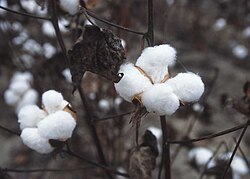
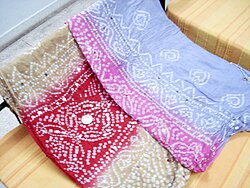
Traditionally, Bharuch has been the centre of the peanut-processing and marketing industry, with a well-established brand name across India.[26] Almost none of the peanuts are grown locally, but the best crops from neighbouring regions are brought here for processing. Bharuch is also the home of the Bandhni method of clothing design and is well known for this traditional art form.
At present, this heavily industrialised area is renowned for its textile mills, chemical plants, long-staple cotton, dairy products, and more. Gujarat's biggest liquid cargo terminal is situated here. It also houses many reputed multinational companies such as Videocon, BASF, Reliance, Welspun Stahl, etc. Bharuch is a shopping centre noted for its salty peanuts. Because of the distinctive colour of its soil, which is ideal for cotton cultivation, Bharuch is sometimes referred to as 'Kanam Pradesh' (black-soil land).
Over the past 60 years, a major part of the population has moved to countries such as the UK, USA, the African nations, and parts of Europe.[27] This migration continues to boost the local economy, as people return for vacations and spend their earnings locally.
Trade[edit | edit source]
Bharuch was a major seaport in the important pre-compass coastal trading routes to points west, perhaps as far back as the days of the Pharaohs, which utilised the regular and predictable monsoon winds or galleys. Many goods from the Far East were trans-shipped here during the annual monsoon winds, making Bharuch a terminus for several key land-sea trade routes. Bharuch was known to the Greeks, the Persian Empires, the Roman Republic and Empire, and other Western centres of civilisation through the end of the European Middle Ages.[2][3]
In the 1st century AD, Bharuch port has been mentioned as Barigaza. Bharuch, then a prosperous and powerful port, remained an important part of Gujarat until the 16th century. Arab traders entered Gujarat via Bharuch. British, Dutch ("Valandas"), and others recognised Bharuch's importance and established premises and local staff here. At the end of the 17th century, the city was plundered twice, but resurged quickly, giving rise to the proverb, "Bhangyu Bhangyu Toye Bharuch".
As a trading depot, the limitations of coastal shipping made Bharuch a regular terminus alongside several mixed trade routes of the famed spice and silk trade between East and West.
The Narmada River's inland access to central and northern India, combined with Bharuch's sheltered position on the Gulf of Khambhat during an era of coastal sea travel, allowed the city to grew and prosper as a transshipment centre and shipbuilding port. Until modern times, water transport was the most effective means of moving goods, and Bharuch offered sheltered waters in an era without weather forecasting or compasses, when navigating was limited to coastal routes. The east–west course of the Narmada gave access to inland empires at its upper reaches, including caravan routes to the Ganges valley and the plains of Delhi.
Between 1500 and 1700, Bharuch was a major textile-manufacturing hub. The city was famous for its bafta, a textile valued in the West and Southeast Asian markets. Bafta cloth was among the leading textile products exported to Europe and other parts of the world.[28]
Present industrial city[edit | edit source]
Modern Bharuch is one of the most heavily industrialised areas, not only in Gujarat but in India as a whole, with many large chemical plants producing fertilisers, paints, dyes, cotton, textiles, and dairy products.
Bharuch also has Gujarat's biggest liquid cargo terminal. A very large fertiliser and chemical company, GNFC Ltd., has been located in Narmadanagar (a suburb of Bharuch) since 1976.
Large Indian and multinational companies, such as the Torrent Group, PepsiCo International, Guardian Corporation, Hitachi, Heubach Colors, Zydus Cadila, Cadila Health Care, Survival Technologies, Videocon, China Light and Power, BASF, Reliance, Tata Group, Aditya Birla Group, Welspun Stahl, Aventis, Gulbrandsen Technologies, Wockhardt, Rallis, Pfizer, Ciba, L&T, Bayer, Glenmark, UPL, Lupin, J B Chemicals, Gujarat Fluorochemicals, NTPC, ONGC, GAIL, OPaL SOlvay, Breeze Intermediates For Flavor & Fragrance Intermediates, Alliance Tyre Group, Fireminich, Astra Specialty Compounds, Dahej and GPEC, have set up manufacturing units in and around Bharuch and Ankleshwar.
Petronet LNG Ltd, one of the fastest-growing companies in the Indian energy sector, has established the country's first LNG receiving and regasification terminal at Dahej. Dahej is now considered one of the fastest-growing industrial areas, with companies such as ONGC, GNFC, Alliance Tyre Group, ABG Shipyard, First carbon, Indofil, Birla copper, Adani, Reliance.[29]
Demographics[edit | edit source]
As of the 2011 India census,[30] Bharuch had a population of 148,391. Males constitute 52% of the population and females 48%. Bharuch has an average literacy rate of 97.06%, much higher than the national average of 74%, with male literacy at 98.5% and female literacy at 95.5%. About 10% of the population is under 6 years of age.
Culture[edit | edit source]
As Bharuch is a renowned tirtha, also known as Bhrigu Tirtha in many of the Hindu Puranas, it hosts a large number of temples along the riverside. There are also a number of mosques in the city, many of them built during the medieval era, and the most famous is the Jamia Masjid Bharuch, built in 1644 during reign of Shah Jahan.[31]
Notable people[edit | edit source]
Mythological figures related to Bharuch include Bhrigu Rishi, Shukra, Chyavana, Chandra, Dattatreya, Durvasa, Vamana, Mahabali, Jamadagni and Parshurama, and the first mystic who self-immolated himself in Athens, Zarmanochegas. Notable historical figures include King Nahapana.
Notable people from recent times include:
- Godrej family, including Ardeshir Godrej and Pirojsha Burjorji Godrej, co-founders of the Godrej Group
- Kanaiyalal Maneklal Munshi (1887–1971), Indian independence movement activist, politician, writer and educationist
- Feroze Gandhi (1912–1960), Indian politician and journalist, husband of Prime Minister Indira Gandhi
- Ahmed Patel (1949–2020), senior leader of the Indian National Congress
- Cyrus Broacha (born 1971), Indian television personality, ancestors were from Bharuch
- Omkarnath Thakur (1897–1967), Indian educator, musicologist, and Hindustani classical singer
- Premchand Roychand (1831–1906), Indian businessman and merchant, founder of the Bombay Stock Exchange
- Tribhuvandas Luhar (1908–1991), Gujarati writer
- Shapurji Broacha (1845–1920), Indian industrialist and philanthropist, sheriff of Bombay during George V's coronation in India
- Ibrahim Ali Patel, politician
Broacha and Bharucha are common surnames among Parsis and Dawoodi Bohras originally from Bharuch.
Places of interest[edit | edit source]
Bharuch City[edit | edit source]
- Bhrigu Rishi Temple. The temple of Bhrigu Rishi, one of the famous and sacred temples of Gujarat, is situated on the eastern side of the city in Dandia Bazar area on the banks of the holy river Narmada. This temple, visited by many pilgrims, has great religious importance to the people of Bharuch. Bharuch, which was originally called 'Bhrigukachchha', derived its name from this temple. The temple was built in honour of the great saint Maharishi Bhrigu, who was able to attain sainthood by reaching the perfect balance between wisdom and activity. It was here that Bhrigu Rishi wrote the first Indian Astrological work, the Bhrigu Samhita. He is said to have documented five million horoscopes, recording the fate of every being in the universe.[32]
- Nav Nathas. There are nine Swayambhu (self-manifested) Shivalingas located at different places in old Bharuch city. These Shivalingas are known as the Nav Naths in Bharuch. They are Kamnath, Jwalnath, Somnath, Bhimnath, Gangnath, Bhootnath, Pingalnath, Siddhnath and Kashi Vishwanath. These nine shivlingas are said to have existed since time immemorial. It was because of these shivlingas that Bhrigu Rishi chose Bharuch for his ashram.
- Temples are found throughout the city, and each holds its own religious significance. The Swaminarayan Temple in Dandia Bazar area of city is 175 years old and hosts a palette of colour on its walls. Narmada Mata Temple, also in Dandia Bazar, is 150 years old and dedicated to Goddess Narmada. The Vaishnav Haveli enshrines an idol of Bal Krishna said to have come from Mathura in 1725. Behind the old Civil Hospital, the Khodiyar Mata Temple overlooks the low-lying area of Furja and offers one of the best views of sunset in the city.[32]
- Gurudwara Chadar Saheb. In the 15th century, Guru Nanak Dev, the first Sikh Guru, visited Bharuch. It is believed that when a boatman refused to take him across the Narmadda, he crosses the river over on a cloth sheet, or chadar. The Gurudwara was later constructed in Kasak area, on the site where he landed in Bharuch.[32]
Surrounding area[edit | edit source]
- Shuklatirth is situated at a distance of about 12 km (7.5 mi) east of Bharuch is a host of many old temples. The most famous of them is Shukleshwar Mahadev Temple. Legend says that Shiva was pleased with the devout Chanakya and guided him to salvation. He instructed Chanakya to start his journey in a black boat at the mouth of the Narmada dress in black and accompanied by a black cow. The place where black would transform into white would mark the location of his liberation. The transformation occurred in Shuklatirth. Shiva stayed with Chanakya at this site in the form of a linga. It is believed that this temple houses that same linga, and that by praying here all sins are purged and desires fulfilled. The Omkarnath Vishnu Mandir has a tall white idol of Vishnu said to have emerged from the Narmada. This idol is made up of sand (it is a self manifested idol), but it appears as if it is made from marble.[33]
- Kabirvad is the island of Banyan trees. Kabirvad is an island on the river Narmada at a distance of about 16 km (10 mi) east of Bharuch city. The main attraction here is a gigantic banyan tree covering an area of more than 2.5 acres. According to legend, it is at this place that saint Kabirdas meditated and the tree grew from a meswak stick (used for brushing the teeth) that was thrown here by the saint. A single tree has over years proliferated into a tree with several trunks and spread in over 2.5 acres of land. Other added attractions here are the lotus shaped marble temple, Kabir museum and boat ride on Narmada river.[34]
Other places of interest[edit | edit source]
- Stambheshwar Mahadev – Kavi Kamboi (45 kilometres (28 miles) from Bharuch) at the estuary of the Mahi River. This Shivalinga is flooded at high tides; not during low tides.[35]
See also[edit | edit source]
Notes[edit | edit source]
References[edit | edit source]
- ↑ Manzo, Andrea; Zazzaro, Chiara; Falco, Diana Joyce De (26 November 2018). Stories of Globalisation: The Red Sea and the Persian Gulf from Late Prehistory to Early Modernity: Selected Papers of Red Sea Project VII. Brill Publishers. p. 386. ISBN 978-90-04-36232-1.
- ↑ 2.0 2.1 Periplus of the Erythraean Sea
- ↑ 3.0 3.1 Periplus of the Erythraean Sea. Depts.washington.edu. Retrieved on 28 July 2013.
- ↑ "History | District Court Bharuch - Gujarat | India". Retrieved 7 March 2025.
- ↑ Munśī, Dhanaprasād Candālāl (1929). Bhārgava brāhmaṇo-no itihās (History of the Bhargava Brahmins). Mumbai: Navlakhī Printing Press, Kālbādevī.
- ↑ "Bharuch-Ankleshwar - The Chemical capital of India".
- ↑ "Dahej Port, Gujarat". Dahej Port, Gujarat. Archived from the original on 29 July 2019. Retrieved 5 January 2021.
- ↑ "Home". safariequipments.co.in.
- ↑ "About Us". dcmshriram.com/. Retrieved 10 February 2023.
- ↑ "Bharuch - Kanam Pradesham".
- ↑ "Bharuch Special Peanuts". kheteshwar.com. SHREE KHETESHWAR SWEETS. Archived from the original on 7 January 2022. Retrieved 7 January 2022.
- ↑ Majumdar, M. R. (1960). Historical and Cultural Chronology of Gujarat. Vadodara, India: Maharaja Sayajirao University of Baroda. p. 26.
- ↑ "Περίπλους της Ερυθράς Θαλάσσης - Βικιθήκη". el.wikisource.org. Retrieved 7 March 2023.
- ↑ "LacusCurtius. Strabo's Geography — Book XV Chapter 1". penelope.uchicago.edu. pp. 39‑73. Retrieved 7 March 2023.
- ↑ Neill, A History of Christianity in India, p. 73
- ↑ Herman Odenberg, The Dipavamsa, New Delhi: Asian Educational Services, 2001. (first printed Berlin 1879)
- ↑ 17.0 17.1 Malabari, Behramji Merwanji; Krishnalal M. Jhaveri (1998). Gujarat and the Gujaratis: Pictures of Men and Manners Taken from Life. Asian Educational Services. p. 2. ISBN 81-206-0651-5.
- ↑ "Zac O'Yeah on modern-day Bharuch that used to be the ancient port town of Barygaza". The Hindu. 11 March 2017. ISSN 0971-751X. Retrieved 7 March 2025.
- ↑ "Internet History Sourcebooks". sourcebooks.fordham.edu. Retrieved 17 October 2022.
- ↑ A Collection of Treaties, Engagements, and Sanads Relating to India and Neighbouring Countries. Indian Political Department. 1892.
Broach was conquered by the Mahrattas in 1685, from which time the Nawabs of Broach continued to hold their territories as subordinates of the Peshwa.
- ↑ Visaria, Pravin; Visaria, Leela; Jain, Anrudh (3 November 1995). Contraceptive Use and Fertility in India: A Case Study of Gujarat. Sage Publishing. p. 64. ISBN 978-0-8039-9253-5.
- ↑ 22.0 22.1 Yājñika, Acyuta; Sheth, Suchitra (2005). The Shaping of Modern Gujarat: Plurality, Hindutva, and Beyond. Penguin Books India. p. 63. ISBN 978-0-14-400038-8.
- ↑ Sen, Sailendra Nath (1994). Anglo-Maratha relations during the administration of Warren Hastings 1772-1785. Popular Prakashan. p. 3. ISBN 978-81-7154-578-0.
- ↑ Stanley Reed (1939). The Indian Year Book 1938-39. Bennett, Coleman & Co. p. 1216.
- ↑ "Bharuch". fallingrain.com. Retrieved 7 March 2023.
- ↑ "Bharuch - Peanut processing and marketing hub".
- ↑ "About". Retrieved 7 March 2023.
- ↑ "Surat in the seventeenth century". 1978.
- ↑ "Petronet LNG Limited". Petronetlng.com. 30 September 2012. Archived from the original on 18 September 2012. Retrieved 8 November 2012.
- ↑ "Census of India 2001: Data from the 2001 Census, including cities, villages and towns (Provisional)". Census Commission of India. Archived from the original on 16 June 2004. Retrieved 1 November 2008.
- ↑ From the book Bhruch Shaher No Itihaas in Gujarati
- ↑ 32.0 32.1 32.2 Desai, Anjali (2007). India Guide Gujarat. India Guide Publications. p. 155. ISBN 978-0-9789517-0-2.
- ↑ Anjali Desai, India Guide Gujarat, India Guide Publications, 2007, page 159, ISBN 978-0-9789517-0-2
- ↑ Anjali Desai, India Guide Gujarat, India Guide Publications, 2007, page 160, ISBN 978-0-9789517-0-2
- ↑ "Archived copy". Archived from the original on 20 November 2011. Retrieved 17 October 2011.
{{cite web}}: CS1 maint: archived copy as title (link)
Further reading[edit | edit source]
- ભૃગુતીર્થ ભરૂચ (Gujarati: Bhrigu Tirtha Bharuch). Bharuch: Office of Information Commissioner.
- Patel, Natvar (2010). ગુજરાત ના પ્રવાસધામો (Gujarati:Tourist Places in Gujarat). Darshita Prakashan. ISBN 978-81-907517-0-4.
- Bharuch Heritage. Monuments and Remains of a Glorious Port Town (bilingual, English and Gujarati). Brochure published by the French Embassy in India and Alliance Française d'Ahmedabad, Content: Michaël Rakotozonia and Sara Keller, Baroda, 2014.
- Rakotozonia, Michaël. Bharuch, the Pearl of the Indian Western coastline. How this port-town made the wealth of the greatest empires that ruled overNorthern India in the Early History. Conference at the Vibrant Gujarat Global Summit Gandhinagar 2014, to be published in post conference volume.
- Keller, Sara (2015). Bharuch. The City Fortress. in: Keller, Pearson (ed), Port Towns of Gujarat, Darshak Itihas Nidhi Post conference volume, Primus, 2015. ISBN 978-93-84082-16-1.
- Keller, Sara. Bharuch Fort: An introduction to the identity of a leading port of the Indian coastline during the pre Sultanate Period. in: Ports of the Indian Ocean (Proceedings of the colloquium organised in Kolkata in 2011 by MeDIan), 17 pp.