



m Removing protection template from an unprotected page |
Shahidkumar (talk | contribs) m page updated |
||
| Line 1: | Line 1: | ||
{{ | {{Short description|Forms of competitive activity, usually physical}} | ||
{{Other uses}} | |||
{{pp-vandalism|small=yes}} | |||
{{pp-move}} | |||
{{Use British English|date=October 2018}} | {{Use British English|date=October 2018}} | ||
{{Use dmy dates|date=August 2023}} | |||
{{Use dmy dates|date= | |||
[[File:Youth-soccer-indiana.jpg|thumb|upright=1.35|right|Sport in [[childhood]]. [[Association football]], shown above, is a [[team sport]] which also provides opportunities to nurture [[physical fitness]] and [[social actions|social interaction]] skills.]] | [[File:Youth-soccer-indiana.jpg|thumb|upright=1.35|right|Sport in [[childhood]]. [[Association football]], shown above, is a [[team sport]] which also provides opportunities to nurture [[physical fitness]] and [[social actions|social interaction]] skills.]] | ||
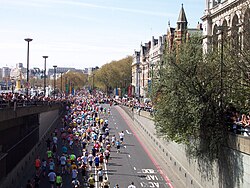
[[File:London Marathon 2005 at Blackfriars.jpg|thumb|The [[2005 London Marathon]]: running races, in their various specialties, represent the oldest and most traditional form of sport.]] | |||
''' | A '''sport''' is a [[physical activity]] or [[game]],<ref name=sportaccord>{{cite web |publisher=SportAccord |url=http://www.sportaccord.com/en/members/index.php?idIndex=32&idContent=14881 |title=Definition of sport |archive-url=https://web.archive.org/web/20111028112912/http://www.sportaccord.com/en/members/index.php?idIndex=32&idContent=14881 |archive-date=28 October 2011}}</ref> often [[Competition|competitive]] and [[organization|organized]], that maintains or improves physical ability and [[skill]]s. Sport may provide enjoyment to participants and [[entertainment]] to spectators.<ref name=council>{{cite web |last=Council of Europe |title=Rec(92)13-rev - on the revised European Sports Charter (adopted by the Committee of Ministers on 24 September 1992 at the 480th meeting of the Ministers' Deputies and revised at their 752nd meeting on 16 May 2001) |date=24 September 1992 |url=https://wcd.coe.int/wcd/ViewDoc.jsp?id=206451 |access-date=5 March 2012 |archive-date=6 June 2020 |archive-url=https://web.archive.org/web/20200606204451/https://search.coe.int/cm/Pages/result_details.aspx?ObjectID=09000016804c9dbb |url-status=live }}</ref> The number of participants in a particular sport can vary from hundreds of people to a single individual. | ||
Sport | Sport competitions may use a [[team]] or single person format, and may be [[Open (sport)|open]], allowing a broad range of participants, or closed, restricting participation to specific groups or those invited. Competitions may allow a "tie" or "draw", in which there is no single winner; others provide [[tie-breaking methods]] to ensure there is only one winner. They also may be arranged in a [[tournament]] format, producing a [[champion]]. Many [[sports league]]s make an annual champion by arranging games in a regular [[sports season]], followed in some cases by [[playoff]]s. | ||
Sport is usually governed by a set of [[regulation of sport|rules]] or [[tradition|customs]], which serve to ensure fair competition | Sport is generally recognised as system of activities based in physical [[athleticism]] or physical [[dexterity]], with major competitions admitting only sports meeting this definition.<ref>{{cite web |url=http://www.olympic.org/sports |title=List of Summer and Winter Olympic Sports and Events |publisher=The Olympic Movement |date=14 November 2018 |access-date=5 March 2012 |archive-date=25 December 2018 |archive-url=https://web.archive.org/web/20181225174712/https://www.olympic.org/sports%20 |url-status=live }}</ref> Some organisations, such as the [[Council of Europe]], preclude activities without any physical element from classification as sports.<ref name=council/> However, a number of competitive, but non-physical, activities claim recognition as [[mind sport]]s. The [[International Olympic Committee]] who oversee the [[Olympic Games]] recognises both [[chess]] and [[Contract bridge|bridge]] as sports. [[SportAccord]], the [[international sport]]s federation association, recognises five non-physical sports: chess, bridge, [[draughts]], [[Go (game)|Go]] and [[xiangqi]].<ref>{{cite web |publisher=SportAccord |title=World Mind Games |url=http://www.sportaccord.com/en/multi-sports-games/index.php?idIndex=35&idContent=658 |archive-url=https://web.archive.org/web/20120508021848/http://www.sportaccord.com/en/multi-sports-games/index.php?idIndex=35&idContent=658 |archive-date=8 May 2012}}</ref><ref>{{cite web |publisher=SportAccord |title=Members |url=http://www.sportaccord.com/en/members/index.php?idContent=644&idIndex=32 |archive-url=https://web.archive.org/web/20120507073823/http://www.sportaccord.com/en/members/index.php?idContent=644&idIndex=32 |archive-date=7 May 2012 }}</ref> However, they limit the number of mind games which can be admitted as sports.<ref name=sportaccord/> Sport is usually governed by a set of [[regulation of sport|rules]] or [[tradition|customs]], which serve to ensure fair competition. Winning can be determined by physical events such as scoring [[goal (sport)|goals]] or crossing a line first. It can also be determined by judges who are scoring elements of the sporting performance, including objective or subjective measures such as technical performance or artistic impression. | ||
Records of performance are often kept, and for popular sports, this information may be widely announced or reported in [[sports journalism|sport news]]. Sport is also a major source of entertainment for non-participants, with [[spectator sport]] drawing large crowds to [[sport venue]]s, and reaching wider audiences through [[broadcasting of sports events|broadcasting]]. [[Sport betting]] is in some cases severely regulated, and in | Records of performance are often kept, and for popular sports, this information may be widely announced or reported in [[sports journalism|sport news]]. Sport is also a major source of entertainment for non-participants, with [[spectator sport]] drawing large crowds to [[sport venue]]s, and reaching wider audiences through [[broadcasting of sports events|broadcasting]]. [[Sport betting]] is in some cases severely regulated, and in others integral to the sport. | ||
According to [[Kearney (consulting firm)|A.T. Kearney]], a consultancy, the global sporting industry is worth up to $620 billion as of 2013.<ref>{{cite news |url=https://www.economist.com/news/international/21585012-sportswomen-are-beginning-score-more-commercial-goalsbut-they-still-have-lot-ground |title=Women in sport: Game, sex and match |newspaper=The Economist |date=7 September 2013}}</ref> The world's most accessible and practised sport is [[running]], while [[association football]] is the most popular spectator sport.<ref name=wa/> | According to [[Kearney (consulting firm)|A.T. Kearney]], a consultancy, the global sporting industry is worth up to $620 billion as of 2013.<ref>{{cite news |url=https://www.economist.com/news/international/21585012-sportswomen-are-beginning-score-more-commercial-goalsbut-they-still-have-lot-ground |title=Women in sport: Game, sex and match |newspaper=The Economist |date=7 September 2013 |access-date=14 September 2017 |archive-date=2 August 2017 |archive-url=https://web.archive.org/web/20170802224933/http://www.economist.com/news/international/21585012-sportswomen-are-beginning-score-more-commercial-goalsbut-they-still-have-lot-ground |url-status=live }}</ref> The world's most accessible and practised sport is [[running]], while [[association football]] is the most popular spectator sport.<ref name="wa">{{cite web |url=https://www.worldatlas.com/articles/what-are-the-most-popular-sports-in-the-world.html |title=The Most Popular Sports in the World |date=2018 |website=www.worldatlas.com |publisher=World Atlas |access-date=17 August 2018 |archive-date=17 August 2018 |archive-url=https://web.archive.org/web/20180817161238/https://www.worldatlas.com/articles/what-are-the-most-popular-sports-in-the-world.html |url-status=live }}</ref> | ||
==Meaning and usage== | ==Meaning and usage== | ||
===Etymology=== | ===Etymology=== | ||
The word " | The word "sport" comes from the [[Old French]] {{Lang|fro|desport}} meaning "[[leisure]]", with the oldest definition in English from around 1300 being "anything humans find amusing or entertaining".<ref>{{cite web |url=http://www.etymonline.com/index.php?search=sport&searchmode=none |title=sport (n.) |access-date=20 April 2008 |first=Douglas |last=Harper |work=Online Etymological Dictionary |archive-date=11 January 2012 |archive-url=https://web.archive.org/web/20120111214311/http://www.etymonline.com/index.php?search=sport&searchmode=none |url-status=live }}</ref> | ||
Other meanings include gambling and events staged for the purpose of gambling; hunting; and games and diversions, including ones that require exercise.<ref>{{cite book |title=Webster's Third New International Dictionary of the English Language, Unabridged |publisher=G&C Merriam Company |location=Springfield, MA |page=2206 |year=1967}}</ref> Roget's defines the noun sport as an "activity engaged in for relaxation and amusement" with synonyms including diversion and recreation.<ref>{{cite book |title=Roget's II: The New Thesaurus | Other meanings include gambling and events staged for the purpose of gambling; hunting; and games and diversions, including ones that require exercise.<ref>{{cite book |title=Webster's Third New International Dictionary of the English Language, Unabridged |publisher=G&C Merriam Company |location=Springfield, MA |page=2206 |year=1967}}</ref> Roget's defines the noun sport as an "activity engaged in for relaxation and amusement" with synonyms including diversion and recreation.<ref>{{cite book |title=Roget's II: The New Thesaurus|edition =3rd|publisher=Houghton Mifflin Harcourt |url=https://archive.org/details/rogetsiiinewthes00houg |year=1995 |isbn=978-0-618-25414-9 |url-access=registration }}</ref> | ||
===Nomenclature=== | ===Nomenclature=== | ||
The singular term "sport" is used in most English dialects to describe the overall concept | The singular term "sport" is used in most English dialects to describe the overall concept, e.g. "children taking part in sport", with "sports" used to describe multiple activities, e.g. "football and rugby are the most popular sports in England". American English uses "sports" for both senses.<ref>{{cite web |title=Sport vs sports – Usage Notes |url=https://dictionary.cambridge.org/grammar/british-grammar/sport-s-sports |publisher=Cambridge University Press |access-date=2025-05-02}}</ref><ref>{{cite web |title=Sport |url=https://www.merriam-webster.com/dictionary/sport |publisher=Merriam-Webster |access-date=2025-05-02}}</ref> | ||
===Definition=== | ===Definition=== | ||
{{see also|Game#Definitions}} | {{see also|Game#Definitions}} | ||
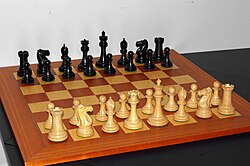
[[File:ChessStartingPosition.jpg|thumb|upright=0.9|right|The [[International Olympic Committee]] recognises some board games as sports including [[chess]].]] | [[File:ChessStartingPosition.jpg|thumb|upright=0.9|right|The [[International Olympic Committee]] recognises some board games as sports, including [[chess]].]] | ||
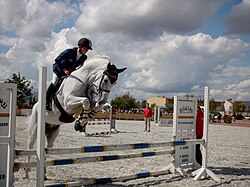
[[File:Showjumping white horse.jpg|thumb|upright=0.9|right|[[Show jumping]], an [[Equestrianism|equestrian]] sport]] | [[File:Showjumping white horse.jpg|thumb|upright=0.9|right|[[Show jumping]], an [[Equestrianism|equestrian]] sport]] | ||
The precise definition of what | The precise definition of what differentiates a sport from other leisure activities varies between sources. The closest to an international agreement on a definition is provided by the [[Global Association of International Sports Federations]] (GAISF), which is the association for all the largest international sports federations (including [[association football]], [[athletics (sport)|athletics]], [[cycling]], [[tennis]], [[equestrianism|equestrian sports]], and more), and is therefore the ''de facto'' representative of international sport. | ||
GAISF uses the following criteria, determining that a sport should:<ref name=sportaccord/> | |||
* have an element of competition | * have an element of competition | ||
* be in no way harmful to any living creature | * be in no way harmful to any living creature | ||
| Line 38: | Line 39: | ||
* not rely on any "luck" element specifically designed into the sport. | * not rely on any "luck" element specifically designed into the sport. | ||
They also recognise that sport can be primarily physical (such as [[rugby union|rugby]] or [[Athletics (sport)|athletics]]), primarily mind (such as [[chess]] or [[Go (game)|Go]]), predominantly motorised (such as [[Formula 1]] or [[powerboating]]), primarily co-ordination (such as [[cue | They also recognise that sport can be primarily physical (such as [[rugby union|rugby]] or [[Athletics (sport)|athletics]]), primarily mind (such as [[chess]] or [[Go (game)|Go]]), predominantly motorised (such as [[Formula 1]] or [[powerboating]]), primarily co-ordination and dexterity (such as [[snooker]] and other [[cue sports]]), or primarily animal-supported (such as [[equestrian sport]]).<ref name=sportaccord/> | ||
The inclusion of mind sports within sport definitions has not been universally accepted, leading to legal challenges from governing bodies in regards to being denied funding available to sports.<ref>{{cite news |work=BBC News |title=Judicial review of 'sport' or 'game' decision begins |url=https://www.bbc.co.uk/news/uk-34320201 |date=2015- | The inclusion of mind sports within sport definitions has not been universally accepted, leading to legal challenges from governing bodies in regards to being denied funding available to sports.<ref>{{cite news |work=BBC News |title=Judicial review of 'sport' or 'game' decision begins |url=https://www.bbc.co.uk/news/uk-34320201 |date=22 September 2015 |access-date=21 June 2018 |archive-date=23 October 2018 |archive-url=https://web.archive.org/web/20181023020304/https://www.bbc.co.uk/news/uk-34320201 |url-status=live }}</ref> Whilst GAISF recognises a small number of mind sports, it is not open to admitting any further mind sports. | ||
There has been an increase in the application of the term "sport" to a wider set of non-physical challenges such as [[video game]]s, also called [[esports]] (from "electronic sports"), especially due to the large scale of participation and organised competition, but these are not widely recognised by mainstream sports organisations. According to [[Council of Europe]], European Sports Charter, article 2.i, {{"'}}Sport' means all forms of physical activity which, through casual or organised participation, aim at expressing or improving physical fitness and mental well-being, forming social relationships or obtaining results in competition at all levels."<ref | There has been an increase in the application of the term "sport" to a wider set of non-physical challenges such as [[video game]]s, also called [[esports]] (from "electronic sports"), especially due to the large scale of participation and organised competition, but these are not widely recognised by mainstream sports organisations. According to [[Council of Europe]], European Sports Charter, article 2.i, {{"'}}Sport' means all forms of physical activity which, through casual or organised participation, aim at expressing or improving physical fitness and mental well-being, forming social relationships or obtaining results in competition at all levels."<ref name=council/> | ||
===Competition=== | ===Competition=== | ||
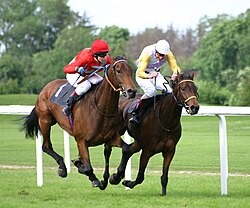
[[File: | [[File:Horse-racing-4.jpg|thumb|left|Horse racing]] | ||
There are opposing views on the necessity of [[competition]] as a defining element of a sport, with almost all [[professional sports]] involving competition, and governing bodies requiring competition as a prerequisite of recognition by the International Olympic Committee (IOC) or | There are opposing views on the necessity of [[competition]] as a defining element of a sport, with almost all [[professional sports]] involving competition, and governing bodies requiring competition as a prerequisite of recognition by the International Olympic Committee (IOC) or GAISF.<ref name=sportaccord/> | ||
Other bodies advocate widening the definition of sport to include all physical activity. For instance, the [[Council of Europe]] | Other bodies advocate widening the definition of sport to include all forms of physical activity, not only organised or competitive events. For instance, the [[Council of Europe]]'s Sports Charter defines "sport" as: "all forms of physical activity which, through casual or organised participation, are aimed at maintaining or improving physical fitness and mental well-being, forming social relationships or obtaining results in competition at all levels", explicitly encompassing recreational exercise undertaken purely for fun.<ref>{{cite web |date=Jun 2022 |title=Revised European Sports Charter – Article 2 |url=https://rm.coe.int/revised-european-sports-charter-web-a6/1680a7534b |publisher=Council of Europe |access-date=2025-05-02}}</ref><ref>{{cite web |title= The Development and Prospects for Community Action in the Field of Sport |date=29 September 1998 |url=https://ec.europa.eu/assets/eac/sport/library/documents/doc252_en.pdf |publisher=European Commission |access-date=2025-05-02}}</ref> | ||
To widen participation, and reduce the impact of losing on less able participants, there has been an introduction of non-competitive physical activity to traditionally competitive events such as school [[sports day]]s, although moves like this can be controversial.<ref>{{cite news |last=Front |first=Rebecca |work=The Guardian |title=A little competition |url=https://www.theguardian.com/commentisfree/2011/jul/17/school-sport-competitive-children-achievement-ambition |date=17 July 2011 |access-date=13 December 2016 |archive-date=15 March 2017 |archive-url=https://web.archive.org/web/20170315143528/https://www.theguardian.com/commentisfree/2011/jul/17/school-sport-competitive-children-achievement-ambition |url-status=live }}</ref><ref>{{cite news |publisher=ParentDish |title=Why parents hate school sports day |last=Scrimgeour |first=Heidi |date=17 June 2011 |url=http://www.parentdish.co.uk/2011/06/17/why-parents-hate-school-sports-day/ |access-date=11 June 2012 |archive-date=24 October 2020 |archive-url=https://web.archive.org/web/20201024182750/http://www.parentdish.co.uk/2011/06/17/why-parents-hate-school-sports-day/ |url-status=live }}</ref> | |||
In competitive events, participants are graded or classified based on their "result" and often divided into groups of comparable performance, | In competitive events, participants are graded or classified based on their "result" and often divided into groups of comparable performance, e.g. gender, weight and age. The measurement of the result may be objective or subjective, and corrected with "handicaps" or penalties. In a race, for example, the time to complete the course is an objective measurement. In [[gymnastics]] or [[diving (sport)|diving]] the result is decided by judges, and therefore subjective. There are shades of judging between boxing and mixed martial arts, where if neither competitor secures a victory before the time limit, the outcome is determined by judges' scorecards. In boxing, three judges independently score each round, based on criteria such as clean punching, effective aggression, ring generalship and defense.<ref>{{cite web |title=ABC Uniform Championship Rules |url=https://www.ibf-usba-boxing.com/wp-content/uploads/ABCUniformChampionshipRules.pdf |publisher=Association of Boxing Commissions |access-date=2025-05-02}}</ref> | ||
==History== | ==History== | ||
{{Main article|History of sport}} | {{Main article|History of sport}} | ||
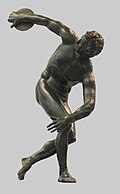
[[File:Roman bronze copy of Myron’s Discobolos, 2nd century CE (Glyptothek Munich).jpg|thumb|upright=0.7|left|[[Ancient Rome|Roman]] bronze reduction of [[Myron]]'s [[Discobolos]], 2nd century AD.]] | [[File:Roman bronze copy of Myron’s Discobolos, 2nd century CE (Glyptothek Munich).jpg|thumb|upright=0.7|left|[[Ancient Rome|Roman]] bronze reduction of [[Myron]]'s [[Discobolos]], 2nd century AD]] | ||
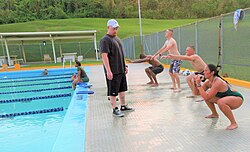
[[File:Participants with the Water Warrior class perform squats prior to entering the pool at Camp Foster, Okinawa, Japan, July 6, 2011 110706-M-VD776-004 (cropped).jpg|thumb|upright=1.2|Swimmers perform [[Squat (exercise)|squats]] as [[warming up|warm-up exercise]] prior to entering the pool in a U.S. military base, 2011.]] | |||
Artifacts and structures suggest [[sport in China]] as early as 2000 BC.<ref>{{cite web |url=http://chineseculture.about.com/library/weekly/aa032301a.htm |title=Sports History in China}}</ref> Gymnastics appears to have been popular in China's ancient past. Monuments to the [[Pharaoh]]s indicate that a number of sports, including swimming and fishing, were well-developed and regulated several thousands of years ago in [[ancient Egypt]].<ref>{{cite web |url=http://www.ioa.leeds.ac.uk/1980s/84085.htm |title= | Artifacts and structures suggest [[sport in China]] as early as 2000 BC.<ref>{{cite web |url=http://chineseculture.about.com/library/weekly/aa032301a.htm |title=Sports History in China |author1=Ye Qinfa |access-date=15 October 2006 |archive-date=3 March 2009 |archive-url=https://web.archive.org/web/20090303183246/http://chineseculture.about.com/library/weekly/aa032301a.htm |url-status=deviated }}</ref> Gymnastics appears to have been popular in China's ancient past. Monuments to the [[Pharaoh]]s indicate that a number of sports, including swimming and fishing, were well-developed and regulated several thousands of years ago in [[ancient Egypt]].<ref>{{cite web |url=http://www.ioa.leeds.ac.uk/1980s/84085.htm |title=84.85-90 History of Sports in Ancient Egypt |first1=Ahmed D. |last1=Touny |website=Proceedings of the International Olympic Academy |archive-url=https://web.archive.org/web/20061029232515/http://www.ioa.leeds.ac.uk/1980s/84085.htm |archive-date=29 October 2006 }}</ref> Other Egyptian sports included javelin throwing, high jump, and wrestling. [[Ancient Persia]]n sports such as the traditional Iranian martial art of [[Zourkhaneh|Zoorkhaneh]] had a close connection to warfare skills.<ref>{{cite web |url=http://www.kuwait-info.com/newsnew/NewsDetails1.asp?id=78319&dt=10/13/2006&ntype=World |title=Ancient sport still flexing its muscles in Iran |website=kuwait-info.com |archive-url=https://web.archive.org/web/20070326081959/http://www.kuwait-info.com/newsnew/NewsDetails1.asp?id=78319&dt=10%2F13%2F2006&ntype=World |archive-date=26 March 2007 }}</ref> Among other sports that originated in ancient Persia are [[polo]] and [[jousting]]. Various [[traditional games of India]] such as [[Kho kho]] and [[Kabbadi]] have been played for thousands of years. The kabaddi was played potentially as a preparation for hunting.<ref>{{Cite web |title=kabaddi {{!}} sport |url=https://www.britannica.com/sports/kabaddi |access-date=21 November 2022 |website=Britannica |language=en}}</ref> | ||
[[File:Bruno Senna 2006 Australian Grand Prix.jpg|thumb|upright=0.9|right|[[Motorsport|Motorised sports]] have appeared since the advent of the modern age.]] | [[File:Bruno Senna 2006 Australian Grand Prix.jpg|thumb|upright=0.9|right|[[Motorsport|Motorised sports]] have appeared since the advent of the modern age.]] | ||
Sports have been increasingly organised and regulated from the time of the ancient Olympics up to the present century. Industrialisation has brought increased [[leisure time]], letting people attend and follow spectator sports and participate in athletic activities. These trends continued with the advent of [[mass media]] and global communication. Professionalism became prevalent, further adding to the increase in sport's popularity, as sports fans followed the exploits of professional | A wide range of sports were already established by the time of [[Ancient Greece]] and the military culture and the development of sport in Greece influenced one another considerably. Sport became such a prominent part of their culture that the Greeks created the [[Olympic Games]], which in ancient times were held every four years in a small village in the [[Peloponnese|Peloponnesus]] called [[Olympia, Greece|Olympia]].<ref>{{cite web|url=http://www.olympic.org/uk/games/ancient/index_uk.asp|title=Ancient Olympic Games|date=30 July 2018|access-date=15 October 2006|archive-date=28 September 2009|archive-url=https://web.archive.org/web/20090928011744/http://www.olympic.org/uk/games/ancient/index_uk.asp|url-status=live}}</ref> | ||
Sports have been increasingly organised and regulated from the time of the ancient Olympics up to the present century. Industrialisation has brought motorised transportation and increased [[leisure time]], letting people attend and follow spectator sports and participate in athletic activities. These trends continued with the advent of [[mass media]] and global communication. Professionalism became prevalent, further adding to the increase in sport's popularity, as sports fans followed the exploits of professional [[athlete]]s – all while enjoying the exercise and competition associated with amateur participation in sports. Since the turn of the 21st century, there has been increasing debate about whether [[transgender]] sports people should be able to participate in sport events that conform with their post-transition [[gender identity]].<ref>''Sport and the Law: Historical and Cultural Intersections'', p. 111, Sarah K. Fields (2014){{ISBN?}}|</ref> | |||
==Fair play== | ==Fair play== | ||
| Line 72: | Line 74: | ||
{{See also|Gamesmanship|Winning isn't everything; it's the only thing}} | {{See also|Gamesmanship|Winning isn't everything; it's the only thing}} | ||
Sportsmanship is an attitude that strives for fair play, courtesy toward teammates and opponents, ethical behaviour and integrity, and grace in victory or defeat.<ref>{{cite web |url=http://www.merriam.com/cgi-bin/dictionary?va=sportsmanship |publisher=Merriam-Webster |title=Sportsmanship}}</ref><ref>{{cite book |last1=Fish |first1=Joel |last2=Magee |first2=Susan |year=2003 |title=101 Ways to Be a Terrific Sports Parent |publisher=Fireside |page=168}}</ref><ref>{{cite news |last=Lacey |first=David |date=10 November 2007 |url=http://blogs.guardian.co.uk/sport/2007/11/10/it_takes_a_bad_loser_to_become.html |title=It takes a bad loser to become a good winner |work=The Guardian}}</ref> | Sportsmanship is an attitude that strives for fair play, courtesy toward teammates and opponents, ethical behaviour and integrity, and grace in victory or defeat.<ref>{{cite web |url=http://www.merriam.com/cgi-bin/dictionary?va=sportsmanship |publisher=Merriam-Webster |title=Sportsmanship |access-date=15 October 2006 |archive-date=28 September 2007 |archive-url=https://web.archive.org/web/20070928231236/http://www.merriam.com/cgi-bin/dictionary?va=sportsmanship |url-status=live }}</ref><ref>{{cite book |last1=Fish |first1=Joel |last2=Magee |first2=Susan |year=2003 |title=101 Ways to Be a Terrific Sports Parent |publisher=Fireside |page=168}}</ref><ref>{{cite news |last=Lacey |first=David |date=10 November 2007 |url=http://blogs.guardian.co.uk/sport/2007/11/10/it_takes_a_bad_loser_to_become.html |title=It takes a bad loser to become a good winner |work=The Guardian |access-date=28 October 2009 |archive-date=13 January 2008 |archive-url=https://web.archive.org/web/20080113021424/http://blogs.guardian.co.uk/sport/2007/11/10/it_takes_a_bad_loser_to_become.html |url-status=dead }}</ref> | ||
Sportsmanship expresses an aspiration or ethos that the activity will be enjoyed for its own sake. The well-known sentiment by sports journalist [[Grantland Rice]], that it's | Sportsmanship expresses an aspiration or ethos that the activity will be enjoyed for its own sake. The well-known sentiment by sports journalist [[Grantland Rice]], that it is "it's not whether you win or lose, but how you play the game,"<ref>{{cite web |title=Rice, Grantland |url=https://tshf.net/halloffame/rice-grantland/ |publisher=Tennessee Sports Hall of Fame |access-date=2025-05-02}}</ref> and the modern Olympic creed expressed by its founder [[Pierre de Coubertin]]: "The most important thing in the Olympic Games is not to win but to take part," are typical expressions of this sentiment.<ref>{{cite web |title=Fundamentals of Olympic Values Education |publisher=International Olympic Committee |url=https://stillmed.olympic.org/media/Document%20Library/OlympicOrg/Documents/Document-Set-Teachers-The-Main-Olympic-Topics/Olympism-and-the-Olympic-Movement.pdf |access-date=2025-05-02}}</ref> | ||
===Cheating=== | ===Cheating=== | ||
{{see also|Match fixing|cheating}} | {{see also|Match fixing|cheating}} | ||
Key principles of sport include that the result should not be predetermined, and | Key principles of sport include that the result should not be predetermined, and all participants must have an equal opportunity to win.<ref>{{cite web|title=European Sports Charter, Article 3|url=https://www.coe.int/en/web/sport/european-sports-charter|publisher=Council of Europe|access-date=2025-05-02}}</ref> Rules and regulations are established by governing bodies to ensure fair play and integrity.<ref>{{cite web|title=International Charter of Physical Education, Physical Activity and Sport, Article 10|url=http://unesdoc.unesco.org/ark:/48223/pf0000235409|publisher=UNESCO|access-date=2025-05-02}}</ref> However, participants sometimes breach these rules to gain an unfair advantage.<ref>{{cite web|title=Fair play and the competitive spirit|url=https://unesdoc.unesco.org/ark:/48223/pf0000093013|publisher=UNESCO|access-date=2025-05-02}}</ref> | ||
Participants may cheat | Participants may cheat to increase their chances of winning, secure financial gain or other benefit.<ref>{{cite web|title=Global Report on Corruption in Sport|url=https://www.unodc.org/documents/corruption/Publications/2022/Global_Report_on_Corruption_in_Sport_Full_report.pdf|publisher=United Nations Office on Drugs and Crime|access-date=2025-05-02}}</ref> The prevalence of [[gambling]] on sporting outcomes creates incentives for [[match fixing]], in which one or more participants collude to predetermine results rather than compete honestly.<ref>{{cite web|title=Staying on Side: How to Stop Match-Fixing|url=https://images.transparencycdn.org/images/2014_Stop_MatchFixing_EN.pdf|publisher=Transparency International|access-date=2025-05-02}}</ref> | ||
===Doping and drugs=== | ===Doping and drugs=== | ||
{{main article|Use of performance-enhancing drugs in sport}} | {{main article|Use of performance-enhancing drugs in sport}} | ||
The competitive nature of sport encourages some participants to attempt to enhance their performance through | The competitive nature of sport encourages some participants to attempt to enhance their performance through medicines, or other means such as [[Blood doping|increasing the volume of blood in their bodies]] through artificial means.<ref name="Baron2007">{{cite journal |last1=Baron |first1=David A. |last2=Martin |first2=David M. |last3=Abol Magd |first3=Samir |title=Doping in sports and its spread to at-risk populations: an international review |journal=World Psychiatry |year=2007 |volume=6 |issue=2 |pages=118–123 |pmid=18235871|pmc=2219897 }}</ref> | ||
All sports recognised by the IOC or SportAccord are required to implement a testing programme, looking for a list of banned drugs, with suspensions or bans being placed on participants who test positive for banned substances. | All sports recognised by the IOC, or SportAccord, are required to implement a testing programme, looking for a list of banned drugs, with suspensions or bans being placed on participants who test positive for banned substances.<ref>{{cite web |title=Prohibited List |url=https://www.wada-ama.org/en/prohibited-list |publisher=World Anti-Doping Agency |access-date=2025-05-02}}</ref><ref>{{cite web |title=World Anti-Doping Code |url=https://www.wada-ama.org/en/what-we-do/world-anti-doping-code |publisher=World Anti-Doping Agency |access-date=2025-05-02}}</ref> | ||
===Violence=== | ===Violence=== | ||
[[Violence in sports]] involves crossing the line between fair competition and intentional aggressive violence. Athletes, coaches, fans, and parents sometimes unleash violent behaviour on people or property, in misguided shows of loyalty, dominance, anger, or celebration. [[Rioting]] or [[hooliganism]] by fans in particular is a problem at some national and international sporting contests.{{ | [[Violence in sports]] involves crossing the line between fair competition and intentional aggressive violence. Athletes, coaches, fans, and parents sometimes unleash violent behaviour on people or property, in misguided shows of loyalty, dominance, anger, or celebration. [[Rioting]] or [[hooliganism]] by fans in particular is a problem at some national and international sporting contests.<ref>{{cite journal |last=Russell |first=Gareth |title=Sport riots: A social–psychological review |journal=Aggression and Violent Behavior |year=2004 |volume=9 |issue=5 |pages=353–378|doi=10.1016/S1359-1789(03)00031-4 }}</ref><ref>{{cite web |title=Guide on the Security of Major Sporting Events |url=https://www.un.org/counterterrorism/sites/www.un.org.counterterrorism/files/211006_guide_on_security_major_sporting_events_web.pdf |publisher=United Nations |access-date=2025-05-02}}</ref> | ||
==Participation== | ==Participation== | ||
===Gender participation=== | ===Gender participation=== | ||
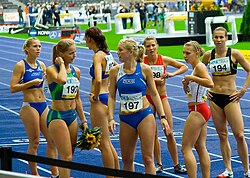
[[File:100 metres race winner Sina Schielke (192) and the other Runners - ISTAF 2006 - Berlin, 3 September.jpg|thumb | {{see also|Women's sports}} | ||
{{ | [[File:100 metres race winner Sina Schielke (192) and the other Runners - ISTAF 2006 - Berlin, 3 September.jpg|thumb|International level female athletes at [[ISTAF Berlin]], 2006]] | ||
{{see | Female participation in sports has risen alongside expanded opportunities and growing recognition of the benefits of athletic activity for [[child development]] and [[physical fitness]].<ref>{{cite journal |last1=Eime |first1=Rochelle M. |last2=Young |first2=Janet A. |last3=Harvey |first3=Jack T. |last4=Charity |first4=Melanie J. |last5=Payne |first5=Warren R. |title=A systematic review of the psychological and social benefits of participation in sport for children and adolescents |journal=International Journal of Behavioral Nutrition and Physical Activity |year=2013 |volume=10 |issue=98 |page=98 |doi=10.1186/1479-5868-10-98|doi-access=free |pmid=23945179 |pmc=3751802 }}</ref> Despite these gains, a gender gap persists. At Olympic level, women accounted for 49% at Tokyo 2020,<ref name="RioTokyoWSF">{{cite news |title=Paris 2024 should see gender parity – WSF study |url=https://www.reuters.com/lifestyle/sports/paris-2024-should-see-gender-parity-wsf-study-2022-04-21/ |publisher=Reuters |date=2022-04-21 |access-date=2025-05-02}}</ref> reaching full 50 % parity at Paris 2024.<ref name="GenderParity2024">{{cite news |last=Reid |first=Helen |title=Women athletes say the work isn't over after Olympics gender parity |url=https://www.reuters.com/sports/olympics/women-athletes-say-work-isnt-over-after-olympics-gender-parity-2024-07-28/ |publisher=Reuters |date=2024-07-28 |access-date=2025-05-02}}</ref> But global surveys report only 20% of women versus 31% of men participate in sporting activity monthly,<ref name="YouGovGap">{{cite web |last=Shah |first=Kineree |title=The great divide – exploring the gender gap in sports viewership |url=https://business.yougov.com/content/46311-the-great-divide-exploring-gender-gap-in-sports-viewership |publisher=YouGov |date=2023-03-10 |access-date=2025-05-02}}</ref> and the World Health Organization notes women are 5 percentage points less likely than men to meet recommended activity guidelines.<ref name="WHOActivity">{{cite web |title=Physical activity fact sheet |url=https://www.who.int/news-room/fact-sheets/detail/physical-activity |publisher=World Health Organization |access-date=2025-05-02}}</ref> | ||
Certain [[Mixed-sex sport|sports are mixed-sex]], allowing, or even requiring, men and women to play on the same team. One example of this is [[Baseball5]], which is the first mixed-gender sport to be admitted to the Olympics.<ref>{{Cite web |title=Debut of Baseball5 at Youth Olympic Games postponed as next YOG shifted from 2022 to 2026 |url=http://www.wbsc.org/en/news/debut-of-baseball5-at-youth-olympic-games-postponed-as-next-yog-shifted-from-2022-to-2026 |access-date=21 November 2022 |website=World Baseball Softball Confederation |language=en}}</ref> | |||
===Youth participation=== | ===Youth participation=== | ||
{{See also|College sports}} | |||
{{See also|College | Youth sport presents children with opportunities for fun, socialisation, forming peer relationships, [[physical fitness]], and [[athletic scholarship]]s. Activists for [[education]] and the [[war on drugs]] encourage youth sport as a means to increase [[Participation inequality|educational participation]] and to fight the [[illegal drug trade]]. According to the [[Nationwide Children's Hospital (Columbus)#Research and education|Center for Injury Research and Policy at Nationwide Children's Hospital]], the biggest risk for youth sport is death or serious injury including [[concussion]]. These risks come from running, basketball, association football, volleyball, gridiron, gymnastics, and ice hockey.<ref>[https://healthland.time.com/2009/08/04/why-are-more-kids-getting-hurt-in-gym-class/ "Gym class injuries up 150% between 1997 and 2007"], ''Time'', 4 August 2009</ref> Youth sport in the US is a $15 billion industry including equipment up to private coaching.<ref>{{cite magazine |last1=Gregory |first1=Sean |title=How Kids' Sports Became a $15 Billion Industry |url=https://time.com/4913687/how-kids-sports-became-15-billion-industry/ |access-date=24 August 2017 |magazine=[[Time (magazine)|Time]] |date=24 August 2017 |archive-date=24 August 2017 |archive-url=https://web.archive.org/web/20170824112734/http://time.com/4913687/how-kids-sports-became-15-billion-industry/ |url-status=live }}</ref> | ||
Youth sport presents children with opportunities for fun, socialisation, forming peer relationships, [[physical fitness]], and [[athletic scholarship]]s. Activists for [[education]] and the [[war on drugs]] encourage youth sport as a means to increase [[Participation inequality|educational participation]] and to fight the [[illegal drug trade]]. According to the [[Nationwide Children's Hospital (Columbus)#Research and education|Center for Injury Research and Policy at Nationwide Children's Hospital]], the biggest risk for youth sport is death or serious injury including [[concussion]]. These risks come from running, basketball, association football, volleyball, gridiron, gymnastics, and ice hockey.<ref>[ | |||
===Disabled participation=== | ===Disabled participation=== | ||
[[File:David Bizet - Marathon de Paris 2014.jpg|thumb | {{see also|Parasports|Paralympic Games}} | ||
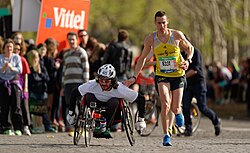
[[File:David Bizet - Marathon de Paris 2014.jpg|thumb|A runner gives a friendly tap on the shoulder to a wheelchair racer during the [[Paris Marathon|''Marathon International de Paris'' (Paris Marathon)]] in 2014.]] | |||
Disabled or adaptive sports are played by people with a [[disability]], including [[physical disability|physical]] and [[intellectual disabilities]].<ref>{{cite web |title=Para Sport |url=https://www.paralympic.org/paralympic-sport |publisher=International Paralympic Committee |access-date=2025-05-02}}</ref> As many of these are based on existing sports modified to meet the needs of people with a disability, they are sometimes referred to as ''adapted sports''.<ref>{{cite journal |last1=Misener |first1=Laura |last2=Kissack |first2=Travis |title=Social inclusion through sport: Community coaching and participation of people with disabilities in sport |journal=Sport Management Review |year=2010 |volume=13 |issue=1 |pages=49–67 |doi=10.1016/j.smr.2009.10.001}}</ref> However, not all [[disabled sports]] are adapted; several that have been specifically created for people with a disability have no equivalent in able-bodied sports, such as [[goalball]] and [[boccia]].<ref>{{cite web |title=Sitting Volleyball, Goalball and Boccia |url=https://www.paralympic.org/sports |publisher=International Paralympic Committee |access-date=2025-05-02}}</ref> | |||
===Older participation=== | |||
{{see also|Masters athletics|Masters cycling|Masters swimming}} | |||
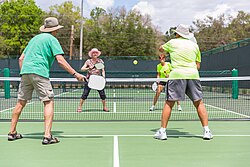
[[File:Pickleball Players.jpg|thumb|right|[[Pickleball]] is a sport particularly attractive to older players.]] | |||
'''Masters sport''', '''senior sport''', or '''veteran sport''' is an age category of sport, that usually contains age groups of those 35 and older.<ref>{{cite web|url=https://teara.govt.nz/en/veterans-and-masters-sport|title=Story: Veterans and masters sport|publisher=govt.nz|access-date=28 March 2020}}</ref> It may concern unaltered or adapted sport activities, with and without competitions. | |||
'''Competitions''' | |||
* [[World Masters Games]] organized since 1985 every four years. | |||
* [[European Masters Games]] organized for the first time in 2008 and then since 2011 every four years. | |||
* [[Senior Olympics]] (Senior Games) | |||
* [[USATF Masters Outdoor Championships]] began 1968 | |||
* [[USATF Masters Indoor Championships]] began 1975 | |||
* [[World Masters Athletics Championships]] began 1975 | |||
===Spectator involvement=== | ===Spectator involvement=== | ||
{{Main article|Spectator sport}} | |||
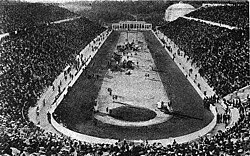
[[File:1906 Athens stadium.jpg|thumb|right|Spectators at the 1906 unofficial Olympic Games]] | [[File:1906 Athens stadium.jpg|thumb|right|Spectators at the 1906 unofficial Olympic Games]] | ||
The competition element of sport, along with the aesthetic appeal of some disciplines, has resulted in the phenomenon of spectator sport. Amateur and professional sports attract audiences in person at venues and via broadcast media—radio, television and internet streaming—each of which may levy fees such as entrance tickets or [[pay-per-view]] subscriptions.<ref>{{cite encyclopedia |title=Spectator sport |encyclopedia=Encyclopædia Britannica Online |url=https://www.britannica.com/sports/spectator-sport |access-date=2025-05-02}}</ref> [[Sports league]]s and tournaments provide the primary organisational frameworks for regular competition among teams or individual athletes.<ref>{{cite book |last=Fort |first=Rogelio |title=Sports Economics |publisher=Prentice Hall |year=2015 |isbn=978-0133452485}}</ref> | |||
High-profile events command vast audiences, driving lucrative media-rights deals. The 2006 FIFA World Cup final drew over 700 million viewers worldwide,<ref>{{cite web |title=2006 FIFA World Cup™ Media Report |url=http://www.fifa.com/worldcup/archive/germany2006/organisation/media/media-reports.html |publisher=FIFA |archive-url=https://web.archive.org/web/20120101000000/http://www.fifa.com/worldcup/archive/germany2006/organisation/media/media-reports.html |access-date=2025-05-02|archive-date=1 January 2012 }}</ref> and the 2011 Cricket World Cup final was watched by approximately 135 million viewers in India alone.<ref name="CWC2011">{{cite news |title=135 mn saw World Cup final: TAM |date=10 April 2011 |url=http://www.hindustantimes.com/business-news/135-mn-saw-World-Cup-final-TAM/Article1-683623.aspx |newspaper=Hindustan Times |access-date=2025-05-02 |archive-url=https://web.archive.org/web/20130803013151/http://www.hindustantimes.com/business-news/135-mn-saw-World-Cup-final-TAM/Article1-683623.aspx |archive-date=2013-08-03}}</ref> In the US, the Super Bowl ranks as the most-watched annual television broadcast, with Super Bowl XLIX in 2015 averaging 114 million viewers.<ref>{{cite web |last=Nielsen |title=Super Bowl XLIX Sets U.S. Viewership Record |url=http://www.nielsen.com/us/en/insights/news/2015/super-bowl-xlix-most-watched-telecast-in-u-s--history.html |publisher=Nielsen |date=2015-02-02 |access-date=2025-05-02}}</ref> Super Bowl Sunday is considered an unofficial national holiday, and in 2015 a 30-second advertising spot sold for approximately US$4.5 million.<ref>{{cite web |title=Super Bowl Ads Cost US$4.5M for 30-Second Spot |url=https://adage.com/article/media/super-bowl-ads-cost-4-5m-30-spot/296163 |publisher=Ad Age |date=2015-01-30 |access-date=2025-05-02}}</ref> | |||
Super Bowl | |||
==Amateur and professional== | ==Amateur and professional== | ||
{{See also|Professional sport|Amateur sport}} | {{See also|Professional sport|Amateur sport}} | ||
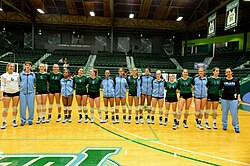
[[File:Volleyball-5 (9786053885).jpg|thumb|Women's volleyball team of a U.S. university]] | |||
Sport can be undertaken on an amateur, professional or semi-professional basis, depending on whether participants are incentivised for participation (usually through payment of a [[wage]] or [[salary]]). Amateur participation in sport at lower levels is often called "grassroots sport".<ref name="council"/><ref name="White Paper">{{cite web |publisher=European Commission |title=The White Paper on Sport |url=http://ec.europa.eu/sport/white-paper/index_en.htm |access-date=11 July 2007 |archive-url=https://web.archive.org/web/20080916202200/http://ec.europa.eu/sport/white-paper/index_en.htm |archive-date=16 September 2008}}</ref> | Sport can be undertaken on an amateur, professional or semi-professional basis, depending on whether participants are incentivised for participation (usually through payment of a [[wage]] or [[salary]]). Amateur participation in sport at lower levels is often called "grassroots sport".<ref name="council"/><ref name="White Paper">{{cite web |publisher=European Commission |title=The White Paper on Sport |url=http://ec.europa.eu/sport/white-paper/index_en.htm |access-date=11 July 2007 |archive-url=https://web.archive.org/web/20080916202200/http://ec.europa.eu/sport/white-paper/index_en.htm |archive-date=16 September 2008}}</ref> | ||
The popularity of [[spectator sport]] as a recreation for non-participants has led to sport becoming a major business in its own right, and this has incentivised a high paying [[professional sport]] culture, where high performing participants are rewarded with pay far in excess of average wages, which can run into millions of dollars.<ref>{{cite | The popularity of [[spectator sport]] as a recreation for non-participants has led to sport becoming a major business in its own right, and this has incentivised a high paying [[professional sport]] culture, where high performing participants are rewarded with pay far in excess of average wages, which can run into millions of dollars.<ref>{{cite magazine |magazine=Sports Illustrated |url=http://sportsillustrated.cnn.com/specials/fortunate50-2011/index.html |title=Fortunate 50 2011 |last=Freedman |first=Jonah |access-date=5 March 2012 |archive-date=29 April 2014 |archive-url=https://web.archive.org/web/20140429050301/http://sportsillustrated.cnn.com/specials/fortunate50-2011/index.html }}</ref> | ||
Some sports, or individual competitions within a sport, retain a policy of allowing only [[amateur sport]]. The | Some sports, or individual competitions within a sport, retain a policy of allowing only [[amateur sport]]. The Olympic Games started with a principle of amateur competition with those who practised a sport professionally considered to have an unfair advantage over those who practised it merely as a hobby.<ref name=OIdeology>{{cite book |last=Eassom |first=Simon |title=Critical Reflections on Olympic Ideology |year=1994 |location=Ontario |publisher=The Centre for Olympic Studies |pages=120–123 |isbn=978-0-7714-1697-2}}</ref> From 1971, Olympic [[athlete]]s were allowed to receive compensation and [[sponsorship]],<ref name="InfoPlease">{{cite web |url=http://www.infoplease.com/spot/olympic-athletes.html |title=Olympic Athletes |publisher=Info Please |access-date=13 June 2015 |archive-date=16 June 2015 |archive-url=https://web.archive.org/web/20150616042315/http://www.infoplease.com/spot/olympic-athletes.html |url-status=live }}</ref> and from 1986, the IOC decided to make all professional athletes eligible for the Olympics,<ref name="InfoPlease"/><ref>{{cite web |url=https://edition.cnn.com/2012/07/22/opinion/greene-olympics-amateurs/ |title=What changed the Olympics forever |publisher=CNN |date=23 July 2012 |access-date=13 June 2015 |archive-date=15 June 2015 |archive-url=https://web.archive.org/web/20150615122848/http://edition.cnn.com/2012/07/22/opinion/greene-olympics-amateurs/ |url-status=live }}</ref> with the exceptions of [[boxing]],<ref>{{cite web |url=http://www.insidethegames.biz/articles/13894/olympic-boxing-must-remain-amateur-despite-moves-to-turn-it-professional-states-warren- |title=Olympic boxing must remain amateur despite moves to turn it professional states Warren |publisher=Inside the Games |date=13 August 2011 |access-date=13 June 2015 |archive-date=15 June 2015 |archive-url=https://web.archive.org/web/20150615044539/http://www.insidethegames.biz/articles/13894/olympic-boxing-must-remain-amateur-despite-moves-to-turn-it-professional-states-warren- |url-status=live }}</ref><ref>{{cite book |url=https://books.google.com/books?id=njefAgAAQBAJ&q=only+amateur+boxers+at+olympics&pg=PA400 |title=Historical Dictionary of Boxing |last1=Grasso |first1=John |date=2013 |publisher=Scarecrow Press |access-date=13 June 2015 |isbn=978-0-8108-7867-9 |archive-date=17 April 2021 |archive-url=https://web.archive.org/web/20210417060735/https://books.google.com/books?id=njefAgAAQBAJ&q=only+amateur+boxers+at+olympics&pg=PA400 |url-status=live }}</ref> and wrestling.<ref>{{cite web |url=http://bleacherreport.com/articles/1529280-olympic-wrestling-is-important-for-pro-wrestlers-and-its-fans |title=Olympic Wrestling Is Important for Pro Wrestling and Its Fans|author-first1=John|author-last1=Canton|publisher=Bleacher Report |date=14 February 2013 |access-date=13 June 2015 |archive-date=16 June 2015 |archive-url=https://web.archive.org/web/20150616155635/http://bleacherreport.com/articles/1529280-olympic-wrestling-is-important-for-pro-wrestlers-and-its-fans |url-status=live }}</ref><ref>{{cite book |url=https://books.google.com/books?id=2WYEAAAAMBAJ&q=only+amateur+wrestlers+at+olympics&pg=PA24 |title=Boys' Life |date=August 1988 |page=24 |access-date=13 June 2015 |publisher=Boy Scouts of America, Inc. |archive-date=17 April 2021 |archive-url=https://web.archive.org/web/20210417073533/https://books.google.com/books?id=2WYEAAAAMBAJ&q=only+amateur+wrestlers+at+olympics&pg=PA24 |url-status=live }}</ref> | ||
==Technology== | ==Technology== | ||
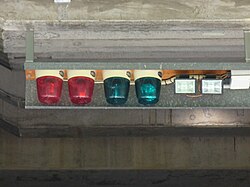
[[File:Third umpire lights at Melbourne Cricket Ground.JPG|thumb|These lights at the [[Melbourne Cricket Ground]] indicate the decision the third umpire makes following a review.]] | [[File:Third umpire lights at Melbourne Cricket Ground.JPG|thumb|These lights at the [[Melbourne Cricket Ground]] indicate the decision the third umpire makes following a review.]] | ||
Technology plays an important part in modern sport. | Technology plays an important part in modern sport. It is a necessary part of some sports (such as motorsport), and it is used in others to improve performance. Some sports also use it to allow off-field decision making. | ||
[[Sports science]] | [[Sports science]] can be applied to areas including athlete performance, such as the use of video analysis to fine-tune technique, or to equipment, such as improved [[running shoe]]s or [[competitive swimwear]]. [[Sports engineering]] emerged as a discipline in 1998 with an increasing focus not just on materials design but also the use of technology in sport, from analytics and big data to [[wearable technology]].<ref name="Gaining Steam in Sports Technology">{{cite web |title=Gaining Steam in Sports Technology |url=https://alum.mit.edu/pages/sliceofmit/2014/06/17/mit-steam-sports-technology/ |archive-url=https://web.archive.org/web/20140714150052/https://alum.mit.edu/pages/sliceofmit/2014/06/17/mit-steam-sports-technology/ |archive-date=14 July 2014 |website=Slice of MIT |access-date=3 January 2015 |ref=Slice of MIT}}</ref> In order to control the impact of technology on fair play, governing bodies frequently have specific rules that are set to control the impact of technical advantage between participants. For example, in 2010, full-body, non-textile swimsuits were banned by [[FINA]], as they were enhancing swimmers' performances.<ref>{{cite web |url=https://news.bbc.co.uk/sport2/hi/other_sports/swimming/8161867.stm |title=Hi-tech suits banned from January |publisher=BBC Sport |date=31 July 2009 |access-date=8 June 2015 |archive-date=8 September 2017 |archive-url=https://web.archive.org/web/20170908051335/http://news.bbc.co.uk/sport1/hi/other_sports/swimming/8161867.stm |url-status=live }}</ref><ref>{{cite web |url=https://abcnews.go.com/Politics/full-body-swimsuit-now-banned-professional-swimmers/story?id=9437780 |first=Kristina |last=Wong |title=Full Body Swimsuit Now Banned for Professional Swimmers |work=ABC News |date=4 January 2010 |access-date=8 June 2015 |archive-date=7 June 2015 |archive-url=https://web.archive.org/web/20150607200059/http://abcnews.go.com/Politics/full-body-swimsuit-now-banned-professional-swimmers/story?id=9437780 |url-status=live }}</ref> | ||
The increase in technology has also allowed many decisions in sports matches to be taken, or reviewed, off-field, with another official using instant replays to make decisions. In some sports, players can now challenge decisions made by officials. In [[Association football]], [[goal-line technology]] makes decisions on whether a ball has crossed the goal line or not.<ref>{{cite journal |last=FIFA |title=Testing Manual |journal=FIFA Quality Programme for Goal Line Technology |year=2012 |url=https://www.fifa.com/mm/document/fifaqualityprogramme/goal-linetechnology/01/66/02/89/glt_testing_manual_2012.pdf|archive-url=https://web.archive.org/web/20121030143223/http://www.fifa.com/mm/document/fifaqualityprogramme/goal-linetechnology/01/66/02/89/glt%5Ftesting%5Fmanual%5F2012.pdf | The increase in technology has also allowed many decisions in sports matches to be taken, or reviewed, off-field, with another official using instant replays to make decisions. In some sports, players can now challenge decisions made by officials. In [[Association football]], [[goal-line technology]] makes decisions on whether a ball has crossed the goal line or not.<ref>{{cite journal |last=FIFA |title=Testing Manual |journal=FIFA Quality Programme for Goal Line Technology |year=2012 |url=https://www.fifa.com/mm/document/fifaqualityprogramme/goal-linetechnology/01/66/02/89/glt_testing_manual_2012.pdf|archive-url=https://web.archive.org/web/20121030143223/http://www.fifa.com/mm/document/fifaqualityprogramme/goal-linetechnology/01/66/02/89/glt%5Ftesting%5Fmanual%5F2012.pdf|archive-date=30 October 2012}}</ref> The technology is not compulsory,<ref name=IFABofficial>{{cite web |title=IFAB makes three unanimous historic decisions |url=https://www.fifa.com/about-fifa/news/y=2012/m=7/news=ifab-makes-three-unanimous-historic-decisions-1660541.html |archive-url=https://web.archive.org/web/20150507234418/http://www.fifa.com/about-fifa/news/y=2012/m=7/news=ifab-makes-three-unanimous-historic-decisions-1660541.html |archive-date=7 May 2015 |publisher=FIFA |access-date=23 April 2015}}</ref> but was used in the [[2014 FIFA World Cup]] in Brazil,<ref>{{cite web |url=https://www.fifa.com/worldcup/news/y=2014/m=4/news=goal-line-technology-set-ahead-fifa-world-cup-2311481.html |archive-url=https://web.archive.org/web/20140511001351/http://www.fifa.com/worldcup/news/y=2014/m=4/news=goal-line-technology-set-ahead-fifa-world-cup-2311481.html |archive-date=11 May 2014 |title=Goal-line technology set up ahead of FIFA World Cup |date=1 April 2014 |publisher=FIFA |access-date=9 June 2015}}</ref> and the [[2015 FIFA Women's World Cup]] in Canada,<ref>{{cite web |url=https://www.fifa.com/womensworldcup/news/y=2015/m=3/news=hawk-eye-confirmed-as-goal-line-technology-provider-for-canada-2015-2580727.html |archive-url=https://web.archive.org/web/20150331170115/http://www.fifa.com/womensworldcup/news/y=2015/m=3/news=hawk-eye-confirmed-as-goal-line-technology-provider-for-canada-2015-2580727.html |archive-date=31 March 2015 |title=Hawk-Eye confirmed as goal-line technology provider for Canada 2015 |date=31 March 2015 |publisher=[[FIFA]] |access-date=2 June 2015}}</ref> as well as in the [[Premier League]] from [[2013–14 Premier League|2013–14]],<ref name="BBC_Premier">{{cite news |url=https://www.bbc.co.uk/sport/football/22107409 |title=Goal-line technology: Premier League votes in favour for 2013–14 |publisher=BBC |date=11 April 2013 |access-date=11 April 2013 |archive-date=11 April 2013 |archive-url=https://web.archive.org/web/20130411143514/http://www.bbc.co.uk/sport/0/football/22107409 |url-status=live }}</ref> and the [[Bundesliga]] from [[2015–16 Bundesliga|2015–16]].<ref>{{cite web |url=http://www.carlyleobserver.com/sports/bundesliga-approves-hawk-eye-goal-line-technology-for-new-season-1.1650074 |title=Bundesliga approves Hawk-Eye goal-line technology for new season |work=Carlyle Observer |access-date=9 June 2015 |archive-date=29 October 2020 |archive-url=https://web.archive.org/web/20201029003339/https://www.carlyleobserver.com/sports/bundesliga-approves-hawk-eye-goal-line-technology-for-new-season-1.1650074 |url-status=live }}</ref> In the [[NFL]], a referee can ask for a review from the replay booth, or a head [[Coach (sport)|coach]] can issue a [[Challenge (NFL)|challenge]] to review the play using replays. The final decision rests with the referee.<ref>{{cite web |url=https://www.nfl.com/news/nfl-approves-rule-to-change-replay-process-0ap2000000336662 |title=NFL approves rule to change replay process |publisher=Business Insider |date=20 July 2011 |access-date=8 June 2015 |archive-date=8 June 2015 |archive-url=https://web.archive.org/web/20150608173617/http://www.nfl.com/news/story/0ap2000000336662/article/nfl-approves-rule-to-change-replay-process |url-status=live }}</ref> A video referee (commonly known as a [[Television match official#Television match official|Television Match Official]] or TMO) can also use replays to help decision-making in rugby (both [[Rugby league|league]] and [[Rugby union|union]]).<ref>{{cite web |url=http://www.rugbyworld.com/news/blogs/television-match-official-when-can-they-rule-14818 |title=Television Match Official – when can they rule |publisher=Rugby World |date=20 August 2011 |access-date=8 June 2015 |archive-date=8 June 2015 |archive-url=https://web.archive.org/web/20150608222853/http://www.rugbyworld.com/news/blogs/television-match-official-when-can-they-rule-14818 |url-status=live }}</ref><ref>{{cite news |url=https://www.telegraph.co.uk/sport/rugbyunion/club/9488451/New-rules-for-Television-Match-Officials-will-not-make-game-boring-to-watch-insist-rugby-chiefs.html |archive-url=https://ghostarchive.org/archive/20220110/https://www.telegraph.co.uk/sport/rugbyunion/club/9488451/New-rules-for-Television-Match-Officials-will-not-make-game-boring-to-watch-insist-rugby-chiefs.html |archive-date=10 January 2022 |url-access=subscription |url-status=live |title=New rules for Television Match Officials will not make game boring to watch, insist rugby chiefs |work=The Telegraph |date=20 August 2012 |access-date=8 June 2015|last1=Cleary |first1=Mick }}{{cbignore}}</ref> In international cricket, an umpire can ask the [[Third umpire]] for a decision, and the third umpire makes the final decision.<ref name="BBC Umpire">{{cite news |url=https://news.bbc.co.uk/sport2/hi/cricket/rules_and_equipment/4183398.stm |title=The role of cricket umpires |publisher=BBC Sport |access-date=8 June 2015 |date=26 August 2005 |archive-date=2 March 2007 |archive-url=https://web.archive.org/web/20070302114814/http://news.bbc.co.uk/sport1/hi/cricket/rules_and_equipment/4183398.stm |url-status=live }}</ref><ref name="Top End">{{cite web |url=http://www.topendsports.com/sport/cricket/technology.htm |title=Cricket Technology |publisher=Top End Sports |access-date=8 June 2015 |archive-date=8 June 2015 |archive-url=https://web.archive.org/web/20150608175247/http://www.topendsports.com/sport/cricket/technology.htm |url-status=live }}</ref> Since 2008, a [[Umpire Decision Review System|decision review system]] for players to review decisions has been introduced and used in [[International Cricket Council|ICC]]-run tournaments, and optionally in other matches.<ref name="BBC Umpire"/><ref>{{cite web |url=http://zeenews.india.com/sports/cricket/controversial-drs-to-be-used-in-2015-icc-world-cup_1538054.html |title=Controversial DRS to be used in 2015 ICC World Cup |publisher=Zee News |date=29 January 2015 |access-date=8 June 2015 |archive-date=8 June 2015 |archive-url=https://web.archive.org/web/20150608222859/http://zeenews.india.com/sports/cricket/controversial-drs-to-be-used-in-2015-icc-world-cup_1538054.html |url-status=live }}</ref> Depending on the host broadcaster, a number of different technologies are used during an umpire or player review, including instant replays, [[Hawk-Eye]], [[Hot Spot (cricket)|Hot Spot]] and [[Snickometer|Real Time Snickometer]].<ref>{{cite web |url=http://www.espncricinfo.com/icc-cricket-world-cup-2015/content/story/827213.html |title=Hawkeye, Realtime Snicko for World Cup |publisher=ESPNcricinfo |date=7 February 2015 |access-date=8 June 2015 |archive-date=10 June 2015 |archive-url=https://web.archive.org/web/20150610075356/http://www.espncricinfo.com/icc-cricket-world-cup-2015/content/story/827213.html |url-status=live }}</ref><ref>{{cite news |url=http://www.rediff.com/cricket/report/icc-world-cup-3-top-reasons-why-did-not-use-hotspot-as-part-of-drs/20150213.htm |title=3 Top reasons why ICC did not use 'Hotspot' as part of DRS |newspaper=Rediff |publisher=Rediff cricket |date=13 February 2015 |access-date=8 June 2015 |archive-date=8 June 2015 |archive-url=https://web.archive.org/web/20150608195717/http://www.rediff.com/cricket/report/icc-world-cup-3-top-reasons-why-did-not-use-hotspot-as-part-of-drs/20150213.htm |url-status=live }}</ref> Hawk-Eye is also used in tennis to challenge umpiring decisions.<ref>{{cite web |last1=Almog |first1=David |last2=Gauriot |first2=Romain |last3=Page |first3=Lionel |last4=Martin |first4=Daniel |title=AI Has Entered the Court. Is This Changing Umpires’ Calls? |url=https://insight.kellogg.northwestern.edu/article/ai-has-entered-the-court-is-this-changing-umpires-calls |website=Kellogg Insight |publisher=[[Kellogg School of Management]] |access-date=23 February 2026 |language=en |date=1 April 2024}}</ref><ref>{{cite news |url=https://news.bbc.co.uk/sport2/hi/tennis/7305404.stm |title=Hawk-Eye challenge rules unified |date=19 March 2008 |access-date=22 August 2008 |work=BBC News |archive-date=23 March 2008 |archive-url=https://web.archive.org/web/20080323085536/http://news.bbc.co.uk/sport1/hi/tennis/7305404.stm |url-status=live }}</ref> | ||
== Sports and education == | == Sports and education == | ||
Research suggests that sports have the capacity to connect [[youth]] to positive adult role models and provide positive development opportunities, as well as promote the learning and application of life [[ | Research suggests that sports have the capacity to connect [[youth]] to positive adult role models and provide positive development opportunities, as well as promote the learning and application of life [[skill]]s.<ref>{{Cite journal |last1=Fraser-Thomas |first1=Jessica L. |last2=Côté |first2=Jean |last3=Deakin |first3=Janice |date=2005 |title=Youth sport programs: an avenue to foster positive youth development |url=https://www.researchgate.net/publication/43501126 |journal=Physical Education & Sport Pedagogy |language=en |volume=10 |issue=1 |pages=19–40 |doi=10.1080/1740898042000334890 |hdl=1974/14425 |issn=1740-8989|hdl-access=free }}</ref><ref name=":0">{{Cite book|last=UNESCO|url=https://unesdoc.unesco.org/ark:/48223/pf0000366771|title=Strengthening the rule of law through education: a guide for policymakers|publisher=UNESCO|year=2019|isbn=978-92-3-100308-0|access-date=9 March 2020|archive-date=25 February 2020|archive-url=https://web.archive.org/web/20200225195201/https://unesdoc.unesco.org/ark:/48223/pf0000366771|url-status=live}}</ref> In recent years the use of sport to reduce [[crime]], as well as to prevent [[violent extremism]] and [[radicalization]], has become more widespread, especially as a tool to improve [[self-esteem]], enhance social bonds and provide participants with a feeling of purpose.<ref name=":0" /> | ||
There is no high-quality evidence that shows the effectiveness of interventions to increase sports participation of the community in sports such as mass media campaigns, educational sessions, and policy changes.<ref>{{cite journal |last1=Priest |first1=N |last2=Armstrong |first2=R |last3=Doyle |first3=J |last4=Waters |first4=E |date=16 July 2008 |title=Interventions Implemented Through Sporting Organisations for Increasing Participation in Sport |journal=Cochrane Database of Systematic Reviews |issue=3 |article-number=CD004812 |doi=10.1002/14651858.CD004812.pub3 |pmid=18646112 |hdl-access=free |hdl=1885/285237|issn = 1464-780X }}</ref> There is also no high-quality studies that investigate the effect of such interventions in promoting healthy behaviour change in the community.<ref>{{cite journal |first1=Priest |last1=N |first2=Armstrong |last2=R |first3=Doyle |last3=J |first4=Water |last4=E |title=Policy Interventions Implemented Through Sporting Organisations for Promoting Healthy Behaviour Change |journal=Cochrane Database of Systematic Reviews |date=16 July 2008 |volume=2008 |issue=3 |article-number=CD004809 |doi=10.1002/14651858.CD004809.pub3 |pmid=18646111 |pmc=6464902}}</ref> | |||
Educational qualifications are available in sport: for example, sports science is a well-established [[academic discipline]]. In the UK, a BTEC National Diploma in [[Sports Coaching]] and Development is offered by [[Pearson Education]].<ref>Pearson Education, [https://qualifications.pearson.com/en/qualifications/btec-nationals/sports-coaching-and-development-2019.html Sports Coaching and Development (2019)], accessed on 29 August 2025</ref> There are four qualifications in this family: | |||
*Extended Certificate in Sports Coaching | |||
*Foundation Diploma in Sports Coaching and Development | |||
*Diploma in Sports Coaching and Development | |||
*[[BTEC Extended Diploma|Extended Diploma]] in Sports Coaching and Development.<ref>Pearson Education, [https://qualifications.pearson.com/content/dam/pdf/BTEC-Nationals/sports-coaching-and-development/2019/specification-and-sample-assessments/btec-nats-non-measures-sports-coaching-and-development-spec.pdf Pearson BTEC Level 3 Nationals in Sports Coaching], accessed on 18 June 2022</ref> | |||
==Politics== | ==Politics== | ||
{{Main article|Politics and sports}} | {{Main article|Politics and sports}} | ||
{{ | {{See also|Sportswashing}} | ||
[[Benito Mussolini]] used the [[1934 FIFA World Cup]], held in Italy, to showcase [[Kingdom of Italy#Fascist regime (1922–1943)|Fascist Italy]].<ref>{{cite book |url=https://books.google.com/books?id=HWj7BgAAQBAJ&pg=PA28 |title=Soccer Vs. the State: Tackling Football and Radical Politics |last1=Kuhn |first1=Gabriel |date=2011 |page=28 |publisher=PM Press |access-date=8 June 2015 |isbn=978-1-60486-053-5 |archive-date=16 December 2019 |archive-url=https://web.archive.org/web/20191216073648/https://books.google.com/books?id=HWj7BgAAQBAJ&pg=PA28 |url-status=live }}</ref><ref name="World Fascism">{{cite book |url=https://books.google.com/books?id=nvD2rZSVau4C&pg=PA630 |title=World Fascism: A Historical Encyclopedia, Volume 1 |last1=Blamires |first1=Cyprian |date=2006 |pages=630–632 |publisher=Bloomsbury Academic |access-date=8 June 2015 |isbn=978-1-57607-940-9 |archive-date=13 December 2019 |archive-url=https://web.archive.org/web/20191213050912/https://books.google.com/books?id=nvD2rZSVau4C&pg=PA630 |url-status=live }}</ref> [[Adolf Hitler]] used the [[1936 Summer Olympics]] held in [[Berlin]], and the [[1936 Winter Olympics]] held in [[Garmisch-Partenkirchen]], to promote the [[Nazi ideology]] of the superiority of the [[Aryan race]], and inferiority of the Jews and other "[[Untermensch|undesirables]]".<ref name="World Fascism"/><ref name="Sociology Sport">{{cite book |url=https://books.google.com/books?id=uKarC6oX3P8C&q=hitler+used+1936+olympics+to+promote+ideology&pg=PT32 |title=The Sociology of Sport and Physical Education |last1=Saxena |first1=Anurag |year=2001 |publisher=Pinnacle Technology |access-date=8 June 2015 |isbn=978-1-61820-468-4 }}{{Dead link|date=April 2024 |bot=InternetArchiveBot |fix-attempted=yes }}</ref> Germany used the Olympics to give off a peaceful image while secretly preparing for war.<ref>''[[Kulttuurivihkot]]'' 1 2009 Berliinin olympialaiset 1936 Poliittisen viattomuuden menetys Jouko Jokisalo 28–29{{in lang|fi}}</ref> | |||
When [[apartheid]] was official policy in South Africa, many sports people, particularly in [[rugby union]], adopted the conscientious approach that they should not appear in competitive sports there. Some feel this was an effective contribution to the eventual end of apartheid, others feel it may have prolonged and reinforced its worst effects.<ref>{{cite journal |title=Sport and apartheid|journal=History Compass|volume=3|pages= **|doi=10.1111/j.1478-0542.2005.00165.x|year = 2005|last1 = Merrett|first1 = Christopher}}</ref> | |||
[[ | In the history of Ireland, Gaelic sports were connected with [[cultural nationalism]]. Until the mid-20th century a person could have been banned from playing [[Gaelic football]], [[hurling]], or other sports administered by the [[Gaelic Athletic Association]] (GAA) if she/he played or supported [[Association football]], or other games seen to be of [[Great Britain|British]] origin. The GAA banned the playing of football and [[rugby union]] at Gaelic venues. This ban, also known as Rule 42,<ref>{{Cite journal |last1=Fulton |first1=Gareth |last2=Bairner |first2=Alan |year=2007 |title=Sport, Space and National Identity in Ireland: The GAA, Croke Park and Rule 42. |journal=Space & Polity |volume=11 |issue=1 |pages=55–74 |doi=10.1080/13562570701406592 |s2cid=143213001 }}</ref> is still enforced, but was modified to allow football and rugby to be played in [[Croke Park]] while [[Lansdowne Road]] was redeveloped into [[Aviva Stadium]]. Under Rule 21, the GAA banned members of the British security forces and members of the [[Royal Ulster Constabulary|RUC]] from playing Gaelic games, but the advent of the [[Good Friday Agreement]] in 1998 led to removal of the ban.<ref>{{Cite web |title=50th anniversary of abolition of 'The Ban' offers pause for perspective |url=https://www.gaa.ie/news/50th-anniversary-of-abolition-of-the-ban-offers-pause-for-perspective/ |access-date=2 July 2023 |website=www.gaa.ie |date=9 April 2021 |language=en}}</ref> | ||
[[Nationalism]] is often evident in the pursuit of sport or in its reporting: athletes compete in national teams, and commentators or audiences frequently adopt partisan perspectives.<ref>{{cite journal|last=Arnold|first=Richard|title=Nationalism and Sport: A Review of the Field|journal=Nationalities Papers|year=2020|volume=49|issue=1|pages=2–11|doi=10.1017/nps.2020.9}}</ref> On occasion, such tensions erupt into violence among players or spectators, as during the 1969 [[Football War]] between El Salvador and Honduras, a conflict sparked by rioting at World Cup qualifiers.<ref>{{cite news|last=Jennings|first=Andrew|title=Has football ever started a war?|work=The Guardian|date=2007-02-21|url=https://www.theguardian.com/football/2007/feb/21/theknowledge.sport|access-date=2025-05-02}}</ref> Such episodes are viewed as contrary to the fundamental ethos of sport—namely, that it be contested for its own sake and for the enjoyment of participants. Politics and sport tragically intersected at the [[1972 Munich Olympics]], when Palestinian militants infiltrated the Olympic Village, took Israeli team members hostage, and ultimately killed 11 athletes in what became known as the [[Munich massacre]].<ref>{{cite news|publisher=Reuters|title=Paris ceremony honours Israeli athletes killed in 1972 Munich Games attack|date=2024-08-06|url=https://www.reuters.com/sports/olympics/paris-ceremony-honours-israeli-athletes-killed-1972-munich-games-attack-2024-08-06/|access-date=2025-05-02}}</ref> | |||
A study of US elections has shown that the result of sports events can affect the results. A study published in the [[Proceedings of the National Academy of Sciences]] showed that when the home team wins the game before the election, the incumbent candidates can increase their share of the vote by 1.5 | A study of US elections has shown that the result of sports events can affect the results. A study published in the [[Proceedings of the National Academy of Sciences]] showed that when the home team wins the game before the election, the incumbent candidates can increase their share of the vote by 1.5%. A loss had the opposite effect, and the effect is greater for higher-profile teams or unexpected wins and losses.<ref>{{cite news |title=Will Ohio State's Football Team Decide Who Wins the White House? |author1=Tyler Cowen |author2=Kevin Grier |work=[[Slate (magazine)|Slate]] |date=24 October 2012 |url=http://www.slate.com/articles/news_and_politics/politics/2012/10/how_the_presidential_race_between_barack_obama_and_mitt_romney_could_be.html |access-date=29 December 2013 |archive-date=30 December 2013 |archive-url=https://web.archive.org/web/20131230233509/http://www.slate.com/articles/news_and_politics/politics/2012/10/how_the_presidential_race_between_barack_obama_and_mitt_romney_could_be.html |url-status=live }}</ref> When the [[Washington Commanders]] win their final game before an election, then the incumbent president is more likely to win, and if they lose, then the opposition candidate is more likely to win; this has become known as the [[Redskins Rule]].<ref>{{cite news |url=https://www.washingtonpost.com/blogs/football-insider/wp/2012/11/03/will-redskins-rule-again-determine-outcome-of-presidential-election/ |title=Will Redskins Rule again determine outcome of presidential election? |author=Mike Jones |date=3 November 2012 |newspaper=The Washington Post |access-date=14 September 2017 |archive-date=7 November 2014 |archive-url=https://web.archive.org/web/20141107110626/http://www.washingtonpost.com/blogs/football-insider/wp/2012/11/03/will-redskins-rule-again-determine-outcome-of-presidential-election/ |url-status=live }}</ref><ref>{{cite web |url=http://www.espnfrontrow.com/2012/10/redskins-rule-mnfs-hirdt-on-intersection-of-football-politics/ |title='Redskins Rule': MNF's Hirdt on intersection of football & politics |work=ESPN Front Row |date=30 October 2012 |access-date=12 June 2015 |archive-date=17 November 2015 |archive-url=https://web.archive.org/web/20151117032035/http://www.espnfrontrow.com/2012/10/redskins-rule-mnfs-hirdt-on-intersection-of-football-politics/ |url-status=live }}</ref> | ||
===As a means of controlling and subduing populations=== | ===As a means of controlling and subduing populations=== | ||
[[Étienne de La Boétie]], in his essay ''[[Discourse on Voluntary Servitude]]'' describes athletic spectacles as means for tyrants to control their subjects by distracting them. | [[Étienne de La Boétie]], in his essay ''[[Discourse on Voluntary Servitude]]'' describes athletic spectacles as means for tyrants to control their subjects by distracting them. | ||
<blockquote> | <blockquote> | ||
Do not imagine that there is any bird more easily caught by decoy, nor any fish sooner fixed on the hook by wormy bait, than are all these poor fools neatly tricked into servitude | Do not imagine that there is any bird more easily caught by decoy, nor any fish sooner fixed on the hook by wormy bait, than are all these poor fools neatly tricked into servitude...they let themselves be caught so quickly at the slightest tickling of their fancy. Plays, farces, spectacles, gladiators, strange beasts, medals, pictures, and other such opiates, these were for ancient peoples the bait toward slavery, the price of their liberty, the instruments of tyranny. By these...enticements the ancient dictators so successfully lulled their subjects under the yoke, that the stupefied peoples, fascinated by the pastimes and vain pleasures flashed before their eyes, learned subservience as naïvely...as little children learn to read by looking at bright picture books.<ref>[[Étienne de La Boétie]], ''[[Discourse on Voluntary Servitude]]'' (1549), Part 2</ref> | ||
</blockquote> | </blockquote>During the British rule of [[Bengal]], British and European sports began to supplant [[Bengali traditional games|traditional Bengali sports]], resulting in a loss of native culture.<ref>{{Cite web|url=https://dergipark.org.tr/tr/download/article-file/904168|archive-url=https://web.archive.org/web/20221126161837/https://dergipark.org.tr/tr/download/article-file/904168|title=Disappearance of Traditional games by the imitation of Colonial Culture through the Historical parameters of Cultural Colonialism|archive-date=26 November 2022}}</ref><ref>{{Cite web|url=https://dergipark.org.tr/tr/|archive-url=https://web.archive.org/web/20190801043229/https://dergipark.org.tr/|title=Ana Sayfa » DergiPark|archive-date=1 August 2019|website=dergipark.org.tr}}</ref> | ||
In communist controlled [[East Germany]], from the 1970s to 1990, 'an estimated 3,000 unofficial collaborators were used each year in top-level sport, including many football players, fans and referees'.<ref>{{cite book |last1=Mike Dennis |first1=Norman LaPorte |title=State and Minorities in Communist East Germany |date=2011 |publisher=Berghahn Books |isbn=978-0-857-45-195-8 |page=125 |chapter=Football fans, hooligans and the state}}</ref> Among the most important reasons for the [[Stasi]] setting up this extensive network of collaborators was to prevent athletes escaping to the West, using both methods of surveillance and repression.<ref>{{cite book |last1=Mike Dennis |first1=Norman LaPorte |title=State and Minorities in Communist East Germany |date=2011 |publisher=Berghahn Books |isbn=978-0-857-45-195-8 |page=125 |chapter=Football fans, hooligans and the state}}</ref> | |||
==Religious views== | ==Religious views== | ||
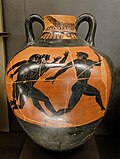
[[File:Panathenaic amphora Kleophrades Louvre F277.jpg|thumb|The foot race was one of the events dedicated to Zeus. Panathenaic amphora, Kleophrades painter, | {{main|New Testament athletic metaphors}} | ||
Sport was an important form of worship in [[Ancient Greek religion]]. The [[ancient Olympic Games]] | [[File:Panathenaic amphora Kleophrades Louvre F277.jpg|thumb|The foot race was one of the events dedicated to Zeus. Panathenaic amphora, Kleophrades painter, {{Circa|500 BC}}, Louvre museum.]] | ||
Sport was an important form of worship in [[Ancient Greek religion]]. The [[ancient Olympic Games]] were held in honour of the head deity, [[Zeus]], and featured various forms of religious dedication to him and other gods.<ref>Gardinier, Norman E., 'The Olympic Festival' in ''Greek Athletic Sports and Festivals'', London: MacMillan, 1910, p.195</ref> Many Greeks travelled to see the games and the combination of religious pilgrimage and sport served as a way of uniting them as one people.<ref>{{cite book |last1=Harker |first1=Barry H. |title=Strange Fire: Christianity and the Rise of Modern Olympianism |date=2006 |publisher=Hartland Publications |location=Rapidan |isbn=0-923309-39-X |page=75 |chapter=6: Olympia and Jerusalem}}</ref> | |||
The practice of athletic competitions has been criticised by some Christian thinkers as a form of [[idolatry]], in which "human beings extol themselves, adore themselves, sacrifice themselves and reward themselves."<ref name=Watson1>''Sports and Christianity: Historical and Contemporary Perspectives'', Nick J. Watson, ed. (Routledge: 2013), p. 178.</ref> Sports are seen by these critics as a manifestation of "collective pride" and "national self-deification" in which feats of human power are | The practice of athletic competitions has been criticised by some Christian thinkers as a form of [[idolatry]], in which "human beings extol themselves, adore themselves, sacrifice themselves and reward themselves."<ref name=Watson1>''Sports and Christianity: Historical and Contemporary Perspectives'', Nick J. Watson, ed. (Routledge: 2013), p. 178.</ref> Sports are seen by these critics as a manifestation of "collective pride" and "national self-deification" in which feats of human power are idolised at the expense of divine worship.<ref name=Watson1/> | ||
[[Tertullian]] condemns the athletic performances of his day, insisting "the entire apparatus of the shows is based upon idolatry."<ref>[[Tertullian]], ''[[De spectaculis]]'', Chapter 4.</ref> The shows, says Tertullian, excite passions foreign to the calm temperament cultivated by the Christian: | [[Tertullian]] condemns the athletic performances of his day, insisting "the entire apparatus of the shows is based upon idolatry."<ref>[[Tertullian]], ''[[De spectaculis]]'', Chapter 4.</ref> The shows, says Tertullian, excite passions foreign to the calm temperament cultivated by the Christian: | ||
| Line 174: | Line 193: | ||
God has enjoined us to deal calmly, gently, quietly, and peacefully with the Holy Spirit, because these things are alone in keeping with the goodness of His nature, with His tenderness and sensitiveness. ... Well, how shall this be made to accord with the shows? For the show always leads to spiritual agitation, since where there is pleasure, there is keenness of feeling giving pleasure its zest; and where there is keenness of feeling, there is rivalry giving in turn its zest to that. Then, too, where you have rivalry, you have rage, bitterness, wrath and grief, with all bad things which flow from them – the whole entirely out of keeping with the religion of Christ.<ref>''[[De spectaculis]]'' Chapter 15.</ref> | God has enjoined us to deal calmly, gently, quietly, and peacefully with the Holy Spirit, because these things are alone in keeping with the goodness of His nature, with His tenderness and sensitiveness. ... Well, how shall this be made to accord with the shows? For the show always leads to spiritual agitation, since where there is pleasure, there is keenness of feeling giving pleasure its zest; and where there is keenness of feeling, there is rivalry giving in turn its zest to that. Then, too, where you have rivalry, you have rage, bitterness, wrath and grief, with all bad things which flow from them – the whole entirely out of keeping with the religion of Christ.<ref>''[[De spectaculis]]'' Chapter 15.</ref> | ||
</blockquote> | </blockquote> | ||
Christian clerics in the [[Wesleyan-Holiness movement]] oppose the viewing of or participation in professional sports, believing that professional sports leagues [[Sabbath desecration|profane the Sabbath]] | Christian clerics in the [[Wesleyan-Holiness movement]] oppose the viewing of or participation in professional sports, believing that professional sports leagues [[Sabbath desecration|profane the Sabbath]], compete with a Christian's primary commitment to God, exhibit a lack of modesty in the players' and cheerleaders' uniforms, are associated with violence and extensive use of profanity among many players, and encourage gambling, as well as alcohol and other drugs at sporting events, which go against a commitment to [[teetotalism]].<ref name="Handel2020">{{cite book |last1=Handel |first1=Paul S. |title=Reasons Why Organized Sports Are Not Pleasing to God |date=2020 |publisher=Immanuel Missionary Church |page=4 |language=English}}</ref> | ||
==See also== | ==See also== | ||
{{Portal|Sports}} | {{Portal|Sports}} | ||
{{div col|colwidth=30em}} | {{div col|colwidth=30em}} | ||
* [[List of sports]] | * [[List of sports]] | ||
* [[List of sports attendance figures]] | * [[List of sports attendance figures]] | ||
* [[List of professional sports leagues]] | * [[List of professional sports leagues]] | ||
* [[New | * [[Lists of sportspeople]] | ||
* [[List of exercise activities]] | |||
* [[New media]] | |||
* [[Outline of sports]] | |||
{{div col end}} | {{div col end}} | ||
'''Related topics''' | '''Related topics''' | ||
{{Div col|colwidth= | |||
{{Div col|colwidth=19em}} | |||
* [[Animals in sport]] | * [[Animals in sport]] | ||
* [[Combat sport]] | * [[Combat sport]] | ||
* [[Fan (person)]] | * [[Fan (person)]] | ||
* [[Handedness# | * [[Handedness#Sports]] | ||
* [[Lawn game]] | * [[Lawn game]] | ||
* [[ | * [[List of sports terms named after people]] | ||
* [[ | * [[Motorsport]] | ||
* [[Multi-sport | * [[Multi-sport event]] | ||
* [[National sport]] | * [[National sport]] | ||
* [[Nationalism and sports]] | * [[Nationalism and sports]] | ||
* [[ | * [[Penalty card]] | ||
* [[Physical education]] | * [[Physical education]] | ||
* [[Sport in film]] | * [[Sport in film]] | ||
* [[Sport psychology]] | * [[Sport psychology]] | ||
* [[Sports club]] | * [[Sports club]] | ||
* [[Sports commentator]] | * [[Sports commentator]] | ||
* [[Sports entertainment]] | * [[Sports entertainment]] | ||
| Line 259: | Line 234: | ||
* [[Sports marketing]] | * [[Sports marketing]] | ||
* [[Sports nutrition]] | * [[Sports nutrition]] | ||
* [[Sports trainer]] | * [[Sports trainer]] | ||
* [[ | * [[Sportswear]] | ||
* [[Sunday sporting events]] | * [[Sunday sporting events]] | ||
* [[Team sport]] | * [[Team sport]] | ||
* [[Traditional sports and games]] | |||
* [[Underwater sports]] | * [[Underwater sports]] | ||
* [[Women's sports]] | * [[Women's sports]] | ||
| Line 271: | Line 245: | ||
{{div col end}} | {{div col end}} | ||
== Sources == | ==References== | ||
{{Free-content attribution | {{Reflist}} | ||
===Sources=== | |||
* European Commission (2007), ''The White Paper on Sport'' | |||
* Council of Europe (2001), ''The European sport charter'' | |||
*{{Free-content attribution | |||
| title = Strengthening the rule of law through education: a guide for policymakers | | title = Strengthening the rule of law through education: a guide for policymakers | ||
| publisher = UNESCO | | publisher = UNESCO | ||
| page numbers = | | page numbers = | ||
| documentURL = https://unesdoc.unesco.org/ark:/48223/pf0000366771 | | documentURL = https://unesdoc.unesco.org/ark:/48223/pf0000366771 | ||
| license statement URL = | | license statement URL = | ||
| license = CC BY-SA 3.0 IGO | | license = CC BY-SA 3.0 IGO | ||
}} | }} | ||
==Further reading== | ==Further reading== | ||
{{Sister project links|Sports|voy=Sport}} | |||
* ''The Meaning of Sports'' by Michael Mandel (PublicAffairs, {{ISBN|1-58648-252-1}}). | * ''The Meaning of Sports'' by Michael Mandel (PublicAffairs, {{ISBN|1-58648-252-1}}). | ||
* [ | * [https://www.tandfonline.com/journals/rjps20 ''Journal of the Philosophy of Sport''] | ||
* Sullivan, George. ''The Complete Sports Dictionary''. New York: Scholastic Book Services, 1979. 199 | * Sullivan, George. ''The Complete Sports Dictionary''. New York: Scholastic Book Services, 1979. p. 199. {{ISBN|0-590-05731-6}} | ||
{{Sport}} | {{Sport}} | ||
{{ | {{Entertainment}} | ||
{{Types of games}} | {{Types of games}} | ||
{{Authority control}} | {{Authority control}} | ||
[[Category:Sports| ]] | [[Category:Sports| ]] | ||
[[Category: | [[Category:Culture]] | ||
[[Category:Social events]] | |||
[[Category:Social | |||
Latest revision as of 14:45, 16 March 2026


A sport is a physical activity or game,[1] often competitive and organized, that maintains or improves physical ability and skills. Sport may provide enjoyment to participants and entertainment to spectators.[2] The number of participants in a particular sport can vary from hundreds of people to a single individual.
Sport competitions may use a team or single person format, and may be open, allowing a broad range of participants, or closed, restricting participation to specific groups or those invited. Competitions may allow a "tie" or "draw", in which there is no single winner; others provide tie-breaking methods to ensure there is only one winner. They also may be arranged in a tournament format, producing a champion. Many sports leagues make an annual champion by arranging games in a regular sports season, followed in some cases by playoffs.
Sport is generally recognised as system of activities based in physical athleticism or physical dexterity, with major competitions admitting only sports meeting this definition.[3] Some organisations, such as the Council of Europe, preclude activities without any physical element from classification as sports.[2] However, a number of competitive, but non-physical, activities claim recognition as mind sports. The International Olympic Committee who oversee the Olympic Games recognises both chess and bridge as sports. SportAccord, the international sports federation association, recognises five non-physical sports: chess, bridge, draughts, Go and xiangqi.[4][5] However, they limit the number of mind games which can be admitted as sports.[1] Sport is usually governed by a set of rules or customs, which serve to ensure fair competition. Winning can be determined by physical events such as scoring goals or crossing a line first. It can also be determined by judges who are scoring elements of the sporting performance, including objective or subjective measures such as technical performance or artistic impression.
Records of performance are often kept, and for popular sports, this information may be widely announced or reported in sport news. Sport is also a major source of entertainment for non-participants, with spectator sport drawing large crowds to sport venues, and reaching wider audiences through broadcasting. Sport betting is in some cases severely regulated, and in others integral to the sport.
According to A.T. Kearney, a consultancy, the global sporting industry is worth up to $620 billion as of 2013.[6] The world's most accessible and practised sport is running, while association football is the most popular spectator sport.[7]
Meaning and usage[edit | edit source]
Etymology[edit | edit source]
The word "sport" comes from the Old French desport meaning "leisure", with the oldest definition in English from around 1300 being "anything humans find amusing or entertaining".[8]
Other meanings include gambling and events staged for the purpose of gambling; hunting; and games and diversions, including ones that require exercise.[9] Roget's defines the noun sport as an "activity engaged in for relaxation and amusement" with synonyms including diversion and recreation.[10]
Nomenclature[edit | edit source]
The singular term "sport" is used in most English dialects to describe the overall concept, e.g. "children taking part in sport", with "sports" used to describe multiple activities, e.g. "football and rugby are the most popular sports in England". American English uses "sports" for both senses.[11][12]
Definition[edit | edit source]


The precise definition of what differentiates a sport from other leisure activities varies between sources. The closest to an international agreement on a definition is provided by the Global Association of International Sports Federations (GAISF), which is the association for all the largest international sports federations (including association football, athletics, cycling, tennis, equestrian sports, and more), and is therefore the de facto representative of international sport.
GAISF uses the following criteria, determining that a sport should:[1]
- have an element of competition
- be in no way harmful to any living creature
- not rely on equipment provided by a single supplier (excluding proprietary games such as arena football)
- not rely on any "luck" element specifically designed into the sport.
They also recognise that sport can be primarily physical (such as rugby or athletics), primarily mind (such as chess or Go), predominantly motorised (such as Formula 1 or powerboating), primarily co-ordination and dexterity (such as snooker and other cue sports), or primarily animal-supported (such as equestrian sport).[1]
The inclusion of mind sports within sport definitions has not been universally accepted, leading to legal challenges from governing bodies in regards to being denied funding available to sports.[13] Whilst GAISF recognises a small number of mind sports, it is not open to admitting any further mind sports.
There has been an increase in the application of the term "sport" to a wider set of non-physical challenges such as video games, also called esports (from "electronic sports"), especially due to the large scale of participation and organised competition, but these are not widely recognised by mainstream sports organisations. According to Council of Europe, European Sports Charter, article 2.i, Template:"'Sport' means all forms of physical activity which, through casual or organised participation, aim at expressing or improving physical fitness and mental well-being, forming social relationships or obtaining results in competition at all levels."[2]
Competition[edit | edit source]

There are opposing views on the necessity of competition as a defining element of a sport, with almost all professional sports involving competition, and governing bodies requiring competition as a prerequisite of recognition by the International Olympic Committee (IOC) or GAISF.[1]
Other bodies advocate widening the definition of sport to include all forms of physical activity, not only organised or competitive events. For instance, the Council of Europe's Sports Charter defines "sport" as: "all forms of physical activity which, through casual or organised participation, are aimed at maintaining or improving physical fitness and mental well-being, forming social relationships or obtaining results in competition at all levels", explicitly encompassing recreational exercise undertaken purely for fun.[14][15]
To widen participation, and reduce the impact of losing on less able participants, there has been an introduction of non-competitive physical activity to traditionally competitive events such as school sports days, although moves like this can be controversial.[16][17]
In competitive events, participants are graded or classified based on their "result" and often divided into groups of comparable performance, e.g. gender, weight and age. The measurement of the result may be objective or subjective, and corrected with "handicaps" or penalties. In a race, for example, the time to complete the course is an objective measurement. In gymnastics or diving the result is decided by judges, and therefore subjective. There are shades of judging between boxing and mixed martial arts, where if neither competitor secures a victory before the time limit, the outcome is determined by judges' scorecards. In boxing, three judges independently score each round, based on criteria such as clean punching, effective aggression, ring generalship and defense.[18]
History[edit | edit source]
.jpg)
.jpg)
Artifacts and structures suggest sport in China as early as 2000 BC.[19] Gymnastics appears to have been popular in China's ancient past. Monuments to the Pharaohs indicate that a number of sports, including swimming and fishing, were well-developed and regulated several thousands of years ago in ancient Egypt.[20] Other Egyptian sports included javelin throwing, high jump, and wrestling. Ancient Persian sports such as the traditional Iranian martial art of Zoorkhaneh had a close connection to warfare skills.[21] Among other sports that originated in ancient Persia are polo and jousting. Various traditional games of India such as Kho kho and Kabbadi have been played for thousands of years. The kabaddi was played potentially as a preparation for hunting.[22]

A wide range of sports were already established by the time of Ancient Greece and the military culture and the development of sport in Greece influenced one another considerably. Sport became such a prominent part of their culture that the Greeks created the Olympic Games, which in ancient times were held every four years in a small village in the Peloponnesus called Olympia.[23]
Sports have been increasingly organised and regulated from the time of the ancient Olympics up to the present century. Industrialisation has brought motorised transportation and increased leisure time, letting people attend and follow spectator sports and participate in athletic activities. These trends continued with the advent of mass media and global communication. Professionalism became prevalent, further adding to the increase in sport's popularity, as sports fans followed the exploits of professional athletes – all while enjoying the exercise and competition associated with amateur participation in sports. Since the turn of the 21st century, there has been increasing debate about whether transgender sports people should be able to participate in sport events that conform with their post-transition gender identity.[24]
Fair play[edit | edit source]
Sportsmanship[edit | edit source]
Sportsmanship is an attitude that strives for fair play, courtesy toward teammates and opponents, ethical behaviour and integrity, and grace in victory or defeat.[25][26][27]
Sportsmanship expresses an aspiration or ethos that the activity will be enjoyed for its own sake. The well-known sentiment by sports journalist Grantland Rice, that it is "it's not whether you win or lose, but how you play the game,"[28] and the modern Olympic creed expressed by its founder Pierre de Coubertin: "The most important thing in the Olympic Games is not to win but to take part," are typical expressions of this sentiment.[29]
Cheating[edit | edit source]
Key principles of sport include that the result should not be predetermined, and all participants must have an equal opportunity to win.[30] Rules and regulations are established by governing bodies to ensure fair play and integrity.[31] However, participants sometimes breach these rules to gain an unfair advantage.[32]
Participants may cheat to increase their chances of winning, secure financial gain or other benefit.[33] The prevalence of gambling on sporting outcomes creates incentives for match fixing, in which one or more participants collude to predetermine results rather than compete honestly.[34]
Doping and drugs[edit | edit source]
The competitive nature of sport encourages some participants to attempt to enhance their performance through medicines, or other means such as increasing the volume of blood in their bodies through artificial means.[35]
All sports recognised by the IOC, or SportAccord, are required to implement a testing programme, looking for a list of banned drugs, with suspensions or bans being placed on participants who test positive for banned substances.[36][37]
Violence[edit | edit source]
Violence in sports involves crossing the line between fair competition and intentional aggressive violence. Athletes, coaches, fans, and parents sometimes unleash violent behaviour on people or property, in misguided shows of loyalty, dominance, anger, or celebration. Rioting or hooliganism by fans in particular is a problem at some national and international sporting contests.[38][39]
Participation[edit | edit source]
Gender participation[edit | edit source]
_and_the_other_Runners_-_ISTAF_2006_-_Berlin,_3_September.jpg)
Female participation in sports has risen alongside expanded opportunities and growing recognition of the benefits of athletic activity for child development and physical fitness.[40] Despite these gains, a gender gap persists. At Olympic level, women accounted for 49% at Tokyo 2020,[41] reaching full 50 % parity at Paris 2024.[42] But global surveys report only 20% of women versus 31% of men participate in sporting activity monthly,[43] and the World Health Organization notes women are 5 percentage points less likely than men to meet recommended activity guidelines.[44]
Certain sports are mixed-sex, allowing, or even requiring, men and women to play on the same team. One example of this is Baseball5, which is the first mixed-gender sport to be admitted to the Olympics.[45]
Youth participation[edit | edit source]
Youth sport presents children with opportunities for fun, socialisation, forming peer relationships, physical fitness, and athletic scholarships. Activists for education and the war on drugs encourage youth sport as a means to increase educational participation and to fight the illegal drug trade. According to the Center for Injury Research and Policy at Nationwide Children's Hospital, the biggest risk for youth sport is death or serious injury including concussion. These risks come from running, basketball, association football, volleyball, gridiron, gymnastics, and ice hockey.[46] Youth sport in the US is a $15 billion industry including equipment up to private coaching.[47]
Disabled participation[edit | edit source]

Disabled or adaptive sports are played by people with a disability, including physical and intellectual disabilities.[48] As many of these are based on existing sports modified to meet the needs of people with a disability, they are sometimes referred to as adapted sports.[49] However, not all disabled sports are adapted; several that have been specifically created for people with a disability have no equivalent in able-bodied sports, such as goalball and boccia.[50]
Older participation[edit | edit source]

Masters sport, senior sport, or veteran sport is an age category of sport, that usually contains age groups of those 35 and older.[51] It may concern unaltered or adapted sport activities, with and without competitions.
Competitions
- World Masters Games organized since 1985 every four years.
- European Masters Games organized for the first time in 2008 and then since 2011 every four years.
- Senior Olympics (Senior Games)
- USATF Masters Outdoor Championships began 1968
- USATF Masters Indoor Championships began 1975
- World Masters Athletics Championships began 1975
Spectator involvement[edit | edit source]

The competition element of sport, along with the aesthetic appeal of some disciplines, has resulted in the phenomenon of spectator sport. Amateur and professional sports attract audiences in person at venues and via broadcast media—radio, television and internet streaming—each of which may levy fees such as entrance tickets or pay-per-view subscriptions.[52] Sports leagues and tournaments provide the primary organisational frameworks for regular competition among teams or individual athletes.[53]
High-profile events command vast audiences, driving lucrative media-rights deals. The 2006 FIFA World Cup final drew over 700 million viewers worldwide,[54] and the 2011 Cricket World Cup final was watched by approximately 135 million viewers in India alone.[55] In the US, the Super Bowl ranks as the most-watched annual television broadcast, with Super Bowl XLIX in 2015 averaging 114 million viewers.[56] Super Bowl Sunday is considered an unofficial national holiday, and in 2015 a 30-second advertising spot sold for approximately US$4.5 million.[57]
Amateur and professional[edit | edit source]
.jpg)
Sport can be undertaken on an amateur, professional or semi-professional basis, depending on whether participants are incentivised for participation (usually through payment of a wage or salary). Amateur participation in sport at lower levels is often called "grassroots sport".[2][58]
The popularity of spectator sport as a recreation for non-participants has led to sport becoming a major business in its own right, and this has incentivised a high paying professional sport culture, where high performing participants are rewarded with pay far in excess of average wages, which can run into millions of dollars.[59]
Some sports, or individual competitions within a sport, retain a policy of allowing only amateur sport. The Olympic Games started with a principle of amateur competition with those who practised a sport professionally considered to have an unfair advantage over those who practised it merely as a hobby.[60] From 1971, Olympic athletes were allowed to receive compensation and sponsorship,[61] and from 1986, the IOC decided to make all professional athletes eligible for the Olympics,[61][62] with the exceptions of boxing,[63][64] and wrestling.[65][66]
Technology[edit | edit source]

Technology plays an important part in modern sport. It is a necessary part of some sports (such as motorsport), and it is used in others to improve performance. Some sports also use it to allow off-field decision making.
Sports science can be applied to areas including athlete performance, such as the use of video analysis to fine-tune technique, or to equipment, such as improved running shoes or competitive swimwear. Sports engineering emerged as a discipline in 1998 with an increasing focus not just on materials design but also the use of technology in sport, from analytics and big data to wearable technology.[67] In order to control the impact of technology on fair play, governing bodies frequently have specific rules that are set to control the impact of technical advantage between participants. For example, in 2010, full-body, non-textile swimsuits were banned by FINA, as they were enhancing swimmers' performances.[68][69]
The increase in technology has also allowed many decisions in sports matches to be taken, or reviewed, off-field, with another official using instant replays to make decisions. In some sports, players can now challenge decisions made by officials. In Association football, goal-line technology makes decisions on whether a ball has crossed the goal line or not.[70] The technology is not compulsory,[71] but was used in the 2014 FIFA World Cup in Brazil,[72] and the 2015 FIFA Women's World Cup in Canada,[73] as well as in the Premier League from 2013–14,[74] and the Bundesliga from 2015–16.[75] In the NFL, a referee can ask for a review from the replay booth, or a head coach can issue a challenge to review the play using replays. The final decision rests with the referee.[76] A video referee (commonly known as a Television Match Official or TMO) can also use replays to help decision-making in rugby (both league and union).[77][78] In international cricket, an umpire can ask the Third umpire for a decision, and the third umpire makes the final decision.[79][80] Since 2008, a decision review system for players to review decisions has been introduced and used in ICC-run tournaments, and optionally in other matches.[79][81] Depending on the host broadcaster, a number of different technologies are used during an umpire or player review, including instant replays, Hawk-Eye, Hot Spot and Real Time Snickometer.[82][83] Hawk-Eye is also used in tennis to challenge umpiring decisions.[84][85]
Sports and education[edit | edit source]
Research suggests that sports have the capacity to connect youth to positive adult role models and provide positive development opportunities, as well as promote the learning and application of life skills.[86][87] In recent years the use of sport to reduce crime, as well as to prevent violent extremism and radicalization, has become more widespread, especially as a tool to improve self-esteem, enhance social bonds and provide participants with a feeling of purpose.[87]
There is no high-quality evidence that shows the effectiveness of interventions to increase sports participation of the community in sports such as mass media campaigns, educational sessions, and policy changes.[88] There is also no high-quality studies that investigate the effect of such interventions in promoting healthy behaviour change in the community.[89]
Educational qualifications are available in sport: for example, sports science is a well-established academic discipline. In the UK, a BTEC National Diploma in Sports Coaching and Development is offered by Pearson Education.[90] There are four qualifications in this family:
- Extended Certificate in Sports Coaching
- Foundation Diploma in Sports Coaching and Development
- Diploma in Sports Coaching and Development
- Extended Diploma in Sports Coaching and Development.[91]
Politics[edit | edit source]
Benito Mussolini used the 1934 FIFA World Cup, held in Italy, to showcase Fascist Italy.[92][93] Adolf Hitler used the 1936 Summer Olympics held in Berlin, and the 1936 Winter Olympics held in Garmisch-Partenkirchen, to promote the Nazi ideology of the superiority of the Aryan race, and inferiority of the Jews and other "undesirables".[93][94] Germany used the Olympics to give off a peaceful image while secretly preparing for war.[95]
When apartheid was official policy in South Africa, many sports people, particularly in rugby union, adopted the conscientious approach that they should not appear in competitive sports there. Some feel this was an effective contribution to the eventual end of apartheid, others feel it may have prolonged and reinforced its worst effects.[96]
In the history of Ireland, Gaelic sports were connected with cultural nationalism. Until the mid-20th century a person could have been banned from playing Gaelic football, hurling, or other sports administered by the Gaelic Athletic Association (GAA) if she/he played or supported Association football, or other games seen to be of British origin. The GAA banned the playing of football and rugby union at Gaelic venues. This ban, also known as Rule 42,[97] is still enforced, but was modified to allow football and rugby to be played in Croke Park while Lansdowne Road was redeveloped into Aviva Stadium. Under Rule 21, the GAA banned members of the British security forces and members of the RUC from playing Gaelic games, but the advent of the Good Friday Agreement in 1998 led to removal of the ban.[98]
Nationalism is often evident in the pursuit of sport or in its reporting: athletes compete in national teams, and commentators or audiences frequently adopt partisan perspectives.[99] On occasion, such tensions erupt into violence among players or spectators, as during the 1969 Football War between El Salvador and Honduras, a conflict sparked by rioting at World Cup qualifiers.[100] Such episodes are viewed as contrary to the fundamental ethos of sport—namely, that it be contested for its own sake and for the enjoyment of participants. Politics and sport tragically intersected at the 1972 Munich Olympics, when Palestinian militants infiltrated the Olympic Village, took Israeli team members hostage, and ultimately killed 11 athletes in what became known as the Munich massacre.[101]
A study of US elections has shown that the result of sports events can affect the results. A study published in the Proceedings of the National Academy of Sciences showed that when the home team wins the game before the election, the incumbent candidates can increase their share of the vote by 1.5%. A loss had the opposite effect, and the effect is greater for higher-profile teams or unexpected wins and losses.[102] When the Washington Commanders win their final game before an election, then the incumbent president is more likely to win, and if they lose, then the opposition candidate is more likely to win; this has become known as the Redskins Rule.[103][104]
As a means of controlling and subduing populations[edit | edit source]
Étienne de La Boétie, in his essay Discourse on Voluntary Servitude describes athletic spectacles as means for tyrants to control their subjects by distracting them.
Do not imagine that there is any bird more easily caught by decoy, nor any fish sooner fixed on the hook by wormy bait, than are all these poor fools neatly tricked into servitude...they let themselves be caught so quickly at the slightest tickling of their fancy. Plays, farces, spectacles, gladiators, strange beasts, medals, pictures, and other such opiates, these were for ancient peoples the bait toward slavery, the price of their liberty, the instruments of tyranny. By these...enticements the ancient dictators so successfully lulled their subjects under the yoke, that the stupefied peoples, fascinated by the pastimes and vain pleasures flashed before their eyes, learned subservience as naïvely...as little children learn to read by looking at bright picture books.[105]
During the British rule of Bengal, British and European sports began to supplant traditional Bengali sports, resulting in a loss of native culture.[106][107]
In communist controlled East Germany, from the 1970s to 1990, 'an estimated 3,000 unofficial collaborators were used each year in top-level sport, including many football players, fans and referees'.[108] Among the most important reasons for the Stasi setting up this extensive network of collaborators was to prevent athletes escaping to the West, using both methods of surveillance and repression.[109]
Religious views[edit | edit source]

Sport was an important form of worship in Ancient Greek religion. The ancient Olympic Games were held in honour of the head deity, Zeus, and featured various forms of religious dedication to him and other gods.[110] Many Greeks travelled to see the games and the combination of religious pilgrimage and sport served as a way of uniting them as one people.[111]
The practice of athletic competitions has been criticised by some Christian thinkers as a form of idolatry, in which "human beings extol themselves, adore themselves, sacrifice themselves and reward themselves."[112] Sports are seen by these critics as a manifestation of "collective pride" and "national self-deification" in which feats of human power are idolised at the expense of divine worship.[112]
Tertullian condemns the athletic performances of his day, insisting "the entire apparatus of the shows is based upon idolatry."[113] The shows, says Tertullian, excite passions foreign to the calm temperament cultivated by the Christian:
God has enjoined us to deal calmly, gently, quietly, and peacefully with the Holy Spirit, because these things are alone in keeping with the goodness of His nature, with His tenderness and sensitiveness. ... Well, how shall this be made to accord with the shows? For the show always leads to spiritual agitation, since where there is pleasure, there is keenness of feeling giving pleasure its zest; and where there is keenness of feeling, there is rivalry giving in turn its zest to that. Then, too, where you have rivalry, you have rage, bitterness, wrath and grief, with all bad things which flow from them – the whole entirely out of keeping with the religion of Christ.[114]
Christian clerics in the Wesleyan-Holiness movement oppose the viewing of or participation in professional sports, believing that professional sports leagues profane the Sabbath, compete with a Christian's primary commitment to God, exhibit a lack of modesty in the players' and cheerleaders' uniforms, are associated with violence and extensive use of profanity among many players, and encourage gambling, as well as alcohol and other drugs at sporting events, which go against a commitment to teetotalism.[115]
See also[edit | edit source]
Related topics
- Animals in sport
- Combat sport
- Fan (person)
- Handedness#Sports
- Lawn game
- List of sports terms named after people
- Motorsport
- Multi-sport event
- National sport
- Nationalism and sports
- Penalty card
- Physical education
- Sport in film
- Sport psychology
- Sports club
- Sports commentator
- Sports entertainment
- Sports equipment
- Sports fan
- Sports governing body
- Sports injuries
- Sports league attendances
- Sports marketing
- Sports nutrition
- Sports trainer
- Sportswear
- Sunday sporting events
- Team sport
- Traditional sports and games
- Underwater sports
- Women's sports
- Water sports
- Winter sport
References[edit | edit source]
- ↑ 1.0 1.1 1.2 1.3 1.4 "Definition of sport". SportAccord. Archived from the original on 28 October 2011.
- ↑ 2.0 2.1 2.2 2.3 Council of Europe (24 September 1992). "Rec(92)13-rev - on the revised European Sports Charter (adopted by the Committee of Ministers on 24 September 1992 at the 480th meeting of the Ministers' Deputies and revised at their 752nd meeting on 16 May 2001)". Archived from the original on 6 June 2020. Retrieved 5 March 2012.
- ↑ "List of Summer and Winter Olympic Sports and Events". The Olympic Movement. 14 November 2018. Archived from the original on 25 December 2018. Retrieved 5 March 2012.
- ↑ "World Mind Games". SportAccord. Archived from the original on 8 May 2012.
- ↑ "Members". SportAccord. Archived from the original on 7 May 2012.
- ↑ "Women in sport: Game, sex and match". The Economist. 7 September 2013. Archived from the original on 2 August 2017. Retrieved 14 September 2017.
- ↑ "The Most Popular Sports in the World". www.worldatlas.com. World Atlas. 2018. Archived from the original on 17 August 2018. Retrieved 17 August 2018.
- ↑ Harper, Douglas. "sport (n.)". Online Etymological Dictionary. Archived from the original on 11 January 2012. Retrieved 20 April 2008.
- ↑ Webster's Third New International Dictionary of the English Language, Unabridged. Springfield, MA: G&C Merriam Company. 1967. p. 2206.
- ↑ Roget's II: The New Thesaurus (3rd ed.). Houghton Mifflin Harcourt. 1995. ISBN 978-0-618-25414-9.
- ↑ "Sport vs sports – Usage Notes". Cambridge University Press. Retrieved 2 May 2025.
- ↑ "Sport". Merriam-Webster. Retrieved 2 May 2025.
- ↑ "Judicial review of 'sport' or 'game' decision begins". BBC News. 22 September 2015. Archived from the original on 23 October 2018. Retrieved 21 June 2018.
- ↑ "Revised European Sports Charter – Article 2". Council of Europe. June 2022. Retrieved 2 May 2025.
- ↑ "The Development and Prospects for Community Action in the Field of Sport" (PDF). European Commission. 29 September 1998. Retrieved 2 May 2025.
- ↑ Front, Rebecca (17 July 2011). "A little competition". The Guardian. Archived from the original on 15 March 2017. Retrieved 13 December 2016.
- ↑ Scrimgeour, Heidi (17 June 2011). "Why parents hate school sports day". ParentDish. Archived from the original on 24 October 2020. Retrieved 11 June 2012.
- ↑ "ABC Uniform Championship Rules" (PDF). Association of Boxing Commissions. Retrieved 2 May 2025.
- ↑ Ye Qinfa. "Sports History in China". Archived from the original on 3 March 2009. Retrieved 15 October 2006.
- ↑ Touny, Ahmed D. "84.85-90 History of Sports in Ancient Egypt". Proceedings of the International Olympic Academy. Archived from the original on 29 October 2006.
- ↑ "Ancient sport still flexing its muscles in Iran". kuwait-info.com. Archived from the original on 26 March 2007.
- ↑ "kabaddi | sport". Britannica. Retrieved 21 November 2022.
- ↑ "Ancient Olympic Games". 30 July 2018. Archived from the original on 28 September 2009. Retrieved 15 October 2006.
- ↑ Sport and the Law: Historical and Cultural Intersections, p. 111, Sarah K. Fields (2014)[ISBN missing]|
- ↑ "Sportsmanship". Merriam-Webster. Archived from the original on 28 September 2007. Retrieved 15 October 2006.
- ↑ Fish, Joel; Magee, Susan (2003). 101 Ways to Be a Terrific Sports Parent. Fireside. p. 168.
- ↑ Lacey, David (10 November 2007). "It takes a bad loser to become a good winner". The Guardian. Archived from the original on 13 January 2008. Retrieved 28 October 2009.
- ↑ "Rice, Grantland". Tennessee Sports Hall of Fame. Retrieved 2 May 2025.
- ↑ "Fundamentals of Olympic Values Education" (PDF). International Olympic Committee. Retrieved 2 May 2025.
- ↑ "European Sports Charter, Article 3". Council of Europe. Retrieved 2 May 2025.
- ↑ "International Charter of Physical Education, Physical Activity and Sport, Article 10". UNESCO. Retrieved 2 May 2025.
- ↑ "Fair play and the competitive spirit". UNESCO. Retrieved 2 May 2025.
- ↑ "Global Report on Corruption in Sport" (PDF). United Nations Office on Drugs and Crime. Retrieved 2 May 2025.
- ↑ "Staying on Side: How to Stop Match-Fixing" (PDF). Transparency International. Retrieved 2 May 2025.
- ↑ Baron, David A.; Martin, David M.; Abol Magd, Samir (2007). "Doping in sports and its spread to at-risk populations: an international review". World Psychiatry. 6 (2): 118–123. PMC 2219897. PMID 18235871.
- ↑ "Prohibited List". World Anti-Doping Agency. Retrieved 2 May 2025.
- ↑ "World Anti-Doping Code". World Anti-Doping Agency. Retrieved 2 May 2025.
- ↑ Russell, Gareth (2004). "Sport riots: A social–psychological review". Aggression and Violent Behavior. 9 (5): 353–378. doi:10.1016/S1359-1789(03)00031-4.
- ↑ "Guide on the Security of Major Sporting Events" (PDF). United Nations. Retrieved 2 May 2025.
- ↑ Eime, Rochelle M.; Young, Janet A.; Harvey, Jack T.; Charity, Melanie J.; Payne, Warren R. (2013). "A systematic review of the psychological and social benefits of participation in sport for children and adolescents". International Journal of Behavioral Nutrition and Physical Activity. 10 (98): 98. doi:10.1186/1479-5868-10-98. PMC 3751802. PMID 23945179.
- ↑ "Paris 2024 should see gender parity – WSF study". Reuters. 21 April 2022. Retrieved 2 May 2025.
- ↑ Reid, Helen (28 July 2024). "Women athletes say the work isn't over after Olympics gender parity". Reuters. Retrieved 2 May 2025.
- ↑ Shah, Kineree (10 March 2023). "The great divide – exploring the gender gap in sports viewership". YouGov. Retrieved 2 May 2025.
- ↑ "Physical activity fact sheet". World Health Organization. Retrieved 2 May 2025.
- ↑ "Debut of Baseball5 at Youth Olympic Games postponed as next YOG shifted from 2022 to 2026". World Baseball Softball Confederation. Retrieved 21 November 2022.
- ↑ "Gym class injuries up 150% between 1997 and 2007", Time, 4 August 2009
- ↑ Gregory, Sean (24 August 2017). "How Kids' Sports Became a $15 Billion Industry". Time. Archived from the original on 24 August 2017. Retrieved 24 August 2017.
- ↑ "Para Sport". International Paralympic Committee. Retrieved 2 May 2025.
- ↑ Misener, Laura; Kissack, Travis (2010). "Social inclusion through sport: Community coaching and participation of people with disabilities in sport". Sport Management Review. 13 (1): 49–67. doi:10.1016/j.smr.2009.10.001.
- ↑ "Sitting Volleyball, Goalball and Boccia". International Paralympic Committee. Retrieved 2 May 2025.
- ↑ "Story: Veterans and masters sport". govt.nz. Retrieved 28 March 2020.
- ↑ "Spectator sport". Encyclopædia Britannica Online. Retrieved 2 May 2025.
- ↑ Fort, Rogelio (2015). Sports Economics. Prentice Hall. ISBN 978-0133452485.
{{cite book}}: Check|isbn=value: checksum (help) - ↑ "2006 FIFA World Cup™ Media Report". FIFA. Archived from the original on 1 January 2012. Retrieved 2 May 2025.
- ↑ "135 mn saw World Cup final: TAM". Hindustan Times. 10 April 2011. Archived from the original on 3 August 2013. Retrieved 2 May 2025.
- ↑ Nielsen (2 February 2015). "Super Bowl XLIX Sets U.S. Viewership Record". Nielsen. Retrieved 2 May 2025.
- ↑ "Super Bowl Ads Cost US$4.5M for 30-Second Spot". Ad Age. 30 January 2015. Retrieved 2 May 2025.
- ↑ "The White Paper on Sport". European Commission. Archived from the original on 16 September 2008. Retrieved 11 July 2007.
- ↑ Freedman, Jonah. "Fortunate 50 2011". Sports Illustrated. Archived from the original on 29 April 2014. Retrieved 5 March 2012.
- ↑ Eassom, Simon (1994). Critical Reflections on Olympic Ideology. Ontario: The Centre for Olympic Studies. pp. 120–123. ISBN 978-0-7714-1697-2.
- ↑ 61.0 61.1 "Olympic Athletes". Info Please. Archived from the original on 16 June 2015. Retrieved 13 June 2015.
- ↑ "What changed the Olympics forever". CNN. 23 July 2012. Archived from the original on 15 June 2015. Retrieved 13 June 2015.
- ↑ "Olympic boxing must remain amateur despite moves to turn it professional states Warren". Inside the Games. 13 August 2011. Archived from the original on 15 June 2015. Retrieved 13 June 2015.
- ↑ Grasso, John (2013). Historical Dictionary of Boxing. Scarecrow Press. ISBN 978-0-8108-7867-9. Archived from the original on 17 April 2021. Retrieved 13 June 2015.
- ↑ Canton, John (14 February 2013). "Olympic Wrestling Is Important for Pro Wrestling and Its Fans". Bleacher Report. Archived from the original on 16 June 2015. Retrieved 13 June 2015.
- ↑ Boys' Life. Boy Scouts of America, Inc. August 1988. p. 24. Archived from the original on 17 April 2021. Retrieved 13 June 2015.
- ↑ "Gaining Steam in Sports Technology". Slice of MIT. Archived from the original on 14 July 2014. Retrieved 3 January 2015.
- ↑ "Hi-tech suits banned from January". BBC Sport. 31 July 2009. Archived from the original on 8 September 2017. Retrieved 8 June 2015.
- ↑ Wong, Kristina (4 January 2010). "Full Body Swimsuit Now Banned for Professional Swimmers". ABC News. Archived from the original on 7 June 2015. Retrieved 8 June 2015.
- ↑ FIFA (2012). "Testing Manual" (PDF). FIFA Quality Programme for Goal Line Technology. Archived from the original (PDF) on 30 October 2012.
- ↑ "IFAB makes three unanimous historic decisions". FIFA. Archived from the original on 7 May 2015. Retrieved 23 April 2015.
- ↑ "Goal-line technology set up ahead of FIFA World Cup". FIFA. 1 April 2014. Archived from the original on 11 May 2014. Retrieved 9 June 2015.
- ↑ "Hawk-Eye confirmed as goal-line technology provider for Canada 2015". FIFA. 31 March 2015. Archived from the original on 31 March 2015. Retrieved 2 June 2015.
- ↑ "Goal-line technology: Premier League votes in favour for 2013–14". BBC. 11 April 2013. Archived from the original on 11 April 2013. Retrieved 11 April 2013.
- ↑ "Bundesliga approves Hawk-Eye goal-line technology for new season". Carlyle Observer. Archived from the original on 29 October 2020. Retrieved 9 June 2015.
- ↑ "NFL approves rule to change replay process". Business Insider. 20 July 2011. Archived from the original on 8 June 2015. Retrieved 8 June 2015.
- ↑ "Television Match Official – when can they rule". Rugby World. 20 August 2011. Archived from the original on 8 June 2015. Retrieved 8 June 2015.
- ↑ Cleary, Mick (20 August 2012). "New rules for Television Match Officials will not make game boring to watch, insist rugby chiefs". The Telegraph. Archived from the original on 10 January 2022. Retrieved 8 June 2015.
- ↑ 79.0 79.1 "The role of cricket umpires". BBC Sport. 26 August 2005. Archived from the original on 2 March 2007. Retrieved 8 June 2015.
- ↑ "Cricket Technology". Top End Sports. Archived from the original on 8 June 2015. Retrieved 8 June 2015.
- ↑ "Controversial DRS to be used in 2015 ICC World Cup". Zee News. 29 January 2015. Archived from the original on 8 June 2015. Retrieved 8 June 2015.
- ↑ "Hawkeye, Realtime Snicko for World Cup". ESPNcricinfo. 7 February 2015. Archived from the original on 10 June 2015. Retrieved 8 June 2015.
- ↑ "3 Top reasons why ICC did not use 'Hotspot' as part of DRS". Rediff. Rediff cricket. 13 February 2015. Archived from the original on 8 June 2015. Retrieved 8 June 2015.
- ↑ Almog, David; Gauriot, Romain; Page, Lionel; Martin, Daniel (1 April 2024). "AI Has Entered the Court. Is This Changing Umpires' Calls?". Kellogg Insight. Kellogg School of Management. Retrieved 23 February 2026.
- ↑ "Hawk-Eye challenge rules unified". BBC News. 19 March 2008. Archived from the original on 23 March 2008. Retrieved 22 August 2008.
- ↑ Fraser-Thomas, Jessica L.; Côté, Jean; Deakin, Janice (2005). "Youth sport programs: an avenue to foster positive youth development". Physical Education & Sport Pedagogy. 10 (1): 19–40. doi:10.1080/1740898042000334890. hdl:1974/14425. ISSN 1740-8989.
- ↑ 87.0 87.1 UNESCO (2019). Strengthening the rule of law through education: a guide for policymakers. UNESCO. ISBN 978-92-3-100308-0. Archived from the original on 25 February 2020. Retrieved 9 March 2020.
- ↑ Priest, N; Armstrong, R; Doyle, J; Waters, E (16 July 2008). "Interventions Implemented Through Sporting Organisations for Increasing Participation in Sport". Cochrane Database of Systematic Reviews (3) CD004812. doi:10.1002/14651858.CD004812.pub3. hdl:1885/285237. ISSN 1464-780X. PMID 18646112.
- ↑ N, Priest; R, Armstrong; J, Doyle; E, Water (16 July 2008). "Policy Interventions Implemented Through Sporting Organisations for Promoting Healthy Behaviour Change". Cochrane Database of Systematic Reviews. 2008 (3) CD004809. doi:10.1002/14651858.CD004809.pub3. PMC 6464902. PMID 18646111.
- ↑ Pearson Education, Sports Coaching and Development (2019), accessed on 29 August 2025
- ↑ Pearson Education, Pearson BTEC Level 3 Nationals in Sports Coaching, accessed on 18 June 2022
- ↑ Kuhn, Gabriel (2011). Soccer Vs. the State: Tackling Football and Radical Politics. PM Press. p. 28. ISBN 978-1-60486-053-5. Archived from the original on 16 December 2019. Retrieved 8 June 2015.
- ↑ 93.0 93.1 Blamires, Cyprian (2006). World Fascism: A Historical Encyclopedia, Volume 1. Bloomsbury Academic. pp. 630–632. ISBN 978-1-57607-940-9. Archived from the original on 13 December 2019. Retrieved 8 June 2015.
- ↑ Saxena, Anurag (2001). The Sociology of Sport and Physical Education. Pinnacle Technology. ISBN 978-1-61820-468-4. Retrieved 8 June 2015.[permanent dead link]
- ↑ Kulttuurivihkot 1 2009 Berliinin olympialaiset 1936 Poliittisen viattomuuden menetys Jouko Jokisalo 28–29(in Finnish)
- ↑ Merrett, Christopher (2005). "Sport and apartheid". History Compass. 3: **. doi:10.1111/j.1478-0542.2005.00165.x.
- ↑ Fulton, Gareth; Bairner, Alan (2007). "Sport, Space and National Identity in Ireland: The GAA, Croke Park and Rule 42". Space & Polity. 11 (1): 55–74. doi:10.1080/13562570701406592. S2CID 143213001.
- ↑ "50th anniversary of abolition of 'The Ban' offers pause for perspective". www.gaa.ie. 9 April 2021. Retrieved 2 July 2023.
- ↑ Arnold, Richard (2020). "Nationalism and Sport: A Review of the Field". Nationalities Papers. 49 (1): 2–11. doi:10.1017/nps.2020.9.
- ↑ Jennings, Andrew (21 February 2007). "Has football ever started a war?". The Guardian. Retrieved 2 May 2025.
- ↑ "Paris ceremony honours Israeli athletes killed in 1972 Munich Games attack". Reuters. 6 August 2024. Retrieved 2 May 2025.
- ↑ Tyler Cowen; Kevin Grier (24 October 2012). "Will Ohio State's Football Team Decide Who Wins the White House?". Slate. Archived from the original on 30 December 2013. Retrieved 29 December 2013.
- ↑ Mike Jones (3 November 2012). "Will Redskins Rule again determine outcome of presidential election?". The Washington Post. Archived from the original on 7 November 2014. Retrieved 14 September 2017.
- ↑ "'Redskins Rule': MNF's Hirdt on intersection of football & politics". ESPN Front Row. 30 October 2012. Archived from the original on 17 November 2015. Retrieved 12 June 2015.
- ↑ Étienne de La Boétie, Discourse on Voluntary Servitude (1549), Part 2
- ↑ "Disappearance of Traditional games by the imitation of Colonial Culture through the Historical parameters of Cultural Colonialism". Archived from the original on 26 November 2022.
- ↑ "Ana Sayfa » DergiPark". dergipark.org.tr. Archived from the original on 1 August 2019.
- ↑ Mike Dennis, Norman LaPorte (2011). "Football fans, hooligans and the state". State and Minorities in Communist East Germany. Berghahn Books. p. 125. ISBN 978-0-857-45-195-8.
- ↑ Mike Dennis, Norman LaPorte (2011). "Football fans, hooligans and the state". State and Minorities in Communist East Germany. Berghahn Books. p. 125. ISBN 978-0-857-45-195-8.
- ↑ Gardinier, Norman E., 'The Olympic Festival' in Greek Athletic Sports and Festivals, London: MacMillan, 1910, p.195
- ↑ Harker, Barry H. (2006). "6: Olympia and Jerusalem". Strange Fire: Christianity and the Rise of Modern Olympianism. Rapidan: Hartland Publications. p. 75. ISBN 0-923309-39-X.
- ↑ 112.0 112.1 Sports and Christianity: Historical and Contemporary Perspectives, Nick J. Watson, ed. (Routledge: 2013), p. 178.
- ↑ Tertullian, De spectaculis, Chapter 4.
- ↑ De spectaculis Chapter 15.
- ↑ Handel, Paul S. (2020). Reasons Why Organized Sports Are Not Pleasing to God. Immanuel Missionary Church. p. 4.
Sources[edit | edit source]
- European Commission (2007), The White Paper on Sport
- Council of Europe (2001), The European sport charter
 This article incorporates text from a free content work. Licensed under CC BY-SA 3.0 IGO. Text taken from Strengthening the rule of law through education: a guide for policymakers, UNESCO.

Further reading[edit | edit source]
- The Meaning of Sports by Michael Mandel (PublicAffairs, ISBN 1-58648-252-1).
- Journal of the Philosophy of Sport
- Sullivan, George. The Complete Sports Dictionary. New York: Scholastic Book Services, 1979. p. 199. ISBN 0-590-05731-6
Template:Sport Template:Entertainment Template:Types of games