





robot: Create/update articles. If there is a mistake please report on my talk page. |
IQOCharli56 (talk | contribs) updated information for clarity |
||
| Line 1: | Line 1: | ||
{{short description|Medieval fort in Jodhpur, Rajasthan, India}} | {{short description|Medieval fort in Jodhpur, Rajasthan, India}} | ||
{{Use dmy dates|date=December 2015}} | {{Use dmy dates|date=December 2015}}{{Use Indian English|date=December 2015}} | ||
{{Use Indian English|date=December 2015}} | |||
{{Infobox military installation | {{Infobox military installation | ||
| location = [[Jodhpur]], [[Rajasthan]], [[India]] | |||
|location = [[Jodhpur]], Rajasthan, India | | image = {{Photo montage | ||
|image = Mehrangarh Fort.jpg | | photo1a = Mehrangarh Fort sanhita.jpg | ||
|caption = | | photo2a =Jodhpur mehrangarh fort (enhanced).jpg | ||
|map_type = India Rajasthan | | size = 250 | ||
|map_size = | | color = #FFFFFF | ||
|map_caption = | | border = 3 | ||
|type = [[Fort]] | | color_border = #808080 | ||
|coordinates = {{coord|26|17|53|N|73|01|08|E|type:landmark|display=inline,title}} | | text = | ||
|code = | | text_background = #F5F5F5 | ||
|built = | }} | ||
|builder = [[Rathore]] | | caption = '''Top''': Day view of the fort <br/> | ||
|materials = | '''Bottom''': Night view of the fort | ||
|height = | | map_type = India Rajasthan#India | ||
|used = | | map_size = 270px | ||
|demolished = | | map_caption = | ||
|condition = | | type = [[Fort]] | ||
|open_to_public = Yes | | coordinates = {{coord|26|17|53|N|73|01|08|E|type:landmark|display=inline,title}} | ||
|controlledby = [ | | code = | ||
|garrison | | built = {{start date and age|1459}} | ||
| builder = [[Rathore dynasty]] of [[Kingdom of Marwar]] | |||
|commanders = | | materials = Red [[Sandstone]] | ||
|occupants = | | height = | ||
|battles = | | used = | ||
|events | | demolished = | ||
| condition = Well-preserved | |||
| open_to_public = Yes | |||
| controlledby = [https://www.mehrangarh.org/ Mehrangarh Museum Trust] | |||
| garrison = | |||
| commanders = | |||
| occupants = | |||
| battles = | |||
| events = | |||
}} | }} | ||
'''Mehrangarh | '''Mehrangarh''' is a historic fort located in [[Jodhpur]], [[Rajasthan]], [[India]]. It stands on a hilltop, rising about {{cvt|122|metre}} above the surrounding plains,<ref name=":1">{{Cite book |last1=Bajwa |first1=Jagir Singh |url=https://books.google.com/books?id=TVXCiwdwPxsC&dq=mehrangarh+fort&pg=PA187 |title=Tourism Management |last2=Kaur |first2=Ravinder |date=2007 |publisher=APH Publishing |isbn=978-81-313-0047-3 |language=en}}</ref> and the complex spans 1,200 acres (486 hectares). It was initially built around 1459 by the [[Rajput]] ruler of [[Rathore dynasty|Rathore]] clan [[Jodha of Mandore|Rao Jodha]],<ref>{{Cite web |title=Mehrangarh Fort {{!}} History, Description, & Facts {{!}} Britannica |url=https://www.britannica.com/place/Mehrangarh-Fort |access-date=2024-03-25 |quote= built about 1459 by Rao Jodha, a member of the Rathore branch of the Rajput clan and the 15th Rathore ruler of Marwar|website=www.britannica.com |language=en}}</ref> though most of the existing structure is from the 17th century built by his successors.<ref>{{Cite web |title=History |url=https://www.mehrangarh.org/mehrangarh-2/history/ |access-date=2023-10-19 |website=Mehrangarh Museum Trust |language=en-US}}</ref> The fort has seven gates, which includes main entrance Jai Pol (meaning 'victory gate'), built by [[Man Singh of Marwar|Maharaja Man Singh]] to commemorate his victories over the [[Jaipur State|Jaipur]] and [[Bikaner State|Bikaner]] armies in 1806. The Fattehpol ({{lit|victory gate}}), commemorates victory of [[Ajit Singh of Marwar|Maharaja Ajit Singh]] over the [[Mughals]].<ref>{{Cite web |last=Ramavana |first=Sandeep |date=2017-04-22 |title=Mehrangarh Fort, Jodhpur |url=https://dreamtrails.in/mehrangarh-fort/ |access-date=2023-10-19 |website=dreamtrails |language=en-US}}</ref> The English writer and Nobel Prize winner, [[Rudyard Kipling]], described the fort as "''a palace that might have been built by Titans and colored by the morning sun.''"<ref>{{Cite book |last=Kipling |first=Rudyard |url=https://books.google.com/books?id=FCxsvzSjp0MC&q=a+palace+that+might+have+been+built+by+Titans+and+colored+by+the+morning+sun. |title=Out of India: Things I Saw, and Failed to See, in Certain Days and Nights at Jeypore and Elsewhere |date=1895 |publisher=G.W. Dillingham |language=en |quote=a palace that might have been built by Titans and colored by the morning sun}}</ref> | ||
Within its boundaries are several palaces known for their intricate [[Carving|carvings]] and expansive courtyards, a [[Chamunda]] Mataji Temple, as well as a museum that houses various relics. A winding road leads to and from the city below. The imprints of the impact of cannonballs fired by attacking armies of Jaipur can still be seen on the second gate. At the north-east of the fort is the ''[[chhatri]]'' of Kirat Singh Sodha, a soldier who fell on the spot defending Mehrangarh.<ref>{{Cite web |last=Chhabra |first=Jatin |date=2016-11-06 |title=Mehrangarh Fort - A Palace built by the Titans Part 1 by Jatin Chhabra |url=https://jatinchhabra.com/mehrangarh-fort-a-palace-built-by-the-titans-part-1/ |access-date=2023-10-20 |website=Blog: Jatin Chhabra |language=en-US}}</ref> | |||
Some of the notable festivals taking place here include the World Sacred Spirit Festival and [[Rajasthan International Folk Festival]]. | |||
==Etymology== | |||
Mehrangarh's etymology is rooted in the [[Sanskrit]] words 'Mihir' (meaning sun) and 'garh' (meaning fort). Phonetically evolving from 'Mihirgarh' to 'Mehrangarh' in [[Rajasthani languages|Rajasthani language]].<ref>{{Cite book |last1=Hooja |first1=Rima |url=https://books.google.com/books?id=8CFUDgAAQBAJ&q=Mihir+garh |title=Conserving Fortified Heritage: The Proceedings of the 1st International Conference on Fortifications and World Heritage, New Delhi, 2015 |last2=Jain |first2=Shikha |date=2016-09-23 |publisher=Cambridge Scholars Publishing |isbn=978-1-4438-9637-5 |language=en |quote=whereas the name "Mehrangarh" (or Mihirgarh, as used earlier) is made up of the Sanskrit words Mihir (sun) and Garh (fort), meaning "fortress of the sun".}}</ref> The fort was named Mihirgarh, meaning ‘fort of the sun’ – a reference to the ruling clan [[Rathore dynasty|Rathore]]'s mythical descent from the sun god [[Surya]].<ref>{{Cite web |title=History |url=https://www.mehrangarh.org/mehrangarh-2/history/ |access-date=2023-09-17 |website=Mehrangarh Museum Trust |language=en-US |quote=The fort was named Mehrangarh, meaning ‘fort of the sun’ – a reference to the clan’s mythical descent from the sun god Surya.}}</ref> | |||
==History== | ==History== | ||
[[Jodha of Mandore|Rao Jodha]], the chief of the Rathore clan, is credited with the origin of Jodhpur in India.<ref>{{Cite journal|last=Vyas|first=S.P.|date=2007|title=Water supply system in the fort of Jodhpur|journal=Proceedings of the Indian History Congress|volume=68|pages=1423|jstor=44145652}}</ref> He founded Jodhpur in 1459 as the capital of Marwar ([[Mandore]] was the previous capital). He was one of [[Ranmal]]'s 24 sons and became the fifteenth [[Rathore]] ruler. One year after his accession to the throne, Jodha decided to move his capital to the safer location of Jodhpur, as the one thousand years old [[Mandore]] fort was no longer considered to provide sufficient security. | [[Jodha of Mandore|Rao Jodha]], the chief of the Rathore clan, is credited with the origin of Jodhpur in India.<ref>{{Cite journal|last=Vyas|first=S.P.|date=2007|title=Water supply system in the fort of Jodhpur|journal=Proceedings of the Indian History Congress|volume=68|pages=1423|jstor=44145652}}</ref> He founded Jodhpur in 1459 as the capital of Marwar ([[Mandore]] was the previous capital). He was one of [[Ranmal]]'s 24 sons and became the fifteenth [[Rathore dynasty|Rathore]] ruler. One year after his accession to the throne, Jodha decided to move his capital to the safer location of Jodhpur, as the one thousand years old [[Mandore]] fort was no longer considered to provide sufficient security. | ||
With the trusted aid of Rao Nara (son of Rao Samra), the Mewar forces were subdued at Mandore. With that, Rao Jodha gave Rao Nara the title of Diwan. With the help of Rao Nara, the foundation of the fort was decided on 12 May 1459<ref name="Mehrangarh Fort-Jodhpur">[http://www.maharajajodhpur.com/fort/fort_hist.htm Mehrangarh Fort-Jodhpur<!-- Bot generated title -->] {{webarchive|url=https://web.archive.org/web/20081120141657/http://www.maharajajodhpur.com/fort/fort_hist.htm |date=20 November 2008 }}</ref> by Jodha on a rocky hill {{convert|9|km}} to the south of Mandore. This hill was known as Bhakurcheeria, the mountain of birds. | With the trusted aid of Rao Nara (son of Rao Samra), the Mewar forces were subdued at Mandore. With that, Rao Jodha gave Rao Nara the title of Diwan. With the help of Rao Nara, the foundation of the fort was decided on 12 May 1459<ref name="Mehrangarh Fort-Jodhpur">[http://www.maharajajodhpur.com/fort/fort_hist.htm Mehrangarh Fort-Jodhpur<!-- Bot generated title -->] {{webarchive|url=https://web.archive.org/web/20081120141657/http://www.maharajajodhpur.com/fort/fort_hist.htm |date=20 November 2008 }}</ref> by Jodha on a rocky hill {{convert|9|km}} to the south of Mandore. This hill was known as Bhakurcheeria, the mountain of birds. | ||
According to legend to build the fort he had to displace the hill's sole human occupant, a hermit called Cheeria Nathji, the lord of birds. Cheeria Nathji was a man with the local population as his followers and hence influential in the region. When requested to move he refused categorically. This happened many times. Rao Jodha then took extreme measures and sought help from another more powerful saint, [[Karni Mata]] of [[Deshnoke]]. At the request of the king, she came and asked Cheeria Nathji to quit immediately. Seeing a superior power he left at once but cursed Rao Jodha with words "Jodha! May your citadel ever suffer a scarcity of water!". Rao Jodha managed to appease the hermit by building a house and a temple in the fort. Karni Mata laid down the foundation stone of the Mehrangarh Fort. Today only the forts of [[Bikaner]] and Jodhpur remain in the hands of [[Rathore]]s, both had their foundation stones laid by [[Karni Mata|Shri Karni Mata]]. All other Rajput forts of Rajasthan were abandoned for some or the other reasons by the respective clans. Only the Rathores of Jodhpur and Bikaner have their forts with them till date. This fact is considered a miracle by the local population and is attributed to Shri Karni Mata. [[Rao Jodha]] also granted villages of [[Mathania, Jodhpur|Mathania]] and Chopasni to the two [[Charan]] warlords who were sent by him to request [[Karni Mata|maa Mehaai]] to come to Jodhpur.<ref name=":02">{{Cite book |last=Ujwal |first=Kailash Dan S. |url=https://books.google.com/books?id=pkkqAAAAYAAJ |title=Bhagwati Shri Karniji Maharaj: A Biography |date=1985 |publisher=<nowiki>[s.n.]]</nowiki> |language=en}}</ref> | According to legend to build the fort he had to displace the hill's sole human occupant, a hermit called Cheeria Nathji, the lord of birds. Cheeria Nathji was a man with the local population as his followers and hence influential in the region. When requested to move he refused categorically. This happened many times. Rao Jodha then took extreme measures and sought help from another more powerful saint, [[Karni Mata]] of [[Deshnoke]] who was a Hindu warrior sage born in [[Charan]] caste. At the request of the king, she came and asked Cheeria Nathji to quit immediately. Seeing a superior power he left at once but cursed Rao Jodha with words "Jodha! May your citadel ever suffer a scarcity of water!". Rao Jodha managed to appease the hermit by building a house and a temple in the fort. Karni Mata laid down the foundation stone of the Mehrangarh Fort. Today only the forts of [[Bikaner]] and Jodhpur remain in the hands of [[Rathore dynasty|Rathore]]s, both had their foundation stones laid by [[Karni Mata|Shri Karni Mata]]. All other Rajput forts of Rajasthan were abandoned for some or the other reasons by the respective clans. Only the Rathores of Jodhpur and Bikaner have their forts with them till date. This fact is considered a miracle by the local population and is attributed to Shri Karni Mata. [[Rao Jodha]] also granted villages of [[Mathania, Jodhpur|Mathania]] and Chopasni to the two [[Charan]] warlords who were sent by him to request [[Karni Mata|maa Mehaai]] to come to Jodhpur.<ref name=":02">{{Cite book |last=Ujwal |first=Kailash Dan S. |url=https://books.google.com/books?id=pkkqAAAAYAAJ |title=Bhagwati Shri Karniji Maharaj: A Biography |date=1985 |publisher=<nowiki>[s.n.]]</nowiki> |language=en}}</ref> | ||
To ensure that the new site proved propitious; he buried a man of the [[Meghwal]] caste called "Raja Ram Meghwal", who offered his services voluntarily, alive in the foundations as this was considered auspicious those days. "Raja Ram Meghwal" was promised that in return his family would be looked after by the Rathores. His family was granted land and to this day his descendants still live in Raj Bag, near Soor Sagar. | To ensure that the new site proved propitious; he buried a man of the [[Meghwal]] caste called "Raja Ram Meghwal", who offered his services voluntarily, alive in the foundations as this was considered auspicious during those days. "Raja Ram Meghwal" was promised that in return his family would be looked after by the Rathores. His family was granted land and to this day his descendants still live in Raj Bag, near Soor Sagar. | ||
Though the fortress was originally started in 1459 by Rao Jodha, founder of Jodhpur, most of the fort which stands today dates from the period of [[Jaswant Singh of Marwar|Maharaja Jaswant Singh]] (1638–78). The fort is located at the centre of the city spreading over {{convert|5|km}} on top of a high hill. Its walls, which are up to {{convert|36|m|ft|}} high and {{convert|21|m|ft|}} wide, protect some of the most beautiful and historic palaces in [[Rajasthan]]. | |||
Khandwaliya community one of the old traditional community had the knowledge of breaking the big stones made this fort with others. | Khandwaliya community one of the old traditional community had the knowledge of breaking the big stones made this fort with others. | ||
[[File: | [[File:Mehrangarh Fort sanhita.jpg|thumb|Mehrangarh Fort with the [[Jaswant Thada]] in front ]] | ||
[[File:Jodhpur, India, Gates of Mehrangarh Fort.jpg|thumb|Amruti Pol]] | [[File:Jodhpur, India, Gates of Mehrangarh Fort.jpg|thumb|Amruti Pol]] | ||
Entry to the fort is gained through a series of seven gates. The most famous of the gates are: | Entry to the fort is gained through a series of seven gates. The most famous of the gates are: | ||
| Line 59: | Line 66: | ||
* Suraj Pol, inner most gate which provides access to palace complex and Daulat Khana Chauk. | * Suraj Pol, inner most gate which provides access to palace complex and Daulat Khana Chauk. | ||
[[File:Jodhpur, India, Mehrangarh Fort, Palace 2.jpg|thumb|Intricate carvings and expansive courtyards of Mehrangarh palaces]] | [[File:Jodhpur, India, Mehrangarh Fort, Palace 2.jpg|thumb|Intricate carvings and expansive courtyards of Mehrangarh palaces]] | ||
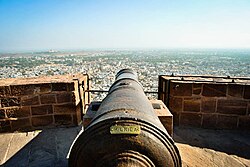
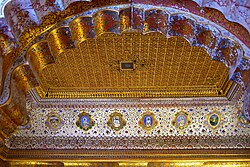
Within the fort are several brilliantly crafted and decorated palaces. These include, Moti Mahal (Pearl Palace), Phool Mahal (Flower Palace), Sheesha Mahal (Mirror Palace), Sileh Khana and Daulat Khana. The museum houses a collection of [[palanquin]]s, [[howdah]]s, royal cradles, miniatures, musical instruments, costumes, and furniture. The ramparts of the fort house preserved old cannon (including the famous | Within the fort are several brilliantly crafted and decorated palaces. These include, Moti Mahal (Pearl Palace), Phool Mahal (Flower Palace), Sheesha Mahal (Mirror Palace), Sileh Khana and Daulat Khana. The museum houses a collection of [[palanquin]]s, [[howdah]]s, royal cradles, miniatures, musical instruments, costumes, and furniture. The ramparts of the fort house preserved old cannon (including the famous '''Kilkila'''), and provided a breath-taking view of the city. | ||
[[File:Jodhpur Palace Market Gate.jpg|thumb|This is the gate to a market inside the Mehrangarh Fort. The wall is adorned with paintings of Gods and Goddesses.]] | |||
[[File:Kilkila cannon.jpg|thumb|Kilkila cannon]] | [[File:Kilkila cannon.jpg|thumb|Kilkila cannon]] | ||
| Line 75: | Line 84: | ||
This gallery displays one of the most important and best-preserved collections of fine and applied arts of the Mughal period of Indian history, during which the Rathore rulers of Jodhpur maintained close links with the Mughal emperors. It also has the remains of Emperor Akbar. | This gallery displays one of the most important and best-preserved collections of fine and applied arts of the Mughal period of Indian history, during which the Rathore rulers of Jodhpur maintained close links with the Mughal emperors. It also has the remains of Emperor Akbar. | ||
=== | ===Armory=== | ||
This gallery displays a rare collection of | This gallery displays a rare collection of armor from every period in Jodhpur. On display are sword hilts in jade, silver, rhino horn, ivory, shields studded with rubies, emeralds and pearls and guns with gold and silver work on the barrels. The gallery also has on display the personal swords of many emperors, among them outstanding historical piece like the Khaanda of Rao Jodha, weighing over 3 kg, the sword of [[Akbar]] and the sword of [[Timur]]. | ||
===Paintings=== | ===Paintings=== | ||
| Line 91: | Line 100: | ||
==Tourist attractions== | ==Tourist attractions== | ||
===National Geological Monument=== | ===National Geological Monument=== | ||
The [[Jodhpur Group - Malani Igneous Suite Contact]] on which the Mehrangarh Fort has been built has been declared a National Geological Monument by the [[Geological Survey of India]] to encourage Geo Tourism in the country. This unique geological feature is part of the Malani Igenus Suite seen in the Thar desert region, spread over an area of 43,500 km<sup>2</sup>. This unique geological feature represents the last phase of igneous activity of Precambrian age in the Indian Subcontinent.<ref>{{cite web |url= http://www.portal.gsi.gov.in/portal/page?_pageid=127,529424&_dad=portal&_schema=PORTAL |title= Monuments of Stratigraphic Significance, Malani volcanics overlain by Jodhpur sandstone |access-date= 2009-03-23 |publisher= Geological Survey of India |year= 2001 |archive-url= https://archive.today/20130419091251/http://www.portal.gsi.gov.in/portal/page?_pageid=127,529424&_dad=portal&_schema=PORTAL |archive-date= 19 April 2013 |url-status= dead }}</ref><ref name = bhushan>{{cite web|url=http://prr.hec.gov.pk/Chapters/338-3.pdf|title=Regional Geological and Tectonic Setting|access-date=2009-03-25|pages =68–73}}</ref> | The [[Jodhpur Group - Malani Igneous Suite Contact]] on which the Mehrangarh Fort has been built has been declared a National Geological Monument by the [[Geological Survey of India]] to encourage Geo Tourism in the country. This unique geological feature is part of the Malani Igenus Suite seen in the Thar desert region, spread over an area of 43,500 km<sup>2</sup>. This unique geological feature represents the last phase of igneous activity of Precambrian age in the Indian Subcontinent.<ref>{{cite web |url= http://www.portal.gsi.gov.in/portal/page?_pageid=127,529424&_dad=portal&_schema=PORTAL |title= Monuments of Stratigraphic Significance, Malani volcanics overlain by Jodhpur sandstone |access-date= 2009-03-23 |publisher= Geological Survey of India |year= 2001 |archive-url= https://archive.today/20130419091251/http://www.portal.gsi.gov.in/portal/page?_pageid=127,529424&_dad=portal&_schema=PORTAL |archive-date= 19 April 2013 |url-status= dead }}</ref><ref name = bhushan>{{cite web|url=http://prr.hec.gov.pk/Chapters/338-3.pdf|title=Regional Geological and Tectonic Setting|access-date=2009-03-25|pages=68–73|archive-date=5 October 2011|archive-url=https://web.archive.org/web/20111005122809/http://prr.hec.gov.pk/Chapters/338-3.pdf|url-status=dead}}</ref> | ||
===The Chamunda Mataji Temple=== | ===The Chamunda Mataji Temple=== | ||
| Line 103: | Line 112: | ||
==2008 stampede== | ==2008 stampede== | ||
A [[2008 Jodhpur stampede|human stampede]] occurred on 30 September 2008, at the Chamunda Devi temple inside of the Mehrangarh Fort, in which | A [[2008 Jodhpur stampede|human stampede]] occurred on 30 September 2008, at the Chamunda Devi temple inside of the Mehrangarh Fort, in which 224 people were killed and more than 400 injured.<ref>[https://web.archive.org/web/20131017074544/http://articles.economictimes.indiatimes.com/2008-09-30/news/27722458_1_temple-stampede-chamunda-devi-temple-mahatma-gandhi-hospital 2008 Stampede at Chanmunda Devi Temple in Mehrangarh Fort Sep 30, 2008]</ref> | ||
==Culture== | ==Culture== | ||
[[File:Mehrangarh fort jodhpur fort.jpg|thumb|Night view of Mehrangarh Fort]] | [[File:Mehrangarh fort jodhpur fort.jpg|thumb|Night view of Mehrangarh Fort]] | ||
The fort has musicians performing folk music at the entrance and houses museum, restaurants, exhibitions, and craft bazaars.<ref>{{cite news|title=The Fantastic 5 Forts: Rajasthan Is Home to Some Beautiful Forts, Here Are Some Must-See Heritage Structures|url=http://www.highbeam.com/doc/1P3-3191827171.html|archive-url=https://web.archive.org/web/20150924204252/http://www.highbeam.com/doc/1P3-3191827171.html|url-status=dead|archive-date=24 September 2015|access-date=5 July 2015|date=28 January 2014|publisher=DNA : Daily News & Analysis|via=[[HighBeam Research]] | The fort has musicians performing folk music at the entrance and houses museum, restaurants, exhibitions, and craft bazaars.<ref>{{cite news|title=The Fantastic 5 Forts: Rajasthan Is Home to Some Beautiful Forts, Here Are Some Must-See Heritage Structures|url=http://www.highbeam.com/doc/1P3-3191827171.html|archive-url=https://web.archive.org/web/20150924204252/http://www.highbeam.com/doc/1P3-3191827171.html|url-status=dead|archive-date=24 September 2015|access-date=5 July 2015|date=28 January 2014|publisher=DNA : Daily News & Analysis|via=[[HighBeam Research]] }}</ref> The fort was one of the filming locations for Disney's 1994 live-action film [[The Jungle Book (1994 film)|''The Jungle Book'']], as well as the 2012 film ''[[The Dark Knight Rises]]''.<ref>{{cite news|title=Shooting in India was nice adventure: Christian Bale| newspaper=The Times of India | date=10 July 2012 |url=http://timesofindia.indiatimes.com/entertainment/hollywood/news-interviews/Shooting-in-India-was-nice-adventure-Christian-Bale/articleshow/14803932.cms?referral=PM|publisher=INDIATIMES|access-date=6 March 2014}}</ref> [[Principal photography]] for the latter commenced on 6 May 2011.<ref>{{cite web|url=https://timesofindia.indiatimes.com/entertainment/hollywood/news-interviews/Christopher-Nolan-to-shoot-in-Jodhpur/articleshow/8124839.cms|archive-url=https://web.archive.org/web/20130710104700/http://articles.timesofindia.indiatimes.com/2011-04-30/news-interviews/29490552_1_jodhpur-s-mehrangarh-fort-jaipur-crew|url-status=live|archive-date=July 10, 2013|title=Christopher Nolan to shoot in Jodhpur| last=Dasgupta|first=Priyanka|date=April 30, 2011|work=[[The Times of India]]|access-date=August 10, 2011}}</ref><ref>{{cite web|url=http://splashpage.mtv.com/2011/04/27/the-dark-knight-rises-india/|archive-url=https://web.archive.org/web/20110430034017/http://splashpage.mtv.com/2011/04/27/the-dark-knight-rises-india|url-status=dead|archive-date=30 April 2011|title='The Dark Knight Rises' Heads to India|work=MTV|first=Rachel|last=Molino|date=April 27, 2011|access-date=May 8, 2011}}</ref> The [[Emraan Hashmi]] starrer ''[[Awarapan]]'' was also shot here.<ref>{{cite web|title=Awarapan Locations|url=http://www.bollylocations.com/movies/Awarapan?referral=PM|publisher=BOLLYLOCATIONS|access-date=18 January 2015}}</ref> | ||
In 2015, the fort was used to record a collaborative album by musicians including Israeli composer [[Shye Ben Tzur]], English composer and [[Radiohead]] guitarist [[Jonny Greenwood]], and Radiohead producer [[Nigel Godrich]]. The recording was the subject of a documentary, ''[[Junun (film)|Junun]],'' by the American director [[Paul Thomas Anderson]].<ref name=":0">{{Cite web|title = NYFF Review: Paul Thomas Anderson is Trying Something Different With 'Junun'|url = http://www.indiewire.com/article/nyff-review-paul-thomas-anderson-is-trying-something-different-with-junun-20151008|website = Indiewire|access-date = 2015-10-09}}</ref><ref>{{Cite web|title = Film Review: 'Junun'|url = https://variety.com/2015/film/reviews/junun-film-review-1201613807/|website = Variety|access-date = 2015-10-09}}</ref> | In 2015, the fort was used to record a collaborative album by musicians including Israeli composer [[Shye Ben Tzur]], English composer and [[Radiohead]] guitarist [[Jonny Greenwood]], and Radiohead producer [[Nigel Godrich]]. The recording was the subject of a documentary, ''[[Junun (film)|Junun]],'' by the American director [[Paul Thomas Anderson]].<ref name=":0">{{Cite web|title = NYFF Review: Paul Thomas Anderson is Trying Something Different With 'Junun'|url = http://www.indiewire.com/article/nyff-review-paul-thomas-anderson-is-trying-something-different-with-junun-20151008|website = Indiewire| date=8 October 2015 |access-date = 2015-10-09}}</ref><ref>{{Cite web|title = Film Review: 'Junun'|url = https://variety.com/2015/film/reviews/junun-film-review-1201613807/|website = Variety| date=8 October 2015 |access-date = 2015-10-09}}</ref> | ||
In March 2018, the film crew for the [[Bollywood]] film [[Thugs of Hindostan]] used the fort as one of its shooting locations;<ref>{{cite web| url = https://www.indiatvnews.com/entertainment/bollywood-thugs-of-hindostan-amitabh-bachchan-gets-smitten-by-the-beauty-of-jodhpur-s-mehrangarh-fort-431513| title = Thugs Of Hindostan: Amitabh Bachchan gets smitten by the beauty of | In March 2018, the film crew for the [[Bollywood]] film ''[[Thugs of Hindostan]]'' used the fort as one of its shooting locations;<ref>{{cite web| url = https://www.indiatvnews.com/entertainment/bollywood-thugs-of-hindostan-amitabh-bachchan-gets-smitten-by-the-beauty-of-jodhpur-s-mehrangarh-fort-431513| title = Thugs Of Hindostan: Amitabh Bachchan gets smitten by the beauty of Jodhpur's Mehrangarh Fort {{!}} Bollywood News – India TV| date = 8 March 2018}} </ref> actor [[Amitabh Bachchan]] left a reflective post about his experience there on his official [[blog]].<ref>{{cite web |url=http://srbachchan.tumblr.com/post/171634120571 |title = Amitabh Bachchan's Official Blog • DAY 3636}}</ref> | ||
== | ==References== | ||
{{ | {{Reflist|colwidth=30em}} | ||
==Further reading== | ==Further reading== | ||
{{refbegin| | {{refbegin|20em}} | ||
* {{cite book|author1=Crump, Vivien |author2=Toh, Irene |title= Rajasthan|location=London|publisher=Everyman Guides|year=1996| isbn = 1-85715-887-3| page = 400}} | * {{cite book|author1=Crump, Vivien |author2=Toh, Irene |title= Rajasthan|location=London|publisher=Everyman Guides|year=1996| isbn = 1-85715-887-3| page = 400}} | ||
* {{cite book|author1=Beny, Rolof|author1-link=Roloff Beny|author2=Matheson, Sylvia | title=Rajasthan - Land of Kings| year = 1984| publisher=The Vendome Press| location=New York| isbn = 0-86565-046-2| page = 200 pages}} | * {{cite book|author1=Beny, Rolof|author1-link=Roloff Beny|author2=Matheson, Sylvia | title=Rajasthan - Land of Kings| year = 1984| publisher=The Vendome Press| location=New York| isbn = 0-86565-046-2| page = 200 pages}} | ||
| Line 127: | Line 136: | ||
==External links== | ==External links== | ||
{{commons category|Mehrangarh Fort}} | {{commons category|Mehrangarh Fort}} | ||
* {{official|mehrangarh.org}} | * {{official|https://www.mehrangarh.org/}} | ||
{{Forts in Rajasthan}} | {{Forts in Rajasthan}} | ||
| Line 136: | Line 145: | ||
[[Category:Rajput architecture]] | [[Category:Rajput architecture]] | ||
[[Category:Forts in Rajasthan]] | [[Category:Forts in Rajasthan]] | ||
[[Category:Forts in India]] | |||
[[Category:Tourist attractions in Rajasthan]] | |||
[[Category:Tourist attractions in India]] | |||
[[Category:Tourist attractions in Jodhpur]] | |||
[[Category:Buildings and structures in Jodhpur]] | [[Category:Buildings and structures in Jodhpur]] | ||
[[Category:History of Jodhpur]] | [[Category:History of Jodhpur]] | ||
[[Category:Jodhpur]] | [[Category:Jodhpur]] | ||
[[Category:Tourism in Jodhpur]] | [[Category:Tourism in Jodhpur]] | ||
[[Category:National museums of India]] | [[Category:National museums of India]] | ||
Latest revision as of 21:59, 3 August 2025
| Mehrangarh | |
|---|---|
| Jodhpur, Rajasthan, India | |
| Template:Photo montage Top: Day view of the fort Bottom: Night view of the fort | |
  Mehrangarh  Mehrangarh | |
| Coordinates | 26°17′53″N 73°01′08″E / 26.29806°N 73.01889°E |
| Type | Fort |
| Site information | |
| Controlled by | Mehrangarh Museum Trust |
| Open to the public | Yes |
| Condition | Well-preserved |
| Site history | |
| Built | 1459 |
| Built by | Rathore dynasty of Kingdom of Marwar |
| Materials | Red Sandstone |
Mehrangarh is a historic fort located in Jodhpur, Rajasthan, India. It stands on a hilltop, rising about 122 m (400 ft) above the surrounding plains,[1] and the complex spans 1,200 acres (486 hectares). It was initially built around 1459 by the Rajput ruler of Rathore clan Rao Jodha,[2] though most of the existing structure is from the 17th century built by his successors.[3] The fort has seven gates, which includes main entrance Jai Pol (meaning 'victory gate'), built by Maharaja Man Singh to commemorate his victories over the Jaipur and Bikaner armies in 1806. The Fattehpol (lit. 'victory gate'), commemorates victory of Maharaja Ajit Singh over the Mughals.[4] The English writer and Nobel Prize winner, Rudyard Kipling, described the fort as "a palace that might have been built by Titans and colored by the morning sun."[5]
Within its boundaries are several palaces known for their intricate carvings and expansive courtyards, a Chamunda Mataji Temple, as well as a museum that houses various relics. A winding road leads to and from the city below. The imprints of the impact of cannonballs fired by attacking armies of Jaipur can still be seen on the second gate. At the north-east of the fort is the chhatri of Kirat Singh Sodha, a soldier who fell on the spot defending Mehrangarh.[6]
Some of the notable festivals taking place here include the World Sacred Spirit Festival and Rajasthan International Folk Festival.
Etymology[edit | edit source]
Mehrangarh's etymology is rooted in the Sanskrit words 'Mihir' (meaning sun) and 'garh' (meaning fort). Phonetically evolving from 'Mihirgarh' to 'Mehrangarh' in Rajasthani language.[7] The fort was named Mihirgarh, meaning ‘fort of the sun’ – a reference to the ruling clan Rathore's mythical descent from the sun god Surya.[8]
History[edit | edit source]
Rao Jodha, the chief of the Rathore clan, is credited with the origin of Jodhpur in India.[9] He founded Jodhpur in 1459 as the capital of Marwar (Mandore was the previous capital). He was one of Ranmal's 24 sons and became the fifteenth Rathore ruler. One year after his accession to the throne, Jodha decided to move his capital to the safer location of Jodhpur, as the one thousand years old Mandore fort was no longer considered to provide sufficient security. With the trusted aid of Rao Nara (son of Rao Samra), the Mewar forces were subdued at Mandore. With that, Rao Jodha gave Rao Nara the title of Diwan. With the help of Rao Nara, the foundation of the fort was decided on 12 May 1459[10] by Jodha on a rocky hill 9 kilometres (5.6 mi) to the south of Mandore. This hill was known as Bhakurcheeria, the mountain of birds. According to legend to build the fort he had to displace the hill's sole human occupant, a hermit called Cheeria Nathji, the lord of birds. Cheeria Nathji was a man with the local population as his followers and hence influential in the region. When requested to move he refused categorically. This happened many times. Rao Jodha then took extreme measures and sought help from another more powerful saint, Karni Mata of Deshnoke who was a Hindu warrior sage born in Charan caste. At the request of the king, she came and asked Cheeria Nathji to quit immediately. Seeing a superior power he left at once but cursed Rao Jodha with words "Jodha! May your citadel ever suffer a scarcity of water!". Rao Jodha managed to appease the hermit by building a house and a temple in the fort. Karni Mata laid down the foundation stone of the Mehrangarh Fort. Today only the forts of Bikaner and Jodhpur remain in the hands of Rathores, both had their foundation stones laid by Shri Karni Mata. All other Rajput forts of Rajasthan were abandoned for some or the other reasons by the respective clans. Only the Rathores of Jodhpur and Bikaner have their forts with them till date. This fact is considered a miracle by the local population and is attributed to Shri Karni Mata. Rao Jodha also granted villages of Mathania and Chopasni to the two Charan warlords who were sent by him to request maa Mehaai to come to Jodhpur.[11]
To ensure that the new site proved propitious; he buried a man of the Meghwal caste called "Raja Ram Meghwal", who offered his services voluntarily, alive in the foundations as this was considered auspicious during those days. "Raja Ram Meghwal" was promised that in return his family would be looked after by the Rathores. His family was granted land and to this day his descendants still live in Raj Bag, near Soor Sagar.
Though the fortress was originally started in 1459 by Rao Jodha, founder of Jodhpur, most of the fort which stands today dates from the period of Maharaja Jaswant Singh (1638–78). The fort is located at the centre of the city spreading over 5 kilometres (3.1 mi) on top of a high hill. Its walls, which are up to 36 metres (118 ft) high and 21 metres (69 ft) wide, protect some of the most beautiful and historic palaces in Rajasthan. Khandwaliya community one of the old traditional community had the knowledge of breaking the big stones made this fort with others.


Entry to the fort is gained through a series of seven gates. The most famous of the gates are:
- Jai Pol ("Gate of Victory"), built by Maharaja Man Singh in 1806 to celebrate his victory in a war with Jaipur and Bikaner.
- Fateh Pol, built to celebrate a victory over the Mughals in 1707;
- Gopal Pol, it is the second Pol after Fateh Pol.
- Dedh Kangra Pol, which still bears the scars of bombardment by cannonballs;
- Amruti Pol, it is in between Dedh Kangra Pol and Loha Pol.
- Loha Pol, which is the final gate into the main part of the fort complex. Immediately to the left are the handprints (sati marks) of the ranis and some princesses, who had committed Sati over the years after death of their husband.
- Suraj Pol, inner most gate which provides access to palace complex and Daulat Khana Chauk.

Within the fort are several brilliantly crafted and decorated palaces. These include, Moti Mahal (Pearl Palace), Phool Mahal (Flower Palace), Sheesha Mahal (Mirror Palace), Sileh Khana and Daulat Khana. The museum houses a collection of palanquins, howdahs, royal cradles, miniatures, musical instruments, costumes, and furniture. The ramparts of the fort house preserved old cannon (including the famous Kilkila), and provided a breath-taking view of the city.


Galleries at the Mehrangarh Museum[edit | edit source]
Elephant's howdahs[edit | edit source]

Howdahs were a kind of two-compartment wooden seat (mostly covered with gold and silver embossed sheets), which were fastened onto the elephant's back. The front compartment, with more leg space and a raised protective metal sheet, was meant for kings or royalty, and the rear smaller one for a reliable bodyguard disguised as a fly-whisk attendant.
Palanquins[edit | edit source]
Palanquins were a popular means of travel and circumambulation for the ladies of the nobility up to the second quarter of the 20th century. They were also used by male nobility and royals on special occasions.
Daulat Khana – Treasures of Mehrangarh Museum[edit | edit source]
This gallery displays one of the most important and best-preserved collections of fine and applied arts of the Mughal period of Indian history, during which the Rathore rulers of Jodhpur maintained close links with the Mughal emperors. It also has the remains of Emperor Akbar.
Armory[edit | edit source]
This gallery displays a rare collection of armor from every period in Jodhpur. On display are sword hilts in jade, silver, rhino horn, ivory, shields studded with rubies, emeralds and pearls and guns with gold and silver work on the barrels. The gallery also has on display the personal swords of many emperors, among them outstanding historical piece like the Khaanda of Rao Jodha, weighing over 3 kg, the sword of Akbar and the sword of Timur.
Paintings[edit | edit source]
,_folio_3_from_the_Shiva_Purana,_c._1828.jpg)
This gallery displays colours of Marwar-Jodhpur, the finest example of Marwar paintings.
The Turban Gallery[edit | edit source]
The Turban Gallery in the Mehrangarh Museum seeks to preserve, document and display the many different types of turbans once prevalent in Rajasthan; every community, region, and festival having had its own headgear.
Shahi Lal Dera[edit | edit source]
Shahi Lal Dera or Royal Red Tent is a part of royal collection at the fort.
Tourist attractions[edit | edit source]
National Geological Monument[edit | edit source]
The Jodhpur Group - Malani Igneous Suite Contact on which the Mehrangarh Fort has been built has been declared a National Geological Monument by the Geological Survey of India to encourage Geo Tourism in the country. This unique geological feature is part of the Malani Igenus Suite seen in the Thar desert region, spread over an area of 43,500 km2. This unique geological feature represents the last phase of igneous activity of Precambrian age in the Indian Subcontinent.[12][13]
The Chamunda Mataji Temple[edit | edit source]


The chamunda Mataji was Rao Jodha's favourite goddess, he brought her idol from the old capital of Mandore in 1460 and installed her in Mehrangarh (Maa chamunda was the kul devi of the Pratihara rulers of Mandore). She remains the Maharaja's and the Royal Family's Isht Devi or adopted goddess and is worshipped by most of Jodhpur's citizens as well. Crowds throng Mehrangarh during the Dussehra celebrations.
Rao Jodha Desert Rock Park[edit | edit source]
Rao Jodha Desert Rock Park, spreads over 72 hectares, adjoining Mehrangarh Fort. The park contains ecologically restored desert and arid land vegetation.[14][15] The park was created in 2006 to try and restore the natural ecology of a large, rocky area adjoining and below the fort and opened to the public in February 2011. The area in and around the park contains distinctive volcanic rock formations such as rhyolite, with welded tuff, and breccia, sandstone formations. The park includes a Visitors Centre with Interpretation Gallery, a native plant nursery, small shop and cafe.
2008 stampede[edit | edit source]
A human stampede occurred on 30 September 2008, at the Chamunda Devi temple inside of the Mehrangarh Fort, in which 224 people were killed and more than 400 injured.[16]
Culture[edit | edit source]

The fort has musicians performing folk music at the entrance and houses museum, restaurants, exhibitions, and craft bazaars.[17] The fort was one of the filming locations for Disney's 1994 live-action film The Jungle Book, as well as the 2012 film The Dark Knight Rises.[18] Principal photography for the latter commenced on 6 May 2011.[19][20] The Emraan Hashmi starrer Awarapan was also shot here.[21] In 2015, the fort was used to record a collaborative album by musicians including Israeli composer Shye Ben Tzur, English composer and Radiohead guitarist Jonny Greenwood, and Radiohead producer Nigel Godrich. The recording was the subject of a documentary, Junun, by the American director Paul Thomas Anderson.[22][23] In March 2018, the film crew for the Bollywood film Thugs of Hindostan used the fort as one of its shooting locations;[24] actor Amitabh Bachchan left a reflective post about his experience there on his official blog.[25]
References[edit | edit source]
- ↑ Bajwa, Jagir Singh; Kaur, Ravinder (2007). Tourism Management. APH Publishing. ISBN 978-81-313-0047-3.
- ↑ "Mehrangarh Fort | History, Description, & Facts | Britannica". www.britannica.com. Retrieved 25 March 2024.
built about 1459 by Rao Jodha, a member of the Rathore branch of the Rajput clan and the 15th Rathore ruler of Marwar
- ↑ "History". Mehrangarh Museum Trust. Retrieved 19 October 2023.
- ↑ Ramavana, Sandeep (22 April 2017). "Mehrangarh Fort, Jodhpur". dreamtrails. Retrieved 19 October 2023.
- ↑ Kipling, Rudyard (1895). Out of India: Things I Saw, and Failed to See, in Certain Days and Nights at Jeypore and Elsewhere. G.W. Dillingham.
a palace that might have been built by Titans and colored by the morning sun
- ↑ Chhabra, Jatin (6 November 2016). "Mehrangarh Fort - A Palace built by the Titans Part 1 by Jatin Chhabra". Blog: Jatin Chhabra. Retrieved 20 October 2023.
- ↑ Hooja, Rima; Jain, Shikha (23 September 2016). Conserving Fortified Heritage: The Proceedings of the 1st International Conference on Fortifications and World Heritage, New Delhi, 2015. Cambridge Scholars Publishing. ISBN 978-1-4438-9637-5.
whereas the name "Mehrangarh" (or Mihirgarh, as used earlier) is made up of the Sanskrit words Mihir (sun) and Garh (fort), meaning "fortress of the sun".
- ↑ "History". Mehrangarh Museum Trust. Retrieved 17 September 2023.
The fort was named Mehrangarh, meaning 'fort of the sun' – a reference to the clan's mythical descent from the sun god Surya.
- ↑ Vyas, S.P. (2007). "Water supply system in the fort of Jodhpur". Proceedings of the Indian History Congress. 68: 1423. JSTOR 44145652.
- ↑ Mehrangarh Fort-Jodhpur Archived 20 November 2008 at the Wayback Machine
- ↑ Ujwal, Kailash Dan S. (1985). Bhagwati Shri Karniji Maharaj: A Biography. [s.n.]].
- ↑ "Monuments of Stratigraphic Significance, Malani volcanics overlain by Jodhpur sandstone". Geological Survey of India. 2001. Retrieved 23 March 2009.
{{cite web}}: CS1 maint: deprecated archival service (link) - ↑ "Regional Geological and Tectonic Setting" (PDF). pp. 68–73. Archived from the original (PDF) on 5 October 2011. Retrieved 25 March 2009.
- ↑ "Reclaiming the desert". The Hindu. 30 July 2014. ISSN 0971-751X. Retrieved 4 September 2016.
- ↑ "Rao Jodhpur desert rock park - Xinhua | English.news.cn". news.xinhuanet.com. Archived from the original on 31 October 2013. Retrieved 4 September 2016.
- ↑ 2008 Stampede at Chanmunda Devi Temple in Mehrangarh Fort Sep 30, 2008
- ↑ "The Fantastic 5 Forts: Rajasthan Is Home to Some Beautiful Forts, Here Are Some Must-See Heritage Structures". DNA : Daily News & Analysis. 28 January 2014. Archived from the original on 24 September 2015. Retrieved 5 July 2015 – via HighBeam Research.
- ↑ "Shooting in India was nice adventure: Christian Bale". The Times of India. INDIATIMES. 10 July 2012. Retrieved 6 March 2014.
- ↑ Dasgupta, Priyanka (30 April 2011). "Christopher Nolan to shoot in Jodhpur". The Times of India. Archived from the original on 10 July 2013. Retrieved 10 August 2011.
- ↑ Molino, Rachel (27 April 2011). "'The Dark Knight Rises' Heads to India". MTV. Archived from the original on 30 April 2011. Retrieved 8 May 2011.
- ↑ "Awarapan Locations". BOLLYLOCATIONS. Retrieved 18 January 2015.
- ↑ "NYFF Review: Paul Thomas Anderson is Trying Something Different With 'Junun'". Indiewire. 8 October 2015. Retrieved 9 October 2015.
- ↑ "Film Review: 'Junun'". Variety. 8 October 2015. Retrieved 9 October 2015.
- ↑ "Thugs Of Hindostan: Amitabh Bachchan gets smitten by the beauty of Jodhpur's Mehrangarh Fort | Bollywood News – India TV". 8 March 2018.
- ↑ "Amitabh Bachchan's Official Blog • DAY 3636".
Further reading[edit | edit source]
- Crump, Vivien; Toh, Irene (1996). Rajasthan. London: Everyman Guides. p. 400. ISBN 1-85715-887-3.
- Beny, Rolof; Matheson, Sylvia (1984). Rajasthan - Land of Kings. New York: The Vendome Press. p. 200 pages. ISBN 0-86565-046-2.
- Tillotson, G.H.R (1987). The Rajput Palaces - The Development of an Architectural Style (First ed.). New Haven and London: Yale University Press. p. 224 pages. ISBN 0-300-03738-4.
- SuryanagariJodhpur by Prem Bhandari
- Maharaja Umaid Singhji by Prem Bhandari
- Paintings from the royal collection of the Mehrangarh Museum Trust, Jodhpur British Museum
