

enhance formatting additionally and updated info per sources |
|||
| Line 1: | Line 1: | ||
[ | {{Short description|Species of fish}} | ||
'''''Tor putitora''''', the ''' | {{Copy edit|date=March 2026}} | ||
{{Copypaste|date=March 2026|url=[https://doi.org/10.2305/IUCN.UK.2018-2.RLTS.T126319882A126322226.en IUCN]}} | |||
{{Speciesbox | |||
| status = EN | |||
| status_system = IUCN3.1 | |||
| status_ref = <ref name=IUCN>{{cite iucn|author1=Jha, B.R.|author2=Rayamajhi, A.|author3=Dahanukar, N.|author4=Harrison, A.|author5=Pinder, A.|name-list-style=amp|title=''Tor putitora''|article-number=e.T126319882A126322226|year=2018|doi=10.2305/IUCN.UK.2018-2.RLTS.T126319882A126322226.en|doi-access=free}}</ref> | |||
| image = Golden mahseer (Tor putitora) Babai River.jpg | |||
| image_caption = Babai River, Nepal | |||
| image2 = Tor Putitora.jpeg | |||
| image2_caption = Juvenile, about {{convert|14|in|cm|abbr=on|round=5|disp=flip}} long | |||
| taxon = Tor putitora | |||
| authority = ([[Francis Buchanan-Hamilton|F. Hamilton]], 1822) | |||
| synonyms = {{collapsible list| | |||
* ''Cyprinus putitora'' Hamilton, 1822 | |||
* ''Barbus putitora'' (Hamilton, 1822) | |||
* ''Puntius putuitora'' (Hamilton, 1822) | |||
* ''Cyprinus mosal'' Hamilton, 1822 | |||
* ''Tor mosal'' (Hamilton, 1822) | |||
* ''Barbus mosal'' (Hamilton, 1822) | |||
* ''Labeobarbus macrolepis'' [[Johann Jakob Heckel|Heckel]], 1838 | |||
* ''Tor macrolepis'' (Heckel, 1838) | |||
* ''Barbus macrocephalus'' McClelland, 1839 | |||
* ''Barbus progeneius'' McClelland, 1839 | |||
* ''Tor progeneius'' (McClelland, 1839) | |||
}} | |||
| synonyms_ref = <ref name=WoRMS>{{Cite WoRMS|title=Tor putitora (Hamilton, 1822)|id=1026593|access-date=2026-03-22|db=FishBase}}</ref> | |||
}} | |||
'''''Tor putitora''''', the ''' golden mahseer''', '''putitor mahseer''', or '''Himalayan mahseer''', is an [[Endangered species|endangered]] species of [[cyprinid]] fish that is found in rapid streams, riverine pools, and lakes in the [[Himalayas|Himalayan]] region. Its native range is within the basins of the [[Indus River|Indus]], [[Ganges]] and [[Brahmaputra River|Brahmaputra]] rivers.<ref name="IUCN" /> It was reported to be found in the [[Salween River]], the natural border between [[Thailand]] and [[Myanmar]], but observations of it have been very rare, having only been observed three times in 28 years.<ref>{{cite magazine|author=Kittipong Jaruthanin |author-link=Kittipong Jaruthanin |name-list-style=and |author2=Pong Bang Tan|title= Monsters of the River 2013|work=Aquarium Biz|volume= 4 |issue= 39 |date=September 2013|lang=th}}</ref> | |||
This [[omnivorous]] species is generally found near the surface in water that ranges from {{convert|13–30|C|F}}.<ref>{{cite report|author=IRG Systems South Asia Pvt. Ltd. |date=December 2014|url=http://envfor.nic.in/sites/default/files/Vol-01-Final%20report.pdf |title=Cumulative Impact and Carrying Capacity Study of Subansiri Sub Basin including Downstream Impacts. Final Report|volume= 1 |institution= Central Water Commission, India}}</ref> | |||
It is a popular [[gamefish]], once believed to be the largest species of [[mahseer]], and can reach up to {{convert|2.75|m|ft|abbr=on}} in length and {{convert|54|kg|abbr=on}} in weight, though most caught today are far smaller.<ref name="fishbase">{{FishBase |genus= Tor |species= putitora| month = January | year = 2012}}</ref> | |||
The golden mahaseer is the [[List of national animals|National fish]] of [[Pakistan]].<ref>{{cite web |url=http://www.pakistan.gov.pk/national_symbols.html |title=Pakistan |url-status=dead |archive-url=https://web.archive.org/web/20161128073024/http://www.pakistan.gov.pk/national_symbols.html |archive-date=2016-11-28 }}{{primary source inline|date=March 2016}}</ref>{{refn|name=Gcounts|group=n|''"The Official National fish of [[Pakistan]]" respectively''}} It is also the state fish of the states of [[Arunachal Pradesh]], [[Himachal Pradesh]], [[Uttarakhand]], [[Odisha]] and the UT of [[Jammu and Kashmir (union territory)|Jammu and Kashmir]].<ref>{{cite web|title=State Fishes of India|url=http://nfdb.gov.in/PDF/Fish%20&%20Fisheries%20of%20India/2.State%20Fishes%20of%20India.pdf|publisher=National Fisheries Development Board, Government of India|access-date=25 December 2020}}</ref> | |||
Nobel Prize winner for Literature - Rudyard Kipling, wrote: "There he met the mahseer of the Poonch, beside whom the tarpon is a herring, and he who catches him can say he is a fisherman." (Rudyard Kipling - "The Day's Work" 1898 - "The Brushwood Boy" 1899).{{Citation needed|date=March 2026}} | |||
==Description== | |||
Francis Buchanan-Hamilton's [[Species description|original description]] of ''Cyprinus putitora'' says "The head is blunt, oval, small, and smooth". He goes on to say "The mouth is small" and "the [[lateral line]] is scarcely distinguishable".{{Verify source|date=March 2026}}<ref name="OG"/> However, the largest head of any mahseer species, with a large mouth and prominent lateral line stripe, are features considered to be important in the correct identification of this species.{{Citation needed|date=March 2026}} Their scales are so large that playing cards were made from them in [[Dacca]],<ref name=ZSI/> as reported by Hamilton in his description.<ref name="OG">{{cite book |title=An account of the fishes found in the river Ganges and its branches |date=1822 |pages=303–304|publisher=A. Constable and company; [etc., etc.], |location=Edinburgh |doi=10.5962/bhl.title.6897}}</ref> | |||
''Tor putitora'' were previously distinguished by determining head length (which is purportedly greater than body depth in the species),<ref>HORA, S.L., 1939. The game fishes of India VIII. The mahseer or the | |||
large scaled Barbels of India. 1. The putitor mahseer, Barbus Tor putitora (Hamilton). Journal of the Bombay Natural History Society, vol. 41, pp. 272-285.</ref><ref name="ZSI">{{cite book |last1=Sen |first1=T. K. |title=The mahseer fishes of India |date=1982 |publisher=Zoological Survey of India |location=Calcutta |pages=38 |lccn=83900473 |url=https://archive.org/details/dli.zoological.occpapers.039 |access-date=18 March 2026}}</ref><ref>MIRZA, M.R. and JAVED, M.N., 1986. A contribution to the fishes | |||
of the genus Tor Gray (Pisces: Cyprinidae) from Pakistan and Azad Kashmir. Biologia, vol. 32, pp. 71-82.</ref><ref>TALWAR, P.K. and JHINGRAN, A.G., 1991. Inland Fisheries of India and Adjacent Countries. Calcutta: Oxford and I B H Publication Co. Vol. 1 and 2</ref><ref>MENON, A.G.K., 1992. Taxonomy of the Mahseer fishes of Genus Tor Gray with description of new species from Deccan. Journal of the Bombay Natural History Society, vol. 89, pp. 210-228</ref> but analysis of ''T. putitora'' [[population]]s throughout India have determined that this method is hampered by the [[phenotypic plasticity]] of the species;<ref>BHATT, J.P. and PANDIT, M.K., 2016. Endangered Golden mahseer Tor putitora Hamilton: a review of natural history. Reviews in Fish Biology and Fisheries, vol. 26, no. 1, pp. 25-38. [http://dx.doi.org/10.1007/s11160-015-9409-7 DOI Link].</ref> this metric should not be relied upon as individuals may have head lengths less than, equal to, or greater than body depth.<ref name="Instability"/><ref>SARMA, D., AKHTAR, M.S. and SINGH, A.K., 2014. Mahseer Research and Development: A Journey by DCFR. Uttarakhand, India: ICAR-Directorate of Cold Water Fisheries Research Bhimtal. DCFR publication Manual.</ref><ref>SARMA, D., DAS, P., DAS, P., SANWA, S. and AKHTAR, M.S., 2015. Nutritional Composition of Golden Mahseer (Tor putitora) in Coldwater Himalayan Region of India. SKUAST Journal of Research, vol. 17, pp. 23-28.</ref> This variation lead to the naming of ''Tor macrolepis'', now known to be a [[junior synonym]] of ''T. putitora'' inhabiting the [[Indus River]].<ref name="Instability">{{cite journal |title=An overview of the taxonomic instability of endangered Golden and Zhobi mahseer in Pakistan |journal=Brazilian Journal of Biology |date=24 February 2021 |volume=83 |doi=10.1590/1519-6984.243975 |issn=1678-4375 |url=https://www.scielo.br/j/bjb/a/bPCDnfDFSpqgz5RwMhRzSFD/?format=pdf&lang=en |access-date=18 March 2026}}</ref> | |||
Its caudal, pelvic, and anal fins show a reddish-golden tint. While the body above its lateral line is generally golden in colour at adulthood, the gold colour might be absent in young specimens.{{Citation needed|date=March 2026}} | |||
== Habitat == | |||
[[File:Golden mahseer (cropped).jpg|thumb|Caught in India]] | |||
The golden mahseer is naturally found in montane and submontane regions within streams and rivers across the Himalayan region. Its habitat includes high-energy river systems with rocky substrates, and the species has shown adaptability to lacustrine environments formed by dam impoundments. Additionally, introduced populations have established in lakes where suitable habitats for reproduction are created by ephemeral stream inputs. The species' ability to thrive in varied environmental conditions underscores the importance of preserving both natural river ecosystems and artificial reservoirs for the sustainable conservation of this fish species in the South Himalayan region.<ref name="IUCN" /> | |||
===As an introduced species=== | |||
Recent releases of artificially bred stock have been into the [[Irrawaddy River]] basin in Nagaland, India and, through the Indo-German Biodiversity Programme releases into the Hira Bambai reservoir and small streams around [[Melghat]] Tiger Reserve, part of the [[Tapti River]] basin.<ref>{{Cite web|url=https://www.thehitavada.com/Encyc/2019/11/22/Golden-Mahashir-fish-fingerlings-released-in-Hira-Bambai-reservoir.html|title=Golden Mahashir fish fingerlings released in Hira Bambai reservoir|website=Thehitavada.com|access-date=28 November 2021}}</ref> The effect of releasing fish from a different river basin, well outside its native range is uncertain. That these fish are being released over a ten-year period, with as many as 10,000 in each batch, must be considered a huge threat to the native mahseer and other fish species.<ref>{{Cite news|url=https://timesofindia.indiatimes.com/home/environment/flora-fauna/conservation-project-helps-revive-mahseer-in-rivers/articleshow/48737691.cms|title=Conservation project helps revive Mahseer in rivers|newspaper=[[The Times of India]]|access-date=28 November 2021}}</ref> | |||
According to Ogale, former scientist leading the fish breeding programme for Tata Power: | |||
"When these mature, there will be more fingerlings which will be then introduced in river Tapi".<ref>{{Cite web|url=https://punemirror.indiatimes.com/pune/others/mahseer-fish-makes-a-comeback-in-melghat/articleshow/46979898.cms|title=Mahseer fish makes a comeback in Melghat|website=Punemirror.indiatimes.com|date=19 April 2015 |access-date=28 November 2021}}</ref> | |||
River Tapi is a west-flowing river of the central Indian state of [[Maharashtra]]. | |||
Golden mahseer from Lonavala hatchery in Maharashtra, India were supplied to the government of [[Papua New Guinea]]<ref>{{cite book|url=https://www.academia.edu/27880882 |first1=Prakash |last1=Nautiyal|title=Mahseer Conservation in India Status, Challenges and the Way Forward |first2=Suresh |last2=Babu |first3=Sandeep |last3=Behera|publisher=[[WWF-India]]|year=2013}}</ref><ref>{{Cite report |url=https://www.fao.org/3/bo809e/bo809e.pdf |title=Fish stocking activities undertaken by the Sepik River Fish Stock Enhancement Project (1987-1993) and the FISHAID Project (1993-1997) |last=Coates |first=D. |date=1997 |publisher=FISHAID Project |issue=FI:P.N.G./93/007 Field Document # 5 |location=Rome}}</ref> where the fish escaped into the local [[Sepik]] river system after release into the Yonki reservoir. There are fears about the decline of native species following these introductions.<ref>{{Cite journal |last1=Dudgeon |first1=David |last2=Smith |first2=Ross E. W. |date=2006-02-28 |title=Exotic species, fisheries and conservation of freshwater biodiversity in tropical Asia: the case of the Sepik River, Papua New Guinea |url=https://onlinelibrary.wiley.com/doi/10.1002/aqc.713 |journal=Aquatic Conservation: Marine and Freshwater Ecosystems |language=en |volume=16 |issue=2 |pages=203–215 |doi=10.1002/aqc.713 |bibcode=2006ACMFE..16..203D |issn=1052-7613|url-access=subscription }}</ref> | |||
== Relation to humans == | |||
It is threatened by [[habitat loss]], [[habitat degradation]] and [[overfishing]], and it already has declined by more than an estimated 50%.<ref name="IUCN" /> | |||
The prospect of large-scale [[dam]] building across the distribution range gives cause for concern reflected by the current Red Listing status. | |||
Most researchers believe this fish is in a population decline, hence the Red Listing status of Endangered. Some, however, have noted that ''Tor putitora'' is "quite abundant",<ref>{{Cite journal|url=https://www.researchgate.net/publication/333918157|title=Distribution record on abundance of ''Tor putitora'' in Jammu waters|journal=International Journal of Fisheries and Aquatic Studies |year=2016|volume= 4|issue=1|pages= 341–347 |via=Researchgate.net|access-date=28 November 2021}}</ref> which also raises questions about the status of ongoing stock augmentation programmes. | |||
The primary threat to ''Tor putitora'' is habitat loss and degradation, driven predominantly by the extensive development of hydropower projects in the Himalayan range. This anthropogenic impact poses a substantial risk to the species, as it results in the deterioration and reduction of essential habitats.<ref name="IUCN" /> | |||
Overfishing exacerbates the challenges faced by ''Tor putitora'', with unsustainable practices such as dynamiting, poisoning, and the use of fine-meshed nets contributing to a decline in populations. The impact of overfishing is notable in various river systems, affecting the species' overall population dynamics.<ref name="IUCN" /> | |||
The species may also face increased [[Competition (biology)|competition]] due to widespread introduction of non-native species in the trans-Himalayan region, such as [[trout]] (''[[Salmo]]'' spp. and ''[[Oncorhynchus mykiss]]'') and common carp (''[[Cyprinus carpio]]''). Conversely, golden mahseer are themselves stocked into waterways where they aren't native, which may threaten other species and lead to "genetic simplification" ([[genetic erosion]]);<ref name="Agenda">{{cite web |title=India needs to set a new conservation agenda for mahseer |url=https://www.downtoearth.org.in/wildlife-biodiversity/india-needs-to-set-a-new-conservation-agenda-for-mahseer-69546 |publisher=DownToEarth |access-date=19 March 2026}}</ref><ref>Nishikant Gupta & Mark Everard (2019) Non-native fishes in the Indian Himalaya: an emerging concern for freshwater scientists, International Journal of River Basin Management, 17:2, 271–275, [https://doi.org/10.1080/15715124.2017.1411929 DOI Link]</ref> intentional stocking of mahseers have been taking place for several years.<ref>{{cite web |url=https://www.dcfr.res.in/user_upload/77_noticeDCFRwebsite.pdf |title=Mahseer Seed Ranching in Teesta River of Sikkim on World Environment Day (5th June, 2017) |via=Directorate of Coldwater Fisheries Research}}{{Dead link|date=March 2026}}</ref> It has been reported that the Teesta River in Sikkim and West Bengal has been stocked with hundreds of thousands of golden mahseer every year since at least 2014 in a drive to promote angling in the region.<ref>{{Cite web | url=https://www.telegraphindia.com/west-bengal/gta-push-to-angling-tourism-with-golden-mahseer-hill-body-to-promote-fishing-in-teesta-and-rangit-with-help-from-tour-conductors-and-uk-organisation/cid/1581070 | title=GTA push to angling tourism with golden mahseer – Hill body to promote fishing in Teesta and Rangit with help from tour conductors and UK organisation}}</ref> That the fish stocks continue to decline suggests that the policy needs to be reviewed and more efforts devoted to improving habitat as the first priority.{{Verify source|date=March 2026}}<ref>{{cite web |url=http://sikkimforest.gov.in/Reports%20and%20Publications/Biodiveristy-of-Sikkim/12%20Fish_221-232%20web.pdf |title=Fish Biodiversity as an Indicator of Riverine Status of Sikkim |author1=Saroj Toppo |author2=H. Rahman |author3=N. Haque |website=sikkimforest.gov.in}}{{Dead link|date=March 2026}}</ref><ref>{{Cite journal | url=https://scinapse.io/papers/2461900486 |title = Endangered Golden mahseer Tor putitora Hamilton: A review of natural history | Scinapse | Academic search engine for paper| journal=Reviews in Fish Biology and Fisheries | date=14 November 2015 | doi=10.1007/s11160-015-9409-7 | last1=Bhatt | first1=J. P. | last2=Pandit | first2=Maharaj K. | url-access=subscription }}</ref> | |||
== Notes == | |||
{{reflist|group=n}} | |||
==References== | ==References== | ||
{{Reflist}} | {{Reflist}} | ||
[[Category: | {{Taxonbar|from=Q2741221}} | ||
[[Category:Tor (fish)|putitora]] | |||
[[Category:Taxa named by Francis Buchanan-Hamilton]] | |||
[[Category:Fish described in 1822]] | |||
[[Category:Cyprinid fish of Asia]] | |||
[[Category:Freshwater fish of China]] | |||
[[Category:Freshwater fish of India]] | |||
[[Category:Freshwater fish of Pakistan]] | |||
[[Category:National symbols of Pakistan]] | [[Category:National symbols of Pakistan]] | ||
[[Category: | [[Category:Symbols of Arunachal Pradesh]] | ||
[[Category: | [[Category:Symbols of Himachal Pradesh]] | ||
[[Category:Symbols of Uttarakhand]] | |||
Latest revision as of 20:56, 22 March 2026
 | This article may require copy editing for grammar, style, cohesion, tone, or spelling. (March 2026) |
 | This article or section may have been copied and pasted from another location, possibly in violation of Bharatpedia's copyright policy. (March 2026) |
| Tor putitora | |
|---|---|
_Babai_River.jpg)
| |
| Babai River, Nepal | |

| |
| Juvenile, about 35 cm (14 in) long | |
Scientific classification 
| |
| : | [[Template:Taxonomy/Tor]] |
| Species: | Template:Taxonomy/TorT. putitora
|
| Binomial name | |
| Template:Taxonomy/TorTor putitora (F. Hamilton, 1822)
| |
| Synonyms[2] | |
|
List
| |
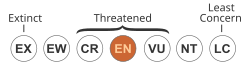
Tor putitora, the golden mahseer, putitor mahseer, or Himalayan mahseer, is an endangered species of cyprinid fish that is found in rapid streams, riverine pools, and lakes in the Himalayan region. Its native range is within the basins of the Indus, Ganges and Brahmaputra rivers.[1] It was reported to be found in the Salween River, the natural border between Thailand and Myanmar, but observations of it have been very rare, having only been observed three times in 28 years.[3]
This omnivorous species is generally found near the surface in water that ranges from 13–30 °C (55–86 °F).[4] It is a popular gamefish, once believed to be the largest species of mahseer, and can reach up to 2.75 m (9.0 ft) in length and 54 kg (119 lb) in weight, though most caught today are far smaller.[5]
The golden mahaseer is the National fish of Pakistan.[6][n 1] It is also the state fish of the states of Arunachal Pradesh, Himachal Pradesh, Uttarakhand, Odisha and the UT of Jammu and Kashmir.[7]
Nobel Prize winner for Literature - Rudyard Kipling, wrote: "There he met the mahseer of the Poonch, beside whom the tarpon is a herring, and he who catches him can say he is a fisherman." (Rudyard Kipling - "The Day's Work" 1898 - "The Brushwood Boy" 1899).[citation needed]
Description[edit | edit source]
Francis Buchanan-Hamilton's original description of Cyprinus putitora says "The head is blunt, oval, small, and smooth". He goes on to say "The mouth is small" and "the lateral line is scarcely distinguishable".[verification needed][8] However, the largest head of any mahseer species, with a large mouth and prominent lateral line stripe, are features considered to be important in the correct identification of this species.[citation needed] Their scales are so large that playing cards were made from them in Dacca,[9] as reported by Hamilton in his description.[8]
Tor putitora were previously distinguished by determining head length (which is purportedly greater than body depth in the species),[10][9][11][12][13] but analysis of T. putitora populations throughout India have determined that this method is hampered by the phenotypic plasticity of the species;[14] this metric should not be relied upon as individuals may have head lengths less than, equal to, or greater than body depth.[15][16][17] This variation lead to the naming of Tor macrolepis, now known to be a junior synonym of T. putitora inhabiting the Indus River.[15]
Its caudal, pelvic, and anal fins show a reddish-golden tint. While the body above its lateral line is generally golden in colour at adulthood, the gold colour might be absent in young specimens.[citation needed]
Habitat[edit | edit source]
.jpg)
The golden mahseer is naturally found in montane and submontane regions within streams and rivers across the Himalayan region. Its habitat includes high-energy river systems with rocky substrates, and the species has shown adaptability to lacustrine environments formed by dam impoundments. Additionally, introduced populations have established in lakes where suitable habitats for reproduction are created by ephemeral stream inputs. The species' ability to thrive in varied environmental conditions underscores the importance of preserving both natural river ecosystems and artificial reservoirs for the sustainable conservation of this fish species in the South Himalayan region.[1]
As an introduced species[edit | edit source]
Recent releases of artificially bred stock have been into the Irrawaddy River basin in Nagaland, India and, through the Indo-German Biodiversity Programme releases into the Hira Bambai reservoir and small streams around Melghat Tiger Reserve, part of the Tapti River basin.[18] The effect of releasing fish from a different river basin, well outside its native range is uncertain. That these fish are being released over a ten-year period, with as many as 10,000 in each batch, must be considered a huge threat to the native mahseer and other fish species.[19] According to Ogale, former scientist leading the fish breeding programme for Tata Power: "When these mature, there will be more fingerlings which will be then introduced in river Tapi".[20] River Tapi is a west-flowing river of the central Indian state of Maharashtra. Golden mahseer from Lonavala hatchery in Maharashtra, India were supplied to the government of Papua New Guinea[21][22] where the fish escaped into the local Sepik river system after release into the Yonki reservoir. There are fears about the decline of native species following these introductions.[23]
Relation to humans[edit | edit source]
It is threatened by habitat loss, habitat degradation and overfishing, and it already has declined by more than an estimated 50%.[1] The prospect of large-scale dam building across the distribution range gives cause for concern reflected by the current Red Listing status.
Most researchers believe this fish is in a population decline, hence the Red Listing status of Endangered. Some, however, have noted that Tor putitora is "quite abundant",[24] which also raises questions about the status of ongoing stock augmentation programmes.
The primary threat to Tor putitora is habitat loss and degradation, driven predominantly by the extensive development of hydropower projects in the Himalayan range. This anthropogenic impact poses a substantial risk to the species, as it results in the deterioration and reduction of essential habitats.[1]
Overfishing exacerbates the challenges faced by Tor putitora, with unsustainable practices such as dynamiting, poisoning, and the use of fine-meshed nets contributing to a decline in populations. The impact of overfishing is notable in various river systems, affecting the species' overall population dynamics.[1]
The species may also face increased competition due to widespread introduction of non-native species in the trans-Himalayan region, such as trout (Salmo spp. and Oncorhynchus mykiss) and common carp (Cyprinus carpio). Conversely, golden mahseer are themselves stocked into waterways where they aren't native, which may threaten other species and lead to "genetic simplification" (genetic erosion);[25][26] intentional stocking of mahseers have been taking place for several years.[27] It has been reported that the Teesta River in Sikkim and West Bengal has been stocked with hundreds of thousands of golden mahseer every year since at least 2014 in a drive to promote angling in the region.[28] That the fish stocks continue to decline suggests that the policy needs to be reviewed and more efforts devoted to improving habitat as the first priority.[verification needed][29][30]
Notes[edit | edit source]
References[edit | edit source]
- ↑ 1.0 1.1 1.2 1.3 1.4 1.5 Jha, B.R.; Rayamajhi, A.; Dahanukar, N.; Harrison, A. & Pinder, A. (2018). "Tor putitora". IUCN Red List of Threatened Species. 2018 e.T126319882A126322226. doi:10.2305/IUCN.UK.2018-2.RLTS.T126319882A126322226.en.
- ↑ Bailly N (ed.). "Tor putitora (Hamilton, 1822)". FishBase. World Register of Marine Species. Retrieved 2026-03-22.
- ↑ Kittipong Jaruthanin and Pong Bang Tan (September 2013). "Monsters of the River 2013". Aquarium Biz (in ไทย). Vol. 4, no. 39.
- ↑ IRG Systems South Asia Pvt. Ltd. (December 2014). Cumulative Impact and Carrying Capacity Study of Subansiri Sub Basin including Downstream Impacts. Final Report (PDF) (Report). Vol. 1. Central Water Commission, India.
- ↑ Template:FishBase
- ↑ "Pakistan". Archived from the original on 2016-11-28.[non-primary source needed]
- ↑ "State Fishes of India" (PDF). National Fisheries Development Board, Government of India. Retrieved 25 December 2020.
- ↑ 8.0 8.1 An account of the fishes found in the river Ganges and its branches. Edinburgh: A. Constable and company; [etc., etc.],. 1822. pp. 303–304. doi:10.5962/bhl.title.6897.
{{cite book}}: CS1 maint: extra punctuation (link) - ↑ 9.0 9.1 Sen, T. K. (1982). The mahseer fishes of India. Calcutta: Zoological Survey of India. p. 38. LCCN 83900473. Retrieved 18 March 2026.
- ↑ HORA, S.L., 1939. The game fishes of India VIII. The mahseer or the large scaled Barbels of India. 1. The putitor mahseer, Barbus Tor putitora (Hamilton). Journal of the Bombay Natural History Society, vol. 41, pp. 272-285.
- ↑ MIRZA, M.R. and JAVED, M.N., 1986. A contribution to the fishes of the genus Tor Gray (Pisces: Cyprinidae) from Pakistan and Azad Kashmir. Biologia, vol. 32, pp. 71-82.
- ↑ TALWAR, P.K. and JHINGRAN, A.G., 1991. Inland Fisheries of India and Adjacent Countries. Calcutta: Oxford and I B H Publication Co. Vol. 1 and 2
- ↑ MENON, A.G.K., 1992. Taxonomy of the Mahseer fishes of Genus Tor Gray with description of new species from Deccan. Journal of the Bombay Natural History Society, vol. 89, pp. 210-228
- ↑ BHATT, J.P. and PANDIT, M.K., 2016. Endangered Golden mahseer Tor putitora Hamilton: a review of natural history. Reviews in Fish Biology and Fisheries, vol. 26, no. 1, pp. 25-38. DOI Link.
- ↑ 15.0 15.1 "An overview of the taxonomic instability of endangered Golden and Zhobi mahseer in Pakistan". Brazilian Journal of Biology. 83. 24 February 2021. doi:10.1590/1519-6984.243975. ISSN 1678-4375. Retrieved 18 March 2026.
- ↑ SARMA, D., AKHTAR, M.S. and SINGH, A.K., 2014. Mahseer Research and Development: A Journey by DCFR. Uttarakhand, India: ICAR-Directorate of Cold Water Fisheries Research Bhimtal. DCFR publication Manual.
- ↑ SARMA, D., DAS, P., DAS, P., SANWA, S. and AKHTAR, M.S., 2015. Nutritional Composition of Golden Mahseer (Tor putitora) in Coldwater Himalayan Region of India. SKUAST Journal of Research, vol. 17, pp. 23-28.
- ↑ "Golden Mahashir fish fingerlings released in Hira Bambai reservoir". Thehitavada.com. Retrieved 28 November 2021.
- ↑ "Conservation project helps revive Mahseer in rivers". The Times of India. Retrieved 28 November 2021.
- ↑ "Mahseer fish makes a comeback in Melghat". Punemirror.indiatimes.com. 19 April 2015. Retrieved 28 November 2021.
- ↑ Nautiyal, Prakash; Babu, Suresh; Behera, Sandeep (2013). Mahseer Conservation in India Status, Challenges and the Way Forward. WWF-India.
- ↑ Coates, D. (1997). Fish stocking activities undertaken by the Sepik River Fish Stock Enhancement Project (1987-1993) and the FISHAID Project (1993-1997) (PDF) (Report). Rome: FISHAID Project.
- ↑ Dudgeon, David; Smith, Ross E. W. (2006-02-28). "Exotic species, fisheries and conservation of freshwater biodiversity in tropical Asia: the case of the Sepik River, Papua New Guinea". Aquatic Conservation: Marine and Freshwater Ecosystems. 16 (2): 203–215. Bibcode:2006ACMFE..16..203D. doi:10.1002/aqc.713. ISSN 1052-7613.
- ↑ "Distribution record on abundance of Tor putitora in Jammu waters". International Journal of Fisheries and Aquatic Studies. 4 (1): 341–347. 2016. Retrieved 28 November 2021 – via Researchgate.net.
- ↑ "India needs to set a new conservation agenda for mahseer". DownToEarth. Retrieved 19 March 2026.
- ↑ Nishikant Gupta & Mark Everard (2019) Non-native fishes in the Indian Himalaya: an emerging concern for freshwater scientists, International Journal of River Basin Management, 17:2, 271–275, DOI Link
- ↑ "Mahseer Seed Ranching in Teesta River of Sikkim on World Environment Day (5th June, 2017)" (PDF) – via Directorate of Coldwater Fisheries Research.[dead link]
- ↑ "GTA push to angling tourism with golden mahseer – Hill body to promote fishing in Teesta and Rangit with help from tour conductors and UK organisation".
- ↑ Saroj Toppo; H. Rahman; N. Haque. "Fish Biodiversity as an Indicator of Riverine Status of Sikkim" (PDF). sikkimforest.gov.in.[dead link]
- ↑ Bhatt, J. P.; Pandit, Maharaj K. (14 November 2015). "Endangered Golden mahseer Tor putitora Hamilton: A review of natural history | Scinapse | Academic search engine for paper". Reviews in Fish Biology and Fisheries. doi:10.1007/s11160-015-9409-7.
- IUCN Red List endangered species
- Tor (fish)
- Taxa named by Francis Buchanan-Hamilton
- Fish described in 1822
- Cyprinid fish of Asia
- Freshwater fish of China
- Freshwater fish of India
- Freshwater fish of Pakistan
- National symbols of Pakistan
- Symbols of Arunachal Pradesh
- Symbols of Himachal Pradesh
- Symbols of Uttarakhand