

No edit summary |
robot: Creating/updating articles |
||
| Line 1: | Line 1: | ||
{{ | {{Short description|Ground fruit of the family Piperaceae}} | ||
{{redirect|Peppercorn}} | {{redirect|Peppercorn}} | ||
{{Use dmy dates|date= | {{Use dmy dates|date=January 2023}} | ||
{{Speciesbox | {{Speciesbox | ||
|image = Piper_nigrum_-_Köhler–s_Medizinal-Pflanzen-107.jpg | |image = Piper_nigrum_-_Köhler–s_Medizinal-Pflanzen-107.jpg | ||
| Line 9: | Line 10: | ||
|authority = [[Carl Linnaeus|L.]]<ref name=GRIN>{{GRIN | access-date = 2 March 2008}}</ref> | |authority = [[Carl Linnaeus|L.]]<ref name=GRIN>{{GRIN | access-date = 2 March 2008}}</ref> | ||
}} | }} | ||
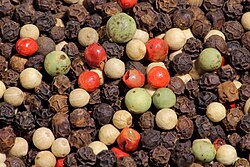
'''Black pepper''' (''Piper nigrum'') is a [[flowering plant|flowering]] [[vine]] in the family [[Piperaceae]], cultivated for its [[fruit]] | '''Black pepper''' (''Piper nigrum'') is a [[flowering plant|flowering]] [[vine]] in the family [[Piperaceae]], cultivated for its [[fruit]] (the '''peppercorn'''), which is usually dried and used as a [[spice]] and [[seasoning]]. The fruit is a [[drupe]] (stonefruit) which is about {{convert|5|mm|in|abbr=on}} in diameter (fresh and fully mature), dark red, and contains a [[Pyrena|stone]] which encloses a single pepper [[seed]]. Peppercorns and the ground pepper derived from them may be described simply as ''pepper'', or more precisely as ''black pepper'' (cooked and dried unripe fruit), ''green pepper'' (dried unripe fruit), or ''white pepper'' (ripe fruit seeds).<ref name=kind>{{cite web |url=https://www.foodrepublic.com/2016/01/27/what-are-the-different-kinds-of-peppercorns/ |title=What Are The Different Kinds of Peppercorns? |last=Harrison |first=Paul |date=27 January 2016 |website=Food Republic |language=en-US |access-date=21 November 2019}}</ref> | ||
Black pepper is native to the [[Malabar Coast]]<ref name="Sen, Colleen-Taylor">{{cite book |title= Food Culture in India – Food culture around the world |first=Colleen Taylor |last=Sen |publisher=Greenwood Publishing Group |year=2004 |isbn=9780313324871 |page=58 |url=https://books.google.com/books?id=YIyV_5wrplMC |quote=Peppers, called the king of spices, are the dried berries of a tropical vine native to Kerala, which is India's major producer}}</ref><ref name="Hajeski">{{cite book |title=National Geographic Complete Guide to Herbs and Spices: Remedies, Seasonings, and Ingredients to Improve Your Health and Enhance Your Life |first=Nancy J |last=Hajeski |publisher=National Geographic Books |year=2016 |isbn=9781426215889 |url=https://books.google.com/books?id=DmscDQAAQBAJ |page=236}}</ref> of [[India]], and the [[Malabar pepper]] is extensively cultivated there and in other [[tropical]] regions. | Black pepper is native to the [[Malabar Coast]]<ref name="Sen, Colleen-Taylor">{{cite book |title= Food Culture in India – Food culture around the world |first=Colleen Taylor |last=Sen |publisher=Greenwood Publishing Group |year=2004 |isbn=9780313324871 |page=58 |url=https://books.google.com/books?id=YIyV_5wrplMC |quote=Peppers, called the king of spices, are the dried berries of a tropical vine native to Kerala, which is India's major producer}}</ref><ref name="Hajeski">{{cite book |title=National Geographic Complete Guide to Herbs and Spices: Remedies, Seasonings, and Ingredients to Improve Your Health and Enhance Your Life |first=Nancy J |last=Hajeski |publisher=National Geographic Books |year=2016 |isbn=9781426215889 |url=https://books.google.com/books?id=DmscDQAAQBAJ |page=236}}</ref> of [[India]], and the [[Malabar pepper]] is extensively cultivated there and in other [[tropical]] regions. | ||
| Line 15: | Line 16: | ||
Ground, dried, and cooked peppercorns have been used since antiquity, both for flavour and as a [[traditional medicine]]. Black pepper is the world's most traded [[spice]], and is one of the most common spices added to cuisines around the world. Its spiciness is due to the chemical compound [[piperine]], which is a different kind of spicy from the [[capsaicin]] characteristic of [[chili pepper]]s. It is ubiquitous in the Western world as a [[seasoning]], and is often paired with [[salt]] and available on dining tables in [[salt and pepper shakers|shakers]] or [[burr mill|mills]]. | Ground, dried, and cooked peppercorns have been used since antiquity, both for flavour and as a [[traditional medicine]]. Black pepper is the world's most traded [[spice]], and is one of the most common spices added to cuisines around the world. Its spiciness is due to the chemical compound [[piperine]], which is a different kind of spicy from the [[capsaicin]] characteristic of [[chili pepper]]s. It is ubiquitous in the Western world as a [[seasoning]], and is often paired with [[salt]] and available on dining tables in [[salt and pepper shakers|shakers]] or [[burr mill|mills]]. | ||
[[Category: | ==Etymology== | ||
The word ''pepper'' derives from [[Old English]] ''pipor'', [[Latin]] ''piper'', and [[Sanskrit]] ''pippali'' for "long pepper".<ref name="oed">{{cite web |url=https://www.etymonline.com/word/pepper |title=Pepper (noun) |publisher=Online Etymology Dictionary, Douglas Harper |date=2016 |access-date=24 September 2016}}</ref> In the 16th century, people began using ''pepper'' to also mean the unrelated [[New World]] [[chili pepper]] (genus ''[[Capsicum]]'').<ref name=oed/> | |||
==Varieties== | |||
[[File:4 color mix of peppercorns.jpg|thumb|Black, green, white, and pink (''[[Schinus terebinthifolia]]'') peppercorns]] | |||
Processed peppercorns come in a variety of colours, any one of which may be used in food preparation, especially common [[peppercorn sauce]].<ref>{{Cite web |last=Higgins |first=Edward |date=25 May 2015 |title=Where Do Peppercorns Come From? |url=https://www.farmersalmanac.com/where-do-peppercorns-come-from-21386 |access-date=2 May 2022 |website=Farmers' Almanac |language=en-US}}</ref> | |||
===Black pepper=== | |||
Black pepper is produced from the still-green, unripe [[drupe]] of the pepper plant.<ref name=kind/> The drupes are cooked briefly in hot water, both to clean them and to prepare them for drying.<ref name=":0">{{Cite web |date=22 October 2021 |title=Why Is Pepper Black? - Know Your Pantry |url=https://www.knowyourpantry.com/seasonings/why-is-pepper-black/ |access-date=24 May 2022 |website=www.knowyourpantry.com |language=en-us}}</ref> The heat ruptures [[cell wall]]s in the pepper, speeding the work of [[browning (chemical process)|browning]] [[enzymes]] during drying.<ref name=":0" /> The drupes dry in the sun or by machine for several days, during which the pepper skin around the seed shrinks and darkens into a thin, wrinkled black layer. Once dry, the spice is called black peppercorn. On some estates, the berries are separated from the stem by hand and then sun-dried without boiling.<ref name=kind/> | |||
After the peppercorns are dried, pepper spirit and oil can be extracted from the berries by crushing them. Pepper spirit is used in many medicinal and beauty products. Pepper oil is also used as an [[ayurvedic]] massage oil and in certain beauty and herbal treatments. | |||
===White pepper=== | |||
White pepper consists solely of the seed of the ripe fruit of the pepper plant, with the thin darker-coloured skin (flesh) of the fruit removed. This is usually accomplished by a process known as [[retting]], where fully ripe red pepper berries are soaked in water for about a week so the flesh of the peppercorn softens and [[decomposition|decomposes]]; rubbing then removes what remains of the fruit, and the naked seed is dried. Sometimes the outer layer is removed from the seed through other mechanical, chemical, or biological methods.<ref>{{cite web |url=https://www.thehindubusinessline.com/todays-paper/tp-agri-biz-and-commodity/Cleaner-technology-for-white-pepper-production/article20126987.ece |title=Cleaner technology for white pepper production |work=The Hindu Business line |date=27 March 2008 |access-date=29 January 2009 |url-status=live |archive-url=https://web.archive.org/web/20080509200302/http://www.thehindubusinessline.com/2008/03/27/stories/2008032751741300.htm |archive-date=9 May 2008}}</ref> | |||
Ground white pepper is commonly used in [[Chinese cuisine|Chinese]], [[Thai cuisine|Thai]], and [[Portuguese cuisine]]s. It finds occasional use in other cuisines in salads, [[Béchamel|light-coloured]] sauces, and [[mashed potatoes]] as a substitute for black pepper, because black pepper would visibly stand out. However, white pepper lacks certain compounds present in the outer layer of the drupe, resulting in a different overall flavour. | |||
===Green pepper=== | |||
Green pepper, like black pepper, is made from unripe drupes. Dried green peppercorns are treated in a way that retains the green colour, such as with [[sulfur dioxide]], [[canning]], or [[freeze-drying]]. [[Pickled]] peppercorns, also green, are unripe drupes preserved in [[brine]] or [[vinegar]]. | |||
Fresh, unpreserved green pepper drupes are used in some cuisines like [[Thai cuisine]] and [[Tamil cuisine]]. Their flavour has been described as "spicy and fresh", with a "bright aroma."<ref>Ochef, [http://www.ochef.com/205.htm Using fresh green peppercorns] {{Webarchive |url=https://web.archive.org/web/20110904032529/http://www.ochef.com/205.htm |date=4 September 2011}}. Retrieved 6 November 2005.</ref> They decay quickly if not dried or preserved, making them unsuitable for international shipping. | |||
===Red peppercorns=== | |||
Red peppercorns usually consist of ripe peppercorn drupes preserved in brine and vinegar. Ripe red peppercorns can also be dried using the same colour-preserving techniques used to produce green pepper.<ref>Katzer, Gernot (2006). [http://gernot-katzers-spice-pages.com/engl/Pipe_nig.html Pepper] {{Webarchive|url=https://web.archive.org/web/20121205014755/http://gernot-katzers-spice-pages.com/engl/Pipe_nig.html |date=5 December 2012 }}. Gernot Katzer's Spice Pages. Retrieved 2 December 2012.</ref> | |||
===Pink pepper and other plants=== | |||
[[Pink peppercorn]]s are the fruits of the [[Peruvian pepper|Peruvian pepper tree]], ''Schinus molle'', or its relative, the [[Brazilian pepper|Brazilian pepper tree]], ''Schinus terebinthifolius'', plants from a different family ([[Anacardiaceae]]). As they are members of the [[cashew]] family, they may cause [[allergic reactions]], including [[anaphylaxis]], for persons with a [[tree nut allergy]]. | |||
The bark of ''[[Drimys winteri]]'' ("canelo" or "winter's bark") is used as a substitute for pepper in cold and temperate regions of [[Chile]] and [[Argentina]], where it is easily found and readily available. In [[New Zealand]], the seeds of [[Kawakawa (tree)|kawakawa]] (''Piper excelsum''), a [[Piperaceae|relative of black pepper]], are sometimes used as pepper; the leaves of ''[[Pseudowintera colorata]]'' ("mountain horopito") are another replacement for pepper. Several plants in the United States are also used as pepper substitutes, such as [[Lepidium campestre|field pepperwort]], [[Lepidium virginicum|least pepperwort]], [[shepherd's purse]], [[horseradish]], and [[field pennycress]]. | |||
<gallery mode="packed" heights="200px"> | |||
Variants of Pepper.jpg|Six variants of peppercorns (two types of white and two types of black, based on region) | |||
Dried Peppercorns.jpg|alt=Black peppercorns and white peppercorns|Black and white peppercorns | |||
Dried red Kampot peppercorns.jpg|Dried red [[Kampot peppercorns]] | |||
Pimienta negra (Piper nigrum), 2020-06-12, DD 20-40 FS.jpg|Close-up of a peppercorn | |||
</gallery> | |||
==Plants== | |||
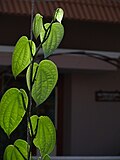
[[File:Pepper vine.JPG|thumb|Pepper vine]] | |||
The pepper plant is a [[perennial plant|perennial]] [[woody plant|woody]] [[vine]] growing up to {{convert|4|m|ft|abbr=on}} in height on supporting trees, poles, or trellises. It is a spreading vine, rooting readily where trailing stems touch the ground. The leaves are alternate, entire, {{convert|5|to|10|cm|abbr=on}} long and {{convert|3|to|6|cm|abbr=on}} across. The flowers are small, produced on pendulous spikes {{convert|4|to|8|cm|abbr=on}} long at the leaf nodes, the spikes lengthening up to {{convert|7|to|15|cm|abbr=on}} as the fruit matures.<ref name="Herbal Beast"/> <!-- The fruit of the black pepper is called a drupe and when dried is known as a peppercorn. --> | |||
Pepper can be grown in soil that is neither too dry nor susceptible to flooding, moist, well-drained, and rich in organic matter (the vines do not do well over an altitude of {{convert|900|m|ft|abbr=on|adj=on}} above sea level). The plants are propagated by cuttings about {{convert|40|to|50|cm|abbr=on}} long, tied up to neighbouring trees or climbing frames at distances of about {{convert|2|m|abbr=on}} apart; trees with rough bark are favoured over those with smooth bark, as the pepper plants climb rough bark more readily. Competing plants are cleared away, leaving only sufficient trees to provide shade and permit free ventilation. The roots are covered in leaf [[mulch]] and [[manure]], and the shoots are trimmed twice a year. On dry soils, the young plants require watering every other day during the [[dry season]] for the first three years. The plants bear fruit from the fourth or fifth year, and then typically for seven years. The cuttings are usually [[cultivar]]s, selected both for yield and quality of fruit.{{citation needed|date=June 2021}} | |||
A single stem bears 20 to 30 fruiting spikes. The harvest begins as soon as one or two fruits at the base of the spikes begin to turn red, and before the fruit is fully mature, and still hard; if allowed to ripen completely, the fruits lose pungency, and ultimately fall off and are lost. The spikes are collected and spread out to dry in the sun, then the peppercorns are stripped off the spikes.<ref name="Herbal Beast">{{cite web |url=http://www.herbalbeast.com/black-pepper-cultivation-and-harvest/ |title=Black Pepper Cultivation and Harvest |publisher=Thompson Martinez |access-date=14 May 2014 |url-status=dead |archive-url=https://web.archive.org/web/20140809123950/http://www.herbalbeast.com/black-pepper-cultivation-and-harvest/ |archive-date=9 August 2014}}</ref> | |||
Black pepper is native either to [[Southeast Asia]]<ref>{{cite web | url = http://www.efloras.org/florataxon.aspx?flora_id=2&taxon_id=200005581 | work = Flora of China | title = Piper nigrum Linnaeus }}</ref> or [[South Asia]].<ref name="jaramillo">{{Cite journal | url = http://www.amjbot.org/cgi/content/full/88/4/706 | doi = 10.2307/2657072 | pmid = 11302858 | title = Phylogeny and Patterns of Floral Diversity in the Genus Piper (Piperaceae) | year = 2001 | author = Jaramillo, M. Alejandra | journal = American Journal of Botany | volume = 88 | issue = 4 | pages = 706–16 | author2 = Manos | jstor = 2657072 | access-date = 20 February 2022 | archive-date = 30 June 2010 | archive-url = https://web.archive.org/web/20100630163917/http://www.amjbot.org/cgi/content/full/88/4/706 | url-status = dead }}</ref> Within the genus ''[[Piper (genus)|Piper]]'', it is most closely related to other Asian species such as ''P. caninum''.<ref name="jaramillo"/> | |||
Wild pepper grows in the [[Western Ghats]] region of [[India]]. Into the 19th century, the forests contained expansive wild pepper vines, as recorded by the Scottish physician [[Francis Buchanan]] (also a botanist and geographer) in his book ''A journey from Madras through the countries of Mysore, Canara and Malabar'' (Volume III).<ref name="DH-Hegde">{{cite news |last1=Manjunath Hegde |first1=Bomnalli |title=Meet the pepper queen |url=https://www.deccanherald.com/content/365810/meet-pepper-queen.html |access-date=22 January 2015 |issue=Bangalore |newspaper=Deccan Herald |date=19 October 2013}}</ref> However, [[deforestation]] resulted in wild pepper growing in more limited forest patches from [[Goa]] to [[Kerala]], with the wild source gradually decreasing as the quality and yield of the cultivated variety improved. No successful grafting of commercial pepper on wild pepper has been achieved to date.<ref name=DH-Hegde/> | |||
==Production and trade== | |||
{| class="wikitable" style="float:right; clear:right; margin-left:25px;" | |||
|+ Black pepper production, 2020 | |||
|- | |||
! Country | |||
! Production<br />{{small|([[tonne]]s)}} | |||
|- | |||
| {{VNM}} ||{{center| 270,192}} | |||
|- | |||
| {{BRA}} ||{{center| 114,749}} | |||
|- | |||
| {{INA}} ||{{center| 89,041}} | |||
|- | |||
| {{IND}} ||{{center| 66,000}} | |||
|- | |||
| {{LKA}} ||{{center| 43,557}} | |||
|- | |||
| {{CHN}} ||{{center| 33,348}} | |||
|- | |||
| {{MYS}} ||{{center| 30,804}} | |||
|- | |||
| '''World''' ||{{center| '''747,644'''}} | |||
|- | |||
| colspan="2" |{{center|<small>Source: [[FAOSTAT]] of the [[United Nations]]<ref name="fao">{{cite web |url=http://www.fao.org/faostat/en/#data/QC/visualize |publisher=Food And Agriculture Organization of the United Nations: Statistical Division (FAOSTAT) |title=Pepper (piper spp.), World regions/Production/Crops for 2019 (from pick list) |date=2019 |access-date=25 March 2021}}</ref></small>}} | |||
|} | |||
In 2020, [[Vietnam]] was the world's largest producer and exporter of black peppercorns, producing 270,192 [[tonnes]] or 36% of the world total (table).<ref name=fao/> Other major producers were [[Brazil]], [[Indonesia]], [[India]], [[Sri Lanka]], [[China]], and [[Malaysia]]. Global pepper production varies annually according to crop management, disease, and weather.<ref name="karvy">{{cite web |url=http://www.karvycommodities.com/downloads/karvySpecialReports/karvysSpecialReports_20080515_01.pdf |title=Karvy's special Reports — Seasonal Outlook Report Pepper |publisher=Karvy Comtrade Limited |date=15 May 2008 |access-date=29 January 2008}}</ref> Peppercorns are among the most widely traded spice in the world, accounting for 20% of all spice imports.<ref>{{cite book |last1=Parthasarthy |first1=V. A. |title=Chemistry of spices |date=2008 |publisher=CABI Pub |isbn=978-1845934057}}</ref> | |||
==History== | |||
Black pepper is native to [[South Asia]] and Southeast Asia, and has been known to [[Indian cuisine|Indian cooking]] since at least 2000 BCE.<ref>{{cite book |last1=Aggarwal |first1=Bharat B. |last2=Kunnumakkara |first2=Ajaikumar B. |title=Molecular Targets and Therapeutic Uses of Spices: Modern Uses for Ancient Medicine |date=2009 |publisher=World Scientific |isbn=978-981-283-791-2 |pages=26–27 |url=https://www.google.com/books/edition/Molecular_Targets_and_Therapeutic_Uses_o/xblX4RL_qQgC?hl=en&gbpv=1&dq=black+pepper+indian+cooking+2000+bce&pg=PA27&printsec=frontcover |access-date=28 March 2022 |language=en}}</ref>{{how|date=March 2023}} J. Innes Miller notes that while pepper was grown in southern [[Thailand]] and in [[Malaysia]],{{when|date=February 2020}} its most important source was India, particularly the [[Malabar Coast]], in what is now the state of [[Kerala]].<ref>J. Innes Miller, ''The Spice Trade of the Roman Empire'' (Oxford: Clarendon Press, 1969), p. 80</ref> The lost ancient port city of [[Muziris]] in Kerala, famous for exporting black pepper and various other spices, gets mentioned in a number of classical historical sources for its trade with [[Roman Empire]], [[Egypt]], [[Mesopotamia]], [[Levant]], and [[Yemen]].<ref>[http://www.thehindu.com/news/cities/Delhi/artefacts-from-the-lost-port-of-muziris/article6657446.ece "Artefacts from the lost Port of Muziris."] {{Webarchive|url=https://web.archive.org/web/20160113025900/http://www.thehindu.com/news/cities/Delhi/artefacts-from-the-lost-port-of-muziris/article6657446.ece |date=13 January 2016 }} The Hindu. 3 December 2014.</ref><ref>[http://www.frontline.in/navigation/?type=static&page=flonnet&rdurl=fl2708/stories/20100423270806200.htm "Muziris, at last?"] {{Webarchive|url=https://web.archive.org/web/20210723201636/http://www.frontline.in/navigation/?type=static&page=flonnet&rdurl=fl2708%2Fstories%2F20100423270806200.htm |date=23 July 2021 }} R. Krishnakumar, ''www.frontline.in'' Frontline, 10–23 April 2010.</ref><ref name="Pattanam">[http://www.thehindu.com/todays-paper/tp-national/pattanam-richest-indoroman-site-on-indian-ocean-rim/article274715.ece "Pattanam richest Indo-Roman site on Indian Ocean rim."] {{Webarchive|url=https://web.archive.org/web/20160113025900/http://www.thehindu.com/todays-paper/tp-national/pattanam-richest-indoroman-site-on-indian-ocean-rim/article274715.ece |date=13 January 2016 }} The Hindu. 3 May 2009.</ref><ref name="Kodungallur">{{cite book |author=Prof. George Menachery |author2= Fr. Werner Chakkalakkal, CMI |chapter=Cranganore: Past and Present |title=Kodungallur – The Cradle of Christianity in India |chapter-url=http://www.indianchristianity.com/html/Books.htm#CRANGANORE:%20PAST%20AND%20PRESENT |date=10 January 2001 |access-date=11 May 2016}}</ref> Peppercorns were a much-prized trade good, often referred to as "black gold" and used as a form of [[commodity money]]. The legacy of this trade remains in some Western legal systems that recognize the term "[[peppercorn rent]]" as a token payment for something that is, essentially, a gift. | |||
The ancient history of black pepper is often interlinked with (and confused with) that of [[long pepper]], the dried fruit of closely related ''[[Piper longum]]''. The Romans knew of both and often referred to either as just ''piper''. In fact, the popularity of long pepper did not entirely decline until the discovery of the New World and of [[chili pepper]]s. Chili peppers—some of which, when dried, are similar in shape and taste to long pepper—were easier to grow in a variety of locations more convenient to Europe. Before the 16th century, pepper was being grown in [[Java]], [[Sunda Islands|Sunda]], [[Sumatra]], [[Madagascar]], Malaysia, and everywhere in Southeast Asia. These areas traded mainly with China, or used the pepper locally.<ref>Dalby, p. 93.</ref> Ports in the Malabar area also served as a stop-off point for much of the trade in other spices from farther east in the Indian Ocean. | |||
===Ancient times=== | |||
Black peppercorns were found stuffed in the nostrils of [[Ramesses II]], placed there as part of the [[mummy|mummification]] rituals shortly after his death in 1213 BCE.<ref>{{cite book |url=https://books.google.com/books?id=J8mGcvFkatIC&pg=PT24 |title=Ramses II, Egyptian Pharaoh, Warrior, and Builder |author=Stephanie Fitzgerald |publisher=Compass Point Books |date=8 September 2008 |isbn=978-0-7565-3836-1 |page=88 |access-date=29 January 2008 }}</ref> Little else is known about the use of pepper in [[ancient Egypt]] and how it reached the [[Nile]] from the [[Malabar Coast]] of South Asia. | |||
Pepper (both long and black) was known in Greece at least as early as the fourth century BCE, though it was probably an uncommon and expensive item that only the very rich could afford. | |||
[[File:Italy to India Route.svg|thumb|A Roman-era trade route from India to Italy]] | |||
By the time of the early [[Roman Empire]], especially after Rome's conquest of Egypt in 30 BCE, open-ocean crossing of the Arabian Sea direct to Chera dynasty [[southern India]]'s Malabar Coast was near routine. Details of this trading across the Indian Ocean have been passed down in the ''[[Periplus of the Erythraean Sea]]''. According to the Greek geographer [[Strabo]], the early empire sent a fleet of around 120 ships on an annual trip to India and back.<ref name=Young2001p25/> The fleet timed its travel across the Arabian Sea to take advantage of the predictable [[monsoon]] winds. Returning from India, the ships travelled up the [[Red Sea]], from where the cargo was carried overland or via the [[Canal of the Pharaohs|Nile-Red Sea canal]] to the Nile River, barged to [[Alexandria]], and shipped from there to Italy and Rome. The rough geographical outlines of this same trade route would dominate the pepper trade into Europe for a millennium and a half to come. | |||
With ships sailing directly to the Malabar coast, [[Malabar pepper|Malabar black pepper]] was now travelling a shorter trade route than long pepper, and the prices reflected it. [[Pliny the Elder]]'s ''[[Natural History (Pliny)|Natural History]]'' tells us the prices in Rome around 77 CE: "Long pepper ... is 15 [[denarius|denarii]] per pound, while that of white pepper is seven, and of black, four." Pliny also complains, "There is no year in which India does not drain the Roman Empire of 50 million [[sestertius|sesterces]]", and further moralizes on pepper: | |||
{{Blockquote|It is quite surprising that the use of pepper has come so much into fashion, seeing that in other substances which we use, it is sometimes their sweetness, and sometimes their appearance that has attracted our notice; whereas, pepper has nothing in it that can plead as a recommendation to either fruit or berry, its only desirable quality being a certain pungency; and yet it is for this that we import it all the way from India! Who was the first to make trial of it as an article of food? and who, I wonder, was the man that was not content to prepare himself by hunger only for the satisfying of a greedy appetite?|Pliny, ''Natural History'' 12.14<ref>From Bostock and Riley's 1855 translation. [https://www.perseus.tufts.edu/hopper/text?doc=Perseus%3Atext%3A1999.02.0137%3Abook%3D12%3Achapter%3D14 Text online] {{Webarchive|url=https://web.archive.org/web/20210323014710/http://www.perseus.tufts.edu/hopper/text?doc=Perseus%3Atext%3A1999.02.0137%3Abook%3D12%3Achapter%3D14 |date=23 March 2021 }}.</ref>}} | |||
He does not state whether the 50 million was the actual amount of money which found its way to India or the total retail cost of the items in Rome, and, elsewhere, he cites a figure of 100 million sesterces.<ref name=Young2001p25>Young, p. 25.</ref> | |||
Black pepper was a well-known and widespread, if expensive, seasoning in the Roman Empire. [[Apicius]]' ''[[De re coquinaria]]'', a third-century cookbook probably based at least partly on one from the first century CE, includes pepper in a majority of its recipes. [[Edward Gibbon]] wrote, in ''[[The History of the Decline and Fall of the Roman Empire]]'', that pepper was "a favorite ingredient of the most expensive Roman cookery".<ref>{{cite book|last=Gibbon|first=Edward|title=History of the Decline and Fall of the Roman Empire|url=https://books.google.com/books?id=QKALAAAAYAAJ&pg=PA272|edition=New|volume=III|year=1873|orig-year=1781|publisher=Claxton, Remsen & Haffelfinger|location=Philadelphia|oclc=669186315|page=272f79}}</ref> | |||
===Postclassical Europe=== | |||
Pepper was so valuable that it was often used as [[collateral (finance)|collateral]] or even currency. The taste for pepper (or the appreciation of its monetary value) was passed on to those who would see Rome fall. [[Alaric I|Alaric]], king of the [[Visigoths]], included 3,000 pounds of pepper as part of the ransom he demanded from Rome when he besieged the city in the fifth century.<ref>J. Norwich, ''Byzantium: The Early Centuries'', 134</ref> After the fall of Rome, others took over the middle legs of the [[spice trade]], first the [[Persian Empire|Persians]] and then the [[Arab]]s; Innes Miller cites the account of [[Cosmas Indicopleustes]], who travelled east to India, as proof that "pepper was still being exported from India in the sixth century".<ref>Innes Miller, ''The Spice Trade'', p. 83</ref> By the end of the [[Early Middle Ages]], the central portions of the spice trade were firmly under [[Islamic]] control. Once into the Mediterranean, the trade was largely monopolized by Italian powers, especially [[Republic of Venice|Venice]] and [[Republic of Genoa|Genoa]]. The rise of these [[city-state]]s was funded in large part by the spice trade. | |||
A [[riddle]] authored by [[Saint Aldhelm]], a seventh-century [[Bishop of Sherborne (historic)|Bishop of Sherborne]], sheds some light on black pepper's role in England at that time: | |||
{{Poem quote|I am black on the outside, clad in a wrinkled cover, | |||
Yet within I bear a burning marrow. | |||
I season delicacies, the banquets of kings, and the luxuries of the table, | |||
Both the sauces and the tenderized meats of the kitchen. | |||
But you will find in me no quality of any worth, | |||
Unless your bowels have been rattled by my gleaming marrow.<ref>Translation from Turner, p 94. The riddle's answer is of course ''pepper''.</ref>}} | |||
It is commonly believed that during the [[Middle Ages]], pepper was often used to conceal the taste of partially rotten meat. No evidence supports this claim, and historians view it as highly unlikely; in the Middle Ages, pepper was a [[luxury good|luxury item]], affordable only to the wealthy, who certainly had unspoiled meat available, as well.<ref>Dalby, p. 156; also Turner, pp. 108–109, though Turner does go on to discuss spices (not pepper specifically) being used to disguise the taste of partially spoiled wine or ale.</ref> In addition, people of the time certainly knew that eating spoiled food would make them sick. Similarly, the belief that pepper was widely used as a preservative is questionable; it is true that [[piperine]], the compound that gives pepper its spiciness, has some antimicrobial properties, but at the concentrations present when pepper is used as a spice, the effect is small.<ref>{{cite journal |author1 =H. J. D. Dorman |author2 =S. G. Deans | title=Antimicrobial agents from plants: antibacterial activity of plant volatile oils | journal=Journal of Applied Microbiology | year=2000 | volume=88| issue = 2 | pages=308–16 | doi=10.1046/j.1365-2672.2000.00969.x | pmid=10736000|s2cid =21788355 |quote=Spices, which are used as integral ingredients in cuisine or added as flavouring agents to foods, are present in insufficient quantities for their antimicrobial properties to be significant.}}</ref> Salt is a much more effective preservative, and [[salt-cured meat]]s were common fare, especially in winter. However, pepper and other spices certainly played a role in improving the taste of long-preserved meats. | |||
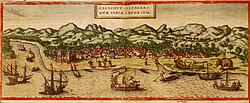
[[File:Calicut 1572.jpg|thumb|300px|A depiction of [[Kozhikode|Calicut, Kerala, India]] published in 1572 during Portugal's control of the pepper trade]] | |||
Its exorbitant price during the Middle Ages – and the monopoly on the trade held by Italy – was one of the inducements that led the [[Portugal|Portuguese]] to seek a sea route to India. In 1498, [[Vasco da Gama]] became the first person to reach India by sailing around Africa (see [[Age of Discovery]]); asked by Arabs in [[Kozhikode|Calicut]] (who spoke Spanish and Italian) why they had come, his representative replied, "we seek [[Christians]] and spices".<ref>Prasad, p. 3.</ref> Though this first trip to India by way of the southern tip of Africa was only a modest success, the Portuguese quickly returned in greater numbers and eventually gained much greater control of trade on the Arabian Sea. The [[Treaty of Tordesillas|1494 Treaty of Tordesillas]] with the Spanish granted Portugal exclusive rights to the half of the world where black pepper originated. | |||
However, the Portuguese proved unable to monopolize the spice trade. Older Arab and Venetian trade networks successfully imported enormous quantities of spices, and pepper once again flowed through Alexandria and Italy, as well as around Africa. In the 17th century, the Portuguese lost almost all of their valuable Indian Ocean trade to the [[Netherlands|Dutch]] and the [[England|English]], who, taking advantage of the Spanish rule over Portugal during the [[Iberian Union]] (1580–1640), occupied by force almost all Portuguese interests in the area. The pepper ports of Malabar began to trade increasingly with the Dutch in the period 1661–1663. | |||
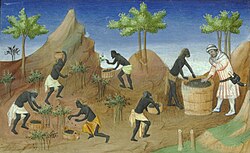
[[File:Le livre des merveilles de Marco Polo-pepper.jpg|thumb|Pepper harvested for the European trade, from a manuscript ''Livre des merveilles de [[Marco Polo]]'' (The book of the marvels of Marco Polo)]] | |||
As pepper supplies into Europe increased, the price of pepper declined (though the total value of the import trade generally did not). Pepper, which in the early Middle Ages had been an item exclusively for the rich, started to become more of an everyday seasoning among those of more average means. Today, pepper accounts for one-fifth of the world's spice trade.<ref>Jaffee, p. 10.</ref> | |||
===China=== | |||
It is possible that black pepper was known in [[China]] in the second century BCE, if poetic reports regarding an explorer named Tang Meng (唐蒙) are correct. Sent by [[Emperor Wu of Han China|Emperor Wu]] to what is now south-west China, Tang Meng is said to have come across something called ''jujiang'' or "sauce-betel". He was told it came from the markets of [[Shu (state)|Shu]], an area in what is now the [[Sichuan]] province. The traditional view among historians is that "sauce-betel" is a sauce made from [[betel]] leaves, but arguments have been made that it actually refers to pepper, either long or black.<ref>Dalby, pp. 74–75. The argument that ''jujiang'' was long pepper goes back to the fourth century CE botanical writings of Ji Han; Hui-lin Li's 1979 translation of and commentary on Ji Han's work makes the case that it was ''Piper nigrum''.</ref> | |||
In the third century CE, black pepper made its first definite appearance in Chinese texts, as ''hujiao'' or "foreign pepper". It does not appear to have been widely known at the time, failing to appear in a fourth-century work describing a wide variety of spices from beyond China's southern border, including long pepper.<ref>Dalby, p. 77.</ref> By the 12th century, however, black pepper had become a popular ingredient in the cuisine of the wealthy and powerful, sometimes taking the place of China's native [[Sichuan pepper]] (the tongue-numbing dried fruit of an unrelated plant).{{citation needed|date=May 2021}} | |||
[[Marco Polo]] testifies to pepper's popularity in 13th-century China, when he relates what he is told of its consumption in the city of Kinsay ([[Hangzhou]]): "... Messer Marco heard it stated by one of the Great Kaan's officers of customs that the quantity of pepper introduced daily for consumption into the city of Kinsay amounted to 43 loads, each load being equal to 223 lbs."<ref>[[Henry Yule|Yule, Henry]]; Cordier, Henri, Translation from [http://www.gutenberg.org/browse/authors/y#a5823 ''The Travels of Marco Polo: The Complete Yule-Cordier Edition''] {{Webarchive|url=https://web.archive.org/web/20080509074924/http://www.gutenberg.org/browse/authors/y#a5823 |date=9 May 2008 }}, Vol. 2, Dover. {{ISBN|0-486-27587-6}}. p. 204.</ref> | |||
During the course of the [[Ming treasure voyages]] in the early 15th century, Admiral [[Zheng He]] and his expeditionary fleets returned with such a large amount of black pepper that the once-costly luxury became a common commodity.<ref>{{cite journal |last=Finlay |first=Robert |title=The Voyages of Zheng He: Ideology, State Power, and Maritime Trade in Ming China |journal=Journal of the Historical Society |year=2008 |volume=8 |issue=3 |page=337 |doi=10.1111/j.1540-5923.2008.00250.x}}</ref> | |||
==Traditional medicine, phytochemicals, and research== | |||
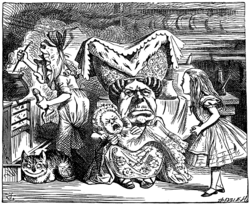
[[File:Alice par John Tenniel 21.png|right|thumb|"There's certainly too much pepper in that soup!" Alice said to herself, as well as she could for sneezing. — ''[[Alice in Wonderland]]'' (1865). Chapter VI: Pig and Pepper. Note the cook's pepper mill.]] | |||
Like many eastern spices, pepper was historically both a seasoning and a [[traditional medicine]]. Pepper appears in the Buddhist [[Samaññaphala Sutta]], chapter five, as one of the few medicines a monk is allowed to carry.<ref>{{cite book |url=https://archive.org/details/buddhistmonastic0000wija |title=Buddhist Monastic Code II |author=Thanissaro Bhikkhu |author-link=Thanissaro Bhikkhu |publisher=Cambridge University Press |date=30 November 1990 |isbn=978-0-521-36708-0 |access-date=29 January 2008 |url-access=registration}}</ref> Long pepper, being stronger, was often the preferred medication, but both were used. Black pepper (or perhaps long pepper) was believed to cure several illnesses, such as [[constipation]], [[insomnia]], oral [[abscess]]es, [[sunburn]], and [[toothache]]s, among others.<ref>Turner, p. 160.</ref> Various sources from the fifth century onward recommended pepper to treat eye problems, often by applying salves or poultices made with pepper directly to the eye. Though current medical research has yet to confirm any treatment benefit to humans, several benefits have been shown in animal modeling experiments.<ref>Turner, p. 171.</ref><ref>{{cite journal |url=https://pubmed.ncbi.nlm.nih.gov/23768180/ |pmid=23768180 |year=2013 |last1=Butt |first1=M. S. |last2=Pasha |first2=I. |last3=Sultan |first3=M. T. |last4=Randhawa |first4=M. A. |last5=Saeed |first5=F. |last6=Ahmed |first6=W. |title=Black pepper and health claims: A comprehensive treatise |journal=Critical Reviews in Food Science and Nutrition |volume=53 |issue=9 |pages=875–86 |doi=10.1080/10408398.2011.571799 |s2cid=4764467}}</ref><ref>[https://time.com/5503520/black-pepper-health-benefits/ Is Black Pepper Healthy? Here's What the Science Says] {{Webarchive|url=https://web.archive.org/web/20221031180228/https://time.com/5503520/black-pepper-health-benefits/ |date=31 October 2022 }} Time magazine, 16 January 2019</ref> | |||
Pepper contains [[phytochemical]]s,<ref>{{cite journal |last1=Dawid |first1=Corinna |last2=Henze|first2=Andrea |last3=Frank |first3=Oliver |last4=Glabasnia |first4=Anneke |last5=Rupp |first5=Mathias |last6=Büning |first6=Kirsten |last7=Orlikowski |first7=Diana |last8=Bader |first8=Matthias |last9=Hofmann |first9=Thomas |title=Structural and Sensory Characterization of Key Pungent and Tingling Compounds from Black Pepper (''Piper nigrum'' L.) |journal=Journal of Agricultural and Food Chemistry |volume=60 |issue=11 |year=2012 |pages=2884–2895 |pmid=22352449 |doi=10.1021/jf300036a}}</ref> including [[amide]]s, [[piperidine]]s, [[pyrrolidine]]s, and trace amounts of [[safrole]], which may be [[carcinogen]]ic in laboratory rodents.<ref name=duke>{{cite book |url=https://books.google.com/books?id=-tg7R4hU8hkC&pg=PA395 |title=CRC Handbook of Alternative Cash Crops |author=James A. Duke |publisher=CRC Press |date=16 August 1993 |isbn=978-0-8493-3620-1 |page=395 |access-date=29 January 2009}}</ref> | |||
Piperine is under study for its potential to increase absorption of [[selenium]], [[vitamin B12|vitamin B<sub>12</sub>]], [[beta-carotene]], and [[curcumin]], as well as other compounds.<ref>{{cite journal |doi=10.1100/2012/637953 |title=A comprehensive review on pharmacotherapeutics of herbal bioenhancers |journal=The Scientific World Journal |year=2012 |volume=2012 |issue=637953 |pages=637953 |last1=Dudhatra |first1=GB |last2=Mody |first2=SK |last3=Awale |first3=MM |last4=Patel |first4=HB |last5=Modi |first5=CM |last6=Kumar |first6=A |last7=Kamani |first7=DR |last8=Chauhan |first8=BN |pmid=23028251 |pmc=3458266}}</ref> | |||
Pepper is known to cause [[sneeze|sneezing]]. Some sources say that piperine, a substance present in black pepper, irritates the nostrils, causing the sneezing.<ref>U.S. Library of Congress Science Reference Services, "Everyday Mysteries", [https://www.loc.gov/rr/scitech/mysteries/pepper.html Why does pepper make you sneeze?] {{Webarchive|url=https://web.archive.org/web/20221031180231/https://www.loc.gov/everyday-mysteries/food-and-nutrition/item/why-does-pepper-make-you-sneeze/ |date=31 October 2022 }}. Retrieved 12 November 2005.</ref> Few, if any, controlled studies have been carried out to answer the question. | |||
Piperine is also under study for a variety of possible physiological effects,<ref>{{cite journal |journal=Crit Rev Food Sci Nutr |year=2007 |volume=47 |issue=8 |pages=735–48 |title=Black pepper and its pungent principle–piperine: a review of diverse physiological effects |author=Srinivasan K |pmid=17987447 |doi=10.1080/10408390601062054 |s2cid=42908718}}</ref> although this work is preliminary and mechanisms of activity for piperine in the human body remain unknown. | |||
===Nutrition=== | |||
One [[tablespoon]] (6 grams) of ground black pepper contains moderate amounts of [[vitamin K]] (13% of the [[daily value]] or DV), [[iron]] (10% DV), and [[manganese]] (18% DV), with trace amounts of other [[essential nutrients]], [[protein (nutrient)|protein]], and [[dietary fibre]].<ref>{{cite web |url=https://nutritiondata.self.com/facts/spices-and-herbs/200/2 |title=Nutrition facts for black pepper, one tablespoon (6 g); USDA Nutrient Database, version SR-21 |publisher=Conde Nast |date=2014 |access-date=25 October 2014}}</ref> | |||
==Flavour== | |||
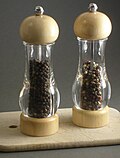
[[File:Pfeffermuehlen S7301812.jpg|thumb|Handheld pepper mills with black (left) and mixed (right) peppercorns]] | |||
Pepper gets its spicy heat mostly from [[piperine]] derived from both the outer fruit and the seed. Black pepper contains between 4.6 and 9.7% piperine by mass, and white pepper slightly more than that.<ref>[https://www.tis-gdv.de/tis_e/ware/gewuerze/pfeffer/pfeffer.htm/#selbsterhitzung Pepper]. Tis-gdv.de. Retrieved on 31 October 2012.</ref> Refined piperine, by weight, is about one percent as hot as the [[capsaicin]] found in [[chili pepper]]s.<ref name=lawless>{{cite book|last1=Lawless|first1=Harry T.|last2=Heymann|first2=Hildegarde|title=Sensory Evaluation of Food: Principles and Practices|pages=62–3|year=2010|publisher=Springer|isbn=978-1441964885|url=https://books.google.com/books?id=BTR7VEJPDWAC&q=piperine}}</ref> The outer fruit layer, left on black pepper, also contains [[aroma]]-contributing [[terpene]]s, including [[germacrene]] (11%), [[limonene]] (10%), [[pinene]] (10%), [[alpha-phellandrene]] (9%), and [[beta-caryophyllene]] (7%),<ref>{{cite journal|pmid= 12462618|year= 2002|last1= Jirovetz|first1= L|title= Aroma compound analysis of Piper nigrum and Piper guineense essential oils from Cameroon using solid-phase microextraction-gas chromatography, solid-phase microextraction-gas chromatography-mass spectrometry and olfactometry|journal= Journal of Chromatography A|volume= 976|issue= 1–2|pages= 265–75|last2= Buchbauer|first2= G|last3= Ngassoum|first3= M. B.|last4= Geissler|first4= M|url=https://www.academia.edu/1845116|doi=10.1016/s0021-9673(02)00376-x}}</ref> which give citrusy, woody, and floral notes. These scents are mostly missing in white pepper, as the fermentation and other processing removes the fruit layer (which also contains some of the spicy piperine). Other flavours also commonly develop in this process, some of which are described as off-flavours when in excess: Primarily [[3-methylindole]] (pig manure-like), [[4-methylphenol]] (horse manure), [[3-methylphenol]] (phenolic), and [[butyric acid]] (cheese).<ref>{{cite journal |last1=Steinhaus |first1=Martin |last2=Schieberle |first2=Peter |date=28 June 2005 |title= Role of the Fermentation Process in Off-odorant Formation in White Pepper: On-site Trial in Thailand |journal=Journal of Agricultural and Food Chemistry |volume=53 |issue=15 |pages=6056–6060 |doi=10.1021/jf050604s |pmid=16028995}}</ref> The aroma of pepper is attributed to [[rotundone]] (3,4,5,6,7,8-Hexahydro-3α,8α-dimethyl-5α-(1-methylethenyl)[[azulene]]-1(2H)-one), a [[sesquiterpene]] originally discovered in the tubers of ''[[Cyperus rotundus]]'', which can be detected in concentrations of 0.4 nanograms/l in water and in wine: rotundone is also present in marjoram, oregano, rosemary, basil, thyme, and geranium, as well as in some [[Shiraz wine]]s.<ref>{{cite journal |last1= Siebert |first1= Tracey E. |last2= Wood |first2= Claudia |last3= Elsey |first3= Gordon M. |last4= Alan |year= 2008 |title= Determination of Rotundone, the Pepper Aroma Impact Compound, in Grapes and Wine |journal= J. Agric. Food Chem. |volume= 56 |issue= 10|pages= 3745–3748 |doi= 10.1021/jf800184t |pmid=18461962}}</ref> | |||
Pepper loses flavour and aroma through evaporation, so airtight storage helps preserve its spiciness longer. Pepper can also lose flavour when exposed to light, which can [[Isomerisation|transform]] piperine into nearly tasteless [[chavicine|isochavicine]].<ref name = "McGee">McGee, p. 428.</ref> Once ground, pepper's aromatics can evaporate quickly; most culinary sources recommend grinding whole peppercorns immediately before use for this reason. Handheld [[pepper mill]]s or grinders, which mechanically grind or crush whole peppercorns, are used for this as an alternative to pepper shakers that dispense ground pepper. Spice mills such as pepper mills were found in European kitchens as early as the 14th century, but the [[mortar and pestle]] used earlier for crushing pepper have remained a popular method for centuries, as well.<ref>{{cite book | author=Montagne, Prosper | title=Larousse Gastronomique | publisher=Hamlyn | year=2001 | isbn=978-0-600-60235-4 | page=726 | oclc=47231315 }} "Mill".</ref> | |||
Enhancing the flavour profile of peppercorns (including piperine and essential oils), prior to processing, has been attempted through the postharvest application of ultraviolet-C light (UV-C).<ref>{{cite journal |last1=Collings |first1=Emma R. |last2=Alamar Gavidia |first2=M. Carmen |last3=Cools |first3=Katherine |last4=Redfern |first4=Sally |last5=Terry |first5=Leon A. |title=Effect of UV-C on the physiology and biochemical profile of fresh Piper nigrum berries |journal=Postharvest Biology and Technology |date=February 2018 |volume=136 |pages=161–165 |doi=10.1016/j.postharvbio.2017.11.007|pmid=29398783 |pmc=5727672 }}</ref> | |||
==See also== | |||
* [[False black pepper]] – ''Embelia ribes'' is a species in the family Primulaceae (the ''primrose family'') | |||
{{Clear}} | |||
==References== | |||
{{Reflist}} | |||
==Bibliography== | |||
{{Refbegin}} | |||
* {{cite book | last = Dalby | first = Andrew | title = Dangerous Tastes | publisher = University of California Press | location = Berkeley | year = 2002 | isbn = 978-0-520-23674-5|url=https://books.google.com/books?id=7IHcZ21dyjwC}} | |||
* {{cite book | last = Davidson | first = Alan | title = Wilder Shores of Gastronomy: Twenty Years of the Best Food Writing from the Journal Petits Propos Culinaires | publisher = Ten Speed Press | location = Berkeley | year = 2002 | isbn = 978-1-58008-417-8 | url-access = registration | url = https://archive.org/details/wildershoresofga00davi }} | |||
* {{cite journal|last=Jaffee|first=Steven|year=2004|title=Delivering and Taking the Heat: Indian Spices and Evolving Process Standards|journal=An Agriculture and Rural Development Discussion Paper|url=http://siteresources.worldbank.org/INTRANETTRADE/Resources/Topics/Standards/IndiaSpices.pdf|access-date=27 October 2005|archive-url=https://web.archive.org/web/20160303165643/http://siteresources.worldbank.org/INTRANETTRADE/Resources/Topics/Standards/IndiaSpices.pdf|archive-date=3 March 2016|url-status=dead}} | |||
* {{cite book | author=McGee, Harold|chapter=Black Pepper and Relatives | title=On Food and Cooking | publisher=Scribner | year=2004 | isbn=978-0-684-80001-1 | pages=427–429 | oclc=56590708|edition=Revised }} | |||
* {{cite book|last1=Prasad|first1=Anshuman|editor-last1=Prasad|editor-first1=Anshuman|title=Postcolonial Theory and Organizational Analysis: A Critical Engagement|chapter-url=https://books.google.com/books?id=FVbHAAAAQBAJ&pg=PA3|year=2003|publisher=Palgrave Macmillan US|location=New York|isbn=978-1-4039-8229-2|pages=3–43|chapter=The Gaze of the Other: Postcolonial Theory and Organizational Analysis}} | |||
* {{cite book | author=Turner, Jack | title=Spice: The History of a Temptation | publisher=Vintage Books | location = London| year=2004 | isbn=978-0-375-70705-6 | oclc=61213802}} | |||
* {{cite book|last=Young|first=Gary K.|title=Rome's Eastern Trade|date=2001|isbn=0-415-24219-3}} | |||
{{Refend}} | |||
==External links== | |||
* {{Commons category-inline|Piper nigrum}} | |||
* {{Wikispecies-inline|Piper nigrum}} | |||
* {{cookbook-inline|Pepper}} | |||
{{Culinary herbs and spices}} | |||
{{Transient receptor potential channel modulators}} | |||
{{Taxonbar|from=Q43084}} | |||
{{Authority control}} | |||
{{DEFAULTSORT:Pepper, Black}} | |||
[[Category:Crops originating from India]] | |||
[[Category:Essential oils]] | |||
[[Category:Indian spices]] | |||
[[Category:Medicinal plants of Asia]] | |||
[[Category:Monoamine oxidase inhibitors]] | |||
[[Category:Non-timber forest products]] | |||
[[Category:Pepper trade]] | |||
[[Category:Piper (plant)]] | |||
[[Category:Spices]] | |||
[[Category:Plants described in 1753]] | |||
Revision as of 21:22, 17 March 2023
| Black pepper | |
|---|---|

| |
| Pepper plant with immature peppercorns | |
Scientific classification 
| |
| : | [[Template:Taxonomy/Piper]] |
| Species: | Template:Taxonomy/PiperP. nigrum
|
| Binomial name | |
| Template:Taxonomy/PiperPiper nigrum | |
Black pepper (Piper nigrum) is a flowering vine in the family Piperaceae, cultivated for its fruit (the peppercorn), which is usually dried and used as a spice and seasoning. The fruit is a drupe (stonefruit) which is about 5 mm (0.20 in) in diameter (fresh and fully mature), dark red, and contains a stone which encloses a single pepper seed. Peppercorns and the ground pepper derived from them may be described simply as pepper, or more precisely as black pepper (cooked and dried unripe fruit), green pepper (dried unripe fruit), or white pepper (ripe fruit seeds).[2]
Black pepper is native to the Malabar Coast[3][4] of India, and the Malabar pepper is extensively cultivated there and in other tropical regions.
Ground, dried, and cooked peppercorns have been used since antiquity, both for flavour and as a traditional medicine. Black pepper is the world's most traded spice, and is one of the most common spices added to cuisines around the world. Its spiciness is due to the chemical compound piperine, which is a different kind of spicy from the capsaicin characteristic of chili peppers. It is ubiquitous in the Western world as a seasoning, and is often paired with salt and available on dining tables in shakers or mills.
Etymology
The word pepper derives from Old English pipor, Latin piper, and Sanskrit pippali for "long pepper".[5] In the 16th century, people began using pepper to also mean the unrelated New World chili pepper (genus Capsicum).[5]
Varieties

Processed peppercorns come in a variety of colours, any one of which may be used in food preparation, especially common peppercorn sauce.[6]
Black pepper
Black pepper is produced from the still-green, unripe drupe of the pepper plant.[2] The drupes are cooked briefly in hot water, both to clean them and to prepare them for drying.[7] The heat ruptures cell walls in the pepper, speeding the work of browning enzymes during drying.[7] The drupes dry in the sun or by machine for several days, during which the pepper skin around the seed shrinks and darkens into a thin, wrinkled black layer. Once dry, the spice is called black peppercorn. On some estates, the berries are separated from the stem by hand and then sun-dried without boiling.[2]
After the peppercorns are dried, pepper spirit and oil can be extracted from the berries by crushing them. Pepper spirit is used in many medicinal and beauty products. Pepper oil is also used as an ayurvedic massage oil and in certain beauty and herbal treatments.
White pepper
White pepper consists solely of the seed of the ripe fruit of the pepper plant, with the thin darker-coloured skin (flesh) of the fruit removed. This is usually accomplished by a process known as retting, where fully ripe red pepper berries are soaked in water for about a week so the flesh of the peppercorn softens and decomposes; rubbing then removes what remains of the fruit, and the naked seed is dried. Sometimes the outer layer is removed from the seed through other mechanical, chemical, or biological methods.[8]
Ground white pepper is commonly used in Chinese, Thai, and Portuguese cuisines. It finds occasional use in other cuisines in salads, light-coloured sauces, and mashed potatoes as a substitute for black pepper, because black pepper would visibly stand out. However, white pepper lacks certain compounds present in the outer layer of the drupe, resulting in a different overall flavour.
Green pepper
Green pepper, like black pepper, is made from unripe drupes. Dried green peppercorns are treated in a way that retains the green colour, such as with sulfur dioxide, canning, or freeze-drying. Pickled peppercorns, also green, are unripe drupes preserved in brine or vinegar.
Fresh, unpreserved green pepper drupes are used in some cuisines like Thai cuisine and Tamil cuisine. Their flavour has been described as "spicy and fresh", with a "bright aroma."[9] They decay quickly if not dried or preserved, making them unsuitable for international shipping.
Red peppercorns
Red peppercorns usually consist of ripe peppercorn drupes preserved in brine and vinegar. Ripe red peppercorns can also be dried using the same colour-preserving techniques used to produce green pepper.[10]
Pink pepper and other plants
Pink peppercorns are the fruits of the Peruvian pepper tree, Schinus molle, or its relative, the Brazilian pepper tree, Schinus terebinthifolius, plants from a different family (Anacardiaceae). As they are members of the cashew family, they may cause allergic reactions, including anaphylaxis, for persons with a tree nut allergy.
The bark of Drimys winteri ("canelo" or "winter's bark") is used as a substitute for pepper in cold and temperate regions of Chile and Argentina, where it is easily found and readily available. In New Zealand, the seeds of kawakawa (Piper excelsum), a relative of black pepper, are sometimes used as pepper; the leaves of Pseudowintera colorata ("mountain horopito") are another replacement for pepper. Several plants in the United States are also used as pepper substitutes, such as field pepperwort, least pepperwort, shepherd's purse, horseradish, and field pennycress.
-
 Six variants of peppercorns (two types of white and two types of black, based on region)
 -
 Black and white peppercorns
 -
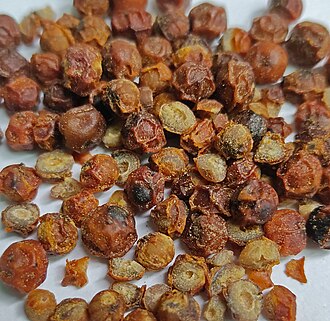 Dried red Kampot peppercorns
 -
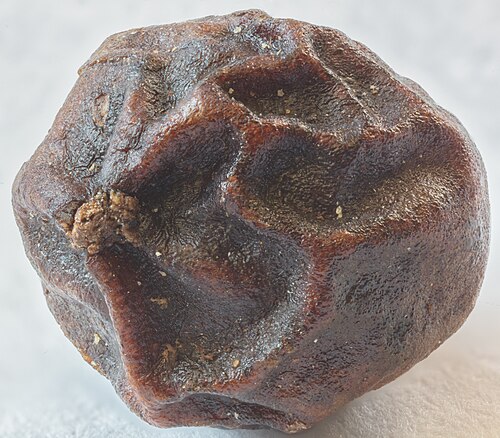 Close-up of a peppercorn


,_2020-06-12,_DD_20-40_FS.jpg)
Plants

The pepper plant is a perennial woody vine growing up to 4 m (13 ft) in height on supporting trees, poles, or trellises. It is a spreading vine, rooting readily where trailing stems touch the ground. The leaves are alternate, entire, 5 to 10 cm (2.0 to 3.9 in) long and 3 to 6 cm (1.2 to 2.4 in) across. The flowers are small, produced on pendulous spikes 4 to 8 cm (1.6 to 3.1 in) long at the leaf nodes, the spikes lengthening up to 7 to 15 cm (2.8 to 5.9 in) as the fruit matures.[11]
Pepper can be grown in soil that is neither too dry nor susceptible to flooding, moist, well-drained, and rich in organic matter (the vines do not do well over an altitude of 900 m (3,000 ft) above sea level). The plants are propagated by cuttings about 40 to 50 cm (16 to 20 in) long, tied up to neighbouring trees or climbing frames at distances of about 2 m (6 ft 7 in) apart; trees with rough bark are favoured over those with smooth bark, as the pepper plants climb rough bark more readily. Competing plants are cleared away, leaving only sufficient trees to provide shade and permit free ventilation. The roots are covered in leaf mulch and manure, and the shoots are trimmed twice a year. On dry soils, the young plants require watering every other day during the dry season for the first three years. The plants bear fruit from the fourth or fifth year, and then typically for seven years. The cuttings are usually cultivars, selected both for yield and quality of fruit.[citation needed]
A single stem bears 20 to 30 fruiting spikes. The harvest begins as soon as one or two fruits at the base of the spikes begin to turn red, and before the fruit is fully mature, and still hard; if allowed to ripen completely, the fruits lose pungency, and ultimately fall off and are lost. The spikes are collected and spread out to dry in the sun, then the peppercorns are stripped off the spikes.[11]
Black pepper is native either to Southeast Asia[12] or South Asia.[13] Within the genus Piper, it is most closely related to other Asian species such as P. caninum.[13]
Wild pepper grows in the Western Ghats region of India. Into the 19th century, the forests contained expansive wild pepper vines, as recorded by the Scottish physician Francis Buchanan (also a botanist and geographer) in his book A journey from Madras through the countries of Mysore, Canara and Malabar (Volume III).[14] However, deforestation resulted in wild pepper growing in more limited forest patches from Goa to Kerala, with the wild source gradually decreasing as the quality and yield of the cultivated variety improved. No successful grafting of commercial pepper on wild pepper has been achieved to date.[14]
Production and trade
| Country | Production (tonnes) |
|---|---|
 Vietnam Vietnam |
270,192
|
 Brazil Brazil |
114,749
|
 Indonesia Indonesia |
89,041
|
 India India |
66,000
|
 Sri Lanka Sri Lanka |
43,557
|
 China China |
33,348
|
 Malaysia Malaysia |
30,804
|
| World | 747,644
|
In 2020, Vietnam was the world's largest producer and exporter of black peppercorns, producing 270,192 tonnes or 36% of the world total (table).[15] Other major producers were Brazil, Indonesia, India, Sri Lanka, China, and Malaysia. Global pepper production varies annually according to crop management, disease, and weather.[16] Peppercorns are among the most widely traded spice in the world, accounting for 20% of all spice imports.[17]
History
Black pepper is native to South Asia and Southeast Asia, and has been known to Indian cooking since at least 2000 BCE.[18][how?] J. Innes Miller notes that while pepper was grown in southern Thailand and in Malaysia,[when?] its most important source was India, particularly the Malabar Coast, in what is now the state of Kerala.[19] The lost ancient port city of Muziris in Kerala, famous for exporting black pepper and various other spices, gets mentioned in a number of classical historical sources for its trade with Roman Empire, Egypt, Mesopotamia, Levant, and Yemen.[20][21][22][23] Peppercorns were a much-prized trade good, often referred to as "black gold" and used as a form of commodity money. The legacy of this trade remains in some Western legal systems that recognize the term "peppercorn rent" as a token payment for something that is, essentially, a gift.
The ancient history of black pepper is often interlinked with (and confused with) that of long pepper, the dried fruit of closely related Piper longum. The Romans knew of both and often referred to either as just piper. In fact, the popularity of long pepper did not entirely decline until the discovery of the New World and of chili peppers. Chili peppers—some of which, when dried, are similar in shape and taste to long pepper—were easier to grow in a variety of locations more convenient to Europe. Before the 16th century, pepper was being grown in Java, Sunda, Sumatra, Madagascar, Malaysia, and everywhere in Southeast Asia. These areas traded mainly with China, or used the pepper locally.[24] Ports in the Malabar area also served as a stop-off point for much of the trade in other spices from farther east in the Indian Ocean.
Ancient times
Black peppercorns were found stuffed in the nostrils of Ramesses II, placed there as part of the mummification rituals shortly after his death in 1213 BCE.[25] Little else is known about the use of pepper in ancient Egypt and how it reached the Nile from the Malabar Coast of South Asia.
Pepper (both long and black) was known in Greece at least as early as the fourth century BCE, though it was probably an uncommon and expensive item that only the very rich could afford.

By the time of the early Roman Empire, especially after Rome's conquest of Egypt in 30 BCE, open-ocean crossing of the Arabian Sea direct to Chera dynasty southern India's Malabar Coast was near routine. Details of this trading across the Indian Ocean have been passed down in the Periplus of the Erythraean Sea. According to the Greek geographer Strabo, the early empire sent a fleet of around 120 ships on an annual trip to India and back.[26] The fleet timed its travel across the Arabian Sea to take advantage of the predictable monsoon winds. Returning from India, the ships travelled up the Red Sea, from where the cargo was carried overland or via the Nile-Red Sea canal to the Nile River, barged to Alexandria, and shipped from there to Italy and Rome. The rough geographical outlines of this same trade route would dominate the pepper trade into Europe for a millennium and a half to come.
With ships sailing directly to the Malabar coast, Malabar black pepper was now travelling a shorter trade route than long pepper, and the prices reflected it. Pliny the Elder's Natural History tells us the prices in Rome around 77 CE: "Long pepper ... is 15 denarii per pound, while that of white pepper is seven, and of black, four." Pliny also complains, "There is no year in which India does not drain the Roman Empire of 50 million sesterces", and further moralizes on pepper:
It is quite surprising that the use of pepper has come so much into fashion, seeing that in other substances which we use, it is sometimes their sweetness, and sometimes their appearance that has attracted our notice; whereas, pepper has nothing in it that can plead as a recommendation to either fruit or berry, its only desirable quality being a certain pungency; and yet it is for this that we import it all the way from India! Who was the first to make trial of it as an article of food? and who, I wonder, was the man that was not content to prepare himself by hunger only for the satisfying of a greedy appetite?
— Pliny, Natural History 12.14[27]
He does not state whether the 50 million was the actual amount of money which found its way to India or the total retail cost of the items in Rome, and, elsewhere, he cites a figure of 100 million sesterces.[26]
Black pepper was a well-known and widespread, if expensive, seasoning in the Roman Empire. Apicius' De re coquinaria, a third-century cookbook probably based at least partly on one from the first century CE, includes pepper in a majority of its recipes. Edward Gibbon wrote, in The History of the Decline and Fall of the Roman Empire, that pepper was "a favorite ingredient of the most expensive Roman cookery".[28]
Postclassical Europe
Pepper was so valuable that it was often used as collateral or even currency. The taste for pepper (or the appreciation of its monetary value) was passed on to those who would see Rome fall. Alaric, king of the Visigoths, included 3,000 pounds of pepper as part of the ransom he demanded from Rome when he besieged the city in the fifth century.[29] After the fall of Rome, others took over the middle legs of the spice trade, first the Persians and then the Arabs; Innes Miller cites the account of Cosmas Indicopleustes, who travelled east to India, as proof that "pepper was still being exported from India in the sixth century".[30] By the end of the Early Middle Ages, the central portions of the spice trade were firmly under Islamic control. Once into the Mediterranean, the trade was largely monopolized by Italian powers, especially Venice and Genoa. The rise of these city-states was funded in large part by the spice trade.
A riddle authored by Saint Aldhelm, a seventh-century Bishop of Sherborne, sheds some light on black pepper's role in England at that time:
I am black on the outside, clad in a wrinkled cover,
Yet within I bear a burning marrow.
I season delicacies, the banquets of kings, and the luxuries of the table,
Both the sauces and the tenderized meats of the kitchen.
But you will find in me no quality of any worth,
Unless your bowels have been rattled by my gleaming marrow.[31]
It is commonly believed that during the Middle Ages, pepper was often used to conceal the taste of partially rotten meat. No evidence supports this claim, and historians view it as highly unlikely; in the Middle Ages, pepper was a luxury item, affordable only to the wealthy, who certainly had unspoiled meat available, as well.[32] In addition, people of the time certainly knew that eating spoiled food would make them sick. Similarly, the belief that pepper was widely used as a preservative is questionable; it is true that piperine, the compound that gives pepper its spiciness, has some antimicrobial properties, but at the concentrations present when pepper is used as a spice, the effect is small.[33] Salt is a much more effective preservative, and salt-cured meats were common fare, especially in winter. However, pepper and other spices certainly played a role in improving the taste of long-preserved meats.

Its exorbitant price during the Middle Ages – and the monopoly on the trade held by Italy – was one of the inducements that led the Portuguese to seek a sea route to India. In 1498, Vasco da Gama became the first person to reach India by sailing around Africa (see Age of Discovery); asked by Arabs in Calicut (who spoke Spanish and Italian) why they had come, his representative replied, "we seek Christians and spices".[34] Though this first trip to India by way of the southern tip of Africa was only a modest success, the Portuguese quickly returned in greater numbers and eventually gained much greater control of trade on the Arabian Sea. The 1494 Treaty of Tordesillas with the Spanish granted Portugal exclusive rights to the half of the world where black pepper originated.
However, the Portuguese proved unable to monopolize the spice trade. Older Arab and Venetian trade networks successfully imported enormous quantities of spices, and pepper once again flowed through Alexandria and Italy, as well as around Africa. In the 17th century, the Portuguese lost almost all of their valuable Indian Ocean trade to the Dutch and the English, who, taking advantage of the Spanish rule over Portugal during the Iberian Union (1580–1640), occupied by force almost all Portuguese interests in the area. The pepper ports of Malabar began to trade increasingly with the Dutch in the period 1661–1663.

As pepper supplies into Europe increased, the price of pepper declined (though the total value of the import trade generally did not). Pepper, which in the early Middle Ages had been an item exclusively for the rich, started to become more of an everyday seasoning among those of more average means. Today, pepper accounts for one-fifth of the world's spice trade.[35]
China
It is possible that black pepper was known in China in the second century BCE, if poetic reports regarding an explorer named Tang Meng (唐蒙) are correct. Sent by Emperor Wu to what is now south-west China, Tang Meng is said to have come across something called jujiang or "sauce-betel". He was told it came from the markets of Shu, an area in what is now the Sichuan province. The traditional view among historians is that "sauce-betel" is a sauce made from betel leaves, but arguments have been made that it actually refers to pepper, either long or black.[36]
In the third century CE, black pepper made its first definite appearance in Chinese texts, as hujiao or "foreign pepper". It does not appear to have been widely known at the time, failing to appear in a fourth-century work describing a wide variety of spices from beyond China's southern border, including long pepper.[37] By the 12th century, however, black pepper had become a popular ingredient in the cuisine of the wealthy and powerful, sometimes taking the place of China's native Sichuan pepper (the tongue-numbing dried fruit of an unrelated plant).[citation needed]
Marco Polo testifies to pepper's popularity in 13th-century China, when he relates what he is told of its consumption in the city of Kinsay (Hangzhou): "... Messer Marco heard it stated by one of the Great Kaan's officers of customs that the quantity of pepper introduced daily for consumption into the city of Kinsay amounted to 43 loads, each load being equal to 223 lbs."[38]
During the course of the Ming treasure voyages in the early 15th century, Admiral Zheng He and his expeditionary fleets returned with such a large amount of black pepper that the once-costly luxury became a common commodity.[39]
Traditional medicine, phytochemicals, and research

Like many eastern spices, pepper was historically both a seasoning and a traditional medicine. Pepper appears in the Buddhist Samaññaphala Sutta, chapter five, as one of the few medicines a monk is allowed to carry.[40] Long pepper, being stronger, was often the preferred medication, but both were used. Black pepper (or perhaps long pepper) was believed to cure several illnesses, such as constipation, insomnia, oral abscesses, sunburn, and toothaches, among others.[41] Various sources from the fifth century onward recommended pepper to treat eye problems, often by applying salves or poultices made with pepper directly to the eye. Though current medical research has yet to confirm any treatment benefit to humans, several benefits have been shown in animal modeling experiments.[42][43][44]
Pepper contains phytochemicals,[45] including amides, piperidines, pyrrolidines, and trace amounts of safrole, which may be carcinogenic in laboratory rodents.[46]
Piperine is under study for its potential to increase absorption of selenium, vitamin B12, beta-carotene, and curcumin, as well as other compounds.[47]
Pepper is known to cause sneezing. Some sources say that piperine, a substance present in black pepper, irritates the nostrils, causing the sneezing.[48] Few, if any, controlled studies have been carried out to answer the question.
Piperine is also under study for a variety of possible physiological effects,[49] although this work is preliminary and mechanisms of activity for piperine in the human body remain unknown.
Nutrition
One tablespoon (6 grams) of ground black pepper contains moderate amounts of vitamin K (13% of the daily value or DV), iron (10% DV), and manganese (18% DV), with trace amounts of other essential nutrients, protein, and dietary fibre.[50]
Flavour

Pepper gets its spicy heat mostly from piperine derived from both the outer fruit and the seed. Black pepper contains between 4.6 and 9.7% piperine by mass, and white pepper slightly more than that.[51] Refined piperine, by weight, is about one percent as hot as the capsaicin found in chili peppers.[52] The outer fruit layer, left on black pepper, also contains aroma-contributing terpenes, including germacrene (11%), limonene (10%), pinene (10%), alpha-phellandrene (9%), and beta-caryophyllene (7%),[53] which give citrusy, woody, and floral notes. These scents are mostly missing in white pepper, as the fermentation and other processing removes the fruit layer (which also contains some of the spicy piperine). Other flavours also commonly develop in this process, some of which are described as off-flavours when in excess: Primarily 3-methylindole (pig manure-like), 4-methylphenol (horse manure), 3-methylphenol (phenolic), and butyric acid (cheese).[54] The aroma of pepper is attributed to rotundone (3,4,5,6,7,8-Hexahydro-3α,8α-dimethyl-5α-(1-methylethenyl)azulene-1(2H)-one), a sesquiterpene originally discovered in the tubers of Cyperus rotundus, which can be detected in concentrations of 0.4 nanograms/l in water and in wine: rotundone is also present in marjoram, oregano, rosemary, basil, thyme, and geranium, as well as in some Shiraz wines.[55]
Pepper loses flavour and aroma through evaporation, so airtight storage helps preserve its spiciness longer. Pepper can also lose flavour when exposed to light, which can transform piperine into nearly tasteless isochavicine.[56] Once ground, pepper's aromatics can evaporate quickly; most culinary sources recommend grinding whole peppercorns immediately before use for this reason. Handheld pepper mills or grinders, which mechanically grind or crush whole peppercorns, are used for this as an alternative to pepper shakers that dispense ground pepper. Spice mills such as pepper mills were found in European kitchens as early as the 14th century, but the mortar and pestle used earlier for crushing pepper have remained a popular method for centuries, as well.[57]
Enhancing the flavour profile of peppercorns (including piperine and essential oils), prior to processing, has been attempted through the postharvest application of ultraviolet-C light (UV-C).[58]
See also
- False black pepper – Embelia ribes is a species in the family Primulaceae (the primrose family)
References
- ↑ [{{#property:P1421|}} "{{#Property:P225}}"]. Germplasm Resources Information Network (GRIN). Agricultural Research Service (ARS), United States Department of Agriculture (USDA). Retrieved 2 March 2008.
{{citation}}: Check|url=value (help) - ↑ 2.0 2.1 2.2 Harrison, Paul (27 January 2016). "What Are The Different Kinds of Peppercorns?". Food Republic. Retrieved 21 November 2019.
- ↑ Sen, Colleen Taylor (2004). Food Culture in India – Food culture around the world. Greenwood Publishing Group. p. 58. ISBN 9780313324871.
Peppers, called the king of spices, are the dried berries of a tropical vine native to Kerala, which is India's major producer
- ↑ Hajeski, Nancy J (2016). National Geographic Complete Guide to Herbs and Spices: Remedies, Seasonings, and Ingredients to Improve Your Health and Enhance Your Life. National Geographic Books. p. 236. ISBN 9781426215889.
- ↑ 5.0 5.1 "Pepper (noun)". Online Etymology Dictionary, Douglas Harper. 2016. Retrieved 24 September 2016.
- ↑ Higgins, Edward (25 May 2015). "Where Do Peppercorns Come From?". Farmers' Almanac. Retrieved 2 May 2022.
- ↑ 7.0 7.1 "Why Is Pepper Black? - Know Your Pantry". www.knowyourpantry.com. 22 October 2021. Retrieved 24 May 2022.
- ↑ "Cleaner technology for white pepper production". The Hindu Business line. 27 March 2008. Archived from the original on 9 May 2008. Retrieved 29 January 2009.
- ↑ Ochef, Using fresh green peppercorns Archived 4 September 2011 at the Wayback Machine. Retrieved 6 November 2005.
- ↑ Katzer, Gernot (2006). Pepper Archived 5 December 2012 at the Wayback Machine. Gernot Katzer's Spice Pages. Retrieved 2 December 2012.
- ↑ 11.0 11.1 "Black Pepper Cultivation and Harvest". Thompson Martinez. Archived from the original on 9 August 2014. Retrieved 14 May 2014.
- ↑ "Piper nigrum Linnaeus". Flora of China.
- ↑ 13.0 13.1 Jaramillo, M. Alejandra; Manos (2001). "Phylogeny and Patterns of Floral Diversity in the Genus Piper (Piperaceae)". American Journal of Botany. 88 (4): 706–16. doi:10.2307/2657072. JSTOR 2657072. PMID 11302858. Archived from the original on 30 June 2010. Retrieved 20 February 2022.
- ↑ 14.0 14.1 Manjunath Hegde, Bomnalli (19 October 2013). "Meet the pepper queen". Deccan Herald. No. Bangalore. Retrieved 22 January 2015.
- ↑ 15.0 15.1 "Pepper (piper spp.), World regions/Production/Crops for 2019 (from pick list)". Food And Agriculture Organization of the United Nations: Statistical Division (FAOSTAT). 2019. Retrieved 25 March 2021.
- ↑ "Karvy's special Reports — Seasonal Outlook Report Pepper" (PDF). Karvy Comtrade Limited. 15 May 2008. Retrieved 29 January 2008.
- ↑ Parthasarthy, V. A. (2008). Chemistry of spices. CABI Pub. ISBN 978-1845934057.
- ↑ Aggarwal, Bharat B.; Kunnumakkara, Ajaikumar B. (2009). Molecular Targets and Therapeutic Uses of Spices: Modern Uses for Ancient Medicine. World Scientific. pp. 26–27. ISBN 978-981-283-791-2. Retrieved 28 March 2022.
- ↑ J. Innes Miller, The Spice Trade of the Roman Empire (Oxford: Clarendon Press, 1969), p. 80
- ↑ "Artefacts from the lost Port of Muziris." Archived 13 January 2016 at the Wayback Machine The Hindu. 3 December 2014.
- ↑ "Muziris, at last?" Archived 23 July 2021 at the Wayback Machine R. Krishnakumar, www.frontline.in Frontline, 10–23 April 2010.
- ↑ "Pattanam richest Indo-Roman site on Indian Ocean rim." Archived 13 January 2016 at the Wayback Machine The Hindu. 3 May 2009.
- ↑ Prof. George Menachery; Fr. Werner Chakkalakkal, CMI (10 January 2001). "Cranganore: Past and Present". Kodungallur – The Cradle of Christianity in India. Retrieved 11 May 2016.
- ↑ Dalby, p. 93.
- ↑ Stephanie Fitzgerald (8 September 2008). Ramses II, Egyptian Pharaoh, Warrior, and Builder. Compass Point Books. p. 88. ISBN 978-0-7565-3836-1. Retrieved 29 January 2008.
- ↑ 26.0 26.1 Young, p. 25.
- ↑ From Bostock and Riley's 1855 translation. Text online Archived 23 March 2021 at the Wayback Machine.
- ↑ Gibbon, Edward (1873) [1781]. History of the Decline and Fall of the Roman Empire. Vol. III (New ed.). Philadelphia: Claxton, Remsen & Haffelfinger. p. 272f79. OCLC 669186315.
- ↑ J. Norwich, Byzantium: The Early Centuries, 134
- ↑ Innes Miller, The Spice Trade, p. 83
- ↑ Translation from Turner, p 94. The riddle's answer is of course pepper.
- ↑ Dalby, p. 156; also Turner, pp. 108–109, though Turner does go on to discuss spices (not pepper specifically) being used to disguise the taste of partially spoiled wine or ale.
- ↑ H. J. D. Dorman; S. G. Deans (2000). "Antimicrobial agents from plants: antibacterial activity of plant volatile oils". Journal of Applied Microbiology. 88 (2): 308–16. doi:10.1046/j.1365-2672.2000.00969.x. PMID 10736000. S2CID 21788355.
Spices, which are used as integral ingredients in cuisine or added as flavouring agents to foods, are present in insufficient quantities for their antimicrobial properties to be significant.
- ↑ Prasad, p. 3.
- ↑ Jaffee, p. 10.
- ↑ Dalby, pp. 74–75. The argument that jujiang was long pepper goes back to the fourth century CE botanical writings of Ji Han; Hui-lin Li's 1979 translation of and commentary on Ji Han's work makes the case that it was Piper nigrum.
- ↑ Dalby, p. 77.
- ↑ Yule, Henry; Cordier, Henri, Translation from The Travels of Marco Polo: The Complete Yule-Cordier Edition Archived 9 May 2008 at the Wayback Machine, Vol. 2, Dover. ISBN 0-486-27587-6. p. 204.
- ↑ Finlay, Robert (2008). "The Voyages of Zheng He: Ideology, State Power, and Maritime Trade in Ming China". Journal of the Historical Society. 8 (3): 337. doi:10.1111/j.1540-5923.2008.00250.x.
- ↑ Thanissaro Bhikkhu (30 November 1990). Buddhist Monastic Code II. Cambridge University Press. ISBN 978-0-521-36708-0. Retrieved 29 January 2008.
- ↑ Turner, p. 160.
- ↑ Turner, p. 171.
- ↑ Butt, M. S.; Pasha, I.; Sultan, M. T.; Randhawa, M. A.; Saeed, F.; Ahmed, W. (2013). "Black pepper and health claims: A comprehensive treatise". Critical Reviews in Food Science and Nutrition. 53 (9): 875–86. doi:10.1080/10408398.2011.571799. PMID 23768180. S2CID 4764467.
- ↑ Is Black Pepper Healthy? Here's What the Science Says Archived 31 October 2022 at the Wayback Machine Time magazine, 16 January 2019
- ↑ Dawid, Corinna; Henze, Andrea; Frank, Oliver; Glabasnia, Anneke; Rupp, Mathias; Büning, Kirsten; Orlikowski, Diana; Bader, Matthias; Hofmann, Thomas (2012). "Structural and Sensory Characterization of Key Pungent and Tingling Compounds from Black Pepper (Piper nigrum L.)". Journal of Agricultural and Food Chemistry. 60 (11): 2884–2895. doi:10.1021/jf300036a. PMID 22352449.
- ↑ James A. Duke (16 August 1993). CRC Handbook of Alternative Cash Crops. CRC Press. p. 395. ISBN 978-0-8493-3620-1. Retrieved 29 January 2009.
- ↑ Dudhatra, GB; Mody, SK; Awale, MM; Patel, HB; Modi, CM; Kumar, A; Kamani, DR; Chauhan, BN (2012). "A comprehensive review on pharmacotherapeutics of herbal bioenhancers". The Scientific World Journal. 2012 (637953): 637953. doi:10.1100/2012/637953. PMC 3458266. PMID 23028251.
{{cite journal}}: CS1 maint: article number as page number (link) - ↑ U.S. Library of Congress Science Reference Services, "Everyday Mysteries", Why does pepper make you sneeze? Archived 31 October 2022 at the Wayback Machine. Retrieved 12 November 2005.
- ↑ Srinivasan K (2007). "Black pepper and its pungent principle–piperine: a review of diverse physiological effects". Crit Rev Food Sci Nutr. 47 (8): 735–48. doi:10.1080/10408390601062054. PMID 17987447. S2CID 42908718.
- ↑ "Nutrition facts for black pepper, one tablespoon (6 g); USDA Nutrient Database, version SR-21". Conde Nast. 2014. Retrieved 25 October 2014.
- ↑ Pepper. Tis-gdv.de. Retrieved on 31 October 2012.
- ↑ Lawless, Harry T.; Heymann, Hildegarde (2010). Sensory Evaluation of Food: Principles and Practices. Springer. pp. 62–3. ISBN 978-1441964885.
- ↑ Jirovetz, L; Buchbauer, G; Ngassoum, M. B.; Geissler, M (2002). "Aroma compound analysis of Piper nigrum and Piper guineense essential oils from Cameroon using solid-phase microextraction-gas chromatography, solid-phase microextraction-gas chromatography-mass spectrometry and olfactometry". Journal of Chromatography A. 976 (1–2): 265–75. doi:10.1016/s0021-9673(02)00376-x. PMID 12462618.
- ↑ Steinhaus, Martin; Schieberle, Peter (28 June 2005). "Role of the Fermentation Process in Off-odorant Formation in White Pepper: On-site Trial in Thailand". Journal of Agricultural and Food Chemistry. 53 (15): 6056–6060. doi:10.1021/jf050604s. PMID 16028995.
- ↑ Siebert, Tracey E.; Wood, Claudia; Elsey, Gordon M.; Alan (2008). "Determination of Rotundone, the Pepper Aroma Impact Compound, in Grapes and Wine". J. Agric. Food Chem. 56 (10): 3745–3748. doi:10.1021/jf800184t. PMID 18461962.
- ↑ McGee, p. 428.
- ↑ Montagne, Prosper (2001). Larousse Gastronomique. Hamlyn. p. 726. ISBN 978-0-600-60235-4. OCLC 47231315. "Mill".
- ↑ Collings, Emma R.; Alamar Gavidia, M. Carmen; Cools, Katherine; Redfern, Sally; Terry, Leon A. (February 2018). "Effect of UV-C on the physiology and biochemical profile of fresh Piper nigrum berries". Postharvest Biology and Technology. 136: 161–165. doi:10.1016/j.postharvbio.2017.11.007. PMC 5727672. PMID 29398783.
Bibliography
- Dalby, Andrew (2002). Dangerous Tastes. Berkeley: University of California Press. ISBN 978-0-520-23674-5.
- Davidson, Alan (2002). Wilder Shores of Gastronomy: Twenty Years of the Best Food Writing from the Journal Petits Propos Culinaires. Berkeley: Ten Speed Press. ISBN 978-1-58008-417-8.
- Jaffee, Steven (2004). "Delivering and Taking the Heat: Indian Spices and Evolving Process Standards" (PDF). An Agriculture and Rural Development Discussion Paper. Archived from the original (PDF) on 3 March 2016. Retrieved 27 October 2005.
- McGee, Harold (2004). "Black Pepper and Relatives". On Food and Cooking (Revised ed.). Scribner. pp. 427–429. ISBN 978-0-684-80001-1. OCLC 56590708.
- Prasad, Anshuman (2003). "The Gaze of the Other: Postcolonial Theory and Organizational Analysis". In Prasad, Anshuman (ed.). Postcolonial Theory and Organizational Analysis: A Critical Engagement. New York: Palgrave Macmillan US. pp. 3–43. ISBN 978-1-4039-8229-2.
- Turner, Jack (2004). Spice: The History of a Temptation. London: Vintage Books. ISBN 978-0-375-70705-6. OCLC 61213802.
- Young, Gary K. (2001). Rome's Eastern Trade. ISBN 0-415-24219-3.