

m Movebot moved page Talk:Ficus microcarpa to Ficus microcarpa without leaving a redirect: BP:MOVE |
Wikindia777 (talk | contribs) m minor edit |
||
| Line 1: | Line 1: | ||
[[ | {{Short description|Species of fig}} | ||
{{Redirect|Curtain fig|the Queensland, Australia strangler fig attraction|Curtain Fig Tree}} | |||
{{Speciesbox | |||
|image = Ficus microcarpa - La Gomera 01.jpg | |||
|status = LC | |||
|status_system = IUCN3.1 | |||
|status_ref = <ref name="iucn status 19 November 2021">{{cite iucn |author=Shao, Q. |author2=Zhao, L. |author3=Botanic Gardens Conservation International (BGCI). |author4=IUCN SSC Global Tree Specialist Group |date=2019 |title=''Ficus microcarpa'' |volume=2019 |article-number=e.T73088912A147623376 |doi=10.2305/IUCN.UK.2019-2.RLTS.T73088912A147623376.en |access-date=19 November 2021}}</ref> | |||
|genus = Ficus | |||
|parent = Ficus subg. Urostigma | |||
|species = microcarpa | |||
|authority = [[Carolus Linnaeus the Younger|L.f.]] | |||
|subdivision_ranks = Varieties | |||
|subdivision = {{Species list | |||
|Ficus microcarpa var. hillii|([[Frederick Manson Bailey|F.M.Bailey]]) [[E. J. H. Corner|Corner]] | |||
|Ficus microcarpa var. microcarpa| | |||
|Ficus microcarpa var. saffordii|([[Elmer Drew Merrill|Merr.]]) Corner}} | |||
|subdivision_ref = <ref name=POWO>{{cite POWO |id=853217-1 |title=''Ficus microcarpa'' L.f. |access-date=21 November 2024}}</ref> | |||
|synonyms = *''Urostigma microcarpum'' (L.f.) [[Friedrich Anton Wilhelm Miquel|Miq.]] | |||
{{Species list | |||
|hidden=yes | |||
|header=var. ''hillii''<ref>{{cite POWO |id=121115-3 |title=''Ficus microcarpa'' var. ''hillii'' (F.M.Bailey) Corner |access-date=21 November 2024}}</ref> | |||
|Ficus prolixa|[[Eugène Vieillard|Vieill.]] & [[Émile Deplanche|Deplanche]] | |||
|Ficus hillii|F.M.Bailey | |||
|Ficus schlechteri|[[Otto Warburg (botanist)|Warb.]]}} | |||
{{Species list | |||
|hidden=yes | |||
|header=var. ''microcarpa''<ref>{{cite POWO |id=121196-3 |title=''Ficus microcarpa'' var. ''microcarpa'' |access-date=21 November 2024}}</ref> | |||
|Ficus rubra|Roth | |||
|Ficus rubra var. acuminata|[[Benjamin Heyne|B.Heyne]] ex Roth | |||
|Ficus littoralis|[[Carl Ludwig Blume|Blume]] | |||
|Ficus condaravia|[[Francis Buchanan-Hamilton|Buch.-Ham.]] | |||
|Urostigma amblyphyllum|Miq. | |||
|Urostigma pisiferum|Miq. | |||
|Urostigma littorale|(Blume) Miq. | |||
|Urostigma accedens var. latifolia|Miq. | |||
|Ficus dilatata|Miq. | |||
|Ficus amblyphylla|(Miq.) Miq. | |||
|Ficus dyctiophleba|[[Ferdinand von Mueller|F.Muell.]] ex Miq. | |||
|Ficus retusa f. parvifolia|Miq. | |||
|Ficus retusa var. pisifera|(Miq.) Miq. | |||
|Ficus retusa f. pubescens|Miq. | |||
|Ficus dictyophleba|F.Muell. ex Miq. | |||
|Ficus naumannii|[[Adolf Engler|Engl.]] | |||
|Ficus retusa var. nitida|[[George King (botanist)|King]] | |||
|Ficus thynneana|F.M.Bailey | |||
|Ficus dahlii|[[Karl Moritz Schumann|K.Schum.]] | |||
|Ficus cairnsii|Warb. | |||
|Ficus retusiformis|[[Augustin Abel Hector Léveillé|H.Lév.]] | |||
|Ficus thynneana var. minor|[[Karel Domin|Domin]] | |||
|Ficus thynneana var. typica|Domin | |||
|Ficus regnans|[[Ludwig Diels|Diels]] | |||
|Ficus microcarpa f. pubescens|Corner | |||
|Ficus microcarpa var. latifolia|(Miq.) Corner | |||
|Ficus microcarpa var. naumannii|(Engl.) Corner | |||
|Ficus retusa var. crassifolia|[[Wang Chueng Shieh|W.C.Shieh]] | |||
|Ficus microcarpa var. crassifolia|(W.C.Shieh) [[Jih Ching Liao|J.C.Liao]] | |||
|Ficus microcarpa var. nitida|[[Feng Chi Ho|F.C.Ho]] | |||
|Ficus microcarpa var. fuyuensis|J.C.Liao | |||
|Ficus microcarpa var. oluangpiensis|J.C.Liao | |||
|Ficus microcarpa var. pusillifolia|J.C.Liao}} | |||
{{Species list | |||
|hidden=yes | |||
|header=var. ''saffordii''<ref>{{cite POWO |id=77250940-1 |title=''Ficus microcarpa'' var. ''saffordii'' (Merr.) Corner |access-date=21 November 2024}}</ref> | |||
|Ficus saffordii|Merr.}} | |||
|synonyms_ref = <ref name=POWO/> | |||
}} | |||
'''''Ficus microcarpa''''', also known as '''Chinese banyan''', '''Hill's weeping fig''', '''small-fruited fig''', '''Malayan banyan''', '''Indian laurel''', or '''curtain fig''',<ref name=GRIN>{{GRIN | access-date = 1 April 2018}}</ref> is a species of [[banyan]] tree in the family [[Moraceae]]. Its native range is from India to China and Japan, through Southeast Asia and the western Pacific to the state of [[Queensland]] in Australia, and it has been introduced to parts of the Americas and the Mediterranean. It was first described in 1782, and is a culturally significant plant in a number of Asian countries. | |||
==Description== | |||
''Ficus microcarpa'' is a large tropical tree that grows to {{cvt|25|m}} tall, occasionally to {{cvt|35|m}}, with innumerable aerial roots descending from the branches that have the capacity to develop into accessory trunks or "prop roots". It may initially be [[Epiphyte|epiphytic]], [[Lithophyte|lithophytic]] or terrestrial. The leaves are narrowly to broadly [[Glossary of leaf morphology#elliptic|elliptic]], measuring up to {{cvt|12|cm}} long by {{cvt|9|cm}} wide. They are {{botanygloss|glabrous}} (without hairs) and have 5–9 pairs of main lateral veins either side of the midrib, which form distinct loops within the leaf margin. | |||
{{R|FOA|FOC|RFK}} | |||
==Taxonomy== | |||
[[File:Starr 080601-5190 Ficus microcarpa.jpg|thumb|Foliage and fruit]] | |||
''Ficus microcarpa'' was described in 1782 by [[Carl Linnaeus the Younger]]. The species has a considerable number of synonyms. In 1965, [[E. J. H. Corner]] described seven varieties (and two forms of ''Ficus microcarpa'' var. ''microcarpa''){{R|Corner-1965}} which were regarded as synonyms under the name of ''Ficus microcarpa'' in the latest{{which|date=April 2016}} [[Flora Malesiana]] volume. | |||
'''Hill's weeping fig''' was first formally described as a species, '''''Ficus hillii''''', by [[Frederick Manson Bailey]] in the ''Botany Bulletin'' of the Queensland Department of Agriculture, based on a specimen collected in the "scrubs of tropical [[Queensland]]".{{R|APNI-F.hillii}} In 1960, it was reassigned by E. J. H. Corner as a variety of ''F. microcarpa'', namely '''''F. microcarpa'' var. ''hillii'''''.{{R|Corner-1960}} | |||
==Distribution and habitat== | |||
''Ficus microcarpa'' is native to tropical Asia, [[southern China]], [[Taiwan]], islands of the Western Pacific and [[Australia]].<ref name="iucn status 19 November 2021" /> A tropical and subtropical species, the tree requires a warm climate and a humid atmosphere. It can nevertheless withstand temperatures close to 0 °C. The species occurs mainly at low elevations, and its natural habitats include tropical rainforests, river edges, coasts, swamps and mangroves.{{cn|date=March 2023}} | |||
===Introduced range=== | |||
''Ficus microcarpa'' was widely distributed as an ornamental plant and is one of the most common street trees in warm climates.{{cn|date=March 2023}} It has been introduced to a number of countries in the Mediterranean, Central and South America, the Caribbean, and Hawaii, California and Florida in the US.{{R|POWO}} | |||
In urbanized areas, trees can grow in cracks, walls, buildings and other masonry elements. It seems that the species can tolerate urban pollutants in soil moisture, including [[sulfur dioxide]], [[lead]] and [[cadmium]], as well as [[salt]]. | |||
The symbiotic pollinating [[fig wasp]], ''Eupristina verticillata'', was introduced along with ''F. microcarpa''. Such an introduction, however, can be delayed: in [[Brazil]] - where specimens of the tree had been used in [[gardening]] since the nineteenth century, when it was introduced by the architect [[Auguste François Marie Glaziou]] into various public parks of [[Rio de Janeiro]] - the appearance of saplings began only during the 1970s. Such saplings are considered to be very aggressive, as they can grow in the walls of buildings, bridges, highways, and other concrete structures.<ref>Carauta, Jorge Pedro Pereira & Diaz, B. Ernani, ''Figueiras no Brasil'', Rio de Janeiro, UFRJ, 2002, {{ISBN|85-7108-250-2}}, pg.155</ref> | |||
The tree is considered a major [[invasive species]] in [[Hawaii]], [[Florida]], [[Bermuda]], [[Central America]], and [[South America]]. ''F. microcarpa'' is widely used as a street and ornamental tree in areas of coastal [[California]] that are free of regular frost. Its strong roots can lift sidewalks and pavements, and many California cities no longer recommend planting them. In [[Southern California]], a population of the symbiotic fig wasp is now established, which allows the ornamental trees to produce fertile fruit. Seeds are spread by fruit-eating birds, and ''F. microcarpa'' can now spread without direct human help. Naturalized populations have been found in Los Angeles, Orange, Riverside, San Diego, and Ventura counties, including on buildings, bridges, and other structures, and as an [[epiphyte]] on other trees, especially palm trees.{{R|RIEFNER}} It is commonly used as an ornamental tree in most of [[Spain]]'s [[Mediterranean]] coast, as in the [[Balearic Islands|Balearic]] and the [[Canary Islands|Canary]] islands. Ficus microcarpa can also be found on the southern coast of [[Sicily]], in [[Rhodes]] and [[Cyprus]]. It is considered an invasive plant in Israel, although it is not widespread.{{R|RIEFNER}} | |||
==Ecology== | |||
The pollinating [[fig wasp]] associated with ''Ficus microcarpa'' is ''Eupristina verticillata''. In addition, 19 non-pollinating fig wasp species parasitize ''Ficus microcarpa'' figs.<ref name=Chen99>{{cite journal | |||
| last = Chen | |||
| first = Ying-Ru |author2=Wen-Chung Chuang |author3=Wen-Jer Wu | |||
| year = 1999 | |||
| title = Chalcids wasps on ''Ficus microcarpa'' L. in Taiwan (Hymenoptera: Chalcidoidea) | |||
| journal = Journal of Taiwan Museum | |||
| volume = 52 | |||
| pages = 39–79 | |||
}}</ref>{{Unreliable source?|reason=This paper cites the taxon author as Linnaeus (instead of Linnaeus' son) and has numerous spelling mistakes, including repeated misspellings of 'microcarpa' as 'mieroearpa' or 'microcarapa', suggesting the paper has not been properly reviewed|date=December 2024}} | |||
These [[fig wasp]]s are from different families, which include those of the [[Eurytomidae]] and [[Pteromalidae]] families.{{cn|date=March 2023}} | |||
In some parts of its introduced range, it is very attractive to avian wildlife: in [[São Paulo]], Brazil, ten species of birds were listed as feeding on its fruits, especially ''[[Turdus rufiventris]]'', ''[[Pitangus sulphuratus]]'', ''[[Turdus leucomelas]]'', ''[[Thraupis sayaca]]'' and ''[[Celeus flavescens]]''.<ref>{{cite journal | |||
|author1 = Somenzari, Marina | |||
|author2 = Linda Lacerda da Silva | |||
|author3 = Rosanna G. Q. Benesi | |||
|name-list-style = amp | |||
|year = 2006 | |||
|title = Atração de aves por ''Ficus elastica'' Roxb. e ''Ficus microcarpa'' L. em ambiente urbano (abstract) | |||
|journal = XIV Congresso Brasileiro de Ornitologia | |||
|url = http://www.ararajuba.org.br/sbo/cbo/xiv_cbo/Historia_natural.pdf | |||
|archive-url = https://web.archive.org/web/20090206171218/http://ararajuba.org.br/sbo/cbo/xiv_cbo/Historia_natural.pdf | |||
|archive-date = 2009-02-06 | |||
}}</ref> Its fruit and leaves are also sought after and eaten by the parrot ''[[Aratinga leucophthalmus]]''.<ref>{{cite journal | |||
|author1=da Silva, Linda Lacerda | |||
|author2=Sonia Maria de Amorim Gimenez | |||
|author3=Sumiko Namba | |||
|name-list-style=amp | |||
|year=2006 | |||
|title=Método quantitativo para a avaliacão da preferência alimentar de ''Aratinga leucophthalmus'' em cativeiro (abstract) | |||
|journal=XIV Congresso Brasileiro de Ornitologia | |||
|url=http://www.ararajuba.org.br/sbo/cbo/xiv_cbo/Comportamento.pdf | |||
|archive-url=https://web.archive.org/web/20110706161151/http://www.ararajuba.org.br/sbo/cbo/xiv_cbo/Comportamento.pdf | |||
|archive-date=2011-07-06 | |||
}}</ref> Although invasive, its hardiness makes it an important species for the attraction of avian wildlife in urban environments.<ref>Frisch, Johan Dalgas & Frisch, Christian Dalgas, ''Aves Brasileiras e Plantas que as Atraem'', São Paulo:2005, {{ISBN|85-85015-07-1}}, pg.366</ref> | |||
==Cultivation== | |||
[[Image:Ficus microcarpa1.jpg|thumb|200px|right|''Ficus microcarpa'' as an indoor landscape plant.]] | |||
''Ficus microcarpa'' is cultivated as an [[ornamental tree]] for planting in gardens, parks, and in containers as an [[Houseplant|indoor plant]] and [[bonsai]] specimen. In Southeast Asia, it is cultivated as a [[shade tree]] because of its dense foliage.{{cn|date=March 2023}} Its ability to produce [[Wiktionary:discard|discard]]s{{vague|what's that?|date=July 2025}} also makes it easy to drive{{vague|like a car?|date=July 2025}} in hedge or bush.{{clarify|date=December 2024}} | |||
As a tropical and subtropical tree, it is suitable for temperatures above 20 °C all year long, which explains why it is generally sold as a houseplant. It can, however, withstand relatively low temperatures, suffering damage only below 0 °C. High humidity (70% - 100%) is preferable and seems to favor the development of aerial roots. The species can be propagated easily by [[cuttings (plant)|cuttings]], either in water or directly in a substrate of sand or potting soil.{{cn|date=March 2023}} | |||
===Medicine=== | |||
The plant is also used in [[traditional medicine]] in India, Malaysia, China and Japan. In Japan, the bark, the aerial roots and dried leaves are traditionally used against pain and [[fever]], while in China the plant is traditionally used among others against the [[flu]], the [[malaria]], [[bronchitis]] and [[rheumatism]]. The pharmacological properties of ''Ficus microcarpa'' include [[antioxidant]] activities, [[antibacterial]], [[anticarcinogen]] and anti diabetic agents.<ref>{{cite journal |last1=Kalaskar |first1=MohanG |last2=Surana |first2=SanjayJ |title=Pharmacognostic and phytochemical studies on Ficus Microcarpa L. fil |journal=Ancient Science of Life |date=2012 |volume=32 |issue=2 |pages=107–111 |doi=10.4103/0257-7941.118550 |doi-access=free |pmid=24167337 |pmc=3807953 }}</ref> | |||
==Folklore== | ==Folklore== | ||
In | In Southeast Asia, ''F. microcarpa'', among other species, is thought to be home to spirits, such as [[Pontianak (folklore)]]. In China, large fig trees can be associated with beneficial spirits and vital energy ("[[Qi]]"). In Singapore, some trees are associated with places of worship among Buddhists and Taoists. | ||
==Gallery== | |||
<gallery widths="240" heights="180" perrow="5"> | |||
File:Starr 040514-0204 Ficus microcarpa.jpg|''Ficus microcarpa'' with aerial roots. | |||
File:Starr 050516-1267 Ficus microcarpa.jpg|Foliage | |||
File:Ficus microcarpa (8150114011).jpg|Branch and leaves | |||
File:Ficus microcarpa var. nitida 2zz.jpg|A tree | |||
File:Ficus microcarpa kz3.jpg|Bonsai | |||
File:Ficus microcarpa var. nitida 0zz.jpg|Trunk | |||
File:Starr 080601-5176 Ficus microcarpa.jpg|Shrubby tree | |||
File:Starr 070111-3088 Ficus microcarpa.jpg|A tree at a park in Hawaii | |||
File:Starr 080531-4730 Ficus microcarpa.jpg|A tree in [[Midway Atoll]] | |||
File:Starr 050722-2918 Ficus microcarpa.jpg|Tree with closeup of branches and trunk | |||
File:Ficus microcarpa P1130327 08.jpg|Fruits | |||
File:Ficus microcarpa Blanco2.382.jpg|Botanical illustration | |||
File:Morning in the Hyde Park, Sydney 01.jpg|An avenue of ''Ficus microcarpa'' in [[Hyde Park, Sydney]] | |||
File:פיקוס השדרות על דקל תמר מצוי.jpg|Ficus microcarpa living on [[Phoenix dactylifera]] (date palm). It is there due to [[guano]] of flying [[Egyptian fruit bat]] | |||
File:Ficus microcarpa - Habitus.jpg|alt=Ficus microcarpa – Stem & Habitus.|Stem & Habitus | |||
File:Ficus microcarpa - Stem & leaves 2.jpg|alt=Ficus microcarpa – Stem with leaves|Stem with leaves | |||
File:פיקוס השדרות גדל על גג.jpg|Growing on roof top | |||
File:Wilshire Boulevard at Hope Street, downtown Los Angeles, California.jpg|''Ficus microcarpa'' is a common tree seen alongside streets of [[Greater Los Angeles|Los Angeles area]] and generally its the most common evergreen fig in [[southern California]] | |||
</gallery> | |||
==References== | ==References== | ||
{{Reflist}} | {{Portal|Trees}} | ||
{{Reflist|27em|refs= | |||
<ref name="FOA">{{cite web |url=https://profiles.ala.org.au/opus/foa/profile/Ficus%20microcarpa |title=''Ficus microcarpa'' |last1=Chew |first1=W.-L. |last2=Du Puy |first2=D.J. |year=2022 |editor-last1=Kodela |editor-first1=P.G. |website=[[Flora of Australia]] |publisher=[[Australian Biological Resources Study]], Department of Climate Change, Energy, the Environment and Water: Canberra |access-date=27 December 2024}}</ref> | |||
<ref name="RFK">{{cite web |url=https://apps.lucidcentral.org/rainforest/text/entities/Ficus_microcarpa.htm |title=''Ficus microcarpa'' |author1=F.A.Zich |author2=B.P.M.Hyland |author3=T.Whiffen |author4=R.A.Kerrigan |author2-link=Bernard Hyland |year=2020 |website=[[Australian Tropical Rainforest Plants]] Edition 8 (RFK8) |publisher=Centre for Australian National Biodiversity Research (CANBR), [[Australian Government]] |access-date=27 December 2024}}</ref> | |||
<ref name="FOC">{{cite web |title=''Ficus microcarpa'' L.f. |url=http://www.efloras.org/florataxon.aspx?flora_id=2&taxon_id=200006364 |website=Flora of China (eFloras) |publisher=Missouri Botanical Garden, St. Louis, MO & Harvard University Herbaria, Cambridge, MA. |access-date=27 December 2012}}</ref> | |||
<ref name="Corner-1960">{{cite journal |last1=Corner |first1=E.J.H. |title=Taxonomic Notes on ''Ficus'' Linn., Asia and Australasia. Sections 1-4 |journal=The Gardens' Bulletin Singapore |date=1960 |volume=17 |issue=3 |page=397 |url=https://www.biodiversitylibrary.org/page/43588179 |access-date=28 December 2024}}</ref> | |||
<ref name="Corner-1965">{{Cite journal |last1=Corner |first1=E.J.H. |title=Check-list of ''Ficus'' in Asia and Australasia with keys to identification |journal=The Gardens' Bulletin Singapore |date=1965 |volume=21 |issue=1 |pages=22–23 |url=https://www.biodiversitylibrary.org/page/43581730 |access-date=28 December 2024}}</ref> | |||
<ref name="APNI-F.hillii">{{cite web |url=https://biodiversity.org.au/nsl/services/rest/name/apni/91233 |title=''Ficus hillii'' |website=[[Australian Plant Name Index]] (APNI) |publisher=Centre for Australian National Biodiversity Research, [[Australian Government]] |access-date=28 December 2024}}</ref> | |||
<ref name="RIEFNER">{{cite journal |last1=Riefner |first1=R.E. |title=''Ficus microcarpa'' (Moraceae) naturalized in Southern California, U. S. A.: Linking plant, pollinator, and suitable microhabitats to document the invasion process |journal=Phytologia |date=2016 |volume=98 |issue=1 |pages=42–75 |url=https://www.researchgate.net/publication/322554823}}</ref><!-- | |||
<ref name="CHAN">{{cite journal |last1=Chan |first1=Eric Wei Chiang |last2=Tangah |first2=Joseph |last3=Inoue |first3=Tomomi |last4=Kainuma |first4=Mami |last5=Baba |first5=Karin |last6=Oshiro |first6=Nozomi |last7=Kezuka |first7=Mio |last8=Kimura |first8=Norimi |title=Botany, Uses, Chemistry and Pharmacology of ''Ficus microcarpa'': A Short Review |journal=Systematic Reviews in Pharmacy |date=2017 |volume=8 |issue=1 |pages=103-111 |doi=10.5530/srp.2017.1.18}}</ref> --> | |||
}} | |||
== | ==External links== | ||
{{ | {{Commons category|Ficus microcarpa}} | ||
* [https://web.archive.org/web/20070512131157/http://www.hear.org/starr/hiplants/reports/html/ficus_microcarpa.htm Plants of Hawaii: ''Ficus microcarpa''], hear.org | |||
* [https://plants.usda.gov/java/profile?symbol=FIMI2 ''Ficus microcarpa'' L.f.], [[Natural Resources Conservation Service]] of the U.S. Department of Agriculture | |||
* [http://www.conservation.bm/indian-laurel/ Indian Laurel Invasive Plant Page, Bermuda Department of Conservation Services.] | |||
* [http://ci.nii.ac.jp/els/110003374475.pdf?id=ART0003849347&type=pdf&lang=en&host=cinii&order_no=&ppv_type=0&lang_sw=&no=1480404937&cp=], Yokoyama, Jun, and Kunio Iwatsuki. "A faunal survey of fig-wasps (Chalcidoidea: Hymenoptera) distributed in Japan and their associations with figs (Ficus: Moraceae)." Entomological science 1.1 (1998): 37–46. | |||
{{Taxonbar|from=Q714180}} | {{Taxonbar|from=Q714180}} | ||
[[Category:Ficus|microcarpa]] | [[Category:Ficus|microcarpa]] | ||
[[Category:Australasian realm | [[Category:Flora of the Australasian realm]] | ||
[[Category:Indomalayan realm | [[Category:Flora of the Indomalayan realm]] | ||
[[Category:Trees of China]] | [[Category:Trees of China]] | ||
[[Category: | [[Category:Trees of Japan]] | ||
[[Category:Trees of Taiwan]] | [[Category:Trees of Taiwan]] | ||
[[Category:Flora of tropical Asia]] | [[Category:Flora of tropical Asia]] | ||
[[Category:Flora of the Northwestern Pacific]] | |||
[[Category:Trees of Australia]] | |||
[[Category:Flora of Queensland]] | |||
[[Category:Plants described in 1782]] | |||
[[Category:Garden plants of Asia]] | [[Category:Garden plants of Asia]] | ||
[[Category:Plants used in bonsai]] | [[Category:Plants used in bonsai]] | ||
[[Category:Ornamental trees]] | [[Category:Ornamental trees]] | ||
<!-- | |||
The largest known specimen in Hawaii is Auntie Sarah's Banyan at the Menehune Botanical Gardens near Nawiliwili, [[Kauai]], [[Hawaiʻi]] which is {{cvt|110|ft|order=flip}} in height, {{cvt|250|ft|order=flip}} in crown spread, and having over one thousand aerial trunks.<ref>{{cite news| last=Sommer| first=Anthony| date=May 17, 1999|title=Ancient Banyan Tree Returns Protector's Favor| url= http://archives.starbulletin.com/1999/05/17/news/story6.html |work=Star Bulletin| location=Honolulu}}</ref><ref>{{cite news| last=Chang| first=Lester| date=September 14, 2003| title=Auntie Sarah's Banyan| url=https://www.thegardenisland.com/2003/09/14/news/auntie-sarahs-banyan/| work=The Garden Island| location= Lihue}}</ref> | |||
The ''F. microcarpa'' with the thickest trunk is also in Hawaiʻi, at Keaau Village, [[Puna District]], on the Big Island. Its main trunk is {{cvt|28|ft|order=flip}} thick at breast height. It is also {{cvt|195|ft|order=flip}} in limb spread.<ref>{{cite journal| last=Littlecott| first=Lorna| date=February 1969| title= Hawaiʻi First| journal=American Forests| volume= 75| issue= 2| page= 61}}</ref> Only slightly smaller is the "Banyan at Lomteuheakal" in [[Vanuatu]], a ''F. microcarpa'' with a main trunk {{cvt|26|m}} in circumference.<ref>{{cite web| url=http://www.wondermondo.com/Attractions/TreesStout.htm| title=Stoutest trees of the world |access-date=April 12, 2016| date=2014-06-29}}</ref><ref>{{cite web | url= https://www.beforethey.com/tribe/vanuatu?photo=5 |last= anonymous | title= BEFORE THEY - Vanuatu Majestic Banyan on Tanna Island | date= n.d. | access-date= July 14, 2015}} Photograph</ref> --> | |||
Latest revision as of 06:43, 17 December 2025
| Ficus microcarpa | |
|---|---|

| |
Scientific classification 
| |
| : | [[Template:Taxonomy/Ficus subg. Urostigma]] |
| Species: | Template:Taxonomy/FicusF. microcarpa
|
| Binomial name | |
| Template:Taxonomy/FicusFicus microcarpa | |
| Varieties[2] | |
| Synonyms[2] | |
Template:Species list Template:Species list Template:Species list | |
Ficus microcarpa, also known as Chinese banyan, Hill's weeping fig, small-fruited fig, Malayan banyan, Indian laurel, or curtain fig,[3] is a species of banyan tree in the family Moraceae. Its native range is from India to China and Japan, through Southeast Asia and the western Pacific to the state of Queensland in Australia, and it has been introduced to parts of the Americas and the Mediterranean. It was first described in 1782, and is a culturally significant plant in a number of Asian countries.
Description[edit | edit source]
Ficus microcarpa is a large tropical tree that grows to 25 m (82 ft) tall, occasionally to 35 m (115 ft), with innumerable aerial roots descending from the branches that have the capacity to develop into accessory trunks or "prop roots". It may initially be epiphytic, lithophytic or terrestrial. The leaves are narrowly to broadly elliptic, measuring up to 12 cm (4.7 in) long by 9 cm (3.5 in) wide. They are Template:Botanygloss (without hairs) and have 5–9 pairs of main lateral veins either side of the midrib, which form distinct loops within the leaf margin. [4][5][6]
Taxonomy[edit | edit source]

Ficus microcarpa was described in 1782 by Carl Linnaeus the Younger. The species has a considerable number of synonyms. In 1965, E. J. H. Corner described seven varieties (and two forms of Ficus microcarpa var. microcarpa)[7] which were regarded as synonyms under the name of Ficus microcarpa in the latest[which?] Flora Malesiana volume.
Hill's weeping fig was first formally described as a species, Ficus hillii, by Frederick Manson Bailey in the Botany Bulletin of the Queensland Department of Agriculture, based on a specimen collected in the "scrubs of tropical Queensland".[8] In 1960, it was reassigned by E. J. H. Corner as a variety of F. microcarpa, namely F. microcarpa var. hillii.[9]
Distribution and habitat[edit | edit source]
Ficus microcarpa is native to tropical Asia, southern China, Taiwan, islands of the Western Pacific and Australia.[1] A tropical and subtropical species, the tree requires a warm climate and a humid atmosphere. It can nevertheless withstand temperatures close to 0 °C. The species occurs mainly at low elevations, and its natural habitats include tropical rainforests, river edges, coasts, swamps and mangroves.[citation needed]
Introduced range[edit | edit source]
Ficus microcarpa was widely distributed as an ornamental plant and is one of the most common street trees in warm climates.[citation needed] It has been introduced to a number of countries in the Mediterranean, Central and South America, the Caribbean, and Hawaii, California and Florida in the US.[2]
In urbanized areas, trees can grow in cracks, walls, buildings and other masonry elements. It seems that the species can tolerate urban pollutants in soil moisture, including sulfur dioxide, lead and cadmium, as well as salt.
The symbiotic pollinating fig wasp, Eupristina verticillata, was introduced along with F. microcarpa. Such an introduction, however, can be delayed: in Brazil - where specimens of the tree had been used in gardening since the nineteenth century, when it was introduced by the architect Auguste François Marie Glaziou into various public parks of Rio de Janeiro - the appearance of saplings began only during the 1970s. Such saplings are considered to be very aggressive, as they can grow in the walls of buildings, bridges, highways, and other concrete structures.[10]
The tree is considered a major invasive species in Hawaii, Florida, Bermuda, Central America, and South America. F. microcarpa is widely used as a street and ornamental tree in areas of coastal California that are free of regular frost. Its strong roots can lift sidewalks and pavements, and many California cities no longer recommend planting them. In Southern California, a population of the symbiotic fig wasp is now established, which allows the ornamental trees to produce fertile fruit. Seeds are spread by fruit-eating birds, and F. microcarpa can now spread without direct human help. Naturalized populations have been found in Los Angeles, Orange, Riverside, San Diego, and Ventura counties, including on buildings, bridges, and other structures, and as an epiphyte on other trees, especially palm trees.[11] It is commonly used as an ornamental tree in most of Spain's Mediterranean coast, as in the Balearic and the Canary islands. Ficus microcarpa can also be found on the southern coast of Sicily, in Rhodes and Cyprus. It is considered an invasive plant in Israel, although it is not widespread.[11]
Ecology[edit | edit source]
The pollinating fig wasp associated with Ficus microcarpa is Eupristina verticillata. In addition, 19 non-pollinating fig wasp species parasitize Ficus microcarpa figs.[12][unreliable source?] These fig wasps are from different families, which include those of the Eurytomidae and Pteromalidae families.[citation needed]
In some parts of its introduced range, it is very attractive to avian wildlife: in São Paulo, Brazil, ten species of birds were listed as feeding on its fruits, especially Turdus rufiventris, Pitangus sulphuratus, Turdus leucomelas, Thraupis sayaca and Celeus flavescens.[13] Its fruit and leaves are also sought after and eaten by the parrot Aratinga leucophthalmus.[14] Although invasive, its hardiness makes it an important species for the attraction of avian wildlife in urban environments.[15]
Cultivation[edit | edit source]

Ficus microcarpa is cultivated as an ornamental tree for planting in gardens, parks, and in containers as an indoor plant and bonsai specimen. In Southeast Asia, it is cultivated as a shade tree because of its dense foliage.[citation needed] Its ability to produce discards[vague] also makes it easy to drive[vague] in hedge or bush.[clarification needed]
As a tropical and subtropical tree, it is suitable for temperatures above 20 °C all year long, which explains why it is generally sold as a houseplant. It can, however, withstand relatively low temperatures, suffering damage only below 0 °C. High humidity (70% - 100%) is preferable and seems to favor the development of aerial roots. The species can be propagated easily by cuttings, either in water or directly in a substrate of sand or potting soil.[citation needed]
Medicine[edit | edit source]
The plant is also used in traditional medicine in India, Malaysia, China and Japan. In Japan, the bark, the aerial roots and dried leaves are traditionally used against pain and fever, while in China the plant is traditionally used among others against the flu, the malaria, bronchitis and rheumatism. The pharmacological properties of Ficus microcarpa include antioxidant activities, antibacterial, anticarcinogen and anti diabetic agents.[16]
Folklore[edit | edit source]
In Southeast Asia, F. microcarpa, among other species, is thought to be home to spirits, such as Pontianak (folklore). In China, large fig trees can be associated with beneficial spirits and vital energy ("Qi"). In Singapore, some trees are associated with places of worship among Buddhists and Taoists.
Gallery[edit | edit source]
-
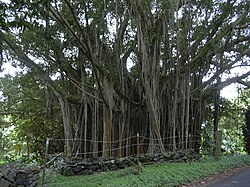 Ficus microcarpa with aerial roots.
 -
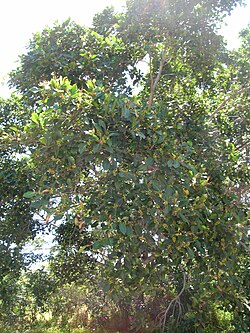 Foliage
 -
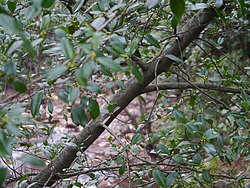 Branch and leaves
 -
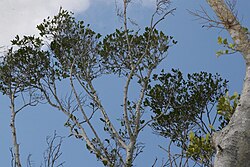 A tree
 -
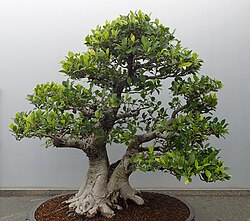 Bonsai
 -
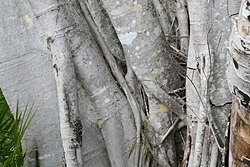 Trunk
Trunk -
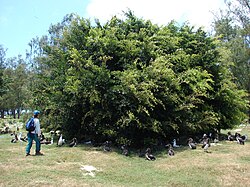 Shrubby tree
 -
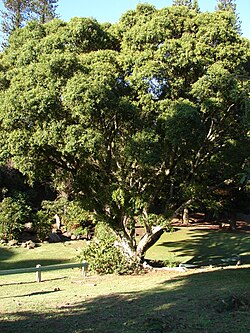 A tree at a park in Hawaii
 -
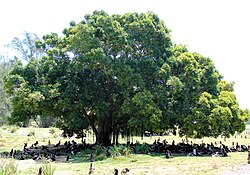 A tree in Midway Atoll
 -
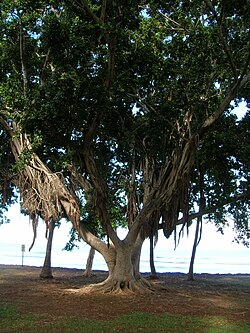 Tree with closeup of branches and trunk
 -
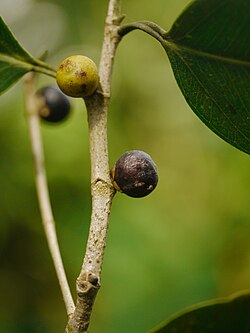 Fruits
 -
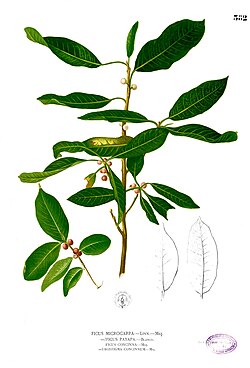 Botanical illustration
 -
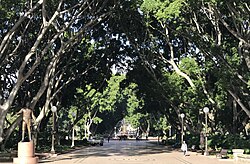 An avenue of Ficus microcarpa in Hyde Park, Sydney
 -
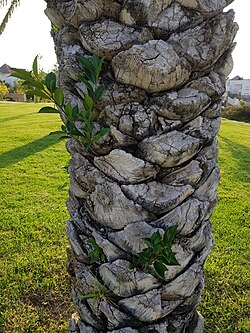 Ficus microcarpa living on Phoenix dactylifera (date palm). It is there due to guano of flying Egyptian fruit bat
 -
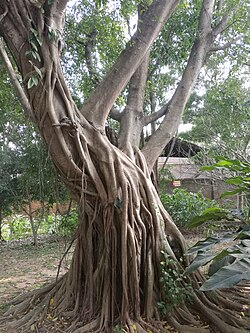 Stem & Habitus
 -
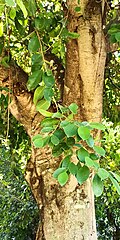 Stem with leaves
 -
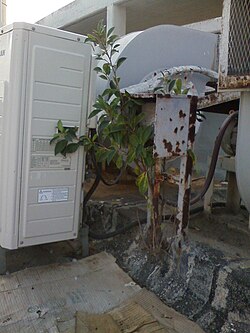 Growing on roof top
 -
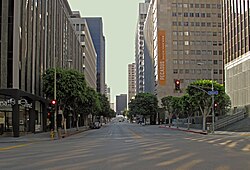 Ficus microcarpa is a common tree seen alongside streets of Los Angeles area and generally its the most common evergreen fig in southern California


.jpg)


References[edit | edit source]
- ↑ 1.0 1.1 Shao, Q.; Zhao, L.; Botanic Gardens Conservation International (BGCI).; IUCN SSC Global Tree Specialist Group (2019). "Ficus microcarpa". IUCN Red List of Threatened Species. 2019 e.T73088912A147623376. doi:10.2305/IUCN.UK.2019-2.RLTS.T73088912A147623376.en. Retrieved 19 November 2021.
- ↑ 2.0 2.1 2.2 "Ficus microcarpa L.f." Plants of the World Online. Royal Botanic Gardens, Kew. Retrieved 21 November 2024.
- ↑ [{{#property:P1421|}} "{{#Property:P225}}"]. Germplasm Resources Information Network (GRIN). Agricultural Research Service (ARS), United States Department of Agriculture (USDA). Retrieved 1 April 2018.
{{citation}}: Check|url=value (help) - ↑ Chew, W.-L.; Du Puy, D.J. (2022). Kodela, P.G. (ed.). "Ficus microcarpa". Flora of Australia. Australian Biological Resources Study, Department of Climate Change, Energy, the Environment and Water: Canberra. Retrieved 27 December 2024.
- ↑ "Ficus microcarpa L.f." Flora of China (eFloras). Missouri Botanical Garden, St. Louis, MO & Harvard University Herbaria, Cambridge, MA. Retrieved 27 December 2012.
- ↑ F.A.Zich; B.P.M.Hyland; T.Whiffen; R.A.Kerrigan (2020). "Ficus microcarpa". Australian Tropical Rainforest Plants Edition 8 (RFK8). Centre for Australian National Biodiversity Research (CANBR), Australian Government. Retrieved 27 December 2024.
- ↑ Corner, E.J.H. (1965). "Check-list of Ficus in Asia and Australasia with keys to identification". The Gardens' Bulletin Singapore. 21 (1): 22–23. Retrieved 28 December 2024.
- ↑ "Ficus hillii". Australian Plant Name Index (APNI). Centre for Australian National Biodiversity Research, Australian Government. Retrieved 28 December 2024.
- ↑ Corner, E.J.H. (1960). "Taxonomic Notes on Ficus Linn., Asia and Australasia. Sections 1-4". The Gardens' Bulletin Singapore. 17 (3): 397. Retrieved 28 December 2024.
- ↑ Carauta, Jorge Pedro Pereira & Diaz, B. Ernani, Figueiras no Brasil, Rio de Janeiro, UFRJ, 2002, ISBN 85-7108-250-2, pg.155
- ↑ 11.0 11.1 Riefner, R.E. (2016). "Ficus microcarpa (Moraceae) naturalized in Southern California, U. S. A.: Linking plant, pollinator, and suitable microhabitats to document the invasion process". Phytologia. 98 (1): 42–75.
- ↑ Chen, Ying-Ru; Wen-Chung Chuang; Wen-Jer Wu (1999). "Chalcids wasps on Ficus microcarpa L. in Taiwan (Hymenoptera: Chalcidoidea)". Journal of Taiwan Museum. 52: 39–79.
- ↑ Somenzari, Marina; Linda Lacerda da Silva & Rosanna G. Q. Benesi (2006). "Atração de aves por Ficus elastica Roxb. e Ficus microcarpa L. em ambiente urbano (abstract)" (PDF). XIV Congresso Brasileiro de Ornitologia. Archived from the original (PDF) on 2009-02-06.
- ↑ da Silva, Linda Lacerda; Sonia Maria de Amorim Gimenez & Sumiko Namba (2006). "Método quantitativo para a avaliacão da preferência alimentar de Aratinga leucophthalmus em cativeiro (abstract)" (PDF). XIV Congresso Brasileiro de Ornitologia. Archived from the original (PDF) on 2011-07-06.
- ↑ Frisch, Johan Dalgas & Frisch, Christian Dalgas, Aves Brasileiras e Plantas que as Atraem, São Paulo:2005, ISBN 85-85015-07-1, pg.366
- ↑ Kalaskar, MohanG; Surana, SanjayJ (2012). "Pharmacognostic and phytochemical studies on Ficus Microcarpa L. fil". Ancient Science of Life. 32 (2): 107–111. doi:10.4103/0257-7941.118550. PMC 3807953. PMID 24167337.
External links[edit | edit source]
- Plants of Hawaii: Ficus microcarpa, hear.org
- Ficus microcarpa L.f., Natural Resources Conservation Service of the U.S. Department of Agriculture
- Indian Laurel Invasive Plant Page, Bermuda Department of Conservation Services.
- [1], Yokoyama, Jun, and Kunio Iwatsuki. "A faunal survey of fig-wasps (Chalcidoidea: Hymenoptera) distributed in Japan and their associations with figs (Ficus: Moraceae)." Entomological science 1.1 (1998): 37–46.
- IUCN Red List least concern species
- Ficus
- Flora of the Australasian realm
- Flora of the Indomalayan realm
- Trees of China
- Trees of Japan
- Trees of Taiwan
- Flora of tropical Asia
- Flora of the Northwestern Pacific
- Trees of Australia
- Flora of Queensland
- Plants described in 1782
- Garden plants of Asia
- Plants used in bonsai
- Ornamental trees