

No edit summary |
|||
| Line 1: | Line 1: | ||
{{Infobox | {{Short description|National Mosque of Bangladesh}} | ||
| name = Baitul Mukarram National Mosque | {{Other uses}} | ||
| native_name = বায়তুল মোকাররম জাতীয় মসজিদ | {{Use dmy dates|date=July 2024}} | ||
| native_name_lang = bn | {{Infobox mosque | ||
| tradition = [[ | | name = Baitul Mukarram National Mosque | ||
| native_name = বায়তুল মোকাররম জাতীয় মসজিদ | |||
| native_name_lang = bn | |||
| tradition = | |||
| sect = [[Sunni Islam]] | |||
| religious_affiliation = [[Islam]] | | religious_affiliation = [[Islam]] | ||
| image = Baitul Mukarram | | image = Baitul Mukarram National Mosque in 2022.09.jpg | ||
| image_size = | | image_size = | ||
| caption = | | caption = Baitul Mukarram, the National Mosque of Bangladesh is designed in the style of the [[Kaaba]] of [[Mecca]] | ||
| map_type | | map_type = Bangladesh Dhaka#Bangladesh Dhaka division#Bangladesh | ||
| coordinates = {{coord|23.7294|N|90.4128|E|format=dms|region:TR_type:city|display=inline,title}} | | coordinates = {{coord|23.7294|N|90.4128|E|format=dms|region:TR_type:city|display=inline,title}} | ||
| map_size = 250 | | map_size = 250 | ||
| map_caption = | | map_caption = | ||
| location = | | location = Topkhana Road, [[Paltan]] [[Dhaka]] | ||
| administration = [[ | | district = [[Dhaka District]] | ||
| consecration_year = 1959 | | country = [[Bangladesh]] | ||
| | | administration = [[Ministry of Religious Affairs (Bangladesh)|Ministry of Religious Affairs]] | ||
| consecration_year = {{start date and age|1959}} | |||
| type = [[Mosque]] | |||
| functional_status = Active | |||
| ownership = [[Government of East Pakistan]] (1959-71)<br>[[Government of Bangladesh]] (since 1971) | |||
| architect = [[Abdulhusein M. Thariani]] | |||
| architect = [[Abdulhusein M. Thariani]] | | architecture_style = [[Islamic Architecture]] | ||
| architecture_style = [[Islamic Architecture]] | | founded_by = [[Government of East Pakistan]] | ||
| | | architecture_type = Neo-islamic | ||
| general_contractor = | | funded_by = Abdul Latif Ibrahim Bhawani | ||
| established = | | general_contractor = Thariani & Co. | ||
| groundbreaking = 27 January 1960 | | established = | ||
| year_completed = 1968 | | groundbreaking = {{start date and age|27 January 1960}} | ||
| year_completed = 1968 | |||
| capacity = | | capacity = 42,000+ | ||
| height_max = 99 feet | |||
| website = {{Url|https://beautifulbangladesh.gov.bd/loc/dhaka/99|Baitul Mukarram Mosque.<br/ >Bangladesh National Tourism Board, website}} | |||
| height_max = 99 feet | |||
| | |||
| | |||
| | |||
}} | }} | ||
'''Baitul Mukarram''',{{efn|{{langx|bn|বায়তুল মোকাররম||The Honored House}}}} officially '''Baitul Mukarram National Mosque''',{{efn|{{langx|bn|বায়তুল মোকাররম জাতীয় মসজিদ}}}}<ref>{{Cite news|url=https://www.dhakatribune.com/bangladesh/dhaka/349074/5-eid-jamaats-to-be-held-at-baitul-mukarram|title=5 Eid jamaats to be held at Baitul Mukarram|date=2024-06-11|access-date=2024-08-19|work=[[Dhaka Tribune]]}}</ref> is the [[national mosque]] of Bangladesh. It is located at the center of [[Dhaka]], the capital of [[Bangladesh]]. The mosque was completed in 1968.<ref>{{Cite Banglapedia |article=Baitul Mukarram Mosque |author=Md. Shahidul Amin}}</ref><ref name="thariani">Thariani and Co: Architects and Engineers. Booklet in section under projects completed "mosques".</ref> It has a capacity of more than 42,000 worshippers.<ref>{{cite book |last1=Tan |first1=Tai Yong |author1-link=Tan Tai Yong |last2=Kudaisya |first2=Gyanesh |author2-link=Gyanesh Kudaisya |year=2000 |title=The Aftermath of Partition in South Asia |url=https://archive.org/details/aftermathpartiti00kuda |url-access=limited |publisher=[[Routledge]] |page=[https://archive.org/details/aftermathpartiti00kuda/page/n184 170] |isbn=978-0-415-17297-4 |quote=... the Al-Baitul Mukarram, the largest mosque in East Pakistan, which could accommodate 42,000+ devotees for congregational worship.}}</ref> | |||
'' | ==History== | ||
[[File:An architect's view of Baitul Mukarram, Dhaka.jpg|thumb|An architect's view of Baitul Mukarram]] | |||
The mosque complex was designed by architect [[Abdulhusein M. Thariani]].<ref name="Khan1990" /> On 27 April 1959, Abdul Latif Ibrahim Bawani, owner of then Bawani Jute Mills, held a meeting at his house with G.A. Madani, Haji Abdul Latif Bawani, M.H. Adamji, S. Sattar, Muhammad Sadiq, A.Z.M. Rezai Karim and Major General Umrao Khan.<ref>{{cite news |url=https://www.dailyinqilab.com/article/61016/%E0%A6%AC%E0%A6%BE%E0%A6%87%E0%A6%A4%E0%A7%81%E0%A6%B2-%E0%A6%AE%E0%A7%8B%E0%A6%95%E0%A6%BE%E0%A6%B0%E0%A6%B0%E0%A6%AE%E0%A7%87%E0%A6%B0-%E0%A6%B6%E0%A7%81%E0%A6%B0%E0%A7%81%E0%A6%B0-%E0%A6%95%E0%A6%A5%E0%A6%BE |script-title=bn:বাইতুল মোকাররমের শুরুর কথা |language=bn |date=28 January 2017 |access-date=6 December 2022 |newspaper=[[Daily Inqilab|The Daily Inqilab]] |archive-date=6 December 2022 |archive-url=https://web.archive.org/web/20221206031627/https://www.dailyinqilab.com/article/61016/%E0%A6%AC%E0%A6%BE%E0%A6%87%E0%A6%A4%E0%A7%81%E0%A6%B2-%E0%A6%AE%E0%A7%8B%E0%A6%95%E0%A6%BE%E0%A6%B0%E0%A6%B0%E0%A6%AE%E0%A7%87%E0%A6%B0-%E0%A6%B6%E0%A7%81%E0%A6%B0%E0%A7%81%E0%A6%B0-%E0%A6%95%E0%A6%A5%E0%A6%BE |url-status=live }}</ref> In that meeting he proposed to Major General Khan, then military administrator of [[East Pakistan]], that a grand mosque be built in Dhaka. Umrao Khan agreed to help build such a mosque. The same year, a Baitul Mukarram mosque committee was established and 8.3 acres of land between new Dhaka and [[Old Dhaka]] was chosen for the site. At that time, there was a large pond at the present mosque's location. It was known as Paltan pond. The pond was filled up and on 27 January 1960, then president of Pakistan [[Ayub Khan (Field Marshal)|Ayub Khan]] inaugurated the work. Prayers took place for the first time on Friday, 25 January 1963. On 28 March 1975, the [[Government of Bangladesh]] entrusted the management of the mosque to the [[Islamic Foundation Bangladesh]].<ref>{{cite news |url=https://www.kalerkantho.com/online/muslim-world/2021/01/25/998423 |script-title=bn:বায়তুল মোকাররমে প্রথম নামাজ আদায়ের ৫৮ বছর |language=bn |date=25 January 2021 |access-date=6 December 2022 |newspaper=[[Kaler Kantho]] |archive-date=6 December 2022 |archive-url=https://web.archive.org/web/20221206032344/https://www.kalerkantho.com/online/muslim-world/2021/01/25/998423 |url-status=live }}</ref> | |||
The mosque complex includes shops, offices, libraries and parking areas. Unusually, the mosque does not have a dome. In 2008, the mosque was extended, financed by a donation from the [[government of Saudi Arabia]].<ref>{{cite news |title=Saudi donation for extension work of Baitul Mukarram National Mosque |url=http://www.thedailystar.net/news-detail-59660 |work=The Daily Star |date=21 October 2008}}</ref><ref>{{cite news |url=https://www.bbc.com/bengali/news-56736871 |script-title=bn:বায়তুল মোকাররম: পারিবারিক উদ্যোগে তৈরি হয়ে যেভাবে বাংলাদেশের জাতীয় মসজিদ হয়ে উঠলো |language=bn |first=Kadir |last=Kollol |date=14 April 2021 |access-date=6 December 2022 |work=[[BBC Bangla]] |archive-date=6 December 2022 |archive-url=https://web.archive.org/web/20221206030604/https://www.bbc.com/bengali/news-56736871 |url-status=live }}</ref> | |||
==Architecture== | |||
The mosque has several [[Modern architecture|modern architectural]] features whilst preserving the traditional principles of [[Mughal Empire|Mughal]] architecture which has for some time been dominant in the [[Indian subcontinent|Indian sub-continent]].{{citation needed|date=June 2019}} Baitul Mukarram's large cube shape was modeled after that of the [[Kaaba]] at [[Mecca]],<ref name="Khan1990">{{cite conference |title=The Mosque |first=Hasan-Uddin |last=Khan |year=1990 |conference=Proceedings of an international seminar sponsored by the Aga Khan Award for Architecture and the Indonesian Institute of Architects, held in Jakarta and Yogyakarta, Indonesia, 15–19 October 1990 |book-title=Expressions of Islam in Buildings |publisher=Aga Khan Trust for Culture |location=Geneva |page=119 |isbn=978-2-88207-006-7 |quote=It takes the historical model of the Kaaba in Mecca as its formal reference. Architect: A.H. Thariani}}</ref> making it a noticeable structure unlike any other mosque in Bangladesh. | |||
===Exterior design=== | |||
The mosque is on a very high platform. The Baitul Mukarram National Mosque's building is eight storied and 99 feet high from the ground level. According to the original plan, the main entrance of the mosque was to be on the eastern side. The 'shaan' on the east is 29,000 square feet with ablution ([[Wudu|Wu'du]]) space on its south and north sides. The absence of a dome on the main building is compensated by the two superficial domed entrance porticoes, one on the south, and the other on the north. The height of these porticoes consists of three [[rabbit's foot]] shaped arches, the middle of which is bigger than the rest. | |||
===Interior design=== | |||
Two patios (roofless inner courtyard) ensure that enough light and air enter the prayer hall of Baitul Mukarram National Mosque. The prayer niché of the hall is rectangular instead of semi-circular. Excessive ornamentation is avoided throughout the mosque, since minimizing ornamentation is typical of modern architecture. | |||
===Garden=== | |||
The garden is laid out in a style borrowed heavily from [[Mughal gardens]], however unlike the traditional Mughal gardens which represent the [[Islamic heaven|Islamic Heaven]], the garden does not have the [[Charbagh|Char-Bagh]] system, most likely due to not having enough room for such a garden. The future of this garden is unknown; if the [[Government of Bangladesh|Bangladeshi government]] extends the mosque, it will most likely have to remove the garden. | |||
== Khatibs == | |||
{| class="wikitable" | |||
|+[[Khatib]]s of ''Baitul Mukarram National Mosque'' | |||
|- bgcolor=#99ccff | |||
| align="center" | '''Serial''' | |||
| align="center" | '''Name''' | |||
| align="center" | '''Term''' | |||
| align="center" | '''Notes''' | |||
|- | |||
| align="center" |1|| [[Abdur Rahman Bekhud]] (1904–1987) || 1963–1971|| | |||
|- | |||
| align="center" |2|| [[Usman Madani]] || 1971 || [[Acting (law)|Acting]] khatib during [[Bangladesh Liberation War]] | |||
|- | |||
| align="center" |3|| [[Amimul Ehsan Barkati]] (1911–1974) || 1971–1974|| | |||
|- | |||
| align="center" |4||[[Abdul Muiz]] (1919–1984) || 1974–1984|| | |||
|- | |||
| align="center" |5|| [[Ubaidul Haq]] (1928–2007) || 1984–2007 || Longest-serving khatib<ref>{{cite news |title=Khatib Obaidul Haq passes away |url=https://www.thedailystar.net/news-detail-7094 |work=[[The Daily Star (Bangladesh)]] |date=8 October 2007 |access-date=31 March 2019 |archive-date=15 April 2022 |archive-url=https://web.archive.org/web/20220415202603/https://www.thedailystar.net/news-detail-7094 |url-status=live }}</ref> | |||
|- | |||
| align="center" |6|| [[Muhammad Nuruddin]] (1954–2009) || 2007–2009 || [[Acting (law)|Acting]] | |||
|- | |||
| align="center" |7|| [[Mohammed Salahuddin]] (1944–2022) || 2009–2022 | |||
| | |||
|- | |||
| align="center" |8|| [[Ruhul Amin (mufti)|Ruhul Amin Faridpuri]] || 2022–2024 | |||
|Expelled | |||
|- | |||
| align="center" |9|| [[Muhammad Abdul Malek]] || 2024– | |||
| | |||
|- | |||
|} | |||
{{Clear}} | |||
== Gallery == | |||
{{Gallery | |||
| title = [[Baitul Mukarram]] | |||
| align = | |||
| footer = | |||
| style = | |||
| state = | |||
| height = 240 | |||
| width = 240 | |||
| perrow = | |||
| mode = | |||
| whitebg = | |||
| noborder = | |||
| captionstyle = | |||
|File:Inside view of Baitul Mukarram National Mosque.jpg|Inside view | |||
|File:বায়তুল মোকাররম.jpg|Corridor | |||
|File:Design at dome in Baitul Mukarram.jpg|Design of inner arch | |||
|File:Baitul Mukarram National Mosque main entrance & Minaret.jpg|Main entrance and Minaret | |||
|File:Friday Prayer at Baitul Mukarram Mosque 03.jpg|Inside view of the Mosque | |||
|File:Baitul Mukarram National Mosque's prayer place for the Imam (left side of the minbar).jpg|Prayer place for the imam (to the left of the minbar) | |||
|File:Baitul Mukarram National Mosque Interior (lower angel).jpg|Interior (lower angle) | |||
|File:Architecture of baitul Mukarram.jpg|Architecture of Baitul Mukarram National Mosque | |||
|File:Bayt al Mukarram.jpg|Baitul Mukarram in 2004 | |||
}} | |||
== See also == | |||
{{stack|{{portal|Bangladesh|Islam}}}} | |||
* [[Islam in Bangladesh]] | |||
* [[List of mosques in Bangladesh]] | |||
* [[Architecture of Bangladesh]] | |||
* [[Haqqani Anjuman]] | |||
* [[Bengali Muslims]] | |||
* [[List of Qawmi Madrasas in Bangladesh]] | |||
==Notes== | |||
{{notelist}} | |||
==References== | ==References== | ||
{{reflist}} | {{reflist}} | ||
{{ | ==External links== | ||
{{Commons category|Baitul Mukarram}} | |||
* [https://www.facebook.com/national.mosque Baitul Mukarram the National Mosque of Bangladesh] | |||
* [https://parjatan.portal.gov.bd/site/page/891113fb-9c74-495e-b1c6-fbde9d8717d7/ Baitul Mukarram National Mosque] | |||
{{Mosques in Bangladesh}} | |||
[[Category:Dhaka]] | {{Dhakaplaces}} | ||
[[Category:Mosques in Dhaka]] | |||
[[Category:National symbols of Bangladesh]] | [[Category:National symbols of Bangladesh]] | ||
[[Category: | [[Category:Mosques completed in 1968]] | ||
[[Category:1968 establishments in East Pakistan]] | |||
[[Category:20th-century mosques in Bangladesh]] | |||
*https://beautifulbangladesh.gov.bd/loc/dhaka/99 | |||
Latest revision as of 20:28, 24 March 2026
| Baitul Mukarram National Mosque | |
|---|---|
বায়তুল মোকাররম জাতীয় মসজিদ | |
| Religion | |
| Affiliation | Islam |
| District | Dhaka District |
| Ownership | Government of East Pakistan (1959-71) Government of Bangladesh (since 1971) |
| 1959 | |
| Status | Active |
| Location | |
| Location | Topkhana Road, Paltan Dhaka |
| Country | Bangladesh |
| Lua error in Module:Location_map at line 851: Unable to find the specified location map definition: "Module:Location map/data/Bangladesh Dhaka" does not exist. | |
| Administration | Ministry of Religious Affairs |
| Coordinates | 23°43′46″N 90°24′46″E / 23.7294°N 90.4128°E |
| Architecture | |
| Architect | Abdulhusein M. Thariani |
| Type | Neo-islamic |
| Style | Islamic Architecture |
| Founder | Government of East Pakistan |
| Funded by | Abdul Latif Ibrahim Bhawani |
| Thariani & Co. | |
| Groundbreaking | 27 January 1960 |
| Completed | 1968 |
| Specifications | |
| Capacity | 42,000+ |
| Height (max) | 99 feet |
| Website | |
| Baitul Mukarram Mosque. Bangladesh National Tourism Board, website | |
Baitul Mukarram,[lower-alpha 1] officially Baitul Mukarram National Mosque,[lower-alpha 2][1] is the national mosque of Bangladesh. It is located at the center of Dhaka, the capital of Bangladesh. The mosque was completed in 1968.[2][3] It has a capacity of more than 42,000 worshippers.[4]
History[edit | edit source]

The mosque complex was designed by architect Abdulhusein M. Thariani.[5] On 27 April 1959, Abdul Latif Ibrahim Bawani, owner of then Bawani Jute Mills, held a meeting at his house with G.A. Madani, Haji Abdul Latif Bawani, M.H. Adamji, S. Sattar, Muhammad Sadiq, A.Z.M. Rezai Karim and Major General Umrao Khan.[6] In that meeting he proposed to Major General Khan, then military administrator of East Pakistan, that a grand mosque be built in Dhaka. Umrao Khan agreed to help build such a mosque. The same year, a Baitul Mukarram mosque committee was established and 8.3 acres of land between new Dhaka and Old Dhaka was chosen for the site. At that time, there was a large pond at the present mosque's location. It was known as Paltan pond. The pond was filled up and on 27 January 1960, then president of Pakistan Ayub Khan inaugurated the work. Prayers took place for the first time on Friday, 25 January 1963. On 28 March 1975, the Government of Bangladesh entrusted the management of the mosque to the Islamic Foundation Bangladesh.[7]
The mosque complex includes shops, offices, libraries and parking areas. Unusually, the mosque does not have a dome. In 2008, the mosque was extended, financed by a donation from the government of Saudi Arabia.[8][9]
Architecture[edit | edit source]
The mosque has several modern architectural features whilst preserving the traditional principles of Mughal architecture which has for some time been dominant in the Indian sub-continent.[citation needed] Baitul Mukarram's large cube shape was modeled after that of the Kaaba at Mecca,[5] making it a noticeable structure unlike any other mosque in Bangladesh.
Exterior design[edit | edit source]
The mosque is on a very high platform. The Baitul Mukarram National Mosque's building is eight storied and 99 feet high from the ground level. According to the original plan, the main entrance of the mosque was to be on the eastern side. The 'shaan' on the east is 29,000 square feet with ablution (Wu'du) space on its south and north sides. The absence of a dome on the main building is compensated by the two superficial domed entrance porticoes, one on the south, and the other on the north. The height of these porticoes consists of three rabbit's foot shaped arches, the middle of which is bigger than the rest.
Interior design[edit | edit source]
Two patios (roofless inner courtyard) ensure that enough light and air enter the prayer hall of Baitul Mukarram National Mosque. The prayer niché of the hall is rectangular instead of semi-circular. Excessive ornamentation is avoided throughout the mosque, since minimizing ornamentation is typical of modern architecture.
Garden[edit | edit source]
The garden is laid out in a style borrowed heavily from Mughal gardens, however unlike the traditional Mughal gardens which represent the Islamic Heaven, the garden does not have the Char-Bagh system, most likely due to not having enough room for such a garden. The future of this garden is unknown; if the Bangladeshi government extends the mosque, it will most likely have to remove the garden.
Khatibs[edit | edit source]
| Serial | Name | Term | Notes |
| 1 | Abdur Rahman Bekhud (1904–1987) | 1963–1971 | |
| 2 | Usman Madani | 1971 | Acting khatib during Bangladesh Liberation War |
| 3 | Amimul Ehsan Barkati (1911–1974) | 1971–1974 | |
| 4 | Abdul Muiz (1919–1984) | 1974–1984 | |
| 5 | Ubaidul Haq (1928–2007) | 1984–2007 | Longest-serving khatib[10] |
| 6 | Muhammad Nuruddin (1954–2009) | 2007–2009 | Acting |
| 7 | Mohammed Salahuddin (1944–2022) | 2009–2022 | |
| 8 | Ruhul Amin Faridpuri | 2022–2024 | Expelled |
| 9 | Muhammad Abdul Malek | 2024– |
Gallery[edit | edit source]
-
 Inside view
 -
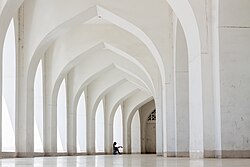 Corridor
 -
 Design of inner arch
 -
 Main entrance and Minaret
 -
 Inside view of the Mosque
 -
 Prayer place for the imam (to the left of the minbar)
 -
 Interior (lower angle)
 -
 Architecture of Baitul Mukarram National Mosque
 -
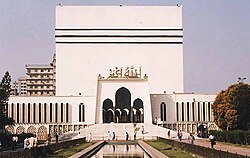 Baitul Mukarram in 2004


.jpg)
.jpg)


See also[edit | edit source]
- Islam in Bangladesh
- List of mosques in Bangladesh
- Architecture of Bangladesh
- Haqqani Anjuman
- Bengali Muslims
- List of Qawmi Madrasas in Bangladesh
Notes[edit | edit source]
References[edit | edit source]
- ↑ "5 Eid jamaats to be held at Baitul Mukarram". Dhaka Tribune. 11 June 2024. Retrieved 19 August 2024.
- ↑ Md. Shahidul Amin (2012). "Baitul Mukarram Mosque". In Islam, Sirajul; Miah, Sajahan; Khanam, Mahfuza; Ahmed, Sabbir (eds.). Banglapedia: the National Encyclopedia of Bangladesh (Online ed.). Dhaka, Bangladesh: Banglapedia Trust, Asiatic Society of Bangladesh. ISBN 984-32-0576-6. OCLC 52727562. Retrieved 19 October 2026.
- ↑ Thariani and Co: Architects and Engineers. Booklet in section under projects completed "mosques".
- ↑ Tan, Tai Yong; Kudaisya, Gyanesh (2000). The Aftermath of Partition in South Asia. Routledge. p. 170. ISBN 978-0-415-17297-4.
... the Al-Baitul Mukarram, the largest mosque in East Pakistan, which could accommodate 42,000+ devotees for congregational worship.
- ↑ 5.0 5.1 Khan, Hasan-Uddin (1990). "The Mosque". Expressions of Islam in Buildings. Proceedings of an international seminar sponsored by the Aga Khan Award for Architecture and the Indonesian Institute of Architects, held in Jakarta and Yogyakarta, Indonesia, 15–19 October 1990. Geneva: Aga Khan Trust for Culture. p. 119. ISBN 978-2-88207-006-7.
It takes the historical model of the Kaaba in Mecca as its formal reference. Architect: A.H. Thariani
- ↑ বাইতুল মোকাররমের শুরুর কথা. The Daily Inqilab (in Bengali). 28 January 2017. Archived from the original on 6 December 2022. Retrieved 6 December 2022.
- ↑ বায়তুল মোকাররমে প্রথম নামাজ আদায়ের ৫৮ বছর. Kaler Kantho (in Bengali). 25 January 2021. Archived from the original on 6 December 2022. Retrieved 6 December 2022.
- ↑ "Saudi donation for extension work of Baitul Mukarram National Mosque". The Daily Star. 21 October 2008.
- ↑ Kollol, Kadir (14 April 2021). বায়তুল মোকাররম: পারিবারিক উদ্যোগে তৈরি হয়ে যেভাবে বাংলাদেশের জাতীয় মসজিদ হয়ে উঠলো. BBC Bangla (in Bengali). Archived from the original on 6 December 2022. Retrieved 6 December 2022.
- ↑ "Khatib Obaidul Haq passes away". The Daily Star (Bangladesh). 8 October 2007. Archived from the original on 15 April 2022. Retrieved 31 March 2019.