




m Movebot moved page Talk:Himalayan salt to Himalayan salt without leaving a redirect: BP:MOVE |
cleanup layout additionally and improved wording |
||
| Line 1: | Line 1: | ||
[[File:Himalayan | {{short description|Rock salt from Pakistan}} | ||
[[File:Himalayan salt (coarse).jpg|thumb|Himalayan salt (coarse)]] | |||
[[Image:2015-03-07 Pakistanisches, sogenanntes Himalaya-Salz 0399.jpg|thumb|right|Himalayan salt from [[Khewra Salt Mine]] near [[Khewra, Punjab]], [[Pakistan]]]] | |||
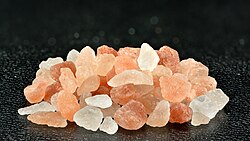
'''Himalayan salt''' is rock salt ([[halite]]) mined from the [[Punjab, Pakistan|Punjab region]] of [[Pakistan]]. The salt, which often has a pinkish tint due to trace minerals, is primarily used as a food additive to replace [[Salt#Edible salt|refined table salt]] but is also used for cooking and food presentation, decorative lamps, and spa treatments. The product is often promoted with unsupported claims that it [[health claim|has health benefits]]. | |||
== Geology== | |||
[[File:Himalayan salt of Saúde flea market, São Paulo, Brazil.jpg|thumb|left|Himalayan salt]] | |||
Himalayan salt is mined from the [[Salt Range]] mountains,<ref name="punjab">{{cite journal |author=Qazi Muhammad Sharif |author2=Mumtaz Hussain |author3=Muhammad Tahir Hussain |date=December 2007 |title=Chemical evaluation of major salt deposits of Pakistan |journal=Journal of the Chemical Society of Pakistan |volume=29 |issue=26 |pages=570–571 |publisher=Chemical Society of Pakistan |editor1=Viqar Uddin Ahmad |editor2=Muhammad Raza Shah |url=http://jcsp.org.pk/ArticleUpload/1249-5588-1-RV.pdf |archive-url=https://web.archive.org/web/20160306102656/http://jcsp.org.pk/articleupload/1249-5588-1-rv.pdf |url-status=live |archive-date=March 6, 2016 |access-date=September 3, 2017 }}</ref> the southern edge of a [[Fold and thrust belt|fold-and-thrust belt]] that underlies the [[Pothohar Plateau]] south of the Himalayas in [[Pakistan]]. Himalayan salt comes from a thick layer of [[Ediacaran]] to early [[Cambrian]] [[evaporite]]s of the Salt Range Formation. This [[geological formation]] consists of crystalline [[halite]] intercalated with [[potash]] salts, overlain by gypsiferous [[marl]] and interlayered with beds of [[gypsum]] and [[Dolomite (rock)|dolomite]] with infrequent seams of [[oil shale]] that accumulated between 600 and 540 million years ago. These strata and the overlying Cambrian to [[Eocene]] [[sedimentary rock]]s were thrust southward over younger sedimentary rocks, and eroded to create the Salt Range.<ref name="JauméOthers1998a">{{cite journal |last1=Jaumé |first1=Steven C. |last2=Lillie |first2=Robert J. |title=Mechanics of the Salt Range-Potwar Plateau, Pakistan: A fold-and-thrust belt underlain by evaporites |journal=Tectonics |date=1988 |volume=7 |issue=1 |pages=57–71 |doi=10.1029/TC007i001p00057|bibcode=1988Tecto...7...57J }}</ref><ref name="GrelandOthers2002a">{{cite journal |last1=Grelaud |first1=Sylvain |last2=Sassi |first2=William |last3=de Lamotte |first3=Dominique Frizon |last4=Jaswal |first4=Tariq |last5=Roure |first5=François |title=Kinematics of eastern Salt Range and South Potwar Basin (Pakistan): a new scenario |journal=Marine and Petroleum Geology |date=2002 |volume=19 |issue=9 |pages=1127–1139 |doi=10.1016/S0264-8172(02)00121-6}}</ref><ref name="RichardsOthers2015a">{{cite journal |last1=Richards |first1=L. |last2=King |first2=R. C. |last3=Collins |first3=A. S. |last4=Sayab |first4=M. |last5=Khan |first5=M. A. |last6=Haneef |first6=M. |last7=Morley |first7=C. K. |last8=Warren |first8=J. |title=Macrostructures vs microstructures in evaporite detachments: An example from the Salt Range, Pakistan |journal=Journal of Asian Earth Sciences |date=2015 |volume=113 |pages=922–934 |doi=10.1016/j.jseaes.2015.04.015|s2cid=129485400 }}</ref> | |||
==History== | |||
Local legend traces the discovery of the Himalayan salt deposits to the army of [[Alexander the Great]].<ref name=NPRPride>{{cite news| title=Pakistan's Pink Himalayan Salt Has Become A Matter Of National Pride |last=Hadid |first=Diaa |publisher=NPR |date=22 September 2019 |access-date=25 January 2020|url=https://www.npr.org/2019/09/22/763162082/pakistans-pink-himalayan-salt-has-become-a-matter-of-national-pride}}</ref> However, the first records of mining are from the [[Janjua]] clan in the 1200s.<ref>{{cite web|last1=Maurer|first1=Hermann|title=Khewra Salt Mines|url=https://global-geography.org/af/Geography/Asia/Pakistan/Special_Information/Khewra_Salt_Mines|publisher=Global Geography|access-date=11 August 2017|language=en|date=2016}}</ref> The salt is mostly mined at the [[Khewra Salt Mine]] in Khewra, [[Jhelum District]], Punjab, Pakistan, which is situated in the foothills of the Salt Range hill system between the [[Indus River]] and the [[Punjab Plain]].<ref name=punjab/><ref name="marvyn">{{cite journal |last1=Weller |first1=J. Marvyn |title=The Cenozoic History of the Northwest Punjab|journal=The Journal of Geology |volume=36 |issue=4 |pages=362–375 |publisher=Chicago Journals |jstor=30055696 |date=May–June 1928 |doi=10.1086/623522 |bibcode=1928JG.....36..362W |s2cid=129105623 }}</ref><ref>[https://whc.unesco.org/en/tentativelists/6118/ The Salt Range and Khewra Salt Mine]. ''whc.unesco.org''. Retrieved 19 October 2021.</ref> It is primarily exported in bulk, and processed in other countries for the consumer market.<ref name=NPRPride /> | |||
== | [[File:Himalayan Rock Salt.jpg|thumb|Himalayan salt crystals]] | ||
==Mineral composition== | |||
Himalayan salt is a [[table salt]]. There is a common misconception that Himalayan salt has lower sodium than conventional table salt, but the levels are similar.<ref>{{cite journal | vauthors=Vala DR, Azam MS | title=Salt and Cardiovascular Disease | journal=Indian Journal of Clinical Cardiology | volume=5 | issue=2 | date=2024 | issn=2632-4636 | doi=10.1177/26324636241259583 | pages=160–166| doi-access=free }}</ref> Analysis of a range of Khewra salt samples showed them to be between 96% and 99% [[sodium chloride]], with trace presence of [[calcium]], [[iron]], [[zinc]], [[chromium]], [[magnesium]], and [[sulfate]]s, all at varying safe levels below 1%.<ref name=punjab/><ref>{{cite journal|title=Chemical Characterisation of Himalayan Rock Salt|author1=Abrar ul Hassana| author2=Ayesha Mohy Udd Din| author3=Sakhawat Alib| journal=Pakistan Journal of Scientific and Industrial Research Series A: Physical Sciences| volume=60| pages=67–71|year=2017|url=https://www.v3.pjsir.org/index.php/physical-sciences/article/download/10/9}}</ref><ref name="mcgill">{{cite web |author1=Ada McVean |title=Is Himalayan Pink Salt Better For You?|url= https://www.mcgill.ca/oss/article/health-and-nutrition-quackery-you-asked/himalayan-pink-salt |publisher=Office for Science and Society, McGill University, Montreal, Canada |access-date=11 June 2019 |date=20 June 2017}}</ref><ref name="hall">{{cite journal |last1=Hall |first1=Harriet|title=Pink Himalayan sea salt: An update |journal=Science-Based Medicine |date=31 January 2017|url=https://sciencebasedmedicine.org/pink-himalayan-sea-salt-an-update/|access-date=11 June 2019}}</ref> | |||
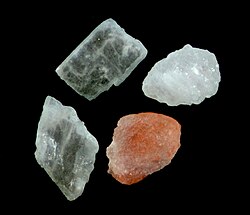
Some salt crystals from this region have an off-white to transparent color, while the trace minerals in some veins of salt give it a pink, reddish, or beet-red color.<ref>{{cite web |title=Salt Mines |website=Pakistan Mineral Development Corporation |url=http://www.pmdc.gov.pk/?p=KhewraSaltMines |access-date=August 13, 2017 |archive-url=https://web.archive.org/web/20170813115525/http://www.pmdc.gov.pk/?p=KhewraSaltMines |archive-date=August 13, 2017}}</ref><ref name="Freeman">{{cite web |url=http://science.howstuffworks.com/innovation/edible-innovations/salt2.htm |title=How Salt Works |last1=Freeman |first1=Shanna |date=27 November 2007 |publisher=[[HowStuffWorks]] |access-date=October 20, 2014 |archive-url=https://web.archive.org/web/20170721024605/http://science.howstuffworks.com/innovation/edible-innovations/salt2.htm |archive-date=July 21, 2017}}</ref> | |||
Nutritionally, Himalayan salt is similar to common table salt.<ref name=hall/><ref name=Time>{{cite web|author=Alexandra Sifferlin|title=Does pink Himalayan salt have any health benefits?|publisher=Time|date=28 January 2017|url=https://time.com/4834865/himalayan-pink-salt-benefits/|access-date=23 December 2018|archive-date=18 June 2022|archive-url=https://web.archive.org/web/20220618141544/https://time.com/4834865/himalayan-pink-salt-benefits/|url-status=dead}}</ref> A study of pink salts in Australia showed Himalayan salt to contain higher levels of a range of trace elements compared to table salt, but that the levels were too low for nutritional significance without an "exceedingly high intake", at which point any nutritional benefit would be outweighed by the risks of elevated sodium consumption.<ref name=":0">{{cite journal |first1=Flavia |last1=Fayet-Moore |first2=Cinthya |last2=Wibisono |first3=Prudence |last3=Carr |first4=Emily |last4=Duve |first5=Peter |last5=Petocz |first6=Graham |last6=Lancaster |first7=Joanna |last7=McMillan |first8=Skye |last8=Marshall |first9=Michelle |last9=Blumfield |title=An Analysis of the Mineral Composition of Pink Salt Available in Australia |journal=Foods |year=2020 |volume=9 |issue=10 |page=1490 |doi=10.3390/foods9101490 |pmid=33086585|pmc=7603209 |doi-access=free }}</ref> An important exception is [[essential mineral]] [[iodine]]. Commercial table salt in many countries is [[iodised salt|supplemented with iodine]], and this has significantly reduced disorders of [[iodine deficiency]].<ref>{{cite web|title=Iodized salt|url=http://www.saltinstitute.org/Uses-benefits/Salt-in-Food/Essential-nutrient/Iodized-salt|publisher=Salt Institute|access-date=5 December 2010|year=2009|url-status=live|archive-url=https://web.archive.org/web/20130214101408/http://www.saltinstitute.org/Uses-benefits/Salt-in-Food/Essential-nutrient/Iodized-salt|archive-date=14 February 2013|df=dmy-all}}</ref> Himalayan salt, however, does not provide this benefit.<ref name=inthepink>{{cite web|url=https://www.iol.co.za/capetimes/arts-portal/food-and-wine/himalayan-salt-benefits-of-staying-in-the-pink-11780528|title=Himalayan salt: Benefits of staying in the pink|author=Sipokazi Fokazi|date=30 October 2017|publisher=Independent Media, South Africa|access-date=29 September 2018}}</ref><ref name="Vice-20190117">{{cite web|url=https://www.vice.com/en_us/article/yw7a8y/is-https://smsalt.com-salt-vs-regular-salt |title=Pink Himalayan Salt Is a Waste of Money |last=Shilton |first=A. C. |publisher=Vice |date=17 January 2019 |access-date=3 January 2020}}{{dead link|date=May 2025|bot=medic}}{{cbignore|bot=medic}}</ref> | |||
==Uses== | |||
Himalayan salt is used to flavor food. Due mainly to marketing costs, pink Himalayan salt is up to 20 times more expensive than table salt or [[sea salt]].<ref name="bi">{{cite web |author1=Charlie Floyd |author2=Ju Shardlow |title=Why pink Himalayan salt is so expensive |url=https://www.businessinsider.com/pink-himalayan-salt-expensive-health-benefits-minerals-2019-6 |publisher=Business Insider |access-date=30 August 2019 |date=11 June 2019}}</ref> The impurities giving it its distinctive pink hue, as well as its unprocessed state and lack of [[anti-caking agent]]s, have given rise to the unsupported belief that it is healthier than common table salt.<ref name=Time /><ref name="Vice-20190117" /><ref name=Mull>{{cite journal|author=Mull, Amanda|title=How Pink Salt Took Over Millennial Kitchens|journal=The Atlantic|date=5 December 2018|url=https://www.theatlantic.com/health/archive/2018/12/himalayan-pink-salt-in-your-kitchen/577390/|access-date=23 December 2018}}</ref> There is no scientific basis for such claimed health benefits.<ref name=inthepink /><ref name=hall/><ref name=Mull /><ref>{{Cite book|last=Schwarcz|first=Dr Joe|url=https://books.google.com/books?id=iyulDwAAQBAJ|title=A Grain of Salt: The Science and Pseudoscience of What We Eat|date=2019-10-08|publisher=ECW Press|isbn=978-1-77305-385-1|location=|pages=281|language=en|quote=As is often the case with nutritional controversies, pseudoscience slithers into the picture. In this case it is in the form of “natural” alternatives to table salt with insinuations of health benefits. Himalayan salt, which is composed of large grains of rock salt mined in Pakistan, is touted as a healthier version because it contains traces of potassium, silicon, phosphorus, vanadium, and iron. The amounts are enough to color the crystals, giving them a more “natural” appearance, but are nutritionally irrelevant. Some promoters make claims that are laughable. Himalayan salt, they say, contains stored sunlight, will remove phlegm from the lungs, clear sinus congestion, prevent varicose veins, stabilize irregular heartbeats, regulate blood pressure, and balance excess acidity in brain cells. One would have to have a deficiency in brain cells to believe such hokum. It doesn’t even rise to the level of taking it with a grain of salt.|author-link=Joe Schwarcz}}</ref> In the United States, the [[Food and Drug Administration]] [[FDA warning letter|warned]] a manufacturer of [[dietary supplement]]s, including one consisting of Himalayan salt, to discontinue marketing the products using unproven [[health claim|claims]] of health benefits.<ref>{{cite web |title=Inspections, Compliance, Enforcement, and Criminal Investigations Herbs of Light, Inc.|date= June 18, 2013 |url=https://www.fda.gov/iceci/enforcementactions/warningletters/2013/ucm359315.htm |publisher=[[Food and Drug Administration]] (FDA) |access-date=July 7, 2018 |url-status=dead |archive-url=https://web.archive.org/web/20190424223711/https://www.fda.gov/iceci/enforcementactions/warningletters/2013/ucm359315.htm |archive-date=April 24, 2019}}</ref> | |||
Slabs of salt are used as serving dishes, [[baking stone]]s, and [[griddle]]s,<ref name=":1">{{cite web |last1=Bitterman |first1=Mark |title=Safe Heating and Washing Tips for Your Himalayan Salt Block. |url=http://www.saltnews.com/heating-using-cleaning-storing-your-himalayan-salt-block/ |publisher=Salt News |date=January 30, 2008 |archive-url=https://web.archive.org/web/20170813121205/http://www.saltnews.com/heating-using-cleaning-storing-your-himalayan-salt-block/ |archive-date=August 13, 2017}}</ref> and it is also used to make [[tequila]] [[shot glass]]es.<ref name=NPRPak>{{cite news |title=Pakistan Wants You To Know: Most Pink Himalayan Salt Doesn't Come From India |last1=Hadid |first1=Diaa |last2=Sattar |first2=Abdul |publisher=NPR |date=3 October 2019 |access-date=25 January 2020 |url=https://www.npr.org/sections/thesalt/2019/10/03/763960436/pakistan-wants-you-to-know-most-pink-himalayan-salt-doesnt-come-from-india}}</ref> In such uses, small amounts of salt transfer to the food or drink and alter its flavor profile.<ref>{{cite news| last=Scozzaro| first=Carrie| title=Salt blocks can be used as a versatile cooking alternative| publisher=Inlander| location=Spokane, WA| date=January 10, 2019| access-date=27 January 2020| url=https://www.inlander.com/spokane/salt-blocks-can-be-used-as-a-versatile-cooking-alternative/Content?oid=15991876}}</ref> | |||
[[File:Himalayian salt lamp gnangarra-1000.jpg|thumb|upright|Salt lamp]] | |||
It is also used to make {{vanchor|salt lamps}} that radiate a pinkish or orangish hue, manufactured by placing a light source within the hollowed-out interior of a block of Himalayan salt.<ref name=":2">{{cite news|title=Everything you need to know about buying Himalayan salt lamps|author=Banu Ibrahim, Nikhita Mahtani|url=https://www.cnn.com/2018/05/24/cnn-underscored/himalayan-pink-salt-lamp-shop/index.html|publisher=CNN|date=24 May 2018}}</ref> Claims that their use results in the release of [[ion]]s that benefit health have no scientific foundation.<ref name=Time /><ref>{{cite web|url=https://www.snopes.com/fact-check/salt-lamps-cure-everything/ |title=Do Salt Lamps Provide Multiple Health Benefits?|publisher=Snopes|author=Alex Kasprak|date=22 December 2016|access-date=2 September 2019}}</ref> Similar scientifically unsupported claims underlie the use of Himalayan salt to line the walls of [[spa]]s, along with its use for salt-inhalation spa treatments.<ref name=Time /> Salt lamps can be a danger to pets, who may suffer [[salt poisoning]] after licking them.<ref>{{cite news |last1=Scott |first1=Ellen |title=Vets warn how dangerous Himalayan salt lamps can be for cats |url=https://metro.co.uk/2019/07/04/vets-warn-dangerous-himalayan-salt-lamps-can-cats-10112003/ |access-date=22 November 2021 |work=Metro |date=4 July 2019 |language=en}}</ref> | |||
== Impact of India–Pakistan trade tensions == | |||
In 2025, the trade of Himalayan pink salt faced a major disruption due to renewed [[Geopolitics|geopolitical]] tensions between [[India–Pakistan relations|India and Pakistan]]. Following the April 2025 [[2025 Pahalgam attack|Pahalgam terror attack]], in which 26 individuals – mostly Indian tourists – were killed, the [[Government of India|Indian government]] imposed a ban on the import of all goods from Pakistan, including those routed via third countries. This measure led to an immediate halt in the cross-border trade of pink salt. | |||
India had been one of the largest markets for Himalayan pink salt, traditionally sourced from Pakistan's [[Khewra, Jhelum|Khewra]] Salt Mine. For decades, Indian importers had brought in thousands of tonnes quarterly to meet demand, with the salt widely used in culinary practices, wellness products, and religious rituals – particularly by [[Hindus]] during fasting periods due to its non-marine origin. | |||
The ban not only disrupted supply chains in India but also resulted in significant [[Economy|economic]] losses for [[Pakistanis|Pakistani]] exporters, many of whom relied heavily on Indian demand to sustain large-scale pink salt operations.<ref>{{Cite web |last=Singh |first=Gurvinder |title=India-Pakistan conflict claims an unlikely victim: Himalayan pink salt |url=https://www.aljazeera.com/economy/2025/6/9/india-pakistan-conflict-claims-an-unlikely-victim-himalayan-pink-salt |access-date=2025-06-11 |website=Al Jazeera |language=en}}</ref> | |||
==See also== | |||
* [[Health effects of salt]] | |||
* [[List of edible salts]] | |||
* [[List of topics characterized as pseudoscience]] | |||
* [[Sea salt]] | * [[Sea salt]] | ||
* [[Salt#Edible salt|Table salt]] | * [[Salt#Edible salt|Table salt]] | ||
| Line 12: | Line 46: | ||
{{Reflist}} | {{Reflist}} | ||
[[Category: | ==External links== | ||
[[Category: | *{{Commons category-inline}} | ||
[[Category: | {{Portal bar|Food|Pakistan}} | ||
{{Salt topics}} | |||
{{Authority control}} | |||
{{DEFAULTSORT:Himalayan Salt}} | |||
[[Category:Edible salt]] | |||
[[Category:Pseudoscience]] | |||
[[Category:Salt industry in Pakistan]] | |||
[[Category:Pakistani spices]] | |||
Latest revision as of 01:43, 29 March 2026
.jpg)

Himalayan salt is rock salt (halite) mined from the Punjab region of Pakistan. The salt, which often has a pinkish tint due to trace minerals, is primarily used as a food additive to replace refined table salt but is also used for cooking and food presentation, decorative lamps, and spa treatments. The product is often promoted with unsupported claims that it has health benefits.
Geology[edit | edit source]

Himalayan salt is mined from the Salt Range mountains,[1] the southern edge of a fold-and-thrust belt that underlies the Pothohar Plateau south of the Himalayas in Pakistan. Himalayan salt comes from a thick layer of Ediacaran to early Cambrian evaporites of the Salt Range Formation. This geological formation consists of crystalline halite intercalated with potash salts, overlain by gypsiferous marl and interlayered with beds of gypsum and dolomite with infrequent seams of oil shale that accumulated between 600 and 540 million years ago. These strata and the overlying Cambrian to Eocene sedimentary rocks were thrust southward over younger sedimentary rocks, and eroded to create the Salt Range.[2][3][4]
History[edit | edit source]
Local legend traces the discovery of the Himalayan salt deposits to the army of Alexander the Great.[5] However, the first records of mining are from the Janjua clan in the 1200s.[6] The salt is mostly mined at the Khewra Salt Mine in Khewra, Jhelum District, Punjab, Pakistan, which is situated in the foothills of the Salt Range hill system between the Indus River and the Punjab Plain.[1][7][8] It is primarily exported in bulk, and processed in other countries for the consumer market.[5]

Mineral composition[edit | edit source]
Himalayan salt is a table salt. There is a common misconception that Himalayan salt has lower sodium than conventional table salt, but the levels are similar.[9] Analysis of a range of Khewra salt samples showed them to be between 96% and 99% sodium chloride, with trace presence of calcium, iron, zinc, chromium, magnesium, and sulfates, all at varying safe levels below 1%.[1][10][11][12]
Some salt crystals from this region have an off-white to transparent color, while the trace minerals in some veins of salt give it a pink, reddish, or beet-red color.[13][14]
Nutritionally, Himalayan salt is similar to common table salt.[12][15] A study of pink salts in Australia showed Himalayan salt to contain higher levels of a range of trace elements compared to table salt, but that the levels were too low for nutritional significance without an "exceedingly high intake", at which point any nutritional benefit would be outweighed by the risks of elevated sodium consumption.[16] An important exception is essential mineral iodine. Commercial table salt in many countries is supplemented with iodine, and this has significantly reduced disorders of iodine deficiency.[17] Himalayan salt, however, does not provide this benefit.[18][19]
Uses[edit | edit source]
Himalayan salt is used to flavor food. Due mainly to marketing costs, pink Himalayan salt is up to 20 times more expensive than table salt or sea salt.[20] The impurities giving it its distinctive pink hue, as well as its unprocessed state and lack of anti-caking agents, have given rise to the unsupported belief that it is healthier than common table salt.[15][19][21] There is no scientific basis for such claimed health benefits.[18][12][21][22] In the United States, the Food and Drug Administration warned a manufacturer of dietary supplements, including one consisting of Himalayan salt, to discontinue marketing the products using unproven claims of health benefits.[23]
Slabs of salt are used as serving dishes, baking stones, and griddles,[24] and it is also used to make tequila shot glasses.[25] In such uses, small amounts of salt transfer to the food or drink and alter its flavor profile.[26]

It is also used to make salt lamps that radiate a pinkish or orangish hue, manufactured by placing a light source within the hollowed-out interior of a block of Himalayan salt.[27] Claims that their use results in the release of ions that benefit health have no scientific foundation.[15][28] Similar scientifically unsupported claims underlie the use of Himalayan salt to line the walls of spas, along with its use for salt-inhalation spa treatments.[15] Salt lamps can be a danger to pets, who may suffer salt poisoning after licking them.[29]
Impact of India–Pakistan trade tensions[edit | edit source]
In 2025, the trade of Himalayan pink salt faced a major disruption due to renewed geopolitical tensions between India and Pakistan. Following the April 2025 Pahalgam terror attack, in which 26 individuals – mostly Indian tourists – were killed, the Indian government imposed a ban on the import of all goods from Pakistan, including those routed via third countries. This measure led to an immediate halt in the cross-border trade of pink salt.
India had been one of the largest markets for Himalayan pink salt, traditionally sourced from Pakistan's Khewra Salt Mine. For decades, Indian importers had brought in thousands of tonnes quarterly to meet demand, with the salt widely used in culinary practices, wellness products, and religious rituals – particularly by Hindus during fasting periods due to its non-marine origin.
The ban not only disrupted supply chains in India but also resulted in significant economic losses for Pakistani exporters, many of whom relied heavily on Indian demand to sustain large-scale pink salt operations.[30]
See also[edit | edit source]
- Health effects of salt
- List of edible salts
- List of topics characterized as pseudoscience
- Sea salt
- Table salt
References[edit | edit source]
- ↑ 1.0 1.1 1.2 Qazi Muhammad Sharif; Mumtaz Hussain; Muhammad Tahir Hussain (December 2007). Viqar Uddin Ahmad; Muhammad Raza Shah (eds.). "Chemical evaluation of major salt deposits of Pakistan" (PDF). Journal of the Chemical Society of Pakistan. 29 (26). Chemical Society of Pakistan: 570–571. Archived (PDF) from the original on March 6, 2016. Retrieved September 3, 2017.
- ↑ Jaumé, Steven C.; Lillie, Robert J. (1988). "Mechanics of the Salt Range-Potwar Plateau, Pakistan: A fold-and-thrust belt underlain by evaporites". Tectonics. 7 (1): 57–71. Bibcode:1988Tecto...7...57J. doi:10.1029/TC007i001p00057.
- ↑ Grelaud, Sylvain; Sassi, William; de Lamotte, Dominique Frizon; Jaswal, Tariq; Roure, François (2002). "Kinematics of eastern Salt Range and South Potwar Basin (Pakistan): a new scenario". Marine and Petroleum Geology. 19 (9): 1127–1139. doi:10.1016/S0264-8172(02)00121-6.
- ↑ Richards, L.; King, R. C.; Collins, A. S.; Sayab, M.; Khan, M. A.; Haneef, M.; Morley, C. K.; Warren, J. (2015). "Macrostructures vs microstructures in evaporite detachments: An example from the Salt Range, Pakistan". Journal of Asian Earth Sciences. 113: 922–934. doi:10.1016/j.jseaes.2015.04.015. S2CID 129485400.
- ↑ 5.0 5.1 Hadid, Diaa (22 September 2019). "Pakistan's Pink Himalayan Salt Has Become A Matter Of National Pride". NPR. Retrieved 25 January 2020.
- ↑ Maurer, Hermann (2016). "Khewra Salt Mines". Global Geography. Retrieved 11 August 2017.
- ↑ Weller, J. Marvyn (May–June 1928). "The Cenozoic History of the Northwest Punjab". The Journal of Geology. 36 (4). Chicago Journals: 362–375. Bibcode:1928JG.....36..362W. doi:10.1086/623522. JSTOR 30055696. S2CID 129105623.
- ↑ The Salt Range and Khewra Salt Mine. whc.unesco.org. Retrieved 19 October 2021.
- ↑ Vala DR, Azam MS (2024). "Salt and Cardiovascular Disease". Indian Journal of Clinical Cardiology. 5 (2): 160–166. doi:10.1177/26324636241259583. ISSN 2632-4636.
- ↑ Abrar ul Hassana; Ayesha Mohy Udd Din; Sakhawat Alib (2017). "Chemical Characterisation of Himalayan Rock Salt". Pakistan Journal of Scientific and Industrial Research Series A: Physical Sciences. 60: 67–71.
- ↑ Ada McVean (20 June 2017). "Is Himalayan Pink Salt Better For You?". Office for Science and Society, McGill University, Montreal, Canada. Retrieved 11 June 2019.
- ↑ 12.0 12.1 12.2 Hall, Harriet (31 January 2017). "Pink Himalayan sea salt: An update". Science-Based Medicine. Retrieved 11 June 2019.
- ↑ "Salt Mines". Pakistan Mineral Development Corporation. Archived from the original on August 13, 2017. Retrieved August 13, 2017.
- ↑ Freeman, Shanna (27 November 2007). "How Salt Works". HowStuffWorks. Archived from the original on July 21, 2017. Retrieved October 20, 2014.
- ↑ 15.0 15.1 15.2 15.3 Alexandra Sifferlin (28 January 2017). "Does pink Himalayan salt have any health benefits?". Time. Archived from the original on 18 June 2022. Retrieved 23 December 2018.
- ↑ Fayet-Moore, Flavia; Wibisono, Cinthya; Carr, Prudence; Duve, Emily; Petocz, Peter; Lancaster, Graham; McMillan, Joanna; Marshall, Skye; Blumfield, Michelle (2020). "An Analysis of the Mineral Composition of Pink Salt Available in Australia". Foods. 9 (10): 1490. doi:10.3390/foods9101490. PMC 7603209. PMID 33086585.
- ↑ "Iodized salt". Salt Institute. 2009. Archived from the original on 14 February 2013. Retrieved 5 December 2010.
- ↑ 18.0 18.1 Sipokazi Fokazi (30 October 2017). "Himalayan salt: Benefits of staying in the pink". Independent Media, South Africa. Retrieved 29 September 2018.
- ↑ 19.0 19.1 Shilton, A. C. (17 January 2019). "Pink Himalayan Salt Is a Waste of Money". Vice. Retrieved 3 January 2020.[dead link]
- ↑ Charlie Floyd; Ju Shardlow (11 June 2019). "Why pink Himalayan salt is so expensive". Business Insider. Retrieved 30 August 2019.
- ↑ 21.0 21.1 Mull, Amanda (5 December 2018). "How Pink Salt Took Over Millennial Kitchens". The Atlantic. Retrieved 23 December 2018.
- ↑ Schwarcz, Dr Joe (2019-10-08). A Grain of Salt: The Science and Pseudoscience of What We Eat. ECW Press. p. 281. ISBN 978-1-77305-385-1.
As is often the case with nutritional controversies, pseudoscience slithers into the picture. In this case it is in the form of "natural" alternatives to table salt with insinuations of health benefits. Himalayan salt, which is composed of large grains of rock salt mined in Pakistan, is touted as a healthier version because it contains traces of potassium, silicon, phosphorus, vanadium, and iron. The amounts are enough to color the crystals, giving them a more "natural" appearance, but are nutritionally irrelevant. Some promoters make claims that are laughable. Himalayan salt, they say, contains stored sunlight, will remove phlegm from the lungs, clear sinus congestion, prevent varicose veins, stabilize irregular heartbeats, regulate blood pressure, and balance excess acidity in brain cells. One would have to have a deficiency in brain cells to believe such hokum. It doesn't even rise to the level of taking it with a grain of salt.
- ↑ "Inspections, Compliance, Enforcement, and Criminal Investigations Herbs of Light, Inc". Food and Drug Administration (FDA). June 18, 2013. Archived from the original on April 24, 2019. Retrieved July 7, 2018.
- ↑ Bitterman, Mark (January 30, 2008). "Safe Heating and Washing Tips for Your Himalayan Salt Block". Salt News. Archived from the original on August 13, 2017.
- ↑ Hadid, Diaa; Sattar, Abdul (3 October 2019). "Pakistan Wants You To Know: Most Pink Himalayan Salt Doesn't Come From India". NPR. Retrieved 25 January 2020.
- ↑ Scozzaro, Carrie (January 10, 2019). "Salt blocks can be used as a versatile cooking alternative". Spokane, WA: Inlander. Retrieved 27 January 2020.
- ↑ Banu Ibrahim, Nikhita Mahtani (24 May 2018). "Everything you need to know about buying Himalayan salt lamps". CNN.
- ↑ Alex Kasprak (22 December 2016). "Do Salt Lamps Provide Multiple Health Benefits?". Snopes. Retrieved 2 September 2019.
- ↑ Scott, Ellen (4 July 2019). "Vets warn how dangerous Himalayan salt lamps can be for cats". Metro. Retrieved 22 November 2021.
- ↑ Singh, Gurvinder. "India-Pakistan conflict claims an unlikely victim: Himalayan pink salt". Al Jazeera. Retrieved 2025-06-11.