




No edit summary |
|||
| Line 1: | Line 1: | ||
{{ | {{Infobox Hindu temple | ||
| name = Six Abodes of Murugan | |||
| image =File:Murugan, print c. 1930.jpg | |||
| alt = | |||
| caption =Painting of Murugan, c. 1930. | |||
{{location map+|India Tamil Nadu|width=260|caption=The Six Temples' location in [[Tamil Nadu]]|places= | {{location map+|India Tamil Nadu|width=260|caption=The Six Temples' location in [[Tamil Nadu]]|places= | ||
{{location map~|India Tamil Nadu|label=[[Thiruparankundram Murugan temple|Thiruparankundram]]|lat=9.8798|long=78.0711}} | {{location map~|India Tamil Nadu|label=[[Thiruparankundram Murugan temple|Thiruparankundram]]|lat=9.8798|long=78.0711}} | ||
| Line 6: | Line 9: | ||
{{location map~|India Tamil Nadu|label=[[Palani Murugan temple|Palani]]|lat=10.438805|long=77.520261}} | {{location map~|India Tamil Nadu|label=[[Palani Murugan temple|Palani]]|lat=10.438805|long=77.520261}} | ||
{{location map~|India Tamil Nadu|label=[[Swaminathaswamy Temple, Swamimalai|Swamimalai]]|lat=10.956844|long=79.325776}} | {{location map~|India Tamil Nadu|label=[[Swaminathaswamy Temple, Swamimalai|Swamimalai]]|lat=10.956844|long=79.325776}} | ||
{{location map~|India Tamil Nadu|label=[[ | {{location map~|India Tamil Nadu|label=[[Subramaniya Swamy Temple, Tiruttani|Tiruttani]]|lat=13.171833|long=79.603769}} | ||
{{location map~|India Tamil Nadu|label=[[Pazhamudircholai]]|lat=10.094069|long=78.223445}} | {{location map~|India Tamil Nadu|label=[[Pazhamudircholai]]|lat=10.094069|long=78.223445}} | ||
}} | }} | ||
| map_type = <!-- India Tamil Nadu --> | | map_type = <!-- India Tamil Nadu --> | ||
| map_caption = Location in Tamil Nadu | | map_caption = Location in Tamil Nadu | ||
| coordinates = | | coordinates = | ||
| native_name = | | native_name = Arupadaiveedu | ||
| country = [[India]] | | country = [[India]] | ||
| state = [[Tamil Nadu]] | | state = [[Tamil Nadu]] | ||
| district = | | district = | ||
| location = [[Thiruparankundram]], [[Tiruchendur]], [[ | | location = [[Thiruparankundram]], [[Tiruchendur]], [[Palani]], [[Swamimalai]], [[Tiruttani]], [[Pazhamudircholai]] | ||
| elevation_m = | | elevation_m = | ||
| deity = [[Murugan]] | | deity = [[Murugan]] (Kartikeya) | ||
| festivals = [[ | | festivals = {{Bulleted list | ||
| architecture = [[ | | [[Sooranporu|Skanda Sashti]] | ||
| [[Thaipusam]] | |||
| [[Karthikai Deepam]] | |||
| [[Panguni Uthiram]] | |||
| [[Vaisakha | Vaikaasi Visakam]] | |||
| [[Mahashivarathri]] | |||
}} | |||
| architecture = [[Tamil architecture]] | |||
| temple_quantity = 6 | | temple_quantity = 6 | ||
| monument_quantity = | | monument_quantity = | ||
| Line 32: | Line 37: | ||
| creator = | | creator = | ||
| website = | | website = | ||
}} | }}{{Short description|Six sacred temples of Hindu deity Murugan}} | ||
{{Use dmy dates|date=October 2020}}{{Use Indian English|date=July 2013}} | |||
The '''Six Abodes of Murugan''' ( | The '''Six Abodes of Murugan''' ({{Lang-ta|ஆறுபடைவீடுகள்|translit=Āṟupadai veedu}}) are six temples situated in the state of [[Tamil Nadu]] in [[South India]], dedicated to the [[Hinduism|Hindu]] deity [[Kartikeya|Murugan]], also referred to as [[Nallur Kandaswamy temple|Kandaswamy]], [[Kartikeya]], Skanda, and Vadivela at various temples. These six sacred abodes of Murugan are mentioned in Tamil [[Sangam literature]], ''Thirumurugatrupadai'', written by [[Nakkeerar]] and in ''Tiruppugaḻ'', written by Arunagirinathar. The six abodes are [[Thiruparankundram Murugan temple|Thiruparankundram]], [[Tiruchendur Murugan Temple|Tiruchendur]], [[Palani Murugan Temple|Palani]], [[Swaminathaswamy Temple, Swamimalai|Swamimalai]], [[Subramaniya Swamy Temple, Tiruttani|Tiruttani]], and [[Pazhamudircholai]]. | ||
== | ==Legend== | ||
The | The legend of Murugan is described in [[Skanda Purana|Kanda Puranam]], the Tamil iteration of the Skanda Purana. According to the text, the [[asura]] [[Śūrapadmā|Surapadman]] drove the [[Deva (Hinduism)|devas]] out of [[Svarga]], and the latter sought the assistance of the deities [[Vishnu]] and [[Brahma]]. They assigned [[Kamadeva]] to disturb [[Shiva]] from his penance and fall in love with [[Parvati]], and the couple later gave birth to [[Kartikeya|Murugan]]. Murugan slew Surapadman in battle and restored Svarga to the devas. Murugan is anointed as the commander of the devas prior to the war. Murugan married the goddesses [[Valli]] by love and married [[Deivayanai]] after the war that is regarded to have occurred at [[Tiruchendur]].<ref>{{cite news|title=Arupadaiveedu|url=http://www.hindu.com/2010/11/12/stories/2010111259230200.htm|date=12 November 2010|access-date=3 December 2016|archive-url=https://web.archive.org/web/20101120063752/http://www.hindu.com/2010/11/12/stories/2010111259230200.htm|archive-date=20 November 2010|work=[[The Hindu]]|url-status=dead}}</ref> | ||
In Tamil literature five types of | In [[Tamil literature]], five [[Sangam landscape|types of land]] are explained. These are the Kurinji (mountainous region), Mullai (forest region), Marutham (agricultural region), Neithal (coastal region) and Palai (desert region). Various deities are designated as the patron gods of these regions in [[Sangam literature]]. According to these texts, [[Muruga|Murugan]] is the deity of the Kurinji region.<ref>{{cite web|url=http://www.sttemple.com/STT/english/murugan.asp |title=Worship of Murugan |access-date=26 January 2010 |url-status=dead |archive-url=https://web.archive.org/web/20100126014218/http://www.sttemple.com/STT/english/murugan.asp |archive-date=26 January 2010 }}</ref> | ||
==Religious importance== | == Religious importance == | ||
[[Arunagirinathar]] was a 15th-century Tamil poet born in [[Tiruvannamalai]]. | [[Arunagirinathar]] was a 15th-century Tamil poet born in [[Tiruvannamalai]]. According to regional tradition, he spent his early years as a rioter and seducer of women. After ruining his health, he tried to commit suicide by throwing himself from the northern tower of [[Annamalaiyar Temple]], but was saved by the grace of god [[Murugan]].<ref>{{Cite book |last=V.K. |first=Subramanian |title= 101 Mystics of India |year=2007 |publisher=Abhinav Publications|location=New Delhi |isbn=978-81-7017-471-4|page=109}}</ref> He became a staunch devotee and composed Tamil hymns glorifying Murugan, the most notable being ''Tiruppugaḻ''.<ref>{{Citation |last=Aiyar |first=P.V.Jagadisa |title=South Indian Shrines: Illustrated |url=https://books.google.com/books?id=NLSGFW1uZboC&q=tiruvannamalai&pg=PA190 |year=1982 |publisher=Asian Educational Services |location=New Delhi |isbn=81-206-0151-3 |pages=191–203 |access-date=4 December 2016 |archive-url=https://web.archive.org/web/20161221033942/https://books.google.com/books?id=NLSGFW1uZboC&pg=PA190&lpg=PA190&dq=tiruvannamalai#v=onepage&q=tiruvannamalai&f=false |archive-date=21 December 2016 |url-status=live }}</ref><ref>{{Citation |first=Kamil |last=Zvelebil |title=Tamil literature, Volume 2, Part 1 |url=https://books.google.com/books?id=OQ33i496MsIC&q=tiruvempavai&pg=PA105 |year=1975 |publisher=E.J. Brill, Leiden |location=Netherlands |isbn=90-04-04190-7 |page=217 |access-date=4 December 2016 |archive-url=https://web.archive.org/web/20161221032209/https://books.google.com/books?id=OQ33i496MsIC&pg=PA105&lpg=PA105&dq=tiruvempavai#v=onepage&q=tiruvempavai&f=false |archive-date=21 December 2016 |url-status=live }}</ref> Arunagirinathar visited various Murugan temples and on his way back to Tiruvannamalai, visited Palani and sung praises about Swaminathaswamy.<ref>[[#kamil|Zvelebil 1991]], p. 53</ref> Tiruparamkundram is considered the first of the six abodes. This is the only temple where the [[Abhisheka|abhishekam]] is performed for the divine spear called [[vel]] instead of Murugan.<ref>{{Cite web|title=Arupadai Veedu - Famous Murugan Temples|url=https://www.dharisanam.com/pages/arupadai-veedu|access-date=2020-07-02|website=Dharisanam|language=en}}</ref> Palani is considered the most prominent abodes of Murugan.<ref>{{cite book|title=Economic Reforms and Small Scale Industries|url=https://books.google.com/books?id=SIHLq5XvZMEC&q=palani+murugan+temple&pg=PA35|page=25|publisher=Concept Publishing Company|year=2009|isbn=9788180694493}}</ref> | ||
== | ==Practices== | ||
One of the main traditions of the six temples, is the [[tonsure|tonsuring]] of devotees, who vow to discard their hair in imitation of the Palani deity. Another is the anointing of the head of the presiding deity's idol with sandalwood paste, at night, prior to the temple being closed for the day. The paste, upon being allowed to stay overnight, is said to acquire medicinal properties, and is much sought after and distributed to devotees, as | One of the main traditions of the six temples, is the [[tonsure|tonsuring]] of devotees, who vow to discard their hair in imitation of the Palani deity. Another is the anointing of the head of the presiding deity's idol with [[sandalwood]] paste, at night, prior to the temple being closed for the day. The paste, upon being allowed to stay overnight, is said to acquire medicinal properties, and is much sought after and distributed to devotees, as {{transl|ta|rakkāla chandaṇam}}.<ref name=JSTOR>{{cite journal|title=Pilgrimage Centers in the Tamil Cultus of Murukan|jstor=1461919|last=Clothey|first=Fred W.|year=1972|page=82|publisher=Oxford University Press|journal=Journal of the American Academy of Religion|volume=40|issue=1}}</ref> A commonly followed worship practice involves devotees wearing ochre clothes and carrying a {{transl|ta|kavadi}}, an ornamental mount decked with flowers, glazed paper, and tinsel work, on foot for long distances.<ref>{{cite journal|title=N.P. Mohamed in Conversation with A.J. Thomas|jstor=23341738|last1=Mohamed |first1=N.P.|first2=Thomas|last2=A.J.|year=2003|page=147|publisher=Sahitya Akademi|journal=Indian Literature|volume=47|issue=1}}</ref> | ||
==List== | ==List== | ||
| Line 57: | Line 64: | ||
|- | |- | ||
| [[Arulmigu Subramaniya Swamy Temple, Thiruparankundram]] | | [[Arulmigu Subramaniya Swamy Temple, Thiruparankundram]] | ||
| தென்பரங்குன்றம் | | Tenparangunram | ||
{{lang|ta|தென்பரங்குன்றம்}} | |||
''Teṉparaṅkuṉṟam'' | |||
| [[Thiruparankundram]], [[Madurai district]] | | [[Thiruparankundram]], [[Madurai district]] | ||
| [[File:Thiruparamkundram (22).jpg |200px|center]] | | [[File:Thiruparamkundram (22).jpg |200px|center]] | ||
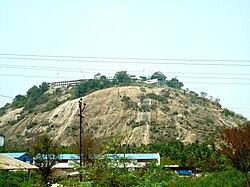
| Located on the outskirts of Madurai on a hillock where | | Located on the outskirts of Madurai on a hillock where Murugan is said to have married Indra's adopted daughter, Deivanai. Nakkeerar is regarded to have worshipped Murugan in this shrine and is said to have worshipped Shiva here as Parangirinathar. This is the first of the Arupadaiveedu. | ||
|- | |- | ||
| [[Arulmigu Subramaniya Swamy Temple, Tiruchendur]] | | [[Arulmigu Subramaniya Swamy Temple, Tiruchendur]] | ||
| திருச்சீரலைவாய் | | Trichiralaiwai | ||
{{lang|ta|திருச்சீரலைவாய்|italic=}} | |||
''Tiruccīralaivāy'' | |||
| [[Tiruchendur]], [[Thoothukudi district]] | | [[Tiruchendur]], [[Thoothukudi district]] | ||
| [[File:Thiruchendur11.jpg|200px|center]] | | [[File:Thiruchendur11.jpg|200px|center]] | ||
| Located on the | | Located on the seashore near Thoothukudi amongst the remains of Gandhamadana Parvatam or Santhanamalai (Sandal Mountain). The temple commemorates the place where Murugan won a decisive victory over the asura Surapadman by worshipping Shiva. | ||
|- | |- | ||
| [[Arulmigu Dhandayuthapani Swamy Temple, Palani]] | | [[Arulmigu Dhandayuthapani Swamy Temple, Palani]] | ||
| திருவாவினன்குடி | | Tiruvavinankudi | ||
{{lang|ta|திருவாவினன்குடி}} | |||
''Tiruvāviṉaṉkuṭi'' | |||
| [[Palani]], [[Dindigul district]] | | [[Palani]], [[Dindigul district]] | ||
|[[File:Palani Hills 1.JPG |200px|center]] | |[[File:Palani Hills 1.JPG |200px|center]] | ||
| Located in Dindigul District, on the Palani hill bottom ( Malai Adivaram ) called 'Thiruaavinankudi', where the deity is known as ' | | Located in Dindigul District, on the Palani hill bottom ( Malai Adivaram ) called 'Thiruaavinankudi', where the deity is known as 'Kulanthai Velayuthaswami' and is said to have been worshipped by the goddess Lakshmi ('Thiru' in Tamil), owner of cows ('Aavinan' in Tamil), living place ('kudi' in Tamil). | ||
There is also a Murugan temple on the Palani hill top where 'Dhandayuthapani' is the main deity, in a meditating state, carrying a staff ('danda') as weapon ('ayutha') in his hands ('pani'). This is the place where Murugan resided after his feud with his family over a divine fruit. | There is also a Murugan temple on the Palani hill top where 'Dhandayuthapani' is the main deity, in a meditating state, carrying a staff ('danda') as a weapon ('ayutha') in his hands ('pani'). This is the place where Murugan is said to have resided after his feud with his family over a [[Jnana Palam|divine fruit]]. | ||
|- | |- | ||
| [[Arulmigu Swaminatha Swamy Temple, Swamimalai]] | | [[Arulmigu Swaminatha Swamy Temple, Swamimalai]] | ||
| திருவேரகம் | | Thiruveragam | ||
{{lang|ta|திருவேரகம்}} | |||
''Tiruvērakam'' | |||
| [[Swamimalai]], [[Thanjavur district]] | | [[Swamimalai]], [[Thanjavur district]] | ||
| [[File:Swamimalai temple.jpg |200px|center]] | | [[File:Swamimalai temple.jpg |200px|center]] | ||
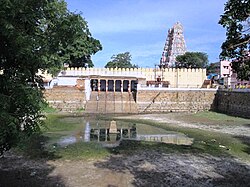
| Located at 5 | | Located at 5 km from Kumbakonam, the temple is built on an artificial hill. The temple commemorates the incident where Muruga is regarded to have explained the essence of the pranava mantra "[[Om]]" to his father [[Shiva]]. | ||
|- | |||
| [[Arulmigu Subramaniya Swamy Temple, Tiruttani]] | |||
| Kundrottal | |||
{{lang|ta|குன்றுதோறாடல்}} | |||
''Kuṉṟutōṟāṭal'' | |||
| [[Tiruttani]], [[Thiruvallur district]] | |||
|[[File:Thiruthani Murugan Temple.jpg |200px|center]] | |||
| Located near Chennai, Murugan is said to have reclaimed his inner peace after waging a war with the asuras and married Valli here. | |||
|- | |- | ||
| [[Arulmigu Solaimalai Murugan Temple, Pazhamudircholai]] | | [[Arulmigu Solaimalai Murugan Temple, Pazhamudircholai]] | ||
| சோலைமலை | | Solaimalai | ||
{{lang|ta|சோலைமலை}} | |||
''Cōlaimalai'' | |||
| [[Pazhamudircholai]], [[Madurai district]] | | [[Pazhamudircholai]], [[Madurai district]] | ||
| [[File:Pazhamuthir solai Murugan 2.JPG |200px|center]] | | [[File:Pazhamuthir solai Murugan 2.JPG |200px|center]] | ||
| Located on the outskirts of Madurai on a hillock with a holy stream nearby called "Nupura Gangai". Murugan is seen with both his consorts Deivanai and Valli. | | Located on the outskirts of Madurai on a hillock with a holy stream nearby called "Nupura Gangai". Murugan is seen here with both his consorts, Deivanai and Valli. | ||
|} | |} | ||
| Line 126: | Line 116: | ||
{{reflist|20em}} | {{reflist|20em}} | ||
{{Murugan temples}} | {{Murugan temples}} | ||
{{DEFAULTSORT:Six Abodes | {{DEFAULTSORT:Six Abodes of Murugan}} | ||
[[Category:Murugan temples in Tamil Nadu]] | [[Category:Murugan temples in Tamil Nadu]] | ||
[[Category:Kaumaram]] | [[Category:Kaumaram]] | ||
[[Category:Temples in Tamil Nadu]] | |||
[[Category:Shaivism]] | |||
[[Category:Kartikeya temples]] | |||
Latest revision as of 18:36, 18 July 2023
| Six Abodes of Murugan | |
|---|---|
Arupadaiveedu | |
 Painting of Murugan, c. 1930.
The Six Temples' location in Tamil Nadu | |
| Religion | |
| Deity | Murugan (Kartikeya) |
| Location | |
| Location | Thiruparankundram, Tiruchendur, Palani, Swamimalai, Tiruttani, Pazhamudircholai |
| State | Tamil Nadu |
| Country | India |
| Architecture | |
| Temple | 6 |


The Six Abodes of Murugan (Tamil: ஆறுபடைவீடுகள், romanized: Āṟupadai veedu) are six temples situated in the state of Tamil Nadu in South India, dedicated to the Hindu deity Murugan, also referred to as Kandaswamy, Kartikeya, Skanda, and Vadivela at various temples. These six sacred abodes of Murugan are mentioned in Tamil Sangam literature, Thirumurugatrupadai, written by Nakkeerar and in Tiruppugaḻ, written by Arunagirinathar. The six abodes are Thiruparankundram, Tiruchendur, Palani, Swamimalai, Tiruttani, and Pazhamudircholai.
Legend[edit | edit source]
The legend of Murugan is described in Kanda Puranam, the Tamil iteration of the Skanda Purana. According to the text, the asura Surapadman drove the devas out of Svarga, and the latter sought the assistance of the deities Vishnu and Brahma. They assigned Kamadeva to disturb Shiva from his penance and fall in love with Parvati, and the couple later gave birth to Murugan. Murugan slew Surapadman in battle and restored Svarga to the devas. Murugan is anointed as the commander of the devas prior to the war. Murugan married the goddesses Valli by love and married Deivayanai after the war that is regarded to have occurred at Tiruchendur.[1]
In Tamil literature, five types of land are explained. These are the Kurinji (mountainous region), Mullai (forest region), Marutham (agricultural region), Neithal (coastal region) and Palai (desert region). Various deities are designated as the patron gods of these regions in Sangam literature. According to these texts, Murugan is the deity of the Kurinji region.[2]
Religious importance[edit | edit source]
Arunagirinathar was a 15th-century Tamil poet born in Tiruvannamalai. According to regional tradition, he spent his early years as a rioter and seducer of women. After ruining his health, he tried to commit suicide by throwing himself from the northern tower of Annamalaiyar Temple, but was saved by the grace of god Murugan.[3] He became a staunch devotee and composed Tamil hymns glorifying Murugan, the most notable being Tiruppugaḻ.[4][5] Arunagirinathar visited various Murugan temples and on his way back to Tiruvannamalai, visited Palani and sung praises about Swaminathaswamy.[6] Tiruparamkundram is considered the first of the six abodes. This is the only temple where the abhishekam is performed for the divine spear called vel instead of Murugan.[7] Palani is considered the most prominent abodes of Murugan.[8]
Practices[edit | edit source]
One of the main traditions of the six temples, is the tonsuring of devotees, who vow to discard their hair in imitation of the Palani deity. Another is the anointing of the head of the presiding deity's idol with sandalwood paste, at night, prior to the temple being closed for the day. The paste, upon being allowed to stay overnight, is said to acquire medicinal properties, and is much sought after and distributed to devotees, as rakkāla chandaṇam.[9] A commonly followed worship practice involves devotees wearing ochre clothes and carrying a kavadi, an ornamental mount decked with flowers, glazed paper, and tinsel work, on foot for long distances.[10]
List[edit | edit source]
| Temple | Original name | Location | Picture | Description |
| Arulmigu Subramaniya Swamy Temple, Thiruparankundram | Tenparangunram
தென்பரங்குன்றம் Teṉparaṅkuṉṟam |
Thiruparankundram, Madurai district | .jpg) |
Located on the outskirts of Madurai on a hillock where Murugan is said to have married Indra's adopted daughter, Deivanai. Nakkeerar is regarded to have worshipped Murugan in this shrine and is said to have worshipped Shiva here as Parangirinathar. This is the first of the Arupadaiveedu. |
| Arulmigu Subramaniya Swamy Temple, Tiruchendur | Trichiralaiwai
திருச்சீரலைவாய் Tiruccīralaivāy |
Tiruchendur, Thoothukudi district |  |
Located on the seashore near Thoothukudi amongst the remains of Gandhamadana Parvatam or Santhanamalai (Sandal Mountain). The temple commemorates the place where Murugan won a decisive victory over the asura Surapadman by worshipping Shiva. |
| Arulmigu Dhandayuthapani Swamy Temple, Palani | Tiruvavinankudi
திருவாவினன்குடி Tiruvāviṉaṉkuṭi |
Palani, Dindigul district |  |
Located in Dindigul District, on the Palani hill bottom ( Malai Adivaram ) called 'Thiruaavinankudi', where the deity is known as 'Kulanthai Velayuthaswami' and is said to have been worshipped by the goddess Lakshmi ('Thiru' in Tamil), owner of cows ('Aavinan' in Tamil), living place ('kudi' in Tamil).
There is also a Murugan temple on the Palani hill top where 'Dhandayuthapani' is the main deity, in a meditating state, carrying a staff ('danda') as a weapon ('ayutha') in his hands ('pani'). This is the place where Murugan is said to have resided after his feud with his family over a divine fruit. |
| Arulmigu Swaminatha Swamy Temple, Swamimalai | Thiruveragam
திருவேரகம் Tiruvērakam |
Swamimalai, Thanjavur district |  |
Located at 5 km from Kumbakonam, the temple is built on an artificial hill. The temple commemorates the incident where Muruga is regarded to have explained the essence of the pranava mantra "Om" to his father Shiva. |
| Arulmigu Subramaniya Swamy Temple, Tiruttani | Kundrottal
குன்றுதோறாடல் Kuṉṟutōṟāṭal |
Tiruttani, Thiruvallur district |  |
Located near Chennai, Murugan is said to have reclaimed his inner peace after waging a war with the asuras and married Valli here. |
| Arulmigu Solaimalai Murugan Temple, Pazhamudircholai | Solaimalai
சோலைமலை Cōlaimalai |
Pazhamudircholai, Madurai district |  |
Located on the outskirts of Madurai on a hillock with a holy stream nearby called "Nupura Gangai". Murugan is seen here with both his consorts, Deivanai and Valli. |
References[edit | edit source]
- ↑ "Arupadaiveedu". The Hindu. 12 November 2010. Archived from the original on 20 November 2010. Retrieved 3 December 2016.
- ↑ "Worship of Murugan". Archived from the original on 26 January 2010. Retrieved 26 January 2010.
- ↑ V.K., Subramanian (2007). 101 Mystics of India. New Delhi: Abhinav Publications. p. 109. ISBN 978-81-7017-471-4.
- ↑ Aiyar, P.V.Jagadisa (1982), South Indian Shrines: Illustrated, New Delhi: Asian Educational Services, pp. 191–203, ISBN 81-206-0151-3, archived from the original on 21 December 2016, retrieved 4 December 2016
- ↑ Zvelebil, Kamil (1975), Tamil literature, Volume 2, Part 1, Netherlands: E.J. Brill, Leiden, p. 217, ISBN 90-04-04190-7, archived from the original on 21 December 2016, retrieved 4 December 2016
- ↑ Zvelebil 1991, p. 53
- ↑ "Arupadai Veedu - Famous Murugan Temples". Dharisanam. Retrieved 2 July 2020.
- ↑ Economic Reforms and Small Scale Industries. Concept Publishing Company. 2009. p. 25. ISBN 9788180694493.
- ↑ Clothey, Fred W. (1972). "Pilgrimage Centers in the Tamil Cultus of Murukan". Journal of the American Academy of Religion. 40 (1). Oxford University Press: 82. JSTOR 1461919.
- ↑ Mohamed, N.P.; A.J., Thomas (2003). "N.P. Mohamed in Conversation with A.J. Thomas". Indian Literature. 47 (1). Sahitya Akademi: 147. JSTOR 23341738.