|
|
| Line 1: |
Line 1: |
| {{Short description|Third Prime Minister of India (1966–77, 1980–84)}}
| |
| {{pp-protected|small=yes}}
| |
| {{Use dmy dates|date=March 2022}}
| |
| {{Use Indian English|date=August 2014}}
| |
| {{Infobox officeholder | | {{Infobox officeholder |
| | name = Indira Gandhi | | |name = Indira Gandhi |
| | image = Indira Gandhi in 1966.jpg | | |image = Indira Gandhi 1966 crop.jpg |
| | caption = Gandhi in 1966 | | |caption = Indira Gandhi in 1966 |
| | honorific-suffix = <!-- Bharat Ratna cannot be used as a suffix --> | | |office = [[List of Prime Ministers of India|3rd]] [[Prime Minister of India]] |
| | party = [[Indian National Congress]]
| | |president = [[Neelam Sanjiva Reddy]]<br />[[Zail Singh]] |
| <!-- -->| order = 3rd
| | |term_start = 14 January 1980 |
| | office = Prime Minister of India
| | |term_end = 31 October 1984 |
| | term_start = 14 January 1980
| | |predecessor = [[Charan Singh]] |
| | term_end = 31 October 1984
| | |successor = [[Rajiv Gandhi]] |
| | predecessor = [[Charan Singh]]
| | |president2 = [[Sarvepalli Radhakrishnan]]<br />[[Zakir Hussain (politician)|Zakir Hussain]]<br />[[V. V. Giri]]<br />[[Fakhruddin Ali Ahmed]] |
| | president = [[N. Sanjiva Reddy]] <br /> [[Zail Singh]] | | |deputy2 = Morarji Desai |
| | successor = [[Rajiv Gandhi]] | | |term_start2 = 24 January 1966 |
| <!-- -->| deputy1 = [[Morarji Desai]]
| | |term_end2 = 24 March 1977 |
| | term_start1 = 24 January 1966 | | |predecessor2 = [[Gulzarilal Nanda]] <small>(acting)</small> |
| | term_end1 = 24 March 1977
| | |successor2 = Morarji Desai |
| | predecessor1 = [[Gulzarilal Nanda]] {{small|(Acting)}}
| | |office3 = [[Minister of External Affairs (India)|Minister of External Affairs]] |
| | president1 = [[Sarvepalli Radhakrishnan]] <br /> [[Zakir Husain (politician)|Zakir Husain]] <br /> [[V. V. Giri]] <br /> [[Fakhruddin Ali Ahmed]] | | |term_start3 = 9 March 1984 |
| | successor1 = [[Morarji Desai]] | | |term_end3 = 31 October 1984 |
| <!-- -->| office2 = [[Minister of External Affairs (India)|Minister of External Affairs]] | | |predecessor3 = [[P. V. Narasimha Rao]] |
| | term_start2 = 9 March 1984 | | |successor3 = [[Rajiv Gandhi]] |
| | term_end2 = 31 October 1984 | | |term_start4 = 22 August 1967 |
| | predecessor2 = [[P. V. Narasimha Rao]] | | |term_end4 = 14 March 1969 |
| | successor2 = [[Rajiv Gandhi]] | | |predecessor4 = [[M. C. Chagla]] |
| <!-- -->| term_start3 = 22 August 1967
| | |successor4 = [[Dinesh Singh]] |
| | term_end3 = 14 March 1969 | | |office5 = [[Minister of Defence (India)|Minister of Defence]] |
| | predecessor3 = [[M. C. Chagla]] | | |term_start5 = 14 January 1980 |
| | successor3 = [[Dinesh Singh (Uttar Pradesh politician)|Dinesh Singh]] | | |term_end5 = 15 January 1982 |
| <!-- -->| office4 = [[Minister of Defence (India)|Minister of Defence]]
| | |predecessor5 = [[Chidambaram Subramaniam]] |
| | term_start4 = 14 January 1980 | | |successor5 = |
| | term_end4 = 15 January 1982 | | |term_start6 = 30 November 1975 |
| | predecessor4 = [[Chidambaram Subramaniam]] | | |term_end6 = 20 December 1975 |
| | successor4 = [[R. Venkataraman]] | | |predecessor6 = [[Sardar Swaran Singh]] |
| <!-- -->| term_start5 = 30 November 1975
| | |successor6 = [[Bansi Lal]] |
| | term_end5 = 20 December 1975 | | |office7 = [[Minister for Home Affairs (India)|Minister of Home Affairs]] |
| | predecessor5 = [[Swaran Singh]] | | |term_start7 = 27 June 1970 |
| | successor5 = [[Bansi Lal]] | | |term_end7 = 4 February 1973 |
| <!-- -->| office6 = [[Minister of Home Affairs (India)|Minister of Home Affairs]]
| | |predecessor7 = [[Yashwantrao Chavan]] |
| | term_start6 = 27 June 1970 | | |successor7 = [[Uma Shankar Dikshit]] |
| | term_end6 = 4 February 1973 | | |office8 = [[Minister of Finance (India)|Minister of Finance]] |
| | predecessor6 = [[Yashwantrao Chavan]] | | |term_start8 = 16 July 1969 |
| | successor6 = [[Uma Shankar Dikshit]] | | |term_end8 = 27 June 1970 |
| <!-- -->| office7 = [[Minister of Finance (India)|Minister of Finance]]
| | |predecessor8 = [[Morarji Desai]] |
| | term_start7 = 17 July 1969 | | |successor8 = [[Yashwantrao Chavan]] |
| | term_end7 = 27 June 1970 | | |birth_date = {{birth date|1917|11|19|df=y}} |
| | predecessor7 = [[Morarji Desai]] | | |birth_name=Indira Priyadarshini Nehru |
| | successor7 = [[Yashwantrao Chavan]] | | |birth_place = [[Allahabad]], [[United Provinces of Agra and Oudh|United Provinces]], [[British Raj|British India]] |
| <!-- -->| office8 = [[Minister of Information and Broadcasting (India)|Minister of Information and Broadcasting]]
| | |death_date = {{death date and age|1984|10|31|1917|11|19|df=y}} |
| | primeminister8 = [[Lal Bahadur Shastri]]
| | |death_place = [[New Delhi]], [[Delhi]], [[India]] |
| | term_start8 = 9 June 1964
| | |alma_mater = [[University of Oxford|Somerville College, Oxford]] |
| | term_end8 = 24 January 1966
| | |party = [[Indian National Congress]] |
| | predecessor8 = [[Satya Narayan Sinha]]
| | |relations = [[Jawaharlal Nehru]] (father) <br/>[[Kamala Nehru]] (mother) |
| | successor8 = [[Kodardas Kalidas Shah]]
| |
| <!-- -->| signature = Indira-Gandhi-Signature-Transparent.png
| |
| | birth_name = Indira Priyadarshini Nehru
| |
| | birth_date = {{birth date|1917|11|19|df=y}} | |
| | birth_place = [[Allahabad]], [[United Provinces of Agra and Oudh]], [[British Raj|British India]] <br /> (present-day Prayagraj, India) | |
| | death_date = {{death date and age|1984|10|31|1917|11|19|df=y}} | |
| | death_place = [[New Delhi]], [[India]] | |
| {{labeldata|Monuments|[[Shakti sthal]]}}
| |
| | spouse = {{marriage|[[Feroze Gandhi]]|26 March 1942|8 September 1960|reason=died}} | |
| | relatives = ''See [[Nehru–Gandhi family]]''
| |
| | children = [[Rajiv Gandhi]] <br /> [[Sanjay Gandhi]] | |
| | parents = [[Jawaharlal Nehru]] (father) <br /> [[Kamala Nehru]] (mother) | |
| | alma_mater = [[Visva-Bharati University]] (dropped out)<ref name="degree" /> <br /> [[Somerville College, Oxford]] (dropped out)<ref name="degree" /> <!-- DO NOT remove "dropped out" word as she attended, for one year each in both universities; whereas graduate degrees are of 3 or 4 years, therefore it must be mentioned.-->
| |
| | awards = {{ubl|[[Bharat Ratna]] (1971)|[[Bangladesh Freedom Honour]] (2011)}}
| |
| | death_cause = [[Assassination of Indira Gandhi|Assassination]] ([[Ballistic trauma]])
| |
| | nickname = [[List of nicknames of prime ministers of India#Indira Gandhi|see article]]
| |
| }}
| |
| '''Indira Priyadarshini Gandhi''' ({{IPA-hi|ˈɪnd̪ɪɾɑː ˈɡɑːnd̪ʰi|lang|Hi-IndiraGandhi.ogg}}; [[Given name|''née'']] '''Nehru'''; 19 November 1917 – 31 October 1984) was an Indian politician and a central figure of the [[Indian National Congress]]. She was the [[List of prime ministers of India|3rd]] prime minister of India and was also the first and, to date, only female [[prime minister of India]]. Gandhi was the daughter of [[Jawaharlal Nehru]], the 1st prime minister of India. She served as prime minister from January 1966 to March 1977 and again from January 1980 until [[Assassination of Indira Gandhi|her assassination]] in October 1984, making her the second longest-serving Indian prime minister after her father.
| |
|
| |
|
| During Nehru's premiership from 1947 to 1964, Gandhi was considered a key assistant and accompanied him on his numerous foreign trips. She was elected [[president of the Indian National Congress]] in 1959. Upon her father's death in 1964, she was appointed as a member of the [[Rajya Sabha]] (upper house) and became a member of [[Lal Bahadur Shastri ministry|Lal Bahadur Shastri's cabinet]] as [[Minister of Information and Broadcasting (India)|Minister of Information and Broadcasting]]. In the Congress Party's parliamentary leadership election held in early 1966 (upon the death of [[Lal Bahadur Shastri|Shastri]]), she defeated her rival [[Morarji Desai]] to become leader, and thus succeeded Shastri, [[Lal Bahadur Shastri#Death|after his death]], as Prime Minister of India.
| | |spouse = [[Feroze Gandhi]] |
| | |children = [[Rajiv Gandhi|Rajiv]]<br />[[Sanjay Gandhi|Sanjay]] |
|
| |
|
| As prime minister, Gandhi was known for her political intransigency and unprecedented [[centralisation of power]]. She went to [[Indo-Pakistani War of 1971|war with Pakistan]] in support of the [[Six point movement|independence movement]] and [[Bangladesh Liberation War|war of independence]] in [[East Pakistan]], which resulted in an Indian victory and the creation of [[Bangladesh]], as well as increasing India's influence to the point where it became the sole [[regional power]] of [[South Asia]]. Citing separatist tendencies, and in response to a call for revolution, Gandhi instituted a [[The Emergency (India)|state of emergency]] from 1975 to 1977 where basic civil liberties were suspended and the press was censored. Widespread atrocities were carried out during the emergency.<ref>{{Cite web|url=https://economictimes.indiatimes.com/news/politics-and-nation/democracy-interrupted-some-lesser-known-facts-about-emergency-1975-77/emergency/slideshow/69940337.cms|title=The darkest phase in Indira's tenure as PM – Emergency!|website=The Economic Times}}</ref> In 1980, she [[1980 Indian general election|returned to power]] after free and fair elections. After Gandhi ordered military action in the [[Golden Temple]] in [[Operation Blue Star]], her own bodyguards and Sikh nationalists assassinated her on 31 October 1984.
| | }} |
| | | '''Indira Gandhi''' (19 November 1917 – 31 October 1984) was an [[Indian people|Indian]] [[politician]]. She was [[Prime Minister]] of [[India]] from 1966 to 1977. She was the daughter of [[Jawaharlal Nehru]], who was also Prime Minister of India. Her son, [[Rajiv Gandhi]], later became Prime Minister of India. She married [[Feroze Gandhi]], who was not related to the [[civil rights]] leader, [[Mahatma Gandhi]]. |
| In 1999, Indira Gandhi was named "Woman of the Millennium" in an online poll organised by the [[BBC]].<ref>{{Cite web|title=India Gandhi: Remembering country's first female PM on her 104th birthday|date=19 November 2021|url=https://www.hindustantimes.com/india-news/india-gandhi-remembering-country-s-first-female-pm-on-her-104th-birthday-101637284960604.html}}</ref> In 2020, Gandhi was named by [[Time (magazine)|''Time'']] magazine among the world's 100 powerful women who defined the last century.<ref>{{Cite news|title=Indira Gandhi, Amrit Kaur named by TIME among '100 Women of the Year'|newspaper=The Economic Times|url=https://economictimes.indiatimes.com/news/politics-and-nation/indira-gandhi-amrit-kaur-named-by-time-among-100-women-of-the-year/articleshow/74498165.cms}}</ref>
| |
| | |
| == Early life and career ==
| |
| Indira Gandhi was born Indira Nehru, into a [[Kashmiri Pandit]] family on 19 November 1917 in [[Allahabad]].{{sfn|Frank|2010|p=13}}<ref name="Indira Priyadarshini">{{cite book|author=Pupul Jayakar|title=Indira Gandhi: A Biography|url=https://books.google.com/books?id=gm5JGkb2rhkC&pg=PR9|date=27 November 1992|publisher=[[Penguin Books India]]|isbn=978-0-14-011462-1|page=10}}</ref> Her father, [[Jawaharlal Nehru]], was a leading figure in the [[Indian independence movement|movement for independence]] from [[British Raj|British rule]], and became the first Prime Minister of the [[Dominion of India|Dominion]] (and later [[India|Republic]]) of India.{{sfn|Gupte|2012|p=3}} She was the only child (she had a younger brother who died young),{{sfn|Frank|2010|p=31}} and grew up with her mother, [[Kamala Nehru]], at the [[Anand Bhavan]], a large family estate in Allahabad.{{sfn|Frank|2010|p=16}} She had a lonely and unhappy childhood.{{sfn|Frank|2010|p=25}} Her father was often away, directing political activities or incarcerated, while her mother was frequently bedridden with illness, and later suffered an early death from [[tuberculosis]].{{sfn|Frank|2010|p=32}} She had limited contact with her father, mostly through letters.{{sfn|Frank|2010|p=55}}
| |
| | |
| [[File:Mahatma Gandhi and Indira Gandhi in 1924.jpg|thumb|left|Young Indira with [[Mahatma Gandhi]] during his [[fasting|fast]] in 1924. Indira, who is dressed in a [[khadi]] garment, is shown following Gandhi's advocacy that khadi be worn by all Indians instead of British-manufactured textiles.]]
| |
| | |
| Indira was taught mostly at home by tutors and attended school intermittently until matriculation in 1934. She was a student at the [[Modern School (New Delhi)|Modern School]] in [[Delhi]], St Cecilia's and St Mary's Christian convent schools in Allahabad,<ref>{{cite book|last1=Gupte|first1=Pranay|title=Mother India : a political biography of Indira Gandhi / Pranay Gupte.|date=2011|publisher=[[Penguin Books]]|location=New York|isbn=978-0-14-306826-6|pages=151–152|edition=Rev.|url={{Google books|OOmK1lPWq80C|page=PA151|keywords=|text=|plainurl=yes}}|access-date=16 August 2016}}</ref> the [[International School of Geneva]], the Ecole Nouvelle in [[Bex]], and the Pupils' Own School in [[Pune|Poona]] and [[Mumbai|Bombay]], which is affiliated with the [[University of Mumbai]]. {{sfn|Frank|2010|pp=29,75,83}} She and her mother Kamala moved to the [[Belur Math]] headquarters of the [[Ramakrishna Mission]] where [[Swami Ranganathananda]] was her guardian.{{sfn|Indira Gandhi: Daughter of India|2002|pp=42,43,45}} She went on to study at the Vishwa Bharati in [[Santiniketan]], which became [[Visva-Bharati University]] in 1951.<ref name="EB">{{cite web | title=Overview of Indira Gandhi | url=https://www.britannica.com/biography/Indira-Gandhi | website=Encyclopædia Britannica | access-date=15 November 2019 | archive-url=https://web.archive.org/web/20190702074830/https://www.britannica.com/biography/Indira-Gandhi | archive-date=2 July 2019 | url-status=live }}</ref> It was during her interview with him that [[Rabindranath Tagore]] named her ''[[:wikt:प्रियदर्शिन्|Priyadarshini]]'', literally "looking at everything with kindness" in [[Sanskrit]], and she came to be known as Indira Priyadarshini Nehru.{{sfn|Frank|2010|p=90}} A year later, however, she had to leave university to attend to her ailing mother in [[Europe]].{{sfn|Gupte|2012|p=170}} There it was decided that Indira would continue her education at the [[University of Oxford]].{{sfn|Gupte|2012|p=181}}<ref name="EB" /> After her mother died, she attended the [[Badminton School]] for a brief period before enrolling at [[Somerville College, Oxford|Somerville College]] in 1937 to study history.{{sfn|Frank|2010|p=116}} Indira had to take the entrance examination twice, having failed at her first attempt with a poor performance in Latin.{{sfn|Frank|2010|p=116}} At Oxford, she did well in history, political science and economics, but her grades in Latin—a compulsory subject—remained poor.{{sfn|Somervill|2007|p=36}}{{sfn|Gupte|2012|p=184}} Indira did, however, have an active part within the student life of the university, such as membership in the Oxford Majlis Asian Society.<ref>{{Cite web |url=http://oxfordmajlis.wix.com/majlis |title=Majlis Asian Society |website=oxfordmajilis.wix |url-status=live |access-date=19 April 2020 |archive-url=https://web.archive.org/web/20160304100851/http://oxfordmajlis.wix.com/majlis |archive-date=4 March 2016 }}</ref>
| |
| | |
| [[File:Young Indira Gandhi.jpg|thumb|upright|Indira Nehru c. early 1930s]]
| |
| | |
| During her time in Europe, Indira was plagued with ill-health and was constantly attended to by doctors. She had to make repeated trips to Switzerland to recover, disrupting her studies. She was being treated there in 1940, when Germany rapidly conquered Europe. Indira tried to return to England through Portugal but was left stranded for nearly two months. She managed to enter England in early 1941, and from there returned to India without completing her studies at Oxford. The university later awarded her an honorary degree. In 2010, Oxford honoured her further by selecting her as one of the ten Oxasians, illustrious Asian graduates from the [[University of Oxford]].<ref>{{cite web|url=http://www.ox.ac.uk/media/news_releases_for_journalists/100422_1.html |title=Exhibit celebrates 120 years of South Asians at Oxford |publisher=[[University of Oxford]] |date=22 April 2010 |access-date=24 December 2012 |url-status=dead |archive-url=https://web.archive.org/web/20130102074542/http://www.ox.ac.uk/media/news_releases_for_journalists/100422_1.html |archive-date=2 January 2013 }}</ref><ref name="degree">{{cite web|title=Rahul first in three generations with a world university degree|url=http://www.tribuneindia.com/2014/20140218/main6.htm|work=[[The Tribune (Chandigarh)|The Tribune]]|access-date=18 May 2015|archive-url=https://web.archive.org/web/20160303220725/http://www.tribuneindia.com/2014/20140218/main6.htm|archive-date=3 March 2016|url-status=live}}</ref> During her stay in Britain, Indira frequently met her future husband [[Feroze Gandhi]] (no relation to [[Mahatma Gandhi]]), whom she knew from Allahabad, and who was studying at the [[London School of Economics]]. Their marriage took place in Allahabad according to [[Adi Dharm]] rituals, though Feroze belonged to a [[Zoroastrianism|Zoroastrian]] [[Parsi]] family of [[Gujarat]].<ref>{{cite web|url=http://archive.indianexpress.com/oldStory/82389/|title=Sonia assures help for father-in-law's grave|website=archive.indianexpress.com|date=21 November 2005|access-date=19 July 2017|archive-url=https://web.archive.org/web/20160205144008/http://archive.indianexpress.com/oldStory/82389/|archive-date=5 February 2016|url-status=live}}</ref> The couple had two sons, [[Rajiv Gandhi]] (born 1944) and [[Sanjay Gandhi]] (born 1946).<ref>{{Cite web|url=https://thediplomat.com/2019/07/the-end-of-indias-nehru-gandhi-dynasty/|title=The End of India's Nehru-Gandhi Dynasty?|last=Iwanek|first=Krzysztof|website=thediplomat.com|language=en-US|access-date=2 January 2020|archive-url=https://web.archive.org/web/20200102223539/https://thediplomat.com/2019/07/the-end-of-indias-nehru-gandhi-dynasty/|archive-date=2 January 2020|url-status=live}}</ref><ref name=":1">{{Cite news|url=https://www.washingtonpost.com/archive/politics/1984/11/01/indira-is-india/3a5a4ea5-53d9-47e7-8a30-4f6b39b2e6f6/|title=Indira Is India|last=Auerbach|first=Stuart|date=1 November 1984|newspaper=[[The Washington Post]]|access-date=2 January 2020|language=en-US|issn=0190-8286|archive-url=https://web.archive.org/web/20200103102056/https://www.washingtonpost.com/archive/politics/1984/11/01/indira-is-india/3a5a4ea5-53d9-47e7-8a30-4f6b39b2e6f6/|archive-date=3 January 2020|url-status=live}}</ref>
| |
| | |
| In the 1950s, Indira, now Mrs. Indira Gandhi after her marriage, served her father unofficially as a personal assistant during his tenure as the first [[prime minister of India]].<ref>{{cite book|last1=Steinberg|first1=Blema S.|title=Women in power : the personalities and leadership styles of Indira Gandhi, Golda Meir, and Margaret Thatcher|date=2008|publisher=[[McGill-Queen's University Press]]|location=Montreal|isbn=978-0-7735-3356-1|page=20|url={{Google books|EZIBxpeRXxsC|page=PR7|keywords=indira%20nehru%20hostess|text=|plainurl=yes}}|access-date=2 December 2015}}</ref> Towards the end of the 1950s, Gandhi served as the President of the [[Indian National Congress|Congress]]. In that capacity, she was instrumental in getting the Communist led [[Government of Kerala|Kerala]] State Government dismissed in 1959. That government had the distinction of being India's first-ever elected [[Communism|Communist]] Government.<ref>{{cite journal|last1=Upadhyaya|first1=Prakash Chandra|title=Review of Marxist State Governments in India, Politics, Economics and Society by T. J. Nossiter|journal=[[Social Scientist]]|date=1989|volume=17|issue=1/2 January – February 1989|pages=84–91|doi=10.2307/3520112|jstor=3520112}}</ref> After her father's death in 1964 she was appointed a member of the [[Rajya Sabha]] (upper house) and served in Prime Minister [[Lal Bahadur Shastri]]'s cabinet as [[Minister of Information and Broadcasting (India)|Minister of Information and Broadcasting]].<ref>Gandhi, Indira. (1982) ''My Truth''</ref> In January 1966, after Shastri's death, the Congress legislative party elected her over [[Morarji Desai]] as their leader. Congress party veteran [[K. Kamaraj]] was instrumental in Gandhi achieving victory.<ref>{{cite journal|last1=Kochanek|first1=Stanley A.|title=Post Nehru India: The Emergence of the New Leadership|journal=[[Asian Survey]]|date=May 1966|volume=6|issue=5|page=298|doi=10.2307/2642538|jstor=2642538}}</ref> Because she was a woman, other political leaders in India saw Gandhi as weak and hoped to use her as a puppet once elected: <blockquote>Congress President Kamaraj orchestrated Mrs. Gandhi's selection as prime minister because he perceived her to be weak enough that he and the other regional party bosses could control her, and yet strong enough to beat Desai [her political opponent] in a party election because of the high regard for her father ... a woman would be an ideal tool for the Syndicate.<ref>Genovese, Michael A., ed. Women As National Leaders. Newbury Park, CA: [[Sage Publications]], 1993. Print. 110.</ref></blockquote>
| |
| | |
| == First term as prime minister between 1966 and 1977 ==
| |
| Gandhi's first eleven years serving as prime minister saw her evolve from the perception of Congress party leaders as their puppet, to a strong leader with the iron resolve to split the party over her policy positions, or to go to war with Pakistan to assist Bangladesh in the 1971 liberation war. At the end of 1977, she was such a dominating figure in Indian politics that Congress party president [[D. K. Barooah]] had coined the phrase "India is Indira and Indira is India."<ref>Ghosh, P.S., 1999. Whither Indian Polity?. [[Economic and Political Weekly]], pp.3340–3342.</ref>
| |
| | |
| === First year ===
| |
| Gandhi formed her government with Morarji Desai as deputy prime minister and finance minister. At the beginning of her first term as prime minister, she was widely criticised by the media and the opposition as a "''Goongi goodiya''" (Hindi for a "dumb doll" or "puppet") of the Congress party bosses who had orchestrated her election and then tried to constrain her.<ref>{{cite book|editor-last=Derichs|editor-first=Claudia |last=Thompson|first=Mark R.|title=Dynasties and female political leaders in Asia : gender, power and pedigree|date=2013|publisher=[[LIT Verlag]]|location=London|isbn=978-3-643-90320-4|pages=32, 50|url={{Google books|UKBcLhCxSvQC|page=PA27|keywords=%22goongi%20gudiya%22%20indira|text=|plainurl=yes}}}}</ref><ref>{{cite book|last1=Shankar|first1=Kalyani|title=Pandora's daughters|date=2013|publisher=[[Bloomsbury Publishing]] India|location=London|isbn=978-93-82951-04-9|url={{Google books|_knCBwAAQBAJ|page=PT8|keywords=goongi|text=|plainurl=yes}}}}</ref>
| |
| | |
| === 1967–1971 ===
| |
| [[File:John Gorton and Indira Gandhi.jpg|thumb|left|Indira Gandhi with Australian [[Prime Minister of Australia|Prime Minister]] [[John Gorton]] in 1968]]
| |
| The first electoral test for Gandhi was the [[1967 Indian general election|1967 general elections]] for the [[Lok Sabha]] and state assemblies. The Congress Party won a reduced majority in the Lok Sabha after these elections owing to widespread disenchantment over the rising prices of commodities, unemployment, economic stagnation and a food crisis. Gandhi was elected to the Lok Sabha from the [[Raebareli (Lok Sabha constituency)|Raebareli constituency]]. She had a rocky start after agreeing to [[devaluation|devalue]] the [[Indian rupee|rupee]] which created hardship for Indian businesses and consumers. The importation of wheat from the United States fell through due to political disputes.<ref name="Kapila1" />
| |
| | |
| For the first time, the party also lost power or lost its majority in a number of states across the country. Following the 1967 elections, Gandhi gradually began to move towards socialist policies. In 1969, she fell out with senior Congress party leaders over several issues. Chief among them was her decision to support [[V. V. Giri]], the independent candidate rather than the official Congress party candidate [[Neelam Sanjiva Reddy]] for the vacant position of [[president of India]]. The other was the announcement by the prime minister of Bank nationalisation without consulting the finance minister, Morarji Desai. These steps culminated in party president [[S. Nijalingappa]] expelling her from the party for indiscipline.<ref>{{Cite news|url=http://economictimes.indiatimes.com/opinion/et-commentary/march-to-socialism-under-prime-minister-indira-gandhi-offers-an-interesting-parallel/articleshow/9715049.cms|title=March to socialism under Prime Minister Indira Gandhi offers an interesting parallel|date=24 August 2011|work=[[The Economic Times]]|access-date=19 July 2017|archive-url=https://web.archive.org/web/20171010075812/http://economictimes.indiatimes.com/opinion/et-commentary/march-to-socialism-under-prime-minister-indira-gandhi-offers-an-interesting-parallel/articleshow/9715049.cms|archive-date=10 October 2017|url-status=live}}</ref><ref>{{Cite news|url=http://indiatoday.intoday.in/story/1969-congress-splits/1/155566.html|title=1969: S. Nijalingappa expelled Indira Gandhi from the party|website=indiatoday.com|access-date=19 July 2017|archive-url=https://web.archive.org/web/20140714195348/http://indiatoday.intoday.in/story/1969-congress-splits/1/155566.html|archive-date=14 July 2014|url-status=live}}</ref><ref>{{cite book|last1=Singh|first1=Mahendra Prasad|title=Split in a Predominant Party: The Indian National Congress in 1969|date=1981|publisher=Sakti Malik, Abhinav Prakashan|location=New Delhi|isbn=978-81-7017-140-9|url={{Google books|UOQRWuMXyRMC|page=PR5|keywords=indian%20national%20|text=|plainurl=yes}}}}</ref> Gandhi, in turn, floated her own faction of the Congress party and managed to retain most of the Congress MPs on her side with only 65 on the side of the [[Indian National Congress (Organisation)|Congress (O)]] faction. The Gandhi faction, called [[Indian National Congress (R)|Congress (R)]], lost its majority in the parliament but remained in power with the support of regional parties such as [[Dravida Munnetra Kazhagam|DMK]].<ref name="Rosser">{{Cite book| publisher = [[MIT Press]]| pages = 468–470
| |
| | url={{Google books|y3Mr6TgalqMC|page=PA470|keywords=|text=|plainurl=yes}}|isbn=978-0-262-18234-8| last1 = Rosser| first1 = J. Barkley| last2 = Rosser| first2 = Marina V.| title = Comparative Economics in Transforming the World Economy| year = 2004}}</ref> The policies of the Congress under Gandhi, before the 1971 elections, also included proposals for the abolition of the [[Privy Purse in India|Privy Purse]] to former rulers of the [[princely state]]s and the 1969 nationalization of the fourteen largest banks in India.<ref>{{Cite web|url=https://www.theweek.in/webworld/features/society/indira-gandhi-iron-willed-stateswoman.html|title=Indira Gandhi—the iron-willed stateswoman|website=theweek.in|access-date=2 January 2020}}</ref>
| |
| | |
| === 1971–1977 ===
| |
| [[Garibi Hatao]] (Eradicate Poverty) was the resonant theme for Gandhi's 1971 political bid. The slogan was developed in response to the combined opposition alliance's use of the two word manifesto—"Indira Hatao" (Remove Indira).<ref name="1971.iz iz result">{{cite web|title=General Elections, India, 1971: Statistical report |url=http://eci.nic.in/eci_main/statisticalreports/LS_1971/Vol_I_LS71.pdf |website=eci.nic.in |publisher=Commission of India |access-date=25 June 2014 |url-status=dead |archive-url=https://web.archive.org/web/20140718175452/http://eci.nic.in/eci_main/StatisticalReports/LS_1971/Vol_I_LS71.pdf |archive-date=18 July 2014 }}</ref><ref>{{cite news|last1=Masani|first1=Zareer|title=The Indira Wave|url=http://www.thehindu.com/features/magazine/article2950165.ece|access-date=8 January 2015|issue=3 March 2012|newspaper=[[The Hindu]]|date=2012|archive-url=https://web.archive.org/web/20150903232831/http://www.thehindu.com/features/magazine/article2950165.ece|archive-date=3 September 2015|url-status=live}}</ref><ref name=IGIN /> The Garibi Hatao slogan and the proposed [[poverty reduction|anti-poverty programs]] that came with it were designed to give Gandhi independent national support, based on the rural and urban poor. This would allow her to bypass the dominant rural [[Caste system in India|castes]] both in and of state and local governments as well as the urban commercial class. For their part, the previously voiceless poor would at last gain both political worth and political weight.<ref name=IGIN>{{Cite web |url=http://indiragandhi.in/en/timeline/index/garibi-hatao-timeline |title=The Garibi Hatao Programme |website=indiragandhi.in |url-status=live |access-date=20 April 2020 |archive-url=https://web.archive.org/web/20190909194851/http://indiragandhi.in/en/timeline/index/garibi-hatao-timeline |archive-date=9 September 2019 }}</ref> The programs created through Garibi Hatao, though carried out locally, were funded and developed by the Central Government in New Delhi. The program was supervised and staffed by the Indian National Congress party. "These programs also provided the central political leadership with new and vast patronage resources to be disbursed ... throughout the country."<ref>{{cite journal|author=Rath, Nilakantha|title='Garibi Hatao': Can IRDP Do It?|year=1985|journal=[[Economic and Political Weekly]]|volume=20|issue=6 |pages=238–246|jstor=4374060}}</ref>
| |
| | |
| Gandhi's biggest achievement following the 1971 election came in December 1971 with India's decisive victory over [[Pakistan]] in the [[Indo-Pakistani War of 1971|Indo-Pakistani War]] that occurred in the last two weeks of the [[Bangladesh Liberation War]], which led to the formation of independent [[Bangladesh]]. She was said to be hailed as Goddess [[Durga]] by opposition leader [[Atal Bihari Vajpayee]] at the time.<ref>{{cite book|last1=Hellmann-Rajanayagam|first1=D|title=Dynasties and Female Political Leaders in Asia: Gender, Power and Pedigree|date=2013|publisher=[[LIT Verlag]] GMBH|location=Vienna, Zurich|isbn=978-3-643-90320-4|page=27|url={{Google books|UKBcLhCxSvQC|page=PA27|keywords=indira%20durga%20vajpayee%20bangladesh|text=|plainurl=yes}}}}</ref><ref>{{cite journal|last1=Puri|first1=Balraj|title=Indian Muslims since Partition|journal=[[Economic and Political Weekly]]|date=1993|volume=28|issue=40|page=2144|jstor=4400229}}</ref><ref>Sanghavi, Nagindas. "From Navnirman to the anti-Mandal riots: the political trajectory of Gujarat (1974–1985)." South Asian History and Culture 1.4 (2010): 480–493.</ref><ref>{{cite book|editor1-last=Copeman|editor1-first=Jacob |editor2-last=Ikegame|editor2-first=Aya |last=Jaffrelot|first= Christophe|title=The Guru in South Asia: New Interdisciplinary Perspectives Chapter 4 The political guru.|date=2012|publisher=[[Routledge]]|location=London, New York|isbn=978-0-415-51019-6|page=85|url={{Google books|q_byVNXT1aEC|page=PA80|keywords=vajpayee|text=|plainurl=yes}}|access-date=30 November 2015}}</ref>{{#tag:ref|[[Atal Bihari Vajpayee]] though categorically denied ever having said that when he made an appearance on [[Rajat Sharma]]'s show ''Aap ki Adalat''.<ref>{{cite web |url=https://www.youtube.com/watch?v=ofxZKeH8BGM |title=Did Atal bihari Vajpayee call Indira Gandhi 'Durga' ? |last=Jain |first=Atishay |publisher=YouTube |date=26 September 2015 |website=YouTube |access-date=23 March 2016 |archive-url=https://web.archive.org/web/20170215093632/https://www.youtube.com/watch?v=ofxZKeH8BGM |archive-date=15 February 2017 |url-status=live }}</ref> |group=note}} In the elections held for State assemblies across India in March 1972, the Congress (R) swept to power in most states riding on the post-war "Indira wave".<ref name="jstor.org">{{cite journal|last1=Rudolph|first1=Lloyd|last2=Rudolph|first2=Susanne|title=India's Election: Backing into the future|journal=[[Foreign Affairs]]|date=July 1977|volume=55|issue=4|pages=836–853|doi=10.2307/20039739|jstor=20039739}}</ref>
| |
| | |
| Despite the victory against Pakistan, the Congress government faced numerous problems during this term. Some of these were due to high inflation which in turn was caused by wartime expenses, drought in some parts of the country and, more importantly, the [[1973 oil crisis]]. Opposition to her in the 1973–75 period, after the Gandhi wave had receded, was strongest in the states of [[Bihar]] and [[Gujarat]]. In Bihar, [[Jayaprakash Narayan]], the veteran leader came out of retirement to lead the protest movement there.<ref name="jstor.org" />
| |
| | |
| ==== Verdict on electoral malpractice ====
| |
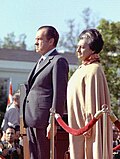
| [[File:Indira and Nixon.JPG|thumb|upright|left|Indira Gandhi with U.S. [[President of the United States|President]] [[Richard Nixon]], 1971]]
| |
| On 12 June 1975, the [[Allahabad High Court]] declared Indira Gandhi's election to the Lok Sabha in 1971 void on the grounds of electoral malpractice. In an election petition filed by her 1971 opponent, [[Raj Narain]] (who later defeated her in the 1977 parliamentary election running in the Raebareli constituency), alleged several major as well as minor instances of the use of government resources for campaigning.<ref name=":0">{{cite news|url=http://news.bbc.co.uk/onthisday/hi/dates/stories/june/12/newsid_2511000/2511691.stm|title=BBC On This Day {{!}} 12 {{!}} 1975: Gandhi found guilty of corruption|website=news.bbc.co.uk|access-date=19 July 2017|date=12 June 1975|archive-url=https://web.archive.org/web/20170623125017/http://news.bbc.co.uk/onthisday/hi/dates/stories/june/12/newsid_2511000/2511691.stm|archive-date=23 June 2017|url-status=live}}</ref><ref>Priyadarshi, D., 1975. Case Study: Smt. Indira Nehru Gandhi vs. Shri Raj Narain and Anr. on 7 November 1975. Indira Nehru Gandhi vs. Shri Raj Narain and Anr. on, 7.</ref> Gandhi had asked one of her colleagues in government, [[Ashoke Kumar Sen]], to defend her in court.<ref>{{Cite web|date=26 June 2020|title=Indira Gandhi Biography: Birth, Family, Education, Political Career, Posthumus Awards, Legacy and more|url=https://www.jagranjosh.com/general-knowledge/indira-gandhi-biography-1593168504-1|access-date=16 July 2021|website=Jagranjosh.com}}</ref> She gave evidence in her defence during the trial. After almost four years, the court found her guilty of dishonest election practices, excessive election expenditure, and of using government machinery and officials for party purposes.<ref name=":0" /><ref>{{cite book|last1=Chandra|first1=Bipan|title=In the name of democracy : JP movement and the emergency, Chapter 4, Emergency imposed|date=2003|publisher=[[Penguin Books]]|location=New Delhi|isbn=978-0-14-302967-0|url={{Google books|3K7dCQAAQBAJ|page=PT4|keywords=yashpal|text=|plainurl=yes}}}}</ref> The judge, however, rejected the more serious charges of bribery, laid against her in the case.<ref name=":0" />
| |
| | |
| The court ordered her stripped of her parliamentary seat and banned her from running for any office for six years. As the [[Constitution of India|constitution]] requires that the Prime Minister must be a [[Member of Parliament, Lok Sabha|member]] of either the Lok Sabha or the Rajya Sabha, the two houses of the [[Parliament of India]], she was effectively removed from office. However, Gandhi rejected calls to resign. She announced plans to appeal to the Supreme Court and insisted that the conviction did not undermine her position. She said: "There is a lot of talk about our government not being clean, but from our experience the situation was very much worse when [opposition] parties were forming governments."<ref name=":0" /> And she dismissed criticism of the way her Congress Party raised election campaign money, saying all parties used the same methods. The prime minister retained the support of her party, which issued a statement backing her.
| |
| | |
| After news of the verdict spread, hundreds of supporters demonstrated outside her house, pledging their loyalty. Indian High Commissioner to the United Kingdom [[Braj Kumar Nehru]] said Gandhi's conviction would not harm her political career. "Mrs Gandhi has still today overwhelming support in the country," he said. "I believe the prime minister of India will continue in office until the electorate of India decides otherwise".<ref>{{citation|url=http://news.bbc.co.uk/onthisday/hi/dates/stories/june/12/newsid_2511000/2511691.stm|publisher=[[BBC]]|title=1975: Gandhi found guilty of corruption|date=12 June 1975|access-date=11 December 2008|archive-url=https://web.archive.org/web/20081217171952/http://news.bbc.co.uk/onthisday/hi/dates/stories/june/12/newsid_2511000/2511691.stm|archive-date=17 December 2008|url-status=live}}</ref>
| |
| | |
| ==== State of Emergency (1975–1977) ====
| |
| {{Main|The Emergency (India)}}
| |
| Gandhi moved to restore order by ordering the arrest of most of the opposition participating in the unrest. Her Cabinet and government then recommended that President [[Fakhruddin Ali Ahmed]] declare a [[state of emergency]] because of the disorder and lawlessness following the Allahabad High Court decision. Accordingly, Ahmed declared a State of Emergency caused by internal disorder, based on the provisions of Article 352(1) of the Constitution, on 25 June 1975.<ref>{{Cite web |url=https://thelogicalindian.com/rewind/emergency-imposed-by-indira-gandhi-government/ |title=A Page From The Past: All You Need To Know About Emergency Imposed By Indira Gandhi Government |date=25 June 2018 |url-status=live |access-date=20 April 2020 |archive-url=https://web.archive.org/web/20200414172700/https://thelogicalindian.com/rewind/emergency-imposed-by-indira-gandhi-government/ |archive-date=14 April 2020 }}</ref>
| |
| | |
| ==== Rule by decree ====
| |
| Within a few months, [[President's rule]] was imposed on the two opposition party ruled states of Gujarat and [[Tamil Nadu]] thereby bringing the entire country under direct Central rule or by governments led by the ruling Congress party.<ref>Kochanek, Stanely, ''Mrs. Gandhi's Pyramid: The New Congress'', ([[Westview Press]], Boulder, CO 1976) p. 98</ref> Police were granted powers to impose curfews and detain citizens indefinitely; all publications were subjected to substantial censorship by the [[Ministry of Information and Broadcasting (India)|Ministry of Information and Broadcasting]]. Finally, the impending legislative assembly elections were postponed indefinitely, with all opposition-controlled state governments being removed by virtue of the constitutional provision allowing for a dismissal of a state government on the recommendation of the state's governor.<ref>{{Cite book|last=Malhotra|first=Inder|url=https://books.google.com/books?id=wRxnDwAAQBAJ&q=indira+gandhi|title=Indira Gandhi: A Personal and Political Biography|date=1 February 2014|publisher=[[Hay House]], Inc.|isbn=978-93-84544-16-4|language=en}}</ref>
| |
| | |
| Indira Gandhi used the emergency provisions to change conflicting party members:
| |
| {{blockquote|1=
| |
| Unlike her father Jawaharlal Nehru, who preferred to deal with strong chief ministers in control of their legislative parties and state party organizations, Mrs. Gandhi set out to remove every Congress chief minister who had an independent base and to replace each of them with ministers personally loyal to her...Even so, stability could not be maintained in the states...<ref>Brass, Paul R., ''The Politics of India Since Independence'', ([[Cambridge University Press]], England 1995) p. 40</ref>}}
| |
| | |
| President Ahmed issued [[decree|ordinances]] that did not require debate in the Parliament, allowing Gandhi to [[rule by decree]].<ref>{{Cite book |url=https://books.google.com/books?id=8IUE33Vrdx0C&q=Ahmed+issued+ordinances+that+did+not+require+debate+in+Parliament,+allowing+Gandhi+to+rule+by+decree&pg=PA225 |title=Eq And Leadership |last=Joseph |first=P.T. |year=2007 |publisher=Tata McGraw-Hill Educational |page=225 |isbn=978-0-07-061794-0 |access-date=20 April 2020}}</ref>
| |
| | |
| ==== Rise of Sanjay ====
| |
| The Emergency saw the entry of Gandhi's younger son, Sanjay Gandhi, into Indian politics. He wielded tremendous power during the emergency without holding any government office. According to [[Mark Tully]], "His inexperience did not stop him from using the Draconian powers his mother, Indira Gandhi, had taken to terrorise the administration, setting up what was in effect a police state."<ref>{{Cite book |last=Tully |first=Mark |title=Amritsar: Mrs. Gandhi's Last Battle |publisher=[[Rupa & Co.]] |year=1985 |isbn=81-291-0917-4 |location=New Delhi |pages=55}}</ref>
| |
| | |
| It was said that during the Emergency he virtually ran India along with his friends, especially [[Bansi Lal]].<ref>{{cite news|author=Subodh Ghildiyal|url=http://articles.timesofindia.indiatimes.com/2010-12-29/india/28661327_1_slum-clearance-sanjay-gandhi-sterilization|title=Cong blames Sanjay Gandhi for Emergency 'excesses'|date=29 December 2010|access-date=19 January 2013|archive-url=https://archive.today/20120708020419/http://articles.timesofindia.indiatimes.com/2010-12-29/india/28661327_1_slum-clearance-sanjay-gandhi-sterilization|archive-date=8 July 2012|newspaper=[[The Times of India]]|url-status=dead}}</ref> It was also quipped that Sanjay Gandhi had total control over his mother and that the government was run by the [[7, Lok Kalyan Marg|PMH (Prime Minister House)]] rather than the [[Prime Minister's Office (India)|PMO (Prime Minister Office)]].<ref>{{cite web|url=https://www.scribd.com/doc/26022710/Mystery-Called-Sanjay-Gandhi|title=Mystery Called Sanjay Gandhi|publisher=Scribd|date=21 November 2007|access-date=19 January 2013|archive-url=https://web.archive.org/web/20120825025714/http://www.scribd.com/doc/26022710/Mystery-Called-Sanjay-Gandhi|archive-date=25 August 2012|url-status=live}}</ref><ref>{{cite news|author=Express News Service|title=Emergency 'propagandist' who banned Kishore Kumar songs|url=http://archive.indianexpress.com/news/emergency-propagandist-who-banned-kishore-kumar-songs/1127804/|access-date=17 January 2014|newspaper=Indian Express|date=11 June 2013|archive-url=https://web.archive.org/web/20140220013302/http://archive.indianexpress.com/news/emergency-propagandist-who-banned-kishore-kumar-songs/1127804/|archive-date=20 February 2014|url-status=live}}</ref><ref name="The Life of Indira Gandhi">{{cite journal|last=Dasgupta|first=Swapan|journal=[[Third World Quarterly]]|title=Sanjay Gandhi|date=July 1985|volume=7|issue=3|doi=10.1080/01436598508419863|pages=731–778}}</ref>
| |
| | |
| == 1977 election and opposition years ==
| |
| [[File:Face detail, Premier Indira Gandhi (Congrespartij), Bestanddeelnr 929-0811 (cropped).jpg|thumb|Indira Gandhi on 21 March 1977]]
| |
| In 1977, after extending the state of emergency twice, Gandhi called [[1977 Indian general election|elections]] to give the electorate a chance to vindicate her rule. She may have grossly misjudged her popularity by reading what the heavily censored press wrote about her.<ref>{{cite book|last1=Derfler|first1=Leslie|title=The fall and rise of political leaders Olof Palme, Olusegun Obasanjo, and Indira Gandhi|date=2011|publisher=[[Palgrave Macmillan]]|location=New York|isbn=978-0-230-11724-2|pages=186–187|edition=1st|url={{Google books|7VjJAAAAQBAJ|page=PR2|keywords=sterilization|text=|plainurl=yes}}|access-date=14 September 2017}}</ref> She was opposed by the [[Janata alliance]] of Opposition parties. The alliance was made up of [[Bharatiya Jana Sangh]], Congress (O), The Socialist parties, and [[Charan Singh]]'s [[Bharatiya Kranti Dal]] representing northern peasants and farmers. The Janata alliance, with [[Jai Prakash Narayan]] as its spiritual guide, claimed the elections were the last chance for India to choose between "democracy and dictatorship". The Congress Party split during the election campaign of 1977: veteran Gandhi supporters like [[Jagjivan Ram]], [[Hemvati Nandan Bahuguna]] and [[Nandini Satpathy]] were compelled to part ways and form a new political entity, the CFD ([[Congress for Democracy]]), due primarily to intra-party politicking and the circumstances created by Sanjay Gandhi. The prevailing rumour was that he intended to dislodge Gandhi, and the trio stood to prevent that. Gandhi's Congress party was soundly crushed in the elections. The Janata Party's democracy or dictatorship claim seemed to resonate with the public. Gandhi and Sanjay Gandhi lost their seats, and Congress was reduced to 153 seats (compared with 350 in the previous Lok Sabha), 92 of which were in the South. The Janata alliance, under the leadership of Morarji Desai, came to power after the State of Emergency was lifted. The alliance parties later merged to form the [[Janata Party]] under the guidance of Gandhian leader, Jayaprakash Narayan. The other leaders of the Janata Party were Charan Singh, Raj Narain, [[George Fernandes]] and Atal Bihari Vajpayee.<ref>{{cite book|last1=Rudolph|first1=Lloyd I.| author-link = Lloyd Rudolph|first2=Susanne|last2= Hoeber|author-link2=Susanne Hoeber Rudolph|title=In pursuit of Lakshmi: The political economy of the Indian state|date=1989|publisher=[[University of Chicago Press]]|location=Chicago|isbn=978-0-226-73139-1|pages=159–178|edition=[Nachdr.]|url={{Google books|amtV90ig9-8C|page=PR16|keywords=1977%20janata%20|text=|plainurl=yes}}}}</ref>
| |
| | |
| === In opposition and return to power ===
| |
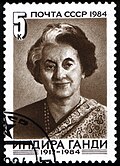
| [[File:1984 CPA 5588.jpg|thumb|upright|{{Center|1984 [[USSR]]}}{{Center| commemorative stamp}}]]
| |
| | |
| Since Gandhi had lost her seat in the election, the defeated Congress party appointed [[Yashwantrao Chavan]] as their parliamentary party leader. Soon afterwards, the Congress party split again with Gandhi floating her own Congress faction. She won a by-election in the [[Chikmagalur (Lok Sabha constituency)|Chikmagalur Constituency]] and took a seat in the Lok Sabha in November 1978 <ref>{{cite news|last1=Maramkal|first1=M-B|title=Chikmagalur remembers Indira Gandhi|url=http://timesofindia.indiatimes.com/city/mysuru/Chikmagalur-remembers-Indira-Gandhi/articleshow/26064352.cms|issue=20 November|newspaper=[[Times of India]]|date=2013|access-date=9 January 2015|archive-url=https://web.archive.org/web/20150630051741/http://timesofindia.indiatimes.com/city/mysuru/Chikmagalur-remembers-Indira-Gandhi/articleshow/26064352.cms|archive-date=30 June 2015|url-status=live}}</ref><ref>{{cite web|title=Mrs. Gandhi is Jeered|url=https://news.google.com/newspapers?nid=1314&dat=19781121&id=nEpOAAAAIBAJ&pg=4709,2645853|website=[[The Spokesman-Review]]|access-date=9 April 2017|date=21 November 1978}}</ref> after the Janata Party's attempts to have [[Kannada]] matinee idol [[Dr. Rajkumar|Rajkumar]] run against her failed when he refused to contest the election saying he wanted to remain apolitical.<ref>{{cite web | url=https://timesofindia.indiatimes.com/city/bengaluru/how-fernandes-ran-a-high-voltage-campaign-for-chikkamagaluru-bypoll/articleshow/67745513.cms | title=How Fernandes ran a high-voltage campaign for Chikkamagaluru bypoll | website=[[Times of India]] | access-date=17 February 2019 | archive-url=https://web.archive.org/web/20190217201055/https://timesofindia.indiatimes.com/city/bengaluru/how-fernandes-ran-a-high-voltage-campaign-for-chikkamagaluru-bypoll/articleshow/67745513.cms | archive-date=17 February 2019 | url-status=live }}</ref> However, the Janata government's home minister, Choudhary Charan Singh, ordered her arrest along with Sanjay Gandhi on several charges, none of which would be easy to prove in an Indian court. The arrest meant that Gandhi was automatically expelled from Parliament. These allegations included that she "had planned or thought of killing all opposition leaders in jail during the Emergency".<ref>[[Malhotra, Inder]]. ''Indira Gandhi''. New York: [[Coronet Books]], 1991.</ref> However, this strategy backfired disastrously. In response to her arrest, Gandhi's [[Bholanath and Devendra Pandey|supporters hijacked]] an [[Indian Airlines]] jet and demanded her immediate release.<ref>{{cite web | url=http://timesofindia.indiatimes.com/india/Tale-of-two-hijackers-One-is-Congress-candidate-other-most-wanted/articleshow/33156540.cms | title=Tale of two hijackers: One is Congress candidate, other most wanted | website=[[Times of India]] | access-date=13 June 2017 | archive-url=https://web.archive.org/web/20171010085146/https://timesofindia.indiatimes.com/india/Tale-of-two-hijackers-One-is-Congress-candidate-other-most-wanted/articleshow/33156540.cms | archive-date=10 October 2017 | url-status=live }}</ref> Her arrest and long-running trial gained her sympathy from many people. The Janata coalition was only united by its hatred of Gandhi (or "that woman" as some called her). The party included right wing [[Hindu]] Nationalists, Socialists and former Congress party members. With so little in common, the Morarji Desai government was bogged down by infighting. In 1979, the government began to unravel over the issue of the dual loyalties of some members to Janata and the [[Rashtriya Swayamsevak Sangh]] (RSS)—the [[Hindu nationalism|Hindu nationalist]],<ref name="Horowitz">{{cite book|last=Horowitz|first=Donald L.|title=The Deadly Ethnic Riot|year=2001|publisher=[[University of California Press]]|isbn=978-0-520-22447-6|page=[https://archive.org/details/deadlyethnicriot00horo/page/244 244]|url=https://archive.org/details/deadlyethnicriot00horo/page/244}}</ref><ref name="Haynes2003">{{cite book|author=Jeff Haynes|title=Democracy and Political Change in the Third World|url=https://books.google.com/books?id=YdWAAgAAQBAJ&pg=PA168|date=2 September 2003|publisher=[[Routledge]]|isbn=978-1-134-54184-3|pages=168–|access-date=25 September 2016|archive-url=https://web.archive.org/web/20170423174835/https://books.google.com/books?id=YdWAAgAAQBAJ&pg=PA168|archive-date=23 April 2017|url-status=live}}</ref> [[paramilitary]]<ref name="McLeod2002">{{cite book|last=McLeod|first=John|title=The history of India|url=https://books.google.com/books?id=DAwmUphO6eAC&pg=PA209|access-date=11 June 2010|year=2002|publisher=[[Greenwood Publishing Group]]|isbn=978-0-313-31459-9|pages=209–|archive-url=https://web.archive.org/web/20170424015646/https://books.google.com/books?id=DAwmUphO6eAC&pg=PA209|archive-date=24 April 2017|url-status=live}}</ref> organisation. The ambitious Union finance minister, Charan Singh, who as the Union home minister during the previous year had ordered the Gandhi's' arrests, took advantage of this and started courting the Congress. After a significant exodus from the party to Singh's faction, Desai resigned in July 1979. Singh was appointed prime minister, by President Reddy, after Gandhi and Sanjay Gandhi promised Singh that Congress would support his government from outside on certain conditions.<ref name="Supporting Charan Singh">{{cite book|last1=de Mesquita|first1=Bruce Bueno|title=The Predictioneer's Game: Using the Logic of Brazen Self-Interest to See and shapte the future|publisher=[[Random House]]|location=New York|isbn=978-0-8129-7977-0|page=xxiii|url={{Google books|8BafGvdAYYEC|page=PA10|keywords=%22charan%20singh%22|text=|plainurl=yes}}|year=2010}}</ref><ref name="Charan Singh">{{cite book|last1=Sanghvi|first1=Vijay|title=The Congress, Indira to Sonia Gandhi By|date=2006|publisher=Kalpaz|location=Delhi|isbn=978-81-7835-340-1|pages=114–122|url={{Google books|npdqD_TXucQC|page=PA7|keywords=charan|text=|plainurl=yes}}}}</ref> The conditions included dropping all charges against Gandhi and Sanjay. Since Singh refused to drop them, Congress withdrew its support and President Reddy dissolved Parliament in August 1979.
| |
| | |
| Before the [[1980 Indian general election|1980 elections]] Gandhi approached the then [[Shahi Imam]] of [[Jama Masjid, Delhi|Jama Masjid]], [[Syed Abdullah Bukhari]] and entered into an agreement with him on the basis of 10-point programme to secure the support of the Muslim votes.<ref name="AgnihotriRay2002">{{cite book|author1=S. K. Agnihotri|author2=B. Datta Ray|title=Perspective Of Security And Development In North East India|url={{Google books|OKRiQaHWKJcC|page=PA106|keywords=|text=|plainurl=yes}}|access-date=28 June 2013|year=2002|publisher=Concept Publishing Company|isbn=978-81-8069-165-2|pages=106–}}</ref> In the elections held in January, Congress returned to power with a landslide majority.<ref>{{Cite news|url=http://news.bbc.co.uk/onthisday/hi/dates/stories/january/7/newsid_2506000/2506387.stm|title=1980: Gandhi returned by landslide vote|date=7 January 1980|website=bbc.co.uk|access-date=2 January 2020|language=en-GB|archive-url=https://web.archive.org/web/20121023133601/http://news.bbc.co.uk/onthisday/hi/dates/stories/january/7/newsid_2506000/2506387.stm|archive-date=23 October 2012|url-status=live}}</ref>
| |
| | |
| == 1980 elections and third term ==
| |
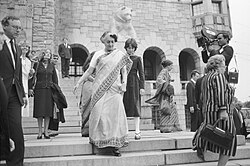
| [[File:Indira-Gandhi-in-Finland-1983.jpg|thumb|Indira Gandhi on the stairs of the [[National Museum of Finland|National Museum]] in [[Helsinki]], [[Finland]] on 10 June 1983]]
| |
| The Congress Party under Gandhi swept back into power in January 1980.<ref>{{Cite news|url=http://www.history.com/this-day-in-history/indira-gandhi-becomes-indian-prime-minister|title=Indira Gandhi becomes Indian prime minister – Jan 19, 1966 – History.com|work=History.com|access-date=5 December 2017|archive-url=https://web.archive.org/web/20171119080837/http://www.history.com/this-day-in-history/indira-gandhi-becomes-indian-prime-minister|archive-date=19 November 2017|url-status=live}}</ref> In this election, Gandhi was elected by the voters of the [[Medak (Lok Sabha constituency)|Medak constituency]].<ref>{{Cite web|date=April 2, 2019|first=Sribala|last=Vadlapatla|title=Congress loses hold on Medak, once won by Indira Gandhi – Times of India|url=https://timesofindia.indiatimes.com/elections/lok-sabha-elections-2019/telangana/news/congress-loses-hold-on-medak-once-won-by-indira-gandhi/articleshow/68680665.cms|access-date=16 July 2021|website=[[The Times of India]]|language=en}}</ref> On 23 June, Sanjay was killed in a plane crash while performing an [[Aerobatic maneuver|aerobatic manoeuvre]] in New Delhi.<ref>{{Cite news|url=https://www.washingtonpost.com/archive/politics/1980/06/23/sanjay-gandhi-killed-in-plane-crash/76d13092-8233-483a-b8e4-54f29dfbd2e6/|title=Sanjay Gandhi Killed in Plane Crash|last=Auerbach|first=Stuart|date=23 June 1980|newspaper=[[The Washington Post]]|access-date=19 July 2017|language=en-US|issn=0190-8286}}{{dead link|date=August 2020|bot=medic}}{{cbignore|bot=medic}}</ref> In 1980, as a tribute to her son's dream of launching an indigenously manufactured car, Gandhi nationalized Sanjay's debt ridden company, [[Maruti Suzuki|Maruti Udyog]], for Rs. 43,000,000<!--Western numbering--> (4.34 [[crore]]<!--Indian numbering-->) and invited joint venture bids from automobile companies around the world. [[Suzuki]] of Japan was selected as the partner. The company launched its first Indian manufactured car in 1984.<ref name="orfonline69">{{cite book |last1=Chikermane |first1=Gautam |title=70 Policies That Shaped India 1947 to 2017, Independence to $2.5 Trillion |date=2018 |publisher=[[Observer Research Foundation]] |isbn=978-81-937564-8-5 |pages=69–70 |url=https://www.orfonline.org/wp-content/uploads/2018/07/70_Policies.pdf |access-date=24 August 2018 |archive-url=https://web.archive.org/web/20180825002533/https://www.orfonline.org/wp-content/uploads/2018/07/70_Policies.pdf |archive-date=25 August 2018 |url-status=live }}</ref>
| |
| | |
| By the time of Sanjay's death, Gandhi trusted only family members, and therefore persuaded her reluctant son, Rajiv, to enter politics.<ref name=":1" /><ref>{{Cite web|title=Rajiv Gandhi {{!}} prime minister of India|url=https://www.britannica.com/biography/Rajiv-Gandhi|website=Encyclopedia Britannica|language=en|access-date=1 June 2020}}</ref>
| |
| | |
| Her PMO office staff included [[Sharada Prasad|H.Y.Sharada Prasad]] as her information adviser and speechwriter.<ref>{{cite book |last1=Baru |first1=Sanjay |title=The Accidental Prime Minister: The Making and Unmaking of Manmohan Singh |date=11 April 2014 |publisher=[[Penguin India]] }}</ref><ref>{{cite book |last1=Prasad |first1=Sharada |title=The Book I Won't Be Writing and Other Essays |date=1 January 2003 |publisher=[[Chronicle Books]] }}</ref>
| |
| | |
| === Operation Blue Star ===
| |
| {{Main|Operation Blue Star}}
| |
| | |
| Following the 1977 elections, a coalition led by the [[Sikh]]-majority [[Shiromani Akali Dal|Akali Dal]] came to power in the northern Indian state of Punjab. In an effort to split the Akali Dal and gain popular support among the Sikhs, Gandhi's Congress Party helped to bring the orthodox religious leader [[Jarnail Singh Bhindranwale]] to prominence in Punjab politics.<ref name="Gus2011">{{cite book|author=Gus Martin|title=The SAGE Encyclopedia of Terrorism|edition=Second|url={{Google books|I_jh4VBi_HYC|page=PA543|keywords=|text=|plainurl=yes}}|access-date=11 October 2012|date=15 June 2011|publisher=[[SAGE Publishing]]|isbn=978-1-4129-8016-6|pages=543–545}}</ref><ref name="Christine2008">{{cite book|author1=C. Christine Fair|author2=Sumit Ganguly|title=Treading on Hallowed Ground: Counterinsurgency Operations in Sacred Spaces|url={{Google books|L2E1NpYuOrsC|page=PA39|keywords=|text=|plainurl=yes}}|access-date=11 October 2012|date=29 September 2008|publisher=[[Oxford University Press]]|isbn=978-0-19-534204-8|pages=39–40}}</ref> Later, Bhindranwale's organisation, [[Damdami Taksal]], became embroiled in violence with another religious sect called the [[Sant Nirankari Mission]], and he was accused of instigating the murder of [[Jagat Narain]], the owner of the ''[[Punjab Kesari]]'' newspaper.<ref name="William2011">{{cite book|author=William Gould|title=Religion and Conflict in Modern South Asia|url={{Google books|K2oexn_mLPIC|page=PA237|keywords=|text=|plainurl=yes}}|access-date=11 October 2012|date=30 November 2011|publisher=[[Cambridge University Press]]|isbn=978-0-521-87949-1|page=237}}</ref> After being arrested over this matter, Bhindranwale disassociated himself from the Congress Party and joined Akali Dal.<ref name="Deol2012">{{cite book|author=Harnik Deol|title=Religion and Nationalism in India: The Case of the Punjab|url={{Google books|wKRP1-H8T8AC|page=PA105|keywords=|text=|plainurl=yes}}|access-date=11 October 2012|date=2 October 2012|publisher=[[Psychology Press]]|isbn=978-0-415-20108-7|page=105}}</ref> In July 1982, he led the campaign for the implementation of the [[Anandpur Resolution]], which demanded greater autonomy for the Sikh-majority state. Meanwhile, a small group of Sikhs, including some of Bhindranwale's followers, turned to militancy after being targeted by government officials and police for supporting the Anandpur Resolution.<ref name="Martin2004">{{cite book|author1=Martin E. Marty|author2=R. Scott Appleby|title=Fundamentalisms Comprehended|url={{Google books|wiBwMJrlMVoC|page=PA454|keywords=|text=|plainurl=yes}}|access-date=11 October 2012|date=1 May 2004|publisher=[[University of Chicago Press]]|isbn=978-0-226-50888-7|page=454}}</ref> In 1982, Bhindranwale and approximately 200 armed followers moved into a guest house called the Guru Nanak Niwas near the [[Golden Temple]].<ref name="itp1">{{cite magazine|url=http://www.india-today.com/itoday/millennium/100people/jarnail.html|title=Prophet of Hate:J S Bhindranwale|last=Singh|first=Tavleen|magazine=[[India Today]]|archive-url=https://web.archive.org/web/20080620164214/http://www.india-today.com/itoday/millennium/100people/jarnail.html|archive-date=20 June 2008|access-date=22 December 2009}}</ref>
| |
| | |
| By 1983, the Temple complex had become a fort for many militants.<ref name="Satish Jacob 1985">Mark Tully and Satish Jacob, Amritsar – Mrs. Gandhi's Last Battle (Calcutta: [[Rupa & Co.]] by arrangement with Pan Books, London, 1985)</ref> ''[[The Statesman (India)|The Statesman]]'' later reported that [[light machine guns]] and [[semi-automatic rifles]] were known to have been brought into the compound.<ref>Kuldip Nayar and Khushwant Singh, Tragedy of Punjab, Vision Books, New Delhi, 1984, page 79.</ref> On 23 April 1983, the Punjab Police Deputy Inspector General [[A. S. Atwal]] was shot dead as he left the Temple compound. The following day, Harchand Singh Longowal (then president of [[Shiromani Akali Dal]]) confirmed the involvement of Bhindranwale in the murder.<ref>Longowal said "Whenever the situation becomes ripe for settlement, some violent incident takes place. I know [[Bhindranwale]] is behind the murder of the DIG", "(The person behind the murder is) The one who is afraid of losing his seat of power"{{cite book| title = Indian Express | date = 27 April 1983 | pages = interview with Longowal | no-pp = true }}</ref>
| |
| | |
| After several futile negotiations, in June 1984, Gandhi ordered the Indian army to enter the Golden Temple to remove Bhindranwale and his supporters from the complex. The army used heavy artillery, including tanks, in the action code-named [[Operation Blue Star]]. The operation badly damaged or destroyed parts of the Temple complex, including the [[Akal Takht]] shrine and the Sikh library. It also led to the deaths of many Sikh fighters and innocent pilgrims. The number of casualties remains disputed with estimates ranging from many hundreds to many thousands.<ref name="Univ. of Michigan Press">{{cite book|editor1-last=Guidry|editor1-first=John|editor2-last=Kennedy|editor2-first=Michael D.|editor3-last=Zald|editor3-first=Mayer N. |title=Globalizations and social movements : culture, power, and the transnational public sphere|date=2000|publisher=[[Univ. of Michigan Press]]|location=Ann Arbor, Michigan|isbn=978-0-472-06721-3|page=319|edition=Reprint|url={{Google books|Eh0OlJWuh4sC|page=PR7|keywords=bhindranwale|text=|plainurl=yes}}|access-date=14 September 2017}}</ref>
| |
| | |
| Gandhi was accused of using the attack for political ends. Harjinder Singh Dilgeer stated that she attacked the temple complex to present herself as a great hero in order to win the general elections planned towards the end of 1984.<ref name="Dilg">"Indira Gandhi had since long been planning for an attack on Darbar Sahib..." Harjinder Singh Dilgeer (2012). ''Sikh History in 10 Volumes''. Vol 7, p. 168; 196–197.</ref> There was fierce criticism of the action by Sikhs in India and overseas.<ref>{{cite book|editor1-last=Mandair|editor1-first=Arvind-pal Singh|editor2-last=Shackle|editor2-first=Christopher|editor3-last=Singh|editor3-first=Gurharpal |title=Sikh religion, culture and ethnicity|date=2001|publisher=[[Routledge]]|isbn=978-1-136-84634-2|pages=169–171|url={{Google books|D8xdAgAAQBAJ|page=PA161|keywords=1984%20protest%20golden%20temple|text=|plainurl=yes}}}}</ref> There were also incidents of mutiny by Sikh soldiers in the aftermath of the attack.<ref name="Univ. of Michigan Press" />
| |
| | |
| == Assassination ==
| |
| {{Main|Assassination of Indira Gandhi|1984 anti-Sikh riots}}
| |
| [[File:Samadhi of Indira Gandhi (Shakti Sthala).JPG|thumb|upright|alt=Samadhi of Indira Gandhi|''[[Shakti Sthal]]'', the place where Indira Gandhi was cremated at New Delhi]]
| |
| {{quote box|bgcolor=#CCDDFF|width=25%|align=right|quote="I am alive today, I may not be there tomorrow ... I shall continue to serve until my last breath and when I die, I can say, that every drop of my blood will invigorate India and strengthen it ... Even if I died in the service of the nation, I would be proud of it. Every drop of my blood ... will contribute to the growth of this nation and to make it strong and dynamic."|source=—Gandhi’s remarks on her last speech a day before her death (30 October 1984) at the then Parade Ground, Odisha.<ref>{{cite web|url=http://www.dnaindia.com/india/report-remembering-indira-gandhi-on-her-29th-death-anniversary-1911491|title=Remembering Indira Gandhi on her 29th death anniversary|date=30 October 2013|website=dna|language=en-US|access-date=5 June 2016|archive-url=https://web.archive.org/web/20150917081430/http://www.dnaindia.com/india/report-remembering-indira-gandhi-on-her-29th-death-anniversary-1911491|archive-date=17 September 2015|url-status=live}}</ref><ref name=assassination>{{cite news|title=Last speech of Prime Minister Indira Gandhi prior to her assassination|url=http://www.indiastudychannel.com/resources/142182-Last-speech-Indira-Gandhi-at-Bhubaneswar.aspx|access-date=9 March 2013|newspaper=India Study Channel|date=21 June 2011|archive-url=https://web.archive.org/web/20130509182103/http://www.indiastudychannel.com/resources/142182-Last-speech-Indira-Gandhi-at-Bhubaneswar.aspx|archive-date=9 May 2013|url-status=live}}</ref>}}
| |
| | |
| On 31 October 1984, two of Gandhi's [[Sikh]] bodyguards, [[Satwant Singh]] and [[Beant Singh (assassin)|Beant Singh]], shot her with their service weapons in the garden of the prime minister's residence at 1 [[Safdarjung Road]], [[New Delhi]], allegedly in revenge for [[Operation Blue Star]].<ref name="The New York Times">{{Cite news|url=https://www.nytimes.com/1989/01/06/world/india-hangs-two-sikhs-convicted-in-assassination-of-indira-gandhi.html|title=India Hangs Two Sikhs Convicted In Assassination of Indira Gandhi|last1=Crossette|first1=Barbara|date=1989|work=[[The New York Times]]|access-date=5 December 2017|language=en-US|issn=0362-4331|archive-url=https://web.archive.org/web/20171206074556/http://www.nytimes.com/1989/01/06/world/india-hangs-two-sikhs-convicted-in-assassination-of-indira-gandhi.html|archive-date=6 December 2017|url-status=live}}</ref> The shooting occurred as she was walking past a wicket gate guarded by the two men. She was to be interviewed by the British filmmaker [[Peter Ustinov]], who was filming a documentary for [[Raidió Teilifís Éireann|Irish television]].<ref>{{Cite news|url=http://indiatoday.intoday.in/story/indira-gandhi-assassination-death-anniversary-things-to-know-operation-blue-star/1/799136.html|title=32 years of Indira Gandhi assassination, anti-Sikh riots: All you need to know|access-date=5 December 2017|archive-url=https://web.archive.org/web/20171211003715/http://indiatoday.intoday.in/story/indira-gandhi-assassination-death-anniversary-things-to-know-operation-blue-star/1/799136.html|archive-date=11 December 2017|url-status=live}}</ref> Beant shot her three times using his side-arm; Satwant fired 30 rounds.<ref name=smith>{{cite news |last=Smith |first=William E. |title=Indira Gandhi's assassination sparks a fearful round of sectarian violence |url=http://www.sikhtimes.com/bios_111284a.html |access-date=19 January 2013 |newspaper=[[Time (magazine)|Time]] |date=12 November 1984 |archive-url=https://web.archive.org/web/20121103043002/http://www.sikhtimes.com/bios_111284a.html |archive-date=3 November 2012 |url-status=live }}</ref> The men dropped their weapons and surrendered. Afterwards, they were taken away by other guards into a closed room where Beant was shot dead. [[Kehar Singh]] was later arrested for conspiracy in the attack. Both Satwant and Kehar were sentenced to death and hanged in Delhi's [[Tihar Jail]].<ref>{{Cite web|url=https://www.indiatoday.in/magazine/indiascope/story/19890131-indira-gandhi-assassination-trial-satwant-singh-and-kehar-singh-hanged-815690-1989-01-31|title=Indira Gandhi assassination trial: Satwant Singh and Kehar Singh hanged|date=31 January 1989|first1=Vipul |last1=Mudgal |first2=David |last2=Devadas|website=[[India Today]]|language=en|access-date=2 January 2020}}</ref>
| |
| | |
| Gandhi was taken to the [[All India Institutes of Medical Sciences]] at 9:30 AM where doctors operated on her. She was declared dead at 2:20 PM. The post-mortem examination was conducted by a team of doctors headed by [[Tirath Das Dogra]]. Dogra stated that Gandhi had sustained as many as 30 bullet wounds, from two sources: a [[Sten]] [[submachine gun]]<ref>[http://www.time.com/time/magazine/article/0,9171,926929-2,00.html Indira Gandhi: Death in the Garden] {{Webarchive|url=https://web.archive.org/web/20121103050402/http://www.time.com/time/magazine/article/0,9171,926929-2,00.html |date=3 November 2012 }} – ''TIME''</ref><ref>[https://books.google.com/books?id=8QufTc6fAocC&pg=RA1-PA135&lpg=RA1-PA135 Fighting for Faith and Nation: Dialogues With Sikh Militants] – Cynthia Keppley Mahmood – Google Books</ref> and a [[.38 Special]] revolver. The assailants had fired 31 bullets at her, of which 30 hit her; 23 had passed through her body while seven remained inside her. Dogra extracted bullets to establish the make of the weapons used and to match each weapon with the bullets recovered by ballistic examination. The bullets were matched with their respective weapons at the [[Central Forensic Science Laboratory]] (CFSL) Delhi. Subsequently, Dogra appeared in Shri Mahesh Chandra's court as an expert witness (PW-5); his testimony took several sessions. The cross examination was conducted by Shri [[Pran Nath Lekhi]], the defence counsel.<ref>Dr. T D Dogra's Expert Evidence in trial of assassination of Late Mrs. Indira Gandhi, Prime Minister of India (Witness No. PW 5) Raina Anupuma, Lalwani Sanjeev, Dogra TD, Dept. of Forensic Medicine & Toxicology, AIIMS, N. Delhi. Indian Internet Journal of Forensic Medicine & Toxicology, Year : 2009, Volume : 7, Issue : 4</ref> [[Salma Sultan]] provided the first news of her assassination on [[Doordarshan]]'s evening news on 31 October 1984, more than 10 hours after she was shot.<ref>[http://www.indianexpress.com/news/the-riots-that-could-not-be-televised/536471/ The riots that could not be televised] {{Webarchive|url=https://web.archive.org/web/20091205154910/http://www.indianexpress.com/news/the-riots-that-could-not-be-televised/536471/ |date=5 December 2009 }}. [[The Indian Express]] (3 November 2009). Retrieved on 21 May 2014.</ref><ref>[http://indiatoday.intoday.in/story/We+the+eyeballs/1/1328.html We the eyeballs : Cover Story – India Today] {{Webarchive|url=https://web.archive.org/web/20141215111034/http://indiatoday.intoday.in/story/We+the+eyeballs/1/1328.html|date=15 December 2014}}. Indiatoday.intoday.in. Retrieved on 21 May 2014.</ref>
| |
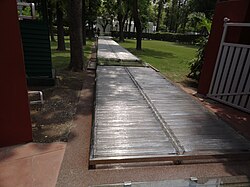
| [[File:PathOfMartyrdom.JPG|thumb|left|Today, the spot where Indira Gandhi was assassinated is marked by a glass opening in the crystal pathway at the Indira Gandhi Memorial]]
| |
| | |
| Gandhi was cremated in accordance with Hindu tradition on 3 November near [[Raj Ghat and associated memorials|Raj Ghat]].<ref>{{Cite news|url=https://www.washingtonpost.com/archive/politics/1984/11/04/indira-gandhi-cremated-in-hindu-ritual/124ca3f5-3121-4289-9c7d-51a953ab7b39/|title=Indira Gandhi Cremated in Hindu Ritual|last1=Claiborne|first1=William|date=4 November 1984|newspaper=[[The Washington Post]]|access-date=5 December 2017|last2=Sun|first2=Lena|language=en-US|issn=0190-8286|archive-url=https://web.archive.org/web/20171206010005/https://www.washingtonpost.com/archive/politics/1984/11/04/indira-gandhi-cremated-in-hindu-ritual/124ca3f5-3121-4289-9c7d-51a953ab7b39/|archive-date=6 December 2017|url-status=live}}</ref> The site where she was cremated is known today as [[Raj Ghat and associated memorials|Shakti Sthal]].<ref>{{cite web|url=https://www.delhiinformation.in/tourism/memorials/shaktisthal.html|title=Shakti Sthal – Delhi Information|website=www.delhiinformation.in|language=en|access-date=5 December 2017|archive-url=https://web.archive.org/web/20180309021606/http://www.delhiinformation.in/tourism/memorials/shaktisthal.html|archive-date=9 March 2018|url-status=live}}</ref> In order to pay homage, Gandhi's body lay in state at Teen Murti House. Thousands of followers strained for a glimpse of the cremation.<ref name="Hindu Ritual">{{cite news |title=Indira Gandhi Cremated in Hindu Ritual |url=https://www.washingtonpost.com/archive/politics/1984/11/04/indira-gandhi-cremated-in-hindu-ritual/124ca3f5-3121-4289-9c7d-51a953ab7b39/ |accessdate=4 April 2020 |work=William Claiborne |agency=The Washington Post |publisher=Washington Post Foreign Service |date=4 November 1984}}</ref> Her funeral was televised live on domestic and international stations, including the [[BBC]]. After her death, the Parade Ground was converted to the Indira Gandhi Park which was inaugurated by her son, [[Rajiv Gandhi]].
| |
| | |
| Gandhi's assassination dramatically changed the political landscape. Rajiv succeeded his mother as Prime Minister within hours of her murder and anti-Sikh riots erupted, lasting for several days and killing more than 3,000 Sikhs in [[New Delhi]] and an estimated 8,000 across India. Many Congress leaders were believed to be behind the anti-Sikh massacre.<ref name="after riots">{{cite news |title=Anti-Sikh riots: What happened in 1984 and after? |url=https://gulfnews.com/world/asia/india/anti-sikh-riots-what-happened-in-1984-and-after-1.60501721 |accessdate=4 April 2020 |work=Karuna Madan |agency=Al Nisr Publishing |date=21 November 2018}}</ref><ref>{{cite news|url= http://news.bbc.co.uk/2/hi/south_asia/8306420.stm|title= Indira Gandhi's death remembered|date= 1 November 2009|work= [[BBC News]]|access-date= 25 June 2012|archive-url= https://web.archive.org/web/20091102113639/http://news.bbc.co.uk/2/hi/south_asia/8306420.stm|archive-date= 2 November 2009|url-status= live}}</ref>
| |
| | |
| === International reaction ===
| |
| Gandhi's death was mourned worldwide. World leaders condemned the assassination and said her death would leave a 'big emptiness' in international affairs. In [[Moscow]], Soviet President [[Konstantin Chernenko]] sent condolences stating, "The Soviet people learned with pain and sorrow about the untimely death in a villainous assassination of the glorious daughter of the great Indian people, a fiery fighter for peace and security of peoples and a great friend of the Soviet Union". President [[Ronald Reagan]], along with secretary of state [[George Shultz]], visited the [[Embassy of India, Washington, D.C.|Indian Embassy]] to sign a book of condolences and expressed his 'shock, revulsion, and grief' over the assassination. 42nd [[vice president of the United States]] [[Walter Mondale]] called Gandhi 'a great leader of a great democracy' and deplored 'this shocking act of violence'. Asian, African and European leaders mourned Gandhi as a great champion of democracy and leader of the Non-Aligned Movement expressed its 'deepest grief' and called the killing a 'terrorist' act. South Korean President [[Chun Doo-hwan]], said Gandhi's death meant the 'loss of a great leader to the whole world.' Yugoslav President [[Veselin Đuranović]], Pakistani President [[Mohammad Zia ul-Haq]], Italian President [[Sandro Pertini]], [[Pope John Paul II]] at the [[Vatican City|Vatican]], French President [[Francois Mitterrand]] condemned the killing. At the [[United Nations]], the General Assembly paused in its work as shocked delegates mourned the death. Assembly President [[Paul Lusaka]] of Zambia postponed a scheduled debate and hastily organized a memorial meeting.<ref name="morning">{{cite news|title=World leaders condemned the 'senseless' assassination of Indian Prime Minister Indira Gandhi |url=https://www.upi.com/Archives/1984/10/31/World-leaders-condemned-the-senseless-assassination-of-Indian-Prime/1907468046800/ |accessdate=4 April 2020 |work=VALERIE STRAUSS |agency=UPI.COM |publisher=United Press International |date=31 October 1984}}</ref>
| |
| | |
| == Foreign relations ==
| |
| Gandhi is remembered for her ability to effectively promote Indian foreign policy measures.<ref name="Genovese, Michael A. 1993">Genovese, Michael A., ed. ''Women As National Leaders'' (SAGE Publications, 1993).</ref><ref>Surjit Mansinghm ''India′s Search for Power: Indira Gandhi′s Foreign Policy 1966–1982'' (1984)</ref><ref>Shashi Tharoor, ''Reasons of state: political development and India's foreign policy under Indira Gandhi, 1966–1977'' (1982) [https://archive.org/details/reasonsofstatepo0000thar/page/n5/mode/2up online]</ref>
| |
| | |
| === South Asia ===
| |
| {{Further|List of state visits made by Indira Gandhi}}
| |
| | |
| In early 1971, disputed elections in Pakistan led then [[East Pakistan]] to declare independence as Bangladesh. Repression and violence by the Pakistani army led to 10 million refugees crossing the border into India over the following months.<ref name="ahsgjxajtu0c244">{{cite book|last1=Reynolds|first1=David|title=One world divisible : a global history since 1945|date=2001|publisher=[[W. W. Norton & Company|W.W. Norton]]|location=New York|isbn=978-0-393-32108-1|pages=244–247|url={{Google books|AHsGJxAJTU0C|page=PR14|keywords=indira%20gandhi|text=|plainurl=yes}}}}</ref> Finally, in December 1971, Gandhi intervened directly in the conflict to liberate Bangladesh. India emerged victorious following the war with Pakistan to become the dominant power of South Asia.<ref>{{cite book|first=Hermann|last=Kulke|title=A History of India|url=https://archive.org/details/historyindia00kulk|url-access=limited|publisher=[[Routledge]]|year=2004|page=[https://archive.org/details/historyindia00kulk/page/n371 359]|isbn=978-0-415-32919-4}}</ref> India had signed a [[Indo-Soviet Treaty of Friendship and Cooperation|treaty]] with the Soviet Union promising mutual assistance in the case of war,<ref name="ahsgjxajtu0c244" /> while Pakistan received active support from the United States during the conflict.<ref name="NixonWitchBBC">[http://news.bbc.co.uk/2/hi/south_asia/4633263.stm Nixon's dislike of 'witch' Indira, BBC News, 29 June 2005] {{Webarchive|url=https://web.archive.org/web/20110812125319/http://news.bbc.co.uk/2/hi/south_asia/4633263.stm |date=12 August 2011 }}. [[BBC News]] (29 June 2005). Retrieved on 18 June 2011.</ref> U.S. President [[Richard Nixon]] disliked Gandhi personally, referring to her as a "[[Bitch (slang)|bitch]]"<!-- Nixon and Kissinger called Gandhi a bitch and not a witch. It is on record and such official transcription has been cited herein.--><ref>{{Cite web|title=Foreign Relations of the United States, 1969–1976, Volume E–7, Documents on South Asia, 1969–1972 – Office of the Historian|url=https://history.state.gov/historicaldocuments/frus1969-76ve07/d150|access-date=15 February 2022|website=history.state.gov|quote=Nixon: This is just the point when she is a bitch. Kissinger: Well, the Indians are bastards anyway. They are starting a war there. It’s—to them East Pakistan is no longer the issue. Now, I found it very interesting how she carried on to you yesterday about West Pakistan. Nixon: I think I’ll make the meeting today a rather brief—cool. [unclear] I don’t mean by that cool in terms of not trying to bring up [unclear] I’ll talk to her a little about Vietnam, and– Kissinger: I’d let her talk a little more, maybe today— Nixon: Yeah? Kissinger:—to be a little less forthcoming. But basically, Mr. President— Nixon: So I was trying to give her no excuses. Now I’ve talked to her, told her everything we’re going to do. Now it’s up to her. Kissinger: While she was a bitch, we got what we wanted too. You very subtly—I mean, she will not be able to go home and say that the United States didn’t give her a warm reception and therefore, in despair, she’s got to go to war.}}</ref> and a "clever fox" in his private communication with Secretary of State [[Henry Kissinger]].<ref>{{cite news|url=http://news.bbc.co.uk/2/hi/south_asia/4633263.stm|title=BBC NEWS {{!}} South Asia {{!}} Nixon's dislike of 'witch' Indira|website=news.bbc.co.uk|access-date=19 July 2017|date=29 June 2005|archive-url=https://web.archive.org/web/20110812125319/http://news.bbc.co.uk/2/hi/south_asia/4633263.stm|archive-date=12 August 2011|url-status=live}}</ref> Nixon later wrote of the war: "[Gandhi] suckered [America]. Suckered us ... this woman suckered us."<ref>{{Cite news|url=http://www.hindustantimes.com/delhi-news/this-woman-suckered-us-said-nixon-of-indira-gandhi/story-WGR773bfTnuAsEffYYvq5O.html|title='This woman suckered us', said Nixon of Indira Gandhi|date=2 March 2010|work=www.hindustantimes.com|access-date=19 July 2017|language=en|archive-url=https://web.archive.org/web/20170720223345/http://www.hindustantimes.com/delhi-news/this-woman-suckered-us-said-nixon-of-indira-gandhi/story-WGR773bfTnuAsEffYYvq5O.html|archive-date=20 July 2017|url-status=live}}</ref> Relations with the U.S. became distant as Gandhi developed closer ties with the Soviet Union after the war. The latter grew to become India's largest trading partner and its biggest arms supplier for much of Gandhi's premiership.<ref>{{cite book|first=Linda |last=Racioppi|title=Soviet Policy towards South Asia since 1970|url=https://archive.org/details/sovietpolicytowa1970raci |url-access=limited |publisher=[[Cambridge University Press]]|year=1994|page=[https://archive.org/details/sovietpolicytowa1970raci/page/n76 65]|isbn=978-0-521-41457-9}}</ref> India's new hegemonic position, as articulated under the "Indira Doctrine", led to attempts to bring the [[Himalayan states]] under India's sphere of influence.<ref>{{cite book|first=Harish|last=Kapur|title=Foreign Policies Of India's Prime Ministers|publisher=Lancer Publishers|year=2009|page=138|isbn=978-0-9796174-8-5}}</ref> [[Nepal]] and [[Bhutan]] remained aligned with India, while in 1975, after years of building up support, Gandhi incorporated [[Sikkim]] into India, after [[1975 Sikkimese monarchy referendum|a referendum]] in which a majority of Sikkimese voted to join India.<ref>{{Cite book|title=Himalayan Anthropology: The Indo-Tibetan Interface|page=225|publisher=[[Walter de Gruyter]]|author=James F. Fisher|year=1978|url={{Google books|m8Eq6Obu6oYC|page=|keywords=|text=|plainurl=yes}}}}</ref>{{sfn|Malik|1988|pp=120–121}} This was denounced as a "despicable act" by China.<ref>{{cite book|first=G. S. |last=Bajpai|title=China's Shadow Over Sikkim: The Politics of Intimidation|publisher=Lancer Publishers|year=1999|page=210|isbn=978-1-897829-52-3}}</ref>
| |
| | |
| [[File:Jacqueline Kennedy and Indira Gandhi.jpg|thumb|Indira Gandhi with [[Jacqueline Kennedy Onassis|Jacqueline Kennedy]], First Lady of the [[USA]] in New Delhi, 1962]]
| |
| | |
| India [[Indo-Bangla Treaty of Friendship, Cooperation and Peace|maintained close ties]] with neighbouring Bangladesh (formerly East Pakistan) following the Liberation War. Prime Minister [[Sheikh Mujibur Rahman]] recognised Gandhi's contributions to the independence of Bangladesh. However, Mujibur Rahman's pro-India policies antagonised many in Bangladeshi politics and the military, which feared that Bangladesh had become a client state of India.<ref name="Nair">{{cite book|first=P. Sukumaran|last=Nair|title=Indo-Bangladesh Relations|publisher=APH Publishing|year=2008|page=47|isbn=978-81-313-0408-2}}</ref><ref name="MK">{{cite web |url=http://countrystudies.us/bangladesh/19.htm |title=Mujib's downfall |publisher=Countrystudies.us |date=15 August 1975 |access-date=31 July 2013 |archive-url=https://web.archive.org/web/20110805012545/http://countrystudies.us/bangladesh/19.htm |archive-date=5 August 2011 |url-status=live }}</ref> The [[Assassination of Sheikh Mujibur Rahman|Assassination of Mujibur Rahman]] in 1975 led to the establishment of Islamist military regimes that sought to distance the country from India.<ref name="IB">{{cite web |url=http://countrystudies.us/bangladesh/106.htm |title=Bangladesh's relations with India |publisher=Countrystudies.us |access-date=31 July 2013 |archive-url=https://web.archive.org/web/20140328232816/http://countrystudies.us/bangladesh/106.htm |archive-date=28 March 2014 |url-status=live }}</ref> Gandhi's relationship with the military regimes was strained because of her alleged support of anti-Islamist leftist guerrilla forces in Bangladesh.<ref name="IB" /> Generally, however, there was a rapprochement between Gandhi and the Bangladeshi regimes, although issues such as border disputes and the [[Farakka Barrage|Farakka Dam]] remained an irritant to bilateral ties.<ref>{{cite book|first= N |last=Jayapalan|title=India And Her Neighbours|publisher=[[Atlantic Books|Atlantic Publishers & Dist]]|year=2000|page=134|isbn=978-81-7156-912-0}}</ref> In 2011, the [[Government of Bangladesh]] conferred its highest state award for non-nationals, the [[Bangladesh Freedom Honour]] posthumously on Gandhi for her "outstanding contribution" to the country's independence.<ref name="Gandhi1971">[http://articles.economictimes.indiatimes.com/2011-07-25/news/29812476_1_liberation-war-sonia-gandhi-outstanding-contribution Former PM Indira Gandhi honoured with Bangladesh's highest award, The Economic Times, 25 July 2011] {{Webarchive|url=https://web.archive.org/web/20130510165730/http://articles.economictimes.indiatimes.com/2011-07-25/news/29812476_1_liberation-war-sonia-gandhi-outstanding-contribution |date=10 May 2013 }}. [[The Economic Times]] (25 July 2011). Retrieved on 25 December 2012.</ref>
| |
| | |
| Gandhi's approach to dealing with Sri Lanka's [[Sri Lankan Civil War|ethnic problems]] was initially accommodating. She enjoyed cordial relations with Prime Minister [[Sirimavo Bandaranaike]]. In 1974, India ceded the tiny islet of [[Katchatheevu]] to Sri Lanka to save Bandaranaike's socialist government from a political disaster.<ref name="Suryanarayan">{{cite book|first=Venkateswaran|last=Suryanarayan|title=Conflict Over Fisheries In The Palk Bay Region|publisher=Lancer Publishers & Distributors|year=2005|page=65|isbn=978-81-7062-242-0}}</ref> However, relations soured over Sri Lanka's movement away from socialism under [[J. R. Jayewardene]], whom Gandhi despised as a "western puppet".{{sfn|Gupte|2012|p=5}} India under Gandhi was alleged to have supported the [[Liberation Tigers of Tamil Eelam]] (LTTE) militants in the 1980s to put pressure on Jayewardene to abide by Indian interests.<ref name="sndayt">{{cite news|url=http://sundaytimes.lk/970119/plus4.html|title=LTTE: the Indian connection|newspaper=[[The Sunday Times]]|year=1997|access-date=29 December 2012|archive-url=https://web.archive.org/web/20140915053716/http://sundaytimes.lk/970119/plus4.html|archive-date=15 September 2014|url-status=dead}}</ref> Nevertheless, Gandhi rejected demands to invade Sri Lanka in the aftermath of [[Black July|Black July 1983]], an anti-Tamil pogrom carried out by Sinhalese mobs.<ref name="Bandarage">{{cite book|first=Asoka|last= Bandarage|title=The Separatist Conflict in Sri Lanka: Terrorism, Ethnicity, Political Economy|publisher=[[Taylor & Francis]]|year=2009|page=111|isbn=978-0-415-77678-3}}</ref> Gandhi made a statement emphasising that she stood for the territorial integrity of Sri Lanka, although she also stated that India cannot "remain a silent spectator to any injustice done to the Tamil community."<ref name="Bandarage" /><ref name="Dissanayaka">{{cite book|first=T.D.S.A.|last=Dissanayaka|title=War Or Peace in Sri Lanka|publisher=[[Popular Prakashan]]|year=2005|page=84|isbn=978-81-7991-199-0}}</ref>
| |
| | |
| India's relationship with Pakistan remained strained following the [[Simla Agreement|Shimla Accord]] in 1972. Gandhi's [[Smiling Buddha|authorisation of the detonation of a nuclear device]] at Pokhran in 1974 was viewed by Pakistani leader [[Zulfikar Ali Bhutto]] as an attempt to intimidate Pakistan into accepting India's hegemony in the subcontinent. However, in May 1976, Gandhi and Bhutto both agreed to reopen diplomatic establishments and normalise relations.<ref name="Grover">{{cite book|first= Verinder|last=Grover|title=Events and Documents of Indo-Pak Relations: Includes Chronology of All Important Events & Documents from 1947 to 1998|publisher=Deep and Deep Publications|year=1999|pages=100–113|isbn=978-81-7629-059-3}}</ref> Following the rise to power of General [[Muhammad Zia-ul-Haq]] in Pakistan in 1978, India's relations with its neighbour reached a nadir. Gandhi accused General Zia of supporting [[Khalistan movement|Khalistani]] militants in [[Punjab, India|Punjab]].<ref name="Grover" /> Military hostilities recommenced in 1984 following Gandhi's authorisation of [[Operation Meghdoot]].<ref name=Kapur>{{cite book|last=Kapur|first=S. Paul|title=Dangerous Deterrent: Nuclear Weapons Proliferation and Conflict in South Asia|publisher=[[Stanford University Press]]|isbn=978-0-8047-5550-4|page=118|year=2007}}</ref> India was victorious in the resulting [[Siachen conflict]] against Pakistan.<ref name=Kapur />
| |
| | |
| In order to keep the Soviet Union and the United States out of South Asia, Gandhi was instrumental in establishing the South Asian Association for Regional Cooperation ([[South Asian Association for Regional Cooperation|SAARC]]) in 1983<ref>{{cite book|last1=Gupte|first1=Pranay|title=Mother India : a political biography of Indira Gandhi|date=2011|publisher=[[Penguin Books]]|location=New York|isbn=978-0-14-306826-6|page=482|edition=Rev.|url={{Google books|OOmK1lPWq80C|page=PR9|keywords=saarc|text=|plainurl=yes}}}}</ref>
| |
| | |
| === Middle East ===
| |
| Gandhi remained a staunch supporter of the Palestinians in the [[Arab–Israeli conflict]] and was critical of the Middle East diplomacy sponsored by the United States.{{sfn|Gupte|2012|p=5}} [[Israel]] was viewed as a religious state, and thus [[Two-nation theory|an analogue]] to India's [[archrival]] Pakistan. Indian diplomats hoped to win Arab support in countering Pakistan in [[Kashmir]]. Nevertheless, Gandhi authorised the development of a secret channel of contact and security assistance with Israel in the late 1960s. Her lieutenant, [[P. V. Narasimha Rao]], later became prime minister and approved full diplomatic ties with Israel in 1992.<ref name="AKapur">{{cite book|first=Ashok|last=Kapur|title=India: From Regional to World Power |url=https://archive.org/details/indiafromregiona00kapu|url-access=limited|publisher=[[Routledge]] |year=2006 |page=[https://archive.org/details/indiafromregiona00kapu/page/n225 215] |isbn=978-0-415-32804-3}}</ref>
| |
| | |
| [[File:Pahlavis meet Indira Gandhi in India, 1970.jpg|thumb|left|Indira Gandhi meeting the [[Shah of Iran]] [[Mohammad Reza Pahlavi]] and [[Shahbanu]] [[Farah Pahlavi]] during their state visit to India in 1970]]
| |
| | |
| India's pro-Arab policy had mixed success. Establishment of close ties with the socialist and secular [[Ba'athism|Baathist]] regimes to some extent neutralised Pakistani propaganda against India.<ref name="Ghosh">{{cite book|first=Anjali|last=Ghosh|title=India's Foreign Policy |publisher=[[Pearson plc|Pearson]]|year=2009|pages=306–307|isbn=978-81-317-1025-8}}</ref> However, the Indo-Pakistani War of 1971 presented a dilemma for the Arab and Muslim states of the Middle East as the war was fought by two states both friendly to the Arabs.<ref name="Kaur">{{cite book|first=Ranjit|last=Kaur|title=Islamic Co-Operation and Unity|publisher=Deep and Deep Publications |year=1993 |pages=168–170|isbn=978-81-7100-564-2}}</ref> The progressive Arab regimes in [[Egypt]], [[Syria]], and [[Algeria]] chose to remain neutral, while the conservative pro-American Arab monarchies in [[Jordan]], [[Saudi Arabia]], [[Kuwait]], and [[United Arab Emirates]] openly supported Pakistan. Egypt's stance was met with dismay by the Indians, who had come to expect close co-operation with the Baathist regimes.<ref name="Ghosh" /> But, the death of [[Gamal Abdel Nasser|Nasser]] in 1970 and [[Anwar Sadat|Sadat]]'s growing friendship with [[Riyadh]], and his mounting differences with Moscow, constrained Egypt to a policy of neutrality.<ref name="Ghosh" /> Gandhi's overtures to [[Muammar Gaddafi]] were rebuffed.<ref name="Kaur" /> [[Libya]] agreed with the Arab monarchies in believing that Gandhi's intervention in East Pakistan was an attack against [[Islam]].<ref name="Kaur" />
| |
| [[File:Nehru and Indira Gandhi visit Einstein.jpg|right|thumb|Indira Gandhi and Nehru visit Albert Einstein]]
| |
| The 1971 war became a temporary stumbling block in growing [[India–Iran relations|Indo-Iranian ties]].<ref name="Ghosh" /> Although [[Iran]] had earlier characterized the Indo-Pakistani war in 1965 as Indian aggression, the [[Mohammad Reza Pahlavi|Shah]] had launched an effort at rapprochement with India in 1969 as part of his effort to secure support for a larger Iranian role in the [[Persian Gulf]].<ref name="Ghosh" /> Gandhi's tilt towards Moscow and her dismemberment of Pakistan was perceived by the Shah as part of a larger anti-Iran conspiracy involving India, [[Iraq]], and the Soviet Union.<ref name="Ghosh" /> Nevertheless, Iran had resisted Pakistani pressure to activate the [[Baghdad Pact]] and draw the Central Treaty Organisation (CENTO) into the conflict.<ref name="Ghosh" /> Gradually, Indian and Iranian disillusionment with their respective regional allies led to a renewed partnership between the nations.<ref name=hunter>{{cite book|last=Hunter|first=Shireen|title=Iran's Foreign Policy in the Post-Soviet Era: Resisting the New International Order|publisher=[[ABC-CLIO]]|isbn=978-0-8047-5550-4|date=2010|pages=120–121}}</ref> Gandhi was unhappy with the lack of support from India's Arab allies during the war with Pakistan, while the Shah was apprehensive at the growing friendship between Pakistan and [[Arab states of the Persian Gulf]], especially Saudi Arabia, and the growing influence of Islam in Pakistani society.<ref name=hunter /> There was an increase in Indian economic and military co-operation with Iran during the 1970s.<ref name=hunter /> The 1974 India-Iranian agreement led to Iran supplying nearly 75 percent of India's crude oil demands.<ref name=pande>{{cite book|last=Pande|first=Aparna|title=Explaining Pakistan's Foreign Policy|publisher=[[Taylor & Francis]], 2011|isbn=978-1-136-81894-3|year=2011|page=146}}</ref> Gandhi appreciated the Shah's disregard of [[Pan-Islamism]] in diplomacy.<ref name=hunter />
| |
| | |
| === Asia-Pacific ===
| |
| One of the major developments in [[Southeast Asia]] during Gandhi's premiership was the formation of the [[Association of Southeast Asian Nations]] (ASEAN) in 1967. Relations between ASEAN and India were mutually antagonistic. India perceived ASEAN to be linked to the [[Southeast Asia Treaty Organization]] (SEATO) and, therefore, it was seen as a pro-American organisation. On their part, the ASEAN nations were unhappy with Gandhi's sympathy for the [[Viet Cong]] and India's strong links with the [[Soviet Union|USSR]]. Furthermore, they were also apprehensions in the region about Gandhi's plans, particularly after India played a big role in breaking up Pakistan and facilitating the emergence of Bangladesh as a sovereign country in 1971. India's entry into the nuclear weapons club in 1974 also contributed to tensions in Southeast Asia.<ref name=Nanda>{{cite book|last=Nanda|first=Prakash|title=Rediscovering Asia: Evolution of India's Look-East Policy|publisher=Lancer Publishers|isbn=978-81-7062-297-0|year=2003|pages=220–226}}</ref> Relations only began to improve following Gandhi's endorsement of the [[Zone of Peace, Freedom and Neutrality|ZOPFAN declaration]] and the disintegration of the SEATO alliance in the aftermath of Pakistani and American defeats in the region. Nevertheless, Gandhi's close relations with reunified [[Vietnam]] and her decision to recognize the Vietnam-installed Government of [[People's Republic of Kampuchea|Cambodia]] in 1980 meant that India and ASEAN were unable to develop a viable partnership.<ref name=Nanda />
| |
| | |
| On 26 September 1981, Gandhi was conferred with the honorary degree of Doctor at the Laucala Graduation at the [[University of the South Pacific]] in Fiji.<ref>{{Cite web|url=https://www.usp.ac.fj/index.php?id=13882|title=USP: Honorary Degree of Doctor|website=www.usp.ac.fj|access-date=2 January 2020}}</ref>
| |
| | |
| === Africa ===
| |
| Although independent India was initially viewed as a champion of various African independence movements, its cordial relationship with the [[Commonwealth of Nations]] and its liberal views of British policies in [[East Africa]] had harmed its image as a staunch supporter of various independence movements in the [[third world]].<ref name="Ghosh2">{{cite book|first=Anjali|last=Ghosh|title=India's Foreign Policy|publisher=[[Pearson plc|Pearson]]|year=2009|pages=422–424|isbn=978-81-317-1025-8}}</ref> Indian condemnation of militant struggles in [[Mau Mau Uprising|Kenya]] and [[Algerian War|Algeria]] was in sharp contrast to China, who had supported armed struggle to win African independence.<ref name="Ghosh2" /> After reaching a high diplomatic point in the aftermath of Nehru's role in the [[Suez Crisis]], India's isolation from Africa was complete when only four nations—[[Ethiopia]], [[Kenya]], [[Nigeria]] and Libya—supported her during the [[Sino-Indian War]] in 1962.<ref name="Ghosh2" /> After Gandhi became prime minister, diplomatic and economic relations with the states which had sided with India during the Sino-Indian War were expanded.<ref name="Ghosh2" /> Gandhi began negotiations with the Kenyan government to establish the Africa-India Development Cooperation. The Indian government also started considering the possibility of bringing Indians settled in Africa within the framework of its policy goals to help recover its declining geo-strategic influence. Gandhi declared the people of Indian origin settled in Africa as "Ambassadors of India".<ref name="Ghosh2" /> Efforts to rope in the Asian community to join Indian diplomacy, however, came to naught, in part because of the unwillingness of Indians to remain in politically insecure surroundings, and because of the exodus of African Indians to Britain with the passing of the [[Commonwealth Immigrants Act 1968|Commonwealth Immigrants Act]] in 1968.<ref name="Ghosh2" /> In [[Uganda]], the African Indian community [[Expulsion of Asians from Uganda|suffered persecution and eventually expulsion]] under the government of [[Idi Amin]].<ref name="Oonk">{{cite book|first=Gijsbert|last=Oonk|title=Global Indian Diasporas: Exploring Trajectories of Migration and Theory|publisher=[[Amsterdam University Press]]|year=2007|page=189|isbn=978-90-5356-035-8}}</ref>
| |
| | |
| Foreign and domestic policy successes in the 1970s enabled Gandhi to rebuild India's image in the eyes of African states.<ref name="Ghosh2" /> Victory over Pakistan and India's possession of nuclear weapons showed the degree of India's progress.<ref name="Ghosh2" /> Furthermore, the conclusion of the Indo-Soviet treaty in 1971, and threatening gestures by the United States, to send its nuclear armed [[Task Force 74]] into the [[Bay of Bengal]] at the height of the East Pakistan crisis had enabled India to regain its anti-imperialist image.<ref name="Ghosh2" /> Gandhi firmly tied Indian anti-imperialist interests in Africa to those of the Soviet Union.<ref name="Mawdsley">{{Cite book| publisher = Fahamu & Pambazuka| pages = 51–52|url={{Googlebooks|fMnTomlIPQwC|page=PA51|keywords=|text=|plainurl=yes}}|isbn=978-1-906387-65-5| last = Mawdsley| first = Emma|author2=Gerard McCann| title = India in Africa: Changing Geographies of Power| year = 2011}}</ref> Unlike Nehru, she openly and enthusiastically supported liberation struggles in Africa.<ref name="Mawdsley" /> At the same time, Chinese influence in Africa had declined owing to its incessant quarrels with the Soviet Union.<ref name="Ghosh2" /> These developments permanently halted India's decline in Africa and helped to reestablish its geo-strategic presence.<ref name="Ghosh2" />
| |
| | |
| === The Commonwealth ===
| |
| [[File:Chegada ao Rio de Janeiro de Indira Priyadarshini Gandhi, primeira ministra da Índia..tif|thumb|Indira Gandhi on a visit to Brazil, 1968, [[Brazilian National Archives|National Archives of Brazil]]]]
| |
| | |
| The [[Commonwealth of Nations|Commonwealth]] is a voluntary association of mainly former British colonies. India maintained cordial relations with most of the members during Gandhi's time in power. In the 1980s, she, along with Canadian [[Prime Minister of Canada|prime minister]] [[Pierre Trudeau]], Zambia's [[President of Zambia|president]] [[Kenneth Kaunda]], Australian [[Prime Minister of Australia|prime minister]] [[Malcolm Fraser]] and Singapore [[Prime Minister of Singapore|prime minister]] [[Lee Kuan Yew]] was regarded as one of the pillars of the Commonwealth.<ref>{{cite book|last1=Low|first1=D.A.|title=The contraction of England : an inaugural lecture delivered before the University of Cambridge on 22 October 1984|date=1984|publisher=[[Cambridge University Press]]|location=Cambridge [Cambridgeshire]|isbn=978-0-521-31424-4|page=28|url={{Google books|U8o7AAAAIAAJ|page=PA42|keywords=gandhi|text=|plainurl=yes}}}}</ref> India under Gandhi also hosted the 1983 [[Commonwealth Heads of Government]] summit in New Delhi. Gandhi used these meetings as a forum to put pressure on member countries to cut economic, sports, and cultural ties with [[Apartheid]] South Africa.<ref>Danilewitz, J., 1998. Athletics & apartheid. [[Harvard International Review]], 20(4), p.36.</ref>
| |
| | |
| === The Non-aligned Movement ===
| |
| [[File:Indira Gandhi & Nicolae Ceaușescu.jpg|thumb|Gandhi with [[Nicolae Ceaușescu]] {{Center|in 1969}}]]
| |
| | |
| In the early 1980s under Gandhi, India attempted to reassert its prominent role in the [[Non-Aligned Movement]] by focusing on the relationship between disarmament and economic development. By appealing to the economic grievances of [[Developing country|developing countries]], Gandhi and her successors exercised a moderating influence on the Non-aligned movement, diverting it from some of the [[Cold War]] issues that marred the controversial 1979 Havana meeting where Cuban leader [[Fidel Castro]] attempted to steer the movement towards the Soviet Union.<ref>{{cite book|last1=Gupte|first1=Pranay|title=Mother India : a political biography of Indira Gandhi|date=2011|publisher=[[Penguin Books]]|location=New York|isbn=978-0-14-306826-6|pages=499–500|edition=Rev.|url={{Google books|OOmK1lPWq80C|page=PR9|keywords=%22non%20aligned%20movement%22%20india%20indira|text=|plainurl=yes}}}}</ref> Although hosting the 1983 summit at Delhi boosted Indian prestige within the movement, its close relations with the Soviet Union and its pro-Soviet positions on [[Afghanistan]] and [[Cambodia]] limited its influence.<ref>{{Cite news|title=Mamata remembers Indira Gandhi on her death anniversary|work=[[United News of India]]|url=http://www.uniindia.com/~/mamata-remembers-indira-gandhi-on-her-death-anniversary/States/news/1393309.html}}</ref>
| |
| | |
| === Western Europe ===
| |
| Gandhi spent a number of years in Europe during her youth and had formed many friendships there. During her premiership she formed friendships with many leaders such as West German chancellor, [[Willy Brandt]]<ref>{{cite book|last1=Brandt|first1=Willy|translator-last=Bell|translator-first=Anthea|title=Arms and hunger|date=1987|publisher=[[MIT Press]]|location=Cambridge, Mass.|isbn=978-0-262-52127-7|pages=43–44|edition=1st MIT Press English language pbk.|url={{Google books|hBhr8W16XWMC|page=PP11|keywords=indira|text=|plainurl=yes}}}}</ref> and Austrian chancellor [[Bruno Kreisky]].<ref>{{cite book|last1=Kreisky|first1=Bruno|last2=Lewis|first2=Jill|last3=Rathkolb|first3=Oliver|title=The struggle for a democratic Austria : Bruno Kreisky on peace and social justice|date=2000|publisher=[[Berghahn Books]]|location=New York|isbn=978-1-57181-155-4|pages=413–414|url={{Google books|lb6uBAAAQBAJ|page=PR11|keywords=%20gandhi|text=|plainurl=yes}}}}</ref> She also enjoyed a close working relationship with many British leaders including conservative premiers, [[Edward Heath]] and [[Margaret Thatcher]].<ref>{{cite book|last1=Gupte|first1=Pranay|title=Mother India : a political biography of Indira Gandhi|date=1992|publisher=[[Scribner's]]|location=New York|isbn=978-0-684-19296-3|pages=516–517|url={{Google books|OOmK1lPWq80C|page=PR9|keywords=%20thatcher|text=|plainurl=yes}}}}</ref>
| |
| | |
| === Soviet Union and Eastern Bloc countries ===
| |
| The relationship between India and the Soviet Union deepened during Gandhi's rule. The main reason was the perceived bias of the United States and [[China]], rivals of the USSR, towards Pakistan. The support of the Soviets with arms supplies and the casting of a veto at the United Nations helped in winning and consolidating the victory over Pakistan in the 1971 Bangladesh liberation war. Before the war, Gandhi signed a treaty of friendship with the Soviets. They were unhappy with the 1974 nuclear test conducted by India but did not support further action because of the ensuing Cold War with the United States. Gandhi was unhappy with the Soviet invasion of Afghanistan, but once again calculations involving relations with Pakistan and China kept her from criticising the Soviet Union harshly. The Soviets became the main arms supplier during the Gandhi years by offering cheap credit and transactions in rupees rather than in dollars. The easy trade deals also applied to non-military goods. Under Gandhi, by the early 1980s, the Soviets had become India's largest trading partner.<ref name="British Academic Press">{{cite book|editor1-last=Light|editor1-first=Margot |last=Duncan|first=Peter J.S. |title=Troubled friendships : Moscow's Third World ventures, Chapter II, Soviet-Indian Model|date=1993|publisher=British Academic Press|location=London [u.a.]|isbn=978-1-85043-649-2|url=https://books.google.com/books?id=a7MA1F1TD08C&pg=PA29}}</ref>
| |
| | |
| ==== Soviet intelligence in India ====
| |
| Soviet intelligence was involved in India during Indira Gandhi's administration, sometimes at Gandhi's expense. In the prelude to [[Operation Blue Star]], by 1981, the Soviets had launched ''Operation Kontakt'', which was based on a forged document purporting to contain details of the weapons and money provided by the ISI to Sikh militants who wanted to create an independent country.<ref name="Andrew2006">{{cite book |author=Christopher Andrew |url=https://books.google.com/books?id=Msx8swEACAAJ |title=The World Was Going Our Way: The KGB and the Battle for the Third World: Newly Revealed Secrets from the Mitrokhin Archive |date=10 October 2006 |publisher=Basic Books |isbn=978-0-465-00313-6 |page=152}}</ref> In November 1982, [[Yuri Andropov]], the [[General Secretary of the Communist Party of the Soviet Union|General Secretary]] of the Communist Party and leader of the Soviet Union, approved a proposal to fabricate Pakistani intelligence documents detailing ISI plans to foment religious disturbances in Punjab and promote the creation of [[Khalistan movement|Khalistan]] as an independent Sikh state.<ref name="Andrew2014p278">{{cite book |author=Christopher Andrew |url=https://books.google.com/books?id=AQ9uAAAAQBAJ&pg=PR278 |title=The Mitrokhin Archive II: The KGB in the World |date=2 January 2014 |publisher=Penguin Books Limited |isbn=978-0-14-197798-0 |pages=278–}}</ref> Indira Gandhi's decision to move troops into the Punjab was based on her taking seriously the information provided by the Soviets regarding secret CIA support for the Sikhs.<ref name="Andrew2014p279">{{cite book |author=Christopher Andrew |url=https://books.google.com/books?id=AQ9uAAAAQBAJ&pg=PR278 |title=The Mitrokhin Archive II: The KGB in the World |date=2 January 2014 |publisher=Penguin Books Limited |isbn=978-0-14-197798-0 |pages=279–}}</ref>
| |
| | |
| According to the [[Mitrokhin Archive]], the Soviets used a new recruit in the New Delhi residency named “Agent S” who was close to Indira Gandhi as a major channel for providing her disinformation.<ref name="Andrew20062">{{cite book |author=Christopher Andrew |url=https://books.google.com/books?id=Msx8swEACAAJ |title=The World Was Going Our Way: The KGB and the Battle for the Third World: Newly Revealed Secrets from the Mitrokhin Archive |date=10 October 2006 |publisher=Basic Books |isbn=978-0-465-00313-6 |page=152}}</ref> Agent S provided Indira Gandhi with false documents purporting to show Pakistani involvement in the Khalistan conspiracy.<ref name="Andrew20062" /> The KGB became confident that it could continue to deceive Indira Gandhi indefinitely with fabricated reports of CIA and Pakistani conspiracies against her.<ref name="Andrew2014p2782">{{cite book |author=Christopher Andrew |url=https://books.google.com/books?id=AQ9uAAAAQBAJ&pg=PR278 |title=The Mitrokhin Archive II: The KGB in the World |date=2 January 2014 |publisher=Penguin Books Limited |isbn=978-0-14-197798-0 |pages=278–}}</ref> The Soviets persuaded [[Rajiv Gandhi]] during a visit to Moscow in 1983 that the CIA was engaged in subversion in the Punjab.<ref name="Andrew2014p2782" /> When Rajiv Gandhi returned to India, he declared this to be true.<ref name="Andrew2014p2782" /> The KGB was responsible for Indira Gandhi exaggerating the threats posed by both the CIA and Pakistan.<ref name="Andrew2014p2792">{{cite book |author=Christopher Andrew |url=https://books.google.com/books?id=AQ9uAAAAQBAJ&pg=PR278 |title=The Mitrokhin Archive II: The KGB in the World |date=2 January 2014 |publisher=Penguin Books Limited |isbn=978-0-14-197798-0 |pages=279–}}</ref> This KGB role in facilitating Operation Bluestar was acknowledged by [[Subramanian Swamy]] who stated in 1992 “The 1984 Operation Bluestar became necessary because of the vast disinformation against Sant [[Jarnail Singh Bhindranwale|Bhindranwale]] by the KGB, and repeated inside Parliament by the Congress Party of India."<ref name="Swamy1992">{{cite book |author=Subramanian Swamy |url=https://books.google.com/books?id=wQBIAAAAMAAJ |title=Building a New India: An Agenda for National Renaissance |publisher=UBS Publishers' Distributors |year=1992 |isbn=978-81-85674-21-6 |page=18}}</ref>
| |
| | |
| A report following the Mitrokhin archive also caused some historiographical controversy about Indira Gandhi.<ref>{{Cite web |last=Bedi |first=Rahul |title=Book alleges KGB cash trail to India |url=https://www.irishtimes.com/news/book-alleges-kgb-cash-trail-to-india-1.494244 |access-date=2022-04-23 |website=The Irish Times |language=en}}</ref> In India, a senior leader of the [[Bharatiya Janata Party]], [[L. K. Advani]], requested of the Government a white paper on the role of foreign intelligence agencies and a judicial enquiry on the allegations.<ref>[https://web.archive.org/web/20060216101512/http://www.hindu.com/2005/10/03/stories/2005100309241200.htm "Advani seeks white paper on KGB charges"], ''The Hindu'', October 3, 2005.</ref> The spokesperson of the Indian Congress party referred to the book as "pure sensationalism not even remotely based on facts or records" and pointed out that the book is not based on official records from the Soviet Union. L.K Advani raised his voice because in this book is written about ex-prime minister Indira Gandhi (Codenamed VANO) relations with KGB.<ref>{{cite web |title=रूस के जासूस ने किया बड़ा खुलासा ! इन्दिरा गाँधी थी रसिया की इंटेलिजेंस एजेंसी की जासूस ? – RAJNITI TAK NEWS |url=https://rajnititak.in/2021/2020/rajniti-tak-news-rajnititak-news-russian-agency-revealed-about-indra-gandhi/rajnititaknews |url-status=dead |archive-url=https://web.archive.org/web/20210123170450/https://rajnititak.in/2021/2020/rajniti-tak-news-rajnititak-news-russian-agency-revealed-about-indra-gandhi/rajnititaknews |archive-date=2021-01-23 |website=rajnititak.in}}</ref><ref>{{cite web |title=Allegations in Mitrokhin Archives vague: Congress. |url=http://in.rediff.com/news/2005/sep/18kgb.htm |access-date=21 June 2015 |website=Rediff News}}</ref> KGB's direct link to Prime Minister of India, Indira Gandhi (code-named Vano) was alleged. "Suitcases full of banknotes were said to be routinely taken to the Prime Minister's house. Former Syndicate member [[S. K. Patil]] is reported to have said that Mrs. Gandhi did not even return the suitcases".<ref>Andrew & Mitrokhin, ''The Mitrokhin Archive II- The KGB and the World, The Special Relationship With India: Part I'', p. 311-312.</ref><ref>{{Cite news |last=Pubby |first=Manu |title=USSR supplied clandestine cash to Congress party: CIA |work=The Economic Times |url=https://economictimes.indiatimes.com/news/politics-and-nation/ussr-supplied-clandestine-cash-to-congress-party-cia/articleshow/56787127.cms |access-date=2021-07-28}}</ref> An extensive footprint in the Indian media was also described- "According to KGB files, by 1973 it had ten Indian newspapers on its payroll (which cannot be identified for legal reasons) as well as a press agency under its control. During 1972 the KGB claimed to have planted 3,789 articles in Indian newspapers – probably more than in any other country in the non-Communist world."<ref>{{Cite web |last=Lall |first=Rashmee R. |date=2005 |title='KGB moles infiltrated Indira's PMO' – Times of India |url=https://timesofindia.indiatimes.com/world/rest-of-world/kgb-moles-infiltrated-indiras-pmo/articleshow/1234437.cms |url-status=live |access-date=2021-07-28 |website=The Times of India |language=en}}</ref> According to its files, the number fell to 2,760 in 1973 but rose to 4,486 in 1974 and 5,510 in 1975. Mitrokhin estimated that in some major NATO countries, despite [[Active measures|active-measures]] campaigns, the KGB was able to plant little more than 1 per cent of the articles which it placed in the Indian press."<ref>Andrew & Mitrokhin, ''The Mitrokhin Archive II- The KGB and the World, The Special Relationship With India: Part I'', p. 323.</ref>
| |
| | |
| === United States ===
| |
| [[File:Indira Gandhi and LBJ meeting in the Oval Office (1).tif|thumb|right|Indira Gandhi meeting President [[Lyndon B. Johnson]] in the Oval Office on 28 March 1966]]
| |
| When Gandhi came to power in 1966, Lyndon Johnson was the US president. At the time, India was reliant on the US for food aid. Gandhi resented the US policy of food aid being used as a tool to force India to adopt policies favoured by the US. She also resolutely refused to sign the [[Treaty on the Non-Proliferation of Nuclear Weapons]] (NPT). Relations with the US were strained badly under President Richard Nixon and his favouring of Pakistan during the Bangladesh liberation war. Nixon despised Gandhi politically and personally.<ref>{{cite book|editor1-last=Van Dijk|editor1-first=Ruud|editor2-last=Glenn Gray|editor2-first=William|editor3-last=Savranskaya|editor3-first=Svetlana|editor4-last=Suri|editor4-first=Jeremi|editor5-last=Zhai|editor5-first=Qiang |title=Encyclopedia of the Cold War.|date=2008|publisher=[[Routledge]]|location=New York|isbn=978-0-203-88021-0|pages=340–341|url={{Google books|QgX0bQ3Enj4C|page=PR3|keywords=%22indira%20gandhi%22%20johnson|text=|plainurl=yes}}}}</ref> In 1981, Gandhi met President [[Ronald Reagan]] for the first time at the [[North–South Summit]] held to discuss global poverty. She had been described to him as an 'Ogre', but he found her charming and easy to work with and they formed a close working relationship during her premiership in the 1980s.<ref>{{cite book|editor-last=Wolfgang|editor-first=Hoppenstedt|title=Global management|date=2005|publisher=Lit|location=Wien|isbn=978-3-8258-8644-8|pages=65–66|url={{Google books|ZaeM0YNbRA4C|page=PA61|keywords=indira%20|text=|plainurl=yes}}}}</ref>
| |
| | |
| == Economic policy ==
| |
| Gandhi presided over three [[Five-Year Plans of India|Five-Year Plans]] as prime minister, two of which succeeded in meeting their targeted growth.<ref name="Growth statistics">{{cite book|url=https://books.google.com/books?id=rRWDxpHcBHoC&q=sixth%20five%20year%20plan%20of%20india%20growth%20actual%205.6&pg=PA114|title=World bank and economic development of India|publisher=APH Publishing|year=2000|isbn=978-81-7648-121-2|page=375|author=L. N. Dash}}</ref>
| |
| | |
| There is considerable debate whether Gandhi was a socialist on principle or out of political expediency.<ref name="Rosser" /> [[Sunanda K. Datta-Ray]] described her as "a master of rhetoric ... often more posture than policy", while ''[[The Times]]'' journalist, Peter Hazelhurst, famously quipped that Gandhi's socialism was "slightly left of self-interest."<ref name="Indira">{{cite web|author=Datta-Ray, Sunanda |url=http://www.timeshighereducation.co.uk/story.asp?storyCode=166151§ioncode=22 |title=Indira – terror personified or goddess? |publisher=Timeshighereducation.co.uk |date=7 December 2001 |access-date=31 July 2013 |url-status=dead |archive-url=https://web.archive.org/web/20120722143044/http://www.timeshighereducation.co.uk/story.asp?storyCode=166151§ioncode=22 |archive-date=22 July 2012 }}</ref> Critics have focused on the contradictions in the evolution of her stance towards communism. Gandhi was known for her anti-communist stance in the 1950s, with [[Meghnad Desai, Baron Desai|Meghnad Desai]] even describing her as "the scourge of [India's] Communist Party."<ref name="Desai">{{cite book|first=Meghnad|last=Desai|title=The Rediscovery Of India|publisher=[[Penguin Books India]]|year=2011|page=346|isbn=978-0-14-341735-4}}</ref> Yet, she later forged close relations with Indian communists even while using the army to break the [[Naxalite]]s. In this context, Gandhi was accused of formulating populist policies to suit her political needs. She was seemingly against the rich and big business while preserving the status quo to manipulate the support of the left in times of political insecurity, such as the late 1960s.{{sfn|Malik|1988|pp=60–72}}<ref name="Jaffrelot">{{Cite book| publisher = [[C. Hurst & Co. Publishers]]| pages = 131–142|url={{Google books|-rMW03l_gx0C|page=PA136|keywords=|text=|plainurl=yes}}|isbn=978-1-85065-398-1| last = Jaffrelot| first = Christoph| title = India's Silent Revolution: The Rise of the Lower Castes in North India| year = 2003}}</ref> Although in time Gandhi came to be viewed as the scourge of the right-wing and reactionary political elements of India, leftist opposition to her policies emerged. As early as 1969, critics had begun accusing her of insincerity and [[machiavelli]]anism. ''The Indian Libertarian'' wrote that: "it would be difficult to find a more machiavellian leftist than Mrs Indira Gandhi ... for here is [[Niccolò Machiavelli|Machiavelli]] at its best in the person of a suave, charming and astute politician."<ref>The Indian Libertarian, Volume 15–17. 1969. [[University of Virginia]].</ref> [[J. Barkley Rosser Jr.]] wrote that "some have even seen the declaration of emergency rule in 1975 as a move to suppress [leftist] dissent against Gandhi's policy shift to the right."<ref name="Rosser" /> In the 1980s, Gandhi was accused of "betraying socialism" after the beginning of ''Operation Forward'', an attempt at economic reform.<ref name="Datta-Ray">Sunanda K. Datta-Ray; "Indira Gandhi: Enigma, Mother-Goddess and Terror Incernate". 3 November 1994. [[The Straits Times]] (Singapore).</ref> Nevertheless, others were more convinced of Gandhi's sincerity and devotion to socialism. Pankaj Vohra noted that "even the late prime minister's critics would concede that the maximum number of legislations of social significance was brought about during her tenure ... [and that] she lives in the hearts of millions of Indians who shared her concern for the poor and weaker sections and who supported her politics."<ref name="aam aadmi">{{cite web|url=http://www.hindustantimes.com/News-Feed/ColumnsPankajVohra/The-original-aam-aadmi-leader/Article1-471695.aspx |title=The original aam aadmi leader |publisher=Hindustantimes.com |date=1 November 2009 |access-date=31 July 2013 |url-status=dead |archive-url=https://web.archive.org/web/20130513074215/http://www.hindustantimes.com/News-Feed/ColumnsPankajVohra/The-original-aam-aadmi-leader/Article1-471695.aspx |archive-date=13 May 2013 }}</ref>
| |
| | |
| In summarising the biographical works on Gandhi, Blema S. Steinberg concludes she was decidedly non-ideological.<ref name="Steinberg">{{cite book|first= Blema|last=Steinberg|title=Women in Power: The Personalities and Leadership Styles of Indira Gandhi, Golda Meir, and Margaret Thatcher|publisher=[[McGill-Queen's Press]]|year=2008|pages=79–95|isbn=978-0-7735-3356-1}}</ref> Only 7.4% (24) of the total 330 biographical extractions posit ideology as a reason for her policy choices.<ref name="Steinberg" /> Steinberg notes Gandhi's association with socialism was superficial. She had only a general and traditional commitment to the ideology by way of her political and family ties.<ref name="Steinberg" /> Gandhi personally had a fuzzy concept of socialism. In one of the early interviews she gave as prime minister, Gandhi had ruminated: "I suppose you could call me a socialist, but you have understand what we mean by that term ... we used the word [socialism] because it came closest to what we wanted to do here – which is to eradicate poverty. You can call it socialism; but if by using that word we arouse controversy, I don't see why we should use it. I don't believe in words at all."<ref name="Steinberg" /> Regardless of the debate over her ideology or lack thereof, Gandhi remains a left-wing icon. She has been described by ''Hindustan Times'' columnist, Pankaj Vohra, as "arguably the greatest mass leader of the last century."<ref name="aam aadmi" /> Her campaign slogan, Garibi Hatao ('Remove Poverty'), has become an often used motto of the Indian National Congress Party.<ref>{{Cite web |url=https://economictimes.indiatimes.com/nation-world/top-six-political-slogans-and-their-impact/indira-hatao-desh-bachao/slideshow/23599159.cms |title=Top six political slogans and their impact |date=6 October 2013 |website=economictimes.indiatimes.com |access-date=21 April 2020}}</ref> To the rural and urban poor, untouchables, minorities and women in India, Gandhi was "Indira Amma or Mother Indira."<ref name="Chandra 2007c">{{Cite book| publisher = [[Penguin Books India]]| page = 335|url={{Google books|dE9qEg-NgHMC|page=PA335|keywords=|text=|plainurl=yes}}|isbn=978-0-14-310409-4| last = Chandra| first = Bipan|author2=Aditya Mukherjee |author3=Mridula Mukherjee | title = India Since Independence| year = 2008}}</ref>
| |
| | |
| === Green Revolution and the Fourth Five-Year Plan ===
| |
| Gandhi inherited a weak and troubled economy. Fiscal problems associated with the war with Pakistan in 1965, along with a drought-induced food crisis that spawned famines, had plunged India into the sharpest recession since independence.<ref name="Kapila1">{{Cite book| publisher =Academic Foundation| page = 126|url={{Google books|de66PkzcfusC|page=PA126|keywords=|text=|plainurl=yes}}|isbn=978-81-7188-105-5| last1 = Kapila| first1 = Raj| last2= Kapila| first2= Uma| title = Understanding India's economic Reforms| year = 2004}}</ref><ref name="Rosser" /> The government responded by taking steps to liberalise the economy and agreeing to the devaluation of the currency in return for the restoration of foreign aid.<ref name="Kapila1" /> The economy managed to recover in 1966 and ended up growing at 4.1% over 1966–1969.{{sfn|Malik|1988|pp=60–72}}<ref name="Nayak">{{Cite book| publisher = [[SAGE Publications]]| pages = 8–9|url={{Google books|TxkfWrkb2n4C|page=PA8|keywords=|text=|plainurl=yes}}|isbn=978-81-321-0452-0| last = Nayak| first = Pulin|author2=Bishwanath Goldar |author3=Pradeep Agrawal | title = India's Economy and Growth| year = 2010}}</ref> Much of that growth, however, was offset by the fact that the external aid promised by the United States government and the [[International Bank for Reconstruction and Development]] (IBRD), meant to ease the short-run costs of adjustment to a liberalised economy, never materialised.<ref name="Kapila1" /> American policy makers had complained of continued restrictions imposed on the economy. At the same time, Indo-US relations were strained because of Gandhi's criticism of the American bombing campaign in Vietnam. While it was thought at the time, and for decades after, that President [[Lyndon B. Johnson|Johnson]]'s policy of withholding [[Food for Peace|food grain shipments]] was to coerce Indian support for the war, in fact, it was to offer India rainmaking technology that he wanted to use as a counterweight to China's possession of the atomic bomb.<ref>{{Cite web |url=http://faculty.georgetown.edu/khb3/Osiris/papers/Doel-Harper.pdf |title=Archived copy |access-date=3 February 2016 |archive-url=https://web.archive.org/web/20170215072525/http://faculty.georgetown.edu/khb3/Osiris/papers/Doel-Harper.pdf |archive-date=15 February 2017 |url-status=dead }}</ref><ref name="Oliver">{{cite book|first=Robert W.|last=Oliver|title=George Woods and the World Bank|year=1995|page=144|isbn=978-1-55587-503-9}}</ref> In light of the circumstances, liberalisation became politically suspect and was soon abandoned.<ref name="Kapila1" /> Grain diplomacy and currency devaluation became matters of intense national pride in India. After the bitter experience with Johnson, Gandhi decided not to request food aid in the future. Moreover, her government resolved never again to become "so vulnerably dependent" on aid, and painstakingly began building up substantial foreign exchange reserves.<ref name="Kirk">{{Cite book| publisher = Anthem Press| pages = 20–21|url={{Google books|nALKqdykmrwC|page=PA17|keywords=|text=|plainurl=yes}}|isbn=978-0-85728-412-9| last = Kirk| first = Jason A.| title = India and the World Bank: The Politics of Aid and Influence| year = 2011}}</ref> When food stocks slumped after poor harvests in 1972, the government made it a point to use foreign exchange to buy US wheat commercially rather than seek resumption of food aid.<ref name="Kux">{{Cite book| publisher = DIANE Publishing| page = 311|url={{Google books|zcylFXH9_z8C|page=PA311|keywords=|text=|plainurl=yes}}|isbn=978-0-7881-0279-0| last = Kux| first = Dennis| title = India and the United States: Estranged Democracies, 1941–1991| year = 1992}}</ref>
| |
| | |
| The period of 1967–75 was characterised by socialist ascendency in India, which culminated in 1976 with the [[List of amendments of the Constitution of India|official declaration of state socialism]]. Gandhi not only abandoned the short-lived liberalisation programme but also aggressively expanded the public sector with new licensing requirements and other restrictions for industry. She began a new course by launching the Fourth Five-Year Plan in 1969. The government targeted growth at 5.7% while stating as its goals, "growth with stability and progressive achievement of self-reliance."{{sfn|Malik|1988|pp=60–72}}<ref name="Gupta">{{Cite book| publisher = Deep and Deep Publications| page = 7|url={{Googlebooks|8D0iS_EF8_AC|page=PA7|keywords=|text=|plainurl=yes}}|isbn=978-81-7629-559-8| last = Gupta| first = K. L.|author2=Harvinder Kaur| title = New Indian Economy and Reforms| year = 2004}}</ref> The rationale behind the overall plan was Gandhi's ''Ten-Point Programme'' of 1967. This had been her first economic policy formulation, six months after coming to office. The programme emphasised greater state control of the economy with the understanding that government control assured greater welfare than private control.{{sfn|Malik|1988|pp=60–72}} Related to this point were a set of policies which were meant to regulate the private sector.{{sfn|Malik|1988|pp=60–72}} By the end of the 1960s, the reversal of the liberalisation process was complete, and India's policies were characterised as "protectionist as ever."<ref name="Kirk" />
| |
| | |
| To deal with India's food problems, Gandhi expanded the emphasis on production of inputs to agriculture that had already been initiated by her father, Jawaharlal Nehru.<ref name="Rosser" /> The [[Green Revolution in India]] subsequently culminated under her government in the 1970s. It transformed the country from a nation heavily reliant on imported grains, and prone to famine, to one largely able to feed itself, and becoming successful in achieving its goal of food security. Gandhi had a personal motive in pursuing agricultural self-sufficiency, having found India's dependency on the U.S. for shipments of grains humiliating.<ref>{{cite book|first=Maya|last=Chadda|title=Building Democracy in South Asia|location=London|publisher=[[Lynne Rienner Publishers]]|year=2000|page=150|isbn=978-1-55587-859-7}}</ref>
| |
| | |
| The economic period of 1967–75 became significant for its major wave of nationalisation amidst increased regulation of the private sector.<ref name="Rosser" />
| |
| | |
| Some other objectives of the economic plan for the period were to provide for the minimum needs of the community through a rural works program and the removal of the privy purses of the nobility.{{sfn|Malik|1988|pp=60–72}} Both these, and many other goals of the 1967 programme, were accomplished by 1974–75. Nevertheless, the success of the overall economic plan was tempered by the fact that annual growth at 3.3–3.4% over 1969–74 fell short of the targeted figure.{{sfn|Malik|1988|pp=60–72}}
| |
| | |
| === The Fifth Five-Year Plan ===
| |
| The Fifth Five-Year Plan (1974–79) was enacted against the backdrop of the state of emergency and the ''Twenty Point Program'' of 1975.{{sfn|Malik|1988|pp=60–72}} It was the economic rationale of the emergency, a political act which has often been justified on economic grounds.{{sfn|Malik|1988|pp=60–72}} In contrast to the reception of Gandhi's earlier economic plan, this one was criticised for being a "hastily thrown together wish list."{{sfn|Malik|1988|pp=60–72}} Gandhi promised to reduce poverty by targeting the consumption levels of the poor and enact wide-ranging social and economic reforms. In addition, the government targeted an annual growth rate of 4.4% over the period of the plan.<ref name="Growth statistics" />
| |
| | |
| The measures of the emergency regime was able to halt the economic trouble of the early to mid-1970s, which had been marred by harvest failures, fiscal contraction, and the breakdown of the [[Bretton Woods system]] of fixed exchanged rates. The resulting turbulence in the foreign exchange markets was accentuated further by the oil shock of 1973.<ref name="Nayak" /> The government was able to exceed the targeted growth figure with an annual growth rate of 5.0–5.2% over the five-year period of the plan (1974–79).<ref name="Growth statistics" />{{sfn|Malik|1988|pp=60–72}} The economy grew at the rate of 9% in 1975–76 alone, and the Fifth Plan, became the first plan during which the per capita income of the economy grew by over 5%.<ref name="Kelly">{{Cite book| publisher = [[World Scientific]]| page = 62|url={{Google books|eijMYAdeLkYC|page=PA62|keywords=|text=|plainurl=yes}}|isbn=978-981-256-494-8| last = Kelly| first = D. David A.|author2=Ramkishen S. Raj |author3=Gillian H. L. Goh | title = Managing Globalisation: Lessons from China And India| year = 2010}}</ref>
| |
| | |
| === Operation Forward and the Sixth Five-Year Plan ===
| |
| Gandhi inherited a weak economy when she became prime minister again in 1980.<ref name="Harley">{{Cite book| publisher = [[Routledge]]| page = 192|url={{Google books|PtINAAAAQAAJ|page=PA192|keywords=|text=|plainurl=yes}}|isbn=978-0-415-00161-8
| |
| | last = Harley| first = Keith|author2=Todd Sandler| title = The Economics of Defence Spending: An International Survey| year = 1990}}</ref> The preceding year—1979–80—under the Janata Party government saw the strongest recession (−5.2%) in the history of modern India with inflation rampant at 18.2%.<ref name="Rosser" /><ref name="Kelly" /><ref name="Lal">{{cite book|last=Lal|first=Deepak |title=The Hindu Equilibrium: India c.1500 B.C. – 2000 A.D.|url=https://archive.org/details/hinduequilibrium00lald|url-access=limited|publisher=[[Oxford University Press]]|isbn=978-0-19-927579-3|year=2004|page=[https://archive.org/details/hinduequilibrium00lald/page/n329 314]}}</ref> Gandhi proceeded to abrogate the Janata Party government's Five-Year Plan in 1980 and launched the Sixth Five-Year Plan (1980–85). Her government targeted an average growth rate of 5.2% over the period of the plan.<ref name="Growth statistics" /> Measures to check inflation were also taken; by the early 1980s it was under control at an annual rate of about 5%.<ref name="Lal" />
| |
| | |
| Although Gandhi continued professing socialist beliefs, the Sixth Five-Year Plan was markedly different from the years of Garibi Hatao. Populist programmes and policies were replaced by pragmatism.{{sfn|Malik|1988|pp=60–72}} There was an emphasis on tightening public expenditures, greater efficiency of the [[state-owned enterprise]]s (SOE), which Gandhi qualified as a "sad thing", and on stimulating the private sector through deregulation and liberation of the capital market.<ref name="Waterbury">{{cite book|first=John|last=Waterbury|title=Exposed to Innumerable Delusions: Public Enterprise and State Power in Egypt, India, Mexico, and Turkey|publisher=[[Cambridge University Press]]|year=1993|page=58|isbn=978-0-521-43497-3}}</ref> The government subsequently launched ''Operation Forward'' in 1982, the first cautious attempt at reform.<ref name="Rendezvous">{{cite news|url=http://www.business-standard.com/india/news/sunanda-k-datta-ray-rendezvousronnie/152623/ |title=Sunanda K Datta Ray: Rendezvous with Ronniel |publisher=Business-standard.com |date=12 June 2004 |access-date=31 July 2013|newspaper=Business Standard India |last1=Ray |first1=Sunanda K. Datta }}</ref> The Sixth Plan went on to become the most successful of the Five-Year Plans yet; showing an average growth rate of 5.7% over 1980–85.<ref name="Growth statistics" />
| |
| | |
| === Inflation and unemployment ===
| |
| [[File:Oil Prices Since 1861.svg|thumb|The price of oil during the [[1970s energy crisis]]. The graph shows sharp increases in 1973 and again in 1979]]
| |
| | |
| During Lal Bahadur Shastri's last full year in office (1965), inflation averaged 7.7%, compared to 5.2% at the end of Gandhi's first term in office (1977).<ref name="inflation">Centre for Monitoring the Indian Economy; ''Basic Statistics Relating to the Indian Economy''. Economic Intelligence Service. August 1993.</ref> On average, inflation in India had remained below 7% through the 1950s and 1960s.<ref name="Kapila">{{cite book|last=Kapila|first=Uma|title=Indian Economy Since Independence|publisher=Academic Foundation|isbn=978-81-7188-708-8|year=2009|page=[https://archive.org/details/indianeconomysin0000unse/page/838 838]|url=https://archive.org/details/indianeconomysin0000unse/page/838}}</ref> It then accelerated sharply in the 1970s, from 5.5% in 1970–71 to over 20% by 1973–74, due to the international oil crisis.<ref name="inflation" /> Gandhi declared inflation the gravest of problems in 1974 (at 25.2%) and devised a severe anti-inflation program. The government was successful in bringing down inflation during the emergency; achieving negative figures of −1.1% by the end of 1975–76.<ref name="Harley" /><ref name="inflation" />
| |
| | |
| Gandhi inherited a tattered economy in her second term; harvest failures and a [[1979 energy crisis|second oil shock]] in the late 1970s had caused inflation to rise again.<ref name="Harley" /> During Charan Singh's short time in office in the second half of 1979, inflation averaged 18.2%, compared to 6.5% during Gandhi's last year in office (1984).<ref name="Lal" /><ref name="inflation" /> General economic recovery under Gandhi led to an average inflation rate of 6.5% from 1981–82 to 1985–86—the lowest since the beginning of India's inflation problems in the 1960s.<ref name="Kapila" />
| |
| | |
| The unemployment rate remained constant at 9% over a nine-year period (1971–80) before declining to 8.3% in 1983.{{sfn|Malik|1988|pp=60–72}}<ref name=" Chandhoke">{{Cite book| publisher = [[Pearson plc|Pearson]]| page = 60|url={{Google books|bVHHyAs6tdwC|page=PA60|keywords=|text=|plainurl=yes}}|isbn=978-81-317-1929-9| last = Chandhoke| first = Neera|author2=Praveen Priyadarshi| title = Contemporary India: Economy, Society, Politics| year = 2009}}</ref>
| |
| | |
| == Domestic policy ==
| |
| === Nationalisation ===
| |
| Despite the provisions, control and regulations of the [[Reserve Bank of India]], most banks in India had continued to be owned and operated by private persons.<ref name="Gomez">{{cite book|first=Clifford|last=Gomez|title=Financial Markets Institutions And Financial Services
| |
| |publisher=PHI|year=2008|page=283|isbn=978-81-203-3537-0}}</ref> Businessmen who owned the banks were often accused of channeling the deposits into their own companies and ignoring [[priority sector lending]]. Furthermore, there was a great resentment against ''class'' banking in India, which had left the poor (the majority of the population) [[unbanked]].<ref name="Off the record">{{cite news |author=Akshat Kaushal |url=http://www.business-standard.com/india/news/offrecord/436974/ |title=Off the record |publisher=Business-standard.com |date=28 May 2011 |access-date=31 July 2013 |newspaper=[[Business Standard, India]] |archive-url=https://web.archive.org/web/20111119170848/http://www.business-standard.com/india/news/offrecord/436974/ |archive-date=19 November 2011 |url-status=live }}</ref> After becoming prime minister, Gandhi expressed her intention of nationalising the banks to alleviate poverty in a paper titled, "Stray thoughts on Bank Nationalisation".<ref name="Muralidharan1">{{cite book|last=Muralidharan|title=Modern Banking: Theory And Practice|publisher=PHI|year=2009|page=364|isbn=978-81-203-3655-1}}</ref> The paper received overwhelming public support.<ref name="Muralidharan1" /> In 1969, Gandhi moved to nationalise fourteen major commercial banks. After this, public sector bank branch deposits increased by approximately 800 percent; advances took a huge jump by 11,000 percent.<ref name="Muralidharan2">{{cite book|last=Muralidharan|title=Modern Banking: Theory And Practice|publisher=PHI|year=2009|page=4|isbn=978-81-203-3655-1}}</ref> Nationalisation also resulted in significant growth in the geographic coverage of banks; the number of bank branches rose from 8,200 to over 62,000, most of which were opened in unbanked, rural areas. The nationalisation drive not only helped to increase household savings, but it also provided considerable investments in the informal sector, in small- and medium-sized enterprises, and in agriculture, and contributed significantly to regional development and to the expansion of India's industrial and agricultural base.<ref name="Singh">{{cite book|first=Kavaljit|last=Singh|title=Questioning Globalization
| |
| |publisher=[[Zed Books]]|year=2005|page=45|isbn=978-1-84277-279-9}}</ref> Jayaprakash Narayan, who became famous for leading the opposition to Gandhi in the 1970s, solidly praised her nationalisation of banks.<ref name="Off the record" />
| |
|
| |
|
| Having been re-elected in 1971 on a nationalisation platform, Gandhi proceeded to nationalise the coal, steel, copper, refining, cotton textiles, and insurance industries.<ref name="Rosser" /> Most of this was done to protect employment and the interests of organised labour.<ref name="Rosser" /> The remaining private sector industries were placed under strict regulatory control.<ref name="Rosser" />
| | Indira Gandhi was the first woman prime minister of India. In 1938, Indira joined the [[Indian National Congress Party]]. After the death of [[Lal Bahadur Shastri]] in 1966, Indira Gandhi served as prime minister until India held the next [[election]]. She won that election in 1967 and became one of the first women elected to lead a [[democracy]]. |
|
| |
|
| During the Indo-Pakistani War of 1971, foreign-owned private oil companies had refused to supply fuel to the Indian Navy and the Indian Air Force. In response, Gandhi nationalised some oil companies in 1973.<ref>{{Cite journal|date=4 July 2015|title=Energy Geopolitics – An Overview|url=http://greatgameindia.com/energy-geopolitics-an-overview/|journal=GreatGameIndia Magazine|issue=July–Sept 2015 issue|archive-url=https://web.archive.org/web/20160628175408/http://greatgameindia.com/energy-geopolitics-an-overview/|archive-date=28 June 2016|url-status=live}}</ref> However, major nationalisations also occurred in 1974 and 1976, forming the oil majors.<ref>{{Cite journal|last=Chaudhury|first=Saumitra|date=1977|title=Nationalisation of Oil Companies in India|url=https://www.jstor.org/stable/4365379|journal=Economic and Political Weekly|volume=12|issue=10|pages=437–444|jstor=4365379|issn=0012-9976}}</ref> After nationalisation, the oil majors such as the [[Indian Oil Corporation]] (IOC), the [[Hindustan Petroleum|Hindustan Petroleum Corporation]] (HPCL) and the [[Bharat Petroleum|Bharat Petroleum Corporation]] (BPCL) had to keep a minimum stock level of oil, to be supplied to the military when needed.<ref>{{cite book|first=Ved |last=Luthra|title=Poverty And Economic Reforms|location=New Delhi|publisher=Sarup & Sons|year=2005|page=293|isbn=978-81-7890-136-7}}</ref>
| | Indira Gandhi was Prime Minister of India twice. She served the first time between 1966 and 1977 and the second time between 1980 and 1984.<ref>{{Cite web|url=http://www.distinguishedwomen.com/biographies/gandhi.html|title=Indira Gandhi|access-date=13 October 2009|publisher=Microsoft Corporation|archive-date=25 June 2009|archive-url=https://web.archive.org/web/20090625204400/http://www.distinguishedwomen.com/biographies/gandhi.html|url-status=dead}}</ref> She also studied at the [[University of Oxford]]. |
|
| |
|
| === Administration === | | == Death == |
| [[File:Territorial evolution of India 1961–1975.png|thumb|upright=2.2|Administrative divisions of India 1961–1975. Gandhi established six states, [[Haryana]] (1966), [[Himachal Pradesh]] (1971), [[Meghalaya]], [[Manipur]] and [[Tripura]] (all 1972), and finally [[Sikkim]] (1975), bringing up the total of states to 22. She also established [[Arunachal Pradesh]] and [[Mizoram]] (1972) as Union Territories]]
| | She was [[assassination|assassinated]] in 1984 at the age of 66 by her own 2 bodyguards. |
| | |
| In 1966, Gandhi [[Punjabi Suba movement|accepted the demands]] of the Akalis to reorganise Punjab on linguistic lines. The [[Hindi]]-speaking southern half of Punjab became a separate state, [[Haryana]], while the [[Pahari languages|Pahari]] speaking hilly areas in the [[Northeast India|northeast]] were joined to [[Himachal Pradesh]].{{sfn|Gupte|2012|p=302}} By doing this she had hoped to ward off the growing political conflict between Hindu and Sikh groups in the region.{{sfn|Gupte|2012|p=302}} However, a contentious issue that was considered unresolved by the Akalis was the status of [[Chandigarh]], a prosperous city on the Punjab-Haryana border, which Gandhi declared a union territory to be shared as a capital by both the states.<ref name="Pletcher">{{cite book|first= Kenneth|last=Pletcher|title=The History of India|publisher=[[The Rosen Publishing Group]]|year=2010|page=315|isbn=978-1-61530-201-7}}</ref>
| |
| | |
| Victory over Pakistan in 1971 consolidated Indian power in Kashmir. Gandhi indicated that she would make no major concessions on Kashmir. The most prominent of the Kashmiri separatists, [[Sheikh Abdullah]], had to recognise India's control over Kashmir in light of the new order in South Asia. The situation was normalised in the years following the war after Abdullah [[1975 Indira–Sheikh accord|agreed to an accord]] with Gandhi, by giving up the demand for a plebiscite in return for a [[Article 370 of the Constitution of India|special autonomous status for Kashmir]]. In 1975, Gandhi declared the state of [[Jammu and Kashmir (state)|Jammu and Kashmir]] as a constituent unit of India. The Kashmir conflict remained largely peaceful if frozen under Gandhi's premiership.<ref>{{cite book|first=Jayanta|last=Kumar Ray|title=Aspects of India's International Relations, 1700 to 2000: South Asia and the World|publisher=[[Pearson plc]]|year=2007|page=493|isbn=978-81-317-0834-7}}</ref>
| |
| | |
| In 1972, Gandhi granted statehood to [[Meghalaya]], [[Manipur]] and [[Tripura]], while the [[North-East Frontier Agency]] was declared a union territory and renamed [[Arunachal Pradesh]]. The transition to statehood for these territories was successfully overseen by her administration.<ref name="Chandra 2007b" /> This was followed by the annexation of Sikkim in 1975.{{sfn|Malik|1988|pp=120–121}}
| |
| | |
| === Social reform ===
| |
| The principle of equal pay for equal work for both men and women was enshrined in the Indian Constitution under the Gandhi administration.<ref name="Sarkar ">{{Cite book| publisher = [[Indiana University Press]]| page = 490|url={{Google books|GEPYbuzOwcQC|page=PA490|keywords=|text=|plainurl=yes}}|isbn=978-0-253-35269-9| last = Sarkar| first = Sumit|author2=Tanika Sarkar| title = Women and Social Reform in Modern India: A Reader| year = 2008}}</ref>
| |
| | |
| Gandhi questioned the continued existence of a privy purse for former rulers of princely states. She argued the case for abolition based on equal rights for all citizens and the need to reduce the government's revenue deficit. The nobility responded by rallying around the Jana Sangh and other right-wing parties that stood in opposition to Gandhi's attempts to abolish royal privileges.<ref name="Jaffrelot" /> The motion to abolish privy purses, and the official recognition of the titles, was originally brought before the Parliament in 1970. It was passed in the Lok Sabha but fell short of the two-thirds majority in the Rajya Sabha by a single vote.{{sfn|Jayakar|1997|p=214}} Gandhi responded by having a [[Presidential proclamation]] issued; de-recognising the princes; with this withdrawal of recognition, their claims to privy purses were also legally lost.{{sfn|Jayakar|1997|p=214}} However, the proclamation was struck down by the [[Supreme Court of India]].{{sfn|Jayakar|1997|p=214}} In 1971, Gandhi again motioned to abolish the privy purse. This time, it was passed successfully as the 26th Amendment to the Constitution of India.<ref name="Jaffrelot" />
| |
| | |
| Gandhi claimed that only "clear vision, iron will and the strictest discipline" can remove poverty.<ref name="Jaffrelot" /> She justified the imposition of the state of emergency in 1975 in the name of the socialist mission of the Congress.<ref name="Jaffrelot" /> Armed with the power to rule by decree and without constitutional constraints, Gandhi embarked on a massive redistribution program.<ref name="Jaffrelot" /> The provisions included rapid enforcement of land ceilings, housing for landless labourers, the abolition of bonded labour and a moratorium on the debts of the poor.<ref name="Jaffrelot" /> North India was at the centre of the reforms. Millions of hectares of land were acquired and redistributed.<ref name="Jaffrelot" /> The government was also successful in procuring houses for landless labourers; According to [[Francine Frankel]], three-fourths of the targeted four million houses was achieved in 1975 alone.<ref name="Jaffrelot" /> Nevertheless, others have disputed the success of the program and criticised Gandhi for not doing enough to reform land ownership. The political economist, Jyotindra Das Gupta, cryptically questioned "...whether or not the real supporters of land-holders were in jail or in power?"<ref name="Jaffrelot" /> Critics also accused Gandhi of choosing to "talk left and act right", referring to her concurrent pro-business decisions and endeavours.<ref name="Jaffrelot" /> [[J. Barkley Rosser Jr.]] wrote that "some have even seen the declaration of emergency rule in 1975 as a move to suppress dissent against Gandhi's policy shift to the right."<ref name="Rosser" /> Regardless of the controversy over the nature of the reforms, the long-term effects of the social changes gave rise to the prominence of middle-ranking farmers from intermediate and lower castes in North India.<ref name="Jaffrelot" /> The rise of these newly empowered social classes challenged the political establishment of the [[Hindi Belt]] in the years to come.<ref name="Jaffrelot" />
| |
| | |
| === Language policy ===
| |
| Under the 1950 Constitution of India, Hindi was to have become the official national language by 1965. This was unacceptable to many non-Hindi speaking states, which wanted the continued use of English in government. In 1967, Gandhi introduced a constitutional amendment that guaranteed the de facto use of both Hindi and English as official languages. This established the official government policy of bilingualism in India and satisfied the non-Hindi speaking Indian states.<ref name="Steinberg" /> Gandhi thus put herself forward as a leader with a pan-Indian vision.<ref name="Chandra 2007">{{Cite book| publisher = [[Penguin Books India]]| page = 122|url={{Google books|dE9qEg-NgHMC|page=PA122|keywords=|text=|plainurl=yes}}|isbn=978-0-14-310409-4| last = Chandra| first = Bipan|author2=Aditya Mukherjee |author3=Mridula Mukherjee | title = India Since Independence| year = 2008}}</ref> Nevertheless, critics alleged that her stance was actually meant to weaken the position of rival Congress leaders from the northern states such as [[Uttar Pradesh]], where there had been strong, sometimes violent, pro-Hindi agitations.<ref name="Steinberg" /> Gandhi came out of the language conflicts with the strong support of the south Indian populace.<ref name="Chandra 2007" />
| |
| | |
| === National security ===
| |
| In the late 1960s and 1970s, Gandhi had the Indian army crush [[Naxalite#Violence in West Bengal|militant Communist uprisings]] in the Indian state of [[West Bengal]].<ref name="Hamlet">{{cite web |url=http://www.sify.com/news/hamlet-and-the-naxals-news-defence-jgsnxMbjcdh.html |title=Hamlet and the Naxals |publisher=Sify.com |access-date=31 July 2013 |archive-url=https://web.archive.org/web/20130605192016/http://www.sify.com/news/hamlet-and-the-naxals-news-defence-jgsnxMbjcdh.html |archive-date=5 June 2013 |url-status=dead }}</ref> The communist insurgency in India was completely suppressed during the [[The Emergency (India)|state of emergency]].<ref name="Naxalites">{{Cite web|url=http://www.watershed.com.br/article/208/naxalites-who-are-they-and-what-are-their-demands.aspx|archive-url=https://web.archive.org/web/20130602111341/http://www.watershed.com.br/article/208/naxalites-who-are-they-and-what-are-their-demands.aspx|url-status=dead|title=Naxalites: who are they and what are their demands?|archive-date=2 June 2013}}</ref><ref name="History">{{cite web|url=http://www.hindustantimes.com/News-Feed/NM2/History-of-Naxalism/Article1-6545.aspx |title=History of Naxalism |publisher=Hindustantimes.com |date=15 December 2005 |access-date=31 July 2013 |url-status=dead |archive-url=https://web.archive.org/web/20130722091758/http://www.hindustantimes.com/News-Feed/NM2/History-of-Naxalism/Article1-6545.aspx |archive-date=22 July 2013 }}</ref><ref name="break">{{cite web |url=http://www.ndtv.com/article/india/indira-gandhi-used-army-to-break-naxals-retired-general-30840 |title=Indira Gandhi used Army to break Naxals: Retired General |publisher=[[NDTV.com]] |date=10 June 2010 |access-date=31 July 2013 |archive-url=https://web.archive.org/web/20130511100731/http://www.ndtv.com/article/india/indira-gandhi-used-army-to-break-naxals-retired-general-30840 |archive-date=11 May 2013 |url-status=live }}</ref>
| |
| | |
| Gandhi considered the north-eastern region important, because of its strategic situation.<ref>{{cite book|first=Indira|last=Gandhi|title=Selected Thoughts of Indira Gandhi: A Book of Quotes|publisher=Mittal Publications|year=1985|page=224}}</ref> In 1966, the [[March 1966 Mizo National Front uprising|Mizo uprising]] took place against the government of India and overran almost the whole of the [[Mizoram|Mizoram region]]. Gandhi ordered the [[Indian Army]] to launch massive retaliatory strikes in response. The rebellion was suppressed with the [[Indian Air Force]] carrying out airstrikes in [[Aizawl]]; this remains the only instance of India carrying out an airstrike in its own territory.<ref name="Chandra 2007b">{{Cite book| publisher = [[Penguin Books India]]| pages = 146–147|url={{Google books|dE9qEg-NgHMC|page=PA147|keywords=|text=|plainurl=yes}}|isbn=978-0-14-310409-4| last = Chandra| first = Bipan|author2=Aditya Mukherjee |author3=Mridula Mukherjee | title = India Since Independence| year = 2008}}</ref><ref name="rediff_iaf">{{cite web | url = http://news.rediff.com/slide-show/2010/aug/03/slide-show-1-special-dont-bomb-the-naxals.htm#6 | title = Don't bomb the Naxals!: IAF last strafed Indian territory in 1966 | work = [[Rediff.com]] | date = 5 August 2010 | access-date = 27 December 2012 | archive-url = https://web.archive.org/web/20121117085439/http://news.rediff.com/slide-show/2010/aug/03/slide-show-1-special-dont-bomb-the-naxals.htm#6 | archive-date = 17 November 2012 | url-status = live }}</ref> The defeat of Pakistan in 1971 and the secession of East Pakistan as pro-India Bangladesh led to the collapse of the Mizo separatist movement. In 1972, after the less extremist Mizo leaders came to the negotiating table, Gandhi upgraded Mizoram to the status of a union territory. A small-scale insurgency by some militants continued into the late 1970s, but it was successfully dealt with by the government.<ref name="Chandra 2007b" /> The Mizo conflict was [[Mizo Accord|resolved definitively]] during the administration of Gandhi's son Rajiv. Today, Mizoram is considered one of the most peaceful states in the north-east.<ref name="Stepan">{{Cite book| publisher = [[JHU Press]]| page = 105|url={{Google books|kGUuOdeCiXQC|page=PA105|keywords=|text=|plainurl=yes}}|isbn=978-0-8018-9723-8| last = Stepan| first = Alfred|author2=Juan J. Linz |author3=Yogendra Yadav
| |
| | title = Crafting State-Nations: India and Other Multinational Democracies| year = 2011}}</ref>
| |
| | |
| Responding to the insurgency in [[Nagaland]], Gandhi "unleashed a powerful military offensive" in the 1970s.<ref name="Das">{{Cite book
| |
| | publisher = [[SAGE Publishing]]| page = 207|url={{Google books|4bY27nAdkocC|page=PA207|keywords=|text=|plainurl=yes}}|isbn=978-0-7619-3391-5| last = Das| first = Samir| title = Peace Processes and Peace Accords| year = 2005}}</ref> Finally, a massive crackdown on the insurgents took place during the state of emergency ordered by Gandhi. The insurgents soon agreed to surrender and signed the [[Shillong Accord of 1975|Shillong Accord]] in 1975.<ref name="R1">{{cite web |url= http://www.satp.org/satporgtp/countries/india/states/nagaland/documents/papers/nagaland_accord_the_shillong_nov_11_1975.htm |title= Nagaland Accord – The Shillong Agreement of November 11, 1975 |quote= representatives of the underground organisations met the Governor of Nagaland, Shri L.P. Singh representing the Government of India, at Shillong on 10th and 11th November, 1975. |publisher= satp.org/ |access-date= 27 December 2012 |archive-url= https://web.archive.org/web/20130603044643/http://www.satp.org/satporgtp/countries/india/states/nagaland/documents/papers/nagaland_accord_the_shillong_nov_11_1975.htm |archive-date= 3 June 2013 |url-status= live }}</ref> While the agreement was considered a victory for the Indian government and ended large-scale conflicts,<ref name="R3">{{cite web|url=http://nagaland.nic.in/profile/history/peace.htm |title=Dawn of Peace in Nagaland – SHILLONG ACCORD |quote=the historic "Shillong" signed at Shillong on November 11, 1975, by the Governor of Nagaland Mr. L.P Singh representing the Government of India and the underground leadership represented by Mr. Assa and Mr. Kevi Yalley |publisher=nagaland.nic.in |access-date=27 April 2012 |url-status=dead |archive-url=https://web.archive.org/web/20120314113027/http://nagaland.nic.in/profile/history/peace.htm |archive-date=14 March 2012 }}</ref> there have since been spurts of violence by [[National Socialist Council of Nagaland|rebel holdouts]] and [[Ethnic conflict in Nagaland|ethnic conflict amongst the tribes]].<ref name="R3" />
| |
| | |
| === India's nuclear programme ===
| |
| {{Main|India and weapons of mass destruction|Smiling Buddha}}
| |
| Gandhi contributed to, and carried out further, the vision of Jawaharlal Nehru, former premier of India, to develop its nuclear program.<ref name="http://nuclearweaponarchive.org" /><ref name=prolifimpact>{{cite book|last=Perkovich|first=George|title=India's nuclear bomb: the impact on global proliferation|year=2002|publisher=[[University of California Press]]|isbn= 978-0-520-23210-5}}</ref> Gandhi authorised the development of nuclear weapons in 1967, in response to ''[[Test No. 6]]'' by the People's Republic of China. Gandhi saw this test as Chinese nuclear intimidation and promoted Nehru's views to establish India's stability and security interests independent from those of the nuclear superpowers.<ref>{{Cite news |url=https://economictimes.indiatimes.com/news/defence/nehrus-refusal-of-kennedys-offer-of-nuclear-detonation-kept-india-out-of-the-nsg/articleshow/52732667.cms?from=mdr |title=Nehru's refusal of Kennedy's offer of nuclear detonation kept India out of the NSG |last=Chaudhury |first=Dipanjan Roy |date=12 July 2018 |newspaper=The Economic Times |url-status=live |access-date=22 April 2020 |archive-url=https://web.archive.org/web/20190401192438/https://economictimes.indiatimes.com/news/defence/nehrus-refusal-of-kennedys-offer-of-nuclear-detonation-kept-india-out-of-the-nsg/articleshow/52732667.cms?from=mdr |archive-date=1 April 2019 }}</ref>
| |
| | |
| The programme became fully mature in 1974, when Dr. [[Raja Ramanna]] reported to Gandhi that India had the ability to test its first nuclear weapon. Gandhi gave verbal authorisation for this [[nuclear testing|test]], and preparations were made in the Indian Army's [[Pokhran Test Range]].<ref name="http://nuclearweaponarchive.org">{{cite web|last= Sublette|first= Carey|title= Origins of Indian nuclear program|url= http://nuclearweaponarchive.org/India/IndiaOrigin.html|work= Nuclear Weapon Archive|access-date= 13 November 2011|archive-url= https://web.archive.org/web/20190809125408/http://nuclearweaponarchive.org/India/IndiaOrigin.html|archive-date= 9 August 2019|url-status= live}}</ref> In 1974, India successfully conducted an underground nuclear test, unofficially code named "''Smiling Buddha''", near the desert village of [[Pokhran]] in Rajasthan.<ref name="Smiling Buddha">{{cite web| url= http://nuclearweaponarchive.org/India/IndiaSmiling.html| work= India's Nuclear Weapons Program| title= Smiling Buddha, 1974| publisher= Nuclear Weapon Archive| access-date= 26 February 2020| archive-url= https://web.archive.org/web/20190829003453/http://nuclearweaponarchive.org/India/IndiaSmiling.html| archive-date= 29 August 2019| url-status= live}}</ref> As the world was quiet about this test, a vehement protest came from Pakistan as its prime minister, Zulfikar Ali Bhutto, described the test as "Indian hegemony" to intimidate Pakistan.<ref>{{Citation | publisher = [[Associated Press of Pakistan]] (APP) and Pakistan Television (PTV) | title = Prime minister Secretariat Press Release | quote = India's so-called Peaceful Nuclear Explosion (PNE) is tested and designed to intimidate and establish "Indian hegemony in the subcontinent", most particularly Pakistan... | first = Zulfikar Ali | last = Bhutto | date = 18 May 1974 | url = http://www.nti.org/e_research/profiles/Pakistan/Nuclear/chronology_1974.html | url-status = dead | archive-url = https://web.archive.org/web/20110918040826/http://www.nti.org/e_research/profiles/Pakistan/Nuclear/chronology_1974.html | archive-date = 18 September 2011 }}</ref> In response to this, [[Zulfikar Ali Bhutto|Bhutto]] launched a massive campaign to make Pakistan a nuclear power. Bhutto asked the nation to unite and slogans such as "hum ghaas aur pattay kha lay gay magar nuclear power ban k rhe gay" ("We will eat grass or leaves or even go hungry, but we will get nuclear power") were employed. Gandhi directed a letter to Bhutto, and later to the world, claiming the test was for [[Peaceful nuclear explosion|peaceful purposes]] and part of India's commitment to develop its programme for industrial and scientific use.<ref>{{Cite web |url=https://timesofindia.indiatimes.com/india/WikiLeaks-Indira-had-offered-to-share-N-tech-with-Pakistan-in-1974/articleshow/19467959.cms |title=WikiLeaks: Indira had offered to share N-tech with Pakistan |website=timesofindia.indiatimes.com |url-status=live |access-date=13 April 2013 |archive-url=https://web.archive.org/web/20190406115840/https://timesofindia.indiatimes.com/india/WikiLeaks-Indira-had-offered-to-share-N-tech-with-Pakistan-in-1974/articleshow/19467959.cms |archive-date=6 April 2019 }}</ref>
| |
| | |
| In spite of intense international criticism and steady decline in foreign investment and trade, the nuclear test was popular domestically. The test caused an immediate revival of Gandhi's popularity, which had flagged considerably from its heights after the [[Indo-Pakistani War of 1971|1971 war]]. The overall popularity and image of the Congress Party was enhanced and the Congress Party was well received in the [[Indian Parliament]].
| |
| | |
| == Family, personal life and outlook ==
| |
| [[File:Indira Gandhi, Jawaharlal Nehru, Rajiv Gandhi and Sanjay Gandhi.jpg|thumb|Indira Gandhi, [[Jawaharlal Nehru]], [[Rajiv Gandhi]] and [[Sanjay Gandhi]]]]
| |
| [[File:Feroze and Indira Gandhi.JPG|thumb|alt=Personal Life|Portrait of [[Feroze Gandhi|Feroze]] and Indira Gandhi]]
| |
| | |
| She married Feroze Gandhi at the age of 25, in 1942. Their marriage lasted 18 years until he died of a [[Myocardial infarction|heart attack]] in 1960.<ref>{{cite web |title=Indira Nehru – Feroze Gandhi Wedding (in page 4 bottom/right) |url=https://news.google.com/newspapers?nid=P9oYG7HA76QC&dat=19420327&printsec=frontpage&hl=en |publisher=[[Indian Express]] (27 March 1942) |access-date=19 August 2019}}</ref> They had two sons—Rajiv (b. 1944) and Sanjay (b. 1946). Initially, her younger son Sanjay had been her chosen heir, but after his death in a flying accident in June 1980, Gandhi persuaded her reluctant elder son Rajiv to quit his job as a pilot and enter politics in February 1981. Rajiv took office as [[Prime Minister of India|prime minister]] following his mother's [[Assassination of Indira Gandhi|assassination]] in 1984; he served until December 1989. Rajiv Gandhi himself was assassinated by a suicide bomber working on behalf of LTTE on 21 May 1991.<ref>''State of Tamil Nadu through Superintendent of Police, CBI/SIT vs. Nalini & 25 Ors.'', Death Ref. Case No. 1 of 1998 (@ D.No.1151 of 1998) per [http://cbi.nic.in/dop/judgements/thomas.pdf K.T. Thomas] {{Webarchive|url=https://web.archive.org/web/20111102222525/http://cbi.nic.in/dop/judgements/thomas.pdf |date=2 November 2011 }}, para. 163</ref>
| |
| | |
| Gandhi's yoga guru, [[Dhirendra Brahmachari]], helped her in making certain decisions and also executed certain top level political tasks on her behalf, especially from 1975 to 1977 when Gandhi "declared a state of emergency and suspended civil liberties."<ref>[https://www.nytimes.com/1994/06/10/obituaries/dhirendra-brahmachari-yoga-master-70.html Dhirendra Brahmachari, Yoga Master, 7] {{Webarchive|url=https://web.archive.org/web/20170429154345/http://www.nytimes.com/1994/06/10/obituaries/dhirendra-brahmachari-yoga-master-70.html |date=29 April 2017 }}, ''[[The New York Times]]'', 10 June 1994</ref><ref>[http://www.outlookindia.com/article.aspx?211174 Mrs G's String of Beaus] {{Webarchive|url=https://web.archive.org/web/20100813154743/http://www.outlookindia.com/article.aspx?211174 |date=13 August 2010 }}, ''[[Outlook India]]'', 26 March 2001</ref>
| |
| | |
| == Views on women ==
| |
| In 1952 in a letter to her American friend Dorothy Norman, Gandhi wrote: "I am in no sense a feminist, but I believe in women being able to do everything ... Given the opportunity to develop, capable Indian women have come to the top at once." While this statement appears paradoxical, it reflects Gandhi's complex feelings toward her gender and feminism.<ref name="Norman, Dorothy 1985">Norman, Dorothy. Indira Gandhi, Letters to an American Friend. San Diego: [[Harcourt Brace Jovanovich]], 1985. Print. 20.</ref> Her egalitarian upbringing with her cousins helped contribute to her sense of natural equality. "Flying kites, climbing trees, playing marbles with her boy cousins, Indira said she hardly knew the difference between a boy and a girl until the age of twelve."<ref>{{cite book|last1=Jayakar|first1=Pupul|title=Indira Gandhi, a biography|date=1995|publisher=[[Penguin Books]]|location=New Delhi, India|isbn=978-0-14-011462-1|page=265|edition=Rev.|url={{Google books|gm5JGkb2rhkC|page=PR9|keywords=feminist|text=|plainurl=yes}}}}</ref><ref>Jayakar, Pupul. Indira Gandhi: An Intimate Biography. New York: Pantheon, 1992. Print. 64.</ref>
| |
| | |
| Gandhi did not often discuss her gender, but she did involve herself in women's issues before becoming the prime minister. Before her election as prime minister, she became active in the organisational wing of the Congress party, working in part in the Women's Department.<ref name="auto1">Genovese, Michael A., ed. Women As National Leaders. Newbury Park, CA: [[SAGE Publications]], 1993. Print. 109.</ref> In 1956, Gandhi had an active role in setting up the Congress Party's Women's Section.<ref name="ReferenceA">Norman, Dorothy. Indira Gandhi, Letters to an American Friend. San Diego: Harcourt Brace Jovanovich, 1985. Print. 30.</ref> Unsurprisingly, a lot of her involvement stemmed from her father. As an only child, Gandhi naturally stepped into the political light. And, as a woman, she naturally helped head the Women's section of the Congress Party. She often tried to organise women to involve themselves in politics.<ref>{{Cite web |url=https://theprint.in/politics/indian-women-a-step-closer-to-breaking-glass-ceiling-in-politics/212444/ |title=Indian women a step closer to breaking glass ceiling in politics |last=Srivastava |first=Shruit |date=27 March 2019 |website=theprint.in |url-status=live |access-date=22 April 2020 |archive-url=https://web.archive.org/web/20200226202029/https://theprint.in/politics/indian-women-a-step-closer-to-breaking-glass-ceiling-in-politics/212444/ |archive-date=26 February 2020 }}</ref> Although rhetorically Gandhi may have attempted to separate her political success from her gender, Gandhi did involve herself in women's organizations. The political parties in India paid substantial attention to Gandhi's gender before she became prime minister, hoping to use her for political gain.<ref>{{Cite web |url=https://www.nytimes.com/1970/10/23/archives/indira-gandhi-has-never-regretted-being-a-woman-well-almost-never.html |title=Indira Gandhi Has Never Regretted Being a Woman …Well, Almost Never |last=Klemesrud |first=Judy |date=23 October 1970 |website=[[The New York Times]] |url-status=live |access-date=22 April 2020 |archive-url=https://web.archive.org/web/20200226202026/https://www.nytimes.com/1970/10/23/archives/indira-gandhi-has-never-regretted-being-a-woman-well-almost-never.html |archive-date=26 February 2020 }}</ref><ref>{{Cite web |url=https://www.nytimes.com/1971/02/14/archives/indira-gandhi-is-either-hated-or-adored-indira-gandhi-is-either.html |title=The Indian Prime Minister prepares for an election |first=Dom |last=Moraesnew |date=14 February 1971 |website=[[The New York Times]] |url-status=live |access-date=22 April 2020 |archive-url=https://web.archive.org/web/20200226202024/https://www.nytimes.com/1971/02/14/archives/indira-gandhi-is-either-hated-or-adored-indira-gandhi-is-either.html |archive-date=26 February 2020 }}</ref>
| |
| Even though men surrounded Gandhi during her upbringing, she still had a female role model as a child. Several books on Gandhi mention her interest in [[Joan of Arc]]. In her own accounts through her letters, she wrote to her friend Dorothy Norman, in 1952 she wrote: "At about eight or nine I was taken to France; Jeanne d'Arc became a great heroine of mine. She was one of the first people I read about with enthusiasm."<ref>Norman, Dorothy. Indira Gandhi, Letters to an American Friend. San Diego: Harcourt Brace Jovanovich, 1985. Print. 12.</ref> Another historian recounts Indira's comparison of herself to Joan of Arc: "Indira developed a fascination for Joan of Arc, telling her aunt, 'Someday I am going to lead my people to freedom just as Joan of Arc did'!"<ref>Genovese, Michael A., ed. Women As National Leaders. Newbury Park, CA: [[SAGE Publications]], 1993. Print. 107.</ref> Gandhi's linking of herself to Joan of Arc presents a model for historians to assess Gandhi. As one writer said: "The Indian people were her children; members of her family were the only people capable of leading them."<ref>Genovese, Michael A., ed. Women As National Leaders. Newbury Park, CA: [[SAGE Publications]], 1993. Print. 131.</ref>
| |
| | |
| Gandhi had been swept up in the call for Indian independence since she was born in 1917.<ref>[http://www.indiragandhi.com/aboutindiragandhi.htm "Indira Gandhi." About Indira Gandhi. Web. 20 November 2012.]{{Webarchive|url=https://web.archive.org/web/20161013113017/http://www.indiragandhi.com/aboutindiragandhi.htm |date=13 October 2016 }}</ref> Thus by 1947, she was already well immersed in politics, and by 1966, when she first assumed the position of prime minister, she had held several cabinet positions in her father's office.<ref>{{Cite web |url=http://www.indiragandhi.com/history.html |title=History |website=indiragandhi.com |url-status=live |access-date=22 April 2020 |archive-url=https://web.archive.org/web/20190904222356/http://www.indiragandhi.com/history.html |archive-date=4 September 2019 }}</ref>
| |
| | |
| Gandhi's advocacy for women's rights began with her help in establishing the Congress Party's Women's Section.<ref name="auto1" /> In 1956, she wrote in a letter: "It is because of this that I am taking a much more active part in politics. I have to do a great deal of touring in order to set up the Congress Party Women's Section, and am on numerous important committees."<ref name="ReferenceA" /> Gandhi spent a great deal of time throughout the 1950s helping to organise women. She wrote to Norman in 1959, irritable that women had organised around the communist cause but had not mobilised for the Indian cause: "The women, whom I have been trying to organize for years, had always refused to come into politics. Now they are out in the field."<ref>Norman, Dorothy. Indira Gandhi, Letters to an American Friend. San Diego: [[Harcourt Brace Jovanovich]], 1985. Print. 57.</ref> Once appointed president in 1959, she "travelled relentlessly, visiting remote parts of the country that had never before received a VIP ... she talked to women, asked about child health and welfare, inquired after the crafts of the region"<ref>Jayakar, Pupul. Indira Gandhi: An Intimate Biography. New York: [[Pantheon Books|Pantheon]], 1992. Print. 112.</ref> Gandhi's actions throughout her ascent to power clearly reflect a desire to mobilise women{{Citation needed|reason=Your explanation here|date=August 2017}}. Gandhi did not see the purpose of feminism. She saw her own success as a woman, and also noted that: "Given the opportunity to develop, capable Indian women have come to the top at once."<ref name="Norman, Dorothy 1985" />
| |
| | |
| Gandhi felt guilty about her inability to fully devote her time to her children. She noted that her main problem in office was how to balance her political duties with tending to her children, and "stressed that motherhood was the most important part of her life."<ref>Genovese, Michael A., ed. Women As National Leaders. Newbury Park, CA: [[SAGE Publications]], 1993. Print. 127.</ref> At another point, she went into more detail: "To a woman, motherhood is the highest fulfilment ... To bring a new being into this world, to see its perfection and to dream of its future greatness is the most moving of all experiences and fills one with wonder and exaltation."<ref>Malhotra, Inder. Indira Gandhi: A Personal and Political Biography. Boston: [[Northeastern University Press]], 1989. Print. 55.</ref>
| |
| | |
| Her domestic initiatives did not necessarily reflect favourably on Indian women. Gandhi did not make a special effort to appoint women to cabinet positions. She did not appoint any women to full cabinet rank during her terms in office.<ref name="Genovese, Michael A. 1993" /> Yet despite this, many women saw Gandhi as a symbol for feminism and an image of women's power.<ref name="Genovese, Michael A. 1993" />
| |
| | |
| == Legacy ==
| |
| | |
| After leading India to victory against Pakistan in the [[Bangladesh Liberation War]] in 1971, President V. V. Giri awarded Gandhi with India's highest civilian honour, the [[Bharat Ratna]].<ref>{{cite web|title=Padma Awards Directory (1954–2007) |url=http://www.mha.nic.in/pdfs/PadmaAwards1954-2007.pdf |publisher=Ministry of Home affairs |access-date=26 November 2010 |url-status=dead |archive-url=https://web.archive.org/web/20090304070427/http://mha.nic.in/pdfs/PadmaAwards1954-2007.pdf |archive-date=4 March 2009 }}</ref><ref>Shankar, A. (1987). Indira Priyadarshini. Children's Book Trust, page 95.</ref><ref>{{cite news|title=Awards earned, awards fixed?|url=http://www.thehindu.com/2003/01/19/stories/2003011900251600.htm|access-date=24 January 2015|newspaper=[[The Hindu]]|date=19 January 2003|archive-url=https://web.archive.org/web/20151015235739/http://www.thehindu.com/2003/01/19/stories/2003011900251600.htm|archive-date=15 October 2015|url-status=dead}}</ref>
| |
| | |
| In 2011, the [[Bangladesh Freedom Honour]] (Bangladesh Swadhinata Sammanona), Bangladesh's highest civilian award, was posthumously conferred on Gandhi for her "outstanding contributions" to Bangladesh's Liberation War.<ref>{{Cite news|url=http://www.thehindu.com/news/international/bangladesh-honours-indira-gandhi-with-highest-award/article2293016.ece|title=Bangladesh honours Indira Gandhi with highest award|work=[[The Hindu]]|access-date=21 July 2017|language=en|archive-url=https://web.archive.org/web/20171010075735/http://www.thehindu.com/news/international/bangladesh-honours-indira-gandhi-with-highest-award/article2293016.ece|archive-date=10 October 2017|url-status=live}}</ref>
| |
| | |
| [[File:Indira Gandhi wax figure from london madame tussauds.jpg|thumb|upright|Indira Gandhi's wax statue at [[Madame Tussauds]], [[London]]]]
| |
| | |
| Gandhi's main legacy was standing firm in the face of American pressure to defeat Pakistan and turn East Pakistan into independent Bangladesh.<ref name="ahsgjxajtu0c244" /> She was also responsible for India joining the group of [[countries with nuclear weapons]].<ref name="Smiling Buddha" /> Despite India being officially part of the Non-Aligned Movement, she gave Indian foreign policy a tilt towards the [[Soviet bloc]].<ref name="British Academic Press" />
| |
| In 1999, Gandhi was named "Woman of the Millennium" in an online poll organised by the BBC.<ref>{{cite news|url=http://news.bbc.co.uk/2/hi/543743.stm|title=BBC Indira Gandhi 'greatest woman'|work=BBC News|access-date=19 July 2017|archive-url=https://web.archive.org/web/20171010122338/http://news.bbc.co.uk/2/hi/543743.stm|archive-date=10 October 2017|url-status=live}}</ref> In 2012, she was ranked number seven on ''[[Outlook (Indian magazine)|Outlook India's]]'' poll of [[the Greatest Indian]].<ref>{{cite web | url=https://www.outlookindia.com/magazine/story/a-measure-of-the-man/281949 | title=A Measure of the Man| date=5 February 2022}}</ref>
| |
| | |
| Being at the forefront of Indian politics for decades, Gandhi left a powerful but controversial legacy on Indian politics. The main legacy of her rule was destroying internal party democracy in the Congress party. Her detractors accuse her of weakening State chief ministers and thereby weakening the federal structure, weakening the independence of the judiciary, and weakening her cabinet by vesting power in her secretariat and her sons.<ref>{{cite book|last1=Jannuzi|first1=F. Tomasson|title=India in transition : issues of political economy in a plural society|date=1989|publisher=[[Westview Press]]|location=Boulder|isbn=978-0-8133-7723-0|page=9|url={{Google books|R7IMtFL5kdMC|page=PR9|keywords=indira|text=|plainurl=yes}}|access-date=14 September 2017}}</ref> Gandhi is also associated with fostering a culture of [[nepotism]] in Indian politics and in India's institutions.<ref>{{cite journal|last=Câmpu|first=Adina|year=2009|title=History as a marker of otherness in Rohinton Mistry's "A fine balance"|url=http://but.unitbv.ro/BU2009/BULETIN2009/Series%20IV/BULETIN%20IV%20PDF/08_Campu_A.pdf|url-status=dead|journal=Bulletin of the Transilvania University of Brașov. Series IV: Philology and Cultural Studies|volume=2|issue=51|page=47|archive-url=https://web.archive.org/web/20110812234207/http://but.unitbv.ro/BU2009/BULETIN2009/Series%20IV/BULETIN%20IV%20PDF/08_Campu_A.pdf|archive-date=12 August 2011|access-date=27 May 2011}}</ref> She is also almost singularly associated with the period of Emergency rule and the dark period in Indian democracy that it entailed.<ref>{{cite news|last1=Rajgarhia|first1=Mahak|title=40 years on, 7 things you need to know about Emergency imposed by Indira Gandhi|url=http://www.dnaindia.com/india/report-39-years-on-7-things-you-need-to-know-about-emergency-imposed-by-indira-gandhi-1997782|access-date=1 July 2015|work=[[Daily News and Analysis]]|date=25 June 2014|archive-url=https://web.archive.org/web/20150626142844/http://www.dnaindia.com/india/report-39-years-on-7-things-you-need-to-know-about-emergency-imposed-by-indira-gandhi-1997782|archive-date=26 June 2015|url-status=live}}</ref>
| |
| | |
| The Congress party was a "broad church" during the independence movement; however, it started turning into a family firm controlled by Indira Gandhi's family during the emergency. This was characterised by servility and sycophancy towards the family which later turned into a hereditary succession of Gandhi family members to power.<ref name="Bose2013">{{cite book|author=Sumantra Bose|title=Transforming India|url={{Google books|reiwAAAAQBAJ|page=PP8|keywords=|text=|plainurl=yes}}|date=16 September 2013|publisher=[[Harvard University Press]]|isbn=978-0-674-72819-6|pages=28–29}}</ref>
| |
| | |
| One of her legacies is supposed to be the systematic corruption of all parts of India's government from the executive to the judiciary due to her sense of insecurity.<ref>{{cite book|last=McDonald|first=Hamish|title=Mahabharat in Polyester|date=2010|publisher=[[University of New South Wales Press]]|location=Australia|chapter=Ch.5 – A first-class fountain|isbn=978-1-74223-158-7}}</ref> The [[Forty-second Amendment of the Constitution of India]] which was adopted during the emergency can also be regarded as part of her legacy. Although judicial challenges and non-Congress governments tried to water down the amendment, the amendment still stands.<ref>{{cite web |url=http://ibnlive.in.com/generalnewsfeed/news/new-book-flays-indira-gandhis-decision-to-impose-emergency/706495.html |title=New book flays Indira Gandhi's decision to impose Emergency |publisher=[[IBN Live News]] |date=30 May 2011 |access-date=23 November 2013 |archive-url=https://archive.today/20131123164002/http://ibnlive.in.com/generalnewsfeed/news/new-book-flays-indira-gandhis-decision-to-impose-emergency/706495.html |archive-date=23 November 2013 |url-status=dead }}</ref>
| |
| | |
| Although the Maruti Udyog company was first established by Gandhi's son, Sanjay, it was under Indira that the then nationalized company came to prominence.<ref name="orfonline69" />
| |
| | |
| She remains the only woman to occupy the office of the prime minister of India.<ref>{{cite web|title=This day in history: Jan 19 1966 Indira Gandhi becomes Indian prime minister|url=http://www.history.com/this-day-in-history/indira-gandhi-becomes-indian-prime-minister|website=history.com|access-date=1 July 2015|archive-url=https://web.archive.org/web/20150701210752/http://www.history.com/this-day-in-history/indira-gandhi-becomes-indian-prime-minister|archive-date=1 July 2015|url-status=live}}</ref> In 2020, Gandhi was named by [[Time (magazine)|''Time'']] magazine among the world's 100 powerful women who defined the last century.<ref name="auto">{{Cite news|date=5 March 2020|title=Indira Gandhi, Amrit Kaur named by TIME among '100 Women of the Year'|newspaper=The Economic Times|url=https://economictimes.indiatimes.com/news/politics-and-nation/indira-gandhi-amrit-kaur-named-by-time-among-100-women-of-the-year/articleshow/74498165.cms}}</ref><ref name="Time1">{{Cite magazine|date=5 March 2020|title=1976: Indira Gandhi|url=https://time.com/5793650/indira-gandhi-100-women-of-the-year/|magazine=[[Time (magazine)|Time]]}}</ref> [[Shakti Sthal]] whose name literally translates to ''place of strength'' is a monument to her.
| |
| | |
| == In popular culture ==
| |
| {{See also|:Category:Cultural depictions of Indira Gandhi|Category:Works about the Emergency (India)|:Category:Films based on 1984 anti-Sikh riots|:Category:Insurgency in Punjab in fiction}}
| |
| While portrayals of Indira Gandhi by actors in Indian cinema have generally been avoided, with filmmakers using back-shots, silhouettes and voiceovers to give impressions of her character, several films surrounding her tenure, policies or assassination have been made.<ref name=":2">{{Cite web|date=2021-04-02|title=How Indian cinema's timid portrayal of Indira Gandhi confined her to allusions, voices, silhouettes on screen|url=https://www.firstpost.com/art-and-culture/how-indian-cinemas-timid-portrayal-of-indira-gandhi-confined-her-to-allusions-voices-silhouettes-on-screen-9462531.html|url-status=live|access-date=2021-06-10|website=[[Firstpost]]}}</ref>
| |
| | |
| These include ''[[Aandhi]]'' (1975) by [[Gulzar]], ''[[Kissa Kursi Ka]]'' (1975) by [[Amrit Nahata]]'', [[Nasbandi]]'' (1978) by [[I. S. Johar]], ''[[Maachis]]'' (1996) by Gulzar, ''[[Hazaaron Khwaishein Aisi]]'' (2003) by [[Sudhir Mishra]], ''[[Hawayein (2003 film)|Hawayein]]'' (2003) by [[Amitoj Maan|Ammtoje Mann]], ''[[Des Hoyaa Pardes]]'' (2004) by [[Manoj Punj]], ''[[Kaya Taran]]'' (2004) by [[Sashi Kumar]], ''[[Amu (film)|Amu]]'' (2005) by [[Shonali Bose]], ''[[Kaum De Heere]]'' (2014) by Ravinder Ravi, ''[[47 to 84]]'' (2014) by Rajiv Sharma, ''[[Punjab 1984]]'' (2014) by [[Anurag Singh (director)|Anurag Singh]], ''[[The Fourth Direction]]'' (2015) by [[Gurvinder Singh]], [[Dharam Yudh Morcha (film)|''Dharam Yudh Morcha'']] (2016) by Naresh S. Garg, [[31st October (film)|''31 October'']] (2016) by [[Shivaji Lotan Patil]], ''[[Baadshaho]]'' (2017) by [[Milan Luthria]], [[Toofan Singh (film)|''Toofan Singh'']] (2017) by Baghal Singh, ''[[Sonchiriya]]'' (2019) by [[Abhishek Chaubey]], ''[[Shukranu]]'' (2020) by Bishnu Dev Halder.<ref name=":2" /> ''Aandhi'', ''Kissa Kursi Ka'' and ''Nasbandi'' are notable for having been released during Gandhi's lifetime and were subject to censorship on exhibition during the Emergency.<ref name=":2" />
| |
| | |
| ''Indus Valley to Indira Gandhi'' is a 1970 Indian two-part [[documentary film]] by S. Krishnaswamy which traces the [[history of India]] from the earliest times of the [[Indus Valley civilisation|Indus Valley Civilization]] to the prime ministership of Indira Gandhi.<ref>{{Cite web|title=INDUS VALLEY TO INDIRA GANDHI (1970)|url=https://www2.bfi.org.uk/films-tv-people/4ce2b72cc8897|access-date=10 June 2021|website=BFI|language=en}}</ref> The [[Films Division of India]] produced ''Our Indira'', a 1973 short documentary film directed by S.N.S. Sastry showing the beginning of her first tenure as PM and her speeches from the [[Stockholm Conference]].<ref>{{cite web |title=Our Indira |url=https://www.youtube.com/watch?v=BPEs4x7WMtk | archive-url=https://ghostarchive.org/varchive/youtube/20211027/BPEs4x7WMtk| archive-date=27 October 2021|publisher=Films Division |language=en |date=20 March 2013}}{{cbignore}}</ref>
| |
| | |
| ''[[Pradhanmantri]]'' ({{Literal translation|Prime Minister}}), a 2013 Indian documentary television series which aired on [[ABP News]] and covers the various policies and political tenures of Indian PMs, includes the tenureship of Gandhi in the episodes "Indira Gandhi Becomes PM", "Split in Congress Party", "Story before Indo-Pakistani War of 1971", "Indo-Pakistani War of 1971 and Birth of Bangladesh", "1975–77 State of Emergency in India", and "Indira Gandhi back as PM and Operation Blue Star" with [[Navni Parihar]] portraying the role of Gandhi.<ref>{{cite web |title=Pradhanmantri – Episode 9: Split in Congress – Indira Gandhi and Morarji Desai |url=https://www.youtube.com/watch?v=k9MgBGtVX0Q | archive-url=https://ghostarchive.org/varchive/youtube/20211027/k9MgBGtVX0Q| archive-date=27 October 2021|publisher=ABP News |language=en|date=8 September 2013}}{{cbignore}}</ref> Parihar also portrays Gandhi in the 2021 Indian film ''[[Bhuj: The Pride of India]]'' which is based on the [[Indo-Pakistani War of 1971|1971 Indo-Pakistani War]].<ref>{{Cite AV media|url=https://www.youtube.com/watch?v=n89h4FqDZ6Q| archive-url=https://ghostarchive.org/varchive/youtube/20211027/n89h4FqDZ6Q| archive-date=27 October 2021|title=Bhuj: The Pride Of India – Official Trailer|date=12 July 2021|publisher=[[Disney+ Hotstar]]}}{{cbignore}}</ref>
| |
| | |
| The taboo surrounding the depiction of Indira Gandhi in Indian cinema has begun to dissipate in recent years with actors portraying her in films. Notable portrayals include: [[Sarita Choudhury]] in [[Midnight's Children (film)|''Midnight's Children'']] (2012); Mandeep Kohli in ''[[Jai Jawaan Jai Kisaan (film)|Jai Jawaan Jai Kisaan]]'' (2015); Supriya Vinod in ''[[Indu Sarkar]]'' (2017), ''[[NTR: Kathanayakudu]]''/''[[NTR: Mahanayakudu]]'' (2019) and ''Yashwantrao Chavan – Bakhar Eka Vaadalaachi'' (2014); Flora Jacob in [[Raid (2018 film)|''Raid'']] (2018), ''[[Thalaivi]]'' (2021) and ''[[Radhe Shyam]]'' (2022), [[Kishori Shahane]] in ''[[PM Narendra Modi]]'' (2019), Avantika Akerkar in [[Thackeray (film)|''Thackeray'']] (2019) and [[83 (film)|''83'']] (2021), [[Supriya Karnik]] in ''[[Main Mulayam Singh Yadav]]'' (2021), [[Lara Dutta]] in ''[[Bell Bottom (2021 film)|Bell Bottom]]'' (2021).<ref name=":2" /><ref>{{Cite news|date=5 August 2021|title=Playing Indira Gandhi|work=[[The Asian Age]]|url=https://www.pressreader.com/india/the-asian-age/20210805/282067689984311}}</ref>
| |
| | |
| == Posthumous honours ==
| |
| {{See also|List of things named after Indira Gandhi}}
| |
| *[[Bangladesh Freedom Honour]], Bangladesh's highest civilian honour for non-nationals.
| |
| *The southernmost [[Indira Point]] (6.74678°N 93.84260°E) is named after Gandhi.
| |
| *The [[Pradhan Mantri Gramin Awaas Yojana|Indira Awaas Yojana]], a central government low-cost housing programme for the rural poor, was named after her.
| |
| *The international airport at New Delhi is named [[Indira Gandhi International Airport]] in her honour.
| |
| *The [[Indira Gandhi National Open University]], the largest university in the world, is also named after her.
| |
| *[[Indian National Congress]] established the annual [[Indira Gandhi Award for National Integration]] in 1985, given in her memory on her death anniversary.
| |
| *The Indira Gandhi Memorial Trust also constituted the annual [[Indira Gandhi Prize]].
| |
| | |
| == Bibliography ==
| |
| ''Book written by Indira Gandhi''
| |
| * ''My Truth'' (1980), [[Orient Paperback]], {{ISBN|978-81-709446-8-3}}
| |
| | |
| ''Books on Indira Gandhi''
| |
| * ''My Years with Indira Gandhi'' by [[P. C. Alexander]], [[Orient Paperbacks]], {{ISBN|978-81-709444-2-3}}, {{ISBN|978-81-709444-2-3}}
| |
| * ''Indira Gandhi'' by [[H. Y. Sharada Prasad]], [[Penguin India]], {{ISBN|978-01-433328-8-6}}
| |
| * ''Indira Gandhi – Tryst with Power'' by [[Nayantara Sahgal]], [[Penguin India]], {{ISBN|978-01-430673-5-1}}
| |
| *''[[Indira: India's Most Powerful Prime Minister]]'' by [[Sagarika Ghose]], {{ISBN|978-93-862283-4-5}}
| |
| | |
| == See also ==
| |
| {{Portal|Biography|Politics|India|Socialism
| |
| }}
| |
| * [[Indian National Congress]]
| |
| * [[List of presidents of the Indian National Congress]]
| |
| * [[List of assassinated Indian politicians]]
| |
| * [[List of elected and appointed female heads of state and government]]
| |
| * [[:Category:Indira Gandhi administration]]
| |
|
| |
|
| == References == | | == References == |
| === Notes ===
| | {{reflist}} |
| {{Notelist|30em}} | |
| | |
| {{Reflist|group=note}}
| |
| | |
| === References ===
| |
| {{Reflist|30em}}
| |
| | |
| === Sources ===
| |
| {{Refbegin}}
| |
| *{{cite book|last=Skard|first=Torild|author-link=Torild Skard|year=2014|chapter= Indira Gandhi |title=Women of Power: Half a Century of Female Presidents and Prime Ministers Worldwide|location=Bristol|publisher=[[Policy Press]]|isbn=978-1-4473-1578-0|ref=none}}
| |
| * {{Cite book | author = Barbara Somervill | title = Indira Gandhi: Political Leader in India | publisher = [[Capstone Publishers]] | year = 2007 | isbn = 978-0-7565-1885-1 | ref = none}}
| |
| * {{Cite book | author = Katherine Frank | title = Indira: the life of Indira Nehru Gandhi | publisher = [[HarperCollins]] | year = 2010 | isbn = 978-0-00-737250-8 | ref = CITEREFFrank2010}}
| |
| * {{Cite book | author = Meena Agrawal | title = Indira Gandhi | publisher = Diamond Pocket Books | year = 2005 | isbn = 978-81-288-0901-9 | ref = none}}
| |
| * {{Cite book | author = Pranay Gupte | title = Mother India: A Political Biography of Indira Gandhi | publisher = [[Penguin Books]]| year = 2012 | isbn = 978-0-14-306826-6 | ref = CITEREFGupte2012}}
| |
| * {{Cite book | author = Pupul Jayakar| title = Indira Gandhi: A Biography | publisher = [[Penguin Books]] | year = 1997 | isbn = 978-0-14-011462-1 | ref = CITEREFJayakar1997}}
| |
| * {{Cite book | author = Yogendra Kumar Malik | title = India: The Years of Indira Gandhi | publisher = [[BRILL Publishers]] | year = 1988 | isbn = 978-90-04-08681-4 | ref = CITEREFMalik1988}}
| |
| {{Refend}}
| |
| | |
| == Further reading ==
| |
| {{Refbegin}}
| |
| * [[Ramachandra Guha|Guha, Ramachandra]]. ''India after Gandhi: The History of the World's Largest Democracy'' (2007) {{ISBN|978-0-06-019881-7}}
| |
| * Hart, Henry C., ed. ''Indira Gandhi's India'' (Routledge, 2019). [https://www.amazon.com/Indira-Gandhis-India-Henry-Hart/dp/0367170507/ excerpt]
| |
| * [[Pupul Jayakar|Jayakar, Pupul]]. ''Indira Gandhi: An Intimate Biography'' (1992) {{ISBN|978-0-679-42479-6}}
| |
| * Malhotra, Inder. ''Indira Gandhi: A personal and political biography'' (1991) {{ISBN|0-340-53548-2}}
| |
| * Malone, David M., C. Raja Mohan, and Srinath Raghavan, eds. ''The Oxford handbook of Indian foreign policy'' (2015) [https://www.amazon.com/Oxford-Handbook-Indian-Foreign-Policy/dp/0198799063/ excerpt] pp 104–111.
| |
| * Mansinghm Surjit. ''India′s Search for Power: Indira Gandhi′s Foreign Policy 1966–1982'' (1984)
| |
| * [[Ved Mehta]], ''A Family Affair: India Under Three Prime Ministers'' (1982) {{ISBN|0-19-503118-0}}
| |
| * Ramesh, Jairam. ''Indira Gandhi: a life in nature'' (Simon and Schuster, 2017); on environmentalism
| |
| * Sahgal, Nayantara. ''Indira Gandhi: Tryst with Power'' (Penguin Random House India, 2017).
| |
| * Tharoor, Shashi. ''Reasons of state: political development and India's foreign policy under Indira Gandhi, 1966–1977'' (1982) [https://archive.org/details/reasonsofstatepo0000thar/page/n5/mode/2up online]
| |
| * [[Arun Shourie|Shourie, Arun]] (1984). Mrs Gandhi's second reign. New Delhi: Vikas.
| |
| * [https://web.archive.org/web/20160101041543/http://www.asiantribune.com/news/2011/11/18/indira-gandhi-iron-lady-india Indira Gandhi – Iron Lady of India by Dr Sulakshi Thelikorala]
| |
| * [[Midnight's Children]], Salman Rushdie
| |
| {{Refend}}
| |
|
| |
|
| == External links == | | == External links == |
| {{sisterlinks|d=Q1149|commons=Category:Indira Gandhi|s=author:Indira Priyadarshini Gandhi|n=no|b=no|v=no|voy=no|m=no|mw=no|species=no|wikt=no}}
| | * [http://indiragandhi.in/ Official website of Indira Gandhi] |
| * [http://indiragandhi.in/en The Indira Gandhi Memorial Trust] | | * [http://indiragandhi.in/en/timeline Indira's timeline] |
| * {{curlie|Regional/Asia/India/Society_and_Culture/History/Personalities/Gandhi%2C_Indira}}
| | * [http://indiragandhi.in/en/milestones Indira's Milestone] |
| * {{OL author}}
| |
| * {{IMDb name|id=0304156}}
| |
| * [https://web.archive.org/web/20110212155550/http://www.india-intro.com/jawaharlal-nehru-and-indira-gandhi.html Rare pictures of Indira Gandhi]
| |
| * [http://indiragandhi.in/en/philosophy/letters Rare letters by Indira Gandhi] | |
| * [http://indiragandhi.in/en/philosophy/speeches Famous and Historic speeches given by Indira Gandhi] | |
| * [https://www.britannica.com/topic/Indira-Gandhi-on-global-underprivilege-2003652 Indira Gandhi on global underprivilege] at ''[[Encyclopaedia Britannica]]''
| |
| | |
| {{Navboxes
| |
| |title=Offices and distinctions
| |
| |list1=
| |
| {{s-start}}
| |
| {{s-ppo}}
| |
| {{s-bef|before=[[U. N. Dhebar|Uchharangrai Navalshankar Dhebar]]}}
| |
| {{s-ttl|title=President of the [[Indian National Congress]]|years=1959}}
| |
| {{s-aft|after=[[Neelam Sanjiva Reddy]]}}
| |
| {{s-break}}
| |
| {{s-bef|before=[[Devakanta Barua]]}}
| |
| {{s-ttl|title=President of the [[Indian National Congress]]|years=1978–1984}}
| |
| {{s-aft|after=[[Rajiv Gandhi]]}}
| |
| {{s-break}}
| |
| {{s-off}}
| |
| {{s-bef|before=[[B. V. Keskar]]}}
| |
| {{s-ttl|title=[[Ministry of Information and Broadcasting (India)|Union Minister of Information and Broadcasting]]|years=9 June 1964 – 11 January 1966}}
| |
| {{s-aft|after=[[Kodardas Kalidas Shah]]}}
| |
| {{s-break}}
| |
| {{s-bef|rows=2|before=[[Gulzarilal Nanda]]<br />{{small|Acting}}}}
| |
| {{s-ttl|title=[[Prime Minister of India]]|years=24 January 1966 – 24 March 1977}}
| |
| {{s-aft|rows=2|after=[[Morarji Desai]]}}
| |
| {{s-break}}
| |
| {{s-ttl|title=Chair of the [[Planning Commission (India)|Planning Commission]]|years=24 January 1966 – 24 March 1977}}
| |
| {{s-break}}
| |
| {{s-bef|before=[[M. C. Chagla|Mahommedali Currim Chagla]]}}
| |
| {{s-ttl|title=[[Minister of External Affairs (India)|Union Minister of External Affairs]]|years=6 September 1967 – 13 February 1969}}
| |
| {{s-aft|after=[[Dinesh Singh (Uttar Pradesh politician)|Dinesh Singh]]}}
| |
| {{s-break}}
| |
| {{s-bef|rows=2|before=[[Morarji Desai]]}}
| |
| {{s-ttl|title=[[Minister of Finance (India)|Union Minister of Finance]]|years=16 January 1969 – 15 March 1971}}
| |
| {{s-aft|rows=2|after=[[Yashwantrao Chavan]]}}
| |
| {{s-break}}
| |
| {{s-ttl|title=[[Minister of Home Affairs (India)|Union Minister of Home Affairs]]|years=27 June 1970 – 4 February 1973}}
| |
| {{s-break}}
| |
| {{s-bef|before=[[Swaran Singh]]}}
| |
| {{s-ttl|title=[[Minister of Defence (India)|Union Minister of Defence]]|years=1 December 1975 – 25 December 1975}}
| |
| {{s-aft|after=[[Bansi Lal]]}}
| |
| {{s-break}}
| |
| {{s-bef|rows=2|before=[[Charan Singh]]}}
| |
| {{s-ttl|title=[[Prime Minister of India]]|years=14 January 1980 – 31 October 1984}}
| |
| {{s-aft|rows=2|after=[[Rajiv Gandhi]]}}
| |
| {{s-break}}
| |
| {{s-ttl|title=Chair of the [[Planning Commission (India)|Planning Commission]]|years=14 January 1980 – 31 October 1984}}
| |
| {{s-break}}
| |
| {{s-bef|before=[[Chidambaram Subramaniam]]}}
| |
| {{s-ttl|title=[[Minister of Defence (India)|Union Minister of Defence]]|years=16 January 1980 – 15 January 1982}}
| |
| {{s-aft|after=[[R. Venkataraman|Ramaswamy Venkataraman]]}}
| |
| {{s-break}}
| |
| {{s-bef|before=[[P. V. Narasimha Rao|Narasimha Rao]]}}
| |
| {{s-ttl|title=[[Minister of External Affairs (India)|Union Minister of External Affairs]]|years=19 July 1984 – 31 October 1984}}
| |
| {{s-aft|after=[[Rajiv Gandhi]]}}
| |
| {{s-end}}
| |
| }}
| |
| {{Prime Ministers of India}}
| |
| {{Defence Ministers of India}}
| |
| {{External Affairs Ministers of India}}
| |
| {{Ministry of Finance (India)}}
| |
| {{Home Ministry (India)}}
| |
| {{Energy Ministries and Departments of India}}
| |
| {{Ministry of Commerce and Industry (India)}}
| |
| {{Ministry of Communications (India)}}
| |
| {{Ministers of Information and Broadcasting}}
| |
| {{Indian National Congress Presidents}}
| |
| {{Bharat Ratna}}
| |
| | |
| {{Authority control}}
| |
|
| |
|
| {{DEFAULTSORT:Gandhi, Indira}} | | {{DEFAULTSORT:Gandhi, Indira}} |
| [[Category:Indira Gandhi| ]]
| |
| [[Category:1917 births]] | | [[Category:1917 births]] |
| [[Category:1984 deaths]] | | [[Category:1984 deaths]] |
| [[Category:20th-century Indian women politicians]] | | [[Category:Alumni of the University of Oxford]] |
| [[Category:20th-century Indian politicians]]
| | [[Category:Indian National Congress politicians]] |
| [[Category:20th-century prime ministers of India]]
| | [[Category:Assassinated people]] |
| [[Category:20th-century women rulers]]
| | [[Category:Government ministers]] |
| [[Category:4th Lok Sabha members]]
| |
| [[Category:5th Lok Sabha members]]
| |
| [[Category:6th Lok Sabha members]]
| |
| [[Category:7th Lok Sabha members]]
| |
| [[Category:Assassination of Indira Gandhi]]
| |
| [[Category:Assassinated heads of government]]
| |
| [[Category:Assassinated Indian politicians]] | |
| [[Category:Children of prime ministers of India]] | |
| [[Category:Deaths by firearm in India]]
| |
| [[Category:Defence Ministers of India]] | |
| [[Category:Female defence ministers]]
| |
| [[Category:Female finance ministers]]
| |
| [[Category:Female foreign ministers]]
| |
| [[Category:Female heads of government]]
| |
| [[Category:Female interior ministers]]
| |
| [[Category:Finance Ministers of India]]
| |
| [[Category:Heads of government who were later imprisoned]]
| |
| [[Category:Indian Hindus]] | | [[Category:Indian Hindus]] |
| [[Category:Indian socialists]] | | [[Category:Indian murder victims]] |
| [[Category:International School of Geneva alumni]] | | [[Category:Murders by firearm]] |
| [[Category:Kashmiri people]]
| | [[Category:People murdered in India]] |
| [[Category:Lenin Peace Prize recipients]]
| |
| [[Category:Lok Sabha members from Andhra Pradesh]]
| |
| [[Category:Lok Sabha members from Karnataka]]
| |
| [[Category:Lok Sabha members from Uttar Pradesh]]
| |
| [[Category:Ministers for Corporate Affairs]]
| |
| [[Category:Ministers for External Affairs of India]]
| |
| [[Category:Ministers for Information and Broadcasting of India]]
| |
| [[Category:Ministers of Internal Affairs of India]]
| |
| [[Category:Nehru–Gandhi family]]
| |
| [[Category:People associated with Santiniketan]]
| |
| [[Category:People educated at Badminton School]]
| |
| [[Category:People murdered in Delhi]] | |
| [[Category:People from Raebareli]]
| |
| [[Category:People of the Emergency (India)]]
| |
| [[Category:Presidents of the Indian National Congress]]
| |
| [[Category:Prime Ministers of India]] | | [[Category:Prime Ministers of India]] |
| [[Category:Rajya Sabha members from Uttar Pradesh]]
| | [[Category:Women politicians]] |
| [[Category:Recipients of the Bharat Ratna]]
| |
| [[Category:Victims of Sikh terrorism]]
| |
| [[Category:Women members of the Cabinet of India]] | |
| [[Category:Women members of the Lok Sabha]]
| |
| [[Category:Women prime ministers]]
| |
| [[Category:Women members of the Rajya Sabha]]
| |