|
|
| Line 1: |
Line 1: |
| {{Short description|1858–1947 British colonial rule on the Indian subcontinent}}
| |
| {{redirect2|British Empire in India|Indian Empire|other uses|India (disambiguation)|other Indian empires|History of India}}
| |
| {{About|the rule of India by the British Crown from 1858 to 1947|the rule of the East India Company from 1757 to 1858|Company rule in India}}
| |
| {{pp-protected|small=yes}}
| |
| {{Use dmy dates|date=August 2014}} | | {{Use dmy dates|date=August 2014}} |
| {{EngvarB|date=May 2021}} | | {{Use British English|date=November 2018}} |
| {{Infobox former country | | {{Infobox former country |
| | conventional_long_name = India | | | conventional_long_name = Indian Empire |
| | native_name = <!--DO NOT FILL. Avoided as per [[WP:INDICSCRIPTS]]--> | | | native_name=<!--DO NOT FILL. Avoided as per [[WP:INDICSCRIPTS]]--> |
| | status = [[British Empire|Imperial political structure]] (comprising British India, a quasi-federation of [[Presidencies and provinces of British India|presidencies and provinces]] directly governed by [[The Crown|the British Crown]] through the [[Viceroy and Governor-General of India]], [[Princely States]], governed by Indian rulers, under the [[suzerainty]] of The British Crown exercised through the Viceroy of India)<ref name="Interpretation Act 1889">Interpretation Act 1889 (52 & 53 Vict. c. 63), s. 18.</ref> | | | common_name = India |
| | p1 = Persian Gulf Residency{{!}}'''1763:'''<br />Persian Gulf Residency | | | status = [[British Empire|Imperial political structure]] {{small|(British India, a quasi-federation of [[Presidencies and provinces of British India|presidencies and provinces]] directly governed by [[The Crown|the British Crown]] through the [[Viceroy and Governor-General of India]], [[Princely States]], governed by Indian rulers, under the suzerainty of [[The British Crown]] exercised through the Viceroy of India)<ref name="Interpretation Act 1889">Interpretation Act 1889 (52 & 53 Vict. c. 63), s. 18.</ref>}} |
| | flag_p1 = | | | p1 = Company rule in India |
| | p2 = Cis-Sutlej states{{!}}'''1809:'''<br />Cis-Sutlej states | | | flag_p1 = |
| | flag_p2 = | | | p2 = Mughal Empire |
| | p3 = Maratha Empire{{!}}'''1818:'''<br />Maratha Empire | | | flag_p2 = |
| | flag_p3 = | | | s1 = Dominion of India |
| | p4 = Aden Settlement{{!}}'''1839:'''<br />Aden Settlement | | | flag_s1 = |
| | flag_p4 = | | | s2 = Dominion of Pakistan |
| | p5 = Mughal Empire{{!}}'''1857:'''<br />Mughal Empire | | | flag_s2 = |
| | flag_p5 = | | | image_flag = |
| | p6 = Company rule in India{{!}}'''1858:'''<br />Company rule in India | | | image_flag2 = |
| | flag_p6 = | | | flag_type = |
| | p7 = Emirate of Afghanistan{{!}}'''1893:'''<br />Emirate of Afghanistan | | | national_anthem = "[[God Save the Queen|God Save the King/Queen]]" <ref>{{cite journal|title = Sourindro Mohun Tagore and the National Anthem Project |url = https://archive.org/details/sim_ethnomusicology_fall-1987_31_3/page/407 | author = Charles Capwell | journal = Ethnomusicology | publisher = University of Illinois Press | pages = 407–430| doi = 10.2307/851664 |year = 1987| volume = 31 | issue = 3 | jstor = 851664 }}</ref> <div style="display:inline-block;margin-top:0.4em;">{{center|[[File:United States Navy Band - God Save the Queen.ogg]]}}</div> |
| | flag_p7 = | | | image_map = British Indian Empire 1909 Imperial Gazetteer of India.jpg |
| | s1 = Colony of Aden{{!}}'''1937:'''<br />Colony of Aden | | | image_map_caption = 1909 Map of the British Indian Empire, showing British India in two shades of pink and the princely states in yellow. |
| | flag_s1 = | | | capital = [[Kolkata|Calcutta]] {{small|(1858–1911)}} <br> [[New Delhi]] {{small|(1911–1947)}} |
| | s2 = Colony of Burma | | | religion =[[Hinduism]], [[Islam]], [[Christianity]], [[Sikhism]], [[Buddhism]], [[Jainism]], [[Zoroastrianism]], [[Judaism]] |
| | flag_s2 = | | | common_languages = {{hlist|English|[[Urdu]]|[[Hindi]]|[[Languages of South Asia|Various South Asian languages]]}} |
| | s3 = Dominion of India{{!}}'''1947:'''<br />Dominion of India
| | | government_type = British Colonial Government |
| | flag_s3 = | | | title_leader = [[Monarch of the United Kingdom]] and [[Emperor of India|Emperor/Empress]]{{sup|a}} |
| | s4 = Dominion of Pakistan | | | leader1 = [[Queen Victoria|Victoria]] |
| | flag_s4 = | | | year_leader1 = 1858–1901 |
| | s5 = Trucial States | | | leader2 = [[Edward VII]] |
| | flag_s5 = | | | year_leader2 = 1901–1910 |
| | s6 = History of Bahrain (1783–1971){{!}}Bahrain | | | leader3 = [[George V]] |
| | flag_s6 =
| | | year_leader3 = 1910–1936 |
| | s7 = Muscat and Oman
| | | leader4 = [[Edward VIII]] |
| | flag_s7 =
| | | year_leader4 = 1936 |
| | s8 = Sheikhdom of Kuwait
| | | leader5 = [[George VI]] |
| | flag_s8 =
| | | year_leader5 = 1936–1947 |
| | s9 = Qatar#British period (1916–1971){{!}}Qatar
| | | title_representative = [[Governor-General of India|Viceroy]]{{sup|b}} |
| | flag_s9 =
| | | representative1 = [[Charles Canning, 1st Earl Canning|The 2nd Viscount Canning]] (first) |
| | image_flag =
| | | year_representative1 = 1858–1862 |
| | flag_type =
| | | representative2 = [[Louis Mountbatten, 1st Earl Mountbatten of Burma|The 1st Viscount Mountbatten]] (last) |
| | other_symbol_type =
| | | year_representative2 = 1947 |
| | national_anthem =
| | | title_deputy = [[Secretary of State for India|Secretary of State]] |
| | image_map = 1909 Map of India.jpg | | | deputy1 = [[Edward Stanley, 15th Earl of Derby|Lord Stanley]] (first) |
| | image_map_caption = 1909 Map of India, showing [[British India]] in two shades of pink and [[Princely states]] in yellow | | | year_deputy1 = 1858–1859 |
| | capital = [[Kolkata|Calcutta]]<br />(1858–1911)<br />[[New Delhi]]<br />(1911–1947)<br />[[Shimla|Simla]] {{small|([[summer capital]])}}<br />(1864–1947) | | | deputy2 = [[William Hare, 5th Earl of Listowel|The 5th Earl of Listowel]] (last) |
| | religion = [[Hinduism]], [[Islam]], [[Christianity]], [[Sikhism]], [[Buddhism]], [[Jainism]], [[Zoroastrianism]], [[Judaism]] | | | year_deputy2 = 1947 |
| | common_languages = {{hlist|[[English language|English]] (Official language)<br /><br />Regional languages:<br /><!-- List top 10 languages in order of number of speakers in the Indian Subcontinent -->[[Hindustani language|Hindustani]]<br />[[Bengali language|Bengali]]<br />[[Punjabi language|Punjabi]]<br />[[Marathi language|Marathi]]<br />[[Telugu language|Telugu]]<br />[[Tamil language|Tamil]]<br />[[Pashto]]<br />[[Gujarati language|Gujarati]]<br />[[Sindhi language|Sindhi]]<br />[[Kannada]]<br /><br />Other languages:<br />[[Languages of South Asia|Various South Asian languages]]}} | | | legislature = [[Imperial Legislative Council]] |
| | government_type = [[British Empire|British Colonial Government]] | | | event_pre = [[Battle of Plassey]] & [[Indian Rebellion of 1857|Indian Rebellion]] |
| | title_leader = [[Emperor of India|King-Emperor/Queen-Empress]] | | | date_pre = 23 June 1757 & 10 May 1857 |
| | leader1 = [[Queen Victoria|Victoria]] | | | event_start = [[Government of India Act 1858|Government of India Act]] |
| | year_leader1 = 1858–1901 | | | date_start = 2 August |
| | leader2 = [[Edward VII]] | | | year_start = 1858 |
| | year_leader2 = 1901–1910 | | | event_end = {{nowrap|[[Indian Independence Act 1947|Indian Independence Act]]}} |date_end=18 July |year_end=1947 |
| | leader3 = [[George V]] | | | event_post = [[Partition of India]] |
| | year_leader3 = 1910–1936 | | | date_post = 14 and 15 August 1947 |
| | leader4 = [[Edward VIII]] | | | currency = [[Indian rupee]] |
| | year_leader4 = 1936 | | | footnote_a = Title of Emperor/Empress of India existed 1876–1948 |
| | leader5 = [[George VI]] | | | footnote_b = Full title was "Viceroy and Governor-General of India" |
| | year_leader5 = 1936–1947 | | |demonym=|area_km2=|area_rank=|GDP_PPP=|GDP_PPP_year=|HDI=|HDI_year=|today=|image_coat=}} |
| | title_representative = [[Governor-General of India|Viceroy]] | |
| | representative1 = [[Charles Canning, 1st Earl Canning|Charles Canning]] | |
| | year_representative1 = 1858–1862 (first) | |
| | representative2 = {{nowrap|[[Louis Mountbatten, 1st Earl Mountbatten of Burma|Louis Mountbatten]]}} | |
| | year_representative2 = 1947 (last) | |
| | title_deputy = [[Secretary of State for India|Secretary of State]] | |
| | deputy1 = [[Edward Stanley, 15th Earl of Derby|Edward Stanley]] | |
| | year_deputy1 = 1858–1859 (first) | |
| | deputy2 = [[William Hare, 5th Earl of Listowel|William Hare]] | |
| | year_deputy2 = 1947 (last) | |
| | legislature = [[Imperial Legislative Council]] | |
| | event_pre = [[Battle of Plassey]] & [[Indian Rebellion of 1857|Indian Rebellion]] | |
| | date_pre = 23 June 1757 and 10 May 1857 | |
| | event_start = [[Government of India Act 1858|Government of India Act]] | |
| | date_start = 2 August | |
| | year_start = 1858 | |
| | event_end = {{nowrap|[[Indian Independence Act 1947|Indian Independence Act]]}} | |
| | date_end = 18 July | |
| | year_end = 1947 | |
| | event_post = [[Partition of India]] | |
| | date_post = 14 and 15 August 1947 | |
| | currency = [[Indian rupee]] | |
| | footnotes = {{notelist}} | |
| | demonym =
| |
| | area_km2 =
| |
| | area_rank =
| |
| | GDP_PPP =
| |
| | GDP_PPP_year =
| |
| | HDI =
| |
| | HDI_year =
| |
| | image_coat =
| |
| }}
| |
| {{Colonial India}}
| |
| {{HistoryOfSouthAsia}}
| |
| The '''British Raj''' ({{IPAc-en|r|ɑː|dʒ}}; from [[Hindi language|Hindi]] ''rāj'': kingdom, realm, state, or empire<ref name=mcgregor>{{citation|last=McGregor|first=R. S.|author-link=R. S. McGregor|title=Oxford Hindi-English Dictionary|year=1993|page=860|publisher=Oxford University Press|isbn=9780195638462|quote= ''raj'' (noun, masculine): kingdom, realm, state, empire}}</ref>{{efn|in turn from [[Sanskrit]] ''rājya'', which means kingship, realm, state.<ref name=OED-raj>{{citation|chapter="raj, n."|title=OED Online|publisher=Oxford University Press|year=2021| chapter-url=https://www.oed.com/view/Entry/157632|access-date=20 September 2021 |chapter-url-access=subscription}}</ref>}}) was the rule of the [[The Crown|British Crown]] on the [[Indian subcontinent]] from 1858 to 1947.<ref name="oed2008-british-raj">''Oxford English Dictionary'', 3rd edition (June 2008), on-line edition (September 2011): "spec. In full ''British Raj''. Direct rule in India by the British (1858–1947); this period of dominion."</ref><ref>{{citation|last=Stein|first=Burton|title=A History of India|url=https://books.google.com/books?id=QY4zdTDwMAQC&pg=GBS.PA107|year=2010|publisher=John Wiley & Sons|isbn=978-1-4443-2351-1|page=107}} Quote: "When the formal rule of the Company was replaced by the direct rule of the British Crown in 1858, […]"</ref><ref>{{citation|last=Lowe|first=Lisa|title=The Intimacies of Four Continents|url=https://books.google.com/books?id=UMMECgAAQBAJ&pg=PT71|date= 2015|publisher=Duke University Press|isbn=978-0-8223-7564-7|page=71}} Quote: "Company rule in India lasted effectively from the Battle of Plassey in 1757 until 1858, when following the 1857 Indian Rebellion, the British Crown assumed direct colonial rule of India in the new British Raj."</ref><ref>{{citation|last=Wright|first=Edmund|title=A Dictionary of World History|url=https://books.google.com/books?id=POAwBwAAQBAJ&pg=PA537|year=2015|publisher=Oxford University Press|isbn=978-0-19-968569-1|page=537}} Quote: "More than 500 Indian kingdoms and principalities […] existed during the 'British Raj' period (1858–1947)".</ref> The rule is also called '''Crown rule in India''',<ref>{{citation|last=Fair|first=C. Christine|title=Fighting to the End: The Pakistan Army's Way of War|url=https://books.google.com/books?id=jjaTAwAAQBAJ&pg=PA61|year=2014|publisher=Oxford University Press|isbn=978-0-19-989270-9|page=61}} Quote: "[…] by 1909 the Government of India, reflecting on 50 years of Crown rule after the rebellion, could boast that […]".</ref> or '''direct rule in India'''.<ref>{{citation|last=Glanville|first=Luke|title=Sovereignty and the Responsibility to Protect: A New History|url=https://books.google.com/books?id=nX3GAQAAQBAJ|year=2013|publisher=University of Chicago Press|isbn=978-0-226-07708-6|page=120}} Quote: "Mill, who was himself employed by the British East India company from the age of seventeen until the British government assumed direct rule over India in 1858."</ref> The region under British control was commonly called '''India''' in contemporaneous usage and included areas directly administered by the [[United Kingdom of Great Britain and Ireland|United Kingdom]], which were collectively called [[Presidencies and provinces of British India|British India]], and areas ruled by indigenous rulers, but under British [[British paramountcy|paramountcy]], called the [[princely state]]s. The region was sometimes called the '''Indian Empire''', though not officially.<ref>{{citation|last1=Bowen|first1=H. V.|last2=Mancke|first2=Elizabeth|last3=Reid|first3=John G.|title=Britain's Oceanic Empire: Atlantic and Indian Ocean Worlds, C. 1550–1850|url=https://books.google.com/books?id=Oi9neJg39wcC&pg=PA106|year=2012|publisher=Cambridge University Press|isbn=978-1-107-02014-6|page=106}} Quote: "British India, meanwhile, was itself the powerful 'metropolis' of its own colonial empire, 'the Indian empire'."</ref>
| |
|
| |
|
| As "India", it was a founding member of the [[League of Nations]], a participating nation in the [[India at the Olympics|Summer Olympics]] in [[India at the 1900 Summer Olympics|1900]], [[India at the 1920 Summer Olympics|1920]], [[India at the 1928 Summer Olympics|1928]], [[India at the 1932 Summer Olympics|1932]], and [[India at the 1936 Summer Olympics|1936]], and a [[Member states of the United Nations|founding member]] of the [[United Nations]] in [[United Nations Conference on International Organization|San Francisco in 1945]].<ref name="mansergh-UN-SanFrancisco">{{citation|last=Mansergh|first=Nicholas|author-link=Nicholas Mansergh|title=Constitutional relations between Britain and India|year=1974|url=https://books.google.com/books?id=DJkOAQAAMAAJ|access-date=19 September 2013|publisher=His Majesty's Stationery Office|location=London|page=xxx|isbn=9780115800160}} Quote: "[[Viceroy's Executive Council|India Executive Council]]: Sir [[Arcot Ramasamy Mudaliar]], Sir [[Firoz Khan Noon]] and Sir [[V. T. Krishnamachari]] served as India's delegates to the London Commonwealth Meeting, April 1945, and the U.N. San Francisco Conference on International Organisation, April–June 1945."</ref>
| | The '''British Raj''' was the rule until 1947 by the [[British Empire]] in [[Southeast India]]. "Raj" is a word in [[Hindi]] that means "rule". so "British Raj" means rule by the [[British Empire]] in Southern Asia. The area is now in [[India]], [[Pakistan]], [[Bangladesh]], [[Sri Lanka]] and [[Myanmar]]. The British Raj is also called the '''British Indian Empire''' or the '''Indian Empire'''.<ref>Bowen H.V; Mancke, Elizabeth; Reid, John G. 2012. ''Britain's Oceanic Empire: Atlantic and Indian Ocean worlds c1550–1850''. Cambridge University Press</ref><ref> Mansergh, Nicholas 1974. ''Constitutional relations between Britain and India''. London: HMSO.</ref> |
|
| |
|
| This system of governance was instituted on 28 June 1858, when, after the [[Indian Rebellion of 1857]], the [[Company rule in India|rule]] of the British [[East India Company]] was transferred to the Crown in the person of [[Queen Victoria]]<ref>{{cite web|last=Kaul|first=Chandrika|title=From Empire to Independence: The British Raj in India 1858–1947|url=https://www.bbc.co.uk/history/british/modern/independence1947_01.shtml|access-date=3 March 2011}}</ref> (who, in 1876, was proclaimed [[Empress of India]]). It lasted until 1947, when the British Raj was [[Partition of India|partitioned]] into two sovereign [[dominion]] states: the [[Dominion of India|Union of India]] (later the [[India|Republic of India]]) and the [[Dominion of Pakistan]] (later the [[Pakistan|Islamic Republic of Pakistan]] and the [[Bangladesh|People's Republic of Bangladesh]]). At the inception of the Raj in 1858, [[Lower Burma]] was already a part of British India; [[Upper Burma]] was added in 1886, and the resulting union, [[British rule in Burma|Burma]] was administered as an autonomous province until 1937, when it became a separate British colony, gaining its own independence in 1948. It was renamed [[Myanmar]] in 1989.
| | The term "British Raj" is used for the direct British rule over areas which had been conquered by the British, known as '''[[British India]]'''. That included the British influence over many independent princely states. Those areas were governed by their own traditional rulers under the overall authority of the British crown. |
|
| |
|
| ==Geographical extent==
| | '''Undivided India''' is another term to mean the whole area of British rule, but it does not take in Burma, which became in 1937 its own British colony. The colony of [[Aden]] came under the same government in India from 1858 to 1937, and the same was true for British Somaliland (now part of [[Somalia]]) from 1884 to 1898 and [[Singapore]] from 1858 to 1867. |
|
| |
|
| The British Raj extended over almost all present-day India, Pakistan, and Bangladesh, except for small holdings by other European nations such as [[Goa]] and [[Pondicherry]].<ref name="British India geography">{{cite book|title=The Geography of British India, Political & Physical |year=1882 |url=https://archive.org/details/geographybritis00smitgoog|website=Archive.org|publisher=UK Archives|access-date=2 August 2014}}</ref> This area is very diverse, containing the Himalayan mountains, fertile floodplains, the [[Indo-Gangetic Plain]], a long coastline, tropical dry forests, arid uplands, and the [[Thar Desert]].<ref>{{cite book|author=Baten, Jörg |title=A History of the Global Economy. From 1500 to the Present|date=2016|publisher=Cambridge University Press|page=247|isbn=978-1107507180}}</ref> In addition, at various times, it included [[Aden Province|Aden]] (from 1858 to 1937),<ref>Marshall (2001), p. 384</ref> [[Lower Burma]] (from 1858 to 1937), [[Upper Burma]] (from 1886 to 1937), [[British Somaliland]] (briefly from 1884 to 1898), and [[Singapore]] (briefly from 1858 to 1867). Burma was separated from India and directly administered by the British Crown from 1937 until its independence in 1948. The [[Trucial States]] of the [[Persian Gulf]] and the states under the [[Persian Gulf Residency]] were theoretically princely states as well as [[presidencies and provinces of British India]] until 1947 and used the [[rupee]] as their unit of currency.<ref>{{cite book |author=Subodh Kapoor |title=The Indian encyclopaedia: biographical, historical, religious ..., Volume 6 |publisher=Cosmo Publications |date=January 2002 |page=1599 |url=https://books.google.com/books?id=q5ZM0nZXZEkC&pg=PA1599 |isbn=978-81-7755-257-7 }}</ref>
| | British rule ended on 15 August 1947. The borders between India and Pakistan came into effect on the 18 August. Many people died during the [[partition of India]]. |
|
| |
|
| Among other countries in the region, [[British Ceylon|Ceylon]], which was referred to coastal regions and northern part of the island at that time (now [[Sri Lanka]]) was ceded to Britain in 1802 under the [[Treaty of Amiens]]. These coastal regions were temporarily administered under [[Madras Presidency]] between 1793 and 1798,<ref name="codringtonch10">[[#Codrington|Codrington]], 1926, Chapter X:Transition to British administration</ref> but for later periods the British governors reported to London, and it was not part of the Raj. The kingdoms of [[Kingdom of Nepal|Nepal]] and [[Bhutan]], having fought wars with the British, subsequently signed treaties with them and were recognised by the British as independent states.<ref>{{cite encyclopedia |url=http://www.britannica.com/place/Nepal/Cultural-life#toc23631 |title=Nepal: Cultural life |encyclopedia=Encyclopædia Britannica Online |archive-url=https://web.archive.org/web/20151124082743/http://www.britannica.com/place/Nepal/Cultural-life|archive-date=24 November 2015 |date=2008}}</ref><ref>{{cite encyclopedia |url=http://www.britannica.com/place/Bhutan/Government-and-society#toc25008 |title=Bhutan |encyclopedia=Encyclopædia Britannica Online |date=2008}}</ref> The [[Kingdom of Sikkim]] was established as a princely state after the Anglo-Sikkimese Treaty of 1861; however, the issue of sovereignty was left undefined.<ref>{{cite encyclopedia |title=Sikkim |encyclopedia=Encyclopædia Britannica Online |date=5 August 2007 |url=http://www.britannica.com/eb/article-46212}}</ref> The [[Maldives|Maldive Islands]] were a British [[protectorate]] from 1887 to 1965, but not part of British India.
| | [[Jammu and Kashmir]], like the other princely states, had not been under direct British rule. India and Pakistan [[First Kashmir War|went to war]] over this area, which is now divided between them. |
| <gallery mode="packed" heights="200" widths="150" class="center">
| |
| BritishIndianEmpireandEnvirons2.jpg|The British Indian Empire and surrounding countries in 1909
| |
| </gallery>
| |
|
| |
|
| ==History==
| | The [[1861 Census|1861]] [[census]] showed that the British population in the subcontinent was 125,945. Only 41,862 of them were civilians as compared with 84,083 European officers and men of the Army.<ref>{{cite journal | last1 = Ernst| first1 = W.| year = 1996 | title = European Madness and Gender in Nineteenth-century British India | url = http://shm.oxfordjournals.org/cgi/content/abstract/9/3/357 | journal = Social History of Medicine | volume = 9 | issue = 3| pages = 357–82 | doi=10.1093/shm/9.3.357| pmid = 11618727}}</ref> In 1880, the standing Indian Army consisted of 66,000 British soldiers, 130,000 natives, and 350,000 soldiers in the princely armies.<ref>Robinson, Ronald Edward, & John Gallagher. 1968. ''Africa and the Victorians: the climax of imperialism.'' Garden City, NY: Doubleday {{cite web |url=http://home.uchicago.edu/~caverley/Web_Documents/Send%20the%20Mild%20Hindoo.pdf |title='Send the Mild Hindoo:' The Simultaneous Expansion of British Suffrage and Empire∗ |access-date=15 February 2009 |url-status=dead |archive-url=https://web.archive.org/web/20090225030732/http://home.uchicago.edu/~caverley/Web_Documents/Send%20the%20Mild%20Hindoo.pdf |archive-date=25 February 2009 |df=dmy-all}}</ref> |
| {{main|History of the British Raj}}
| |
| | |
| ===Aftermath of the Rebellion of 1857: Indian critiques, British response===
| |
| Although the [[Indian rebellion of 1857|rebellion]] had shaken the British enterprise in India, it had not derailed it. After the war, the British became more circumspect. Much thought was devoted to the causes of the rebellion and three main lessons were drawn. First, at a practical level, it was felt that there needed to be more communication and camaraderie between the British and Indians—not just between British army officers and their Indian staff but in civilian life as well.<ref name=spear147>{{Harvnb|Spear|1990|p=147}}</ref> The Indian army was completely reorganised: units composed of the Muslims and Brahmins of the [[United Provinces of Agra and Oudh]], who had formed the core of the rebellion, were disbanded. New regiments, like the Sikhs and Baluchis, composed of Indians who, in British estimation, had demonstrated steadfastness, were formed. From then on, the Indian army was to remain unchanged in its organisation until 1947.<ref>{{Harvnb|Spear|1990|pp=145–46}}: "The army took on the form which survived till independence... The Bengal army was completely recast... The Brahmin element from Uttar Pradesh, the core of the original mutiny, was heavily reduced and its place taken by Gurkhas, Sikhs, and Punjabis."</ref> The 1861 Census had revealed that the English population in India was 125,945. Of these only about 41,862 were civilians as compared with about 84,083 European officers and men of the Army.<ref>{{cite journal | last1 = Ernst| first1 = W.| year = 1996 | title = European Madness and Gender in Nineteenth-century British India | journal = Social History of Medicine | volume = 9 | issue = 3| pages = 357–82 | doi=10.1093/shm/9.3.357| pmid = 11618727}}</ref> In 1880, the standing Indian Army consisted of 66,000 British soldiers, 130,000 Natives, and 350,000 soldiers in the princely armies.<ref>Robinson, Ronald Edward, & John Gallagher. 1968. ''Africa and the Victorians: The Climax of Imperialism.'' Garden City, NY: Doubleday {{cite web |url=http://home.uchicago.edu/~caverley/Web_Documents/Send%20the%20Mild%20Hindoo.pdf |title='Send the Mild Hindoo:' The Simultaneous Expansion of British Suffrage and Empire∗ |access-date=15 February 2009 |url-status=dead |archive-url=https://web.archive.org/web/20090225030732/http://home.uchicago.edu/~caverley/Web_Documents/Send%20the%20Mild%20Hindoo.pdf |archive-date=25 February 2009 |df=dmy-all }}</ref>
| |
| | |
| Second, it was also felt that both the princes and the large land-holders, by not joining the rebellion, had proved to be, in Lord Canning's words, "breakwaters in a storm".<ref name=spear147/> They too were rewarded in the new British Raj by being officially recognised in the treaties each state now signed with the Crown.<ref name="spear147-148"/>{{failed verification|date=July 2016}} At the same time, it was felt that the peasants, for whose benefit the large land-reforms of the United Provinces had been undertaken, had shown disloyalty, by, in many cases, fighting for their former landlords against the British. Consequently, no more land reforms were implemented for the next 90 years: Bengal and Bihar were to remain the realms of large land holdings (unlike the Punjab and [[Uttar Pradesh]]).<ref>{{Harvnb|Spear|1990|pp=150–51}}</ref>
| |
| | |
| Third, the British felt disenchanted with Indian reaction to social change. Until the rebellion, they had enthusiastically pushed through social reform, like the ban on ''[[sati (practice)|sati]]'' by [[Lord William Bentinck]].<ref>{{Harvnb|Spear|1990|p=150}}</ref> It was now felt that traditions and customs in India were too strong and too rigid to be changed easily; consequently, no more British social interventions were made, especially in matters dealing with religion,<ref name="spear147-148">{{Harvnb|Spear|1990|pp=147–48}}</ref> even when the British felt very strongly about the issue (as in the instance of the remarriage of Hindu child widows).<ref>{{Harvnb|Spear|1990|p=151}}</ref> This was exemplified further in Queen Victoria's Proclamation released immediately after the rebellion. The proclamation stated that 'We disclaim alike our Right and Desire to impose Our Convictions on any of Our Subjects';<ref>{{cite web |url=http://www.csas.ed.ac.uk/mutiny/confpapers/Queen%27sProclamation.pdf |title=East India Proclamations |website=sas.ed.ac.uk |access-date=6 November 2021 |url-status=live|archive-url=https://web.archive.org/web/20120304114349/http://www.csas.ed.ac.uk:80/mutiny/confpapers/Queen%27sProclamation.pdf |archive-date=4 March 2012 }}</ref> demonstrating official British commitment to abstaining from social intervention in India.
| |
| <gallery mode="packed" heights="200" widths="150" class="left">
| |
| File:Rani of jhansi.jpg|[[Rani of Jhansi|Lakshmibai]], the Rani of Jhansi, one of the principal leaders of the [[Indian Rebellion of 1857]], who earlier had lost her kingdom as a result of [[James Broun-Ramsay, 1st Marquess of Dalhousie|Lord Dalhousie]]'s [[Doctrine of Lapse]]
| |
| File:SAKhan.jpg|[[Sir Syed Ahmed Khan]], founder of the [[Muhammadan Anglo-Oriental College]], later the [[Aligarh Muslim University]], wrote one of the early critiques, ''The Causes of the Indian Mutiny''.
| |
| File:Victoria empress india1.jpg|An 1887 souvenir portrait of Queen Victoria as [[Empress of India]], 30 years after the war
| |
| File:Return visit of the Viceroy to the Maharaja of Cashmere.jpg|Viceroy, [[Charles Canning, 1st Earl Canning|Lord Canning]], meets the ruler of the princely state of [[Jammu and Kashmir (princely state)|Jammu and Kashmir]], [[Ranbir Singh (Maharaja)|Ranbir Singh]], 9 March 1860. Kashmir, like Hyderabad, Mysore, and the states of the Rajputana, supported the British during the Rebellion of 1857.
| |
| </gallery>
| |
| | |
| ===1860s–1890s: New Middle Class, Indian National Congress===
| |
| {{See also|Indian National Congress}}
| |
| {{multiple image
| |
| | align = right
| |
| | total_width = 450
| |
| | |
| | image1 = GKGokhale.jpg
| |
| | alt1 = Gopal Krishna Gokhale
| |
| | caption1 = [[Gopal Krishna Gokhale]], a constitutional social reformer and moderate nationalist, was elected president of the Indian National Congress in 1905.
| |
| | |
| | image2 = Sri Aurobindo presiding over a meeting of the Nationalists after the Surat Congress, with Tilak speaking, 1907.jpg
| |
| | alt2 = Bal Gangadhar Tilak
| |
| | caption2 = Congress "extremist" [[Bal Gangadhar Tilak]] speaking in 1907 as the party split into the Moderates and the Extremists. Seated at the table is [[Aurobindo Ghosh]] and to his right is [[Lala Lajpat Rai]], both allies of Tilak.
| |
| | |
| }}
| |
| By 1880, a new middle class had arisen in India and spread thinly across the country. Moreover, there was a growing solidarity among its members, created by the "joint stimuli of encouragement and irritation".<ref>{{Harvnb|Spear|1990|p=169}}</ref> The encouragement felt by this class came from its success in education and its ability to avail itself of the benefits of that education such as employment in the [[Indian Civil Service]]. It came too from Queen Victoria's proclamation of 1858 in which she had declared, "We hold ourselves bound to the natives of our Indian territories by the same obligation of duty which bind us to all our other subjects."<ref name=majumdar888>{{Harvnb|Majumdar|Raychaudhuri|Datta|1950|p=888}}</ref> Indians were especially encouraged when Canada was granted [[Canadian Confederation|dominion status]] in 1867 and established an autonomous democratic constitution.<ref name=majumdar888/> Lastly, the encouragement came from the work of contemporaneous Oriental scholars like [[Monier Monier-Williams]] and [[Max Müller]], who in their works had been presenting ancient India as a great civilisation. Irritation, on the other hand, came not just from incidents of racial discrimination at the hands of the British in India, but also from governmental actions like the use of Indian troops in imperial campaigns (e.g. in the [[Second Anglo-Afghan War]]) and the attempts to control the vernacular press (e.g. in the ''Vernacular Press Act of 1878'').<ref>F.H. Hinsley, ed. ''The New Cambridge Modern History, Vol. 11: Material Progress and World-Wide Problems, 1870–98'' (1962) [http://library.mpib-berlin.mpg.de/toc/z2010_334.pdf contents] pp. 411–36.</ref>
| |
| | |
| It was, however, Viceroy [[Lord Ripon]]'s partial reversal of the [[Ilbert Bill]] (1883), a legislative measure that had proposed putting Indian judges in the [[Bengal Presidency]] on equal footing with British ones, that transformed the discontent into political action.<ref name=spear170>{{Harvnb|Spear|1990|p=170}}</ref> On 28 December 1885, professionals and intellectuals from this middle-class—many educated at the new British-founded universities in Bombay, Calcutta, and Madras, and familiar with the ideas of British political philosophers, especially the [[Utilitarianism#History|utilitarians]] assembled in Bombay. The seventy men founded the [[Indian National Congress]]; [[Womesh Chunder Bonnerjee|Womesh Chunder Bonerjee]] was elected the first president. The membership comprised a westernised elite and no effort was made at this time to broaden the base.{{Citation needed|date=November 2018}}
| |
| | |
| During its first twenty years, the Congress primarily debated British policy toward India; however, its debates created a new Indian outlook that held Great Britain responsible for draining India of its wealth. Britain did this, the nationalists claimed, by unfair trade, by the restraint on indigenous Indian industry, and by the use of Indian taxes to pay the high salaries of the British civil servants in India.<ref>{{Harvnb|Bose|Jalal|2004|pp=80–81}}</ref>
| |
| | |
| [[Thomas Baring, 1st Earl of Northbrook|Thomas Baring]] served as Viceroy of India 1872–1876. Baring's major accomplishments came as an energetic reformer who was dedicated to upgrading the quality of government in the British Raj. He began large scale famine relief, reduced taxes, and overcame bureaucratic obstacles in an effort to reduce both starvation and widespread social unrest. Although appointed by a Liberal government, his policies were much the same as Viceroys appointed by Conservative governments.<ref>James S. Olson and Robert S. Shadle, ''Historical Dictionary of the British Empire'' (1996) p. 116</ref>
| |
| | |
| Social reform was in the air by the 1880s. For example, [[Pandita Ramabai]], poet, Sanskrit scholar, and a champion of the emancipation of Indian women, took up the cause of widow remarriage, especially of Brahmin widows, later converted to Christianity.<ref>Helen S. Dyer, ''Pandita Ramabai: the story of her life'' (1900) [https://archive.org/details/panditaramabais00dyergoog/page/n160 online]</ref> By 1900 reform movements had taken root within the Indian National Congress. Congress member [[Gopal Krishna Gokhale]] founded the [[Servants of India Society]], which lobbied for legislative reform (for example, for a law to permit the remarriage of Hindu child widows), and whose members took vows of poverty, and worked among the [[Dalits|untouchable community]].<ref>{{Harvnb|Ludden|2002|p=197}}</ref>
| |
| | |
| By 1905, a deep gulf opened between the moderates, led by Gokhale, who downplayed public agitation, and the new "extremists" who not only advocated agitation, but also regarded the pursuit of social reform as a distraction from nationalism. Prominent among the extremists was [[Bal Gangadhar Tilak]], who attempted to mobilise Indians by appealing to an explicitly Hindu political identity, displayed, for example, in the annual public [[Ganapati]] festivals that he inaugurated in western India.<ref>Stanley A. Wolpert, ''Tilak and Gokhale: revolution and reform in the making of modern India'' (1962) p 67</ref>
| |
| | |
| ===1905–1911: Partition of Bengal, rise of the Muslim League===
| |
| {{main|Partition of Bengal (1905)|Swadeshi movement|All-India Muslim League}}
| |
| [[File:George Curzon2.jpg|thumb|left|Viceroy [[George Curzon, 1st Marquess Curzon of Kedleston|Curzon]] (1899–1905). He promoted many reforms but his partitioning of Bengal into Muslim and Hindu provinces caused outrage.]]
| |
| [[File:1909magazine vijaya.jpg|thumb|left|Cover of a 1909 issue of the Tamil magazine ''Vijaya'' showing "Mother India" with her diverse progeny and the rallying cry "[[Vande Mataram]]"]]
| |
| The viceroy, [[George Curzon, 1st Marquess Curzon of Kedleston|Lord Curzon]] (1899–1905), was unusually energetic in pursuit of efficiency and reform.<ref>Michael Edwardes, ''High Noon of Empire: India under Curzon'' (1965) p. 77</ref> His agenda included the creation of the [[North-West Frontier Province (1901–1955)|North-West Frontier Province]]; small changes in the civil services; speeding up the operations of the secretariat; setting up a gold standard to ensure a stable currency; creation of a Railway Board; irrigation reform; reduction of peasant debts; lowering the cost of telegrams; archaeological research and the preservation of antiquities; improvements in the universities; police reforms; upgrading the roles of the Native States; a new Commerce and Industry Department; promotion of industry; revised land revenue policies; lowering taxes; setting up agricultural banks; creating an Agricultural Department; sponsoring agricultural research; establishing an Imperial Library; creating an Imperial Cadet Corps; new famine codes; and, indeed, reducing the smoke nuisance in Calcutta.<ref>Moore, "Imperial India, 1858–1914", p. 435</ref>
| |
| | |
| Trouble emerged for Curzon when he divided the largest administrative subdivision in British India, the [[Bengal Presidency|Bengal Province]], into the Muslim-majority province of [[Eastern Bengal and Assam]] and the Hindu-majority province of West Bengal (present-day Indian states of [[West Bengal]], [[Bihar]], and [[Odisha]]). Curzon's act, the [[Partition of Bengal (1905)|Partition of Bengal]], had been contemplated by various colonial administrations since the time of Lord William Bentinck, but was never acted upon. Though some considered it administratively felicitous, it was communally charged. It sowed the seeds of division among Indians in Bengal, transforming nationalist politics as nothing else before it. The Hindu elite of Bengal, among them many who owned land in East Bengal that was leased out to Muslim peasants, protested fervidly.<ref>{{cite journal |last=McLane |first=John R. |date=July 1965 |title=The Decision to Partition Bengal in 1905 |journal=[[Indian Economic and Social History Review]] |volume=2 |issue=3 |pages=221–37 |doi=10.1177/001946466400200302|s2cid=145706327 }}</ref>
| |
| {{multiple image
| |
| | align = right
| |
| | total_width = 380
| |
| | |
| | image1 = Salimullah.jpg
| |
| | alt1 = Khawaja Salimullah
| |
| | caption1 = [[Khwaja Salimullah|Sir Khawaja Salimullah]], an influential Bengali aristocrat and British ally, who strongly favoured the creation of [[Eastern Bengal and Assam]]
| |
| | |
| | image2 = Surendranath Banerjee.jpg
| |
| | alt2 = Surendranath Banerjee
| |
| | caption2 = [[Surendranath Banerjee]], a Congress moderate, who led the opposition to the partition of Bengal with the ''[[Swadeshi]]'' movement to buy Indian-made cloth
| |
| | |
| }}
| |
| Following the [[Partition of Bengal (1905)|Partition of Bengal]], which was a strategy set out by Lord Curzon to weaken the nationalist movement, Tilak encouraged the [[Swadeshi movement]] and the Boycott movement.<ref>Ranbir Vohra, The Making of India: A Historical Survey (Armonk: M.E. Sharpe, Inc, 1997), 120</ref> The movement consisted of the boycott of foreign goods and also the social boycott of any Indian who used foreign goods. The Swadeshi movement consisted of the usage of natively produced goods. Once foreign goods were boycotted, there was a gap which had to be filled by the production of those goods in India itself. Bal Gangadhar Tilak said that the Swadeshi and Boycott movements are two sides of the same coin. The large Bengali Hindu middle-class (the ''[[Bhadralok]]''), upset at the prospect of Bengalis being outnumbered in the new Bengal province by Biharis and Oriyas, felt that Curzon's act was punishment for their political assertiveness. The pervasive protests against Curzon's decision took the form predominantly of the ''[[Swadeshi]]'' ("buy Indian") campaign led by two-time Congress president, [[Surendranath Banerjee]], and involved boycott of British goods.<ref>V. Sankaran Nair, ''Swadeshi movement: The beginnings of student unrest in South India'' (1985) [https://books.google.com/books?id=YQVqo0lzq5EC excerpt and text search]</ref>
| |
| | |
| The rallying cry for both types of protest was the slogan ''[[Bande Mataram]]'' ("Hail to the Mother"), which invoked a mother goddess, who stood variously for Bengal, India, and the Hindu goddess [[Kali]]. [[Sri Aurobindo]] never went beyond the law when he edited the ''[[Bande Mataram (publication)|Bande Mataram]]'' magazine; it preached independence but within the bounds of peace as far as possible. Its goal was Passive Resistance.<ref>[[Peter Heehs]], ''The lives of Sri Aurobindo'' (2008) p. 184</ref> The unrest spread from Calcutta to the surrounding regions of Bengal when students returned home to their villages and towns. Some joined [[Anushilan samiti|local political youth clubs]] emerging in Bengal at the time, some engaged in robberies to fund arms, and even attempted to take the lives of Raj officials. However, the conspiracies generally failed in the face of intense police work.<ref name=bandyo260>{{Harvnb|Bandyopadhyay|2004|p=260}} A distinct group within the Calcutta Anushilan Samiti ... soon started action ... robbery to raise funds ... Attempts to assassinate oppressive officials ... became the main features of the revolutionary activities ... arrest of the entire Maniktala group ... dealt a great blow to such terrorist activities. In terms of direct gains, the terrorists achieved precious little; most of their attempts were either aborted or failed.</ref> The ''Swadeshi'' boycott movement cut imports of British textiles by 25%. The ''swadeshi'' cloth, although more expensive and somewhat less comfortable than its Lancashire competitor, was worn as a mark of national pride by people all over India.<ref>{{Harvnb|Wolpert|2004|pp=273–274}}</ref>
| |
| | |
| The Hindu protests against the partition of Bengal led the Muslim elite in India to organise in 1906 the [[All India Muslim League]]. The League favoured the partition of Bengal, since it gave them a Muslim majority in the eastern half. In 1905, when Tilak and Lajpat Rai attempted to rise to leadership positions in the Congress, and the Congress itself rallied around the symbolism of [[Kali]], Muslim fears increased. The Muslim elite, including [[Dhaka Nawab Family|Dacca Nawab]] and [[Khwaja Salimullah]], expected that a new province with a Muslim majority would directly benefit Muslims aspiring to political power.<ref>{{Harvnb|Ludden|2002|pp=200–201}}</ref>
| |
| | |
| The first steps were taken toward self-government in British India in the late 19th century with the appointment of Indian counsellors to advise the British viceroy and the establishment of provincial councils with Indian members; the British subsequently widened participation in legislative councils with the [[Indian Councils Act 1892|Indian Councils Act of 1892]]. [[Municipal Corporation]]s and District Boards were created for local administration; they included elected Indian members.
| |
| | |
| The [[Indian Councils Act 1909]], known as the Morley-Minto Reforms ([[John Morley]] was the secretary of state for India, and [[Gilbert John Elliot-Murray-Kynynmound, 4th Earl of Minto|Minto]] was viceroy)—gave Indians limited roles in the central and provincial legislatures. Upper class Indians, rich landowners and businessmen were favoured. The Muslim community was made a separate electorate and granted double representation. The goals were quite conservative but they did advance the elective principle.<ref name="Das1964"/>
| |
| | |
| The partition of Bengal was rescinded in 1911 and announced at the Delhi Durbar at which King [[George V of the United Kingdom|George V]] came in person and was crowned [[Emperor of India]]. He announced the capital would be moved from Calcutta to Delhi. This period saw an increase in the activities of [[Revolutionary movement for Indian independence|revolutionary groups]], which included Bengal's [[Anushilan Samiti]] and the Punjab's [[Ghadar Party]]. The British authorities were, however, able to crush violent rebels swiftly, in part because the mainstream of educated Indian politicians opposed violent revolution.<ref>{{Harvnb|Robb|2002|p=174}}: Violence too could be ... repressed, partly because it was eshewed by the mainstream of educatied politicians – despite the attraction to some of them of ... movements such as Bengal's Anusilan Samiti or Punjab's Ghadr Party.</ref>
| |
| <gallery mode="packed" heights="200" widths="150" class="center">
| |
| | |
| File:Brit IndianEmpireReligions3.jpg|''1909 Prevailing Religions'', map of British India, 1909, showing the majority religions based on the Census of 1901
| |
| File:1921ajmalkhan.jpg|[[Hakim Ajmal Khan]], a founder of the Muslim League, became the president of the Indian National Congress in 1921.
| |
| File:LordMelgund1885.jpg|Lord Minto, the Conservative viceroy met with the Muslim delegation in June 1906. The [[Minto-Morley Reforms]] of 1909 called for separate Muslim electorates.
| |
| </gallery>
| |
| | |
| ===1914–1918: First World War, Lucknow Pact===
| |
| {{Anchor|World War I}}
| |
| {{See also|Indian Army during World War I|Lucknow Pact}}
| |
| [[File:Khudadad khan vc1915.jpg|thumb|upright|Sepoy [[Khudadad Khan]], the first Indian to be awarded the [[Victoria Cross]], the British Empire's highest war-time medal for gallantry. Khan, from [[Chakwal District]], Punjab (present-day Pakistan) was fighting on the Western Front in 1914.]]
| |
| The [[First World War]] would prove to be a watershed in the imperial relationship between Britain and India. Shortly before the outbreak of war, the Government of India had indicated that they could furnish two divisions plus a cavalry brigade, with a further division in case of emergency.<ref name="India's contribution">{{cite book |title=India's contribution to the Great War |year=1923 |publisher=Govt of India |location=Calcutta |page=74}}</ref> Some 1.4{{nbsp}}million Indian and British soldiers of the [[British Indian Army]] took part in the war, primarily in Iraq and the [[Middle Eastern theatre of World War I|Middle East]]. Their participation had a wider cultural fallout as news spread of how bravely soldiers fought and died alongside British soldiers, as well as soldiers from dominions like Canada and Australia.<ref name="brown-p197-198">{{Harvnb|Brown|1994|pp=197–98}}</ref> India's international profile rose during the 1920s, as it became a [[League of Nations members#1920: founder members|founding member]] of the [[League of Nations]] in 1920 and participated, under the name "Les Indes Anglaises" (British India), in the [[1920 Summer Olympics]] in Antwerp.<ref>{{cite web |url=http://library.la84.org/6oic/OfficialReports/1920/1920.pdf |title=Olympic Games Antwerp. 1920: Official Report |last=Belgium Olympic Committee |date=1957 |website=LA84 Foundation |access-date=9 December 2016 |archive-url=https://web.archive.org/web/20181007202443/http://library.la84.org/6oic/OfficialReports/1920/1920.pdf |archive-date=7 October 2018 |url-status=dead }}</ref> Back in India, especially among the leaders of the [[Indian National Congress]], the war led to calls for greater self-government for Indians.<ref name="brown-p197-198"/>
| |
| [[File:Indiantroops medical ww1.jpg|thumb|left|Indian medical orderlies attending to wounded soldiers with the ''Mesopotamian Expeditionary Force'' in [[Mesopotamia]] during [[World War I]]]]
| |
| At the onset of World War I, the reassignment of most of the British army in India to Europe and [[Mesopotamian campaign|Mesopotamia]], had led the previous viceroy, [[Charles Hardinge, 1st Baron Hardinge of Penshurst|Lord Harding]], to worry about the "risks involved in denuding India of troops".<ref name="brown-p197-198"/> [[Revolutionary movement for Indian independence|Revolutionary violence]] had already been a concern in British India; consequently, in 1915, to strengthen its powers during what it saw was a time of increased vulnerability, the Government of India passed the [[Defence of India Act 1915]], which allowed it to intern politically dangerous dissidents without due process, and added to the power it already had—under the 1910 Press Act—both to imprison journalists without trial and to censor the press.<ref name="brown-p201-202">{{Harvnb|Brown|1994|pp=201–02}}</ref> It was under the Defence of India act that the Ali brothers were imprisoned in 1916, and [[Annie Besant]], a European woman, and ordinarily more problematic to imprison, was arrested in 1917.<ref name="brown-p201-202"/> Now, as constitutional reform began to be discussed in earnest, the British began to consider how new moderate Indians could be brought into the fold of constitutional politics and, simultaneously, how the hand of established constitutionalists could be strengthened. However, since the Government of India wanted to ensure against any sabotage of the reform process by extremists, and since its reform plan was devised during a time when extremist violence had ebbed as a result of increased governmental control, it also began to consider how some of its wartime powers could be extended into peacetime.<ref name="brown-p201-202"/>
| |
| | |
| After the 1906 split between the moderates and the extremists in the [[Indian National Congress]], organised political activity by the Congress had remained fragmented until 1914, when [[Bal Gangadhar Tilak]] was released from prison and began to sound out other Congress leaders about possible reunification. That, however, had to wait until the demise of Tilak's principal moderate opponents, [[Gopal Krishna Gokhale]] and [[Pherozeshah Mehta]], in 1915, whereupon an agreement was reached for Tilak's ousted group to re-enter the Congress.<ref name="brown-p197-198"/> In the 1916 Lucknow session of the Congress, Tilak's supporters were able to push through a more radical resolution which asked for the British to declare that it was their "aim and intention ... to confer self-government on India at an early date".<ref name="brown-p197-198"/> Soon, other such rumblings began to appear in public pronouncements: in 1917, in the [[Imperial Legislative Council]], [[Madan Mohan Malaviya]] spoke of the expectations the war had generated in India, "I venture to say that the war has put the clock ... fifty years forward ... (The) reforms after the war will have to be such, ... as will satisfy the aspirations of her (India's) people to take their legitimate part in the administration of their own country."<ref name="brown-p197-198"/>
| |
| [[File:Jinnah lucknow pact1916.jpg|thumb|[[Muhammad Ali Jinnah]], seated, third from the left, was a supporter of the Lucknow Pact, which, in 1916, ended the three-way rift between the Extremists, the Moderates and the League.]]
| |
| The 1916 Lucknow Session of the Congress was also the venue of an unanticipated mutual effort by the Congress and the Muslim League, the occasion for which was provided by the wartime partnership between Germany and Turkey. Since the [[Ottoman Caliphate|Turkish Sultan]], or ''Khalifah'', had also sporadically claimed guardianship of the Islamic holy sites of [[Mecca]], [[Medina]], and [[Jerusalem]], and since the British and their allies were now in conflict with Turkey, doubts began to increase among some Indian Muslims about the "religious neutrality" of the British, doubts that had already surfaced as a result of the [[Partition of Bengal (1905)|reunification of Bengal]] in 1911, a decision that was seen as ill-disposed to Muslims.<ref name="brown-p200-201">{{Harvnb|Brown|1994|pp=200–01}}</ref> In the [[Lucknow Pact]], the League joined the Congress in the proposal for greater self-government that was campaigned for by Tilak and his supporters; in return, the Congress accepted separate electorates for Muslims in the provincial legislatures as well as the Imperial Legislative Council. In 1916, the Muslim League had anywhere between 500 and 800{{nbsp}}members and did not yet have the wider following among Indian Muslims that it enjoyed in later years; in the League itself, the pact did not have unanimous backing, having largely been negotiated by a group of "Young Party" Muslims from the [[United Provinces of Agra and Oudh|United Provinces]] (UP), most prominently, two brothers [[Maulana Mohammad Ali|Mohammad]] and [[Maulana Shaukat Ali|Shaukat Ali]], who had embraced the Pan-Islamic cause;<ref name="brown-p200-201"/> however, it did have the support of a young lawyer from Bombay, [[Muhammad Ali Jinnah]], who was later to rise to leadership roles in both the League and the Indian independence movement. In later years, as the full ramifications of the pact unfolded, it was seen as benefiting the Muslim minority ''élites'' of provinces like UP and Bihar more than the Muslim majorities of Punjab and Bengal; nonetheless, at the time, the "Lucknow Pact" was an important milestone in nationalistic agitation and was seen as such by the British.<ref name="brown-p200-201"/>
| |
| | |
| During 1916, two [[Home Rule Movement|Home Rule Leagues]] were founded within the Indian National Congress by Tilak and [[Annie Besant]], respectively, to promote [[Home Rule]] among Indians, and also to elevate the stature of the founders within the Congress itself.<ref name="brown-p199">{{Harvnb|Brown|1994|p=199}}</ref> Besant, for her part, was also keen to demonstrate the superiority of this new form of organised agitation, which had achieved some success in the [[Home Rule#Irish home rule|Irish home rule movement]], over the political violence that had intermittently plagued the subcontinent during the years 1907–1914.<ref name="brown-p199"/> The two Leagues focused their attention on complementary geographical regions: Tilak's in western India, in the [[Bombay presidency#Geography|southern Bombay presidency]], and Besant's in the rest of the country, but especially in the [[Madras Presidency]] and in regions like [[Sindh|Sind]] and [[Gujarat]] that had hitherto been considered politically dormant by the Congress.<ref name="brown-p199"/> Both leagues rapidly acquired new members—approximately thirty{{nbsp}}thousand each in a little over a year—and began to publish inexpensive newspapers. Their propaganda also turned to posters, pamphlets, and political-religious songs, and later to mass meetings, which not only attracted greater numbers than in earlier Congress sessions, but also entirely new social groups such as non-[[Brahmin]]s, traders, farmers, students, and lower-level government workers.<ref name="brown-p199"/> Although they did not achieve the magnitude or character of a nationwide mass movement, the Home Rule leagues both deepened and widened organised political agitation for self-rule in India. The British authorities reacted by imposing restrictions on the Leagues, including shutting out students from meetings and banning the two leaders from travelling to certain provinces.<ref name="brown-p199"/>
| |
| | |
| ===1915–1918: Return of Gandhi===
| |
| {{See also|Champaran Satyagraha|Kheda Satyagraha of 1918}}
| |
| [[File:Gandhi back in india1915.gif|thumb|[[Mahatma Gandhi]] (seated in carriage, on the right, eyes downcast, with black flat-top hat) receiving a big welcome in [[Karachi]] in 1916 after his return to India from [[South Africa]]]]
| |
| [[File:Gandhi Kheda 1918.jpg|thumb|Gandhi at the time of the Kheda Satyagraha, 1918]]
| |
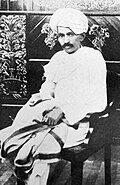
| The year 1915 also saw the return of [[Mohandas Karamchand Gandhi]] to India. Already known in India as a result of his civil liberties protests on behalf of the Indians in South Africa, Gandhi followed the advice of his mentor [[Gopal Krishna Gokhale]] and chose not to make any public pronouncements during the first year of his return, but instead spent the year travelling, observing the country at first hand, and writing.<ref name="brown-p214-215">{{Harvnb|Brown|1994|pp=214–15}}</ref> Earlier, during his South Africa sojourn, Gandhi, a lawyer by profession, had represented an Indian community, which, although small, was sufficiently diverse to be a microcosm of India itself. In tackling the challenge of holding this community together and simultaneously confronting the colonial authority, he had created a technique of non-violent resistance, which he labelled ''[[Satyagraha]]'' (or Striving for Truth).<ref name="brown-p210-213">{{Harvnb|Brown|1994|pp=210–13}}</ref> For Gandhi, ''Satyagraha'' was different from "[[passive resistance]]", by then a familiar technique of social protest, which he regarded as a practical strategy adopted by the weak in the face of superior force; ''Satyagraha'', on the other hand, was for him the "last resort of those strong enough in their commitment to truth to undergo suffering in its cause".<ref name="brown-p210-213"/> [[Ahimsa]] or "non-violence", which formed the underpinning of ''Satyagraha'', came to represent the twin pillar, with Truth, of Gandhi's unorthodox religious outlook on life.<ref name="brown-p210-213"/> During the years 1907–1914, Gandhi tested the technique of ''Satyagraha'' in a number of protests on behalf of the Indian community in South Africa against the unjust racial laws.<ref name="brown-p210-213"/>
| |
| | |
| Also, during his time in South Africa, in his essay, ''Hind Swaraj'', (1909), Gandhi formulated his vision of ''[[Swaraj]]'', or "self-rule" for India based on three vital ingredients: solidarity between Indians of different faiths, but most of all between Hindus and Muslims; the removal of [[untouchability]] from Indian society; and the exercise of ''[[swadeshi]]''—the boycott of manufactured foreign goods and the revival of Indian [[cottage industry]].<ref name="brown-p214-215"/> The first two, he felt, were essential for India to be an egalitarian and tolerant society, one befitting the principles of Truth and ''[[Ahimsa]]'', while the last, by making Indians more self-reliant, would break the cycle of dependence that was perpetuating not only the direction and tenor of the British rule in India, but also the British commitment to it.<ref name="brown-p214-215"/> At least until 1920, the British presence itself was not a stumbling block in Gandhi's conception of ''[[swaraj]]''; rather, it was the inability of Indians to create a modern society.<ref name="brown-p214-215"/>
| |
| | |
| Gandhi made his political debut in India in 1917 in [[Champaran]] district in [[Bihar]], near the Nepal border, where he was invited by a group of disgruntled tenant farmers who, for many years, had been forced into planting [[indigo]] (for dyes) on a portion of their land and then selling it at below-market prices to the British planters who had leased them the land.<ref name="brown-p216-217">{{Harvnb|Brown|1994|pp=216–17}}</ref> Upon his arrival in the district, Gandhi was joined by other agitators, including a young Congress leader, [[Rajendra Prasad]], from Bihar, who would become a loyal supporter of Gandhi and go on to play a prominent role in the Indian independence movement. When Gandhi was ordered to leave by the local British authorities, he refused on moral grounds, setting up his refusal as a form of individual [[Satyagraha]]. Soon, under pressure from the Viceroy in Delhi who was anxious to maintain domestic peace during wartime, the provincial government rescinded Gandhi's expulsion order, and later agreed to an official enquiry into the case. Although the British planters eventually gave in, they were not won over to the farmers' cause, and thereby did not produce the optimal outcome of a Satyagraha that Gandhi had hoped for; similarly, the farmers themselves, although pleased at the resolution, responded less than enthusiastically to the concurrent projects of rural empowerment and education that Gandhi had inaugurated in keeping with his ideal of ''swaraj''. The following year Gandhi launched two more Satyagrahas—both in his native [[Gujarat]]—one in the rural [[Kheda|Kaira]] district where land-owning farmers were protesting increased land-revenue and the other in the city of [[Ahmedabad]], where workers in an Indian-owned textile mill were distressed about their low wages. The satyagraha in Ahmedabad took the form of Gandhi fasting and supporting the workers in a strike, which eventually led to a settlement. In Kaira, in contrast, although the farmers' cause received publicity from Gandhi's presence, the satyagraha itself, which consisted of the farmers' collective decision to withhold payment, was not immediately successful, as the British authorities refused to back down. The agitation in Kaira gained for Gandhi another lifelong lieutenant in [[Sardar Vallabhbhai Patel]], who had organised the farmers, and who too would go on to play a leadership role in the Indian independence movement.<ref>Balraj Krishna, ''India's Bismarck, Sardar Vallabhbhai Patel'' (2007) ch. 2</ref> Champaran, Kaira, and Ahmedabad were important milestones in the history of Gandhi's new methods of social protest in India.
| |
| | |
| ===1916–1919: Montagu–Chelmsford reforms===
| |
| {{See also|Montagu–Chelmsford Reforms}}
| |
| {{multiple image
| |
| | align = right
| |
| | total_width = 380
| |
| | |
| | image1 = Edwin Samuel Montagu.jpg
| |
| | alt1 = Montagu
| |
| | caption1 = [[Edwin Montagu]], the secretary of state for India, whose report led to the [[Government of India Act 1919]], also known as the Montford Reforms or the Montagu-Chelmsford Reforms.
| |
| | |
| | image2 = Chelmsford Governor.jpg
| |
| | alt2 = Chelmsford
| |
| | caption2 = [[Frederic Thesiger, 1st Viscount Chelmsford|Lord Chelmsford]], viceroy of India, who cautioned the British Government to be more responsive to Indian public opinion
| |
| | |
| }}
| |
| In 1916, in the face of new strength demonstrated by the nationalists with the signing of the [[Lucknow Pact]] and the founding of the [[Indian Home Rule movement|Home Rule leagues]], and the realisation, after the disaster in the [[Mesopotamian campaign]], that the war would likely last longer, the new viceroy, [[Frederic Thesiger, 1st Viscount Chelmsford|Lord Chelmsford]], cautioned that the Government of India needed to be more responsive to Indian opinion.<ref name="brown-p203-204"/> Towards the end of the year, after discussions with the government in London, he suggested that the British demonstrate their good faith—in light of the Indian war role—through a number of public actions, including awards of titles and honours to princes, granting of commissions in the army to Indians, and removal of the much-reviled cotton excise duty, but, most importantly, an announcement of Britain's future plans for India and an indication of some concrete steps. After more discussion, in August 1917, the new Liberal secretary of state for India, [[Edwin Montagu]], announced the British aim of "increasing association of Indians in every branch of the administration, and the gradual development of self-governing institutions, with a view to the progressive realisation of responsible government in India as an integral part of the British Empire".<ref name="brown-p203-204"/> Although the plan envisioned limited self-government at first only in the provinces—with India emphatically within the British Empire—it represented the first British proposal for any form of representative government in a non-white colony.
| |
| | |
| Montagu and Chelmsford presented their report in July 1918 after a long fact-finding trip through India the previous winter.<ref name="brown-p205-207">{{Harvnb|Brown|1994|pp=205–07}}</ref> After more discussion by the government and parliament in Britain, and another tour by the Franchise and Functions Committee for the purpose of identifying who among the Indian population could vote in future elections, the [[Government of India Act 1919]] (also known as the [[Montagu–Chelmsford Reforms]]) was passed in December 1919.<ref name="brown-p205-207"/> The new Act enlarged both the provincial and [[Imperial Legislative Council|Imperial]] legislative councils and repealed the Government of India's recourse to the "official majority" in unfavourable votes.<ref name="brown-p205-207"/> Although departments like defence, foreign affairs, criminal law, communications, and income-tax were retained by the [[Governor-General of India|Viceroy]] and the central government in New Delhi, other departments like public health, education, land-revenue, local self-government were transferred to the provinces.<ref name="brown-p205-207"/> The provinces themselves were now to be administered under a new [[Diarchy|diarchical]] system, whereby some areas like education, agriculture, infrastructure development, and local self-government became the preserve of Indian ministers and legislatures, and ultimately the Indian electorates, while others like irrigation, land-revenue, police, prisons, and control of media remained within the purview of the British governor and his executive council.<ref name="brown-p205-207"/> The new Act also made it easier for Indians to be admitted into the civil services and the army officer corps.
| |
| | |
| A greater number of Indians were now enfranchised, although, for voting at the national level, they constituted only 10% of the total adult male population, many of whom were still illiterate.<ref name="brown-p205-207"/> In the provincial legislatures, the British continued to exercise some control by setting aside seats for special interests they considered cooperative or useful. In particular, rural candidates, generally sympathetic to British rule and less confrontational, were assigned more seats than their urban counterparts.<ref name="brown-p205-207"/> Seats were also reserved for non-Brahmins, landowners, businessmen, and college graduates. The principal of "communal representation", an integral part of the [[Minto–Morley Reforms]], and more recently of the Congress-Muslim League Lucknow Pact, was reaffirmed, with seats being reserved for Muslims, [[Sikhs]], [[Christianity in India|Indian Christians]], [[Anglo-Indians]], and domiciled Europeans, in both provincial and Imperial legislative councils.<ref name="brown-p205-207"/> The Montagu–Chelmsford reforms offered Indians the most significant opportunity yet for exercising legislative power, especially at the provincial level; however, that opportunity was also restricted by the still limited number of eligible voters, by the small budgets available to provincial legislatures, and by the presence of rural and special interest seats that were seen as instruments of British control.<ref name="brown-p205-207"/> Its scope was unsatisfactory to the Indian political leadership, famously expressed by [[Annie Besant]] as something "unworthy of England to offer and India to accept".<ref name=Chhabra2>{{Harvnb|Chhabra|2005|p=2}}</ref>
| |
| | |
| ===1917–1919: Rowlatt Act===
| |
| {{See also|Rowlatt Act}}
| |
| [[File:Sir Sidney Arthur Taylor Rowlatt (cropped).jpg|thumb|[[Sidney Rowlatt]], the British judge under whose chairmanship the [[Rowlatt Committee]] recommended [[Rowlatt Act|stricter anti-sedition laws]]]]
| |
| | |
| In 1917, as Montagu and Chelmsford were compiling their report, a committee chaired by a British judge, [[Sidney Rowlatt]], was tasked with investigating "revolutionary conspiracies", with the unstated goal of extending the government's wartime powers.<ref name="brown-p203-204">{{Harvnb|Brown|1994|pp=203–04}}</ref> The Rowlatt Committee presented its report in July 1918 and identified three regions of conspiratorial insurgency: [[Bengal]], the [[Bombay presidency]], and the [[Punjab, India|Punjab]].<ref name="brown-p203-204"/> To combat subversive acts in these regions, the committee recommended that the government use emergency powers akin to its wartime authority, which included the ability to try cases of sedition by a panel of three judges and without juries, exaction of securities from suspects, governmental overseeing of residences of suspects,<ref name="brown-p203-204"/> and the power for provincial governments to arrest and detain suspects in short-term detention facilities and without trial.<ref name=spear190/>
| |
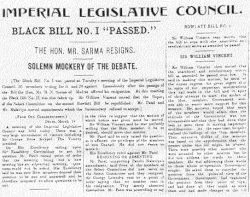
| [[File:Rowlatt bills1919.gif|thumb|left|Headlines about the Rowlatt Bills (1919) from a nationalist newspaper in India. Although all non-official Indians on the Legislative Council voted against the Rowlatt Bills, the government was able to force their passage by using its majority.<ref name=spear190/>]]
| |
| With the end of World War I, there was also a change in the economic climate. By the end of 1919, 1.5{{nbsp}}million Indians had served in the armed services in either combatant or non-combatant roles, and India had provided £146{{nbsp}}million in revenue for the war.<ref name="brown195-196">{{Harvnb|Brown|1994|pp=195–96}}</ref> The increased taxes coupled with disruptions in both domestic and international trade had the effect of approximately doubling the index of overall prices in India between 1914 and 1920.<ref name="brown195-196"/> Returning war veterans, especially in the Punjab, created a growing unemployment crisis,<ref name=stein304>{{Harvnb|Stein|2001|p=304}}</ref> and post-war inflation led to food riots in Bombay, Madras, and Bengal provinces,<ref name=stein304/> a situation that was made only worse by the failure of the 1918–19 monsoon and by profiteering and speculation.<ref name="brown195-196"/> The global influenza epidemic and the [[Bolshevik Revolution]] of 1917 added to the general jitters; the former among the population already experiencing economic woes,<ref name=stein304/> and the latter among government officials, fearing a similar revolution in India.<ref>{{Harvnb|Ludden|2002|p=208}}</ref>
| |
| | |
| To combat what it saw as a coming crisis, the government now drafted the Rowlatt committee's recommendations into two [[Rowlatt Acts|Rowlatt Bills]].<ref name=spear190>{{Harvnb|Spear|1990|p=190}}</ref> Although the bills were authorised for legislative consideration by Edwin Montagu, they were done so unwillingly, with the accompanying declaration, "I loathe the suggestion at first sight of preserving the Defence of India Act in peacetime to such an extent as Rowlatt and his friends think necessary."<ref name="brown-p203-204"/> In the ensuing discussion and vote in the Imperial Legislative Council, all Indian members voiced opposition to the bills. The Government of India was, nevertheless, able to use of its "official majority" to ensure passage of the bills early in 1919.<ref name="brown-p203-204"/> However, what it passed, in deference to the Indian opposition, was a lesser version of the first bill, which now allowed extrajudicial powers, but for a period of exactly three years and for the prosecution solely of "anarchical and revolutionary movements", dropping entirely the second bill involving modification the [[Indian Penal Code]].<ref name="brown-p203-204"/> Even so, when it was passed, the new [[Rowlatt Act]] aroused widespread indignation throughout India, and brought Gandhi to the forefront of the nationalist movement.<ref name=spear190/>
| |
| | |
| ===1919–1939: Jallianwala Bagh, non-cooperation, Government of India Act===
| |
| {{see also|Jallianwala Bagh massacre|Non-cooperation movement|Simon Commission|Purna Swaraj|Round Table Conferences|Government of India Act 1935}}
| |
| [[File:Jallianwallah.jpg|thumb|The Jallianwala Bagh in 1919, a few months after the massacre which had occurred on 13 April]]
| |
| The [[Jallianwala Bagh massacre]] or "Amritsar massacre", took place in the [[Jallianwala Bagh]] public garden in the predominantly Sikh northern city of [[Amritsar]]. After days of unrest Brigadier-General [[Reginald Dyer|Reginald E.H. Dyer]] forbade public meetings and on Sunday 13 April 1919 fifty British Indian Army soldiers commanded by Dyer began shooting at an unarmed gathering of thousands of men, women, and children without warning. Casualty estimates vary widely, with the Government of India reporting 379{{Nbsp}}dead, with 1,100{{Nbsp}}wounded.<ref>Nick Lloyd (2011). ''The Amritsar Massacre: The Untold Story of One Fateful Day'' p. 180</ref> The [[Indian National Congress]] estimated three times the number of dead. Dyer was removed from duty but he became a celebrated hero in Britain among people with connections to the Raj.<ref>{{cite journal |last=Sayer |first=Derek |date=May 1991 |title=British Reaction to the Amritsar Massacre 1919–1920 |journal=Past & Present |volume= 131|issue=131 |pages=130–64 |doi=10.1093/past/131.1.130 |jstor=650872}}</ref> Historians consider the episode was a decisive step towards the end of British rule in India.<ref>{{cite magazine |last=Bond |first=Brian |date=October 1963 |title=Amritsar 1919 |magazine=History Today |volume=13 |issue=10 |pages=666–76}}</ref>
| |
| | |
| In 1920, after the British government refused to back down, Gandhi began his campaign of [[Non-cooperation movement|non-cooperation]], prompting many Indians to return British awards and honours, to resign from the civil services, and to again boycott British goods. In addition, Gandhi reorganised the Congress, transforming it into a mass movement and opening its membership to even the poorest Indians. Although Gandhi halted the non-cooperation movement in 1922 after the violent [[Chauri Chaura incident|incident at Chauri Chaura]], the movement revived again, in the mid-1920s.
| |
| | |
| The visit, in 1928, of the British [[Simon Commission]], charged with instituting constitutional reform in India, resulted in widespread protests throughout the country.<ref name="markovits-simon-bhagat">{{Harvnb|Markovits|2004|pp=373–74}}</ref> Earlier, in 1925, non-violent protests of the Congress had resumed too, this time in Gujarat, and led by Patel, who organised farmers to refuse payment of increased land taxes; the success of this protest, the [[Bardoli Satyagraha]], brought Gandhi back into the fold of active politics.<ref name="markovits-simon-bhagat"/>
| |
| <gallery mode="packed" heights="200" widths="150" class="center">
| |
| File:Gandhi besant madras1921.jpg|[[Mahatma Gandhi]] with [[Annie Besant]] ''en route'' to a meeting in [[Madras]] in September 1921. Earlier, in [[Madurai]], on 21 September 1921, Gandhi had adopted the [[loin-cloth]] for the first time as a symbol of his identification with India's poor.
| |
| File:Noncooperation khilafat1921.gif|An early 1920s poster advertising a Congress non-co-operation "Public Meeting" and a "Bonfire of Foreign Clothes" in Bombay, and expressing support for the "Karachi Khilafat Conference"
| |
| File:Noncooperation movement1922.jpg|Hindus and Muslims, displaying the flags of both the [[Indian National Congress]] and the [[All-India Muslim League|Muslim League]], collecting clothes to be later burnt as a part of the [[non-cooperation movement]] initiated by Gandhi
| |
| File:Bhagat singh noncooperation.jpg|Photograph of the staff and students of the National College, [[Lahore]], founded in 1921 by [[Lala Lajpat Rai]] for students preparing for the non-co-operation movement. Standing, fourth from the right, is future revolutionary [[Bhagat Singh]].
| |
| </gallery>
| |
| {{multiple image
| |
| | align = right
| |
| | total_width = 420
| |
| | |
| | image1 = Indian General Election 1934.svg
| |
| | alt1 = GE 1934
| |
| | caption1 = The [[1934 Indian general election]] was the first general election that the [[Indian National Congress|INC]] participated in.{{efn|Excluding previous elections contested by the [[Swaraj Party]], in which candidates from Congress stood without official endorsement from the party.}} The party won a majority of the general seats.
| |
| | |
| | image2 = Indian_Provincial_Election_1937.svg
| |
| | alt2 = PE 1937
| |
| | caption2 = The INC dominated the first provincial elections in the [[1937 Indian provincial elections]].
| |
| | image3 = Indian_General_Election_1945.svg
| |
| | alt3 = GE 1945
| |
| | caption3 = The [[All India Muslim League]] gained ground in the [[1945 Indian general election]]
| |
| | |
| }}
| |
| | |
| At its annual session in [[Lahore]], the Indian National Congress, under the presidency of [[Jawaharlal Nehru]], issued a demand for ''[[Purna Swaraj]]'' ([[Hindustani language]]: "complete independence"), or Purna Swarajya. The declaration was drafted by the [[Congress Working Committee]], which included Gandhi, Nehru, Patel, and [[Chakravarthi Rajagopalachari]]. Gandhi subsequently led an expanded movement of civil disobedience, culminating in 1930 with the [[Salt Satyagraha]], in which thousands of Indians defied the tax on salt, by marching to the sea and making their own salt by evaporating seawater. Although, many, including Gandhi, were arrested, the British government eventually gave in, and in 1931 Gandhi travelled to London to negotiate new reform at the [[Round Table Conferences]].
| |
| | |
| In local terms, British control rested on the [[Indian Civil Service]] (ICS), but it faced growing difficulties. Fewer and fewer young men in Britain were interested in joining, and the continuing distrust of Indians resulted in a declining base in terms of quality and quantity. By 1945 Indians were numerically dominant in the ICS and at issue was loyal divided between the Empire and independence.<ref>{{cite journal |last=Potter |first=David C. |date=January 1973 |title=Manpower Shortage and the End of Colonialism: The Case of the Indian Civil Service |journal=Modern Asian Studies |volume=7 |issue=1 |pages=47–73 |jstor=312036|doi=10.1017/S0026749X00004388 |s2cid=146445282 }}</ref> The finances of the Raj depended on land taxes, and these became problematic in the 1930s. Epstein argues that after 1919 it became harder and harder to collect the land revenue. The Raj's suppression of civil disobedience after 1934 temporarily increased the power of the revenue agents but after 1937 they were forced by the new Congress-controlled provincial governments to hand back confiscated land. Again the outbreak of war strengthened them, in the face of the [[Quit India]] movement the revenue collectors had to rely on military force and by 1946–47 direct British control was rapidly disappearing in much of the countryside.<ref>{{cite journal |last=Epstein |first=Simon |date=May 1982 |title=District Officers in Decline: The Erosion of British Authority in the Bombay Countryside, 1919 to 1947 |journal=Modern Asian Studies |volume=16 |issue=3 |pages=493–518 |jstor=312118|doi=10.1017/S0026749X00015286 |s2cid=143984571 }}</ref>
| |
| | |
| In 1935, after the Round Table Conferences, Parliament passed the [[Government of India Act 1935]], which authorised the establishment of independent legislative assemblies in all provinces of British India, the creation of a central government incorporating both the British provinces and the princely states, and the protection of Muslim minorities. The future [[Constitution of India|Constitution of independent India]] was based on this act.<ref>{{Harvnb|Low|1993|pp=40, 156}}</ref> However, it divided the electorate into 19 religious and social categories, e.g., Muslims, Sikhs, Indian Christians, Depressed Classes, Landholders, Commerce and Industry, Europeans, Anglo-Indians, etc., each of which was given separate representation in the Provincial Legislative Assemblies. A voter could cast a vote only for candidates in his own category.
| |
| | |
| The 1935 Act provided for more autonomy for Indian provinces, with the goal of cooling off nationalist sentiment. The act provided for a national parliament and an executive branch under the purview of the British government, but the rulers of the princely states managed to block its implementation. These states remained under the full control of their hereditary rulers, with no popular government. To prepare for elections Congress built up its grass roots membership from 473,000 in 1935 to 4.5{{nbsp}}million in 1939.<ref>Piers Brendon, ''The Decline and Fall of the British Empire: 1781–1997'' (2008) p. 394</ref>
| |
| | |
| In the [[Indian Provincial Elections, 1937|1937 elections]] Congress won victories in seven of the eleven provinces of British India.<ref name="low-1935-elections">{{Harvnb|Low|1993|p=154}}</ref> Congress governments, with wide powers, were formed in these provinces. The widespread voter support for the Indian National Congress surprised Raj officials, who previously had seen the Congress as a small elitist body.<ref>{{cite journal |last=Muldoon |first=Andrew |date=2009 |title=Politics, Intelligence and Elections in Late Colonial India: Congress and the Raj in 1937 |url=https://www.erudit.org/en/journals/jcha/2009-v20-n2-jcha3903/044403ar.pdf |journal=Journal of the Canadian Historical Association |volume=20 |issue=2 |pages=160–88 |doi=10.7202/044403ar}}; Muldoon, ''Empire, politics and the creation of the 1935 India Act: last act of the Raj'' (2009)</ref> The British separated Burma Province from British India in 1937 and granted the colony a new constitution calling for a fully elected assembly, with many powers given to the Burmese, but this proved to be a divisive issue as a ploy to exclude Burmese from any further Indian reforms.<ref>[https://web.archive.org/web/20080117060229/http://www.time.com/time/magazine/article/0,9171,788006,00.html "Sword For Pen"]. ''[[Time (magazine)|Time]]''. 12 April 1937.</ref>
| |
| {{clear}}
| |
| <gallery mode="packed" heights="200" widths="150" class="center">
| |
| File:Gandhi in London meeting, 1931.jpg | British prime minister, [[Ramsay MacDonald]], three places to the right of Gandhi (to the viewer's left) at the 2nd Round Table Conference. [[Samuel Hoare, 1st Viscount Templewood|Samuel Hoare]] is two places to Gandhi's right. Foreground, fourth from left, is [[B. R. Ambedkar]] representing the "[[Dalit|Depressed Classes]]"
| |
| File:NewDelhiInaugurationSecondDayCancellation27Feb1931.jpg|A second-day cancellation of the series "Inauguration of New Delhi", 27 February 1931, commemorating the new city designed by Sir [[Edwin Lutyens]] and Sir [[Herbert Baker]]
| |
| File:Separation of Burma from British India 1937.jpg|A first-day cover issued on 1 April 1937 commemorating the separation of Burma from the British Indian Empire
| |
| </gallery>
| |
| | |
| ===1939–1945: World War II===
| |
| {{See also|India in World War II|Indian Army during World War II|Cripps Mission|Quit India Movement}}
| |
| [[File:A k fazlul hoque.jpg|thumb|upright|[[A. K. Fazlul Huq]], known as the ''Sher-e-Bangla'' or ''Tiger of Bengal'', was the first elected [[Prime Minister of Bengal|Premier of Bengal]], leader of the [[Krishak Sramik Party|K. P. P.]] and an important ally of the [[All India Muslim League]].]]
| |
| [[File:Bundesarchiv Bild 101III-Alber-064-03A, Subhas Chandra Bose bei Heinrich Himmler.jpg|thumb| Subhas Chandra Bose (second from left) with [[Heinrich Himmler]] (right), 1942]]
| |
| [[File:VictoryWorldWar2BritishRaj.jpg|right|thumb|The series of stamps, "Victory", issued by the Government of India to commemorate the allied victory in World War II]]
| |
| With the outbreak of World War II in 1939, the viceroy, [[Victor Hope, 2nd Marquess of Linlithgow|Lord Linlithgow]], declared war on India's behalf without consulting Indian leaders, leading the Congress provincial ministries to resign in protest. The Muslim League, in contrast, supported Britain in the war effort and maintained its control of the government in three major provinces, Bengal, Sind and the Punjab.<ref name="British Raj Independence movement"/>
| |
| | |
| While the Muslim League had been a small elite group in 1927 with only 1300{{nbsp}}members, it grew rapidly once it became an organisation that reached out to the masses, reaching 500,000{{nbsp}}members in Bengal in 1944, 200,000 in Punjab, and hundreds of thousands elsewhere.<ref name="India and Pakistan independence"/> Jinnah now was well positioned to negotiate with the British from a position of power.<ref>Ramachandra Guha, ''India After Gandhi: The History of the World's Largest Democracy'' (2007) p. 43</ref> Jinnah repeatedly warned that Muslims would be unfairly treated in an independent India dominated by the Congress. On 24 March 1940 in Lahore, the League passed the "[[Lahore Resolution]]", demanding that, "the areas in which the Muslims are numerically in majority as in the North-Western and Eastern zones of India should be grouped to constitute independent states in which the constituent units shall be autonomous and sovereign."<ref>{{cite web|url=http://www.columbia.edu/itc/mealac/pritchett/00ambedkar/ambedkar_partition/101.html |title=Muslim Case for Pakistan |publisher=University of Columbia}}</ref> Although there were other important national Muslim politicians such as Congress leader [[Ab'ul Kalam Azad]], and influential regional Muslim politicians such as [[A. K. Fazlul Huq]] of the leftist [[Krishak Praja Party]] in Bengal, [[Fazl-i-Hussain]] of the landlord-dominated [[Unionist Muslim League|Punjab Unionist Party]], and [[Abdul Ghaffar Khan|Abd al-Ghaffar Khan]] of the pro-Congress [[Khudai Khidmatgar]] (popularly, "red shirts") in the [[North-West Frontier Province (1901–1955)|North West Frontier Province]],<ref>{{Harvnb|Robb|2002|p=190}}</ref> the British, over the next six years, were to increasingly see the League as the main representative of Muslim India.
| |
| | |
| The Congress was secular and strongly opposed to having any religious state.<ref name="India and Pakistan independence">{{cite web|title=India and Pakistan win independence|url=http://www.history.com/this-day-in-history/india-and-pakistan-win-independence|website=History.com|publisher=History|access-date=2 August 2014}}</ref> It insisted there was a natural unity to India, and repeatedly blamed the British for "divide and rule" tactics based on prompting Muslims to think of themselves as alien from Hindus.{{citation needed|date=January 2018}} Jinnah rejected the notion of a united India, and emphasised that religious communities were more basic than an artificial nationalism. He proclaimed the [[Two-Nation Theory]],<ref>{{cite book |author=Stephen P. Cohen |author-link=Stephen P. Cohen |year=2004 |title=The Idea of Pakistan |publisher=Brookings Institution Press |page=[https://archive.org/details/ideaofpakistan00cohe/page/28 28] |isbn=978-0-8157-1502-3 |url=https://archive.org/details/ideaofpakistan00cohe/page/28 }}</ref> stating at Lahore on 23 March 1940:
| |
| {{blockquote|text=[Islam and Hinduism] are not religions in the strict sense of the word, but are, in fact, different and distinct social orders and it is a dream that the Hindus and Muslims can ever evolve a common nationality ... The Hindu and Muslim belong to two different religions, philosophies, social customs and literature [sic]. They neither intermarry nor interdine together and indeed they belong to two different civilizations which are based mainly on conflicting ideas and conceptions. Their aspects on life and of life are different ... To yoke together two such nations under a single state, one as a numerical minority and the other as a majority must lead to growing discontent and final destruction of any fabric that may be so built up for the government of such a state.<ref>{{cite book |author=D. N. Panigrahi |year=2004 |title=India's partition: the story of imperialism in retreat |url=https://archive.org/details/indiaspartitions00grah |url-access=limited |publisher=Routledge |pages=[https://archive.org/details/indiaspartitions00grah/page/n171 151]–52 |isbn=978-1-280-04817-3}}</ref>
| |
| }}
| |
| | |
| While the regular Indian army in 1939 included about 220,000{{Nbsp}}native troops, it expanded tenfold during the war,<ref>Recruitment was especially active in the Punjab province of British India, under the leadership of Premier [[Sir Sikandar Hayat Khan]], who believed in cooperating with the British to achieve eventual independence for the Indian nation. For details of various recruitment drives by Sir Sikandar between 1939 and 1942, see {{cite journal |last1=Tarin |first1=Omer |author-link1=Omer Tarin |last2=Dando |first2=Neal |date=Autumn 2010 |title=Memoirs of the Second World War: Major Shaukat Hayat Khan |journal=Durbar: Journal of the Indian Military Historical Society |volume=27 |issue=3 |type=Critique |pages=136–37}}</ref> and small naval and air force units were created. Over two{{nbsp}}million Indians volunteered for military service in the British Army. They played a major role in numerous campaigns, especially in the Middle East and North Africa. Casualties were moderate (in terms of the world war), with 24,000{{Nbsp}}killed; 64,000 wounded; 12,000{{Nbsp}}missing (probably dead), and 60,000{{Nbsp}}captured at Singapore in 1942.<ref>{{cite journal |last1=Roy |first1=Kaushik |year=2009 |title=Military Loyalty in the Colonial Context: A Case Study of the Indian Army during World War II |journal=Journal of Military History |volume=73 |issue=2}}</ref>
| |
| | |
| London paid most of the cost of the Indian Army, which had the effect of erasing India's national debt; it ended the war with a surplus of £1,300{{nbsp}}million. In addition, heavy British spending on munitions produced in India (such as uniforms, rifles, machine-guns, field artillery, and ammunition) led to a rapid expansion of industrial output, such as textiles (up 16%), steel (up 18%), and chemicals (up 30%). Small warships were built, and an aircraft factory opened in Bangalore. The railway system, with 700,000 employees, was taxed to the limit as demand for transportation soared.<ref>John F. Riddick, ''The history of British India: a chronology'' (2006) p. 142</ref>
| |
| | |
| The British government sent the [[Cripps mission]] in 1942 to secure Indian nationalists' co-operation in the war effort in exchange for a promise of independence as soon as the war ended. Top officials in Britain, most notably Prime Minister [[Winston Churchill]], did not support the Cripps Mission and negotiations with the Congress soon broke down.<ref>{{cite journal |last=Gupta |first=Shyam Ratna |date=January 1972 |title=New Light on the Cripps Mission |journal=India Quarterly |volume=28 |issue=1 |pages=69–74 |doi=10.1177/097492847202800106|s2cid=150945957 }}</ref>
| |
| | |
| Congress launched the [[Quit India Movement]] in July 1942 demanding the immediate withdrawal of the British from India or face nationwide civil disobedience. On 8 August the Raj arrested all national, provincial and local Congress leaders, holding tens of thousands of them until 1945. The country erupted in violent demonstrations led by students and later by peasant political groups, especially in Eastern [[United Provinces of Agra and Oudh|United Provinces]], Bihar, and western Bengal. The large wartime British Army presence crushed the movement in a little more than six weeks;<ref name="metcalf-quit-india">{{Harvnb|Metcalf|Metcalf|2006|pp=206–07}}</ref> nonetheless, a portion of the movement formed for a time an underground provisional government on the border with Nepal.<ref name="metcalf-quit-india"/> In other parts of India, the movement was less spontaneous and the protest less intensive, however it lasted sporadically into the summer of 1943. It did not slow down the British war effort or recruiting for the army.<ref name=Bandypadhya420>{{Harvnb|Bandyopadhyay|2004|pp=418–20}}</ref>
| |
| | |
| Earlier, [[Subhas Chandra Bose]], who had been a leader of the younger, radical, wing of the [[Indian National Congress]] in the late 1920s and 1930s, had risen to become Congress President from 1938 to 1939.{{sfn|Stein|2010|pp=305, 325|ps=": Jawaharlal Nehru and Subhas Bose were among those who, impatient with Gandhi's programmes and methods, looked upon socialism as an alternative for nationalistic policies capable of meeting the country's economic and social needs, as well as a link to potential international support. (p. 325) (p. 345)"}} However, he was ousted from the Congress in 1939 following differences with the high command,{{Sfn|Low|2002|p=297}} and subsequently placed under house arrest by the British before escaping from India in early 1941.{{Sfn|Low|2002|p=313}} He turned to [[Axis powers of World War II|Nazi Germany and Imperial Japan]] for help in gaining India's independence by force.{{Sfn|Low|1993|pp=31–31}} With Japanese support, he organised the [[Indian National Army]], composed largely of Indian soldiers of the British Indian Army who had been captured by the Japanese in the [[Battle of Singapore]]. As the war turned against them, the Japanese came to support a number of puppet and provisional governments in the captured regions, including those in [[Japanese occupation of Burma|Burma]], the [[Philippines]] and [[Vietnam]], and in addition, the Provisional Government of [[Azad Hind]], presided by Bose.{{Sfn|Low|1993|pp=31–31}}
| |
| | |
| Bose's effort, however, was short-lived. In mid-1944 the British Army first halted and then reversed the Japanese [[Operation U-Go|U-Go offensive]], beginning the successful part of the [[Burma Campaign]]. Bose's Indian National Army largely disintegrated during the subsequent fighting in Burma, with its remaining elements surrendering with the recapture of Singapore in September 1945. Bose died in August from third degree burns received after attempting to escape in an overloaded Japanese plane which crashed in Taiwan,{{Sfn|Wolpert|2006|p=69}} which many Indians believe did not happen.{{sfn|Bandyopadhyay|2004|p=427}}{{sfn|Bayly|Harper|2007|p=2}}<ref name="sugata-bose-p320">{{citation |last=Bose |first=Sugata |title=His Majesty's Opponent: Subhas Chandra Bose and India's Struggle against Empire |url=https://books.google.com/books?id=g-pfHRAD03AC&pg=PA320 |access-date=21 September 2013 |year=2011 |publisher=Harvard University Press |isbn=978-0-674-04754-9 |page=320}}</ref> Although Bose was unsuccessful, he roused patriotic feelings in India.{{sfn|Stein|2001|p=345}}
| |
| <gallery mode="packed" heights="200" widths="150" class="center">
| |
| File:Ncert gandhi tomeet linlithgow1939.jpg|[[Mahatma Gandhi]] (centre-right) and [[Rajendra Prasad]] (centre-left) on their way to meet the viceroy, [[Marquess of Linlithgow|Lord Linlithgow]], on 13 October 1939, after the outbreak of [[World War II]]
| |
| File:Chaudhry Khaliquzzaman.jpg|[[Chaudhari Khaliquzzaman]] (left) seconding the 1940 Lahore Resolution of the Muslim League with [[Jinnah]] (right) presiding, and [[Liaquat Ali Khan]] (centre)
| |
| File:Newly-arrived Indian troops.jpg|Newly arrived Indian troops on the quayside in Singapore, November 1941
| |
| File:Operation Crusader.jpg|Indian Army troops in action during [[Operation Crusader]] in the [[Western Desert Campaign]] in North Africa in November/December 1941
| |
| </gallery>
| |
| | |
| ===1946–1947: Independence, Partition===
| |
| {{See also|Partition of India|Interim Government of India}}
| |
| | |
| [[File:Cabinet mission to india1946.jpg|thumb|Members of the [[1946 Cabinet Mission to India]] meeting [[Muhammad Ali Jinnah]]. Far left is [[Frederick Pethick-Lawrence, 1st Baron Pethick-Lawrence|Lord Pethick Lawrence]]; far right is [[Stafford Cripps|Sir Stafford Cripps]]]]
| |
| [[File:Hindu percent 1909.jpg|thumb|Percentage of Hindus by district, 1909]]
| |
| [[File:Muslim percent 1909.jpg|thumb|Percentage of Muslims by district, 1909]]
| |
| In January 1946, a number of mutinies broke out in the armed services, starting with that of RAF servicemen frustrated with their slow repatriation to Britain.<ref name="judd-mutiny">{{Harvnb|Judd|2004|pp=172–73}}</ref> The mutinies came to a head with [[The Royal Indian Navy Mutiny|mutiny of the Royal Indian Navy]] in Bombay in February 1946, followed by others in [[Calcutta]], [[Madras]], and [[Karachi]]. Although the mutinies were rapidly suppressed, they had the effect of spurring the new Labour government in Britain to action, and leading to the Cabinet Mission to India led by the secretary of state for India, [[Frederick Pethick-Lawrence, 1st Baron Pethick-Lawrence|Lord Pethick Lawrence]], and including [[Stafford Cripps|Sir Stafford Cripps]], who had visited four years before.<ref name="judd-mutiny"/>
| |
| | |
| Also in early 1946, new elections were called in India. Earlier, at the end of the war in 1945, the colonial government had announced the public trial of three senior officers of Bose's defeated Indian National Army who stood accused of treason. Now as the trials began, the Congress leadership, although ambivalent towards the INA, chose to defend the accused officers.<ref>{{Harvnb|Judd|2004|pp=170–71}}</ref> The subsequent convictions of the officers, the public outcry against the convictions, and the eventual remission of the sentences, created positive propaganda for the Congress, which only helped in the party's subsequent electoral victories in eight of the eleven provinces.<ref>{{Harvnb|Judd|2004|p=172}}</ref> The negotiations between the Congress and the Muslim League, however, stumbled over the issue of the partition. Jinnah proclaimed 16 August 1946, [[Direct Action Day]], with the stated goal of highlighting, peacefully, the demand for a Muslim homeland in [[British India]]. The following day Hindu-Muslim riots broke out in Calcutta and quickly spread throughout British India. Although the Government of India and the Congress were both shaken by the course of events, in September, a Congress-led interim government was installed, with Jawaharlal Nehru as united India's prime minister.<ref name="Gopal1976">{{cite book|author=Sarvepalli Gopal|title=Jawaharlal Nehru: A Biography|url=https://archive.org/details/jawaharlalnehrub01gopa|url-access=registration|access-date=21 February 2012|year=1976|publisher=Harvard University Press|isbn=978-0-674-47310-2|page=[https://archive.org/details/jawaharlalnehrub01gopa/page/362 362]}}</ref>
| |
| | |
| Later that year, the [[exchequer|British Exchequer]] exhausted by the recently concluded World War II, and the [[Labour Party (UK)|Labour]] government conscious that it had neither the mandate at home, the international support, nor the reliability of [[British Indian Army|native forces]] for continuing to control an increasingly restless British India,<ref name=Hyam106>{{Harvnb|Hyam|2007|p=106}} Quote: By the end of 1945, he and the [[Commander-in-Chief, India|Commander-in-Chief of India]], General Auckinleck were advising that there was a real threat in 1946 of large-scale anti-British disorder amounting to even a well-organised rising aiming to expel the British by paralysing the administration.
| |
| Quote:...it was clear to Attlee that everything depended on the spirit and reliability of the Indian Army:"Provided that they do their duty, armed insurrection in India would not be an insoluble problem. If, however, the Indian Army was to go the other way, the picture would be very different...<br />
| |
| Quote:...Thus, Wavell concluded, if the army and the police "failed" Britain would be forced to go. In theory, it might be possible to revive and reinvigorate the services, and rule for another fifteen to twenty years, but:It is a fallacy to suppose that the solution lies in trying to maintain status quo. We have no longer the resources, nor the necessary prestige or confidence in ourselves.
| |
| </ref><ref>{{Harvnb|Brown|1994|p=330}} Quote: "India had always been a minority interest in British public life; no great body of public opinion now emerged to argue that war-weary and impoverished Britain should send troops and money to hold it against its will in an empire of doubtful value. By late 1946 both Prime Minister and Secretary of State for India recognized that neither international opinion no their own voters would stand for any reassertion of the ''raj'', even if there had been the men, money, and administrative machinery with which to do so." {{Harvnb|Sarkar|2004|p=418}} Quote: "With a war weary army and people and a ravaged economy, Britain would have had to retreat; the Labour victory only quickened the process somewhat." {{Harvnb|Metcalf|Metcalf|2006|p=212}} Quote: "More importantly, though victorious in war, Britain had suffered immensely in the struggle. It simply did not possess the manpower or economic resources required to coerce a restive India."</ref> decided to end British rule of India, and in early 1947 Britain announced its intention of transferring power no later than June 1948.<ref name="British Raj Independence movement">{{cite web|title=From Empire to Independence: The British Raj in India 1858–1947|url=https://www.bbc.co.uk/history/british/modern/independence1947_01.shtml|website= History|publisher=BBC|access-date=2 August 2014 | last=Dr Chandrika Kaul |date=3 March 2011}}</ref>
| |
| | |
| As independence approached, the violence between Hindus and Muslims in the provinces of Punjab and Bengal continued unabated. With the British army unprepared for the potential for increased violence, the new viceroy, [[Louis Mountbatten]], advanced the date for the transfer of power, allowing less than six months for a mutually agreed plan for independence.<ref name="Indian Independence movement">{{cite web|title=Indian Independence|url=http://www.bl.uk/reshelp/findhelpregion/asia/india/indianindependence/|website=British Library: Help for Researchers|publisher=British Library|access-date=2 August 2014 |quote=portal to educational sources available in the India Office Records}}</ref> In June 1947, the nationalist leaders, including Sardar Patel, Nehru and [[Abul Kalam Azad]] on behalf of the Congress, Jinnah representing the Muslim League, [[B. R. Ambedkar]] representing the [[Dalit|Untouchable]] community, and [[Master Tara Singh]] representing the [[Sikhs]], agreed to a [[Partition of India|partition of the country]] along religious lines in stark opposition to Gandhi's views.<ref name="British Raj Independence movement"/> The predominantly Hindu and Sikh areas were assigned to the [[Dominion of India|new nation of India]] and predominantly Muslim areas to the [[Dominion of Pakistan|new nation of Pakistan]]; the plan included a partition of the Muslim-majority provinces of Punjab and Bengal.<ref>{{cite web|title=The Road to Partition 1939–1947|url=http://www.nationalarchives.gov.uk/education/resources/the-road-to-partition/|website=Nationalarchives.gov.uk Classroom Resources|publisher=National Archives|access-date=2 August 2014}}</ref>
| |
| | |
| On 15 August 1947, the new [[Dominion of Pakistan]] (later [[Islamic Republic of Pakistan]]), with Muhammad Ali Jinnah as the governor-general; and the [[Dominion of India]], (later [[Republic of India]]) with [[Jawaharlal Nehru]] as the [[Prime Minister of India|prime minister]], and the viceroy, [[Louis Mountbatten]], staying on as its first governor-general came into being; with official ceremonies taking place in [[Karachi]] on 14 August and [[New Delhi]] on 15 August. This was done so that Mountbatten could attend both ceremonies.<ref>Ian Talbot and Gurharpal Singh, The Partition of India (2009), passim</ref>
| |
| | |
| The great majority of Indians remained in place with independence, but in border areas millions of people (Muslim, Sikh, and Hindu) relocated across the [[Radcliffe Line|newly drawn borders]]. In Punjab, where the new border lines divided the Sikh regions in half, there was much bloodshed; in Bengal and Bihar, where Gandhi's presence assuaged communal tempers, the violence was more limited. In all, somewhere between 250,000 and 500,000 people on both sides of the new borders, among both the refugee and resident populations of the three faiths, died in the violence.<ref>Maria Misra, ''Vishnu's crowded temple: India since the Great Rebellion'' (2008) p. 237</ref> Other estimates of the number of deaths are as high as 1,500,000.<ref>{{cite web|author=John Pike |url=http://www.globalsecurity.org/military/world/war/indo-pak-partition2.htm |title=India-Pakistan Partition 1947 |publisher=Globalsecurity.org |access-date=14 August 2018}}</ref>
| |
| | |
| ===Timeline of major events, legislation, public works===
| |
| <gallery mode="packed" heights="160" widths="160" class="center" caption="The reigning British monarchs during the period of the British Raj, 1858–1947, in silver one-rupee coins.">
| |
| File:VictoriaQueen1862Empress1886.jpg| Two silver one rupee coins used in India during the British Raj, showing Victoria, Queen, 1862 (left) and Victoria, Empress, 1886 (right)
| |
| File:EdwardVIIKingEmperorIndia1903and1908.jpg| Silver one rupee coins showing Edward VII, King-Emperor, 1903 (left) and 1908 (right)
| |
| File:GeorgeVKingEmperor1913and1919.jpg| Silver one rupee coins used in India during the British Raj, showing George V, King-Emperor, 1913 (left) and 1919 (right)
| |
| File:GeorgeVIKingEmperorIndia1940and1947.jpg| One rupee coins showing George VI, King-Emperor, 1940 (left) and just before India's independence in 1947 (right){{efn|The only other emperor during this period, [[Edward VIII]] (reigned January to December 1936), did not issue any Indian currency under his name.}}
| |
| </gallery>
| |
| | |
| {| class="wikitable"
| |
| |- style="vertical-align:bottom;"
| |
| ! width=130pt|Period
| |
| !Major events, legislation, public Works
| |
| !width=150pt|Presiding viceroy
| |
| |-
| |
| | 1 November 1858{{snd}}<br />21 March 1862 || 1858 reorganisation of [[British Indian Army]] (contemporaneously and hereafter Indian Army) <br /> Construction begins (1860): [[University of Bombay]], [[University of Madras]], and [[University of Calcutta]] <br /> [[Indian Penal Code]] passed into law in 1860.<br /> [[Upper Doab famine of 1860–1861]] <br /> [[Indian Councils Act 1861]] <br /> Establishment of [[Archaeological Survey of India]] in 1861 <br /> [[James Wilson (businessman)|James Wilson]], financial member of [[Council of India]], reorganises customs, imposes [[income tax]], creates [[paper currency]]. <br /> [[Indian Police Act 1861]]: creation of the [[Imperial Police]], later known as the [[Indian Police Service]]. ||[[Charles Canning, 1st Earl Canning|Viscount Canning]]<ref name="Maclagan1963">{{cite book|author=Michael Maclagan|title="Clemency" Canning: Charles John, 1st Earl Canning, Governor-General and Viceroy of India, 1856–1862|url=https://books.google.com/books?id=WUg5AQAAIAAJ|access-date=21 February 2012|year=1963|publisher=Macmillan|page=212}}</ref>
| |
| |-
| |
| | 21 March 1862{{snd}}<br />20 November 1863 || Viceroy dies prematurely in [[Dharamsala, Himachal Pradesh|Dharamsala]] || [[James Bruce, 8th Earl of Elgin|Earl of Elgin]]
| |
| |-
| |
| | 12 January 1864{{snd}}<br />12 January 1869 ||[[Duar War|Anglo-Bhutan Duar War]] (1864–1865)<br /> [[Orissa famine of 1866]] <br /> [[Rajputana famine of 1869]]<br /> Creation of Department of Irrigation. <br /> Creation of the [[Imperial Forestry Service]] in 1867 (now the [[Indian Forest Service]]).<br /> "[[Nicobar Islands]] annexed and incorporated into India 1869" ||[[John Lawrence, 1st Baron Lawrence|Sir John Lawrence, Bt]]<ref>{{cite book|author=William Ford|title=John Laird Mair Lawrence, a viceroy of India, by William St. Clair|url=https://books.google.com/books?id=GAYPAAAAQAAJ|year=1887|pages=186–253}}</ref>
| |
| |-
| |
| | 12 January 1869{{snd}}<br />8 February 1872 || Creation of Department of Agriculture (now [[Ministry of Agriculture (India)|Ministry of Agriculture]]) <br /> Major extension of railways, roads, and canals <br /> Indian Councils Act of 1870 <br /> Creation of [[Andaman and Nicobar Islands]] as a [[Chief Commissioner]]ship (1872). <br />Assassination of Lord Mayo in the Andamans. || [[Richard Bourke, 6th Earl of Mayo|Earl of Mayo]]<ref name="Hunter1876">{{cite book|author=Sir William Wilson Hunter|title=A life of the Earl of Mayo, fourth viceroy of India|publisher=Smith, Elder, & Company|url=https://archive.org/details/alifeearlmayofo02huntgoog|year=1876|pages=[https://archive.org/details/alifeearlmayofo02huntgoog/page/n192 181]–310}}</ref>
| |
| |-
| |
| | 3 May 1872{{snd}}<br />12 April 1876|| Deaths in [[Bihar famine of 1873–74]] prevented by import of rice from Burma.<br /> Gaikwad of Baroda dethroned for misgovernment; dominions continued to a child ruler.{{clarify|date=May 2019}}<br /> Indian Councils Act of 1874 <br /> Visit of the [[Prince of Wales]], the future [[Edward VII]], in 1875–76. || [[Thomas Baring, 1st Earl of Northbrook|Lord Northbrook]]<ref name="Hunter1876"/>
| |
| |-
| |
| | 12 April 1876{{snd}}<br />8 June 1880 ||[[Baluchistan (Chief Commissioners Province)|Baluchistan]] established as a [[Chief Commissioner]]ship<br /> [[Queen Victoria]] (in absentia) proclaimed [[Empress of India]] at [[Delhi Durbar]] of 1877. <br /> [[Great Famine of 1876–1878]]: 5.25 million dead; reduced relief offered at expense of [[Rupee|Rs.]] 8 [[crore]].<br /> Creation of Famine Commission of 1878–80 under Sir [[Richard Strachey]]. <br /> Indian Forest Act of 1878 <br /> [[Second Anglo-Afghan War]]. || [[Robert Bulwer-Lytton, 1st Earl of Lytton|Lord Lytton]]
| |
| |-
| |
| | 8 June 1880{{snd}}<br />13 December 1884 || End of [[Second Anglo-Afghan War]]. <br /> Repeal of Vernacular Press Act of 1878. Compromise on the [[Ilbert Bill]].<br /> Local Government Acts extend self-government from towns to country. <br /> [[University of Punjab]] established in [[Lahore]] in 1882 <br /> Famine Code promulgated in 1883 by the Government of India. <br /> Creation of the [[Education Commission]]. Creation of indigenous schools, especially for Muslims. <br /> Repeal of import duties on cotton and of most tariffs. Railway extension. || [[George Robinson, 1st Marquess of Ripon|Marquess of Ripon]]<ref name="Gopal1953">{{cite book|author=Sarvepalli Gopal|title=The viceroyalty of Lord Ripon, 1880–1884|url=https://archive.org/details/viceroyaltyoflor0000gopa_w4c6|url-access=registration|access-date=21 February 2012|year=1953|publisher=Oxford University Press}}</ref>
| |
| |-
| |
| | 13 December 1884{{snd}}<br />10 December 1888 || Passage of Bengal Tenancy Bill <br /> [[Third Anglo-Burmese War]]. <br /> Joint Anglo-Russian Boundary Commission appointed for the Afghan frontier. Russian attack on Afghans at [[Panjdeh]] (1885). [[The Great Game]] in full play. <br /> Report of Public Services Commission of 1886–87, creation of the Imperial Civil Service (later the [[Indian Civil Service]] (ICS), and today the [[Indian Administrative Service]]) <br /> [[University of Allahabad]] established in 1887 <br /> Queen Victoria's Jubilee, 1887. ||[[Frederick Hamilton-Temple-Blackwood, 1st Marquess of Dufferin and Ava|Earl of Dufferin]]<ref>Briton Martin, Jr. "The Viceroyalty of Lord Dufferin", ''History Today'', (Dec 1960) 10#12 pp. 821–30, and (Jan 1961) 11#1 pp. 56–64
| |
| </ref><ref>{{cite book|author=Sir Alfred Comyn Lyall|title=The life of the Marquis of Dufferin and Ava|url=https://books.google.com/books?id=rq10VOw8380C&pg=PA95|volume=2|year=1905|pages=72–207}}</ref>
| |
| |-
| |
| | 10 December 1888{{snd}}<br />11 October 1894 || Strengthening of NW Frontier defence. Creation of [[Imperial Service Troops]] consisting of regiments contributed by the [[princely states]]. <br /> [[Gilgit Agency]] leased in 1899 <br /> British Parliament passes [[Indian Councils Act 1892]], opening the [[Imperial Legislative Council]] to Indians. <br /> Revolution in [[princely state]] of [[Manipur]] and subsequent reinstatement of ruler. <br /> High point of [[The Great Game]]. Establishment of the [[Durand Line]] between British India and Afghanistan, <br /> Railways, roads, and irrigation works begun in Burma. Border between Burma and [[Siam]] finalised in 1893. <br /> Fall of the rupee, resulting from the steady depreciation of silver currency worldwide (1873–93). <br /> Indian Prisons Act of 1894 || [[Henry Petty-Fitzmaurice, 5th Marquess of Lansdowne|Marquess of Lansdowne]]<ref name="Forrest1894">{{cite book|author=Sir George Forrest|title=The administration of the Marquis of Lansdowne as Viceroy and Governor-general of India, 1888–1894|publisher=Office of the Supdt. of Government Print.|url=https://archive.org/details/administrationm00forrgoog|page=[https://archive.org/details/administrationm00forrgoog/page/n52 40]|year=1894}}</ref>
| |
| |-
| |
| | 11 October 1894{{snd}}<br />6 January 1899||Reorganisation of [[British Indian Army|Indian Army]] (from Presidency System to the four Commands). <br /> Pamir agreement Russia, 1895 <br /> [[Chitral Expedition|The Chitral Campaign (1895)]], the [[Tirah campaign]] (1896–97) <br /> [[Indian famine of 1896–1897]] beginning in [[Bundelkhand]]. <br /> [[Bubonic plague]] in Bombay (1896), Bubonic plague in Calcutta (1898); riots in wake of plague prevention measures. <br /> Establishment of Provincial Legislative Councils in Burma and Punjab; the former a new Lieutenant Governorship. || [[Victor Bruce, 9th Earl of Elgin|Earl of Elgin]]
| |
| |-
| |
| | 6 January 1899{{snd}}<br />18 November 1905 || Creation of the [[North-West Frontier Province]] under a [[Chief Commissioner]] (1901). <br /> [[Indian famine of 1899–1900]]. <br /> Return of the bubonic plague, 1 million deaths<br /> Financial Reform Act of 1899; Gold Reserve Fund created for India. <br /> Punjab Land Alienation Act <br /> Inauguration of [[Ministry of Commerce and Industry (India)|Department (now Ministry) of Commerce and Industry]].<br /> Death of [[Queen Victoria]] (1901); dedication of the [[Victoria Memorial (India)|Victoria Memorial Hall]], [[Calcutta]] as a national gallery of Indian antiquities, art, and history. <br /> [[Delhi Durbar|Coronation Durbar in Delhi (1903)]]; [[Edward VII]] (in absentia) proclaimed [[Emperor of India]].<br /> [[Francis Younghusband]]'s [[British expedition to Tibet]] (1903–04) <br /> [[North-Western Provinces]] (previously [[Ceded and Conquered Provinces]]) and [[Awadh|Oudh]] renamed [[United Provinces of Agra and Oudh|United Provinces]] in 1904 <br /> Reorganisation of Indian Universities Act (1904). <br /> Systemisation of preservation and restoration of ancient monuments by [[Archaeological Survey of India]] with Indian Ancient Monument Preservation Act. <br /> Inauguration of agricultural banking with Cooperative Credit Societies Act of 1904 <br /> [[Partition of Bengal (1905)|Partition of Bengal]]; new province of [[East Bengal and Assam]] under a Lieutenant-Governor.<br /> Census of 1901 gives the total population at 294{{nbsp}}million, including 62{{nbsp}}million in the princely states and 232{{nbsp}}million in British India.<ref name=IGI-I-449>{{cite book |year=1909 |title=The Imperial Gazetteer of India |volume=I: The Indian Empire, Descriptive |url=https://dsal.uchicago.edu/reference/gazetteer/pager.html?objectid=DS405.1.I34_V01_479.gif |location=Oxford |publisher=Clarendon Press |page=449}}</ref> About 170,000 are Europeans. 15{{nbsp}}million men and 1{{nbsp}}million women are literate. Of those school-aged, 25% of the boys and 3% of the girls attend. There are 207{{nbsp}}million Hindus, and 63{{nbsp}}million Muslims, along with 9{{nbsp}}million Buddhists (in Burma), 3{{nbsp}}million Christians, 2{{nbsp}}million Sikhs, 1{{nbsp}}million Jains, and 8.4{{nbsp}}million who practise animism.<ref>Ernest Hullo, "India", in ''Catholic Encyclopedia'' (1910) vol. 7 [http://www.newadvent.org/cathen/07722a.htm online]</ref>||[[George Curzon, 1st Marquess Curzon of Kedleston|Lord Curzon of Kedleston]]<ref>Michael Edwardes, ''High Noon of Empire: India under Curzon'' (1965)</ref><ref>{{cite book|author=H. Caldwell Lipsett|title=Lord Curzon in India: 1898–1903|url=https://archive.org/details/cu31924021025436|year=1903|publisher=R.A. Everett }}</ref>
| |
| |-
| |
| | 18 November 1905{{snd}}<br />23 November 1910 || Creation of the [[Railway Board]] <br /> [[Anglo-Russian Convention of 1907]] <br /> [[Indian Councils Act 1909]] (also Minto–Morley Reforms) <br /> Appointment of Indian Factories Commission in 1909.<br /> Establishment of [[Ministry of Education (India)|Department of Education]] in 1910 (now Ministry of Education) || [[Gilbert Elliot-Murray-Kynynmound, 4th Earl of Minto|Earl of Minto]]<ref name="Das1964">{{cite book|author=Manmath Nath Das|title=India under Morley and Minto: politics behind revolution, repression and reforms|url=https://books.google.com/books?id=V3geAAAAMAAJ|access-date=21 February 2012|year=1964|publisher=G. Allen and Unwin|isbn=9780049540026}}</ref>
| |
| |-
| |
| | 23 November 1910{{snd}}<br />4 April 1916 || Visit of King [[George V]] and [[Mary of Teck|Queen Mary]] in 1911: commemoration as [[Emperor of India|Emperor and Empress of India]] at last [[Delhi Durbar]]<br /> King George V announces creation of new city of New Delhi to replace [[Calcutta]] as capital of India.<br /> Indian High Courts Act of 1911 <br /> Indian Factories Act of 1911 <br /> Construction of New Delhi, 1912–1929 <br /> World War I, [[British Indian Army|Indian Army]] in: [[Western Front (World War I)|Western Front, Belgium, 1914]]; [[German East Africa]] ([[Battle of Tanga|Battle of Tanga, 1914]]); [[Mesopotamian campaign]] ([[Battle of Ctesiphon (1915)|Battle of Ctesiphon, 1915]]; [[Siege of Kut|Siege of Kut, 1915–16]]); [[Battle of Gallipoli|Battle of Galliopoli, 1915–16]] <br /> Passage of [[Defence of India Act 1915]] || [[Charles Hardinge, 1st Baron Hardinge of Penshurst|Lord Hardinge of Penshurst]]
| |
| |-
| |
| | 4 April 1916{{snd}}<br />2 April 1921 ||[[British Indian Army|Indian Army]] in: [[Mesopotamian campaign]] ([[Fall of Baghdad (1917)|Fall of Baghdad, 1917]]); [[Sinai and Palestine campaign]] ([[Battle of Megiddo (1918)|Battle of Megiddo, 1918]]) <br /> Passage of [[Rowlatt Act|Rowlatt Act, 1919]] <br /> [[Government of India Act 1919]] (also [[Montagu–Chelmsford Reforms]]) <br /> [[Jallianwala Bagh massacre|Jallianwala Bagh massacre, 1919]] <br /> [[Third Anglo-Afghan War|Third Anglo-Afghan War, 1919]] <br /> [[University of Rangoon]] established in 1920. <br /> Indian Passport Act of 1920: [[British Indian passport]] introduced || [[Frederic Thesiger, 1st Viscount Chelmsford|Lord Chelmsford]]
| |
| |-
| |
| | 2 April 1921{{snd}}<br />3 April 1926 ||[[University of Delhi]] established in 1922. <br /> Indian Workers Compensation Act of 1923 || [[Rufus Isaacs, 1st Marquess of Reading|Earl of Reading]]
| |
| |-
| |
| | 3 April 1926{{snd}}<br />18 April 1931 || Indian Trade Unions Act of 1926, [[Indian Forest Act, 1927]] <br /> Appointment of Royal Commission of Indian Labour, 1929 <br /> [[Round Table Conferences (India)|Indian Constitutional Round Table Conferences, London, 1930–32]], [[Gandhi–Irwin Pact|Gandhi–Irwin Pact, 1931]]. || [[E. F. L. Wood, 1st Earl of Halifax|Lord Irwin]]
| |
| |-
| |
| | 18 April 1931{{snd}}<br />18 April 1936 || New Delhi inaugurated as capital of India, 1931.<br /> Indian Workmen's Compensation Act of 1933 <br /> Indian Factories Act of 1934 <br /> [[Royal Indian Air Force]] created in 1932. <br /> [[Indian Military Academy]] established in 1932. <br /> [[Government of India Act 1935]] <br /> Creation of [[Reserve Bank of India]] || [[Freeman Freeman-Thomas, 1st Marquess of Willingdon|Earl of Willingdon]]
| |
| |-
| |
| | 18 April 1936{{snd}}<br />1 October 1943 || Indian Payment of Wages Act of 1936 <br /> Burma administered independently after 1937 with creation of new cabinet position [[Secretary of State for India and Burma]], and with the [[Burma Office]] separated off from the [[India Office]] <br /> Indian Provincial Elections of 1937 <br /> [[Cripps' mission]] to India, 1942.<br /> [[British Indian Army|Indian Army]] in [[Mediterranean, Middle East and African theatres of World War II]] ([[North African campaign]]): ([[Operation Compass]], [[Operation Crusader]], [[First Battle of El Alamein]], [[Second Battle of El Alamein]]. [[East African campaign (World War II)|East African campaign, 1940]], [[Anglo-Iraqi War|Anglo-Iraqi War, 1941]], [[Syria–Lebanon campaign|Syria–Lebanon campaign, 1941]], [[Anglo-Soviet invasion of Iran|Anglo-Soviet invasion of Iran, 1941]]) <br /> Indian Army in [[Battle of Hong Kong]], [[Battle of Malaya]], [[Battle of Singapore]]<br /> [[Burma campaign]] of World War II begins in 1942. || [[Victor Hope, 2nd Marquess of Linlithgow|Marquess of Linlithgow]]
| |
| |-
| |
| | 1 October 1943{{snd}}<br />21 February 1947 ||[[British Indian Army|Indian Army]] becomes, at 2.5 million men, the largest all-volunteer force in history.<br /> [[Burma campaign|World War II: Burma Campaign, 1943–45]] ([[Battle of Kohima]], [[Battle of Imphal]]) <br /> [[Bengal famine of 1943]] <br /> [[British Indian Army|Indian Army]] in [[Italian campaign (World War II)|Italian campaign]] ([[Battle of Monte Cassino]]) <br /> [[British Labour Party]] wins [[1945 United Kingdom general election|UK General Election of 1945]] with [[Clement Attlee]] becoming prime minister.<br /> [[1946 Cabinet Mission to India]] <br /> Indian Elections of 1946. || [[Archibald Wavell, 1st Earl Wavell|Viscount Wavell]]
| |
| |-
| |
| | 21 February 1947{{snd}}<br />15 August 1947 ||[[Indian Independence Act 1947]] of the British Parliament enacted on 18 July 1947. <br /> [[Radcliffe Award]], August 1947 <br /> [[Partition of India]], August 1947 <br /> [[India Office]] and position of [[Secretary of State for India]] abolished; ministerial responsibility within the United Kingdom for British relations with India and Pakistan transferred to the [[Commonwealth Relations Office]]. ||[[Louis Mountbatten, 1st Earl Mountbatten of Burma|Viscount Mountbatten of Burma]]
| |
| |}
| |
| | |
| ==British India and the princely states==
| |
| {{main|Presidencies and provinces of British India|Princely state|Subdivisions of British India}}
| |
| | |
| India during the British Raj was made up of two types of territory: ''British India'' and the ''Native States'' (or ''[[Princely State]]s'').<ref name=WDL>{{cite web|title=India|url=http://www.wdl.org/en/item/388/|publisher=World Digital Library|access-date=24 January 2013}}</ref> In its [[Interpretation Act 1889]], the [[Parliament of the United Kingdom|British Parliament]] adopted the following definitions in Section 18:
| |
| | |
| <blockquote>
| |
| (4.) The expression "British India" shall mean all territories and places within Her Majesty's dominions which are for the time being governed by Her Majesty through the Governor-General of India or through any governor or other officer subordinates to the Governor-General of India.
| |
| | |
| (5.) The expression "India" shall mean British India together with any territories of any native prince or chief under the suzerainty of Her Majesty exercised through the Governor-General of India, or through any governor or other officer subordinates to the Governor-General of India.<ref name="Interpretation Act 1889" />
| |
| </blockquote>
| |
| | |
| In general, the term "British India" had been used (and is still used) to refer also to the regions under [[Company rule in India|the rule of the British East India Company]] in India from 1600 to 1858.<ref>'''1.''' ''Imperial Gazetteer of India, volume IV, published under the authority of the [[India Office|Secretary of State for India-in-Council]]'', 1909, Oxford University Press. p. 5. Quote: "The history of British India falls, as observed by Sir C. P. Ilbert in his ''Government of India'', into three periods. From the beginning of the seventeenth century to the middle of the eighteenth century the East India Company is a trading corporation, existing on the sufferance of the native powers and in rivalry with the merchant companies of Holland and France. During the next century, the Company acquires and consolidates its dominion, shares its sovereignty in increasing proportions with the Crown, and gradually loses its mercantile privileges and functions. After the mutiny of 1857 the remaining powers of the Company are transferred to the Crown, and then follows an era of peace in which India awakens to new life and progress." '''2.''' ''The Statutes: From the Twentieth Year of King Henry the Third to the ...'' by [[Robert Drayton|Robert Harry Drayton]], Statutes of the Realm – Law – 1770 p. 211 (3) "Save as otherwise expressly provided in this Act, the law of British India and of the several parts thereof existing immediately before the appointed ..." '''3.''' {{cite book |last=Edney |first=Matthew H. |date=1997|title=Mapping an Empire: The Geographical Construction of British India, 1765–1843 |publisher=University of Chicago Press |isbn=978-0-226-18488-3}} '''4.''' {{cite book |last=Hawes |first=Christopher J. |date=1996 |title=Poor Relations: The Making of a Eurasian Community in British India, 1773–1833 |url=https://books.google.com/books?id=d22WUEmG49IC&q=+%22British+India%22 |publisher=Routledge |isbn=978-0-7007-0425-5}}</ref> The term has also been used to refer to the "British in India".<ref>{{cite book |year=1908 |title=The Imperial Gazetteer of India |volume=II: The Indian Empire, Historical |url=https://archive.org/details/imperialgazette01meyegoog/page/n501/mode/1up?q=fifteen |location=Oxford |publisher=Clarendon Press |pages=463, 470}} '''Quote1''': "Before passing on to the political history of British India, which properly begins with the Anglo-French Wars in the [[Carnatic region|Carnatic]], ... (p. 463)" '''Quote2''': "The political history of the British in India begins in the eighteenth century with the French Wars in the Carnatic. (p. 471)"</ref>
| |
| | |
| The terms "Indian Empire" and "Empire of India" (like the term "British Empire") were not used in legislation. The monarch was officially known as Empress or Emperor of India and the term was often used in Queen Victoria's [[Speech from the throne|Queen's Speeches]] and Prorogation Speeches. In addition, an [[Chivalric order|order of knighthood]], [[Order of the Indian Empire|the Most Eminent Order of the Indian Empire]], was set up in 1878.
| |
| | |
| [[Suzerainty]] over 175 princely states, some of the largest and most important, was exercised (in the name of the [[The Crown|British Crown]]) by the central government of British India under the [[viceroy]]; the remaining approximately 500 states were dependents of the provincial governments of British India under a governor, lieutenant-governor, or chief commissioner (as the case might have been).<ref name="igi-60">{{Harvnb|Imperial Gazetteer of India vol. IV|1909|p=60}}</ref> A clear distinction between "dominion" and "suzerainty" was supplied by the jurisdiction of the courts of law: the law of British India rested upon the laws passed by the British Parliament and the legislative powers those laws vested in the various governments of British India, both central and local; in contrast, the courts of the Princely States existed under the authority of the respective rulers of those states.<ref name="igi-60"/>
| |
| | |
| ===Major provinces===
| |
| {{main|Presidencies and provinces of British India}}
| |
| At the turn of the 20th century, British India consisted of eight{{Nbsp}}provinces that were administered either by a governor or a lieutenant-governor.
| |
| {| class="wikitable sortable"
| |
| |-
| |
| |+ Areas and populations (excluding the dependent Native States) c. 1907<ref name="igi-46">{{Harvnb|Imperial Gazetteer of India vol. IV|1909|p=[https://dsal.uchicago.edu/reference/gazetteer/pager.html?objectid=DS405.1.I34_V04_075.gif 46]}}</ref>
| |
| | |
| |- style="vertical-align:top;"
| |
| ! width=350pt|Province of British India<br /><small>(and present-day territories)</small>
| |
| ! Total area in km<sup>2</sup><br />(sq mi)
| |
| ! Population in 1901<br />(millions)
| |
| ! Chief administrative<br />officer
| |
| |-
| |
| | style="text-align:center;"| [[Assam Province|Assam]] <br /><small>([[Assam]], [[Arunachal Pradesh]], [[Meghalaya]], [[Mizoram]], [[Nagaland]])</small>
| |
| | style="text-align:center;"| {{convert|130000|km2|sqmi|abbr=values|disp=br()|sortable=on}}
| |
| | style="text-align:center;"| 6
| |
| | style="text-align:center;"| [[List of Governors of Assam|Chief Commissioner]]
| |
| |-
| |
| | style="text-align:center;"| [[Bengal Presidency|Bengal]] <br /><small>([[Bangladesh]], [[West Bengal]], [[Bihar]], [[Jharkhand]] and [[Orissa, India|Odisha]])</small>
| |
| | style="text-align:center;"| {{convert|390000|km2|sqmi|abbr=values|disp=br()|sortable=on}}
| |
| | style="text-align:center;"| 75
| |
| | style="text-align:center;"| [[List of Governors of Bengal|Lieutenant-Governor]]
| |
| |-
| |
| | style="text-align:center;"| [[Bombay Presidency|Bombay]]<br /><small>([[Sindh]] and parts of [[Maharashtra]], [[Gujarat]] and [[Karnataka]])</small>
| |
| | style="text-align:center;"| {{convert|320000|km2|sqmi|abbr=values|disp=br()|sortable=on}}
| |
| | style="text-align:center;"| 19
| |
| | style="text-align:center;"| [[List of Governors of Bombay|Governor-in-Council]]
| |
| |-
| |
| | style="text-align:center;"| [[British rule in Burma|Burma]] <br /><small>([[Myanmar]])</small>
| |
| | style="text-align:center;"| {{convert|440000|km2|sqmi|abbr=values|disp=br()|sortable=on}}
| |
| | style="text-align:center;"| 9
| |
| | style="text-align:center;"| [[List of colonial governors of Burma|Lieutenant-Governor]]
| |
| |-
| |
| | style="text-align:center;"| [[Central Provinces and Berar]] <br /><small>([[Madhya Pradesh]] and parts of [[Maharashtra]], [[Chhattisgarh]] and [[Odisha]])</small>
| |
| | style="text-align:center;"| {{convert|270000|km2|sqmi|abbr=values|disp=br()|sortable=on}}
| |
| | style="text-align:center;"| 13
| |
| | style="text-align:center;"| [[List of Governors of the Central Provinces and Berar|Chief Commissioner]]
| |
| |-
| |
| | style="text-align:center;"| [[Madras Presidency|Madras]] <br /><small>([[Andhra Pradesh]], [[Tamil Nadu]] and parts of [[Kerala]], [[Karnataka]], [[Odisha]] and [[Telangana]])</small>
| |
| | style="text-align:center;"| {{convert|370000|km2|sqmi|abbr=values|disp=br()|sortable=on}}
| |
| | style="text-align:center;"|38
| |
| | style="text-align:center;"|[[List of colonial Governors and Presidents of Madras|Governor-in-Council]]
| |
| |-
| |
| | style="text-align:center;"| [[Punjab (British India)|Punjab]]<br /><small>([[Punjab Province (Pakistan)|Punjab Province]], [[Islamabad Capital Territory]], [[Punjab, India|Punjab]], [[Haryana]], [[Himachal Pradesh]], [[Chandigarh]] and the [[National Capital Territory of Delhi]])</small>
| |
| | style="text-align:center;"| {{convert|250000|km2|sqmi|abbr=values|disp=br()|sortable=on}}
| |
| | style="text-align:center;"| 20
| |
| | style="text-align:center;"| [[List of Governors of Punjab (British India)|Lieutenant-Governor]]
| |
| |-
| |
| | style="text-align:center;"| [[United Provinces of Agra and Oudh|United Provinces]]<br /><small>([[Uttar Pradesh]] and [[Uttarakhand]])</small>
| |
| | style="text-align:center;"| {{convert|280000|km2|sqmi|abbr=values|disp=br()|sortable=on}}
| |
| | style="text-align:center;"| 48
| |
| | style="text-align:center;"| [[List of Governors of the United Provinces|Lieutenant-Governor]]
| |
| |}
| |
| During the partition of Bengal (1905–1913), the new provinces of Assam and East Bengal were created as a Lieutenant-Governorship. In 1911, ''East Bengal'' was reunited with Bengal, and the new provinces in the east became: Assam, Bengal, Bihar and Orissa.<ref name="igi-46"/>
| |
| | |
| ===Minor provinces===
| |
| In addition, there were a few minor provinces that were administered by a chief commissioner:<ref name="igi-56">{{Harvnb|Imperial Gazetteer of India vol. IV|1909|p=56}}</ref>
| |
| {| class="wikitable sortable"
| |
| |- style="vertical-align:bottom;"
| |
| ! width=350pt|Minor province of British India<br /><small>(and present day territories)</small>
| |
| ! Total area in km<sup>2</sup><br />(sq mi)
| |
| ! Population in 1901<br />(in thousands)
| |
| ! Chief administrative<br />officer
| |
| |-
| |
| | style="text-align:center;"| [[Ajmer-Merwara]] <br /><small>(parts of [[Rajasthan]])</small>
| |
| | style="text-align:center;"| {{convert|7000|km2|sqmi|abbr=values|disp=br()|sortable=on}}
| |
| | style="text-align:center;"| 477
| |
| | style="text-align:center;"| ''ex officio'' Chief Commissioner
| |
| |-
| |
| | style="text-align:center;"| [[Andaman and Nicobar Islands]] <br /><small>([[Andaman and Nicobar Islands]])</small>
| |
| | style="text-align:center;"| {{convert|78000|km2|sqmi|abbr=values|disp=br()|sortable=on}}
| |
| | style="text-align:center;"| 25
| |
| | style="text-align:center;"| Chief Commissioner
| |
| |-
| |
| | style="text-align:center;"| [[Baluchistan (Chief Commissioner's Province)|British Baluchistan]] <br /><small>([[Balochistan]])</small>
| |
| | style="text-align:center;"| {{convert|120000|km2|sqmi|abbr=values|disp=br()|sortable=on}}
| |
| | style="text-align:center;"| 308
| |
| | style="text-align:center;"| ''ex officio'' Chief Commissioner
| |
| |-
| |
| | style="text-align:center;"| [[Coorg Province]] <br /><small>([[Kodagu district]])</small>
| |
| | style="text-align:center;"| {{convert|4100|km2|sqmi|abbr=values|disp=br()|sortable=on}}
| |
| | style="text-align:center;"| 181
| |
| | style="text-align:center;"| ''ex officio'' Chief Commissioner
| |
| |-
| |
| | style="text-align:center;"| [[North-West Frontier Province (1901–1955)|North West Frontier Province]] <br /><small>([[Khyber Pakhtunkhwa]])</small>
| |
| | style="text-align:center;"| {{convert|41000|km2|sqmi|abbr=values|disp=br()|sortable=on}}
| |
| | style="text-align:center;"| 2,125
| |
| | style="text-align:center;"| Chief Commissioner
| |
| |}
| |
| | |
| ===Princely states===
| |
| {{main|Princely state}}
| |
| A Princely State, also called a Native State or an Indian State, was a British [[vassal state]] in India with an indigenous nominal Indian ruler, subject to a [[subsidiary alliance]].<ref name="Markovits2004">{{Harvnb|Markovits|2004|pp=386–409}}</ref> There were 565 princely states when India and Pakistan became independent from Britain in August 1947. The princely states did not form a part of [[British India]] (i.e. the presidencies and provinces), as they were not directly under British rule. The larger ones had treaties with Britain that specified which rights the princes had; in the smaller ones the princes had few rights. Within the princely states external affairs, defence and most communications were under British control.{{citation needed|date=August 2020}} The British also exercised a general influence over the states' internal politics, in part through the granting or withholding of recognition of individual rulers. Although there were nearly 600 princely states, the great majority were very small and contracted out the business of government to the British. Some two hundred of the states had an area of less than {{Convert|25|km2|mi2|0|abbr=off}}.<ref name="Markovits2004"/>
| |
| | |
| The states were grouped into [[Agencies of British India|agencies]] and [[Residencies of British India|residencies]].
| |
| | |
| ===Organisation===
| |
| [[File:1stViscountHalifax.jpg|thumb|upright|[[Charles Wood, 1st Viscount Halifax|Sir Charles Wood]] (1800–1885) was [[President of the Board of Control]] of the [[East India Company]] from 1852 to 1855; he shaped British education policy in India, and was [[Secretary of State for India]] from 1859 to 1866.]]
| |
| | |
| Following the [[Indian Rebellion of 1857]] (usually called the Indian Mutiny by the British), the [[Government of India Act 1858]] made changes in the governance of India at three levels:
| |
| # in the imperial government in London,
| |
| # in the central government in [[Calcutta]], and
| |
| # in the provincial governments in the presidencies (and later in the provinces).<ref>{{Harvnb|Moore|2001a|pp=422–46}}</ref>
| |
| | |
| In London, it provided for a cabinet-level [[Secretary of State for India]] and a fifteen-member [[Council of India]], whose members were required, as one prerequisite of membership, to have spent at least ten years in India and to have done so no more than ten years before.<ref>{{Harvnb|Moore|2001a|pp=424}}</ref> Although the secretary of state formulated the policy instructions to be communicated to India, he was required in most instances to consult the Council, but especially so in matters relating to spending of Indian revenues. The Act envisaged a system of "double government" in which the Council ideally served both as a check on excesses in imperial policy-making and as a body of up-to-date expertise on India. However, the secretary of state also had special emergency powers that allowed him to make unilateral decisions, and, in reality, the Council's expertise was sometimes outdated.<ref>{{Harvnb|Brown|1994|p=96}}</ref> From 1858 until 1947, twenty-seven individuals served as Secretary of State for India and directed the [[India Office]]; these included: Sir [[Charles Wood, 1st Viscount Halifax|Charles Wood]] (1859–1866), the [[Robert Gascoyne-Cecil, 3rd Marquess of Salisbury|Marquess of Salisbury]] (1874–1878; later British prime minister), [[John Morley]] (1905–1910; initiator of the [[Minto–Morley Reforms]]), [[Edwin Montagu|E. S. Montagu]] (1917–1922; an architect of the [[Montagu–Chelmsford Reforms]]), and [[Frederick Pethick-Lawrence]] (1945–1947; head of the [[1946 Cabinet Mission to India]]). The size of the Advisory Council was reduced over the next half-century, but its powers remained unchanged. In 1907, for the first time, two Indians were appointed to the Council.<ref name="moore-426">{{Harvnb|Moore|2001a|pp=426}}</ref> They were [[K.G. Gupta]] and [[Syed Hussain Bilgrami]].
| |
| | |
| [[File:Lord Viscount Canning.jpg|thumb|left|upright|[[Lord Canning]], the last [[Governor-General of India|governor-general of India]] under [[Company rule in India|Company rule]] and the first [[viceroy of India]] under Crown rule]]
| |
| [[File:Robert cecil.jpg|thumb|left|upright|[[Robert Gascoyne-Cecil, 3rd Marquess of Salisbury|Lord Salisbury]] was [[Secretary of State for India]] from 1874 to 1878.]]
| |
| | |
| In Calcutta, the [[Governor-General of India|governor-general]] remained head of the Government of India and now was more commonly called the viceroy on account of his secondary role as the Crown's representative to the nominally sovereign princely states; he was, however, now responsible to the secretary of state in London and through him to Parliament. A system of "double government" had already been in place during the Company's rule in India from the time of Pitt's [[Pitt's India Act|India Act of 1784]]. The governor-general in the capital, Calcutta, and the governor in a subordinate presidency ([[Madras Presidency|Madras]] or [[Bombay Presidency|Bombay]]) was each required to consult his advisory council; executive orders in Calcutta, for example, were issued in the name of "Governor-General-in-Council" (''i.e.'' the Governor-General with the advice of the Council). The Company's system of "double government" had its critics, since, from the time of the system's inception, there had been intermittent feuding between the governor-general and his Council; still, the Act of 1858 made no major changes in governance.<ref name="moore-426" /> However, in the years immediately thereafter, which were also the years of post-rebellion reconstruction, Viceroy [[Charles Canning, 1st Earl Canning|Lord Canning]] found the collective decision making of the Council to be too time-consuming for the pressing tasks ahead, so he requested the "portfolio system" of an [[Executive Council (Commonwealth countries)|Executive Council]] in which the business of each government department (the "portfolio") was assigned to and became the responsibility of a single council member.<ref name="moore-426"/> Routine departmental decisions were made exclusively by the member, but important decisions required the consent of the governor-general and, in the absence of such consent, required discussion by the entire Executive Council. This innovation in Indian governance was promulgated in the [[Indian Councils Act 1861]].
| |
| | |
| If the Government of India needed to enact new laws, the Councils Act allowed for a Legislative Council—an expansion of the Executive Council by up to twelve additional members, each appointed to a two-year term—with half the members consisting of British officials of the government (termed ''official'') and allowed to vote, and the other half, comprising Indians and domiciled Britons in India (termed ''non-official'') and serving only in an advisory capacity.<ref>{{Harvnb|Metcalf|Metcalf|2006|p=104}}</ref> All laws enacted by Legislative Councils in India, whether by the [[Imperial Legislative Council]] in [[Kolkata|Calcutta]] or by the provincial ones in [[Chennai|Madras]] and [[Mumbai|Bombay]], required the final assent of the secretary of state in [[London]]; this prompted Sir Charles Wood, the second secretary of state, to describe the Government of India as "a despotism controlled from home".<ref name="moore-426"/> Moreover, although the appointment of Indians to the Legislative Council was a response to calls after the 1857 rebellion, most notably by [[Sayyid Ahmad Khan]], for more consultation with Indians, the Indians so appointed were from the landed aristocracy, often chosen for their loyalty, and far from representative.<ref>{{Harvnb|Peers|2006|p=76}}</ref> Even so, the "... tiny advances in the practice of representative government were intended to provide safety valves for the expression of public opinion, which had been so badly misjudged before the rebellion".<ref>{{Harvnb|Bayly|1990|p=195}}</ref> Indian affairs now also came to be more closely examined in the British Parliament and more widely discussed in the British press.<ref>{{Harvnb|Peers|2006|p=72}}, {{Harvnb|Bayly|1990|p=72}}</ref>
| |
| | |
| With the promulgation of the Government of India Act 1935, the Council of India was abolished with effect from 1 April 1937 and a modified system of government enacted. The secretary of state for India represented the Government of India in the UK. He was assisted by a body of advisers numbering from 8–12 individuals, at least half of whom were required to have held office in India for a minimum of 10 years, and had not relinquished office earlier than two years prior to their appointment as advisers to the secretary of state.<ref name="Constitution 1947">p. 103–05, "India – Government and Constitution," ''The Statesman's Year-Book 1947'', Steinberg, S.H., Macmillan, New York</ref>
| |
| | |
| The viceroy and governor-general of India, a Crown appointee, typically held office for five years though there was no fixed tenure, and received an annual salary of Rs. 2,50,800 {{Abbr|p.a.|per annum}} (£18,810 p.a.).<ref name="Constitution 1947"/><ref>pp. 133–34, "India – Currency, Weights and Measures," ''The Statesman's Year-Book 1947'', Steinberg, S.H., Macmillan, New York</ref> He headed the Viceroy's Executive Council, each member of which had responsibility for a department of the central administration. From 1 April 1937, the position of Governor-General in Council, which the viceroy and governor-general concurrently held in the capacity of representing the Crown in relations with the Indian princely states, was replaced by the designation of "HM Representative for the Exercise of the Functions of the Crown in its Relations with the Indian States", or the "Crown Representative". The Executive Council was greatly expanded during the Second World War, and in 1947 comprised 14{{Nbsp}}members ([[Secretary to the Government of India|secretaries]]), each of whom earned a salary of Rs. 66,000 p.a. (£4,950 p.a.). The portfolios in 1946–1947 were:
| |
| * External Affairs and Commonwealth Relations
| |
| * Home and Information and Broadcasting
| |
| * Food and transportation
| |
| * Transport and Railways
| |
| * Labour
| |
| * Industries and Supplies
| |
| * Works, Mines and Power
| |
| * Education
| |
| * Defence
| |
| * Finance
| |
| * Commerce
| |
| * Communications
| |
| * Health
| |
| * Law
| |
| Until 1946, the viceroy held the portfolio for External Affairs and Commonwealth Relations, as well as heading the Political Department in his capacity as the Crown representative. Each department was headed by a [[Secretary to the Government of India|secretary]] excepting the Railway Department, which was headed by a Chief Commissioner of Railways under a secretary.<ref>pp. 106–07, "India – Government and Constitution," ''The Statesman's Year-Book 1947'', Steinberg, S.H., Macmillan, New York</ref>
| |
| | |
| The viceroy and governor-general was also the head of the bicameral Indian Legislature, consisting of an upper house (the Council of State) and a lower house (the Legislative Assembly). The viceroy was the head of the Council of State, while the Legislative Assembly, which was first opened in 1921, was headed by an elected president (appointed by the Viceroy from 1921 to 1925). The Council of State consisted of 58{{nbsp}}members (32{{Nbsp}}elected, 26{{Nbsp}}nominated), while the Legislative Assembly comprised 141{{nbsp}}members (26{{Nbsp}}nominated officials, 13{{Nbsp}}others nominated and 102{{Nbsp}}elected). The Council of State existed in five-year periods and the Legislative Assembly for three-year periods, though either could be dissolved earlier or later by the Viceroy. The Indian Legislature was empowered to make laws for all persons resident in British India including all British subjects resident in India, and for all British Indian subjects residing outside India. With the assent of the King-Emperor and after copies of a proposed enactment had been submitted to both houses of the British Parliament, the Viceroy could overrule the legislature and directly enact any measures in the perceived interests of British India or its residents if the need arose.<ref>p.
| |
| 106–07, "India – Government and Constitution," ''The Statesman's Year-Book 1947'', Steinberg, S.H., Macmillan, New York</ref>
| |
| | |
| Effective from 1 April 1936, the Government of India Act created the new provinces of Sind (separated from the Bombay Presidency) and Orissa (separated from the Province of Bihar and Orissa). Burma and Aden became separate Crown Colonies under the Act from 1 April 1937, thereby ceasing to be part of the Indian Empire. From 1937 onwards, British India was divided into 17 administrations: the three Presidencies of Madras, Bombay and Bengal, and the 14 provinces of the United Provinces, Punjab, Bihar, the Central Provinces and Berar, Assam, the North-West Frontier Province (NWFP), Orissa, Sind, British Baluchistan, Delhi, Ajmer-Merwara, Coorg, the Andaman and Nicobar Islands and Panth Piploda. The Presidencies and the first eight provinces were each under a governor, while the latter six provinces were each under a chief commissioner. The viceroy directly governed the chief commissioner provinces through each respective chief commissioner, while the Presidencies and the provinces under governors were allowed greater autonomy under the Government of India Act.<ref>pp. 104–05, "India – Government and Constitution," ''The Statesman's Year-Book 1947'', Steinberg, S.H., Macmillan, New York</ref><ref name="ReferenceA">p. 108, "India – Government and Constitution," ''The Statesman's Year-Book 1947'', Steinberg, S.H., Macmillan, New York</ref> Each Presidency or province headed by a governor had either a provincial bicameral legislature (in the Presidencies, the United Provinces, Bihar and Assam) or a unicameral legislature (in the Punjab, Central Provinces and Berar, NWFP, Orissa and Sind). The governor of each presidency or province represented the Crown in his capacity, and was assisted by a ministers appointed from the members of each provincial legislature. Each provincial legislature had a life of five years, barring any special circumstances such as wartime conditions. All bills passed by the provincial legislature were either signed or rejected by the governor, who could also issue proclamations or promulgate ordinances while the legislature was in recess, as the need arose.<ref name="ReferenceA"/>
| |
| | |
| Each province or presidency comprised a number of divisions, each headed by a [[Divisional commissioner (India)|commissioner]] and subdivided into districts, which were the basic administrative units and each headed by a [[District collector (India)|district magistrate, collector or deputy commissioner]]; in 1947, British India comprised 230 districts.<ref name="ReferenceA"/>
| |
| | |
| ==Legal system==
| |
| [[File:Delhi Durbar 1903.jpg|thumb|Elephant Carriage of the [[Maharaja]] of [[Rewa (princely state)|Rewa]], [[Delhi Durbar]] of 1903]]
| |
| Singha argues that after 1857 the colonial government strengthened and expanded its infrastructure via the court system, legal procedures, and statutes. New legislation merged the Crown and the old [[East India Company]] courts and introduced a new penal code as well as new codes of civil and criminal procedure, based largely on English law. In the 1860s–1880s the Raj set up compulsory registration of births, deaths, and marriages, as well as adoptions, property deeds, and wills. The goal was to create a stable, usable public record and verifiable identities. However, there was opposition from both Muslim and Hindu elements who complained that the new procedures for census-taking and registration threatened to uncover female privacy. [[Purdah]] rules prohibited women from saying their husband's name or having their photograph taken. An all-India census was conducted between 1868 and 1871, often using total numbers of females in a household rather than individual names. Select groups which the Raj reformers wanted to monitor statistically included those reputed to practice [[female infanticide]], prostitutes, lepers, and eunuchs.<ref>{{cite journal |last=Singha |first=Radhika |date=February 2003 |title=Colonial Law and Infrastructural Power: Reconstructing Community, Locating the Female Subject |journal=Studies in History |volume=19 |issue=1 |pages=87–126 |doi=10.1177/025764300301900105|s2cid=144532499 }}</ref>
| |
| | |
| Murshid argues that women were in some ways more restricted by the modernisation of the laws. They remained tied to the strictures of their religion, caste, and customs, but now with an overlay of [[Victorian era|British Victorian]] attitudes. Their inheritance rights to own and manage property were curtailed; the new English laws were somewhat harsher. Court rulings restricted the rights of second wives and their children regarding inheritance. A woman had to belong to either a father or a husband to have any rights.<ref>Tazeen M. Murshid, "Law and Female Autonomy in Colonial India", ''Journal of the Asiatic Society of Bangladesh: Humanities'', (June 2002), 47#1 pp. 25–42</ref>
| |
| | |
| ==Economy==
| |
| {{further|Economy of India under the British Raj|Economic history of India}}
| |
| | |
| ===Economic trends===
| |
| [[File:India 1862 One Mohur.jpg|thumb|One [[Mohur]] depicting [[Queen Victoria]] (1862)]]
| |
| | |
| The Indian economy grew at about 1% per year from 1880 to 1920, and the population also grew at 1%.<ref>{{Harvnb|Tomlinson|1993|p=5}}</ref> All three sectors of the economy—agriculture, manufacturing, and services—accelerated in the postcolonial India. In agriculture a "[[green revolution]]" took place in the 1870s. The most important difference between colonial and postcolonial India was the utilisation of land surplus with productivity-led growth by using high-yielding variety seeds, chemical fertilizers and more intensive application of water. All these three inputs were subsidised by the state.<ref>{{cite book |last=Baten |first=Jörg |date=2016 |title=A History of the Global Economy. From 1500 to the Present|publisher=Cambridge University Press |page=267 |isbn=978-1-107-50718-0}}</ref> The result was, on average, no long-term change in per capita income levels, though cost of living had grown higher. Agriculture was still dominant, with most peasants at the subsistence level. Extensive irrigation systems were built, providing an impetus for switching to cash crops for export and for raw materials for Indian industry, especially jute, cotton, sugarcane, coffee and tea.<ref>{{Harvnb|Tomlinson|1975|pp=337–80}}</ref> India's global share of GDP fell drastically from above 20% to less than 5% in the colonial period.<ref>{{cite book |last=Maddison |first=Angus |author-link=Angus Maddison |date=2006 |title=The World Economy Volumes 1–2 |publisher=OECD Publishing |page=638 |doi=10.1787/456125276116 |isbn=978-92-64-02261-4}}</ref> Historians have been bitterly divided on issues of economic history, with the Nationalist school (following Nehru) arguing that India was poorer at the end of British rule than at the beginning and that impoverishment occurred because of the British.<ref>{{cite journal |author=Peter Robb |date=November 1981 |title=British Rule and Indian "Improvement" |journal=The Economic History Review |volume=34 |issue=4 |pages=507–23 |doi= 10.1111/j.1468-0289.1981.tb02016.x|jstor=2595587}}</ref>
| |
| | |
| Mike Davis writes that much of the economic activity in British India was for the benefit of the British economy and was carried out relentlessly through repressive British imperial policies and with negative repercussions for the Indian population. This is reified in India's large exports of wheat to Britain: despite a major famine that claimed between 6 and 10{{nbsp}}million lives in the late 1870s, these exports remained unchecked. A colonial government committed to laissez-faire economics refused to interfere with these exports or provide any relief.<ref>{{Harvnb|Davis|2001|p=37}}</ref>
| |
| | |
| ====Industry====
| |
| With the end of the state-granted monopoly of the [[East India Trading Company]] in 1813, the importation into India of British manufactured goods, including [[textile manufacturing|finished textiles]], increased dramatically, from approximately 1 million yards of cotton cloth in 1814 to 13 million in 1820, 995 million in 1870, to 2050 million by 1890. The British imposed "[[free trade]]" on India, while continental Europe and the United States erected [[protectionism|stiff tariff]] barriers ranging from 30% to 70% on the importation of cotton yarn or prohibited it entirely. As a result of the [[Infant industry argument|less expensive imports from more industrialized]] Britain, India's most significant industrial sector, [[textile industry in India|textile production]], [[deindustrialization|shrank]], such that by 1870–1880 Indian producers were manufacturing only 25%–45% of local consumption. Deindustrialization of India's [[ferrous metallurgy|iron industry]] was even more extensive during this period.<ref>Paul Bairoch, "Economics and World History: Myths and Paradoxes," (1995: University of Chicago Press, Chicago) p. 89</ref>
| |
| | |
| The entrepreneur [[Jamsetji Tata]] (1839–1904) began his industrial career in 1877 with the Central India Spinning, Weaving, and Manufacturing Company in Bombay. While other Indian mills produced cheap coarse yarn (and later cloth) using local short-staple cotton and cheap machinery imported from Britain, Tata did much better by importing expensive longer-stapled cotton from Egypt and buying more complex ring-spindle machinery from the United States to spin finer yarn that could compete with imports from Britain.<ref>F. H. Brown and B. R. Tomlinson, "Tata, Jamshed Nasarwanji (1839–1904)", in ''Oxford Dictionary of National Biography'' (2004) [http://www.oxforddnb.com/view/article/36421, Retrieved 28 Jan 2012] {{doi|10.1093/ref:odnb/36421}}</ref>
| |
| | |
| In the 1890s, he launched plans to move into heavy industry using Indian funding. The Raj did not provide capital, but, aware of Britain's declining position against the US and Germany in the steel industry, it wanted steel mills in India. It promised to purchase any surplus steel Tata could not otherwise sell.<ref>{{cite journal |last=Bahl |first=Vinay |date=October 1994 |title=The Emergence of Large-Scale Steel Industry in India Under British Colonial Rule, 1880–1907 |journal=Indian Economic and Social History Review |volume=31 |issue=4 |pages=413–60 |doi=10.1177/001946469403100401|s2cid=144471617 }}</ref> The [[Tata Steel|Tata Iron and Steel Company]] (TISCO), now headed by his son [[Dorabji Tata]] (1859–1932), opened its plant at Jamshedpur in Bihar in 1908. It used American technology, not British,{{sfn|Headrick|1988|p=291–92}} and became the leading iron and steel producer in India, with 120,000 employees in 1945. TISCO became India's proud symbol of technical skill, managerial competence, entrepreneurial flair, and high pay for industrial workers.<ref>Vinay Bahl, ''Making of the Indian Working Class: A Case of the Tata Iron & Steel Company, 1880–1946'' (1995) ch 8</ref> The Tata family, like most of India's big businessmen, were Indian nationalists but did not trust the Congress because it seemed too aggressively hostile to the Raj, too socialist, and too supportive of trade unions.<ref>{{cite book |last=Markovits |first=Claude |year=1985 |title=Indian Business and Nationalist Politics 1931–39: The Indigenous Capitalist Class and the Rise of the Congress Party |publisher=Cambridge University Press |pages=160–66 |isbn=978-0-511-56333-1}}</ref>
| |
| | |
| ====Railways====
| |
| {{main|History of rail transport in India}}
| |
| [[File:IndianRailways1871b.jpg|thumb|The railway network of India in 1871, all major cities, Calcutta, Bombay and Madras, as well as Delhi are connected]]
| |
| [[File:India railways1909a.jpg|thumb|The railway network of India in 1909, when it was the fourth largest railway network in the world]]
| |
| [[File:Victoriaterminus1903.JPG|thumb|"The most magnificent railway station in the world." says the caption of the stereographic tourist picture of [[Victoria Terminus]], [[Bombay]], which was completed in 1888]]
| |
| | |
| British India built a modern railway system in the late 19th century, which was the fourth largest in the world. At first the railways were privately owned and operated. They were run by British administrators, engineers and craftsmen. At first, only the unskilled workers were Indians.<ref>{{cite journal |author=I. D. Derbyshire |date=1987 |title=Economic Change and the Railways in North India, 1860–1914 |journal=Modern Asian Studies |volume=21 |issue=3 |pages=521–45 |doi= 10.1017/s0026749x00009197|jstor=312641|s2cid=146480332 }}</ref>
| |
| | |
| The East India Company (and later the colonial government) encouraged new railway companies backed by private investors under a scheme that would provide land and guarantee an annual return of up to 5% during the initial years of operation. The companies were to build and operate the lines under a 99-year lease, with the government having the option to buy them earlier.<ref name=Bhandari_Chap1-2>{{cite book|title = Indian Railways: Glorious 150 years| author = R.R. Bhandari| publisher = Ministry of Information and Broadcasting, Government of India| pages = 1–19| isbn = 978-81-230-1254-4|year = 2005}}</ref> Two new railway companies, the [[Great Indian Peninsular Railway]] (GIPR) and the [[East Indian Railway Company]] (EIR) began to construct and operate lines near Bombay and Calcutta in 1853–54. The first passenger railway line in North India, between Allahabad and Kanpur, opened in 1859. Eventually, five British companies came to own all railway business in India,<ref name=":0">Laxman D. Satya, "British Imperial Railways in Nineteenth Century South Asia," ''Economic and Political Weekly'' 43, No. 47 (November 2008): 72.</ref> and operated under a profit maximization scheme.<ref>Dharma Kumar and Meghnad Desai, ''The Cambridge Economic History of India: Volume 2, c.1757-c.1970'' (Cambridge: Cambridge University Press, 1983), 751.</ref> Further, there was no government regulation of these companies.<ref name=":0"/>
| |
| | |
| In 1854, Governor-General [[Lord Dalhousie]] formulated a plan to construct a network of trunk lines connecting the principal regions of India. Encouraged by the government guarantees, investment flowed in and a series of new rail companies was established, leading to rapid expansion of the rail system in India.<ref name=Thorner>{{cite book |last=Thorner |first=Daniel |author-link=Daniel Thorner |editor=Kerr, Ian J. |title=Railways in Modern India |year=2005 |publisher=Oxford University Press |location=New Delhi |isbn=978-0-19-567292-3 |pages=80–96 |chapter=The pattern of railway development in India}}</ref> Soon several large princely states built their own rail systems and the network spread to the regions that became the modern-day states of [[Assam]], Rajasthan and [[Andhra Pradesh]]. The route mileage of this network increased from {{convert|1349|to|25495|km|mi}} between 1860 and 1880, mostly radiating inland from the three major port cities of Bombay, [[Madras]], and Calcutta.<ref name=Hurd>{{cite book |last=Hurd |first=John |editor=Kerr, Ian J. |title=Railways in Modern India |year=2005 |publisher=Oxford University Press |location=New Delhi |isbn=978-0-19-567292-3 |pages=147–172–96 |chapter=Railways}}</ref>
| |
| | |
| After the Sepoy Rebellion in 1857, and subsequent Crown rule over India, the railways were seen as a strategic defense of the European population, allowing the military to move quickly to subdue native unrest and protect Britons.<ref>Barbara D Metcalf and Thomas R Metcalf, ''A Concise History of India'' (Cambridge: Cambridge University Press, 2002), 96.</ref> The railway thus served as a tool of the colonial government to control India as they were "an essential strategic, defensive, subjugators and administrative 'tool'" for the Imperial Project.<ref>Ian Derbyshire, 'The Building of India's Railways: The Application of Western Technology in the Colonial Periphery, 1850–1920', in ''Technology and the Raj: Western Technology and Technical Transfers to India 1700–1947'' ed, Roy Macleod and Deepak Kumar (London: Sage, 1995), 203.</ref>
| |
| | |
| Most of the railway construction was done by Indian companies supervised by British engineers.<ref name="Indian railways">{{cite web|title=History of Indian Railways|url=http://www.irfca.org/~mrinal/history_ir.html|website=Irfca.org|publisher=IRFCA|access-date=2 August 2014|archive-url=https://web.archive.org/web/20121125155234/http://irfca.org/~mrinal/history_ir.html|archive-date=25 November 2012|url-status=dead|df=dmy-all}}</ref> The system was heavily built, using a broad gauge, sturdy tracks and strong bridges. By 1900 India had a full range of rail services with diverse ownership and management, operating on broad, metre and [[narrow gauge]] networks. In 1900, the government took over the GIPR network, while the company continued to manage it.<ref name="Indian railways"/> During the First World War, the railways were used to transport troops and grain to the ports of Bombay and Karachi en route to Britain, [[Mesopotamia]], and [[East Africa]]. With shipments of equipment and parts from Britain curtailed, maintenance became much more difficult; critical workers entered the army; workshops were converted to making artillery; some locomotives and cars were shipped to the Middle East. The railways could barely keep up with the increased demand.{{sfn|Headrick| 1988|p=78–79}} By the end of the war, the railways had deteriorated for lack of maintenance and were not profitable. In 1923, both GIPR and EIR were nationalised.<ref>{{cite book|title=Appletons' annual cyclopaedia and register of important events of the year: 1862|year=1863|publisher=D. Appleton & Company|location=New York|page=690|url=https://archive.org/stream/1862appletonsan02newyuoft#page/n697/mode/1up}}</ref><ref name="h1">{{cite web|url=http://www.hinduonnet.com/thehindu/mp/2002/04/18/stories/2002041800430100.htm|title=The great Indian Railway bazaar|author=Khan, Shaheed|work=[[The Hindu]]|date=18 April 2002|access-date=2 August 2014|archive-url=https://web.archive.org/web/20080716010813/http://www.hinduonnet.com/thehindu/mp/2002/04/18/stories/2002041800430100.htm|archive-date=16 July 2008|url-status=usurped|df=dmy-all}}</ref>
| |
| | |
| Headrick shows that until the 1930s, both the Raj lines and the private companies hired only European supervisors, civil engineers, and even operating personnel, such as locomotive engineers. The hard physical labor was left to the Indians. The colonial government was chiefly concerned with the welfare of European workers, and any Indian deaths were "either ignored or merely mentioned as a cold statistical figure."<ref>Satya, 73.</ref><ref>Derbyshire, 157-67.</ref> The government's Stores Policy required that bids on railway contracts be made to the India Office in London, shutting out most Indian firms.<ref name="h1"/> The railway companies purchased most of their hardware and parts in Britain. There were railway maintenance workshops in India, but they were rarely allowed to manufacture or repair locomotives. TISCO steel could not obtain orders for rails until the war emergency.{{sfn|Headrick| 1988|p=81–82, 291}}
| |
| | |
| The Second World War severely crippled the railways as rolling stock was diverted to the Middle East, and the railway workshops were converted into munitions workshops.<ref>{{cite book |last=Wainwright |first=A. Marin |title=Inheritance of Empire |publisher=Greenwood Publishing Group |year=1994 |location=Westport, Connecticut |page=48 |url=https://books.google.com/books?id=1wERzXx94c8C&pg=PA48 |isbn=978-0-275-94733-0}}</ref> After independence in 1947, forty-two separate railway systems, including thirty-two lines owned by the former Indian princely states, were amalgamated to form a single nationalised unit named the ''Indian Railways''.
| |
| | |
| India provides an example of the [[British Empire]] pouring its money and expertise into a very well-built system designed for military purposes (after the Rebellion of 1857), in the hope that it would stimulate industry. The system was overbuilt and too expensive for the small amount of freight traffic it carried. Christensen (1996), who looked at colonial purpose, local needs, capital, service, and private-versus-public interests, concluded that making the railways a creature of the state hindered success because railway expenses had to go through the same time-consuming and political budgeting process as did all other state expenses. Railway costs could therefore not be tailored to the current needs of the railways or of their passengers.<ref>{{cite journal |last=Christensen |first=R. O. |date=September 1981 |title=The State and Indian Railway Performance, 1870–1920: Part I, Financial Efficiency and Standards of Service |journal=The Journal of Transport History |volume=2 |issue=2 |pages=1–15 |doi=10.1177/002252668100200201|s2cid=168461253 }}</ref>
| |
| | |
| ====Irrigation====
| |
| {{Main|Irrigation in India}}
| |
| | |
| The British Raj invested heavily in infrastructure, including canals and irrigation systems in addition to railways, telegraphy, roads and ports.<ref>Neil Charlesworth, ''British Rule and the Indian Economy, 1800–1914'' (1981) pp. 23–37</ref><ref>Ian Stone, ''Canal Irrigation in British India: Perspectives on Technological Change in a Peasant Economy'' (2002) pp. 278–80</ref><ref>for the historiography, see {{cite journal |last=D’Souza |first=Rohan |date=2006 |title=Water in British India: the making of a 'colonial hydrology' |url=http://www.sussex.ac.uk/cweh/documents/hcomroh.pdf |journal=History Compass |volume=4 |issue=4 |pages=621–28 |doi=10.1111/j.1478-0542.2006.00336.x
| |
| |citeseerx=10.1.1.629.7369 }}</ref> The Ganges Canal reached {{convert|350|mi|km|order=flip|abbr=off}} from Haridwar to Cawnpore (now Kanpur), and supplied thousands of kilometres of distribution canals. By 1900 the Raj had the largest irrigation system in the world. One success story was Assam, a jungle in 1840 that by 1900 had {{convert|4,000,000|acre|ha|order=flip}} under cultivation, especially in tea plantations. In all, the amount of irrigated land multiplied by a factor of eight. Historian [[Sir David Gilmour, 4th Baronet|David Gilmour]] says:
| |
| :By the 1870s the peasantry in the districts irrigated by the Ganges Canal were visibly better fed, housed and dressed than before; by the end of the century the new network of canals in the Punjab at producing even more prosperous peasantry there.<ref>{{cite book|author=David Gilmour|title=The Ruling Caste: Imperial Lives in the Victorian Raj|url=https://books.google.com/books?id=xEzx2zVHXSwC&pg=PA9|year=2007|publisher=Farrar, Straus and Giroux|page=9|isbn=978-0374530808}}</ref>
| |
| | |
| ====Policies====
| |
| [[File:The Queen's Own Madras Sappers and Miners, Review Order .jpg|thumb|The Queen's Own [[Madras Army|Madras]] Sappers and Miners, 1896]]
| |
| | |
| In the second half of the 19th century, both the direct administration of India by the [[British Crown]] and the technological change ushered in by the industrial revolution had the effect of closely intertwining the economies of India and Great Britain.<ref>{{Harvnb|Stein|2001|p=259}}</ref> In fact many of the major changes in transport and communications (that are typically associated with Crown rule of India) had already begun before the Rebellion. Since Dalhousie had embraced the technological revolution underway in Britain, India too saw rapid development of all those technologies. [[Railway]]s, roads, canals, and bridges were rapidly built in India and telegraph links equally rapidly established in order that raw materials, such as [[cotton]], from India's hinterland could be transported more efficiently to ports, such as Bombay, for subsequent export to England.<ref>{{cite book |last=Bear |first=Laura |author-link=Laura Bear |year=2007 |title=Lines of the Nation: Indian Railway Workers, Bureaucracy, and the Intimate Historical Self |publisher=Columbia University Press |pages=25–28 |isbn=978-0-231-14002-7}}</ref> Likewise, finished goods from England, were transported back, just as efficiently, for sale in the burgeoning Indian markets. Massive railway projects were begun in earnest and government railway jobs and pensions attracted a large number of upper caste Hindus into the civil services for the first time. The Indian Civil Service was prestigious and paid well. It remained politically neutral.<ref>{{cite journal |last=Burra |first=Arudra |date=November 2010 |title=The Indian Civil Service and the nationalist movement: neutrality, politics and continuity |journal=Commonwealth and Comparative Politics |volume=48 |issue=4 |pages=404–32 |doi=10.1080/14662043.2010.522032|s2cid=144605629 }}</ref> Imports of British cotton covered 55% of the Indian market by 1875.<ref>{{Harvnb|Tomlinson|1993|p=109}}</ref> Industrial production as it developed in European factories was unknown until the 1850s when the first cotton mills were opened in Bombay, posing a challenge to the cottage-based home production system based on family labour.<ref>{{Harvnb|Brown|1994|p=12}}</ref>
| |
| | |
| Taxes in India decreased during the colonial period for most of India's population; with the land tax revenue claiming 15% of India's national income during Mughal times compared with 1% at the end of the colonial period. The percentage of national income for the village economy increased from 44% during Mughal times to 54% by the end of colonial period. India's per capita GDP decreased from 1990 [[Int'l$]]550 in 1700 to $520 by 1857, although it later increased to $618, by 1947.<ref>{{cite book |last=Maddison |first=Angus |author-link=Angus Maddison |date=2006 |title=The World Economy Volumes 1–2 |publisher=OECD Publishing |pages=111–14 |doi=10.1787/456125276116 |isbn=978-92-64-02261-4}}</ref>
| |
| | |
| ===Economic impact of the Raj===
| |
| [[File:Share of Global GDP.gif|thumb|300px|The global contribution to world's GDP by major economies from 1 CE to 2003 CE according to Angus Maddison's estimates.<ref>Data table in Maddison A (2007), Contours of the World Economy I-2030AD, Oxford University Press, {{ISBN|978-0199227204}}</ref> Up until the early 18th century, China and India were the two largest economies by GDP output.]]
| |
| {{Quote box2
| |
| |width = 30em
| |
| |align = right
| |
| |bgcolor = WhiteSmoke
| |
| |halign = left
| |
| |quote = A significant fact which stands out is that those parts of India which have been longest under British rule are the poorest today. Indeed some kind of chart might be drawn up to indicate the close connection between length of British rule and progressive growth of poverty.
| |
| |source = — [[Jawaharlal Nehru]], on the economic effects of the British rule, in his book ''[[The Discovery of India]]''<ref>{{Harvnb|Nehru|1946|p=295}}</ref>}}
| |
| | |
| Historians continue to debate whether the long-term intention of British rule was to accelerate the economic development of India, or to distort and retard it. In 1780, the conservative British politician [[Edmund Burke]] raised the issue of India's position: he vehemently attacked the [[East India Company]], claiming that [[Warren Hastings]] and other top officials had ruined the Indian economy and society. Indian historian Rajat Kanta Ray (1998) continues this line of attack, saying the new economy brought by the British in the 18th century was a form of "plunder" and a catastrophe for the traditional economy of the [[Mughal Empire]].<ref name="British expansion in India"/> Ray accuses the British of depleting the food and money stocks and of imposing high taxes that helped cause the terrible [[Bengal famine of 1770]], which killed a third of the people of Bengal.<ref>Rajat Kanta Ray, "Indian Society and the Establishment of British Supremacy, 1765–1818", in ''The Oxford History of the British Empire'': vol. 2, "The Eighteenth Century" ed. by P. J. Marshall, (1998), pp. 508–29</ref>
| |
| | |
| 2018 research by Indian economist [[Utsa Patnaik]] estimated the resources taken by the British to amount to $45 trillion, taking India’s export surplus earnings over the 173 year rule and compounding at a 5 per cent rate of interest.<ref>{{Cite web|url=https://www.livemint.com/Companies/HNZA71LNVNNVXQ1eaIKu6M/British-Raj-siphoned-out-45-trillion-from-India-Utsa-Patna.html|title = British Raj siphoned out $45 trillion from India: Utsa Patnaik|date = 19 November 2018}}</ref>
| |
| | |
| [[P. J. Marshall]] shows that recent scholarship has reinterpreted the view that the prosperity of the formerly benign Mughal rule gave way to poverty and anarchy.<ref name="Impact of British Rule">{{cite web|title=Impact of British Rule on India: Economic, Social and Cultural (1757–1857)|url=http://www.nios.ac.in/media/documents/SecSocSciCour/English/Lesson-05.pdf|website= Nios.ac.uk|publisher=NIOS|access-date=2 August 2014}}</ref> He argues the British takeover did not make any sharp break with the past, which largely delegated control to regional Mughal rulers and sustained a generally prosperous economy for the rest of the 18th century. Marshall notes the British went into partnership with Indian bankers and raised revenue through local tax administrators and kept the old Mughal rates of taxation.
| |
| | |
| The East India Company inherited an onerous taxation system that took one-third of the produce of Indian cultivators.<ref name="British expansion in India"/> Instead of the Indian nationalist account of the British as alien aggressors, seizing power by brute force and impoverishing all of India, Marshall presents the interpretation (supported by many scholars in India and the West) that the British were not in full control but instead were players in what was primarily an Indian play and in which their rise to power depended upon excellent co-operation with Indian elites.<ref name="Impact of British Rule"/> Marshall admits that much of his interpretation is still highly controversial among many historians.<ref>P.J. Marshall (1998). "The British in Asia: Trade to Dominion, 1700–1765", in ''The Oxford History of the British Empire: vol. 2, The Eighteenth Century'' ed. by P. J. Marshall, pp. 487–507</ref>
| |
| | |
| ==Demography==
| |
| {{main|Demographics of India|Demographics of Myanmar|Demographics of Pakistan|Demographics of Bangladesh}}
| |
| [[File:Census of British India by religion, 1921.jpg|thumb|The [[Census of India prior to independence|1921 Census of British India]] shows 69 million Muslims, 217 million Hindus out of a total population of 316 million.]]
| |
| The population of the territory that became the British Raj was 100{{nbsp}}million by 1600 and remained nearly stationary until the 19th century. The population of the Raj reached 255{{nbsp}}million according to the first census taken in 1881 of India.<ref>{{cite journal | last1 = Romaniuk | first1 = Anatole | year = 2014 | title = Glimpses of Indian Historical Demography | url = https://ejournals.library.ualberta.ca/index.php/csp/article/download/21301/16105 | journal = Canadian Studies in Population | volume = 40 | issue = 3–4| pages = 248–51 | doi=10.25336/p6hw3r| doi-access = free }}</ref><ref>Parameswara Krishnan, ''Glimpses of Indian Historical Demography'' (Delhi: B.R. Publishing Corporation 2010) {{ISBN|978-8176466387}}</ref><ref>Kingsley Davis, ''The Population of India and Pakistan'' (Princeton University Press, 1951).</ref><ref>{{cite journal |author=Kingsley Davis |author-link=Kingsley Davis |date=19 April 1943 |title=The population of India |journal=Far Eastern Survey |volume=12 |issue=8 |pages=76–79 |doi=10.2307/3022159 |jstor=3022159}}</ref>
| |
| | |
| Studies of India's population since 1881 have focused on such topics as total population, birth and death rates, growth rates, geographic distribution, literacy, the rural and urban divide, cities of a{{nbsp}}million, and the three cities with populations over eight{{nbsp}}million: [[Delhi]], Greater [[Bombay]], and [[Calcutta]].<ref>{{cite journal | last1 = Khan | first1 = J.H. | year = 2004 | title = Population growth and demographic change in India | journal = Asian Profile | volume = 32 | issue = 5| pages = 441–60 }}</ref>
| |
| | |
| Mortality rates fell in the 1920–1945 era, primarily due to biological immunisation. Other factors included rising incomes and better living conditions, improved nutrition, a safer and cleaner environment, and better official health policies and medical care.<ref>{{cite journal | last1 = Klein | first1 = Ira | year = 1990 | title = Population growth and mortality in British India: Part II: The demographic revolution | journal = Indian Economic and Social History Review | volume = 27 | issue = 1| pages = 33–63 | doi = 10.1177/001946469002700102 | s2cid = 144517813 }}</ref>
| |
| | |
| Severe overcrowding in the cities caused major public health problems, as noted in an official report from 1938:<ref>Klein, "Population growth and mortality in British India: Part II: The demographic revolution," p. 42</ref>
| |
| | |
| : In the urban and industrial areas ... cramped sites, the high values of land and the necessity for the worker to live in the vicinity of his work ... all tend to intensify congestion and overcrowding. In the busiest centres houses are built close together, eave touching eave, and frequently back to back .... Space is so valuable that, in place of streets and roads, winding lanes provide the only approach to the houses. Neglect of sanitation is often evidenced by heaps of rotting garbage and pools of sewage, whilst the absence of latrines enhance the general pollution of air and soil.
| |
| | |
| === Religion ===
| |
| {| class="wikitable sortable"
| |
| |+ ''Religion in British India''
| |
| |-
| |
| ! Religion
| |
| ! Population (1891) ''<ref name="census1891">{{cite web|url=https://censusindia.gov.in/DigitalLibrary/data/Census_1891/Publication/India/31444_1891_%20REP.pdf|title=CENSUS OF INDIA 1891 A General Report|access-date=25 September 2021}}</ref>{{rp|171}}
| |
| ! Percentage (1891) <ref name="census1891"/>{{rp|171}}
| |
| ! Population (1921)
| |
| ! Percentage (1921)
| |
| |-
| |
| | [[Hinduism]]
| |
| | 207,731,727
| |
| | {{Percentage | 207731727 | 287223431 | 2 }}
| |
| | 216,734,586
| |
| |{{Percentage | 216734586 | 316128721 | 2 }}
| |
| |-
| |
| | [[Islam]]
| |
| | 57,321,164
| |
| | {{Percentage | 57321164 | 287223431 | 2 }}
| |
| | 68,735,233
| |
| |{{Percentage | 68735233 | 316128721 | 2 }}
| |
| |-
| |
| | [[Tribal religions in India|Tribal]]
| |
| | 9,280,467
| |
| | {{Percentage | 9280467 | 287223431 | 2 }}
| |
| | 9,774,611
| |
| | {{Percentage | 9774611 | 316128721 | 2 }}
| |
| |-
| |
| | [[Buddhism]]
| |
| | 7,131,361
| |
| | {{Percentage | 7131361 | 287223431 | 2 }}
| |
| | 11,571,268
| |
| |{{Percentage | 11571268 | 316128721 | 2 }}
| |
| |-
| |
| | [[Christianity]]
| |
| | 2,284,380
| |
| | {{Percentage | 2284380 | 287223431 | 2 }}
| |
| | 4,754,064
| |
| |{{Percentage | 4754064 | 316128721 | 2 }}
| |
| |-
| |
| | [[Sikhism]]
| |
| | 1,907,833
| |
| | {{Percentage | 1907833 | 287223431 | 2 }}
| |
| | 3,238,803
| |
| |{{Percentage | 3238803 | 316128721 | 2 }}
| |
| |-
| |
| | [[Jainism]]
| |
| | 1,416,638
| |
| | {{Percentage | 1416638 | 287223431 | 2 }}
| |
| | 1,178,596
| |
| |{{Percentage | 1178596 | 316128721 | 2 }}
| |
| |-
| |
| | [[Zoroastrianism]]
| |
| | 89,904
| |
| | {{Percentage | 89904 | 287223431 | 2 }}
| |
| | 101,778
| |
| |{{Percentage | 101778 | 316128721 | 2 }}
| |
| |-
| |
| | [[Judaism]]
| |
| | 17,194
| |
| | {{Percentage | 17194 | 287223431 | 2 }}
| |
| | 21,778
| |
| |{{Percentage | 21778 | 316128721 | 2 }}
| |
| |-
| |
| | Others
| |
| | 42,763
| |
| | {{Percentage | 42763 | 287223431 | 2 }}
| |
| | 18,004
| |
| |{{Percentage | 0 | 316128721 | 2 }}
| |
| |-
| |
| | '''Total Population'''
| |
| | '''287,223,431'''
| |
| |'''{{Percentage | 287223431 | 287223431 | 2 }}'''
| |
| | '''316,128,721'''
| |
| | '''{{Percentage | 316128721 | 316128721 | 2 }}'''
| |
| |}
| |
| | |
| == Famines, epidemics, public health ==
| |
| | |
| {{main|Famine in India#British rule|Timeline of major famines in India during British rule}}
| |
| {{category see also|Famines in British India}}
| |
| {{Famines in British India}}
| |
| | |
| During the British Raj, [[famine in India|India experienced some of the worst famines ever recorded]], including the [[Great Famine of 1876–78|Great Famine of 1876–1878]], in which 6.1 million to 10.3 million people died<ref name=mikedavis>{{Harvnb|Davis|2001|p=7}}</ref> and the [[Indian famine of 1899–1900]], in which 1.25 to 10 million people died.<ref name="autogenerated1">{{Harvnb|Davis|2001|p=173}}</ref> Recent research, including work by [[Mike Davis (scholar)|Mike Davis]] and [[Amartya Sen]],<ref name=amartyasen>Sen, Amartya. Development as Freedom. {{ISBN|978-0-385-72027-4}} ch 7</ref> argue that famines in India were made more severe by British policies in India.
| |
| | |
| [[File:Bengal famine 1943 photo.jpg|thumb|left|Child who starved to death during the [[Bengal famine of 1943]]]]
| |
| | |
| The [[first cholera pandemic]] began in [[Bengal]], then spread across India by 1820. Ten{{nbsp}}thousand British troops and countless Indians died during this [[pandemic]].<ref>{{cite web|author=John Pike |url=http://www.globalsecurity.org/wmd/intro/bio_cholera.htm |title=Cholera – Biological Weapons |publisher=Globalsecurity.org |date=24 July 2011 |access-date=29 April 2012}}</ref> Estimated deaths in India between 1817 and 1860 exceeded 15 million. Another 23 million died between 1865 and 1917.<ref>[http://www.earlyamerica.com/review/2000_fall/1832_cholera_part1.html The 1832 Cholera Epidemic in New York State], By G. William Beardslee</ref> The [[Third plague pandemic|Third Pandemic]] of [[Plague (disease)|plague]] which started in China in the middle of the 19th century, eventually spread to all inhabited continents and killed 10 million people in India alone.<ref>[http://www.sciencemag.org/cgi/content/full/321/5890/773 Infectious Diseases: Plague Through History], sciencemag.org</ref> [[Waldemar Haffkine]], who mainly worked in India, became the first [[microbiologist]] to develop and deploy [[vaccine]]s against cholera and bubonic plague. In 1925 the Plague Laboratory in Bombay was renamed the [[Haffkine Institute]].
| |
| | |
| Fevers ranked as one of the leading causes of death in India in the 19th century.<ref>[http://www.nls.uk/indiapapers/malaria.html Malaria] {{webarchive|url=https://web.archive.org/web/20070910150510/http://www.nls.uk/indiapapers/malaria.html |date=10 September 2007 }} – Medical History of British India, National Library of Scotland 2007.</ref> Britain's [[Ronald Ross|Sir Ronald Ross]], working in the [[Presidency General Hospital]] in [[Kolkata|Calcutta]], finally proved in 1898 that mosquitoes transmit [[malaria]], while on assignment in the Deccan at Secunderabad, where the [[Centre for Tropical and Communicable Diseases]] is now named in his honour.<ref>{{cite web | title = Biography of Ronald Ross | publisher = The Nobel Foundation | url = http://nobelprize.org/nobel_prizes/medicine/laureates/1902/ross-bio.html | access-date =15 June 2007}}</ref>
| |
| | |
| In 1881 there were around 120,000 [[leprosy]] patients. The central government passed the [[List of Indian Federal Legislation|Lepers Act of 1898]], which provided legal provision for forcible confinement of leprosy sufferers in India.<ref>[http://www.nls.uk/indiapapers/leprosy.html Leprosy – Medical History of British India] {{webarchive|url=https://web.archive.org/web/20070910150758/http://www.nls.uk/indiapapers/leprosy.html |date=10 September 2007 }}, National Library of Scotland 2007</ref> Under the direction of [[Mountstuart Elphinstone]] a program was launched to propagate [[smallpox vaccination]].<ref>{{cite web|url=http://www.smallpoxhistory.ucl.ac.uk/Other%20Asia/ongoingwork.htm |title=Other histories of smallpox in South Asia |publisher=Smallpoxhistory.ucl.ac.uk |date=18 July 2006 |access-date=29 April 2012|archive-url=https://web.archive.org/web/20120416015559/http://www.smallpoxhistory.ucl.ac.uk/Other%20Asia/ongoingwork.htm|archive-date=16 April 2012}}</ref> Mass vaccination in India resulted in a major decline in smallpox mortality by the end of the 19th century.<ref>{{cite web |url=http://www.vigyanprasar.gov.in/comcom/feature57.htm |title=Feature Story: Smallpox |publisher=Vigyanprasar.gov.in |access-date=29 April 2012 |url-status=dead |archive-url=https://web.archive.org/web/20120305060729/http://www.vigyanprasar.gov.in/comcom/feature57.htm |archive-date=5 March 2012 |df=dmy-all }}</ref> In 1849 nearly 13% of all Calcutta deaths were due to [[smallpox]].<ref>{{cite journal | pmc=2181657 | pmid=19993010 | volume=38 | issue=3 | title=Smallpox and Vaccination in British India During the Last Seventy Years | date=January 1945 | journal=Proc. R. Soc. Med. | pages=135–40 | last1 = Rogers | first1 = L | doi=10.1177/003591574503800318}}</ref> Between 1868 and 1907, there were approximately 4.7 million deaths from smallpox.<ref>{{cite web|url=http://www.ijme.in/index.php/ijme/article/download/1533/3329|title=Smallpox – some unknown heroes in smallpox eradication}}</ref>
| |
| | |
| Sir [[Robert Grant (MP)|Robert Grant]] directed his attention to establishing a systematic institution in Bombay for imparting medical knowledge to the natives.<ref>{{cite web |url=http://www.grantmedicalcollege-jjhospital.org/history.htm |title=Sir JJ Group of Hospitals |publisher=Grantmedicalcollege-jjhospital.org |access-date=29 April 2012 |url-status=dead |archive-url=https://web.archive.org/web/20120420181057/http://www.grantmedicalcollege-jjhospital.org/history.htm |archive-date=20 April 2012 |df=dmy-all }}</ref> In 1860, [[Grant Medical College]] became one of the four recognised colleges for teaching courses leading to degrees (alongside [[Elphinstone College]], [[Deccan College (Pune)|Deccan College]] and [[Government Law College, Mumbai]]).<ref name="Impact of British Rule"/>
| |
| | |
| ==Education==
| |
| {{main|Macaulayism}}[[File:Lucknowuniversity.jpg|thumb|left|The [[University of Lucknow]], founded by the British in 1867]]
| |
| | |
| [[Thomas Babington Macaulay]] (1800–1859) [[Whig history|presented his Whiggish interpretation of English history]] as an upward progression always leading to more liberty and more progress. Macaulay simultaneously was a leading reformer involved in transforming the educational system of India. He would base it on the English language so that India could join the mother country in a steady upward progress. Macaulay took Burke's emphasis on moral rule and implemented it in actual school reforms, giving the British Empire a profound moral mission to "civilise the natives".
| |
| | |
| Yale professor Karuna Mantena has argued that the civilising mission did not last long, for she says that benevolent reformers were the losers in key debates, such as those following the 1857 rebellion in India, and the scandal of [[Edward John Eyre|Edward Eyre]]'s brutal repression of the [[Morant Bay rebellion]] in Jamaica in 1865. The rhetoric continued but it became an alibi for British misrule and racism. No longer was it believed that the natives could truly make progress, instead, they had to be ruled by heavy hand, with democratic opportunities postponed indefinitely. As a result:
| |
| | |
| <blockquote>The central tenets of liberal imperialism were challenged as various forms of rebellion, resistance and instability in the colonies precipitated a broad-ranging reassessment....the equation of 'good government' with the reform of native society, which was at the core of the discourse of liberal empire, would be subject to mounting scepticism.<ref>{{cite journal |last=Mantena |first=Karuna |date=2010 |title=The Crisis of Liberal Imperialism |url=http://www.histoire-politique.fr/documents/11/dossier/pdf/HP11_Mantena_pdf_200510.pdf |journal=Histoire@Politique |volume=11 |issue=2 |page=3 |doi=10.3917/hp.011.0002 |access-date=1 February 2016 |archive-url=https://web.archive.org/web/20171019152508/http://www.histoire-politique.fr/documents/11/dossier/pdf/HP11_Mantena_pdf_200510.pdf |archive-date=19 October 2017 |url-status=dead }}</ref></blockquote>
| |
| | |
| English historian Peter Cain, has challenged Mantena, arguing that the imperialists truly believed that British rule would bring to the subjects the benefits of ‘ordered liberty’, thereby Britain could fulfil its moral duty and achieve its own greatness. Much of the debate took place in Britain itself, and the imperialists worked hard to convince the general population that the civilising mission was well under-way. This campaign served to strengthen imperial support at home, and thus, says Cain, to bolster the moral authority of the gentlemanly elites who ran the Empire.<ref>{{cite journal | last1 = Cain | first1 = Peter J. | year = 2012 | title = Character, 'Ordered Liberty', and the Mission to Civilise: British Moral Justification of Empire, 1870–1914 | journal = Journal of Imperial and Commonwealth History | volume = 40 | issue = 4| pages = 557–78 | doi=10.1080/03086534.2012.724239| s2cid = 159825918 }}</ref>
| |
| | |
| [[File:Calcuttamedicalcollege1.jpg|thumb|right|upright=1.2|The [[University of Calcutta]], established in 1857, is one of the three oldest modern [[State university (India)|state universities]] in India.]]
| |
| Universities in Calcutta, Bombay, and Madras were established in 1857, just before the Rebellion. By 1890 some 60,000 Indians had matriculated, chiefly in the [[Liberal arts education|liberal arts]] or law. About a third entered public administration, and another third became lawyers. The result was a very well educated professional state bureaucracy. By 1887 of 21,000 mid-level civil services appointments, 45% were held by Hindus, 7% by Muslims, 19% by Eurasians (European father and Indian mother), and 29% by Europeans. Of the 1000 top-level civil services positions, almost all were held by Britons, typically with an [[Oxbridge]] degree.<ref>{{Harvnb|Moore|2001a|p=431}}</ref> The government, often working with local philanthropists, opened 186{{Nbsp}}universities and colleges of higher education by 1911; they enrolled 36,000 students (over 90% men). By 1939 the number of institutions had doubled and enrolment reached 145,000. The curriculum followed classical British standards of the sort set by Oxford and Cambridge and stressed English literature and European history. Nevertheless, by the 1920s the student bodies had become hotbeds of Indian nationalism.<ref>Zareer Masani (1988). ''Indian Tales of the Raj'' p. 89</ref>
| |
| | |
| ==Missionary work==
| |
| {{further|Protestantism in India}}
| |
| [[File:St. Paul's Cathedral - Calcutta (Kolkata) - 1865.jpg|thumb|upright=1.2|[[St. Paul's Cathedral, Kolkata|St. Paul's Cathedral]] was built in 1847 and served as the [[Cathedra|chair]] of the Bishop of Calcutta, who served as the [[Metropolitan bishop|metropolitan]] of the [[Church of India, Burma and Ceylon]].<ref name="Buchanan2015">{{cite book|last=Buchanan|first=Colin|title=Historical Dictionary of Anglicanism|date=2015|publisher=[[Rowman & Littlefield Publishers]]|language=en|isbn=978-1442250161|page=117}}</ref>]]
| |
| | |
| In 1889, the [[Prime Minister of the United Kingdom|prime minister of the United Kingdom]], [[Robert Gascoyne-Cecil, 3rd Marquess of Salisbury]] stated, "It is not only our duty but is in our interest to promote the diffusion of Christianity as far as possible throughout the length and breadth of India."<ref name="Kanjamala2014">{{cite book|last=Kanjamala|first=Augustine|title=The Future of Christian Mission in India|year= 2014|publisher=[[Wipf and Stock Publishers]]|language=en|isbn=978-1620323151|pages=117–19}}</ref>
| |
| | |
| The growth of the [[British Indian Army]] led to the arrival of many [[Anglican]] chaplains in India.<ref name="Tovey2017">{{cite book|last=Tovey|first=Phillip|title=Anglican Baptismal Liturgies|date=2017|publisher=Canterbury Press|language=en|isbn=978-1786220202|page=197|quote=The growth of the army in India also led to many army chaplains. After the change in the Charter in 1813, Anglican missionaries began to work across North India. The missionaries translated the Book of Common Prayer into various Indian languages. The first Anglican diocese was Calcutta in 1813, and bishops from India were at the first Lambeth conference. In 1930 the Church of India, Burma and Ceylon became an independent Province and created its own Book of Common Prayer, which was translated into several languages.}}</ref> Following the arrival of the Church of England's [[Church Mission Society]] in 1814, the [[Diocese of Calcutta of the Church of North India|Diocese of Calcutta]] of the [[Church of India, Burma and Ceylon]] (CIBC) was erected, with its [[St. Paul's Cathedral, Kolkata|St. Paul's Cathedral]] being built in 1847.<ref name="Dalal2014">{{cite book|last=Dalal|first=Roshen|title=The Religions of India|date=2014|publisher=Penguin Books Limited|language=en|isbn=978-8184753967|page=177}}</ref> By 1930, the Church of India, Burma and Ceylon had fourteen [[diocese]]s across the Indian Empire.<ref name="BCC1940">{{cite book|title=The Indian Year Book|url=https://books.google.com/books?id=UScWAQAAMAAJ|year=1940|publisher=Bennett, Coleman & Company|language=en |page=455|quote=The three dioceses thus formed have been repeatedly subdivided, until in 1930 there were fourteen dioceses, the dates of their creation being as follows : Calcutta 1814; Madras 1835; Bombay 1837; Colombo 1845; Lahore 1877; Rangoon 1877; Travancore 1879; Chota Nagpur 1890; Lucknow 1893; Tinnevelly 1896; Nagpur 1903; Dornakal 1912; Assam 1915; Nasik 1929.}}</ref>
| |
| | |
| Missionaries from other [[Christian denominations]] came to British India as well; [[Lutheran]] missionaries, for example, arrived in Calcutta in 1836 and by "the year 1880 there were over 31,200 Lutheran Christians spread out in 1,052 villages".<ref name="Kanjamala2014"/> [[Methodists]] began arriving in India in 1783 and established [[Christian mission|missions]] with a focus on "education, health ministry, and evangelism".<ref name="AbrahamKirby2009">{{cite book|last1=Abraham|first1=William J.|last2=Kirby|first2=James E.|title=The Oxford Handbook of Methodist Studies|date= 2009|publisher=[[Oxford University Press]]|language=en |isbn=978-0191607431|page=93}}</ref><ref name="Jr2014">{{cite book|last=Jr|first=Charles Yrigoyen|title=T&T Clark Companion to Methodism|date=2014|publisher=Bloomsbury Publishing|language=en |isbn=978-0567662460|page=400}}</ref> In the 1790s, Christians from the [[London Missionary Society]] and [[Baptist Missionary Society]], began doing missionary work in the Indian Empire.<ref name="FrykenbergLow2003">{{cite book|last1=Frykenberg|first1=Robert Eric|last2=Low|first2=Alaine M.|title=Christians and Missionaries in India: Cross-cultural Communication Since 1500, with Special Reference to Caste, Conversion, and Colonialism|year=2003|publisher=[[William B. Eerdmans Publishing Company]]|language=en |isbn=978-0802839565|page=127}}</ref> In [[Neyyoor|Neyoor]], the London Missionary Society Hospital "pioneered improvements in the public health system for the treatment of diseases even before organised attempts were made by the colonial Madras Presidency, reducing the death rate substantially".<ref name="LucykLoewenau2017">{{cite book|last1=Lucyk|first1=Kelsey|last2=Loewenau|first2=Aleksandra|last3=Stahnisch|first3=Frank W.|title=The Proceedings of the 21st Annual History of Medicine Days Conference 2012|date=2017|publisher=Cambridge Scholars Publishing|language=en|isbn=978-1443869287|page=237}}</ref>
| |
| | |
| [[Christ Church College, Kanpur|Christ Church College]] (1866) and [[St. Stephen's College, Delhi|St. Stephen's College]] (1881) are two examples of prominent church-affiliated educational institutions founded during the British Raj.<ref name="CarpenterGlanzer2014">{{cite book|last1=Carpenter|first1=Joel|last2=Glanzer|first2=Perry L.|last3=Lantinga|first3=Nicholas S.|title=Christian Higher Education|date=2014|publisher=Wm. B. Eerdmans Publishing|language=en|isbn=978-1467440394|page=103}}</ref> Within educational institutions established during the British Raj, Christian texts, especially the [[Christian Bible|Bible]], were a part of the curricula.<ref name="CraneMohanram2013">{{cite book|last1=Crane|first1=Ralph|last2=Mohanram|first2=Radhika|title=Imperialism as Diaspora: Race, Sexuality, and History in Anglo-India|date= 2013|publisher=Oxford University Press|language=en |isbn=978-1781385630|page=86}}</ref> During the British Raj, Christian missionaries developed writing systems for Indian languages that previously did not have one.<ref name="AKanjamala2014">{{cite book|last=Kanjamala|first=Augustine|title=The Future of Christian Mission in India|date= 2014|publisher=[[Wipf and Stock Publishers]]|language=en|isbn=978-1630874858|page=120}}</ref><ref name="Bhaṭṭācāryya1969">{{cite book|last=Bhaṭṭācāryya|first=Haridāsa|title=The Cultural Heritage of India|year=1969|publisher=[[Ramakrishna Mission Institute of Culture]]|language=en|isbn=978-0802849007|page=60}}</ref> Christian missionaries in India also worked to increase literacy and also engaged in social activism, such as fighting against prostitution, championing the right of widowed women to remarry, and trying to stop early marriages for women.<ref name="Mullin2014">{{cite book|last=Mullin|first=Robert Bruce|title=A Short World History of Christianity|year=2014|publisher=Westminster John Knox Press|language=en|isbn=978-1611645514|page=231}}</ref> Among British women, [[zenana missions]] became a popular method to win [[conversion to Christianity|converts to Christianity]].<ref name="CraneMohanram2013"/>
| |
| | |
| ==Legacy==
| |
| The old consensus among historians held that British imperial authority was quite secure from 1858 to World War II. Recently, however, this interpretation has been challenged. For example, Mark Condos and Jon Wilson argue that imperial authority was chronically insecure. Indeed, the anxiety of generations of officials produced a chaotic administration with minimal coherence. Instead of a confident state capable of acting as it chose, these historians find a psychologically embattled one incapable of acting except in the abstract, small scale, or short term. Meanwhile, Durba Ghosh offers an alternative approach.<ref>Joshua Ehrlich, "Anxiety, Chaos, and the Raj." ''Historical Journal'' 63.3 (2020): 777–787.</ref>
| |
| | |
| ===Ideological impact===
| |
| | |
| At independence and after the independence of India, the country has maintained such central British institutions as parliamentary government, one-person, one-vote and the rule of law through nonpartisan courts.<ref name="British expansion in India">{{cite web|title=Britain in India, Ideology and Economics to 1900|url=http://www.fsmitha.com/h3/h50imp2.htm|website=Fsmitha|publisher=F. Smith|access-date=2 August 2014}}</ref> It retained as well the institutional arrangements of the Raj such as the civil services, administration of sub-divisions, universities and stock exchanges. One major change was the rejection of its former separate princely states. Metcalf shows that over the course of two centuries, British intellectuals and Indian specialists made the highest priority bringing peace, unity and good government to India.<ref name="Ideology in British Raj">{{cite web|title=Ideology and Empire in Eighteenth-Century India: the British in Bengal|url=http://www.history.ac.uk/reviews/review/697|website=History.ac.uk|publisher=History|access-date=2 August 2014}}</ref> They offered many competing methods to reach the goal. For example, [[Charles Cornwallis, 1st Marquess Cornwallis|Cornwallis]] recommended turning Bengali [[Zamindar]] into the sort of English landlords that controlled local affairs in England.<ref name="Ideology in British Raj"/> [[Sir Thomas Munro, 1st Baronet|Munro]] proposed to deal directly with the peasants. [[William Jones (philologist)|Sir William Jones]] and the Orientalists promoted Sanskrit, while [[Thomas Babington Macaulay, 1st Baron Macaulay|Macaulay]] promoted the English language.<ref>Thomas R. Metcalf, ''[[The New Cambridge History of India]]: Ideologies of the Raj'' (1995), pp. 10–12, 34–35</ref> Zinkin argues that in the long-run, what matters most about the legacy of the Raj is the British political ideologies which the Indians took over after 1947, especially the belief in unity, democracy, the rule of law and a certain equality beyond caste and creed.<ref name="Ideology in British Raj"/> Zinkin sees this not just in the Congress party but also among [[Hindu nationalism|Hindu nationalists]] in the [[Bharatiya Janata Party]], which specifically emphasises Hindu traditions.<ref>{{cite journal |last=Zinkin |first=Maurice |date=October 1995 |title=Legacies of the Raj |journal=Asian Affairs |volume=26 |issue=3 |type=Book Review |pages=314–16 |issn=0306-8374|doi=10.1080/714041289 }}</ref><ref>Y. K. Malik and V. B. Singh, ''Hindu Nationalists in India: the rise of the Bharatiya Janata Party'' (Westview Press, 1994), p. 14</ref>
| |
| | |
| === Cultural impact ===
| |
| {{Unreferenced section|date=November 2021}}
| |
| The British colonisation of India influenced [[Indian culture]] noticeably. The most noticeable influence is the English language which emerged as the administrative and lingua franca of India and Pakistan followed by the blend of native and gothic/sarcenic architecture. Similarly, the influence of the [[languages of India]] and culture can be seen on Britain, too; for example, many Indian words entering the English language, and also the adoption of [[Indian cuisine]].
| |
| | |
| ==See also==
| |
| {{portal|British Empire|India|Pakistan|Bangladesh}}
| |
| {{col div|colwidth=40em}}
| |
| * [[Historiography of the British Empire]]
| |
| * [[List of governors-general of India]]
| |
| * [[Company rule in India]], the East India Company
| |
| * [[Legislatures of British India]]
| |
| * [[Interim Government of India]]
| |
| * [[Colonial India]]
| |
| * [[Glossary of the British Raj]] (Hindi-Urdu words)
| |
| * [[Direct colonial rule]]
| |
| * [[Subsidiary alliance]], the status of princely states
| |
| {{colend}}
| |
| {{clear}}
| |
| | |
| ==Notes==
| |
| {{notelist|30em}}
| |
|
| |
|
| ==References== | | ==References== |
| {{reflist}} | | {{reflist}} |
|
| |
| ==Bibliography==
| |
|
| |
| ===Surveys===
| |
|
| |
| {{refbegin|30em}}
| |
| * Allan, J., T. Wolseley Haig, H. H. Dodwell. ''[https://archive.org/details/in.ernet.dli.2015.283073 The Cambridge Shorter History of India]'' (1934) 996 pp.
| |
| * Bandhu, Deep Chand. ''History of Indian National Congress'' (2003) 405pp
| |
| * {{Citation | last1=Bandyopadhyay| first1=Sekhar| year=2004| title=From Plassey to Partition: A History of Modern India| publisher=Orient Longman. Pp. xx, 548.| isbn=978-81-250-2596-2}}.
| |
| * {{Citation| last1=Bayly| first1=C. A.| author-link1=Christopher Alan Bayly| year=1990| title=Indian Society and the Making of the British Empire (The New Cambridge History of India)| publisher=Cambridge and London: Cambridge University Press. Pp. 248| isbn=978-0-521-38650-0}}.
| |
| * {{Citation| last1=Brown| first1=Judith M.| author-link=Judith M. Brown| year=1994| orig-year=First published 1984 | title=Modern India: The Origins of an Asian Democracy| publisher=Oxford University Press. Pp. xiii, 474| isbn=978-0-19-873113-9}}.
| |
| * {{Citation |last1=Bose |first1=Sugata |author-link1=Sugata Bose |last2=Jalal |first2=Ayesha |author-link2=Ayesha Jalal |year=2004 |title=Modern South Asia: History, Culture, Political Economy |edition=2nd |publisher=Routledge |isbn=978-0-415-30787-1 |url=https://archive.org/details/modernsouthasiah00bose }}
| |
| * {{Citation |last=Chhabra |first=G. S. |year=2005 |orig-year=First published 1971 |title=Advanced Study in the History of Modern India |url=https://books.google.com/books?id=e08-yhBFfpAC |volume=III (1920–1947) |edition=Revised |location=New Delhi |publisher=Lotus Press |page=2 |isbn=978-81-89093-08-2}}
| |
| * {{Citation| last1=Copland| first1=Ian| year=2001| title=India 1885–1947: The Unmaking of an Empire (Seminar Studies in History Series)| publisher=Harlow and London: Pearson Longmans. Pp. 160| isbn=978-0-582-38173-5}}
| |
| * Coupland, Reginald. ''[https://archive.org/details/in.ernet.dli.2015.280299 India: A Re-Statement]'' (Oxford University Press, 1945)
| |
| * Dodwell H. H., ed. ''The Cambridge History of India. Volume 6: The Indian Empire 1858–1918. With Chapters on the Development of Administration 1818–1858'' (1932) 660 pp. [https://archive.org/details/cambridgehistory06rapsuoft online edition]; also published as vol 5 of the ''Cambridge History of the British Empire''
| |
| * Gilmour, David. ''The British in India: A Social History of the Raj''(2018); expanded edition of ''The Ruling Caste: Imperial Lives in the Victorian Raj'' (2007) [https://books.google.com/books?id=xEzx2zVHXSwC&pg=PA9 Excerpt and text search]
| |
| * Herbertson, A.J. and O.J.R. Howarth. eds. ''The Oxford Survey Of The British Empire'' (6 vol 1914) [https://archive.org/details/in.ernet.dli.2015.77042 online vol 2 on Asia] pp. 1–328 on India
| |
| * James, Lawrence. ''Raj: The Making and Unmaking of British India'' (2000)
| |
| * {{Citation| last1=Judd| first1=Denis| year=2004| title=The Lion and the Tiger: The Rise and Fall of the British Raj, 1600–1947| publisher=Oxford and New York: Oxford University Press. Pp. xiii, 280| isbn=978-0-19-280358-0}}.
| |
| * Louis, William Roger, and Judith M. Brown, eds. ''The Oxford History of the British Empire'' (5 vol 1999–2001), with numerous articles on the Raj
| |
| * {{citation |last=Low |first=D. A. |author-link=Anthony Low |year=1993 |title=Eclipse of Empire |url=https://books.google.com/books?id=QBaYddlnKBEC |publisher=Cambridge University Press |isbn=978-0-521-45754-5}}
| |
| * {{citation |last=Ludden |first=David E. |year=2002 |title=India And South Asia: A Short History |location=Oxford |publisher=Oneworld |isbn=978-1-85168-237-9}}
| |
| * {{Citation |last1=Majumdar |first1=Ramesh Chandra |last2=Raychaudhuri |first2=Hemchandra |last3=Datta |first3=Kalikinkar |date=1950 |title=An advanced history of India }}
| |
| * Majumdar, R. C. ed. (1970). British paramountcy and Indian renaissance. ([[The History and Culture of the Indian People|The history and culture of the Indian people]]) Bombay: Bharatiya Vidya Bhavan.
| |
| * Mansingh, Surjit ''The A to Z of India'' (2010), a concise historical encyclopaedia
| |
| * {{Citation| last1=Marshall| first1=P. J.| author-link1=P. J. Marshall| year=2001| title=The Cambridge Illustrated History of the British Empire, 400 pp.| publisher=Cambridge and London: Cambridge University Press.| isbn=978-0-521-00254-7}}.
| |
| * {{citation |last=Markovits |first=Claude |year=2004 |title=A History of Modern India, 1480–1950 |url=https://books.google.com/books?id=uzOmy2y0Zh4C |publisher=Anthem Press |isbn=978-1-84331-004-4}}
| |
| * {{Citation| last1=Metcalf| first1=Barbara D.| author1-link=Barbara D. Metcalf| last2=Metcalf |first2=Thomas R. | author2-link=Thomas R. Metcalf |year=2006| title=A Concise History of Modern India (Cambridge Concise Histories) | publisher=Cambridge and New York: Cambridge University Press. Pp. xxxiii, 372 | isbn=978-0-521-68225-1}}
| |
| * Moon, Penderel. ''The British Conquest and Dominion of India'' (2 vol. 1989) 1235pp; the fullest scholarly history of political and military events from a British top-down perspective;
| |
| * [[K. M. Panikkar|Panikkar, K. M.]] (1953). Asia and Western dominance, 1498–1945, by K.M. Panikkar. London: G. Allen and Unwin.
| |
| * {{Citation| last1=Peers| first1=Douglas M.| year=2006| title=India under Colonial Rule 1700–1885| publisher=Harlow and London: Pearson Longmans. Pp. xvi, 163| isbn=978-0-582-31738-3}}.
| |
| * Riddick, John F. ''The history of British India: a chronology'' (2006) [https://books.google.com/books?id=Es6x4u_g19UC excerpt and text search], covers 1599–1947
| |
| * Riddick, John F. ''Who Was Who in British India'' (1998), covers 1599–1947
| |
| * {{Citation |last=Robb |first=Peter |year=2002 |title=A History of India |url=https://books.google.com/books?id=GQ-2VH1LO_EC |publisher=Palgrave Macmillan |isbn=978-0-230-34549-2}}
| |
| * {{Citation |last=Sarkar |first=Sumit |author-link=Sumit Sarkar |year=2004 |orig-year=First published 1983 |title=Modern India, 1885–1947 |url=https://archive.org/details/modernindia1885100sark |url-access=registration |location=Delhi |publisher=Macmillan |isbn=978-0-333-90425-1}}
| |
| * Smith, Vincent A. (1958) ''The Oxford History of India'' (3rd ed.) the Raj section was written by [[Percival Spear]]
| |
| * Somervell, D.C. ''The Reign of King George V,'' (1936) covers Raj 1910–35 pp. 80–84, 282–91, 455–64 [https://archive.org/details/in.ernet.dli.2015.176466 online free]
| |
| * {{Citation| last1=Spear| first1=Percival| author-link = Percival Spear| year=1990| orig-year=First published 1965 | title=A History of India, Volume 2| publisher=New Delhi and London: Penguin Books. Pp. 298| isbn=978-0-14-013836-8| url=https://books.google.com/books?id=K2H_v0t5jTkC&pg=PA147}}.
| |
| * {{Citation| last1=Stein| first1=Burton| author-link=Burton Stein| year=2001| title=A History of India| publisher=New Delhi and Oxford: Oxford University Press. Pp. xiv, 432| isbn=978-0-19-565446-2}}.
| |
| * Thompson, Edward, and G.T. Garratt. ''Rise and Fulfilment of British Rule in India'' (1934) 690 pages; scholarly survey, 1599–1933 [https://books.google.com/books?id=93fnssiWvjoC excerpt and text search]
| |
| * {{Citation |last1=Wolpert |first1=Stanley |author-link=Stanley Wolpert |year=2004 |title=A New History of India |edition=7th |location=Oxford and New York |publisher=Oxford University Press |isbn=978-0-19-516677-4}}.
| |
| * Wolpert, Stanley, ed. ''Encyclopedia of India'' (4 vol. 2005) comprehensive coverage by scholars
| |
| * {{Citation |last=Wolpert |first=Stanley A. |year=2006 |title=Shameful Flight: The Last Years of the British Empire in India |publisher=Oxford University Press |isbn=978-0-19-539394-1}}
| |
| {{refend}}
| |
|
| |
| ===Specialised topics===
| |
|
| |
| {{refbegin|30em}}
| |
| * {{Citation |last=Baker |first=David |date=1993 |title=Colonialism in an Indian Hinterland: The Central Provinces, 1820–1920 |location=Delhi |publisher=Oxford University Press. Pp. xiii, 374 |isbn=978-0-19-563049-7}}
| |
| * {{Citation |last1=Bayly |first1=Christopher |author-link1=Christopher Alan Bayly |year=2000 |title=Empire and Information: Intelligence Gathering and Social Communication in India, 1780–1870 (Cambridge Studies in Indian History and Society) |publisher=Cambridge University Press. Pp. 426 |isbn=978-0-521-66360-1}}
| |
| * {{Citation |last1=Bayly |first1=Christopher |author-link1=Christopher Alan Bayly |last2=Harper |first2=Timothy |year=2005 |title=Forgotten Armies: The Fall of British Asia, 1941–1945 |url=https://books.google.com/books?id=qXH9xGCWjYUC |access-date=22 September 2013 |publisher=Harvard University Press |isbn=978-0-674-01748-1}}
| |
| * {{Citation |last1=Bayly |first1=Christopher |author-link1=Christopher Alan Bayly |last2=Harper |first2=Timothy |title=Forgotten Wars: Freedom and Revolution in Southeast Asia |url=https://books.google.com/books?id=0M4Pl_VCExgC |access-date=21 September 2013|year=2007 |publisher=Harvard University Press |isbn=978-0-674-02153-2}}
| |
| * Bayly, Christopher Alan. ''Imperial Meridian: The British Empire and the World 1780-1830''. (Routledge, 2016).
| |
| * {{Citation |last=Bose |first=Sudhindra |author-link=Sudhindra Bose |year=1916 |title=Some Aspects of British Rule in India |url=https://books.google.com/books?id=5wmGAAAAIAAJ |series=Studies in the Social Sciences |volume=V |issue=1 |location=Iowa City |publisher=The University |pages=79–81}}
| |
| * Bosma, Ulbe (2011), [http://ieg-ego.eu/en/threads/europe-on-the-road/economic-migration/ulbe-bosma-emigration-colonial-circuits-between-europe-and-asia-in-the-19th-and-early-20th-century Emigration: Colonial circuits between Europe and Asia in the 19th and early 20th century], [http://www.ieg-ego.eu/ EGO - European History Online], Mainz: [http://www.ieg-mainz.de/likecms/index.php Institute of European History], retrieved: March 25, 2021 ([https://d-nb.info/103144355X/34 pdf]).
| |
| * Brown, Judith M. ''Gandhi: Prisoner of Hope'' (1991), scholarly biography
| |
| * {{Citation |editor1-last=Brown, Judith M. |editor2-last=Louis |editor2-first=Wm. Roger |year=2001 |title=Oxford History of the British Empire: The Twentieth Century |publisher=Oxford University Press. pp. 800 |isbn=978-0-19-924679-3 }}
| |
| * Buckland, C.E. ''Dictionary of Indian Biography'' (1906) 495 pp. [https://archive.org/details/bub_gb_InFTmnS4crYC full text]
| |
| * {{Citation |last=Carrington |first=Michael |date=May 2013 |title=Officers, Gentlemen, and Murderers: Lord Curzon's campaign against "collisions" between Indians and Europeans, 1899–1905 |journal=Modern Asian Studies |volume=47 |issue=3 |pages=780–819 |doi=10.1017/S0026749X12000686|s2cid=147335168 }}
| |
| * {{Citation |last1=Chandavarkar |first1=Rajnarayan |author-link=Rajnarayan Chandavarkar |year=1998 |title=Imperial Power and Popular Politics: Class, Resistance and the State in India, 1850–1950|publisher=(Cambridge Studies in Indian History & Society). Cambridge University Press. Pp. 400 |isbn=978-0-521-59692-3}}.
| |
| * {{Citation |last1=Chatterji |first1=Joya |year=1993 |title=Bengal Divided: Hindu Communalism and Partition, 1932–1947 |publisher=Cambridge University Press. Pp. 323 |isbn=978-0-521-52328-8}}.
| |
| * {{Citation |last1=Copland |first1=Ian |year=2002 |title=Princes of India in the Endgame of Empire, 1917–1947 |publisher=(Cambridge Studies in Indian History & Society). Cambridge University Press. Pp. 316 |isbn=978-0-521-89436-4}}.
| |
| * {{cite book |last=Das |first=Manmath Nath |year=1964 |title=India under Morley and Minto: politics behind revolution, repression and reforms |url=https://books.google.com/books?id=V3geAAAAMAAJ |publisher=G. Allen and Unwin|isbn=9780049540026 }}
| |
| * {{Citation |last=Davis |first=Mike |author-link=Mike Davis (scholar) |year=2001 |title=Late Victorian Holocausts |publisher=Verso Books |isbn=978-1-85984-739-8|title-link=Late Victorian Holocausts }}
| |
| * Dewey, Clive. ''Anglo-Indian Attitudes: The Mind of the Indian Civil Service'' (2003)
| |
| * Ewing, Ann. "Administering India: The Indian Civil Service", ''History Today'', June 1982, 32#6 pp. 43–48, covers 1858–1947
| |
| * {{Citation |last=Fieldhouse |first=David |year=1996 |chapter=For Richer, for Poorer? |editor-last=Marshall |editor-first=P. J. | title=The Cambridge Illustrated History of the British Empire |chapter-url=https://books.google.com/books?id=S2EXN8JTwAEC&q=famine+british+empire+india&pg=PA132 |publisher=Cambridge: Cambridge University Press. Pp. 400 |pages=108–146 |isbn=978-0-521-00254-7}}
| |
| * Gilmartin, David. 1988. ''Empire and Islam: Punjab and the Making of Pakistan''. University of California Press. 258 pages. {{ISBN|978-0-520-06249-8}}.
| |
| * Gilmour, David. ''Curzon: Imperial Statesman'' (2006) [https://books.google.com/books?id=kOEsSmOQL7EC excerpt and text search]
| |
| * Gopal, Sarvepalli. ''British Policy in India 1858–1905'' (2008)
| |
| * {{Citation |last=Gopal |first=Sarvepalli |year=1976 |title=Jawaharlal Nehru: A Biography|url=https://books.google.com/books?id=Jj-4zmBLXq0C |access-date=21 February 2012 |publisher=Harvard U. Press |isbn=978-0-674-47310-2}}
| |
| * Gopal, Sarvepalli. ''Viceroyalty of Lord Irwin 1926–1931'' (1957)
| |
| * {{Citation |last=Gopal |first=Sarvepalli |year=1953 |title=The Viceroyalty of Lord Ripon, 1880–1884 |url=https://books.google.com/books?id=eKE9AAAAIAAJ |access-date=21 February 2012 |publisher=Oxford U. Press}}
| |
| * {{Citation |last1=Gould |first1=William |year=2004 |title=Hindu Nationalism and the Language of Politics in Late Colonial India |publisher= Cambridge U. Press. Pp. 320}}.
| |
| * {{Citation |last=Grove |first=Richard H. |author-link=Richard Grove |year=2007 |title=The Great El Nino of 1789–93 and its Global Consequences: Reconstructing an Extreme Climate Even in World Environmental History |journal=The Medieval History Journal |volume=10 |issue=1&2 |pages=75–98 |doi=10.1177/097194580701000203|s2cid=162783898 |hdl=1885/51009 |hdl-access=free }}
| |
| * {{Citation |last=Hall-Matthews |first=David |date=November 2008 |title=Inaccurate Conceptions: Disputed Measures of Nutritional Needs and Famine Deaths in Colonial India |journal=Modern Asian Studies |volume=42 |issue=6 |pages=1189–1212 |doi=10.1017/S0026749X07002892|s2cid=146232991 }}
| |
| *{{citation |first=Daniel R. |last=Headrick |title=The tentacles of progress: technology transfer in the age of imperialism, 1850–1940 |date=1988 }}
| |
| * {{Citation |last=Hyam |first=Ronald |year=2007 |title=Britain's Declining Empire: The Road to Decolonisation, 1918–1968 |publisher=Cambridge University Press |isbn=978-0-521-86649-1}}
| |
| * {{Citation |last=Imperial Gazetteer of India vol. III |year=1907 |title=The Indian Empire, Economic (Chapter X: Famine), pp. 475–502 |publisher=Published under the authority of His Majesty's Secretary of State for India in Council, Oxford at the Clarendon Press. Pp. xxx, 1 map, 552.}}
| |
| * {{Citation |year=1909 |title=The Imperial Gazetteer of India |volume=IV: The Indian Empire, Administrative |url=https://archive.org/details/imperialgazettee04grea |location=Oxford |publisher=Clarendon Press |ref={{harvid|Imperial Gazetteer of India vol. IV|1909}} }}
| |
| * {{Citation |last=Jalal |first=Ayesha |author-link=Ayesha Jalal |year=1993 |title=The Sole Spokesman: Jinnah, the Muslim League and the Demand for Pakistan |publisher=Cambridge U. Press, 334 pages}}.
| |
| * Kaminsky, Arnold P. ''The India Office, 1880–1910'' (1986) [https://www.amazon.com/1880-1910-Contributions-Comparative-Colonial-Studies/dp/0313249091/ excerpt and text search], focus on officials in London
| |
| * {{Citation |last=Khan |first=Yasmin |year=2007 |title=The Great Partition: The Making of India and Pakistan |publisher=Yale U. Press, 250 pages |isbn=978-0-300-12078-3 |url=https://archive.org/details/greatpartitionma00khan }}
| |
| * Khan, Yasmin. ''India At War: The Subcontinent and the Second World War'' (2015), wide-ranging scholarly survey [https://www.amazon.com/India-At-War-Subcontinent-Second/dp/0199753490/ excerpt]; also published as Khan, Yasmin. ''The Raj At War: A People's History Of India's Second World War'' (2015) a major, comprehensive scholarly study
| |
| * {{Citation |last=Klein |first=Ira |date=July 2000 |title=Materialism, Mutiny and Modernization in British India |journal=Modern Asian Studies |volume=34 |issue=3 |pages=545–80 |jstor=313141|doi=10.1017/S0026749X00003656 |s2cid=143348610 }}
| |
| * {{Citation |last=Koomar |first=Roy Basanta |year=2009 |title=The Labor Revolt in India |publisher=BiblioBazaar, LLC |pages=13–14 |isbn=978-1-113-34966-8}}
| |
| * Kumar, Deepak. ''Science and the Raj: A Study of British India'' (2006)
| |
| * Lipsett, Chaldwell. ''Lord Curzon in India 1898–1903'' (1903) [https://www.amazon.com/Curzon-India-1898-1903-Chaldwell-Lipsett/dp/1110690029/ excerpt and text search] 128pp
| |
| * {{Citation |last1=Low |first1=D. A. |author-link=Anthony Low |year=2002 |title=Britain and Indian Nationalism: The Imprint of Ambiguity 1929–1942 |publisher= Cambridge University Press. Pp. 374 |isbn=978-0-521-89261-2}}.
| |
| * MacMillan, Margaret. ''Women of the Raj: The Mothers, Wives, and Daughters of the British Empire in India'' (2007)
| |
| * {{Citation |last=Metcalf |first=Thomas R.|author-link=Thomas R. Metcalf |year=1991 |title=The Aftermath of Revolt: India, 1857–1870 |publisher=Riverdale Co. Pub. Pp. 352 |isbn=978-81-85054-99-5}}
| |
| * {{Citation |last=Metcalf |first=Thomas R. |author-link=Thomas R. Metcalf |year=1997 |title=Ideologies of the Raj |publisher=Cambridge University Press, Pp. 256 |isbn=978-0-521-58937-6|url=https://books.google.com/books?id=TRcMoGSkRtIC&pg=PR8}}
| |
| * {{Citation |last=Moore |first=Robin J. |year=2001a |chapter=Imperial India, 1858–1914 |editor-last=Porter |editor-first=Andrew N. |title=Oxford History of the British Empire |volume=III: The Nineteenth Century |pages=422–46 |isbn=978-0-19-924678-6}}
| |
| * Moore, Robin J. "India in the 1940s", in Robin Winks, ed. ''Oxford History of the British Empire: Historiography'', (2001b), pp. 231–42
| |
| * {{Citation |last=Nehru |first=Jawaharlal |author-link=Jawaharlal Nehru |year=1946 |title=Discovery of India |url=https://archive.org/details/DiscoveryOfIndia |location=Delhi |publisher=Oxford University Press}}
| |
| * {{Citation |editor-last=Porter |editor-first=Andrew |year=2001 |title=Oxford History of the British Empire: Nineteenth Century |publisher=Oxford University Press. Pp. 800 |isbn=978-0-19-924678-6}}
| |
| * Raghavan, Srinath. ''India's War: World War II and the Making of Modern South Asia'' (2016). wide-ranging scholarly survey [https://www.amazon.com/dp/046503022X/ excerpt]
| |
| * {{Citation |last=Rai |first=Lajpat |author-link=Lajpat Rai |year=2008 |title=England's Debt to India: A Historical Narrative of Britain's Fiscal Policy in India |publisher=BiblioBazaar, LLC |pages=263–281 |isbn=978-0-559-80001-6}}
| |
| * {{Citation |last=Raja |first=Masood Ashraf |author-link=Masood Ashraf Raja |year=2010 |title=Constructing Pakistan: Foundational Texts and the Rise of Muslim National Identity, 1857–1947 |publisher=Oxford University Press |isbn=978-0-19-547811-2}}
| |
| * {{Citation |last=Ramusack |first=Barbara |year=2004 |title=The Indian Princes and their States (The New Cambridge History of India) |publisher=Cambridge University Press. Pp. 324 |isbn=978-0-521-03989-5}}
| |
| * Read, Anthony, and David Fisher; ''The Proudest Day: India's Long Road to Independence'' (W. W. Norton, 1999) [https://archive.org/details/proudestdayindia0000read Archive.org, borrowable]
| |
| * Riddick, John F. ''The History of British India: A Chronology'' (2006) [https://books.google.com/books?id=Es6x4u_g19UC excerpt]
| |
| * Riddick, John F. ''Who Was Who in British India'' (1998); 5000 entries [https://books.google.com/books?id=LI8UAQAAIAAJ excerpt]
| |
| * {{Citation |last=Shaikh |first=Farzana |year=1989 |title=Community and Consensus in Islam: Muslim Representation in Colonial India, 1860–1947 |publisher=Cambridge University Press. Pp. 272. |isbn=978-0-521-36328-0}}.
| |
| * {{Citation |editor1-last=Talbot |editor1-first=Ian |editor2-last=Singh |editor2-first=Gurharpal |year=1999|title=Region and Partition: Bengal, Punjab and the Partition of the Subcontinent |publisher= Oxford University Press. Pp. 420 |isbn=978-0-19-579051-1}}.
| |
| * Thatcher, Mary. ''Respected Memsahibs: an Anthology'' (Hardinge Simpole, 2008)
| |
| * {{Citation |last=Tinker |first=Hugh |date=October 1968 |title=India in the First World War and after |journal=Journal of Contemporary History |volume=3 |issue=4, 1918–19: From War to Peace |pages=89–107 |jstor=259853|doi=10.1177/002200946800300407 |s2cid=150456443 }}.
| |
| * Voigt, Johannes. ''India in The Second World War'' (1988)
| |
| * {{Citation |last=Wainwright |first=A. Martin |year=1993 |title=Inheritance of Empire: Britain, India, and the Balance of Power in Asia, 1938–55 |publisher=Praeger Publishers. Pp. xvi, 256 |isbn=978-0-275-94733-0}}.
| |
| * {{Citation |last1=Wolpert |first1=Stanley A. |chapter=India: British Imperial Power 1858–1947 (Indian nationalism and the British response, 1885–1920; Prelude to Independence, 1920–1947) |chapter-url=http://www.britannica.com/eb/article-47042/India |year=2007 |title=Encyclopædia Britannica }}.
| |
| * Wolpert, Stanley A. ''Jinnah of Pakistan'' (2005)
| |
| * Wolpert, Stanley A. ''Tilak and Gokhale: revolution and reform in the making of modern India'' (1962) [https://books.google.com/books?id=cmV6KLzEZNAC full text online]
| |
| {{refend}}
| |
|
| |
| ===Economic and social history===
| |
|
| |
| {{refbegin|30em}}
| |
| * Anstey, Vera. ''The economic development of India'' (4th ed. 1952), 677pp; thorough scholarly coverage; focus on 20th century down to 1939
| |
| * Ballhatchet, Kenneth. ''Race, Sex, and Class under the Raj: Imperial Attitudes and Policies and Their Critics, 1793–1905'' (1980).
| |
| * Chaudhary, Latika, et al. eds. ''A New Economic History of Colonial India'' (2015)
| |
| * {{Citation | last = Derbyshire | first = I. D. | year = 1987 | title = Economic Change and the Railways in North India, 1860–1914 | journal = Population Studies | volume = 21 | issue = 3 | pages = 521–45 | doi=10.1017/s0026749x00009197 | jstor = 312641| s2cid = 146480332 }}
| |
| * Chaudhuri, Nupur. "Imperialism and Gender." in ''Encyclopedia of European Social History,'' edited by Peter N. Stearns, (vol. 1, 2001), pp. 515–521. [https://link.gale.com/apps/doc/CX3460500057/GPS?u=wikipedia&sid=GPS&xid=6ee40b44 online] emphasis on Raj.
| |
| * Dutt, Romesh C. ''The Economic History of India under early British Rule'' (1901); ''The Economic History of India in the Victorian Age'' (1906) [https://archive.org/search.php?query=%28Dutt%2C%20Romesh%20C.%20%27%27The%20Economic%20History%20of%20India%22%29%20AND%20creator%3A%28Dutt%2C%20Romesh%20%29 online]
| |
| * Gupta, Charu, ed. ''Gendering Colonial India: Reforms, Print, Caste and Communalism'' (2012)
| |
| * Hyam, Ronald. ''Empire and Sexuality: The British Experience'' (1990).
| |
| * {{Citation |last1=Kumar |first1=Dharma |last2=Desai |first2=Meghnad |year=1983 |title=The Cambridge Economic History of India |url=https://books.google.com/books?id=9ew8AAAAIAAJ |volume=2: c. 1757–c. 1970 |publisher=Cambridge University Press |isbn=978-0-521-22802-2}}
| |
| * Lockwood, David. ''The Indian Bourgeoisie: A Political History of the Indian Capitalist Class in the Early Twentieth Century'' (I.B. Tauris, 2012) 315 pages; focus on Indian entrepreneurs who benefited from the Raj, but ultimately sided with the Indian National Congress.
| |
| * {{cite journal | last1 = O'Dell | first1 = Benjamin D | year = 2014 | title = Beyond Bengal: Gender, Education, And The Writing Of Colonial Indian History | url = http://www.academia.edu/download/49550822/ODell_Beyond_Bengal_VLC.pdf | journal = Victorian Literature and Culture | volume = 42 | issue = 3| pages = 535–551 | doi = 10.1017/S1060150314000138 | s2cid = 96476257 }}
| |
| * {{Citation | last = Roy | first = Tirthankar | date = Summer 2002 | title = Economic History and Modern India: Redefining the Link | journal = The Journal of Economic Perspectives | volume = 16 | issue = 3 | pages = 109–30 | doi=10.1257/089533002760278749 | jstor = 3216953| doi-access = free }}
| |
| * Sarkar, J. (2013, reprint). Economics of British India ... Third edition. Enlarged and partly rewritten. Calcutta: M.C. Sarkar & Sons.
| |
| * {{Citation | last = Simmons | first = Colin | year = 1985 | title = 'De-Industrialization', Industrialization and the Indian Economy, c. 1850–1947 | journal = Modern Asian Studies | volume = 19 | issue = 3 | pages = 593–622 | doi=10.1017/s0026749x00007745 | jstor= 312453| s2cid = 144581168 }}
| |
| * Sinha, Mrinalini. ''Colonial Masculinity: The 'Manly Englishman' and the 'Effeminate Bengali' in the Late Nineteenth Century'' (1995).
| |
| * Strobel, Margaret. ''European Women and the Second British Empire'' (1991).
| |
| * {{Citation |last=Tirthankar |first=Roy |date=2014 |title=Financing the Raj: the City of London and colonial India 1858–1940 |journal=Business History |volume=56 |issue=6 |pages=1024–1026 |doi=10.1080/00076791.2013.828424|s2cid=153716644 }}
| |
| * {{Citation |last=Tomlinson |first=Brian Roger |year=1993 |title=The Economy of Modern India, 1860–1970 |series=New Cambridge history of India |volume=III, 3 |publisher=Cambridge University Press |page=109 |isbn=978-0-521-36230-6}}
| |
| * {{citation |last=Tomlinson |first=Brian Roger |date=October 1975 |title=India and the British Empire, 1880–1935 |journal=Indian Economic and Social History Review |volume=12 |issue=4 |pages=337–380 |doi=10.1177/001946467501200401|s2cid=144217855 }}
| |
| {{refend}}
| |
|
| |
| ===Historiography and memory===
| |
| * {{cite book|author=Andrews, C.F.|title=India and the Simon Report|url=https://books.google.com/books?id=tMZRDQAAQBAJ&pg=PT11|year=2017|publisher=Routledge reprint of 1930 first edition|page=11|isbn=9781315444987}}
| |
| * Durant, Will (2011, reprint). The case for India. New York: Simon and Schuster.
| |
| * {{cite journal | last1 = Ellis | first1 = Catriona | year = 2009 | title = Education for All: Reassessing the Historiography of Education in Colonial India | journal = History Compass | volume = 7 | issue = 2| pages = 363–75 | doi=10.1111/j.1478-0542.2008.00564.x}}
| |
| * {{cite journal | last1 = Gilmartin | first1 = David | year = 2015 | title = The Historiography of India's Partition: Between Civilization and Modernity | journal = The Journal of Asian Studies | volume = 74 | issue = 1| pages = 23–41 | doi=10.1017/s0021911814001685| s2cid = 67841003 }}
| |
| * {{cite journal | last1 = Major | first1 = Andrea | year = 2011 | title = Tall tales and true: India, historiography and British imperial imaginings | journal = Contemporary South Asia | volume = 19 | issue = 3 | pages = 331–32 | doi=10.1080/09584935.2011.594257| s2cid = 145802033 }}
| |
| * Mantena, Rama Sundari. ''The Origins of Modern Historiography in India: Antiquarianism and Philology'' (2012)
| |
| * Moor-Gilbert, Bart. ''Writing India, 1757–1990: The Literature of British India'' (1996) on fiction written in English
| |
| * Mukherjee, Soumyen. "Origins of Indian Nationalism: Some Questions on the Historiography of Modern India." ''Sydney Studies in Society and Culture'' 13 (2014). [http://openjournals.library.usyd.edu.au/index.php/SSSC/article/download/7500/7868 online]
| |
| * Nawaz, Rafida, and Syed Hussain Murtaza. "Impact of Imperial Discourses on Changing Subjectivities in Core and Periphery: A Study of British India and British Nigeria." ''Perennial Journal of History'' 2.2 (2021): 114-130. [http://pjh.wum.edu.pk/index.php/ojs/article/download/66/56 online]
| |
| * Nayak, Bhabani Shankar. "Colonial world of postcolonial historians: reification, theoreticism, and the neoliberal reinvention of tribal identity in India." ''Journal of Asian and African Studies'' 56.3 (2021): 511-532 [https://journals.sagepub.com/doi/pdf/10.1177/0021909620930048 online].
| |
|
| |
| * Parkash, Jai. "Major trends of historiography of revolutionary movement in India – Phase II." (PhD dissertation, Maharshi Dayanand University, 2013). [http://shodhganga.inflibnet.ac.in/bitstream/10603/7844/7/07_summary.pdf online]
| |
| * Philips, Cyril H. ed. ''Historians of India, Pakistan and Ceylon'' (1961), reviews the older scholarship
| |
| * {{cite journal | last1 = Stern | first1 = Philip J | year = 2009 | title = History and Historiography of the English East India Company: Past, Present, and Future | journal = History Compass | volume = 7 | issue = 4| pages = 1146–80 | doi=10.1111/j.1478-0542.2009.00617.x}}
| |
| * Stern, Philip J. "Early Eighteenth-Century British India: Antimeridian or antemeridiem?." '''Journal of Colonialism and Colonial History'' 21.2 (2020) pp 1–26, focus on C.A. Bayly, ''Imperial Meridian'' [https://muse.jhu.edu/article/761127/summary online].
| |
| * {{cite journal |last=Whitehead |first=Clive |year=2005 |title=The historiography of British imperial education policy, Part I: India |journal=History of Education |volume=34 |issue=3 |pages=315–329 |doi=10.1080/00467600500065340|s2cid=144515505 }}
| |
| * Winks, Robin, ed. ''[https://archive.org/details/oxfordhistoryofb0005unse/page/n5/mode/2up Historiography]'' (1999) vol. 5 in William Roger Louis, eds. ''The Oxford History of the British Empire''
| |
| * Winks, Robin W. ''[https://archive.org/details/historiographyof0000wink/page/n5/mode/2up The Historiography of the British Empire-Commonwealth: Trends, Interpretations and Resources]'' (1966)
| |
| * Young, Richard Fox, ed. (2009). ''Indian Christian Historiography from Below, from Above, and in Between India and the Indianness of Christianity: Essays on Understanding – Historical, Theological, and Bibliographical – in Honor of Robert Eric Frykenberg''
| |
|
| |
| ==Further reading==
| |
| {{Commons category|British India}}
| |
| {{Wikiquote}}
| |
| {{Wikivoyage}}
| |
| {{Wiktionary}}
| |
| * Malone, David M., C. Raja Mohan, and Srinath Raghavan, eds. ''The Oxford handbook of Indian foreign policy (2015)'' [https://www.amazon.com/Oxford-Handbook-Indian-Foreign-Policy/dp/0198799063/ excerpt] pp 55–79.
| |
| *[https://babel.hathitrust.org/cgi/pt?id=mdp.39015027588329;view=1up;seq=5 Simon Report (1930) vol 1], wide-ranging survey of conditions
| |
| *Editors, Charles Rivers (2016). The British Raj: The History and Legacy of Great Britain’s Imperialism in India and the Indian Subcontinent.
| |
| *{{cite book|author=Keith, Arthur Berriedale|title=Responsible government in the dominions|url=https://archive.org/details/responsiblegove00keitgoog|year=1912|publisher=The Clarendon press}}, major primary source
| |
|
| |
| ===Year books and statistical records===
| |
| *''Indian Year-book for 1862: A review of social, intellectual, and religious progress in India and Ceylon'' (1863), ed. by John Murdoch [https://books.google.com/books?id=ODMQAAAAYAAJ online edition] [https://books.google.com/books?id=uqAEAAAAQAAJ 1861 edition]
| |
| *{{citation|title=The Year-book of the Imperial Institute of the United Kingdom, the colonies and India: a statistical record of the resources and trade of the colonial and Indian possessions of the British Empire|edition=2nd|date=1893|location=India|pages=375–462|url=https://books.google.com/books?id=i25MAAAAYAAJ|via=Google Books}}
| |
| *''The Imperial Gazetteer of India'' (26 vol, 1908–31), highly detailed description of all of India in 1901. [https://dsal.uchicago.edu/reference/gazetteer/ online edition]
| |
| *''Statistical abstract relating to British India, from 1895–96 to 1904–05'' (London, 1906) [https://books.google.com/books?id=xC5RAAAAYAAJ full text online],
| |
| *[https://books.google.com/books?id=U9bkAAAAMAAJ ''The Cyclopedia of India: biographical, historical, administrative, commercial''] (1908) business history, biographies, illustrations
| |
| *''[https://archive.org/details/in.ernet.dli.2015.850 The Indian Year Book: 1914]'' (1914)
| |
| *''The Indian Annual Register: A digest of public affairs of India regarding the nation's activities in the matters, political, economic, industrial, educational, etc. during the period 1919–1947'' [https://archive.org/details/in.ernet.dli.2015.40427 online]
| |
| **[https://archive.org/details/in.ernet.dli.2015.40427 1930 edition]
| |
| **[https://archive.org/details/in.ernet.dli.2015.110101 1921 edition]
| |
| **[https://archive.org/search.php?query=title%3A%28%22+Indian+Annual+Register%22%29&sort=-date&page=4 1919–1947 editions]
| |
|
| |
| {{Indian independence movement}}
| |
| {{British overseas territories}}
| |
| {{Former Monarchies}}
| |
| {{India topics}}
| |
|
| |
| {{Authority control}}
| |
|
| |
|
| [[Category:British India| ]] | | [[Category:British India| ]] |
| [[Category:1858 establishments in British India| ]] | | [[Category:History of Pakistan]] |
| [[Category:1947 disestablishments in British India| ]] | | [[Category:Myanmar]] |
| [[Category:Bangladesh and the Commonwealth of Nations]] | | [[Category:Viceroys]] |
| [[Category:Former British colonies and protectorates in Asia|Raj]] | | [[Category:1858 establishments]] |
| [[Category:India and the Commonwealth of Nations]] | | [[Category:1850s establishments in the United Kingdom]] |
| [[Category:Pakistan and the Commonwealth of Nations]] | | [[Category:19th-century establishments in India]] |
| [[Category:States and territories disestablished in 1947]] | | [[Category:19th-century establishments in Pakistan]] |
| [[Category:States and territories established in 1858]] | | [[Category:Establishments in Bangladesh]] |
| | [[Category:1947 disestablishments in India]] |
| | [[Category:1947 disestablishments in the United Kingdom]] |
| | [[Category:1850s establishments in Asia]] |