|
|
| Line 1: |
Line 1: |
| {{short description|Citizens of the United Kingdom of Great Britain and Northern Ireland, British Overseas Territories, Crown Dependencies, and their descendants}} | | {{About|people from Britain|people from [[Brittany]]|Bretons}} |
| {{redirect|Britons}}
| |
| {{For|a specific analysis of the population of United Kingdom|Demographics of United Kingdom}}
| |
| {{see also|English people|Scottish people|Welsh people|People of Northern Ireland}}
| |
| | |
| | |
| {{use British English | date = October 2011}}
| |
| {{Use dmy dates|date=December 2019}}
| |
| {{Infobox ethnic group | | {{Infobox ethnic group |
| | group = British people | | | group = British people |
| Line 16: |
Line 9: |
| * [[British diaspora]] '''140 million'''<ref name="Richards 2004 255">{{harvnb|Richards|2004|p=255}}.</ref> | | * [[British diaspora]] '''140 million'''<ref name="Richards 2004 255">{{harvnb|Richards|2004|p=255}}.</ref> |
| }} | | }} |
| [[File:British people around the world.svg|center|frameless|260x260px]] | | [[File:Map of the British Diaspora in the World.svg|center|frameless|260x260px]] |
| | genealogy = | | | genealogy = |
| | regions = | | | regions = |
| Line 26: |
Line 19: |
| | ref11 = <ref name="ReferenceA">See the article entitled [[British overseas territories]].</ref> | | | ref11 = <ref name="ReferenceA">See the article entitled [[British overseas territories]].</ref> |
| | region2 = {{USA}} | | | region2 = {{USA}} |
| | pop2 = {{val|678000|fmt=commas}}{{efn-ua|name=i_born}}{{efn-ua|name=i_usa}} | | | pop2 = {{Unbulleted list |class=nowrap |
| | ref2 = <ref>{{cite book|url=https://books.google.com/books?id=VNCX6UsdZYkC&pg=PA36 |title=Encyclopedia of North American Immigration: British Immigration |date=2009|isbn=9781438110127 |last1=Powell |first1=John }}</ref><ref>{{cite web |url=https://www2.census.gov/programs-surveys/decennial/tables/1980/1980-ancestry/tab02.pdf |title=Persons Who Reported At Least One Specific Ancestry Group for the United States: 1980 |publisher=United States Census Bureau}}</ref><ref name=BritUS>{{cite web|title=Selected social characteristics in the United States: 2013–2017 American Community Survey 5-Year Estimates|url=https://factfinder.census.gov/bkmk/table/1.0/en/ACS/17_5YR/DP02/0100000US|publisher=US Census Bureau|access-date=26 August 2019|archive-url=https://archive.today/20200213004920/https://factfinder.census.gov/bkmk/table/1.0/en/ACS/17_5YR/DP02/0100000US|archive-date=13 February 2020|url-status=dead}}</ref><ref name="Brits Abroad: Country-by-country">{{citation | url = http://news.bbc.co.uk/2/hi/uk_news/6161705.stm | title = Brits Abroad: Country-by-country | work = [[BBC News]]| date = 11 December 2006 | access-date = 24 May 2009 }}</ref> | | | {{val|34275567|fmt=commas}}{{efn-ua|name=i_anc}} |
| | | {{val|678000|fmt=commas}}{{efn-ua|name=i_born}} |
| | }} |
| | | ref2 = <ref name=BritUS>{{cite web|title=Selected social characteristics in the United States: 2013–2017 American Community Survey 5-Year Estimates|url=https://factfinder.census.gov/bkmk/table/1.0/en/ACS/17_5YR/DP02/0100000US|publisher=US Census Bureau|access-date=26 August 2019|archive-url=https://archive.today/20200213004920/https://factfinder.census.gov/bkmk/table/1.0/en/ACS/17_5YR/DP02/0100000US|archive-date=13 February 2020|url-status=dead}}</ref><ref name="Brits Abroad: Country-by-country">{{citation | url = http://news.bbc.co.uk/2/hi/uk_news/6161705.stm | title = Brits Abroad: Country-by-country | work = [[BBC News]]| date = 11 December 2006 | access-date = 24 May 2009 }}</ref> |
| | region3 = {{AUS}} | | | region3 = {{AUS}} |
| | pop3 = {{Unbulleted list |class=nowrap | | | pop3 = {{Unbulleted list |class=nowrap |
| Line 33: |
Line 29: |
| | {{val|1300000|fmt=commas}}{{efn-ua|name=i_cit}} | | | {{val|1300000|fmt=commas}}{{efn-ua|name=i_cit}} |
| }} | | }} |
| | ref3 = <ref name="BritsAbroad" /> | | | ref3 = |
| | region4 = {{CAN}} | | | region4 = {{CAN}} |
| | pop4 = {{Unbulleted list |class=nowrap | | | pop4 = {{Unbulleted list |class=nowrap |
| Line 51: |
Line 47: |
| | {{val|750000|fmt=commas}}{{efn-ua|name=i_cit}} | | | {{val|750000|fmt=commas}}{{efn-ua|name=i_cit}} |
| }} | | }} |
| | ref6 = <ref name="BritsAbroad" /><ref name=Census2011>{{cite book |title=Census 2011: Census in brief |url=http://www.statssa.gov.za/census/census_2011/census_products/Census_2011_Census_in_brief.pdf |publisher=Statistics South Africa |location=Pretoria |year=2012 |isbn=9780621413885 |archive-url=https://web.archive.org/web/20150513171240/http://www.statssa.gov.za/census/census_2011/census_products/Census_2011_Census_in_brief.pdf |archive-date=13 May 2015 |url-status=live |page=26}} The number of people who described themselves as white in terms of population group and specified their first language as English in South Africa's 2011 Census was 1,603,575. The total white population with a first language specified was 4,461,409 and the total population was 51,770,560.</ref> | | | ref6 = <ref name=Census2011>{{cite book |title=Census 2011: Census in brief |url=http://www.statssa.gov.za/census/census_2011/census_products/Census_2011_Census_in_brief.pdf |publisher=Statistics South Africa |location=Pretoria |year=2012 |isbn=9780621413885 |archive-url=https://web.archive.org/web/20150513171240/http://www.statssa.gov.za/census/census_2011/census_products/Census_2011_Census_in_brief.pdf |archive-date=13 May 2015 |page=26}} The number of people who described themselves as white in terms of population group and specified their first language as English in South Africa's 2011 Census was 1,603,575. The total white population with a first language specified was 4,461,409 and the total population was 51,770,560.</ref> |
| |region7 = {{flagcountry|Brazil}} | | | region7 = {{BRA}} |
| |pop7 = 840,000 (ancestry estimates){{Citation needed|date=August 2021|reason=}}<br>23,914 (citizens) | | | pop7 = {{val|840000|fmt=commas}}{{efn-ua|name=i_anc}} |
| |ref7 = <ref>{{Cite web|title=Imigrantes internacionais registrados no Brasil|url=https://www.nepo.unicamp.br/observatorio/bancointerativo/numeros-imigracao-internacional/sincre-sismigra/|url-status=live|access-date=2021-08-20|website=www.nepo.unicamp.br}}</ref> | | | ref7 = <ref>FREYRE, G. ''Ingleses no Brasil''</ref> |
| | <ref name="Imigrantes Ingleses no Brasil">{{cite web|author=Gilberto Freyre |url=https://www.geni.com/projects/Imigrantes-do-Reino-Unido-ao-Brasil/33294# |title=Ingleses no Brasil}}</ref><ref>{{Cite web |title=A chegada dos britânicos ao Paraná|trans-title=The arrival of the British in Paraná |url=https://www.revistaideias.com.br/2018/11/06/a-chegada-dos-britanicos-ao-parana/ |access-date=2021-02-25 |archive-date=2020-10-28 |archive-url=https://web.archive.org/web/20201028231500/https://www.revistaideias.com.br/2018/11/06/a-chegada-dos-britanicos-ao-parana/ |url-status=dead }}</ref> |
| | region8 = {{CHI}} | | | region8 = {{CHI}} |
| | pop8 = {{val|700000|fmt=commas}}{{efn-ua|name=i_anc}} | | | pop8 = {{val|700000|fmt=commas}}{{efn-ua|name=i_anc}} |
| | ref8 = <ref name="british" /> | | | ref8 = |
| | region9 = {{FRA}} | | | region9 = {{FRA}} |
| | pop9 = {{val|400000|fmt=commas}}{{efn-ua|name=i_cit}} | | | pop9 = {{val|400000|fmt=commas}}{{efn-ua|name=i_cit}} |
| | ref9 = <ref name="Présentation du Royaume-Uni">{{cite web|author=Erwin Dopf |url=http://www.diplomatie.gouv.fr/fr/dossiers-pays/royaume-uni/presentation-du-royaume-uni |title=Présentation du Royaume-Uni |publisher=diplomatie.gouv.fr |access-date=8 April 2014}}</ref> | | | ref9 = <ref name="Présentation du Royaume-Uni">{{cite web|author=Erwin Dopf |url=http://www.diplomatie.gouv.fr/fr/dossiers-pays/royaume-uni/presentation-du-royaume-uni |title=Présentation du Royaume-Uni |publisher=diplomatie.gouv.fr |access-date=8 April 2014}}</ref> |
| | region10 = {{IRL}} | | | region10 = {{IRL}} |
| | pop10 = {{val|291000|fmt=commas}}{{efn-ua|name=i_cit}} | | | pop10 = {{val|291000|fmt=commas}}{{efn-ua|name=i_cit}} |
| | ref10 = <ref name="BritsAbroad" /> | | | ref10 = |
| | region12 = {{ARG}} | | | region12 = {{ARG}} |
| | pop12 = {{val|250000|fmt=commas}}{{efn-ua|name=i_anc}} | | | pop12 = {{val|250000|fmt=commas}}{{efn-ua|name=i_anc}} |
| Line 69: |
Line 66: |
| | region13 = {{UAE}} | | | region13 = {{UAE}} |
| | pop13 = {{val|240000|fmt=commas}}{{efn-ua|name=i_born}} | | | pop13 = {{val|240000|fmt=commas}}{{efn-ua|name=i_born}} |
| | ref13 = <ref>{{cite web|url=http://www.thenational.ae/thenationalconversation/news-comment/the-other-special-relationship-the-uae-and-the-uk |title=The other special relationship: the UAE and the UK |work=The National|location=Abu Dhabi |date=21 November 2010 |access-date=26 February 2014}}</ref> | | | ref13 = <ref>{{cite web |url=http://www.thenational.ae/thenationalconversation/news-comment/the-other-special-relationship-the-uae-and-the-uk |title=The other special relationship: the UAE and the UK |work=The National |location=Abu Dhabi |date=21 November 2010 |access-date=26 February 2014 |archive-date=28 June 2017 |archive-url=https://web.archive.org/web/20170628214043/http://www.thenational.ae/thenationalconversation/news-comment/the-other-special-relationship-the-uae-and-the-uk |url-status=dead }}</ref> |
| | region14 = {{ESP}} | | | region14 = {{ESP}} |
| | pop14 = {{val|236669|fmt=commas}}{{efn-ua|name=i_cit}} | | | pop14 = {{val|236669|fmt=commas}}{{efn-ua|name=i_cit}} |
| Line 141: |
Line 138: |
| | pop36 = {{val|23000|fmt=commas}}{{efn-ua|name=i_born}} | | | pop36 = {{val|23000|fmt=commas}}{{efn-ua|name=i_born}} |
| | ref36 = <ref name="Brits Abroad: Country-by-country" /> | | | ref36 = <ref name="Brits Abroad: Country-by-country" /> |
| | region37 = {{HKG}} | | | region37 = {{HKG}} |
| | pop37 = {{Unbulleted list |class=nowrap | | | pop37 = {{Unbulleted list |class=nowrap |
| | {{val|19405|fmt=commas}}{{efn-ua|name=i_anc}}{{efn-ua|name=i_born}}<ref name=hkcensus>[http://itable.censtatd.gov.hk/UI/Report/Report.aspx?lang=en-US Interactive Data Dissemination Service], [[Hong Kong Census]], 2011</ref> | | | {{val|19405|fmt=commas}}{{efn-ua|name=i_anc}}{{efn-ua|name=i_born}}<ref name=hkcensus>[http://itable.censtatd.gov.hk/UI/Report/Report.aspx?lang=en-US Interactive Data Dissemination Service], [[Hong Kong Census]], 2011</ref> |
| Line 147: |
Line 144: |
| | {{val|33733|fmt=commas}}{{efn-ua|name=i_cit}} | | | {{val|33733|fmt=commas}}{{efn-ua|name=i_cit}} |
| }} | | }} |
| | region38 = {{DEN}} | | | ref37 = <ref name=hkcensus/> |
| | pop38 = {{val|18512|fmt=commas}}{{efn-ua|name=i_born}}
| | | region38 = {{GRE}} |
| | ref38 = <ref name="Stat Bank Denmark">{{cite web|url=https://m.statbank.dk/Data?lang=en/>|title=Population at the first day of the quarter by region, sex, age, citizenship and time|publisher=[[Statistics Denmark]]}}</ref>
| | | pop38 = {{val|18000|fmt=commas}}{{efn-ua|name=i_born}} |
| | region39 = {{GRE}} | | | ref38 = |
| | pop39 = {{val|18000|fmt=commas}}{{efn-ua|name=i_born}} | | | region39 = {{FIN}} |
| | ref39 = | | | pop39 = {{val|16732|fmt=commas}}<ref>{{cite web|url=https://www.worldatlas.com/articles/ethnic-groups-and-nationalities-in-finland.html|title=Ethnic Groups And Nationalities In Finland|date=5 June 2018|publisher=Worldatlas.com}}</ref> |
| | region40 = {{FIN}} | |
| | pop40 = {{val|16732|fmt=commas}}<ref>{{cite web|url=https://www.worldatlas.com/articles/ethnic-groups-and-nationalities-in-finland.html|title=Ethnic Groups And Nationalities In Finland|publisher=Worldatlas.com}}</ref> | |
| | languages = {{plainlist}} | | | languages = {{plainlist}} |
| * '''[[English language|English]]''' | | * '''[[English language|English]]''' |
| Line 160: |
Line 155: |
| * [[Cornish language|Cornish]] | | * [[Cornish language|Cornish]] |
| * [[Guernésiais]] | | * [[Guernésiais]] |
| * [[Irish language|Irish]] | | * [[Irish language|Irish]]a |
| * [[Jèrriais]] | | * [[Jèrriais]] |
| * [[Llanito]] | | * [[Llanito]] |
| Line 167: |
Line 162: |
| * {{nowrap|[[Scots language|Scots]] (including [[Ulster Scots dialects|Ulster-Scots]])}} | | * {{nowrap|[[Scots language|Scots]] (including [[Ulster Scots dialects|Ulster-Scots]])}} |
| * {{nowrap|[[Scottish Gaelic]]}} | | * {{nowrap|[[Scottish Gaelic]]}} |
| | * Immigrant languages |
| {{endflatlist}} | | {{endflatlist}} |
| {{endplainlist}} | | {{endplainlist}} |
| Line 176: |
Line 172: |
| {{efn-ua|name=i_anc|People who identify of full or partial British ancestry born into that country.}} | | {{efn-ua|name=i_anc|People who identify of full or partial British ancestry born into that country.}} |
| {{efn-ua|name=i_born|UK-born people who identify of British ancestry only.}} | | {{efn-ua|name=i_born|UK-born people who identify of British ancestry only.}} |
| {{efn-ua|name=i_usa|In 2000, over 67 million Americans identified as being of British origin. In 1980, over 61 million identified as being of British origin.}}
| |
| {{efn-ua|name=i_res|British citizens by way of residency in the [[British overseas territories]]; however, not all have ancestry from the United Kingdom.}} | | {{efn-ua|name=i_res|British citizens by way of residency in the [[British overseas territories]]; however, not all have ancestry from the United Kingdom.}} |
| {{efn-ua|name=i_cit|British citizens or nationals.}} | | {{efn-ua|name=i_cit|British citizens or nationals.}} |
| Line 184: |
Line 179: |
| | related_groups = | | | related_groups = |
| }} | | }} |
| {{Culture of the United Kingdom|People}}
| | '''Britons''', '''British people''', or '''the British''' are people from [[Britain]]<ref name=":0">{{Cite web|year=2008|title=Briton, ''n''. and ''adj''.|url=https://www.oed.com/view/Entry/23468|access-date=2021-02-25|website=Oxford English Dictionary Online|edition=3rd}}</ref> – either from the [[United Kingdom]] or the island of [[Great Britain]].<ref name=":1">{{Cite web|year=2008|title=British, ''adj''. and ''n''.|url=https://www.oed.com/view/Entry/23462|access-date=2021-02-25|website=Oxford English Dictionary Online|edition=3rd}}</ref> In history, the people of the [[British Empire]], and later the [[British Commonwealth]], were also named British or Britons.<ref name=":0" /><ref name=":1" /> |
| The '''British people''', or '''Britons''', are the citizens of the [[United Kingdom|United Kingdom of Great Britain and Northern Ireland]], the [[British Overseas Territories]], and the [[Crown dependencies]].<ref>Cfr. [[Interpretation Act 1978]], Sched. 1. By the [[British Nationality Act 1981]], s. 50 (1), the [[United Kingdom]] includes the [[Channel Islands]] and the [[Isle of Man]] for the purposes of nationality law.</ref><ref name="Dic62">{{Harvnb|Macdonald|1969|p=62}}:{{quote box|'''British''', ''brit'ish, adj.'' of Britain or the Commonwealth. <br /> '''Briton''', ''brit'ὁn, n.'' one of the early inhabitants of Britain: a native of Great Britain.}}</ref><ref>{{citation | title = British | author = The American Heritage Dictionary of the English Language|edition=Fourth | url = http://dictionary.reference.com/browse/british | publisher = dictionary.reference.com | year = 2004 | access-date = 19 February 2009| author-link = The American Heritage Dictionary of the English Language}}: "'''Brit·ish''' ''(brĭt'ĭsh) adj''.
| |
| * Of or relating to Great Britain or its people, language, or culture.
| |
| * Of or relating to the United Kingdom or the Commonwealth of Nations.
| |
| * Of or relating to the ancient Britons.
| |
| ''n. (used with a pl. verb)''
| |
| * The people of Great Britain."</ref> [[British nationality law]] governs modern British citizenship and nationality, which can be acquired, for instance, by descent from British nationals. When used in a historical context, "British" or "Britons" can refer to the [[Ancient Britons]], the indigenous inhabitants of [[Great Britain]] and [[Brittany]], whose surviving members are the modern [[Welsh people]], [[Cornish people]], and [[Bretons]].<ref name="Dic62" /> It also refers to citizens of the former [[British Empire]], who settled in the country prior to 1973, and hold neither UK citizenship nor nationality.<ref name="windrushreport2020" />
| |
| | |
| Though early assertions of being British date from the [[Late Middle Ages]], the [[Union of the Crowns]] in 1603 and the creation of the [[Kingdom of Great Britain]]<ref>{{citation | url = http://www.nationalarchives.gov.uk/pathways/citizenship/rise_parliament/uniting.htm | title = Uniting the kingdom? | publisher = nationalarchives.gov.uk | access-date = 4 January 2011}}</ref><ref>{{citation | url = http://www.parliament.uk/about/living-heritage/evolutionofparliament/legislativescrutiny/ | title = Acts of Union 1707 | publisher = Parliament of the United Kingdom | access-date = 4 January 2011}}</ref><ref>{{citation|url=http://www.scottish.parliament.uk/vli/visitingHolyrood/union_exhibition.pdf |title=Making the Act of Union 1707 |publisher=Parliament of the United Kingdom |access-date=4 January 2011 |url-status=dead |archive-url=https://web.archive.org/web/20110511140052/http://www.scottish.parliament.uk/vli/visitingHolyrood/union_exhibition.pdf |archive-date=11 May 2011 }}</ref><ref>{{citation|url=http://www.ltscotland.org.uk/scotlandshistory/unioncrownsparliaments/unionofparliaments/index.asp |title=The Union of the Parliaments 1707 |publisher=Learning and Teaching Scotland |access-date=28 January 2011 |url-status=dead |archive-url=https://web.archive.org/web/20120102060414/http://www.ltscotland.org.uk/scotlandshistory/unioncrownsparliaments/unionofparliaments/index.asp |archive-date=2 January 2012 }}</ref><ref>{{cite web | url = http://www.scotshistoryonline.co.uk/union.html | title = THE TREATY or Act of the Union | publisher = scotshistoryonline.co.uk | access-date = 12 December 2009}}</ref> in 1707 triggered a sense of British national identity.<ref name="Colley1">{{Harvnb|Colley|1992|p=1}}.</ref> The notion of [[Britishness]] and a shared British identity was forged during the 18th century and early 19th century when Britain engaged in several global conflicts with France, and developed further during the [[Victorian era]].<ref name="Colley1" /><ref name="Colley5">{{Harvnb|Colley|1992|p=5}}.</ref> The complex [[history of the formation of the United Kingdom]] created a "particular sense of nationhood and belonging" in Great Britain and Ireland;<ref name="Colley1" /> Britishness became "superimposed on much older identities", of [[English people|English]], [[Scottish people|Scots]], [[Welsh people|Welsh]], and [[Irish people|Irish]] cultures, whose distinctiveness still resists notions of a [[Homogeneity (ecology)|homogenised]] British identity.<ref name="Colley6">{{Harvnb|Colley|1992|p=6}}.</ref> Because of longstanding ethno-sectarian divisions, British identity in [[Northern Ireland]] is controversial, but it is held with strong conviction by [[Unionism in Ireland|Unionists]].<ref>{{citation | url = http://cain.ulst.ac.uk/dd/report7/report7c.htm | publisher = cain.ulst.ac.uk | author = CAIN Web Service | title = British? Irish? Or what? | access-date = 19 February 2009}}</ref>
| |
| | |
| Modern Britons are descended mainly from the varied ethnic groups that settled in [[Great Britain]] in and before the 11th century: [[Prehistoric Britain|Prehistoric]], Brittonic, [[Roman Britain|Roman]], [[Anglo-Saxons|Anglo-Saxon]], [[Norsemen|Norse]], and [[Normans]].<ref name="state">{{citation | title = United Kingdom - People | url = https://2009-2017.state.gov/r/pa/ei/bgn/3846.htm | author = United States Department of State | access-date = 19 February 2009 | publisher = state.gov | date = July 2008| author-link = United States Department of State }}</ref> The progressive political unification of the British Isles facilitated migration, cultural and linguistic exchange, and intermarriage between the peoples of England, Scotland and Wales during the late Middle Ages, [[early modern Britain|early modern period]] and beyond.<ref name="Trudgill519">{{Harvnb|Trudgill|1984|p=519}}.</ref><ref name="Richardson531">{{Harvnb|Richardson|Ashford|1993|p=531}}.</ref> Since 1922 and earlier, there has been [[Immigration to the United Kingdom since 1922|immigration to the United Kingdom]] by people from what is now the [[Republic of Ireland]], the [[Commonwealth of Nations|Commonwealth]], mainland Europe and elsewhere; they and their descendants are mostly British citizens, with some assuming a British, dual or hyphenated identity.<ref name="Ward113-115">{{Harvnb|Ward|2004|pp=113–115}}.</ref> This includes the groups [[Black British]] and [[Asian-British people|Asian British people]], which constitute around 10% of the British population.<ref>{{cite web|url=http://www.ons.gov.uk/ons/rel/census/2011-census/key-statistics-and-quick-statistics-for-local-authorities-in-the-united-kingdom---part-1/rft-ks201uk.xls|title=2011 Census: Ethnic group, local authorities in the United Kingdom|publisher=Office for National Statistics|date=11 October 2013|access-date=28 February 2015|archive-url=https://web.archive.org/web/20131021150149/http://www.ons.gov.uk/ons/rel/census/2011-census/key-statistics-and-quick-statistics-for-local-authorities-in-the-united-kingdom---part-1/rft-ks201uk.xls|archive-date=21 October 2013|url-status=live}}</ref>
| |
| | |
| The British are a diverse, [[multinational state|multinational]],<ref>[https://www.telegraph.co.uk/comment/3556535/Gordon-Brown-We-must-defend-the-Union.html Gordon Brown: We must defend the Union] ''The Daily Telegraph'', 25 March 2008</ref><ref>[http://www.devon.gov.uk/sc-feb0659017b.pdf DIVERSITY AND CITIZENSHIP CURRICULUM REVIEW] www.devon.gov.uk. Retrieved 13 August 2010. {{webarchive |url=https://web.archive.org/web/20110615160114/http://www.devon.gov.uk/sc-feb0659017b.pdf |date=15 June 2011 }}</ref> multicultural and multilingual society, with "strong regional accents, expressions and identities".<ref>{{citation | url = http://news.bbc.co.uk/1/hi/uk/4152394.stm | title = UK dialects 'strong and varied' | publisher = BBC | date = 15 August 2005 | access-date = 19 February 2009}}</ref><ref name="Rosen3">{{Harvnb|Rosen|2003|p=3}}.</ref> The [[social structure of the United Kingdom]] has changed radically since the 19th century, with a decline in religious observance, enlargement of the [[middle class]], and [[Ethnic groups in the United Kingdom|increased ethnic diversity]], particularly since the 1950s, when citizens of the British Empire were encouraged to immigrate to Britain to work as part of the recovery from World War II. The population of the UK stands at around 66 million,<ref>{{cite web |url=https://www.ons.gov.uk/peoplepopulationandcommunity/populationandmigration/populationestimates/bulletins/annualmidyearpopulationestimates/mid2017 |title=Population estimates for UK, England and Wales, Scotland and Northern Ireland: mid-2017|publisher=www.ons.gov.uk}}</ref> with a [[British diaspora]] of around 140 million concentrated in the United States, Australia, Canada, and New Zealand, with smaller concentrations in the Republic of Ireland, Chile, South Africa, and parts of the Caribbean.<ref name="BritDis47" />
| |
| | |
| == History of the term ==
| |
| {{further|Britain (place name)}}
| |
| {{See also|Glossary of names for the British}}
| |
| The earliest known reference to the inhabitants of Great Britain may have come from 4th century BC records of the voyage of [[Pytheas]], a [[ancient Greece|Greek]] geographer who made a voyage of exploration around the [[British Isles]]. Although none of his own writings remain, writers during the time of the [[Roman Empire]] made much reference to them. Pytheas called the islands collectively {{lang|grc|αἱ Βρεττανίαι}} (''hai Brettaniai''), which has been translated as the ''Brittanic Isles'', and the peoples of what are today [[England]], [[Wales]], [[Scotland]] and the [[Isle of Man]] of ''Prettanike'' were called the {{lang|grc|Πρεττανοί}} (''Prettanoi''), ''Priteni'', ''Pritani'' or ''Pretani''.
| |
| | |
| The group included [[Ireland]], which was referred to as ''Ierne'' (''Insula sacra'' "sacred island" as the Greeks interpreted it) "inhabited by the different race of ''Hiberni''" (''gens hibernorum''), and Britain as ''insula Albionum'', "island of the Albions".{{sfn|Snyder|2003}}<ref name=ohi>{{cite book|author=Donnchadh Ó Corráin|editor-last=Foster|editor-first=R. F.|title=The Oxford History of Ireland|publisher=Oxford University Press|date=1 November 2001|url=https://archive.org/details/oxfordhistoryofi00rffo|isbn=0-19-280202-X}}</ref> The term ''Pritani'' may have reached Pytheas from the [[Gaul]]s, who possibly used it as their term for the inhabitants of the islands.<ref name=ohi/>
| |
| | |
| [[Ancient Greece|Greek]] and [[Ancient Rome|Roman]] writers, in the 1st century BC and the 1st century AD, name the inhabitants of [[Great Britain]] and [[Ireland]] as the ''[[Cruthin|Priteni]]'',<ref>{{Harvnb|Snyder|2003|pp=12, 68}}</ref> the origin of the [[Latin]] word ''Britanni''. It has been suggested that this name derives from a [[Gaulish language|Gaulish]] description translated as "people of the forms", referring to the custom of tattooing or painting their bodies with blue woad made from ''[[Isatis tinctoria]]''.<ref>{{Harvnb|Cunliffe|2002|p=95}}</ref> [[Parthenius of Nicaea|Parthenius]], a 1st-century{{clarify|date=January 2016}} Ancient Greek grammarian, and the ''[[Etymologicum Genuinum]]'', a 9th-century lexical encyclopaedia, mention a mythical character Bretannus (the Latinised form of the {{lang-grc|Βρεττανός}}, ''Brettanós'') as the father of [[Celtine]], mother of Celtus, the eponymous ancestor of the [[Celts]].<ref>{{citation | title = Patrhenius, Love Stories 2 ; XXX. The Story of Celtine | url = http://www.theoi.com/Text/Parthenius2.html#30 | publisher = theoi.com | access-date = 26 May 2009}}</ref>
| |
| | |
| By 50 BC Greek geographers were using equivalents of ''Prettanikē'' as a collective name for the [[British Isles]].<ref>{{Harvnb|O'Rahilly| 1946}}</ref> However, with the [[Roman conquest of Britain]] the Latin term ''[[Britannia]]'' was used for the island of Great Britain, and later Roman-occupied Britain south of [[Caledonia]] (modern day Scotland north of the rivers Forth & Clyde), although the people of Caledonia and the north were also the self same Britons during the Roman period, the Gaels arriving four centuries later.<ref>[[wikisource:Commentaries on the Gallic War/Book 4#20|4.20]] provides a translation describing Caesar's first invasion, using terms which from [[wikisource:Commentarii de bello Gallico - Liber IV#20|IV.XX]] appear in [[Latin]] as arriving ''tamen in Britanniam'', the inhabitants being ''Britannos'', and on p.30 ''principes Britanniae'' is translated as "chiefs of Britain".</ref><ref>{{Harvnb|Cunliffe|2002|pp=94–95}}</ref> Following the [[end of Roman rule in Britain]], the island of Great Britain was left open to invasion by [[paganism|pagan]], seafaring warriors such as [[Germanic languages|Germanic]]-speaking [[Anglo-Saxons]] and [[Jutes]] from [[Continental Europe]], who gained control in areas around the south east, and to [[Middle Irish]]-speaking people migrating from what is today [[Northern Ireland]] to the north of Great Britain (modern [[Scotland]]), founding Gaelic kingdoms such as [[Dál Riata]] and [[Alba]], which would eventually subsume the native Brittonic and Pictish kingdoms and become Scotland.<ref name="sax1">{{cite web | title = Anglo-Saxons | url = http://www.bbc.co.uk/history/ancient/anglo_saxons/ | work = BBC News | access-date = 5 September 2009}}</ref>
| |
| | |
| In this [[sub-Roman Britain]], as Anglo-Saxon culture spread across southern and eastern Britain and Gaelic through much of the north, the demonym "Briton" became restricted to the Brittonic-speaking inhabitants of what would later be called [[Wales]], [[Cornwall]], [[North West England]] ([[Cumbria]]), and a southern part of [[Scotland]]<ref>Foster, Sally M. (2014). Picts, Scots and Gaels — Early Historic Scotland. Edinburgh: Birlinn. {{ISBN|9781780271910}}.</ref>([[Strathclyde]]).<ref name="SnowCelt">{{cite episode | title = A New Civilization|series= How the Celts Saved Britain |credits= [[Dan Snow]] (presenter)|minutes=36—40 |network= [[BBC Four]] |airdate= 7 June 2009 |number=1}}</ref> In addition the term was also applied to [[Brittany]] in what is today [[France]] and [[Britonia]] in north west [[Spain]], both regions having been colonised by Britons in the 5th century fleeing the Anglo-Saxon invasions. However, the term Britannia persisted as the Latin name for the island. The ''[[Historia Brittonum]]'' claimed legendary origins as a prestigious [[genealogy]] for [[King of the Britons|Brittonic kings]], followed by the ''[[Historia Regum Britanniae]]'' which popularised this pseudo-history to support the claims of the [[List of English monarchs|Kings of England]].<ref name="Consci1" />
| |
| | |
| During the [[Middle Ages]], and particularly in the [[Tudor period]], the term "British" was used to refer to the [[Welsh people]] and [[Cornish people]]. At that time, it was "the long held belief that these were the remaining descendants of the Britons and that they spoke '[[Common Brittonic|the British tongue]]{{'"}}.<ref name="Consci1">{{Harvnb|Bradshaw|Roberts|2003|p=1}}.</ref> This notion was supported by texts such as the ''[[Historia Regum Britanniae]]'', a [[pseudohistory|pseudohistorical]] account of ancient British history, written in the mid-12th century by [[Geoffrey of Monmouth]].<ref name="Consci1" /> The ''Historia Regum Britanniae'' chronicled the lives of [[List of legendary kings of Britain|legendary kings of the Britons]] in a narrative spanning 2000 years, beginning with the [[Troy|Trojans]] founding the ancient British nation and continuing until the [[Anglo-Saxon settlement of Britain]] in the 7th century forced the Britons to the west, i.e. [[Wales]] and [[Cornwall]], and north, i.e. [[Cumbria]], [[Strathclyde]] and northern Scotland.<ref name="Consci1" /> This legendary Celtic history of Great Britain is known as the [[Matter of Britain]]. The Matter of Britain, a [[national myth]], was retold or reinterpreted in works by [[Gerald of Wales]], a [[Cambro-Normans|Cambro-Norman]] chronicler who in the 12th and 13th centuries used the term British to refer to the people later known as the Welsh.<ref>{{citation | url = http://www.visionofbritain.org.uk/text/chap_page.jsp?t_id=Cambrensis_Desc&c_id=8 | title = Book 1, Ch. 6: The pleasantness and fertility of Wales | publisher = visionofbritain.org.uk | author = Great Britain Historical GIS | access-date = 13 May 2009| author-link = Great Britain Historical GIS }}</ref>
| |
| | |
| == History ==
| |
| | |
| === Ancestral roots ===
| |
| {{further|Genetic history of the British Isles|historical immigration to Great Britain}}
| |
| The indigenous people of the [[British Isles]] have a combination of [[Celts|Celtic]], [[Anglo-Saxon]], [[Vikings|Norse]] and [[Normans|Norman]] ancestry.<ref name="SnowCelt" /><ref name="Parliament 1">{{cite web | title = Cornish Stannary Parliament Archives – Documents – UNITED NATIONS RECOGNISES CORNISH IDENTITY | url = http://cornishstannaryparliament.co.uk//resources//index.php?topic=General | access-date = 15 May 2009 | work = Cornish Stannary Parliament website | publisher = Cornish Stannary Parliament | date = 6 July 2008 | archive-url = https://web.archive.org/web/20090226202602/http://cornishstannaryparliament.co.uk/resources/index.php?topic=General | archive-date = 26 February 2009 | url-status = dead }}</ref><ref name="Mebyon Kernow 1">{{cite web | title = Mebyon Kernow – The Party for Cornwall – BETA | url = http://www.mebyonkernow.org/?q=policies_historic_celtic_nation | access-date = 15 May 2009 | work = Mebyon Kernow website| publisher = Mebyon Kernow | year = 2007 }}</ref><ref name="RTÉ 1">{{cite web |title=About RTÉ- RTÉ Awards|url=http://www.rte.ie/about/awards/celtic09%20nominees.html|access-date=15 May 2009|publisher=Raidió Teilifís Éireann|date=13 January 2009|url-status=dead|archive-url=https://web.archive.org/web/20090220215252/http://www.rte.ie/about/awards/celtic09%20nominees.html|archive-date=20 February 2009 }}</ref><ref name="Welsh Government 1">{{cite web | title = Welsh Assembly Government – Celtic countries connect with contemporary Cymru | url = http://wales.gov.uk/news/topic/officefirstminister/2008/2372569/;jsessionid=2HxQKNPNwtyLzpl2VLlsysLyGVVhyMybcd94RlxXDyZHG6VpJbjP!1298896870?lang=en | access-date = 15 May 2009 | work = Welsh Assembly Government website | publisher = Welsh Assembly Government | date = 13 May 2008 | archive-date = 29 July 2020 | archive-url = https://web.archive.org/web/20200729190517/https://gov.wales/404 | url-status = dead }}</ref><ref name="United">{{citation | url = https://www.nytimes.com/2007/03/06/science/06brits.html | title = A United Kingdom? Maybe | work = The New York Times | last = Wade | first = Nicholas | date = 6 March 2007 | access-date = 16 May 2009}}</ref><ref name="Oppenheimer">{{citation | url = http://www.prospectmagazine.co.uk/2006/10/mythsofbritishancestry/ | publisher = prospect-magazine.co.uk | title = Myths of British Ancestry | first = Stephen | last = Oppenheimer | access-date = 16 May 2009 | date = October 2006}}</ref>
| |
| | |
| Between the 8th and 11th centuries, "three major cultural divisions" had emerged in Great Britain: the [[English people|English]], the [[Scottish people|Scots]] and the [[Welsh people|Welsh]], the earlier Brittonic Celtic polities in what are today England and Scotland having finally been absorbed into Anglo-Saxon England and Gaelic Scotland by the early 11th century.<ref name="Smyth24-25">{{Harvnb|Smyth|1998|pp=24–25}}</ref> The English had been unified under a single [[nation state]] in 937 by King [[Athelstan of England|Athelstan of Wessex]] after the [[Battle of Brunanburh]].<ref>{{citation | url = http://www.bbc.co.uk/history/historic_figures/athelstan.shtml | title = Athelstan (c.895 – 939) | publisher = BBC | access-date = 18 May 2009}}</ref> Before then, the English (known then in [[Old English]] as the ''Anglecynn'') were under the governance of independent Anglo-Saxon [[petty kingdom]]s which gradually coalesced into a [[Heptarchy]] of seven powerful states, the most powerful of which were [[Mercia]] and [[Wessex]]. Scottish historian and archaeologist [[Neil Oliver]] said that the Battle of Brunanburh would "define the shape of Britain into the modern era", it was a "showdown for two very different ethnic identities – a Norse Celtic alliance versus Anglo Saxon. It aimed to settle once and for all whether Britain would be controlled by a single imperial power or remain several separate independent kingdoms, a split in perceptions which is still very much with us today".<ref>{{cite episode | title = The Last of the Free |series= A History of Scotland |series-link= A History of Scotland |credits= [[Neil Oliver]] (presenter) |network= [[BBC One]] |airdate= 9 November 2008 |number=1}}</ref> However, historian [[Simon Schama]] suggested that it was [[Edward I of England]] who was solely "responsible for provoking the peoples of Britain into an awareness of their nationhood" in the 13th century.<ref name="SchamaNations">{{cite episode | title = Nations|series= A History of Britain |series-link= A History of Britain (TV series) |credits= [[Simon Schama]] (presenter) |network= [[BBC One]] |airdate= 21 October 2000 |number=4 |minutes=3}}</ref> Schama hypothesised that [[Scottish national identity]], "a complex amalgam" of [[Gaelic Ireland|Gaelic]], [[Britons (Celtic people)|Brittonic]], [[Pictish]], [[Norsemen]] and [[Anglo-Normans|Anglo-Norman]] origins, was not finally forged until the [[Wars of Scottish Independence]] against the [[Kingdom of England]] in the late 13th and early 14th centuries.<ref>{{Harvnb|Smyth|1998|p=xii}}</ref><ref>{{cite episode | title = Hammers of the Scots |series= A History of Scotland |series-link= A History of Scotland |credits= [[Neil Oliver]] (presenter) |network= [[BBC One]] |airdate= 16 November 2008 |number=2}}</ref>
| |
| | |
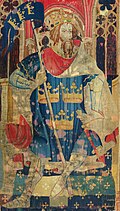
| [[File:Arth tapestry2.jpg|thumb|right|Medieval tapestry showing [[King Arthur]], a legendary [[Britons (historical)|ancient British]] ruler who had a leading role in the [[Matter of Britain]], a [[national myth]] used as propaganda for the ancestral origins of the [[British Royal Family]] and their [[British subject]]s.]]
| |
| | |
| Though [[Wales]] was conquered by England, and its legal system replaced by that of the [[Kingdom of England]] under the [[Laws in Wales Acts 1535–1542]], the Welsh endured as a [[nation]] distinct from [[the English]], and to some degree the [[Cornish people]], although conquered into England by the 11th century, also retained a distinct Brittonic identity and language.<ref name="Consci11">{{Harvnb|Bradshaw|Roberts|2003|p=11}}.</ref> Later, with both an [[English Reformation]] and a [[Scottish Reformation]], [[Edward VI of England]], under the counsel of [[Edward Seymour, 1st Duke of Somerset]], advocated a union with the [[Kingdom of Scotland]], joining England, Wales, and Scotland in a united Protestant Great Britain.<ref name="Ryrie82">{{Harvnb|Ryrie|2006|p=82}}.</ref> The Duke of Somerset supported the unification of the English, Welsh and Scots under the "indifferent old name of Britons" on the basis that their monarchies "both derived from a Pre-Roman British monarchy".<ref name="Ryrie82" />
| |
| | |
| Following the death of [[Elizabeth I of England]] in 1603, the throne of England was inherited by James VI, King of Scots, so that the [[Kingdom of England]] and the [[Kingdom of Scotland]] were united in a [[personal union]] under [[James VI and I|James VI of Scotland and I of England]], an event referred to as the [[Union of the Crowns]].<ref>{{Harvnb|Ross|2002|p=56|quote=''1603:'' James VI becomes [[James VI and I]] in the [[Union of the Crowns]], and leaves Edinburgh for London}}</ref> King James advocated full [[political union]] between England and Scotland,<ref>{{Harvnb|Robbins|1998|p=53}}.</ref> and on 20 October 1604 proclaimed his assumption of the [[style (manner of address)|style]] "King of Great Britain", though this title was rejected by both the [[Parliament of England]] and the [[Parliament of Scotland]],<ref>{{Harvnb|Croft|2003|p=67}}</ref><ref>{{Harvnb|Willson|1963|pp=249–252}}.</ref> and so had no basis in either [[English law]] or [[Scots law]].
| |
| | |
| === Union and the development of Britishness ===
| |
| {{main|Treaty of Union|Britishness}}
| |
| {{See also|Acts of Union 1707|History of the formation of the United Kingdom}}
| |
| {{further|Napoleonic Wars|Royal Navy|British Empire}}
| |
| [[File:Union flag 1606 (Kings Colors).svg|thumb|right|On 12 April 1606, the [[Union Flag]] representing the [[personal union]] between the Kingdoms of [[Kingdom of England|England]] and [[Kingdom of Scotland|Scotland]] was specified in a royal decree. The [[St George's Cross]] and [[Flag of Scotland|St Andrew's saltire]] were "joined together ... to be published to our Subjects."<ref name="flaginst">{{citation | url = http://www.flaginstitute.org/index.php?location=7 | publisher = flaginstitute.org | work = [[Flag Institute]] | access-date = 14 May 2009 | title = British Flags}}</ref>]]
| |
| Despite centuries of military and religious conflict, the Kingdoms of England and Scotland had been "drawing increasingly together" since the [[Protestant Reformation]] of the 16th century and the Union of the Crowns in 1603.<ref name="Colley12">{{Harvnb|Colley|1992|p=12}}.</ref> A broadly shared language, island, monarch, religion and Bible (the [[Authorized King James Version]]) further contributed to a growing cultural alliance between the two sovereign realms and their peoples.<ref name="Colley12" /><ref name="Parli">{{citation | url = http://www.parliament.uk/actofunion/02_03_future.html | publisher = Parliament of the United Kingdom | title = The Future of Scotland: Union? | author = Parliament of the United Kingdom|author-link=Parliament of the United Kingdom | access-date = 22 December 2009 |archive-url = https://web.archive.org/web/20080615125226/http://www.parliament.uk/actofunion/02_03_future.html |archive-date = 15 June 2008}}</ref> The [[Glorious Revolution]] of 1688 resulted in a pair of [[Acts of Parliamen|Acts]] of the English and Scottish legislatures—the [[Bill of Rights 1689]] and [[Claim of Right Act 1689]] respectively—which ensured that the shared [[constitutional monarchy]] of England and Scotland was held only by Protestants. Despite this, although popular with the monarchy and much of the aristocracy, attempts to unite the two states by Acts of Parliament in 1606, 1667, and 1689 were unsuccessful;<ref name="Parli" /> increased political management of Scottish affairs from England had led to "criticism", and strained Anglo-Scottish relations.<ref name="Scot18th">{{citation | url = http://www.bbc.co.uk/politics97/devolution/scotland/briefing/1707.shtml | publisher = BBC | title = Scotland in the Early Eighteenth Century | access-date = 14 May 2009}}</ref><ref>{{Harvnb|Whatley|2006|p=91}}</ref>
| |
| | |
| While English maritime explorations during the [[Age of Discovery]] gave new-found imperial power and wealth to the English and Welsh at the end of the 17th century, Scotland suffered from a long-standing weak economy.<ref name="Scot18th" /> In response, the Scottish kingdom, in opposition to [[William III of England|William II of Scotland (III of England)]], commenced the [[Darien Scheme]], an attempt to establish a Scottish imperial outlet—the [[colony]] of New Caledonia—on the [[isthmus of Panama]].<ref name="Scot18th" /> However, through a combination of disease, Spanish hostility, Scottish mismanagement and opposition to the scheme by the [[East India Company]] and the English government (who did not want to provoke the Spanish into war)<ref name="Scot18th" /><ref name="Birnie">{{Harvnb|Birnie|2006|pp=206–208}}.</ref> this imperial venture ended in "catastrophic failure" with an estimated "25% of Scotland's total liquid capital" lost.<ref name="Scot18th" />
| |
| | |
| The events of the Darien Scheme, and the passing by the English Parliament of the [[Act of Settlement 1701]] asserting the right to choose the [[order of succession]] for English, Scottish and Irish thrones, escalated political hostilities between England and Scotland, and neutralised calls for a united British people. The Parliament of Scotland responded by passing the [[Act of Security 1704]], allowing it to appoint a different monarch to succeed to the Scottish crown from that of England, if it so wished.<ref name="Scot18th" /> The English political perspective was that the appointment of a [[Jacobitism|Jacobite]] monarchy in Scotland opened up the possibility of a Franco-Scottish military conquest of England during the [[Second Hundred Years' War]] and [[War of the Spanish Succession]].<ref name="Scot18th" /> The Parliament of England passed the [[Alien Act 1705]], which provided that Scottish nationals in England were to be treated as [[alien (law)|aliens]] and estates held by Scots would be treated as alien property,<ref>{{citation|publisher=Parliament of the United Kingdom |title=Westminster passes the 'Alien Act', 1705 |url=http://www.parliament.uk/actofunion/03_05_alien.html |access-date=8 February 2009 |author=Parliament of the United Kingdom |author-link=Parliament of the United Kingdom |url-status=dead |archive-url=https://web.archive.org/web/20081017085553/http://www.parliament.uk/actofunion/03_05_alien.html |archive-date=17 October 2008 }}</ref> whilst also restricting the [[import]] of Scottish products into England and its colonies (about half of Scotland's trade).<ref>{{Harvnb|Lynch|1992|pp=311–314}}.</ref> However, the Act contained a provision that it would be suspended if the Parliament of Scotland entered into negotiations regarding the creation of a unified [[Parliament of Great Britain]], which in turn would refund Scottish financial losses on the Darien Scheme.<ref name="Birnie"/>
| |
| | |
| ===Union of Scotland and England===
| |
| Despite opposition from within both Scotland<ref name="Scot18th" /> and England,<ref name="Colley1213">{{Harvnb|Colley|1992|pp=12–13}}.</ref> a [[Treaty of Union]] was agreed in 1706 and was then ratified by the parliaments of both countries with the passing of the [[Acts of Union 1707]]. With effect from 1 May 1707, this created a new sovereign state called the "[[Kingdom of Great Britain]]".<ref>[http://www.parliament.uk/about/living-heritage/evolutionofparliament/legislativescrutiny/ Acts of Union 1707] Parliament of the United Kingdom. Retrieved 9 January 2011</ref><ref>[http://www.nationalarchives.gov.uk/pathways/citizenship/rise_parliament/uniting.htm Uniting the kingdom?] nationalarchives.gov.uk. Retrieved 9 January 2011</ref><ref>[http://www.scottish.parliament.uk/vli/visitingHolyrood/union_exhibition.pdf Making the Act of Union 1707] {{webarchive|url=https://web.archive.org/web/20110511140052/http://www.scottish.parliament.uk/vli/visitingHolyrood/union_exhibition.pdf |date=11 May 2011 }} Parliament of the United Kingdom. Retrieved 9 January 2011</ref> This kingdom "began as a hostile merger", but led to a "full partnership in the most powerful [[going concern]] in the world"; historian [[Simon Schama]] stated that "it was one of the most astonishing transformations in European history".<ref name="Schama">{{cite episode | title = Britannia Incorporated|series= A History of Britain |series-link= Simon Schama's A History of Britain |credits= [[Simon Schama]] (presenter) |network= [[BBC One]] |airdate= 22 May 2001 |number=10 |minutes=3}}</ref>
| |
| | |
| After 1707, a British national identity began to develop, though it was initially resisted, particularly by the English.<ref name="Colley1213" /> The peoples of Great Britain had by the 1750s begun to assume a "layered identity": to think of themselves as simultaneously British and also Scottish, English, or Welsh.<ref name="Colley1213" />
| |
| | |
| [[File:Turner, The Battle of Trafalgar (1822).jpg|thumb|''[[The Battle of Trafalgar (painting)|The Battle of Trafalgar]]'' by [[J. M. W. Turner]] (oil on canvas, 1822–1824) combines events from several moments during the [[Napoleonic Wars]]' [[Battle of Trafalgar]]—a major British naval victory upon which Britishness has drawn influence.]]
| |
| | |
| The terms [[North Briton]] and [[South Briton]] were devised for the Scots and the English respectively, with the former gaining some preference in Scotland, particularly by the economists and philosophers of the [[Scottish Enlightenment]].<ref>{{Harvnb|Campbell|Skinner|1985|p=39}}.</ref><ref>{{Harvnb|Broadie|2003|p=14}}.</ref> Indeed, it was the "Scots [who] played key roles in shaping the contours of British identity";<ref name="Gottlieb15">{{Harvnb|Gottlieb|2007|p=15}}.</ref> "their scepticism about the Union allowed the Scots the space and time in which
| |
| to dominate the construction of Britishness in its early crucial years",<ref>{{Harvnb|O'Neill|2004|p=353}}.</ref> drawing upon the notion of a shared "spirit of liberty common to both Saxon and Celt ... against the usurpation of the Church of Rome".<ref name="Brad1">{{Harvnb|Bradley|2007|pp=119–120}}.</ref> [[James Thomson (poet)|James Thomson]] was a poet and playwright born to a [[Church of Scotland]] minister in the [[Scottish Lowlands]] in 1700 who was interested in forging a common British culture and national identity in this way.<ref name="Brad1" /> In collaboration with [[Thomas Arne]], they wrote ''[[Alfred (Arne opera)|Alfred]]'', an opera about [[Alfred the Great]]'s victory against the [[Viking]]s performed to [[Frederick, Prince of Wales]] in 1740 to commemorate the accession of [[George I of Great Britain|George I]] and the birthday of [[Princess Augusta of Great Britain|Princess Augusta]].<ref>{{Harvnb|Scholes|1970|p=897}}.</ref> "[[Rule, Britannia!]]" was the climactic piece of the opera and quickly became a "[[jingoism|jingoistic]]" British patriotic song celebrating "Britain's supremacy offshore".<ref name="Colley10">{{Harvnb|Colley|1992|p=10}}.</ref> An [[island country]] with a series of victories for the [[Royal Navy]] associated empire and [[naval warfare]] "inextricably with ideals of Britishness and Britain's place in the world".<ref>{{Harvnb|Lincoln|2002|p=73}}</ref>{{sfn|Colley|1992|pp=132–133}}
| |
| | |
| [[Britannia]], the new [[national personification]] of Great Britain, was established in the 1750s as a representation of "nation and empire rather than any single national hero".{{sfn|Whale|Copley|1992|p=81}} On Britannia and British identity, historian Peter Borsay wrote: {{quote|Up until 1797 Britannia was conventionally depicted holding a spear, but as a consequence of the increasingly prominent role of the Royal Navy in the war against the French, and of several spectacular victories, the spear was replaced by a trident... The navy had come to be seen...as the very bulwark of British liberty and the essence of what it was to be British.<ref>Peter Borsay, ''New approaches to social history. Myth, memory, and place: Monmouth and Bath 1750–1900.'' [[Journal of Social History]] March 22, 2006</ref>}}
| |
| | |
| From the Union of 1707 through to the [[Battle of Waterloo]] in 1815, Great Britain was "involved in successive, very dangerous wars with Catholic France",<ref name="Colley18">{{Harvnb|Colley|1992|p=18}}.</ref> but which "all brought enough military and naval victories ... to flatter British pride".<ref name="Colley52">{{Harvnb|Colley|1992|p=52}}.</ref> As the [[Napoleonic Wars]] with the [[First French Empire]] advanced, "the English and Scottish learned to define themselves as similar primarily by virtue of not being French or Catholic".<ref name="Allan17">{{Harvnb|Allan|2008|p=17}}.</ref> In combination with sea power and empire, the notion of Britishness became more "closely bound up with Protestantism",<ref name="Colley8">{{Harvnb|Colley|1992|p=8}}.</ref> a cultural commonality through which the English, Scots and Welsh became "fused together, and remain[ed] so, despite their many cultural divergences".<ref name="Colley386">{{Harvnb|Colley|1992|p=368}}.</ref>
| |
| | |
| The neo-classical monuments that proliferated at the end of the 18th century and the start of the 19th century, such as [[The Kymin]] at [[Monmouth]], were attempts to meld the concepts of Britishness with the [[Greco-Roman world|Greco-Roman empires]] of [[classical antiquity]]. The new and expanding [[British Empire]] provided "unprecedented opportunities for upward mobility and the accumulations of wealth", and so the "Scottish, Welsh and Irish populations were prepared to suppress nationalist issues on pragmatic grounds".{{sfn|Rojek|2008|p=8}} The British Empire was "crucial to the idea of a British identity and to the self-image of Britishness".<ref>{{Harvnb|Powell|2002|p=xi}}</ref> Indeed, the Scottish welcomed Britishness during the 19th century "for it offered a context within which they could hold on to their own identity whilst participating in, and benefiting from, the expansion of the [British] Empire".<ref name="Williams17" /> Similarly, the "new emphasis of Britishness was broadly welcomed by the Welsh who considered themselves to be the lineal descendants of the ancient Britons – a word that was still used to refer exclusively to the Welsh".<ref name="Williams17">{{Harvnb|Williams|2006|p=17}}.</ref> For the English, however, by the [[Victorian era]] their enthusiastic adoption of Britishness had meant that, for them, Britishness "meant the same as 'Englishness'",<ref>{{Harvnb|Hilton|2006|p=714}}.</ref>{{sfn|Caunce et al. 2004|p=92}} so much so that "Englishness and Britishness" and "'England' and 'Britain' were used interchangeably in a variety of contexts".<ref name="Anderson34">{{Harvnb|Anderson|2006|p=34}}.</ref> Britishness came to borrow{{clarify|date=January 2016}} heavily from English political history because England had "always been the dominant component of the British Isles in terms of size, population and power"; [[Magna Carta]], [[common law]] and hostility to [[continental Europe]] were English factors that influenced British sensibilities.<ref name="Langlands">{{citation | first=Rebecca | last = Langlands | year = 1999 | title = Britishness or Englishness? The Historical Problem of National Identity in Britain|journal=Nations and Nationalism|volume=5|pages=53–69|doi=10.1111/j.1354-5078.1999.00053.x}}</ref><ref name="Ichijo26">{{harvnb|Ichijo|Spohn|2005|p=26}}</ref>
| |
| | |
| ===Union with Ireland===
| |
| The [[Acts of Union 1800|political union in 1800]] of the predominantly Catholic [[Kingdom of Ireland]] with Great Britain, coupled with the outbreak of peace with France in the early 19th century, challenged the previous century's concept of militant Protestant Britishness.<ref name="Colley322">{{Harvnb|Colley|1992|p=322}}.</ref><ref name="Spohn22" /> The new, expanded [[United Kingdom of Great Britain and Ireland]] meant that the state had to re-evaluate its position on the civil rights of Catholics, and extend its definition of Britishness to the [[Irish people]].<ref name="Spohn22">{{Harvnb|Ichijo|Spohn|2005|p=22}}</ref><ref name="Howe40">{{Harvnb|Howe|2002|p=40}}.</ref> Like the terms that had been invented at the time of the Acts of Union 1707, "[[West Brit]]on" was introduced for the Irish after 1800. In 1832 [[Daniel O'Connell]], an Irish politician who campaigned for [[Catholic Emancipation]], stated in Britain's [[House of Commons of the United Kingdom|House of Commons]]: {{quote|[[Irish people|The people of Ireland]] are ready to become a portion of the [[British Empire]], provided they be made so in reality and not in name alone; they are ready to become a kind of West Briton if made so in benefits and justice; but if not, we are Irishmen again.<ref>{{Harvnb|Hall|Rose|2006|p=93}}.</ref>}}
| |
| | |
| [[History of Ireland (1801–1923)|Ireland, from 1801 to 1923]], was marked by a succession of economic and political mismanagement and neglect, which marginalised the Irish,<ref name="Howe40" /> and advanced [[Irish nationalism]]. In the forty years that followed the Union, successive British governments grappled with the problems of governing a country which had as [[Benjamin Disraeli]], a staunch anti-Irish and anti-Catholic member of the Conservative party with a virulent racial and religious prejudice towards Ireland<ref name="Blake2012">{{cite book|author=Robert Blake|title=Disraeli|url=https://books.google.com/books?id=BmB4jYrsiQoC&pg=PT153|date=19 April 2012|publisher=Faber & Faber|isbn=978-0-571-28755-0|pages=153–}}</ref> put it in 1844, "a starving population, an absentee aristocracy, and an alien Church, and in addition the weakest executive in the world".<ref>{{Harvnb|James|1978|p=40}}.</ref> Although the vast majority of [[Unionism in Ireland|Unionists in Ireland]] proclaimed themselves "simultaneously Irish and British", even for them there was a strain upon the adoption of Britishness after the [[Great Famine (Ireland)|Great Famine]].<ref>{{Harvnb|Howe|2002|p=41}}.</ref>
| |
| | |
| War continued to be a unifying factor for the people of Great Britain: British jingoism re-emerged during the [[Boer Wars]] in [[southern Africa]].<ref name="Ward96">{{Harvnb|Ward|2004|p=96}}</ref><ref name="Ward16">{{Harvnb|Ward|2004|p=16}}</ref> The experience of military, political and economic power from the rise of the British Empire led to a very specific drive in artistic technique, taste and sensibility for Britishness.<ref name="taste">{{citation | url = http://www.britishempire.co.uk/art/artandempire.htm | title = Art and Empire | publisher = britishempire.co.uk | access-date = 24 October 2008 | last = McKenzie | first = John}}</ref> In 1887, [[Frederic Harrison]] wrote: {{quote|Morally, we Britons plant the British flag on every peak and pass; and wherever the Union Jack floats there we place the cardinal British institutions—tea, tubs, sanitary appliances, lawn tennis, and churches.<ref name="Anderson34" />}}
| |
| | |
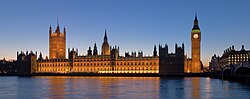
| The [[Catholic Relief Act 1829]] reflected a "marked change in attitudes" in Great Britain towards Catholics and Catholicism.<ref name="Colley324">{{Harvnb|Colley|1992|pp=324–325}}.</ref> A "significant" example of this was the collaboration between [[Augustus Welby Northmore Pugin|Augustus Welby Pugin]], an "ardent Roman Catholic" and son of a Frenchman, and Sir [[Charles Barry]], "a confirmed Protestant", in redesigning the [[Palace of Westminster]]—"the building that most enshrines ... Britain's national and imperial pre-tensions".<ref name="Colley324" /> Protestantism gave way to [[imperialism]] as the leading element of British national identity during the Victorian and [[Edwardian era]]s,<ref name="Ward16" /> and as such, a series of royal, imperial and national celebrations were introduced to the British people to assert imperial British culture and give themselves a sense of uniqueness, superiority and national consciousness.<ref name="Spohn22" /><ref name="Ward16" /><ref>{{Harvnb|Bush|2006|p=177}}.</ref> [[Empire Day]] and jubilees of [[Queen Victoria]] were introduced to the British [[middle class]],<ref name="Ward16" /> but quickly "merged into a national 'tradition'".<ref>{{Harvnb|MacKenzie|1989|p=135}}.</ref>
| |
| | |
| === Modern period ===
| |
| {{See also|British nationality law}}
| |
| {{further|Immigration to the United Kingdom since 1922}}
| |
| [[File:30a Sammlung Eybl Großbritannien. Alfred Leete (1882–1933) Britons (Kitchener) wants you (Briten Kitchener braucht Euch). 1914 (Nachdruck), 74 x 50 cm. (Slg.Nr. 552).jpg|thumb|right|A famous [[World War I|First World War]]-era [[Lord Kitchener Wants You|recruitment poster]], stressing the concept of British national identity]]
| |
| | |
| The [[World War I|First World War]] "reinforced the sense of Britishness" and patriotism in the early 20th century.<ref name="Spohn22" /><ref name="Ward96" /> Through war service (including conscription in Great Britain), "the English, Welsh, Scots and Irish fought as British".<ref name="Spohn22" /> The aftermath of the war institutionalised British national commemoration through [[Remembrance Sunday]] and the [[Poppy Appeal]].<ref name="Spohn22" /> The [[World War II|Second World War]] had a similar unifying effect upon the British people,<ref name="Spohn23">{{Harvnb|Ichijo|Spohn|2005|p=23}}</ref> however, its outcome was to recondition Britishness on a basis of [[Democracy|democratic values]] and its marked contrast to [[Europeanism]].<ref name="Spohn23" /> Notions that the British "constituted an Island race, and that it stood for democracy were reinforced during the war and they were circulated in the country through [[Winston Churchill]]'s speeches, history books and newspapers".<ref name="Spohn23" />
| |
| | |
| At its international zenith, "Britishness joined peoples around the world in shared traditions and common loyalties that were strenuously maintained".<ref>{{Harvnb|Darian-Smith et al. 2007|p=1}}.</ref> But following the two world wars, the British Empire experienced rapid [[decolonisation]]. The secession of the [[Irish Free State]] from the United Kingdom meant that Britishness had lost "its Irish dimension" in 1922,<ref name="Spohn23" /> and the shrinking empire supplanted by independence movements dwindled the appeal of British identity in the [[Commonwealth of Nations]] during the mid-20th century.<ref>{{Harvnb|Darian-Smith et al. 2007|p=236}}.</ref>
| |
| | |
| Since the [[British Nationality Act 1948]] and the subsequent mass [[immigration to the United Kingdom since 1922|immigration to the United Kingdom]] from the Commonwealth and elsewhere in the world, "the expression and experience of cultural life in Britain has become fragmented and reshaped by the influences of gender, ethnicity, class and region".<ref>{{Harvnb|Christopher|1999|p=xi}}.</ref> Furthermore, the United Kingdom's membership of the [[European Economic Community]] in 1973 eroded the concept of Britishness as distinct from [[continental Europe]].<ref>{{Harvnb|Darian-Smith et al. 2007|p=3}}.</ref><ref>{{Harvnb|Powell|2002|p=240}}.</ref> As such, since the 1970s "there has been a sense of crisis about what it has meant to be British",<ref name="Ward1">{{Harvnb|Ward|2004|p=1}}.</ref> exacerbated by growing demands for greater political autonomy for [[Northern Ireland]], [[Scotland]], and [[Wales]].<ref name="Spohn25">{{Harvnb|Ichijo|Spohn|2005|p=25}}</ref>
| |
| | |
| The late 20th century saw major changes to the [[politics of the United Kingdom]] with the establishment of [[devolution|devolved]] national administrations for Northern Ireland, Scotland, and Wales following pre-legislative [[Referendums in the United Kingdom|referendums]].<ref>{{citation | url = http://publius.oxfordjournals.org/cgi/content/abstract/28/1/217 | archive-url = https://web.archive.org/web/20090617212544/http://publius.oxfordjournals.org/cgi/content/abstract/28/1/217 | url-status = dead | archive-date = 17 June 2009 | title = Reforging the Union: Devolution and Constitutional Change in the United Kingdom | access-date = 4 February 2009|journal=Publius: The Journal of Federalism|volume=28|issue=1|page=217 | author = Keating, Michael | date = 1 January 1998 | doi=10.1093/oxfordjournals.pubjof.a029948}}</ref> Calls for greater autonomy for the four [[countries of the United Kingdom]] had existed since their original union with each other, but gathered pace in the 1960s and 1970s.<ref name="Spohn25" /> Devolution has led to "increasingly assertive Scottish, Welsh and Irish national identities",<ref name="Ward180">{{Harvnb|Ward|2004|p=180}}.</ref> resulting in more diverse cultural expressions of Britishness,<ref>{{Harvnb|Christopher|1999|pp=xi–xii}}.</ref> or else its outright rejection: [[Gwynfor Evans]], a [[Welsh nationalism|Welsh nationalist]] politician active in the late 20th century, rebuffed Britishness as "a political synonym for Englishness which extends English culture over the Scots, Welsh and the Irish".<ref>{{cite web|url=https://www.bbc.co.uk/wales/southeast/halloffame/public_life/gwynfor_evans.shtml |title=South East Wales Public Life – Dr Gwynfor Evans |publisher=BBC |access-date=13 April 2010 |url-status=dead |archive-url=https://web.archive.org/web/20110629025706/http://www.bbc.co.uk/wales/southeast/halloffame/public_life/gwynfor_evans.shtml |archive-date=29 June 2011 }}</ref>
| |
| [[File:Ve Day Celebrations in London, England, UK, 8 May 1945 D24587.jpg|thumb|Britons gathered in [[Whitehall]] to hear [[Winston Churchill]]'s victory speech on 8 May 1945]]
| |
| In 2004 Sir [[Bernard Crick]], political theorist and [[democratic socialism|democratic socialist]] tasked with developing the [[life in the United Kingdom test]] said: {{quote|Britishness, to me, is an overarching political and legal concept: it signifies allegiance to the laws, government and broad moral and political concepts—like tolerance and freedom of expression—that hold the United Kingdom together.<ref name="Brad34" /><ref>{{citation | url = https://www.theguardian.com/politics/2004/apr/12/immigration.immigrationandpublicservices | work = The Guardian | date = 12 April 2004 | access-date = 19 May 2009 | title = All this talk of Britain is so ... English | last = Crick | first = Bernard|author-link=Bernard Crick | location=London}}</ref>}}
| |
| | |
| [[Gordon Brown]] initiated a debate on British identity in 2006.<ref name="Brown">{{citation | url = http://news.bbc.co.uk/1/hi/uk_politics/4611682.stm | title = Brown speech promotes Britishness | work = BBC News | date = 14 January 2006 | access-date = 17 May 2009}}</ref> Brown's speech to the [[Fabian Society]]'s Britishness Conference proposed that British values demand a new constitutional settlement and symbols to represent a modern patriotism, including a new youth community service scheme and a [[British Day]] to celebrate.<ref name="Brown" /> One of the central issues identified at the Fabian Society conference was how the English identity fits within the framework of a devolved United Kingdom.<ref name="Brown" /> An expression of [[Her Majesty's Government]]'s initiative to promote Britishness was the inaugural [[Veterans' Day (United Kingdom)|Veterans' Day]] which was first held on 27 June 2006. As well as celebrating the achievements of armed forces veterans, Brown's speech at the first event for the celebration said: {{quote|Scots and people from the rest of the UK share the purpose that Britain has something to say to the rest of the world about the values of freedom, democracy and the dignity of the people that you stand up for. So at a time when people can talk about football and devolution and money, it is important that we also remember the values that we share in common.<ref>{{citation | title = Brown pinning his hopes on a new regiment | work = [[The Herald (Glasgow)|The Herald]] | date = 27 June 2006 | url = http://www.theherald.co.uk/news/64828.html | access-date = 15 October 2006 | url-status = dead | archive-url = https://archive.today/20120917102727/http://www.theherald.co.uk/news/64828.html | archive-date = 17 September 2012 | df = dmy-all }}</ref>}}
| |
| | |
| In 2018, the [[Windrush scandal]] illustrated complex developments in British peoplehood, when it was revealed hundreds of Britons had been wrongfully deported.<ref>{{Cite news|url=https://www.ft.com/content/209782f4-4254-11e8-93cf-67ac3a6482fd|title=May says sorry to Caribbean leaders over Windrush scandal|work=[[Financial Times]]|author=Robert Wright|date=17 April 2018|quote=Theresa May told Caribbean leaders face to face on Tuesday that she was “genuinely sorry” for the harassment of up to 50,000 British people of Caribbean origin, who have been asked to prove they have the right to stay in the UK.}}</ref> With roots in the break-up of the empire, and post-war rebuilding; the [[Windrush generation]] had arrived as CUKC citizens in the 1950s and 1960s. Born in former [[British colonies]], they settled in the UK before 1973, and were granted “right of abode” by the [[Immigration Act 1971]].<ref name="windrushreport2020">{{Cite web|url=https://assets.publishing.service.gov.uk/government/uploads/system/uploads/attachment_data/file/876336/6.5577_HO_Windrush_Lessons_Learned_Review_LoResFinal.pdf|title=Windrush Lessons Learned Review|author=Wendy Williams, [[Her Majesty's Crown Prosecution Service Inspectorate|HMCPSI]]|date=March 2020|publisher=[[UK Home Office]]|quote=They were from a group of British people who held what became CUKC (citizens of the UK and Colonies) citizenship, and their children, who came to the UK between 1948 and 1973, mostly from Caribbean countries ... [[Chartered Institute of Housing]]: "the Windrush Britons often had compelling anecdotal and other evidence demonstrating their lengthy residence in the UK".}}</ref> Having faced removal, or been deported, many British people of [[African Caribbean]] heritage suffered with loss of home, livelihood, and health.<ref name="windrushreport2020" /> As a result of the political scandal, many institutions and elected politicians publicly affirmed that these individuals, while not legally holding British citizenship or nationality, were, in fact, British people. These included British Prime Minister [[Theresa May]],<ref>{{Cite news|url=https://www.bbc.com/news/uk-politics-43806710|title=Windrush: Theresa May hits back at Labour over landing cards|publisher=[[BBC]]|date=18 April 2018|quote=The prime minister had begun the session with a fresh apology to the Windrush migrants, saying: "These people are British. They are part of us."}}</ref> London Mayor [[Sadiq Khan]],<ref>{{Cite web|url=https://www.london.gov.uk/press-releases/mayoral/mayor-government-is-leaving-teenagers-in-limbo|title=Sadiq Khan: Government must act to avoid second Windrush-style scandal|publisher=[[London Assembly]]|date=14 May 2018|quote=Khan: "something we already know to be true – that they are British citizens, that they are Londoners.”}}</ref> Her Majesty's [[Her Majesty's Crown Prosecution Service Inspectorate|CPS Inspectorate]] Wendy Williams and her [[House of Commons]]-ordered ''Windrush Lessons Learned Review'',<ref>{{Cite news|url=https://www.belfasttelegraph.co.uk/news/uk/windrush-review-key-findings-39058104.html|title=Windrush Review: Key findings|work=[[Belfast Telegraph]]|author=Joe Gammie|date=19 March 2020|quote=Ministers should apologise and admit ‘serious harm’ was inflicted on British people. The first recommendation of the report is that ministers on behalf of the [[Home Office]] admit that serious harm was inflicted on people who are British and to provide an “unqualified apology” to those affected and the wider [[British African-Caribbean people|black African-Caribbean community]].}}</ref><ref>{{Cite web|url=https://www.itv.com/news/2020-03-19/windrush-scandal-foreseeable-and-avoidable/|title=Windrush scandal 'foreseeable and avoidable' and victims let down by 'systematic operational failings' |publisher=[[ITV News]]|date=19 March 2020}}</ref> the [[Chartered Institute of Housing]],<ref name="windrushreport2020" /> [[Amnesty International]],<ref>{{Cite web|url=https://www.amnesty.org.uk/press-releases/windrush-one-year-scandal-far-over|title=Windrush one year on: Scandal 'far from over'|date=15 April 2019|work=[[Amnesty International]]|quote=It risks doing precisely what was done when the seeds of the Windrush Scandal were first sown – that is leaving British people treated as mere guests in the country of their home}}</ref> [[University of Oxford]]'s social geographer [[Danny Dorling]],<ref>{{cite book|author1=Danny Dorling|author2=Sally Tomlinson|author-link1=Danny Dorling|title=Rule Britannia: Brexit and the End of Empire|chapter=The Windrush Scandal|isbn=978-1785904530|date=2016|publisher=[[Biteback Publishing]]|quote=It was unfortunate (for the [[UK government]], not for the deportees) that the biennial [[Commonwealth Heads of Government Meeting]] was in London that week and they were suitably outraged at the threats of deportation of these British people ... In 2018, the [[independent Chief Inspector of Borders and Immigration]] reported that some 140,000 British people had been told they faced removal as they had no official legal status in the country.}}</ref> and other public figures.<ref>{{Cite news|url=https://www.spectator.co.uk/article/why-theresa-may-is-to-blame-for-the-windrush-scandal|title=Why Theresa May is to blame for the Windrush scandal|work=[[The Spectator]]|author=Brendan O'Neill|author-link=Brendan O'Neill (columnist)|date=17 April 2018|quote=As a result, Windrush people who are effectively paperless — because they were told they could stay, because they were told they didn't need papers, because they feel and ''are'' British — are now having their lives turned upside down.}}</ref><ref>{{Cite news|url=https://www.telegraph.co.uk/news/2018/04/18/windrush-scandal-heartbreaking-should-not-used-excuse-stop-sensible/|title=The Windrush scandal is heartbreaking, but it should not be used as an excuse to stop sensible migration controls|work=[[The Daily Telegraph]]|author=Nick Timothy|author-link=Nick Timothy|date=18 April 2018|quote=The people of the Windrush generation are here legally, they are British, and their experience is intolerable.}}</ref>
| |
| | |
| == Geographic distribution ==
| |
| {{Main|British diaspora}}
| |
| {{See also|English-speaking world|List of countries by British immigrants}}
| |
| [[File:British people around the world.svg|thumb|300x300px|Map of the British diaspora in the world by population (includes people with British ancestry or citizenship).<br>
| |
| {{Legend|#000000|United Kingdom}}
| |
| {{Legend|#000b44|+ 10,000,000}}
| |
| {{Legend|#002a9e|+ 1,000,000}}
| |
| {{Legend|#366bff|+ 100,000}}
| |
| {{Legend|#7bb1ff|+ 10,000}}]]
| |
| | |
| The earliest migrations of Britons date from the 5th and 6th centuries AD, when Brittonic Celts fleeing the Anglo-Saxon invasions migrated what is today northern France and north western Spain and forged the colonies of [[Brittany]] and [[Britonia]]. Brittany remained independent of France until the early 16th century and still retains a distinct Brittonic culture and language, whilst Britonia in modern [[Galicia (Spain)|Galicia]] was absorbed into Spanish states by the end of the 9th century AD.
| |
| | |
| Britons – people with British citizenship or of British descent – have a significant presence in a number of countries other than the United Kingdom, and in particular in those with historic connections to the [[British Empire]]. After the [[Age of Discovery]] the British were one of the earliest and largest communities to emigrate out of [[Europe]], and the British Empire's expansion during the first half of the 19th century triggered an "extraordinary dispersion of the British people", resulting in particular concentrations "in [[Australasia]] and [[North America]]".<ref name="BritDis47">{{Harvnb|Ember et al. 2004|p=47}}.</ref>
| |
| | |
| The British Empire was "built on waves of migration overseas by British people",<ref name="Marsh254">{{harvnb|Marshall|2001|p=254}}.</ref> who left the United Kingdom and "reached across the globe and permanently affected population structures in three continents".<ref name="BritDis47" /> As a result of the [[British colonisation of the Americas]], what became the [[United States]] was "easily the greatest single destination of emigrant British", but in [[Australia]] the British experienced a [[birth rate]] higher than "anything seen before" resulting in the displacement of [[indigenous Australians]].<ref name="BritDis47" />
| |
| | |
| In colonies such as [[Southern Rhodesia]], [[British East Africa]] and [[Cape Colony]], permanently resident British communities were established and whilst never more than a numerical minority these Britons "exercised a dominant influence" upon the culture and politics of those lands.<ref name="Marsh254" /> In Australia, [[Canada]] and [[New Zealand]] "people of British origin came to constitute the majority of the population" contributing to these states becoming integral to the [[Anglosphere]].<ref name="Marsh254" />
| |
| | |
| The [[United Kingdom Census 1861]] estimated the size of the overseas British to be around 2.5 million, but concluded that most of these were "not conventional settlers" but rather "travellers, merchants, professionals, and military personnel".<ref name="BritDis47" /> By 1890, there were over 1.5 million further UK-born people living in Australia, Canada, New Zealand and [[South Africa]].<ref name="BritDis47" /> A 2006 publication from the [[Institute for Public Policy Research]] estimated 5.6 million Britons lived outside of the United Kingdom.<ref name="BritsAbroad">{{citation | title = Brits Abroad| url= http://news.bbc.co.uk/2/shared/spl/hi/in_depth/brits_abroad/html/| work=[[BBC News]] | date=11 December 2006 | access-date=13 April 2009}}</ref><ref>{{citation|last=Sriskandarajah |first=Dhananjayan |author2=Drew, Catherine |title=Brits Abroad: Mapping the scale and nature of British emigration |url=http://www.ippr.org.uk/publicationsandreports/publication.asp?id=509 |date=11 December 2006 |publisher=[[Institute for Public Policy Research|ippr.org.uk]] |access-date=13 April 2009 |url-status=dead |archive-url=https://web.archive.org/web/20080524215729/http://www.ippr.org.uk/publicationsandreports/publication.asp?id=509 |archive-date=24 May 2008 }}</ref>
| |
| | |
| Outside of the United Kingdom and its [[British Overseas Territories|Overseas Territories]], the largest proportions of people of self-identified [[British diaspora|ethnic British descent]] in the world are found in New Zealand (59%),<ref name=BritNZ/> Australia (46%)<ref name=BritAus/> and Canada (31%),<ref name=BritCan/> followed by a considerably smaller minority in the [[United States]] (10.7%)<ref name=BritUS/> and [[Commonwealth Caribbean|parts of the Caribbean]]. Hong Kong has the highest proportion of British citizens outside of the United Kingdom and its Overseas Territories, with 47% of Hong Kong residents holding a British National (Overseas) citizenship or a British citizenship.<ref name="auto1"/>
| |
| | |
| === Australia ===
| |
| {{See also|First Fleet|Anglo-Celtic Australian}}
| |
| [[File:Flag of Australia.svg|thumb|right|The [[flag of Australia]] was approved by Australian and British authorities, and features a [[Union Flag]]—the [[flag of the United Kingdom]]—in the canton. Australia has one of the largest concentrations of people of British heritage.]]
| |
| From the [[History of Australia (1788–1850)|beginning of Australia's colonial period]] until after the Second World War, people from the United Kingdom made up a large majority of people coming to Australia, meaning that many people born in Australia can trace their origins to Britain.<ref name="ausbrit">{{citation | url = http://www.abs.gov.au/AUSSTATS/[email protected]/2f762f95845417aeca25706c00834efa/af5129cb50e07099ca2570eb0082e462!OpenDocument | title = Population characteristics: Ancestry of Australia's population | author = Australian Bureau of Statistics|author-link=Australian Bureau of Statistics | publisher = abs.gov.au | date = 3 June 2003 | access-date = 27 May 2009}}</ref> The colony of [[New South Wales]], founded on 26 January 1788, was part of the eastern half of Australia claimed by the Kingdom of Great Britain in 1770, and initially settled by Britons through [[penal transportation]]. Together with another five largely self-governing Crown Colonies, the [[federation of Australia]] was achieved on 1 January 1901. | |
| | |
| Its history of British dominance meant that Australia was "grounded in British culture and political traditions that had been transported to the Australian colonies in the nineteenth century and become part of colonial culture and politics".{{sfn|Galligan et al. 2001|p=113}} Australia maintains the [[Westminster system]] of Parliamentary Government and [[Elizabeth II]] as [[Queen of Australia]]. Until 1987, the national status of Australian citizens was formally described as "British Subject: Citizen of Australia". Britons continue to make up a substantial proportion of immigrants.<ref name="ausbrit" />
| |
| | |
| By 1947, Australia was fundamentally British in origin with 7,524,129 or 99.3% of the population declaring themselves as European.<ref>[https://books.google.co.uk/books?id=AE-AZucUOCcC&pg=PA1289&dq=1947+australia+census+race+european&hl=en&sa=X&ved=0ahUKEwik6cKD3_HgAhVXSRUIHeXaBU0Q6AEIJTAA#v=onepage&q=1947%20australia%20census%20race%20european&f=false Official Year Book of the Commonwealth of Australia No. 37] – 1946 and 1947</ref> In the most recent [[2016 Australian census|2016]] census, a large proportion of Australians self-identified with British ancestral origins, including 36.1% or 7,852,224 as [[English Australians|English]] and 9.3% (2,023,474) as [[Scottish Australians|Scottish]] alone.<ref>[http://www.abs.gov.au/ausstats/[email protected]/Lookup/by%20Subject/2071.0~2016~Main%20Features~Cultural%20Diversity%20Article~60 THE ANCESTRIES OF AUSTRALIANS] – Census of Population and Housing: Reflecting Australia – Stories from the Census, 2016</ref><ref>[http://www.abs.gov.au/ausstats/[email protected]/Lookup/by%20Subject/2071.0~2016~Main%20Features~Cultural%20Diversity%20Data%20Summary~30 Census of Population and Housing: Reflecting Australia] – Ancestry 2016</ref> A substantial proportion —33.5%— chose to identify as ‘Australian’, the census Bureau has stated that most of these are of [[Anglo-Celtic Australians|Anglo-Celtic]] colonial stock.<ref>Australian Bureau of Statistics has stated that most who list "Australian" as their ancestry are part of the "[[Anglo-Celtic Australians|Anglo-Celtic]]" group. {{cite web|url=http://www.abs.gov.au/Ausstats/[email protected]/94713ad445ff1425ca25682000192af2/49f609c83cf34d69ca2569de0025c182!OpenDocument |title=Feature Article – Ethnic and Cultural Diversity in Australia (Feature Article) |access-date=24 June 2008 |url-status=live |archive-url=https://web.archive.org/web/20160420205113/http://www.abs.gov.au/Ausstats/abs%40.nsf/94713ad445ff1425ca25682000192af2/49f609c83cf34d69ca2569de0025c182%21OpenDocument |archive-date=20 April 2016 |date=January 1995 }}</ref> | |
| | |
| All [[States and territories of Australia|6 states of Australia]] retain the flag of the United Kingdom in the canton of their respective flags.
| |
| | |
| === British overseas territories ===
| |
| The approximately 250,000 people of the [[British overseas territories]] are British by [[citizenship]], via origins or [[naturalisation]]. Along with aspects of common British identity, each of them has their own distinct identity shaped in the respective particular circumstances of political, economic, ethnic, social and cultural history. For instance, in the case of the [[Falkland Islanders]], Lewis Clifton the [[Speaker (politics)|Speaker]] of the [[Legislative Council of the Falkland Islands]], explains: {{quote|British cultural, economic, social, political and educational values create a unique British-like, Falkland Islands. Yet Islanders feel distinctly different from their fellow citizens who reside in the United Kingdom. This might have something to do with geographical isolation or with living on a smaller island—perhaps akin to those Britons not feeling European.<ref>{{harvnb|Clifton|1999|pp=16–19}}.</ref> }}
| |
| In contrast, for the majority of the [[Gibraltarians]], who live in [[Gibraltar]], there is an "insistence on their Britishness" which "carries excessive loyalty" to Britain.<ref name="inde">{{citation | url = https://www.independent.co.uk/opinion/leading-articles/gibraltars-people-ought-to-accept-this-sensible-deal-659298.html | archive-url = https://web.archive.org/web/20090618205224/http://www.independent.co.uk/opinion/leading-articles/gibraltars-people-ought-to-accept-this-sensible-deal-659298.html | url-status = dead | archive-date = 18 June 2009 | work = The Independent | date = 4 February 2002 | access-date = 28 May 2009 | title = Gibraltar's people ought to accept this sensible deal | location=London}}</ref> The sovereignty of Gibraltar has been a point of contention in [[Spain–United Kingdom relations]], but an overwhelming number of Gibraltarians embrace Britishness with strong conviction, in direct opposition to [[disputed status of Gibraltar|Spanish territorial claims]].<ref name="inde" /><ref>{{citation | url = http://news.bbc.co.uk/2/hi/europe/country_profiles/3851047.stm | title = Regions and territories: Gibraltar | access-date = 20 December 2007 | date = 18 July 2007 | work = [[BBC News]]}}</ref><ref>{{citation | url = https://www.theguardian.com/gibraltar/story/0,,634007,00.html | title = Gibraltar | author = Mark Oliver | access-date = 20 December 2007|author2=Sally Bolton|author3=Jon Dennis|author4=Matthew Tempest | date = 4 August 2004 | work = The Guardian | location=London}}</ref>
| |
| | |
| === Canada ===
| |
| {{See also|Canadians}}
| |
| [[File:VE Day celebrations on Bay Street 1945.jpg|thumb|[[Victory in Europe Day|V-E Day]] celebrations in [[Toronto]], May 1945]]
| |
| | |
| Canada traces its statehood to the [[French colonisation of the Americas|French]], [[British colonisation of the Americas|English, and Scottish]] expeditions of North America from the late-15th century. France ceded nearly all of [[New France]] in 1763 after the [[Seven Years' War]], and so after the [[United States Declaration of Independence]] in 1776, [[Province of Quebec (1763–1791)|Quebec]] and [[Nova Scotia]] formed "the nucleus of the colonies that constituted Britain's remaining stake on the North American continent".<ref name="Marsh34">{{harvnb|Marshall|2001|p=34}}</ref> [[British North America]] attracted the [[United Empire Loyalist]]s, Britons who migrated out of what they considered the "rebellious" [[United States]], increasing the size of British communities in what was to become Canada.<ref name="Marsh34" />
| |
| | |
| [[File:TimbrePosteCanada5centsElizabethIIWilding1954.jpg|thumb|upright=0.75|left|Postage stamp with portrait of [[Elizabeth II|Queen Elizabeth II]], 1954]]
| |
| In 1867 there was a union of three colonies with British North America which together formed the [[Canadian Confederation]], a [[federalism|federal]] [[dominion]].<ref>{{citation|title=Territorial evolution |work=Atlas of Canada |publisher=Natural Resources Canada |url=http://atlas.nrcan.gc.ca/site/english/maps/reference/anniversary_maps/terr_evol |access-date=9 October 2007 |quote=In 1867, the colonies of Canada, Nova Scotia and New Brunswick are united in a federal state, the Dominion of Canada.... |url-status=dead |archive-url=https://web.archive.org/web/20070809154930/http://atlas.nrcan.gc.ca/site/english/maps/reference/anniversary_maps/terr_evol |archive-date=9 August 2007 }}</ref><ref>{{citation|title=Canada: History |work=Country Profiles |author=Commonwealth Secretariat |publisher=thecommonwealth.org |url=http://www.thecommonwealth.org/YearbookInternal/145152/history/ |access-date=9 October 2007 |quote=The British North America Act of 1867 brought together four British colonies ... in one federal Dominion under the name of Canada. |url-status=dead |archive-url=https://web.archive.org/web/20071012021238/http://www.thecommonwealth.org/YearbookInternal/145152/history/ |archive-date=12 October 2007 |author-link=Commonwealth Secretariat }}</ref><ref>{{cite encyclopedia|author=Norman Hillmer; W. David MacIntyre|url=https://www.thecanadianencyclopedia.ca/en/article/commonwealth|title=Commonwealth|encyclopedia=[[The Canadian Encyclopedia]]|quote=With "Confederation" in 1867, Canada became the first federation in the British Empire|access-date=25 August 2019}}</ref> This began an [[Territorial evolution of Canada|accretion of additional provinces and territories]] and a process of increasing autonomy from the United Kingdom, highlighted by the [[Statute of Westminster 1931]] and culminating in the [[Canada Act 1982]], which severed the vestiges of legal dependence on the [[parliament of the United Kingdom]]. Nevertheless, it is recognised that there is a "continuing importance of Canada's long and close relationship with Britain";<ref>{{harvnb|Buckner|2008|p=1}}.</ref> large parts of Canada's modern population claim "British origins" and the cultural impact of the British upon Canada's institutions is profound.<ref>{{harvnb|Buckner|2008|p=160}}.</ref>
| |
| | |
| It was not until 1977 that the phrase "A Canadian citizen is a British subject" ceased to be used in Canadian passports. The [[politics of Canada]] are strongly influenced by British political culture.<ref>{{citation | last = Victoria| author-link=Queen Victoria| date=29 March 1867| title=Constitution Act, 1867| series=III.15| location=Westminster| publisher=Queen's Printer| url = http://www.solon.org/Constitutions/Canada/English/ca_1867.html| access-date=15 January 2009| ref=CITEREF_Victoria_1867}}</ref><ref name="MacLeod17">{{citation | last = MacLeod| first=Kevin S.| author-link=Kevin S. MacLeod| title=A Crown of Maples| place=Ottawa| publisher=Queen's Printer for Canada| year=2008| edition=1| page=17| url = http://www.pch.gc.ca/pgm/ceem-cced/fr-rf/crnCdn/crn_mpls-eng.pdf| isbn=978-0-662-46012-1| ref=CITEREF_MacLeod_2008}}</ref> Although significant modifications have been made, Canada is governed by a democratic parliamentary framework comparable to the [[Westminster system]], and retains [[Elizabeth II]] as [[Monarchy of Canada|The Queen of Canada]] and Head of State.<ref>{{citation | url = http://www.pch.gc.ca/pgm/ceem-cced/fr-rf/index-eng.cfm| last=Department of Canadian Heritage| title=Ceremonial and Canadian Symbols Promotion > The Canadian Monarchy| publisher=Queen's Printer for Canada| access-date=14 May 2009}}</ref><ref name="Buck1">{{citation | url = http://www.royal.gov.uk/MonarchAndCommonwealth/Canada/Canada.aspx| last=The Royal Household| title=The Queen and the Commonwealth > Queen and Canada| publisher=Queen's Printer| access-date=14 May 2009}}</ref> English is the most commonly spoken language used in Canada and it is an official language of Canada.<ref>{{Citation
| |
| | url = http://www.thecommonwealth.org/YearbookHomeInternal/138389/
| |
| | title = Canada; Key Facts
| |
| | author = Commonwealth Secretariat
| |
| | access-date = 28 May 2009
| |
| | publisher = thecommonwealth.org}}</ref>
| |
| | |
| British iconography remains present in the design of many [[List of Canadian flags|Canadian flags]], with 10 out of 13 Canadian provincial and territorial flags adopting some form of British symbolism in their design. The flag of the United Kingdom is also an official ceremonial flag in Canada known as the Royal Union Flag which is flown outside of federal buildings three days of the year.<ref name=DCH>{{cite web| title=The Honours, Flags and Heritage Structure of the Canadian Forces| url=http://www.saskd.ca/heritage.pdf#page=336| author=Department of National Defence| publisher=Queen's Printer for Canada| date=5 January 2001| page=337| url-status=dead| archive-url=https://web.archive.org/web/20090325162006/http://www.saskd.ca/heritage.pdf#page=336| archive-date=25 March 2009| df=dmy-all}}</ref><ref name=ruf>{{cite web| title=Statement by the Hon. Jason Kenney, PC, MP, Secretary of State (Multiculturalism and Canadian Identity) on Commonwealth Day| url=http://www.pch.gc.ca/pc-ch/infoCNtr/cdm-mc/index-eng.cfm?action=doc&DocIDCd=DJK072980| author=Canadian Heritage| date=10 March 2008| publisher=Queen's Printer for Canada| archive-url=https://web.archive.org/web/20111111070357/http://www.pch.gc.ca/pc-ch/infoCNtr/cdm-mc/index-eng.cfm?action=doc&DocIDCd=DJK072980| archive-date=11 November 2011}}</ref>
| |
| | |
| === New Zealand ===
| |
| {{See also|New Zealand European|Immigration to New Zealand}}
| |
| [[File:Flag of New Zealand.svg|thumb|right|The [[flag of New Zealand]] features a [[Union Flag]]—the [[flag of the United Kingdom]]—in the canton. [[2015–2016 New Zealand flag referendums|A referendum held in 2016]] found that 57% of New Zealand voters wanted to retain the current design of the New Zealand flag.]]
| |
| A long-term result of [[James Cook]]'s voyage of 1768–1771,<ref name="MeinSmith23">{{Harvnb|Mein Smith|2005|p=23}}.</ref> a significant number of New Zealanders are of British descent, for whom a sense of Britishness has contributed to their identity.<ref>{{citation | encyclopedia=Te Ara: The Encyclopedia of New Zealand | url = http://www.teara.govt.nz/NewZealanders/NewZealandPeoples/TheNewZealanders/3/en | title = Britons | publisher = teara.govt.nz | access-date = 28 May 2009 | date = 1 October 2007 | first = Jock | last = Phillips}}</ref> As late as the 1950s, it was common for British New Zealanders to refer to themselves as British, such as when Prime Minister [[Keith Holyoake]] described Sir [[Edmund Hillary]]'s successful ascent of [[Mount Everest]] as putting "the British race and New Zealand on top of the world".<ref>{{citation|title=Panel Discussion 3c – Population Change And International Linkages |work=Population Conference 1997, New Zealand |url=http://www.executive.govt.nz/96-99/minister/bradford/population/content/pnldis3c/pnld3c_1.htm |publisher=executive.govt.nz |first=Phillip |last=Gibson |year=2000 |access-date=22 May 2009 |url-status=dead |archive-url=https://web.archive.org/web/20090411212113/http://executive.govt.nz/96-99/minister/bradford/population/content/pnldis3c/pnld3c_1.htm |archive-date=11 April 2009 }}</ref> [[New Zealand passport]]s described nationals as "British Subject: Citizen of New Zealand" until 1974, when this was changed to "New Zealand citizen".<ref>{{citation | first=Carl | last = Walrond | url = http://www.teara.govt.nz/NewZealanders/NewZealandPeoples/KiwisOverseas/3/en | encyclopedia = Te Ara – the Encyclopedia of New Zealand | publisher = teara.govt.nz | title = Kiwis overseas – Staying in Britain | date = 13 April 2007 | access-date = 22 May 2009}}</ref>
| |
| | |
| In an interview with the ''[[New Zealand Listener]]'' in 2006, [[Don Brash]], the then [[Leader of the Opposition (New Zealand)|Leader of the Opposition]], said:
| |
| | |
| {{quote|British immigrants fit in here very well. My own ancestry is all British. New Zealand values are British values, derived from centuries of struggle since Magna Carta. Those things make New Zealand the society it is.<ref>{{citation | url = http://www.listener.co.nz/issue/3460/features/6926/so_who_do_we_keep_out.html;jsessionid=6294B858836B17C47C11ECEDD83FD284 | title = So who do we keep out? | publisher = listener.co.nz | access-date = 22 May 2009 | first = Bruce | last = Ansley | date = 2 September 2006 | archive-url = https://web.archive.org/web/20090523012030/http://www.listener.co.nz/issue/3460/features/6926/so_who_do_we_keep_out.html <!--Added by H3llBot--> | archive-date = 23 May 2009}}</ref>}}
| |
| | |
| The [[politics of New Zealand]] are strongly influenced by British political culture. Although significant modifications have been made, New Zealand is governed by a democratic parliamentary framework comparable to the [[Westminster system]], and retains [[Elizabeth II]] as the head of the [[monarchy of New Zealand]].<ref>{{harvnb|Mulgan|Aimer|2004|p=62}}.</ref> English is the dominant official language used in New Zealand.<ref>{{Citation
| |
| | url = http://www.thecommonwealth.org/YearbookHomeInternal/138891/
| |
| | title = New Zealand; Key Facts
| |
| | author = Commonwealth Secretariat
| |
| | access-date = 28 May 2009
| |
| | publisher = thecommonwealth.org}}</ref>
| |
| | |
| === Hong Kong ===
| |
| {{see also|British nationality law and Hong Kong|British National (Overseas)|Britons in Hong Kong|Hong Kong Handover}}{{unreferenced section|date=November 2012}}
| |
| British nationality law as it pertains to [[Hong Kong]] has been unusual ever since Hong Kong became a [[British colony]] in 1842. From its beginning as a sparsely populated trading port to its modern role as a cosmopolitan international financial centre of over seven million people, the territory has attracted refugees, immigrants and expatriates alike searching for a new life.
| |
| Citizenship matters were complicated by the fact that [[British nationality law]] treated those born in Hong Kong as [[British subjects]] (although they did not enjoy full rights and citizenship), while the [[People's Republic of China]] (PRC) did not recognise Hong Kong Chinese as such. The main reason for this was that recognising these people as British was seen as a tacit acceptance of a series of historical treaties that the PRC labelled as "unequal", including the ones which ceded [[Hong Kong Island]], the [[Kowloon Peninsula]] and the [[New Territories]] to Britain. The British government, however, recognising the unique political situation of Hong Kong, granted 3.4 million Hong Kongers a new type of nationality known as [[British National (Overseas)]], which is established in accordance with the Hong Kong Act 1985. Among those 3.4 million people, there are many British Nationals (Overseas) who are eligible for full British citizenship. Both British Nationals (Overseas) and British citizens are British nationals and [[Commonwealth citizen]]s according to the British Nationality Law, which enables them to various rights in the [[United Kingdom]] and the [[European Union]].
| |
| | |
| === United States ===
| |
| {{further|British Americans}}
| |
| {{See also|British colonisation of the Americas|British America|New England}}
| |
| An English presence in North America began with the [[Roanoke Colony]] and [[Colony of Virginia]] in the late-16th century, but the first successful English settlement was established in 1607, on the [[James River (Virginia)|James River]] at [[Jamestown, Virginia|Jamestown]]. By the 1610s an estimated 1,300 English people had travelled to North America, the "first of many millions from the British Isles".<ref name="BritDis48">{{Harvnb|Ember et al. 2004|p=48}}.</ref> In 1620 the [[Pilgrim (Plymouth Colony)|Pilgrims]] established the English imperial venture of [[Plymouth Colony]], beginning "a remarkable acceleration of permanent emigration from England" with over 60% of trans-Atlantic English migrants settling in the [[New England Colonies]].<ref name="BritDis48" /> During the 17th century an estimated 350,000 English and Welsh migrants arrived in North America, which in the century after the [[Acts of Union 1707]] was surpassed in rate and number by Scottish and Irish migrants.<ref name="BritDis49">{{Harvnb|Ember et al. 2004|p=49}}.</ref>
| |
| | |
| The British policy of [[salutary neglect]] for its North American colonies intended to minimise trade restrictions as a way of ensuring they stayed loyal to British interests.<ref name="history of colonial" /> This permitted the development of the [[American Dream]], a cultural spirit distinct from that of its European founders.<ref name="history of colonial">{{citation|last=Henretta |first=James A. |title=History of Colonial America |url=http://encarta.msn.com/text_1741502191___0/History_of_Colonial_America.html |encyclopedia=Encarta Online Encyclopedia |year=2007 |archive-url=https://web.archive.org/web/20090923141733/http://encarta.msn.com/text_1741502191___0/History_of_Colonial_America.html |archive-date=23 September 2009 |url-status=dead }}</ref> The [[Thirteen Colonies]] of [[British America]] began an armed rebellion against British rule in 1775 when they rejected the [[Rights of Englishmen|right]] of the [[Parliament of Great Britain]] to govern them [[No taxation without representation|without representation]]; they proclaimed their independence in 1776, and constituted the first thirteen states of the United States of America, which became a [[sovereign state]] in 1781 with the ratification of the [[Articles of Confederation]]. The [[Treaty of Paris (1783)|1783 Treaty of Paris]] represented Great Britain's formal acknowledgement of the United States' sovereignty at the end of the [[American Revolutionary War]].<ref name="road">{{citation | title = Chapter 3: The Road to Independence | url = http://usinfo.state.gov/products/pubs/histryotln/road.htm | work = Outline of U.S. History | publisher = usinfo.state.gov | date = November 2005 | access-date = 21 April 2008|archive-url = https://web.archive.org/web/20080409035942/http://usinfo.state.gov/products/pubs/histryotln/road.htm |archive-date = 9 April 2008}}</ref>
| |
| | |
| Nevertheless, longstanding cultural and historical ties have, in more modern times, resulted in the [[Special Relationship]], the historically close political, diplomatic, and military co-operation between the [[United Kingdom – United States relations|United Kingdom and United States]].<ref name="wither">{{citation | last =James| first =Wither|date=March 2006| title =An Endangered Partnership: The Anglo-American Defence Relationship in the Early Twenty-first Century| journal =European Security| volume =15| issue =1| pages =47–65| doi =10.1080/09662830600776694 | s2cid =154879821| issn =0966-2839}}</ref> [[Linda Colley]], a professor of history at [[Princeton University]] and specialist in Britishness, suggested that because of their colonial influence on the United States, the British find Americans a "mysterious and paradoxical people, physically distant but culturally close, engagingly similar yet irritatingly different".<ref>{{Harvnb|Colley|1992|p=134}}.</ref>
| |
| | |
| For over two centuries (1789-1989) of early U.S. history, all [[American presidents|Presidents]] with the exception of two (Van Buren and Kennedy) were descended from the varied colonial British stock, from the Pilgrims and Puritans to the Scotch-Irish and English who settled the [[Appalachia]].<ref>{{cite book|url=https://books.google.com/books?id=GOYg58I7g30C&q=albions+seed+presidents+&pg=PA835|title=Albion's Seed: Four British Folkways in America|first=David|last=Hackett Fischer|year=1989|page=839|isbn=9780195069051|access-date=July 25, 2020}}</ref>
| |
| | |
| The largest concentrations of self-reported British ethnic ancestry in the United States were found to be in [[Utah]] (35%), [[Maine]] (30%), [[New Hampshire]] (25%) and [[Vermont]] (25%) at the 2015 American Community Survey.<ref>https://statisticalatlas.com/United-States/Overview 'Overview of the United States'</ref> Overall, 10.7% of Americans reported their ethnic ancestry as some form of "British" in the 2013–17 ACS, behind [[German Americans|German]] and [[African Americans|African]] ancestries and on par with [[Mexican Americans|Mexican]] and [[Irish Americans|Irish]] ancestries.<ref name=BritUS/>
| |
| | |
| === Chile ===
| |
| {{Main|British Chilean}}
| |
| [[File:Antofagasta.jpg|thumb|right|British and Chilean flags in a monument in [[Antofagasta]] city]]
| |
| [[File:Escudo de Coquimbo.svg|thumb|right|upright=0.45|Coat of arms of [[Coquimbo]], with the Union Flag.]]
| |
| Approximately 4% of [[Chile|Chile's]] population is of British or Irish descent.<ref>{{cite web|url=http://arpa.ucv.cl/archivum6/historia%20regional,%20gran%20valpara%EDso/6.%20LA%20IGLESIA%20SAINT%20PAUL%B4S%20DE%20VALPARA%CDSO...M.PRAIN.pdf |title=Inmigrantes británicos. |access-date=26 February 2014 }}{{dead link|date=June 2017 |bot=InternetArchiveBot |fix-attempted=yes }}</ref> Over 50,000<ref>{{cite web|author=Frank Keelderwald |url=http://www.galeon.com/typepad/enlaces2074641.html |title=Noticias La Emigración De Chilenos Al Exterior E Inmigración A Chile |publisher=Galeon.com |access-date=26 February 2014}}</ref> British [[Immigration to Chile|immigrants settled in Chile]] from 1840 to 1914. A significant number of them settled in [[Magallanes Province]], especially in the city of [[Punta Arenas, Chile|Punta Arenas]] when it flourished as a major global seaport for ships crossing between the Atlantic and Pacific Oceans through the Strait of Magellan. Around 32,000 English settled in [[Valparaíso]], influencing the port city to the extent of making it virtually a British colony during the last decades of the 19th century and the beginning of the 20th century.<ref name=galeon>{{cite web |url=http://www.galeon.com/typepad/ |title=Inmigración britanica en Chile |access-date=25 January 2009 |archive-url=https://web.archive.org/web/20090822074242/http://www.galeon.com/typepad/ |archive-date=22 August 2009 |url-status=dead }}</ref> However, the opening of the [[Panama Canal]] in 1914 and the outbreak of the [[First World War]] drove many of them away from the city or back to Europe.
| |
| | |
| In [[Valparaíso]], they created their largest and most important colony, bringing with them neighbourhoods of British character, schools, [[social clubs]], [[sports clubs]], [[business organisations]] and [[periodicals]]. Even today their influence is apparent in specific areas, such as the banks and the navy, as well as in certain social activities, such as [[Association football|football]], horse racing, and the custom of drinking tea.
| |
| | |
| During the movement for [[independence]] (1818), it was mainly the British who formed the [[Chilean Navy]], under the command of [[Thomas Cochrane, 10th Earl of Dundonald|Lord Cochrane]].
| |
| | |
| British investment helped Chile become prosperous and British seamen helped the Chilean navy become a strong force in the South Pacific. Chile won two wars, the first against the Peru-Bolivian Confederation and the second, the [[War of the Pacific]], in 1878–79, against an alliance between [[Peru]] and [[Bolivia]]. The liberal-socialist "Revolution of 1891" introduced political reforms modelled on British parliamentary practice and lawmaking.
| |
| | |
| British immigrants were also important in the northern zone of the country during the [[saltpetre]] boom, in the ports of [[Iquique]] and [[Pisagua, Chile|Pisagua]]. The "King of Saltpetre", [[John Thomas North]], was the principal tycoon of nitrate mining. The British legacy is reflected in the streets of the historic district of the city of Iquique, with the foundation of various institutions, such as the [[Club Hipico de Santiago|Club Hípico]] (Racing Club). Nevertheless, the British active presence came to an end with the saltpetre crisis during the 1930s.
| |
| | |
| Some [[Scottish people|Scots]] settled in the country's more temperate regions, where the climate and the forested landscape with glaciers and islands may have reminded them of their homeland (the Highlands and Northern Scotland) while [[English Chilean|English]] and [[Welsh Chilean|Welsh]] made up the rest. The Irish immigrants, who were frequently confused with the British, arrived as [[merchants]], [[tradesmen]] and sailors, settling along with the British in the main trading cities and ports.
| |
| | |
| An important contingent of British (principally Welsh) immigrants arrived between 1914 and 1950, settling in the present-day region of [[Magallanes y la Antártica Chilena Region|Magallanes]]. British families were established in other areas of the country, such as [[Santiago, Chile|Santiago]], [[Coquimbo]], the [[Araucanía Region|Araucanía]], and [[Chiloé]].
| |
| | |
| The cultural legacy of the British in Chile is notable and has spread beyond the British Chilean community into society at large. Customs taken from the British include [[afternoon tea]] (called [[Tea|onces]] by Chileans), [[Association football|football]], [[rugby union]] and [[horse racing]]. Another legacy is the widespread use of British personal names by Chileans.
| |
| | |
| Chile has the largest population of descendants of British settlers in Latin America. Over 700,000 Chileans may have British (English, [[Scottish people|Scottish]] and [[Welsh people|Welsh]]) origin, amounting to 4.5% of Chile's population.<ref name="british">{{citation | url = http://www.biografiadechile.cl/detalle.php?IdContenido=1673&IdCategoria=91&IdArea=488&TituloPagina=Historia%20de%20Chile | title = Historia de Chile, Británicos y Anglosajones en Chile durante el siglo XIX | access-date = 15 September 2009 | publisher = biografiadechile.cl}}</ref>
| |
| | |
| === South Africa ===
| |
| {{further|British diaspora in Africa|1820 Settlers}}
| |
| {{see also|White South Africans}}
| |
| {{more citations needed section|date=January 2013}}
| |
| [[File:Cecil Rhodes - Project Gutenberg eText 16600.jpg|upright|thumb|[[Cecil Rhodes|Cecil John Rhodes]], the 6th [[Prime Minister of the Cape Colony]] (divided between two provinces in modern-day South Africa) and founder of the [[De Beers]] diamond company.]]
| |
| The British arrived in the area which would become the modern-day [[South Africa]] during the early 18th century, yet substantial settlement only started end of the 18th century, in the [[Cape of Good Hope]]; the British first explored the area for conquests for or related to the Slave Trade. In the late 19th century, the discovery of gold and diamonds further encouraged colonisation of South Africa by the British, and the population of the British-South Africans rose substantially, although there was fierce rivalry between the British and [[Afrikaners]] (descendants of Dutch colonists) in the period known as the [[Boer Wars]]. When apartheid first started most British-South Africans were mostly keen on keeping and even strengthening its ties with the United Kingdom. The latest census in South Africa showed that there are almost 2 million British-South Africans; they make up about 40% of the total [[White South African]] demographic, and the greatest white British ancestry populations in South Africa are in the [[KwaZulu-Natal]] province and in the cities of [[Cape Town]], [[Durban]] and [[Port Elizabeth]].
| |
| | |
| === Ireland ===
| |
| {{further|Plantations of Ireland|Unionism in Ireland|The Troubles}}
| |
| [[File:The Special Air Service during the Second World War MH24415.jpg|thumb|right|[[Paddy Mayne]] from [[County Down]]; a founding member of the [[Special Air Service|SAS]]; was one of the most decorated British soldiers of World War II. He also played rugby for Ireland.]]
| |
| Plantations of Ireland introduced large numbers of people from Great Britain to [[Ireland]] throughout the Middle Ages and [[early modern period]]. The resulting [[Protestant Ascendancy]], the aristocratic class of the [[Lordship of Ireland]], broadly identified themselves as [[Anglo-Irish]].<ref>{{Harvnb|Finnegan|McCarron|2000|p=14}}.</ref> In the sixteenth and seventeenth centuries, Protestant British settlers subjugated Catholic, Gaelic inhabitants in the north of Ireland during the [[Plantation of Ulster]] and the [[Williamite War in Ireland]]; it was "an explicit attempt to control Ireland strategically by introducing ethnic and religious elements loyal to the British interest in Ireland".<ref name="Craith169">{{harvnb|Craith|2002|p=169}}.</ref>
| |
| | |
| The [[Ulster Scots people]] are an ethnic group of British origin in Ireland, broadly descended from [[Scottish Lowlands|Lowland Scots]] who settled in large numbers in the Province of [[Ulster]] during the planned process of [[colonisation]]s of Ireland which took place in the reign of James VI of Scotland and I of England. Together with English and Welsh settlers, these Scots introduced Protestantism (particularly the [[Presbyterianism]] of the [[Church of Scotland]]) and the [[Ulster Scots dialects|Ulster Scots]] and [[English language]]s to, mainly, northeastern Ireland. With the partition of Ireland and independence for what is now the [[Republic of Ireland]] some of these people found themselves no longer living within the United Kingdom.
| |
| | |
| Northern Ireland itself was, for many years, the site of a violent and bitter ethno-sectarian conflict—[[The Troubles]]—between those claiming to represent [[Irish nationalism]], who are predominantly [[Roman Catholic]], and those claiming to represent [[Unionism in Ireland|British unionism]], who are predominantly [[Protestant]].<ref>{{citation | title = Northern Ireland LIFE & TIMES survey. Question: Generally speaking, do you think of yourself as a unionist, nationalist or neither? | url = http://www.ark.ac.uk/nilt/2005/Political_Attitudes/UNINATID.html | publisher = ARK Research | year = 2005 | access-date = 18 May 2009}}</ref> Unionists want Northern Ireland to remain part of the United Kingdom,<ref>{{citation | url = http://www.uup.org/policy/standing-up-for-northern-ireland/index.php | title = Standing up for Northern Ireland | publisher = uup.org | author = Ulster Unionist Party | access-date = 2 September 2008 | archive-url = https://web.archive.org/web/20080608215815/http://www.uup.org/policy/standing-up-for-northern-ireland/index.php <!--Added by H3llBot--> | archive-date = 8 June 2008| author-link = Ulster Unionist Party }}</ref> while nationalists desire a [[united Ireland]].<ref>{{citation | url = http://www.sinnfein.ie/policies/document/155 | title = Strategy Framework Document: Reunification through Planned Integration: Sinn Féin's All Ireland Agenda | publisher = sinnfein.ie | access-date = 2 September 2008 | author = Sinn Féin|archive-url = https://web.archive.org/web/20080619073014/http://www.sinnfein.ie/policies/document/155 |archive-date = 19 June 2008}}</ref><ref>{{citation | url = http://www.sdlp.ie/policy_details.php?id=78 | title = Policy Summaries: Constitutional Issues | publisher = sdlp.ie | access-date = 2 September 2008 | author = Social Democratic and Labour Party|archive-url = https://web.archive.org/web/20071024181602/http://www.sdlp.ie/policy_details.php?id=78 |archive-date = 24 October 2007| author-link = Social Democratic and Labour Party }}</ref>
| |
| | |
| Since the signing of the [[Good Friday Agreement]] in 1998, most of the paramilitary groups involved in the Troubles have ceased their armed campaigns, and constitutionally, the [[people of Northern Ireland]] have been recognised as "all persons born in Northern Ireland and having, at the time of their birth, at least one parent who is a British citizen, an Irish citizen or is otherwise entitled to reside in Northern Ireland without any restriction on their period of residence".<ref name="GFA">{{Citation
| |
| | url = http://cain.ulst.ac.uk/events/peace/docs/agreement.htm#annex
| |
| | title = Agreement reached in the multi-party negotiations
| |
| | date = 10 April 1998
| |
| | publisher = cain.ulst.ac.uk/
| |
| | access-date = 13 May 2008}}</ref> The Good Friday Agreement guarantees the "recognition of the birthright of all the people of Northern Ireland to identify themselves and be accepted as Irish or British, or both, as they may so choose".<ref name="GFA" />
| |
| | |
| == Culture ==
| |
| {{See also|Culture of the United Kingdom}}
| |
| | |
| Result from the expansion of the [[British Empire]], British cultural influence can be observed in the language and culture of a geographically wide assortment of countries such as [[Canada]], [[Australia]], [[New Zealand]], [[South Africa]], [[India]], [[Pakistan]], the [[United States]], and the [[British overseas territory|British overseas territories]]. These states are sometimes collectively known as the [[Anglosphere]].{{sfn|Bennett|2004|p=80}} As well as the British influence on its empire, the empire also influenced British culture, particularly [[British cuisine]]. Innovations and movements within the wider-[[culture of Europe]] have also changed the United Kingdom; [[Humanism]], [[Protestantism]], and [[representative democracy]] have developed from broader [[Western culture]].
| |
| | |
| As a result of the [[history of the formation of the United Kingdom]], the [[Culture of England|cultures of England]], [[Culture of Scotland|Scotland]], [[Culture of Wales|Wales]], and [[Culture of Northern Ireland|Northern Ireland]] are diverse and have varying degrees of overlap and distinctiveness.
| |
| | |
| === Cuisine ===
| |
| {{Main|British cuisine}}
| |
| [[File:Fish and chips.jpg|thumb|right|[[Fish and chips]], a popular [[take-away food]] throughout the United Kingdom, has been described as the quintessential British dish.<ref name="Walton">{{Harvnb|Walton|2000|p=1}}.</ref>]]
| |
| Historically, [[British cuisine]] has meant "unfussy dishes made with quality local ingredients, matched with simple sauces to accentuate flavour, rather than disguise it".<ref>{{citation |url = http://goodfood.uktv.co.uk|publisher = uktv.co.uk|work = [[UKTV]]|title = British cuisine|access-date = 23 May 2008}}</ref> It has been "vilified as unimaginative and heavy", and traditionally been limited in its international recognition to the [[full breakfast]] and the [[Christmas dinner]].<ref name="Spencer">{{Harvnb|Spencer|2003|pp=7–10}}.</ref> This is despite British cuisine having absorbed the culinary influences of those who have [[Immigration to the United Kingdom since 1922|settled in Britain]], resulting in hybrid dishes such as the [[British Asian]] [[Chicken tikka masala]], hailed by some as "Britain's true national dish".<ref name="bbcenc">{{citation | author= BBC E-Cyclopedia | url = http://news.bbc.co.uk/1/hi/special_report/1999/02/99/e-cyclopedia/1285804.stm | title=Chicken tikka masala: Spice and easy does it | work = [[BBC News]] | access-date=28 September 2007 | date=20 April 2001}}</ref>
| |
| | |
| [[Celtic fields|Celtic agriculture]] and animal breeding produced a wide variety of foodstuffs for Celts and Britons. The Anglo-Saxons developed meat and savoury herb stewing techniques before the practice became common in Europe. The [[Norman conquest of England]] introduced exotic spices into Britain in the Middle Ages.<ref name="Spencer" /> The British Empire facilitated a knowledge of [[Indian cuisine|India's food tradition]] of "strong, penetrating spices and herbs".<ref name="Spencer" /> [[Rationing in the United Kingdom|Food rationing policies]], imposed by the British government during wartime periods of the 20th century, are said to have been the stimulus for British cuisine's poor international reputation.<ref name="Spencer" />
| |
| | |
| British dishes include [[fish and chips]], the [[Sunday roast]], and [[bangers and mash]]. British cuisine has several national and regional varieties, including [[English cuisine|English]], [[Scottish cuisine|Scottish]] and [[Welsh cuisine]], each of which has developed its own regional or local dishes, many of which are [[Geographically indicated foods of the United Kingdom|geographically indicated foods]] such as [[Cheddar cheese]], [[Cheshire cheese]], the [[Yorkshire pudding]], [[Arbroath Smokie]], [[Cornish pasty]] and [[Welsh cake]]s.
| |
| | |
| The British are the second largest per capita [[tea]] consumers in the world, consuming an average of {{convert|2.1|kg}} per person each year.<ref>{{citation | url = http://www.foodanddrinkeurope.com/news/ng.asp?id=17656-britons-have-less | title = Britons have less time for tea | publisher = foodanddrinkeurope.com | date = 16 June 2003 | access-date = 16 June 2003|archive-url = https://web.archive.org/web/20071215124721/http://www.foodanddrinkeurope.com/news/ng.asp?id=17656-britons-have-less |archive-date = 15 December 2007}}</ref> [[British tea culture]] dates back to the 19th century, when [[India]] was part of the [[British Empire]] and British interests controlled tea production in the subcontinent.
| |
| | |
| === Languages ===
| |
| {{Further|British English|British literature|Languages of the United Kingdom}}
| |
| There is no single British language, though [[English language|English]] is by far the main language spoken by British citizens, being spoken monolingually by more than 70% of the UK population. English is therefore the ''[[de facto]]'' official language of the United Kingdom.<ref>{{Citation
| |
| | url = http://www.thecommonwealth.org/YearbookHomeInternal/139560/
| |
| | title = United Kingdom; Key Facts
| |
| | author = Commonwealth Secretariat
| |
| | access-date = 27 May 2009
| |
| | publisher = thecommonwealth.org}}</ref> However, under the [[European Charter for Regional or Minority Languages]], the [[Welsh language|Welsh]], [[Scottish Gaelic]], [[Cornish language|Cornish]], [[Irish Gaelic]], [[Ulster Scots dialects|Ulster Scots]], [[Manx language|Manx]], [[Scots language|Scots]] and Lowland Scots languages are officially recognised as Regional or Minority languages by the UK Government.<ref>{{citation | author=Scottish Executive | url = http://www.scotland.gov.uk/Topics/ArtsCulture/gaelic/gaelic-english/17910/europeancharter | title = European Charter for Regional or Minority Languages | publisher = scotland.gov.uk | date = 13 June 2006 | access-date = 23 August 2007}}</ref> As [[indigenous language]]s which continue to be spoken as a first language by native inhabitants, Welsh and Scottish Gaelic have a different legal status from other minority languages. In some parts of the UK, some of these languages are commonly spoken as a first language; in wider areas, their use in a bilingual context is sometimes supported or promoted by central or local government policy. For naturalisation purposes, a competence standard of English, Scottish Gaelic or Welsh is required to pass the [[life in the United Kingdom test]].<ref>{{citation | url = http://lifeintheuktest.ukba.homeoffice.gov.uk/htmlsite/background_10.html | work = [[Life in the United Kingdom test]] | publisher = lifeintheuktest.gov.uk | author = UK Border Agency|author-link=UK Border Agency | title = Background to the test | access-date = 28 May 2009}}</ref> However, English is used routinely, and although considered culturally important, Scottish Gaelic and Welsh are much less used.
| |
| | |
| Throughout the United Kingdom there are distinctive spoken expressions and [[regional accents of English]],<ref name="Rosen3" /> which are seen to be symptomatic of a locality's culture and identity.<ref>{{harvnb|Hardill|Graham|Kofman|2001|p=139}}.</ref> An awareness and knowledge of accents in the United Kingdom can "place, within a few miles, the locality in which a man or woman has grown up".<ref name="Rose54">{{harvnb|Rose|1958|p=54}}.</ref>
| |
| | |
| === Literature ===
| |
| {{main|British literature}}
| |
| [[File:Jk-rowling-crop.JPG|thumb|upright|[[J.K. Rowling]] is one of the world's [[List of best-selling fiction authors|best selling]] British authors. Her ''[[Harry Potter]]'' series of books have sold more than 400 million copies worldwide.<ref>{{cite web|url=http://www.hypable.com/harry-potter/book-history/ |title=Harry Potter – History of the Books • Hypable |publisher=Hypable.com |access-date=26 February 2014}}</ref>]]
| |
| [[British literature]] is "one of the leading literatures in the world".{{sfn|Broich|Bassnett|2001|p=27}} The overwhelming part is written in the [[English language]], but there are also pieces of literature written in [[Scots language|Scots]], [[Scottish Gaelic]], [[Ulster Scots dialects|Ulster Scots]], [[Cornish literature|Cornish]] and [[Welsh language|Welsh]].
| |
| | |
| Britain has a long history of famous and influential authors. It boasts some of the oldest pieces of literature in the Western world, such as the epic poem [[Beowulf]], one of the oldest surviving written work in the English language.<ref name="Cohen2008">{{cite book|author=J. M. Cohen|title=A History of Western Literature: From Medieval Epic to Modern Poetry|url=https://books.google.com/books?id=qVM2fnZSA78C&pg=PA39|access-date=29 June 2013|year=2008|publisher=Transaction Publishers|isbn=978-0-202-36641-8|page=39}}</ref>
| |
| | |
| Famous authors include some of the world's most studied and praised writers. [[William Shakespeare]] and [[Christopher Marlowe]] defined England's Elizabethan period.<ref name="Wagner2013">{{cite book|author=John Wagner|title=Historical Dictionary of the Elizabethan World: Britain, Ireland, Europe and America|url=https://books.google.com/books?id=zjfwNlN1sWYC&pg=PA194|year=2013|publisher=Routledge|isbn=978-1-136-59761-9|page=194}}</ref> The British Romantic movement was one of the strongest and most recognisable in Europe. The poets [[William Blake]], [[William Wordsworth|Wordsworth]] and [[Samuel Taylor Coleridge|Coleridge]] were amongst the pioneers of Romanticism in literature.<ref name="Murray2013">{{cite book|author=Christopher John Murray|title=Encyclopedia of the Romantic Era, 1760–1850|url=https://books.google.com/books?id=8GS8DWMLRYEC&pg=PA116|year=2013|publisher=Taylor & Francis|isbn=978-1-135-45579-8|page=116}}</ref> Other Romantic writers that followed these figure further enhanced the profile of Romanticism in Europe, such as [[John Keats]], [[Percy Bysshe Shelley]] and [[Lord Byron]].<ref name="Snodgrass2009">{{cite book|author=Mary Ellen Snodgrass|title=Encyclopedia of Gothic Literature|url=https://books.google.com/books?id=zEAcjezGec4C&pg=PA420|year=2009|publisher=Infobase Publishing|isbn=978-1-4381-0911-4|page=420}}</ref> Later periods like the Victorian Era saw a further flourishing of British writing, including [[Charles Dickens]] and [[William Thackeray]].<ref name="Dahiya1992">{{cite book|author=Bhim S. Dahiya|title=Major Trends in English Literature ( 1837–1945 )|url=https://books.google.com/books?id=DCM8oKPs_4oC&pg=PA31|year=1992|publisher=Academic Foundation|isbn=978-81-7188-039-3|page=31}}</ref>
| |
| | |
| Women's literature in Britain has had a long and often troubled history, with many female writers producing work under a pen name, such as [[George Eliot]].<ref name="Levine2001">{{cite book|author=George Levine|title=The Cambridge Companion to George Eliot|url=https://books.google.com/books?id=wWafuNhBP7oC&pg=PA20|year=2001|publisher=Cambridge University Press|isbn=978-0-521-66473-8|page=20}}</ref> Other great female novelists that have contributed to world literature are [[Frances Burney]], [[Frances Hodgson Burnett]], [[Virginia Woolf]], [[Jane Austen]] and the Brontë sisters, [[Emily Brontë|Emily]], [[Charlotte Brontë|Charlotte]] and [[Anne Brontë|Anne]].<ref name="SheenKozlowski2004">{{cite book|author1=B. A. Sheen|author2=Matthew Kozlowski|title=English Writers: A Bibliography With Vignettes|url=https://books.google.com/books?id=h0ciAGWDWaYC&pg=PA110|year=2004|publisher=Nova Publishers|isbn=978-1-59033-260-3|page=110}}</ref>
| |
| | |
| Non-fiction has also played an important role in the history of British letters, with the first dictionary of the English language being produced and compiled by [[Samuel Johnson]], a graduate of Oxford University and a London resident.<ref name="Reddick1996">{{cite book|author=Allen Reddick|title=The Making of Johnson's Dictionary 1746–1773|url=https://books.google.com/books?id=cCccP0mNlZcC&pg=PA2|year=1996|publisher=Cambridge University Press|isbn=978-0-521-56838-8|page=2}}</ref>
| |
|
| |
|
| === Media and music ===
| | The first people to be named Britons were the people of ancient Britain, the [[ancient Britons]].<ref name=":0" /> The [[ancient Romans]] named the people of Britain in {{Lang-la|Britanni|lit=Britons}}.<ref name=":0" /> People from [[Roman Britain]] called themselves in {{Lang-la|Brittones|links=no}}.<ref name=":0" /> [[Bede]] used the [[wikt:spelling|spelling]] in {{Lang-la|Brettones|links=no}}, the spelling of which was possibly learned from the [[Old English]] word of the same meaning.<ref name=":0" /> |
| {{Further|Music of the United Kingdom|Radio in the United Kingdom|Television in the United Kingdom}}
| |
| [[File:Proms in the Park 2.jpg|thumb|right|[[The Proms]] is an eight-week summer season of daily orchestral classical music concerts held across the United Kingdom. The Last Night of the Proms celebrates British tradition with patriotic [[classical music of the United Kingdom]].<ref>{{citation | url = http://www.bbc.co.uk/proms/2008/lastnight/ | title = The Last Night | publisher = BBC | year = 2008 | access-date = 22 October 2008 | archive-date = 13 November 2012 | archive-url = https://web.archive.org/web/20121113065621/http://www.bbc.co.uk/proms/2008/lastnight/ | url-status = dead }}</ref><ref>{{citation|url=http://www.sundayherald.com/news/heraldnews/display.var.2446128.0.last_night_of_the_proms_brought_to_a_rousing_finale_with_patriotic_splendour.php |publisher=sundayherald.com |title=Last Night of the Proms brought to a rousing finale with patriotic splendour |access-date=22 October 2008 |first=James |last=Hamilton |url-status=dead |archive-url=https://web.archive.org/web/20080918022406/http://www.sundayherald.com/news/heraldnews/display.var.2446128.0.last_night_of_the_proms_brought_to_a_rousing_finale_with_patriotic_splendour.php |archive-date=18 September 2008 }}</ref>]]
| |
| Although cinema, theatre, dance and live music are popular, the favourite pastime of the British is watching [[television]].<ref>{{harvnb|Gallagher|2006|p=36}}.</ref> Public broadcast [[television in the United Kingdom]] began in 1936, with the launch of the BBC Television Service (now [[BBC One]]). In the United Kingdom and the [[Crown dependencies]], one must have a [[television licensing in the United Kingdom|television licence]] to legally receive any broadcast television service, from any source. This includes the commercial channels, cable and satellite transmissions, and the [[Internet]]. Revenue generated from the television licence is used to provide radio, television and Internet content for the [[BBC|British Broadcasting Corporation]], and Welsh language television programmes for [[S4C]]. The BBC, the common abbreviation of the British Broadcasting Corporation,<ref>{{citation | title = About the BBC | url = http://www.bbc.co.uk/info/ | access-date = 30 December 2008}}</ref> is the world's largest [[broadcasting|broadcaster]].<ref>{{citation | title = About the BBC – What is the BBC | url = http://www.bbc.co.uk/info/purpose/what.shtml | access-date = 14 June 2008 | publisher = BBC | archive-date = 16 January 2010 | archive-url = https://web.archive.org/web/20100116202334/http://www.bbc.co.uk/info/purpose/what.shtml | url-status = dead }}</ref> Unlike other broadcasters in the UK, it is a [[Public service broadcasting in the United Kingdom|public service based]], [[Autonomy|quasi-autonomous]], [[statutory corporation]] run by the [[BBC Trust]]. [[Free-to-air]] terrestrial television channels available on a national basis are [[BBC One]], [[BBC Two]], [[ITV (TV channel)|ITV]], [[Channel 4]] ([[S4C]] in Wales), and [[Five (TV channel)|Five]].
| |
|
| |
|
| [[100 Greatest British Television Programmes]] was a list compiled by the [[British Film Institute]] in 2000, chosen by a poll of industry professionals, to determine what were the greatest British television programmes of any genre ever to have been screened.<ref name="greatestTV">{{citation|url=http://www.bfi.org.uk/features/tv/100/index.html |title=The bfi TV 100 |access-date=2 June 2009 |publisher=bfi.org.uk |work=British Film Institute |date=4 September 2006 |url-status=dead |archive-url=https://web.archive.org/web/20090524092249/http://www.bfi.org.uk/features/tv/100/index.html |archive-date=24 May 2009 }}</ref> Topping the list was ''[[Fawlty Towers]]'', a [[British sitcom]] set in a fictional [[Torquay]] hotel starring [[John Cleese]].<ref name="greatestTV" /> | | Originally, the word Briton in the [[English language]] meant a person from one of the [[Brythonic languages]]-speaking peoples in Great Britain and northern [[France]]: mostly the people of [[Strathclyde]], [[Wales]], [[Cornwall]], and [[Brittany]].<ref name=":0" /> This meaning of the word was used in [[Middle English]] from the 13th [[wikt:century|century]] and after.<ref name=":0" /> In the 16th and 17th centuries, Briton could also be a name for [[Welsh people]].<ref name=":0" /> |
|
| |
|
| "British musical tradition is essentially vocal",{{sfn|Cosman|1957|p=22}} dominated by the [[English folk music|music of England]] and [[Germanic languages|Germanic culture]],<ref>{{harvnb|Harewood|1962|p=224}}.</ref> most greatly influenced by [[hymns]] and [[Anglican church music]].<ref>{{harvnb|Crowest|1896|pp=172–174}}.</ref> However, the specific, traditional [[music of Wales]] and [[music of Scotland]] is distinct, and of the [[Celtic music|Celtic musical tradition]].<ref>{{harvnb|Office for National Statistics|2000|p=253}}</ref> In the United Kingdom, more people attend live music performances than football matches.<ref>{{harvnb|Office for National Statistics|2000|p=252}}</ref> [[British rock]] was born in the mid-20th century out of the influence of [[rock and roll]] and [[rhythm and blues]] from the United States. Major early exports were<!-- NOTICE: This is not an arbitrary list, it includes those mentioned in the source material. This is not a point to add your favourite bands. Thank you --> [[The Beatles]], [[The Rolling Stones]], [[The Who]] and [[The Kinks]]<!-- NOTICE: That is not an arbitrary list, it includes those mentioned in the source material. That was not a point to add your favourite bands. Thank you -->.<ref name="Else74">{{harvnb|Else et al. 2007|p=74}}.</ref> Together with other bands from the United Kingdom, these constituted the [[British Invasion]], a popularisation of British pop and rock music in the United States. Into the 1970s [[Heavy metal music|heavy metal]], [[New wave music|new wave]], and [[2 tone (type of music)|2 tone]].<ref name="Else74" /> [[Britpop]] is a subgenre of [[alternative rock]] that emerged from the British [[independent music]] scene of the early 1990s and was characterised by bands reviving British guitar pop music of the 1960s and 1970s. Leading exponents of Britpop were <!-- NOTICE: This is not an arbitrary list, it includes those mentioned in the source material. This is not a point to add your favourite bands. Thank you -->[[Blur (band)|Blur]], [[Oasis (band)|Oasis]] and [[Pulp (band)|Pulp]].<!-- NOTICE: That is not an arbitrary list, it includes those mentioned in the source material. That was not a point to add your favourite bands. Thank you --><ref name="Brit119">{{harvnb|Bartsch-Parker|O'Maolalaigh|Burger|1999|p=119}}</ref> Also popularised in the United Kingdom during the 1990s were several domestically produced varieties of [[electronic dance music]]; [[acid house]], [[UK hard house]], [[Jungle music|jungle]], [[UK garage]] which in turn have influenced [[Grime (music)|grime]] and [[British hip hop]] in the 2000s.<ref name="Brit119" /> [[The BRIT Awards]] are the [[British Phonographic Industry]]'s annual awards for both international and [[British popular music]].
| | The use of Britons to mean all the people of Britain was not common in the English language before the early 18th century.<ref name=":0" /> It became more [[wikt:usual|usual]] after the [[Acts of Union 1707]] joined together the [[Kingdom of England]] and the [[Kingdom of Scotland]] into the [[United Kingdom of Great Britain]].<ref name=":0" /><ref>{{Cite ODNB|last=Murdoch|first=Alexander|year=2007|title=England, Scotland, and the Acts of Union (1707)|url=https://www.oxforddnb.com/view/10.1093/ref:odnb/9780198614128.001.0001/odnb-9780198614128-e-96282|access-date=2021-06-17|language=en|doi=10.1093/ref:odnb/96282|isbn=978-0-19-861412-8}}</ref> The word Briton was frequently used in the 18th and 19th centuries with the suggestion of "qualities of [[wikt:bravery|bravery]] and [[wikt:fortitude|fortitude]]".<ref name=":0" /> The [[wikt:rare|rare]] word "Britoness" was sometimes used in the past for women from Britain.<ref name=":02">{{Cite web|year=2008|title=Britoness, ''n''.|url=https://www.oed.com/view/Entry/23470|access-date=2021-02-28|website=Oxford English Dictionary Online|edition=3rd}}</ref> Writers like [[Edmund Spenser]], [[Thomas Babington Macaulay]], and [[Alfred, Lord Tennyson]] used it for strong women like the ancient British queen [[Boudica]] (who fought the Romans) and the English queen, [[Elizabeth I]] (whose [[Royal Navy]] defeated the [[Spanish Armada]]).<ref name=":02" /> |
|
| |
|
| === Religion === | | ==Citizenship== |
| {{Further|Religion in the United Kingdom}}
| | To become a British [[Citizenship|citizen]], there are many different thing that must be considered. Unlike some countries, a person is not a citizen of Britan just because they were born there.<ref name="cit">{{cite web |title=Check if you can become a British citizen |url=https://www.gov.uk/british-citizenship |website=GOV.UK |accessdate=28 March 2022 |language=en}}</ref> When they were born and the citizenship status of thieir parents can affect if the can be a citizen. Other things that may affect being a citizen of England include being married to a British citizen, having indefinite leave to remain (ILR) and then living in the UK for 12 months or if the person had "settled status".<ref name="cit" /> |
| [[File:Westminster abbey west.jpg|thumb|upright|[[Westminster Abbey]] is used for the [[coronation of the British monarch]]s, who are also made the head of the [[Church of England]].]] | |
| Historically, [[Christianity]] has been the most influential and important religion in Britain, and it remains the declared faith of the majority of the British people.<ref name="Briton2001234">{{Harvnb|Office for National Statistics|2000|p=234}}</ref> The influence of Christianity on British culture has been "widespread, extending beyond the spheres of prayer and worship. Churches and cathedrals make a significant contribution to the architectural landscape of the nation's cities and towns" whilst "many schools and hospitals were founded by men and women who were strongly influenced by Christian motives".<ref name="Briton2001234" /> Throughout the United Kingdom, [[Easter]] and [[Christmas]], the "two most important events in the Christian calendar", are recognised as [[holiday|public holidays]].<ref name="Briton2001234" />
| |
|
| |
|
| Christianity remains the major religion of the population of the United Kingdom in the 21st century, followed by [[Islam]], [[Hinduism]], [[Sikhism]] and then [[Judaism]] in terms of numbers of adherents. The 2007 [[Tearfund]] Survey revealed 53% identified themselves as Christian, which was similar to the 2004 [[British Social Attitudes Survey]],<ref name="Tearfund_Survey">{{citation|url=http://www.tearfund.org/webdocs/Website/News/Final%20churchgoing%20report.pdf |title=Tearfund Survey 2007 |access-date=5 May 2007 |year=2007 |url-status=dead |archive-url=https://web.archive.org/web/20070614005402/http://www.tearfund.org/webdocs/Website/News/Final%20churchgoing%20report.pdf |archive-date=14 June 2007 }}</ref><ref name="BSAS2004">{{Citation|publication-date=20 February 2006 |year=2004 |title=British Social Attitudes Survey |publisher=data-archive.ac.uk |author=National Centre for Social Research |url=http://www.data-archive.ac.uk/findingData/snDescription.asp?sn=5329 |access-date=25 February 2008 |url-status=dead |archive-url=https://web.archive.org/web/20071112165559/http://www.data-archive.ac.uk/findingData/snDescription.asp?sn=5329 |archive-date=12 November 2007 }}</ref> and to the [[United Kingdom Census 2001]] in which 71.6% said that Christianity was their religion,<ref>{{citation | url = http://www.statistics.gov.uk/cci/nugget.asp?id=293 | title = UK Census 2001 | access-date = 22 April 2007 | archive-url = https://web.archive.org/web/20070312034628/http://www.statistics.gov.uk/cci/nugget.asp?id=293 <!--Added by H3llBot--> | archive-date = 12 March 2007}}</ref> However, the Tearfund Survey showed only one in ten Britons attend church weekly.<ref>{{citation | url = http://www.methodist.org.uk/downloads/pr-Tearfund-Prayer-in-the-UK-report_1.pdf | publisher = methodist.org.uk | title = Prayer in the UK | date = 11 November 2007 | access-date = 19 May 2009 | author = Tearfund| author-link = Tearfund }}</ref> [[Secularism]] was advanced in Britain during the [[Age of Enlightenment]], and modern British organisations such as the [[British Humanist Association]] and the [[National Secular Society]] offer the opportunity for their members to "debate and explore the moral and philosophical issues in a non-religious setting".<ref name="Briton2001234" />
| | Other things that may let a person apply for citizenship include having a British parent, being a citizen of another British country, not being a citizen of any country or having been a citizen in the past but giving up that citizenship.<ref name="cit" /> A person may also be able to apply if their parents came to the UK before 1973 and that person was also born in the UK or moved to it before they were 18. They must also have not moved away from the UK for more than two years.<ref name="cit" /> |
|
| |
|
| The [[Treaty of Union]] that led to the formation of the Kingdom of Great Britain ensured that there would be a [[Protestant]] succession as well as a link between [[Separation of church and state|church and state]] that still remains. The [[Church of England]] ([[Anglican]]) is legally recognised as the [[established church]], and so retains representation in the [[Parliament of the United Kingdom]] through the [[Lords Spiritual]], whilst the [[Monarchy of the United Kingdom|British monarch]] is a member of the church as well as its [[Supreme Governor of the Church of England|Supreme Governor]].<ref name="Briton2001235">{{Harvnb|Office for National Statistics|2000|p=235}}</ref><ref>{{citation | url = http://www.cofe.anglican.org/about/history/ | title = The History of the Church of England | author = Church of England | access-date = 23 November 2008 | publisher = cofe.anglican.org}}</ref> The Church of England also retains the right to draft legislative measures (related to religious administration) through the [[General Synod of the Church of England|General Synod]] that can then be passed into law by Parliament. The [[Roman Catholic Church in England and Wales]] is the second largest Christian church with around five million members, mainly in England.<ref>{{citation|url=http://www.catholicchurch.org.uk/Catholic-Church/The-Church-in-England-and-Wales |title=The Church in England and Wales |publisher=catholic-ew.org.uk |access-date=27 November 2008 |url-status=dead |archive-url=https://web.archive.org/web/20100617043450/http://www.catholicchurch.org.uk/Catholic-Church/The-Church-in-England-and-Wales |archive-date=17 June 2010 }}</ref> There are also growing [[Orthodoxy|Orthodox]], [[Evangelicalism|Evangelical]] and [[Pentecostalism|Pentecostal]] churches, with Pentecostal churches in England now third after the Church of England and the Roman Catholic Church in terms of church attendance.<ref>{{citation | url = http://www.timesonline.co.uk/tol/news/uk/article757934.ece | title = 'Fringe' Church winning the believers | work = [[The Times]]| date = 19 December 2006 | access-date = 26 May 2009 | first = Ruth | last = Gledhill| location=London}}</ref> Other large Christian groups include [[Methodism|Methodists]] and [[Baptists]].
| |
|
| |
|
| The [[Presbyterianism|Presbyterian]] [[Church of Scotland]] (known informally as [[The Kirk]]), is recognised as the [[national church]] of Scotland and not subject to state control. The British monarch is an ordinary member and is required to swear an oath to "defend the security" of the church upon his or her accession. The [[Roman Catholicism in Scotland|Roman Catholic Church in Scotland]] is Scotland's second largest Christian church, with followers representing a sixth of the population of Scotland.<ref>{{citation | url = http://www.scotland.gov.uk/Publications/2005/02/20757/53570 | title = Analysis of Religion in the 2001 Census: Summary Report | publisher = scotland.gov.uk | access-date = 6 December 2008 | year = 2005}}</ref> The [[Scottish Episcopal Church]], which is part of the Anglican Communion, dates from the final establishment of Presbyterianism in Scotland in 1690, when it split from the Church of Scotland over matters of theology and ritual. Further splits in the Church of Scotland, especially in the 19th century, led to the creation of other Presbyterian churches in Scotland, including the [[Free Church of Scotland (post-1900)|Free Church of Scotland]]. In the 1920s, the [[Church in Wales]] became independent from the Church of England and became '[[Disestablishmentarianism|disestablished']] but remains in the [[Anglican Communion]].<ref name="Briton2001235" /> Methodism and other Protestant churches have had a major presence in Wales. The main [[Religion in Northern Ireland|religious groups in Northern Ireland]] are organised on an [[all-Ireland]] basis. Though collectively Protestants constitute the overall majority,<ref>{{citation|url=http://www.statistics.gov.uk/cci/nugget.asp?id=980 |title=Communities in Northern Ireland |publisher=statistics.gov.uk |access-date=29 October 2008 |author=Office for National Statistics |author-link=Office for National Statistics |url-status=dead |archive-url=https://web.archive.org/web/20080315171823/http://www.statistics.gov.uk/cci/nugget.asp?id=980 |archive-date=15 March 2008 }}</ref> the [[Roman Catholicism in Ireland|Roman Catholic Church of Ireland]] is the largest single church. The [[Presbyterian Church in Ireland]], closely linked to the Church of Scotland in terms of theology and history, is the second largest church followed by the [[Church of Ireland]] (Anglican) which was disestablished in the 19th century.
| | == References == |
| | |
| === Sport ===
| |
| {{Further|Sport in the United Kingdom}}
| |
| {{See also|Home Nations}}
| |
| [[File:GB Gold WOC2008 Relay.jpg|thumb|right|The British gold medalist relay team of the 2008 [[World Orienteering Championships]].]]
| |
| [[Sport]] is an important element of British culture, and is one of the most popular leisure activities of Britons. Within the United Kingdom, nearly half of all adults partake in one or more sporting activity each week.<ref name="Briton2001282">{{Harvnb|Office for National Statistics|2000|p=282}}</ref> Some of the major sports in the United Kingdom "were invented by the British",<ref name="Briton2001293">{{Harvnb|Office for National Statistics|2000|p=293}}</ref> including [[association football|football]], [[rugby union]], [[rugby league]] and [[cricket]], and "exported various other games" including [[tennis]], [[badminton]], [[boxing]], [[golf]], [[snooker]] and [[Squash (sport)|squash]].<ref name="Misc164">{{Harvnb|O'Meara|2007|pp=164–166}}.</ref>
| |
| | |
| In most sports, separate organisations, teams and clubs represent the individual [[countries of the United Kingdom]] at international level, though in some sports, like rugby union, an all-Ireland team represents both Northern Ireland and Ireland (Republic of), and the [[British and Irish Lions]] represent Ireland and Britain as a whole. The UK is represented by a single team at the [[Olympic Games]] and at the [[2012 Summer Olympics]], the [[Great Britain at the Olympics|Great Britain team]] won 65 medals: 29 gold (the most since the [[1908 Summer Olympics]]), 17 silver and 19 bronze, ranking them 3rd.<ref>See the articles entitled [[All-time Olympic Games medal table]] and [[Great Britain at the Olympics]].</ref> In total, sportsmen and women from the UK "hold over 50 world titles in a variety of sports, such as professional boxing, rowing, snooker, squash and motorcycle sports".<ref name="Briton2001282" />
| |
| | |
| A 2006 poll found that association football was the most popular sport in the UK.<ref>{{citation|url=http://www.ipsospublicaffairs.co.uk/content/crowded-summer-of-sport.ashx |title=Crowded Summer of Sport |publisher=Ipsos Mori |access-date=17 October 2008 |url-status=dead |archive-url=https://web.archive.org/web/20090618163751/http://www.ipsospublicaffairs.co.uk/content/crowded-summer-of-sport.ashx |archive-date=18 June 2009 }}</ref> In England 320 football clubs are affiliated to [[The Football Association]] (FA) and more than 42,000 clubs to regional or district associations. The FA, founded in 1863, and the Football League, founded in 1888, were both the first of their kind in the world.<ref name="Briton2001297" /> In Scotland there are 78 full and associate clubs and nearly 6,000 registered clubs under the jurisdiction of the [[Scottish Football Association]].<ref name="Briton2001297">{{Harvnb|Office for National Statistics|2000|pp=297–298}}</ref> Two Welsh clubs play in England's Football League and others at non-league level, whilst the [[Welsh Football League]] contains 20 semi-professional clubs. In Northern Ireland, 12 semi-professional clubs play in the [[IFA Premiership]], the second oldest league in the world.<ref name="Briton2001297" />
| |
| | |
| [[Recreational fishing]], particularly [[angling]], is one of the most popular participation activities in the United Kingdom, with an estimated 3–4 million anglers in the country.<ref name="Briton2001293" /><ref>{{citation | url = http://www.safewatersports.co.uk/sport-fishing.html | publisher = safewatersports.co.uk | access-date = 3 June 2009 | title = Sport Fishing}}</ref> The most widely practised form of angling in [[England and Wales]] is for [[coarse fishing|coarse fish]] while in Scotland angling is usually for [[salmon]] and [[trout]].<ref name="Briton2001293" />
| |
| | |
| === Visual art and architecture ===
| |
| {{Further|Architecture of the United Kingdom|Art of the United Kingdom}}
| |
| For centuries, artists and architects in Britain were overwhelmingly influenced by [[Western art history]].<ref name="Else78" /> Amongst the first visual artists credited for developing a distinctly British aesthetic and artistic style is [[William Hogarth]].<ref name="Else78">{{harvnb|Else et al. 2007|p=78}}.</ref> The experience of military, political and economic power from the rise of the [[British Empire]], led to a very specific drive in artistic technique, taste and sensibility in the United Kingdom.<ref name="taste" /> Britons used their art "to illustrate their knowledge and command of the natural world", whilst the permanent settlers in British North America, Australasia, and South Africa "embarked upon a search for distinctive artistic expression appropriate to their sense of national identity".<ref name="taste" /> The empire has been "at the centre, rather than in the margins, of the history of British art", and imperial British visual arts have been fundamental to the construction, celebration and expression of Britishness.{{sfn|Barringer et al. 2007|p=3}}
| |
| | |
| British attitudes to [[modern art]] were "polarised" at the end of the 19th century.<ref name="Whittle5">{{harvnb|Whittle et al. 2005|p=5}}.</ref> Modernist movements were both cherished and vilified by artists and critics; [[Impressionism]] was initially regarded by "many conservative critics" as a "subversive foreign influence", but became "fully assimilated" into British art during the early-20th century.<ref name="Whittle5" /> [[Representation (arts)|Representational art]] was described by [[Herbert Read]] during the [[interwar period]] as "necessarily... revolutionary", and was studied and produced to such an extent that by the 1950s, [[Classicism]] was effectively void in British visual art.<ref name="Whittle5" /> [[Postmodern art|Post-modern]], contemporary British art, particularly that of the [[Young British Artists]], has been pre-occupied with [[postcolonialism]], and "characterised by a fundamental concern with material culture ... perceived as a post-imperial cultural anxiety".{{sfn|Barringer et al. 2007|p=17}}
| |
| | |
| [[Architecture of the United Kingdom]] is diverse; most influential developments have usually taken place in England, but Ireland, Scotland, and Wales have at various times played leading roles in architectural history.<ref name="BritEncart">{{citation|url=http://uk.encarta.msn.com/encnet/refpages/RefArticle.aspx?refid=781533633 |title=British Architecture > page 1 |work=[[Encarta]] |publisher=MSN |access-date=18 June 2009 |archive-url=https://www.webcitation.org/5kwQNgfPK?url=http://uk.encarta.msn.com/encnet/refpages/RefArticle.aspx?refid=781533633 |archive-date=31 October 2009 |url-status=dead }}</ref> Although there are prehistoric and classical structures in the British Isles, British architecture effectively begins with the first Anglo-Saxon Christian churches, built soon after [[Augustine of Canterbury]] arrived in Great Britain in 597.<ref name="BritEncart" /> [[Norman architecture]] was built on a vast scale from the 11th century onwards in the form of castles and churches to help impose Norman authority upon their dominion.<ref name="BritEncart" /> [[English Gothic architecture]], which flourished between 1180 until around 1520, was initially imported from France, but quickly developed its own unique qualities.<ref name="BritEncart" /> Secular [[medieval architecture]] throughout Britain has left a legacy of large stone [[castle]]s, with the "finest examples" being found lining both sides of the [[Anglo-Scottish border]], dating from the [[Wars of Scottish Independence]] of the 14th century.<ref name="BritEncart2">{{citation|url=http://uk.encarta.msn.com/encnet/refpages/RefArticle.aspx?refid=781533633&pn=2 |title=British Architecture > page 2 |work=[[Encarta]] |publisher=MSN |access-date=18 June 2009 |archive-url=https://www.webcitation.org/5kwQOJDjl?url=http://uk.encarta.msn.com/encnet/refpages/RefArticle.aspx?refid=781533633&pn=2 |archive-date=31 October 2009 |url-status=dead }}</ref> The invention of gunpowder and canons made castles redundant, and the [[English Renaissance]] which followed facilitiated the development of new artistic styles for domestic architecture: [[Tudor style architecture|Tudor style]], [[English Baroque]], [[Queen Anne Style architecture|The Queen Anne Style]] and [[Palladian architecture|Palladian]].<ref name="BritEncart2" /> [[Georgian architecture|Georgian]] and [[Neoclassical architecture]] advanced after the [[Scottish Enlightenment]]. Outside the United Kingdom, the influence of British architecture is particularly strong in [[South India]],<ref name="Sing69">{{harvnb|Singh et al. 2007|p=69}}.</ref> the result of [[British Raj|British rule in India]] in the 19th century. The Indian cities of [[Bangalore]], [[Chennai]], and [[Mumbai]] each have courts, hotels and [[train station]]s designed in British architectural styles of [[Gothic Revival architecture|Gothic Revivalism]] and [[Neoclassical architecture|neoclassicism]].<ref name="Sing69" />
| |
| | |
| === Political culture ===
| |
| {{Further|Politics of the United Kingdom}}
| |
| [[File:Palace of Westminster, London - Feb 2007.jpg|thumb|The [[Palace of Westminster]] is a [[World Heritage Site|UNESCO World Heritage Site]] which houses the [[Parliament of the United Kingdom]].]]
| |
| British political culture is tied closely with its institutions and [[civics]], and a "subtle fusion of new and old values".<ref name="Craith169" /><ref>{{harvnb|Burch|Moran|1987|p=69}}.</ref> The principle of [[constitutional monarchy]], with its notions of stable [[parliamentary government]] and [[political liberalism]], "have come to dominate British culture".<ref>{{Harvnb|Goldman|1993|p=87}}.</ref> These views have been reinforced by Sir [[Bernard Crick]] who said:<ref name="Brad34">{{Harvnb|Bradley|2007|p=34}}.</ref> {{quote|To be British seems to us to mean that we respect the laws, the elected parliamentary and democratic political structures, traditional values of mutual tolerance, respect for equal rights and mutual concern; that we give our allegiance to the state (as commonly symbolised by [[the Crown]]) in return for its protection.}}
| |
| | |
| British political institutions include the [[Westminster system]], the [[Commonwealth of Nations]] and [[Privy Council of the United Kingdom]].<ref>{{harvnb|Harrison|1996|p=380}}.</ref> Although the Privy Council is primarily a British institution, officials from other Commonwealth realms are also appointed to the body.<ref name="gay-p3">{{Harvnb|Gay|Rees|2005|p=3}}.</ref> The most notable continuing instance is the [[Prime Minister of New Zealand]], its senior politicians, Chief Justice and Court of Appeal judges are conventionally made Privy Counsellors,<ref name="nz-pc">{{citation | url = http://www.dpmc.govt.nz/honours/overview/honourable_privycouncil.html | title = The title 'The Honourable' and the Privy Council | work = New Zealand Honours | publisher = Department of the Prime Minister and Cabinet| access-date = 3 August 2008 | archive-url = https://web.archive.org/web/20080703221643/http://www.dpmc.govt.nz/honours/overview/honourable_privycouncil.html <!--Added by H3llBot--> | archive-date = 3 July 2008}}</ref> as the prime ministers and chief justices of Canada and Australia used to be.<ref>{{citation | url = https://sencanada.ca/en/Content/Sen/chamber/362/orderpaper/ord-e | title = Order Paper and Notice Paper, 20 October 2000 | publisher = Senate of Canada | year = 2000 | access-date = 12 September 2008 }}</ref><ref>{{citation | url = http://www.justice.gov.uk/guidance/foa-com-judges.htm | title = Commonwealth Judges | work = Forms of address | publisher = Ministry of Justice| year = 2008 | access-date = 12 September 2008 | archive-url = https://web.archive.org/web/20080829153353/http://www.justice.gov.uk/guidance/foa-com-judges.htm <!--Added by H3llBot--> | archive-date = 29 August 2008}}</ref> Prime Ministers of Commonwealth countries which retain the [[British monarch]] as their sovereign continue to be sworn as Privy Counsellors.<ref name="gay-p3" />
| |
| | |
| [[Universal suffrage]] for all males over 21 was granted in 1918 and for adult women in 1928 after the [[Women's suffrage in the United Kingdom|Suffragette movement]].<ref>{{harvnb|Power|Rae|2006|p=22}}.</ref> Politics in the United Kingdom is [[multi-party system|multi-party]], with three dominant political parties: the [[Conservative Party (UK)|Conservative Party]], the [[Labour Party (UK)|Labour Party]] and the [[Scottish National Party]]. The [[social structure of Britain]], specifically [[social class]], has "long been pre-eminent among the factors used to explain party allegiance", and still persists as "the dominant basis" of party political allegiance for Britons.<ref>{{harvnb|Dearlove|Saunders|2000|p=120}}.</ref> The Conservative Party is descended from the historic [[Tory Party]] (founded in England in 1678), and is a [[centre-right]] [[conservative]] political party,<ref>{{citation | url = http://news.bbc.co.uk/1/hi/uk_politics/382412.stm | work = [[BBC News]]| title = Tories secure centre-right deal | date = 30 June 1999| access-date=2 January 2010}}</ref> which traditionally draws support from the [[middle class]]es.<ref>{{harvnb|Dearlove|Saunders|2000|p=90}}.</ref> The Labour Party (founded by Scotsman [[Keir Hardie]]) grew out of the [[trade union]] movement and [[socialist]] political parties of the 19th century, and continues to describe itself as a "democratic socialist party".<ref name="iqgxtf">{{citation|url=http://www.labour.org.uk/labour_policies |title=Labour's policies |access-date=21 July 2007 |publisher=labour.org.uk |url-status=dead |archive-url=https://web.archive.org/web/20070711081023/http://www.labour.org.uk/labour_policies |archive-date=11 July 2007 }}</ref> Labour states that it stands for the representation of the low-paid [[working class]], who have traditionally been its members and voters.<ref name = "iqgxtf" /> The [[Scottish National Party]] is the third largest political party in the UK in terms of both party membership and representation in parliament, having won 56 out of 59 Scottish seats at the 2015 General Election. The [[Liberal Democrats (UK)|Liberal Democrats]] are a [[Liberalism|liberal]] political party, and fourth largest in England in terms of membership and MPs elected. It is descended from the [[Liberal Party (UK)|Liberal Party]], a major [[ruling party]] of 19th-century UK through to the First World War, when it was supplanted by the Labour Party.<ref name="Dear102" /> The Liberal Democrats have historically drawn support from wide and "differing social backgrounds".<ref name="Dear102">{{harvnb|Dearlove|Saunders|2000|p=102}}.</ref> There are over 300 other, smaller [[List of political parties in the United Kingdom|political parties in the United Kingdom]] registered to the [[Electoral Commission (United Kingdom)|Electoral Commission]].<ref>{{citation | url = http://registers.electoralcommission.org.uk/regulatory-issues/regpoliticalparties.cfm?ec={ts%20%272009-05-14%2000%3A33%3A49%27} | title = Register of political parties | date = 14 May 2009 | publisher = electoralcommission.org.uk | access-date = 13 May 2009 | author = Electoral Commission | author-link = Electoral Commission (United Kingdom) | archive-url = https://web.archive.org/web/20090618164406/http://registers.electoralcommission.org.uk/regulatory-issues/regpoliticalparties.cfm?ec=%7Bts%20%272009-05-14%2000%3A33%3A49%27%7D | archive-date = 18 June 2009 | url-status = dead | df = dmy-all }}</ref><ref>{{citation | url = http://registers.electoralcommission.org.uk/regulatory-issues/regpoliticalparties.cfm?ec={ts%20%272009-05-14%2000%3A33%3A15%27} | title = Register of political parties (Northern Ireland) | date = 14 May 2009 | publisher = electoralcommission.org.uk | access-date = 13 May 2009 | author = Electoral Commission | author-link = Electoral Commission (United Kingdom) | archive-url = https://web.archive.org/web/20090618163452/http://registers.electoralcommission.org.uk/regulatory-issues/regpoliticalparties.cfm?ec=%7Bts%20%272009-05-14%2000%3A33%3A15%27%7D | archive-date = 18 June 2009 | url-status = dead | df = dmy-all }}</ref>
| |
| | |
| == Classification ==
| |
| {{See also|British nationality law|Ethnic groups in the United Kingdom|United Kingdom Census 2001 Ethnic Codes}}
| |
| According to the [[British Social Attitudes Survey]], there are broadly two interpretations of British identity, with ethnic and civic dimensions:
| |
| | |
| {{quote|The first group, which we term the ethnic dimension, contained the items about birthplace, ancestry, living in Britain, and sharing British customs and traditions. The second, or civic group, contained the items about feeling British, respecting laws and institutions, speaking English, and having British citizenship.<ref>{{harvnb|Park|2005|p=153}}.</ref>}}
| |
| | |
| Of the two perspectives of British identity, the civic definition has become "the dominant idea ... by far",<ref name="Ichijo26" /> and in this capacity, Britishness is sometimes considered an institutional or overarching [[Sovereign state|state]] identity.<ref name="Langlands" /><ref name="Ichijo26" /><ref name="Brad34" /> This has been used to explain why first-, second- and third-generation immigrants are more likely to describe themselves as British, rather than English, because it is an "institutional, inclusive" identity, that can be acquired through [[naturalisation]] and [[British nationality law]];<ref name="Ichijo27">{{harvnb|Ichijo|Spohn|2005|p=27}}</ref> the vast majority of people in the United Kingdom who are from an ethnic minority feel British.<ref>{{citation | url = https://www.independent.co.uk/news/uk/this-britain/ethnic-minorities-feel-strong-sense-of-identity-with-britain-report-reveals-578503.html | archive-url = https://web.archive.org/web/20110515193209/http://www.independent.co.uk/news/uk/this-britain/ethnic-minorities-feel-strong-sense-of-identity-with-britain-report-reveals-578503.html | url-status = dead | archive-date = 15 May 2011 | work = [[The Independent]]| title = Ethnic minorities feel strong sense of identity with Britain, report reveals | first = Maxine | last = Frith | access-date = 7 July 2009 | date = 8 January 2004 | location=London}}</ref>
| |
| | |
| However, this attitude is more common in England than in Scotland or Wales; "white English people perceived themselves as English first and as British second, and most people from ethnic minority backgrounds perceived themselves as British, but none identified as English, a label they associated exclusively with white people". Contrawise, in Scotland and Wales, [[White British]] and ethnic minority people both identified more strongly with Scotland and Wales than with Britain.<ref>{{harvnb|Commission for Racial Equality|2005|p=35}}</ref>
| |
| | |
| Studies and surveys have "reported that the majority of the Scots and Welsh see themselves as both Scottish/Welsh and British though with some differences in emphasis".<ref name="Ichijo27" /> The [[Commission for Racial Equality]] found that with respect to notions of [[nationality]] in Britain, "the most basic, objective and uncontroversial conception of the British people is one that includes the English, the Scots and the Welsh".<ref name="CRE22" /> However, "English participants tended to think of themselves as indistinguishably English or British, while both Scottish and Welsh participants identified themselves much more readily as Scottish or Welsh than as British".<ref name="CRE22" />
| |
| | |
| Some persons opted "to combine both identities" as "they felt Scottish or Welsh, but held a [[British passport]] and were therefore British", whereas others saw themselves as exclusively Scottish or exclusively Welsh and "felt quite divorced from the British, whom they saw as the English".<ref name="CRE22">{{harvnb|Commission for Racial Equality|2005|p=22}}</ref> Commentators have described this latter phenomenon as "[[nationalism]]", a rejection of British identity because some Scots and Welsh interpret it as "cultural imperialism imposed" upon the United Kingdom by "English ruling elites",<ref name="Ward2-3">{{Harvnb|Ward|2004|pp=2–3}}.</ref> or else a response to a historical misappropriation of equating the word "English" with "British",<ref>{{citation | url = http://assets.cambridge.org/97805217/71887/sample/9780521771887ws.pdf| title = The Making of English National Identity | publisher = assets.cambridge.org | first = Krishan | last = Kumar | year = 2003 | access-date = 5 June 2009}}</ref> which has "brought about a desire among Scots, Welsh and Irish to learn more about their heritage and distinguish themselves from the broader British identity".<ref>{{citation | url = http://news.bbc.co.uk/1/hi/uk/255337.stm | work = [[BBC News]]| date = 14 January 1999 | access-date = 5 June 2009 | title = The English: Europe's lost tribe}}</ref>
| |
| | |
| == See also ==
| |
| * [[Anti-British sentiment]]
| |
| * [[Lists of British people]]
| |
| ** [[100 Greatest Britons]]
| |
| | |
| == References== | |
| === Citations ===
| |
| {{reflist}} | | {{reflist}} |
|
| |
|
| === Sources ===
| | [[Category:British people| ]] |
| {{refbegin|40em}}
| |
| * {{citation | title = Women and the Politics of Travel, 1870–1914 | first = Monica | last = Anderson | publisher = Fairleigh Dickinson University Press | year = 2006 | isbn = 978-0-8386-4091-3 }}
| |
| * {{citation | title = Making British Culture: English Readers and the Scottish Enlightenment, 1740–1830 | first = David | last = Allan | publisher = Routledge | year = 2008 | isbn = 978-0-415-96286-5 }}
| |
| * {{citation | title = Art and the British Empire | first1 = T. J. | last1 = Barringer | first2 = Geoff | last2 = Quilley | first3 = Douglas | last3 = Fordham | publisher = Manchester University Press | year = 2007 | isbn = 978-0-7190-7392-2 |ref = {{sfnRef|Barringer et al. 2007}} }}
| |
| * {{citation | title = British phrasebook | first1 = Elizabeth | last1 = Bartsch-Parker | first2 = Roibeard | last2 = O'Maolalaigh | first3 = Stephen | last3 = Burger | publisher = Lonely Planet | year = 1999 | isbn = 978-0-86442-484-6}}
| |
| *{{Cite book|last=Bennett |first=James C. |year=2004 |title=The anglosphere challenge: why the English-speaking nations will lead the way in the twenty-first century |publisher=Rowman & Littlefield |isbn=0-7425-3332-8}}
| |
| * {{citation | title = An Economic History of the British Isles | first = Arthur | last = Birnie | publisher = Taylor & Francis | year = 2006 | isbn = 978-0-415-37872-7 }}
| |
| * {{citation | title = Believing in Britain: The Spiritual Identity of 'Britishness' | first = Ian C. | last = Bradley | publisher = I.B.Tauris | year = 2007 | isbn = 978-1-84511-326-1 }}
| |
| * {{citation | title = British Consciousness and Identity: The Making of Britain, 1533–1707 | first1 = Brendan | last1 = Bradshaw | first2 = Peter | last2 = Roberts | publisher = Cambridge University Press | year = 2003 | isbn = 0-521-89361-5}}
| |
| * {{citation | title = The Cambridge Companion to the Scottish Enlightenment | first = Alexander | last = Broadie | publisher = Cambridge University Press | year = 2003 | isbn = 978-0-521-00323-0 }}
| |
| * {{citation | title = Britain at the turn of the Twenty-First Century | first1 = Ulrich | last1 = Broich | first2 = Susan | last2 = Bassnett | publisher = Rodopi | year = 2001 | isbn = 978-90-420-1536-4 }}
| |
| * {{citation | title = Canada and the British Empire | first = Phillip | last = Buckner | publisher = Oxford University Press | year = 2008 | isbn = 978-0-19-927164-1}}
| |
| * {{citation | title = British Politics: A Reader | first1 = Martin | last1 = Burch | first2 = Michael | last2 = Moran | publisher = Manchester University Press | year = 1987 | isbn = 978-0-7190-2302-6 }}
| |
| * {{citation | title = Imperialism and Postcolonialism | first = Barbara | last = Bush | publisher = Pearson Education | year = 2006 | isbn = 978-0-582-50583-4 }}
| |
| * {{citation | title = Adam Smith | first1 = Roy Hutcheson | last1 = Campbell | first2 = Andrew S. | last2 = Skinner | publisher = Routledge | year = 1985 | isbn = 978-0-7099-3473-8 }}
| |
| * {{citation | title = Relocating Britishness | first1 = Stephen | last1 = Caunce | first2 = Ewa | last2 = Mazierska | first3 = Susan | last3 = Sydney-Smith | publisher = Manchester University Press | year = 2004 | isbn = 978-0-7190-7026-6 |ref = {{sfnRef|Caunce et al. 2004}} }}
| |
| * {{citation | title = British Culture | first = David | last = Christopher | publisher = Routledge | year = 1999 | isbn = 978-0-415-14218-2 }}
| |
| * {{citation | last = Colley | first = Linda |author-link = Linda Colley | title = Britons: Forging the Nation, 1701–1837 | publisher = Yale University Press | year = 1992 | isbn = 978-0-300-05737-9 }}
| |
| * {{citation |title=Citizenship and Belonging: What is Britishness? |author=Commission for Racial Equality |author-link = Commission for Racial Equality |date=November 2005 |url = http://www.ethnos.co.uk/what_is_britishness_CRE.pdf |publisher=Commission for Racial Equality |isbn=1-85442-573-0 |url-status=dead |archive-url = https://web.archive.org/web/20090107041031/http://www.ethnos.co.uk/what_is_britishness_CRE.pdf |archive-date = 7 January 2009}}
| |
| * {{citation | title = Musical Sketchbook | first = Milein | last = Cosman | publisher = Cassirer | year = 1957 }}
| |
| * {{citation | title = Plural identities—singular narratives: the case of Northern Ireland | first = Máiréad Nic | last = Craith | publisher = Berghahn Books | year = 2002 | isbn = 978-1-57181-314-5}}
| |
| * {{citation | last = Croft | first = Pauline | year = 2003 | title = King James | location = Basingstoke and New York | publisher = Palgrave Macmillan | isbn = 0-333-61395-3}}
| |
| * {{citation | title = The Story of British Music | first = Frederick James | last = Crowest | publisher = C. Scribner's sons | year = 1896}}
| |
| *{{Cite book |last = Cunliffe | first = Barry | author-link = Barry Cunliffe | year = 2002 | title = The extraordinary voyage of Pytheas the Greek | place = New York | publisher = Walker & Co | edition = revised | isbn = 0-14-029784-7 | oclc = 49692050 }}
| |
| * {{citation | title = Britishness Abroad: Transnational Movements and Imperial Cultures | first1 = Kate | last1 = Darian-Smith | first2 = Patricia | last2 = Grimshaw | first3 = Stuart | last3 = Macintyre | year = 2007 | isbn = 978-0-522-85392-6|ref={{sfnRef|Darian-Smith et al. 2007}}}}
| |
| * {{citation | title = Introduction to British Politics | first1 = John | last1 = Dearlove | first2 = Peter | last2 = Saunders|edition=3rd | publisher = Wiley-Blackwell | year = 2000 | isbn = 978-0-7456-2096-1}}
| |
| * {{citation | title = Great Britain | first1 = David | last1 = Else | first2 = Jolyon | last2 = Attwooll | first3 = Charlotte | last3 = Beech|first4=Laetitia|last4=Clapton|first5=Oliver|last5=Berry|first6=Fionn|last6=Davenport|edition=7th | publisher = Lonely Planet | year = 2007 | isbn = 978-1-74104-565-9|ref={{sfnRef|Else et al. 2007}}}}
| |
| * {{citation | title = Encyclopedia of Diasporas: Immigrant and Refugee Cultures Around the World | first1 = Carol R. | last1 = Ember | first2 = Melvin | last2 = Ember | first3 = Ian A. | last3 = Skoggard | publisher = Springer | year = 2004 | isbn = 978-0-306-48321-9|ref={{sfnRef|Ember et al. 2004}}}}
| |
| * {{citation | title = Ireland: Historical Echoes, Contemporary Politics | first1 = Richard B. | last1 = Finnegan | first2 = Edward | last2 = McCarron|edition=2nd | publisher = Westview Press | year = 2000 | isbn = 978-0-8133-3247-5}}
| |
| * {{citation | title = The United Kingdom Today | last = Gallagher | first = Michael | isbn = 978-0-7496-6488-6 | publisher = Franklin Watts | location = London | year = 2006}}
| |
| * {{citation | title = Australians and Globalisation: the Experience of two Centuries | first1 = Brian | last1 = Galligan | first2 = Winsome | last2 = Roberts | first3 = Gabriella | last3 = Trifiletti | publisher = Cambridge University Press | year = 2001 | isbn = 978-0-521-01089-4 |ref = {{sfnRef|Galligan et al. 2001}} }}
| |
| * {{citation|last1=Gay |first1=O/ |last2=Rees |first2 = A/ |title=The Privy Council |journal=House of Commons Library Standard Note |id=SN/PC/2708 |year=2005 |url = http://www.parliament.uk/commons/lib/research/briefings/snpc-3708.pdf |access-date=2 August 2008 |url-status=dead |archive-url=https://web.archive.org/web/20111227183508/http://www.parliament.uk/commons/lib/research/briefings/snpc-3708.pdf |archive-date=27 December 2011}}
| |
| * {{citation | title = In Search of the Real: the Origins and Originality of D.W. Winnicott | first = Dodi | last = Goldman | publisher = Jason Aronson | year = 1993 | isbn = 978-0-87668-006-3 }}
| |
| * {{citation | title = Feeling British: sympathy and national identity in Scottish and English writing, 1707–1832 | first = Evan | last = Gottlieb | publisher = Bucknell University Press | year = 2007 | isbn = 978-0-8387-5678-2}}
| |
| * {{citation | title = At Home with the Empire: Metropolitan Culture and the Imperial World | first1 = Catherine | last1 = Hall | first2 = Sonya | last2 = Rose | publisher = Cambridge University Press | year = 2006 | isbn = 978-0-521-85406-1}}
| |
| * {{citation | title = Human Geography of the UK: An Introduction | first1 = Irene | last1 = Hardill | first2 = David T. | last2 = Graham | first3 = Eleonore | last3 = Kofman | publisher = Routledge | year = 2001 | isbn = 978-0-415-21425-4}}
| |
| * {{citation | title = Opera | first = George H. H. L. | last = Harewood | publisher = Rolls House | year = 1962}}
| |
| * {{citation | title = The Transformation of British politics, 1860–1995 | first = Brian Howard | last = Harrison | publisher = Oxford University Press | year = 1996 | isbn = 978-0-19-873121-4}}
| |
| * {{citation | title = A mad, bad, and dangerous people?: England, 1783–1846 | first = Boyd | last = Hilton | publisher = Oxford University Press | year = 2006 | isbn = 978-0-19-822830-1}}
| |
| * {{citation | title = Ireland and Empire: Colonial Legacies in Irish History and Culture | first = Stephen | last = Howe | publisher = Oxford University Press | year = 2002 | isbn = 978-0-19-924990-9}}
| |
| * {{citation | title = Entangled Identities: Nations and Europe | first1 = Atsuko | last1 = Ichijo | first2 = Willfried | last2 = Spohn | year = 2005 | isbn = 978-0-7546-4372-2}}<!-- Ichijo Spohn 2002 would be an earlier edition -->
| |
| * {{citation | title = The British Revolution: British Politics, 1880–1939 | first = Robert Rhodes | last = James | publisher = Taylor & Francis | year = 1978 | isbn = 978-0-416-71140-0}}
| |
| * {{citation | last = Clifton | first = Lewis | title = The Falkland Islands: Self-government with an emerging national identity? | publisher = News and Journal 2004, The 21st century Trust | location = London | year = 1999}}
| |
| *{{cite book|last=Lincoln|first=Margarette|title=Representing the Royal Navy: British Sea Power, 1750–1815|publisher=Ashgate Publishing, Ltd.|year=2002|isbn=978-0-7546-0830-1}}
| |
| * {{citation | last = Lynch | first = Michael | title=Scotland: A New History | publisher=Pimlico | year=1992 | isbn = 0-7126-9893-0}}
| |
| * {{citation | last = Macdonald | first = A. M. | title = Chambers Compact Dictionary | year = 1969 | publisher = W. & R. Chambers | location = [[Edinburgh]] | isbn = 0-550-10605-7}}
| |
| * {{citation | title = Imperialism and Popular Culture | first = John M. | last = MacKenzie | publisher = Manchester University Press | year = 1989 | isbn = 978-0-7190-1868-8}}
| |
| * {{citation | title = The Cambridge Illustrated History of the British Empire | first = Peter James | last = Marshall | publisher = Cambridge University Press | year = 2001 | isbn = 978-0-521-00254-7}}
| |
| * {{citation | last = Mein Smith| first = Philippa| title = A Concise History of New Zealand| publisher = Cambridge University Press| year = 2005| location = Australia | isbn = 0-521-54228-6}}
| |
| * {{citation | title = Politics in New Zealand | first1 = R. G. | last1 = Mulgan | first2 = Peter | last2 = Aimer|edition=3rd | publisher = Auckland University Press | year = 2004 | isbn = 978-1-86940-318-8}}
| |
| * {{citation | last = O'Meara | first = Tom | title = A Miscellany of Britain | year = 2007 | location = Toronto | isbn = 978-1-84193-664-2}}
| |
| * {{citation | title = Devolution and British Politics | first = Michael | last = O'Neill | publisher = Pearson/Longman | year = 2004 | isbn = 978-0-582-47274-7}}
| |
| *{{Cite book | last =O'Rahilly | first =T. F. | author-link =T. F. O'Rahilly | year = 1946 | title =Early Irish History and Mythology | place = Dublin | publisher =Dublin Institute for Advanced Studies | edition =reprinted 1964, 1971, 1984 | isbn =0-901282-29-4 }}
| |
| * {{citation | title = Britain 2001: The Official Handbook of the United Kingdom | year = 2000 | author = Office for National Statistics|author-link=Office for National Statistics | publisher = [[Stationery Office Books]] | location = London | isbn = 978-0-11-621278-8}}
| |
| * {{citation | title = British Social Attitudes: The 21st Report | first = Alison | last = Park | publisher = SAGE | year = 2005 | isbn = 978-0-7619-4278-8}}
| |
| * {{citation | title = Nationhood and Identity: the British State since 1800 | first = David | last = Powell | publisher = I.B. Tauris | year = 2002 | isbn = 978-1-86064-517-4}}
| |
| * {{citation | title = Exporting Congress?: the influence of the U.S. Congress on world legislatures | first1 = Timothy Joseph | last1 = Power | first2 = Nicol C. | last2 = Rae | publisher = University of Pittsburgh Press | year = 2006 | isbn = 978-0-8229-5921-2}}
| |
| * {{citation | title = Britannia's Children: Emigration from England, Scotland, Wales and Ireland since 1600 | first = Eric | last = Richards | year = 2004 | isbn = 1-85285-441-3}}
| |
| * {{citation | title = Collected Papers of Lewis Fry Richardson | first1 = Lewis Fry | last1 = Richardson | first2 = Oliver M. | last2 = Ashford | publisher = Cambridge University Press | year = 1993 | isbn = 978-0-521-38298-4}}
| |
| * {{citation | title = Great Britain: identities, institutions, and the idea of Britishness | first = Keith | last = Robbins | publisher = Longman | year = 1998 | isbn = 978-0-582-03138-8}}
| |
| * {{citation | title = Brit-Myth: Who Do the British Think They Are? | first = Chris | last = Rojek | publisher = Reaktion Books | year = 2008 | isbn = 978-1-86189-336-9}}
| |
| * {{citation | title = The Institutions of Advanced Societies | first = Arnold Marshall | last = Rose | publisher = University of Minnesota Press | year = 1958 | isbn = 978-0-8166-0168-4}}
| |
| * {{citation | last = Rosen | first = Andrew | title = The Transformation of British Life, 1950–2000: A Social History | year = 2003 | publisher = Manchester University Press | isbn = 978-0-7190-6612-2}}
| |
| * {{citation | title = Chronology of Scottish History | publisher = Geddes & Grosset | isbn = 1-85534-380-0 | last = Ross | first = David | year = 2002}}
| |
| * {{citation | title = The origins of the Scottish Reformation | first = Alec | last = Ryrie | publisher = Manchester University Press | year = 2006 | isbn = 978-0-7190-7105-8}}
| |
| * {{citation | last = Scholes | first = Percy A.|author-link=Percy Scholes | year = 1970 | title = The Oxford Companion to Music|edition=10th | publisher = [[Oxford University Press]]| title-link = The Oxford Companion to Music}}
| |
| * {{citation | title = South India | first1 = Sarina | last1 = Singh | first2 = Stuart | last2 = Butler | first3 = Virginia | last3 = Jealous|first4=Amy|last4=Karafin|first5=Simon|last5=Richmond|first6=Rafael|last6=Wlodarski|edition=4th | publisher = Lonely Planet | year = 2007 | isbn = 978-1-74104-704-2|ref={{sfnRef|Singh et al. 2007}}}}
| |
| * {{citation | title = Medieval Europeans: studies in ethnic identity and national perspectives in Medieval Europe | first = Alfred P. | last = Smyth | publisher = Palgrave Macmillan | year = 1998 | isbn = 978-0-312-21301-5}}
| |
| *{{Cite book | last = Snyder | first = Christopher A. | author-link= Christopher Snyder | year = 2003 | title = The Britons| isbn =0-631-22260-X | oclc = 237823808 }}
| |
| * {{citation | title = British Food: An Extraordinary Thousand Years of History | first = Colin | last = Spencer | year = 2003 | isbn = 978-0-231-13110-0 | publisher = [[Columbia University Press]]}}
| |
| * {{citation | title = Language in the British Isles | first = Peter | last = Trudgill | publisher = CUP Archive | year = 1984 | isbn = 978-0-521-28409-7}}
| |
| * {{citation | title = Fish and chips and the British working class, 1870–1940 | first = John K. | last = Walton | publisher = Continuum International | year = 2000 | isbn = 978-0-7185-2120-2}}
| |
| * {{citation | title = Britishness Since 1870 | first = Paul | last = Ward | publisher = Routledge | year = 2004 | isbn = 978-0-203-49472-1}}
| |
| * {{citation | title = Beyond romanticism: new approaches to texts and contexts, 1780–1832 | first1 = John C. | last1 = Whale | first2 = Stephen | last2 = Copley | publisher = Routledge | year = 1992 | isbn = 978-0-415-05201-6}}
| |
| *{{Cite book |first=C. |last=Whatley |title=The Scots and the Union |location=Edinburgh |publisher=Edinburgh University Press |year=2006 |page=91 |isbn=0-7486-1685-3}}
| |
| * {{citation | title = Creative Tension: British Art 1900–1950 | year = 2005 | last1 = Whittle | first1 = Stephen | last2 = Jenkins | first2 = Adrian | isbn=978-1-903470-28-2 | ref = {{sfnRef|Whittle et al. 2005}}}}
| |
| * {{citation | title = Ethnicity and cultural authority: from Arnold to Du Bois | first = Daniel G. | last = Williams | publisher = Edinburgh University Press | year = 2006 | isbn = 978-0-7486-2205-4}}
| |
| * {{citation | last = Willson | first = David Harris | year = 1963 | title = King James VI & I | location = London | publisher = Jonathan Cape | isbn = 0-224-60572-0}}
| |
| {{refend}}
| |
|
| |
|
| == Further reading ==
| |
| <!-- contains works not directly referenced in the main text -->
| |
| * {{cite book| title = Political Ideology Today | first = Ian | last = Adams|edition=2nd | publisher = Manchester University Press | year = 1993 | isbn = 978-0-7190-3347-6 }}
| |
| * {{cite book | title = Iron Age communities in Britain: an account of England, Scotland and Wales from the seventh century BC until the Roman conquest | first = Barry | last = Cunliffe|edition=4th | publisher = Routledge | year = 2005 | isbn = 978-0-415-34779-2 }}
| |
| * {{cite book| title = The Culture of Fascism: Visions of the Far Right in Britain | first1 = Julie V. | last1 = Gottlieb | first2 = Thomas P. | last2 = Linehan | publisher = I.B.Tauris | year = 2004 | isbn = 978-1-86064-799-4 }}
| |
| * {{cite book| last = McLean | first = Iain | title = Rational Choice and British Politics | publisher = Oxford University Press | location = Oxford, Oxfordshire | year = 2001 | isbn = 0-19-829529-4 }}
| |
| * {{cite book| title = The Origins of the British: A Genetic Detective Story | first = Stephen | last = Oppenheimer|author-link=Stephen Oppenheimer | publisher = Constable | year = 2006 | isbn = 978-1-84529-158-7}}
| |
| * {{cite book| title = Blood of the Isles | first = Bryan | last = Sykes | publisher = Bantam Press | year = 2006 | isbn = 978-0-593-05652-3|author-link=Bryan Sykes}}
| |
| * {{cite book| title = Northern Ireland: Conflict and Change | first = Jonathan | last = Tonge|edition=2nd | publisher = Pearson Education | year = 2002 | isbn = 978-0-582-42400-5}}
| |
| * {{cite book| title = Questioning Identity: Gender, Class and Nation | first = Kath | last = Woodward | publisher = Routledge | year = 2000 | isbn = 978-0-415-22287-7 }}
| |
|
| |
|
| ==External links==
| | {{UK-stub}} |
| *{{commons category-inline|People of the United Kingdom}}
| |
| *{{wikiquote-inline}}
| |
| | |
| {{British people}}
| |
| {{British Isles}}
| |
| {{Authority control}}
| |
| {{Good article}}
| |
| | |
| {{DEFAULTSORT:British people}}
| |
| [[Category:British people| ]]
| |
| [[Category:British society]]
| |
| [[Category:Ethnic groups in the United Kingdom]]
| |