



CleanupBot (talk | contribs) →References: Add {{source}} tag |
WikiDwarfBOT (talk | contribs) m →References: Replace {{Source}} tag |
||
| Line 72: | Line 72: | ||
{{Reflist}} | {{Reflist}} | ||
[[Category:Mahabharata| ]] | [[Category:Mahabharata| ]] | ||
[[Category:Hinduism]] | [[Category:Hinduism]] | ||
[[Category:Hindu texts]] | [[Category:Hindu texts]] | ||
[[Category:National symbols of India]] | [[Category:National symbols of India]] | ||
{{simple-Wikipedia}} | |||
Revision as of 21:03, 30 April 2021
| Part of a series on |
| Hindu scriptures and texts |
|---|
 |
| Related Hindu texts |
 | This article needs more citations. (August 2013) |
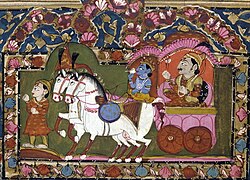
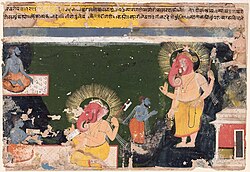
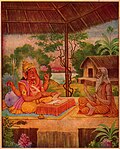
The Mahabharata, that is, the great Bharata, is one of the two most important ancient epics of India, the other being the Ramayana. The Mahabharata was compiled in Ancient India. One of the rishis (Indian sages) named Vyasa is believed to have composed the work. The legend states that God Ganesha wrote the Mahabharata while Vyasa dictated the same in the city of Rourkela in Odisha State. It is possibly one of the longest work of its kind in the world. The epic contains about 110,000 shloka (couplets) in eighteen sections. These sections deal with a number of topics such as a number of aspects of Hinduism, Hindu mythology, ethics, and the Hindu way of life. There is also a nineteenth section named Harivamsha. The Bhagavadgita, a dialogue between Krishna and Arjuna, is a part of the Mahabharata.
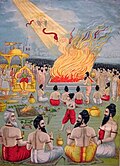
Sage Vyasa taught this epic to his son Suka and his students Vaisampayana and others. King Janamejaya, the son of Parikshit and grandson of the heroes of the epic, performed a great sacrifice (yajna). The epic was retold by Vaisampayana to Janamejaya at the advice of Vyasa. Later on, the other sage Suta retold the Mahabharata similar to Vaisampayana to Janamejaya, to Saunaka and others, during a sacrifice performed by Saunaka in Naimisaranya, which is near Sitapur in Uttar Pradesh.
Noted below are few words about the eighteen sections of the Mahabharata. In Mahabharata, these sections are called parvan. A parvan means a book. The names of all parvas or books of the Mahabharata are noted below.
| Parva | Title | Contents |
| 1 | Adi-Parva | Introduction, birth and growing up of the princes. |
| 2 | Sabha-Parva | Life at the court, the game of dice, and the exile of the Pandavas. Maya Danava erects the palace and court (sabha), at Indraprastha. |
| 3 | Aranyaka-Parva (also Vanaparva, Aranyaparva) | The twelve years in exile in the forest (aranya). |
| 4 | Virata-Parva | The year in exile spent at the court of King Virata. |
| 5 | Udyoga-parva | Preparations for war. |
| 6 | Bhishma-parva | The first part of the great battle, with Bhishma as commander for the Kauravas. |
| 7 | Drona-parva | The battle continues, with Dronacharya as commander. |
| 8 | Karna-parva | The battle again, with Karna as commander. |
| 9 | Shalya-parva | The last part of the battle, with Shalya as commander. |
| 10 | Sauptika-parva | How Ashvattama and the remaining Kauravas killed the Pandava army in their sleep (Sauptika). |
| 11 | Stri-parva | Gandhari and the other women (stri) lament the dead. |
| 12 | Shanti-parva | The crowning of Yudhisthira, and his instructions from Bhishma |
| 13 | Anusasana-parva | The final instructions (anusasana) from Bhishma. |
| 14 | Ashvamedhika-Parva | The royal ceremony of the Ashvamedha conducted by Yudhisthira. |
| 15 | Ashramavasika-Parva | Dhritarashtra, Gandhari and Kunti leave for an ashram and eventual death in the forest. |
| 16 | Mausala-parva | The infighting between the Yadavas with maces (masala). |
| 17 | Mahaprasthanika-parva | The first part of the path to death (mahaprasthana or ‘the great journey’) of Yudhisthira and his brothers. |
| 18 | Svargarohana-parva | The Pandavas return to the spiritual world (svarga). |
| 19 | Harivamsha | Life of Krishna. |
The Pandavas

Kunti wants to fulfil her maternal expectations, but she has no man. She recollects the moment when her first son Karna was conceived from an arcane mantra which had given her once. Surya, the Sun God, appeared to her then. Thus, Kunti remembers her secret mantra and gives birth to the three sons – Yudhistra, Bhima and Arjuna. Yudhisthira’s father was god Yama, Bhima’s father was god Vayu, and Arjuna's father was Indra.
Madri, the second wife of Pandu, gave birth to two other sons - the twins, whose fathers were Ashwins (divine twins). Madri's sons are Nakula and Sahadeva.
These all are called the five Pandavas.
Donation for it's compilation
In the year 1932, The Bhandarkar oriental research institute located in Pune, needed money for the compilation and publication of the Holy Mahabharata and a guest house. A formal request was made to the seventh Nizam of Hyderabad State, Mir Osman Ali Khan who in no time released a farman to donate Rs.1000 per year for a period of 11 years.
Whereas, Rs. 50,000 was offered for the guest which is known as "Nizam guest house".[1]
Related page
More information
- Mahabharata Online - The Complete Translation of Vyasa Mahabharata and Stories from Mahabharata
- Some nice info on Hinduism including the Mahabharata
References