

imported>Billjones94 No edit summary |
fixed issues |
||
| Line 1: | Line 1: | ||
{{Short description|Maharaja of Mysore from 1868 to 1894}} | |||
{{Use Indian English|date=July 2017}} | {{Use Indian English|date=July 2017}} | ||
{{Use dmy dates|date=July 2017}} | {{Use dmy dates|date=July 2017}} | ||
{{Infobox | {{refimprove|date=March 2026}} | ||
| name = Chamarajendra Wadiyar X | {{Infobox royalty | ||
| image= Chamaraja Wodeyar 1863-94.jpg | | name = Chamarajendra Wadiyar X | ||
|caption = Chamarajendra Wadiyar X | | image = Chamaraja Wodeyar 1863-94.jpg | ||
| succession | | caption = Photograph of Chamarajendra Wadiyar X | ||
| reign = 23 September 1868 – 28 December 1894 | | succession = 23rd [[Maharaja of Mysore]] | ||
| coronation = 23 September 1868 | | reign = 23 September 1868 – 28 December 1894 | ||
| predecessor = [[Krishnaraja Wadiyar III]] | | title = Chamarajendra Maharaja X | ||
| successor = [[Krishna Raja Wadiyar IV]] | | coronation = 23 September 1868 | ||
| spouse | | predecessor = [[Krishnaraja Wadiyar III]] | ||
| issue = [[Krishna Raja Wadiyar IV]], [[Kanteerava Narasimharaja Wadiyar]], Jayalakshmi | | successor = [[Krishna Raja Wadiyar IV]] | ||
| royal house = [[Wadiyar dynasty]] | | spouse = [[Kempananjammanni Devi]] | ||
| father = Sardar Chikka Krishnaraj Urs<br> | | issue = [[Krishna Raja Wadiyar IV]], [[Kanteerava Narasimharaja Wadiyar]], Jayalakshmi Ammanni, Krishnaraja Ammanni, Chaluvaja Ammanni, Krishnajammanni | ||
[[Krishnaraja | | full name = Chamarajendra Wadiyar Bahadur X | ||
| mother = Rajkumari Sri | | royal house = [[Wadiyar dynasty]] | ||
| birth_date = 22 February 1863 | | father = Sardar Chikka Krishnaraj Urs<br> | ||
| birth_place = [[Chamundi Hills]], [[Mysore]], [[Mysore Kingdom]] | [[Krishnaraja Wodeyar III]] (grandfather) | ||
| death_date = {{death date and age|df=yes|1894|12|28|1863|2|22}} | | mother = Rajkumari Sri Putta Ammanni | ||
| death_place = [[Kolkata | | birth_date = 22 February 1863 | ||
| religion = [[Hinduism]] | | birth_place = [[Chamundi Hills]], [[Mysore]], [[Mysore Kingdom]] (present-day [[Karnataka]], India) | ||
| death_date = {{death date and age|df=yes|1894|12|28|1863|2|22}} | |||
| death_place = [[Calcutta]], [[Bengal Presidency]], [[British Raj|British India]] (present-day [[Kolkata]], [[West Bengal]], India) | |||
| religion = [[Hinduism]] | |||
}} | }} | ||
'''Chamarajendra Wadiyar X''' (22 February 1863 – 28 December 1894) was the twenty-third [[Maharaja of Mysore]] between 1868 and 1894. | |||
== | ==Early life== | ||
Chamarajendra Wadiyar X was born in the old palace in Mysore on 22 February 1863, as the third son of Sardar Chikka Krishnaraj Urs of the Bettada-Kote branch of the | Chamarajendra Wadiyar X was born in the old palace in [[Mysore]] on 22 February 1863, as the third son of Sardar Chikka Krishnaraj Urs of the [[Wadiyar dynasty#Bettada Kote (Hill Fort) Urs branch|Bettada-Kote Urs branch]] of the Wadiyar dynasty. His father died about a week before his birth. His mother, Rajkumari Putammani Devi, was the eldest daughter of [[Krishnaraja Wadiyar III]], then [[Maharaja of Mysore]]. As the king did not have a male heir, he adopted Chamarajendra as his official heir on 18 June 1865, which was later recognised by the [[British Raj]] on 16 April 1867. | ||
==Reign== | ==Reign== | ||
[[File:Chamarajednra Wadiyar X of Mysore1877.jpg|thumb|left|upright|Chamarajendra Wadiyar X in 1877]] | |||
Krishnaraja Wadiyar III died on 27 March 1868, and Chamarajendra Wadiyar X ascended the throne at the [[Mysore Palace]] on 23 September 1868. However, since 1831, the [[Kingdom of Mysore]] had been under the direct administration of the British Raj via [[Mysore Commission]], which had earlier deposed Krishnaraja Wodeyar III on allegations of misrule. Later, the Privy Council of the United Kingdom ordered the reversal of the [[Company rule in India|Company]]'s decision, and the princely state of Mysore was reconstituted and restored to the Wadiyar dynasty by an instrument of rendition in 1881. Chamarajendra Wadiyar X, who was groomed to take charge of the administration, and was officially handed the reins in the same year.<ref name="DH">{{cite web|url=https://www.deccanherald.com/content/608087/a-legacy-art-architecture.html|title=A legacy of art & architecture|work=[[Deccan Herald]]|date=17 April 2017|access-date=1 June 2025}}</ref> | |||
During his brief reign, he was aided by dewans [[C. V. Rungacharlu]] (1881–1883) and [[K. Seshadri Iyer]] (1883–1901). He instituted the [[Karnataka Legislative Assembly|Mysore Representative Assembly]] in 1881, one of the earliest legislative institutions in princely India.<ref>{{cite book |last=Assembly |first=Karnataka (India) Legislature Legislative |url=https://books.google.com/books?id=cV9NMwEACAAJ |title=The History of Karnataka Legislature: The Mysore Representative Assembly |date=1989 |publisher=Government Suburban Press }}</ref> He sponsored the journey of [[Swami Vivekananda]] to [[Chicago]] in 1893. He founded the [[Kannada]] Bashojjivini School and instituted several industrial schools. The annual Dasara Industrial Exhibition was established, and he facilitated the founding of agricultural banks to help finance farmers, and [[life insurance]] for government employees.<ref name="DH"/> | |||
== Death and succession == | |||
Chamarajndra Wadiyar died of [[diphtheria]], in [[Calcutta]], on 28 December 1894, aged 31.<ref name="DH"/> He was succeeded by his ten-year-old son, [[Krishna Raja Wadiyar IV]]. His wife, [[Kempananjammanni Devi]], served as regent of Mysore till their son came of age. | |||
== Family == | == Family == | ||
In May 1878, Chamarajendra Wadiyar married | [[File:HH Sri Chamarajendra Wadiyar X.jpg|thumb|upright|Portrait of Chamarajendra Wadiyar X by [[Raja Ravi Varma]], 1885]] | ||
In May 1878, Chamarajendra Wadiyar married Kempananjammani Devi, the daughter of an ''arasu'' (royalty) of [[Kalale]], a prominent nobleman of Mysore state. They had four sons and three daughters, of whom the following survived to adulthood: | |||
#[[Krishna Raja Wadiyar IV]], succeeded his father as Maharaja of Mysore. | #[[Krishna Raja Wadiyar IV]], succeeded his father as Maharaja of Mysore. | ||
# Prince [[Kanteerava Narasimharaja Wadiyar]], father of Maharaja [[Jayachamarajendra Wadiyar]]. | # Prince [[Kanteerava Narasimharaja Wadiyar]], father of Maharaja [[Jayachamarajendra Wadiyar]]. | ||
# Princess Jayalakshammani, (1881–1924), married | # Princess Jayalakshammani, (1881–1924), married her youngest maternal uncle, [[M. Kantaraj Urs]], who was the [[List of Diwans of Mysore|Diwan of Mysore]] between 1919 and 1922, in 1897. | ||
# Princess Krishnajammani, (1883–1904), married | # Princess Krishnajammani, (1883–1904), married Desaraja Urs, Commander of the Mysore Armed Forces, from the Bagle family of Mogur in Mysore State, in 1896. They had a son and three daughters. She and her three daughters died of [[tuberculosis]], and the Krishnajammanni Sanitorium was built in her memory. | ||
# Princess Cheluvajammani (1886–1936),<ref>{{cite news|title=Mysore Princess Dead|url=http://eresources.nlb.gov.sg/newspapers/Digitised/Article/straitstimes19360503-1.2.112|access-date=9 May 2017|work=[[The Straits Times]]|date=3 May 1936|page=15}}</ref> married | # Princess Cheluvajammani (1886–1936),<ref>{{cite news|title=Mysore Princess Dead|url=http://eresources.nlb.gov.sg/newspapers/Digitised/Article/straitstimes19360503-1.2.112|access-date=9 May 2017|work=[[The Straits Times]]|date=3 May 1936|page=15}}</ref> married M. Lakshmikanta Raj Urs, a nobleman of Mysore State, in 1900. A maternity hospital and park are named after her. | ||
==Patronage== | |||
Chamarajendra Wadiyar X was a great patron of arts and music; his court boasted of artists like Veene Subbanna, [[Veene Sheshanna]], [[Mysore Vasudevachar]], Veena Padmanabhaiah, Mysore Karigiri Rao, and [[Bidaram Krishnappa]], among others. The maharaja was a violin virtuoso himself and used to daily provide accompaniment to Veena Subbanna's vocal and Veena Sheshanna's veena performances. His favourite ''[[kriti (music)|kriti]]'s'' included ''Sujana Jeevana'' and ''Lavanya Rama.'' He was also a connaisseur of ''Javali's'' ''Kritis'' (''Javalis'' are a genre of [[Carnatic music]]). | |||
== Places in honour == | |||
[[File:Maharaja Cham Rajendra Vadiyar Marg - Vadodara - Gujarat - DSC0001.jpg|thumb|Maharaja Cham Rajendra Wadiyar Marg in [[Vadodara]]]] | |||
Several landmarks in Mysore and [[Bangalore]] were built during his reign including the [[Bangalore Palace]] and [[Lalbagh Glass House]] in Bangalore. He established the [[Maharaja's College, Mysore]] (1889), [[Oriental Research Institute Mysore]] (1891), [[Dufferin Clock Tower]], and [[Mysore Zoo]], in Mysore, and the [[The Fernhills Palace, Ooty|Fernhills Palace]] in [[Ooty]].<ref>{{cite news|url=http://timesofindia.indiatimes.com/city/vadodara/A-bit-of-Baroda-in-Mysore-Road-in-Sayajiraos-name-main-market/articleshow/5389215.cms|title=A bit of Baroda in Mysore: Road in Sayajirao's name main market|date=28 December 2009|work=The Times of India}}</ref><ref>{{Cite web | title = Maharaja's royal gift to Mysore | url = https://timesofindia.indiatimes.com/city/mysore/Maharajas-royal-gift-to-Mysore-/articleshow/6216007.cms | archive-url = https://web.archive.org/web/20131203062519/http://articles.timesofindia.indiatimes.com/2010-07-25/mysore/28281284_1_mysore-crawford-hall-maharaja-s-college | url-status = live | archive-date = 3 December 2013 | date = 25 Jul 2010| work = [[The Times of India]] | access-date = 11 July 2013 }}</ref> Places and roads named after him include the [[Chamaraja Road, Vadodara]], [[Chamaraja (Vidhana Sabha constituency)]], [[Chamaraja Road, Mysore]], [[Chamarajpet]] in Bangalore, and [[Chamarajapuram]] in Mysore.<ref>{{Cite web |date=April 20, 2017|title=Rajmahal Road to be renamed Chamaraja Road|url=https://timesofindia.indiatimes.com/city/vadodara/rajmahal-road-to-be-renamed-chamaraja-road/articleshow/58269464.cms |access-date=2022-02-28 |website=The Times of India |language=en}}</ref><ref>{{Cite web |date=December 28, 2009 |first=Prashant|last=Rupera|title=A bit of Baroda in Mysore: Road in Sayajirao's name main market|url=https://timesofindia.indiatimes.com/city/vadodara/a-bit-of-baroda-in-mysore-road-in-sayajiraos-name-main-market/articleshow/5389215.cms |access-date=2022-02-28 |website=The Times of India |language=en}}</ref><ref>{{Cite web |date=May 13, 2015 |first=Sachin|last=Sharma|title=Memory of Sayajis friend erased from {{sic|nolink=y|reason=error in source|citys}} face|url=https://timesofindia.indiatimes.com/city/vadodara/memory-of-sayajis-friend-erased-from-citys-face/articleshow/47259736.cms |access-date=2022-02-28 |website=The Times of India |language=en}}</ref> | |||
== | ==References== | ||
{{reflist}} | |||
* {{cite book|url=https://archive.org/details/ABriefSketchOfTheLifeOfRajaDharmaPravinaT.R.A.ThumbooChetty|title=A Brief Sketch of the Life of T. R. A. Thumboo Chetty | ===Bibliography=== | ||
* {{cite book|url=https://archive.org/details/ABriefSketchOfTheLifeOfRajaDharmaPravinaT.R.A.ThumbooChetty|title=A Brief Sketch of the Life of T. R. A. Thumboo Chetty, Formerly Chief Judge and Officiating Dewan of Mysore.|last=Royaloo Chetty|first=T.|publisher=Hoe & Co.Madras|year=1909}} | |||
==External links== | ==External links== | ||
| Line 82: | Line 77: | ||
[[Category:Knights Grand Commander of the Order of the Star of India]] | [[Category:Knights Grand Commander of the Order of the Star of India]] | ||
[[Category:Infectious disease deaths in India]] | [[Category:Infectious disease deaths in India]] | ||
[[Category:Respiratory disease deaths in India]] | |||
[[Category:Deaths from diphtheria]] | [[Category:Deaths from diphtheria]] | ||
[[Category:19th-century Indian royalty]] | [[Category:19th-century Indian royalty]] | ||
Latest revision as of 13:20, 16 March 2026
 | This article needs more citations. (March 2026) |
| Chamarajendra Wadiyar X | |||||
|---|---|---|---|---|---|
| Chamarajendra Maharaja X | |||||
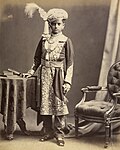
 Photograph of Chamarajendra Wadiyar X | |||||
| 23rd Maharaja of Mysore | |||||
| Reign | 23 September 1868 – 28 December 1894 | ||||
| Coronation | 23 September 1868 | ||||
| Predecessor | Krishnaraja Wadiyar III | ||||
| Successor | Krishna Raja Wadiyar IV | ||||
| Born | 22 February 1863 Chamundi Hills, Mysore, Mysore Kingdom (present-day Karnataka, India) | ||||
| Died | 28 December 1894 (aged 31) Calcutta, Bengal Presidency, British India (present-day Kolkata, West Bengal, India) | ||||
| Spouse | Kempananjammanni Devi | ||||
| Issue | Krishna Raja Wadiyar IV, Kanteerava Narasimharaja Wadiyar, Jayalakshmi Ammanni, Krishnaraja Ammanni, Chaluvaja Ammanni, Krishnajammanni | ||||
| |||||
| House | Wadiyar dynasty | ||||
| Father | Sardar Chikka Krishnaraj Urs Krishnaraja Wodeyar III (grandfather) | ||||
| Mother | Rajkumari Sri Putta Ammanni | ||||
| Religion | Hinduism | ||||
Chamarajendra Wadiyar X (22 February 1863 – 28 December 1894) was the twenty-third Maharaja of Mysore between 1868 and 1894.
Early life[edit | edit source]
Chamarajendra Wadiyar X was born in the old palace in Mysore on 22 February 1863, as the third son of Sardar Chikka Krishnaraj Urs of the Bettada-Kote Urs branch of the Wadiyar dynasty. His father died about a week before his birth. His mother, Rajkumari Putammani Devi, was the eldest daughter of Krishnaraja Wadiyar III, then Maharaja of Mysore. As the king did not have a male heir, he adopted Chamarajendra as his official heir on 18 June 1865, which was later recognised by the British Raj on 16 April 1867.
Reign[edit | edit source]

Krishnaraja Wadiyar III died on 27 March 1868, and Chamarajendra Wadiyar X ascended the throne at the Mysore Palace on 23 September 1868. However, since 1831, the Kingdom of Mysore had been under the direct administration of the British Raj via Mysore Commission, which had earlier deposed Krishnaraja Wodeyar III on allegations of misrule. Later, the Privy Council of the United Kingdom ordered the reversal of the Company's decision, and the princely state of Mysore was reconstituted and restored to the Wadiyar dynasty by an instrument of rendition in 1881. Chamarajendra Wadiyar X, who was groomed to take charge of the administration, and was officially handed the reins in the same year.[1]
During his brief reign, he was aided by dewans C. V. Rungacharlu (1881–1883) and K. Seshadri Iyer (1883–1901). He instituted the Mysore Representative Assembly in 1881, one of the earliest legislative institutions in princely India.[2] He sponsored the journey of Swami Vivekananda to Chicago in 1893. He founded the Kannada Bashojjivini School and instituted several industrial schools. The annual Dasara Industrial Exhibition was established, and he facilitated the founding of agricultural banks to help finance farmers, and life insurance for government employees.[1]
Death and succession[edit | edit source]
Chamarajndra Wadiyar died of diphtheria, in Calcutta, on 28 December 1894, aged 31.[1] He was succeeded by his ten-year-old son, Krishna Raja Wadiyar IV. His wife, Kempananjammanni Devi, served as regent of Mysore till their son came of age.
Family[edit | edit source]

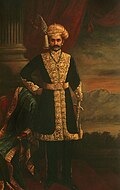
In May 1878, Chamarajendra Wadiyar married Kempananjammani Devi, the daughter of an arasu (royalty) of Kalale, a prominent nobleman of Mysore state. They had four sons and three daughters, of whom the following survived to adulthood:
- Krishna Raja Wadiyar IV, succeeded his father as Maharaja of Mysore.
- Prince Kanteerava Narasimharaja Wadiyar, father of Maharaja Jayachamarajendra Wadiyar.
- Princess Jayalakshammani, (1881–1924), married her youngest maternal uncle, M. Kantaraj Urs, who was the Diwan of Mysore between 1919 and 1922, in 1897.
- Princess Krishnajammani, (1883–1904), married Desaraja Urs, Commander of the Mysore Armed Forces, from the Bagle family of Mogur in Mysore State, in 1896. They had a son and three daughters. She and her three daughters died of tuberculosis, and the Krishnajammanni Sanitorium was built in her memory.
- Princess Cheluvajammani (1886–1936),[3] married M. Lakshmikanta Raj Urs, a nobleman of Mysore State, in 1900. A maternity hospital and park are named after her.
Patronage[edit | edit source]
Chamarajendra Wadiyar X was a great patron of arts and music; his court boasted of artists like Veene Subbanna, Veene Sheshanna, Mysore Vasudevachar, Veena Padmanabhaiah, Mysore Karigiri Rao, and Bidaram Krishnappa, among others. The maharaja was a violin virtuoso himself and used to daily provide accompaniment to Veena Subbanna's vocal and Veena Sheshanna's veena performances. His favourite kriti's included Sujana Jeevana and Lavanya Rama. He was also a connaisseur of Javali's Kritis (Javalis are a genre of Carnatic music).
Places in honour[edit | edit source]

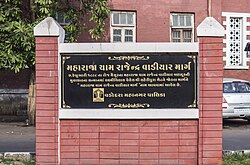
Several landmarks in Mysore and Bangalore were built during his reign including the Bangalore Palace and Lalbagh Glass House in Bangalore. He established the Maharaja's College, Mysore (1889), Oriental Research Institute Mysore (1891), Dufferin Clock Tower, and Mysore Zoo, in Mysore, and the Fernhills Palace in Ooty.[4][5] Places and roads named after him include the Chamaraja Road, Vadodara, Chamaraja (Vidhana Sabha constituency), Chamaraja Road, Mysore, Chamarajpet in Bangalore, and Chamarajapuram in Mysore.[6][7][8]
References[edit | edit source]
- ↑ 1.0 1.1 1.2 "A legacy of art & architecture". Deccan Herald. 17 April 2017. Retrieved 1 June 2025.
- ↑ Assembly, Karnataka (India) Legislature Legislative (1989). The History of Karnataka Legislature: The Mysore Representative Assembly. Government Suburban Press.
- ↑ "Mysore Princess Dead". The Straits Times. 3 May 1936. p. 15. Retrieved 9 May 2017.
- ↑ "A bit of Baroda in Mysore: Road in Sayajirao's name main market". The Times of India. 28 December 2009.
- ↑ "Maharaja's royal gift to Mysore". The Times of India. 25 July 2010. Archived from the original on 3 December 2013. Retrieved 11 July 2013.
- ↑ "Rajmahal Road to be renamed Chamaraja Road". The Times of India. 20 April 2017. Retrieved 28 February 2022.
- ↑ Rupera, Prashant (28 December 2009). "A bit of Baroda in Mysore: Road in Sayajirao's name main market". The Times of India. Retrieved 28 February 2022.
- ↑ Sharma, Sachin (13 May 2015). "Memory of Sayajis friend erased from citys [sic] face". The Times of India. Retrieved 28 February 2022.
Bibliography[edit | edit source]
- Royaloo Chetty, T. (1909). A Brief Sketch of the Life of T. R. A. Thumboo Chetty, Formerly Chief Judge and Officiating Dewan of Mysore. Hoe & Co.Madras.
External links[edit | edit source]
- Pages using the JsonConfig extension
- Articles needing additional references from March 2026
- 1863 births
- 1894 deaths
- Kings of Mysore
- Wadiyar dynasty
- Knights Grand Commander of the Order of the Star of India
- Infectious disease deaths in India
- Respiratory disease deaths in India
- Deaths from diphtheria
- 19th-century Indian royalty