

>Titodutta →References: unclear reference |
m improved lead per standard format for consistency |
||
| Line 1: | Line 1: | ||
{{Short description|Hindu temple in Bhubaneswar}} | {{Short description|Hindu temple in Bhubaneswar, India}} | ||
{{for|the temple in West Bengal|Ananta Basudeba Temple}} | {{for|the temple in West Bengal|Ananta Basudeba Temple}} | ||
{{Use dmy dates|date=January 2019}} | {{Use dmy dates|date=January 2019}} | ||
| Line 5: | Line 5: | ||
{{Infobox Hindu temple | {{Infobox Hindu temple | ||
|name = Ananta Vasudeva Temple | |name = Ananta Vasudeva Temple | ||
|native_name = [[:or:ଅନନ୍ତ ବାସୁଦେବ ମନ୍ଦିର|ଅନନ୍ତ ବାସୁଦେବ ମନ୍ଦିର]] | |native_name = [[:or:ଅନନ୍ତ ବାସୁଦେବ ମନ୍ଦିର|ଅନନ୍ତ ବାସୁଦେବ ମନ୍ଦିର]] | ||
|native_name_lang= or | |native_name_lang = or | ||
|image | |image = Ananta Vasudev.jpg | ||
|caption = The Ananta Vasudeva Temple | |caption = The Ananta Vasudeva Temple | ||
|map_type | |map_type = Orissa | ||
|coordinates = {{coord|20|14|26.18|N|85|50|8.81|E|type:landmark|display=inline,title}} | |coordinates = {{coord|20|14|26.18|N|85|50|8.81|E|type:landmark|display=inline,title}} | ||
|coordinates_footnotes= | |coordinates_footnotes= | ||
| Line 24: | Line 15: | ||
|map_size = 250 | |map_size = 250 | ||
|country = [[India]] | |country = [[India]] | ||
|state | |state = [[Odisha]] | ||
|district = [[Khurda district|Khurda]] | |district = [[Khurda district|Khurda]] | ||
|locale = [[Bhubaneswar]] | |locale = [[Bhubaneswar]] | ||
|elevation_m = | |elevation_m = | ||
|elevation_footnotes = | |elevation_footnotes = | ||
|deity | |deity = Ananta Vasudeva ([[Krishna]]) | ||
|festivals | |festivals = | ||
|temple_quantity = | |temple_quantity = | ||
| | |monument_quantity = | ||
|architecture = [[Kalinga Architecture]] | |||
|inscriptions = | |inscriptions = | ||
|year_completed | |year_completed = 13th Century | ||
|creator = | |creator = | ||
|temple_board = | |temple_board = | ||
| Line 40: | Line 32: | ||
}} | }} | ||
'''Ananta Vasudeva Temple''' ("Temple of the [[Ananta (infinite)|Infinite]] [[Vāsudeva]]", [[Odia language|Odia]]:ଅନନ୍ତ ବାସୁଦେବ ମନ୍ଦିର) is a [[Hindu temple]] dedicated to [[ | '''Ananta Vasudeva Temple''' ("Temple of the [[Ananta (infinite)|Infinite]] [[Vāsudeva]]", [[Odia language|Odia]]:ଅନନ୍ତ ବାସୁଦେବ ମନ୍ଦିର) is a [[Hindu temple]] dedicated to [[Krishna]], an ''[[avatar]]'' of [[Vishnu]] located in [[Bhubaneswar]], the state capital of [[Odisha]], [[India]].<ref>{{cite book|title=Rajput Architecture |first=G.S. |last=Ghurye |publisher=Popular Prakashan|year= 2005 |ISBN =81-7154-446-0 |pages=91}}</ref> The temple was constructed in the thirteenth century, and the complete [[Murti|murtis]] of Krishna, [[Balarama]] and [[Subhadra]] are worshipped there. The temple dates back to the period of Chandrika Devi, the daughter of [[Anangabhima III]], during the reign of the king Bhanudeva. A commemorative inscription that marked the foundation of the temple can be found in the [[British Museum]]'s collection.<ref>[https://www.britishmuseum.org/collection/object/A_1967-1018-4 British Museum Collection]</ref> | ||
==Legend== | ==Legend== | ||
It appears that the original image of [[Vishnu]] was worshipped on the spot where the great temple of Ananta Vasudeva was built in the 13th century | It appears that the original image of [[Vishnu]] was worshipped on the spot where the great temple of Ananta Vasudeva was built in the 13th century CE. Thus in the 13th century, Queen Chandrika of [[Eastern Ganga dynasty]] was prompted to construct a new temple - the temple of Ananta Vasudeva in this place. There must have been an old temple where this Vishnu image was installed. The [[Maratha]]s, who extended their empire up to river [[Mahanadi]], were responsible for renovating the Vishnu temple at [[Bhubaneswar]] in the late 17th century.<ref>''Tāntric art of Orissa ''. P.126. Jitāmitra Prasāda Siṃhadeba.</ref> | ||
==Architecture== | ==Architecture== | ||
In form, the temple resembles the [[Lingaraja Temple|Lingaraj temple]], but includes ''[[Vaishnavism| | In form, the temple resembles the [[Lingaraja Temple|Lingaraj temple]], but includes ''[[Vaishnavism|Vaishnavite]]'' ([[Vishnu]] related) sculptures.<ref>''Hinduism and the Religious Arts ''.p.149. Heather Elgood</ref> The temple has longitudinal bands of miniature ''[[shikhara]]s'' (shrines), exactly like those in Lingaraj temple, with the minor difference that the number of the ''[[shikhara]]s'' forming one longitudinal band in its case is only three.<ref>''Rajput Architecture ''.p.126.G.S. Ghurye</ref> The sculpture in the exterior walls varies in character in each temple in Bhubaneswar. Most of the female sculptures in the temple walls are overly ornamented and lack originality<ref>''World heritage monuments and related edifices in India ''P.186.ʻAlī Jāvīd, Tabassum Javeed.</ref> | ||
The sanctum has the icons of Krishna, Balarama, and Subhadra. Balarama stands under a seven-hooded serpent, Subhadra holds pot of jewels and a lotus in her two hands, keeping her left foot over another jewel pot, while Krishna holds a [[Kaumodaki|mace]], ''[[Sudarshana Chakra|chakra]]'', [[Padma (Vishnu)|lotus]], and a [[Panchajanya|conch]]. | |||
==Difference from Jagannath Temple, Puri== | ==Difference from Jagannath Temple, Puri== | ||
The idols found in the ''[[Garbhagriha|garbhagrha]] ''(sanctum sanctorum) of the temple have complete structure unlike the images of the [[Jagannath Temple, Puri]]. Here the ''shrimurtis'' (idols) are made of black granite stone, rather than wood, as seen in the Puri temple. For this temple only the city gains its name as ''Chakra kshetra'' (circular place), whereas [[Puri]] is named ''Shankha kshetra'' ( | The idols found in the ''[[Garbhagriha|garbhagrha]] ''(sanctum sanctorum) of the temple have complete structure unlike the images of the [[Jagannath Temple, Puri]]. Here the ''shrimurtis'' (idols) are made of black granite stone, rather than wood, as seen in the Puri temple. For this temple only, the city gains its name as ''Chakra kshetra'' (circular place), whereas [[Puri]] is named ''Shankha kshetra'' (conch-shaped place). | ||
==Gallery== | ==Gallery== | ||
| Line 64: | Line 58: | ||
File:Temple Kitchen of Ananta Basudeba Temple, Bhubaneswar 02.jpg|The temple kitchen of the Ananta Basudeba temple in Bhubaneswar, Odisha | File:Temple Kitchen of Ananta Basudeba Temple, Bhubaneswar 02.jpg|The temple kitchen of the Ananta Basudeba temple in Bhubaneswar, Odisha | ||
File:Temple Kitchen of Ananta Basudeba Temple, Bhubaneswar 01.jpg|The temple kitchen of the Ananta Basudeba temple in Bhubaneswar, Odisha | File:Temple Kitchen of Ananta Basudeba Temple, Bhubaneswar 01.jpg|The temple kitchen of the Ananta Basudeba temple in Bhubaneswar, Odisha | ||
File:Ananta Basudeba Temple, Bhubaneswar - Varaha niche 08 (cropped).jpg|[[Varaha]] as a parshvadevata in a niche | |||
</gallery> | </gallery> | ||
==Community Service== | |||
Many temples in India do community service in the form of serving food, medical assistance, cultural activities, etc. | |||
Serving food on special occasions is done by almost all the temples and is known as [[Prasad (food offering)|Prasad]]. | |||
Around one hundred temples in Bhubaneswar serve food to the people in and around the temple area free or at a nominal cost. It helps in preserving traditional Odia recipes. These recipes are automatically introduced to the newer generation as well as to the visiting people from outside the state and India.The taste of the prasad is unique and delicious. It helps to maintain a connection with the ancient roots besides feeding thousands of devotees with dignity and devotion.<ref>Times of India, Sunday, 22 December 2024 {{fcn|reason=need more precise location e.g. title and/or page|date=September 2025}}</ref> | |||
==References== | ==References== | ||
| Line 73: | Line 72: | ||
{{Hindu temples in Odisha}} | {{Hindu temples in Odisha}} | ||
[[Category:Purana temples of Vishnu]] | |||
[[Category:Hindu temples in Bhubaneswar]] | [[Category:Hindu temples in Bhubaneswar]] | ||
[[Category: | [[Category:Jagannath temples]] | ||
[[Category: | [[Category:Historic sites in Odisha]] | ||
[[Category:13th-century Hindu temples]] | [[Category:13th-century Hindu temples]] | ||
[[Category:13th-century establishments in India]] | [[Category:13th-century establishments in India]] | ||
[[Category:13th-century religious buildings and structures in India]] | |||
Latest revision as of 05:22, 29 March 2026
| Ananta Vasudeva Temple | |
|---|---|
 The Ananta Vasudeva Temple | |
| Religion | |
| District | Khurda |
| Deity | Ananta Vasudeva (Krishna) |
| Location | |
| State | Odisha |
| Country | India |
| Coordinates | 20°14′26.18″N 85°50′8.81″E / 20.2406056°N 85.8357806°E |
Ananta Vasudeva Temple ("Temple of the Infinite Vāsudeva", Odia:ଅନନ୍ତ ବାସୁଦେବ ମନ୍ଦିର) is a Hindu temple dedicated to Krishna, an avatar of Vishnu located in Bhubaneswar, the state capital of Odisha, India.[1] The temple was constructed in the thirteenth century, and the complete murtis of Krishna, Balarama and Subhadra are worshipped there. The temple dates back to the period of Chandrika Devi, the daughter of Anangabhima III, during the reign of the king Bhanudeva. A commemorative inscription that marked the foundation of the temple can be found in the British Museum's collection.[2]
Legend[edit | edit source]
It appears that the original image of Vishnu was worshipped on the spot where the great temple of Ananta Vasudeva was built in the 13th century CE. Thus in the 13th century, Queen Chandrika of Eastern Ganga dynasty was prompted to construct a new temple - the temple of Ananta Vasudeva in this place. There must have been an old temple where this Vishnu image was installed. The Marathas, who extended their empire up to river Mahanadi, were responsible for renovating the Vishnu temple at Bhubaneswar in the late 17th century.[3]
Architecture[edit | edit source]
In form, the temple resembles the Lingaraj temple, but includes Vaishnavite (Vishnu related) sculptures.[4] The temple has longitudinal bands of miniature shikharas (shrines), exactly like those in Lingaraj temple, with the minor difference that the number of the shikharas forming one longitudinal band in its case is only three.[5] The sculpture in the exterior walls varies in character in each temple in Bhubaneswar. Most of the female sculptures in the temple walls are overly ornamented and lack originality[6]
The sanctum has the icons of Krishna, Balarama, and Subhadra. Balarama stands under a seven-hooded serpent, Subhadra holds pot of jewels and a lotus in her two hands, keeping her left foot over another jewel pot, while Krishna holds a mace, chakra, lotus, and a conch.
Difference from Jagannath Temple, Puri[edit | edit source]
The idols found in the garbhagrha (sanctum sanctorum) of the temple have complete structure unlike the images of the Jagannath Temple, Puri. Here the shrimurtis (idols) are made of black granite stone, rather than wood, as seen in the Puri temple. For this temple only, the city gains its name as Chakra kshetra (circular place), whereas Puri is named Shankha kshetra (conch-shaped place).
Gallery[edit | edit source]
-
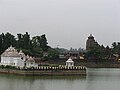 View of Ananta Vasudeva Temple from Bindusagar
 -
 View of Ananta Vasudeva Temple in 1869
 -
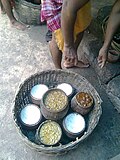 Mahaprasad in Ananta Vasudeva temple
 -
 Lion statue in the singhadwara
 -
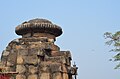 A small broken shrine in the premises
 -
 First stone inscription installed in the outer wall
 -
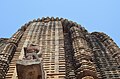 Bimana or Deula
 -
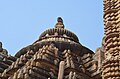 Jagamohana
 -
 Abadha and Prasada offered to the deities
 -
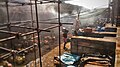 The temple kitchen of the Ananta Basudeba temple in Bhubaneswar, Odisha
 -
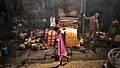 The temple kitchen of the Ananta Basudeba temple in Bhubaneswar, Odisha
 -
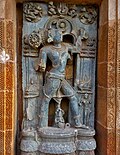 Varaha as a parshvadevata in a niche


.jpg)
Community Service[edit | edit source]
Many temples in India do community service in the form of serving food, medical assistance, cultural activities, etc. Serving food on special occasions is done by almost all the temples and is known as Prasad. Around one hundred temples in Bhubaneswar serve food to the people in and around the temple area free or at a nominal cost. It helps in preserving traditional Odia recipes. These recipes are automatically introduced to the newer generation as well as to the visiting people from outside the state and India.The taste of the prasad is unique and delicious. It helps to maintain a connection with the ancient roots besides feeding thousands of devotees with dignity and devotion.[7]
References[edit | edit source]
- ↑ Ghurye, G.S. (2005). Rajput Architecture. Popular Prakashan. p. 91. ISBN 81-7154-446-0.
- ↑ British Museum Collection
- ↑ Tāntric art of Orissa . P.126. Jitāmitra Prasāda Siṃhadeba.
- ↑ Hinduism and the Religious Arts .p.149. Heather Elgood
- ↑ Rajput Architecture .p.126.G.S. Ghurye
- ↑ World heritage monuments and related edifices in India P.186.ʻAlī Jāvīd, Tabassum Javeed.
- ↑ Times of India, Sunday, 22 December 2024 [full citation needed]
