


>Niceguyedc m v2.04 - Repaired 1 link to disambiguation page - (You can help) - Kartik |
Charnkamal (talk | contribs) m adjust content for clarity based on references |
||
| Line 1: | Line 1: | ||
{{ | {{Short description|Lunar phase near new moon}} | ||
{{Use British English|date=March 2014}} | |||
{{Use dmy dates|date=March 2014}} | {{Use dmy dates|date=March 2014}} | ||
{{Infobox recurring event | |||
| name = Amavasya | |||
| native_name = {{IAST|Amāvásyā}} | |||
| image = New_Moon.jpg | |||
| caption = Simulated image of [[new moon]] | |||
| genre = Natural phenomena | |||
| frequency = Monthly | |||
}} | |||
'''Amavasya''' ({{IAST|Amāvásyā}}) represents the [[lunar phase]] of [[new moon]] in the [[Hindu calendar]]. A calendar month ends on amavasya as per the [[Hindu calendar#Amānta and Purnimānta systems|amanta]] tradition of the Hindu lunar calendar.{{efn|name=Amanta|The Hindu calendar follows two various systems:Amanta and Purnimanta. As per the amanta tradition, the lunar month ends on the [[new moon]] day and as per the purnimanta tradition, it ends on the [[full moon day]]. As a consequence, in the amanta tradition, [[Shukla paksha]] ([[waning moon]]) precedes [[Krishna paksha]] ([[waxing moon]]) in every lunar month, whereas the reverse happens in purnimānta tradition. Hence, Shukla paksha will always belong to the same month in both traditions, whereas Krishna paksha will always be associated with different but succeeding months in each tradition. The Amanta tradition is officially followed by the [[Indian national calendar]].<ref>{{cite book|author=V. R. Ramachandra Dikshitar|title=The Gupta Polity|publisher=[[Motilal Banarsidass]]|year=1993|isbn=978-81-208-1024-2|pages=24–35}}</ref><ref>{{cite web |title=Amānta and Pūrṇimānta – Decoding Hindu Lunar Months |url=https://divinehindu.com/hinduism/amanta-and-purnimanta-decoding-hindu-lunar-months/|work=Divine Hindu |access-date=29 October 2025}}</ref><ref>{{cite web |title=Lunar months – Pūrṇimānta and Amānta system |url=https://www.ekohumm.com/article/lunar-months-purnimanta-and-amanta-system|work=Ekohumm |access-date=29 October 2025}}</ref>}} Various [[Hindu]] beliefs and rituals are associated with the day. [[Hindu festivals]] including [[Diwali]] are celebrated on the amavasya day of various months. | |||
''' | == Etymology == | ||
Amavasya is derived from [[Sanskrit]] words ''amā'' meaning "together" and ''vásya'' meaning "to dwell" or "cohabit", implying the conjunction of the [[Sun]] and the [[Moon]] in the same ecliptic longitude.<ref>{{cite web|url=https://www.sampratyaya.com/wp-content/uploads/2024/12/Article-7.-Dr.Ananya-Baruah.pdf|title=What is Amāvaśyā?|work=Sampratyaya Journal|date=December 2024|access-date=1 June 2025}}</ref> It can also be interpreted as "no-moon day", derived from ''na'' + ''ma'' + ''asya'' ("no" + "moon" + "there"), referring to the lunar phase when the Moon is not visible from the [[Earth]].<ref>{{cite web|url=https://www.tamilandvedas.com/2021/12/08/why-do-we-call-new-moon-day-amavasya-post-no-10423/|title=Why do we call new-moon day 'Amavasyā'?|date=8 December 2021|work=Tamil and Vedas|access-date=1 June 2025}}</ref> | |||
== Description == | |||
[[File:Amavasya and Prathama tithi.jpg|thumb|Amavasya and Prathama tithi]] | [[File:Amavasya and Prathama tithi.jpg|thumb|Amavasya and Prathama tithi]] | ||
{{See also|Astronomical basis of the Hindu calendar}} | |||
== | In the Hindu lunar calendar, each month has 29 or 30 days. The month begins on the next day after Amavasya ([[new moon]]) or [[Purnima]] ([[full moon]]) in the [[Hindu calendar#Amānta and Purnimānta systems|amanta]] and [[Hindu calendar#Amānta and Purnimānta systems|purnimanta]] systems respectively. The amanta system is followed majorly in the [[South India]] and the purnimanta system in [[North India]].<ref>{{cite web|url=https://aryasamajhouston.org/index.php?option=com_content&view=article&id=166&Itemid=125|title=Hindu calendar|work=[[Arya Samaj]]|access-date=1 June 2025}}</ref> A month consists of two cycles– [[Shukla Paksha]] ([[waning moon]]) and [[Krishna Paksha]] ([[waxing moon]]), consisting of 15 days each. Days in each cycle is labeled as a [[thithi]], with each thithi representing the [[Lunar phase (Hinduism)|different phases]] of the moon and repeating twice in a month.<ref>{{cite web|url=https://iskconeducationalservices.org/HoH/practice/festivals/the-hindu-calendar/|title=Hindu calendar|work=[[ISKCON]]|access-date=1 June 2025}}</ref><ref>{{cite book|author=Most, Glenn W. |title=Hesiod Volume 1: Theogony Works and Days|publisher=[[Harvard University Press]]|year=2006}}</ref> Amavasya corresponds to the period when the [[Moon]] is within 12 degrees of angular distance from the Sun before their [[syzygy (astronomy)|conjunction]].<ref>{{cite journal|author=Cole, Freedom|title=Amāvásya and Pratipad|journal=Jyotish Digest|volume=XI|issue=2|date=April–September 2014}}</ref> | ||
== Tradition and beliefs == | |||
[[File:Pinda_Daan_-_Jagannath_Ghat_-_Kolkata_2012-10-15_0701.JPG|thumb|Worship of ancestors during [[Pitru Paksha]]]] | |||
In [[Hindu culture]], Amavasya day is considered a time of significance to propitiate the Sun, the Moon and other Gods.<ref>{{cite book|author=B. K. Chaturvedi|title=Garuda Purana|url=https://books.google.com/books?id=hCFuxBfaIzQC&pg=PA82|access-date=13 November 2012|date=2002|publisher=Diamond Pocket Books|isbn=978-81-288-0155-6|pages=82–}}</ref> People observe [[fasting]] on the day, with the belief that all desires could be fulfilled if one fasts on this Amavasya.<ref>{{cite book|author=Gaṅgā Rām Garg|title=Encyclopaedia of the Hindu World: Ak-Aq|url=https://books.google.com/books?id=WjDcd0cTFxQC&pg=PA370|access-date=13 November 2012|date=1992|publisher=Concept Publishing Company|isbn=978-81-7022-375-7|pages=370–}}</ref> When the new moon day falls on a [[Monday]], it is observed as Somvati Amavasya.<ref>{{cite web|url=https://www.thedailyguardian.com/spirituality/somvati-amavasya-the-sacred-significance-and-observances/|title=SomvatiAmavasya – The Sacred Significance and Observances|date=10 December 2024|work=The Daily Guardian|access-date=1 June 2025}}</ref> Married women observe fast and pray to lord [[Shiva]] for the well-being of their husbands.<ref>{{cite web|url=https://www.india-today.com/information/story/somvati-amavasya-2024-date-time-and-puja-vidhi-2524677-2024-04-08|title=Somvati Amavasya 2024: Date, Time and Puja Vidhi|date=8 April 2024|work=[[India Today]]|access-date=1 June 2025}}</ref> | |||
Amavasya is particularly associated with worship of ancestors (pitrs). People take holy dips in rivers and perform special [[puja (Hinduism)|pujas]]. It is considered the time to perform rituals ([[Śrāddha]]) to the ancestors. Memorial rituals such as [[tarpana]], and offering of pinda (cooked rice and flour balls mixed with [[ghee]] and black [[sesame]] seeds) are performed for the oblation of the departed souls of the forefathers.<ref>{{cite web|url=https://www.timesofindia.indiatimes.com/religion/rituals-puja/somvati-amavasya/articleshow/68207142.cms|title=SomvatiAmavasya: The Day to Honour Ancestors and Seek Liberation|date=4 March 2019|work=[[The Times of India]]|access-date=1 June 2025}}</ref> | |||
The dark fortnight (Krishna Paksha) of the month of [[Bhadrapada]] is known as [[Pitru Paksha]] and is reserved for the [[veneration of the dead]]. The period ends on the ''Mahalaya Amavasya'' day, on which Hindus pay homage to their ancestors through special offerings. As per [[Hindu scriptures]], it has been ordained that offerings made during this period benefit all the departed souls with the grace of [[Yama (Hinduism)|Yama]].<ref>{{cite web |title=Pitru-Paksha – a fortnight of venerating and honouring our ancestors |url=https://britishhindus.org.uk/pitru-paksha-a-fortnight-of-venerating-and-honouring-our-ancestors/|work=British Hindus |access-date=27 October 2025}}</ref><ref>{{cite web |title=Significance of Pitru Paksha, Shraaddh and Tarpan |url=https://beta.esamskriti.com/e/Culture/Indian-Culture/Significance-of-Pitru-Paksha%2C-Shraaddh-and-Tarpan-2.aspx|work=eSamskriti |access-date=27 October 2025}}</ref><ref>{{cite web |title=What is Purnima Shradha |url=https://timesofindia.indiatimes.com/religion/rituals-puja/what-is-purnima-shradha/articleshow/68206047.cms |work=[[The Times of India]] |access-date=27 October 2025}}</ref> [[Kush Amavasya]] is observed on the same amavasya day of the month of Bhadrapada, during which people collect the sacred [[Kusha grass|Kusha]] grass which is used in various Hindu rituals.<ref>{{cite web |title=Kusha Grahani Amavasya |url=https://www.hindu-blog.com/2009/08/kushagrahani-amavasi-kushgrahini-amas.html|work=Hindu Blog |access-date=27 October 2025}}</ref><ref>{{cite web |title=Bhadrapada Amavasya 2025 Date, Puja, Significance |url=https://www.indiatvnews.com/lifestyle/spiritual/bhadrapada-amavasya-2025-date-time-puja-vidhi-2025-08-22-1004666|work=India TV |access-date=27 October 2025}}</ref> In Southern state of [[Tamil Nadu]], people perform rituals on [[Aadi Amavasai]], which falls in the [[Tamil calendar|Tamil month]] of [[Aadi (month)|Aadi]] (July–August) and Thai Amavasai, which falls in the month of [[Thai (month)|Thai]] (January–February).<ref>{{cite web |title=Aadi Amavasai 2024: Importance and Rituals in Tamil Nadu |url=https://www.tamilnadutourism.tn.gov.in/festivals/aadi-amavasai |work=Tamil Nadu Tourism |access-date=27 October 2025}}</ref> | |||
== | == Festivals == | ||
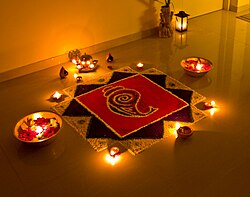
[[File:The_Rangoli_of_Lights.jpg|thumb|[[Lakshmi Puja]], celebrated on the Amavasya of the month of [[Ashvin (month)|Ashvin]] marks the important day of [[Diwali]] celebrations]] | |||
=== | [[Diwali]] is a five‑day [[Hindu]] [[Diwali|festival of lights]] marking the victory of light over darkness, or good over evil.<ref>{{cite web |title=Deepavali |url=https://www.itslife.in/festivals/deepavali|work=Its Life |access-date=1 June 2025}}</ref><ref>{{cite book |last=Mead |first=Jean |url=https://books.google.com/books?id=QJyZKOtHWg4C&dq=deepavali+hinduism&pg=PA5 |title=How and why Do Hindus Celebrate Divali? |date=February 2008 |publisher=Evans Brothers |isbn=978-0-237-53412-7 |access-date=5 August 2022 |archive-url=https://web.archive.org/web/20231111150755/https://books.google.com/books?id=QJyZKOtHWg4C&dq=deepavali+hinduism&pg=PA5#v=onepage&q=deepavali%20hinduism&f=false |archive-date=11 November 2023 |url-status=live}}</ref><ref>{{cite book |last1=Vasudha Narayanan |url=https://books.google.com/books?id=rdTJJEQsDHoC&pg=PA31 |title=Celebrate Diwali |last2=Deborah Heiligman |publisher=National Geographic Society |year=2008 |isbn=978-1-4263-0291-6 |page=31 |access-date=14 October 2016 |archive-url=https://web.archive.org/web/20170102023011/https://books.google.com/books?id=rdTJJEQsDHoC&pg=PA31 |archive-date=2 January 2017 |url-status=live}}</ref> [[Lakshmi Puja]], celebrated on the Amavasya of the month of [[Ashvin (month)|Ashvin]] marks the important day of Diwali celebrations. It is dedicated to welcoming prosperity by worshipping [[Lakshmi]], the Hindu goddess of wealth, and [[Ganesha]], the foremost god. People light lamps ([[Diya (lamp)|diya]]s), burst [[Firecracker|crackers]], and do pujas.<ref name="NDTV">{{cite web |title=Happy Diwali: Deepavali, Kali Puja, Naraka Chaturdasi, Ramayana, The Legends Linked To Diwali |url=https://www.ndtv.com/india-news/happy-diwali-deepavali-kali-puja-naraka-chaturdasi-ramayana-legends-linked-to-diwali-2120984|work=[[NDTV]] |access-date=1 June 2025}}</ref><ref>{{cite web |title=Diwali 2025: Five Days of Lights, Legends and Rituals |url=https://www.hinduismtoday.com/hpi/2024/10/31/diwali-2024-five-days-of-lights-legends-and-rituals/|work=Hinduism Today |date=31 October 2024 |access-date=29 October 2025}}</ref> | ||
Shani Dev Jayanti is celebrated on Amavasya of the month of [[Jyeshtha (month)|Jyeshtha]]. It is dedicated to [[Shani]] ([[Saturn]]), one of the [[navagrahas]].<ref>{{cite web |url=https://indianexpress.com/article/when-is/shani-jayanti-2025-date-rituals-significance-shani-dev-temples-in-india-10031031/|title=Shani Jayanti 2025: Date, rituals, significance and top Shani Dev temples in India |work=[[The Indian Express]] |access-date=1 October 2025}}</ref> In [[Gujarat]], [[Dashama Vrata]], dedicated to [[Momai]], is observed on the Amavasya of the month of [[Ashadha]].<ref>{{cite web |title=Dashama Vrata |url=https://www.bharattemples.com/dashama-vrata/|work=Bharat Temples |access-date=27 October 2025}}</ref><ref>{{cite news |title=Dashama Vrat 2025: Date, Puja Vidhi and Significance |url=https://timesofindia.indiatimes.com/religion/rituals-puja/dashama-vrat-2025-date-puja-vidhi-and-significance/articleshow/122967832.cms |work=[[The Times of India]] |date=25 July 2025 |access-date=27 October 2025}}</ref> [[Sohrai]] is a [[harvest festival]] celebrated by tribal communities in [[Jharkhand]] and [[West Bengal]]. Observed on Amavasya of the month of [[Kartika (month)|Kartika]], it honours [[cattle]], agricultural land and involves paying tribute to the ancestors, and community feasting.<ref>{{cite web |title=Sohrai – A tribal festival celebrating cattle & nature |url=https://www.villagesquare.in/sohrai-tribal-festival-celebrating-cattles-nature/ |work=Village Square |date=2 February 2023 |access-date=29 October 2025}}</ref> Homes are cleaned and decorated, livestock bathed and offered special meals, and the walls of houses are adorned with Sohrai art.<ref>{{cite web |title=Sohrai Festival |url=https://www.utsav.gov.in/view-event/sohrai-festival-1|work=Ministry of Tourism – Utsav |access-date=29 October 2025}}</ref> | |||
==See also== | |||
* [[Hindu astronomy]] | |||
* [[Hindu units of measurement]] | |||
* [[Jyotish]] | |||
==Notes== | |||
{{notelist}} | |||
==References== | ==References== | ||
| Line 39: | Line 49: | ||
==External links== | ==External links== | ||
* [http://shrifreedom.org/vedic-astrology/amavasya-the-dark-moon/ A discussion of Amāvāsyā translation issues within Monier-Williams’ Sanskrit Dictionary] | * [http://shrifreedom.org/vedic-astrology/amavasya-the-dark-moon/ A discussion of Amāvāsyā translation issues within Monier-Williams’ Sanskrit Dictionary] | ||
{{Tithi}} | {{Tithi}} | ||
{{Hindu calendar}} | |||
<!--Please don't remove this category until this article is sorted into the specific Hindu calendar category--> | |||
[[Category:Amavasya| ]] | |||
[[Category:Hindu astronomy]] | [[Category:Hindu astronomy]] | ||
[[Category:Hindu calendar]] | [[Category:Hindu calendar]] | ||
| Line 51: | Line 62: | ||
[[Category:Days of the Hindu calendar]] | [[Category:Days of the Hindu calendar]] | ||
[[Category:Observances held on the new moon]] | [[Category:Observances held on the new moon]] | ||
[[Category:Hindu festivals]] | [[Category:Hindu festivals]] | ||
Latest revision as of 23:58, 25 March 2026
| Amavasya Amāvásyā | |
|---|---|
 Simulated image of new moon | |
| Genre | Natural phenomena |
| Frequency | Monthly |
Amavasya (Amāvásyā) represents the lunar phase of new moon in the Hindu calendar. A calendar month ends on amavasya as per the amanta tradition of the Hindu lunar calendar.[lower-alpha 1] Various Hindu beliefs and rituals are associated with the day. Hindu festivals including Diwali are celebrated on the amavasya day of various months.
Etymology[edit | edit source]
Amavasya is derived from Sanskrit words amā meaning "together" and vásya meaning "to dwell" or "cohabit", implying the conjunction of the Sun and the Moon in the same ecliptic longitude.[4] It can also be interpreted as "no-moon day", derived from na + ma + asya ("no" + "moon" + "there"), referring to the lunar phase when the Moon is not visible from the Earth.[5]
Description[edit | edit source]

In the Hindu lunar calendar, each month has 29 or 30 days. The month begins on the next day after Amavasya (new moon) or Purnima (full moon) in the amanta and purnimanta systems respectively. The amanta system is followed majorly in the South India and the purnimanta system in North India.[6] A month consists of two cycles– Shukla Paksha (waning moon) and Krishna Paksha (waxing moon), consisting of 15 days each. Days in each cycle is labeled as a thithi, with each thithi representing the different phases of the moon and repeating twice in a month.[7][8] Amavasya corresponds to the period when the Moon is within 12 degrees of angular distance from the Sun before their conjunction.[9]
Tradition and beliefs[edit | edit source]

In Hindu culture, Amavasya day is considered a time of significance to propitiate the Sun, the Moon and other Gods.[10] People observe fasting on the day, with the belief that all desires could be fulfilled if one fasts on this Amavasya.[11] When the new moon day falls on a Monday, it is observed as Somvati Amavasya.[12] Married women observe fast and pray to lord Shiva for the well-being of their husbands.[13]
Amavasya is particularly associated with worship of ancestors (pitrs). People take holy dips in rivers and perform special pujas. It is considered the time to perform rituals (Śrāddha) to the ancestors. Memorial rituals such as tarpana, and offering of pinda (cooked rice and flour balls mixed with ghee and black sesame seeds) are performed for the oblation of the departed souls of the forefathers.[14]
The dark fortnight (Krishna Paksha) of the month of Bhadrapada is known as Pitru Paksha and is reserved for the veneration of the dead. The period ends on the Mahalaya Amavasya day, on which Hindus pay homage to their ancestors through special offerings. As per Hindu scriptures, it has been ordained that offerings made during this period benefit all the departed souls with the grace of Yama.[15][16][17] Kush Amavasya is observed on the same amavasya day of the month of Bhadrapada, during which people collect the sacred Kusha grass which is used in various Hindu rituals.[18][19] In Southern state of Tamil Nadu, people perform rituals on Aadi Amavasai, which falls in the Tamil month of Aadi (July–August) and Thai Amavasai, which falls in the month of Thai (January–February).[20]
Festivals[edit | edit source]

Diwali is a five‑day Hindu festival of lights marking the victory of light over darkness, or good over evil.[21][22][23] Lakshmi Puja, celebrated on the Amavasya of the month of Ashvin marks the important day of Diwali celebrations. It is dedicated to welcoming prosperity by worshipping Lakshmi, the Hindu goddess of wealth, and Ganesha, the foremost god. People light lamps (diyas), burst crackers, and do pujas.[24][25]
Shani Dev Jayanti is celebrated on Amavasya of the month of Jyeshtha. It is dedicated to Shani (Saturn), one of the navagrahas.[26] In Gujarat, Dashama Vrata, dedicated to Momai, is observed on the Amavasya of the month of Ashadha.[27][28] Sohrai is a harvest festival celebrated by tribal communities in Jharkhand and West Bengal. Observed on Amavasya of the month of Kartika, it honours cattle, agricultural land and involves paying tribute to the ancestors, and community feasting.[29] Homes are cleaned and decorated, livestock bathed and offered special meals, and the walls of houses are adorned with Sohrai art.[30]
See also[edit | edit source]
Notes[edit | edit source]
- ↑ The Hindu calendar follows two various systems:Amanta and Purnimanta. As per the amanta tradition, the lunar month ends on the new moon day and as per the purnimanta tradition, it ends on the full moon day. As a consequence, in the amanta tradition, Shukla paksha (waning moon) precedes Krishna paksha (waxing moon) in every lunar month, whereas the reverse happens in purnimānta tradition. Hence, Shukla paksha will always belong to the same month in both traditions, whereas Krishna paksha will always be associated with different but succeeding months in each tradition. The Amanta tradition is officially followed by the Indian national calendar.[1][2][3]
References[edit | edit source]
- ↑ V. R. Ramachandra Dikshitar (1993). The Gupta Polity. Motilal Banarsidass. pp. 24–35. ISBN 978-81-208-1024-2.
- ↑ "Amānta and Pūrṇimānta – Decoding Hindu Lunar Months". Divine Hindu. Retrieved 29 October 2025.
- ↑ "Lunar months – Pūrṇimānta and Amānta system". Ekohumm. Retrieved 29 October 2025.
- ↑ "What is Amāvaśyā?" (PDF). Sampratyaya Journal. December 2024. Retrieved 1 June 2025.
- ↑ "Why do we call new-moon day 'Amavasyā'?". Tamil and Vedas. 8 December 2021. Retrieved 1 June 2025.
- ↑ "Hindu calendar". Arya Samaj. Retrieved 1 June 2025.
- ↑ "Hindu calendar". ISKCON. Retrieved 1 June 2025.
- ↑ Most, Glenn W. (2006). Hesiod Volume 1: Theogony Works and Days. Harvard University Press.
- ↑ Cole, Freedom (April–September 2014). "Amāvásya and Pratipad". Jyotish Digest. XI (2).
- ↑ B. K. Chaturvedi (2002). Garuda Purana. Diamond Pocket Books. pp. 82–. ISBN 978-81-288-0155-6. Retrieved 13 November 2012.
- ↑ Gaṅgā Rām Garg (1992). Encyclopaedia of the Hindu World: Ak-Aq. Concept Publishing Company. pp. 370–. ISBN 978-81-7022-375-7. Retrieved 13 November 2012.
- ↑ "SomvatiAmavasya – The Sacred Significance and Observances". The Daily Guardian. 10 December 2024. Retrieved 1 June 2025.
- ↑ "Somvati Amavasya 2024: Date, Time and Puja Vidhi". India Today. 8 April 2024. Retrieved 1 June 2025.
- ↑ "SomvatiAmavasya: The Day to Honour Ancestors and Seek Liberation". The Times of India. 4 March 2019. Retrieved 1 June 2025.
- ↑ "Pitru-Paksha – a fortnight of venerating and honouring our ancestors". British Hindus. Retrieved 27 October 2025.
- ↑ "Significance of Pitru Paksha, Shraaddh and Tarpan". eSamskriti. Retrieved 27 October 2025.
- ↑ "What is Purnima Shradha". The Times of India. Retrieved 27 October 2025.
- ↑ "Kusha Grahani Amavasya". Hindu Blog. Retrieved 27 October 2025.
- ↑ "Bhadrapada Amavasya 2025 Date, Puja, Significance". India TV. Retrieved 27 October 2025.
- ↑ "Aadi Amavasai 2024: Importance and Rituals in Tamil Nadu". Tamil Nadu Tourism. Retrieved 27 October 2025.
- ↑ "Deepavali". Its Life. Retrieved 1 June 2025.
- ↑ Mead, Jean (February 2008). How and why Do Hindus Celebrate Divali?. Evans Brothers. ISBN 978-0-237-53412-7. Archived from the original on 11 November 2023. Retrieved 5 August 2022.
- ↑ Vasudha Narayanan; Deborah Heiligman (2008). Celebrate Diwali. National Geographic Society. p. 31. ISBN 978-1-4263-0291-6. Archived from the original on 2 January 2017. Retrieved 14 October 2016.
- ↑ "Happy Diwali: Deepavali, Kali Puja, Naraka Chaturdasi, Ramayana, The Legends Linked To Diwali". NDTV. Retrieved 1 June 2025.
- ↑ "Diwali 2025: Five Days of Lights, Legends and Rituals". Hinduism Today. 31 October 2024. Retrieved 29 October 2025.
- ↑ "Shani Jayanti 2025: Date, rituals, significance and top Shani Dev temples in India". The Indian Express. Retrieved 1 October 2025.
- ↑ "Dashama Vrata". Bharat Temples. Retrieved 27 October 2025.
- ↑ "Dashama Vrat 2025: Date, Puja Vidhi and Significance". The Times of India. 25 July 2025. Retrieved 27 October 2025.
- ↑ "Sohrai – A tribal festival celebrating cattle & nature". Village Square. 2 February 2023. Retrieved 29 October 2025.
- ↑ "Sohrai Festival". Ministry of Tourism – Utsav. Retrieved 29 October 2025.