

quick add content for clarity and fixed typos based on references |
|||
| Line 4: | Line 4: | ||
{{Infobox river | {{Infobox river | ||
| name = Alakanandā | | name = Alakanandā | ||
| | | native_name = | ||
| | | native_name_lang = | ||
| name_other = | | name_other = | ||
| name_etymology = | | name_etymology = | ||
| Line 11: | Line 11: | ||
| image = Alaknanda devprayag.jpg | | image = Alaknanda devprayag.jpg | ||
| image_size = 300px | | image_size = 300px | ||
| image_caption = The sediment-laden | | image_caption = The sediment-laden Alaknanda river flowing into [[Devprayag]], Uttarakhand. | ||
| map = HeadwatersGanges1.jpg | | map = HeadwatersGanges1.jpg | ||
| map_size = | | map_size = | ||
| Line 43: | Line 43: | ||
<!---------------------- BASIN FEATURES --> | <!---------------------- BASIN FEATURES --> | ||
| source1 = Confluence of [[Satopanth Glacier]] and Bhagirathi Kharak Glacier | | source1 = Confluence of [[Satopanth Glacier]] and Bhagirathi Kharak Glacier | ||
| source1_location = | | source1_location = [[Uttarakhand]] | ||
| source1_coordinates= | | source1_coordinates = {{Coord|30.7841|79.4385|format=dms|type:river_region:IN|display=i}} | ||
| source1_elevation = {{convert|3880|m|abbr=on}} | | source1_elevation = {{convert|3880|m|abbr=on}} | ||
| mouth = [[Ganges River|Ganges]] | | mouth = [[Ganges River|Ganges]] | ||
| mouth_location = [[Devprayag]], | | mouth_location = [[Devprayag]], Uttarakhand, India | ||
| mouth_coordinates = | | mouth_coordinates = {{Coord|30.1453|78.5979|format=dms|region:IN|display=it}} | ||
| mouth_elevation = {{convert|475|m|abbr=on}} | | mouth_elevation = {{convert|475|m|abbr=on}} | ||
| progression = | | progression = | ||
| Line 64: | Line 60: | ||
}} | }} | ||
The '''Alaknanda''' is a [[Himalaya]]n river in the [[India]]n state of [[Uttarakhand]] and one of the two [[headstream]]s of the [[Ganges]], the major river of [[Northern India]] and | The '''Alaknanda''' is a [[Himalaya]]n river in the [[India]]n state of [[Uttarakhand]] and one of the two [[headstream]]s of the [[Ganges]], the major river of [[Northern India]] and a river considered holy in [[Hinduism]]. In [[hydrology]], the Alaknanda is considered the [[headstream|source stream]] of the Ganges on account of its greater length and discharge;<ref>{{cite book|title=India through the ages|url=https://archive.org/details/indiathroughages00mada|last=Gopal|first=Madan|year= 1990| page= [https://archive.org/details/indiathroughages00mada/page/65 65]|editor=K.S. Gautam|publisher=Publication Division, Ministry of Information and Broadcasting, Government of India}}</ref> while, in Hindu tradition and culture, the other headstream, the [[Bhagirathi River|Bhagirathi]], is considered the source stream. | ||
== | ==Course== | ||
The Alaknanda | The Alaknanda rises at the confluence and foot of the [[Satopanth Glacier|Satopanth]] and Bhagirath Kharak [[glacier]]s in Uttarakhand.<ref>{{cite web |url=https://www.euttaranchal.com/uttarakhand/alaknanda-river |title=eUttaranchal |date=10 December 2015 |access-date=15 January 2018 |archive-date=17 July 2018 |archive-url=https://web.archive.org/web/20180717183432/https://www.euttaranchal.com/uttarakhand/alaknanda-river |url-status=dead }}</ref><ref>In Hindu culture {{cite web |url=https://omshivam.wordpress.com/2010/01/25/the-story-of-ganga-the-river-goddess/ |title=The Story of Ganga : The River Goddess|date=25 January 2010 }}</ref> From its origin, it travels to the village of [[Mana, India|Mana]], meets with the [[Saraswati River (Uttarakhand)|Saraswati River]], a left bank [[tributary]] at Keshav Prayag and continues downstream through narrow valleys. It reaches the Badrinath valley, arrives at Hanumanchatti, and meets with the Ghrit Ganga, a right bank tributary. From Hanumanchatti, the river goes to Pandukeshwar and flows through wide valleys and steep terrains. | ||
[[ | At [[Vishnuprayag]] it meets [[Dhauliganga River|Dhauliganga]], a left bank tributary, and travels west to the town of [[Joshimath]]. From Joshimath, the Alaknanda crosses the [[Main Central Thrust]] near Helang. It then meets with Birahi Ganga, a left bank tributary at Birahi. The river reaches the town of [[Nandaprayag|Nandprayag]] and joins with the [[Nandakini|Nandakini River]], a left bank tributary. At [[Karnaprayag|Karanprayag]], the [[Pindar River]], a left bank tributary, meets with the Alaknanda River. At [[Rudraprayag]], it meets with the [[Mandakini River]], a right bank tributary. As the Alaknanda flows past Rudraprayag, it enters a wide valley near [[Srinagar, Uttarakhand|Srinagar, Garhwal]]. At [[Devprayag]] the Alaknanda River converges with the Bhagirathi River and travels onward as the Ganges River.<ref name=":0">{{Citation |last=Singh |first=Sandeep |title=Alakhnanda–Bhagirathi River System |date=2018 |url=https://doi.org/10.1007/978-981-10-2984-4_8 |work=The Indian Rivers: Scientific and Socio-economic Aspects |series=Springer Hydrogeology |pages=107–108 |editor-last=Singh |editor-first=Dhruv Sen |place=Singapore |publisher=Springer |language=en |doi=10.1007/978-981-10-2984-4_8 |isbn= 978-981-10-2983-7|access-date=2022-04-13|url-access=subscription }}</ref> | ||
The | The Alaknanda contributes a significantly larger portion to the flow of the Ganges than the Bhagirathi.<ref name=":0" /> The Alaknanda system drains parts of [[Chamoli district|Chamoli]], [[Tehri Garhwal district|Tehri]], and [[Pauri Garhwal district|Pauri]] districts.<ref name=singh>Singh Negi, Sharad (1995). ''Uttarakhand: Land and People'', page 6. MD Publications Pvt Ltd. {{ISBN|81-85880-73-5}}.</ref> | ||
==Religious significance== | |||
In ancient Hindu texts, the Alaknanda river has been used synonymously with the Ganges river. In the [[Vishnu Purana]], the Ganges river which surrounds the city of [[Brahma]] divides into four and one of rivers is called Alaknanda, which flows south to India.<ref>{{Cite book |last=Dalal |first=Roshen |url=https://www.google.com/books/edition/Hinduism/DH0vmD8ghdMC?hl=en&gbpv=1&dq=Alaknanda+river+hinduism&pg=PA19&printsec=frontcover |title=Hinduism: An Alphabetical Guide |date=2010 |publisher=Penguin Books India |isbn= |pages=19 |language=en}}</ref> | |||
Five rivers merge with the Alaknanda and are referred to as prayag or 'holy confluence of rivers' and are places of [[pilgrimage]] in Hinduism.<ref name=":1">{{Cite book |last=Sati |first=Vishwambhar Prasad |url=https://www.google.com/books/edition/Towards_Sustainable_Livelihoods_and_Ecos/qD-3BAAAQBAJ?hl=en&gbpv=1&dq=Alaknanda+river+hinduism&pg=PA95&printsec=frontcover |title=Towards Sustainable Livelihoods and Ecosystems in Mountain Regions |date=2013-12-21 |publisher=Springer Science & Business Media |pages=95 |language=en}}</ref> '''Panch Prayag''' (Pañcha prayāga) is an expression in [[Hindu]] religious ethos, specifically used to connote the five sacred [[confluence|river confluence]]s in the [[Garhwal Himalaya]]s in the state of [[Uttarakhand]], [[India]]. The five ''prayag''s - ''prayaga'' meaning "place of confluence of rivers" in [[Sanskrit]] - also termed as "Prayag pentad". These in the descending flow sequence of their occurrence include [[Vishnuprayag]], where the Alaknanda meets the [[Dhauliganga River]], [[Nandaprayag]], where it meets the [[Nandakini]] River, [[Karnaprayag]], where it meets the [[Pindar River]], [[Rudraprayag]], where it meets the [[Mandakini River]], and [[Devprayag]], where it meets the [[Bhagirathi River]] and officially becomes the [[Ganges]].<ref name="kapadia">Kapadia, Harish (2001). ''Trekking and Climbing in the Indian Himalaya'', page 89. Stackpole Books. {{ISBN|0-8117-2953-2}}.</ref> | |||
Alaknanda + Dhauliganga = Vishnu Prayag | |||
Alaknanda + Nandakini = Nand Prayag | |||
Alaknanda + Pindarganga = Karna Prayag | |||
Alaknanda + Mandakini = Rudra Prayag | |||
Alaknanda + Bhagirathi = Dev Prayag | |||
The Alaknanda also flows through other important places of pilgrimage such as [[Badrinath]] and [[Joshimath]].<ref name=":1" /> | |||
==Recreation== | |||
The Alaknanda river is known for river [[rafting]] due to its high rafting grade.<ref>{{cite web|url=http://travelnewsindia.com/11-top-destinations-river-rafting-india/|title=11 Top Destinations for River Rafting in India - Travel News India|publisher=travelnewsindia.com|date=2017-01-31|access-date=31 January 2017|archive-url=https://web.archive.org/web/20180311111842/http://travelnewsindia.com/11-top-destinations-river-rafting-india/|archive-date=11 March 2018|url-status=dead}}</ref> | |||
==Dams== | ==Dams== | ||
| Line 97: | Line 94: | ||
{| class="wikitable" | {| class="wikitable" | ||
|- | |- | ||
! | ! # !! Name !! Electrical output capacity (MW) !! Status !! Dam height (m) !! Full reservoir level (MSL) (m) !! River bed level at dam site (MSL) (m) !! Head race tunnel length (km) !! Tail race tunnel length (m) !! Tail water level (MSL) (m) | ||
|- | |- | ||
| 1 || Badrinath || 1.25 || operational || || || || || || | | 1 || Badrinath || 1.25 || operational || || || || || || | ||
| Line 123: | Line 120: | ||
| 12 || Tapovan Vishnugad || 520 || under construction || 22 || 803.5 || || || 513 || 1267 | | 12 || Tapovan Vishnugad || 520 || under construction || 22 || 803.5 || || || 513 || 1267 | ||
|- | |- | ||
| 13 || | | 13 || [[Srinagar Hydroelectric Project|Srinagar]]|| 330 || operational || || || || || || | ||
|- | |- | ||
| 14 || Singoli Bhatwari || 99 || under construction || || || || || || | | 14 || Singoli Bhatwari || 99 || under construction || || || || || || | ||
|} | |} | ||
There are 23 other proposed projects in the Alaknanda river basin through which the power-potential of the Alaknanda and its tributaries can be harnessed. The proposed 23 hydel-projects are as follows - | There are 23 other proposed projects in the Alaknanda river basin through which the power-potential of the Alaknanda and its tributaries can be harnessed. The proposed 23 hydel-projects are as follows - | ||
# Alaknanda (Badrinath) (300 MW) | # Alaknanda ([[Badrinath]]) (300 MW) | ||
# Bagoli (72 MW) | # Bagoli (72 MW) | ||
# Bowla Nandprayag (132 MW) | # Bowla Nandprayag (132 MW) | ||
| Line 134: | Line 131: | ||
# Deodi (60 MW) | # Deodi (60 MW) | ||
# Devsari Dam (255 MW) | # Devsari Dam (255 MW) | ||
# Gaurikund (18.6 MW) | # [[Gauri Kund|Gaurikund]] (18.6 MW) | ||
# Gohana Tal (60 MW) | # Gohana Tal (60 MW) | ||
# Jelam Tamak (60 MW) | # Jelam Tamak (60 MW) | ||
| Line 152: | Line 149: | ||
# Vishnugad Pipalkoti (444 MW) | # Vishnugad Pipalkoti (444 MW) | ||
== | ==Gallery== | ||
<gallery> | <gallery> | ||
Image: Rudraprayag - Confluence of Alaknanda and Mandakini.JPG|[[Rudraprayag]] - [[confluence]] of Alaknanda and [[Mandakini River|Mandakini]] | Image: Rudraprayag - Confluence of Alaknanda and Mandakini.JPG|[[Rudraprayag]] - [[confluence]] of Alaknanda and [[Mandakini River|Mandakini]] | ||
| Line 170: | Line 164: | ||
==External links== | ==External links== | ||
{{Commons category | {{Commons category}} | ||
* [http://www.britannica.com/EBchecked/topic/12086/Alaknanda-River Alaknanda River] ''[[Britannica.com]]'' | * [http://www.britannica.com/EBchecked/topic/12086/Alaknanda-River Alaknanda River] ''[[Britannica.com]]'' | ||
* [https://web.archive.org/web/20090520150732/http://www.gmvnl.com/newgmvn/districts/chamoli/prayags.aspx Prayags] at ''GMVN'' | * [https://web.archive.org/web/20090520150732/http://www.gmvnl.com/newgmvn/districts/chamoli/prayags.aspx Prayags] at ''GMVN'' | ||
{{Hydrography of Uttarakhand}} | {{Hydrography of Uttarakhand}} | ||
{{Authority control}} | {{Authority control}} | ||
| Line 187: | Line 179: | ||
[[Category:Rudraprayag district]] | [[Category:Rudraprayag district]] | ||
[[Category:Pauri Garhwal district]] | [[Category:Pauri Garhwal district]] | ||
Latest revision as of 22:39, 27 March 2026
| Alakanandā | |
|---|---|
 The sediment-laden Alaknanda river flowing into Devprayag, Uttarakhand. | |
 The Himalayan headwaters of the Ganges river in the Garhwal region of Uttarakhand, India. The Alaknanda is the left bank tributary of the Ganges at Devprayag. | |
| Location | |
| Country | India |
| State | Uttarakhand |
| Region | Garhwal division |
| District | Chamoli, Rudraprayag, Pauri Garhwal |
| Physical characteristics | |
| Source | Confluence of Satopanth Glacier and Bhagirathi Kharak Glacier |
| • location | Uttarakhand |
| • coordinates | 30°47′03″N 79°26′19″E / 30.7841°N 79.4385°E |
| • elevation | 3,880 m (12,730 ft) |
| Mouth | Ganges |
• location | Devprayag, Uttarakhand, India |
• coordinates | 30°08′43″N 78°35′52″E / 30.1453°N 78.5979°E |
• elevation | 475 m (1,558 ft) |
| Length | 195 km (121 mi) |
| Basin size | 10,882 km2 (4,202 sq mi) |
| Discharge | |
| • average | 439.36 m3/s (15,516 cu ft/s) |
| Basin features | |
| Tributaries | |
| • left | Saraswati, Dhauliganga, Nandakini, Pindar |
| • right | Mandakini |
The Alaknanda is a Himalayan river in the Indian state of Uttarakhand and one of the two headstreams of the Ganges, the major river of Northern India and a river considered holy in Hinduism. In hydrology, the Alaknanda is considered the source stream of the Ganges on account of its greater length and discharge;[1] while, in Hindu tradition and culture, the other headstream, the Bhagirathi, is considered the source stream.
Course[edit | edit source]
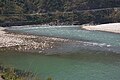
The Alaknanda rises at the confluence and foot of the Satopanth and Bhagirath Kharak glaciers in Uttarakhand.[2][3] From its origin, it travels to the village of Mana, meets with the Saraswati River, a left bank tributary at Keshav Prayag and continues downstream through narrow valleys. It reaches the Badrinath valley, arrives at Hanumanchatti, and meets with the Ghrit Ganga, a right bank tributary. From Hanumanchatti, the river goes to Pandukeshwar and flows through wide valleys and steep terrains.
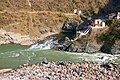
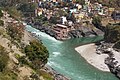
At Vishnuprayag it meets Dhauliganga, a left bank tributary, and travels west to the town of Joshimath. From Joshimath, the Alaknanda crosses the Main Central Thrust near Helang. It then meets with Birahi Ganga, a left bank tributary at Birahi. The river reaches the town of Nandprayag and joins with the Nandakini River, a left bank tributary. At Karanprayag, the Pindar River, a left bank tributary, meets with the Alaknanda River. At Rudraprayag, it meets with the Mandakini River, a right bank tributary. As the Alaknanda flows past Rudraprayag, it enters a wide valley near Srinagar, Garhwal. At Devprayag the Alaknanda River converges with the Bhagirathi River and travels onward as the Ganges River.[4]
The Alaknanda contributes a significantly larger portion to the flow of the Ganges than the Bhagirathi.[4] The Alaknanda system drains parts of Chamoli, Tehri, and Pauri districts.[5]
Religious significance[edit | edit source]
In ancient Hindu texts, the Alaknanda river has been used synonymously with the Ganges river. In the Vishnu Purana, the Ganges river which surrounds the city of Brahma divides into four and one of rivers is called Alaknanda, which flows south to India.[6]
Five rivers merge with the Alaknanda and are referred to as prayag or 'holy confluence of rivers' and are places of pilgrimage in Hinduism.[7] Panch Prayag (Pañcha prayāga) is an expression in Hindu religious ethos, specifically used to connote the five sacred river confluences in the Garhwal Himalayas in the state of Uttarakhand, India. The five prayags - prayaga meaning "place of confluence of rivers" in Sanskrit - also termed as "Prayag pentad". These in the descending flow sequence of their occurrence include Vishnuprayag, where the Alaknanda meets the Dhauliganga River, Nandaprayag, where it meets the Nandakini River, Karnaprayag, where it meets the Pindar River, Rudraprayag, where it meets the Mandakini River, and Devprayag, where it meets the Bhagirathi River and officially becomes the Ganges.[8]
Alaknanda + Dhauliganga = Vishnu Prayag
Alaknanda + Nandakini = Nand Prayag
Alaknanda + Pindarganga = Karna Prayag
Alaknanda + Mandakini = Rudra Prayag
Alaknanda + Bhagirathi = Dev Prayag
The Alaknanda also flows through other important places of pilgrimage such as Badrinath and Joshimath.[7]
Recreation[edit | edit source]
The Alaknanda river is known for river rafting due to its high rafting grade.[9]
Dams[edit | edit source]
There are 37 hydroelectric dams in operation, under construction or planned to harness the energy of the Alaknanda river and its tributaries and generate electricity.[10]
| # | Name | Electrical output capacity (MW) | Status | Dam height (m) | Full reservoir level (MSL) (m) | River bed level at dam site (MSL) (m) | Head race tunnel length (km) | Tail race tunnel length (m) | Tail water level (MSL) (m) |
|---|---|---|---|---|---|---|---|---|---|
| 1 | Badrinath | 1.25 | operational | ||||||
| 2 | Tapovan | 0.8 | operational | ||||||
| 3 | Tharali | 0.4 | operational | ||||||
| 4 | Tilwara | 0.2 | operational | ||||||
| 5 | Urgam | 3 | operational | ||||||
| 6 | Vishnuprayag | 400 | operational | 14 | 11.323 | ||||
| 7 | Kaliganga-I | 4 | under construction | ||||||
| 8 | Kaliganga-II | 6 | under construction | ||||||
| 9 | Koti Bhel IB | 320 | under construction | 90 | 521 | 452.5 | 230 | 463.2 | |
| 10 | Koti Bhel II | 530 | under construction | 82 | 458.5 | 401.4 | 390 | 411.1 | |
| 11 | Madhamaheshwar | 10 | under construction | ||||||
| 12 | Tapovan Vishnugad | 520 | under construction | 22 | 803.5 | 513 | 1267 | ||
| 13 | Srinagar | 330 | operational | ||||||
| 14 | Singoli Bhatwari | 99 | under construction |
There are 23 other proposed projects in the Alaknanda river basin through which the power-potential of the Alaknanda and its tributaries can be harnessed. The proposed 23 hydel-projects are as follows -
- Alaknanda (Badrinath) (300 MW)
- Bagoli (72 MW)
- Bowla Nandprayag (132 MW)
- Chuni Semi (60 MW)
- Deodi (60 MW)
- Devsari Dam (255 MW)
- Gaurikund (18.6 MW)
- Gohana Tal (60 MW)
- Jelam Tamak (60 MW)
- Karnaprayag (160 MW)
- Lakshmanganga (4.4 MW)
- Lata Tapovan (310 MW)
- Maleri Jelam (55 MW)
- Nandprayag Langasu (141 MW)
- Padli Dam (27 MW)
- Phata-Byung (10.8 MW)
- Rambara (24 MW)
- Rishiganga I (70 MW)
- Rishiganga II (35 MW)
- Tamak Lata (280 MW)
- Urgam II (3.8 MW)
- Utyasu Dam (860 MW)
- Vishnugad Pipalkoti (444 MW)
Gallery[edit | edit source]
-
-
 Alaknanda river near the town of Srinagar in Uttarakhand
 -


See also[edit | edit source]
References[edit | edit source]
- ↑ Gopal, Madan (1990). K.S. Gautam (ed.). India through the ages. Publication Division, Ministry of Information and Broadcasting, Government of India. p. 65.
- ↑ "eUttaranchal". 10 December 2015. Archived from the original on 17 July 2018. Retrieved 15 January 2018.
- ↑ In Hindu culture "The Story of Ganga : The River Goddess". 25 January 2010.
- ↑ 4.0 4.1 Singh, Sandeep (2018), Singh, Dhruv Sen (ed.), "Alakhnanda–Bhagirathi River System", The Indian Rivers: Scientific and Socio-economic Aspects, Springer Hydrogeology, Singapore: Springer, pp. 107–108, doi:10.1007/978-981-10-2984-4_8, ISBN 978-981-10-2983-7, retrieved 13 April 2022
{{citation}}: CS1 maint: work parameter with ISBN (link) - ↑ Singh Negi, Sharad (1995). Uttarakhand: Land and People, page 6. MD Publications Pvt Ltd. ISBN 81-85880-73-5.
- ↑ Dalal, Roshen (2010). Hinduism: An Alphabetical Guide. Penguin Books India. p. 19.
- ↑ 7.0 7.1 Sati, Vishwambhar Prasad (21 December 2013). Towards Sustainable Livelihoods and Ecosystems in Mountain Regions. Springer Science & Business Media. p. 95.
- ↑ Kapadia, Harish (2001). Trekking and Climbing in the Indian Himalaya, page 89. Stackpole Books. ISBN 0-8117-2953-2.
- ↑ "11 Top Destinations for River Rafting in India - Travel News India". travelnewsindia.com. 31 January 2017. Archived from the original on 11 March 2018. Retrieved 31 January 2017.
- ↑ Hydroelectric Projects on Alaknanda River Basin, by South Asia Network on Dams Rivers and People, www.sandrp.in

External links[edit | edit source]
- Alaknanda River Britannica.com
- Prayags at GMVN