


No edit summary |
m clean up, typos fixed: m³ → m<sup>3</sup>, $18 million USD → US$18 million |
||
| (One intermediate revision by one other user not shown) | |||
| Line 9: | Line 9: | ||
| image_bathymetry = | | image_bathymetry = | ||
| pushpin_map = India Jaipur##Rajasthan | | pushpin_map = India Jaipur##Rajasthan | ||
| | | pushpin_alt = Location of the lake within Jaipur | ||
| caption_bathymetry = | | caption_bathymetry = | ||
| location = [[Jaipur]] | | location = [[Jaipur]] | ||
| | | coordinates = {{Coord|26.9537|N|75.8463|E|region:IN_type:landmark|display=inline,title}} | ||
| type = Freshwater – Recreational | | type = Freshwater – Recreational | ||
| inflow = | | inflow = | ||
| outflow = | | outflow = | ||
| catchment = {{convert|23.5|km2|mi2}} | | catchment = {{convert|23.5|km2|mi2}} | ||
| | | countries = India | ||
| length = | | length = | ||
| width = | | width = | ||
| area = {{convert|300|acre|ha}} | | area = {{convert|300|acre|ha}} | ||
| depth = | | depth = | ||
| | | max_depth = {{convert|4.5|m|ft}} | ||
| volume = | | volume = | ||
| residence_time = | | residence_time = | ||
| Line 28: | Line 28: | ||
| elevation = | | elevation = | ||
| islands = | | islands = | ||
| | | settlements = [[Jaipur]] | ||
| agency = KGK Group of Companies JAIPUR | | agency = KGK Group of Companies JAIPUR | ||
}} | }} | ||
[[File: Jal Mahal-Jaipur-India0002.JPG|thumb|Jal Mahal at night.]] | [[File: Jal Mahal-Jaipur-India0002.JPG|thumb|Jal Mahal at night.]] | ||
'''Jal Mahal''' ( | '''Jal Mahal''' ([[Hindi]]: {{IPA|[dʒəl mɛːɦəl]}}, {{lit|Water Palace}}) is a historical palace in the middle of [[Man Sagar Lake]] in the city of [[Jaipur]], capital of the [[India]]n state of [[Rajasthan]]. | ||
== | ==History== | ||
[[File: | [[File:Gaitor ki Chhatri Cenotaphs, Jaipur, India (DSCN4779).jpg|thumb|Royal Cenotaphs of Gaitore]] | ||
[[File: | [[File:Jal-Mahal-Jaipur.jpg|thumb|Jal Mahal in 2025]] | ||
Originally constructed around 1699 by [[Sawai Jai Singh]] of [[Amer, India|Amber]] as a duck-hunting lodge rather than a royal residence. The building and the lake around it were later [[Renovation|renovated]] and enlarged in the mid-18th century by Maharaja [[Madho Singh I]].<ref>{{cite web |title=Jal Mahal |url=https://www.tourism.rajasthan.gov.in/jal-mahal.html |website=Rajasthan Tourism |publisher=Department of Tourism, Government of Rajasthan |access-date=2 June 2026}}</ref> | |||
== Grounds == | |||
Jal Mahal is built from local pink and red sandstone and stands as a five-story building in the middle of [[Man Sagar Lake]]. The Man Sagar Dam faces eastward while the local roadside promenade faces west. When the lake is at full capacity, its depth reaches approximately 4.5 meters (15 feet); consequently, the lower story remains submerged underwater.<ref>{{cite web |last1=Sachdev |first1=Vibhuti |title=Restoring the Jal Mahal: Challenges and Opportunities |url=https://academia.edu |access-date=2026-08-07 |website=Academia.edu}}</ref> | |||
The | The top floor terrace features a central garden with arched passages, flanked by four octagonal [[Chhatri]] or "domed-pavilions" marking the corners of the building. | ||
The hills surrounding the lake to the northeast belong to the [[Aravalli Range|Aravalli]] mountain range and feature quartzite rock formations historically quarried for local construction. | |||
In the past, the palace has suffered subsidence and partial plaster wall logging damage due to [[Damp (structural)|rising damp]] which has been repaired under restoration projects commissioned by the [[Government of Rajasthan]].<ref name="Brown">{{Cite book|last=Brown|first=Lindsay|author2=Amelia Thomas |title= Rajasthan, Delhi and Agra|page=160|access-date=2009-09-13|url=https://books.google.com/books?id=Zz0_zXPb68kC&q=Jal+Mahal+place+details+Jaipur&pg=PA160|publisher= Lonely Planet|year=2008|isbn=978-1-74104-690-8 }}</ref> | |||
In | |||
From the northeast, the Kanak Vrindavan valley, where a [[temple]] complex sits, the hills slope gently towards the lake edge. Within the lake area, the ground area is made up of a thick mantle of soil, blown sand, and alluvium. Forest [[denudation]], particularly in the hilly areas, has caused [[soil erosion]], compounded by wind and water action. As a result, silt built up in the lake incrementally raises the lake bed.<ref name="Joshi">{{Cite web|url=http://www.aars-acrs.org/acrs/proceeding/ACRS2008/Papers/TS%2010.1.pdf|title=Impact of Urbanization on Urban Lake Using High Resolution Satellite Data and GIS(A Case Study of Man Sagar Lake of Jaipur, Rajasthan)|access-date=21 September 2009|archive-date=1 December 2017|archive-url=https://web.archive.org/web/20171201041403/http://www.aars-acrs.org/acrs/proceeding/ACRS2008/Papers/TS%2010.1.pdf|url-status=dead}}</ref> | |||
[[ | ===Royal Cenotaphs of Gaitore=== | ||
Located opposite the lake at Gaitore are [[chhatris]] and [[cenotaphs]] erected over cremation platforms of notable [[Kachwaha]] rulers of Jaipur. Originally built by [[Sawai Jai Singh|Sawai Jai Singh II]], the cenotaphs are in honor of [[Pratap Singh of Jaipur|Pratap Singh]], [[Madho Singh II]] among others. The monument for Jai Singh II is noted for its intricate carvings and 20 carved domed pillars.<ref name="Brown" /> | |||
==Restoration == | |||
In 2004, the Rajasthan Tourism Development Corporation signed an agreement with Jal Mahal Resorts, granting it a 99-year lease to develop the palace and 100 acres along the Man Sagar Lake.<ref name="Outlook India">{{cite news|last=Joshi|first=Namrata|title=A Jewel Finds its Water|url=http://www.outlookindia.com/article.aspx?272097|archive-url=https://web.archive.org/web/20110608111554/http://www.outlookindia.com/article.aspx?272097|url-status=dead|archive-date=8 June 2011|access-date=30 August 2011|newspaper=Outlook India|date=13 June 2011}}</ref> From 2005 onwards the company has worked on the [[Environmental degradation|cleaning]] of the lake, reviving the ecology of the area and restoring the palace. For the future, Jal Mahal Resorts plans to build the site and surrounding area into a tourist destination for visitors to the city of Jaipur. | |||
===Lake Restoration === | |||
[[File: Jalmahal Restored.jpeg|thumb|Jal Mahal in 2011, after water restoration.]] | |||
In the early 2000s, an extensive public-private partnership project worth ₹1.5 billion (approximately US$18 million) was launched to restore Jal Mahal, rehabilitate Man Sagar Lake, and develop the surrounding area.<ref name="ilfs">{{Cite web|url=http://www.ilfsindia.com/downloads/bus_rep/jalmahal_tourism_rep.pdf|title=Innovation Report: Jal Mahal Tourism Project|access-date=2009-09-11|publisher=IL&FS|archive-url=https://web.archive.org/web/20100103135940/http://www.ilfsindia.com/downloads/bus_rep/jalmahal_tourism_rep.pdf|archive-date=3 January 2010|url-status=dead}}</ref> The project covered a total area of 432 acres (175 ha), which included: | |||
* 300 acres (120 ha) of lake surface area. | |||
* 100 acres (40 ha) of lake precincts designated for tourism development. | |||
* 32 acres (13 ha) allocated for a public promenade, tertiary water treatment facilities, and related infrastructure.<ref name="minutes">{{Cite web|url=http://ppp.rajasthan.gov.in/ECID/ECIDVIII.pdf|title=Minutes of the 8th meeting of the Empowered Committee on Infrastructure Development (ECID) held on April 05, 2005|access-date=2009-09-12|publisher=Government of Rajasthan|archive-url=https://web.archive.org/web/20110721161549/http://ppp.rajasthan.gov.in/ECID/ECIDVIII.pdf|archive-date=21 July 2011|url-status=dead}}</ref> | |||
Led by the [[Jaipur Development Authority]] (JDA) in collaboration with central government agencies, notably the Ministry of Environment and Forests, as well as private sector developer KGK Consortium, the initiative addressed decades of environmental degradation caused by urban sewage and catchment runoff.<ref name="ilfs" /> | |||
=== Environmental and Engineering Works === | |||
To restore the lake's ecosystem and improve water quality, several major environmental and engineering measures were executed: | |||
The interior of the Jal Mahal | * '''Desilting & Landscaping:''' Approximately 500,000 m<sup>3</sup> of silt was dredged from the lakebed. The material was reused to build [[check dam]]s, reinforce embankments, and construct three artificial nesting grounds for migratory birds. | ||
* '''Water Treatment & Bioremediation:''' City sewage drains were realigned, and untreated discharge from the Brahmpuri and Nagtalai drains were diverted into a newly built treatment plant. The secondary effluent was routed through a 4-hectare (9.9-acre) artificial wetland with [[hyacinth]] channels for nutrient removal. Additionally, an in-situ [[bioremediation]] system utilizing 140 diffusers and 5 air compressors was installed to [[Aerated lagoon|aerate]] the lake bed. | |||
* '''Infrastructure & Reforestation:''' A 1 km (0.62 mi) lakefront promenade and a 2.7 km (1.7 mi) road connecting [[Amber, India|Amber]] to Man Sagar Dam were built. Local flora such as [[Vachellia nilotica|Acacia arabica]], [[Tamarix]], [[Terminalia arjuna]], [[Populus|Poplar]], [[Azadirachta indica|Neem]], and [[Ficus]] species were planted along the banks to stabilize soil and expand bird habitat.<ref name="Joshi" /><ref name="Jaipur">{{Cite web|url=http://www.jaipurjda.org/page.aspx?pid=94|title=The Ecological Restoration Project of Mansagar Lake|publisher=Jaipur Development Authority, Government of Rajasthan|archive-url=https://web.archive.org/web/20110726201454/http://www.jaipurjda.org/page.aspx?pid=94|archive-date=26 July 2011|url-status=dead|access-date=2009-09-12}}</ref><ref name="Lake">{{Cite web|url=http://dlc.dlib.indiana.edu/archive/00001612/01/INEFWP2005.pdf|title=Mine Spoil Restoration: A strategy combining rainwater harvesting and adaptation|access-date=2009-09-20|work=Man Sagar Lake|page=15|publisher=International Network on Ethnoforestry|location=Jaipur|year=2005|archive-url=https://web.archive.org/web/20070610135159/http://dlc.dlib.indiana.edu/archive/00001612/01/INEFWP2005.pdf|archive-date=10 June 2007|url-status=dead}}</ref> | |||
=== Tourism Precinct and Current Status === | |||
Following the initial ecological restoration, a joint-sector enterprise (PDCOR) was formed between the JDA and KGK Consortium to manage the site's commercial and cultural development. The broader master plan envisioned a convention center, craft village, resort hotels, public gardens, and ongoing maintenance of the monument.<ref name="ilfs" /> | |||
However, commercial tourism development stalled following legal challenges in the [[Rajasthan High Court]] and subsequent Supreme Court rulings, which altered the lease duration to 30 years and restricted construction on wetland areas. Despite the environmental cleanup of the lake, commercial construction remains inactive, and the lower four-story interior of the palace remains closed to general visitors.<ref name="HC2012">{{cite news |last=Sharma |first=K. P. |date=17 May 2012 |title=Prof. K.P. Sharma v. State Of Rajasthan & Ors. |url=https://www.casemine.com/judgement/in/56e0ee79607dba38965ed2a8 |work=Rajasthan High Court}}</ref><ref name="SC2014">{{cite news |date=14 May 2014 |title=Supreme Court Nod to Jal Mahal Tourism Development Project at Jaipur |url=https://www.ndtv.com/jaipur-news/supreme-court-nod-to-jal-mahal-tourism-development-project-at-jaipur-561777 |work=NDTV}}</ref> | |||
==See also== | ==See also== | ||
Latest revision as of 13:22, 12 October 2026
| Jal Mahal | |
|---|---|
 | |
  Jal Mahal  Jal Mahal | |
| Location | Jaipur |
| Coordinates | 26°57′13″N 75°50′47″E / 26.9537°N 75.8463°E |
| Type | Freshwater – Recreational |
| Catchment area | 23.5 square kilometres (9.1 sq mi) |
| Basin countries | India |
| Managing agency | KGK Group of Companies JAIPUR |
| Surface area | 300 acres (120 ha) |
| Settlements | Jaipur |

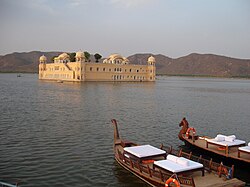
Jal Mahal (Hindi: [dʒəl mɛːɦəl], lit. 'Water Palace') is a historical palace in the middle of Man Sagar Lake in the city of Jaipur, capital of the Indian state of Rajasthan.
History[edit | edit source]


Originally constructed around 1699 by Sawai Jai Singh of Amber as a duck-hunting lodge rather than a royal residence. The building and the lake around it were later renovated and enlarged in the mid-18th century by Maharaja Madho Singh I.[1]
Grounds[edit | edit source]
Jal Mahal is built from local pink and red sandstone and stands as a five-story building in the middle of Man Sagar Lake. The Man Sagar Dam faces eastward while the local roadside promenade faces west. When the lake is at full capacity, its depth reaches approximately 4.5 meters (15 feet); consequently, the lower story remains submerged underwater.[2]
The top floor terrace features a central garden with arched passages, flanked by four octagonal Chhatri or "domed-pavilions" marking the corners of the building.
The hills surrounding the lake to the northeast belong to the Aravalli mountain range and feature quartzite rock formations historically quarried for local construction.
In the past, the palace has suffered subsidence and partial plaster wall logging damage due to rising damp which has been repaired under restoration projects commissioned by the Government of Rajasthan.[3]
From the northeast, the Kanak Vrindavan valley, where a temple complex sits, the hills slope gently towards the lake edge. Within the lake area, the ground area is made up of a thick mantle of soil, blown sand, and alluvium. Forest denudation, particularly in the hilly areas, has caused soil erosion, compounded by wind and water action. As a result, silt built up in the lake incrementally raises the lake bed.[4]
Royal Cenotaphs of Gaitore[edit | edit source]
Located opposite the lake at Gaitore are chhatris and cenotaphs erected over cremation platforms of notable Kachwaha rulers of Jaipur. Originally built by Sawai Jai Singh II, the cenotaphs are in honor of Pratap Singh, Madho Singh II among others. The monument for Jai Singh II is noted for its intricate carvings and 20 carved domed pillars.[3]
Restoration[edit | edit source]
In 2004, the Rajasthan Tourism Development Corporation signed an agreement with Jal Mahal Resorts, granting it a 99-year lease to develop the palace and 100 acres along the Man Sagar Lake.[5] From 2005 onwards the company has worked on the cleaning of the lake, reviving the ecology of the area and restoring the palace. For the future, Jal Mahal Resorts plans to build the site and surrounding area into a tourist destination for visitors to the city of Jaipur.
Lake Restoration[edit | edit source]

In the early 2000s, an extensive public-private partnership project worth ₹1.5 billion (approximately US$18 million) was launched to restore Jal Mahal, rehabilitate Man Sagar Lake, and develop the surrounding area.[6] The project covered a total area of 432 acres (175 ha), which included:
- 300 acres (120 ha) of lake surface area.
- 100 acres (40 ha) of lake precincts designated for tourism development.
- 32 acres (13 ha) allocated for a public promenade, tertiary water treatment facilities, and related infrastructure.[7]
Led by the Jaipur Development Authority (JDA) in collaboration with central government agencies, notably the Ministry of Environment and Forests, as well as private sector developer KGK Consortium, the initiative addressed decades of environmental degradation caused by urban sewage and catchment runoff.[6]
Environmental and Engineering Works[edit | edit source]
To restore the lake's ecosystem and improve water quality, several major environmental and engineering measures were executed:
- Desilting & Landscaping: Approximately 500,000 m3 of silt was dredged from the lakebed. The material was reused to build check dams, reinforce embankments, and construct three artificial nesting grounds for migratory birds.
- Water Treatment & Bioremediation: City sewage drains were realigned, and untreated discharge from the Brahmpuri and Nagtalai drains were diverted into a newly built treatment plant. The secondary effluent was routed through a 4-hectare (9.9-acre) artificial wetland with hyacinth channels for nutrient removal. Additionally, an in-situ bioremediation system utilizing 140 diffusers and 5 air compressors was installed to aerate the lake bed.
- Infrastructure & Reforestation: A 1 km (0.62 mi) lakefront promenade and a 2.7 km (1.7 mi) road connecting Amber to Man Sagar Dam were built. Local flora such as Acacia arabica, Tamarix, Terminalia arjuna, Poplar, Neem, and Ficus species were planted along the banks to stabilize soil and expand bird habitat.[4][8][9]
Tourism Precinct and Current Status[edit | edit source]
Following the initial ecological restoration, a joint-sector enterprise (PDCOR) was formed between the JDA and KGK Consortium to manage the site's commercial and cultural development. The broader master plan envisioned a convention center, craft village, resort hotels, public gardens, and ongoing maintenance of the monument.[6]
However, commercial tourism development stalled following legal challenges in the Rajasthan High Court and subsequent Supreme Court rulings, which altered the lease duration to 30 years and restricted construction on wetland areas. Despite the environmental cleanup of the lake, commercial construction remains inactive, and the lower four-story interior of the palace remains closed to general visitors.[10][11]
See also[edit | edit source]

Gallery[edit | edit source]
-
 The palace amidst the lake, as seen in November 2007
-
 Jal Mahal under restoration, as seen in February 2008
-
 Jal Mahal after restoration, as seen in March 2008
-
 Jal Mahal during the day time
-
 Jal Mahal in August 2014
-
 Jal Mahal close-up


References[edit | edit source]
- ↑ "Jal Mahal". Rajasthan Tourism. Department of Tourism, Government of Rajasthan. Retrieved 2 June 2026.
- ↑ Sachdev, Vibhuti. "Restoring the Jal Mahal: Challenges and Opportunities". Academia.edu. Retrieved 7 August 2026.
- ↑ 3.0 3.1 Brown, Lindsay; Amelia Thomas (2008). Rajasthan, Delhi and Agra. Lonely Planet. p. 160. ISBN 978-1-74104-690-8. Retrieved 13 September 2009.
- ↑ 4.0 4.1 "Impact of Urbanization on Urban Lake Using High Resolution Satellite Data and GIS(A Case Study of Man Sagar Lake of Jaipur, Rajasthan)" (PDF). Archived from the original (PDF) on 1 December 2017. Retrieved 21 September 2009.
- ↑ Joshi, Namrata (13 June 2011). "A Jewel Finds its Water". Outlook India. Archived from the original on 8 June 2011. Retrieved 30 August 2011.
- ↑ 6.0 6.1 6.2 "Innovation Report: Jal Mahal Tourism Project" (PDF). IL&FS. Archived from the original (PDF) on 3 January 2010. Retrieved 11 September 2009.
- ↑ "Minutes of the 8th meeting of the Empowered Committee on Infrastructure Development (ECID) held on April 05, 2005" (PDF). Government of Rajasthan. Archived from the original (PDF) on 21 July 2011. Retrieved 12 September 2009.
- ↑ "The Ecological Restoration Project of Mansagar Lake". Jaipur Development Authority, Government of Rajasthan. Archived from the original on 26 July 2011. Retrieved 12 September 2009.
- ↑ "Mine Spoil Restoration: A strategy combining rainwater harvesting and adaptation" (PDF). Man Sagar Lake. Jaipur: International Network on Ethnoforestry. 2005. p. 15. Archived from the original (PDF) on 10 June 2007. Retrieved 20 September 2009.
- ↑ Sharma, K. P. (17 May 2012). "Prof. K.P. Sharma v. State Of Rajasthan & Ors". Rajasthan High Court.
- ↑ "Supreme Court Nod to Jal Mahal Tourism Development Project at Jaipur". NDTV. 14 May 2014.