



No edit summary Tags: Mobile edit Mobile web edit |
Vishvaksena (talk | contribs) No edit summary Tags: Mobile edit Mobile web edit |
||
| (31 intermediate revisions by 5 users not shown) | |||
| Line 1: | Line 1: | ||
{{Short description|Late medieval Hindu dynasty of India (800-16th c.)}} | |||
{{pp-extended|small=yes}} | |||
{{Use Indian English|date=March 2013}} | |||
{{Use dmy dates|date=July 2022}} | {{Use dmy dates|date=July 2022}} | ||
{{Infobox country | {{Infobox country | ||
|conventional_long_name = Chandelas of Jejakabhukti | |conventional_long_name = Chandelas of Jejakabhukti | ||
|common_name = | |common_name = Chandela | ||
|era = [[Medieval India]] | |era = [[Medieval India]] | ||
|government_type = Monarchy | |government_type = Monarchy | ||
|year_start = {{Circa|early 9th c.}} | |||
|year_end = 16th c. | |||
|year_start = | |||
|year_end = | |||
|p1 = Kalachuris of Tripuri | |p1 = Kalachuris of Tripuri | ||
| s1 = Mamluk dynasty (Delhi) | |||
| s1 | | s2 = Mughal Empire | ||
|image_map = Map of the Candellas.png | |||
|image_map_caption = Territory of the Chandelas during the reign of [[Vidyadhara (Chandela ruler)|Vidyadhara]] circa 1025 CE.<ref name="JS">{{cite book |last1=Schwartzberg |first1=Joseph E. |title=A Historical Atlas of South Asia |date=1978 |publisher=Oxford University Press, Digital South Asia Library|author-link=Joseph E. Schwartzberg |url=https://dsal.uchicago.edu/cgi-bin/reference/schwartzberg/query.py?display_type=image_display&object=183#gsc.tab=0|page=146, Map "j"}}</ref> | |||
| | |map_width = 300px | ||
|image_map = Map of Candellas | |||
|image_map_caption = [[ | |||
|map_width = | |||
|capital = {{ubl|[[Khajuraho]]|[[Kalanjara]]|[[Mahoba]]}} | |capital = {{ubl|[[Khajuraho]]|[[Kalanjara]]|[[Mahoba]]}} | ||
|common_languages = [[Sanskrit]] | |common_languages = [[Sanskrit]] | ||
| Line 34: | Line 21: | ||
|today = [[India]] | |today = [[India]] | ||
| image_coat = Chandelas of Jejakabhukti. Sallakshana Varman. Circa 1120-1135 CE.jpg | | image_coat = Chandelas of Jejakabhukti. Sallakshana Varman. Circa 1120-1135 CE.jpg | ||
| coa_size = | | coa_size = 280px | ||
| symbol_type = Coinage of [[Sallakshanavarman|Sallakshana-Varman]] (1120–1135 CE), Chandelas of Jejakabhukti | | symbol_type = Coinage of [[Sallakshanavarman|Sallakshana-Varman]] (1120–1135 CE), Chandelas of Jejakabhukti | ||
}} | }} | ||
[[ | |||
The '''Chandel Empire''' ([[Sanskrit]]: चन्देल साम्राज्य, [[IAST]]: ''Çandela empire''), also known as '''Chandelas of Jejakabhukti''' was an [[Indian]] empire during the [[medieval India|medieval period]] of the Indian subcontinent which existed from the 9th century to the 16th century CE. At its peak, the dynasty ruled an empire that stretched across more than half of the [[Indian subcontinent]], with its country called [[Jejakabhukti (Chandela country)|Jejakabhukti]]. The ruling dynasty of the empire was founded by the Chandela ruler [[Nannukavarman]], who established [[Chandela dynasty of Jejakabhukti]] in the early 9th century. The dynasty belonged to the [[Chandel (Rajput clan)|Chandel]] clan of the [[Rajput|Rajputs]].<ref>*{{Cite book |author=Upinder Singh|author-link=Upinder Singh|url=https://books.google.com/books?id=7DRuAAAAMAAJ |title=The Discovery of Ancient India: Early Archaeologists and the Beginnings of Archaeology |date=2004 |publisher=Permanent Black |isbn=978-81-7824-088-6|page=73|quote=Discussion of the histories of various Rajput clans, such as the Chauhans, Kachhvahas, Chandelas, Pratiharas and Tomaras on the basis of a wide range of sources-literary, epigraphic, numismatic, bardic accounts and local traditions|language=en}} | |||
*{{Cite book|last1=Kulke|first1=Hermann|author-link1=Hermann Kulke|last2=Rothermund|first2=Dietmar |author-link2=Dietmar Rothermund|url=https://books.google.com/books?id=TPVq3ykHyH4C|title=A History of India|date=2004|publisher=Psychology Press|isbn=978-0-415-32919-4|language=en|page=117|quote="When Gurjara Pratiharas power declined after the sacking of Kannauj by the Rashtrakutas in the early tenth century many Rajput princes declared their independence and founded their own kingdoms, some of which grew to importance in the subsequent two centuries. The better known among those dynasties were the Chaulukyas or Solankis of Gujarat and Kathiawar, the Chahamanas (i.e. Chauhans) of eastern Rajasthan (Ajmer and Jodhpur) and the Tomaras who had founded Delhi (Dhillika) in 736 but had been displaced by the Chauhans in the twelfth century. Rajput descent was also claimed by the Chandelas of Khujuraho and the Kalachuris of Tripuri"}} | |||
*{{Cite book |author=Romila Thapar|author-link=Romila Thapar|url=https://books.google.com/books?id=i6cwDwAAQBAJ |title=Early India: From the Origins to AD 1300 |date=2004|publisher=University of California Press |isbn=978-0-520-24225-8 |page=420|quote=Other claiming to be Rajputs and descended from the solar and lunar lines, established themselves as local kings in various parts of western and central India. Among them were the Chandellas, prominent in the tenth century in Bundelkhand with their centre at Khajuraho and their territory known as Jejakabhukti|language=en}} | |||
*{{harvnb|R. K. Dikshit|1976|pp=8}}: "The Candellas are undoubtedly a Rajput clan and the epigraphic evidences does not show that any inferiority was applied to them in the past. It reveals their matrimonial relationship with important Rajput families from the very beginning of their history"</ref> | |||
The Chandela dynasty of Jejakabhukti initially ruled small territories surrounding Khajuraho by overthrowing Pratiharas from there during the reign of its founder Nannukavarman. The 10th century Chandela ruler Harshavarman defeated the Rashtrakuta Empire and restored the Pratihara ruler Mahipala to the throne of Kannauj. Harsha's son [[Yashovarman (Chandela dynasty)|Yashovarman]] defeated Pratiharas, palas and other kingdoms and expanded the supremacy of Chandel empire in North India. His successor [[Dhangavarman|Dhangavarman]] expanded the Chandela Empire, and stretched it over more than half of the Indian subcontinent. Vidyadharavarman was the greatest emperor who defeated Mahmud Ghaznavi twice. From the 9th to the 14th centuries, the Chandelas defeated the [[Paramara dynasty|Paramaras of Malwa]], [[Gurjara-Pratihara dynasty|Gurjara-Pratiharas]], [[Pala Empire|Palas]], [[Kambojas]], [[Kalachuris of Tripuri]], [[Magadha]]s, and [[Kalinga]]s at various times, bringing these kingdoms under feudal, subordinate, vassal, or tributary status during different periods. Many Chandela emperors also performed the [[Ashvamedha]] yajna on multiple occasions, asserting their sovereignty through the conquest and subjugation of Indian kingdoms. | |||
They also defeated the [[Kashmiris]], [[Khasas]], [[Chaulukya dynasty|Chaulukyas]], [[Chalukya dynasty|Chalukyas]], and [[Rashtrakuta dynasty|Rashtrakutas]] at various times and captured parts of their territories, while conducting raids into [[South India]]. | |||
From the 11th century onwards, the Chandel Empire faced raids and invasions by the [[Ghaznavid dynasty|Ghaznavids]] and the [[Ghurid dynasty|Ghurids]], followed by those of the [[Delhi Sultanate]] and other Muslim and Hindu dynasties. However, the [[Chandela dynasty of Jejakabhukti|Chandelas]] repulsed invasions by the [[Ghaznavid Empire|Ghaznavids]], [[Ghurid dynasty|Ghurids]], the [[Delhi Sultanate]], and other Muslim and Hindu dynasties, while retaining their power and independence until the 16th century. | |||
The Chandelas are well known for their art and architecture, most notably for the temples at their original capital [[Khajuraho Group of Monuments|Khajuraho]]. They also commissioned a number of temples, water bodies, palaces and forts at other places, including their strongholds of [[Ajaigarh]], [[Kalinjar]] and their later capital [[Mahoba]]. | |||
== Origin == | == Origin == | ||
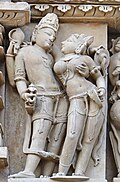
The origin of the Chandelas is obscured by mythical legends. The epigraphic records of the dynasty, as well as contemporary texts such as ''Balabhadra-vilasa'' and ''Prabodha-chandrodaya'', suggest that the Chandelas belonged to the legendary [[Lunar dynasty]] (''Chandravansha'').{{sfn|R. K. Dikshit|1976|p=3}} A 954 CE [[Khajuraho]] inscription states that the dynasty's first king [[Nannuka]] was a descendant of sage Chandratreya, who was a son of [[Atri]]. A 1002 CE Khajuraho inscription gives a slightly different account, in which Chandratreya is mentioned as a son of Indu (the Moon) and a grandson of Atri.{{sfn|R. K. Dikshit|1976|p=4}} The 1195 CE Baghari inscription and the 1260 CE Ajaygadh inscription contain similar accounts.{{sfn|R. K. Dikshit|1976|p=5}} The ''Balabhadra-vilasa'' also names [[Atri]] among the ancestors of the Chandelas. Another Khajuraho inscription describes the Chandela king [[Dhanga]] as a member of the [[Vrishni]] clan of the [[Yadavas]] (who also claimed to be part of the Lunar dynasty).{{sfn|R. K. Dikshit|1976|p=3}} | The origin of the Chandelas is obscured by mythical legends. The epigraphic records of the dynasty, as well as contemporary texts such as ''Balabhadra-vilasa'' and ''Prabodha-chandrodaya'', suggest that the Chandelas belonged to the legendary [[Lunar dynasty]] (''Chandravansha'').{{sfn|R. K. Dikshit|1976|p=3}} A 954 CE [[Khajuraho]] inscription states that the dynasty's first king [[Nannuka]] was a descendant of sage Chandratreya, who was a son of [[Atri]]. A 1002 CE Khajuraho inscription gives a slightly different account, in which Chandratreya is mentioned as a son of Indu (the Moon) and a grandson of Atri.{{sfn|R. K. Dikshit|1976|p=4}} The 1195 CE Baghari inscription and the 1260 CE Ajaygadh inscription contain similar accounts.{{sfn|R. K. Dikshit|1976|p=5}} The ''Balabhadra-vilasa'' also names [[Atri]] among the ancestors of the Chandelas. Another Khajuraho inscription describes the Chandela king [[Dhanga]] as a member of the [[Vrishni]] clan of the [[Yadavas]] (who also claimed to be part of the Lunar dynasty).{{sfn|R. K. Dikshit|1976|p=3}} | ||
[[File:Le temple de Parshvanath (Khajuraho) (8638391942).jpg |thumb|left|upright| | [[File:Le temple de Parshvanath (Khajuraho) (8638391942).jpg |thumb|left|upright|Lord Vishnu and Goddess Lakshmi, [[Khajuraho]].]] | ||
The ''Mahoba-Khanda'' legend of the dynasty's origin goes like this: Hemaraja, a priest of the [[Gahadavala|Gaharwar]] king of [[Varanasi|Benares]], had a beautiful daughter named Hemavati. Once, while Hemavati was bathing in a pond, the moon god [[Chandra]] saw her and made love to her. Hemavati was worried about the dishonour of being an unwed mother, but Chandra assured her that their son would become a great king. This child was the dynasty's progenitor Chandravarma. Chandra presented him with a [[philosopher's stone]] and taught him politics.<ref name="Asopa1976">{{cite book |author=Jai Narayan Asopa |title=Origin of the Rajputs |url=https://books.google.com/books?id=I_KznQEACAAJ |year=1976 |publisher=Bharatiya Publishing House |page=208}}</ref>{{sfn|R. K. Dikshit|1976|p=3}} The dynasty's own records do not mention Hemavati, Hemaraja or Indrajit. Such legends appear to be later bardic inventions. In general, the ''Mahoba-Khanda'' is a historically unreliable text.{{sfn|R. K. Dikshit|1976|p=4}} ''Prithviraj Raso'' is also considered an historically unreliable text.<ref>{{cite book | editor=K Ayyappap Panikkar | title=Medieval Indian literature: an anthology (Volume 1) | author = Vijayendra Snatak | chapter = Medieval Hindi Literature | chapter-url=https://books.google.com/books?id=KYLpvaKJIMEC&pg=PA142 | The ''Mahoba-Khanda'' legend of the dynasty's origin goes like this: Hemaraja, a priest of the [[Gahadavala|Gaharwar]] king of [[Varanasi|Benares]], had a beautiful daughter named Hemavati. Once, while Hemavati was bathing in a pond, the moon god [[Chandra]] saw her and made love to her. Hemavati was worried about the dishonour of being an unwed mother, but Chandra assured her that their son would become a great king. This child was the dynasty's progenitor Chandravarma. Chandra presented him with a [[philosopher's stone]] and taught him politics.<ref name="Asopa1976">{{cite book |author=Jai Narayan Asopa |title=Origin of the Rajputs |url=https://books.google.com/books?id=I_KznQEACAAJ |year=1976 |publisher=Bharatiya Publishing House |page=208}}</ref>{{sfn|R. K. Dikshit|1976|p=3}} The dynasty's own records do not mention Hemavati, Hemaraja or Indrajit. Such legends appear to be later bardic inventions. In general, the ''Mahoba-Khanda'' is a historically unreliable text.{{sfn|R. K. Dikshit|1976|p=4}} ''Prithviraj Raso'' is also considered an historically unreliable text.<ref>{{cite book | editor=K Ayyappap Panikkar | title=Medieval Indian literature: an anthology (Volume 1) | author = Vijayendra Snatak | chapter = Medieval Hindi Literature | chapter-url=https://books.google.com/books?id=KYLpvaKJIMEC&pg=PA142 |year=1997 | publisher=Sahitya Akademi | isbn=978-81-260-0365-5 | page=142}}</ref><ref>{{cite book |title=Serving empire, serving nation: James Tod and the Rajputs of Rajasthan |first=Jason |last=Freitag |publisher=BRILL |year=2009 |isbn=978-90-04-17594-5 |url=https://books.google.com/books?id=Ib93BhAu43gC |pages=3–5}}</ref><ref>{{cite book |author=R. V. Somani |url=https://books.google.com/books?id=NcIBAAAAMAAJ |title=History of Mewar, from Earliest Times to 1751 A.D. |publisher=Mateshwari |year=1976 |oclc=2929852 |page= 30}}</ref> | ||
[[File:Celestial dancer (Devata) mid-11th century, Chandela period, Madhya Pradesh.jpg|thumb|Celestial dancer (Devata) mid-11th century, Chandela period, Madhya Pradesh. [[Metropolitan Museum of Art]].]] | [[File:Celestial dancer (Devata) mid-11th century, Chandela period, Madhya Pradesh.jpg|thumb|Celestial dancer (Devata) mid-11th century, Chandela period, Madhya Pradesh. [[Metropolitan Museum of Art]].]] | ||
| Line 52: | Line 51: | ||
=== Early rulers === | === Early rulers === | ||
The | The Chandelas were originally vassals of the [[Gurjara-Pratiharas]].<ref>Radhey Shyam Chaurasia, History of Ancient India: Earliest Times to 1000 A. D.</ref> [[Nannuka]] (r. {{Circa|831}}–845 CE), the founder of the dynasty, was the ruler of a small kingdom centered around [[Khajuraho Group of Monuments|Khajuraho]].<ref>{{cite book |author=Sailendra Sen |title=A Textbook of Medieval Indian History |url=https://books.google.com/books?id=UdW6lAEACAAJ |year=2013 |publisher=Primus |isbn=978-93-80607-34-4 |page=22}}</ref> | ||
According to the Chandela inscriptions, Nannuka's successor [[Vakpati (Chandela dynasty)|Vakpati]] defeated several enemies.{{sfn|Sisirkumar Mitra|1977|pp=27-28}} Vakpati's sons [[Jayashakti]] (Jeja) and [[Vijayashakti]] (Vija) consolidated the Chandela power.{{sfn|Sisirkumar Mitra|1977|p=30}} According to a [[Mahoba]] inscription, the Chandela territory was named "Jejakabhukti" after the Jayashakti.{{sfn|R. K. Dikshit|1976|p=28}} Vijayashakti's successor [[Rahila]] is credited with several military victories in eulogistic inscriptions.{{sfn|R. K. Dikshit|1976|pp=30–31}} Rahila's son [[Harsha (Chandela dynasty)|Harsha]] played an important role in restoring the rule of the Pratihara king [[Mahipala I|Mahipala]], possibly after a [[Rashtrakuta]] invasion or after Mahiapala's conflict with his step-brother [[Bhoja II (Gurjara-Pratihara dynasty)|Bhoja II]].{{sfn|R. K. Dikshit|1976|pp=32–35}} | |||
According to the Chandela inscriptions, Nannuka's successor [[Vakpati (Chandela dynasty)|Vakpati]] defeated several enemies.{{sfn|Sisirkumar Mitra|1977|pp=27-28}} Vakpati's sons [[Jayashakti]] (Jeja) and [[Vijayashakti]] (Vija) consolidated the Chandela power.{{sfn|Sisirkumar Mitra|1977|p=30}} According to a [[Mahoba]] inscription, the Chandela territory was named "Jejakabhukti" after the Jayashakti.{{sfn|R. K. Dikshit|1976|p=28}} Vijayashakti's successor [[Rahila]] is credited with several military victories in eulogistic inscriptions.{{sfn|R. K. Dikshit|1976|pp= | |||
=== Rise as a sovereign power === | === Rise as a sovereign power === | ||
[[File:Kirtivarman Chandela visits the temple of Khajurahu.jpg|thumb|A 20th century artist's imagination of Kirtivarman Chandela visiting a [[Khajuraho]] temple]] | [[File:Kirtivarman Chandela visits the temple of Khajurahu.jpg|thumb|A 20th century artist's imagination of Kirtivarman Chandela visiting a [[Khajuraho]] temple]] | ||
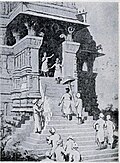
Harsha's son [[Yashovarman (Chandela dynasty)|Yashovarman]] (r. c. | Harsha's son [[Yashovarman (Chandela dynasty)|Yashovarman]] (r. c. 925–950 CE) continued to acknowledge the Pratihara suzerainty, but became practically independent.{{sfn|Sisirkumar Mitra|1977|pp=36–37}} He conquered the important fortress of [[Kalanjara]].{{sfn|Sushil Kumar Sullerey|2004|p=24}} A 953–954 CE [[Khajuraho]] inscription credits him with several other military successes, including against [[Gauḍa (region)|Gaudas]] (identified with the [[Pala Empire|Palas]]), the [[Khasas]], the [[Chedi Kingdom|Chedis]] (the [[Kalachuris of Tripuri]]), the [[Dakshina Kosala|Kosalas]] (possibly the [[Somavaṃśī dynasty|Somavamshis]]), the [[Mithila (ancient)|Mithila]] (possibly a small tributary ruler), [[Malwa|Malavas]] (identified with the [[Paramara dynasty|Paramaras]]), the [[Kuru Kingdom|Kurus]], the [[Kasmira Kingdom|Kashmiris]].{{sfn|Sisirkumar Mitra|1977|p=42-51}} These claims appear to be exaggerated, as similar claims of extensive conquests in northern India are also found in the records of the other contemporary kings such as the Kalachuri king Yuva-Raja and the Rashtrakuta king [[Krishna III]].{{sfn|R. K. Dikshit|1976|p=42}} Yashovarman's reign marked the beginning of the famous Chandela-era art and architecture. He commissioned the [[Lakshmana Temple, Khajuraho|Lakshmana Temple]] at Khajuraho.{{sfn|Sushil Kumar Sullerey|2004|p=24}} | ||
Unlike the earlier Chandela inscriptions, the records of Yashovarman's successor [[Dhanga]] (r. c. | Unlike the earlier Chandela inscriptions, the records of Yashovarman's successor [[Dhanga]] (r. c. 950–999 CE) do not mention any Pratihara overlord. This indicates that Dhanga formally established the Chandela sovereignty.{{sfn|Sisirkumar Mitra|1977|p=57}} A Khajuraho inscription claims that the rulers of [[Dakshina Kosala|Kosala]], Kratha (part of [[Vidarbha]] region), [[Kuntala country|Kuntala]], and [[Sinhala Kingdom|Simhala]] listened humbly to the commands of Dhanga's officers. It also claims that the wives of the kings of [[Andhra Kingdom|Andhra]], [[Anga]], [[Kanchi Kingdom|Kanchi]] and [[Rarh region|Raḍha]] resided in his prisons as a result of his success in wars. These appear to be eulogistic exaggerations by a court poet, but suggest that Dhanga did undertake extensive military campaigns.{{sfn|R. K. Dikshit|1976|p=56}}{{sfn|Sisirkumar Mitra|1977|pp=61–65}} Like his predecessor, Dhanga also commissioned a magnificent temple at Khajuraho, which is identified as the [[Vishvanatha Temple, Khajuraho|Vishvanatha Temple]].{{sfn|R. K. Dikshit|1976|p=69}} | ||
Dhanga's successor [[Ganda (Chandela dynasty)|Ganda]] appears to have retained the territory he inherited.{{sfn|Sisirkumar Mitra|1977|pp=72}} His son [[Vidyadhara (Chandela | Dhanga's successor [[Ganda (Chandela dynasty)|Ganda]] appears to have retained the territory he inherited.{{sfn|Sisirkumar Mitra|1977|pp=72}} His son [[Vidyadhara (Chandela ruler)|Vidyadhara]] killed theking of [[Kannauj]] (possibly Rajyapala) for fleeing his capital instead of fighting the [[Ghaznavid]] invader [[Mahmud of Ghazni]].{{sfn|Sisirkumar Mitra|1977|pp=72–73}}{{sfn|R. K. Dikshit|1976|p=72}} Mahmud later invaded Vidyadhara's kingdom; according to the Muslim invaders, this conflict ended with Vidyadhara paying tribute to Mahmud.{{sfn|Sisirkumar Mitra|1977|pp=81–82}} Vidyadhara is noted for having commissioned the [[Kandariya Mahadeva Temple]].{{sfn|Sushil Kumar Sullerey|2004|p=26}} | ||
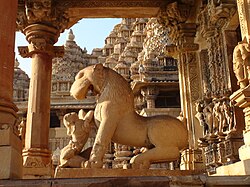
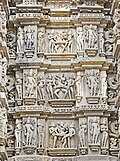
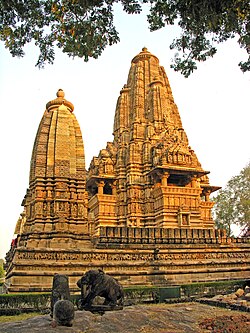
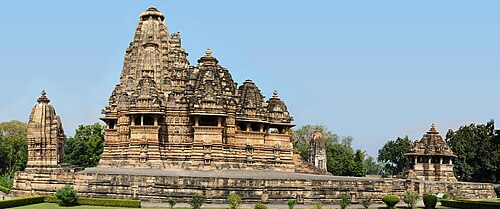
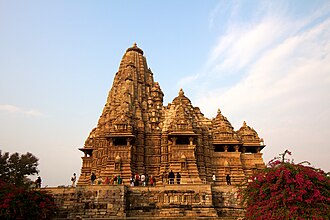
The Chandela art and architecture reached its zenith during this period. The [[Lakshmana Temple, Khajuraho|Lakshmana Temple]] (c. 930–950 CE), the [[Vishvanatha Temple, Khajuraho|Vishvanatha Temple]] (c. | The Chandela art and architecture reached its zenith during this period. The [[Lakshmana Temple, Khajuraho|Lakshmana Temple]] (c. 930–950 CE), the [[Vishvanatha Temple, Khajuraho|Vishvanatha Temple]] (c. 999–1002 CE) and the [[Kandariya Mahadeva Temple]] (c. 1030 CE) were constructed during the reigns of Yashovarman, Dhanga and Vidyadhara respectively. These [[Nagara architecture|Nagara-style]] temples are representative of the most fully developed style at Khajuraho.<ref name="James_1994">{{cite book |url=https://books.google.com/books?id=LwcBVvdqyBkC&pg=PA234 |title=The Art and Architecture of the Indian Subcontinent |author=James C. Harle |publisher=Yale University Press |year=1994 |page=234 |isbn=0300062176 }}</ref> | ||
<gallery mode="packed" caption="Nagara-style temples of Khajuraho"> | <gallery mode="packed" caption="Nagara-style temples of Khajuraho"> | ||
| Line 77: | Line 75: | ||
[[File:Mahadeva Temple, Khajuraho.jpg|thumb|[[Surasundari]] and [[vyala]], [[Khajuraho]].]] | [[File:Mahadeva Temple, Khajuraho.jpg|thumb|[[Surasundari]] and [[vyala]], [[Khajuraho]].]] | ||
[[File:Le Temple Kandariya Mahadeva (Khajurâho) (8503001895).jpg|thumb|[[Kandariya Mahadeva Temple|Kandariya Mahadeva temple]] carvings.]] | [[File:Le Temple Kandariya Mahadeva (Khajurâho) (8503001895).jpg|thumb|[[Kandariya Mahadeva Temple|Kandariya Mahadeva temple]] carvings.]] | ||
By the end of Vidyadhara's reign, the [[Ghaznavid]] invasions had weakened the Chandela kingdom. Taking advantage of this, the [[Kalachuris of Tripuri|Kalachuri]] king [[Gangeyadeva|Gangeya-deva]] conquered eastern parts of the kingdom.{{sfn|Sisirkumar Mitra|1977|pp= | By the end of Vidyadhara's reign, the [[Ghaznavid]] invasions had weakened the Chandela kingdom. Taking advantage of this, the [[Kalachuris of Tripuri|Kalachuri]] king [[Gangeyadeva|Gangeya-deva]] conquered eastern parts of the kingdom.{{sfn|Sisirkumar Mitra|1977|pp=89–90}} Chandela inscriptions suggest that Vidyadhara's successor [[Vijayapala]] (r. c. 1035–1050 CE) defeated Gangeya in a battle.{{sfn|Sisirkumar Mitra|1977|p=88}} However, the Chandela power started declining during the Vijayapala's reign.{{sfn|R. K. Dikshit|1976|p=101}} The [[Kachchhapaghata dynasty|Kachchhapaghatas]] of [[Gwalior]] probably gave up their allegiance to the Chandelas during this period.{{sfn|Sisirkumar Mitra|1977|p=90}} | ||
Vijayapala's elder son [[Devavarman (Chandela dynasty)|Devavavarman]] was subjugated by Gangeya's son [[Lakshmikarna|Lakshmi-Karna]].{{sfn|Sisirkumar Mitra|1977|p=91}} His younger brother [[Kirttivarman (Chandela dynasty)|Kirttivarman]] resurrected the Chandela power by defeating Lakshmi-Karna.{{sfn|Sisirkumar Mitra|1977|p=94}} Kirtivarman's son [[Sallakshanavarman]] achieved military successes against the Paramaras and the Kalachuris, possibly by raiding their territories. A [[Mau, Uttar Pradesh|Mau]] inscription suggests that he also conducted successful campaigns in the Antarvedi region (the Ganga-Yamuna [[doab]]).{{sfn|R. K. Dikshit|1976|p=120-121}} His son [[Jayavarman (Chandela dynasty)|Jayavarman]] was of religious temperament and abdicated the throne after being tired of governance.{{sfn|R. K. Dikshit|1976|p=126}} | Vijayapala's elder son [[Devavarman (Chandela dynasty)|Devavavarman]] was subjugated by Gangeya's son [[Lakshmikarna|Lakshmi-Karna]].{{sfn|Sisirkumar Mitra|1977|p=91}} His younger brother [[Kirttivarman (Chandela dynasty)|Kirttivarman]] resurrected the Chandela power by defeating Lakshmi-Karna.{{sfn|Sisirkumar Mitra|1977|p=94}} Kirtivarman's son [[Sallakshanavarman]] achieved military successes against the Paramaras and the Kalachuris, possibly by raiding their territories. A [[Mau, Uttar Pradesh|Mau]] inscription suggests that he also conducted successful campaigns in the Antarvedi region (the Ganga-Yamuna [[doab]]).{{sfn|R. K. Dikshit|1976|p=120-121}} His son [[Jayavarman (Chandela dynasty)|Jayavarman]] was of religious temperament and abdicated the throne after being tired of governance.{{sfn|R. K. Dikshit|1976|p=126}} | ||
Jayavarman appears to have died heirless, as he was succeeded by his uncle [[Prithvivarman]], the younger son of Kirttivarman.{{sfn|Sisirkumar Mitra|1977|pp= | Jayavarman appears to have died heirless, as he was succeeded by his uncle [[Prithvivarman]], the younger son of Kirttivarman.{{sfn|Sisirkumar Mitra|1977|pp=110–111}} The Chandela inscriptions do not ascribe any military achievements to him; it appears that he was focused on maintaining the existing Chandela territories without adopting an aggressive expansionist policy.{{sfn|Sisirkumar Mitra|1977|p=111}} | ||
=== Revival === | === Revival === | ||
By the time Prithvivarman's son [[Madanavarman]] (r. c. 1128–1165 CE) ascended the throne, the neighbouring [[Kalachuris of Tripuri|Kalachuri]] and [[Paramara]] kingdoms had been weakened by enemy invasions. Taking advantage of this situation, Madanavarman defeated the Kalachuri king [[Gayakarna|Gaya-Karna]], and possibly annexed the northern part of the [[Baghelkhand]] region.{{sfn|R. K. Dikshit|1976|p=132}} However, the Chandelas lost this territory to Gaya-Karna's successor [[Narasimha (Kalachuri dynasty)|Narasimha]].{{sfn|R. K. Dikshit|1976|p=135}} Madanavarman also captured the territory on the western periphery of the Paramara kingdom, around [[Bhilsa]] (Vidisha). This probably happened during the reign of the Paramara king [[Yashovarman (Paramara dynasty)|Yashovarman]] or his son [[Jayavarman I (Paramara dynasty)|Jayavarman]].{{sfn|R. K. Dikshit|1976|pp= | By the time Prithvivarman's son [[Madanavarman]] (r. c. 1128–1165 CE) ascended the throne, the neighbouring [[Kalachuris of Tripuri|Kalachuri]] and [[Paramara dynasty|Paramara]] kingdoms had been weakened by enemy invasions. Taking advantage of this situation, Madanavarman defeated the Kalachuri king [[Gayakarna|Gaya-Karna]], and possibly annexed the northern part of the [[Baghelkhand]] region.{{sfn|R. K. Dikshit|1976|p=132}} However, the Chandelas lost this territory to Gaya-Karna's successor [[Narasimha (Kalachuri dynasty)|Narasimha]].{{sfn|R. K. Dikshit|1976|p=135}} Madanavarman also captured the territory on the western periphery of the Paramara kingdom, around [[Bhilsa]] (Vidisha). This probably happened during the reign of the Paramara king [[Yashovarman (Paramara dynasty)|Yashovarman]] or his son [[Jayavarman I (Paramara dynasty)|Jayavarman]].{{sfn|R. K. Dikshit|1976|pp=130–132}}{{sfn|Sisirkumar Mitra|1977|p=112-113}} Once again, the Chandelas could not retain the newly annexed territory for long, and the region was recaptured by Yashovarman's son Lakshmivarman.{{sfn|R. K. Dikshit|1976|p=135}} | ||
[[Jayasimha Siddharaja]], the [[Chaulukya]] king of Gujarat, also invaded the Paramara territory, which was located between the Chandela and the Chaulukya kingdoms. This brought him in conflict with Madanavarman. The result of this conflict appears to have been inconclusive, as records of both the kingdoms claim victory.{{sfn|R. K. Dikshit|1976|p=133}} A [[Kalanjara]] inscription suggests that Madanavarman defeated Jayasimha. On the other hand, the various chronicles of Gujarat claim that Jayasimha either defeated Madanavarman or extracted a tribute from him.{{sfn|R. K. Dikshit|1976|pp= | [[Jayasimha Siddharaja]], the [[Chaulukya]] king of Gujarat, also invaded the Paramara territory, which was located between the Chandela and the Chaulukya kingdoms. This brought him in conflict with Madanavarman. The result of this conflict appears to have been inconclusive, as records of both the kingdoms claim victory.{{sfn|R. K. Dikshit|1976|p=133}} A [[Kalanjara]] inscription suggests that Madanavarman defeated Jayasimha. On the other hand, the various chronicles of Gujarat claim that Jayasimha either defeated Madanavarman or extracted a tribute from him.{{sfn|R. K. Dikshit|1976|pp=133–134}} Madanavarman maintained friendly relations with his northern neighbours, the [[Gahadavala]]s.{{sfn|R. K. Dikshit|1976|p=132-133}} | ||
Madanavarman's son [[Yashovarman II (Chandela dynasty)|Yashovarman II]] either did not rule, or ruled for a very short time. Madanavarman's grandson [[Paramardi|Paramardi-deva]] was the last powerful Chandela king.{{sfn|R. K. Dikshit|1976|p=130}} | Madanavarman's son [[Yashovarman II (Chandela dynasty)|Yashovarman II]] either did not rule, or ruled for a very short time. Madanavarman's grandson [[Paramardi|Paramardi-deva]] was the last powerful Chandela king.{{sfn|R. K. Dikshit|1976|p=130}} | ||
===Final decline === | === Final decline === | ||
[[ | {{South Asia in 1175||Location of the Chandelas and neighbouring South Asian polities in 1175, on the eve of the [[Ghurid Empire]] invasion of the subcontinent.<ref>{{cite book |last1=Schwartzberg |first1=Joseph E. |title=A Historical atlas of South Asia |date=1978 |publisher=University of Chicago Press |location=Chicago |pages=37, 147|isbn=0226742210 |url=https://dsal.uchicago.edu/reference/schwartzberg/pager.html?object=074}}</ref><ref>{{cite book |last1=Eaton |first1=Richard M. |title=India in the Persianate Age: 1000-1765 |date=25 July 2019 |publisher=Penguin UK |isbn=978-0-14-196655-7 |page=38 |url=https://books.google.com/books?id=aIF6DwAAQBAJ&pg=PP31 |language=en}}</ref>|{{Annotation|152|90|[[File:Orange dot (semi-transparent).png|35px]]}}}} | ||
[[Paramardi]] (reigned c. 1165-1203 CE) ascended the Chandela throne at a young age. While the early years of his reign were peaceful, around 1182–1183 CE, the [[Chahamanas of Shakambhari|Chahamana]] ruler [[Prithviraj Chauhan]] invaded the Chandela kingdom. According to the medieval legendary ballads, Prithviraj's army lost its way after a surprise attack by ([[Ghurid]]) [[Turkic peoples|Turkic]] forces, and unknowingly camped at the Chandela capital [[Mahoba]]. This led to a brief conflict between the Chandelas and the Chauhans, before Prithviraj left for Delhi. Sometime later, Prithviraj invaded the Chandela kingdom and sacked Mahoba. Paramardi cowardly took shelter in the [[Kalanjara]] fort. The Chandela force, led by [[Alha]], Udal [[banaphar]], rajputs, of Mahoba|Udal]] and other generals, was defeated in this battle. Nowadays [[ahir]], caste claims alha udal but according to historians and alha khand and mahoba khand they belongs to [[banaphar]], clan of [[rajput]], caste and their mother was of [[ahir]], which is why they are called of mixed origin.According to the various ballads, Paramardi either committed suicide out of shame or retired to [[Gaya, India|Gaya]].{{sfn|Sisirkumar Mitra|1977|pp=120–123}} | |||
[[Paramardi | |||
Prithviraj Chauhan's raid of Mahoba is corroborated by his [[Madanpur, Lalitpur, India|Madanpur]] stone inscriptions. However, there are several instances of historical inaccuracies in the bardic legends. For example, it is known that Paramardi did not retire or die immediately after the Chauhan victory. He restored the Chandela power, and ruled as a sovereign until around 1202–1203 CE, when [[Qutb al-Din Aibak]], the [[Ghurid Empire]] governor of [[Delhi]], invaded the Chandela kingdom.{{sfn|Sisirkumar Mitra|1977|pp=123–126}} According to ''Taj-ul-Maasir'', a chronicle of the [[Delhi Sultanate]], Paramardi surrendered to the Delhi forces. He promised to pay tribute to the Sultan, but died before he could keep this promise. His [[dewan]] offered some resistance to the invading forces, but was ultimately subdued. The 16th century historian [[Firishta]] states that Paramardi was assassinated by his own minister, who disagreed with the king's decision to surrender to the Delhi forces.{{sfn|R. K. Dikshit|1976|p=148}} | |||
The Chandela power did not fully recover from their defeat against the Delhi forces. Paramardi was succeeded by [[Trailokyavarman]], [[Viravarman]] and [[Bhojavarman]]. The next ruler [[Hammiravarman]] (r. c. | The Chandela power did not fully recover from their defeat against the Delhi forces. Paramardi was succeeded by [[Trailokyavarman]], [[Viravarman]] and [[Bhojavarman]]. The next ruler [[Hammiravarman]] (r. c. 1288–1311 CE) did not use the imperial title [[Maharajadhiraja]], which indicates that the Chandela king had a lower status by his time. The Chandela power continued to decline because of the rising Muslim influence, as well as the rise of other local dynasties, such as the [[Bundela]]s, the Baghelas and the [[Khangar (community)|Khangars]].{{sfn|R. K. Dikshit|1976|p=179}} | ||
Hammiravarman was succeeded by Viravarman II, whose titles do not indicate a high political status.{{sfn|Peter Jackson|2003|p=199}}{{sfn|Om Prakash Misra|2003|p=11}} [[Chandelas of Kalanjara (minor Chandela branch)|One minor branch of the family continued ruling Kalanjara]]: its ruler was killed by [[Sher Shah Suri]]'s army in 1545 CE. | Hammiravarman was succeeded by Viravarman II, whose titles do not indicate a high political status.{{sfn|Peter Jackson|2003|p=199}}{{sfn|Om Prakash Misra|2003|p=11}} [[Chandelas of Kalanjara (minor Chandela branch)|One minor branch of the family continued ruling Kalanjara]]: its ruler was killed by [[Sher Shah Suri]]'s army in 1545 CE. Another minor branch ruled at [[Mahoba]]: [[Rani Durgavati|Durgavati]], one of its princesses married into the [[Garha Kingdom|Gond]] royal family of [[Mandla]]. Some other ruling families also claimed Chandela descent (see [[Chandel (Rajput clan)|Chandel]]).{{sfn|Romila Thapar|2013|p=572}} | ||
== Art and architecture == | == Art and architecture == | ||
| Line 121: | Line 109: | ||
</gallery> | </gallery> | ||
Other smaller Chandela sites include Chandpur, [[Deogarh, Uttar Pradesh|Deogarh]], Dudahi, [[Kakadeo]] and | Other smaller Chandela sites include Chandpur, [[Deogarh, Uttar Pradesh|Deogarh]], Dudahi, [[Kakadeo]], Madanpur and [[Aharji Jain Teerth|Aharji]].{{sfn|Sushil Kumar Sullerey|2004|p=17}}<ref>{{cite book |last1=Titze |first1=Kurt |last2=Bruhn|first2=Klaus |title=Jainism: A Pictorial Guide to the Religion of Non-Violence |url={{Google books|loQkEIf8z5wC|page=123|plainurl=yes}} |publisher=[[Motilal Banarsidass]] |edition=2 |year=1998 |isbn=978-81-208-1534-6 | page=128 }}</ref><ref>{{cite book |last=Reddy |first=P. Chenny | author-link=P. Chenna Reddy |title=Kalyana Mitra: A treasure house of history, culture and archaeological studies | volume=5 |url={{Google books|prCqEAAAQBAJ|page=197|plainurl=yes}} |publisher=Blue Rose Publishers |year=2023 |isbn=978-93-5741-111-0 | page=197 }}</ref> | ||
<gallery mode="packed" caption="Chandela sculptures"> | <gallery mode="packed" caption="Chandela sculptures"> | ||
| Line 137: | Line 125: | ||
</gallery> | </gallery> | ||
== List of | == List of Rulers== | ||
Based on epigraphic records, the historians have come up with the following list of Chandela rulers of Jejākabhukti ([[IAST]] names in brackets):{{sfn|R. K. Dikshit|1976|p=25}}{{sfn|Sushil Kumar Sullerey|2004|p=25}}{{sfn|Peter Jackson|2003|p=199}} | |||
{| class="wikitable" | |||
|+List of Chandela rulers of Jejākabhukti | |||
! S.N. | |||
! Ruler's regional name ([[IAST]] name in bracket) | |||
! Reign (CE) | |||
|- | |||
|1 | |||
|[[Nannuka]] | |||
|831–845 | |||
|- | |||
|2 | |||
|[[Vakpati (Chandela dynasty)|Vakpati]] (Vākpati) | |||
|845–865 | |||
|- | |||
|3 | |||
|[[Jayashakti]] (Jayaśakti) and [[Vijayashakti]] (Vijayaśakti) | |||
|865–885 | |||
|- | |||
|4 | |||
|[[Rahila]] (Rāhila) | |||
|885–905 | |||
|- | |||
|5 | |||
|[[Harsha (Chandela dynasty)|Shri Harsha]] (Śri Harśa) | |||
|905–925 | |||
|- | |||
|6 | |||
|[[Yashovarman (Chandela dynasty)|Yasho-Varman]] (Yaśovarman) | |||
|925–950 | |||
|- | |||
|7 | |||
|[[Dhangavarman]] | |||
|950–999 | |||
|- | |||
|8 | |||
|[[Ganda (Chandela dynasty)|Ganda-Deva]] (Gaṇḍadeva) | |||
|999–1002 | |||
|- | |||
|9 | |||
|[[Vidyadhara (Chandela ruler)|Vidyadhara]] (Vidyādhara) | |||
|1003–1035 | |||
|- | |||
|10 | |||
|[[Vijayapala|Vijaya-Pala]] (Vijayapāla) | |||
|1035–1050 | |||
|- | |||
|11 | |||
|[[Devavarman (Chandela dynasty)|Deva-Varman]] | |||
|1050–1060 | |||
|- | |||
|12 | |||
|[[Kirttivarman (Chandela dynasty)|Kirtti-Varman]] (Kīrtivarman) | |||
|1060–1100 | |||
|- | |||
|13 | |||
|[[Sallakshanavarman|Sallakshana-Varman]] (Sallakṣaṇavarman) | |||
|1100–1110 | |||
|- | |||
|14 | |||
|[[Jayavarman (Chandela dynasty)|Jaya-Varman]] | |||
|1110–1120 | |||
|- | |||
|15 | |||
|[[Prithvivarman|Prithvi-Varman]] (Pṛthvīvarman) | |||
|1120–1128 | |||
|- | |||
|16 | |||
|[[Madanavarman|Madana-Varman]] | |||
|1128–1164 | |||
|- | |||
|17 | |||
|[[Yashovarman II (Chandela dynasty)|Yasho-Varman II]] | |||
|1164–1165 | |||
|- | |||
|18 | |||
|[[Paramardideva|Paramardi-Deva]] | |||
|1165–1203 | |||
|- | |||
|19 | |||
|[[Trailokyavarman|Trailokya-Varman]] | |||
|1203–1245 | |||
|- | |||
|20 | |||
|[[Viravarman|Vira-Varman]] (Vīravarman) | |||
|1245–1285 | |||
|- | |||
|21 | |||
|[[Bhojavarman|Bhoja-Varman]] | |||
|1285–1288 | |||
|- | |||
|22 | |||
|[[Hammiravarman|Hammira-Varman]] (Hammīravarman) | |||
|1288–1311 | |||
|- | |||
|23 | |||
|Vira-Varman II | |||
|1311–1315 | |||
|} | |||
== Family tree == | |||
{{Chart top|width=100%|collapsed=yes|Chandela dynasty}} | |||
{{Tree chart/start|align=center|style=font-size:90%}} | |||
{{Tree chart|border=1| | | | | | | | | | | | | | | | | | | | | | |A01 | | | | | | | | | | | | | | | | | | | | | | | | |||
A01='''[[Nannuka]]'''<br><sup>(1)</sup><br><small>r. {{circa}} 831-845</small>|boxstyle_A01=border-color:#FFD700}} | |||
{{Tree chart|border=1| | | | | | | | | | | | | | | | | | | | | | | |!| | | | | | | | | | | | | | | | | | | | | | | |}} | |||
{{Tree chart|border=1| | | | | | | | | | | | | | | | | | | | | | |A01 | | | | | | | | | | | | | | | | | | | | | | | | |||
A01='''[[Vakpati (Chandela dynasty)|Vakpati]]'''<br><sup>(2)</sup><br><small>r. {{circa}} 845-865</small>|boxstyle_A01=border-color:#FFD700}} | |||
{{Tree chart|border=1| | | | | | | | | | | | | | | | | | | |,|-|-|-|(| | | | | | | | | | | | | | | | | | | | | | | |}} | |||
{{Tree chart|border=1| | | | | | | | | | | | | | | | | | |A01 | |A02 | | | | | | | | | | | | | | | | | | | | | | | | |||
} | A01='''[[Jayashakti]]'''<br><sup>(3)</sup><br><small>r. {{circa}} 865-885</small>|boxstyle_A01=border-color:#FFD700| | ||
A02='''[[Vijayashakti]]'''<br><sup>(4)</sup><br><small>r. {{circa}} 865-885</small>|boxstyle_A02=border-color:#FFD700}} | |||
{{Tree chart|border=1| | | | | | | | | | | | | | | | | | | | | | | |!| | | | | | | | | | | | | | | | | | | | | | | |}} | |||
{{Tree chart|border=1| | | | | | | | | | | | | | | | | | | | | | |A01 | | | | | | | | | | | | | | | | | | | | | | | | |||
A01='''[[Rahila]]'''<br><sup>(5)</sup><br><small>r. {{circa}} 885-905</small>|boxstyle_A01=border-color:#FFD700}} | |||
{{Tree chart|border=1| | | | | | | | | | | | | | | | | | | | | | | |!| | | | | | | | | | | | | | | | | | | | | | | |}} | |||
{{Tree chart|border=1| | | | | | | | | | | | | | | | | | | | | | |A01 | | | | | | | | | | | | | | | | | | | | | | | | |||
A01='''[[Harsha (Chandela dynasty)|Harsha]]'''<br><sup>(6)</sup><br><small>r. {{circa}} 905-925</small>|boxstyle_A01=border-color:#FFD700}} | |||
{{Tree chart|border=1| | | | | | | | | | | | | | | | | | | | | | | |!| | | | | | | | | | | | | | | | | | | | | | | |}} | |||
{{Tree chart|border=1| | | | | | | | | | | | | | | | | | | | | | |A01 | | | | | | | | | | | | | | | | | | | | | | | | |||
A01='''[[Yashovarman (Chandela dynasty)|Yashovarman I]]'''<br><sup>(7)</sup><br><small>r. {{circa}} 925-950</small>|boxstyle_A01=border-color:#FFD700}} | |||
{{Tree chart|border=1| | | | | | | | | | | | | | | | | | | | | | | |!| | | | | | | | | | | | | | | | | | | | | | | |}} | |||
{{Tree chart|border=1| | | | | | | | | | | | | | | | | | | | | | |A01 | | | | | | | | | | | | | | | | | | | | | | | | |||
A01='''[[Dhanga]]deva'''<br><sup>(8)</sup><br><small>r. {{circa}} 950-999</small>|boxstyle_A01=border-color:#FFD700}} | |||
{{Tree chart|border=1| | | | | | | | | | | | | | | | | | | | | | | |!| | | | | | | | | | | | | | | | | | | | | | | |}} | |||
{{Tree chart|border=1| | | | | | | | | | | | | | | | | | | | | | |A01 | | | | | | | | | | | | | | | | | | | | | | | | |||
A01='''[[Ganda (Chandela dynasty)|Gandadeva]]'''<br><sup>(9)</sup><br><small>r. {{circa}} 999-1002</small>|boxstyle_A01=border-color:#FFD700}} | |||
{{Tree chart|border=1| | | | | | | | | | | | | | | | | | | | | | | |!| | | | | | | | | | | | | | | | | | | | | | | |}} | |||
{{Tree chart|border=1| | | | | | | | | | | | | | | | | | | | | | |A01 | | | | | | | | | | | | | | | | | | | | | | | | |||
A01='''[[Vidyadhara (Chandela ruler)|Vidyadhara]]'''<br><sup>(10)</sup><br><small>r. {{circa}} 1003-1035</small>|boxstyle_A01=border-color:#FFD700}} | |||
{{Tree chart|border=1| | | | | | | | | | | | | | | | | | | | | | | |!| | | | | | | | | | | | | | | | | | | | | | | |}} | |||
{{Tree chart|border=1| | | | | | | | | | | | | | | | | | | | | | |A01 | | | | | | | | | | | | | | | | | | | | | | | | |||
A01='''[[Vijayapala]]'''<br><sup>(11)</sup><br><small>r. {{circa}} 1035-1050</small>|boxstyle_A01=border-color:#FFD700}} | |||
{{Tree chart|border=1| | | | | | | | | | | | | | | | | | | |,|-|-|-|(| | | | | | | | | | | | | | | | | | | | | | | |}} | |||
{{Tree chart|border=1| | | | | | | | | | | | | | | | | | |A01 | |A02 | | | | | | | | | | | | | | | | | | | | | | | | |||
A01='''[[Devavarman (Chandela dynasty)|Devavarman]]'''<br><sup>(12)</sup><br><small>r. {{circa}} 1050-1060</small>|boxstyle_A01=border-color:#FFD700| | |||
A02='''[[Kirttivarman (Chandela dynasty)|Kirttivarman]]'''<br><sup>(13)</sup><br><small>r. {{circa}} 1060-1100</small>|boxstyle_A02=border-color:#FFD700}} | |||
{{Tree chart|border=1| | | | | | | | | | | | | | | | | | | |,|-|-|-|(| | | | | | | | | | | | | | | | | | | | | | | |}} | |||
{{Tree chart|border=1| | | | | | | | | | | | | | | | | | |A01 | |A02 | | | | | | | | | | | | | | | | | | | | | | | | |||
A01='''[[Sallakshanavarman]]'''<br><sup>(14)</sup><br><small>r. {{circa}} 1100-1110</small>|boxstyle_A01=border-color:#FFD700| | |||
A02='''[[Prithvivarman]]'''<br><sup>(16)</sup><br><small>r. {{circa}} 1120-1128</small>|boxstyle_A02=border-color:#FFD700}} | |||
{{Tree chart|border=1| | | | | | | | | | | | | | | | | | | |!| | | |!| | | | | | | | | | | | | | | | | | | | | | | |}} | |||
{{Tree chart|border=1| | | | | | | | | | | | | | | | | | |A01 | |A02 | | | | | | | | | | | | | | | | | | | | | | | | |||
A01='''[[Jayavarman (Chandela dynasty)|Jayavarman]]'''<br><sup>(15)</sup><br><small>r. {{circa}} 1110-1120</small>|boxstyle_A01=border-color:#FFD700| | |||
A02='''[[Madanavarman]]'''<br><sup>(17)</sup><br><small>r. {{circa}} 1128-1165</small>|boxstyle_A02=border-color:#FFD700}} | |||
{{Tree chart|border=1| | | | | | | | | | | | | | | | | | | | | | | |!| | | | | | | | | | | | | | | | | | | | | | | |}} | |||
{{Tree chart|border=1| | | | | | | | | | | | | | | | | | | | | | |A01 | | | | | | | | | | | | | | | | | | | | | | | | |||
A01='''[[Yashovarman II (Chandela dynasty)|Yashovarman II]]'''<br><sup>(18)</sup><br><small>r. {{circa}} 1165</small>|boxstyle_A01=border-color:#FFD700}} | |||
{{Tree chart|border=1| | | | | | | | | | | | | | | | | | | |,|-|-|-|+|-|-|-|.| | | | | | | | | | | | | | | | | | | |}} | |||
{{Tree chart|border=1| | | | | | | | | | | | | | | | | | |A01 | |A02 | |A03 | | | | | | | | | | | | | | | | | | | | |||
A01='''[[Paramardi]]'''<br><sup>(19)</sup><br><small>r. {{circa}} 1165-1203</small>|boxstyle_A01=border-color:#FFD700| | |||
A02='''[[Viravarman]]'''<br><sup>(21)</sup><br><small>r. {{circa}} 1245-1285</small>|boxstyle_A02=border-color:#FFD700| | |||
A03=Child of<br>Yashovarman}} | |||
{{Tree chart|border=1| | | | | | | | | | | | | | | | | | | |!| | | |!| | | |!| | | | | | | | | | | | | | | | | | | |}} | |||
{{Tree chart|border=1| | | | | | | | | | | | | | | | | | |A01 | |A02 | |A03 | | | | | | | | | | | | | | | | | | | | |||
A01='''[[Trailokyavarman]]'''<br><sup>(20)</sup><br><small>r. {{circa}} 1203–1245</small>|boxstyle_A01=border-color:#FFD700| | |||
A02='''[[Hammiravarman]]'''<br><sup>(23)</sup><br><small>r. {{circa}} 1288-1311</small>|boxstyle_A02=border-color:#FFD700| | |||
A03='''[[Bhojavarman]]'''<br><sup>(22)</sup><br><small>r. {{circa}} 1285-1288</small>|boxstyle_A03=border-color:#FFD700}} | |||
{{Tree chart/end}} | |||
{{Chart bottom}} | |||
== See also == | |||
* [[History of Madhya Pradesh]] | |||
* [[Chandel (Rajput clan)]] | |||
* [[Chandelas of Kalanjara]] | |||
* [[Chandelas of Kumaun]] | |||
== References == | == References == | ||
{{reflist}} | |||
{{reflist | |||
=== Bibliography === | === Bibliography === | ||
{{ | {{refbegin}} | ||
* {{cite book |author=Harihar Vitthal Trivedi |title=Inscriptions of the Paramāras (Part 2) |series=Corpus Inscriptionum Indicarum Volume VII: Inscriptions of the Paramāras, Chandēllas, Kachchapaghātas, and two minor dynasties |url=https://books.google.com/books?id=8B4LAQAAMAAJ |year=1991 |publisher=[[Archaeological Survey of India]] }} | * {{cite book |author=Harihar Vitthal Trivedi |title=Inscriptions of the Paramāras (Part 2) |series=Corpus Inscriptionum Indicarum Volume VII: Inscriptions of the Paramāras, Chandēllas, Kachchapaghātas, and two minor dynasties |url=https://books.google.com/books?id=8B4LAQAAMAAJ |year=1991 |publisher=[[Archaeological Survey of India]] }} | ||
* {{cite book |author=Om Prakash Misra |title=Archaeological Excavations in Central India: Madhya Pradesh and Chhattisgarh |url=https://books.google.com/books?id=o0ISjDDWJwQC&pg=PA11 |year=2003 |publisher=Mittal Publications |isbn=978-81-7099-874-7 }} | * {{cite book |author=Om Prakash Misra |title=Archaeological Excavations in Central India: Madhya Pradesh and Chhattisgarh |url=https://books.google.com/books?id=o0ISjDDWJwQC&pg=PA11 |year=2003 |publisher=Mittal Publications |isbn=978-81-7099-874-7 }} | ||
| Line 297: | Line 342: | ||
* {{cite book |author=Sisirkumar Mitra |title=The Early Rulers of Khajurāho |url=https://books.google.com/books?id=irHN2UA_Z7gC&pg=PA113 |publisher=Motilal Banarsidass |year=1977 |isbn=9788120819979 }} | * {{cite book |author=Sisirkumar Mitra |title=The Early Rulers of Khajurāho |url=https://books.google.com/books?id=irHN2UA_Z7gC&pg=PA113 |publisher=Motilal Banarsidass |year=1977 |isbn=9788120819979 }} | ||
* {{cite book |author=Sushil Kumar Sullerey |title=Chandella Art |url=https://books.google.com/books?id=Rj8RusFpYHIC&pg=PA25 |year=2004 |publisher=Aakar Books |isbn=978-81-87879-32-9 }} | * {{cite book |author=Sushil Kumar Sullerey |title=Chandella Art |url=https://books.google.com/books?id=Rj8RusFpYHIC&pg=PA25 |year=2004 |publisher=Aakar Books |isbn=978-81-87879-32-9 }} | ||
{{ | {{refend}} | ||
== External links == | == External links == | ||
* {{commons category inline|Chandelas of Jejakabhukti}} | * {{commons category-inline|Chandelas of Jejakabhukti}} | ||
[[Category:Chandelas of Jejakabhukti| ]] | [[Category:Chandelas of Jejakabhukti| ]] | ||
[[Category:Medieval | [[Category:Medieval Indian dynasties]] | ||
[[Category:Hindu dynasties]] | [[Category:Hindu dynasties]] | ||
[[Category:Bundelkhand]] | [[Category:Bundelkhand]] | ||
[[Category: | [[Category:Rajput dynasties]] | ||
[[Category: | [[Category:9th-century establishments in India]] | ||
[[Category:14th-century disestablishments in India]] | |||
Latest revision as of 03:31, 29 September 2026
Chandelas of Jejakabhukti | |||||||||||
|---|---|---|---|---|---|---|---|---|---|---|---|
| c. early 9th c.–16th c. | |||||||||||
 Coinage of Sallakshana-Varman (1120–1135 CE), Chandelas of Jejakabhukti
| |||||||||||
 Territory of the Chandelas during the reign of Vidyadhara circa 1025 CE.[1] | |||||||||||
| Capital | |||||||||||
| Common languages | Sanskrit | ||||||||||
| Religion | |||||||||||
| Government | Monarchy | ||||||||||
| Historical era | Medieval India | ||||||||||
• Established | c. early 9th c. | ||||||||||
• Disestablished | 16th c. | ||||||||||
| |||||||||||
| Today part of | India | ||||||||||

The Chandel Empire (Sanskrit: चन्देल साम्राज्य, IAST: Çandela empire), also known as Chandelas of Jejakabhukti was an Indian empire during the medieval period of the Indian subcontinent which existed from the 9th century to the 16th century CE. At its peak, the dynasty ruled an empire that stretched across more than half of the Indian subcontinent, with its country called Jejakabhukti. The ruling dynasty of the empire was founded by the Chandela ruler Nannukavarman, who established Chandela dynasty of Jejakabhukti in the early 9th century. The dynasty belonged to the Chandel clan of the Rajputs.[2]
The Chandela dynasty of Jejakabhukti initially ruled small territories surrounding Khajuraho by overthrowing Pratiharas from there during the reign of its founder Nannukavarman. The 10th century Chandela ruler Harshavarman defeated the Rashtrakuta Empire and restored the Pratihara ruler Mahipala to the throne of Kannauj. Harsha's son Yashovarman defeated Pratiharas, palas and other kingdoms and expanded the supremacy of Chandel empire in North India. His successor Dhangavarman expanded the Chandela Empire, and stretched it over more than half of the Indian subcontinent. Vidyadharavarman was the greatest emperor who defeated Mahmud Ghaznavi twice. From the 9th to the 14th centuries, the Chandelas defeated the Paramaras of Malwa, Gurjara-Pratiharas, Palas, Kambojas, Kalachuris of Tripuri, Magadhas, and Kalingas at various times, bringing these kingdoms under feudal, subordinate, vassal, or tributary status during different periods. Many Chandela emperors also performed the Ashvamedha yajna on multiple occasions, asserting their sovereignty through the conquest and subjugation of Indian kingdoms.
They also defeated the Kashmiris, Khasas, Chaulukyas, Chalukyas, and Rashtrakutas at various times and captured parts of their territories, while conducting raids into South India.
From the 11th century onwards, the Chandel Empire faced raids and invasions by the Ghaznavids and the Ghurids, followed by those of the Delhi Sultanate and other Muslim and Hindu dynasties. However, the Chandelas repulsed invasions by the Ghaznavids, Ghurids, the Delhi Sultanate, and other Muslim and Hindu dynasties, while retaining their power and independence until the 16th century.
The Chandelas are well known for their art and architecture, most notably for the temples at their original capital Khajuraho. They also commissioned a number of temples, water bodies, palaces and forts at other places, including their strongholds of Ajaigarh, Kalinjar and their later capital Mahoba.
Origin[edit | edit source]
The origin of the Chandelas is obscured by mythical legends. The epigraphic records of the dynasty, as well as contemporary texts such as Balabhadra-vilasa and Prabodha-chandrodaya, suggest that the Chandelas belonged to the legendary Lunar dynasty (Chandravansha).[3] A 954 CE Khajuraho inscription states that the dynasty's first king Nannuka was a descendant of sage Chandratreya, who was a son of Atri. A 1002 CE Khajuraho inscription gives a slightly different account, in which Chandratreya is mentioned as a son of Indu (the Moon) and a grandson of Atri.[4] The 1195 CE Baghari inscription and the 1260 CE Ajaygadh inscription contain similar accounts.[5] The Balabhadra-vilasa also names Atri among the ancestors of the Chandelas. Another Khajuraho inscription describes the Chandela king Dhanga as a member of the Vrishni clan of the Yadavas (who also claimed to be part of the Lunar dynasty).[3]

The Mahoba-Khanda legend of the dynasty's origin goes like this: Hemaraja, a priest of the Gaharwar king of Benares, had a beautiful daughter named Hemavati. Once, while Hemavati was bathing in a pond, the moon god Chandra saw her and made love to her. Hemavati was worried about the dishonour of being an unwed mother, but Chandra assured her that their son would become a great king. This child was the dynasty's progenitor Chandravarma. Chandra presented him with a philosopher's stone and taught him politics.[6][3] The dynasty's own records do not mention Hemavati, Hemaraja or Indrajit. Such legends appear to be later bardic inventions. In general, the Mahoba-Khanda is a historically unreliable text.[4] Prithviraj Raso is also considered an historically unreliable text.[7][8][9]

British indologist V. A. Smith theorized that the Chandelas were of either Bhar or Gond origin. Some other scholars including R. C. Majumdar also supported this theory.[10] The Chandelas worshipped Maniya, a tribal goddess, whose temples are located at Mahoba and Maniyagadh.[11] Besides, they have been associated with places that are also associated with Bhars and Gonds. Also, Rani Durgavati, whose family claimed Chandela descent married a Gond chief of Garha-Mandla.[12] Historian R. K. Dikshit does not find these arguments convincing: he argues that Maniya was not a tribal deity.[13] Also, the dynasty's association with Gond territory is not necessarily indicative of a common descent: the dynasty's progenitor may have been posted as a governor in these territories.[12] Finally, Durgavati's marriage to a Gond chief can be dismissed as a one-off case.[13]
History[edit | edit source]
Early rulers[edit | edit source]
The Chandelas were originally vassals of the Gurjara-Pratiharas.[14] Nannuka (r. c. 831–845 CE), the founder of the dynasty, was the ruler of a small kingdom centered around Khajuraho.[15]
According to the Chandela inscriptions, Nannuka's successor Vakpati defeated several enemies.[16] Vakpati's sons Jayashakti (Jeja) and Vijayashakti (Vija) consolidated the Chandela power.[17] According to a Mahoba inscription, the Chandela territory was named "Jejakabhukti" after the Jayashakti.[18] Vijayashakti's successor Rahila is credited with several military victories in eulogistic inscriptions.[19] Rahila's son Harsha played an important role in restoring the rule of the Pratihara king Mahipala, possibly after a Rashtrakuta invasion or after Mahiapala's conflict with his step-brother Bhoja II.[20]
Rise as a sovereign power[edit | edit source]

Harsha's son Yashovarman (r. c. 925–950 CE) continued to acknowledge the Pratihara suzerainty, but became practically independent.[21] He conquered the important fortress of Kalanjara.[22] A 953–954 CE Khajuraho inscription credits him with several other military successes, including against Gaudas (identified with the Palas), the Khasas, the Chedis (the Kalachuris of Tripuri), the Kosalas (possibly the Somavamshis), the Mithila (possibly a small tributary ruler), Malavas (identified with the Paramaras), the Kurus, the Kashmiris.[23] These claims appear to be exaggerated, as similar claims of extensive conquests in northern India are also found in the records of the other contemporary kings such as the Kalachuri king Yuva-Raja and the Rashtrakuta king Krishna III.[24] Yashovarman's reign marked the beginning of the famous Chandela-era art and architecture. He commissioned the Lakshmana Temple at Khajuraho.[22]
Unlike the earlier Chandela inscriptions, the records of Yashovarman's successor Dhanga (r. c. 950–999 CE) do not mention any Pratihara overlord. This indicates that Dhanga formally established the Chandela sovereignty.[25] A Khajuraho inscription claims that the rulers of Kosala, Kratha (part of Vidarbha region), Kuntala, and Simhala listened humbly to the commands of Dhanga's officers. It also claims that the wives of the kings of Andhra, Anga, Kanchi and Raḍha resided in his prisons as a result of his success in wars. These appear to be eulogistic exaggerations by a court poet, but suggest that Dhanga did undertake extensive military campaigns.[26][27] Like his predecessor, Dhanga also commissioned a magnificent temple at Khajuraho, which is identified as the Vishvanatha Temple.[28]
Dhanga's successor Ganda appears to have retained the territory he inherited.[29] His son Vidyadhara killed theking of Kannauj (possibly Rajyapala) for fleeing his capital instead of fighting the Ghaznavid invader Mahmud of Ghazni.[30][31] Mahmud later invaded Vidyadhara's kingdom; according to the Muslim invaders, this conflict ended with Vidyadhara paying tribute to Mahmud.[32] Vidyadhara is noted for having commissioned the Kandariya Mahadeva Temple.[33]
The Chandela art and architecture reached its zenith during this period. The Lakshmana Temple (c. 930–950 CE), the Vishvanatha Temple (c. 999–1002 CE) and the Kandariya Mahadeva Temple (c. 1030 CE) were constructed during the reigns of Yashovarman, Dhanga and Vidyadhara respectively. These Nagara-style temples are representative of the most fully developed style at Khajuraho.[34]
- Nagara-style temples of Khajuraho
-
-

-
-


Decline[edit | edit source]


By the end of Vidyadhara's reign, the Ghaznavid invasions had weakened the Chandela kingdom. Taking advantage of this, the Kalachuri king Gangeya-deva conquered eastern parts of the kingdom.[35] Chandela inscriptions suggest that Vidyadhara's successor Vijayapala (r. c. 1035–1050 CE) defeated Gangeya in a battle.[36] However, the Chandela power started declining during the Vijayapala's reign.[37] The Kachchhapaghatas of Gwalior probably gave up their allegiance to the Chandelas during this period.[38]
Vijayapala's elder son Devavavarman was subjugated by Gangeya's son Lakshmi-Karna.[39] His younger brother Kirttivarman resurrected the Chandela power by defeating Lakshmi-Karna.[40] Kirtivarman's son Sallakshanavarman achieved military successes against the Paramaras and the Kalachuris, possibly by raiding their territories. A Mau inscription suggests that he also conducted successful campaigns in the Antarvedi region (the Ganga-Yamuna doab).[41] His son Jayavarman was of religious temperament and abdicated the throne after being tired of governance.[42]
Jayavarman appears to have died heirless, as he was succeeded by his uncle Prithvivarman, the younger son of Kirttivarman.[43] The Chandela inscriptions do not ascribe any military achievements to him; it appears that he was focused on maintaining the existing Chandela territories without adopting an aggressive expansionist policy.[44]
Revival[edit | edit source]
By the time Prithvivarman's son Madanavarman (r. c. 1128–1165 CE) ascended the throne, the neighbouring Kalachuri and Paramara kingdoms had been weakened by enemy invasions. Taking advantage of this situation, Madanavarman defeated the Kalachuri king Gaya-Karna, and possibly annexed the northern part of the Baghelkhand region.[45] However, the Chandelas lost this territory to Gaya-Karna's successor Narasimha.[46] Madanavarman also captured the territory on the western periphery of the Paramara kingdom, around Bhilsa (Vidisha). This probably happened during the reign of the Paramara king Yashovarman or his son Jayavarman.[47][48] Once again, the Chandelas could not retain the newly annexed territory for long, and the region was recaptured by Yashovarman's son Lakshmivarman.[46]
Jayasimha Siddharaja, the Chaulukya king of Gujarat, also invaded the Paramara territory, which was located between the Chandela and the Chaulukya kingdoms. This brought him in conflict with Madanavarman. The result of this conflict appears to have been inconclusive, as records of both the kingdoms claim victory.[49] A Kalanjara inscription suggests that Madanavarman defeated Jayasimha. On the other hand, the various chronicles of Gujarat claim that Jayasimha either defeated Madanavarman or extracted a tribute from him.[50] Madanavarman maintained friendly relations with his northern neighbours, the Gahadavalas.[51]
Madanavarman's son Yashovarman II either did not rule, or ruled for a very short time. Madanavarman's grandson Paramardi-deva was the last powerful Chandela king.[52]
Final decline[edit | edit source]
Template:South Asia in 1175 Paramardi (reigned c. 1165-1203 CE) ascended the Chandela throne at a young age. While the early years of his reign were peaceful, around 1182–1183 CE, the Chahamana ruler Prithviraj Chauhan invaded the Chandela kingdom. According to the medieval legendary ballads, Prithviraj's army lost its way after a surprise attack by (Ghurid) Turkic forces, and unknowingly camped at the Chandela capital Mahoba. This led to a brief conflict between the Chandelas and the Chauhans, before Prithviraj left for Delhi. Sometime later, Prithviraj invaded the Chandela kingdom and sacked Mahoba. Paramardi cowardly took shelter in the Kalanjara fort. The Chandela force, led by Alha, Udal banaphar, rajputs, of Mahoba|Udal]] and other generals, was defeated in this battle. Nowadays ahir, caste claims alha udal but according to historians and alha khand and mahoba khand they belongs to banaphar, clan of rajput, caste and their mother was of ahir, which is why they are called of mixed origin.According to the various ballads, Paramardi either committed suicide out of shame or retired to Gaya.[53]
Prithviraj Chauhan's raid of Mahoba is corroborated by his Madanpur stone inscriptions. However, there are several instances of historical inaccuracies in the bardic legends. For example, it is known that Paramardi did not retire or die immediately after the Chauhan victory. He restored the Chandela power, and ruled as a sovereign until around 1202–1203 CE, when Qutb al-Din Aibak, the Ghurid Empire governor of Delhi, invaded the Chandela kingdom.[54] According to Taj-ul-Maasir, a chronicle of the Delhi Sultanate, Paramardi surrendered to the Delhi forces. He promised to pay tribute to the Sultan, but died before he could keep this promise. His dewan offered some resistance to the invading forces, but was ultimately subdued. The 16th century historian Firishta states that Paramardi was assassinated by his own minister, who disagreed with the king's decision to surrender to the Delhi forces.[55]
The Chandela power did not fully recover from their defeat against the Delhi forces. Paramardi was succeeded by Trailokyavarman, Viravarman and Bhojavarman. The next ruler Hammiravarman (r. c. 1288–1311 CE) did not use the imperial title Maharajadhiraja, which indicates that the Chandela king had a lower status by his time. The Chandela power continued to decline because of the rising Muslim influence, as well as the rise of other local dynasties, such as the Bundelas, the Baghelas and the Khangars.[56]
Hammiravarman was succeeded by Viravarman II, whose titles do not indicate a high political status.[57][58] One minor branch of the family continued ruling Kalanjara: its ruler was killed by Sher Shah Suri's army in 1545 CE. Another minor branch ruled at Mahoba: Durgavati, one of its princesses married into the Gond royal family of Mandla. Some other ruling families also claimed Chandela descent (see Chandel).[59]
Art and architecture[edit | edit source]
The Chandelas are well known for their art and architecture. They commissioned a number of temples, water bodies, palaces and forts at various places. The most famous example of their cultural achievements are the Hindu and Jain temples at Khajuraho. Three other important Chandela strongholds were Jayapura-Durga (modern Ajaigarh), Kalanjara (modern Kalinjar) and Mahotsava-Nagara (modern Mahoba).[60]
- Chandela architecture
-
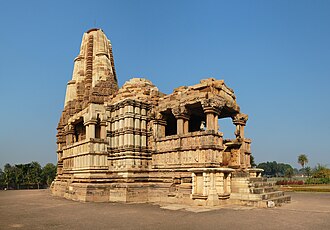 Dulhadeo temple, Khajuraho
-
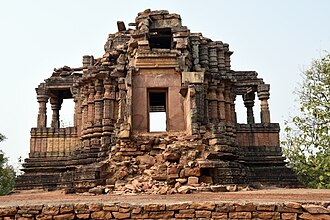 Ajaigarh temple
-
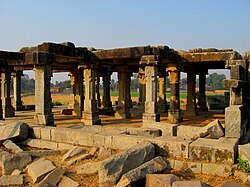


Other smaller Chandela sites include Chandpur, Deogarh, Dudahi, Kakadeo, Madanpur and Aharji.[60][61][62]
- Chandela sculptures
-
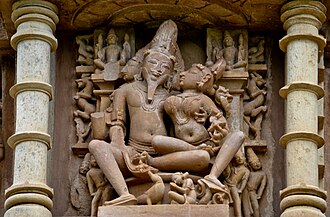 Brahma and his consort, Khajuraho
-
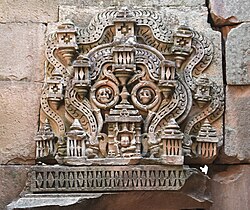 Stone carving, Ajaigarh
-
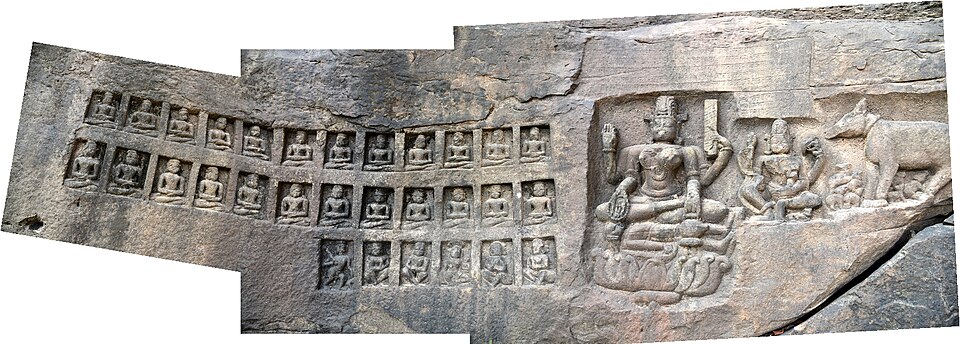 Jain tirthankaras and Sarasvati, Ajaigarh
-
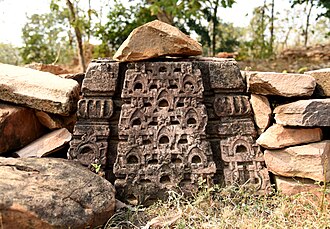 Jain heavens, Ajaigarh
-
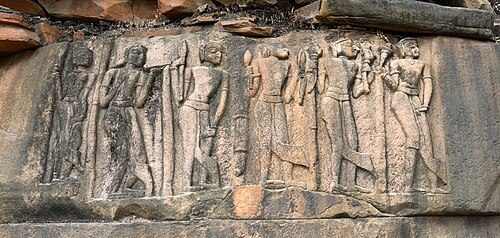 Jain shramanas, Ajaigarh
-
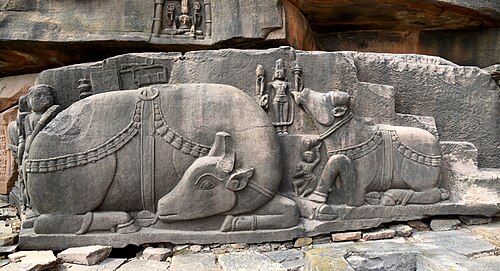 Cattle with treasure sign, Ajaigarh
-
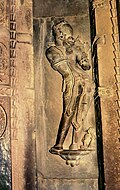 Surasundari Apsara, Khajuraho
-
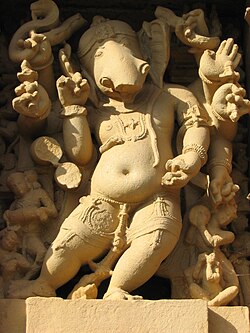 Dancing Ganesha, Khajuraho
-
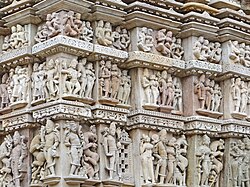 Parshvanatha temple carvings
-
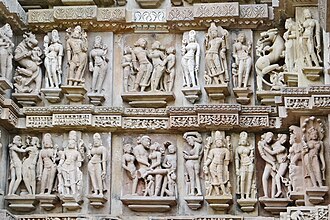 Lakshmana temple carvings


List of Rulers[edit | edit source]
Based on epigraphic records, the historians have come up with the following list of Chandela rulers of Jejākabhukti (IAST names in brackets):[63][64][57]
| S.N. | Ruler's regional name (IAST name in bracket) | Reign (CE) |
|---|---|---|
| 1 | Nannuka | 831–845 |
| 2 | Vakpati (Vākpati) | 845–865 |
| 3 | Jayashakti (Jayaśakti) and Vijayashakti (Vijayaśakti) | 865–885 |
| 4 | Rahila (Rāhila) | 885–905 |
| 5 | Shri Harsha (Śri Harśa) | 905–925 |
| 6 | Yasho-Varman (Yaśovarman) | 925–950 |
| 7 | Dhangavarman | 950–999 |
| 8 | Ganda-Deva (Gaṇḍadeva) | 999–1002 |
| 9 | Vidyadhara (Vidyādhara) | 1003–1035 |
| 10 | Vijaya-Pala (Vijayapāla) | 1035–1050 |
| 11 | Deva-Varman | 1050–1060 |
| 12 | Kirtti-Varman (Kīrtivarman) | 1060–1100 |
| 13 | Sallakshana-Varman (Sallakṣaṇavarman) | 1100–1110 |
| 14 | Jaya-Varman | 1110–1120 |
| 15 | Prithvi-Varman (Pṛthvīvarman) | 1120–1128 |
| 16 | Madana-Varman | 1128–1164 |
| 17 | Yasho-Varman II | 1164–1165 |
| 18 | Paramardi-Deva | 1165–1203 |
| 19 | Trailokya-Varman | 1203–1245 |
| 20 | Vira-Varman (Vīravarman) | 1245–1285 |
| 21 | Bhoja-Varman | 1285–1288 |
| 22 | Hammira-Varman (Hammīravarman) | 1288–1311 |
| 23 | Vira-Varman II | 1311–1315 |
Family tree[edit | edit source]
| Chandela dynasty |
|---|
|
|
See also[edit | edit source]
References[edit | edit source]
- ↑ Schwartzberg, Joseph E. (1978). A Historical Atlas of South Asia. Oxford University Press, Digital South Asia Library. p. 146, Map "j".
- ↑ *Upinder Singh (2004). The Discovery of Ancient India: Early Archaeologists and the Beginnings of Archaeology. Permanent Black. p. 73. ISBN 978-81-7824-088-6.
Discussion of the histories of various Rajput clans, such as the Chauhans, Kachhvahas, Chandelas, Pratiharas and Tomaras on the basis of a wide range of sources-literary, epigraphic, numismatic, bardic accounts and local traditions
- Kulke, Hermann; Rothermund, Dietmar (2004). A History of India. Psychology Press. p. 117. ISBN 978-0-415-32919-4.
When Gurjara Pratiharas power declined after the sacking of Kannauj by the Rashtrakutas in the early tenth century many Rajput princes declared their independence and founded their own kingdoms, some of which grew to importance in the subsequent two centuries. The better known among those dynasties were the Chaulukyas or Solankis of Gujarat and Kathiawar, the Chahamanas (i.e. Chauhans) of eastern Rajasthan (Ajmer and Jodhpur) and the Tomaras who had founded Delhi (Dhillika) in 736 but had been displaced by the Chauhans in the twelfth century. Rajput descent was also claimed by the Chandelas of Khujuraho and the Kalachuris of Tripuri
- Romila Thapar (2004). Early India: From the Origins to AD 1300. University of California Press. p. 420. ISBN 978-0-520-24225-8.
Other claiming to be Rajputs and descended from the solar and lunar lines, established themselves as local kings in various parts of western and central India. Among them were the Chandellas, prominent in the tenth century in Bundelkhand with their centre at Khajuraho and their territory known as Jejakabhukti
- R. K. Dikshit 1976, pp. 8: "The Candellas are undoubtedly a Rajput clan and the epigraphic evidences does not show that any inferiority was applied to them in the past. It reveals their matrimonial relationship with important Rajput families from the very beginning of their history"
- Kulke, Hermann; Rothermund, Dietmar (2004). A History of India. Psychology Press. p. 117. ISBN 978-0-415-32919-4.
- ↑ 3.0 3.1 3.2 R. K. Dikshit 1976, p. 3.
- ↑ 4.0 4.1 R. K. Dikshit 1976, p. 4.
- ↑ R. K. Dikshit 1976, p. 5.
- ↑ Jai Narayan Asopa (1976). Origin of the Rajputs. Bharatiya Publishing House. p. 208.
- ↑ Vijayendra Snatak (1997). "Medieval Hindi Literature". In K Ayyappap Panikkar (ed.). Medieval Indian literature: an anthology (Volume 1). Sahitya Akademi. p. 142. ISBN 978-81-260-0365-5.
- ↑ Freitag, Jason (2009). Serving empire, serving nation: James Tod and the Rajputs of Rajasthan. BRILL. pp. 3–5. ISBN 978-90-04-17594-5.
- ↑ R. V. Somani (1976). History of Mewar, from Earliest Times to 1751 A.D. Mateshwari. p. 30. OCLC 2929852.
- ↑ R. K. Dikshit 1976, p. 6.
- ↑ Ali Javid and Tabassum Javeed (2008). World Heritage Monuments and Related Edifices in India. Vol. 1. Algora. p. 44. ISBN 9780875864822.
- ↑ 12.0 12.1 R. K. Dikshit 1976, p. 7.
- ↑ 13.0 13.1 R. K. Dikshit 1976, p. 8.
- ↑ Radhey Shyam Chaurasia, History of Ancient India: Earliest Times to 1000 A. D.
- ↑ Sailendra Sen (2013). A Textbook of Medieval Indian History. Primus. p. 22. ISBN 978-93-80607-34-4.
- ↑ Sisirkumar Mitra 1977, pp. 27-28.
- ↑ Sisirkumar Mitra 1977, p. 30.
- ↑ R. K. Dikshit 1976, p. 28.
- ↑ R. K. Dikshit 1976, pp. 30–31.
- ↑ R. K. Dikshit 1976, pp. 32–35.
- ↑ Sisirkumar Mitra 1977, pp. 36–37.
- ↑ 22.0 22.1 Sushil Kumar Sullerey 2004, p. 24.
- ↑ Sisirkumar Mitra 1977, p. 42-51.
- ↑ R. K. Dikshit 1976, p. 42.
- ↑ Sisirkumar Mitra 1977, p. 57.
- ↑ R. K. Dikshit 1976, p. 56.
- ↑ Sisirkumar Mitra 1977, pp. 61–65.
- ↑ R. K. Dikshit 1976, p. 69.
- ↑ Sisirkumar Mitra 1977, pp. 72.
- ↑ Sisirkumar Mitra 1977, pp. 72–73.
- ↑ R. K. Dikshit 1976, p. 72.
- ↑ Sisirkumar Mitra 1977, pp. 81–82.
- ↑ Sushil Kumar Sullerey 2004, p. 26.
- ↑ James C. Harle (1994). The Art and Architecture of the Indian Subcontinent. Yale University Press. p. 234. ISBN 0300062176.
- ↑ Sisirkumar Mitra 1977, pp. 89–90.
- ↑ Sisirkumar Mitra 1977, p. 88.
- ↑ R. K. Dikshit 1976, p. 101.
- ↑ Sisirkumar Mitra 1977, p. 90.
- ↑ Sisirkumar Mitra 1977, p. 91.
- ↑ Sisirkumar Mitra 1977, p. 94.
- ↑ R. K. Dikshit 1976, p. 120-121.
- ↑ R. K. Dikshit 1976, p. 126.
- ↑ Sisirkumar Mitra 1977, pp. 110–111.
- ↑ Sisirkumar Mitra 1977, p. 111.
- ↑ R. K. Dikshit 1976, p. 132.
- ↑ 46.0 46.1 R. K. Dikshit 1976, p. 135.
- ↑ R. K. Dikshit 1976, pp. 130–132.
- ↑ Sisirkumar Mitra 1977, p. 112-113.
- ↑ R. K. Dikshit 1976, p. 133.
- ↑ R. K. Dikshit 1976, pp. 133–134.
- ↑ R. K. Dikshit 1976, p. 132-133.
- ↑ R. K. Dikshit 1976, p. 130.
- ↑ Sisirkumar Mitra 1977, pp. 120–123.
- ↑ Sisirkumar Mitra 1977, pp. 123–126.
- ↑ R. K. Dikshit 1976, p. 148.
- ↑ R. K. Dikshit 1976, p. 179.
- ↑ 57.0 57.1 Peter Jackson 2003, p. 199.
- ↑ Om Prakash Misra 2003, p. 11.
- ↑ Romila Thapar 2013, p. 572.
- ↑ 60.0 60.1 Sushil Kumar Sullerey 2004, p. 17.
- ↑ Titze, Kurt; Bruhn, Klaus (1998). Jainism: A Pictorial Guide to the Religion of Non-Violence (2 ed.). Motilal Banarsidass. p. 128. ISBN 978-81-208-1534-6.
- ↑ Reddy, P. Chenny (2023). Kalyana Mitra: A treasure house of history, culture and archaeological studies. Vol. 5. Blue Rose Publishers. p. 197. ISBN 978-93-5741-111-0.
- ↑ R. K. Dikshit 1976, p. 25.
- ↑ Sushil Kumar Sullerey 2004, p. 25.
Bibliography[edit | edit source]
- Harihar Vitthal Trivedi (1991). Inscriptions of the Paramāras (Part 2). Corpus Inscriptionum Indicarum Volume VII: Inscriptions of the Paramāras, Chandēllas, Kachchapaghātas, and two minor dynasties. Archaeological Survey of India.
- Om Prakash Misra (2003). Archaeological Excavations in Central India: Madhya Pradesh and Chhattisgarh. Mittal Publications. ISBN 978-81-7099-874-7.
- Peter Jackson (2003). The Delhi Sultanate: A Political and Military History. Cambridge University Press. ISBN 978-0-521-54329-3.
- R. K. Dikshit (1976). The Candellas of Jejākabhukti. Abhinav. ISBN 9788170170464.
- Romila Thapar (2013). The Past Before Us. Harvard University Press. ISBN 978-0-674-72651-2.
- Sisirkumar Mitra (1977). The Early Rulers of Khajurāho. Motilal Banarsidass. ISBN 9788120819979.
- Sushil Kumar Sullerey (2004). Chandella Art. Aakar Books. ISBN 978-81-87879-32-9.