









Ajay Kumar (talk | contribs) Created a new article Tag: New redirect |
Chakravarthy (talk | contribs) added info |
||
| Line 1: | Line 1: | ||
{{Short description|Concept in political and social science}} | |||
{{redirect-several|Class war|Class Struggle}} | |||
{{Use dmy dates|date=April 2021}} | |||
{{Multiple issues| | |||
{{original research|date=November 2024}} | |||
{{Primary sources|date=June 2025}} | |||
}} | |||
[[File:Anti-capitalism color Restored.jpg|thumb|376x376px|The [[Pyramid of Capitalist System]], a well-known cartoon satirizing capitalist society.]] | |||
{{Revolution sidebar}} | |||
In [[political science]], the terms '''class struggle''', '''class conflict''', and '''class war''' refer to the economic antagonism and political tension that can exist between [[social class]]es because of clashing interests, competition for limited resources, and inequalities of power in a [[socioeconomic]] hierarchy.<ref name="Isaac Harrison Lipold">{{cite book |doi=10.1016/B978-0-12-820195-4.00248-X |chapter=Class Conflict in Capitalist Society |title=Encyclopedia of Violence, Peace, & Conflict |date=2022 |last1=Isaac |first1=Larry W. |last2=Harrison |first2=Daniel M. |last3=Lipold |first3=Paul F. |pages=118–136 |isbn=978-0-12-820312-5 }}</ref><ref>{{Cite news |title=Survey Finds Rising Perception of Class Tension |last=Tavernise |first=Sabrina |date=January 11, 2012 |url=https://www.nytimes.com/2012/01/12/us/more-conflict-seen-between-rich-and-poor-survey-finds.html |newspaper=The New York Times}}</ref> Commonly cited historical examples of class antagonists are slavemasters and slaves, feudal lords and serfs, landowners and tenants, and capitalists and workers.<ref>{{cite web |last=Hunt |first=Stephen |title=Class Conflict |url=https://doi.org/10.1002/9781405165518.wbeosc049.pub2 |publisher=Wiley Online Library |date=22 September 2017}}</ref><ref>{{cite book |last=Erikson |first=Kai |title=The Sociologist's Eye: Reflections on Social Life |year=2017 |publisher=Yale University Press |page=97 |isbn=978-0300106671}}</ref> | |||
The writings of several [[Left-wing politics|leftist]], [[Socialism|socialist]], and [[Marxism|communist]] theorists portray class struggle as a core tenet and a practical means for effecting radical sociopolitical transformations for the majority [[working class]].<ref>{{cite encyclopedia |editor1-last=Bullock |editor1-first=Allan |editor2-last=Trombley |editor2-first=Stephen |encyclopedia=The New Fontana Dictionary of Modern Thought |title=class conflict |date=1999 |publisher=HarperCollins |isbn=978-0-00-255871-6 |page=127}}</ref> It is also a central concept within [[conflict theories]] of [[sociology]] and [[political philosophy]]. | |||
Class struggle can reveal itself through: | |||
* Direct violence, such as assassinations, [[Coup d'état|coups]], [[revolution|revolutions]], [[counter-revolutionary|counterrevolutions]], and civil wars for control of government, natural resources, and labor; | |||
* Indirect violence, such as deaths from poverty, malnutrition, illness, and unsafe workplaces; | |||
* Economic coercion, such as [[boycott|boycotts]] and [[strike action|strikes]], the threat of unemployment and [[capital flight]], the withdrawal of [[Investment|investment capital]]; | |||
* Political machinations through lobbying (legal and illegal), bribery of legislators, [[voter suppression]] and [[disenfranchisement]]; | |||
* Ideological struggle by way of [[propaganda]] and [[:Category:Political literature|political literature]].<ref name="Isaac Harrison Lipold"/> | |||
In the economic sphere, class struggle is sometimes expressed overtly, such as owner [[Lockout (industry)|lockouts]] of employees in an effort to weaken the [[bargaining power]] of the employees' [[trade union|union]]; or covertly, such as a worker [[slowdown]] of production or the widespread, simultaneous use of sick leave (e.g., "[[blue flu]]") to protest [[unfair labor practices]], low wages, poor [[outline of working time and conditions|work conditions]], or a perceived injustice to a fellow worker.<ref name="Parenti_citation">{{cite book| last=Parenti |first=Michael |title=Land of Idols: Political Mythology in America |date=1993 |pages=66–67 |publisher=St. Martin's Press |isbn=978-0-312-09841-4 }}</ref> | |||
== Usage == | |||
[[File:battle strike 1934.jpg|thumb|Truck drivers fight the police in the course of the [[Minneapolis Teamsters Strike of 1934]].]] | |||
[[File:Storming the bastille 4 - 2.jpg|thumb|Heads of aristocrats on pikes at the [[storming of the Bastille]]]] | |||
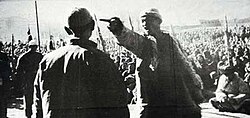
[[File:Choubapi.jpg|thumb|Farmer confronting landlord during [[Land Reform Movement (China)|China's Land Reform Movement]]]] | |||
When [[Marxists]] speak of class struggle, they define a class primarily in economic terms, i.e., by its relationship to the [[means of production]]. When [[anarchism|anarchists]] like [[Mikhail Bakunin|Bakunin]] speak of class struggle, they have a broader definition of "social class" which encompasses "notions of domination and privilege" in the political and cultural spheres as well as the economic.<ref name="Bakunin_book">{{cite book |title=Freedom or Death: The Theory and Practice of Mikhail Bakunin |last=Corrêa |first=Felipe |date=2024 |publisher=Black Rose Books |isbn=978-1-55164-812-5 }}{{pn|date=August 2024}}</ref> Bakunin believed the successful struggle of the dominated classes would achieve a revolution to depose the ruling elites and create a stateless or [[libertarian socialism]], and that a prerequisite for successful revolution is class [[solidarity]].<ref>{{cite web |url=https://www.marxists.org/reference/archive/bakunin/works/various/soc-anar.htm |last=Bakunin |first=Mikhail |title=Stateless Socialism: Anarchism |date=1873 |via=Mikhail Bakunin Reference Archive}}</ref><ref>{{cite web |url=https://www.marxists.org/reference/archive/bakunin/works/writings/ch04.htm |last=Bakunin |first=Mikhail |title=Solidarity in Liberty: The Workers' Path to Freedom |date=1867 |via=Mikhail Bakunin Reference Archive}}</ref> | |||
[[Marx's theory of history]] asserts that in the history of economic systems such as [[capitalism]] and [[feudalism]], class struggle is "the central fact of social evolution."<ref>{{cite web |title=Class struggle |last1=McLellan |first1=David T. |last2=Chambre |first2=Henri |date=July 30, 2024 |url=https://www.britannica.com/topic/Marxism/Class-struggle |publisher=Britannica}}</ref> Indeed, the first sentence of Chapter 1 of the ''[[Communist Manifesto]]'' reads: "The history of all hitherto existing society is the history of class struggles."<ref>{{cite web |url=https://www.marxists.org/archive/marx/works/1848/communist-manifesto/ch01.htm |last1=Marx |first1=Karl |last2=Engels |first2=Friedrich |title=Manifesto of the Communist Party |at=Chapter I. Bourgeois and Proletarians |date=1848 |via=Marx-Engels Archive}}</ref> Marxists view the struggle's resolution in favor of the working class to be inevitable under [[plutocratic]] capitalism. | |||
==Oligarchs versus commoners in Ancient Greece== | |||
Where societies are divided by wealth, status, or control of social production and distribution, class structures arise and are thus coeval with civilization itself. The rise of class structures eventually leads to class conflict. It is a pattern that has repeated since at least European [[classical antiquity]] as illustrated in the [[Conflict of the Orders]] and the slave revolt led by [[Spartacus]].<ref>{{cite book |last1=de Ste. Croix |first1=Geoffrey Ernest Maurice |title=The Class Struggle in the Ancient Greek World: From the Archaic Age to the Arab Conquests |date=1989 |publisher=Cornell University Press |pages=333–37, 409 |isbn=978-0-8014-9597-7}}</ref> | |||
===Thucydides=== | |||
In his [[History of the Peloponnesian War|''History'']], [[Thucydides]] recounts a class-based civil war in the city of [[Korkyra (polis)|Corcyra]] between the pro-[[Athens]] party of the common people and their pro-[[Ancient Corinth|Corinth]] [[oligarchy|oligarchic]] opposition. Near the climax of the struggle, "the oligarchs in full rout, fearing that the victorious commons might assault and carry the arsenal and put them to the sword, fired the houses round the market-place and the lodging-houses, in order to bar their advance."<ref>Thucydides. [https://classics.mit.edu/Thucydides/pelopwar.3.third.html ''The History of the Peloponnesian War'']. Book Three, Chapter X, Translated by Richard Crawley. [https://classics.mit.edu/ The Internet Classics Archive].</ref> The historian [[Tacitus]] would later narrate a similar class conflict in the city of [[Seleucia]], in which disharmony between the oligarchs and the commoners resulted in each side calling on outside help to defeat the other.<ref>Cornelius Tacitus. [https://penelope.uchicago.edu/Thayer/E/Roman/Texts/Tacitus/Annals/6B*.html ''Annals''], Book VI, Section 42, Translated by John Jackson. [https://penelope.uchicago.edu/Thayer/E/Roman/home.html LacusCurtius].</ref> | |||
===Socrates=== | |||
[[Socrates]] was the first [[Ancient Greek philosophy|Greek philosopher]] to describe class conflict. In [[Plato]]'s ''[[Republic (Plato)|Republic]]'', Socrates is quoted as saying that "any city, however small, is in fact divided into two, one the city of the poor, the other [the city] of the rich; these [cities] are at war with one another."<ref>Plato. [https://www.gutenberg.org/files/1497/1497-h/1497-h.htm ''The Republic''], Book IV. Translated by Benjamin Jowett. [[Project Gutenberg]].</ref> He disapproved of [[oligarchy|oligarchies]], in which wealthy property owners take positions of political power in order to dominate the large social class of impoverished commoners. Socrates used the analogy of a [[maritime pilot]] who, like the power-holder in a [[polis]], ought to be chosen for his skill, not for the amount of property he owns.<ref>Plato. [https://www.gutenberg.org/files/1497/1497-h/1497-h.htm ''The Republic''], Book VIII.</ref> | |||
===Aristotle=== | |||
In [[Politics (Aristotle)|''Politics'']], [[Aristotle]] analyzes the basic dimensions of class conflict: "[B]ecause the rich are generally few in number, while the poor are many, they appear to be antagonistic, and as the one or the other prevails they form the government.".<ref>Aristotle. [https://classics.mit.edu/Aristotle/politics.2.two.html ''Politics''], Book Four, Part IV.</ref> To lessen class antagonism in Greece's slave society, Aristotle proposed a middle way between indulgence and cruelty in the treatment of [[slavery|slaves]] by their masters, averring that "if not kept in hand, [slaves] are insolent, and think that they are as good as their masters, and, if harshly treated, they hate and conspire against them."<ref>Aristotle. [https://classics.mit.edu/Aristotle/politics.2.two.html ''Politics''], Book Two, Part IX.</ref> As [[Charles A. Beard]] wrote, much of ''Politics'' is concerned with achieving political stability by moderating extreme behaviors by different economic groups.<ref>{{cite book |last=Beard |first=Charles A. |author-link=Charles A. Beard |year=1922 |title=The Economic Basis of Politics |pages=20–21 |location=New York |publisher=A. A. Knopf |oclc=1437092}}</ref><ref>Aristotle. [https://classics.mit.edu/Aristotle/politics.3.three.html ''Politics''], Book Three, Part X.</ref> | |||
===Plutarch=== | |||
[[File:Amphora olive-gathering BM B226.jpg|thumb|upright|This 6th-century Athenian black-figure urn, in the [[British Museum]], depicts the olive harvest. Many farmers, enslaved for debt, would have worked on large estates for their creditors.]] | |||
The historian [[Plutarch]] recounts how the Greek people engaged in a battle against the aristocratic class. Financially oppressed by their indebtedness to the aristocrats, the mass of Athenians chose [[Solon]] to be the lawgiver to lead them to freedom from their creditors.<ref>Plutarch. [https://www.gutenberg.org/files/674/674-h/674-h.htm ''Lives''], ''Solon''. Translated by John Dryden. [[Project Gutenberg]].</ref> The philosopher [[Hegel|Georg Wilhelm Friedrich Hegel]] said that Solon's constitution of the Athenian [[Ecclesia (ancient Greece)|popular assembly]] created a political sphere that balanced the competing interests of the factions in Athens.<ref>Hegel, Georg Wilhelm Friedrich, [https://socialsciences.mcmaster.ca/econ/ugcm/3ll3/hegel/history.pdf ''The Philosophy of History''], Part II: "An antagonism had early arisen between ancient and wealthy families and such as were poorer.... The polity of the state was wavering between Aristocracy and Democracy. [[Solon]] effected, by his division into four property-classes, a medium between these opposites." [[McMaster University]].</ref> | |||
Taking sides in Greece's class conflicts was sometimes dangerous. In ''[[Parallel Lives]]'', Plutarch wrote of two Spartan kings, [[Cleomenes III|Cleomenes]] and [[Agis IV|Agis]], who both met tragic ends after "being desirous to raise the people, and to restore the noble and just form of government ... [they] incurred the hatred of the rich and powerful, who could not endure to be deprived of the selfish enjoyment to which they were accustomed."<ref>Plutarch. [https://www.gutenberg.org/files/674/674-h/674-h.htm ''Lives''], ''Agis''.</ref> | |||
==Patricians versus plebeians in Ancient Rome== | |||
It was similarly difficult for the Romans to maintain peace between the upper-class [[Patrician (ancient Rome)|patricians]] and the lower-class [[plebs]]. French [[Age of Enlightenment|Enlightenment]] philosopher [[Montesquieu]] stated that this conflict intensified after the [[overthrow of the Roman monarchy]].<ref>[[Charles Louis de Secondat, Baron de Montesquieu]]. [https://oll-resources.s3.amazonaws.com/titles/837/Montesquieu_0171-01_EBk_v6.0.pdf ''The Spirit of Laws'', Volume 1], Book XI, Chapter 13. [[Liberty Fund]].</ref> | |||
In ''[[The Spirit of Laws]]'' he lists the four main grievances of the plebs, which were rectified in the years following the deposition of [[Lucius Tarquinius Superbus|King Tarquin]]: | |||
* The patricians had much too easy access to positions of public service. | |||
* The [[Roman constitution|constitution]] granted the [[Roman consul|consuls]] far too much power. | |||
* The plebs were constantly verbally slighted. | |||
* The plebs had too little power in their assemblies.<ref>Montesquieu. [https://oll-resources.s3.amazonaws.com/titles/837/Montesquieu_0171-01_EBk_v6.0.pdf ''The Spirit of Laws'', Volume 1], Book XI, Chapter 14.</ref> | |||
{{ | ===Camillus=== | ||
{{ | The Senate had the ability to give a magistrate the power of [[Roman dictator|dictatorship]], meaning he could bypass public law in the pursuit of a prescribed mandate. Montesquieu explained that the purpose of this institution was to tilt the balance of power in favour of the patricians.<ref>Montesquieu. [https://oll-resources.s3.amazonaws.com/titles/837/Montesquieu_0171-01_EBk_v6.0.pdf ''The Spirit of Laws'', Volume 1], Book XI, Chapter 16.</ref> However, in an attempt to resolve a conflict between the patricians and the plebs, the dictator [[Marcus Furius Camillus|Camillus]] used his power of dictatorship to coerce the [[Roman Senate|Senate]] into giving the plebs the right to choose one of the two consuls.<ref>Plutarch. [https://www.gutenberg.org/files/674/674-h/674-h.htm ''Lives''], ''Camillus''.</ref> | ||
===Marius=== | |||
Tacitus believed that the increase in Roman power spurred the patricians to expand their power over more and more cities. This process, he felt, exacerbated pre-existing class tensions with the plebs, and eventually culminated in a civil war between the patrician Sulla and the [[populist]] reformer [[Gaius Marius|Marius]].<ref>Cornelius Tacitus. [https://penelope.uchicago.edu/Thayer/E/Roman/Texts/Tacitus/Histories/2A*.html ''The Histories''], Book II, Section 38. Translated by C. H. Moore. [https://penelope.uchicago.edu/Thayer/E/Roman/home.html LacusCurtius].</ref> Marius had taken the step of enlisting ''[[capite censi]]'', the very lowest class of citizens, into the army, for the first time allowing non-land owners into the [[Roman legion|legions]]. | |||
===Tiberius Gracchus=== | |||
[[File:Tiberius Gracchus.jpg|thumb|left|upright|Tiberius Gracchus]] | |||
Of the notable figures discussed by Plutarch and Tacitus, [[agrarian reform]]er [[Tiberius Gracchus]] was an ardent champion of the lower classes. In a speech to common soldiers, he decried their conditions:{{blockquote|[T]he men who bear arms, and expose their lives for the safety of their country, enjoy in the meantime nothing more in it but the air and light; and having no houses or settlements of their own, are constrained to wander from place to place with their wives and children."<ref>Plutarch. [https://www.gutenberg.org/files/674/674-h/674-h.htm ''Lives''], ''Tiberius Gracchus''.</ref>}} | |||
He added that soldiers "fought indeed and were slain, but it was to maintain the luxury and the wealth of other men."<ref>Plutarch. [https://www.gutenberg.org/files/674/674-h/674-h.htm ''Lives''], ''Tiberius Gracchus''.</ref> Tiberius diminished the power of the Senate by changing the law so that judges were chosen from the ranks of the [[Equites|knights]], instead of from their social superiors in the senatorial class.<ref>Montesquieu. [https://oll-resources.s3.amazonaws.com/titles/837/Montesquieu_0171-01_EBk_v6.0.pdf ''The Spirit of Laws'', Volume 1], Book XI, Chapter 18.</ref> [[Cicero]] believed that the reforming efforts of Tiberius saved Rome from tyranny.<ref>Montesquieu. [https://oll-resources.s3.amazonaws.com/titles/837/Montesquieu_0171-01_EBk_v6.0.pdf ''The Spirit of Laws'', Volume 1], Book XI, Chapter 15. "Tiberius Gracchus (says Cicero) caused the [[Freedman|free-men]] to be admitted into the [[Roman tribe|tribes]], not by the force of his eloquence, but by a word, by a gesture; which had he not effected, the republic, whose drooping head we are at present scarce able to uphold, would not even exist."</ref> | |||
===Julius Caesar=== | |||
{{Undue|date=August 2025}} | |||
In [[William Shakespeare|Shakespeare]]'s tragedy ''[[Julius Caesar (play)|Julius Caesar]]'', the senatorial assassins of Caesar were portrayed as striking a blow against a would-be tyrant. Historian [[Michael Parenti]] argued instead that Caesar was a populist, not a tyrant, who was enacting policies to benefit the common people of Rome.<ref>{{cite book |last=Parenti |first=Michael |author-link=Michael Parenti |title=The Assassination of Julius Caesar: A People's History of Ancient Rome |year=2003 |location=New York |publisher=The New Press |pages=2–3 |isbn=978-1565847972}}</ref> In this interpretation, the assassination was an act of class warfare by wealthy Romans to preserve their grip on power.<ref>{{cite web |title=The Assassination of Julius Caesar: A People's History of Ancient Rome |url=https://www.kirkusreviews.com/book-reviews/michael-parenti/the-assassination-of-julius-caesar/ |work=[[Kirkus Reviews]] |access-date=12 November 2014 |date=1 June 2003 |quote=Populist historian Parenti [...] views ancient Rome's most famous assassination not as a tyrannicide but as a sanguinary scene in the never-ending drama of class warfare.}}</ref><ref>{{cite web |title=The Assassination of Julius Caesar: A People's History of Ancient Rome |work=[[Publishers Weekly]] |url=https://www.publishersweekly.com/978-1-56584-797-2 |access-date=12 November 2011 |date=26 May 2003 |quote=Parenti [...] narrates a provocative history of the late republic in Rome (100–33 BC) to demonstrate that Caesar's death was the culmination of growing class conflict, economic disparity and political corruption.}}</ref> | |||
===Coriolanus=== | |||
[[File:Gavin Hamilton - Coriolanus Act V, Scene III edit2.jpg|thumb|''Coriolanus'', Act V, Scene III. Engraved by James Caldwell from a painting by [[Gavin Hamilton (artist)|Gavin Hamilton]]]] | |||
The patrician [[Gaius Marcius Coriolanus|Coriolanus]], whose life Shakespeare depicted in the play ''[[Coriolanus]]'', fought for his class and against the plebs. The play includes the language of class conflict. In the opening scene, a mob of angry plebs gathers in Rome to denounce Coriolanus as the "chief enemy to the people", with the leader of the mob speaking out against Roman patricians:{{blockquote|They ne'er cared for us yet: suffer us to famish, and their store-houses crammed with grain; make edicts for usury, to support usurers; repeal daily any wholesome act established against the rich, and provide more piercing statutes daily, to chain up and restrain the poor. If the wars eat us not up, they will; and there's all the love they bear us.<ref>William Shakespeare. [https://shakespeare.mit.edu/coriolanus/full.html ''The Tragedy of Coriolanus''], Act I, Scene I. [https://shakespeare.mit.edu/ ''The Complete Works of William Shakespeare'']</ref>}} | |||
Plutarch writes that when grain arrived to relieve a serious shortage in Rome, the plebs said it should be divided amongst them as a gift, but Coriolanus stood up in the Senate against this idea on the grounds that it would empower the plebs at the expense of the patricians.<ref>Plutarch. [https://www.gutenberg.org/files/674/674-h/674-h.htm ''Lives''], ''Coriolanus''.</ref> This decision would eventually contribute to Coriolanus's undoing when he was impeached following a trial by the [[tribunes of the plebs]]. Montesquieu recounts how Coriolanus castigated the tribunes for trying a patrician, when in his mind no one but a consul had that right, although a law had been passed stipulating that all appeals affecting the life of a citizen had to be brought before the plebs.<ref>Montesquieu. [https://oll-resources.s3.amazonaws.com/titles/837/Montesquieu_0171-01_EBk_v6.0.pdf ''The Spirit of Laws'', Volume 1], Book XI, Chapter 18.</ref> | |||
===Landlessness and debt=== | |||
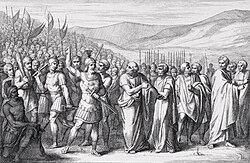
[[File:Secessio plebis.JPG|thumb|left|''The Secession of the People to the Mons Sacer''. Engraving by B. Barloccini, 1849]] | |||
Historian [[Edward Gibbon]] also chronicled Roman class conflict. In the third volume of ''[[The History of the Decline and Fall of the Roman Empire]]'', he relates the origins of the conflict:{{blockquote|[T]he plebeians of Rome [...] had been oppressed from the earliest times by the weight of debt and usury; and the husbandman, during the term of his military service, was obliged to abandon the cultivation of his farm. The lands of Italy which had been originally divided among the families of free and indigent proprietors, were insensibly purchased or usurped by the avarice of the nobles; and in the age which preceded the fall of the republic, it was computed that only two thousand citizens were possessed of an independent substance.<ref name=Gibbon />}} | |||
[[Hegel]] similarly states that the "severity of the patricians their creditors, the debts due to whom they had to discharge by slave-work, drove the plebs to revolts."<ref>[[Hegel]]. [https://socialsciences.mcmaster.ca/econ/ugcm/3ll3/hegel/history.pdf ''The Philosophy of History''], Part III. [[McMaster University]].</ref> Gibbon explains how [[Augustus]] sought to pacify the plebs with [[bread and circuses]].<ref name=Gibbon>{{cite book |last=Gibbon |first=Edward |title=History of the Decline and Fall of the Roman Empire'': Volume Three, Chapter XXXI, Part III'' |url=https://www.gutenberg.org/files/25717/25717-h/25717-h.htm |via=[[Project Gutenberg]]}}</ref> | |||
The economist [[Adam Smith]] noted that the poor freeman's lack of land was a driving force for Roman [[colonia (Roman)|colonisation]], as a way to relieve class tensions at home between the rich and the landless poor.<ref>[[Adam Smith|Smith, Adam]]. [https://www.gutenberg.org/files/3300/3300-h/3300-h.htm ''An Inquiry into the Nature and Causes of the Wealth of Nations''], Book IV, Chapter 7, Part 1. :The citizens, therefore, who had no land, had scarce any other means of subsistence but the bounties of the candidates at the annual elections. The tribunes, when they had a mind to animate the people against the rich and the great, put them in mind of the ancient divisions of lands, and represented that law which restricted this sort of private property as the fundamental law of the republic. The people became clamorous to get land, and the rich and the great, we may believe, were perfectly determined not to give them any part of theirs. To satisfy them in some measure, therefore, they frequently proposed to send out a new colony." – via [[Project Gutenberg]].</ref> [[Hegel]] described the same phenomenon as being the impetus to [[Greek colonisation]].<ref>[[Georg Wilhelm Friedrich Hegel]]. [https://socialsciences.mcmaster.ca/econ/ugcm/3ll3/hegel/history.pdf ''The Philosophy of History''], Part II. "Nevertheless a part of the poorer classes would not submit to the degradations of poverty, for everyone felt himself a free citizen. The only expedient, therefore, that remained, was colonization. In another country, those who suffered distress in their own, might seek a free soil, and gain a living as free citizens by its cultivation." [[McMaster University]].</ref> | |||
==Enlightenment era== | |||
Writing in pre-capitalist Europe, the Swiss [[Philosophes|''philosophe'']] [[Jean-Jacques Rousseau]] and the [[Federalist Party|Federalist]] statesman [[James Madison]] across the Atlantic Ocean made significant remarks on the dynamics of class struggle. Later, [[German idealist]] [[Georg Wilhelm Friedrich Hegel]] would also contribute his perspective to the discussion around class conflict between employers and employees. | |||
===Jean-Jacques Rousseau=== | |||
[[File:Jean-Jacques Rousseau (painted portrait).jpg|thumb|upright|Rousseau by [[Maurice Quentin de La Tour]], 1753]] | |||
It was with bitter sarcasm that [[Rousseau]] outlined the class conflict prevailing in his day between masters and their workmen:{{blockquote|You have need of me, because I am rich and you are poor. We will therefore come to an agreement. I will permit you to have the honour of serving me, on condition that you bestow on me the little you have left, in return for the pains I shall take to command you.<ref>[[Jean-Jacques Rousseau]]. [https://oll.libertyfund.org/titles/rousseau-the-social-contract-and-discourses#lf0132_head_069 ''The Social Contract and Discourses''], ''On Political Economy''.</ref>}} | |||
Rousseau suggested that the most important function of any government is to fight on the side of workmen against their masters, who he said engage in exploitation under the pretence of serving society.<ref>[[Rousseau]]. [https://oll.libertyfund.org/titles/rousseau-the-social-contract-and-discourses#lf0132_head_069 ''The Social Contract and Discourses''], ''On Political Economy''. "The law, which they thus abuse, serves the powerful at once as a weapon of offence, and as a shield against the weak; and the pretext of the public good is always the most dangerous scourge of the people. What is most necessary, and perhaps most difficult, in government, is rigid integrity in doing strict justice to all, and above all in protecting the poor against the tyranny of the rich.' [[Liberty Fund]].</ref> Specifically, he believed that governments should actively intervene in the economy to abolish poverty and prevent the accrual of too much wealth in the hands of too few men.<ref>[[Rousseau]]. [https://oll.libertyfund.org/titles/rousseau-the-social-contract-and-discourses#lf0132_head_069 ''The Social Contract and Discourses''], ''On Political Economy''. "It is therefore one of the most important functions of government to prevent extreme inequality of fortunes; not by taking away wealth from its possessors, but by depriving all men of means to accumulate it; not by building hospitals for the poor, but by securing the citizens from becoming poor."</ref> | |||
=== Thomas Jefferson === | |||
American [[Founding Fathers of the United States|founding father]] [[Thomas Jefferson]] worried that a sharp disparity between classes, which he had observed in Europe, would get replicated in the newly formed United States. He wrote in a 1787 letter to Edward Carrington that in Europe,{{blockquote|under pretence of governing they have divided their nations into two classes, wolves & sheep. I do not exaggerate. This is a true picture of Europe.... It seems to be the law of our general nature, in spite of individual exceptions; and experience declares that man is the only animal which devours his own kind, for I can apply no milder term to the governments of Europe, and to the general prey of the rich on the poor.<ref>{{cite web |title=Letter to Edward Carrington |url=https://en.wikisource.org/wiki/Letter_to_Edward_Carrington_-_January_16,_1787 |date= January 16, 1787 |last=Jefferson |first=Thomas}}</ref>}} | |||
Jefferson advocated for a free press to mitigate this type of class divide.<ref>{{cite news |last=Miller |first=Floyd |date=May 6, 2022 |title=Why Thomas Jefferson and I applaud the ''West Texas Tribune'' |url=https://westtexastribune.org/2022/05/06/why-thomas-jefferson-and-i-applaud-the-west-texas-tribune/ |newspaper=West Texas Tribune }}</ref> | |||
===James Madison=== | |||
In [[Federalist No. 10]], [[James Madison]] commented on the conflict between rich and poor, stating that "the most common and durable source of factions has been the various and unequal distribution of property. Those who hold and those who are without property have ever formed distinct interests in society. Those who are creditors, and those who are debtors, fall under a like discrimination."<ref>[[James Madison]]. [https://guides.loc.gov/federalist-papers/text-1-10#s-lg-box-wrapper-25493273 ''The Federalist Papers''], [[Federalist No. 10]]. [[Library of Congress]]. "The regulation of these various and interfering interests forms the principal task of modern legislation, and involves the spirit of party and faction in the necessary and ordinary operations of the government."</ref> He wrote that a vital role of government was to manage and regulate a society's class-based factions. | |||
===Georg Wilhelm Friedrich Hegel=== | |||
In his ''[[Philosophy of Right]]'', [[Hegel]] expressed concern that the standard of living of the poor might drop so far as to make it even easier for the rich to amass more wealth.<ref>[[Georg Wilhelm Friedrich Hegel]]. [https://www.marxists.org/reference/archive/hegel/works/pr/philosophy-of-right.pdf ''Elements of the Philosophy of Right''], Part III, Paragraph 244. "When a large number of people sink below the standard of living regarded as essential for the members of society, and lose that sense of right, rectitude, and honour which is derived from self-support, a pauper class arises, and wealth accumulates disproportionately in the hands of a few." – via [[Marxists Internet Archive]].</ref> He believed that, especially in a liberal country such as contemporary England, the poorest will politicise their situation, channelling their frustrations against the rich:{{blockquote|Against nature man can claim no right, but once society is established, poverty immediately takes the form of a wrong done to one class by another.<ref>Hegel. [https://www.marxists.org/reference/archive/hegel/works/pr/philosophy-of-right.pdf ''The Philosophy of Right''], Addition 149.</ref>}} | |||
== Capitalist societies == | |||
Class conflict is most commonly described as occurring within capitalist societies. The conflict manifests itself as clashes between the capitalist class and working class, and takes the form of disputes over hours of work, amount paid in wages, division of profits, culture in the workplace, cost of consumer goods, cost of rent, control over [[parliament]] or government [[bureaucracy]], and [[economic inequality]]. Even a seemingly benign humanitarian program such as government-provided disaster relief can exacerbate class conflict if the relief is seen as being unequally distributed depending on the recipient's class.<ref>{{cite web |url=https://www.gregpalast.com/burn-baby-burnthe-california-celebrity-fires/ |last=Palast |first=Greg |title=Burn Baby Burn - The California Celebrity Fires |date=October 26, 2007 |access-date=August 1, 2024}}</ref> | |||
=== Adam Smith === | |||
As a [[classical liberal|liberal]] political economist, [[Adam Smith]] believed that the amassing of property in the hands of a minority naturally resulted in a disharmonious state of affairs. He wrote that "avarice and ambition in the rich, in the poor the hatred of labour and the love of present ease and enjoyment, are the passions which prompt to invade property", requiring a government to protect property rights, which he elaborated on in ''[[The Wealth of Nations]]'':{{blockquote|Wherever there is a great property, there is great inequality. For one very rich man, there must be at least five hundred poor, and the affluence of the few supposes the indigence of the many. The affluence of the rich excites the indignation of the poor, who are often both driven by want, and prompted by envy to invade his possessions. It is only under the shelter of the civil magistrate, that the owner of that valuable property, which is acquired by the labour of many years, or perhaps of many successive generations, can sleep a single night in security. He is at all times surrounded by unknown enemies, whom, though he never provoked, he can never appease, and from whose injustice he can be protected only by the powerful arm of the civil magistrate, continually held up to chastise it.<ref>[[Adam Smith|Smith, Adam]]. [https://www.gutenberg.org/files/3300/3300-h/3300-h.htm ''An Inquiry into the Nature and Causes of the Wealth of Nations''], Book V, Chapter 1, Part 2. – via [[Project Gutenberg]].</ref>}} | |||
Smith observed that, outside of colonies where land is cheap and labour expensive, both the masters who subsist by profit and the masters who subsist by rents will work in tandem to subjugate the class of workmen, who subsist by wages.<ref>Smith, Adam. [https://www.gutenberg.org/files/3300/3300-h/3300-h.htm#chap32 ''An Inquiry into the Nature and Causes of the Wealth of Nations''], Book IV, Chapter 7, Part 2.</ref> He analyzed wage levels in terms of the conflicting interests of owners of capital and of labourers. Of the latter, he said they were often compelled to form [[trade unions]] for fear of suffering starvation wages:{{blockquote|What are the common wages of labour, depends everywhere upon the contract usually made between those two parties, whose interests are by no means the same. The workmen desire to get as much, the masters to give as little, as possible. The former are disposed to combine in order to raise, the latter in order to lower, the wages of labour.<ref name="gutenberg.org">Smith, Adam. [https://www.gutenberg.org/files/3300/3300-h/3300-h.htm ''An Inquiry into the Nature and Causes of the Wealth of Nations''], Book I, Chapter 8.</ref>}} | |||
=== Karl Marx === | |||
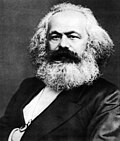
[[File:Karl Marx.jpg|thumb|upright|Karl Marx, 1875]] | |||
In his writings, [[Karl Marx]] argued that [[Social class|classes]] had formed in history due to changes in the [[mode of production]]. Members of a class may become aware of their economic position in society, achieving what is known as [[class consciousness]].<ref>{{Cite book |title=Sociological Theory in the Classical Era: Text and Readings |last1=Edles |first1=Laura Desfor |last2=Appelrouth |first2=Scott |location=[[Thousand Oaks, California|Thousand Oaks]] |publisher=Pine Forge Press |year=2005 |isbn=978-1506347820 |pages=24–25}}</ref> For workers, this happens when they become aware of their [[Exploitation of labour|exploitation]] at the hands of the capitalist class. According to Marx, workers then take action against capitalists, and vice versa. | |||
In his analysis of 19th-century industrial society, he identified two main groups as the source of [[social stratification]],<ref name=Cox_essay>{{cite web |last=Cox |first=Kimberley |title=Marx and Stratification |website=[[EBSCO Information Services|EBSCO]] |series=Research Starters |date=2021 |url=https://www.ebsco.com/research-starters/history/marx-and-stratification}}</ref> which in his view generated class conflict: | |||
* ''Labour'' (the [[proletariat]] or workers) includes anyone who earns their livelihood by selling their [[labor power]] and being paid a wage or salary for their labor time. They have little choice but to work for capital, since they typically have no independent way to survive. | |||
* ''Capital'' (the [[bourgeoisie]] or capitalists) includes anyone who gets their income not from labor as much as from the [[surplus value]] they appropriate from the workers who create wealth. The income of the capitalists, therefore, is based on their [[Exploitation (Marxism)|exploitation]] of the workers (proletariat). | |||
In Marxist theory, class struggle becomes a more potent factor as it becomes more general, as industries are organized rather than crafts, as workers agitate for systemic change, and as their class consciousness rises. Marx referred to this as the progress of the proletariat from being a class "in itself", i.e., merely a position in the social structure, to being one "for itself", an active and conscious force that could change the world.<ref>{{cite web |first=André |last=Munro |url=https://www.britannica.com/topic/class-consciousness |title=Class consciousness - Social Stratification, Marxism {{&}} Class Conflict |publisher=Britannica}}</ref> | |||
While Marx elevated the importance of the class struggle, he did not claim to have discovered it. He acknowledged his debt to Adam Smith and other earlier economists and historians. In an 1852 letter to [[Joseph Weydemeyer]], Marx wrote: "And now as to myself, no credit is due to me for discovering the existence of classes in modern society nor yet the struggle between them. Long before me bourgeois historians had described the historical development of this class struggle and bourgeois economists the economic anatomy of the classes."<ref>{{cite book |title=Karl Marx and Frederick Engels: Selected Correspondence, 1846–1895, with explanatory notes |editor-last=Torr |editor-first=Dona |year=1942 |location=New York |publisher=International Publishers |chapter=Engels to Marx: Paris, 23–24 November 1847 |page=57 |lccn=43011421 |series=Marxist Library, Volume XXIX}}</ref> | |||
He believed the class struggle would result in the revolutionary overthrow of the bourgeoisie, and that private property would become communally owned.<ref>{{cite magazine |last=Foster |first=John Bellamy |title=Marx and Communal Society |magazine=[[Monthly Review]] |volume=77 |number=3 |date=July–August 2025 |url=https://monthlyreview.org/articles/marx-and-communal-society/}}</ref><ref>{{cite encyclopedia |title=Understanding Marxism: Differences vs. Communism, Socialism, Capitalism |encyclopedia=[[Investopedia]] |url=https://www.investopedia.com/terms/m/marxism.asp |date=17 August 2025}}</ref> He predicted that after a revolution, as class boundaries broke down, the need for a state apparatus would diminish, which would lead to a [[Classless society|classless]], stateless [[communist society]].<ref>{{cite web |title=Communism: The Ideal Classless and Stateless Society |website=PolSci Institute |date=14 December 2025 |url=https://polsci.institute/understanding-political-theory/communism-ideal-classless-stateless-society/}}</ref> | |||
===John Stuart Mill=== | |||
Like Adam Smith, John Stuart Mill was a liberal political economist concerned with class conflict. In his ''[[Considerations on Representative Government]]'', he notes the complete marginalisation of workmen's voices in [[Parliament of the United Kingdom|Parliament]], rhetorically asking whether its members ever empathise with the position of workmen, instead of siding entirely with their masters, on issues such as the right to [[go on strike]].<ref>[[John Stuart Mill]]. [https://www.gutenberg.org/files/5669/5669-h/5669-h.htm ''Representative Government''], Chapter 3. "Yet does Parliament, or almost any of the members composing it, ever for an instant look at any question with the eyes of a working man? When a subject arises in which the laborers as such have an interest, is it regarded from any point of view but that of the employers of labor? I do not say that the working men's view of these questions is in general nearer to the truth than the other, but it is sometimes quite as near; and in any case it ought to be respectfully listened to, instead of being, as it is, not merely turned away from, but ignored." – via [[Project Gutenberg]].</ref> Later in the book, he argues that an important function of [[representative government]] is to provide a relatively equal balance of power between workmen and masters, in order to prevent threats to the good of the whole of society.<ref>Mill. [https://www.gutenberg.org/files/5669/5669-h/5669-h.htm ''Representative Government''], Chapter 6. "In a state of society thus composed, if the representative system could be made ideally perfect, and if it were possible to maintain it in that state, its organization must be such that these two classes, manual laborers and their affinities on one side, employers of labor and their affinities on the other, should be, in the arrangement of the representative system, equally balanced, each influencing about an equal number of votes in Parliament".</ref><ref>{{cite book |last=Mill |first=John Stuart |title=Utilitarianism |url=https://www.gutenberg.org/files/11224/11224-h/11224-h.htm |chapter=Chapter 5: On the Connexion Between Justice and Utility}} Mill cites [[progressive taxation]] as a source of class tension: "People feel obliged to argue that the State does more for the rich than for the poor, as a justification for its taking more [in taxation] from them: though this is in reality not true, for the rich would be far better able to protect themselves, in the absence of law or government, than the poor, and indeed would probably be successful in converting the poor into their slaves."</ref> | |||
=== Max Weber === | |||
While [[Max Weber]] accepted the Marxian notion of classes in conflict due to stratification, he did not reduce it to a binary struggle between the bourgeoisie and proletariat. Instead, Weber claimed that society contained multiple strata, stemming from differences in property ownership, political power, and social standing.<ref>{{cite magazine |last=Allen |first=Kieran |title=Max Weber Was a Class-Conscious Champion of the Bourgeoisie |url=https://jacobin.com/2023/05/max-weber-class-consciousness-bourgeoisie-social-theory-capitalism |date=17 May 2023 |magazine=[[Jacobin (magazine)|Jacobin]]}}</ref> His multiclass approach to social stratification went beyond economic factors to also include differences in status and prestige.<ref>{{cite web |title=Theories of Social Stratification: Insights from Marx and Weber |date=8 April 2025 |publisher=BNS Institute |department=Behavioural Sciences |url=https://bns.institute/behavioural-sciences/social-stratification-theories-marx-weber/}}</ref> | |||
=== Charles Comte and Charles Dunoyer === | |||
[[Charles Comte]] and [[Charles Dunoyer]] believed that class struggle was engendered by [[Political faction|factions]] that managed to gain control of the [[State (polity)|state]] apparatus. The [[ruling classes]] are the groups that seize the power of the state to carry out their political agenda; the ''ruled'' are then taxed and regulated by the state for the benefit of the ruling classes. Through [[taxation]], [[subsidies]], [[tax code]]s, laws, and privileges, the state creates class conflict by giving preferential treatment to some at the expense of others. In the [[free market]], by contrast, exchanges are not carried out by force but by the [[non-aggression principle]] of cooperation in a [[Win-win game|win-win scenario]].<ref>{{cite web |date=28 March 2012 |title=James Mill and Libertarian Class Analysis |url=https://mises.org/library/james-mill-and-libertarian-class-analysis}}</ref> | |||
=== Other perspectives === | |||
{{expand section|date=November 2010}} | |||
One of the first writers to comment on class struggle in the modern sense of the term was the [[French Revolution|French revolution]]ary [[:fr:François Boissel|François Boissel]].<ref name="Guthrie1907">{{cite book |author=William Buck Guthrie |url=https://books.google.com/books?id=4DJJAAAAIAAJ |title=Socialism Before the French Revolution: A History |publisher=Macmillan |year=1907 |page=283}}</ref> Other class struggle commentators include [[Henri de Saint-Simon]],<ref name="Blake1939">{{cite book |author=William James Blake |url=https://books.google.com/books?id=iPnTAAAAMAAJ |title=An American Looks at Karl Marx |publisher=Cordon Company |year=1939 |page=622}}</ref> [[Augustin Thierry]],<ref>Augustin Thierry: [https://web.archive.org/web/20180501215641/https://books.google.com/books?id=c5A1lIZb5H8C&dq=Histoire+du+Tiers+%C3%89tat&source=gbs_navlinks_s Recueil des monuments inédits de l'histoire du Tiers état]</ref> [[François Guizot]],<ref name="Blake1939" /> [[François-Auguste Mignet]] and [[Adolphe Thiers]]. The [[Physiocrat]]s, [[David Ricardo]], and after Marx, [[Henry George]] noted the inelastic supply of land and argued that this created certain privileges ([[economic rent]]) for landowners. According to the historian [[Arnold J. Toynbee]], stratification along lines of class appears only within civilizations, and furthermore only appears during the process of a civilization's decline while not characterizing the growth phase of a civilization.<ref>{{cite book |last=Toynbee |first=Arnold |title=[[A Study of History]]: Abridgment of Volumes I–VI |publisher=Oxford University Press |year=1947 |oclc=891822269 |editor=Dorothea Grace Somervell |location=New York |page=365 |chapter=The Nature of Disintegration}}</ref> | |||
[[Pierre-Joseph Proudhon]], in ''[[What is Property?]]'' (1840) states that "certain classes do not relish investigation into the pretended titles to property, and its fabulous and perhaps scandalous history."<ref>Pierre Proudhon, ''What is Property?'', chapter 2, remark 2.</ref> While Proudhon saw the solution as the lower classes forming an alternative, solidarity economy centered on cooperatives and self-managed workplaces, which would slowly undermine and replace capitalist class society, the anarchist [[Mikhail Bakunin]] insisted that a massive class struggle by the working class, peasantry and poor was essential to the creation of libertarian socialism. This would require a final showdown in the form of a social revolution. | |||
One of the earliest analyses of the development of class as the development of conflicts between emergent classes is available in [[Peter Kropotkin]]'s ''[[Mutual Aid: A Factor of Evolution|Mutual Aid]]''. In this work, Kropotkin analyzes the disposal of goods after death in pre-class or [[hunter-gatherer]] societies, and how inheritance produces early [[class division]]s and conflict. | |||
[[Fascists]] have often opposed 'horizontal' class struggle in favour of vertical national struggle and instead have attempted to appeal to the working class while promising to preserve the existing social classes and have proposed an alternative concept known as [[class collaboration]].{{Dubious|date=June 2025}} | |||
== Twentieth and twenty-first centuries == | |||
{{Expand section|date=September 2024}} | |||
=== Soviet Union and similar societies === | |||
A variety of thinkers, mostly [[Trotskyist]] and [[anarchist]], argue that class conflict existed in [[Soviet-type economic planning|Soviet-style societies]]. Their arguments describe as a class the bureaucratic [[stratum]] formed by the ruling [[political party]] (known as the ''[[nomenklatura]]'' in the [[Soviet Union]]), sometimes termed a "[[new class]]",<ref>{{cite book |last=Đilas |first=Milovan |title=The New Class: An Analysis of the Communist System |publisher=Harcourt Brace Jovanovich |year=1983 |isbn=978-0-15-665489-0 |edition=paperback |location=San Diego |author-link=Milovan Đilas |orig-date=1957 |page=39}}</ref> that controls and guides the [[means of production]]. This ruling class is viewed to be in opposition to the remainder of society, generally considered the proletariat. This type of system has been referred to as [[state socialism]], [[state capitalism]], [[bureaucratic collectivism]] or [[new class]] societies. Marxism was already a powerful ideological power in Russia before the Soviet Union was created in 1917, since a Marxist group known as the [[Russian Social Democratic Labour Party]] existed. This party soon divided into two main factions; the [[Bolsheviks]], led by [[Vladimir Lenin]], and the [[Mensheviks]], led by [[Julius Martov]]. | |||
However, many Marxists contend that unlike in capitalism, the Soviet elites did not own the [[means of production]] nor did they accumulate [[surplus value]] for their personal wealth, as the generated profit from the economy was recycled into Soviet society.<ref>{{cite book |last1=Harpal |first1=Brar |title=Trotskyism or Leninism? |year=1993 |isbn=978-1-874613-03-9 |location=London |publisher=H. Brar |pages=647}}</ref> Even some Trotskyists like [[Ernest Mandel]] criticized the concept of a new ruling class as an [[oxymoron]], saying: "The hypothesis of the bureaucracy's being a new ruling class leads to the conclusion that, for the first time in history, we are confronted with a 'ruling class' which does not exist as a class before it actually rules."<ref>{{cite web |last1=Ernest |first1=Mandel |title=Why The Soviet Bureaucracy is not a New Ruling Class (1979) |url=https://www.ernestmandel.org/en/works/txt/1979/soviet_bureaucracy.htm |url-status=live |archive-url=https://web.archive.org/web/20170522081826/http://www.ernestmandel.org/en/works/txt/1979/soviet_bureaucracy.htm |archive-date=22 May 2017 |access-date=26 April 2017}}</ref> | |||
=== United States === | |||
Class conflict was present in the earliest days of the U.S. with the struggles between slaveowners and slaves. Since slavery's abolition, class conflict is more often noted in labor-management disputes. In 1933, Edward Hamilton of the [[Air Line Pilots Association International|Airline Pilot's Association]] used the term "class warfare" to describe airline management's opposition at the [[National Labor Board]] hearings that year.<ref>{{cite book |last=Kaps |first=Robert W. |title=Air Transport Labor Relations (Southern Illinois University Press Series in Aviation Management) |year=1997 |publisher=Southern Illinois Press |location=Carbondale |isbn=978-0-8093-1776-9 |page=51}}</ref> Apart from daily forms of class conflict, there are also periods of crisis or revolution when the conflict takes on a violent nature and involves repression, assault, restriction of civil liberties, and assassinations or death squads.<ref>{{Cite book |last=Zinn |first=Howard |title=A People's History of the United States: 1492–2001 |year=2003 |publisher=HarperCollins |isbn=978-0-06-052842-3 |location=New York |oclc=50622172 }}{{pn|date=August 2024}}</ref> | |||
American [[billionaire]] investor [[Warren Buffett]]<ref>{{cite magazine |title=The World's Billionaires |url=https://www.forbes.com/billionaires/list/ |url-status=live |archive-url=https://web.archive.org/web/20130403013841/http://www.forbes.com/billionaires/list/ |archive-date=3 April 2013 |access-date=1 May 2018 |magazine=Forbes}}</ref> said on several occasions that his class, the "rich class", is waging class warfare on the rest of society. He told [[CNN]] in 2005: "It's class warfare, my class is winning, but they shouldn't be."<ref>{{cite news |last1=Dobbs |first1=Lou |title=Buffett: 'There are lots of loose nukes around the world' |url=https://www.cnn.com/2005/US/05/10/buffett/index.html |work=CNN |date=19 June 2005 }}</ref> He echoed these remarks in a ''[[The New York Times|New York Times]]'' interview: "There's class warfare all right, but it's my class, the rich class, that's making war, and we're winning."<ref>{{cite news |last=Buffett |first=Warren |date=26 November 2006 |title=In Class Warfare, Guess Which Class is Winning |url=https://www.nytimes.com/2006/11/26/business/yourmoney/26every.html |archive-url=https://web.archive.org/web/20170103165340/http://www.nytimes.com/2006/11/26/business/yourmoney/26every.html |archive-date=3 January 2017 |url-status=live |newspaper=The New York Times}}</ref> Sociologist Thomas Volscho wrote in 2015 that the [[neoliberal]] revolution starting in the late 1970s resulted from a class conflict in which the [[Powell Memorandum|political mobilizations]] of an increasingly class-conscious capitalist elite "against the New Deal of the 1930s, War on Poverty programs from the 1960s, and the power of organized labor" dramatically increased both the political power of [[Wall Street]] and [[economic inequality]].<ref>{{cite journal |last1=Volscho |first1=Thomas |last2= |first2= |date=2015|title=The Revenge of the Capitalist Class: Crisis, the Legitimacy of Capitalism and the Restoration of Finance from the 1970s to Present |url= |journal=[[Critical Sociology (journal) |Critical Sociology]] |volume=43 |issue=2 |publisher= |pages= |doi= 10.1177/0896920515589003 |access-date=}}</ref> | |||
[[File:Noam Chomsky, 2004.jpg|thumb|upright|[[Noam Chomsky]], 2004]] | |||
The political activist [[Noam Chomsky]] also spoke out on the subject of class conflict in the U.S.:{{blockquote|Well, there's always a class war going on. The United States, to an unusual extent, is a business-run society, more so than others. The business classes are very class-conscious{{snd}}they're constantly fighting a bitter class war to improve their power and diminish opposition. Occasionally this is recognized... The enormous benefits given to the very wealthy, the privileges for the very wealthy here, are way beyond those of other comparable societies and are part of the ongoing class war. Take a look at CEO salaries...<ref>{{cite book |last=Chomsky |first=Noam |title=Occupy: Class War, Rebellion and Solidarity |year=2013 |access-date=14 October 2014 |url=http://www.alternet.org/economy/chomsky-business-elites-are-waging-brutal-class-war-america-0?paging=off¤t_page=1#bookmark |editor-last=Ruggiero |editor-first=Greg |archive-url=https://web.archive.org/web/20141016043703/http://www.alternet.org/economy/chomsky-business-elites-are-waging-brutal-class-war-america-0?paging=off¤t_page=1#bookmark |archive-date=16 October 2014 |url-status=dead |edition=2nd |isbn=978-1884519253 |location=[[Westfield, New Jersey]] |publisher=Zuccotti Park Press}}</ref>}} | |||
The 2024 [[Killing of Brian Thompson|killing of United Healthcare CEO Brian Thompson]] was portrayed by some as an act of class warfare. [[Luigi Mangione]] was charged with the shooting, and a manifesto attributed to him harshly criticized the health insurance industry. According to [[NBC News|NBC]], there were social media posts celebrating Thompson's death, mentioning other powerful business figures as potential targets, and calling the shooting the opening blow of a class war.<ref>{{Cite web |date=2024-12-05 |title=Insurance executive's killing sparks online praise and hate |url=https://www.nbcnews.com/investigations/insurance-executives-murder-sparks-online-praise-hate-rcna183017 |access-date=2024-12-12 |website=NBC News |language=en}}</ref><ref>{{Cite web |title=12/5/24 - Praise for United Healthcare CEO Assassination Goes Viral |url=https://networkcontagion.us/reports/praise-for-united-healthcare-ceo-assassination-goes-viral/ |access-date=2024-12-12 |website=Network Contagion Research Institute |language=en-US}}</ref> | |||
[[Michael Parenti]] pointed out that not all instances of class struggle are radical, violent or aggressive, as in the case of strikes, lockouts, workplace sabotage, and assassination. He wrote that class antagonism can surface in minor acts of pilferage, low worker morale, and individual worker resistance to petty authority and hoarding of information. On the employers' side, lobbying for anti-union laws and against minimum wage increases, and hiring union-busting legal firms are expressions of class struggle.<ref name="Parenti_citation"/> | |||
===Post-2008 financial crisis=== | |||
{{Main|2008 financial crisis|We are the 99%|Occupy movement}} | |||
[[File:People's march (Columbus) IMG 7041 (54312985258).jpg|thumb|Protester at the [[People's March]] in [[Columbus, Ohio]], with sign reading, "It's a class war, not a culture war."]] | |||
Class conflict intensified in the period after the [[2008 financial crisis]], which led to a global wave of [[Anti-austerity movement|anti-austerity protests]], including the [[Anti-austerity movement in Greece|Greek]] and [[Anti-austerity movement in Spain|Spanish Indignados]] movements and later the [[Occupy movement]], whose slogan was "[[We are the 99%]]", signalling a more expansive class antagonist against the financial elite than that of the classical Marxist proletariat. | |||
In the speech "The Great American Class War" (2013), the journalist [[Bill Moyers]] asserted the existence of social-class conflict between democracy and [[plutocracy]] in the U.S.<ref>Moyers, Bill (12 December 2013). [http://www.brennancenter.org/analysis/great-american-class-war The Great American Class War] {{webarchive|url=https://web.archive.org/web/20131222031232/http://www.brennancenter.org/analysis/great-american-class-war |date=22 December 2013 }}. [[Brennan Center for Justice]]. Retrieved 25 January 2014.</ref> [[Chris Hedges]] wrote a column for ''[[Truthdig]]'' called "Let's Get This Class War Started", which was a play on [[Pink (singer)|Pink's]] song "[[Get the Party Started|Let's Get This Party Started]]."<ref>[https://therealnews.com/chedges1112raipt2 The Pathology of the Rich – Chris Hedges on Reality Asserts Itself pt 1] {{webarchive|url=https://web.archive.org/web/20131209060244/http://therealnews.com/t2/index.php?option=com_content&task=view&id=31&Itemid=74&jumival=11150 |date=9 December 2013 }} ''[[The Real News]].'' 5 December 2013. Retrieved 25 January 2014.</ref><ref>[[Chris Hedges|Hedges, Chris]] (20 October 2013). [https://www.truthdig.com/articles/lets-get-this-class-war-started/ Let's Get This Class War Started] {{webarchive|url=https://web.archive.org/web/20131021143451/http://www.truthdig.com/report/item/lets_get_this_class_war_started_20131020 |date=21 October 2013 }}. ''[[Truthdig]].'' Retrieved 25 January 2014.</ref> In a 2022 piece "America's New Class War", Hedges argues that increased class struggle and [[Striketober|strikes]] by organized workers, often in defiance of union leadership, is the "one last hope for the United States."<ref>{{cite web|last1=Hedges|first1=Chris|title=America's New Class War|url=https://scheerpost.com/2022/01/18/hedges-americas-new-class-war/|work=Scheerpost|date=January 18, 2022|access-date=January 21, 2022}}</ref> | |||
Historian Steve Fraser, author of ''The Age of Acquiescence'', asserted in 2014 that class conflict is an inevitability if current political and economic conditions continue, noting that "people are increasingly fed up [...] their voices are not being heard. And I think that can only go on for so long without there being more and more outbreaks of what used to be called class struggle, class warfare."<ref>{{cite episode |series=[[Moyers & Company]] |title=The New Robber Barons|date=December 19, 2014 |url=https://billmoyers.com/episode/steve-fraser-new-robber-barons/}}</ref> | |||
=== Arab Spring === | |||
Often seen as part of the same "movement of squares" as the Indignado and Occupy movements, the [[Arab Spring]] was a wave of social protests starting in 2011. Numerous factors have culminated in the Arab Spring, including rejection of dictatorship or [[absolute monarchy]], [[human rights]] violations, [[government corruption]] (demonstrated by [[United States diplomatic cables leak|Wikileaks diplomatic cables]]<ref name="Walker 2011">{{cite web | last=Walker | first=Peter | title=Amnesty International hails WikiLeaks and Guardian as Arab spring 'catalysts' |website=The Guardian | date=2011-05-12 | url=https://www.theguardian.com/world/2011/may/13/amnesty-international-wikileaks-arab-spring | access-date=2021-10-11}}</ref>), economic decline, unemployment, extreme poverty, and a number of demographic structural factors,<ref>{{cite journal |author=Korotayev A, Zinkina J |author-link=Andrey Korotayev |url=https://www.academia.edu/29300010 |title=Egyptian Revolution: A Demographic Structural Analysis |journal=Entelequia. Revista Interdisciplinar |volume=13 |year=2011 |pages=139–165 |url-status=live |archive-url=https://web.archive.org/web/20161020144003/https://www.academia.edu/29300010/Egyptian_Revolution_A_Demographic_Structural_Analysis |archive-date=20 October 2016 }}</ref><ref name="Mason 2013">{{cite web | last=Mason | first=Paul | title=From Arab Spring to global revolution |website=The Guardian | date=2013-02-05 | url=https://www.theguardian.com/world/2013/feb/05/arab-spring-global-revolution | access-date=2021-10-11}}</ref> such as a large percentage of educated but dissatisfied youth within the population.<ref>{{cite web|url=http://www.wolframalpha.com/input/?i=arab+league+demographics|title=Demographics of the Arab League, computed by Wolfram Alpha|url-status=live|archive-url=https://web.archive.org/web/20110302053128/http://www.wolframalpha.com/input/?i=arab+league+demographics|archive-date=2 March 2011}}</ref> but class conflict is also a key factor. The catalysts for the revolts in all [[North Africa|Northern African]] and [[Persian Gulf countries]] have been the concentration of wealth in the hands of autocrats in power for decades, insufficient transparency of its redistribution, corruption, and especially the refusal of the youth to accept the status quo.<ref>{{cite web |last1=Breisinger |first1=Clemens |last2=Ecker |first2=Olivier |last3=Al-Riffai |first3=Perrihan |title=Economics of the Arab Awakening |url=http://www.ifpri.org/publication/economics-arab-awakening |publisher=International Food Policy Research Institute|access-date=25 May 2012 |url-status=dead |archive-url=https://web.archive.org/web/20120415185102/http://www.ifpri.org/publication/economics-arab-awakening|archive-date=15 April 2012}}</ref><ref>{{Cite web|url=https://www.nytimes.com/2012/04/08/opinion/sunday/friedman-the-other-arab-spring.html|archive-url=https://web.archive.org/web/20161129012246/http://www.nytimes.com/2012/04/08/opinion/sunday/friedman-the-other-arab-spring.html|url-status=dead|title=Opinion | The Other Arab Spring|first=Thomas L.|last=Friedman|date=7 April 2012|archive-date=29 November 2016|via=NYTimes.com}}</ref> | |||
== Relationship to race == | |||
{{main|Intersectionality}} | |||
[[File:NORTH PHILADELPHIA JOBLESS BLACKS. MAN STANDING AT RIGHT IS GERALD "HEAT WAVE" JONES, WHO WORKS FOR "THE NETWORK", A... - NARA - 552754.jpg|thumb|left|Jobless black workers in the heat of the [[Philadelphia]] summer, 1973]] | |||
Some historical tendencies of orthodox Marxism [[No War but the Class War|reject]] [[racism]], [[sexism]], etc. as struggles that essentially [[false consciousness|distract]] from class struggle, the real conflict.{{Citation needed|date=September 2018}} These divisions within the class prevent the purported antagonists from acting in their common class interest. However, many Marxist internationalists and anti-colonial revolutionaries believe that sex, race and class are bound up together. Within Marxist scholarship there is an ongoing debate about these topics. | |||
According to [[Michel Foucault]], in the 19th century, the [[essentialist]] notion of the "[[Race (classification of human beings)|race]]" was incorporated by [[racism|racists]], [[biologist]]s, and [[Eugenics|eugenicists]], who gave it the modern sense of "biological race" which was then integrated into "[[state racism]]". On the other hand, Foucault claims that when [[Marxists]] developed their concept of "class struggle", they were partly inspired by the older, non-biological notions of the "race" and the "race struggle". Quoting a non-existent 1882 letter from Marx to Friedrich Engels during a lecture, Foucault erroneously claimed Marx wrote: "You know very well where we found our idea of class struggle; we found it in the work of the [[French historians]] who talked about the race struggle."<ref>Quoted in ''Society Must be Defended'' by Michel Foucault (trans. [[David Macey]]), London: Allen Lane, Penguin Press (1976, 2003), p. 79</ref>{{Citation needed|reason=original source not listed|date=October 2016}} For Foucault, the theme of social war provides the overriding principle that connects class and race struggle.<ref>Ann Laura Stoler, ''Race and the Education of Desire: Foucault's "History of Sexuality" and the Colonial Order of Things '', Duke University Press (1995), p.71-72</ref> | |||
[[Moses Hess]], an important theoretician and [[Labor Zionism|labor Zionist]] of the early socialist movement, in his "Epilogue" to "[[Rome and Jerusalem]]" argued that "the race struggle is primary, the class struggle secondary. [...] With the cessation of race antagonism, the class struggle will also come to a standstill. The equalization of all classes of society will necessarily follow the [[emancipation]] of all the races, for it will ultimately become a scientific question of social economics."<ref>Quoted in ''Prophecy and Politics: Socialism, Nationalism, and the Russian Jews'' by [[Jonathan Frankel (historian)|Jonathan Frankel]], Cambridge University Press (1981), p. 22. {{ISBN|978-0521230285}}.</ref> | |||
[[W. E. B. Du Bois]] theorized that the [[intersectional]] paradigms of race, class, and nation might explain certain aspects of black political economy. [[Patricia Hill Collins]] writes: "Du Bois saw race, class, and nation not primarily as personal identity categories but as social hierarchies that shaped African-American access to status, poverty, and power."<ref name="Collins 2000">{{Cite journal | last = Collins | first = Patricia Hill | author-link = Patricia Hill Collins | title = Gender, black feminism, and black political economy | journal = [[Annals of the American Academy of Political and Social Science]] | volume = 568 | issue = 1 | pages = 41–53 | doi = 10.1177/000271620056800105 | date = March 2000 | s2cid = 146255922 }}</ref>{{rp|44}} | |||
In modern times, emerging schools of thought in the U.S. and other countries hold the opposite to be true.<ref>{{cite book|last1=Eastwood|first1=John H.|author-link1=John H. Eastwood|title=The Wonder of Grace|year=1995|publisher=Companion Press|location=Shippensburg, PA|isbn=978-1-56043-572-3|page=18|chapter=Ye Are the Salt of the Earth|quote=The system that was supposed to treat all men equally actually created a class society.}}</ref> They argue that the race struggle is less important, because the primary struggle is that of class since labor of all races face the same problems and injustices. | |||
== Chronology == | |||
Nationalist movements are not included. | |||
{{columns-list|colwidth=18em| | |||
Classical antiquity: | |||
* [[Gracchi|Gracchi Tribuneship]] | |||
* [[Social War (91–88 BC)|Social War]], 91–88 BC | |||
* [[Gallic Wars]] and the assassination of [[Julius Caesar]] | |||
* [[Conflict of the Orders]] | |||
* [[Roman Servile Wars]] | |||
* [[Yellow Turban Rebellion]], 184–205 AD | |||
Middle Ages: | |||
* [[Popular revolt in late medieval Europe]] | |||
* [[Ciompi]] in Florence, 1378 | |||
* [[Peasants' Revolt]] in England, 1381 | |||
* [[Jacquerie]] in 14th-century France | |||
* [[Saint George's Night Uprising]] | |||
Modern era: | |||
* [[German Peasants' War]] since 1524 | |||
* [[Shimabara Rebellion]], 1637–1638 | |||
* [[English Civil War]], 1642–1651 | |||
* [[French Revolution]] since 1789<ref>see Daniel Guérin, ''Class Struggle in the First French Republic'', Pluto Press, 1977. {{ISBN|978-0904383447}}.</ref> | |||
* [[Old Price Riots]], 1809 | |||
* [[July Revolution]], 1830 | |||
* [[Canut revolts]] in [[Lyon]] since 1831, often considered as the beginning of the modern [[labor movement]] | |||
* [[June Rebellion]], 1832 | |||
* [[Galician slaughter]], 1846 | |||
* [[Revolutions of 1848]] in France and around Europe | |||
* [[Newport Rising]], political revolt in 1839 led by Chartists | |||
* [[American Civil War]], 1861–1865 | |||
* [[Taiping Rebellion]], 1850-1864 | |||
* [[Paris Commune]], 1871 | |||
* [[Pabna Peasant Uprisings]], 1873–1876 | |||
* [[Johnson County War]], 1889–1893 | |||
* [[Coal Wars]], 1890–1930 | |||
* [[Donghak Peasant Revolution]] in Korea, 1893–94 | |||
* [[1905 Russian Revolution]] | |||
* [[1907 Romanian Peasants' Revolt]] | |||
* [[Mexican Revolution]], 1910-1920 | |||
* [[Revolutions of 1917–1923]], including the [[Russian Revolution|1917 Russian Revolution]] and the [[German Revolution of 1918–1919]] | |||
* [[Limerick Soviet]] in Ireland, 1919 | |||
* [[Seattle General Strike of 1919]] in [[Seattle]] | |||
* [[Anarchism in Spain#General Strike of 1919|General Strike of 1919]] in [[Spain]] | |||
* [[Winnipeg General Strike]], 1919 | |||
* [[Ruhr Uprising]] in Germany, 1920 | |||
* [[Kronstadt rebellion]], 1921 | |||
* [[Battle of Blair Mountain]], 1921 | |||
* [[Hamburg Uprising]], 1923 | |||
* [[1926 United Kingdom general strike]] | |||
* [[1934 West Coast waterfront strike]] | |||
* [[Spanish Civil War]], 1936–1939 | |||
* [[Tebhaga movement]], 1946–1947 | |||
* [[Land Reform Movement (China)]], 1947–1950 | |||
* [[Communist insurgency in Myanmar]], 1948–1988 | |||
* [[Nachole Uprising]], 1949–1950 | |||
* [[Uprising of 1953 in East Germany]] | |||
* [[Telangana Rebellion]] | |||
* [[Cuban Revolution]], 1953–1959 | |||
* [[Hungarian Revolution of 1956]] | |||
* [[Poznań 1956 protests]] | |||
* [[Naxalite-Maoist insurgency]], 1967–present | |||
* [[Protests of 1968]], including [[May 68]] in France and the [[Prague Spring]] | |||
* [[Hot Autumn]] in Italy, 1969–70 | |||
* [[Communist rebellion in the Philippines]], 1969–present | |||
* [[1972–1975 Bangladesh insurgency]] | |||
* Several strikes by coal miners in the United Kingdom | |||
** [[UK miners' strike (1969)|1969]] | |||
** [[UK miners' strike (1972)|1972]] | |||
** [[UK miners' strike (1974)|1974]] | |||
** [[UK miners' strike (1984–1985)|1984–85]] | |||
* [[Winter of Discontent]] 1978–79 | |||
* [[Nicaraguan Revolution]] | |||
* [[Poll tax riots]] 1990 | |||
* [[1993 Russian constitutional crisis]] | |||
* [[Maoist insurgency in Bangladesh]], 1993–present | |||
* [[1999 Seattle WTO protests]] | |||
* [[2006 Oaxaca protests]] in Mexico | |||
* [[Bolivarian Revolution]] | |||
* [[2008 Greek riots]] | |||
* [[Kyrgyz Revolution of 2010]] | |||
* [[Egyptian Revolution of 2011]] | |||
* [[World Social Forum]] | |||
* [[World Economic Forum]] | |||
* [[Occupy Wall Street]], 2011, and the [[Occupy movement]] | |||
* [[Jasic Incident]] | |||
* [[Rojava Revolution]] | |||
* [[Protests against Rodrigo Duterte]] in the Philippines, 2016-2022 | |||
* [[Protests against Bongbong Marcos]] in the Philippines, 2021-present | |||
* [[Yellow vests movement]] in France, 2018–2020 | |||
* [[2019–2020 Chilean protests]] | |||
* [[2026_Bolivian_protests|2026 Bolivian Protests]] | |||
}} | }} | ||
== See also == | |||
* [[Class collaboration]] | |||
* [[Class consciousness]] | |||
* [[Classicide]] | |||
* [[Classism]] | |||
* [[Criticism of capitalism]] | |||
* [[Critique of political economy]] | |||
* [[Critique of work]] | |||
* [[Economic stratification]] | |||
* [[Social class]] | |||
* [[Master–slave dialectic|Master-slave dialectic]] | |||
== References == | |||
{{Reflist}} | |||
== Further reading == | |||
* {{cite book |editor-last= Abidor|editor-first=Mitchell|date=2016 |title=Death to Bourgeois Society: The Propagandists of the Deed|url=https://pmpress.org/index.php?l=product_detail&p=732|publisher=[[PM Press]] |isbn=978-1629631127}} | |||
* {{cite book |last=Adamic |first=Louis |author-link=Louis Adamic |title=[[Dynamite: The Story of Class Violence in America]] |edition=Revised |year=1934}} | |||
* {{cite book |first1=Gerson |last1=Antell |first2=Walter |last2=Harris |title=Economics For Everybody |publisher=Amsco School Publications |year=2007 |isbn=978-1-56765-640-4}} | |||
* {{cite book |title=Class and Class Conflict in Industrial Society |url=https://archive.org/details/classclassconfli0000dahr |url-access=registration |first=Ralf |last=Dahrendorf |publisher=Stanford University Press |date=1959 |oclc=263443}} (reprinted in 2013 in paperback as {{ISBN|1314811819|978-1314811810}}). | |||
* {{cite book |title=The Global Class War: How America's Bipartisan Elite Lost Our Future and What It Will Take to Win It Back |first=Jeff |last=Faux |publisher=John Wiley and Sons |date=2006 |isbn=978-0471697619 |url-access=registration |url=https://archive.org/details/globalclasswarho0000faux }} | |||
* {{cite book |last1=Klein |first1=Matthew C.|last2= Pettis |first2=Michael |date=2020 |title=Trade Wars Are Class Wars: How Rising Inequality Distorts the Global Economy and Threatens International Peace |url=https://yalebooks.yale.edu/book/9780300244175/trade-wars-are-class-wars |publisher=[[Yale University Press]] |isbn=978-0300244175 }} | |||
* {{cite book |author=Li Yi |date=2005 |title=The Structure and Evolution of Chinese Social Stratification |publisher=University Press of America |isbn=978-0-7618-3331-4 }} | |||
* {{cite journal |last=Maavak |first=Mathew |url=https://jfsdigital.org/wp-content/uploads/2013/10/172-A02.pdf |title=Class Warfare, Anarchy and the Future Society |journal=Journal of Futures Studies |date=December 2012 |volume=17 |issue=2 |pages=15–36 |ssrn=2226762 }} | |||
* {{cite book |title=The International Encyclopedia of Revolution and Protest: 1500 to the Present |editor-first=Immanuel |editor-last=Ness |location=Malden, MA |publisher=Wiley & Sons |year=2009}} | |||
* {{cite book |last=Ness |first=Immanuel |date=2014 |title=New Forms of Worker Organization: The Syndicalist and Autonomist Restoration of Class-Struggle Unionism |url=https://secure.pmpress.org/index.php?l=product_detail&p=628 |publisher=PM Press |isbn=978-1604869569 |author-link=Immanuel Ness |access-date=2 August 2018 |archive-date=29 March 2019 |archive-url=https://web.archive.org/web/20190329025349/https://secure.pmpress.org/index.php?l=product_detail&p=628 |url-status=dead}} | |||
* {{cite book |last=Tranjan|first=Ricardo |author-link= |date=2023 |title=The Tenant Class|url= |location= |publisher=Between the Lines|page= |isbn=978-1771136228}} | |||
* {{cite journal |last1= Vasudevan |first1=Ramaa |date=2019 |title=The Global Class War |url=https://catalyst-journal.com/2019/07/the-global-class-war/ |journal=Catalyst |volume=3 |issue=1 |pages=110–139 }} | |||
* {{cite book |editor-last=Zeilig |editor-first=Leo |title=Class Struggle and Resistance in Africa |publisher=New Clarion Press |year=2002}} | |||
== External links == | |||
{{Wikiquote}} | |||
* [https://www.democracynow.org/2010/9/3/study_ceos_who_fired_most_workers 2008-2010 Study: CEOs Who Fired Most Workers Earned Highest Pay] – video report by ''[[Democracy Now!]]'' | |||
* [https://www.vice.com/en/article/how-a-real-class-war-like-with-guns-could-actually-happen/ How a Real Class War, Like with Guns, Could Actually Happen]. ''[[Vice Media|Vice]]'', 26 November 2018. | |||
{{anarchism}} | |||
{{Marxist and communist phraseology}} | |||
{{communism}} | |||
{{socialism}} | |||
{{Social class}} | |||
{{authority control}} | |||
[[Category:Anti-capitalism]] | |||
[[Category:Anti-fascism]] | |||
[[Category:Conflict theory]] | |||
[[Category:Political science]] | |||
[[Category:Social classes]] | |||
[[Category:Social conflict]] | |||
[[Category:Socialism]] | |||
Latest revision as of 13:55, 31 May 2026
 | This article has multiple issues. Please help improve it or discuss these issues on the talk page. (Learn how and when to remove these template messages)
|


| Part of a series on |
| Revolution |
|---|
 |
In political science, the terms class struggle, class conflict, and class war refer to the economic antagonism and political tension that can exist between social classes because of clashing interests, competition for limited resources, and inequalities of power in a socioeconomic hierarchy.[1][2] Commonly cited historical examples of class antagonists are slavemasters and slaves, feudal lords and serfs, landowners and tenants, and capitalists and workers.[3][4]
The writings of several leftist, socialist, and communist theorists portray class struggle as a core tenet and a practical means for effecting radical sociopolitical transformations for the majority working class.[5] It is also a central concept within conflict theories of sociology and political philosophy.
Class struggle can reveal itself through:
- Direct violence, such as assassinations, coups, revolutions, counterrevolutions, and civil wars for control of government, natural resources, and labor;
- Indirect violence, such as deaths from poverty, malnutrition, illness, and unsafe workplaces;
- Economic coercion, such as boycotts and strikes, the threat of unemployment and capital flight, the withdrawal of investment capital;
- Political machinations through lobbying (legal and illegal), bribery of legislators, voter suppression and disenfranchisement;
- Ideological struggle by way of propaganda and political literature.[1]
In the economic sphere, class struggle is sometimes expressed overtly, such as owner lockouts of employees in an effort to weaken the bargaining power of the employees' union; or covertly, such as a worker slowdown of production or the widespread, simultaneous use of sick leave (e.g., "blue flu") to protest unfair labor practices, low wages, poor work conditions, or a perceived injustice to a fellow worker.[6]
Usage[edit | edit source]


When Marxists speak of class struggle, they define a class primarily in economic terms, i.e., by its relationship to the means of production. When anarchists like Bakunin speak of class struggle, they have a broader definition of "social class" which encompasses "notions of domination and privilege" in the political and cultural spheres as well as the economic.[7] Bakunin believed the successful struggle of the dominated classes would achieve a revolution to depose the ruling elites and create a stateless or libertarian socialism, and that a prerequisite for successful revolution is class solidarity.[8][9]
Marx's theory of history asserts that in the history of economic systems such as capitalism and feudalism, class struggle is "the central fact of social evolution."[10] Indeed, the first sentence of Chapter 1 of the Communist Manifesto reads: "The history of all hitherto existing society is the history of class struggles."[11] Marxists view the struggle's resolution in favor of the working class to be inevitable under plutocratic capitalism.
Oligarchs versus commoners in Ancient Greece[edit | edit source]
Where societies are divided by wealth, status, or control of social production and distribution, class structures arise and are thus coeval with civilization itself. The rise of class structures eventually leads to class conflict. It is a pattern that has repeated since at least European classical antiquity as illustrated in the Conflict of the Orders and the slave revolt led by Spartacus.[12]
Thucydides[edit | edit source]
In his History, Thucydides recounts a class-based civil war in the city of Corcyra between the pro-Athens party of the common people and their pro-Corinth oligarchic opposition. Near the climax of the struggle, "the oligarchs in full rout, fearing that the victorious commons might assault and carry the arsenal and put them to the sword, fired the houses round the market-place and the lodging-houses, in order to bar their advance."[13] The historian Tacitus would later narrate a similar class conflict in the city of Seleucia, in which disharmony between the oligarchs and the commoners resulted in each side calling on outside help to defeat the other.[14]
Socrates[edit | edit source]
Socrates was the first Greek philosopher to describe class conflict. In Plato's Republic, Socrates is quoted as saying that "any city, however small, is in fact divided into two, one the city of the poor, the other [the city] of the rich; these [cities] are at war with one another."[15] He disapproved of oligarchies, in which wealthy property owners take positions of political power in order to dominate the large social class of impoverished commoners. Socrates used the analogy of a maritime pilot who, like the power-holder in a polis, ought to be chosen for his skill, not for the amount of property he owns.[16]
Aristotle[edit | edit source]
In Politics, Aristotle analyzes the basic dimensions of class conflict: "[B]ecause the rich are generally few in number, while the poor are many, they appear to be antagonistic, and as the one or the other prevails they form the government.".[17] To lessen class antagonism in Greece's slave society, Aristotle proposed a middle way between indulgence and cruelty in the treatment of slaves by their masters, averring that "if not kept in hand, [slaves] are insolent, and think that they are as good as their masters, and, if harshly treated, they hate and conspire against them."[18] As Charles A. Beard wrote, much of Politics is concerned with achieving political stability by moderating extreme behaviors by different economic groups.[19][20]
Plutarch[edit | edit source]

The historian Plutarch recounts how the Greek people engaged in a battle against the aristocratic class. Financially oppressed by their indebtedness to the aristocrats, the mass of Athenians chose Solon to be the lawgiver to lead them to freedom from their creditors.[21] The philosopher Georg Wilhelm Friedrich Hegel said that Solon's constitution of the Athenian popular assembly created a political sphere that balanced the competing interests of the factions in Athens.[22]
Taking sides in Greece's class conflicts was sometimes dangerous. In Parallel Lives, Plutarch wrote of two Spartan kings, Cleomenes and Agis, who both met tragic ends after "being desirous to raise the people, and to restore the noble and just form of government ... [they] incurred the hatred of the rich and powerful, who could not endure to be deprived of the selfish enjoyment to which they were accustomed."[23]
Patricians versus plebeians in Ancient Rome[edit | edit source]
It was similarly difficult for the Romans to maintain peace between the upper-class patricians and the lower-class plebs. French Enlightenment philosopher Montesquieu stated that this conflict intensified after the overthrow of the Roman monarchy.[24] In The Spirit of Laws he lists the four main grievances of the plebs, which were rectified in the years following the deposition of King Tarquin:
- The patricians had much too easy access to positions of public service.
- The constitution granted the consuls far too much power.
- The plebs were constantly verbally slighted.
- The plebs had too little power in their assemblies.[25]
Camillus[edit | edit source]
The Senate had the ability to give a magistrate the power of dictatorship, meaning he could bypass public law in the pursuit of a prescribed mandate. Montesquieu explained that the purpose of this institution was to tilt the balance of power in favour of the patricians.[26] However, in an attempt to resolve a conflict between the patricians and the plebs, the dictator Camillus used his power of dictatorship to coerce the Senate into giving the plebs the right to choose one of the two consuls.[27]
Marius[edit | edit source]
Tacitus believed that the increase in Roman power spurred the patricians to expand their power over more and more cities. This process, he felt, exacerbated pre-existing class tensions with the plebs, and eventually culminated in a civil war between the patrician Sulla and the populist reformer Marius.[28] Marius had taken the step of enlisting capite censi, the very lowest class of citizens, into the army, for the first time allowing non-land owners into the legions.
Tiberius Gracchus[edit | edit source]

Of the notable figures discussed by Plutarch and Tacitus, agrarian reformer Tiberius Gracchus was an ardent champion of the lower classes. In a speech to common soldiers, he decried their conditions:
[T]he men who bear arms, and expose their lives for the safety of their country, enjoy in the meantime nothing more in it but the air and light; and having no houses or settlements of their own, are constrained to wander from place to place with their wives and children."[29]
He added that soldiers "fought indeed and were slain, but it was to maintain the luxury and the wealth of other men."[30] Tiberius diminished the power of the Senate by changing the law so that judges were chosen from the ranks of the knights, instead of from their social superiors in the senatorial class.[31] Cicero believed that the reforming efforts of Tiberius saved Rome from tyranny.[32]
Julius Caesar[edit | edit source]
 | This article may lend undue weight to certain ideas, incidents, or controversies. (August 2025) |
In Shakespeare's tragedy Julius Caesar, the senatorial assassins of Caesar were portrayed as striking a blow against a would-be tyrant. Historian Michael Parenti argued instead that Caesar was a populist, not a tyrant, who was enacting policies to benefit the common people of Rome.[33] In this interpretation, the assassination was an act of class warfare by wealthy Romans to preserve their grip on power.[34][35]
Coriolanus[edit | edit source]

The patrician Coriolanus, whose life Shakespeare depicted in the play Coriolanus, fought for his class and against the plebs. The play includes the language of class conflict. In the opening scene, a mob of angry plebs gathers in Rome to denounce Coriolanus as the "chief enemy to the people", with the leader of the mob speaking out against Roman patricians:
They ne'er cared for us yet: suffer us to famish, and their store-houses crammed with grain; make edicts for usury, to support usurers; repeal daily any wholesome act established against the rich, and provide more piercing statutes daily, to chain up and restrain the poor. If the wars eat us not up, they will; and there's all the love they bear us.[36]
Plutarch writes that when grain arrived to relieve a serious shortage in Rome, the plebs said it should be divided amongst them as a gift, but Coriolanus stood up in the Senate against this idea on the grounds that it would empower the plebs at the expense of the patricians.[37] This decision would eventually contribute to Coriolanus's undoing when he was impeached following a trial by the tribunes of the plebs. Montesquieu recounts how Coriolanus castigated the tribunes for trying a patrician, when in his mind no one but a consul had that right, although a law had been passed stipulating that all appeals affecting the life of a citizen had to be brought before the plebs.[38]
Landlessness and debt[edit | edit source]

Historian Edward Gibbon also chronicled Roman class conflict. In the third volume of The History of the Decline and Fall of the Roman Empire, he relates the origins of the conflict:
[T]he plebeians of Rome [...] had been oppressed from the earliest times by the weight of debt and usury; and the husbandman, during the term of his military service, was obliged to abandon the cultivation of his farm. The lands of Italy which had been originally divided among the families of free and indigent proprietors, were insensibly purchased or usurped by the avarice of the nobles; and in the age which preceded the fall of the republic, it was computed that only two thousand citizens were possessed of an independent substance.[39]
Hegel similarly states that the "severity of the patricians their creditors, the debts due to whom they had to discharge by slave-work, drove the plebs to revolts."[40] Gibbon explains how Augustus sought to pacify the plebs with bread and circuses.[39]
The economist Adam Smith noted that the poor freeman's lack of land was a driving force for Roman colonisation, as a way to relieve class tensions at home between the rich and the landless poor.[41] Hegel described the same phenomenon as being the impetus to Greek colonisation.[42]
Enlightenment era[edit | edit source]
Writing in pre-capitalist Europe, the Swiss philosophe Jean-Jacques Rousseau and the Federalist statesman James Madison across the Atlantic Ocean made significant remarks on the dynamics of class struggle. Later, German idealist Georg Wilhelm Friedrich Hegel would also contribute his perspective to the discussion around class conflict between employers and employees.
Jean-Jacques Rousseau[edit | edit source]
.jpg)
It was with bitter sarcasm that Rousseau outlined the class conflict prevailing in his day between masters and their workmen:
You have need of me, because I am rich and you are poor. We will therefore come to an agreement. I will permit you to have the honour of serving me, on condition that you bestow on me the little you have left, in return for the pains I shall take to command you.[43]
Rousseau suggested that the most important function of any government is to fight on the side of workmen against their masters, who he said engage in exploitation under the pretence of serving society.[44] Specifically, he believed that governments should actively intervene in the economy to abolish poverty and prevent the accrual of too much wealth in the hands of too few men.[45]
Thomas Jefferson[edit | edit source]
American founding father Thomas Jefferson worried that a sharp disparity between classes, which he had observed in Europe, would get replicated in the newly formed United States. He wrote in a 1787 letter to Edward Carrington that in Europe,
under pretence of governing they have divided their nations into two classes, wolves & sheep. I do not exaggerate. This is a true picture of Europe.... It seems to be the law of our general nature, in spite of individual exceptions; and experience declares that man is the only animal which devours his own kind, for I can apply no milder term to the governments of Europe, and to the general prey of the rich on the poor.[46]
Jefferson advocated for a free press to mitigate this type of class divide.[47]
James Madison[edit | edit source]
In Federalist No. 10, James Madison commented on the conflict between rich and poor, stating that "the most common and durable source of factions has been the various and unequal distribution of property. Those who hold and those who are without property have ever formed distinct interests in society. Those who are creditors, and those who are debtors, fall under a like discrimination."[48] He wrote that a vital role of government was to manage and regulate a society's class-based factions.
Georg Wilhelm Friedrich Hegel[edit | edit source]
In his Philosophy of Right, Hegel expressed concern that the standard of living of the poor might drop so far as to make it even easier for the rich to amass more wealth.[49] He believed that, especially in a liberal country such as contemporary England, the poorest will politicise their situation, channelling their frustrations against the rich:
Against nature man can claim no right, but once society is established, poverty immediately takes the form of a wrong done to one class by another.[50]
Capitalist societies[edit | edit source]
Class conflict is most commonly described as occurring within capitalist societies. The conflict manifests itself as clashes between the capitalist class and working class, and takes the form of disputes over hours of work, amount paid in wages, division of profits, culture in the workplace, cost of consumer goods, cost of rent, control over parliament or government bureaucracy, and economic inequality. Even a seemingly benign humanitarian program such as government-provided disaster relief can exacerbate class conflict if the relief is seen as being unequally distributed depending on the recipient's class.[51]
Adam Smith[edit | edit source]
As a liberal political economist, Adam Smith believed that the amassing of property in the hands of a minority naturally resulted in a disharmonious state of affairs. He wrote that "avarice and ambition in the rich, in the poor the hatred of labour and the love of present ease and enjoyment, are the passions which prompt to invade property", requiring a government to protect property rights, which he elaborated on in The Wealth of Nations:
Wherever there is a great property, there is great inequality. For one very rich man, there must be at least five hundred poor, and the affluence of the few supposes the indigence of the many. The affluence of the rich excites the indignation of the poor, who are often both driven by want, and prompted by envy to invade his possessions. It is only under the shelter of the civil magistrate, that the owner of that valuable property, which is acquired by the labour of many years, or perhaps of many successive generations, can sleep a single night in security. He is at all times surrounded by unknown enemies, whom, though he never provoked, he can never appease, and from whose injustice he can be protected only by the powerful arm of the civil magistrate, continually held up to chastise it.[52]
Smith observed that, outside of colonies where land is cheap and labour expensive, both the masters who subsist by profit and the masters who subsist by rents will work in tandem to subjugate the class of workmen, who subsist by wages.[53] He analyzed wage levels in terms of the conflicting interests of owners of capital and of labourers. Of the latter, he said they were often compelled to form trade unions for fear of suffering starvation wages:
What are the common wages of labour, depends everywhere upon the contract usually made between those two parties, whose interests are by no means the same. The workmen desire to get as much, the masters to give as little, as possible. The former are disposed to combine in order to raise, the latter in order to lower, the wages of labour.[54]
Karl Marx[edit | edit source]

In his writings, Karl Marx argued that classes had formed in history due to changes in the mode of production. Members of a class may become aware of their economic position in society, achieving what is known as class consciousness.[55] For workers, this happens when they become aware of their exploitation at the hands of the capitalist class. According to Marx, workers then take action against capitalists, and vice versa.
In his analysis of 19th-century industrial society, he identified two main groups as the source of social stratification,[56] which in his view generated class conflict:
- Labour (the proletariat or workers) includes anyone who earns their livelihood by selling their labor power and being paid a wage or salary for their labor time. They have little choice but to work for capital, since they typically have no independent way to survive.
- Capital (the bourgeoisie or capitalists) includes anyone who gets their income not from labor as much as from the surplus value they appropriate from the workers who create wealth. The income of the capitalists, therefore, is based on their exploitation of the workers (proletariat).
In Marxist theory, class struggle becomes a more potent factor as it becomes more general, as industries are organized rather than crafts, as workers agitate for systemic change, and as their class consciousness rises. Marx referred to this as the progress of the proletariat from being a class "in itself", i.e., merely a position in the social structure, to being one "for itself", an active and conscious force that could change the world.[57]
While Marx elevated the importance of the class struggle, he did not claim to have discovered it. He acknowledged his debt to Adam Smith and other earlier economists and historians. In an 1852 letter to Joseph Weydemeyer, Marx wrote: "And now as to myself, no credit is due to me for discovering the existence of classes in modern society nor yet the struggle between them. Long before me bourgeois historians had described the historical development of this class struggle and bourgeois economists the economic anatomy of the classes."[58]
He believed the class struggle would result in the revolutionary overthrow of the bourgeoisie, and that private property would become communally owned.[59][60] He predicted that after a revolution, as class boundaries broke down, the need for a state apparatus would diminish, which would lead to a classless, stateless communist society.[61]
John Stuart Mill[edit | edit source]
Like Adam Smith, John Stuart Mill was a liberal political economist concerned with class conflict. In his Considerations on Representative Government, he notes the complete marginalisation of workmen's voices in Parliament, rhetorically asking whether its members ever empathise with the position of workmen, instead of siding entirely with their masters, on issues such as the right to go on strike.[62] Later in the book, he argues that an important function of representative government is to provide a relatively equal balance of power between workmen and masters, in order to prevent threats to the good of the whole of society.[63][64]
Max Weber[edit | edit source]
While Max Weber accepted the Marxian notion of classes in conflict due to stratification, he did not reduce it to a binary struggle between the bourgeoisie and proletariat. Instead, Weber claimed that society contained multiple strata, stemming from differences in property ownership, political power, and social standing.[65] His multiclass approach to social stratification went beyond economic factors to also include differences in status and prestige.[66]
Charles Comte and Charles Dunoyer[edit | edit source]
Charles Comte and Charles Dunoyer believed that class struggle was engendered by factions that managed to gain control of the state apparatus. The ruling classes are the groups that seize the power of the state to carry out their political agenda; the ruled are then taxed and regulated by the state for the benefit of the ruling classes. Through taxation, subsidies, tax codes, laws, and privileges, the state creates class conflict by giving preferential treatment to some at the expense of others. In the free market, by contrast, exchanges are not carried out by force but by the non-aggression principle of cooperation in a win-win scenario.[67]
Other perspectives[edit | edit source]
![[icon]](/wiki/File:Wiki_letter_w_cropped.svg) | This section needs expansion. You can help by adding to it. (November 2010) |
One of the first writers to comment on class struggle in the modern sense of the term was the French revolutionary François Boissel.[68] Other class struggle commentators include Henri de Saint-Simon,[69] Augustin Thierry,[70] François Guizot,[69] François-Auguste Mignet and Adolphe Thiers. The Physiocrats, David Ricardo, and after Marx, Henry George noted the inelastic supply of land and argued that this created certain privileges (economic rent) for landowners. According to the historian Arnold J. Toynbee, stratification along lines of class appears only within civilizations, and furthermore only appears during the process of a civilization's decline while not characterizing the growth phase of a civilization.[71]
Pierre-Joseph Proudhon, in What is Property? (1840) states that "certain classes do not relish investigation into the pretended titles to property, and its fabulous and perhaps scandalous history."[72] While Proudhon saw the solution as the lower classes forming an alternative, solidarity economy centered on cooperatives and self-managed workplaces, which would slowly undermine and replace capitalist class society, the anarchist Mikhail Bakunin insisted that a massive class struggle by the working class, peasantry and poor was essential to the creation of libertarian socialism. This would require a final showdown in the form of a social revolution.
One of the earliest analyses of the development of class as the development of conflicts between emergent classes is available in Peter Kropotkin's Mutual Aid. In this work, Kropotkin analyzes the disposal of goods after death in pre-class or hunter-gatherer societies, and how inheritance produces early class divisions and conflict.
Fascists have often opposed 'horizontal' class struggle in favour of vertical national struggle and instead have attempted to appeal to the working class while promising to preserve the existing social classes and have proposed an alternative concept known as class collaboration.[dubious ]
Twentieth and twenty-first centuries[edit | edit source]
| This section needs expansion. You can help by adding to it. (September 2024) |
Soviet Union and similar societies[edit | edit source]
A variety of thinkers, mostly Trotskyist and anarchist, argue that class conflict existed in Soviet-style societies. Their arguments describe as a class the bureaucratic stratum formed by the ruling political party (known as the nomenklatura in the Soviet Union), sometimes termed a "new class",[73] that controls and guides the means of production. This ruling class is viewed to be in opposition to the remainder of society, generally considered the proletariat. This type of system has been referred to as state socialism, state capitalism, bureaucratic collectivism or new class societies. Marxism was already a powerful ideological power in Russia before the Soviet Union was created in 1917, since a Marxist group known as the Russian Social Democratic Labour Party existed. This party soon divided into two main factions; the Bolsheviks, led by Vladimir Lenin, and the Mensheviks, led by Julius Martov.
However, many Marxists contend that unlike in capitalism, the Soviet elites did not own the means of production nor did they accumulate surplus value for their personal wealth, as the generated profit from the economy was recycled into Soviet society.[74] Even some Trotskyists like Ernest Mandel criticized the concept of a new ruling class as an oxymoron, saying: "The hypothesis of the bureaucracy's being a new ruling class leads to the conclusion that, for the first time in history, we are confronted with a 'ruling class' which does not exist as a class before it actually rules."[75]
United States[edit | edit source]
Class conflict was present in the earliest days of the U.S. with the struggles between slaveowners and slaves. Since slavery's abolition, class conflict is more often noted in labor-management disputes. In 1933, Edward Hamilton of the Airline Pilot's Association used the term "class warfare" to describe airline management's opposition at the National Labor Board hearings that year.[76] Apart from daily forms of class conflict, there are also periods of crisis or revolution when the conflict takes on a violent nature and involves repression, assault, restriction of civil liberties, and assassinations or death squads.[77]
American billionaire investor Warren Buffett[78] said on several occasions that his class, the "rich class", is waging class warfare on the rest of society. He told CNN in 2005: "It's class warfare, my class is winning, but they shouldn't be."[79] He echoed these remarks in a New York Times interview: "There's class warfare all right, but it's my class, the rich class, that's making war, and we're winning."[80] Sociologist Thomas Volscho wrote in 2015 that the neoliberal revolution starting in the late 1970s resulted from a class conflict in which the political mobilizations of an increasingly class-conscious capitalist elite "against the New Deal of the 1930s, War on Poverty programs from the 1960s, and the power of organized labor" dramatically increased both the political power of Wall Street and economic inequality.[81]

The political activist Noam Chomsky also spoke out on the subject of class conflict in the U.S.:
Well, there's always a class war going on. The United States, to an unusual extent, is a business-run society, more so than others. The business classes are very class-conscious – they're constantly fighting a bitter class war to improve their power and diminish opposition. Occasionally this is recognized... The enormous benefits given to the very wealthy, the privileges for the very wealthy here, are way beyond those of other comparable societies and are part of the ongoing class war. Take a look at CEO salaries...[82]
The 2024 killing of United Healthcare CEO Brian Thompson was portrayed by some as an act of class warfare. Luigi Mangione was charged with the shooting, and a manifesto attributed to him harshly criticized the health insurance industry. According to NBC, there were social media posts celebrating Thompson's death, mentioning other powerful business figures as potential targets, and calling the shooting the opening blow of a class war.[83][84]
Michael Parenti pointed out that not all instances of class struggle are radical, violent or aggressive, as in the case of strikes, lockouts, workplace sabotage, and assassination. He wrote that class antagonism can surface in minor acts of pilferage, low worker morale, and individual worker resistance to petty authority and hoarding of information. On the employers' side, lobbying for anti-union laws and against minimum wage increases, and hiring union-busting legal firms are expressions of class struggle.[6]
Post-2008 financial crisis[edit | edit source]
_IMG_7041_(54312985258).jpg)
Class conflict intensified in the period after the 2008 financial crisis, which led to a global wave of anti-austerity protests, including the Greek and Spanish Indignados movements and later the Occupy movement, whose slogan was "We are the 99%", signalling a more expansive class antagonist against the financial elite than that of the classical Marxist proletariat.
In the speech "The Great American Class War" (2013), the journalist Bill Moyers asserted the existence of social-class conflict between democracy and plutocracy in the U.S.[85] Chris Hedges wrote a column for Truthdig called "Let's Get This Class War Started", which was a play on Pink's song "Let's Get This Party Started."[86][87] In a 2022 piece "America's New Class War", Hedges argues that increased class struggle and strikes by organized workers, often in defiance of union leadership, is the "one last hope for the United States."[88]
Historian Steve Fraser, author of The Age of Acquiescence, asserted in 2014 that class conflict is an inevitability if current political and economic conditions continue, noting that "people are increasingly fed up [...] their voices are not being heard. And I think that can only go on for so long without there being more and more outbreaks of what used to be called class struggle, class warfare."[89]
Arab Spring[edit | edit source]
Often seen as part of the same "movement of squares" as the Indignado and Occupy movements, the Arab Spring was a wave of social protests starting in 2011. Numerous factors have culminated in the Arab Spring, including rejection of dictatorship or absolute monarchy, human rights violations, government corruption (demonstrated by Wikileaks diplomatic cables[90]), economic decline, unemployment, extreme poverty, and a number of demographic structural factors,[91][92] such as a large percentage of educated but dissatisfied youth within the population.[93] but class conflict is also a key factor. The catalysts for the revolts in all Northern African and Persian Gulf countries have been the concentration of wealth in the hands of autocrats in power for decades, insufficient transparency of its redistribution, corruption, and especially the refusal of the youth to accept the status quo.[94][95]
Relationship to race[edit | edit source]

Some historical tendencies of orthodox Marxism reject racism, sexism, etc. as struggles that essentially distract from class struggle, the real conflict.[citation needed] These divisions within the class prevent the purported antagonists from acting in their common class interest. However, many Marxist internationalists and anti-colonial revolutionaries believe that sex, race and class are bound up together. Within Marxist scholarship there is an ongoing debate about these topics.
According to Michel Foucault, in the 19th century, the essentialist notion of the "race" was incorporated by racists, biologists, and eugenicists, who gave it the modern sense of "biological race" which was then integrated into "state racism". On the other hand, Foucault claims that when Marxists developed their concept of "class struggle", they were partly inspired by the older, non-biological notions of the "race" and the "race struggle". Quoting a non-existent 1882 letter from Marx to Friedrich Engels during a lecture, Foucault erroneously claimed Marx wrote: "You know very well where we found our idea of class struggle; we found it in the work of the French historians who talked about the race struggle."[96][citation needed] For Foucault, the theme of social war provides the overriding principle that connects class and race struggle.[97]
Moses Hess, an important theoretician and labor Zionist of the early socialist movement, in his "Epilogue" to "Rome and Jerusalem" argued that "the race struggle is primary, the class struggle secondary. [...] With the cessation of race antagonism, the class struggle will also come to a standstill. The equalization of all classes of society will necessarily follow the emancipation of all the races, for it will ultimately become a scientific question of social economics."[98]
W. E. B. Du Bois theorized that the intersectional paradigms of race, class, and nation might explain certain aspects of black political economy. Patricia Hill Collins writes: "Du Bois saw race, class, and nation not primarily as personal identity categories but as social hierarchies that shaped African-American access to status, poverty, and power."[99]:44
In modern times, emerging schools of thought in the U.S. and other countries hold the opposite to be true.[100] They argue that the race struggle is less important, because the primary struggle is that of class since labor of all races face the same problems and injustices.
Chronology[edit | edit source]
Nationalist movements are not included.
- Gracchi Tribuneship
- Social War, 91–88 BC
- Gallic Wars and the assassination of Julius Caesar
- Conflict of the Orders
- Roman Servile Wars
- Yellow Turban Rebellion, 184–205 AD
Middle Ages:
- Popular revolt in late medieval Europe
- Ciompi in Florence, 1378
- Peasants' Revolt in England, 1381
- Jacquerie in 14th-century France
- Saint George's Night Uprising
Modern era:
- German Peasants' War since 1524
- Shimabara Rebellion, 1637–1638
- English Civil War, 1642–1651
- French Revolution since 1789[101]
- Old Price Riots, 1809
- July Revolution, 1830
- Canut revolts in Lyon since 1831, often considered as the beginning of the modern labor movement
- June Rebellion, 1832
- Galician slaughter, 1846
- Revolutions of 1848 in France and around Europe
- Newport Rising, political revolt in 1839 led by Chartists
- American Civil War, 1861–1865
- Taiping Rebellion, 1850-1864
- Paris Commune, 1871
- Pabna Peasant Uprisings, 1873–1876
- Johnson County War, 1889–1893
- Coal Wars, 1890–1930
- Donghak Peasant Revolution in Korea, 1893–94
- 1905 Russian Revolution
- 1907 Romanian Peasants' Revolt
- Mexican Revolution, 1910-1920
- Revolutions of 1917–1923, including the 1917 Russian Revolution and the German Revolution of 1918–1919
- Limerick Soviet in Ireland, 1919
- Seattle General Strike of 1919 in Seattle
- General Strike of 1919 in Spain
- Winnipeg General Strike, 1919
- Ruhr Uprising in Germany, 1920
- Kronstadt rebellion, 1921
- Battle of Blair Mountain, 1921
- Hamburg Uprising, 1923
- 1926 United Kingdom general strike
- 1934 West Coast waterfront strike
- Spanish Civil War, 1936–1939
- Tebhaga movement, 1946–1947
- Land Reform Movement (China), 1947–1950
- Communist insurgency in Myanmar, 1948–1988
- Nachole Uprising, 1949–1950
- Uprising of 1953 in East Germany
- Telangana Rebellion
- Cuban Revolution, 1953–1959
- Hungarian Revolution of 1956
- Poznań 1956 protests
- Naxalite-Maoist insurgency, 1967–present
- Protests of 1968, including May 68 in France and the Prague Spring
- Hot Autumn in Italy, 1969–70
- Communist rebellion in the Philippines, 1969–present
- 1972–1975 Bangladesh insurgency
- Several strikes by coal miners in the United Kingdom
- Winter of Discontent 1978–79
- Nicaraguan Revolution
- Poll tax riots 1990
- 1993 Russian constitutional crisis
- Maoist insurgency in Bangladesh, 1993–present
- 1999 Seattle WTO protests
- 2006 Oaxaca protests in Mexico
- Bolivarian Revolution
- 2008 Greek riots
- Kyrgyz Revolution of 2010
- Egyptian Revolution of 2011
- World Social Forum
- World Economic Forum
- Occupy Wall Street, 2011, and the Occupy movement
- Jasic Incident
- Rojava Revolution
- Protests against Rodrigo Duterte in the Philippines, 2016-2022
- Protests against Bongbong Marcos in the Philippines, 2021-present
- Yellow vests movement in France, 2018–2020
- 2019–2020 Chilean protests
- 2026 Bolivian Protests
See also[edit | edit source]
- Class collaboration
- Class consciousness
- Classicide
- Classism
- Criticism of capitalism
- Critique of political economy
- Critique of work
- Economic stratification
- Social class
- Master-slave dialectic
References[edit | edit source]
- ↑ 1.0 1.1 Isaac, Larry W.; Harrison, Daniel M.; Lipold, Paul F. (2022). "Class Conflict in Capitalist Society". Encyclopedia of Violence, Peace, & Conflict. pp. 118–136. doi:10.1016/B978-0-12-820195-4.00248-X. ISBN 978-0-12-820312-5.
- ↑ Tavernise, Sabrina (11 January 2012). "Survey Finds Rising Perception of Class Tension". The New York Times.
- ↑ Hunt, Stephen (22 September 2017). "Class Conflict". Wiley Online Library.
- ↑ Erikson, Kai (2017). The Sociologist's Eye: Reflections on Social Life. Yale University Press. p. 97. ISBN 978-0300106671.
- ↑ Bullock, Allan; Trombley, Stephen, eds. (1999). "class conflict". The New Fontana Dictionary of Modern Thought. HarperCollins. p. 127. ISBN 978-0-00-255871-6.
- ↑ 6.0 6.1 Parenti, Michael (1993). Land of Idols: Political Mythology in America. St. Martin's Press. pp. 66–67. ISBN 978-0-312-09841-4.
- ↑ Corrêa, Felipe (2024). Freedom or Death: The Theory and Practice of Mikhail Bakunin. Black Rose Books. ISBN 978-1-55164-812-5.[page needed]
- ↑ Bakunin, Mikhail (1873). "Stateless Socialism: Anarchism" – via Mikhail Bakunin Reference Archive.
- ↑ Bakunin, Mikhail (1867). "Solidarity in Liberty: The Workers' Path to Freedom" – via Mikhail Bakunin Reference Archive.
- ↑ McLellan, David T.; Chambre, Henri (30 July 2024). "Class struggle". Britannica.
- ↑ Marx, Karl; Engels, Friedrich (1848). "Manifesto of the Communist Party". Chapter I. Bourgeois and Proletarians – via Marx-Engels Archive.
- ↑ de Ste. Croix, Geoffrey Ernest Maurice (1989). The Class Struggle in the Ancient Greek World: From the Archaic Age to the Arab Conquests. Cornell University Press. pp. 333–37, 409. ISBN 978-0-8014-9597-7.
- ↑ Thucydides. The History of the Peloponnesian War. Book Three, Chapter X, Translated by Richard Crawley. The Internet Classics Archive.
- ↑ Cornelius Tacitus. Annals, Book VI, Section 42, Translated by John Jackson. LacusCurtius.
- ↑ Plato. The Republic, Book IV. Translated by Benjamin Jowett. Project Gutenberg.
- ↑ Plato. The Republic, Book VIII.
- ↑ Aristotle. Politics, Book Four, Part IV.
- ↑ Aristotle. Politics, Book Two, Part IX.
- ↑ Beard, Charles A. (1922). The Economic Basis of Politics. New York: A. A. Knopf. pp. 20–21. OCLC 1437092.
- ↑ Aristotle. Politics, Book Three, Part X.
- ↑ Plutarch. Lives, Solon. Translated by John Dryden. Project Gutenberg.
- ↑ Hegel, Georg Wilhelm Friedrich, The Philosophy of History, Part II: "An antagonism had early arisen between ancient and wealthy families and such as were poorer.... The polity of the state was wavering between Aristocracy and Democracy. Solon effected, by his division into four property-classes, a medium between these opposites." McMaster University.
- ↑ Plutarch. Lives, Agis.
- ↑ Charles Louis de Secondat, Baron de Montesquieu. The Spirit of Laws, Volume 1, Book XI, Chapter 13. Liberty Fund.
- ↑ Montesquieu. The Spirit of Laws, Volume 1, Book XI, Chapter 14.
- ↑ Montesquieu. The Spirit of Laws, Volume 1, Book XI, Chapter 16.
- ↑ Plutarch. Lives, Camillus.
- ↑ Cornelius Tacitus. The Histories, Book II, Section 38. Translated by C. H. Moore. LacusCurtius.
- ↑ Plutarch. Lives, Tiberius Gracchus.
- ↑ Plutarch. Lives, Tiberius Gracchus.
- ↑ Montesquieu. The Spirit of Laws, Volume 1, Book XI, Chapter 18.
- ↑ Montesquieu. The Spirit of Laws, Volume 1, Book XI, Chapter 15. "Tiberius Gracchus (says Cicero) caused the free-men to be admitted into the tribes, not by the force of his eloquence, but by a word, by a gesture; which had he not effected, the republic, whose drooping head we are at present scarce able to uphold, would not even exist."
- ↑ Parenti, Michael (2003). The Assassination of Julius Caesar: A People's History of Ancient Rome. New York: The New Press. pp. 2–3. ISBN 978-1565847972.
- ↑ "The Assassination of Julius Caesar: A People's History of Ancient Rome". Kirkus Reviews. 1 June 2003. Retrieved 12 November 2014.
Populist historian Parenti [...] views ancient Rome's most famous assassination not as a tyrannicide but as a sanguinary scene in the never-ending drama of class warfare.
- ↑ "The Assassination of Julius Caesar: A People's History of Ancient Rome". Publishers Weekly. 26 May 2003. Retrieved 12 November 2011.
Parenti [...] narrates a provocative history of the late republic in Rome (100–33 BC) to demonstrate that Caesar's death was the culmination of growing class conflict, economic disparity and political corruption.
- ↑ William Shakespeare. The Tragedy of Coriolanus, Act I, Scene I. The Complete Works of William Shakespeare
- ↑ Plutarch. Lives, Coriolanus.
- ↑ Montesquieu. The Spirit of Laws, Volume 1, Book XI, Chapter 18.
- ↑ 39.0 39.1 Gibbon, Edward. History of the Decline and Fall of the Roman Empire: Volume Three, Chapter XXXI, Part III – via Project Gutenberg.
- ↑ Hegel. The Philosophy of History, Part III. McMaster University.
- ↑ Smith, Adam. An Inquiry into the Nature and Causes of the Wealth of Nations, Book IV, Chapter 7, Part 1. :The citizens, therefore, who had no land, had scarce any other means of subsistence but the bounties of the candidates at the annual elections. The tribunes, when they had a mind to animate the people against the rich and the great, put them in mind of the ancient divisions of lands, and represented that law which restricted this sort of private property as the fundamental law of the republic. The people became clamorous to get land, and the rich and the great, we may believe, were perfectly determined not to give them any part of theirs. To satisfy them in some measure, therefore, they frequently proposed to send out a new colony." – via Project Gutenberg.
- ↑ Georg Wilhelm Friedrich Hegel. The Philosophy of History, Part II. "Nevertheless a part of the poorer classes would not submit to the degradations of poverty, for everyone felt himself a free citizen. The only expedient, therefore, that remained, was colonization. In another country, those who suffered distress in their own, might seek a free soil, and gain a living as free citizens by its cultivation." McMaster University.
- ↑ Jean-Jacques Rousseau. The Social Contract and Discourses, On Political Economy.
- ↑ Rousseau. The Social Contract and Discourses, On Political Economy. "The law, which they thus abuse, serves the powerful at once as a weapon of offence, and as a shield against the weak; and the pretext of the public good is always the most dangerous scourge of the people. What is most necessary, and perhaps most difficult, in government, is rigid integrity in doing strict justice to all, and above all in protecting the poor against the tyranny of the rich.' Liberty Fund.
- ↑ Rousseau. The Social Contract and Discourses, On Political Economy. "It is therefore one of the most important functions of government to prevent extreme inequality of fortunes; not by taking away wealth from its possessors, but by depriving all men of means to accumulate it; not by building hospitals for the poor, but by securing the citizens from becoming poor."
- ↑ Jefferson, Thomas (16 January 1787). "Letter to Edward Carrington".
- ↑ Miller, Floyd (6 May 2022). "Why Thomas Jefferson and I applaud the West Texas Tribune". West Texas Tribune.
- ↑ James Madison. The Federalist Papers, Federalist No. 10. Library of Congress. "The regulation of these various and interfering interests forms the principal task of modern legislation, and involves the spirit of party and faction in the necessary and ordinary operations of the government."
- ↑ Georg Wilhelm Friedrich Hegel. Elements of the Philosophy of Right, Part III, Paragraph 244. "When a large number of people sink below the standard of living regarded as essential for the members of society, and lose that sense of right, rectitude, and honour which is derived from self-support, a pauper class arises, and wealth accumulates disproportionately in the hands of a few." – via Marxists Internet Archive.
- ↑ Hegel. The Philosophy of Right, Addition 149.
- ↑ Palast, Greg (26 October 2007). "Burn Baby Burn - The California Celebrity Fires". Retrieved 1 August 2024.
- ↑ Smith, Adam. An Inquiry into the Nature and Causes of the Wealth of Nations, Book V, Chapter 1, Part 2. – via Project Gutenberg.
- ↑ Smith, Adam. An Inquiry into the Nature and Causes of the Wealth of Nations, Book IV, Chapter 7, Part 2.
- ↑ Smith, Adam. An Inquiry into the Nature and Causes of the Wealth of Nations, Book I, Chapter 8.
- ↑ Edles, Laura Desfor; Appelrouth, Scott (2005). Sociological Theory in the Classical Era: Text and Readings. Thousand Oaks: Pine Forge Press. pp. 24–25. ISBN 978-1506347820.
- ↑ Cox, Kimberley (2021). "Marx and Stratification". EBSCO. Research Starters.
- ↑ Munro, André. "Class consciousness - Social Stratification, Marxism [[:Template:&]] Class Conflict". Britannica.
{{cite web}}: URL–wikilink conflict (help) - ↑ Torr, Dona, ed. (1942). "Engels to Marx: Paris, 23–24 November 1847". Karl Marx and Frederick Engels: Selected Correspondence, 1846–1895, with explanatory notes. Marxist Library, Volume XXIX. New York: International Publishers. p. 57. LCCN 43011421.
- ↑ Foster, John Bellamy (July–August 2025). "Marx and Communal Society". Monthly Review. Vol. 77, no. 3.
- ↑ "Understanding Marxism: Differences vs. Communism, Socialism, Capitalism". Investopedia. 17 August 2025.
- ↑ "Communism: The Ideal Classless and Stateless Society". PolSci Institute. 14 December 2025.
- ↑ John Stuart Mill. Representative Government, Chapter 3. "Yet does Parliament, or almost any of the members composing it, ever for an instant look at any question with the eyes of a working man? When a subject arises in which the laborers as such have an interest, is it regarded from any point of view but that of the employers of labor? I do not say that the working men's view of these questions is in general nearer to the truth than the other, but it is sometimes quite as near; and in any case it ought to be respectfully listened to, instead of being, as it is, not merely turned away from, but ignored." – via Project Gutenberg.
- ↑ Mill. Representative Government, Chapter 6. "In a state of society thus composed, if the representative system could be made ideally perfect, and if it were possible to maintain it in that state, its organization must be such that these two classes, manual laborers and their affinities on one side, employers of labor and their affinities on the other, should be, in the arrangement of the representative system, equally balanced, each influencing about an equal number of votes in Parliament".
- ↑ Mill, John Stuart. "Chapter 5: On the Connexion Between Justice and Utility". Utilitarianism. Mill cites progressive taxation as a source of class tension: "People feel obliged to argue that the State does more for the rich than for the poor, as a justification for its taking more [in taxation] from them: though this is in reality not true, for the rich would be far better able to protect themselves, in the absence of law or government, than the poor, and indeed would probably be successful in converting the poor into their slaves."
- ↑ Allen, Kieran (17 May 2023). "Max Weber Was a Class-Conscious Champion of the Bourgeoisie". Jacobin.
- ↑ "Theories of Social Stratification: Insights from Marx and Weber". Behavioural Sciences. BNS Institute. 8 April 2025.
- ↑ "James Mill and Libertarian Class Analysis". 28 March 2012.
- ↑ William Buck Guthrie (1907). Socialism Before the French Revolution: A History. Macmillan. p. 283.
- ↑ 69.0 69.1 William James Blake (1939). An American Looks at Karl Marx. Cordon Company. p. 622.
- ↑ Augustin Thierry: Recueil des monuments inédits de l'histoire du Tiers état
- ↑ Toynbee, Arnold (1947). "The Nature of Disintegration". In Dorothea Grace Somervell (ed.). A Study of History: Abridgment of Volumes I–VI. New York: Oxford University Press. p. 365. OCLC 891822269.
- ↑ Pierre Proudhon, What is Property?, chapter 2, remark 2.
- ↑ Đilas, Milovan (1983) [1957]. The New Class: An Analysis of the Communist System (paperback ed.). San Diego: Harcourt Brace Jovanovich. p. 39. ISBN 978-0-15-665489-0.
- ↑ Harpal, Brar (1993). Trotskyism or Leninism?. London: H. Brar. p. 647. ISBN 978-1-874613-03-9.
- ↑ Ernest, Mandel. "Why The Soviet Bureaucracy is not a New Ruling Class (1979)". Archived from the original on 22 May 2017. Retrieved 26 April 2017.
- ↑ Kaps, Robert W. (1997). Air Transport Labor Relations (Southern Illinois University Press Series in Aviation Management). Carbondale: Southern Illinois Press. p. 51. ISBN 978-0-8093-1776-9.
- ↑ Zinn, Howard (2003). A People's History of the United States: 1492–2001. New York: HarperCollins. ISBN 978-0-06-052842-3. OCLC 50622172.[page needed]
- ↑ "The World's Billionaires". Forbes. Archived from the original on 3 April 2013. Retrieved 1 May 2018.
- ↑ Dobbs, Lou (19 June 2005). "Buffett: 'There are lots of loose nukes around the world'". CNN.
- ↑ Buffett, Warren (26 November 2006). "In Class Warfare, Guess Which Class is Winning". The New York Times. Archived from the original on 3 January 2017.
- ↑ Volscho, Thomas (2015). "The Revenge of the Capitalist Class: Crisis, the Legitimacy of Capitalism and the Restoration of Finance from the 1970s to Present". Critical Sociology. 43 (2). doi:10.1177/0896920515589003.
- ↑ Chomsky, Noam (2013). Ruggiero, Greg (ed.). Occupy: Class War, Rebellion and Solidarity (2nd ed.). Westfield, New Jersey: Zuccotti Park Press. ISBN 978-1884519253. Archived from the original on 16 October 2014. Retrieved 14 October 2014.
- ↑ "Insurance executive's killing sparks online praise and hate". NBC News. 5 December 2024. Retrieved 12 December 2024.
- ↑ "12/5/24 - Praise for United Healthcare CEO Assassination Goes Viral". Network Contagion Research Institute. Retrieved 12 December 2024.
- ↑ Moyers, Bill (12 December 2013). The Great American Class War Archived 22 December 2013 at the Wayback Machine. Brennan Center for Justice. Retrieved 25 January 2014.
- ↑ The Pathology of the Rich – Chris Hedges on Reality Asserts Itself pt 1 Archived 9 December 2013 at the Wayback Machine The Real News. 5 December 2013. Retrieved 25 January 2014.
- ↑ Hedges, Chris (20 October 2013). Let's Get This Class War Started Archived 21 October 2013 at the Wayback Machine. Truthdig. Retrieved 25 January 2014.
- ↑ Hedges, Chris (18 January 2022). "America's New Class War". Scheerpost. Retrieved 21 January 2022.
- ↑ "The New Robber Barons". Moyers & Company.
- ↑ Walker, Peter (12 May 2011). "Amnesty International hails WikiLeaks and Guardian as Arab spring 'catalysts'". The Guardian. Retrieved 11 October 2021.
- ↑ Korotayev A, Zinkina J (2011). "Egyptian Revolution: A Demographic Structural Analysis". Entelequia. Revista Interdisciplinar. 13: 139–165. Archived from the original on 20 October 2016.
- ↑ Mason, Paul (5 February 2013). "From Arab Spring to global revolution". The Guardian. Retrieved 11 October 2021.
- ↑ "Demographics of the Arab League, computed by Wolfram Alpha". Archived from the original on 2 March 2011.
- ↑ Breisinger, Clemens; Ecker, Olivier; Al-Riffai, Perrihan. "Economics of the Arab Awakening". International Food Policy Research Institute. Archived from the original on 15 April 2012. Retrieved 25 May 2012.
- ↑ Friedman, Thomas L. (7 April 2012). "Opinion | The Other Arab Spring". Archived from the original on 29 November 2016 – via NYTimes.com.
- ↑ Quoted in Society Must be Defended by Michel Foucault (trans. David Macey), London: Allen Lane, Penguin Press (1976, 2003), p. 79
- ↑ Ann Laura Stoler, Race and the Education of Desire: Foucault's "History of Sexuality" and the Colonial Order of Things , Duke University Press (1995), p.71-72
- ↑ Quoted in Prophecy and Politics: Socialism, Nationalism, and the Russian Jews by Jonathan Frankel, Cambridge University Press (1981), p. 22. ISBN 978-0521230285.
- ↑ Collins, Patricia Hill (March 2000). "Gender, black feminism, and black political economy". Annals of the American Academy of Political and Social Science. 568 (1): 41–53. doi:10.1177/000271620056800105. S2CID 146255922.
- ↑ Eastwood, John H. (1995). "Ye Are the Salt of the Earth". The Wonder of Grace. Shippensburg, PA: Companion Press. p. 18. ISBN 978-1-56043-572-3.
The system that was supposed to treat all men equally actually created a class society.
- ↑ see Daniel Guérin, Class Struggle in the First French Republic, Pluto Press, 1977. ISBN 978-0904383447.
Further reading[edit | edit source]
- Abidor, Mitchell, ed. (2016). Death to Bourgeois Society: The Propagandists of the Deed. PM Press. ISBN 978-1629631127.
- Adamic, Louis (1934). Dynamite: The Story of Class Violence in America (Revised ed.).
- Antell, Gerson; Harris, Walter (2007). Economics For Everybody. Amsco School Publications. ISBN 978-1-56765-640-4.
- Dahrendorf, Ralf (1959). Class and Class Conflict in Industrial Society. Stanford University Press. OCLC 263443. (reprinted in 2013 in paperback as ISBN 1314811819, 978-1314811810).
- Faux, Jeff (2006). The Global Class War: How America's Bipartisan Elite Lost Our Future and What It Will Take to Win It Back. John Wiley and Sons. ISBN 978-0471697619.
- Klein, Matthew C.; Pettis, Michael (2020). Trade Wars Are Class Wars: How Rising Inequality Distorts the Global Economy and Threatens International Peace. Yale University Press. ISBN 978-0300244175.
- Li Yi (2005). The Structure and Evolution of Chinese Social Stratification. University Press of America. ISBN 978-0-7618-3331-4.
- Maavak, Mathew (December 2012). "Class Warfare, Anarchy and the Future Society" (PDF). Journal of Futures Studies. 17 (2): 15–36. SSRN 2226762.
- Ness, Immanuel, ed. (2009). The International Encyclopedia of Revolution and Protest: 1500 to the Present. Malden, MA: Wiley & Sons.
- Ness, Immanuel (2014). New Forms of Worker Organization: The Syndicalist and Autonomist Restoration of Class-Struggle Unionism. PM Press. ISBN 978-1604869569. Archived from the original on 29 March 2019. Retrieved 2 August 2018.
- Tranjan, Ricardo (2023). The Tenant Class. Between the Lines. ISBN 978-1771136228.
- Vasudevan, Ramaa (2019). "The Global Class War". Catalyst. 3 (1): 110–139.
- Zeilig, Leo, ed. (2002). Class Struggle and Resistance in Africa. New Clarion Press.
External links[edit | edit source]
- 2008-2010 Study: CEOs Who Fired Most Workers Earned Highest Pay – video report by Democracy Now!
- How a Real Class War, Like with Guns, Could Actually Happen. Vice, 26 November 2018.
Template:Anarchism Template:Marxist and communist phraseology Template:Communism Template:Socialism
| |||||||||||||||||||||||||||
| |||||||||||||||||||||||||||
| |||||||||||||||||||||||||||
