











CleanupBot (talk | contribs) m →top: robot: remove incorrect protection templates |
m enhance lead to improve readability and cleaned formatting per standard format |
||
| (4 intermediate revisions by 2 users not shown) | |||
| Line 1: | Line 1: | ||
{{other uses|Christmas (disambiguation)|Christmas | {{Short description|Christian holiday usually on December 25}} | ||
{{Redirect|Christmas Day|other uses|Christmas Day (disambiguation)|and|Christmas (disambiguation)}} | |||
{{protection padlock|reason=See previous logs|small=yes}} | |||
<!--Please review talk archives before altering the opening line and make good use of the talk pages.--> | |||
{{Use mdy dates|date= | {{Use mdy dates|date=January 2024}} | ||
{{Infobox holiday | {{Infobox holiday | ||
| holiday_name = Christmas | | holiday_name = Christmas | ||
| image = NativityChristmasLights2.jpg | | image = NativityChristmasLights2.jpg | ||
| caption = [[Nativity scene]] depicted using [[Christmas lights]] | | caption = [[Nativity scene]] depicted using [[Christmas lights]] | ||
| nickname = Noël, Nativity, [[Xmas]] | | nickname = Noël, Nativity, [[Xmas]], [[Yule]], [[Koleda]], [[Boro Din]], [[Ethiopian Christmas|Genna]] | ||
| observedby = [[Christians]], many | | observedby = [[Christianity|Christians]], [[Alawites]],<ref>{{cite book |author=Abdel Bari Atwan |url=https://books.google.com/books?id=wgTjBwAAQBAJ&pg=PT58 |title=Islamic State: The Digital Caliphate |publisher=[[University of California]] |year=2015 |isbn=978-0-520-28928-4 |location=[[Oakland, California]], [[USA]] |page=58 |quote=The Alawites celebrate the Christian festivals of Christmas, Easter, and Epiphany and believe in reincarnation (though not for women).}}</ref><ref>{{Cite web |date=2025-01-16 |title=Alawite {{!}} Definition, Sect, Syria, & Assad Dynasty {{!}} Britannica |url=https://www.britannica.com/topic/Alawite |access-date=2025-02-10 |website=[[britannica.com|www.britannica.com]] |language=en}}</ref> many others<ref name="nonXians">{{Cite journal |date=December 29, 2005 |title=Christmas as a Multi-Faith Festival |url=https://downloads.bbc.co.uk/worldservice/learningenglish/entertainment/scripts/multifaith_christmas.pdf |journal=[[BBC Learning English]] |access-date=September 30, 2008 |archive-url=https://web.archive.org/web/20081001161153/http://downloads.bbc.co.uk/worldservice/learningenglish/entertainment/scripts/multifaith_christmas.pdf|archive-date=October 1, 2008 |url-status=live }}</ref><ref name="NonXiansUSA">{{cite web|url = https://news.gallup.com/poll/113566/us-christmas-not-just-christians.aspx|title = In the U.S., Christmas Not Just for Christians|publisher = [[Gallup, Inc.]]|date = December 24, 2008|access-date = December 16, 2012|archive-url = https://web.archive.org/web/20121116192524/http://www.gallup.com/poll/113566/US-Christmas-Not-Just-Christians.aspx|archive-date = November 16, 2012}}</ref> | ||
| date = | | date = * <!--Do NOT change the date format, i.e. to "25 December", without attaining consensus at the talk page-->December 25 | ||
** [[Western Christianity]] and part of the [[Eastern Christianity|Eastern]] churches | |||
* January 6 | |||
** [[Armenian Apostolic Church]] and the [[Armenian Evangelical Church]] | |||
* January 7<br/>([[Old Style and New Style dates|O.S.]] December 25) | |||
** Most [[Oriental Orthodox]] and part of the [[Eastern Orthodox]] churches | |||
* January 19<br/>(O.S. January 6) | |||
** [[Armenian Patriarchate of Jerusalem]] | |||
| observances = [[Church service]]s | | observances = [[Church service]]s | ||
| celebrations = Gift-giving, family and other social gatherings, symbolic decoration, feasting | | celebrations = Gift-giving, family and other social gatherings, symbolic decoration, music and entertainment, feasting | ||
| type = | | type = Christian | ||
| longtype = Christian, cultural, international | |||
| significance = Commemoration of the [[nativity of Jesus]] | | significance = Commemoration of the [[nativity of Jesus]] | ||
| relatedto = [[Christmastide]], [[Christmas Eve]], [[Advent]], [[Annunciation]], [[Epiphany (holiday)|Epiphany]], [[Baptism of the Lord]], [[Nativity Fast]], [[Nativity of Christ]], [[Little Christmas|Old Christmas]], [[Yule]], [[ | | relatedto = [[Christmastide]], [[Christmas Eve]], [[Advent]], [[Annunciation]], [[Epiphany (holiday)|Epiphany]], [[Baptism of the Lord]], [[Nativity Fast]], [[Nativity of Christ]], [[Little Christmas|Old Christmas]], [[Yule]], [[Saint Stephen's Day]], [[Boxing Day]], [[Candlemas]] | ||
| frequency = | | frequency = | ||
| duration = | | duration = | ||
}} | }} | ||
{{Christianity sidebar}} | |||
'''Christmas''' is an annual festival commemorating [[Nativity of Jesus|the birth]] of [[Jesus Christ]], observed primarily on December 25{{efn|Several branches of [[Eastern Christianity]] that use the [[Julian calendar]] also celebrate on December 25 according to that calendar, which is now January 7 on the [[Gregorian calendar]]. Armenian Churches observed the nativity on January 6 even before the Gregorian calendar originated. Most Armenian Christians use the Gregorian calendar, still celebrating Christmas Day on January 6. Some Armenian churches use the Julian calendar, thus celebrating Christmas Day on January 19 on the Gregorian calendar, with January 18 being Christmas Eve. Some regions also celebrate primarily on December 24, rather than December 25.}} as a [[Religion|religious]] and [[Culture|cultural]] celebration among billions of people [[Observance of Christmas by country|around the world]]. A [[liturgical year|liturgical]] feast central to [[Christianity]], Christmas preparation begins on the [[Advent Sunday|First Sunday of Advent]]. Advent is followed by [[Christmastide]], which historically in the West lasts [[Twelve Days of Christmas|twelve days]] and culminates on [[Twelfth Night (holiday)|Twelfth Night]]. Christmas Day is a [[public holiday]] in [[List of holidays by country|many countries]] and is observed by a majority of [[Christians]]; it is also celebrated culturally by many non-Christians and forms an integral part of the annual [[Christmas and holiday season|holiday season]]. | |||
The traditional Christmas narrative recounted in the [[New Testament]], known as the [[Nativity of Jesus]], says that Jesus was born in [[Bethlehem]], in accordance with [[Old Testament messianic prophecies quoted in the New Testament|messianic prophecies]]. When [[Saint Joseph|Joseph]] and [[Mary, mother of Jesus|Mary]] arrived in the city, the inn had no room, and so they were offered a stable where the [[Christ Child]] was soon born, with [[angel]]s proclaiming this news to [[Annunciation to the shepherds|shepherds]], who then spread the word. | |||
There are different hypotheses regarding the [[Date of the birth of Jesus#Day of birth|date of the birth of Jesus]]. In the early fourth century, the church fixed the date as December 25, the date of the [[winter solstice]] in the [[Roman Empire]]. It is nine months after [[Feast of the Annunciation|Annunciation]] on March 25, also the Roman date of the spring equinox. Most Christians celebrate on December 25 in the [[Gregorian calendar]], which has been adopted almost universally in the [[civil calendar]]s used in countries throughout the world. However, part of the [[Eastern Christianity|Eastern Christian Churches]] celebrate Christmas on December 25 of the older [[Julian calendar]], which currently corresponds to January 7 in the Gregorian calendar. For Christians, celebrating that [[God the Son|God]] came into the world in the [[Incarnation (Christianity)|form of man]] to [[Atonement in Christianity|atone]] for the [[sin]]s of humanity is more important than knowing Jesus Christ's exact birth date. | |||
The customs associated with Christmas in various countries have a mix of [[wikt:pre-Christian|pre-Christian]], Christian, and [[secularity|secular]] themes and origins. Popular holiday traditions include [[Christmas gift|gift-giving]]; completing an [[Advent calendar]] or [[Advent wreath]]; [[Christmas music]] and [[Christmas carol|carolling]]; watching [[Christmas by medium|Christmas films]]; viewing a [[Nativity play]]; an exchange of [[Christmas card]]s; attending [[church service]]s; a [[Christmas dinner|special meal]]; and displaying various [[Christmas decoration]]s, including [[Christmas tree]]s, [[Christmas lights]], [[nativity scene]]s, [[poinsettia]]s, [[garland]]s, [[wreath]]s, [[mistletoe]], and [[holly]]. Additionally, several related and often interchangeable figures, known as [[Santa Claus]], [[Father Christmas]], [[Saint Nicholas]], and [[Christkind]], are associated with bringing gifts to children during the Christmas season and have their own body of [[Christmas traditions|traditions]] and lore. Because [[gift-giving]] and many other aspects of the Christmas festival involve heightened economic activity, Christmas has become a significant event and a key sales period for retailers and businesses. Over the past few centuries, Christmas has had a steadily growing [[economics of Christmas|economic effect]] in many regions of the world. | |||
{{TOC limit|3}} | {{TOC limit|3}} | ||
== Etymology == | == Etymology == | ||
{{See also|Christ (title)}} | |||
The English word ''Christmas'' is a shortened form of 'Christ's [[Mass (liturgy)|Mass]]'.<ref>{{cite web |title=Christmas |url=https://www.etymonline.com/word/Christmas |date=December 20, 2020 |publisher=[[Online Etymology Dictionary]] |language=en}}</ref> The word is recorded as {{lang|ang|Crīstesmæsse}} in 1038 and {{lang|ang|Cristes-messe}} in 1131.<ref name="CathChrit">{{Cite encyclopedia |year=1908 |title=Christmas |encyclopedia=[[The Catholic Encyclopedia]] |publisher=Robert Appleton Company |location=New York |last=Martindale |first=Cyril Charles |volume=3}}</ref> {{lang|ang|Crīst}} ([[genitive case|genitive]] {{lang|ang|Crīstes}}) is from the [[Koine Greek]] {{lang|grc|Χριστός}} ({{transliteration|grc|Khrīstos|lit=Christ}}, 'Christ'), a translation of the [[Biblical Hebrew language|Hebrew]] {{lang|hbo|{{Script/Hebrew|מָשִׁיחַ}}}} ({{transliteration|hbo|Māšîaḥ}}, '[[Messiah]]'), meaning 'anointed';<ref>{{cite book|title=God's human face: the Christ-icon |first=Christoph |last=Schoenborn |year=1994 |isbn=978-0-89870-514-0 |page=154|publisher=Ignatius Press }}</ref><ref>{{cite book|title=Sinai and the Monastery of St. Catherine |first=John |last=Galey |year=1986 |isbn=978-977-424-118-5 |page=92|publisher=American University in Cairo Press }}</ref> and {{lang|ang|mæsse}} is from the [[Latin]] {{lang|la|missa}}, the celebration of the [[Eucharist]].<ref>{{Cite web|title=Christmas {{!}} Origin, Definition, Traditions, History, & Facts {{!}} Britannica|url=https://www.britannica.com/topic/Christmas|access-date=December 22, 2021|website=www.britannica.com|language=en}}</ref> | |||
The form ''Christenmas'' was also | The form ''Christenmas'' was also used during some periods, but is now considered archaic.<ref>''Christenmas, n.'', ''[[Oxford English Dictionary]]''. Retrieved December 12.</ref> The term derives from [[Middle English]] {{lang|enm|Cristenmasse}}.<ref name=XMED>"Christmas" in the [http://quod.lib.umich.edu/cgi/m/mec/med-idx?type=id&id=MED10371 Middle English Dictionary.] {{Webarchive|url=https://web.archive.org/web/20120105230344/http://quod.lib.umich.edu/cgi/m/mec/med-idx?type=id&id=MED10371 |date=January 5, 2012 }}</ref> ''[[Xmas]]'' is an abbreviation of ''Christmas'', particularly in print, based on the initial letter [[chi (letter)|chi]] (Χ) in the Greek {{lang|grc|Χριστός (Christ)}}, although some [[style guide]]s discourage its use.<ref>{{Cite news |url=https://news.bbc.co.uk/2/hi/uk_news/magazine/4097755.stm |title=Why get cross about Xmas? |last=Griffiths |first=Emma |date=December 22, 2004 |work=BBC News |access-date=December 12, 2011 |archive-url=https://web.archive.org/web/20111111050419/http://news.bbc.co.uk/2/hi/uk_news/magazine/4097755.stm |archive-date=November 11, 2011 |url-status=live }}</ref> This abbreviation has a precedent in Middle English ''{{lang|enm|Χρ̄es masse}}'' (where ''{{lang|enm|Χρ̄}}'' is another abbreviation of the Greek word).<ref name=XMED /> | ||
=== Other names === | === Other names === | ||
== | The [[Anglo-Saxons]] referred to Christmas as {{lang|ang|[[midwinter]]}}.<ref name="Hutton">{{Cite book |url=https://books.google.com/books?id=H3PvQ5bqoBkC&pg=PT21 |title=The Stations of the Sun: A History of the Ritual Year in Britain |last=Hutton |first=Ronald |publisher=Oxford University Press |year=2001 |isbn=978-0-19-285448-3 |author-link=Ronald Hutton}}</ref><ref>"Midwinter" in [http://bosworth.ff.cuni.cz/022849 Bosworth & Toller.] {{Webarchive|url=https://web.archive.org/web/20120113145029/http://bosworth.ff.cuni.cz/022849 |date=January 13, 2012 }}</ref> The period corresponding to December and January was called {{lang|ang|Gēola}} ('[[Yule]]'), and this term was eventually equated with Christmastide;<ref>[http://www.etymonline.com/index.php?allowed_in_frame=0&search=yule&searchmode=none ''Yule''] {{Webarchive|url=https://web.archive.org/web/20120113091314/http://www.etymonline.com/index.php?allowed_in_frame=0&search=yule&searchmode=none |date=January 13, 2012 }}, Online Etymology Dictionary. Retrieved December 12.</ref> [[Old English]] {{lang|ang|Ġeōhel-dæg}} ('Yule Day') was sometimes used as a name for Christmas Day.<ref>Bosworth, Joseph. [https://bosworthtoller.com/15470 "Geóhel-dæg"]. In ''An Anglo-Saxon Dictionary Online'', edited by Thomas Northcote Toller, Christ Sean, and Ondřej Tichy. Prague: Faculty of Arts, Charles University, 2014.</ref> {{lang|sco|Yule}} or {{lang|sco|Yuil}} survived as the main name for Christmastide [[Christmas in Scotland|in Scotland]] until the modern era.<ref>{{cite book |last1=Hutton |first1=Ronald |title=The Stations of the Sun: A History of the Ritual Year in Britain |date=1996 |publisher=Oxford University Press |isbn=978-0-19-820570-8 |pages=26–28 |language=en}}</ref> | ||
{{ | |||
[[ | |||
A rare name for Christmas in Old English was {{lang|ang|Nātiuiteð}} ('Nativity'),<ref name="Hutton" /><ref>{{Cite book |url=https://books.google.com/books?id=HZaxAAAAIAAJ&q=%22natiuited%22 |title=A History of Foreign Words in English |last=Serjeantson |first=Mary Sidney |year=1968}}</ref> from the Latin {{lang|la|nātīvitās}} meaning 'birth'.<ref>{{Cite web|url=http://www.etymonline.com/index.php?allowed_in_frame=0&search=nativity&searchmode=none|title=Online Etymology Dictionary|access-date=December 13, 2011|archive-url=https://web.archive.org/web/20120113103140/http://www.etymonline.com/index.php?allowed_in_frame=0&search=nativity&searchmode=none|archive-date=January 13, 2012|url-status=live}}</ref> 'Noel' (also 'Nowel' or 'Nowell', as in "[[The First Noel|The First Nowell]]") entered English in the late 14th century and is from the [[Old French]] {{lang|fro|noël}} or {{lang|fro|naël}}, itself ultimately from the Latin {{lang|la|nātālis (diēs)}} meaning 'birth (day)'.<ref>Online Etymology Dictionary, [http://www.etymonline.com/index.php?allowed_in_frame=0&search=noel&searchmode=none ''Noel''] {{Webarchive|url=https://web.archive.org/web/20120113100315/http://www.etymonline.com/index.php?allowed_in_frame=0&search=noel&searchmode=none |date=January 13, 2012 }}, accessed January 3, 2022</ref> | |||
''[[Koleda]]'' is the traditional Slavic name for Christmas and the period from Christmas to Epiphany or, more generally, to Slavic Christmastide rituals, some dating to pre-Christian times.<ref>{{Cite web |title=Толковый словарь Даля онлайн |url=https://slovardalja.net/word.php?wordid=13520 |access-date=December 25, 2022 |website=slovardalja.net |language=ru}}</ref> | |||
During the late [[Qing dynasty]], the ''[[Shen Bao|Shanghai News]]'' referred to Christmas by a variety of terms. In 1872, it initially called Christmas "Jesus' birthday" ({{lang-zh|t=耶穌誕日|p=yēsū dànrì}}). However, from 1873 to 1881, the Qing dynasty used terms such as "Western countries' Winter Solstice" ({{lang-zh|t=西國冬至|p=xīguó dōngzhì}}) and "Western peoples' Winter Solstice" ({{lang-zh|t=西人冬節|p=xīrén dōngjiē}}); they settled on "Foreign Winter Solstice" ({{lang-zh|t=外國冬至|p=wàiguó dōngzhì}}) in 1882. This term was gradually replaced by the now standard term "Festival of the birth of the Holy One" ({{lang-zh|t=聖誕節|p=shèngdàn jiē}}) during the early twentieth century.<ref>{{Cite web |url=http://www.iqh.net.cn/info.asp?column_id=8193 |title=从"外国冬至"到"圣诞节":耶稣诞辰在近代中国的节日化 |access-date=2017-12-24 |archive-url=https://web.archive.org/web/20171224214548/http://www.iqh.net.cn/info.asp?column_id=8193 |archive-date=2017-12-24 |url-status=dead }}</ref> | |||
{{ | |||
== Nativity == | |||
{{Main|Nativity of Jesus}} | |||
[[File:Adoration of the sheperds - Matthias Stomer.jpg|thumb|''Adoration of the Shepherds'' by Dutch painter [[Matthias Stomer]], 1632]] | |||
The gospels of [[Gospel of Luke|Luke]] and [[Gospel of Matthew|Matthew]] describe Jesus as being born in [[Bethlehem]] of [[Judea]] to the [[Mary, mother of Jesus|Virgin Mary]]. In the Gospel of Luke, Joseph and Mary travel from [[Nazareth]] to Bethlehem in order to be counted for a [[census]], and Jesus is born there and placed in a [[manger]].<ref name="rees">{{cite web |last1=Rees |first1=Neil |title=Christmas – the original story |url=https://www.christiantoday.com/article/christmas.the.original.story/141137.htm |website=Christian Today |access-date=December 15, 2023 |language=en |date=December 10, 2023}}</ref> Angels proclaim him a savior for all people, and three shepherds come to adore him. In the Gospel of Matthew, by contrast, three [[magi]] follow a [[Star of Bethlehem|star]] to Bethlehem to bring gifts to Jesus.<ref name="ng-biblical">{{cite web |last1=Piñero |first1=Antonio |title=Biblical stories of Jesus' birth reveal intriguing clues about his times |url=https://www.nationalgeographic.co.uk/history-and-civilisation/2021/12/biblical-stories-of-jesus-birth-reveal-intriguing-clues-about-his-times |website=National Geographic |access-date=December 15, 2023 |language=en-gb |date=December 16, 2021}}</ref> | |||
==== | == History == | ||
[[File: | === Early and medieval era === | ||
[[File:Hortus Deliciarum, Die Geburt Christi.JPG|thumb|''Nativity of Christ'', medieval illustration from the {{lang|la|[[Hortus deliciarum]]}} of [[Herrad of Landsberg]], 12th century]] | |||
In the 2nd century, the "earliest church records" indicate that "Christians were remembering and celebrating the birth of the Lord", an "observance [that] sprang up organically from the authentic devotion of ordinary believers"; although "they did not agree upon a set date".<ref name="English">{{cite book |last1=English |first1=Adam C. |title=Christmas: Theological Anticipations |date=October 14, 2016 |publisher=[[Wipf and Stock Publishers]] |isbn=978-1-4982-3933-2 |pages=70–71 |language=English}}</ref> Though Christmas did not appear on the lists of festivals given by the early Christian writers [[Irenaeus]] and [[Tertullian]],<ref name="CathChrit" /> the early Church Fathers [[John Chrysostom]], [[Augustine of Hippo]], and [[Jerome]] attested to December 25 as the date of Christmas toward the end of the fourth century.<ref name="English"/> | |||
The earliest document to place Jesus's birthday on December 25 is the [[Chronograph of 354]] (also called the Calendar of Filocalus), which also names it as the birthday of the god [[Sol Invictus]] (the 'Invincible Sun').<ref>The manuscript reads, ''VIII kal. Ian. natus Christus in Betleem Iudeae.'' ("[http://www.tertullian.org/fathers/chronography_of_354_12_depositions_martyrs.htm The Chronography of 354 AD. Part 12: Commemorations of the Martyrs] {{Webarchive|url=https://web.archive.org/web/20111122221633/http://tertullian.org/fathers/chronography_of_354_12_depositions_martyrs.htm |date=November 22, 2011 }}", ''The Tertullian Project''. 2006.)</ref><ref name="Bradshaw 7-10">{{cite book |last1=Bradshaw |first1=Paul |editor1-last=Larsen |editor1-first=Timothy |title=The Oxford Handbook of Christmas |date=2020 |publisher=Oxford University Press |pages=7–10 |chapter=The Dating of Christmas}}</ref><ref name=":1">{{cite book |last1=Roll |first1=Susan |title=Toward the Origins of Christmas |date=1995 |publisher=Kok Pharos Publishing |page=83}}</ref><ref name="NewCath" >{{Cite encyclopedia |year=2002 |title=Christmas and its cycle |encyclopedia=New Catholic Encyclopedia |publisher=Catholic University of America Press |edition=2nd |volume=3 |pages=550–557}}</ref> Liturgical historians generally agree that this part of the text was written in Rome in AD 336.<ref name="Bradshaw 7-10"/> This is consistent with the assertion that the date was formally set by [[Pope Julius I]], bishop of Rome from 337 to 352.<ref>{{cite book |last1=Mackenzie |first1=Edward |last2=Walcott |first2=Charles |title=Sacred Archaeology: A Popular Dictionary of Ecclesiastical Art and Institutions, from Primitive to Modern Times |date=1868 |publisher=Reeve |page=153 |url=https://books.google.com/books?id=1XpcO4m2h6AC&pg=PA153 |access-date=3 December 2024}}</ref> December 25 was the traditional date of the [[winter solstice]] in the Roman Empire,<ref name="Forsythe">{{cite book |last1=Forsythe |first1=Gary |title=Time in Roman Religion: One Thousand Years of Religious History |date=2012 |publisher=Routledge |pages=113, 123, 141}}</ref> where most Christians lived, and the Roman festival {{lang|la|[[Dies Natalis Solis Invicti]]}} (birthday of Sol Invictus) had been held on this date since AD 274.<ref name="Bradshaw">{{cite book |last1=Bradshaw |first1=Paul |editor1-last=Larsen |editor1-first=Timothy |title=The Oxford Handbook of Christmas |date=2020 |publisher=Oxford University Press |pages=4–10 |chapter=The Dating of Christmas}}</ref> | |||
In the [[Eastern Christianity|East]], the birth of Jesus was celebrated in connection with the [[Epiphany (holiday)|Epiphany]] on January 6.<ref>{{cite book|chapter-url=https://books.google.com/books?id=h5VQUdZhx1gC&pg=PA65 |editor-first1=Geoffrey |editor-last1=Wainwright |editor-link1=Geoffrey Wainwright |editor-first2=Karen Beth |editor-last2=Westerfield Tucker |editor-link2=Karen B. Westerfield Tucker |title=[[The Oxford History of Christian Worship]] |publisher=Oxford University Press |year=2005 |isbn=978-0-19-513886-3 |page=65 |chapter=The Apostolic Tradition|first=Maxwell E.|last=Johnson|access-date=February 3, 2012}}</ref><ref name=Roy>{{cite book |url=https://books.google.com/books?id=ANxZYgEACAAJ |first=Christian |last=Roy |title=Traditional Festivals: A Multicultural Encyclopedia |publisher=ABC-CLIO |year=2005 |place=Santa Barbara, California |isbn=978-1-57607-089-5 |page=146 |access-date=February 3, 2012 |archive-url=https://web.archive.org/web/20140111115502/http://books.google.com/books/about/The_Traditional_Festivals_An_Multicultur.html?id=ANxZYgEACAAJ |archive-date=January 11, 2014 |url-status=live }}</ref> This holiday was not primarily about Christ's birth, but rather [[baptism of Jesus|his baptism]].<ref>{{cite web|url=http://sites.google.com/site/historyofepiphany|title=History of Epiphany|last=Pokhilko|first=Hieromonk Nicholas|access-date=December 27, 2017|archive-url=https://web.archive.org/web/20160923004605/https://sites.google.com/site/historyofepiphany/|archive-date=September 23, 2016|url-status=live}}</ref> Christmas was promoted in the East as part of the revival of [[Eastern Orthodox Church|Orthodox Christianity]] that followed the death of the pro-[[Arianism|Arian]] Emperor [[Valens]] at the [[Battle of Adrianople]] in 378. The feast was introduced in [[Constantinople]] in 379, in [[Antioch]] by [[John Chrysostom]] towards the end of the fourth century,<ref name=Roy /> probably in 388, and in [[Alexandria]] in the following century.<ref>{{cite book |url=https://books.google.com/books?id=INJI4FGeLpYC&q=Encyclopaedia+of+religion+and+ethics+6 |editor-first1=James |editor-last1=Hastings |editor-first2=John A. |editor-last2=Selbie |title=Encyclopedia of Religion and Ethics |publisher=Kessinger Publishing Company |year=2003 |isbn=978-0-7661-3676-2 |pages=603–604 |volume=6 |access-date=February 3, 2012 |archive-url=https://web.archive.org/web/20181122005448/https://books.google.de/books?id=INJI4FGeLpYC&dq=Encyclopaedia+of+religion+and+ethics+6 |archive-date=November 22, 2018 |url-status=live }}</ref> There is evidence that Christmas was celebrated in Jerusalem by the sixth century.<ref>{{Cite journal |last=Frøyshov |first=Stig Simeon |title=[Hymnography of the] Rite of Jerusalem |url=https://www.academia.edu/4874556 |journal=Canterbury Dictionary of Hymnology |date=October 23, 2013 }}</ref> | |||
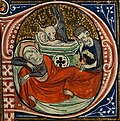
[[File:Nativity from Sherbrooke Missal cropped.jpg|thumb|left|upright=0.8|''The Nativity'', from a 14th-century [[missal]], a liturgical book containing texts and music necessary for the celebration of Mass throughout the year]] | |||
In the [[Early Middle Ages]], Christmas Day was overshadowed by Epiphany, which in [[western Christianity]] focused on the visit of the [[Biblical Magi|magi]]. However, the medieval calendar was dominated by Christmas-related holidays. The forty days before Christmas became the "forty days of St. Martin" (which began on November 11, the feast of [[St. Martin of Tours]]), now known as Advent.<ref name="Murray">Murray, Alexander, [http://www.historytoday.com/alexander-murray/medieval-christmas "Medieval Christmas"] {{Webarchive|url=https://web.archive.org/web/20111213224341/http://www.historytoday.com/alexander-murray/medieval-christmas |date=December 13, 2011 }}, ''History Today'', December 1986, '''36''' (12), pp. 31–39.</ref> In Italy, former [[Saturnalia]]n traditions were attached to Advent.<ref name="Murray" /> Around the 12th century, these traditions transferred again to the [[Twelve Days of Christmas]] (December 25 – January 5); a time that appears in the liturgical calendars as Christmastide or Twelve Holy Days.<ref name="Murray" /> | |||
In 567, the [[Council of Tours 567|Council of Tours]] put in place the season of [[Christmastide]], proclaiming "the twelve days from Christmas to Epiphany as a sacred and festive season, and established the duty of [[Advent]] fasting in preparation for the feast".<ref name="Forbes">{{cite book|last=Forbes|first=Bruce David|title=Christmas: A Candid History|date=October 1, 2008|publisher=[[University of California Press]]|isbn=978-0-520-25802-0|page=27}}</ref> This was done in order to solve the "administrative problem for the Roman Empire as it tried to coordinate the solar Julian calendar with the lunar calendars of its provinces in the east".<ref name="Hill2003">{{cite book|last=Hill|first=Christopher|title=Holidays and Holy Nights: Celebrating Twelve Seasonal Festivals of the Christian Year|year=2003|publisher=Quest Books|isbn=9780835608107|page=91}}<!--|access-date=15 December 2014--></ref> | |||
The prominence of Christmas Day increased gradually after [[Charlemagne]] was crowned Emperor on Christmas Day in 800.<ref>{{cite news |title=Who was Charlemagne? The unlikely king who became an emperor |url=https://www.nationalgeographic.com/premium/article/holy-roman-empire-king-charlemagne |access-date=November 30, 2023 |work=National Geographic}}</ref> King [[Edmund the Martyr]] was anointed on Christmas in 855 and King [[William I of England]] was crowned on Christmas Day 1066.<ref>{{cite news |title=William the Conqueror: Crowned at Christmas |url=https://www.thehistorypress.co.uk/articles/william-the-conqueror-crowned-at-christmas/ |access-date=November 30, 2023 |work=[[The History Press]]}}</ref> | |||
The | [[File:Julius Schnorr von Carolsfeld (German - The Coronation of Charlemagne - Google Art Project.jpg|alt=|thumb|The coronation of [[Charlemagne]] on Christmas of 800 helped promote the popularity of the holiday.]] | ||
By the [[High Middle Ages]], the holiday had become so prominent that chroniclers routinely noted where various [[magnate]]s celebrated Christmas. [[Richard II of England|King Richard II]] of England hosted a Christmas feast in 1377 at which 28 oxen and 300 sheep were eaten.<ref name="Murray" /> The Yule boar was a common feature of medieval Christmas feasts. [[Christmas carol|Caroling]] also became popular, and was originally performed by a group of dancers who sang. The group was composed of a lead singer and a ring of dancers that provided the chorus. Writers of the time condemned caroling as lewd, indicating that the unruly traditions of Saturnalia and Yule may have continued in this form.<ref name="Murray" /> "[[Lord of Misrule|Misrule]]"—drunkenness, promiscuity, gambling—was also an important aspect of the festival. In England, gifts were exchanged on New Year's Day ([[New Year's Day gift (royal courts)|a custom at the royal court]]), and there was special Christmas ale.<ref name="Murray" /> | |||
Christmas during the Middle Ages was a public festival that incorporated [[ivy]], [[holly]], and other evergreens.<ref name=mcgreevy /> Christmas [[gift-giving]] during the Middle Ages was usually between people with legal relationships, such as tenant and landlord.<ref name=mcgreevy>McGreevy, Patrick. "Place in the American Christmas", ([https://www.jstor.org/stable/215896 JSTOR] {{Webarchive|url=https://web.archive.org/web/20181215223504/https://www.jstor.org/stable/215896 |date=December 15, 2018 }}), ''Geographical Review'', Vol. 80, No. 1. January 1990, pp. 32–42. Retrieved September 10, 2007.</ref> The annual indulgence in eating, dancing, singing, sporting, and card playing escalated in England, and by the 17th century the Christmas season featured lavish dinners, elaborate masques, and pageants. In 1607, [[James I of England|King James I]] insisted that a play be acted on Christmas night and that the court indulge in games.<ref name=BTR /> It was during the [[Protestant Reformation|Reformation]] in 16th–17th-century Europe that many Protestants changed the gift bringer to the [[Christ Child]] or ''[[Christkindl]]'', and the date of giving gifts changed from December 6 to Christmas Eve.<ref name="ADS">Forbes, Bruce David, ''Christmas: a candid history'', University of California Press, 2007, {{ISBN|0-520-25104-0}}, pp. 68–79.</ref> | |||
==== | === 17th and 18th centuries === | ||
[[File:Martin Luther’s Christmas Tree.jpg|thumb|upright=0.9|[[Martin Luther]] played a role in the emergence of the [[Christmas tree]] and in the tradition of presents on [[Christmas Eve]].<ref name="History.com">{{cite web |title=History of Christmas Trees |url=http://www.history.com/topics/history-of-christmas-trees |publisher=[[History (U.S. TV channel)|History]] |access-date=15 December 2012 |archive-url=https://web.archive.org/web/20121225093550/http://www.history.com/topics/history-of-christmas-trees |archive-date=December 25, 2012 |url-status=live }}</ref><ref>{{cite web |last1=Karkan |first1=Betsy |title=Lutheran Advent Traditions |url=https://lutheranreformation.org/get-involved/lutheran-advent-traditions/ |website=Lutheran Reformation |access-date=12 December 2024 |date=2 December 2016}}</ref>]] | |||
Following the [[Protestant Reformation]], many of the new denominations, including the [[Church of England|Anglican Church]] and [[History of Lutheranism|Lutheran Church]], continued to celebrate Christmas.<ref name="Lowe2011">{{cite book|last=Lowe|first=Scott C.|title=Christmas|date=January 11, 2011|publisher=John Wiley & Sons|isbn=978-1-4443-4145-4|page=226}}<!--|access-date=November 22, 2014--></ref> In 1629, the Anglican poet [[John Milton]] penned ''[[On the Morning of Christ's Nativity]]'', a poem that has since been read by many during Christmastide.<ref name="Shawcross1993">{{cite book|last=Shawcross|first=John T.|author1-link=John T. Shawcross|title=John Milton|date=January 1, 1993|publisher=University Press of Kentucky|isbn=978-0-8131-7014-5|page=249}}<!--|access-date=November 22, 2014--></ref> Donald Heinz, a professor at [[California State University, Chico]], states that [[Martin Luther]] "inaugurated a period in which Germany would produce a unique culture of Christmas, much copied in North America".<ref name="Heinz">{{cite book|last=Heinz|first=Donald|title=Christmas: Festival of Incarnation|publisher=Fortress Press|isbn=978-1-4514-0695-5|page=94|year=2010}}<!--|access-date=November 22, 2014--></ref> Among the congregations of the [[Dutch Reformed Church]], Christmas was celebrated as one of the principal [[evangelical feast]]s.<ref name="Old">{{cite book|last=Old|first=Hughes Oliphant|title=Worship: Reformed According to Scripture|year=2002|publisher=Westminster John Knox Press|isbn=978-0-664-22579-7|page=29}}<!--|access-date=November 22, 2014--></ref> | |||
[[ | However, in 17th century England, some groups such as the [[Puritans]] strongly condemned the celebration of Christmas, considering it a Catholic invention and the "trappings of [[Papist|popery]]" or the "rags of [[The Beast (Bible)|the Beast]]".<ref name="Durston">{{Cite magazine |last=Durston |first=Chris |url=http://www.historytoday.com/dt_main_allatonce.asp?gid=12890&aid=&tgid=&amid=12890&g12890=x&g9130=x&g30026=x&g20991=x&g21010=x&g19965=x&g19963=x |title=Lords of Misrule: The Puritan War on Christmas 1642–60 |archive-url=https://web.archive.org/web/20070310013925/http://www.historytoday.com/dt_main_allatonce.asp?gid=12890&aid=&tgid=&amid=12890&g12890=x&g9130=x&g30026=x&g20991=x&g21010=x&g19965=x&g19963=x |archive-date=March 10, 2007 |magazine=History Today |date=December 1985 |volume=35 |issue=12 |pages=7–14}}</ref> In contrast, the established [[Church of England|Anglican Church]] "pressed for a more elaborate observance of feasts, penitential seasons, and saints' days. The calendar reform became a major point of tension between the Anglican party and the Puritan party".<ref name="Old"/> The [[Catholic Church]] also responded, promoting the festival in a more religiously oriented form. King [[Charles I of England]] directed his noblemen and gentry to return to their landed estates in midwinter to keep up their old-style Christmas generosity.<ref name=BTR /> Following the [[Roundhead|Parliamentarian]] victory over Charles I during the [[English Civil War]], England's Puritan rulers banned Christmas in 1647.<ref name="Durston" /><ref>{{cite journal |title=From Sukkot to Saturnalia: The Attack on Christmas in Sixteenth-Century Chronological Scholarship |author=Carl Philipp Emanuel Nothaft |journal=Journal of the History of Ideas |volume=72 |issue=4 |date=October 2011 |pages=504–505 |jstor=41337151}}</ref> Oliver Cromwell even ordered his troops to confiscate any special meals made on Christmas Day.<ref>John Rabon, ''British Christmas: How the Victorians Invented Christmas As We Know It'' in ''Anglotopia,'' Dec. 12, 2017</ref> | ||
Protests followed as pro-Christmas rioting broke out in several cities and for weeks [[Canterbury]] was controlled by the rioters, who decorated doorways with [[holly]] and shouted [[Royalism|royalist]] slogans.<ref name="Durston" /> Football, among the sports the Puritans banned on a Sunday, was also used as a rebellious force: when Puritans outlawed Christmas in England in December 1647 the crowd brought out footballs as a symbol of festive misrule.<ref name="auto">{{cite press release |url=http://www2.warwick.ac.uk/newsandevents/pressreleases/ne1000000086166/ |access-date=August 25, 2023 |date=December 17, 2003 |title=Historian Reveals that Cromwellian Christmas Football Rebels Ran Riot|publisher=University of Warwick|archive-date=September 28, 2020 |archive-url=https://web.archive.org/web/20200928090437/https://warwick.ac.uk/newsandevents/pressreleases/ne1000000086166/ |url-status=live}}</ref> The book, ''The Vindication of Christmas'' (London, 1652), argued against the Puritans, and makes note of Old English Christmas traditions, dinner, roast apples on the fire, card playing, dances with "plow-boys" and "maidservants", old Father Christmas and carol singing.<ref>{{cite book|last1=Sandys|first1=William|title=Christmastide: its history, festivities and carols|date=1852|publisher=John Russell Smith|location=London|pages=119–120}}</ref> During the ban, semi-clandestine religious services marking Christ's birth continued to be held, and people sang carols in secret.<ref name="Outlawed"/> | |||
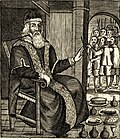
[[File:FatherChristmastrial.jpg|thumb|left|upright=0.75|''The Examination and Tryal of [[Father Christmas|Old Father Christmas]]'', (1686), published after Christmas was reinstated as a holy day in England]] | |||
Christmas was restored as a legal holiday in England with the [[English Restoration|Restoration]] of [[Charles II of England|King Charles II]] in 1660 when Puritan legislation was declared void, with Christmas again freely celebrated in England.<ref name="Outlawed">{{cite news |title=When Christmas carols were banned |url=https://www.bbc.com/culture/article/20141219-when-christmas-carols-were-banned |access-date=March 11, 2022 |agency=BBC}}</ref> Many Calvinist clergymen disapproved of Christmas celebrations. As such, in Scotland, the Presbyterian [[Church of Scotland]] discouraged the observance of Christmas, and though [[James VI]] commanded its celebration in 1618, [[Church attendance|attendance at church]] was scant.<ref>Chambers, Robert (1885). ''Domestic Annals of Scotland'', p. 211.</ref> The [[Parliament of Scotland]] officially abolished the observance of Christmas in 1640, claiming that the church had been "purged of all superstitious observation of days".<ref name="RPS1">{{cite web|url=http://www.rps.ac.uk/search.php?action=fc&fn=charlesi_ms&id=id8564&query=&type=ms&variants=&google= |title=Act dischairging the Yule vacance |work=[[The Records of the Parliaments of Scotland to 1707]] |publisher=University of St Andrews and National Archives of Scotland |version=(in [[Middle Scots]]) |access-date=February 29, 2012 |location=St Andrews |archive-url=https://web.archive.org/web/20120519170629/http://www.rps.ac.uk/search.php?action=fc&fn=charlesi_ms&id=id8564&query=&type=ms&variants=&google= |archive-date=May 19, 2012 }}</ref> Whereas in England, Wales and Ireland Christmas Day is a common law holiday, having been a customary holiday since [[time immemorial]], it was not until 1871 that it was designated a [[Public holidays in the United Kingdom|bank holiday]] in Scotland.<ref name="scotland-1871">{{cite web|url=http://www.tuc.org.uk/extras/bankholidays.pdf |title=Bank Holiday Fact File |last=Anon |date=May 22, 2007 |work=TUC press release |publisher=TUC |access-date=January 12, 2010 |archive-url=https://web.archive.org/web/20130603185926/http://www.tuc.org.uk/extras/bankholidays.pdf |archive-date=June 3, 2013 }}</ref> The diary of James Woodforde, from the latter half of the 18th century, details the observance of Christmas and celebrations associated with the season over a number of years.<ref>{{cite book|last=Woodforde|first=James|title=The Diary of a Country Parson 1758–1802|year=1978|publisher=Oxford University Press|isbn=978-0-19-281241-4|url=https://archive.org/details/diaryofcountrypa00wood}}</ref> | |||
As in England, Puritans in [[Colonial America]] staunchly opposed the observation of Christmas.<ref name="Barnett" /> The [[Pilgrim Fathers|Pilgrims]] of New England pointedly spent their first December 25 in the New World working normally.<ref name="Barnett" /> Puritans such as [[Cotton Mather]] condemned Christmas both because scripture did not mention its observance and because Christmas celebrations of the day often involved boisterous behavior.<ref>{{cite speech |last=Mather |first=Cotton|title=Grace defended. A censure on the ungodliness, by which the glorious grace of God, is too commonly abused. A sermon preached on the twenty fifth day of December, 1712. Containing some seasonable admonitions of piety. And concluded, with a brief dissertation on that case, whether the penitent thief on the cross, be an example of one repenting at the last hour, and on such a repentance received unto mercy?|date=December 25, 1712|location=Boston, Massachusetts|publisher= B. Green, for Samuel Gerrish|url=https://quod.lib.umich.edu/e/evans/N01303.0001.001?rgn=main;view=fulltext|access-date=August 12, 2022|language=English}}</ref><ref name="nissenbaum">Stephen W. Nissenbaum, "[https://www.americanantiquarian.org/proceedings/44539478.pdf Christmas in Early New England, 1620–1820: Puritanism, Popular Culture, and the Printed Word]", ''Proceedings of the American Antiquarian Society'' '''106''':1: p79-164 (January 1, 1996). Retrieved December 25, 2023.</ref> Many non-Puritans in New England deplored the loss of the holidays enjoyed by the laboring classes in England.<ref>{{cite book |last=Innes |first=Stephen |year=1995 |title=Creating the Commonwealth: The Economic Culture of Puritan New England |publisher=[[W.W. Norton & Company]]|isbn=978-0-393-03584-1|url=https://books.google.com/books?id=9XUKUkulSkIC&pg=PA145 |page=145 }}</ref> Christmas observance was outlawed in [[Boston]] in 1659.<ref name="Barnett">{{cite book |last=Barnett |first=James Harwood |year=1984 |title=The American Christmas: A Study in National Culture |publisher=Ayer Publishing |isbn=978-0-405-07671-8 |url=https://books.google.com/books?id=-sRH9skUh6oC&pg=PA2 |page=3}}</ref> The ban on Christmas observance was revoked in 1681 by English governor [[Edmund Andros]], but it was not until the mid-19th century that celebrating Christmas became fashionable in the Boston region.<ref>{{cite book |last=Marling |first=Karal Ann |year=2000 |title=Merry Christmas!: Celebrating America's Greatest Holiday |publisher=Harvard University Press |isbn=978-0-674-00318-7 |url=https://books.google.com/books?id=EUc13_ourtYC&pg=PA44 |page=44}}</ref> | |||
At the same time, Christian residents of [[Virginia]] and New York observed the holiday freely. [[Pennsylvania Dutch]] settlers, predominantly [[Moravian Church|Moravian]] settlers of [[Bethlehem, Pennsylvania|Bethlehem]], [[Nazareth, Pennsylvania|Nazareth]], and [[Lititz]] in Pennsylvania and the [[Wachovia, North Carolina|Wachovia]] settlements in North Carolina, were enthusiastic celebrators of Christmas. The Moravians in Bethlehem had the first Christmas trees in America as well as the first Nativity Scenes.<ref>{{cite book |first=Nancy |last=Smith Thomas |title=Moravian Christmas in the South |page=20 |year=2007 |publisher=Old Salem Museums & Gardens |isbn=978-0-8078-3181-6}}</ref> Christmas fell out of favor in the United States after the [[American Revolution]], when it was considered an English custom.<ref name="cinne">{{cite book | |||
|last = Andrews | |||
|first = Peter | |||
|title = Christmas in Colonial and Early America | |||
|publisher = World Book Encyclopedia, Inc. | |||
|year = 1975 | |||
|location = United States | |||
|isbn = 978-0-7166-2001-3 | |||
}}</ref> | |||
With the atheistic [[Cult of Reason]] in power during the era of [[Revolutionary France]], Christian Christmas [[church service|religious services]] were banned and the [[three kings cake]] was renamed the "equality cake" under [[Dechristianization of France during the French Revolution|anticlerical government policies]].<ref name="Inc1996">{{cite book|title=Christmas in France|year=1996|publisher=[[World Book Encyclopedia]]|isbn=978-0-7166-0876-9|page=35}}</ref> | |||
[[ | |||
=== 19th century === | |||
[[File: | [[File:Scrooges third visitor-John Leech,1843 edit.jpg|thumb|upright=0.75|[[Ebenezer Scrooge]] and the [[Ghost of Christmas Present]], from [[Charles Dickens]]'s ''[[A Christmas Carol]]'', 1843]] | ||
In the early 19th century, Christmas festivities and services gradually spread with the rise of the [[Oxford Movement]] in the [[Church of England]] that emphasized the centrality of Christmas in Christianity and charity to the poor,<ref name="Rowel1993">{{cite journal|last=Rowell|first=Geoffrey|date=December 1993|journal=[[History Today]]|volume=43|issue=12|access-date=December 28, 2016|url=http://www.historytoday.com/geoffrey-rowell/dickens-and-construction-christmas|title=Dickens and the Construction of Christmas|archive-url=https://web.archive.org/web/20161229101255/http://www.historytoday.com/geoffrey-rowell/dickens-and-construction-christmas|archive-date=December 29, 2016|url-status=live}}</ref> along with [[Washington Irving]], [[Charles Dickens]], and other authors emphasizing family, children, kind-heartedness, gift-giving, and [[Santa Claus]] (for Irving),<ref name="Rowel1993"/> or [[Father Christmas]] (for Dickens).<ref>{{cite book|url=https://books.google.com/books?id=j5c9GqZ_7BMC&pg=PA178 |editor-first1=Sally|editor-last1=Ledger |editor-first2=Holly |editor-last2=Furneaux |title= Charles Dickens in Context |publisher=Cambridge University Press |year=2011 |isbn=978-0-19-513886-3 |page=178 |access-date=December 25, 2020}}</ref> An indication this increased recognition of Christmas was slow, however, is seen in the fact that "in twenty of the years between 1790 and 1835, ''The Times'' did not mention Christmas at all."<ref>John Storey, "The Invention of the English Christmas," in ''Christmas, Ideology, and Popular Culture,'' Sheila Whiteley, ed., pp.17, 19 (2008).</ref> | |||
In the early-19th century, writers imagined [[Tudor period|Tudor]]-period Christmas as a time of heartfelt celebration. In 1835, Thomas Hervey and Robert Seymour published ''The Christmas Book'' in which they introduced what has been called a "national Christmas narrative."<ref>Tara Moore, ''Victorian Christmas in Print'' (2009).</ref> In his book, Hervey asserted: "the revels of merry England are fast subsiding into silence, and her many customs wearing gradually away."<ref>Id.</ref> In 1843, Charles Dickens wrote the novel ''[[A Christmas Carol]]'', which helped revive the "spirit" of Christmas and seasonal merriment.<ref name=standiford>{{cite book |first=Les |last=Standiford |title=The Man Who Invented Christmas: How Charles Dickens's A Christmas Carol Rescued His Career and Revived Our Holiday Spirits |publisher=Crown |year=2008 |isbn=978-0-307-40578-4 |url=https://archive.org/details/manwhoinventedch0000stan}}</ref><ref name=AFP>{{cite news | |||
|title=Dickens' classic 'Christmas Carol' still sings to us | |title=Dickens' classic 'Christmas Carol' still sings to us | ||
|url=https://www.usatoday.com/life/books/news/2008-12-17-dickens-main_N.htm | |url=https://www.usatoday.com/life/books/news/2008-12-17-dickens-main_N.htm | ||
|work=[[USA Today]] | |work=[[USA Today]] | ||
|access-date=April 30, 2010 | |access-date=April 30, 2010 | ||
|first=Bob | |first=Bob | ||
|last=Minzesheimer | |last=Minzesheimer | ||
|date=December 22, 2008 | |date=December 22, 2008 | ||
|archive-url=https://web.archive.org/web/20091106135858/http://www.usatoday.com/life/books/news/2008-12-17-dickens-main_N.htm | |archive-url=https://web.archive.org/web/20091106135858/http://www.usatoday.com/life/books/news/2008-12-17-dickens-main_N.htm | ||
|archive-date=November 6, 2009 | |archive-date=November 6, 2009 | ||
|url-status=live | |url-status=live | ||
}}</ref> Its instant popularity played a major role in portraying Christmas as a holiday emphasizing family, goodwill, and compassion.<ref name="Rowel1993"/> | |||
Dickens sought to construct Christmas as a family-centered festival of generosity, linking "worship and feasting, within a context of social reconciliation. | Dickens sought to construct Christmas as a family-centered festival of generosity, linking "worship and feasting, within a context of social reconciliation".<ref name="Hutton2001">{{cite book|last=Hutton|first=Ronald|title=The Stations of the Sun: A History of the Ritual Year in Britain|date=February 15, 2001|publisher=Oxford University Press |isbn=978-0-19-157842-7}}</ref> Superimposing his humanitarian vision of the holiday, in what has been termed "Carol Philosophy",<ref name="Forbes2008">{{cite book|last=Forbes|first=Bruce David|title=Christmas: A Candid History|date=October 1, 2008|publisher=--University of California Press |isbn=978-0-520-25802-0|page=62}}<!--|access-date=November 22, 2014--></ref> Dickens influenced many aspects of Christmas that are celebrated today in Western culture, such as family gatherings, seasonal food and drink, dancing, games, and a festive generosity of spirit.<ref>{{cite book |editor-first=Richard Michael |editor-last=Kelly |year=2003 |title=A Christmas Carol |pages=9, 12 |publisher=Broadview Press |isbn=978-1-55111-476-7}}</ref> It has been said that Dickens' breakthrough with ''A Christmas Carol'' was his "ingenious pairing of seasonal fiction and seasonal [book] sales."<ref>Moore, n.73 above at p. 18.</ref> A prominent phrase from the tale, [[Christmas and holiday season#History of the phrase|"Merry Christmas"]], was popularized following the appearance of the story.<ref>Cochrane, Robertson. ''Wordplay: origins, meanings, and usage of the English language''. University of Toronto Press, 1996, p. 126, {{ISBN|0-8020-7752-8}}.</ref> This coincided with the appearance of the [[Oxford Movement]] and the growth of [[Anglo-Catholicism]], which led a revival in traditional rituals and religious observances.<ref>Hutton, Ronald, ''The Stations of the Sun: The Ritual Year in England''. 1996. Oxford: Oxford University Press, p. 113. {{ISBN|0-19-285448-8}}.</ref> | ||
[[File: | [[File:Christmarkt.jpg|thumb|left|upright=0.9|19th-century lithograph showing the ''[[Christkindlesmarkt, Nuremberg|Christkindlesmarkt]]'' (Christmas market) in [[Nuremberg]], Germany]] | ||
The term [[Ebenezer Scrooge|Scrooge]] became a synonym for [[miser]], with [[Humbug|"Bah! Humbug!"]] dismissive of the festive spirit.<ref>Joe L. Wheeler. ''Christmas in My Heart'', Volume 10, p. 97. Review and Herald Pub Assoc, 2001. {{ISBN|0-8280-1622-4}}.</ref> In 1843, the first commercial [[Christmas card#History|Christmas card]] was produced by [[Sir Henry Cole]].<ref>{{cite web |last = Earnshaw |first = Iris |title = The History of Christmas Cards |publisher = Inverloch Historical Society Inc. |date = November 2003 |url = http://home.vicnet.net.au/~invhs/2004.htm |access-date = | The term ''[[Ebenezer Scrooge|Scrooge]]'' became a synonym for [[miser]], with the phrase [[Humbug|"Bah! Humbug!"]] becoming emblematic of a dismissive attitude of the festive spirit.<ref>Joe L. Wheeler. ''Christmas in My Heart'', Volume 10, p. 97. Review and Herald Pub Assoc, 2001. {{ISBN|0-8280-1622-4}}.</ref> In 1843, the first commercial [[Christmas card#History|Christmas card]] was produced by [[Sir Henry Cole]].<ref>{{cite web |last = Earnshaw |first = Iris |title = The History of Christmas Cards |publisher = Inverloch Historical Society Inc. |date = November 2003 |url = http://home.vicnet.net.au/~invhs/2004.htm |access-date = December 25, 2025 |archive-url = https://web.archive.org/web/20160526174327/http://home.vicnet.net.au/~invhs/2004.htm |archive-date = May 26, 2016 |url-status = dead }}</ref> The revival of the [[Christmas Carol]] began with [[William Sandys (antiquarian)|William Sandys]]'s ''Christmas Carols Ancient and Modern'' (1833), with the first appearance in print of "[[The First Noel]]", "[[I Saw Three Ships]]", "[[Hark the Herald Angels Sing]]" and "[[God Rest Ye Merry, Gentlemen]]", popularized in Dickens's ''A Christmas Carol''. | ||
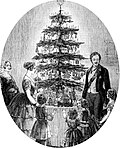
[[File:The Christmas Tree at Windsor Castle, by J. L. Williams - ILN 1848 (cropped).jpg|thumb|upright=0.75|The Queen's Christmas tree at [[Windsor Castle]], published in the ''Illustrated London News'', 1848]] | |||
An image of the British royal family with their Christmas tree at Windsor Castle created a sensation when it was published in the ''[[Illustrated London News]]'' in 1848. A modified version of this image was published in ''[[Godey's Lady's Book]]'', Philadelphia in 1850.<ref name="Shoemaker">Shoemaker, Alfred Lewis. (1959) ''Christmas in Pennsylvania: a folk-cultural study.'' Edition 40. pp. 52, 53. Stackpole Books 1999. {{ISBN|0-8117-0328-2}}.</ref><ref>''[[Godey's Lady's Book]]'', 1850. ''Godey's'' copied it exactly, except he removed the Queen's tiara, and Prince Albert's moustache, to remake the engraving into an American scene.</ref> By the 1870s, putting up a Christmas tree had become common in America.<ref name="Shoemaker" /> | In Britain, the [[Christmas tree#18th and 19th centuries|Christmas tree]] was introduced in the early 19th century by the German-born [[Queen Charlotte]]. In 1832, the future [[Queen Victoria]] wrote about her delight at having a Christmas tree, hung with [[Christmas lights (holiday decoration)|lights]], [[Christmas ornaments|ornaments]], and presents placed round it.<ref>''[https://archive.org/details/girlhoodofqueenv01vict/page/60/mode/2up The Girlhood of Queen Victoria: a selection from Her Majesty's diaries]'', p. 61. Longmans, Green & Co., 1912. University of Wisconsin. Retrieved December 25, 2023.</ref> After her marriage to her German cousin [[Albert, Prince Consort|Prince Albert]], by 1841 the custom became more widespread throughout Britain.<ref name="Lejeune, Marie Claire p.550">Lejeune, ''Marie Claire''. ''Compendium of symbolic and ritual plants in Europe'', p. 550. University of Michigan {{ISBN|90-77135-04-9}}.</ref> An image of the British royal family with their Christmas tree at Windsor Castle created a sensation when it was published in the ''[[Illustrated London News]]'' in 1848. A modified version of this image was published in ''[[Godey's Lady's Book]]'', Philadelphia in 1850.<ref name="Shoemaker">Shoemaker, Alfred Lewis. (1959) ''Christmas in Pennsylvania: a folk-cultural study.'' Edition 40. pp. 52, 53. Stackpole Books 1999. {{ISBN|0-8117-0328-2}}.</ref><ref>''[[Godey's Lady's Book]]'', 1850. ''Godey's'' copied it exactly, except he removed the Queen's tiara, and Prince Albert's moustache, to remake the engraving into an American scene.</ref> By the 1870s, putting up a Christmas tree had become common in America.<ref name="Shoemaker" /> | ||
In America, interest in Christmas had been revived in the 1820s by several | In America, interest in Christmas had been revived in the 1820s by several short stories by Washington Irving which appear in his ''[[The Sketch Book of Geoffrey Crayon, Gent.]]'' and "Old Christmas". Irving's stories depicted harmonious warm-hearted English Christmas festivities he experienced while staying in [[Aston Hall]], Birmingham, England, that had largely been abandoned,<ref>Kelly, Richard Michael (ed.) (2003), ''A Christmas Carol'', p. 20. Broadview Literary Texts, New York: Broadview Press, {{ISBN|1-55111-476-3}}.</ref> and he used the tract ''Vindication of Christmas'' (1652) of Old English Christmas traditions, that he had transcribed into his journal as a format for his stories.<ref name=BTR>{{Cite book | ||
|author=Restad, Penne L. | |author=Restad, Penne L. | ||
|year=1995 | |year=1995 | ||
| Line 197: | Line 149: | ||
|publisher=Oxford University Press | |publisher=Oxford University Press | ||
|isbn=978-0-19-510980-1 | |isbn=978-0-19-510980-1 | ||
}}</ref> | |||
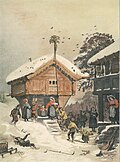
[[File:Adolph Tidemand Norsk juleskik.jpg|thumb|upright|A Norwegian Christmas, 1846 painting by [[Adolph Tidemand]]]] | [[File:Adolph Tidemand Norsk juleskik.jpg|left|thumb|upright=0.75|A Norwegian Christmas, 1846 painting by [[Adolph Tidemand]]]] | ||
In 1822, [[Clement Clarke Moore]] wrote the poem ''[[A Visit From St. Nicholas]]'' (popularly known by its first line: ''Twas the Night Before Christmas'').<ref>Moore's poem transferred the genuine old Dutch traditions celebrated at New Year in New York, including the exchange of gifts, family feasting, and tales of "sinterklass" (a derivation in Dutch from "Saint Nicholas", from whence comes the modern "Santa Claus") to Christmas. | In 1822, [[Clement Clarke Moore]] wrote the poem ''[[A Visit From St. Nicholas]]'' (popularly known by its first line: ''Twas the Night Before Christmas'').<ref>Moore's poem transferred the genuine old Dutch traditions celebrated at New Year in New York, including the exchange of gifts, family feasting, and tales of "sinterklass" (a derivation in Dutch from "Saint Nicholas", from whence comes the modern "Santa Claus") to Christmas.{{cite web |url= http://www.thehistoryofchristmas.com/ch/in_america.htm |title= ''The history of Christmas: Christmas history in America'' |author=<!--Staff writer(s); no by-line.-->|date= |page= |publisher= thehistoryofchristmas.com |access-date= March 5, 2026 |url-status=dead |archive-url= https://web.archive.org/web/20180419103042/http://www.thehistoryofchristmas.com/ch/in_america.htm |archive-date= April 19, 2018}}</ref> The poem helped popularize the tradition of exchanging gifts, and seasonal Christmas shopping began to assume economic importance.<ref>[http://usinfo.state.gov/scv/Archive/2005/Dec/19-344398.html "Americans Celebrate Christmas in Diverse Ways"] {{webarchive|url=https://web.archive.org/web/20061210120636/https://usinfo.state.gov/scv/Archive/2005/Dec/19-344398.html |date=December 10, 2006 }}, Usinfo.state.gov, November 26, 2006.</ref> This also started the cultural conflict between the holiday's spiritual significance and its associated [[commercialism]] that some see as corrupting the holiday. In her 1850 book ''The First Christmas in New England'', [[Harriet Beecher Stowe]] includes a character who complains that the true meaning of Christmas was lost in a shopping spree.<ref>First [[Presbyterianism|Presbyterian Church]] of Watertown [http://www.watertownfirstpres.org/sermons/12-11-05.html "Oh ... and one more thing"] December 11, 2005 {{webarchive |url=https://web.archive.org/web/20070225081456/http://www.watertownfirstpres.org/sermons/12-11-05.html |date=February 25, 2007 }}</ref> | ||
The poem helped popularize the tradition of exchanging gifts, and seasonal Christmas shopping began to assume economic importance.<ref>[http://usinfo.state.gov/scv/Archive/2005/Dec/19-344398.html "Americans Celebrate Christmas in Diverse Ways"] {{webarchive|url=https://web.archive.org/web/20061210120636/https://usinfo.state.gov/scv/Archive/2005/Dec/19-344398.html |date=December 10, 2006 }}, Usinfo.state.gov, November 26, 2006.</ref> | |||
This also started the cultural conflict between the holiday's spiritual significance and its associated [[commercialism]] that some see as corrupting the holiday. In her 1850 book ''The First Christmas in New England'', [[Harriet Beecher Stowe]] includes a character who complains that | |||
While the celebration of Christmas was not yet customary in some regions in the U.S., [[Henry Wadsworth Longfellow]] detected "a transition state about Christmas here in New England" in 1856. "The old puritan feeling prevents it from being a cheerful, hearty holiday; though every year makes it more so. | While the celebration of Christmas was not yet customary in some regions in the U.S., [[Henry Wadsworth Longfellow]] detected "a transition state about Christmas here in New England" in 1856. "The old puritan feeling prevents it from being a cheerful, hearty holiday; though every year makes it more so".<ref name=APH>Restad, Penne L. (1995), ''Christmas in America: a History'', Oxford: Oxford University Press, p. 96. {{ISBN|0-19-510980-5}}.</ref> In [[Reading, Pennsylvania]], a newspaper remarked in 1861, "Even our presbyterian friends who have hitherto steadfastly ignored Christmas—threw open their church doors and assembled in force to celebrate the anniversary of the Savior's birth."<ref name=APH /> | ||
In [[Reading, Pennsylvania]], a newspaper remarked in 1861, "Even our presbyterian friends who have hitherto steadfastly ignored Christmas—threw open their church doors and assembled in force to celebrate the anniversary of the Savior's birth."<ref name=APH /> | |||
The First Congregational Church of Rockford, [[Illinois]], "although of genuine Puritan stock", was 'preparing for a grand Christmas jubilee', a news correspondent reported in 1864.<ref name=APH /> By 1860, fourteen states including several from [[New England]] had adopted Christmas as a legal holiday.<ref name=ABD>{{cite web|url=http://www.christianchurchofgod.com/httpwww.christianchurchofgod.comhistofchristmas.htm |title=Christian church of God – history of Christmas |publisher=Christianchurchofgod.com |access-date=February 24, 2011 | The First Congregational Church of Rockford, [[Illinois]], "although of genuine Puritan stock", was 'preparing for a grand Christmas jubilee', a news correspondent reported in 1864.<ref name=APH /> By 1860, fourteen states including several from [[New England]] had adopted Christmas as a legal holiday.<ref name=ABD>{{cite web|url=http://www.christianchurchofgod.com/httpwww.christianchurchofgod.comhistofchristmas.htm |title=Christian church of God – history of Christmas |publisher=Christianchurchofgod.com |access-date=February 24, 2011 |archive-url=https://web.archive.org/web/20101219215754/http://www.christianchurchofgod.com/httpwww.christianchurchofgod.comhistofchristmas.htm |archive-date=December 19, 2010 }}</ref> In 1875, [[Louis Prang]] introduced the [[Christmas card#History|Christmas card]] to Americans. He has been called the "father of the American Christmas card".<ref name="meggspage148">Meggs, Philip B. A History of Graphic Design. 1998 John Wiley & Sons, Inc. p 148 {{ISBN|0-471-29198-6}}.</ref> On June 28, 1870, Christmas was formally declared a [[Federal holidays in the United States|United States federal holiday]].<ref name="federalholidays">{{cite web|url=https://fas.org/sgp/crs/misc/R41990.pdf|title=Federal Holidays: Evolution and Current Practices|publisher=Congressional Research Service|author=Jacob R. Straus|date=November 16, 2012|access-date=January 2, 2014|archive-url=https://web.archive.org/web/20140103115217/http://www.fas.org/sgp/crs/misc/R41990.pdf|archive-date=January 3, 2014|url-status=live}}</ref> | ||
|access-date=January 2, 2014 | |||
|archive-url=https://web.archive.org/web/20140103115217/http://www.fas.org/sgp/crs/misc/R41990.pdf | |||
|url-status=live | |||
=== 20th and 21st centuries === | |||
[[File:The Christmas Visit. Postcard, c. 1910.jpg|thumb|upright|left|The Christmas Visit. Postcard, {{c.|1910}}]] | |||
During the [[First World War]] and particularly in 1914,<ref>{{Cite news|last=Crossland|first=David|date=December 22, 2021|title=Truces weren't just for 1914 Christmas|language=en|work=The Times|url=https://www.thetimes.com/uk/article/wartime-football-truces-3-historical-prejudice-0-wclv9hs3f|access-date=December 24, 2021|issn=0140-0460}}</ref> a series of [[Christmas truce|informal truces]] took place for Christmas between opposing armies. The truces, which were organised spontaneously by fighting men, ranged from promises not to shoot (shouted at a distance in order to ease the pressure of war for the day) to friendly socializing, gift giving and even sport between enemies.<ref>{{Cite web|last=Baxter|first=Keven|date=December 24, 2021|title=Peace for a day: How soccer brought a brief truce to World War I on Christmas Day 1914|url=https://www.latimes.com/sports/soccer/story/2021-12-24/christmas-truce-soccer-world-war-germany-britain-adolf-hitler|url-status=live|access-date=December 24, 2021|website=Los Angeles Times|language=en-US|archive-url=https://web.archive.org/web/20211224122434/https://www.latimes.com/sports/soccer/story/2021-12-24/christmas-truce-soccer-world-war-germany-britain-adolf-hitler |archive-date=December 24, 2021 }}</ref> These incidents became a well known and semi-mythologised part of popular memory.<ref>{{Cite web|title=The Real Story of the Christmas Truce|url=https://www.iwm.org.uk/history/the-real-story-of-the-christmas-truce|access-date=December 24, 2021|website=Imperial War Museums|language=en}}</ref> They have been described as a symbol of common humanity even in the darkest of situations and used to demonstrate to children the ideals of Christmas.<ref>{{Cite web|title=Christmas Truce 1914|url=https://www.bbc.co.uk/teach/school-radio/articles/zhjpm39|access-date=December 24, 2021|website=BBC School Radio|language=en}}</ref> | |||
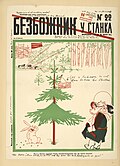
European | Under the [[state atheism]] of the Soviet Union, after its foundation in 1917, Christmas celebrations—along with other Christian holidays—were prohibited in public.<ref name="Connelly2000">{{cite book|last=Connelly|first=Mark|title=Christmas at the Movies: Images of Christmas in American, British and European Cinema|year=2000|publisher=I.B.Tauris|isbn=978-1-86064-397-2|page=186}}<!--|access-date=November 22, 2014--></ref> During the 1920s, 1930s, and 1940s, the [[League of Militant Atheists]] encouraged school pupils to campaign against Christmas traditions, such as the Christmas tree, as well as other Christian holidays, including Easter; the League established an antireligious holiday to be the 31st of each month as a replacement.<ref name="Ramet2005">{{cite book|last=Ramet|first=Sabrina Petra|title=Religious Policy in the Soviet Union|date=November 10, 2005|publisher=[[Cambridge University Press]]|isbn=978-0-521-02230-9|page=138}}<!--|access-date=November 22, 2014--></ref> At the height of this persecution, in 1929, on Christmas Day, children in Moscow were encouraged to spit on [[crucifix]]es as a protest against the holiday.<ref name="Zugger2001">{{cite book|last=Zugger|first=Christopher Lawrence|title=Catholics of the Soviet Empire from Lenin Through Stalin|year=2001|publisher=[[Syracuse University Press]]|isbn=978-0-8156-0679-6|page=210}}</ref> Instead, the importance of the holiday and all its trappings, such as the Christmas tree and gift-giving, was transferred to the New Year.<ref>{{cite web |url=https://foreignpolicy.com/2016/12/30/how-soviets-came-to-celebrate-new-years-like-christmas-and-why-russians-still-do/ |title=How Soviets Came to Celebrate New Year's Like Christmas (and Why Russians Still Do) |last=Tamkin |first=Emily |date=December 30, 2016 |website=Foreign Policy |access-date=January 6, 2022}}</ref> It was not until the [[dissolution of the Soviet Union]] in 1991 that the [[persecution of Christians in the Soviet Union|persecution]] ended and Orthodox Christmas became a state holiday again for the first time in Russia after seven decades.<ref>{{cite news|url=https://www.latimes.com/archives/la-xpm-1991-01-07-mn-5892-story.html|title=A Russian Christmas—Better Late Than Never: Soviet Union: Orthodox Church celebration is the first under Communists. But, as with most of Yeltsin's pronouncements, the holiday stirs a controversy.|last=Goldberg|first=Carey|date=January 7, 1991|work=[[Los Angeles Times]]|access-date=November 22, 2014|archive-url=https://web.archive.org/web/20151222093318/http://articles.latimes.com/1991-01-07/news/mn-5892_1_russian-christmas-traditions|archive-date=December 22, 2015|url-status=live}}</ref> | ||
[[File:Sapin Noel Geant Gubbio 2014.jpg|thumb|[[Mount Ingino Christmas Tree]] in [[Gubbio]], Italy, the tallest Christmas tree in the world, 2014<ref name="tripsavvy"/> ]] | |||
In 1991, the [[Gubbio Christmas Tree]], in Italy, {{convert|650|m}} high and decorated with over 700 lights, entered the [[Guinness Book of Records]] as the tallest Christmas tree in the world.<ref name="tripsavvy">{{Cite web|title=Celebrate Christmas Italian Styles at These City Events|url=https://www.tripsavvy.com/christmas-traditions-things-to-do-italy-4176880|access-date=January 26, 2021|website=TripSavvy|language=en}}</ref> European History Professor Joseph Perry wrote that likewise, in [[Nazi Germany]], "because Nazi ideologues saw organized religion as an enemy of the totalitarian state, propagandists sought to deemphasize—or eliminate altogether—the Christian aspects of the holiday" and that "Propagandists tirelessly promoted numerous Nazified Christmas songs, which replaced Christian themes with the regime's racial ideologies".<ref>{{cite news|title=How the Nazis co-opted Christmas: A history of propaganda|url=https://www.washingtonpost.com/posteverything/wp/2015/12/24/how-the-nazis-co-opted-christmas/|last=Perry|first=Joseph|date=December 24, 2015|newspaper=The Washington Post|access-date=March 11, 2016|archive-url=https://web.archive.org/web/20160106211548/https://www.washingtonpost.com/posteverything/wp/2015/12/24/how-the-nazis-co-opted-christmas/|archive-date=January 6, 2016|url-status=live}}</ref> | |||
Some Christians and organizations such as [[Pat Robertson]]'s [[American Center for Law & Justice|American Center for Law and Justice]] cite alleged attacks on Christmas (dubbing them a "war on Christmas").<ref name="ACLJ">{{cite web |url=http://aclj.org/christmas-laws |title=ACLJ, Christmas laws |work=American Center for Law and Justice |publisher=Aclj.org |access-date=December 25, 2013 |archive-url=https://web.archive.org/web/20131225163554/http://aclj.org/christmas-laws |archive-date=December 25, 2013 }}</ref> Such groups claim that any specific mention of the term "Christmas" or its religious aspects is being increasingly [[censorship|censored]], avoided, or discouraged by a number of advertisers, retailers, government (prominently schools), and other public and private organizations. One controversy is the occurrence of Christmas trees being renamed Holiday trees.<ref name="MCC">{{cite web |last1=Aliweiwi |first1=Jehad |title=A Christmas Tree or a Holiday Tree? |url=http://www.muslimcanadiancongress.org/20051128.html |website=Muslim Canadian Congress |access-date=December 25, 2023 |archive-url=https://web.archive.org/web/20051231172900/http://www.muslimcanadiancongress.org/20051128.html |archive-date=December 31, 2005 |date=November 28, 2005}} (previous title: "Christmas controversy article")</ref> In the U.S. there has been a tendency to replace the greeting ''Merry Christmas'' with ''Happy Holidays'', which is considered inclusive at the time of the Jewish celebration of [[Hanukkah]].<ref>Feder, Don, [http://www.jewishworldreview.com/cols/feder121300.asp "In the culture, Christmas morphs into holiday"] {{Webarchive|url=https://web.archive.org/web/20100412151751/http://www.jewishworldreview.com/cols/feder121300.asp |date=April 12, 2010 }}, ''Jewish World Review'', December 13, 2000.</ref> In the U.S., and Canada, where the use of the term "Holidays" is most prevalent, opponents have denounced its usage and avoidance of using the term "Christmas" as being [[political correctness|politically correct]].<ref>{{cite news |title= The Brits Have It Right: Forget Happy Holidays, Just Wish People Merry Christmas |url= https://www.theguardian.com/commentisfree/2013/dec/22/better-to-say-merry-christmas-or-happy-holidays |work= [[The Guardian]] |location= London |date= August 11, 2016 |access-date= December 11, 2016 |archive-url= https://web.archive.org/web/20161221105842/https://www.theguardian.com/commentisfree/2013/dec/22/better-to-say-merry-christmas-or-happy-holidays |archive-date= December 21, 2016 |url-status= live }}</ref><ref>{{cite news |title= Is Saying 'Merry Christmas' Politically Correct? Who Cares? |url= https://www.forbes.com/sites/pauljankowski/2014/12/19/is-saying-merry-christmas-politically-correct-who-cares/ |work= [[Forbes]] |date= August 11, 2016 |first= Paul |last= Jankowski |access-date= August 22, 2017 |archive-url= https://web.archive.org/web/20170807030050/https://www.forbes.com/sites/pauljankowski/2014/12/19/is-saying-merry-christmas-politically-correct-who-cares/ |archive-date= August 7, 2017 |url-status= live }}</ref><ref>{{cite news |title= If We Can't Say 'Merry Christmas' in Canada, Multiculturalism Failed |url= http://www.huffingtonpost.ca/christopher-stuart-taylor/saying-merry-christmas_b_4490555.html |first1=Christopher Stuart |last1=Taylor |work= [[HuffPost]] |date= August 11, 2016 |access-date= August 11, 2016 |archive-url= https://web.archive.org/web/20160929182951/http://www.huffingtonpost.ca/christopher-stuart-taylor/saying-merry-christmas_b_4490555.html |archive-date= September 29, 2016 |url-status= dead }}</ref> In 1984, the [[U.S. Supreme Court]] ruled in ''[[Lynch v. Donnelly]]'' that a Christmas display (which included a Nativity scene) owned and displayed by the city of [[Pawtucket, Rhode Island]], did not violate the First Amendment.<ref name="Lynch">{{cite web|website= Belcher Foundation|url=http://www.belcherfoundation.org/lynch_v_donnelly.htm|title=Lynch vs. Donnelly|year=1984|access-date=April 12, 2006|archive-url=https://web.archive.org/web/20060216143728/http://www.belcherfoundation.org/lynch_v_donnelly.htm|archive-date=February 16, 2006|url-status=live}}</ref> | |||
== Observance and traditions == | == Observance and traditions == | ||
{{ | {{further|Christmas traditions|Observance of Christmas by country}} | ||
[[File:Christmas at the Church of the Annunciation, Nazareth, 1965.jpg|alt=Christmas at the Annunciation Church in Nazareth, 1965. Photo by Dan Hadani.|thumb|Christmas at the [[Basilica of the Annunciation|Annunciation Church]] in Nazareth, 1965 | [[File:Christmas at the Church of the Annunciation, Nazareth, 1965.jpg|alt=Christmas at the Annunciation Church in Nazareth, 1965. Photo by Dan Hadani.|thumb|Christmas at the [[Basilica of the Annunciation|Annunciation Church]] in Nazareth, 1965]] | ||
[[File:Map of Countries that do not recognize Christmas as Public Holiday.svg|thumb|Dark brown – countries that do not recognize Christmas on December 25 or January 7 as a public holiday. | [[File:Map of Countries that do not recognize Christmas as Public Holiday.svg|thumb|Dark brown – countries that do not recognize Christmas on December 25 or January 7 as a public holiday. Light brown – countries that do not recognize Christmas as a public holiday, but the holiday is given observance]] | ||
[[File:Complete-church-midnight-mass (3135957575).jpg|thumb|Many Christians attend [[church service]]s to celebrate the [[Nativity of Jesus|birth of Jesus Christ]]<ref name="Jespersen2011">{{cite book|last=Jespersen|first=Knud J. V.|title=A History of Denmark|date=June 21, 2011|publisher=Macmillan International Higher Education|isbn=978-0-230-34417-4|page=91}}</ref>]] | |||
Christmas Day is celebrated as a major festival and public holiday in countries around the world, including many whose populations are mostly non-Christian. In some non-Christian areas, periods of former colonial rule introduced the celebration (e.g. Hong Kong); in others, Christian minorities or foreign cultural influences have led populations to observe the holiday. Countries such as Japan, where Christmas is popular despite there being only a small number of Christians, have adopted many of the cultural aspects of Christmas, such as gift-giving, decorations, and Christmas trees. A similar example is in [[Turkey]], being Muslim-majority and with a small number of Christians, where Christmas trees and decorations tend to line public streets during the festival.{{citation needed|date=December 2024}} | |||
Christmas | Many popular customs associated with Christmas developed independently of the commemoration of Jesus's birth, with some{{who|date=December 2025}} claiming that certain elements are Christianized and have origins in pre-Christian festivals that were celebrated by pagan populations who were later [[Christianization|converted to Christianity]]; other scholars reject these claims and affirm that Christmas customs largely developed in a Christian context.<ref name="McGrath2015">{{cite book |last1=McGrath |first1=Alister E. |title=Christianity: An Introduction |date=January 27, 2015 |publisher=John Wiley & Sons |isbn=978-1-118-46565-3 |page=239 |language=en}}</ref><ref name="Huckabee2021">{{cite web |last1=Huckabee |first1=Tyler |title=No, Christmas Trees Don't Have 'Pagan' Roots |url=https://relevantmagazine.com/current/nation/no-christmas-trees-dont-have-pagan-roots/ |publisher=Relevant Magazine |access-date=December 9, 2022 |language=English |date=December 9, 2021}}</ref> The prevailing atmosphere of Christmas has also continually evolved since the holiday's inception, ranging from a sometimes raucous, drunken, [[carnival]]-like state in the [[Middle Ages]],<ref name="Murray" /> to a tamer family-oriented and children-centered theme introduced in a 19th-century transformation.<ref name=standiford /><ref name=AFP /> The celebration of Christmas was banned on more than one occasion within certain groups, such as the [[Puritans]] and [[Jehovah's Witnesses]] (who do not celebrate birthdays in general), due to concerns that it was too unbiblical.<ref name="Durston" /><ref name="Barnett" /><ref>{{cite book |last1=Neal |first1=Daniel |title=The History of the Puritans |url=https://archive.org/details/nealshistorypur00toulgoog/page/132/mode/2up |access-date=December 25, 2023 |date=1822 |publisher=William Baynes and Son |page=193}} (page 133 in the link above)</ref> [[Celtic nations|Celtic]] winter herbs such as [[mistletoe]] and [[ivy]], and the custom of kissing under a mistletoe, are common in modern Christmas celebrations in the English-speaking countries.<ref>{{Cite web |last=NEWS |first=SA |date=December 24, 2022 |title=Christmas Day 2022: Facts, Story & Quotes About Merry Christmas |url=https://news.jagatgururampalji.org/christmas-day-special-gift/ |access-date=December 26, 2022 |website=SA News Channel |language=en-US}}</ref> | ||
Among [[ | The pre-Christian [[Germanic peoples]]—including the Anglo-Saxons and the Norse—celebrated a winter festival called [[Yule]], held in the late December to early January period, yielding modern English ''yule'', today used as a synonym for ''Christmas''.<ref name="SIMEK379">Simek (2007:379).</ref> In Germanic language-speaking areas, numerous elements of modern Christmas folk custom and iconography may have originated from Yule, including the [[Yule log]], [[Yule boar]], and the [[Yule goat]].<ref>Coffman, Elesha. [http://www.christianitytoday.com/history/newsletter/2000/dec08.html "Why December 25?"] {{Webarchive|url=https://web.archive.org/web/20080919140214/http://www.christianitytoday.com/history/newsletter/2000/dec08.html |date=September 19, 2008 }} ''Christian History & Biography'', ''[[Christianity Today]]'', 2000.</ref><ref name="SIMEK379" /> Often leading a ghostly procession through the sky (the [[Wild Hunt]]), the long-bearded god [[Odin]] is referred to as "the Yule one" and "Yule father" in Old Norse texts, while other gods are referred to as "Yule beings".<ref name="SIMEK-2010">Simek (2010:180, 379–380).</ref> On the other hand, as there are no reliable existing references to a Christmas log prior to the 16th century, the burning of the Christmas block may have been an early modern invention by Christians unrelated to the pagan practice.<ref name="Weiser1958">{{cite book |last1=Weiser |first1=Franz Xaver |title=Handbook of Christian Feasts and Customs |date=1958 |publisher=[[Harcourt (publisher)|Harcourt]]}}</ref> | ||
Among [[Christendom|countries with a strong Christian tradition]], a variety of Christmas celebrations have developed that incorporate regional and local cultures. For example, in eastern Europe Christmas celebrations incorporated pre-Christian traditions such as the [[Koleda]],<ref>{{cite web|url=http://www.encyclopediaofukraine.com/pages%5CK%5CO%5CKoliadaIT.htm |title=Koliada |publisher=Encyclopediaofukraine.com |access-date=November 19, 2012}}</ref> which shares parallels with the [[Christmas carol]]. | |||
=== Church attendance === | === Church attendance === | ||
Christmas Day (inclusive of its [[Vigil#Eves of religious celebrations|vigil]], Christmas Eve), is a [[Liturgical calendar (Lutheran)#Festivals|Festival]] in the [[Lutheran Church]]es, a [[ | |||
Christmas Day (inclusive of its [[Vigil#Eves of religious celebrations|vigil]], Christmas Eve), is a [[Liturgical calendar (Lutheran)#Festivals|Festival]] in the [[Lutheran Church]]es, a [[solemnity]] in the [[Roman Catholic Church]], and a [[Principal Feast]] of the [[Anglican Communion]]. Other Christian denominations do not rank their feast days but nevertheless place importance on Christmas Eve/Christmas Day, as with other Christian feasts like Easter, Ascension Day, and Pentecost.<ref>{{cite web |title=2018 Worship and Music Planning Calendar |url=https://gbod-assets.s3.amazonaws.com/legacy/kintera-files/worship/2018-Music-Worship-Planning-Calendar.docx |publisher=[[The United Methodist Church]]|year=2018|access-date=December 9, 2018}}</ref> As such, for Christians, attending a Christmas Eve or Christmas Day [[church service]] plays an important part in the recognition of the [[Christmastide|Christmas season]]. Christmas, along with Easter, is the period of the highest annual church attendance. A 2010 survey by [[LifeWay Christian Resources]] found that six in ten Americans attend church services during this time.<ref>{{cite magazine |last1=Stetzer |first1=Ed |title=What Is Church Attendance Like During Christmastime? New Data From LifeWay Research |url=https://www.christianitytoday.com/edstetzer/2015/december/what-is-church-attendance-like-during-christmastime-new-dat.html |magazine=[[Christianity Today]] |date=December 14, 2015 |access-date=December 9, 2018 |archive-url=https://web.archive.org/web/20180129024022/http://www.christianitytoday.com/edstetzer/2015/december/what-is-church-attendance-like-during-christmastime-new-dat.html |archive-date=January 29, 2018 |url-status=live }}</ref> In the United Kingdom, the Church of England reported an estimated attendance of 2.5{{nbsp}}million people at Christmas services in 2015.<ref>{{cite news | url=https://www.telegraph.co.uk/news/2016/10/27/british-families-only-attend-church-at-christmas-new-figures-sug/ | title=British families only attend church at Christmas, new figures suggest | first=John | last=Bingham | date=October 27, 2016 | work=[[The Daily Telegraph]] | access-date=December 24, 2017 | archive-url=https://web.archive.org/web/20171227191442/http://www.telegraph.co.uk/news/2016/10/27/british-families-only-attend-church-at-christmas-new-figures-sug/ | archive-date=December 27, 2017 | url-status=live }}</ref> | |||
=== Decorations === | === Decorations === | ||
{{Main|Christmas decoration}} | {{Main|Christmas decoration}} | ||
Nativity | {{further|Hanging of the greens}} | ||
[[File:Carnegie Presepio.JPG|thumb|[[Neapolitan nativity scene|Neapolitan ''presepio'']] at the [[Carnegie Museum of Art]] in Pittsburgh, [[United States of America]]]] | |||
[[Nativity scene]]s are known from 10th-century Rome. They were popularised by Saint [[Francis of Assisi]] from 1223, quickly spreading across Europe.<ref name=Collins47>Collins, Ace, ''Stories Behind the Great Traditions of Christmas'', Zondervan, (2003), {{ISBN|0-310-24880-9}} p.47.</ref> Different types of decorations developed across the Christian world, dependent on local tradition and available resources, and can vary from simple representations of the crib to far more elaborate sets – renowned manger scene traditions include the colourful {{lang|pl|[[Kraków szopka]]}} in Poland,<ref>[https://archive.org/details/nativitiesofworl0000webe/page/159 Internet Archive] Susan Topp Weber, ''Nativities of the World'', Gibbs Smith, 2013</ref> which imitate [[Kraków]]'s historical buildings as settings, the elaborate Italian {{lang|it|presepi}} ({{ill|lt=Neapolitan|Presepe napoletano|it}}, {{ill|lt=Genoese|Presepe genovese|it}} and {{ill|lt=Bolognese|Presepe bolognese|it}}),<ref>{{cite web |url=http://www.nuok.it/bulagna/alla-scoperta-dei-cinque-presepi-piu-belli-di-bologna/ |title=Alla scoperta dei cinque presepi più belli di Bologna | Nuok |publisher=Nuok.it |date=January 24, 2013 |access-date=December 25, 2013 |archive-url=https://web.archive.org/web/20131227041612/http://www.nuok.it/bulagna/alla-scoperta-dei-cinque-presepi-piu-belli-di-bologna/ |archive-date=December 27, 2013 }}</ref><ref>{{cite web |url=http://digilander.libero.it/paolore2/liguria/presepi.html |title=Presepi in Liguria: provincia di Genova, Tigullio -sito di Paolino |publisher=Digilander.libero.it |access-date=December 25, 2013 |archive-url=https://web.archive.org/web/20131227022942/http://digilander.libero.it/paolore2/liguria/presepi.html |archive-date=December 27, 2013 |url-status=live }}</ref><ref>{{cite web |url=http://www.carnegiemnh.org/visit/default.aspx?id=21487 |title=Holidays at the Museums: Carnegie Museum of Natural History |publisher=Carnegiemnh.org |date=November 26, 2013 |access-date=December 25, 2013 |archive-url=https://web.archive.org/web/20131227022432/http://www.carnegiemnh.org/visit/default.aspx?id=21487 |archive-date=December 27, 2013 }}</ref><ref>Bershad, David; Carolina Mangone, [https://books.google.com/books?id=llTiET5oCR4C&dq=neapolitan+nativity+scene&pg=PA112 ''The Christian Travelers Guide to Italy''] {{Webarchive|url=https://web.archive.org/web/20221225144711/https://books.google.com/books?id=llTiET5oCR4C&pg=PA112&dq=neapolitan+nativity+scene |date=December 25, 2022 }}, Zondervan, 2001.</ref> or the [[Provence|Provençal]] crèches in [[Le Midi|southern]] France, using hand-painted terracotta figurines called {{lang|fr|[[santon (figurine)|santons]]}}.<ref>{{cite web |url=http://www.simplytreasures.com/t-about-nativity.aspx |archive-url=http://web.archive.org/web/20260103063639/http://www.simplytreasures.com/t-about-nativity.aspx |archive-date=2026-01-03 |title=The Provençal Nativity Scene |publisher=Simplytreasures.com |access-date=December 25, 2013 }}</ref> In certain parts of the world, notably [[Sicily]], living nativity scenes following the tradition of Saint Francis are a popular alternative to static crèches.<ref>Seaburg, Carl, [https://books.google.com/books?id=dLB-UkN5UHYC&dq=living+nativity+scenes+sicily&pg=PT30 ''Celebrating Christmas: An Anthology''] {{Webarchive|url=https://web.archive.org/web/20221225144711/https://books.google.com/books?id=dLB-UkN5UHYC&pg=PT30&dq=living+nativity+scenes+sicily |date=December 25, 2022 }}, iUniverse, 2003.</ref><ref>Bowler, Gerry, [https://books.google.com/books?id=WGaVZ6fEjjsC&dq=living+nativity+scenes+sicily&pg=PT478 ''The World Encyclopedia of Christmas''] {{Webarchive|url=https://web.archive.org/web/20221225144711/https://books.google.com/books?id=WGaVZ6fEjjsC&pg=PT478&dq=living+nativity+scenes+sicily |date=December 25, 2022 }}, Random House LLC, 2012.</ref><ref>{{cite web |author=Carol King |url=http://www.italymagazine.com/featured-story/christmas-living-nativity-scene-sicily |title=A Christmas Living Nativity Scene in Sicily |work=Italy Magazine |date=December 24, 2012 |access-date=December 25, 2013 |archive-url=https://web.archive.org/web/20131226023729/http://www.italymagazine.com/featured-story/christmas-living-nativity-scene-sicily |archive-date=December 26, 2013 }}</ref> The first commercially produced decorations appeared in Germany in the 1860s, inspired by paper chains made by children.<ref name=Collins83>Collins p. 83.</ref> In countries where a representation of the [[Nativity scene]] is very popular, people are encouraged to compete and create the most original or realistic ones. Within some families, the pieces used to make the representation are considered a valuable family [[heirloom]].<ref>{{cite book |title=These Strange German Ways |publisher=Edelweiss Publishing Company |date=1989 |page=122}}</ref> | |||
The traditional | The traditional colours of Christmas decorations are red, green, and gold.<ref>{{Cite web|last=Nowak|first=Claire|date=December 23, 2019|title=The Real Reason Why Christmas Colors Are Green and Red|url=https://www.rd.com/article/christmas-colors-green-red/|access-date=December 18, 2020|website=Reader's Digest|language=en-US}}</ref><ref>{{Cite web|last=Norris|first=Rebecca|date=October 29, 2019|title=Here's the History Behind Why Red and Green Are the Traditional Christmas Colors|url=https://www.countryliving.com/entertaining/a29622860/christmas-colors-red-green/|access-date=December 18, 2020|website=Country Living|language=en-US}}</ref> Red symbolizes the blood of Jesus, which was shed in his [[crucifixion]]; green symbolizes eternal life, and in particular the evergreen tree, which does not lose its leaves in the winter; and gold is the first colour associated with Christmas, as one of the three gifts of the [[Magi]], symbolizing royalty.<ref name="Ace Collins">{{cite book | ||
|url = https://books.google.com/books?id=mo8vgZoROl8C&q=christmas+colors&pg=PT71 | |url = https://books.google.com/books?id=mo8vgZoROl8C&q=christmas+colors&pg=PT71 | ||
|title=Stories Behind the Great Traditions of Christmas | |title = Stories Behind the Great Traditions of Christmas | ||
|author=Collins, Ace | |author = Collins, Ace | ||
|publisher=[[Zondervan]]|access-date=December 2, 2010 | |publisher = [[Zondervan]]|access-date=December 2, 2010 | ||
|isbn = 978-0-310-87388-4 | |isbn = 978-0-310-87388-4 | ||
|date = April 1, 2010}}</ref> | |date = April 1, 2010 | ||
}}</ref> | |||
[[File:1962 Entrance Hall (Official White House) Christmas tree - Jack and Jacqueline Kennedy.jpg|thumb|The official White House Christmas tree for 1962, displayed in the Entrance Hall and presented by [[John F. Kennedy]] and his wife [[Jacqueline Kennedy|Jackie]] | [[File:1962 Entrance Hall (Official White House) Christmas tree - Jack and Jacqueline Kennedy.jpg|thumb|The official White House Christmas tree for 1962, displayed in the Entrance Hall and presented by US President [[John F. Kennedy]] and his wife [[Jacqueline Kennedy|Jackie]]]] | ||
The Christmas tree was first used by German Lutherans in the 16th century, with records indicating that a Christmas tree was placed in the Cathedral of Strassburg in 1539, under the leadership of the [[Protestant Reformers|Protestant Reformer]], [[Martin Bucer]].<ref>{{cite book |last=Senn |first=Frank C. |date=2012 |title=Introduction to Christian Liturgy |publisher=Fortress Press |isbn= | The [[Christmas tree]] was first used by German Lutherans in the 16th century, with records indicating that a Christmas tree was placed in the Cathedral of Strassburg in 1539, under the leadership of the [[Protestant Reformers|Protestant Reformer]], [[Martin Bucer]].<ref>{{cite book |last=Senn |first=Frank C. |date=2012 |title=Introduction to Christian Liturgy |publisher=Fortress Press |isbn=978-1-4514-2433-1 |page=118}}</ref><ref>{{cite journal |year=1936 |title=The Christmas Tree |journal=Lutheran Spokesman |volume=29–32}}</ref> In the United States, these "German Lutherans brought the decorated Christmas tree with them; the [[Moravian Church|Moravians]] put lighted candles on those trees".<ref name="Kelly2010">{{cite book |last=Kelly |first=Joseph F. |date=2010 |title=The Feast of Christmas |publisher=Liturgical Press |isbn=978-0-8146-3932-0 |page=94}}</ref><ref name="Blainey2013">{{cite book |last=Blainey |first=Geoffrey |title=A Short History of Christianity |date=October 24, 2013 |publisher=[[Rowman & Littlefield Publishers]] |isbn=978-1-4422-2590-9 |page=418}}</ref> When [[Christmas decorations|decorating]] the Christmas tree, many individuals place a star at the top of the tree symbolizing the [[Star of Bethlehem]], a fact recorded by ''The School Journal'' in 1897.<ref name="Mandryk2005">{{cite book |last=Mandryk |first=DeeAnn |date=October 25, 2005 |title=Canadian Christmas Traditions |publisher=James Lorimer & Company |isbn=978-1-55439-098-4 |page=[https://archive.org/details/canadianchristma0000mand/page/67 67]|url=https://archive.org/details/canadianchristma0000mand/page/67 }}</ref><ref>{{cite journal|title= Christmas in Other Lands | last= Wells | first= Dorothy | year=1897|journal=The School Journal|volume=55|pages=697–8|url= https://books.google.com/books?id=ePc9AQAAMAAJ&pg=PA697}}</ref> Professor David Albert Jones of [[Oxford University]] writes that in the 19th century, it became popular for people to also use an angel to top the Christmas tree in order to symbolize the angels mentioned in the accounts of the [[Nativity of Jesus]].<ref name="Jones2011">{{cite book |last=Jones |first=David Albert |date=October 27, 2011 |title=Angels |publisher=[[Oxford University Press]] |isbn=978-0-19-161491-0 |page=24}}</ref> Additionally, in the context of a Christian celebration of Christmas, the Christmas tree, being evergreen in colour, is [[Christian symbol|symbolic]] of Christ, who offers eternal life; the candles or lights on the tree represent the [[Light of the World]]—Jesus—born in Bethlehem.<ref name="Becker2000">{{cite book |last1=Becker |first1=Udo |title=The Continuum Encyclopedia of Symbols |date=January 1, 2000 |publisher=[[A & C Black]] |isbn=978-0-8264-1221-8 |page=60 |language=English}}</ref><ref>{{cite book |last1=Crump |first1=William D. |title=The Christmas Encyclopedia |date=2006 |publisher=McFarland & Company |isbn=978-0-7864-2293-7 |page=67 |language=English }}</ref> Christian services for family use and public worship have been published for the blessing of a Christmas tree, after it has been erected.<ref name="Socias2020">{{cite book |last1=Socias |first1=James |title=Handbook of Prayers |date=June 24, 2020 |publisher=Midwest Theological Forum |isbn=978-1-936045-54-9 |language=en}}</ref><ref>{{cite book |last=Kitch |first=Anne E. |date=2004 |title=The Anglican Family Prayer Book |publisher=Morehouse Publishing |page=125}}</ref> The Christmas tree is considered by some as [[Christianisation]] of [[pagan]] tradition and ritual surrounding the [[Winter Solstice]], which included the use of [[evergreen]] boughs, and an adaptation of pagan [[tree worship]];<ref name=Shaman /> according to eighth-century biographer [[Æddi Stephanus]], [[Saint Boniface]] (634–709), who was a missionary in Germany, took an ax to an oak tree dedicated to [[Thor]] and pointed out a [[fir tree]], which he stated was a more fitting object of reverence because it pointed to [[Heaven (Christianity)|heaven]] and it had a triangular shape, which he said was symbolic of the [[Trinity]].<ref>{{cite book|author=Fritz Allhoff, Scott C. Lowe|title=Christmas|publisher=[[John Wiley & Sons]]|year=2010}}</ref> The English language phrase "Christmas tree" is first recorded in 1835<ref name=Harper>Harper, Douglas, [http://www.etymonline.com/index.php?term=Christ Christ] {{Webarchive|url=https://web.archive.org/web/20060509183911/http://www.etymonline.com/index.php?term=Christ |date=May 9, 2006 }}, ''Online Etymology Dictionary'', 2001.</ref> and represents an importation from the German language.<ref name=Shaman>van Renterghem, Tony. ''When Santa was a shaman.'' St. Paul: [[Llewellyn Worldwide|Llewellyn Publications]], 1995. {{ISBN|1-56718-765-X}}.</ref><ref name="Christmas Archives">{{cite web|url=http://www.christmasarchives.com/trees.html |title=The Chronological History of the Christmas Tree |publisher=The Christmas Archives |access-date=December 18, 2007 |archive-url=https://web.archive.org/web/20071221113003/http://www.christmasarchives.com/trees.html |archive-date=December 21, 2007 }}</ref><ref name="Fashion Era- Christmas">{{cite web |url = http://www.fashion-era.com/Christmas/christmas_customs_tree_history.htm |title = Christmas Tradition – The Christmas Tree Custom |publisher = Fashion Era |access-date = December 18, 2007 |archive-url = https://web.archive.org/web/20071218110944/http://www.fashion-era.com/Christmas/christmas_customs_tree_history.htm |archive-date = December 18, 2007 |url-status = live }}</ref> | ||
[[File: | [[File:Wichern Adventskranz originated from Germany.jpg|thumb|left|upright|An advent wreath as designed by [[Johann Hinrich Wichern]]. On Christmas, the Christ Candle in the center of the wreath is traditionally lit in many [[church service]]s.]] | ||
Since the 16th century, the [[poinsettia]], a native plant from Mexico, has been associated with Christmas carrying the Christian symbolism of the [[Star of Bethlehem]]; in that country it is known in Spanish as the ''Flower of the Holy Night''.<ref name="Hewitson2013">{{cite book |last1=Hewitson |first1=Carolyn |title=Festivals |date=2013 |publisher=Routledge |isbn=9781135057060 |quote=It is said to resemble the star of Bethlehem. The Mexicans call it the flower of the Holy Night, but usually it is called poinsettia after the man who introduced it to America, Dr Joel Poinsett.}}</ref><ref>{{cite web|title = The Legends and Traditions of Holiday Plants|url = http://www.ipm.iastate.edu/ipm/hortnews/1995/12-8-1995/trad.html|website = www.ipm.iastate.edu|access-date = February 17, 2016|archive-url = https://web.archive.org/web/20160122071614/http://www.ipm.iastate.edu/ipm/hortnews/1995/12-8-1995/trad.html|archive-date = January 22, 2016|url-status = | Since the 16th century, the [[poinsettia]], a native plant from Mexico, has been associated with Christmas carrying the Christian symbolism of the [[Star of Bethlehem]]; in that country it is known in Spanish as the ''Flower of the Holy Night''.<ref name="Hewitson2013">{{cite book |last1=Hewitson |first1=Carolyn |title=Festivals |date=2013 |publisher=Routledge |isbn=9781135057060 |quote=It is said to resemble the star of Bethlehem. The Mexicans call it the flower of the Holy Night, but usually it is called poinsettia after the man who introduced it to America, Dr Joel Poinsett.}}</ref><ref>{{cite web|title = The Legends and Traditions of Holiday Plants|url = http://www.ipm.iastate.edu/ipm/hortnews/1995/12-8-1995/trad.html|website = www.ipm.iastate.edu|access-date = February 17, 2016|archive-url = https://web.archive.org/web/20160122071614/http://www.ipm.iastate.edu/ipm/hortnews/1995/12-8-1995/trad.html|archive-date = January 22, 2016|url-status = live}}</ref> Other popular holiday plants include holly, [[mistletoe]], red [[amaryllis]], and [[Christmas cactus]]. Along with a Christmas tree, the interior of a home may be decorated with these plants, along with [[Garland (decoration)|garlands]] and [[evergreen]] foliage. The display of [[Christmas village]]s has also become a tradition in many homes this season. The outside of houses may be decorated with lights and sometimes with illuminated Christmas figures. Mistletoe features prominently in European myth and folklore (for example, the legend of [[Baldr]]). It is customary to hang a sprig of mistletoe in the house at Christmas, and anyone standing underneath it may be kissed. | ||
[[File:Neve a Verona 17.01.2006 033.jpg|thumb|[[Christmas lights]] in [[Verona]], Italy]] | |||
Other traditional decorations include [[Bell (instrument)|bells]], [[candles]], [[candy canes]], [[Christmas stocking|stockings]], [[wreath]]s, and [[angels]]. | Other traditional decorations include [[Bell (instrument)|bells]], [[candles]], [[candy canes]], [[Christmas stocking|stockings]], [[wreath]]s, and [[angels]]. The wreaths and candles in each window are a more traditional Christmas display. The concentric assortment of leaves, usually from an [[evergreen]], make up Christmas wreaths. Candles in each window are meant to demonstrate that Christians believe that Jesus Christ is the ultimate light of the world.<ref>{{cite web | ||
|url=http://www.catholicculture.org/culture/liturgicalyear/activities/view.cfm?id=1173 | |url=http://www.catholicculture.org/culture/liturgicalyear/activities/view.cfm?id=1173 | ||
|title=Liturgical Year : Symbolic Lights and Fires of Christmas (Activity) | |title=Liturgical Year : Symbolic Lights and Fires of Christmas (Activity) | ||
|publisher=Catholic Culture | |publisher=Catholic Culture | ||
|access-date=December 10, 2011 | |access-date=December 10, 2011 | ||
|archive-url=https://web.archive.org/web/20120113131615/http://www.catholicculture.org/culture/liturgicalyear/activities/view.cfm?id=1173 | |archive-url=https://web.archive.org/web/20120113131615/http://www.catholicculture.org/culture/liturgicalyear/activities/view.cfm?id=1173 | ||
|archive-date=January 13, 2012 | |archive-date=January 13, 2012 | ||
|url-status= | |url-status=live | ||
}}</ref> | |||
Christmas lights and banners may be hung along streets, music played | [[Christmas lights]] and banners may be hung along streets, music played by speakers, and Christmas trees placed in prominent places.<ref>Murray, Brian. [http://www.historymatters.appstate.edu/documents/christmaslights.pdf "Christmas lights and community building in America,"] ''History Matters'', Spring 2006. {{webarchive |url=https://web.archive.org/web/20100629182754/http://www.historymatters.appstate.edu/documents/christmaslights.pdf |date=June 29, 2010 }}</ref> It is common in many parts of the world for town squares and consumer shopping areas to sponsor and display decorations. Rolls of brightly colored paper with secular or religious Christmas motifs are manufactured to wrap gifts. In some countries, Christmas decorations are traditionally taken down on [[Twelfth Night (holiday)|Twelfth Night]]. | ||
=== Nativity play === | === Nativity play === | ||
{{Main|Nativity play}} | {{Main|Nativity play}} | ||
[[File: | |||
For the Christian celebration of Christmas, the viewing of the [[Nativity play]] is one of the oldest Christmastime traditions, with the first reenactment of the [[Nativity of Jesus]] taking place in A.D. 1223.<ref name="Collins2010">{{cite book |last1=Collins |first1=Ace |title=Stories Behind the Great Traditions of Christmas |date=2010 |publisher=Zondervan |isbn=9780310873884 |pages=139–141}}</ref> In that year, [[Francis of Assisi]] assembled a | [[File:Giotto - Legend of St Francis - -13- - Institution of the Crib at Greccio.jpg|thumb|''St. Francis at [[Greccio]]'' by [[Giotto]], 1295]] | ||
The tradition of the [[Nativity scene]] comes from Italy. One of the earliest representation in art of the nativity was found in the [[early Christian]] [[Roman catacomb]] of [[Catacombs of San Valentino|Saint Valentine]].<ref name="Osborne2020">{{cite book |last1=Osborne |first1=John |title=Rome in the Eighth Century: A History in Art |date=31 May 2020 |publisher=[[Cambridge University Press]] |isbn=978-1-108-87372-7 |page=31 |language=English}}</ref> It dates to about AD 380.<ref name="Tuleja1999">{{cite book |last1=Tuleja |first1=Thaddeus F. |title=Curious Customs: The Stories Behind More Than 300 Popular American Rituals |date=1999 |publisher=BBS Publishing Corporation |isbn=978-1-57866-070-4 |language=English |quote=Francis Weiser (1952) says that the first known depiction of the nativity scene, found in the catacombs of Rome, dates from AD 380.}}</ref> Another, of similar date, is beneath the pulpit in [[Basilica of Sant'Ambrogio|Sant'Ambrogio, Milan]]. | |||
For the Christian celebration of Christmas, the viewing of the [[Nativity play]] is one of the oldest Christmastime traditions, with the first reenactment of the [[Nativity of Jesus]] taking place in A.D. 1223 in the Italian town of [[Greccio]].<ref name="Collins2010">{{cite book |last1=Collins |first1=Ace |title=Stories Behind the Great Traditions of Christmas |date=2010 |publisher=Zondervan |isbn=9780310873884 |pages=139–141}}</ref> In that year, [[Francis of Assisi]] assembled a Nativity scene outside of his church in Italy and children sang Christmas carols celebrating the birth of Jesus.<ref name="Collins2010"/> | |||
Each year, this grew larger, and people travelled from afar to see Francis' depiction of the Nativity of Jesus that came to feature drama and music.<ref name="Collins2010"/> Nativity plays eventually spread throughout all of Europe, where they remained popular. Christmas Eve and Christmas Day church services often came to feature Nativity plays, as did schools and theatres.<ref name="Collins2010"/> In France, Germany, Mexico, and Spain, Nativity plays are often reenacted outdoors in the streets.<ref name="Collins2010"/> | |||
=== Christmas lights === | |||
{{Main|Christmas lights}} | |||
Many families have been decorating their houses with lights and in modern times, [[inflatable]]s, to create a festive environment.<ref>{{Cite web |last=wintercityadmin |date=2024-09-26 |title=Why Do We Celebrate With Lights? {{!}} Holiday Lights Northern VA |url=https://wintercitylights.com/2024/09/why-do-we-celebrate-the-holidays-with-christmas-lights/ |access-date=2025-10-30 |website=Winter City Lights |language=en-US}}</ref> The origin of Christmas lights began with candles on Christmas trees in 16th-century Germany, where they symbolized Christ as the light of the world.<ref>{{Cite web |last=Malanowski |first=Jamie |title=Untangling the History of Christmas Lights |url=https://www.smithsonianmag.com/history/untangling-history-christmas-lights-180961140/ |access-date=2025-10-30 |website=Smithsonian Magazine |language=en}}</ref> | |||
=== Music and carols === | === Music and carols === | ||
{{Main|Christmas music}} | {{Main|Christmas music}} | ||
[[File:Chant'tie d'Cantiques dé Noué Dézembre 2009 Jèrri a.jpg|thumb|Christmas carolers in [[Jersey]]]] | [[File:Chant'tie d'Cantiques dé Noué Dézembre 2009 Jèrri a.jpg|thumb|Christmas carolers in [[Jersey]]]] | ||
The earliest extant specifically Christmas hymns appear in fourth-century [[Rome]]. Latin hymns such as "[[Veni redemptor gentium]]", written by [[Ambrose]], Archbishop of Milan, were austere statements of the theological doctrine of the Incarnation in opposition to [[Arianism]]. "Corde natus ex Parentis" ("Of the Father's love begotten") by the Spanish poet [[Prudentius]] (d. 413) is still sung in some churches today.<ref>Miles, Clement, ''Christmas customs and traditions'', Courier Dover Publications, 1976, {{ISBN|0-486-23354-5}}, p. 32.</ref> In the 9th and 10th centuries, the Christmas "Sequence" or "Prose" was introduced in North European monasteries, developing under [[Bernard of Clairvaux]] into a sequence of rhymed [[stanza]]s. In the 12th century the Parisian monk Adam of St. Victor began to derive music from popular songs, introducing something closer to the traditional [[Christmas carol]]. | The earliest extant specifically Christmas hymns appear in fourth-century [[Rome]]. Latin hymns such as {{lang|la|"[[Veni redemptor gentium]]"}}, written by [[Ambrose]], Archbishop of Milan, were austere statements of the theological doctrine of the Incarnation in opposition to [[Arianism]]. {{lang|la|"[[Corde natus ex Parentis]]"}} ("Of the Father's love begotten") by the Spanish poet [[Prudentius]] ({{abbr|died|d.}} 413) is still sung in some churches today.<ref>Miles, Clement, ''Christmas customs and traditions'', Courier Dover Publications, 1976, {{ISBN|0-486-23354-5}}, p. 32.</ref> In the 9th and 10th centuries, the Christmas "Sequence" or "Prose" was introduced in North European monasteries, developing under [[Bernard of Clairvaux]] into a sequence of rhymed [[stanza]]s. In the 12th century the Parisian monk [[Adam of St. Victor]] began to derive music from popular songs, introducing something closer to the traditional [[Christmas carol]]. Christmas carols in English appear in a 1426 work of [[John Audelay|John Awdlay]] who lists twenty five "caroles of Cristemas", probably sung by groups of '[[wassailing|wassailers]]', who went from house to house.<ref>Miles, Clement, ''Christmas customs and traditions'', Courier Dover Publications, 1976, pp. 47–48</ref> | ||
[[File:Steaua, Bucharest, 1842 crop.jpg|thumb|left|Child singers in [[Bucharest]], 1841]] | [[File:Steaua, Bucharest, 1842 crop.jpg|thumb|left|Child singers in [[Bucharest]], 1841]] | ||
The songs now known specifically as carols were originally communal folk songs sung during celebrations such as "harvest tide" as well as Christmas. It was only later that carols began to be sung in church. Traditionally, carols have often been based on [[medieval]] chord patterns, and it is this that gives them their uniquely characteristic musical sound. Some carols like "[[Personent hodie]]", "[[Good King Wenceslas]]", and "[[ | The songs now known specifically as carols were originally communal folk songs sung during celebrations such as "harvest tide" as well as Christmas. It was only later that carols began to be sung in church. Traditionally, carols have often been based on [[medieval]] chord patterns, and it is this that gives them their uniquely characteristic musical sound. Some carols like "[[Personent hodie]]", "[[Good King Wenceslas]]", and {{lang|la|"[[In dulci jubilo]]"}} can be traced directly back to the [[Middle Ages]]. They are among the oldest musical compositions still regularly sung. {{lang|la|"[[Adeste Fideles]]"}} (O Come all ye faithful) appeared in its current form in the mid-18th century. | ||
The singing of carols | The singing of carols increased in popularity after the [[Protestant Reformation]] in the [[Lutheran]] areas of Europe, as the Reformer [[Martin Luther]] wrote carols and encouraged their use in worship, in addition to spearheading the practice of caroling outside the [[Mass (liturgy)#Lutheranism|Mass]].<ref name="Clancy2008">{{cite book |last1=Clancy |first1=Ronald M. |title=Sacred Christmas Music: The Stories Behind the Most Beloved Songs of Devotion |date=2008 |publisher=Sterling Publishing Company|isbn=978-1-4027-5811-9 |page=40 |language=en}}</ref> The 18th-century English reformer [[Charles Wesley]], a founder of [[Methodism]], understood the importance of music to Christian worship. In addition to setting many psalms to melodies, he wrote texts for at least three Christmas carols. The best known was originally entitled "Hark! How All the Welkin Rings", later renamed "[[Hark! The Herald Angels Sing]]".<ref>{{cite book | ||
|last=Dudley-Smith | |last=Dudley-Smith | ||
|first=Timothy | |first=Timothy | ||
| Line 311: | Line 270: | ||
}} | }} | ||
Christmas seasonal songs of a secular nature emerged in the late 18th century. The Welsh melody for "[[Deck the Halls]]" dates from 1794, with the lyrics added by Scottish musician [[Thomas Oliphant (lyricist)|Thomas Oliphant]] in 1862, and the American "[[Jingle Bells]]" was copyrighted in 1857. Other popular carols include "[[The First Noel]]", "[[God Rest Ye Merry, Gentlemen]]", "[[The Holly and the Ivy]]", "[[I Saw Three Ships]]", "[[In the Bleak Midwinter]]", "[[Joy to the World]]", "[[Once in Royal David's City]]" and "[[While Shepherds Watched Their Flocks]]".<ref>{{cite book |first=John |last=Thomas |author2=Talhaiarn |author3=Thomas Oliphant|title=Welsh melodies: with Welsh and English poetry | |||
|location = London |publisher=Addison, Hollier and Lucas |year=1862 |oclc=63015609 |pages=139 | |||
}}</ref> In the 19th and 20th centuries, African American spirituals and songs about Christmas, based in their tradition of spirituals, became more widely known. An increasing number of seasonal holiday songs were commercially produced in the 20th century, including jazz and blues variations. In addition, there was a revival of interest in early music, from groups singing folk music, such as The Revels, to performers of early medieval and classical music. | |||
One of the most ubiquitous festive songs is "[[We Wish You a Merry Christmas]]", which originates from the [[West Country]] of England in the 1930s.<ref>{{Cite web|last=Byrne|first=Eugene|date=December 24, 2019|title=Arguably most famous Christmas song was written by a Bristolian|url=https://www.bristolpost.co.uk/news/bristol-news/wish-you-merry-christmas-written-3678149|access-date=November 6, 2020|website=BristolLive|language=en}}</ref> Radio has covered Christmas music from variety shows from the 1940s and 1950s, as well as modern-day stations that exclusively play Christmas music from late November through December 25.<ref name=":0">{{Cite journal|last=Smolko|first=Joanna|date=February 4, 2012|title=Christmas music|url=https://www.oxfordmusiconline.com/grovemusic|journal=[[Grove Music Online]]|publisher=[[Oxford University Press]]|doi=10.1093/gmo/9781561592630.article.A2227990|url-access=subscription}}</ref> Hollywood movies have featured new Christmas music, such as "[[White Christmas (song)|White Christmas]]" in ''[[Holiday Inn (film)|Holiday Inn]]'' and ''[[Rudolph the Red-Nosed Reindeer (TV special)|Rudolph the Red-Nosed Reindeer]]''.<ref name=":0" /> Traditional carols have also been included in Hollywood films, such as "Hark! The Herald Angels Sing" in ''[[It's a Wonderful Life]]'' (1946), and "[[Silent Night]]" in ''[[A Christmas Story]]''.<ref name=":0" /> | |||
=== Traditional cuisine === | |||
{{See also|List of Christmas dishes}} | |||
[[File:Christmas Dinner Setting.jpg|thumb|right|[[Christmas dinner]] setting]] | |||
[[File:Panettone - Nicolettone 2017 - IMG 7085 (31752542285).jpg|thumb|[[Panettone]]]] | |||
A special [[Christmas dinner|Christmas family meal]] is traditionally an important part of the holiday's celebration, and the food served varies greatly from country to country. Some regions have special meals for Christmas Eve, such as [[Sicily]], where 12 kinds of fish are served. In the United Kingdom and countries influenced by its traditions, a standard Christmas meal includes turkey, goose or other large bird, gravy, potatoes, vegetables, sometimes bread, cider, and, in more recent decades, [[nut roast]].<ref>{{Cite web |last=Borny |first=Lois |date=2025-12-18 |title=Best supermarket Christmas food to elevate your festive dining in 2025 |url=https://www.independent.co.uk/extras/indybest/christmasgifts/best-christmas-food-supermarket-food-b2886898.html |access-date=2026-04-25 |website=The Independent |language=en}}</ref> Special desserts are also prepared, such as [[Christmas pudding]], [[mince pie]]s, [[fruit cake]] and [[Yule log (cake)|Yule log cake]].<ref>Broomfield, Andrea (2007), [https://books.google.com/books?id=fJ_JDp9OgJEC&pg=PA149&dq=christmas+pudding+england ''Food and Cooking in Victorian England: A History''], Greenwood Publishing Group, 2007, pp. 149–150.</ref><ref>Muir, Frank (1977), ''Christmas customs & traditions'', Taplinger Pub. Co., 1977, p. 58.</ref> | |||
=== | In Poland and Scandinavia, fish is often used for the traditional main course, but richer meat such as lamb is increasingly served. In Sweden, it is common with a special variety of [[smörgåsbord]], where ham, meatballs, and herring play a prominent role. In Germany, France, and Austria, goose and pork are favored. Beef, ham, and chicken in various recipes are popular worldwide. The [[Maltese people|Maltese]] traditionally serve ''[[Imbuljuta tal-Qastan]]'',<ref>{{cite web|url=http://schoolnet.gov.mt/HelloEurope/activities/recepies/imbuljuta.html |title=Imbuljuta |publisher=Schoolnet.gov.mt |access-date=February 3, 2012 |url-status=dead |archive-url=https://web.archive.org/web/20120122070634/http://schoolnet.gov.mt/HelloEurope/activities/recepies/imbuljuta.html |archive-date=January 22, 2012 }}</ref> a chocolate and chestnuts beverage, after [[Midnight Mass]] and throughout the Christmas season. Slovenes prepare the traditional Christmas bread [[potica]], ''[[bûche de Noël]]'' in France, ''[[panettone]]'' in Italy, and elaborate tarts and cakes. ''Panettone'', an [[Italian cuisine|Italian]] type of [[List of sweet breads|sweet bread]] and [[fruitcake]], originally from [[Milan]], Italy, usually prepared and enjoyed for Christmas and [[New Year]] in [[Western Europe|Western]], [[Southern Europe|Southern]], and [[Southeast Europe|Southeastern Europe]], as well as in [[South America]], [[Eritrea]],<ref>{{Cite web | url=http://www.madote.com/2016/01/christmas-in-eritrea.html | title=Christmas in Eritrea}}</ref> Australia and North America.<ref>{{cite web |url= http://www.ansa.it/canale_terraegusto/notizie/prodotti_tipici/2017/12/04/negli-usa-tutti-pazzi-per-il-panettone-e-boom-vendite_b653dfb9-ec37-43c9-99bd-345a4abf1af0.html |title= Negli Usa tutti pazzi per il panettone, è boom vendite |language=it |website=Ansa|date= 4 December 2017 }}</ref> | ||
[[ | |||
[[ | |||
The eating of sweets and chocolates has become popular worldwide, and sweeter Christmas delicacies include the German ''[[stollen]]'', [[marzipan]] cake or candy, and Jamaican rum fruit cake. As one of the few fruits traditionally available to northern countries in winter, oranges have been long associated with special Christmas foods. [[Eggnog]] is a [[added sugar|sweetened]] [[dairy]]-based [[sweetened beverage|beverage]] traditionally made with milk, cream, sugar, and whipped eggs (which gives it a frothy texture). [[Distilled beverage|Spirits]] such as brandy, rum, or bourbon are often added. The finished serving is often garnished with a sprinkling of ground cinnamon or nutmeg. | |||
=== Cards === | === Cards === | ||
{{Main|Christmas card}} | {{Main|Christmas card}} | ||
Christmas cards are illustrated messages of greeting exchanged between friends and family members during the weeks preceding Christmas Day. The traditional greeting reads "wishing you a Merry Christmas and a Happy New Year", much like that of the first commercial [[Christmas card#History|Christmas card]], produced by [[Sir Henry Cole]] in London in 1843.<ref>[ | [[File:Christmas postcard 1907.jpg|alt=|thumb|upright=0.8|A 1907 Christmas card with [[Santa Claus|Santa]] and some of his reindeer]] | ||
Christmas cards are illustrated messages of greeting exchanged between friends and family members during the weeks preceding Christmas Day. The traditional greeting reads "wishing you a Merry Christmas and a Happy New Year", much like that of the first commercial [[Christmas card#History|Christmas card]], produced by [[Henry Cole (inventor)|Sir Henry Cole]] in London in 1843.<ref>[https://news.bbc.co.uk/2/hi/uk_news/england/1679110.stm "Christmas card sold for record price"], BBC News. Retrieved October 28, 2011.</ref> The custom of sending them has become popular among a wide cross-section of people with the emergence of the modern trend towards exchanging [[E-card]]s.<ref>{{Cite news|last=Schaverien|first=Anna|date=June 19, 2021|title=E-Cards Are Back, Thanks to the Pandemic|language=en-US|work=The New York Times|url=https://www.nytimes.com/2021/06/19/business/e-cards-pandemic.html |archive-url=https://ghostarchive.org/archive/20211228/https://www.nytimes.com/2021/06/19/business/e-cards-pandemic.html |archive-date=December 28, 2021 |url-access=limited|access-date=November 13, 2021|issn=0362-4331}}{{cbignore}}</ref><ref>{{Cite web|title=It's time to mail your holiday cards – if you can find any|url=https://www.nbcnews.com/business/consumer/time-mail-holiday-cards-can-find-rcna4262|access-date=November 13, 2021|website=NBC News|date=November 2, 2021 |language=en}}</ref> | |||
Christmas cards are purchased in considerable quantities and feature artwork, commercially designed and relevant to the season. The content of the design might relate directly to the [[Nativity of Jesus|Christmas narrative]], with [[Nativity of Jesus in art|depictions of the Nativity of Jesus]], or [[Christian symbols]] such as the [[Star of Bethlehem]], or a white [[dove]], which can represent both the [[Holy Spirit]] and [[Peace]] on Earth. Other Christmas cards are more | Christmas cards are purchased in considerable quantities and feature artwork, commercially designed and relevant to the season. The content of the design might relate directly to the [[Nativity of Jesus|Christmas narrative]], with [[Nativity of Jesus in art|depictions of the Nativity of Jesus]], or [[Christian symbols]] such as the [[Star of Bethlehem]], or a white [[dove]], which can represent both the [[Holy Spirit in Christianity|Holy Spirit]] and [[Peace]] on Earth. Other Christmas cards are more secular and can depict [[Christmas tradition]]s, figures such as Santa Claus, objects directly associated with Christmas such as candles, holly, and baubles, or a variety of images associated with the season, such as Christmastide activities, snow scenes, and the wildlife of the northern winter.<ref>{{Cite web|date=November 28, 2012|title=History of Christmas – Part 2|url=https://www.americanstationery.com/blog/history-of-christmas-part-2/|access-date=December 22, 2021|website=The Note Pad {{!}} Stationery & Party Etiquette Blog by American Stationery|language=en-US}}</ref> | ||
=== Commemorative stamps === | === Commemorative stamps === | ||
{{Main|Christmas stamp}} | {{Main|Christmas stamp}} | ||
A number of nations have issued [[commemorative stamp]]s at Christmastide. Postal customers will often use these stamps to mail [[Christmas card]]s, and they are popular with [[philately|philatelists]]. These stamps are regular | |||
A number of nations have issued [[commemorative stamp]]s at Christmastide.<ref>{{cite news |title=In pictures: Christmas stamps |url=https://news.bbc.co.uk/2/hi/in_pictures/6121996.stm |access-date=August 29, 2023 |agency=BBC}}</ref> Postal customers will often use these stamps to mail [[Christmas card]]s, and they are popular with [[philately|philatelists]].<ref>{{cite news |title=The First Christmas Stamps |url=https://stamps.org/news/c/start-collecting/cat/collecting-resources/post/the-first-christmas-stamps |access-date=August 29, 2023 |agency=American Philatelic Society}}</ref> These stamps are regular postage stamps, unlike [[Christmas seals]], and are valid for postage year-round. They usually go on sale sometime between early October and early December and are printed in considerable quantities. | |||
===Christmas seals=== | |||
{{Main|Christmas seals}} | |||
Christmas seals were first issued to raise funding to fight and bring awareness to [[tuberculosis]]. The first Christmas seal was issued in [[Denmark]] in 1904, and since then other countries have issued their own Christmas seals.<ref>{{Cite journal|last=Loytved|first=G.|title=[Christmas seals]|journal=Pneumologie (Stuttgart, Germany)|year=2006|volume=60|issue=11|pages=701–710|doi=10.1055/s-2006-944325|issn=0934-8387|pmid=17109268|doi-access=free}}</ref> | |||
=== Gift giving === | === Gift giving === | ||
{{Main|Christmas gift}} | {{Main|Christmas gift}} | ||
[[File:Gifts xmas.jpg|thumb|upright=1.1|Christmas gifts under a Christmas tree]] | |||
The exchanging of gifts is one of the core aspects of the modern Christmas celebration, making it the most profitable time of year for retailers and businesses throughout the world. On Christmas, people exchange gifts based on the Christian tradition associated with [[Saint Nicholas]],<ref>{{cite book|author=Collins, Ace |title=Stories Behind the Great Traditions of Christmas|url=https://books.google.com/books?id=mo8vgZoROl8C&q=giving+gifts+wise+men&pg=PT88 |date=April 20, 2010|access-date=April 10, 2012|publisher=Zondervan|page=17|isbn=978-0-310-87388-4}}</ref> and the gifts of gold, frankincense, and myrrh which were given to the baby Jesus by the [[Biblical Magi|Magi]].<ref>{{cite book|last=Trexler|first=Richard|title=The Journey of the Magi: Meanings in History of a Christian Story|url=https://books.google.com/books?id=YLmhCHtydKMC&pg=PA17|access-date=April 10, 2012|date=May 23, 1997|publisher=[[Princeton University Press]]|page=17|isbn=978-0-691-01126-4|archive-url=https://web.archive.org/web/20151231223014/https://books.google.com/books?id=YLmhCHtydKMC&pg=PA17|archive-date=December 31, 2015|url-status=live}}</ref><ref>{{cite book|author=Collins, Ace|title=Stories Behind the Great Traditions of Christmas|url=https://books.google.com/books?id=mo8vgZoROl8C&q=giving+gifts+wise+men&pg=PT88 |date=April 20, 2010|access-date=April 10, 2012|publisher=Zondervan|page=17|isbn=978-0-310-87388-4}}</ref> The practice of gift giving in the [[Ancient Rome|Roman]] celebration of [[Saturnalia]] may have influenced Christian customs, but on the other hand the Christian "core dogma of the [[Incarnation (Christianity)|Incarnation]], however, solidly established the giving and receiving of gifts as the structural principle of that recurrent yet unique event", because it was the Biblical Magi, "together with all their fellow men, who received the gift of God through man's renewed participation in the divine life".<ref name="Berking1999">{{cite book|last=Berking|first=Helmuth|title=Sociology of Giving|date=March 30, 1999|publisher=SAGE Publications|isbn=978-0-85702-613-2|page=14}}<!--|access-date=December 24, 2015--></ref> However, Thomas J. Talley holds that the Roman Emperor [[Aurelian]] placed the alternate festival on December 25 in order to compete with the growing rate of the Christian Church, which had already been celebrating Christmas on that date first.<ref name="Talley1991">{{cite book|last=Talley|first=Thomas J.|title=The Origins of the Liturgical Year|url=https://books.google.com/books?id=T_O8F_iGcqkC|access-date=December 27, 2016|year=1991|publisher=Liturgical Press|isbn=978-0-8146-6075-1|pages=88–91}}</ref> | |||
==== Gift-bearing figures ==== | ==== Gift-bearing figures ==== | ||
{{Main| | {{Main|List of Christmas and winter gift-bringers}} | ||
A number of figures are associated with Christmas and the seasonal giving of gifts. Among these are [[Father Christmas]], also known as [[Santa Claus]] (derived from the [[Dutch language|Dutch]] for Saint Nicholas), Père Noël, and the [[Weihnachtsmann]]; [[Saint Nicholas]] or [[Sinterklaas]]; the [[Christkind]]; Kris Kringle; [[Joulupukki]]; [[Nisse (folklore)|tomte/nisse]]; Babbo Natale; [[Basil of Caesarea|Saint Basil]]; and [[Ded Moroz]]. The Scandinavian tomte (also called nisse) is sometimes depicted as a [[gnome]] instead of Santa Claus. | A number of figures are associated with Christmas and the seasonal giving of gifts. Among these are [[Father Christmas]], also known as [[Santa Claus]] (derived from the [[Dutch language|Dutch]] for Saint Nicholas), Père Noël, and the [[Weihnachtsmann]]; [[Saint Nicholas]] or [[Sinterklaas]]; the [[Christkind]]; Kris Kringle; [[Joulupukki]]; [[Nisse (folklore)|tomte/nisse]]; Babbo Natale; [[Basil of Caesarea|Saint Basil]]; and [[Ded Moroz]]. The Scandinavian tomte (also called nisse) is sometimes depicted as a [[gnome]] instead of Santa Claus. | ||
[[File:Sinterklaas 2007.jpg|thumb|upright|[[Saint Nicholas]], known as [[Sinterklaas]] in the Netherlands, is considered by many to be the original Santa Claus<ref name="SewardLal2006">{{cite book|last1=Seward|first1=Pat|last2=Lal|first2=Sunandini Arora|title=Netherlands|year=2006|publisher=Marshall Cavendish|isbn=978-0-7614-2052-1|page=[https://archive.org/details/netherlands0000sewa/page/116 116] | [[File:Sinterklaas 2007.jpg|thumb|upright=0.85|[[Saint Nicholas]], known as [[Sinterklaas]] in the Netherlands, is considered by many to be the original [[Santa Claus]].<ref name="SewardLal2006">{{cite book|last1=Seward|first1=Pat|last2=Lal|first2=Sunandini Arora|title=Netherlands|year=2006|publisher=Marshall Cavendish|isbn=978-0-7614-2052-1|page=[https://archive.org/details/netherlands0000sewa/page/116 116]|url=https://archive.org/details/netherlands0000sewa/page/116}}</ref>]] | ||
Saint Nicholas traditionally appeared in bishop's attire, accompanied by helpers, inquiring about the behaviour of children during the past year before deciding whether they deserved a gift or not. By the 13th century, Saint Nicholas was well known in the Netherlands, and the practice of gift-giving in his name spread to other parts of central and southern Europe. At the [[ | The best known of these figures today is the red-dressed Santa Claus, of diverse origins. The name 'Santa Claus' can be traced back to the Dutch {{lang|nl|Sinterklaas}} ('Saint Nicholas'). Nicholas was a 4th-century [[Greeks in Turkey#History|Greek]] bishop of [[Myra]].<ref>{{cite book |author= Domenico, Roy Palmer |title= The regions of Italy: a reference guide to history and culture |publisher= Greenwood Publishing Group |year= 2002 |page=21 |isbn= 978-0-313-30733-1}}</ref><ref name="Collins, Ace 2009 121">{{cite book |author= Collins, Ace |title= Stories Behind Men of Faith |publisher= Zondervan |year= 2009 |url= https://archive.org/details/storiesbehindmen0000coll |url-access= registration |page= [https://archive.org/details/storiesbehindmen0000coll/page/121 121] |isbn= 978-0-310-56456-0|access-date= June 20, 2015 }}</ref> Among other saintly attributes, he was noted for the care of children, generosity, and the giving of gifts. His feast day, December 6, came to be celebrated in many countries with the giving of gifts.<ref name=ADS/> | ||
Saint Nicholas traditionally appeared in bishop's attire, accompanied by helpers, inquiring about the behaviour of children during the past year before deciding whether they deserved a gift or not. By the 13th century, Saint Nicholas was well known in the Netherlands, and the practice of gift-giving in his name spread to other parts of central and southern Europe. At the [[Reformation]] in 16th- and 17th-century Europe, many Protestants changed the gift bringer to the Christ Child or {{lang|de|Christkindl}}, corrupted in English to 'Kris Kringle', and the date of giving gifts changed from December 6 to Christmas Eve.<ref name="ADS" /> | |||
The modern popular image of Santa Claus, however, was created in the United States, and in particular in New York. The transformation was accomplished with the aid of notable contributors including [[Washington Irving]] and the [[German Americans|German-American]] cartoonist [[Thomas Nast]] (1840–1902). Following the [[American Revolutionary War]], some of the inhabitants of New York City sought out symbols of the city's non-English past. New York had originally been established as the Dutch colonial town of [[New Amsterdam]] and the Dutch Sinterklaas tradition was reinvented as Saint Nicholas.<ref>{{cite web | The modern popular image of Santa Claus, however, was created in the United States, and in particular in New York. The transformation was accomplished with the aid of notable contributors including [[Washington Irving]] and the [[German Americans|German-American]] cartoonist [[Thomas Nast]] (1840–1902). Following the [[American Revolutionary War]], some of the inhabitants of New York City sought out symbols of the city's non-English past. New York had originally been established as the Dutch colonial town of [[New Amsterdam]] and the Dutch Sinterklaas tradition was reinvented as Saint Nicholas.<ref>{{cite web | ||
| Line 359: | Line 329: | ||
|publisher=Livius.org | |publisher=Livius.org | ||
|date=November 20, 2008 | |date=November 20, 2008 | ||
|access-date=February 24, 2011 | |access-date=February 24, 2011 | ||
|archive-url=https://web.archive.org/web/20110513114942/https://www.livius.org/ne-nn/nicholas/nicholas_of_myra3.html#New | |archive-url=https://web.archive.org/web/20110513114942/https://www.livius.org/ne-nn/nicholas/nicholas_of_myra3.html#New | ||
|archive-date=May 13, 2011 | |archive-date=May 13, 2011 | ||
|url-status=live | |url-status=live | ||
}}</ref> | |||
Current tradition in several [[Latin | Current tradition in several [[Latin America]]n countries holds that while Santa makes the toys, he then gives them to the Baby Jesus, who is the one who actually delivers them to the children's homes, a reconciliation between traditional [[Religion|religious beliefs]] and the [[iconography]] of Santa Claus imported from the United States. | ||
In [[South Tyrol]] | [[File:Thronendes Jesuskind BNM.jpg|thumb|upright=0.85|[[Christkind]], Munich, Germany]] | ||
In Italy's [[South Tyrol]], Austria, the Czech Republic, Southern Germany, Hungary, Liechtenstein, Slovakia, and Switzerland, the [[Christkind]] ([[Ježíšek]] in Czech, Jézuska in Hungarian and Ježiško in Slovak) brings the presents. Greek children get their presents from [[Saint Basil]] on New Year's Eve, the eve of that saint's liturgical feast.<ref>{{cite web |url=http://www.skiathosbooks.com/saints_basil.htm |title=St. Basil (330–379) |publisher=Skiathosbooks.com |access-date=February 3, 2012 |url-status=usurped |archive-url=https://web.archive.org/web/20120112035451/http://www.skiathosbooks.com/saints_basil.htm |archive-date=January 12, 2012 }}</ref> The German St. Nikolaus is not identical with the Weihnachtsmann (who is the German version of Santa Claus / Father Christmas). St. Nikolaus wears a bishop's dress and still brings small gifts (usually candies, nuts, and fruits) on December 6 and is accompanied by [[Knecht Ruprecht]]. Although many parents around the world routinely teach their children about Santa Claus and other gift bringers, some have come to reject this practice, considering it [[Paternalistic deception|deceptive]].<ref>Matera, Mariane. [http://www.citybeat.com/archives/1996/issue304/cover1.html "Santa: The First Great Lie"] {{Webarchive|url=https://web.archive.org/web/20070914195318/http://citybeat.com/archives/1996/issue304/cover1.html |date=September 14, 2007 }}, ''Citybeat'', Issue 304.</ref> | |||
Multiple gift-giver figures exist in Poland, varying between regions and individual families. St Nicholas ( | Multiple gift-giver figures exist in Poland, varying between regions and individual families. St Nicholas ({{lang|pl|Święty Mikołaj}}) dominates Central and North-East areas, the Starman ({{lang|pl|Gwiazdor}}) is most common in [[Greater Poland]], Baby Jesus ({{lang|pl|Dzieciątko}}) is unique to [[Upper Silesia]], with the Little Star ({{lang|pl|Gwiazdka}}) and the Little Angel ({{lang|pl|Aniołek}}) being common in the South and the South-East. Grandfather Frost ({{lang|pl|Dziadek Mróz}}) is less commonly accepted in some areas of Eastern Poland.<ref>{{cite web|title=Kto przynosi Wam prezenty? Św. Mikołaj, Gwiazdor, Aniołek, Dzieciątko czy może Dziadek Mróz?|url=https://bezprawnik.pl/kto-przynosi-prezenty-mikolaj-gwiazdor/|website=Bezprawnik|language=pl-PL|date=December 22, 2016|access-date=December 24, 2017|archive-url=https://web.archive.org/web/20171224213716/https://bezprawnik.pl/kto-przynosi-prezenty-mikolaj-gwiazdor/|archive-date=December 24, 2017}}</ref><ref>{{cite web|title=Nie tylko Mikołaj, czyli kto według tradycji rozdaje prezenty w różnych regionach Polski?|url=http://wiadomosci.gazeta.pl/wiadomosci/1,114871,19380983,nie-tylko-mikolaj-czyli-kto-wedlug-tradycji-rozdaje-prezenty.html|website=gazeta.pl|date=December 21, 2015 |language=pl-PL|access-date=December 24, 2017|archive-url=https://web.archive.org/web/20171224213619/http://wiadomosci.gazeta.pl/wiadomosci/1,114871,19380983,nie-tylko-mikolaj-czyli-kto-wedlug-tradycji-rozdaje-prezenty.html|archive-date=December 24, 2017|url-status=live}}</ref> It is worth noting that across all of Poland, St Nicholas is the gift giver on [[Saint Nicholas Day]] on December 6. | ||
===Sport=== | |||
Christmas during the Middle Ages was a public festival with annual indulgences, including sporting.<ref name="ADS"/> When Puritans outlawed Christmas in England in December 1647 the crowd brought out footballs as a symbol of festive misrule.<ref name="auto"/> The Orkney [[Christmas Day Ba']] tradition continues.<ref>{{Cite web|url=https://www.orkney.com/events/christmas-day-ba|title=Christmas Day Ba' 2023|website=Orkney.com}}</ref> In the [[Football League|former top tier of English football]], home and away Christmas Day and Boxing Day double headers were often played guaranteeing football clubs large crowds by allowing many working people their only chance to watch a game.<ref name=bbcbs>{{Cite web|url=https://www.bbc.co.uk/bitesize/articles/z4y847h|title=Why football at Christmas is a very British tradition|website=BBC Bitesize}}</ref> Champions [[Preston North End]] faced [[Aston Villa]] [[1889-90 Football League|on Christmas Day 1889]]<ref>{{Cite web|url=https://www.90min.com/posts/the-last-time-football-was-played-christmas-day-england|title=The Last Time Football Was Played on Christmas Day in England|date=December 25, 2020|website=90min.com}}</ref> and the last December 25 fixture was in [[1965-66 in English football|1965 in England]], [[1965-66 Blackpool F.C.|Blackpool]] beating Blackburn Rovers 4–2.<ref name=bbcbs/> One of the most memorable images of the [[Christmas truce]] during World War I was the games of football played between the opposing sides on Christmas Day 1914.<ref>John Woodcock (November 17, 2013). [https://www.telegraph.co.uk/sport/football/teams/england/10455611/England-v-Germany-when-rivals-staged-beautiful-game-on-the-Somme.html "England v Germany: when rivals staged beautiful game on the Somme"] {{Webarchive|url=https://web.archive.org/web/20200612113529/https://www.telegraph.co.uk/sport/football/teams/england/10455611/England-v-Germany-when-rivals-staged-beautiful-game-on-the-Somme.html |date=June 12, 2020 }}, ''The Daily Telegraph''.</ref> | |||
==Choice of date== | |||
[[File:ChristAsSol.jpg|thumb|right|A mosaic dated to around 300 AD in the [[Tomb of the Julii]], an apparently Christian tomb in the [[Vatican Necropolis]]. Most scholars believe it depicts Jesus as the sun god [[Sol (Roman mythology)|Sol]] / [[Helios]].<ref>Hijmans(2009), p. 570: "To explain the presence of Sol in a Christian mausoleum, scholars suggested that in this case he was not Sol, but Christ depicted in the guise of Sol as the New Light and the Sun of Justice. In the words of Lawrence: 'This is the Sun God, Sol Invictus, but also Christ the light of the world' ... Sol in mausoleum M has become the image of choice to illustrate the gradual ascendency of Christianity in the third century AD and in particular of its appropriation of Roman imagery for Christian purposes. ... While Perler, Wallraff, and others differ on details of the meaning of this Sol-Christ, all agree on the basic Christian interpretation and the identity of Sol as Christ".</ref><ref>{{cite book |last1=Jensen |first1=Robin Margaret |title=Understanding Early Christian Art |date=2000 |publisher=Routledge |page=42}}</ref>]] | |||
=== Theories === | |||
{{main|Date of the birth of Jesus#Day of birth}} | |||
There are several theories as to why December 25 was chosen as the date for Christmas. However, according to theology professor Susan Roll, liturgical historians agree that it was linked in some way with "the sun, the winter solstice and the popularity of solar worship in the later Roman Empire".<ref name="Roll107">Roll, Susan K. ''Toward the Origins of Christmas''. Peeters Publishers, 1995, p. 107.</ref> In Roman tradition, December 25 was deemed to be the [[winter solstice]] and March 25 the [[March equinox|spring equinox]], dates that retained significance despite Julian calendar drift.<ref name="Talley1991" /><ref name=":2">{{Cite book |last=Salzman |first=Michele Renee |title=On Roman Time: The Codex-Calendar of 354 and the Rhythms of Urban Life in Late Antiquity |publisher=University of California Press |year=1990|isbn=0520065662}}{{page needed|date=December 2025}}</ref> Greco-Roman writers in the second and third centuries called December 25 the birth day of the Sun.<ref>{{cite book |last1=Beck |first1=Roger |title=The Religion of the Mithras Cult in the Roman Empire: Mysteries of the Unconquered Sun |date=2006 |publisher=Oxford University Press |pages=209–210, 254}}</ref><ref>[[Censorinus]], ''The Natal Day'', trans. by W. Maude. Cambridge Encyclopedia Co., 1900. p.33</ref> The early Church linked Jesus to the Sun and referred to him as the 'true Sun' or 'Sun of Righteousness'.<ref name=hijmans>Hijmans, S.E., ''Sol: The Sun in the Art and Religions of Rome,'' 2009, p. 584.</ref> In the early fifth century, [[Augustine of Hippo]] and [[Maximus of Turin]] preached that it was fitting to celebrate Christ's birth at the winter solstice, because it marked the point when the hours of daylight begin to grow.<ref>Roll, p. 160</ref><ref>St Augustune, Sermon 192, in ''St Augustine: Sermons on the Liturgical Seasons'', translated by Sr Mary Sarah Muldowney. [[Catholic University of America Press]], 1984, p. 34</ref> The use of solar imagery for Christ is understood as part of broader cosmological symbolism in late antiquity, and may not have been direct cultic borrowing.<ref name="Talley1991" /><ref name=":2" /><ref name=":3" /> | |||
The [[Date of the birth of Jesus#History of religions hypothesis|'history of religions' or 'substitution' theory]] proposes that the Church chose December 25 as Christ's birthday ({{lang|la|dies Natalis Christi}})<ref>Kelly, Joseph F., ''The Origins of Christmas'', Liturgical Press, p. 80</ref> to appropriate the Roman winter solstice festival {{lang|la|dies Natalis Solis Invicti}}, the birthday of the god {{lang|la|[[Sol Invictus]]}} (the 'Invincible Sun'). It had been held on this date since 274 AD; before the earliest evidence of Christmas on December 25.<ref name="Forsythe"/><ref name="Bradshaw"/> Professor Gary Forsythe says that the {{lang|la|Natalis Solis Invicti}} followed "the seven-day period of the {{lang|la|[[Saturnalia]]}} (December 17–23), Rome's most joyous holiday season since [[Roman Republic|Republican times]], characterized by parties, banquets, and exchanges of gifts".<ref name="Forsythe"/> Roll says that "the specific nature of the relation" between Christmas and the ''Natalis Solis Invicti'' has not yet been "conclusively proven from extant texts".<ref name="Roll107"/> | |||
The [[Date of the birth of Jesus#Calculation hypothesis|'calculation theory']] proposes that the date arose from Christian chronography rather than from an effort to supplant a pagan festival.<ref name="Bradshaw"/> It was first proposed by [[Louis Duchesne]]. Some early Christians marked [[Crucifixion of Jesus|Jesus's death]] on the day before [[Passover]], the [[Quartodecimanism|14th of Nisan]]. Several third‑century sources correlate this with the spring equinox on March 25. Duchesne conjectured that early Christians believed Jesus was conceived and died on the same date, yielding a March 25 conception and December 25 birth nine months later.<ref name="Talley1991" /><ref name="Roll 87 89">Roll, pp. 87–89</ref><ref>{{Cite book |last1=Bradshaw |first1=Paul F. |title=The origins of feasts, fasts, and seasons in early Christianity |last2=Johnson |first2=Maxwell E. |date=2011 |publisher=SPCK [u.a.] |isbn=978-0-8146-6244-1 |series=Alcuin Club collections |location=London}}{{page needed|date=December 2025}}</ref> However, he admitted that this belief is not found in any early Christian text.<ref name="Roll 87 89"/> The earliest attestation of a December 25 Nativity may be contemporaneous with or earlier than clear attestations of a December 25 Sol Invictus festival.<ref name=":2" /><ref name=":3">{{Cite journal |last=Hijmans |first=Steven |date=2003 |title=Sol Invictus, the Winter Solstice, and the Origins of Christmas |url=https://muse.jhu.edu/pub/77/article/591296 |journal=Mouseion: Journal of the Classical Association of Canada |volume=47 |issue=3 |pages=377–398 |doi=10.1353/mou.2003.0038 |issn=1913-5416|url-access=subscription }}</ref><ref>{{Cite web |last=Staff |first=Biblical Archaeology Society |date=2025-07-10 |title=How December 25 Became Christmas |url=https://www.biblicalarchaeology.org/daily/people-cultures-in-the-bible/jesus-historical-jesus/how-december-25-became-christmas/ |access-date=2025-11-13 |website=Biblical Archaeology Society |language=en}}</ref> | |||
=== Date according to Julian calendar === | === Date according to Julian calendar === | ||
Some jurisdictions of the [[Eastern Orthodox Church]], including those of [[Russian Orthodox Church|Russia]], [[Georgian Orthodox Church|Georgia | Some jurisdictions of the [[Eastern Orthodox Church]], including those of [[Russian Orthodox Church|Russia]], [[Georgian Orthodox Church|Georgia]], [[Macedonian Orthodox Church|North Macedonia]], [[Montenegrin Orthodox Church|Montenegro]], [[Serbian Orthodox Church|Serbia]], and [[Eastern Orthodox Patriarchate of Jerusalem|Jerusalem]], mark feasts using the older [[Julian calendar]]. Since Christmas 1899 until Christmas 2099 inclusive, there is a difference of 13 days between the Julian calendar and the modern [[Gregorian calendar]]. As a result, December 25 on the Julian calendar currently corresponds to January 7 on the calendar used by most governments and people in everyday life. Therefore, the aforementioned Orthodox Christians mark December 25 (and thus Christmas) on the day that is internationally considered to be January 7.<ref name="Jan7">{{cite web |url=http://www.copticchurch.net/topics/coptic_calendar/nativitydate.html |title=The Glorious Feast of Nativity: 7 January? 29 Kiahk? 25 December? |publisher=Coptic Orthodox Church Network |first=John |last=Ramzy |access-date=January 17, 2011 |archive-url=https://web.archive.org/web/20101228051302/http://www.copticchurch.net/topics/coptic_calendar/nativitydate.html |archive-date=December 28, 2010 |url-status=live }}</ref> | ||
However, other Orthodox Christians, such as those belonging to the jurisdictions of [[Ecumenical Patriarchate of Constantinople|Constantinople]], [[Bulgarian Orthodox Church|Bulgaria]], [[Church of Greece|Greece]], [[Romanian Orthodox Church|Romania]], [[Greek Orthodox Church of Antioch|Antioch]], [[Greek Orthodox Church of Alexandria|Alexandria]], [[Orthodox Autocephalous Church of Albania|Albania]], [[Church of Cyprus|Cyprus]], [[Finnish Orthodox Church|Finland]], and the [[Orthodox Church in America]], among others, began using the [[Revised Julian calendar]] | However, following the [[Council of Constantinople (1923)|Council of Constantinople in 1923]],<ref name ="nationalgeographic">{{cite web |url=https://www.nationalgeographic.com/history/article/why-celebrate-christmas-january |archive-url=https://web.archive.org/web/20210416232858/https://www.nationalgeographic.com/history/article/why-celebrate-christmas-january |url-status=dead |archive-date=April 16, 2021 |title=Why some people celebrate Christmas in January |last=Blakemore |first=Erin |date=December 26, 2019 |website=www.nationalgeographic.com |publisher=National Geographic Partners LLC |access-date=July 26, 2022}}</ref> other Orthodox Christians, such as those belonging to the jurisdictions of [[Ecumenical Patriarchate of Constantinople|Constantinople]], [[Bulgarian Orthodox Church|Bulgaria]], [[Church of Greece|Greece]], [[Romanian Orthodox Church|Romania]], [[Greek Orthodox Church of Antioch|Antioch]], [[Greek Orthodox Church of Alexandria|Alexandria]], [[Orthodox Autocephalous Church of Albania|Albania]], [[Church of Cyprus|Cyprus]], [[Finnish Orthodox Church|Finland]], and the [[Orthodox Church in America]], among others, began using the [[Revised Julian calendar]], which at present corresponds exactly to the Gregorian calendar.<ref name=4Dates>{{Cite web|url=http://www.sacred-destinations.com/israel/bethlehem-christmas|title=Christmas in Bethlehem|website=www.sacred-destinations.com|access-date=June 12, 2010|archive-url=https://web.archive.org/web/20100616161715/http://www.sacred-destinations.com/israel/bethlehem-christmas|archive-date=June 16, 2010|url-status=live}}</ref> Therefore, these Orthodox Christians mark December 25 (and thus Christmas) on the same day that is internationally considered to be December 25. | ||
The [[Armenian Apostolic Church]] continues the original ancient [[Eastern Christianity|Eastern Christian]] practice of celebrating the birth of Christ not as a separate holiday, but on the same day as the celebration of his baptism ([[Epiphany (holiday)#Oriental Orthodox|Theophany]]), which is on January 6. This is a public holiday in Armenia, and it is held on the same day that is internationally considered to be January 6, because since 1923 the Armenian Church in Armenia has used the Gregorian calendar.<ref>{{cite news |title=Why Do Armenians Celebrate Christmas on January 6th? |url=https://armenianchurch.org.uk/why-do-armenians-celebrate-christmas-on-january-6th/ |access-date=August 13, 2022 |website=armenianchurch.org}}</ref> However, there is also a small [[Armenian Patriarchate of Jerusalem]], which maintains the traditional Armenian custom of celebrating the birth of Christ on the same day as Theophany (January 6), but uses the Julian calendar for the determination of that date. As a result, this church celebrates "Christmas" (more properly called Theophany) on the day that is considered January 19 on the Gregorian calendar in use by the majority of the world.<ref>{{cite news |title=Christmas is here- yet again! |url=https://m.jpost.com/christian-news/christmas-is-here-yet-again-386813 |access-date=August 13, 2022 |work=Jerusalem Post}}</ref> | |||
Following the [[2022 Russian invasion of Ukraine]], Ukraine officially moved its Christmas date from January 7 to December 25, to distance itself from the [[Russian Orthodox Church]] that had supported Russia's invasion.<ref name="ukraine-date">{{cite news |last1=Lukiv |first1=Jaroslav |title=Ukraine moves Christmas Day in snub to Russia |url=https://www.bbc.com/news/world-europe-66341617 |access-date=December 15, 2023 |work=BBC News |publisher=British Broadcasting Corporation |date=July 28, 2023}}</ref><ref>{{Cite web |date=July 29, 2023 |title=Ukraine moves official Christmas Day holiday to Dec. 25, denouncing Russian-imposed traditions |url=https://apnews.com/article/russia-ukraine-war-christmas-orthodox-church-calendar-b658c9ebecc91a470866c34b1c1847eb |access-date=July 31, 2023 |website=AP News |language=en}}</ref> This followed the [[Orthodox Church of Ukraine]] formally adopting the [[Revised Julian calendar]] for fixed feasts and solemnities.<ref>{{Cite news |last=n.a. |date=May 24, 2023 |title=Orthodox Church Of Ukraine Approves Calendar Switch In Widening Diversion From Russia |language=en |work=RadioFreeEurope/RadioLiberty |url=https://www.rferl.org/a/orthodox-church-ukraine-approves-calendar-switch-russia/32426292.html |access-date=June 18, 2023}}</ref> | |||
=== Table of dates === | |||
There are four different dates used by different Christian groups to mark the birth of Christ, given in the table below. | |||
{| class="wikitable" | {| class="wikitable" | ||
|- | |- | ||
! Church or section | ! Church or section | ||
! Calendar | |||
! Date | ! Date | ||
! Gregorian date | ! Gregorian date | ||
! Note | ! Note | ||
|- | |- | ||
| [[Armenian Patriarchate of Jerusalem]] | | [[Armenian Patriarchate of Jerusalem]] | ||
| Julian calendar | |||
| January 6 | | January 6 | ||
| January 19 | | January 19 | ||
| Correspondence between Julian January 6 and Gregorian January 19 holds until 2100; in the following century the difference will be one day more. | | Correspondence between Julian January 6 and Gregorian January 19 holds until 2100; in the following century the difference will be one day more. | ||
|- | |- | ||
| [[Armenian Apostolic | | [[Armenian Apostolic Church]], [[Armenian Evangelical Church]] | ||
| Gregorian calendar | | Gregorian calendar | ||
| January 6 | | January 6 | ||
| January 6 | | January 6 | ||
| | | | ||
|- | |- | ||
| [[Eastern Orthodox Church]] jurisdictions, including those of [[Ecumenical Patriarchate of Constantinople|Constantinople]], [[Bulgarian Orthodox Church|Bulgaria]], [[Church of Greece|Greece]], [[Romanian Orthodox Church|Romania]], [[Greek Orthodox Church of Antioch|Antioch]], [[Greek Orthodox Church of Alexandria|Alexandria]], [[Orthodox Autocephalous Church of Albania|Albania]], [[Church of Cyprus|Cyprus]], [[Finnish Orthodox Church|Finland]], | | [[Eastern Orthodox Church]] jurisdictions, including those of [[Ecumenical Patriarchate of Constantinople|Constantinople]], [[Bulgarian Orthodox Church|Bulgaria]], [[Ukraine]]<ref name="bbc-ukr-dec-25">{{cite web|title=Ukraine moves Christmas Day in snub to Russia|url=https://www.bbc.co.uk/news/world-europe-66341617|date=July 28, 2023|access-date=July 28, 2023|first=Jaroslav|last=Lukiv|language=en|website=BBC News}}</ref> (state holiday, [[Orthodox Church of Ukraine|Orthodox]] and [[Ukrainian Greek Catholic Church|Greek Catholic]]), [[Church of Greece|Greece]], [[Romanian Orthodox Church|Romania]], [[Moldova]] ([[Metropolis of Bessarabia]]), [[Greek Orthodox Church of Antioch|Antioch]], [[Greek Orthodox Church of Alexandria|Alexandria]], [[Orthodox Autocephalous Church of Albania|Albania]], [[Church of Cyprus|Cyprus]], [[Finnish Orthodox Church|Finland]], the [[Orthodox Church in America]]. | ||
Also, the [[Ancient Church of the East]], [[Syriac Orthodox Church]], [[Malankara Orthodox Syrian Church|Indian Orthodox Church]]. | |||
| [[Revised Julian calendar]] | |||
| December 25 | | December 25 | ||
| December 25 | | December 25 | ||
| Revised Julian calendar | | Revised Julian calendar was agreed at the 1923 Council of Constantinople.<ref name ="nationalgeographic"/> | ||
Although it follows the Julian calendar, the Ancient Church of the East decided on 2010 to celebrate Christmas according to the Gregorian calendar date. | |||
|- | |- | ||
| Other Eastern Orthodox: [[Russian Orthodox Church|Russia]], [[Georgian Orthodox Church|Georgia]], [[ | | Other Eastern Orthodox: [[Russian Orthodox Church|Russia]], [[Georgian Orthodox Church|Georgia]], [[Ukrainian Orthodox Church (Moscow Patriarchate)]], [[Macedonian Orthodox Church|North Macedonia]], [[Belarusian Orthodox Church|Belarus]], Moldova ([[Metropolis of Chișinău and All Moldova]]), Montenegro, [[Serbian Orthodox Church|Serbia]] and [[Eastern Orthodox Patriarchate of Jerusalem|Jerusalem]]. | ||
Also, some [[Greek Byzantine Catholic Church|Byzantine Rite Catholics]] and [[Byzantine Rite Lutheranism|Byzantine Rite Lutherans]]. | Also, some [[Greek Byzantine Catholic Church|Byzantine Rite Catholics]] and [[Byzantine Rite Lutheranism|Byzantine Rite Lutherans]]. | ||
| Julian calendar | |||
| December 25 | | December 25 | ||
| January 7 | | January 7 | ||
| Correspondence between Julian December 25 and Gregorian January 7 of the following year holds until 2100; from 2101 to 2199 the difference will be one day more.{{ | | Correspondence between Julian December 25 and Gregorian January 7 of the following year holds until 2100; from 2101 to 2199 the difference will be one day more.<ref>{{cite web |title=Gregorian and Julian calendars |url=https://universemagazine.com/en/gregorian-and-julian-calendars-2/ |website=UNIVERSE SPACE TECH |access-date=5 December 2025 |date=5 January 2023}}</ref> | ||
|- | |- | ||
| [[Coptic Orthodox Church | | [[Coptic Orthodox Church]] | ||
| [[Coptic calendar]] | | [[Coptic calendar]] | ||
| [[Koiak]] 29 or 28 (December 25) | |||
| January 7 | | January 7 | ||
| After the Coptic insertion of a leap day in what for the Julian calendar is August (September in Gregorian), Christmas is celebrated on Koiak 28 in order to maintain the exact interval of nine 30-day months and 5 days of the child's gestation.{{ | | After the Coptic insertion of a leap day in what for the Julian calendar is August (September in Gregorian), Christmas is celebrated on Koiak 28 in order to maintain the exact interval of nine 30-day months and 5 days of the child's gestation.{{citation needed|date=December 2020}} | ||
|- | |- id="Genna" | ||
| [[Ethiopian Orthodox Tewahedo Church]] (sole date), [[Eritrean Orthodox Tewahedo Church]] (sole date), | | [[Ethiopian Orthodox Tewahedo Church]] (sole date), [[Eritrean Orthodox Tewahedo Church]] (sole date), and [[P'ent'ay|P'ent'ay (Ethiopian-Eritrean Evangelical) Churches]] (primary date) | ||
and [[P'ent'ay|P'ent'ay (Ethiopian-Eritrean Evangelical) Churches]] (primary date) | | [[Ethiopian calendar]] | ||
| [[Ethiopian Calendar|Tahsas]] 29 or 28 ( | | [[Ethiopian Calendar|Tahsas]] 29 or 28 (December 25) | ||
| January 7 | | January 7 | ||
| After the Ethiopian and Eritrean insertion of a leap day in what for the Julian calendar is August (September in Gregorian), Christmas is celebrated on Tahsas 28 in order to maintain the exact interval of nine 30-day months and 5 days of the child's gestation.<ref>Siegbert Uhlig, ''Encyclopaedia Aethiopica'' He-N, p. 538</ref> | | {{Further|Ethiopian Christmas}}After the Ethiopian and Eritrean insertion of a leap day in what for the Julian calendar is August (September in Gregorian), Christmas (also called Liddet or Gena, also Ledet or Genna)<ref>[http://ethiopianorthodox.org/english/calendar.html The Ethiopian Orthodox Tewahedo Church Faith and Order - Religious Holidays and Calendar] {{Webarchive|url=https://web.archive.org/web/20211029183552/http://www.ethiopianorthodox.org/english/calendar.html |date=October 29, 2021 }}></ref> is celebrated on Tahsas 28 in order to maintain the exact interval of nine 30-day months and 5 days of the child's gestation.<ref>Siegbert Uhlig, ''Encyclopaedia Aethiopica'' He-N, p. 538</ref> | ||
Most Protestants ([[P'ent'ay]]/Evangelicals) in the diaspora have the option of choosing the [[Ethiopian calendar]] ([[Ethiopian Calendar|Tahsas]] 29/January 7) or the [[Gregorian calendar]] (December 25) for religious holidays, with this option being used when the corresponding [[Eastern Christianity|eastern celebration]] is not a public holiday in the western world (with most diaspora Protestants celebrating both days).{{citation needed|date=January 2020}} | |||
Most Protestants ([[P'ent'ay]]/Evangelicals) in the diaspora have the option of choosing the [[Ethiopian calendar]] ([[Ethiopian Calendar|Tahsas]] 29/January 7) or the [[Gregorian calendar]] (December 25) for religious holidays, with this option being used when the corresponding [[Eastern Christianity|eastern celebration]] is not a public holiday in the | |||
|- | |- | ||
| Most [[Western Christianity|Western Christian | | Most [[Western Christianity|Western Christian churches]], most [[Eastern Catholic churches]] and civil calendars; also the [[Assyrian Church of the East]]. | ||
| Gregorian calendar | |||
| December 25 | | December 25 | ||
| December 25 | | December 25 | ||
| | | The Assyrian Church of the East adopted the Gregorian calendar in 1964. | ||
|} | |} | ||
== Economy == | == Economy == | ||
{{Main|Economics of Christmas}} | {{Main|Economics of Christmas}} | ||
Christmas is typically a peak selling season for retailers in many nations around the world | Christmas is typically a peak selling season for retailers in many nations around the world; sales increase dramatically during this time as people purchase gifts, decorations, and supplies to celebrate. In the United States, the "Christmas shopping season" starts as early as October.<ref>Varga, Melody. ''About:Retail Industry''. {{Cite web |url=http://retailindustry.about.com/od/abouttheretailindustry/g/black_friday.htm |title=Black Friday | What is Black Friday? |access-date=December 7, 2006 |archive-date=May 17, 2008 |archive-url=https://web.archive.org/web/20080517171329/http://retailindustry.about.com/od/abouttheretailindustry/g/black_friday.htm |url-status=dead }}</ref> In Canada, merchants begin advertising campaigns before [[Halloween]] (October 31) and step up their marketing following Remembrance Day on November 11. In the UK and Ireland, the Christmas shopping season starts from mid-November, around the time when high street [[Christmas lights]] are turned on.<ref>[http://www.viewlondon.co.uk/whatson/south-molton-street-christmas-lights-feature-3530.html "South Molton and Brook Street Christmas Lights"] {{Webarchive|url=https://web.archive.org/web/20101119043958/http://www.viewlondon.co.uk/whatson/south-molton-street-christmas-lights-feature-3530.html |date=November 19, 2010 }} (November 16, 2010), ''View London.co.uk''.</ref><ref name=gar>Kollewe, Julia, (November 29, 2010), [https://www.theguardian.com/business/2010/nov/29/christmas-shopping-spree-starts "West End spree worth £250m marks start of Christmas shopping season"] {{Webarchive|url=https://web.archive.org/web/20161221072147/https://www.theguardian.com/business/2010/nov/29/christmas-shopping-spree-starts |date=December 21, 2016 }}, ''[[The Guardian]]''.</ref> A concept devised by retail entrepreneur [[David Lewis (English merchant)|David Lewis]], the first [[Santa's workshop|Christmas grotto]] opened in [[Lewis's]] department store in Liverpool, England in 1879.<ref>{{cite news |title=Liverpool's record breaking Christmas grotto beloved by generations |url=https://www.liverpoolecho.co.uk/news/nostalgia/liverpools-record-breaking-christmas-grotto-25517874 |access-date=15 April 2024 |work=Liverpool Echo}}</ref> In the United States, it has been calculated that a quarter of all personal spending takes place during the Christmas/holiday shopping season.<ref>{{cite news|title=Economics Report – Holiday Shopping Season in the U.S. |date=December 3, 2004 |author=Gwen Outen |url=http://voanews.com/specialenglish/archive/2004-12/a-2004-12-03-2-1.cfm |publisher=Voice of America |archive-url=https://web.archive.org/web/20090303072926/http://www.voanews.com/specialenglish/archive/2004-12/a-2004-12-03-2-1.cfm |archive-date=March 3, 2009 }}</ref> Figures from the [[US Census Bureau]] reveal that expenditure in department stores nationwide rose from $20.8{{nbsp}}billion in November 2004 to $31.9{{nbsp}}billion in December 2004, an increase of 54 percent. In other sectors, the pre-Christmas increase in spending was even greater, there being a November–December buying surge of 100 percent in bookstores and 170 percent in jewelry stores. In the same year employment in American retail stores rose from 1.6{{nbsp}}million to 1.8{{nbsp}}million in the two months leading up to Christmas.<ref>US Census Bureau. [https://www.census.gov/Press-Release/www/releases/archives/facts_for_features_special_editions/005870.html "Facts. The Holiday Season"] December 19, 2005. (accessed November 30, 2009) [http://webarchive.loc.gov/all/20100507013857/http%3A//www%2Ecensus%2Egov/Press%2DRelease/www/releases/archives/facts_for_features_special_editions/005870%2Ehtml Archived copy] at the [[Library of Congress]] (May 7, 2010).</ref> Industries completely dependent on Christmas include [[Christmas card]]s, of which 1.9{{nbsp}}billion are sent in the United States each year, and live Christmas trees, of which 20.8{{nbsp}}million were cut in the US in 2002.<ref>US Census 2005.</ref> In the UK in 2010, up to £8{{nbsp}}billion was expected to be spent online at Christmas, approximately a quarter of total retail festive sales.<ref name=gar /> | ||
| | |||
|archive-url=https://web.archive.org/web/ | |||
|url-status=dead | |||
In most Western nations, Christmas Day is the least active day of the year for business and commerce; almost all retail, commercial and institutional businesses are closed, and almost all industries cease activity (more than any other day of the year), whether laws require such or not. In [[England and Wales]], the [[Christmas Day (Trading) Act 2004]] prevents all large shops from trading on Christmas Day. Similar legislation was approved in Scotland in 2007. [[Film studio]]s release many high-budget movies during the holiday season, including Christmas films, fantasy movies or high-tone dramas with high production values to hopes of maximizing the chance of nominations for the [[Academy Awards]].<ref>{{Cite journal|last=Zauzmer|first=Ben|date=January 31, 2020|title=Oscar Seasons: The Intersection of Data and the Academy Awards|url=https://hdsr.mitpress.mit.edu/pub/6lpet0sx|journal=Harvard Data Science Review|language=en|volume=2|issue=1|doi=10.1162/99608f92.6230ce9f|s2cid=213681214|access-date=November 15, 2021|doi-access=free}}</ref> | |||
In most Western nations, Christmas Day is the least active day of the year for business and commerce; almost all retail, commercial and institutional businesses are closed, and almost all industries cease activity (more than any other day of the year), whether laws require such or not. In [[England and Wales]], the [[Christmas Day (Trading) Act 2004]] prevents all large shops from trading on Christmas Day. Similar legislation was approved in Scotland | |||
One | One economist's analysis calculates that despite increased overall spending, Christmas is a [[deadweight loss]] under orthodox [[microeconomic theory]], because of the effect of gift-giving. This loss is calculated as the difference between what the gift giver spent on the item and what the gift receiver would have paid for the item. It is estimated that in 2001, Christmas resulted in a $4{{nbsp}}billion deadweight loss in the US alone.<ref name="Deadweight">Joel Waldfogel "[https://graphics8.nytimes.com/images/blogs/freakonomics/pdf/WaldfogelDeadweightLossXmas.pdf The Deadweight Loss of Christmas]" (PDF), ''American Economic Review'', December 1993, '''83''' (5). Retrieved December 25, 2023.</ref><ref name="econ">[http://www.economist.com/finance/displayStory.cfm?Story_ID=885748 "Is Santa a deadweight loss?"] ({{Webarchive|url=https://web.archive.org/web/20051221102605/http://www.economist.com/finance/displayStory.cfm?Story_ID=885748 |date=December 21, 2005 }}). ''The Economist'' December 20, 2001.</ref> Because of complicating factors, this analysis is sometimes used to discuss possible flaws in current microeconomic theory. Other deadweight losses include the effects of Christmas on the environment and the fact that material gifts are often perceived as [[white elephant]]s, imposing cost for upkeep and storage and contributing to clutter.<ref>Reuters. [http://www.enn.com/today.html?id=9475 "Christmas is Damaging the Environment, Report Says"] {{Webarchive|url=https://web.archive.org/web/20070312225752/http://www.enn.com/today.html?id=9475 |date=March 12, 2007 }}, December 16, 2005.</ref> | ||
== | <gallery widths="200" heights="200"> | ||
File:Galerie Lafayette Haussmann Dome.jpg|Christmas decorations at the [[Galeries Lafayette]] department store in Paris, France. The Christmas season is the busiest trading period for retailers. | |||
File:Frankfurt am Main - Frankfurter Weihnachtsmarkt (2025) 1.jpg|[[Frankfurt Christmas Market|Christmas market]] in [[Frankfurt]], Germany | |||
File:Monthly Changes in Currency.jpg|Each year (most notably 2000) [[Federal Reserve System|money supply in US banks]] is increased for Christmas shopping. | |||
</gallery> | |||
== Prohibition == | |||
{{Main|Christmas controversies}} | {{Main|Christmas controversies}} | ||
[[File:Bezbozhnik u stanka - Run along, Lord, 1931, n. 22.jpg|thumb|upright=0.85|A 1931 edition of the Soviet magazine {{transliteration|ru|[[Bezbozhnik (magazine)|Bezbozhnik]]}}, published by the [[League of Militant Atheists]], depicting an Orthodox Christian priest being forbidden to take home a tree for the celebration of [[Christmastide]], which was banned under the Marxist–Leninist doctrine of [[state atheism]]<ref name="Harper1999">{{cite book |last1=Harper |first1=Timothy |title=Moscow Madness: Crime, Corruption, and One Man's Pursuit of Profit in the New Russia |url=https://archive.org/details/moscowmadness00timo |url-access=registration |date=1999 |publisher=McGraw-Hill |isbn=978-0-07-026700-8 |page=[https://archive.org/details/moscowmadness00timo/page/72 72] }}</ref>]] | |||
Christmas has been the subject of controversy and attacks from various sources, both Christian and non-Christian. Historically, it was prohibited by [[Puritans]] during their ascendency in the [[Commonwealth of England]] (1647–1660) and in [[Colonial New England]] where the Puritans outlawed the celebration of Christmas in 1659 on the grounds that Christmas was not mentioned in Scripture and therefore violated the [[regulative principle of worship]].<ref name="puritans-uk">{{cite web|url=http://www.timetravel-britain.com/articles/christmas/ban.shtml|title=Marta Patiño, The Puritan Ban on Christmas|publisher=Timetravel-britain.com|access-date=February 24, 2011|archive-url=https://web.archive.org/web/20110301212323/http://www.timetravel-britain.com/articles/christmas/ban.shtml|archive-date=March 1, 2011}}</ref><ref name="puritans-usa">[http://www.time.com/time/specials/packages/article/0,28804,1868506_1868508_1868518,00.html Christmas in the Colonies] {{Webarchive|url=https://web.archive.org/web/20111225064533/http://www.time.com/time/specials/packages/article/0,28804,1868506_1868508_1868518,00.html |date=December 25, 2011 }} ''Time''. Retrieved December 25, 2011.</ref> The [[Parliament of Scotland]], which was dominated by [[Presbyterian]]s, passed a series of acts outlawing the observance of Christmas between 1637 and 1690; Christmas Day did not become [[Christmas in Scotland|a public holiday in Scotland]] until 1871.<ref name="scotland-1871" /><ref name="Daniels89">Daniels, Bruce Colin (1995). Puritans at Play: Leisure and Recreation in Colonial New England. Macmillan, p. 89, {{ISBN|978-0-312-16124-8}}</ref><ref>{{cite book|last1=Roark|first1=James|last2=Johnson|first2=Michael|last3=Cohen|first3=Patricia|last4=Stage|first4=Sarah|last5=Lawson|first5=Alan|last6=Hartmann|first6=Susan|title=Understanding the American Promise: A History, Volume I: To 1877|year=2011|publisher=Bedford/St. Martin's|page=91}}</ref> Today, some conservative Reformed denominations such as the [[Free Presbyterian Church of Scotland]] and the [[Reformed Presbyterian Church of North America]] likewise reject the celebration of Christmas based on the regulative principle and what they see as its non-Scriptural origin.<ref>{{cite web|title=Should Christians Celebrate Christmas?|publisher=Free Presbyterian Church of Scotland|access-date=February 3, 2025|url=https://www.fpchurch.org.uk/about-us/how-we-worship/no-christian-festivals/should-christians-celebrate-christmas/}}</ref><ref>{{cite book|title=Minutes of Session of 1905 |url=https://archive.org/details/minutesofreforme1905refo/page/130/mode/2up |access-date=December 25, 2023 |publisher=Reformed Presbyterian Church of North America|date=1905|page=130}}</ref> Celebrating Christmas is banned in the [[Jehovah's Witnesses]], as the [[Governing Body of Jehovah's Witnesses|Governing Body]] believes that Christmas is originally pagan and without basis in Scripture.<ref>{{Cite news |date=September 29, 2009 |title=Witnesses: Jehovah's Witnesses at a glance |url=https://www.bbc.co.uk/religion/religions/witnesses/ataglance/glance.shtml |access-date=December 3, 2024 |publisher=[[BBC]]}}</ref> Christmas celebrations have also been prohibited by [[State atheism|atheist states]] such as the [[Soviet Union]]<ref>{{cite news|url= https://www.latimes.com/archives/la-xpm-1991-01-07-mn-5892-story.html|title= A Russian Christmas—Better Late Than Never: Soviet Union: Orthodox Church Celebration Is the First Under Communists. But, as with Most of Yeltsin's Pronouncements, the Holiday Stirs a Controversy|last= Goldberg|first= Carey|date= January 7, 1991|work= [[Los Angeles Times]]|access-date= August 11, 2016|archive-url= https://web.archive.org/web/20151222093318/http://articles.latimes.com/1991-01-07/news/mn-5892_1_russian-christmas-traditions|archive-date= December 22, 2015|url-status= live}}</ref> and in 2015 by the majority Muslim states of [[Somalia]], [[Tajikistan]] and [[Brunei]].<ref name="christmas2015bans">{{cite news|last1=Woolf|first1=Nicky|title=Christmas celebrations banned in Somalia, Tajikistan and Brunei| url=https://www.theguardian.com/world/2015/dec/23/christmas-banned-somalia-tajikistan-brunei|access-date=August 10, 2016|work=The Guardian|date=December 24, 2015|archive-url=https://web.archive.org/web/20160826052214/https://www.theguardian.com/world/2015/dec/23/christmas-banned-somalia-tajikistan-brunei|archive-date=August 26, 2016|url-status=live}}</ref> | |||
As Christmas celebrations began to spread globally even outside traditional [[Christian culture]]s, several Muslim-majority countries began to ban the observance of Christmas, claiming it undermined [[Islam]].<ref>{{cite news|url=https://www.telegraph.co.uk/topics/christmas/12067683/Somalia-joins-Brunei-by-banning-Christmas-celebrations-to-protect-Islam.html|title=Somalia joins Brunei by banning Christmas celebrations 'to protect Islam'|date=December 24, 2015|work=The Daily Telegraph|access-date=April 4, 2018|archive-url=https://web.archive.org/web/20180529064440/https://www.telegraph.co.uk/topics/christmas/12067683/Somalia-joins-Brunei-by-banning-Christmas-celebrations-to-protect-Islam.html|archive-date=May 29, 2018|url-status=live}}</ref> In December 2018, the [[Iraq]]i Council of Ministers amended the national holidays law in order to designate Christmas Day (December 25) an official nationwide holiday which is to be celebrated by all Iraqis instead of only the country's [[Iraqi Christians|Christian minority]].<ref>{{cite web|url= https://edition.cnn.com/2018/12/25/world/iraq-christmas-holiday|title=Iraq officially makes Christmas Day a national holiday|website=CNN |date=December 25, 2018 }}</ref> In 2023, public Christmas celebrations were cancelled in [[Bethlehem]], the city synonymous with the birth of Jesus. [[Palestinians|Palestinian]] leaders of various Christian denominations cited the [[Gaza war|ongoing Israel–Gaza war]] in their unanimous decision to cancel celebrations.<ref>{{cite web|url=https://www.npr.org/2023/12/16/1219245873/bethlehem-christmas-gaza-israel|title=There's no Christmas in Bethlehem this year. With war in Gaza, festivities are off|date=December 16, 2023|accessdate=December 23, 2023|last=Neuman|first=Scott|work=NPR}}</ref> | |||
The government of the People's Republic of China officially espouses state atheism,<ref>{{cite book |last1=Dillon |first1=Michael |title=Religious Minorities and China |date=2001 |publisher=Minority Rights Group International}}</ref> and has conducted [[Antireligious campaigns | The government of the People's Republic of China officially espouses state atheism,<ref>{{cite book |last1=Dillon |first1=Michael |title=Religious Minorities and China |url=https://minorityrights.org/wp-content/uploads/old-site-downloads/download-140-Religious-Minorities-and-China.pdf |access-date=December 25, 2023 |date=2001 |publisher=Minority Rights Group International}}</ref> and has conducted [[Antireligious campaigns of the Chinese Communist Party|antireligious campaigns]] to this end.<ref name="BuangChew2014">{{cite book|last1=Buang|first1=Sa'eda|last2=Chew|first2=Phyllis Ghim-Lian|title=Muslim Education in the 21st Century: Asian Perspectives|date=May 9, 2014|publisher=Routledge|isbn=978-1-317-81500-6|page=75}}</ref> In December 2018, officials raided Christian churches prior to Christmastide and coerced them to close; Christmas trees and Santa Clauses were also forcibly removed.<ref name="BBC2018">{{cite web |title=Alarm over China's Church crackdown |url=https://www.bbc.com/news/world-asia-china-46588650 |publisher=[[BBC]] |date=December 18, 2018 |access-date=January 11, 2019 |archive-url=https://web.archive.org/web/20190105171647/https://www.bbc.com/news/world-asia-china-46588650 |archive-date=January 5, 2019 |url-status=live }}</ref><ref>{{cite news |title=Santa Claus won't be coming to this town, as Chinese officials ban Christmas |url=https://www.scmp.com/news/china/society/article/2178532/santa-claus-wont-be-coming-town-chinese-officials-ban-christmas |newspaper=South China Morning Post |date=December 18, 2018|access-date=January 11, 2019 |archive-url=https://web.archive.org/web/20190112085857/https://www.scmp.com/news/china/society/article/2178532/santa-claus-wont-be-coming-town-chinese-officials-ban-christmas |archive-date=January 12, 2019 |url-status=live }}</ref> | ||
== See also == | == See also == | ||
{{Portal|Christianity|Holidays}} | {{Portal|Christianity|Holidays}} | ||
* | * [[Apollo 8 Genesis reading]] from lunar orbit, December 24, 1968 | ||
* {{ | * {{Annotated link|Christmas by medium}} | ||
* {{ | * {{Annotated link|Christmas in July}} | ||
* {{ | * {{Annotated link|Christmas Peace}} | ||
* {{ | * {{Annotated link|Christmas Sunday}} | ||
* | * [[List of Christmas films]] | ||
* {{ | * {{Annotated link|List of Christmas novels}} | ||
* {{ | * {{Annotated link|Little Christmas}} | ||
* | * [[Mithraism in comparison with other belief systems#December 25]] | ||
* {{ | * {{Annotated link|Nochebuena}} | ||
== Notes == | == Notes == | ||
| Line 514: | Line 470: | ||
== Further reading == | == Further reading == | ||
{{ | {{Refbegin|30em}} | ||
* Bowler, Gerry, ''The World Encyclopedia of Christmas'' (October 2004: McClelland & Stewart). {{ISBN|978-0-7710-1535-9}} | * Bowler, Gerry, ''The World Encyclopedia of Christmas'' (October 2004: McClelland & Stewart). {{ISBN|978-0-7710-1535-9}}. | ||
* Bowler, Gerry, ''Santa Claus: A Biography'' (November 2007: McClelland & Stewart). {{ISBN|978-0-7710-1668-4}} | * Bowler, Gerry, ''Santa Claus: A Biography'' (November 2007: McClelland & Stewart). {{ISBN|978-0-7710-1668-4}}. | ||
* Comfort, David, ''Just Say Noel: A History of Christmas from the Nativity to the Nineties'' (November 1995: Fireside). {{ISBN|978-0-684-80057-8}} | * Comfort, David, ''Just Say Noel: A History of Christmas from the Nativity to the Nineties'' (November 1995: Fireside). {{ISBN|978-0-684-80057-8}}. | ||
* Count, Earl W., ''4000 Years of Christmas: A Gift from the Ages'' (November 1997: Ulysses Press). {{ISBN|978-1-56975-087-2}} | * Count, Earl W., ''4000 Years of Christmas: A Gift from the Ages'' (November 1997: Ulysses Press). {{ISBN|978-1-56975-087-2}}. | ||
* Federer, William J., ''[https://books.google.com/books?id=NngtujclaxoC | * Federer, William J., ''[https://books.google.com/books?id=NngtujclaxoC&dq=There%20Really%20Is%20a%20Santa%20Claus%3A%20The%20History%20of%20St.%20Nicholas%20%26%20Christmas%20Holiday%20Traditions&pg=PP1 There Really Is a Santa Claus: The History of St. Nicholas & Christmas Holiday Traditions]''; {{Webarchive|url=https://web.archive.org/web/20221225144712/https://books.google.com/books?id=NngtujclaxoC&pg=PP1&dq=There%20Really%20Is%20a%20Santa%20Claus%3A%20The%20History%20of%20St.%20Nicholas%20%26%20Christmas%20Holiday%20Traditions |date=December 25, 2022 }} (December 2002: Amerisearch). {{ISBN|978-0-9653557-4-2}}. | ||
* Kelly, Joseph F., ''[https://books.google.com/books?id=ERahko4FXJgC | * Kelly, Joseph F., ''[https://books.google.com/books?id=ERahko4FXJgC&dq=The%20Origins%20of%20Christmas&pg=PP1 The Origins of Christmas]''; {{Webarchive|url=https://web.archive.org/web/20221225144712/https://books.google.com/books?id=ERahko4FXJgC&pg=PP1&dq=The%20Origins%20of%20Christmas |date=December 25, 2022 }} (August 2004: Liturgical Press). {{ISBN|978-0-8146-2984-0}}. | ||
* Miles, Clement A., ''[https://books.google.com/books?id=1XRjAyL8LogC | * {{Cite Catholic Encyclopedia |last=Martindale |first=Cyril |wstitle=Christmas |volume=3}} | ||
* Nissenbaum, Stephen, ''The Battle for Christmas'' (1996; New York: Vintage Books, 1997). {{ISBN|0-679-74038-4}} | * Miles, Clement A., ''[https://books.google.com/books?id=1XRjAyL8LogC&dq=Christmas%20Customs%20and%20Traditions&pg=PP1 Christmas Customs and Traditions]''; {{Webarchive|url=https://web.archive.org/web/20221225144713/https://books.google.com/books?id=1XRjAyL8LogC&pg=PP1&dq=Christmas%20Customs%20and%20Traditions |date=December 25, 2022 }} (1976: Dover Publications). {{ISBN|978-0-486-23354-3}}. | ||
* Nissenbaum, Stephen, ''The Battle for Christmas'' (1996; New York: Vintage Books, 1997). {{ISBN|0-679-74038-4}}. | |||
* {{cite book|title=Christmas in America: A History|first=Penne L.|last=Restad|url=https://archive.org/details/christmasinameri0000rest|url-access=registration|location=New York|publisher=Oxford University Press|year=1995|isbn=978-0-19-509300-1}} | * {{cite book|title=Christmas in America: A History|first=Penne L.|last=Restad|url=https://archive.org/details/christmasinameri0000rest|url-access=registration|location=New York|publisher=Oxford University Press|year=1995|isbn=978-0-19-509300-1}} | ||
* Rosenthal, Jim, ''St. Nicholas: A Closer Look at Christmas'' (July 2006: Nelson Reference). {{ISBN|1-4185-0407-6}} | * Rosenthal, Jim, ''St. Nicholas: A Closer Look at Christmas'' (July 2006: Nelson Reference). {{ISBN|1-4185-0407-6}}. | ||
* {{cite book|title=The Birth of Christ|first=Peter|last=Sammons|date=May 2006|publisher=Glory to Glory Publications (UK)|isbn=978-0-9551790-1-3}} | * {{cite book|title=The Birth of Christ|first=Peter|last=Sammons|date=May 2006|publisher=Glory to Glory Publications (UK)|isbn=978-0-9551790-1-3}} | ||
* {{cite EB1911|wstitle=Christmas |volume=6 |pages=293–294|short=1}} | * {{cite EB1911|wstitle=Christmas |volume=6 |pages=293–294|short=1}} | ||
{{ | {{Refend}} | ||
== External links == | == External links == | ||
{{Sister project links|v=no|voy=no|species=no|mw=no|n=Category:Christmas|d=Q19809|b=Category:Christmas recipes}} | {{Sister project links|v=no|voy=no|species=no|mw=no|n=Category:Christmas|d=Q19809|b=Category:Christmas recipes}} | ||
* | * [https://learninglab.si.edu/collections/subject-christmas-nmahphc/Yd8jtKDBHytbjg0B Christmas collection] at the [[National Museum of American History|Smithsonian National Museum of American History]] | ||
* ''[[gutenberg:22042|Christmas: Its Origin and Associations]]'', by William Francis Dawson, 1902, from [[Project Gutenberg]] | |||
* ''[[gutenberg:18908|Christmas: its origin, celebration and significance as related in prose and verse]]'', by [[Robert Haven Schauffler]], 1907 | |||
{{Christmas}} | {{Christmas}} | ||
{{Nativity of Jesus}} | {{Nativity of Jesus}} | ||
{{Jesus footer}} | |||
{{Virgin Mary}} | |||
{{Navboxes | {{Navboxes | ||
|list= | |list = | ||
{{Liturgical year of the Catholic Church}} | {{Liturgical year of the Catholic Church}} | ||
{{Public holidays in Algeria}} | {{Public holidays in Algeria}} | ||
| Line 557: | Line 518: | ||
{{US Holidays}} | {{US Holidays}} | ||
{{Winter solstice}} | {{Winter solstice}} | ||
{{Christianity footer}} | |||
}} | }} | ||
{{Authority control}} | {{Authority control}} | ||
[[Category:Christmas| ]]<!--please leave the empty space as standard--> | [[Category:Christmas| ]]<!--please leave the empty space as standard--> | ||
[[Category:Birthdays of religious leaders]] | |||
[[Category:December observances]] | [[Category:December observances]] | ||
[[Category:Feasts of Jesus Christ]] | |||
[[Category:Quarter days]] | [[Category:Quarter days]] | ||
[[Category: | [[Category:Christian festivals and holy days]] | ||
[[Category: | [[Category:Alawite traditions]] | ||
[[Category: | [[Category:Great Feasts of the Orthodox Church]] | ||
Latest revision as of 00:51, 5 May 2026
| Christmas | |
|---|---|
 Nativity scene depicted using Christmas lights | |
| Also called | Noël, Nativity, Xmas, Yule, Koleda, Boro Din, Genna |
| Observed by | Christians, Alawites,[1][2] many others[3][4] |
| Type | Christian, cultural, international |
| Significance | Commemoration of the nativity of Jesus |
| Celebrations | Gift-giving, family and other social gatherings, symbolic decoration, music and entertainment, feasting |
| Observances | Church services |
| Date |
|
| Related to | Christmastide, Christmas Eve, Advent, Annunciation, Epiphany, Baptism of the Lord, Nativity Fast, Nativity of Christ, Old Christmas, Yule, Saint Stephen's Day, Boxing Day, Candlemas |
| Part of a series on |
| Christianity |
|---|
 |
 Christianity portal Christianity portal |
Christmas is an annual festival commemorating the birth of Jesus Christ, observed primarily on December 25[lower-alpha 1] as a religious and cultural celebration among billions of people around the world. A liturgical feast central to Christianity, Christmas preparation begins on the First Sunday of Advent. Advent is followed by Christmastide, which historically in the West lasts twelve days and culminates on Twelfth Night. Christmas Day is a public holiday in many countries and is observed by a majority of Christians; it is also celebrated culturally by many non-Christians and forms an integral part of the annual holiday season.
The traditional Christmas narrative recounted in the New Testament, known as the Nativity of Jesus, says that Jesus was born in Bethlehem, in accordance with messianic prophecies. When Joseph and Mary arrived in the city, the inn had no room, and so they were offered a stable where the Christ Child was soon born, with angels proclaiming this news to shepherds, who then spread the word.
There are different hypotheses regarding the date of the birth of Jesus. In the early fourth century, the church fixed the date as December 25, the date of the winter solstice in the Roman Empire. It is nine months after Annunciation on March 25, also the Roman date of the spring equinox. Most Christians celebrate on December 25 in the Gregorian calendar, which has been adopted almost universally in the civil calendars used in countries throughout the world. However, part of the Eastern Christian Churches celebrate Christmas on December 25 of the older Julian calendar, which currently corresponds to January 7 in the Gregorian calendar. For Christians, celebrating that God came into the world in the form of man to atone for the sins of humanity is more important than knowing Jesus Christ's exact birth date.
The customs associated with Christmas in various countries have a mix of pre-Christian, Christian, and secular themes and origins. Popular holiday traditions include gift-giving; completing an Advent calendar or Advent wreath; Christmas music and carolling; watching Christmas films; viewing a Nativity play; an exchange of Christmas cards; attending church services; a special meal; and displaying various Christmas decorations, including Christmas trees, Christmas lights, nativity scenes, poinsettias, garlands, wreaths, mistletoe, and holly. Additionally, several related and often interchangeable figures, known as Santa Claus, Father Christmas, Saint Nicholas, and Christkind, are associated with bringing gifts to children during the Christmas season and have their own body of traditions and lore. Because gift-giving and many other aspects of the Christmas festival involve heightened economic activity, Christmas has become a significant event and a key sales period for retailers and businesses. Over the past few centuries, Christmas has had a steadily growing economic effect in many regions of the world.
Etymology[edit | edit source]
The English word Christmas is a shortened form of 'Christ's Mass'.[5] The word is recorded as Crīstesmæsse in 1038 and Cristes-messe in 1131.[6] Crīst (genitive Crīstes) is from the Koine Greek Χριστός (Khrīstos, 'Christ'), a translation of the Hebrew מָשִׁיחַ (Māšîaḥ, 'Messiah'), meaning 'anointed';[7][8] and mæsse is from the Latin missa, the celebration of the Eucharist.[9]
The form Christenmas was also used during some periods, but is now considered archaic.[10] The term derives from Middle English Cristenmasse.[11] Xmas is an abbreviation of Christmas, particularly in print, based on the initial letter chi (Χ) in the Greek Χριστός (Christ), although some style guides discourage its use.[12] This abbreviation has a precedent in Middle English Χρ̄es masse (where Χρ̄ is another abbreviation of the Greek word).[11]
Other names[edit | edit source]
The Anglo-Saxons referred to Christmas as midwinter.[13][14] The period corresponding to December and January was called Gēola ('Yule'), and this term was eventually equated with Christmastide;[15] Old English Ġeōhel-dæg ('Yule Day') was sometimes used as a name for Christmas Day.[16] Yule or Yuil survived as the main name for Christmastide in Scotland until the modern era.[17]
A rare name for Christmas in Old English was Nātiuiteð ('Nativity'),[13][18] from the Latin nātīvitās meaning 'birth'.[19] 'Noel' (also 'Nowel' or 'Nowell', as in "The First Nowell") entered English in the late 14th century and is from the Old French noël or naël, itself ultimately from the Latin nātālis (diēs) meaning 'birth (day)'.[20]
Koleda is the traditional Slavic name for Christmas and the period from Christmas to Epiphany or, more generally, to Slavic Christmastide rituals, some dating to pre-Christian times.[21]
During the late Qing dynasty, the Shanghai News referred to Christmas by a variety of terms. In 1872, it initially called Christmas "Jesus' birthday" (Chinese: 耶穌誕日; pinyin: yēsū dànrì). However, from 1873 to 1881, the Qing dynasty used terms such as "Western countries' Winter Solstice" (Chinese: 西國冬至; pinyin: xīguó dōngzhì) and "Western peoples' Winter Solstice" (Chinese: 西人冬節; pinyin: xīrén dōngjiē); they settled on "Foreign Winter Solstice" (Chinese: 外國冬至; pinyin: wàiguó dōngzhì) in 1882. This term was gradually replaced by the now standard term "Festival of the birth of the Holy One" (Chinese: 聖誕節; pinyin: shèngdàn jiē) during the early twentieth century.[22]
Nativity[edit | edit source]

The gospels of Luke and Matthew describe Jesus as being born in Bethlehem of Judea to the Virgin Mary. In the Gospel of Luke, Joseph and Mary travel from Nazareth to Bethlehem in order to be counted for a census, and Jesus is born there and placed in a manger.[23] Angels proclaim him a savior for all people, and three shepherds come to adore him. In the Gospel of Matthew, by contrast, three magi follow a star to Bethlehem to bring gifts to Jesus.[24]
History[edit | edit source]
Early and medieval era[edit | edit source]

In the 2nd century, the "earliest church records" indicate that "Christians were remembering and celebrating the birth of the Lord", an "observance [that] sprang up organically from the authentic devotion of ordinary believers"; although "they did not agree upon a set date".[25] Though Christmas did not appear on the lists of festivals given by the early Christian writers Irenaeus and Tertullian,[6] the early Church Fathers John Chrysostom, Augustine of Hippo, and Jerome attested to December 25 as the date of Christmas toward the end of the fourth century.[25]
The earliest document to place Jesus's birthday on December 25 is the Chronograph of 354 (also called the Calendar of Filocalus), which also names it as the birthday of the god Sol Invictus (the 'Invincible Sun').[26][27][28][29] Liturgical historians generally agree that this part of the text was written in Rome in AD 336.[27] This is consistent with the assertion that the date was formally set by Pope Julius I, bishop of Rome from 337 to 352.[30] December 25 was the traditional date of the winter solstice in the Roman Empire,[31] where most Christians lived, and the Roman festival Dies Natalis Solis Invicti (birthday of Sol Invictus) had been held on this date since AD 274.[32]
In the East, the birth of Jesus was celebrated in connection with the Epiphany on January 6.[33][34] This holiday was not primarily about Christ's birth, but rather his baptism.[35] Christmas was promoted in the East as part of the revival of Orthodox Christianity that followed the death of the pro-Arian Emperor Valens at the Battle of Adrianople in 378. The feast was introduced in Constantinople in 379, in Antioch by John Chrysostom towards the end of the fourth century,[34] probably in 388, and in Alexandria in the following century.[36] There is evidence that Christmas was celebrated in Jerusalem by the sixth century.[37]

In the Early Middle Ages, Christmas Day was overshadowed by Epiphany, which in western Christianity focused on the visit of the magi. However, the medieval calendar was dominated by Christmas-related holidays. The forty days before Christmas became the "forty days of St. Martin" (which began on November 11, the feast of St. Martin of Tours), now known as Advent.[38] In Italy, former Saturnalian traditions were attached to Advent.[38] Around the 12th century, these traditions transferred again to the Twelve Days of Christmas (December 25 – January 5); a time that appears in the liturgical calendars as Christmastide or Twelve Holy Days.[38]
In 567, the Council of Tours put in place the season of Christmastide, proclaiming "the twelve days from Christmas to Epiphany as a sacred and festive season, and established the duty of Advent fasting in preparation for the feast".[39] This was done in order to solve the "administrative problem for the Roman Empire as it tried to coordinate the solar Julian calendar with the lunar calendars of its provinces in the east".[40]
The prominence of Christmas Day increased gradually after Charlemagne was crowned Emperor on Christmas Day in 800.[41] King Edmund the Martyr was anointed on Christmas in 855 and King William I of England was crowned on Christmas Day 1066.[42]

By the High Middle Ages, the holiday had become so prominent that chroniclers routinely noted where various magnates celebrated Christmas. King Richard II of England hosted a Christmas feast in 1377 at which 28 oxen and 300 sheep were eaten.[38] The Yule boar was a common feature of medieval Christmas feasts. Caroling also became popular, and was originally performed by a group of dancers who sang. The group was composed of a lead singer and a ring of dancers that provided the chorus. Writers of the time condemned caroling as lewd, indicating that the unruly traditions of Saturnalia and Yule may have continued in this form.[38] "Misrule"—drunkenness, promiscuity, gambling—was also an important aspect of the festival. In England, gifts were exchanged on New Year's Day (a custom at the royal court), and there was special Christmas ale.[38]
Christmas during the Middle Ages was a public festival that incorporated ivy, holly, and other evergreens.[43] Christmas gift-giving during the Middle Ages was usually between people with legal relationships, such as tenant and landlord.[43] The annual indulgence in eating, dancing, singing, sporting, and card playing escalated in England, and by the 17th century the Christmas season featured lavish dinners, elaborate masques, and pageants. In 1607, King James I insisted that a play be acted on Christmas night and that the court indulge in games.[44] It was during the Reformation in 16th–17th-century Europe that many Protestants changed the gift bringer to the Christ Child or Christkindl, and the date of giving gifts changed from December 6 to Christmas Eve.[45]
17th and 18th centuries[edit | edit source]

Following the Protestant Reformation, many of the new denominations, including the Anglican Church and Lutheran Church, continued to celebrate Christmas.[48] In 1629, the Anglican poet John Milton penned On the Morning of Christ's Nativity, a poem that has since been read by many during Christmastide.[49] Donald Heinz, a professor at California State University, Chico, states that Martin Luther "inaugurated a period in which Germany would produce a unique culture of Christmas, much copied in North America".[50] Among the congregations of the Dutch Reformed Church, Christmas was celebrated as one of the principal evangelical feasts.[51]
However, in 17th century England, some groups such as the Puritans strongly condemned the celebration of Christmas, considering it a Catholic invention and the "trappings of popery" or the "rags of the Beast".[52] In contrast, the established Anglican Church "pressed for a more elaborate observance of feasts, penitential seasons, and saints' days. The calendar reform became a major point of tension between the Anglican party and the Puritan party".[51] The Catholic Church also responded, promoting the festival in a more religiously oriented form. King Charles I of England directed his noblemen and gentry to return to their landed estates in midwinter to keep up their old-style Christmas generosity.[44] Following the Parliamentarian victory over Charles I during the English Civil War, England's Puritan rulers banned Christmas in 1647.[52][53] Oliver Cromwell even ordered his troops to confiscate any special meals made on Christmas Day.[54]
Protests followed as pro-Christmas rioting broke out in several cities and for weeks Canterbury was controlled by the rioters, who decorated doorways with holly and shouted royalist slogans.[52] Football, among the sports the Puritans banned on a Sunday, was also used as a rebellious force: when Puritans outlawed Christmas in England in December 1647 the crowd brought out footballs as a symbol of festive misrule.[55] The book, The Vindication of Christmas (London, 1652), argued against the Puritans, and makes note of Old English Christmas traditions, dinner, roast apples on the fire, card playing, dances with "plow-boys" and "maidservants", old Father Christmas and carol singing.[56] During the ban, semi-clandestine religious services marking Christ's birth continued to be held, and people sang carols in secret.[57]

Christmas was restored as a legal holiday in England with the Restoration of King Charles II in 1660 when Puritan legislation was declared void, with Christmas again freely celebrated in England.[57] Many Calvinist clergymen disapproved of Christmas celebrations. As such, in Scotland, the Presbyterian Church of Scotland discouraged the observance of Christmas, and though James VI commanded its celebration in 1618, attendance at church was scant.[58] The Parliament of Scotland officially abolished the observance of Christmas in 1640, claiming that the church had been "purged of all superstitious observation of days".[59] Whereas in England, Wales and Ireland Christmas Day is a common law holiday, having been a customary holiday since time immemorial, it was not until 1871 that it was designated a bank holiday in Scotland.[60] The diary of James Woodforde, from the latter half of the 18th century, details the observance of Christmas and celebrations associated with the season over a number of years.[61]
As in England, Puritans in Colonial America staunchly opposed the observation of Christmas.[62] The Pilgrims of New England pointedly spent their first December 25 in the New World working normally.[62] Puritans such as Cotton Mather condemned Christmas both because scripture did not mention its observance and because Christmas celebrations of the day often involved boisterous behavior.[63][64] Many non-Puritans in New England deplored the loss of the holidays enjoyed by the laboring classes in England.[65] Christmas observance was outlawed in Boston in 1659.[62] The ban on Christmas observance was revoked in 1681 by English governor Edmund Andros, but it was not until the mid-19th century that celebrating Christmas became fashionable in the Boston region.[66]
At the same time, Christian residents of Virginia and New York observed the holiday freely. Pennsylvania Dutch settlers, predominantly Moravian settlers of Bethlehem, Nazareth, and Lititz in Pennsylvania and the Wachovia settlements in North Carolina, were enthusiastic celebrators of Christmas. The Moravians in Bethlehem had the first Christmas trees in America as well as the first Nativity Scenes.[67] Christmas fell out of favor in the United States after the American Revolution, when it was considered an English custom.[68]
With the atheistic Cult of Reason in power during the era of Revolutionary France, Christian Christmas religious services were banned and the three kings cake was renamed the "equality cake" under anticlerical government policies.[69]
19th century[edit | edit source]

In the early 19th century, Christmas festivities and services gradually spread with the rise of the Oxford Movement in the Church of England that emphasized the centrality of Christmas in Christianity and charity to the poor,[70] along with Washington Irving, Charles Dickens, and other authors emphasizing family, children, kind-heartedness, gift-giving, and Santa Claus (for Irving),[70] or Father Christmas (for Dickens).[71] An indication this increased recognition of Christmas was slow, however, is seen in the fact that "in twenty of the years between 1790 and 1835, The Times did not mention Christmas at all."[72]
In the early-19th century, writers imagined Tudor-period Christmas as a time of heartfelt celebration. In 1835, Thomas Hervey and Robert Seymour published The Christmas Book in which they introduced what has been called a "national Christmas narrative."[73] In his book, Hervey asserted: "the revels of merry England are fast subsiding into silence, and her many customs wearing gradually away."[74] In 1843, Charles Dickens wrote the novel A Christmas Carol, which helped revive the "spirit" of Christmas and seasonal merriment.[75][76] Its instant popularity played a major role in portraying Christmas as a holiday emphasizing family, goodwill, and compassion.[70]
Dickens sought to construct Christmas as a family-centered festival of generosity, linking "worship and feasting, within a context of social reconciliation".[77] Superimposing his humanitarian vision of the holiday, in what has been termed "Carol Philosophy",[78] Dickens influenced many aspects of Christmas that are celebrated today in Western culture, such as family gatherings, seasonal food and drink, dancing, games, and a festive generosity of spirit.[79] It has been said that Dickens' breakthrough with A Christmas Carol was his "ingenious pairing of seasonal fiction and seasonal [book] sales."[80] A prominent phrase from the tale, "Merry Christmas", was popularized following the appearance of the story.[81] This coincided with the appearance of the Oxford Movement and the growth of Anglo-Catholicism, which led a revival in traditional rituals and religious observances.[82]

The term Scrooge became a synonym for miser, with the phrase "Bah! Humbug!" becoming emblematic of a dismissive attitude of the festive spirit.[83] In 1843, the first commercial Christmas card was produced by Sir Henry Cole.[84] The revival of the Christmas Carol began with William Sandys's Christmas Carols Ancient and Modern (1833), with the first appearance in print of "The First Noel", "I Saw Three Ships", "Hark the Herald Angels Sing" and "God Rest Ye Merry, Gentlemen", popularized in Dickens's A Christmas Carol.
.jpg)
In Britain, the Christmas tree was introduced in the early 19th century by the German-born Queen Charlotte. In 1832, the future Queen Victoria wrote about her delight at having a Christmas tree, hung with lights, ornaments, and presents placed round it.[85] After her marriage to her German cousin Prince Albert, by 1841 the custom became more widespread throughout Britain.[86] An image of the British royal family with their Christmas tree at Windsor Castle created a sensation when it was published in the Illustrated London News in 1848. A modified version of this image was published in Godey's Lady's Book, Philadelphia in 1850.[87][88] By the 1870s, putting up a Christmas tree had become common in America.[87]
In America, interest in Christmas had been revived in the 1820s by several short stories by Washington Irving which appear in his The Sketch Book of Geoffrey Crayon, Gent. and "Old Christmas". Irving's stories depicted harmonious warm-hearted English Christmas festivities he experienced while staying in Aston Hall, Birmingham, England, that had largely been abandoned,[89] and he used the tract Vindication of Christmas (1652) of Old English Christmas traditions, that he had transcribed into his journal as a format for his stories.[44]

In 1822, Clement Clarke Moore wrote the poem A Visit From St. Nicholas (popularly known by its first line: Twas the Night Before Christmas).[90] The poem helped popularize the tradition of exchanging gifts, and seasonal Christmas shopping began to assume economic importance.[91] This also started the cultural conflict between the holiday's spiritual significance and its associated commercialism that some see as corrupting the holiday. In her 1850 book The First Christmas in New England, Harriet Beecher Stowe includes a character who complains that the true meaning of Christmas was lost in a shopping spree.[92]
While the celebration of Christmas was not yet customary in some regions in the U.S., Henry Wadsworth Longfellow detected "a transition state about Christmas here in New England" in 1856. "The old puritan feeling prevents it from being a cheerful, hearty holiday; though every year makes it more so".[93] In Reading, Pennsylvania, a newspaper remarked in 1861, "Even our presbyterian friends who have hitherto steadfastly ignored Christmas—threw open their church doors and assembled in force to celebrate the anniversary of the Savior's birth."[93]
The First Congregational Church of Rockford, Illinois, "although of genuine Puritan stock", was 'preparing for a grand Christmas jubilee', a news correspondent reported in 1864.[93] By 1860, fourteen states including several from New England had adopted Christmas as a legal holiday.[94] In 1875, Louis Prang introduced the Christmas card to Americans. He has been called the "father of the American Christmas card".[95] On June 28, 1870, Christmas was formally declared a United States federal holiday.[96]
20th and 21st centuries[edit | edit source]

During the First World War and particularly in 1914,[97] a series of informal truces took place for Christmas between opposing armies. The truces, which were organised spontaneously by fighting men, ranged from promises not to shoot (shouted at a distance in order to ease the pressure of war for the day) to friendly socializing, gift giving and even sport between enemies.[98] These incidents became a well known and semi-mythologised part of popular memory.[99] They have been described as a symbol of common humanity even in the darkest of situations and used to demonstrate to children the ideals of Christmas.[100]
Under the state atheism of the Soviet Union, after its foundation in 1917, Christmas celebrations—along with other Christian holidays—were prohibited in public.[101] During the 1920s, 1930s, and 1940s, the League of Militant Atheists encouraged school pupils to campaign against Christmas traditions, such as the Christmas tree, as well as other Christian holidays, including Easter; the League established an antireligious holiday to be the 31st of each month as a replacement.[102] At the height of this persecution, in 1929, on Christmas Day, children in Moscow were encouraged to spit on crucifixes as a protest against the holiday.[103] Instead, the importance of the holiday and all its trappings, such as the Christmas tree and gift-giving, was transferred to the New Year.[104] It was not until the dissolution of the Soviet Union in 1991 that the persecution ended and Orthodox Christmas became a state holiday again for the first time in Russia after seven decades.[105]

In 1991, the Gubbio Christmas Tree, in Italy, 650 metres (2,130 ft) high and decorated with over 700 lights, entered the Guinness Book of Records as the tallest Christmas tree in the world.[106] European History Professor Joseph Perry wrote that likewise, in Nazi Germany, "because Nazi ideologues saw organized religion as an enemy of the totalitarian state, propagandists sought to deemphasize—or eliminate altogether—the Christian aspects of the holiday" and that "Propagandists tirelessly promoted numerous Nazified Christmas songs, which replaced Christian themes with the regime's racial ideologies".[107]
Some Christians and organizations such as Pat Robertson's American Center for Law and Justice cite alleged attacks on Christmas (dubbing them a "war on Christmas").[108] Such groups claim that any specific mention of the term "Christmas" or its religious aspects is being increasingly censored, avoided, or discouraged by a number of advertisers, retailers, government (prominently schools), and other public and private organizations. One controversy is the occurrence of Christmas trees being renamed Holiday trees.[109] In the U.S. there has been a tendency to replace the greeting Merry Christmas with Happy Holidays, which is considered inclusive at the time of the Jewish celebration of Hanukkah.[110] In the U.S., and Canada, where the use of the term "Holidays" is most prevalent, opponents have denounced its usage and avoidance of using the term "Christmas" as being politically correct.[111][112][113] In 1984, the U.S. Supreme Court ruled in Lynch v. Donnelly that a Christmas display (which included a Nativity scene) owned and displayed by the city of Pawtucket, Rhode Island, did not violate the First Amendment.[114]
Observance and traditions[edit | edit source]


.jpg)
Christmas Day is celebrated as a major festival and public holiday in countries around the world, including many whose populations are mostly non-Christian. In some non-Christian areas, periods of former colonial rule introduced the celebration (e.g. Hong Kong); in others, Christian minorities or foreign cultural influences have led populations to observe the holiday. Countries such as Japan, where Christmas is popular despite there being only a small number of Christians, have adopted many of the cultural aspects of Christmas, such as gift-giving, decorations, and Christmas trees. A similar example is in Turkey, being Muslim-majority and with a small number of Christians, where Christmas trees and decorations tend to line public streets during the festival.[citation needed]
Many popular customs associated with Christmas developed independently of the commemoration of Jesus's birth, with some[who?] claiming that certain elements are Christianized and have origins in pre-Christian festivals that were celebrated by pagan populations who were later converted to Christianity; other scholars reject these claims and affirm that Christmas customs largely developed in a Christian context.[116][117] The prevailing atmosphere of Christmas has also continually evolved since the holiday's inception, ranging from a sometimes raucous, drunken, carnival-like state in the Middle Ages,[38] to a tamer family-oriented and children-centered theme introduced in a 19th-century transformation.[75][76] The celebration of Christmas was banned on more than one occasion within certain groups, such as the Puritans and Jehovah's Witnesses (who do not celebrate birthdays in general), due to concerns that it was too unbiblical.[52][62][118] Celtic winter herbs such as mistletoe and ivy, and the custom of kissing under a mistletoe, are common in modern Christmas celebrations in the English-speaking countries.[119]
The pre-Christian Germanic peoples—including the Anglo-Saxons and the Norse—celebrated a winter festival called Yule, held in the late December to early January period, yielding modern English yule, today used as a synonym for Christmas.[120] In Germanic language-speaking areas, numerous elements of modern Christmas folk custom and iconography may have originated from Yule, including the Yule log, Yule boar, and the Yule goat.[121][120] Often leading a ghostly procession through the sky (the Wild Hunt), the long-bearded god Odin is referred to as "the Yule one" and "Yule father" in Old Norse texts, while other gods are referred to as "Yule beings".[122] On the other hand, as there are no reliable existing references to a Christmas log prior to the 16th century, the burning of the Christmas block may have been an early modern invention by Christians unrelated to the pagan practice.[123]
Among countries with a strong Christian tradition, a variety of Christmas celebrations have developed that incorporate regional and local cultures. For example, in eastern Europe Christmas celebrations incorporated pre-Christian traditions such as the Koleda,[124] which shares parallels with the Christmas carol.
Church attendance[edit | edit source]
Christmas Day (inclusive of its vigil, Christmas Eve), is a Festival in the Lutheran Churches, a solemnity in the Roman Catholic Church, and a Principal Feast of the Anglican Communion. Other Christian denominations do not rank their feast days but nevertheless place importance on Christmas Eve/Christmas Day, as with other Christian feasts like Easter, Ascension Day, and Pentecost.[125] As such, for Christians, attending a Christmas Eve or Christmas Day church service plays an important part in the recognition of the Christmas season. Christmas, along with Easter, is the period of the highest annual church attendance. A 2010 survey by LifeWay Christian Resources found that six in ten Americans attend church services during this time.[126] In the United Kingdom, the Church of England reported an estimated attendance of 2.5 million people at Christmas services in 2015.[127]
Decorations[edit | edit source]

Nativity scenes are known from 10th-century Rome. They were popularised by Saint Francis of Assisi from 1223, quickly spreading across Europe.[128] Different types of decorations developed across the Christian world, dependent on local tradition and available resources, and can vary from simple representations of the crib to far more elaborate sets – renowned manger scene traditions include the colourful Kraków szopka in Poland,[129] which imitate Kraków's historical buildings as settings, the elaborate Italian presepi (Neapolitan, Genoese and Bolognese),[130][131][132][133] or the Provençal crèches in southern France, using hand-painted terracotta figurines called santons.[134] In certain parts of the world, notably Sicily, living nativity scenes following the tradition of Saint Francis are a popular alternative to static crèches.[135][136][137] The first commercially produced decorations appeared in Germany in the 1860s, inspired by paper chains made by children.[138] In countries where a representation of the Nativity scene is very popular, people are encouraged to compete and create the most original or realistic ones. Within some families, the pieces used to make the representation are considered a valuable family heirloom.[139]
The traditional colours of Christmas decorations are red, green, and gold.[140][141] Red symbolizes the blood of Jesus, which was shed in his crucifixion; green symbolizes eternal life, and in particular the evergreen tree, which does not lose its leaves in the winter; and gold is the first colour associated with Christmas, as one of the three gifts of the Magi, symbolizing royalty.[142]
_Christmas_tree_-_Jack_and_Jacqueline_Kennedy.jpg)
The Christmas tree was first used by German Lutherans in the 16th century, with records indicating that a Christmas tree was placed in the Cathedral of Strassburg in 1539, under the leadership of the Protestant Reformer, Martin Bucer.[143][144] In the United States, these "German Lutherans brought the decorated Christmas tree with them; the Moravians put lighted candles on those trees".[145][146] When decorating the Christmas tree, many individuals place a star at the top of the tree symbolizing the Star of Bethlehem, a fact recorded by The School Journal in 1897.[147][148] Professor David Albert Jones of Oxford University writes that in the 19th century, it became popular for people to also use an angel to top the Christmas tree in order to symbolize the angels mentioned in the accounts of the Nativity of Jesus.[149] Additionally, in the context of a Christian celebration of Christmas, the Christmas tree, being evergreen in colour, is symbolic of Christ, who offers eternal life; the candles or lights on the tree represent the Light of the World—Jesus—born in Bethlehem.[150][151] Christian services for family use and public worship have been published for the blessing of a Christmas tree, after it has been erected.[152][153] The Christmas tree is considered by some as Christianisation of pagan tradition and ritual surrounding the Winter Solstice, which included the use of evergreen boughs, and an adaptation of pagan tree worship;[154] according to eighth-century biographer Æddi Stephanus, Saint Boniface (634–709), who was a missionary in Germany, took an ax to an oak tree dedicated to Thor and pointed out a fir tree, which he stated was a more fitting object of reverence because it pointed to heaven and it had a triangular shape, which he said was symbolic of the Trinity.[155] The English language phrase "Christmas tree" is first recorded in 1835[156] and represents an importation from the German language.[154][157][158]

Since the 16th century, the poinsettia, a native plant from Mexico, has been associated with Christmas carrying the Christian symbolism of the Star of Bethlehem; in that country it is known in Spanish as the Flower of the Holy Night.[159][160] Other popular holiday plants include holly, mistletoe, red amaryllis, and Christmas cactus. Along with a Christmas tree, the interior of a home may be decorated with these plants, along with garlands and evergreen foliage. The display of Christmas villages has also become a tradition in many homes this season. The outside of houses may be decorated with lights and sometimes with illuminated Christmas figures. Mistletoe features prominently in European myth and folklore (for example, the legend of Baldr). It is customary to hang a sprig of mistletoe in the house at Christmas, and anyone standing underneath it may be kissed.

Other traditional decorations include bells, candles, candy canes, stockings, wreaths, and angels. The wreaths and candles in each window are a more traditional Christmas display. The concentric assortment of leaves, usually from an evergreen, make up Christmas wreaths. Candles in each window are meant to demonstrate that Christians believe that Jesus Christ is the ultimate light of the world.[161]
Christmas lights and banners may be hung along streets, music played by speakers, and Christmas trees placed in prominent places.[162] It is common in many parts of the world for town squares and consumer shopping areas to sponsor and display decorations. Rolls of brightly colored paper with secular or religious Christmas motifs are manufactured to wrap gifts. In some countries, Christmas decorations are traditionally taken down on Twelfth Night.
Nativity play[edit | edit source]

The tradition of the Nativity scene comes from Italy. One of the earliest representation in art of the nativity was found in the early Christian Roman catacomb of Saint Valentine.[163] It dates to about AD 380.[164] Another, of similar date, is beneath the pulpit in Sant'Ambrogio, Milan.
For the Christian celebration of Christmas, the viewing of the Nativity play is one of the oldest Christmastime traditions, with the first reenactment of the Nativity of Jesus taking place in A.D. 1223 in the Italian town of Greccio.[165] In that year, Francis of Assisi assembled a Nativity scene outside of his church in Italy and children sang Christmas carols celebrating the birth of Jesus.[165]
Each year, this grew larger, and people travelled from afar to see Francis' depiction of the Nativity of Jesus that came to feature drama and music.[165] Nativity plays eventually spread throughout all of Europe, where they remained popular. Christmas Eve and Christmas Day church services often came to feature Nativity plays, as did schools and theatres.[165] In France, Germany, Mexico, and Spain, Nativity plays are often reenacted outdoors in the streets.[165]
Christmas lights[edit | edit source]
Many families have been decorating their houses with lights and in modern times, inflatables, to create a festive environment.[166] The origin of Christmas lights began with candles on Christmas trees in 16th-century Germany, where they symbolized Christ as the light of the world.[167]
Music and carols[edit | edit source]

The earliest extant specifically Christmas hymns appear in fourth-century Rome. Latin hymns such as "Veni redemptor gentium", written by Ambrose, Archbishop of Milan, were austere statements of the theological doctrine of the Incarnation in opposition to Arianism. "Corde natus ex Parentis" ("Of the Father's love begotten") by the Spanish poet Prudentius (died 413) is still sung in some churches today.[168] In the 9th and 10th centuries, the Christmas "Sequence" or "Prose" was introduced in North European monasteries, developing under Bernard of Clairvaux into a sequence of rhymed stanzas. In the 12th century the Parisian monk Adam of St. Victor began to derive music from popular songs, introducing something closer to the traditional Christmas carol. Christmas carols in English appear in a 1426 work of John Awdlay who lists twenty five "caroles of Cristemas", probably sung by groups of 'wassailers', who went from house to house.[169]

The songs now known specifically as carols were originally communal folk songs sung during celebrations such as "harvest tide" as well as Christmas. It was only later that carols began to be sung in church. Traditionally, carols have often been based on medieval chord patterns, and it is this that gives them their uniquely characteristic musical sound. Some carols like "Personent hodie", "Good King Wenceslas", and "In dulci jubilo" can be traced directly back to the Middle Ages. They are among the oldest musical compositions still regularly sung. "Adeste Fideles" (O Come all ye faithful) appeared in its current form in the mid-18th century.
The singing of carols increased in popularity after the Protestant Reformation in the Lutheran areas of Europe, as the Reformer Martin Luther wrote carols and encouraged their use in worship, in addition to spearheading the practice of caroling outside the Mass.[170] The 18th-century English reformer Charles Wesley, a founder of Methodism, understood the importance of music to Christian worship. In addition to setting many psalms to melodies, he wrote texts for at least three Christmas carols. The best known was originally entitled "Hark! How All the Welkin Rings", later renamed "Hark! The Herald Angels Sing".[171]

Christmas seasonal songs of a secular nature emerged in the late 18th century. The Welsh melody for "Deck the Halls" dates from 1794, with the lyrics added by Scottish musician Thomas Oliphant in 1862, and the American "Jingle Bells" was copyrighted in 1857. Other popular carols include "The First Noel", "God Rest Ye Merry, Gentlemen", "The Holly and the Ivy", "I Saw Three Ships", "In the Bleak Midwinter", "Joy to the World", "Once in Royal David's City" and "While Shepherds Watched Their Flocks".[172] In the 19th and 20th centuries, African American spirituals and songs about Christmas, based in their tradition of spirituals, became more widely known. An increasing number of seasonal holiday songs were commercially produced in the 20th century, including jazz and blues variations. In addition, there was a revival of interest in early music, from groups singing folk music, such as The Revels, to performers of early medieval and classical music.
One of the most ubiquitous festive songs is "We Wish You a Merry Christmas", which originates from the West Country of England in the 1930s.[173] Radio has covered Christmas music from variety shows from the 1940s and 1950s, as well as modern-day stations that exclusively play Christmas music from late November through December 25.[174] Hollywood movies have featured new Christmas music, such as "White Christmas" in Holiday Inn and Rudolph the Red-Nosed Reindeer.[174] Traditional carols have also been included in Hollywood films, such as "Hark! The Herald Angels Sing" in It's a Wonderful Life (1946), and "Silent Night" in A Christmas Story.[174]
Traditional cuisine[edit | edit source]

.jpg)
A special Christmas family meal is traditionally an important part of the holiday's celebration, and the food served varies greatly from country to country. Some regions have special meals for Christmas Eve, such as Sicily, where 12 kinds of fish are served. In the United Kingdom and countries influenced by its traditions, a standard Christmas meal includes turkey, goose or other large bird, gravy, potatoes, vegetables, sometimes bread, cider, and, in more recent decades, nut roast.[175] Special desserts are also prepared, such as Christmas pudding, mince pies, fruit cake and Yule log cake.[176][177]
In Poland and Scandinavia, fish is often used for the traditional main course, but richer meat such as lamb is increasingly served. In Sweden, it is common with a special variety of smörgåsbord, where ham, meatballs, and herring play a prominent role. In Germany, France, and Austria, goose and pork are favored. Beef, ham, and chicken in various recipes are popular worldwide. The Maltese traditionally serve Imbuljuta tal-Qastan,[178] a chocolate and chestnuts beverage, after Midnight Mass and throughout the Christmas season. Slovenes prepare the traditional Christmas bread potica, bûche de Noël in France, panettone in Italy, and elaborate tarts and cakes. Panettone, an Italian type of sweet bread and fruitcake, originally from Milan, Italy, usually prepared and enjoyed for Christmas and New Year in Western, Southern, and Southeastern Europe, as well as in South America, Eritrea,[179] Australia and North America.[180]
The eating of sweets and chocolates has become popular worldwide, and sweeter Christmas delicacies include the German stollen, marzipan cake or candy, and Jamaican rum fruit cake. As one of the few fruits traditionally available to northern countries in winter, oranges have been long associated with special Christmas foods. Eggnog is a sweetened dairy-based beverage traditionally made with milk, cream, sugar, and whipped eggs (which gives it a frothy texture). Spirits such as brandy, rum, or bourbon are often added. The finished serving is often garnished with a sprinkling of ground cinnamon or nutmeg.
Cards[edit | edit source]

Christmas cards are illustrated messages of greeting exchanged between friends and family members during the weeks preceding Christmas Day. The traditional greeting reads "wishing you a Merry Christmas and a Happy New Year", much like that of the first commercial Christmas card, produced by Sir Henry Cole in London in 1843.[181] The custom of sending them has become popular among a wide cross-section of people with the emergence of the modern trend towards exchanging E-cards.[182][183]
Christmas cards are purchased in considerable quantities and feature artwork, commercially designed and relevant to the season. The content of the design might relate directly to the Christmas narrative, with depictions of the Nativity of Jesus, or Christian symbols such as the Star of Bethlehem, or a white dove, which can represent both the Holy Spirit and Peace on Earth. Other Christmas cards are more secular and can depict Christmas traditions, figures such as Santa Claus, objects directly associated with Christmas such as candles, holly, and baubles, or a variety of images associated with the season, such as Christmastide activities, snow scenes, and the wildlife of the northern winter.[184]
Commemorative stamps[edit | edit source]
A number of nations have issued commemorative stamps at Christmastide.[185] Postal customers will often use these stamps to mail Christmas cards, and they are popular with philatelists.[186] These stamps are regular postage stamps, unlike Christmas seals, and are valid for postage year-round. They usually go on sale sometime between early October and early December and are printed in considerable quantities.
Christmas seals[edit | edit source]
Christmas seals were first issued to raise funding to fight and bring awareness to tuberculosis. The first Christmas seal was issued in Denmark in 1904, and since then other countries have issued their own Christmas seals.[187]
Gift giving[edit | edit source]

The exchanging of gifts is one of the core aspects of the modern Christmas celebration, making it the most profitable time of year for retailers and businesses throughout the world. On Christmas, people exchange gifts based on the Christian tradition associated with Saint Nicholas,[188] and the gifts of gold, frankincense, and myrrh which were given to the baby Jesus by the Magi.[189][190] The practice of gift giving in the Roman celebration of Saturnalia may have influenced Christian customs, but on the other hand the Christian "core dogma of the Incarnation, however, solidly established the giving and receiving of gifts as the structural principle of that recurrent yet unique event", because it was the Biblical Magi, "together with all their fellow men, who received the gift of God through man's renewed participation in the divine life".[191] However, Thomas J. Talley holds that the Roman Emperor Aurelian placed the alternate festival on December 25 in order to compete with the growing rate of the Christian Church, which had already been celebrating Christmas on that date first.[192]
Gift-bearing figures[edit | edit source]
A number of figures are associated with Christmas and the seasonal giving of gifts. Among these are Father Christmas, also known as Santa Claus (derived from the Dutch for Saint Nicholas), Père Noël, and the Weihnachtsmann; Saint Nicholas or Sinterklaas; the Christkind; Kris Kringle; Joulupukki; tomte/nisse; Babbo Natale; Saint Basil; and Ded Moroz. The Scandinavian tomte (also called nisse) is sometimes depicted as a gnome instead of Santa Claus.

The best known of these figures today is the red-dressed Santa Claus, of diverse origins. The name 'Santa Claus' can be traced back to the Dutch Sinterklaas ('Saint Nicholas'). Nicholas was a 4th-century Greek bishop of Myra.[194][195] Among other saintly attributes, he was noted for the care of children, generosity, and the giving of gifts. His feast day, December 6, came to be celebrated in many countries with the giving of gifts.[45]
Saint Nicholas traditionally appeared in bishop's attire, accompanied by helpers, inquiring about the behaviour of children during the past year before deciding whether they deserved a gift or not. By the 13th century, Saint Nicholas was well known in the Netherlands, and the practice of gift-giving in his name spread to other parts of central and southern Europe. At the Reformation in 16th- and 17th-century Europe, many Protestants changed the gift bringer to the Christ Child or Christkindl, corrupted in English to 'Kris Kringle', and the date of giving gifts changed from December 6 to Christmas Eve.[45]
The modern popular image of Santa Claus, however, was created in the United States, and in particular in New York. The transformation was accomplished with the aid of notable contributors including Washington Irving and the German-American cartoonist Thomas Nast (1840–1902). Following the American Revolutionary War, some of the inhabitants of New York City sought out symbols of the city's non-English past. New York had originally been established as the Dutch colonial town of New Amsterdam and the Dutch Sinterklaas tradition was reinvented as Saint Nicholas.[196]
Current tradition in several Latin American countries holds that while Santa makes the toys, he then gives them to the Baby Jesus, who is the one who actually delivers them to the children's homes, a reconciliation between traditional religious beliefs and the iconography of Santa Claus imported from the United States.

In Italy's South Tyrol, Austria, the Czech Republic, Southern Germany, Hungary, Liechtenstein, Slovakia, and Switzerland, the Christkind (Ježíšek in Czech, Jézuska in Hungarian and Ježiško in Slovak) brings the presents. Greek children get their presents from Saint Basil on New Year's Eve, the eve of that saint's liturgical feast.[197] The German St. Nikolaus is not identical with the Weihnachtsmann (who is the German version of Santa Claus / Father Christmas). St. Nikolaus wears a bishop's dress and still brings small gifts (usually candies, nuts, and fruits) on December 6 and is accompanied by Knecht Ruprecht. Although many parents around the world routinely teach their children about Santa Claus and other gift bringers, some have come to reject this practice, considering it deceptive.[198]
Multiple gift-giver figures exist in Poland, varying between regions and individual families. St Nicholas (Święty Mikołaj) dominates Central and North-East areas, the Starman (Gwiazdor) is most common in Greater Poland, Baby Jesus (Dzieciątko) is unique to Upper Silesia, with the Little Star (Gwiazdka) and the Little Angel (Aniołek) being common in the South and the South-East. Grandfather Frost (Dziadek Mróz) is less commonly accepted in some areas of Eastern Poland.[199][200] It is worth noting that across all of Poland, St Nicholas is the gift giver on Saint Nicholas Day on December 6.
Sport[edit | edit source]
Christmas during the Middle Ages was a public festival with annual indulgences, including sporting.[45] When Puritans outlawed Christmas in England in December 1647 the crowd brought out footballs as a symbol of festive misrule.[55] The Orkney Christmas Day Ba' tradition continues.[201] In the former top tier of English football, home and away Christmas Day and Boxing Day double headers were often played guaranteeing football clubs large crowds by allowing many working people their only chance to watch a game.[202] Champions Preston North End faced Aston Villa on Christmas Day 1889[203] and the last December 25 fixture was in 1965 in England, Blackpool beating Blackburn Rovers 4–2.[202] One of the most memorable images of the Christmas truce during World War I was the games of football played between the opposing sides on Christmas Day 1914.[204]
Choice of date[edit | edit source]

Theories[edit | edit source]
There are several theories as to why December 25 was chosen as the date for Christmas. However, according to theology professor Susan Roll, liturgical historians agree that it was linked in some way with "the sun, the winter solstice and the popularity of solar worship in the later Roman Empire".[207] In Roman tradition, December 25 was deemed to be the winter solstice and March 25 the spring equinox, dates that retained significance despite Julian calendar drift.[192][208] Greco-Roman writers in the second and third centuries called December 25 the birth day of the Sun.[209][210] The early Church linked Jesus to the Sun and referred to him as the 'true Sun' or 'Sun of Righteousness'.[211] In the early fifth century, Augustine of Hippo and Maximus of Turin preached that it was fitting to celebrate Christ's birth at the winter solstice, because it marked the point when the hours of daylight begin to grow.[212][213] The use of solar imagery for Christ is understood as part of broader cosmological symbolism in late antiquity, and may not have been direct cultic borrowing.[192][208][214]
The 'history of religions' or 'substitution' theory proposes that the Church chose December 25 as Christ's birthday (dies Natalis Christi)[215] to appropriate the Roman winter solstice festival dies Natalis Solis Invicti, the birthday of the god Sol Invictus (the 'Invincible Sun'). It had been held on this date since 274 AD; before the earliest evidence of Christmas on December 25.[31][32] Professor Gary Forsythe says that the Natalis Solis Invicti followed "the seven-day period of the Saturnalia (December 17–23), Rome's most joyous holiday season since Republican times, characterized by parties, banquets, and exchanges of gifts".[31] Roll says that "the specific nature of the relation" between Christmas and the Natalis Solis Invicti has not yet been "conclusively proven from extant texts".[207]
The 'calculation theory' proposes that the date arose from Christian chronography rather than from an effort to supplant a pagan festival.[32] It was first proposed by Louis Duchesne. Some early Christians marked Jesus's death on the day before Passover, the 14th of Nisan. Several third‑century sources correlate this with the spring equinox on March 25. Duchesne conjectured that early Christians believed Jesus was conceived and died on the same date, yielding a March 25 conception and December 25 birth nine months later.[192][216][217] However, he admitted that this belief is not found in any early Christian text.[216] The earliest attestation of a December 25 Nativity may be contemporaneous with or earlier than clear attestations of a December 25 Sol Invictus festival.[208][214][218]
Date according to Julian calendar[edit | edit source]
Some jurisdictions of the Eastern Orthodox Church, including those of Russia, Georgia, North Macedonia, Montenegro, Serbia, and Jerusalem, mark feasts using the older Julian calendar. Since Christmas 1899 until Christmas 2099 inclusive, there is a difference of 13 days between the Julian calendar and the modern Gregorian calendar. As a result, December 25 on the Julian calendar currently corresponds to January 7 on the calendar used by most governments and people in everyday life. Therefore, the aforementioned Orthodox Christians mark December 25 (and thus Christmas) on the day that is internationally considered to be January 7.[219]
However, following the Council of Constantinople in 1923,[220] other Orthodox Christians, such as those belonging to the jurisdictions of Constantinople, Bulgaria, Greece, Romania, Antioch, Alexandria, Albania, Cyprus, Finland, and the Orthodox Church in America, among others, began using the Revised Julian calendar, which at present corresponds exactly to the Gregorian calendar.[221] Therefore, these Orthodox Christians mark December 25 (and thus Christmas) on the same day that is internationally considered to be December 25.
The Armenian Apostolic Church continues the original ancient Eastern Christian practice of celebrating the birth of Christ not as a separate holiday, but on the same day as the celebration of his baptism (Theophany), which is on January 6. This is a public holiday in Armenia, and it is held on the same day that is internationally considered to be January 6, because since 1923 the Armenian Church in Armenia has used the Gregorian calendar.[222] However, there is also a small Armenian Patriarchate of Jerusalem, which maintains the traditional Armenian custom of celebrating the birth of Christ on the same day as Theophany (January 6), but uses the Julian calendar for the determination of that date. As a result, this church celebrates "Christmas" (more properly called Theophany) on the day that is considered January 19 on the Gregorian calendar in use by the majority of the world.[223]
Following the 2022 Russian invasion of Ukraine, Ukraine officially moved its Christmas date from January 7 to December 25, to distance itself from the Russian Orthodox Church that had supported Russia's invasion.[224][225] This followed the Orthodox Church of Ukraine formally adopting the Revised Julian calendar for fixed feasts and solemnities.[226]
Table of dates[edit | edit source]
There are four different dates used by different Christian groups to mark the birth of Christ, given in the table below.
| Church or section | Calendar | Date | Gregorian date | Note |
|---|---|---|---|---|
| Armenian Patriarchate of Jerusalem | Julian calendar | January 6 | January 19 | Correspondence between Julian January 6 and Gregorian January 19 holds until 2100; in the following century the difference will be one day more. |
| Armenian Apostolic Church, Armenian Evangelical Church | Gregorian calendar | January 6 | January 6 | |
| Eastern Orthodox Church jurisdictions, including those of Constantinople, Bulgaria, Ukraine[227] (state holiday, Orthodox and Greek Catholic), Greece, Romania, Moldova (Metropolis of Bessarabia), Antioch, Alexandria, Albania, Cyprus, Finland, the Orthodox Church in America.
Also, the Ancient Church of the East, Syriac Orthodox Church, Indian Orthodox Church. |
Revised Julian calendar | December 25 | December 25 | Revised Julian calendar was agreed at the 1923 Council of Constantinople.[220]
Although it follows the Julian calendar, the Ancient Church of the East decided on 2010 to celebrate Christmas according to the Gregorian calendar date. |
| Other Eastern Orthodox: Russia, Georgia, Ukrainian Orthodox Church (Moscow Patriarchate), North Macedonia, Belarus, Moldova (Metropolis of Chișinău and All Moldova), Montenegro, Serbia and Jerusalem.
Also, some Byzantine Rite Catholics and Byzantine Rite Lutherans. |
Julian calendar | December 25 | January 7 | Correspondence between Julian December 25 and Gregorian January 7 of the following year holds until 2100; from 2101 to 2199 the difference will be one day more.[228] |
| Coptic Orthodox Church | Coptic calendar | Koiak 29 or 28 (December 25) | January 7 | After the Coptic insertion of a leap day in what for the Julian calendar is August (September in Gregorian), Christmas is celebrated on Koiak 28 in order to maintain the exact interval of nine 30-day months and 5 days of the child's gestation.[citation needed] |
| Ethiopian Orthodox Tewahedo Church (sole date), Eritrean Orthodox Tewahedo Church (sole date), and P'ent'ay (Ethiopian-Eritrean Evangelical) Churches (primary date) | Ethiopian calendar | Tahsas 29 or 28 (December 25) | January 7 | After the Ethiopian and Eritrean insertion of a leap day in what for the Julian calendar is August (September in Gregorian), Christmas (also called Liddet or Gena, also Ledet or Genna)[229] is celebrated on Tahsas 28 in order to maintain the exact interval of nine 30-day months and 5 days of the child's gestation.[230]
Most Protestants (P'ent'ay/Evangelicals) in the diaspora have the option of choosing the Ethiopian calendar (Tahsas 29/January 7) or the Gregorian calendar (December 25) for religious holidays, with this option being used when the corresponding eastern celebration is not a public holiday in the western world (with most diaspora Protestants celebrating both days).[citation needed] |
| Most Western Christian churches, most Eastern Catholic churches and civil calendars; also the Assyrian Church of the East. | Gregorian calendar | December 25 | December 25 | The Assyrian Church of the East adopted the Gregorian calendar in 1964. |
Economy[edit | edit source]
Christmas is typically a peak selling season for retailers in many nations around the world; sales increase dramatically during this time as people purchase gifts, decorations, and supplies to celebrate. In the United States, the "Christmas shopping season" starts as early as October.[231] In Canada, merchants begin advertising campaigns before Halloween (October 31) and step up their marketing following Remembrance Day on November 11. In the UK and Ireland, the Christmas shopping season starts from mid-November, around the time when high street Christmas lights are turned on.[232][233] A concept devised by retail entrepreneur David Lewis, the first Christmas grotto opened in Lewis's department store in Liverpool, England in 1879.[234] In the United States, it has been calculated that a quarter of all personal spending takes place during the Christmas/holiday shopping season.[235] Figures from the US Census Bureau reveal that expenditure in department stores nationwide rose from $20.8 billion in November 2004 to $31.9 billion in December 2004, an increase of 54 percent. In other sectors, the pre-Christmas increase in spending was even greater, there being a November–December buying surge of 100 percent in bookstores and 170 percent in jewelry stores. In the same year employment in American retail stores rose from 1.6 million to 1.8 million in the two months leading up to Christmas.[236] Industries completely dependent on Christmas include Christmas cards, of which 1.9 billion are sent in the United States each year, and live Christmas trees, of which 20.8 million were cut in the US in 2002.[237] In the UK in 2010, up to £8 billion was expected to be spent online at Christmas, approximately a quarter of total retail festive sales.[233]
In most Western nations, Christmas Day is the least active day of the year for business and commerce; almost all retail, commercial and institutional businesses are closed, and almost all industries cease activity (more than any other day of the year), whether laws require such or not. In England and Wales, the Christmas Day (Trading) Act 2004 prevents all large shops from trading on Christmas Day. Similar legislation was approved in Scotland in 2007. Film studios release many high-budget movies during the holiday season, including Christmas films, fantasy movies or high-tone dramas with high production values to hopes of maximizing the chance of nominations for the Academy Awards.[238]
One economist's analysis calculates that despite increased overall spending, Christmas is a deadweight loss under orthodox microeconomic theory, because of the effect of gift-giving. This loss is calculated as the difference between what the gift giver spent on the item and what the gift receiver would have paid for the item. It is estimated that in 2001, Christmas resulted in a $4 billion deadweight loss in the US alone.[239][240] Because of complicating factors, this analysis is sometimes used to discuss possible flaws in current microeconomic theory. Other deadweight losses include the effects of Christmas on the environment and the fact that material gifts are often perceived as white elephants, imposing cost for upkeep and storage and contributing to clutter.[241]
-
 Christmas decorations at the Galeries Lafayette department store in Paris, France. The Christmas season is the busiest trading period for retailers.
 -
 Christmas market in Frankfurt, Germany
 -
 Each year (most notably 2000) money supply in US banks is increased for Christmas shopping.

_1.jpg)

Prohibition[edit | edit source]

Christmas has been the subject of controversy and attacks from various sources, both Christian and non-Christian. Historically, it was prohibited by Puritans during their ascendency in the Commonwealth of England (1647–1660) and in Colonial New England where the Puritans outlawed the celebration of Christmas in 1659 on the grounds that Christmas was not mentioned in Scripture and therefore violated the regulative principle of worship.[243][244] The Parliament of Scotland, which was dominated by Presbyterians, passed a series of acts outlawing the observance of Christmas between 1637 and 1690; Christmas Day did not become a public holiday in Scotland until 1871.[60][245][246] Today, some conservative Reformed denominations such as the Free Presbyterian Church of Scotland and the Reformed Presbyterian Church of North America likewise reject the celebration of Christmas based on the regulative principle and what they see as its non-Scriptural origin.[247][248] Celebrating Christmas is banned in the Jehovah's Witnesses, as the Governing Body believes that Christmas is originally pagan and without basis in Scripture.[249] Christmas celebrations have also been prohibited by atheist states such as the Soviet Union[250] and in 2015 by the majority Muslim states of Somalia, Tajikistan and Brunei.[251]
As Christmas celebrations began to spread globally even outside traditional Christian cultures, several Muslim-majority countries began to ban the observance of Christmas, claiming it undermined Islam.[252] In December 2018, the Iraqi Council of Ministers amended the national holidays law in order to designate Christmas Day (December 25) an official nationwide holiday which is to be celebrated by all Iraqis instead of only the country's Christian minority.[253] In 2023, public Christmas celebrations were cancelled in Bethlehem, the city synonymous with the birth of Jesus. Palestinian leaders of various Christian denominations cited the ongoing Israel–Gaza war in their unanimous decision to cancel celebrations.[254]
The government of the People's Republic of China officially espouses state atheism,[255] and has conducted antireligious campaigns to this end.[256] In December 2018, officials raided Christian churches prior to Christmastide and coerced them to close; Christmas trees and Santa Clauses were also forcibly removed.[257][258]
See also[edit | edit source]
- Apollo 8 Genesis reading from lunar orbit, December 24, 1968
- Christmas by medium
- Christmas in July
- Christmas Peace
- Christmas Sunday
- List of Christmas films
- List of Christmas novels
- Little Christmas
- Mithraism in comparison with other belief systems#December 25
- Nochebuena
Notes[edit | edit source]
- ↑ Several branches of Eastern Christianity that use the Julian calendar also celebrate on December 25 according to that calendar, which is now January 7 on the Gregorian calendar. Armenian Churches observed the nativity on January 6 even before the Gregorian calendar originated. Most Armenian Christians use the Gregorian calendar, still celebrating Christmas Day on January 6. Some Armenian churches use the Julian calendar, thus celebrating Christmas Day on January 19 on the Gregorian calendar, with January 18 being Christmas Eve. Some regions also celebrate primarily on December 24, rather than December 25.
References[edit | edit source]
- ↑ Abdel Bari Atwan (2015). Islamic State: The Digital Caliphate. Oakland, California, USA: University of California. p. 58. ISBN 978-0-520-28928-4.
The Alawites celebrate the Christian festivals of Christmas, Easter, and Epiphany and believe in reincarnation (though not for women).
- ↑ "Alawite | Definition, Sect, Syria, & Assad Dynasty | Britannica". www.britannica.com. January 16, 2025. Retrieved February 10, 2025.
- ↑ "Christmas as a Multi-Faith Festival" (PDF). BBC Learning English. December 29, 2005. Archived (PDF) from the original on October 1, 2008. Retrieved September 30, 2008.
- ↑ "In the U.S., Christmas Not Just for Christians". Gallup, Inc. December 24, 2008. Archived from the original on November 16, 2012. Retrieved December 16, 2012.
- ↑ "Christmas". Online Etymology Dictionary. December 20, 2020.
- ↑ 6.0 6.1 Martindale, Cyril Charles (1908). "Christmas". The Catholic Encyclopedia. Vol. 3. New York: Robert Appleton Company.
- ↑ Schoenborn, Christoph (1994). God's human face: the Christ-icon. Ignatius Press. p. 154. ISBN 978-0-89870-514-0.
- ↑ Galey, John (1986). Sinai and the Monastery of St. Catherine. American University in Cairo Press. p. 92. ISBN 978-977-424-118-5.
- ↑ "Christmas | Origin, Definition, Traditions, History, & Facts | Britannica". www.britannica.com. Retrieved December 22, 2021.
- ↑ Christenmas, n., Oxford English Dictionary. Retrieved December 12.
- ↑ 11.0 11.1 "Christmas" in the Middle English Dictionary. Archived January 5, 2012, at the Wayback Machine
- ↑ Griffiths, Emma (December 22, 2004). "Why get cross about Xmas?". BBC News. Archived from the original on November 11, 2011. Retrieved December 12, 2011.
- ↑ 13.0 13.1 Hutton, Ronald (2001). The Stations of the Sun: A History of the Ritual Year in Britain. Oxford University Press. ISBN 978-0-19-285448-3.
- ↑ "Midwinter" in Bosworth & Toller. Archived January 13, 2012, at the Wayback Machine
- ↑ Yule Archived January 13, 2012, at the Wayback Machine, Online Etymology Dictionary. Retrieved December 12.
- ↑ Bosworth, Joseph. "Geóhel-dæg". In An Anglo-Saxon Dictionary Online, edited by Thomas Northcote Toller, Christ Sean, and Ondřej Tichy. Prague: Faculty of Arts, Charles University, 2014.
- ↑ Hutton, Ronald (1996). The Stations of the Sun: A History of the Ritual Year in Britain. Oxford University Press. pp. 26–28. ISBN 978-0-19-820570-8.
- ↑ Serjeantson, Mary Sidney (1968). A History of Foreign Words in English.
- ↑ "Online Etymology Dictionary". Archived from the original on January 13, 2012. Retrieved December 13, 2011.
- ↑ Online Etymology Dictionary, Noel Archived January 13, 2012, at the Wayback Machine, accessed January 3, 2022
- ↑ "Толковый словарь Даля онлайн". slovardalja.net (in русский). Retrieved December 25, 2022.
- ↑ "从"外国冬至"到"圣诞节":耶稣诞辰在近代中国的节日化". Archived from the original on December 24, 2017. Retrieved December 24, 2017.
- ↑ Rees, Neil (December 10, 2023). "Christmas – the original story". Christian Today. Retrieved December 15, 2023.
- ↑ Piñero, Antonio (December 16, 2021). "Biblical stories of Jesus' birth reveal intriguing clues about his times". National Geographic. Retrieved December 15, 2023.
- ↑ 25.0 25.1 English, Adam C. (October 14, 2016). Christmas: Theological Anticipations. Wipf and Stock Publishers. pp. 70–71. ISBN 978-1-4982-3933-2.
- ↑ The manuscript reads, VIII kal. Ian. natus Christus in Betleem Iudeae. ("The Chronography of 354 AD. Part 12: Commemorations of the Martyrs Archived November 22, 2011, at the Wayback Machine", The Tertullian Project. 2006.)
- ↑ 27.0 27.1 Bradshaw, Paul (2020). "The Dating of Christmas". In Larsen, Timothy (ed.). The Oxford Handbook of Christmas. Oxford University Press. pp. 7–10.
- ↑ Roll, Susan (1995). Toward the Origins of Christmas. Kok Pharos Publishing. p. 83.
- ↑ "Christmas and its cycle". New Catholic Encyclopedia. Vol. 3 (2nd ed.). Catholic University of America Press. 2002. pp. 550–557.
- ↑ Mackenzie, Edward; Walcott, Charles (1868). Sacred Archaeology: A Popular Dictionary of Ecclesiastical Art and Institutions, from Primitive to Modern Times. Reeve. p. 153. Retrieved December 3, 2024.
- ↑ 31.0 31.1 31.2 Forsythe, Gary (2012). Time in Roman Religion: One Thousand Years of Religious History. Routledge. pp. 113, 123, 141.
- ↑ 32.0 32.1 32.2 Bradshaw, Paul (2020). "The Dating of Christmas". In Larsen, Timothy (ed.). The Oxford Handbook of Christmas. Oxford University Press. pp. 4–10.
- ↑ Johnson, Maxwell E. (2005). "The Apostolic Tradition". In Wainwright, Geoffrey; Westerfield Tucker, Karen Beth (eds.). The Oxford History of Christian Worship. Oxford University Press. p. 65. ISBN 978-0-19-513886-3. Retrieved February 3, 2012.
- ↑ 34.0 34.1 Roy, Christian (2005). Traditional Festivals: A Multicultural Encyclopedia. Santa Barbara, California: ABC-CLIO. p. 146. ISBN 978-1-57607-089-5. Archived from the original on January 11, 2014. Retrieved February 3, 2012.
- ↑ Pokhilko, Hieromonk Nicholas. "History of Epiphany". Archived from the original on September 23, 2016. Retrieved December 27, 2017.
- ↑ Hastings, James; Selbie, John A., eds. (2003). Encyclopedia of Religion and Ethics. Vol. 6. Kessinger Publishing Company. pp. 603–604. ISBN 978-0-7661-3676-2. Archived from the original on November 22, 2018. Retrieved February 3, 2012.
- ↑ Frøyshov, Stig Simeon (October 23, 2013). "[Hymnography of the] Rite of Jerusalem". Canterbury Dictionary of Hymnology.
- ↑ 38.0 38.1 38.2 38.3 38.4 38.5 38.6 Murray, Alexander, "Medieval Christmas" Archived December 13, 2011, at the Wayback Machine, History Today, December 1986, 36 (12), pp. 31–39.
- ↑ Forbes, Bruce David (October 1, 2008). Christmas: A Candid History. University of California Press. p. 27. ISBN 978-0-520-25802-0.
- ↑ Hill, Christopher (2003). Holidays and Holy Nights: Celebrating Twelve Seasonal Festivals of the Christian Year. Quest Books. p. 91. ISBN 9780835608107.
- ↑ "Who was Charlemagne? The unlikely king who became an emperor". National Geographic. Retrieved November 30, 2023.
- ↑ "William the Conqueror: Crowned at Christmas". The History Press. Retrieved November 30, 2023.
- ↑ 43.0 43.1 McGreevy, Patrick. "Place in the American Christmas", (JSTOR Archived December 15, 2018, at the Wayback Machine), Geographical Review, Vol. 80, No. 1. January 1990, pp. 32–42. Retrieved September 10, 2007.
- ↑ 44.0 44.1 44.2 Restad, Penne L. (1995). Christmas in America: a History. Oxford: Oxford University Press. ISBN 978-0-19-510980-1.
- ↑ 45.0 45.1 45.2 45.3 Forbes, Bruce David, Christmas: a candid history, University of California Press, 2007, ISBN 0-520-25104-0, pp. 68–79.
- ↑ "History of Christmas Trees". History. Archived from the original on December 25, 2012. Retrieved December 15, 2012.
- ↑ Karkan, Betsy (December 2, 2016). "Lutheran Advent Traditions". Lutheran Reformation. Retrieved December 12, 2024.
- ↑ Lowe, Scott C. (January 11, 2011). Christmas. John Wiley & Sons. p. 226. ISBN 978-1-4443-4145-4.
- ↑ Shawcross, John T. (January 1, 1993). John Milton. University Press of Kentucky. p. 249. ISBN 978-0-8131-7014-5.
- ↑ Heinz, Donald (2010). Christmas: Festival of Incarnation. Fortress Press. p. 94. ISBN 978-1-4514-0695-5.
- ↑ 51.0 51.1 Old, Hughes Oliphant (2002). Worship: Reformed According to Scripture. Westminster John Knox Press. p. 29. ISBN 978-0-664-22579-7.
- ↑ 52.0 52.1 52.2 52.3 Durston, Chris (December 1985). "Lords of Misrule: The Puritan War on Christmas 1642–60". History Today. Vol. 35, no. 12. pp. 7–14. Archived from the original on March 10, 2007.
- ↑ Carl Philipp Emanuel Nothaft (October 2011). "From Sukkot to Saturnalia: The Attack on Christmas in Sixteenth-Century Chronological Scholarship". Journal of the History of Ideas. 72 (4): 504–505. JSTOR 41337151.
- ↑ John Rabon, British Christmas: How the Victorians Invented Christmas As We Know It in Anglotopia, Dec. 12, 2017
- ↑ 55.0 55.1 "Historian Reveals that Cromwellian Christmas Football Rebels Ran Riot" (Press release). University of Warwick. December 17, 2003. Archived from the original on September 28, 2020. Retrieved August 25, 2023.
- ↑ Sandys, William (1852). Christmastide: its history, festivities and carols. London: John Russell Smith. pp. 119–120.
- ↑ 57.0 57.1 "When Christmas carols were banned". BBC. Retrieved March 11, 2022.
- ↑ Chambers, Robert (1885). Domestic Annals of Scotland, p. 211.
- ↑ "Act dischairging the Yule vacance". The Records of the Parliaments of Scotland to 1707. (in Middle Scots). St Andrews: University of St Andrews and National Archives of Scotland. Archived from the original on May 19, 2012. Retrieved February 29, 2012.
- ↑ 60.0 60.1 Anon (May 22, 2007). "Bank Holiday Fact File" (PDF). TUC press release. TUC. Archived from the original (PDF) on June 3, 2013. Retrieved January 12, 2010.
- ↑ Woodforde, James (1978). The Diary of a Country Parson 1758–1802. Oxford University Press. ISBN 978-0-19-281241-4.
- ↑ 62.0 62.1 62.2 62.3 Barnett, James Harwood (1984). The American Christmas: A Study in National Culture. Ayer Publishing. p. 3. ISBN 978-0-405-07671-8.
- ↑ Mather, Cotton (December 25, 1712). Grace defended. A censure on the ungodliness, by which the glorious grace of God, is too commonly abused. A sermon preached on the twenty fifth day of December, 1712. Containing some seasonable admonitions of piety. And concluded, with a brief dissertation on that case, whether the penitent thief on the cross, be an example of one repenting at the last hour, and on such a repentance received unto mercy? (Speech). Boston, Massachusetts: B. Green, for Samuel Gerrish. Retrieved August 12, 2022.
- ↑ Stephen W. Nissenbaum, "Christmas in Early New England, 1620–1820: Puritanism, Popular Culture, and the Printed Word", Proceedings of the American Antiquarian Society 106:1: p79-164 (January 1, 1996). Retrieved December 25, 2023.
- ↑ Innes, Stephen (1995). Creating the Commonwealth: The Economic Culture of Puritan New England. W.W. Norton & Company. p. 145. ISBN 978-0-393-03584-1.
- ↑ Marling, Karal Ann (2000). Merry Christmas!: Celebrating America's Greatest Holiday. Harvard University Press. p. 44. ISBN 978-0-674-00318-7.
- ↑ Smith Thomas, Nancy (2007). Moravian Christmas in the South. Old Salem Museums & Gardens. p. 20. ISBN 978-0-8078-3181-6.
- ↑ Andrews, Peter (1975). Christmas in Colonial and Early America. United States: World Book Encyclopedia, Inc. ISBN 978-0-7166-2001-3.
- ↑ Christmas in France. World Book Encyclopedia. 1996. p. 35. ISBN 978-0-7166-0876-9.
- ↑ 70.0 70.1 70.2 Rowell, Geoffrey (December 1993). "Dickens and the Construction of Christmas". History Today. 43 (12). Archived from the original on December 29, 2016. Retrieved December 28, 2016.
- ↑ Ledger, Sally; Furneaux, Holly, eds. (2011). Charles Dickens in Context. Cambridge University Press. p. 178. ISBN 978-0-19-513886-3. Retrieved December 25, 2020.
- ↑ John Storey, "The Invention of the English Christmas," in Christmas, Ideology, and Popular Culture, Sheila Whiteley, ed., pp.17, 19 (2008).
- ↑ Tara Moore, Victorian Christmas in Print (2009).
- ↑ Id.
- ↑ 75.0 75.1 Standiford, Les (2008). The Man Who Invented Christmas: How Charles Dickens's A Christmas Carol Rescued His Career and Revived Our Holiday Spirits. Crown. ISBN 978-0-307-40578-4.
- ↑ 76.0 76.1 Minzesheimer, Bob (December 22, 2008). "Dickens' classic 'Christmas Carol' still sings to us". USA Today. Archived from the original on November 6, 2009. Retrieved April 30, 2010.
- ↑ Hutton, Ronald (February 15, 2001). The Stations of the Sun: A History of the Ritual Year in Britain. Oxford University Press. ISBN 978-0-19-157842-7.
- ↑ Forbes, Bruce David (October 1, 2008). Christmas: A Candid History. --University of California Press. p. 62. ISBN 978-0-520-25802-0.
- ↑ Kelly, Richard Michael, ed. (2003). A Christmas Carol. Broadview Press. pp. 9, 12. ISBN 978-1-55111-476-7.
- ↑ Moore, n.73 above at p. 18.
- ↑ Cochrane, Robertson. Wordplay: origins, meanings, and usage of the English language. University of Toronto Press, 1996, p. 126, ISBN 0-8020-7752-8.
- ↑ Hutton, Ronald, The Stations of the Sun: The Ritual Year in England. 1996. Oxford: Oxford University Press, p. 113. ISBN 0-19-285448-8.
- ↑ Joe L. Wheeler. Christmas in My Heart, Volume 10, p. 97. Review and Herald Pub Assoc, 2001. ISBN 0-8280-1622-4.
- ↑ Earnshaw, Iris (November 2003). "The History of Christmas Cards". Inverloch Historical Society Inc. Archived from the original on May 26, 2016. Retrieved December 25, 2025.
- ↑ The Girlhood of Queen Victoria: a selection from Her Majesty's diaries, p. 61. Longmans, Green & Co., 1912. University of Wisconsin. Retrieved December 25, 2023.
- ↑ Lejeune, Marie Claire. Compendium of symbolic and ritual plants in Europe, p. 550. University of Michigan ISBN 90-77135-04-9.
- ↑ 87.0 87.1 Shoemaker, Alfred Lewis. (1959) Christmas in Pennsylvania: a folk-cultural study. Edition 40. pp. 52, 53. Stackpole Books 1999. ISBN 0-8117-0328-2.
- ↑ Godey's Lady's Book, 1850. Godey's copied it exactly, except he removed the Queen's tiara, and Prince Albert's moustache, to remake the engraving into an American scene.
- ↑ Kelly, Richard Michael (ed.) (2003), A Christmas Carol, p. 20. Broadview Literary Texts, New York: Broadview Press, ISBN 1-55111-476-3.
- ↑ Moore's poem transferred the genuine old Dutch traditions celebrated at New Year in New York, including the exchange of gifts, family feasting, and tales of "sinterklass" (a derivation in Dutch from "Saint Nicholas", from whence comes the modern "Santa Claus") to Christmas."The history of Christmas: Christmas history in America". thehistoryofchristmas.com. Archived from the original on April 19, 2018. Retrieved March 5, 2026.
- ↑ "Americans Celebrate Christmas in Diverse Ways" Archived December 10, 2006, at the Wayback Machine, Usinfo.state.gov, November 26, 2006.
- ↑ First Presbyterian Church of Watertown "Oh ... and one more thing" December 11, 2005 Archived February 25, 2007, at the Wayback Machine
- ↑ 93.0 93.1 93.2 Restad, Penne L. (1995), Christmas in America: a History, Oxford: Oxford University Press, p. 96. ISBN 0-19-510980-5.
- ↑ "Christian church of God – history of Christmas". Christianchurchofgod.com. Archived from the original on December 19, 2010. Retrieved February 24, 2011.
- ↑ Meggs, Philip B. A History of Graphic Design. 1998 John Wiley & Sons, Inc. p 148 ISBN 0-471-29198-6.
- ↑ Jacob R. Straus (November 16, 2012). "Federal Holidays: Evolution and Current Practices" (PDF). Congressional Research Service. Archived (PDF) from the original on January 3, 2014. Retrieved January 2, 2014.
- ↑ Crossland, David (December 22, 2021). "Truces weren't just for 1914 Christmas". The Times. ISSN 0140-0460. Retrieved December 24, 2021.
- ↑ Baxter, Keven (December 24, 2021). "Peace for a day: How soccer brought a brief truce to World War I on Christmas Day 1914". Los Angeles Times. Archived from the original on December 24, 2021. Retrieved December 24, 2021.
- ↑ "The Real Story of the Christmas Truce". Imperial War Museums. Retrieved December 24, 2021.
- ↑ "Christmas Truce 1914". BBC School Radio. Retrieved December 24, 2021.
- ↑ Connelly, Mark (2000). Christmas at the Movies: Images of Christmas in American, British and European Cinema. I.B.Tauris. p. 186. ISBN 978-1-86064-397-2.
- ↑ Ramet, Sabrina Petra (November 10, 2005). Religious Policy in the Soviet Union. Cambridge University Press. p. 138. ISBN 978-0-521-02230-9.
- ↑ Zugger, Christopher Lawrence (2001). Catholics of the Soviet Empire from Lenin Through Stalin. Syracuse University Press. p. 210. ISBN 978-0-8156-0679-6.
- ↑ Tamkin, Emily (December 30, 2016). "How Soviets Came to Celebrate New Year's Like Christmas (and Why Russians Still Do)". Foreign Policy. Retrieved January 6, 2022.
- ↑ Goldberg, Carey (January 7, 1991). "A Russian Christmas—Better Late Than Never: Soviet Union: Orthodox Church celebration is the first under Communists. But, as with most of Yeltsin's pronouncements, the holiday stirs a controversy". Los Angeles Times. Archived from the original on December 22, 2015. Retrieved November 22, 2014.
- ↑ 106.0 106.1 "Celebrate Christmas Italian Styles at These City Events". TripSavvy. Retrieved January 26, 2021.
- ↑ Perry, Joseph (December 24, 2015). "How the Nazis co-opted Christmas: A history of propaganda". The Washington Post. Archived from the original on January 6, 2016. Retrieved March 11, 2016.
- ↑ "ACLJ, Christmas laws". American Center for Law and Justice. Aclj.org. Archived from the original on December 25, 2013. Retrieved December 25, 2013.
- ↑ Aliweiwi, Jehad (November 28, 2005). "A Christmas Tree or a Holiday Tree?". Muslim Canadian Congress. Archived from the original on December 31, 2005. Retrieved December 25, 2023. (previous title: "Christmas controversy article")
- ↑ Feder, Don, "In the culture, Christmas morphs into holiday" Archived April 12, 2010, at the Wayback Machine, Jewish World Review, December 13, 2000.
- ↑ "The Brits Have It Right: Forget Happy Holidays, Just Wish People Merry Christmas". The Guardian. London. August 11, 2016. Archived from the original on December 21, 2016. Retrieved December 11, 2016.
- ↑ Jankowski, Paul (August 11, 2016). "Is Saying 'Merry Christmas' Politically Correct? Who Cares?". Forbes. Archived from the original on August 7, 2017. Retrieved August 22, 2017.
- ↑ Taylor, Christopher Stuart (August 11, 2016). "If We Can't Say 'Merry Christmas' in Canada, Multiculturalism Failed". HuffPost. Archived from the original on September 29, 2016. Retrieved August 11, 2016.
- ↑ "Lynch vs. Donnelly". Belcher Foundation. 1984. Archived from the original on February 16, 2006. Retrieved April 12, 2006.
- ↑ Jespersen, Knud J. V. (June 21, 2011). A History of Denmark. Macmillan International Higher Education. p. 91. ISBN 978-0-230-34417-4.
- ↑ McGrath, Alister E. (January 27, 2015). Christianity: An Introduction. John Wiley & Sons. p. 239. ISBN 978-1-118-46565-3.
- ↑ Huckabee, Tyler (December 9, 2021). "No, Christmas Trees Don't Have 'Pagan' Roots". Relevant Magazine. Retrieved December 9, 2022.
- ↑ Neal, Daniel (1822). The History of the Puritans. William Baynes and Son. p. 193. Retrieved December 25, 2023. (page 133 in the link above)
- ↑ NEWS, SA (December 24, 2022). "Christmas Day 2022: Facts, Story & Quotes About Merry Christmas". SA News Channel. Retrieved December 26, 2022.
- ↑ 120.0 120.1 Simek (2007:379).
- ↑ Coffman, Elesha. "Why December 25?" Archived September 19, 2008, at the Wayback Machine Christian History & Biography, Christianity Today, 2000.
- ↑ Simek (2010:180, 379–380).
- ↑ Weiser, Franz Xaver (1958). Handbook of Christian Feasts and Customs. Harcourt.
- ↑ "Koliada". Encyclopediaofukraine.com. Retrieved November 19, 2012.
- ↑ "2018 Worship and Music Planning Calendar". The United Methodist Church. 2018. Retrieved December 9, 2018.
- ↑ Stetzer, Ed (December 14, 2015). "What Is Church Attendance Like During Christmastime? New Data From LifeWay Research". Christianity Today. Archived from the original on January 29, 2018. Retrieved December 9, 2018.
- ↑ Bingham, John (October 27, 2016). "British families only attend church at Christmas, new figures suggest". The Daily Telegraph. Archived from the original on December 27, 2017. Retrieved December 24, 2017.
- ↑ Collins, Ace, Stories Behind the Great Traditions of Christmas, Zondervan, (2003), ISBN 0-310-24880-9 p.47.
- ↑ Internet Archive Susan Topp Weber, Nativities of the World, Gibbs Smith, 2013
- ↑ "Alla scoperta dei cinque presepi più belli di Bologna | Nuok". Nuok.it. January 24, 2013. Archived from the original on December 27, 2013. Retrieved December 25, 2013.
- ↑ "Presepi in Liguria: provincia di Genova, Tigullio -sito di Paolino". Digilander.libero.it. Archived from the original on December 27, 2013. Retrieved December 25, 2013.
- ↑ "Holidays at the Museums: Carnegie Museum of Natural History". Carnegiemnh.org. November 26, 2013. Archived from the original on December 27, 2013. Retrieved December 25, 2013.
- ↑ Bershad, David; Carolina Mangone, The Christian Travelers Guide to Italy Archived December 25, 2022, at the Wayback Machine, Zondervan, 2001.
- ↑ "The Provençal Nativity Scene". Simplytreasures.com. Archived from the original on January 3, 2026. Retrieved December 25, 2013.
- ↑ Seaburg, Carl, Celebrating Christmas: An Anthology Archived December 25, 2022, at the Wayback Machine, iUniverse, 2003.
- ↑ Bowler, Gerry, The World Encyclopedia of Christmas Archived December 25, 2022, at the Wayback Machine, Random House LLC, 2012.
- ↑ Carol King (December 24, 2012). "A Christmas Living Nativity Scene in Sicily". Italy Magazine. Archived from the original on December 26, 2013. Retrieved December 25, 2013.
- ↑ Collins p. 83.
- ↑ These Strange German Ways. Edelweiss Publishing Company. 1989. p. 122.
- ↑ Nowak, Claire (December 23, 2019). "The Real Reason Why Christmas Colors Are Green and Red". Reader's Digest. Retrieved December 18, 2020.
- ↑ Norris, Rebecca (October 29, 2019). "Here's the History Behind Why Red and Green Are the Traditional Christmas Colors". Country Living. Retrieved December 18, 2020.
- ↑ Collins, Ace (April 1, 2010). Stories Behind the Great Traditions of Christmas. Zondervan. ISBN 978-0-310-87388-4. Retrieved December 2, 2010.
- ↑ Senn, Frank C. (2012). Introduction to Christian Liturgy. Fortress Press. p. 118. ISBN 978-1-4514-2433-1.
- ↑ "The Christmas Tree". Lutheran Spokesman. 29–32. 1936.
- ↑ Kelly, Joseph F. (2010). The Feast of Christmas. Liturgical Press. p. 94. ISBN 978-0-8146-3932-0.
- ↑ Blainey, Geoffrey (October 24, 2013). A Short History of Christianity. Rowman & Littlefield Publishers. p. 418. ISBN 978-1-4422-2590-9.
- ↑ Mandryk, DeeAnn (October 25, 2005). Canadian Christmas Traditions. James Lorimer & Company. p. 67. ISBN 978-1-55439-098-4.
- ↑ Wells, Dorothy (1897). "Christmas in Other Lands". The School Journal. 55: 697–8.
- ↑ Jones, David Albert (October 27, 2011). Angels. Oxford University Press. p. 24. ISBN 978-0-19-161491-0.
- ↑ Becker, Udo (January 1, 2000). The Continuum Encyclopedia of Symbols. A & C Black. p. 60. ISBN 978-0-8264-1221-8.
- ↑ Crump, William D. (2006). The Christmas Encyclopedia. McFarland & Company. p. 67. ISBN 978-0-7864-2293-7.
- ↑ Socias, James (June 24, 2020). Handbook of Prayers. Midwest Theological Forum. ISBN 978-1-936045-54-9.
- ↑ Kitch, Anne E. (2004). The Anglican Family Prayer Book. Morehouse Publishing. p. 125.
- ↑ 154.0 154.1 van Renterghem, Tony. When Santa was a shaman. St. Paul: Llewellyn Publications, 1995. ISBN 1-56718-765-X.
- ↑ Fritz Allhoff, Scott C. Lowe (2010). Christmas. John Wiley & Sons.
- ↑ Harper, Douglas, Christ Archived May 9, 2006, at the Wayback Machine, Online Etymology Dictionary, 2001.
- ↑ "The Chronological History of the Christmas Tree". The Christmas Archives. Archived from the original on December 21, 2007. Retrieved December 18, 2007.
- ↑ "Christmas Tradition – The Christmas Tree Custom". Fashion Era. Archived from the original on December 18, 2007. Retrieved December 18, 2007.
- ↑ Hewitson, Carolyn (2013). Festivals. Routledge. ISBN 9781135057060.
It is said to resemble the star of Bethlehem. The Mexicans call it the flower of the Holy Night, but usually it is called poinsettia after the man who introduced it to America, Dr Joel Poinsett.
- ↑ "The Legends and Traditions of Holiday Plants". www.ipm.iastate.edu. Archived from the original on January 22, 2016. Retrieved February 17, 2016.
- ↑ "Liturgical Year : Symbolic Lights and Fires of Christmas (Activity)". Catholic Culture. Archived from the original on January 13, 2012. Retrieved December 10, 2011.
- ↑ Murray, Brian. "Christmas lights and community building in America," History Matters, Spring 2006. Archived June 29, 2010, at the Wayback Machine
- ↑ Osborne, John (May 31, 2020). Rome in the Eighth Century: A History in Art. Cambridge University Press. p. 31. ISBN 978-1-108-87372-7.
- ↑ Tuleja, Thaddeus F. (1999). Curious Customs: The Stories Behind More Than 300 Popular American Rituals. BBS Publishing Corporation. ISBN 978-1-57866-070-4.
Francis Weiser (1952) says that the first known depiction of the nativity scene, found in the catacombs of Rome, dates from AD 380.
- ↑ 165.0 165.1 165.2 165.3 165.4 Collins, Ace (2010). Stories Behind the Great Traditions of Christmas. Zondervan. pp. 139–141. ISBN 9780310873884.
- ↑ wintercityadmin (September 26, 2024). "Why Do We Celebrate With Lights? | Holiday Lights Northern VA". Winter City Lights. Retrieved October 30, 2025.
- ↑ Malanowski, Jamie. "Untangling the History of Christmas Lights". Smithsonian Magazine. Retrieved October 30, 2025.
- ↑ Miles, Clement, Christmas customs and traditions, Courier Dover Publications, 1976, ISBN 0-486-23354-5, p. 32.
- ↑ Miles, Clement, Christmas customs and traditions, Courier Dover Publications, 1976, pp. 47–48
- ↑ Clancy, Ronald M. (2008). Sacred Christmas Music: The Stories Behind the Most Beloved Songs of Devotion. Sterling Publishing Company. p. 40. ISBN 978-1-4027-5811-9.
- ↑ Dudley-Smith, Timothy (1987). A Flame of Love. London: Triangle/SPCK. ISBN 978-0-281-04300-2.
- ↑ Thomas, John; Talhaiarn; Thomas Oliphant (1862). Welsh melodies: with Welsh and English poetry. London: Addison, Hollier and Lucas. p. 139. OCLC 63015609.
- ↑ Byrne, Eugene (December 24, 2019). "Arguably most famous Christmas song was written by a Bristolian". BristolLive. Retrieved November 6, 2020.
- ↑ 174.0 174.1 174.2 Smolko, Joanna (February 4, 2012). "Christmas music". Grove Music Online. Oxford University Press. doi:10.1093/gmo/9781561592630.article.A2227990.
- ↑ Borny, Lois (December 18, 2025). "Best supermarket Christmas food to elevate your festive dining in 2025". The Independent. Retrieved April 25, 2026.
- ↑ Broomfield, Andrea (2007), Food and Cooking in Victorian England: A History, Greenwood Publishing Group, 2007, pp. 149–150.
- ↑ Muir, Frank (1977), Christmas customs & traditions, Taplinger Pub. Co., 1977, p. 58.
- ↑ "Imbuljuta". Schoolnet.gov.mt. Archived from the original on January 22, 2012. Retrieved February 3, 2012.
- ↑ "Christmas in Eritrea".
- ↑ "Negli Usa tutti pazzi per il panettone, è boom vendite". Ansa (in italiano). December 4, 2017.
- ↑ "Christmas card sold for record price", BBC News. Retrieved October 28, 2011.
- ↑ Schaverien, Anna (June 19, 2021). "E-Cards Are Back, Thanks to the Pandemic". The New York Times. ISSN 0362-4331. Archived from the original on December 28, 2021. Retrieved November 13, 2021.
- ↑ "It's time to mail your holiday cards – if you can find any". NBC News. November 2, 2021. Retrieved November 13, 2021.
- ↑ "History of Christmas – Part 2". The Note Pad | Stationery & Party Etiquette Blog by American Stationery. November 28, 2012. Retrieved December 22, 2021.
- ↑ "In pictures: Christmas stamps". BBC. Retrieved August 29, 2023.
- ↑ "The First Christmas Stamps". American Philatelic Society. Retrieved August 29, 2023.
- ↑ Loytved, G. (2006). "[Christmas seals]". Pneumologie (Stuttgart, Germany). 60 (11): 701–710. doi:10.1055/s-2006-944325. ISSN 0934-8387. PMID 17109268.
- ↑ Collins, Ace (April 20, 2010). Stories Behind the Great Traditions of Christmas. Zondervan. p. 17. ISBN 978-0-310-87388-4. Retrieved April 10, 2012.
- ↑ Trexler, Richard (May 23, 1997). The Journey of the Magi: Meanings in History of a Christian Story. Princeton University Press. p. 17. ISBN 978-0-691-01126-4. Archived from the original on December 31, 2015. Retrieved April 10, 2012.
- ↑ Collins, Ace (April 20, 2010). Stories Behind the Great Traditions of Christmas. Zondervan. p. 17. ISBN 978-0-310-87388-4. Retrieved April 10, 2012.
- ↑ Berking, Helmuth (March 30, 1999). Sociology of Giving. SAGE Publications. p. 14. ISBN 978-0-85702-613-2.
- ↑ 192.0 192.1 192.2 192.3 Talley, Thomas J. (1991). The Origins of the Liturgical Year. Liturgical Press. pp. 88–91. ISBN 978-0-8146-6075-1. Retrieved December 27, 2016.
- ↑ Seward, Pat; Lal, Sunandini Arora (2006). Netherlands. Marshall Cavendish. p. 116. ISBN 978-0-7614-2052-1.
- ↑ Domenico, Roy Palmer (2002). The regions of Italy: a reference guide to history and culture. Greenwood Publishing Group. p. 21. ISBN 978-0-313-30733-1.
- ↑ Collins, Ace (2009). Stories Behind Men of Faith. Zondervan. p. 121. ISBN 978-0-310-56456-0. Retrieved June 20, 2015.
- ↑ Jona Lendering (November 20, 2008). "Saint Nicholas, Sinterklaas, Santa Claus". Livius.org. Archived from the original on May 13, 2011. Retrieved February 24, 2011.
- ↑ "St. Basil (330–379)". Skiathosbooks.com. Archived from the original on January 12, 2012. Retrieved February 3, 2012.
- ↑ Matera, Mariane. "Santa: The First Great Lie" Archived September 14, 2007, at the Wayback Machine, Citybeat, Issue 304.
- ↑ "Kto przynosi Wam prezenty? Św. Mikołaj, Gwiazdor, Aniołek, Dzieciątko czy może Dziadek Mróz?". Bezprawnik (in polski). December 22, 2016. Archived from the original on December 24, 2017. Retrieved December 24, 2017.
- ↑ "Nie tylko Mikołaj, czyli kto według tradycji rozdaje prezenty w różnych regionach Polski?". gazeta.pl (in polski). December 21, 2015. Archived from the original on December 24, 2017. Retrieved December 24, 2017.
- ↑ "Christmas Day Ba' 2023". Orkney.com.
- ↑ 202.0 202.1 "Why football at Christmas is a very British tradition". BBC Bitesize.
- ↑ "The Last Time Football Was Played on Christmas Day in England". 90min.com. December 25, 2020.
- ↑ John Woodcock (November 17, 2013). "England v Germany: when rivals staged beautiful game on the Somme" Archived June 12, 2020, at the Wayback Machine, The Daily Telegraph.
- ↑ Hijmans(2009), p. 570: "To explain the presence of Sol in a Christian mausoleum, scholars suggested that in this case he was not Sol, but Christ depicted in the guise of Sol as the New Light and the Sun of Justice. In the words of Lawrence: 'This is the Sun God, Sol Invictus, but also Christ the light of the world' ... Sol in mausoleum M has become the image of choice to illustrate the gradual ascendency of Christianity in the third century AD and in particular of its appropriation of Roman imagery for Christian purposes. ... While Perler, Wallraff, and others differ on details of the meaning of this Sol-Christ, all agree on the basic Christian interpretation and the identity of Sol as Christ".
- ↑ Jensen, Robin Margaret (2000). Understanding Early Christian Art. Routledge. p. 42.
- ↑ 207.0 207.1 Roll, Susan K. Toward the Origins of Christmas. Peeters Publishers, 1995, p. 107.
- ↑ 208.0 208.1 208.2 Salzman, Michele Renee (1990). On Roman Time: The Codex-Calendar of 354 and the Rhythms of Urban Life in Late Antiquity. University of California Press. ISBN 0520065662.[page needed]
- ↑ Beck, Roger (2006). The Religion of the Mithras Cult in the Roman Empire: Mysteries of the Unconquered Sun. Oxford University Press. pp. 209–210, 254.
- ↑ Censorinus, The Natal Day, trans. by W. Maude. Cambridge Encyclopedia Co., 1900. p.33
- ↑ Hijmans, S.E., Sol: The Sun in the Art and Religions of Rome, 2009, p. 584.
- ↑ Roll, p. 160
- ↑ St Augustune, Sermon 192, in St Augustine: Sermons on the Liturgical Seasons, translated by Sr Mary Sarah Muldowney. Catholic University of America Press, 1984, p. 34
- ↑ 214.0 214.1 Hijmans, Steven (2003). "Sol Invictus, the Winter Solstice, and the Origins of Christmas". Mouseion: Journal of the Classical Association of Canada. 47 (3): 377–398. doi:10.1353/mou.2003.0038. ISSN 1913-5416.
- ↑ Kelly, Joseph F., The Origins of Christmas, Liturgical Press, p. 80
- ↑ 216.0 216.1 Roll, pp. 87–89
- ↑ Bradshaw, Paul F.; Johnson, Maxwell E. (2011). The origins of feasts, fasts, and seasons in early Christianity. Alcuin Club collections. London: SPCK [u.a.] ISBN 978-0-8146-6244-1.[page needed]
- ↑ Staff, Biblical Archaeology Society (July 10, 2025). "How December 25 Became Christmas". Biblical Archaeology Society. Retrieved November 13, 2025.
- ↑ Ramzy, John. "The Glorious Feast of Nativity: 7 January? 29 Kiahk? 25 December?". Coptic Orthodox Church Network. Archived from the original on December 28, 2010. Retrieved January 17, 2011.
- ↑ 220.0 220.1 Blakemore, Erin (December 26, 2019). "Why some people celebrate Christmas in January". www.nationalgeographic.com. National Geographic Partners LLC. Archived from the original on April 16, 2021. Retrieved July 26, 2022.
- ↑ "Christmas in Bethlehem". www.sacred-destinations.com. Archived from the original on June 16, 2010. Retrieved June 12, 2010.
- ↑ "Why Do Armenians Celebrate Christmas on January 6th?". armenianchurch.org. Retrieved August 13, 2022.
- ↑ "Christmas is here- yet again!". Jerusalem Post. Retrieved August 13, 2022.
- ↑ Lukiv, Jaroslav (July 28, 2023). "Ukraine moves Christmas Day in snub to Russia". BBC News. British Broadcasting Corporation. Retrieved December 15, 2023.
- ↑ "Ukraine moves official Christmas Day holiday to Dec. 25, denouncing Russian-imposed traditions". AP News. July 29, 2023. Retrieved July 31, 2023.
- ↑ n.a. (May 24, 2023). "Orthodox Church Of Ukraine Approves Calendar Switch In Widening Diversion From Russia". RadioFreeEurope/RadioLiberty. Retrieved June 18, 2023.
- ↑ Lukiv, Jaroslav (July 28, 2023). "Ukraine moves Christmas Day in snub to Russia". BBC News. Retrieved July 28, 2023.
- ↑ "Gregorian and Julian calendars". UNIVERSE SPACE TECH. January 5, 2023. Retrieved December 5, 2025.
- ↑ The Ethiopian Orthodox Tewahedo Church Faith and Order - Religious Holidays and Calendar Archived October 29, 2021, at the Wayback Machine>
- ↑ Siegbert Uhlig, Encyclopaedia Aethiopica He-N, p. 538
- ↑ Varga, Melody. About:Retail Industry. "Black Friday | What is Black Friday?". Archived from the original on May 17, 2008. Retrieved December 7, 2006.
- ↑ "South Molton and Brook Street Christmas Lights" Archived November 19, 2010, at the Wayback Machine (November 16, 2010), View London.co.uk.
- ↑ 233.0 233.1 Kollewe, Julia, (November 29, 2010), "West End spree worth £250m marks start of Christmas shopping season" Archived December 21, 2016, at the Wayback Machine, The Guardian.
- ↑ "Liverpool's record breaking Christmas grotto beloved by generations". Liverpool Echo. Retrieved April 15, 2024.
- ↑ Gwen Outen (December 3, 2004). "Economics Report – Holiday Shopping Season in the U.S." Voice of America. Archived from the original on March 3, 2009.
- ↑ US Census Bureau. "Facts. The Holiday Season" December 19, 2005. (accessed November 30, 2009) Archived copy at the Library of Congress (May 7, 2010).
- ↑ US Census 2005.
- ↑ Zauzmer, Ben (January 31, 2020). "Oscar Seasons: The Intersection of Data and the Academy Awards". Harvard Data Science Review. 2 (1). doi:10.1162/99608f92.6230ce9f. S2CID 213681214. Retrieved November 15, 2021.
- ↑ Joel Waldfogel "The Deadweight Loss of Christmas" (PDF), American Economic Review, December 1993, 83 (5). Retrieved December 25, 2023.
- ↑ "Is Santa a deadweight loss?" (Archived December 21, 2005, at the Wayback Machine). The Economist December 20, 2001.
- ↑ Reuters. "Christmas is Damaging the Environment, Report Says" Archived March 12, 2007, at the Wayback Machine, December 16, 2005.
- ↑ Harper, Timothy (1999). Moscow Madness: Crime, Corruption, and One Man's Pursuit of Profit in the New Russia. McGraw-Hill. p. 72. ISBN 978-0-07-026700-8.
- ↑ "Marta Patiño, The Puritan Ban on Christmas". Timetravel-britain.com. Archived from the original on March 1, 2011. Retrieved February 24, 2011.
- ↑ Christmas in the Colonies Archived December 25, 2011, at the Wayback Machine Time. Retrieved December 25, 2011.
- ↑ Daniels, Bruce Colin (1995). Puritans at Play: Leisure and Recreation in Colonial New England. Macmillan, p. 89, ISBN 978-0-312-16124-8
- ↑ Roark, James; Johnson, Michael; Cohen, Patricia; Stage, Sarah; Lawson, Alan; Hartmann, Susan (2011). Understanding the American Promise: A History, Volume I: To 1877. Bedford/St. Martin's. p. 91.
- ↑ "Should Christians Celebrate Christmas?". Free Presbyterian Church of Scotland. Retrieved February 3, 2025.
- ↑ Minutes of Session of 1905. Reformed Presbyterian Church of North America. 1905. p. 130. Retrieved December 25, 2023.
- ↑ "Witnesses: Jehovah's Witnesses at a glance". BBC. September 29, 2009. Retrieved December 3, 2024.
- ↑ Goldberg, Carey (January 7, 1991). "A Russian Christmas—Better Late Than Never: Soviet Union: Orthodox Church Celebration Is the First Under Communists. But, as with Most of Yeltsin's Pronouncements, the Holiday Stirs a Controversy". Los Angeles Times. Archived from the original on December 22, 2015. Retrieved August 11, 2016.
- ↑ Woolf, Nicky (December 24, 2015). "Christmas celebrations banned in Somalia, Tajikistan and Brunei". The Guardian. Archived from the original on August 26, 2016. Retrieved August 10, 2016.
- ↑ "Somalia joins Brunei by banning Christmas celebrations 'to protect Islam'". The Daily Telegraph. December 24, 2015. Archived from the original on May 29, 2018. Retrieved April 4, 2018.
- ↑ "Iraq officially makes Christmas Day a national holiday". CNN. December 25, 2018.
- ↑ Neuman, Scott (December 16, 2023). "There's no Christmas in Bethlehem this year. With war in Gaza, festivities are off". NPR. Retrieved December 23, 2023.
- ↑ Dillon, Michael (2001). Religious Minorities and China (PDF). Minority Rights Group International. Retrieved December 25, 2023.
- ↑ Buang, Sa'eda; Chew, Phyllis Ghim-Lian (May 9, 2014). Muslim Education in the 21st Century: Asian Perspectives. Routledge. p. 75. ISBN 978-1-317-81500-6.
- ↑ "Alarm over China's Church crackdown". BBC. December 18, 2018. Archived from the original on January 5, 2019. Retrieved January 11, 2019.
- ↑ "Santa Claus won't be coming to this town, as Chinese officials ban Christmas". South China Morning Post. December 18, 2018. Archived from the original on January 12, 2019. Retrieved January 11, 2019.
Further reading[edit | edit source]
- Bowler, Gerry, The World Encyclopedia of Christmas (October 2004: McClelland & Stewart). ISBN 978-0-7710-1535-9.
- Bowler, Gerry, Santa Claus: A Biography (November 2007: McClelland & Stewart). ISBN 978-0-7710-1668-4.
- Comfort, David, Just Say Noel: A History of Christmas from the Nativity to the Nineties (November 1995: Fireside). ISBN 978-0-684-80057-8.
- Count, Earl W., 4000 Years of Christmas: A Gift from the Ages (November 1997: Ulysses Press). ISBN 978-1-56975-087-2.
- Federer, William J., There Really Is a Santa Claus: The History of St. Nicholas & Christmas Holiday Traditions; Archived December 25, 2022, at the Wayback Machine (December 2002: Amerisearch). ISBN 978-0-9653557-4-2.
- Kelly, Joseph F., The Origins of Christmas; Archived December 25, 2022, at the Wayback Machine (August 2004: Liturgical Press). ISBN 978-0-8146-2984-0.
- Martindale, Cyril (1908). . In Herbermann, Charles (ed.). Catholic Encyclopedia. Vol. 3. New York: Robert Appleton Company.
- Miles, Clement A., Christmas Customs and Traditions; Archived December 25, 2022, at the Wayback Machine (1976: Dover Publications). ISBN 978-0-486-23354-3.
- Nissenbaum, Stephen, The Battle for Christmas (1996; New York: Vintage Books, 1997). ISBN 0-679-74038-4.
- Restad, Penne L. (1995). Christmas in America: A History. New York: Oxford University Press. ISBN 978-0-19-509300-1.
- Rosenthal, Jim, St. Nicholas: A Closer Look at Christmas (July 2006: Nelson Reference). ISBN 1-4185-0407-6.
- Sammons, Peter (May 2006). The Birth of Christ. Glory to Glory Publications (UK). ISBN 978-0-9551790-1-3.
- . Encyclopædia Britannica. Vol. 6 (11th ed.). 1911. pp. 293–294.
External links[edit | edit source]
- Christmas collection at the Smithsonian National Museum of American History
- Christmas: Its Origin and Associations, by William Francis Dawson, 1902, from Project Gutenberg
- Christmas: its origin, celebration and significance as related in prose and verse, by Robert Haven Schauffler, 1907
Template:Christmas Template:Nativity of Jesus Template:Jesus footer Template:Virgin Mary


- Pages using the JsonConfig extension
- Articles containing Ancient Greek (to 1453)-language text
- Articles containing French-language text
- Christmas
- Birthdays of religious leaders
- December observances
- Feasts of Jesus Christ
- Quarter days
- Christian festivals and holy days
- Alawite traditions
- Great Feasts of the Orthodox Church