










CleanupBot (talk | contribs) m clean up, removed: {{pp-protected|small=yes}} |
mNo edit summary |
||
| (3 intermediate revisions by one other user not shown) | |||
| Line 1: | Line 1: | ||
{{Short description|British | {{Short description|British public service broadcaster}} | ||
{{ | {{Hatnote group| | ||
{{About|the public service broadcaster|its predecessor|British Broadcasting Company|other uses}} | |||
{{ | {{Redirect|The Beeb||Beeb (disambiguation){{!}}Beeb}} | ||
{{ | }} | ||
{{Use dmy dates|date= | {{pp-move|small=no}} | ||
{{Use British English|date= | {{pp-semi-indef|small=yes}} | ||
{{Use dmy dates|date=April 2026}} | |||
{{Use British English|date=October 2025}} | |||
{{Infobox company | {{Infobox company | ||
| name = British Broadcasting Corporation | | name = British Broadcasting Corporation | ||
| logo = BBC.svg | | logo = BBC Logo 2021.svg | ||
| logo_caption = Logo used since | | logo_caption = Logo used since 2021 | ||
| logo_alt = The white "BBC" letters in black boxes, typed in | | logo_upright = 1.0 | ||
| type = [[ | | logo_alt = The white "BBC" letters in black boxes, typed in Reith, the BBC's corporate font. | ||
| industry = | | type = [[Chartered corporation]], [[public broadcaster]] | ||
| industry = Mass media | |||
| predecessor = [[British Broadcasting Company]] | | predecessor = [[British Broadcasting Company]] | ||
| founder = [[Government of the United Kingdom | | founder = [[Government of the United Kingdom]] | ||
| area_served = Worldwide | | area_served = Worldwide | ||
| key_people = {{plainlist| | | key_people = {{plainlist| | ||
*[[ | * [[Samir Shah]] ([[Chair of the BBC|Chair]]) | ||
*[[ | * [[Rhodri Talfan Davies]] (Interim [[Director-General of the BBC|Director-General]]) | ||
* [[Matt Brittin]] (Incoming Director-General) | |||
}} | }} | ||
| products = {{flat list| | | products = {{flat list| | ||
* | * Broadcasting | ||
* [[Web portal]]s | * [[Web portal]]s | ||
}} | }} | ||
| Line 29: | Line 33: | ||
* [[BBC Online|Online]] | * [[BBC Online|Online]] | ||
}} | }} | ||
| revenue = {{ | | revenue = {{decrease}} [[Pound sterling|£]]5.389 billion (2024)<ref name="2023-24-accounts">{{cite web |date=24 July 2024 |title=BBC Group Annual Report and Accounts 2023/24 |url=https://www.bbc.co.uk/aboutthebbc/documents/ara-2023-24.pdf |access-date=12 October 2024 |publisher=BBC}}</ref> | ||
| operating_income = {{decrease}} | | operating_income = {{decrease}} £199 million (2024)<ref name="2023-24-accounts"/> | ||
| net_income = {{ | | net_income = {{increase}} £229 million (2024)<ref name="2023-24-accounts"/> | ||
| assets = {{ | | assets = {{decrease}} £1.976 billion (2024)<ref name="2023-24-accounts"/> | ||
| owner = | | owner = | ||
| num_employees = {{increase}} 21,918 (2024)<ref name="2023-24-accounts"/> | |||
| divisions = [[BBC | | divisions = {{ubl|[[BBC Television]]|[[BBC Sport]]|[[BBC Radio]]|[[BBC News]]|[[BBC Online]]|[[BBC Sounds]]|[[BBC Weather]]|[[BBC Music]]|[[BBC English Regions]]|[[BBC Scotland]]|[[BBC Cymru Wales]]|[[BBC Northern Ireland]]|[[BBC North]]|[[BBC Bitesize]]|[[BBC Studios]]}} | ||
| founded = {{start date and age|1922|10|18|df=y}} (as British Broadcasting Company)<br />{{start date and age|1927|01|01|df=y}} (as British Broadcasting Corporation) | | founded = {{start date and age|1922|10|18|df=y}} (as British Broadcasting Company)<br />{{start date and age|1927|01|01|df=y}} (as British Broadcasting Corporation) | ||
| location = [[Broadcasting House]], | | location = [[Broadcasting House]]<br>London, England, UK | ||
| website = {{Official URL}} | | website = {{Official URL}} | ||
| logo_class = skin-invert | |||
}} | }} | ||
The '''British Broadcasting Corporation''' ('''BBC''') is | {{BBC sidebar}} | ||
The '''British Broadcasting Corporation''' ('''BBC''') is a [[United Kingdom of Great Britain and Northern Ireland|British]] [[public service broadcaster]] that serves as the primary national public broadcasting company of the [[United Kingdom of Great Britain and Northern Ireland|United Kingdom]], headquartered at [[Broadcasting House]] in [[London]], England. Originally established in 1922 as the [[British Broadcasting Company]], it evolved into its current state with its current name on 1 January 1927. It is the oldest and largest local and global broadcaster by stature and by number of employees, with a total staff of 21,000. | |||
The BBC | The BBC was established under a [[Royal charter#United Kingdom|royal charter]],<ref name="crown">{{cite journal |last=Andrews |first=Leighton |year=2005 |editor-last=Harris |editor-first=Phil |editor-link=Phil Harris (academic) |editor2=Fleisher |editor2-first=Craig S. |editor2-link=Craig Fleisher |title=A UK Case: Lobbying for a new BBC Charter |journal=The Handbook of Public Affairs |publisher=SAGE |pages=247–48 |doi=10.4135/9781848608108.n16 |isbn=978-0-7619-4393-8}}</ref> and operates under an agreement with the [[Secretary of State for Culture, Media and Sport|secretary of state for culture, media and sport]].<ref>{{cite web |url=https://www.bbc.co.uk/annualreport/2014/bbc-trust/inside-the-trust/governance.html |title=BBC – Governance – Annual Report 2013/14 |publisher=BBC |access-date=20 December 2019 |archive-date=5 July 2019 |archive-url=https://web.archive.org/web/20190705050934/http://www.bbc.co.uk/annualreport/2014/bbc-trust/inside-the-trust/governance.html |url-status=live}}</ref> Its work is funded principally by an annual [[Television licensing in the United Kingdom|television licence fee]]<ref name="TrustAR">{{cite web |title=BBC Annual Report & Accounts 2008/9: Financial Performance |url=https://www.bbc.co.uk/annualreport/trust/overview/finan_perf.shtml |publisher=BBC |access-date=12 February 2010 |archive-url=https://web.archive.org/web/20100210210957/http://www.bbc.co.uk/annualreport/trust/overview/finan_perf.shtml |archive-date=10 February 2010 |url-status=dead}}</ref> which is charged to all British households, companies, and organisations using any type of equipment to receive or record live television broadcasts or to use the BBC's streaming service, [[iPlayer]].<ref name="TVLic">{{cite web |title=Legislation and policy |website=TV Licensing |url=http://www.tvlicensing.co.uk/about/legislation-and-policy-AB9/#link1 |access-date=12 February 2010 |archive-url=https://web.archive.org/web/20100129041323/http://www.tvlicensing.co.uk/about/legislation-and-policy-AB9#link1 |archive-date=29 January 2010 |url-status=dead}}</ref> The fee is set by the [[British government]], agreed by [[Parliament of the United Kingdom|Parliament]],<ref name="TVLic2">{{cite press release |title=TV Licence Fee: facts & figures |publisher=BBC Press Office |year=2010 |url=https://www.bbc.co.uk/pressoffice/keyfacts/stories/licencefee.shtml |access-date=12 February 2010 |url-status=dead |archive-url=https://web.archive.org/web/20100907023331/http://www.bbc.co.uk/pressoffice/keyfacts/stories/licencefee.shtml |archive-date=7 September 2010}}</ref> and is used to fund the BBC's radio, TV, and online services covering the nations and regions of the UK. Since 1 April 2014, it has also funded the [[BBC World Service]] (launched in 1932 as the BBC Empire Service), which broadcasts in 28 languages and provides comprehensive TV, radio, and online services in [[Arabic]] and [[Persian language|Persian]]. | ||
Some of the BBC's revenue comes from its commercial subsidiary [[BBC Studios]] (formerly [[BBC Worldwide]]), which sells BBC programmes and services internationally and also distributes the BBC's international 24-hour English-language news services [[BBC News (international TV channel)|BBC News]], and from BBC.com, provided by BBC Global News Ltd.<ref>{{cite news |url=https://www.telegraph.co.uk/business/2016/12/20/bbc-studios-wins-go-ahead-commercial-production-push/ |archive-url=https://ghostarchive.org/archive/20220112/https://www.telegraph.co.uk/business/2016/12/20/bbc-studios-wins-go-ahead-commercial-production-push/ |archive-date=12 January 2022 |url-access=subscription |url-status=live |title=BBC Studios wins go-ahead for commercial production push |work=The Daily Telegraph |location=London |first=Christopher |last=Williams |date=20 December 2016}}</ref><ref>{{cite press release |title=BBC Global News Ltd to Be Everywhere |url=https://www.bbc.co.uk/mediacentre/worldnews/2015/global-news-ltd-be-everywhere |date=June 2015 |access-date=18 October 2023 |publisher=BBC Media Centre |archive-date=19 October 2023 |archive-url=https://web.archive.org/web/20231019114700/https://www.bbc.co.uk/mediacentre/worldnews/2015/global-news-ltd-be-everywhere |url-status=live}}</ref> | |||
Since its formation in 1922, the BBC has played a prominent role in British life and culture.<ref>{{cite book |last=Potter |first=Simon J. |title=This Is the BBC Entertaining the Nation, Speaking for Britain, 1922–2022 |year=2022 |publisher=Oxford University Press |quote=the significant impact that the BBC has had on the social and cultural history of Britain}}</ref> It is sometimes informally referred to as '''the Beeb''' or '''Auntie'''.<ref name="Jackson">{{cite press release |title=Jack Jackson: Rhythm And Radio Fun Remembered |date=February 2017 |url=https://www.bbc.co.uk/mediacentre/proginfo/2017/08/jack-jackson |access-date=26 June 2019 |publisher=BBC Media Centre |archive-url=https://web.archive.org/web/20190626051821/https://www.bbc.co.uk/mediacentre/proginfo/2017/08/jack-jackson |archive-date=26 June 2019 |url-status=live}}</ref><ref>{{cite news |title=Top of the Pops 2 – Top 5 |url=https://www.bbc.co.uk/totp2/features/top5/banned_songs.shtml |access-date=26 June 2019 |publisher=BBC |archive-url=https://web.archive.org/web/20190626051822/http://www.bbc.co.uk/totp2/features/top5/banned_songs.shtml |archive-date=26 June 2019 |url-status=live}}</ref> In 1923 it launched ''[[Radio Times]]'' (subtitled "The official organ of the BBC"), the first broadcast listings magazine; the 1988 Christmas edition sold 11 million copies, the biggest-selling edition of any British magazine in history.<ref name="RadioTimes Oldest">{{cite news |title=Longest running TV magazine a collector's favourite |url=https://www.lep.co.uk/heritage-and-retro/retro/longest-running-tv-magazine-a-collectors-favourite-3056282 |access-date=16 August 2024 |work=Lancashire Evening Post |archive-date=16 August 2024 |archive-url=https://web.archive.org/web/20240816172427/https://www.lep.co.uk/heritage-and-retro/retro/longest-running-tv-magazine-a-collectors-favourite-3056282 |url-status=live}}</ref> | |||
==History== | ==History== | ||
{{ | {{For timeline}} | ||
===The birth of British broadcasting | ===1920–1922: The birth of British broadcasting=== | ||
Britain's first live public broadcast was made from the factory of | Britain's first live public broadcast was made from [[New Street Works|the factory of Marconi Company]] in [[Chelmsford]] in June 1920. It was sponsored by the ''[[Daily Mail]]''{{'}}s [[Alfred Harmsworth, 1st Viscount Northcliffe]] and featured the famous [[Australia]]n soprano [[Dame Nellie Melba]]. The Melba broadcast caught the people's imagination and marked a turning point in the British public's attitude to radio.{{sfn | Briggs | 1985 | p=}}{{rp|47}} However, this public enthusiasm was not shared in official circles where such broadcasts were held to interfere with important military and civil communications. By late 1920, the pressure from these quarters and uneasiness among the staff of the licensing authority, the [[General Post Office]] (GPO), was sufficient to lead to a ban on further Chelmsford broadcasts.{{sfn | Briggs | 1985 | p=}}{{rp|50}} | ||
But by 1922 | But by 1922 the GPO had received nearly 100 broadcast licence requests{{sfn | Curran | Seaton | 2018}}{{rp|110}} and moved to rescind its ban in the wake of a petition by 63 wireless societies with over 3,000 members.{{sfn | Briggs | 1985 | p=}}{{rp|50–97}} Anxious to avoid the same chaotic expansion experienced in the United States, the GPO proposed that it would issue a single broadcasting licence to a company jointly owned by a consortium of leading wireless receiver manufacturers, to be known as the [[British Broadcasting Company Ltd]], which was formed on 18 October 1922.<ref>{{cite news |title=BBC 100: 1920s |url=https://www.bbc.com/historyofthebbc/timelines/1920s/ |access-date=18 October 2022 |agency=BBC |archive-date=18 October 2022 |archive-url=https://web.archive.org/web/20221018065159/https://www.bbc.com/historyofthebbc/timelines/1920s/ |url-status=live}}</ref> [[John Reith, 1st Baron Reith|John Reith]], a Scottish [[Calvinist]], was appointed its general manager in December 1922 a few weeks after the company made its first official broadcast.{{sfn | Curran | Seaton | 2018}}{{rp|110}} [[L. Stanton Jefferies]] was its first director of music.<ref>{{cite book |last=Doctor |first=Jennifer Ruth |title=The BBC and Ultra-Modern Music, 1922–1936: Shaping a Nation's Tastes |year=1999 |url=https://books.google.com/books?id=CVCtkShvDSkC |publisher=Cambridge University Press |isbn=9780521661171 |page=402 |access-date=8 July 2019}}</ref> The company was to be financed by a royalty on the sale of BBC wireless receiving sets from approved domestic manufacturers.<ref>{{Cite book |title=The BBC: Public Institution and Private World |last=Burns |first=Tom |publisher=The Macmillan Press LTD |year=1977 |isbn=978-0-333-19720-2 |location=Great Britain |pages=1}}</ref> To this day, the BBC aims to follow the Reithian directive to "inform, educate and entertain".<ref>{{cite news |date=24 February 2016 |title=No need to change BBC's mission to 'inform, educate and entertain' |agency=UK Parliament |url=https://old.parliament.uk/business/committees/committees-a-z/lords-select/communications-committee/news-parliament-2015/bbc-charter-review-report-published/ |url-status=live |access-date=7 January 2022 |archive-url=https://web.archive.org/web/20161031154543/https://www.parliament.uk/business/committees/committees-a-z/lords-select/communications-committee/news-parliament-2015/bbc-charter-review-report-published/ |archive-date=31 October 2016}}</ref> | ||
===From private company | ===1923–1926: From private company to public service corporation=== | ||
The financial arrangements soon proved inadequate. Set sales were disappointing as amateurs made their own receivers and listeners bought rival unlicensed sets. | [[File:Radio Times - front cover - 28 September 1923.jpg|thumb|left|The first issue of the ''[[Radio Times]]'' (28 September 1923)]] | ||
The financial arrangements soon proved inadequate. Set sales were disappointing as amateurs made their own receivers and listeners bought rival unlicensed sets.{{sfn | Briggs | 1985 | p=}}{{rp|146}} By mid-1923, discussions between the GPO and the BBC had become deadlocked and the Postmaster General commissioned a review of broadcasting by the Sykes Committee.<ref name="Company History">{{cite news |title=BBC history, profile and history |url=https://www.companieshistory.com/bbc/ |access-date=25 June 2022 |work=CompaniesHistory.com |archive-date=18 May 2022 |archive-url=https://web.archive.org/web/20220518190601/https://www.companieshistory.com/bbc/ |url-status=live}}</ref> The committee recommended a short-term reorganisation of licence fees with improved enforcement to address the BBC's immediate financial distress, and an increased share of the licence revenue split between it and the GPO. This was to be followed by a simple 10 shillings licence fee to fund broadcasts.<ref name="Company History"/> The BBC's broadcasting monopoly was made explicit for the duration of its current broadcast licence, as was the prohibition on advertising. To avoid competition with newspapers, [[Fleet Street]] persuaded the government to ban news bulletins before 7 pm and the BBC was required to source all news from external wire services.<ref name="Company History"/> The ''[[Radio Times]]'', the world's first and longest-running radio and television listings magazine, was launched by Reith in September 1923.<ref name="RadioTimes Oldest"/> The first edition, subtitled "The official organ of the BBC", was priced at tuppence (two [[Penny (British pre-decimal coin)|pence]]) on newsstands, and quickly sold out its run of a quarter of a million copies.<ref>{{cite book |last1=Briggs |first1=Asa |title=The History of Broadcasting in the United Kingdom Volume 1 |date=1961 |publisher=Oxford University Press |page=297}}</ref> | |||
Mid-1925 found the future of broadcasting under further consideration, this time by the Crawford committee. | Mid-1925 found the future of broadcasting under further consideration, this time by the Crawford committee. By now the BBC, under Reith's leadership, had forged a consensus favouring a continuation of the unified (monopoly) broadcasting service, but more money was still required to finance rapid expansion. Wireless manufacturers were anxious to exit the loss-making consortium, and Reith was keen that the BBC be seen as a public service rather than a commercial enterprise. The recommendations of the Crawford Committee were published in March the following year and were still under consideration by the GPO when the [[1926 United Kingdom general strike]] broke out in May. The strike temporarily interrupted newspaper production, and with restrictions on news bulletins waived, the BBC suddenly became the primary source of news for the duration of the crisis.{{sfn | Curran | Seaton | 2018}}{{rp|117}} | ||
The crisis placed the BBC in a delicate position. On the one hand Reith was acutely aware that the government might exercise its right to commandeer the BBC at any time as a mouthpiece of the government if the BBC were to step out of line, but on the other he was anxious to maintain public trust by appearing to be acting independently. The government was divided on how to handle the BBC but ended up trusting Reith, whose opposition to the strike mirrored the PM's own. Although [[Winston Churchill]] in particular wanted to commandeer the BBC to use it "to the best possible advantage", Reith wrote that [[Stanley Baldwin]]'s government wanted to be able to say "that they did not commandeer [the BBC], but they know that they can trust us not to be really impartial".<ref name="guardian180814">{{cite | The crisis placed the BBC in a delicate position. On the one hand Reith was acutely aware that the government might exercise its right to commandeer the BBC at any time as a mouthpiece of the government if the BBC were to step out of line, but on the other he was anxious to maintain public trust by appearing to be acting independently. The [[Government of the United Kingdom|government]] was divided on how to handle the BBC, but ended up trusting Reith, whose opposition to the strike mirrored the PM's own. Although [[Winston Churchill]] in particular wanted to commandeer the BBC to use it "to the best possible advantage", Reith wrote that [[Stanley Baldwin]]'s government wanted to be able to say "that they did not commandeer [the BBC], but they know that they can trust us not to be really impartial".<ref name="guardian180814">{{cite news |last1=Higgins |first1=Charlotte |title=BBC's long struggle to present the facts without fear or favour |url=https://www.theguardian.com/media/2014/aug/18/-sp-bbc-report-facts-impartial |website=The Guardian |location=London |access-date=19 May 2020 |date=18 August 2014 |archive-date=18 December 2022 |archive-url=https://web.archive.org/web/20221218100055/http://www.theguardian.com/media/2014/aug/18/-sp-bbc-report-facts-impartial |url-status=live}}</ref> Thus the BBC was granted sufficient leeway to pursue the government's objectives largely in a manner of its own choosing. Supporters of the strike nicknamed the BBC the BFC for British Falsehood Company. Reith personally announced the end of the strike which he marked by reciting from Blake's "[[And did those feet in ancient time|Jerusalem]]" signifying that England had been saved.<ref>Crook, Tim (2002). "International Radio Journalism". Routledge.</ref> | ||
While the BBC tends to characterise its coverage of the general strike by emphasising the positive impression created by its balanced coverage of the views of government and strikers, | While the BBC tends to characterise its coverage of the general strike by emphasising the positive impression created by its balanced coverage of the views of government and strikers, Seaton has characterised the episode as the invention of "modern propaganda in its British form".{{sfn | Curran | Seaton | 2018}}{{rp|117}} Reith argued that trust gained by 'authentic impartial news' could then be used. Impartial news was not necessarily an end in itself.{{sfn | Curran | Seaton | 2018}}{{rp|118}} | ||
The BBC did well out of the crisis, which cemented a national audience for its broadcasting, and it was followed by the Government's acceptance of the recommendation made by the Crawford Committee (1925–26) that the British Broadcasting Company be replaced by a non-commercial, Crown-chartered organisation: the British Broadcasting Corporation. | The BBC did well out of the crisis, which cemented a national audience for its broadcasting, and it was followed by the Government's acceptance of the recommendation made by the Crawford Committee (1925–26) that the British Broadcasting Company be replaced by a non-commercial, Crown-chartered organisation: the British Broadcasting Corporation.<ref name="Company History"/> | ||
=== | ===1927–1939=== | ||
[[File:Radio Times 1931 (masthead).jpg|thumb|left| | [[File:Radio Times 1931 (masthead).jpg|thumb|left|The ''Radio Times'' masthead from 25 December 1931, including the BBC motto "Nation shall speak peace unto Nation"]] | ||
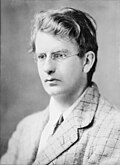
[[File:John Logie Baird in 1917.jpg|thumb| | [[File:John Logie Baird in 1917.jpg|thumb|upright|Television pioneer [[John Logie Baird]] (seen here in 1917) televised the BBC's first drama, ''[[The Man with the Flower in His Mouth]]'', on 14 July 1930, and the first live outside broadcast, [[Epsom Derby|The Derby]], on 2 June 1931.<ref>{{cite news |title=The Man with the Flower in his Mouth |url=https://www.bbc.co.uk/programmes/p02d2sm7 |publisher=BBC |date=9 October 2017 |access-date=20 December 2019 |archive-url=https://web.archive.org/web/20181021180342/https://www.bbc.co.uk/programmes/p02d2sm7 |archive-date=21 October 2018 |url-status=live}}</ref><ref>{{cite news |title=BBC's first television outside broadcast |url=http://www.bbceng.info/additions/2016/first-scanner-prospero-2010a.pdf |publisher=Prospero |access-date=9 October 2017 |archive-url=https://web.archive.org/web/20171009223351/http://www.bbceng.info/additions/2016/first-scanner-prospero-2010a.pdf |archive-date=9 October 2017 |url-status=live}}</ref>]] | ||
The British Broadcasting Corporation came into existence on 1 January 1927, and Reith – newly knighted – was appointed its first | The British Broadcasting Corporation came into existence on 1 January 1927, and Reith – newly knighted – was appointed its first director general. To represent its purpose and (stated) values, the new corporation adopted the [[Coat of arms of the BBC|coat of arms]], including the motto "Nation shall speak peace unto Nation".<ref name="Motto">{{cite book |last=Knowles |first=Elizabeth |title=The Oxford Dictionary of Modern Quotations |url=https://archive.org/details/oxforddictionary0000unse_f8b0 |edition=Oxford Reference Online |year=2008 |publisher=Oxford University Press |access-date=11 February 2010 |isbn=9780199208951}}</ref> | ||
British radio audiences had little choice apart from | British radio audiences had little choice apart from BBC's programming approach. Reith was viewed as taking a moralistic approach as an executive, aiming to broadcast "all that is best in every department of human knowledge, endeavour and achievement", and putting the programming in moral or ethical terms, advocating "a high moral tone" as "obviously of paramount importance".<ref>[[C. L. Mowat]], ''Britain between the Wars 1918–1940'' (1955) p 242.</ref> Reith succeeded in building a high wall against a more tabloid, free-for-all in radio aimed at merely attracting the largest audience (and advertising revenue). There was no paid advertising on the BBC; all the revenue came from a tax on receiving sets. Highbrow audiences, however, greatly enjoyed it.<ref>David Hendy, "Painting with Sound: The Kaleidoscopic World of Lance Sieveking, a British Radio Modernist," ''Twentieth Century British History'' (2013) 24#2 pp 169–200.</ref> At a time when American, Australian and Canadian stations were drawing huge audiences cheering for their local teams with the broadcast of baseball, rugby and hockey, the BBC emphasised service for a national rather than a regional audience. Boat races were well covered along with tennis and horse racing, but the BBC was reluctant to spend its severely limited air time on long football or [[cricket]] games, regardless of their popularity.<ref>Mike Huggins, "BBC Radio and Sport 1922–39," ''Contemporary British History'' (2007) 21#4 pp 491–515.</ref> | ||
[[File:BBC Birmingham 1928.png|thumb|The BBC's radio studio in Birmingham, from the ''BBC Hand Book'' 1928, which described it as "Europe's largest studio" | [[File:BBC Birmingham 1928.png|thumb|left|The BBC's radio studio in Birmingham, from the ''BBC Hand Book'' 1928, which described it as "Europe's largest studio"]] | ||
John Reith and the BBC, with support from [[the Crown]], determined the universal needs of the people of Britain and broadcast content according to these perceived standards.<ref>{{Cite book |title=The BBC and national identity in Britain, 1922–53 |last=Hajkowski |first=Thomas |publisher=Palgrave Macmillan |year=2010 |isbn=9780719079443 |location=New York |page=11}}</ref> Reith effectively censored anything that he felt would be harmful, directly or indirectly.<ref name="Avery-2006">{{Cite book |title=Radio Modernism |last=Avery |first=Todd |publisher=Ashgate Publishing Limited |year=2006 |isbn=9780754655176 |page=21}}</ref> While recounting his time with the BBC in 1935, [[Raymond Postgate]] claims that BBC broadcasters were made to submit a draft of their potential broadcast for approval. It was expected that they tailored their content to accommodate the modest, church-going elderly or a member of the Clergy.<ref>{{Cite journal |last=Dawkins |first=Charlie |date=Spring 2016 |title=Harold Nicolson, Ulysses, Reithianism |journal=The Review of English Studies |volume=67 |issue=280 |pages=558–578 |doi=10.1093/res/hgv063 |url=https://ora.ox.ac.uk/objects/uuid:977bed97-a430-4524-a0dc-1ba68898ba04 |access-date=6 September 2020 |issn=0034-6551 |archive-date=22 December 2020 |archive-url=https://web.archive.org/web/20201222192412/https://ora.ox.ac.uk/objects/uuid:977bed97-a430-4524-a0dc-1ba68898ba04 |url-status=live |url-access=subscription}}</ref> Until 1928, entertainers broadcasting on the BBC, both singers and "talkers" were expected to avoid biblical quotations, Clerical impersonations and references, references to drink or [[Prohibition in the United States]], vulgar and doubtful matter and political allusions.<ref name="Avery-2006"/> The BBC excluded popular foreign music and musicians from its broadcasts, while promoting British alternatives.<ref>{{Cite book |title=The BBC and Ultra-Modern Music, 1922–1936: Shaping a Nation's Taste |last=Doctor |first=Jennifer |publisher=Cambridge University Press |year=1999 |isbn=978-0521661171 |location=New York}}</ref> On 5 March 1928, Stanley Baldwin, the Prime Minister, maintained the censorship of editorial opinions on public policy, but allowed the BBC to address matters of religious, political or industrial controversy.<ref name="Scanell-1991">{{Cite book |title=A Social History of British Broadcasting |last1=Scanell |first1=Paddy |last2=Cardiff |first2=David |publisher=Basil Blackwell |year=1991 |isbn=978-0631175438 |location=Cambridge, Massachusetts |page=75}}</ref> The resulting political "talk series", designed to inform England on political issues, were criticised by members of parliament, including Winston Churchill, [[David Lloyd George]] and [[Sir Austen Chamberlain]]. Those who opposed these chats claimed that they silence the opinions of those in Parliament who are not nominated by Party Leaders or Party Whips, thus stifling independent, non-official views.<ref name="Scanell-1991"/> In October 1932, the policemen of the [[Metropolitan Police Federation]] marched in protest at a proposed pay cut. Fearing dissent within the police force and public support for the movement, the BBC censored its coverage of the events, only broadcasting official statements from the government.<ref name="Scanell-1991"/> | |||
Throughout the 1930s | Throughout the 1930s political broadcasts had been monitored by the BBC.<ref name="West-1987">{{Cite book |title=Truth Betrayed |last=West |first=W.J. |publisher=Redwood Burn Limited, Trowbridge |year=1987 |isbn=978-0715621820 |location=London, England |page=15}}</ref> In 1935, the BBC censored the broadcasts of [[Oswald Mosley]] and [[Harry Pollitt]].<ref name="Scanell-1991"/> Mosley was a leader of the [[British Union of Fascists]], and Pollitt a leader of the [[Communist Party of Great Britain]]. They were contracted to provide a series of five broadcasts on their parties' politics. The BBC, in conjunction with [[The Foreign Office]] of Britain, suspended this series and ultimately cancelled it without the notice of the public.<ref name="West-1987"/><ref name="Scanell-1991"/> Some politicians faced censorship. In 1938, Winston Churchill proposed a series of talks regarding British domestic and foreign politics and affairs but was censored.<ref name="West-1987"/> The censorship of political discourse by the BBC started the shutdown of the political debate that manifested over the BBC's wartime airwaves.<ref name="West-1987"/> The Foreign Office maintained that the public should not be aware of their role in the censorship.<ref name="Scanell-1991"/> From 1935 to 1939, the BBC attempted to unite the British Empire's radio waves, sending staff to Egypt, [[Mandatory Palestine|Palestine]], [[Newfoundland]], Jamaica, India, Canada and South Africa.<ref name="Potter-2012">{{Cite book |title=Broadcasting Empire |last=Potter |first=Simon |publisher=Oxford University Press |year=2012 |isbn=9780199568963 |location=Oxford, England |page=85}}</ref> Reith visited South Africa, lobbying for state-run radio programmes accepted by [[South African Parliament]] in 1936.<ref name="Potter-2012"/> A similar programme was adopted in Canada. Through collaboration with these state-run broadcasting centres, Reith had an influence on the culture across the empire of [[Great Britain]] with his departure from the corporation in 1938.<ref name="Potter-2012"/> | ||
Experimental television broadcasts were started in 1929 | Experimental television broadcasts were started in 1929 using an [[Electromechanical film|electromechanical]] 30-line system developed by [[John Logie Baird]].<ref>{{Cite web |title=1920s |url=http://bbc.com/historyofthebbc//timelines/1920s |access-date=18 November 2020 |website=bbc.com |language=en |archive-date=16 May 2020 |archive-url=https://web.archive.org/web/20200516200700/http://bbc.com/historyofthebbc//timelines/1920s |url-status=live}}</ref> Limited regular broadcasts using this system began in 1932, and [[First day of BBC television|an expanded service]] (now named the [[BBC Television#History of BBC Television|BBC Television Service]]) started from [[Alexandra Palace]] in November 1936, alternating between an improved Baird mechanical 240-line system and the all-electronic [[405-line]] Marconi-EMI system which had been developed by an [[EMI]] research team led by Sir [[Isaac Shoenberg]].<ref>{{cite news |title=Sir Isaac Shoenberg, British inventor |url=https://www.britannica.com/biography/Isaac-Shoenberg |access-date=22 July 2021 |work=Encyclopaedia Britannica |quote=principal inventor of the first high-definition television system |archive-date=20 October 2021 |archive-url=https://web.archive.org/web/20211020205748/https://www.britannica.com/biography/Isaac-Shoenberg |url-status=live}}</ref> The superiority of the electronic system saw the [[mechanical system]] dropped early the following year, with the Marconi-EMI system the first fully electronic [[television]] system in the world to be used in regular [[broadcasting]].<ref>{{cite book |last=Norman |first=Bruce |url=https://archive.org/details/hereslookingatyo0000norm/page/99 |title=Here's Looking at You: The Story of British Television 1908–1939 |year=1984 |isbn=978-0-563-20102-1 |page=[https://archive.org/details/hereslookingatyo0000norm/page/99 99] |publisher=British Broadcasting Corporation}}</ref> | ||
====BBC versus other media==== | ====BBC versus other media==== | ||
[[File:Royal broadcast, Christmas 1934 (Our Generation, 1938).jpg|thumb|left|King [[George V]] giving the 1934 [[Royal Christmas | [[File:Royal broadcast, Christmas 1934 (Our Generation, 1938).jpg|thumb|left|King [[George V]] giving the 1934 [[Royal Christmas message]] on BBC Radio. The annual message typically reflects on the year's major events.]] | ||
The success of broadcasting provoked animosities between the BBC and well-established media such as theatres, concert halls and the recording industry. By 1929, the BBC complained that the agents of many comedians refused to sign contracts for broadcasting, because they feared it harmed the artist "by making his material stale" and that it "reduces the value of the artist as a visible music-hall performer". On the other hand, the BBC was "keenly interested" in a cooperation with the recording companies who "in recent years ... have not been slow to make records of singers, orchestras, dance bands, etc. who have already proved their power to achieve popularity by wireless." Radio plays were so popular that the BBC had received 6,000 manuscripts by 1929, most of them written for stage and of little value for broadcasting: "Day in and day out, manuscripts come in, and nearly all go out again through the post, with a note saying 'We regret, etc.'"<ref>''BBC Hand Book'' (1929), pp. 164, 182, 186</ref> In the 1930s music broadcasts also enjoyed great popularity, for example the friendly and wide-ranging | The success of broadcasting provoked animosities between the BBC and well-established media such as theatres, concert halls and the recording industry. By 1929, the BBC complained that the agents of many comedians refused to sign [[contracts]] for broadcasting, because they feared it harmed the artist "by making his material stale" and that it "reduces the value of the artist as a visible music-hall performer". On the other hand, the BBC was "keenly interested" in a cooperation with the recording companies who "in recent years ... have not been slow to make records of [[singers]], orchestras, dance bands, etc. who have already proved their power to achieve popularity by wireless." Radio plays were so popular that the BBC had received 6,000 manuscripts by 1929, most of them written for stage and of little value for broadcasting: "Day in and day out, manuscripts come in, and nearly all go out again through the post, with a note saying 'We regret, etc.'"<ref>''BBC Hand Book'' (1929), pp. 164, 182, 186</ref> In the 1930s music broadcasts also enjoyed great popularity, for example the friendly and wide-ranging [[BBC Theatre Organ]] broadcasts at [[St. George's Hall, London|St George's Hall]], London by [[Reginald Foort]], who held the official role of BBC Staff Theatre Organist from 1936 to 1938.<ref>{{cite journal |date=28 October 1938 |title=National Programme Daventry, 31 October 1938 20.10: Farewell to Reginald Foort |journal=[[Radio Times]] |publisher=BBC |volume=61 |issue=787 |url=http://genome.ch.bbc.co.uk/c92472a1092345fdbaa66216e8ed9451 |access-date=11 September 2021 |archive-date=4 October 2021 |archive-url=https://web.archive.org/web/20211004180651/https://genome.ch.bbc.co.uk/c92472a1092345fdbaa66216e8ed9451 |url-status=dead}}</ref> | ||
===Second World War=== | ===Second World War=== | ||
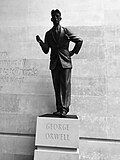
[[File:George Orwell statue - BBC London (38562767202).jpg|thumb|[[Statue of George Orwell]] outside [[Broadcasting House]], headquarters of the BBC | [[File:George Orwell statue - BBC London (38562767202).jpg|thumb|upright|[[Statue of George Orwell]] outside [[Broadcasting House]], headquarters of the BBC]] | ||
Television broadcasting was suspended from 1 September 1939 to 7 June 1946, during | Television broadcasting was suspended from 1 September 1939 to 7 June 1946, during [[World War II]], and it was left to [[BBC Radio]] broadcasters such as Reginald Foort to keep the nation's spirits up. The BBC moved most of its radio operations out of London, initially to [[Bristol]], and then to [[Bedford]]. Concerts were broadcast from the [[Bedford Corn Exchange]]; the Trinity Chapel in [[St Paul's Church, Bedford]] was the studio for the Daily Service (a daily 15-minute religious service first broadcast on the BBC in 1928 which continues today) from 1941 to 1945, and, in the darkest days of the war in 1941, the [[Cosmo Gordon Lang|Archbishops of Canterbury]] and [[William Temple (bishop)|York]] came to St Paul's to broadcast to the UK and the world on the National Day of Prayer.<ref>{{cite web |title=History of the Daily Service |url=https://www.bbc.co.uk/programmes/articles/5sFq5GhJ5nN76DXFSXVK3zZ/history-of-the-daily-service |website=BBC Religion & Ethics |access-date=24 February 2025 |archive-date=6 March 2025 |archive-url=https://web.archive.org/web/20250306113221/https://www.bbc.co.uk/programmes/articles/5sFq5GhJ5nN76DXFSXVK3zZ/history-of-the-daily-service |url-status=live}}</ref> BBC employees during the war included [[George Orwell]] who spent two years with the broadcaster.<ref>{{Cite web |url=https://www.bbc.co.uk/webarchive/https%3A%2F%2Fwww.bbc.co.uk%2Fblogs%2Faboutthebbc%2Fentries%2F41a0eedb-c435-479d-aa63-a89ad81daf01 |title=Orwell statue unveiled |date=7 November 2017 |website=About the BBC |access-date=2 December 2017 |archive-url=https://web.archive.org/web/20171119183632/http://www.bbc.co.uk/blogs/aboutthebbc/entries/41a0eedb-c435-479d-aa63-a89ad81daf01 |archive-date=19 November 2017 |url-status=live}}</ref> | ||
During his role as prime minister during the | During his role as prime minister during the war, Winston Churchill delivered 33 major wartime speeches by radio, all of which were carried by the BBC within the UK.<ref>Christopher H. Sterling (2004). "Encyclopedia of Radio 3-Volume Set". p. 524. Routledge</ref> On 18 June 1940, French general [[Charles de Gaulle]], in exile in London as the leader of the Free French, made a speech, broadcast by the BBC, urging the French people not to capitulate to the Nazis.<ref>{{cite news |title=How de Gaulle speech changed fate of France |url=https://news.bbc.co.uk/2/hi/programmes/newsnight/8747121.stm |agency=BBC |date=4 January 2018 |access-date=4 January 2018 |archive-url=https://web.archive.org/web/20170831091459/http://news.bbc.co.uk/1/hi/programmes/newsnight/8747121.stm |archive-date=31 August 2017 |url-status=live}}</ref> In October 1940, Princesses [[Elizabeth II|Elizabeth]] and [[Princess Margaret, Countess of Snowdon|Margaret]] made their first radio broadcast for the BBC's ''[[Children's Hour]]'', addressing other children who had been evacuated from cities.<ref>{{Citation |title=Children's Hour: Princess Elizabeth |date=13 October 1940 |url=https://www.bbc.co.uk/videos/c888v541pweo |archive-url=https://web.archive.org/web/20191127053143/https://www.bbc.co.uk/archive/childrens-hour--princess-elizabeth/z7wm92p |work=BBC Archive |access-date=17 September 2022 |archive-date=27 November 2019 |url-status=live}}</ref> | ||
In 1938 | In 1938 John Reith and the [[Government of the United Kingdom]], specifically the [[Ministry of Information (United Kingdom)|Ministry of Information]] which had been set up for WWII, designed a censorship apparatus for the inevitability of war.<ref name="Nicholas-1996">{{Cite book |title=The Echo of War |last=Nicholas |first=Sian |publisher=Manchester University Press |year=1996 |isbn=978-0719046087 |location=New York City |page=18}}</ref> Due to the BBC's advancements in [[shortwave radio]] technology, the corporation could broadcast across the world during the Second World War.<ref name="Cull-1995">{{Cite book |title=Selling War: The British Propaganda Campaign Against American "neutrality" in World War II |last=Cull |first=Nicholas |publisher=Oxford University Press |year=1995 |isbn=978-0195111507 |location=New York |page=42}}</ref> Within Europe, the BBC European Service would gather intelligence and information regarding the current events of the war in English.<ref name="Nicholas-1996"/><ref name="Ribeiro-2011">{{Cite book |title=BBC Broadcasts to Portugal in World War II |last=Ribeiro |first=Nelson |publisher=[[Edwin Mellen Press]] |year=2011 |isbn=9780773414877 |location=[[Lewiston, New York]] |page=63}}</ref> Regional BBC workers, based on their regional geo-political climate, would then further censor the material their broadcasts would cover. Nothing was to be added outside the preordained news items.<ref name="Nicholas-1996"/><ref name="Ribeiro-2011"/> For example, the BBC Polish Service was heavily censored due to fears of jeopardising relations with the [[Soviet Union]]. Controversial topics, i.e. the contested Polish and Soviet border, the deportation of Polish citizens, the arrests of [[Polish Home Army]] members and the [[Katyn massacre]], were not included in Polish broadcasts.<ref>{{Cite journal |last=Morriss |first=Agnieszka |date=2015 |title=The BBC Polish Service During the Second World War |journal=Special Issue Research Project Reports |volume=21 |issue=4 |pages=459–460 |doi=10.1080/13688804.2015.1077108 |doi-access=free}}</ref> American radio broadcasts were broadcast across Europe on BBC channels. This material also passed through the BBC's censorship office, which surveilled and edited American coverage of British affairs.<ref name="Cull-1995"/> By 1940, across all BBC broadcasts, music by composers from enemy nations was censored. In total, 99 German, 38 Austrian and 38 Italian composers were censored. The BBC argued that like the Italian or German languages, listeners would be irritated by the inclusion of enemy composers.<ref>{{Cite journal |last=Mackay |first=Robert |date=Fall 2000 |title=Being Beastly to the Germans: music, censorship and the BBC in World War II |journal=Historical Journal of Film, Radio and Television |volume=20 |issue=4 |pages=517 |doi=10.1080/713669737 |s2cid=192078695}}</ref> Any potential broadcasters said to have pacifist, communist or [[fascist]] ideologies were not allowed on the BBC's airwaves.<ref>{{Cite book |title=Writing the Radio War |last=Whittington |first=Ian |publisher=Edinburgh University Press |year=2018 |isbn=9781474413596 |location=Edinburgh, Scotland |page=19}}</ref> In 1937, a [[MI5]] security officer was given a permanent office within the organisation. This officer would examine the files of potential political subversives and [["Christmas tree" files|mark the files of those deemed a security risk]] to the organisation, [[blacklisting]] them. This was often done on spurious grounds; even so, the practice would continue and expand during the years of the Cold War.<ref>{{cite news |last1=Leigh |first1=David |last2=Lashmar |first2=Paul |title=The Blacklist in Room 105. Revealed: How MI5 vets BBC staff |url=https://www.cambridgeclarion.org/press_cuttings/mi5.bbc.page9_obs_18aug1985.html |work=The Observer |date=18 August 1985 |page=9 |access-date=7 December 2021 |archive-date=13 May 2019 |archive-url=https://web.archive.org/web/20190513210628/http://www.cambridgeclarion.org/press_cuttings/mi5.bbc.page9_obs_18aug1985.html |url-status=live}}</ref><ref name="Hollingsworth">Mark Hollingsworth and Richard Norton-Taylor ''Blacklist: The Inside Story of Political Vetting'', London: Hogarth, 1988, p. 103. The relevant extract from the book is [http://bilderberg.org/mi5bbc.htm here] {{Webarchive|url=https://web.archive.org/web/20021004083825/http://bilderberg.org/mi5bbc.htm |date=4 October 2002 }}</ref> | ||
===Later 20th century=== | ===Later 20th century=== | ||
[[File:BBC AXBT Microphone (designed in 1944).jpg|thumb|left|Produced between 1934 and 1959, the [[BBC-Marconi Type A microphone]] | [[File:BBC AXBT Microphone (designed in 1944).jpg|thumb|left|upright=0.9|Produced between 1934 and 1959, the [[BBC-Marconi Type A microphone]] is regarded as an iconic symbol of the BBC, alongside the channel's [[History of BBC television idents#BBC Television Service/BBC One|rotating globe]] emblem introduced in 1963.<ref>{{citation |last1=Sargeant |first1=Paul |title=Looking Back at the BBC |year=2010 |publisher=BBC |place=London |url=https://www.bbc.co.uk/blogs/ahistoryoftheworld/2010/10/looking-back-at-the-bbc.shtml |access-date=9 November 2010 |archive-date=22 December 2020 |archive-url=https://web.archive.org/web/20201222192824/https://www.bbc.co.uk/blogs/ahistoryoftheworld/2010/10/looking-back-at-the-bbc.shtml |url-status=live}}</ref>]] | ||
There was a widely reported urban myth that, upon resumption of the BBC television service after the war, announcer [[Leslie Mitchell (broadcaster)|Leslie Mitchell]] started by saying, "As I was saying before we were so rudely interrupted ..." In fact, the first person to appear when transmission resumed was [[Jasmine Bligh]] and the words said were "Good afternoon, everybody. How are you? Do you remember me, Jasmine Bligh ... ?"<ref>{{cite web|url=http://www.transdiffusion.org/emc/baird/tvoff.php |title=Baird: The edit that rewrote history |last=Graham |first=Russ J. |date=31 October 2005 |access-date=11 August 2006 |archive-url=https://web.archive.org/web/20060718223433/http://www.transdiffusion.org/emc/baird/tvoff.php |archive-date=18 July 2006 |url-status=dead | There was a widely reported urban myth that, upon resumption of the BBC television service after the war, announcer [[Leslie Mitchell (broadcaster)|Leslie Mitchell]] started by saying, "As I was saying before we were so rudely interrupted ..." In fact, the first person to appear when transmission resumed was [[Jasmine Bligh]] and the words said were "Good afternoon, everybody. How are you? Do you remember me, Jasmine Bligh ... ?"<ref>{{cite web |url=http://www.transdiffusion.org/emc/baird/tvoff.php |title=Baird: The edit that rewrote history |last=Graham |first=Russ J. |date=31 October 2005 |access-date=11 August 2006 |archive-url=https://web.archive.org/web/20060718223433/http://www.transdiffusion.org/emc/baird/tvoff.php |archive-date=18 July 2006 |url-status=dead}}</ref> The [[European Broadcasting Union]] was formed on 12 February 1950, in [[Torquay]] with the BBC among the 23 founding broadcasting organisations.<ref>"BBC Annual Report and Handbook". p. 215. BBC 1985</ref> | ||
Competition to the BBC was introduced in 1955, with the commercial and independently operated television network of [[ITV (TV network)|Independent Television (ITV)]]. However, the BBC monopoly on radio services would persist until 8 October 1973 when under the control of the newly renamed [[Independent Broadcasting Authority]] (IBA), the UK's first Independent local radio station, [[LBC]] came on-air in the London area. As a result of the [[Pilkington Committee on Broadcasting|Pilkington Committee]] report of 1962, in which the BBC was praised for the quality and range of its output, and ITV was very heavily criticised for not providing enough quality programming,<ref>{{cite web |title=Committees of Enquiry: Pilkington Committee |url=https://www.bbc.co.uk/heritage/more/pdfs/committees_of_enquiry.pdf |page=4 |date=1 June 1962 |access-date=30 September 2006 |archive-url=https://web.archive.org/web/20061012060952/http://www.bbc.co.uk/heritage/more/pdfs/committees_of_enquiry.pdf |archive-date=12 October 2006 |url-status=dead}}</ref> the decision was taken to award the BBC a second television channel, [[BBC2]], in 1964, renaming the existing service [[BBC1]]. BBC2 used the higher resolution 625-line standard which had been standardised across Europe. BBC2 was broadcast in colour from 1 July 1967 and was joined by BBC1 and ITV on 15 November 1969. The 405-line [[Very high frequency#United Kingdom|VHF]] transmissions of BBC1 (and ITV) were continued for compatibility with older television receivers until 1985. | |||
[[File:BBC TV Centre.jpg|thumb|[[Television Centre, London|Television Centre]] at [[White City, London|White City]], west London (pictured in 2009), headquarters of the BBC from 1960 to 2013. Since being refurbished, the complex is now the home of [[BBC Studioworks]].]] | |||
Starting in 1964, a series of [[pirate radio]] stations (starting with [[Radio Caroline]]) came on the air and forced the British government finally to regulate radio services to permit nationally based advertising-financed services. In response, the BBC reorganised and renamed their radio channels. On 30 September 1967, the Light Programme was split into [[BBC Radio 1|Radio 1]] offering continuous "Popular" music and [[BBC Radio 2|Radio 2]] more "Easy Listening".<ref>{{cite news |url=https://www.telegraph.co.uk/arts/main.jhtml?xml=/arts/2007/09/27/bvradio127.xml&page=1 |newspaper=The Daily Telegraph |title=The day we woke up to pop music on Radio 1 |date=27 September 2007 |first=Imogen |last=Carter |access-date=30 September 2007 |location=London |archive-url=https://web.archive.org/web/20071018203739/http://www.telegraph.co.uk/arts/main.jhtml?xml=%2Farts%2F2007%2F09%2F27%2Fbvradio127.xml&page=1 |archive-date=18 October 2007 |url-status=dead}}</ref> The "Third" programme became [[BBC Radio 3|Radio 3]] offering classical music and cultural programming. The Home Service became [[BBC Radio 4|Radio 4]] offering news, and non-musical content such as quiz shows, readings, dramas and plays. As well as the four national channels, a series of local BBC radio stations were established in 1967, including [[BBC Radio London|Radio London]].<ref>{{cite news |url=https://books.google.com/books?id=-Q8EAAAAMBAJ&pg=PA41 |title=Radio in London |last=Partridge |first=Rob |date=13 November 1971 |magazine=Billboard |access-date=2 August 2010 |archive-url=https://web.archive.org/web/20160125083315/https://books.google.com/books?id=-Q8EAAAAMBAJ&pg=PA41 |archive-date=25 January 2016 |url-status=live}}</ref> In 1969, the BBC Enterprises department was formed to exploit BBC brands and programmes for commercial spin-off products. In 1979, it became a wholly owned limited company, BBC Enterprises Ltd.<ref name="briggs">{{cite book |last=Briggs |first=Asa |title=Competition |year=2000 |publisher=Oxford University Press |location=Oxford |isbn=978-0-19-215964-9 |page=713 |edition=Reprinted}}</ref> | |||
In 1974 the BBC's [[teletext]] service, [[Ceefax]], was introduced, created initially to provide subtitling, but developed into a news and information service. In 1978, BBC staff went on strike just before the Christmas, thus blocking out the transmission of both channels and amalgamating all four radio stations into one.<ref>[http://www.meldrum.co.uk/mhp/continuity/guestroom.html The Guestroom for Mr Cock-up] {{webarchive|url=https://web.archive.org/web/20080224233404/http://www.meldrum.co.uk/mhp/continuity/guestroom.html |date=24 February 2008 }} Pick of the Continuity Announcers, 6 April 2000</ref><ref>[http://www.users.zetnet.co.uk/itw/features/Ratings.html Ratings for 1978] {{Webarchive|url=https://web.archive.org/web/20080827202157/http://www.users.zetnet.co.uk/itw/features/Ratings.html |date=27 August 2008 }} Independent Teleweb</ref> Since the deregulation of the UK television and radio market in the 1980s, the BBC has faced increased competition from the commercial sector (and from the advertiser-funded public service broadcaster [[Channel 4]]), especially on satellite television, cable television, and digital television services. In the late 1980s, the BBC began a process of [[divestment]] by [[Corporate spin-off|spinning off]] and selling parts of its organisation. In 1988, it sold off the Hulton Press Library, a photographic archive which had been acquired from the ''[[Picture Post]]'' magazine by the BBC in 1957. The archive was sold to Brian Deutsch and is now owned by [[Getty Images]].<ref name=hulton-history>{{cite web |last=McDonald |first=Sarah |title=15 October 2004 Sarah McDonald, Curator Page 1 10/15/04 Hulton{{!}}Archive – History in Pictures |url=http://corporate.gettyimages.com/masters2/conservation/articles/HAHistory.pdf |publisher=Getty Images |access-date=28 May 2013 |archive-url=https://web.archive.org/web/20130527044717/http://corporate.gettyimages.com/masters2/conservation/articles/HAHistory.pdf |archive-date=27 May 2013 |url-status=dead}}</ref> In 1987, the BBC decided to centralise its operations by the management team with the radio and television divisions joining forces together for the first time, the activities of the news and currents departments and coordinated jointly under the new directorate.<ref>{{Cite news |last=Guider |first=Elizabeth |date=22 July 1987 |title=New BBC Management Team Sees Radio, TV Divisions Joining Forces |page=52 |work=[[Variety (magazine)|Variety]]}}</ref> During the 1990s, this process continued with the separation of certain operational arms of the corporation into autonomous but [[wholly owned subsidiaries]], with the aim of generating additional revenue for programme-making. BBC Enterprises was reorganised and relaunched in 1995, as BBC Worldwide Ltd.<ref name="briggs"/> In 1998, BBC studios, outside broadcasts, post production, design, costumes and wigs were spun off into BBC Resources Ltd.<ref name=guardian-resources>{{cite news |last=Holmwood |first=Leigh |title=BBC Resources sell-off to begin |url=https://www.theguardian.com/media/2007/aug/15/bbc.television |access-date=28 May 2013 |date=15 August 2007 |location=London |newspaper=[[The Guardian]] |archive-url=https://web.archive.org/web/20131203153604/http://www.theguardian.com/media/2007/aug/15/bbc.television |archive-date=3 December 2013 |url-status=live}}</ref> | |||
The [[BBC Research & Development]] has played a major part in the development of broadcasting and recording techniques. The BBC was also responsible for the development of the [[NICAM]] stereo standard. In recent decades, a number of additional channels and radio stations have been launched: [[BBC Radio 5 (former)|Radio 5]] was launched in 1990, as a sports and educational station, but was replaced in 1994, with [[BBC Radio 5 Live]] to become a live radio station, following the success of the [[Radio 4 News FM|Radio 4 service]] to cover the 1991 [[Gulf War]]. The new station would be a news and sport station. In 1997, [[BBC News 24]], a rolling news channel, launched on digital television services, and the following year, [[BBC Choice]] was launched as the third general entertainment channel from the BBC. The BBC also purchased The Parliamentary Channel, which was renamed [[BBC Parliament]]. In 1999, [[BBC Knowledge]] launched as a multimedia channel, with services available on the newly launched [[BBC Text]] digital teletext service (later rebranded as BBC Red Button), and on [[BBC Online]]. The channel had an educational aim, which was modified later on in its life to offer documentaries. | |||
===2000–2011=== | |||
====Channel and branding changes==== | |||
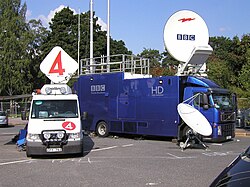
[[File:BBC HD SNG.jpg|thumb|A [[BBC HD]] outside broadcast van in August 2005]] | |||
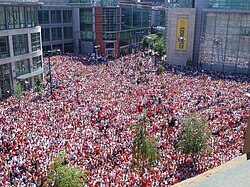
[[File:Manchester big screen.jpg|thumb|England fans in [[Manchester]] during a [[2006 FIFA World Cup]] game shown on the [[BBC Big Screen]]]] | |||
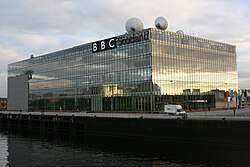
[[File:BBC Scotland.jpg|thumb|right|[[BBC Pacific Quay]] in Glasgow, which was opened in 2007]] | |||
In 2002 several television and radio channels were reorganised. BBC Knowledge was replaced by [[BBC Four]] and became the BBC's arts and documentaries channel. [[CBBC]], which had been a programming strand as Children's BBC since 1985, was split into CBBC and [[CBeebies]], for younger children, with both new services getting a digital channel: the CBBC Channel and CBeebies Channel.<ref>{{cite news |work=Digital Spy |access-date=26 December 2020 |date=11 February 2002 |url=http://www.digitalspy.com/british-tv/news/a6198/new-childrens-channels-from-bbc-launch.html |title=New children's channels from BBC launch |archive-date=23 September 2015 |archive-url=https://web.archive.org/web/20150923223511/http://www.digitalspy.com/british-tv/news/a6198/new-childrens-channels-from-bbc-launch.html |url-status=live}}</ref> In addition to the television channels, new digital radio stations were created: [[1Xtra]], [[6 Music]] and [[Radio 4 Extra]]. BBC 1Xtra was a sister station to Radio 1 and specialised in modern black music, BBC 6 Music specialised in alternative music genres and BBC7 specialised in archive, speech and children's programming.<ref>{{cite web |title=Inside the BBC: BBC Radio stations |url=https://www.bbc.co.uk/aboutthebbc/whatwedo/publicservices#networkradio |website=www.bbc.co.uk |publisher=BBC |access-date=26 December 2020 |archive-url=https://web.archive.org/web/20190110103926/https://www.bbc.co.uk/aboutthebbc/whatwedo/publicservices#networkradio |archive-date=10 January 2019 |url-status=live}}</ref> | |||
The following few years resulted in repositioning of some channels to conform to a larger brand: in 2003, BBC Choice was replaced by [[BBC Three]], with programming for younger adults and shocking real-life documentaries, BBC News 24 became the [[BBC News Channel]] in 2008, and BBC Radio 7 became BBC Radio 4 Extra in 2011, with new programmes to supplement those broadcast on Radio 4. In 2008, another channel was launched, [[BBC Alba]], a [[Scottish Gaelic]] service.<ref>{{cite news |url=https://news.bbc.co.uk/2/hi/uk_news/scotland/highlands_and_islands/7556739.stm |title=Launch date for Gaelic TV channel |work=BBC News |date=13 August 2008 |access-date=23 July 2025}}</ref> | |||
In 2006 [[BBC HD]] was launched as an experimental service, becoming official in December 2007. The channel broadcast HD simulcasts of programmes on [[BBC One]], [[BBC Two]], [[BBC Three]] and [[BBC Four]] as well as repeats of some older programmes in HD. In 2010, an HD simulcast of BBC One launched: [[BBC One HD]]. The channel uses HD versions of BBC One's schedule and uses upscaled versions of programmes not currently produced in HD. The BBC HD channel closed in March 2013 and was replaced by BBC Two HD in the same month.<ref>{{cite web |last=Pryde |first=Alix |title=Hello BBC Two HD; Goodbye BBC HD |url=https://www.bbc.co.uk/blogs/aboutthebbc/posts/BBC-Two-HD |archive-url=https://web.archive.org/web/20130323003251/http://www.bbc.co.uk/blogs/aboutthebbc/posts/BBC-Two-HD |url-status=dead |archive-date=23 March 2013 |work=About the BBC Blog |publisher=BBC |access-date=26 May 2025 |date=19 March 2013}}</ref> | |||
The 2004 [[Hutton Inquiry]] and the subsequent report raised questions about the BBC's journalistic standards and its impartiality. This led to resignations of senior management members at the time including the then Director General, [[Greg Dyke]]. In January 2007, the BBC released minutes of the board meeting which led to Greg Dyke's resignation.<ref>{{cite news |url=https://www.theguardian.com/media/2007/jan/11/politicsandthemedia.bbc |title=Dyke departure minutes released |newspaper=The Guardian |location=London |date=11 January 2007 |access-date=22 March 2010 |first=Matt |last=Wells |archive-url=https://web.archive.org/web/20131204094244/http://www.theguardian.com/media/2007/jan/11/politicsandthemedia.bbc |archive-date=4 December 2013 |url-status=live}}</ref> | |||
====Sale of divisions==== | |||
During this decade the corporation began to sell off a number of its operational divisions to private owners: BBC Broadcast was spun off as a separate company in 2002,<ref name=broadcast-ltd>{{cite press release |title=BBC to launch new commercial subsidiary following DCMS approval |url=https://www.bbc.co.uk/pressoffice/pressreleases/stories/2002/01_january/23/broadcastltd.shtml |access-date=28 May 2013 |publisher=BBC Press Office |date=23 January 2002 |archive-date=22 October 2023 |archive-url=https://web.archive.org/web/20231022204849/https://www.bbc.co.uk/pressoffice/pressreleases/stories/2002/1_january/23/broadcastltd.shtml |url-status=live}}</ref> and in 2005, it was sold off to Australian-based Macquarie Capital Alliance Group and [[Macquarie Group]] Limited and rebranded [[Red Bee Media]].<ref>{{cite news |url=https://news.bbc.co.uk/2/hi/entertainment/4708749.stm |title=BBC Broadcast sell-off approved |work=BBC News |date=22 July 2005 |access-date=11 December 2008 |archive-date=13 March 2022 |archive-url=https://web.archive.org/web/20220313002531/http://news.bbc.co.uk/1/hi/entertainment/4708749.stm |url-status=live}}</ref> The BBC's [[IT]], [[telephony]] and [[broadcast technology]] were brought together as BBC Technology Ltd in 2001,<ref name=broadcast-ltd /> and the division was later sold to the German company [[Siemens IT Solutions and Services]] (SIS).<ref name=bbc-2204>{{cite press release |title=BBC announces Siemens Business Services as Single Preferred Bidder |url=https://www.bbc.co.uk/pressoffice/pressreleases/stories/2004/07_july/07/technology.shtml |publisher=BBC Press Office |access-date=4 June 2012 |archive-date=16 December 2021 |archive-url=https://web.archive.org/web/20211216203543/https://www.bbc.co.uk/pressoffice/pressreleases/stories/2004/7_july/07/technology.shtml |url-status=live}}</ref> SIS was subsequently acquired from Siemens by the French company [[Atos]].<ref name=atos-ariel>{{cite news |title=New firm to support BBC IT |url=https://www.bbc.co.uk/ariel/14014213 |access-date=27 May 2013 |newspaper=Ariel |publisher=BBC |date=4 July 2011 |archive-url=https://web.archive.org/web/20130703052344/http://www.bbc.co.uk/ariel/14014213 |archive-date=3 July 2013 |url-status=dead}}</ref> Further divestments included [[BBC Books]] (sold to [[Random House]] in 2006);<ref>{{cite press release |url=https://www.bbc.co.uk/pressoffice/bbcworldwide/worldwidestories/pressreleases/2006/06_june/bbc_books.shtml |title=The Random House Group acquires majority shareholding in BBC Books |publisher=BBC Press Office |date=22 June 2006 |access-date=20 December 2019 |archive-date=23 November 2018 |archive-url=https://web.archive.org/web/20181123170442/http://www.bbc.co.uk/pressoffice/bbcworldwide/worldwidestories/pressreleases/2006/6_june/bbc_books.shtml |url-status=live}}</ref> BBC Outside Broadcasts Ltd (sold in 2008 to [[Satellite Information Services]]);<ref name=OBsale>{{cite press release |title=BBC announces successful bidder for BBC Outside Broadcasts |url=https://www.bbc.co.uk/pressoffice/pressreleases/stories/2008/03_march/07/ob.shtml |publisher=BBC Press Office |access-date=28 May 2013 |date=7 March 2008 |archive-date=22 October 2023 |archive-url=https://web.archive.org/web/20231022204849/https://www.bbc.co.uk/pressoffice/pressreleases/stories/2008/3_march/07/ob.shtml |url-status=live}}</ref> Costumes and Wigs (stock sold in 2008 to [[Angels Costumes]]);<ref name=angels-costumes>{{cite news |title=New home for BBC costume archive |url=https://news.bbc.co.uk/2/hi/entertainment/7321453.stm |access-date=28 May 2013 |work=BBC News |date=30 March 2008 |archive-url=https://web.archive.org/web/20081206133931/http://news.bbc.co.uk/1/hi/entertainment/7321453.stm |archive-date=6 December 2008 |url-status=live}}</ref> and BBC Magazines (sold to [[Immediate Media Company]] in 2011).<ref>{{cite news |url=https://www.theguardian.com/media/2011/aug/16/bbc-completes-magazines-sell-off |title=BBC Worldwide agrees £121m magazine sell-off |first=Mark |last=Sweney |newspaper=The Guardian |date=16 August 2011 |location=London |access-date=11 December 2016 |archive-url=https://web.archive.org/web/20161221065706/https://www.theguardian.com/media/2011/aug/16/bbc-completes-magazines-sell-off |archive-date=21 December 2016 |url-status=live}}</ref> After the sales of OBs and costumes, the remainder of BBC Resources was reorganised as [[BBC Studios and Post Production]], which continues today as a wholly owned subsidiary of the BBC. | |||
====Creative Futures==== | |||
<!---[[Creative Futures (BBC)]] redirects here. Please do not change section heading without changing the redirect---> | |||
On 7 March 2005 director general [[Mark Thompson (television executive)|Mark Thompson]] launched the "Creative Futures" project to restructure the organisation.<ref>{{cite web |title=BBC starts work on editorial blueprint for the future |website=BBC |date=7 March 2005 |url=https://www.bbc.co.uk/pressoffice/pressreleases/stories/2005/03_march/07/futures.shtml |access-date=17 July 2025}}</ref> A [[2005 BBC strike|strike in May 2005]] by more than 11,000 BBC workers over a proposal to cut 4,000 jobs and to privatise parts of the BBC, disrupted much of the BBC's regular programming.<ref name="nyt-2005-05-24">{{cite news |url=https://www.nytimes.com/2005/05/24/world/europe/bbc-employees-stage-24hour-strike-to-protest-planned-job-cuts.html |title=BBC Employees Stage 24-Hour Strike to Protest Planned Job Cuts |newspaper=The New York Times |date=24 May 2005 |last1=Lyall |first1=Sarah |access-date=4 November 2022 |archive-date=4 November 2022 |archive-url=https://web.archive.org/web/20221104101806/https://www.nytimes.com/2005/05/24/world/europe/bbc-employees-stage-24hour-strike-to-protest-planned-job-cuts.html |url-status=live}}</ref><ref>{{cite news |url=http://www.cnn.com/2005/WORLD/europe/05/23/britain.bbc/ |title=BBC strike hits TV, radio output |date=23 May 2005 |work=[[CNN]] |access-date=4 November 2022 |archive-date=4 November 2022 |archive-url=https://web.archive.org/web/20221104101808/http://www.cnn.com/2005/WORLD/europe/05/23/britain.bbc/ |url-status=live}}</ref> | |||
The | The blueprint for the future of the BBC resulting from the project was published ion 25 April 2006.<ref>{{cite web |title=Creative Future |website=BBC |date=25 April 2006 |url=https://www.bbc.co.uk/pressoffice/pressreleases/stories/2006/04_april/25/creative.shtml |access-date=17 July 2025}}</ref><ref>{{cite web |last=Dowell |first=Ben |title=BBC Creative Future: the key points |website=The Guardian |date=25 April 2006 |url=https://www.theguardian.com/media/2006/apr/25/broadcasting.newmedia |access-date=17 July 2025}}</ref><ref>{{cite web |last=Bell |first=Emily |title=The BBC has laid out its vision of a brave new media world |website=The Guardian |date=28 April 2006 |url=https://www.theguardian.com/commentisfree/2006/apr/29/comment.media |access-date=17 July 2025}}</ref> | ||
On 18 October 2007, Thompson announced a six-year plan, "Delivering Creative Futures", which included merging the television current affairs department into a new "News Programmes" division.<ref name=reform/><ref>{{cite news |url=http://blogs.guardian.co.uk/organgrinder/2007/10/post_51.html |title=BBC cuts: look on the bright side |work=The Guardian |date=22 October 2007 |location=London |first=Steve |last=Hewlett |archive-url=https://web.archive.org/web/20071024120744/http://blogs.guardian.co.uk/organgrinder/2007/10/post_51.html |archive-date=24 October 2007 |url-status=dead}}</ref> Thompson's announcement, in response to a £2 billion shortfall in funding, would, he said, deliver "a smaller but fitter BBC" in the digital age, by cutting its payroll and, in 2013, selling [[BBC Television Centre|Television Centre]].<ref>{{cite news |url=https://news.bbc.co.uk/1/hi/entertainment/7050440.stm |title=BBC cuts back programmes and jobs |work=BBC News |date=18 October 2007 |access-date=25 October 2007 |archive-url=https://web.archive.org/web/20071020035603/http://news.bbc.co.uk/1/hi/entertainment/7050440.stm#tables |archive-date=20 October 2007 |url-status=live}}</ref> The plans included a reduction in posts of 2,500; including 1,800 redundancies, consolidating news operations, reducing programming output by 10% and selling off the flagship [[Television Centre, London|Television Centre]] building in London.<ref name=reform>{{cite press release |url=https://www.bbc.co.uk/pressoffice/pressreleases/stories/2007/10_october/18/reform.shtml |title=Radical reform to deliver a more focused BBC |publisher=BBC |date=18 October 2007 |archive-url=https://web.archive.org/web/20071020051207/http://www.bbc.co.uk/pressoffice/pressreleases/stories/2007/10_october/18/reform.shtml |archive-date=20 October 2007 |url-status=live}}</ref> | |||
=== | ====Licence fee frozen==== | ||
On 20 October 2010 the [[Chancellor of the Exchequer]] [[George Osborne]] announced that the television licence fee would be frozen at its current level until the end of the current charter in 2016. The same announcement revealed that the BBC would take on the full cost of running the [[BBC World Service]] and the [[BBC Monitoring]] service from the [[Foreign, Commonwealth and Development Office]], and partially finance the Welsh broadcaster [[S4C]].<ref>{{cite news |title=Television licence fee to be frozen for the next six years |url=https://www.bbc.co.uk/news/entertainment-arts-11572171 |access-date=6 October 2011 |work=BBC News |date=20 October 2010 |archive-url=https://web.archive.org/web/20111007165009/http://www.bbc.co.uk/news/entertainment-arts-11572171 |archive-date=7 October 2011 |url-status=live}}</ref>{{efn|Unlike the other departments of the BBC, the BBC World Service had been funded by the [[Foreign, Commonwealth and Development Office]] (aka Foreign Office or the FCO), is the British government department responsible for promoting the interests of the United Kingdom abroad.{{citation needed|date=July 2025}}}} | |||
[[File: | ===Since 2011=== | ||
[[File:20191017 BBC Studios London, BBC Radio Theatre, New Broadcasting House vertical photo by Amy Karle.jpg|thumb|The new extension to the BBC's [[Broadcasting House]], completed in 2012]] | |||
Further cuts were announced on 6 October 2011, so the BBC could reach a total reduction in their budget of 20%, following the licence fee freeze in October 2010, which included cutting staff by 2,000 and sending a further 1,000 to the [[MediaCityUK]] development in [[Salford]], with BBC Three moving online only in 2016, the sharing of more programmes between stations and channels, sharing of radio news bulletins, more repeats in schedules, including the whole of BBC Two daytime and for some original programming to be reduced. BBC HD was closed on 26 March 2013, and replaced with an HD simulcast of BBC Two; however, flagship programmes, other channels and full funding for CBBC and CBeebies would be retained.<ref>{{cite news |title=BBC set to cut 2000 jobs by 2017 |url=https://www.bbc.co.uk/news/entertainment-arts-15165926 |access-date=6 October 2011 |newspaper=BBC News |date=6 October 2011 |archive-url=https://web.archive.org/web/20111006124012/http://www.bbc.co.uk/news/entertainment-arts-15165926 |archive-date=6 October 2011 |url-status=live}}</ref><ref>{{cite news |title=BBC cuts at a glance |url=https://www.bbc.co.uk/news/entertainment-arts-15186116 |access-date=6 October 2011 |work=BBC News |date=6 October 2011 |archive-url=https://web.archive.org/web/20111006172317/http://www.bbc.co.uk/news/entertainment-arts-15186116 |archive-date=6 October 2011 |url-status=live}}</ref><ref>{{cite news |title=BBC cuts: in detail |url=https://www.telegraph.co.uk/culture/tvandradio/bbc/8810868/BBC-cuts-in-detail.html |access-date=6 October 2011 |newspaper=The Daily Telegraph |date=6 October 2011 |location=London |archive-url=https://web.archive.org/web/20111006131137/http://www.telegraph.co.uk/culture/tvandradio/bbc/8810868/BBC-cuts-in-detail.html |archive-date=6 October 2011 |url-status=live}}</ref> Numerous BBC facilities have been sold off, including [[New Broadcasting House, Manchester|New Broadcasting House]] on [[Wilmslow Road]] in Manchester. Many major departments have been relocated to [[Broadcasting House]] in central London and MediaCityUK in Salford, particularly since the closure of BBC Television Centre in March 2013.<ref>{{cite news |url=https://www.theguardian.com/media/2010/sep/21/bbc1-live-coronation-anniversary |title=BBC1 to go live for coronation anniversary night in 2013 |archive-url=https://web.archive.org/web/20171204061336/https://www.theguardian.com/media/2010/sep/21/bbc1-live-coronation-anniversary |archive-date=4 December 2017 |work=The Guardian |location=London |date=21 September 2010}}</ref> On 16 February 2016, the BBC Three television service was discontinued and replaced by a [[BBC Three (streaming service)|digital outlet]] under the same name, targeting its young adult audience with web series and other content.<ref>{{cite web |last=Goodacre |first=Kate |url=http://www.digitalspy.com/tv/news/a775348/bbc-three-will-move-online-in-march-2016-as-bbc-trust-approves-plans-to-axe-broadcast-tv-channel/ |title=BBC Three will move online in March 2016 as BBC Trust approves plans to axe broadcast TV channel |website=Digital Spy |date=26 November 2015 |access-date=27 December 2015 |archive-url=https://web.archive.org/web/20151229142035/http://www.digitalspy.com/tv/news/a775348/bbc-three-will-move-online-in-march-2016-as-bbc-trust-approves-plans-to-axe-broadcast-tv-channel/ |archive-date=29 December 2015 |url-status=live}}</ref><ref>{{cite news |url=https://www.bbc.co.uk/news/entertainment-arts-35221706 |title=BBC Three reveals new logo and switchover date |work=BBC News |date=4 January 2016 |access-date=4 January 2016 |archive-url=https://web.archive.org/web/20160104173745/http://www.bbc.co.uk/news/entertainment-arts-35221706 |archive-date=4 January 2016 |url-status=live}}</ref> | |||
Under the new royal charter instituted in 2017, the corporation must publish an annual report to Ofcom, outlining its plans and public service obligations for the next year. In its 2017–18 report, released July 2017, the BBC announced plans to "re-invent" its output to better compete against commercial streaming services such as [[Netflix]]. These plans included increasing the diversity of its content on television and radio, a major increase in investments towards digital children's content, and plans to make larger investments in Wales, Scotland and Northern Ireland to "rise to the challenge of better reflecting and representing a changing UK".<ref>{{Cite news |url=https://www.bbc.co.uk/news/uk-40489812 |title=BBC making £34m investment in children's services |date=4 July 2017 |work=BBC News |access-date=7 July 2017 |archive-url=https://web.archive.org/web/20170707051117/http://www.bbc.co.uk/news/uk-40489812 |archive-date=7 July 2017 |url-status=live}}</ref><ref>{{Cite news |url=https://www.theguardian.com/media/2017/jul/04/bbc-promises-wider-mix-than-rivals-seeks-reinvent-itself |title=BBC promises a wider mix than rivals as it seeks to reinvent itself |last=Ruddick |first=Graham |date=4 July 2017 |newspaper=The Guardian |location=London |access-date=7 July 2017 |archive-url=https://web.archive.org/web/20170707003420/https://www.theguardian.com/media/2017/jul/04/bbc-promises-wider-mix-than-rivals-seeks-reinvent-itself |archive-date=7 July 2017 |url-status=live}}</ref> Since 2017, the BBC has also funded the [[Local Democracy Reporting Service]], with up to 165 journalists employed by independent news organisations to report on [[Local government in the United Kingdom|local democracy]] issues on a [[Press pool|pooled]] basis.<ref name="Linford">{{cite news |last1=Linford |first1=Paul |title=Local Democracy Reporting service 'has become template" says Davie – Journalism News from HoldtheFrontPage |url=https://www.holdthefrontpage.co.uk/2021/news/local-democracy-reporting-service-has-become-template-says-bbc-dg/ |access-date=25 June 2022 |work=Hold the Front Page |archive-date=11 August 2022 |archive-url=https://web.archive.org/web/20220811123633/https://www.holdthefrontpage.co.uk/2021/news/local-democracy-reporting-service-has-become-template-says-bbc-dg/ |url-status=live}}</ref> | |||
In 2016 the BBC Director General [[Tony Hall, Baron Hall of Birkenhead|Tony Hall]] announced a savings target of £800 million per year by 2021, which is about 23% of annual licence fee revenue. Having to take on the £700 million cost for free TV licences for the over-75 pensioners, and rapid inflation in drama and sport coverage costs, was given as the reason. Duplication of management and content spending would be reduced, and there would be a review of [[BBC News]].<ref name=guardian-20160308>{{cite news |url=https://www.theguardian.com/media/2016/mar/08/bbc-increases-saving-target-to-800m-a-year-to-pay-for-drama-and-sport |title=BBC increases savings target to £800m a year to pay for drama and sport |last=Martinson |first=Jane |newspaper=The Guardian |date=8 March 2016 |access-date=15 December 2020 |archive-date=6 January 2021 |archive-url=https://web.archive.org/web/20210106201125/https://www.theguardian.com/media/2016/mar/08/bbc-increases-saving-target-to-800m-a-year-to-pay-for-drama-and-sport |url-status=live}}</ref><ref name=forbes-20160511>{{cite news |url=https://www.forbes.com/sites/neilmidgley/2016/05/11/800-million-of-bbc-cuts-already-needed-not-even-close-tony-hall/ |title=£800 Million Of BBC Cuts Already Needed? Not Quite, Tony Hall |last=Midgley |first=Neil |newspaper=Forbes |date=11 May 2016 |access-date=15 December 2020 |archive-date=14 April 2021 |archive-url=https://web.archive.org/web/20210414034907/https://www.forbes.com/sites/neilmidgley/2016/05/11/800-million-of-bbc-cuts-already-needed-not-even-close-tony-hall/ |url-status=live}}</ref> | |||
In September 2019 the BBC launched the [[Trusted News Initiative]] to work with news and social media companies to combat [[disinformation]] about national elections.<ref>{{Cite web |last=Mar |first=Leon |date=7 September 2019 |title=CBC/Radio-Canada joins global charter to fight disinformation |url=https://cbc.radio-canada.ca/en/media-centre/trusted-news-charter-fight-disinformation |url-status=live |archive-url=https://web.archive.org/web/20230811013231/https://cbc.radio-canada.ca/en/media-centre/trusted-news-charter-fight-disinformation |archive-date=11 August 2023 |access-date=15 October 2023 |website=[[CBC/Radio-Canada]] |language=en}}</ref><ref>{{Cite web |date=7 September 2019 |title=New collaboration steps up fight against disinformation |url=https://www.bbc.co.uk/mediacentre/latestnews/2019/bbc.com/mediacentre/latestnews/2019/disinformation/ |url-status=dead |archive-url=https://web.archive.org/web/20231015182650/https://www.bbc.co.uk/mediacentre/latestnews/2019/disinformation |archive-date=15 October 2023 |access-date=15 October 2023 |website=BBC |language=en}}</ref> | |||
[[ | In 2020 the BBC announced a BBC News savings target of £80 million per year by 2022, involving about 520 staff reductions. The BBC's director of news and current affairs [[Fran Unsworth]] said there would be further moves toward digital broadcasting, in part to attract back a youth audience, and more pooling of reporters to stop separate teams covering the same news.<ref name="bbc-20200129">{{cite news |url=https://www.bbc.co.uk/news/entertainment-arts-51271168 |title=BBC News to close 450 posts as part of £80m savings drive |work=BBC News |date=29 January 2020 |access-date=14 December 2020 |archive-date=15 December 2020 |archive-url=https://web.archive.org/web/20201215000003/https://www.bbc.co.uk/news/entertainment-arts-51271168 |url-status=live}}</ref><ref name="guardian-20200715">{{cite news |url=https://www.theguardian.com/media/2020/jul/15/bbc-announces-further-70-job-cuts-in-news-division |title=BBC announces further 70 job cuts in news division |last=Waterson |first=Jim |newspaper=The Guardian |date=15 July 2020 |access-date=15 December 2020 |archive-date=1 November 2020 |archive-url=https://web.archive.org/web/20201101031912/https://www.theguardian.com/media/2020/jul/15/bbc-announces-further-70-job-cuts-in-news-division |url-status=live}}</ref> In 2020, the BBC reported a £119 million deficit because of delays to cost reduction plans, and the forthcoming ending of the remaining £253 million funding towards pensioner licence fees would increase financial pressures.<ref name="ft-20200915">{{cite news |url=https://www.ft.com/content/d8e1911e-6233-4f2a-bc0b-7dfd97f9ff55 |title=BBC faces era of cuts after reporting 'substantial shortfall' |last=Barker |first=Alex |newspaper=Financial Times |url-access=subscription |date=15 September 2020 |access-date=15 December 2020 |archive-date=15 January 2021 |archive-url=https://web.archive.org/web/20210115035150/https://www.ft.com/content/d8e1911e-6233-4f2a-bc0b-7dfd97f9ff55 |url-status=live}}</ref> | ||
In | In March 2023 the BBC was at the centre of a political row with football pundit [[Gary Lineker]], after he criticised the British government's asylum policy on social media. Lineker was suspended from his position on ''Match of the Day'' before being re-instated after receiving overwhelming support from his colleagues. The scandal was made worse due to the connections between BBC's chairman, Richard Sharp, and the Conservative Party.<ref>{{Cite news |url=https://www.theguardian.com/media/2023/mar/26/labour-vows-to-secure-bbcs-independence-after-lineker-row |title=Labour vows to 'secure BBC's independence' after Lineker row |work=The Guardian |date=26 March 2023 |access-date=26 March 2023 |archive-date=26 March 2023 |archive-url=https://web.archive.org/web/20230326075100/https://www.theguardian.com/media/2023/mar/26/labour-vows-to-secure-bbcs-independence-after-lineker-row |url-status=live}}</ref> | ||
In April 2023 Richard Sharp resigned as chairman after a report found he did not disclose potential perceived conflicts of interest in his role in the facilitation of a loan to Prime Minister [[Boris Johnson]].<ref>{{Cite web |title=Richard Sharp resigns as BBC chairman after Boris Johnson £800,000 loan row |url=https://news.sky.com/story/bbc-chairman-richard-sharp-resigns-12832218 |access-date=28 April 2023 |website=Sky News |language=en |archive-date=28 April 2023 |archive-url=https://web.archive.org/web/20230428100244/https://news.sky.com/story/bbc-chairman-richard-sharp-resigns-12832218 |url-status=live}}</ref><ref>{{Cite web |last=Wilkinson |first=Peter |date=28 April 2023 |title=BBC chairman resigns after controversy involving loan deal for former PM Boris Johnson |url=https://www.cnn.com/2023/04/28/media/bbc-sharp-resigns-intl-gbr/index.html |access-date=28 April 2023 |website=CNN |language=en |archive-date=28 April 2023 |archive-url=https://web.archive.org/web/20230428121544/https://www.cnn.com/2023/04/28/media/bbc-sharp-resigns-intl-gbr/index.html |url-status=live}}</ref> Dame [[Elan Closs Stephens]] was appointed as acting chairwoman on 27 June 2023, and she would lead the BBC board for a year or until a new permanent chair has been appointed.<ref name="Stephens">{{Cite web |date=2 June 2023 |title=Dame Elan Closs Stephens appointed acting BBC chairwoman |url=https://www.bbc.com/news/uk-65787514 |access-date=13 August 2023 |website=[[BBC News]] |language=en |archive-date=19 June 2023 |archive-url=https://web.archive.org/web/20230619213012/https://www.bbc.com/news/uk-65787514 |url-status=live}}</ref> [[Samir Shah]] was subsequently appointed with effect from 4 March 2024.<ref name=ShahAppointment>{{cite web |url=https://www.bbc.com/aboutthebbc/whoweare/samir-shah |title=Dr Samir Shah CBE |publisher=BBC.com |accessdate=4 March 2024 |archive-date=4 March 2024 |archive-url=https://web.archive.org/web/20240304215732/https://www.bbc.com/aboutthebbc/whoweare/samir-shah |url-status=live}}</ref> In October 2024 it was announced that the BBC along with [[Sky Sports]] signed a deal to broadcast the 2025–26 season of the [[Women's Super League]] campaign.<ref>{{Cite news |last=Garry |first=Tom |date=30 October 2024 |title=WSL agrees record £65m domestic five-year TV deal with Sky Sports and BBC |url=https://www.theguardian.com/football/2024/oct/30/wsl-agrees-record-65m-domestic-five-year-tv-deal-with-sky-sports-and-bbc |access-date=30 October 2024 |work=The Guardian |language=en-GB |issn=0261-3077}}</ref> | |||
In May 2025, BBC director general [[Tim Davie]] said there were plans to switch off traditional broadcast transmissions in the 2030s to transition to a fully online delivery of programmes.<ref>{{cite news |title=BBC boss vows to tackle Britain's 'crisis of trust' |url=https://www.bbc.co.uk/news/articles/cvg5p8z27z8o |access-date=22 May 2025 |publisher=BBC}}</ref> | |||
== | In November 2025, following the leaking of [[2025 BBC editorial bias controversy|a report that alleged systemic bias]] within the BBC, Tim Davie resigned as Director-General along with Deborah Turness as CEO of News within the organisation.<ref>{{Cite web |title=Tim Davie resigns as BBC's director-general |url=https://news.sky.com/story/tim-davie-resigns-as-bbcs-director-general-13467527 |access-date=9 November 2025 |website=Sky News |language=en}}</ref> | ||
On 16 December 2025, the [[Starmer ministry|UK government]] considered a [[green paper]] of new ways to fund the BBC, such as replacing the television licence with either advertising or a subscription model.<ref>{{Cite web |url=https://www.bbc.co.uk/news/articles/cz94q0v4kq2o |title=Government considers advertising or subscription model for BBC |date=16 December 2025 |website=BBC News |publisher=BBC |accessdate=17 December 2025}}</ref> | |||
On 25 March 2026, former Google executive [[Matt Brittin]] was appointed as the new Director-General.<ref>{{Cite web |date=25 March 2026 |title=Matt Brittin: Ex-Google boss confirmed as new BBC director general |url=https://www.bbc.co.uk/news/articles/cjd97evn2gko |access-date=25 March 2026 |website=BBC News |language=en-GB}}</ref> | |||
On 15 April 2026, BBC announced cuts up to 2,000 jobs—its largest layoffs in over a decade—to reduce costs by about 10% (around £500 million) over the next two years.<ref>{{Cite web |last=español |first=BRIAN MELLEY Leer en |date=2026-04-15 |title=BBC will cut up to 2,000 jobs to reduce costs by about 10% |url=https://apnews.com/article/bbc-job-cuts-layoffs-uk-177a37bba2a282de28ea961e031a5feb |access-date=2026-04-16 |website=AP News |language=en}}</ref> | |||
==Governance== | |||
{{Main|BBC independence}} | |||
The BBC is a [[chartered corporation]], independent from direct government intervention, with its activities being overseen from April 2017 by the [[BBC Board]] and regulated by [[Ofcom]].<ref name=Ofcom>{{cite web |url=https://www.ofcom.org.uk/consultations-and-statements/ofcom-and-the-bbc |title=BBC regulation |website=Ofcom |date=29 March 2017 |access-date=27 April 2017 |archive-url=https://web.archive.org/web/20170429184602/https://www.ofcom.org.uk/consultations-and-statements/ofcom-and-the-bbc |archive-date=29 April 2017 |url-status=live}}</ref><ref name="Appointments">{{cite web |url=https://www.bbc.co.uk/mediacentre/latestnews/2017/board-appointments |title=BBC Board Appointments |website=BBC Media Centre |date=23 March 2017 |access-date=20 December 2019 |archive-date=21 August 2019 |archive-url=https://web.archive.org/web/20190821172324/https://www.bbc.co.uk/mediacentre/latestnews/2017/board-appointments |url-status=live}}</ref> The chairman is [[Samir Shah]].<ref name=ShahAppointment /> | |||
The BBC is a [[ | |||
===Charter=== | ===Charter and Agreement=== | ||
{{Main|BBC Charter}} | |||
The BBC is a [[public broadcasting]] company that operates under a [[royal charter]]. The charter is the constitutional basis for the BBC, and sets out the BBC's object, mission and public purposes.<ref name="BBConCA">{{cite web |url=https://www.bbc.com/aboutthebbc/governance/charter |title=Charter and Agreement |access-date=1 April 2019 |archive-date=1 April 2019 |archive-url=https://web.archive.org/web/20190401142740/https://www.bbc.com/aboutthebbc/governance/charter |url-status=live}}</ref> It emphasises [[public service]], (limited){{efn|The BBC itself wrote on the matter (in about 2005) that it can not "express its own editorial opinion about current affairs or matters of public policy", and that that "is not to say, of course, that controversial programmes are never broadcast, but great care is taken to ensure that arguments are well balanced."<ref name="BBCon">{{cite news |url=https://www.bbc.co.uk/worldservice/us/001108_wsfunding.shtml |title=The BBC on funding, and the charter. |work=BBC World Service |archive-date=19 February 2024 |access-date=19 February 2024 |archive-url=https://web.archive.org/web/20240219101408/https://www.bbc.co.uk/worldservice/us/001108_wsfunding.shtml |url-status=live}}</ref>}} [[editorial independence]], prohibits advertising on domestic services and proclaims the BBC is to "seek to avoid adverse impacts on competition which are not necessary for the effective fulfilment of the Mission and the promotion of the Public Purposes".<ref>{{cite web |url=https://downloads.bbc.co.uk/bbctrust/assets/files/pdf/about/how_we_govern/2016/charter.pdf |title=ECopy of Royal Charter for the continuance of the British Broadcasting Corporation |website=BBC |date=December 2016 |access-date=16 February 2024 |archive-date=12 July 2017 |archive-url=https://web.archive.org/web/20170712193850/http://downloads.bbc.co.uk/bbctrust/assets/files/pdf/about/how_we_govern/2016/charter.pdf |url-status=live}}</ref> | |||
The charter additionally sets out that the BBC is subject to an additional agreement between it and the [[Culture Secretary]], and that its [[Broadcast license|operating licence]] is to be set by Ofcom, an external [[regulatory body]]. It used to be that the [[Home Secretary]] be departmental to both the agreement as well as the licence, and regulatory duties fall to the [[BBC Trust]], but the 2017 charter changed those 2007 arrangements.<ref name="bbchow">{{cite web |title=BBC World Service – Institutional – How is the World Service funded? |publisher=BBC World Service |url=https://www.bbc.co.uk/worldservice/institutional/2009/03/000000_funding.shtml |quote=The BBC, including World Service, operates under two constitutional documents – its Royal Charter and the Licence and Agreement. The Charter gives the Corporation legal existence, sets out its objectives and constitution, and also deals with such matters as advisory bodies. Under the Royal Charter, the BBC must obtain a licence from the Home Secretary. The Licence, which is coupled with an Agreement between the Minister and the Corporation, lays down the terms and conditions under which the BBC is allowed to broadcast. |access-date=20 December 2019 |archive-url=https://web.archive.org/web/20121008072648/http://www.bbc.co.uk/worldservice/institutional/2009/03/000000_funding.shtml |archive-date=8 October 2012 |url-status=dead}}</ref> | |||
The charter also outlines the BBC's governance and regulatory arrangements as a statutory corporation, including the role and composition of the BBC Board. The current charter took effect on 1 January 2017 and is set to expire on 31 December 2027; the agreement being coterminous.<ref name="BBConCA" /> | |||
===BBC Board=== | ===BBC Board=== | ||
{{Main|BBC Board}} | {{Main|BBC Board}} | ||
The BBC Board was formed in April 2017. It replaced the previous governing body, the BBC Trust, which itself had replaced the [[Board of Governors of the BBC|board of governors]] in 2007. The board sets the strategy for the corporation, assesses the performance of the BBC's executive board in delivering the BBC's services, and appoints the director-general. Ofcom is responsible for the regulation of the BBC. [[Samir Shah]] has served as the chairman since 4 March 2024.<ref name="Appointments"/><ref name="Board and Executive">{{cite web |url=https://www.bbc.com/aboutthebbc/whoweare |title=Who we are |website=About the BBC |date=1 April 2019 |access-date=1 April 2019 |archive-url=https://web.archive.org/web/20190401172417/https://www.bbc.com/aboutthebbc/whoweare |archive-date=1 April 2019 |url-status=live}}</ref> | |||
| | |||
===Executive committee=== | ===Executive committee=== | ||
The executive committee is responsible for the day-to-day operations of the broadcaster. Consisting of senior managers of the BBC, the committee meets once per month and is responsible for operational management and delivery of services within a framework set by the board, and is chaired by the [[Director-General of the BBC|director-general]], who is chief executive and (from 1994) editor-in-chief.<ref>{{cite web |url=https://www.bbc.com/aboutthebbc/whoweare/exco |title=Executive committee |website=About the BBC |access-date=3 September 2020 |archive-date=22 December 2020 |archive-url=https://web.archive.org/web/20201222173834/https://www.bbc.com/aboutthebbc/whoweare/exco |url-status=live}}</ref> | |||
{| class="wikitable" | {| class="wikitable" | ||
!Name !!Position | !Name !!Position | ||
|- | |- | ||
| | |[[Samir Shah]]|| Chairman | ||
|- | |||
|[[Rhodri Talfan Davies]] || Acting Director-general (chair) and Director, Nations | |||
|- | |- | ||
|Kerris Bright || Chief Customer Officer | |Kerris Bright || Chief Customer Officer | ||
|- | |||
|Alan Dickson || Chief Financial Officer | |||
|- | |- | ||
|Tom Fussell || CEO, [[BBC Studios]] | |Tom Fussell || CEO, [[BBC Studios]] | ||
|- | |- | ||
| | |Leigh Tavaziva|| Chief Operating Officer | ||
|- | |- | ||
|[[ | |[[Charlotte Moore (TV executive)|Charlotte Moore]] || Chief Content Officer | ||
|- | |- | ||
| | |Uzair Qadeer || Chief People Officer | ||
|- | |- | ||
| | |Alice Macandrew || Group Corporate Affairs Director<!-- | ||
|- | |- | ||
|[[ | |[[Rhodri Talfan Davies]] || Director, Nations--> | ||
|- | |- | ||
| | |Gautam Rangarajan || Group Director of Strategy and Performance | ||
|- | |- | ||
| | |''vacant''|| CEO, BBC News and Current Affairs | ||
|} | |} | ||
===Operational divisions=== | ===Operational divisions=== | ||
The corporation has the following in-house divisions covering the BBC's output and operations:<ref | The corporation has the following in-house divisions covering the BBC's output and operations:<ref>{{cite news |url=https://www.bbc.co.uk/mediacentre/latestnews/2020/charlotte-moore |title=Charlotte Moore appointed to BBC Board |publisher=BBC Media Centre. 3 September 2020 |access-date=3 September 2020 |archive-date=9 April 2021 |archive-url=https://web.archive.org/web/20210409134658/https://www.bbc.co.uk/mediacentre/latestnews/2020/charlotte-moore |url-status=live}}</ref><ref>{{cite news |title=BBC Radio and Education moves to new division |url=https://radiotoday.co.uk/2020/09/bbc-radio-and-education-moves-to-new-division/ |access-date=25 June 2022 |work=Radio Today |archive-date=25 June 2022 |archive-url=https://web.archive.org/web/20220625090235/https://radiotoday.co.uk/2020/09/bbc-radio-and-education-moves-to-new-division/ |url-status=live}}</ref> | ||
* '''Content''', headed by [[Charlotte Moore (TV executive)|Charlotte Moore]] is in charge of the corporation's [[BBC Television|television channel]]s including the commissioning of programming. | * '''Content''', headed by [[Charlotte Moore (TV executive)|Charlotte Moore]] is in charge of the corporation's [[BBC Television|television channel]]s including the commissioning of programming. | ||
* '''Nations and Regions''', headed by Rhodri Talfan Davies is responsible for the corporation's divisions in [[BBC Scotland|Scotland]], [[BBC Northern Ireland|Northern Ireland]], [[BBC Cymru Wales|Wales]], and the [[BBC English Regions|English Regions]]. | |||
* '''Nations and Regions''', headed by | |||
===Commercial divisions=== | ===Commercial divisions=== | ||
The BBC also operates a number of wholly owned commercial divisions: | The BBC also operates a number of wholly owned commercial divisions: | ||
* | * [[BBC Studios]] is the former in-house television production; Entertainment, Music & Events, Factual and Scripted (drama and comedy). Following a merger with [[BBC Worldwide]] in April 2018, it also operates international channels and sells programmes and merchandise in the UK and abroad to gain additional income that is returned to BBC programmes. It is kept separate from the corporation due to its commercial nature. | ||
* | * [[BBC News (international TV channel)|BBC News]] is in charge of the production and distribution of its commercial global television channel. It works closely with the [[BBC News]] division, but is not governed by it, and shares the corporation's facilities and staff. It also works with BBC Studios, the channel's distributor. | ||
* | * [[BBC Studioworks]] is also separate and officially owns and operates some of the BBC's studio facilities, such as the [[BBC Elstree Centre]], leasing them out to productions from within and outside of the corporation.<ref>[https://www.bbc.co.uk/aboutthebbc/running/bbcstructure/ bbc.co.uk About The BBC section] {{webarchive |url=https://web.archive.org/web/20110715004020/http://www.bbc.co.uk/aboutthebbc/running/bbcstructure/ |date=15 July 2011 }}. Retrieved 9 July 2011</ref> | ||
===MI5 vetting policy=== | ===MI5 vetting policy=== | ||
From as early as the 1930s until the 1990s, [[MI5]], the British domestic intelligence service, engaged in | From as early as the 1930s until the 1990s, [[MI5]], the British domestic intelligence service, engaged in the vetting of applicants for BBC jobs, a policy designed to keep out persons deemed subversive.<ref name="vetting">{{cite news |url=https://www.bbc.co.uk/news/stories-43754737 |website=BBC News |title=The vetting files: How the BBC kept out 'subversives' |date=22 April 2018 |access-date=22 April 2018 |archive-url=https://web.archive.org/web/20180422000203/http://www.bbc.co.uk/news/stories-43754737 |archive-date=22 April 2018 |url-status=live}}</ref><ref>{{cite news |url=https://www.telegraph.co.uk/news/uknews/1522875/Revealed-how-the-BBC-used-MI5-to-vet-thousands-of-staff.html |newspaper=The Daily Telegraph |location=London |title=Revealed: how the BBC used MI5 to vet thousands of staff |date=2 July 2006 |access-date=22 April 2018 |last1=Hastings |first1=Chris |archive-url=https://web.archive.org/web/20180426100703/https://www.telegraph.co.uk/news/uknews/1522875/Revealed-how-the-BBC-used-MI5-to-vet-thousands-of-staff.html |archive-date=26 April 2018 |url-status=live}}</ref> In 1933, BBC executive Colonel Alan Dawnay began to meet the head of MI5, Sir [[Vernon Kell]], to informally trade information; from 1935, a formal arrangement was made whereby job applicants would be secretly vetted by MI5 for their political views (without their knowledge).<ref name="vetting"/> The BBC took up a policy of denying any suggestion by the press of such a relationship (the very existence of MI5 itself was not officially acknowledged until the [[Security Service Act 1989]]).<ref name="vetting"/> | ||
This relationship garnered wider public attention after an article by [[David Leigh (journalist)|David Leigh]] and Paul Lashmar appeared in ''[[The Observer]]'' in August 1985, revealing that MI5 had been vetting appointments, running operations | This relationship garnered wider public attention after an article by [[David Leigh (journalist)|David Leigh]] and Paul Lashmar appeared in ''[[The Observer]]'' in August 1985, revealing that MI5 had been vetting appointments, running operations from Room 105 in Broadcasting House.<ref name="vetting"/><ref>{{cite news |url=http://www.cambridgeclarion.org/press_cuttings/mi5.bbc.page9_obs_18aug1985.html |newspaper=The Observer |location=London |title=The Blacklist in Room 105 |date=18 August 1985 |access-date=22 April 2018 |archive-url=https://web.archive.org/web/20190513210628/http://www.cambridgeclarion.org/press_cuttings/mi5.bbc.page9_obs_18aug1985.html |archive-date=13 May 2019 |url-status=live}}</ref> At the time of the exposé, the operation was being run by [[Ronnie Stonham]]. A memo from 1984 revealed that blacklisted organisations included the far-left Communist Party of Great Britain, the [[Socialist Workers Party (UK)|Socialist Workers Party]], the [[Workers Revolutionary Party (UK)|Workers Revolutionary Party]] and the [[Militant tendency]], as well as the far-right [[National Front (UK)|National Front]] and the [[British National Party]]. An association with one of these groups could result in a denial of a job application.<ref name="vetting"/> | ||
In October 1985 | In October 1985 the BBC announced that it would stop the vetting process, except for a few people in top roles, as well as those in charge of [[Wartime Broadcasting Service]] emergency broadcasting (in the event of a nuclear war) and staff of the [[BBC World Service]].<ref name="vetting"/> In 1990, following the Security Service Act 1989, vetting was further restricted to those responsible for wartime broadcasting and those with access to [[Security clearance|secret government information]].<ref name="vetting"/> Michael Hodder, who succeeded Stonham, had the MI5 vetting files sent to the [[BBC Archives]] in [[Reading, Berkshire]].<ref name="vetting"/> | ||
==Finances== | ==Finances== | ||
The BBC has the second largest budget of any UK-based broadcaster with an operating expenditure of £4.722 billion in 2013/14<ref name="2013-14-consolidated-income-statement">{{cite web |title=BBC Full Financial Statements 2013/14 |url= | The BBC has the second largest budget of any UK-based broadcaster with an operating expenditure of £4.722 billion in 2013/14<ref name="2013-14-consolidated-income-statement">{{cite web |title=BBC Full Financial Statements 2013/14 |url=https://downloads.bbc.co.uk/annualreport/pdf/2013-14/BBC_Financial_statements_201314.pdf |website=BBC Annual Report and Accounts 2013/14 |publisher=BBC |date=July 2014 |access-date=1 March 2015 |page=20 |archive-url=https://web.archive.org/web/20141114141640/http://downloads.bbc.co.uk/annualreport/pdf/2013-14/BBC_Financial_statements_201314.pdf |archive-date=14 November 2014 |url-status=live}}</ref> compared with £6.471 billion for [[Sky UK]] in 2013/14<ref>{{cite web |title=Annual Report 2014 |url=https://corporate.sky.com/documents/annual-report-2014/annual-report-2014.pdf |publisher=British Sky Broadcasting |page=86 |date=July 2014 |access-date=1 March 2015 |archive-url=https://web.archive.org/web/20150321175155/https://corporate.sky.com/documents/annual-report-2014/annual-report-2014.pdf |archive-date=21 March 2015 |url-status=live}}</ref> and £1.843 billion for ITV in the calendar year 2013.<ref>{{cite web |title=ITV plc Annual Report and Accounts for the year ended 31 December 2013 |url=http://www.itvplc.com/sites/itvplc/files/ITV%20Annual%20Report%202013_0.pdf |publisher=ITV |page=109 |date=2014 |access-date=1 March 2015 |url-status=dead |archive-url=https://web.archive.org/web/20140626234806/http://www.itvplc.com/sites/itvplc/files/ITV%20Annual%20Report%202013_0.pdf |archive-date=26 June 2014}}</ref>{{Update inline|date=January 2022}} | ||
===Revenue=== | ===Revenue=== | ||
{{See also|Television licence|Television licensing in the United Kingdom}} | {{See also|Television licence|Television licensing in the United Kingdom}} | ||
The principal means of funding the BBC is through the television licence, costing | The principal means of funding the BBC is through the television licence, costing £169.50 per year per household as of April 2024.<ref>{{Cite web |url=https://www.tvlicensing.co.uk/faqs/FAQ23 |title=How much does a TV Licence cost? – TV Licensing ™ |website=www.tvlicensing.co.uk |access-date=17 July 2019 |archive-url=https://web.archive.org/web/20190717184925/https://www.tvlicensing.co.uk/faqs/FAQ23 |archive-date=17 July 2019 |url-status=live}}</ref> Such a licence is required to legally receive broadcast television across the UK, the [[Channel Islands]] and the [[Isle of Man]]. No licence is required to own a television used for other means, or for sound only radio sets (though a separate licence for these was also required for non-TV households until 1971). The cost of a television licence is set by the government and enforced by the criminal law. A 50% discount is offered to people who are registered blind or severely visually impaired,<ref>{{cite web |url=http://www.tvlicensing.co.uk/check-if-you-need-one/for-your-home/blindseverely-sight-impaired-aud5 |title=Blind/severely sight impaired |publisher=TV Licensing |date=1 April 2000 |access-date=15 November 2011 |archive-url=https://web.archive.org/web/20111122104842/http://www.tvlicensing.co.uk/check-if-you-need-one/for-your-home/blindseverely-sight-impaired-aud5 |archive-date=22 November 2011 |url-status=live}}</ref> and the licence is completely free for any household containing anyone aged 75 or over and receiving pension credit.<ref name="TV Licensing Over 75 TV Licences">{{cite web |url=https://www.tvlicensing.co.uk/age?wt.mc_id=bbc_pr_o75_english |title=Important information about over 75 TV Licences |publisher=TV Licensing |access-date=5 April 2020 |archive-date=23 September 2020 |archive-url=https://web.archive.org/web/20200923163448/https://www.tvlicensing.co.uk/age?wt.mc_id=bbc_pr_o75_english |url-status=live}}</ref> | ||
The BBC pursues its licence fee collection and enforcement under the trading name "TV Licensing". The revenue is collected privately by Capita, an outside agency, and is paid into the central government [[Consolidated Fund]], a process defined in the [[Communications Act 2003]]. Funds are then allocated by the [[Department for Culture, Media and Sport]] (DCMS) and the Treasury and approved by Parliament via legislation. Additional revenues are paid by the Department for Work and Pensions to compensate for subsidised licences for eligible over-75-year-olds. | The BBC pursues its licence fee collection and enforcement under the trading name "TV Licensing". The revenue is collected privately by [[Capita]], an outside agency, and is paid into the central government [[Consolidated Fund]], a process defined in the [[Communications Act 2003]]. Funds are then allocated by the [[Department for Culture, Media and Sport]] (DCMS) and the [[HM Treasury|Treasury]] and approved by Parliament via legislation. Additional revenues are paid by the [[Department for Work and Pensions]] to compensate for subsidised licences for eligible over-75-year-olds. | ||
The licence fee is classified as a tax,<ref name="Select Committee 20060303">{{cite web |url=https://publications.parliament.uk/pa/ld200506/ldselect/ldbbc/128/128i.pdf |title=Further Issues for BBC Charter Review |access-date=15 August 2008 |website=House of Lords Session Report |publisher=The Stationery Office Limited |date=3 March 2006 |archive-url=https://web.archive.org/web/20090320052437/http://www.publications.parliament.uk/pa/ld200506/ldselect/ldbbc/128/128i.pdf |archive-date=20 March 2009 |url-status=live }}</ref> and its evasion is a criminal offence. Since 1991, collection and enforcement of the licence fee has been the responsibility of the BBC in its role as TV Licensing Authority.<ref name="KeyFacts">{{cite web|url=https://www.bbc.co.uk/pressoffice/keyfacts/stories/licencefee.shtml |title=Key Facts, The TV Licence Fee |access-date=31 July 2008 |website=BBC Web Site |publisher=BBC Press Office |date=April 2008 |url-status=dead |archive-url=https://web.archive.org/web/20070708154449/http://www.bbc.co.uk/pressoffice/keyfacts/stories/licencefee.shtml |archive-date=8 July 2007 }}</ref> The BBC carries out surveillance (mostly using subcontractors) on properties (under the auspices of the [[Regulation of Investigatory Powers Act 2000]]) and may conduct searches of a property using a search warrant.<ref name="BBC25AUG2006">{{cite web|url=https://www.bbc.co.uk/foi/docs/freedom_of_information/selected_requests_and_responses/2006/SR2006000476_TV_Licence_Search_Warrants.pdf |title=BBC response to Freedom of Information | The licence fee is classified as a tax,<ref name="Select Committee 20060303">{{cite web |url=https://publications.parliament.uk/pa/ld200506/ldselect/ldbbc/128/128i.pdf |title=Further Issues for BBC Charter Review |access-date=15 August 2008 |website=House of Lords Session Report |publisher=The Stationery Office Limited |date=3 March 2006 |archive-url=https://web.archive.org/web/20090320052437/http://www.publications.parliament.uk/pa/ld200506/ldselect/ldbbc/128/128i.pdf |archive-date=20 March 2009 |url-status=live}}</ref> and its evasion is a criminal offence. Since 1991, collection and enforcement of the licence fee has been the responsibility of the BBC in its role as TV Licensing Authority.<ref name="KeyFacts">{{cite web |url=https://www.bbc.co.uk/pressoffice/keyfacts/stories/licencefee.shtml |title=Key Facts, The TV Licence Fee |access-date=31 July 2008 |website=BBC Web Site |publisher=BBC Press Office |date=April 2008 |url-status=dead |archive-url=https://web.archive.org/web/20070708154449/http://www.bbc.co.uk/pressoffice/keyfacts/stories/licencefee.shtml |archive-date=8 July 2007}}</ref> The BBC carries out surveillance (mostly using subcontractors) on properties (under the auspices of the [[Regulation of Investigatory Powers Act 2000]]) and may conduct searches of a property using a search warrant.<ref name="BBC25AUG2006">{{cite web |url=https://www.bbc.co.uk/foi/docs/freedom_of_information/selected_requests_and_responses/2006/SR2006000476_TV_Licence_Search_Warrants.pdf |title=BBC response to Freedom of Information request – RFI 2006000476 |date=25 August 2006 |website=bbc.co.uk/foi |url-status=dead |archive-url=https://web.archive.org/web/20080413163405/http://www.bbc.co.uk/foi/docs/freedom_of_information/selected_requests_and_responses/2006/SR2006000476_TV_Licence_Search_Warrants.pdf |archive-date=13 April 2008}}</ref> According to TV Licensing, 216,900 people in the UK were caught watching TV without a licence in 2018/19.<ref>{{cite web |url=https://www.tvlicensing.co.uk/ss/Satellite?blobcol=urldata&blobheadername1=content-type&blobheadervalue1=application%2Fpdf&blobkey=id&blobtable=MungoBlobs&blobwhere=1370006520458&ssbinary=true |title=TV Licensing Annual Review 2018/19 |publisher=Tvlicensing.co.uk |access-date=5 April 2020 |archive-date=30 July 2019 |archive-url=https://web.archive.org/web/20190730191533/https://www.tvlicensing.co.uk/ss/Satellite?blobcol=urldata&blobheadername1=content-type&blobheadervalue1=application%2Fpdf&blobkey=id&blobtable=MungoBlobs&blobwhere=1370006520458&ssbinary=true |url-status=live}}</ref> Licence fee evasion makes up about one-tenth of all cases prosecuted in magistrates' courts, representing 0.3% of court time.<ref name="Perry reference BBC">{{cite news |url=https://www.bbc.co.uk/news/election-2019-50800128 |title=BBC: TV licence fee decriminalisation being considered |work=BBC News |date=15 December 2019 |access-date=5 April 2020 |archive-date=21 December 2020 |archive-url=https://web.archive.org/web/20201221083515/https://www.bbc.co.uk/news/election-2019-50800128 |url-status=live}}</ref> | ||
Income from commercial enterprises and from overseas sales of its catalogue of programmes has substantially increased over recent years,<ref>{{cite web | title = Annual Report and Accounts 2004–2005 | url = | Income from commercial enterprises and from overseas sales of its catalogue of programmes has substantially increased over recent years,<ref>{{cite web |title=Annual Report and Accounts 2004–2005 |url=https://downloads.bbc.co.uk/annualreport/pdf/2004-05/bbc_2004_05.pdf |author=BBC |page=94 |access-date=16 May 2011 |archive-url=https://web.archive.org/web/20120119172042/http://downloads.bbc.co.uk/annualreport/pdf/2004-05/bbc_2004_05.pdf |archive-date=19 January 2012 |url-status=live}}</ref> with [[BBC Worldwide]] contributing some £243 million to the BBC's core public service business.<ref name="BBC Annual Report 2018/19" /> | ||
According to the BBC's 2018/19 Annual Report, its total income was £4. | According to the BBC's 2018/19 Annual Report, its total income was £4.889 billion a decrease from £5.062 billion in 2017/18 – partly owing to a 3.7% phased reduction in government funding for free over-75s TV licences,<ref name="BBC Annual Report 2018/19">{{cite web |title=BBC Annual Report 2018/19 |url=https://downloads.bbc.co.uk/aboutthebbc/reports/annualreport/2018-19.pdf |publisher=BBC |date=July 2019 |access-date=5 April 2020 |page=133; 91 |archive-url=https://web.archive.org/web/20190702140524/http://downloads.bbc.co.uk/aboutthebbc/reports/annualreport/2018-19.pdf |archive-date=2 July 2019 |url-status=live}}</ref> which can be broken down as follows: | ||
* £3.690 billion in licence fees collected from householders; | * £3.690 billion in licence fees collected from householders; | ||
* £1.199 billion from the BBC's commercial businesses and government grants some of which will cease in 2020 | * £1.199 billion from the BBC's commercial businesses and government grants some of which will cease in 2020 | ||
But the licence fee has attracted criticism. It has been argued that in an age of multi-stream, multi-channel availability, an obligation to pay a licence fee is no longer appropriate. The BBC's use of private sector company Capita to send letters to premises not paying the licence fee has been criticised, especially as there have been cases where such letters have been sent to premises which are up to date with their payments, or do not require a TV licence.<ref>{{cite news |url=https://www.telegraph.co.uk/arts/main.jhtml?xml=/arts/2006/09/22/ftlicence22.xml |title=Why am I being hounded like this? |newspaper=[[The Daily Telegraph]] |date=22 September 2006 |access-date=6 February 2008 |location=London |first=Simon |last=Heffer |archive-url=https://web.archive.org/web/20071117105208/http://www.telegraph.co.uk/arts/main.jhtml?xml=%2Farts%2F2006%2F09%2F22%2Fftlicence22.xml |archive-date=17 November 2007 |url-status=dead}}</ref> | |||
The BBC uses advertising campaigns to inform customers of the requirement to pay the licence fee. Past campaigns have been criticised by [[Conservative Party (UK)|Conservative]] MP [[Boris Johnson]] and former MP [[Ann Widdecombe]] for having a threatening nature and language used to scare evaders into paying.<ref>{{cite news | url = https://www.telegraph.co.uk/opinion/main.jhtml?xml=/opinion/2005/05/26/do2602.xml | title = I won't pay to be abused by the BBC | newspaper = | The BBC uses advertising campaigns to inform customers of the requirement to pay the licence fee. Past campaigns have been criticised by [[Conservative Party (UK)|Conservative]] MP [[Boris Johnson]] and former MP [[Ann Widdecombe]] for having a threatening nature and language used to scare evaders into paying.<ref>{{cite news |url=https://www.telegraph.co.uk/opinion/main.jhtml?xml=/opinion/2005/05/26/do2602.xml |title=I won't pay to be abused by the BBC |newspaper=The Daily Telegraph |date=26 May 2005 |access-date=6 February 2008 |location=London |first=Boris |last=Johnson |archive-url=https://web.archive.org/web/20070815114952/http://www.telegraph.co.uk/opinion/main.jhtml?xml=%2Fopinion%2F2005%2F05%2F26%2Fdo2602.xml |archive-date=15 August 2007 |url-status=dead}}</ref><ref>{{cite news |url=http://www.dailyexpress.co.uk/posts/view/24455/BBC-bullies-shame-in-licence-fee-chaos |title=BBC bullies' shame in licence fee chaos |newspaper=Daily Express |location=London |date=7 November 2007 |access-date=6 February 2008 |archive-url=https://web.archive.org/web/20120523181010/http://www.express.co.uk/posts/view/24455/BBC-bullies-shame-in-licence-fee-chaos |archive-date=23 May 2012 |url-status=live}}</ref> Audio clips and television broadcasts are used to inform listeners of the BBC's comprehensive database.<ref>{{cite web |url=http://www.tvlicensing.co.uk/index.jsp |title=TV Licensing |publisher=[[TV Licensing]] |date=2 June 2008 |access-date=6 February 2008 |archive-url=https://web.archive.org/web/20080207185717/http://www.tvlicensing.co.uk/index.jsp |archive-date=7 February 2008 |url-status=live}}</ref> There are a number of pressure groups campaigning on the issue of the licence fee.<ref>{{cite news |url=http://www.spiderbomb.com/tv/ |title=Example of Licence Fee pressure group |publisher=Campaign to Abolish the Licence Fee |date=2 June 2008 |access-date=6 February 2008 |archive-url=https://web.archive.org/web/20080220031124/http://www.spiderbomb.com/tv/ |archive-date=20 February 2008 |url-status=live}}</ref> | ||
In 2023, about half a million UK households cancelled their TV licence, driven by shifting viewing habits and financial pressures. As a result, the BBC saw a decline in revenue, with the number of households paying the licence fee dropping to 23.9 million.<ref>{{Cite news |last=Waterson |first=Jim |date=23 July 2024 |title=Half a million households cancelled BBC licence fee last year |url=https://www.theguardian.com/media/article/2024/jul/23/half-million-households-cancelled-bbc-licence-fee-last-year |access-date=26 December 2024 |work=The Guardian |location=London}}</ref> | |||
The majority of the BBC's commercial output comes from its commercial arm BBC Worldwide which sell programmes abroad and exploit key brands for merchandise. Of their 2012/13 sales, 27% were centred on the five key "superbrands" of ''[[Doctor Who]]'', ''[[Top Gear (2002 TV series)|Top Gear]]'', ''[[Strictly Come Dancing]]'' (known as ''[[Dancing with the Stars]]'' internationally), the BBC's archive of natural history programming (collected under the umbrella of [[BBC Earth]]) and the (now sold) travel guide brand [[Lonely Planet]].<ref name="BBC Worldwide 2012/13 review">{{cite web |title=Annual Review 2012/13 |url=http://www.bbcworldwide.com/media/94807/bbc%20worldwide%20annual%20review%202012-13.pdf |publisher=BBC Worldwide |access-date=17 August 2013 |page=34 |archive-url=https://web.archive.org/web/20130820040453/http://www.bbcworldwide.com/media/94807/bbc%20worldwide%20annual%20review%202012-13.pdf |archive-date=20 August 2013 |url-status=live}}</ref> | |||
The | |||
In April 2026, the BBC announced that they would be cutting between 1,800 and 2,000 jobs, citing a need to save £500{{Spaces}}million over the coming two years.<ref>{{Cite web |date=15 April 2026 |title=BBC to cut almost one in 10 staff in £500m savings |url=https://www.bbc.co.uk/news/articles/cyv11lryv7ro |access-date=15 April 2026 |website=BBC News |language=en-GB}}</ref> | |||
===Assets=== | |||
{{Main|List of BBC properties}} | |||
| | |||
{{further|Broadcasting House|Broadcasting House, Belfast|BBC Cymru Wales New Broadcasting House|Television Centre, London}} | |||
{{Multiple image | |||
| direction = vertical | |||
| width = 190 | |||
{| | | image1 = Broadcasting House by Stephen Craven.jpg | ||
| | | image2 = New Broadcasting House (14561681425).jpg | ||
| caption1 = The headquarters of the BBC at [[Broadcasting House]] in [[Portland Place]], central London. This section of the building is called ''Old Broadcasting House''. | |||
| caption2 = The main entrance of the extension to the building (''New Broadcasting House''). | |||
| | }} | ||
| | |||
| | |||
| | |||
| | |||
| | |||
| | |||
Broadcasting House in [[Portland Place]], central London, is the official headquarters of the BBC. It is home to the BBC's national and international radio networks ([[BBC Radio 1]], [[BBC Radio 1Xtra]], [[BBC Asian Network]], [[BBC Radio 2]], [[BBC Radio 3]], [[BBC Radio 4]], [[BBC Radio 4 Extra]], [[BBC Radio 6 Music]] and the [[BBC World Service]]), with the exception of [[BBC Radio 5 Live]] and [[BBC Radio 5 Sports Extra]] which have broadcast from [[MediaCityUK]] in [[Salford]] since 2011. It is also the home of [[BBC News]], which relocated to the building from BBC Television Centre in 2013. On the front of the building are statues of [[Prospero]] and [[Ariel (The Tempest)|Ariel]], characters from [[William Shakespeare]]'s play ''[[The Tempest]]'', sculpted by [[Eric Gill]]. Renovation of Broadcasting House began in 2002, and was completed in 2012.<ref>{{cite news |title=BBC Broadcasting House extension – review |url=https://www.theguardian.com/artanddesign/2012/mar/04/broadcasting-house-bbc-extension-moore |access-date=10 June 2020 |work=The Guardian |archive-date=11 May 2019 |archive-url=https://web.archive.org/web/20190511022449/https://www.theguardian.com/artanddesign/2012/mar/04/broadcasting-house-bbc-extension-moore |url-status=live}}</ref> | |||
[[ | |||
Until it closed at the end of March 2013, [[BBC Television]] was based at [[Television Centre, London|Television Centre]], a purpose-built television facility opened in 1960 located in [[White City, London|White City]], {{convert|4|mi|sigfig=1|spell=in}} west of central London.<ref>{{cite web |url=https://www.standard.co.uk/news/uk/bbc-television-centre-closes-its-doors-for-the-last-time-8555435.html |title=BBC Television Centre closes its doors for the last time |website=The Evening Standard |access-date=23 December 2015 |date=31 March 2013 |archive-url=https://web.archive.org/web/20160125083316/http://www.standard.co.uk/news/uk/bbc-television-centre-closes-its-doors-for-the-last-time-8555435.html |archive-date=25 January 2016 |url-status=live}}</ref> This facility was host to a number of famous guests and programmes through the years, and its name and image is familiar with many British citizens. Nearby, the [[White City Place]] complex contains numerous programme offices, housed in Centre House, the Media Centre and Broadcast Centre. It is in this area around [[Shepherd's Bush]] that the majority of BBC employees worked. | |||
As part of a major reorganisation of BBC property, the entire BBC News operation relocated from the News Centre at BBC Television Centre to the refurbished Broadcasting House to create what is being described as "one of the world's largest live broadcast centres".<ref>{{cite web |title=New Broadcasting House – The future |url=http://www.bbc.co.uk/broadcastinghouse/thefuture/bh_project.shtml |author=BBC |access-date=6 July 2006 |archive-url=https://web.archive.org/web/20060521230740/http://www.bbc.co.uk/broadcastinghouse/thefuture/bh_project.shtml |archive-date=21 May 2006 |url-status=dead}}</ref> The [[BBC News Channel]] and [[BBC News (international TV channel)|BBC News International]] relocated to the premises in early 2013.<ref>{{cite web |title=BBC News' television output moves to new studios at Broadcasting House |url=http://www.bbc.co.uk/mediacentre/latestnews/2013/tv_news_move.html |author=BBC |access-date=23 December 2015 |archive-url=https://web.archive.org/web/20190505071444/https://www.bbc.co.uk/mediacentre/latestnews/2013/tv_news_move.html |archive-date=5 May 2019 |url-status=dead}}</ref> Broadcasting House is now also home to most of the BBC's national radio stations, and the [[BBC World Service]]. The major part of this plan involved the demolition of the two post-war extensions to the building and construction of an extension<ref>{{cite web |title=New Broadcasting House |url=http://www.bbc.co.uk/broadcastinghouse/timeline/index.shtml |author=BBC |access-date=16 September 2009 |archive-url=https://web.archive.org/web/20091005184252/http://www.bbc.co.uk/broadcastinghouse/timeline/index.shtml |archive-date=5 October 2009 |url-status=dead}}</ref> designed by [[Sir Richard MacCormac]] of [[MJP Architects]]. This move concentrated the BBC's London operations, allowing them to sell Television Centre.<ref name="BBC News Article - TV Centre up for sale">{{cite news |title=BBC Television Centre up for sale |url=https://www.bbc.co.uk/news/uk-13746250 |access-date=11 July 2011 |newspaper=BBC News |date=13 June 2011 |archive-url=https://web.archive.org/web/20110720070550/http://www.bbc.co.uk/news/uk-13746250 |archive-date=20 July 2011 |url-status=live}}</ref> | |||
In addition to the scheme above, the BBC is in the process of making and producing more programmes outside London, involving production centres such as [[BBC Northern Ireland|Belfast]], [[BBC Cymru Wales|Cardiff]], [[BBC Scotland|Glasgow]], Newcastle and, most notably, in [[Greater Manchester]] as part of the "BBC North Project" scheme where several major departments, including [[BBC North West]], [[BBC Manchester]], [[BBC Sport]], [[CBBC|BBC Children's]], [[CBeebies]], Radio 5 Live, [[BBC Radio 5 Sports Extra]], ''[[BBC Breakfast]]'', [[BBC Learning]] and the [[BBC Philharmonic]] have all moved from their previous locations in either London or [[New Broadcasting House, Manchester|New Broadcasting House]], Manchester to the new 200-acre (80ha) [[MediaCityUK]] production facilities in [[City of Salford|Salford]], that form part of the large [[BBC North|BBC North Group]] division and will therefore become the biggest staffing operation outside London.<ref>{{cite news |title=BBC Salford move gets green light |url=https://news.bbc.co.uk/2/hi/uk_news/england/manchester/6708383.stm |author=BBC News Online |date=31 May 2007 |access-date=31 May 2007 |author-link=BBC News Online |archive-url=https://web.archive.org/web/20070831014258/http://news.bbc.co.uk/1/hi/england/manchester/6708383.stm |archive-date=31 August 2007 |url-status=live}}</ref><ref name="BBC North Website">{{cite web |title=BBC North |url=https://www.bbc.co.uk/aboutthebbc/bbcnorth/index.shtml |publisher=BBC |access-date=11 July 2011 |url-status=dead |archive-url=https://web.archive.org/web/20110620125506/http://www.bbc.co.uk/aboutthebbc/bbcnorth/index.shtml |archive-date=20 June 2011}}</ref> | |||
[[File:Dalek prop.jpg|left|thumb|upright|A [[Dalek]] prop used in ''[[Doctor Who]]'' at [[BBC Birmingham]]]] | |||
As well as the two main sites in London (Broadcasting House and White City), there are seven other important BBC production centres in the UK, mainly specialising in different productions. [[BBC Cymru Wales New Broadcasting House|Cardiff]] is home to [[BBC Cymru Wales]], which specialises in drama production. Open since 2012, and containing 7 new studios, Roath Lock<ref>{{cite web |url=http://www.roathlock.com/ |title=Roath Lock studios |publisher=Roathlock.com |access-date=29 March 2012 |archive-url=https://web.archive.org/web/20120401070507/http://roathlock.com/ |archive-date=1 April 2012 |url-status=live}}</ref> is notable as the home of productions such as ''[[Doctor Who]]'' and ''[[Casualty (TV series)|Casualty]]''. [[Broadcasting House, Belfast|Broadcasting House Belfast]], home to [[BBC Northern Ireland]], specialises in original drama and comedy, and has taken part in many co-productions with independent companies and notably with [[RTÉ]] in the Republic of Ireland. [[BBC Scotland]], based in [[BBC Pacific Quay|Pacific Quay, Glasgow]] is a large producer of programmes for the network, including several quiz shows. In England, the larger regions also produce some programming. | |||
Previously the largest hub of BBC programming from the [[BBC English Regions|regions]] had been BBC North West. At present they produce all religious and ethical programmes on the BBC, as well as other programmes such as ''[[A Question of Sport]]''. However, this is to be merged and expanded under the [[BBC North]] project, which involved the region moving from [[New Broadcasting House, Manchester|New Broadcasting House]], Manchester, to [[MediaCityUK]]. [[BBC West Midlands|BBC Midlands]], based at [[Mailbox Birmingham]], also produces drama and contains the headquarters for the [[BBC English Regions|English regions]] and the BBC's daytime output. Other production centres include [[Broadcasting House Bristol]], home of [[BBC West]] and famously the [[BBC Studios Natural History Unit]] and to a lesser extent, [[Quarry Hill, Leeds|Quarry Hill]] in Leeds, home of [[BBC Yorkshire]]. There are also many smaller local and regional studios throughout the UK, operating the BBC regional television services and the [[BBC Local Radio]] stations. | |||
Previously | |||
The BBC also operates several news gathering centres in various locations around the world, which provide news coverage of that region to the national and international news operations. | The BBC also operates several news gathering centres in various locations around the world, which provide news coverage of that region to the national and international news operations. | ||
== | ===Information technology service management=== | ||
In 2004 | In 2004 the BBC contracted out its former BBC Technology division to the German engineering and electronics company [[Siemens IT Solutions and Services]] (SIS), outsourcing its [[IT]], [[telephony]] and [[broadcast technology]] systems.<ref name="bbc-2204"/> When Atos Origin acquired the SIS division from [[Siemens]] in December 2010 for €850 million (£720m),<ref name=cw-siemens>{{cite news |title=Atos Origin acquires Siemens division for €850m |url=http://www.computerweekly.com/news/1280094628/Atos-Origin-acquires-Siemens-division-for-850m |access-date=27 May 2013 |newspaper=Computer Weekly |date=15 December 2010 |archive-url=https://web.archive.org/web/20130512145155/http://www.computerweekly.com/news/1280094628/Atos-Origin-acquires-Siemens-division-for-850m |archive-date=12 May 2013 |url-status=live}}</ref> the BBC support contract also passed to [[Atos]], and in July 2011, the BBC announced to staff that its technology support would become an Atos service.<ref name="atos-ariel"/> Siemens staff working on the BBC contract were transferred to Atos; the BBC's [[Information technology|Information Technology systems]] are now managed by Atos.<ref>{{Cite web |date=11 May 2017 |title=Atos signs new contract with BBC for technology services |url=https://atos.net/en/2017/press-release/general-press-releases_2017_05_11/atos-signs-new-contract-bbc-technology-services |access-date=10 July 2020 |website=Atos |language=en-US |archive-date=19 September 2020 |archive-url=https://web.archive.org/web/20200919145447/https://atos.net/en/2017/press-release/general-press-releases_2017_05_11/atos-signs-new-contract-bbc-technology-services |url-status=live}}</ref> In 2011, the BBC's chief financial officer [[Zarin Patel]] stated to the [[House of Commons of the United Kingdom|House of Commons]] [[Public Accounts Committee (United Kingdom)|Public Accounts Committee]] that, following criticism of the BBC's management of major IT projects with Siemens (such as the [[Digital Media Initiative]]), the BBC partnership with Atos would be instrumental in achieving cost savings of about £64 million as part of the BBC's "Delivering Quality First" programme.<ref name=publicaccounts>{{cite web |title=BBC Efficiency Programme |url=https://publications.parliament.uk/pa/cm201012/cmselect/cmpubacc/c1658-i/c165801.htm |website=House of Commons Public Accounts Committee |publisher=UK Parliament |access-date=27 May 2013 |date=21 November 2011 |archive-url=https://web.archive.org/web/20130205203852/http://www.publications.parliament.uk/pa/cm201012/cmselect/cmpubacc/c1658-i/c165801.htm |archive-date=5 February 2013 |url-status=live}}</ref> In 2012, the BBC's then-[[chief technology officer]] John Linwood, expressed confidence in service improvements to the BBC's technology provision brought about by Atos. He also stated that supplier accountability had been strengthened following some high-profile technology failures which had taken place during the partnership with Siemens.<ref name=cw-linwood>{{cite news |last=Mari |first=Angelica |title=CIO interview: John Linwood, chief technology officer, BBC |url=http://www.computerweekly.com/news/2240114385/CIO-interview-John-Linwood-chief-technology-officer-BBC |access-date=28 May 2013 |newspaper=Computer Weekly |date=26 January 2012 |archive-url=https://web.archive.org/web/20130528064938/http://www.computerweekly.com/news/2240114385/CIO-interview-John-Linwood-chief-technology-officer-BBC |archive-date=28 May 2013 |url-status=live}}</ref> | ||
==Services== | ==Services== | ||
===Television=== | ===Television=== | ||
{{Main|BBC Television}} | {{Main|BBC Television}} | ||
The BBC operates several television channels nationally and internationally. [[BBC One]] and [[BBC Two]] are the flagship television channels. Others include cultural and documentary channel [[BBC Four]], | [[File:BBC weekly reach 2011-12.png|thumb|right|upright=1.14|Weekly reach of the BBC's domestic services from 2011 to 2012.<ref name="BBC Trust annual report 11/12">{{cite press release |title=BBC publishes Annual Report for 2011/12 |url=https://www.bbc.co.uk/bbctrust/news/press_releases/2012/annual_report.html |publisher=BBC Trust |access-date=21 September 2012 |date=16 July 2012 |archive-date=21 December 2012 |archive-url=https://web.archive.org/web/20121221074948/http://www.bbc.co.uk/bbctrust/news/press_releases/2012/annual_report.html |url-status=live}}</ref><ref name="BBC Annual Report 2011-12 reach pages">{{cite web |title=Part 2 – The BBC Executive's Review and Assessment |url=https://downloads.bbc.co.uk/annualreport/pdf/bbc_executive_2011_12.pdf |website=Annual Report 2011–12 |publisher=BBC |access-date=21 September 2012 |location=London |pages=4–9 |date=16 July 2012 |archive-date=30 October 2012 |archive-url=https://web.archive.org/web/20121030111815/http://downloads.bbc.co.uk/annualreport/pdf/bbc_executive_2011_12.pdf |url-status=live}}</ref> Reach is the number of people who use the service at any point for more than 15 minutes in a week.<ref name="BBC Annual Report 2011-12 reach pages"/>]] | ||
The BBC operates several television channels nationally and internationally. [[BBC One]] and [[BBC Two]] are the flagship television channels. Others include the youth channel [[BBC Three]],{{efn|BBC Three ceased broadcasting as a linear television channel in February 2016 but returned to television in February 2022.}}<ref>{{cite news |title=BBC Three returns to TV with RuPaul special and regional focus |url=https://www.bbc.com/news/entertainment-arts-60205751 |date=1 February 2022 |access-date=7 March 2022 |work=BBC News |archive-date=19 March 2022 |archive-url=https://web.archive.org/web/20220319180631/https://www.bbc.com/news/entertainment-arts-60205751 |url-status=live}}</ref> cultural and documentary channel [[BBC Four]], the [[BBC News (British TV channel)|British]] and [[BBC News (international TV channel)|international]] variations of the BBC News channel, parliamentary channel BBC Parliament, and two children's channels, [[CBBC]] and [[CBeebies]]. Digital television is now entrenched in the UK, with analogue transmission completely phased out {{as of|2012|December|lc=y}}.<ref>{{cite news |title=BBC News Report |url=https://news.bbc.co.uk/2/hi/entertainment/6453087.stm |date=15 March 2007 |access-date=15 March 2007 |archive-date=17 March 2007 |archive-url=https://web.archive.org/web/20070317195832/http://news.bbc.co.uk/1/hi/entertainment/6453087.stm |url-status=live}}</ref> | |||
BBC One is a regionalised TV service which provides opt-outs throughout the day for local news and other local programming. These variations are more pronounced in the BBC "Nations", i.e. [[BBC Northern Ireland|Northern Ireland]], [[BBC Scotland|Scotland]] and [[BBC Cymru Wales|Wales]], where the presentation is mostly carried out locally on BBC One and Two, and where programme schedules can vary considerably from that of the network. BBC Two variations exist in the Nations; however, [[BBC English Regions|English regions]] today rarely have the option to opt out as regional programming now exists only on BBC One. In 2019, the Scottish variation of BBC Two ceased operation and was replaced with the networked version in favour of a new [[BBC Scotland (TV channel)|BBC Scotland channel]]. BBC Two was the first channel to be transmitted on 625 lines, in 1964. It then carried a small-scale regular colour service from 1967. BBC One followed in November 1969. | |||
BBC One is a regionalised TV service which provides opt-outs throughout the day for local news and other local programming. These variations are more pronounced in the BBC "Nations", i.e. [[BBC Northern Ireland|Northern Ireland]], [[BBC Scotland|Scotland]] and [[BBC Wales|Wales]], where the presentation is mostly carried out locally on BBC One and Two, and where programme schedules can vary | |||
A new [[Scottish Gaelic]] television channel, [[BBC Alba]], was launched in September 2008. It is also the first multi-genre channel to come entirely from Scotland with almost all of its programmes made in Scotland. The service was initially only | [[File:BBC Television weekly reach 2011-12.png|thumb|left|upright=1.14|Weekly reach of the BBC's domestic television channels 2011–12<ref name="BBC Trust annual report 11/12"/>]] | ||
A new [[Scottish Gaelic]] television channel, [[BBC Alba]], was launched in September 2008. It is also the first multi-genre channel to come entirely from Scotland with almost all of its programmes made in Scotland. The service was initially available only via [[Satellite television|satellite]] but since June 2011 has been available to viewers in Scotland on [[Freeview (UK)|Freeview]] and cable television.<ref>{{cite news |title=BBC Alba Freeview date unveiled |url=https://www.bbc.com/news/uk-scotland-highlands-islands-13479551 |date=23 May 2011 |access-date=28 July 2011 |work=BBC News |archive-date=11 October 2017 |archive-url=https://web.archive.org/web/20171011005155/http://www.bbc.com/news/uk-scotland-highlands-islands-13479551 |url-status=live}}</ref> | |||
The BBC currently operates [[High-definition television|HD]] simulcasts of all its nationwide channels with the exception of [[BBC Parliament]]. Until 26 March 2013, a separate channel called [[BBC HD]] was available, in place of [[BBC Two HD]]. It launched on 15 May 2006, following a 12-month trial of the broadcasts. It became a proper channel in 2007, and screened HD programmes as simulcasts of the main network, or as repeats. The corporation has been producing programmes in the format for many years, and stated that it hoped to produce 100% of new programmes in HDTV by 2010.<ref>{{cite press release |title=BBC to trial High Definition broadcasts in 2006 |publisher=BBC Press Office |url=https://www.bbc.co.uk/pressoffice/pressreleases/stories/2005/11_november/08/hdtv.shtml |date=8 November 2005 |access-date=7 July 2006 |archive-date=18 May 2006 |archive-url=https://web.archive.org/web/20060518191221/http://www.bbc.co.uk/pressoffice/pressreleases/stories/2005/11_november/08/hdtv.shtml |url-status=live}}</ref> On 3 November 2010, a high-definition simulcast of BBC One was launched, entitled [[BBC One HD]], and BBC Two HD launched on 26 March 2013, replacing BBC HD. Scotland's new television channel, BBC Scotland, launched in February 2019.<ref>{{Cite web |title=Welcome to your brand new television channel: BBC Scotland |url=https://www.bbc.co.uk/programmes/articles/1hx87NrNp3Y45hF2NyQDhFs/welcome-to-your-brand-new-television-channel-bbc-scotland |website=BBC |access-date=16 May 2020 |archive-date=7 November 2020 |archive-url=https://web.archive.org/web/20201107233207/https://www.bbc.co.uk/programmes/articles/1hx87NrNp3Y45hF2NyQDhFs/welcome-to-your-brand-new-television-channel-bbc-scotland |url-status=live}}</ref> | |||
[[File:The Reichenbach Fall filming (3).JPG|thumb|230px|Filming an episode of BBC One's ''[[Sherlock (TV series)|Sherlock]]'' (with [[Benedict Cumberbatch]] as Sherlock Holmes pictured) in July 2011]] | [[File:The Reichenbach Fall filming (3).JPG|thumb|230px|Filming an episode of BBC One's ''[[Sherlock (TV series)|Sherlock]]'' (with [[Benedict Cumberbatch]] as Sherlock Holmes pictured) in July 2011]] | ||
In the Republic of Ireland, Belgium, the Netherlands and Switzerland, the BBC channels are available in a number of ways. In these countries digital and cable operators carry a range of BBC channels. These include BBC One, BBC Two, BBC Four and BBC News, although viewers in the Republic of Ireland may receive BBC services via overspill from transmitters in Northern Ireland or Wales, or via "deflectors"—transmitters in the Republic which rebroadcast broadcasts from the UK,<ref>{{cite news |url=https://www.independent.co.uk/news/media/aerial-warfare-1268455.html |title=Aerial warfare |first=John |last=Waters |work=The Independent |location=London |date=21 April 1997 |archive-date=9 October 2017 |access-date=24 August 2017 |archive-url=https://web.archive.org/web/20171009190739/https://www.independent.co.uk/news/media/aerial-warfare-1268455.html |url-status=live}}</ref> received off-air, or from digital satellite. | |||
In the Republic of Ireland, Belgium, the Netherlands and Switzerland, the BBC channels are available in a number of ways. In these countries digital and cable operators carry a range of BBC channels. These include BBC One, BBC Two, BBC Four and BBC | |||
Since 1975 | Since 1975 the BBC has also provided its TV programmes to the [[British Forces Broadcasting Service|British Forces Broadcasting Service (BFBS)]], allowing members of [[UK military]] serving abroad to watch them on four dedicated TV channels. From 27 March 2013, BFBS will carry versions of BBC One and BBC Two, which will include children's programming from [[CBBC]], as well as carrying programming from [[BBC Three]] on a new channel called [[British Forces Broadcasting Service#Forces TV|BFBS Extra]]. | ||
Since 2008 | Since 2008 all BBC channels are available to watch online through the [[BBC iPlayer]] service. This online streaming ability came about following experiments with live streaming, involving streaming certain channels in the UK.<ref>{{cite press release |url=https://www.bbc.co.uk/pressoffice/pressreleases/stories/2008/11_november/19/simulcast.shtml |title=BBC One and BBC Two to be simulcast from 27 November |publisher=BBC Press Office |date=19 November 2008 |access-date=15 November 2011 |archive-date=25 August 2011 |archive-url=https://web.archive.org/web/20110825055004/http://www.bbc.co.uk/pressoffice/pressreleases/stories/2008/11_november/19/simulcast.shtml |url-status=live}}</ref> In February 2014, Director-General Tony Hall announced that the corporation needed to save £100 million. In March 2014, the BBC confirmed plans for BBC Three to become an internet-only channel.<ref>{{cite news |url=https://www.bbc.com/news/entertainment-arts-26447089 |work=BBC News |access-date=5 March 2014 |title=BBC Three to be axed as on-air channel |date=5 March 2014 |archive-date=5 March 2014 |archive-url=https://web.archive.org/web/20140305163016/http://www.bbc.com/news/entertainment-arts-26447089 |url-status=live}}</ref> | ||
===BBC Genome Project=== | |||
{{Main|BBC Genome Project}} | {{Main|BBC Genome Project}} | ||
In December 2012 | In December 2012 the BBC completed a digitisation exercise, scanning the listings of all BBC programmes from an entire run of about 4,500 copies of the ''[[Radio Times]]'' magazine from the first, 1923, issue to 2009 (later listings already being held electronically), the "BBC Genome project", with a view to creating an online database of its programme output.<ref name="Kelion">{{cite news |url=https://www.bbc.co.uk/news/technology-20625884 |title=BBC finishes Radio Times archive digitisation effort |last=Kelion |first=Leo |work=[[BBC Online]] |access-date=20 January 2013 |date=7 December 2012 |archive-url=https://web.archive.org/web/20130209063924/http://www.bbc.co.uk/news/technology-20625884 |archive-date=9 February 2013 |url-status=live}}</ref> An earlier ten months of listings are to be obtained from other sources.<ref name="Kelion" /> They identified about five million programmes, involving 8.5 million actors, presenters, writers and technical staff.<ref name="Kelion" /> The Genome project was opened to public access on 15 October 2014, with corrections to OCR errors and changes to advertised schedules being [[crowdsourced]].<ref name="BBC-RTANL">{{cite web |url=https://www.bbc.co.uk/webarchive/https%3A%2F%2Fwww.bbc.co.uk%2Fblogs%2Faboutthebbc%2Fentries%2F108fa5e5-cc28-3ea8-b4a0-129912a74efc |title=Genome – Radio Times archive now live |website=[[BBC Online]] |author=BBC Archive Development |date=15 October 2014 |access-date=1 March 2015 |archive-url=https://web.archive.org/web/20141229185553/http://www.bbc.co.uk/blogs/aboutthebbc/entries/108fa5e5-cc28-3ea8-b4a0-129912a74efc |archive-date=29 December 2014 |url-status=live}}</ref> | ||
===Radio=== | ===Radio=== | ||
[[File:BBC Radio weekly reach 2011-12.png|thumb|right|upright=1.364|Weekly reach of the BBC's national radio stations, both | [[File:BBC Radio weekly reach 2011-12.png|thumb|right|upright=1.364|Weekly reach of the BBC's national radio stations, on both analogue and digital (2012)<ref name="BBC Annual Report 2011-12 reach pages"/>]] | ||
{{Main|BBC Radio|BBC Local Radio}} | {{Main|BBC Radio|BBC Local Radio}} | ||
The BBC has ten radio stations serving the whole of the UK, a further seven stations in the "national regions" ([[Wales]], [[Scotland]], and [[Northern Ireland]]), and 39 other local stations serving defined areas of England. Of the ten national stations, five are major stations and are available on [[FM broadcasting|FM]] | The BBC has ten radio stations serving the whole of the UK, a further seven stations in the "national regions" ([[Wales]], [[Scotland]], and [[Northern Ireland]]), and 39 other local stations serving defined areas of England. Of the ten national stations, five are major stations and are available on [[FM broadcasting|FM]] or [[AM broadcasting|AM]] as well as on [[Digital radio in the United Kingdom|DAB]] and online. These are [[BBC Radio 1]], offering new contemporary music and popular styles and being notable for its chart show; [[BBC Radio 2]], playing adult contemporary, country and soul music amongst many other genres; [[BBC Radio 3]], presenting classical and jazz music together with some spoken-word programming of a cultural nature in the evenings; [[BBC Radio 4]], focusing on news, factual and other speech-based programming, including drama and comedy; and [[BBC Radio 5 Live]], broadcasting 24-hour news, sport and talk programming.<ref>{{cite news |title=Radio 5 Live at 30 |url=https://www.bbc.com/historyofthebbc/research/radio-5-live-at-30 |access-date=8 April 2025 |work=BBC}}</ref> | ||
[[File:Current-portrait-of-the-radio-Ingrid-Bergman-142360829576.jpg|thumb|upright|left|Swedish actress [[Ingrid Bergman]] being interviewed on BBC Radio in October 1954]] | |||
[[BBC Radio | In addition to these five stations, the BBC runs a further five stations that broadcast on DAB and online only. These stations supplement and expand on the big five stations, and were launched in 2002. [[BBC Radio 1Xtra]] sisters Radio 1, and broadcasts new Black music and urban tracks. [[BBC Radio 5 Sports Extra]] sisters 5 Live and offers extra sport analysis, including broadcasting sports that previously were not covered. [[BBC Radio 6 Music]] offers alternative music genres and is notable as a platform for new artists. BBC Radio 7, later renamed [[BBC Radio 4 Extra]], provides archive drama, comedy and children's programming. The final station is the [[BBC Asian Network]], providing music, talk and news to this section of the community. This station evolved out of Local radio stations serving certain areas, and as such this station is available on [[medium wave]] frequency in some areas of the Midlands. | ||
As well as the national stations, the BBC also provides 40 [[BBC Local Radio]] stations in England and the Channel Islands, each named for and covering a particular city and its surrounding area (e.g. [[BBC Radio Bristol]]), county or region (e.g. [[BBC Three Counties Radio]]), or geographical area (e.g. [[BBC Radio Solent]] covering the central south coast). A further six stations broadcast in what the BBC terms "the national regions": Wales, Scotland, and Northern Ireland. These are [[BBC Radio Wales]] (in English), [[BBC Radio Cymru]] (in [[Welsh language|Welsh]]), [[BBC Radio Scotland]] (in English), [[BBC Radio nan | As well as the national stations, the BBC also provides 40 [[BBC Local Radio]] stations in England and the Channel Islands, each named for and covering a particular city and its surrounding area (e.g. [[BBC Radio Bristol]]), county or region (e.g. [[BBC Three Counties Radio]]), or geographical area (e.g. [[BBC Radio Solent]] covering the central south coast). A further six stations broadcast in what the BBC terms "the national regions": Wales, Scotland, and Northern Ireland. These are [[BBC Radio Wales]] (in English), [[BBC Radio Cymru]] (in [[Welsh language|Welsh]]), [[BBC Radio Scotland]] (in English), [[BBC Radio nan Gàidheal]] (in [[Scottish Gaelic]]), [[BBC Radio Ulster]], and [[BBC Radio Foyle]], the latter being an opt-out station from Radio Ulster for the north-west of Northern Ireland. | ||
The BBC's UK national channels are also broadcast in the Channel Islands and the Isle of Man (although these [[Crown | The BBC's UK national channels are also broadcast in the Channel Islands and the Isle of Man (although these [[Crown Dependencies]] are outside the UK), and in the former there are two local stations – [[BBC Radio Guernsey]] and [[BBC Radio Jersey]]. There is no BBC local radio station, however, in the Isle of Man, partly because the island has long been served by the popular independent commercial station, [[Manx Radio]], which predates the existence of BBC Local Radio. BBC services in the dependencies are financed from [[television licence]] fees which are set at the same level as those payable in the UK, although collected locally. This is the subject of some controversy in the Isle of Man since, as well as having no BBC Local Radio service, the island also lacks a local television news service analogous to that provided by [[BBC Spotlight (BBC South West TV programme)#BBC Channel Islands|BBC Channel Islands]].<ref>{{cite news |url=http://www.iomtoday.co.im/news/isle-of-man-news/tv-licence-fee-not-value-for-money-inquiry-hears-1-3053173 |title=TV licence fee not value for money – inquiry hears |work=IOM Today |location=Douglas |date=8 February 2011 |access-date=1 January 2013 |url-status=dead |archive-url=https://web.archive.org/web/20121221125549/http://www.iomtoday.co.im/news/isle-of-man-news/tv-licence-fee-not-value-for-money-inquiry-hears-1-3053173 |archive-date=21 December 2012}}</ref> | ||
[[File:BBC World Questions - Hungary.jpg|thumb|[[BBC World Service]], with [[Jonathan Dimbleby]] (middle) broadcasting from Budapest, Hungary in 2016]] | |||
For a worldwide audience the [[BBC World Service]] provides news, current affairs and information in more than 40 languages, including English, around the world, and is available in over 150 capital cities, making it the world's largest external broadcaster in terms of reception area, language selection and audience reach.<ref>{{cite web |url=https://publications.parliament.uk/pa/cm200910/cmselect/cmfaff/334/334.pdf |title=The Work of the BBC World Service 2008–09 |publisher=House of Commons Foreign Affairs Committee |date=5 February 2010 |access-date=16 September 2024 |archive-date=21 October 2020 |archive-url=https://web.archive.org/web/20201021001645/https://publications.parliament.uk/pa/cm200910/cmselect/cmfaff/334/334.pdf |url-status=live}}</ref><ref>{{Cite web |url=https://www.bbc.com/ws/languages |title=News in your language |website=BBC News |access-date=16 September 2024 |archive-date=15 September 2024 |archive-url=https://web.archive.org/web/20240915220938/https://www.bbc.com/ws/languages |url-status=live}}</ref> It is broadcast worldwide on [[shortwave radio]], DAB and online and has an estimated weekly audience of 192 million, and its websites have an audience of 38 million people per week.<ref>{{cite news |title=192 Million BBC World Service Listeners |url=https://www.bbc.co.uk/programmes/p01b4npp |access-date=25 October 2015 |publisher=BBC World Service |date=25 October 2015 |archive-url=https://web.archive.org/web/20130801210747/http://www.bbc.co.uk/programmes/p01b4npp |archive-date=1 August 2013 |url-status=live}}</ref> Since 2005, it is also available on DAB in the UK, a step not taken before, due to the way it is funded. Following the Government's spending review in 2011, the service was funded for the first time through the Licence fee.<ref name="BBC World Service Annual Review 2010">{{cite web |title=BBC World Service Annual Review 2009–2010 |url=https://downloads.bbc.co.uk/worldservice/pdf/bbc_world_service_annual_review_0910.pdf |website=Annual Review |publisher=BBC World Service |access-date=12 July 2011 |archive-url=https://web.archive.org/web/20120119094716/http://downloads.bbc.co.uk/worldservice/pdf/bbc_world_service_annual_review_0910.pdf |archive-date=19 January 2012 |url-status=live}}</ref><ref name="World Service Finance details">{{cite web |title=How BBC World Service is run |url=https://www.bbc.co.uk/worldservice/institutional/2009/03/000000_ws_run.shtml |publisher=BBC |access-date=12 July 2011 |archive-url=https://web.archive.org/web/20110930233941/http://www.bbc.co.uk/worldservice/institutional/2009/03/000000_ws_run.shtml |archive-date=30 September 2011 |url-status=dead}}</ref> In recent years, some services of the World Service have been reduced: the [[Thai language|Thai]] service ended in 2006,<ref>{{cite news |title=BBC Thai service ends broadcasts |url=https://news.bbc.co.uk/2/hi/asia-pacific/4609860.stm |first=Clare |last=Harkey |date=13 March 2006 |access-date=8 November 2008 |work=BBC News |archive-url=https://web.archive.org/web/20081218021705/http://news.bbc.co.uk/2/hi/asia-pacific/4609860.stm |archive-date=18 December 2008 |url-status=live}}</ref> as did the Eastern European languages. Resources were diverted instead into the new [[BBC News Arabic]].<ref>{{cite news |title=BBC Arabic TV appoints former Al Jazeera employee as news editor |url=http://www.metimes.com/articles/normal.php?StoryID=20060315-071402-4650r |work=[[Middle East Times]] |location=Sydney |date=15 March 2006 |url-status=dead |archive-url=https://web.archive.org/web/20061030015704/http://www.metimes.com/storyview.php?StoryID=20060315-071402-4650r |archive-date=30 October 2006 |access-date=6 July 2006}}</ref> | |||
BBC | Historically the BBC was the only legal radio broadcaster based in the UK mainland until 1967, when [[University Radio York]], then under the name ''Radio York'', was launched as the first, and now oldest, legal independent radio station in the country. However, the BBC did not enjoy a complete monopoly before this, as several Continental stations, such as [[Radio Luxembourg]], had broadcast programmes in English to Britain since the 1930s and the Isle of Man-based [[Manx Radio]] began in 1964. Today, despite the advent of [[commercial broadcasting]], BBC radio stations remain among the most listened-to in the country. Radio 2 has the largest audience share (up to 16.8% in 2011–12) and Radios 1 and 4 ranked second and third in terms of weekly [[Reach (advertising)|reach]].<ref>{{cite web |first=Stuart |last=Corke |url=http://mediatel.co.uk/radio/news/2012/10/25/rajar-q3-2012-national-stations/ |title=MediaTel information for all BBC and commercial radio stations |publisher=Mediatel.co.uk |date=25 October 2012 |access-date=1 January 2013 |archive-url=https://web.archive.org/web/20121221125554/http://mediatel.co.uk/radio/news/2012/10/25/rajar-q3-2012-national-stations/ |archive-date=21 December 2012 |url-status=live}}</ref> | ||
The BBC is a patron of | BBC programming is also available to other services and in other countries. Since 1943, the BBC has provided radio programming to the [[British Forces Broadcasting Service]], which broadcasts in countries where British troops are stationed. BBC Radio 1 is also carried in Canada on [[Sirius XM]] (online streaming only). The BBC is a patron of the [[Radio Academy]], a registered UK charity that promotes excellence in broadcasting.<ref>The Radio Academy [http://www.radioacademy.org/about/patrons/ "Patrons"] {{webarchive|url=https://web.archive.org/web/20100107234239/http://www.radioacademy.org/about/patrons/ |date=7 January 2010 }}</ref> | ||
===News=== | ===News=== | ||
{{Main|BBC News}} | {{Main|BBC News}} | ||
[[File:BBC Broadcasting House newsroom and studio 2013.jpg|thumb|right|The new newsroom in Broadcasting House, central London, officially opened by | [[File:BBC Broadcasting House newsroom and studio 2013.jpg|thumb|right|The new newsroom in Broadcasting House, central London, officially opened by [[Elizabeth II|the Queen]] in 2013]] | ||
Ratings figures suggest that during major incidents such as the [[7 July 2005 London bombings]] or royal events, the UK audience overwhelmingly turns to the BBC's coverage as opposed to its commercial rivals.<ref>{{cite news |last=Cozens |first=Claire |title=BBC news ratings double |newspaper=[[The Guardian]]|location=UK |date=8 July 2005 |url= | BBC News is the largest broadcast news gathering operation in the world,<ref name="About BBC News Website">{{cite news |title=This is BBC News |url=https://news.bbc.co.uk/aboutbbcnews/hi/this_is_bbc_news/default.stm |work=About BBC News |publisher=BBC |access-date=12 July 2011 |date=13 September 2006 |archive-url=https://web.archive.org/web/20110728131932/http://news.bbc.co.uk/aboutbbcnews/hi/this_is_bbc_news/default.stm |archive-date=28 July 2011 |url-status=live}}</ref> providing services to BBC domestic radio as well as television networks such as the [[BBC News (British TV channel)|BBC News]], BBC Parliament and [[BBC News (international TV channel)|BBC News International]]. In addition to this, news stories are available on the BBC Red Button service and [[BBC News Online]]. In addition to this, the BBC has been developing new ways to access BBC News and as a result, has launched the service on BBC Mobile, making it accessible to mobile phones and PDAs, as well as developing alerts by email, on digital television, and on computers through a [[BBC Alerts|desktop alert]]. | ||
On 7 July 2005, the day | |||
Ratings figures suggest that during major incidents such as the [[7 July 2005 London bombings]] or royal events, the UK audience overwhelmingly turns to the BBC's coverage as opposed to its commercial rivals.<ref>{{cite news |last=Cozens |first=Claire |title=BBC news ratings double |newspaper=[[The Guardian]] |location=UK |date=8 July 2005 |url=https://www.theguardian.com/media/2005/jul/08/terrorism.attackonlondon1 |archive-url=https://web.archive.org/web/20250928123723/https://www.theguardian.com/media/2005/jul/08/terrorism.attackonlondon1 |url-status=live |archive-date=28 September 2025 |access-date=25 December 2006}}</ref> On 7 July 2005, the day there were a series of coordinated bomb blasts on London's public transport system, the BBC Online website recorded an all time [[bandwidth (computing)|bandwidth]] peak of 11 [[Bit#Multiple bits|Gb]]/s at 12.00 on 7 July. BBC News received some 1 billion total hits on the day of the event (including all images, text, and [[HTML]]), serving some 5.5 [[terabytes]] of data. At peak times during the day, there were 40,000-page requests per second for the BBC News website. The previous day's announcement of the [[2012 Summer Olympics]] being awarded to London caused a peak of about 5 Gbit/s. The previous all-time high at BBC Online was caused by the announcement of the [[Michael Jackson]] verdict, which used 7.2 Gbit/s.<ref>{{cite web |title=Statistics on BBC Webservers 7 July 2005 |url=https://www.bbc.co.uk/contact/ |author=BBC |access-date=13 November 2006 |archive-url=https://web.archive.org/web/20061012141440/http://www.bbc.co.uk/feedback/07July_Statistics.shtml |archive-date=12 October 2006 |url-status=live}}</ref> | |||
===Internet=== | ===Internet=== | ||
{{Main|BBC Online}} | {{Main|BBC Online}} | ||
The BBC's online presence includes a comprehensive [[BBC News Online|news website]] and archive. The BBC's first official online service was the BBC Networking Club, which was launched on 11 May 1994. The service was subsequently relaunched as BBC Online in 1997, before being renamed BBCi, then bbc.co.uk, before it was rebranded back as BBC Online. The website is funded by the Licence fee, but uses [[ | The BBC's online presence includes a comprehensive [[BBC News Online|news website]] and archive. The BBC's first official online service was the BBC Networking Club, which was launched on 11 May 1994. The service was subsequently relaunched as BBC Online in 1997, before being renamed BBCi, then bbc.co.uk, before it was rebranded back as BBC Online. The website is funded by the Licence fee, but uses [[Geotargeting|GeoIP]] technology, allowing advertisements to be carried on the site when viewed outside of the UK.<ref>{{cite news |url=https://news.bbc.co.uk/1/hi/entertainment/6385175.stm |title=BBC keeps web adverts on agenda |work=BBC News |date=22 February 2007 |access-date=15 November 2011 |archive-url=https://web.archive.org/web/20090115111900/http://news.bbc.co.uk/1/hi/entertainment/6385175.stm |archive-date=15 January 2009 |url-status=live}}</ref> The BBC claims the site to be "Europe's most popular content-based site"<ref>{{cite web |title=bbc.co.uk Commissioning |url=http://www.bbc.co.uk/commissioning/newmedia/websites.shtml |access-date=6 July 2006 |archive-url=https://web.archive.org/web/20060706020809/http://www.bbc.co.uk/commissioning/newmedia/websites.shtml |archive-date=6 July 2006 |url-status=dead}}</ref> and states that 13.2 million people in the UK visit the site's more than two million pages each day.<ref>{{cite web |title=bbc.co.uk Key Facts |url=http://www.bbc.co.uk/pressoffice/keyfacts/stories/website.shtml |access-date=6 July 2006 |archive-url=https://web.archive.org/web/20060524233844/http://www.bbc.co.uk/pressoffice/keyfacts/stories/website.shtml |archive-date=24 May 2006 |url-status=dead}}</ref> | ||
The centre of the website is the Homepage, which features a modular layout. Users can choose which modules, and which information, is displayed on their homepage, allowing the user to customise it. This system was first launched in December 2007, becoming permanent in February 2008, and has undergone a few aesthetical changes since then.<ref>{{cite web|url=https://www.bbc.co.uk/blogs/bbcinternet/2007/12/a_lick_of_paint_for_the_bbc_ho.html|title=A lick of paint for the BBC homepage|first=Richard|last=Titus|publisher=BBC Internet Blog|date=13 December 2007|access-date=5 February 2008| archive-url= https://web.archive.org/web/20080205231721/http://www.bbc.co.uk/blogs/bbcinternet/2007/12/a_lick_of_paint_for_the_bbc_ho.html| archive-date= 5 February 2008 | url-status=live}}</ref> The home page then has links to other micro-sites, such as [[BBC News Online]], [[BBC Sport|Sport]], [[BBC Weather|Weather]], TV, and Radio. As part of the site, every programme on BBC Television or Radio is given its own page, with bigger programmes getting their own micro-site, and as a result it is often common for viewers and listeners to be told [[ | The centre of the website is the Homepage, which features a modular layout. Users can choose which modules, and which information, is displayed on their homepage, allowing the user to customise it. This system was first launched in December 2007, becoming permanent in February 2008, and has undergone a few aesthetical changes since then.<ref>{{cite web |url=https://www.bbc.co.uk/blogs/bbcinternet/2007/12/a_lick_of_paint_for_the_bbc_ho.html |title=A lick of paint for the BBC homepage |first=Richard |last=Titus |publisher=BBC Internet Blog |date=13 December 2007 |access-date=5 February 2008 |archive-url=https://web.archive.org/web/20080205231721/http://www.bbc.co.uk/blogs/bbcinternet/2007/12/a_lick_of_paint_for_the_bbc_ho.html |archive-date=5 February 2008 |url-status=live}}</ref> The home page then has links to other micro-sites, such as [[BBC News Online]], [[BBC Sport|Sport]], [[BBC Weather|Weather]], TV, and Radio. As part of the site, every programme on BBC Television or Radio is given its own page, with bigger programmes getting their own micro-site, and as a result it is often common for viewers and listeners to be told [[URL]]s for the programme website. | ||
Another large part of the site also allows users to watch and listen to most Television and Radio output live and for seven days after broadcast using the [[BBC iPlayer]] platform, which launched on 27 July 2007, and initially used [[peer-to-peer]] and [[Digital rights management|DRM]] technology to deliver both radio and TV content of the last seven days for offline use for up to 30 days, since then video is now streamed directly. Also, through participation in the [[Creative Archive Licence]] group, bbc.co.uk allowed legal downloads of selected archive material via the internet.<ref>{{cite | [[File:BBC iPlayer advertisement on Old Street roundabout.jpg|thumb|2008 advertisement for [[BBC iPlayer]] at Old Street, London]] | ||
Another large part of the site also allows users to watch and listen to most Television and Radio output live and for seven days after broadcast using the [[BBC iPlayer]] platform, which launched on 27 July 2007, and initially used [[peer-to-peer]] and [[Digital rights management|DRM]] technology to deliver both radio and TV content of the last seven days for offline use for up to 30 days, since then video is now streamed directly. Also, through participation in the [[Creative Archive Licence]] group, bbc.co.uk allowed legal downloads of selected archive material via the internet.<ref>{{cite press release |url=https://www.bbc.co.uk/pressoffice/pressreleases/stories/2006/01_january/03/archive.shtml |title=BBC News opens its archives for the first time |publisher=BBC Press Office |date=3 January 2006 |access-date=3 October 2006 |archive-date=22 October 2023 |archive-url=https://web.archive.org/web/20231022204850/https://www.bbc.co.uk/pressoffice/pressreleases/stories/2006/1_january/03/archive.shtml |url-status=live}}</ref> | |||
The BBC has often included learning as part of its online service, running services such as [[BBC Jam]], [[BBC Learning Zone|Learning Zone Class Clips]] and also runs services such as [[BBC WebWise]] and First Click which are designed to teach people how to use the internet. | The BBC has often included learning as part of its online service, running services such as [[BBC Jam]], [[BBC Learning Zone|Learning Zone Class Clips]] and also runs services such as [[BBC WebWise]] and First Click which are designed to teach people how to use the internet. BBC Jam was a free online service, delivered through broadband and narrowband connections, providing high-quality interactive resources designed to stimulate learning at home and at school. Initial content was made available in January 2006; however, BBC Jam was suspended on 20 March 2007 due to allegations made to the [[European Commission]] that it was damaging the interests of the commercial sector of the industry.<ref>{{cite press release |url=https://www.bbc.co.uk/bbctrust/news/press_releases/14_03_2007.html |title=BBC Trust suspends BBC Jam |publisher=[[BBC Trust]] |date=14 March 2007 |access-date=5 February 2008 |archive-url=https://web.archive.org/web/20080126171441/http://www.bbc.co.uk/bbctrust/news/press_releases/14_03_2007.html |archive-date=26 January 2008 |url-status=dead}}</ref> | ||
In recent years | In recent years some major on-line companies and politicians have complained that BBC Online receives too much funding from the television licence, meaning that other websites are unable to compete with the vast amount of advertising-free on-line content available on BBC Online.<ref>{{cite web |title=Department of Culture, Media and Sport: Independent Review of BBC Online, pp41-58 |url=http://www.culture.gov.uk/NR/rdonlyres/45F9953F-CE61-4325-BEA6-400DF9722494/0/BBCOnlinereview.pdf |last=Graf |first=Philip |access-date=6 July 2006 |archive-url=https://web.archive.org/web/20060723051550/http://www.culture.gov.uk/NR/rdonlyres/45F9953F-CE61-4325-BEA6-400DF9722494/0/BBCOnlinereview.pdf |archive-date=23 July 2006 |url-status=live}}</ref> Some have proposed that the amount of licence fee money spent on BBC Online should be reduced—either being replaced with funding from advertisements or subscriptions, or a reduction in the amount of content available on the site.<ref>{{cite web |author=British Internet Publishers Alliance |title=BIPA Response to Review of the BBC's Royal Charter |url=http://www.bipa.co.uk/getArticle.php?ID=325 |archive-url=https://web.archive.org/web/20061005113031/http://www.bipa.co.uk/getArticle.php?ID=325 |url-status=dead |archive-date=5 October 2006 |date=31 May 2005 |access-date=6 July 2006}}</ref> In response to this the BBC carried out an investigation, and has now set in motion a plan to change the way it provides its online services. BBC Online will now attempt to fill in gaps in the market, and will guide users to other websites for currently existing market provision. (For example, instead of providing local events information and timetables, users will be guided to outside websites already providing that information.) | ||
Part of this plan included the BBC closing some of its websites, and rediverting money to redevelop other parts.<ref>{{cite news | title = Public value key to BBC websites |work=BBC News | Part of this plan included the BBC closing some of its websites, and rediverting money to redevelop other parts.<ref>{{cite news |title=Public value key to BBC websites |work=BBC News |url=https://news.bbc.co.uk/2/hi/entertainment/3992875.stm |date=8 November 2004 |access-date=6 July 2006 |archive-url=https://web.archive.org/web/20060616150109/http://news.bbc.co.uk/1/hi/entertainment/tv_and_radio/3992875.stm |archive-date=16 June 2006 |url-status=live}}</ref><ref>{{cite news |url=http://news.independent.co.uk/media/article1219009.ece |title=99 per cent of the BBC archives is on the shelves. We ought to liberate it |newspaper=[[The Independent]] |location=London |date=14 August 2006 |first=Ian |last=Burrell |access-date=26 April 2010 |url-status=dead |archive-url=https://web.archive.org/web/20080706020214/http://news.independent.co.uk/media/article1219009.ece |archive-date=6 July 2008}}</ref> | ||
On 26 February 2010 | On 26 February 2010 ''[[The Times]]'' claimed that [[Mark Thompson (media executive)|Mark Thompson]], Director General of the BBC, proposed that the BBC's web output should be cut by 50%, with online staff numbers and budgets reduced by 25% in a bid to scale back BBC operations and allow commercial rivals more room.<ref>{{cite news |url=http://business.timesonline.co.uk/tol/business/industry_sectors/media/article7041944.ece |title=BBC signals an end to era of expansion |work=The Times |location=London |archive-url=https://web.archive.org/web/20100423170054/http://business.timesonline.co.uk/tol/business/industry_sectors/media/article7041944.ece |archive-date=23 April 2010 |date=26 February 2010 |first=Patrick |last=Foster |access-date=26 February 2010 |url-status=dead}}</ref> On 2 March 2010, the BBC reported that it would cut its website spending by 25% and close BBC 6 Music and Asian Network, as part of Mark Thompson's plans to make "a smaller, fitter BBC for the digital age".<ref>{{cite news |url=https://www.nytimes.com/2010/03/03/business/media/03bbc.html |title=BBC Proposes Deep Cuts in Web Site |work=The New York Times |archive-url=https://web.archive.org/web/20170423145954/http://www.nytimes.com/2010/03/03/business/media/03bbc.html |archive-date=23 April 2017 |date=3 March 2010 |access-date=2 March 2010}}</ref><ref>{{cite news |url=https://news.bbc.co.uk/2/hi/entertainment/8544150.stm |title=BBC 6 Music and Asian Network face axe in shake-up |archive-url=https://web.archive.org/web/20100303053354/http://news.bbc.co.uk/2/hi/entertainment/8544150.stm |archive-date=3 March 2010 |date=2 March 2010 |access-date=2 March 2010 |url-status=live |work=BBC News}}</ref> | ||
===Interactive television=== | ===Interactive television=== | ||
{{Main|BBC Red Button}} | {{Main|BBC Red Button}} | ||
BBC Red Button is the brand name for the BBC's [[ | BBC Red Button is the brand name for the BBC's [[interactive television]] services, which are available through [[Freeview (UK)|Freeview]] (digital terrestrial), as well as [[Freesat]], [[Sky UK]] (satellite), and [[Virgin Media]] (cable). Unlike Ceefax, the service's analogue counterpart, BBC Red Button is able to display full-colour graphics, photographs, and video, as well as programmes and can be accessed from any BBC channel. The service carries News, Weather and Sport 24 hours a day, but also provides extra features related to programmes specific at that time. Examples include viewers to play along at home to gameshows, to give, voice and vote on opinions to issues, as used alongside programmes such as ''[[Question Time (TV programme)|Question Time]]''. At some points in the year, when multiple sporting events occur, some coverage of less mainstream sports or games are frequently placed on the Red Button for viewers to watch. Frequently, other features are added unrelated to programmes being broadcast at that time, such as the broadcast of the ''[[Doctor Who]]'' animated episode ''[[Dreamland (Doctor Who)|Dreamland]]'' in November 2009.<ref>{{cite web |url=https://www.bbc.co.uk/pressoffice/pressreleases/stories/2009/08_august/21/dreamland.shtml |title=Press Office – First look at new animated Doctor Who |publisher=BBC |access-date=20 November 2021 |archive-date=20 November 2021 |archive-url=https://web.archive.org/web/20211120184005/https://www.bbc.co.uk/pressoffice/pressreleases/stories/2009/8_august/21/dreamland.shtml |url-status=live}}</ref> | ||
===Music=== | ===Music=== | ||
[[File:BBC Big Band - Town Hall Birmingham - May 2012.jpg|thumb|The [[BBC Big Band]] ]] | [[File:BBC Big Band - Town Hall Birmingham - May 2012.jpg|thumb|left|The [[BBC Big Band]]]] | ||
The BBC employs 5 staff orchestras, a professional choir, and supports two amateur choruses, based in BBC venues across the UK;<ref>{{Cite web|url=https://www.bbc.co.uk/orchestras|title=BBC Orchestras and Choirs|website=BBC Music Events|language=en|access-date=2 October 2019|archive-url=https://web.archive.org/web/20191014201823/https://www.bbc.co.uk/orchestras|archive-date=14 October 2019|url-status=live}}</ref> the [[BBC Symphony Orchestra]], the [[BBC Singers]] and [[BBC Symphony Chorus]] based in London, the [[BBC Scottish Symphony Orchestra]] in Glasgow, the [[BBC Philharmonic]] in Salford, the [[BBC Concert Orchestra]] based in Watford, and the [[BBC National Orchestra | The BBC employs 5 staff orchestras, a professional choir, and supports two amateur choruses, based in BBC venues across the UK;<ref>{{Cite web |url=https://www.bbc.co.uk/orchestras |title=BBC Orchestras and Choirs |website=BBC Music Events |language=en |access-date=2 October 2019 |archive-url=https://web.archive.org/web/20191014201823/https://www.bbc.co.uk/orchestras |archive-date=14 October 2019 |url-status=live}}</ref> the [[BBC Symphony Orchestra]], the [[BBC Singers]] and [[BBC Symphony Chorus]] based in London, the [[BBC Scottish Symphony Orchestra]] in Glasgow, the [[BBC Philharmonic]] in Salford, the [[BBC Concert Orchestra]] based in Watford, and the [[BBC National Orchestra of Wales]] in Cardiff. It also buys a selected number of broadcasts from the [[Ulster Orchestra]] in Belfast and the [[BBC Big Band]]. | ||
The [[ | [[File:Royal Albert Hall.001 - London.JPG|thumb|right|245px|[[BBC Proms]] at the [[Royal Albert Hall]]]] | ||
The [[BBC Proms]] have been produced by the BBC every year since 1927, stepping in to fund the popular eight-week summer classical music festival when music publishers Chappell and Co withdrew their support.<ref>{{Cite web |url=https://www.bbc.co.uk/programmes/articles/1sgMxZvFzHQG3Y1HktMfg6w/history-of-the-proms |title=BBC Radio 3 – BBC Proms – History of the Proms |website=BBC |language=en-GB |access-date=2 October 2019 |archive-url=https://web.archive.org/web/20190414071428/https://www.bbc.co.uk/programmes/articles/1sgMxZvFzHQG3Y1HktMfg6w/history-of-the-proms |archive-date=14 April 2019 |url-status=live}}</ref> In 1930, the newly formed BBC Symphony Orchestra gave all 49 Proms, and have performed at every Last Night of the Proms since then. The Proms have been held at the [[Royal Albert Hall]] since 1941, and the BBC's orchestras and choirs are the backbone of the festival, giving about 40% to 50% of all performances each season.<ref>{{Cite web |url=https://www.bbc.co.uk/mediacentre/mediapacks/proms-2017/artists/bbc-orchestras-choirs |title=BBC – BBC orchestras and choirs – Media Centre |website=www.bbc.co.uk |access-date=2 October 2019 |archive-date=23 December 2020 |archive-url=https://web.archive.org/web/20201223174715/https://www.bbc.co.uk/mediacentre/mediapacks/proms-2017/artists/bbc-orchestras-choirs |url-status=live}}</ref> | |||
Many famous musicians of every genre have played at the BBC, such as [[The Beatles]] (''[[Live at the BBC (Beatles album)|Live at the BBC]]'' is one of their many albums). The BBC is also responsible for the broadcast of [[Glastonbury Festival]], [[Reading | Many famous musicians of every genre have played at the BBC, such as [[The Beatles]] (''[[Live at the BBC (Beatles album)|Live at the BBC]]'' is one of their many albums). The BBC is also responsible for the broadcast of [[Glastonbury Festival]], [[Reading and Leeds Festivals]] and [[United Kingdom in the Eurovision Song Contest|United Kingdom]] coverage of the [[Eurovision Song Contest]], a show with which the broadcaster has been associated for over 60 years.<ref>{{cite news |title=BBC One Celebrates 60 Years of the Eurovision Song Contest with special anniversary event |url=https://www.bbc.co.uk/mediacentre/latestnews/2015/eurovision-60 |access-date=1 January 2022 |agency=BBC |archive-date=1 January 2022 |archive-url=https://web.archive.org/web/20220101025310/https://www.bbc.co.uk/mediacentre/latestnews/2015/eurovision-60 |url-status=live}}</ref> The BBC also operates the division of BBC Audiobooks sometimes found in association with Chivers Audiobooks. | ||
===Other=== | ===Other=== | ||
The BBC operates other ventures | [[File:BBC Micro people in 2008.jpg|thumb|Some of the [[BBC Micro]] team in 2008. Developed by [[Acorn Computers|Acorn]], the Micro computer dominated the educational computer market in the UK during the 1980s.<ref>{{Cite news |url=https://www.telegraph.co.uk/finance/newsbysector/epic/arm/8243162/History-of-ARM-from-Acorn-to-Apple.html |archive-url=https://web.archive.org/web/20180316092313/https://www.telegraph.co.uk/finance/newsbysector/epic/arm/8243162/History-of-ARM-from-Acorn-to-Apple.html |url-status=live |title=History of ARM: from Acorn to Apple |date=6 January 2011 |archive-date=16 March 2018 |work=The Telegraph |location=London}}</ref>]] | ||
The BBC operates other ventures as well as its broadcasting arm. In addition to broadcasting output on television and radio, some programmes are also displayed on the [[BBC Big Screen]]s in several central-city locations. The BBC and the [[Foreign, Commonwealth and Development Office]] also jointly run [[BBC Monitoring]], which monitors radio, television, the press and the internet worldwide. The BBC also developed several computers throughout the 1980s, most notably the [[BBC Micro]] (created as part of the ''BBC Computer Literacy Project'', which foreshadowed the coming microcomputer revolution and its effect on the economy, industry, and society of the United Kingdom), which ran alongside the corporation's educational aims and programming, starting with ''[[The Computer Programme]]'' broadcast in 1982.<ref>John Radcliffe and Roberts Salkeld (1983), [https://clp.bbcrewind.co.uk/media/Towards%20Computer%20Literacy.pdf "Towards Computer Literacy – The BBC Computer Literacy Project 1979–1983"], BBC Education.</ref><ref>[http://www.naec.org.uk/organisations/bbc-computer-literacy-project/towards-computer-literacy-the-bbc-computer-literacy-project-1979-1983 HTML version] {{Webarchive|url=https://web.archive.org/web/20241204092125/http://www.naec.org.uk/organisations/bbc-computer-literacy-project/towards-computer-literacy-the-bbc-computer-literacy-project-1979-1983 |date=4 December 2024 }}, National Archive of Educational Computing. Retrieved 28 October 2024</ref> [[The National Museum of Computing]] at [[Bletchley Park]] uses BBC Micros as part of a scheme to educate school children about [[computer programming]].<ref>{{cite news |last=Ward |first=Mark |title=Tech Know: BBC Micros used in retro programming class |work=BBC News |access-date=28 October 2024 |url=https://www.bbc.co.uk/news/technology-10951040 |date=25 August 2010 |archive-url=https://web.archive.org/web/20100826041939/http://www.bbc.co.uk/news/technology-10951040 |archive-date=26 August 2010 |url-status=live}}</ref> | |||
In 1951, in conjunction with [[Oxford University Press]] the BBC published ''The BBC Hymn Book'' | In 1951, in conjunction with [[Oxford University Press]], the BBC published ''The BBC Hymn Book'', intended to be used by radio listeners to follow hymns being broadcast. The book was published both with and without music, the music edition being entitled ''The BBC Hymn Book with Music''.<ref>British Broadcasting Corporation (1969). ''The BBC Hymn Book with Music''. London: Oxford University Press.</ref> The book contained 542 popular hymns. | ||
===Ceefax=== | ===Ceefax=== | ||
{{Main|Ceefax}} | {{Main|Ceefax}} | ||
The BBC provided the world's first teletext service called | [[File:Ceefax football index.jpg|thumb|right|[[Ceefax]] page (showing football news) in 2009. A teletext service provided by the BBC from 1974 to 2012, it was a popular method to check score updates.<ref>{{cite news |title=The lost art of tracking down sports scores: from shop loitering to Teletext |url=https://www.theguardian.com/sport/that-1980s-sports-blog/2021/mar/31/lost-art-tracking-down-sports-football-scores-teletext |access-date=13 April 2025 |work=The Guardian}}</ref>]] | ||
The BBC provided the world's first [[teletext]] service called Ceefax (near-homophonous with "See Facts") from 23 September 1974 until 23 October 2012 on the BBC1 analogue channel, then later on BBC2.<ref>{{cite news |first=John |last=Hand |url=https://www.bbc.co.uk/news/uk-20032882 |title=Ceefax service to end after 38 years on BBC |publisher=BBC |date=23 October 2012 |access-date=13 April 2025}}</ref> It showed informational pages, such as news, sport, and the weather. From New Year's Eve, 1974, ITV's [[ORACLE (teletext)|Oracle]] tried to compete with Ceefax. Oracle closed on New Year's Eve, 1992. During its lifetime, Ceefax attracted millions of viewers, right up until 2012, prior to the [[Digital terrestrial television in the United Kingdom#Digital switchover|digital switchover in the United Kingdom]]. Since then, the BBC's [[BBC Red Button|Red Button Service]] has provided a digital information system that replaced Ceefax.<ref>{{Cite news |last=Griffin |first=Andrew |date=30 September 2020 |title=BBC red button: Corporation U-turns on plans to cut services |work=Independent |url=https://www.independent.co.uk/life-style/gadgets-and-tech/bbc-red-button-service-closing-date-update-b714031.html |url-status=live |access-date=21 October 2022 |archive-url=https://web.archive.org/web/20201016010206/https://www.independent.co.uk/life-style/gadgets-and-tech/bbc-red-button-service-closing-date-update-b714031.html |archive-date=16 October 2020}}</ref> | |||
===BritBox=== | ===BritBox=== | ||
{{Main|BritBox}} | {{Main|BritBox}} | ||
In 2016 | In 2016 the BBC, in partnership with fellow UK broadcasters [[ITV (TV network)|ITV]] and [[Channel 4]] (the latter later withdrew from the project), set up 'project kangaroo' to develop an international online streaming service to rival services such as Netflix and Hulu.<ref name="Variety">{{cite news |url=https://variety.com/2017/tv/news/britbox-eastenders-streaming-prime-suspect-1202002791/ |title=Britbox, a streaming service for British TV from the BBC and ITV, launches in the US |website=The Verge |access-date=12 December 2017 |date=7 March 2017 |archive-url=https://web.archive.org/web/20171228054022/https://variety.com/2017/tv/news/britbox-eastenders-streaming-prime-suspect-1202002791/ |archive-date=28 December 2017 |url-status=live}}</ref><ref>{{cite news |url=https://www.telegraph.co.uk/news/2016/05/15/bbc-set-to-launch-britflix-rival-to-netflix-after-john-whittingd/ |title=BBC set to launch Britflix rival to Netflix after John Whittingdale approves subscription streaming |website=The Daily Telegraph |access-date=17 May 2016}}</ref> During the development stages 'Britflix' was touted as a potential name. However, the service eventually launched as [[BritBox]] in March 2017. The online platform shows a catalogue of classic BBC and ITV shows, as well as making a number of programmes available shortly after their UK broadcast. {{as of|2021}}, BritBox is available in the UK, the US, Canada, Australia, and, more recently, South Africa, with the potential availability for new markets in the future.<ref>{{cite news |url=https://www.bbc.co.uk/news/business-47383559 |work=BBC News |title=BBC and ITV set to launch Netflix rival |date=27 February 2019 |access-date=21 October 2019 |archive-url=https://web.archive.org/web/20190726045631/https://www.bbc.co.uk/news/business-47383559 |archive-date=26 July 2019 |url-status=live}}</ref><ref>{{Cite news |date=23 November 2020 |title=Britbox launches in Australia |url=https://www.broadbandtvnews.com/2020/11/23/britbox-launches-in-australia/ |access-date=23 November 2020 |website=Broadband TV News |archive-date=23 November 2020 |archive-url=https://web.archive.org/web/20201123121204/https://www.broadbandtvnews.com/2020/11/23/britbox-launches-in-australia/ |url-status=live}}</ref><ref>{{Cite news |title=BritBox launched in South Africa at R100/month |work=TechCentral |url=https://techcentral.co.za/britbox-launched-in-south-africa-pricing-details/109549/ |access-date=27 July 2021 |date=27 July 2021 |archive-date=27 July 2021 |archive-url=https://web.archive.org/web/20210727154452/https://techcentral.co.za/britbox-launched-in-south-africa-pricing-details/109549/ |url-status=live}}</ref> | ||
==Commercial activities== | ==Commercial activities== | ||
{{Main|BBC Studios}} | {{Main|BBC Studios}} | ||
BBC Studios | [[File:BBC Television Centre, Wood Lane, London W12 - geograph.org.uk - 686894.jpg|thumb|[[BBC Studios]] is headquartered at [[Television Centre, London|Television Centre]] (BBC Television's former headquarters) in west London.]] | ||
BBC Studios is the wholly owned commercial subsidiary of the BBC, responsible for the commercial exploitation of BBC programmes and other properties, including a number of television stations throughout the world.<ref>{{Cite news |url=https://variety.com/2017/tv/global/bbc-worldwide-bbc-studios-merge-single-operation-1202625590/ |title=BBC Worldwide, BBC Studios to Merge into Single Operation |last=Chu |first=Henry |date=29 November 2017 |work=Variety |access-date=22 February 2025}}</ref> It was formed in 2018 after the merger of the BBC's commercial production arm and the BBC's commercial international distribution arm, [[BBC Worldwide]], with the latter formed in 1995 following the restructuring of its predecessor, BBC Enterprises. Prior to this, the selling of BBC television programmes was at first handled in 1958 with the establishment of a business manager post.<ref name="BBC 70 years book"/> This expanded until the establishment of the Television Promotions (renamed Television Enterprises) department in 1960 under a general manager.<ref name="BBC 70 years book">{{cite book |last=Cain |first=John |title=The BBC: 70 years of broadcasting |year=1992 |publisher=British Broadcasting Corporation |location=London |isbn=0-563-36750-4 |pages=116–119}}</ref> | |||
The company owns and administers a number of commercial stations around the world operating in a number of territories and on a number of different platforms. | The company owns and administers a number of commercial stations around the world operating in a number of territories and on a number of different platforms. These include [[BBC UKTV]] for the Australasia region, and formerly [[BBC America]] (now fully owned by [[AMC Networks]]). The company airs two channels aimed at children, an international [[CBeebies]] channel and [[BBC Kids]], a joint venture with [[Knowledge Network Corporation]]. The company also runs [[BBC Earth (international TV channel)|BBC Earth]], which distributes the BBC's natural history content to countries outside the UK, and [[BBC Lifestyle]], broadcasting programmes based on themes of Food, Style and Wellbeing.<ref>{{cite web |last=Kemp |first=Stuart |title=BBC Earth Announces Three New 3D Projects |date=18 September 2012 |url=http://www.hollywoodreporter.com/news/bbc-earth-3d-films-371168 |publisher=The Hollywood Reporter |access-date=22 February 2025 |archive-date=24 October 2018 |archive-url=https://web.archive.org/web/20181024112847/https://www.hollywoodreporter.com/news/bbc-earth-3d-films-371168 |url-status=live}}</ref> In addition to this, BBC Studios ran an international version of the channel [[BBC HD (international)|BBC HD]]. | ||
BBC Studios also distributes the 24-hour international news channel [[BBC | [[File:Makosi Musambasi.jpg|thumb|left|upright=0.9|The BBC's East Africa bureau in Nairobi, Kenya. It is the broadcaster's biggest bureau outside of the UK.<ref>{{cite news |title=BBC's biggest bureau outside the UK is in Africa – Nairobi, Kenya |url=https://www.africanews.com/2018/11/06/bbc-s-biggest-bureau-outside-the-uk-is-in-africa-nairobi-kenya// |access-date=24 May 2023 |work=African News |archive-date=24 May 2023 |archive-url=https://web.archive.org/web/20230524135407/https://www.africanews.com/2018/11/06/bbc-s-biggest-bureau-outside-the-uk-is-in-africa-nairobi-kenya// |url-status=live}}</ref>]] | ||
<ref name=" | BBC Studios also distributes the 24-hour international news channel [[BBC News (international TV channel)|BBC News]]. The station is separate from BBC Studios to maintain the station's neutral point of view, but is distributed by BBC Studios. The channel itself is the oldest surviving entity of its kind, and has 50 foreign news bureaus and correspondents in nearly all countries in the world.<ref name="Henery-2010">{{cite web |last1=Henery |first1=Michelle |title=Why Do We See What We See: A comparison of CNN International, BBC World News and Al Jazeera English, analysing the respective drivers influencing editorial content |url=https://reutersinstitute.politics.ox.ac.uk/sites/default/files/Why%20do%20we%20see%20what%20we%20see%20A%20comparison%20of%20CNN%20International,%20BBC%20World%20News%20and%20Al%20Jazeera%20English%20analysing%20the%20respective%20drivers%20influencing%20editorial%20cont.pdf |website=reutersinstitute.politics.ox.ac.uk |publisher=Reuters Institute for the Study of Journalism, University of Oxford, 2010 |access-date=15 August 2016 |archive-url=https://web.archive.org/web/20160920130100/https://reutersinstitute.politics.ox.ac.uk/sites/default/files/Why%20do%20we%20see%20what%20we%20see%20A%20comparison%20of%20CNN%20International,%20BBC%20World%20News%20and%20Al%20Jazeera%20English%20analysing%20the%20respective%20drivers%20influencing%20editorial%20cont.pdf |archive-date=20 September 2016 |url-status=dead}}</ref> As officially surveyed, it is available to more than 294 million households, significantly more than [[CNN]]'s estimated 200 million.<ref name="Henery-2010"/> | ||
In addition to these international channels, BBC Studios also owns the [[UKTV]] network of seven channels. These channels contain BBC archive programming to be rebroadcast on their respective channels: [[Alibi (TV channel)|Alibi]], crime dramas; [[Dave (TV channel)|Dave]] (slogan: "The Home of Witty Banter"); [[Drama (British TV channel)|Drama]], drama, launched in 2013; [[Eden (TV channel)|Eden]], nature; [[Gold ( | In addition to these international channels, BBC Studios also owns the [[UKTV]] network of seven channels. These channels contain BBC archive programming to be rebroadcast on their respective channels: [[Alibi (TV channel)|Alibi]], crime dramas; [[Dave (TV channel)|Dave]] (slogan: "The Home of Witty Banter"); [[Drama (British TV channel)|Drama]], drama, launched in 2013; [[Eden (British TV channel)|Eden]], nature; [[Gold (British TV channel)|Gold]], comedy; [[W (British TV channel)|W]], Entertainment; and [[Yesterday (TV channel)|Yesterday]], history programming. | ||
In addition to these channels, many BBC programmes are sold via BBC Studios to foreign television stations with comedy, documentaries and [[ | In addition to these channels, many BBC programmes are sold via BBC Studios to foreign television stations with comedy, documentaries, crime dramas (such as ''[[Luther (TV series)|Luther]]'' and ''[[Peaky Blinders (TV series)|Peaky Blinders]]'') and [[historical drama]] productions being the most popular. The BBC's most successful reality television show format, ''[[Strictly Come Dancing]]''—under the title ''Dancing with the Stars''—has been exported to 60 other countries.<ref>{{cite news |title=Strictly Come Dancing: the worldwide phenomenon |url=https://www.telegraph.co.uk/culture/tvandradio/strictly-come-dancing/8938893/Strictly-Come-Dancing-the-worldwide-phenomenon.html |access-date=25 August 2022 |work=[[The Daily Telegraph|The Telegraph]] |archive-date=27 March 2019 |archive-url=https://web.archive.org/web/20190327203918/https://www.telegraph.co.uk/culture/tvandradio/strictly-come-dancing/8938893/Strictly-Come-Dancing-the-worldwide-phenomenon.html |url-status=live}}</ref><ref>{{cite web |url=http://advertising.bbcworldwide.com/home/advertisewithus/entertainment/dancingwiththestars |title=Dancing with the Stars advertising opportunities |publisher=Advertising.bbcworldwide.com |access-date=20 September 2012 |archive-date=15 September 2012 |archive-url=https://web.archive.org/web/20120915120119/http://advertising.bbcworldwide.com/home/advertisewithus/entertainment/dancingwiththestars |url-status=live}}</ref> Shows commissioned and distributed by the BBC include the ''[[Wallace & Gromit]]'' animated comedy short films ''[[The Wrong Trousers]]'' and ''[[A Close Shave]]''.<ref>{{cite news |title=Aardman Animations |url=https://www.screenonline.org.uk/film/id/530232/index.html |access-date=22 February 2025 |publisher=BFI}}{{Dead link|date=July 2025 |bot=InternetArchiveBot |fix-attempted=yes }}</ref> BBC television news also appears nightly on many [[PBS]] stations in the US, as do reruns of BBC programmes such as ''[[EastEnders]]'', and in New Zealand on [[TVNZ 1]].<ref>{{cite news |title=Attenborough's Dynasties |url=https://www.tvnz.co.nz/shows/dynasties |access-date=28 August 2025 |publisher=TVNZ}}</ref> | ||
In addition to programming, BBC Studios produces material to accompany programmes. The company maintained the publishing arm of the BBC, | [[File:Radio Times - 1931-12-18 - front cover.png|thumb|upright|The 1931 Christmas issue of the ''[[Radio Times]]''.]] | ||
In addition to programming, BBC Studios produces material to accompany programmes. The company maintained the publishing arm of the BBC, BBC Magazines, which published the ''[[Radio Times]]''; first published by the BBC on 28 September 1923, it is the world's first broadcast listings magazine.<ref>{{cite book |first=Tony |last=Currie |title=The Radio Times Story |publisher=Kelly Publishing |year=2001 |isbn=978-1903053096 |url=https://archive.org/details/radiotimesstory0000curr}}</ref> ''Radio Times'' covers all British television and radio programming schedules, and the 1988 Christmas edition sold 11,220,666 copies, which the ''[[Guinness World Records]]'' certified as the biggest-selling edition of any British magazine in history.<ref>{{cite news |title=The Radio Times |url=https://www.bbc.com/historyofthebbc/research/radio-times |access-date=19 October 2023 |publisher=BBC |archive-date=9 August 2022 |archive-url=https://web.archive.org/web/20220809072454/https://www.bbc.com/historyofthebbc/research/radio-times |url-status=live}}</ref> Other magazines that support BBC programming include ''[[Top Gear (magazine)|BBC Top Gear]]'', ''[[BBC Good Food]]'', ''[[The Sky at Night|BBC Sky at Night]]'', ''[[BBC History]]'', ''[[BBC Wildlife]]'' and ''[[BBC Music Magazine|BBC Music]]''. BBC Magazines was sold to Exponent Private Equity in 2011, which merged it with Origin Publishing (previously owned by BBC Worldwide between 2004 and 2006) to form [[Immediate Media Company]].<ref>{{Cite web |url=https://www.fipp.com/news/features/the-immediate-media-co-story |title=The Immediate Media Co story: from starting up to being acquired by Burda |last=Gavin |first=Jamie |date=24 May 2017 |website=FIPP |access-date=28 October 2024 |archive-date=16 July 2019 |archive-url=https://web.archive.org/web/20190716095628/https://www.fipp.com/news/features/the-immediate-media-co-story |url-status=dead}}</ref> | |||
BBC Studios also publishes books, to accompany programmes such as '' | BBC Studios also publishes books, to accompany programmes such as ''Sherlock'' and ''Doctor Who'' under the [[BBC Books]] brand, a publishing imprint majority owned by [[Random House]]. Soundtrack albums, singles (which include two UK number one singles from BBC children's shows, "[[Teletubbies say "Eh-oh!"]]" from ''[[Teletubbies]]'' and "[[Can We Fix It?]]" from ''[[Bob the Builder]]''), talking books and sections of radio broadcasts are also sold under the brand [[BBC Records]], with DVDs also being sold and licensed in large quantities to consumers both in the UK and abroad under the [[BBC Studios Home Entertainment]] brand.<ref>{{Cite web |date=21 June 1985 |title=2 Entertain Video Limited overview – Find and update company information – GOV.UK |url=https://find-and-update.company-information.service.gov.uk/company/01924997 |access-date=15 February 2024 |website=[[Companies House]] |language=en |archive-date=6 March 2025 |archive-url=https://web.archive.org/web/20250306210400/https://find-and-update.company-information.service.gov.uk/company/01924997 |url-status=live}}</ref> Archive programming and classical music recordings are sold under the brand BBC Legends.<ref>{{cite news |title=BBC Legends Vol.1 |url=https://icaclassics.com/releases/bbc-legends |access-date=22 February 2025 |work=ica classics |archive-date=4 March 2025 |archive-url=https://web.archive.org/web/20250304233339/https://icaclassics.com/releases/bbc-legends |url-status=live}}</ref> | ||
==Cultural significance== | ==Cultural significance== | ||
[[File:The world's first regular high definition television service was inaugurated here by the BBC 2 November 1936.jpg|thumb|upright | [[File:The world's first regular high definition television service was inaugurated here by the BBC 2 November 1936.jpg|thumb|upright=0.8|[[Blue plaque]] at [[Alexandra Palace]], commemorating the launch of the world's first high-definition television service, [[BBC Television]], in 1936]] | ||
Until the development, popularisation, and domination of television, radio was the broadcast medium upon which people in the United Kingdom relied. It "reached into every home in the land, and simultaneously united the nation, an important factor during the Second World War".<ref name="Perry">{{cite book | last = Perry | first = George | title = The Life of Python | year = 1999 | publisher=Pavilion Books | location = London | isbn = 978-1-85793-441-0 | page = 14}}</ref> The BBC introduced the world's first "high-definition" | Until the development, popularisation, and domination of television, radio was the broadcast medium upon which people in the United Kingdom relied. It "reached into every home in the land, and simultaneously united the nation, an important factor during the Second World War".<ref name="Perry">{{cite book |last=Perry |first=George |title=The Life of Python |year=1999 |publisher=Pavilion Books |location=London |isbn=978-1-85793-441-0 |page=14}}</ref> The BBC introduced the world's first "high-definition" 405-line television service in 1936. It suspended its television service during the Second World War and until 1946, but remained the only television broadcaster in the UK until 1955, when Independent Television (ITV) began operating.<ref name="Perry16">Perry (1999) p16</ref> This heralded the transformation of television into a popular and dominant medium. Nevertheless, "throughout the 1950s radio still remained the dominant source of broadcast comedy".<ref name="Perry16" /> Further, the BBC was the only legal radio broadcaster until 1968 (when [[University Radio York]] obtained its first licence).<ref>{{cite web |url=http://ury.org.uk/about/ |title=URY History |access-date=21 November 2008 |archive-url=https://web.archive.org/web/20081006220201/http://ury.york.ac.uk/about.php |archive-date=6 October 2008 |url-status=live}}</ref> | ||
[[File:David Attenborough at Great Barrier Reef.jpg|thumb|left|The nature documentaries of [[David Attenborough]], such as ''[[The Blue Planet]]'', ''[[Planet Earth (2006 TV series)|Planet Earth]]'' and ''[[Life on Earth (TV series)|Life on Earth]]'', are produced by the [[BBC Natural History Unit]], the largest wildlife documentary production house in the world.<ref>{{cite web|url=http://www.iawf.org.uk/directory.aspx?page=5&dcatid=1000 |title=Directory of Production Companies |publisher=The International Association of Wildlife Filmmakers |access-date=6 July 2007 |url-status=dead |archive-url=https://web.archive.org/web/20100829134620/http://www.iawf.org.uk/directory.aspx?page=5&dcatid=1000 |archive-date=29 August 2010 }}</ref>]] | [[File:David Attenborough at Great Barrier Reef.jpg|thumb|left|The nature documentaries of [[David Attenborough]], such as ''[[The Blue Planet]]'', ''[[Planet Earth (2006 TV series)|Planet Earth]]'' and ''[[Life on Earth (TV series)|Life on Earth]]'', are produced by the [[BBC Studios Natural History Unit]], the largest wildlife documentary production house in the world.<ref>{{cite web |url=http://www.iawf.org.uk/directory.aspx?page=5&dcatid=1000 |title=Directory of Production Companies |publisher=The International Association of Wildlife Filmmakers |access-date=6 July 2007 |url-status=dead |archive-url=https://web.archive.org/web/20100829134620/http://www.iawf.org.uk/directory.aspx?page=5&dcatid=1000 |archive-date=29 August 2010}}</ref>]] | ||
Despite the advent of commercial television and radio, with competition from | Despite the advent of commercial television and radio, with competition from ITV, Channel 4 and [[Sky UK|Sky]], the BBC has remained one of the main elements in British popular culture through its obligation to produce TV and radio programmes for mass audiences.<ref name="Public service">{{cite news |title=Public service broadcasting is 'lynchpin' of British culture, says Joan Bakewell |url=https://www.theguardian.com/media/2009/oct/08/joan-bakewell-psb-james-cameron-lecture |date=8 October 2008 |access-date=25 June 2010 |first=Hugh |last=Muir |newspaper=The Guardian |location=London |archive-url=https://web.archive.org/web/20131203185708/http://www.theguardian.com/media/2009/oct/08/joan-bakewell-psb-james-cameron-lecture |archive-date=3 December 2013 |url-status=live}}</ref><ref>{{cite news |title=James Corden: BBC is a cornerstone of everything Britain stands for |url=https://www.theguardian.com/media/2016/may/12/james-corden-bbc-government-white-paper |agency=[[Press Association]] |newspaper=The Guardian |date=12 May 2016 |location=London |access-date=2 September 2019 |archive-url=https://web.archive.org/web/20161031155605/https://www.theguardian.com/media/2016/may/12/james-corden-bbc-government-white-paper |archive-date=31 October 2016 |url-status=live}}</ref> However, the arrival of BBC2 allowed the BBC also to make programmes for minority interests in drama, documentaries, current affairs, entertainment, and sport. Examples cited include the television series ''[[Civilisation (TV series)|Civilisation]]'', ''[[Doctor Who]]'', ''[[I, Claudius (TV series)|I, Claudius]]'', ''[[Monty Python's Flying Circus]]'', ''[[Pot Black]]'', and ''[[Tonight (1957 TV programme)|Tonight]]'', but other examples can be given in each of these fields as shown by the BBC's entries in the [[British Film Institute]]'s 2000 list of the [[BFI TV 100]], with the BBC's 1970s sitcom ''[[Fawlty Towers]]'' (featuring [[John Cleese]] as [[Basil Fawlty]]) topping the list.<ref name="tv100">{{cite web |url=http://www.bfi.org.uk/features/tv/100/list/list.php |title=The BFI TV 100: 1–100 |publisher=[[British Film Institute]] |year=2000 |access-date=23 February 2007 |archive-url=https://web.archive.org/web/20070223104219/http://www.bfi.org.uk/features/tv/100/list/list.php |archive-date=23 February 2007 |url-status=dead}}</ref> Described as television's first "watercooler moment" by ''[[The Daily Telegraph|The Telegraph]]'', the BBC's 1954 [[Nineteen Eighty-Four (British TV programme)|adaptation of ''Nineteen Eighty-Four'']] made a dramatic impact on a fledgling television audience who were horrified by the graphic depiction of a totalitarian regime controlling the population.<ref>{{cite news |title=George Orwell's 1984: Why it still matters |url=https://www.youtube.com/watch?v=eFvuzu8vtY8 |access-date=14 August 2025 |last=Lynskey |first=Dorian |date=10 June 2019 |publisher=[[BBC News]] |via=YouTube |archive-date=12 October 2023 |archive-url=https://web.archive.org/web/20231012041811/https://www.youtube.com/watch?v=eFvuzu8vtY8 |url-status=live |ref=none}}</ref><ref>{{cite news |title=How the 'unadulterated horror' of Peter Cushing's Nineteen Eighty-Four broke the BBC |url=https://www.telegraph.co.uk/tv/0/unadulterated-horror-peter-cushings-nineteen-eighty-four-broke/ |access-date=14 August 2025 |work=The Telegraph}}</ref> Making his BBC debut in 1949, [[Benny Hill]] with ''[[The Benny Hill Show]]'' became the first British comedian to become famous via television.<ref>{{cite news |first=John |last=Oliver |title=Hill, Benny (1924–1992) |url=http://www.screenonline.org.uk/people/id/473323/index.html |access-date=15 February 2025 |publisher=BFI |archive-date=20 February 2025 |archive-url=https://web.archive.org/web/20250220172605/http://www.screenonline.org.uk/people/id/473323/index.html |url-status=live}}</ref> Popular comedy duos on the BBC include [[Morecambe and Wise]] (whose show debuted in 1968) and [[The Two Ronnies]] (debuting in 1971).<ref>{{cite news |url=https://news.bbc.co.uk/2/hi/entertainment/473779.stm |title=Entertainment | Obituary: Ronnie Barker |publisher=BBC News |date=4 October 2005 |access-date=20 February 2025}}</ref> Black comedy sitcom ''[[Blackadder]]'', starring [[Rowan Atkinson]] as the title character, ran for four series between 1983 and 1989.<ref>{{cite book |first=Garry |last=Berman |title=Best of the Britcoms: From Fawlty Towers to The Office |date=2011 |publisher=Taylor Trade Publishing |page=55}}</ref> | ||
The term "BBC English" was used as an alternative name for [[Received Pronunciation]], and the ''English Pronouncing Dictionary'' uses the term "BBC Pronunciation" to label its recommendations.<ref>{{cite book |last= Roach |first= Peter |author-link= Peter Roach (phonetician) |title= English Pronouncing Dictionary, 18th edition |url= | ''[[Top of the Pops]]'', the world's longest-running weekly music show, first aired in January 1964, the Rolling Stones being the first group to perform on it.<ref>{{cite press release |title=BBC says fond farewell to Top of the Pops |url=https://www.bbc.co.uk/pressoffice/pressreleases/stories/2006/06_june/20/totp.shtml |date=20 June 2006 |access-date=25 September 2019 |publisher=BBC Press Office |archive-date=24 September 2020 |archive-url=https://web.archive.org/web/20200924161925/http://www.bbc.co.uk/pressoffice/pressreleases/stories/2006/6_june/20/totp.shtml |url-status=live}}</ref> On air since 22 August 1964, ''[[Match of the Day]]'' is broadcast on Saturday nights during the [[Premier League]] season.<ref>{{cite news |title=BBC's Match of the Day marks 50 years as an institution of English football |url=https://www.theguardian.com/tv-and-radio/2014/aug/16/bbc-match-of-the-day-marks-50-years-institution-english-football |date=16 August 2014 |access-date=12 November 2021 |work=The Guardian |location=London |archive-date=12 November 2021 |archive-url=https://web.archive.org/web/20211112234258/https://www.theguardian.com/tv-and-radio/2014/aug/16/bbc-match-of-the-day-marks-50-years-institution-english-football |url-status=live}}</ref> Some BBC shows have had a direct impact on society. For example, ''[[The Great British Bake Off]]'' is credited with reinvigorating interest in baking throughout the UK, with stores reporting sharp rises in sales of baking ingredients and accessories.<ref>{{cite news |url=https://www.telegraph.co.uk/foodanddrink/foodanddrinknews/9530119/Great-British-Bake-Off-sees-sales-of-baking-goods-soar.html |title=Great British Bake Off sees sales of baking goods soar |first=Roya |last=Nikkhah |date=9 September 2012 |access-date=22 July 2019 |newspaper=The Daily Telegraph |location=London |archive-url=https://web.archive.org/web/20190722175026/https://www.telegraph.co.uk/foodanddrink/foodanddrinknews/9530119/Great-British-Bake-Off-sees-sales-of-baking-goods-soar.html |archive-date=22 July 2019 |url-status=live}}</ref> The export of BBC programmes through services like the [[BBC World Service]] and [[BBC News (international TV channel)|BBC News]], as well as through the channels operated by [[BBC Studios]], means that audiences can consume BBC productions worldwide. Long-running BBC shows include: ''[[Desert Island Discs]]'', broadcast on radio since 1942,<ref>{{cite news |title=Desert Island Discs: 75 defining moments from 75 years of castaways |url=https://www.theguardian.com/tv-and-radio/2017/jan/06/desert-island-discs-75-defining-moments-from-75-years-castaways |access-date=16 April 2025 |newspaper=[[The Guardian]] |last=Moss |first=Stephen}}</ref> ''[[Sports Report]]'', broadcast on radio from 5 pm on Saturday evenings during the football season since January 1948, and featuring the same theme tune by [[Hubert Bath]], is the world's longest-running sports radio programme,<ref>{{cite news |title=Behind the scenes of the world's longest running radio sports programme |url=https://www.bbc.co.uk/programmes/p0dxyfbq |access-date=16 April 2025 |work=BBC}}</ref><ref>{{cite web |url=https://www.bbc.co.uk/sport/42546157 |title=Sports Report at 70: Presenters' memories, royal recognition & THAT theme tune |publisher=BBC Sport |date=5 January 2018 |access-date=15 April 2025}}</ref> ''[[The Archers]]'', broadcast on radio since 1951, is the world's longest-running drama,<ref>{{cite web |url=https://www.independent.co.uk/arts-entertainment/tv/features/60-things-you-never-knew-you-wanted-to-know-about-the-archers-2173365.html |title=60 things you never knew you wanted to know about The Archers |date=1 January 2011 |website=The Independent |access-date=16 April 2025 |archive-date=4 January 2011 |archive-url=https://web.archive.org/web/20110104053312/http://www.independent.co.uk/arts-entertainment/tv/features/60-things-you-never-knew-you-wanted-to-know-about-the-archers-2173365.html |url-status=live}}</ref> and ''[[Panorama (British TV programme)|Panorama]]'', broadcast on BBC television since 1953, is the world's longest-running news television programme.<ref>{{cite web |url=https://www.bbc.co.uk/pressoffice/pressreleases/stories/2006/07_july/18/panorama.shtml |title=Panorama returns to peak time on BBC ONE |website=BBC |access-date=28 June 2022 |archive-date=29 June 2022 |archive-url=https://web.archive.org/web/20220629101449/https://www.bbc.co.uk/pressoffice/pressreleases/stories/2006/07_july/18/panorama.shtml |url-status=live}}</ref> [[Douglas Adams]]' 1978 Radio 4 sci-fi comedy series ''[[The Hitchhiker's Guide to the Galaxy (radio series)|The Hitchhiker's Guide to the Galaxy]]'', which spawned a [[The Hitchhiker's Guide to the Galaxy|media franchise]], was the first radio comedy programme to be produced in stereo, and was innovative in its use of music and sound effects.<ref>{{cite book |author=Gaiman, Neil |title=Don't Panic: the official Hitch-Hiker's Guide to the Galaxy Companion |publisher=Pocket Books |isbn=1852860138 |year=1988 |page=45}}</ref> The BBC's broadcast of [[Wimbledon Championships|Wimbledon]] is the longest-running partnership in sports broadcasting history, starting with radio in 1927 and television in 1937.<ref>{{cite news |title=BBC to overhaul Wimbledon coverage as late matches clash with highlights |url=https://www.thetimes.com/culture/tv-radio/article/no-wimbledon-highlights-on-bbc-for-first-time-in-60-years-xxst6ndmd |access-date=14 July 2025 |work=The Times |url-access=subscription}}</ref> | ||
[[File:BAFTA Mask and BBC Logo (2008).jpg|thumb|upright|[[British Academy of Film and Television Arts|BAFTA]] (British Academy of Film and Television Arts) mask and the BBC logo. The BBC broadcasts BAFTA's [[British Academy Film Awards|film]] and [[British Academy Television Awards|television]] award ceremonies.]] | |||
The [[British Academy Film Awards]] (BAFTAs) was first broadcast on the BBC in 1956, with [[Vivien Leigh]] as the host.<ref>{{cite news |title=Switched On: Television joins the fold |url=https://heritage.bafta.org/moment/1958/switched-on-television-joins-the-fold/41 |access-date=5 January 2022 |agency=BAFTA.org |archive-date=6 January 2022 |archive-url=https://web.archive.org/web/20220106162846/https://heritage.bafta.org/moment/1958/switched-on-television-joins-the-fold/41 |url-status=live}}</ref> The television equivalent, the [[British Academy Television Awards]], has been screened exclusively on the BBC since a [[2007 British Academy Television Awards|2007 awards ceremony]] that included wins for [[Jim Broadbent]] (Best actor) and [[Ricky Gervais]] (Best comedy performance).<ref>{{cite news |title=Bafta TV Awards 2007: The winners |url=https://news.bbc.co.uk/2/hi/entertainment/6543947.stm |access-date=5 January 2022 |agency=BBC |archive-date=23 January 2009 |archive-url=https://web.archive.org/web/20090123172757/http://news.bbc.co.uk/1/hi/entertainment/6543947.stm |url-status=live}}</ref> | |||
The term "BBC English" was used as an alternative name for [[Received Pronunciation]], and the ''English Pronouncing Dictionary'' uses the term "BBC Pronunciation" to label its recommendations.<ref>{{cite book |last=Roach |first=Peter |author-link=Peter Roach (phonetician) |title=English Pronouncing Dictionary, 18th edition |url=https://www.cambridge.org/gb/cambridgeenglish/catalog/dictionaries/cambridge-english-pronouncing-dictionary-18th-edition |access-date=6 January 2013 |year=2011 |publisher=Cambridge University Press |page=6}}</ref> However, the BBC itself now makes more use of [[Regional accents of English|regional accents]] to reflect the diversity of the UK, while continuing to expect clarity and fluency of its presenters.<ref name="accents">{{cite news |url=https://news.bbc.co.uk/2/hi/uk_news/289882.stm |title=Speaking out for regional accents |access-date=26 January 2009 |work=BBC News |date=3 March 1999 |archive-url=https://web.archive.org/web/20090930002512/http://news.bbc.co.uk/2/hi/uk_news/289882.stm |archive-date=30 September 2009 |url-status=live}}</ref> From its "starchy" beginnings, the BBC has also become more inclusive, and now attempts to accommodate the interests of all strata of society and all minorities, because they all pay the licence fee.<ref name="diversityPolicy">{{cite web |url=http://www.bbc.co.uk/info/policies/diversity.shtml |publisher=BBC |title=Diversity Policy |access-date=26 January 2009 |archive-url=https://web.archive.org/web/20090207222149/http://www.bbc.co.uk/info/policies/diversity.shtml |archive-date=7 February 2009 |url-status=dead}}</ref> | |||
===Colloquial terms=== | ===Colloquial terms=== | ||
Older domestic UK audiences often refer to the BBC as "the Beeb", a nickname | Older domestic UK audiences often refer to the BBC as "the Beeb", a nickname coined by [[Peter Sellers]] during a [[The Last Goon Show of All|1972 reunion]] of the 1950s BBC radio comedy ''[[The Goon Show]]'', when he referred to the "Beeb Beeb Ceeb".<ref>{{cite book |last1=Martin |first1=Cooper |title=Radio's Legacy in Popular Culture: The Sounds of British Broadcasting Over the Decades |date=2022 |publisher=Bloomsbury |page=83}}</ref> It was then shortened and popularised by radio DJ [[Kenny Everett]].<ref>{{cite web |url=http://www.radiorewind.co.uk/kenny_everett_page.htm |title=Radio Rewind: Kenny Everett |last=Davies |first=Alan |work=Radio Rewind |access-date=10 May 2007 |archive-url=https://web.archive.org/web/20070501114549/http://www.radiorewind.co.uk/kenny_everett_page.htm |archive-date=1 May 2007 |url-status=dead}}</ref> [[David Bowie]]'s recording sessions at the BBC were released as ''[[Bowie at the Beeb]]'', while [[Queen (band)|Queen]]'s BBC recording sessions were released as ''[[At the Beeb]]''.<ref>{{cite magazine |url=https://www.rollingstone.com/music/artists/queen/albumguide |title=Queen: Album Guide |magazine=[[Rolling Stone]] |location=New York |access-date=30 March 2018 |date=n.d. |archive-url=https://web.archive.org/web/20120427175109/https://www.rollingstone.com/music/artists/queen/albumguide |archive-date=27 April 2012 |url-status=live}}</ref> Another nickname, now less commonly used, is "Auntie", said to originate from the old-fashioned "Auntie knows best" attitude, or the idea of aunties and uncles who are present in the background of one's life (but possibly a reference to the "aunties" and "uncles" who presented children's programmes in the early days) in the days when John Reith, the BBC's first director general, was in charge.<ref>{{cite press release |title=Mark Thompson celebrates the official opening of a new state-of-the art BBC building in Hull |date=21 October 2004 |publisher=BBC Press Office |url=https://www.bbc.co.uk/pressoffice/pressreleases/stories/2004/10_october/21/hull.shtml |access-date=6 July 2006 |url-status=live |archive-url=https://web.archive.org/web/20060628183705/http://www.bbc.co.uk/pressoffice/pressreleases/stories/2004/10_october/21/hull.shtml |archive-date=28 June 2006}}</ref> The term "Auntie" for the BBC is often credited to radio disc-jockey [[Jack Jackson (radio personality)|Jack Jackson]].<ref name="Jackson"/> To celebrate the fiftieth anniversary of the BBC the song "[[Auntie (song)|Auntie]]" was released in 1972.<ref>{{cite magazine |date=30 June 1973 |title=Hits of the World |magazine=[[Billboard (magazine)|Billboard]] |location=New York |volume=85 |issue=26 |page=57 |issn=0006-2510}}</ref> It also featured in the title of the BBC's blooper show, ''[[Auntie's Bloomers]]'', which was presented by [[Terry Wogan]] from 1991 to 2001.<ref>{{cite news |title=Terry Wogan: Broadcaster whose gentle iconoclasm made him much-loved by radio and television audiences |url=https://www.independent.co.uk/news/people/terry-wogan-broadcaster-whose-gentle-iconoclasm-made-him-muchloved-by-radio-and-television-audiences-a6844906.html |access-date=26 August 2024 |work=The Independent |archive-date=26 August 2024 |archive-url=https://web.archive.org/web/20240826183958/https://www.independent.co.uk/news/people/terry-wogan-broadcaster-whose-gentle-iconoclasm-made-him-muchloved-by-radio-and-television-audiences-a6844906.html |url-status=live}}</ref> The two nicknames have also been used together as "Auntie Beeb".<ref>{{cite news |title=Auntie Beeb suffers a relapse |url=http://business.timesonline.co.uk/tol/business/industry_sectors/media/article400120.ece |date=7 December 2004 |access-date=12 February 2007 |location=London |newspaper=The Times |archive-url=https://web.archive.org/web/20110814012018/http://business.timesonline.co.uk/tol/business/industry_sectors/media/article400120.ece |archive-date=14 August 2011 |url-status=dead}}</ref> | ||
== | ==Logo and symbols== | ||
===Logos=== | |||
{{Main|Logo of the BBC}} | |||
<gallery heights="40" widths="120"> | |||
File:BBC logo (50s-60s).svg|alt=BBC's first three-box logo used from 1958 until 1963.|BBC's first three-box logo used from 1958 until 1963<ref>{{cite web |url=http://www.logodesignlove.com/bbc-logo-design |title=BBC logo design evolution, dating back to the 1950s |website=Logo Design Love |date=26 August 2008 |access-date=26 June 2019 |archive-url=https://web.archive.org/web/20190626054543/https://www.logodesignlove.com/bbc-logo-design |archive-date=26 June 2019 |url-status=live}}</ref> | |||
File:BBC 1 logo 1963.png|alt=BBC's second three-box logo used from 1963 until 1971.|BBC's second three-box logo used from 1963 until 1971<ref name="tvark">{{cite web |first=Hayden |last=Walker |url=http://www2.tv-ark.org.uk/bbcother/corporate_logo.html |title=BBC Corporate Logo |archive-url=https://web.archive.org/web/20120304034018/http://www2.tv-ark.org.uk/bbcother/corporate_logo.html |archive-date=4 March 2012 |work=[[TVARK|TV ARK]] |access-date=20 November 2010 |url-status=usurped}}</ref> | |||
File:BBC logo (80s).svg|alt=BBC's third three-box logo used from 1971 until 1988.|BBC's third three-box logo used from 1971 until 1988<ref name="tvark"/> | |||
File:BBC logo (pre97).svg|alt=BBC's fourth three-box logo used from 1988 until 1997.|BBC's fourth three-box logo used from 1987 until 1998<ref name="bbclogo">{{cite web |url=https://www.bbc.co.uk/historyofthebbc/resources/in-depth/bbc_logo.shtml |title=The BBC logo story |website=BBC |access-date=27 September 2013 |url-status=dead |archive-url=https://web.archive.org/web/20131014083936/http://www.bbc.co.uk/historyofthebbc/resources/in-depth/bbc_logo.shtml |archive-date=14 October 2013}}</ref> | |||
File:BBC.svg|alt=BBC's fifth three-box logo used since 1997.|BBC's fifth three-box logo used from 1997 to 2021<ref name="bbclogo"/><ref name="Media centre">{{Cite press release |title=Modernising audience experience across the BBC |url=https://www.bbc.com/mediacentre/articles/2021/modernising-audience-experience/ |access-date=19 October 2021 |work=BBC Media Centre |first=Kerris |last=Bright |date=19 October 2021 |archive-date=20 October 2021 |archive-url=https://web.archive.org/web/20211020195406/https://www.bbc.com/mediacentre/articles/2021/modernising-audience-experience/ |url-status=live}}</ref> | |||
File:BBC Logo 2021.svg|alt=BBC's sixth and current three-box logo used since 2021.|BBC's sixth and current three-box logo used since 2021<ref name="Media centre"/> | |||
</gallery> | |||
===Coat of arms=== | |||
{{Main|Coat of arms of the BBC}} | |||
{{Infobox COA wide | |||
|name = the British Broadcasting Corporation | |||
|image = File:Coat_of_Arms_BBC.svg | |||
|year_adopted = 1927 | |||
|crest = On a Wreath of the Colours, a Lion passant Or, grasping in the dexter fore-paw a Thunderbolt proper.<ref name="Briggs">{{cite book |last=Briggs |first=Geoffrey |title=Civic & corporate heraldry: a dictionary of impersonal arms of England, Wales, & N. Ireland; |date=1971 |publisher=Heraldry Today |location=London |isbn=9780900455216 |page=76}}</ref> | |||
|torse = A Wreath of the Colours<ref name="Briggs" /> | |||
|escutcheon = Azure a Terrestrial Globe proper encircled by an Annulet Or, and seven Estoiles in Orle Argent.<ref name="Briggs" /> | |||
|supporters = On either side an Eagle, wings addorsed proper collared Azure pendant therefrom a Bugle horn stringed Or.<ref name="Briggs" /> | |||
|motto = Nation shall speak peace unto Nation<ref name="Briggs" /> | |||
|other_elements = Badge – A Thunderbolt proper thereon a Pellet inscribed with the letters BBC Or.<ref name="Briggs" /> | |||
}} | |||
==Controversies== | |||
{{Main|Criticism of the BBC|BBC controversies}} | {{Main|Criticism of the BBC|BBC controversies}} | ||
Throughout its existence | [[File:What would Orwell have thought of the BBC's Pro-Israel propaganda (53335024694).jpg|thumb|[[Gaza war protests in the United Kingdom|Pro-Palestinian protester]] accusing the BBC of pro-Israel bias during the [[Gaza war]]]] | ||
Throughout its existence the BBC has faced numerous accusations regarding many topics: the [[2003 invasion of Iraq|Iraq war]], the [[Gaza war]], politics, ethics and religion, as well as funding and staffing. It also has been involved in numerous controversies because of its coverage of specific news stories and programming. | |||
The BBC has long faced accusations | ===Claims of liberal and left-wing bias=== | ||
{{see also|2025 BBC editorial bias allegations}} | |||
The BBC has long faced accusations of liberal and left-wing bias.<ref>{{cite news |url=https://www.theguardian.com/media/2012/oct/10/bbc-review-liberal-bias |title=BBC reporting scrutinised after accusations of liberal bias |newspaper=The Guardian |first=Josh |last=Halliday |date=10 October 2012 |quote=The corporation has long faced accusations of liberal and leftwing bias from politicians and other sections of the media. |access-date=6 August 2017 |archive-url=https://web.archive.org/web/20170807023223/https://www.theguardian.com/media/2012/oct/10/bbc-review-liberal-bias |archive-date=7 August 2017 |url-status=live}}</ref> Accusations of a bias against the [[Premiership of Margaret Thatcher]] and the [[Conservative Party (UK)|Conservative Party]] were often made against the BBC by members of that government, with [[Margaret Thatcher]] herself considering the broadcaster's news coverage to be biased and irresponsible.<ref>{{cite news |url=https://www.telegraph.co.uk/news/politics/margaret-thatcher/11313380/Margaret-Thatcher-conducted-covert-war-against-BBC.html |title=Margaret Thatcher conducted covert war against BBC |work=Telegraph Online |date=30 December 2014 |access-date=9 April 2018 |archive-url=https://web.archive.org/web/20180411082401/https://www.telegraph.co.uk/news/politics/margaret-thatcher/11313380/Margaret-Thatcher-conducted-covert-war-against-BBC.html |archive-date=11 April 2018 |url-status=live}}</ref> In 2011, [[Peter Sissons]], a main news presenter at the BBC from 1989 to 2009, said that "at the core of the BBC, in its very DNA, is a way of thinking that is firmly of the Left".<ref>{{cite book |last=Sissons |first=Peter |title=When One Door Closes |publisher=Bite Back |year=2011}}</ref> | |||
Another BBC presenter, [[Andrew Marr]], commented that "the BBC is not impartial or neutral. It has a liberal bias, not so much a party-political bias. It is better expressed as a cultural liberal bias." Former BBC director [[Roger Mosey]] classified it as "liberal defensive".<ref>{{cite news |url=https://www.telegraph.co.uk/comment/personal-view/3633619/The-BBCs-commitment-to-bias-is-no-laughing-matter.html |location=London |newspaper=The Daily Telegraph |first=Tom |last=Leonard |title=The BBC's commitment to bias is no laughing matter |date=27 October 2006 |access-date=5 April 2018 |archive-url=https://web.archive.org/web/20180411115901/https://www.telegraph.co.uk/comment/personal-view/3633619/The-BBCs-commitment-to-bias-is-no-laughing-matter.html |archive-date=11 April 2018 |url-status=live}}</ref><ref>{{cite news |url=https://news.bbc.co.uk/1/hi/6764779.stm |work=BBC News |first=Torin |last=Douglas |title=Does the BBC have a bias problem? |date=18 June 2007 |access-date=19 June 2015 |archive-date=19 March 2022 |archive-url=https://web.archive.org/web/20220319060745/http://news.bbc.co.uk/1/hi/6764779.stm |url-status=live}}</ref><ref>{{cite news |url=https://www.telegraph.co.uk/news/bbc/11690479/BBC-accused-of-liberal-bias-by-former-director.html |title=BBC accused of liberal bias by former director |newspaper=Telegraph |first=Victoria |last=Ward |date=22 June 2015 |access-date=5 April 2018 |archive-url=https://web.archive.org/web/20180411214631/https://www.telegraph.co.uk/news/bbc/11690479/BBC-accused-of-liberal-bias-by-former-director.html |archive-date=11 April 2018 |url-status=live}}</ref> In 2022, the BBC chairman, [[Richard Sharp (banker)|Richard Sharp]], said that the BBC "does have a liberal bias" and that the institution is "fighting against it".<ref>{{Cite news |url=https://www.theguardian.com/media/2022/dec/03/bbc-chairman-criticises-emily-maitlis-newsnight-comments-on-dominic-cummings |title=BBC chairman criticises Emily Maitlis' Newsnight comments on Dominic Cummings |first=Nadeem |last=Badshah |date=3 December 2022 |work=The Guardian |location=London |access-date=4 December 2022 |archive-date=3 December 2022 |archive-url=https://web.archive.org/web/20221203233724/https://www.theguardian.com/media/2022/dec/03/bbc-chairman-criticises-emily-maitlis-newsnight-comments-on-dominic-cummings |url-status=live}}</ref> In November 2025, [[2025 BBC editorial bias allegations|allegations]] by ''[[The Daily Telegraph]]'' that the BBC had deceptively spliced a [[Donald Trump]] speech preceding the [[January 6 United States Capitol attack|6 January United States Capitol attack]] in a documentary led to several BBC executives resigning, including the head of the BBC.<ref>{{Cite web |date=9 November 2025 |title=Top BBC bosses resign after criticism of the broadcaster's editing of a Trump speech |url=https://abcnews.go.com/International/wireStory/bbc-director-resigns-after-criticism-broadcasters-editing-trump-127357626 |access-date=11 November 2025 |website=ABC News}}</ref> | |||
===Claims of right-wing bias=== | |||
Writing for ''[[The Guardian]]'' in 2018, the left-wing columnist [[Owen Jones]] stated "the truth is the BBC is stacked full of rightwingers,"<ref>{{Cite news |url=https://www.theguardian.com/commentisfree/2014/mar/17/bbc-leftwing-bias-non-existent-myth |title=It's the BBC's rightwing bias that is the threat to democracy and journalism |first=Owen |last=Jones |date=17 March 2014 |work=The Guardian |location=London |access-date=11 December 2016 |archive-date=21 December 2016 |archive-url=https://web.archive.org/web/20161221070448/https://www.theguardian.com/commentisfree/2014/mar/17/bbc-leftwing-bias-non-existent-myth |url-status=live}}</ref> and cited as an example of bias its employment of "ultra-[[Thatcherite]]" [[Andrew Neil]] as a politics presenter.<ref>{{cite news |url=https://www.theguardian.com/commentisfree/2018/apr/11/bbc-andrew-neil-media-politics |title=If the BBC is politically neutral, how does it explain Andrew Neil? |newspaper=The Guardian |location=London |first=Owen |last=Jones |date=11 April 2018 |access-date=7 December 2018 |archive-date=9 December 2018 |archive-url=https://web.archive.org/web/20181209123856/https://www.theguardian.com/commentisfree/2018/apr/11/bbc-andrew-neil-media-politics |url-status=live}}</ref> In August 2022, former BBC presenter [[Emily Maitlis]] stated that BBC board member [[Robbie Gibb]], who had worked as an editorial advisor to the right-wing channel [[GB News]], and former Prime Minister [[Boris Johnson]], who had appointed him to the board, was an "active agent of the Conservative party" who played a significant role in determining the nature of the corporation's news output.<ref>{{cite news |last1=Waterson |first1=Jim |author-link=Jim Waterson |title=Emily Maitlis says "active Tory party agent" shaping BBC news output |url=https://www.theguardian.com/media/2022/aug/24/emily-maitlis-says-active-tory-party-agent-shaping-bbc-news-output |access-date=11 November 2025 |work=[[The Guardian]] |date=24 August 2022 |archive-date=24 August 2022 |archive-url=https://web.archive.org/web/20220824180513/https://www.theguardian.com/media/2022/aug/24/emily-maitlis-says-active-tory-party-agent-shaping-bbc-news-output |url-status=live}}</ref> In November 2025, [[LibDem]] leader [[Ed Davey]] called for Gibb's removal from the BBC board because of Gibb's alleged role in the 2025 BBC editorial bias controversy.<ref>{{Cite web |date=11 November 2025 |title=Ed Davey calls for Robbie Gibb to be ousted from BBC board |url=https://www.independent.co.uk/news/uk/politics/bbc-robbie-gibb-ed-davey-tim-davie-b2862736.html |access-date=11 November 2025 |website=The Independent |language=en}}</ref> | |||
A BBC | A 2018 opinion poll by BMG Research found that 40% of the British public thought that the BBC was politically partisan, with a nearly even split between those who believed it leaned to the left or right.<ref name="economist-20190109">{{cite news |url=https://www.economist.com/graphic-detail/2019/01/09/question-time-the-bbcs-flagship-political-show-gets-a-female-host |title=Question Time, the BBC's flagship political show, gets a female host |newspaper=The Economist |location=London |date=9 January 2019 |access-date=16 January 2019 |archive-date=16 January 2019 |archive-url=https://web.archive.org/web/20190116004014/https://www.economist.com/graphic-detail/2019/01/09/question-time-the-bbcs-flagship-political-show-gets-a-female-host |url-status=live}}</ref> | ||
=== Accusations of bias on transgender topics === | |||
The BBC has been accused by politicians, media sources, BBC staff, and trans rights advocates of creating a "moral panic" against trans rights and of wider transphobia in reporting,<ref>{{Cite web |last=Dawson |first=Bethany |title=The BBC and The Times are accused of stoking a 'moral panic' against the trans community |url=https://www.businessinsider.com/the-bbc-and-the-times-accused-of-moral-panic-against-trans-community-2021-11 |access-date=13 November 2025 |website=Business Insider |language=en-US}}</ref><ref>{{Cite web |last=John |first=Tara |date=9 October 2021 |title=Analysis: Anti-trans rhetoric is rife in the British media. Little is being done to extinguish the flames |url=https://www.cnn.com/2021/10/09/uk/uk-trans-rights-gender-critical-media-intl-gbr-cmd |access-date=13 November 2025 |website=CNN |language=en}}</ref> citing examples such as the article [["We're being pressured into sex by some trans women"]], in which the BBC cited a social media poll from an anti-trans group to say that transgender women were pressuring lesbians to have sex with them under the threat of being labeled transphobic.<ref name="Hansford">{{Cite web |last=Hansford |first=Amelia |date=10 November 2025 |title=Right-wingers claim the BBC is 'pro-trans' – that couldn't be further from the truth |url=https://www.thepinknews.com/2025/11/10/bbc-pro-trans-nope-not-even-close/ |access-date=13 November 2025 |website=PinkNews |language=en-US}}</ref><ref>{{Cite web |last=Correspondent |first=Jake Kanter, Media |date=5 November 2021 |title=Young BBC staffers angered by trans story claiming harassment of lesbians |url=https://www.thetimes.com/culture/tv-radio/article/young-bbc-staffers-angered-by-trans-story-claiming-harassment-of-lesbians-mwndtxf7s |access-date=13 November 2025 |website=www.thetimes.com |language=en}}</ref><ref>{{Cite web |date=28 October 2021 |title=Lesbians stand by trans women in open letter after 'dangerous' BBC article |url=https://www.nbcnews.com/nbc-out/out-news/lesbians-stand-trans-women-open-letter-dangerous-bbc-article-rcna3903 |access-date=13 November 2025 |website=NBC News |language=en}}</ref> Additionally oft-cited are its policy of "balancing" appearances by transgender people with activists from gender-critical groups, its manual of style which requires any allegations of transphobia to be challenged by the news presenter, and its policy against using the term "cisgender".<ref>{{Cite web |last=Duffy |first=Nick |date=15 December 2020 |title=Ofcom boss declares it 'extremely inappropriate' for BBC to 'balance' trans people with anti-trans activists |url=https://www.thepinknews.com/2020/12/15/ofcom-melanie-dawes-bbc-lgb-alliance-john-nicolson-trans-transphobia-balance/ |access-date=13 November 2025 |website=PinkNews |language=en-US}}</ref><ref>{{Cite web |last=Kanter |first=Jake |date=22 March 2024 |title=BBC Presenters Told To Challenge Guests Who Label Others "Transphobic" After J.K. Rowling Errors |url=https://deadline.com/2024/03/bbc-sex-and-gender-briefing-jk-rowling-1235864310/ |access-date=13 November 2025 |website=Deadline |language=en-US}}</ref> | |||
The BBC has also been accused by [[Gender-critical feminism|gender-critical]] groups and BBC staff of having a pro-trans bias, primarily for "failing to make it clear that transgender women are biological males".<ref>{{Cite web |title=Access Restricted |url=https://www.telegraph.co.uk/news/2025/11/05/bbc-trans-coverage-censored-own-reporters/ |access-date=13 November 2025 |website=www.telegraph.co.uk}}</ref><ref>{{Cite web |title=Access Restricted |url=https://www.telegraph.co.uk/news/2025/11/11/bbc-ignored-pro-trans-bias-in-sports-stories/ |access-date=13 November 2025 |website=www.telegraph.co.uk}}</ref> Such accusations have alleged that the BBC's LGBT desk has been "captured by a small group of people" intent on promoting a pro-trans agenda.<ref name="Hansford"/><ref>{{Cite web |author=Sanchez Manning |date=10 November 2025 |title='I was forced out of BBC News over gender-critical views' |url=https://www.thetimes.com/uk/media/article/bbc-news-editors-trans-issues-junior-staff-bxjp3t7j3 |access-date=13 November 2025 |website=www.thetimes.com |language=en}}</ref><ref>{{Cite web |date=11 November 2025 |title=When will the BBC face up to the truth? |url=https://sex-matters.org/posts/updates/when-will-the-bbc-face-up-to-the-truth/ |access-date=13 November 2025 |website=Sex Matters |language=en-GB}}</ref> Shortly thereafter, the BBC began running articles referring to trans women as "biological males who identify as women".<ref>{{Cite web |last=Perry |first=Sophie |date=28 November 2025 |title=BBC denies telling staff to describe trans women as 'biological males' |url=https://www.thepinknews.com/2025/11/28/bbc-trans-biological-males/ |access-date=11 December 2025 |website=PinkNews |language=en-US}}</ref> | |||
==See also== | ==See also== | ||
{{Portal|BBC|Television|United Kingdom}} | {{Portal|BBC|Television|United Kingdom}} | ||
* [[The Green Book (BBC)]] | * [[The Green Book (BBC)]] | ||
* [[List of BBC television channels and radio stations]] | * [[List of BBC television channels and radio stations]] | ||
* [[List of companies based in London]] | * [[List of companies based in London]] | ||
* [[List of television programmes broadcast by the BBC]] | * [[List of television programmes broadcast by the BBC]] | ||
* [[List of BBC podcasts]] | |||
* [[Prewar television stations]] | * [[Prewar television stations]] | ||
* [[Public service broadcasting in the United Kingdom]] | * [[Public service broadcasting in the United Kingdom]] | ||
* [[Television in the United Kingdom]] | * [[Television in the United Kingdom]] | ||
* {{Look from|BBC}}<!--About 1441 pages, nearly all for British Broadcasting Corporation--> | * {{Look from|BBC}}<!--About 1441 pages, nearly all for British Broadcasting Corporation--> | ||
== References == | ==Notes== | ||
{{notelist}} | |||
==References== | |||
{{reflist|30em}} | {{reflist|30em}} | ||
=== Sources === | ===Sources=== | ||
{{refbegin}} | {{refbegin}} | ||
===Works cited=== | |||
* {{cite book |last1=Curran |first1=James |last2=Seaton |first2=Jean |author2-link=Jean Seaton |title=Power Without Responsibility |publisher=Routledge |publication-place=Abingdon, Oxon New York, NY |date=2018 |isbn=978-0-415-71042-8 |pages=205–208}} ''(sections attributed in the index)'' | |||
* Baade, Christina L. ''Victory through Harmony: The BBC and Popular Music in World War II'' (Oxford University Press, 2012). | * Baade, Christina L. ''Victory through Harmony: The BBC and Popular Music in World War II'' (Oxford University Press, 2012). | ||
* Briggs | * {{cite book |last=Briggs |first=Asa |title=The BBC |publisher=Oxford University Press |publication-place=Oxford, New York |date=1985 |isbn=0-19-212971-6}} | ||
* Coulton, Barbara. – ''Louis MacNeice in the BBC'' – Writer and producer from 1941 to 1961 in the Features Department of BBC radio. – [[Faber & Faber]], 1980. {{ISBN|0-571-11537-3}} | * Coulton, Barbara. – ''Louis MacNeice in the BBC'' – Writer and producer from 1941 to 1961 in the Features Department of BBC radio. – [[Faber & Faber]], 1980. {{ISBN|0-571-11537-3}} | ||
* Gilder, Eric. – ''Mass Media Moments in the United Kingdom, the USSR and the USA'' (2003). – Historical background relating to the British Broadcasting Company, Ltd, its founding companies; their transatlantic connections; General Post Office licensing system; commercial competitors from Europe before the Second World War and offshore during the 1960s. | * Gilder, Eric. – ''Mass Media Moments in the United Kingdom, the USSR and the USA'' (2003). – Historical background relating to the British Broadcasting Company, Ltd, its founding companies; their transatlantic connections; General Post Office licensing system; commercial competitors from Europe before the Second World War and offshore during the 1960s. online {{Cite book |url=https://www.academia.edu/2925656 |title=Mass Media Moments in the United Kingdom, the USSR and the USA |date=January 2003 |access-date=29 January 2018 |archive-date=18 August 2021 |archive-url=https://web.archive.org/web/20210818114731/https://www.academia.edu/2925656/Mass_Media_Moments_in_the_United_Kingdom_the_USSR_and_the_US |url-status=bot: unknown}} | ||
* Hajkowski, Thomas. ''The BBC and National Identity in Britain, 1922–53'' (Manchester University Press, 2010), 252 pages; explores ideas of Britishness conveyed in BBC radio programmes, including notions of the empire and monarchy as symbols of unity; also considers regional broadcasting in Scotland, Wales, and Northern Ireland. | * Hajkowski, Thomas. ''The BBC and National Identity in Britain, 1922–53'' (Manchester University Press, 2010), 252 pages; explores ideas of Britishness conveyed in BBC radio programmes, including notions of the empire and monarchy as symbols of unity; also considers regional broadcasting in Scotland, Wales, and Northern Ireland. | ||
* Hendy, David. ''Life on air: a history of Radio Four'' (Oxford University Press, 2007) covers 1967 to 1997. | * Hendy, David. ''Life on air: a history of Radio Four'' (Oxford University Press, 2007) covers 1967 to 1997. | ||
| Line 665: | Line 517: | ||
* Mills, Brett. "'Shoved Online': BBC Three, British Television and the Marginalisation of Young Adult Audiences." in ''Media, Margins and Popular Culture'' (Palgrave Macmillan UK, 2015) pp. 219–231. | * Mills, Brett. "'Shoved Online': BBC Three, British Television and the Marginalisation of Young Adult Audiences." in ''Media, Margins and Popular Culture'' (Palgrave Macmillan UK, 2015) pp. 219–231. | ||
* Parker, Derek. – ''Radio: the Great Years'' – History of BBC radio programmes from the beginning until the date of publication. Newton Abbot: [[David & Charles]], 1977. {{ISBN|0-7153-7430-3}} | * Parker, Derek. – ''Radio: the Great Years'' – History of BBC radio programmes from the beginning until the date of publication. Newton Abbot: [[David & Charles]], 1977. {{ISBN|0-7153-7430-3}} | ||
* Potter, Simon J. ''Broadcasting Empire: The BBC and the British World, 1922–1970'' (2012) {{ | * Potter, Simon J. ''Broadcasting Empire: The BBC and the British World, 1922–1970'' (2012) {{doi|10.1093/acprof:oso/9780199568963.001.0001}} online | ||
* Smart, Billy. "The BBC Television Audience Research Reports, 1957–1979: Recorded Opinions and Invisible Expectations." ''Historical Journal of Film, Radio and Television'' 34#3 (2014): 452–462. | * Smart, Billy. "The BBC Television Audience Research Reports, 1957–1979: Recorded Opinions and Invisible Expectations." ''Historical Journal of Film, Radio and Television'' 34#3 (2014): 452–462. | ||
* Spangenberg, Jochen. – ''The BBC in Transition. Reasons, Results and Consequences'' – Encompassing account of the BBC and influencing external factors until 1996. – Deutscher Universitaetsverlag. 1997. {{ISBN|3-8244-4227-2}} | * Spangenberg, Jochen. – ''The BBC in Transition. Reasons, Results and Consequences'' – Encompassing account of the BBC and influencing external factors until 1996. – Deutscher Universitaetsverlag. 1997. {{ISBN|3-8244-4227-2}} | ||
| Line 683: | Line 535: | ||
* {{Official website}} | * {{Official website}} | ||
* {{OpenCorp|BBC}} | * {{OpenCorp|BBC}} | ||
*[http://pid.emory.edu/ark:/25593/8xzxr Third Programme Radio Scripts Collection] at [https://rose.library.emory.edu/ Stuart A. Rose Manuscript, Archives, & Rare Book Library, Emory University] | * [http://pid.emory.edu/ark:/25593/8xzxr Third Programme Radio Scripts Collection]{{Dead link|date=September 2025 |bot=InternetArchiveBot }} at [https://rose.library.emory.edu/ Stuart A. Rose Manuscript, Archives, & Rare Book Library, Emory University] | ||
{{BBC}} | {{BBC}} | ||
| Line 694: | Line 546: | ||
{{European Broadcasting Union Members}} | {{European Broadcasting Union Members}} | ||
{{Department for Culture, Media and Sport}} | {{Department for Culture, Media and Sport}} | ||
{{Media in the United Kingdom | {{Media in the United Kingdom}} | ||
}} | }} | ||
{{Authority control}} | {{Authority control}} | ||
[[Category:BBC | [[Category:BBC]] | ||
[[Category:Radio in the United Kingdom]] | [[Category:Radio in the United Kingdom]] | ||
[[Category:Mass media companies based in London]] | [[Category:Mass media companies based in London]] | ||
[[Category:British companies established in 1922]] | [[Category:British companies established in 1922]] | ||
| Line 709: | Line 559: | ||
[[Category:British brands]] | [[Category:British brands]] | ||
[[Category:Public corporations of the United Kingdom with a Royal Charter]] | [[Category:Public corporations of the United Kingdom with a Royal Charter]] | ||
[[Category:Department for | [[Category:Department for Culture, Media and Sport]] | ||
[[Category:Peabody Award winners]] | [[Category:Peabody Award winners]] | ||
[[Category:Radio stations established in 1922]] | [[Category:Radio stations established in 1922]] | ||
| Line 715: | Line 565: | ||
[[Category:Television broadcasting companies of the United Kingdom]] | [[Category:Television broadcasting companies of the United Kingdom]] | ||
[[Category:Mass media companies established in 1922]] | [[Category:Mass media companies established in 1922]] | ||
[[Category:Publicly funded English language broadcasters]] | |||
[[Category:YouTube channels launched in 2005]] | |||
Latest revision as of 18:05, 7 May 2026
 Logo used since 2021 | |
| Industry | Mass media |
|---|---|
| Predecessor | British Broadcasting Company |
| Founded | 18 October 1922 (as British Broadcasting Company) 1 January 1927 (as British Broadcasting Corporation) |
| Founder(s) | Government of the United Kingdom |
| Headquarters | Broadcasting House London, England, UK |
Area served | Worldwide |
Key people |
|
| Products |
|
| Services | |
| Revenue |  £5.389 billion (2024)[1] £5.389 billion (2024)[1] |
| £199 million (2024)[1] | |
 £229 million (2024)[1] £229 million (2024)[1] | |
| Total assets | £1.976 billion (2024)[1] |
Number of employees | 21,918 (2024)[1] |
| Divisions | |
| Website | {{URL|example.com|optional display text}} |
Template:BBC sidebar The British Broadcasting Corporation (BBC) is a British public service broadcaster that serves as the primary national public broadcasting company of the United Kingdom, headquartered at Broadcasting House in London, England. Originally established in 1922 as the British Broadcasting Company, it evolved into its current state with its current name on 1 January 1927. It is the oldest and largest local and global broadcaster by stature and by number of employees, with a total staff of 21,000.
The BBC was established under a royal charter,[2] and operates under an agreement with the secretary of state for culture, media and sport.[3] Its work is funded principally by an annual television licence fee[4] which is charged to all British households, companies, and organisations using any type of equipment to receive or record live television broadcasts or to use the BBC's streaming service, iPlayer.[5] The fee is set by the British government, agreed by Parliament,[6] and is used to fund the BBC's radio, TV, and online services covering the nations and regions of the UK. Since 1 April 2014, it has also funded the BBC World Service (launched in 1932 as the BBC Empire Service), which broadcasts in 28 languages and provides comprehensive TV, radio, and online services in Arabic and Persian.
Some of the BBC's revenue comes from its commercial subsidiary BBC Studios (formerly BBC Worldwide), which sells BBC programmes and services internationally and also distributes the BBC's international 24-hour English-language news services BBC News, and from BBC.com, provided by BBC Global News Ltd.[7][8]
Since its formation in 1922, the BBC has played a prominent role in British life and culture.[9] It is sometimes informally referred to as the Beeb or Auntie.[10][11] In 1923 it launched Radio Times (subtitled "The official organ of the BBC"), the first broadcast listings magazine; the 1988 Christmas edition sold 11 million copies, the biggest-selling edition of any British magazine in history.[12]
History[edit | edit source]
1920–1922: The birth of British broadcasting[edit | edit source]
Britain's first live public broadcast was made from the factory of Marconi Company in Chelmsford in June 1920. It was sponsored by the Daily Mail's Alfred Harmsworth, 1st Viscount Northcliffe and featured the famous Australian soprano Dame Nellie Melba. The Melba broadcast caught the people's imagination and marked a turning point in the British public's attitude to radio.[13]:47 However, this public enthusiasm was not shared in official circles where such broadcasts were held to interfere with important military and civil communications. By late 1920, the pressure from these quarters and uneasiness among the staff of the licensing authority, the General Post Office (GPO), was sufficient to lead to a ban on further Chelmsford broadcasts.[13]:50
But by 1922 the GPO had received nearly 100 broadcast licence requests[14]:110 and moved to rescind its ban in the wake of a petition by 63 wireless societies with over 3,000 members.[13]:50–97 Anxious to avoid the same chaotic expansion experienced in the United States, the GPO proposed that it would issue a single broadcasting licence to a company jointly owned by a consortium of leading wireless receiver manufacturers, to be known as the British Broadcasting Company Ltd, which was formed on 18 October 1922.[15] John Reith, a Scottish Calvinist, was appointed its general manager in December 1922 a few weeks after the company made its first official broadcast.[14]:110 L. Stanton Jefferies was its first director of music.[16] The company was to be financed by a royalty on the sale of BBC wireless receiving sets from approved domestic manufacturers.[17] To this day, the BBC aims to follow the Reithian directive to "inform, educate and entertain".[18]
1923–1926: From private company to public service corporation[edit | edit source]

The financial arrangements soon proved inadequate. Set sales were disappointing as amateurs made their own receivers and listeners bought rival unlicensed sets.[13]:146 By mid-1923, discussions between the GPO and the BBC had become deadlocked and the Postmaster General commissioned a review of broadcasting by the Sykes Committee.[19] The committee recommended a short-term reorganisation of licence fees with improved enforcement to address the BBC's immediate financial distress, and an increased share of the licence revenue split between it and the GPO. This was to be followed by a simple 10 shillings licence fee to fund broadcasts.[19] The BBC's broadcasting monopoly was made explicit for the duration of its current broadcast licence, as was the prohibition on advertising. To avoid competition with newspapers, Fleet Street persuaded the government to ban news bulletins before 7 pm and the BBC was required to source all news from external wire services.[19] The Radio Times, the world's first and longest-running radio and television listings magazine, was launched by Reith in September 1923.[12] The first edition, subtitled "The official organ of the BBC", was priced at tuppence (two pence) on newsstands, and quickly sold out its run of a quarter of a million copies.[20]
Mid-1925 found the future of broadcasting under further consideration, this time by the Crawford committee. By now the BBC, under Reith's leadership, had forged a consensus favouring a continuation of the unified (monopoly) broadcasting service, but more money was still required to finance rapid expansion. Wireless manufacturers were anxious to exit the loss-making consortium, and Reith was keen that the BBC be seen as a public service rather than a commercial enterprise. The recommendations of the Crawford Committee were published in March the following year and were still under consideration by the GPO when the 1926 United Kingdom general strike broke out in May. The strike temporarily interrupted newspaper production, and with restrictions on news bulletins waived, the BBC suddenly became the primary source of news for the duration of the crisis.[14]:117
The crisis placed the BBC in a delicate position. On the one hand Reith was acutely aware that the government might exercise its right to commandeer the BBC at any time as a mouthpiece of the government if the BBC were to step out of line, but on the other he was anxious to maintain public trust by appearing to be acting independently. The government was divided on how to handle the BBC, but ended up trusting Reith, whose opposition to the strike mirrored the PM's own. Although Winston Churchill in particular wanted to commandeer the BBC to use it "to the best possible advantage", Reith wrote that Stanley Baldwin's government wanted to be able to say "that they did not commandeer [the BBC], but they know that they can trust us not to be really impartial".[21] Thus the BBC was granted sufficient leeway to pursue the government's objectives largely in a manner of its own choosing. Supporters of the strike nicknamed the BBC the BFC for British Falsehood Company. Reith personally announced the end of the strike which he marked by reciting from Blake's "Jerusalem" signifying that England had been saved.[22]
While the BBC tends to characterise its coverage of the general strike by emphasising the positive impression created by its balanced coverage of the views of government and strikers, Seaton has characterised the episode as the invention of "modern propaganda in its British form".[14]:117 Reith argued that trust gained by 'authentic impartial news' could then be used. Impartial news was not necessarily an end in itself.[14]:118
The BBC did well out of the crisis, which cemented a national audience for its broadcasting, and it was followed by the Government's acceptance of the recommendation made by the Crawford Committee (1925–26) that the British Broadcasting Company be replaced by a non-commercial, Crown-chartered organisation: the British Broadcasting Corporation.[19]
1927–1939[edit | edit source]
.jpg)

The British Broadcasting Corporation came into existence on 1 January 1927, and Reith – newly knighted – was appointed its first director general. To represent its purpose and (stated) values, the new corporation adopted the coat of arms, including the motto "Nation shall speak peace unto Nation".[25]
British radio audiences had little choice apart from BBC's programming approach. Reith was viewed as taking a moralistic approach as an executive, aiming to broadcast "all that is best in every department of human knowledge, endeavour and achievement", and putting the programming in moral or ethical terms, advocating "a high moral tone" as "obviously of paramount importance".[26] Reith succeeded in building a high wall against a more tabloid, free-for-all in radio aimed at merely attracting the largest audience (and advertising revenue). There was no paid advertising on the BBC; all the revenue came from a tax on receiving sets. Highbrow audiences, however, greatly enjoyed it.[27] At a time when American, Australian and Canadian stations were drawing huge audiences cheering for their local teams with the broadcast of baseball, rugby and hockey, the BBC emphasised service for a national rather than a regional audience. Boat races were well covered along with tennis and horse racing, but the BBC was reluctant to spend its severely limited air time on long football or cricket games, regardless of their popularity.[28]

John Reith and the BBC, with support from the Crown, determined the universal needs of the people of Britain and broadcast content according to these perceived standards.[29] Reith effectively censored anything that he felt would be harmful, directly or indirectly.[30] While recounting his time with the BBC in 1935, Raymond Postgate claims that BBC broadcasters were made to submit a draft of their potential broadcast for approval. It was expected that they tailored their content to accommodate the modest, church-going elderly or a member of the Clergy.[31] Until 1928, entertainers broadcasting on the BBC, both singers and "talkers" were expected to avoid biblical quotations, Clerical impersonations and references, references to drink or Prohibition in the United States, vulgar and doubtful matter and political allusions.[30] The BBC excluded popular foreign music and musicians from its broadcasts, while promoting British alternatives.[32] On 5 March 1928, Stanley Baldwin, the Prime Minister, maintained the censorship of editorial opinions on public policy, but allowed the BBC to address matters of religious, political or industrial controversy.[33] The resulting political "talk series", designed to inform England on political issues, were criticised by members of parliament, including Winston Churchill, David Lloyd George and Sir Austen Chamberlain. Those who opposed these chats claimed that they silence the opinions of those in Parliament who are not nominated by Party Leaders or Party Whips, thus stifling independent, non-official views.[33] In October 1932, the policemen of the Metropolitan Police Federation marched in protest at a proposed pay cut. Fearing dissent within the police force and public support for the movement, the BBC censored its coverage of the events, only broadcasting official statements from the government.[33]
Throughout the 1930s political broadcasts had been monitored by the BBC.[34] In 1935, the BBC censored the broadcasts of Oswald Mosley and Harry Pollitt.[33] Mosley was a leader of the British Union of Fascists, and Pollitt a leader of the Communist Party of Great Britain. They were contracted to provide a series of five broadcasts on their parties' politics. The BBC, in conjunction with The Foreign Office of Britain, suspended this series and ultimately cancelled it without the notice of the public.[34][33] Some politicians faced censorship. In 1938, Winston Churchill proposed a series of talks regarding British domestic and foreign politics and affairs but was censored.[34] The censorship of political discourse by the BBC started the shutdown of the political debate that manifested over the BBC's wartime airwaves.[34] The Foreign Office maintained that the public should not be aware of their role in the censorship.[33] From 1935 to 1939, the BBC attempted to unite the British Empire's radio waves, sending staff to Egypt, Palestine, Newfoundland, Jamaica, India, Canada and South Africa.[35] Reith visited South Africa, lobbying for state-run radio programmes accepted by South African Parliament in 1936.[35] A similar programme was adopted in Canada. Through collaboration with these state-run broadcasting centres, Reith had an influence on the culture across the empire of Great Britain with his departure from the corporation in 1938.[35]
Experimental television broadcasts were started in 1929 using an electromechanical 30-line system developed by John Logie Baird.[36] Limited regular broadcasts using this system began in 1932, and an expanded service (now named the BBC Television Service) started from Alexandra Palace in November 1936, alternating between an improved Baird mechanical 240-line system and the all-electronic 405-line Marconi-EMI system which had been developed by an EMI research team led by Sir Isaac Shoenberg.[37] The superiority of the electronic system saw the mechanical system dropped early the following year, with the Marconi-EMI system the first fully electronic television system in the world to be used in regular broadcasting.[38]
BBC versus other media[edit | edit source]
.jpg)
The success of broadcasting provoked animosities between the BBC and well-established media such as theatres, concert halls and the recording industry. By 1929, the BBC complained that the agents of many comedians refused to sign contracts for broadcasting, because they feared it harmed the artist "by making his material stale" and that it "reduces the value of the artist as a visible music-hall performer". On the other hand, the BBC was "keenly interested" in a cooperation with the recording companies who "in recent years ... have not been slow to make records of singers, orchestras, dance bands, etc. who have already proved their power to achieve popularity by wireless." Radio plays were so popular that the BBC had received 6,000 manuscripts by 1929, most of them written for stage and of little value for broadcasting: "Day in and day out, manuscripts come in, and nearly all go out again through the post, with a note saying 'We regret, etc.'"[39] In the 1930s music broadcasts also enjoyed great popularity, for example the friendly and wide-ranging BBC Theatre Organ broadcasts at St George's Hall, London by Reginald Foort, who held the official role of BBC Staff Theatre Organist from 1936 to 1938.[40]
Second World War[edit | edit source]
.jpg)
Television broadcasting was suspended from 1 September 1939 to 7 June 1946, during World War II, and it was left to BBC Radio broadcasters such as Reginald Foort to keep the nation's spirits up. The BBC moved most of its radio operations out of London, initially to Bristol, and then to Bedford. Concerts were broadcast from the Bedford Corn Exchange; the Trinity Chapel in St Paul's Church, Bedford was the studio for the Daily Service (a daily 15-minute religious service first broadcast on the BBC in 1928 which continues today) from 1941 to 1945, and, in the darkest days of the war in 1941, the Archbishops of Canterbury and York came to St Paul's to broadcast to the UK and the world on the National Day of Prayer.[41] BBC employees during the war included George Orwell who spent two years with the broadcaster.[42]
During his role as prime minister during the war, Winston Churchill delivered 33 major wartime speeches by radio, all of which were carried by the BBC within the UK.[43] On 18 June 1940, French general Charles de Gaulle, in exile in London as the leader of the Free French, made a speech, broadcast by the BBC, urging the French people not to capitulate to the Nazis.[44] In October 1940, Princesses Elizabeth and Margaret made their first radio broadcast for the BBC's Children's Hour, addressing other children who had been evacuated from cities.[45]
In 1938 John Reith and the Government of the United Kingdom, specifically the Ministry of Information which had been set up for WWII, designed a censorship apparatus for the inevitability of war.[46] Due to the BBC's advancements in shortwave radio technology, the corporation could broadcast across the world during the Second World War.[47] Within Europe, the BBC European Service would gather intelligence and information regarding the current events of the war in English.[46][48] Regional BBC workers, based on their regional geo-political climate, would then further censor the material their broadcasts would cover. Nothing was to be added outside the preordained news items.[46][48] For example, the BBC Polish Service was heavily censored due to fears of jeopardising relations with the Soviet Union. Controversial topics, i.e. the contested Polish and Soviet border, the deportation of Polish citizens, the arrests of Polish Home Army members and the Katyn massacre, were not included in Polish broadcasts.[49] American radio broadcasts were broadcast across Europe on BBC channels. This material also passed through the BBC's censorship office, which surveilled and edited American coverage of British affairs.[47] By 1940, across all BBC broadcasts, music by composers from enemy nations was censored. In total, 99 German, 38 Austrian and 38 Italian composers were censored. The BBC argued that like the Italian or German languages, listeners would be irritated by the inclusion of enemy composers.[50] Any potential broadcasters said to have pacifist, communist or fascist ideologies were not allowed on the BBC's airwaves.[51] In 1937, a MI5 security officer was given a permanent office within the organisation. This officer would examine the files of potential political subversives and mark the files of those deemed a security risk to the organisation, blacklisting them. This was often done on spurious grounds; even so, the practice would continue and expand during the years of the Cold War.[52][53]
Later 20th century[edit | edit source]
.jpg)
There was a widely reported urban myth that, upon resumption of the BBC television service after the war, announcer Leslie Mitchell started by saying, "As I was saying before we were so rudely interrupted ..." In fact, the first person to appear when transmission resumed was Jasmine Bligh and the words said were "Good afternoon, everybody. How are you? Do you remember me, Jasmine Bligh ... ?"[55] The European Broadcasting Union was formed on 12 February 1950, in Torquay with the BBC among the 23 founding broadcasting organisations.[56]
Competition to the BBC was introduced in 1955, with the commercial and independently operated television network of Independent Television (ITV). However, the BBC monopoly on radio services would persist until 8 October 1973 when under the control of the newly renamed Independent Broadcasting Authority (IBA), the UK's first Independent local radio station, LBC came on-air in the London area. As a result of the Pilkington Committee report of 1962, in which the BBC was praised for the quality and range of its output, and ITV was very heavily criticised for not providing enough quality programming,[57] the decision was taken to award the BBC a second television channel, BBC2, in 1964, renaming the existing service BBC1. BBC2 used the higher resolution 625-line standard which had been standardised across Europe. BBC2 was broadcast in colour from 1 July 1967 and was joined by BBC1 and ITV on 15 November 1969. The 405-line VHF transmissions of BBC1 (and ITV) were continued for compatibility with older television receivers until 1985.

Starting in 1964, a series of pirate radio stations (starting with Radio Caroline) came on the air and forced the British government finally to regulate radio services to permit nationally based advertising-financed services. In response, the BBC reorganised and renamed their radio channels. On 30 September 1967, the Light Programme was split into Radio 1 offering continuous "Popular" music and Radio 2 more "Easy Listening".[58] The "Third" programme became Radio 3 offering classical music and cultural programming. The Home Service became Radio 4 offering news, and non-musical content such as quiz shows, readings, dramas and plays. As well as the four national channels, a series of local BBC radio stations were established in 1967, including Radio London.[59] In 1969, the BBC Enterprises department was formed to exploit BBC brands and programmes for commercial spin-off products. In 1979, it became a wholly owned limited company, BBC Enterprises Ltd.[60]
In 1974 the BBC's teletext service, Ceefax, was introduced, created initially to provide subtitling, but developed into a news and information service. In 1978, BBC staff went on strike just before the Christmas, thus blocking out the transmission of both channels and amalgamating all four radio stations into one.[61][62] Since the deregulation of the UK television and radio market in the 1980s, the BBC has faced increased competition from the commercial sector (and from the advertiser-funded public service broadcaster Channel 4), especially on satellite television, cable television, and digital television services. In the late 1980s, the BBC began a process of divestment by spinning off and selling parts of its organisation. In 1988, it sold off the Hulton Press Library, a photographic archive which had been acquired from the Picture Post magazine by the BBC in 1957. The archive was sold to Brian Deutsch and is now owned by Getty Images.[63] In 1987, the BBC decided to centralise its operations by the management team with the radio and television divisions joining forces together for the first time, the activities of the news and currents departments and coordinated jointly under the new directorate.[64] During the 1990s, this process continued with the separation of certain operational arms of the corporation into autonomous but wholly owned subsidiaries, with the aim of generating additional revenue for programme-making. BBC Enterprises was reorganised and relaunched in 1995, as BBC Worldwide Ltd.[60] In 1998, BBC studios, outside broadcasts, post production, design, costumes and wigs were spun off into BBC Resources Ltd.[65]
The BBC Research & Development has played a major part in the development of broadcasting and recording techniques. The BBC was also responsible for the development of the NICAM stereo standard. In recent decades, a number of additional channels and radio stations have been launched: Radio 5 was launched in 1990, as a sports and educational station, but was replaced in 1994, with BBC Radio 5 Live to become a live radio station, following the success of the Radio 4 service to cover the 1991 Gulf War. The new station would be a news and sport station. In 1997, BBC News 24, a rolling news channel, launched on digital television services, and the following year, BBC Choice was launched as the third general entertainment channel from the BBC. The BBC also purchased The Parliamentary Channel, which was renamed BBC Parliament. In 1999, BBC Knowledge launched as a multimedia channel, with services available on the newly launched BBC Text digital teletext service (later rebranded as BBC Red Button), and on BBC Online. The channel had an educational aim, which was modified later on in its life to offer documentaries.
2000–2011[edit | edit source]
Channel and branding changes[edit | edit source]


In 2002 several television and radio channels were reorganised. BBC Knowledge was replaced by BBC Four and became the BBC's arts and documentaries channel. CBBC, which had been a programming strand as Children's BBC since 1985, was split into CBBC and CBeebies, for younger children, with both new services getting a digital channel: the CBBC Channel and CBeebies Channel.[66] In addition to the television channels, new digital radio stations were created: 1Xtra, 6 Music and Radio 4 Extra. BBC 1Xtra was a sister station to Radio 1 and specialised in modern black music, BBC 6 Music specialised in alternative music genres and BBC7 specialised in archive, speech and children's programming.[67]
The following few years resulted in repositioning of some channels to conform to a larger brand: in 2003, BBC Choice was replaced by BBC Three, with programming for younger adults and shocking real-life documentaries, BBC News 24 became the BBC News Channel in 2008, and BBC Radio 7 became BBC Radio 4 Extra in 2011, with new programmes to supplement those broadcast on Radio 4. In 2008, another channel was launched, BBC Alba, a Scottish Gaelic service.[68]
In 2006 BBC HD was launched as an experimental service, becoming official in December 2007. The channel broadcast HD simulcasts of programmes on BBC One, BBC Two, BBC Three and BBC Four as well as repeats of some older programmes in HD. In 2010, an HD simulcast of BBC One launched: BBC One HD. The channel uses HD versions of BBC One's schedule and uses upscaled versions of programmes not currently produced in HD. The BBC HD channel closed in March 2013 and was replaced by BBC Two HD in the same month.[69]
The 2004 Hutton Inquiry and the subsequent report raised questions about the BBC's journalistic standards and its impartiality. This led to resignations of senior management members at the time including the then Director General, Greg Dyke. In January 2007, the BBC released minutes of the board meeting which led to Greg Dyke's resignation.[70]
Sale of divisions[edit | edit source]
During this decade the corporation began to sell off a number of its operational divisions to private owners: BBC Broadcast was spun off as a separate company in 2002,[71] and in 2005, it was sold off to Australian-based Macquarie Capital Alliance Group and Macquarie Group Limited and rebranded Red Bee Media.[72] The BBC's IT, telephony and broadcast technology were brought together as BBC Technology Ltd in 2001,[71] and the division was later sold to the German company Siemens IT Solutions and Services (SIS).[73] SIS was subsequently acquired from Siemens by the French company Atos.[74] Further divestments included BBC Books (sold to Random House in 2006);[75] BBC Outside Broadcasts Ltd (sold in 2008 to Satellite Information Services);[76] Costumes and Wigs (stock sold in 2008 to Angels Costumes);[77] and BBC Magazines (sold to Immediate Media Company in 2011).[78] After the sales of OBs and costumes, the remainder of BBC Resources was reorganised as BBC Studios and Post Production, which continues today as a wholly owned subsidiary of the BBC.
Creative Futures[edit | edit source]
On 7 March 2005 director general Mark Thompson launched the "Creative Futures" project to restructure the organisation.[79] A strike in May 2005 by more than 11,000 BBC workers over a proposal to cut 4,000 jobs and to privatise parts of the BBC, disrupted much of the BBC's regular programming.[80][81]
The blueprint for the future of the BBC resulting from the project was published ion 25 April 2006.[82][83][84] On 18 October 2007, Thompson announced a six-year plan, "Delivering Creative Futures", which included merging the television current affairs department into a new "News Programmes" division.[85][86] Thompson's announcement, in response to a £2 billion shortfall in funding, would, he said, deliver "a smaller but fitter BBC" in the digital age, by cutting its payroll and, in 2013, selling Television Centre.[87] The plans included a reduction in posts of 2,500; including 1,800 redundancies, consolidating news operations, reducing programming output by 10% and selling off the flagship Television Centre building in London.[85]
Licence fee frozen[edit | edit source]
On 20 October 2010 the Chancellor of the Exchequer George Osborne announced that the television licence fee would be frozen at its current level until the end of the current charter in 2016. The same announcement revealed that the BBC would take on the full cost of running the BBC World Service and the BBC Monitoring service from the Foreign, Commonwealth and Development Office, and partially finance the Welsh broadcaster S4C.[88][lower-alpha 1]
Since 2011[edit | edit source]

Further cuts were announced on 6 October 2011, so the BBC could reach a total reduction in their budget of 20%, following the licence fee freeze in October 2010, which included cutting staff by 2,000 and sending a further 1,000 to the MediaCityUK development in Salford, with BBC Three moving online only in 2016, the sharing of more programmes between stations and channels, sharing of radio news bulletins, more repeats in schedules, including the whole of BBC Two daytime and for some original programming to be reduced. BBC HD was closed on 26 March 2013, and replaced with an HD simulcast of BBC Two; however, flagship programmes, other channels and full funding for CBBC and CBeebies would be retained.[89][90][91] Numerous BBC facilities have been sold off, including New Broadcasting House on Wilmslow Road in Manchester. Many major departments have been relocated to Broadcasting House in central London and MediaCityUK in Salford, particularly since the closure of BBC Television Centre in March 2013.[92] On 16 February 2016, the BBC Three television service was discontinued and replaced by a digital outlet under the same name, targeting its young adult audience with web series and other content.[93][94]
Under the new royal charter instituted in 2017, the corporation must publish an annual report to Ofcom, outlining its plans and public service obligations for the next year. In its 2017–18 report, released July 2017, the BBC announced plans to "re-invent" its output to better compete against commercial streaming services such as Netflix. These plans included increasing the diversity of its content on television and radio, a major increase in investments towards digital children's content, and plans to make larger investments in Wales, Scotland and Northern Ireland to "rise to the challenge of better reflecting and representing a changing UK".[95][96] Since 2017, the BBC has also funded the Local Democracy Reporting Service, with up to 165 journalists employed by independent news organisations to report on local democracy issues on a pooled basis.[97]
In 2016 the BBC Director General Tony Hall announced a savings target of £800 million per year by 2021, which is about 23% of annual licence fee revenue. Having to take on the £700 million cost for free TV licences for the over-75 pensioners, and rapid inflation in drama and sport coverage costs, was given as the reason. Duplication of management and content spending would be reduced, and there would be a review of BBC News.[98][99]
In September 2019 the BBC launched the Trusted News Initiative to work with news and social media companies to combat disinformation about national elections.[100][101]
In 2020 the BBC announced a BBC News savings target of £80 million per year by 2022, involving about 520 staff reductions. The BBC's director of news and current affairs Fran Unsworth said there would be further moves toward digital broadcasting, in part to attract back a youth audience, and more pooling of reporters to stop separate teams covering the same news.[102][103] In 2020, the BBC reported a £119 million deficit because of delays to cost reduction plans, and the forthcoming ending of the remaining £253 million funding towards pensioner licence fees would increase financial pressures.[104]
In March 2023 the BBC was at the centre of a political row with football pundit Gary Lineker, after he criticised the British government's asylum policy on social media. Lineker was suspended from his position on Match of the Day before being re-instated after receiving overwhelming support from his colleagues. The scandal was made worse due to the connections between BBC's chairman, Richard Sharp, and the Conservative Party.[105]
In April 2023 Richard Sharp resigned as chairman after a report found he did not disclose potential perceived conflicts of interest in his role in the facilitation of a loan to Prime Minister Boris Johnson.[106][107] Dame Elan Closs Stephens was appointed as acting chairwoman on 27 June 2023, and she would lead the BBC board for a year or until a new permanent chair has been appointed.[108] Samir Shah was subsequently appointed with effect from 4 March 2024.[109] In October 2024 it was announced that the BBC along with Sky Sports signed a deal to broadcast the 2025–26 season of the Women's Super League campaign.[110]
In May 2025, BBC director general Tim Davie said there were plans to switch off traditional broadcast transmissions in the 2030s to transition to a fully online delivery of programmes.[111]
In November 2025, following the leaking of a report that alleged systemic bias within the BBC, Tim Davie resigned as Director-General along with Deborah Turness as CEO of News within the organisation.[112]
On 16 December 2025, the UK government considered a green paper of new ways to fund the BBC, such as replacing the television licence with either advertising or a subscription model.[113]
On 25 March 2026, former Google executive Matt Brittin was appointed as the new Director-General.[114]
On 15 April 2026, BBC announced cuts up to 2,000 jobs—its largest layoffs in over a decade—to reduce costs by about 10% (around £500 million) over the next two years.[115]
Governance[edit | edit source]
The BBC is a chartered corporation, independent from direct government intervention, with its activities being overseen from April 2017 by the BBC Board and regulated by Ofcom.[116][117] The chairman is Samir Shah.[109]
Charter and Agreement[edit | edit source]
The BBC is a public broadcasting company that operates under a royal charter. The charter is the constitutional basis for the BBC, and sets out the BBC's object, mission and public purposes.[118] It emphasises public service, (limited)[lower-alpha 2] editorial independence, prohibits advertising on domestic services and proclaims the BBC is to "seek to avoid adverse impacts on competition which are not necessary for the effective fulfilment of the Mission and the promotion of the Public Purposes".[120]
The charter additionally sets out that the BBC is subject to an additional agreement between it and the Culture Secretary, and that its operating licence is to be set by Ofcom, an external regulatory body. It used to be that the Home Secretary be departmental to both the agreement as well as the licence, and regulatory duties fall to the BBC Trust, but the 2017 charter changed those 2007 arrangements.[121]
The charter also outlines the BBC's governance and regulatory arrangements as a statutory corporation, including the role and composition of the BBC Board. The current charter took effect on 1 January 2017 and is set to expire on 31 December 2027; the agreement being coterminous.[118]
BBC Board[edit | edit source]
The BBC Board was formed in April 2017. It replaced the previous governing body, the BBC Trust, which itself had replaced the board of governors in 2007. The board sets the strategy for the corporation, assesses the performance of the BBC's executive board in delivering the BBC's services, and appoints the director-general. Ofcom is responsible for the regulation of the BBC. Samir Shah has served as the chairman since 4 March 2024.[117][122]
Executive committee[edit | edit source]
The executive committee is responsible for the day-to-day operations of the broadcaster. Consisting of senior managers of the BBC, the committee meets once per month and is responsible for operational management and delivery of services within a framework set by the board, and is chaired by the director-general, who is chief executive and (from 1994) editor-in-chief.[123]
| Name | Position |
|---|---|
| Samir Shah | Chairman |
| Rhodri Talfan Davies | Acting Director-general (chair) and Director, Nations |
| Kerris Bright | Chief Customer Officer |
| Alan Dickson | Chief Financial Officer |
| Tom Fussell | CEO, BBC Studios |
| Leigh Tavaziva | Chief Operating Officer |
| Charlotte Moore | Chief Content Officer |
| Uzair Qadeer | Chief People Officer |
| Alice Macandrew | Group Corporate Affairs Director |
| Gautam Rangarajan | Group Director of Strategy and Performance |
| vacant | CEO, BBC News and Current Affairs |
Operational divisions[edit | edit source]
The corporation has the following in-house divisions covering the BBC's output and operations:[124][125]
- Content, headed by Charlotte Moore is in charge of the corporation's television channels including the commissioning of programming.
- Nations and Regions, headed by Rhodri Talfan Davies is responsible for the corporation's divisions in Scotland, Northern Ireland, Wales, and the English Regions.
Commercial divisions[edit | edit source]
The BBC also operates a number of wholly owned commercial divisions:
- BBC Studios is the former in-house television production; Entertainment, Music & Events, Factual and Scripted (drama and comedy). Following a merger with BBC Worldwide in April 2018, it also operates international channels and sells programmes and merchandise in the UK and abroad to gain additional income that is returned to BBC programmes. It is kept separate from the corporation due to its commercial nature.
- BBC News is in charge of the production and distribution of its commercial global television channel. It works closely with the BBC News division, but is not governed by it, and shares the corporation's facilities and staff. It also works with BBC Studios, the channel's distributor.
- BBC Studioworks is also separate and officially owns and operates some of the BBC's studio facilities, such as the BBC Elstree Centre, leasing them out to productions from within and outside of the corporation.[126]
MI5 vetting policy[edit | edit source]
From as early as the 1930s until the 1990s, MI5, the British domestic intelligence service, engaged in the vetting of applicants for BBC jobs, a policy designed to keep out persons deemed subversive.[127][128] In 1933, BBC executive Colonel Alan Dawnay began to meet the head of MI5, Sir Vernon Kell, to informally trade information; from 1935, a formal arrangement was made whereby job applicants would be secretly vetted by MI5 for their political views (without their knowledge).[127] The BBC took up a policy of denying any suggestion by the press of such a relationship (the very existence of MI5 itself was not officially acknowledged until the Security Service Act 1989).[127]
This relationship garnered wider public attention after an article by David Leigh and Paul Lashmar appeared in The Observer in August 1985, revealing that MI5 had been vetting appointments, running operations from Room 105 in Broadcasting House.[127][129] At the time of the exposé, the operation was being run by Ronnie Stonham. A memo from 1984 revealed that blacklisted organisations included the far-left Communist Party of Great Britain, the Socialist Workers Party, the Workers Revolutionary Party and the Militant tendency, as well as the far-right National Front and the British National Party. An association with one of these groups could result in a denial of a job application.[127]
In October 1985 the BBC announced that it would stop the vetting process, except for a few people in top roles, as well as those in charge of Wartime Broadcasting Service emergency broadcasting (in the event of a nuclear war) and staff of the BBC World Service.[127] In 1990, following the Security Service Act 1989, vetting was further restricted to those responsible for wartime broadcasting and those with access to secret government information.[127] Michael Hodder, who succeeded Stonham, had the MI5 vetting files sent to the BBC Archives in Reading, Berkshire.[127]
Finances[edit | edit source]
The BBC has the second largest budget of any UK-based broadcaster with an operating expenditure of £4.722 billion in 2013/14[130] compared with £6.471 billion for Sky UK in 2013/14[131] and £1.843 billion for ITV in the calendar year 2013.[132][needs update]
Revenue[edit | edit source]
The principal means of funding the BBC is through the television licence, costing £169.50 per year per household as of April 2024.[133] Such a licence is required to legally receive broadcast television across the UK, the Channel Islands and the Isle of Man. No licence is required to own a television used for other means, or for sound only radio sets (though a separate licence for these was also required for non-TV households until 1971). The cost of a television licence is set by the government and enforced by the criminal law. A 50% discount is offered to people who are registered blind or severely visually impaired,[134] and the licence is completely free for any household containing anyone aged 75 or over and receiving pension credit.[135]
The BBC pursues its licence fee collection and enforcement under the trading name "TV Licensing". The revenue is collected privately by Capita, an outside agency, and is paid into the central government Consolidated Fund, a process defined in the Communications Act 2003. Funds are then allocated by the Department for Culture, Media and Sport (DCMS) and the Treasury and approved by Parliament via legislation. Additional revenues are paid by the Department for Work and Pensions to compensate for subsidised licences for eligible over-75-year-olds.
The licence fee is classified as a tax,[136] and its evasion is a criminal offence. Since 1991, collection and enforcement of the licence fee has been the responsibility of the BBC in its role as TV Licensing Authority.[137] The BBC carries out surveillance (mostly using subcontractors) on properties (under the auspices of the Regulation of Investigatory Powers Act 2000) and may conduct searches of a property using a search warrant.[138] According to TV Licensing, 216,900 people in the UK were caught watching TV without a licence in 2018/19.[139] Licence fee evasion makes up about one-tenth of all cases prosecuted in magistrates' courts, representing 0.3% of court time.[140]
Income from commercial enterprises and from overseas sales of its catalogue of programmes has substantially increased over recent years,[141] with BBC Worldwide contributing some £243 million to the BBC's core public service business.[142]
According to the BBC's 2018/19 Annual Report, its total income was £4.889 billion a decrease from £5.062 billion in 2017/18 – partly owing to a 3.7% phased reduction in government funding for free over-75s TV licences,[142] which can be broken down as follows:
- £3.690 billion in licence fees collected from householders;
- £1.199 billion from the BBC's commercial businesses and government grants some of which will cease in 2020
But the licence fee has attracted criticism. It has been argued that in an age of multi-stream, multi-channel availability, an obligation to pay a licence fee is no longer appropriate. The BBC's use of private sector company Capita to send letters to premises not paying the licence fee has been criticised, especially as there have been cases where such letters have been sent to premises which are up to date with their payments, or do not require a TV licence.[143]
The BBC uses advertising campaigns to inform customers of the requirement to pay the licence fee. Past campaigns have been criticised by Conservative MP Boris Johnson and former MP Ann Widdecombe for having a threatening nature and language used to scare evaders into paying.[144][145] Audio clips and television broadcasts are used to inform listeners of the BBC's comprehensive database.[146] There are a number of pressure groups campaigning on the issue of the licence fee.[147]
In 2023, about half a million UK households cancelled their TV licence, driven by shifting viewing habits and financial pressures. As a result, the BBC saw a decline in revenue, with the number of households paying the licence fee dropping to 23.9 million.[148]
The majority of the BBC's commercial output comes from its commercial arm BBC Worldwide which sell programmes abroad and exploit key brands for merchandise. Of their 2012/13 sales, 27% were centred on the five key "superbrands" of Doctor Who, Top Gear, Strictly Come Dancing (known as Dancing with the Stars internationally), the BBC's archive of natural history programming (collected under the umbrella of BBC Earth) and the (now sold) travel guide brand Lonely Planet.[149]
In April 2026, the BBC announced that they would be cutting between 1,800 and 2,000 jobs, citing a need to save £500 million over the coming two years.[150]
Assets[edit | edit source]

.jpg)
Broadcasting House in Portland Place, central London, is the official headquarters of the BBC. It is home to the BBC's national and international radio networks (BBC Radio 1, BBC Radio 1Xtra, BBC Asian Network, BBC Radio 2, BBC Radio 3, BBC Radio 4, BBC Radio 4 Extra, BBC Radio 6 Music and the BBC World Service), with the exception of BBC Radio 5 Live and BBC Radio 5 Sports Extra which have broadcast from MediaCityUK in Salford since 2011. It is also the home of BBC News, which relocated to the building from BBC Television Centre in 2013. On the front of the building are statues of Prospero and Ariel, characters from William Shakespeare's play The Tempest, sculpted by Eric Gill. Renovation of Broadcasting House began in 2002, and was completed in 2012.[151]
Until it closed at the end of March 2013, BBC Television was based at Television Centre, a purpose-built television facility opened in 1960 located in White City, 4 miles (6 km)* west of central London.[152] This facility was host to a number of famous guests and programmes through the years, and its name and image is familiar with many British citizens. Nearby, the White City Place complex contains numerous programme offices, housed in Centre House, the Media Centre and Broadcast Centre. It is in this area around Shepherd's Bush that the majority of BBC employees worked.
As part of a major reorganisation of BBC property, the entire BBC News operation relocated from the News Centre at BBC Television Centre to the refurbished Broadcasting House to create what is being described as "one of the world's largest live broadcast centres".[153] The BBC News Channel and BBC News International relocated to the premises in early 2013.[154] Broadcasting House is now also home to most of the BBC's national radio stations, and the BBC World Service. The major part of this plan involved the demolition of the two post-war extensions to the building and construction of an extension[155] designed by Sir Richard MacCormac of MJP Architects. This move concentrated the BBC's London operations, allowing them to sell Television Centre.[156]
In addition to the scheme above, the BBC is in the process of making and producing more programmes outside London, involving production centres such as Belfast, Cardiff, Glasgow, Newcastle and, most notably, in Greater Manchester as part of the "BBC North Project" scheme where several major departments, including BBC North West, BBC Manchester, BBC Sport, BBC Children's, CBeebies, Radio 5 Live, BBC Radio 5 Sports Extra, BBC Breakfast, BBC Learning and the BBC Philharmonic have all moved from their previous locations in either London or New Broadcasting House, Manchester to the new 200-acre (80ha) MediaCityUK production facilities in Salford, that form part of the large BBC North Group division and will therefore become the biggest staffing operation outside London.[157][158]

As well as the two main sites in London (Broadcasting House and White City), there are seven other important BBC production centres in the UK, mainly specialising in different productions. Cardiff is home to BBC Cymru Wales, which specialises in drama production. Open since 2012, and containing 7 new studios, Roath Lock[159] is notable as the home of productions such as Doctor Who and Casualty. Broadcasting House Belfast, home to BBC Northern Ireland, specialises in original drama and comedy, and has taken part in many co-productions with independent companies and notably with RTÉ in the Republic of Ireland. BBC Scotland, based in Pacific Quay, Glasgow is a large producer of programmes for the network, including several quiz shows. In England, the larger regions also produce some programming.
Previously the largest hub of BBC programming from the regions had been BBC North West. At present they produce all religious and ethical programmes on the BBC, as well as other programmes such as A Question of Sport. However, this is to be merged and expanded under the BBC North project, which involved the region moving from New Broadcasting House, Manchester, to MediaCityUK. BBC Midlands, based at Mailbox Birmingham, also produces drama and contains the headquarters for the English regions and the BBC's daytime output. Other production centres include Broadcasting House Bristol, home of BBC West and famously the BBC Studios Natural History Unit and to a lesser extent, Quarry Hill in Leeds, home of BBC Yorkshire. There are also many smaller local and regional studios throughout the UK, operating the BBC regional television services and the BBC Local Radio stations.
The BBC also operates several news gathering centres in various locations around the world, which provide news coverage of that region to the national and international news operations.
Information technology service management[edit | edit source]
In 2004 the BBC contracted out its former BBC Technology division to the German engineering and electronics company Siemens IT Solutions and Services (SIS), outsourcing its IT, telephony and broadcast technology systems.[73] When Atos Origin acquired the SIS division from Siemens in December 2010 for €850 million (£720m),[160] the BBC support contract also passed to Atos, and in July 2011, the BBC announced to staff that its technology support would become an Atos service.[74] Siemens staff working on the BBC contract were transferred to Atos; the BBC's Information Technology systems are now managed by Atos.[161] In 2011, the BBC's chief financial officer Zarin Patel stated to the House of Commons Public Accounts Committee that, following criticism of the BBC's management of major IT projects with Siemens (such as the Digital Media Initiative), the BBC partnership with Atos would be instrumental in achieving cost savings of about £64 million as part of the BBC's "Delivering Quality First" programme.[162] In 2012, the BBC's then-chief technology officer John Linwood, expressed confidence in service improvements to the BBC's technology provision brought about by Atos. He also stated that supplier accountability had been strengthened following some high-profile technology failures which had taken place during the partnership with Siemens.[163]
Services[edit | edit source]
Television[edit | edit source]

The BBC operates several television channels nationally and internationally. BBC One and BBC Two are the flagship television channels. Others include the youth channel BBC Three,[lower-alpha 3][166] cultural and documentary channel BBC Four, the British and international variations of the BBC News channel, parliamentary channel BBC Parliament, and two children's channels, CBBC and CBeebies. Digital television is now entrenched in the UK, with analogue transmission completely phased out as of December 2012[update].[167]
BBC One is a regionalised TV service which provides opt-outs throughout the day for local news and other local programming. These variations are more pronounced in the BBC "Nations", i.e. Northern Ireland, Scotland and Wales, where the presentation is mostly carried out locally on BBC One and Two, and where programme schedules can vary considerably from that of the network. BBC Two variations exist in the Nations; however, English regions today rarely have the option to opt out as regional programming now exists only on BBC One. In 2019, the Scottish variation of BBC Two ceased operation and was replaced with the networked version in favour of a new BBC Scotland channel. BBC Two was the first channel to be transmitted on 625 lines, in 1964. It then carried a small-scale regular colour service from 1967. BBC One followed in November 1969.

A new Scottish Gaelic television channel, BBC Alba, was launched in September 2008. It is also the first multi-genre channel to come entirely from Scotland with almost all of its programmes made in Scotland. The service was initially available only via satellite but since June 2011 has been available to viewers in Scotland on Freeview and cable television.[168]
The BBC currently operates HD simulcasts of all its nationwide channels with the exception of BBC Parliament. Until 26 March 2013, a separate channel called BBC HD was available, in place of BBC Two HD. It launched on 15 May 2006, following a 12-month trial of the broadcasts. It became a proper channel in 2007, and screened HD programmes as simulcasts of the main network, or as repeats. The corporation has been producing programmes in the format for many years, and stated that it hoped to produce 100% of new programmes in HDTV by 2010.[169] On 3 November 2010, a high-definition simulcast of BBC One was launched, entitled BBC One HD, and BBC Two HD launched on 26 March 2013, replacing BBC HD. Scotland's new television channel, BBC Scotland, launched in February 2019.[170]
.JPG)
In the Republic of Ireland, Belgium, the Netherlands and Switzerland, the BBC channels are available in a number of ways. In these countries digital and cable operators carry a range of BBC channels. These include BBC One, BBC Two, BBC Four and BBC News, although viewers in the Republic of Ireland may receive BBC services via overspill from transmitters in Northern Ireland or Wales, or via "deflectors"—transmitters in the Republic which rebroadcast broadcasts from the UK,[171] received off-air, or from digital satellite.
Since 1975 the BBC has also provided its TV programmes to the British Forces Broadcasting Service (BFBS), allowing members of UK military serving abroad to watch them on four dedicated TV channels. From 27 March 2013, BFBS will carry versions of BBC One and BBC Two, which will include children's programming from CBBC, as well as carrying programming from BBC Three on a new channel called BFBS Extra.
Since 2008 all BBC channels are available to watch online through the BBC iPlayer service. This online streaming ability came about following experiments with live streaming, involving streaming certain channels in the UK.[172] In February 2014, Director-General Tony Hall announced that the corporation needed to save £100 million. In March 2014, the BBC confirmed plans for BBC Three to become an internet-only channel.[173]
BBC Genome Project[edit | edit source]
In December 2012 the BBC completed a digitisation exercise, scanning the listings of all BBC programmes from an entire run of about 4,500 copies of the Radio Times magazine from the first, 1923, issue to 2009 (later listings already being held electronically), the "BBC Genome project", with a view to creating an online database of its programme output.[174] An earlier ten months of listings are to be obtained from other sources.[174] They identified about five million programmes, involving 8.5 million actors, presenters, writers and technical staff.[174] The Genome project was opened to public access on 15 October 2014, with corrections to OCR errors and changes to advertised schedules being crowdsourced.[175]
Radio[edit | edit source]

The BBC has ten radio stations serving the whole of the UK, a further seven stations in the "national regions" (Wales, Scotland, and Northern Ireland), and 39 other local stations serving defined areas of England. Of the ten national stations, five are major stations and are available on FM or AM as well as on DAB and online. These are BBC Radio 1, offering new contemporary music and popular styles and being notable for its chart show; BBC Radio 2, playing adult contemporary, country and soul music amongst many other genres; BBC Radio 3, presenting classical and jazz music together with some spoken-word programming of a cultural nature in the evenings; BBC Radio 4, focusing on news, factual and other speech-based programming, including drama and comedy; and BBC Radio 5 Live, broadcasting 24-hour news, sport and talk programming.[176]

In addition to these five stations, the BBC runs a further five stations that broadcast on DAB and online only. These stations supplement and expand on the big five stations, and were launched in 2002. BBC Radio 1Xtra sisters Radio 1, and broadcasts new Black music and urban tracks. BBC Radio 5 Sports Extra sisters 5 Live and offers extra sport analysis, including broadcasting sports that previously were not covered. BBC Radio 6 Music offers alternative music genres and is notable as a platform for new artists. BBC Radio 7, later renamed BBC Radio 4 Extra, provides archive drama, comedy and children's programming. The final station is the BBC Asian Network, providing music, talk and news to this section of the community. This station evolved out of Local radio stations serving certain areas, and as such this station is available on medium wave frequency in some areas of the Midlands.
As well as the national stations, the BBC also provides 40 BBC Local Radio stations in England and the Channel Islands, each named for and covering a particular city and its surrounding area (e.g. BBC Radio Bristol), county or region (e.g. BBC Three Counties Radio), or geographical area (e.g. BBC Radio Solent covering the central south coast). A further six stations broadcast in what the BBC terms "the national regions": Wales, Scotland, and Northern Ireland. These are BBC Radio Wales (in English), BBC Radio Cymru (in Welsh), BBC Radio Scotland (in English), BBC Radio nan Gàidheal (in Scottish Gaelic), BBC Radio Ulster, and BBC Radio Foyle, the latter being an opt-out station from Radio Ulster for the north-west of Northern Ireland.
The BBC's UK national channels are also broadcast in the Channel Islands and the Isle of Man (although these Crown Dependencies are outside the UK), and in the former there are two local stations – BBC Radio Guernsey and BBC Radio Jersey. There is no BBC local radio station, however, in the Isle of Man, partly because the island has long been served by the popular independent commercial station, Manx Radio, which predates the existence of BBC Local Radio. BBC services in the dependencies are financed from television licence fees which are set at the same level as those payable in the UK, although collected locally. This is the subject of some controversy in the Isle of Man since, as well as having no BBC Local Radio service, the island also lacks a local television news service analogous to that provided by BBC Channel Islands.[177]

For a worldwide audience the BBC World Service provides news, current affairs and information in more than 40 languages, including English, around the world, and is available in over 150 capital cities, making it the world's largest external broadcaster in terms of reception area, language selection and audience reach.[178][179] It is broadcast worldwide on shortwave radio, DAB and online and has an estimated weekly audience of 192 million, and its websites have an audience of 38 million people per week.[180] Since 2005, it is also available on DAB in the UK, a step not taken before, due to the way it is funded. Following the Government's spending review in 2011, the service was funded for the first time through the Licence fee.[181][182] In recent years, some services of the World Service have been reduced: the Thai service ended in 2006,[183] as did the Eastern European languages. Resources were diverted instead into the new BBC News Arabic.[184]
Historically the BBC was the only legal radio broadcaster based in the UK mainland until 1967, when University Radio York, then under the name Radio York, was launched as the first, and now oldest, legal independent radio station in the country. However, the BBC did not enjoy a complete monopoly before this, as several Continental stations, such as Radio Luxembourg, had broadcast programmes in English to Britain since the 1930s and the Isle of Man-based Manx Radio began in 1964. Today, despite the advent of commercial broadcasting, BBC radio stations remain among the most listened-to in the country. Radio 2 has the largest audience share (up to 16.8% in 2011–12) and Radios 1 and 4 ranked second and third in terms of weekly reach.[185]
BBC programming is also available to other services and in other countries. Since 1943, the BBC has provided radio programming to the British Forces Broadcasting Service, which broadcasts in countries where British troops are stationed. BBC Radio 1 is also carried in Canada on Sirius XM (online streaming only). The BBC is a patron of the Radio Academy, a registered UK charity that promotes excellence in broadcasting.[186]
News[edit | edit source]

BBC News is the largest broadcast news gathering operation in the world,[187] providing services to BBC domestic radio as well as television networks such as the BBC News, BBC Parliament and BBC News International. In addition to this, news stories are available on the BBC Red Button service and BBC News Online. In addition to this, the BBC has been developing new ways to access BBC News and as a result, has launched the service on BBC Mobile, making it accessible to mobile phones and PDAs, as well as developing alerts by email, on digital television, and on computers through a desktop alert.
Ratings figures suggest that during major incidents such as the 7 July 2005 London bombings or royal events, the UK audience overwhelmingly turns to the BBC's coverage as opposed to its commercial rivals.[188] On 7 July 2005, the day there were a series of coordinated bomb blasts on London's public transport system, the BBC Online website recorded an all time bandwidth peak of 11 Gb/s at 12.00 on 7 July. BBC News received some 1 billion total hits on the day of the event (including all images, text, and HTML), serving some 5.5 terabytes of data. At peak times during the day, there were 40,000-page requests per second for the BBC News website. The previous day's announcement of the 2012 Summer Olympics being awarded to London caused a peak of about 5 Gbit/s. The previous all-time high at BBC Online was caused by the announcement of the Michael Jackson verdict, which used 7.2 Gbit/s.[189]
Internet[edit | edit source]
The BBC's online presence includes a comprehensive news website and archive. The BBC's first official online service was the BBC Networking Club, which was launched on 11 May 1994. The service was subsequently relaunched as BBC Online in 1997, before being renamed BBCi, then bbc.co.uk, before it was rebranded back as BBC Online. The website is funded by the Licence fee, but uses GeoIP technology, allowing advertisements to be carried on the site when viewed outside of the UK.[190] The BBC claims the site to be "Europe's most popular content-based site"[191] and states that 13.2 million people in the UK visit the site's more than two million pages each day.[192]
The centre of the website is the Homepage, which features a modular layout. Users can choose which modules, and which information, is displayed on their homepage, allowing the user to customise it. This system was first launched in December 2007, becoming permanent in February 2008, and has undergone a few aesthetical changes since then.[193] The home page then has links to other micro-sites, such as BBC News Online, Sport, Weather, TV, and Radio. As part of the site, every programme on BBC Television or Radio is given its own page, with bigger programmes getting their own micro-site, and as a result it is often common for viewers and listeners to be told URLs for the programme website.

Another large part of the site also allows users to watch and listen to most Television and Radio output live and for seven days after broadcast using the BBC iPlayer platform, which launched on 27 July 2007, and initially used peer-to-peer and DRM technology to deliver both radio and TV content of the last seven days for offline use for up to 30 days, since then video is now streamed directly. Also, through participation in the Creative Archive Licence group, bbc.co.uk allowed legal downloads of selected archive material via the internet.[194]
The BBC has often included learning as part of its online service, running services such as BBC Jam, Learning Zone Class Clips and also runs services such as BBC WebWise and First Click which are designed to teach people how to use the internet. BBC Jam was a free online service, delivered through broadband and narrowband connections, providing high-quality interactive resources designed to stimulate learning at home and at school. Initial content was made available in January 2006; however, BBC Jam was suspended on 20 March 2007 due to allegations made to the European Commission that it was damaging the interests of the commercial sector of the industry.[195]
In recent years some major on-line companies and politicians have complained that BBC Online receives too much funding from the television licence, meaning that other websites are unable to compete with the vast amount of advertising-free on-line content available on BBC Online.[196] Some have proposed that the amount of licence fee money spent on BBC Online should be reduced—either being replaced with funding from advertisements or subscriptions, or a reduction in the amount of content available on the site.[197] In response to this the BBC carried out an investigation, and has now set in motion a plan to change the way it provides its online services. BBC Online will now attempt to fill in gaps in the market, and will guide users to other websites for currently existing market provision. (For example, instead of providing local events information and timetables, users will be guided to outside websites already providing that information.) Part of this plan included the BBC closing some of its websites, and rediverting money to redevelop other parts.[198][199]
On 26 February 2010 The Times claimed that Mark Thompson, Director General of the BBC, proposed that the BBC's web output should be cut by 50%, with online staff numbers and budgets reduced by 25% in a bid to scale back BBC operations and allow commercial rivals more room.[200] On 2 March 2010, the BBC reported that it would cut its website spending by 25% and close BBC 6 Music and Asian Network, as part of Mark Thompson's plans to make "a smaller, fitter BBC for the digital age".[201][202]
Interactive television[edit | edit source]
BBC Red Button is the brand name for the BBC's interactive television services, which are available through Freeview (digital terrestrial), as well as Freesat, Sky UK (satellite), and Virgin Media (cable). Unlike Ceefax, the service's analogue counterpart, BBC Red Button is able to display full-colour graphics, photographs, and video, as well as programmes and can be accessed from any BBC channel. The service carries News, Weather and Sport 24 hours a day, but also provides extra features related to programmes specific at that time. Examples include viewers to play along at home to gameshows, to give, voice and vote on opinions to issues, as used alongside programmes such as Question Time. At some points in the year, when multiple sporting events occur, some coverage of less mainstream sports or games are frequently placed on the Red Button for viewers to watch. Frequently, other features are added unrelated to programmes being broadcast at that time, such as the broadcast of the Doctor Who animated episode Dreamland in November 2009.[203]
Music[edit | edit source]

The BBC employs 5 staff orchestras, a professional choir, and supports two amateur choruses, based in BBC venues across the UK;[204] the BBC Symphony Orchestra, the BBC Singers and BBC Symphony Chorus based in London, the BBC Scottish Symphony Orchestra in Glasgow, the BBC Philharmonic in Salford, the BBC Concert Orchestra based in Watford, and the BBC National Orchestra of Wales in Cardiff. It also buys a selected number of broadcasts from the Ulster Orchestra in Belfast and the BBC Big Band.

The BBC Proms have been produced by the BBC every year since 1927, stepping in to fund the popular eight-week summer classical music festival when music publishers Chappell and Co withdrew their support.[205] In 1930, the newly formed BBC Symphony Orchestra gave all 49 Proms, and have performed at every Last Night of the Proms since then. The Proms have been held at the Royal Albert Hall since 1941, and the BBC's orchestras and choirs are the backbone of the festival, giving about 40% to 50% of all performances each season.[206]
Many famous musicians of every genre have played at the BBC, such as The Beatles (Live at the BBC is one of their many albums). The BBC is also responsible for the broadcast of Glastonbury Festival, Reading and Leeds Festivals and United Kingdom coverage of the Eurovision Song Contest, a show with which the broadcaster has been associated for over 60 years.[207] The BBC also operates the division of BBC Audiobooks sometimes found in association with Chivers Audiobooks.
Other[edit | edit source]

The BBC operates other ventures as well as its broadcasting arm. In addition to broadcasting output on television and radio, some programmes are also displayed on the BBC Big Screens in several central-city locations. The BBC and the Foreign, Commonwealth and Development Office also jointly run BBC Monitoring, which monitors radio, television, the press and the internet worldwide. The BBC also developed several computers throughout the 1980s, most notably the BBC Micro (created as part of the BBC Computer Literacy Project, which foreshadowed the coming microcomputer revolution and its effect on the economy, industry, and society of the United Kingdom), which ran alongside the corporation's educational aims and programming, starting with The Computer Programme broadcast in 1982.[209][210] The National Museum of Computing at Bletchley Park uses BBC Micros as part of a scheme to educate school children about computer programming.[211]
In 1951, in conjunction with Oxford University Press, the BBC published The BBC Hymn Book, intended to be used by radio listeners to follow hymns being broadcast. The book was published both with and without music, the music edition being entitled The BBC Hymn Book with Music.[212] The book contained 542 popular hymns.
Ceefax[edit | edit source]

The BBC provided the world's first teletext service called Ceefax (near-homophonous with "See Facts") from 23 September 1974 until 23 October 2012 on the BBC1 analogue channel, then later on BBC2.[214] It showed informational pages, such as news, sport, and the weather. From New Year's Eve, 1974, ITV's Oracle tried to compete with Ceefax. Oracle closed on New Year's Eve, 1992. During its lifetime, Ceefax attracted millions of viewers, right up until 2012, prior to the digital switchover in the United Kingdom. Since then, the BBC's Red Button Service has provided a digital information system that replaced Ceefax.[215]
BritBox[edit | edit source]
In 2016 the BBC, in partnership with fellow UK broadcasters ITV and Channel 4 (the latter later withdrew from the project), set up 'project kangaroo' to develop an international online streaming service to rival services such as Netflix and Hulu.[216][217] During the development stages 'Britflix' was touted as a potential name. However, the service eventually launched as BritBox in March 2017. The online platform shows a catalogue of classic BBC and ITV shows, as well as making a number of programmes available shortly after their UK broadcast. As of 2021[update], BritBox is available in the UK, the US, Canada, Australia, and, more recently, South Africa, with the potential availability for new markets in the future.[218][219][220]
Commercial activities[edit | edit source]

BBC Studios is the wholly owned commercial subsidiary of the BBC, responsible for the commercial exploitation of BBC programmes and other properties, including a number of television stations throughout the world.[221] It was formed in 2018 after the merger of the BBC's commercial production arm and the BBC's commercial international distribution arm, BBC Worldwide, with the latter formed in 1995 following the restructuring of its predecessor, BBC Enterprises. Prior to this, the selling of BBC television programmes was at first handled in 1958 with the establishment of a business manager post.[222] This expanded until the establishment of the Television Promotions (renamed Television Enterprises) department in 1960 under a general manager.[222]
The company owns and administers a number of commercial stations around the world operating in a number of territories and on a number of different platforms. These include BBC UKTV for the Australasia region, and formerly BBC America (now fully owned by AMC Networks). The company airs two channels aimed at children, an international CBeebies channel and BBC Kids, a joint venture with Knowledge Network Corporation. The company also runs BBC Earth, which distributes the BBC's natural history content to countries outside the UK, and BBC Lifestyle, broadcasting programmes based on themes of Food, Style and Wellbeing.[223] In addition to this, BBC Studios ran an international version of the channel BBC HD.

BBC Studios also distributes the 24-hour international news channel BBC News. The station is separate from BBC Studios to maintain the station's neutral point of view, but is distributed by BBC Studios. The channel itself is the oldest surviving entity of its kind, and has 50 foreign news bureaus and correspondents in nearly all countries in the world.[225] As officially surveyed, it is available to more than 294 million households, significantly more than CNN's estimated 200 million.[225] In addition to these international channels, BBC Studios also owns the UKTV network of seven channels. These channels contain BBC archive programming to be rebroadcast on their respective channels: Alibi, crime dramas; Dave (slogan: "The Home of Witty Banter"); Drama, drama, launched in 2013; Eden, nature; Gold, comedy; W, Entertainment; and Yesterday, history programming.
In addition to these channels, many BBC programmes are sold via BBC Studios to foreign television stations with comedy, documentaries, crime dramas (such as Luther and Peaky Blinders) and historical drama productions being the most popular. The BBC's most successful reality television show format, Strictly Come Dancing—under the title Dancing with the Stars—has been exported to 60 other countries.[226][227] Shows commissioned and distributed by the BBC include the Wallace & Gromit animated comedy short films The Wrong Trousers and A Close Shave.[228] BBC television news also appears nightly on many PBS stations in the US, as do reruns of BBC programmes such as EastEnders, and in New Zealand on TVNZ 1.[229]

In addition to programming, BBC Studios produces material to accompany programmes. The company maintained the publishing arm of the BBC, BBC Magazines, which published the Radio Times; first published by the BBC on 28 September 1923, it is the world's first broadcast listings magazine.[230] Radio Times covers all British television and radio programming schedules, and the 1988 Christmas edition sold 11,220,666 copies, which the Guinness World Records certified as the biggest-selling edition of any British magazine in history.[231] Other magazines that support BBC programming include BBC Top Gear, BBC Good Food, BBC Sky at Night, BBC History, BBC Wildlife and BBC Music. BBC Magazines was sold to Exponent Private Equity in 2011, which merged it with Origin Publishing (previously owned by BBC Worldwide between 2004 and 2006) to form Immediate Media Company.[232]
BBC Studios also publishes books, to accompany programmes such as Sherlock and Doctor Who under the BBC Books brand, a publishing imprint majority owned by Random House. Soundtrack albums, singles (which include two UK number one singles from BBC children's shows, "Teletubbies say "Eh-oh!"" from Teletubbies and "Can We Fix It?" from Bob the Builder), talking books and sections of radio broadcasts are also sold under the brand BBC Records, with DVDs also being sold and licensed in large quantities to consumers both in the UK and abroad under the BBC Studios Home Entertainment brand.[233] Archive programming and classical music recordings are sold under the brand BBC Legends.[234]
Cultural significance[edit | edit source]

Until the development, popularisation, and domination of television, radio was the broadcast medium upon which people in the United Kingdom relied. It "reached into every home in the land, and simultaneously united the nation, an important factor during the Second World War".[235] The BBC introduced the world's first "high-definition" 405-line television service in 1936. It suspended its television service during the Second World War and until 1946, but remained the only television broadcaster in the UK until 1955, when Independent Television (ITV) began operating.[236] This heralded the transformation of television into a popular and dominant medium. Nevertheless, "throughout the 1950s radio still remained the dominant source of broadcast comedy".[236] Further, the BBC was the only legal radio broadcaster until 1968 (when University Radio York obtained its first licence).[237]

Despite the advent of commercial television and radio, with competition from ITV, Channel 4 and Sky, the BBC has remained one of the main elements in British popular culture through its obligation to produce TV and radio programmes for mass audiences.[239][240] However, the arrival of BBC2 allowed the BBC also to make programmes for minority interests in drama, documentaries, current affairs, entertainment, and sport. Examples cited include the television series Civilisation, Doctor Who, I, Claudius, Monty Python's Flying Circus, Pot Black, and Tonight, but other examples can be given in each of these fields as shown by the BBC's entries in the British Film Institute's 2000 list of the BFI TV 100, with the BBC's 1970s sitcom Fawlty Towers (featuring John Cleese as Basil Fawlty) topping the list.[241] Described as television's first "watercooler moment" by The Telegraph, the BBC's 1954 adaptation of Nineteen Eighty-Four made a dramatic impact on a fledgling television audience who were horrified by the graphic depiction of a totalitarian regime controlling the population.[242][243] Making his BBC debut in 1949, Benny Hill with The Benny Hill Show became the first British comedian to become famous via television.[244] Popular comedy duos on the BBC include Morecambe and Wise (whose show debuted in 1968) and The Two Ronnies (debuting in 1971).[245] Black comedy sitcom Blackadder, starring Rowan Atkinson as the title character, ran for four series between 1983 and 1989.[246]
Top of the Pops, the world's longest-running weekly music show, first aired in January 1964, the Rolling Stones being the first group to perform on it.[247] On air since 22 August 1964, Match of the Day is broadcast on Saturday nights during the Premier League season.[248] Some BBC shows have had a direct impact on society. For example, The Great British Bake Off is credited with reinvigorating interest in baking throughout the UK, with stores reporting sharp rises in sales of baking ingredients and accessories.[249] The export of BBC programmes through services like the BBC World Service and BBC News, as well as through the channels operated by BBC Studios, means that audiences can consume BBC productions worldwide. Long-running BBC shows include: Desert Island Discs, broadcast on radio since 1942,[250] Sports Report, broadcast on radio from 5 pm on Saturday evenings during the football season since January 1948, and featuring the same theme tune by Hubert Bath, is the world's longest-running sports radio programme,[251][252] The Archers, broadcast on radio since 1951, is the world's longest-running drama,[253] and Panorama, broadcast on BBC television since 1953, is the world's longest-running news television programme.[254] Douglas Adams' 1978 Radio 4 sci-fi comedy series The Hitchhiker's Guide to the Galaxy, which spawned a media franchise, was the first radio comedy programme to be produced in stereo, and was innovative in its use of music and sound effects.[255] The BBC's broadcast of Wimbledon is the longest-running partnership in sports broadcasting history, starting with radio in 1927 and television in 1937.[256]
.jpg)
The British Academy Film Awards (BAFTAs) was first broadcast on the BBC in 1956, with Vivien Leigh as the host.[257] The television equivalent, the British Academy Television Awards, has been screened exclusively on the BBC since a 2007 awards ceremony that included wins for Jim Broadbent (Best actor) and Ricky Gervais (Best comedy performance).[258]
The term "BBC English" was used as an alternative name for Received Pronunciation, and the English Pronouncing Dictionary uses the term "BBC Pronunciation" to label its recommendations.[259] However, the BBC itself now makes more use of regional accents to reflect the diversity of the UK, while continuing to expect clarity and fluency of its presenters.[260] From its "starchy" beginnings, the BBC has also become more inclusive, and now attempts to accommodate the interests of all strata of society and all minorities, because they all pay the licence fee.[261]
Colloquial terms[edit | edit source]
Older domestic UK audiences often refer to the BBC as "the Beeb", a nickname coined by Peter Sellers during a 1972 reunion of the 1950s BBC radio comedy The Goon Show, when he referred to the "Beeb Beeb Ceeb".[262] It was then shortened and popularised by radio DJ Kenny Everett.[263] David Bowie's recording sessions at the BBC were released as Bowie at the Beeb, while Queen's BBC recording sessions were released as At the Beeb.[264] Another nickname, now less commonly used, is "Auntie", said to originate from the old-fashioned "Auntie knows best" attitude, or the idea of aunties and uncles who are present in the background of one's life (but possibly a reference to the "aunties" and "uncles" who presented children's programmes in the early days) in the days when John Reith, the BBC's first director general, was in charge.[265] The term "Auntie" for the BBC is often credited to radio disc-jockey Jack Jackson.[10] To celebrate the fiftieth anniversary of the BBC the song "Auntie" was released in 1972.[266] It also featured in the title of the BBC's blooper show, Auntie's Bloomers, which was presented by Terry Wogan from 1991 to 2001.[267] The two nicknames have also been used together as "Auntie Beeb".[268]
Logo and symbols[edit | edit source]
Logos[edit | edit source]
-
 BBC's first three-box logo used from 1958 until 1963[269]
 -
 BBC's second three-box logo used from 1963 until 1971[270]
 -
 BBC's third three-box logo used from 1971 until 1988[270]
 -
 BBC's fourth three-box logo used from 1987 until 1998[271]
 -

-
 BBC's sixth and current three-box logo used since 2021[272]
.svg)

.svg)
.svg)

Coat of arms[edit | edit source]

|
|
Controversies[edit | edit source]
.jpg)
Throughout its existence the BBC has faced numerous accusations regarding many topics: the Iraq war, the Gaza war, politics, ethics and religion, as well as funding and staffing. It also has been involved in numerous controversies because of its coverage of specific news stories and programming.
Claims of liberal and left-wing bias[edit | edit source]
The BBC has long faced accusations of liberal and left-wing bias.[274] Accusations of a bias against the Premiership of Margaret Thatcher and the Conservative Party were often made against the BBC by members of that government, with Margaret Thatcher herself considering the broadcaster's news coverage to be biased and irresponsible.[275] In 2011, Peter Sissons, a main news presenter at the BBC from 1989 to 2009, said that "at the core of the BBC, in its very DNA, is a way of thinking that is firmly of the Left".[276]
Another BBC presenter, Andrew Marr, commented that "the BBC is not impartial or neutral. It has a liberal bias, not so much a party-political bias. It is better expressed as a cultural liberal bias." Former BBC director Roger Mosey classified it as "liberal defensive".[277][278][279] In 2022, the BBC chairman, Richard Sharp, said that the BBC "does have a liberal bias" and that the institution is "fighting against it".[280] In November 2025, allegations by The Daily Telegraph that the BBC had deceptively spliced a Donald Trump speech preceding the 6 January United States Capitol attack in a documentary led to several BBC executives resigning, including the head of the BBC.[281]
Claims of right-wing bias[edit | edit source]
Writing for The Guardian in 2018, the left-wing columnist Owen Jones stated "the truth is the BBC is stacked full of rightwingers,"[282] and cited as an example of bias its employment of "ultra-Thatcherite" Andrew Neil as a politics presenter.[283] In August 2022, former BBC presenter Emily Maitlis stated that BBC board member Robbie Gibb, who had worked as an editorial advisor to the right-wing channel GB News, and former Prime Minister Boris Johnson, who had appointed him to the board, was an "active agent of the Conservative party" who played a significant role in determining the nature of the corporation's news output.[284] In November 2025, LibDem leader Ed Davey called for Gibb's removal from the BBC board because of Gibb's alleged role in the 2025 BBC editorial bias controversy.[285]
A 2018 opinion poll by BMG Research found that 40% of the British public thought that the BBC was politically partisan, with a nearly even split between those who believed it leaned to the left or right.[286]
Accusations of bias on transgender topics[edit | edit source]
The BBC has been accused by politicians, media sources, BBC staff, and trans rights advocates of creating a "moral panic" against trans rights and of wider transphobia in reporting,[287][288] citing examples such as the article "We're being pressured into sex by some trans women", in which the BBC cited a social media poll from an anti-trans group to say that transgender women were pressuring lesbians to have sex with them under the threat of being labeled transphobic.[289][290][291] Additionally oft-cited are its policy of "balancing" appearances by transgender people with activists from gender-critical groups, its manual of style which requires any allegations of transphobia to be challenged by the news presenter, and its policy against using the term "cisgender".[292][293]
The BBC has also been accused by gender-critical groups and BBC staff of having a pro-trans bias, primarily for "failing to make it clear that transgender women are biological males".[294][295] Such accusations have alleged that the BBC's LGBT desk has been "captured by a small group of people" intent on promoting a pro-trans agenda.[289][296][297] Shortly thereafter, the BBC began running articles referring to trans women as "biological males who identify as women".[298]
See also[edit | edit source]
- The Green Book (BBC)
- List of BBC television channels and radio stations
- List of companies based in London
- List of television programmes broadcast by the BBC
- List of BBC podcasts
- Prewar television stations
- Public service broadcasting in the United Kingdom
- Television in the United Kingdom
- All pages with titles beginning with BBC
Notes[edit | edit source]
- ↑ Unlike the other departments of the BBC, the BBC World Service had been funded by the Foreign, Commonwealth and Development Office (aka Foreign Office or the FCO), is the British government department responsible for promoting the interests of the United Kingdom abroad.[citation needed]
- ↑ The BBC itself wrote on the matter (in about 2005) that it can not "express its own editorial opinion about current affairs or matters of public policy", and that that "is not to say, of course, that controversial programmes are never broadcast, but great care is taken to ensure that arguments are well balanced."[119]
- ↑ BBC Three ceased broadcasting as a linear television channel in February 2016 but returned to television in February 2022.
References[edit | edit source]
- ↑ 1.0 1.1 1.2 1.3 1.4 "BBC Group Annual Report and Accounts 2023/24" (PDF). BBC. 24 July 2024. Retrieved 12 October 2024.
- ↑ Andrews, Leighton (2005). Harris, Phil; Fleisher, Craig S. (eds.). "A UK Case: Lobbying for a new BBC Charter". The Handbook of Public Affairs. SAGE: 247–48. doi:10.4135/9781848608108.n16. ISBN 978-0-7619-4393-8.
- ↑ "BBC – Governance – Annual Report 2013/14". BBC. Archived from the original on 5 July 2019. Retrieved 20 December 2019.
- ↑ "BBC Annual Report & Accounts 2008/9: Financial Performance". BBC. Archived from the original on 10 February 2010. Retrieved 12 February 2010.
- ↑ "Legislation and policy". TV Licensing. Archived from the original on 29 January 2010. Retrieved 12 February 2010.
- ↑ "TV Licence Fee: facts & figures" (Press release). BBC Press Office. 2010. Archived from the original on 7 September 2010. Retrieved 12 February 2010.
- ↑ Williams, Christopher (20 December 2016). "BBC Studios wins go-ahead for commercial production push". The Daily Telegraph. London. Archived from the original on 12 January 2022.
- ↑ "BBC Global News Ltd to Be Everywhere" (Press release). BBC Media Centre. June 2015. Archived from the original on 19 October 2023. Retrieved 18 October 2023.
- ↑ Potter, Simon J. (2022). This Is the BBC Entertaining the Nation, Speaking for Britain, 1922–2022. Oxford University Press.
the significant impact that the BBC has had on the social and cultural history of Britain
- ↑ 10.0 10.1 "Jack Jackson: Rhythm And Radio Fun Remembered" (Press release). BBC Media Centre. February 2017. Archived from the original on 26 June 2019. Retrieved 26 June 2019.
- ↑ "Top of the Pops 2 – Top 5". BBC. Archived from the original on 26 June 2019. Retrieved 26 June 2019.
- ↑ 12.0 12.1 "Longest running TV magazine a collector's favourite". Lancashire Evening Post. Archived from the original on 16 August 2024. Retrieved 16 August 2024.
- ↑ 13.0 13.1 13.2 13.3 Briggs 1985.
- ↑ 14.0 14.1 14.2 14.3 14.4 Curran & Seaton 2018.
- ↑ "BBC 100: 1920s". BBC. Archived from the original on 18 October 2022. Retrieved 18 October 2022.
- ↑ Doctor, Jennifer Ruth (1999). The BBC and Ultra-Modern Music, 1922–1936: Shaping a Nation's Tastes. Cambridge University Press. p. 402. ISBN 9780521661171. Retrieved 8 July 2019.
- ↑ Burns, Tom (1977). The BBC: Public Institution and Private World. Great Britain: The Macmillan Press LTD. p. 1. ISBN 978-0-333-19720-2.
- ↑ "No need to change BBC's mission to 'inform, educate and entertain'". UK Parliament. 24 February 2016. Archived from the original on 31 October 2016. Retrieved 7 January 2022.
- ↑ 19.0 19.1 19.2 19.3 "BBC history, profile and history". CompaniesHistory.com. Archived from the original on 18 May 2022. Retrieved 25 June 2022.
- ↑ Briggs, Asa (1961). The History of Broadcasting in the United Kingdom Volume 1. Oxford University Press. p. 297.
- ↑ Higgins, Charlotte (18 August 2014). "BBC's long struggle to present the facts without fear or favour". The Guardian. London. Archived from the original on 18 December 2022. Retrieved 19 May 2020.
- ↑ Crook, Tim (2002). "International Radio Journalism". Routledge.
- ↑ "The Man with the Flower in his Mouth". BBC. 9 October 2017. Archived from the original on 21 October 2018. Retrieved 20 December 2019.
- ↑ "BBC's first television outside broadcast" (PDF). Prospero. Archived (PDF) from the original on 9 October 2017. Retrieved 9 October 2017.
- ↑ Knowles, Elizabeth (2008). The Oxford Dictionary of Modern Quotations (Oxford Reference Online ed.). Oxford University Press. ISBN 9780199208951. Retrieved 11 February 2010.
- ↑ C. L. Mowat, Britain between the Wars 1918–1940 (1955) p 242.
- ↑ David Hendy, "Painting with Sound: The Kaleidoscopic World of Lance Sieveking, a British Radio Modernist," Twentieth Century British History (2013) 24#2 pp 169–200.
- ↑ Mike Huggins, "BBC Radio and Sport 1922–39," Contemporary British History (2007) 21#4 pp 491–515.
- ↑ Hajkowski, Thomas (2010). The BBC and national identity in Britain, 1922–53. New York: Palgrave Macmillan. p. 11. ISBN 9780719079443.
- ↑ 30.0 30.1 Avery, Todd (2006). Radio Modernism. Ashgate Publishing Limited. p. 21. ISBN 9780754655176.
- ↑ Dawkins, Charlie (Spring 2016). "Harold Nicolson, Ulysses, Reithianism". The Review of English Studies. 67 (280): 558–578. doi:10.1093/res/hgv063. ISSN 0034-6551. Archived from the original on 22 December 2020. Retrieved 6 September 2020.
- ↑ Doctor, Jennifer (1999). The BBC and Ultra-Modern Music, 1922–1936: Shaping a Nation's Taste. New York: Cambridge University Press. ISBN 978-0521661171.
- ↑ 33.0 33.1 33.2 33.3 33.4 33.5 Scanell, Paddy; Cardiff, David (1991). A Social History of British Broadcasting. Cambridge, Massachusetts: Basil Blackwell. p. 75. ISBN 978-0631175438.
- ↑ 34.0 34.1 34.2 34.3 West, W.J. (1987). Truth Betrayed. London, England: Redwood Burn Limited, Trowbridge. p. 15. ISBN 978-0715621820.
- ↑ 35.0 35.1 35.2 Potter, Simon (2012). Broadcasting Empire. Oxford, England: Oxford University Press. p. 85. ISBN 9780199568963.
- ↑ "1920s". bbc.com. Archived from the original on 16 May 2020. Retrieved 18 November 2020.
- ↑ "Sir Isaac Shoenberg, British inventor". Encyclopaedia Britannica. Archived from the original on 20 October 2021. Retrieved 22 July 2021.
principal inventor of the first high-definition television system
- ↑ Norman, Bruce (1984). Here's Looking at You: The Story of British Television 1908–1939. British Broadcasting Corporation. p. 99. ISBN 978-0-563-20102-1.
- ↑ BBC Hand Book (1929), pp. 164, 182, 186
- ↑ "National Programme Daventry, 31 October 1938 20.10: Farewell to Reginald Foort". Radio Times. 61 (787). BBC. 28 October 1938. Archived from the original on 4 October 2021. Retrieved 11 September 2021.
- ↑ "History of the Daily Service". BBC Religion & Ethics. Archived from the original on 6 March 2025. Retrieved 24 February 2025.
- ↑ "Orwell statue unveiled". About the BBC. 7 November 2017. Archived from the original on 19 November 2017. Retrieved 2 December 2017.
- ↑ Christopher H. Sterling (2004). "Encyclopedia of Radio 3-Volume Set". p. 524. Routledge
- ↑ "How de Gaulle speech changed fate of France". BBC. 4 January 2018. Archived from the original on 31 August 2017. Retrieved 4 January 2018.
- ↑ "Children's Hour: Princess Elizabeth", BBC Archive, 13 October 1940, archived from the original on 27 November 2019, retrieved 17 September 2022
- ↑ 46.0 46.1 46.2 Nicholas, Sian (1996). The Echo of War. New York City: Manchester University Press. p. 18. ISBN 978-0719046087.
- ↑ 47.0 47.1 Cull, Nicholas (1995). Selling War: The British Propaganda Campaign Against American "neutrality" in World War II. New York: Oxford University Press. p. 42. ISBN 978-0195111507.
- ↑ 48.0 48.1 Ribeiro, Nelson (2011). BBC Broadcasts to Portugal in World War II. Lewiston, New York: Edwin Mellen Press. p. 63. ISBN 9780773414877.
- ↑ Morriss, Agnieszka (2015). "The BBC Polish Service During the Second World War". Special Issue Research Project Reports. 21 (4): 459–460. doi:10.1080/13688804.2015.1077108.
- ↑ Mackay, Robert (Fall 2000). "Being Beastly to the Germans: music, censorship and the BBC in World War II". Historical Journal of Film, Radio and Television. 20 (4): 517. doi:10.1080/713669737. S2CID 192078695.
- ↑ Whittington, Ian (2018). Writing the Radio War. Edinburgh, Scotland: Edinburgh University Press. p. 19. ISBN 9781474413596.
- ↑ Leigh, David; Lashmar, Paul (18 August 1985). "The Blacklist in Room 105. Revealed: How MI5 vets BBC staff". The Observer. p. 9. Archived from the original on 13 May 2019. Retrieved 7 December 2021.
- ↑ Mark Hollingsworth and Richard Norton-Taylor Blacklist: The Inside Story of Political Vetting, London: Hogarth, 1988, p. 103. The relevant extract from the book is here Archived 4 October 2002 at the Wayback Machine
- ↑ Sargeant, Paul (2010), Looking Back at the BBC, London: BBC, archived from the original on 22 December 2020, retrieved 9 November 2010
- ↑ Graham, Russ J. (31 October 2005). "Baird: The edit that rewrote history". Archived from the original on 18 July 2006. Retrieved 11 August 2006.
- ↑ "BBC Annual Report and Handbook". p. 215. BBC 1985
- ↑ "Committees of Enquiry: Pilkington Committee" (PDF). 1 June 1962. p. 4. Archived from the original (PDF) on 12 October 2006. Retrieved 30 September 2006.
- ↑ Carter, Imogen (27 September 2007). "The day we woke up to pop music on Radio 1". The Daily Telegraph. London. Archived from the original on 18 October 2007. Retrieved 30 September 2007.
- ↑ Partridge, Rob (13 November 1971). "Radio in London". Billboard. Archived from the original on 25 January 2016. Retrieved 2 August 2010.
- ↑ 60.0 60.1 Briggs, Asa (2000). Competition (Reprinted ed.). Oxford: Oxford University Press. p. 713. ISBN 978-0-19-215964-9.
- ↑ The Guestroom for Mr Cock-up Archived 24 February 2008 at the Wayback Machine Pick of the Continuity Announcers, 6 April 2000
- ↑ Ratings for 1978 Archived 27 August 2008 at the Wayback Machine Independent Teleweb
- ↑ McDonald, Sarah. "15 October 2004 Sarah McDonald, Curator Page 1 10/15/04 Hulton|Archive – History in Pictures" (PDF). Getty Images. Archived from the original (PDF) on 27 May 2013. Retrieved 28 May 2013.
- ↑ Guider, Elizabeth (22 July 1987). "New BBC Management Team Sees Radio, TV Divisions Joining Forces". Variety. p. 52.
- ↑ Holmwood, Leigh (15 August 2007). "BBC Resources sell-off to begin". The Guardian. London. Archived from the original on 3 December 2013. Retrieved 28 May 2013.
- ↑ "New children's channels from BBC launch". Digital Spy. 11 February 2002. Archived from the original on 23 September 2015. Retrieved 26 December 2020.
- ↑ "Inside the BBC: BBC Radio stations". www.bbc.co.uk. BBC. Archived from the original on 10 January 2019. Retrieved 26 December 2020.
- ↑ "Launch date for Gaelic TV channel". BBC News. 13 August 2008. Retrieved 23 July 2025.
- ↑ Pryde, Alix (19 March 2013). "Hello BBC Two HD; Goodbye BBC HD". About the BBC Blog. BBC. Archived from the original on 23 March 2013. Retrieved 26 May 2025.
- ↑ Wells, Matt (11 January 2007). "Dyke departure minutes released". The Guardian. London. Archived from the original on 4 December 2013. Retrieved 22 March 2010.
- ↑ 71.0 71.1 "BBC to launch new commercial subsidiary following DCMS approval" (Press release). BBC Press Office. 23 January 2002. Archived from the original on 22 October 2023. Retrieved 28 May 2013.
- ↑ "BBC Broadcast sell-off approved". BBC News. 22 July 2005. Archived from the original on 13 March 2022. Retrieved 11 December 2008.
- ↑ 73.0 73.1 "BBC announces Siemens Business Services as Single Preferred Bidder" (Press release). BBC Press Office. Archived from the original on 16 December 2021. Retrieved 4 June 2012.
- ↑ 74.0 74.1 "New firm to support BBC IT". Ariel. BBC. 4 July 2011. Archived from the original on 3 July 2013. Retrieved 27 May 2013.
- ↑ "The Random House Group acquires majority shareholding in BBC Books" (Press release). BBC Press Office. 22 June 2006. Archived from the original on 23 November 2018. Retrieved 20 December 2019.
- ↑ "BBC announces successful bidder for BBC Outside Broadcasts" (Press release). BBC Press Office. 7 March 2008. Archived from the original on 22 October 2023. Retrieved 28 May 2013.
- ↑ "New home for BBC costume archive". BBC News. 30 March 2008. Archived from the original on 6 December 2008. Retrieved 28 May 2013.
- ↑ Sweney, Mark (16 August 2011). "BBC Worldwide agrees £121m magazine sell-off". The Guardian. London. Archived from the original on 21 December 2016. Retrieved 11 December 2016.
- ↑ "BBC starts work on editorial blueprint for the future". BBC. 7 March 2005. Retrieved 17 July 2025.
- ↑ Lyall, Sarah (24 May 2005). "BBC Employees Stage 24-Hour Strike to Protest Planned Job Cuts". The New York Times. Archived from the original on 4 November 2022. Retrieved 4 November 2022.
- ↑ "BBC strike hits TV, radio output". CNN. 23 May 2005. Archived from the original on 4 November 2022. Retrieved 4 November 2022.
- ↑ "Creative Future". BBC. 25 April 2006. Retrieved 17 July 2025.
- ↑ Dowell, Ben (25 April 2006). "BBC Creative Future: the key points". The Guardian. Retrieved 17 July 2025.
- ↑ Bell, Emily (28 April 2006). "The BBC has laid out its vision of a brave new media world". The Guardian. Retrieved 17 July 2025.
- ↑ 85.0 85.1 "Radical reform to deliver a more focused BBC" (Press release). BBC. 18 October 2007. Archived from the original on 20 October 2007.
- ↑ Hewlett, Steve (22 October 2007). "BBC cuts: look on the bright side". The Guardian. London. Archived from the original on 24 October 2007.
- ↑ "BBC cuts back programmes and jobs". BBC News. 18 October 2007. Archived from the original on 20 October 2007. Retrieved 25 October 2007.
- ↑ "Television licence fee to be frozen for the next six years". BBC News. 20 October 2010. Archived from the original on 7 October 2011. Retrieved 6 October 2011.
- ↑ "BBC set to cut 2000 jobs by 2017". BBC News. 6 October 2011. Archived from the original on 6 October 2011. Retrieved 6 October 2011.
- ↑ "BBC cuts at a glance". BBC News. 6 October 2011. Archived from the original on 6 October 2011. Retrieved 6 October 2011.
- ↑ "BBC cuts: in detail". The Daily Telegraph. London. 6 October 2011. Archived from the original on 6 October 2011. Retrieved 6 October 2011.
- ↑ "BBC1 to go live for coronation anniversary night in 2013". The Guardian. London. 21 September 2010. Archived from the original on 4 December 2017.
- ↑ Goodacre, Kate (26 November 2015). "BBC Three will move online in March 2016 as BBC Trust approves plans to axe broadcast TV channel". Digital Spy. Archived from the original on 29 December 2015. Retrieved 27 December 2015.
- ↑ "BBC Three reveals new logo and switchover date". BBC News. 4 January 2016. Archived from the original on 4 January 2016. Retrieved 4 January 2016.
- ↑ "BBC making £34m investment in children's services". BBC News. 4 July 2017. Archived from the original on 7 July 2017. Retrieved 7 July 2017.
- ↑ Ruddick, Graham (4 July 2017). "BBC promises a wider mix than rivals as it seeks to reinvent itself". The Guardian. London. Archived from the original on 7 July 2017. Retrieved 7 July 2017.
- ↑ Linford, Paul. "Local Democracy Reporting service 'has become template" says Davie – Journalism News from HoldtheFrontPage". Hold the Front Page. Archived from the original on 11 August 2022. Retrieved 25 June 2022.
- ↑ Martinson, Jane (8 March 2016). "BBC increases savings target to £800m a year to pay for drama and sport". The Guardian. Archived from the original on 6 January 2021. Retrieved 15 December 2020.
- ↑ Midgley, Neil (11 May 2016). "£800 Million Of BBC Cuts Already Needed? Not Quite, Tony Hall". Forbes. Archived from the original on 14 April 2021. Retrieved 15 December 2020.
- ↑ Mar, Leon (7 September 2019). "CBC/Radio-Canada joins global charter to fight disinformation". CBC/Radio-Canada. Archived from the original on 11 August 2023. Retrieved 15 October 2023.
- ↑ "New collaboration steps up fight against disinformation". BBC. 7 September 2019. Archived from the original on 15 October 2023. Retrieved 15 October 2023.
- ↑ "BBC News to close 450 posts as part of £80m savings drive". BBC News. 29 January 2020. Archived from the original on 15 December 2020. Retrieved 14 December 2020.
- ↑ Waterson, Jim (15 July 2020). "BBC announces further 70 job cuts in news division". The Guardian. Archived from the original on 1 November 2020. Retrieved 15 December 2020.
- ↑ Barker, Alex (15 September 2020). "BBC faces era of cuts after reporting 'substantial shortfall'". Financial Times. Archived from the original on 15 January 2021. Retrieved 15 December 2020.
- ↑ "Labour vows to 'secure BBC's independence' after Lineker row". The Guardian. 26 March 2023. Archived from the original on 26 March 2023. Retrieved 26 March 2023.
- ↑ "Richard Sharp resigns as BBC chairman after Boris Johnson £800,000 loan row". Sky News. Archived from the original on 28 April 2023. Retrieved 28 April 2023.
- ↑ Wilkinson, Peter (28 April 2023). "BBC chairman resigns after controversy involving loan deal for former PM Boris Johnson". CNN. Archived from the original on 28 April 2023. Retrieved 28 April 2023.
- ↑ "Dame Elan Closs Stephens appointed acting BBC chairwoman". BBC News. 2 June 2023. Archived from the original on 19 June 2023. Retrieved 13 August 2023.
- ↑ 109.0 109.1 "Dr Samir Shah CBE". BBC.com. Archived from the original on 4 March 2024. Retrieved 4 March 2024.
- ↑ Garry, Tom (30 October 2024). "WSL agrees record £65m domestic five-year TV deal with Sky Sports and BBC". The Guardian. ISSN 0261-3077. Retrieved 30 October 2024.
- ↑ "BBC boss vows to tackle Britain's 'crisis of trust'". BBC. Retrieved 22 May 2025.
- ↑ "Tim Davie resigns as BBC's director-general". Sky News. Retrieved 9 November 2025.
- ↑ "Government considers advertising or subscription model for BBC". BBC News. BBC. 16 December 2025. Retrieved 17 December 2025.
- ↑ "Matt Brittin: Ex-Google boss confirmed as new BBC director general". BBC News. 25 March 2026. Retrieved 25 March 2026.
- ↑ español, BRIAN MELLEY Leer en (15 April 2026). "BBC will cut up to 2,000 jobs to reduce costs by about 10%". AP News. Retrieved 16 April 2026.
- ↑ "BBC regulation". Ofcom. 29 March 2017. Archived from the original on 29 April 2017. Retrieved 27 April 2017.
- ↑ 117.0 117.1 "BBC Board Appointments". BBC Media Centre. 23 March 2017. Archived from the original on 21 August 2019. Retrieved 20 December 2019.
- ↑ 118.0 118.1 "Charter and Agreement". Archived from the original on 1 April 2019. Retrieved 1 April 2019.
- ↑ "The BBC on funding, and the charter". BBC World Service. Archived from the original on 19 February 2024. Retrieved 19 February 2024.
- ↑ "ECopy of Royal Charter for the continuance of the British Broadcasting Corporation" (PDF). BBC. December 2016. Archived (PDF) from the original on 12 July 2017. Retrieved 16 February 2024.
- ↑ "BBC World Service – Institutional – How is the World Service funded?". BBC World Service. Archived from the original on 8 October 2012. Retrieved 20 December 2019.
The BBC, including World Service, operates under two constitutional documents – its Royal Charter and the Licence and Agreement. The Charter gives the Corporation legal existence, sets out its objectives and constitution, and also deals with such matters as advisory bodies. Under the Royal Charter, the BBC must obtain a licence from the Home Secretary. The Licence, which is coupled with an Agreement between the Minister and the Corporation, lays down the terms and conditions under which the BBC is allowed to broadcast.
- ↑ "Who we are". About the BBC. 1 April 2019. Archived from the original on 1 April 2019. Retrieved 1 April 2019.
- ↑ "Executive committee". About the BBC. Archived from the original on 22 December 2020. Retrieved 3 September 2020.
- ↑ "Charlotte Moore appointed to BBC Board". BBC Media Centre. 3 September 2020. Archived from the original on 9 April 2021. Retrieved 3 September 2020.
- ↑ "BBC Radio and Education moves to new division". Radio Today. Archived from the original on 25 June 2022. Retrieved 25 June 2022.
- ↑ bbc.co.uk About The BBC section Archived 15 July 2011 at the Wayback Machine. Retrieved 9 July 2011
- ↑ 127.0 127.1 127.2 127.3 127.4 127.5 127.6 127.7 "The vetting files: How the BBC kept out 'subversives'". BBC News. 22 April 2018. Archived from the original on 22 April 2018. Retrieved 22 April 2018.
- ↑ Hastings, Chris (2 July 2006). "Revealed: how the BBC used MI5 to vet thousands of staff". The Daily Telegraph. London. Archived from the original on 26 April 2018. Retrieved 22 April 2018.
- ↑ "The Blacklist in Room 105". The Observer. London. 18 August 1985. Archived from the original on 13 May 2019. Retrieved 22 April 2018.
- ↑ "BBC Full Financial Statements 2013/14" (PDF). BBC Annual Report and Accounts 2013/14. BBC. July 2014. p. 20. Archived (PDF) from the original on 14 November 2014. Retrieved 1 March 2015.
- ↑ "Annual Report 2014" (PDF). British Sky Broadcasting. July 2014. p. 86. Archived (PDF) from the original on 21 March 2015. Retrieved 1 March 2015.
- ↑ "ITV plc Annual Report and Accounts for the year ended 31 December 2013" (PDF). ITV. 2014. p. 109. Archived from the original (PDF) on 26 June 2014. Retrieved 1 March 2015.
- ↑ "How much does a TV Licence cost? – TV Licensing ™". www.tvlicensing.co.uk. Archived from the original on 17 July 2019. Retrieved 17 July 2019.
- ↑ "Blind/severely sight impaired". TV Licensing. 1 April 2000. Archived from the original on 22 November 2011. Retrieved 15 November 2011.
- ↑ "Important information about over 75 TV Licences". TV Licensing. Archived from the original on 23 September 2020. Retrieved 5 April 2020.
- ↑ "Further Issues for BBC Charter Review" (PDF). House of Lords Session Report. The Stationery Office Limited. 3 March 2006. Archived (PDF) from the original on 20 March 2009. Retrieved 15 August 2008.
- ↑ "Key Facts, The TV Licence Fee". BBC Web Site. BBC Press Office. April 2008. Archived from the original on 8 July 2007. Retrieved 31 July 2008.
- ↑ "BBC response to Freedom of Information request – RFI 2006000476" (PDF). bbc.co.uk/foi. 25 August 2006. Archived from the original (PDF) on 13 April 2008.
- ↑ "TV Licensing Annual Review 2018/19". Tvlicensing.co.uk. Archived from the original on 30 July 2019. Retrieved 5 April 2020.
- ↑ "BBC: TV licence fee decriminalisation being considered". BBC News. 15 December 2019. Archived from the original on 21 December 2020. Retrieved 5 April 2020.
- ↑ BBC. "Annual Report and Accounts 2004–2005" (PDF). p. 94. Archived (PDF) from the original on 19 January 2012. Retrieved 16 May 2011.
- ↑ 142.0 142.1 "BBC Annual Report 2018/19" (PDF). BBC. July 2019. p. 133; 91. Archived (PDF) from the original on 2 July 2019. Retrieved 5 April 2020.
- ↑ Heffer, Simon (22 September 2006). "Why am I being hounded like this?". The Daily Telegraph. London. Archived from the original on 17 November 2007. Retrieved 6 February 2008.
- ↑ Johnson, Boris (26 May 2005). "I won't pay to be abused by the BBC". The Daily Telegraph. London. Archived from the original on 15 August 2007. Retrieved 6 February 2008.
- ↑ "BBC bullies' shame in licence fee chaos". Daily Express. London. 7 November 2007. Archived from the original on 23 May 2012. Retrieved 6 February 2008.
- ↑ "TV Licensing". TV Licensing. 2 June 2008. Archived from the original on 7 February 2008. Retrieved 6 February 2008.
- ↑ "Example of Licence Fee pressure group". Campaign to Abolish the Licence Fee. 2 June 2008. Archived from the original on 20 February 2008. Retrieved 6 February 2008.
- ↑ Waterson, Jim (23 July 2024). "Half a million households cancelled BBC licence fee last year". The Guardian. London. Retrieved 26 December 2024.
- ↑ "Annual Review 2012/13" (PDF). BBC Worldwide. p. 34. Archived (PDF) from the original on 20 August 2013. Retrieved 17 August 2013.
- ↑ "BBC to cut almost one in 10 staff in £500m savings". BBC News. 15 April 2026. Retrieved 15 April 2026.
- ↑ "BBC Broadcasting House extension – review". The Guardian. Archived from the original on 11 May 2019. Retrieved 10 June 2020.
- ↑ "BBC Television Centre closes its doors for the last time". The Evening Standard. 31 March 2013. Archived from the original on 25 January 2016. Retrieved 23 December 2015.
- ↑ BBC. "New Broadcasting House – The future". Archived from the original on 21 May 2006. Retrieved 6 July 2006.
- ↑ BBC. "BBC News' television output moves to new studios at Broadcasting House". Archived from the original on 5 May 2019. Retrieved 23 December 2015.
- ↑ BBC. "New Broadcasting House". Archived from the original on 5 October 2009. Retrieved 16 September 2009.
- ↑ "BBC Television Centre up for sale". BBC News. 13 June 2011. Archived from the original on 20 July 2011. Retrieved 11 July 2011.
- ↑ BBC News Online (31 May 2007). "BBC Salford move gets green light". Archived from the original on 31 August 2007. Retrieved 31 May 2007.
- ↑ "BBC North". BBC. Archived from the original on 20 June 2011. Retrieved 11 July 2011.
- ↑ "Roath Lock studios". Roathlock.com. Archived from the original on 1 April 2012. Retrieved 29 March 2012.
- ↑ "Atos Origin acquires Siemens division for €850m". Computer Weekly. 15 December 2010. Archived from the original on 12 May 2013. Retrieved 27 May 2013.
- ↑ "Atos signs new contract with BBC for technology services". Atos. 11 May 2017. Archived from the original on 19 September 2020. Retrieved 10 July 2020.
- ↑ "BBC Efficiency Programme". House of Commons Public Accounts Committee. UK Parliament. 21 November 2011. Archived from the original on 5 February 2013. Retrieved 27 May 2013.
- ↑ Mari, Angelica (26 January 2012). "CIO interview: John Linwood, chief technology officer, BBC". Computer Weekly. Archived from the original on 28 May 2013. Retrieved 28 May 2013.
- ↑ 164.0 164.1 "BBC publishes Annual Report for 2011/12" (Press release). BBC Trust. 16 July 2012. Archived from the original on 21 December 2012. Retrieved 21 September 2012.
- ↑ 165.0 165.1 165.2 "Part 2 – The BBC Executive's Review and Assessment" (PDF). Annual Report 2011–12. London: BBC. 16 July 2012. pp. 4–9. Archived (PDF) from the original on 30 October 2012. Retrieved 21 September 2012.
- ↑ "BBC Three returns to TV with RuPaul special and regional focus". BBC News. 1 February 2022. Archived from the original on 19 March 2022. Retrieved 7 March 2022.
- ↑ "BBC News Report". 15 March 2007. Archived from the original on 17 March 2007. Retrieved 15 March 2007.
- ↑ "BBC Alba Freeview date unveiled". BBC News. 23 May 2011. Archived from the original on 11 October 2017. Retrieved 28 July 2011.
- ↑ "BBC to trial High Definition broadcasts in 2006" (Press release). BBC Press Office. 8 November 2005. Archived from the original on 18 May 2006. Retrieved 7 July 2006.
- ↑ "Welcome to your brand new television channel: BBC Scotland". BBC. Archived from the original on 7 November 2020. Retrieved 16 May 2020.
- ↑ Waters, John (21 April 1997). "Aerial warfare". The Independent. London. Archived from the original on 9 October 2017. Retrieved 24 August 2017.
- ↑ "BBC One and BBC Two to be simulcast from 27 November" (Press release). BBC Press Office. 19 November 2008. Archived from the original on 25 August 2011. Retrieved 15 November 2011.
- ↑ "BBC Three to be axed as on-air channel". BBC News. 5 March 2014. Archived from the original on 5 March 2014. Retrieved 5 March 2014.
- ↑ 174.0 174.1 174.2 Kelion, Leo (7 December 2012). "BBC finishes Radio Times archive digitisation effort". BBC Online. Archived from the original on 9 February 2013. Retrieved 20 January 2013.
- ↑ BBC Archive Development (15 October 2014). "Genome – Radio Times archive now live". BBC Online. Archived from the original on 29 December 2014. Retrieved 1 March 2015.
- ↑ "Radio 5 Live at 30". BBC. Retrieved 8 April 2025.
- ↑ "TV licence fee not value for money – inquiry hears". IOM Today. Douglas. 8 February 2011. Archived from the original on 21 December 2012. Retrieved 1 January 2013.
- ↑ "The Work of the BBC World Service 2008–09" (PDF). House of Commons Foreign Affairs Committee. 5 February 2010. Archived (PDF) from the original on 21 October 2020. Retrieved 16 September 2024.
- ↑ "News in your language". BBC News. Archived from the original on 15 September 2024. Retrieved 16 September 2024.
- ↑ "192 Million BBC World Service Listeners". BBC World Service. 25 October 2015. Archived from the original on 1 August 2013. Retrieved 25 October 2015.
- ↑ "BBC World Service Annual Review 2009–2010" (PDF). Annual Review. BBC World Service. Archived (PDF) from the original on 19 January 2012. Retrieved 12 July 2011.
- ↑ "How BBC World Service is run". BBC. Archived from the original on 30 September 2011. Retrieved 12 July 2011.
- ↑ Harkey, Clare (13 March 2006). "BBC Thai service ends broadcasts". BBC News. Archived from the original on 18 December 2008. Retrieved 8 November 2008.
- ↑ "BBC Arabic TV appoints former Al Jazeera employee as news editor". Middle East Times. Sydney. 15 March 2006. Archived from the original on 30 October 2006. Retrieved 6 July 2006.
- ↑ Corke, Stuart (25 October 2012). "MediaTel information for all BBC and commercial radio stations". Mediatel.co.uk. Archived from the original on 21 December 2012. Retrieved 1 January 2013.
- ↑ The Radio Academy "Patrons" Archived 7 January 2010 at the Wayback Machine
- ↑ "This is BBC News". About BBC News. BBC. 13 September 2006. Archived from the original on 28 July 2011. Retrieved 12 July 2011.
- ↑ Cozens, Claire (8 July 2005). "BBC news ratings double". The Guardian. UK. Archived from the original on 28 September 2025. Retrieved 25 December 2006.
- ↑ BBC. "Statistics on BBC Webservers 7 July 2005". Archived from the original on 12 October 2006. Retrieved 13 November 2006.
- ↑ "BBC keeps web adverts on agenda". BBC News. 22 February 2007. Archived from the original on 15 January 2009. Retrieved 15 November 2011.
- ↑ "bbc.co.uk Commissioning". Archived from the original on 6 July 2006. Retrieved 6 July 2006.
- ↑ "bbc.co.uk Key Facts". Archived from the original on 24 May 2006. Retrieved 6 July 2006.
- ↑ Titus, Richard (13 December 2007). "A lick of paint for the BBC homepage". BBC Internet Blog. Archived from the original on 5 February 2008. Retrieved 5 February 2008.
- ↑ "BBC News opens its archives for the first time" (Press release). BBC Press Office. 3 January 2006. Archived from the original on 22 October 2023. Retrieved 3 October 2006.
- ↑ "BBC Trust suspends BBC Jam" (Press release). BBC Trust. 14 March 2007. Archived from the original on 26 January 2008. Retrieved 5 February 2008.
- ↑ Graf, Philip. "Department of Culture, Media and Sport: Independent Review of BBC Online, pp41-58" (PDF). Archived (PDF) from the original on 23 July 2006. Retrieved 6 July 2006.
- ↑ British Internet Publishers Alliance (31 May 2005). "BIPA Response to Review of the BBC's Royal Charter". Archived from the original on 5 October 2006. Retrieved 6 July 2006.
- ↑ "Public value key to BBC websites". BBC News. 8 November 2004. Archived from the original on 16 June 2006. Retrieved 6 July 2006.
- ↑ Burrell, Ian (14 August 2006). "99 per cent of the BBC archives is on the shelves. We ought to liberate it". The Independent. London. Archived from the original on 6 July 2008. Retrieved 26 April 2010.
- ↑ Foster, Patrick (26 February 2010). "BBC signals an end to era of expansion". The Times. London. Archived from the original on 23 April 2010. Retrieved 26 February 2010.
- ↑ "BBC Proposes Deep Cuts in Web Site". The New York Times. 3 March 2010. Archived from the original on 23 April 2017. Retrieved 2 March 2010.
- ↑ "BBC 6 Music and Asian Network face axe in shake-up". BBC News. 2 March 2010. Archived from the original on 3 March 2010. Retrieved 2 March 2010.
- ↑ "Press Office – First look at new animated Doctor Who". BBC. Archived from the original on 20 November 2021. Retrieved 20 November 2021.
- ↑ "BBC Orchestras and Choirs". BBC Music Events. Archived from the original on 14 October 2019. Retrieved 2 October 2019.
- ↑ "BBC Radio 3 – BBC Proms – History of the Proms". BBC. Archived from the original on 14 April 2019. Retrieved 2 October 2019.
- ↑ "BBC – BBC orchestras and choirs – Media Centre". www.bbc.co.uk. Archived from the original on 23 December 2020. Retrieved 2 October 2019.
- ↑ "BBC One Celebrates 60 Years of the Eurovision Song Contest with special anniversary event". BBC. Archived from the original on 1 January 2022. Retrieved 1 January 2022.
- ↑ "History of ARM: from Acorn to Apple". The Telegraph. London. 6 January 2011. Archived from the original on 16 March 2018.
- ↑ John Radcliffe and Roberts Salkeld (1983), "Towards Computer Literacy – The BBC Computer Literacy Project 1979–1983", BBC Education.
- ↑ HTML version Archived 4 December 2024 at the Wayback Machine, National Archive of Educational Computing. Retrieved 28 October 2024
- ↑ Ward, Mark (25 August 2010). "Tech Know: BBC Micros used in retro programming class". BBC News. Archived from the original on 26 August 2010. Retrieved 28 October 2024.
- ↑ British Broadcasting Corporation (1969). The BBC Hymn Book with Music. London: Oxford University Press.
- ↑ "The lost art of tracking down sports scores: from shop loitering to Teletext". The Guardian. Retrieved 13 April 2025.
- ↑ Hand, John (23 October 2012). "Ceefax service to end after 38 years on BBC". BBC. Retrieved 13 April 2025.
- ↑ Griffin, Andrew (30 September 2020). "BBC red button: Corporation U-turns on plans to cut services". Independent. Archived from the original on 16 October 2020. Retrieved 21 October 2022.
- ↑ "Britbox, a streaming service for British TV from the BBC and ITV, launches in the US". The Verge. 7 March 2017. Archived from the original on 28 December 2017. Retrieved 12 December 2017.
- ↑ "BBC set to launch Britflix rival to Netflix after John Whittingdale approves subscription streaming". The Daily Telegraph. Retrieved 17 May 2016.
- ↑ "BBC and ITV set to launch Netflix rival". BBC News. 27 February 2019. Archived from the original on 26 July 2019. Retrieved 21 October 2019.
- ↑ "Britbox launches in Australia". Broadband TV News. 23 November 2020. Archived from the original on 23 November 2020. Retrieved 23 November 2020.
- ↑ "BritBox launched in South Africa at R100/month". TechCentral. 27 July 2021. Archived from the original on 27 July 2021. Retrieved 27 July 2021.
- ↑ Chu, Henry (29 November 2017). "BBC Worldwide, BBC Studios to Merge into Single Operation". Variety. Retrieved 22 February 2025.
- ↑ 222.0 222.1 Cain, John (1992). The BBC: 70 years of broadcasting. London: British Broadcasting Corporation. pp. 116–119. ISBN 0-563-36750-4.
- ↑ Kemp, Stuart (18 September 2012). "BBC Earth Announces Three New 3D Projects". The Hollywood Reporter. Archived from the original on 24 October 2018. Retrieved 22 February 2025.
- ↑ "BBC's biggest bureau outside the UK is in Africa – Nairobi, Kenya". African News. Archived from the original on 24 May 2023. Retrieved 24 May 2023.
- ↑ 225.0 225.1 Henery, Michelle. "Why Do We See What We See: A comparison of CNN International, BBC World News and Al Jazeera English, analysing the respective drivers influencing editorial content" (PDF). reutersinstitute.politics.ox.ac.uk. Reuters Institute for the Study of Journalism, University of Oxford, 2010. Archived from the original (PDF) on 20 September 2016. Retrieved 15 August 2016.
- ↑ "Strictly Come Dancing: the worldwide phenomenon". The Telegraph. Archived from the original on 27 March 2019. Retrieved 25 August 2022.
- ↑ "Dancing with the Stars advertising opportunities". Advertising.bbcworldwide.com. Archived from the original on 15 September 2012. Retrieved 20 September 2012.
- ↑ "Aardman Animations". BFI. Retrieved 22 February 2025.[permanent dead link]
- ↑ "Attenborough's Dynasties". TVNZ. Retrieved 28 August 2025.
- ↑ Currie, Tony (2001). The Radio Times Story. Kelly Publishing. ISBN 978-1903053096.
- ↑ "The Radio Times". BBC. Archived from the original on 9 August 2022. Retrieved 19 October 2023.
- ↑ Gavin, Jamie (24 May 2017). "The Immediate Media Co story: from starting up to being acquired by Burda". FIPP. Archived from the original on 16 July 2019. Retrieved 28 October 2024.
- ↑ "2 Entertain Video Limited overview – Find and update company information – GOV.UK". Companies House. 21 June 1985. Archived from the original on 6 March 2025. Retrieved 15 February 2024.
- ↑ "BBC Legends Vol.1". ica classics. Archived from the original on 4 March 2025. Retrieved 22 February 2025.
- ↑ Perry, George (1999). The Life of Python. London: Pavilion Books. p. 14. ISBN 978-1-85793-441-0.
- ↑ 236.0 236.1 Perry (1999) p16
- ↑ "URY History". Archived from the original on 6 October 2008. Retrieved 21 November 2008.
- ↑ "Directory of Production Companies". The International Association of Wildlife Filmmakers. Archived from the original on 29 August 2010. Retrieved 6 July 2007.
- ↑ Muir, Hugh (8 October 2008). "Public service broadcasting is 'lynchpin' of British culture, says Joan Bakewell". The Guardian. London. Archived from the original on 3 December 2013. Retrieved 25 June 2010.
- ↑ "James Corden: BBC is a cornerstone of everything Britain stands for". The Guardian. London. Press Association. 12 May 2016. Archived from the original on 31 October 2016. Retrieved 2 September 2019.
- ↑ "The BFI TV 100: 1–100". British Film Institute. 2000. Archived from the original on 23 February 2007. Retrieved 23 February 2007.
- ↑ Lynskey, Dorian (10 June 2019). "George Orwell's 1984: Why it still matters". BBC News. Archived from the original on 12 October 2023. Retrieved 14 August 2025 – via YouTube.
- ↑ "How the 'unadulterated horror' of Peter Cushing's Nineteen Eighty-Four broke the BBC". The Telegraph. Retrieved 14 August 2025.
- ↑ Oliver, John. "Hill, Benny (1924–1992)". BFI. Archived from the original on 20 February 2025. Retrieved 15 February 2025.
- ↑ "Entertainment | Obituary: Ronnie Barker". BBC News. 4 October 2005. Retrieved 20 February 2025.
- ↑ Berman, Garry (2011). Best of the Britcoms: From Fawlty Towers to The Office. Taylor Trade Publishing. p. 55.
- ↑ "BBC says fond farewell to Top of the Pops" (Press release). BBC Press Office. 20 June 2006. Archived from the original on 24 September 2020. Retrieved 25 September 2019.
- ↑ "BBC's Match of the Day marks 50 years as an institution of English football". The Guardian. London. 16 August 2014. Archived from the original on 12 November 2021. Retrieved 12 November 2021.
- ↑ Nikkhah, Roya (9 September 2012). "Great British Bake Off sees sales of baking goods soar". The Daily Telegraph. London. Archived from the original on 22 July 2019. Retrieved 22 July 2019.
- ↑ Moss, Stephen. "Desert Island Discs: 75 defining moments from 75 years of castaways". The Guardian. Retrieved 16 April 2025.
- ↑ "Behind the scenes of the world's longest running radio sports programme". BBC. Retrieved 16 April 2025.
- ↑ "Sports Report at 70: Presenters' memories, royal recognition & THAT theme tune". BBC Sport. 5 January 2018. Retrieved 15 April 2025.
- ↑ "60 things you never knew you wanted to know about The Archers". The Independent. 1 January 2011. Archived from the original on 4 January 2011. Retrieved 16 April 2025.
- ↑ "Panorama returns to peak time on BBC ONE". BBC. Archived from the original on 29 June 2022. Retrieved 28 June 2022.
- ↑ Gaiman, Neil (1988). Don't Panic: the official Hitch-Hiker's Guide to the Galaxy Companion. Pocket Books. p. 45. ISBN 1852860138.
- ↑ "BBC to overhaul Wimbledon coverage as late matches clash with highlights". The Times. Retrieved 14 July 2025.
- ↑ "Switched On: Television joins the fold". BAFTA.org. Archived from the original on 6 January 2022. Retrieved 5 January 2022.
- ↑ "Bafta TV Awards 2007: The winners". BBC. Archived from the original on 23 January 2009. Retrieved 5 January 2022.
- ↑ Roach, Peter (2011). English Pronouncing Dictionary, 18th edition. Cambridge University Press. p. 6. Retrieved 6 January 2013.
- ↑ "Speaking out for regional accents". BBC News. 3 March 1999. Archived from the original on 30 September 2009. Retrieved 26 January 2009.
- ↑ "Diversity Policy". BBC. Archived from the original on 7 February 2009. Retrieved 26 January 2009.
- ↑ Martin, Cooper (2022). Radio's Legacy in Popular Culture: The Sounds of British Broadcasting Over the Decades. Bloomsbury. p. 83.
- ↑ Davies, Alan. "Radio Rewind: Kenny Everett". Radio Rewind. Archived from the original on 1 May 2007. Retrieved 10 May 2007.
- ↑ "Queen: Album Guide". Rolling Stone. New York. n.d. Archived from the original on 27 April 2012. Retrieved 30 March 2018.
- ↑ "Mark Thompson celebrates the official opening of a new state-of-the art BBC building in Hull" (Press release). BBC Press Office. 21 October 2004. Archived from the original on 28 June 2006. Retrieved 6 July 2006.
- ↑ "Hits of the World". Billboard. Vol. 85, no. 26. New York. 30 June 1973. p. 57. ISSN 0006-2510.
- ↑ "Terry Wogan: Broadcaster whose gentle iconoclasm made him much-loved by radio and television audiences". The Independent. Archived from the original on 26 August 2024. Retrieved 26 August 2024.
- ↑ "Auntie Beeb suffers a relapse". The Times. London. 7 December 2004. Archived from the original on 14 August 2011. Retrieved 12 February 2007.
- ↑ "BBC logo design evolution, dating back to the 1950s". Logo Design Love. 26 August 2008. Archived from the original on 26 June 2019. Retrieved 26 June 2019.
- ↑ 270.0 270.1 Walker, Hayden. "BBC Corporate Logo". TV ARK. Archived from the original on 4 March 2012. Retrieved 20 November 2010.
- ↑ 271.0 271.1 "The BBC logo story". BBC. Archived from the original on 14 October 2013. Retrieved 27 September 2013.
- ↑ 272.0 272.1 Bright, Kerris (19 October 2021). "Modernising audience experience across the BBC". BBC Media Centre (Press release). Archived from the original on 20 October 2021. Retrieved 19 October 2021.
- ↑ 273.0 273.1 273.2 273.3 273.4 273.5 Briggs, Geoffrey (1971). Civic & corporate heraldry: a dictionary of impersonal arms of England, Wales, & N. Ireland;. London: Heraldry Today. p. 76. ISBN 9780900455216.
- ↑ Halliday, Josh (10 October 2012). "BBC reporting scrutinised after accusations of liberal bias". The Guardian. Archived from the original on 7 August 2017. Retrieved 6 August 2017.
The corporation has long faced accusations of liberal and leftwing bias from politicians and other sections of the media.
- ↑ "Margaret Thatcher conducted covert war against BBC". Telegraph Online. 30 December 2014. Archived from the original on 11 April 2018. Retrieved 9 April 2018.
- ↑ Sissons, Peter (2011). When One Door Closes. Bite Back.
- ↑ Leonard, Tom (27 October 2006). "The BBC's commitment to bias is no laughing matter". The Daily Telegraph. London. Archived from the original on 11 April 2018. Retrieved 5 April 2018.
- ↑ Douglas, Torin (18 June 2007). "Does the BBC have a bias problem?". BBC News. Archived from the original on 19 March 2022. Retrieved 19 June 2015.
- ↑ Ward, Victoria (22 June 2015). "BBC accused of liberal bias by former director". Telegraph. Archived from the original on 11 April 2018. Retrieved 5 April 2018.
- ↑ Badshah, Nadeem (3 December 2022). "BBC chairman criticises Emily Maitlis' Newsnight comments on Dominic Cummings". The Guardian. London. Archived from the original on 3 December 2022. Retrieved 4 December 2022.
- ↑ "Top BBC bosses resign after criticism of the broadcaster's editing of a Trump speech". ABC News. 9 November 2025. Retrieved 11 November 2025.
- ↑ Jones, Owen (17 March 2014). "It's the BBC's rightwing bias that is the threat to democracy and journalism". The Guardian. London. Archived from the original on 21 December 2016. Retrieved 11 December 2016.
- ↑ Jones, Owen (11 April 2018). "If the BBC is politically neutral, how does it explain Andrew Neil?". The Guardian. London. Archived from the original on 9 December 2018. Retrieved 7 December 2018.
- ↑ Waterson, Jim (24 August 2022). "Emily Maitlis says "active Tory party agent" shaping BBC news output". The Guardian. Archived from the original on 24 August 2022. Retrieved 11 November 2025.
- ↑ "Ed Davey calls for Robbie Gibb to be ousted from BBC board". The Independent. 11 November 2025. Retrieved 11 November 2025.
- ↑ "Question Time, the BBC's flagship political show, gets a female host". The Economist. London. 9 January 2019. Archived from the original on 16 January 2019. Retrieved 16 January 2019.
- ↑ Dawson, Bethany. "The BBC and The Times are accused of stoking a 'moral panic' against the trans community". Business Insider. Retrieved 13 November 2025.
- ↑ John, Tara (9 October 2021). "Analysis: Anti-trans rhetoric is rife in the British media. Little is being done to extinguish the flames". CNN. Retrieved 13 November 2025.
- ↑ 289.0 289.1 Hansford, Amelia (10 November 2025). "Right-wingers claim the BBC is 'pro-trans' – that couldn't be further from the truth". PinkNews. Retrieved 13 November 2025.
- ↑ Correspondent, Jake Kanter, Media (5 November 2021). "Young BBC staffers angered by trans story claiming harassment of lesbians". www.thetimes.com. Retrieved 13 November 2025.
{{cite web}}:|last=has generic name (help)CS1 maint: multiple names: authors list (link) - ↑ "Lesbians stand by trans women in open letter after 'dangerous' BBC article". NBC News. 28 October 2021. Retrieved 13 November 2025.
- ↑ Duffy, Nick (15 December 2020). "Ofcom boss declares it 'extremely inappropriate' for BBC to 'balance' trans people with anti-trans activists". PinkNews. Retrieved 13 November 2025.
- ↑ Kanter, Jake (22 March 2024). "BBC Presenters Told To Challenge Guests Who Label Others "Transphobic" After J.K. Rowling Errors". Deadline. Retrieved 13 November 2025.
- ↑ "Access Restricted". www.telegraph.co.uk. Retrieved 13 November 2025.
- ↑ "Access Restricted". www.telegraph.co.uk. Retrieved 13 November 2025.
- ↑ Sanchez Manning (10 November 2025). "'I was forced out of BBC News over gender-critical views'". www.thetimes.com. Retrieved 13 November 2025.
- ↑ "When will the BBC face up to the truth?". Sex Matters. 11 November 2025. Retrieved 13 November 2025.
- ↑ Perry, Sophie (28 November 2025). "BBC denies telling staff to describe trans women as 'biological males'". PinkNews. Retrieved 11 December 2025.
Sources[edit | edit source]
Works cited[edit | edit source]
- Curran, James; Seaton, Jean (2018). Power Without Responsibility. Abingdon, Oxon New York, NY: Routledge. pp. 205–208. ISBN 978-0-415-71042-8. (sections attributed in the index)
- Baade, Christina L. Victory through Harmony: The BBC and Popular Music in World War II (Oxford University Press, 2012).
- Briggs, Asa (1985). The BBC. Oxford, New York: Oxford University Press. ISBN 0-19-212971-6.
- Coulton, Barbara. – Louis MacNeice in the BBC – Writer and producer from 1941 to 1961 in the Features Department of BBC radio. – Faber & Faber, 1980. ISBN 0-571-11537-3
- Gilder, Eric. – Mass Media Moments in the United Kingdom, the USSR and the USA (2003). – Historical background relating to the British Broadcasting Company, Ltd, its founding companies; their transatlantic connections; General Post Office licensing system; commercial competitors from Europe before the Second World War and offshore during the 1960s. online Mass Media Moments in the United Kingdom, the USSR and the USA. January 2003. Archived from the original on 18 August 2021. Retrieved 29 January 2018.
{{cite book}}: CS1 maint: bot: original URL status unknown (link) - Hajkowski, Thomas. The BBC and National Identity in Britain, 1922–53 (Manchester University Press, 2010), 252 pages; explores ideas of Britishness conveyed in BBC radio programmes, including notions of the empire and monarchy as symbols of unity; also considers regional broadcasting in Scotland, Wales, and Northern Ireland.
- Hendy, David. Life on air: a history of Radio Four (Oxford University Press, 2007) covers 1967 to 1997.
- James, A. Lloyd. The Broadcast Word. (Kegan Paul, 1935),
- Mills, Brett. "'Shoved Online': BBC Three, British Television and the Marginalisation of Young Adult Audiences." in Media, Margins and Popular Culture (Palgrave Macmillan UK, 2015) pp. 219–231.
- Parker, Derek. – Radio: the Great Years – History of BBC radio programmes from the beginning until the date of publication. Newton Abbot: David & Charles, 1977. ISBN 0-7153-7430-3
- Potter, Simon J. Broadcasting Empire: The BBC and the British World, 1922–1970 (2012) doi:10.1093/acprof:oso/9780199568963.001.0001 online
- Smart, Billy. "The BBC Television Audience Research Reports, 1957–1979: Recorded Opinions and Invisible Expectations." Historical Journal of Film, Radio and Television 34#3 (2014): 452–462.
- Spangenberg, Jochen. – The BBC in Transition. Reasons, Results and Consequences – Encompassing account of the BBC and influencing external factors until 1996. – Deutscher Universitaetsverlag. 1997. ISBN 3-8244-4227-2
- West, W. J. – Truth Betrayed a critical assessment of the BBC, London, 1987, ISBN 0-7156-2182-3
- Wilson, H. H. – Pressure Group – History of the political fight to introduce commercial television into the United Kingdom. – Rutgers University Press, 1961.
- Wyver, John. – The Moving Image: An International History of Film, Television & Radio – Basil Blackwell Ltd in Association with the British Film Institute, 1989. ISBN 0-631-15529-5
Primary sources[edit | edit source]
- Template:BBC Online
- Template:BBC Online
- Template:BBC Online – Copies of all of the BBC's annual reports since the millennium.
- Milne, Alasdair. – The Memoirs of a British Broadcaster – History of the Zircon spy satellite affair, written by a former Director-General of the BBC. A series of BBC radio programmes called "The Secret Society" led to a raid by police in both England and Scotland to seize documents as part of a government censorship campaign. – Coronet, 1989. ISBN 0-340-49750-5
External links[edit | edit source]
{{URL|example.com|optional display text}}- Template:OpenCorp
- Third Programme Radio Scripts Collection[dead link] at Stuart A. Rose Manuscript, Archives, & Rare Book Library, Emory University
- Pages using the JsonConfig extension
- Convert invalid options
- BBC
- Radio in the United Kingdom
- Mass media companies based in London
- British companies established in 1922
- 1922 establishments in England
- European Broadcasting Union members
- Multilingual broadcasters
- British brands
- Public corporations of the United Kingdom with a Royal Charter
- Department for Culture, Media and Sport
- Peabody Award winners
- Radio stations established in 1922
- Radio broadcasting companies of the United Kingdom
- Television broadcasting companies of the United Kingdom
- Mass media companies established in 1922
- Publicly funded English language broadcasters
- YouTube channels launched in 2005