

Ajay Kumar (talk | contribs) Created a new article |
m small add layout for accuracy further and fixed typos |
||
| Line 1: | Line 1: | ||
{{Short description|Genus of trees}} | {{Short description|Genus of trees}} | ||
{{Use dmy dates|date=July 2024}} | |||
{{Speciesbox | {{Speciesbox | ||
|image = Starr 031210-0047 Spathodea campanulata.jpg | |image = Starr 031210-0047 Spathodea campanulata.jpg | ||
|image2 = Spathodea campanulata flower cluster (Philippines) 2.jpg | |image2 = Spathodea campanulata flower cluster (Philippines) 2.jpg | ||
|status = LC | |||
|status_system = IUCN3.1 | |||
|status_ref =<ref name=IUCN>{{cite iucn |author1=Rivers, M.C. |author2=Mark, J. |name-list-style=amp |title=''Spathodea campanulata'' |article-number=e.T49196213A49196223 |year=2017 |access-date=13 November 2023}}</ref> | |||
|display_parents = 3 | |display_parents = 3 | ||
|genus = Spathodea | |genus = Spathodea | ||
| Line 10: | Line 14: | ||
}} | }} | ||
'''''Spathodea''''' is a [[genus]] in the plant family [[Bignoniaceae]]. The single species it contains, '''''Spathodea campanulata''''', is commonly known as the '''African tulip tree'''.<ref>{{PLANTS|id=SPCA2|taxon=Spathodea campanulata|accessdate=24 November 2015}}</ref> The tree grows between {{convert|7|-|25|m|ft|abbr=on}} tall and is native to [[tropical dry forest]]s of Africa. It has been nominated as among 100 of the "World's Worst" invaders.<ref>{{cite web |url=http://www.iucngisd.org/gisd/100_worst.php |title = GISD}}</ref> | '''''Spathodea''''' is a [[genus]] in the plant family [[Bignoniaceae]]. The single species it contains, '''''Spathodea campanulata''''', is commonly known as the '''African tulip tree''' or the '''Nandi Flame'''.<ref>{{PLANTS|id=SPCA2|taxon=Spathodea campanulata|accessdate=24 November 2015}}</ref> The tree grows between {{convert|7|-|25|m|ft|abbr=on}} tall and is native to [[tropical dry forest]]s of Africa. It has been nominated as among 100 of the "World's Worst" invaders.<ref>{{cite web |url=http://www.iucngisd.org/gisd/100_worst.php |title = GISD}}</ref> | ||
This tree is planted extensively as an [[ornamental plant|ornamental tree]] throughout the tropics and is much appreciated for its very showy reddish-orange or crimson (rarely yellow), campanulate [[flower]]s. The [[Genus#Use in nomenclature|generic name]] comes from the [[Ancient Greek]] words σπαθη (''spathe'') and οιδα (''oida''),<ref>{{cite book |url=https://books.google.com/books?id=NJ6PyhVuecwC |title=The Names of Plants |first=D. |last=Gledhill |edition=4 |publisher=Cambridge University Press |isbn=978-0-521-86645-3 |year=2008 |page=357}}</ref> referring to the [[spathe]]-like [[flower|calyx]].<ref>{{cite book |url=https://books.google.com/books?id=2ndDtX-RjYkC |title=CRC World Dictionary of Plant Names |volume=4 R-Z |year=2000 |first=Umberto |last=Quattrocchi |publisher=Taylor & Francis US |isbn=978-0-8493-2678-3 |page=2526}}</ref> It was identified by Europeans in 1787 on the [[Gold Coast (region)|Gold Coast]] of Africa.<ref>{{citation |title=African Tulip Tropical Tree|url=http://tropicalflowerguide.com/african-tulip-tropical-tree.html}}</ref> | This tree is planted extensively as an [[ornamental plant|ornamental tree]] throughout the tropics and is much appreciated for its very showy reddish-orange or crimson (rarely yellow), campanulate [[flower]]s. The [[Genus#Use in nomenclature|generic name]] comes from the [[Ancient Greek]] words σπαθη (''spathe'') and οιδα (''oida''),<ref>{{cite book |url=https://books.google.com/books?id=NJ6PyhVuecwC |title=The Names of Plants |first=D. |last=Gledhill |edition=4 |publisher=Cambridge University Press |isbn=978-0-521-86645-3 |year=2008 |page=357}}</ref>{{citation needed|reason=Gledhill seems to confuse -ειδής (= '-like') and οἶδα = 'I know'. A more reliable source is needed.|date=March 2025}} referring to the [[spathe]]-like [[flower|calyx]].<ref>{{cite book |url=https://books.google.com/books?id=2ndDtX-RjYkC |title=CRC World Dictionary of Plant Names |volume=4 R-Z |year=2000 |first=Umberto |last=Quattrocchi |publisher=Taylor & Francis US |isbn=978-0-8493-2678-3 |page=2526}}</ref> It was identified by Europeans in 1787 on the [[Gold Coast (region)|Gold Coast]] of Africa.<ref>{{citation |title=African Tulip Tropical Tree|url=http://tropicalflowerguide.com/african-tulip-tropical-tree.html}}</ref> | ||
==Description== | ==Description== | ||
[[File: | [[File:Funchal, Spathodea campanulata, Parque de Santa Catarina.jpg|thumb|Spathodea on [[Madeira]]]] | ||
The [[flower bud]] is [[ampule]]-shaped and contains water. People sometimes play with these buds because of their ability to squirt water.<ref>{{cite book|last1=Hargreaves|first1=Dorothy|last2=Hargreaves|first2=Bob|title=Tropical Trees of Hawaii|url=https://archive.org/details/tropicaltreesofh00doro_0|url-access=registration|year=1964|publisher=Hargreaves|location=Kailua, Hawaii|page=[https://archive.org/details/tropicaltreesofh00doro_0/page/2 2]|isbn= | The [[flower bud]] is [[ampule]]-shaped and contains water. People sometimes play with these buds because of their ability to squirt water.<ref>{{cite book|last1=Hargreaves|first1=Dorothy|last2=Hargreaves|first2=Bob|title=Tropical Trees of Hawaii|url=https://archive.org/details/tropicaltreesofh00doro_0|url-access=registration|year=1964|publisher=Hargreaves|location=Kailua, Hawaii|page=[https://archive.org/details/tropicaltreesofh00doro_0/page/2 2]|isbn=978-0-910690-02-7}}</ref> The sap sometimes stains yellow on fingers and clothes. The open flowers are cup-shaped and hold rain and dew, making them attractive to many species of [[bird]]s. | ||
==Flower anatomy== | ==Flower anatomy== | ||
The African tulip tree flower produces large flamboyant reddish-orange flowers that have approximately five petals and are | The African tulip tree flower produces large flamboyant reddish-orange flowers that have approximately five petals and are 8–15 cm long. The flowers are bisexual and zygomorphic. These are displayed in a terminal corymb-like raceme inflorescence. Its pedicel is approximately 6 cm long. This flower also has a yellow margin and throat. The pistil can be found at center of four stamens that is inserted on the corolla tube. This flower has a slender ovary that is superior and is two celled. The seeds of this tree are flat, thin, and broadly winged. | ||
==Species associations== | ==Species associations== | ||
In [[Neotropical]] gardens and parks, their [[nectar]] is popular with many [[hummingbird]]s, such as the [[black-throated mango]] (''Anthracothorax nigricollis''), the [[black jacobin]] (''Florisuga fusca''), or the [[gilded hummingbird]] (''Hylocharis chrysura'').<ref name = bm&da2005>Baza Mendonça & dos Anjos (2005)</ref> The wood of the tree is soft and is used for nesting by many hole-building birds such as [[Lybiidae|barbets]]. <ref name = ad&gv&md2012>de QUEIROZ, A. C. M., VENTURIERI, G., VENTURIERI, G., & de OLIVEIRA JUNIOR, M. C. M. (2012). Effect of toxicity of nectar and pollen of african tulip tree (Spathodea campanulata) on Melipona fasciculata and M. seminigra (Apidae, Meliponini). In Embrapa Amazônia Oriental-Resumo em anais de congresso (ALICE). In: ENCONTRO SOBRE ABELHAS, 10., 2012, Ribeirão Preto. Anais... Ribeirão Preto: FUNPEC, 2012 </ref> Unfortunately the flowers have a natural defence killing bees, and it is thought various other species who harvest its pollen. | In [[Neotropical]] gardens and parks, their [[nectar]] is popular with many [[hummingbird]]s, such as the [[black-throated mango]] (''Anthracothorax nigricollis''), the [[black jacobin]] (''Florisuga fusca''), or the [[gilded hummingbird]] (''Hylocharis chrysura'').<ref name = bm&da2005>Baza Mendonça & dos Anjos (2005)</ref> The wood of the tree is soft and is used for nesting by many hole-building birds such as [[Lybiidae|barbets]].<ref name = ad&gv&md2012>de QUEIROZ, A. C. M., VENTURIERI, G., VENTURIERI, G., & de OLIVEIRA JUNIOR, M. C. M. (2012). Effect of toxicity of nectar and pollen of african tulip tree (Spathodea campanulata) on Melipona fasciculata and M. seminigra (Apidae, Meliponini). In Embrapa Amazônia Oriental-Resumo em anais de congresso (ALICE). In: ENCONTRO SOBRE ABELHAS, 10., 2012, Ribeirão Preto. Anais... Ribeirão Preto: FUNPEC, 2012</ref> Unfortunately the flowers have a natural defence killing bees, and it is thought various other species who harvest its pollen.{{citation needed|date=July 2024}}{{disputed inline|date=May 2025}} | ||
==Geographic distribution== | ==Geographic distribution== | ||
*Native to: Angola, Ethiopia, Ghana, Kenya, Sudan, Tanzania, Uganda, Zambia | *Native to: Angola, Cameroon, Ethiopia, Ghana, Kenya, Sudan, Tanzania, Uganda, Zambia | ||
*Exotic in: Australia, Bangladesh,<ref>{{cite web |url=http://www.prothomalo.com/bangladesh/article/1471856/ফুটেছে-রুদ্রপলাশ |title = ফুটেছে রুদ্রপলাশ {{!}} প্রথম আলো| date=18 April 2018 }}</ref>[[Brazil]], [[Colombia]], Costa Rica, Cuba, Fiji, India, Jamaica, [[Mauritius]], [[Mexico]], Papua New Guinea, [[Puerto Rico]], Sri Lanka, [[Zanzibar | *Exotic in: Australia, Bangladesh,<ref>{{cite web |url=http://www.prothomalo.com/bangladesh/article/1471856/ফুটেছে-রুদ্রপলাশ |title = ফুটেছে রুদ্রপলাশ {{!}} প্রথম আলো| date=18 April 2018 }}</ref>[[Brazil]], [[Colombia]], Costa Rica, Cuba, Fiji, [[Hawaii]], [[Honduras]], India, Jamaica, [[Mauritius]], [[Mexico]], Papua New Guinea, [[Puerto Rico]], Sri Lanka, [[Zanzibar]], Philippines | ||
It has become an [[invasive species]] in many tropical areas, such as Hawaii, Queensland (Australia), Fiji, Papua New Guinea, South Africa<ref>{{Cite web|title=African tulip tree – Invasive Species South Africa|url=https://invasives.org.za/fact-sheet/african-tulip-tree/|access-date=2022 | It has become an [[invasive species]] in many tropical areas, such as Hawaii, Queensland (Australia), Fiji, Papua New Guinea, South Africa<ref>{{Cite web|title=African tulip tree – Invasive Species South Africa|url=https://invasives.org.za/fact-sheet/african-tulip-tree/|access-date=17 February 2022|language=en-US}}</ref> and the wet and intermediate zones of Sri Lanka.<ref>{{citation |title=Invasive Species Compendium|url=http://www.cabi.org/isc/?compid=5&dsid=51139&loadmodule=datasheet&page=481&site=144}} and Lalith Gunasekera, ''Invasive Plants: A guide to the identification of the most invasive plants of Sri Lanka'', Colombo 2009, pp. 70–71.</ref>{{clear|left}} | ||
''Spathodea campanulata'' is a [[list of common weeds of Queensland|declared class 3 pest species in Queensland]], Australia, under the ''Land Protection (Pest and Stock Route Management) Act 2002''.<ref>{{citation | title=Land Protection (Pest and Stock Route) Regulation 2003 (Qld) | ''Spathodea campanulata'' is a [[list of common weeds of Queensland|declared class 3 pest species in Queensland]], Australia, under the ''Land Protection (Pest and Stock Route Management) Act 2002''.<ref>{{citation | title=Land Protection (Pest and Stock Route) Regulation 2003 (Qld) – Schedule 2}}</ref> It is known to be toxic to Australian native [[stingless bee]]s, such as ''Lipotriches (Austronomia) flavoviridis''.<ref>{{cite news |last1=O'Flaherty |first1=Antonia |title=Brisbane beekeeper creates editable map to track African tulip trees killing native stingless bees |url=https://www.abc.net.au/news/2021-02-17/beekeper-creates-tree-map-to-save-native-bees/13156240 |access-date=18 February 2021 |work=ABC News |publisher=Australian Broadcasting Corporation |date=17 February 2021}}</ref> | ||
==Pests and diseases== | ==Pests and diseases== | ||
| Line 36: | Line 40: | ||
==Use== | ==Use== | ||
Its wood is too weak for construction use but ideal enough for boxes and toothpicks. [[Fijians|Fijian]] children sometimes use its flower buds as [[water gun|water pistols]].<ref name=":0">{{cite book |last1=Keppel |first1=Gunnar |last2=Ghazanfar |first2=Shahina A. | | Its wood is too weak for construction use but ideal enough for boxes and toothpicks. [[Fijians|Fijian]] children sometimes use its flower buds as [[water gun|water pistols]].<ref name=":0">{{cite book |last1=Keppel |first1=Gunnar |title=Trees of Fiji: A Guide to 100 Rainforest Trees |last2=Ghazanfar |first2=Shahina A. |author-link2=Shahina A. Ghazanfar |date=2011 |publisher=Secretariat of the Pacific Community & Deutsche Gesellschaft für Technische Zusammenarbeit |edition=third, revised |pages=58–9}}</ref> | ||
==Common names== | ==Common names== | ||
*Afrikaans: {{lang|af|fakkelboom}}, {{lang|af|Afrika-vlamboom}}<ref name="auto">{{Cite web |title=African tulip tree (Spathodea campanulata) |url=https://www.inaturalist.org/taxa/126566-Spathodea-campanulata |access-date=2 April 2024 |website=iNaturalist |language=en}}</ref> | |||
*Afrikaans: {{lang|af|fakkelboom}}, {{lang|af|Afrika-vlamboom}} | *Bangla: {{Transliteration|bn|rudrapalash}} ({{lang|bn|রুদ্রপলাশ}}) | ||
*Bangla: {{ | |||
*English: African tulip tree, fountain tree, Nandi flame, Nile flame, squirt tree, tulip tree, Uganda flame, Flame Tree of Thika | *English: African tulip tree, fountain tree, Nandi flame, Nile flame, squirt tree, tulip tree, Uganda flame, Flame Tree of Thika | ||
*Fijian: {{lang|fj|pasiu}}, {{lang|fj|pisipisi}}<ref name=":0" /> | *Fijian: {{lang|fj|pasiu}}, {{lang|fj|pisipisi}}<ref name=":0" /> | ||
*French: | *French: ''tulipier de Gabon''<ref name="auto"/> | ||
*Hindi: {{ | *Hindi: {{Transliteration|hi|rugtoora}} ({{lang|hi|रुग्तूरा}}) | ||
*Kannada: {{ | *Javanese: {{lang|jv|ꦕꦿꦸꦠ꧀ꦕꦿꦸꦠꦤ꧀}} ''crut-crutan''<!--q.v. p. 260 vol. 8 "Javaansch-Nederlandsch Handwoordenboek" (1901)--> | ||
*Kannada: {{Transliteration|kn|Neerukayi mara, Jeerkolavi mara}} ({{lang|kn|ನೀರುಕಾಯಿ ಮರ, ಜೀರ್ಕೊೞವಿ ಮರ, ಜೀರ್ಕೊಳವಿ ಮರ }}) | |||
*Luganda: {{lang|lg|kifabakazi}} | *Luganda: {{lang|lg|kifabakazi}} | ||
*Luhya: {{lang|luy|muzurio}} | *Luhya: {{lang|luy|muzurio}} | ||
*Malay: {{lang|ms|panchut-panchut}} | *Malay: {{lang|ms|panchut-panchut}} | ||
*Malayalam: ''African Poomaram'' ({{lang|ml|ആഫ്രിക്കൻ പൂമരം}}) | *Malayalam: ''African Poomaram'' ({{lang|ml|ആഫ്രിക്കൻ പൂമരം}}) | ||
*Sinhala: {{ | *Sinhala: {{Transliteration|si|kudaella gaha}}, {{Transliteration|si|kudulu}} | ||
*Spanish: {{lang|es|amapola}}, {{lang|es|espatodea}}, {{lang|es|mampolo}}, {{lang|es|tulipán africano}}, in Puerto Rico {{lang|es|meaíto}}, in Guatemala {{lang|es|llama del bosque}}. | *Spanish: {{lang|es|amapola}}, {{lang|es|espatodea}}, {{lang|es|mampolo}}, {{lang|es|tulipán africano}}, in Puerto Rico {{lang|es|meaíto}}, in Guatemala {{lang|es|llama del bosque}}.<ref name="auto"/> | ||
*Sundanese: {{lang|su|ᮊᮄ ᮃᮎᮢᮦᮒ᮪}} ''kaï acret''<!--cross reference with Soendaneesch-Hollandsch Woordenboek (1913)--> or {{lang|su|ᮊᮤᮃᮎᮢᮦᮒ᮪}} ''kiacret''<ref>{{cite book |title=Five hundred plant species in Gunung Halimun Salak National Park, West Java: a checklist including Sundanese names, distribution, and use |date=2010 |publisher=CIFOR |location=Bogor, Indonesia |isbn=978-602-8693-22-6 |page=74}}</ref><ref name="auto"/> | |||
*Swahili: {{lang|sw|kibobakasi}}, {{lang|sw|kifabakazi}} | *Swahili: {{lang|sw|kibobakasi}}, {{lang|sw|kifabakazi}} | ||
*Telugu: {{ | *Telugu: {{Transliteration|te|Neeti Budda}} ({{lang|te|నీటి బుడ్డ}}), {{Transliteration|te|Gonuganta}} ({{lang|te|గోనుగంట}}) | ||
*Tamil: {{ | *Tamil: {{Transliteration|ta|pasadi}} ({{lang|ta|பாசடி}}) | ||
Nandi: Septet (singular),Septonok (plural) | |||
*Trade name: Nandi flame | *Trade name: Nandi flame | ||
==Gallery== | ==Gallery== | ||
<gallery> | <gallery> | ||
File: | File:Spathodea campanulata flower in Narshapur, AP W IMG 0721.jpg|{{center|Flower}} | ||
File: | File:Spathodea campanulata at Secunderabad W IMG 6626.jpg|{{center|Fruit}} | ||
File:Bark I IMG_2807.jpg|{{center|Bark}} | File:Bark I IMG_2807.jpg|{{center|Bark}} | ||
File:Spathodea campanulata A.jpg|{{center|Habitus}} | File:Spathodea campanulata A.jpg|{{center|Habitus}} | ||
| Line 82: | Line 88: | ||
==External links== | ==External links== | ||
* | * {{Wikispecies-inline|Spathodea campanulata}} | ||
* | * {{Commons-inline|Spathodea campanulata|Spathodea}} | ||
{{Taxonbar|from1=Q16034822|from2=Q387442}} | {{Taxonbar|from1=Q16034822|from2=Q387442}} | ||
[[Category:Bignoniaceae]] | [[Category:Bignoniaceae]] | ||
[[Category:Flora of | [[Category:Flora of the Afrotropical realm]] | ||
[[Category:Garden plants of Africa]] | [[Category:Garden plants of Africa]] | ||
[[Category:Ornamental trees]] | [[Category:Ornamental trees]] | ||
[[Category:Monotypic Lamiales genera]] | [[Category:Monotypic Lamiales genera]] | ||
Latest revision as of 18:19, 14 January 2026
| Spathodea | |
|---|---|

| |
_2.jpg)
| |
Scientific classification 
| |
| : | [[Template:Taxonomy/Spathodea]] P.Beauv. |
| Species: | Template:Taxonomy/SpathodeaS. campanulata
|
| Binomial name | |
| Template:Taxonomy/SpathodeaSpathodea campanulata | |
Spathodea is a genus in the plant family Bignoniaceae. The single species it contains, Spathodea campanulata, is commonly known as the African tulip tree or the Nandi Flame.[2] The tree grows between 7–25 m (23–82 ft) tall and is native to tropical dry forests of Africa. It has been nominated as among 100 of the "World's Worst" invaders.[3]
This tree is planted extensively as an ornamental tree throughout the tropics and is much appreciated for its very showy reddish-orange or crimson (rarely yellow), campanulate flowers. The generic name comes from the Ancient Greek words σπαθη (spathe) and οιδα (oida),[4][citation needed] referring to the spathe-like calyx.[5] It was identified by Europeans in 1787 on the Gold Coast of Africa.[6]
Description[edit | edit source]

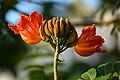
The flower bud is ampule-shaped and contains water. People sometimes play with these buds because of their ability to squirt water.[7] The sap sometimes stains yellow on fingers and clothes. The open flowers are cup-shaped and hold rain and dew, making them attractive to many species of birds.
Flower anatomy[edit | edit source]
The African tulip tree flower produces large flamboyant reddish-orange flowers that have approximately five petals and are 8–15 cm long. The flowers are bisexual and zygomorphic. These are displayed in a terminal corymb-like raceme inflorescence. Its pedicel is approximately 6 cm long. This flower also has a yellow margin and throat. The pistil can be found at center of four stamens that is inserted on the corolla tube. This flower has a slender ovary that is superior and is two celled. The seeds of this tree are flat, thin, and broadly winged.
Species associations[edit | edit source]
In Neotropical gardens and parks, their nectar is popular with many hummingbirds, such as the black-throated mango (Anthracothorax nigricollis), the black jacobin (Florisuga fusca), or the gilded hummingbird (Hylocharis chrysura).[8] The wood of the tree is soft and is used for nesting by many hole-building birds such as barbets.[9] Unfortunately the flowers have a natural defence killing bees, and it is thought various other species who harvest its pollen.[citation needed][disputed ]
Geographic distribution[edit | edit source]
- Native to: Angola, Cameroon, Ethiopia, Ghana, Kenya, Sudan, Tanzania, Uganda, Zambia
- Exotic in: Australia, Bangladesh,[10]Brazil, Colombia, Costa Rica, Cuba, Fiji, Hawaii, Honduras, India, Jamaica, Mauritius, Mexico, Papua New Guinea, Puerto Rico, Sri Lanka, Zanzibar, Philippines
It has become an invasive species in many tropical areas, such as Hawaii, Queensland (Australia), Fiji, Papua New Guinea, South Africa[11] and the wet and intermediate zones of Sri Lanka.[12]
Spathodea campanulata is a declared class 3 pest species in Queensland, Australia, under the Land Protection (Pest and Stock Route Management) Act 2002.[13] It is known to be toxic to Australian native stingless bees, such as Lipotriches (Austronomia) flavoviridis.[14]
Pests and diseases[edit | edit source]
In Uganda, two lepidopteran species, two termite species, and one bark beetle attack S. campanulata. In Puerto Rico nine insect species in the orders Hemiptera, Hymenoptera, Lepidoptera, and Thysanoptera have been reported as feeding on various parts of S. campanulata. The species is quite susceptible to butt and heart rot; wood of the tree rots quickly when in contact with the ground.
Use[edit | edit source]
Its wood is too weak for construction use but ideal enough for boxes and toothpicks. Fijian children sometimes use its flower buds as water pistols.[15]
Common names[edit | edit source]
- Afrikaans: fakkelboom, Afrika-vlamboom[16]
- Bangla: rudrapalash (রুদ্রপলাশ)
- English: African tulip tree, fountain tree, Nandi flame, Nile flame, squirt tree, tulip tree, Uganda flame, Flame Tree of Thika
- Fijian: pasiu, pisipisi[15]
- French: tulipier de Gabon[16]
- Hindi: rugtoora (रुग्तूरा)
- Javanese: ꦕꦿꦸꦠ꧀ꦕꦿꦸꦠꦤ꧀ crut-crutan
- Kannada: Neerukayi mara, Jeerkolavi mara (ನೀರುಕಾಯಿ ಮರ, ಜೀರ್ಕೊೞವಿ ಮರ, ಜೀರ್ಕೊಳವಿ ಮರ)
- Luganda: kifabakazi
- Luhya: muzurio
- Malay: panchut-panchut
- Malayalam: African Poomaram (ആഫ്രിക്കൻ പൂമരം)
- Sinhala: kudaella gaha, kudulu
- Spanish: amapola, espatodea, mampolo, tulipán africano, in Puerto Rico meaíto, in Guatemala llama del bosque.[16]
- Sundanese: ᮊᮄ ᮃᮎᮢᮦᮒ᮪ kaï acret or ᮊᮤᮃᮎᮢᮦᮒ᮪ kiacret[17][16]
- Swahili: kibobakasi, kifabakazi
- Telugu: Neeti Budda (నీటి బుడ్డ), Gonuganta (గోనుగంట)
- Tamil: pasadi (பாசடி)
Nandi: Septet (singular),Septonok (plural)
- Trade name: Nandi flame
Gallery[edit | edit source]
-
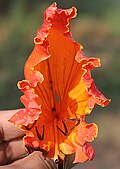 Flower
 -
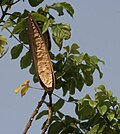 Fruit
Fruit -
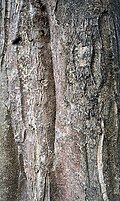 Bark
Bark -
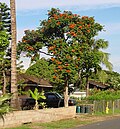 Habitus
 -
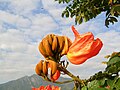 Buds
Buds -
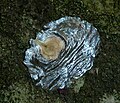 Seed
Seed -
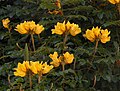 Yellow cultivar
 -
 Buds
Buds -
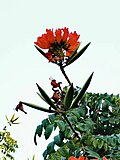 Fruits
 -
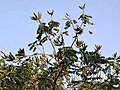 Fruits
 -
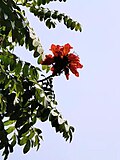 Phyllotaxy
 -
 Leaves


Footnotes[edit | edit source]
- ↑ Rivers, M.C. & Mark, J. (2017). "Spathodea campanulata". IUCN Red List of Threatened Species. 2017 e.T49196213A49196223.
{{cite journal}}:|access-date=requires|url=(help) - ↑ NRCS. "Spathodea campanulata". PLANTS Database. United States Department of Agriculture (USDA). Retrieved 24 November 2015.
- ↑ "GISD".
- ↑ Gledhill, D. (2008). The Names of Plants (4 ed.). Cambridge University Press. p. 357. ISBN 978-0-521-86645-3.
- ↑ Quattrocchi, Umberto (2000). CRC World Dictionary of Plant Names. Vol. 4 R-Z. Taylor & Francis US. p. 2526. ISBN 978-0-8493-2678-3.
- ↑ African Tulip Tropical Tree
- ↑ Hargreaves, Dorothy; Hargreaves, Bob (1964). Tropical Trees of Hawaii. Kailua, Hawaii: Hargreaves. p. 2. ISBN 978-0-910690-02-7.
- ↑ Baza Mendonça & dos Anjos (2005)
- ↑ de QUEIROZ, A. C. M., VENTURIERI, G., VENTURIERI, G., & de OLIVEIRA JUNIOR, M. C. M. (2012). Effect of toxicity of nectar and pollen of african tulip tree (Spathodea campanulata) on Melipona fasciculata and M. seminigra (Apidae, Meliponini). In Embrapa Amazônia Oriental-Resumo em anais de congresso (ALICE). In: ENCONTRO SOBRE ABELHAS, 10., 2012, Ribeirão Preto. Anais... Ribeirão Preto: FUNPEC, 2012
- ↑ "ফুটেছে রুদ্রপলাশ | প্রথম আলো". 18 April 2018.
- ↑ "African tulip tree – Invasive Species South Africa". Retrieved 17 February 2022.
- ↑ Invasive Species Compendium and Lalith Gunasekera, Invasive Plants: A guide to the identification of the most invasive plants of Sri Lanka, Colombo 2009, pp. 70–71.
- ↑ Land Protection (Pest and Stock Route) Regulation 2003 (Qld) – Schedule 2
- ↑ O'Flaherty, Antonia (17 February 2021). "Brisbane beekeeper creates editable map to track African tulip trees killing native stingless bees". ABC News. Australian Broadcasting Corporation. Retrieved 18 February 2021.
- ↑ 15.0 15.1 Keppel, Gunnar; Ghazanfar, Shahina A. (2011). Trees of Fiji: A Guide to 100 Rainforest Trees (third, revised ed.). Secretariat of the Pacific Community & Deutsche Gesellschaft für Technische Zusammenarbeit. pp. 58–9.
- ↑ 16.0 16.1 16.2 16.3 "African tulip tree (Spathodea campanulata)". iNaturalist. Retrieved 2 April 2024.
- ↑ Five hundred plant species in Gunung Halimun Salak National Park, West Java: a checklist including Sundanese names, distribution, and use. Bogor, Indonesia: CIFOR. 2010. p. 74. ISBN 978-602-8693-22-6.
References[edit | edit source]
- Baza Mendonça, Luciana & dos Anjos, Luiz (2005): Beija-flores (Aves, Trochilidae) e seus recursos florais em uma área urbana do Sul do Brasil [Hummingbirds (Aves, Trochilidae) and their flowers in an urban area of southern Brazil]. [Portuguese with English abstract] Revista Brasileira de Zoologia 22(1): 51–59. doi:10.1590/S0101-81752005000100007 PDF fulltext
- http://www.issg.org/database/species/ecology.asp?si=75