

WikiDwarfBOT (talk | contribs) m →References: Replace {{Source}} tag |
Vilianahdm (talk | contribs) formatting fix |
||
| (One intermediate revision by one other user not shown) | |||
| Line 1: | Line 1: | ||
{{Short description|Salutation used to express patriotism in India}} | |||
{{About|the slogan|the Internet comedy show|Jay Hind!}} | |||
{{other uses}} | {{other uses}} | ||
{{ | [[File:Netaji Subhas Chandra Bose.jpg|"Jai Hind" meaning "Victory to India" was popularized by [[Netaji Subhas Chandra Bose]] as a unifying slogan of courage and patriotism during [[Indian Independence Movement|India’s freedom struggle]], especially through the [[Indian National Army]] (INA)|thumb]] | ||
{{italic title}}'''Jai Hind''' ({{Langx|hi|जय हिन्द}}, {{IPA|hi|dʒəj ɦɪnd|IPA}}) is a salutation and slogan that means "Hail India", "Long live India",<ref>{{cite book |title=The Rise and Fall of the British Empire |last=James |first=Lawrence |year=1997 |publisher=[[Macmillan Publishers|Macmillan]] |isbn=978-0-312-16985-5<!-- 8120725069--> |page=548 |url=https://books.google.com/books?id=4DMS3r_BxOYC&q=jai+hind+long+live+india&pg=RA4-PA548-IA8 |access-date=17 February 2010}}</ref> or literally "Victory [for] India" as originally coined by Chempakaraman Pillai .<ref>{{cite book|author=Charles Stephenson|title=Germany's Asia-Pacific Empire: Colonialism and Naval Policy, 1885–1914|url=https://books.google.com/books?id=tOtCAQAAIAAJ|year=2009|publisher=[[Boydell & Brewer]]|isbn=978-1-84383-518-9|page=233|quote=...Champakaraman Pillai, a committed anti-imperialist. He is credited with coining the phrase 'Jai Hind' meaning 'Victory for India'...}}</ref><ref>{{cite book|author=Saroja Sundararajan|title=Madras Presidency in pre-Gandhian era: a historical perspective, 1884–1915|url=https://books.google.com/books?id=-ExuAAAAMAAJ|year=1997|publisher=Lalitha Publications|page=535|quote=To Champakaraman Pillai goes the credit of coining the taraka mantra "Jai Hind" in 1907...}}</ref> Used during [[Indian independence movement|India's independence movement]] from [[British Raj|British rule]],<ref>{{cite book|author=Ian W. Archer|title=Transactions of the Royal Historical Society|url=https://books.google.com/books?id=foj2AwAAQBAJ&pg=PA203|year=2014|publisher=[[Cambridge University Press]]|isbn=978-1-107-06386-0|page=203}}</ref><ref>{{cite book|author=Gyanendra Pandey|title=Remembering Partition: Violence, Nationalism and History in India|url=https://books.google.com/books?id=ZdLhnFet4w4C |year=2001|publisher=Cambridge University Press|isbn=978-0-521-00250-9|pages=100–101}}</ref> it emerged as a [[battle cry]] and in political speeches.<ref name=bose2018 /> The phrase reached a new level of popularity when under [[Subhas Chandra Bose|Netaji Subhas Chandra Bose]] it was adopted as an official slogan of the [[Indian National Army]]. | |||
==Etymology== | |||
''' | The word "jai" (जय ''jaya'' in [[Sanskrit]]) means "triumph, victory, cheers, bravo, rejoice".<ref>{{cite book|author=Duncan Forbes|title=A Dictionary, Hindustani & English: Accompanied by a Reversed Dictionary, English and Hindustani|url=https://books.google.com/books?id=EWtOAQAAMAAJ&pg=PA307|year=1958|publisher=W.H. Allen and Company|page=307}}</ref> The word ''jaya'' appears in [[Vedas|Vedic]] literature such as in ''[[Atharvaveda]]'' 8.50.8 and in post-Vedic literature such as the ''[[Mahabharata]]''.<ref>{{cite book|title=Monier-Williams Sanskrit-English Dictionary 1899 (Updated 2009)|author=Monier Monier-Williams|publisher=Harvard University Press|url=https://www.sanskrit-lexicon.uni-koeln.de/scans/MWScan/2014/web/webtc2/index.php|chapter=jaya (जय)}}</ref> "Hind" (from [[Persian language|Persian]] هند ''hind'') was the common endonym for what is today the entire Indian subcontinent prior to [[Indian independence movement|independence]]. Indians were called "Hindī" as in [[Muhammad Iqbal|Iqbal]]'s iconic Indian patriotic song ''[[Sare Jahan se Accha|Saare Jahaan Se Accha]]''. | ||
== | ==History== | ||
[[Chempakaraman Pillai]] coined the term "Jai Hind", which was adopted as a slogan of the Indian National Army in the 1940s at the suggestion of [[Abid Hasan]]. After India's independence, it emerged as a national slogan<ref>{{cite book | last1=Sharma | first1=Aditi | title=Unsung Warriors (Hindi Translation of Gumnaam Yoddha): Bestseller Book by Aditi Sharma: Unsung Warriors Hindi Translation of Gumnaam Yoddha | date=19 May 2023 | publisher=Prabhat Prakashan | isbn=978-93-5521-768-4 | url=https://books.google.com/books?id=Qoe_EAAAQBAJ&pg=PA24 }}</ref> | |||
In 1907, Chempakaraman Pillai coined the term "Jai Hind",<ref>{{cite book|author=Charles Stephenson|title=Germany's Asia-Pacific Empire: Colonialism and Naval Policy, 1885-1914|url=https://books.google.com/books?id=tOtCAQAAIAAJ|year=2009|publisher=Boydell Press|isbn=978-1-84383-518-9|page=233|quote=...Champakaraman Pillai, a committed anti-imperialist. He is credited with coining the phrase 'Jai Hind' meaning 'Victory for India'...}}</ref><ref>{{cite book|author=Saroja Sundararajan|title=Madras Presidency in pre-Gandhian era: a historical perspective, 1884-1915|url=https://books.google.com/books?id=-ExuAAAAMAAJ|year=1997|publisher=Lalitha Publications|page=535|quote=To Champakaraman Pillai goes the credit of coining the taraka mantra "Jai Hind" in 1907...}}</ref> which was adopted as a slogan of the [[Indian National Army]] in the 1940s at the suggestion of [[Subhas Chandra Bose]] and [[Abid Hasan]].<ref>{{cite book|author=Gurbachan Singh Mangat|title=The Tiger Strikes: An Unwritten Chapter of Netaji's Life History|url=https://books.google.com/books?id=NiMgAAAAMAAJ|year=1986|publisher=Gagan Publishers|page=95}}</ref> After [[Indian independence movement|India's independence]], it emerged as a national slogan.<ref name="bose2018"/><ref name="Who coined 'Jai Hind'">{{Cite news|url=https://www.business-standard.com/article/pti-stories/who-coined-jai-hind-114022400255_1.html|title=Who coined 'Jai Hind'? |newspaper=Business Standard India |date=24 February 2014 |agency=Press Trust of India }}</ref> | |||
According to [[Sumantra Bose]] the phrase is devoid of any religious tones. The term became popular as a slogan and greeting of the Indian National Army organised by [[Subhas Chandra Bose]] and his colleagues, particularly between 1943 and 1945.<ref name=bose2018/> | |||
The | After India's independence, it emerged as a national slogan, and has been a common form of greeting the Indian people by political leaders and [[Prime Minister of India|prime ministers]] such as [[Jawaharlal Nehru]],<ref name="Zachariah2004">{{cite book|author=Benjamin Zachariah|title=Nehru|url=https://archive.org/details/nehru0000zach|url-access=registration|year=2004|publisher=Routledge|isbn=978-1-134-57740-8|pages=[https://archive.org/details/nehru0000zach/page/126 126]–127}}</ref> [[Indira Gandhi]],<ref name=ighandi1984/> [[Rajiv Gandhi]], [[P. V. Narasimha Rao]], and others.<ref>{{cite book|author1=Jagdish Bhagwati|author2=Arvind Panagariya|title=Why Growth Matters: How Economic Growth in India Reduced Poverty and the Lessons for Other Developing Countries|url=https://books.google.com/books?id=yEm-kZpLY7UC&pg=PT35|year=2013|publisher=Public Affairs|isbn=978-1-61039-272-3|page=27}}</ref><ref>{{cite book|title=Economic and Political Weekly, Volume 24|url=https://books.google.com/books?id=w9SwAAAAIAAJ|year=1989|publisher=Sameeksha Trust|page=1325}}</ref> Indira Gandhi in particular often ended her political speeches with a triple shout of "''Jai Hind''".<ref name=ighandi1984>{{cite book|author=Indira Gandhi|title=Selected speeches and writings of Indira Gandhi, September 1972-October 30, 1984|url=https://books.google.com/books?id=PAtuAAAAMAAJ|year=1984|publisher=Publications Division, Ministry of Information and Broadcasting, Govt. of India|pages=273 }}</ref> Since the mid-1990s, it came to be used as a greeting among [[Indian Army]] personnel.<ref name=bose2018>{{cite book|author=Sumantra Bose|title=Secular States, Religious Politics|url=https://books.google.com/books?id=vrxsDwAAQBAJ&pg=PA49|year=2018|publisher=Cambridge University Press|isbn=978-1-108-47203-6|pages=49–50}}</ref> | ||
Since 2019, [[Air India]] requires cabin crew to end every announcement with Jai Hind.<ref>{{cite web |title=Air India demands crew 'hail motherland' |url=https://www.bbc.com/news/world-asia-india-47451761 |website=[[BBC]] |access-date=15 June 2025 |date=5 March 2019}}</ref> | |||
<gallery widths="200px" heights="200px"> | <gallery widths="200px" heights="200px"> | ||
The Prime Minister, Dr. Manmohan Singh chanting 'Jai Hind' from the ramparts of Red Fort on the occasion of 64th Independence Day, in Delhi on August 15, 2010.jpg|Former Prime Minister | The Prime Minister, Dr. Manmohan Singh chanting 'Jai Hind' from the ramparts of Red Fort on the occasion of 64th Independence Day, in Delhi on August 15, 2010.jpg|Former Prime Minister [[Manmohan Singh]] chanting "''Jai Hind''" from the ramparts of [[Red Fort]], [[Delhi]] | ||
JAI HIND.jpg|The book "Jai Hind" | JAI HIND.jpg|The book "''Jai Hind''" by Ramchandra Moreshwar Karkare. | ||
1947 India Flag 3½ annas.jpg|Independent India's first postage stamp. | 1947 India Flag 3½ annas.jpg|Independent India's first postage stamp. | ||
Jai Hind Post-mark.gif|Indian commemorative | Jai Hind Post-mark.gif|Indian commemorative [[Jai Hind postmark|''Jai Hind'' postmark]]. | ||
</gallery> | </gallery> | ||
==In popular culture== | ==In popular culture== | ||
A follower of | A follower of [[Subhas Chandra Bose]], Ramchandra Moreshwar Karkare, of [[Gwalior|Gwalher]] (Gwalior) Madhya Bharat, wrote the patriotic drama ''Jai Hind'' in March 1947, and published a book in [[Hindi]] with the same title. Later, Karkare became Congress president of Central India Province.{{citation needed|date=May 2016}} | ||
The [[Jai Hind postmark]] was the first commemorative [[postmark]] of Independent India. The first stamps of | The [[Jai Hind postmark]] was the first commemorative [[postmark]] of Independent India. The first stamps of an independent India were issued on November 21, 1947, with ''Jai Hind'' inscribed on them, in 1.5 anna, 3.5 anna and 12 anna denominations. Along with ''Jai Hind'', these bore images of the [[Lion Capital of Ashoka]], the [[Flag of India|national flag]], and an aircraft respectively.<ref>{{cite book|author=Gopa Sabharwal|title=India Since 1947: The Independent Years|url=https://books.google.com/books?id=D9gvCgAAQBAJ&pg=PT24|year=2017|publisher=Penguin Random House|isbn=978-93-5214-089-3|page=24}}</ref> "जय हिन्द" is also stated on the first, [[List of postage stamps of India#1947|Independence series of Indian stamps]]. | ||
The phrase is used on [[All India Radio]] at the end of a broadcast.{{citation needed|date=May 2016}} It occurs in the patriotic song "[[Aye Mere Watan Ke Logo]]" sung by [[Lata Mangeshkar]] in 1963.<ref>{{cite book|last=Chaturvedi|first=Mamta |title=Filmi & non-filmi songs|url=https://books.google.com/books?id=459ay5Ai2l4C&q=Jay+Hind&pg=PA38|year=2004|publisher=Diamond Pocket Books|isbn=81-288-0299-2|page=38}}</ref> | The phrase is used on [[All India Radio]] at the end of a broadcast.{{citation needed|date=May 2016}} It occurs in the patriotic song "[[Aye Mere Watan Ke Logo]]" sung by [[Lata Mangeshkar]] in 1963.<ref>{{cite book|last=Chaturvedi|first=Mamta |title=Filmi & non-filmi songs|url=https://books.google.com/books?id=459ay5Ai2l4C&q=Jay+Hind&pg=PA38|year=2004|publisher=Diamond Pocket Books|isbn=81-288-0299-2|page=38}}</ref> The phrase also appeared in early slogans of state-owned [[Air India]], with a 1965 [[Lok Sabha]] debate mentioning it as part of the tagline "One Nation, One Leader, One India, Jai Hind".<ref>{{cite book|title=Asian Recorder|url=https://books.google.com/books?id=O3weAAAAMAAJ|year=1965|publisher=K. K. Thomas at Recorder Press|page=6220}}</ref> | ||
[[Mahatma Gandhi]] sent a piece of crocheted, cotton lace made from yarn | [[Mahatma Gandhi]] sent a piece of crocheted, cotton lace made from yarn he spun by himself, with the central motif of ''Jai Hind'', to [[Elizabeth II|Queen Elizabeth II]] and [[Prince Philip, Duke of Edinburgh|Prince Philip]], as a gift on the occasion of [[Wedding of Princess Elizabeth and Philip Mountbatten|their wedding]] in 1947.<ref>{{cite web|url=http://www.royal.gov.uk/HMTheQueen/TheQueenandspecialanniversaries/DiamondAnniversary/60facts.aspx |title=Archived copy |access-date=November 10, 2015 |url-status=dead |archive-url=https://web.archive.org/web/20151008194238/http://www.royal.gov.uk/HMTheQueen/TheQueenandspecialanniversaries/DiamondAnniversary/60facts.aspx |archive-date=October 8, 2015 }}</ref> | ||
In the Hindi-language film ''[[Pathaan_(film)|Pathaan]]'' (2023), [[Shah Rukh Khan]] uses the phrase ''Jai Hind'' at the end of his fight with the villain played by [[John Abraham]]. | |||
==Other uses== | ==Other uses== | ||
The phrase has also given its name to | The phrase has also given its name to | ||
*''[[ | |||
* ''Jai Hind'' | * Media | ||
* | ** Movies | ||
* [[Jai Hind | *** ''[[Jaihind (1994 film)]]''), a Tamil language movie with [[Arjun Sarja]] as hero | ||
* ''[[Jai Hind (newspaper)|Jai Hind]]'', a Gujarati newspaper | *** ''[[Jai Hind (2019 film)]]'', a Hindi language movie, made by actor-director [[Manoj Kumar]]<ref>{{IMDb title|qid=Q12428152|title=Jai Hind}}</ref> | ||
* | *** ''[[Jai Hind (2012 film)]]'', Kannada language war movie | ||
*** ''[[Jaihind 2]] (2014 film)'', a Hindi language movie (''Arjunin Jaihind 2'' in Tamil) produced and directed by Arjun Sarja | |||
*** ''[[Jai Hind (2019 film)]]'', Bhojpuri language movie | |||
** TV | |||
*** ''[[Jay Hind!]]'', a comedy show | |||
*** [[JaiHind TV]] | |||
** Newspaper | |||
*** ''[[Jai Hind (newspaper)|Jai Hind]]'', a [[Gujarati language|Gujarati]] language newspaper | |||
* Institutes and places | |||
** [[Jai Hind College]] in [[Mumbai]] | |||
** [[Jai Hind metro station]] in [[Kolkata]] | |||
==See also== | ==See also== | ||
* [[Bharat Mata]] | |||
* [[ | * General | ||
* [[ | ** [[Bharat Mata]] | ||
* [[ | |||
* [[ | * Anthems and mottos of Mother India | ||
* [[ | ** [[Hindustan Zindabad]], "Hail India" | ||
* [[ | ** [[Jai Jawan Jai Kisan]], "Hail soldiers and farmers (of India)" | ||
* [[Jai Maharashtra]] | ** [[Janani Janmabhumishcha Swargadapi Gariyasi]], "mother and motherland are more sacred than the heaven" | ||
* [[Jaya Jaya He Telangana]] | ** [[Jana Gana Mana]], the Indian national anthem | ||
* [[ | ** [[Jaya Bharata Jananiya Tanujate]], anthem in Kannada language for Mother India | ||
* [[ | ** [[Vande Mataram]], hail the motherland | ||
** [[National Pledge (India)|National Pledge of India]] | |||
** [[List of Indian state anthems]] | |||
* Slogans of States of India | |||
** [[Jai Jai Garavi Gujarat]] | |||
** [[Jai Maharashtra]] | |||
** [[Jaya Jaya He Telangana]] | |||
** [[Joy Bangla (slogan)|Joy Bangla]] | |||
* Other slogans | |||
** [[Jai Bhim]] | |||
==References== | ==References== | ||
{{Reflist}} | {{Reflist}} | ||
{{Subhas Chandra Bose}} | {{Subhas Chandra Bose}} | ||
| Line 67: | Line 95: | ||
[[Category:Battle cries]] | [[Category:Battle cries]] | ||
[[Category:Hindi words and phrases]] | [[Category:Hindi words and phrases]] | ||
Latest revision as of 20:48, 27 December 2025

Jai Hind (Hindi: जय हिन्द, IPA: [dʒəj ɦɪnd]) is a salutation and slogan that means "Hail India", "Long live India",[1] or literally "Victory [for] India" as originally coined by Chempakaraman Pillai .[2][3] Used during India's independence movement from British rule,[4][5] it emerged as a battle cry and in political speeches.[6] The phrase reached a new level of popularity when under Netaji Subhas Chandra Bose it was adopted as an official slogan of the Indian National Army.
Etymology[edit | edit source]
The word "jai" (जय jaya in Sanskrit) means "triumph, victory, cheers, bravo, rejoice".[7] The word jaya appears in Vedic literature such as in Atharvaveda 8.50.8 and in post-Vedic literature such as the Mahabharata.[8] "Hind" (from Persian هند hind) was the common endonym for what is today the entire Indian subcontinent prior to independence. Indians were called "Hindī" as in Iqbal's iconic Indian patriotic song Saare Jahaan Se Accha.
History[edit | edit source]
Chempakaraman Pillai coined the term "Jai Hind", which was adopted as a slogan of the Indian National Army in the 1940s at the suggestion of Abid Hasan. After India's independence, it emerged as a national slogan[9]
In 1907, Chempakaraman Pillai coined the term "Jai Hind",[10][11] which was adopted as a slogan of the Indian National Army in the 1940s at the suggestion of Subhas Chandra Bose and Abid Hasan.[12] After India's independence, it emerged as a national slogan.[6][13]
According to Sumantra Bose the phrase is devoid of any religious tones. The term became popular as a slogan and greeting of the Indian National Army organised by Subhas Chandra Bose and his colleagues, particularly between 1943 and 1945.[6] After India's independence, it emerged as a national slogan, and has been a common form of greeting the Indian people by political leaders and prime ministers such as Jawaharlal Nehru,[14] Indira Gandhi,[15] Rajiv Gandhi, P. V. Narasimha Rao, and others.[16][17] Indira Gandhi in particular often ended her political speeches with a triple shout of "Jai Hind".[15] Since the mid-1990s, it came to be used as a greeting among Indian Army personnel.[6]
Since 2019, Air India requires cabin crew to end every announcement with Jai Hind.[18]
-

-
 The book "Jai Hind" by Ramchandra Moreshwar Karkare.
 -
 Independent India's first postage stamp.
 -
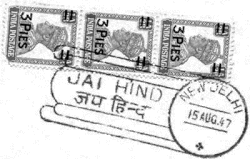 Indian commemorative Jai Hind postmark.


In popular culture[edit | edit source]
A follower of Subhas Chandra Bose, Ramchandra Moreshwar Karkare, of Gwalher (Gwalior) Madhya Bharat, wrote the patriotic drama Jai Hind in March 1947, and published a book in Hindi with the same title. Later, Karkare became Congress president of Central India Province.[citation needed]
The Jai Hind postmark was the first commemorative postmark of Independent India. The first stamps of an independent India were issued on November 21, 1947, with Jai Hind inscribed on them, in 1.5 anna, 3.5 anna and 12 anna denominations. Along with Jai Hind, these bore images of the Lion Capital of Ashoka, the national flag, and an aircraft respectively.[19] "जय हिन्द" is also stated on the first, Independence series of Indian stamps.
The phrase is used on All India Radio at the end of a broadcast.[citation needed] It occurs in the patriotic song "Aye Mere Watan Ke Logo" sung by Lata Mangeshkar in 1963.[20] The phrase also appeared in early slogans of state-owned Air India, with a 1965 Lok Sabha debate mentioning it as part of the tagline "One Nation, One Leader, One India, Jai Hind".[21]
Mahatma Gandhi sent a piece of crocheted, cotton lace made from yarn he spun by himself, with the central motif of Jai Hind, to Queen Elizabeth II and Prince Philip, as a gift on the occasion of their wedding in 1947.[22]
In the Hindi-language film Pathaan (2023), Shah Rukh Khan uses the phrase Jai Hind at the end of his fight with the villain played by John Abraham.
Other uses[edit | edit source]
The phrase has also given its name to
- Media
- Movies
- Jaihind (1994 film)), a Tamil language movie with Arjun Sarja as hero
- Jai Hind (2019 film), a Hindi language movie, made by actor-director Manoj Kumar[23]
- Jai Hind (2012 film), Kannada language war movie
- Jaihind 2 (2014 film), a Hindi language movie (Arjunin Jaihind 2 in Tamil) produced and directed by Arjun Sarja
- Jai Hind (2019 film), Bhojpuri language movie
- Movies
- TV
- Jay Hind!, a comedy show
- JaiHind TV
- TV
- Institutes and places
See also[edit | edit source]
- General
- Anthems and mottos of Mother India
- Hindustan Zindabad, "Hail India"
- Jai Jawan Jai Kisan, "Hail soldiers and farmers (of India)"
- Janani Janmabhumishcha Swargadapi Gariyasi, "mother and motherland are more sacred than the heaven"
- Jana Gana Mana, the Indian national anthem
- Jaya Bharata Jananiya Tanujate, anthem in Kannada language for Mother India
- Vande Mataram, hail the motherland
- National Pledge of India
- List of Indian state anthems
- Slogans of States of India
- Other slogans
References[edit | edit source]
- ↑ James, Lawrence (1997). The Rise and Fall of the British Empire. Macmillan. p. 548. ISBN 978-0-312-16985-5. Retrieved 17 February 2010.
- ↑ Charles Stephenson (2009). Germany's Asia-Pacific Empire: Colonialism and Naval Policy, 1885–1914. Boydell & Brewer. p. 233. ISBN 978-1-84383-518-9.
...Champakaraman Pillai, a committed anti-imperialist. He is credited with coining the phrase 'Jai Hind' meaning 'Victory for India'...
- ↑ Saroja Sundararajan (1997). Madras Presidency in pre-Gandhian era: a historical perspective, 1884–1915. Lalitha Publications. p. 535.
To Champakaraman Pillai goes the credit of coining the taraka mantra "Jai Hind" in 1907...
- ↑ Ian W. Archer (2014). Transactions of the Royal Historical Society. Cambridge University Press. p. 203. ISBN 978-1-107-06386-0.
- ↑ Gyanendra Pandey (2001). Remembering Partition: Violence, Nationalism and History in India. Cambridge University Press. pp. 100–101. ISBN 978-0-521-00250-9.
- ↑ 6.0 6.1 6.2 6.3 Sumantra Bose (2018). Secular States, Religious Politics. Cambridge University Press. pp. 49–50. ISBN 978-1-108-47203-6.
- ↑ Duncan Forbes (1958). A Dictionary, Hindustani & English: Accompanied by a Reversed Dictionary, English and Hindustani. W.H. Allen and Company. p. 307.
- ↑ Monier Monier-Williams. "jaya (जय)". Monier-Williams Sanskrit-English Dictionary 1899 (Updated 2009). Harvard University Press.
- ↑ Sharma, Aditi (19 May 2023). Unsung Warriors (Hindi Translation of Gumnaam Yoddha): Bestseller Book by Aditi Sharma: Unsung Warriors Hindi Translation of Gumnaam Yoddha. Prabhat Prakashan. ISBN 978-93-5521-768-4.
- ↑ Charles Stephenson (2009). Germany's Asia-Pacific Empire: Colonialism and Naval Policy, 1885-1914. Boydell Press. p. 233. ISBN 978-1-84383-518-9.
...Champakaraman Pillai, a committed anti-imperialist. He is credited with coining the phrase 'Jai Hind' meaning 'Victory for India'...
- ↑ Saroja Sundararajan (1997). Madras Presidency in pre-Gandhian era: a historical perspective, 1884-1915. Lalitha Publications. p. 535.
To Champakaraman Pillai goes the credit of coining the taraka mantra "Jai Hind" in 1907...
- ↑ Gurbachan Singh Mangat (1986). The Tiger Strikes: An Unwritten Chapter of Netaji's Life History. Gagan Publishers. p. 95.
- ↑ "Who coined 'Jai Hind'?". Business Standard India. Press Trust of India. 24 February 2014.
- ↑ Benjamin Zachariah (2004). Nehru. Routledge. pp. 126–127. ISBN 978-1-134-57740-8.
- ↑ 15.0 15.1 Indira Gandhi (1984). Selected speeches and writings of Indira Gandhi, September 1972-October 30, 1984. Publications Division, Ministry of Information and Broadcasting, Govt. of India. p. 273.
- ↑ Jagdish Bhagwati; Arvind Panagariya (2013). Why Growth Matters: How Economic Growth in India Reduced Poverty and the Lessons for Other Developing Countries. Public Affairs. p. 27. ISBN 978-1-61039-272-3.
- ↑ Economic and Political Weekly, Volume 24. Sameeksha Trust. 1989. p. 1325.
- ↑ "Air India demands crew 'hail motherland'". BBC. 5 March 2019. Retrieved 15 June 2025.
- ↑ Gopa Sabharwal (2017). India Since 1947: The Independent Years. Penguin Random House. p. 24. ISBN 978-93-5214-089-3.
- ↑ Chaturvedi, Mamta (2004). Filmi & non-filmi songs. Diamond Pocket Books. p. 38. ISBN 81-288-0299-2.
- ↑ Asian Recorder. K. K. Thomas at Recorder Press. 1965. p. 6220.
- ↑ "Archived copy". Archived from the original on October 8, 2015. Retrieved November 10, 2015.
{{cite web}}: CS1 maint: archived copy as title (link) - ↑ Jai Hind on IMDb
| Family |
|  | |||||
|---|---|---|---|---|---|---|---|
| Events | |||||||
| People |
| ||||||
| Legacy | |||||||