

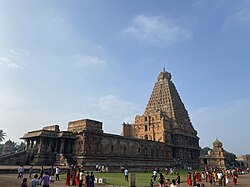
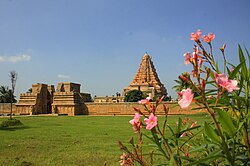
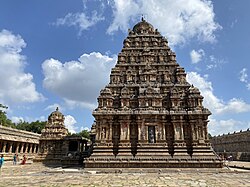
Kamal Guha (talk | contribs) Tamil Nadu Hindu temple template added |
LolitasErurf (talk | contribs) formatting fix |
||
| Line 5: | Line 5: | ||
| caption = Scenes from the three temples | | caption = Scenes from the three temples | ||
| location = [[Tamil Nadu]], [[India]] | | location = [[Tamil Nadu]], [[India]] | ||
| includes = | | includes = [[Brihadisvara Temple|The Brihadisvara Temple Complex, Thanjavur]]<br/>[[Brihadisvara Temple, Gangaikonda Cholapuram|The Brihadisvara Temple Complex, Gangaikondacholapuram]]<br/>[[Airavatesvara Temple|The Airavatesvara Temple Complex, Darasuram]] | ||
| ID = 250bis | | ID = 250bis | ||
| coordinates = {{coord|10|46|59|N|79|07|57|E|region:IN|display=title, inline|format=dms}} | | coordinates = {{coord|10|46|59|N|79|07|57|E|region:IN|display=title, inline|format=dms}} | ||
| year = | | year = 1986 | ||
| extension = 2004 | | extension = 2004 | ||
| area = {{convert|21.88|ha|acre|abbr=on}} | | area = {{convert|21.88|ha|acre|abbr=on}} | ||
| Line 19: | Line 14: | ||
| locmapin = India#Tamil Nadu | | locmapin = India#Tamil Nadu | ||
| map_caption = | | map_caption = | ||
| WHS = Great Living Chola Temples | |||
| Criteria = {{UNESCO WHS type|(i), (ii), (iii), (iv)}}(i), (ii), (iii), (iv) | |||
}} | }} | ||
The '''Great Living Chola Temples''' is a [[UNESCO]] [[World Heritage Site]] designation for a group of [[Chola dynasty]] era [[Hindu temple]]s in the Indian state of [[Tamil Nadu]].<ref name=":0">{{ | The '''Great Living Chola Temples''' is a [[UNESCO]] [[World Heritage Site]] designation for a group of three [[Chola dynasty]] era [[Hindu temple]]s in the Indian state of [[Tamil Nadu]]. The temple at [[Thanjavur]] was added in the list in 1987, while the other two temples were added in 2004.<ref name=":0">{{cite web|url=https://whc.unesco.org/en/list/250 |title=Great Living Chola Temples |access-date=6 November 2010 |publisher=World Heritage: Unesco.org}}</ref> | ||
==World Heritage Site recognition== | Completed between early 11th and the 12th century CE, the monuments include:<ref>{{cite web|url=https://whc.unesco.org/archive/advisory_body_evaluation/945rev.pdf |title=Great Living Chola Temples |access-date=6 November 2010 |publisher=[[UNESCO]]}}</ref> | ||
* [[Brihadisvara Temple]] at [[Thanjavur]], built by [[Rajaraja I]]. | |||
* [[Brihadisvara Temple, Gangaikonda Cholapuram|Brihadisvara Temple]] at [[Gangaikonda Cholapuram]], built by [[Rajendra Chola I]]. | |||
* [[Airavatesvara Temple]] at [[Darasuram]], built by [[Rajaraja II]]. | |||
== World Heritage Site recognition == | |||
The Temple Complex at [[Thanjavur]] was recognised in 1987. The Temple Complex at [[Gangaikonda Cholapuram]] and the Airavatesvara Temple Complex were added as extensions to the site in 2004. The criteria for inclusion in the "Great Living Chola Temples" site are: | The Temple Complex at [[Thanjavur]] was recognised in 1987. The Temple Complex at [[Gangaikonda Cholapuram]] and the Airavatesvara Temple Complex were added as extensions to the site in 2004. The criteria for inclusion in the "Great Living Chola Temples" site are: | ||
*Criterion (i): The three [[Chola]] temples of Southern India represent an outstanding creative achievement in the architectural conception of the pure form of the Dravidan type of temple. | * Criterion (i): The three [[Chola]] temples of Southern India represent an outstanding creative achievement in the architectural conception of the pure form of the Dravidan type of temple. | ||
*Criterion (ii): The [[Brihadisvara Temple]] at Thanjavur became the first great example of the Chola temples, followed by a development of which the other two properties also bear witness. | * Criterion (ii): The [[Brihadisvara Temple]] at Thanjavur became the first great example of the Chola temples, followed by a development of which the other two properties also bear witness. | ||
*Criterion (iii): The three Great Chola Temples are an exceptional and the most outstanding testimony to the development of the architecture of the Chola Empire and the [[Tamil civilization]] in Southern India. | * Criterion (iii): The three Great Chola Temples are an exceptional and the most outstanding testimony to the development of the architecture of the Chola Empire and the [[Tamil civilization]] in Southern India. | ||
*Criterion (iv): The Great Chola temples at Thanjavur, at Gangaikondacholapuram and | * Criterion (iv): The Great Chola temples at Thanjavur, at Gangaikondacholapuram and Darasuram are outstanding examples of the architecture and the representation of the Chola ideology. | ||
== Temples == | |||
Thanjavur is about {{convert|340|km}} southwest of [[Chennai]]. Gangaikonda Cholapuram and Darasuram are respectively about {{convert|70|km}} and about {{convert|40|km}} to its northeast. | |||
{{Location map+ | Tamil Nadu | {{Location map+ | Tamil Nadu | ||
| width = 300 | | width = 300 | ||
| Line 88: | Line 89: | ||
}} | }} | ||
===Brihadisvara Temple in Thanjavur=== | === Brihadisvara Temple in Thanjavur === | ||
{{main|Brihadisvara Temple, Thanjavur}} | {{main|Brihadisvara Temple, Thanjavur}} | ||
[[File:Brihadisvara Temple - Thanjavur peruvudaiyar kovil ttkcvrvb122k23iph (588).jpg|thumb|Brihadisvara Temple in Thanjavur]] | |||
The Brihadisvara Temple at Thanjavur is a [[Hindu temple]] dedicated to [[Shiva]].<ref name=britbrihadthanj>[https://www.britannica.com/place/Thanjavur-India Thanjavur], Encyclopaedia Britannica</ref><ref name=asibrihadthanj/> It is one of the largest South Indian temples and an exemplary example of fully realized [[Tamil architecture]].<ref>{{cite book |first=John |last=Keay |author-link=John Keay |year=2000 |title=India, a History |publisher=[[Harper Collins Publishers]] |location=New York, United States |isbn=0-00-638784-5 |url=https://books.google.com/books?id=3aeQqmcXBhoC |pages=xix}}</ref> Built by [[Raja Raja Chola I]] between 1003 and 1010 AD. The original monuments of this 11th century temple were built around a moat. It included gopura, the main temple, its massive tower, inscriptions, frescoes and sculptures predominantly related to [[Shaivism]], but also of [[Vaishnvaism]] and [[Shaktism]] traditions of [[Hinduism]]. The temple was damaged in its history and some artwork is now missing. Additional mandapam and monuments were added in centuries that followed. The temple now stands amidst fortified walls that were added after the 16th century.{{sfn|S.R. Balasubrahmanyam|1975|pp=1-21}}<ref name=michell16>{{cite book|first=George |last=Michell |date=2008 |title=Architecture and art of Southern India |publisher=[[Cambridge University Press]] |pages=16–21, 89–91}}</ref> | |||
Built out of granite, the [[vimana (architectural feature)|vimanam]] tower above the sanctum is one of the tallest in South India.<ref name=asibrihadthanj>{{cite web|title=The Archaeological Survey of India (ASI) |url=http://asi.nic.in/asi_monu_whs_cholabt.asp}}</ref> The temple has a massive colonnaded prakara (corridor) and one of the largest Shiva linga in India.<ref name=asibrihadthanj/>{{sfn|S.R. Balasubrahmanyam|1975|pp=20-21}} It is also famed for the quality of its sculpture, as well as being the location that commissioned the brass [[Nataraja]] – Shiva as the lord of dance, in 11th century. The complex includes shrines for [[Nandi (Hinduism)|Nandi]], Amman, Subrahmanyar, Ganesha, Sabhapati, Dakshinamurti, Chandesrvarar, Varahi and others.{{sfn|S.R. Balasubrahmanyam|1975|pp=1-26}} The temple is one of the most visited tourist attractions in [[Tamil Nadu]].<ref name="Gopal 1990 185">{{cite book|title=India through the ages|url=https://archive.org/details/indiathroughages00mada|last=Gopal|first=Madan|year= 1990| page= [https://archive.org/details/indiathroughages00mada/page/185 185]|editor=K.S. Gautam|publisher=Publication Division, Ministry of Information and Broadcasting, Government of India}}</ref> | |||
=== Brihadisvara Temple in Gangaikonda Cholapuram === | |||
{{main|Brihadisvara Temple, Gangaikonda Cholapuram}} | |||
[[File:Gangaikonda Cholapuram, Tamil Nadu.jpg|thumb|Brihadisvara Temple in Gangaikonda Cholapuram]] | |||
The Brihadisvara Temple at Gangaikonda Cholapuram is a Hindu temple located at Gangaikonda Cholapuram about {{convert|70|km}} from the Thanjavur Brihadisvara Temple. This temple was completed in 1035 AD by [[Rajendra Chola I]] as a part of his new capital, this Chola dynasty era temple is similar in design and has a similar name as the 11th century, and sometimes just called the Gangaikondacholapuram temple.{{sfn|S.R. Balasubrahmanyam|1975|pp=241-245}}<ref name=asigcbt/>{{sfn|Michell|1988|p=4, 51-53, 145}} | |||
It is dedicated to Shiva and based on a square plan, but the temple reverentially displays Vaishnavism, Shaktism and syncretic equivalence themes of Hinduism with statues of Vishnu, Durga, Surya, Harihara, Ardhanishvara, and others.<ref name=asigcbt>[http://asi.nic.in/asi_monu_whs_cholabt.asp Great Living Chola Temples], Archaeological Survey of India, Government of India</ref><ref name=ayyar291>PV Jagadisa Ayyar (1993), South Indian Shrines, Asian Educational Services, {{ISBN|81-206-0151-3}}, pages 291-295</ref>{{sfn|S.R. Balasubrahmanyam|1975|pp=241-249}} In addition to the main shrine with linga, the temple complex has a number of smaller shrines, gopura, and other monuments, with some partially ruined or restored in later centuries. The temple is famed for its bronze sculptures, artwork on its walls, the Nandi and the scale of its curvilinear tower.<ref name=asigcbt/>{{sfn|S.R. Balasubrahmanyam|1975|pp=243-249}}<ref name=unesco>{{cite web|url=https://whc.unesco.org/en/list/250/ |title=Great Living Chola Temples|publisher= UNESCO World Heritage Centre|year=2004}}</ref> | |||
=== Airavatesvara Temple === | |||
{{main|Airavatesvara Temple}} | |||
[[File:Airavatesvara Temple, Dharasuram, Kumbakonam ttkcvrvb122k23iph (586).jpg|thumb|Airavatesvara Temple]] | |||
The Airavatesvara Temple is at [[Darasuram]], in the outskirt of the city of [[Kumbakonam]], completed in 1166 AD.<ref name=michell91>{{cite book|first=George |last=Michell |editor-first1=Julia A. B. |editor-last1=Hegewald |editor-first2=Subrata K. |editor-last2=Mitra |title=Re-Use-The Art and Politics of Integration and Anxiety |url=https://books.google.com/books?id=2ZqHAwAAQBAJ&pg=PA91 |year=2012 |publisher=SAGE Publications |isbn=978-81-321-0981-5 |pages=91–93}}</ref> It is one among a cluster of eighteen medieval era large Hindu temples in the [[Kumbakonam]] area.<ref>[[#Ayyar|Ayyar 1992]], pp. 349-350</ref> The temple is dedicated to Lord Shiva. It also reverentially displays Vaishnavism and Shaktism traditions of Hinduism, along with the legends associated with sixty three [[Nayanars]] – the [[Bhakti movement]] saints of Shaivism.{{sfn|S.R. Balasubrahmanyam|1979|pp=225-245}}<ref name="Harle1994p318">{{cite book|first=James C. |last=Harle |title=The Art and Architecture of the Indian Subcontinent |url=https://archive.org/details/artarchitectureo00harl |url-access=registration |year=1994 |publisher=[[Yale University Press]] |isbn=978-0-300-06217-5 |page=[https://archive.org/details/artarchitectureo00harl/page/318 318]}}</ref><ref name="Dehejia2010p106">{{cite book|first=Vidya |last=Dehejia |title=Art of the Imperial Cholas |url=https://books.google.com/books?id=23F7vTn3hBMC |year=2010 |publisher=[[Columbia University Press]] |isbn=978-0-231-51524-5 |pages=106–115}}</ref> | |||
Named after Airavata, Indra's white elephant, the Airavatesvara Temple is part of the Great Living Chola Temples, a group of three major Chola-era temples in Tamil Nadu, India. It is the last of the three temples built under successive Chola rulers, beginning with Rajaraja I, and was constructed by Rajaraja II around c. 1150 CE. The temple is noted for the Rajagambhira Thirumandapam ("Royal Courtyard"), which features intricately carved pillars, long granite steps, and stone chariots drawn by horses. The site is located at Darasuram, near Kumbakonam. | |||
< | The stone temple incorporates a chariot structure, and includes major Vedic and Puranic deities such as Indra, [[Agni]], [[Varuna]], [[Vayu]], Brahma, Surya, Vishnu, Saptamtrikas, Durga, Saraswati, Sri Devi (Lakshmi), Ganga, Yamuna, Subrahmanya, Ganesha, Kama, Rati and others.{{sfn|S.R. Balasubrahmanyam|1979|pp=225-234}} The temple was much larger and once had seven courtyards according to inscriptions. Only one courtyard survives; parts of the temple such as the gopuram are in ruins, and the main temple and the main temple and associated shrines stand alone.<ref name=ayyar351>[[#Ayyar|Ayyar 1993]], p. 351</ref> The temple continues to attract large gatherings of Hindu pilgrims every year.<ref>[[#Ayyar|Ayyar 1992]], pp. 350-351</ref>{{sfn|S.R. Balasubrahmanyam|1979|pp=225-234}}<ref>{{cite book|first1=Pratapaditya |last1=Pal |first2=Stephen P. |last2=Huyler |first3=John E. |last3=Cort |display-authors=etal |title=Puja and Piety: Hindu, Jain, and Buddhist Art from the Indian Subcontinent |url=https://books.google.com/books?id=NXolDQAAQBAJ&pg=PA65 |year=2016 |publisher=[[University of California Press]] |isbn=978-0-520-28847-8 |page=65}}</ref> | ||
== Gallery == | |||
<gallery mode="packed" heights="180" caption="Brihadisvara Temple in Thanjavur"> | |||
File:Thanjavur, Brihadishwara Temple (7013915633).jpg|View of the [[vimana|Śrī Vimāna]] of the Thanjavur Temple | File:Thanjavur, Brihadishwara Temple (7013915633).jpg|View of the [[vimana|Śrī Vimāna]] of the Thanjavur Temple | ||
File: | File:Brihadisvara Temple, Thanjavur, Tamil Nadu, India (2016) 086.jpg|The granite [[gopuram]] (tower) of the Thanjavur Temple | ||
File: | File:Thanjavur brihadeeswarar temple.jpg|Temple entrance gopurams at Thanjavur | ||
File:An elephant relief on the Brihadisvara Temple, Thanjavur.jpg|An elephant relief on the Thanjavur temple | File:An elephant relief on the Brihadisvara Temple, Thanjavur.jpg|An elephant relief on the Thanjavur temple | ||
File:Sanskrit written on the Brihadisvara Temple, Thanjavur.jpg|Tamil written on the Thanjavur Temple | File:Sanskrit written on the Brihadisvara Temple, Thanjavur.jpg|Tamil written on the Thanjavur Temple | ||
</gallery> | </gallery> | ||
===Brihadisvara Temple in Gangaikonda Cholapuram | <gallery mode="packed" heights="180" caption="Brihadisvara Temple in Gangaikonda Cholapuram"> | ||
File:Gangaikonda Cholapuram Temple entrance.jpg|The entrance leads into a grand complex | |||
File:Back view of Raja gopuram.jpg|The pyramidal structure above the sanctum at the Gangaikonda Cholapuram Temple | File:Back view of Raja gopuram.jpg|The pyramidal structure above the sanctum at the Gangaikonda Cholapuram Temple | ||
File:Gangaikonda Cholapuram-Temple-WUS02583.jpg|[[Nandi (Hinduism)|Nandi]] | |||
File:Gangaikonda cholapuram sculptures 06.jpg|[[Ardhanarishvara]] (half Shiva, half Parvati): sculpture at Gangaikonda Cholapuram | File:Gangaikonda cholapuram sculptures 06.jpg|[[Ardhanarishvara]] (half Shiva, half Parvati): sculpture at Gangaikonda Cholapuram | ||
File:Chola sculpture.jpg|Stone sculpture at Gangaikonda Cholapuram | File:Chola sculpture.jpg|Stone sculpture at Gangaikonda Cholapuram | ||
</gallery> | </gallery> | ||
<gallery mode="packed" heights="180" caption="Airavatesvara Temple"> | |||
File:A Dravidian architecture Pillar in Airavatesvara Temple, Darasuram @ Thanjavur district..JPG|A pillar in Dravidian architectural-style in Airavatesvara Temple | File:A Dravidian architecture Pillar in Airavatesvara Temple, Darasuram @ Thanjavur district..JPG|A pillar in Dravidian architectural-style in Airavatesvara Temple | ||
File:Chariot detail, Airavatesvara, Tamil Nadu.jpg|Chariot detail of the Airavatesvara Temple | File:Chariot detail, Airavatesvara, Tamil Nadu.jpg|Chariot detail of the Airavatesvara Temple | ||
File:Darasuram, Airavatesvara Temple, Mandapa at night, India.jpg|Altar | |||
File:Darasuram, Airavatesvara Temple, Inner halls, India.jpg|Pillars | |||
</gallery> | </gallery> | ||
| Line 134: | Line 139: | ||
{{reflist}} | {{reflist}} | ||
== | == Sources == | ||
* {{cite book |first= P.V. Jagadisa | * {{cite book |last=Ayyar |first= P.V. Jagadisa |title=South Indian Shrines |publisher=Asian Educational Services |location=New Delhi |year=1993 |isbn=81-206-0151-3 |ref=Ayyar}} | ||
* {{cite book |first= Krishna | * {{cite book |last=Chaitanya |first=Krishna |title=Arts of India |publisher=Abhinav Publications |year=1987 |ref=Chaitanya}} | ||
* {{cite book |first=Richard | * {{cite book |last=Davis |first=Richard |title=Lives of Indian images |publisher=[[Princeton University Press]] |location=Princeton, N.J |year=1997 |isbn=0-691-00520-6 |ref=Davis |url-access=registration |url=https://archive.org/details/livesofindianima0000davi}} | ||
* {{ | * {{cite book |author=S.R. Balasubrahmanyam |title=Later Chola Temples |publisher=Thomson Press |year=1979 |oclc=6921015}} | ||
* {{ | * {{cite book |author=S.R. Balasubrahmanyam |title=Middle Chola Temples |publisher=Thomson Press |year=1975 |isbn=978-9060236079}} | ||
* {{ | * {{cite book |last=Michell |first=George |title=The Hindu Temple: An Introduction to Its Meaning and Forms |publisher=[[University of Chicago Press]] |year=1988 |location=Chicago |isbn=0-226-53230-5}} | ||
==External links== | == External links == | ||
* {{Commons category-inline|Great living Chola temples}} | * {{Commons category-inline|Great living Chola temples}} | ||
* [https://whc.unesco.org/en/list/250 UNESCO's World Heritage Site] listing the Chola temples | * [https://whc.unesco.org/en/list/250 UNESCO's World Heritage Site] listing the Chola temples | ||
{{World Heritage Sites in India}} | {{World Heritage Sites in India}} | ||
[[Category:World Heritage Sites in India]] | [[Category:World Heritage Sites in India]] | ||
Latest revision as of 08:52, 19 January 2026
| UNESCO World Heritage Site | |
|---|---|
 Scenes from the three temples | |
| Location | Tamil Nadu, India |
| Includes | The Brihadisvara Temple Complex, Thanjavur The Brihadisvara Temple Complex, Gangaikondacholapuram The Airavatesvara Temple Complex, Darasuram |
| Criteria | Cultural: (i), (ii), (iii), (iv) |
| Reference | 250bis |
| Inscription | 1986 (10th session) |
| Extensions | 2004 |
| Area | 21.88 ha (54.1 acres) |
| Buffer zone | 16.715 ha (41.30 acres) |
| Coordinates | 10°46′59″N 79°07′57″E / 10.78306°N 79.13250°E |
  Location of Great Living Chola Temples in India  Great Living Chola Temples (Tamil Nadu) | |
The Great Living Chola Temples is a UNESCO World Heritage Site designation for a group of three Chola dynasty era Hindu temples in the Indian state of Tamil Nadu. The temple at Thanjavur was added in the list in 1987, while the other two temples were added in 2004.[1]
Completed between early 11th and the 12th century CE, the monuments include:[2]
- Brihadisvara Temple at Thanjavur, built by Rajaraja I.
- Brihadisvara Temple at Gangaikonda Cholapuram, built by Rajendra Chola I.
- Airavatesvara Temple at Darasuram, built by Rajaraja II.
World Heritage Site recognition[edit | edit source]
The Temple Complex at Thanjavur was recognised in 1987. The Temple Complex at Gangaikonda Cholapuram and the Airavatesvara Temple Complex were added as extensions to the site in 2004. The criteria for inclusion in the "Great Living Chola Temples" site are:
- Criterion (i): The three Chola temples of Southern India represent an outstanding creative achievement in the architectural conception of the pure form of the Dravidan type of temple.
- Criterion (ii): The Brihadisvara Temple at Thanjavur became the first great example of the Chola temples, followed by a development of which the other two properties also bear witness.
- Criterion (iii): The three Great Chola Temples are an exceptional and the most outstanding testimony to the development of the architecture of the Chola Empire and the Tamil civilization in Southern India.
- Criterion (iv): The Great Chola temples at Thanjavur, at Gangaikondacholapuram and Darasuram are outstanding examples of the architecture and the representation of the Chola ideology.
Temples[edit | edit source]
Thanjavur is about 340 kilometres (210 mi) southwest of Chennai. Gangaikonda Cholapuram and Darasuram are respectively about 70 kilometres (43 mi) and about 40 kilometres (25 mi) to its northeast.


Brihadisvara Temple in Thanjavur[edit | edit source]
.jpg)
The Brihadisvara Temple at Thanjavur is a Hindu temple dedicated to Shiva.[3][4] It is one of the largest South Indian temples and an exemplary example of fully realized Tamil architecture.[5] Built by Raja Raja Chola I between 1003 and 1010 AD. The original monuments of this 11th century temple were built around a moat. It included gopura, the main temple, its massive tower, inscriptions, frescoes and sculptures predominantly related to Shaivism, but also of Vaishnvaism and Shaktism traditions of Hinduism. The temple was damaged in its history and some artwork is now missing. Additional mandapam and monuments were added in centuries that followed. The temple now stands amidst fortified walls that were added after the 16th century.[6][7]
Built out of granite, the vimanam tower above the sanctum is one of the tallest in South India.[4] The temple has a massive colonnaded prakara (corridor) and one of the largest Shiva linga in India.[4][8] It is also famed for the quality of its sculpture, as well as being the location that commissioned the brass Nataraja – Shiva as the lord of dance, in 11th century. The complex includes shrines for Nandi, Amman, Subrahmanyar, Ganesha, Sabhapati, Dakshinamurti, Chandesrvarar, Varahi and others.[9] The temple is one of the most visited tourist attractions in Tamil Nadu.[10]
Brihadisvara Temple in Gangaikonda Cholapuram[edit | edit source]

The Brihadisvara Temple at Gangaikonda Cholapuram is a Hindu temple located at Gangaikonda Cholapuram about 70 kilometres (43 mi) from the Thanjavur Brihadisvara Temple. This temple was completed in 1035 AD by Rajendra Chola I as a part of his new capital, this Chola dynasty era temple is similar in design and has a similar name as the 11th century, and sometimes just called the Gangaikondacholapuram temple.[11][12][13]
It is dedicated to Shiva and based on a square plan, but the temple reverentially displays Vaishnavism, Shaktism and syncretic equivalence themes of Hinduism with statues of Vishnu, Durga, Surya, Harihara, Ardhanishvara, and others.[12][14][15] In addition to the main shrine with linga, the temple complex has a number of smaller shrines, gopura, and other monuments, with some partially ruined or restored in later centuries. The temple is famed for its bronze sculptures, artwork on its walls, the Nandi and the scale of its curvilinear tower.[12][16][17]
Airavatesvara Temple[edit | edit source]
.jpg)
The Airavatesvara Temple is at Darasuram, in the outskirt of the city of Kumbakonam, completed in 1166 AD.[18] It is one among a cluster of eighteen medieval era large Hindu temples in the Kumbakonam area.[19] The temple is dedicated to Lord Shiva. It also reverentially displays Vaishnavism and Shaktism traditions of Hinduism, along with the legends associated with sixty three Nayanars – the Bhakti movement saints of Shaivism.[20][21][22]
Named after Airavata, Indra's white elephant, the Airavatesvara Temple is part of the Great Living Chola Temples, a group of three major Chola-era temples in Tamil Nadu, India. It is the last of the three temples built under successive Chola rulers, beginning with Rajaraja I, and was constructed by Rajaraja II around c. 1150 CE. The temple is noted for the Rajagambhira Thirumandapam ("Royal Courtyard"), which features intricately carved pillars, long granite steps, and stone chariots drawn by horses. The site is located at Darasuram, near Kumbakonam.
The stone temple incorporates a chariot structure, and includes major Vedic and Puranic deities such as Indra, Agni, Varuna, Vayu, Brahma, Surya, Vishnu, Saptamtrikas, Durga, Saraswati, Sri Devi (Lakshmi), Ganga, Yamuna, Subrahmanya, Ganesha, Kama, Rati and others.[23] The temple was much larger and once had seven courtyards according to inscriptions. Only one courtyard survives; parts of the temple such as the gopuram are in ruins, and the main temple and the main temple and associated shrines stand alone.[24] The temple continues to attract large gatherings of Hindu pilgrims every year.[25][23][26]
Gallery[edit | edit source]
- Brihadisvara Temple in Thanjavur
-
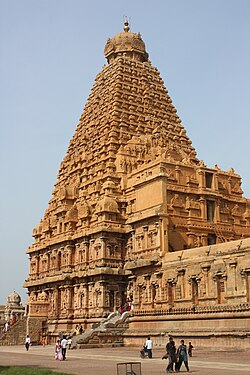 View of the Śrī Vimāna of the Thanjavur Temple
 -
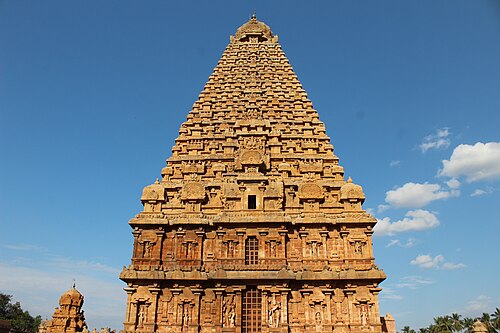 The granite gopuram (tower) of the Thanjavur Temple
 -
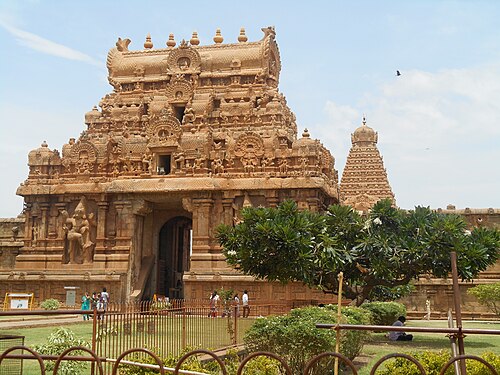 Temple entrance gopurams at Thanjavur
 -
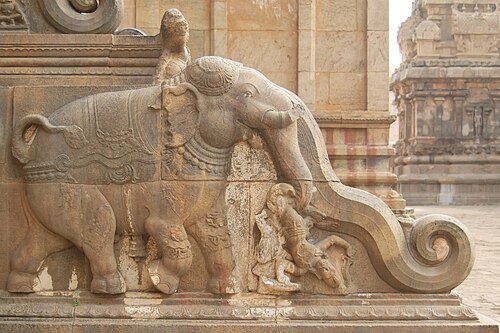 An elephant relief on the Thanjavur temple
 -
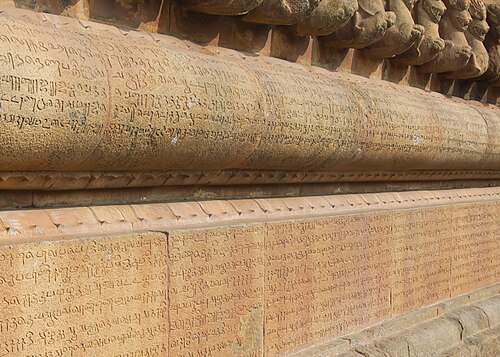 Tamil written on the Thanjavur Temple
.jpg)
_086.jpg)


- Brihadisvara Temple in Gangaikonda Cholapuram
-
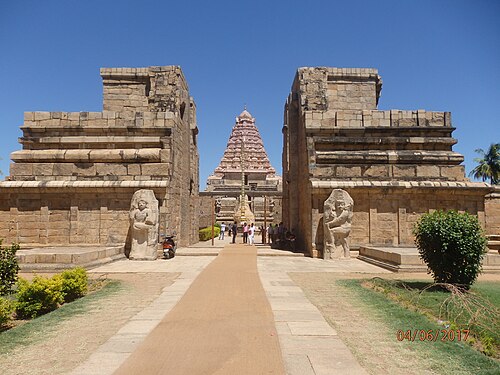 The entrance leads into a grand complex
 -
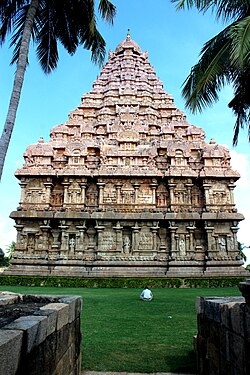 The pyramidal structure above the sanctum at the Gangaikonda Cholapuram Temple
 -
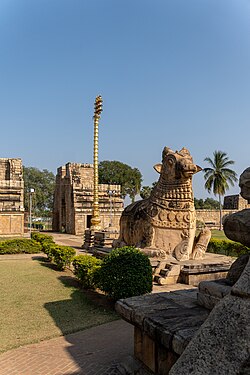
-
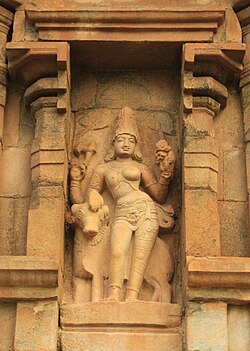 Ardhanarishvara (half Shiva, half Parvati): sculpture at Gangaikonda Cholapuram
 -
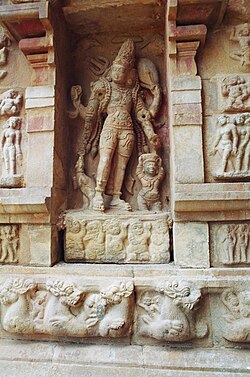 Stone sculpture at Gangaikonda Cholapuram


- Airavatesvara Temple
-
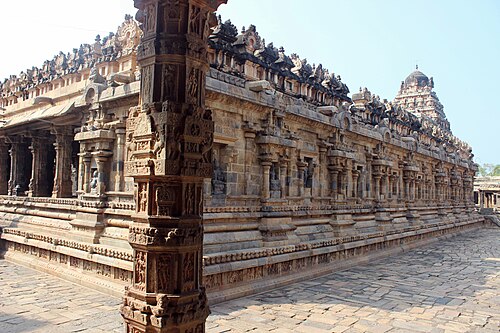 A pillar in Dravidian architectural-style in Airavatesvara Temple
 -
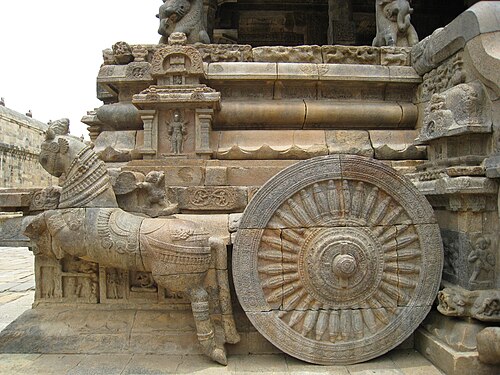 Chariot detail of the Airavatesvara Temple
 -
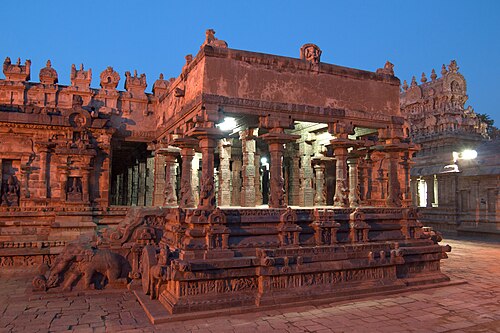 Altar
Altar -
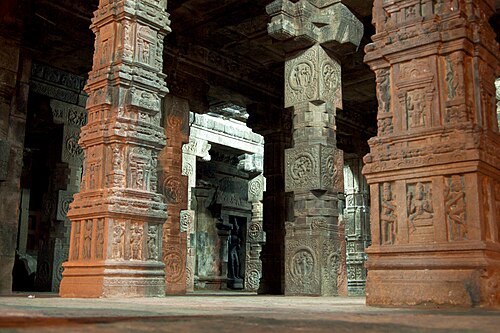 Pillars


References[edit | edit source]
- ↑ "Great Living Chola Temples". World Heritage: Unesco.org. Retrieved 6 November 2010.
- ↑ "Great Living Chola Temples" (PDF). UNESCO. Retrieved 6 November 2010.
- ↑ Thanjavur, Encyclopaedia Britannica
- ↑ 4.0 4.1 4.2 "The Archaeological Survey of India (ASI)".
- ↑ Keay, John (2000). India, a History. New York, United States: Harper Collins Publishers. pp. xix. ISBN 0-00-638784-5.
- ↑ S.R. Balasubrahmanyam 1975, pp. 1-21.
- ↑ Michell, George (2008). Architecture and art of Southern India. Cambridge University Press. pp. 16–21, 89–91.
- ↑ S.R. Balasubrahmanyam 1975, pp. 20-21.
- ↑ S.R. Balasubrahmanyam 1975, pp. 1-26.
- ↑ Gopal, Madan (1990). K.S. Gautam (ed.). India through the ages. Publication Division, Ministry of Information and Broadcasting, Government of India. p. 185.
- ↑ S.R. Balasubrahmanyam 1975, pp. 241-245.
- ↑ 12.0 12.1 12.2 Great Living Chola Temples, Archaeological Survey of India, Government of India
- ↑ Michell 1988, p. 4, 51-53, 145.
- ↑ PV Jagadisa Ayyar (1993), South Indian Shrines, Asian Educational Services, ISBN 81-206-0151-3, pages 291-295
- ↑ S.R. Balasubrahmanyam 1975, pp. 241-249.
- ↑ S.R. Balasubrahmanyam 1975, pp. 243-249.
- ↑ "Great Living Chola Temples". UNESCO World Heritage Centre. 2004.
- ↑ Michell, George (2012). Hegewald, Julia A. B.; Mitra, Subrata K. (eds.). Re-Use-The Art and Politics of Integration and Anxiety. SAGE Publications. pp. 91–93. ISBN 978-81-321-0981-5.
- ↑ Ayyar 1992, pp. 349-350
- ↑ S.R. Balasubrahmanyam 1979, pp. 225-245.
- ↑ Harle, James C. (1994). The Art and Architecture of the Indian Subcontinent. Yale University Press. p. 318. ISBN 978-0-300-06217-5.
- ↑ Dehejia, Vidya (2010). Art of the Imperial Cholas. Columbia University Press. pp. 106–115. ISBN 978-0-231-51524-5.
- ↑ 23.0 23.1 S.R. Balasubrahmanyam 1979, pp. 225-234.
- ↑ Ayyar 1993, p. 351
- ↑ Ayyar 1992, pp. 350-351
- ↑ Pal, Pratapaditya; Huyler, Stephen P.; Cort, John E.; et al. (2016). Puja and Piety: Hindu, Jain, and Buddhist Art from the Indian Subcontinent. University of California Press. p. 65. ISBN 978-0-520-28847-8.
Sources[edit | edit source]
- Ayyar, P.V. Jagadisa (1993). South Indian Shrines. New Delhi: Asian Educational Services. ISBN 81-206-0151-3.
- Chaitanya, Krishna (1987). Arts of India. Abhinav Publications.
- Davis, Richard (1997). Lives of Indian images. Princeton, N.J: Princeton University Press. ISBN 0-691-00520-6.
- S.R. Balasubrahmanyam (1979). Later Chola Temples. Thomson Press. OCLC 6921015.
- S.R. Balasubrahmanyam (1975). Middle Chola Temples. Thomson Press. ISBN 978-9060236079.
- Michell, George (1988). The Hindu Temple: An Introduction to Its Meaning and Forms. Chicago: University of Chicago Press. ISBN 0-226-53230-5.
External links[edit | edit source]
- UNESCO's World Heritage Site listing the Chola temples
| North |  | |
|---|---|---|
| East | ||
| Northeast | ||
| South | ||
| Central | ||
| West | ||